The official magazine of the College of Engineering, Architecture and Technology, Oklahoma State University
2015
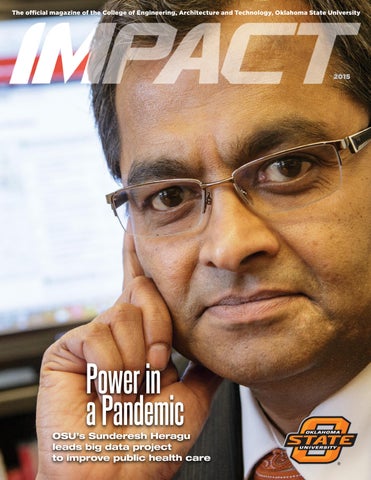
Power in a Pandemic
OSU’s Sunderesh Heragu leads big data project to improve public health care
ON THE COVER
22
Dr. Sunderesh Heragu is leading research to help officials make better decisions in a major health care crisis. PHOTOGRAPHY / PHIL SHOCKLEY / UNIVERSIT Y MARKETING
GOING BOLDLY TO ROME
4
OSU’s study abroad program in the School of Architecture has a new home in the Italian capital city, leaving its original base of Versailles, France
A SPECTACULAR TESTING LAB
A CAREER OF CHALLENGES
18
14
The brand-new Bert Cooper Engineering Laboratory is the largest and most advanced structures and materials testing laboratory in the region.
EXPERIENCE IN THE CLASSROOM
INDEX DE AN’S LET TER DE VELOPMENT & DONOR S H A L L O F FA M E L O H M A N N M E DA L S FAC U LT Y C H A N G E S
Alumnus Ed Robben shares the secrets of his success in the ever-evolving world of technology. 36
The real-world experience of OSU’s engineering technology faculty is a key factor in preparing students for hands-on engineering careers.
CLASSES IN THE COLLEGE OF ENGINEERING, ARCHITECTURE AND TECHNOLOGY DRAW STUDENTS FROM ALL T YPES OF BACKGROUNDS — INCLUDING PISTOL PETE. / PAGE 46
PHOTO / COLLEGE OF ENGINEERING, ARCHITECTURE AND TECHNOLOGY
College of Engineering, Architecture and Technology DEAN, COLLEGE OF ENGINEERING, ARCHITECTURE AND TECHNOLOGY
Paul Tikalsky, Ph.D., P.E., F.ASCE, F.ACI, EACR SENIOR DIRECTOR OF DEVELOPMENT
Tylerr Ropp MARKETING MANAGER AND MANAGING EDITOR
Chelsea Robinson
is a publication of the Oklahoma State University College of Engineering, Architecture and Technology and is designed to provide information on college activities and accomplishments while fostering communication among the CEAT family and friends. WWW.CEAT.OKSTATE.EDU
IMPACT
UNIVERSITY EDITOR
The office of publication for IMPACT is 307 Whitehurst, Stillwater, OK 74078-1024. © 2015, IMPACT. All rights reserved.
Dorothy Pugh
Oklahoma State University, in compliance with Title VI and VII of the Civil Rights Act of 1964, Executive Order 11246 as amended, and Title IX of the Education Amendments of 1972 (Higher Education Act), the Americans with Disabilities Act of 1990, and other federal and state laws and regulations, does not discriminate on the basis of race, color, national origin, genetic information, sex, age, sexual orientation, gender identity, religion, disability, or status as a veteran, in any of its policies, practices or procedures. This provision includes, but is not limited to admissions, employment, financial aid, and educational services. The Director of Equal Opportunity, 408 Whitehurst, OSU, Stillwater, OK 74078-1035; Phone 405-744-5371; email: eeo@okstate.edu has been designated to handle inquiries regarding non-discrimination policies. Any person (student, faculty, or staff) who believes that discriminatory practices have been engaged in based on gender may discuss his or her concerns and file informal or formal complaints of possible violations of Title IX with OSU’s Title IX Coordinator 405-744-9154.
ART DIRECTOR
Paul V. Fleming, BCE, BFA, MS PHOTOGRAPHY
Phil Shockley, Gary Lawson, CEAT Staff CONTRIBUTING WRITERS
Marketa Krcalova, Ryan Doonkeen, Pam Covington, Jeff Joiner, Janet Reeder, Mallory Pence, Milissa Gofourth, Jim Self and Paige Worley
This publication, issued by Oklahoma State University as authorized by the College of Engineering, Architecture and Technology, was printed by University Marketing Services, University Printing Services, at a cost of $14,575/July 2015/job #6016.
2 56 60 62 67
GARY LAWSON / UNIVERSIT Y MARKETING
From the Dean’s Office
••••••••••••••••••••••••••••••••••
T
he demand for practicing engineers and engineering technologists continues to rise as the world seeks new and innovative methods to manage power infrastructure, optimize energy, manufacture goods in a sustainable manner and address global challenges. The College of Engineering, Architecture and Technology (CEAT) at OSU is dedicated to providing the education and hands-on experiences necessary to prepare the next generation of engineers, architects and technologists.
CEAT continues to be one of the fastest-growing colleges on the Stillwater campus with a 42 percent increase in undergraduate engineering enrollment over the past five years. These students continually prove to be top performers, excelling in the classroom and in leading university organizations and clubs. With help from generous donations, nearly half of these students were able to graduate from CEAT without any student loan debt last year. Graduate students are also reaping the benefits of the college’s growth and excellence. Graduateprograms.com recently ranked OSU’s CEAT No. 3 in the country for career support. These successes are the beginning of where the college is headed in the coming years. As one of roughly 120 universities in the country — and the only one in Oklahoma — that is pursuing the National Academy of Engineers Grand Challenges Scholars Program, the college is on the brink of becoming a premier leader in the nation’s leading engineering initiatives as defined by the NAE, the United Nations Millennium Goals and the White House Strategy for American Innovation. The program will empower the college to challenge students through a special program that addresses the world’s major engineering issues and allows the students to be nationally recognized as Grand Challenge Scholars. Our students, faculty and partners are also seeing significant changes in our facilities, including the recently opened Student Excellence Center, located on the first floor of the Advanced Technology Research Center, and the Bert Cooper Engineering Laboratory, designed as a groundbreaking structures and materials testing facility. The Student Excellence Center offers students 24-hour access to study, work in groups and connect with college student services and scholarships.
The Cooper Lab was officially opened in April more than a decade after its namesake Bert Cooper and Gorman Gilbert, former civil and environmental school head, envisioned it. A longtime partnership between the college and the Oklahoma Department of Transportation produced the lab’s first contract, which involves moving the Highway Construction Materials Technician Training and Certification program from its Oklahoma City location to the new facility in Stillwater. With the four largest classes in college history now enrolled at OSU, the college is focusing on developing the nation’s most advanced undergraduate laboratory building with integrated design input from leading industry experts, hands-on experimental systems and room for students to innovate and discover new ideas. Oklahoma City’s FBS in partnership with Dallas-based HKS are leading the architectural design. The conditions of CEAT’s labs have diminished over time, and the rise in enrollment and technology has made it necessary to create labs for the 21st century. While the state has not provided any direct capital funds for engineering labs, OSU has agreed to match major gifts, students have endorsed an increase in labs fees, and a donor has agreed to provide a $2,500 scholarship for every donor who provides a personal gift of $2,500 or more toward the lab building. I urge all the alumni of CEAT to get engaged to help make CEAT’s future every bit as great as its past!
GO POKES! PAU L J . T I K A L S K Y DE AN, COLLEGE OF ENGINEERING, A R C H I T E CT U R E A N D T E C H N O LO GY IMPACT
MAGAZINE
1
National Scholarship Program comes to CEAT ._:a.:,,
GRANDCHALLENGES FORENGINEERING Nearly a quarter of the country’s engineering schools have unified to establish a new, impactful
GRAND CHALLENGES FOR ENGINEERING . As a member of this
scholarship program —
leadership group, THE COLLEGE OF ENGINEERING, ARCHITECTURE AND TECHNOLOGY (CEAT) is committed to graduating students who are specifically PRESIDENT BARACK OBAMA GREETS SCIENCE, TECHNOLOGY, ENGINEERING AND MATH LEADERS INCLUDING NATIONAL ACADEMY OF ENGINEERING PRESIDENT C.D. MOTE JR. DURING THE 2015 WHITE HOUSE SCIENCE FAIR. (OFFICIAL WHITE HOUSE PHOTO BY PETE SOUZA)
2 FA L L 2 0 15
trained and educated to tackle the world’s leading engineering challenges.
IMAGES / ENGINEERINGCHALLENGES.ORG
OSU CEAT Dean Paul Tikalsky says GRAND CHALLENGES SCHOLARS will work on innovation throughout their four years as they take on engineering challenges of the next generation. THE PROGRAM WILL FOCUS ON FIVE AREAS THAT INCLUDE: □
A hands-on research or design project connected to one of the Grand Challenges topics.
□
Learning with industry partners.
□
Entrepreneurship and innovation experience.
□
Global and cross-cultural perspectives.
□
Service learning.
“They will experience the global context of these challenges through study abroad and international teams,” Tikalsky says. “They will work in OSU’s New Product Development Center with our world-class faculty and industry partners to develop methodologies and prototypes.”
IMPACT
MAGAZINE
The training model was inspired by the National Academy of Engineeringendorsed Grand Challenges Scholars Program established by ASEE’s Council of Engineering Deans in 2009. The Grand Challenges for Engineering programs have graduated more than 160 NAE-designated scholars. OSU will be part of the expansion of this national movement aimed at boosting that number to more than 20,000 formally recognized Grand Challenges Engineers over the coming decade. CEAT is proud to be a leader of this innovative movement and looks forward to establishing the inaugural group of scholars in the coming years. 0
A AC
DEM Y OF E
N
EERING
A visual representation of the existing 14 GRAND CHALLENGES FOR ENGINEERING IN THE 21ST CENTURY: (from top down) solar, carbon, fusion, nitrogen, water, infrastructure, nuclear terror, brain, medicine, health, cyberspace, personal, virtual reality, and discovery tools.
Many will do capstone projects and an Honors College thesis to complete the challenges. These pieces of the program will weave the practical experience into traditional textbook learning in a manner that will give students a wellrounded and unprecedented engineering education in tOklahoma.
N GI
The developments created by the Grand Challenges students will be a first step in transforming the engineering industry’s impact on the biggest issues society faces in the modern world. Student projects will be more than experiments
“These students will receive scholarships and support as part of our program, Tikalsky says. “They will bring the best of OSU engineering to the world.”
L
WHITE HOUSE STRATEGY FOR AMERICAN INNOVATION, the NATIONAL ACADEMY OF ENGINEERING (NAE) GRAND CHALLENGES FOR ENGINEERING and the UNITED NATIONS MILLENNIUM DEVELOPMENT GOALS.
— they will be tangible ideas and products that affect some of today’s most prominent and frequently used processes.
NATIONA
PRESIDENT OBAMA endorsed the program on March 23 at the White House Science Fair, signing the letter of commitment sent on behalf of 122 higher education institutions. THE GRAND CHALLENGES PROGRAM will focus on approximately 20 engineering problems as identified by the
FO
UN
DED 1
96
4
FOR MORE INFORMATION ON THIS INITIATIVE, INCLUDING THE PRESIDENT’S LETTER OF COMMITMENT AND A MAP OF THE PARTICIPATING UNIVERSITIES, VISIT NAE.EDU.
3
From France to Italy S TO R Y BY M A R K E TA K R CA LOVA
Architecture’s study abroad program moves to Rome T H E S IX- CR E DI T H O U R S TU D Y A B R O A D P R O G R A M IN T H E S CH O O L O F A R C H I TEC TU R E H A S I TS F I R S T N E W H O ME S I N C E I TS B EG I N N I N G I N 19 8 2 .
Previously based in Versailles, France, as an associated program with the University of Illinois, the program’s primary base moved to Rome in the summer of 2014. The change was sparked by the University of Illinois program’s move to Barcelona, Spain. OSU faculty members have been going to Rome for nearly 20 years and have developed many connections in Italy’s capital city, making it a natural choice for the new home.
Above: A sketch from the journals kept by faculty and students on the study abroad trip.
4
“Rome is just a wonderful place for architecture programs,” says Randy Seitsinger, professor and head of the School of Architecture at Oklahoma State University. OSU professor David Hanser launched the program to provide students with real-life experience and a new perception on international architecture.
FA L L 2 0 15
The school works with the Pantheon Institution in Rome, which helps provide housing. Students stay in Santa Maria in the Cappella student residence, a complex close to the Tiber River and just a short walk away from the historic city center, allowing students to truly experience Italy as residents. The study abroad experience provides personal growth and accelerated architectural thinking and skills for students, who complete analysis projects, sketches and journals, as well as directed individual independent studies. It may not sound like part of an academic study, but journals are based on a longtime tradition. For hundreds of years, architects travelling in Europe kept daily records of their experiences. The School of Architecture requires journals from its students and considers them the most valuable records of
the students’ stay in Europe — tangible evidence that can be brought back to the United States. Journals include daily records of lectures, discussions, experiences, and observations of buildings, gardens and architectural details. Since architects and engineers communicate primarily through annotated drawings, the journal is often a visual record of experiences with supplementary notes. Students’ schedules include some free time to explore Rome. Students make multiple visits to different areas with faculty members, but the main program focus is on visual analysis and observing architecture. Most of the buildings and European architecture have been covered in classes, but students can experience the information in their textbooks in person here.
“For architects, it’s so important to be able to experience the observation,” says Seitsinger. “Your viewpoint changes, how you perceive the space changes and how you feel changes.” Students also travel in small groups on their own, doing independent study. Faculty members assist the students on their topics, and the students record and document their experiences in their journals. Throughout the experience, especially during their independent study weeks, students reconnect with the art of architecture. Computers are important in today’s world, but architecture students still need to learn how to draw. Rome offers a great place for learning with many historical architectural buildings that are perfect practical applications.
f
continues
5
“For architects, it’s so important to be able to experience the observation.” — Randy Seitsinger, professor and head of the School of Architecture
Students’ expectations are high leading into the trip. Those who’ve gone before them enjoy their time so much that they can be found sharing their experiences of this life-changing trip with their peers. Students preparing for the next summer’s trip expect to open their eyes to different perspectives and see firsthand how others live in different parts of the world. “In our studies of architecture, we will explore the ancient neighborhoods of Rome, take in monuments like the Coliseum and try to gain new insight into the thinking behind legendary religious architecture like the Cathedral of Notre Dame in Paris,” says Cameron Patterson, an architecture student. Patterson says he’s prepared to feel like a tourist in the beginning of his trip but knows he will start to build confidence and assimilate to the culture over time. “Given time, we will be traveling via public transit with wind in our sails, and we will begin to see the spaces, buildings and environments in a clear, honest light,” he says. Students pay for the six-credit class as well as the airfare; however, the School of Architecture offers many study abroad scholarship options, including the Eason Leonard Endowment and the Mike and Sharon Damore fund.
6 FA L L 2 0 15
_,,,__,, 1"~$
.... 4'trtfl""•~t..,/
..,.,_.,,
-~"
--···-"'· ~·~~
bF6n<
P'WWY
I•
:---~=~ ~.IIC'>I""~.
~V'>/if<AI\,.,
v/~u'~
The summer study abroad trip offers a life-changing experience that will be valuable for students in their future careers. “If I had never gone to Europe, I would have never seen the potential of the world and the potential of this profession,” says Andrew Klare, 2001 architecture alumnus. “I don’t think I would be where I am today.”
a
AT A
GLANCE
H E AD
R ANDY S EIT S INGER, AIA
SCHOOL OF
Architecture
ENROLLMEN T
FO CU S A R EA S
D EG R EE O P TI O N S
29 0 und e rg radu ate s
Building syste m s
A rc h i tec tu re
Co m pu te r a rchite cture
A rc h i tec tu re Eng i neeri ng
FAC ULTY
9 p rofe s so rs 9 as sociate p rofe s so rs 7 as s ista nt p rofe s so rs
ENDOWED POS ITI ON S
1 p rofe s so rs hip
Co m me rcial building De s ig n a nd stru ctural co nce pts Digital syste m s Enviro nme ntal d e s ig ns H isto rical a rchite cture I nnovative d e s ig ns M ate rials M o d e rn a rchite cture S tru ctural syste m s S u staina ble building U rba n d e s ig n
IMPACT
MAGAZINE
7
Momentum is pushing undergraduate lab plans forward ••••••••••••••••••••••••••••••••••
The flexibility of the labs will allow instruction to adapt to evolving technologies while meeting the needs of CEAT students. Two lecture halls will offer large teaching spaces and an area for industry partners to mentor and host events. Students will be able to develop relationships with engineering-related companies by connecting real-life issues in the field to applied solutions they develop in labs through the entrepreneurial hub. This area will be open to students interested in further establishing their concepts into tangible products and services. The senior design studio and student gallery will allow students to display their work, know they are receiving a quality education that will prepare them to enter the workforce as world-class engineers. Recently, the OSU Board of Regents approved architects Frankfurt + Short + Bruza of Oklahoma City and HKS of Dallas to assist the university in the design and construction of the new building. The project is building momentum, and several leadership gifts have already been donated. OSU has made the project a top priority and is offering capital matching funds to those making investments in the new facility. Please consider supporting the next era of engineering, architecture and technology education at Oklahoma State University. 0
T
he College of Engineering, Architecture and Technology’s success is built on a foundation of transforming math and science into ideas, devices and processes that improve the world and advance business opportunities that support society as a whole.
WE NEED YOUR HELP TO CONTRIBUTE TO THE NEW CEAT UNDERGRADUATE LABORATORY BUILDING, CONTACT TYLERR ROPP, SENIOR DEVELOPMENT OFFICER, AT TROPP@OSUGIVING.COM OR 405-385-5664.
A new 55,000-square-foot building dedicated to undergraduate labs will further support the college’s success and add value to the quality of each degree earned from CEAT by encouraging big ideas and developing tomorrow’s innovative leaders. This plan will modernize the college’s lab spaces and give Oklahoma State a competitive edge among peer institutions.
8
The building will help nearly 4,000 students each year master basic engineering principles at a small scale that will later translate into larger, more complex projects and scenarios as they move into advanced education, specialization and careers. The facility will house 14-16 reconfigurable research laboratories spread strategically throughout its four floors along with lecture halls, a student gallery, an entrepreneurial hub and a capstone design studio for industry-defined projects. TOP AND ABOVE: TENATIVE RENDERINGS OF THE FUTURE UNDERGRADUATE LABORATORY BUILDING.
FA L L 2 0 15
AT A
GLANCE
H E AD
DAN THOMAS, Ph.D., P.E., F. ASABE, F. AS CE
SCHOOL OF
Biosystems and Agricultural Engineering
ENROLLMEN T
D EG R EE O P TI O N S
110 und e rg radu ate s
Bio mas s g as if icatio n
Biomecha n i ca l
42 g radu ate s
Bio p roce s s ing
Bioproces s i ng a nd Bio -tech no log y
Ecolo g y m as s FAC ULTY
9 p rofe s so rs 6 as sociate p rofe s so rs 3 as s ista nt p rofe s so rs
R E SEARCH AREAS
A ir p ollu tio n A nimal waste Bio base d p ro du cts Bio e ne rg y Bioche mical Biof ue ls Bio mas s
Enz y m atic hydrol ys is
Env i ron men t a nd Natu ra l Resou rces
Etha nol
Food Proces s i ng
Fire co ntrol H yd raulic e ngine e ring M a nu facturing R eacto r d e s ign R e gulatio ns S e dime nt co ntrol S u staina bilit y S y nthe s is g as fe rme ntatio n Wate r qu alit y Waste m a nag e m e nt e ngine e ring
IMPACT
MAGAZINE
9
“Our motto is ‘don’t screw up.’ Students will be successful no matter what, and our job is to not demotivate them and make them lose their confidence.” — Rob Whiteley
10 FA L L 2 0 15
Rob vhiteley
Leaving a Legacy S TO R Y BY M A R K E TA K R CA LOVA
Longtime faculty member and school head makes impact Rob Whiteley, Ph.D., has been part of the chemical engineering program at Oklahoma State University since 1991 and school head since 2012. His contributions to OSU have helped shaped the School of Chemical Engineering and the College of Engineering, Architecture and Technology in many ways. “Over the last two years, Dr. Whiteley has worked to transform the chemical engineering school into a world-class academic program, both at the undergraduate and graduate level,” says Paul Tikalsky, dean of the College of Engineering, Architecture and Technology. After receiving his bachelor’s degree in chemical engineering in 1977, Whiteley worked for nearly 10 years at three different companies, concentrating on chemical engineering. Working in the industry heavily influenced his teaching and gave him a special perspective. His experience was reflected in his lectures, homework assignments, projects and exams. He then went on to finish his master’s degree and doctorate in chemical engineering at Ohio State University. “I am most proud of our students and faculty, both the young and the experienced, and what they accomplished academically and professionally,” says Whiteley. “I think that everybody in our faculty had major accomplishments throughout the past two years, and it’s really fun to see the success.”
11 Whiteley has high standards for the students, faculty and staff around him, as well as for himself. This never changed, even after he became the school head. “His high standards were demonstrated by the fact that his classes were the toughest ones I had while in the chemical engineering program at OSU,” says Josh Ramsey, now an associate professor in the School of Chemical Engineering. “He also held himself to the same high standards, though, and this was demonstrated by the fact that his classes were some of the courses where I learned the most.” continues
~MAGAZINE
AIChE Design Contest winners, from left, Brian Callihan, Sean Hockersmith and Richard Bruce. They are flanked by design course instructors Rob Whiteley, left, and Jan Wagner.
Whiteley stresses the importance of treating everybody with equal respect. This collective attitude of working hard and treating people well brings quality results and gives everybody a chance to contribute as much as they can. As a school head with many administrative duties, Whiteley has less direct involvement with students. The position gives him a chance to do his best work for students and faculty members, along with making sure they have the best opportunities to learn and work. He is determined to achieve the goals of the School of Chemical Engineering and OSU. “Our motto is ‘don’t screw up,’” says Whiteley. “Students will be successful no matter what, and our job is to not demotivate them and make them lose their confidence.”
His tenure has produced significant results for the college. Chemical engineering’s enrollment has doubled since 2007, making it the second-largest school in the college of engineering. Whiteley hired three new faculty members last year, and the school is also planning on increasing the number of faculty members from 12 to 20 in the future. “It’s been exciting to be a school head during this period,” says Whiteley. “Previous school heads didn’t have luxury of this kind of growth, and the circumstances were more difficult.” The feedback reflects how successful Whiteley was in his dual role as a professor and school head, maximizing students’ talent and helping them to accomplish their goals. He also mentors young faculty members. “Now that I’m a fellow Ph.D. colleague, Dr. Whiteley continues to be supportive of my research career with dynamic conversations, hosting visits to OSU, providing invaluable career advice and being an avid fan and cheerleader,” says Cassie Mitchell, a former OSU student and research engineer at Georgia Institute of Technology. His leadership fosters a strong research environment. His positive impact on the department is not easily measured, but is definitely seen. The School of Chemical Engineering is looking at a complete renovation of the department next year, and Whiteley has hopes to design the solution for the next generation.
a
12 FA L L 2 0 15
Jan Wagner, Ph.D., Professor Emeritus, Chemical Engineering, left, with Rob Whitley.
AT A
GLANCE
H E AD
JAMES (ROB) WHITELE Y, Ph.D
SCHOOL OF
Chemical Engineering
ENROLLMEN T
435 und e rg radu ate s 50 g radu ate s
FAC ULTY
5 p rofe s so rs 3 as sociate p rofe s so rs 5 as s ista nt p rofe s so rs 2 re sea rch as s ista nt p rofe s so rs
ENDOWED POS ITI ON S
Pol y me ric syste m s
CFD-co m bu stio n reacto r d e s ign
Proce s s d eve lo p me nt
Fluid me cha nic s
R eacto r d e s ign
Emuls io n Fo rmatio n a nd S ta bilit y
S u staina bilit y
Enha nce d unco nve ntio nal g as re cove r y
T he rm o d y na mic s a nd the rmo p hys ical p ro p e r t y p re dictio n
G as te sting
T is su e e ngine e ring
G e ne d e live r y
V isco e lasticit y
H eat tra nsfe r
Wate r p roce s s a nd io n excha ng e
5 chairs
M as s Tra nsfe r
1 fe llows hip
N ate rial scie nce
D EG R EE O P TI O N S
M o d e ling
Chem i ca l Eng i neeri ng
R E SEARCH AREAS
Ad a ptive f ilte ring Biof ue ls Bio me dical
N a no pa r ticle s a nd bio m e m b ra ne s
• B i o m ed i ca l / B i oc h em i ca l o pt i o n
Petroleum e ne rg y a nd ref ining
• Env i ro n m en t a l o pti o n • Pre -m ed o pti o n
Phase e quilib rium
Biote chnolo g y IMPACT
MAGAZINE
13
“We are committed to having the finest structures engineering program in the nation … it is also the result of a rare partnership between the private sector, the public sector and the university.” — Gorman Gilbert, former head of the School of Civil and Environmental Engineering
THE BERT COOPER ENGINEERING LABORATORY IS 33,000 SQUARE FEET OF SUSTAINABLE STRUCTURES TESTING FACILITY — THE BEST IN THE REGION.
14 FA L L 2 0 15
Open Doors
••••••••••••••••••••••••••••••••••••••••••••••••••••••••••••••••••• P H OTO S BY C O L L E G E O F E N G I N E E R I N G , A R C H I T E CT U R E A N D T E C H N O LO GY
Cooper Lab welcomes new research and contracts in its first year Oklahoma State’s College of Engineering, Architecture and Technology is now home to the largest and most advanced structures and materials testing laboratory in the region — the Bert Cooper Engineering Laboratory. Two of the project’s original pioneers died before they could see the building come to fruition, but they were there in spirit as the college proudly presented the lab to alumni, donors and friends at the grand opening ceremony on April 22. ENVISIONING THE FUTURE More than a decade ago, two engineers came together with a vision for a stateof-the-art structures and materials testing lab. Bert Cooper, former W&W | AFCO Steel CEO and OSU alumnus, and Gorman Gilbert, former head of Civil and Environmental Engineering, saw the impact that such a facility would have on the university, state and region. They set out to build momentum for the project, and in 2003, broke ground at a location near the current Fire Protection Publications building. “This project is extremely exciting to us,” Gilbert said in 2003. “We are committed to having the finest structures engineering program in the nation and not only does this world-class lab help us attain that goal, it is also the result of a rare partnership between the private sector, the public sector and the university.”
occur,” Cooper said at the original groundbreaking. “Concrete is a big competitor of ours, but we recognize that anything we can do to further the economic feasibility of concrete, steel and other construction industries in the state benefits all of Oklahoma.” Cooper led the financial support for the building, donating all of the needed structural steel and taking a leadership role in ensuring the lab had the technology necessary to serve the college in the future.
Both men left a lasting legacy at the college, university and in their respective industries. Bert Cooper died Feb. 28, 2013, and Gorman Gilbert on Dec. 13, 2014. BUILDING A REALITY Fast-forward to spring 2015 at a location west of the Professional Development building north of the main Stillwater campus. Nearly 250 people arrived at the Bert Cooper Engineering Laboratory to celebrate its opening and remember those who initiated the project. The continues
MORE THAN 200 PEOPLE ATTENDED THE APRIL GRAND OPENING OF THE BERT COOPER ENGINEERING LABORATORY.
Gilbert was instrumental in the partnership that brought the dream to life. As colleagues and friends, Gilbert worked with Cooper to create a plan that would better educate the structures engineers and produce quality employees for industry. “Our industry’s forward momentum is dependent upon research and development of new products, and we need a facility in the state where that can IMPACT
MAGAZINE
15
Members of the OSU administration expressed gratitude to the supporters and shared their enthusiasm that the lab would begin operation immediately. “A variety of circumstances stalled and delayed the project, but more than a decade later, the lab is more than anyone ever imagined it would be,” Tikalsky said. “The lab is as technologically advanced as any other facility in the country.”
THE DONOR WALL RECOGNIZES THE MANY SUPPORTERS OF THE LAB, AND ESPECIALLY RECOGNIZES BERT COOPER AND GORMAN GILBERT.
facility was constructed as 33,000 square feet of sustainable laboratory space with five project offices, nine labs, a graduate studio, a conference room, a 20-ton crane and a 4-foot-thick strong floor. The lab mimics a real-world environment, providing a place to conduct groundbreaking research in structures and materials testing. “The Cooper Lab will be home to developing the next generation of structural materials and sensor technology, and we hope to showcase the world-leading geothermal technology developed within our college,” says Paul Tikalsky, dean of the College of Engineering, Architecture and Technology. “The geothermal technology that was developed right here at OSU is now used around the world. We hope that the Bert Cooper Engineering Laboratory will provide a working example for energy efficiency and environmental sustainability in buildings.”
16
The facility incorporated environmentally sustainable construction methods developed by OSU faculty and researchers, from low-carbon concrete mixtures for foundations to the geothermal ground-source heat pump systems. It is
one of the first major building projects in Oklahoma to use a blended cement containing limestone flour and fly ash. These reduce the building’s environmental footprint 40 percent. Also, 96 percent of the structural steel is made from recycled materials. In addition, the building features high-efficiency plumbing and solar shading both inside and outside. At the time of the grand opening, materials were already being delivered for the first round of research. Steel beams provided by W&W | AFCO Steel were set up as the main stage for the event, creating a background that truly conveyed the nature of the space. A plaque dedicated to Gilbert and Cooper was installed inside the high bay area as a tribute and reminder of those who first envisioned the world-class lab. PARTNERING WITH OKLAHOMA Several stakeholders spoke during the grand opening ceremony, including OSU President Burns Hargis, CEAT Dean Paul Tikalsky, W&W | AFCO Steel CEO and President Rick Cooper, Civil and Environmental Engineering School Head John Veenstra and Oklahoma Department of Transportation Executive Director Mike Patterson.
FA L L 2 0 15
Rick Cooper, Bert Cooper’s son and successor to the family company, expressed pride in the space his father dedicated so much time to getting started and gave a touching tribute to those who continually battled the obstacles that come with building a state-ofthe-art facility. “Our family greatly appreciates everyone who made this a reality, it’s been worth the wait,” Rick Cooper says. “Dad shared Burns’ vision and passion for Oklahoma State; he, too, wanted it to be the best land-grant [university] in the United States, and one piece of that puzzle was for the College of Engineering to be a pre-eminent college in the country. There’s no question that goal has been achieved.” ODOT’s Patterson announced that the Highway Construction Materials Technician Training and Certification Program would move from its Oklahoma City location to the Cooper Lab. “A lab like this, and the research that is developed in this space, will change transportation in Oklahoma and across the country,” Patterson said. “Having a training facility and resources like this puts ODOT on the map.” Through this partnership, ODOT begins teaching courses in fall 2015 with a combination of ODOT and OSU staff. 0 □ CHELSE A ROBINSON
VISIT OSTATE.TV TO WATCH THE FULL GRAND OPENING CEREMONY.
AT A
GLANCE
H E AD
JOHN V EEN STR A , Ph.D, P.E.
SCHOOL OF
Civil and Environmental Engineering
ENROLLMEN T
R E S E AR C H A R EA S
286 und e rg radu ate s
Co ncrete
Pave me nt d ata syste m s
81 g radu ate s
Co nstru ctio n
R e cycling
Ene rg y
S e nso rs a nd d ata tra nsfe r
Enviro nme ntal biolo gical p roce s s
Soil ef fe cts
G e ote chnical
S tru ctural e ngine e ring
G I S (g e o gra p hic info rmatio n syste m s)
S te e l stru cture s Tra ns p o r tatio n
Pave m e nt co nstru ctio n
Wate r qu alit y
FAC ULTY
6 p rofe s so rs 5 as sociate p rofe s so rs 7 as s ista nt p rofe s so rs
ENDOWED POS ITI ON S
2 chairs
D EG R EE O P TI O N S
1 p rofe s so rs hip
Ci v i l Eng i neeri ng • Env i ro n m en t a l o pti o n
IMPACT
MAGAZINE
17
Serial Mover
STORY BY RYAN DOONKEEN / PHOTOGRAPHY BY PHIL SHOCKLEY / UNIVERSITY MARKETING
Successful alumnus shares career and industry knowledge on OSU campus “A journey is a person in itself; no two are alike. And all plans, safeguards, policing, and coercion are fruitless. We find that after years of struggle that we do not take a trip; a trip takes us.” — John Steinbeck John Steinbeck could not better describe the path that Fossil Group’s Chief Information Officer Ed Robben has taken to get where he is today. Robben, a School of Electrical Engineering alumnus from Oklahoma State University, is a self-proclaimed “serial mover.” After working as an information technology executive for BNSF Railway and a consultant at the Feld Group and EDS, Robben set his sights on retail and helping J.C. Penney keep up in the evolving world of technology. Looking for challenge after five lL(lJJ1DJikrrIIB~ foir another ffiIIBIDJ(t@eir ir:lmru[IlQ;:IIB~e ruil\lQ;:ir iffiwe
<Cil(Q) (D)if:the (l;@eFossil lfo:;;§iill yeruir§, !Fl(lJJlblbieIIB lbiecrume the (l;@eCIO years, Robben became of
Group in June 2012. The company, based in <GmlUl]Pl iiIIBjlU!IIBe :2(0)1ll,'flme tr:(DJM]PlffiIIBY, ibru§etdl iiIIB itlme [)Jrullllru§ slUlibilUlirlbi (DJ[Richardson, !Flkimffilftdl§(DJIIB, 1I'el!ru5,knew lfoew the Dallas suburb of Texas, that developing capabilities to engage customers and listen to their needs with a targeted, analytical approach was the only way to continue its success, and Robben would play a large role in that.
Dealing with cybersecurity, millions of consumers’ personal information, complying with the regulations of up to 150 governments (Fossil products sell in 150 countries, and the company has locations in 27) is becoming more and more complex. Robben prides himself on being able to work daily with some of the smartest people he knows. “The experience and being able to see all the different companies how they think about technology and how it’s applied has been great,” Robben says. “Meeting great people along the way and having great projects to work on has helped me move up in my career. I love the leadership aspect of it, and that’s why I’ve gravitated toward the position of CIO. Working with the leaders and the teams really energizes me.” continues
18 FA L L 2 0 15
“Have a clear vision and focus and understand the risk. Be flexible and at the end of the day, remain calm.” — Ed Robben
19
OSU ALUMNUS AND FOSSIL GROUP CIO ED ROBBEN SPEAKS ABOUT HIS SUCCESS IN ENGINEERING AND THE FUTURE OF THE INDUSTRY DURING THE HALLIBURTON GLOBAL INNOVATORS SERIES ON APRIL 2.
“Today’s advances in wearable technology are exciting,” Robben says. He’s seeing it on a daily basis at fashion company Fossil, but he has always been around innovation throughout his career. Robben worked with the global positioning system in its infancy in the early ’80s. At the time, the systems weren’t the super-compact devices of today; they were closer to the size of microwave ovens, he says. He’s seen his work on GPS systems evolve into radio frequency identification (RFID), which keeps track of everything from rail carts to shirts at J.C. Penney and now to wristwatches that can track your every move. IrilITll<err, line is TI§excited e1<:d1te<!ll il:(Q)see §<eethis 11:lhin§ As an avid runner, he to wearable technology’s impact on running. The demand to make this tightly packed technology into something that goes as well with khakis as it does running shoes is one of the challenges that Fossil and Robben are tackling.
Robben can attribute much of his success to his experience at Oklahoma State University. He says he uses the problem-solving skills he developed while getting his bachelor’s degree in electrical engineering at OSU daily in business. He participated in a co-op program that was once in place for three semesters, gaining invaluable experience. Entering the professional world with production-level programming experience under his belt kick-started his career and gave him the ability to move up the ladder very quickly. Still, he says the best thing to happen to him at OSU was when, “I met my wife of 31 years at Oklahoma State. She’s the mother to my 3 daughters, all of whom are now a part of the OSU family. “I met a lot of great people, and OSU does great things and continues to get better each time I visit,” says Robben. “I’m really proud of the university and everything that they’re doing.” He offers advice for today’s students: “If you’re in the field of change or driving to create change, believe it can be done,” says Robben. “Have a clear vision and focus and understand the risk. Be flexible and at the end of the day, remain calm.”
20 FA L L 2 0 15
AT A
GLANCE
H E AD
JEFFERY YOUNG, Ph.D.
SCHOOL OF
Electrical and Computer Engineering
ENROLLMEN T
401 und e rg radu ate s 235 g radu ate s
FAC ULTY
13 p rofe s so rs 7 as sociate p rofe s so rs 4 as s ista nt p rofe s so rs 1 vis iting as s ista nt
ENDOWED POS ITI ON S
Co m municatio ns syste m s a nd s ig nal p roce s s ing
Pat te rn re co gnitio n a nd m achine lea rning
Co m pu tatio nal inte llig e nce, p e rce ptio n a nd neuroscie nce
Photo nic s
Co m pu te r s imulatio ns
Plas mo nic s
Digital a nd e m b e d d e d syste m s
R o b otic s a nd e m b e d d e d co m pu ting se nso rs
Ele ctro nic mate rials a nd d evice s
Sola r hydro g e n
Ene rg y a nd re newa ble e ne rg y source s
S yste m s the o r y a nd instrum e ntatio n
I mag e p roce s s ing a nd co m pu te r vis io n
Te ra he r t z p hoto nic s T he rmo e le ctric
2 chairs
I nte llig e nt syste m s a nd co ntrol
3 p rofe s so rs hips
L ase r o ptic s
T is su e e ngine e ring U ltrafast fe mtose co nd lase rs
M e dical imaging
Ve r y la rg e scale inte g ratio n
R E SEARCH AREAS
M icro e le ctro me cha nical syste m s
L ase r s p e ctrosco py
M eta mate rials
D EG R EE O P TI O N S
Bio mate rials
N a no m ate rials
Elec tri ca l Eng i neeri ng
Bio p hoto nic s/bio me dical o ptic s
O ptical im aging
Com pu ter Eng i neeri ng
Clas s ical o ptic s IMPACT
MAGAZINE
21
Using Data in Health Care S TO R Y BY PA M C OV I N GTO N
OSU industrial engineering faculty, students unite on innovative projects Several OSU industrial engineering faculty members and students are involved in research aimed at improving public safety and health with big data analytics. Sunderesh Heragu, Ph.D. and head of OSU’s School of Industrial Engineering and Management, is the lead investigator in an ongoing project to develop a decision support system for a pandemic influenza response. This system takes the guesswork out of making decisions during a public health emergency by pulling together information. For example, the system can determine which airport in a state or which routes would be best to receive shipments of aid. A system like this can determine the quickest, most efficient way to deliver vaccinations or other treatments, taking into account minute details such as the capacity of each vehicle, speed limits on the selected routes, traffic conditions, road repairs and weather conditions. It can even send the vehicle drivers pictures from DOT cameras on highways so that drivers en route can judge traffic tieups.
22
WORANAT WONGDHAMMA IS WORKING ON A WIRELESS, WEARABLE MULTISENSORY SYSTEM THAT CAN DETECT SLEEP APNEA WHILE A PATIENT IS AT HOME — AND EVEN PREVENT SUCH ATTACKS. PHOTOGRAPHY / GARY LAWSON / UNIVERSIT Y MARKETING
FA L L 2 0 15
About 50 experts in health care, industrial engineering and computer science have been involved in developing the pandemic decision support system over the past three years. The system is now in the process of being commercialized and has already been used in drills in Georgia, Kentucky, Alabama, Florida, North Carolina, South Carolina, Tennessee and Mississippi. Heragu says decision support tools have been developed for public health officials, first responders and hospitals. One module has been used in a realworld mass vaccination clinic. In 2009,
19,000 vaccines were administered in 1½ days in a mass drive-through clinic in Louisville, Ky., a world record. Apps have also been developed for resource allocation. For example, as soon as a ventilator becomes available in a hospital, a nurse could swipe the ventilator bar code, and the database would be updated to show that the resource is available. As another example, the resource allocation system could determine how many vehicles of different types are needed to evacuate patients from a hospital in the
path of a hurricane and how to allocate these patients to other hospitals in unaffected areas. Other countries such as China are also interested in a resource allocation tool, which can be used for transporting resources such as grain during a famine or earthquake, a mobile hospital, pallets of food or any number of other resources. “That’s what big-data analytics is all about — taking large amounts of data, mining through it, processing it, and then using the processed information to make real-time decisions,” Heragu says. continues
23
“That’s what big-data analytics is all about — taking large amounts of data, mining through it, processing it, and then using the processed information to make real-time decisions.” — Sunderesh Heragu
PHOTOGRAPHY / GARY LAWSON / UNIVERSIT Y MARKETING
Industrial engineering faculty member Tieming Liu is also working to improve health care. Liu is using his data analytics skills with the large database of OSU’s Center for Health Systems Innovation, analyzing strategies to predict and prevent diabetes. Industrial engineering doctoral student Woranat Wongdhamma, who worked with former faculty member Satish Bukkapatnam, Ph.D., is also conducting health care-related research. Wongdhamma and his research group have developed a wireless wearable multisensory system to detect sleep apnea.
24
Currently, the primary way to diagnose sleep apnea is through a sleep study performed overnight in a sleep lab. According to Wongdhamma, the waiting period for a sleep study could range from two to 10 months and could cost around $2,500.
Wongdhamma’s wireless wearable multisensory system uses an armband to record a patient’s EKG waves while the patient is sleeping in his own home. Using advanced statistical analysis and data mining techniques, the system analyzes the EKG patterns and determines whether or not a patient has sleep apnea, and if so, the degree of severity. The wireless wearable multisensory system is so precise that it can determine if a person is going to have a sleep apnea attack within the next minute. Because of the advance warning the system provides of an impending attack, the research project can be taken to a new level. Since sleep apnea is caused by upper-airway obstruction during sleep, a stimulus could be provided directly to the target muscles to prevent the obstruction before it actually happens.
FA L L 2 0 15
Wongdhamma says he feels good about working on a research project that will eventually be used to help people and could save lives. Heragu also mentioned another industrial engineering student who is in the early stages of working on a similar idea for predicting and diagnosing bipolar disorder. According to Wongdhamma, future health care is likely to be more personalized and less costly. The cost will be lower because the diagnosis process could be carried out at the patient’s home with the help of the Internet and wearable sensors. In addition, the health care analytics will help diagnose conditions before damage is done to a body’s systems, thus eliminating the need for costly medical procedures. Cl
AT A
GLANCE
H E AD
SUNDERES H HER AGU, Ph.D.
SCHOOL OF
Industrial Engineering and Management
ENROLLMEN T
R E S E AR C H A R EA S
D EG R EE O P TI O N S
132 und e rg radu ate s
A lg o rithm s
240 g radu ate s
A p plie d p ro ba bilit y
Ind u s tria l Eng i neeri ng a nd Ma nag emen t
Co g nitive e rg o no mic s FAC ULTY
3 p rofe s so rs 7 as sociate p rofe s so rs 4 as s ista nt p rofe s so rs 1 le cture r
ENDOWED POS ITI ON S
Ene rg y o p e ratio ns I nfo rmatio n syste m s Lo gistic s a nd sup ply chain m a nag e me nt M a nag e me nt a nd d e cis io n a nal ys is M a nu facturing syste m s
1 chair
M o d e ling
1 p rofe s so rs hip
M oto rcycle s afet y
1 fe llow
Q u alit y ma nag e m e nt R o b otic s S e nso rs S up p ly chain S u staina bilit y Tra ns p o r tatio n IMPACT
MAGAZINE
25
Making It to ‘30 under 30’ S TO R Y BY J E F F J O I N E R
Mechanical engineering alumnus receives national attention for his entrepreneurship
“My experiences as an undergraduate, and in graduate school, made me realize I wanted to continue to learn, and that all began with opportunities at OSU.” — Brett Walker
26 FA L L 2 0 15
Brett Walker, a 2004 OSU mechanical engineering graduate, was named one of Forbes magazine’s ‘30 under 30’ for his company, Electroninks. AT FIRST GLANCE it might look like Walker’s success has been as much luck as anything else. After all, the 29-year-old entrepreneur started a successful company that has enjoyed rapid growth, launched a consumer product with a wildly successful Kickstarter campaign and won recognition for his accomplishments by Forbes magazine. But crediting luck alone overlooks years of hard work, painstaking research and an education that began at Oklahoma State University. Walker is a co-founder and CEO of Electroninks, which develops electricity conductive inks widely used in consumer electronics. But Electroninks is best known for Circuit Scribe, a rollerball pen he and colleagues invented that allows users to draw functioning electrical circuits by doodling on paper. The pen caused a sensation in 2013 when Walker launched it with a Kickstarter campaign that raised $675,000 from more than 12,000 backers, many of whom were teachers who use the pen to demonstrate how circuits work in the classroom. “It uses a high-performance, conductive ink that’s nontoxic, dries quickly at room temperature and allows you to draw a circuit on paper and get immediate feedback if it’s working by connecting it to a battery,” Walker says.
Walker and his company have garnered a lot of attention in just a few short years. In 2013, Scientific American magazine named Walker’s ink one of nine materials that will change the future of manufacturing. And earlier this year, Forbes named Walker to its “30 Under 30” list in industry and manufacturing. Each year the magazine selects up-and-coming leaders under the age of 30 in a variety of fields, described as “disruptors and innovators” who are modernizing the way things are made in a greener, tech-savvy world. Walker traces the roots of his success to OSU, where he graduated in 2004 with a bachelor’s degree with honors in mechanical engineering. The Edmond, Okla., native then went straight into a materials science engineering doctorate program at the University of Illinois at Urbana-Champaign. As an undergrad in the College of Engineering, Architecture and Technology, Walker first experienced research and the foundations of mechanical and materials engineering that changed the course of his career. Walker says working with engineering faculty in the lab was a formative experience that led to his passion for materials science.
“There is really a lot of research going on at OSU that is widely available as long as you’re open to the experience,” he says. “As an undergrad, I got my feet wet in the practical applications in a number of areas.” Walker worked with Jim Smay, Ph.D. and associate professor of materials science and engineering, who was working with 3D printers to make dental composites from printed ceramic materials. He also did research with Lorenzo Cremaschi, Ph.D. and associate professor in mechanical and aerospace engineering, assisting him with thermodynamic experiments, with mechanical and aerospace engineering professor Jamey Jacobs. “That was it,” Walker says. “I decided this is for me. This is what I wanted to do. “In undergrad mechanical engineering courses, I studied the failure of materials and material science and a lot of the chemical fundamentals to mechanical engineering that really interested me,” he says. “That sort of melding of mechanical engineering and the chemistry and fundamentals of materials really appealed to me and led me to do graduate work in materials science.” continues
IMPACT
MAGAZINE
27
Walker was also a member of the American Indian Science and Engineering Society, where he served as president his senior year, and a student scholar with the Oklahoma Louis Stokes Alliance for Minority Participation (OK-LSAMP), which supports underrepresented students studying science, technology, engineering and mathematics (STEM).
“Undergraduate research really prepared me for the research world. It was a lot of hard work but it was exciting,” — Brett Walker
28
Fueled with a passion to continue studying, Walker joined the University of Illinois research team of renowned materials engineer Jennifer Lewis, PhD., and began working with conductive inks. His optimized ink improved conductivity, and the formulation was more costeffective to manufacture and easier to use than existing products. The project, Walker’s doctoral thesis, resulted in the development of the silverbased conductive ink, which created a buzz when published in journals and highlighted in science publications. In 2012, Walker won second place in the graduate student category of the National Collegiate Inventors Competition. The buzz resulted from a realization that this was a game changer for manufacturers of printed electronics. Most inks for printed electronics rely on suspended metal particles in the ink to conduct electricity. But the inks are expensive to make and difficult to use. Walker’s ink uses a dissolved solution of silver acetate and ammonia. Once the ink is laid down, the liquid evaporates, leaving the conductive silver behind. The ink also dries faster at lower temperatures and can be used in inexpensive printers. Walker and his fellow researchers knew the ink had potential to be commercialized. In January 2013, Walker and Lewis launched Electroninks to make and market the improved conductive ink to consumer electronics manufacturers. The buzz did translate into demand as sales grew rapidly. Additional students joined the partnership to help propel an idea for a consumer product that used similar inks in a simple rollerball pen that would appeal to educators, students and do-it-yourself types interested in prototyping electronic circuitry. That pen became Circuit Scribe. Walker and his partners believed the product would be popular but had no idea how much so until their December 2013 Kickstarter campaign.
FA L L 2 0 15
“I think it is so popular because it’s so accessible,” Walker says. “You don’t need an instruction manual for a rollerball pen. Kids who don’t know how to write yet can doodle with Circuit Scribe and make functional circuits.” Since its launch, Circuit Scribe pens, which sell for $20, and accessories, have generated more than $1.5 million in revenue. Sales of industrial inks remain the company’s largest revenue producer, but Circuit Scribe has become the “cool” face of Walker’s company. “I feel like the educational market has the brightest future,” he says. The company is expanding its line of pens and accessories and recently introduced Circuit Scribe Microcenter national computer and electronics chain. Walker is pushing to see the pen sold in more retail locations and directly to educational outlets and schools. Walker also just finished moving the company’s headquarters from Illinois to Austin, Texas, where Electroninks also develops and makes its inks. A group in Boston develops educational content, while its customer service is in Phoenix. Walker will tell you that starting a successful business is as much about passion as it is about having a great product to sell. “I’m passionate about learning and understanding the fundamental reasons why things work,” he says. “My experiences as an undergraduate, and in graduate school, made me realize I wanted to continue to learn and that all began with opportunities at OSU.” D
FOR INFORMATION ABOUT WALKER’S COMPANY, VISIT WWW.ELECTRONINKS.COM.
AT A
GLANCE
H E AD
DAN FI S HER, Ph.D.
SCHOOL OF
Mechanical and Aerospace Engineering
ENROLLMEN T
1,333 und e rg radu ate s
Au to m atio n
Pre cis io n e ngine e ring
134 g radu ate s
Building syste m s
R efrig e ratio n
Ca rdiovascula r
R o b otic s
FAC ULTY
Coating s
S yste m s
10 p rofe s so rs
Co m pu tatio nal f luid d y na mic s
T he rm al syste m s
5 as sociate p rofe s so rs
De s ig n syste m s
T is su e e ngine e ring
10 as s ista nt p rofe s so rs
D y na mic s
U nm a nne d ae rial syste m s
5 le cture/clinical
Ele ctro mag netic s
Ve hicle sta bilit y a nd co ntrol
Fire
W inding
Fluid s
Wrinkling
ENDOWED POS ITI ON S
6 chairs 3 p rofe s so rs hips
R E SEARCH AREAS
H eat pump D EG R EE O P TI O N S
H eat tra nsfe r
Aeros pace Eng i neeri ng
I mag e p roce s s ing
Acou stic s
L ase rs
Ae ros pace
M ate rial scie nce
A ircraf t
M e cha nic s
Mecha n i ca l Eng i neeri ng • B i o m ed i c a l o pt i o n • Pre -m ed o pti o n
Poly m e rs
IMPACT
MAGAZINE
29
Building Partnerships ••••••••••••••••••••••••••••••••••••••••••••• S TO R Y BY BY PA I G E W O R L E Y / A R T W O R K BY O S U -T U L S A
OCAST advances Oklahoma service with Helmerich Research Center OKLAHOMA STATE UNIVERSITY’S 27-year relationship with the
OKLAHOMA CENTER FOR THE ADVANCEMENT OF SCIENCE AND TECHNOLOGY (OCAST) is becoming even stronger. OCAST will be using office space in the Helmerich Research Center (HRC), a state-of-the-art research facility on the OSU-Tulsa campus. OCAST works with entrepreneurs and small to medium-size businesses on innovation and manufacturing to advance science and technology in Oklahoma through funding for projects from grants. It also assists business owners with integrating innovative techniques into manufacturing.
THE OKLAHOMA CENTER FOR THE ADVANCEMENT OF SCIENCE AND TECHNOLOGY WILL SOON BE USING OFFICE SPACE IN THE HELMERICH RESEARCH CENTER AT OSU-TULSA.
30 FA L L 2 0 15
“We sponsor manufacturing activity, particularly in support of advanced manufacturing processes and techniques,” says Michael Carolina, executive director of OCAST. “Our universities, specifically OSU and the New Product Development Center, are an integral part of what we do because of the focus on manufacturing processes and techniques.” “The HRC has high-quality equipment that OCAST can utilize to advance its research,” says Robert Taylor, director of the New Product Development Center.
“This is what the founding fathers of the land-grant mission university meant with research, teaching and outreach all represented.” — Ed Kirtley, assistant dean of Outreach and Extension
OSU has also offered to hire a full-time design engineer and several students to work with OCAST in the HRC to support the business community in Tulsa. OCAST will use space available in the HRC to meet with Tulsa-area clients. “Our goal is to expand our services in Tulsa, and OCAST has welcomed the idea of having that increased support,” says Taylor. The HRC was created to allow development, testing and education to fulfill the commitment made to the residents of Tulsa for Vision 2025. In its mission statement, the HRC is meant to “positively impact the economy and quality of life for the region and provide opportunities for OSU students and faculty to work hand-in-hand with industries.” “This partnership is the HRC’s mission at its finest. OCAST has worked with OSU and the Oklahoma Manufacturing Alliance (OMA) to connect OSU
specialists and researchers with companies that need assistance with a problem,” Taylor says.
our manufacturing companies that want to try something out without buying a large piece of equipment.”
“OCAST brings us a lot of business, in terms of companies that need support work,” Taylor says. “A lot of our proposal writing comes through OCAST, and it will identify someone who is looking for funding that is specifically qualified for a Small Business Innovation Research grant. We will support that company in writing those proposals.”
The primary research conducted in the HRC is on material science, a program on the OSU-Tulsa campus. Ed Kirtley, assistant dean of Outreach and Extension, says the program is doing cutting-edge research.
The relationship involving OSU, OCAST and the OMA cultivate the teaching, outreach and innovation needed to help businesses grow. “The collaboration also gives these students on-the-job problem-solving training while they are still in school,” Taylor says. “The easy problems have been solved; the hard problems will come out of these programs.” The HRC’s 123,000 square feet of space can house up to 40 faculty and researchers and 100 graduate students. The center also has specialized laboratories, a clean room, an imaging suite and advanced information technology equipment. The HRC’s core lab is its biggest asset to OCAST, Taylor says. “A core lab has equipment that most of us can’t really afford to go buy unless we have a high-value need for it, and the HRC will allow us to use this equipment or give us students who are trained on the equipment,” Taylor says. OCAST and other businesses using the technology and researchers in the core lab pay a small fee. “The fees are really small compared with the cost of the equipment,” he says. “It’s been a wonderful move for some of
IMPACT
MAGAZINE
“For example, it has developed a new wrap for natural-gas storage cylinders for cars that are natural-gas fueled,” he says. “The research they are doing is state-of-the-art; it’s current, ground breaking science.” The variety of opportunities and resources at the HRC will serve as a collaborative space for OSU, CEAT, Tulsa and Oklahoma. “One of the primary contributions that CEAT can make to the Oklahoma economy is to help small and medium-sized manufacturing and businesses overcome technical problems,” Kirtley says. “We can bring the latest research, science and engineering technology to help solve common, everyday problems.” According to OSU’s experts, researchers and students helping businesses and industries with problems, allows the companies to be competitive and the industry to grow. “That’s really the land-grant mission we talk about at its best,” Kirtley says. “This is what the founding fathers of the land-grant mission university meant with research, teaching and outreach all represented.” D
SINCE THIS ARTICLE WAS WRITTEN, THE OKLAHOMA SMALL BUSINESS DEVELOPMENT CORP. HAS ALSO MOVED INTO THE HRC.
31
AT A
GLANCE
H E AD
R AJ S INGH, Ph.D.
SCHOOL OF
Materials Science and Engineering
ENROLLMEN T
R E S E AR C H A R EA S
8 g radu ate s
Bio me cha nic s/bio m ate rials in me dicine
Lipid multilaye r as se m blie s
Bio me cha nic s/bio m ate rials in tis su e e ngine e ring
M a nu facturing
FAC ULTY
1 as sociate p rofe s so r
Lip oso mal d ru g d e live r y
N a no mate rial fo r me dicine
2 as s ista nt p rofe s so rs
Bio mim etic p hotothe rmal hyd ro g e n p ro du ctio n
1 re sea rch as s ista nt
Ele ctric e e l bio-mimicr y
N o notub e s/na no ro d s
Fila me nt winding
Pol y me r co mp os ite
Fu e l ce ll
Proce s s ing
I n vitro/in vivo stu die s
Pro p e r tie s of na nostru cture d mate rials
ENDOWED POS ITI ON S
2 chairs 1 re sea rch as s ista nt p rofe s so r
N atural g as
I o n cha nne l a rrays
S caf fold d e s ig n
IMPACT
MAGAZINE
33
Avoiding the Brain Drain
••••••••••••••••••••••••••••••••••••••••••
S TO R Y BY M A L LO R Y P E N C E / P H OTO S BY C E AT
Students and industries benefit through New Product Development Center internship program
T
HE NEW PRODUCT DEVELOPMENT CENTER at Oklahoma State University has a rich history of supporting the Oklahoma business and manufacturing community and working with student interns from an array of disciplines. Much of the center’s accomplishments can be traced to how it connects the business and manufacturing communities with student interns.
For the last several years, funding from state, federal and industry sources has supported this student-industry interaction. Robert Taylor, a research professor who serves as the NPDC director, says improving the student-industry interaction helps keep graduates in Oklahoma. “We want to connect the right students to professionals in their desired fields, so they can begin to network and get their foot in the door,” Taylor says.
34 FA L L 2 0 15
Student interns get to put their university-acquired skills to use, learn good communication skills and get a jump start on for future employment. Industry clients discover the value student interns bring to their companies. Many of the small manufacturing businesses interacting with the NPDC do not have a degreed engineer or business professional on staff. For these manufacturers to compete in hiring recent graduates, they must offer a competitive salary, which can be difficult. Those businesses in rural areas also find location to be an issue with hiring. Many graduates prefer a big city. Oklahoma and its universities have seen science, technology, engineering and math (STEM) students leave the state for other jobs with higher pay and better benefits — the “brain drain.” Within Oklahoma, many communities and companies have launched programs to entice local students to return home after graduation. These efforts have been effective to counter the brain drain, yet there are still some problems reducing the effect in specific STEM fields such as engineering.
“Advantages of working in rural manufacturing are that manufacturers have uniquely experienced workforces availability of raw materials, and low-cost space for expansion and water,” Taylor says. “This allows for less money and resources to be used and spent for shipping, materials and recruiting, but these advantages are sometimes not enough to make engineering graduates stay.” Tulsa and Oklahoma City are striving to improve their attractiveness to recent college graduates. Bloomberg Businessweek’s “Best Cities for New College Grads” list recently placed Tulsa at No. 13 and Oklahoma City at No. 14 in the nation for entry-level career opportunities with good pay and a low cost of living. According to the National Center for Education Statistics, Oklahoma had a “brain gain” overall in all educational disciplines in 2008, with 2,039 students leaving and 4,734 arriving. However, engineering data tell a different story. In 2014, the College of Engineering Architecture and Technology graduated 434 students. Of those who responded to surveys regarding employment location after graduation, 55 percent were staying in Oklahoma. The OSU Career Services system, however, found in a 2014 survey that out of more than 245 post-graduation respondents, only about 70 went to work for Oklahoma companies.
“There have been improvements in attracting engineering students to work in rural areas of Oklahoma but major changes have yet to occur,” Taylor says. “The statistics show that our efforts at the NPDC and other departments have helped the students and the Oklahoma companies. We need these students to stay in order to help our economy; we have invested the effort to train them, let’s try to keep them here.” Six recent NPDC student interns accepted positions, thanks to the NPDC’s efforts. Tyler Worden is a perfect example of the success of the student-industry interaction program. Worden found his job after graduate school because of the NPDC and its integrated program. “As a graduate intern at the NPDC, I assisted on a project that was for a company called Wilco,” Worden says. “Upon approaching graduation, the faculty of the NPDC put a large foot in the door by initiating communications with the company, giving excellent referrals and providing guidance throughout the interviewing and job application process. Without the NPDC, I almost assuredly would not have landed such a rewarding position at a successful and growing Oklahoma manufacturing company.” Worden’s experience and professional guidance from the NPDC also provided him with helpful insights for his future as an engineer.
IMPACT
MAGAZINE
“Working at the NPDC opened my eyes to the importance of not only keeping manufacturing and engineering in Oklahoma but also striving to make it stronger,” Worden says. “I felt it was my duty to apply my Oklahoma-learned skillsets here in Oklahoma, in a way, to give back.” Many people may find Oklahoma lacks specific industry opportunities or the job markets they want to pursue. It also depends on the degree program from which the student is graduating; some degree field options are not available in Oklahoma. Other students prefer to stay in the state because it is their home and recent improvements make it a more attractive place to live. Stuart Wood, a current NPDC intern and soon-to-be Webco employee, believes Oklahoma manufacturers are taking important, early steps toward connecting with students. “Webco works with local high schools around the Tulsa area to allow students to visit their facilities, which helps get younger students interested in manufacturing and design,” Wood says. Business and manufacturing companies are improving their student interaction to boost their appeal to recent graduates, but guidance from professional advisers also benefit the student-industry interaction. “The staff at the NPDC was extremely helpful when it came to answering questions about potential employers, how to handle professional communication, résumé review and any other questions I had about the hiring process and the interviews,” Wood says. D
35
An IndustryAppreciated Education S TO R Y BY
PA M C OV I N GTO N P H OTO G R A P H Y BY PHIL SHOCKLE Y /
UNIVERSIT Y MARKETING
•••••••••••••••••••••••••••••••••••••••••••••••••••••••••••••
Faculty members bring decades of real-life experience to engineering technology classrooms The real-world experience of OSU’s engineering technology faculty is a key factor in preparing students for handson engineering careers. More than 90 percent of OSU’s engineering technology faculty members have at least five years of industry experience, says Dana Hobson, interim head of the Division of Engineering Technology. Oklahoma State’s Engineering Technology Division includes four degree programs: construction management technology, electrical engineering technology, fire protection and safety engineering technology, and mechanical engineering technology. With nearly 950 students and 23 faculty positions, the Engineering Technology Division is the second-largest school in OSU’s College of Engineering, Architecture and Technology.
36
Most of the engineering technology faculty spent long careers in the industry before teaching at OSU. Antone Kusmanoff, Ph.D., a faculty member in
Electrical Engineering Technology, is one example. He served 20 years in the Air Force as a communications systems officer. After retiring from the Air Force, Kusmanoff earned his doctorate at OSU and took a job at at the Southwest Research Institute working on multiple contracts associated with computer and information systems for NASA’s Johnson Space Center, and other government and defense organizations. Kusmanoff worked as a principal systems engineer for major defense industry contractors: E-Systems, Raytheon and L-3 Communications. Altogether, he worked in the industry for 24 years after he retired from the Air Force. Although the two fields overlap, electrical engineering technology is more applied whereas electrical engineering is more theoretical. Kusmanoff says that even though he has a doctorate in electrical engineering, he spent most of his time in the industry doing applied engineering, such as building parts for a new communication system in the Johnson Space Center. continues
FA L L 2 0 15
37
ELECTRICAL ENGINEERING TECHNOLOGY FACULTY MEMBER ANTONE KUSMANOFF (LEFT) IS JUST ONE EXAMPLE OF PROFESSORS IN THE DIVISION OF ENGINEERING TECHNOLOGY WHO BRING DECADES OF INDUSTRY EXPERIENCE TO THE CLASSROOM.
“There’s a lot of demand for people who have that applied engineering skill set,” Kusmanoff says. Kusmanoff puts his senior design students in industry-like experiences. The students work in teams to build microprocessor-based projects suited for the needs of customers. “I’m making them experience it, not just telling them about it,” Kusmanoff says. Senior Jeff Johnson says he is using what he learned in his electrical engineering technology classes in his internship with Hewlett-Packard.
ANTON KUSMANOFF
“Mainly what I do is programming. We learned the different languages throughout the program courses, and I’ve actually used every single language to do multiple projects,” says Johnson.
More Experience Other faculty members who bring years of professional experience to the Engineering Technology Division, according to interim department head Dana Hobson, are: ROB AGNEW — a senior manager in the defense sector who worked for 15
years in the environmental, health and safety field. RICHARD BEIER — 18 years of industrial experience with companies such
as Conoco, DuPont and Factory Mutual Research. DANA HOBSON — 20 years in the construction business. For 13 of those
years, Hobson owned and managed his own contracting company, designing and constructing over 600 projects in 38 states. RACHEL MOSIER — oversaw numerous large construction projects during
six years as a civil engineer for Oklahoma City. MARK PRUITT — over 15 years of designing and building homes for
several design and construction companies, resulting in the construction
38
of more than 2,000 homes.
FA L L 2 0 15
Hobson says there are several reasons why OSU engineering technology students are capable of solving realworld application problems: First, the technology program attracts students with a desire to work with their hands and their minds to physically make things work. Second, the fact that the faculty members have been truly successful gives validity to what they say. The third reason is that the entire technology curriculum is hands-on rather than theoretical. As an example of the curriculum, Hobson says that two 400-hour internships are required in construction management technology — one between the sophomore and junior years and the second between the junior and senior years. “They have to put in the hours, or they don’t graduate,” Hobson says. “We realize how important it is to get out there.” The engineering technology division maintains close relationships with the industry, helped by the faculty members’ successful backgrounds. “Our relationship with the industry, with our recruiters and with our donors is based upon a common respect. Although we are educators now, our alums, our donors and the employers of our students see us as people capable of doing their jobs. Most of us have been successful in our field and chose to go another direction, so we are successful with raising funds, placing our students and giving recommendations for our students,” says Hobson. Through continued recruitment of faculty with successful industry experience, OSU’s Engineering Technology Division is providing students with the hands-on training needed to allow them to hit the ground running when they enter the workforce.
AT A
GLANCE
H E AD
GOUR ANGA BANIK, Ph.D.
DI V ISION OF
Engineering Technology
ENROLLMEN T
761 und e rg radu ate s
FAC ULTY
5 p rofe s so rs 6 as sociate p rofe s so rs 10 as s ista nt p rofe s so rs 1 vis iting as s ista nt
Co nstru ctio n mate rials te sting a nd ins p e ctio n
M ate rials scie nce S afet y
Data acquis itio n a nd co ntrol Deve lo p me nt e quip me nt d e s ign Ele ctrical infrastru cture
D EPA R TM EN TS A N D D EG R EE O P TI O N S
Engine e ring te chnolo g y
ENDOWED POS ITI ON S
Fire co ntrol
1 chair
Fluid p owe r
Cons tru c tion Ma nag emen t • Bu i l d i n g o pt i o n • Heav y o pti o n
G e ote chnical e ngine e ring Co ncrete d e s ig n a nd law Co nstru ctio n d e s ig n a nd ma nag e me nt
S yste m s p roce s s a nd ma nag e me nt
Em b e d d e d microco ntrolle rs
Enviro nm e ntal building
R E SEARCH AREAS
S e curit y in e me rg e ncie s
G round source heat pum p
Elec tri ca l Eng i neeri ng Tech no log y
H a za rd ou s mate rial incid e nt
• Co m p u ter o pt i o n
I ndu strial hygie ne I nstrume ntatio n d eve lo p me nt M a nu facturing syste m s
IMPACT
MAGAZINE
Fi re Protec tion a nd S afet y Tec h no log y Mecha n i ca l Eng i neeri ng Tech no log y
39
Economic Impact P H OTO S BY C E AT O U T R E AC H A N D E X T E N S I O N U N I T S
CEAT’s Outreach and Extension units improve the lives of Oklahomans Land-grant universities are tasked with educating and informing the communities that surround them. As part of the College of Engineering, Architecture and Technology, Outreach and Extension has been pursuing that mission and reaching its goals since the early 1900s. The department is made up of nine outreach units that include: □ □
Applications Engineers Program (AEP) Center for Local Government and Technology (CLGT)
□
Distance Education
□
Fire Protection Publications (FPP)
□
Fire Service Training (FST)
□
□
International Fire Service Accreditation Congress (IFSAC) International Ground Source Heat Pump Association (IGSHPA)
□
New Product Development Center (NPDC)
□
Professional Development
Together, these units serve all 77 counties of Oklahoma, multiple states and countries to improve people’s lives by sharing their best practices. “Our college represents the best in technology, science and innovation,” says Ed Kirtley, assistant dean of Outreach and Extension for CEAT. “Outreach and Extension takes that knowledge and those skills, and they serve as the delivery system that sends it out in a way that it can be used.” All areas of the Outreach and Extension units serve the state of Oklahoma whether it’s in manufacturing, processes, sustainability, safety or other areas. Several extend into the surrounding region, including the NPDC through its work with companies throughout the southeast, and Distance Education with students located across the country. Three units in particular offer resources
CEAT Outreach and Extension has programs that assist the state, region and nation with all types of engineering and technology issues, including road maintenance and fire trainings.
40 FA L L 2 0 15
around the world, including IFSAC through its international accreditation programs, FPP with publications in more than 12 languages, and IGSHPA with members in Canada, India, China and Australia. From small manufacturing companies to international organizations, Outreach and Extension units provide services to all facets of industry. AEP and the NPDC improve processes and equipment for local manufactures while FPP, FST and IFSAC make up some of the largest governing and education groups in fire safety. Distance Education and Professional Development each offer courses for industry workers looking to continue their education, and groups like IGSHPA serve as global partners to the world’s most innovative sustainability efforts.
While the units maintain working relationships with the academic side of the college, Outreach and Extension operates largely on its own as an arm of CEAT. However, this has not always been the case. History has shown that nearly all the units were formed by faculty who knew the college had something practical to offer the citizens who supported it and made an effort to connect those stakeholders with information and services that could benefit the state, region and country as a whole. Kirtley says the fire service areas were some of the first to take on the responsibilities of outreach. In the 1930s, the Oklahoma State Fireman’s Association held training conventions that soon became too large to accommodate. The assocation turned to the Oklahoma Agricultural and Mechanical College for assistance. A vocational teacher from Ponca City, Okla., stepped up to teach the classes, and Fire Service Training was established. A similar story can be told for units such as NPDC and CLGT. Some units, like IGSHPA, were created when groundbreaking technologies were invented on the OSU campus. Ground-source heat pumps are a rapidly growing industry for heating and cooling buildings, and the technology was researched, created and implemented
at Oklahoma State. IGSHPA today has more than 5,000 members worldwide and hosts an annual conference to promote the movement. The Outreach and Extension department has high goals for the future. With budget cuts and new customer ideologies, Outreach and Extension is working more diligently than ever to find innovative ways to provide services and products at low or no cost to the public and industry. They are also striving to better connect with constituents in an increasingly competitive work environment. “Our resources are dropping, and our customers’ needs are continuing to rise,” says Kirtley. “We are finding a way to close the gap between those and improve engagement and responsiveness in each of our units. We are looking to provide a ‘cradle-to-grave’ source for training in both technical and nontechnical skills that makes OSU an institution of choice when considering beginning or continuing education.” Kirtley has identified two main goals for the future: □
□
Reconnect and strengthen the connection with customers by building two-way communication that will determine the needs of future customers. Create a new, sustainable funding and resource model.
Surveys and other communication platforms will give the department more feedback to improve its work, Kirtley says. The department recognizes the need to understand the greater expectations of customers and believes the best way to attain this information is through a free exchange of ideas and requests. “For so long, our customers have simply accepted what they’ve gotten from the government,” says Kirtley. “Now they are speaking out and being more proactive about their needs and requirements.” Simultaneously, Outreach and Extension will address funding issues by reevaluating budget management. Kirtley says the NPDC has implemented a new approach that he would like to see throughout the units — a system of looking at expenses in three brackets to better calculate the highest returns on investment. Outreach and Extension will continue its long-standing reputation as a service department for the state, nation and world. Kirtley is optimistic that the next 100 years of outreach will be as successful, if not more than, than the last 100. 0 □ CHELSE A ROBINSON
41
BISHOP KELLEY HIGH SCHOOL IN TULSA RECENTLY INSTALLED A GEOTHERMAL SYSTEM AS A COSTEFFECTIVE APPROACH TO HEATING AND AIR EQUIPMENT.
Efficiency Rules
••••••••••••••••••••••••••••••••••••••••
S TO R Y BY JA N E T F. R E E D E R / P H OTO S BY C O L L E G E O F E N G I N E E R I N G , A R C H I T E CT U R E A N D T E C H N O LO GY
Bishop Kelley High School embraces renewable energy As president of Tulsa’s Bishop Kelley High School, the Rev. Brian O’Brien realized that the 50-plus-year-old school pretty much had its original heat and air equipment (aside from a few adjustments and repairs) — and it wouldn’t last forever. “Between our guys and the HVAC contractor, we were about at the end of bandaging whatever we could,” O’Brien says.
42
“At a meeting one day, we realized we really only had about a year left on our current equipment,” O’Brien says. “So we started looking at how to change it.”
Looking at conventional systems led officials to the realization that finances would be the first obstacle to the upgrades. As a private school, Bishop Kelley doesn’t get state funding; anything added to the budget generally is passed on to parents. O’Brien checked with the Diocese of Tulsa about financial assistance in this case. Catholic Foundation of Eastern Oklahoma committee member Matt Coughlin, who has a geothermal system in his home, suggested O’Brien look into geothermal systems and get back to the committee. FA L L 2 0 15
Knowing that geothermal cost much more than a conventional system, O’Brien thought they would give that a quick look and come back to the original plan. A school parent whose local manufacturing outfit uses geothermal systems offered to give him a tour, piquing O’Brien’s interest and need for more information. The school’s biggest obstacle was still the expense. “Since it is greener, and it would save us money in the long run, we thought we had a good chance to raise the money,” O’Brien says. And he was right. Through a number of creative efforts,
the school reached the fundraising goal. The environmental aspect of geothermal was a huge factor in raising the needed funds, he says.
The administration offices and classrooms had the crew dealing with an existing underground structure under the main building.
The three-phase project started in the summer of 2012, drilling 66 boreholes in the school’s athletic field. All would be back to normal by game time.
Coughlin advocated the use of geothermal systems from his personal experience. He was also on the committee that would decide whether to offer financial help to the school. In the end, he influenced a decision to make a $500,000 matching grant to Bishop Kelley for the geothermal HVAC upgrade.
“Mechanically, what they have is a big central plant, and then tunnels under the building,” Murphy says. “We had to figure out how to make it simple and still zone it.” The ducts ended up running down the tunnel.
Bishop Kelley spent about $70,000 on an extensive new control system for the entire campus in Phase I. Johnson Controls got that work done in time for the start of school that August. It allowed some savings by selective use of heat and air, but nothing compared with what was to come.
“They could see a proven return on investment and longer lifespan on equipment, along with lower maintenance,” O’Brien says. “So they ended up giving us more.” Bishop Kelley met the match requirement for the funding. K&M Shillingford (KMS), a Tulsa firm that claims to be the oldest geothermal heating and air conditioning company in the United States, handled the work. Tom Nowak at KMS designed the 230-ton system, working with Pete Shillingford, Jay Murphy, Ron Willis, Jeremy Garrison and Shawn Miller to get it installed. The short timeline of two months for each phase was challenging, says Nowak, who used his top-notch problem-solving skills on the project. “We looked at a district arrangement but individual tonnages for the buildings was sufficient and most economical,” Jay Murphy says.
“Nowak said he thought he could put a machine in the tunnel under every classroom,” Murphy says. “The guys created a trolley system to pull the units into the tunnels and came up with tools and ideas to get the project done on time.” “Father saying a prayer over it was a really cool thing,” Murphy says. “Most outfits don’t get the experience of having a priest bless their work and equipment.” The geothermal installation was all ClimateMaster equipment with one 8-ton, three 10-ton, two 12-ton, two 14-ton, and seven 20-ton units. Environmental Loop Service Inc., also of Tulsa, handled the ground exchange work, drilling 115 boreholes at 400 feet deep. The geothermal system cost $987,414 to install. Bishop Kelley received a credit of more than $21,000 from local power utility Public Service of Oklahoma.
Phase II, the conversion to geothermal heat and air for the main building housing administration offices and 25 classrooms, took place during the summer break of 2013. In the summer of 2014, Phase III work put geothermal heat and air in the cafeteria and both gymnasiums. “Half of our square footage is now geothermal,” O’Brien says. “We know it is working because nobody is talking about it.” The school has seen “a definite decrease in energy bills from the quarter of a million dollars the school saw previously,” O’Brien says. Plus, there’s an educational component: Bishop Kelley students will be able to learn about the importance of renewable energy and the new geothermal system. O’Brien says he gets questions from other principals all the time. “Basically, they are interested in the cost savings,” he says.
a
~MAGAZINE
43
MARIE GUARD SHARES HER STORY ABOUT HOW SMOKE ALARMS INSTALLED BY OSU HELPED PROTECT HER AND HER HOME FROM FIRE DAMAGE.
Saving Lives
S TO R Y BY N A N CY T R E N C H A N D M I L I S S A G O F O U R T H / P H OTO S BY M A I R E G UA R D & C O L L E G E O F E N G I N E E R I N G , A R C H I T E CT U R E A N D T E C H N O LO GY
OSU offers smoke alarms for the hearing impaired MARIE GUARD CREDITS HER LIFE to smoke alarm equipment designed for people who are deaf or have hearing loss. Around a half-hour after OSU staffers and an American Sign Language interpreter installed a new smoke alarm, she was in the back office of her home on the video relay phone, visiting with her husband. “I looked, and I could see the strobe light way down the hall,” says the Broken Arrow, Okla., resident.
44
Smoke alarms save lives by notifying people to a home fire through highfrequency tone, but individuals with hearing loss can’t always hear the standard smoke alarms. The Oklahoma Assistive Technology Foundation (OkAT) received a grant from the U.S. Department of Homeland Security
Federal Emergency Management Agency to install smoke alarms and alert equipment in the homes of individuals in Oklahoma who are deaf or hard of hearing. OkAT has partnered with Oklahoma ABLE Tech, Fire Protection Publications, and Fire Service Training (all located at Oklahoma State University) to install free smoke alarms and alert equipment for those who are deaf or have hearing loss. Guard says she thought the equipment was malfunctioning — until she found smoke in her living room. In the kitchen, a towel that was left too close to a burner was smoldering. Guard says she had started to melt chocolate on the stove for candy, then thought she turned off the burner and
FA L L 2 0 15
left the kitchen to call her husband to tell him about the new smoke alarms. She never meant to test it out so soon. “No one was hurt, just my pride a little bit,” she says. “There was no smoke smell in the office, and this could have continued and become a really dangerous fire.” After her experience, Guard wants other people to know about the alarms. She teaches children who are deaf in the Tulsa schools system, and she provided each of her students with an application for the program. She included a letter about her experience to encourage others to apply. After Guard’s smoke alarms were installed and put to the test, two television channels in Tulsa highlighted the program in their newscasts, prompting many to apply for the equipment.
Guard says that many of these things were not available to the hearing impaired when she was growing up. “As a matter of fact, when I became deaf, there was not even closed captioning on the television,” she says. “But much has changed, and the lifesaving alarms installed in my home were free, thanks to Oklahoma State University.” The program includes the installation of smoke alarms and alert equipment that a bed shaker and a very loud, lowfrequency bedside alarm that has a strobe light as well. Trained fire safety professionals also provide household members with a customized home fire escape plan and information to prevent home fires, burns, falls and other common home mishaps. All of the equipment is provided at no cost.
Guard’s case is one of nearly two dozen documented since the program started at OSU. Those working to promote the program support its cause and are working to tell others how important this technology can be. “Fire is hotter and faster in today’s homes,” says Nancy Trench, program director. “When a smoke detector sounds the alarm, escape time is as little as three minutes.” She encourages each home to have plenty of smoke alarms and a home fire drill. Anyone who is hearing impaired or deaf in Oklahoma is eligible for the program. D
TO VIEW COVERAGE OF THIS STORY BY KOTV (CHANNEL 6 IN TULSA), VISIT OKLA.ST/1TO8IUR.
APPLICATIONS ARE AVAILABLE AT WWW.OKABLETECH.OKSTATE.EDU OR BY CALLING TAMMIE HONEYMAN AT OKLAHOMA ABLE TECH (TOLL FREE) 888-885-5588 OR EMAIL TAMMIE.HONEYMAN@OKSTATE.EDU. EQUIPMENT IS AVAILABLE WHILE SUPPLIES LAST. APPLICANTS MUST PROVIDE PROOF OF HEARING LOSS WITH THE COMPLETED APPLICATION.
45
IMPACT
MAGAZINE
“We don’t need a textbook; we are changing the whole dynamic.” — Warren Lewis
Changing the Dynamic
STORY BY MALLORY PENCE / PHOTOS BY COLLEGE OF ENGINEERING, ARCHITECTURE AND TECHNOLOGY
FabLab provides applied engineering experience through hands-on facility A UNIQUE HANDS-ON FACILITY AT OKLAHOMA STATE UNIVERSITY IS PIONEERING A NEW AVENUE IN ENGINEERING.
46
Under the direction of associate professor Warren Lewis and the guidance of coordinator Jeremy Crocker, the Mechanical Engineering Technology Lab (FabLab) in the College of Engineering, Architecture and Technology has grown to a fully functional engineering lab from a humble beginning with donated equipment in 2006. The lab was developed for a handson undergraduate education experience. Its growing success has increased OSU’s industrial partnerships as well as expanded the student educational resources available.
FA L L 2 0 15
The lab gets students involved while meeting and exceeding safety standards in the industry. Faculty and staff are focused on providing students an opportunity to learn by safely and efficiently educating them on equipment and technologies. “We don’t need a textbook; we are changing the whole dynamic,” Lewis says. “In the beginning, we give students small projects and then grow to bigger projects with more successes and potential failures to learn from.”
The lab gives intern engineers — undergraduate engineering students hired by the FabLab — a chance to make parts and see the design process from concept to reality through projects contracted by industrial partners and researchers. “Depending on the intern’s work experience, it takes approximately one to two years to get the interns ready for a major project,” Crocker says. “We gradually step them through various capabilities of the lab while simultaneously exposing them to the various logistical aspects of a full project, until we think they are ready to be tasked with a real external project with real dollars attached to it.” A diastolic heart chamber was a recent project at the FabLab. The heart chamber replicates the fluid dynamics of a single heart ventricle and uses lasers to track the fluid flow through a model of the left ventricle to study how the heart reacts to various heart diseases. Arvind Santhanakrishnan, assistant professor of mechanical and aerospace engineering, is the innovator behind the diastolic heart chamber.
Larry Carden, a graduate intern of the FabLab, was in charge of the fabrication and manufacturing of the heart chamber. Today, Carden is a systems engineer at Boeing Defense, Space and Security in Oklahoma City. At the lab, he gained engineering experience. Interns also work as lab assistants for the classes at the FabLab. As a lab assistant, Carden developed a deeper understanding of the coursework covered in those labs. “Because the diastolic heart chamber was a project where I was able to experience the importance of design requirements and customer needs, it allowed me to ‘hit the ground running’ when I started my job after graduation,” Carden says. “Overall, it taught me a lot about managing all aspects of a project.” There were continuous improvements to the project with design reviews and meetings with Lewis, Crocker and Santhanakrishnan. Carden determined costs and regulations and obtained the required documentation to proceed, which is another aspect that mimics the industry.
“For any project, you should be prepared to have design changes develop,” Carden says. “It is important to keep this in mind while designing so that changes can be made efficiently. It sums up to staying flexible and keeping open communication with your customer to allow for quick solutions when problems arise.”
a
47
“My interest has been in creating a phantom model, which is basically a replica of whatever physiologic component you are interested in, which in this case is the left ventricle,” Santhanakrishnan says. “The left chamber of the heart pumps oxygen-rich blood to the rest of your body, and so the goal of this heart chamber is to basically create a phantom that can be see-through so that we can actually have formable heart models that matched with the anatomical geometry that can actually move similar to how the heart pumps. This way we can study what happens to the flow inside the heart when affected by different heart diseases.” Santhanakrishnan needed a solutiondriven design guided by the cost. There was a need for local resources, complex equipment and quick turn-around for the design, which is where the FabLab came in. ~MAGAZINE
“The Tribal
I
Technical Assistance Program at OSU has been focused on innovation and excellence in regards to meeting the training and technology needs of tribal nations.”
— Franklin Akoneto
KAY COUNTY EMPLOYEES BUILD ABUTMENTS FOR A GEO-SYNTHETIC REINFORCED SOIL INTEGRATED BRIDGE SYSTEM PROJECT ON NORTH 44TH STREET OUTSIDE BLACKWELL, OKLA. THE PROJECT WAS FUNDED BY THE KAW NATION, WHICH IS HEADQUARTERED IN KAY COUNTY. THE TECHNOLOGY CUTS COST AND CONSTRUCTION TIME FOR SHORT-SPAN RURAL BRIDGES.
A Focus on Transportation
••••••••••••••••••••••••••••••••••••••••••••••••••••••••••••••••••• Southern Plains Tribal Assistance Program Center aids Native Americans in Oklahoma
S TO R Y BY J I M S E L F A N D K A R L A S I S C O / P H OTO S BY C O L L E G E O F E N G I N E E R I N G ,
A R C H I T E CT U R E A N D T E C H N O LO GY
ACCORDING TO THE STATE’S LICENSE PLATE, Oklahoma is Native America. Boasting a native population of approximately 400,000, it is second only to California in American Indian tribal members. Comprised of some 10 percent of the state’s population, tribal citizens are an integral part of Oklahoma’s culture and a key element in the economy.
48
The tribes provide employment through various enterprises and offer valuable resources in rural transportation infrastructure, tourism and transit. For the past 20 years, Oklahoma State University has been collaborating with tribes to provide training, technology and education through a regional Tribal Technical Assistance Program Center. The center resides in the Center for Local Government Technology as part of the College of Engineering, Architecture and Technology.
FA L L 2 0 15
“The Tribal Technical Assistance Program at OSU has been focused on innovation and excellence in regards to meeting the training and technology needs of tribal nations,” says Franklin Akoneto, a budget analyst for the Comanche Nation. “To have an agency that is only a phone call or email away for insight on a particular concern is our assurance that we are best serving our clients’ needs.”
r f'
One of seven regional centers across the United States, the TTAP Center at OSU began in 1995 to serve the 38 tribes in Oklahoma, as well as four tribes in Kansas and two tribes in Texas. The center was renamed the Southern Plains TTAP Center in August 2012 to more clearly identify its regional nature. TTAP centers provide transportation education, training, technical assistance and related support to Native American tribal governments, personnel and consultants. Funded by the Federal Highway Administration and the Bureau of Indian Affairs, the Southern Plains TTAP Center strives to develop and expand expertise in road and transportation disciplines, including pavement, bridges, concrete structures, intermodal connections, safety management systems, incident response, transit operations, traffic safety countermeasures, infrastructure management and leadership skills. Answering the need for transportation safety training and technical assistance, the center has increased its safety training
TABATHA HARRIS, TRIBAL SAFETY CIRCUIT RIDER FOR THE SOUTHERN PLAINS TTAP CENTER, DISCUSSES CHILD PASSENGER SAFETY AT A RECENT INTERTRIBAL SAFETY WORKSHOP IN PONCA CITY, OKLA.
outreach efforts, placing special emphasis on engineering, education, enforcement and emergency management. To date, it has collaborated with five tribes to develop tribal transportation safety plans, which incorporate many elements of the state’s highway strategic safety plan. Other safety plans are currently in the developmental stages. The Federal Highway Administration’s commitment to tribal transportation safety is evidenced in its recent cooperation with the Centers for Disease Control to pilot a Tribal Safety Circuit Rider Program in three regional TTAP centers, including the one at OSU. The program is aimed at improving transportation safety on local roads.
Tabatha Harris was introduced as SPTTAP’s tribal safety circuit rider, on Dec. 1, 2014. She works to expand safety partnerships with tribal, federal, state and local agencies. “I have a passion for working with Native people and a strong desire to make their lives safer,” she says. Harris, an OSU graduate, is a member of the Choctaw Nation and previously worked as the injury prevention coordinator for the Kaw Nation. “The TSCR project has been a goal of our center’s for a long time,” says Jim Self, TTAP manager. “It’s exciting to see it come to fruition.” D
THE CENTER HAS THREE FULL-TIME STAFF MEMBERS. FOR MORE INFORMATION ON THE CENTER, VISIT TTAP.OKSTATE.EDU.
TTAP Projects The Southern Plains TTAP Center has implemented a variety of projects, programs and events that assist Oklahoma. GEOSYNTHETIC REINFORCED SOIL BRIDGE SHOWCASE
TRIBAL TRANSPORTATION PROGRAM SAFETY FUNDING
Improving access to innovative transportation technology is a high priority for TTAP centers across the country. Recently, The Southern Plains center coordinated a Geosynthetic Reinforced Soil Bridge Showcase in Kay County, Okla., where the Kaw Nation and Kay County replaced four bridges. The TTAP, in cooperation with the Bureau of Indian Affairs and the Federal Highway Adminsitration, hosted the event, which included an introduction to the GRS technology and a visit to the construction site. GRS abutments and a combination of prefabricated superstructures were used so the bridges were constructed in days rather than months.
Recently, the Southern Plains center has been heavily focused on tribal transportation safety with the introduction of the Federal Highway Administration’s Tribal Transportation Program Safety Funding in 2013. The safety funds are available to federally recognized Indian tribes through a competitive, discretionary program. Awarded annually, projects are chosen whose outcomes will address the prevention and reduction of death or serious injuries in transportation-related crashes. Recognizing that traffic fatalities and injuries severely impact the quality of life in Indian country, the highway agency advocates developing strategic transportation safety plans as a means for tribes to determine how transportation safety needs will be addressed. IMPACT
MAGAZINE
49
Hot Spot ••••••••••••••••••••••••••••••••••••
CEAT’s new student center provides innovative space on campus
CEAT STUDENTS have been enjoying a new study, gathering and event space since November, when the renovated first-floor lobby of the Advanced Technology Research Center (ATRC) officially reopened as the Student Excellence Center. The center provides a central location for students to meet with academic advisers, study, interact with their peers in other academic disciplines and simply relax.
tutoring, career services, interview training, résumé-writing workshops and other programs to develop leadership and communication skills. OSU President Burns Hargis says the center reflects OSU’s increased emphasis on undergraduate students with a strong background in science, technology, engineering and mathematics (STEM) fields. “The Student Excellence Center is instrumental in helping our students grow these skills, whether it is through the mentoring, tutoring and advising services or simply through the innovative spaces for study and collaboration,” says Hargis. “I look forward to watching this become a hub of activity and inspiration. I am sure it will help us attract and retain the best and brightest STEM students for years to come.”
“I am convinced that this center will not only physically change the face of our building but also transform the way our students learn, study and ultimately succeed,” says Paul Tikalsky, dean of the College of Engineering, Architecture and Technology. “We designed this space based on what students told us was most important to them and how it could help them succeed. We listened to their ideas, and what you see today is the result of that process.” The Student Excellence Center features an open-environment design that mirrors new work spaces in many technology corporations. It will offer nightly
The ribbon-cutting ceremony was executed by a Rube Goldberg machine designed by a group of CEAT students. The mechanism used pulleys and levers triggered by a moving soccer ball that eventually turned on CEAT’s Baja cars, which rolled down ramps, opening the front entrance to the center. Students continued to be the focus at the event as CEAT Student Council President Cole Griffin welcomed attendees to the event before handing the presentation over to Dean Tikalsky. Since opening, the center has been filled with students studying and gathering between classes. Finals week found the space packed to the brim with students preparing for exams and participating in free meals hosted by the college.
Several named spaces were funded by lead donors, including the William L. Cain Academic Center, the ExxonMobil Boardroom, Sharon V’s Number Crunch Café and the Cal and Marilyn Vogt Networking Lounge, which was relocated and remodeled from the previous ATRC first-floor lobby. “None of this would be possible without the many alumni, donors and corporate partners who embraced this vision and made it a reality,” says Tikalsky. “We know that students will see these donor names and be inspired by their generosity.” In addition to the named spaces in the indoor area, Phillips 66 is funding the Phillips 66 Student Plaza just outside the center. The plaza will be the site for future activities, tailgates, graduation ceremonies, research activities, student displays and other events. Construction is to be complete by the end of the fall 2015 semester. “We are thrilled to be a part of the new Student Excellence Center,” says Debbie Adams, senior vice president for Health, Safety and Environment in Projects and Procurement for Phillips 66. “The Phillips 66 Student Plaza will provide OSU’s CEAT students the opportunity to collaborate and foster a sense of teamwork, two very important tenants of the Phillips 66 culture.” D □ CHELSE A ROBINSON
PHOTOS BY CEAT AND KASI KENNEDY
50 FA L L 2 0 15
a
tion t
Five Oklahoma State University students are heading to Cambridge University in the United Kingdom for their graduate degrees. From left, they are: Philip White, Eric Gilbert, Eric Ruhlmann, Kathleen Nelson and Peter Storm.
Going Across the Pond PHOTOGRAPHY / PHIL SHOCKLEY / UNIVERSIT Y MARKETING
OSU CEAT students admitted to U.K.’s Cambridge University
W
hile Oklahoma State University usually sends only a student or two to Cambridge University in the United Kingdom, five students from the College of Engineering, Architecture and Technology are headed across the Atlantic Ocean this fall to begin coursework on their master’s degrees there. The five — four from the W.W. Allen Scholars Program and one CEAT scholar — are part of a limited number of American engineering students pursuing a graduate degree at Cambridge.
52
The students are Eric Gilbert, industrial engineering and management graduate from Edmond, Okla.; Kathleen Nelson, mechanical engineering graduate from Oklahoma City; Eric Ruhlmann, mechanical engineering graduate from Oklahoma City; Peter Storm, biosystems engineering graduate from Stillwater; and Philip White, mechanical engineering graduate from Edmond.
FA L L 2 0 15
roles in such organizations as the CEAT Student Council, Student Government Association and President’s Leadership Council.
“I have been lucky enough to visit Cambridge three times, and there is no other place I would rather want to continue my education,” says White. “The atmosphere there is conducive to intellectual thought and collaboration, and the resources there are second to none.” OSU’s CEAT students represent nearly a fifth of the American engineering graduate students admitted to Cambridge this year. “Since Cambridge is one of the top universities in the world, their acceptance is a wonderful achievement for our students as well as OSU,” says Wayne Allen, former chairman and CEO of Phillips Petroleum Co. and founder of the W.W. Allen Scholars Program. “We have a world-class engineering program with the Allen Scholars, and it attracts the best of the best.” Students who participate in the program are some of the highest-achieving at Oklahoma State. They consistently demonstrate their dedication to their education by maintaining high grade point averages and serving in leadership
Each will be pursuing a master’s degree and have selected a specific area of emphasis unique to their passions and career goals, ranging from industrial systems, manufacturing and management to engineering for sustainable development and technology policy. “The Master’s in Philosophy for Sustainable Development program will give me an education I could not attain anywhere else,” says Kathleen Nelson, mechanical engineering graduate and CEAT Scholar. “It will provide me with a background in environmental policy, management skills and provide a knowledge of sustainable development, which will lay the groundwork for me to achieve my professional goals.” CEAT students consistently prepare themselves for advanced degrees and careers after graduation. Many benefit from scholarship programs through the college, specifically designed to build soft skills and participate in cultural experiences.
The W.W. Allen Scholars Program, W.W. Allen Boys and Girls Club Scholars Program and CEAT Scholars Program are all options for incoming freshmen. The high requirements for eligibility attract top students. Financial support offered through the programs allow students to focus on their coursework, leadership activities, professional development and cultural trips instead of trying to balance academics and a job. “These students really care about the college and their careers,” says Williams of those admitted to Cambridge. “They want the same experience for the younger generation, and they encourage the underclassmen to learn what they did and teach them to pass it along.” The succession of passion from the graduating group of scholars to those still beginning their college career promises to produce more students striving to set the bar high and reach their goals. 0 □ CHELSE A ROBINSON
53
CEAT Scholarship Coordinator Amanda Williams says those in the undergraduate scholarship programs are the leaders of the college who participate in student organizations and represent the college throughout the university.
FOR MORE INFORMATION ON CEAT SCHOLARSHIP PROGRAMS, VISIT CEAT.OKSTATE/SCHOLARSHIPS.
W.W. ALLEN SCHOLARS PROGRAM includes
W.W. ALLEN BOYS AND GIRLS CLUB SCHOLARS
more than $104,000 in scholarship,
PROGRAM awards more than $74,000
packages ranging from $13,000–$16,000
enrichment activities, professional devel-
toward a bachelor’s degree in engineering
(distributed at different amounts over four
THE CEAT SCHOLARS PROGRAM includes
opment and national and international
for a former, active high school Boys &
years). The program provides educational
travel, followed by full tuition and housing
Girls Club member. It includes enrichment
experiences for a select group of students that will develop their technical compe-
for a master’s degree at the University
activities, professional development and
of Cambridge in the United Kingdom.
national and international travel. One new
tence, a broader world view, professional
Two new awards are made each year.
award is made each year. The W. W. Allen
and public responsibility, and leadership
The W.W. Allen Scholarship application
Boys & Girls Club Scholarship application
abilities. In addition to these experiences,
deadline is Dec. 1.
deadline is Feb. 15.
students included in the CEAT Scholars Program participate in summer tours in the United States and abroad.
IMPACT
MAGAZINE
PHOTOGRAPHY / GARY LAWSON / UNIVERSIT Y MARKETING
A New Director of Student Services ••••••••••••••••••••••••••••••••••••••••••••••••••••••••••••••
Lance Millis sets high goals
F
rom hosting mock interviews and career fairs to offering résumé writing clinics and job search tips, CEAT Student Services is a onestop shop for students looking to improve in the classroom, boost their soft skills and enhance their chances of employment following graduation.
In November, the College of Engineering, Architecture and Technology welcomed Lance Millis as the new director for Student Services. He came to CEAT from the College of Education, where he served as the assistant director of Student Services for more than 18 years. Before that, he spent seven years recruiting potential OSU students. Millis knows the campus like a true Cowboy — during his senior year, he was a Pistol Pete — and CEAT’s reputation was one of the many reasons he pursued the position.
54
“CEAT has always had the best reputation and the biggest impact outside of Stillwater,” Millis says. “It’s exciting to be a part of a college that celebrates innovation and new ideas.” As part of his new role, Millis has already successfully implemented some new ideas. His leadership has resulted in the reconstitution of the CEAT Ambassador Program with 25 students enrolled for the fall and a four-time increase in enrollment in the CEAT Summer Bridge Program — an annual course that prepares students for college life. He doesn’t claim all the credit, though. Millis says he’s been impressed with CEAT faculty who make themselves available to students for consultation about a class, career matters and other mentorship, all of which appeals to CEAT students. “CEAT students have great commitment and dedication, more so than most college students,” Millis says. “We have nearly the best retention rate on campus in spite of having arguably the most difficult majors.”
FA L L 2 0 15
MILLIS HAS SET EVEN HIGHER GOALS FOR THE COMING YEARS, INCLUDING: □
Improving the CEAT student retention rate to more than 90 percent.
□
Streamlining the professional school admittance process.
□
Simplifying the transition process for transfer students.
□
□
Expanding STEM recruitment. Boosting student satisfaction in the adviser program.
Millis comes from a family of OSU Cowboys, including his father, brother, wife and brother-in-law. His bachelor’s degree in recreation management and master’s in natural and applied sciences are both from OSU. He and his wife, Linda, have been married for 27 years and have two daughters, Lauren and Lindsay. D
FOR MORE INFORMATION ON CEAT STUDENT SERVICES, VISIT STUDENTSERVICES.OKSTATE.EDU.
S
pl'\O\O
--
,-.b()ll\
osuco_
rt••· ..... ,...
1ec
JuOS22
•\ Opl'!
a\ 2•.:J
,ooO
al1
inl\uenti
1\9•
10 ngineef\ deis e
ga ,e dUcaun ica,e1d0e
oed
I
lale,edlJ
es,ol(S
\sef\'lc ,swden
h\\P~
109Y'
0 d1ech0
118 an
\1 arcN\eG
, o,ao's..
....
L,...~
c<"'""' ',,., e.,o,,..ee c o t " ' " " " '-"' "'''-- " 1.8-' • ...--~24", al"" s,udo<< ,. ,_. """ ,.,..,,,,,, ""'"""'~_ " I ·30 "",. " . . . , . , " " " ;,'"c'"."e'ade1s\...UnChprovided\ V nno\09
>
.,e,_......
>
,_..,,,
' , .... ':" ... ""' 'lo•< I • •" '~ " ;e<
\0
""'"'
55
Support CEAT
•••••••••••••••••••••••••••••••••••••••••••••••••••••••••••••••••••
The College of Engineering, Architecture and Technology is committed to providing the most comprehensive and integrative education for its students. With talented faculty, staff and plans for world-class facilities, CEAT students will arrive at graduation well-prepared for the workforce or post-graduate study. CEAT programs have more than doubled in size in the past decade, and the demand for its graduates far outpaces the capacity to create top-level engineers, architects and technology leaders. As such, the college recently opened the Bert Cooper Engineering Laboratory, and plans are underway to break ground on the new Undergraduate Lab Building in 2016, which will provide our students with a modern facility while also providing the classroom and lab space necessary to accommodate the college’s growing enrollment. SUPPORT CEAT
ADDITIONAL PRIORITIES
Our student body is growing, and the college must prepare even more graduates who are innovative, entrepreneurial and public-service minded. Breaking new ground has costs, and the pace and scope of change in the field of engineering requires ongoing resources. OSU must continue bringing together leading professors and students, laboratory space and materials and state-of-the-art equipment if it is to become a top 50 program in engineering among public U.S. institutions. With your support, we can continue creating a diverse community of scholars dedicated to the creation of solutions to address challenges facing Oklahoma, the nation and the world.
SCHOLARSHIPS provide need-based or merit-based financial assistance for undergraduate students. FELLOWSHIPS provide financial assistance for graduate students, training the innovators and technology leaders of the future. DEPARTMENT CHAIRS are the elite faculty members who are attracted, honored and retained with financial assistance. PROFESSORSHIPS provide financial assistance to recognize a professor as a distinguished faculty member, strengthening the underlying research enterprise.
.~ ELngtneering, Architecture • & Technology
56
FOR MORE INFORMATION ON SUPPORTING CEAT, CONTACT: TYLERR ROPP, SENIOR DIRECTOR OF DEVELOPMENT AND TEAM LEAD, TROPP@OSUGIVING.COM, 405-385-5664. LISA SMITH, SENIOR DIRECTOR OF DEVELOPMENT, LSMITH@OSUGIVING.COM, 405-385-5170.
FA L L 2 0 15
57
College of Engineering, Architecture and Technology Donors 2014 $500,000+
$10,000-$24,999
Dolese Bros. Co. Frankfurt-Short-Bruza & Associates W&W | AFCO Steel
AEP/Public Service Co. of Oklahoma/Tulsa AISC Education Foundation Gary Allen, ENGR TECH ’82, and Judy Allen William Anderson, CIVE ’63, and Karen Anderson Ken Barrett, MAE ’64, MAE ’65, and Maureen Barrett Bobby Blair, CHE ’64 Roger and Elizabeth Bruggemeyer Chevron Jack Corgan, ARCH ’67, and Carol Corgan Michael Damore, ARCH ’73, and Sharon Damore Gerard Desormeau, ECEN ’71, and Patricia Desormeau Dewberry Scott Edwards, MAE ’86, MAE ’88, and LouAnn Edwards Linda Foster Gregory Geiser, CIVE ’80, and Nancy Geiser Goss International HE&M Saw Kerry Havner, CIVE ’55, CIVE ’56, CIVE ’59 Lambert Construction Co. Donald Lippert, ENGR TECH ’78 Niagara Bottling LLC OG&E Energy Corp. Ann Oglesby, CHE ’87, and Bill Oglesby James Penn, CIVE ’79 Ashley Price, CHE ’04 Arthur Rigg, ECEN ’49 Jean Schuetz Kevin Stephney, ECEN ’79, and Tangye Stephney Al Strecker ECEN ’71; Martha Strecker James D. Waggoner, MAE ‘57 Steven Wegener, MAE ’73, and Linda Wegener Gordon White, CHE ’63, and Carol White Jim Williams, MAE ’80, and Lynne Williams Edward Woods, MAE ’59, MAE ’60, MAE ’63, and Norma Woods
$100,000-$499,999
Wayne Allen, MAE ’59, IEM ’69, and Judith Allen ConocoPhillips ExxonMobil Earl Glimp, ECEN ’66, and Carolyn Glimp Jack Lee, MAE ’77, and Fu Lee Nokia HERE Phillips 66 Darton and Jamie Zink $50,000-$99,999
ASHRAE Inc. Bridge Crane Specialists Ltd. Chesapeake Energy Inc. Chevron Phillips Chemical Co. LP C.S. Cho, CIVE ’59, and Boksoo Cho Cobb Engineering Company CEC Holcim Kerns Construction Lockheed Martin Sunderland Foundation Sharon Voskuhl, MAE ’80, and Alan Staab Terracon Consultants Inc. $25,000-$49,999
58
3M Deborah Adams, CHE ’83, and Charles Adams Avery Dennison Corp. BP John Brown, CIVE ’66, CIVE ’68, and Judy Brown Brueckner Group USA Inc. Thomas Carson Charles and Lynn Schusterman Family Foundation Mark Dickerson, CHE ’74, CHE ’76, and Lee Ann Dickerson E.I. du Pont de Nemours and Co. Federico & Elvia Faggin Foundation Halliburton Foundation Kimberly-Clark Corp. Martin Family Foundation Procter & Gamble Gene and Lynne Smith Gary Wilson, CHE ‘89, and Kerri Wilson Raymond Witten, ENGR TECH ‘79, and René Witten Darlene Woodson
$5,000-$9,999
ABB Inc. Abbott Laboratories Anadarko Petroleum Corp. William Atherton, MAE ’56, and Ann Atherton Marcus and Jennifer Aurelius Jack Bobek, CHE ’49 Boeing Jerald Brown John Clark, ENGR TECH ’78, and Mary Clark
FA L L 2 0 15
Clifford Clottey, CIVE ’77 James Cobb, CIVE ’59, CIVE ’60, and LaVerna Cobb Dennis Collins, ENGR TECH ’71, ENGR TECH ’74, and Gayle Collins Paul Crawford, ECEN ’76, and Pamela Crawford John Doerner, CHE ’83, and Cristy Doerner Dow Chemical Foundation Nancy Payne Ellis Jacque Fowler Goken America John Groh, MAE ’60, and Nancy Groh Guy Engineering Services Inc. Home Builders Association of Greater Tulsa Honeywell International Inc. Koch Industries Inc. John Lawrence, CHE ’81, CHE ’82, and Carolyn Lawrence Frank McPherson, MAE ’57, and Nadine McPherson National Fire Protection Association Northrop Grumman Raymond Pappe, MAE ’58, and Shirley Pappe Spirit AeroSystems Inc. Edward Stokes, CIVE ’75, and Claudia Stokes Megan Storm, CHE ’04 Thai Nguyen University of Technology Alyssa Warner, CHE ’02, and Jeffery Warner Steven Wear, ECEN ’85, and Judy Wear Brent Wooten, CIVE ’74, and Mary Wooten $1,000-$4,999
AGC of Oklahoma AGCO Corp. AIA Oklahoma APAC Central Inc. Kristoffer Abu-Sharar, MAE ’05, and Laticia Rivera Acme Brick Co. of Fort Worth, Texas Mary Adair, CHE ’12, and Clinton Adair Adolfson & Peterson Construction Roger Allen, MAE ’69, MAE ’71, and Lelia Allen Stephen Allen, ENGR TECH ’79, and Linda Allen Hakam Altohol, MAE ’93, ENGR TECH ’95, MAE ’98 American Society of Civil Engineers, Oklahoma Section Andres Construction Services LLC Atlas General Contractors LLC Charles Bacon, ECEN ’61, ECEN ’61, and Jeanne Bacon Kevin Bailey, ARCH ’95, and Desiree Bailey Baker Hughes Foundation Matthew Balven, CIVE ‘04
$1,000 – $4,999 CONTINUED
David and Sherrlyn Bardwell Roger Beecham, CIVE ’65, and Karen Beecham Kenneth and Karen Bell Edward and Lauren Bond Johnnie Boyle, MAE ’72 Brewer Construction Co. Browning Next Step Innovations LLC Burns & McDonnell Foundation Richard Bush, IEM ’63 capSpire Centennial Contractors Enterprises Inc. Center for Life Safety Education Central OK Section Illuminating Engineering Society Leighton Clark, CHE ’14 Marjorie Cooke Kenneth Cooper, MAE ’76, and Janell Cooper Teresa Cooper Otis Courtright, CIVE ’58, and Joyce Courtright Jimmy Cox. MAE ’63 Crossland Construction Co. Inc. DCP Midstream LP Dallas CSI Foundation Inc. Kenneth Davey, ARCH ’73, and Mary Davey, CHE ’72 Cary DeHart, ENGR TECH ’74, and Bobbie DeHart Devon Energy Corp. Scott Doores Thomas Dossey, CIVE ’65, and Anita Dossey Leslie Doty Ray Earley, ECEN ’80, ECEN ’81, and Sharon Earley Lynn Ebbesen, MAE ’72, MAE ’76, and Debra Ebbesen Donald Ebbs, MAE ’57 Billy Eddleman, IEM ’66, and Angeline Eddleman City of Edmond, Okla. Brian Engelman, MAE ’02, and Alexia Engelman Thomas Engle, ENGR TECH ’61, and Martha Engle Robert and Susan Evans FCI Constructors Inc. Flintco LLC Kerry Gannaway, IEM ’82, and Donna Gannaway Garney Holding Co. Garver USA Barney Ghiglieri, CHE ’72 Warren Gilmour, MAE ’58, MAE ’59, and Lyn Gilmour Global Production Solutions Jack Goertz, IEM ’73, IEM ’74, and Susan Goertz Jack Graham, ECEN ’59 Thomas Graham, CIVE ’95, CIVE ’97, and Kimberly Graham Richard Gray, ECEN ‘61, and Rosemary Gray Daniel and Frieda Grischkowsky John Harder, MAE ’67, and Mildred Harder Kelly Harris, CIVE ’04, and Carey Harris Sofiri Hart, MAE ’03 Edward Hatley, CHE ’95, and Valerie Hatley Charles Heller, CIVE ’59, CIVE ‘60
Lee J. Henderson, MAE ’82, and Marta Henderson, IEM ’83 William Henry, ECEN ’79, ECEN ’80, and Cindy Schultz Martin and Karen High Steve Huff, BAE ’11 IBM Corp. Intel Corp. JE Dunn Construction Group Inc. Joeris General Contractors Bill and Jill Johnson William Johnson, ENGR TECH ’76, and Barbara Johnson Monty Karns, CIVE ’77, and Vickie Karns Mark Kelley, MAE ’87, and Sharon Kelley William Kelton, ENGR TECH ’60, Barbara Kelton Robert Kersten, CIVE ’56 Larry Kester, ARCH ’68, and Linda Kester Jason Kruska, MAE ’96, and Moon Kruska Larry Laengrich Lauren Engineers & Constructors Inc. Samir Lawrence, CIVE ’63, and Lucille Lawrence David Lee, ECEN ’95, and Amanda Lee Donald Lehman, CHE ’69, and Laura Lehman John Lewis, IEM ’83, IEM ’85, and Judy Lewis Fongtsu Lin, MAE ’67, and Hsiuling Lin Linbeck Group LLC Stan Lingo, ARCH ’87, ARCH ’89, and Renee Lingo Lithko Contracting Inc. Duoying Liu, ECEN ’88, and Yuan Yue Liu R. Logen Logendran, IEM ’84, and Jayanthi Logendran Shane Lupi, ENGR TECH ’14 Marathon Oil Corp. Billy Martin, ENGR TECH ’83, and Janan Martin Neal McCaleb, CIVE ’57, and Georgann McCaleb McCarthy Building Cos. Inc. Susan McKenzie, MAE ’80 Robert Merkle, ECEN ’76, ECEN ’77, and Susan Merkle Kurt Metzinger, MAE ’86, MAE ’90, and Bernadine Metzinger Albert Meyer, ECEN ’49, and Ruth Meyer Jodie Millemon,CHE ’11 Russell Miller, MAE ’10 Louise Moore NVIDIA Corp. Arthur Nall, ECEN ’75, and Doreen Nall Frank Narcomey, ENGR TECH ’79, and Cindy Narcomey Alan Nelson, MAE ’79, and Jean Nelson Newpark Drilling Fluids OK/AR Chapter American Concrete Pavement Association ONEOK Foundation Kevin O’Brien, MAE ’76, MAE ’77, and Judith O’Brien Oklahoma State Firefighters Association Ronald Orr, IEM ’79, and Diana Orr Joe Owen, ECEN ’48, ECEN ’50 Parker Hannifin Foundation Bard Peevy, CIVE ’74, MAE ’80 Jim Pierson, CHE ’57, and Sue Pierson
Kent Powers, IEM ’76, and Sheryl Powers Brian Price, CHE ’72, CHE ’73, and Brenda Price Donald Pruitt, MAE ’62, and Mary Pruitt Raytheon Co. Readyforce Karl Reid, MAE ’56, MAE ’58, and Verna Lou Reid Michael Reifel, CIVE ’70, and Sherolyn Reifel Charles Ritterhouse, ECEN ’58, and Patsy Ritterhouse Joseph Robinson, MAE ’52, and Katheryn Robinson Brian Rogers, ECEN ’89, ECEN ’95 Francis Rooney Neil Ryan, ENGR TECH ’78, ENGR TECH ’80, and Katherine Ryan John and Keri Schuller Martha Seabolt Sherwood Construction Co. Inc. Richard Sievert, CHE ’77 Marsha Slaughter, CIVE ’72, CIVE ’73 Jack Snoddy, ECEN ‘63, and Barbara Snoddy James Snyder, CHE ’65, CHE ’72 Society of American Military Engineers/OKC Post Southern Co. SpawGlass Spectrex Inc. Lucas Spinazzola, MAE ’10, MAE ’10 Terry Stewart, CHE ’72, and Karen Stewart Steven Streater, ENGR TECH ’80, ENGR TECH ’81, and Mikki Streater Laura Sugg, CHE ’83, and Charles Sugg Jim Surjaatmadja, MAE ’73, MAE ’76, and Agnes Surjaatmadja Textron Matching Gift Program Tianjin University Paul and Julie Tikalsky Alan and Rae Tree The University of Tulsa U.S. Stone Industries LLC John and Martha Veenstra Calvin Vogt, ECEN ’53, ECEN ’60, and Marilyn Vogt WILLCO PAC Thomas Wallace, ARCH ’75, ARCH ’80, and Susan Wallace Walvoil Fluid Power Corp. Van Weathers ARCH ’64, ARCH ’65 Richard Weidner, ECEN ’78, ECEN ’79, ECEN ’81, and Mee Mong Lee, ECEN ’81 Douglas White, IEM ’74, and Barbara White Williams Cos. Inc. Charles Williams, MAE ’78, and Lorene Williams Womble Co. Marvin Woody and Patricia St. Clair Younger-Holmes Electrical Contractors Inc.
IF YOU SEE SOMETHING THAT SHOULD BE CORRECTED, CONTACT JILL BLAKE AT 405-385-5156.
59
CEAT Hall of Fame Inductees
DEBBIE ADAMS
HAROLD D. COURSON
DEBBIE ADAMS Senior vice president, health, safety and environment, projects and procurement, Phillips 66 DEBBIE G. ADAMS was born in Houston in 1960 to parents JM Gibbs and Bonnie Bell Gibbs.
Adams moved to Oklahoma while in middle school. She grew an interest in engineering and chose Oklahoma State University for the “down-to-earth” atmosphere and high academic standards. After she graduated from OSU with a bachelor’s in chemical engineering in 1983, she began her career with Conoco as a process engineer in refining. In 1995, she transferred to Stockholm, Sweden, as manager of business development, and in 1997 to London as manager of information management, downstream. After the ConocoPhillips merger in 2002, Adams became manager of global downstream information systems, in Bartlesville, Okla. In 2003, she was named manager of international refining and UK/Ireland, in Warwick, England. In 2005, she became chief procurement officer.
60
Before her current role as senior vice president of health, safety and environment, projects and procurement, Adams served
JEFF HUME
DAVID TIMBERLAKE
as president of transportation from 2008 through the spin-off of Phillips 66. In this role, her passion for health, safety and environmental excellence was evidenced by the strong safety performance of the organization with her at the helm. Adams and her husband, Charlie, enjoy spending time outdoors with their golden retrievers. She attributes her success to the support of her husband and family. She is a board member for Neighborhood Centers Inc., a member of the OSU Foundation Board of Trustees, and is on the Board of Governors for OSU Foundation. As her career in the oil industry has taken her around the world and back, Adams embraces change in her life and chooses to see change as an opportunity for growth. Her accomplishments and positive attitude are an inspiration.
HAROLD D. COURSON Founder, Courson Oil and Gas Inc. HAROLD D. COURSON was born to Kit and Merlie Courson. He graduated from Pampa (Texas) High School before attending Oklahoma A&M from 1952-1955. He left school to pursue the drilling business. He and Joyce Jones married Jan. 27, 1968, and between them they have four children, 10 grandchildren and 13 great-grandchildren, many of whom are OSU alumni.
FA L L 2 0 15
JANET WEISS
In 1960, he purchased speculative gas leases in the Texas Panhandle and formed Courson Oil and Gas Inc. He led the exploration effort in the Texas Panhandle for natural gas in what is now known as Anadarko. Courson Oil and Gas drilled two of the first horizontal wells in the early 1970s, and one is still producing today. Courson Oil and Gas and Natural Gas Anadarko Co. have drilled more than 300 horizontal wells. Courson is chairman of Courson Oil and Gas and chairman of Natural Gas Anadarko. He serves on the executive committee of the Independent Petroleum Association of America, and is a member of the natural gas committee and the natural gas subcommittee of the Independent Petroleum Association of America. He is a director of the Panhandle Producers and Royalty Owners Association and serves on the executive committee of the Texas Producers and Royalty Owners Association. He served three terms as mayor of Perryton, Texas, and was Perryton’s Citizen of the Year in 1979. He is the chairman of the Cal Farleys Boys Ranch and Girls Town USA and a director of the Harrington Cancer Center in Amarillo, Texas. He was president of the Panhandle Producers and Royalty Owners Association, a member of the National Petroleum Council and the past chairman of the Panhandle Regional Planning Commission. He has been on the Texas Historical Commission and
chairman of its archeology committee, a director of the Panhandle Plains Historical Museum and a Paul Harris Fellow of the Rotary Club. The Amarillo Globe-News selected Courson as one of 100 as having the most influence as a “History Maker of the High Plains.”
JEFF HUME Vice chairman of strategic growth initiatives, Continental Resources Inc.
After living in Texas and Wyoming, Hume and his wife, Francee, moved back to Oklahoma. Together, they have three children.
DAVID TIMBERLAKE Chairman and CEO Timberlake Construction DAVID TIMBERLAKE followed in his father’s
footsteps when he enrolled in the architectural engineering program at Oklahoma State. He excelled in the program and graduated in 1965.
JEFF HUME began his oil and gas career
following high school graduation working as a roustabout in the oil fields outside his hometown of Enid, Okla. In the spring of 1970, he moved to California to live with his parents and attend Fullerton Junior College to become an architect, but his return visits to the oil fields to work during school breaks soon revealed his true passion. Hume enrolled in the petroleum engineering technology program at OSU and graduated with his bachelor’s degree in 1975. He says his growth in self-confidence that came with classroom competition, and encouragement from faculty members boosted his success. His career led him through position at various oil and gas companies, including Sun Oil Co., Monsanto Co. and FCD Oil Corp. For more than 30 years, Hume has been a leader for Continental Resources Inc., serving as the senior vice president for various departments, president, chief operating officer and most recently, the vice chairman of strategic growth initiatives. With Hume’s leadership and guidance, Continental Resources has been able to navigate the ebbs and flows of the oil and gas industry. Additionally, his efforts are contributing to energy independence in America. Hume is a registered professional engineer in Oklahoma and a member of the Society of Petroleum Engineers, Oklahoma Independent Petroleum Association and the Oklahoma and National Professional Engineering Societies.
Following graduation, he joined the Army Corps of Engineers where he attended basic combat engineering school and advanced construction management. He served a year in the Dominican Republic before becoming an instructor at Fort Belvoir’s Army Corps of Engineering Command and General Staff College in Virginia. Timberlake moved to the private sector and worked for a firm in Washington, D.C., after his time in the service. There, he managed structural engineering and inspection of construction on government buildings, including the Executive Office Building and its connector to the White House. While working as a structural engineer in D.C., Timberlake met a contractor who had considerable influence on his career and ultimately hired him to use his engineering skills in the construction industry. He later moved to Oklahoma and founded his own company in Oklahoma City, Timberlake Construction. To date, his company has built projects in 48 of the 50 states. Timberlake says he grew up around conversations about designing and constructing buildings. He believes success in life is based around relationships with other people and says he found both of those in his architecture/engineering studio and Kappa Sigma fraternity experiences at OSU. Timberlake enjoys time with family through boating, hunting, fishing and telling stories around the campfire.
IMPACT
MAGAZINE
JANET WEISS President, Alaska region BP A Stillwater native, JANET WEISS always had a love for math and science, especially chemistry. She attended OSU as a chemical engineering major and graduated with a bachelor’s degree in 1986. Weiss has been a pioneer in the oil and gas industry. She has held multiple positions within ARCO — ranging from a process engineer to a reservoir manager — and for the past 14 years, has been a vital asset to BP’s success, holding positions in Houston, London and Anchorage, Alaska. Weiss has served as the president of the Alaska region for BP since February 2013. She is responsible for oil and gas exploration, development and production activities at the largest field in North America, Prudhoe Bay. Recently, her leadership landed her as the focal point of BP’s most current television ad campaign. Weiss is truly an industry innovator and excellent representative of her alma mater. She credits her impressive career to her time at OSU, specifically the cooperative education program where she had the opportunity to explore options at ARCO. She’s a published author on the Kuparuk River Field and is involved with a variety of boards, including the Alaska Oil and Gas Association Board, the University of Alaska Fairbanks Advisory Board and the Anchorage United Way Board. Family is of primary importance to Weiss, who met her husband, Troy, at Oklahoma State. They enjoy fishing, camping and rafting along with family travel trips to destinations such as Europe, South Africa and the Caribbean with their two children. D
ADAMS, COURSON, HUME, TIMBERLAKE AND WEISS WERE INDUCTED INTO THE CEAT HALL OF FAME ON OCT 11.
61
L hmann Medal A LA N B R U NA C INI, L. D E C K E R D AW S O N A N D J O H A N N D E M M E L ALAN BRUNACINI Retired Phoenix fire chief Oklahoma State University, associate degree in fire protection technology, 1960 Arizona State University, bachelor’s in political science/urban sociology, 1960 Massachusetts Institute of Technology, Urban Executives Program, 1973 Arizona State University, master’s in public administration, 1975 ALAN BRUNACINI started his successful career at OSU, graduating in 1960 with a degree in fire protection technology. Brunacini began his career at the Phoenix Fire Department in 1958 and was promoted through the ranks until his appointment as fire chief in 1978. He retired in 2006. At the Phoenix Fire Department, Brunacini received acclaim for the design and implementation of specialized, unique apparatus and equipment. He developed and established a command system — emergency scene personnel and resource management — that became accepted as best practice across the country and remains so to this day.
Brunacini has received many awards for recognition, achievement and service, including Public Official of the Year from Governing Magazine in 1997. In 2001, he was honored with the Paul C. Lamb Award from the National Fire Protection Association, the most prestigious award bestowed by the NFPA and never before given to a fire chief. Additionally, Brunacini has received four lifetime achievement awards. He has published seven books and has been recognized in The Wall Street Journal, Journal of Emergency Medical Services, Fire Service Journal and the Mesa (Ariz.) Tribune.
L. DECKER DAWSON Founder, Dawson Geophysical Company University of Tulsa Engineering School, 1939 Oklahoma State University, bachelor’s degree in civil engineering, 1941 L. DECKER DAWSON is an industry leader in the application of geophysical technologies used in the search for, and development of, oil and natural gas reservoirs. He graduated from OSU in 1941 with a bachelor’s degree in civil engineering.
62
After graduation, Dawson served in the U.S. Naval as an active duty lieutenant for four years. From 1946 to 1952, he worked for Republic Exploration Co. He founded Dawson
FA L L 2 0 15
Geophysical Company in Midland, Texas, after leaving Republic. In 2013, the company celebrated its 61-year anniversary. Dawson has been a member of the Society of Exploration Geophysicists since 1948, where he became president and secretary-treasurer. Dawson has received numerous awards throughout his life. In 1997, he was inducted into the Permian Basin Petroleum Museum Hall of Fame, and in 2000, he received the Permian Basin Petroleum Top Hand Award and “Decker Dawson Day” in Midland.
In 2002, he received the Hearst Energy Award for Lifetime Achievement and the Petroleum Basin Pioneers Top Pioneer Award in 2005. He and his wife, Lou, received the Philanthropist of the Year Award in 2011.
His funding of the Permian Basin Area Foundation Dawson Geophysical Scholarship, provided through the Permian Basin Geophysical Society, reflects Dawson’s commitment to education and OSU.
JOHANN DEMMEL Capture manager/program strategy development, Advanced Missile Systems Raytheon Co. Rochester Institute of Technology, New York, bachelor’s degree in industrial engineering, 1983 Oklahoma State University, master’s degree in industrial engineering and management, 1985 University of Arizona, doctorate in systems engineering, 1991 JOHANN DEMMEL graduated from Oklahoma State University with his master’s degree in industrial engineering and management in 1985. Since then, he has remained a proud graduate and loyal alumnus of OSU. Throughout his academic pursuits, he has exhibited excellent leadership and communication skills. While working on his doctorate, he was employed full time at Raytheon Co. and simultaneously taught courses at the University of Arizona as an adjunct assistant professor.
He has been at Raytheon since 1987 and has progressed through the ranks, starting as the Howard Hughes Doctoral Fellow and advancing to capture manager/program strategy development in Advanced Missile Systems — the position he holds today. Demmel has been an active member of several professional societies such as the Institute of Industrial Engineers, where he served as senior vice president of industry on the Board of Trustees. Between 1991 and 1997, he won various Team Excellence Awards and High Performance Team Awards, and in 2009, he was recognized with the Engineering Excellence in Leadership Award. D
BRUNACINI, DAWSON AND DEMMEL WERE PRESENTED WITH THE LOHMANN MEDAL ON OCT. 11.
2015 Honorees
Congratulations to the 2015 HALL OF FAME HONOREES AND LOHMANN MEDAL RECIPIENT. We look forward to recognizing your contributions to the industry at our annual event on OCT. 17. Those being honored are: SHIRKANT JOSHI, R&C director, Delphi Corp., for the LOHMANN MEDAL. ED STOKES, marine project manager; DR. RAO SURAMPALLI, engineer director; and JACK CORGAN, retired president of Corgan Associates Inc., for the CEAT HALL OF FAME.
IMPACT
MAGAZINE
63
Nelson named a top CEAT senior •••••••••••••••••••••••••• KATHLEEN NELSON , a mechanical engineering senior, was named an outstanding senior in the Class of 2015 for the College of Engineering, Architecture and Technology. She is the daughter of Alan and Jean Nelson of Oklahoma City. While at OSU, Nelson co-founded a mentoring organization, Women Inspiring Successful Engineers (WISE), which serves to increase retention of freshman females in engineering by providing them with a community of support. She also worked during the school year as a mechanical engineering intern at the New Product Development Center. She was a CEAT Scholar, served as public relations chair of Society of Women Engineers, and was an undergraduate research assistant and Wentz Research Award recipient with help from several faculty mentors.
64 FA L L 2 0 15
As a freshman, Nelson traveled to Sierra Leone in west Africa with Engineers Without Borders to teach local university students to build bio-sand water filters and provide clean water for their community. She also attended the Cowboys in Cambridge program and traveled to Japan with the CEAT Scholars. She has been awarded the CEAT Saint Patrick’s Award, Mechanical and Aerospace Engineering Outstanding Leadership Award, and is a member of Phi Kappa Phi Honor Society and Tau Beta Pi Engineering Honor Society. “Through every study abroad trip, volunteer experience, study session and leadership opportunity, OSU helped me learn more about myself and my abilities,” she says. “With the support of the Oklahoma State community, I look forward to carrying on the Cowboy spirit in my future endeavors.” After graduation, Nelson will attend graduate school at the University of Cambridge in the United Kingdom. With her career, she hopes to promote sustainable practices and strategies within large infrastructure projects. D
Storm graduates with honors ••••••••••••••••••••••••• PETER STORM was born and raised in Stillwater, Okla., and graduated from Stillwater High School in May 2011. The Monday after his high school graduation, he began working for Garey Fox on a USGS research project. During his career at OSU, he has been a Freshman Research Scholar, a Niblack Research Scholar and a Wentz Research Scholar. He has worked with Jason Vogel and Glenn Brown on different research projects as well. During his junior year, he was a visiting scholar with Kelley Sanders at the University of Southern California. He spent some of his senior year at OSU on the NASA X-Hab project.
He was involved in the CEAT Student Council, the ASABE Student Branch and the local nonprofit organization Lake McMurtry Friends. After graduation, he studied abroad in Ireland with CEAT. This fall, he will attend the University of Cambridge and pursue an MPhil in Engineering for Sustainable Development. He plans to return to the U.S. and pursue a doctorate in the NSF Graduate Research Fellowships Program. “I am very humbled by the resources my family, friends, colleagues, professors, mentors, and donors have invested in me to help me grow and guide me into the first steps of a fruitful life and career,” he says. D
In May, Storm graduated Magna Cum Laude with an Honors College degree, a General Honors Award, and a College Honors Award in Engineering, Architecture, and Technology.
IMPACT
MAGAZINE
65
4 represent CEAT in 3MT
TAYLOR MITCHELL of Stillwater won first place in the 3MT® competition, explaining his thesis about using unmanned aircraft to detect carbon dioxide leaks for carbon sequestration. Carbon sequestration is taking carbon dioxide, a greenhouse gas, from manufacturing plants and instead of releasing it into the air, pumping it underground where it’s stored in the rocks that normally hold oil and natural gas, which also helps pump more oil and natural gas out. Mitchell is making an unmanned aircraft and sensor system that flies around and maps carbon dioxide levels so spot leaks can be seen. He is majoring in mechanical and aerospace engineering with the unmanned aircraft systems option.
66
SALAH HAMIM, a native of Dhaka, Bangladesh, is working on his doctorate in the School of Mechanical and Aerospace Engineering at OSU. He received his master’s degree from the department in 2011, and his bachelor’s came from the Bangladesh University of Engineering and Technology in 2009. He plans to graduate this fall and pursue a career as a research scientist. Hamim has worked as a teaching assistant and a research assistant at OSU. He is also the recipient of the Creativity, Innovation and Entrepreneurship Scholarship. He has volunteered with the Bangladesh Student Association, served as a guest judge for the Indian Student Association’s Talent Night and worked as an event photographer for the Latin Dance and Cultural Club’s Salsa Ball. His research project involves the study of a testing method that could lead to improved artificial organ developments and other health care benefits.
CHRISTIAN TORMOS, a native of Puerto Rico, is working on his doctorate in chemical engineering at OSU. The Ronald E. McNair Scholar holds a bachelor’s degree from Iowa State University in chemical engineering. The 24-year-old is married and the proud father of a 2-month-old daughter. His research focuses on the development of an injection that could be used with adult stem cells to repair cardiac areas damaged in heart attacks.
NAVEEN PESSANI, a native of India who is a candidate for his doctorate in food science at OSU, has a master’s in biosystems and agricultural engineering from OSU and a bachelor’s in industrial biotechnology from SASTRA University in India. He also serves as president of the OSU Karate Club and an assistant instructor of tae kwon do at the Colvin Center. His research focuses on biofuels, specifically the conversion of sweet sorghum into biofuels. Sweet sorghum is a crop native to Africa that is similar to sugarcane but has a low water requirement and can be grown across the U.S. Its high-yielding capacity and drought tolerance makes it a very promising crop for biofuel production.
a
Three Minute Thesis (3MT®) is a research communication competition developed by the University of Queensland. The exercise challenges research degree students to present a compelling oration on their thesis/dissertation topic and its significance in just three minutes using just one static slide. 3MT® develops academic, presentation and research communication skills and supports the development of research students’ capacity to explain their research effectively in language appropriate to a non-specialist audience. A panel of judges representing industry, education, government and community selected the winners.
FA L L 2 0 15
Faculty Changes
The College of Engineering, Architecture and Technology has made several faculty changes recently, including new appointments and new hires. They include: FACULTY APPOINTMENTS
NEW FACULTY MEMBERS
ELEC TRIC AL AN D CO MPU T E R E N G IN E E R IN G
C H EM I C A L EN G I N EER I N G
Jeffrey Young
Professor and school head
Runar Nygaard, associate professor Seok-Jhin Kim, assistant professor
DIV IS ION OF EN G IN E E R IN G T E CH N OL O GY
C I VI L A N D EN VI R O N M EN TA L EN G I N EER I N G
Gouranga Banik
Professor and school head
Mohamed Soliman, assistant professor David Lampert, assistant professor
CHEMICAL EN GIN E E R IN G
ELEC TR I C A L A N D C O M P U TER EN G I N EER I NG
Rob Whiteley
pending
Professor and school head
I N D U S TR I A L EN G I N EER I N G A N D M A N A G EM ENT INDUS TRIAL EN GI N E E R IN G AN D MAN AGE MEN T
Sunderesh Heragu Regents Professor
Austin Buchanan, assistant professor Farzad Yousefian, assistant professor M EC H A N I C A L A N D A ER O S PA C E EN G I N EERI NG
MATERIALS S CIEN CE AN D E N G IN E E R IN G
Raj Singh
Regents Professor
Omer San, assistant professor He Bai, assistant professor Balaji Jayaraman, assistant professor D I VI S I O N O F EN G I N EER I N G TEC H N O LO G Y
Hitesh Vora, assistant professor Jarett Metheny, assistant professor M ATER I A L S C I EN C E & EN G I N EER I N G
Do Young Kim, assistant professor
IMPACT
MAGAZINE
67
COLLEGE OF ENGINEERING, ARCHITECTURE AND TECHNOLOGY CEAT LEADERSHIP
COLLEGE LEADERSHIP
Dr. Paul J. Tikalsky, F.ACI, F.ASCE, EACR
Randy Seitsinger, FAIA
Dr. Sunderesh Heragu
Professor and Head,
Dean
School of Architecture
Head, School of Industrial Engineering and Management
Professor, Civil and Environmental Engineering
Dr. Dan Thomas, P.E.
Donald and Cathy Humphreys Chair Professor, Industrial Engineering
Dr. Chuck Bunting Associate Dean of Research and Sponsored Programs
Halliburton Professor in Engineering Professor of Electrical Engineering Dr. Raman Singh Associate Dean of Academic Affairs
Professor of Mechanical Engineering C.F. Colcord Endowed Professor Ed Kirtley, M.A. Assistant Dean of Outreach and Extension
Professor and Head,
School of Biosystems and Agricultural Engineering
Dr. Raj Singh, Sc.D.
Dr. James (Rob) Whiteley, P.E.
Williams Cos. Distinguished Chair Professor Directors, Energy Technologies Program Regents Professor
Head, School of Chemical Engineering
Bartlett Chair in Chemical Engineering Professor, Chemical Engineering Dr. John Veenstra, P.E. Head, School of Civil and Environmental Engineering
Head, Materials Science and Engineering
Dr. Dan Fisher Head, School of Mechanical and Aerospace Engineering
Professor, Civil and Environmental Engineering
L. Andrew Maciula Professor of Engineering Albert H. Nelson, Jr. Chair
Dr. Jeffrey L. Young, P.E., IEEE Fellow
Dr. Gouranga Banik, PE, PMP, F.ASCE
Head, School of Electrical and Computer Engineering
School Head and Professor, Division of Engineering Technology
OSURF Endowed Chair of Engineering Professor, Electrical and Computer Engineering
CEAT Strategic Advisory Council
CEAT STRATEGIC ADVISORY COUNCIL
68
Debbie Adams
Jeff Fisher
Stan Lingo
Phillips66 Transportation
American Energy Partners
Lingo Construction Services Inc.
Stephen Allen
Joe D. Hall
Anadarko Petroleum
General Contractors LLC
Gregg Bradshaw
Steve Huckaby
Lambert Construction Co.
Meritage Operating Co.
Mark Brewer
Jeff Hume
Seagate Technology LLC
Continential Resources Inc.
C. Michael Carolina
Jack Lee
Oklahoma Center for the Advancement of Science and Technology
Jamco Aerospace
Mitch T. Johnson Speedpro Imaging
Bill Remy TBM Consulting Group Inc.
David Swank Central Rural Electric Cooperative
Rick Webb Wal-Mart
FA L L 2 0 15
Office of the Dean
NO N- P ROF IT
COLLEGE OF ENGINEERING, ARCHITECTURE AND TECHNOLOGY
Oklahoma State University 2 0 1 A d v a n c e d Te c h n o l o g y R e s e a r c h C e n t e r S t i l l w a t e r, O k l a h o m a 74 0 7 8 - 5 0 1 3
S T I L LWAT E R , OK P ER M I T N O. 1 9 1
CEAT mobile app
□
Keep CEAT In Your Pocket! Take us with you. Download our free mobile app, and keep up to date with all things CEAT and Oklahoma State. Our app gives you humorous, real-world tips on everything from apartments to retirement.
~oolOSY
U.S . P O S TAGE P A I D
D
-•-. •• erin9, Architecture
O R G ANIZAT ION
download now Scan this with your smartphone visit mycribsheet.com/osuceat or search an app store for "Oklahoma State University CEAT."