he Collegeof Human EnvironmentalSciencesis celebrating its lQQd, birthday.We look back on a century of prominence and forward to continuing the u·adition.
T
The feature articleof this CHES Magazine,2000,recallsindividualswhose visionaryleadershipbrought us to prominence. Their ideaswere incorporatedinto the culture of the collegeat criticalpoints in its history,and their ideashave livedon. For example,Lela O'Toole, dean from 1951-1975, establishedthe importance of an internationalfocus that brought the College nationalrecognition.All of our departments now offer our students enrichinginternationalexpe1iences.Many of our faculty themselveshave substantialinternationalexperienceand increasinglyparticipatein the new OSU School oflnternational Studies,which will continue to expand opportunities for our students. Integrating an internationalfocus into the College was certainlyforward thinking in Dean O'Toole's time and essentialin today's. Developingleadershas long been a u·aditionin the College. OSU's first Truman Scholarswere human environmentalsciences students, Jeannette Jones-Webband Carla Kaye(Jones) Switzer.This prestigiousnational scholarshipis awardedto students interestedin a career dedicatedto public policy.Our coverfeaturesthe current OSU Truman Scholar,Kim Sasser,a nutritional sciencesmajor,who will pursue a graduate degree in public policyand nutrition. She is a talented and articulate young woman who certainlywill emerge as a prominent leader in her professionand commwlity. Can leadershiplike Kim's and our past Truman Scholarsbe taught1There may not be an absolute answer,but we believe that leadershipdoes not just happen. Rather, it is our philosophy that we must create an atmospherethat nurtures both the academicand civiccompetenciesof our students. With the support of the CHES Associates, a college-wideprogram has been establishedto encouragestudents from their freshman year onward to take up the challengeofleadership.The cornerstone of this program is an annual symposium.Held in earlyfall,its purpose is to focus our students' attention on leadershipthrough meeting and hearing inspiringrole models. The College'sfirst symposiumis featuredin this issue.Activities throughout the year build on this foundation exploringthe nature and practiceof leadershipand providingskillenhancement opportwlities. Interaction with representativesof the industriesand professionswe serve allowsour students to explorecorporate lead-
ership and philanthropy,the practicaltechniquesofleading organizations,and the importance of speakingand liste1ling skills.They learn firsthandabout leadershipdevelopment through the individuallifestoriesof Collegealumniand friendswho regularlyspend time in our classroomsand with student organizations.Joe Fassler,tllis year's Collegeof Human EnvironmentalSciencesHall of Fame winner,is an exampleof a leaderwho is passionateabout investingin the next generation of professionals.
Dylan Jackson, astudent from theChild Development Lab, andDean Patricia Knaub admire thebronze sculpture thatwasdonated bythe{HES Assodotes inDean Knaub's honor forher outstanding leadership intheCollege. Thesculpture, which features three, life-sized children at play, wascreated byartist L'Deane Trueblood, aformer Oklahoman. The sculpture islocated in thelobby ofHuman Environmental Sciences West.
We are coming to the close of OSU's "B1ingingDreamsto Life" capitalcampaign.The College of Human Environmental Scienceshas not only met, but also exceededits goal. Tllissuccesscan only be attributed to the many all1Il1lli and friends who believedin us and investedin our "dreams." Investments in scholarships,facilities,facultychairs,professorshipsand excellenceendowmentsare the difference-makersbecause they provide the resources- to assurea second century of prol111Ilence.
Dean PatriciaKnaub
4 DREAMSARE NOW REALITIES In the finalmonths of the profow1d1ysuccessfi.tl campaign,dreams are trLtly becoming realitiesfor the College.
l00YEARS OFLEADERSHIP AEthe College celebrates100 yearsof growthand prospe1ity, it paystribute to those whohaveled it to the placeof prominenceit has today.
12
NO BONES ABOUT IT
FacLtlty /Researchers work to in1provehealth and qualityof lifeon a bare-boneslevel.
17
A LEADER WHO SHINES The Collegeof Human EnvironmentalSciences inducts Joe Fasslerinto the Hall of Fame.
CHES MAGAZINE· VOLUME 7, 2000 Directorof&tensionand Development- Debra Engle Editor- ShelleyBrinsfield Art Director- ValerieC. Kisling Photography - Heath Shelton tmlessotherwisenoted CHESMagazineis a publicationof the Oklal1omaState UniversityCollegeof Human EnvironmentalSciences.Its pmposeis to connect this Collegewith its many stakeholders,prm~dinginformationon both campusnews and perti- . nent issuesin the fieldof human environmentalsciences. ©Oklal1oma State University2000
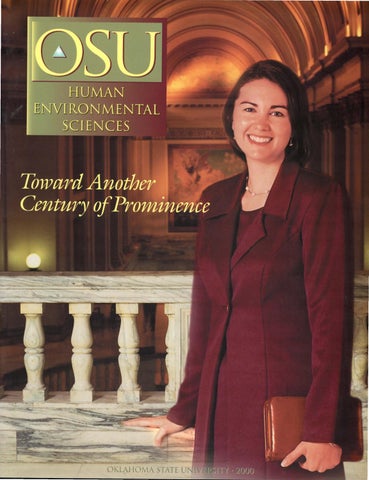
COVER: 1999 Troman Scholar Kim Sasser is;ustone ofthemost recent leaders toemerge from the College ofHuman Environmental Sciences. Throughout it5100-year history, theCollege has produced anumber ofvisionaries whose legacies live ontoday. Their visions, and those offuture leaders, • arehelping guide theCollege toward another centu,y ofprominence. See story, page 6_
Visitom web site at: www.okstate.edu/ hes/
Ok!ohomo StateUniversity incompliance withTitle VlandVllof ilieCoil RighsActol l964,Executive O,der 11146osamended, TirleIXoftheEducation Amendments of 1972, Ameriurns wilh
OisobilitiesActofl990,ondothe1federollowsond1e doesnotdisc,iminote onthebosisof race,color, notional or~ gin,sex,oge,religion,disobilifY,or!itotusosovetero i~policies,procticesorprocedures.Thisindudesbut itedtoodmissions,employment, finoncioloidondeducotiona services. Thispublicotion,issued byOklohomoStote University osouthorizedbythe(ollegeofHumonEnvironmento wosprimedbyTheAudiaVisuol(enter, University Printing Services otnoco!it tothetaxpayer ofOklohomo. 6.SM/April/00. 17106
Apparel andinterior design students lineuponthegrand staircase oftheParis Opera House.
Students Discover Who)e New Wor1d International study opportunities give students a definiteadvantagein today's globalmarketplace,saysCollege of Human EnvironmentalSciences Dean PatriciaKnaub. "There's nothing like 'being there' and immersingyourselfin a totally differentenvironment," says Knaub. Carol Bormann, associateprofessor, and Lona Robertson, assistant professor,in design, housing and merchandising,took a group of appareland interior design students to England, France and Italy last summer to study the three leading European design centers. "The students were required to keep a dailyjournal of everything
2
College of Human Environmental Sciences 2000
they observedand experienced,"says Bormann. MelissaEl-Assi,an interior design junior who attended last year's study tour, saysshe sketchedeverythingshe saw."I wanted to be able to go back and look at the sketchesand incorporate some of the ideasinto my designs." Bormann saysvisitingwith European designerswho are on the cutting-edge will not only help students while they're in school, but also after they graduate. "Anytimean employerseesyou've traveledabroad and are willingto learn more and see new things, it's a big plus." DEBBIE BASORE
Upcoming • The nutritional sciences department isoffering a 15-day tour toEngland and Scotland from July 20through Aug. 3.During thetour, participants willattend the13th annual International Congress ofDietetics inEdinburgh, Scotland. • Afive-week stay inSwitzerland willallow hotel andrestaurant administration students an opportunity toexperience Swiss andEuropean hospitality. Students willattend classes attheHotel School Les Roches oftheSwiss Hotel Association atBluche, Switzerland, and theHotel Institute atMontreux, located on Lake Geneva. The tour isscheduled June 12 through July 17. Fpr more information calltheCHES University Extension office at(405)744-6571.
GraduatesPrepared Collegegraduatesentering the "real world"sometimesface uncertain futures and dead-endcareerprospects. Not so in the Collegeof Human EnvironmentalSciences. "Feedbackfrom our alumni inrucate that our graduatesare getting what they needto land desirablejobs, keep those jobsand then move up in their respective fields,"saysMargaretWeber,associate dean. A surveyof the College'sgraduates whohavebeen out one year showsthat 90 percentare employed,and 80 percent are workingwithin their major area of study. "Nearlyall graduates,or 95 percent, reporttheywere well prepared and knew whatcareersthey could pursue prior to graduation," says Weber, "and 65 percentsaythey obtained a positionwithin twomonthsof graduation." The Collegeis successfullypreparing graduatesto move into managementpositions,too, accordingto a surveyof fiveyeargraduates."Seventy-twopercent of graduatesconsiderthemselvesto be 'up and coming'leadersin their fields,"says Weber. One of the reasonsfor graduates' careersuccessesis the College'scommitmentto learningoutcomes and competencies.Upon graduation,all students not onlypossessknowledgeof subjectslike textilesor nutrition, they also possesslifelongskills. "Our graduateslearn more than informationwhilein school.They learn how to growand adapt in an ever-changing world,"saysWeber."They know how to creativelysolveproblems,think c1itically and use technology."She saysgraduates leavethe Collegewith a global awareness, appreciationof a ruverseworkforceand commitmentto buildingand enhancing co1ru1mnities.
Student leaders Kim Sasser, Tambra Stevenson andRachael Belvin helped plantheCollege's first-ever Student Leadership Development Symposium.
leading the Way RachaelBelvin,KimSasserand Tambra Stevensonknow all about taking the initiative.These three students weren't satisfied with simplyattenrung the College's first arumalStudent LeadershipDevelopment Symposium.Instead, they helped plan it.
leadership,and third, we want to help students developleadershipskills." The inauguralleadershipsymposium featured a keynote addressby former astronaut Mae Jemison,M.D., Ph.D., and breakout sessionsled by local and internationallyrecognizedindustry leaders.
The program couldn't havehappened Students likeStevensonare already without important input from the three reaping the benefits.She landed a paid student leaders.It also couldn't have hap- internshipwith Jemison Group, Inc., a pened without the generous support of companythat provideshealthcaredelivery Pearl and Esther Winterfeldt- two sisto developingcountries, and she ruscovters who initiated the leadershipprogram. ered a role model. "Through these arurnalsymposiums, "I found a mentor in Dr. Jemison," we hope to accomplishthree things," says saysStevenson."She's the firstprofesEsther Winterfeldt."First, we want to sional,blackfemaleI've met who has exposestudents to local and nationally- • taken the same careerpath that I want to known leaders.Second, we want to help take." students have a better understanrungof SHEllEY BRINSFIELD
Oklahon1aState Uni11ersity 3
_ Bringing_D_reams_ to Life
The Truthis:DreamsAre Now Realities The "Bringing Dreams to Life" campaignwasjust an idea fiveyearsago. In a few short years,the idea becamereality,overflowingwith events benefiting the Collegeof Human EnvironmentalSciences(CHES). And it all began with a process. Earlyin 1995, Dean PatriciaKnaub and the Collegecampaignchairs, Billand Ann Atherton and John and Sue Taylor,unveileda philosophy that would inspirethose within the Collegeto a successfulfi.md-raising
Bright colors and children's laughter attract attention to the new Outdoor Learning Classroom for the Child Development Lab. More than a playground,the
'Rack to the Future'
new facilityencouragesdevelopmentof imagination,socialskills,language,perceptual-motor skillsand problem solvingin ageappropriateareas.And it providesa setting in which innovativeresearchcan be conducted.
"Moving into a new century is alwaysa good time to reflect," saysKnaub. "The momentum attained by the Collegeoverthe last fiveyearswouldn't have been possible without the plan, the process,and the people. We've been able to makethe results greater by growing the cont1ibutionsfrom both public and privateresources."
dents, faculty,staff, the CHESAssociates, alumni and friends. Knaub focusedher team on the elementsneeded to accomplishits mission: facultydevelopment,student scholarshipsand internships,and improvementof instructionaland researchfacilities.
Rui1ding the Dream
With financialsupport from Founders and Associates,Inc., Tulsa, both a Human Nutrition Laboratory and Human Nutrition Assessment Laboratory give faculty and students more researchopport:1.mities, includingclinicaltrials.The AssessmentLab is availableto both the OSU and Stillwater communities.
Ry Design Chris Salmonwas a designer,teacher, public servant, mentor and leader.As a faculty member for 20 yearsin the Department of Design, Housing and Merchandising, Salmon influencedthe livesof many students. It was only appropriatethat the Chris
Collegeof Human Em,iromneutal Sciences 2000
continue the legacyof this great teacher.The individualsselectedfor the professorshipwill continue Salmon's tradition of enrichingthe expe1iencesof students. And there are fiverecipientsthis yearof the Jean Bullen Newman Internship Scholarships. Newman has made it possible for these design, housing and merchandising students to gain real-worldexpe1ienceby establishingan endowment for student internship scholarships."The significance of this gift is immeasurablefor both students and the College," Knaub says."Jean'ssupport in this area solidifiesthe certaintyof student accessto quality internships."
campaign.They decided the processrequired a team effort, involvingstu-
4
Salmon Endowed Professorship in Interior Design be establishedto recognizeand
But Knaub has her focus on the future. Plans for the millenniumincludeincreasing scholarshipsupport, increasedactivityin earlychildhood education includingan Early Learning Center in Tulsa,a new studiofor Interior Design and two additionalfloorsin Human EnvironmentalSciencesWestthat will house labs and classrooms.OSU's College of Human EnvironmentalSciences\l~ll definitelycontinue bringingdreamsto lifebut only with your help. BARBARA SWIGGART
CELEBRATING
1 DD YEARS
IOIN OUR CIRCLE
In the year 2000, the College of Human Environmental Sciences is celebrating I 00 years of excellence in teaching. research and service to Oklahoma, the nation and the world.
To recognize this landmark year. and to prepare for the next century of prominence, the College has established a "Circle of Excellence" society. There are no minimum gift reQuirements for inclusion in the Circle. Lifetime membership is accorded upon written confirmation by the donor of his or her gift commitment by naming the College as a beneficiary of a will, trust arrangement, life insurance policy or charitable gift annuity. Often these gift arrangements offer substantial tax advantages for the donor. We invite your participation in our ever-growing Circle to enable the College to embrace the challenges and opportunities of the next I 00 years. Clockwise from topleft:Cuth Salmon, husband ofChris Salmon, former design, housing andmerchandising (OHM) professor; Guests attend "Integrating Home &Garden," aspecial event honoring Chris Salmon; 1999 Newman Internship Scholarship recipientsfrom lefttorightareJoanna Smith, Audry Crawford, Minarni Gozali andSarah Snowder. Not pictured isDebra Young; OSU's Child Development Laboratory (CDL) celebrates its15thanniversary and thededication ofthenewOutdoor Learning Classroom.
For more information about joining the College's "Circle of Excellence," e-mail leanne Short at shortj@osuf.okstate.edu; or contact Debra Engle at (405) 744-6571 or the Gift Planning Office at the OSU Foundation at (405) 744-7274.
Oklahoma State Uui11ersity
5
Maud Gardiner, center, Dean Nara Ta/bat, right
left:OSU wasonlythesecond land-grant college inthe nation toofferanursery school program. above: anearly-day cooking class
Aswe enter the 21st century,the CollegeofHuman Enviromnental Sciences(CHES) celebrates Maud Gardiner was a ymmg woman 100 years of growth and prosperity and pays tribute to those who haveled the Collegeto the placeof prominenceit has today. The Collegeis a nationalleader in educationthanksto the many people who took risks and believedin th~ir own abilitiesand the abilities of those around them. These visionariesweren't content to just stand still. Instead, they initiated changes, spurred growth and helped the Collegeflourish. 6 College of Hmnnn Environmental Sciences2000
ahead of her time. In 1900, she traveled from Ames, Iowa, to Stillwater, Okla., to teach the first course in domestic economy at OSU. Gardiner's previous experience at two pioneer instiu1tions - Kansas State College and Iowa State College - helped her successfullysteer the program forward. Under her leadership, the domestic economy course grew into a full-fledged department with 50 srndents, the first wave of what would eventually become the College of Human Environmental Sciences. Gardiner was proud of her department and once desctibed it as " ...one that we hope will be the means of spreading many truths that will help to lighten the bmdens and make b1ighter the fuuu-e way of many of the young people who come to seek learning within its doors."
In the early 1920s there were few college mu-sery schools. But that didn't discomage Dean Nora Talbot, who led the College from 19231950. One of her first orders of business as dean was in ~924, when OSU became only the second land-grant college in the nation to offer a mu-sery school program. Talbot was a visionary who realized that smdents majoring in child development needed ach1al observation and participation in a live laboratory setting. Dean Talbot established OSU's first mu-sery school - what would later become the Child Development Laboratory (CDL) - in a remodeled laundry area where two rooms comprised the first "lab" for 2-and-3-year-olds taught by the first nmsery school teacher, Louise Shields. The purpose of the mu-seryschool was three-fold: to provide educational experiences for children, to help parents
above: Dean Nora Talbot's vision became reality with theopening oftheCDL in 1924. right: Daisy Purdy helped launch thehotel and restaurant administration program inthe1940s. farright: anearly-day foodpreparation doss
,tJ
•
understand child behaviorand to provide a setting for students seekingcareers in child development.
Today's School of Hotel and Restaurant Administration(HRAD) can trace its roots to DaisyPurdy, a woman with foresightand imagination,who first visualized a need for hotel and restaurant u·ainingfacilitieswhen such programs were rare throughout the nation. The cuniculum featmed coursesin everythingfrom meal management to reading blueprints and included 30 weeksof supervisedemploymentin a hotel or similarinstitution. In 1942 restaurant management courseswere added. Purdy led the program until 1955. During her tenure, she took leaves of absenceto work as owner and operator of a teahouse in Tuscon, Aiiz., and later as a food supervisorin Philadelphia and as assistantmanager with a cafeteria company in Cleveland,Ohio. These
expe1iencesenabled Purdy to offer insight to the developmentof the hotel and restaurant cuniculum and bring real-worldexamplesto the basiccourse she taught that was required of all hotel and restaurant students.
With a sincereinterest in people from all over the world, Dean Lela O'Toole guided the College to a position of international leadership.She believedthat "universitieshave a heavystake in international and world affairs"and that the " ...survivalof institutions of higher education are dependent on the successful handling of international questions." Throughout her career as dean from 1951-1975, the College gained international respect for its programs and faculty.Faculty and some staff conducted short coursesfor internationalvisitors and traveledoverseasto such placesas Germany,the Philippines,England and Ethiopia. Dean O'Toole, herselfa
Fulb1ightScholar,was in charge of a summer school in Norway. In 1957, she and other facultytraveled to Pakistanand worked with the Pakistani government to developplans for a new collegeof home economicsin Dacca. In a quest to understand how familylife could be enriched through education, they alsoworked with existing collegesand studied in countries from India to Thailand. Six facultymembers committed themselvesto studying in Mexico for five srnrunersbeginning in 1965. The professors were involvedin an intensivecourse in Spanishon campus and in mientation to the Mexicanculture. Dean O'Toole helped the group formulate 17 goals to which they committed themselves.Her parting words were, "the overallgoal is to have facultygrow into world citizens."Her hope was that factiltywould eventually"think and feel interculturally."
Okln.bomnState U1ti11ersity 7
Corio Kaye (Jones) Switzer, 1983 Truman Scholar
• Deon Lela O'Toole's leadership gave theCollege oninternational reputation thatisstillpaying dividends today.
BeulahHirschlein,Alta Lane and James Moran III broke new grOLmdin the '70s when they becamethe first three graduates of the College'sPh.D. program. Moran remembersarrivingtwo days before the fall'76 semester."I felt that I had fOLmdmy home," saysMoran. "The mentoring I receivedfrom facultyled me to the conclusionthat the Collegewas the appropriateplace to addresssocietal needs." As one of the College's first doctoral graduates,it only seemsnatural that Moran would go on to lead others, first as a teacher,·then as a department head and finallyas a dean. Moran, who taught at the Universityof Oklahomaand VirginiaTech University, saysOSU has had a powerfulinfluence on his life. "I continue to rely on my OSU experiencesevery day," saysthe current dean of the College of Human
8 College of Human Eu11ironmentalScimces 2000
Ecologyat the Universityof Tennessee. Moran also served as the department head offarnilyrelationsand child development at OSU from 1985-89.
The tradition continued three yearslater in 1983 when Jones-Webb'syounger sister, Carla KayeJones, also receivedthe prestigiousaward.
Moran sayshe appreciatesthe College's facultywho helped foster his development while in graduate school. "The only regret I have," jokes Moran, "is not steppingin front of Alta Lane to be the first of the College'sPh.D. graduates."
As OSU's and the College'sfirst-ever Truman Scholai·,Jones-Webbsaysshe becamemore astute and interested in the politicalarena. "I came to understand how goyernmentworks and impactsthe livesoffanulies," saysJonesWebb, who worked for the Oklahoma CooperativeExtensionServicefor nearly 10 yeai·s.For the past sevenyearsthe Custer City, Okla., resident has served as an advisorto pro-familypoliticalcampaigns, taught speech and debate classes and home-educatedher children.
Jeaimette Jones-Webbprobablydidn't realizethe precedent she was setting in 1980 when she becameOSU's first Truman Scholai·. "Everyonewas shocked," saysthe family relationsand child developmentmajor. "Those scholarshipstypicallywent to politicalsciencemajors." Each year, the $30,000 Trwnan Scholarship is awardedon a merit basisto college students who show potential for leadership,academicabilityai1dpublic service.
Cai·laKaye(Jones) Switzersaysapplying for the Truman Scholarshipwas the catalyst that influencedher career decisions. "It gave me an opportunity to do careerplaimingearlierthan I would have otherwise," saysthe fai11ily relationsand child developmentmajor.The Newport
<
The College's firstbuilding, theWomen's Building, isnow home totheBartlett ArtCenter.
Kim Sasser, 1999 Truman Scholar
News, Va.,resident went on to pursue a master's degree in gerontologyfrom Virginia Tech University.She has worked for the governorsof both Oklahomaand Virginia,managed an adult livingcenter and served as an adjunct professorat Hampton Universityin Hampton, Va. Today she staysbusy educatingher son at home and working for education reform. Food stamp reform is the goal of the College's 1999 Truman ScholarKim Sasser.The dieteticssenior from Lawton, Okla., hopes to playa vitalrole in foture policydecisionsconcerningfederaland state food stamp allocation.She plans to researchthe affectsof food stamp reform on the nutritional intake of participants and then share her findingswith policymakers. "There isn't much data out there on what kinds of food people actuallyuse their food stampsfor, so what better way to get that data than to do the research myself,"Sassersays."Through my
Truman and Wentz Scholarships,I now have financialsupport for the project." Sasser'sfoture is foll of interestingpossibilities,such as conducting researchfor a public-policyfirm, working as a registered dietitian or administe1ingnutritional servicesfor a public health department. Whichevercareerpath Sasserchooses, one thing is certain. Like her predecessors, she willleavebehind a legacyof leadershipthat influencespolicy-makers and impactssocietyfor years to come. Today's students are tomorrow's leaders, and who better to mentor fi.ttureleaders than current leaders? In 1990, newly-appointedDean Patricia Knaub establishedan advisorygroup. It would later evolveinto the CHES Associates,a donor-basedadvisorygroup, composedof alumni and industry professionals."These are people who are committed to making a measurabledif-
ferencein the College'sfi.turre,"says Knaub. "They link the universityto the outside world." The approximately275 membersof the group are involvedin strategicplanning meetingsand specialeventsfor the College. They also serve as legislativeadvocates and aid in curriculumrevision; however,their most irr].portantcontribution is to the developmentof students. A number of CHES Associatesprovide scholarshipsand serve as mentors to students. Some help raisemoney for the College,and still others help open doors for student internshipsand employment. "These people have a stake in the College and want it to be successfi.tl," says Knaub. "They are very involvedand very focusedon creatingan atmosphere where students flourish." Some information taken from
HonieEconomics:CentennialHistories Seriesby Lorene Keeler-Battles
Oklahoma State Uni11enity
9
Outreach, Tnstn1ctionand Research
Rick Bartholomew
Tribal Symbols Inspire Furniture Design
A rn1iqueline of custom furnitrn:edesigned by an OSU professor is appearingin showroomsacrossthe country. The "Native Lines" residentialand officefurniture incorporatessymbolsand graphicsused by the Five CivilizedTribes of Oklahoma. "It's not only tmique becauseof its NativeAmericaninfluence but also the way the fi.rrnitureline was developedand produced," saysRickBartholomew,the OSU assistantprofessorwho designed the fi.rrniture."After I designed the fi.m1iture,Oklahoma Fixture Company (OFC) in Tulsa fabricatedthe piecesand invested$75,000 to produce a proto-type line. This has been an excellentexampleof education and industry working together." Bartholomewdesigned 15 piecesof furniture after spending nearlytwo yearsresearchingnibal artifactsand symbols. His "Cherokee-Inspired" line consistsof a writing desk with a leg that resemblesa feather from a Cherokeeheaddress. In his "Creek-Inspired"line, he incorporatesa ceremonialsash around the top and sides of a mirror. His Choctaw,Chickasaw and Seminolelines also incorporatehistoricalsymbols. "It's a win-winsituation for everyoneinvolved,"says Bartholomew. "I have been able to bring techniquesof furniture design and fabricationinto the classroomto share with students," he says. "There have also been internshipopportunities for our interior design students at Oklal1omaFixture Company.
Rick Bartholomew, assistant professor ofdesign, housing andmerchandising (OHM), isworking withOklahoma Fixture Company toproduce "Native Lines" office andresidential furniture. The designs incorporate symbols andgraphics used bytheFive Civilized Tribes ofOklahoma.
IO
CollcgeufHtmurn £1111irom11cntn/Scienccs 2000
"The future is very exciting,"saysBartholomew."Oklahoma Fixture Company's commitment to 'Native Lines' means the developmentof additionalfurniture designs,student internships and employmentopportunities for graduates."
Hotel Partnership Puts Students in the "Real World"
When Ned Shelton graduatesfrom OSU next year, he'll have more than just a piece of paper as a testament to his time here; he'll have the hands-on experiencethat employerswant. Shelton is one of the first smdents to utilize TheHotel at OSU as a lab. The School of Hotel and Restaw-antAdministration (HRAD) began operating and managingthe hotel in July.Previouslyit was administeredby the Student Union. Dr. Jeff Beck,who teachesthe lodging front officesystemsclassat the hotel, says that while classroomwork is worthwhile and valuableto students, combining it with the lab makesfor an even bettertrained, future employee. "The lab expeiiencereinforceswhat they have learned," saysBeck. "Instead of reading about it, they're doing it." Hotel students WeeShelton agree. He saysthe lab helpssmdents make a connection between theory and practice.By completing tasksat the front desk or in housekeeping,for exan1ple,the manager knowswhat housekeepingis all about and will have more respectfor the housekeepers. New to TheHotel at OSU is General ManagerJin1Barnard.A native Oklahoman, Barnard brings with him more than 20 yearsof experiencewith the Maniott Corporation and other companies. "Being able to work with the students and such a fine staff and student body is what brought me here," Barnard says.
General Manager JimBarnard, left,works withhotel andrestaurant student Ned Shelton, whoisoneofthefirststudents toutilize The Hotel atOSU asalab. JeffBeck, whowasrecently named thenewCharles Lanphere Professor, isresponsible forteaching courses inhotel administration, including alodging frontoffice systems class at The Hotel atOSU. Beck alsodevelops theDistinguished Speaker Series inhotel administration.
Barnard is working diligentlywith students and facultyto brii1ga higher levelof serviceto hotel customers.However, great servicealone does not keep guests satisfied. It also requiresfresh, modern accommodations, which is why the school, tl1rough tl1egenerosityof industry,alumni and guests of the hotel, is attempting to raise $5 millionfor renovationstl1atwillput tl1e hotel on a levelwith Four Star hotels around tl1ecountry. TANIA WARD
1crsitJ Oklahoma State U1Ji1
11
A study of astronauts' bone loss while in outer spacecould hold the answerfor sufferersof osteoporosis,a diseasein which bones are subject to fracture. "Although the project targets astronauts, we're interested in the long-run impact on osteoporosis,"saysDr. Barbara Stoecker,OSU professorand head of nuu-itionalsciences. Through a grant funded by NASA, Stoeckerand Brenda Smith, a postdoctoral fellowin nuu-itionalsciences,are looking at the effect of skeletalunloading. Skeletalunloading sin1plymeans "not weight-bearing." The result of skeletalunloading is a loss of bone density.In fact, most astronauts lose one to two percent per month of their bone densitywhile in space.
Stoeckersaysthis is a seriousproblem for astronautson long-term missions.It is also a problem for elderlypersonswho are confined to bed or not doing weight-bearing activity. "In the NASAproject we're looking at the effectsof differentlevelsof Vitamin E," she says."We want to see if there's some protectiveeffecton bone and if it changesthe amount of bone loss."
Vitan1inE is of particularinterest to NASA.In addition to its direct effectson bone, it can also help astronautswho suffer oxidativedamage due to radiation exposure. The one-year,$206,000 grant has spawnedtwo additionalfollow-upproposalsincludingone with Stoecker,Smith and BalrramArjmandi,associateprofessorof
nuu-itionalsciences.They have submitted a proposal to researchselectiveestrogen receptor modulators (SERMS). The other follow-upstudy involves DNA chip technologyin which gene expressionis examinedin responseto skeletal unloading. Stoeckersaysthis project would involvescientistsat the University of Oklahoma. In the long run, not only willastronauts benefit from the research,but patients sufferingfrom osteoporosismay also find a u·eatment. "Once you find out what's causingthe bone damage,you can target dtugs or dietary treaunent that can help prevent the damage," Stoeckersays. "Even delayingthe damage givespeople a better qualityof life."
Research Fi11sa T(nee'd A new discoverymay help women with osteoartht-itis,particularly in the knees. Dr. BalmunArjmandi,associateprofessorof nutritional sciences,in collaborationwith two facultymembers and a graduate student, has fOlmdhigh concentrationsof estradiol,a type of estrogen, in the synovialfluid in the cartilageof the knee. "After age 45, women expe1iencea more dramaticincreasein the incidenceof osteoarthritisthan men," saysArjmandi. "Findings from animalstudies suggest that estrogen and estrogen receptorsare involvedin regulatingcartilagemetabolism," saysArjmandi."Estrogen receptors are moleculesthat facilitate the action of esu·ogenon target tissues." Arjmandi,who has been studying this particularresearcharea since 1989, was recentlyable to extend his researchon human tissue.
12
College o[Humr,,n. Environnumtal Sciences 2000
"To evaluatethe presenceof estrogen receptorsin humans, cartilagetissueswere collectedwithin 30 minutes of surgery and frozen in liquid nitrogen," Arjmandisays."We evaluatedfresh cartilagespecimensfrom men and women, with and without knee osteoartlrritis." He saystiming is everything."We discoveredthat the estrogen receptorscan only be detected in the tissuewithin a 30-minute time frame." Arjmandisaysuntil now, ilie cause of knee osteoartlmtisand tl1emechanismcausingit in tl1ehuman joint has not been welldefined. "The presencedf estrogen receptorsin human cartilageis of interest becauseit suggeststhat cartilagemetabolismcan be influenced by selectiveesu-ogenreceptor modulators (SERMS),"says Arjmandi."SERMSare a classof non-sterodialcompounds that
Drinking milkand taking calciumsupplementsmay not be the only thing needed to prevent osteoporosis. A two-yearstudy funded by the Oklal1omaCouncil for the Advancementof Scienceand Technology(OCAST) has a nuu-itional sciencesfacultymember looking at the effectof different levelsof dietary iron on bone growth and metabolism. Andrea Arquitt, mmitional sciencesassistantprofessor,has worked with u·acemineralssince graduate school and saysa missing piece of her researchdealswith iron. "I believethat what happens in osteoporosisin old age is the result of how we treated our bodies when we were ymmg," she says."I'm looking at two studies combined into one overall project." The first study evaluatesthe effectsof differentlevelsof iron in an a.t1in1al model that is equivalentto a ymmg adult, she says. "I fmmd that anin1alsfed high iron diets had more dense bones than those fed a.t1iron deficientdiet," Arquitt says."That was excitingto find that iron playsa role in bone maturation."
Dr.Barbara Stoecker, Dr.Bohram Ar;mondi andDr.Andrea Arquitt oreoilconducting impoant research ontheprevention ofbone disease andthepreservation ofbone health.
mimicthe effectsof estrogens in some tissues,but have anti-estrogenic effectsin others."
The second pa.i·tof the study looks at the effectof those sa.ine levelsof iron on bone metabolismin ovarianhormone deficient anin1als. "This simulatesthe effectsof menopauseon bone," she says, "which may be important to women as they age. "We'll be looking at the collagenexcretionproducts and the breakingstrength of the bone, which is a.t1otherissue- how strong is the bone?" Arquitt says."If it's dense, but it shatters easily,then that's not very good." The next phase of the project is to a.t1alyze the data, which could impact current recommended intake levelsof iron.
Collaboratingwith Atjmandi on the researchproject are Dr. "With bones, we have to look at overallhealth. Bones a.i·e Mark M1mson,a Stillwaterorthopedic surgeon and OSU adjunct impactedby more than just milk," saysArquitt. "Milk is imporprofessorof nuu-itionalsciences;Dr. Jerry Malayer,OSU associate tant, but there are other mineralsand nuu-ientsinvolved.Iron is a professorof infectiousdiseaseand physiology;and nuu-itionalscipiece of the puzzle, and eventuallyit willfallinto place. ences doctoral student-ShanilJurna. "One of the things that I feelis positiveabout the data from Atjmandisaysthe findingsof this study suggest that natural or these studies is that it reinforcesthe importanceof the message syntheticselectiveesu-ogenreceptor modulatorsmay play a posithat all foods contribute to good health." tive role in the health of human cartilage.
STORIES BY DEBBIE BASORE
O/t/,i/Jom11. State University
13
Outreach, Instruction and Research
[HES Assodote Bryan Close isoneoffhemany supporters of05IJ.Tulso's Early Leaming Center, ofacility fhotwillgive Tulsa children a;ump startandensure fheygrow uptobecome produdive adults.
Tu1sa Eady Learning Center Proposed Community Partnership Benefits the Children of Tulsa
Nearly25 percent of children entering schools in Tulsa are not ready to learn, according to the Tulsa Chamber of Commerce and the Tulsa 2000 task force.And, 85 percent of all children under 18 yearsold have working mothers who are dependent on child care. These startlingstatisticsare just one of the reasonsOSU is proposing the OSU-TulsaEarlyLearning Center (ELC). "We want to give children a jump start and ensme they grow up to be respoBsible,productive adults," saysBryan Close, president of CloseBend,Inc. of Tulsa and a CHES Associate."That's why the Collegeof Human EnvironmentalSciences'EarlyLearning Center proposalis so excitingfor Tulsa." Closesaysthe OSU-TulsaELC willnot only providequality childcare,but willserve as a model program to train students and professionals.
14
Collegt of Human Enviro11,me11tal Sciences2000
The goals of the OSU-TulsaELC will be: • To serve children and support developmentthat allowschildren to be successfulas they enter school. • To educate and involveparents in their child's care and education. • To provide OSU-Tulsaundergraduateand graduate students the best possibleacademicexperience. • To work as partnerswith the Tulsa communityto better meet the needs of children and their familiesthrough researchand professionaldevelopment. OSU-TulsaPresident Gary Trennepohl is excitedabout the project. "It is a good exampleof the benefitsresultingfrom a strong partnership between higher education and the Tulsa community." DEBBIE BASORE
Introducing Four New Faculty A Taste for the Unusual
ORA/William E. Davis Chair Named
From advisingCaiibbean peanut farmersto creatinga processfor canning a low-acidsoup calledCallaloo,Dr. MargaretJ.Hinds brings a multitude of reseat-chand teaching experienceto OSU.
Chalk up a five-stat·rating for ProfessorHallin Qu, who has brought his internationalknowledgein hotel, restaurant and tourism management to OSU.
Hinds, assistai1tprofessorof nutritional sciences,is a nativeof Trinidad and Tobago and earned her bachelor's,master's and doctorate degreesfrom the Universityof the WestIndies. Her reseat-chaccomplishmentsare many and vaiied. She has developedbottled beveragesusing the juice of fresh sugar cane as the main ingredient, and she created a sausagefrom flyingfish that are indigenousto the islai1dof Bai-bados.
East Meets West Total immersionin a culture by livingthere, speaking the languageand learning the country's customsis the best wayto learn about a country and work internationally,saysRenee Kubiak,assistantprofessorof design, housing and merchai1dising. Kubiak,who graduated from ArizonaState University with a master's in design,should know.She grew up Tay Kennedy in the United States,Japan and England and created her own residentialand commercialdesign companies in Californiaand Japan. After working as a professionaldesignerin the international arena for 20 years,Kubiakbecameinterested in teachingfuture designersat the universitylevel.She currently teachesstudios involvingcriticaldesign issuesand the professionalpracticecourse.
'Engaging'
The Oklal1omaRestaurantAssociation/Willian1E. DavisDistinguishedChair in the School of Hotel and RestaurantAdministration(HRAD) has extensively studied consumer behavior,marketingand servicequal ity of hotel, restaurai1tai1dtravelpatrons ai·oundtl1e globe. The China nativeholds master's and doctorate degrees from Purdue Universityand is at1honorary professorfor severaluniversitiesworldwide.Qu coordinatesthe hotel and restaurant graduate program and serveson tl1efacultyof the OSU School oflnterna tional Studies.
A Diet of Diversity With more tl1an20 yearsas a registereddietitian,Tay Kennedybrings a wealtl1of experienceto the classroom. She has worked as a food servicedirector in a ko· sher skillednursing home, provided nu11itioneducation for the VisitingNurse Serviceof New Yorkand served as chief clinicaldietitianfor a pediatrichospital. Kennedy,an assistantprofessorof nutritionalsciences,specializesin the nutrition of very young children, particularlythose with healili care needs. A native of upstate New York,Kennedyspent a year as a postdoctoralfellowat Children's SeashoreHouse in Philadelphia,Pa., before coming to OSU in January. She holds a Ph.D. in humai1nutrition from Iowa State University.
10 a Retter Education
Long gone are the dayswhen collegeprofessorsstayedholed up inside their "ivory towers" poring over_papers and research. Today's facultymembers are expected to bring a varietyof real-worldexperiences into the classroomand be involvedin their communitiesthrough interaction with not only citizens,but businessand industry as well. "Doctoral students need a broader experience,"saysMargaretWeber, associate dean. "We want to produce 'engaged' professorswho practicein the community
what they learn in class.We want them to conduct researchai1dapplyknowledge that helps solveproblems in the communities they serve." To prepare "engaged" professorsthe Collegehas restructured its graduate curriculmn.All doctoral students are now required to meet a list of competencies that include:resource generation through grant writing; sharing knowledgethrough classroominstruction and training;community engagement through community serviceprojects and public policyissues;
and generating knowledgethrough researchand other forms of creativescholarship.The Collegeis also committed to producing graduatescapableof using state-of-the-arttechnologyin support of their professionalcareers. "Education is no longer a one-wayprocessin which the universitytransfersexpertise to key constituents," saysWeber."It's a two-waystreet that involvesparmerships and a reciprocitybetween facultyand various parmers." SHELLEY BRINSFIELD
Oklahoma State University
]5
Outreach, Instruction and Research Uncle Bob may boast of grillinga "mean" hamburger, but that bmger could become even meaner if he doesn't followa few precautions. Each year 80 millionAmericansexpe1iencefoodborne illness,and more than 9,000 will die from it. With that in mind, the OklahomaCooperativeExtensionService(OCES) is workingto increasethe safetyof the food supplyin Oklahoma. BarbaraBrown, assistantprofessorof nutritionalsciencesand OCES food specialist,sayshumor is important when spreadingfood safetymessagesto the public. Last year, she spearheadedthe TastySafetyHints food safetycampaign that featured tips and advicefrom taste buddies like Patty "Melt" and Chuck "Roast" and reached more than 800,000 Oklahomahouseholds. Brown also provideseducation on safestorage and preservationof garden produce to 175,000 viewerseach week during segmentsof the "Oklal1omaGardening" televisionprogram on OETA. CooperativeExtension'sSuper Nuuition ActivityProgram (SNAP)contains food safetyeducation for children. "We teach children to alwayscheck for a brown color throughout their hambmgers before taking a bite," saysBrown. Of those children who completedthe training, 43 percent say they now check their burgers before eating them. Barbara Brown's weekly kitchen segments onthe"Oklahoma Gardening" Adults a.realso getting the message.Eighty-threepercent of the participants television program focus onthenutrition andsafety offoods produced by in CooperativeExtension'sHealthy Livingprogram say they increasedtheir gardeners throughout thestate.
knowledgeabout food safety.
The economy is booming, but some Oklahomansare going bust. They spend more money than they make, use credit cards to pay monthly billsand finallywind up in bankruptcycourt. So what's to keep these poor money managersfrom repeating their mistakes? Dottie Goss, recentlyretired fanlilyresource managementspecialistfor the Oklal1omaCooperativeExtensionService,has developed Money Managementfor ChallengingTimes, a program that helps improvethe financialskillsof filersof Chapter 13 bankruptcy. Drning the course,participantslearn about cash flow management, risk managementtools, estimatingexpenses,goal setting and reward systemsand mategies for identifyingand coping with past money problems. Resultsfrom the pilot program indicateit's working.Almost 80 percent of participantsreported a feelingof conu·olover tl1eir financialsituations. Goss's progran1may eventuallybe mandated, if federallegislators have their way."There is continuing interest in reforming federalbankruptcylaws," saysGoss, "and includingeducational programming as a requirement oftl1e bankruptcyprocess."
16
College of Hmnnn Environmental Sciences 2000
Dottie Goss hasdeveloped aprogram thatteaches filers ofChapter 13bankruptcy tobalance their books. Nearly 80percent oftheprogram's participants saytheynowhave afeeling ofcontrol over theirfinancial situations.
Hall ofFame Joe Fasslerhas a piece of advicefor today's aspiring students. "Don't forget where you came from," saysthe 1963 graduateof OSU's hotel and restaurantadministration(HRAD) program.
The College of Human EnvironmentalSciences shines the spotlight on an outstanding leader
whose dedication to the college merited his recent induction into the CHES Hall of Fame
Fassler knows what he's talking about. The president and chief executive officer of ProDine, Inc., a leisure and entertainment company headquartered in Phoenix, Ariz., grew up in a tough neighborhood on the lower east side of New York City. "At a very young age, I had to learn what it is to be competitive in order to survive, in order to be chosen in a street game, in order not to be beat up when I walked out in the street," says Fassler. "The people who were the most aggressive, who applied the most common sense, wound up leading a situation." Fortunately, Fassler was able to transfer his drive to succeed to the hospitality industry when he landed a job with Restaura, Inc., a subsidiary of ProDine's parent company, Viad Corp. During his 37-year career with the company, Fassler has held a number of positions including branch manager, district manager, vice president, executive vice president, and most recently, president and CEO. Fassler's current responsibilities include such notable operations as America West Arena (home of the Phoenix Suns), Bank One Ballpark (home of the Arizona Diamondbacks), and Glacier Park, Inc. (owner and operator of lodging facilities at Glacier National Park in Montana and its Canadian counterpart, Waterton Lakes National Park). A certified Foodservice Management Professional (FMP), Fassler serves on the board of directors and is immediate past chair of the National Restaurant Association. He is also a board member and the past chair of the National Restaurant Association's Educational Foundation, and he serves on the board of directors for the National Park Hospitality Association. But his leadership skills don't end there. Fassler gives back to his alma mater by serving as one of the CHESAssociatesand sitting on the college's HRAD advisory board. In addition, he was honored with the CHES 1993 Distinguished Alumni Award. Fassler speaks on numerous trade panels, participates in industry conventions and has authored dozens of articles for magazines and journals. The dynamic leaaer also never forgets where he came from. "Leadership is by consent, not by title. Just because you have a title doesn't make you a leader. If your ego is out of control, you won't be a leader for long. Those are the people who forget where they came from."
B_e_par_t_nti~he~---
THEHOTEL at OSUis on its wayto an excitingnew future.
S
ately plantation-style buildingsof Georgian architecture overlook
acres of formalgardens and majestictree-covered walkways,which wind around historic Theta pond. THEHOTEL at OSUcombines
the harmonioussetting of this beautiful college campus with an enhanced learning laboratoryfor future hotel professionals. Yourparticipation is key. Join the excitement. Be part of the vision.
THEHOTEL at OSU. Be part of teaching the future. For reservationsor information about our renovationefforts, call (405) 744-6835.
0SU .-