I
I
1/
~
Cultivating ~Leadersmp
nee B
ased on the belief that we, in education, are primarily in the business of"growing people," the College of Human Environmental Sciences is committed to creating an atmosphere in which our students, faculty, staff, alumni and friends flourish. Providing opportmiities for enhancing leadership skills is the cornerstone of our comniitment to student success. For this reason, the 1998 issue of Human Environmental Sciencesfocuses on leadership.
In as much as future behavior is best predicted by past behavior, we are comniitted to leadership development. Students confident in their ability to lead will be more likely to seek leadership roles/opportunities in their professions and communities. Experimenting with variations in leadership approaches, being encouraged to take risks, and evaluating successes and those not-so-successful experiences are each important to the development of greater confidence in the ability to lead. During their years with us, students are introduced to a variety of leadership activities and invited to participate. It is assumed that leadership is not only needed in roles such as president or chair of an organization, but also in the many opportunities presented in comniittees, task forces, special assignments and classes. Pictured with me on this page are two student leaders who have selected arenas best suited to personal interests. Ben Coffin is a senior who believes leadership means being involved. He demonstrates this by his volunteer participation in not only the OSU Distinguished Chef Scholarship Benefit Series, but many other activities as well. Karin Warfield is chair of the CHES Freshman Council. She is already showing much promise as a leader by taking charge of this enthusiastic group. Marilyn Smith, Mary Fallin, Joe Fassler, Antigone Kotsiopulos and Carla Custer Nikkel, Human Environmental Sciences alumni, are profiled for having
achieved eminence in their careers and providingsignificant leadership in their professional fields and associations or in government. They all were college leaders during their undergraduate days, which confirms our opinion that early experience with leading is predictive of future leadership activity. Featured on the cover and in an article highlighting the Student Union Hotel Project is Steve Jorns. He has led his company to industry prominence and is providing leadership to the Student Union/Hotel and Restaurant partnership. Eight years ago, Steve described a vision for this project, which today is close to a reality. Steve is giving the gift ofleadership back to OSU where, he says, he received many formative leadership opportunities. Hall of Fame Award recipients Bryan Close, Nancy Payne Ellis and Sue Taylor have each played very important leadership roles and have given generously of their time and talent in their commmtities, the college and the univ~rsity. The college also talcesmuch pride in facultyleadership resulting in innovative academic program and curricula development. Several of our current efforts are featured in this issue. From successful grantsmanship in support of academic programs, to designing and delivering courses via the Internet, designing new facilities, to leading professional associations,our faculty are leaders. Writing in Leadership is an Art, Max DePree states that "leaders should leave behind assets and a legacy." This issue is filled with examples of just such leaders. Certainly the greatest of assets and legaciesis the development of people, for as DePree declares, they are."the heart and spirit of all that counts."
Dean PatriciaKnaub
2
C NTENTS
FRIENDS & EXPERTS CHES Associates offers priceless knowledge, resources and time to the college.
6
TRUE ARTISTS Through its continuing legacy of leadership,CHES is educating men and women who are accomplishing amazing things.
17
LEADERS WHO SHINE CHES inducts three dedicated alumni into the Hall of Fame.
12 CREATINGA NEW PATTERN Design, housing and merchandising is fostering a superior learning-environment by integrating its facilities.
CHESMAGAZINE • VOLUME 5, 1998 Directorof Extensionand Development- Debra Engle Editor- Lisa M. Ziriax Art Director- Valerie C. Kisling Designers - Clark Bell and Christopher Bono Photography - Andy Maxey unlessotherJ1Jise noted AssociateEditor - Janet Varnum CHES Magazine is a publication of the Oklahoma State University College of Human Environmental Sciences.Its purpose is to connect this college with its manystakeholders, providing information on both can1pusnews and pertinent issues in the field ofhwnan environmental sciences. ©OklallomaState University 1998
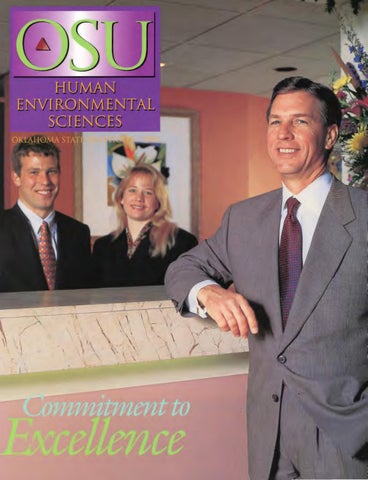
COVER:OSU graduate Steven D. Jorns, right,says that as chairman of the campaign to refurbishthe Student Union Hotel, his goal is to offer hotel and restaurant administrationstudents, such as Jacob Gray, left, and Wendy McMahon, center, the best training possible for a career in the lodging industry.See story, page 4.
Visit our Web site at: www.okstate.edu/hes/
OklohomoStoteUniVt!rsilyincomplioncewithT theCoil Righ•Actol 1964, Executive Order 1124601omended TIiie IXoftheEducation Amendments of1972, Americans with DisobilitiesActof 1990,ondotherfedemllowsondiegul doesnotdiscriminoteonthebosisofroce,color,not gin,sex,oge,religion,disobility,01stotusosoY1lt itspolicies, practices orprocedures. Thisindudesbul isnotlimitedtoodmirnons, employment, financiolaid ondeduco~onol services. Thispublicotion,issuedbyOklahomoState osautharizedbythe(ollegeofHumanEnvironmen wosp1intedbylheAudioVisuol(ente1, UniversityP,infingS vices alnocosttothetoxp<rye1 ofOklahoma. 7M/Morch/98. 1110~,
■■■ OFNOTE
OfferingSomeFriendlyAdvice
B
efore Norman attorney Tamara Cain became involved with the CHES Associatesin 1993, "the college had lost me, and I had lost it." Now the 1980 family relations and child development graduate is back, and she is here to stay. Along with her fellow Associates, she is committed to making a measurable difference in the college's future. "We link the university to the outside world," says Cain, Associates chairwoman for 1997-98. The group was established in 1991 as a donor-based advisory group not exclusive to CHES graduates. Today, it has about 300 members, nearly all from Oklahoma, who work in a variety of fields and positions.
Beth Wettemonn, left, familyrelationsand child development senior,and TomaroCain, familyrelationsand child development graduate, are two of about 300 members who are making the CHES Associates an esse tialcomponent of the college through theirwillingnessto shore expertise, inputand resources.
Bringing with them real-world knowledge and expertise, the members provide leadership and insight to the college in a variety of areas. They have engaged in fund-raising efforts, established a scholarship for undergraduate students, appeared as guest speakers in classes and aided in curriculum revision. Members have also served as legislative advocates, as well as involved themselves in student recruitment and faculty development efforts.
"They introduce absolutely essential information from industry and the professional environment into our curricular and planning process," Dean Patricia Knaub says. "The payoff has been tremendous. I can see a definite difference." Probably one of the most important functions of the CHES Associateshas been its commitment to mentoring students. Through the Mentor Program, Associateshave helped students locate internships, plan a resume, and make decisions about graduate school and job opportunities.
"A few years ago, I served asa mentor to a girl who - like I had done - was studying family relations and child development and wanted to go on to law school," Cain says. "I visited the law school with her, and helped her with the admissions process. I just kind of guided her. She is completing her final year oflaw school right nO\V."
Cain says her involvement with the Associateshas increased her pride and confidence in the college. "Now that I've become involved, I feel like I, too, havea stake in the college, and I want it to be successful." LISAM. ZIRIAX
"Theyintroduceabsolutely essentialinformationfrom industryand the professionalenvironmen_t into our curricularand planning process."
2
~
College of Hmmm Em1iromnental Sciences 1998
Dr.Margaret Weber, left, associate dean for academic and research services,and Dr.Jeff Beck, right, assistantprofessorin the school of hotel and restaurantadministration,visitwith U.S. Rep. Wes Watkins at his Washington, D.C., office as part of the college's FacultyScholarsprogram.
HelpingFacultySharpenTools for Success
A
unique CHES program helps new faculty get on the right track and makes them excellent teachers, more productiveresearchers and better able to meet the needs of industry and educationthrough their outreach activities.
Dean Patricia Knaub says enteringthe world of academe can be intimidating.New faculty are expectedto teach several classes, attractgrants, conduct research, publishin professional journals and extendtheir expertise outside the campusthrough outreach activities. In between,there are committee meetings,counseling with students andattending conferences. "It's a tremendous responsibility,"Knaub says. "It's easy to feel overwhelmed.I think our program helpsprovide the structure that facultyneed to be successful."
In the six-year-old CHES FacultyScholarsprogram, professors: • Learn about the role of scholarshipat Oklal1oma State and other land-grant universities. • Developa portfolio of teaching,outreach, and research strategies andevaluationprocesses for improv-
ing their work in these areas. • Engage in a mentoring relationship with a senior faculty in a different department. • Learn how to collaborate \.vith federal and state agencies and private foundations that may support their efforts through external funding. • Develop and maintain contacts with these agencies and foundations.
As part of the training, the college supports a trip to Washington, D.C., as well as a state trip where faculty meet with representatives from federal and state agencies. They make valuable contacts and learn about grant opportunities and policy issues. Workshops and seminars throughout the year cover a range of topics like successful proposal development, the peer review process, how to make contacts, good teaching strategies and how to evaluate teaching methods. "The program has helped me to develop my grantsmanship skills to support my teaching, research and outreach activities,
which is a very important part of OSU and CHES," says Dr. Jeff Beck, an assistant professor in the School of Hotel and Restaurant Administration. "It's showed me how to integrate all these areas so that I am more effective." DEBRA BASORE
A FAMILYAFFAIR:
Mom's Weekend is a spring traditionat Oklahoma State. Last year, CHESdecided to add a twistto that traditionby sponsoring its firstParent'sDay and invitingparents to tourtheirstudent's department,meet facultyand learn more about iob and internship opportunities."Parentshave expressed an interestin an academicfocused event foryears, " says Dean PatriciaKnaub. "Byextending Mom's Weekend to includeother familymembers, it gave us a chance to meet the familiesof our students." Senior Holly Glenn invitedher parents, who live in Clovis,N.M., to attend festivities. Stanley Glenn, lier father,says, "Itwould be difficultto find a more graciousgroup of people than those we encountered in CHES. We are pleased that Holly is associated with these fine people." Picturedat the annual CHESHomecoming Feastwith Knaub {standing}are, from left, Holly'sfather,Stanley Glenn; grandmother,BernieGlenn; Holly Glenn;and, brother,Matthew Glenn. Oklahoma State U11iJJc,-sity~
3
A ons 's graduates
new partnership between the Student Union Hotel and the school of hotel and restaurant administration is a win-win situation for students, hotel visitors and the campus.
"This partnership will enable OSU to give students the best training possible for a career in the lodging industry," says Steven D. Joms, a 1971 hotel and restaurant graduate who is chairman and chief executive officer of both American General Hospitality Corp., a billion-dollar hotel real estate investment trust, and American General Hospitality, Inc. "The lodging industry, and tourism in general, is the largest industry in the world," Joms says. "Incorporating the Student Union Hotel into classroom and laboratory curriculum gives students an exceptional advantage."
The partnership and renovation will restore the hotel manage· ment program to national prominence, raise the hotel facility to first-class status and give students an unequaled, on-site learning laboratory before they embark on careers in the hotel .industry.
Left:Sophomore Matt Boyce inspectsa room in the Student Union Hotel. Above: Mark Mah, junior;Dr.Jeff Beck, assistantprofessor in the school of hotel and restaurantadministration; and, Kim Crawford, junior, discuss procedures at the Student Union Hotel front desk. The students are enrolledin the hotel and restaurantadministration program.
A LeaderWith VtSion /1here were no alternativesin my family-you just bled orange,"laughsSteven D. Jorns. That'scertainlywhy the Stillwater-bornand Oklahoma-bred"Aggie"decided to do his studiesat OSU in the late 1960s-early1970s.
TheOklahomaState UniversityStudent Union
Dean Patricia Knaub says improvinglaboratory facilities for hotelmanagement students has beena priority of hers for years.
"ABour industrial friends tell us allthe time, our hotel managementstudents really do need hands-on,industry experience beforethey graduate," she says. "People who visit campus tell us that there are no better facilities than our Taylor's Dining Room andother student-run restaurants, but to be competitive with the top programsand to comply with accreditationrequirements, our schoolneeds a lab experience for hotelstudents." Jorns says his goal as chairman of the fund-raising campaign for the refurbishment and repositioningof the hotel is to attract industryand financial support through monetarygifts or gifts in kind. "We need to think outside the boxabout our improvement of the hotel," Jorns says. "Instead of competingwith local hotels, we needto create a first-class, upscale hotelthat will give students a greatlearning opportunity and set the pace for them when they graduate." Jorns says OSU alumni will havean opportunity to "own" a room and have their name associatedwith it through a gift to the project.In addition, they will have
a right to use their room on select occasions.
r suite
This spring, the Front Office Systems Class is the first t combine classroom curriculum with a weekly, two-hour lab in Student Union Hotel. Stude ts are learning firsthand about c eek-in/ out procedures, concierge duties, housekeeping responsibilitties and front office management. Each semester, more h tel classes will incorporate th Student Union Hotel lab int the curriculum. By fall, the Ldaging Operations Systems Analysis class and the Mechanical Equi~ ent and Building classes will b gin incorporating the hotel into the curriculum. By spring 1999, labs tend to Hotel and Resta t Promotions and Sales, Hospitality Customer Development S tegies and Legal Aspects of Hotd and Restaurant Management. Plans call for incorporating hot labs into nine classes by spring 001. hancement for our progr , and for the campus and visitor to the Student Union Hotel," aub says. "It will enrich our c ·culum tremendously and be efit the students immeasurably." JANETVARNUM.
While the young Jornshad his mind made up about where to study,he was still directionlessabout what to study.But that all changedthe summerafter his freshmanyear. "I had readthe book 'Hotel' that summer,and my dad suggestedI look into hotel and restaurant administration," he explains."WhenI got backto school in the fallof 1967, I visitedwith the director of the program." There were no questions afterthat. Jornshad found his calling.The following summer,he worked at a hotel in Tulsa, and the last two yearsof college, he gained invaluableexperience working at the Student Union Hotel. Aftergraduatingin 1971, Jornsbegan what hasbeen a lastingand fruitful careerin the hospitalityindustry.In 1974, he went to workfor an affiliate of GeneralGrowthPropertieswhere he oversawa 16-hotel portfolio.He founded his own company,American GeneralHospitality,Inc., in 1981./ Today,AmericanGeneralHospitalStevenD.Joms ity,located in Dallas,Texas,is one of the largesthotel realestateinvestment trusts in the countrywith 66 hotels in 22 states.It has been listed on the New YorkStock Exchangesince 1996. Becauseof his businessinnovationand foresight, Joms was named a "risingstar"in 1991 by the AmericanHotel and Motel Association.The college acknowledgedhis accomplishments,as well, by inductinghim into the CHES Hall of Fame in 1994. Jornshas maintainedan activerole in the school that gave him a startin his career.He serveson the hotel and restaurantadministrationadvisoryboard and has also sij91edon as chairmanof the fund-raising campaignto refurbishand repositionthe Student Union Hotel, a project that will benefit hotel and restaurant students and the entire OSU campus. Jorns and his wife, Monica, have four children. They live in Southlake, Texas. IJSAM.ZIRIAX OltJ,ihm,ui SM# Uni,mity
~ S
■■■ FEATURESTORY
TakingResponsibility
C Legacy ofLeadership
arla Custer Nikkel doesn't believe leaders are born, she believes they are made.
Undoubtedly a leader herself, Nikkel knows what played a large role in making her a leader - her patents and CHES. "My parents reared me to be driven and to strive to help others," says the Oklahoma City native.
"Leadershipis an art, something to be learned over time, not simply by reading books." -Max DePree
I
f leadership is truly an art, then the College of Hwnan Environmental Sciences, through its continuing commitment to developing leaders, has educated and graduated brilliant artists who have gone on to accept the challenging roles society offers. The alumni featured on the following pages are some of the most distinguished leaders in the college's legacy ofleadership. Their foresight, integrity, determination and commitment have afforded amazing results. Although they have branched out into different areas, they share common roots firmly grounded in their education in the college. So read on and meet these admirable graduates. BY LISA M. ZIRIAX
Though her parents planted the seeds early on, the college provided the perfect environment for Nikkel to grow and blossom. In 1987, she enrolled in the nutritional sciences program, a small department in which each student received an1ple one-onone instruction from professors.
"Unlike in many larger fields of snidy, you don't get lost in the shuffle," she says. "The personal attention you receive as a CHES snident inspires you to push yourself to a higher level and in renirn be ' ' more accountable for your education." Shortly after graduating in 1991 with a degree in nutritional sciences and hours of service in college organizations under her belt, Nikkel joined Mead Johnson Nutritionals as a medical sales representative. Just a few years later, she was promoted to a business team leader. She has also been named a top performer in her district three tin1es.
But Nikkel is more tl1an just a leader in her career. She is a leader in her field. The 29-year-old is president of the Oklahoma City District Dietetic Association and president-elect of the Oklahoma Dietetic Association. Once she is sworn-in as president of ODA this year, one of her biggest goals will be to promote tl1e passage of the Medical Nutrition Therapy Bill, which will require insurance companies to reimburse patients for nutrition services. "Passage of this bill should be tl1e goal of every dietitian out there," Nikkel says. "You can't move forward in the medical profession until that's taken care of." Nikkel's proudest moment as a leader can1elast year when she was named Yow1g Dietitian of the Year by the ODA. "Because I do not practice clinically, I was really touched tl1at I was still nominated," she says. Nik.led hopes to continue to serve in leadership roles. Altl1ough she feels she possesses many leadership traits, she does have one downfall.
"I tend to take on everything myself," she laughs. "That's why I always get involved in these positions - people know I'll get tl1ejob done."
Understanding People
W
hat does it take to be the first femalelieutenant governor of Oklahoma?It takes a leader. But Lt. Gov. Mary Fallin's definitionof a leader might be a bit differentfrom that of some.
Fallin,elected to the position in 1994,stressesthat a leader is someonewho understands people, someonewho takes time to listen, someonewho keeps her word. "There are a lot of'leaders' who missthe boat when they don't get out and talk to people," she says. "It would be very easy to put yow-selfbehind closed doors and con centrateon yow-job only, but you haveto get out, especially in my position,and meet the people and talkto them and understand their issuesand concerns."
Fallinhas put her money where hermouth is during her term as the second-highestelected official in cl1estate. Her charismatic charm andfriendlysmile in tow, she drives cl1ousands of miles each year, visitingas many as 10 cities each week to talkwith Oklahomans. The publicis alsowelcome to come to Fallin."I want everyone in Oklahomato feel like they can call my officeand that we will try to accommodatethem if at all possible," shesays. Thisdisplay of confident leadershipseemslike a world away from thesmall-townTecun1seh girl who cameto OSU in 1975, seeking a degreein fanlily relations and child developmentthrough CHES. "At the time, I thought I wanted to be a psychologist and do some typeof counseling," she says. But as fate would have it, Fallin traveleda different path after graduatingfrom the wuversity in
1977.
"I took a job with the State Merit System agency, which was related to fanlily relations and child development because it was in personnel and tallc.ingto people about what they wanted to do with their lives and their careers." Fallin worked in other state jobs before entering the private sector in hotel, restaurant and resort management. Although both of her parents had served as mayor of her hometown, Fallin never seriously considered politics as a career until she married and had a cluld. "I started seeing how the decisions made at the Oklahoma Capitol were affecting my fanlily and my husband's business," she says. "I decided that I wanted to run for office and get involved." That was 1989. Fallin annow1ced in December she planned to run for the Oklal1oma House of Representatives. Two months later, she learned she was pregnant. "It was a very tough way to start out running for office," she laughs. But Fallin prevailed and went on to serve two terms in the House before being elected the first female lieutenant governor of Oklahoma in 1994.
Oklahoma Lieutenant Governor Mary Fallin
Today, Fallin looks back over the last three years with a snule. She is especially proud of her worker's compensation reform project which resulted in sweeping changes in legislation last year, as well as her efforts in the areas of tourism, victims' rights, health care and literacy. Fallin says her story proves one tiling: "You may feel like you can't come from a small town in Oklal10ma.and be lieutenant governor, but you can. You really can."
Oklahoma State Uni11ersity ~ 7
By Consent, Not Title
M
ost people find few positives in growing up in the projects on the lower east side of New York City. Here, Charles Darwin's theory of natural selection is a distinct reality.
But to Joe Fassler, the competitive, ruthless nature of his melting pot neighborhood breathed life into him, giving him an edge that those who grow up in more genteel surroundings probably lack. "At a very young age, I had to learn what it is to be competitive in order to survive, in order to be chosen into a street game, in order not to be beat up when I walked out in the street. The people who were the most aggressive, who applied the most common sense, wound up leading a situation. You couldn't be a wallflower if you wanted to have fun." Fortunately for Fassler, he was able to transfer this drive to succeed in his congested childhood neighborhood to his career in the hospitality industry, which has done nothing but ascend since he graduated in 1963 from CHES with a degree in hotel and restaurant administration. A few days after graduation, Fassler landed a job with Restaura, which is now based in Phoenix, Ariz. He has been there ever since, and at one time or another, has served at nearly every level of management. In 1982, he climbed to the top of the totem pole, becoming president and chief executive officer of one of the nation's top dining service companies. Fassler is also a leader of the hospitality industry. He is chairman of the Educational Foundation of the National Restaurant Association (NRA) and will assume chairmanship of the NRA in May. As spokesperson for the industry, he will travel about 50 weeks each year making presentations and talking to various groups in an effort to promote and enhance the industry, especiallywhere federal legislative issues and policies are concerned. It is no mystery to Fassler how he attained sucha lofty position, and he is quick to share his advice with would-be leaders who will listen. "Don't forget where you came from," he says. "Leadership is by consent, not by title. Just because you have a title doesn't make you a leader. If your ego is out of control, you won't be a leader for long. Those are the people who forget where they came from."
Joe Fassler
Helping Others
Excel Dr.Antigone Kotsiopulos
D
r. Antigone Kotsiopul~s is on~ busy lad~. Her vita reads what seems like a mile long with information about her professional experience, honors and achievements, publications, and campus and community activities. But although the native Nebraskan who now heads the Department of Design, Merchandising, and Consumer Sciences at Colorado State University fills many shoes, she knows one of the most important aspects of her job is to be an effective leader and that means serving more than 500 w1dergradu ate and graduate students, faculty and staff. "I come to work everyday with a list of things I would like to accomplish, but at anytime I have to be willing to set those aside to address a situation that was unexpected," says Kotsiopulos, who earned a Ph.D. in apparel marketing and merchandising from CHES in 1985. "I have to be willing to put my needs and wants in a secondary position. I have to be willing to serve others." Kotsiopulos was ( and still is) a professor in the department when she became department head in 1992. At Colorado State, the woman who was elected the first female president of her high school continues to break ground as a progressive female leader who embraces a team approach to problemsolving and strives to take her department headfirst into the future. "I think we always can use rn"orefemale leaders,"
she explains. "Females have a different perspective and way of seeing things." One of her most memorable mentors was a woman. Dr. Katherine Greenwood, former director of the OSU Center for Apparel Marketing and Merchandising, served as a source of encouragement to Kotsiopulos while she was studying at OSU. "Dr. Greenwood was somebody who connected with me as a professional," she says. "She treated me as a colleague and honored what I had to offer. She certainly did have assets that I looked at in terms of learning from her. We didn't always agree on things, but we agreed to disagree, and that's OK." Kotsiopulos, who also served as president of the International Textile and Apparel Association, has a philosophy of what makes an effective leader. She maintains that a leader is someone who determines her assets and how best to use those assets, who has a clear set of values, and who can communicate effectively.A leader is also someone who helps others be the best they can be. "That's probably the most exciting part," she says. Although uncertain if she will always be serving in a leadership role, Kotsiopulos is sure she will forever be doing something to contribute to her community or profession. 0
"Even after I retire, I still want to contribute in some way," she says. "I wouldn't know how to live without doing that."
Oklahoma State University ~ 9
A Symphony, Not a Solo Dr. Marilyn Smith
D
r. Marilyn Smith recalls the turning point in her life with great clarity.
It happened in the late 1950s during her senior year as a family relations and child development student at OSU.
"In those days, CHES had an agreement with the
tional Association for the Education of Young Children (NAEYC), which is based in Washington, D.C., and employs nearly 100. When she was appointed to the position in 1973, the NAEYC had roughly 12,000 members nationwide. Today, that number is a robust 100,000.
Merrill-Palmer Institute in Detroit, Michigan," the 1958 graduate says. "They could send two students per semester. I was given the opportunity to spend the semester there, which was incredible.
Although her role as a leader is varied, it is influenced by the goal of the organization - to improve the quality of early childhood programs in the United States.
"We were challenged to take responsibility for our own learning. At first, we were immobilized because we were so used to being told what to study and in what sequence. We struggled to define questions and what we needed to know, and only then did the instructor participate with us by identifying resources and experiences related to our defined needs.
Much of Smith's philosophy about what makes a good leader centers around working as a team. She is motivated by the opportunity to work with others to achieve a goal, not by the possibility of self-achievement or self-recognition.
"Most ·college graduates understand that learning is a lifelong endeavor, but how many recognize that it is our personal responsibility? This revelation turned my life around. It changed the way I viewed my potential and my opportunities." The Marlow native probably didn't know it at the time, but she was being transformed into a potential leader - a leader who would one day be responsible for a significant national organization. Today, Smith is the executive director of the Na-
10 ~ College of Human Environmental Sciences 1998
"A leader's role is to help others envision what could be and inspire them to malce it happen. A powerful example of this is NAEYC's accreditation system to recognize high quality early childhood programs," she says. "Almost 15 years ago when there was no national accreditation system and no national child care standards, a handful of l~aders decided to launch such a system. Today, there are more than 6,000 programs accredited nationwide. How did this happen? A small team ofleaders created the system, then kept challenging others to join the team."
EXTENSION. INSTRUCTION AND RESEARCH ■■■
The Virtual Classroom
N
ext time you are thinking about taking a class, you may want to cruise the Internet and see if it is on-line.
CHES was the first college on the Oklahoma State University campus, as well as in the nation, to go entirely on-line with one of its classes during the fall 1997 semester. A research literature in gerontology course was offered last fall as a pilot study for future classes. After the successful completion of the first class, the college offered two classes during the spring semester. Dr. Joe Weber, associate professor offarnily relations and child development, was the instructor for the course.
"We did a pilot study to see how well the class presentations and PowerPoint presentations worked," Weber said. "We got all the bugs worked out, and the college has two classes on-line during the spring semester."
What makes the classes unique, Weber says, is that they've been redesigned for the Internet and are interactive with the student. He also points out that the college plans to develop classes that will lead to a degree or certification. The classes offered this spring are graduate level courses and include research literature in gerontology and early childhood theory. Students enrolled in the classes read lectures, take part in interactive class discussions and complete assignments using the Internet. Utilizing a new virtual classroom software, the classes have been designed so that students receive all the information and interaction they would receive on campus. "The difference is the students can do the work on their own time and from their own computer at home," Weber said. To enroll or get more information, call CHES University Extension at (405) 744-6571 or check the Web site at www.okstate.edu/hes/. DEBRABASORE
A NOURISHINGSOLUTIONGatheringto celebrate the dedication of the Foundersand Associates,Inc., Human NutritionLaboratoryin October are, from left, Dean PatriciaKnaub;Dr.Herbert Orr, OSU alumnusand representativeof Foundersand Associates, Inc.;Carleen Orr, formerstudent of the home science ma;or {nutrition)and representativeof Foundersand Associates,Inc.;Dr.Barbara Stoecker,head, Department of NutritionalSciences;and, LeelandAlexander, OSU alumnus and representativeof Foundersand Associates, Inc. The Orrs were instrumentalin securinggrants from Foundersand Associates, Inc.,whichenabled the renovationto proceed. OSU, CHES,the Oklahoma State Regentsfor HigherEducation,Murray Case Sells and Oklahoma AgriculturalExperimentStationcompleted funding for the pro;ect. The facilityenhances the department's abilityto attractgraduate students,faculty and researchgrants. It has 11 working lab stationswith the latest in support equipment for researchand safety, as well as individualwork areas, whichmake collaborationand sharingof equipment easier. Researchpro;ects include studying the effectsof aspirinon heart disease and the trace mineraleffects on lipidsin postmenopausal women.
Oklahoma State Uui11ersity ~
l1
■■■ EXTENSlON, lNSTRUCTION
AND RESEARCH
Designinga BrighterTomorrow r. Donna Branson has always enjoyed "putting the pieces together," whether they be parts of a garment, solutions to a design question, or components of an educational program.
D
Branson, head of the Department of Design, Housing, and Merchandising (DHM), says all disciplines in the department are benefiting from an integrated approach to facilities. The need to renovate DHM's facilities became evident about five years ago when the department was working to get accreditation from the Foundation of Interior Design, Education and Research (FIDER). "One of the accreditation issues was the fact that we did not have a Computer Aided Design (CAD) laboratory," she explains. "So, we concentrated on renovating the space and getting the hardware, software and furnishings for the CAD lab." However, their work did not stop there. They went on to create and equip four laboratories in five years, including the Textile Product Evaluation Laboratory, the Sewn Products Production Laboratory and the Automated Cutting Room. To ensure
that the pieces fit, the undergraduate and graduate curriculum were simultaneously revised to reflectindustry changes and use of the enhanced laboratories
For example, in their first semester, apparel desig students learn how to create a pattern for an article of apparel in the traditional manner on paper. The following semester, they learn how to do the same thing on computer. Learning both methods of design prepares students to work in a ruverse field, Branson says.
"Apparel companies run the gamut from usingal traditional methods to completing all design by CAD. We feel if our students know both ends of the spectrum, they are going to be ready for anything," she says.
An automated cutting machine is the most recen piece to be added. The designer now makes the pattern design on a computer, then makes a marker (which is a cutting layout of patterns graded into multiple sizes), saves the file, transfers the file to the cutting machine, and the machine cuts the fabric
Life SkillsEducationHoldsI(ey to Freedom SU hopes to save the State of Oklahoma nearly $2 million by educating the state's minimum security prison population with a pre-release program designed by a university professor.
0
"Ifwe could prevent 10 percent of the 1,500 offenders who will be educated by the program from returning to prison this year, the state would save $1.8 million," says Dr. Glennis Couchman, family and consumer economics specialist with Oklahoma Cooperative Extension Services. Couchman, also a family relations and childhood development professor, says the estimated an-
12
~
College of Human EnPironmental Sciences 1998
nual cost to taxpayers for holding an offender in a state correctiona facility is $12,000 to $15,000.
Couchman has designed a pro gram called "Keys to Successful Life Choices." The program provides basic life skills education for pre-release offenders. Its purpose is to help offenders adjust to com munity living once they are out o correctional facility confinement.
Couchman and project directo Sissy Osteen, an assistant Cooperative Extension State specialist, say they hope the program will help offenders become responsib and contributing citizens.
The Oklahoma Department of Corrections (ODOC) has a
Dr.Donna Branson, left, head of design, housing, and merchandising,and Jennifer Parrish,a senior in apparel des)gnand production, inspect fabric before testing the •recently-purchased automated cutting machine.
accordingto the computer instructions. "CAD allows us to compute the percent of the materialthat has been used, and that information is veryimportant in the apparel industry," she says. Branson says another piece of equipment is still needed- the Unit Production System (UPS), whichwill take the cut pieces of fabric from the cuttingtable and transport them to the sewing facility. Funding for the growth of the laboratories has comefrom multiple sources, Branson says, including the college, industry, alumni and the Oklahoma StateRegents for Higher Education. "The integration of design, testing and production facilitieswill provide a superior learning experiencefor our students, better-prepared employees for industryand good jobs for our students. And, of course,we plan to use these facilities for research and outreach to Oklahoma businesses." TOMJOHNSTON
$123,000 contract with OklahomaCooperative Extension Servicesto train 200 ODOC persormelat all of the mini.mum securityprisons, community correctioncenters and work release programsin Oklahoma. "The program is targeted at offenderswho are close to beip.g released,"Couchman says. "Most of the offenders have had one or two convictions,and we're trying to reducerecidivism. "A lot of these offenders haven't had the basic life education skillsthey need. Many are schooldrop-outs and don't know howto find a job, manage their moneyonce they have a job or
find housing." Each offender will attend 4550 hours of classroom instruction. The classes will include five modules that cover finding employment, managing money, improving shopping skills, securing transportation and locating housing. "Once they've been released from the facility, we plan to track their progress," Couchman says.
they've been released from prison. The study will evaluate the ex-offenders' resource management behavior. "If we can help a few from returning to prison, we feel the progran1 will be a success." DEBRABASORE
Dr. Glennis Couchman
"We'll do a pre-survey to find out what the offenders know and a post-survey after they've completed the 50 hours of training. Then we plan to do a longitudinal study and see how they're doing three, six, 12 and 18 months after
Oklnhoma State Unim:rsity ~
13
■■■ EXTENSION,
INSTRUCTION AND RESEARCH
,.
PartnershipofPeers
W
hen resources and facilities are shared, everyone benefits.
That's what the School of Hotel and Restaurant Administration and University Extension, International and Economic Development are learning.
The two have entered into a partnership in which the school will provide conference and meet-
ing planning expertise in the Center for International Trade Development.
"Our business is hospitality education," says Dr. Bill Ryan,assistant professor and intetirn director of hotel and restaurant administration. "University Extension was looking for help to promote its new home in the CITD facilities. It seemed to be a
Pictured in the Center for International Trade Development building are, from left,
Dr. Bill Ryan, assistant professor and interim director of the School of Hotel and Restaurant Administration; Debra Engle, director of CHES University Extension
and Development; Sarah Bryant, coordinator of University Extension, International
and Economic Development; and, Jim Hromas, dean of University Extension International and Economic Development.
HelpingSocie-ty FindAnswers
T
hrough the Bureau for Social Research, CHES has established another means by which to share its vast resources with people and industry locally, nationally, and even internationally.
Dr. Christine Johnson, director, says the bureau focuses on social and behavioral science research and offers clients a full array of services. Bureau projects are often multidisciplinary, using the expertise of faculty members from across the university. Sometimes, they include input from other w1iversities and organizations. Such is the case with the project for the Governor's Task Force on Substance Abuse. Johnson is working with Mike Lapolla of the Oklahoma Academy of State Goals and Vivian Valdmanis of the OU Health Sciences Center to assess the monetary cost of substance abuse to Oklahoma taxpayers by using six sectors of social life health, economy, social services, crin1inaljustice, business and property.
14
~
College ofHwmrn En11fro11mcutalSciences 1998
By late spring, early summer, Johnson and her collaborators will have reported their findings to the task force, as well as produced an educational videotape on the project. The bureau's services include designing the research project, data collection, data management, statistical analyses, instituting quality control methods and writing surnmary reports. Johnson says project design includes defining a san1ple population, deciding on a sample size and choosing the way data is collected. The bureau provides support for four data collection methods: mail questionnaires, telephone surveys, focus groups and videotape data collection. Developing a proper smvey instrwnent is often the most important part of a research project. The bureau can help with questionnaire construction, response formats and question order. Data coding, data entry and analysis are other services available from the bureau.
natural.We have the expertise in thefaculty,and we're training studentsso we can put the two programstogether to create a better environmentfor both." Ryansays the principle behind thepartnership is to facilitate growthin the CITD's usage and thewliversity'soutreach, as well asprovideeducational opportunitiesfor students. "Our students now leave here withpractical, real-life experience whileenhancing the center's abilityto be a highly-visible and premieroutreach center in the state," hesays. "Eachof us has our own expertise,and we're working together. Hopefully we can develop a synergy whereeach program benefits."
University Extension, International and Economic Development serves the university's outreach needs, Ryan says. "They have wonderful facilities - an exhibition hall, auditorium, meeting halls and individual breakout rooms - all fullyequipped with state-of-the-art multimedia and electronics," he says. Last year, Sarah Bryant, coordinator of Extension Programs at the center, took on the challenge of maximizing these facilities for conferences and special events. In 1996, Bryant, then a hotel management senior, did a market analysis for the CITD as a class project, and her findings helped lead to the current partnership.
"We looked at the building and made recommendations for catering, parking, food service, scheduling, billing - you name it," she says. "Now I'm trying to integrate all of those things into action." Bryant, who is also a hospitality administration graduate student, says various hotel and restaurant courses have included work on projects at the center. "Currently, a layout and design class is seeking to upgrade the kitchen and make it more functional for caterers," she says. In the future, other upper-division classes will work with the center to improve its services. "It's a win-win situation," Bryant says. CLAY BILLMAN
To provide proper quality control, tl1e bureau offersinterviewer training, supervisors to monitor interviewersand the archival of data and reports. Finally, the bureau can provide clients with professionalsummary reports. Johnson says potential bureau clients are OSU facultywho have support from agencies or foundations,adnlinistrative units within the university, local, stateand federal government agencies, and private foundations,businesses and industry. Bestof all, the service is flexible. "Wecan do anything from consulting on how the researchproject should be designed all the way to doingthe full-scale project," Johnson says. The Bureau of Social Research may be reached by telephoneat (405) 744-6701, by fax at (405) 7447113,or by e-mail at chrisaj@okway.okstate.edu. NESTOR GONZALES
OklnhomnState Uni11ersity ~
15
■■■ EXTENSJON. lNSTRUCTION
AND RESEARCH
Ensuring Graduate Success
MakingA Mental Note
I
n order to meet the needs of industry now, the college continues its effort to create an environment that facilitates not only specialized career education but also intellectual growth. One result has been an increased emphasis on problem-solving and a return to the days when higher education meant learning how to think critically and analytically. "More and more employers are telling us that they want graduates of our program to be able to think and solve problems, not just memorize
simply regurgitate facts. "We ask students to apply information that we have presented in class to a real problem, make a decision and defend it, either in writing or orally, to the rest of the class," Ownbey says. "By doing so, they gain the ability to make judgments according to some standard of excellence in terms of occupation, work place and societal situations." CHES faculty can only speculate what the future holds for today's graduates. However, they are
"More and more employersare telling us that they want graduates of our program to be able to thinkand solveproblems,not just memorize information."
information," says Shiretta Ownbey, associate professor of the department of design, housing and merchandising. "That precipitated our college to think about our students having the kinds of skills so that they not only can become good childhood educators, interior designers, restaurant managers, etc., but so that they can also solve problems and make judgments." Rather than present it as another topic, faculty have been encouraged to incorporate critical thinking into core course work using methods including Socratic questioning. With the right questions, instructors can ·challenge students to do more than
certain that success in any field will require flexibility and an inherent ability to adapt to rapidly evolving job requirements. Although undergraduate course work is now more specialized than ever, elements of critical thinking can and need to be preserited college-wide, says Dr. Margaret Weber, associate dean of academic and research services. "We've got to help students understand that in today's environment, learning is lifelong and they have to be problem-solvers," Weber says. "We need that to be an integral part of the ongoing curriculum because if it is not, we are not going to change the way students approach learning." ADAM HUFFER
16
~
Cotlege of Human Environmental Sciences 1998
IIJl of ~a.me TheCollegeof Human EnvironmentalSciences shines the spotlighton three outstandingleaders whose dedication to the college merited theirrecent induction intothe CHESHallof Fame. SueTayloris one of the many starswho shine in the CHES Hall of Fame. A loyal alumna of the collegeand university, she receivedthe highest honor OklahomaState University can bestow on an individual, the Henry G. BennettAward. This award recognizesindividuals for their outstandingservice to the university and humanity.
"There are a lot of students who want and deserve to go to school, and I would hate for the lack of money to be the reason some didn't get the opportunity," Close says. In addition to his scholarship endowments supporting many students, he has given the college a life insurance policy donation to create an unrestricted endowment for priority projects.
Not only is Taylor an exemplarycitizen, she and her husband,John, have been generous donorsto the college. Taylor's DiningRoom in the School of Hotel and Restaurant Administration is named in their honor.
"This is my way of continuing something that lives on. I'm not ready for them to have it yet, but I'm not going to need it. It's a painless way to give a nice sum of money," he says.
The Taylors are strong believers in education, completing an endowmentfor the first DistinguishedProfessorship in the college.They also have endowed four President's Distinguished Scholarshipsand have devoted yearsof service to the college and the imiversity.
Close, vice president of CloseBend Inc., a manufacturing firm that produces pipe fittings, is considered a nontraditional supporter because he doesn't work in a field directly related to his degree in hotel and restaurant administration. He describes himself as a person who fills needs.
Taylorreturned to the universityas a nontraditional student and receivedher bachelor's degreein familyrelations and childdevelopment in 1984.
His "fills the needs" attitude has enabled the college to purchase equipment and perform needed renovations. For example, when the child development laboratories needed a washer and dryer, he purchased them.
BryanClose is a staunch believerin education and OSU. His commitment to education is whyhe gives time and financial resourcesto the college.
Even though he describes these gifts as "little things," they're essential to the success of CHES programs.
Nancy Payne Ellis admits to "bleeding orange and black" for many years. Her father-in-law, William T. Payne, graduated from OSU in 1915 and was a member of the first cowboy wrestling team. Her late husband, Stephen B. Payne, also attended Oklahoma State, as did Ellis and her three daughters. A staunch supporter of education, Ellis believes in giving back to her alma mater. She has established a scholarship endowment for the college's students, serves as an advocate for the Women in Philanthropy program, and serves on the OSU Foundation Board of Trustees and Board of Governors. Ellis is the first female chair of the trustees. She is also vice chairwoman of the "Bringing Dreams to Life" campaign. Her OSU roots helped prepare her for numerous leadership roles in tl1e Oklahoma City community. She's been honored on many occasions for her work as a volunteer in numerous civic and charitable organizations. Some of her most recent honors include being named Woman of the Year for the Fellowship of Christian Athletes and being named by the OU Medical Alllillni Association as a Friends of Medicine awardee. DEBRABASORE
Sue Taylor
Bryan Close
Nancy Payne Ellis
Playing a PattinLeamin o a child, it's a playground. To Oklahoma State University's School of Family Relations and Child Development, it's an outdoor learning environment. And, to those who are making it happen with their conttibutions, it's bringing dreams to life! The OSU Child Development Laboratory has served as a model teaching program and an educational facility for early childhood professionals and teachers for 7 5 years! Today, one can observe more than 300 students receiving hands-on training ... today, our young children benefit from the irmovative curriculum, research and outreach programs initiated by faculty ... and today, 85 children, six months to six years, enjoy high-quality early childhood programs that encourage the development of their imaginations, social skills, language, perceptual-motor skills and problem-solving. Today, that experience needs enhancement through an Outdoor Learning Environment.
Dr. David Balk, standing, head of family relationsand child development, and Sue Taylor,CHESalumna and chairwo an of the Outdoor Learning Environmentfund-raisingcampaign, play with childrenat the OSU Child Development Laboratory.
More than a playground, an Outdoor Learning Environment is crucial to the development of our children, the most important asset to our society. Not only do these children deserve the approp1iate outdoor equipment and spaces to facilitate their development, teachers deserve the academic experience of programs that will assist in their contribution to teaching many children. In celebration of our 75 years, we are asking for your support to complete this kind of facility at OSU. You can make a difference ... you can bring dreams to life!
For more information about how you can help the college students of tomorrow - today, contact Debra Engle, director of University Extension and Development, by telephone at (405 744-6571, by fax at (405) 744-6843, or by e-mail at dce@okway.okstate.edu.