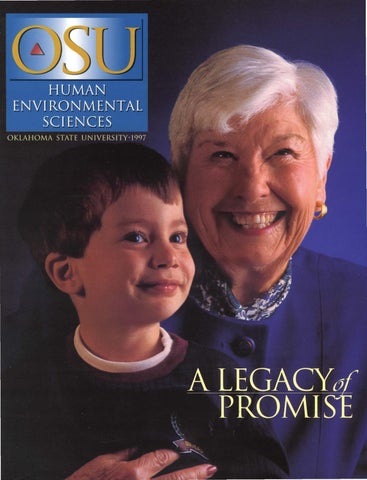
tis \vith enthusiasm that we share Human Environmental Sciences 1997 with you. This year, we focus on people realizing dreams, stepping up to challenges, experiencing growth through opportunities, enjoying the fu1fillment of providing opportunity for others and expressing the legacy of promise. Embedded in this promise is a spirit of caring ... creating a bright future for others. How is a legacy of caijng developed? The university is a perfect setting for establishing this legacy. The OSU campus naturally brings together two groups that provide the essentials for drea.tn-making, for meeting new challenges, for growth and fulfillment of promises. These two groups include alumni and friends of all ages who have reached a level of personal and professional achievement interacting with students who are still developing their personal a.t1dprofessional identities. For those who have reached this level of personal and professional achievement, Erik Erikson, in his book Vitallnyolvementin OldAge (1986), describes a time of life known as generativity. It is a stage mai·ked by an interest in taking care of all that has been produced, procreated and created. It is a time of giving back, not out of obligation, but out of concern for the future and for the common good. Margaret Fitch, featured on this issue's cover, symbolizes generativit:y.Over several decades, Margaret's professional commitment \Vas to building better fanruies ai1d communities. In retirement she selflessly
continues to support these efforts through a generous sharing of her own resources. She is a positive role model for our students, having herself liveda life of commitment and caring. Another positive influence in the livesof student\ is Brya.t1Close. Featured on the back cover, Bryan has given selflesslyof his time, talents and resources to ensure that more students have the opportwutyto gain an education. His friendly, outgoing generous spirit is evidenced by the respect and adnuration given him by all the lives he touches. Role models like Margaret and Bryan are important to establishing legacies. Those individualswho are in the process of developing identities and forming commitments in careers a.t1drelationshipsneed role models. Research tells us that a person with good role models who takes advantage of opportunities for service, the enrichment of cross-culturalexperiences and good mentoring will emerge a committed, caijng adult. Dreams come to life because they ai·emmured in an environment of commitment. The CHES fanuly, made up of friends, alumni, faculty, staff and smdents, provide such an atmosphere is illustrated throughout the magazine. I hope you enjoy reading about all these truly outsta.t1ding individuals ... for they ARE bringing dreams to life, stepping up to challenges, experiencing growth through opportunities and fulfilling promises.
Deon PatricioKnaub
CONTENTS OVERLAPPING DISCIPLINES A DHM student combines disciplines to help remodel the OSU Student Union Hotel.
4 REACHINGOUT TO OKLAHOMANS CHES continues the legacy by offering wuque outreach programs.
12
2 ENHANCING THEQUALITYOF LIFE Renovation of the Nutritional Sciences Lab will provide researchers with a state-of-the-art facility.
6 BEYONDTHECLASSROOM Lea Ebro is the unassunung guardian angel who watches over her students.
A GOOD IMPRESSION Research indicates portfolios make a lasting impression on job interviews.
15
CHES MAGAZINE • VOLUME 4, 1997
COVER: Margaret Fitch,alumna and retired Cooperative Extention, is shown with Cedre Shangreaux. Fitchbelieves in extending the legacy of promise to future generations of Oklahomans.
Director of "Extensionand Development - Debra Engle Editor - Debra Basore Art Director - Valerie C. Kisling Photography- Andy Maxey unless otherivisenoted
CHES Magazine is a publication of the Oklal10ma State University College of Human Environmental Sciences. Its purpose is to connect this college with its many stakeholders, providing information on both can1pus news and pertinent issues in the field of human environmental sciences. ©Oklahoma State University 1997
Oklahoma StateUnive1siry incomplionre withTille VIandVII of 1heGvilRighlsActofl964,ExecutiveOrderll246osom TitleIXoftheEducation Amendments of 1972, Americans with
DisabilitiesActof 1990,ondotherfederollowsondregulotio doesnotdiscriminate onthebasisofrnce,color, notional or~ gin,sex,oge,religion,disability,01stotusosowternnino
itspolicies,procticeso,procedures. Thisindudesbutisnotlimitedtoadmissions,employmenl, finoncioloid andeducotionol services. Thispublicotion, issuedbyOklohomoStoteUniversity osouthorizedbytheColle9eofHumanEnvironmenlolSc wasp1intedbyTheAudioVisuol(enler,UniversltyPrintin vices al nocosttothetaxpayer ofOklahoma. SM/Morch/97.
18196
■■■ OF NOTE
Internship Becomes Zone of Overlap
pholo@JudyNordsethPhologrnphy,DollosTX
BlendingDisciplines
I
t's exciting when the line between two disciplines results in a zone of overlap rather than a boundary. Design, housing and merchandising senior Erron Kreie experienced this overlap firsthand during a recent internship. Not only did Kreie work with one of the world's top designers; he also was able to work with two OSU departments on the renovation plan of the Student Union Hotel. The internship was the result of collaboration between the department of design, housing and merchandising (DHM), the school of hotel and restaurant management (HRAD) and the Dallas design firm of Deborah Lloyd Forrest Associates Inc. "The opportunity to work with HRAD and Deborah Lloyd Forrest was the highlight of my academic career," says Kreie. "The diversity of people associated with this project gave it life and a meaning I had never before experienced." Ray Kavanaugh, director ofHRAD, says, "Erron has the career goal of being a designer working within the lodging industry. Obviously there's a good deal of overlap between design and the hospitality industry, and this project suited Erron's goals perfectly." Through an independent study project under Kavanaugh, Kreie began his work by gaining a thorough understanding of tl1e structural issues at the Student Union Hotel. "Erron tl1en came up with design recommendations for how the hotel could most reasonably be upgraded to a state-of-the-art, world-class facility," says Kavanaugh. During the summer, Kreie completed an internship under Deborah Lloyd Forrest, 'vvidelyknown as one of the top designers involved in restoring historic hotels. Working together at her Dallas firm, Forrest and Kreie produced the concept for the remodeled hotel. Erron Kreie (right) spent last summer as an intern working with Deborah Lloyd Forrest at her Dallas firm. "During this proiect many people had a profound affect on me, but none more than Deborah. She gave direction to my studies, as well as my future," says Kreie.
"Erron really did a good job on this real-life project,"says Forrest. • JENNIFERWINGETT
"Theopportunityto work withHRADand DeborahLloydForrest was the highlight.of myacademic career."
2
~
College of Hmnan Environmental Sciences 1997
wtoleave :theirlega.~ women: involvedwith the Collegeof Human enta.l:Sciences' (CHES)Womenin Philan(WIP) learnedit is moreimportantthanever -control of theirfinancesin orderto leave behindforfuturegenerations. etherthefulfillmentof theirphilanthropy be ritecauseor forfuturegenerations,the Jim Anderson (right)is the business manager and driving force behind the theyleavebehindcanonlyhappenif women school's DistinguishedChef Scholarship Benefit Series. withtheirown financial ptan,iing. ilu.mna, NancyPayneEllis,demonstrated tow.n-d the college'sWIPendeavorsby CHFSDeanPatriciaKnaubandOSU Dean Patricia Knaub agreed to 1at started out as an • nPresident RonAreawitha $50,000 try it one semester. Six years later, experiment six years ago 'pBilto the college.Thisgiftwillbe has turned into a phenomevery chef event is sold out and to a humanenvironmental sciencesstudent the tickets are a hot commodity. enal success today. Not only are •esthe p}plan~u: aild. leadershipspirit students and faculty benefiting The series has featured nationprogtaµiasa W!lfof buildingon the from the Distinguished Chef ally-known chefs from the besanbyEllis. Scholarship Be1i.efitSeries, but the Broadmoor Hotel, Disney World tsjfuporJJnt thatwe rqch the studentstoday OSU community is also tasting and Santa Fe, to name a few. • c,tphilanthropy - at any:levelor forany the benefits. He says this is a good ending N~ Ellis."Th~ andonlythen,is The brainchild of Jim Andernote to his career at OSU. In forthefutureforCOJltinuing the legacy son, the business manager of the May, Anderson will retire after opyandleadership." series, it has awarded more than spending the last 12 years teachhonoredto receivesucha $30,000 in scholarships and proing and managing the chef series. continfessional development funds and • that He says he'll miss the students
SweetSuccess
W:
brought nationally-recognized chefs to OSU.
"When you're given lemons, make lemonade," quips Anderson when asked how the series got started. In 1990 the school moved into a new facility.The only thing lacking was an experienced culinary chef, says Anderson. "I asked the dean if we could bring in several chefs and recoup our expenses for the chef by preparing a meal and selling tickets."
and the excitement of the dinners. "I get a great deal of enjoyment from watching the students come together as a tean1 and produce a meal," he says. "By the end of each event I'm usually thinking, 'wow the students are really something."' Even though Anderson is retiring, he wants to be involved with OSU. And, of course, he'll be attending future chef events (ifhe can get tickets) .• DEBRABASORE
Oklahoma State University ~
3
A'v\PAIC
■■■
FRI )I I rY
"Yourtruepilotca~ nothingaboutanythingon earth theriver;and hisprideinhisoccupationsurpassesthe prideof kings." - MarkTwain
Brenda Smith, Seretean Scholarship recipient, stands in the Nutritional Sciences Lab, currently undergoing renovation.
Bringing Dreams to Life Brenda Smith began college hooked on athletics. But somewhere along the way, she came to a "fork" in the road and took the path that led her to study nutrition and preventative health measures. Today, this Seretean Scholarship recipient has finished course work on a Ph.D. and is looking forward to completion of her research project, which is focused on post menopausal osteoporosis. "Calciw11is critical to this conclition," Smith says, "but a recent study shows that trace mineral supplementation is also oitical to increase bone density. My research will evaluate the effect of trace mineral deficiencies on bone and immune functions. I think I can make a difference." "I don't think I could have chosen a better place than OSU. I work with top researchers and have been encouraged to take the steps to reach my goal, which is to work with college smdents. OSU has made that dream a reality for me!" • BARBARASWIGGART
4
~
CollegeofHumau Environmental Sciences 1997
his quote could havebeen ment. Stoecker, maintaining a authoredby Patricia "hands on" position, keeps a close eye on the renovation, Knaub,Deanof the Collegeof HumanEnvironmeqtal often seen inspecting progress Sciences(CHES).As the pilot of with building plans in hand, this college,herpridein CHES is ing and dust dancing at her especiallyevidentas she addresses But it's smooth sailing ahea<i, the renovationof the OSU Nutri- according to Stoecker. "The tionalSciencesLab,currentlyin project is on schedule and progress."Thisrenovationproject should be finished by the end is trulya dreamcomingto life," May. It will move us out of Dean Knaubrelates."It'sbeen a 1950s - and into a facilitywi long time comingand it is absoeleven working lab stations, lutelycriticalto our workin nutri- equipped with the latest in SUP';i tionalresearch.The public port equipment fur research demandis puttinggreatemphasis safety." on healthand qualityof life.With OSU's reputationin the fieldof projects seem endless. From nutrition,we had to havefacilities dealing with the effects of asp' to supportthat demandthrough on heart diseaseto the interac research. Fortunately, we have tions of drugs, nutrients and generous donors who recognize human physiology, to how tra the effect of nutritional research mineral elements relate to on the betterment of humanity," chronic disease. she continues. " 'n;i not sure that there • And, there is a sizable "ci;cw" awareness ofOSU's collabo.raaboard the CHES vesselti,01,1with o tside en ·nes~ equally excited aboutihe renova°'Stoecker ys. One of our tion project. Chit{ project cr c;,oncernsi osteoporosis or loss is Dr_ Bar· o ~ne density, a problem th:\ the nu
EnhancingChildhood o know Ed Long is to know a man of passion. As a long-term public official, Long made his reputation as a passionate man about several subjects: cattle, children, education and doing what's right- not necessarily in any priority. And, this man, along with his wife, Mona, focus on three of those fom passions through the College of Human Environmental Science's (CHES) early childhood development progran1.
of today'ssociety," concludes."Andsociety debtof gratitudeto those whohaverecognizedthe andsteppedforwardto thisdreamof a cuttingnutritional lab to reality. shouldtakegreatpridein t theyhaveaccomplished for , forthe stateandfor ·cy."Contributorsto the tionof the OSU Nutriundersof Doctors'Hospital, . andCarleneandHerbert , theOklahomaStateRegents HigherEducation,the U.S. artrnent of Agricultureand y GaseSells.
Long has also been an advocate for crime prevention programs. He's studied ways to help children get the right start in life so they become contributing citizens instead of criminals. He is convinced that the best way to fight crime is to invest in children through education. CHES Dean Knaub shares the Longs' passion for improvement of childhood quality of life. "Childhood is so btief and
we, at OSU, recognize the importance of the lessons each child canies forth into their adult lives." CHES's Child Development Lab was established to focus on giving children a developmentally appropriate environment in which to grow and discover those lifelong lessons. "That's why we're very excited about being able to establish the Ed and Mona Long Professorship for Fan1ily Relations and Cl1ild Development at OSU," Knaub says. "The professorship will support a high-level applied research professional and provide an opportunity to better educate our students and enhance om research capabilities. We are so appreciative of Ed and Mona Long for this endowment that benefits children and their parents." • BARBARASWIGGART
Ed Long and a fouryear-old child in the Child Development Labs build a tower with blocks. Long and his wife Mona have established a professorship that will benefit children.
Oklahoma Strite U11i11crsity ~
5
eeply rooted in a long history of serving the public, the college has offered outreach programs for nearly 90 years. Although the programs have changed since the first outreach lecture offered in 1908, the overall mission remains the san1e-to enhance the quality of life for the citizens of the state. To accomplish this goal, the college offers a unique net\vork of programs through University Extension and Cooperative Extension. The college of human environmental sciences considers its ouu-each programs to be a significant part of its mission. It gives the faculty an opportunity to apply their extensive knowledge in real-world sin,ations while allowing students to gain firsthand experience in their chosen field. But perhaps even more important, it provides an opporttmity for the university to serve the people of Oklahoma. This is the legacy of promise that the college offers to Oklahomans.
Expandingthe sphere of influencebeyond the campus
has a/ways been part of the missionof the collegeof human environmentalsciences.
In the pages that follow are four stories of unique CHES outreach programs. Discover how Joe Weber in the department of family relations and child development is working ,vi_thissues facing our aging population. Next, discover how Gail Gates, associate professor of nutritional sciences, is planning to meet the on-going u·aining needs of managers and employees in the hospitality and health care industJies. Learn about our paru1ership with Tulsa Community College (TCC) to offer distance learning and on-site classes to facilitate the preparation and transfer ofTCC students to programs offered at CHES. And finally, find out how first-time parents are improving their parenting skills through a w1ique program offered through Cooperative Extension. No longer does the image of the university as an "ivory tower" stand. The hard work and dedicated research of CHES faculty and stt1dents is reaching out to Oklal1omans across the state - helping solve their day-to-day problems. The legacy lives on.
6
~
Collegeof Humn.n.Envfronmental Sci&11ccs 1997
"Asmany as one in fivepersonswill be elderly by the middle of the nextcentury.Thisiscreating many career opportunities for studentsin the field
of aging."
TimeMarchesOn ge happens. That's why Joe Weber is helping OSU gerontology students and health care professionals preparefor the next century - when projections indicatethere will be more persons who are elderly d1a11 young. According to the U.S. Census Bureau, "the elderlypopulation will more than double, to 80 million,between now and the year 2050."
In response, OSU has developed several programsto address the needs of gerontology professionals.
Weber says the 5,000 member network provides an outlet for education, research, community service and healtl1 care issues. "We're at a critical time in tl1e field of gerontology," says Weber. "As many as one in five persons will be elderly by the middle of tl1e next century. This is creating many career opportunities for students in tl1e field of aging." DEBRABASORE
Weber,an associate professor of family relations and child development, has been involved in gerontologyresearch for several years and teaches classes on the subject. He also serves as the director of the newGerontology Institute. The institute is a multidisciplinaryprogram that offers a master's degree in gerontology. The program is designed to train students to deal withissues facing an aging population, including ethicaland moral dilemmas confronting families. For example, some of the classes deal with ethics and aging, theories of aging, nutrition for the elderly and social gerontology.
Asdirector of the program, Weber coordinates classesoffered in three colleges: human environmentalsciences, education and arts and sciences. Classesare also offered in Tulsa through OSU's Collegeof Osteopathic Medicine. Weber also coordinates the annual Ethics and AgingConference for gerontology professionals. It servesas a statewide task force to study the needs of d1eelderly and covers issues such as health care, politicalissues, human rights and cultmal diversity. Because of the success of the Gerontology Institute, the Ethics and Aging Conference and the outstanclingfaculty at OSU, the Southwest Society on Agingrecently moved its headquarters to OSU.
Discussingthe annual Ethicsand Aging Conference in Tulsaare Joe Weber, OSU associate professor and director of the new Gerontology Institute{left}; Peggy Risinger,Blue Cross & Blue Shield Vice Presidentof Government Programs (center};and TerryClark, HillcrestDirectorof Community Development. The three organizations plan and coordinate the annual conference.
Oklnhown Smtc UniPcrsity ~
7
Partnersin Education erving the educational needs of students and professionals is one of the most important responsibilities of a faculty member. But determining what education is needed and wanted can be a challenge. Two faculty members in the college tackled that challenge by combining their two disciplines. The result was the first-ever comprehensive training needs assessment for professionals in the hospitality and health care industries in Oklahoma.
"We surveyed managers in restaurants, hotels, tourism and dietetics," says Gail Gates, associate professor of nuttitional sciences and project head. "We asked them what kind of continuing education they needed as managers and what kind of tt·aining their employees needed." Gates worked with Gail Sammons, former assistant professor of hotel and restaurant adminisu·ation (HRAD), to develop a 17-page survey. The results showed that the top five training needs for managers were problem-solving, internal communications, leadership, increasing sales and establishment of total quality management. Managers said their employees needed training in resolving service problems, sanitation and commwlication. "Th.is project was unique not only because it was the first such survey of this group, but because of the part11ershipsthat made it possible," says Ray Kavanaugh, professor and director ofHRAD. The project was supported by several wliversity depart111entsand the Oklal1oma Restaurant Association. An elite group of industt·y leaders also provided input by serving on an advisory comnlittee. Now that the trai1ling needs have been identified, Gates and other CHES faculty are working to meet those needs. "We are developing ·sixtraiiling modules that \\~II be offered tllis year," says Gates. Kavanaugh predicts the information created from the senlinars will also impact the classroom. "One of the biggest challenges a professor has is keeping up witl1 what's going on in tl1e industry and then presenting tl1at cutting-edge information in the classroom," he says. DANA SCHULER
Gail Gates, associate professor of nutritionalsciences {left),discusses the results of a recent survey on the hospitalityindustry with Bob Clift,Oklahoma Restaurant Association executive vice president (center},and Stan Clark, president of Stan Clark Companies.
8
~
College of Htmurn Envir-oumwtnl Sciences 1997
"Learninghas to be funto be interesting."
TheTulsaConnection ecognizing that a significant number ofOSU students are from the Tulsa area, OSU has seizedan opportmtity to recruit students.Under a new arrangement,Tulsa Community College (TCC) students can attend the communitycollege for tv.royears andtransfer to OSU for their juniorand senior year without losing collegecredit. To help make this seamless transitioneven easier, the college ofhuman environmental sciences' schoolof hotel and restaurant administration(HRAD) and the department of design, housing andmerchandising (DHM) are both offering courses at Tulsa CommwlityCollege. The courses will be identical to thosetaught on the OSU can1pus.It will allow TCC students, whocomplete their associate of sciencedegree in apparel design andmerchandising or hotel and restaurantadnlinistration to easily transfertheir hours and complete theirdegree at OSU.
HRAD has hired a recent OSUgraduate, Jill Buxton '92, to teach a course on the overview of the hospitality indu_stryat TCC
next fall. "Jill will be using the same syllabus and textbook that we use in class here," says Kavanaugh. DHM will also be offering a course to TCC students next fall but using a different delivery method. Lona Robertson, DHM assistant professor, will be delivering the course via compressed video from a distance learning classroom in Stillwater. This way, students at both can1puses will be taking the course simultaneously and from the same instructor. "We have developed this link with Tulsa Corrununity College because so many of our transfer students come from there," Robertson says. Learning has to be fun to be interesting, so I've tried to put together an attention-getting multimedia program." "Although HRAD and DHM have taken a somewhat different approach in presenting courses at TCC, our objectives are the same," says Kavanaugh, "to provide a broader scope of service to the Tulsa market and make a seamless transition to OSU." JENNIFERWINGETT
Lona Robertson, design, housing and merchandising assistant professor, greets students at OSU and Tulsa Community College. Robertson will be teaching a class simultaneously dt OSU and Tulsa Community College using compressed video.
OklahomaStn.teUni11e1·sity~ 9
HealthyFamilies= EffectiveFamilies ringing that new baby home can be intimidating and challenging for first-tin1e parents. Thanks to Oklahoma State University:s Cooperative Extension Service "Healthy Families" progran1s, approximately 165 families are currently being seen in tl1eir own homes by family support workers. Human enviromnental sciences researcher Dr. Anne McDonald Culp, an associate professor of family relations and child development (FRCD), has conducted research on high-risk families and tl1e Healtl1y Families progran1 evolved from her research efforts. The grant-funded program gives young high-risk families access to information about child development and parenting to help ease the transition to parenthood.
professor. Robertson is responsible for providing education and support to the program. "Parents are enrolled on a voltmtary basis in the program prenatally or within tl1ree monilis of tl1e baby's birtl1," Robertson says. "Fanmy support workers assist parents in improving parenting skills, increasing knowledge of child growtl1 and development and increasing parental self esteem.
"The family support worker provides information and support to help strengilien ilie fanmy. They've done everything from helping a parent enroll in GED classes to helping a fanmy acquire safer housing," Robertson says. What really makes tl1e progran1s successful is strong community collaboration and committed staff who receive ongoing education," says Robertson. LAURIEKING
"Thisprogram recognizes that it is criticalto reach familiesas early as possible in order to build parenting skills,strengthenfamilies,and promote child and familyhealth."
Culp says the programs are making significant strides in helping parents understand ilie needs of children. After 12 montl1s of enrollment, mothers have gained knowledge about child growtl1 and development, she says. In addition, among teenage mothers enrolled in the program, the rate of repeat pregnancies is only five percent, while ilie national rate of repeat pregnancies for this group is 20 to 25 percent. "This progran1 recognizes tlut it is critical to reach families as early as possible in order to build parenting skills, strengthen families, and promote child and family healtl1," says Jo Robertson, human and family development specialist and FRCD assistant OSU graduate student Rebecca Pruitt{right),a full-timefamily support worker, counsels Lisa Gibson {left),mother of four-month-oldChance Edwards. Lisa enrolled in the program four months before Chance was born. JO ~
College of Human Emifronmental Sciences 1997
EXTENSION, INSTRUCTION AND R.ESEAR.CH ■■■
Olympic Organizers Reach Out to the World
BringingHome the Gold osting eight million guests and the Swnmer Olympic Games for 17 days teaches a city a few things about its hospitality and tourism industry. In a recent school of hotel and restaw-ant administration lecnire series, Oklahoma State University students gained insight into those lessons from three of the Olympics' chief organizers. "Students learned that research and planning for such an event is essential for financial success," says Dr. Brian Mihalik, the Charles W. Lanphere Professor and coordinator of the school's master's degree program.
for ARAMARK. One of the Olympic-sized lessons came from feeding Olympic-sized appetites, says Bruno. "After 100,000 hours of planning, ARAMARK prepared and served five million meals during the games," says Bnmo. He described the world's largest temporary dining facility,where 6,500 part-time employees provided food service 24 hours a day in the Olympic Village to the 15,000 coaches, athletes and officials. A configuration of26 tractor trailers all linked together served as the kitchen. "I wanted our food-service students to see what institutionalized food can be in terms of serving so
"Studentslearned that research and planning for such an event is essential for financialsuccess." Mihalik says it is important for students to realize the implications of managing a mega-event because part of the tourism industry involves learning to deal with a large nun1ber of people in relation to the community size. "It could be something like selling eight million tickets to the Summer Games in Atlanta or bringing in 150 high school bands for a festival in tl1e state of Oklahoma." Each speaker gave students a unique perspective of the events in Atlanta, Mihalik says, including their individual work with the Olympic Committee and tl1e city of Atlanta. Invited speal<ersincluded Sherman Day, managing director for Legacy at tl1e Atlanta Committee for the Olympic Games; Robert King, president and chief executive officer of the Georgia Hospitality & Travel Association; and Mark Bruno, food service director
many meals, in a short period of time, witl1 part-time staff," Mihalik says. "When you serve tl1at kind of meal, you buy tomato sauce by tl1e 55-gallon dn1m." ADAM HUFFER
"BringingHome the Gold: Olympic-Sized Lessons for Hospitalityand Tourism,"was held last
October. ThisfirstCharles W. Lanphere Lecture Series is part of an endowed professorship established by Sue Lanphere in memory of her husband, Charles W. Lanphere (HRAD '67 ). The lectureseries is an opportunity for HRAD to host national le~ders in the hospitalityindustry. Lanphere, who died in 1993, was a hotelierand founder of HospitalityManagement Corporation. An active supporter of OSU, he received OSU's DistinguishedAlumni Award in 1992.
Oklahoma State Uui11ersity ~
11
■■■ EXTENSION, INSTRUCTION
AND RESEARCH
GoingBeyondTheClassroomExperience
D
r. Lea Ebro, a nutritional sciences professor and head of the ilietetic internship program, talcespride in going beyond the classroom expenence.
Every year she helps ilietetic students find internships in hospitals, nursing homes, clinics or anywhere a dietitian is needed. Recently, she discovered a new opportmiity to serve a pressing need. "Oklahoma has a large Native American population with more tl1an 30 different tribes," says Ebro. Native American ilietitians are needed to work in major medical centers and clinics to deal witl1 ilisease prevention and health issues, she says. "For example, iliabetes and heart ilisease are higher among Native Americans and can be modified by nutrition," she says.
Multiculturalscholarshipstudents Shannon Hardin {left), Jessica Garrison {center)and Robin Carpenter conduct a sensory panel as part of theirstudies. The Native American students are part of a $40,000 USDA multicultural
scholarsprogram. Inset:Lea Ebro
Research inilicates persons· of certain ethnic backgrounds relate better to someone of tl1eir own ethnic background. That's why it's so important for our program to recruit minorities, especially Native Americans to the ilietetics profession." Witl1 that in niind, Ebro was able to get a $40,000 grant from the United States Department of
Agriculture to fund a program, which will recruit and maintain four Native American dietetic students in the department. "We were fortunate to findstudents from four different tribes," Ebro says. "So far, tl1e students are doing a great job and should start tl1eir internships in about a year," The ilietetic program consists of four years of undergraduate work and a one-year internship. The unpaid internship is a full load for students. They work 32 hours a week and attend classes one day a week on the OSU campus. The students are really dedicated to tl1e program, says Ebro. "We have students interning as far away as McAlester and Ada who drive to OSU once a week to attend classes." For Ebro, the internsliip program is successful because it is combined witl1 follow-up activities. She takes pride in being the unassuming guarilian angel who watches over her students to ensure tl1ey are successfoJ. "I check on them to see how they're doing," she says. "Sometimes they call me witl1 tl1eirproblems, and I always try to help. DEBRABASORE
Native Americandietitiansare needed to work in ma{ormedical centersand clinics to deal withdisease preventionand healthissues.
12
~
College of Human En11ironmental Sciences 1997
TheEthicalBalance aking ethical decisions and exhibiting professionalism may not be on the minds of college students as they dash from classes to activities.However, one college of human environmental sciences (CHES) course focuses on just that.
M
"Feedback from employers inrucates th.at they want employees who perform in an ethical and professional manner," says Lynn Sisler, CHES associate dean of undergraduate programs and services. Taking this request seriously, the college has included it in their mission statement: " ... human environmental programs which enhance inruvidual wellness and quality of life in an ethical and socially responsible manner." Scott Plwi.k:ett,a family relations and child development instructor, teaches differing philosophical views on ethical responsibility. "I think one of the reasons this class is important is the increased emphases businesses are placing on ethics," Plunkett says. "Adding a professionalism and ethics course to a graduate's transcript is impressive to potential employers." In Plmi.k:ett'scourse, students examine a specific dilemma and then use a problem-solving process presented in class to work through the challenge. "After they figure out the different ways of looking at the issue, they can better understand the reasons somebody might have a particular opinion. The class also highlights the experience of being a new employee. Students learn to measure the professional climate of the organization by listening carefollyto what is being said and done in the office.
·--·... ---. .--·. .__ ..::: ::::::.. --· ______ ---____ ---__ ---
-·... .... ............ .... ...... 1,_. • ;'-.I ..... 1111 ,:;;:.: ~ .. ._--~-:..., '"" _,_.._._, •................ ...... ......... ,_. ......... t I ---- .. ---------•1---....-~ ==::::.-:.--··~--:=r -'
\.
=-==== -----------~ ... . . ----- ---==~ ---
-
..,,,,
"They need to be aware of what is acceptable," Plm1kett says. "For example, do employees use first names or last names? Can employees informally 'drop in' and visit with their supervisor or do they need to set up formal meetings?" Plmikett likes to tallc about professional principles th.at apply to all of the college's majors. "The principles we teach can be applieq to all human environmental sciences majors such as confidentiality, professional responsibility, competence, welfare of clients and professional relationships," Plunkett says. While Plm1k.ett'sstudents may not reveal it during the hustle and bustle of everyday college life, they will be leaving OSU well aware oftl1e ethical challenges they'll be facing in tl1e professional world as well as how to exhibit professionalism. • AMY ALLEN
Ok.lnhom.«State Uui11ersity ~
13
■■■ EXTENSION, INSTRUCTION
AND RESEARCH
New DHM Lab Will Provide
Science-Based Experience ith help from the National Science Fow1dation (NSF), a hnn1an environmental sciences teacher and researcher has been the driving force behind building a new lab. This lab will help provide a technologically superior, science-based education in academic areas not usually known as scientific fields.
W
Students in interior and apparel design and merchandising will benefit from the new integrated Computer and Product Testing Laboratory ( CAPT) being developed by Dr. Cheryl Farr, associate professor of design, housing and merchandising (DHM). Farr says the lab will be used to teach science principles and to integrate course work in product design, prototype production and product testing and evaluation with textile testing of interiors and apparel products. Curriculum in both departments has been completely redesigned to mesh with labora tory work. The lab will have computer systems, textile product testing equipment and industrial sewn product production equipment. Students will learn how to conduct statistical analysis of test results and how to link these results to science-based explanations that can predict product performance. Product testing applications will include testing for tensile strength, dye stability in fabrics, compression, resiliency, flammability and soil resistance. Students will learn the full product development cycle, Farr says. This includes designing a textile in the Computer Aided Drafting and Design (CADD) Lab, making a prototype of the product, testing the product in the CAPT Lab and analyzing the results using special computer software packages. It's possible the laboratory will have an impact beyond the campus. "The potential for student-industry collaboration on projects certainly exists," Farr says. "This will give the students real-world experience and valuable job contacts."
Cheryl Farr,OHM associate professor, displays a varietyof fabrics that have been dyed by students in the new Computer and ProductTesting Laboratory.The inset photo illustrates a flammabilityexperiment.
14
~
College of Human Environmental Sciences 1997
The project has been a collaborative effort between the DHM faculty, department head Dr. Donna Branson and Dean Patricia Knaub. "The department is one of few DHM departments in the nation that has obtained funding through the NSF Instrnn1entation and Laboratory Improvement grants to improve undergraduate education," Farr says.• DEBRABASORE
Makinga Good FirstImpression aking a good first impression is especially critical for first-time job seekers. That's why an OSU professor's research into the best wayfor students to put together a portfolio is so important to students. Shiretta Ownbey, associate professor of design, housingand merchandising (DHM), teaches a class thatinstructs students in the process of putting togetherthat all-important portfolio. "The process of putting together a portfolio makesstudents think about their skills, builds selfconfidenceand helps them solve problems," she says."The portfolio is an excellent tool to have at an interview.It shows that they're far beyond others beinginterviewed because they have this material they'veput together sho,ving visually and with powerfulwords what their experiences have been." The strongest element in the portfolio comes fromthe summer internship that all DHM students arerequired to complete, Ownbey says. After their internshipthey put together the portfolio based on theirinternship experience, any other work experiencethey may have and classroom work.
HillariTucker,an OSU apparel merchandising graduate, discusses the importance of making a good firstimpressionon a job interview by using a portfolio. Meeting with her is OSU associate professor Shiretta Ownbey. Tucker landed a job at CottontailOriginals in Stillwater.
Not only does Ownbey teach the class, she has alsoresearched and fine-tuned the portfolio process to make sure students are getting the most current information. "Three years ago I developed a process for puttingtogether an apparel portfolio and tested it in my class,"says Ownbey. "I developed a survey instrumentand used it at the end of the semester in my classto see if my hypothesis was correct."
"Ownbey's balance of knowledge, research and practical experience has impacted many of her students," says Patricia Pitts, an interior design student. "She has been both a teacher and mentor for me."
Ownbey hypothesized that students who had createda portfolio would be better prepared for an interview.The researc~ results were published in the Associationfor Business Simulation and Experiential Leaming.
Ownbey's passion for the profession and her real-world experiences offer students a wellrounded education, says Pitts.
"This kind of research is really the opposite of whatyou typically think about," she says. "Usually youdo research and share it with your class. In this casethe class was part of the research. I've incorporatedthe students' feedback and refined it and hopefullyimproved the class each year."
With the help of Ownbey, OSU's design, housing and merchandising students are well on their way to making an excellent first impression. DEBRABASORE
Oklahoma State University ~
I5
■■■ IN MEMORY
Leavinga Legacy nn Griffin Mills and Barbara Heister were exceptional women whose love for children and students knew no bow1ds. Both spent a significant portion of their professional lives teaching yow1g children, researching the best methods of teaching them and advising student teachers in the College of Human Environmental Sciences.
A
Ann and Barbara's love for students and children will continue as parts of the new Outdoor Learning Environment in the Child Development Laboratory are dedicated in their honor. In this way, the legacy of excellence and caring established by these women will continue to help foture generations as they grow into the next century.
Barbara Brown Heister 1951-1994 From the preschoolers in her classes to the student tea~hers she advised to her colleagues in the department of fan1ilyrelations and child development, Barbara Heister was known as someone with a true affection for others. "You just knew she cared about your cl1ild," says Don Topliff, anin1al science professor whose son Christopher was in Barbara's Child Development Laboratory for 3-year-olds. "She modeled the very best in early childhood care," agrees Topliff's wife, Linda. Christopher, now 7, remembers Barbara as a good teacher who was fon to be arow1d. "Every time she came in she said 'hi kids' and almost the whole class would come and give her a hug," he says. Barbara was also a model and mentor to students preparing for a career in early cl1ildhood education. "Children, parents, college students and fellow staff members loved her," says Faye Ann Presnal, a colleague in Fan1ilyRelations and Child Development. Barbara left a legacy to the CDL of high standards, commitment to children and their fan1ilies,and a belief that everyone has the potential to achieve."
1941-1995 "When describing herself, Ann Griffin Mills saidshe wasn't good at art or music, but she sure knew how to play," remembers Ann's friend and colleague Elaine Wilson. "Ann's knack for play was what we consider the basics of good, solid early cl1ildhood education," says Wilson, associate professor and parenting specialist. Wilson shared teaching responsibilitieswith her at OSU's Cl1ild Development Laboratory in the early 1970s. One of Ann's favorite ways of teaching was to let children play with water. "She had a respect for splashers," Wilson says, even dividing the children into groups of splashers and non-splashers so everyone could have a good time. It is particularly fitting that the water play section of the Child Development Lab's new outdoor learning environment will be named in her memory. One of the focal points will be a brightly-colored mermaid fow1tain tl1at allows many types of water play. Dedicating part of tl1e new Outdoor Learning Environment in Ann's honor is indeed a fitting tribute. JANETVARNUM
TorememberAnn GriffinMills or Barbara Heisterwitha memorialgiftto the new outdoorlearningenvironment, contad the CHES University Extension and DevelopmentOffice, 125 HES, Stillwater,OK 74078, or call (405) 744-6571.
16
~
College of Human Eniiironmental Sciences 1995
TheCollege of Human EnvironmentalScienceswould like to congratulate Bruce Snyder and June Henton for a lifetimeof achievementand service to the college.
Thetwo outstandingalumni were recentlyinducted into the college's Hall of Fame. June M. Henton Sincegraduating from OSU in 1961, June M. Henton has spent more than 30 years devoted to highereducation. She currently servesas dean of the school of humansciences at Auburn University,a position she's held since 1985. In addition to coordinating the efforts of three departments in the school, she's provided nationalleadership for the new Commissionon Food, Environment and Renewable Resources of the National Association of StateUniversities and Land-Grant Colleges.She also provided joint leadershipfor the National Textile Centerwhich recently received $9 millionin funding. The center providesleadership for textile engineersat Auburn University, ClemsonUniversity, Georgia Institute of Technology and North Carolina State University. AI; dean of human sciences,
Henton has revised and consolidated tlu·ee departments and added a doctoral degree in fan1ily and child development. In addition to recruiting outstanding faculty,Henton says the school has increasedenrollment by more than 30 percent. Henton also is responsible for sponsoring the nation's first apparelsourcing fair. Designed to
combat foreign imports and increase domestic production, tl1e fair matched national retailers witl1 Alabama contractors and manufacturers. Henton says the model has been replicated by other states, trade associations and corporations.
After Snyder graduated from OSU he went to work for one of the airlines. The company sent him to the '21' Club to learn how to give its travelers that same special treatment. After his work at '21' there was no going back to airline work.
Prior to 1985, Henton served as professor, associate dean and head of the department of human development and fan1ilystudies at Oregon State University.
Although his life revolves around the '21' Club, he's more proud of the work he's done witl1 his fan1ilythan his career. He married his sweetheart from OSU, Marcia Truesdell, '62 FRCD, and they have two children, Michael andJe1my.
She has also taught at Texas Tech University, University of M.itmesota and East Carolina University. After graduating from OSU in 1961 she taught vocational subjects at Pawhuska High School in Pawhuska, Okla.
Bruce Snyder As vice president of the '21' Club in New York City, Bruce Snyder rubs elbows with movie stars and heads of state almost every evening. The '21' Club is one of New York City's favorite hot spots. Snyder, who graduated from the school of hotel and restaurant administration in 1962, says the club's reputation rests on tl1e special treatment given to every customer. Learning how to give that VIP treatment is what landed him the job 27 years ago.
June M. Henton
A native of Covington, Okla., Snyder is happy to talk to Oklal10mans who visit '21.' If fact, he fondly remembers hosting tl1e party for Oklahomans when the Will Rogers' Follies premiered. He is very proud of his Oklahoma roots, especially when it comes to his involvement in the OSU School of Hotel and Restaurant Administration. Two years ago he hosted a '21' Club fund raiser for the school's William E. Davis Chair. He even provided souvenir books from tl1e '21' Club. The school literally rolled out tl1e red carpet for the fund raiser just as they do at '21 '.
Bruce Snyder
"Withoutthe BryanClose ScholarshipI wouldn'tbe 11
attendingschoolat OSU,
says a 41-year-oldwidow aDdmotherof a 14-year-old daughter. ithout the aid of scholarships, Ann Ramsey would not be studying at OSU to achieve her dream.
Ann Ramsey and Bryan Close
She hopes to combine a major in hotel and restaurant administration with a minor in environmental tourism to help families learn from their environment in a resort setting. She is diligent in achieving this goal and credits her school, its personnel and Bryan Close (HRAD '66 ) for helping her achieve that dream. Through several scholarship donations, Close has provided for the future of the College of Human Environmental Sciences and the university. "This is my way of continuing something that lives on and on," says Close.
Together we can foster a legacy of promise to generations of Oklahomans. For more information on how you can help the college, contact Debra Engle, director of extension and development, at (405) 744-6571.