'
Antici iatin
•
ortuni
D
ramatic and rapid change permeates our lives. Regardless of our fields, accepting the constancy of change is perhaps THE challenge for the remainder of the 1990s. While many organizations talk about the need to prepare for the future, this college and its primary stakeholders - alumni, students, faculty, industry and legislators - stand ready.
This issue of the Human Environmental Sciences magazine highlights the proactive stance we have taken in anticipation of emerging opportunities and challenges. From research that contributes to a stronger family unit to human equality questions, we are preparing now for the future needs of our faculty, students and constituents. A higher quality of life, faculty professional development opportunities, and research on products and services that impact the Oklahoma economy are some of the issues we explore daily that are included in this magazine. Also, in this issue we feature four of our most prominent alumni discussing the future and its implications through the focused lens of their unique business or professional experience. Illustrative of the many alumni and friends who are regularly and actively involved with our students and faculty, these individuals provide us with pertinent information through their observations. One concept rapidly changing in every field is that of having a single "job." It is no longer practical for students to prepare for one lifelong occupation . . Rather, they must prepare for overall employability, and it is higher education's role to facilitate individual development both from a practical and intellectual perspective. Increasingly, giving students the edge means preparing them with 21st cenrury employability skills such as flexibility, critical thinking, problem-solving capabilities, and leadership and teamwork abilities. Srudents must also learn to take a self-management approach to their own careers. Tlu·ough its plaiming process, the College of Human Environmental Sciences' faculty have recognized
these trends and made changes to both our curricular·and enrichment progran1s. Several are showcased in this issue. Our college applies scientific principles to the most pressing problems of today and tomorrow. Individual development, fanmy functioning, nutrition and health, and the effective design and management of environments are general concerns. Through the discovery and dissemination of new knowledge, our goal is to produce leaderswho will positively impact these areas and contribute to the overall well-being of the community. Looking at our graduates, we find these leaders. They are in hospitality management, state government, law, medicine, education and social service agencies. They may be entrepreneurs, managers, teachers, counselors or business owners. But each contributes a wuque educational background that focuses on the humai1 being in interaction ,vith the environment. ~
Dean PatriciaKnaub
CONTENTS
BETRUETO YOUR SCHOOL CHES alumni hit the books and the classrooms to serve the college.
-=:~
.
~
2
3
-~
AROUND THEWORLD Nutritional Sciences teams up with the Peace Corps to create a unique international experience.
ILLUMINATINGTHEFUTURE No crystal ball required, CHES Associates predict the future
11 1
6
UTS!
Researchers attempt to create a new and improved pecan, lower in fat and cholesterol.
ETHICSA D AG
G
An essay by Dr. Joe Weber, professor of family relations and child development.
CHES MAGAZLNE • VOLUME 2, 1995 Directorof lixtension and Development - Debra Engle, Editor - Je1mefer R. Tolbert, Art Director- Valerie C. Kisling, Photography - Andy Maxey • CHES Magazine is a publication of the Oklahoma State University College of Human Environmental Sciences. Its purpose is to connect this college with its many stakeholders, providing information on both can1pus news and pertinent issues in the field of human environmental sciences. ©Oklal1omaState University 1995
Oklahoma State University in compliance with Title VI and VII of the Civil Rights Act of 1964, Executive Order 11246 as amended, Title IX of the Education Amendments of 1972, Americans with Disabilities Act of 1990, and other federal laws and regulations, does not discriminate on the basis of race, color, national origin,
sex, age, religion, disability, or status as a veteran in any of its policies, practices or procedures. This in-
cludes but is not limited to admissions, employment, financial aid and educational services.
This publication, issued by Oklahoma State University as authorized by the College of Human Environmental Sciences, was printed by The Audio Visual Center, University Printing Services at a cost of $10,731.00. SM/April/95. #1591
■■■ OF
N(Hf
Backto School embers of the college's e:>..J)anded Alumni Board came back to school last fall to study their alma mater. The trip was part of a larger plan to encourage alumni participation and better serve the college.
M
In response to a need for more, diverse representatives, the Alumni Board doubled its membership from 10 members in ] 993-94 to 20 this year. "Getting more alumni involved is our overall gan1e plan," says Mary Jo Crawford, alumni board president. "Now we represent each of the four academic areas ... family relations and child development; hotel and restaurant administration; design, housing and merchandising; and nutritional sciences." But that was only the beginning. The alumni came back to school to learn about changes in departments and students. While on campus, they met with representatives of each of the four academic areas, student recruitment and the Alwnni Association. The new board also set goals for this year. They include: • to serve as a liaison between
the college and its alumni
2
~
Collegeof Human E11viro11me11tal Sciences1995
• to encourage participation in the Alumni Association • to be visible for the college during both campus and college events • to foster communication and cooperation among all alumni • to contribute to the college through time, expertise, moral support, the mentor program and financing, and • to mentor today's high school students. ~
HITTING THE BOOKS - Mary Jo Crawford, TerryAgnew and Bill Ryan took time out of their schedules to attend a one-day refresher course on the College of Human Environmental Sciences. Members of the expanded Alumni Board, they studied ways to serve the college by visiting with faculty and students on campus.
A CaseofInternationalIntr • ollowing a year of graduate courses in the department of nutritional sciences, one OSU student is off on an excitingtwo-year adventure in an underdevelopedJan1aicanvillage. It's all part of the College of Hun1anEnvironmental Sciences' jointventure with the U.S. Peace Corpsto offer students the opportunityto gain international experiencewhile earning their graduate degreein nutritional sciences through the master's internationalistprogram.
F
StephanyParker, who majored in anthropology at the University of Georgiabefore studying graduate-levelnutrition at OSU, enteredthe Peace Corps last year. Asshe writes in a letter to CHES shortlyafter her arrival, her work isjust beginning. "The Peace Corps recommendsthat we spend the first three months observing and orientatingourselves to the system priorto making suggestions for a change,"writes Parker. "I whole-
heartedly agree with this. Classroom order and health care in a developing country are quite different. Simply communicating with a client is difficult." As a nutrition assistant for the Santa Cruz Health Center in the parish of St. Elizabeth, Parker is gaining valuable experience while helping people in a developing nation. Her responsibilities include teaching Jamaican families how to improve their diet and educating trainers for the country's extension services. That can be tough, she writes, because transportation in Jamaica is mrreliable and equipment is scarce. This joint progran1, initiated in 1992, requires students to be accepted into both the Peace Corps and the graduate program. Then they complete one year of graduate courses at OSU before moving on to the Peace Corps for two years. After their tours, students return to OSU to write their theses.
In addition to intensive Peace Corps language and technical training before service, students receive a readjustment allowance of $4,800 after their tour. They also receive a reduction in their National Direct Student Loans. This makes the program an attractive prospect for talented students like Parker. ~ JANET VARNUM
A LEGACY OF LEARNING - Honoring the memory of Charles Lanphere, his wife, Sue, has established the Charles W. Lanphere Professorship in the School of Hotel and Restaurant Administration. Lanphere, a 1961 HRAD graduate, was chairman and president of The Registry Hotel Corp. and Hospitality Management Corp. of Dallas. The professorship will support a faculty member's efforts to bring the lodging portion of the curriculum into prominence. Shown here, Dean Patricia Knaub and Sue Lanphere discuss the details of the professorship.
■■■
Oklahoma State U11-i11ersity~
3
■■■ OF NOTE
COOPERATIONFOR THENEXT GENERATION-After a day of picking wild plants with botany ProfessorRon Tyrl{picturedright}, studentsfrom the Native Americans in BiologicalSciences {NABS}program created traditionaldishes in the NSC/ experimentalfoods laboratory.CHES was pleased to assistthe program, which is designed to interestNative American juniorhigh studentsin the biologicalsciences.
ThePowerofa Voice
T
hroughout the years, the power of the female voice has furthered many causes. Now the College ofHmnan Environmental Sciences (CHES) is sponsoring a sympositUTIto show women how to change the world through their abilities.
Advancing a Spirit of Caring
The sympositUTI,entitled Women in Philanthropy, will be held April 21, 1995. Its purpose, according to Dean Patricia Knaub, will be "to foster communication and education about how women can promote their vision of a better world through philantl-1ropy." Through tl1isevent, tl1e college wants women to realize their leadership potential and develop their personal philanthropic role at any level or for any cause.
4
~
College of H1muin Environmental Sciences 1995
The National Network on Women as Philanthropists, a group wl1ich originated from programs with predominantly women almnnae, is encouraging tl1ese meetings around tl1e country. Their sympositUTisare now training grounds for women who want to grow as volunteer leaders. Serving as chairman of the task force to create the local sympositUTIis Martha Johnston, vice president of Southern Living Shows and CHES Associate. Guest speaker for the event will be Martha Taylor, vice president of the U11iversityof Wisconsin Foundation. Taylor is part of tl1e national network and serves on its leadership council.
CareerDesigns arci Hamburger knew that getting an internship with the prestigious Arizona interior design firm Est Est Inc. wasn't going to be easy.
M
Hamburger believes the creativedesign skills she honed at OSU and her enthusiasm for designwon her the coveted position at this residential and commercialinterior design firm. "They quickly noticed that I had what it took to be a part of their team, to fit in and get along with others," she says. "They also noticed that I had many technical skills,such as knowledge of specification,drafting, lighting design and knowledge of furniture and cabinetryconstruction." A senior who grew up in Edmond, Okla., Hamburger wanted to experience a different culture outside of Oklal1oma during her internship. But without financialhelp, the expense ofrelocatingwould have been cost prohibitive."The cost of living outside Oklahoma is very high. In Phoerux,it was extremely high." Thanks to several scholarships provided by the college, Hamburger and other students in the internship program were able to take advantage of exceptional internships they might not otherwisebe able to afford. "We're pleased that the college makesthis kind of effort and com mitrnent toward ensuring that students have enrichment opportunities," says Donna
Branson, department head for design, housing and merchandising.
In the program, the department requires students to obtain experiences that meet at least eight goals that the student, OSU and the host company have determined are important. "We want our students to get a range of experiences so that they will have a feel for the industry and the type of projects that they might work on," says Branson. "Not every university provides that kind of structure to their internship programs." Est Est, the oldest design firm in the Phoenix suburb of Scottsdale, works with projects from residences, restaurants and lodges to medical offices, law offices and retail establishments. It also offers a wide variety of styles, and Hamburger was in the middle of it all.
Her participation in a high-end residential project included space planning, calculating costs and }:ekcting fabrics and furnishings. "I really got involved," she says. "They allowed me to take charge, make decisions and use my own design ideas in the project. To our advantage, no budget was set, so our creativity was uninhibited." Est Est gave Hamburger the opportunity to experience the professional aspects of interior design and see projects th.rough all the various stages. "Throughout my internship experience, I learned about all the tasks involved in designing," she says. "It is not just designing, but keeping up with the paperwork, being organized, relating with clients and solving problems. I could never thank the Est Est design team for all they taught me." ~ JANET VARNUM
She became acquainted with all the members of the firm and participated in everything from designing and drafting furniture to working on estimates to opening and closing the office each day. "Everything is done as a team, so all participate in the menial tasks, when time permits."
Oklahoma Stn,te Unilienity
~
5
■■■ f
Prediction~ Premonitions and Prophets - What our Associates see ahead for human environmentalsciences. Joe Fassler
Ramona Paul
Martha Johnston
Sandra Sober
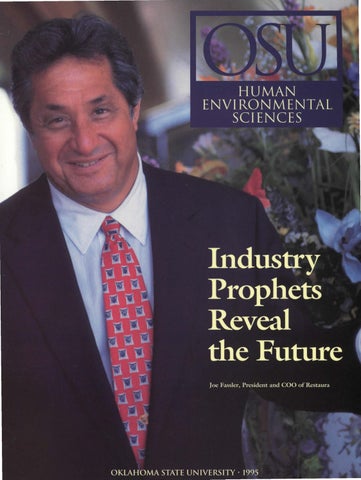
ever short on opinions or passion for his business, Joe Fassler holds a wealth of information on the foture of the hotel and restaurant industry. Chief operating officer and president of the Dial Corp. subsidiary Restaura, Fassler is just one of the many experts who regularly advise the College of Human Environmental Sciences on preparing students for the foture through the CHES Associates. These Associates continuously help the college reposition itself for students' career needs. They are our prophets, alerting the college to industry changes and guiding our students to valuable experiences.
On the following pages, Fassler and three other prominent Associates discuss foture challenges in their businesses. Martha Johnston, vice president of Southern Living Shows and former vice president of food marketing for Southern Living, talks about consumer needs and major trends in the marketplace. Design, housing and merchanrusing graduate, Sandra Sober, ofBSW International in Tulsa, examines the changes in interior design for both 'corporations and designers. Finally, from the Oklahoma Department of Education, Ramona Paul relates the challenges facing educators and the children they teach. It is through a constant exchange that CHES Associates help the college address its challenges. Joe Fassler knows the foture of the hotel and restaurant industry. "The trends that I see on the horizon are already here," says Fassler, referring to shrinking markets and increased competition.
The outspoken president and chief operating officer ofRestaura has been employed with the company since graduating from OSU in 1963. From training manager to vice pi:esident, Fassler has gleaned the best from his predecessors and added his own management style to the mix. He now leads a major food service company with clients like General Motors and IBM, and has restaurant- and hotel-
6 ~ Co/JegeofHmmm Enviromnenta!Scimct:S 1995
The competitive president and COO of Restaura, Joe Fassler. His motto: "Work is a game. If you win it more often than you lose it, then you're successful."
based holdings such as Faber Enterprises, Glacier National Park and Chicago Resorts. Fassler's emphasis in the past few years has been moving the company out of commercial markets and into nontraditional, noncommercial markets. Both markets are shrinking, but Fassler sees potential in nontraditional areas. Fassler says on the commercial side, other restaurants will quickly copy a successful venture, shortening a restaurant's life span to about five years. "That's different from when I came out of school," he says. Thirty years ago the restaurant concept bad a 20- to 25-year life span if the owners did things correctly. Restaura's greatest focus now is on nontraditional facilitiessuch as travel centers, stadiums, arenas, workplaces and college campuses, because even in noncommercial areas owners are looking for new ways to compete. Fassler explains that today organizations like Restaura get a contract to run food services at a plant. Then they call national chains such as Pizza Hut and Dunkin Donuts, requesting franchises to go in the plant. "Therefore you bring to the workplace what a worker would normally get if he or she left the workplace." The biggest challenge fue hotel and restaurant industry faces, and the challenge Fassler is most passionate about, is government. bor costs and government mandates are a growing c ncern. Fassler spends 20 percent of his time with government-related projects. Last year he worked 25-30 days in Washington, D.C., direct! lobbying for his industry. During tlus time, Fassler testified before the House of Representatives against a ill that would limit tourism in national parks. An activist for lus indu try, Fassler believes those entering the field should flducate themselves about government. "When I graduated, food costs were primary and labor costs were second. Now government's effect on business is probably th biggest cost on the profit and loss statement."
----
It's diversity and simplicity for Southern Living's Martha Johnston With the advent of radical changes in the American family, consumer needs have changed as well, says Martha Johnston, OSU alumna and vice president of Southern Living Shows. Johnston, who joined Southern Living in 1978, earned both a bachelor's in foods and nutrition and a master's in food technology from OSU. "We're seeing a renewed interest in home and family, but it's home and family with a '90s twist," explains Johnston. "Consumers still want to prepare meals the family can enjoy together, and they still want to make their homes beautiful, warm and inviting. But now that dual-income families and single-parent families are the norm, many ofus just don't seem to have enough hours in the day." Johnston leads an expanding division that addresses consumers' diverse needs. Through major seminar programs -the Southern Living Cooking School, the Southern Living/LOWE's Lawn and Garden Seminar, and the Southern Living/Dillard's Home Design Seminar - the magazine teaches large audiences across the South and Southwest how they can have the best of both worlds. "I don't know anyone who has time to spend three or four hours every day gardening or cooking," says Johnston. "You can do that on special occasions, but on a day-to-day basis, most ofus need shortcuts and tips that minimize effort while maximizing results." These shows reach a new generation, as well as long time Southern Living readers. "We're seeing an upswing in interest and purchases by younger consumers who feel they haven't had adequate training in nutrition, entertaining and gardening," says Johnston. Many of these so-called Yuppies and Generation X-ers have traveled more and been exposed to more cultures than their parents and grandparents, she continues. Now this generation wants to incorporate these ideas into their own lives. "At Southern Living, we've found that, while our readers still want those traditional foods we all grew up with, they also want new ideas to share with their guests." What does Johnston predict for the future? "Convenience products, such as refrigerated cookie dough and ready-made pie crusts, will only become more popular for cooks who are short on time," she says. "And as international markets grow, I think we'll see more ethnic and multicultural influences ... It may sound jik:ea contradiction in terms",but I think diversity and simplicity are definitely the watchwords for the '90s."
A family advocate in education, Ramona Paul The status of the family wlit continues to affect education. Ramona Paul, assistant state superintendent of professional services at the Oklahoma State Department of Education, knows tllis all too well. "As families continue to change, institutions need to recognize tl1ese changes," she says. Paul, who holds a bachelor's an~a master's in family relations and child development ·om OSU, believes ilie school system needs to examine itself and change to accommodate families. Single-pare t families, combination fanlilies and children living wi grandparents are variations of the "traditional" family unit. Paul calls it "a different kind of extended fanuly." And wllile society bemoans iliese changes, they e unlikely to vanish. Agencies, administrators and in 'viduals must learn to make accommodations for these amily variations and ilieir needs. It is a challenge, but educators need to look at these changes mm a positive standpoint, says Paul, who also holds a doctorate in child and family sciences from Purdue University. "We need to ask 'how can we support iliem?' " she says. "We need to do major paradigm shifts." It is her background in family relations and c•hild development that has Paul asking how schools can work with social ser ·ces and healtl1 services in the future to better serve children. Paul believes in the need to look at the total child, ilie child and family in combination. "I'm very comfortable tlunking about ilia concept because of my training." Supervisin professional services means more to Paul than just teacl er certification. One of her concerns for the future is ti at teachers receive training to help tl1em understand v ious cultures and pass iliat along to ilieir students. "Stu ents are much more diverse and they need to under tand ilie culture," she says. Along witl1 the changes in families and culture today, many children are coming to school concerned about everytlling except learning. The children need their physical and emotional needs met before they can move on to education. "We are recognizing that ilie needs of cllildren have to be met before iliey can be real learners," says Paul, "and we are looking at school as ilie safest place for children, physically and emotionally. "School needs to be a constant place for children. We have such a responsibility now, we really have to move forward."
Sandra Sober, Solving tomorrow's design needs Sandra Sober, with Tulsa's BSW International, says limited resources such as time andspace are changing the interior design industry. A 1972 housing and interior design graduate, Sober manages the GeneSys room, an electronic meeting room engineered to compile w1biased research from focus groups.
One of the biggest changes is the way some clients think about space, says Sober, who had her own firm for nine years before joining BSW in 1990. Coi;porations have traditionally had offices of varying sizes. When someone moved up the corporate ladder, they received a bigger office, maybe with a window. But now firms are turning to open offices with moveable workstations. It is a concept used at BSW, primarily an architecture and engineering firm. A new client requires a new tean1 of designers who must collaborate on projects. Therefore every new client requires a new configuration of offices. "The old way of setting up offices and computers and phones might take several people out for a day," explains Sober. Now when a team changes, designers only move their pencil drawers, personal files, phones and computers to regroup with a new team. They can literally plug into another location and be ready to work. The innovation enhances flexibility and facilitates customer service. Hotelling is another growing concept which solves problems for businesses that have employees who travel extensively, says Sober. "Many people work at home or on the road. Rather than keep a work space for them, companies can have workstations they 'check out' when they're around." There is another shift taking place in the design profession to combat the misperceptions that designers are only interested in aesthetics, and they are poor business people. "Designers are the ultimate problem solvers," says Sober. And they are now moving to highlight this aspect of their work. Even the American Society of Interior Designers (ASID) is examining its awarcis to recognize design effectiveness, says Sober, who is corporate coordinator of ASID's Design Specialty Nenvork and co-chair of the ASID Marketing Advisory Council. "Our focus is whether the solution met the client~sneeds."
•••
It is clear that while the fields of human <mvironmental sciences may be diverse, the same societal factors are affecting each. But with valuable information provided by CHES Associates, the college is preparing students for this constantly changing future. Their future, in turn, depends on the how they deal with the challenges for which tl1ey have been educated. 'i'
EXTENSIO~. INSTRUCTIOl'i AND RESfAR.C:ll ■■■
ANuuyidea lthough the average individual gives little thought to the pecan, one CHES researcheris uirning its tender meatinto a productive enterprise forOklahoma.
A
Sue Knight, associate professor of nutritional sciences, is collaboratingwith Niels Maness and MichaelSmith from horticuluire andlandscape architecuire, and GeraldBrusewitz from agriculturalengineering to create the "perfectpecan." "The perfect pecan would be one that is lower in fat, has an extendedshelf life and also producesan oil that is high in monounsauirates," says Knight. FLmdedby a three-year grant fromthe Oklal10ma Center for theAdvancement of Science and Technology(OCAST), the researchteam plans to eliminate someof the fat from pecans using an oil extraction process. "The process could revolutionizethe pecan industry," she says."Not only would we have a low-fatpecan, but a very desirableoil." According to Knight, pecans arean $11 million industry in Oklahoma.With last year's crop estimatedto be one of the largest recordedin the United States and pecanproduction expected to increase,this research could have a great effect on the Oklahoma economy.
"If the pecan market continues its upward trend, the new reduced-oil pecans have the potential to increase pecan revenues by $40.5 million nationwide," says Knight. "For Oklahoma, that would mean $2 million in revenues, plus revenue from the sale of new pecan confectionery products."
Knight thinks pecan oil's health value could make it competitive with olive oil since both are rich sources of monounsaturated fatty acids. "Pecans are high in the kind of acid that research shows lowers the low density lipoproteins (LDL) in the blood plasma and retains the high density lipoproteins (HDL) levels in humans." In other words, it lowers the bad cholesterol and keeps the good cholesterol. • The oil has high market potential as a prerniw11cooking oil with a pleasant flavor. The reduced fat pecans could, in uirn, be used in low-fat yogurts, ice creams, pies and other dessert items. But would the public want such a product? Researchers surveyed several Oklal1oma companies to answer that question, and the companies responded positively. They indicated a low-fat pecan would have an important and potentially sizable market niche. Some even expressed a desire to cooperate with OSU on this project. 'i' DEBRA BASORE
"Theperfectpecan would be one thatis lower in fat, has an extended shelflife and also produces an oil thatis high in monounsaturates. "
Oklahoma State University ~
11
■■ EXTENSION
INSTRUCTIOI\, AND fUSEARCH
Dr. Rex Culp, professor and head of family relationsand child development, is dedicated to the new Center for EffectiveParenting. Thiscenter, he says, willhelp understand and meet the needs of parents and childrenin Oklahoma.
CenterofHope
P
arenting is one of the to:1ghest challenges -~ individual can face, and it has become a cnl:lcal issue for Oklahoma. In Oklahoma the nwnber of teenage pregnancies is on the rise. Child abuse is increasing, and poverty continues to negatively affect how parents interact with their children. These factors can overwhelm parents. But the Center for Effective Parenting can provide the resources to help. Dr. Rex Culp, professor and head of family relations and child development in the College of Hwnan Environmental Sciences, says Oklahoma needs a resource for parenting advice. "We know there is a need for research on how to be a better parent," says Culp. "All you have to do is look at the statistics on child abuse, neglect and teenage pregnancies - they're all rising." Culp, who for 12 years has been researching parenting with The Children's Place in Kansas City, Mo., discovered in an informal study that nearly all
12
~
College of Human Environmental Sciences 1995
his deparl:lnent's faculty were involved in researchon various parenting issues. "Research ranged from grandparents raising their grandchildren to how to help teenage mothers be more effective parents," he says. "We cover a broad spectrum." After three years of hard work, Drs. Rex Culp, Anne Culp, Laura Hubbs-Tait, and Carolyn Henry developed a model for the Center for Effective Parenting. This center will serve as research headquarters for addressing issues facing today's parents. Culp says statistics on today's families attest to the need for this type of research center: • Child abuse: In Oklahoma in 1993, there were 26,349 investigations of child abuse completed by the Office of Child Welfare. Of these investigations, 8,359 children were confirmed as abused. • Single-parent households: In 1970 about 12 percent of children lived with only one parent;
in 1989 it rose to 25 percent, an increase ofl6 million children.
Meet the new chairin Human EnvironmentalSciences, Laura Hubbs-Tait,an associate professor of familyrelationsand child development. Thisrecipient of theJohn and Sue Taylor Professorshipwilluse her position to launch research with the Centerfor Effective Parenting.
• Children with parents in the workforce: In 1990 approximately 17.4 million children had working mothers. • Children living in poverty: One in five of America's children lives in a family with an income below the federal poverty level. Nearly 13 million children live in poverty. • Teenage parents: Oklahoma continues to be ranked among the top 15 states in the nation with the highest rate of adolescent pregnancy. Nationally, more than 500,000 children are born each year to women under the age of 18.
"A research center is critical to provide a current researchbase to facilitate effective parenting," says Culp."The research findings will enable professionalsto develop innovative, high quality programs that meetthe needs of different families."
A DistinguishedChair
Culp says these needs range from parents trying to cope with their children's normal developmental changesin today's fast-paced and complex world, to parentsat high risk for problems.
It is not often that faculty members are directly rewarded for their efforts in advancing the college, but tl1e John and Sue Taylor Professorslup in Human Environmental Sciences was created to do just that.
The center's research findings will provide new knowledgeto be used in extension programming offeredby CHES' University Extension Office and theOSU Cooperative Extension Service. An announcement concerning the facility is expected thisApril.
Designed to attract new faculty or make an additional commitment to a current faculty member who plays a leadership role in the college, tlus three-year professorship recently was awarded to Laura HubbsTait, associate professor of fanuly relations and child development. The professorship is open to any division \.vithin the college.
According to Culp, the Center for Effective Parentingwill collect and analyze data on contemporaryparenting and child development outcomes, conductspecific research projects for private and govermnentagencies, and design and conduct interdisciplinaryresearch on specific issues related to parentingskills and parent-child interaction. The center will conduct studies that address Oklahoma'sproblems. It will also maintain a data baseof current information, attitudes, issues and parentingskills, which could then be used to develop innovativeprevention and intervention programs. "This center will be wuque not only in Oklahoma,but in the nation," says Culp. "There are othercenters that address broad issues relating to children,but OSU's center is unique because of itsresearch goals and large resomce base of faculty, graduatestudents, w1dergraduate students and facilities.",.. DEBRA BASORE
"Awarding the professorship to Dr. Hubbs-Tait provides a cornerstone for the focus of the Center for Effective Parenting," says Dean Patricia Knaub. "The primary nussion of the center is to conduct research and disseminate findings on an array of questions related to effective contemporary parenting." Hubbs-Tait's current and previous accomplishments helped her selection. Her research focuses on parenting, and tlus professorship will allow HubbsTait to continue her research productivity, expand the student and faculty research groups with which she is already working, and increase her potential for attracting external funding. Hubbs-Tait says the funds will be used to initiate several studies in the college. They include identifying the strengths of parenting that predict positive outcomes and the problems l'hat predict negative ones, attachment in maltreated children, and the social and emotional consequences of adolescent parenting of preschool children. '¥.
DEBRABASORE
Oklahoma State University ~
13
■■ EXTEI\JSION. INSTR.UCTION AND
R.ESEAR.CH
Engineering by Design ngineering may not seem germane to creating the hottest Paris fashions. But Cheryl Farr, who received a crash course in apparel enginee1ing recently, knows just how important it is.
E
Thanks to a fellowship from Textile/Clothing Technology Corporation, better known as [TC]2, this assistant professor in the department of design, housing and merchandising spent six weeks in North Carolina last summer studying apparel engineering witl1 the company's management trainees. Originally tl1e research and development branch of Dupont, [TC] 2 is now an independent facility which provides consulting services for the textile and clothing industry. Farr says they address manufacturing, research and development issues specifically related to the industry. Clotlling is one of the few industries where the products change four to 12 times a year, says Farr. "Most stores don't want the same merchandise to be on the shelf every time a customer walks in. That's not true at an automobile dealership." Increased product Utrnover means more challenges in production for clothing and textile corporations than for most production operations. But because there are still a lot of human factors, [TC]2 helps develop high quality products using cost effective methods. Farr and five other faculty nationwide were chosen to train with [TC]2's apparel engineers so they could bring the latest technology to the classroom. The faculty participated in educational seminars and hands-on training in such areas as computer simulation, total quality management and methods engineering. Farr says much of her time was spent learning ways to estimate the most efficient way to assemble a qualjty product. When they weren't in class, Farr and her counterparts also spent a tremendous amount of time in tl1e factory, learning how to operate machinery or just studying manufacturing processes. "It was like having a real life lab," she says. Farr, who teaches several classes including one on sewn product quality analysis and product costing, says when she returned to OSU she definitely had a better sense of costing, which she took into her class.
14
~
College ofH11,man Environmental Sciences 1995
Designer-turned-engineer Cheryl Farr, associate professor in design, housing and merchandising, spent six weeks learning more about the engineering involved in clothing and textile production.
[TC] 2 even gave Farr a computer program to help students understand the most cost effective way to produce a product. Students specify the process and equipment they expect to use in making a product, and then rw1 tl1e program to complete time/motion studies. Like their industry counterparts, apparel students are lear11inghow to save costs at every level. "Having industry methods of calculating materials utilization and labor is definitely improving their level of instruction." Farr says her training with [TC] 2 has permeated her teaching, exposing her students to valuable apparel engineering practices. The students can go into the job market better prepared for real-world practices. "It will broaden their career options." 'i
Blowingthe WhistleonDiscrimination Consider this scenario:
T
wo hospitality management graduates enter the workforce simultaneously. One is male, the other, female. Despite equal qualifications andacademic records, she may be hired at a lower salarythat will probably never match his. In fact, his salarywill likely increase at a faster rate, even though theirresponsibilities will increase equally. While men may report having more experience, thatis not a reasonable explanation for this difference,says Ray Kavanaugh, professor and director of theSchool of Hotel and Restaurant Administration. This is one conclusion drawn in his recently publishedresearch tl1at shows what has long been suspected:gender discrimination and sexual harassment frequentlyoccur in tl1e hospitality industry. Kavanaugh is quick to point out this is not an indictmentof the industry. Rather it's a reflection of theinequity that can be found in many professions. He says that some in the hospitality industry, however,are not aware how widespread these issues are."It takes hard evidence to put in front of people toprove it's a real issue."
-
Kavanaugh, who published tl1e study in 1994 along with Michigan State's Robert H. Wood, hopes this information will be useful in accelerating positive change within the industry.
Among their findings: • Eighty percent of male respondents and 90 percent of female respondents believe sexual discrimination occurs frequently in the hospitality industry. • Of those who perceived se:xualdiscrimination, men and women disagreed on where it occurs. Women said it was most tied to promotion and salary, while men's responses spread more evenly over hiring, salary, level of responsibility and promotion. • Almost 20 percent of the men reported salaries of$55,000 or over, while less tl1an 1 percent of the women sampled reported the same. Kavanaugh hopes these survey results will encourage industry leaders to review their own track records and make changes. "Our findings suggest systematic discrinlination in the hospitality industry regarding hiring, wages and promotion of women in management." ~ JANET VARNUM
WhizICids ou've heard of walk-on uarterbacks, those freshman athletes who proceed straightfrom high school to collegewitl1out missing a beat. Well, meetsome walk-on scientists. Evenbefore they've learned the meaningof the phrase."publish or perish,"they're gaining valuable experienceas Freshman Research Scholars(FRS) in the College of Human Environmental Sciences. For Susanne Morse, a junior whowas a 1992 FRS, the experiencemeant a unique opportunity to co-write and present a research paperat the Southwestern Society forResearch in Human Develop-
ment. She also co-authored an article in The American Journal of Family Therapy. Shandra Grossardt, this year's FRS, is interested in studying how to build positive relationships for minority, irmer city and single parent fan1ilies. CHES expects a lot out of their FRS students. They belong to research teams, composed of two or three faculty members, master's and doctoral students, which meet weekly. And each member accepts certain tasks and responsibilities. "Every member of the team is a colleague, and everyone is expected to make a contribu-
tion. Our Freshman Research Scholars are treated as equal members on the team," says Rex Culp, professor and head of the department of fanuly relations and child development. "Often it is difficult to get undergraduates to see what value research has for them," says Culp. But research generates information and moves that field of study forward, he says. "I think it's important for undergraduates to have classes with teachers who are involved in research." It may be even more important for students to experience that research themselves.~ DOTTIEWITTER
Oklahoma State University ~
15
■■■ ESSAY
Reversalof Fortune
W
A CHESprofessortalksaboutthe ethicalconcernshe facedwhen hisparentscouldno longercare forthemselves.
parents move to a nursing home? Should someone quit their job to provide full-time care for their parents? Should a promise never to place parents in a nursing home be kept?
BY DR. JOE WEBER
hat can be done when aging parents become chronically ill and can no longer live independently? Should parents move into their son's or daughter's home, or should the
These are questions I tried answering last year. I was not prepared for tl1ese questions, but tl1e events that transpired over two days forced me to confront them. On a cold March afternoon in New Jersey my parents went out for a drive and my 77 -year-old dad became lost. He had experienced a blackout and tl1e police found them in a parking lot witl1 the car trunk on fire. I received a call around midnight that my dad was in tl1e hospital, and my morn, an 89-year-old woman inflicted with Alzheimer's disease, was home alone. What should I do? I lived 1,200 miles from my parents! I just needed time to tl1ink. My mind raced back to tl1e past. It seemed like only yesterday my parents were young and full of energy. Memories of Thanksgiving dinner, fishing in tl1e ocean with my dad, and morn telling stories of my grandparents' journey from Czechoslovakia to Ellis Island filled my thoughts. These fond memories scattered quickly. I was w1eertain what the funu·e would hold.
Hard Choices in a Changing World As tl1e elderly population rises, the ethical and moral issues are astom1ding. Medical and technological breakmroughs have ensured increased longevity, and we are challenged to make decisions regarding tlus growing demograpluc.
Joe Weber is an associate professor in family relations and child development and an authority in the field of gerontology.
16
~
Collegeof Human En11iromnentalSciences 1995
Research projections suggest tl1at fanulies will spend more time caring for elderly relatives than tl1ey did raising their own children. Eve~ though these issues are emotionally and morally tough, tl1ere is a process
fanulies should consider when facing an ethical dilemma related to an elderly boom. First a fanuly must recognize the problem. If they never confront, accept or realize the dilemma, they may never take appropriate action. Later, they may be forced into making a hasty decision. Consider my par· ents' example. Fanulies must learnto act quickly and then re-evaluate the alternatives. Second, a family should consider all possibilities. No one solution is best; in fact, there may be several alternatives. For my predicament, I considered what options were reason· able. I thought, "Maybe I should consider quitting my job, but is that really practical?" I evenn1allyused home health care, adult day care, nursing home care, and in-home family care where my wife, clilldren andI took tllrns caring for my parents. Third, fanulies must consider the likely consequences of each alternative. They need to involve as many other fanuly members and profession· als in the decision-making process. The more people tl1at are involved, tl1e better they can assess tl1elikely consequences. I involved my wifeand clilldren in discussing each option. Soliciting all points of view was certainly helpful. Lastly, fanulies need to select a plan of action and follow through. In making tl1eir final decision they should evaluate the etlucal consequences of tl1eir plan of action by ask· ing, "Is it legal? Is it fair? Is it personally acceptable?" If mey are comfortable with their choice, and it feels right, tl1ey should go al1eadwith me decision. The elderly boom is creating a new set of ethical and moral dilemmas fanulies must face. Solutions are not easy and are often stressful for fanulies. One thing is certain, tl10ugh, decisions that were rare for previous generations are now very common. Do you have a plan-of-action or a strategy for coping with the emical dilemmas of aging tl1at you may someday have to face? ~
-, -
)
r
CT~i
Collegeof HumanEnvironmentalSciencesHall of Famerecognizesa lifetimeof achievement and serviceto thecollege.Our congratulations go to StevenW Lew and StevenD. Jornson theirinductionintothisprestigious group.
Steven W. Lew
Steven D. }oms
Steven W. Lew
Steven D. Jorns
Steven Lew believes in hospitalicy,and his success in the industry proves it. As senior vice president of MCA Recreation Services, Lew is responsible for all leisure time businesses owned or operated by MCA Inc. Th.is includes Universal Studios Hollywood, Universal Studios Florida and the recently announced Universal Studios Osaka, Japan. Lew has worked for MCA since 1975.
Since graduating from OSU's School of Hotel and Restamant Administration in 1971, Steven Jorns has evolved into one ofilie hospitalicy industry's most valued members.
Currently, this 1961 HRAD graduate is on the board of directors and executive committee for the Hollywood Chan1ber of Commerce as well as tl1e White House Conference on Travel and Tourism Issues Task Force. A member of ilie OSU Fow1dation Board of Governors, Lew received the CHES Distinguished Alumni Award in 1992. Lew insists management greet guests and maintains an open door policy 11in1self."I try and manage witl1 ... a lot of communication," he says. "I return every phone call, answer every letter, and for tl1e most part I'm pretcy easy to get to. That goes for tl1e person who was hired yesterday or tl1e longtin1e employee."
Foreseeing the potential role of hotel management companies, Jorns formed American General Hospitalicy Inc. in 1981. Today, tlus independent hotel management company is one of the world's largest. "The U.S. hotel industry has gone through tremendous change over tl1e last 20 years as traditional integrated hotel operators ... have essentially become franchisers," says Jorns. "This change ... created a unique 11ichefor hotel management companies, and I am proud to say American General Hospitalicy is leading tl1e way." Jorns' 111anagementexpertise led the American Hotel and Motel Association to name 11in1a "rising star" in 1991. A frequent speaker at national industry conferences, Jorns also serves on ilie advisory board for OSU's School of Hotel and Restamant Administration. 'i