OKLAHOMA COOPERATIVE FISH AND WILDLIFE RESEARCH UNIT
TRIENNIAL REPORT IN COOPERATION WITH Oklahoma State University Oklahoma Department of Wildlife Conservation Wildlife Management Institute U.S. Geological Survey U.S. Fish and Wildlife Service
2023-2025
WELCOME
UNIT LEADS Dr. James M. Long
Unit Leader/Fisheries
Dr. Robert C. Lonsinger
Assistant Unit Leader/Wildlife
COORDINATING COMMITTEE Current Voting Members Dr. Jayson Lusk Vice President of the Division of Agricultural Sciences and Natural Resources, Oklahoma State University Wade Free Director, Oklahoma Department of Wildlife Conservation Dr. Kevin Pope Acting Chief, Cooperative Research Units, U.S. Geological Survey Tony Wasley
President, Wildlife Management Institute
The UNIT TRIENNIAL REPORT is a publication of the Oklahoma Cooperative Fish and Wildlife Research Unit to disseminate information about unit research and scholarly activities at Oklahoma State University. It is intended to encourage communications among interested parties. Please contact the unit for further information. Oklahoma Cooperative Fish and Wildlife Research Unit 320 Agricultural Hall Oklahoma State University Stillwater, OK 74078-3051 P 405-744-6342 Triennial Report designed by Oklahoma State University Brand Management
OPPORTUNITIES FOR GRADUATE STUDY Natural Resource Ecology and Management and Beyond!
I
t is our great pleasure to circulate this report of the Oklahoma Cooperative Fish and Wildlife Research Unit, which highlights over 75 years of service providing graduate-level education to help train the next generation of natural resource professionals. The unit began in 1948 when Walter P. Taylor arrived at the campus of Oklahoma A&M College (now Oklahoma State University) in Stillwater that February. The Oklahoma Unit of the U.S. Geological Survey’s Cooperative Research Units Program has been an integral part of graduate-level research and postgraduate training in natural resources, particularly fisheries and wildlife conservation, at OSU since 1948. With direction from our coordinating committee, research is conducted on a wide variety of natural resource conservation topics in cooperation with federal and state agencies, OSU, the Oklahoma Department of Wildlife Conservation, the U.S. Fish and Wildlife Service, the Wildlife Management Institute, and various private entities. Most of our research projects are problem-oriented and designed to provide cooperators with useful information on time-sensitive natural resource issues. From its establishment in 1948 to 2006, the unit was affiliated with OSU’s Department of Zoology (now Biology) in the College of Arts and Sciences. In 2006, the unit’s affiliation moved to the newly created Department of Natural Resource Ecology and Management in the Division of Agricultural Sciences and Natural Resources. Research through the unit is conducted mainly by master’s and doctoral candidates. Over 420 theses and dissertations have resulted from their persistence and scholarship. Students have conducted research on fisheries and wildlife management; ponds and rivers; stream ecology; species of special concern, and management of game species including bobwhite quail, black bears and smallmouth bass. While many of our research projects occur in Oklahoma, other projects conducted by our scientists and students occurred in Michigan, Missouri, New Mexico, Nebraska, Pennsylvania, South Dakota and Texas. As we move past our 75th anniversary, projects will continue to emphasize applied research on the natural resources of Oklahoma and the nation. The Oklahoma Unit and its cooperators would be pleased to share additional information on any project summarized herein. You are welcome to contact any of the investigators listed by project through the unit office. Additional information about our cooperators can be found at: https:// www.usgs.gov/programs/cooperative-research-units, www.okstate.edu, www.wildlifedepartment.com, www.wildlifemanagementinstitute.org, and www.fws.gov.
WHAT’S INSIDE 3
Cooperators and Research Personnel Cooperating faculty from the university, resource professionals from many agencies and affiliated universities, postdoctoral researchers, volunteers, graduate students, and research specialists and technicians are the lifeblood of unit operations and opportunities.
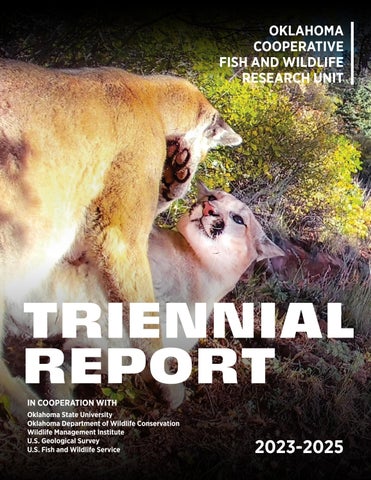
Cover Photo Two mountain lion cubs playing in northern New Mexico. (Photo by Max Marwin) Inside Cover photo A deer stands in a field. (Photo by Phil Shockley)
4
75th Anniversary
7
Fisheries & Aquatics
15
Wildlife Ecology
25
Cooperator Led Projects
31
Scholarly Output
2023 marked the OK Unit’s 75th anniversary, with projects conducted by over 420 students.
The scope and scale of fisheries projects spanned the gamut of game fish, such black bass ecology around the world, to assessment of non-game freshwater mussel communities in the Blue River of Oklahoma.
Wildlife projects spanned research on carnivore ecology, studies of species interactions, and assessments of game species to address applied natural resource problems and test ecological hypotheses.
The OK Unit works closely with OSU cooperators to help fulfill the university’s research mission. During this period, we highlight wildlife projects on bobwhite quail and wild turkey, which have had ongoing needs for several years. For fisheries, we highlight work being performed in tailwater systems of the state.
During this period, the spirit of scientific contribution and scholarship of unit participants has resulted in 17 student/ faculty awards, 15 theses/dissertations (423 since the first in 1950), 49 peer-reviewed and technical publications, and 80 presentations at professional state, regional, national and international meetings. 2
COOPERATORS & PERSONNEL UNIT STAFF Dr. James M. Long Unit Leader and Adjunct Professor. Ph.D., Oklahoma State University, 2000. Conservation ecology and fisheries science. longjm@okstate.edu; jmlong@usgs.gov Dr. Robert C. Lonsinger Assistant Unit Leader and Adjunct Associate Professor. Ph.D., University of Idaho, 2015. Wildlife ecology and conservation genetics robert.lonsinger@okstate.edu; rlonsinger@ usgs.gov Marcie Lemons Senior Administrative Support Assistant marcie.lemons@okstate.edu Renee Flasch Administrative Support Specialist II renee.flasch@okstate.edu
COOPERATORS
OKLAHOMA DEPARTMENT OF WILDLIFE CONSERVATION Administration Wade Free (Director), Nels Rodefeld (Assistant Director), Andrea Crews (Administration Chief), Micah Holmes (Communication & Education Chief), Jessica Brown, Sandy Henry, Amy Newcomb, Treager Stout Fisheries Jory Bartnicki, David Bogner, Brandon Brown, Devlin Carraway, Eric Cox, Ken Cunningham (Chief), Austin Griffin, Matt Mauck, Ashley Nealis, Cliff Sager, Jason Schooley, Richard Snow (Assistant Chief), Jon West, Doug Zentner
Entomology and Plant Pathology Bruce Noden, Wyatt Hoback
Wildlife Curt Allen, Bruce Burton, Steve Conrady, Alex Cooper, Brett Cooper, Scott Cox, Jerrod Davis, Bill Dinkines (Chief), Craig Endicott, Colby Farquhar, Joe Hemphill, Melinda Hickman, Scott Parry (Assistant Chief), Mark Howery, Ron Justice, Kurt Kuklinski, Mike O’Meilia, Scott Parry, JD Ridge, Mike Sams, Doug Schoeling, Rod Smith, Curtis Tackett, Rex Umber, Derek Wiley, Marcus Thibodeau, Dallas Barber
Environmental Science Karen Hickman
U.S. GEOLOGICAL SURVEY
OKLAHOMA STATE UNIVERSITY Administration Jayson Lusk (Vice President), Scott Senseman (Associate Vice President), Cynda Clary (Associate Dean) Agricultural Economics Bhawna Thapa
Natural Resource Ecology and Management Jason Harmon (Head), Colter Chitwood, Craig Davis, Sue Fairbanks, Sam Fuhlendorf, Laura Goodman, Omkar Joshi, Scott Loss, Tim O’Connell, Dan Shoup
3
Biology Jason Belden (Head), Antonio Castilla, Andy Dzialowski, Neil Gilbert, Barney Luttbeg, Michael Reichert, Ciaran Shaughnessy, Shawn Wilder, Guin Wogan, Bo Zhang
Maslowski, Sumina Pokharel, Missy Thode, Lisa Webb (Regional Supervisor)
WILDLIFE MANAGEMENT INSTITUTE Bill Moritz
U.S. FISH AND WILDLIFE SERVICE Region 2: James Broska (Assistant Regional Director [retired]), Beth Ross, David (Randy) Stewart; Tulsa Ecological Services: Ken Collins (Field Supervisor [retired]), Daniel Fenner (Assistant Field Supervisor), David Martinez, Kevin Stubbs Oklahoma Fisheries Resource Office Brian Fillmore Northeast Fishery Center Complex Aaron Maloy, Stacey Nerkowski, Rachael Giglio Tishomingo National Fish Hatchery Ralph Simmons Wichita Mountains Wildlife Refuge Christine Fallon, Dan McDonald
U.S. DEPARTMENT OF DEFENSE Kansas City District Office Joseph Bonneau, Anthony Civiello, Todd Gemeinhardt, Nate Gosch, Marcus Miller
U.S. DEPARTMENT OF AGRICULTURE US Forest Service Robert Bastarache (retired), Jocelyn Howell
Columbia Environmental Research Center Patrick Braaten, Robin Calfee, Josey Ridgeway, Jesse Fisher
OSAGE NATION
Cooperative Research Units Kevin Pope (Acting Chief), Don Dennerline (Acting Deputy Chief), Dawn Childs, Shana Coulby, Derek Geary, Elise Irwin, Amanda
TURNER INSTITUTE OF ECOAGRICULTURE
Frank Freeman, Jann Hayman
Carter Kruse
75+YEARS OF COOPERATOR DRIVEN RESEARCH
February 2023 was the 75th birthday of the Oklahoma Cooperative Fish and Wildlife Research Unit. The OK Unit began in 1948 when Walter P. Taylor arrived on the campus of Oklahoma A&M College (now Oklahoma State University) in Stillwater to begin the Oklahoma Cooperative Wildlife Research Unit. At that time, 14 Cooperative Research Units were active nationwide with an overarching mission to train the next generation of wildlife biologists, Walter P. Taylor primarily through graduate-level research. Among the main topics addressed in this early period were the ecology and management of bobwhite quail — still of keen interest today and benefiting many graduate students.
Photo Bradford Brown (left) and an unidentified student conduct research at Lake Carl Blackwell circa 1960s. (Unit archive photo) 4
The 1990s also brought significant administrative change, with federal scientists — employees of the U.S. Fish and Wildlife Service — being transferred to a new agency, the National Biological Survey (later, National Biological Service; NBS). This program was slated for termination, and, to save the unit program and other important federal research entities, NBS was rolled
Robert Summerfelt harvests catfish from the ponds below Lake Carl Blackwell in 1973. (Unit archive photo)
Significantly, a Fisheries Research Unit was added in 1965. Bradford Brown oversaw the unit’s opening as its first acting leader. He hired the first African American person in a non-custodial role at OSU, Helen Murray, who would eventually become a legend at the unit, serving for 40 years. The first permanent unit leader of the fisheries unit was Dr. Robert Summerfelt, whose first large-scale task was to renovate the aquaculture ponds below Lake Carl Blackwell. These ponds were also renovated during subsequent years, but their current configuration is the one Summerfelt put into place. The 1980s saw a combination of independent Fish and Wildlife units, and the Oklahoma Cooperative Fish and Wildlife Research Unit was established in 1984. Gene Maughan was the first leader of the combined unit. The OK CFWRU continued its mission through the 1990s under the leadership of Chip Leslie, who became the unit’s third leader in 1989 and would serve as its longestserving leader, with 27 years until his retirement in 2016.
5
Helen Murray in the office of the OKCFWRU in the 1970s. Unit archive photo.
into a new division of an existing Department of the Interior agency, the U.S. Geological Survey, where federal scientists of the program continue to be employed. Change continued after the creation of the Department of Natural Resource Ecology and Management in 2006, and the unit moved out of its longtime home in Life Sciences West and the Department of Zoology to a newly renovated suite of offices on the ground floor of Agricultural Hall. Later, in 2024, the unit and NREM
From left: Al Zale (AUL-Fish), Bill Fisher (AUL-Fish), Lynn Haines (Regional Supervisor), and Chip Leslie (UL-Wildlife) in 1991. (Unit archive photo)
department moved to a completely new Agricultural Hall, built across Monroe Street from the old building (renamed Legacy Hall). The OKCFWRU continues to provide training for the next generation of natural resource professionals, primarily through graduate-level education. Some issues continue to be just as important now as in the past, such as conservation of upland birds, black bears and fisheries resources. New facilities have enabled unit scientists and students to use innovative tools to address challenges of the third millennium. The unit’s original mission remains today, and it has helped over 420 graduates earn master’s and doctoral degrees throughout its 75-year history.
Dr. Jim Long (current unit leader) at the 75th anniversary meeting. (Photo by Tanner Scholten)
Dr. Robert Lonsinger (current assistant unit leader) at the 75th anniversary meeting. (Photo by Todd Johnson)
6
FISHERIES &
AQUATICS JIM LONG Dr. Jim Long, leader of the OK Unit, is the principal scientist for fisheries and aquatics projects. Over the past three years, Long has focused on native black bass diversity, paddlefish ecology, fisheries management, and conservation of non-game/ T&E species. Long holds an adjunct professorship in the NREM department and teaches a graduatelevel course in Social Dimensions of Aquatic Ecology.
7
F I S H E R I E S & A Q U AT I C S
BLACK BASS DIVERSITY CONSERVATION
L
ong has been a leader in the black bass diversity conservation movement since before coming to the OK Unit in 2009, studying multiple aspects of native bass conservation, including habitat, genetics and non-native species management. Since the turn of the 20th century, black bass fisheries have become primarily catch-and-release and driven by the desire to catch trophy-sized fish, leading in many cases to the stocking of non-native species. Concurrently, many black bass species have come to be regarded as invasive. For example, the largemouth bass is now considered one of the world’s 100 worst aquatic invasive species, yet it still supports tournament and trophy fisheries around the world. From surveys we conducted in the past, we found that largemouth bass and related Florida bass were considered more economically important than invasive not only in the U.S., but also worldwide. Smallmouth bass, on the other hand, is widely considered invasive outside its native range. By combining elements of psychology with models of fisheries management, Long is providing reasoning behind the shifting opinion of non-native fish from beneficial to
Lab work for thermal ecology experiments. (Photo by Jim Long)
invasive, with a life cycle of black bass fisheries, which was presented to the Black Bass 2025 symposium held in San Antonio. Concurrently, with the changing sentiment toward non-native basses, concern for conservation of rare, endemic native black bass species has also recently become more elevated in the management realm. The notion of managing for native basses in their natural habitats was highlighted in a book Long co-edited in 2015. It was considered a paradigm shift from managing bass for trophy size or maximum yield. Unfortunately, one of the major drivers of native black bass decline is the introduction of non-native black basses. Currently, advances in genetic screening have pushed the total number of black bass to 19, and many of these are considered vulnerable to extinction. Because stocking of non-native bass has been implicated in much of this vulnerability, conflicts may arise among management strategies. As part of an emphasis on black bass diversity, Long continues to work on local-scale issues in addition to those at national and international scales. During the 2023-25 period, Long helped conduct research on Neosho bass thermal ecology compared to non-native smallmouth bass, with funding from the Oklahoma Department of Wildlife Conservation. Smallmouth bass were introduced to select reservoirs in eastern Oklahoma where native Neosho bass occur. In lower portions of large rivers, non-native smallmouth bass have become predominant. However, in the upper portions of rivers and in smaller tributaries, Neosho bass have persisted. Presumably, differences in thermal regimes and tolerances to those regimes could explain these differential patterns in occurrence. To address this, Long is working with Dr. Ciaran Shaughnessy (Department of Biology) and his Ph.D. student, Allison DeLoache, to test various aspects of thermal tolerance in both species and their hybrids. This work, along with
CO-INVESTIGATORS Ciaran Shaghnessy (OK State-Biology) Andrew Taylor (U of N Georgia) Matt Lewis (Lincoln Memorial)
STUDENT INVESTIGATOR Allison DeLoache Ph.D., 2025-Present; advised by Dr. Ciaran Shaughnessy, Biology
others, is included in a multi-state Neosho bass working group. For the past few years, Long has been collaborating with Drs. Andrew Taylor and Matt Lewis to develop a new book highlighting the entire suite of black bass diversity to scientists and lay audiences alike. In 2024, OSU signed with the University of Georgia Press to publish this book, billed as an update to the seminal 1881 “Book of the Black Bass,” written by Dr. James Henshall. Henshall’s work was extraordinarily impactful to black bass management. But, where Henshall saw only two species, largemouth bass and smallmouth bass, the current suite of 19 species requires an update in one synthesis volume. The book’s current status is ongoing, with a June 2027 deadline for delivering materials to the publisher.
“Black Bass Diversity” cover photo. (Photo by Jim Long) 8
F I S H E R I E S & AQ UAT I C S
PADDLEFISH ECOLOGY
P
Wyatt Wolfenkoehler with a paddlefish.
9
addlefish is a large-bodied sport fish pursued by many anglers nationwide. Oklahoma is a destination for many, generating a large economic impact on the state. Paddlefish are also cultivated and harvested for their caviar. Since 2019, OSU has been working with state and federal partners to investigate factors associated with paddlefish stocking success to create additional, sustainable fisheries. Research at the Oklahoma Unit has focused on the use of side-scan sonar not only to map river substrate, but also to count paddlefish to estimate abundance and other aspects of their spatial ecology. In 2023-25, master’s student Wyatt Wolfenkoehler and undergraduate students Jon Lee, Elizabeth Goad and Dylan Ferguson have been working with paddlefish and side-scan sonar data from multiple locations. For river mapping situations, the OK Unit received funding from a joint Fish & Wildlife ServiceGeological Survey program and surveyed tributaries to Lake Eufaula and Lake Hugo. To enhance mapping capabilities, researchers also worked with Dr. Cameron Bodine, the inventor of PingMapper, and developed a new automated substrate-mapping tool called RockMapper. To verify the accuracy of distance sampling methods using side-scan sonar data, OSU had the assistance of Chris Chivetta at the Innsbrook Resort, along with colleagues at the USGS Columbia Environmental Research Center (Josey Ridgway and Jesse Fischer), to survey populations of paddlefish in small reservoirs with known fish abundances. From this research, they have shown how paddlefish are
F I S H E R I E S & AQ UAT I C S
As representatives of an ancient lineage, a paddlefish’s early life represents plesiomorphic traits that are poorly understood, especially in relation to the inner ear and its otoliths. Otoliths of fish are important for hearing and equilibrium, and those of paddlefish are multi-crystal, consisting of a fusion of otoconia. To better understand otolith development in paddlefish, an undergraduate student, Jon Lee, used CT X-ray data to document otolith development from hatching. Otoliths were found to be absent in paddlefish until nine days post-hatch, and reached and maintained maximum density after 16 days post-hatch.
Paddlefish image in downscan sonar. Photo by Jim Long.
distributed across the breadth and depths of reservoirs and that distance sampling can accurately estimate total population abundance. Additionally, Goad’s work showed that live sonar can also be used to estimate abundance by locating fish in space using the boat’s track and speed. The OK Unit is continuing its collaboration with state and federal agency biologists to evaluate sonar estimates of abundance alongside standard gill-net sampling. The Oklahoma Department of Wildlife Conservation uses winter gillnetting to assess paddlefish populations, and researchers performed sidescan sonar in conjunction with two of their reservoirs in 2024-25. Based on body-size measurements, OSU was able to estimate the density and abundance of paddlefish, produce length-frequency information, and estimate depth use, all of which were compared with gillnet data. To date, side-scan sonar has found smaller fish and a broader range of fish sizes than gill nets, and it has demonstrated that gill nets set in deep water are likely missing paddlefish based on relationships
between fish depth and water depth developed from side-scan sonar data. Other research conducted in 202325 focused on the early life stages of paddlefish, less than one month old, and was supported by funding from the OSU Ferguson College of Agriculture and Ag Experiment Station. Work continued in 2022 relating water clarity to juvenile paddlefish foraging. Ethan Hood, then an undergraduate student, presented this work at multiple outlets, winning awards at the 2023 Oklahoma Clean Lakes and Watersheds meeting and the 2023 American Fisheries Society annual meeting. In 2025, this research was published in the journal Transactions of the American Fisheries Society (DOI: 10.1093/tafafs/ vnae007).
24 dph paddlefish with otoliths shown: Sagittae (green), Asterisci (blue), and Lapilli (magenta). (Photo by Jon Lee)
CO-INVESTIGATORS Josey Ridgway (USGS-CERC) Jesse Fischer (USGS-CERC) Cameron Bodine (U Delaware)
STUDENT INVESTIGATORS UNDERGRADUATES Jon Lee, Dylan Ferguson, Elizabeth Goad, Ethan Hood GRADUATE Wyatt Wolfenkoehler (MS, 2024-Present)
10
F I S H E R I E S & AQ UAT I C S
CO-INVESTIGATORS Bhawna Thapa (OK State-Ag Econ) Omkar Joshi (OK State-NREM) Dan Shoup (OK State-NREM)
STUDENT INVESTIGATORS Drew Dunlap (MS, 2024-Present) Nick Barnes (Ph.D., 2025-Present) Tania Islam (Ph.D., 2024-Present; advised by Dr. Bhawna Thapa, Agricultural Economics)
ABOVE: Pat Joyce with a channel catfish from the Blue River.
11
Kernel density map showing the residence of anglers who fish the lower Mountain Fork River. (Photo by Drew Dunlap)
F I S H E R I E S & AQ UAT I C S
FISHERIES MANAGEMENT
R
ecently, science support for fisheries management provided by unit scientists includes two stream fisheries that receive pressure from several sources, including out-of-state. One fishery, the lower Mountain Fork, near Broken Bow, Oklahoma, is one of only two year-round trout fisheries. The rising costs of stocking trout, along with the potential for wild trout, have created an opportunity for fisheries managers to examine management options. The second fishery, in the Blue River, is best known for its winter trout, but it also has a channel catfish stocking program. In both cases, rising costs of fishraising for stocking have prompted managers to examine the costs to the agency relative to the benefits to the angling public. Similarly, both rivers have some reproduction that
could ease the cost of stocking. In the lower Mountain Fork, rainbow trout have had successful spawning for the last decade at least. Although recruitment to adulthood is unknown, wild rainbow trout is a potential fishery worth investigating, which is the focus of master’s student Drew Dunlap’s thesis. Similarly, channel catfish have a native component to the stocked component that has not been assessed, and doctoral student Nick Barnes is working to document multiple aspects of the stocking program there. Is recruitment sufficient in either system to warrant reductions in stocking? Do anglers value stocked fish over wild fish in disproportionate numbers? In both projects, students are using catch and harvest data, along with economic models, to assess the status of these fisheries.
Wild juvenile rainbow trout captured from the lower Mountain Fork River. (Photo by Tyler Farling)
12
F I S H E R I E S & AQ UAT I C S
NON-GAME AND T&E SPECIES CONSERVATION
I
n 2023-25, scientists at the OK Unit provided a variety of science needs to support non-game and vulnerable species across the country. Freshwater mussels were the focus of two projects during this period. As a group, freshwater mussels are imperiled nationwide, and we investigated populations in three rivers in Oklahoma. In the north central plains, master’s student Hunter Torolski followed up from previous studies that found encouraging signs of recovery for many species. Based on these results, similar trends were discovered, including the documentation of the Ouachita Kidneyshell in the Verdigris River, where it had not been observed in nearly a century and an increased distribution of threatened western fanshell mussels. Additionally, surveys in the Caney River documented a previously unknown population of threatened rabbitsfoot mussels, providing the U.S. Fish and Wildlife Service with useful information that could lead to the species’ recovery. In the Blue River, master’s student Pat Joyce has been surveying for mussels in areas that were previously thought to be extirpated. In summer 2025, surveys in the lower Blue River found over 180 individuals representing 14 species, continuing the trend of documenting the recovery of depauperate populations. In contrast, the upper Blue River had extremely limited mussel populations, with only three live individuals of one species, the fatmucket. Future efforts in this area will use eDNA sampling to compare with live sampling results and investigate potential reasons for the decline in mussels in this portion of the river. Two other projects involve ancient lineage fishes: pallid sturgeon and alligator gar. Pallid sturgeon occur in large rivers, such as the Missouri River, and are endangered due to a variety of reasons, including habitat alteration. The U.S. Army Corps of Engineers contracted with the OK Unit to evaluate gear efficiency and habitat use of age-1 Pallid Sturgeon, which are extraordinarily difficult to study. These projects are still in the data collection phase. Ashlee Korte, a master’s student, has been working with biologists from the U.S. Army Corps of Engineers and the U.S. Geological Survey to stock several hundred hatcheryraised pallid sturgeon, some of which were tagged with acoustic transmitters. Using the tagged fish as Judas individuals, teams sampled areas where tagged fish were present to evaluate the efficiency of three gear types in capturing this age/size range of pallid sturgeon. 13
Similarly, Ethan Hood, a master’s student, has been tagging alligator gar with acoustic transmitters to investigate population connectivity in the lower Red River below Lake Texoma. Alligator gar in the lower Red River have been little studied. Still, the hypothesis is that the harsh conditions immediately below the dam, where water levels fluctuate dramatically, may limit interactions with gar occupying portions of the river further downstream, where water levels are more stable. Finally, the last investigation of this theme concerns the Rocky shiner, a species under consideration for listing under the Endangered Species Act. In August 2024, Long participated in a Species Status Assessment (SSA) for the Rocky shiner alongside other federal and state biologists. Soon thereafter, the ODWC funded a project from the State Wildlife Grant program to investigate the current status of Rocky shiners in Oklahoma. Ryley Parker, master’s student, came on board in January 2025 and sampled 146 sites in the western portion of the Rocky shiner range, finding the species at 37 locales. Overall, among the individuals captured, Rocky shiners were the eighth-most abundant species. Sampling for the Rocky shiner in the remainder of the range in Oklahoma will occur in summer 2026.
CO-INVESTIGATORS Robert Lonsinger (USGS-OKCFWRU) Lindsey Bruckerhoff (Ohio State) Antonio Castilla (Oklahoma State) Randy Stewart (USFWS) Jeff Slipke (USACE) Brian Fillmore (USFWS) Richard Snow (ODWC) W. Wyatt Hoback (Oklahoma State-Entomology)
STUDENT INVESTIGATORS Hunter Torolski (MS, 2023-25) Gabrielle Jones (MS, 2022-24) Daniel Logue (MS, 2022-23) Ashlee Korte (MS, 2024-Present) Ethan Hood (MS, 2024-Present) Ryley Parker (MS, 2024-Present) Pat Joyce (MS, 2024-Present)
Scientists and students working in the field. (Photos provided)
14
WILDLIFE ECOLOGY ROBERT LONSINGER Robert Lonsinger, assistant leader of the OK Unit, is the principal scientist for wildlife projects. Over the past three years, Lonsinger’s research program has focused on the conservation of imperiled mesocarnivores, the management of large carnivores, understanding species interactions and the demography of game species to inform management. Collecting reliable data for rare, declining, or imperiled wildlife is challenging; Lonsinger and his team develop studies that integrate the development and testing of cutting-edge data sampling (e.g., adaptive sampling), processing (e.g., artificial intelligence), and analytical (e.g., closekin mark-recapture) methods. Lonsinger holds an adjunct associate professorship in the NREM department and teaches a graduate-level course in occupancy modeling of animal populations.
15
WILDLIFE ECOLOGY
IMPERILED MESOCARNIVORE ECOLOGY & CONSERVATION
Kara White in the field collaring an anesthetized plains spotted skunk. (Photo by Rob Lonsinger)
L
onsinger has focused throughout his career on investigating mesocarnivore ecology to inform management and conservation, integrating spatial ecology, population demography, and genetics. Mesocarnivores comprise a diverse group of species exhibiting wide ecological and morphological specialization, including fossorial, arboreal and semi-aquatic forms that exploit varied habitats. Early in his career, Lonsinger studied
mustelids such as endangered black-footed ferrets, procyonids such as ringtails, and foxes, including declining kit foxes. Over the past three years, he has continued this focus on imperiled mesocarnivores, co-authoring book chapters on western mesocarnivores, monitoring methods for furbearers and ringtail ecology. Recently, Lonsinger has led efforts to inform monitoring and conservation of plains spotted skunks, a species that has declined
across much of its range and has been petitioned for Endangered Species Act protection. Because knowledge of its ecology, distribution and habitat associations has been limited, Lonsinger collaborated with partners in South Dakota and Oklahoma to address key information gaps. In South Dakota, he and Ph.D. student Kara White combined community-science data with species distribution modeling to map the species’ predicted distribution, demonstrating that landcover suitability constrained occurrence more strongly than climate. Pasture-dominated landscapes were more suitable, whereas cropland-dominated areas were less so. White and Lonsinger also trapped, collared, and tracked plains spotted skunks to identify fine-scale habitat features important to the species, and assess how other carnivore species may influence spotted skunks. Spotted skunks had larger home ranges and avoided greater wetland densities in the spring compared to the summer, yet consistently selected features associated with small farmsteads, such as fences and rock piles. Analyses indicated that the plains spotted skunk’s probability of occurrence was unrelated to striped skunks or domestic cats, but was greater in areas where coyotes were lethally controlled. Together, these findings provided critical guidance for regional conservation planning. Lonsinger and master’s student Danni Brosend developed a novel sampling approach to address common challenges in detecting and monitoring species that are rare, elusive and cryptic, such as plains spotted skunks. Using camera trapping integrated with sampling theory, they designed a conditionalreplicate framework that balanced 16
WILDLIFE ECOLOGY
Danni Brosend setting up a cairn with a lure for mesocarnivores (image captured with a trail camera). (Photo by Danielle Brosend)
temporal replication within occupied sites to estimate detection with broad spatial replication to assess occupancy. Camera clusters and a leave-one-out lure design were incorporated to increase detection and test attractants. For plains spotted skunks, detection probability varied by lure type, with sardines producing greater detection rates and clear evidence of preference. The resulting protocol reduced sampling effort for
spotted skunks by approximately 82% (i.e., a 23-day reduction relative to prior recommendations) while maintaining reliable detection rates. Continued sampling across three years allowed assessment of population dynamics; despite rangewide concerns over population declines, the results indicated that plains spotted skunk occupancy in the study system was stable over the three-year period and was approaching equilibrium occupancy.
Collectively, Lonsinger and his team have addressed longstanding knowledge gaps for plains spotted skunks. Their findings on the spatial ecology of plains spotted skunks identified landscape-scale changes in agricultural practices that may reduce suitability for the species, but highlighted fine-scale landscape features that may be important to conserve the species in South Dakota. They developed a
Gray fox captured by a research camera (image captured with a trail camera). (Photo by Bailey Kleeberg)
17
WILDLIFE ECOLOGY
sampling approach that addressed common challenges in monitoring plains spotted skunks and provided evidence for sardines as an appropriate lure. They leveraged this design to assess patterns of occurrence for plains spotted skunks and generate the first camera-based estimate of population trend for the species. Similarly, Lonsinger, Dr. Colter Chitwood and Ph.D. student Emily Burkholder (2023–present) are currently using camera-based sampling methods and occupancy modeling to assess the status of the prairie gray fox, a subspecies of gray fox that was petitioned for listing
under the Endangered Species Act due to concerns over perceived declines. The team is combining these approaches with genetic sampling of harvested gray foxes in Oklahoma to estimate population genetic parameters, including effective population size, genetic diversity and population structure. Their gray fox research aims to aid managers, inform the species status assessment, and decrease the likelihood of the prairie gray fox being listed.
CO-INVESTIGATORS Joshua Stafford (USGS SD CFWRU) M. Colter Chitwood (OSU)
STUDENT INVESTIGATORS Kara M. White (PhD, 2020–2024) Danielle N. Brosend (MS, 2023–2025) Emily Burkholder (PhD, 2023–Present; coadvised with Dr. Chitwood)
Emily Burkholder, Mia Farah and Rob Lonsinger attending the Oklahoma Furbearer Alliance annual fur auction to interact with trappers and collect gray fox samples. (Photo by Rob Lonsinger)
18
WILDLIFE ECOLOGY
Top Left: Bear cub in tree after processing. (Photo by Rob Lonsinger) Behind: A black bear crew in the field in western Oklahoma heads out to check a camera trap. (Photo by Bailey Kleeberg)
LARGE CARNIVORE ECOLOGY & MANAGEMENT
L
arge carnivores can exert disproportionately large ecological effects, often shaping ecosystems through trophic cascades. Common motivations for managing large carnivores include providing harvest opportunities, reducing human-wildlife conflicts (e.g., livestock loss or crop damage), and reducing predation rates on game species (e.g., promoting ungulate prey populations). Lonsinger and his team have worked to study the spatial ecology of large carnivores, inform their management, and provide managers with the tools necessary to monitor management. Over the past three years, this work has focused primarily on black bears and supporting managers from across the United States. The American black bear is an 19
economically and ecologically important game species of management interest across its distribution. Overharvest and loss of habitat greatly reduced black bear populations across their range through the early 1900s, but they recovered across much of their range due to improved harvest regulations, increased habitat through succession, increased subsidies (e.g., crops), and reintroduction efforts. Expanding bear populations often lead to increasing bear-human conflicts, which can pose risks to human safety and property. Harvest of black bears has been used to reduce potential conflicts, but harvest management often requires effective population management methods. In Pennsylvania, black bear
populations increased in abundance and distribution during the latter third of the 20th century. Although harvest opportunities were increased from 2002 to 2018 to stabilize population growth, realized harvest did not substantially increase and was often below the desired goal of 20% removal. Consequently, additional changes to Pennsylvania’s black bear hunting were implemented, including starting harvest earlier, expanding season lengths and adding seasons. To understand how earlier harvest seasons and new methods of take (i.e., muzzleloader) influenced female black bear harvest vulnerability, Lonsinger and graduate student Brandon Snavely (M.S., 2023) monitored space use and survival of GPS-collared adult
WILDLIFE ECOLOGY
Rob Lonsinger and Brandon Snavely with anesthetized cub and adult black bear. (Photo by Rob Lonsinger)
female bears, assessed annual variability in relative abundance of fall hard mast, and evaluated temporal and spatial variation in hunter activity. OSU found that female black bear home ranges varied by year and were generally smaller during archery harvest season than during other periods. Results indicated bears shifted their space use patterns at the start of harvest seasons, and that survival varied among harvest seasons and as a consequence of spatial variation in landscape features (e.g., relative mast abundance, slope, hunter activity). Results suggested that the high harvest rate and low predicted
survival may lead to population reduction and were used to inform changes to bear harvest seasons in Pennsylvania. To inform management of bears in western Oklahoma, Lonsinger, Dr. Sue Fairbanks and graduate student Bailey Kleeberg (M.S., 2024) conducted a noninvasive study of black bears. They used camera traps to understand factors influencing the occurrence of black bears and document reproduction, and noninvasive genetic sampling (via hair snares) to estimate population abundance, sex ratios and connectivity with bears in northern New Mexico.
CO-INVESTIGATORS W. Sue Fairbanks (OSU) Dana J. Morin (MSU)
STUDENT INVESTIGATORS Brandon Snavely (MS, 2020-2023) Anthony Sévêque (Postdoctoral Scientist, 2021–2023; co-advised with Dr. Morin, Mississippi State University) Bailey Kleeberg (MS, 2022-2024; co-advised with Dr. Fairbanks) Morgan Buie (Undergraduate, 2023–2024)
The research team documented evidence of reproduction (i.e., sow with cubs) and found that black bear space use was greater at sites with lower elevations, steeper slopes and more coarse, woody debris. Genetic mark-recapture models estimated 19-43 bears occurred in western Oklahoma, and genetic analyses indicated bears in the region were an extension of a larger population occurring from north-central New Mexico to southeastern Colorado. Results provided baseline data on the spatial distribution and expansion of black bears in the region and identified factors that may influence bear-human conflicts in western Oklahoma. Monitoring black bear population size is challenging, and managers have been seeking effective methods to track abundance and inform harvest. In Michigan, hunting is the primary tool for managing bear populations, and estimates of abundance are critical to evaluate the impact of harvest and set sustainable quotas. Managers in Michigan relied primarily on statistical catch-at-age analysis (SCAA), which combined harvest composition and effort data to model changes in abundance, but required periodic calibration with an independent population estimate. Mark-recapture using tetracycline to mark bears before harvest had been used to periodically estimate bear abundance, but federal regulatory restrictions eliminated this approach. Lonsinger assembled a team of collaborators to develop Close-KinMark-Recapture (CKMR) methods for harvested wildlife. This approach exploits the relatedness of harvested animals within a mark-recapture framework to estimate abundance. Postdoctoral scientist Dr. Anthony Sévêque (housed at Mississippi State University and co-advised with Dr. Dana Morin) led efforts to develop CKMR methods, expanded methods to develop a spatially explicit model, and demonstrated CKMR with Michigan’s black bear population.
20
WILDLIFE ECOLOGY
SPECIES INTERACTIONS
B
eyond advancing the understanding of wildlife spatial ecology, a central contribution of the Lonsinger Lab is to explicitly consider species interactions (e.g., intraguild predation, competition) as fundamental drivers of distribution and population dynamics. Lonsinger’s research over the past three years has aimed to resolve mechanistically complex interactions (e.g., indirect or context-dependent interactions) from observational data. To this end, OSU’s research team has addressed intraguild predation interactions, predatorprey dynamics, and competition. For example, Lonsinger and master’s student Max Marwin have been tracking GPS-collared cougars to locate predation (kill) sites and deploy cameras to investigate the prevalence of black bear kleptoparasitism and determine the impact of kleptoparasitism on cougar predation rates of ungulate game species. Working with undergraduate researcher Raegan Hula, work was extended to uncover previously unknown interactions among cougars, black bears, and coyotes. Although coyote scavenging of cougar kills was limited, it increased when bears usurped kills; in these instances, dominant bears deterred cougars and provided a dominant predator shield effect, allowing coyotes to feed. Lonsinger and his team have also been investigating how species interactions influence nine-banded armadillos, a native mesopredator commonly considered a nuisance in anthropogenic landscapes. In collaboration with Dr. Colter Chitwood, Lonsinger and students in his Occupancy Modeling course investigated the influence of wild pigs on nine-banded armadillos. Results indicated that armadillo detection was significantly greater at sites used by wild pigs, suggesting an underappreciated mechanism by which pigs may facilitate range expansion of armadillos and reshape community dynamics. Lonsinger also used nine-banded armadillos as a model system to evaluate the effectiveness of physical defenses (i.e., armor) in reducing mesopredator suppression by coyotes, a dominant carnivore. Results indicated armadillo occurrence was not influenced by coyotes, but their site-use intensity was, suggesting that suppression of armadillos by coyotes may be limited to juveniles that have not fully developed their physical defenses. Beyond mammal ecology typically studied in the Lonsinger Lab, Lonsinger is working with Ph.D. student Matt Broadway and Drs. Scott Loss and Tim O’Connell to investigate patterns of co-occurrence among competing nightjar species. Nocturnal surveys were
21
used to document Eastern Whip-poor-will and Chuckwill’s-widow detections across eastern Oklahoma. OSU modeled detection and occurrence for each species using single-species and two-species (co-occurrence) models. Results suggested that landscape composition and forest structure were important factors determining occupancy of both species. Moreover, results suggested that whip-poor-wills and chuck-will’s-widows occurred independently of one another. Experimentally manipulating natural systems is challenging but provides stronger evidence for testing ecological hypotheses than observational studies. In collaboration with Dr. Colter Chitwood, Lonsinger and Ph.D. student Nicolle Butler are using experimental field methods to better understand how anthropogenic bait (e.g., shelled cord) used to support game species (e.g., wild turkeys) influences mammalian predator populations. Concurrently, the team is using artificial turkey nests with olfactory (i.e., scented and unscented) and visual (i.e., with a turkey decoy and without) treatments to examine potential mechanisms of nest discovery in baited and unbaited areas. Collectively, this study is anticipated to provide a better mechanistic understanding of how baiting for game species influences mammalian predators’ detection of nests, thereby informing management of declining turkey populations.
CO-INVESTIGATORS M. Colter Chitwood (OSU) Dwayne Elmore (Tall Timbers) James Cain III (USGS NM CFWRU) Tim O’Connell (OSU) Scott Loss (OSU)
STUDENT INVESTIGATORS Matt Broadway (Ph.D., 2022-Present; co-advised with Drs. Loss and O’Connell) Nicolle Butler (Ph.D., 2024-Present; co-advised with Dr. Chitwood) Max Marwin (MS, 2024–Present) Raegan Hula (Undergraduate, 2024–2025)
WILDLIFE ECOLOGY
Top Left: Coyotes detected on a camera at a lion kill in New Mexico. (Photo by Max Marwin) Behind: Max Marwin conducting a kill site investigation to assess bone marrow levels. (Photo by Rob Lonsinger) Bottom Left: Raccoon depredating an artificial nest with a turkey decoy. (Photo by Nicolle Butler) 22
W WIILLDDLLIIFFEE EECCO OLLO OG GYY
DEMOGRAPHY & SPATIAL ECOLOGY OF UNGULATES
A
central mission of the Lonsinger Lab is to conduct applied research that directly supports the needs of wildlife managers, whose responsibilities often include mitigating the influence of invasive species and ensuring the sustainable harvest of game populations. Effective management of these systems requires rigorous ecological data, particularly on species that are both ecologically influential and socially valued. Accordingly, Lonsinger frequently partners with collaborators to understand the spatial ecology of ungulates, generating insights into their movement patterns, habitat use, and population dynamics that can inform evidence-based management and conservation decisions. For example, Lonsinger and master’s student Ben Murley led research on wild pigs to inform lethal control actions of this invasive species. Wild pigs have caused significant economic and ecological damage in the United States, including crop damage, altering native vegetation communities, affecting water quality and soil characteristics, killing native species, and facilitating the spread of other invasive species. Working in concert with U.S. Fish & Wildlife Service partners, OSU used camera traps and multi-state models to evaluate intraspecific tolerance constraints of adults and piglets. As predicted, space was used by adult wild pigs was unconstrained by environmental factors within our study area. Still, piglets were restricted to areas with gentler topography and lower road densities. These patterns provide 23
new information that can facilitate control actions for wild pigs before they reach breeding age. Over the past three years, Lonsinger has also worked with colleagues at Oklahoma State University (Drs. Fairbanks, Chitwood, and Moeller), Caesar Kleberg Wildlife Research Institute (Texas A&M University-Kingsville), and East Central University in Ada, Oklahoma, to investigate the demography and spatial ecology of large game species in western Oklahoma. The pronghorn is a popular big game species in Oklahoma and a conservation success story across the American West, but has experienced apparent population declines over the past 15 years. To inform pronghorn management, the research team captured and collared 266 adult pronghorn and 204 fawns from 2022 to 2025. They then monitored individuals to investigate survival, population dynamics, movement patterns, and diets. Similarly, mule deer are an important game species in Oklahoma, but little is known about their distribution, abundance, demography, movement, and habitat selection. To address knowledge gaps and help managers improve monitoring, a study was begun to evaluate methodologies for monitoring, assess vital rates and population dynamics, and investigate the spatial ecology (e.g., movement and habitat selection) of mule deer. Collectively, these studies aim to help managers identify and implement effective monitoring programs, habitat requirements and sustainable harvest levels.
WWI LI LDDL LI FI FE EE ECCOOL LOOGGYY
CO-INVESTIGATORS M. Colter Chitwood (OSU)
Levi Heffelfinger (TAMUK)
W. Sue Fairbanks (OSU)
Evan Tanner (TAMUK)
Anna Moeller (OSU)
Randy DeYoung (TAMUK)
Michael Cherry (TAMUK)
George Wang (ECU)
STUDENT INVESTIGATORS Scott Boyle (Postdoctoral Scientist, 2025-Present; advised by Dr. Chitwood) Ben Murley (M.S., 2020-24) Derek Hahn (M.S., 2022-24; co-advised with Dr. Fairbanks) Matt Turnley (Ph.D., 2022-25; advised by Drs. Chitwood and Fairbanks) Marlin Dart (TAMUK Ph.D., 2023-Present; advised by Drs. Tanner and Cherry) Celine Rickels (TAMUK M.S., 2024-Present; advised by Dr. Heffelfinger) Molly Koeck (Ph.D., 2024-Present; advised by Dr. Chitwood) Calvin Ellis (TAMUK Ph.D., 2024-Present; advised by Dr. Heffelfinger) Lydia Laughlin (Undergraduate, 2023-2024) Lauren Sellers (Undergraduate, 2023-Present) Ariel Bradley (Undergraduate, 2025–Present) Grace Sagebiel (TAMUK Undergraduate, 2025–Present) Austin Ibarra (TAMUK Undergraduate, 2024–2025) Maggie Rector (TAMUK Undergraduate, 2025)
Above: Molly Koeck processing a mule deer with help from Max Marwin. (Photo by Colter Chitwood) Top Right: Helicopter transporting two captured mule deer for processing. (Photo by Molly Koeck) Bottom Right: Derek Hahn and Kurt Kuklinski processing a pronghorn fawn in western Oklahoma. (Photo by Bailey Kleeberg)
24
COOPERATOR LED PROJECTS
Top Right: Alex Vaisvil, Ph.D. student, with a striped bass from the lower Illinois River. (Photo by Dan Shoup) Behind: The dam and spillway below Lake Tenkiller. (Photo by Alex Vaisvil) Bottom Left: Conducting acoustic telemetry on the lower Illinois River. (Photo by Alex Vaisvil)
25
C O O P E R AT O R L E D P R O J E C T S
TAILWATER FISHERIES
D
ams bring important benefits like flood control and hydropower, but they also change river habitats in ways that can challenge fish and the people who manage them. It is common that dams release cold water from deeper parts of the upstream reservoir, creating cooler downstream conditions known as “tailwaters.” These cold waters can be unsuitable for many native fish but create opportunities for new species that thrive in cooler environments. Tenkiller Dam began operating in 1953 and created a cold water tailwater along what is now the lower Illinois River. Since that time, this stretch of river has developed into a unique cool water fishery that supports thriving populations of striped bass and rainbow trout and draws anglers from across Oklahoma. In recent years, however, changing water allocations, shifts in dam operations, and more frequent droughts and floods have made it increasingly difficult to maintain the cool, well-oxygenated conditions these species require during hot Oklahoma summers. Heavy angling pressure adds another layer of complexity for managers. To help guide decisions under these challenging environmental conditions, the Oklahoma Unit has undertaken two recent research projects to provide managers with the information they need to sustain these fisheries under the current stresses. During the hottest months of the year, striped bass crowd into the lower Illinois River because it is one of the few places in the region cool enough for them to survive. These dense summer aggregations lead to high catch rates for anglers, which makes the fishery extremely popular but also raises concerns about potential overharvest. To better understand and manage this fishery, a study was conducted from 2019 - 2023 to evaluate the sustainability of striped bass fisheries across the Arkansas River system, including the Canadian and the lower Illinois River tailwater. Our work examined the demographics (abundance, age, and size structure) of the populations, estimated angler harvest, tracked seasonal fish movements, and tested how different fishing regulations might affect long term sustainability. Although striped bass move widely throughout the system, they reliably congregate in the tailwaters from June through September. Harvest during this period was high but not high enough to threaten the population. Modeling indicated that a maximum length limit protecting fish over 800 mm would maximize the production of large fish in the system, while a minimum length limit protecting fish under 700 mm would maximize the overall abundance of striped bass.
Dr. Dan Shoup is a professor of fisheries with the Department of Natural Resource Ecology and Management, specializing in assessing fisheries in a variety of environments.
Rainbow trout have been stocked in the lower Illinois River for more than 60 years, and this has become the state’s most popular year-round trout fishery with Oklahomans. In recent years, however, unstable water conditions have led to repeated summer fish kills, raising concerns about whether year round stocking can continue. However, if the stocking regime were to be changed, it could have potential implications to the local economy and the river’s food web. To address these issues, OSU began a study in 2024 to evaluate the structure of the lower Illinois River food web, survey angler opinions and harvest information, and estimate the economic impact of the trout fishery. This work is ongoing, but early results indicate that anglers are highly satisfied with the fishery and harvest only about 15% of stocked trout, despite catching many fish. It is important to note that these data were collected while Tenkiller Dam was under repair, which created abnormal discharge patterns and likely reduced angler access during parts of the year. Continued data collection in future years will help clarify harvest patterns and allow for a better understanding of the ecological and economic consequences of potential management changes.
FACULTY INVESTIGATOR Dan Shoup
STUDENT INVESTIGATORS Alex Vaisvil Will Sims
26
C O O P E R AT O R L E D P R O J E C T S
NORTHERN BOBWHITE RESEARCH
N
orthern bobwhite, commonly known as quail, is one of the most recognizable and culturally important gamebirds in the southern United
States. In Oklahoma, quail hunting has long been a cherished outdoor tradition and an important contributor to rural economies. Unfortunately, bobwhite populations have declined dramatically over the past 50 years. Across their range, numbers have dropped by about 3% per year, and in Oklahoma, populations are estimated to have declined by nearly 68%. These declines have also led to fewer quail hunters, which, in turn, reduces economic activity and conservation funding generated through hunting license sales. To better understand and address these declines, Oklahoma State University researchers have collaborated with the Oklahoma Department of Wildlife Conservation on two complementary research projects. One project is focused on understanding how hunting and extreme weather influence quail populations in western Oklahoma. The second study examines how bobwhite moves across the landscape and responds to changing weather conditions and the availability and quality of food resources (e.g., insects and seeds). Together, these studies will help wildlife managers develop science-based strategies that conserve bobwhite while maintaining sustainable hunting opportunities. At Packsaddle Wildlife Management Area, technicians captured and banded 2,067 bobwhites over a three-year period to estimate harvest rates. Some of these birds were fitted with special reward bands worth $75 or $150 to encourage hunters to report harvested birds. This approach provides a more accurate estimate of harvest pressure. Based on the highest-value reward bands, harvest rates during the first two years of the study ranged from about 20-24%. Researchers also collected information on hunter numbers, hunters’ reports on their hunts, and vehicle activity throughout the hunting season. To better understand hunting pressure on the area, graduate student Jullianna McCauley placed sound recorders across the WMA to measure hunting activity and compare it with quail calling behavior. Early results show that hunting activity is concentrated in certain areas, particularly early in the season, and generally declines as the season progresses. Interestingly, areas with more quail vocal activity also tended to attract more hunters, and hunter activity was also influenced by proximity to parking areas. Graduate students Nik Wright and Nguvan Agaigbe are currently developing an integrated population model to better understand how bobwhite populations respond to hunting pressure and extreme weather. This approach combines several types of information, including band
27
recoveries, harvest data, population surveys and weather conditions to estimate survival, reproduction and long-term population trends. By incorporating weather data, the model will also allow researchers to evaluate how drought, severe winter storms or extreme heat influence bobwhite populations and how those effects interact with hunting pressure. These insights will help wildlife managers be better informed when making recommendations for harvest regulations and developing habitat strategies that support healthy quail populations in the future. A second project, led by graduate student Tanner Humbert, focuses on how food availability and temperature influence bobwhite movement and habitat use. OSU is using GPS transmitters attached to quail that record their locations every five minutes. This detailed movement information will help researchers better understand how quail navigate the landscape and why they select certain habitats. At the same time, the research team is measuring ground-level temperatures and collecting insects and seeds from different vegetation types to evaluate how these factors influence quail behavior and habitat use. The nutritional value of the foods that quail consume will also be analyzed. Ultimately, the goal of this research is to develop maps and predictive models that identify high-quality quail habitat across the landscape and show how it changes through the seasons and under different weather conditions. These tools will help wildlife managers make more informed decisions about managing habitat for bobwhite. By improving habitat quality and better understanding the effects of hunting and weather, this work aims to ensure healthy bobwhite populations and sustainable hunting opportunities for generations to come.
Top Left: Graduate student Jullianna McCauley sets up a sound recorder. Bottom Left: Technicians Kara Craig and Chandler Darnell processes a captured bobwhite. Top Right: A bobwhite with a regular band and reward band attached to its legs Vaisvil. Behind: Technician Jacqueline Sanchez holds a male bobwhite with a Druid transmitter attached.
C O O P E R AT O R L E D P R O J E C T S
FACULTY INVESTIGATORS Craig Davis Sam Fuhlendorf Barney Luttbeg Shawn Wilder Kent Andersson
STUDENT INVESTIGATORS Jullianna McCauley (MS 2023-present) Nik Wright (Ph.D., 2023-present) Nguvan Agaigbe (Ph.D., 2023-present) Tanner Humbert (Ph.D., 2025-present)
28
C O O P E R AT O R L E D P R O J E C T S
29
Students pose with wild turkeys in southeastern Oklahoma.
C O O P E R AT O R L E D P R O J E C T S
WILD TURKEY ECOLOGY
W
ild turkeys are economically and culturally important game birds across North America. Recently, apparent declines in abundance, likely driven by reductions in recruitment, have led to concerns about turkey populations in some areas, including Oklahoma. Since 2022, Oklahoma State University has been working with state, federal, and nongovernmental partners to investigate potential factors contributing to population declines. Research within the Oklahoma Unit has focused on quantifying key vital rates, such as adult female survival and nest success, while identifying the leading causes of mortality and nest loss. In 2023-25, M.S. students Nicolle Butler and Cyrena Bedoian and Ph.D. student Cody Griffin captured around 200 female turkeys in southeast and southwest Oklahoma and affixed backpackstyle GPS transmitters to track their survival and nesting behaviors. Data from the two study areas provided the first vital rate estimates in Oklahoma in over 20 years, and Dr. Kenneth Loonam is currently leveraging those data to parameterize an integrated population model. Undergraduate student Kat Miller summarized serum chemistries and disease status using blood samples collected at capture. Also, Ph.D. student Michael Barrett (Texas A&M UniversityKingsville) used hunter-contributed tissue samples to map the genetics of wild turkeys statewide across Oklahoma. Early results indicated a wider hybrid zone than previously expected between eastern and Rio Grande turkeys, and his work continues to explore how landscape configuration can restrict gene flow or isolate turkey populations. The team is continuing to investigate important predationrelated issues affecting nesting wild
turkeys, with Butler now running a new experimental project to quantify how anthropogenic bait (i.e., corn) could influence the abundance or distribution of mammalian nest predators. Additionally, M.S. student Lydia Laughlin and Ph.D. student Mitchell Nagel are using camera traps and autonomous recording units to test better methods of estimating winter flock distribution and abundance in western Oklahoma. Laughlin and Nagel are also deploying GPS backpacks on male turkeys to estimate the effects of harvest on populations. Concurrently, M.S. student Tara Janosik will quantify hunter use of public land in the same study area. Results from wild turkey work have been shared at numerous state, regional and national conferences, with over 23 presentations given
during 2023-25. The wild turkey research, students, and PIs have been covered in numerous magazines and newspaper articles, as well as appearing on multiple podcasts. Additionally, Butler led the publication of her study on vital rates in southeast Oklahoma in the Wildlife Society Bulletin (DOI: 10.1002/wsb.70002). A related project led by M.S. student Molly Koeck published a new method for estimating wild turkey population size using camera traps in the journal Ecosphere (DOI: 10.1002/ ecs2.70477). Project PIs have also been involved in multiple collaborative publications evaluating wild turkey decline at broader scales, with recent publications in Ecology and Evolution (DOI: 10.1002/ ece3.9830) and Wildlife Society Bulletin (DOI: 10.1002/wsb.1642).
FACULTY INVESTIGATORS Colter Chitwood (OSU) Dwayne Elmore (OSU) Anna Moeller (OSU) Evan Tanner (TAMUK) Randall DeYoung (TAMUK)
STUDENT INVESTIGATORS UNDERGRADUATE AT OSU: Kat Miller (B.S. completed 2025) GRADUATE AT OSU: Nicolle Butler (M.S. completed 2024; Ph.D. 2024–present) Molly Koeck (M.S. completed 2023) Cyrena Bedoian (M.S. 2023–present) Cody Griffin (Ph.D. 2022–present) Lydia Laughlin (M.S. 2025–present) Mitchell Nagel (Ph.D. 2025–present) GRADUATE AT TAMUK: Michael Barrett (Ph.D. 2022–present) POSTDOC AT OSU: Kenneth Loonam (2025–present)
30
SCHOLARLY OUTPUT PUBLICATIONS Broadway, M.S., H.M. Todaro, M. Koeck, C.N. Dotterweich, S. Cain, L. Buehler, M.C. Chitwood, and R.C. Lonsinger. 2025. Interspecific effects of invasive wild pigs (Sus scrofa) on native nine-banded armadillos (Dasypus novemcinctus). Journal of Mammalogy 106(4): 976–988. https://doi. org/10.1093/jmammal/gyaf023. Burton, A.C., […], R.C. Lonsinger et al. [221 coauthors]. 2024. Mammal responses to global changes in human activity vary by trophic group and landscape. Nature Ecology and Evolution 8:924–935. https://doi. org/10.1038/s41559-024-02363-2. Butler, N., R. D. Elmore, C. Griffin, K. Andersson, M. Barrett, C. Bedoian, C. A. Davis, S. D. Fuhlendorf, E. P. Tanner, and M. C. Chitwood. 2025. Vital rates and population trajectory of a declining eastern wild turkey population in southeastern Oklahoma. Wildlife Society Bulletin 49:e70002. DOI:10.1002/wsb.70002. Dale, L.L., R.D. Elmore, M.C. Chitwood, and T.J. O’Connell. 2025. Environmental influences on development of aflatoxins in supplemental feed for wildlife. Wildlife Society Bulletin 49:e70001. Dart, M.M., M.T. Turnley, C.M.J. Rickels, E.P. Tanner, M.C. Chitwood, R.W. DeYoung, W.S. Fairbanks, D.P. Hahn, L.J. Heffelfinger, R.C. Lonsinger, H.G. Wang, and M.J. Cherry. 2025. Predator-induced injury of a neonate pronghorn cues abandonment of current reproductive investment. Ecology 106(5): e70111. https://doi.org/10.1002/ecy.70111. Dart, M.M., L.B. Perkins, J.A. Jenks, G. Hatfield, and R.C. Lonsinger. 2023. The effect of scent lures on detection is not equitable among sympatric species. Wildlife Research 50(3): 190–200. https://doi.org/10.1071/ WR22094. Edwards, O.M., N.R. Balchan, K.M. Banks, F.A. Machado, M.S. Reichert, B. Zhang, D. Esquerré. 2025. Genomic and morphological evidence support contemporary three-way interspecific hybridization in ranid frogs. Ecology and Evolution 15(9): e72035. Edwards, O.M., K.M. Banks, B. Zhang, and M.S. Reichert. 2025. Population dynamics and environmental drivers of Crawfish Frog (Rana areolata) migration in southeastern Oklahoma, USA. Herpetological Conservation and Biology 20:196-212.
31
Banks, K.M., O.M. Edwards, and M.S. Reichert. 2024.Prescribed fire and natural habitat characteristics affect crawfish frog (Rana areolata) advertisement call transmission. Bioacoustics 33:479-497. Edwards, O.M., N.R. Balchan, K.M. Banks. 2025. Rana areolata (Crawfish Frog). Early breeding migration and reproduction. Herpetological Review 56:187-188. Edwards, O.M., J.J. Whitlock, and K.M. Banks. 2024. Rana areolata (Crawfish Frog). Predation and post-consumption recovery. Herpetological Review 55:245-246. Edwards, O.M., K.M. Banks, and J.J. Whitlock. 2024. Rana areolata (Crawfish Frog) and Rana sphenocephala (Southern Leopard Frog). Interspecific amplexus. Herpetological Review 55:244-245. Eori, M.M., A.J. Harman, B.D. Murray, and C.J. Duchardt. 2025. Wildlife biodiversity and topoedaphic features of Oklahoma’s Ozark glades. Southeastern Naturalist 24:253–286. doi:10.1656/058.024.0301. Facka, A.N., R.C. Lonsinger, and G.W. Roemer. 2024. Abundance estimates of Gunnison’s prairie dogs compared to the number of active burrows. Wildlife Society Bulletin 48(1): e1513. https://doi.org/10.1002/ wsb.1513. Fetherston, S.C., L.B. Perkins, C.P. Lehman, J.A. Adams, L.P. Waits, and R.C. Lonsinger. 2024. Genetic analysis of harvest samples reveals population structure in a highly mobile generalist carnivore. Ecology and Evolution 14(5): e11411. https://doi.org/10.1002/ece3.11411. Gary, R.A., J.M. Long, B.T. Eachus, A.R. Dzialowski, and J.D. Schooley. 2024. Factors associated with Paddlefish restoration success in Oklahoma. Fisheries Management and Ecology 31:e12677. DOI: 10.1111/fme.12677 Gese, E.M., P.A. Terletzky, H.S. Cooley, F.F. Knowlton, and R.C. Lonsinger. 2024. Survey and monitoring methods for furbearers. Pages 15.1-15.44 in T.L. Hiller, R.D. Applegate, R.D. Bluett, S.N. Frey, E.M. Gese, and J.F. Organ, editors. Wild Furbearer Management and Conservation in North America (2nd Edition). Wildlife Ecology Institute, Helena, MT. https:// doi.org/10.59438/QXDE4827. Gonzalez, A., J.M. Long, N.J.C. Gosch, A.P. Civiello, T.R. Gemeinhardt, J. Hall, and P.J. Braaten. 2023. Dietary comparison of age-0 sturgeon (Scaphirhynchus sp.) between upper and lower Missouri River basins. Journal of Freshwater Ecology 38:1, 2219689, DOI: 10.1080/02705060.2023.2219689
S C H O L A R LY O U T P U T Gunn, J.C., A.T. Taylor, J.J. Buckingham, A.I. Kern, and J.M. Long. 2023. Limited hybridization and introgression despite stocking among endemic Interior Highlands black basses (Centrarchidae: Micropterus). Diversity and Distributions 29:1205-1320. DOI: 10.1111/ddi.13759
Long, J.M. and R.A. Snow. 2025. Summary of first daily ring formation in otoliths of freshwater fishes in the continental United States. Fisheries. https://doi.org/10.1093/ fshmag/vuaf097
Shamon, H., […], R.C. Lonsinger et al. [146 coauthors]. 2024. SNAPSHOT USA 2021: a third coordinated national camera trap survey of the United States. Ecology 105(6):e4318. https://doi.org/10.1002/ecy.4318.
Harman, A.J., M.M. Eori, and W.W. Hoback. 2024. A comparison of butterfly diversity results between iNaturalist and expert surveys in eastern Oklahoma. Diversity 16(515):1-11. doi:10.3390/d16090515.
Long, J.M., R.A. Snow, D.E. Shoup, and J.B. Bartnicki. 2023. Validation and comparison of age estimates for Smallmouth Buffalo (Ictiobus bubalus) in Oklahoma based on otoliths, pectoral fin rays, and opercula. North American Journal of Fisheries Management 43:601-627. DOI: 10.1002/nafm.108651
Harsh, S., R.C. Lonsinger, H.R. Kauth, and A.J. Gregory. 2024. Seasonal resource selection of a grassland bird in a dynamic landscape: the importance of a heterogeneous landscape. Ecosphere 15(12): e70108. https://doi. org/10.1002/ecs2.70108.
Lonsinger, R.C., M.M. Dart, R.T. Larsen, and R.N. Knight. 2024. Efficacy of machine learning image classification for automated occupancy-based monitoring. Remote Sensing in Ecology and Conservation 10(1): 56–71. https://doi.org/10.1002/rse2.356.
Snavely, B.M., and R.C. Lonsinger. 2023. The factors affecting female black bear harvest rates in Pennsylvania. Final Report to the Pennsylvania Game Commission: Cooperative Agreement #4000024645. U.S. Dept. of Interior, Fish and Wildlife Service, Cooperator Science Series FWS/CSS-150-2023, Washington, D. C. https://doi.org/10.3996/ css88880882.
Harsh, S., R.C. Lonsinger, H.R. Kauth, and A.J. Gregory. 2025. Weather, habitat area, connectivity, and number of patches influence breeding ecology of ring-necked pheasants. Journal of Wildlife Management 89(4): e70003. https://doi.org/10.1002/jwmg.70003.
Lonsinger, R.C., B.P. Murley, D.T. McDonald, C.E. Fallon, and K.M. White. 2025. Habitat and predator influences on the spatial ecology of nine-banded armadillos. Diversity 17(4):290. https://doi.org/10.3390/ d17040290.
Hood, E., J.M. Long, D.E. Shoup, C.A. Pennock, A.R. Dzialowski, and J.D. Schooley. 2025. The effect of turbidity on foraging by prerostrum, juvenile Paddlefish. Transactions of the American Fisheries Society 154:127-133. https://doi.org/10.1093/tafafs/vnae007
Lonsinger, R.C., and G.W. Roemer. 2024. Ringtail (Bassariscus astutus). Pages 895–916 in J.L.E. Cartron and J.K. Frey (Ed.). The Wild Carnivores of New Mexico. University of New Mexico Press, Albuquerque, NM.
Huffman, B.A., and D.M. Leslie, Jr. 2023. Gazella leptoceros (Artiodactyla: Bovidae). Mammalian Species 55(1032):1–15. Kays, R., […], R.C. Lonsinger et al. [117 coauthors]. 2024. Climate, food and humans predict communities of mammals in the United States. Diversity and Distributions 30(9): e13900. https://doi.org/10.1111/ ddi.13900. Kleeberg, B.A., R.C. Lonsinger, J.R. Adams, L.P. Waits, and W.S. Fairbanks. 2025. Landscape associations and population genetics of a generalist carnivore at their range limit. PLoS One 20(12): e0334492. https://doi.org/10.1371/journal.pone.0334492. Kleeberg, B.A., R.C. Lonsinger, WS Fairbanks. 2024. White-backed hognosed skunk (Conepatus leuconotus) occurrence in the panhandle of Oklahoma. Southwestern Naturalist 69(1): 1–5. https://doi. org/10.1894/0038-4909-69.1.9. Long, J.M., P. Joyce, L.A. Bruckerhoff, R.C. Lonsinger, and W. Wolfenkoehler. 2024. Using down-scan capabilities from recreational -grade side-scan sonar systems to sample Paddlefish and evaluate depth use in a reservoir. Fisheries Research 269:106872. https://doi.org/10.1016/j.fishres.2023.106872. Long, J.M. and L.B. Seguy. 2024. Global status of non-native Largemouth Bass (Micropterus salmoides, Centrachidae) and Smallmouth Bass (Micropterus dolomieu, Centrarchidae): disparate views as beloved sportfish and feared invader. Reviews in Fisheries Science & Aquaculture 32:81-98. DOI: 10.1080/23308249.2023.2244078
McKenna, J.R., A. Bowen, J.R. Farver, J.M. Long, J.G. Miner, N.D. Stott, and P.M. Kocovsky. 2023. Hypothesized spawning locations of Silver Chub in Lake Erie. North American Journal of Fisheries Management 43:1166-1179. DOI: 10.1002/nafm.10870 Proudman, N.J., M.L. Haynie, V. Jackson, J.L. Davis, and W.S. Fairbanks. 2025. Wildlife students as community scientists provide statewide detection data to help noninvasively monitor Oklahoma bobcats. The Wildlife Society Bulletin 49(2):e1586. DOI: 10.1002/wsb.1586 Rooney, B., […], R.C. Lonsinger et al. [287 coauthors]. 2025. Snapshot 2019–2023: the first five years of data from a coordinated camera trap survey of the United States. Global Ecology and Biogeography 34(1):e13941. https://doi.org/10.1111/geb.13941 Sévêque, A., R.C. Lonsinger, L.P. Waits, K.E. Brzeski, L.M. Komoroske, C. Ott-Conn, S.L. Mayhew, C.D. Norton, T.R. Petroelje, J.D. Swenson, and D.J. Morin. 2024. Sources of bias in applying close-kin mark–recapture to terrestrial game species with different demography and life history. Ecology 105(3):e4244. https://doi.org/10.1002/ ecy.4244. Sévêque, A., R.C. Lonsinger, L.P. Waits, and D.J. Morin. 2025. Spatial close-kin markrecapture models applied to terrestrial species with continuous natal dispersal. Methods in Ecology and Evolution 16(4):733–743. https:// besjournals.onlinelibrary.wiley.com/doi/ full/10.1111/2041-210X.14490.
Stewart, D.R., T. Hafen, D.A. Hendrickson, A.T. Taylor, A. Varela-Romero, D.H. Mason, J.C. Dysthe, T.W. Franklin, M.K. Young, K.S. McKelvey, M.K. Schwartz, and J.M. Long. 2024. Development and application of environmental DNA (eDNA) markers to assess factors affecting occupancy of the endangered Yaqui Catfish and non-native Channel Catfish in the Yaqui River basin, Mexico. Endangered Species Research 53:569-586. https://doi.org/10.3354/esr01320 Taylor, A.T., M.D. Tringali, and J.M. Long. 2025. Impoundments facilitate upstream invasion and introgression: case studies of fluvial black basses (Micropterus spp.) in the southeastern U.S. PLoS ONE 20(2): e0315620. https://doi.org/10.1371/journal.pone.0315620. Todaro, H.M., S.R. Loss, R.C. Lonsinger, and C.J. Duchardt. 2025. Factors influencing spatial and temporal patterns of Lanius ludovicianus (Loggerhead Shrike) occupancy at a grassland-sagebrush ecotone. Ornithological Applications 2025: duaf055. https://doi.org/10.1093/ornithapp/duaf055. Torolski, H.M., J.M. Long, R.C. Lonsinger, and L.A. Bruckerhoff. 2025. New distributional record of the federally threatened Rabbitsfoot (Theliderma cylindrica) mussel in Oklahoma. Southeastern Naturalist 24:N1-N8. https:// www.eaglehill.us/SENAonline/articles/SENA24-1/50-Torolski.shtml. Torolski, H.M., J.M. Long, R.C. Lonsinger, and L.A. Bruckerhoff. 2024. Updated distribution for two freshwater mussel species of conservation concern in Oklahoma. Southeastern Naturalist 23:N44-N49. https:// www.eaglehill.us/SENAonline/articles/SENA23-3/54-Torolski.shtml. Turnley, M.T., W.S. Fairbanks, R.C. Lonsinger, M.J. Cherry, M.M. Dart, R.W. DeYoung, D.P. Hahn, L.J. Heffelfinger, C.M.J. Rickels, E.P. Tanner, H.G. Wang, and M.C. Chitwood. 2025. Harmless tags or hazardous ads? Investigating the potential for ear tags to increase predation on neonatal ungulates. Canadian Journal of Zoology 103: 1–8. http://dx.doi. org/10.1139/cjz-2025-0007.
32
S C H O L A R LY O U T P U T Turnley, M.T., T.A. Hughes, R.T. Larsen, K.R. Hersey, M.S. Broadway, M.C. Chitwood, W.S. Fairbanks, R.C. Lonsinger, B.R. McMillan. 2024. A fine-scale examination of parturition timing in temperate ungulates. Ecology and Evolution 14(7): e11703. https://doi. org/10.1002/ece3.11703. Weerarathne, P., T.L. Sanders, Y.-F. Kao, S.R. Cotey, J.D. Place, W.S. Fairbanks, C.A. Miller, and M.V. Reichard. 2023. High prevalence of Cytauxzoon felis in bobcats (Lynx rufus) across Oklahoma and occurrence in west Texas, USA. Journal of Wildlife Diseases 59:432-441. DOI: 10.7589/JWD-D-22-0015 White, K.M., A.E. Cheeseman, J.D. Stafford, and R.C. Lonsinger. 2024. Pasture and diurnal temperature are key predictors of regional plains spotted skunk distribution. Journal of Mammalogy 105(6): 1278–1288. https://doi. org/10.1093/jmammal/gyae063. White, K.M., A.E. Cheeseman, J.D. Stafford, and R.C. Lonsinger. 2025. Fine-scale farming features drive resource selection of a small carnivore of conservation concern. Canadian Journal of Zoology 103: 1–12. https://doi. org/10.1139/cjz-2024-0096. White, K.M., A.M. Cheeseman, J.D. Stafford, and R.C. Lonsinger. 2025. Control of a dominant predator influences the occurrence of a mesocarnivore of conservation concern. Wildlife Research 52(11): WR2511. https://doi. org/10.1071/WR25116. White, K.M., J.D. Stafford, and R.C. Lonsinger. 2023. The first documented interaction between a long-tailed weasel (Mustela frenata) and a plains spotted skunk (Spilogale interrupta) carcass. Ecology and Evolution 13(1): e9758. https://doi.org/10.1002/ ece3.9758. Wilson, S., K. Rookmaaker, A.R. Hariyadi, I. Sectionov, D.M. Leslie, Jr., B. Long, S. Sunarto, M. Rahmat, and R. Mahmud. 2025. Javan rhinoceros Rhinoceros sondaicus Desmarest, 1822. Pp. 135–151 in Rhinos of the world: ecology, conservation and management (M. Melletti, B. Talukdar, and D. Balfour, eds.). Springer Nature, Springer International Publishing AG, Cham, Switzerland. xxiv + 423 pp. Wolfenkoehler, W., J.M. Long, R. Gary, R.A. Snow, J.D. Schooley, L.A. Bruckerhoff, and R.C. Lonsinger. 2023. Viability of side-scan sonar to enumerate Paddlefish, a large pelagic freshwater fish, in rivers and reservoirs. Fisheries Research 261:106639. https://doi. org/10.1016/j.fishres.2023.106639. Young, J.K., A.R. Butler, J.D. Holbrook, H. Shamon, and R.C. Lonsinger. 2023. Mesocarnivores of western landscapes. Pages 549–590 in L.B. McNew, D.K. Dahlgren, and J.L. Beck (Ed.). Rangeland Wildlife Ecology and Conservation. Springer, Cham. https://doi. org/10.1007/978-3-031-34037-6_16.
33
Zentner, D.L., S.K. Brewer, and D.E. Shoup. 2023. Environment affects sucker catch rate, size structure, species composition, and precision in boat electrofishing samples. Journal of Fish and Wildlife Management 14:135-152.
THESES/DISSERTATIONS Danielle Brosend. 2025. Investigating factors that influence detection of mesocarnivores and drivers of plains spotted skunk dynamic occupancy in southeastern Oklahoma. M.S. Thesis, Oklahoma State University. (Advisor, Lonsinger)
Daniel Logue. 2023. Assessment of culvert remediation methods and their effectiveness for fish passage in the United States. M.S. Thesis, Oklahoma State University. (Advisor, Long) Ben Murley. 2024. Feral swine space use and effects on ecological communities in the Wichita Mountains Wildlife Refuge. M.S. Thesis, Oklahoma State University. (Advisor, Lonsinger) Nathan Proudman. 2023. Assessing the distribution, abundances, and ecology of bobcats (Lynx rufus) in Oklahoma. Ph.D. Dissertation, Oklahoma State University. (Advisor, Fairbanks)
Nicolle De Filippo. 2024. Eastern wild turkey population dynamics and nest survival in a declining population. M.S. Thesis, Oklahoma State University. (Advisor, Chitwood)
Madeline Schumacher. 2025. Multiscale drivers of Beaded Darter occupancy in the Ouachita Highlands. M.S. Thesis, Ohio State University. (Advisor, Bruckerhoff)
Joe Dittmer. 2023. Evaluating wideband and narrowband echosounding during daytime and nighttime for the assessment of shad abundance in reservoirs. M.S. Thesis, Oklahoma State University. (Advisor, Shoup)
Abigail Shake. 2025. Effects of hydrologic connectivity and local factors on freshwater mussel communities in off channel habitats. M.S. Thesis, Ohio State University. (Advisor, Bruckerhoff)
Courtney Dotterweich. 2024. Density, space use, and human-bear interactions in a recolonizing American black bear populations in southeastern Oklahoma. Ph.D. Dissertation, Oklahoma State University. (Advisor, Fairbanks)
Brandon Snavely. 2023. Home ranges, resource selection, and survival of adult female black bears in a mixed-oak habitat type in northcentral Pennsylvania. M.S. Thesis, Oklahoma State University. (Advisor, Lonsinger)
Derek Hahn. 2024. Factors influencing fawn survival and adult female vigilance in a declining population of pronghorn. M.S. Thesis, Oklahoma State University. (Advisors, Fairbanks and Lonsinger)
Hunter Torolski. 2025. Quantifying freshwater mussel abundance and composition in two prairie rivers of northern Oklahoma. M.S. Thesis, Oklahoma State University. (Advisor, Long)
Owen Edwards. 2024. Physiological and morphological traits affect contemporary range expansion and implications for species distribution modeling in an amphibian species. M.S. Thesis, Oklahoma State University. (Advisor, Reichert)
Matthew Turnley. 2025. An improved understanding of reproductive ecology and behavior in temperate ungulates. Ph.D. Dissertation (Awarded posthumously), Oklahoma State University. (Advisors, Chitwood and Fairbanks)
Madeline Eori. 2025. Characteristics and biodiversity of Oklahoma’s Ozark glades. M.S. Thesis, Oklahoma State University. (Advisors, Duchardt and Murray)
Maddie Watts. 2025. Landowner attitudes toward supplemental feeding of wildlife and mycotoxin risks M.S. Thesis, Oklahoma State University. (Advisor, Joshi)
Alex Harman. 2025. Insect species assessment in the Ozark Ecoregion and the effect of fire on grassland Acrididae. Ph.D. Dissertation, Oklahoma State University. (Advisor, Hoback)
Kara White. 2024. The spatial ecology of plains spotted skunks in South Dakota: insights from species distribution, resource selection, and co-occurrence models. Ph.D. Dissertation, South Dakota State University. (Advisor, Lonsinger)
Bailey Kleeberg. 2024. Landscape associations and population genetics of American black bear in the Oklahoma Panhandle. M.S. Thesis, Oklahoma State University. (Advisors, Lonsinger and Fairbanks) Gabrielle Jones. 2024. Assessing aquatic macroinvertebrate communities in temporary and permanent ponds. M.S. Thesis, Oklahoma State University. (Advisors, Long and Hoback) Benjamin Kelly. 2023. The life cycle of intermittent streams: how do fish communities respond to annual cycles of wetting and drying M.S. Thesis. Oklahoma State University. (Advisor, Bruckerhoff)
AWARDS/HONORS Kaleb Banks received a Distinguished Graduate Fellowship from the Oklahoma State University Department of Integrative Biology (2025) Cyrena Bedoian received the Sally Jo Bible Scholarship from the Oklahoma State University Department of Natural Resource Ecology and Management (2025)
S C H O L A R LY O U T P U T Cyrena Bedoian received first place in the student poster presentation session at the Oklahoma Natural Resources Conference (2025) Matthew Broadway received the Vandiver L. Childs Memorial Award from the Oklahoma State University Department of Natural Resource Ecology and Management (April 2023) Matthew Broadway received the Afanasiev Distinguished Graduate Fellowship from the Oklahoma State University Department of Natural Resource Ecology and Management (April 2024) Danielle Brosend received the Research Presentation Award (second place) at the Oklahoma Chapter of The Wildlife Society annual meeting in Edmond, Oklahoma (February 2024) Danielle Brosend received the Sally Jo Bible Scholarship Award from the Oklahoma State University Department of Natural Resource Ecology and Management (April 2024) Danielle Brosend received the Vandiver L. Childs Memorial Award from the Oklahoma State University Department of Natural Resource Ecology and Management (April 2025) Danielle Brosend received a Student Travel award from the American Society of Mammalogists (June 2025) Aaron Cajero Jr. received the Indigenous Award for Emerging Conservationists from the Wildlife Conservation Network (September 2023) Aaron Cajero Jr. received the Native Peoples’ Wildlife Management Working Group Student Award from The Wildlife Society (November 2023) Owen Edwards was selected as an Honorary Graduate Commencement Marshall at Oklahoma State University (2024) Renee Flasch won the Murray-Gray Unit award for outstanding contributions to the Oklahoma Cooperative Fish and Wildlife Research Unit (April 2023) Paul Fleming won the Murray-Gray Unit award for outstanding contributions to the Oklahoma Cooperative Fish and Wildlife Research Unit (February 2023) Alex Harman won the John Henry Comstock Outstanding Graduate Student Award, Entomological Society of America (2025) Ethan Hood received the Best Student Poster, Runner Up at the American Fisheries Society annual meeting, Grand Rapids, Michigan (August 2023) Ethan Hood received the Jimmie Pigg Student Travel Award from the Oklahoma Chapter of the American Fisheries Society (August 2023)
Ethan Hood received the North American Sturgeon and Paddlefish Society Student Travel Award (July 2023) Ethan Hood received the American Fisheries Society Undergraduate Travel Assistance Award (June 2023) Ethan Hood received the Dale Toetz Best Student Poster Award at the Oklahoma Clean Lakes and Watersheds Association (April 2023) Gabrielle Jones received the Travel scholarship to the Entomological Society of America conference from the American Indian Science and Engineering Society (March 2023) Bailey Kleeberg received the Research Presentation Award (third place) at the Oklahoma Chapter of The Wildlife Society annual meeting in Edmond, Oklahoma (February 2023) Bailey Kleeberg received the Research Presentation Award (first place) at the Oklahoma Chapter of The Wildlife Society annual meeting in Edmond, Oklahoma (February 2024) Jonathan Lee received the Best Student Poster Award (Finalist) at the American Fisheries Society annual meeting in San Antonio (August 2025) Jonathan Lee received the Dale Toetz Best Student Poster Award at the Oklahoma Clean Lakes and Watersheds Association meeting (April 2025) Marcie Lemons won the Wildlife Management Institute’s Administrative Excellence Award for 2024 (April 2025) James Long was nominated for the Excellence in Research Mentoring award at Oklahoma State University (2023) Robert Lonsinger received an Alumni Achievement Award from the University of Idaho College of Natural Resources (March 2023) Robert Lonsinger received a Fellows Award from The Wildlife Society (November 2025)
Hunter Torolski received the Outstanding Graduate Student in Fisheries from the Oklahoma State University Department of Natural Resource Ecology and Management (April 2024) Matthew Turnley received the Williams Distinguished Graduate Fellowship from the Oklahoma State University Department of Natural Resource Ecology and Management (April 2023) Matthew Turnley received the Williams Distinguished Graduate Fellowship from the Oklahoma State University Department of Natural Resource Ecology and Management (April 2024) Matthew Turnley received the Jesse Burton Memorial Graduate Student Scholarship from the Oklahoma State University Department of Natural Resource Ecology and Management (April 2025) Kara White received the Lloyd Fredrickson Memorial Outstanding Wildlife Ph.D. Award from the South Dakota State University Department of Natural Resource Management (April 2024) Kara White and Robert Lonsinger received and Editor’s Choice Award from the Canadian Journal of Zoology (February 2025) Wyatt Wolfenkoehler received the Dr. James K. Schooley Best Presentation Award at the Oklahoma Chapter of American Fisheries Society annual meeting in Jenks, Oklahoma (September 2025) Wyatt Wolfenkoehler received the John E. Skinner Memorial Fund Award (Honorable mention) at the American Fisheries Society annual meeting in San Antonio (June 2025) Wyatt Wolfenkoehler received the Outstanding Graduate Student in Fisheries, Oklahoma State University Department of Natural Resource Ecology and Management (April 2025) Wyatt Wolfenkoehler received the InMemoriam Research Award from the North American Sturgeon and Paddlefish Society (July 2024)
Ben Murley received the Research Presentation Award (second place) at the Oklahoma Chapter of The Wildlife Society annual meeting in Edmond, Oklahoma (February 2023) Ryley Parker received the Jimmie Pigg Student Travel Award from the Oklahoma Chapter of the American Fisheries Society (September 2025) Hunter Torolski received the John E. Skinner Memorial Fund Award (Honorable mention) at the American Fisheries Society annual meeting in Honolulu, Hawaii (June 2024) Hunter Torolski received the Jimmie Pigg Student Travel Award from the Oklahoma Chapter of the American Fisheries Society (April 2025)
34
OKLAHOMA COOPERATIVE WILDLIFE RESEARCH UNIT (EST. 1948) UNIT LEADERS
Walter P. Taylor, 1948-51 Adolph M. Stebler, 1951-67 John A. Morrison, 1967-75 Paul A. Vohs Jr., 1976-79 Frank Schitoskey Jr., 1980-83 O. Eugene Maughan, 1983-84 (acting) ASSISTANT UNIT LEADERS
Fred Baumgartner, 1948-65 George A. Moore, 1953-65 Robert I. Smith, 1965-67 James C. Lewis, 1967-77 John A. Bissonette, 1977-81
OKLAHOMA COOPERATIVE FISHERY RESEARCH UNIT (EST. 1965) UNIT LEADERS
Bradford E. Brown, 1965-66 (acting) Robert C. Summerfelt, 1966-76 O. Eugene Maughan, 1977-84 ASSISTANT UNIT LEADERS
Bradford E. Brown, 1966-70 Austin K. Andrews, 1970-75 Michael D. Clady, 1976-81
OKLAHOMA COOPERATIVE FISH AND WILDLIFE RESEARCH UNIT (COMBINED 1984) UNIT LEADERS
O. Eugene Maughan, 1984-87 Phillip J. Zwank, 1987-89 David M. Leslie Jr., 1989-2016 James M. Long, 2019-present ASSISTANT UNIT LEADERS
David M. Leslie Jr., 1985-89 Alexander V. Zale, 1985-93 Williamz L. Fisher, 1991-2008 Dana L. Winkelman, 1998-2003 James M. Long, 2009-19 Shannon K. Brewer, 2010-20 Robert C. Lonsinger, 2020-present Lindsey A. Bruckerhoff, 2021-23