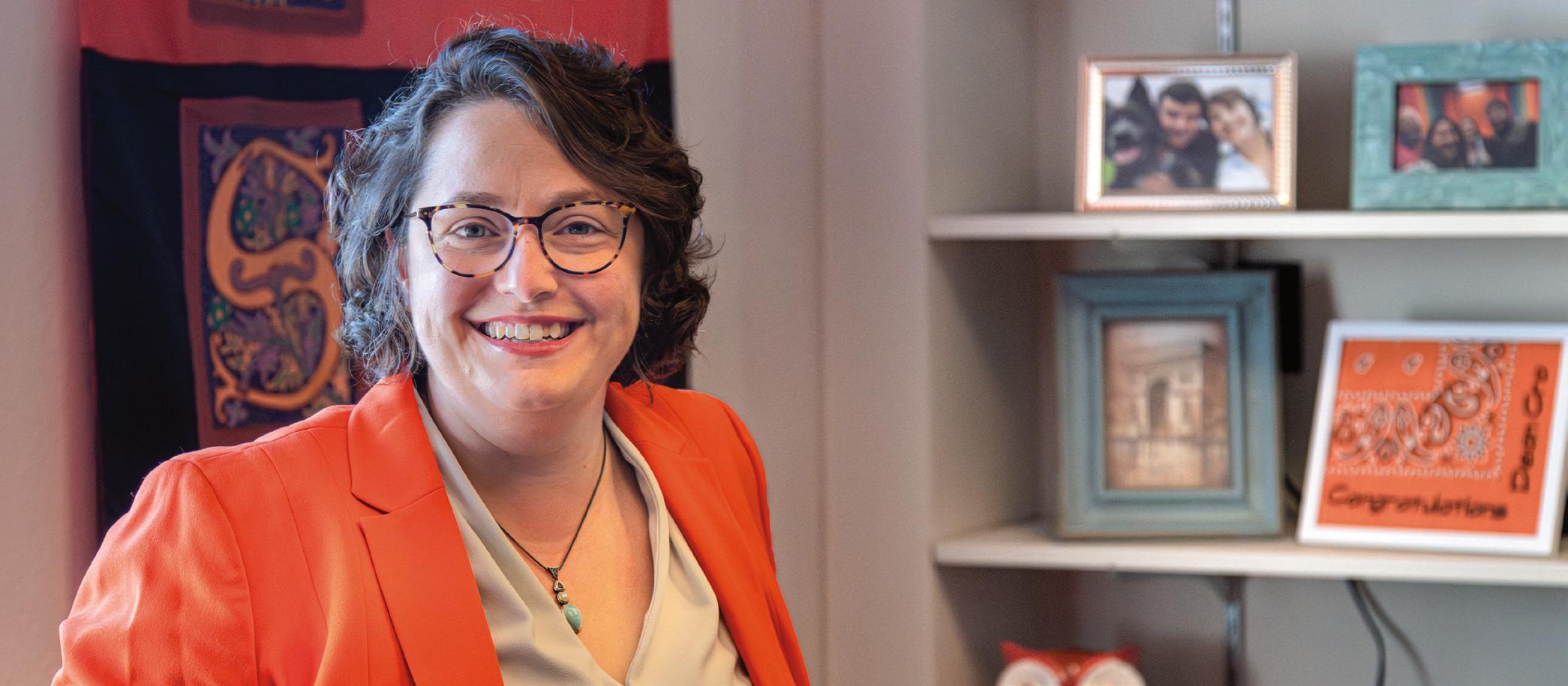
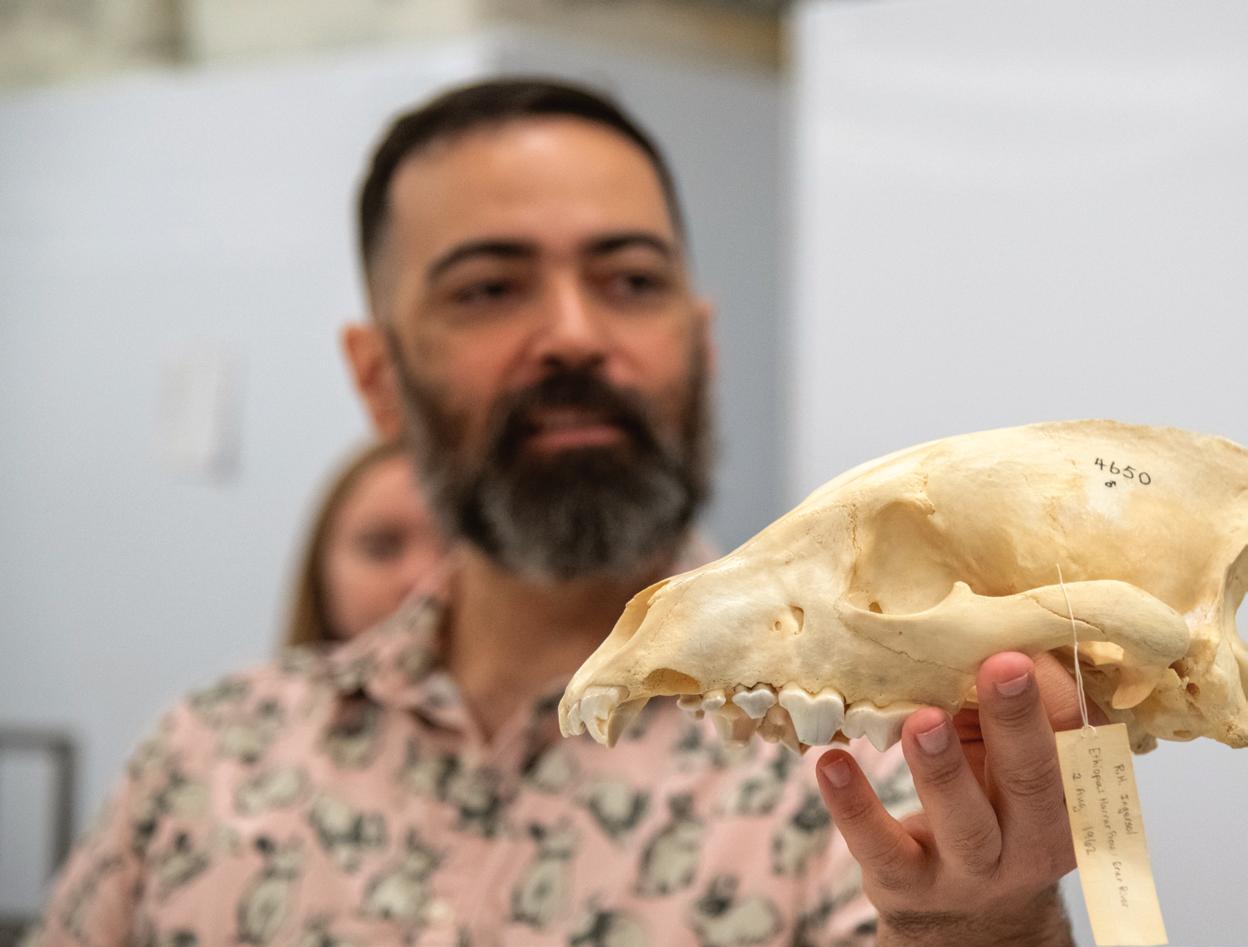
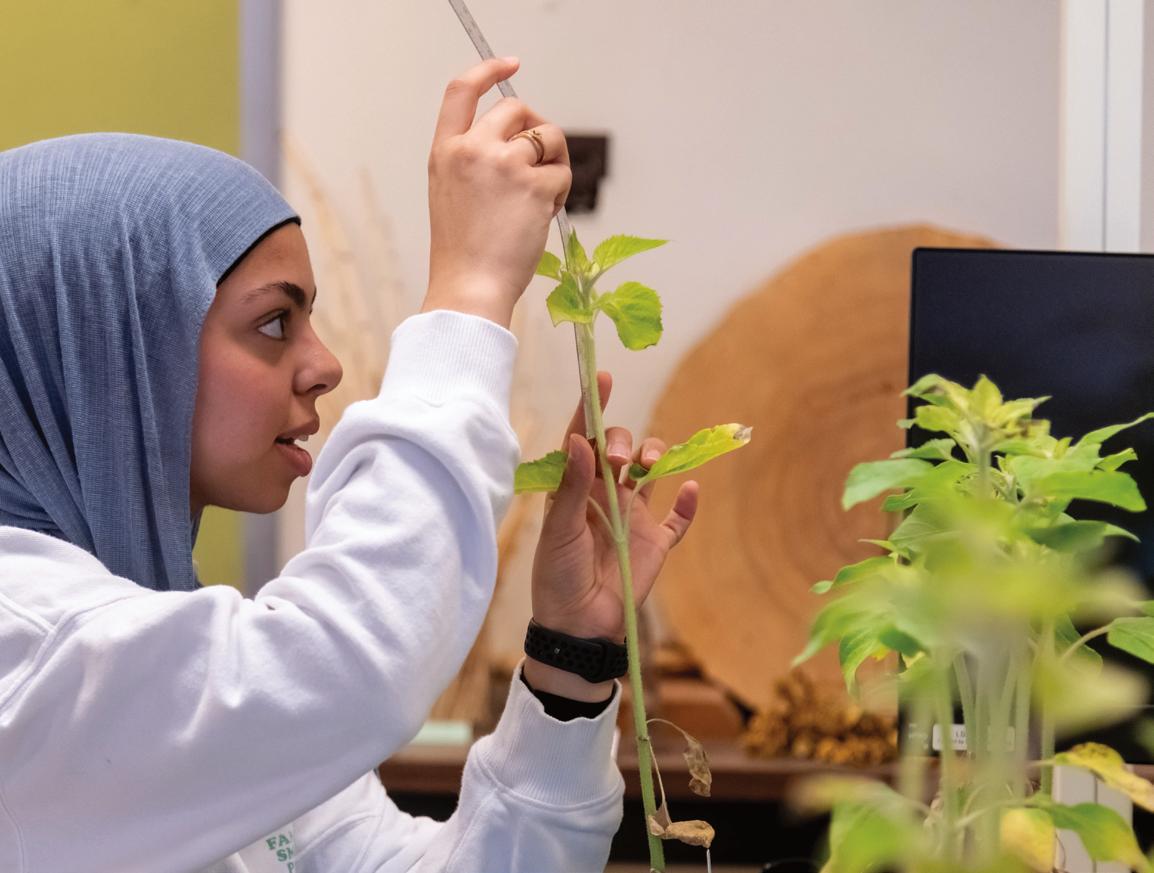
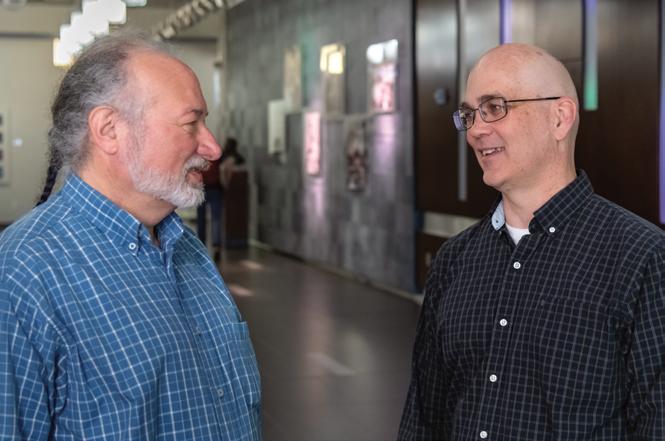
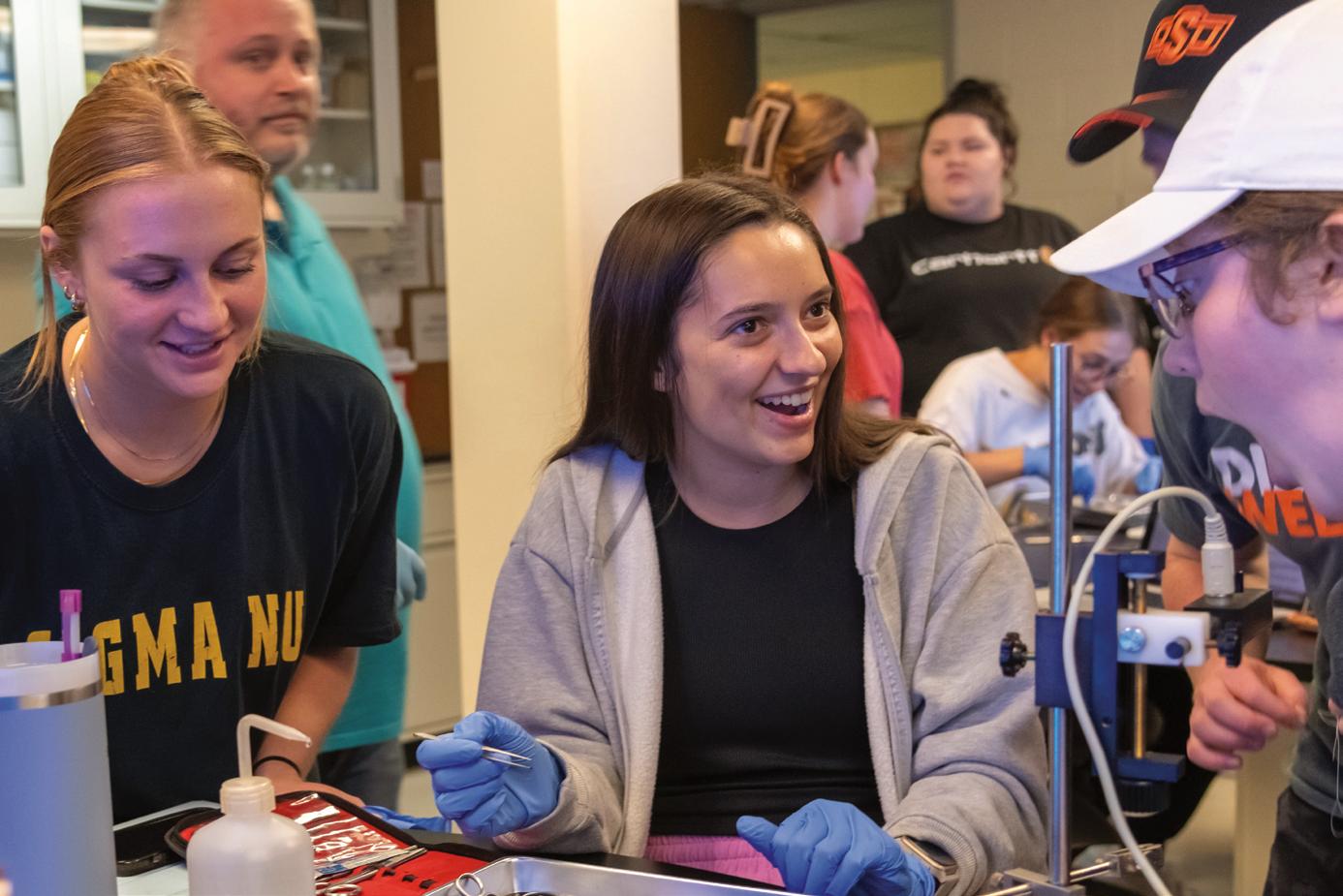
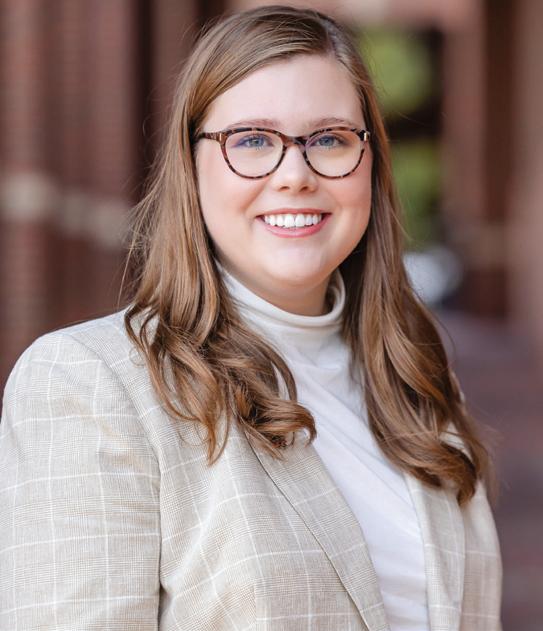
I can hardly believe my first year as dean of the College of Arts and Sciences is already over. What an incredible journey it has been getting to know Stillwater, OSU and Oklahoma. From day one, I’ve been struck by the warmth and genuine spirit of our community — there’s something truly special about being part of the Cowboy family.
Working alongside OSU President Jim Hess has been inspiring. His leadership and vision for OSU’s future align perfectly with our college’s mission to support student success through educational excellence and outstanding research opportunities. Together, we’re embracing innovation while building on OSU’s 150-year legacy. Our college’s achievements continue to impress. Some standout examples from the past 12 months include:
Being home to 14 Wentz Scholars, 11 of 25 Outstanding Seniors, and OSU’s one Marshall Scholar finalist.
Hosting the International Physicists’ Tournament’s U.S. finals.
Helping relaunch OSU Arts Week after a 45-year break.
Having Dr. Hess at the President’s Masterworks Performance for his first official event as president.
Celebrating the countless honors and millions of dollars in research funding awarded to our faculty and students.
Enhancing our academic structure, research capabilities and collaboration opportunities by merging the integrative biology and plant biology departments into the Department of Biology.
The list goes on, but you can see how much we have to be proud of in CAS. The achievements of our students, faculty and staff are a continual testament to the excellence that defines our community.
It has been one of my greatest joys to work with CAS faculty and staff this year. Their dedication to teaching, research and service continues to amaze me. Through our CAS Faculty Council, we’ve established working groups to review strategic priorities and position ourselves for continued growth.
I’ve also enjoyed collaborating with our CAS Student Council, particularly during OSU Homecoming. These partnerships have sparked important conversations about enhancing their voice in college governance to create a more inclusive, student-centered environment.
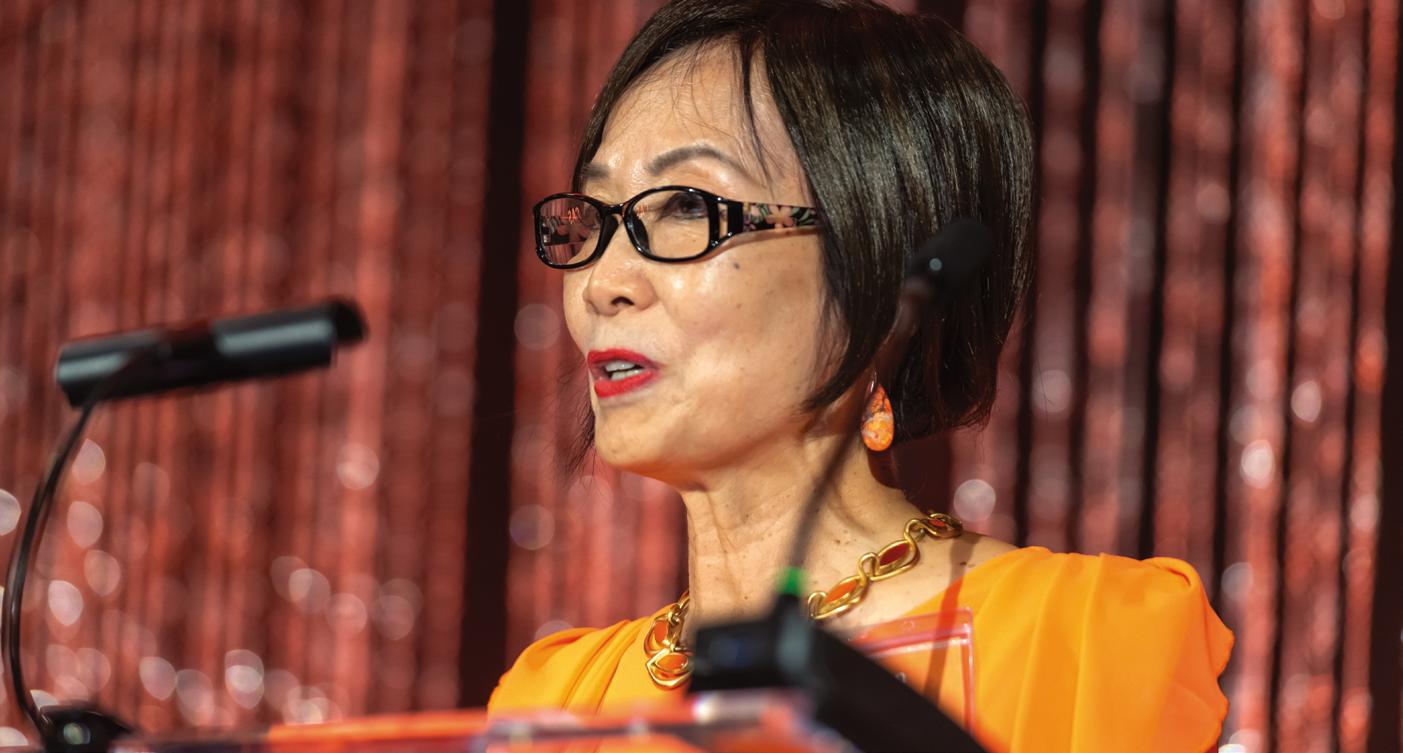
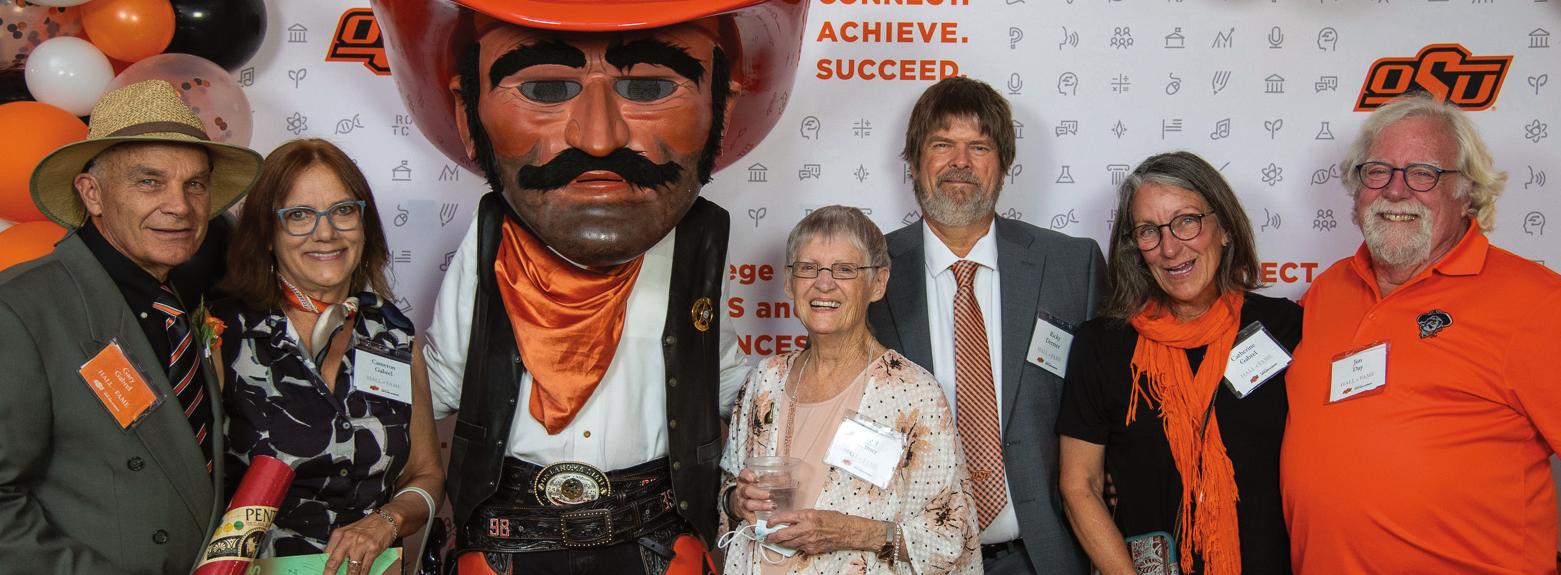
With CAS alumni scattered around the world, it’s been fantastic to meet so many through events ranging from CAS Hall of Fame to our annual Homecoming Reunion to Dean’s Circle gatherings. I am so thankful for the engagement of our alumni base.
Looking ahead, I’m thrilled about the plans for a new facility that will support our tremendous growth in biological sciences and psychology. This state-of-theart building will be a game-changer for student success, providing modern laboratories and interdisciplinary research spaces for critical life sciences fields.
As the college celebrates another successful year, I’m filled with gratitude for our CAS family. The unwavering support of each individual creates an environment where excellence flourishes.
Thank you for being part of this journey with me.
Go Pokes!
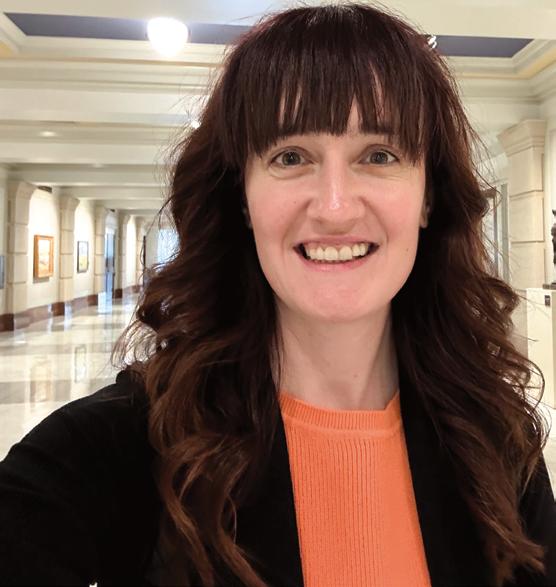
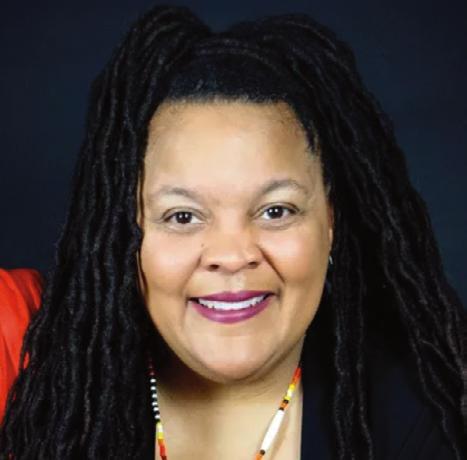
Dr. Melinda A. Cro Dean, College of Arts and Sciences
PHOTO
Culture
of creativity
With the help of CAS departments, OSU Arts Week has returned for the first time since Carter was president. 10
Bio in bloom
CAS renews its commitment to life sciences research and instruction with department merger and new facility plans.
23 Acting out
OSU Theatre’s costume lab is a utopia for student experimentation and hands-on learning that carries into careers.
30
Super collaborators
OSU students and faculty from a myriad of disciplines are working together on elements for the European Organization for Nuclear Research. 34
Fostering greatness
From academic advising to research to career readiness, CAS provides unparalleled student resources.
COMMUNICATIONS
Elizabeth Gosney
EDITOR
Jordan Bishop ’16
ART DIRECTOR
Dave Malec
DESIGNER
Alyssa Scattergood-White
PHOTOGRAPHER
Jason Wallace ’03
MULTIMEDIA PRODUCER
Keith Mattix ’22
WRITERS
Olivia Blackford ’22
Dr. Rachael Eaton
Adeola Favour ’25
Matthew Hunter ’25
Kierstin Pigg ’24
Grant Ramirez ’21
Sydney Trainor
Mak Vanduff ’25
COLLEGE OF ARTS AND SCIENCES DEAN
Dr. Melinda Cro
DIRECTOR OF OUTREACH
Dr. Caitlin Barnes
OSU FOUNDATION
SENIOR DIRECTOR OF DEVELOPMENT
Taylor Buxbaum ’ 14
CONSTITUENT RELATIONS
Autumn Colley
YEARS
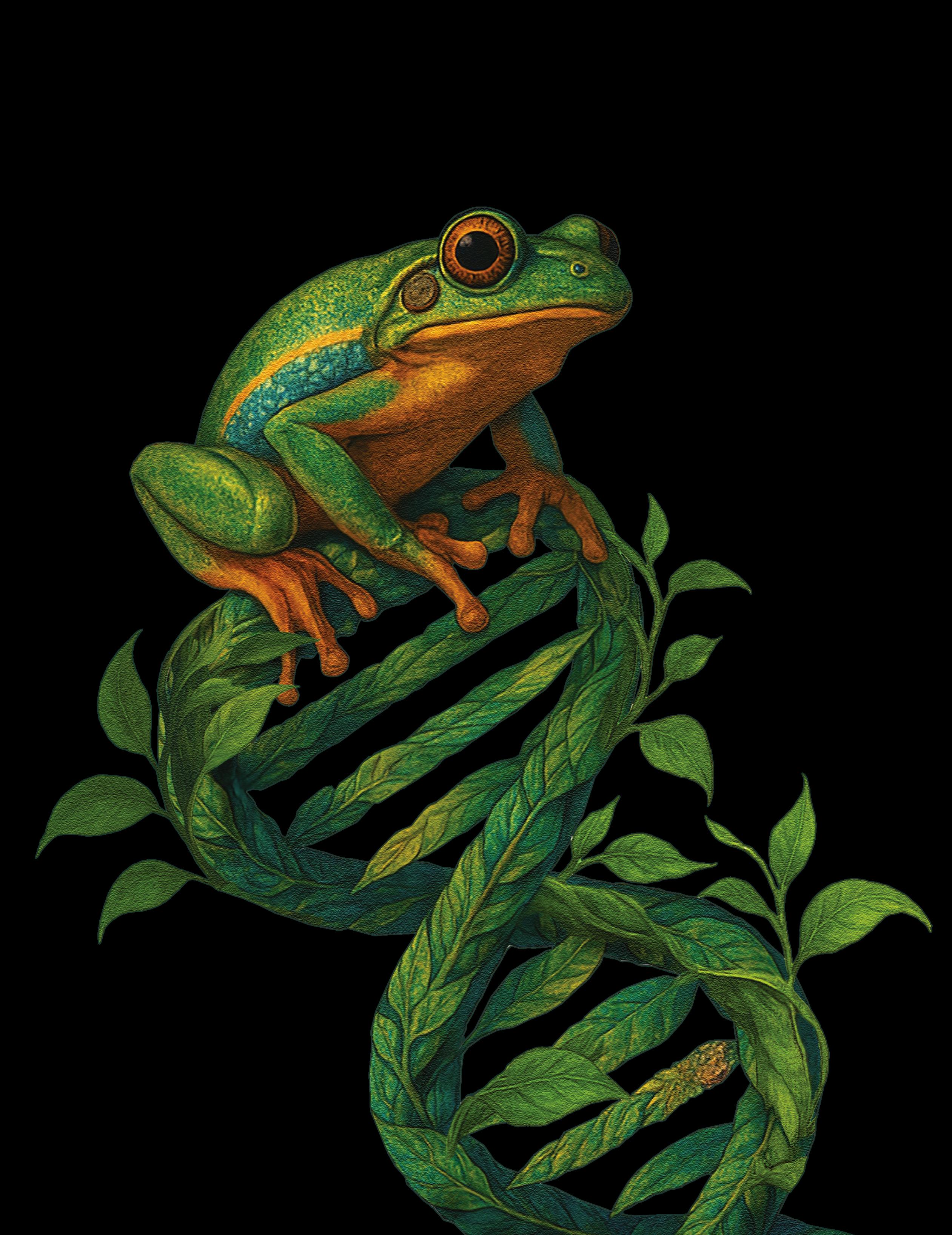
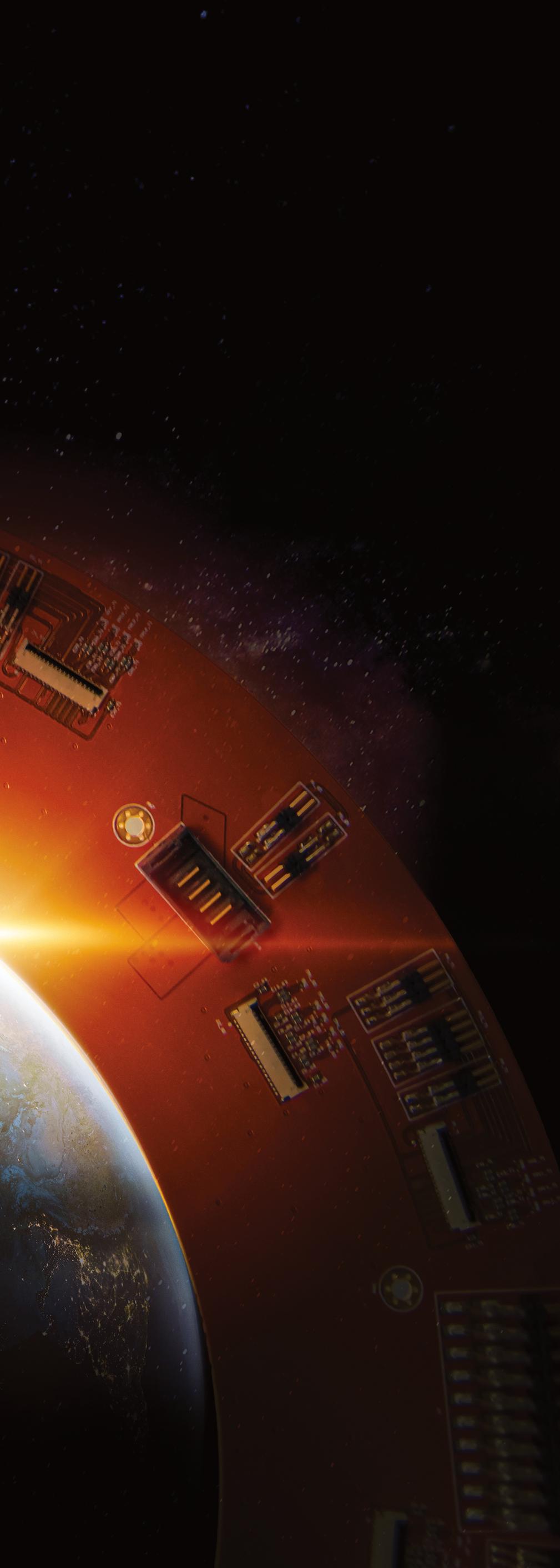
On the cover: Photo illustration by Jason Wallace using generative AI.
RENAISSANCE ready
OSU ARTS WEEK RETURNS AFTER 45-YEAR HIATUS
For the first time since the 1970s, Stillwater saw the return of OSU Arts Week — a celebration of the visual, performing and applied arts at Oklahoma State University.
The OSU Arts Committee led the initiative, with key support from the College of Arts and Sciences’ Department of Theatre, Greenwood School of Music, and Department of Art, Graphic Design and Art History.
“Our primary goal was to showcase the breadth and depth of the arts at OSU and raise awareness of our art programs,” said Chris Ensor, associate director for OSU System Marketing.
“The talent level across our campus — from faculty to students — is worldclass. We wanted to make the arts more personal and accessible to the campus and Stillwater community
by inviting students, faculty and staff to engage in unique, hands-on experiences.”
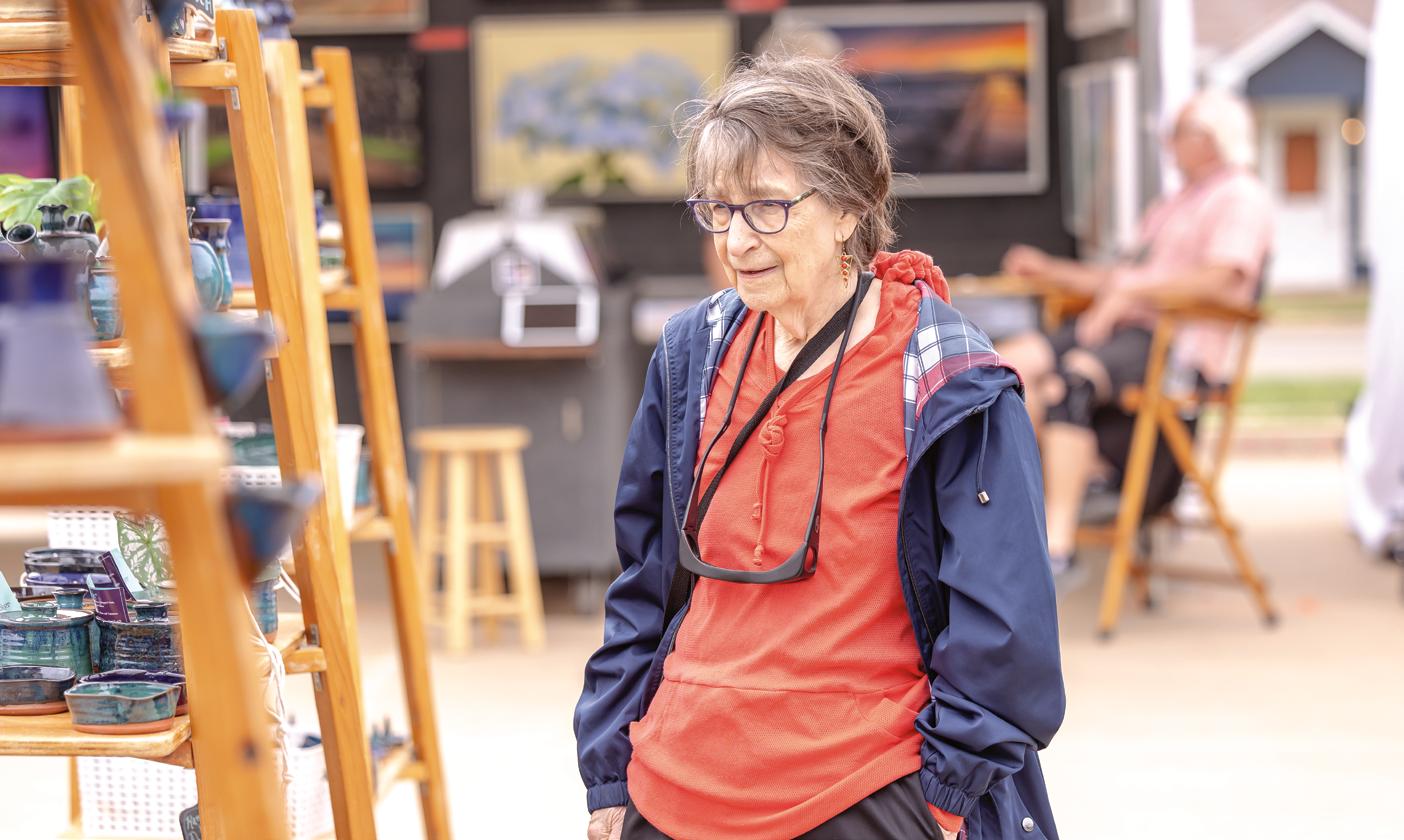
OSU Arts Week kicked off on April 18 with the Stillwater Arts Festival, hosted by the Prairie Arts Center. Over the following days, the campus enjoyed student performances, attended guest lectures and participated in interactive activities all aimed at elevating the visibility of the arts.
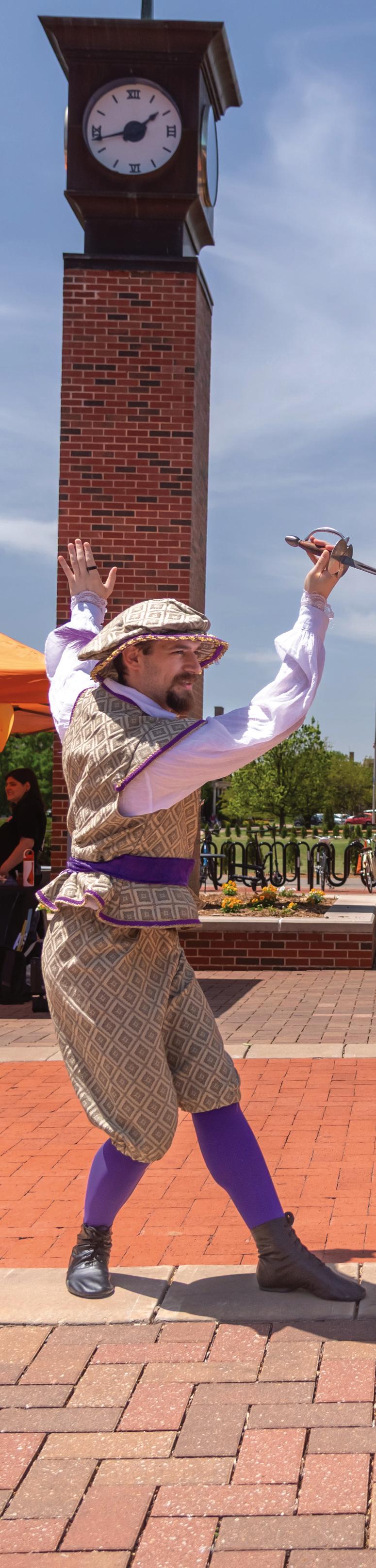
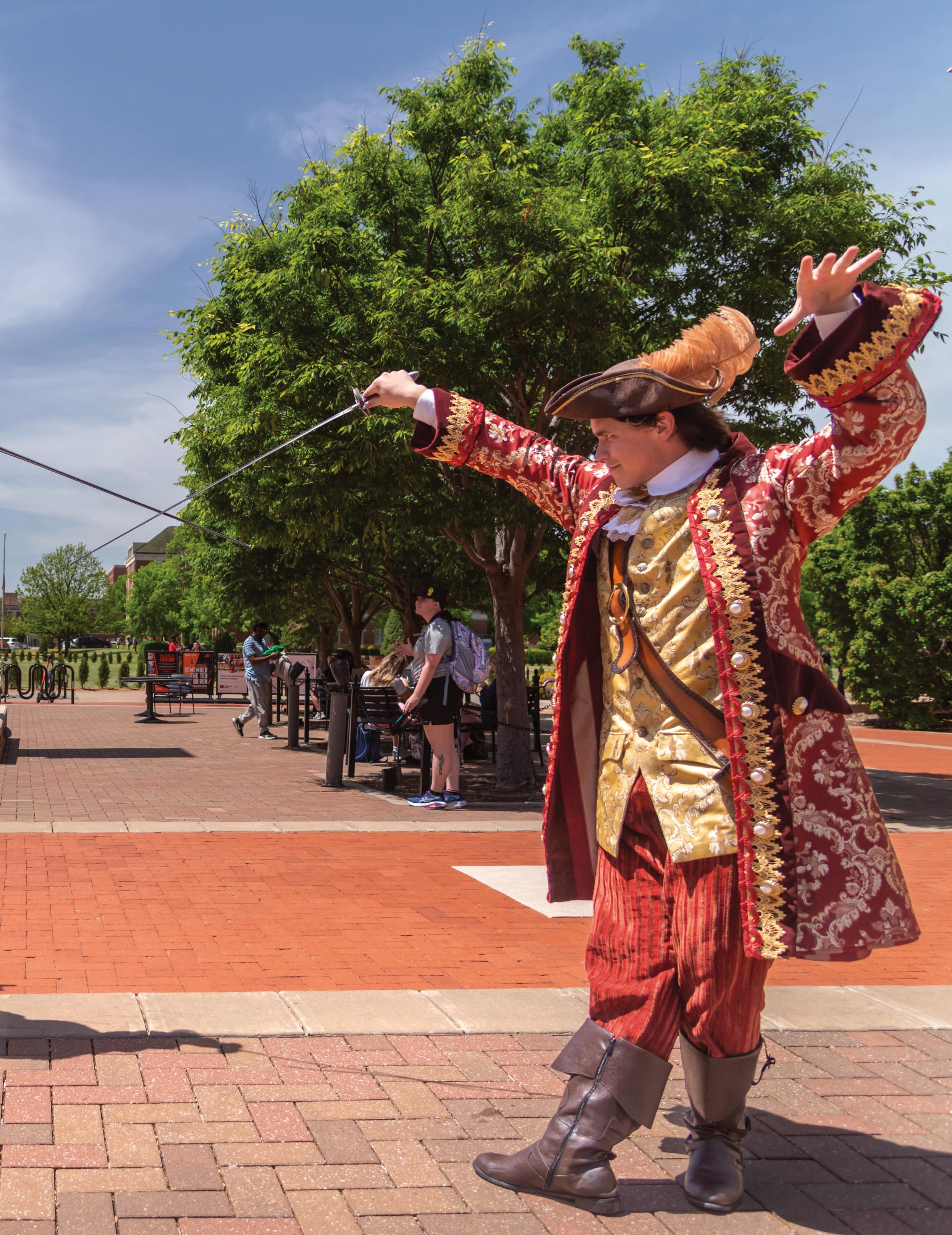
“It was nice to see so many fellow students asking about the arts and showing genuine interest,” said Garett Lacy, a theatre student who demonstrated stage combat for onlookers outside the Student Union.
“For our display specifically, we were sword fighting — what a spectacle, right? We had many students who were stoked to watch and take pictures.
STORY KIERSTIN PIGG | PHOTOS GARY LAWSON, ELLIE PIPER AND JASON WALLACE
Faculty member Matthew Smith performs with student Garett Lacy during OSU Arts Week
“IT IS IMPORTANT TO MAKE SURE STUDENTS GET THE OPPORTUNITY TO EXPLORE THE ARTS — AFTER ALL, COLLEGE IS ABOUT FINDING YOURSELF AND YOUR PASSIONS, AND THAT TAKES EXPLORATION.”
— Garett Lacy, theatre student
“Most students are not even aware of all the artistic opportunities that our university offers. It is important to make sure students get the opportunity to explore the arts — after all, college is about finding yourself and your passions, and that takes exploration.”
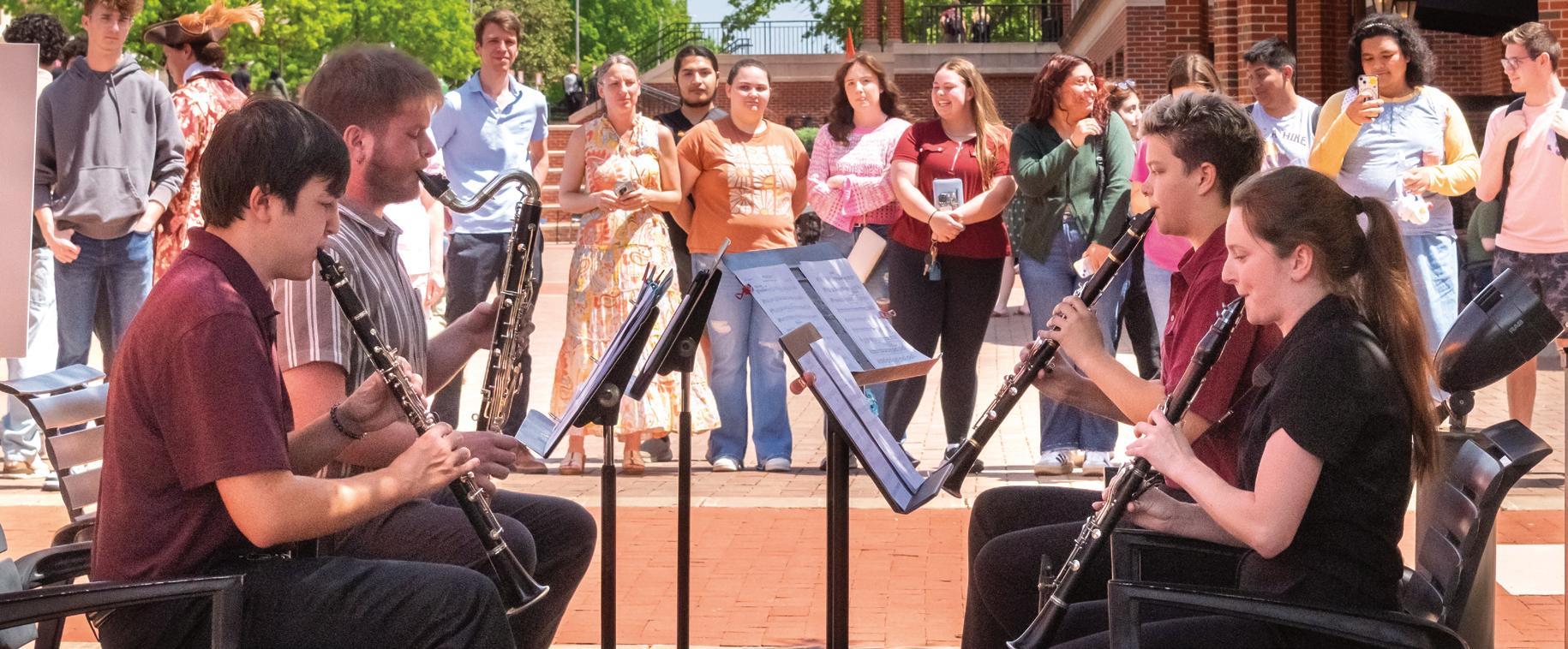
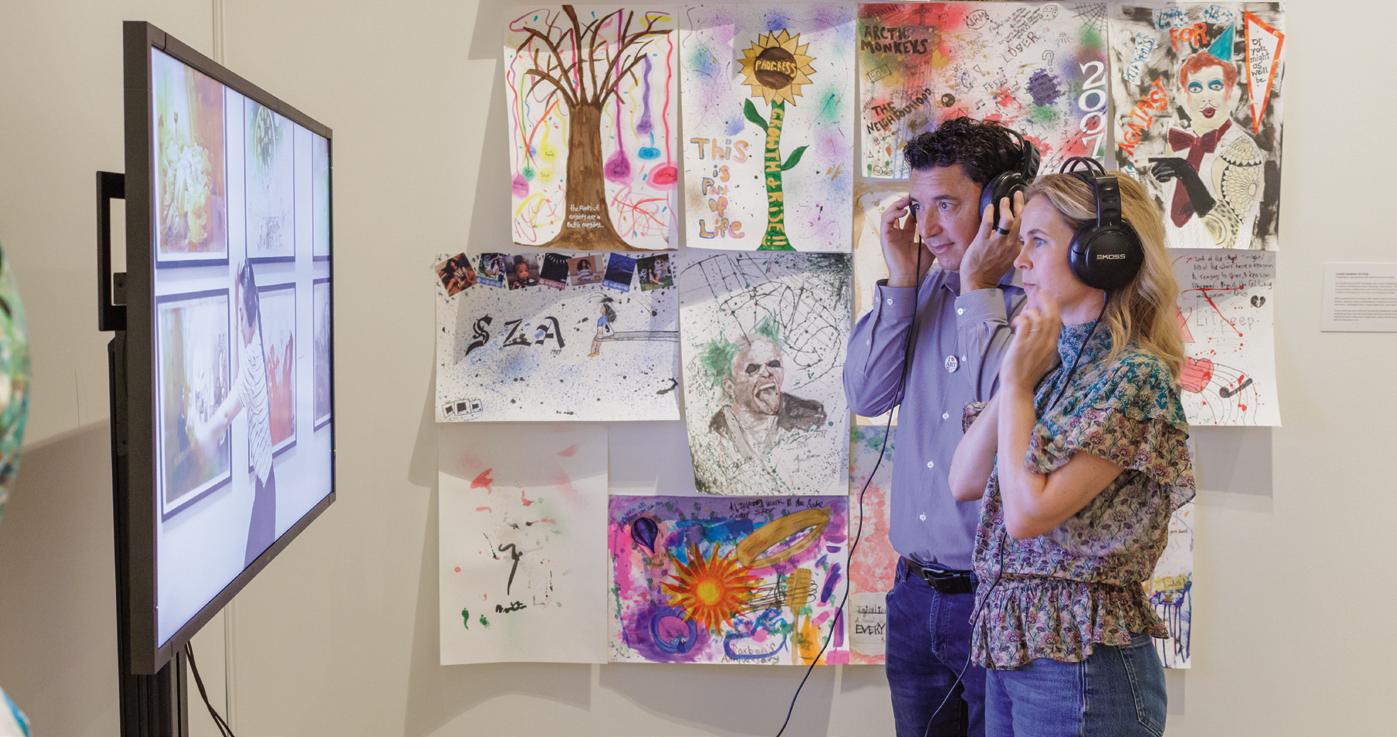
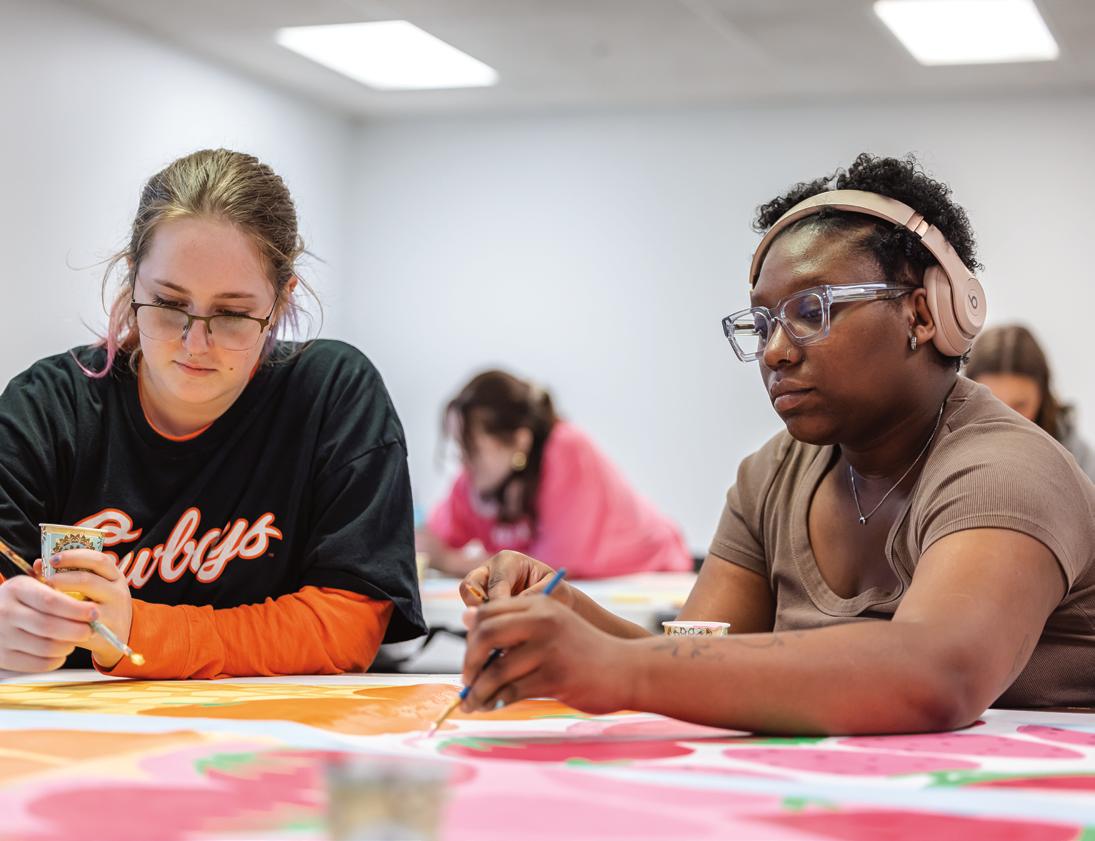
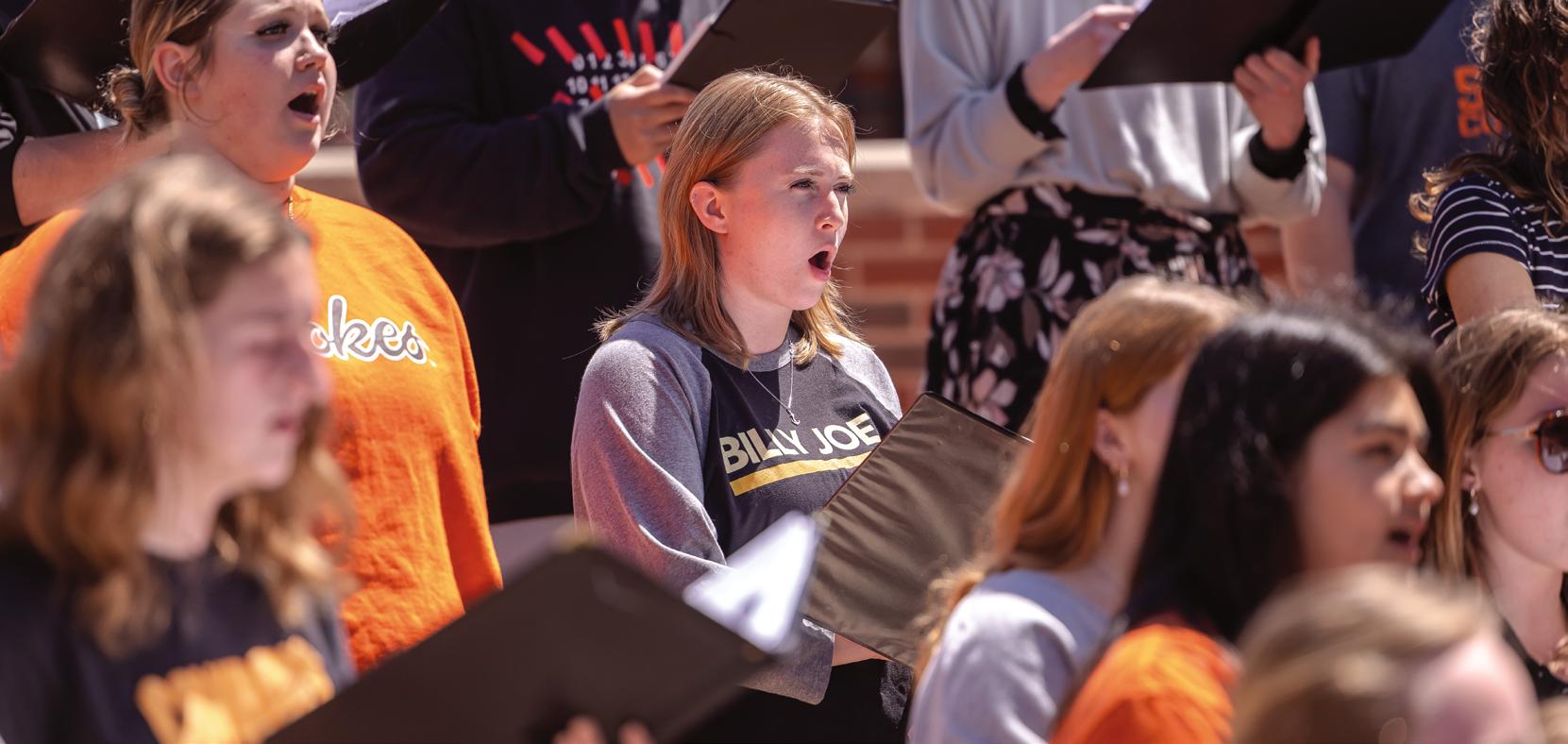
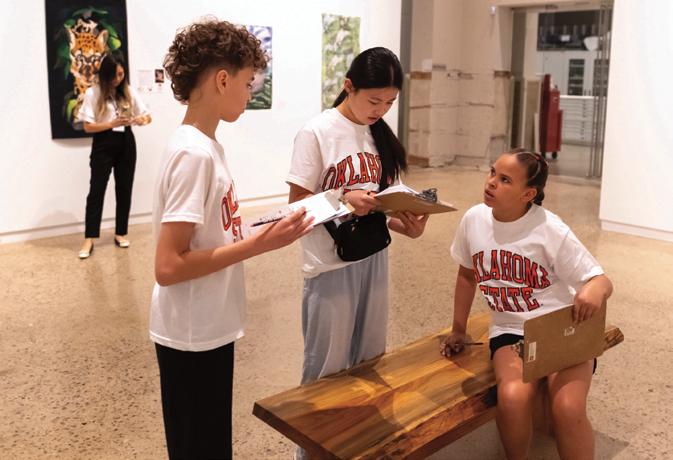
More than 10 departments and campus partners contributed to OSU Arts Week. Activities included free choral and musical performances, linocut printing, screen-printed temporary tattoos, musical theatre, a movie night, artist talks, museum exhibitions and gallery shows.
“Events like this are important for students of all majors. It may not always be obvious, but the arts are tied into almost everything we do,” said Ashton Miller, an OSU Museum of Art intern who gave out dozens of art kits during the week. “This exposure to different thought processes and experiences helps students become more wellrounded and empathetic individuals.
“OSU Arts Week and events like it give students the opportunity to learn about and engage with the various arts departments in ways they may not otherwise be able to.”
As OSU Arts Week 2025 concluded, it left a lasting impression on many who participated and attended. The initiative successfully opened conversations about the role of the arts at OSU and created space for students to engage in creative opportunities.
“The arts are integral to OSU’s land-grant mission,” said Dr. Kirsten Olds, associate provost for the arts.
Scan to watch exclusive content about OSU Arts Week.
“The arts at OSU help us realize what it means to be human. They help us develop empathy. They are excellent at developing our problem-solving skills. They are good at allowing us to be resilient and respond to moments of failure. All of these things are so important in today’s society.”
To keep up with all things OSU Arts and Culture, visit okla.st/osu-arts.
BRINGING it back
These units were key to the revival of OSU Arts Week:
X OSU ARTS COMMITTEE
X COLLEGE OF ARTS AND SCIENCES
X DEPARTMENT OF ART, GRAPHIC DESIGN AND ART HISTORY
X DEPARTMENT OF THEATRE
X GREENWOOD SCHOOL OF MUSIC
X DOEL REED CENTER AT TAOS
X GARDINER GALLERY OF ART
X OSU CENTER FOR POETS AND WRITERS
X OSU MUSEUM OF ART
X THE MCKNIGHT CENTER FOR THE PERFORMING ARTS
X PRAIRIE ARTS CENTER
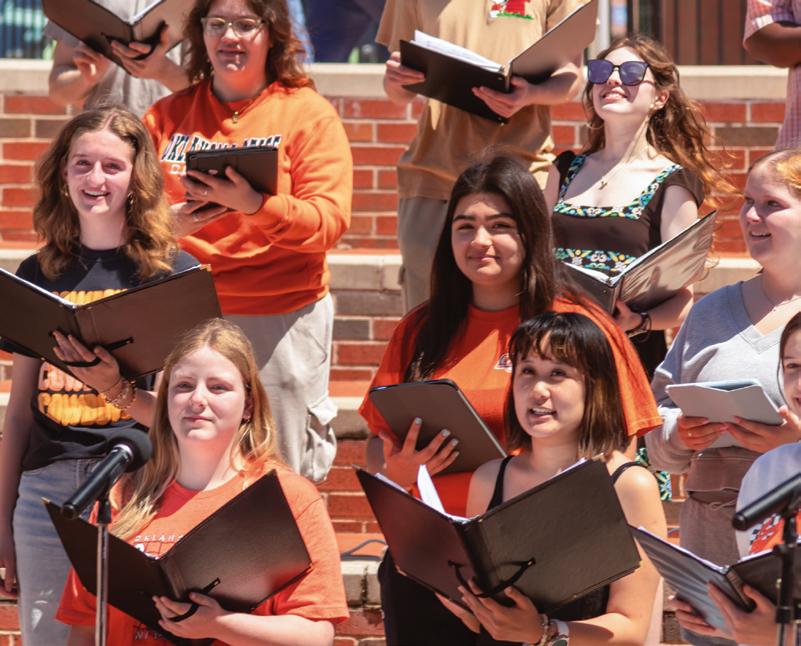
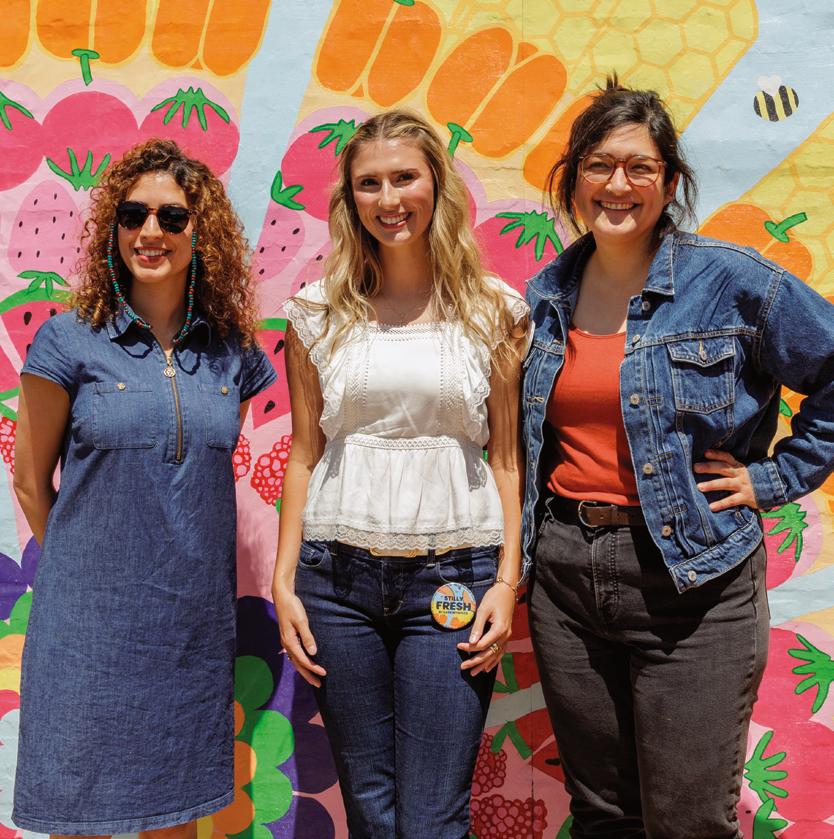
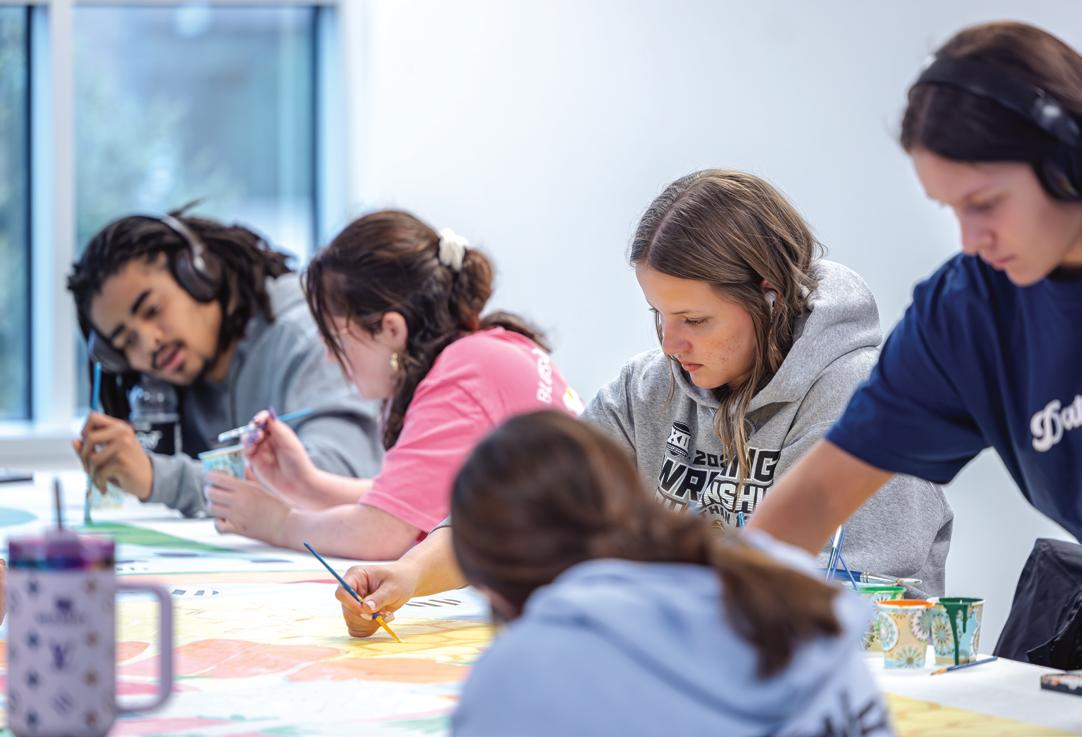
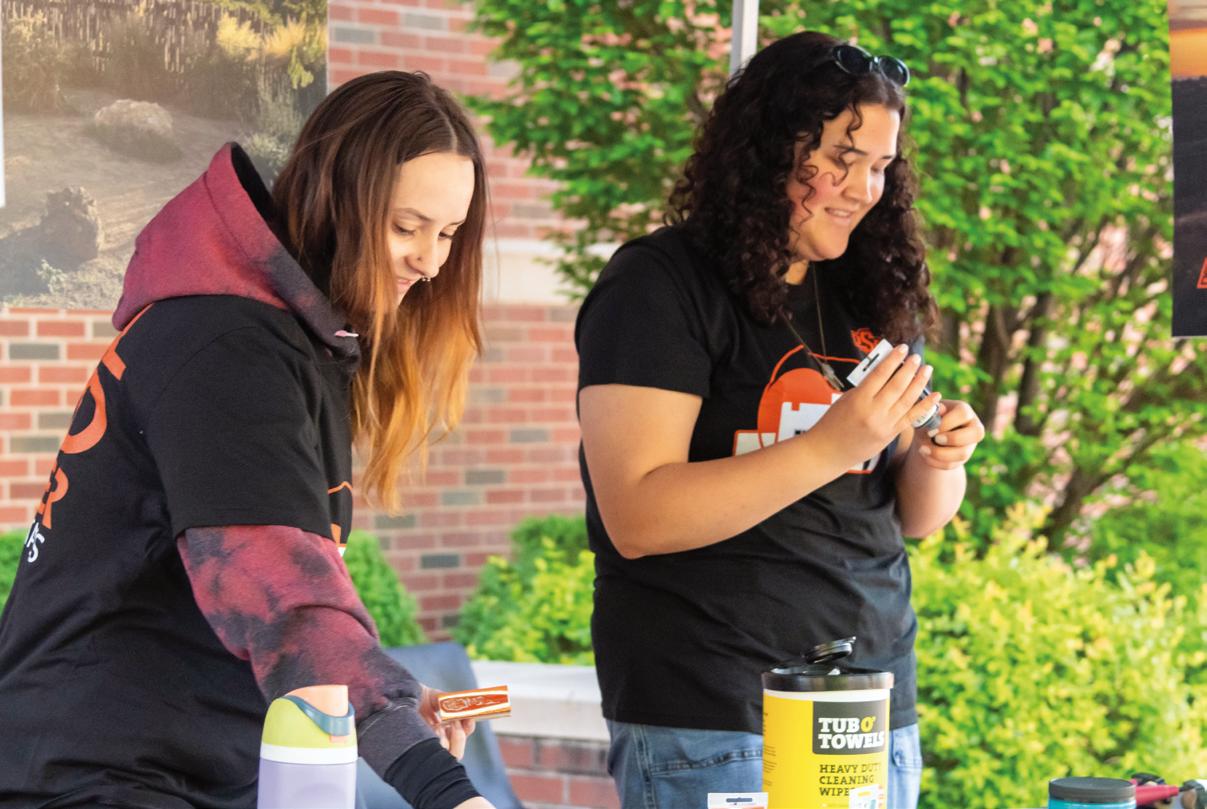
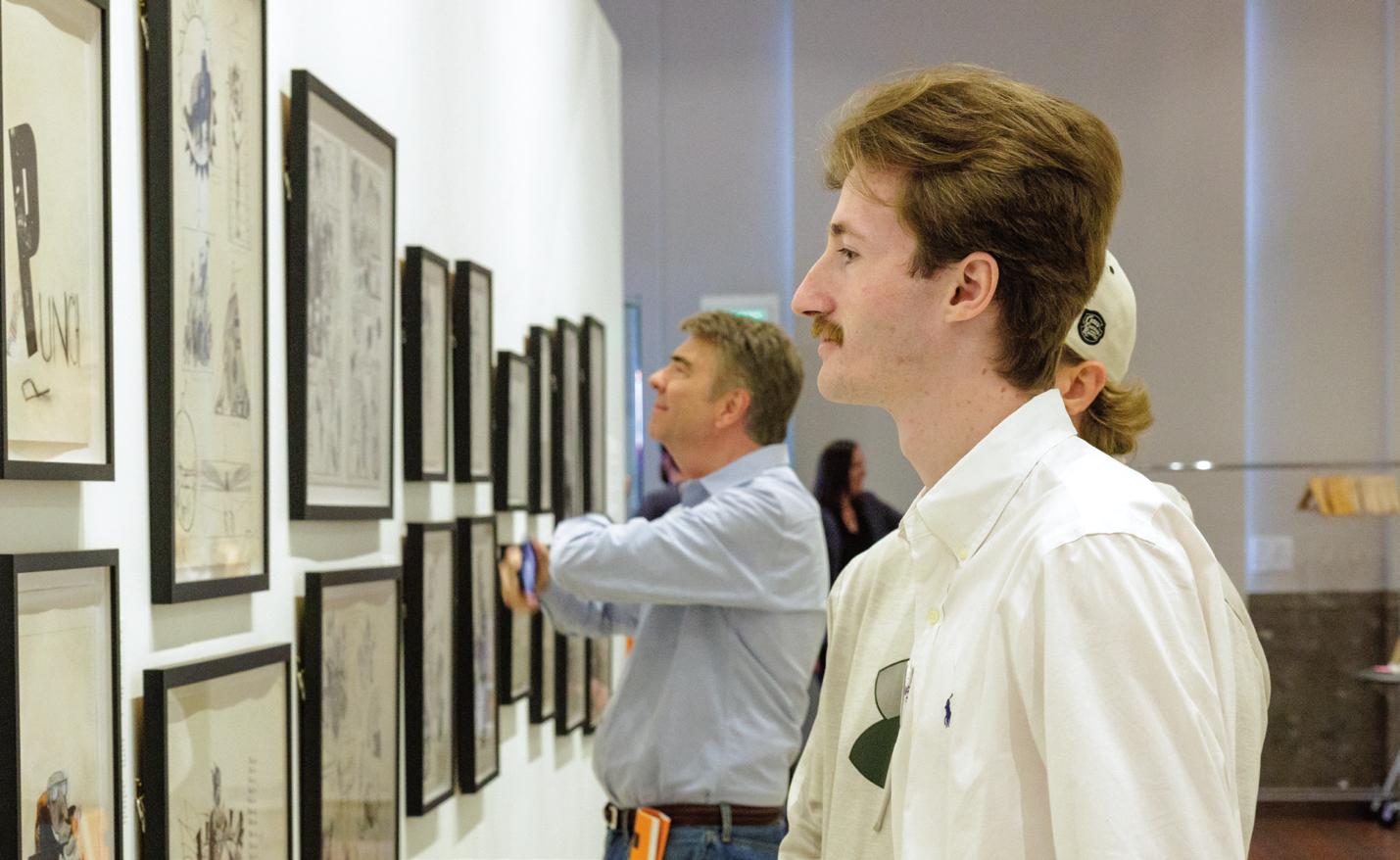
OSU and Stillwater community members enjoyed musical performances, art exhibitions, the unveiling of a new mural and many other activities during OSU Arts Week 2025.
Elevating and Expanding Expertise
CAS faculty advance knowledge across continents and cultures
From the soil of Oklahoma’s prairie to the Arctic ice caps of the North Pole, Oklahoma State University researchers in the College of Arts and Sciences conduct transdisciplinary research covering everything from how people interact with each other to data collected from satellite imagery.
PATTERNS IN THE PRAIRIE
Dr. Hamed Gholizadeh, associate professor in the Department of Geography, received a three-year $731,344 NASA grant for his project, “HI-GRASS - Holistic Investigation of Grassland Systems Across Scales.”
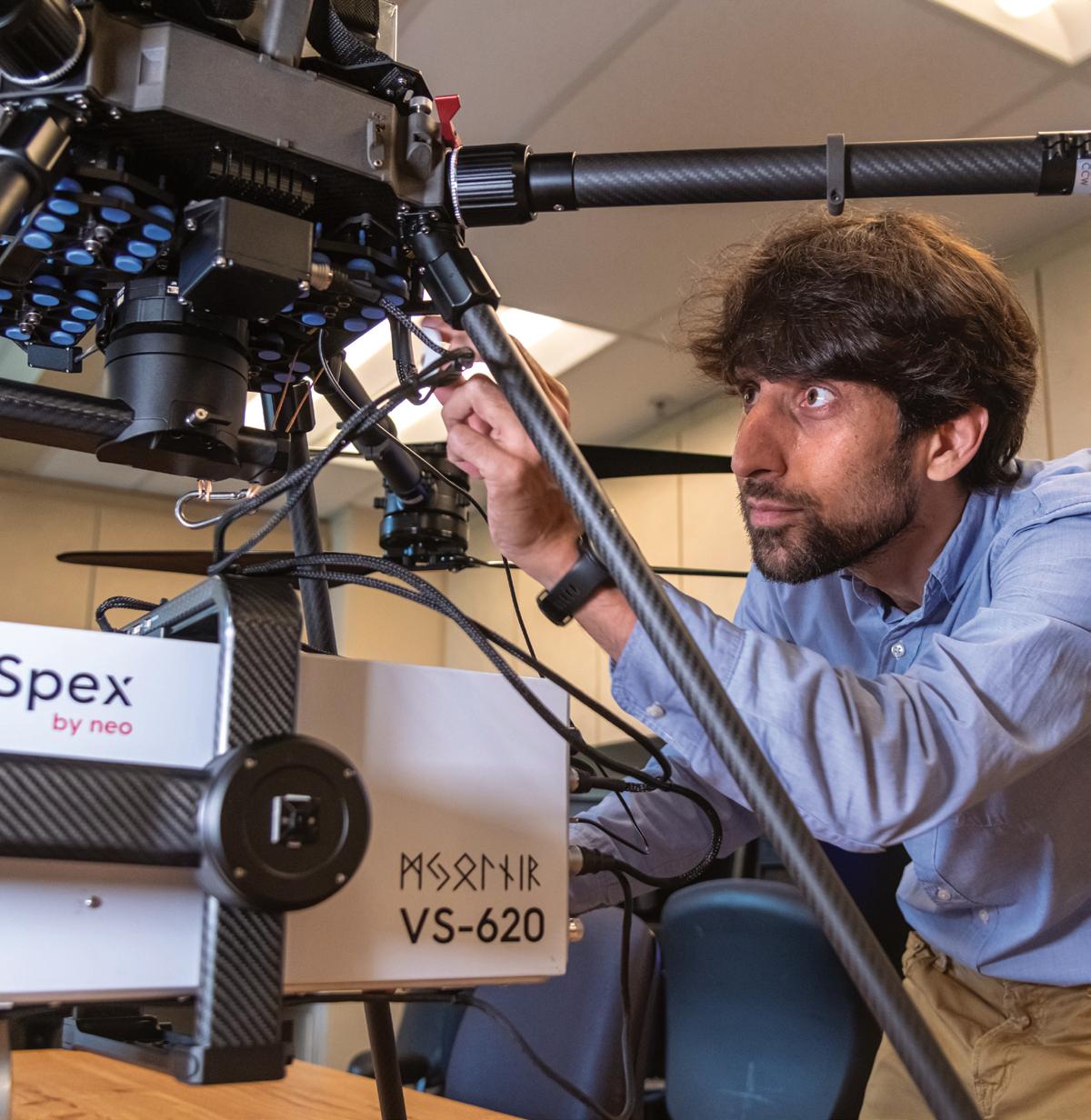
This project uses remote sensing technology— collecting imagery from satellites, airplanes and drones — along with movement ecology, landscape ecology, metagenomics and microbial ecology, to understand how and why aboveground and belowground biodiversity in grasslands is changing.
Gholizadeh is the principal investigator on this project, joined by co-PIs Drs. Benedicte Bachelot, OSU assistant professor of biology; Nicholas McMillan, assistant professor of agronomy and horticulture at the University of Nebraska–Lincoln; Ran Wang, UNL assistant professor and environmental spatial scientist; and John Gamon, UNL professor and quantitative remote sensing scientist.
“The unique aspect of this project is its transdisciplinary nature,” Gholizadeh said. “A significant outcome of this work is the novel integration of expertise in remote sensing, plant–soil interactions and herbivore–landscape interactions to develop a biodiversity monitoring system for grasslands. This project will serve as a showcase of how large-scale integration of expertise can help assess grassland health and inform better conservation strategies.”
As part of the HI-GRASS project, Gholizadeh and the team conduct large-scale field campaigns at two research sites — Joseph H. Williams Tallgrass Prairie Preserve in Oklahoma and the Barta Brothers Ranch in Nebraska — to document
the variety of grassland plant species and validate remote sensing models.
But that’s just one component.
Bachelot collects soil samples to assess fungal and bacterial communities in the soil, while the team from Nebraska deploys GPS trackers on cattle to monitor their movements to understand their impact on grassland aboveground and belowground biodiversity.
All these insights will eventually be scaled up to the entire landscape using remote sensing.
Many grasslands in this part of the world are managed by prescribed fire and grazing. This project helps reveal how these management practices affect grassland biodiversity.
Dr. Hamed Gholizadeh adjusts part of the drone his team uses to conduct grassland research.
“One of the most important things about research is to be out there experiencing the world firsthand, cultivating relationships and building communities around the world.”
BENJAMIN MURPHY, ASSISTANT PROFESSOR OF STUDIO ART
TURNING NUMBERS INTO ART
At 79 degrees north sits the world’s northernmost post office on Norway’s island of Spitsbergen.
In this remote corner of the Svalbard archipelago, 30 people — a diverse, handpicked group of artists, scientists, sociologists and global professionals — set sail on a two-week expedition in May aboard a traditionally rigged schooner vessel to advance their careers and research.
Benjamin Murphy, assistant professor of studio art, was accepted to the highly competitive annual residency where he learned about research projects surrounding the Arctic, climate or social issues related to those areas.
Murphy, a visual artist focused on hydrological landscapes, uses data provided by scientists — whether topographical data or satellite imagery — to create visual forms. He sees it as a way to help scientists communicate their work.
“I’m looking for new ways to make the genre of landscape artworks relevant today, and to say
something about what’s taking place on our planet — how it’s changing — and to start thinking about how that affects the people that live on it and occupy the space,” Murphy said.
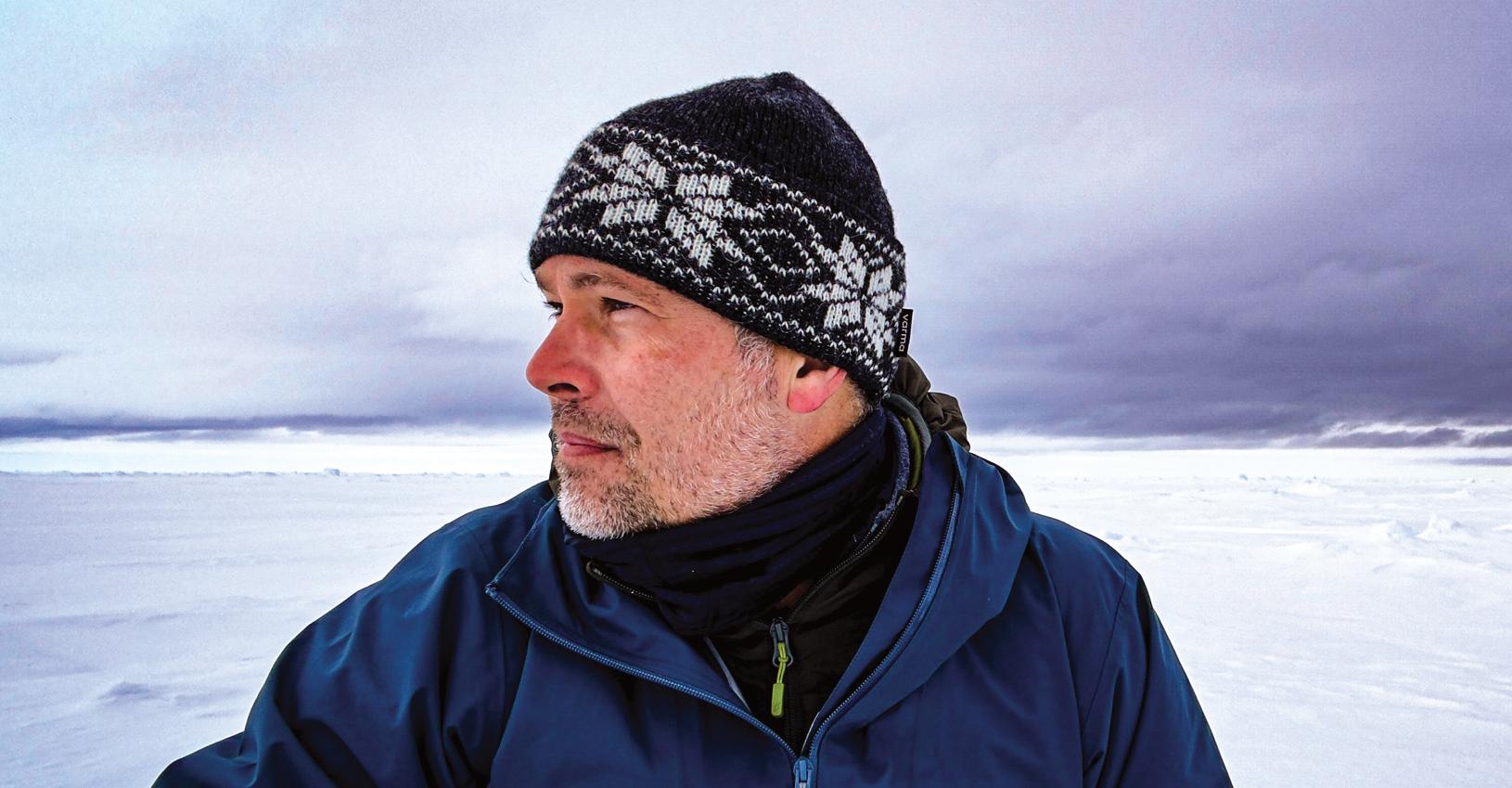
Murphy’s work focuses on the Arctic ice cap.
“To actually go and set foot on that, that part of the world that sort of touches all the information I’m gathering and collecting, was critical,” Murphy said.
Murphy engaged with those who live and work in those remote areas to gather information he would have otherwise never accessed and connect with colleagues worldwide for future collaborations.
“One of the most important things about research is to be out there experiencing the world firsthand, cultivating relationships and building communities around the world,” he said. “Those activities not only drive research, but they also create a dialogue that, I hope, can keep the world a place where we’re able to engage with each other peacefully.”
Benjamin Murphy takes in the landscape on his Arctic expedition.
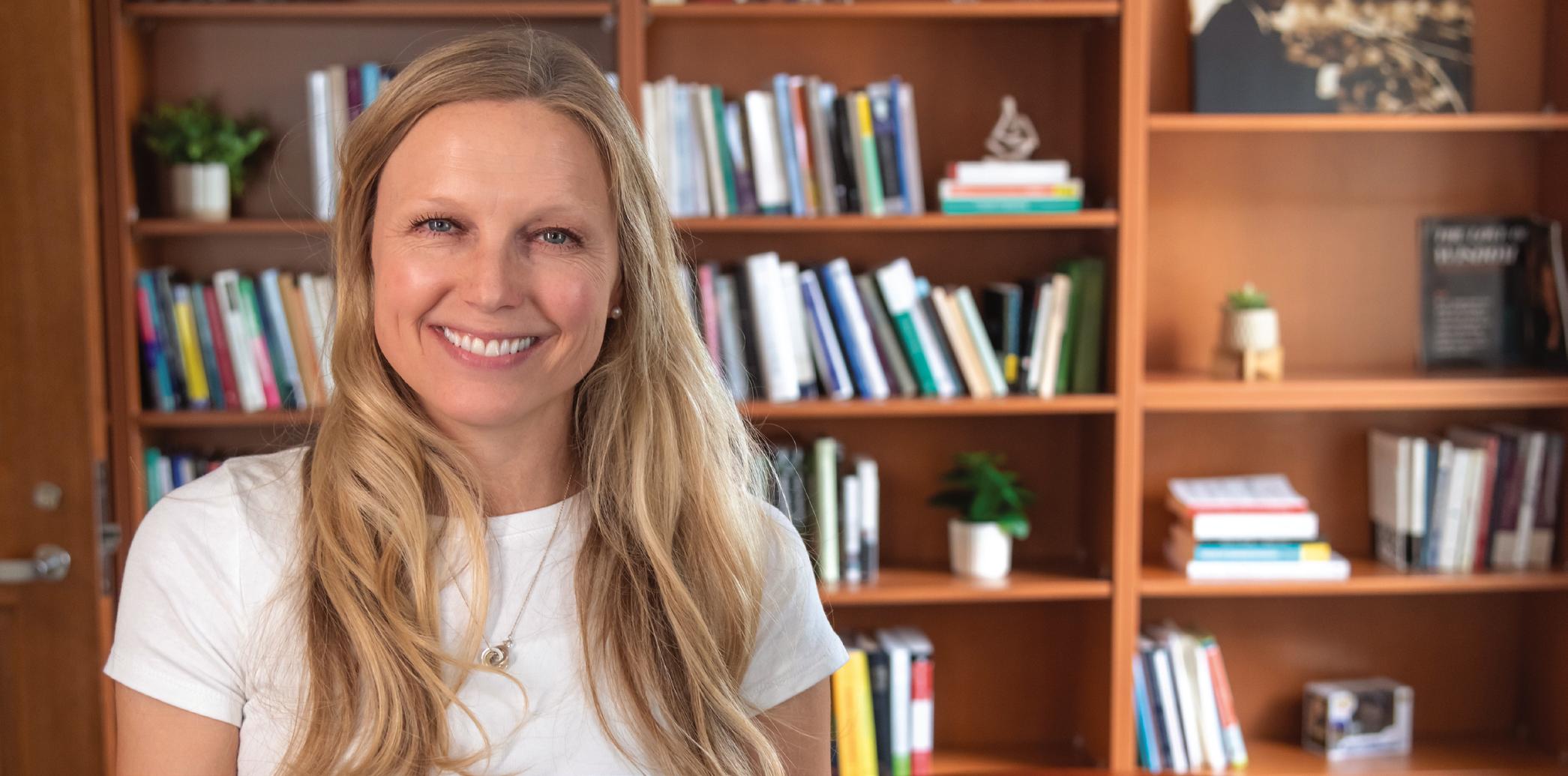
Dr. Shannon Spaulding’s primary area of research is social cognition, the capacity to understand and interact with other agents.
SCIENCE OF MISUNDERSTANDING
At the intersection of philosophy, psychology and neuroscience, one can find Dr. Shannon Spaulding, professor of philosophy and department head, studying social cognition. She aims to answer the basic question of “How do ordinary people understand and interact with other people?”
Every day, humans interact with family, friends, acquaintances, coworkers and strangers on the internet. Research shows that in laboratory conditions, neurotypical adults are fairly good at understanding others. However, in real life, neurotypical adults regularly misinterpret others’ intentions, thoughts and emotions in social interactions. These mistakes occur both within close circles of friends and family and with outgroup members.
However, these aren’t just simple, one-off performance mistakes; they reflect deeper, systematic patterns in how social cues are interpreted.
“I’m really interested in the mistakes we make when trying to understand other people,” Spaulding said. “What’s actually happening when we get it wrong? I’m curious about how our personal motivations and the stereotypes we bring into a social interaction shape how we interpret it — our preconceived ideas about certain situations or people create expectations, and sometimes others meet those expectations, but sometimes they don’t.”
Spaulding is leading in this area of research and was recently recognized with the prestigious Stanton Prize from the Society for Philosophy and Psychology, a preeminent organization at the intersection of those eponymous areas.
The Stanton Prize is awarded to a young scholar in philosophy or psychology who has begun making significant contributions to interdisciplinary research and has been active in SPP.
To Spaulding, receiving the award was especially affirming.
“Research is such a delayed gratification activity — you spend years working on a project without knowing if it will go anywhere or if the idea is a dead end,” she said. “There are so many opportunities to doubt yourself. So being recognized for my years-long contributions to research means a lot.
“It’s especially meaningful to win the prize while representing OSU. Most recipients are from the Ivy League or prestigious private institutions and have networks of faculty and graduate students working in their areas of research at their institution. Thanks to the generous support of the philosophy department, I’ve been able to travel and deliberately build a research network extending across the U.S. and Europe. This support has allowed me to have a thriving research career. I am so grateful to be seen and supported by my peers in philosophy and psychology in this way.”
Sum-thing Special
OSU High School Math Day fosters community of learning
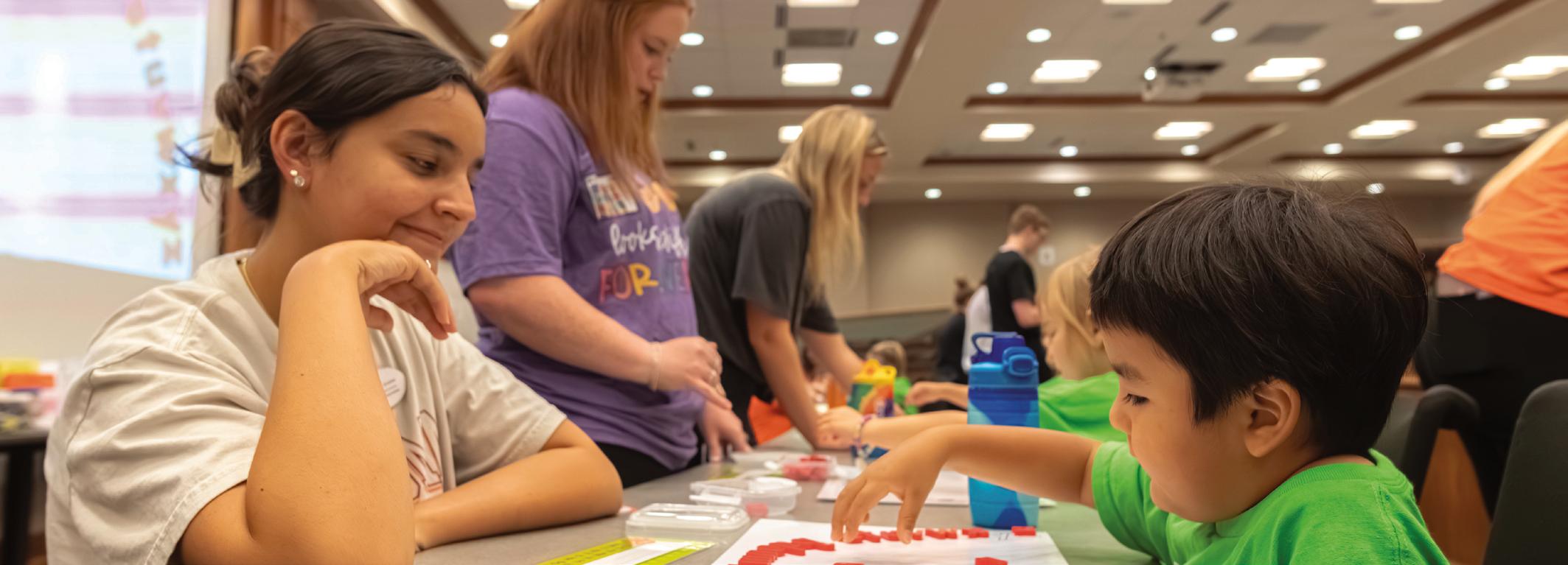
For over 10 years, Oklahoma State University’s Department of Mathematics has hosted High School Math Day, welcoming nearly 200 students annually from schools across the region to Stillwater’s campus.
“Math is an incredibly useful and exciting way to understand the world,” said Dr. Jeff Mermin, associate professor of mathematics and High School Math Day coordinator. “Too often, classroom math feels like memorizing formulas, but step outside that standard curriculum and there’s so much to discover.”
OSU’s Math Day has evolved over the years — from identifying the besttrained mathematician among area high schools to recognizing a broader group of talented math students and showcasing the beauty of engaging with mathematics.
“Even beyond the inherent beauty of geometry, combinatorics and number theory, math offers fresh ways to appreciate sports and the arts, tools for designing systems and objects, and
insight into everyday decision making,” Mermin said.
“I hope students leave thinking, ‘Math is more interesting than I realized. There’s math in places I didn’t expect. There are a lot of other students around Oklahoma who are interested in math. I’d like to learn more about math when I go to college. I’d like to come back to OSU for college.’”
In addition to competing in a 25-question individual contest, Math Day attendees can participate in a lowintensity team round, interact with other talented peers, meet OSU Math Club students and hear from OSU faculty during public talks.
“I think there’s a misconception that mathematics is typically done in isolation, when really math has the possibility to be a very social activity,” said Dr. Jay Schweig, OSU Department of Mathematics head. “Mathematicians and math students give each other ideas and feedback, discuss interesting results and problems and support each other. In general, there’s a real sense of community within the subject at all
levels, and this event demonstrates that well.”
OSU students provide hospitality and support throughout the day, while Department of Mathematics faculty provide competition problems and create presentations that foster continued interest in math well beyond High School Math Day.
“The field of mathematics has such incredible breadth — the math one sees in high school is just a tiny fraction of all the amazing stuff that’s out there,” Schweig said. “High School Math Day is a wonderful opportunity for students to engage with new mathematical material, seeing things they wouldn’t normally encounter in their high school curricula.”
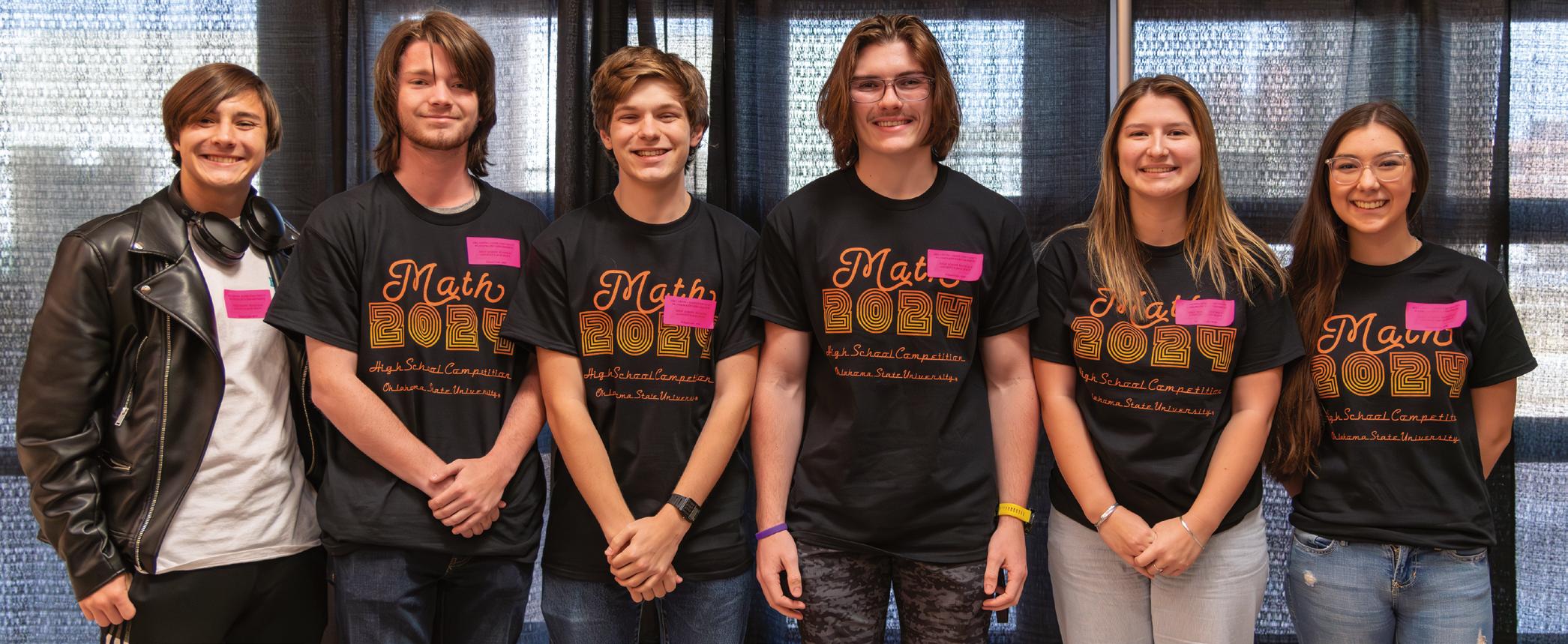
OSU welcomes teens to campus for the annual High School Math Day in 2024.
Scan to hear more about the new biology department.
STORY ELIZABETH GOSNEY | PHOTOS JASON WALLACE
Oklahoma State University is advancing education and research in biological sciences with the merger of the Department of Integrative Biology and the Department of Plant Biology, Ecology and Evolution.
On July 1, the two units officially became a single entity: the OSU Department of Biology.
“This merger reflects our dedication to evolving with the needs of our students and the scientific community,” said Dr. Melinda Cro, dean of the College of Arts and Sciences. “By bringing together these two strong departments, we are enhancing our ability to train future scientists and health care professionals, solve pressing biological challenges and elevate OSU’s impact in the life sciences.”
The unification bolsters OSU’s commitment to interdisciplinary collaboration, providing students with a more comprehensive and streamlined academic experience.
“We have always shared much of our curriculum, and this opportunity further allows our faculty to work closely together to improve course sequencing and content to prepare our students for their future careers,” said Dr. Jason Belden, former Department of Integrative Biology head. “Our merged department will help foster continued research collaboration, especially in areas of joint interest like environmental protection, genetics and evolution.”
While the department’s name has changed, the existing major options are staying the same. These include bachelor’s degrees in biology, physiology, plant biology and zoology, and graduate degrees in integrative biology and plant biology.
“We are maintaining the unique training and opportunities of each of those degrees,” Belden said, who is now the interim head of the new Department of Biology.
Dr. Mark Fishbein, Regents Professor and former Department of Plant Biology, Ecology, and Evolution head, added that the excellence of both departments will be further enhanced by combining resources and expertise.
“We’re looking forward to better coordination of shared responsibilities for courses in our undergraduate programs, including more regular offerings of specialized courses,” Fishbein said. “I’m personally looking forward to bringing plant biology and research involving plants further to the forefront across the life sciences.”
With the Department of Biology merger having been in the works since August 2024, faculty and administrative teams used the spring and summer of 2025 to ensure a final transition in time for fall courses.
“Faculty and staff are excited about coming together to tackle new challenges,” Belden said. “By further developing our undergraduate programs, we’re continuing to provide outstanding
training and collaborative hands-on research opportunities for current and future OSU students.”
Looking ahead, the Department of Biology will be involved with the proposed life sciences facility that received $80 million in state funding in 2024. The building — which also requires $80 million from private donations to be built — will allow the Department of Biology and the College of Arts and Sciences to further improve STEM and pre-health offerings.
“We take seriously our responsibility to give students the foundations they need to become part of a strong workforce,” Cro said. “Along with our dedicated faculty and staff, the new life sciences building is critical to attracting the brightest minds to Oklahoma State and giving them the experience they need to improve their communities and solve society’s problems.”
From left: Drs. Mark Fishbein and Jason Belden
The newly formed Department of Biology provides expanded resources and opportunities for OSU students.
MORE THAN A GUT
FEELING
A recent collaboration between microbiology and molecular genetics professor Dr. Babu Fathepure and biology associate professor Dr. Liz McCullagh aims to characterize gut bacteria in Fragile X Syndrome — the most common single-gene cause of Autism Spectrum Disorder — to better understand how gut microbiome dysbiosis may be linked to changes in the brain.
CAS leading the way in transdisciplinary life sciences research
As the hub of life sciences at Oklahoma State University, the College of Arts and Sciences is committed to research that bridges disciplines and creates breakthroughs for the betterment of societies around the world.
With hundreds of faculty, staff and students across the departments of biology, psychology, and microbiology and molecular genetics, there’s no easy way to fully capture the extent of transdisciplinary life science research within CAS. However, highlighted here are three of the many projects bringing distinction to the college and the university.
“Our goal is to identify specific microbial metabolites that may be indicative of, or contribute to, the underlying causes of the condition,” Fathepure said. “These findings will be further studied by understanding what specific roles the dysregulated bacteria play in gut-brain interactions, and how those changes may be related to FXS and ASD.”
Fathepure and McCullagh explained that interest in the gut-brain axis — or bidirectional communication between the gastrointestinal tract and the central nervous system — has increased in recent years, particularly in relation to neurodevelopmental and neuropsychiatric disorders.
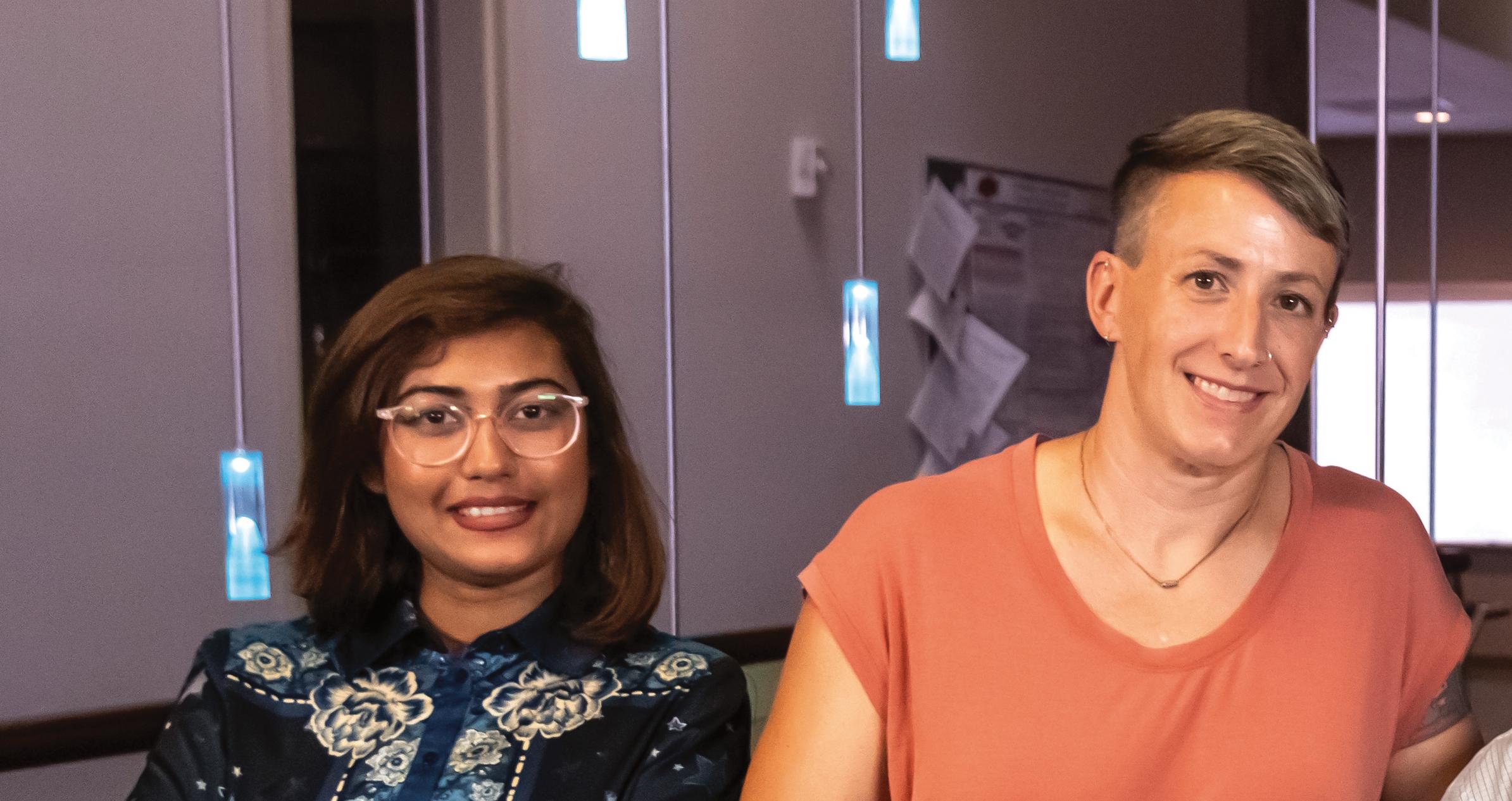
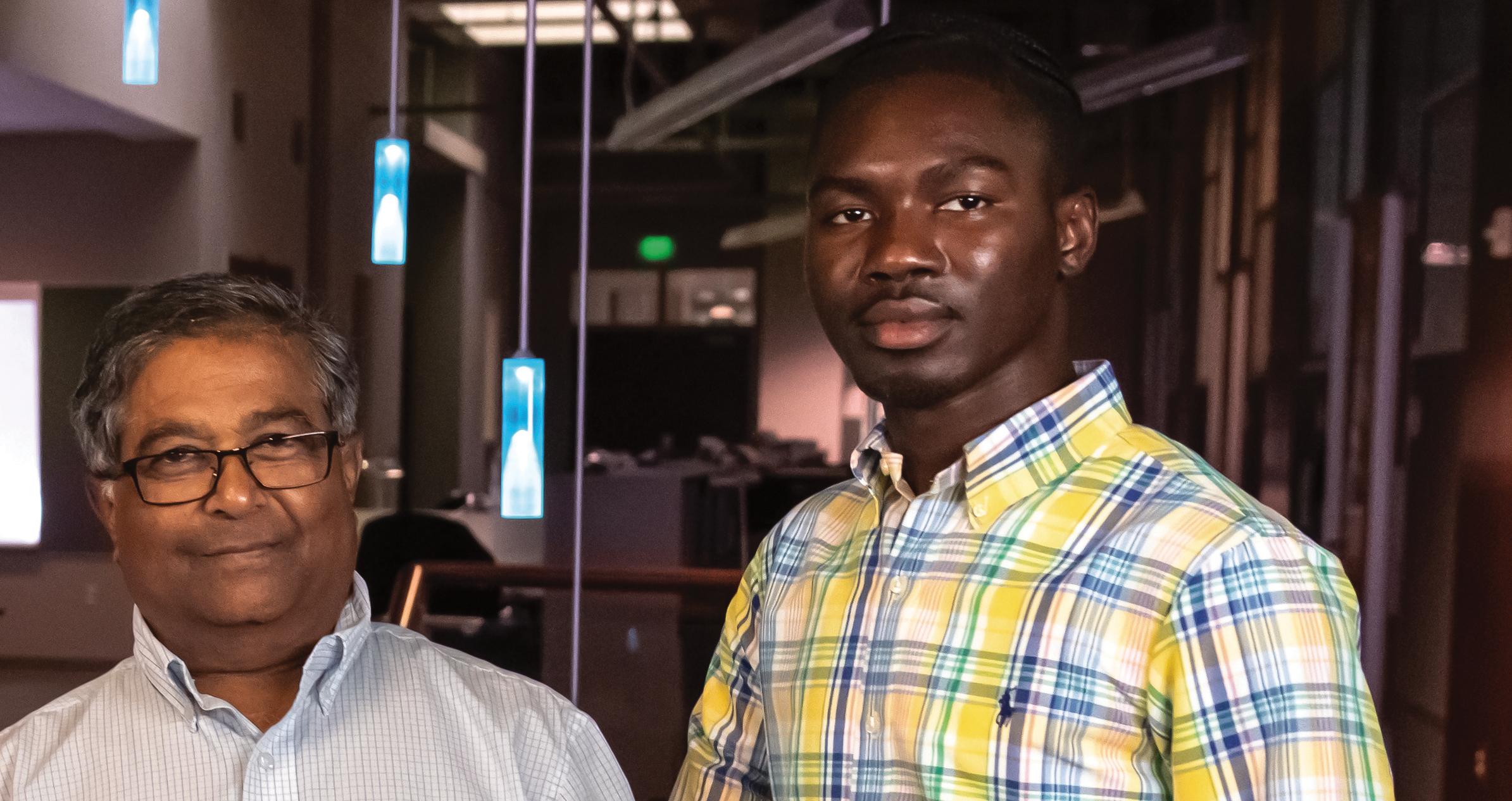
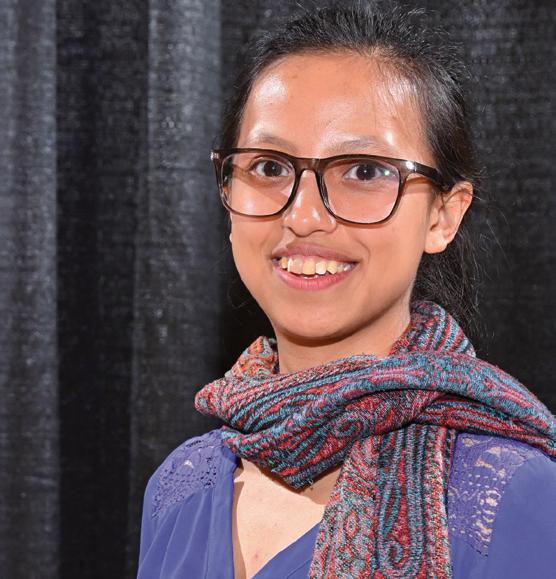
From left: Sabiha Alam, Dr. Liz McCullagh, Dr. Babu Fathepure and Ajagbe Damilare
A key component of the gutbrain axis is the community of microorganisms residing in the GI tract — known as the gut microbiome.
“Although research is still emerging, studies using FXS mouse models have revealed alterations in both the abundance and composition of gut microorganisms in Fragile X Syndrome,” McCullagh said. “Understanding which bacteria may be most important in this link, and what microbial metabolites may be involved, is key to understanding the role microbes play in treating ASD.”
McCullagh’s lab uses FXS mouse models, meaning that the same FXS gene that is impacted in humans has been disrupted in the mice. This allows for a more mechanistic study of the condition in a species with similar genes to humans.
By integrating their respective departments’ expertise in molecular genetics, neurobiology, microbial physiology and ecology, and systems biology, Fathepure and McCullagh can better identify microbial and metabolic signatures associated with FXSrelated symptoms, which could lead to innovative, personalized treatments.
Furthermore, with support from the National Institutes of Health-funded Oklahoma Center for Microbiome Research, McCullagh, Fathepure and OSU graduate student Sabiha Alam have already collected preliminary data suggesting that there are indeed differences in the gut microbial species and abundance in mice with FXS compared to animals that are unaffected, or neurotypical.
“This research holds significant potential for broad societal impact, especially in advancing precision medicine for neurodevelopmental disorders,” Fathepure said. “By uncovering the role of the gut-brain axis in FXS, this work paves the way for novel, low-risk therapeutic strategies — such as probiotics, dietary interventions, or microbiomebased diagnostics — that could improve quality of life for individuals with FXS and related conditions like ASD.”
For students, engaging in this interdisciplinary research offers hands-on experience at the intersection of microbiology, neuroscience and genomics,
preparing them for careers in translational science and biomedical innovation.
“In alignment with the land-grant mission, our research exemplifies public service by addressing real-world health challenges, promoting community wellbeing and fostering accessible, sciencedriven solutions that benefit people in Oklahoma, particularly those in underserved or rural areas,” McCullagh said.
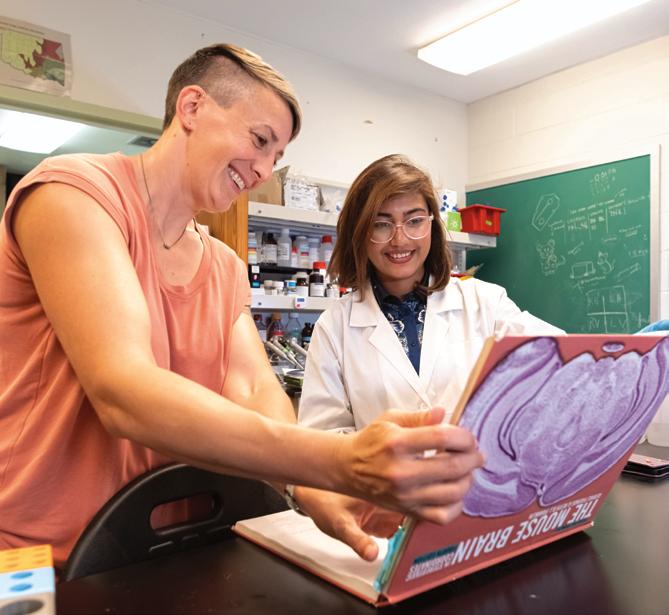
From left: Dr. Liz McCullagh and Sabiha Alam use mouse models in their lab work.
UNEARTHING MICROPLASTIC MYSTERIES
With 23 departments across the arts and humanities, social sciences, math and natural sciences, CAS faculty understand the value of varied perspectives and expertise.
So, when biology’s Dr. Matteo Minghetti was invited to speak at a College of Engineering, Architecture and Technology lecture series by Dr. Jorge Gonzalez Estrella, he gladly accepted.
The two faculty members have since joined forces to research microplastics. The result? A multidisciplinary proposal that uses quantifiable approaches and innovative tools to better understand the role of environmental weathering and gastrointestinal digestion on the bioavailability and toxicity of microplastic and cadmium mixtures.
“Microplastics represent an emerging human health hazard as either a direct environmental contaminant or as a component of other mixed pollutants,” said Gonzalez Estrella, associate professor of civil and environmental engineering and PI on the project. “Once introduced into the environment, microplastics are exposed to degrading conditions, such as ultraviolet radiation, that change their chemical and morphological composition.”
Microplastic UV-degradation is poorly understood in the context of environmental pollutants, Minghetti said. While they know that humans
are mainly exposed to microplastics through contaminated food and water, “the fate of MPs during digestion is largely unknown.”
“The key barrier to advancing our understanding of the health risk of MPs is a lack of information linking MPs’ environmental chemical transformations with bioaccumulation of MPs, and specific health impacts,” Minghetti said. “Investigating the environmental impact of microplastics is critical to elucidating their role as pervasive and persistent contaminants that disrupt ecosystem function, bioaccumulate in aquatic organisms, and pose emerging risks to environmental and human health.”
As Minghetti and Gonzalez Estrella test their hypotheses, undergraduate students are actively involved in the process. In fact, students are why the project received R15 funding — or a Research Enhancement Award — from the National Institutes of Health.
“This project directly supports the NIH-R15 mission by engaging undergraduate students in hands-on research, equipping them with critical skills in environmental toxicology and preparing them to become the next generation of scientists,” Minghetti said. “Through their work, students will contribute to a deeper understanding of microplastics’ environmental impact, particularly their bioavailability and physiological effects in aquatic organisms.
“The societal benefit of this research lies in generating data that can inform science-based policies aimed at mitigating microplastic emissions and protecting both environmental and human health.”
Dr. Matteo Minghetti
Dr. Jorge Gonzalez Estrella
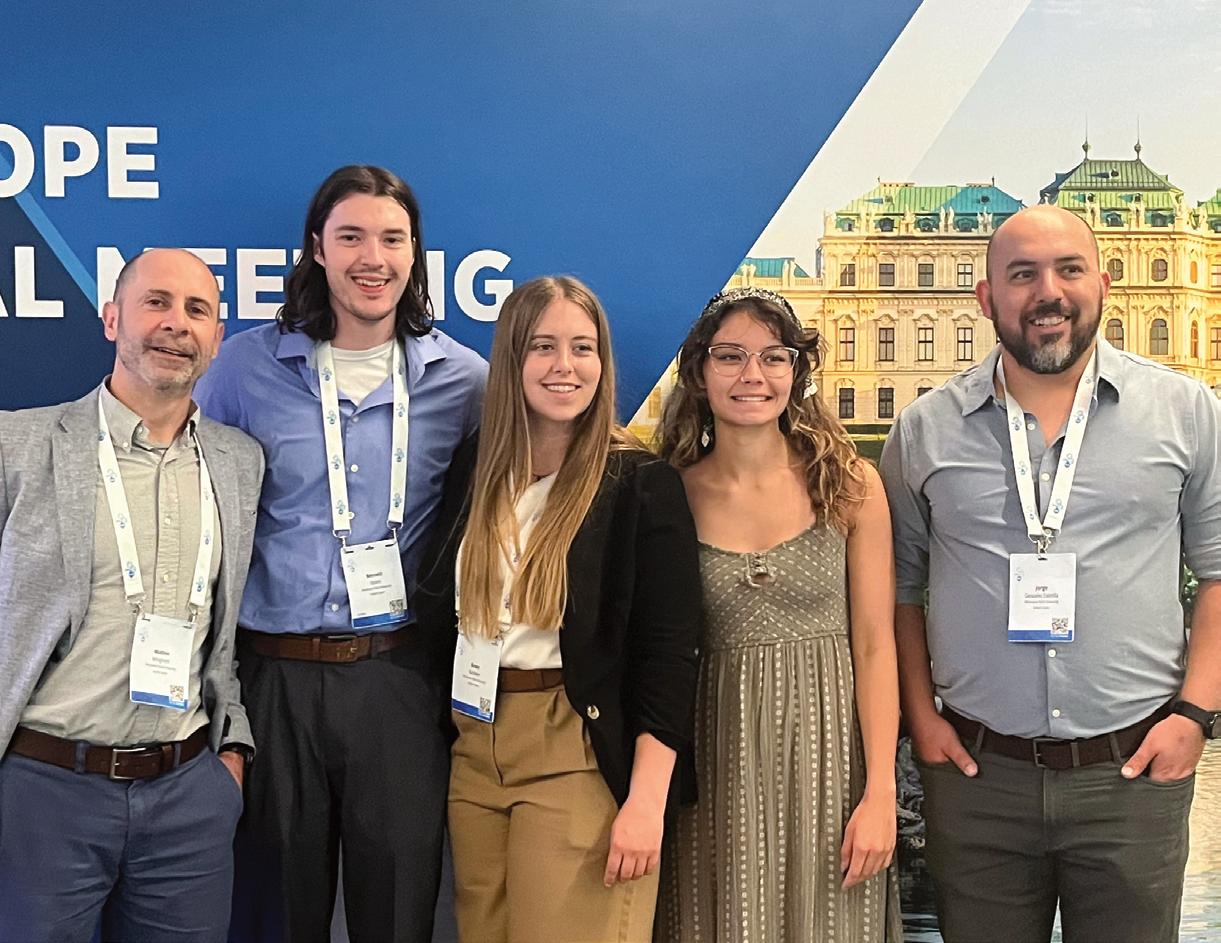
From left: Dr. Matteo Minghetti, Ben Upton, Grace Baldwin, Aryanna Carr and Dr. Jorge Gonzalez Estrella attend Society of Environmental Toxicology and Chemistry (SETAC) Europe in Vienna in May 2025. Right: Microbiology Ph.D. student Ajagbe Damilare.
MEDICINE OF THE MIND
On Riverside Drive in the heart of Tulsa, OSU’s Hardesty Center for Clinical Research and Neuroscience is bringing together experts in medicine and life sciences and providing them with the space and equipment to mitigate the impacts of addictive
on Childhood Adversity, which was established in 2016 as the first national interdisciplinary research center designed to integrate biological and behavioral approaches to the study of adversity and resilience. She is also a co-leader of the Healthy Brain Child Development study, which involves
CAS STUDENT SPOTLIGHTS
Students within the College of Arts and Sciences are continually breaking new ground as they pursue research under the mentorship of renowned Oklahoma State University faculty members.
Here, we highlight the work of just a handful of our undergraduate and graduate students on their way to changing the world.
KYLIE HAMMACK
MAJORS: POLITICAL SCIENCE AND ECONOMICS
CLASS OF 2025
MENTOR: DR. HOLLEY HANSEN
HOMETOWN: BROKEN ARROW, OK
HOW DID YOU GET STARTED IN RESEARCH?
I competed in a high school debate and had some experience working with scholarly level research for my debate cases, but OSU’s Freshman Research Scholar Program was the first time I was an active research participant. After looking at the professor profiles, I met with Dr. Holley Hansen, who would become my research mentor.
WHAT HAVE YOU BEEN WORKING ON?
During 2024-25, I looked into the impact of local-level corruption on foreign aid effectiveness in Sub-Saharan Africa. Specifically, I looked at survey results for questions regarding individual experiences and perceptions of corruption. Using this method, I was able to create a local-level measure of corruption for the countries of Uganda, Tanzania, Nigeria and Kenya. I used this measure of corruption to investigate whether more corrupt local areas receiving more foreign aid experienced less development.
HOW HAS RESEARCH IMPACTED YOU?
Working with large datasets and quantitative analysis tools has equipped me with an informed and analytical perspective. Moreover, researching important global phenomena has given me the methodological ability to address complex problems with nuance. While at OSU, I was a finalist for the Truman and Marshall scholarships, which I do not think would have been possible without my involvement in undergraduate research
WHAT ARE YOUR FUTURE PLANS?
This fall, I’m moving to the U.K. to pursue an MPhil in politics and international studies at Cambridge University. I am excited to continue research via my dissertation, and I know the skills I gained as an undergraduate researcher will be incredibly valuable in this next stage of my academic career.
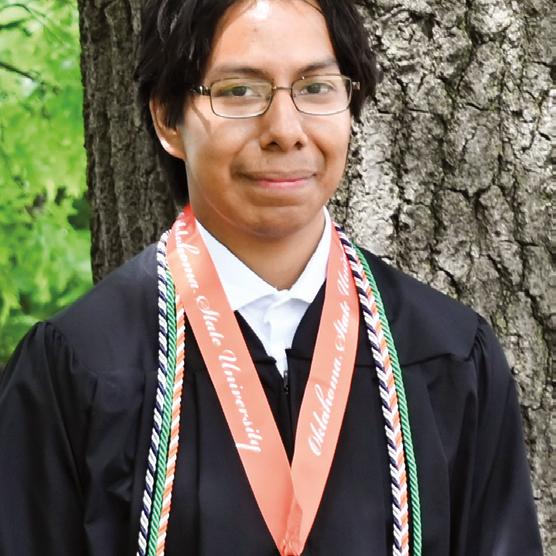
IRVING MIGUEL
MAJOR: MICROBIOLOGY AND MOLECULAR GENETICS
CLASS OF 2025
MENTOR: DR. MARIANNA PATRAUCHAN
HOMETOWN: TULSA, OK
HOW DID YOU GET STARTED IN RESEARCH?
Being involved in research and contributing toward discovering new knowledge was a very interesting prospect for me. Eventually, I became aware of incredible opportunities being offered to conduct research through the Beckman Scholars Program and the McNair Scholars Program. I decided to take the chance and apply.
WHAT HAVE YOU BEEN WORKING ON?
My research has been focused on the responses of the calcium signaling network in Pseudomonas aeruginosa during host-cell interactions. Specifically, the role of key components of the calcium regulatory and signaling network during invasion of epithelial cells and in survival after uptake by macrophages. I have also had the opportunity to be a research leader in CAS, which involves promoting research to other undergraduates.
HOW HAS RESEARCH IMPACTED YOU?
The Beckman Scholars Program, the McNair Scholars Program and conducting research under the guidance of my mentor have contributed toward some of the major decisions I’ve made for my future. Being part of a research project has provided me with the technical skills to succeed in a laboratory setting and allowed me to narrow down the topics I’m most interested in studying, thereby making it easier to plan my future.
WHAT ARE YOUR FUTURE PLANS?
I graduated in May and continued to conduct research in Dr. Patrauchan’s lab over the summer. I’ll now present my research at the Beckman Symposium in Irvine, California. Ultimately, I intend to obtain a medical degree and practice medicine as a physician.
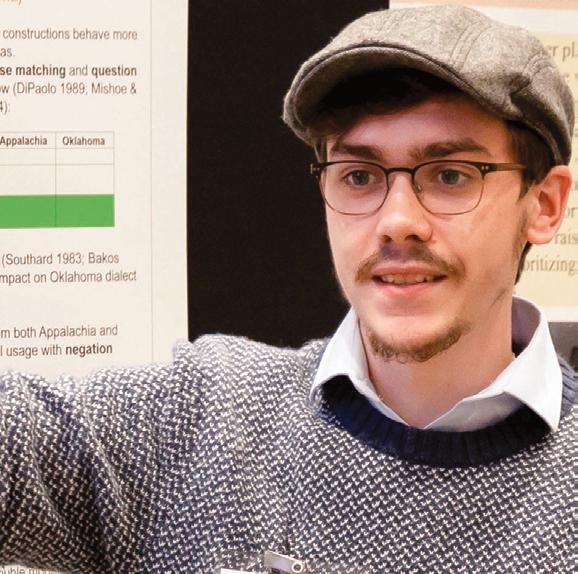
BRAYTON
WHITELEY
MAJORS: PHILOSOPHY AND PSYCHOLOGY
CLASS OF 2026
MENTORS: DR. SHANNON SPAULDING, DR. JAMES GRICE, DR. SARA LOSS
HOMETOWN: EARLY, TX
HOW DID YOU GET STARTED IN RESEARCH?
I was super interested in Department of Philosophy head Dr. Spaulding’s research on empathy, and I sent her an email to get more information. She apparently was really interested in getting undergraduates into her lab. I started working with her, and eventually, I got much more comfortable engaging in research, reading research articles and accomplishing my research goals. I began to explore other fields, too, including linguistics and psychology.
WHAT HAVE YOU BEEN WORKING ON?
I’ve been working in a personality lab for two semesters, where we are researching cognitive dissonance and narcissism. We’re in the literature research portion and I’ve been enjoying developing my skills in literature summaries. I’m also working on a research publication and thesis in philosophy. I’ll be analyzing free will and causality, intending to reexamine the problem in other fields of research.
HOW HAS RESEARCH IMPACTED YOU?
My career goal is to eventually be a professional researcher in philosophy and psychology. Research with faculty has given me many opportunities to engage with my fields and has made me much more comfortable with academics in general.
WHAT ARE YOUR FUTURE PLANS?
I hope to be a professor and researcher in psychology and philosophy. I’ve always wanted to teach, and getting the opportunity and excuse to learn even more in these subjects makes me excited to get out there. Outside of research, I also love fiction writing, and I hope to be published in my creative endeavors as well.
LAUREN
HAYGOOD
PH.D.: GEOLOGY
FOURTH YEAR
MENTOR: DR. TODD HALIHAN
HOMETOWN: OWASSO, OK
HOW DID YOU GET STARTED IN RESEARCH?
As an undergraduate I spent my summers involved in the Tulsa Undergraduate Research Challenge. My master’s thesis involved a biogeochemical analysis of the Kiamichi River Basin in southeast Oklahoma. My dissertation research focuses on applying geochemistry techniques to investigate deep-water ventilation changes using marine sediments. I also learned that it was OK to move around research areas; the skillsets I built from projects are applicable to multiple fields.
WHAT HAVE YOU BEEN WORKING ON?
In 2024, I was part of the science party of the International Ocean Discovery Program Expedition 403, which recovered sediment cores from the Fram Strait situated between Greenland and Svalbard. The material recovered will help us learn more about deep-water variability, and how Arctic glaciations, ice shelf development and distribution of sea ice were impacted by the inflow of warm waters from the Atlantic Ocean.
WHAT ARE THE IMPACTS OF YOUR RESEARCH?
Studying changes in deep-water ventilation is important for understanding the dynamics of global thermohaline circulation, and its effect on climate and global processes. Drilling vessels can recover deep-sea sediment cores, where we can apply geochemistry proxies to investigate changes in deep-water ventilation throughout geologic time, which helps us to infer climate changes in the past. Results of these investigations are important for predicting and managing the impacts of climate change on marine systems.
WHAT ARE YOUR FUTURE PLANS?
I plan on applying for postdoctoral fellowships and faculty positions, as ultimately, I would like to continue research in high-latitude marine environments. I also hope to lead an ocean research expedition later in my career.
M. NY AINA RAKOTOARIVONY
PH.D.: GEOGRAPHY
FOURTH YEAR
MENTOR: DR. HAMED GHOLIZADEH
HOMETOWN: ANTANANARIVO, MADAGASCAR
HOW DID YOU GET STARTED IN RESEARCH?
My father, who holds a master’s degree in life and earth sciences, was key in sparking my research interest early on. His support and dedication have inspired and motivated me to pursue graduate studies and engage in research. After obtaining master’s degrees in agronomy engineering in Madagascar and environmental engineering in Hungary, I started my Ph.D. in geography at OSU in 2021.
WHAT HAVE YOU BEEN WORKING ON?
In my research with Dr. Gholizadeh, I use imaging spectroscopy — also known as hyperspectral remote sensing — which can collect data in hundreds of spectral bands. In comparison, regular RGB cameras on your cellphone collect data in just three spectral bands. The hyperspectral data we collect from satellites, aircraft and drones allow us to map invasive plants in grassland ecosystems and assess their ecological impacts on plant and soil characteristics. I have recently started focusing on acquiring drone-based hyperspectral data using our lab’s Advanced Low-altitude Earth Observing System drone, which is funded by the Future Investigators in NASA Earth and Space Science and Technology program.
WHAT ARE THE IMPACTS OF YOUR RESEARCH?
As I conducted my research, I became increasingly aware of the significant threats posed by invasive species to grassland ecosystems and their biodiversity. I recently published two manuscripts highlighting our findings.
WHAT ARE YOUR FUTURE PLANS?
After graduation, I plan to stay in academia and contribute to the use of remote sensing in addressing ecological questions, such as biological invasions, by expanding my research across various scales and ecosystems.
ANIRUDHA BISWAS
M.S.: MASS COMMUNICATIONS
FIRST YEAR
MENTOR: DR. SKYE COOLEY
HOMETOWN: BARISHAL, BANGLADESH
HOW DID YOU GET STARTED IN RESEARCH?
During the sixth semester of my undergraduate studies, I began my research journey when one of my professors in Bangladesh invited me to join her team for a project examining the representation of juvenile crime gangs in newspapers. This experience introduced me to the excitement of seeking new understandings of things.
WHAT HAVE YOU BEEN WORKING ON?
My current research project investigates the relationship between heart rate variability and emotional resilience. I am also exploring whether mindfulness training or breathing techniques can help individuals regulate their emotions while exposed to emotionally charged media content. The project has an experimental design that includes both surveys and intensive interviews.
HOW HAS RESEARCH IMPACTED YOU?
Currently, I am engaged in research at the intersection of health communication and technology, with a focus on cancer communication, psychological and mental wellbeing, and heart-rate variability, using both experimental design and content analysis. This work continually deepens my understanding of how individuals manage emotions, how media shapes public health narratives, and how organizations promote health-related behaviors. These insights have profoundly shifted my perspective on the world.
WHAT ARE YOUR FUTURE PLANS?
I look forward to pursuing a Ph.D. program after completing my master’s degree at OSU. My long-term goal is to join a university as a faculty member, where I can contribute meaningfully to teaching and research in communication.
Media Milestone
School of Media and Strategic Communications alumnus commits largest gift in program history
Keith Garton had the perfect cover story.
In fourth grade, Garton’s best friend moved away from his hometown of Duncan, Oklahoma. Using paper, colored matte pencils and a typewriter from his dad’s work, he created his own newsletter featuring updates about his life. Garton then sent an issue to his friend every two weeks to stay in touch.
The first headline was clear — “Keith Gives Up Swimming for Tennis.” He always hated swimming.
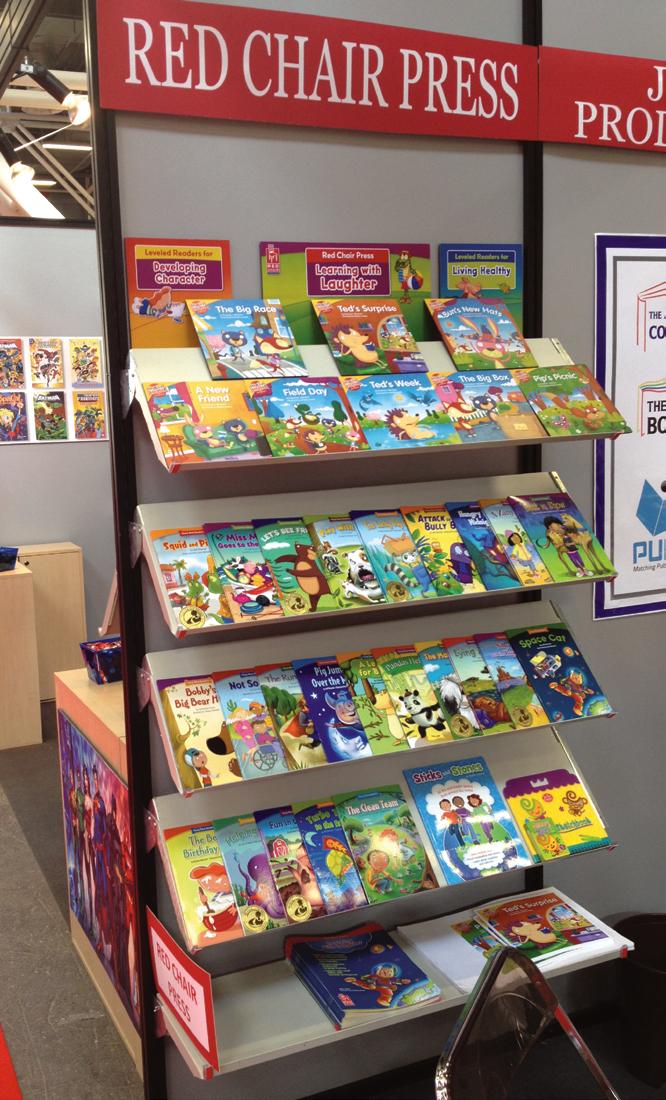
That early foray into journalism sparked a successful career in the media, working for some of the biggest publishers in the country, such as Scholastic, McGraw-Hill and TIME. In 2009, Garton founded Red Chair Press, a children’s book publishing company dedicated to engaging young readers in stories that provide models for strong character and good behavior.
“Books are absolutely critical,” Garton said. “There’s tons of evidence that shows that children who are read to from an early age do much, much better
Scan the code to learn more about OSU’s School of Media and Strategic Communications.
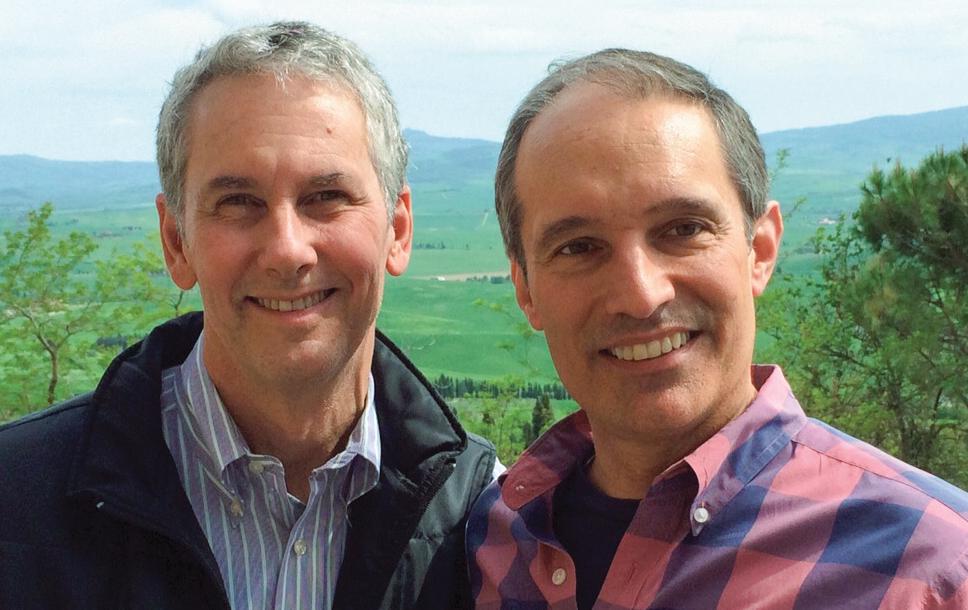
From left: CAS graduate Keith Garton and his partner, David Sheehan.
“Keith and David’s generosity ensures that our students will not only learn the craft of communication, but also use it to elevate voices, build community and shape a better world.”
DR. MELINDA CRO, DEAN OF THE COLLEGE OF ARTS AND SCIENCES
Garton established Red Chair Press in 2009. by the time they start school. Red Chair Press was created on the idea of parents pulling up a chair and telling their child a good story.”
Creating custom newsletters and reporting for his high school paper is where Garton gained an interest in publications. But it was his time at Oklahoma State University, where he earned degrees in journalism and mass communication, that prepared him for professional success.
To give back to the university he loves deeply, Garton and his partner, David Sheehan, have committed the
largest single gift ever directed to the OSU School of Media and Strategic Communications.
The gift will establish the Garton Family Endowed Chair for Media and Strategic Communications, as well as endowed funds for rural journalism and student organizations.
“We are immensely grateful to Keith and David for this transformative gift to SMSC, which plays a crucial role in shaping the future of media by educating the next generation of journalists and communicators,” OSU President Jim Hess said. “This generous support will significantly enhance our ability to provide students with unparalleled resources and opportunities, empowering us to continue producing top-tier professionals who will impact the industry.”
While considering the gift, Garton spent time learning about the current needs and challenges of SMSC so he could make a difference in meaningful ways.
“This extraordinary gift is more than an investment in SMSC it’s a commitment to the future of ethical, impactful storytelling,” said Dr. Melinda Cro, College of Arts and Sciences dean. “Keith and David’s generosity ensures that our students will not only learn the craft of communication, but also use it to elevate voices, build community and shape a better world.”
In today’s modern media climate, it is as important as ever that the state, nation and world are supplied with
capable media members. Along with multimedia and communications skills, SMSC strongly emphasizes ethics and media literacy, so graduates are equipped to serve effectively and ethically.
These skills propelled Garton throughout his professional journey. While his experiences typically focused on sharing positive narratives with young readers, sometimes difficult stories needed to be told.
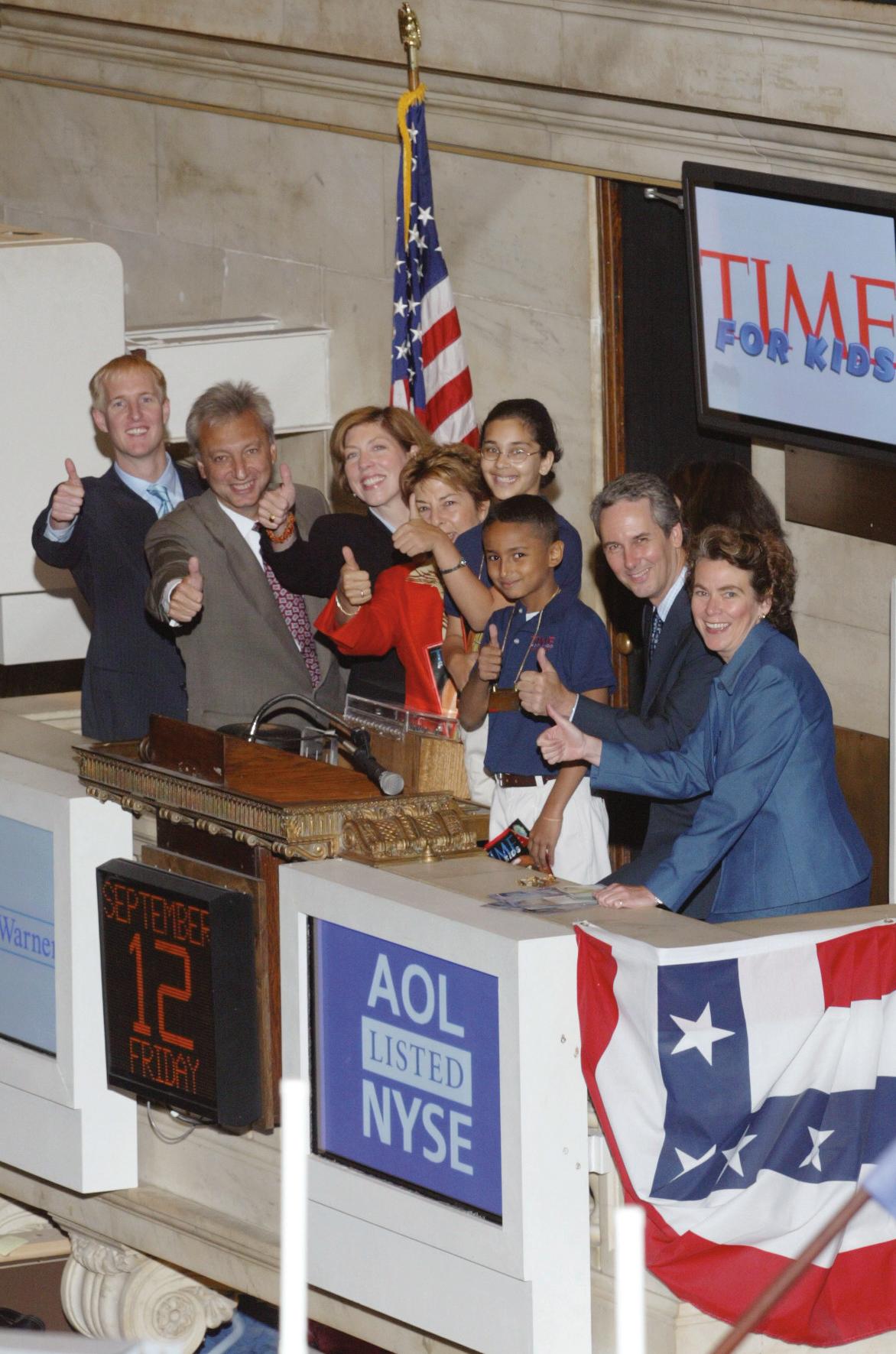
On Sept. 11, 2001, Garton was living in New York City, working at TIME for Kids. As president of the division, he had the responsibility of helping to determine how the magazine should explain the terrorist attacks to young children.
In the aftermath of one of the most horrifying days in U.S. history, he leaned on skills he learned at OSU to make the right decisions for the magazine. The cover featured firefighters planting a flag in the rubble as a symbol of hope.
“Even though at SMSC we didn’t focus specifically on how to write for children, SMSC did teach me the ability to write for different audiences and how to make ethical decisions,” Garton said. “That automatically applied when we had to figure out how to explain things to children while still using all the elements of good writing, journalism and ethics.”
Journalism plays a role in communities of all sizes, from New York City to Garton’s own Stephens County, Oklahoma.
Garton, second from right, helps ring the opening bell at the New York Stock Exchange during his tenure at TIME for Kids.
With an extended family of ranchers, Garton spent a lot of time in small farming towns from a young age. That continued in his first job after college, working for the Oklahoma ARC, where he traveled across the state interacting with families of people with intellectual and developmental disabilities.
It was important to him that a significant portion of his gift supported rural journalism at OSU to ensure these underrepresented populations are still
prevalent in news coverage so their voices can be heard. The Garton Family Funds will help students get out into these rural communities and share their stories.
“As college education evolves, experiential learning and community outreach are more important than ever, but such efforts can be resource intensive,” said Dr. Jared Johnson, SMSC director. “This gift will provide needed resources to perpetually support
our efforts to bring stories to rural areas and benefit those communities for years to come. SMSC is proud to have caring alumni like Keith Garton.”
When Garton was in high school, he and his father took a trip out west to look at colleges in Oregon, Wyoming and Colorado. The whole time, he just wanted to be back home. OSU was always where he was going to go.
Fifty years later, he wouldn’t change a thing.
“OSU opened my eyes to a lot of things I would never have known had I stayed in southern Oklahoma where I grew up or if I had left Oklahoma for school,” Garton said. “It’s a great place to learn who you are and make connections with people that will change your life forever.
“OSU was just the most comfortable place in the world to me. And it was important to give back in some way.”
A look into Theatre’s thriving costume lab
I TRY TO MEET STUDENTS WHERE THEY ARE, WHETHER THEY'RE THREADING A NEEDLE FOR THE FIRST TIME OR BUILDING A FULL GARMENT FROM SCRATCH. I HELP THEM CONNECT THE TECHNICAL SKILLS TO THE BROADER PURPOSE OF STORYTELLING THROUGH COSTUMING. ”
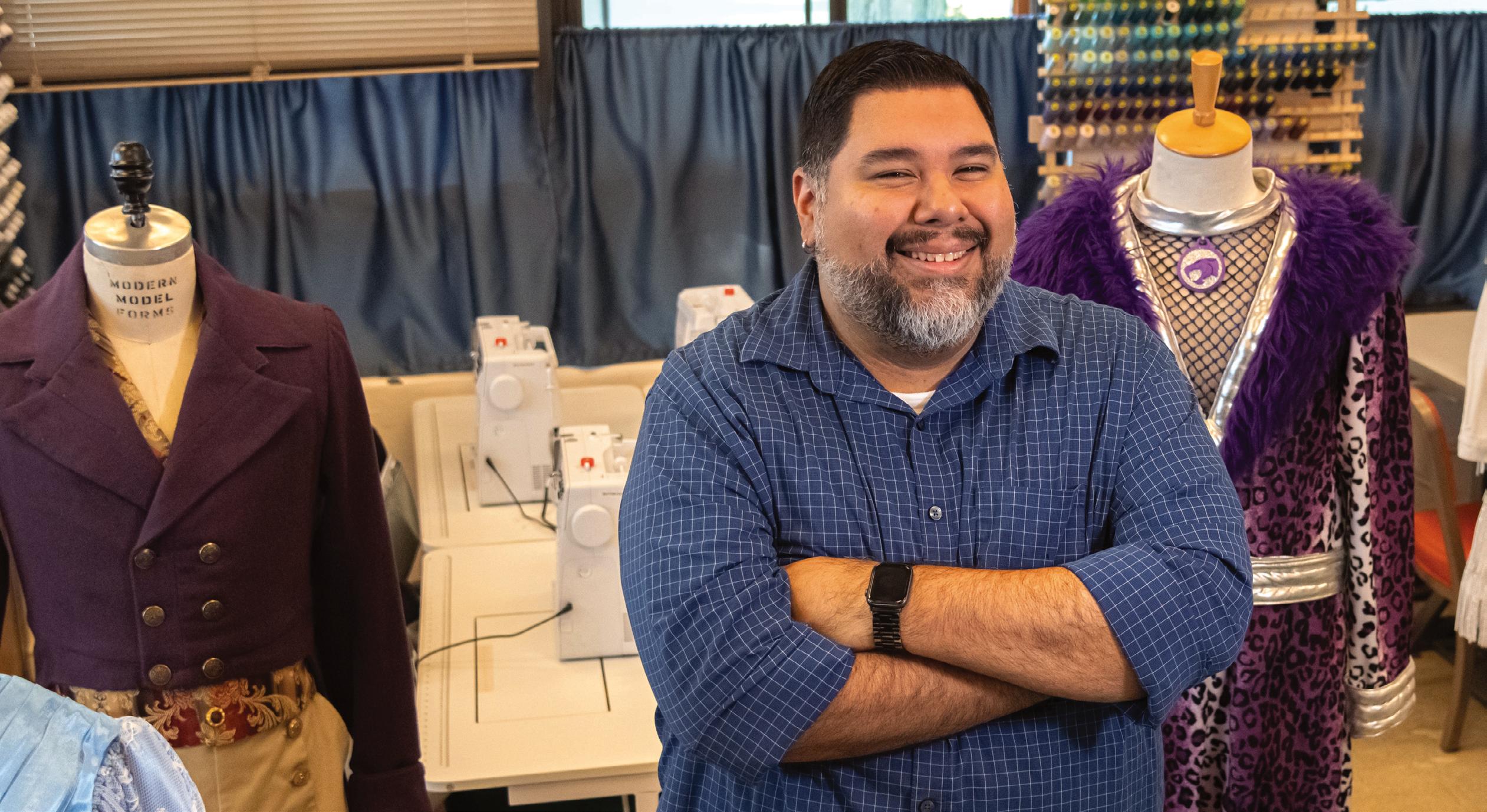
Estala, assistant professor of costume design
science, technology, engineering and mathematics disciplines are typically top of mind.
But those are far from allencompassing. Tucked away on the second floor of the historic Gundersen Building is the Department of Theatre’s Costume Lab.
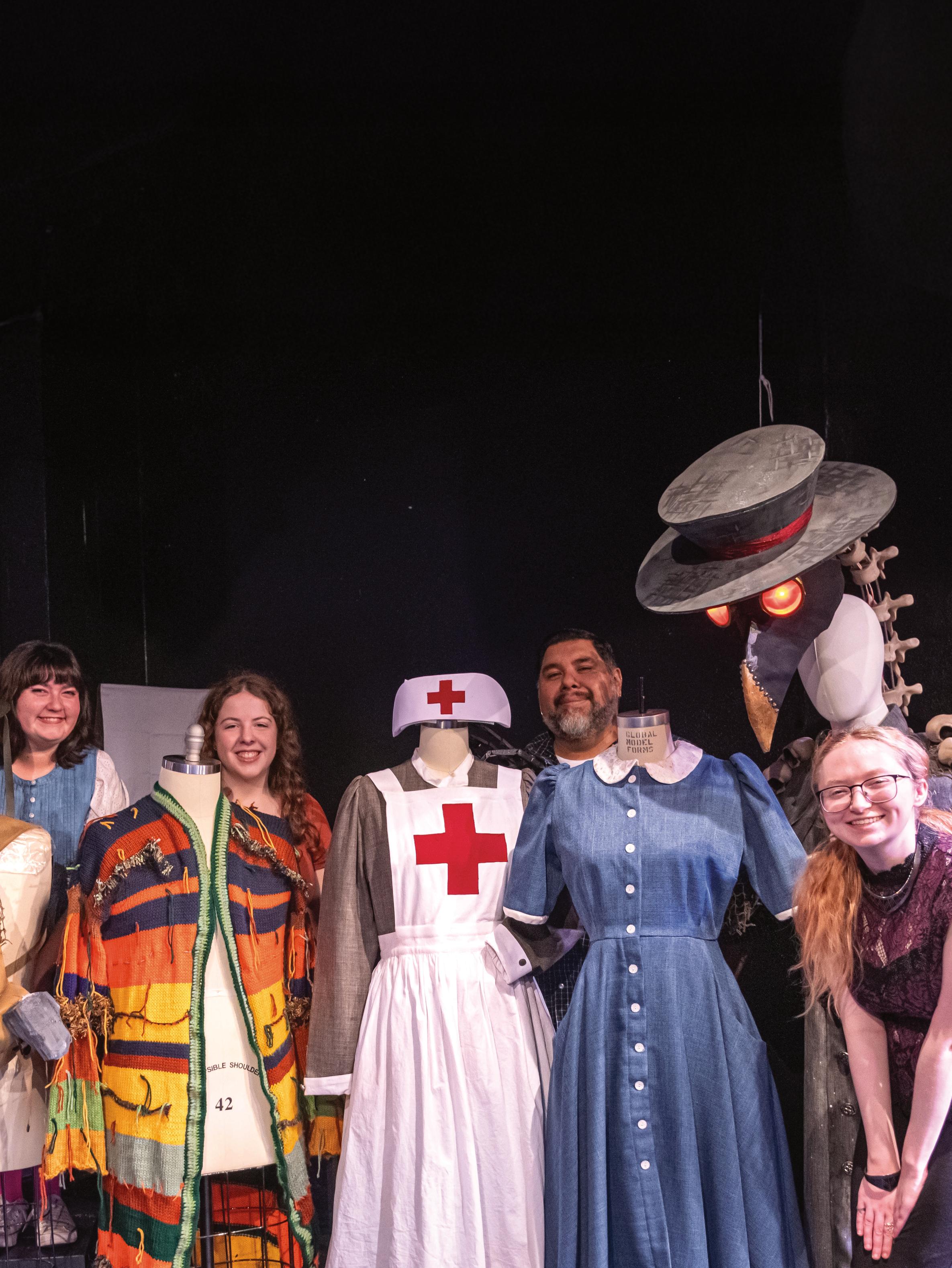
A bustling workshop of fabric, thread, sewing notions and concept sketches, the costume lab is redefining career preparation for theatre students by combining structured coursework, technical training and real-world production experience. Whether students are stitching garments or managing backstage quick changes, every task contributes to the success of theatre’s productions.
“My approach to mentoring is rooted in hands-on skill-building and learning by doing,” said Jason Estala, assistant professor of costume design. “I try to meet students where they are, whether they're threading a needle for the first time or building a full garment from scratch. I help them connect the
technical skills to the broader purpose of storytelling through costuming.”
This mentorship doesn't stop at the basics. Students are encouraged to collaborate, ask questions, problem solve and take risks.
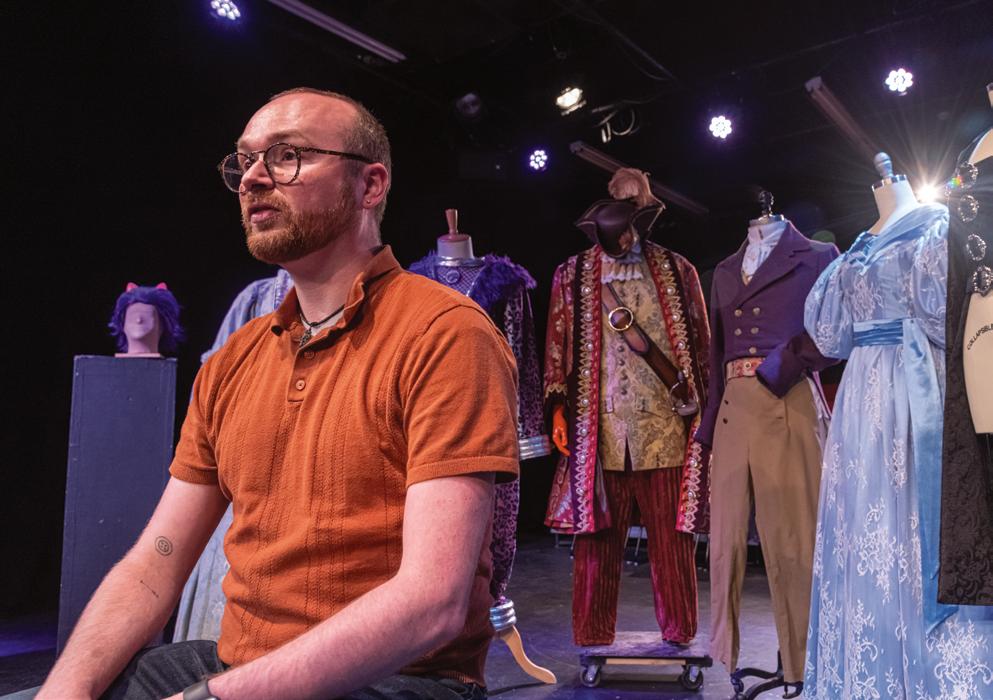
“My No. 1 goal in the costume lab is to encourage students to engage in critical thinking whenever possible,” said David J. Baxter, visiting assistant professor of costume production.
“Another cornerstone of my mentorship method is explaining and understanding the why, not just the how. Understanding why we construct a dress in a certain order … allows the students to engage in lateral thinking when working on other projects.”
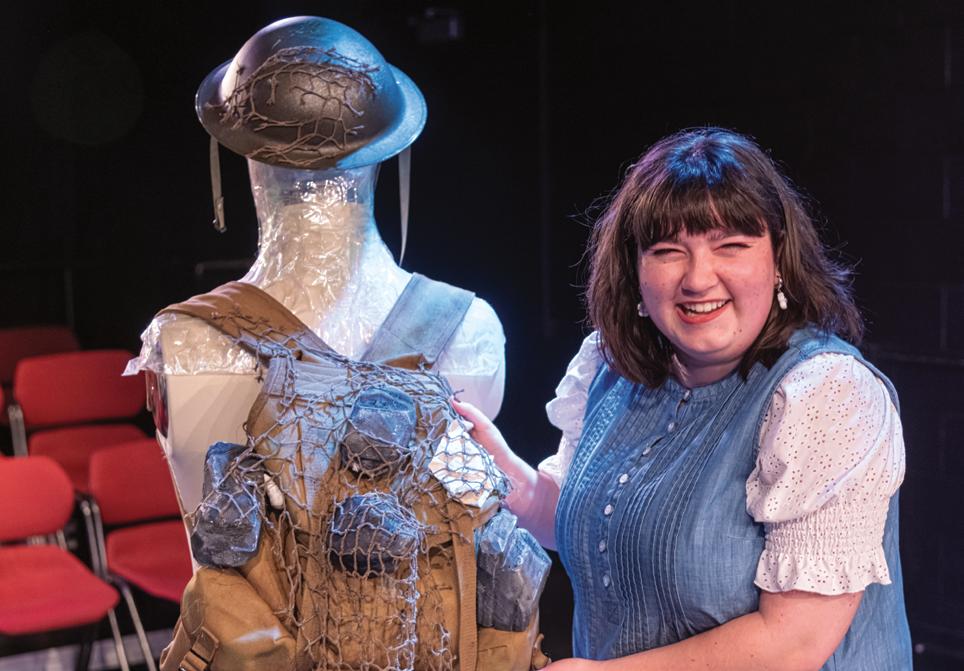
OSU Theatre’s spring 2025 musical “Alice by Heart” challenged students to stretch their skills across costume design and fabrication, truly utilizing what they’d learned from their professors.
“‘Alice by Heart’ was a defining moment for the costume lab this year,” Estala said. “The scale of the production was ambitious, with a blend of period-silhouettes, fantasy elements and t ransformative costume pieces that
reflected the show’s setting in WWII London and the world of Wonderland.”
Since joining the theatre department in 2020, Estala has led the design and creation of costumes that span from Civil War dresses and Shakespearian attire to clown wigs and even a purple leopard jumpsuit. All along the way, he and his fellow professors have given students the spotlight.
“I always say [to the students], ‘I have my degrees. It’s your turn! It’s about getting your degrees,’” Estala said. “The shows are being built by them. ... That’s where they’re learning how the pieces work together — it’s a collaborative art.”
The students, in turn, are quick to give Department of Theatre faculty and staff their flowers.
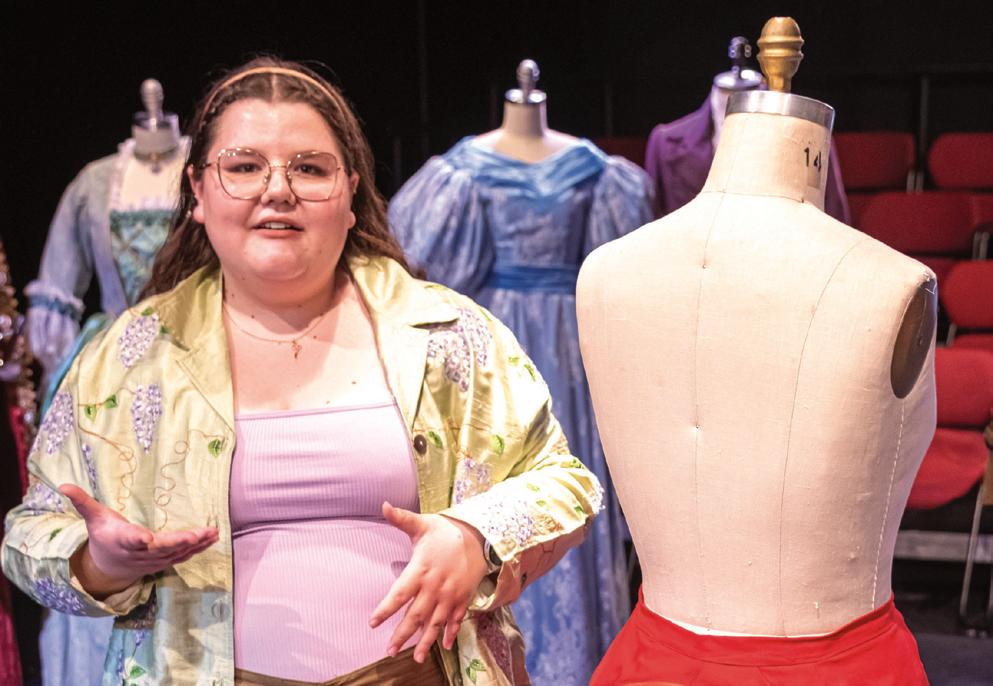
“Working with Jason and David both over the last three years has really cemented my love of costuming,” theatre senior Livvy Higbee said. “They are both so patient and so full of knowledge of costuming. It’s been so fun, and I’ve learned so much.”
In addition to sewing skills and critical thinking, students are taught
Jason
Scan for exclusive behind-the-scenes costume lab content
professional readiness by creating individual sample books. Serving as both customized textbooks and visual portfolios, sample books ensure students graduate with tangible examples they can showcase along with their technical skills.
“My goal is to continue working in costuming after college, so the lab has helped me prepare to work in my desired field,” Higbee said. “I have had the amazing opportunity to work on so many different projects and learn so many neat skills — such as corsetry — to help me grow as a burgeoning professional.
“The work I’ve done in the costume lab has helped me create a robust portfolio to continue on into the professional world.”
Through the professors’ and students’ dedication to the arts, the costume lab promises to continue nurturing generations of confident, creative graduates whose talents will be seen on stages and screens the world over.
Kenzie Gillin, sophomore, shows off one of her designs.
David J. Baxter serves as visiting assistant professor of costume production.
Theatre senior Livvy Higbee explains elements of a costume.
Classroom Champs
CAS professors bring GenEd teaching to new levels of excellence
As the largest source of general education courses at Oklahoma State University, the College of Arts and Sciences welcomes students from all colleges and disciplines into its classrooms.
For CAS instructors, this presents a unique opportunity to engage majors and non-majors alike while equipping them with skills that carry into future classes and careers.
These efforts are regularly recognized, from positive student feedback to university and nationallevel awards. Drs. Haridas Heitz, Ashley Burkett and Reanae McNeal are three of the many CAS professors who engage students in notable ways, helping shape successive cohorts of OSU Ideal Graduates
Each offered their perspective to CONNECT magazine on not just how they teach, but why.
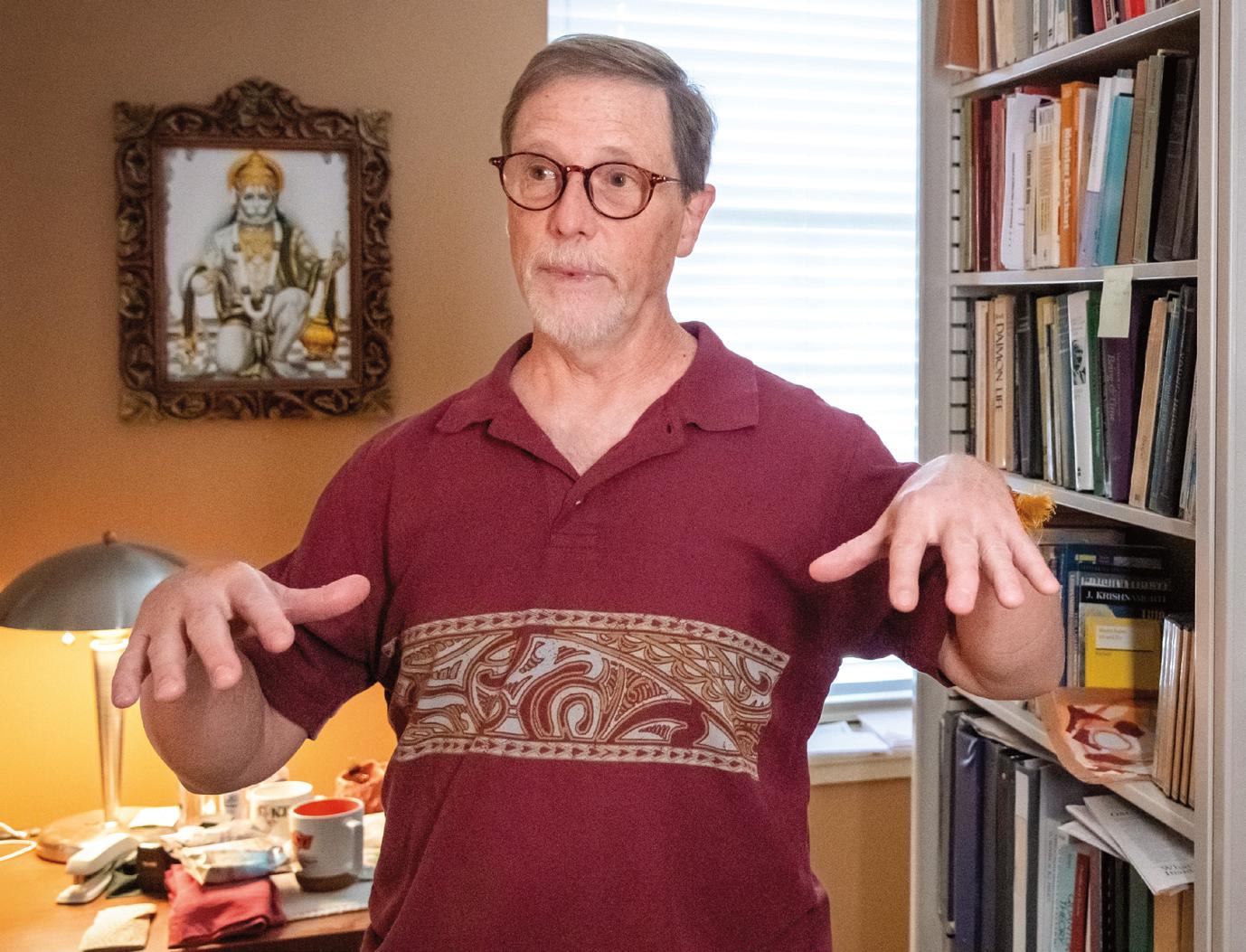
HARIDAS HEITZ — PHILOSOPHY
Recipient of the 2024 CAS Award for Excellence in General Education Teaching, Dr. Haridas Heitz traces his teaching methods back to a formative moment at age 12 — an experience that sparked a passion for living beyond mere existence.
“I remember I was bored in shop class,” Heitz said. “As I watched the sunlight shining through the sawdust in the air, I was struck by the realization that I am! That everything is but might not have been. It was an intense feeling of the wonder of Being. That feeling lingered for several weeks and set me on a path of spiritual exploration.”
Heitz explained that that experience bolstered his natural curiosity and love for science, especially astronomy, leading him toward experiential wisdom and the
world of philosophy. It was also the catalyst for his soon-to-be-published book, “Heart of Wonder”, and directly informs how he works with students.
“My style of teaching is about guiding students toward a sense of wonder,” Heitz said. “Using a Socratic approach, I aim to ‘sting’ and ‘poke’ students into questioning what they know — or think they know — in order to spark deeper investigation.”
In his course “Who Do You Think You Are?” Heitz uses various teaching techniques, including the “Game of Life.” The purpose is to encourage students to find contentment in the present moment instead of only focusing on future goals.
“I want my students to be curious about their own lives, to be more of an explorer of what life is about, by being present here and being aware,” he said.
For Heitz, an OSU Ideal Graduate isn’t just someone equipped to make a living, but one who possesses the wisdom to live well. It’s about finding joy in the present rather than being consumed by worry about the future.
“What keeps me motivated is my own sense of wonder and the opportunity to share that with students,” Heitz said. “They teach me too; I discover more through them and by helping them discover themselves.”
ASHLEY BURKETT — GEOLOGY
Dr. Ashley Burkett, whose course on dinosaurs has an outstanding reputation across campus, centers her teaching on making science accessible by connecting it to students’ lives.
“A lot of students make it up in their minds that they’re not good at math or biology because of the tower of knowledge they feel they can’t access,” said Burkett, winner of the CAS Award for Excellence in General Education Teaching in 2021. “What I
Dr. Haridas Heitz explains some of the philosophies behind his teaching method.
try to do is break it down to the basics and show them they can access it simply by making observations before accumulating knowledge.”
In her introductory geology courses, Burkett tailors lessons for students with little prior knowledge or interest.
“I ask open-ended questions based on the content I deliver,” Burkett said. “It’s something I’ve had to grow into — leaving space for students’ creativity. They always exceed my expectations in how they explore the material on their own. I try to equip them with the tools and confidence to dive in and make their own interpretations. And they do.”
Burkett believes empowering students to take ownership of their learning is essential to shaping an Ideal Graduate.
“What keeps me motivated is witnessing the excitement in students,” Burkett said. “Continuously guiding them through the experience of making the scientific method engaging and relevant and seeing how their understanding of dinosaurs evolves from the beginning to the end of the semester is incredibly rewarding.”
REANAE MCNEAL — AFRICANA STUDIES
During her time at OSU, Dr. Reanae McNeal has cultivated communityoriented classrooms that encourage building collective wisdom.
Her approach draws on experiential learning and integrates competencies from OSU’s Ideal Graduate initiative.
“In this way, I invite students to a multiplicity of worldviews, perspectives and lived experiences to understand
“My courses underscore communityengaged learning that assists students in understanding the lifeways, cultures and values of communities.”
DR. REANAE MCNEAL
the differences, commonalities and complexity of human experience,” said McNeal, who also teaches Gender, Women’s and Sexuality Studies courses. “My hope always is that these methods enhance students’ learning, understanding, critical thinking, relational dynamics and application of ethical leadership.”
As an instructor, McNeal allows students to learn teamwork through group activities that encourage respectful communication and a commitment to continual learning.
“I invite students to critically think about their role as an engaged citizen,” said McNeal, who was recognized in 2022 with the CAS Award for Excellence in General Education Teaching. “As a result, I advance students’ learning by practicing deep listening to different perspectives while
developing respectful interactions. My courses underscore communityengaged learning that assists students in understanding the lifeways, cultures and values of communities.”
McNeal gets continual enjoyment from assisting students on their learning journeys. She finds joy in helping students apply what they learn.
“I remain invested in students contemplating and working to solve real-world problems grounded in rigorous research,” McNeal said. “Each year brings new chances to engage students in research and imagining innovative strategies that can contribute to the wellness of communities.”
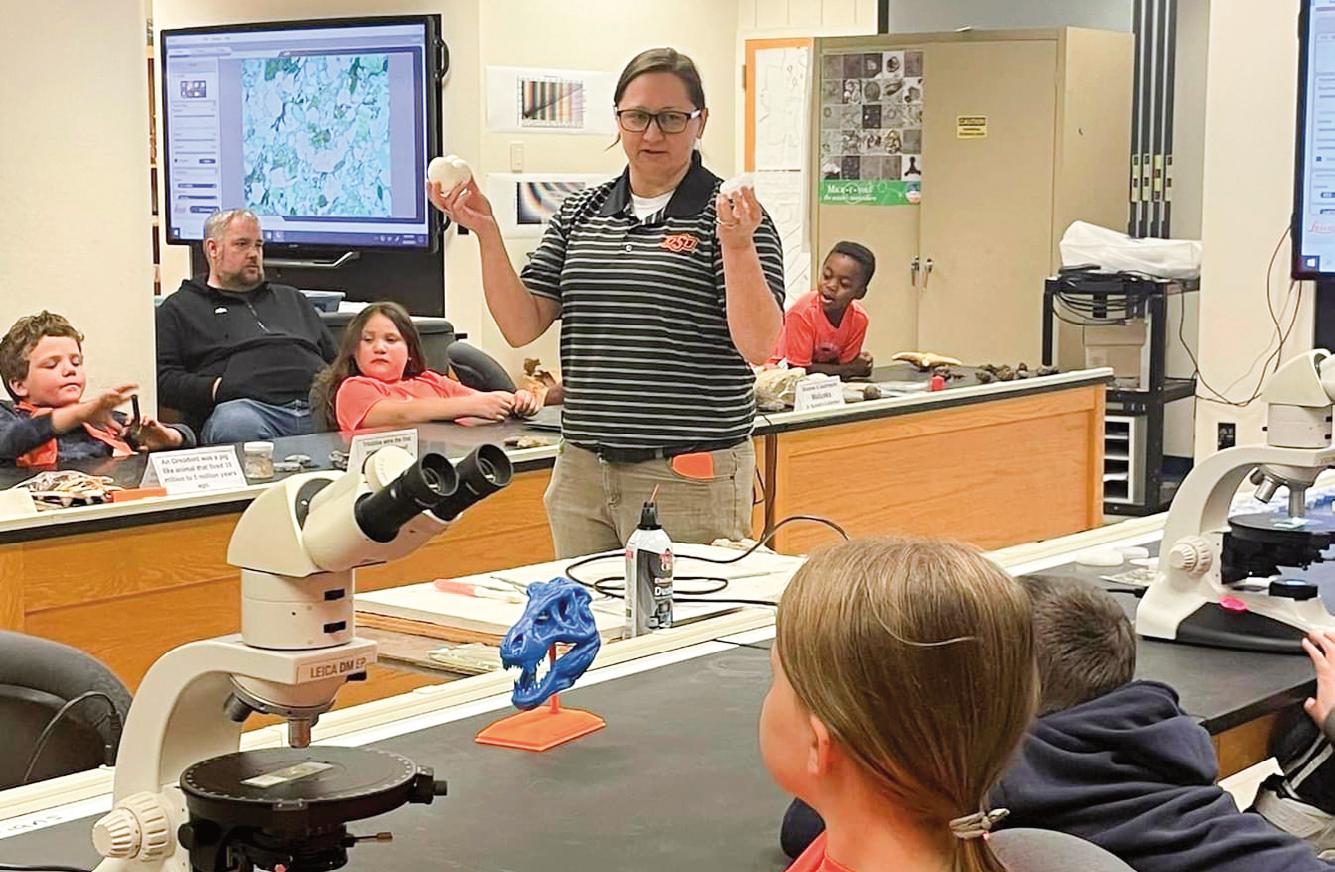
Dr. Ashley Burkett teaches Cub Scouts about micropaleontology.
OUTSTANDING
ALUMNI HONORING
Each year, the College of Arts and Sciences at Oklahoma State University recognizes remarkable alumni whose accomplishments and service are tangible evidence of their distinction. CAS alumni honors are separated into three categories: Rising Stars, Distinguished Alumni and Hall of Fame.
The annual celebration of these CAS graduates is held in September on the OSU-Stillwater campus. We invite you to visit okla.st/cas-hof to learn more about our 2025 honorees, as well as those of years past.
Scan for more information about CAS alumni awards.
RISING STARS
Recipients of the Rising Star award are alumni who have graduated with their CAS undergraduate or graduate degree within the past 10 years. In addition to already reaching major career milestones, Rising Stars demonstrate exemplary community service and a commitment to volunteerism.
DISTINGUISHED ALUMNI
With its 23 departments, the College of Arts and Sciences produces hundreds of graduates each year. Distinguished Alumni stand out among their peers, bringing distinction to OSU through extraordinary achievements in their fields and distinguished records of service. These individuals are chosen annually by representatives from each CAS department.
HALL OF FAME
Induction into the CAS Hall of Fame is the highest honor bestowed by the college on alumni. Recipients of this award embody the qualities that make OSU an extraordinary place to learn and grow. Honorees are nominated by their departments for achieving exceptional success in their professional careers, displaying effective leadership, making outstanding contributions to their communities, and showing great loyalty to their alma mater.
THE WORLD ON THEIR SHOULDERS
OSU WORKS TO UPGRADE
RENOWNED CERN
PARTICLE DETECTOR
“WITHOUT
OSU’S CONTRIBUTION, THE FUTURE OF HIGH ENERGY PHYSICS DOESN’T HAPPEN”
Dr. Evan Van de Wall
OSU assistant research engineer
In a laboratory deep below the Swiss-French border, the world’s most powerful particle accelerator smashes protons together at nearly the speed of light.
A piece of Oklahoma State University sits at the heart of the action.
“Space is infinite, but we’re dealing with millimeters” is how one OSU researcher described their work on components for CERN’s ATLAS detector, but even that understates the precision involved. The copper traces they design are 75 micrometers wide: about the same thickness as a piece of
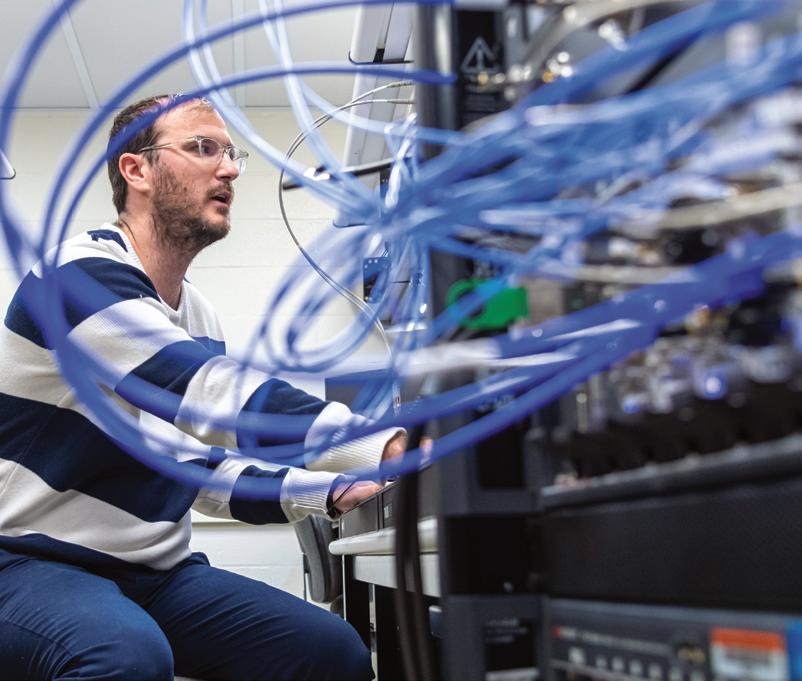
For 20 years, faculty and students from OSU’s College of Arts and Sciences have contributed to ATLAS, a major particle physics experiment on the Large Hadron Collider at the Conseil Européen pour la Recherche Nucléaire (European Organization for Nuclear Research).
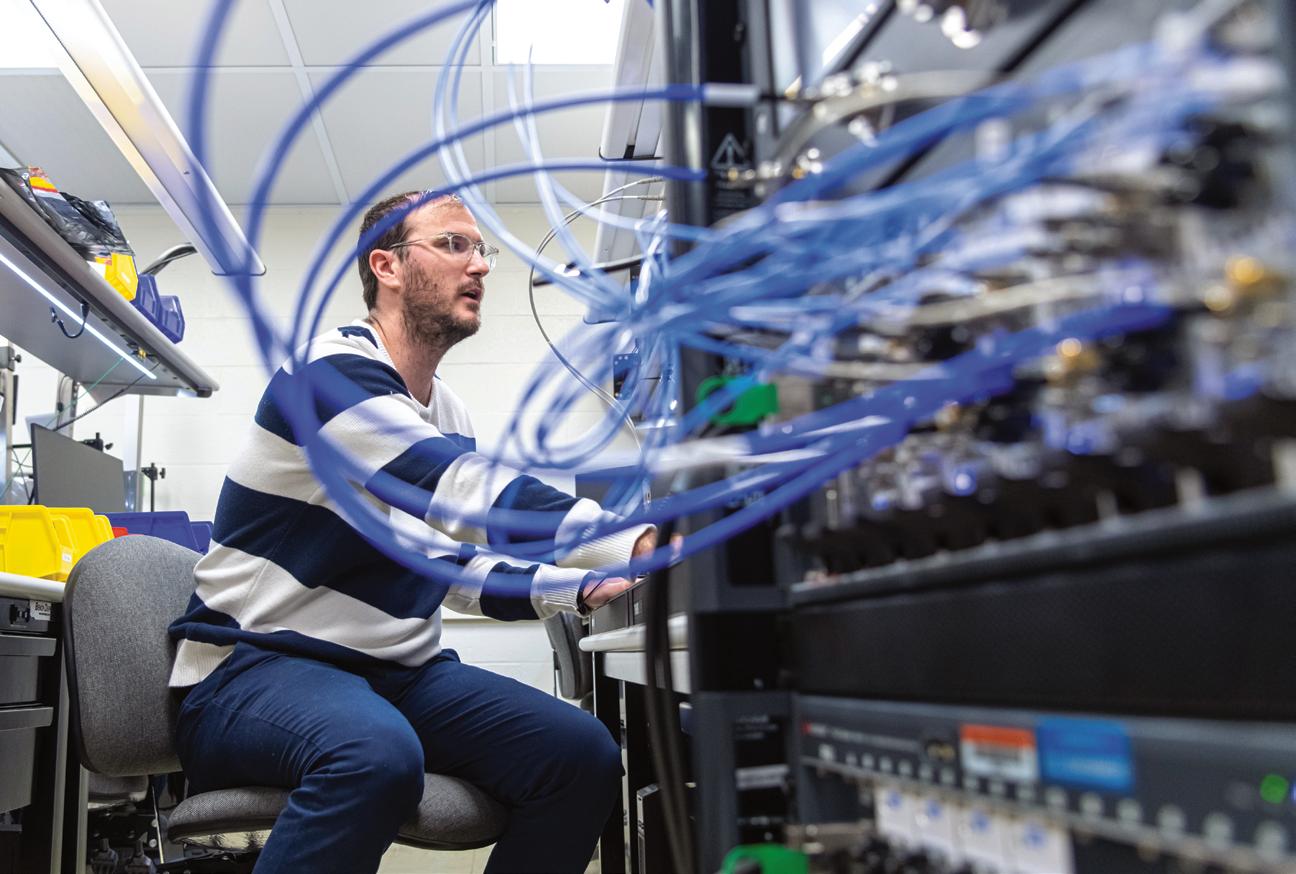
A Toroidal LHC Apparatus (ATLAS) is one of the largest detectors of its kind. It captures data from highenergy particle collisions and was instrumental in the 2012 discovery of the Higgs boson, which is a particle that helps explain why other particles have mass. ATLAS is now undergoing an upgrade, and OSU researchers are
playing a role in developing components for installation during the next maintenance period.
“Without what we’re doing at OSU, it will not be done,” said Dr. Evan Van de Wall, an OSU assistant research engineer. “The current technology that’s in there is too irradiated to continue to work. Without OSU’s contribution, the future of high energy physics doesn’t happen.”
The OSU laboratory responsible for this work was established two decades ago by Dr. Flera Rizatdinova, the current head of the physics department. What began as a small operation has grown into a research group with three professors, five engineers, multiple graduate and undergraduate students and two postdoctoral fellows.
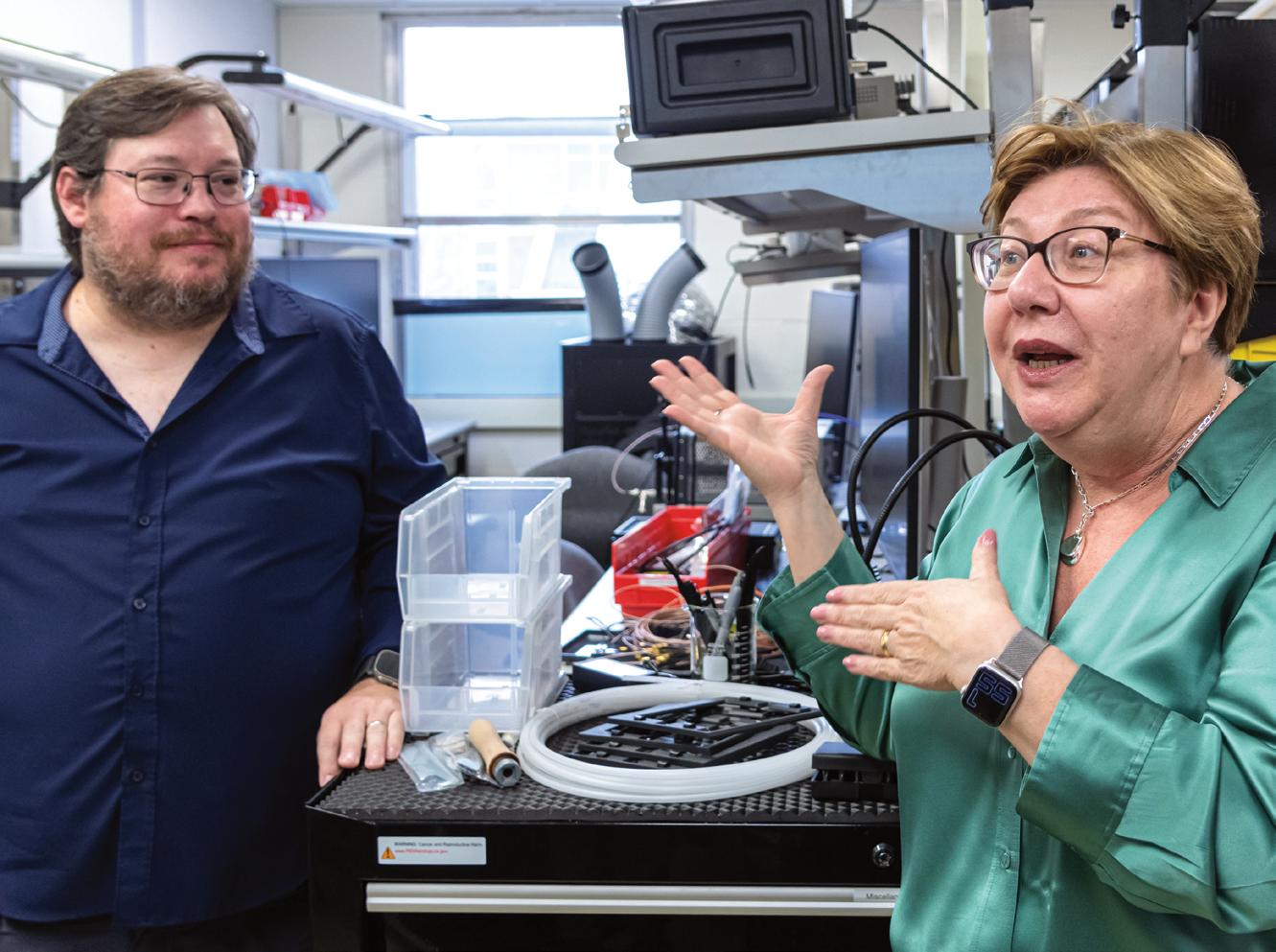
“It’s a melting pot of many disciplines,” said Steven Welch, a senior research engineer who leads the lab.
The team includes students and professionals from physics, computer science, electrical engineering, computer engineering, mathematics, material science and more.
Dr. Joseph Haley, professor in the Department of Physics, said having students working on the project is paramount to their career progress.
“Working on the ATLAS experiment is a transformative experience for our students. They gain hands-on experience with advanced technology and contribute to fundamental science, preparing them for future careers in research and engineering,” Haley said. “It’s worth noting that the research we conduct here at OSU is exactly the same as that at prestigious institutions like Yale and Stanford, and we actively collaborate with these groups, giving our students unparalleled opportunities in the field of high-energy physics.”
This interdisciplinary approach is necessary due to the project’s complexity. OSU’s team is developing components for the inner tracker of the ATLAS detector, specifically layers zero and one, which are closest to the collision point.
“Our boards receive the most radiation and will receive the most data transmitted through them,” Van de Wall said. “If our boards don’t work, the detector doesn’t work.”
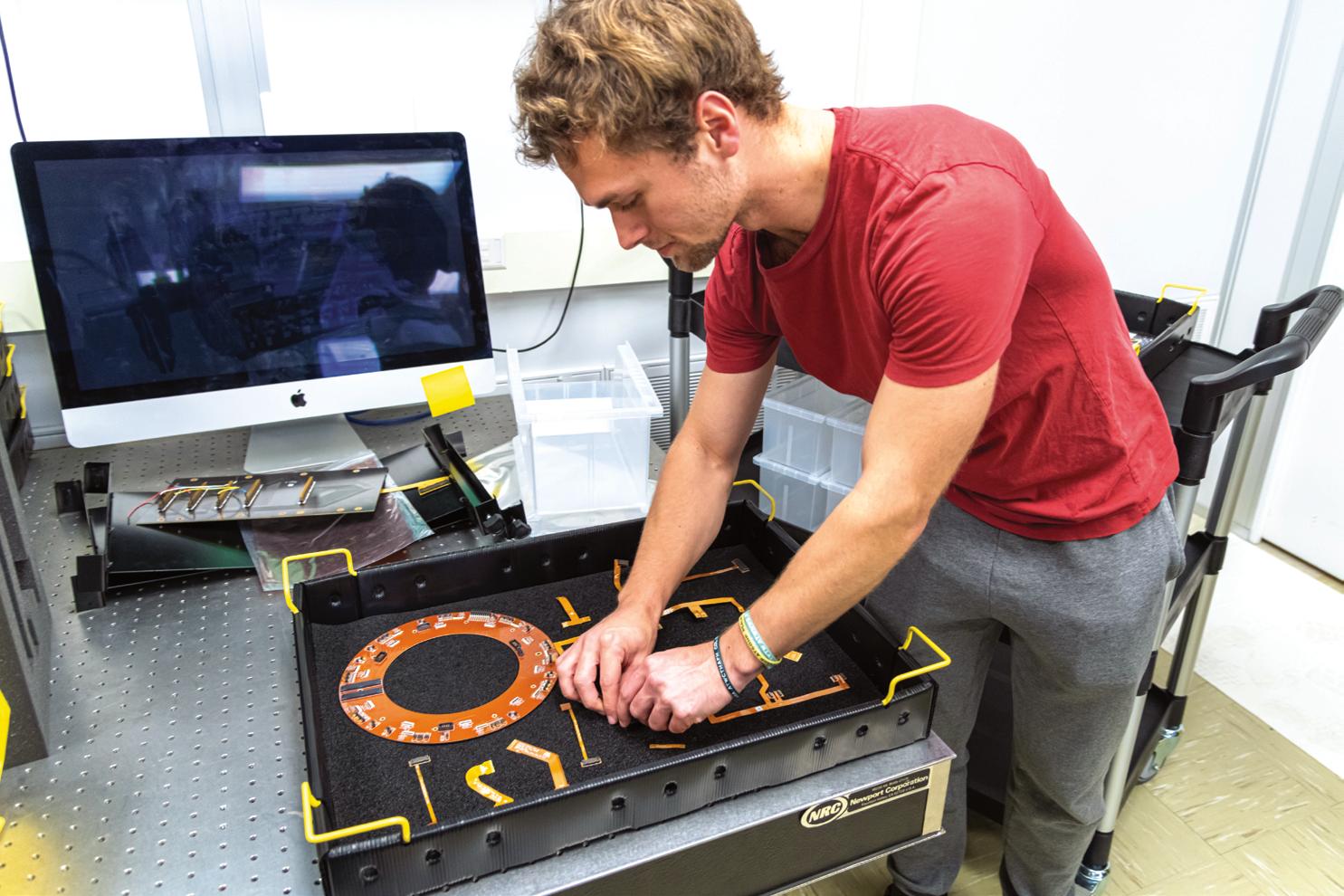
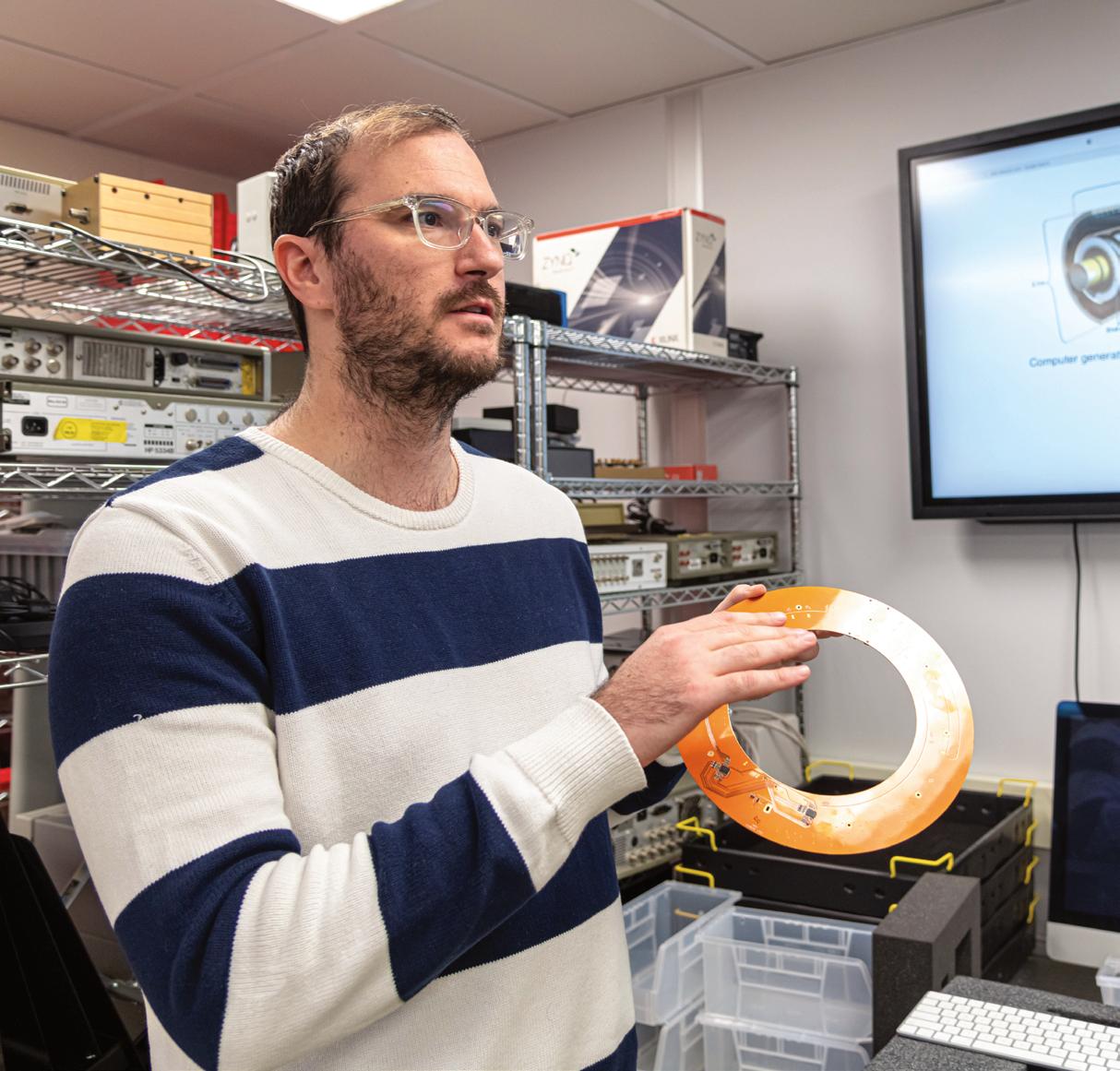
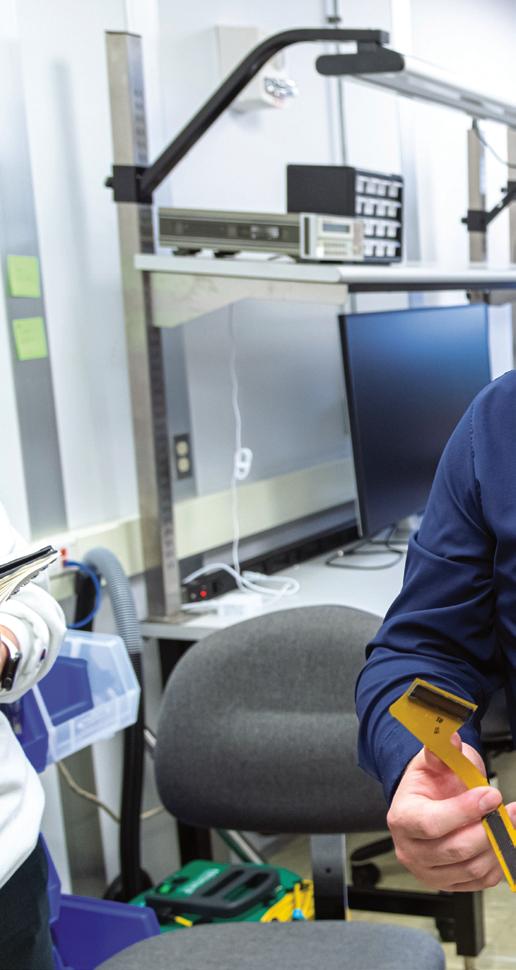
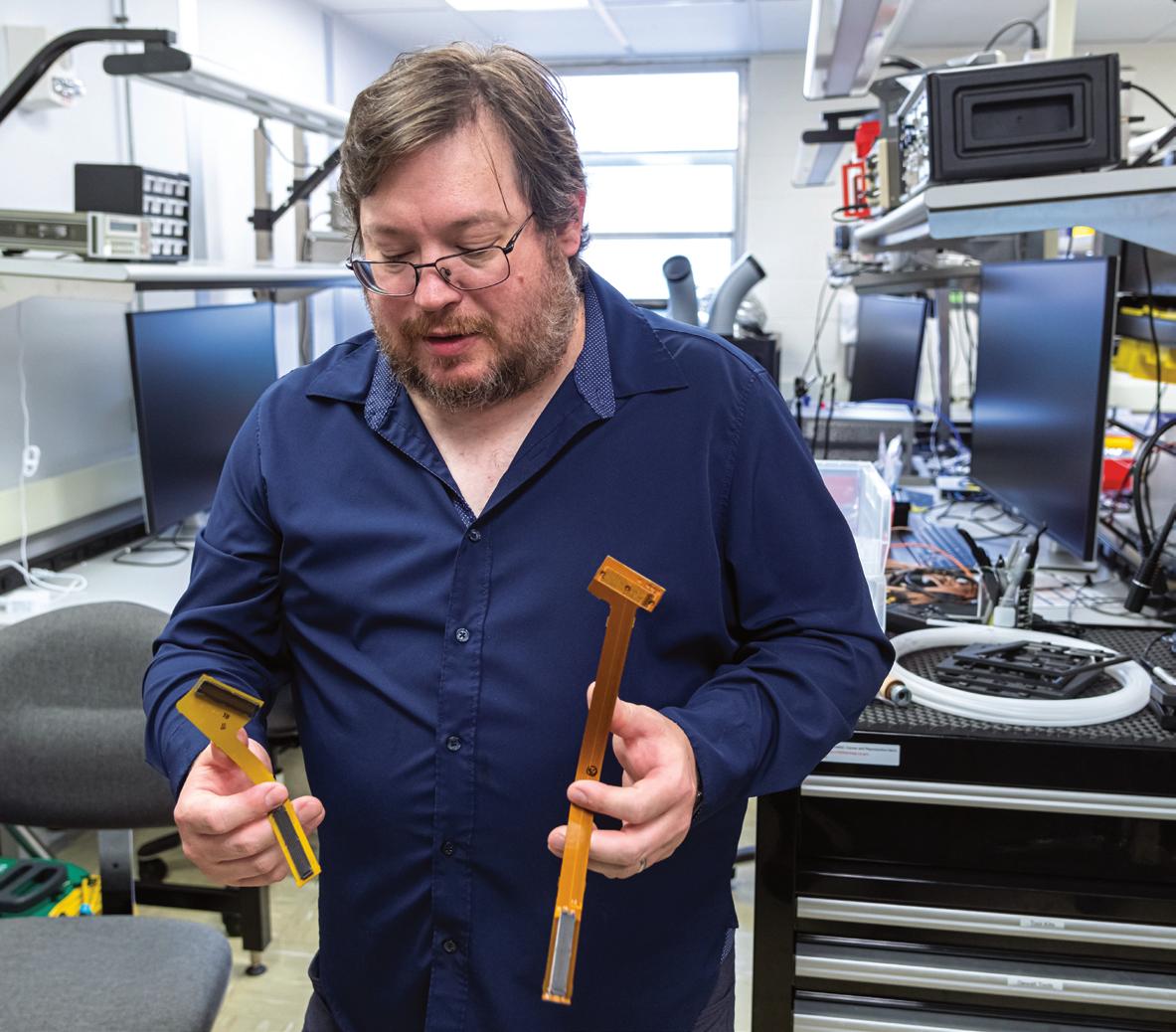
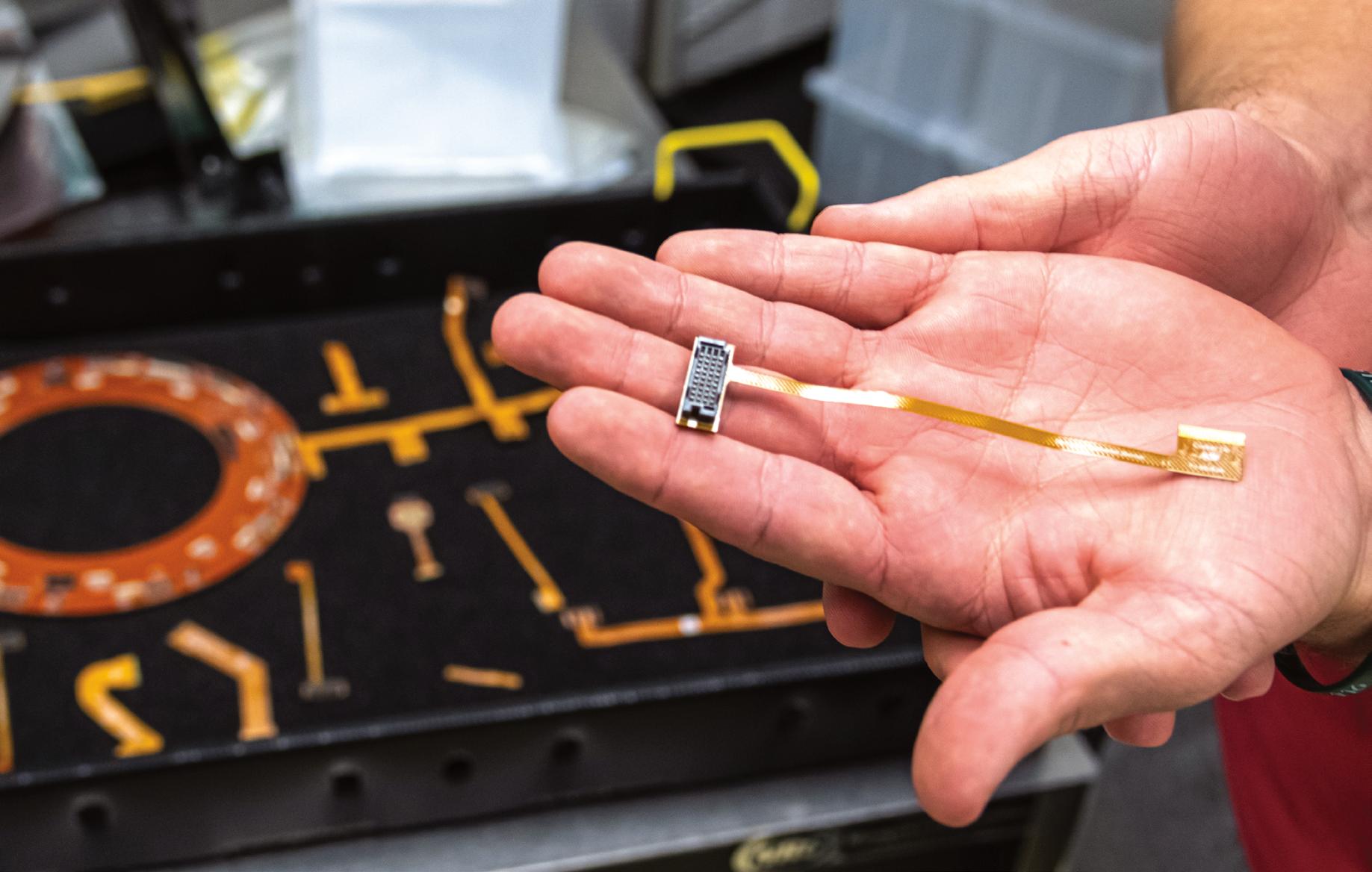
The engineers design flexible cables that link a detector’s sensors to its data system. The parts must meet extremely exact standards, with measurements accurate to just a few micrometers.
“I like to tell people that it takes three revisions to make something work correctly,” Welch said. “You build it once, and it doesn’t work. Then you build it again, and it doesn’t work. And then, by the third time, you can actually make it work.”
The stakes are high. Any mistakes could be catastrophic. Once installed, these components must function flawlessly for at least a decade, as accessing them for repairs would require disassembling the massive ATLAS detector for nearly a year.
The ATLAS collaboration involves approximately 5,000 people from around 40 countries. About 3,500 scientists appear as authors on research papers, with another 1,500 engineers providing support.
Rizatdinova finds the most pride in her team, whom she says all work
OSU faculty and students create numerous versions of components that are eventually installed in CERN’s ATLAS detector.
extremely hard and have been quick to learn and grow.
“I’m proud of this project,” Rizatdinova said. “I’m very proud of my engineering team, and I’m grateful to all of the engineers involved in the project.”
The lab has developed such a strong reputation that national laboratories now send their equipment to OSU for testing.
“We have leading equipment, and that’s not a hyperbole,” Van de Wall said. “We have a lab with the highest-end technology to test and design things.”
For students involved in the project, the experience is transformative. They get hands-on experience with cuttingedge technology while contributing to fundamental science.
“Every piece that we make, you put your name on it,” Van de Wall said. “These students are extremely excited to have their name on components that go into the leading edge of high-energy physics.”
The project also teaches resilience.
“Don’t be afraid to break things,” Van de Wall said. “We always joke that if you’re not breaking things, you’re not actually working. Everybody who’s been on the project has broken something.”
The ongoing work at OSU is scheduled to continue until 2027, with installation planned for CERN in 2028. The upgraded ATLAS detector will help scientists explore questions about the universe, potentially leading to the discovery of new particles and improving our understanding of dark matter and the Higgs boson.
As Welch puts it, the particle accelerator is “E=mc2 in real life,” converting energy from high-speed particles into new forms of matter that have never been seen before.
Rizatdinova summarized the collaborative spirit that makes science like this possible.
“We are collaborative by nature,” she said. “If we aren’t collaborative, we won’t survive.”
Senior research engineer Steven Welch and Department of Physics head Dr. Flera Rizatdinova.
OSU assistant research engineer Dr. Evan Van de Wall.
Set Up for Success
CAS resources give students advantage in academia and career readiness
The College of Arts and Sciences plays a central role in supporting Oklahoma State University’s Ideal Graduate initiative by providing tools for students to succeed both academically and professionally.
“One of my favorite things to do is work with a student early on to help them blend majors and minors in a way that aligns with their goals,” said Dr. Amy Martindale, CAS assistant dean for student academic services. “It’s like solving a puzzle where each choice adds value to their future.”
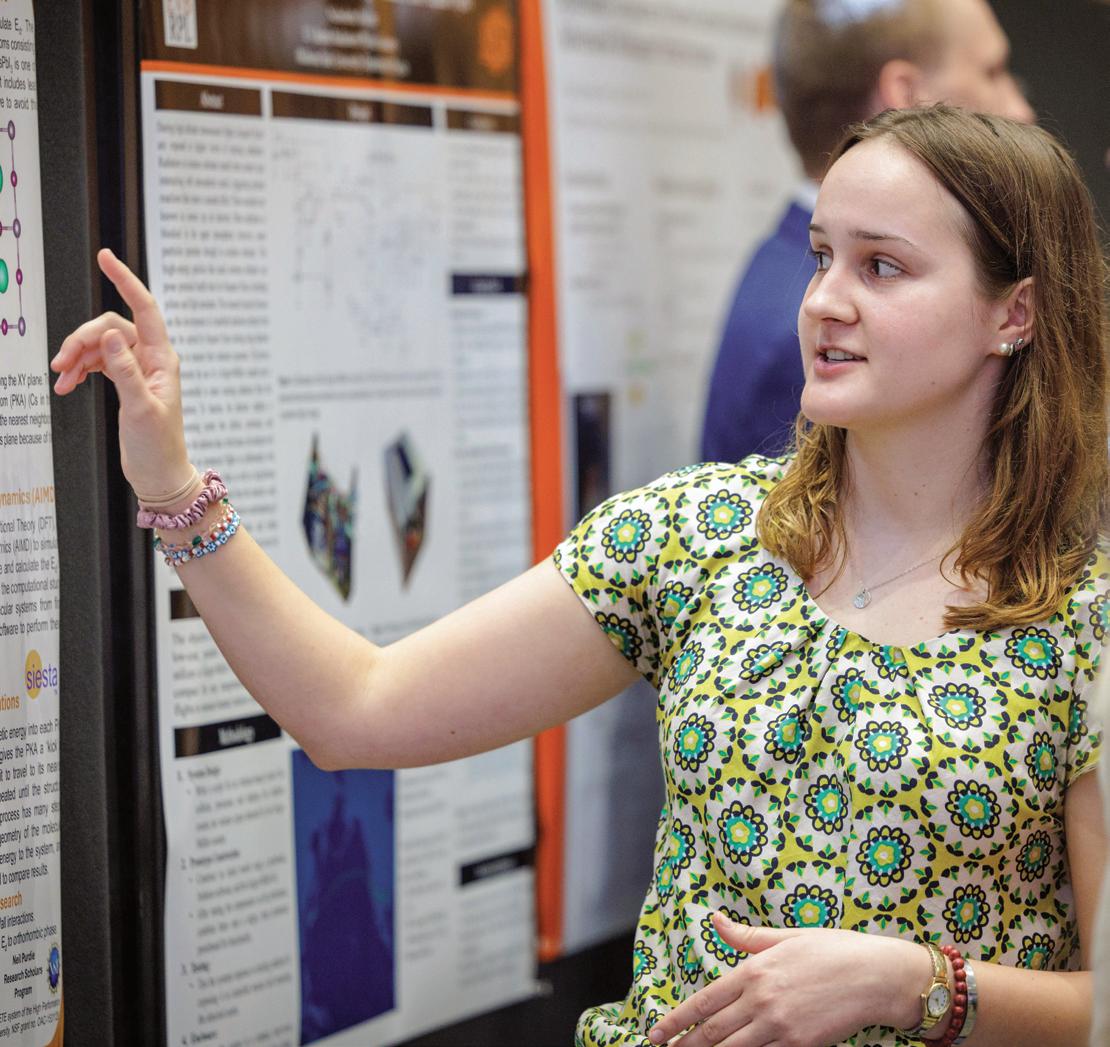
From math tutoring to student government to career readiness, CAS student support extends well beyond traditional academic advising to foster well-rounded, marketable graduates. This includes offering robust undergraduate research opportunities across the arts, humanities, social sciences, mathematics and natural sciences.
“Many of the skills that students can build through research map nicely into career readiness,” said Dr. Rachael Eaton, CAS program director for research engagement. “Research helps students
develop communication, teamwork and resilience skills that will serve them well in their careers.”
These hands-on experiences allow students to connect classroom learning to practical applications, Eaton explained. This bolsters OSU Ideal Graduate skills of critical thinking, communication, leadership and problem-solving.
“At the end of the day, we want our students to leave OSU confident in their abilities and ready to make a difference in their fields,” Eaton said.
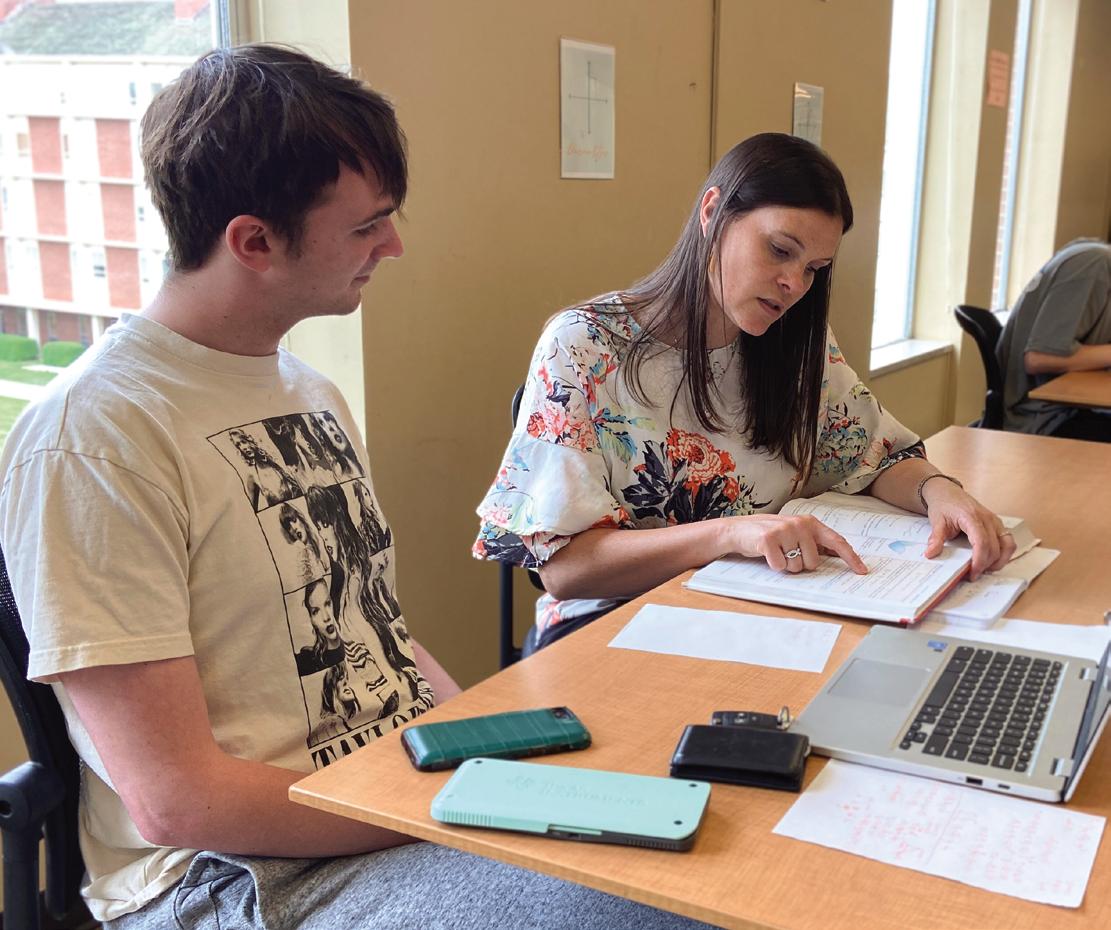
The Math Learning Success Center is building student confidence in both the students receiving help and those giving it.
“The tutors at the MLSC are undergraduates who typically are engineering, math, statistics or computer science majors,” said Dr. Melissa Mills, MLSC director. “They have a real passion for helping others and are trained to help students become independent learners. They are curious about what the students are thinking and able to build on the students’ understanding and meet them where they are.”
STORY OLIVIA BLACKFORD | PHOTOS ELIZABETH GOSNEY, GARY LAWSON AND JASON WALLACE
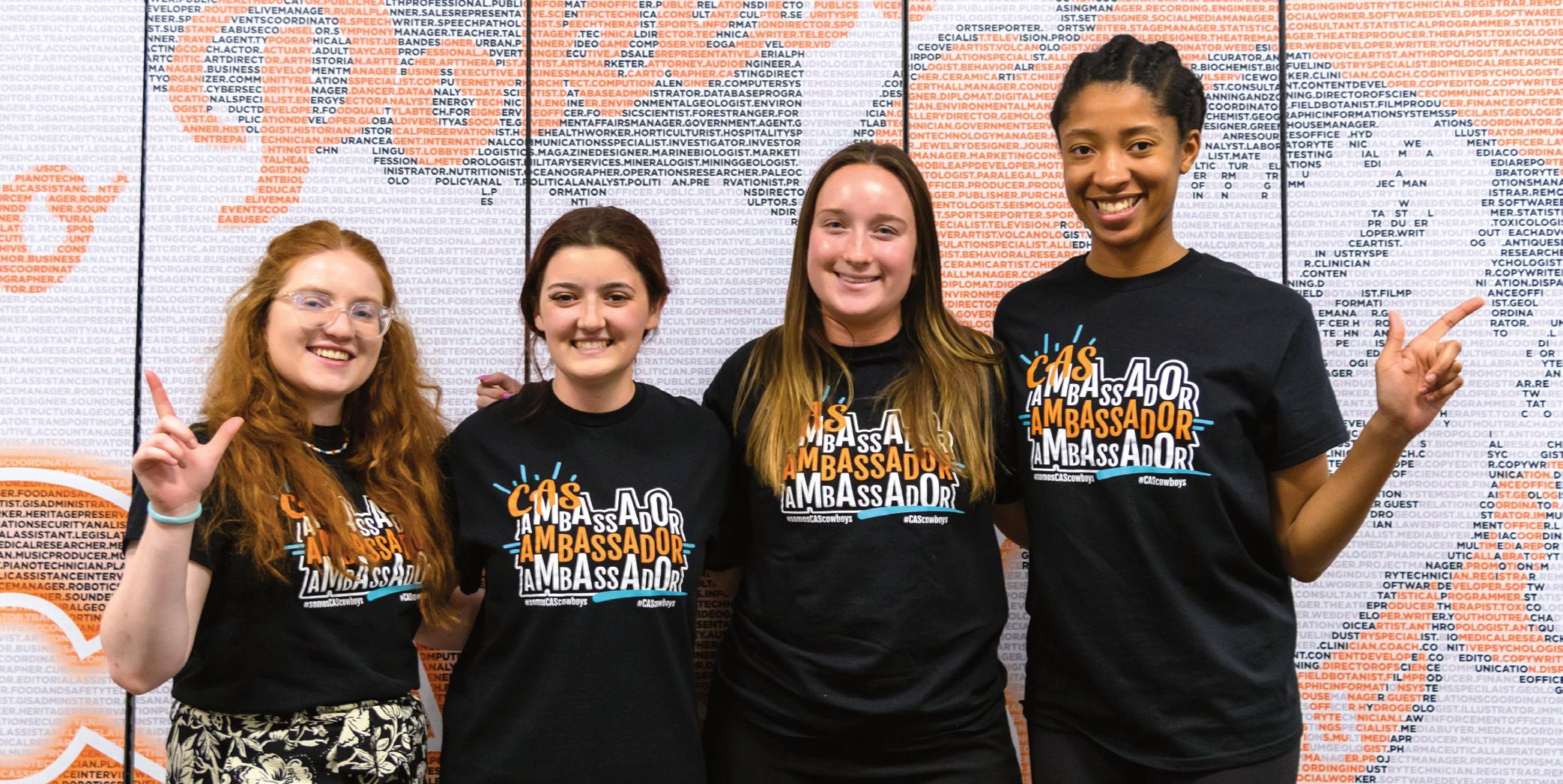
CAS Ambassadors connect current and prospective students with resources, experiences and the vibrant CAS community.
STUDENT SUPPORT
Some of the many college- and department-level resources CAS offers students include:
Academic Advising and Scholarships
Career Services
CAS Undergraduate Research
CAS Ambassadors
CAS Student Council
Living Learning Programs
Math Learning Success Center
OSU Writing Center
Summer STEM Academy
While the MLSC is housed within CAS, it serves the entire campus. On the fifth floor of Edmon Low Library, it’s both a hive of activity and an oasis of learning for those needing personalized math support.
“Students are so isolated in this digital age,” Mills said. “Providing a space where they can interact with real people and talk about their homework problems is really crucial for growing their understanding of math and forming social connections.”
CAS also excels in fostering professional development by providing students with meaningful opportunities to learn outside the classroom. CAS Ambassadors and CAS Student Council are two of those avenues for growth.
“Being a part of CAS Ambassadors has helped me develop leadership and communication skills I never thought I had,” CAS Ambassador Grace Phelps said. “Talking to prospective students and helping them navigate college has taught me how to offer advice and support in meaningful ways.”
CAS Student Council member Staci Dodson echoed Phelps, emphasizing how StuCo allows her to be involved in both leadership and co-curricular activities.
“Through student council, I’ve learned how to work with people from different backgrounds and how to communicate my ideas effectively,” Dodson said. “These are skills I’ll take with me into my future career and beyond.”
The College of Arts and Sciences’ holistic approach to student development through advising, research, tutoring, career services and beyond ensures that graduates leave OSU with more than just a degree.
“We’re not just helping students graduate,” Martindale said. “We’re helping them craft their own future.”
Write Right
Like the MLSC, the OSU Writing Center is housed within CAS, staffed by student tutors and serves the entire campus! Learn more about this outstanding unit at okla.st/writing-center
Students present their work at the Undergraduate Research Symposium.
Dr. Melissa Mills, director of the MLSC, helps a student with their math homework.
Pulling Out All the Stops
OSU Symphony Orchestra and director earn national recognition for innovation and excellence
The Oklahoma State University Symphony Orchestra is hitting the right note.
OSU is one of only five college orchestras named a national finalist for the Vytautas Marijosius Memorial Award in Orchestral Programming — a distinction that celebrates inventive and impactful orchestral performances.
“I was truly honored and humbled when I received the news,” said Dr. Thomas Dickey, former director of orchestral studies. “To be recognized on the national level for the great things we are doing here at OSU means the world to me and the students.”
The award for orchestral programming acknowledges the breadth and diversity of the OSU Symphony Orchestra’s repertoire. From classical symphonies and operas to contemporary pieces by female composers and composers of color, Dickey said the orchestra is committed to exposing students and audiences to a wide range of music.
“This recognition confirms that we are a part of the changes in classical music that we want to see happen for the next generation of orchestral musicians and concertgoers,” he said.
In addition, Dickey was named a national finalist for The American Prize in Orchestral Conducting, highlighting both his leadership and the orchestra’s creative spirit. Dickey says it’s a meaningful affirmation of his work.
“It is both humbling and validating to be recognized nationally alongside some of the best college orchestra directors in the country,” he said.
Graduate teaching assistant Nathan Hooper, who works closely with Dickey and the orchestra, echoed the sentiment.
“It’s really great and well-deserved,” he said. “I’m proud to be the student of a conductor who is getting so much national recognition. It gives me confidence that I am in good hands.”
Hooper credited Dickey’s methodical rehearsal planning and thoughtful programming as key elements of the orchestra’s success.
“He’s excellent at themed concerts that lend to a very easy listening experience,” Hooper said. “The music always makes sense together and complements itself well.”
Looking ahead, the orchestra plans to continue dreaming big.
“We live by the Cowboy Code,” Dickey said. “Next year, we’re hoping to tackle a Shostakovich symphony and explore works by American composers in honor of the country’s 250th birthday.”
With its growing national reputation, the OSU Symphony Orchestra hopes to attract top-tier musical talent from across Oklahoma and beyond.
“OSU is a nationally recognized university,” Dickey said. “It’s only right that we have a nationally recognized orchestral program.”
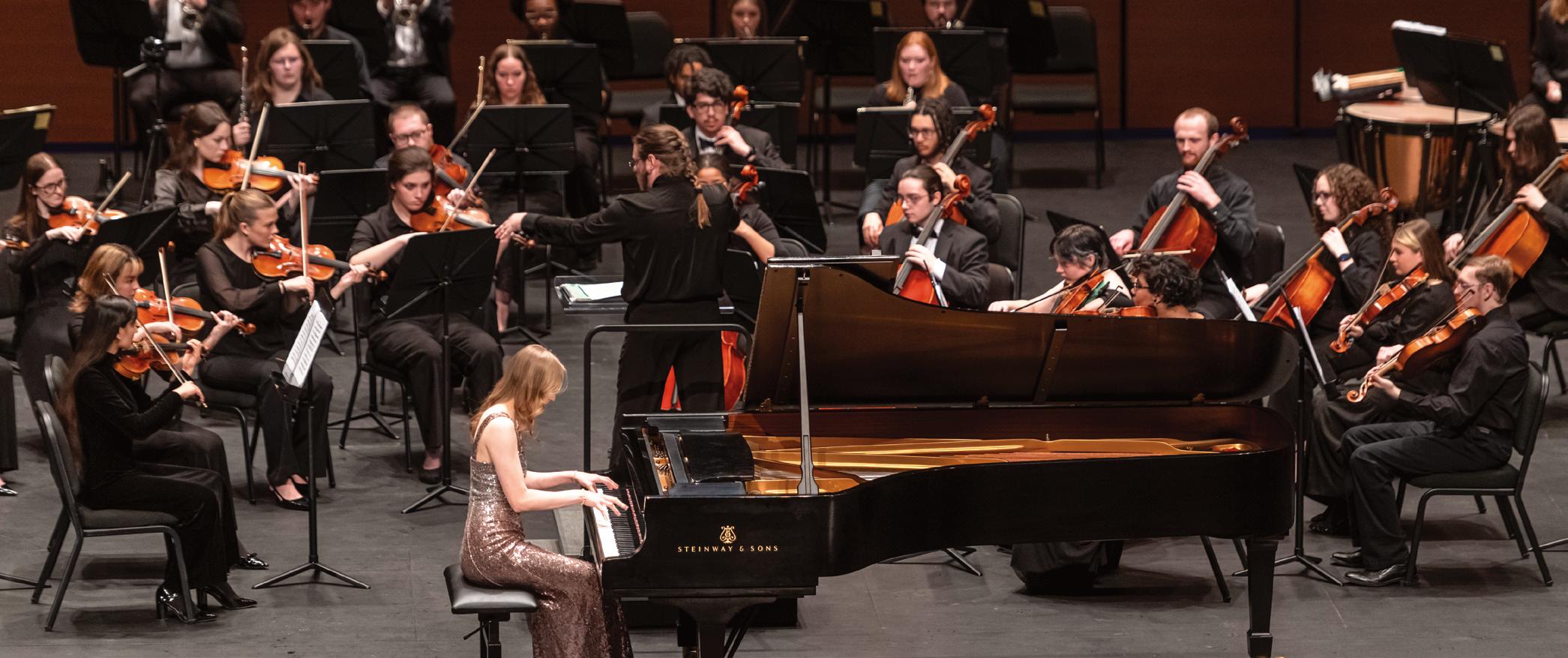
The OSU Symphony Orchestra performs in The McKnight Center for the Performing Arts on March 6, 2025.
After a successful nationwide search in the spring, CAS hired Dr. Ty Hawkins as the new associate dean for academic programs. A native of Missouri, Hawkins holds degrees in English and Spanish from Saint Louis University and Westminster College. Hawkins most recently served as director of the School of Language and Literature at the University of Central Arkansas.
Under the direction of Dr. Lanette López Compton, the Greenwood School of Music clinched first place in the horn quartet competition at the 56th International Horn Symposium.
OSU’s Air Force ROTC Det 670 sent its first all-female team to compete at the 2025 Bataan Memorial Death March. The five cadets trekked more than 26.2 miles carrying over 35 pounds each in the high desert of White Sands, New Mexico. In total, 31 members of Det 670 competed in the event — the most ever by the detachment.
CDIS faculty Dr. Roha Kaipa, Kristi Carpenter and Caryl Hennen were awarded the prestigious 2025 Women for OSU Partnering to Impact Grant. Their project, “Autism Spectrum Disorder Summer Camp: Enhancing Communication Skills and Parent Support” was selected from a competitive pool of over 40 applicants.
Fulfilling their commitment to community outreach programs, CAS faculty hosted several summer K-12 camps. These included Geology’s GEO-REx geoscience research experience for high schoolers and Computer Science’s Cyber Bridge for families and CyberArt Pioneers for 11to 13-year-olds.
Three podcasts from CAS faculty have been gaining popularity over the past year: “Odd Fellows” delves into transdisciplinary research at OSU with co-hosts Drs. Skye Cooley and Andrew Abernathy from the School of Media and Strategic Communications; “Good History” examines the past and how it impacts the present with Department of History’s Drs. Sarah Griswold and Brian Hosmer; and “Neurodiving” with Philosophy’s Dr. Joanna Lawson and Kansas State University’s Dr. Amelia Hicks explores philosophical questions raised by the experiences of neurodivergent people.
Art History grad student Valentina Plata curated “Perspectivas desde el otro lado/Perspectives from the Other Side” at the Mexican consulate in Oklahoma City in the fall of 2024. It featured five Mexican American artists based in Oklahoma who are also members of OSU’s Department of Art, Graphic Design and Art History