The official magazine of the College of Arts and Sciences
FORWARD MOTION
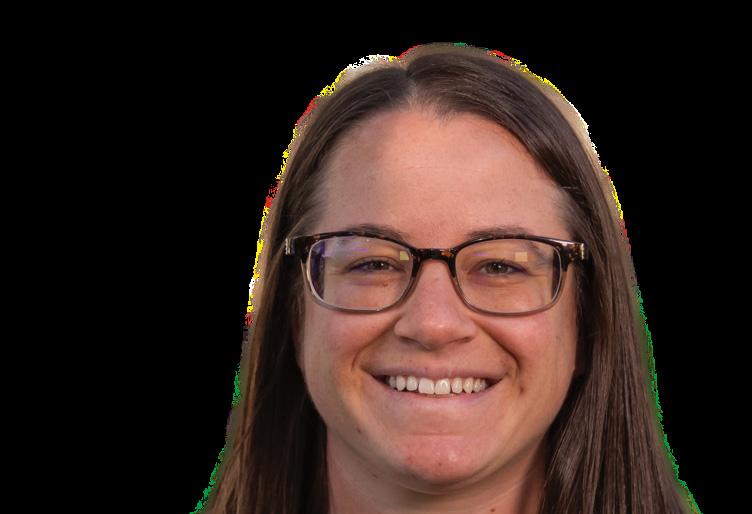
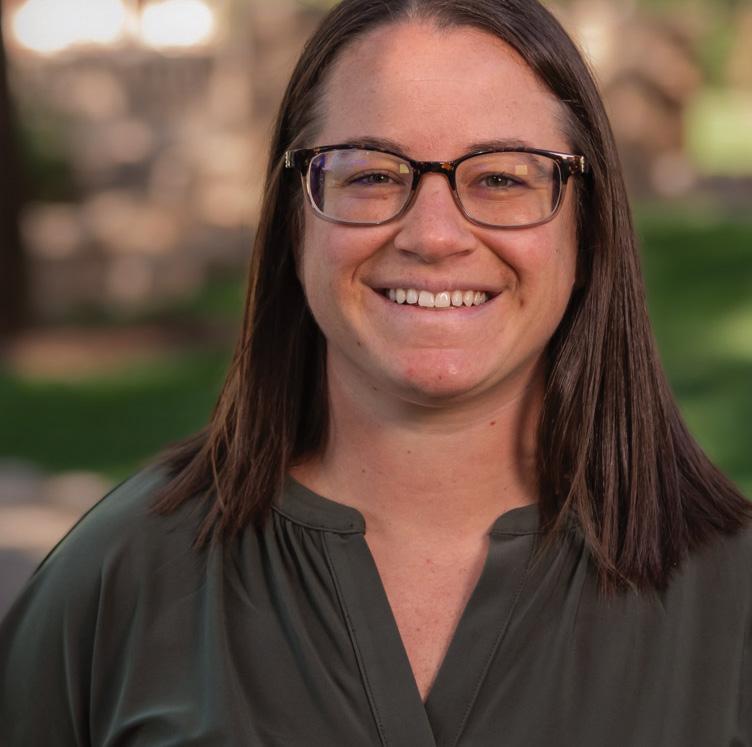
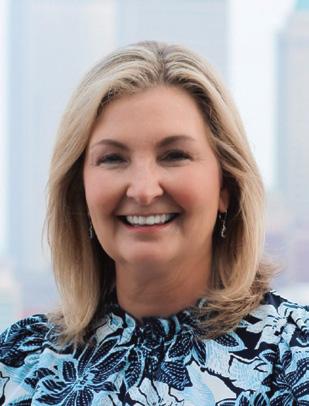
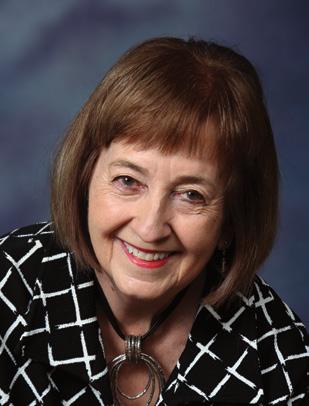
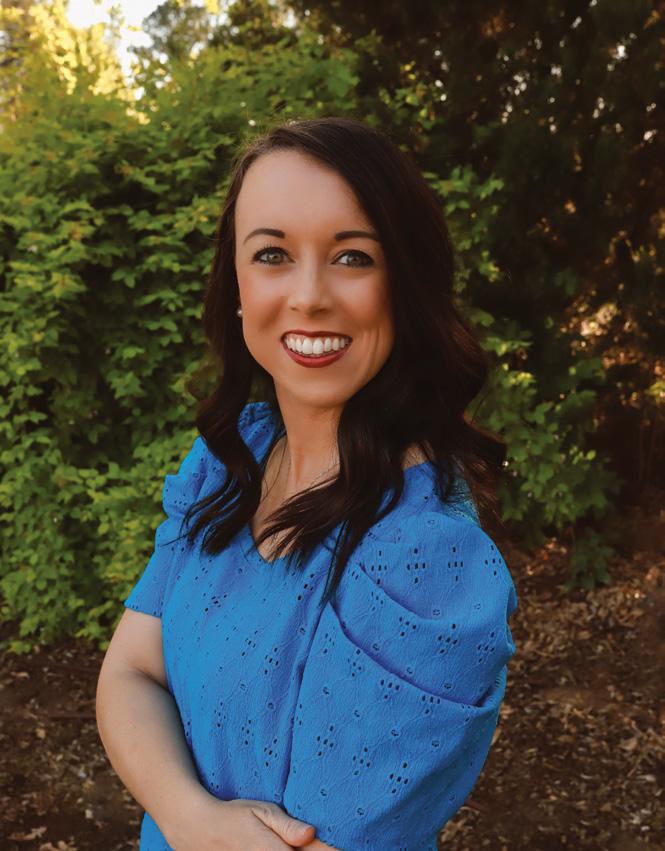
DR. MELINDA CRO TAKES THE REIGNS AS NEW CAS DEAN
Dear CAS alumni, colleagues, students and friends,
It is a true pleasure and honor to be crafting this letter at the beginning of my time as dean of the College of Arts and Sciences.
CAS is an incredibly special place, one where the promise of the land-grant institution is fully realized. I recognized that the moment I met with the search committee, made up of faculty across the college who were engaged, friendly and a true testament to the ethos of the servant-leader that embodies Oklahoma State’s values. It was further cemented when I visited Stillwater and met with Provost Jeanette Mendez, President Kayse Shrum and the campus community, including amazing CAS student representatives.
We came together to break bread and share experiences, which gave me the chance to discuss my goals to help support students, faculty and staff in realizing our mission to become the preeminent land-grant College of Arts and Sciences in alignment with the university’s strategic plan.
This past year, CAS faculty, staff and leadership collaborated to develop the college strategic plan that centers the arts and sciences at the heart of OSU. The university plan leverages the institution’s strengths to serve the needs of the state, deliver an impactful and affordable student experience, and solve the challenges we face in Oklahoma and around the world. Similarly, our college plan harnesses inherent CAS strengths to:
Prioritize student success, broadly and holistically defined, through dedicated faculty and staff;
Develop innovative curricula and foundational courses that engage learners in transdisciplinary modes to best prepare for the challenges that an increasingly globalized world presents;
Advance the research enterprise through increased focus on extramural funding, early career awards, outreach about our research and an emphasis on transdisciplinary work;
Build on the outward-facing Extension work we are already undertaking to engage more fully with our community, from the local to the global, and amplify opportunities in that space.
This work fills my heart with joy, and I am thrilled to be joining OSU CAS at this important moment. What a truly vibrant and exciting time to be a Poke!
I would be remiss if I did not take a moment to extend deep thanks to Dr. Keith Garbutt, who took on the role of interim dean and shepherded CAS through the strategic planning process. His belief in the centrality of the arts and sciences in the landgrant mission, his passion for the liberal arts and his generous spirit shaped his work as interim dean, and we are so grateful for his leadership.
Finally, thanks to all of you for your continued support of the College of Arts and Sciences at Oklahoma State. We could not dream as big as we are dreaming without you!
GO POKES!
Dr. Melinda A. Cro Dean, College of Arts and Sciences
PHOTO
JASON WALLACE
CONNECT
College of Arts and Sciences cas.okstate.edu
20
Taking charge
Dr. Melinda Cro takes the helm as CAS dean after a career spent in administration and language arts.
2
Curating cultural connection
The OSU Museum of Art started with a dream a decade ago, but has seen its impact in the cultural legacy it has on Stillwater.
8
Happy campers
The Les Huston Geology Field Camp marks 75 years of helping provide hands-on experience to geoscientists.
12
Nourishing the world
CAS groundwater researchers use skills to impact society’s sustainability.
MARKETING AND COMMUNICATIONS MANAGER
Elizabeth Gosney ’21
COMMUNICATIONS COORDINATOR
Erin Weaver ’20
EDITOR
Jordan Bishop ’16
ART DIRECTOR
Dave Malec
DESIGNER
Cody Giles
PHOTOGRAPHER
Jason Wallace ’03
WRITERS
Jade Dudley ’24
Dr. Rachael Eaton
Adeola Favour
Elizabeth Gosney
High school heroes
Faculty partnership with Payne County Jail prepares inmates with opportunity to earn high school diplomas.
Mallory Pool ’24
Allie Putman ’23
Grant Ramirez ’21
Erin Weaver
COLLEGE OF ARTS AND SCIENCES DEAN
Dr. Melinda Cro
ASSOCIATE DEAN/OUTREACH
Dr. Bobbi Kay Lewis ’93, ’03
SENIOR DIRECTOR OF DEVELOPMENT
Laura Ketchum
YEARS INDICATE OSU CAS GRADUATES
2024/#Connect2024.
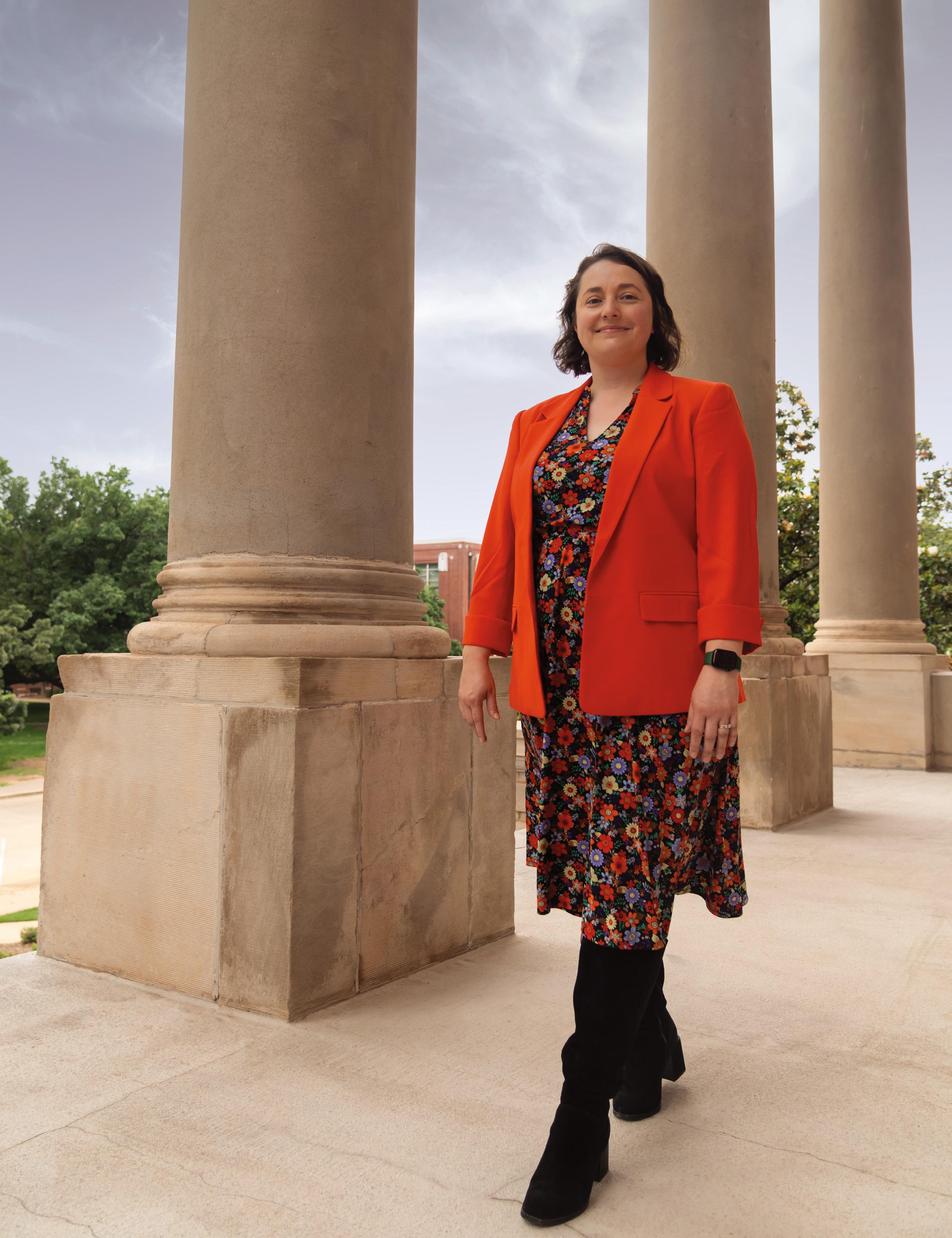
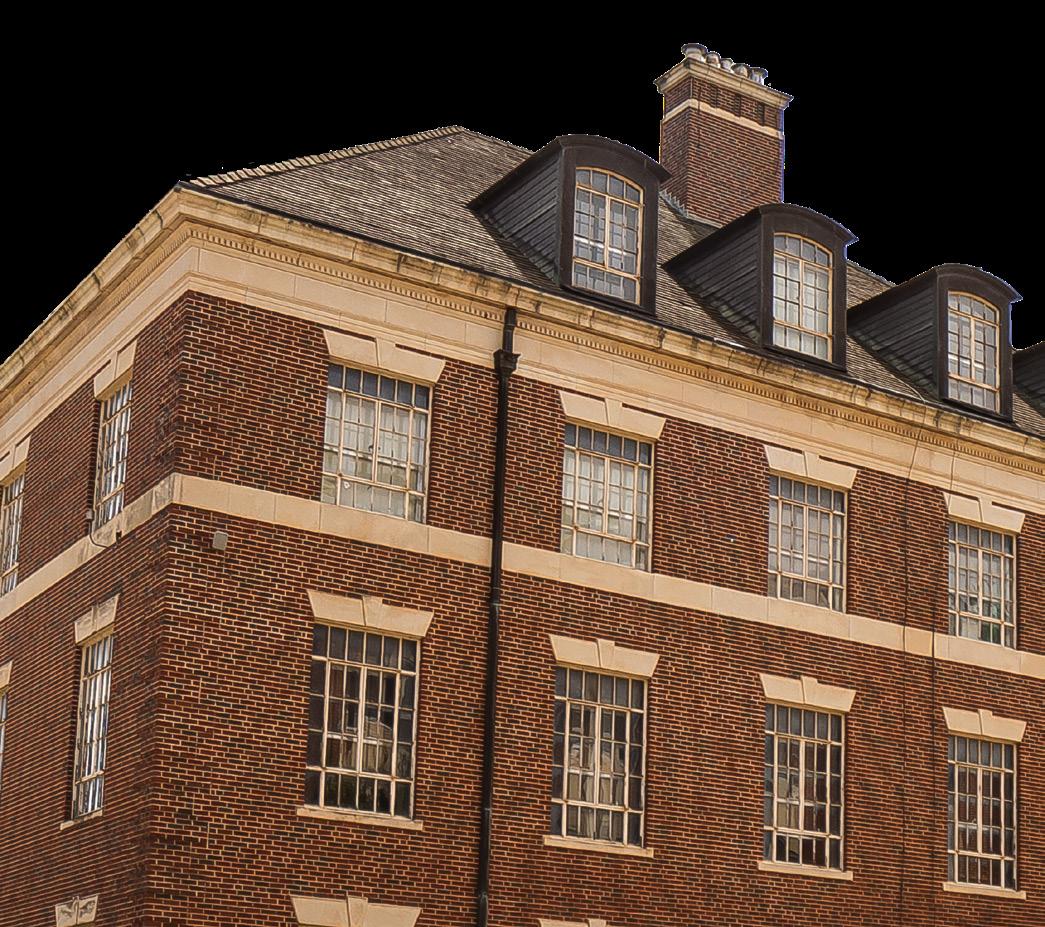
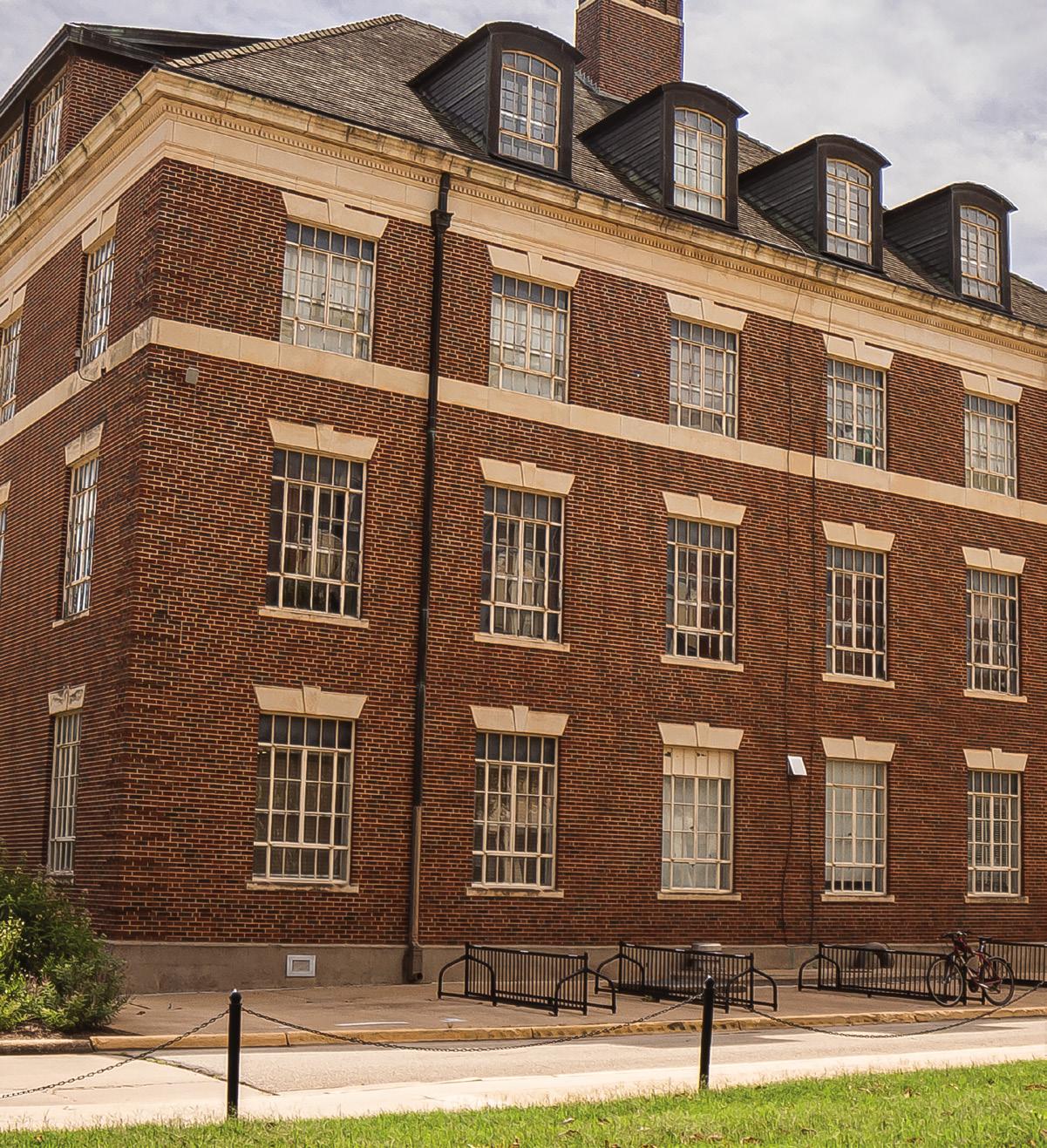
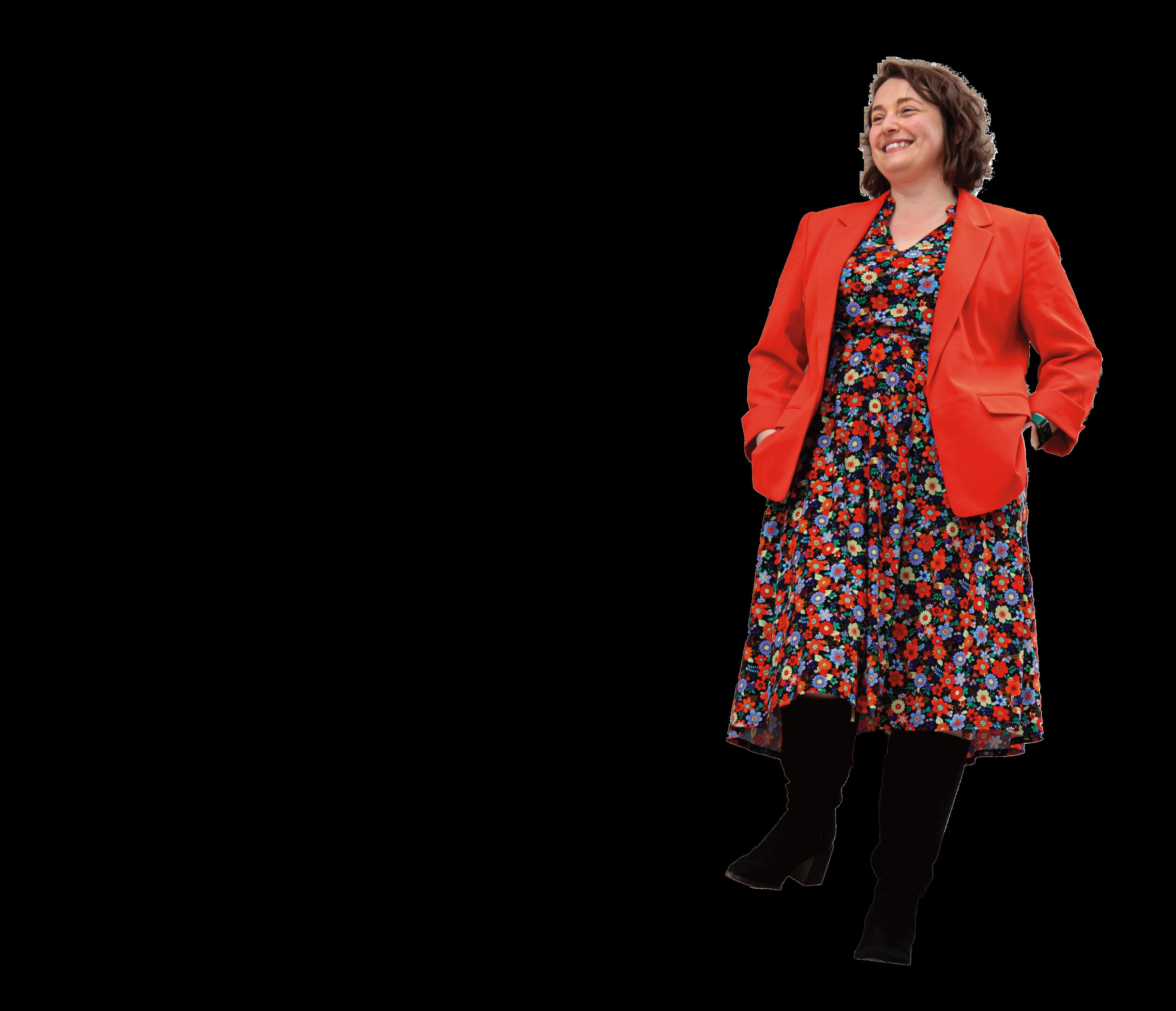
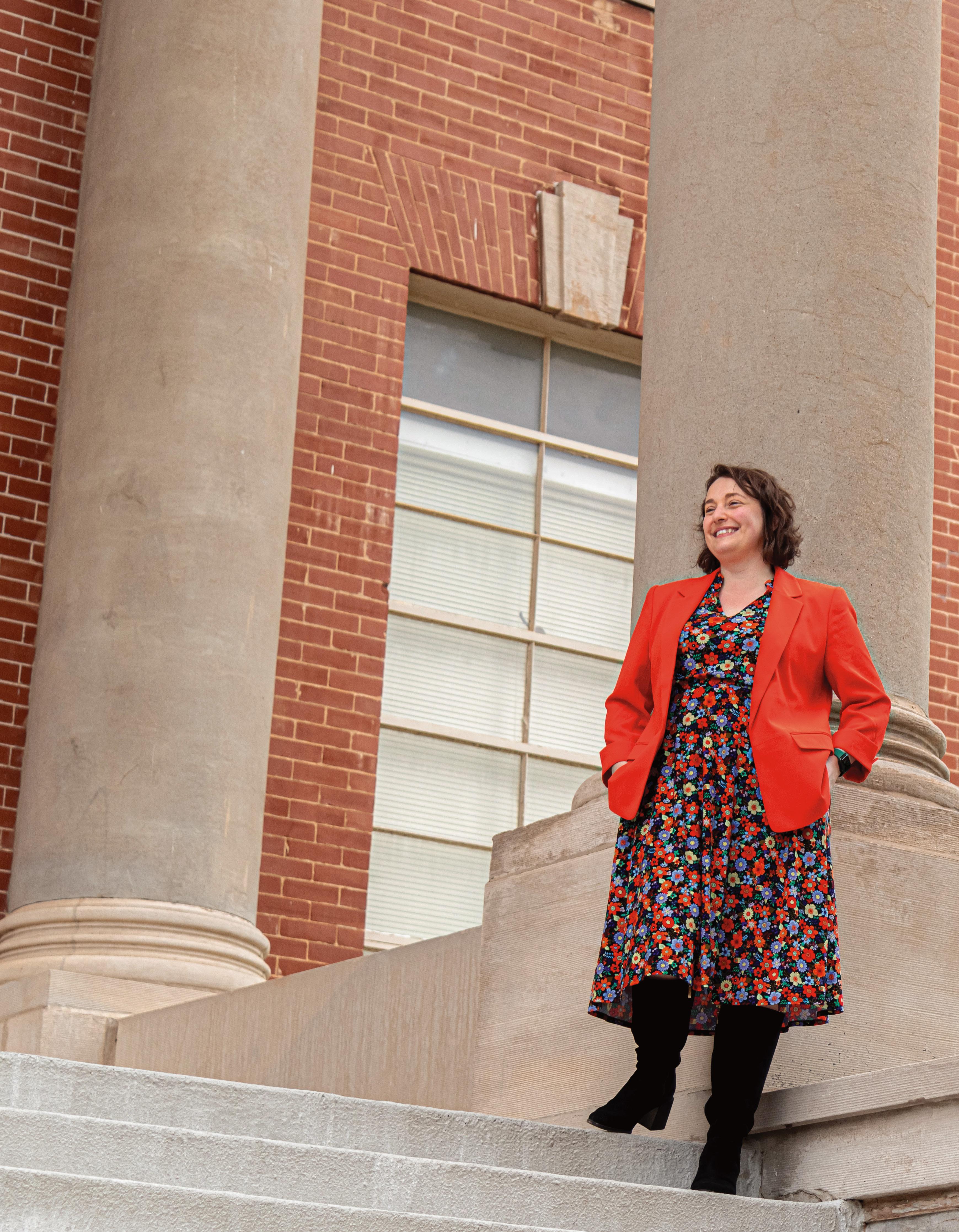
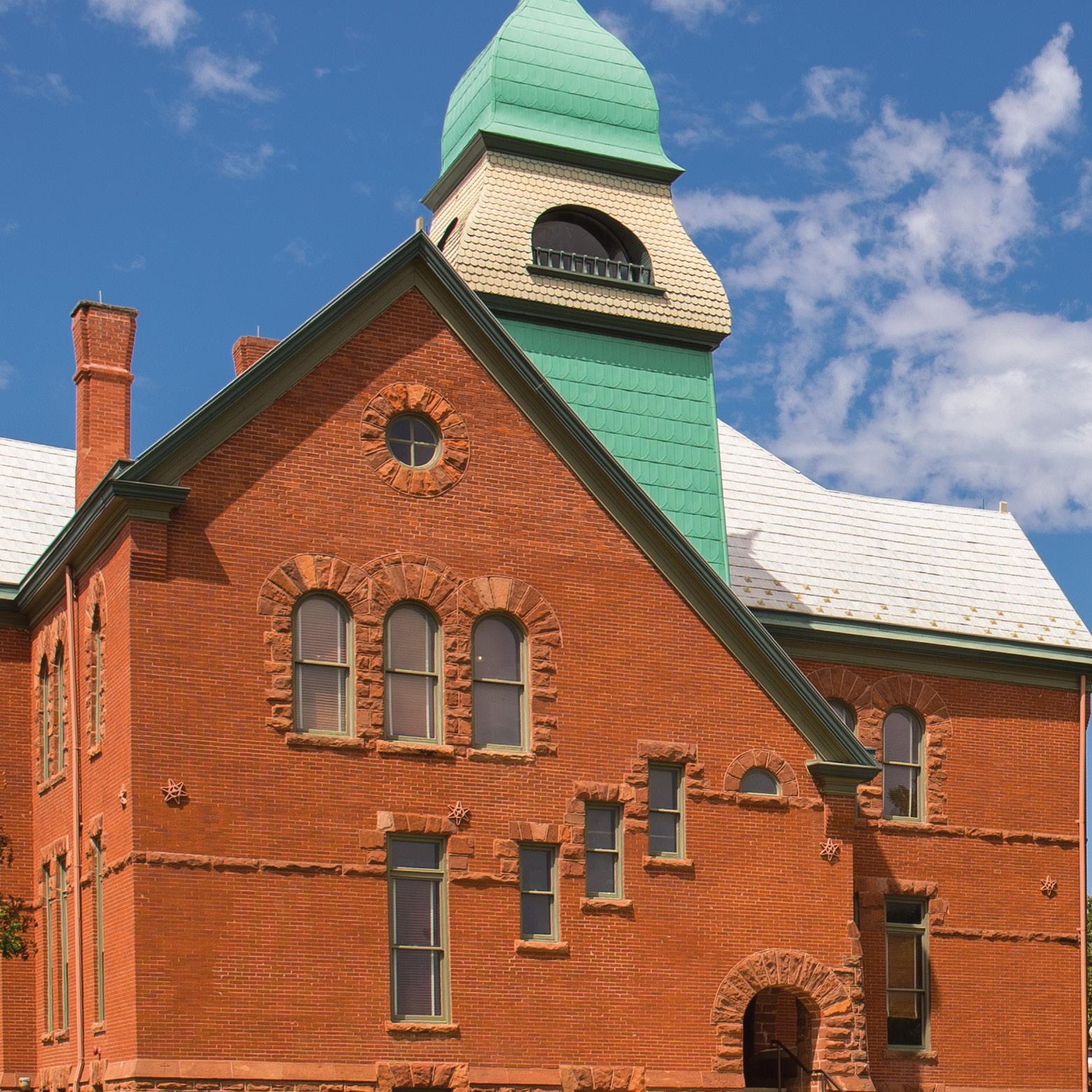
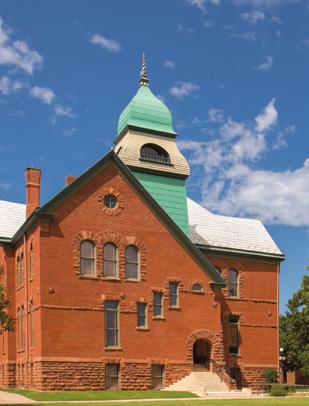
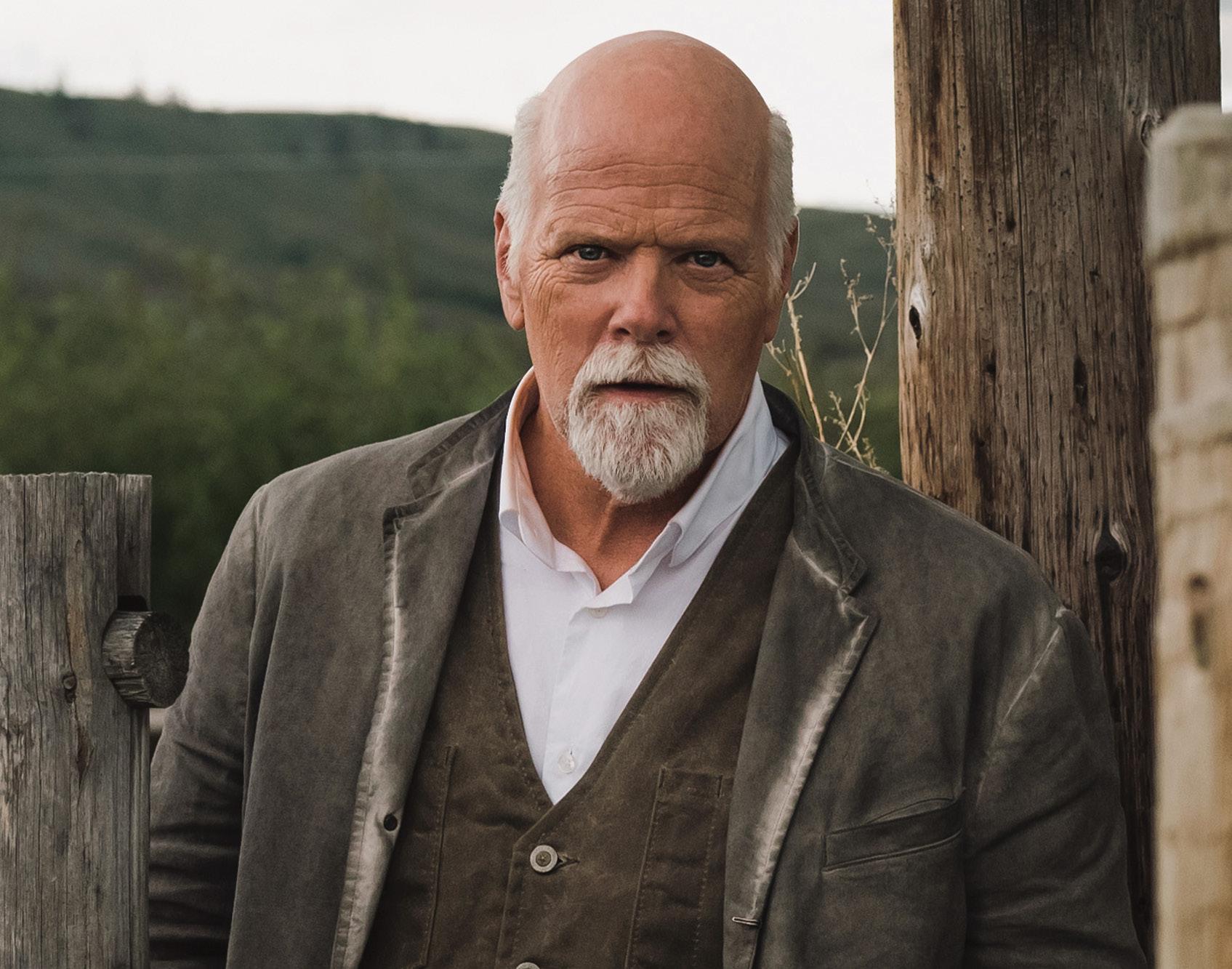
On the cover: Dr. Melinda Cro poses outside of Morrill Hall in her new role as CAS dean.
(Photo illustration by Jason Wallace)
MASTERPIECE IN THE MAKING
OSU Museum of Art celebrates 10 years of campus and community enrichment
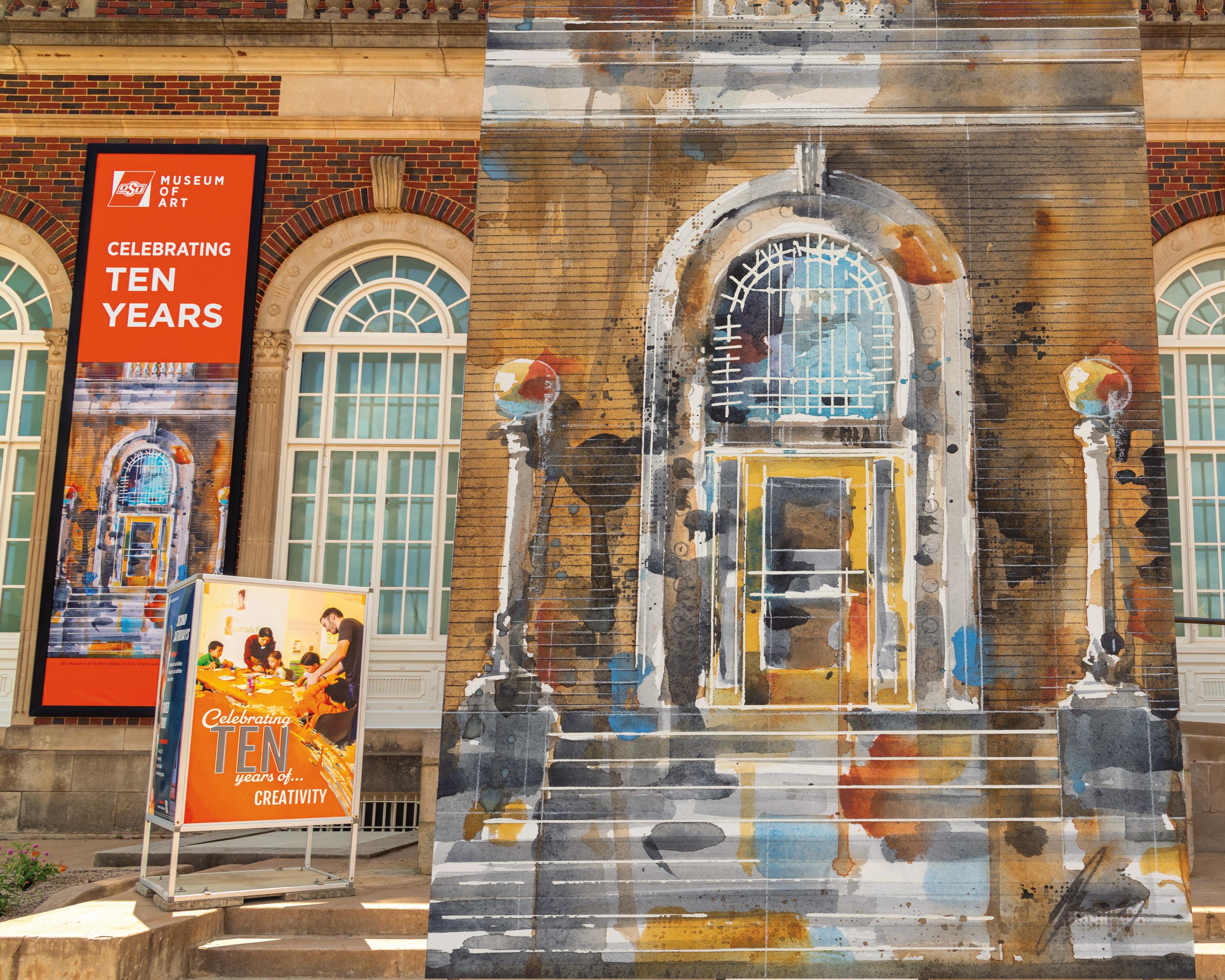
Moh’d Bilbeisi’s OSU Museum of Art (2023, watercolor on paper board) superimposed on top of the OSU Museum of Art exterior.
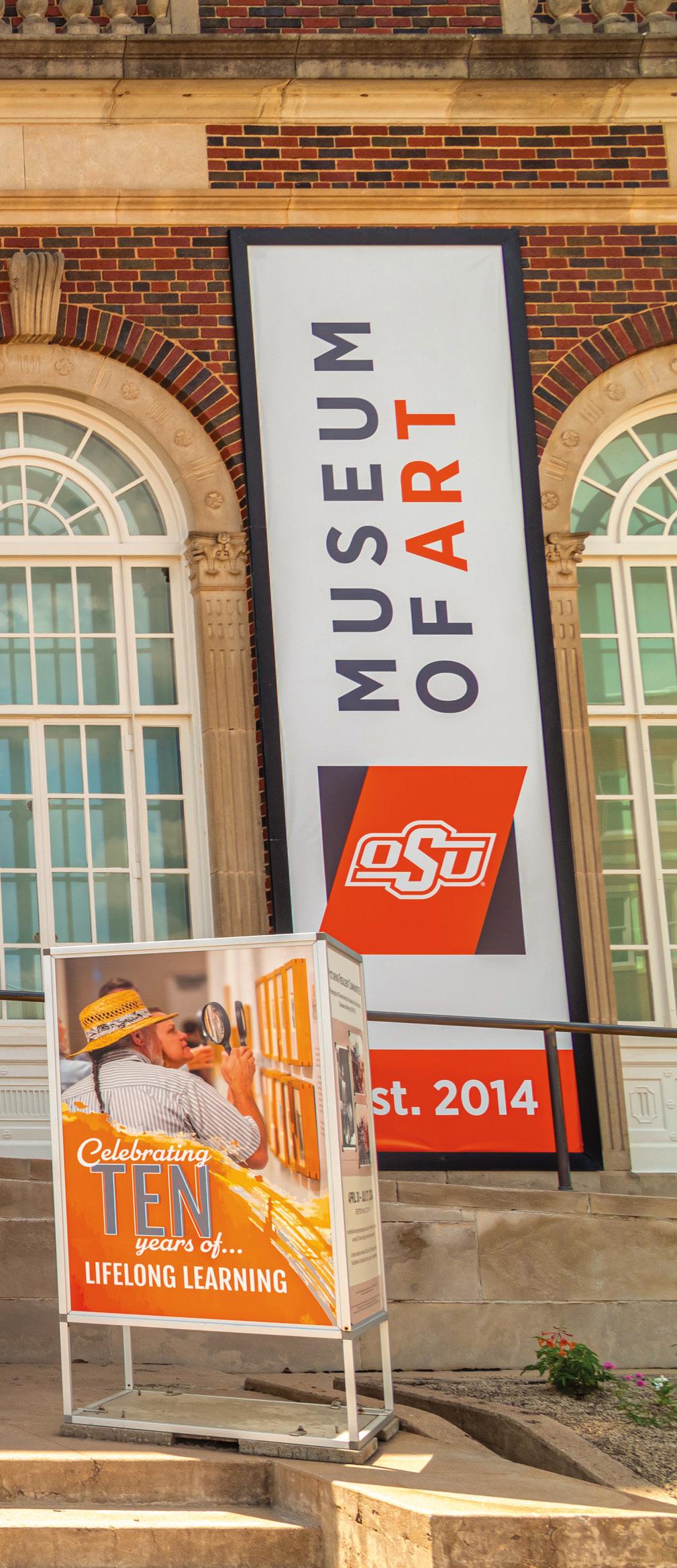
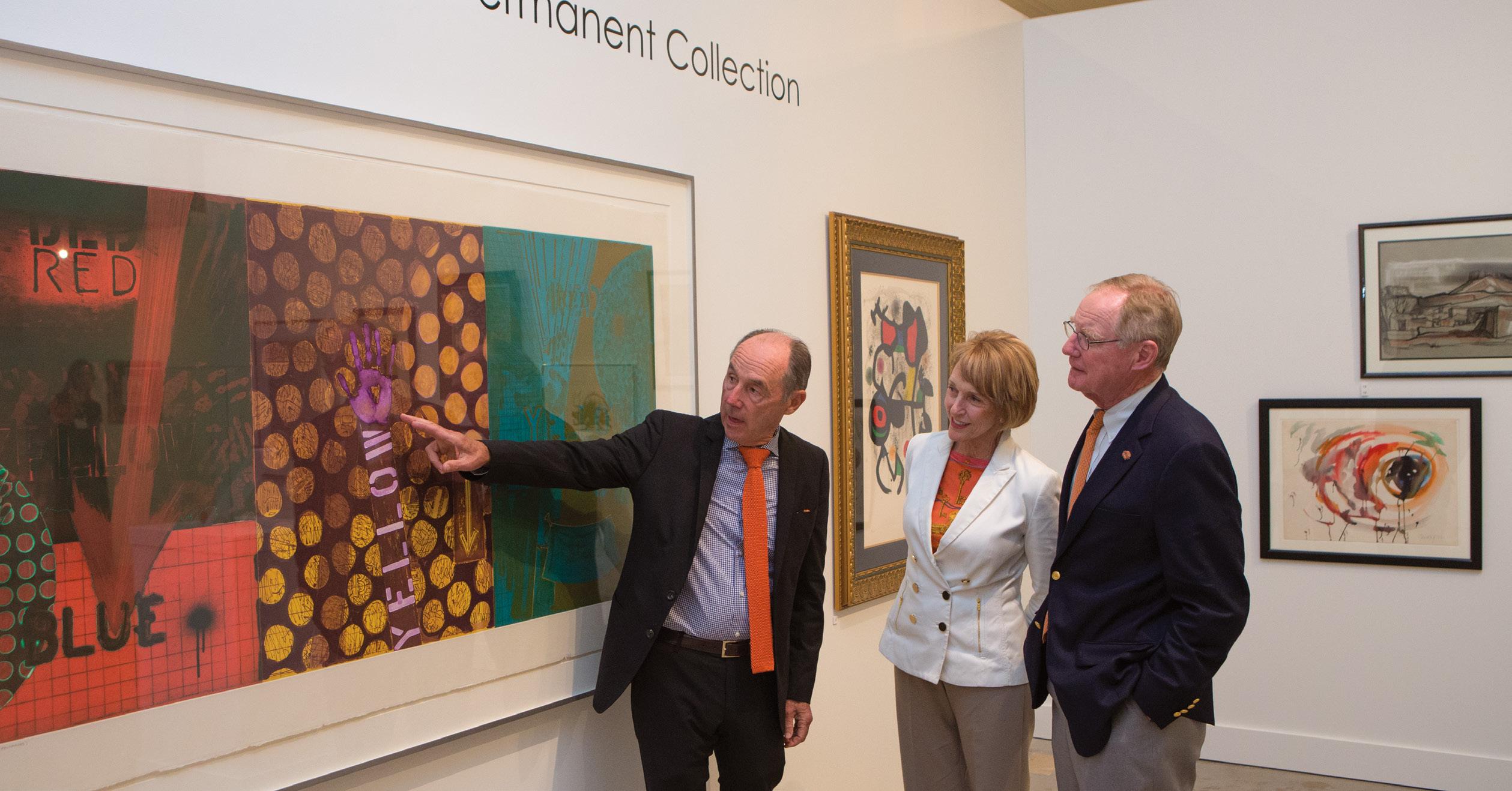
When the Oklahoma State University Museum of Art opened its doors to the public in 2014, it had a newly renovated building, a growing collection, a handful of staff and a lot of promise.
“Art is often made out to be exclusive, but we wanted to change that,” said OSUMA interim director Carla Shelton, who was hired in 2012 to plan and oversee the museum’s permanent collection. “Over the past 10 years, we’ve hosted amazing artists and
“Over the past 10 years, we’ve hosted amazing artists and shows that are accessible to audiences of all levels. It’s about exposure and bringing people together so they can have a conversation.”
Carla Shelton
OSUMA Interim Director
shows that are accessible to audiences of all levels. It’s about exposure and bringing people together so they can have a conversation.”
The concept for the museum began in earnest after former OSU president Burns Hargis and his wife, Ann, secured the help of two key alumni: Universal Limited Art Editions owner Bill Goldston and philanthropist Malinda Berry Fischer. Through their art world connections and expertise, the museum started to take shape with an advisory council and donated artworks.
“The motivation was to enhance the reputation of OSU as a comprehensive research university and to educate our students in art appreciation and encourage their creativity,” President Hargis said. “As a land-grant university, one of OSU’s missions is to share the expertise and discoveries on campus. An art museum would serve the citizens of Stillwater and the state, as well as the OSU community.”
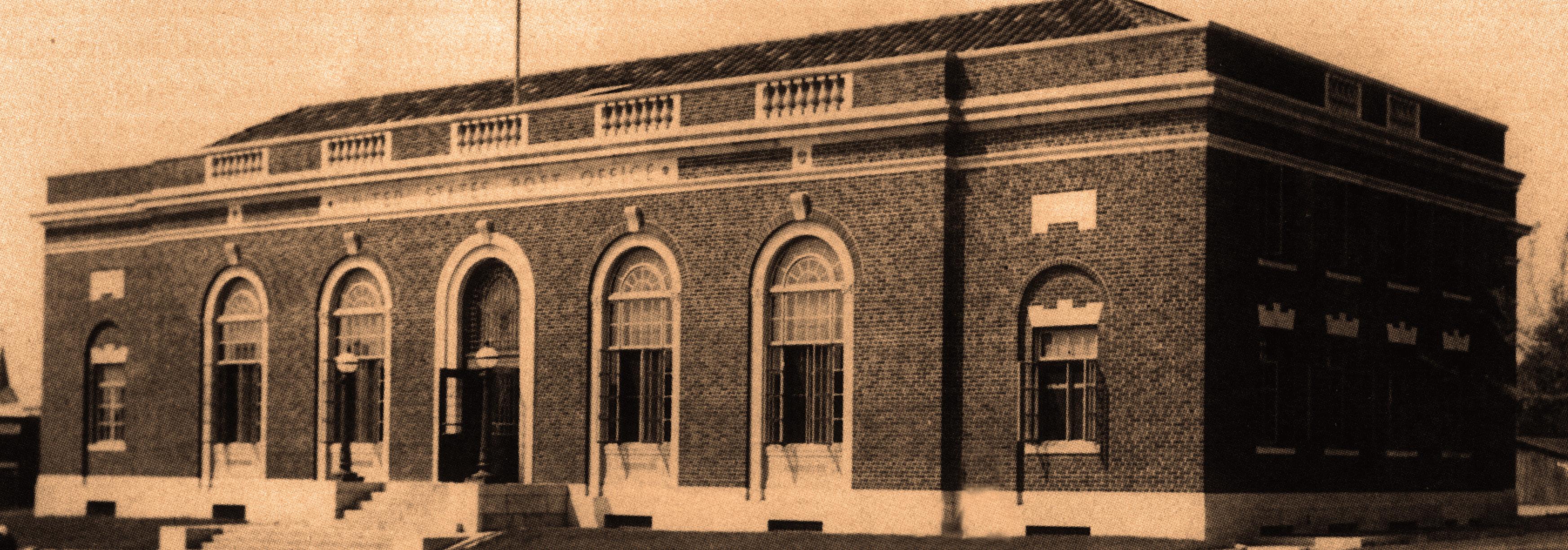
A significant step in establishing the museum came in 2010 with OSU’s acquisition of the Postal Plaza Building in downtown Stillwater. Built in 1933 as a federal post office, the building had been used as business and church office spaces since the late ’70s.
“I will not easily forget the hours spent working with campus facilities to manage the climate systems and the challenges inherent in having a
basement in Oklahoma,” said Vicky Berry, the museum’s first director, who retired this spring. “Revitalizing an old post office provided many challenges ... and yet we were able to marry the building’s character with its new purpose.”
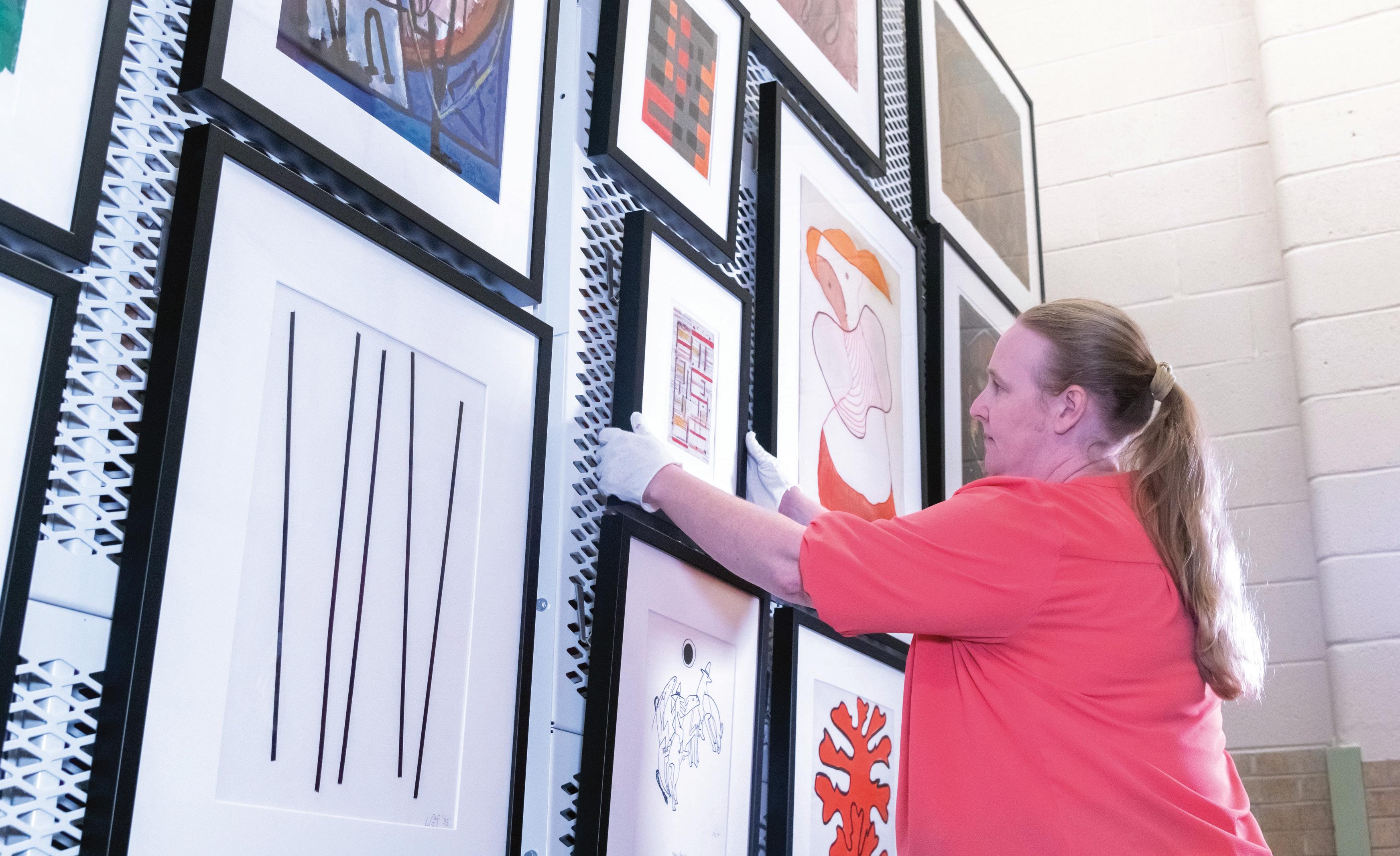
Once renovations were completed in 2013 — OSU grad and architect Rand Elliot designed and supervised the project — the museum team moved hundreds of artworks into the climate-controlled vault. The OSUMA permanent collection has since grown to more than 5,000 gifted pieces.
“We like to describe our collection as having breadth rather than depth,” Shelton said. “When it started, we received things from a lot of different people and a lot of different cultures. ... Now the collection process is more formalized, with a leaning toward modern contemporary.
“It’s important to understand that our collection is a teaching collection. The most exposure it gets is through vault visits and faculty bringing students behind the scenes. It changes the way people interact with objects when they’re not behind glass — the art is right there in front of them within arm’s reach.”
The museum and its collection act as a “physical support to the holistic education OSU offers our students,” according to OSUMA marketing and communications coordinator Casey Ihde.
“You can’t have thinkers of the next century without the creative fields,” said Ihde, who has been involved with the museum since 2011, first as an intern and then a full-time employee. “Simply being here allows people to engage with art a little bit more, to become interested and accepting of it. Students and the community are hungry for it now.”
Although the museum has a permanent collection, it doesn’t have a permanent exhibition like many larger museums. This allows its 10 full-time staff to create six to eight distinct shows every year, so there’s always something new for visitors to discover. Some shows feature pieces from the museum’s collection, while others are traveling exhibitions on loan from artists and galleries nationwide.
“Some of the freedoms of being a young museum is getting to explore and find ourselves,” Shelton said. “Some institutions are steeped in tradition and bound by different ties, but we’ve been allowed to experiment.”
Shelton and Ihde noted past exhibitions that included performance artists, immersive projections, blow-up art, extensive community engagement, interactive elements and more. Over the years, the museum’s growing collection and widening network paved the way for shows featuring artists like Robert Rauschenberg, James Rosenquist and Kiki Smith.
In 2017, the museum showcased works from the George R. Kravis II
Collection, which was gifted to OSU the next year.
In 2021, OSU faculty worked with the museum to create the first exhibition of work by Doel Reed, a renowned artist and former OSU professor.
And in 2023, the museum curated a Leon Polk Smith show exploring the Oklahoma-born artist’s abstract style alongside 20th-century design.
“Collectively, we have made experiences for our audiences more like a New York moment,” Berry said. “We had to build our facility and staff capacity to handle and present the art at the standard of practice required. ... The success of the museum and the support of the community and campus
made way for the arts to flourish at OSU.”
While there is a long list of museum highlights over the past 10 years, one accomplishment is especially gratifying for the staff: In July 2021, OSUMA received accreditation by the American Alliance of Museums, which is the highest national recognition given to U.S. museums.
“We took the museum from 10% to 100% in nine years by achieving accreditation from AAM. This is no small feat,” Berry said. “We acquired this status through hard work, the quality and collective experience of our team, and the overwhelming support of university leadership and our community.”
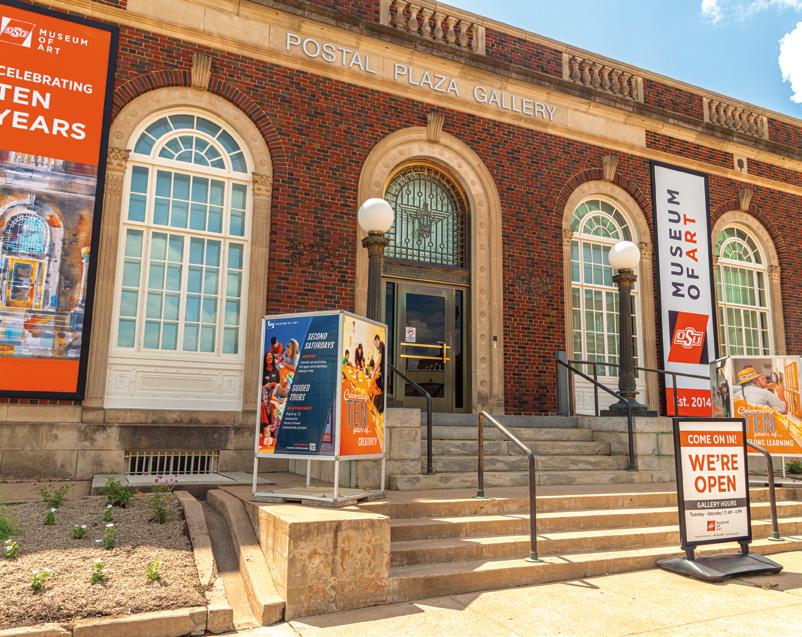
The Postal Plaza building that now houses the OSU Museum of Art was built with U.S. Government Treasury funds in 1933 to serve as a federal post office.
Bill Goldston and Ann and Burns Hargis were instrumental in the OSU Museum of Art’s establishment and growth.
The accreditation followed a yearlong self-study by OSUMA, capped by a three-day virtual site visit. During this same period — at the height of pandemic restrictions — the museum continued to provide art access through modified exhibition tours, outdoor art activities and take-home art kits.
“We realized early on, even before the pandemic, that we could provide a free, open space for creativity,” Ihde said, noting that their free Second Saturday events are especially popular with families. “This has taken many forms over the years, developing and growing as we have developed and grown, but we’ve made a conscious effort to get art in front of diverse audiences.
“Not that long ago, if you wanted to go to a museum, you had to go to Tulsa or Oklahoma City. And not only was that Stillwater, it was surrounding towns like Perkins, Yale, Cushing, Ponca City, so we bring it home for people ... and hopefully prompt lifelong learning and appreciation of art.”
With 10 years under its figurative belt, the OSU Museum of Art is looking
toward the future. Although there’s limited capacity for collecting more art — the vault isn’t infinite, and donors have been generous — OSUMA staff see it as “an opportunity to explore the permanent collection and bring in traveling exhibitions that serve the interests of academic programs and the community,” Berry said.
“The provost and the president are working toward strengthening the arts at OSU through collaborative programming and making connections across the curriculum and into the community. We expect the museum will play a large role in this goal to make the arts a permanent feature of the OSU experience.”
OSU Museum of Art FAST FACTS
Admission is always free!
OSU students serve as tour guides, assistant preparators and occasionally help curate exhibitions.
The museum’s permanent collection can be explored virtually through its Online Collections Database.
Stillwater-born artist
Yatika Starr Fields painted a mural inside the museum during the Postal Plaza Building’s renovation.
OSUMA education staff visit K-12 classrooms and host hundreds of students annually at the museum.
Scan to watch exclusive content about OSUMA.
Carla Shelton has myriad responsibilities as the OSU Museum of Art’s interim director, including overseeing the museum’s permanent collection.
Ready for Takeoff
Air Force ROTC welcomes Davis as first enlisted aerospace studies instructor at OSU
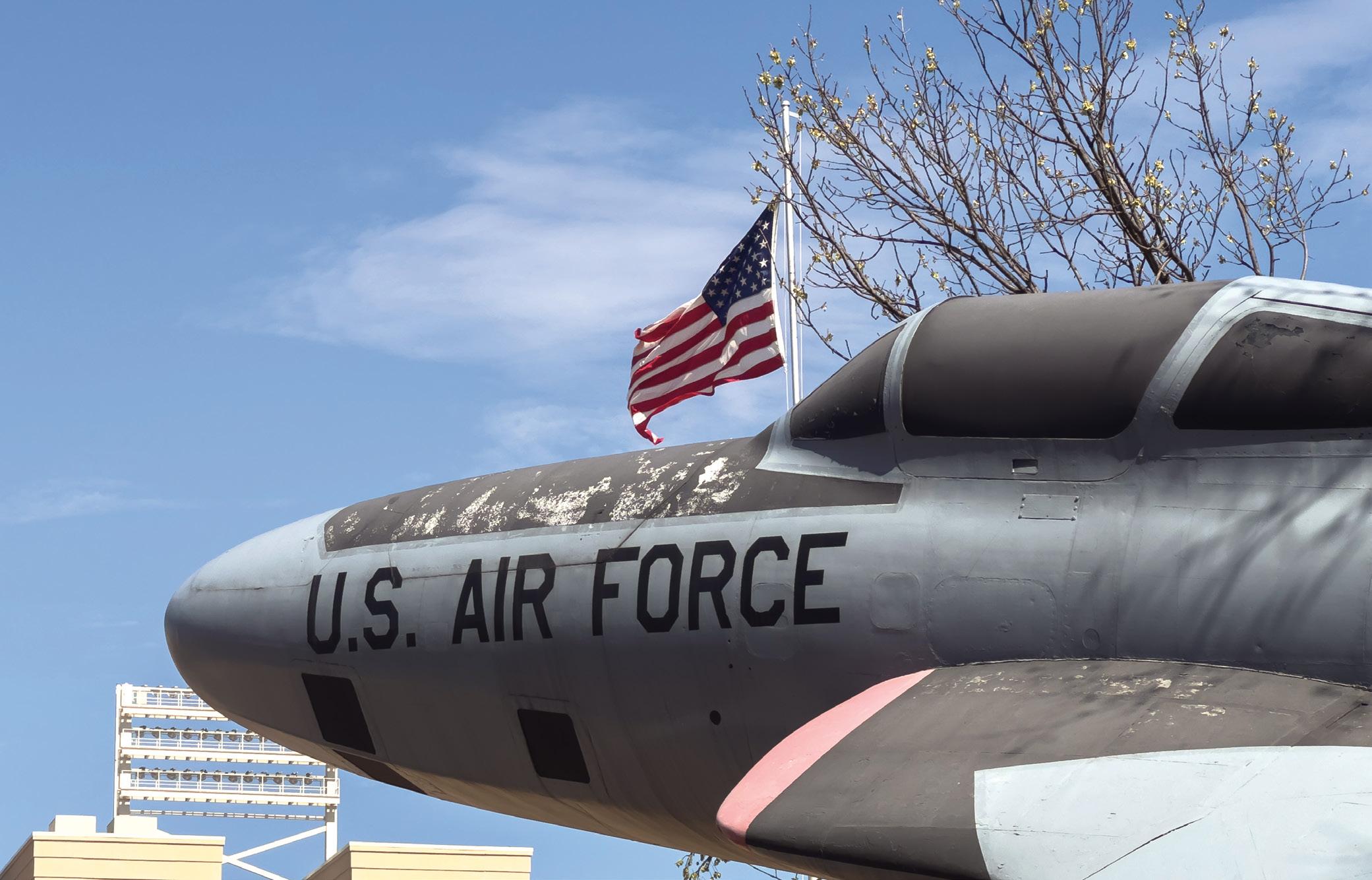
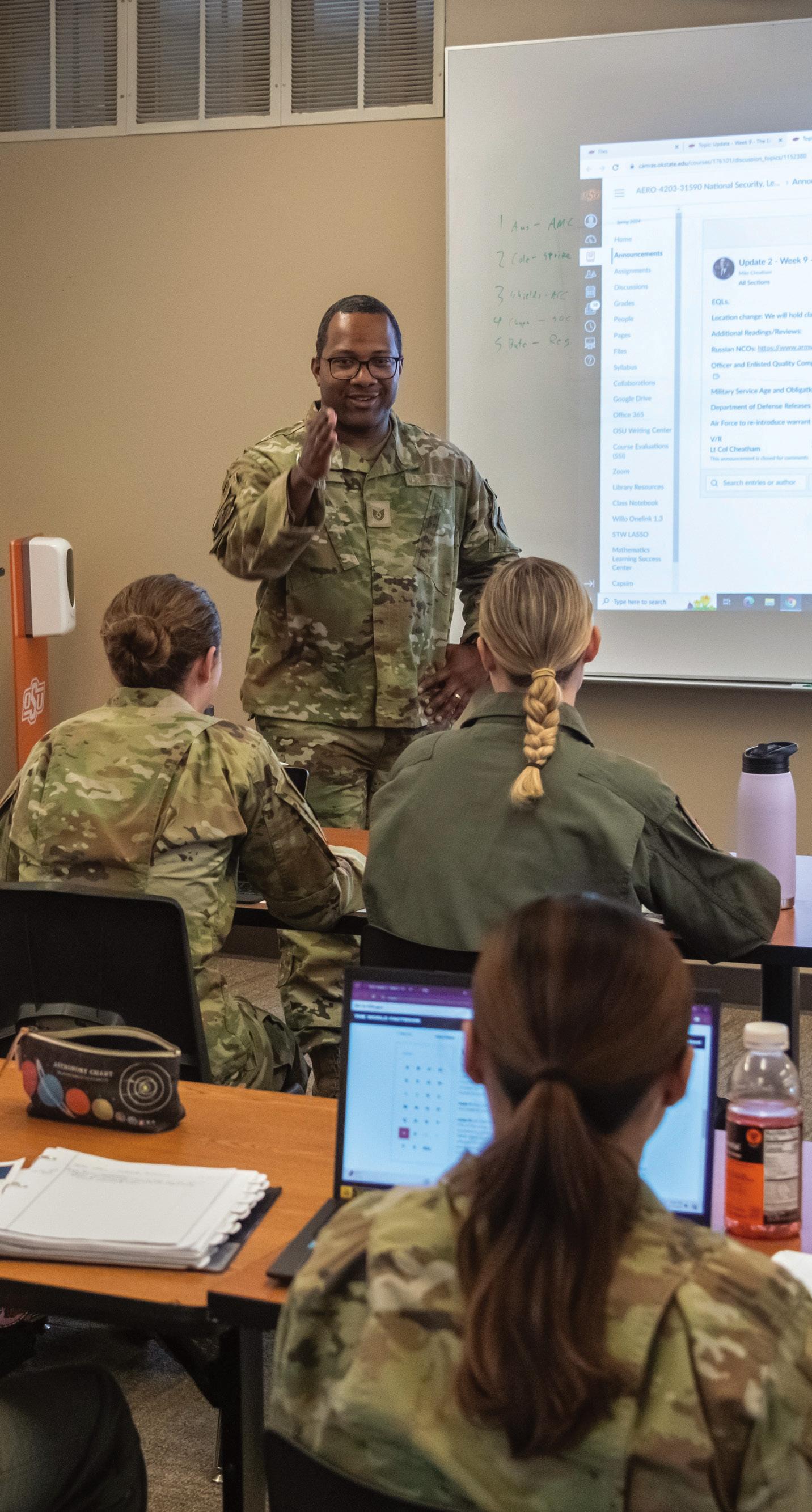
Tech. Sgt. Ephraim Davis, administration for ROTC Detachment 670, became the first enlisted aerospace studies instructor at Oklahoma State University in 2024.
The department has traditionally only had military officer instructors, but Davis holds the title of assistant professor of practice in this new role.
With 14 years of active-duty service in the Air Force as a non-commissioned officer in charge (NCOIC), primarily in a personnel role, Davis’ transition to an enlisted instructor emphasizes his commitment to career progression and leadership development.
“In this capacity, I lead future officers in the Air Force,” Davis said. “So, it’s a big deal for me to be able to coach, mentor and teach people who are going to outrank me one day.”
Davis’ special duty assignment reflects his passion for mentorship and teaching future officers in the Air Force. He created a program at OSU for cadets called Advanced Drill for this specific reason.
“Commitment, discipline, confidence and leadership are some of the key components I hope the cadets will take with them,” he said.
Davis explained that those components are emphasized in
Advance Drill: Cadets must commit to drill, even though it’s voluntary; cadets must exercise discipline while executing drill movements correctly — a practice that translates to success in future tasks; and cadets must build confidence.
As an officer in the Air Force, Davis expressed the need for confidence to gain trust as a leader. Without it, he said, leadership effectiveness is compromised.
In addition to drill, Davis is a hands-on administrator, ensuring the well-being of the students and the ROTC program. Although he is equally dedicated to the administrative side,
Davis ensures the cadets are enhancing their skills and personal development beyond the classroom.
“Tech. Sgt. Davis provides lessons that benefit future officers, as he knows what the enlisted core is looking for in their officers,” said Hannah Marion, a senior cadet at Detachment 670.
Davis views his roles as a mentor and instructor as complementary, acknowledging the significance of fostering personal relationships with his students to facilitate their growth. His students equally appreciate his efforts.
“Within the aerospace studies curriculum, Tech. Sgt. Davis has provided us with lessons about the enlisted core, their history, tradition and expectations,” Marion said. “Being an enlisted member himself, Tech. Sgt. Davis provides a perspective that is unique to the other professors at Detachment 670, as they are all officers. These lessons have further enhanced cadets’ understanding of leadership and the role of officers within the Air Force.”
Reflecting on his appointment, Davis expressed gratitude for the opportunity to contribute to the development of future officers. He emphasized the collaborative nature of the military, recognizing that success requires a collective effort from both instructors and cadets.
Davis embraces his role as part of a larger team working toward the common goal of producing exceptional leaders for the Air Force.
“It takes two to tango,” he said. “It takes the instructors and the cadets to work together to be able to make the cadets very good officers later on. It’s not on any one person. It’s how we all work together. The level of impact I have is based on the cadets’ response to my input.”
Tech. Sgt. Ephraim Davis teaches a group of Air Force ROTC cadets in his new role as an assistant professor of practice.
Scan to watch exclusive content about Tech. Sgt. Davis.
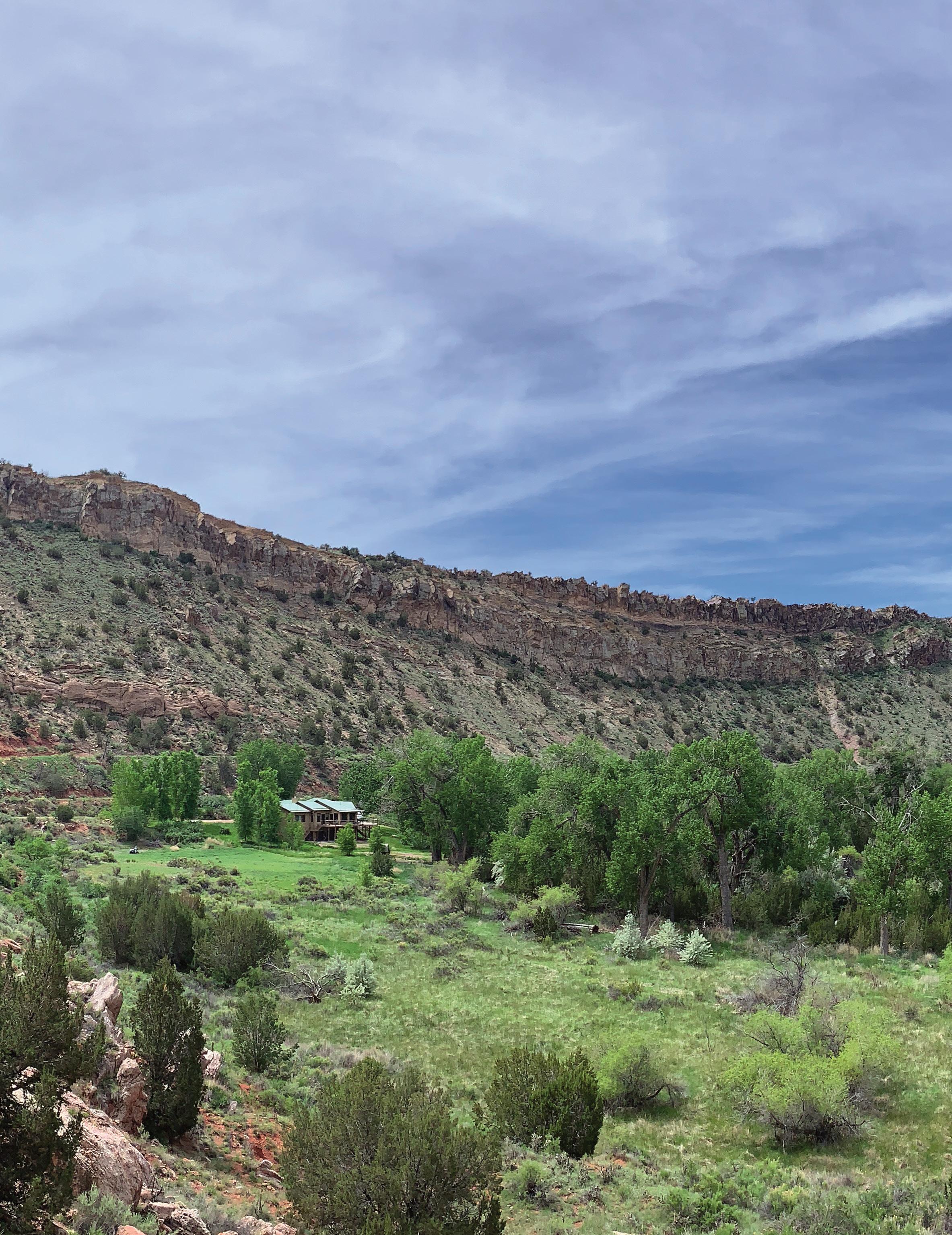
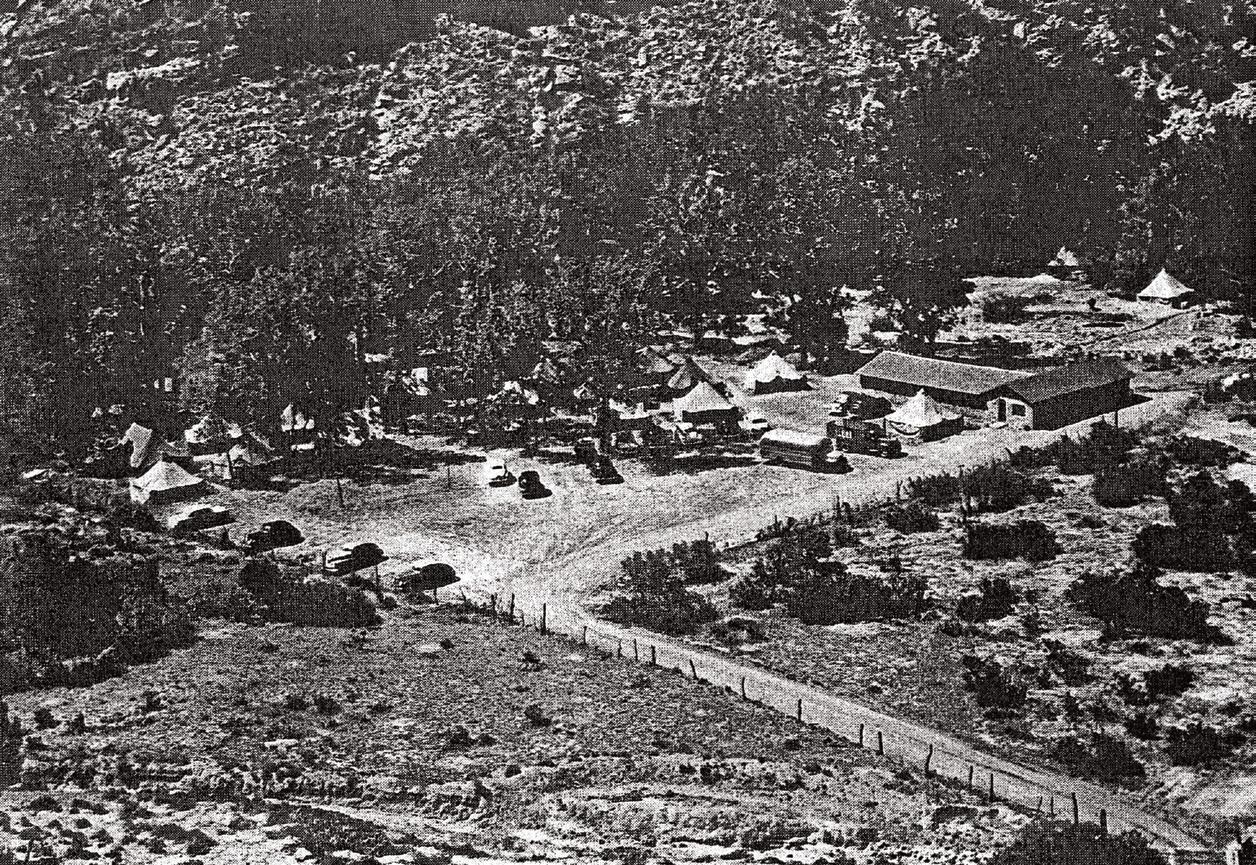
The Les Huston Geology Field Camp in the 1950s.
OSU GEOLOGY FIELD CAMP MARKS 75TH ANNIVERSARY
This summer, the Les Huston Geology Field Camp celebrated 75 years of providing hands-on experiences for aspiring geoscientists.
Since its establishment in 1949, the field camp has become a staple of Oklahoma State University’s Boone Pickens School of Geology. It has offered OSU students — as well as students from other institutions — the opportunity to apply their education to real-world field research and mapping projects.
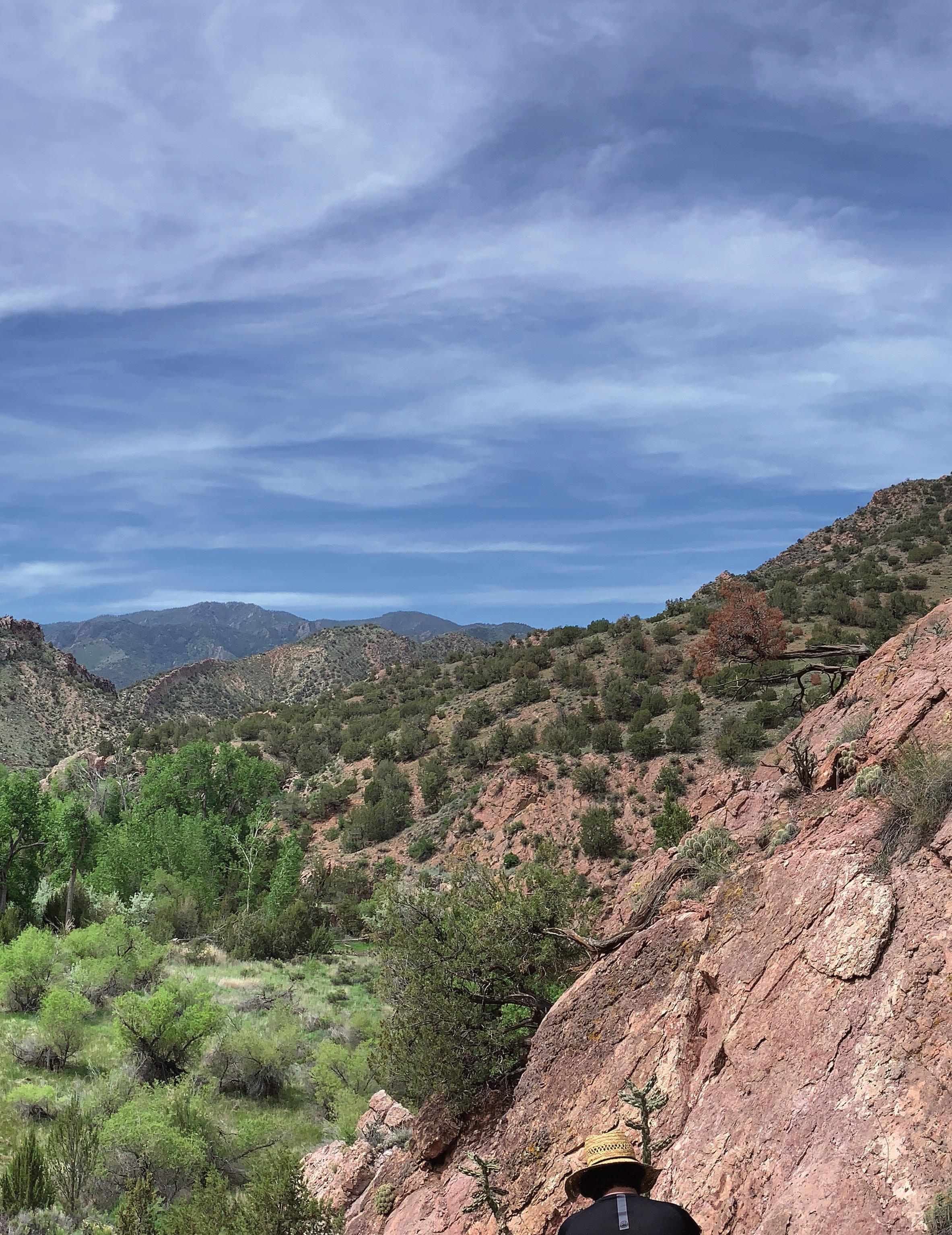
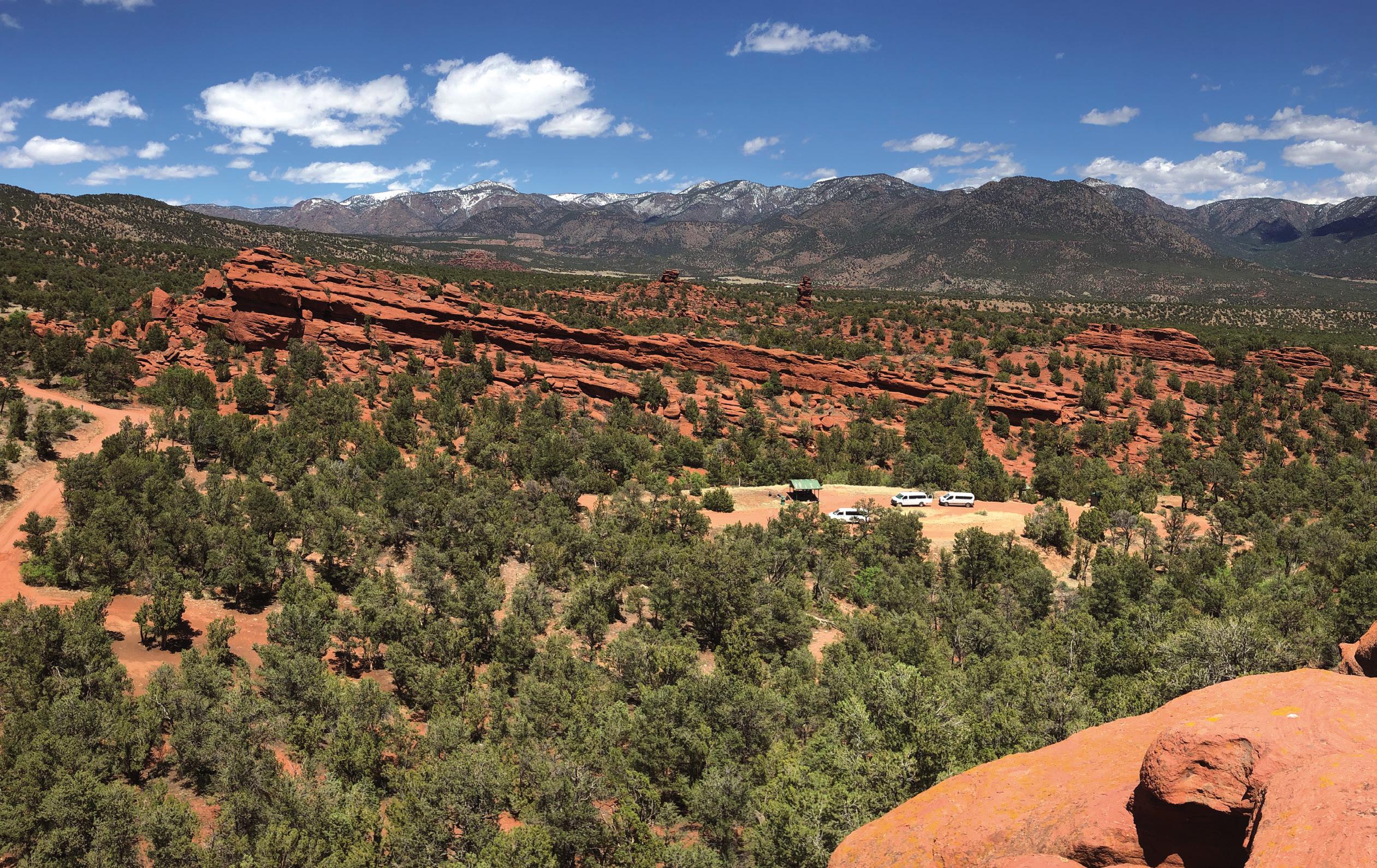
Students travel to Cañon City, Colorado, and spend five weeks putting their geological skills to the test. Among their activities, they conduct detailed geologic mapping, measure stratigraphic sections and hike Cañon City’s vast mountain range.
To commemorate the camp’s 75th anniversary, OSU’s BPSoG has initiated an update to not only the summer program, but the camp as well. With a plan in the works, incoming field camp director and OSU geology professor Dr. Brandon Spencer spoke about the vision he is working to implement.
“This year, we want to celebrate history, but also present our vision for the future publicly for the first time,” Spencer said.
Spencer has taught at OSU field camp for three summers. In 2022, he co-directed with Dr. Jim Puckette, an OSU geology professor who was field camp director since 1998, and then stepped into the director role in 2023 and 2024.
Spencer and the BPSoG alumni group plan to build a new camp facility within the next two years. They also intend to update the camp’s technological capabilities and insulate the buildings for year-round usage.
“We’re working with an architect in Tulsa called GH2,” Spencer said. “The idea is to make a functional facility that’s technologically capable. It will be a four-season camp and serve as a research station for other schools and universities to come into the area and do field work.”
This summer also marked Puckette’s retirement. Puckette attended OSU Field Camp as a student in the ’70s and has since become one of the longest-tenured professors to lead a field camp nationwide.
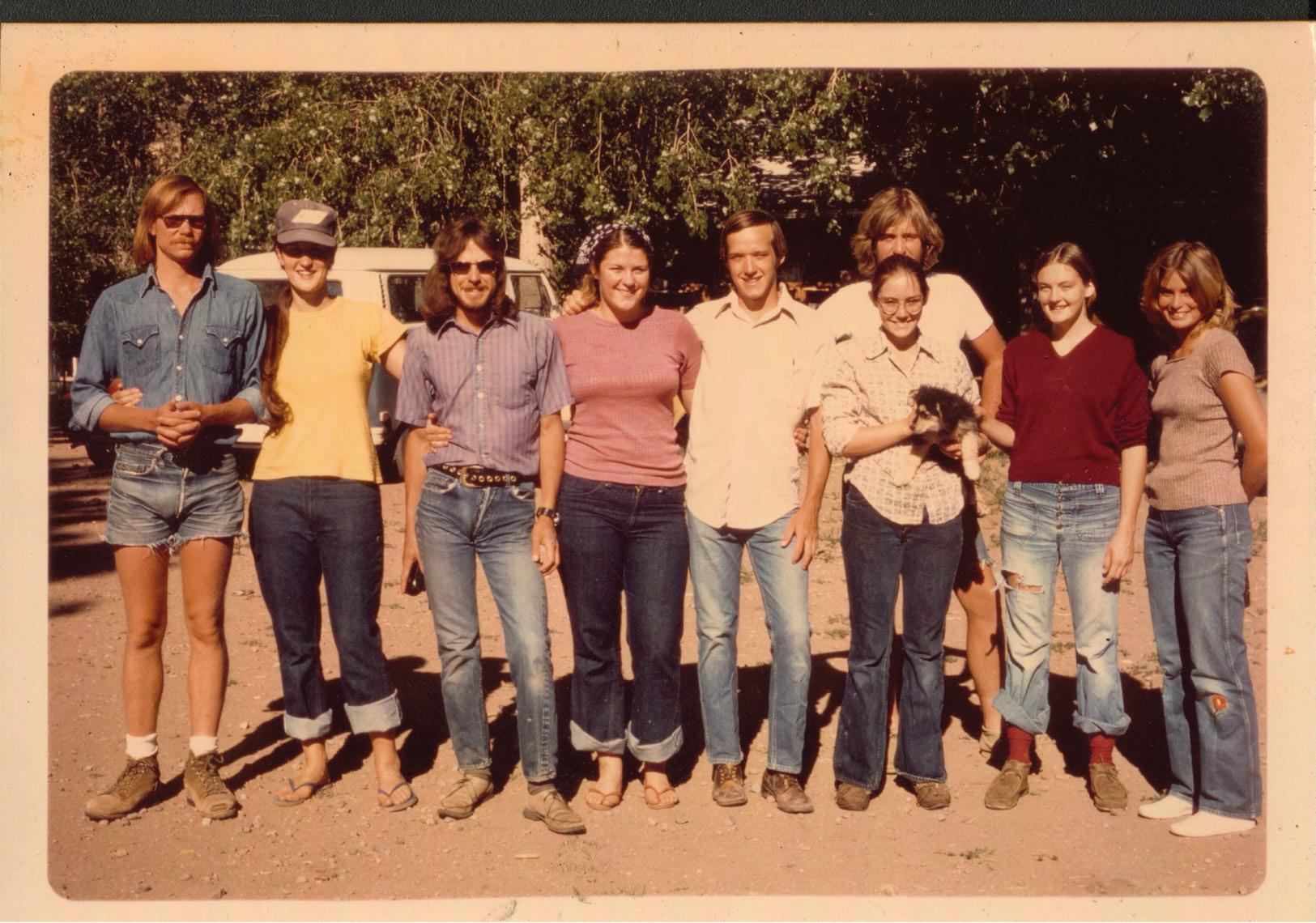
“When I completed field camp in 1975, it was one of those unforgettable life experiences,” Puckette said. “I was also fortunate to have teammates on group projects who were as passionate about geology as I was. All aspects of field camp were enjoyable: fieldwork, breakfast and supper … organizing informal field trips to see more geology, and the recreation, which consisted mostly of playing volleyball in camp in the evening.”
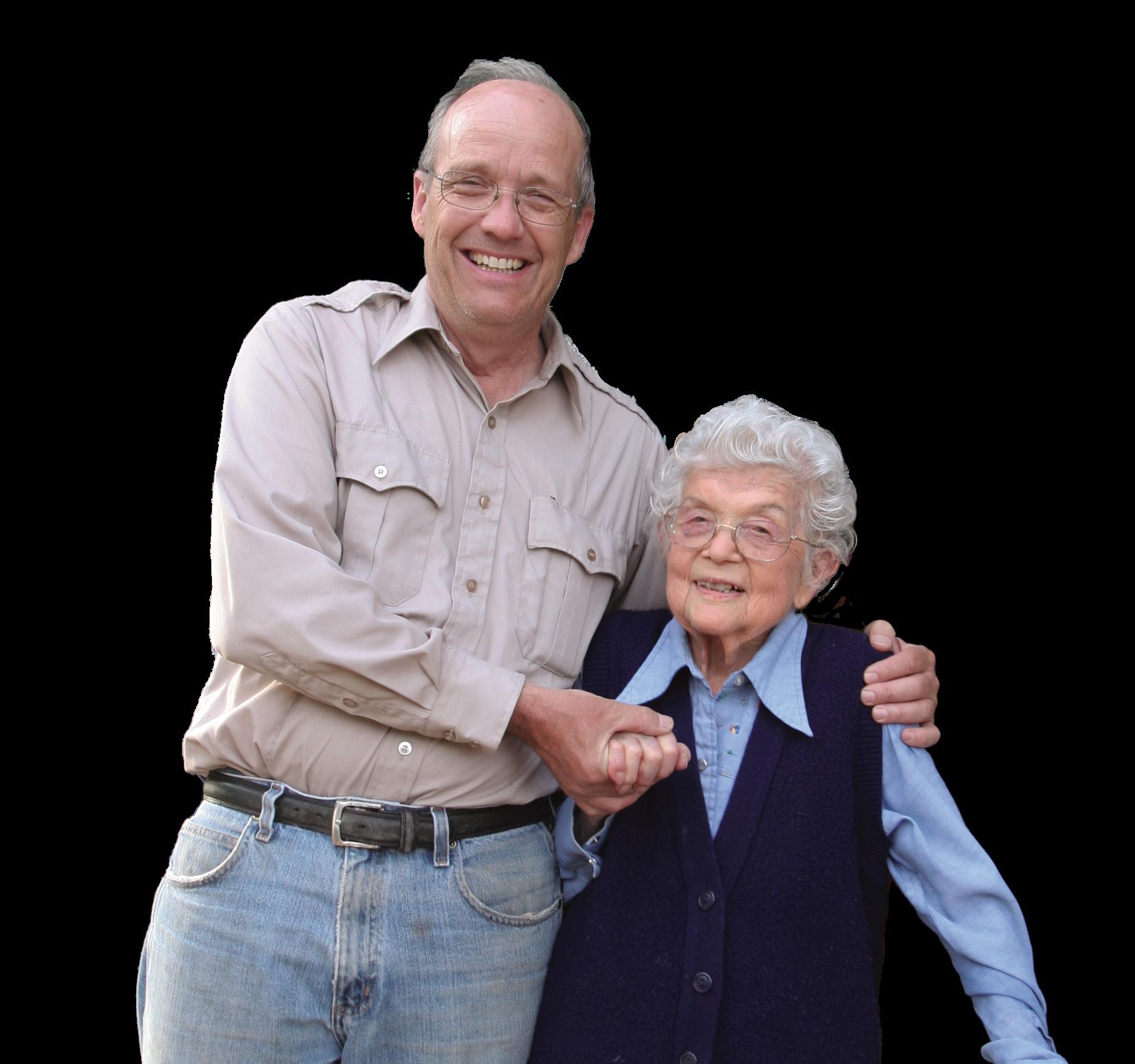
During his first summer at the camp, Puckette established a friendship with the camp’s namesake, Les Huston, and his neighbors who lived on the land where the field camp is located. Huston’s daughter, Tiny Striegel, told Puckette throughout their friendship
how important the camp’s research was to the local community.
“This relationship with our neighbors was more than social because during the severe drought season in the summer, the Eight Mile Creek dries up and our neighbors haul water from the camp well to use domestically and water their livestock,” Puckette said. “Through good times and the tough times, Ms. Tiny Striegel remained our most important benefactor and advocate. Tiny, like her father Les, looked forward each year to the day the camp opened.”
Until her passing in 2018, Striegel positively impacted OSU, her local community and generations of geoscientists. The university named her a matriarchal donor in 2019 to honor her contributions.
“Tiny was an essential part of field camp,” Puckette said. “She not only helped us with access to property in the area, but she was also our advocate for getting permits approved in Fremont County when we rebuilt cabins following the flash flood of 2006. Tiny loved the camp and the students. She visited often to read her poetry to the students and staff and visit with students and her friends and former neighbors.”
OSU professor Dr. Jim Puckette (center) attended field camp as an OSU student in 1975.
“Through good times and the tough times, Ms. Tiny Striegel remained our most important benefactor and advocate. Tiny, like her father Les, looked forward each year to the day the camp opened.”
Dr. Jim Puckette, former field camp director
Like Huston and Striegel, Puckette has been a key figure in the development of field camp — something he is excited to see continue under Spencer’s leadership.
“Field camp must evolve as geological science evolves,” Puckette said. “I am very enthused and supportive of the proposed camp improvements that can make the facility available for other disciplines outside of geoscience and extend the use of the camp into the spring and fall.”
Spencer said that taking over the field camp director role from Puckette was intimidating, as Puckette was recognized as one of the best field instructors in the country. However, Spencer intends to create his own legacy with the vision he has planned.
“I don’t think anyone can be the new Jim Puckette,” Spencer said. “So there’s pressure at times. Our alumni had Puckette as their field camp instructor 15, 20 years ago. There’s an expectation there that we’ll continue to run a quality field camp. But of course, it will be different. I’m making it my own.”
In his plan, Spencer will work to expand the marketing of field camp. He plans on introducing a few new concentrations to widen the pool of applicants.
“Going forward in the next three or four years, we’ll market ourselves not only as a geology field camp, but also a geophysics field camp and an environmental geoscience field camp,” Spencer said. “Running simultaneously in the same field areas or similar field areas, having everybody together, feeding them together, all within the same facilities will be really advantageous.
“With this, we can probably reach students that are environmental majors, environmental geoscience, environmental geology and engineering — fields where our students could use this field experience.”
The energy of field camp lies within the students, something both Spencer and Puckette agree on. They explained that the remote nature of the camp in Cañon City influences students to collaborate and create memories together.
“We want to see students having fun and making friends,” Spencer said. “Jim and I have talked a lot about keeping the spirit alive and living up to their expectations of field camp.”
Although Puckette is retired, he will still be present at OSU as an emeritus professor and mentor to the program.
“He’s not going anywhere, honestly,” Spencer said. “He’s passed the torch on, and we hope to have a great time out there for years to come.”
Scan to learn more about field camp, including how to get involved through giving.
American Dream
Professors cultivating civic education and engagement in rural Oklahoma
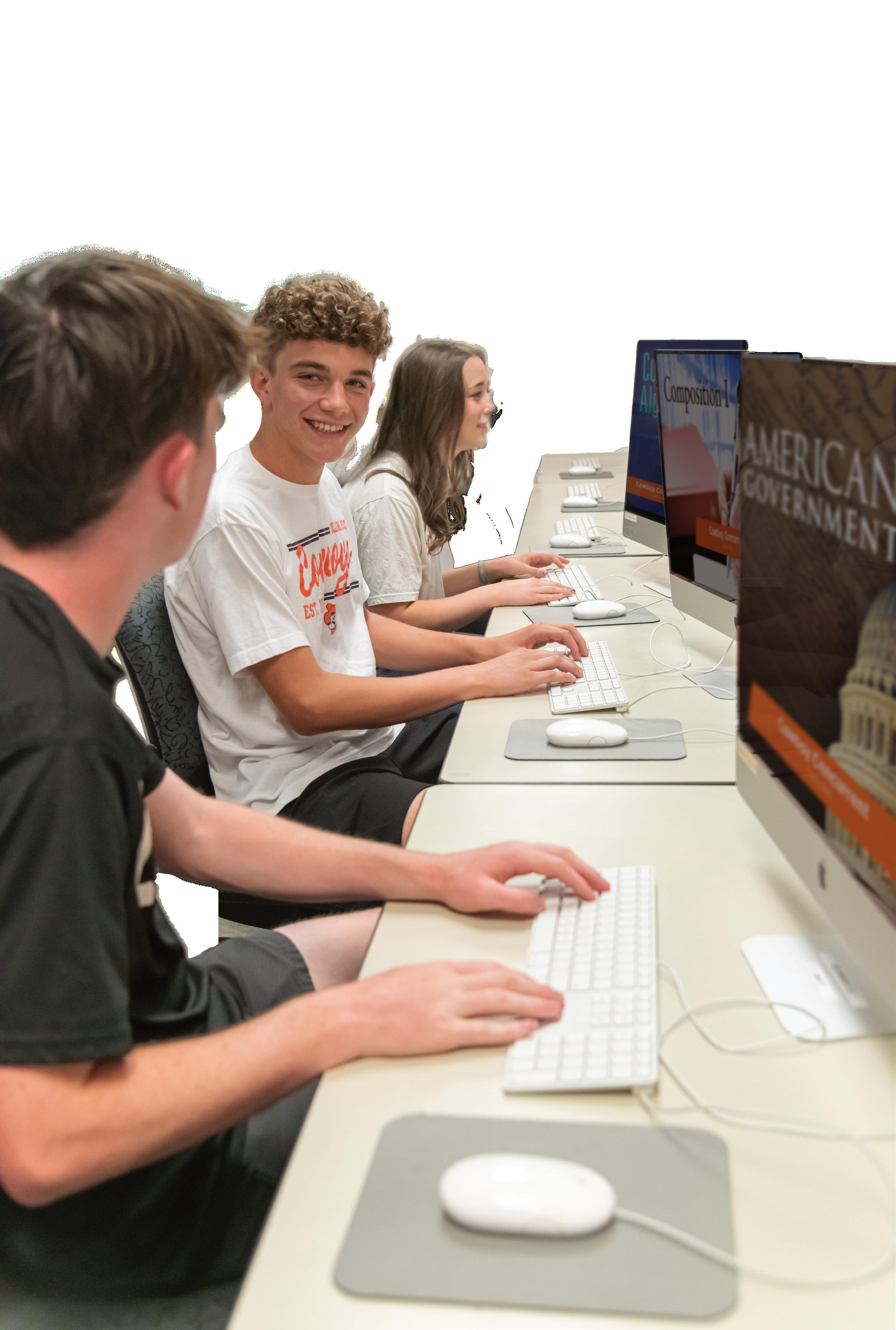
Drs. Eve Ringsmuth and Josh Jansa — two professors in Oklahoma State University’s Department of Political Science — have been awarded a Women for OSU grant to engage rural communities across Oklahoma in civic education through American government classes.
The faculty members are cultivating engaged citizenship through teaching and research, empowering students with the confidence and skills needed for active participation in politics and government. This approach deepens students’ appreciation for democracy by studying their experiences and tailoring classes to best teach them government and politics.
“We were excited to receive the grant funding,” Jansa said. “We intend to utilize it for providing textbooks and addressing internet access barriers for rural students across Oklahoma. This will enable them to take this impactful course online during their high school years.”
Ringsmuth said, regardless of major, all OSU students are required to take Introduction to American Government, which “allows us to study how a wide range of individuals encounter civic education and how it prepares them to engage in democracy.”
“Our study employs a two-way survey administered at the beginning and end of the class to measure students’ growth in knowledge and confidence,” she said.
Past research published by Ringsmuth and Jansa indicates that male and female students acquire knowledge from these classes, yet women exhibit lower confidence levels in their political skills.
“As they took the course, female students experienced significant
growth,” Jansa said. “We found that the course helped narrow the gender gap, motivating our project to identify and support other potentially marginalized groups — such as rural students — in becoming active citizens.”
The partnership with Women for OSU advances OSU’s landgrant mission, extending access to civic education to communities where physical attendance may be challenging. Additionally, the course utilizes engaging techniques to make learning materials relatable and increase student engagement.
“We’ve adopted active and interactive teaching methods such as weekly activities and engaging voting exercises to acquaint students with various voting systems,” Ringsmuth said. “The students have responded positively, expressing appreciation for the interactive approach. Additionally, they find value in reflecting on their learning during the weekly activities.”
By this fall, the team aims to recruit students from rural districts to enroll in the course offered through Cowboy Concurrent, an online dual credit program housed within the College of Arts and Sciences that gives high school students the opportunity to earn college credit from OSU. This will allow students to take the course with the assistance of high school counselors.
“Introduction to American Government is a remarkable opportunity for us as instructors to serve both Oklahoma and the global community,” Ringsmuth said. “It enables us to equip students from diverse backgrounds with the essential skills to engage and participate in American democracy.”
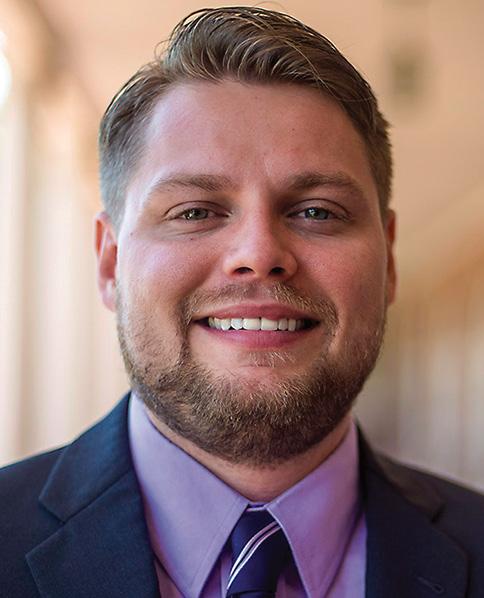
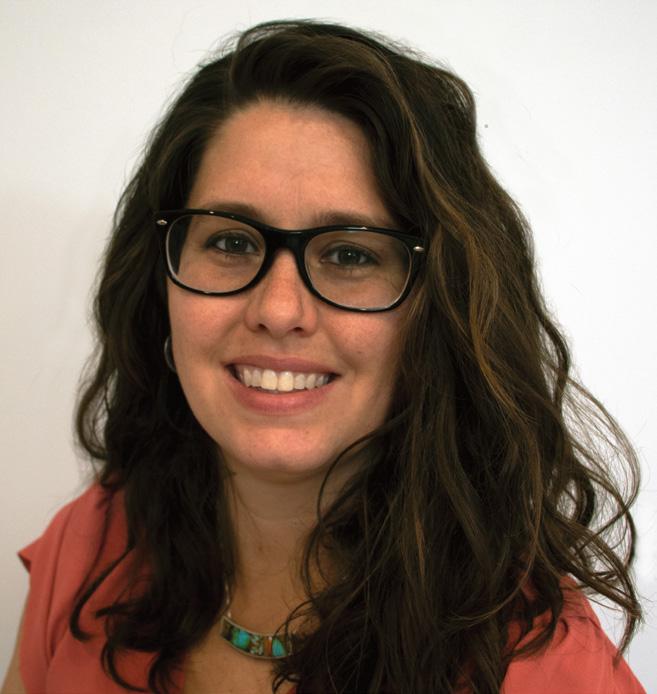
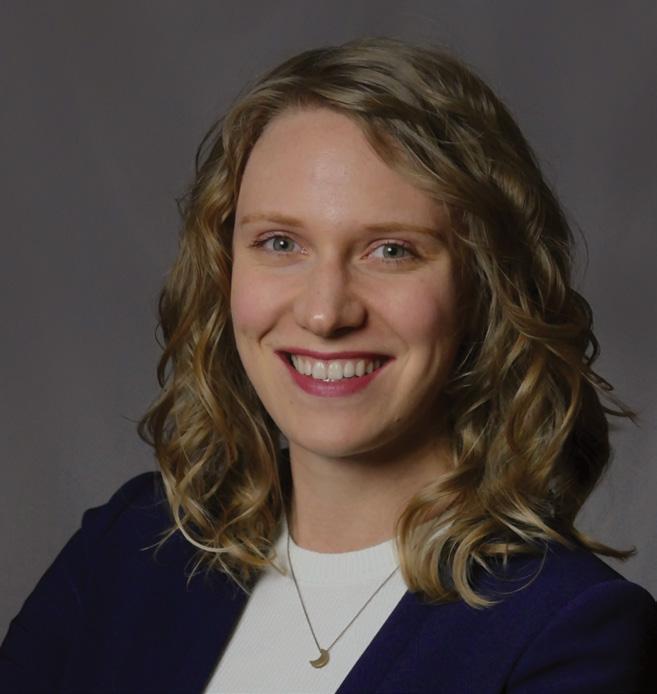
Dr. Josh Jansa
Dr. Eve Ringsmuth
QUENCHING OUR THIRST
CAS FACULTY RESEARCHING WATER, PROVIDING TRAINING TO NOURISH THE WORLD
Water management, access and treatment are key to the work Oklahoma State University’s College of Arts and Sciences’ faculty are doing to ensure communities have the resources to nourish the world for years to come.
OSU’s land-grant mission inspires the work CAS researchers are taking on. With that vision in mind, these individuals use their skills and knowhow to impact society’s sustainability — sometimes in unseen, but no less important, ways.
INVISIBLE WATER SOURCE
Dr. Todd Halihan, a professor and interim head of the Boone Pickens School of Geology, has been conducting water research within the geosciences at OSU since 2000. Halihan’s work centers on Earth’s subsurface, which is then applied to address groundwater issues.
“In the ‘good old days,’ we said, ‘Water comes in and water goes out,’ and we worked with that understanding,” Halihan said. “If you’re really going to understand the subsurface, you need to know where it’s going in, how it’s moving through and how it’s coming out because along the way, the water is going to undergo chemical, biological and physical changes. Sometimes those lead to good outcomes and sometimes bad outcomes.”
Halihan added that the ultimate question he seeks to answer is, “How are we going to provide and manage clean water for 10 billion people?”
In September 2023, Halihan was awarded $2 million from the Environmental Protection Agency to study the use and risks of enhanced aquifer recharge (EAR). Halihan and a team of researchers from OSU, the Oka’ Institute at East Central University in Ada, Oklahoma, and Texas State University in San Marcos are using EAR to improve groundwater availability and quality.
“We know the aquifer is declining,” Halihan said. “So, we’re looking at developing a system to get more water into it and not have adverse effects while doing so. And then taking it a step further to develop an incentive program of ‘invest this much to get this
much additional water and then we will pay this much’ to rally people around supporting the future of the aquifer.”
Having earned his bachelor’s degree from Monmouth University, a liberal arts college, Halihan learned early on to value collaborations between diverse fields of expertise.
“My work with water has led me to working with other faculty in disciplines you might not expect,” Halihan said. “I’ve worked with history professor Dr. Tonia Sharlach on how the Sumerians used water. I’ve worked with art professor Liz Roth to make cover art for articles, and she has joined me in the Bahamas on geological projects. A land-grant university gives us that opportunity to think about getting involved and trying to change the outcome.”
CONTAMINANTS AND PURIFICATION
Dr. Sabrina Beckmann, an assistant professor in the Department of Microbiology and Molecular Genetics, is addressing the need for clean water for household use and irrigation. She is working on projects that directly impact Earth’s water supply quality.
“Our lab studies microorganisms in anaerobic groundwater habitats for enhanced groundwater supply and health,” Beckmann said. “Most of these microbes don’t breathe oxygen as we do, but they can breathe a wide range of other electron acceptors like sulfate and nitrate, contaminants which are chlorinated compounds, or climateactive gases like CO2 and isoprene.”
In conjunction with Halihan, Beckmann is working to understand the impacts of EAR by studying microbes in the water within the Arbuckle Simpson Aquifer in southcentral Oklahoma. The Arbuckle Simpson Aquifer provides public water for municipalities and agricultural or industrial needs.
“The Arbuckle Simpson Aquifer is the primary — and often only — water source for at least 150,000 people,” Beckmann said. “We are analyzing the groundwater before and after implementing the EAR structures to prohibit and/or eliminate the inflow of microbes that cause a potential threat
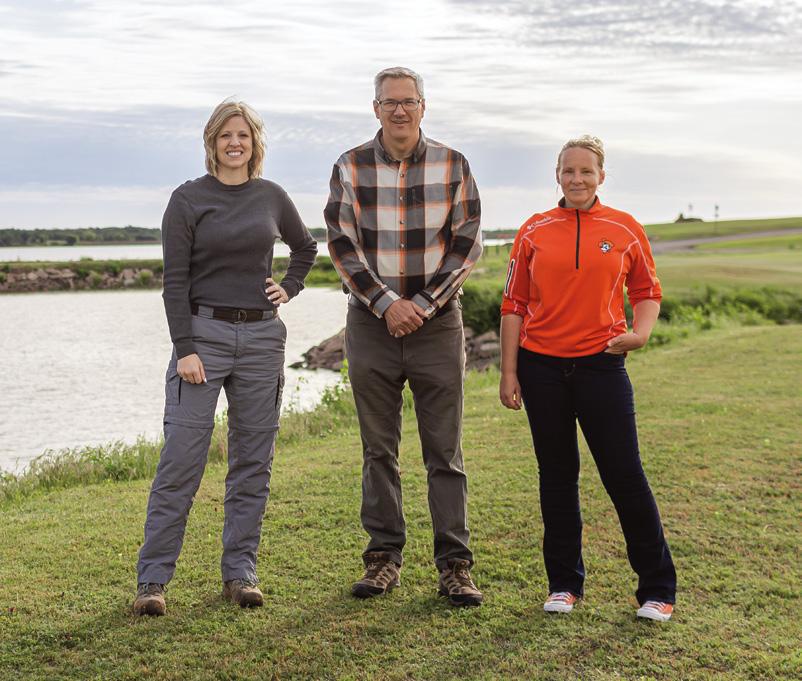
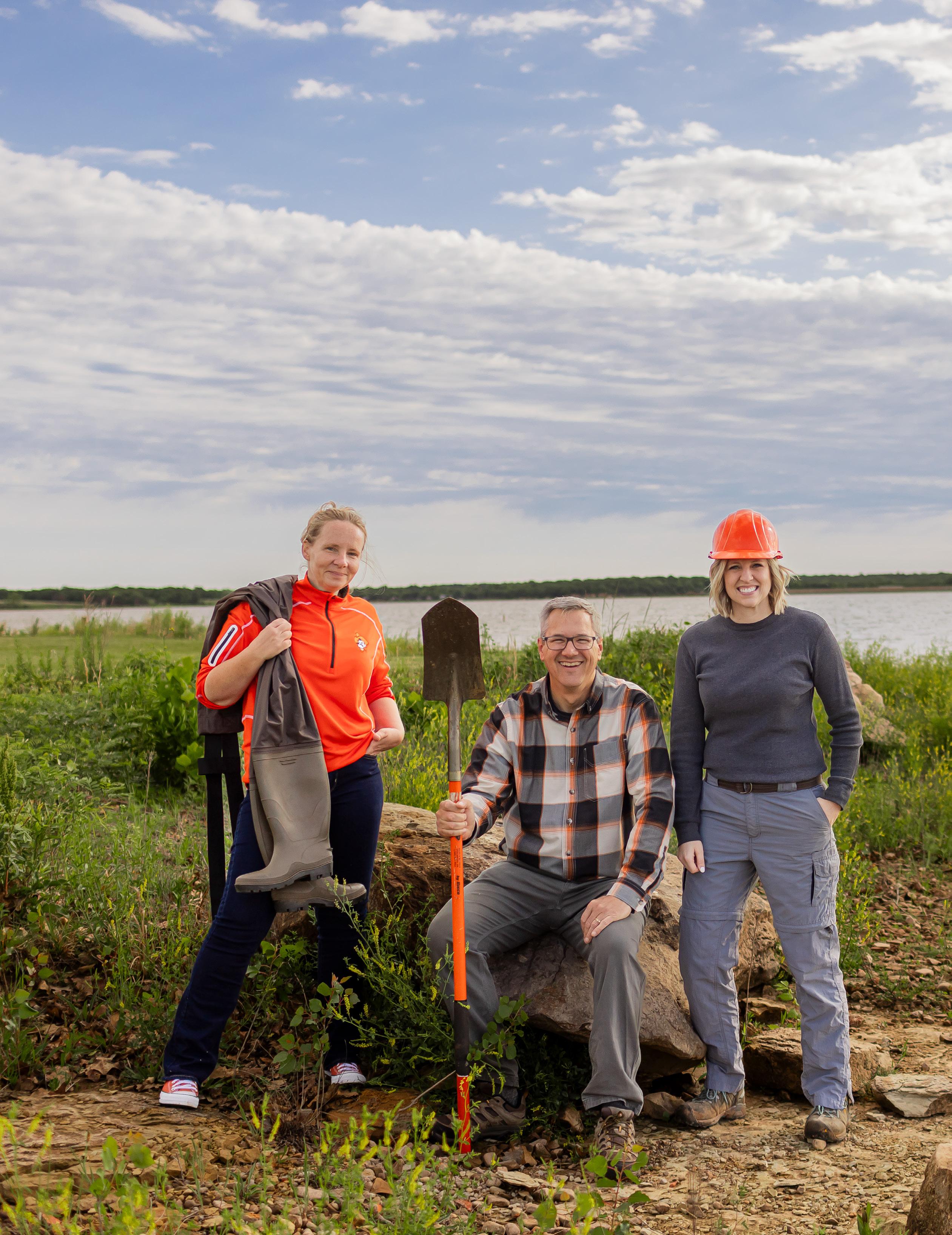
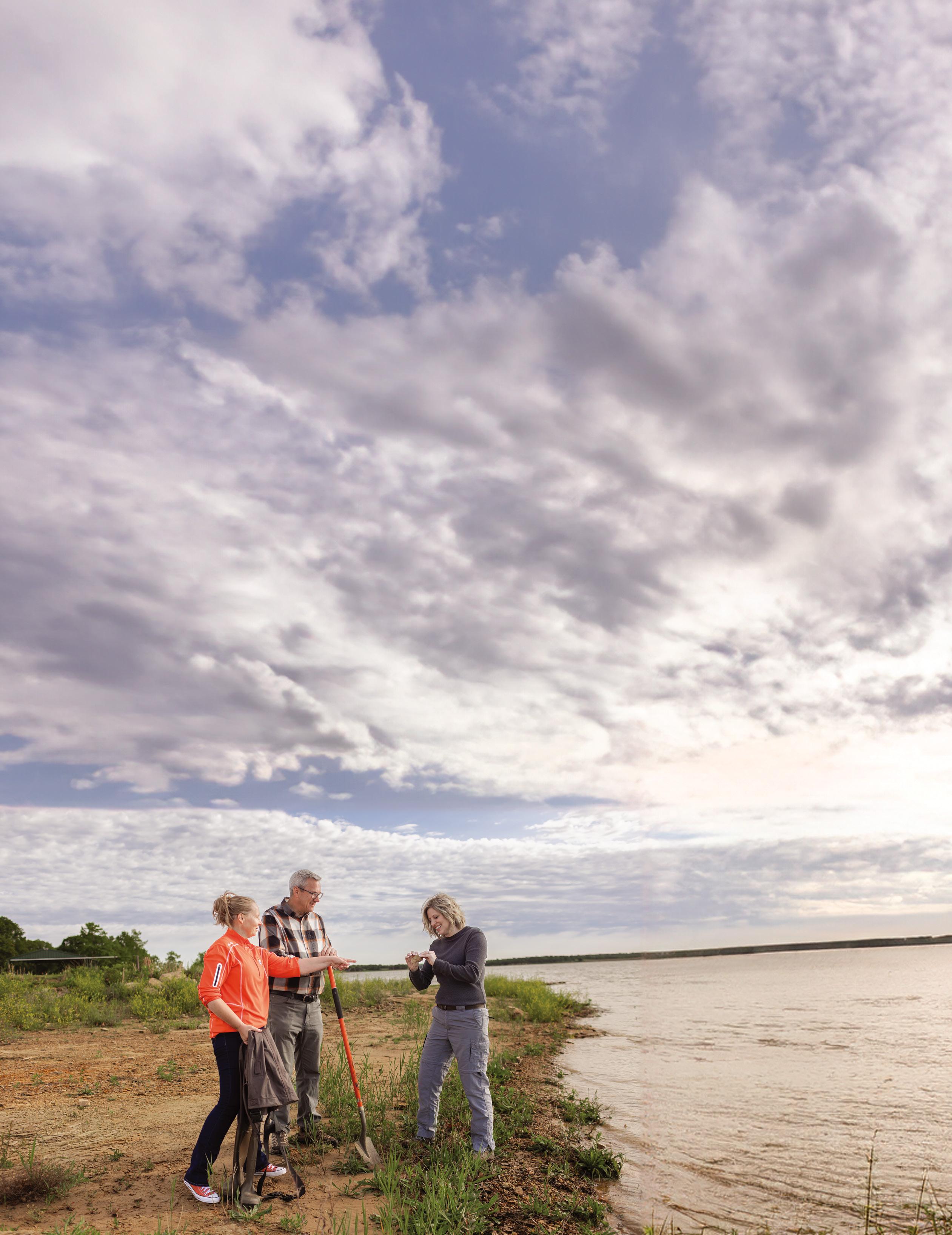
Drs. Sabrina Beckmann, Todd Halihan and Caitlin Barnes are among many CAS faculty working to improve and sustain the future of groundwater and groundwater careers.
to public health. A novel electrode monitoring system will tell us exactly what microbes are active and in what quantities in the groundwater.”
Beckmann said not all bacteria are harmful and that most bacteria can help prevent pathogenic bacteria from forming.
“If the bad guys take over, we can switch the buttons at the electrodes to eliminate them and make the good ones return,” Beckmann said. “We are developing guidance tools for the characterization and monitoring of these EAR structures with the overall goal of presenting a cohesive, comprehensive and accessible framework to assist water planners in determining the feasibility of costeffective EAR structures for their scenarios elsewhere.”
In the pursuit of clean water, Beckmann has also been working on sites with groundwater contaminated with hazardous halogenated compounds. Her goal is to use the good bacteria as probiotics for the groundwater to wipe out the compounds.
“If these specific bacteria are absent in the groundwater, we must search for them elsewhere, such as in different contaminated soil habitats, pristine river sediments, or even deep-sea oceans where trace concentrations of these compounds naturally exist,” Beckmann said. “Once we find promising bacterial candidates, we must understand their physiological needs and determine how to isolate and grow them in the lab, mimicking their future home — the contaminated aquifer.”
Once the perfect probiotic is found, harvested and grown in the lab, Beckmann and her team use the bioaugmentation process to pump the bacteria into the aquifer, where they will take over and eliminate hazardous compounds.
“Our lab specializes in growing microbes that live without oxygen, called anaerobes,” Beckmann said. “In this case, the bacteria breathe the chlorinated compounds instead of oxygen and dehalogenate them for example to ethene, which is nonhazardous for us.”
USING A GLOBAL PERSPECTIVE
Dr. Thomas LaVanchy, an assistant professor in the Department of Geography, is using his research to address global concerns both in the classroom, where he teaches about sustainability and water resources, and abroad, where he works to find adequate water across nations.
“The road to meeting global food needs is a shared path through water and water management,” LaVanchy said. “To solve the global food problem, it takes more food, and the water footprint to fill that growing demand is a growing challenge.”
LaVanchy has traveled to locations including Cape Town, South Africa, and Ghana to explore climate change’s impacts on agriculture and the sustainability of access to water as a resource.
“What a farmer could typically do to sustain their industry is changing,” LaVanchy said. “Now, they are needing to irrigate, and as priorities from competing industries are shifting,
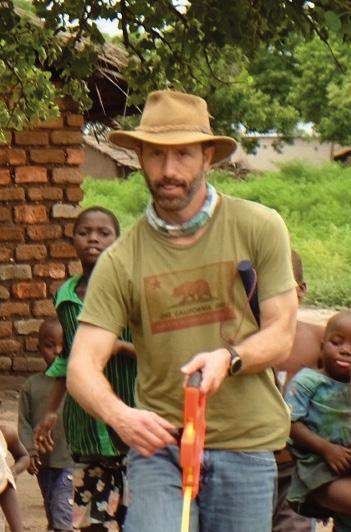
Dr. Thomas LaVanchy conducts geophysical surveying in Malawi.
we’re looking at supply issues and then the social aspect of who is sharing the burden of getting that water.”
LaVanchy said in 2018, Cape Town almost ran out of water. He was interested in helping residents be proactive to avoid future crises.
“Something cities sometimes struggle with is the waste from unhoused populations making its way to the water source,” LaVanchy said. “We’re working with populations to use nature-based solutions to clean the water and keep it clean enough to support drinking water and watering crops.”
As an instructor, LaVanchy said he aspires to help his students see the bigger picture in the world.
“Solving water problems is inherently inter- and transdisciplinary,” LaVanchy said. “CAS offers a variety of perspectives that can be partnered to solve these wicked problems.”
Groundwater research at OSU spans several disciplines. Faculty and staff from CAS Outreach, geology, microbiology and molecular genetics and geography are involved in expanding our knowledge of and access to groundwater.
ACCESSING THE FUTURE
The water below the surface is useless unless trained professionals can access it safely. CAS Outreach is leading the way in workforce development with courses and training materials to prepare future generations of groundwater professionals.
“There are several different positions within the groundwater industry that are needed to get the water to our faucets,” said Dr. Caitlin Barnes, director of CAS Outreach. “The more involved I got in conversations about the industry, the more I came to realize people don’t really even know this industry exists.”
Compounding this lack of awareness is the Department of Labor Statistics’ estimate that 130,000 geoscience positions will need to be filled by 2029. Amidst the shortage of workers, the industry is expected to also grow by 5% by 2031.
In response to these issues — and knowing the resources available at OSU — groundwater industry leaders approached CAS about building selfpaced courses taught by subject matter experts designed to prepare individuals
with varying experience levels to join the groundwater workforce. Barnes worked with Halihan in the Boone Pickens School of Geology, her CAS Outreach colleagues and the National Ground Water Association to head up NGWA University Powered by OSU. Now in its fifth year, NGWAU has provided training to people in 24 states and six countries.
Complementing the NGWAU workforce development program is Awesome Aquifer 360, a K-12 outreach program aimed at instilling an interest in earth sciences in the classroom. It has reached 387 schools, 42 states and more than 40,000 students.
“If we don’t have people filling these positions, we’re going to lose a foundational infrastructure across the nation that helps us access clean water,” Barnes said. “We’ve been accessing water for a very long time, and it is shocking that we could lose that knowledge because no one is paying attention to how we get water from point A to point B.”
To bring focus to groundwater’s essential role in providing clean water to communities, Barnes and her team launched a national public awareness
FROM DREAMS TO REALITY
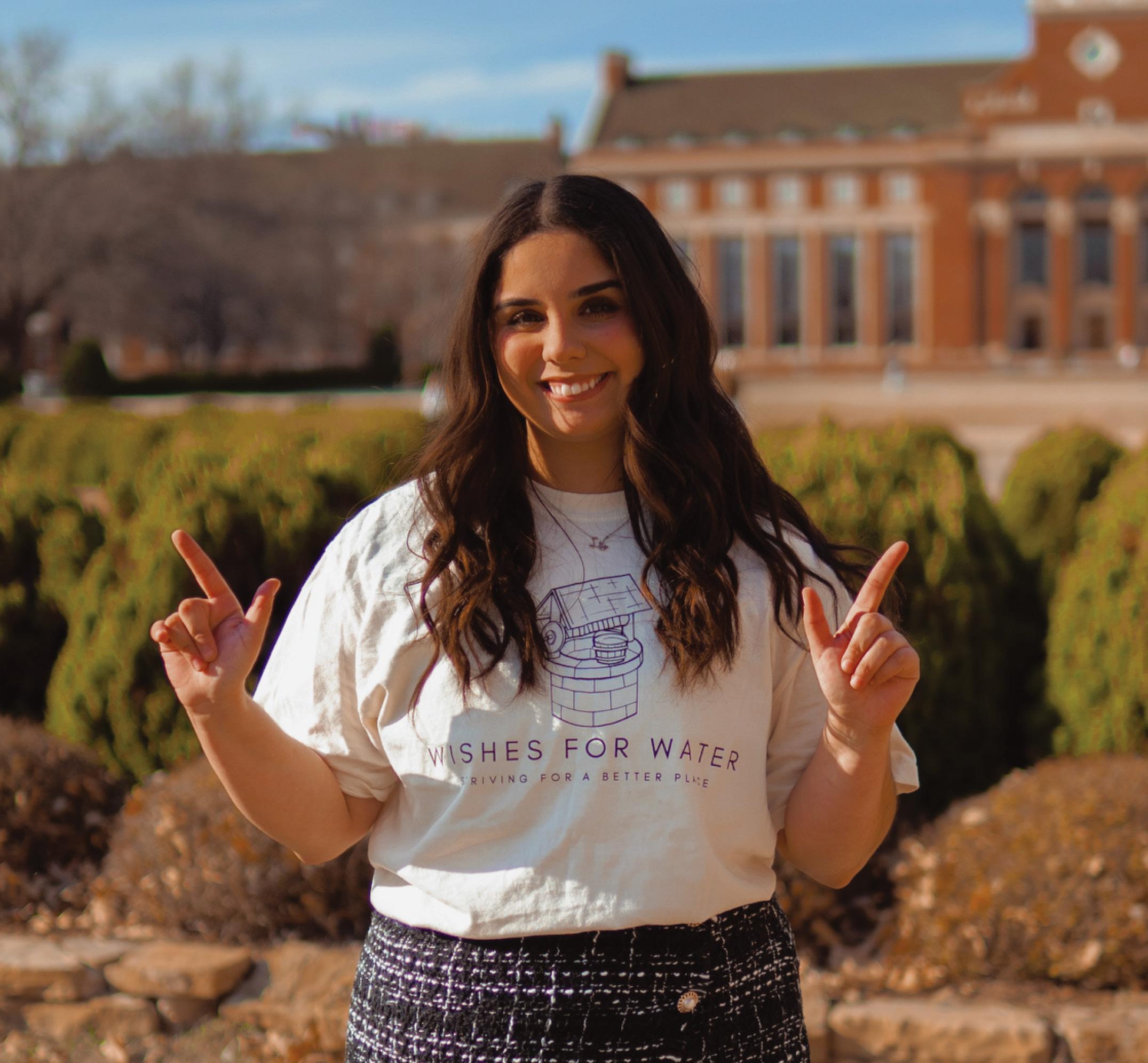
OSU alumna Lily Chavez, who was featured in the 2023 issue of Connect, has raised over $60 thousand for her nonprofit, Wishes for Water.
The organization has funded the drilling of three boreholes at Chivakanenyama Primary School in Zimbabwe and fenced in five acres of land for school gardens, complete with a new irrigation system.
campaign in February. The centerpiece PSA, which begins with a medical professional turning on the tap to find dirty water pouring out, has reached 56 million people in 46 states and 27 countries, airing on networks like CNN, HGTV, TNT and Discovery.
“It was important to convey that you don’t have a medical industry — you don’t have anything — without clean water,” Barnes said. “It has been exciting to hear from people who have seen the PSA organically and to see that they really are absorbing the message. People who are watching this can make an impact by telling their friends and creating that chain of awareness.”
Learn more about groundwater at OSU by visiting groundwater.okstate.edu.
SCAN THE QR CODE TO READ MORE.
CAS STUDENT SPOTLIGHTS
Within the College of Arts and Sciences’ 24 departments, there are countless scholars performing groundbreaking research. Here’s a glimpse of five students who — along with their faculty mentors — are proving why Orange is the Answer when it comes to solving problems and improving the world.
ZYNEYCEA DEFFENBAUGH
MAJOR | SOCIOLOGY CLASS OF 2024
RESEARCH MENTORS: DRS. JOSHUA JANSA AND REBECCA HERRICK WAGONER, OKLAHOMA
HOW DID YOU BEGIN YOUR RESEARCH?
I was unaware that you could do undergraduate research with professors as well as receive compensation for the work conducted. I began my research through a program called Advancing Undergraduate Research and Creative Activity. Through AURCA, I became a research assistant for Dr. Joshua Jansa and Dr. Rebecca Herrick in the Department of Political Science to evaluate “Race and Roadblocks Enclosed in American Voting.” This led me to apply for an internship with Dr. Parker VanValkenburgh from Brown University and Dr. Alicia Odewale from the University of Tulsa to map the historical traumas of the Tulsa Race Massacre.
WHAT HAS BEEN THE IMPACT OF YOUR RESEARCH?
Within Dr. Jansa’s and Dr. Herrick’s research, the focal point is centered on how registration can serve as a major conflict that can depress and discourage certain voters from participating in the process. Due to this, voting turnout is significantly lower among minorities as opposed to their white counterparts. To help enhance and create better voting procedures, five key registration laws are analyzed: Registration Deadline, Registration Portability, Online Registration Access, Ability to Preregister, and Automatic Voter Registration. I presented this research at the 2023 Undergraduate Symposium at OSU.
WHAT ARE YOUR FUTURE PLANS?
Since graduating in May, I am taking a gap year to focus on the LSAT and apply for law school. I also participated in the Oklahoma Legislative Fellowship Program during the summer.
MAX COE
MAJOR | ART HISTORY WITH A EUROPEAN STUDIES MINOR
CLASS OF 2025
RESEARCH MENTOR: DR. CRISTINA GONZALEZ MCKINNEY, TEXAS
HOW DID YOU BEGIN YOUR RESEARCH?
I originally began learning about how to complete art historical research in my classes. After completing several small research papers, I knew I was interested in completing more outside of class and possibly in my future career. When I heard about the AURCA program from another student, I knew it would be a perfect opportunity to gain more research experience and explore my passion for art history even further. I am so thankful I took the time to plan goals that would assist me in my future career. Because of this strategy, I have been able to intern at the Princeton University Art Museum, work under Sana Masood in the OSU Special Collections and work as a research assistant for Dr. Cristina Gonzalez in planning her New Mexico Museum of Art exhibition, “Saints and Santos: Picturing the Holy in New Spain.”
WHAT HAS BEEN THE IMPACT OF YOUR RESEARCH?
Researching the artwork and material for Dr. Gonzalez’s exhibition was not only extremely impactful to my skills and interest in art history, but also to the audience for the exhibition. Recently, I completed several saint biographies for the exhibition that will be published. I also had the opportunity to intern at the Crystal Bridges Museum of American Art in their archives and libraries this summer.
WHAT ARE YOUR FUTURE PLANS?
As an art history major, I have found a passion for working in archives and completing art historical research. So, after I graduate in 2025, I plan to secure a position in a library or archive environment. There, I will gain more experience in my field before pursuing a master’s degree in either library science or art history — or both. In my master’s program, I hope to complete research on the art of tarot cards and how they connect to femininity and sexuality.
JENSEN BRIDGES
MAJORS | MATHEMATICS AND STATISTICS WITH A PHILOSOPHY MINOR
CLASS OF 2024
RESEARCH MENTOR: DR. MELISSA EMORY BLANCHARD, OKLAHOMA
HOW DID YOU BEGIN YOUR RESEARCH?
My Calculus I professor first gave me an introduction to the world of academia through a conference she encouraged me to apply to. During this conference, I learned about Research Experiences for Undergraduates, or REUs. In the summer after my sophomore year, I moved to Embry-Riddle Aeronautical University in Daytona Beach, Florida, to complete an REU in data-enabled industrial math. Our project was assigned by the Department of Energy, and our goal was to predict the amount of plutonium created during the nuclear fuel cycle. This project was at the University of Texas at Tyler in the field of combinatorics, and I immediately found my niche in this work.
WHAT HAS BEEN THE IMPACT OF YOUR RESEARCH?
The work I’m doing is in pattern avoidance of permutations, a subfield of combinatorics, or the study of counting complex objects. Though it’s a field of pure math, combinatorics has many applications to computer science and network security. I have now submitted one paper from this REU for publication, and my group members and I are ready to submit a second one. I have also been given the opportunity to present both of these pattern avoidance projects at several conferences in Oklahoma, Texas, Georgia, Nebraska and California.
WHAT ARE YOUR FUTURE PLANS?
I interned at Chesapeake Energy this summer and am now beginning my Ph.D. in pure mathematics at the University of Florida. After finishing graduate school, I will continue to a postdoctoral fellowship and eventually a tenure-track position to become a mathematics professor, continuing my current research in combinatorics.
KWABENA FOBI
PH.D. | CHEMISTRY
THIRD YEAR
RESEARCH MENTOR: DR. RICHARD BUNCE
KUMASI, GHANA
HOW DID YOU BEGIN YOUR RESEARCH?
I was fortunate to spend a few holidays in my grandma’s village as a young boy. I was fascinated by how she used herbal preparations to treat various ailments. Although I was unaware of research at the time, I became interested in the idea of learning about this subject. My professor’s advice, motivation and biochemical research experiences during my undergraduate studies pushed me into an M.S. in chemistry at East Tennessee State University and then a Ph.D. program at OSU.
WHAT HAS BEEN THE IMPACT OF YOUR RESEARCH?
In our quest to discover drugs that can overcome resistance from bacteria, I have synthesized and characterized small molecules having the requisite functionality for perfect binding and interaction at the active site of bacterioferritin implicated in biofilm formation and antibiotic resistance. These antibiotics will serve as a new strategy to combat Gram-negative bacteria and biofilms. Additionally, I have developed a new domino reaction methodology for the synthesis of drug candidates and produced high yield quinoline, naphthol and lactam lead compounds via novel, optimized methods. I received the Gary Smith and Soon Han Scholarship for Outstanding Graduate Student, the OSU Foundation-Berlin Scholarship in Organic Chemistry, and the Boris Franzus Award for Outstanding Organic Chemistry Graduate Student.
WHAT ARE YOUR FUTURE PLANS?
My career goal is to become part of a community of experts in medicinal chemistry, drug discovery and development with the hope of helping humanity. I envision working in research institutions and pharmaceutical firms to design and develop new antibiotic and anticancer drugs. I also see myself in academia. Who knows where fate will thrust me.
GABBY GOMEZ
PH.D. | SOCIOLOGY
FOURTH YEAR
RESEARCH MENTOR: DR. JONATHAN COLEY
LEHIGH VALLEY, PENNSYLVANIA
HOW DID YOU BEGIN YOUR RESEARCH?
I began researching health care practitioners’ participation and experiences in the weightinclusive health care movement for my master’s thesis at Lehigh University. At that time, I analyzed transcripts of a popular weight-inclusive podcast named Food Psych. I am currently building on my master’s work through my dissertation research by interviewing weight-inclusive health care practitioners about their participation and experiences in the movement directly.
WHAT HAS BEEN THE IMPACT OF YOUR RESEARCH?
With my research, I aim to raise awareness of the weight-inclusive health care movement, as well as the efforts and experiences of the individual health care practitioners who make up this movement. While health scholars stress that top-down policy changes are needed to mitigate the injustice of medical weight bias and its adverse health consequences at the population level, too little attention has been paid to the bottom-up change efforts being carried out by health care practitioners themselves. I received the 2024 Faculty Council for Gender Equity Student Research award for my dissertation work and recently published an article about the barriers that health care practitioners face as they transition toward and carry out weightinclusive care in the journal Fat Studies. This summer, I presented my research at the International Weight Stigma Conference and the annual meeting of the Society for the Study of Social Problems.
WHAT ARE YOUR FUTURE PLANS?
My career goal is to work in an institution of higher education as a sociologist.
SPEAKING
CRO
COMMUNICATES HOLISTIC VISION FOR COLLEGE AS SHE BEGINS TENURE AS NEW CAS DEAN
STORY ELIZABETH GOSNEY
| PHOTOS
JASON WALLACE
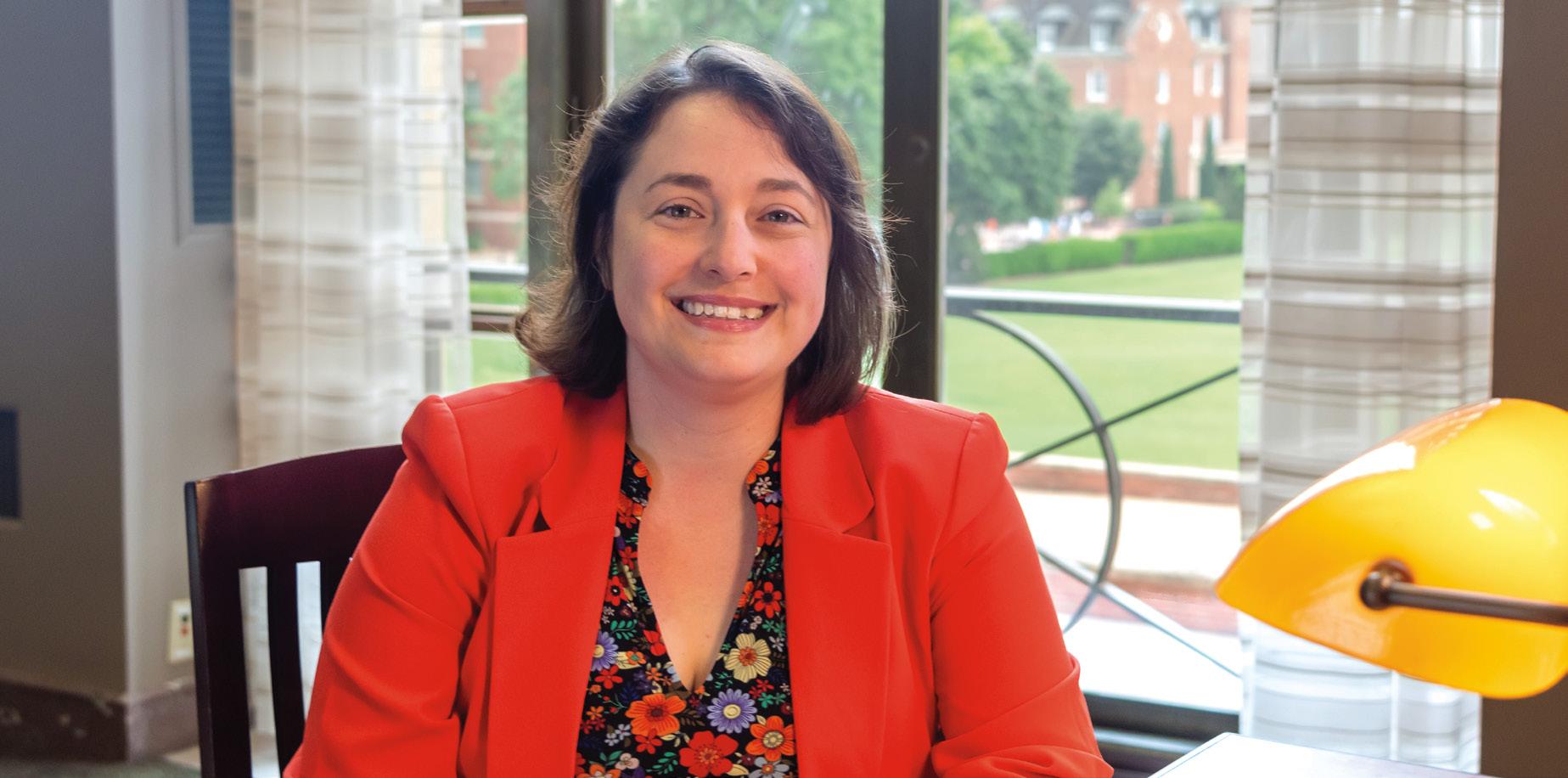
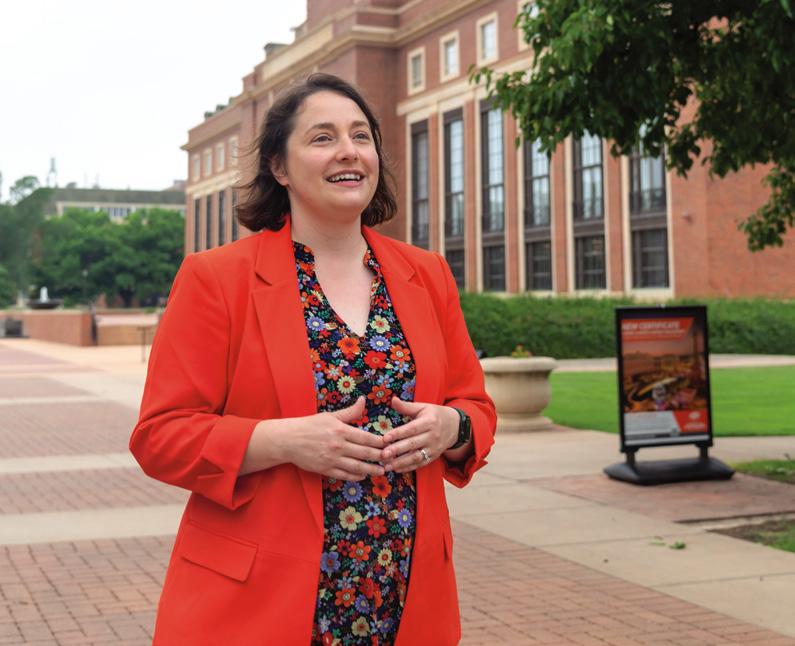
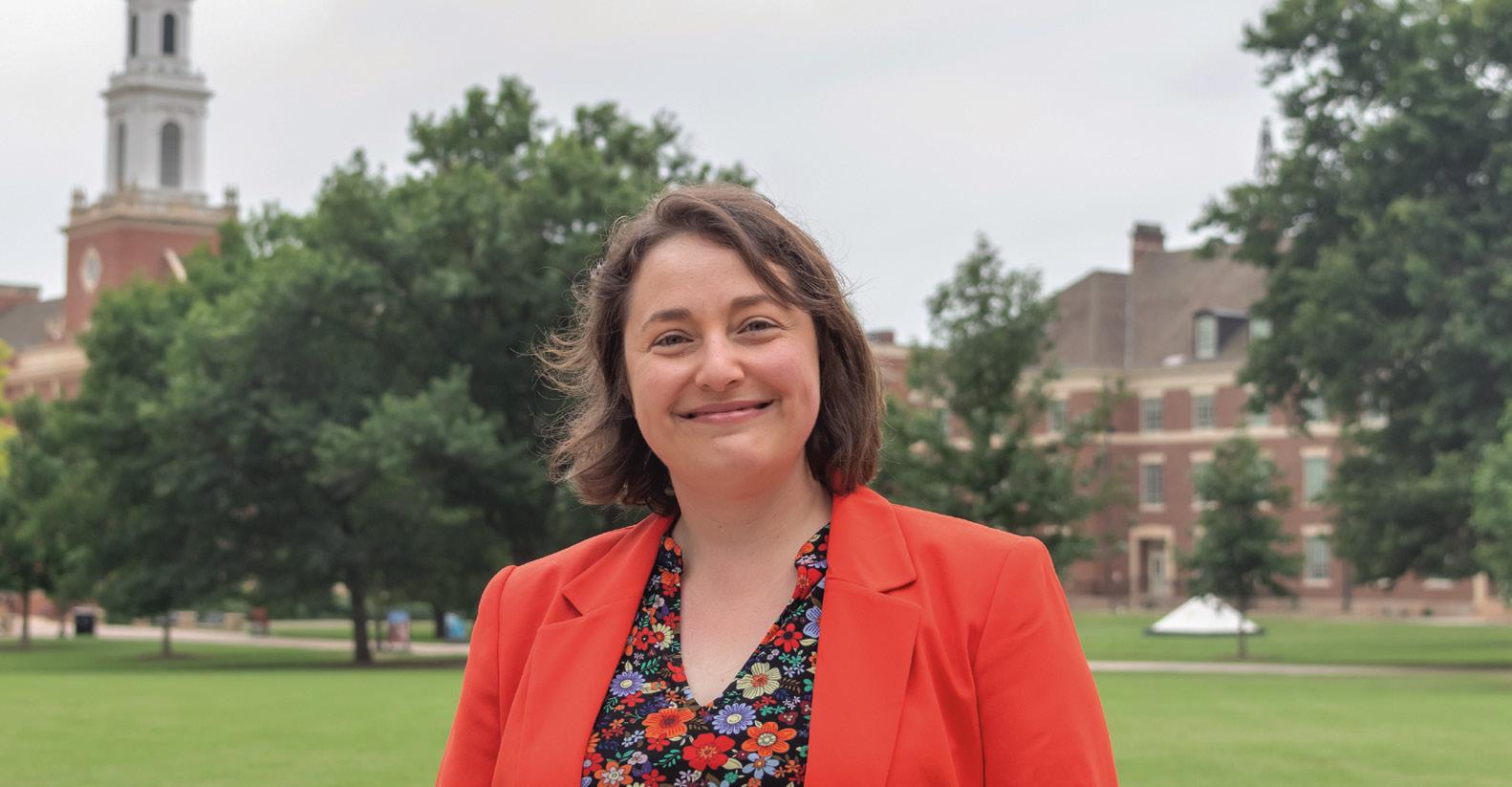
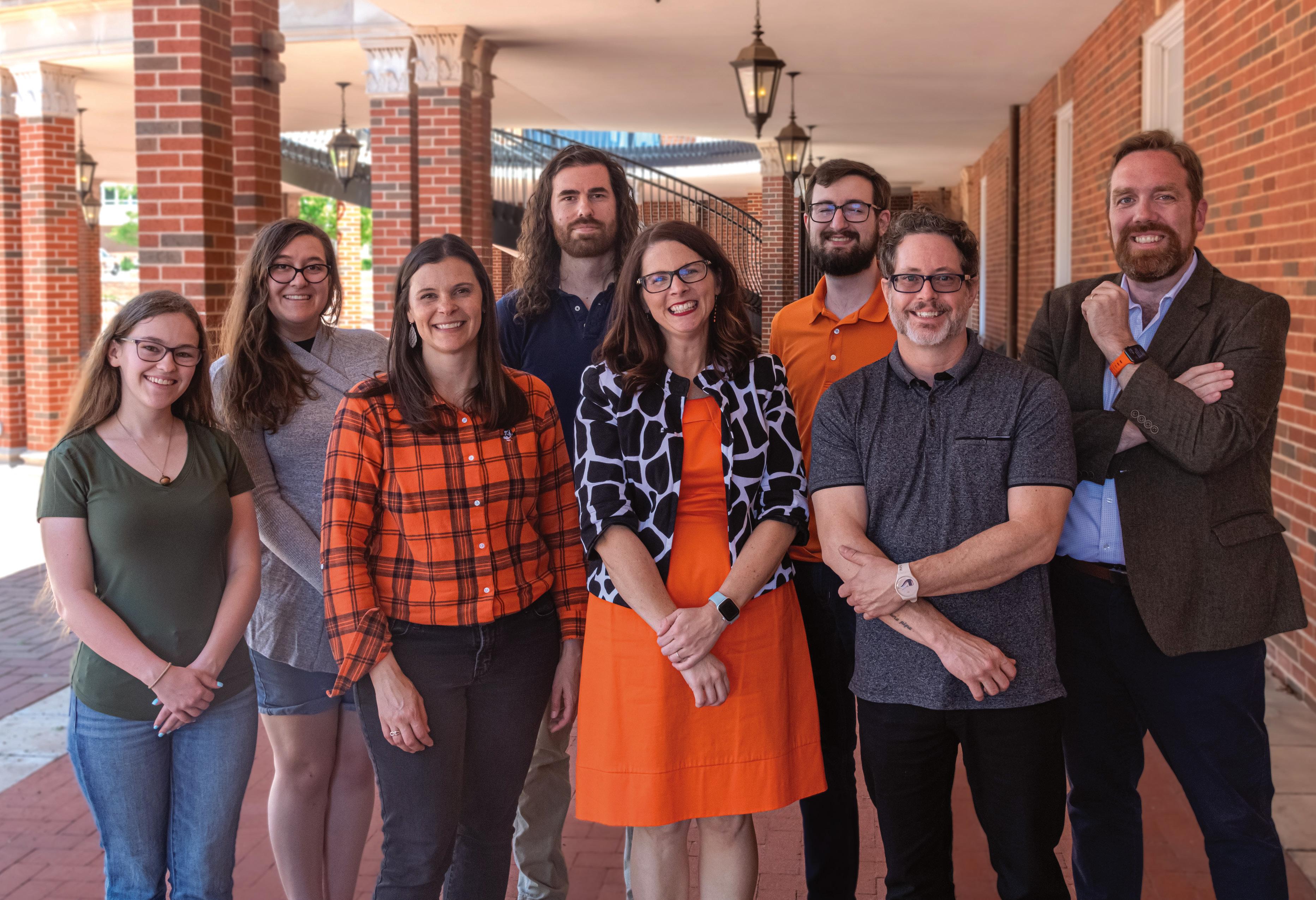
For as long as she can remember, Dr. Melinda Cro has been surrounded by languages.
Not only was she born to multilingual parents — her mother spoke Italian and Spanish, and her Italian-born father was a university language professor — but Cro also attended a French immersion school in Ontario, Canada.
“From kindergarten through seventh grade, every subject except English and shop was done in French,” Cro said. “It was very formative for me, and it hugely impacted how I grew up looking at the world.”
Cro went on to earn her Ph.D. in romance languages from the University of Georgia before gaining more than a decade of university teaching and administrative experience at Kansas State University. In July, she became the newest dean of Oklahoma State University’s College of Arts and Sciences.
“There is strength in diversity of thought and perspective, and that’s what CAS has,” Cro said. “Even though an experience in chemistry is going to be different from an experience in modern languages, we come into the room with shared values.
“I love President [Kayse] Shrum’s focus on ways that the university can leverage its comprehensive resources in a meaningful push toward solving grand challenges because those things are only achievable with the full breadth of the university’s resources, including the ... College of Arts and Sciences. For any challenge we face, the solution will require the collaboration of groups to understand the context and the human impact. When we’re talking about societies and cultures, you need all [CAS areas] to solve the problem.”
This drive for analytic collaboration became particularly evident to Cro while deciding whether to pursue graduate studies in theatre or language, both of which were part of her undergraduate degree at King University in Bristol, Tennessee.
“The thing I really loved about theatre was the directing, the designing and the problem-solving of a production,” Cro said. “But at the end of the day, my first love — of language and
communicating, of culture and bringing a world together that is disparate — won out for me.”
After interviewing with several graduate programs, Cro decided on UGA because it allowed her to study two languages — French and Italian — instead of just one.
“It might not have been the wisest choice, but I wanted to be able to spread my wings,” Cro said. “I’ve always been interested in broader preparation rather than really narrow.”
Attending UGA was Cro’s first experience with a land-grant university, where she witnessed outreach and Extension filter into various aspects of her coursework. She experienced a land-grant institution again with her positions at KSU, all of which has culminated in a vision for her new role at OSU.
“When we think of Extension, a lot of times we contextualize that primarily within an ag context,” Cro said. “In truth, while that is and remains an important reality of Extension, there is opportunity to partner in a variety of ways. For me, the true superpower of a land-grant is a college of arts and sciences that’s deeply embedded in and engaging with the community, building on partnerships with Extension offices, for example, to connect communities across the state with our scholars and resources.”
From teaching and program development to building enrollment and collaborating with faculty, staff and leadership, Cro’s breadth of experience stood out to OSU leadership, with Provost Jeanette Mendez supporting Cro’s appointment.
“President Shrum and I are confident we succeeded in identifying the administrator best suited to lead
the College of Arts and Sciences as the college aligns its strategic vision with the university’s strategic plan and ensures all faculty, staff, students, alumni and external partners have a voice in the process,” Dr. Mendez said.
Cro recognizes the vast opportunities for growth and unity among CAS’s 24 departments, which include 850 faculty and staff, and nearly 7,000 students. And like puzzling out the nuances of language, she welcomes this type of challenge.
“The beauty of the College of Arts and Sciences is our three pillars: arts and humanities, social sciences, and math and sciences,” said Cro, who is the first female CAS dean to serve in a fulltime, non-interim capacity. “If we stay within our pillar area, you can get depth potentially, but we’re missing out on the transdisciplinary reality of research and problem-solving.
“The big challenges that we face as a society require a multi-pronged approach. If we’re not thinking about the full reality of the human experience as we’re looking at a problem, it will be very difficult to provide a holistic or effective solution. That’s what the landgrant actually is all about: leveraging our strengths and bringing together our expertise in applied, meaningful ways that will help to make a difference in this world for the better. ... We are stronger together than we are apart.”
Scan to watch exclusive content about Dean Cro.
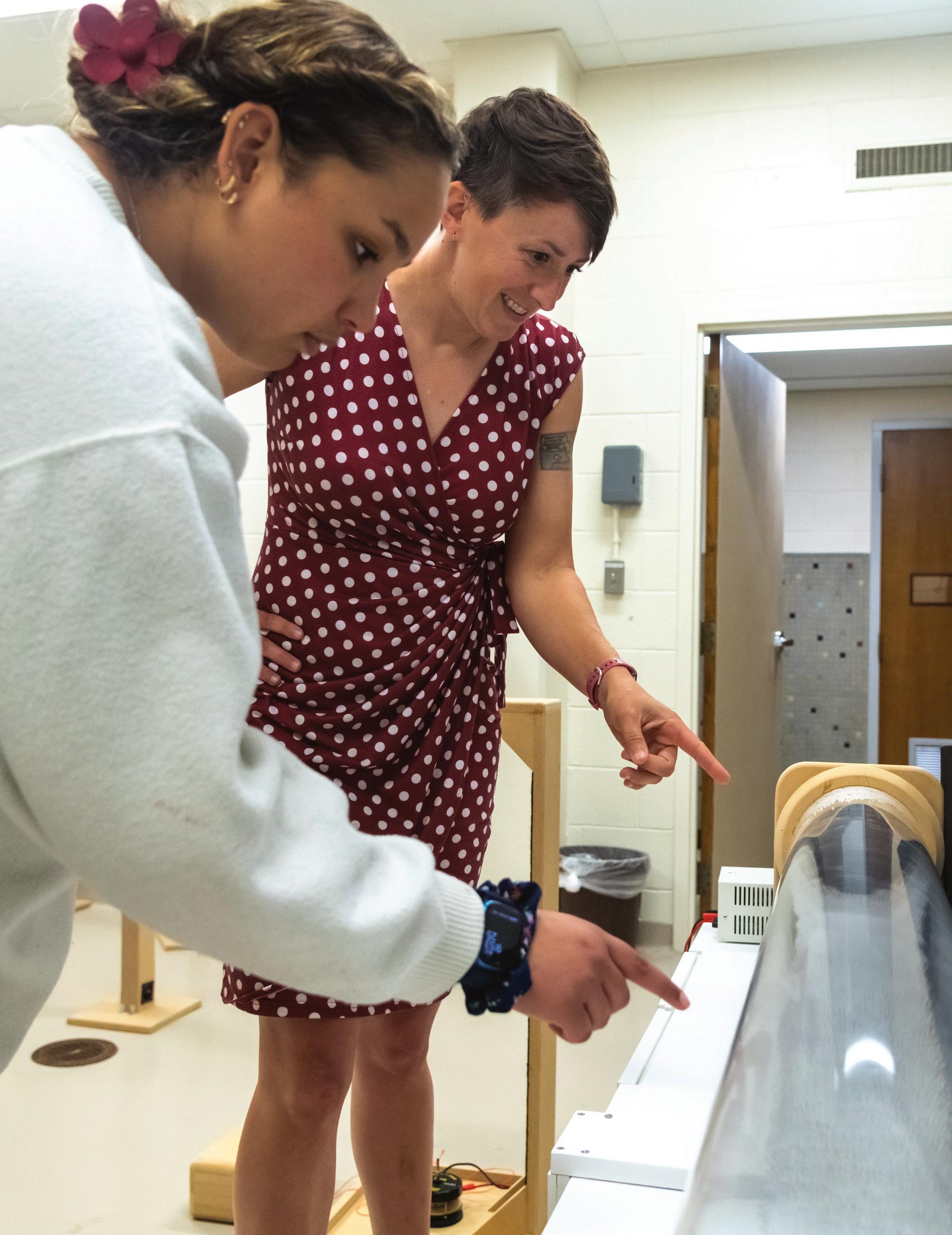
Dr. Liz McCullagh (right) demonstrates auditory principles using her Sound of Science modules.
Lend Us Your Ear
Integrative biology partners with Kicker to create interactive Sound of Science exhibits
In 2023, Dr. Liz McCullagh — an Oklahoma State University Department of Integrative Biology professor — partnered with Stillwater audio company Kicker to create the Sound of Science, a series of educational exhibits that allow students to interact with and visualize sound.
“I’m interested in sound and how the brain processes sound, specifically from where sound comes from,” said McCullagh, an auditory neuroscientist. “I thought that sound and sensory systems are particularly relatable for most people, because either they are into music or want to understand why some folks are more sensitive to sounds.”
With assistance from Kicker and a College of Arts and Sciences Community Engagement Grant, McCullagh worked with Kicker’s Aaron Surrat and two OSU undergraduate assistants — Cameron Miller and Peyton Williams — to bring three exhibits to life: sound localization, Kundt’s tube and using string to show waveforms.
All three Sound of Science modules were exhibited at the Native American Indian Science and Engineering Fair (NAISEF) on OSU’s Stillwater campus in April.
“It’s just all about how to display and visualize sound because sound is something that travels through the air, but we can’t see the air,” Surrat said. “We have all of these displays that we’ve
put together to where you can see a waveform, localize sound from an array of speakers and see how fast vibrations travel through a string.”
McCullagh configured the Sound of Science in its early stages through her research on testing sound location ability in animals. Pulling from her research, she thought of mobile exhibits that could easily travel around Oklahoma, starting with Kundt’s tube.
“The first thing that we came across to display standing waves and waveforms was a pipe that you run gas through and drill holes on top of to light it on fire,” said Surrat, explaining the basics of Kundt’s tube. “You put a cap on one end, the diaphragm on the other and you can see the waveform change visually. We came across that emitting frequency or double frequency allows the display to work properly anywhere.”
The team decided the fire was too dangerous for a public exhibit and opted instead for a tube with small Styrofoam beads to illustrate the same waveforms.
The team has surprised itself as well as participants throughout its time exhibiting Sound of Science. Some attendees noted that they did not realize how difficult sound can be to track.
“It’s not necessarily the things you might think are difficult that truly are difficult with sound,” McCullagh said. “Our ears tell us when something is right in front of you versus right behind. But that is when our ears are perfect.
“When you move your head in the sound localization module, it becomes easier to hear. Otherwise, it is difficult to hear. Most people are making errors about four to six times [in the module] because our ears are kind of not optimized to detect.”
Having assisted with showcasing the modules to an array of students, Williams hopes to see Sound of Science grow into an exhibit for kids across the state. Allowing kids to experience the visualization can lead to further interest in STEM fields, especially audio and biological sciences.
“If they can visualize it and we can get K-12 kids all involved, we can see how far the Sound of Science really works here in Oklahoma,” Williams said.
The team plans to continue exhibiting the Sound of Science in local schools and other universities, as well as at community events and Kicker tradeshows. Its ultimate goal is to grow others’ excitement for STEM and sound science fields.
Scan to watch exclusive content about Sound of Science.
LEARNING IN LOCKUP
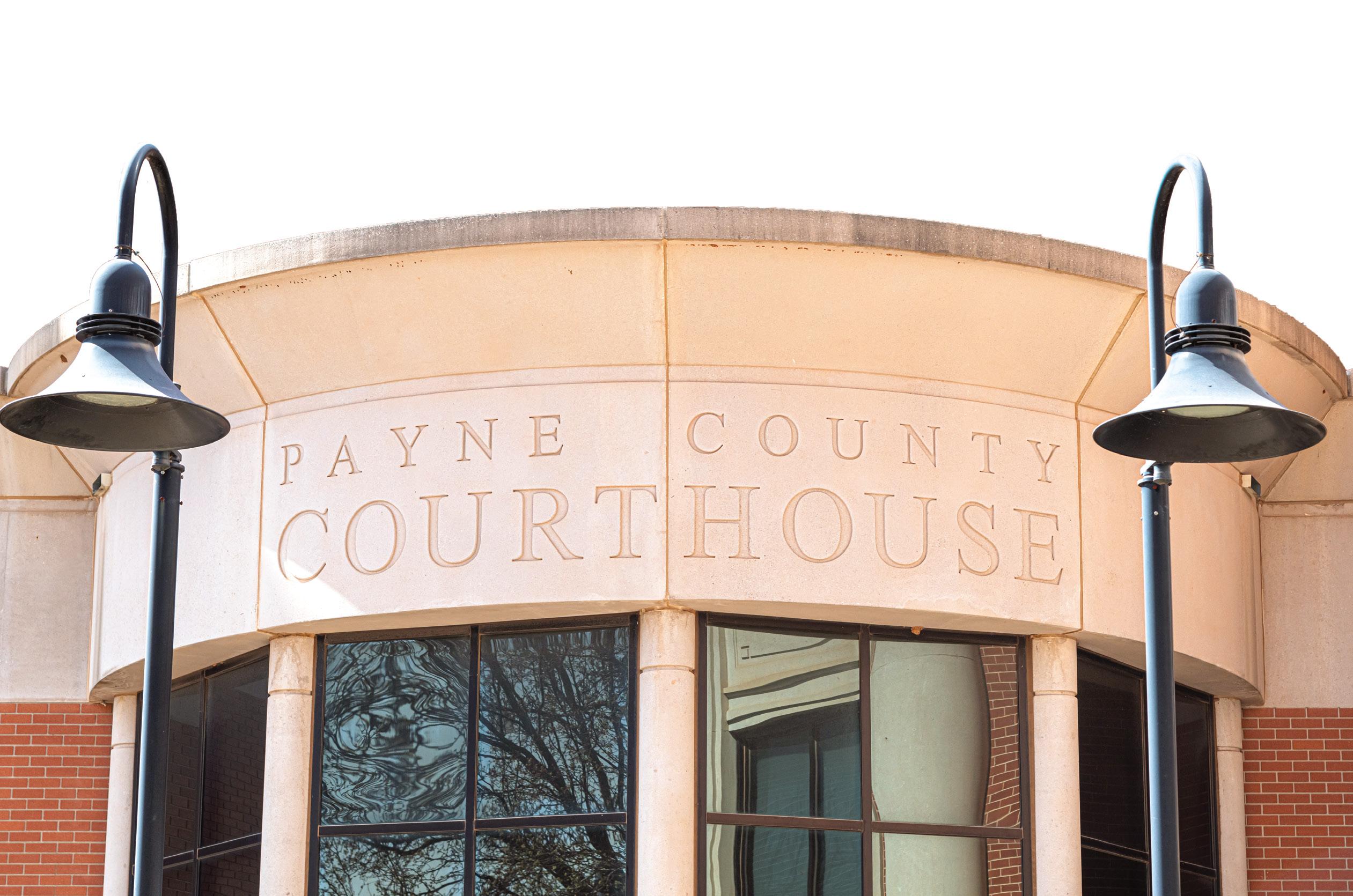
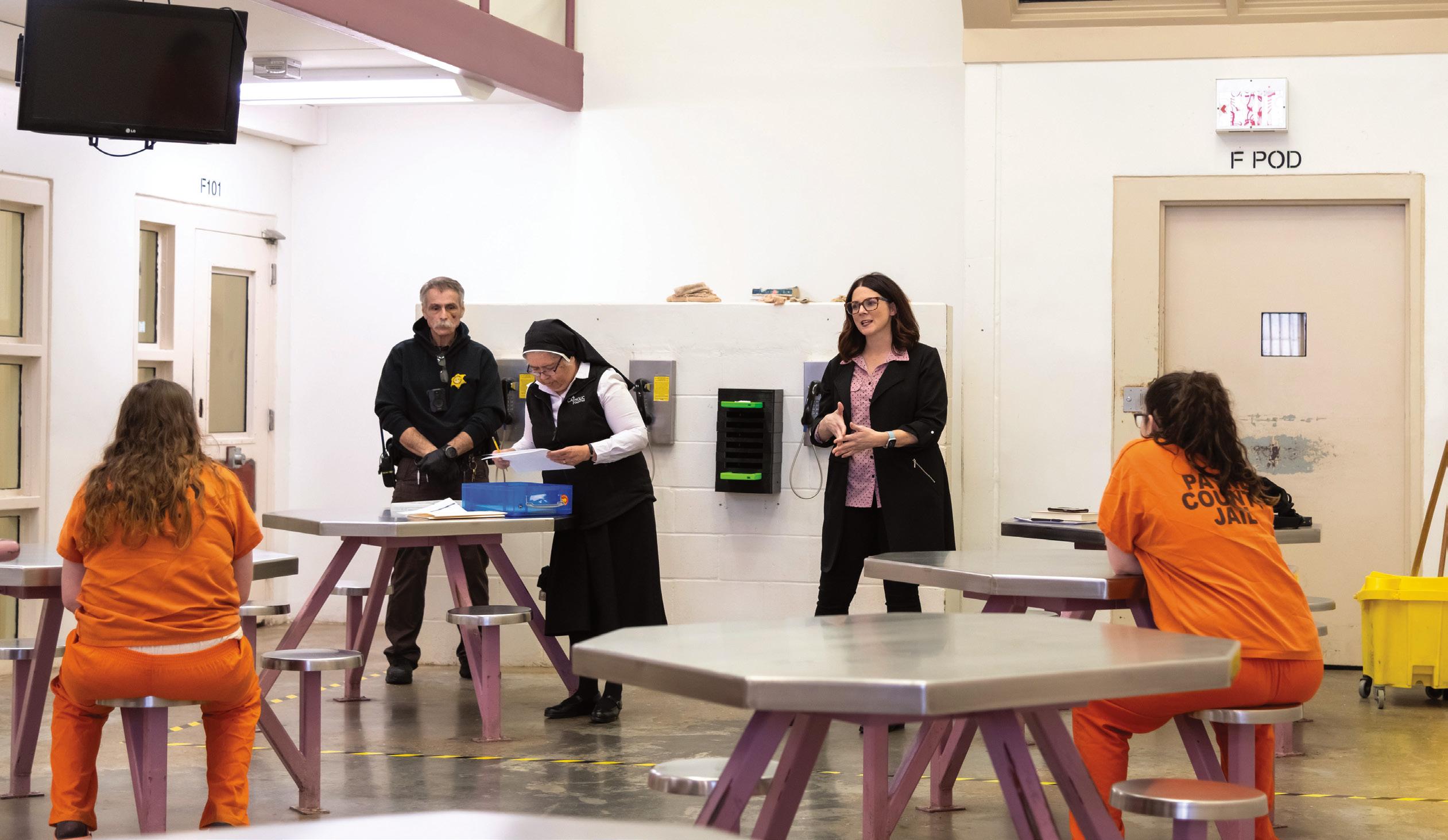
For the past two years, College of Arts and Sciences faculty and graduate students have been teaching in an unconventional classroom: the female pod of the Payne County Jail.
Through a partnership with Catholic Charities of Eastern Oklahoma, CAS professors are helping Payne County Jail inmates earn their high school diplomas.
Equipped with jail-safe pencils and paper curriculum while being escorted by a guard, faculty enter the jail once a week for two hours to host classes from behind a yellow line painted on the floor. Female inmates are invited to attend classes in math, language arts, social studies, science and writing. After they complete their coursework, students take the High School Equivalency Test
in each subject. A passing score on all five tests earns them their diploma.
The partnership dates back to August 2022 when Dr. Kathryn Weinland, a teaching associate professor in the Department of Psychology, got the call from jail officials that her vision for teaching high school education courses inside the facility would come to life. She and mathematics teaching associate professor Dr. Melissa Mills began coordinating courses after a successful meeting with jail officials.
“That meeting helped solidify things a lot,” Weinland said. “Leading up to that meeting had been difficult, because although I’m grateful for everyone who said yes, a lot of people and organizations said no. I just had to keep pushing past the no’s until I asked
“I am thankful for every teacher who came and spent time giving me an education. I couldn’t have asked for a better way to do my time. Now, I can make sure all the time I’m doing isn’t a waste, and I leave here with the skills for a better future.”
HUNTER DUNAGAN
THE FIRST TO RECEIVE A DIPLOMA THROUGH THE PROGRAM
enough people who shared the vision and wanted to work together.”
As the team continued its work using a CAS Community Engagement Grant, more CAS faculty and graduate students came on board to teach courses. The departments of Psychology, Mathematics, Microbiology and Molecular Genetics, English, and Political Science have gotten involved to add further instructor support.
“My work in the jail has reminded me that, for all of the advances we have made in pedagogy and software, the most productive classrooms are
made so by the connections that spark between students and teachers,” said Dr. Howard Sanborn, professor and head of the Department of Political Science. “If students know that their instructors care about them and their learning, and instructors know that the students are working with them earnestly to solve problems, then a lot of good work can be done to further the personal development of all involved.”
While the classroom setting might be non-traditional, the impact faculty are having on their incarcerated students is measurable. To date, CCEOK
has administered 28 subject area tests, resulting in a nearly 65% pass rate.
“The national average pass rate for this test is around 77%,” Weinland said. “We only spend two hours a week with our students, and the testing environment inside the facility isn’t ideal. It is noisy and distracting for testtakers. I’m proud of our pass rate.”
In 2024, the team started furnishing the male inmate pod with paper course materials and test prep books.
“We and the jail staff do not currently have the resources to offer in-person
Sister Catherine Martinez of Catholic Charities and Dr. Kathryn Weinland prepare to distribute subject area tests to inmates.
instruction in both the male and female pods,” Weinland said. “The men’s pod took the math test to assess if they can be successful with just printed curriculum. The answer is yes, they can. So, testing will be expanded in the male pod over the next year while making sure we are taking care of our female inmates.”
Since the team has been offering classes and materials, one female inmate has passed all five tests and earned her high school diploma.
“My time in the Payne County Jail was spent finding ways to improve myself,” said Hunter Dunagan, the first to receive a diploma through the program. “I am thankful for every teacher who came and spent time giving me an education. I couldn’t have asked for a better way to do my time. Now, I can make sure all the time I’m doing isn’t a waste, and I leave here with the skills for a better future.”
Dunagan said she quit attending school after the 10th grade, so getting
an education while in jail was about finding “opportunities in unexpected places.”
“I’m thankful that I was able to get my GED,” Dunagan said. “Now I can look into furthering my education.”
Weinland said her team’s work offers a second chance to a unique population, opening new doors for inmates like Dunagan upon release.
“When she is released, she doesn’t have to start from zero,” Weinland said. “Upon her release, she’ll have options to explore, like attending OSU or having the opportunity to look at jobs she wouldn’t otherwise have been able to. I’m really excited for her.”
Payne County Jail pupils are not OSU students, but the faculty involved keep OSU’s land-grant mission at the forefront of their minds.
“The heart of the land-grant mission lies in promoting education, enhancing economic development and enriching lives,” Weinland said. “That is exactly the goal of our work in the jail.
“You need a high school diploma for most every economic opportunity in our society. With that diploma, you can pursue post-secondary opportunities and open access to gainful employment. That could really change their trajectory and open opportunities to further impact our community and our state.”
To learn more, including how to support OSU faculty efforts at the Payne County Jail, contact Weinland at kathryn.weinland@okstate.edu.
Faculty and graduate students from the departments of Mathematics, Psychology, English, Political Science and Microbiology and Molecular Genetics volunteer their time to educate and test inmates inside the Payne County Jail.
Scan to watch exclusive content about this faculty led program.
Globe Trotters
CAS study abroad programs take international learning to the next level
Griff McClellan sat at a cafe on the banks of the Danube seven weeks before graduating college.
For him, the trip of a lifetime — a spring break study abroad to Vienna — came at just the right moment before he had to start life outside of college. Sitting and eating brunch along the glittering streets of Austria was one of his favorite memories.
“Immersion programs are truly one of the best ways to learn about the world,” said McClellan, a sports media student who joined a diverse group of majors on the trip led by School of Media and Strategic Communications faculty. “It’s one thing to sit in a classroom and hear about its history, its culture and so on. But knowing when you actually go there and get to experience it firsthand, that’s life-changing.”
What makes the SMSC study abroad trips unique is the course credit the students get in helping produce the school’s study abroad magazine, Through an Orange Lens. The SMSC
created the magazine two years ago, when its spring break trip to Geneva was canceled because of COVID19. Students were able to produce a complete version last year after their trip to Scotland.
Vienna’s Through an Orange Lens came out in May and highlighted what the students learned. Every student is tasked with writing an article on a topic of their choosing, while some students are also in charge of other magazine elements such as advertising and editing.
“I think all students want to flex that creativity,” said Dr. Skye Cooley, OSU associate professor of strategic communications. “Human beings are innate storytellers. And this class really lets them flex that. It’s no pressure. You go in, you have fun, pick something that you’re interested in, and the story will naturally come.”
For the students who are not majoring in an SMSC discipline, being able to write creatively outside their own major was a plus of the trip. Sukesh Kamesh, a biochemistry and molecular
biology sophomore, said he got to hone his writing skills, which go hand-inhand with some of the writing he does for his degree classes.
“It’s a good blend,” Kamesh said. “I just think that the class furthered my skills of storytelling from an unbiased lens because I think that’s important for the profession I’m going into. So, I definitely got to take those skills and continue to develop those to make sure that I’m an unbiased scientist one day.”
Many other departments within the College of Arts and Sciences also offer for-credit study abroad trips that any OSU student can attend. For example, the Greenwood School of Music took a two-week trip to Italy and Greece last year, offering students a humanities credit.
Dr. Erin Murphy, associate professor of flute, was one of the faculty members leading that trip. Murphy accompanied 15 students across the region, from Rome and Pompeii to Athens and Santorini.
Students wrote a research paper before the trip over a topic related
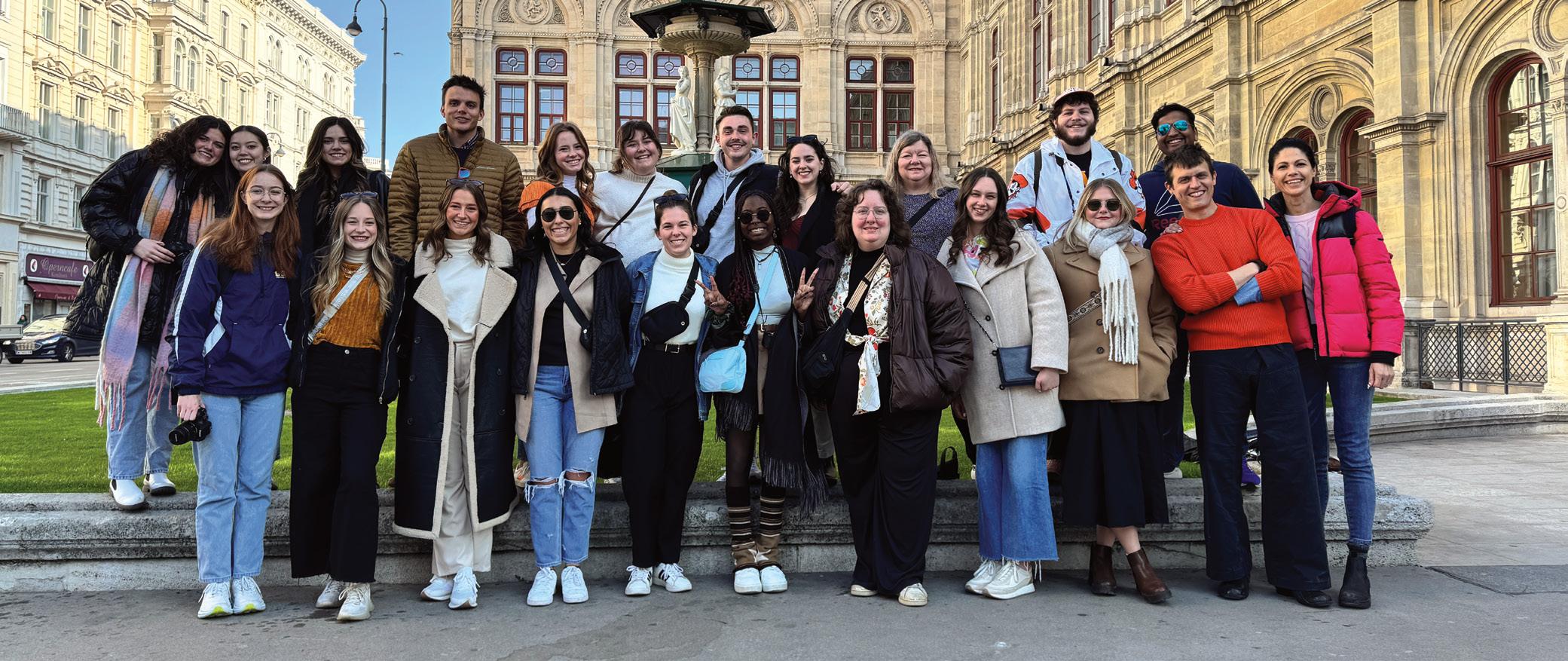
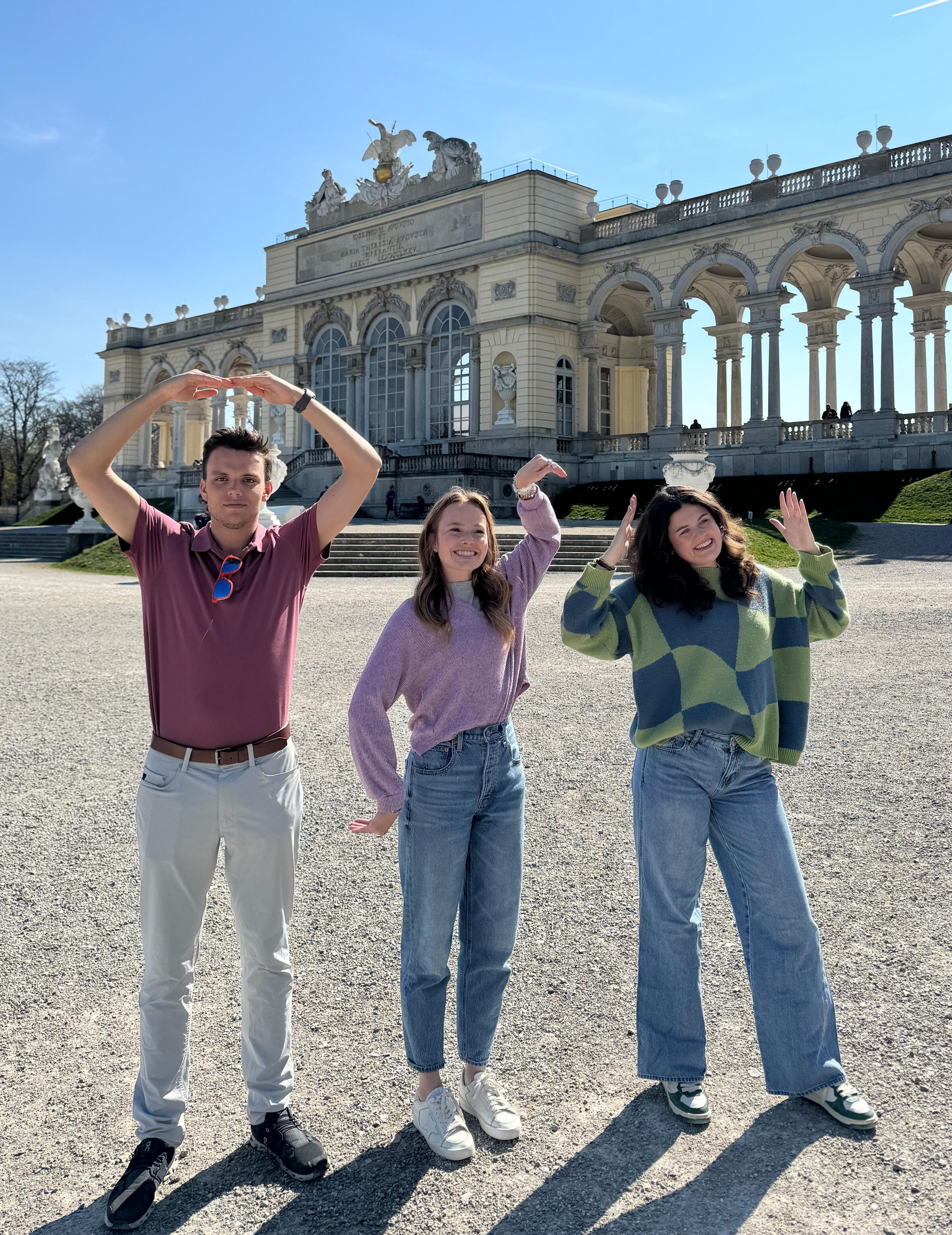
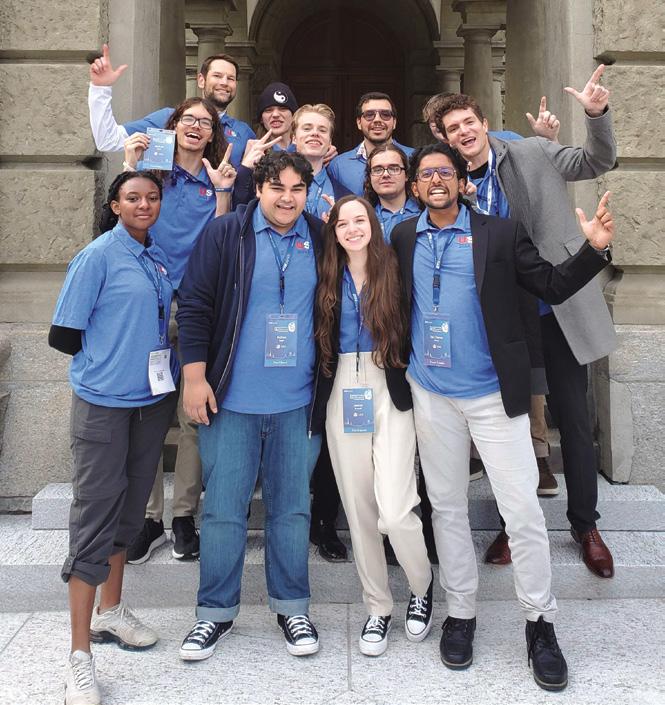
OSU students traveled to Vienna in 2024 with the School of Media and Strategic Communications for a weeklong study abroad.
OSU students traveled to Vienna in 2024 with the School of Media and Strategic Communications for a weeklong study abroad.
CAS STUDY ABROAD DESTINATIONS OVER THE YEARS
ALBANIA AMSTERDAM AUSTRALIA
AUSTRIA (VIENNA) BAHAMAS CHINA CROATIA
CUBA
CZECH REPUBLIC (PRAGUE)
DOMINICAN REPUBLIC
FRANCE (PARIS)
GERMANY (BERLIN)
GREECE (ATHENS) GRENADA
to the areas they would visit and a reflective paper at the end, along with journal entries from the days of the trip. Murphy said one of her favorite parts was reading about the students’ experiences and how they grew throughout the program.
As an experienced traveler, this was not Murphy’s first time out of the country, but it was her first time leading a study abroad trip. She experienced food tours alongside students, saw the frescoes at Pompeii and took a trip to witness the famous architecture of Santorini.
“It reminds you that we’re just a small part of the world,” she said. “It also opens it up to thinking that there’s no reason why you can’t go out and explore other things in study abroad and travel extensively and take advantage of some of these opportunities and programs that are out there.
“Of course, sometimes financial things are restrictive, but there’s good scholarships out there for students that need them. So, it just really expands
HUNGARY (BUDAPEST) IRELAND ITALY
MONTENEGRO MOROCCO PERU
POLAND (KRAKOW)
your view of the world and your life experiences.”
Departments present trip proposals to the CAS Outreach office that then helps the departments make the trip a reality. Shane O’Mealey manages outreach programs and operations for CAS and coordinates the study abroad trips. He said CAS study abroad programs are a great way to get involved because they help students adjust to traveling in another country.
“They’re going to be there with their peers, faculty members and staff,” he said. “They can get their first taste of traveling abroad where they might, at that point, feel more comfortable going back to those areas or traveling on their own. So, doing it while you’re in school is a great opportunity.”
For students not knowing where to start or how to get involved, O’Mealey said he would love to help. There are a variety of programs that can fit most students’ needs.
Over in the Department of Psychology, a recent trip to Lisbon, Portugal, gave students the opportunity
PORTUGAL (LISBON)
PUERTO RICO
RUSSIA (MOSCOW)
SPAIN (GRANADA)
SWITZERLAND
TRINIDAD & TOBAGO
UNITED KINGDOM
to learn about comparative psychology in Europe.
Colton Payne, a psychology senior, said when you’re in another country, it’s hard to imagine you’re on the other side of the world.
“If you have that money and are willing to take that break to go, definitely take that opportunity,” Payne said. “Because it is world-changing.”
CAS study abroad programs offer scholarships to help students who might be unable to pay for their trip.
O’Mealey said all information for funding is available on the CAS website by searching for study abroad. He said these programs are critical for exposing students to different cultures before starting their careers.
“It opens cultural horizons,” O’Mealey said. “Academically, it can help students rethink what they’re doing and how they’re doing it.”
The Love of Wisdom
Heinzig and McMillan gift $6.75 million to Department of Philosophy to advance ethics and critical thinking at OSU
Growing up in Prague, Oklahoma, Dennis Heinzig yearned for more than what he found in his small town of around 2,300. For him, the answers to life’s questions wouldn’t be found there.
So, Heinzig ventured out into a world that was much different than he expected — one that did not fit the perspective he started with, nor for which he was prepared. And then he found philosophy, where his quest for a broader understanding of truth and wisdom really began.
“What philosophy did for me was take the blinders off conceptually,” Heinzig said. “It allowed me to begin to think more objectively about life’s important questions. By going beyond what I was taught one must think or
believe, I began to discern what is true and ethical and then live accordingly.”
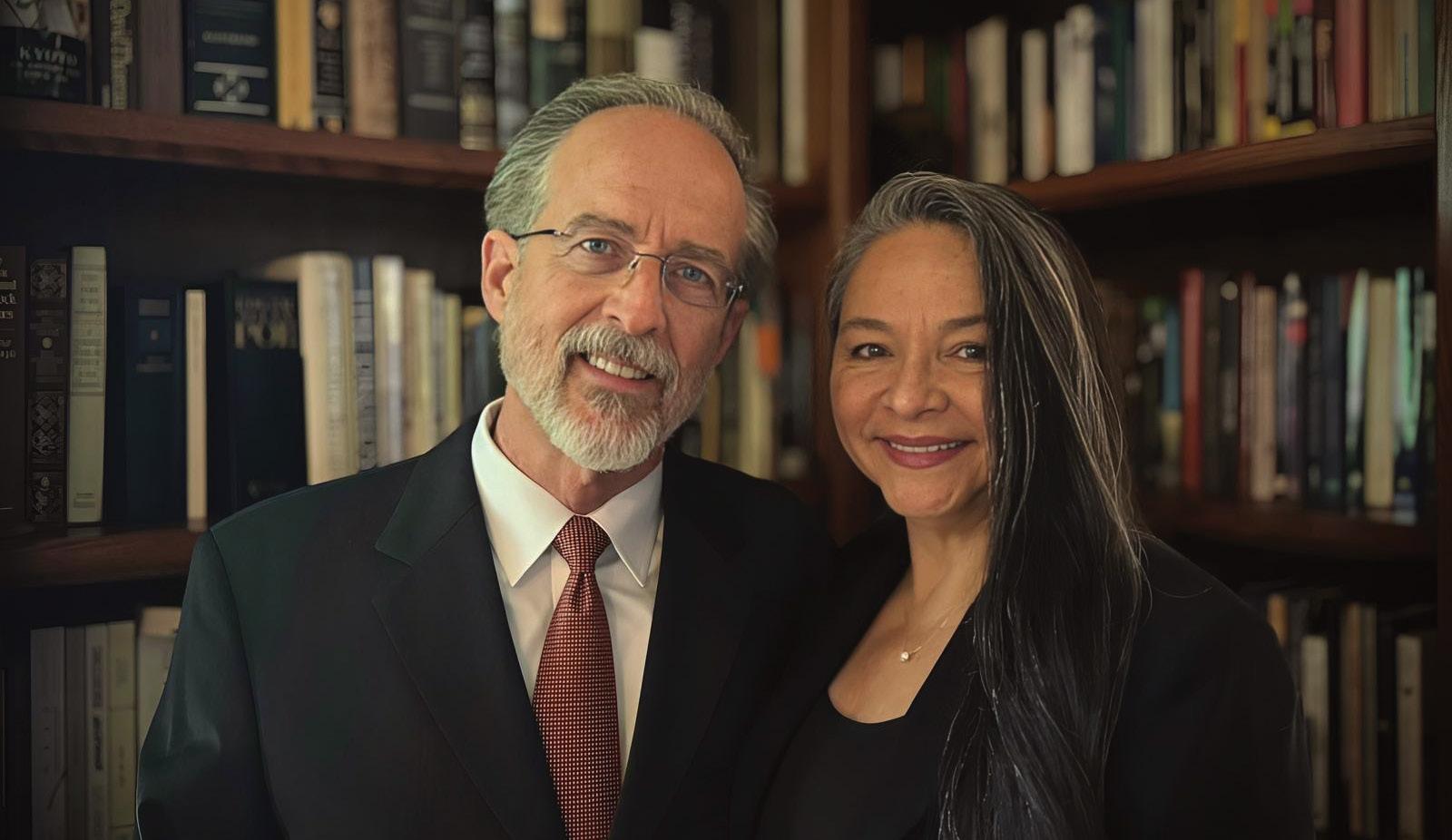
Heinzig and his wife, Iona McMillan, have gained an invaluable amount from philosophy, and the couple wants as many Oklahoma State University students as possible to experience its benefits.
In pursuit of that goal, Heinzig and McMillan made the largest donation ever to the OSU Department of Philosophy. Their $6.75 million gift will establish an endowed chair and fund ethics and critical thinking and an endowed general fund for philosophy. It will also continue to fund the Heinzig & McMillan Endowed Scholarship for Ethics and Critical Thinking.
“We are deeply grateful for Dennis and Iona’s visionary commitment to
advancing critical thinking and ethics at OSU,” said Dr. Scott Gelfand, former philosophy department head. “This transformative gift will empower our faculty and students to engage in rigorous inquiry, ethical reflection and meaningful action, contributing to the cultivation of ethical leaders and responsible citizens.”
Ethics and critical thinking play a prominent role in OSU’s strategic plan and mission to become the nation’s preeminent land-grant university.
“At OSU, our ideal graduate demonstrates professional preparedness, engaged citizenship, ethical leadership and personal responsibility,” OSU President Kayse Shrum said. “Each of those qualities has roots in philosophy, and when
Dennis Heinzig and Iona McMillan
demonstrated, will serve our landgrant mission by equipping graduates to positively impact their communities.
“Dennis and Iona’s generosity with this historic gift will help us ensure our graduates are prepared to make a difference in the world.”
The couple has been involved with multiple charities over the years, but it was McMillan’s idea to make an impact at OSU, where Heinzig earned his master’s degree in philosophy in 1987.
During his time in Stillwater, Heinzig met philosophy professor Ed Lawry, who Heinzig remembers as always supportive and approachable. Lawry taught his students to apply philosophy to real-life issues, which guided Heinzig throughout his 30-year business career.
“As an employer, I found it much harder to train someone to approach business decisions with ethics and critical thinking than it was to teach them knowledge-based job skills,” Heinzig said. “To think carefully and be a good person — those two qualities are
required to navigate life’s challenges for the good of oneself and all others.”
In the spirit of Lawry, Heinzig and McMillan hope their gift will help students and faculty in all fields appreciate the importance and relevance of philosophy. The couple wants to inspire people to face every issue with objectivity and fairness — whether in academics, their career or personal life. To that end, the department is offering a new minor, the Art and Science of Critical Thinking.
“We hope our contributions will equip people with critical thinking skills and a deeper ethical understanding that will in time make a meaningful difference in our world,” McMillan said. “Our intention is to disseminate the benefits of philosophy as broadly as possible, equipping new leaders with the tools and understanding required to grapple with a rapidly changing world.”
Philosophy and philanthropy share the same root word — phileo, or brotherly love. In Greek, philosophy
means the love of wisdom, while philanthropy means the love of humanity. Heinzig and McMillan believe the two are intrinsically intertwined, and that, with conflicts raging across the globe, OSU can play a part in making the world a better place.
“OSU is a very special community and has the right mission and environment to show how philosophy is just as impactful and relevant as agriculture, technology or energy to our lives and the future of humanity,” Heinzig said. “If we approach our global challenges with deep ethical understanding and critical thinking skills, there is no problem humanity cannot solve.”
Among its areas of
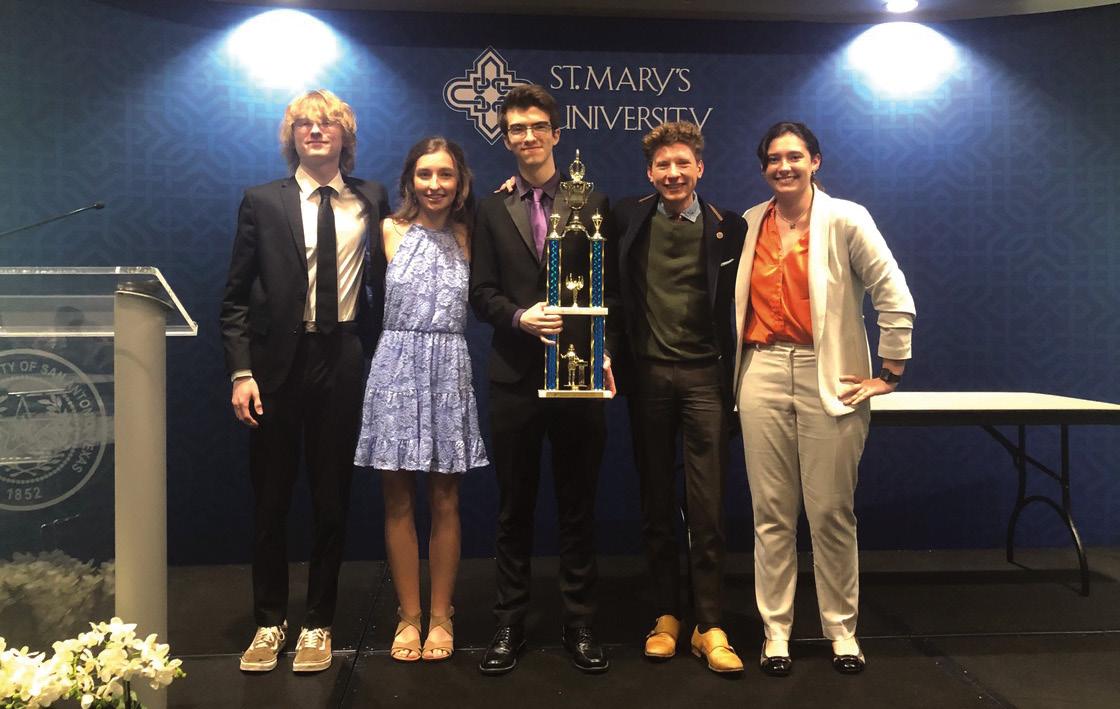
impact, Heinzig and McMillan’s gift will support the award-winning efforts of OSU Ethics Club members.
Scan to learn more about how to make an impact at OSU.
Community Culture
Ready, Foss collaborate on research of Oklahoma’s Latinx people
Dr. Sarah Foss, assistant professor in the Department of History, and Dr. Carol Ready, assistant professor of Spanish and linguistics in the Department of Languages and Literatures, are working together on research projects to create an archive of the history and linguistic diversity of Latinx communities in Oklahoma.
The collaboration started when Foss assisted graduate student Jorge Chávez with collecting oral histories from the Mexican American community in south Oklahoma City for his master’s research.
“Working with Jorge, I realized that there was a need for archival representation of people who identify in Oklahoma’s Latinx community. So, we began working in 2020 with Sarah Milligan and Patrick Daglaris in the Oklahoma Oral History Research Program,” Foss said.
In 2021, Foss received a Humanities-, Arts-, and Design-Based Disciplines (HAD) Grant through the College of Arts and Sciences to start recording Latinx community histories. Her group now has about 30 completed. That same year was also when Ready and Foss met. Ready helped Foss conduct several interviews for her research, which sparked a curiosity for Ready’s own research project. Ready then applied for and received a HAD Grant, which she is now using to build off of the open access aspect of Foss’ archival project.
“I’m looking at and including some surveys and questionnaires about language use,” Ready said. “I want to understand more broadly how languages are used in Spanishspeaking communities in Oklahoma
to support their linguistic knowledge and support their language and human rights.”
Ready is also interested in language policy and how linguistic research can affect it, which can affect practice and education policy more broadly. More specifically, she is hoping to make an impact at the policy level for the Oklahoma State Legislature.
Ready conducted her interviews and collected data this summer in rural Oklahoma communities, specifically focusing on Guymon. Ready’s HAD Grant has allowed graduate researcher Ryan Nicklas — an applied linguistics student — to research Spanish for specific purposes in the United States while assisting Ready.
Ready and Foss have also involved undergraduates Alexandra Williams, Nadia Valles, Sury Yañez and Stephanie Landaverde in their research, adding that the students have been crucial contributors to the projects.
“This project would not be running as quickly and smoothly without the work [of our students] and their ideas, opinions and efforts. It has been a wonderful collaborative experience,” Foss said.
Ready and Foss share an appreciation for the generosity of community members by distributing their knowledge and practices. The professors expressed the importance of avoiding extractive research practices by prioritizing the needs and goals of the Latinx community.
“It’s a challenge and opportunity every time you do research with people where your main focus is to highlight and value the knowledge, skills and practices of the communities,” Ready said. “This project is meant to exist
to support and benefit the community rather than trying to impose some sort of idea of how things should be.”
The archives will be published in fall 2024, available through the Oklahoma Oral History Research Program (OOHRP) webpage. Ready and Foss hope the archive will continue growing as other researchers contribute and utilize it as a resource.
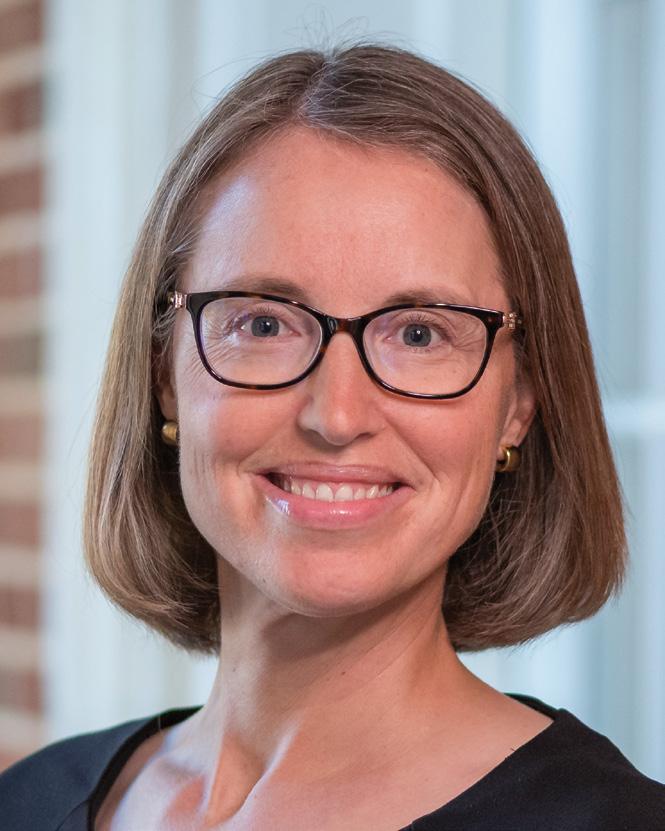
Dr. Carol Ready
Dr. Sarah Foss
HONORING OUTSTANDING ALUMNI
Each year, the College of Arts and Sciences at Oklahoma State University recognizes remarkable alumni whose accomplishments and service are tangible evidence of their distinction. CAS honors are separated into three categories: Distinguished Alumni, Rising Stars and Hall of Fame.
The annual celebration of these CAS graduates is held in October on OSU-Stillwater’s campus.
DISTINGUISHED ALUMNI
With its 24 departments, the College of Arts and Sciences produces hundreds of graduates each year. Distinguished Alumni stand out among their peers, bringing distinction to OSU through extraordinary achievements in their fields of discipline and distinguished records of service. These individuals are chosen annually by representatives from each CAS department.
RISING STARS
Recipients of the Rising Star award are alumni who have graduated with their CAS undergraduate or graduate degree within the past 10 years. In addition to already reaching major career milestones, Rising Stars have shown exemplary community service and a commitment to volunteerism.
HALL OF FAME
CAS Hall of Fame inductees are alumni who embody the qualities that make OSU an extraordinary place to learn and grow. Honorees are nominated by their departments for achieving exceptional success in their professional careers, displaying effective leadership, making outstanding contributions to their communities and showing great loyalty to their alma mater.
For more information about CAS alumni honors, visit okla.st/cas-hof.
Aerospace Studies (Air Force ROTC) 1982
Art, Graphic Design and Art History 1996
Chemistry 1970
DALE FITZ
DANIEL GRIMSLEY
MARCIA WALKER
COLLEGE OF ARTS AND SCIENCES DISTINGUISHED ALUMNI
KRISTINA EGNOR
Communication Sciences and Disorders 2009, 2011
JAMES LITTLE
History 1973
LISA WILSON
Computer Science 1986
EMMA I. CLINE HANSEN
Languages and Literatures 1969
JONATHAN TEUBNER
Economics 2006
MEREDITH WOODRUFF
English 1970
WALTER KOLB
Geography 1959
STEPHEN SADLER
Mathematics 1974, 1976
TRACY HARLOW
Media and Strategic Communications 1993
GARY FORD
Geology 1975, 1978
CRAIG SPAULDING
Microbiology and Molecular Genetics 1978
THOMAS MANCINO
Military Science (Army ROTC) 1992
COLLEGE
BOB SPINKS
Music 1973, 1978, 1980
JULIA BUTHMAN
Psychology 1981
MARK GULLEY
Physics 1987
MARISA BUNNING
Plant Bio, Ecology and Evolution 1980
JOE DORMAN
Political Science 1994
GARY GABREL
Sociology 1971, 1974
PAM SHOCKLEY-ZALABAK
Speech 1965, 1972
SCOTT KEGLER Statistics 1999
JAMES BAKER
Premedical Sciences 1971
ANNAWYN SHAMAS
Theatre 1956
ON THE RISE
CAS honors alumni who have made outstanding career and community contributions in their first 10 years since graduation
ABBY O’DELL
Opening and operating a speech clinic was a dream turned reality for Abby O’Dell.
She observed a need within the Stillwater community, and in 2017, she and her husband, Blake, opened Advanced Therapy Solutions.
O’Dell graduated from Oklahoma State University with her Bachelor of Science in communication sciences and disorders in 2013 and continued in the program to earn her Master of Science in speech-language pathology in 2015. She holds a Certificate of Clinical Competence from the American Speech-Language-Hearing Association and has received multiple awards for continuing education.
What started as a single-person team has since expanded to a staff of 14, with offerings in occupational therapy and lymphedema services.
MIRANDA CHILDRESS
Dr. Jim Puckette’s Introduction to Geology course set Miranda Childress up for her future in oil and gas.
In the class, Childress drilled down a passion for geology that inspired her to pursue interests in the industry.
In 2012, Childress graduated from OSU with a Bachelor of Science in geology and added a master’s degree in 2015. Childress worked as a geologist for Devon Energy for seven years before transitioning to her current role as an asset supervisor in Devons’ Delaware Basin Business Unit.
Childress has taken her skills nationwide, working in basins that have included the Anadarko, Midland and Permian. She is an active member of The American Association of Petroleum Geologists and the Oklahoma City Geological Society.
DR. JASON HIGGINS
Dr. Jason Higgins has dedicated his career to studying the effects of war on military veterans.
As the digital scholarship coordinator for Virginia Tech Publishing and an assistant professor at the university, Higgins is devoted to giving his students learning experiences through oral histories.
Higgins is a first-generation college student who earned a master’s in English from OSU in 2016 before pursuing his doctorate at the University of Massachusetts-Amherst.
During his time at OSU, Higgins worked with the Oklahoma Oral History Research Program to record 30 histories with veterans. Higgins credits that experience as the motivation to pursue his Ph.D.
FORMULA FOR SUCCESS
Tse rallies through hardships to improve herself and others
Over the course of Dr. Chih-duen Tse’s life, she has experienced extreme highs and devastating lows in her personal and professional life.
Yet, the 1982 College of Arts and Sciences graduate has approached each one as a chance for service and growth.
Born in Taiwan into a military general’s family, Tse’s strict-butjoyful childhood instilled in her a drive to succeed. After completing undergraduate work in Taiwan, she moved to the U.S. to earn her Ph.D. in chemistry from Oklahoma State University.
During her time in Stillwater, she met and married Scott Painton, a fellow Ph.D. student studying psychology. Their son, Lee, was born two years later, and they eventually moved to Missouri to begin professorships at St. Louisbased universities.
“It turned from an ideal situation in academia with my son and husband, to become the most challenging situation,” Tse said. “When Lee was about to turn 4, my family was involved in a car accident and Scott passed away.
“I was a new professor in the chemistry department. I was stuck in a new city. I didn’t have many friends, and I had a young son depending on me. It was just a very difficult time in my life.”
Tse soldiered on, making the best of her situation by continuing to teach, develop research programs and apply for grants, all while caring for Lee. Then, to her surprise, a recruiter contacted her about a position at a pharmaceutical company.
“It was unusual to get a call from across industries, but I thought it might be a way out, so I interviewed and got the job,” said Tse, who — within her first 90 days — solved a critical issue with an FDA application submitted by her new employer. “I knew I just really had to show that I could be up to the challenge.”
Dr. Chih-duen Tse
This attitude of exceeding expectations carried Tse into leadership positions at Mallinckrodt Medical, Bayer and Pfizer. Her many accomplishments include saving the Alka-Seltzer Plus franchise during the phenylpropanolamine ban by directing global reformulation projects, receiving the YWCA’s Tribute to Women in Industry Award, and consulting for the Bill & Melinda Gates Foundation.
“I’ve learned that you really have to look at what you’re doing in science to rationalize it in a scientific manner, but not an absolute manner,” said Tse, citing times when her work could be interpreted in vastly different ways depending on the scale used and how results were framed.
“In my last 10 years at Pfizer, I switched from more technical, scientific work to science and technology regulation dealing with ... different government health
authorities,” Tse said. “I got into that area because I feel that I can really tell a good story based on true science, the purpose of science, and not just the big number.”
In addition to aiding the fields of science and medicine, Tse has served her community through language education, youth choir, and Medicare and Medicaid assistance. But through it all, she’s made family her top priority, which has included her and her husband, Pius, temporarily becoming their grandson’s primary caregivers while he underwent cancer treatment 18 years ago.
“I have encountered so many unexpected challenges in my life, but I look back and see that it just makes me stronger,” Tse said. “No matter what challenge there is, there’s always a way. Every problem can be solved.”
SETTING THE SCENE
Linn built foundation for acting career at Oklahoma State
Perhaps best known for playing Sgt. Frank Tripp on “CSI: Miami,” Oklahoma State University alumnus Rex Linn has dozens of film and television credits to his name.
He costarred alongside Jamie Foxx in “Django Unchained,” Kevin Costner in “Tin Cup” and Jackie Chan in “Rush Hour.” Linn was part of AMC’s critically acclaimed “Better Call Saul” and recently wrapped his seven-season role as Principal Petersen on CBS’s “Young Sheldon.”
Yet, the 1981 College of Arts and Sciences grad didn’t even start acting until he was 34.
“In 1989, I had sold my house and broken up with my girlfriend, and my dad said, ‘If you’re going to pursue your dream of acting, now would be the time do it,’” Linn said. “I had been a banker. I was in the oil business. Then, I had a hunting guide service. For that decade, I had been talking about acting. ... So, I packed all my stuff in a U-Haul and headed west on I-40.”
Although Linn had some acting gigs while still in Oklahoma — including opposite “Jaws” actor Roy Scheider in the serial-killer film “Night Game” — his career really took off once he got to Los Angeles. Over the next 35 years, Linn racked up more than 100 acting credits, a feat he attributed to two key attributes: perseverance and work ethic.
“As simplistic as it sounds, that’s what I tell young actors when they ask me for advice,” Linn said. “You’ve got to work at your craft. You’ve got to be in the audition room and in acting class. That’s where you’re going to move forward.”
In addition to the example set by his family, Linn credits his time at OSU for helping him develop a drive to succeed.
“I couldn’t wait to go to class, to study about the history of film and all the other things I got to do,” said Linn,
Rex Linn
who earned a degree in radio, television and film. “Because I was excited, I wanted to be prepared. That carried over into life, especially once I became an actor.
“Because I didn’t move to California until I was 34, I had to revisit that excitement I remember having. I look back at my time at Oklahoma State and I know it had a real influence on why I have a great work ethic.”
Raised in the Texas Panhandle town of Spearman before moving to Oklahoma City at age 12, Linn had expected to continue his family’s long tradition of attending the University of Texas. But after graduating from Casady High School, he “followed a girl” to OSU as a theatre major before moving to what is now the School of Media and Strategic Communications.
“It was an exciting time in Stillwater in the mid- and late-70s,” Linn said,
adding that he was an OSU football walk-on. “I can’t imagine it being any better anywhere else in the country.”
Although it didn’t work out with the girlfriend and a knee injury ended his football career, Linn said he wouldn’t have had it any other way. The friends, mentors and experiences he gained at OSU set him up for a rich and successful life.
Linn now splits his time between Nashville and Los Angeles, where this fall he began filming a new NBC show, “Happy’s Place,” alongside his girlfriend, Reba McEntire.
The Department of Psychology ’s speech communication faculty hosted the second annual Speech Night competition April 2. This was an opportunity for students to hone their public speaking and earn prizes. This year’s judges were Anne Greenwood, First Cowboy Darren Shrum, Edmon Low Library’s Simon Ringsmuth and the Stillwater Medical Foundation’s Joe Akin.
Department of Integrative Biology professor Dr. Michael Reichert has been awarded a CAREER grant from the National Science Foundation totaling more than $1.5 million for research on animal behavior.
Dr. Ryan Armstrong, a visiting professor in the Department of Philosophy and instructor in the Religious Studies Program, completed his book “The Book of Job in Wonderland: Making (Non)sense of Job’s Mediators.” The piece engages the theme of mediation in the biblical Book of Job with a unique approach that examines the Hebrew language, the history of its interpretation and a comparative literary analysis of Lewis Carroll’s “Alice’s Adventures in Wonderland.”
The Oklahoma State University Wind Ensemble released a commercial recording this summer under the direction of Dr. Bradley Genevro. Featured guest artists included Alan Baer, principal tubist of the New York Philharmonic, and Dr. Ryan Robinson, OSU associate professor of tuba.
Jessica Teckemeyer, associate professor of sculpture in the Department of Art, Graphic Design and Art History, commissioned a 200% bronze enlargement of her sculpture “Fox or Foe” using a Humanities-, Arts- and Design-Based Disciplines Research Grant.
ASL lecturer Logan Evans was elected president of the Oklahoma Association for the Deaf (OAD), a nonprofit organization that promotes the interests of the Deaf community in Oklahoma. He also serves as faculty advisor for the ASL Club, which organizes coffee hours and silent dinners for members of the Deaf community and OSU students.
Dr. Tyrrell Conway, a professor in the Department of Microbiology and Molecular Genetics is leading transdisciplinary research initiatives through the Oklahoma Center for Microbiome Research, which was established with a $10.7 million NIH COBRE award.
In April, students from the Department of Physics traveled to Zurich to represent the United States at the International Physicists’ Tournament. The team placed sixth in the world.
Thirty-three students from the Air Force and Army ROTC programs participated in the annual Bataan Memorial Death March over spring break by ruck marching 26.2 miles through rural New Mexico.
Political Science junior Kylie Hammack was selected as a 2024 Harry S. Truman Scholarship finalist. The Truman Scholarship is the premier graduate scholarship for aspiring public service leaders in the United States. Hammack was one of 191 finalists selected from 709 applications and one of four finalists selected from Oklahoma.
Department of Physics ’ Dr. Eric Benton and Ph.D. student Tristen Lee had their radiation detector, SpaceTED, installed on the International Space Station in November 2023. The detector is funded by NASA through an Established Program to Stimulate Competitive Research (EPSCoR) award.
Former CAS interim dean Dr. Keith Garbutt formed an air band named “Mid Life Crisis” featuring deans Pedersen, VanDilender, Frohock and Veenstra to promote the Department of Theatre’s first show of the 202324 school year, “Airness.” The band performed for passersby on library lawn.
The music industry program — which is part of the Michael and Anne Greenwood School of Music — was recognized by Billboard Magazine in October 2023 as a top music business program. OSU was listed alongside 41 other accredited schools, including Abbey Road Institute, California Institute of the Arts and New York University.
The Department of English hosted 12 Japanese teachers for a threeweek program last summer funded by a $69,999 grant from the U.S. Department of State – U.S. Embassy Tokyo. The program brought the teachers to Stillwater to learn from OSU Department of English faculty and Stillwater public school teachers.
“We want our son’s OSU experience to be as impactful as our own, and that’s why we decided to upgrade to Life Membership Plus. We want to support the next generation of Cowboys.”
Sara Brown,’05 & Matt Jeffery,’03
ALUMNI ASSOCIATION
Become a member of the OSU Alumni Association or upgrade your membership today and support the College of Arts and Sciences at ORANGECONNECTION.org/joincas.