CONNECT The official magazine of the College of Arts and Sciences
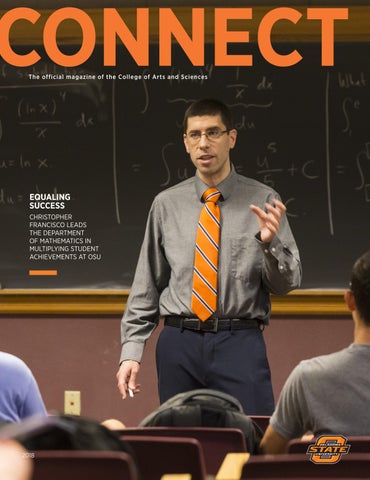
EQUALING SUCCESS CHRISTOPHER FRANCISCO LEADS THE DEPARTMENT OF MATHEMATICS IN MULTIPLYING STUDENT ACHIEVEMENTS AT OSU
2018
C
r-
Top-tier prospective students from across the country connect at Oklahoma State University through the College of Arts and Sciences' 100+ undergraduate degree options.
L
I\\
E
CAS faculty and staff help students achieve academic excellence through quality instruction, advisement, career counseling and innovative research.
I /
rO------.--r-1
'-Q
11
~
L
CD,,,- .... I
✓ ✓
\ I
CD
CAS alumni succeed personally and professionally by building on the many ))) invaluable lessons they learned here at OSU.
COLLEGE
OF
Arts and Sciences
CONNECT.
To learn more, visit
ACHIEVE.
SUCCEED.
cas.okstate.edu
CONNECT College of Arts and Sciences
cas.okstate.edu
Plus …
2
28
Triumphant Trumpeters
Changes Afoot
34
OSUTeach Graduates
New faces are appearing in the dean’s office at the College of Arts and Sciences.
38
Born at OSU
40
Mayoral Success
42
Hall of Fame
38 8
8
Sum of Its Parts New department head Christopher Francisco is taking support for students in mathematics to new heights.
EDITOR
54 17
Dorothy L. Pugh, ’83 ART DIRECTOR
Valerie C. Kisling DESIGNERS
Lacy Branson, '08 Lucas Hess, ’16 Valerie C. Kisling Chelsea J. Morgan Benton Rudd, '07 Jason Wallace, ’03
17
A Clear Path Farida Jalalzai is seeking input and introspection as she determines the future of the Department of Political Science.
32
Changing a Life Abigail Ferrell, an inaugural fellow of the Oklahoma State Scholars Society, says the scholarship is putting her on a new road to her future.
PHOTOGRAPHERS
Gary Lawson, ’83 Phil Shockley Jason Wallace, ’03 WRITERS
32 74
Jenny Berry Lonna Freshley, ’09 Jeff Joiner Jacob Longan, ’05, ’13 Karolyn Moberly Kevin Sharp COLLEGE OF ARTS AND SCIENCES INTERIM DEAN
Jeanette Mendez ASSISTANT DEAN/OUTREACH
Bobbi Kay Lewis, ’93, ’03 SENIOR DIRECTOR OF DEVELOPMENT
36
OSU to Harvard And onward to bright futures around the country are three OSU alumni who tell us how Stillwater prepared them for the Ivy League law school.
Jayme Ferrell, ’04 COORDINATOR OF COMMUNICATIONS
Jacob Longan, ’05, ’13 Years indicate OSU CAS graduates CONNECT is a publication of the Oklahoma State University College of Arts and Sciences and is designed to provide information on college activities and accomplishments while fostering communication among the CAS family and friends. WWW.CAS.OKSTATE.EDU
The office of publication for CONNECT is 307 Whitehurst, Stillwater, OK 74078-1024. © 2018, CONNECT. All rights reserved. Oklahoma State University, in compliance with Title VI and VII of the Civil Rights Act of 1964, Executive Order 11246 as amended, and Title IX of the Education Amendments of 1972 (Higher Education Act), the Americans with Disabilities Act of 1990, and other federal and state laws and regulations, does not discriminate on the basis of race, color, national origin, genetic information, sex, age, sexual orientation, gender identity, religion, disability, or status as a veteran, in any of its policies, practices or procedures. This provision includes, but is not limited to admissions, employment, financial aid, and educational services. The Director of Equal Opportunity, 408 Whitehurst, OSU, Stillwater, OK 74078-1035; Phone 405-744-5371; email: eeo@okstate.edu has been designated to handle inquiries regarding non-discrimination policies. Any person (student, faculty, or staff) who believes that discriminatory practices have been engaged in based on gender may discuss his or her concerns and file informal or formal complaints of possible violations of Title IX with OSU’s Title IX Coordinator 405-744-9154. This publication, issued by Oklahoma State University as authorized by the College of Arts and Sciences, was printed by University Printing, at a cost of $5,478/6,300/August 2018/job #7483.
O S U CO L L EG E O F A RT S A N D S C I E N C E S 1
New leadership Mendez, Belmonte and Baum assume new roles in dean’s office
2 CO N N EC T 2 0 1 8
S TO RY JACO B LO N G A N || P H OTO S JA S O N WA L L AC E
Jeanette Mendez
C
hanges abound among the leadership in Oklahoma State University’s College of Arts and Sciences. Jeanette Mendez was named interim dean in June, following the departure of Bret Danilowicz after six years to become provost at Florida Atlantic University. A nationwide search for the new dean is underway, and the goal is to have that person in place by July 2019. “Bret moved the college forward in many positive ways,” Mendez said. “He always thought of the students first. And he often talked about excellence in teaching, and how we can be outstanding in the classroom and in research at the same time. We shouldn’t talk about teaching and research as two distinct things. We have students more involved in research than ever before, and we’re involving them in a holistic view of academia.” Mendez was promoted to associate dean for research and facilities on March 2, after fulfilling that role on an interim basis the previous year. Kristen A. Baum, an integrative biology professor, is now the interim associate dean for research and facilities. Laura Belmonte, associate dean for instruction and personnel, is another new member of the leadership team. She replaces Bruce Crauder, who is returning to being a full-time professor in the Department of Mathematics after 21 years in the dean’s office.
The lone returning associate dean is Thomas Wikle, who has overseen academic programs since 2000. “There is great energy in the office,” Mendez said. “We are all bouncing ideas off each other and learning things we didn’t know and filling those gaps. That energy is going to help us move forward. Tom’s institutional knowledge is very valuable, and he is also throwing out new ideas and talking about new responsibilities he’d like to take on. Everyone has the chance now to re-imagine their roles and how we can work together in a different way.”
‘Where I’m needed most’ Mendez jokes that she pursued the interim dean position because she has extensive experience in interim roles. Before becoming head of the Department of Political Science in 2011, Mendez had that job on an interim basis. She was also interim associate dean for research and facilities twice. “I really enjoyed moving up to the dean’s suite, and I embraced the role of associate dean,” Mendez said. “I knew this was a chance to give me a different perspective, and a chance to contribute. I always like to think about where I’m needed most on the bigger team.” Mendez came to OSU in 2005 after earning a combined sciences degree at Santa Clara (California) University, and both a master’s and doctorate in political science at Indiana University.
O S U CO L L EG E O F A RT S A N D S C I E N C E S 3
Laura Belmonte
Her recent research includes studying gendered patterns within political campaigns, political participation and identity of American Indians, and the impact of gender on public opinion. Her main goals for this year include maintaining the college’s momentum. She is also focused on ensuring every department has the resources to succeed, implementing best practices across college policies for departments and promoting diversity and inclusion for faculty, students and staff. “As academics, most of our training is focused on how to be excellent researchers and teachers, so we often fall into mentoring students the way we were mentored,” Mendez said. “We’re piloting some programs and working with faculty to determine the best way to mentor our students.”
Challenges of administration Laura Belmonte’s job description includes ensuring quality instruction. She has been teaching in the Department of History since 1996 after finishing her doctorate at the University of Virginia. She also earned a master’s at Virginia and a bachelor’s at the University of Georgia, all in history. She helped found the OSU Women’s Studies Program and served as director of the American Studies Program. That led to her promotion to department head in 2014, where she served until her promotion this summer. “Laura is extremely passionate,” Mendez said. “She cares deeply about faculty and students. She wants to promote a diverse community of scholars
4 CO N N EC T 2 0 1 8
and has the background to do that. I think she has a lot of great ideas that she was able to implement within the Department of History, which gave her the experience to translate those ideas to the college level.” Even as her administrative responsibilities increase, Belmonte continues to teach classes and conduct research. She enjoys those roles as well as the challenges of administration. “To me, it’s all just a different set of intellectual puzzles,” Belmonte said. “I like teaching, and it’s important to focus on that as the key mission of our university. Administration is engaging, and it’s a different way of helping students and faculty. And I think it’s important to maintain an active research agenda because I will be in a position of evaluating the scholarship of others.” Belmonte’s research is often focused on one of her passion areas: the LGBT rights movement. She has been a leading advocate in Oklahoma, founding one of the precursors of Freedom Oklahoma. That led to extensive experience with nonprofits, where she learned valuable lessons about fundraising, organizational and budget management, governance and interacting with the media. She said those experiences have helped her succeed as an academic administrator. “I have also worked for a long time at OSU to advance diversity and inclusion, and part of my job in this role is to be the college equity officer,” Belmonte said. “Helping to diversify our faculty is immensely important to me. I have seen the impact that can make on our students.”
Kristen A. Baum
Uniting research and teaching Kristen A. Baum joined the Department of Integrative Biology in 2005. She is also co-director of OSUTeach, a collaboration between CAS and the OSU College of Education, Health and Aviation that allows science and math majors to earn teaching licenses and prepare to become secondaryeducation teachers. She earned a doctorate in entomology and a master’s in wildlife and fisheries sciences, both at Texas A&M. She also has a bachelor’s from the College of William and Mary. She is a prolific researcher, with most of her work focused on the effects of land use and management practice on pollinators—bees and butterflies, including the monarchs that migrate through Oklahoma annually. “Throughout her career, she has prioritized involving students in research, and erasing the line between research and teaching,” Mendez said. “She is constantly thinking about how to advance the students’ experience here. We are going to grow by taking her expertise and applying it at the college level.” Baum, who has successfully secured research funding from many agencies, is working to streamline the grant-application process for new faculty. She is also coordinating resources such as information about which faculty have submitted proposals to which agencies. “There is a lot that goes into creating successful proposals, and every agency has its own unique
rules,” Baum said. “I enjoy helping faculty succeed at navigating all of that. A lot of times, we recreate the wheel in the proposal process, which is not necessary if we are communicating.” She is also overseeing the implementation of new programs Mendez started as associate dean, such as mentoring for incoming faculty. “I would have been more hesitant to leave that role if it weren’t for my confidence in Kristen,” Mendez said. “We got some things started on the right path, and she has the ability to build on that.”
Building on a successful foundation is exactly what Mendez, Belmonte and Baum will be doing, along with the rest of the college. “It’s important that people know that we are here and accessible, even during this period of transition,” Mendez said. “We want to be responsive and help every department’s students, faculty and staff succeed. We won’t lose focus on the initiatives we have in place. We will use this year to make sure things are working as intended and make adjustments where necessary.” FOR MORE INFORMATION, VISIT CAS.OKSTATE.EDU
O S U CO L L EG E O F A RT S A N D S C I E N C E S 5
more Changes at the top New department heads in Arts and Sciences
FRANCISCO
GREINER
KNAPP JALALZAI
KAIPA 6 CO N N EC T 2 0 1 8
Several departments in Oklahoma State University’s College of Arts and Sciences have gained new chiefs in the last year. On the pages ahead, you’ll meet them and learn more about their plans, dreams and passions. Christopher Francisco was recently promoted to head of the Department of Mathematics. He will continue to help his department lead cooperative efforts to improve how mathematics is taught at all levels throughout Oklahoma. Page 8 Alyson Greiner took over as head of the Department of Geography in January. She will be presiding as the school increases its offerings with two new undergraduate degrees: bachelor’s in geospatial information science and in global studies. Page 12 Ramesh Kaipa has taken over the Department of Communication Sciences and Disorders. His department trains undergraduates in the in-depth study of normal speech, language, and hearing processes, and a background orientation to disorders of communication. Page 14 Farida Jalalzai is now head of OSU’s Department of Political Science. She is looking forward to keeping her department a center for discussing diversity issues and an open environment to debate the latest issues of the day. Page 17 Camelia C. Knapp is leading the Boone Pickens School of Geology. Her department is known for its research applied to the petroleum industry as well as environmental and water resources problems. Page 20
O S U CO L L EG E O F A RT S A N D S C I E N C E S 7
Building Student Confidence
Many innovations help the Department of Mathematics increase success rates
8 CO N N EC T 2 0 1 8
(
“Polls show 90 percent of people think they are above-average drivers. You have the opposite issue with math.”
)
— CHRISTOPHER FRANCISCO
W
hile most people express doubt about their math skills, Christopher Francisco — who was recently promoted to head of the Department of Mathematics — believes that nearly every college student can succeed in math classes with the right support. He has been proving it for years, benefiting students across the entire OSU system. His work has even been recognized by other universities. The National Resource Center for the FirstYear Experience and Students in Transition at the University of South Carolina and Cengage Learning recently honored Francisco as one of 10 Outstanding First-Year Student Advocate Award recipients. He was nominated for his work with the Success in Undergraduate MathematicS (SUMS) initiative, which is designed to help students pass entry-level classes. Since the program started in 2012, OSU has seen a double-digit decrease in the percentage of students failing or dropping those courses. “The Mathematics Initiative is one of many programs at Oklahoma State University focused on the academic success of students,” OSU Provost and Senior Vice President for Academic Affairs Gary Sandefur said. “Math can be a difficult subject for some students, and creating opportunities that help them complete classes required by a majority of our academic programs enhances each student’s academic experience and moves them closer to their goal of earning a degree.” Francisco said the award recognizes the efforts from many people across campus. “Our faculty, lecturers and teaching assistants worked really hard,” he said. “However, we wouldn’t have been able to do it without partners across campus, including at each of the colleges, advising staff, Academic Affairs and the list goes on. Everyone has been on the same page, determined to help students succeed.” The Department of Mathematics implemented a co-requisite instruction model, allowing students who would have enrolled in remedial courses to
S TO RY JACO B LO N G A N || P H OTO S P H I L S H O C K L E Y
take standard first-year courses with additional support. These students attend the regular classes on Mondays, Wednesdays and Fridays, and go to special sessions on Tuesdays and Thursdays, where an undergraduate learning assistant reviews lessons from the last class and previews upcoming material. Nationally, less than 20 percent of students who enroll in remedial courses go on to pass collegelevel math courses within two years. With the co-requisite model, more than two-thirds of OSU students who would have previously taken remedial courses now pass the credit course in one semester. “The biggest impediment to student retention is that first math class,” Francisco said. “Once we get the students into the class, the only two factors that matter are going to class and doing your homework. We now have thousands of extra students who are succeeding in math so they don’t have to change their degree plans or get behind on sequencing. That has big impacts for their careers.” He noted two other benefits: This system removes the stigma for those students, and their transcripts show that they passed the same class as their peers. “Graduate schools and employers should know that these students took the same exams and did the same homework as everyone else,” Francisco said. The department is adding more co-requisite classes and building classrooms that can be easily rearranged to host both lectures and smaller groups. Facilities have been key to the department’s success. The Math Learning Success Center, established in 1985, allows students to learn from other students, tutors, coordinators and math faculty. In 2013, it expanded and relocated to the Edmon Low Library. Now, more than 85 percent of students in lower-division math courses visit at least once per semester. Last fall, it exceeded 36,000 student visits. “They build a sense of community there,” Francisco said. “They hang out and do their
O S U CO L L EG E O F A RT S A N D S C I E N C E S 9
homework. They sometimes teach each other better than we do. Together, we all remind students that everyone needed help at some point, and that includes the faculty.” OSU has been a leader in the Math Pathways initiative, an attempt to modernize and diversify the entry-level college math curriculum, and in pushing for more consistent math curricula across the state from primary school through college to better serve students. That is one reason OSU was featured in a recent issue of Notes from the Field, a publication from the University of Texas at Austin’s Charles A. Dana Center. The newsletter spotlights innovations from higher-education institutions that are improving entry-level mathematics programs. This issue focuses on the success of the Math Learning Success Center under the guidance of Francisco, former department head and current faculty member William “Bus” Jaco, and Melissa Mills, who was hired as the center’s director in 2015. The article’s final line is, “Oklahoma State University remains a leader in providing innovative mathematics support to its students, and continues its commitment to gather meaningful data about best practices and to collaborate with other institutions to keep improving student support services.” That fits with OSU’s land-grant mission — teaching, research and extension — which is a driving force for Francisco. He thinks a lot about the best way to teach math and encourages students to think critically and creatively, delving deeper into how to solve a problem rather than memorizing formulas or processes.
“I know that I learn something much better if I understand how it goes together instead of just following directions,” Francisco said. “As math teachers, we have to do a really good job of explaining to students why they are learning these ideas, and why the procedures we are using accomplish what we want.” Another trick is using real-world examples that make sense to students, such as interest rates on a mortgage, the endowment necessary to produce $2,000 annually in scholarships, or sports statistics. “Context really helps students,” he said. “When they see why we’re doing what we’re doing, suddenly it is clearer to them. We want to avoid students getting the answers correct and passing classes but later thinking, ‘I still don’t know why we did any of that.’ I think that’s where a lot of people get the idea that they aren’t good at math.” Francisco is proud of the department’s strength in research, including increased opportunities for undergraduates to participate. And the outreach efforts go beyond the Math Pathways initiative to include in-service training with school teachers, seminars for high school students, work with children’s museums, etc. “We teach 4,500 students each fall in the lower-division courses, so we’re getting a lot of praise for increasing the success rates in those classes,” Francisco said. “We are proud of that, and we are working to do even more, but I hope people also realize that we have great accomplishments in research and preparing future graduate students and faculty members.” FOR MORE INFORMATION, VISIT MATH.OKSTATE.EDU
10 CO N N EC T 2 0 1 8
“Context really helps students. When they see why we’re doing what we’re doing, suddenly it is clearer to them.”
O S U CO L L EG E O F A RT S A N D S C I E N C E S 11
-
More Than Maps Greiner defines geography as ‘the relationship between people and place’
M
any people oversimplify the concept of geography, thinking of it as memorizing maps. But Alyson Greiner, head of the Department of Geography in Oklahoma State University’s College of Arts and Sciences, likes to explain how it is much more interesting than that. For example, as a cultural historical geographer, she specializes in the similarities and differences between America and Australia. She is fascinated by how Oklahoma’s landscape changed as a part of the New Deal projects, including the eradication of malaria, during the Great Depression. She even explains the northward migration of the sweet-tea line — the prevalence of that drink has historically been one way to differentiate the South from its neighboring regions, but that boundary is moving, or at least blurring, of late. “Geography is the relationship between people and place, which includes the environment,” Greiner said. “It also involves the use of technologies to help us better understand our environment and how we’re changing it. We do a lot with remote sensing, which is made possible by satellites with sensors that detect different types of energy and enable us to analyze transformations in the landscape, such as the loss of agricultural land to urban growth or sprawl. And, of course, we do a lot with maps and mapping.” The Department of Geography offers three majors to fit the demands of today’s students: geography, geospatial information science, and global studies. The latter is the newest and is designed with three emphases: culture of the arts and humanities, geopolitics and the global economy, and global sustainability.
12 CO N N EC T 2 0 1 8
To underscore the point about the breadth of knowledge included in geography, Greiner rattled off some of her colleagues’ research, citing geoarchaeologist Carlos Cordova’s palynology — the study of ancient pollen grains to learn about the vegetative landscape of different places and times — and Jacqueline Vadjunec’s research project in the Oklahoma Panhandle and parts of New Mexico examining how ranchers cope with environmental changes, especially the recurring drought. Dale Lightfoot studies waterrelated technologies, including the distribution and diffusion of qanats, underground channels used for irrigation predominantly in the Middle East. Also, Rebecca Sheehan is examining the contentious issue of removing Confederate monuments in New Orleans. “We also have a project where we are working with the Oklahoma Tourism and Recreation Department to develop resource-management plans for the parks,” Greiner said. “Our department embodies a great deal of research diversity. Many of the faculty also teach and lead study-abroad courses.” Greiner came to OSU in 1996 after completing her doctorate at the University of Texas. She had earned a 1991 master’s degree at the University of Missouri, and a 1988 bachelor’s at Mary Washington College in her native Virginia. She moved to Oklahoma with her husband, Luis Montes, who has been chair of the University of Central Oklahoma’s Department of Chemistry since 2012. Greiner took on her own administrative role at OSU last January. She is responsible for overseeing
the day-to-day operations of the Department of Geography, which includes the faculty, staff and students. “I really keep in mind that the students are the reason we are here,” Greiner said. “That affects everything from making sure we have classes scheduled appropriately, in terms of course subjects and also sections open, to helping facilitate drops and adds and registration. I also help manage the dayto-day affairs of the department, from overseeing things like ordering supplies to managing the budget.”
S TO RY JACO B LO N G A N || P H OTO JA S O N WA L L AC E
“I really keep in mind that the students are the reason we are here.” — ALYSON GREINER
She also oversees the hiring, promotion and retention of faculty. Attracting and recruiting students is one of her main goals as department head. She calls geography an “unsung hero in terms of major options.” “One of the challenges is people don’t really know what geography is, but when they find out, they get very excited about it,” she said. “It has a legacy of being poorly taught in our school systems from elementary to high school, and arguably it is more important today than at any time in our history because of
globalization. We need to know where these changes are coming from and how they’re affecting different places. … Geographic knowledge is very useful in managing resources and planning cities.” She added, “We want people to have an informed map of the world in their head, but we do a lot more than just countries and capitals. Geography is about processes and interactions, how people relate to and interact with their environment, and how we change the earth.” ~
FOR MORE INFORMATION, VISIT GEOGRAPHY.OKSTATE.EDU.
O S U CO L L EG E O F A RT S A N D S C I E N C E S 13
-
Touching Lives and Impacting Futures Communication Sciences and Disorders chief details rewards aplenty
A
s an undergrad, the future head of the Department of Communication Sciences and Disorders had a very different plan for his life. “I had intended on becoming a medical doctor,” Ramesh Kaipa said. “But I’m glad that I chose this profession.” Kaipa said one of the great challenges in speech/language pathology and audiology is that it is largely seen as a female-oriented profession. His graduating class, he explains, was nearly 90 percent female. “Male students often don’t want to give it a shot, and I think that is a great stigma,” Kaipa said. “There are very exciting things in this field that will appeal to every kind of student, regardless of gender or background. Once I enrolled in my undergraduate program, I knew that there was no going back.” Seven years ago, as he was wrapping up his doctoral education at the University of Canterbury in New Zealand, Kaipa began interviewing at a few U.S. institutions, including Oklahoma State University. “I was nervous, of course,” he remembered. “But when I got to OSU, I realized that there was something that stood out about this campus from other places: People were very warm and welcoming here, and I enjoyed that immensely.” When the Department of Communication Sciences and Disorders offered him a tenure-track position, Kaipa leapt at the opportunity, even before he had heard from any other universities.
14 CO N N EC T 2 0 1 8
“It was my first offer, and I accepted it immediately, and I have no regrets,” he said. “It remains one of the best decisions I have ever made. I have enjoyed working with OSU for the last six years, and I enjoy continuing working with the people here.” Now the head of the Department of Communication Sciences and Disorders, Kaipa said that beyond the warm and friendly atmosphere of the campus, one of the aspects that appealed the most to him was the academic freedom OSU offered. “I was not told, ‘This is (the research) you ought to be doing,’ which has allowed me to not only teach more effectively, but also pursue innovative research projects,” he said. The department is ranked in the top half of speech/language pathology graduate programs in the United States. Kaipa envisions it moving into the top 25 percent as the department focuses on training students to be excellent clinicians who are both knowledgeable about current trends and involved in cutting-edge research that will have a profound effect on the profession. “Ours is a health care profession,” he said. “I can think of thousands of challenges, but the one thing that stands out the most is training students to be clinicians who are involved in evidencebased practice.” Kaipa and the department are also focused on training students to be well-versed in seeing patients from multicultural backgrounds. “This is a very exciting time for our department,” Kaipa said. “All of our faculty focus on making students aware of the evidence that is out there so they can incorporate it into their assessment
and treatment plans of their patients. We have also started incorporating aspects of multiculturalism into our graduate courses, and down the line we are planning on offering a specific course that emphasizes multicultural aspects of communication sciences and disorders.”
S TO RY KEVIN SHARP || P H OTO JA S O N WA L L AC E
“… when I got to OSU, I realized that there was something that stood out about this campus from other places: People were very warm and welcoming here, and I enjoyed that immensely.” — RAMESH KAIPA
Kaipa said he foresees great things for the CDIS department. “We have expanded our faculty, the student enrollment numbers are only increasing, our outreach programs have expanded exponentially and will continue to do so as we work toward becoming one of the premier speech and
language pathology programs in the country.” Kaipa is proud of the department’s outreach initiatives. In addition to offering annual hearing screenings to members of the OSU and Stillwater community, CDIS is involved in a range of community engagement. Many faculty members pursue research that
benefits members of the community. And every year, the department hosts the Cimarron Conference on Communication Disorders, which promotes coordination and continuing education on the latest developments. Last year’s conference drew 140 attendees, including 20 CDIS students.
O S U CO L L EG E O F A RT S A N D S C I E N C E S 15
(
“We have expanded our faculty, the student enrollment numbers are only increasing, our outreach programs have expanded exponentially and will continue to do so as we work toward becoming one of the premier speech and language pathology programs in the country.”
)
— RAMESH KAIPA
“As a graduate student in Communication Sciences and Disorders in the late ’90s, I attended the Cimarron Conference, which was a fixture for our department and an opportunity to learn more about the field than I could in my coursework,” said Leslie Baldwin, now the conference’s coordinator. “Fast forward 20-some years and I continue to see value in it and so does a community of speechlanguage pathologists, audiologists, psychologists, special educators, physical therapists, occupational therapists, child-development specialists and families from around the area. Many professionals can count on quality speakers to enhance their practice. Students can supplement their education and network with others in
16 CO N N EC T 2 0 1 8
their field of study. My favorite part of the CCCD is reconnecting with individuals or alumni that have not been on campus in several years. They are a part of OSU again for one day, but what they learn will impact them for much longer.” In addition, the Guthrie Scottish Rite Masons are funding an extra clinician at the Oklahoma State University Speech-Language-Hearing Clinic in Murray Hall, bringing more diagnostic and therapeutic services to the Stillwater community and beyond. Joe R. Manning Jr., Sovereign Grand Inspector General of the Orient of Oklahoma, said, “As Scottish Rite Masons, we have an obligation to make the world a better place. For more than 40 years, we have been
committed to helping children improve their opportunities for a better life by providing diagnostic and therapeutic language services. We are extremely pleased to continue this commitment by partnering with the Oklahoma State University Speech-Language-Hearing Clinic. “This partnership enables the Guthrie Scottish Rite Masons to continue its philanthropic support of children with language disorders by providing funding to train more graduate students and serve more clients.” What is the greatest draw for Communication Sciences and Disorders? Kaipa said it is all about the rewarding experience that a student experiences every day. “This is a very satisfying and rewarding career,” he said. “The students are endowed with a unique opportunity to improve the quality of life of a patient with a communication disorder, by helping him or her speak, hear or even eat better. I want them to be adept at assessing and treating communication disorders, but also I want all of my students to realize the impact that they will have on these patients for the rest of their lives.” FOR MORE INFORMATION, VISIT CDIS.OKSTATE.EDU
-
Building From a ‘Moment of Reflection’
Jalalzai’s vision for Political Science starts with a five-year strategic plan
F
arida Jalalzai had chaired the University of Missouri-St. Louis’ Department of Political Science for two years when she came to Oklahoma State University for a non-administrative position in August 2015. Thanks to a recent promotion, she is now head of OSU’s Department of Political Science. Jalalzai served as interim department head from July 2017 to July 2018, when she accepted the promotion. She is excited to utilize her experience from both universities to oversee what she calls a “moment of reflection” for the department. “We have a huge opportunity because we have some positions to fill, and we could grow up to 50 percent over the next few years,” Jalalzai said. “We are establishing a five-year strategic plan. We have invited three external reviewers from different universities across the country to observe what we’re doing and help us determine what we should do in the future. We want to build on the things we do uniquely well.” The department’s strengths include teaching and research about American political behavior, campaigns, elections, minority politics, and conflict and security studies. Jalalzai wants to ensure the plan reflects that without falling into the trap of assuming the best choice is always to maintain the status quo that led to past success. “It’s easy to move through, year to year, without a clear path,” she said.
“That’s tempting to do, but you won’t progress that way. Our department doesn’t have a lot of institutional memory, which can be challenging. We are at this really important moment of introspection before rolling up our sleeves and doing something new. We are committed to taking some clear ideas that we have really discussed as a faculty and throwing them out there for criticism by people from some of our aspirant peers.” Jalalzai expects that feedback to boost the faculty’s creativity in determining how and where to go next.
S TO RY JACOB LONGAN || P H OTO S JA S O N WA L L AC E
“We are at this really important moment of introspection before rolling up our sleeves and doing something new.”
(
)
FARIDA JALALZAI
O S U CO L L EG E O F A RT S A N D S C I E N C E S 17
And what they do is key for society because of their subject matter. “We are the department that studies policy, policy-making and political institutions,” Jalalzai said. “That’s huge. We can train the next generation of policy leaders. We are good at providing students first-hand experiences that link theoretical knowledge with realworld application. The discipline of political science is really important because politics has so many implications.” As an example, look no further than Jalalzai’s research focus: gender politics worldwide, and especially women becoming top executives such as prime ministers and presidents. “My area of expertise is, to what extent have women been able to get and maintain these positions worldwide?” Jalalzai said. “What led to them getting into those positions, and what were the outcomes of their leadership? In a lot of cases, the first woman to become a country’s president or prime minister had been the wife, widow or daughter of a former leader.” Despite what the polls said and what her gut was telling her, Jalalzai’s expertise indicated that Hillary Clinton would lose the 2016 presidential election. One aspect of that race that resonated with Jalalzai personally was Donald Trump’s comments about immigrants and Muslims. She is one of six children born to a Muslim couple who immigrated from Pakistan, settling in northern New York in the early 1970s. Her father, a physician, was recruited to America, where his career thrived. Jalalzai is also thriving, professionally and personally. Her husband, Chad Hankinson, is also a Department of Political Science faculty member. They have two boys — Elam, 9, and Idris, 2. Along with becoming an administrator at a second university, she has written two books and edited a third about women’s political empowerment.
18 CO N N EC T 2 0 1 8
Jalalzai earned all three of her political science degrees in the State University of New York system – a 1996 bachelor’s degree from The College at Brockport, and both a 2000 master’s and 2004 doctorate at the University of Buffalo. She taught at Pennsylvania’s Allegheny College in 2004-05 before moving on to St. Louis. She was there for a decade until she saw OSU had an opening for the Hannah Atkins Endowed Chair. As the chairholder, Jalalzai receives resources to promote diversity in research, teaching and service. “I thought, ‘Wow, that sounds like what I’m already doing, but now I will have funding to do things like bring in guest lecturers and help students trying to become leaders,’” Jalalzai said. “Obviously I got the job, and this endowment helps me do even more of something so important to me.” Atkins (1923-2010) was the first African-American woman elected to the Oklahoma State Legislature. She later served simultaneously as Oklahoma’s secretary of state and secretary of social services. She advocated for civil and women’s rights, education and improvements in health care, including mental health. She also taught at OSU, the University of Oklahoma and Oklahoma City University. The Department of Political Science honored Atkins in 1992 by creating an endowed professorship, later boosted to an endowed chair. The funding came from many donors, including the Friends of the OSU Library. Jalalzai added the Hannah Atkins Memorial Lecture Series in September 2016. It features campus presentations from researchers improving understanding about political empowerment of minority groups and traditionally disadvantaged peoples. “I am proud to be affiliated with Hannah Atkins’ legacy,” Jalalzai said. “She was a political trailblazer.” FOR MORE INFORMATION, VISIT POLSCI.OKSTATE.EDU
“We are the department that studies policy, policymaking and political institutions. That’s huge. We can train the next generation of policy leaders.” — FARIDA JALALZAI
O S U CO L L EG E O F A RT S A N D S C I E N C E S 19
-
Loving the Elements Knapp’s passion for earth sciences leads her to geology
“I’m excited to brainstorm with the faculty about where the school is and where we want it to be.” — CAMELIA C. KNAPP
20 CO N N EC T 2 0 1 8
S TO RY J E N N Y B E R RY || P H OTO G A RY L AW S O N
A
love of math, physics and the outdoors adds up to one passionate geologist. You can find all of those traits in Camelia C. Knapp, the new Boone Pickens School of Geology head. Her love of the outdoors led her to complete a five-year combined bachelor’s and master’s degree program in geophysics and earth science at the University of Bucharest in Romania. After graduation, she landed a position as a field geophysicist at a Romanian oil company and later became a seismologist with the National Institute for Earth Physics in Romania. A few years later, she used her Fulbright Fellowship to conduct research at Cornell University, where she ended up earning a doctorate in geophysics and tectonics. Knapp began in academia in 2000 as a research assistant professor at the University of South Carolina, where she discovered her passion for teaching. She came to OSU from South Carolina, where she was a professor and director of the Earth Sciences and Resources Institute. “I believe teaching is an attractive and fulfilling path,” she said, citing her enjoyment of interacting with students. “I usually have many undergraduate students doing research in my lab, and quite a few graduate students as well.” Knapp believes that while her new job will bring its share of challenges, it will come with a plethora of opportunities. “OSU has a very strong geology school, especially in petroleum geology,” Knapp said. “I’m excited to brainstorm with the faculty about where the school is and where we want it to be,” including such possibilities as hiring internationally known faculty, growing the Ph.D. program, expanding the undergraduate enrollment, and connecting with more petroleum companies in surrounding states. She already has a considerable amount of experience with petroleum geology, as well as environmental geosciences, and energy resources geology. Her projects span from topics such as climate change and geophysics to carbon sequestration and marine geophysics. Most recently, she worked to analyze the seabed in the Atlantic Ocean for wind-energy development initiatives. She wants to continue some of her research projects with the help of her students, including some graduate students who are planning to follow her from South Carolina. In addition, she is also looking forward to being part of the OSU community, naming the
“friendliness and quality of people” as a very attractive feature of Stillwater and the campus. She found OSU’s supportive environment very appealing and is optimistic that she and her team can achieve their goals. “We all do this together,” Knapp said. “This is teamwork.” She is also very impressed with the level of commitment shown by the alumni of the geology school. “They are a very supportive group of highquality professionals who work in the field and are very dedicated to providing resources for the school,” Knapp said. “I am impressed by and thankful for their level of support to our school.” She hopes to connect with the alumni advisory board and work with its members to continue to increase the level of support shown by the school’s graduates. Knapp has received substantial recognition for her efforts in teaching and research throughout her career. She was awarded the Society of Exploration Geophysicists Foundation Scholarship while pursuing her doctorate. In 2011, the University of South Carolina named her a Rising Star for her innovations and accomplishments in research, and in 2013 she was named a Distinguished Undergraduate Research Mentor. In 2018, she received the Mungo Undergraduate Teaching Award from USC. She was also involved in a number of universitysponsored organizations and committees in South Carolina, including the Faculty Welfare Committee, the Faculty Advisory Committee, the University Committee for Tenure and Promotion, the Faculty Grievance Committee, the Faculty Budget Committee, and the Women’s Connections Mentoring Network. She is very passionate about her research, her students and, of course, her family. Knapp’s husband, James, is also a new member of the geology faculty at OSU, serving as the Boone Pickens Distinguished Chair of Geoscience. She trusts that the support of her husband, their two daughters, her father who moved to Stillwater with them and the OSU community will make the transition to her new position a smooth one. “It really seems to be a good fit,” she said. “I’m excited about OSU.” FOR MORE INFORMATION, VISIT GEOLOGY.OKSTATE.EDU
O S U CO L L EG E O F A RT S A N D S C I E N C E S 21
-
Shepherding Stressed Families
Center for Pediatric Psychology enhances OSU’s ability to make a difference
T
had Leffingwell was already a clinical psychologist and Oklahoma State University faculty member 17 years ago, but he didn’t know much about pediatric psychology. Then his 3-year-old daughter, Claire, was diagnosed with a rare form of bone cancer. “We spent 190 days in the hospital in a year, and she had 13 surgeries,” said Leffingwell, now head of the Department of Psychology. “Suddenly, I was completely aware of the importance of pediatric psychologists. They help shepherd families through their time of greatest stress.” Claire is now a junior at Washburn University in Topeka, Kansas. And thanks to the new Center for Pediatric Psychology at Oklahoma State
Clockwise from lower left: Dr. Thad Leffingwell, head of the Department of Psychology, and his daughter, Claire Leffingwell, at age 3 when she was diagnosed with cancer and today at 20.
22 CO N N EC T 2 0 1 8
University, OSU is doing more to help people like her and her family. The center’s mission is “to engage in cutting-edge scientific discovery related to all aspects of children’s health, as well as their families, and to foster integrated research, training and clinical service delivery.” Larry L. Mullins, the Vaughn Vennerberg II Chair of Psychology, is the inaugural director. He said the center will be an excellent tool for recruiting outstanding faculty and graduate students. “We have a long history of bringing in some of the best graduate students in the country to train in pediatric psychology,” Mullins said. “Establishing the Center for Pediatric Psychology formalizes what we’ve been doing and allows us to move forward in a much more thoughtful manner. It will help us better fund our graduate students and our research, and really support the growth of a network across the state.” The College of Arts and Sciences has provided funding to create a speaker series as well as a graduate student position to help coordinate activities at the center. The long-term goal is to add more funding and training resources for graduate students and research facilities such as a dedicated suite that will serve as the program’s physical home. Joining Mullins as charter faculty are John M. Chaney and Ashley (Hum) Clawson. Mullins’ research focus is child and family adjustment to pediatric chronic illness, with an emphasis on identifying factors that predict both resilience and adjustment difficulties in children and their parents. Chaney’s expertise is emotional adjustment in pediatric chronic illness populations, particularly those suffering from juvenile rheumatic diseases and inflammatory bowel disease. Clawson’s area is child and family health promotion, including reducing secondary and primary tobacco exposure among at-risk children and families, particularly children with medical conditions such as asthma and cancer.
S TO RY JACO B LO N G A N || P H OTO S CO U R T E S Y T H A D L E F F I N G W E L L M U L L I N S P O RT R A I T G A RY L AW S O N
“There are over 20 million children in the U.S. living with chronic health conditions. Through pediatric psychology, we seek to understand those factors that place youth with an illness and their families at risk for further negative health outcomes.” — DR. LARRY L. MULLINS
Mullins said OSU is among the top five pediatric psychology training programs in the country; it is one of only three American universities with three full-time pediatric psychologists. Leffingwell added, “We have such awesome core faculty who have been doing excellent work for many years, and that makes OSU the right place to create this center. OSU is a pioneer in the field of pediatric psychology, and the work we’re doing improves lives.” The Center for Pediatric Psychology’s five affiliate faculty are from OSU and the University of Oklahoma Health Sciences Center. At OSU, Leffingwell is joined by Misty Hawkins and Amanda Baraldi. The pair from OUHSC are Stephen Gillaspy and Ted Wagener, associate director of training at the Oklahoma Tobacco Research Center of the Stephenson Cancer Center. There is also an advisory board of six Ph.D.s from across the country: • Eugene Walker, OUHSC professor emeritus • Bernard Fuemmeler, Virginia Commonwealth University’s Massey Cancer Center • Kevin Hommel, Cincinnati Children’s Hospital Medical Center and the University of Cincinnati College of Medicine • Ahna L.H. Pai, Cincinnati Children’s Hospital and University of Cincinnati College of Medicine • David Elkin, University of Mississippi Medical Center
• David Janicke, University of Florida In addition, it has the following institutional and community partnerships: • Pediatric psychology faculty and pediatricians at OUHSC in Oklahoma City • J.D. McCarty Center for Children with Developmental Disabilities in Norman, Oklahoma • University of Mississippi Medical Center • Lurie Children’s Hospital in Chicago • Weill Cornell Medicine • University of California, San Francisco Medical Center • Washington University Medical Center • Cincinnati Children’s Hospital Medical Center • Children’s Hospital of Philadelphia • Cook Children’s Medical Center of Fort Worth, Texas “The Center for Pediatric Psychology will be a hub for coordinated research and training activities and a way to accomplish even more through all of our collaborations around the nation,” Mullins said. “There are over 20 million children in the U.S. living with chronic health conditions. Through pediatric psychology, we seek to understand those factors that place youth with an illness and their families at risk for further negative health outcomes. We are proud to play a part in advancing that cause, which will help more of these children and families.”
O S U CO L L EG E O F A RT S A N D S C I E N C E S 23
-
New Degrees, New Options
Pre-health majors prepare students for professional graduate studies
T
he health care industry is on the rise, and so is the demand for qualified workers. The College of Arts and Sciences has created two new pathways to meet this need — a prepharmacy option in the Plant Biology Department, and a Medical and Biophysical option in the Chemistry Department. Both help students fulfill their pre-health goals. “If students’ interests lie in plant biology or chemistry, these two new majors provide an opportunity to plan for the required medical, dental and some other professional school prerequisites within the degree,” said Jessica Priddy Bullock, OSU’s director of pre-professional academic support services. “We recommend that students choose a major based on their academic interests rather than one they think looks good to professional schools.” Through the Plant Biology: Pre-Pharmacy program, students learn a skill set that prepares them for graduate-level pharmacy studies. “We teach courses on fundamental knowledge and practical hands-on experimentation,” said Dr. Andrew Doust, head of the Department of Plant Biology, Ecology and Evolution. “It’s the skills in experimentation and lab skills that allow us to discover new medication and understand and measure their effects.” The courses are designed around the basis of pharmacology. By understanding the relationship of plants within the medical field, students can further excel in pharmacy school. “Seventy percent of medications come from plants,” Doust said. “We are able to use the knowledge of our relationships between plants to predict what species of plants hold the keys to pharmacological benefits. Taxol, one of the mostutilized cancer medications in the U.S. and derived
24 CO N N EC T 2 0 1 8
from the bark of the Pacific yew tree, is a great example of this.” Pharmacy school is just one option for this program. According to Doust, Plant Biology: PrePharmacy is also a great fit for students interested in forensics. “Forensics is an emerging field that relies on modern instrumentation,” Doust said. “In all the courses we emphasize conceptual material as well as the skills that make the craft of science. It’s also important that students gain a deep understanding of the molecular level of plants while still being able to communicate in layman’s terms. Students need to be able to take descriptions the public gives them and translate that into meaningful questions and be comfortable working with scientific data.” The Medical and Biophysical Chemistry program is geared toward pre-pharmacy students interested in drug design or drug discovery, along with students interested in gaining an edge for medical school. “When we designed the program, we took the pre-health degree requirements and Chemistry — American Chemical Society degree, and made a hybrid program that includes what you need for pre-med,” said Dr. Nick Materer, head of the Department of Chemistry. “This spring, one of our students in chemistry scored in a very high percentile on the MCAT.” By understanding medications from a chemical perspective, students learn about drug synthesis while developing the skills necessary to be professional chemists. “It’s challenging to get into medical school with any degree,” Materer said. “Having a strong degree makes a big difference. It puts you in a higher tier
S TO RY LO N N A F R E S H L E Y || P H OTO I S TO C K P H OTO
right away. I advocate for students to excel past just the minimum if they’re applying to medical school.” Regardless of major, students at OSU have the tools they need to succeed for any pre-professional path. “Pre-Professional Academic Support Services include opportunities to engage with our office through appointments, teaching courses, the PreHealth Advisory Committee and workshops along
with support to engage in students’ holistic development, one step at a time,” Bullock said. “Whether it is a major in liberal arts, business, education, agriculture, engineering, human sciences, or something else entirely, we always encourage students to choose a major they are passionate about.”
O S U CO L L EG E O F A RT S A N D S C I E N C E S 25
E STAT E PL A NNING HELPS COWBOYS CR E ATE LEGACIE S While Richard Cochran’s parents did not go to college, they taught him that a good education could empower him to pursue his dreams and fulfill his potential. The advice has paid dividends for the first-generation college graduate who earned an economics degree and MBA at OSU. Now in his retirement years, Cochran says giving back to his alma mater is a way to honor his parents and his family’s legacy. The Tulsan used outright gifts and a bequest in his will to create the Betty J. Cochran Chair in History, the Milton B. Cochran Graduate Fellowship and the Cochran Family Scholarship. “I think that through funding higher education, I can do the greatest good for the greatest number of people,” he said. “Cowboys help other Cowboys, even ones we’ll never see.” Cochran worked closely with the OSU Foundation’s Office of Gift Planning to establish his bequest in a way that was most meaningful to him, and so can you. “As my resources grow, there is an area beyond which I don’t need the funds to maintain my lifestyle,” Cochran said. “It makes sense to me to begin funding the donation. I’d like to see who gets this chair and who might receive scholarships.” Our friendly staff is happy to answer your questions and help you determine the best options for your particular situation. Gifts are typically funded with cash, securities or property and are a long-term partnership between you and the OSU Foundation, providing support across campus as well as valuable tax benefits.
L ET US H E L P YOU C R E AT E YOU R LEGAC Y ! Contact Diana Lasswell, Associate Vice President of Gift Planning, at dlasswell@OSUgiving.com or by calling 405.385.5614.
President Burns Hargis, left, presented a rosette to Richard Cochran as a Proud & Immortal Society inductee in recognition for substantial giving to OSU. Cochran used a bequest and outright gifts to establish a history chair, a scholarship and a graduate fellowship.
28 CO N N EC T 2 0 1 8
S TO RY JACOB LONGAN || P H OTO S JA S O N WA L L AC E
WORTH TRUMPETING Soloists and ensembles win at national and international competitions
OSU trumpeters who won awards at the National Trumpet Competition and the International Trumpet Guild Conference are (from left) Noah Mennenga, Matt Herron, Ian Mertes, Nick Nusser, Matt Daigle, Bryson Tuttle, Steffi Tetzloff and Collin Stout. On the far right is Ryan Gardner, associate professor of trumpet. O S U CO L L EG E O F A RT S A N D S C I E N C E S 29
O
klahoma State University has firmly established itself as a powerhouse at the National Trumpet Competition, winning at least one division in each of the past five years. On June 2, the program reached an even higher level by claiming first place in both of the competitions at the International Trumpet Guild Conference in San Antonio, Texas. Noah Mennenga won the ITG Solo Competition, in which he was the only American among the three finalists. Meanwhile, Ian Mertes claimed the ITG Orchestral Excerpts Competition. He was joined in the finals by Nick Nusser, who placed third. All three had won at the National Trumpet Competition in Denton, Texas, on March 10. Mennenga was the top soloist in the undergraduate division, while Mertes and Nusser were among the seven members of OSU’s titlewinning large ensemble. The other members were: Matt Daigle, a master’s student from New Orleans; Matt Herron, a performance junior from Celina, Texas; Steffi Tetzloff, a performance sophomore from Rochester, Minnesota; and Oklahoma natives Collin Stout, a music education junior from Skiatook, and Bryson Tuttle, a music education senior from Jenks. Ryan Gardner, associate trumpet professor, has overseen the Greenwood School of Music’s trumpet studio and trumpet ensembles since 2011. At the National Trumpet Competition, his
30 CO N N EC T 2 0 1 8
students played in the Undergraduate Solo Division, Graduate Solo Division, Small Ensemble and Large Ensemble contests. The program has totaled seven championships and placed nine times across those four categories since 2014. “It’s inspiring to see the students succeed like this,” Gardner said. “We have done very well at the national competition over the past five years, but we have never competed at the International Trumpet Guild Conference. To sweep both competitions is truly a remarkable achievement for these incredible young men.”
Wisconsin roots Mennenga is a performance junior from Cottage Grove, Wisconsin. He chose OSU, more than 600 miles from home, because of what he saw when he attended the National Trumpet Competition three times as a high school student. He has now gone three times as a Cowboy. “To finally win as a soloist is very exciting,” Mennenga said. “Then, to have a great performance and win at the international competition was even more amazing.” Mennenga remembers the 2012 competition, when Northwestern’s Ansel Norris won the solo division for the second time. Mennega and Norris, a native of Madison, Wisconsin, had the same teachers growing up. “I really looked up to him,” Mennenga said. “I was like, ‘Oh my gosh.
He’s incredible!’ So now to be in that position is cool.” Along with a cash prize, Mennenga’s win in Denton earned him a trip to the Conn-Selmer plant in Elkhart, Indiana, for a custom Bach Stradivarius trumpet. He had placed third in 2017, when OSU’s Natalie Upton won. That experience, along with winning as part of the large ensemble in 2016, showed Mennenga what it takes to succeed at this level. And he thought he might have failed with his first-round performance in Denton. “The quarterfinal round is 60 people, with 12 making it to the semifinals and three advancing to the finals,” Mennenga said. “I wasn’t very happy with my initial performance in the quarterfinals. I knew if I performed like that again, I wouldn’t advance. I played a lot better in the semifinals, so then I could rest before the finals knowing I had done what I could.” Like Mennenga, Mertes had learned what it takes to win as a member of the 2016 large ensemble. That experience helped the music education junior from Cushing, Oklahoma, claim two more championships this spring. “We were so pleased to succeed in Denton, and then having three of us reach the finals at the International Trumpet Guild was phenomenal,” Mertes said. “For all of us to play well there and have two of us win is truly remarkable. It’s a special program that Dr. Gardner is developing. We work
hard, but we wouldn’t succeed like this without his instruction and tutelage.” Nusser is a first-year master’s student. The native of WinstonSalem, North Carolina, previously competed at the National Trumpet Competition during his sophomore year at the University of North Carolina at Greensboro. “It’s so much fun to show everybody what we’ve worked on,” Nusser said. “It’s great to see all of our hard work pay off.”
Solo woman Tetzloff is the only female member of the trumpet studio. For the second year in a row, she won a scholarship to attend the International Trumpet Guild Conference through a competitive recording process. “Being in the trumpet ensemble is a really good experience,” Tetzloff said. “We learn so much about interacting with each other as musicians and as people. We learn how to work as a team and get through adversity, and really unite around the common goal of making meaningful music.” Daigle said the trumpet studio spends so much time together that they naturally become good friends. “We all have the same goal in mind, so it’s easy for us to be on the same page and get things done when we need to,” Daigle said. “And we have a good time doing it.” Herron agreed, but added they also knew when to be serious and how to
succeed as a team rather than seeking individual goals. “If anyone came in with any sort of ego or pride, that would inhibit the success of the team,” Herron said. “The seven of us working together as a cohesive unit with the same goals, the same motivation and the same intentions is what creates something special.” Tuttle reflected on a discussion the group had early in the year about how they wanted to have fun even as they worked hard toward serious goals. “We rehearse intensely throughout the semester, so we definitely don’t want to hate each other by the end of it,” Tuttle said. “There have been years where a few of the people didn’t get along, and the group didn’t win. If you don’t like each other, performing at a high level and being expressive with what you do is just not going to happen.” Stout said a group that isn’t close loses something “from the moments you create with the music.”
“It’s really up to them to be hungry, to be determined, to set goals and to achieve those goals,” Gardner said. “Watching them figure out how to succeed, and being a part of that, is why I do what I do.” He added, “These students get a really diverse education. They learn how to play the trumpet well, how to be great musicians, how to play in ensembles. I’m always looking toward how I can help them build their résumés and place them in great jobs.” The experience of an OSU trumpet student will soon include practicing and performing in two new facilities: the Michael and Anne Greenwood School of Music facility and The McKnight Center for the Performing Arts. “We have this incredibly special product, but it’s a bit of a hidden gem,” Gardner said. “We’re hoping these buildings will launch us into a whole new light.”
Professor’s credit He added, “Dr. Gardner has created a program that is fun and inclusive but pushes you pretty hard. It motivates you to think about your own musicianship, which is the biggest reason I came here. I am now playing beyond what I thought I could do.” Gardner deflects credit, noting he can only provide opportunities and information to the students.
O S U CO L L EG E O F A RT S A N D S C I E N C E S 31
-
A Life-Changing Text
Inaugural Scholars Society fellow says award puts her on a new path
A
bigail Ferrell was in her Edmond North High School government class when a life-changing text message arrived. It linked to a video of OSU President Burns and First Cowgirl Ann Hargis congratulating her. She had to watch it 10 times until she comprehended the message: She was named a fellow of the Oklahoma State Scholars Society, the university’s premier scholar-development program for the best in-state students. Ferrell is one of four recipients in its inaugural year. “I was definitely surprised,” she said. “To have been selected is a high bar, and I’m excited to try to meet it. This has been a very humbling experience.” Her father graduated from OSU and her mother from Oklahoma Baptist University, so Ferrell applied to and was considered for scholarships at both institutions. Knowing that the pool of applicants at OBU was smaller, Ferrell assumed that was her better shot at financial support. “I found out a week before the OSU interview that I didn’t get the OBU scholarship,” Ferrell said. “I just thought, ‘If I can’t get the one at OBU, I’m not going to get the one at OSU. There’s no way,’ and then it turns out I got it!” A psychology major, Ferrell, 18, applied for OSU admission before the early deadline of Nov. 1. As a result, she was automatically submitted for the OSSS scholarship since she met the criteria of a 3.8 unweighted GPA and at least a 30 on the ACT. She was then selected as one of 45 semifinalists for a phone interview. “I had never done an interview, let alone a phone interview,” Ferrell said. “My teacher let me leave class so I sat in my car to call and when they answered, there were five other interviewers on the call! I was so nervous.” The 10-minute interview covered numerous topics including Ferrell’s experiences within her community. She discussed her volunteer work with her church, where she helped teach English as a second language. She built relationships, and eventually friendships, with many Venezuelan refugees who attended the church and regularly
32 CO N N EC T 2 0 1 8
went into their homes for dinner and tutored their children. “We would sit around talking at dinner about different parts of their culture and their countries, and it was only when I saw the humans involved that it became real,” Ferrell said. “They are real people, these are real lives.” Benjamin Hagan, OSU’s assistant director of Undergraduate Admissions, was on the phone interview with Ferrell. Hagan helped push the scholarship forward with the idea of building a program that recruits the state’s best and brightest high-school seniors. “Abigail, like the other recipients, has an ability to look outside of herself,” Hagan said. “You can see that in her choice of major and her outlook on life. She’s deeply involved, she’s highly engaged and we see her approach other students with low ego and grace. It’s amazing. She doesn’t have that sense of competition that can come with an award like this, which can actually prevent students from being successful. That’s just a testament to who she is, how she was raised and the community that brought her up. She is here for the long haul.” The rigorous selection process aims to identify academically outstanding and well-rounded students. “We scholarship high-profile athletes, and now OSU fully scholarships those with high academic potential as well,” Hagan said. “This is a sort of starting line-up for the academic team.” The four-year scholarship covers costs that other scholarships don’t, so it looks very different financially for each recipient, depending on the other scholarships awarded. It covers tuition and fees, room and board, $4,500 study-abroad allowance and other educational expenses. Hagan said the OSSS provides a tremendous opportunity to in-state students. Keith Garbutt, dean of OSU’s Honors College, said support for the fellows will go beyond the scholarship. “Early in the semester, my wife and I will be hosting the students at our house for a
S TO RY LO N N A F R E S H L E Y || P H OTO JA S O N WA L L AC E
“My achievements are not my own, and they never have been. I am the product of a loving and caring family. The love that they’ve given me and the opportunities they have given me have gotten me here.” — ABIGAIL FERRELL
home-cooked dinner,” Garbutt said. “We will sit around the dinner table and chat about their goals and aspirations and how we can help them get there.” Garbutt will also be advising the fellows, to start preparing them for prestigious scholarships and study-abroad opportunities they would like to pursue. Ferrell, who has enough AP credit hours to declare as an incoming junior, looks forward to studying psychology this fall. “I’ve always enjoyed analyzing and looking at big-picture and little-picture, so I think psychology will be a good fit,” she said. “I still have a lot of dots to connect, but I’m looking forward to the advisors helping me connect those.”
Ferrell is grateful for the scholarship, which allows her to focus more on school and start planning her future. Her family is supporting her goals. “I’m very lucky to have such a supportive family,” Ferrell said. “My achievements are not my own, and they never have been. I am the product of a loving and caring family. The love that they’ve given me and the opportunities they have given me have gotten me here.”
O S U CO L L EG E O F A RT S A N D S C I E N C E S 33
-
First Grads Head Out
OSUTeach alumni appreciate variety of experiences the program offered
T
he first group of Oklahoma State University students to complete the OSUTeach program are heading into the workforce, ready and willing to shape young minds along with expanding the scope of science and mathematics. After spending the past four to five years in the program, this inaugural class of 13 students crossed the graduation stage in May 2018. They are now headed to different career paths, whether teaching science to middle school students, continuing on to medical school or working as industry professionals. And the OSUTeach program — the only one of its kind in Oklahoma — played a pivotal role in preparing those students for their careers. “Over the course of my college career, I gained experiences in a variety of settings that provided insight as I prepared to find a job after college,”
34 CO N N EC T 2 0 1 8
President Burns Hargis and First Cowgirl Ann Hargis celebrate with the first class of OSUTeach graduates to complete the program.
said Maggie Pearce, an OSUTeach graduate with a bachelor’s degree in biology. Given the name of the program, many incorrectly assume it is strictly for students interested in becoming teachers. But the main goal of the program is to increase awareness of the science, technology, engineering and mathematics (STEM) areas and the teaching opportunities available. “I was able to partake in numerous field experiences, partake in authentic research, present at a national conference for biology teachers,
S TO RY K A R O LY N M O B E R LY || P H OTO S CO U R T E S Y O S U T E AC H
develop an understanding of pedagogy, and be mentored by master teachers, along with so much more,” Pearce said. OSUTeach even serves as a guide for many students deciding on a major or career path. For Laurianne Fisher, an OSUTeach graduate in chemistry, the program helped solve that problem and gave her a variety of options after graduation. “I came into orientation with the desire to be a chemical engineer but that quickly changed, and I spent my entire freshman year in the LASSO program with no declared major,” she said. “This program helped me decide that while teaching may not be the career I want immediately after graduation, it is something I want to do at some point. I loved learning how to become an exceptional educator while also gaining a strong background in chemistry.” The program at OSU, which is a partnership between the College of Arts and Sciences and the College of Education, Health and Aviation, follows the UTeach model developed at the University of Texas. This partnership between the two colleges offers students a degree in science or math and a full teaching certification — without added time or cost. “For me, as someone who was strongly considering pursuing something other than teaching after graduation, this program was amazing at helping me prepare for my future,” Fisher said. “With the OSUTeach program, I was getting a chemistry degree along with my education certification, which means that I was able to spend more time learning about various areas of the chemistry profession.” According to the UTeach Institute, students in the program are more likely to continue teaching after their first year than others, which could lead to more qualified teachers staying in Oklahoma. Sixty-six percent of the inaugural OSUTeach graduates are teaching science and mathematics in Oklahoma. “Because our students are so prepared in their content, they’re not struggling to keep up with both content and classroom management,” said Dr. Caitlin Barnes, who resigned as coordinator of OSUTeach in July to become an instructional designer in CAS. “They can just focus on how to make the class effective.” OSUTeach graduates have access to its resources after they leave campus through an induction year program, which provides support and professional development through their first year of teaching. “Through the induction year program, I will have mentors who provide feedback and insight as I navigate the joys and trials of my first year
Dr. Caitlin Barnes, former coordinator of the OSUTeach program, shares an update on the first class of OSUTeach graduates during a reception celebrating the recent graduates.
of teaching,” said Pearce, who will be teaching seventh-grade science at Oklahoma Christian School in Edmond. “I am currently going through the long jobsearch process, and through my discussions with employers I have learned how marketable someone with an education background is in career fields outside of education,” said Fisher, who is pursuing a chemistry career. “This program helped me learn how to communicate with people in an effective manner and how to explain concepts in multiple ways.” Another distinguishing factor is that OSUTeach allows students to begin teaching as early as their first semester, which was perfect for Pearce. “Once I decided to join the OSUTeach program, I was given countless opportunities to observe and teach in the field,” she said. “Starting from the first semester, I was immersed in teaching as I taught a class of fourth-graders three math and science lessons. In this first experience, I confirmed that the teaching field was the perfect fit.” Most of all, the program creates a sense of community and family between future teachers and faculty at OSU. Students or advisers asked about the OSUTeach program often pause and reflect, looking for just the right words to convey how special it is to them. “This first group of graduates — not only is it impressive that they made it through the whole program, but also they have grown so much as people,” Barnes said, a tear in her eye and her face beaming with pride. “From coming in as freshmen to the people they are now, the changes I’ve seen are so amazing.”
Maggie Pearce
Laurianne Fisher
O S U CO L L EG E O F A RT S A N D S C I E N C E S 35
-
A Foundation Fit for Harvard Three OSU alumni reflect on how professors prepared them for the Ivy League
A
few common threads run among three members of the College of Arts and Sciences family: They all love OSU, attended Harvard Law School, and remember professors who helped them get there. Craig Grounds (English 2014), Travis Leverett (political science ’14) and Jeffrey Roderick (political science/economics ’13) all graduated from Oklahoma State University with their sights set on law school. And although each was accepted to various law schools across the country, all three settled on Harvard Law. “I felt like Harvard had a lot of resources for me,” Grounds said. “I could pursue or try out anything I wanted to do.” Grounds became interested in entertainment law during law school, and he’d grown to love the big-city life while living in Boston. He landed in Los Angeles after graduation and secured a position as a litigation associate with international firm O’Melveny & Myers in its Century City office. He enjoyed reading and “crafting arguments out of obscure texts.” He did not intend to pursue a career in law when he came to college, but his degree led him to it. Grounds cites English professor Jeffery Walker as one person who helped him on his journey to Harvard. Beyond helping him craft essays and applications for law school, Walker helped him gain the skills that prepared him for law school and his career. “He challenged me to work on my writing skills,” Grounds said. “That’s something that really transferred over to law school.” Leverett also continued on to a big city, working with Norton Rose Fulbright in Houston as an associate attorney.
36 CO N N EC T 2 0 1 8
Growing up in Altus, Oklahoma, he spent a lot of time in a courthouse because his father was a judge and his mother was a court reporter. “It always looked like a lot of fun to me, seeing the lawyers argue in front of juries and such,” Leverett said. “I’ve always kind of had that passion.” Leverett named his pre-law adviser, Keely James, as a key influence during his time at OSU. “Keely is awesome,” Leverett said. “She was a great adviser, and I feel that Keely and the pre-law program prepared me really well.” Both OSU in general and the pre-law program in particular helped Leverett build a strong foundation that supported him in law school and at his job. Roderick decided to stay closer to his Oklahoma roots, accepting a Tulsa clerkship with federal district court Chief Judge Gregory Frizzell. After planning to be an engineer for much of his childhood, he discovered his love of words in high-school speech and debate classes. When he arrived at OSU, he determined the pre-law program was a much better fit for him than engineering and decided to study political science and economics with a minor in philosophy. At OSU, Roderick was influenced by Scott Gelfand, associate professor and head of the Department of Philosophy. “He was a really insightful, engaging person who always made time to talk and helped me engage with thoughts critically and thinking critically and logically,” Roderick said. He recalls a handful of classes he took with Gelfand, many of which helped him become a better public speaker. Gelfand used the Socratic method of teaching, which requires students to be prepared to engage in meaningful, stimulating debates.
S TO RY J E N N Y B E R RY || P H OTO S C O U RT E S Y C R A I G G R O U N D S , T R AV I S L E V E R E T T A N D J E F F R E Y R O D E R I C K
Travis Leverett
The same method was used in many of Roderick’s classes at Harvard Law. “I think more than the substantive knowledge I learned in those classes, it was getting to be in the orbit of some of those professors,” Roderick said. Faculty aren’t all the grads remember fondly. They found OSU’s community to be important as well. “The other students were awesome,” Leverett said. “There were dozens of kids in the classes who were also going to law school. We would talk all the time and help motivate each other. It was really helpful.” Roderick found his community through the Honors College. “I really enjoyed the Honors College,” Roderick said. “The smaller classes and the teachers made that so worth it to me, as well as the other students who I got to know, too.” The OSU community didn’t disappear when they left campus. Leverett recalled gathering with fellow OSU alumni to watch Cowboy football games at Harvard.
Jeffrey Roderick
“I was really involved in the OSU alumni group,” he remembered. “That was probably my fondest memory of Boston. They were just the coolest people, and we had so much fun.” All three men agreed Harvard was challenging, but OSU and CAS provided the foundation they needed to succeed. “I’m really appreciative of Oklahoma State and the professors who helped me get where I am now,” Grounds said. And they remain loyal and true to the university that helped shape them. ~
Craig Grounds
O S U CO L L EG E O F A RT S A N D S C I E N C E S 37
-
Born at OSU
A technology startup turns laboratory research into real-world solutions
O
klahoma State University associate chemistry professor Jimmie Weaver enthusiastically describes his work building synthetic molecules as “elegant,” “remarkable” and “robust.” His descriptions characterize the properties of molecules he’s made in the laboratory that are building blocks of many of the most successful pharmaceuticals and other chemical products. From that enthusiasm, and an entrepreneurial spirit, a business was born. Weaver and partner Joel Roark have taken that success in the laboratory and gone commercial. The pair have launched Weaver Labs LLC to produce and sell commercial-grade chemical compounds to pharmaceutical, agribusiness, materials and other companies in need of the expertise. “At the heart of it, what we do is develop innovative solutions, most of which have grown out of chemistry we’ve developed in the laboratory here at OSU, and apply those solutions to real-world needs,” Weaver said.
Carbon-fluorine bonds Before joining OSU’s Department of Chemistry in 2012, Weaver earned a doctorate at the University of Kansas and completed a postdoctoral fellowship at Yale University. At OSU, his work led to a novel technique to synthesize complex molecules with carbon-fluorine bonds, giving those molecules what he describes as “remarkable” properties. For example, molecules with robust carbonfluorine bonds improve the therapeutic benefits of many valuable pharmaceuticals. Such molecules reduce the oxidative degradation of a drug, which is a defense mechanism used by the body to remove foreign compounds, even beneficial ones like medicines. The use of fluorinated molecules as pharmaceutical building blocks is responsible for the commercial success of many blockbuster drugs, like the cholesterol treatment Lipitor and type 2 diabetes drug Januvia.
38 CO N N EC T 2 0 1 8
Almost without exception, molecules with carbon-fluorine bonds do not exist in nature and as a result must be synthesized in the laboratory. But building them using traditional chemistry methods is difficult, expensive and sometimes impossible, hurting their commercial value. Facing this problem, Weaver discovered groundbreaking solutions. Weaver developed a suite of new chemical reactions that allow access to key fluorinated molecules cheaply and easily. The pioneering process allows Weaver Labs to produce industrygrade fluorinated compounds in the quantities needed. Weaver’s breakthrough attracted a lot of attention from pharmaceutical and agrochemical companies and laid the foundation for Weaver Labs LLC. “We’re now recognized worldwide as experts in synthesizing fluorinated molecules,” Weaver said. Roark, a 1989 OSU electrical engineering alumnus, brings years of experience to the partnership, including co-founding Nomadics Inc. in Stillwater in 1995. The company developed explosives sensors for the defense industry and grew to employ more than 200 people. Nomadics was such a success that a larger entity snapped it up in 2010. Roark eventually left the company and began looking for new opportunities. That’s when he met Weaver. “My background is in technology-development startups, and I had been on the lookout for potential technologies through my involvement with the OSU Research Foundation,” Roark said.
Commercial appeal Roark could see the commercial potential in Weaver’s synthetic chemistry advances. The potential was not lost on Weaver, either. He needed help getting a business off the ground and managing its growth and operations. Roark stepped in with entrepreneurial know-how while initial funding came from an investor in the OSU family.
S TO RY J E F F J O I N E R || P H OTO P H I L S H O C K L E Y
JIMMIE WEAVER
Weaver Labs received $175,000 this spring from OSU Research Foundation’s Cowboy Technologies, which invests in new businesses seeking to commercialize technology owned and licensed from the university. Cowboy Technologies Executive Director Daniel Will said Roark and Weaver are on the right path to building a successful business. “Weaver Labs has its bases covered with a strong technology-to-market match and talented founders who can execute their business model,” Will said. “That makes them a good investment.” The new company is headquartered at the Meridian Technology Center for Business Development in Stillwater, where a lab is being set up. Anuradha Singh, a former postdoctoral fellow in Weaver’s lab, was hired as the first employee soon after the company’s launch in June. Despite spending countless hours building the business, neither Roark nor Weaver accepts a paycheck yet.
‘Idea business’ Weaver and Roark see Weaver Labs as not only a producer of fluorinated compounds, but also a developer of intellectual property, which
is the ownership of information and intellectual innovation underlying a technology. Much of the IP behind Weaver’s development of chemical compounds is owned by OSU. In the future, Roark said the business will expand into new areas that match the lab’s expertise. “We want to be in the materials business and we want to be in the idea business by creating our own intellectual property,” Roark said. Another technology Weaver Labs has developed and patented is the synthesis of phosphorescent compounds used in digital displays like smartphone screens. Weaver says the market for organic light-emitting diodes is large and growing quickly. Roark said his experience has shown that building a successful business is a process of trial and error, watching and waiting, not unlike what a baseball player goes through. “In a game, every time you put the ball in play, you run as hard as you can to first base and then you see what happens,” Roark said. “Sometimes, you’re going to hit one in the gap and you get to run the bases.”
O S U CO L L EG E O F A RT S A N D S C I E N C E S 39
-
Progress for Stillwater City’s mayor works to better link OSU and its hometown
W
ill Joyce was 3 when his family moved into Oklahoma State University’s married student housing, where he literally grew up on campus. His parents were both in the Army, and chose to continue their education in Stillwater. As it came time for Joyce to apply for college, he looked outside of his hometown university. “Whenever you grow up in Stillwater, you think about how it would be nice to leave, but I loved the town and decided to go to OSU,” Joyce said. Because he had always excelled in math and science classes, Joyce decided to major in chemical engineering. After seeing the day-to-day tasks of a chemical engineer, he realized he didn’t want to do that for the rest of his life. Joyce was drawn to courses like history, English and political science, and always had law school in the back of his mind. He also had a passion for movies, and OSU was in its inaugural year of a film-studies option in the English department. “I took an introduction to literature class where we studied the movie Pulp Fiction and I thought, ‘We can watch a movie and study film as literature? That sounds awesome,’” Joyce said. Joyce changed his major to English and never looked back. “I was able to take American social history, all kinds of political science classes and an intro to law class,” Joyce said. “Growing up as a math and science kid, I hadn’t explored those areas. I loved the variety of education I was able to experience.” His English major led him to apply for, and eventually receive, the Wentz Research Grant, which is rarely granted in the humanities. Working with professor Robert Mayer, Joyce focused on movies and politics to present research on the portrayal of presidents in film. “After being awarded the Wentz, I had the opportunity to go to the Museum of Modern Art in New York City and do research at the archive of D.W. Griffith, one of the first American filmmakers who did narrative film,” Joyce said. “It was really
40 CO N N EC T 2 0 1 8
cool to have that kind of opportunity at OSU to go see what research was like in the arts and what kind of resources were available.” Life moved fast after Joyce’s senior year. He married his high school sweetheart, Rachelle Razook. They graduated on a Saturday. The following Monday they moved to St. Louis, where Will started law school at Washington University and Rachelle went to graduate college. The couple spent 10 years in St. Louis and had four children. The more their family grew, the more they wanted to return to Stillwater. “Stillwater has always been home,” Will Joyce said. “I wanted to be back. I wanted to find something that I could do to make a living and use the skill set that I have.” Joyce found that opportunity seven years ago with a position in the Riata Center for Entrepreneurship. A year later, he found a new passion, becoming general counsel at Interworks. During his travels, he noticed creative ways that small towns made it work and saw the same potential for Stillwater. “I wanted to see how I could help Stillwater take advantage of the opportunities that it has,” Joyce said. While practicing law, Joyce did municipal work and loved the opportunity to use a different skill set. The more he was involved in city leadership, the more driven he was to make a difference. After serving on the Stillwater City Council for two years, Joyce won a landslide electoral victory to become mayor last April. “We have a great school district, a great technology education program at Meridian, a great university at OSU; we have all of these assets in Stillwater, and we just need to be more ambitious as a community,” Joyce said. His focus as mayor is to connect downtown Stillwater to the OSU campus, making it more pedestrian-friendly and a welcoming experience for out-of-towners.
S TO RY LO N N A F R E S H L E Y || P H OTO JA S O N WA L L AC E
“We have to invest in the core of the city by connecting downtown geographically with campus,” Joyce said. “It’s only six blocks, but it feels much further since there are different traffic patterns through Sixth and Duck. Along with developing new businesses, there’s also room for improvement for neighborhoods in between.” Joyce wants to create an environment where Stillwater is a weekend getaway and where people want to live and grow.
“Stillwater needs to encourage development that complements the university’s outstanding resources,” Joyce said. “We want people to stay here after they graduate and give them the resources to get started. We are working on making our community more welcoming through arts, technology, architecture and so much more. This is just the beginning.”
O S U CO L L EG E O F A RT S A N D S C I E N C E S 41
COLLEGE HONORS OUTSTANDING ALUMNI
E
very year, Oklahoma State University’s College of Arts and Sciences recognizes and honors some of our outstanding alumni whose accomplishments and service are tangible evidence of their distinction. Arts and Sciences Alumni Awards include Hall of Fame induction, Distinguished Alumni recognition and the Rising Star award.
HALL OF FAME
DISTINGUISHED ALUMNI
RISING STAR
The College of Arts and Sciences honors and celebrates a lu m n i who embody t he qualities that make OSU an extraordinary place to learn and grow. Inductees are College of Arts and Sciences alumni who are recognized by their department as Distinguished Alumni for demonstrating excellence and leadership in their careers and making significant contributions through distinguished service.
The College of Arts and Sciences recognizes alumni who bring distinction to OSU through extraordinary achievements in their f ield s of d i s cipl i ne a nd have demonstrated records of disting uished ser vice. Individuals are chosen by representatives from each department of the college to receive this prominent award.
The College of Arts and Sciences recognizes alumni who have graduated in the past 10 years and already reached major milestones in their careers, displayed exemplary service to the community, and/ or proven their commitment to volunteerism.
O
n the following pages are information and photos from the 2017 Hall of Fame Ceremony, held Sept. 22 in the Wes Watkins Center on the Stillwater campus.
FOR MORE INFORMATION AND TO NOMINATE AN INDIVIDUAL, VISIT ASHONORS.OKSTATE.EDU.
42 CO N N EC T 2 0 1 8
P H OTO S JA S O N WA L L AC E
DISTINGUISHED ALUMNI Alisa Ben
Margaret Ewing, Ph.D.
John Rice, Ph.D.
Jerry Burson, Ed.D.
Bill Fournet
Geoffrey Simpson
Tony Cho, Ph.D.
Kimberly Hays
Mike Sloniker
Barrett Cieutat
Kay Oltmanns Headrick
William Talley
Emily Drennan
Elizabeth Hood, Ph.D.
Jane Thomas
Otto Duecker
Brian McDowell, D.O.
Neil Van Dalsem
Bhaskar Dutta, Ph.D.
Fred Regnier, Ph.D.
Vance Winningham
B.A., Broadcast Journalism 2001 B.A., Theatre 1955
B.M., Music Performance 1998 M.S., Geology 1992 B.A., Spanish 2003
B.A., Art Education 1970 Ph.D., Physics 1995
M.S., Zoology; Ph.D., Zoology 1966 M.A., History 1995
B.S., Math 1954
B.S., Computer Science 1997
B.A., Philosophy 1990
B.S., General Business 1967
B.S., Speech Pathology 1985 M.S.,Botany 1980
B.S., Microbiology 1998; D.O. 2003 Ph.D.,Chemistry 1966
B.S., Biological Sciences 1955 B.A., Sociology 1975 B.A., English 1991
B.S., Pre-Law 1963
RISING STARS Hendratta Ali, Ph.D.
Ph.D., Geology/Aqueous Geochemistry 2010
Kimberly Geddie B.S., English, Political Science 2009
Matthew Stiner
B.A., Political Science 2007
Wesley Young
B.A., Journalism & Broadcasting, Advertising & Public Relations 2010 From left are then-Dean Bret Danilowicz, Hall of Fame honorees Tom Daxson, Gaute Vik and Anita Hill, and OSU President Burns Hargis.
O S U CO L L EG E O F A RT S A N D S C I E N C E S 43
CAS HALL OF FAME
ANITA F. HILL
University Professor of Law, Public Policy and Women’s Studies Heller Graduate School of Policy and Management Brandeis University Waltham, Massachusetts Of Counsel at Cohen, Milstein, Sellers and Toll Washington, D.C.
its impact on gender and racial equality. Hill adds this work to numerous other publications including books and articles on subjects ranging from bankruptcy to equal educational opportunity. Hill expands her pursuit of equality beyond law and policy, teaming up with MacArthur Genius Award-winning artist Mark Bradford as he created the U.S. Pavilion exhibit for the 2017 Venice (Italy) Biennale International Arts Festival. They are also collaborating on an exhibit inspired by the text of female civil-rights activists and their various contributions to the iconic 1963 “March on the Mall” and the Civil Rights Movement. Hill’s research, writing and public talks in connection with the exhibit focus on the contemporary importance of restoring women’s civilrights-movement experiences through art, public engagement and scholarship. In addition, Hill is engaging prominent academics and business professionals all over the country to spearhead “The Gender/Race Imperative,” a project to revive awareness of the broad capacity of Title IX, the law mandating equal education opportunities for women. “The Gender/ Race Imperative” aims to kickstart an inquiry as well as legal, policy and social
reforms that enable girls and women of all races and economic backgrounds to succeed in schools and workplaces. Hill’s commentaries have appeared in the Washington Post, New York Times, Boston Globe, Time, Newsweek and Ms. magazine. In numerous appearances on national television and scores of public lectures, Hill has spoken on subjects ranging from banks’ accountability for neighborhood losses in the 2008 recession to the role of female judges in adding to public confidence in the legal system, Title IX developments and eliminating campus sexual harassment and assault. She has received numerous grants, honorary degrees and awards. Her professional and civic contributions include chairing the Human Rights Law Committee of the International Bar Association, and membership on the Board of Governors of the Tufts Medical Center and the Board of Directors of the National Women’s Law Center and the Boston Area Lawyers Committee for Civil Rights. Hill is the subject of Freida Lee Mock’s documentary, Anita, which premiered in January 2013 at the Sundance Film festival.
T
he youngest of 13 children from a farm in Oklahoma, Anita Hill received her J.D. from Yale Law School in 1980. She began her career in private practice in Washington, D.C., where she also worked at the U.S. Department of Education and the Equal Employment Opportunity Commission. In 1989, Hill became the first African-American to be tenured at the University of Oklahoma’s law school, where she taught contracts and commercial law. Currently, she teaches courses on gender, race, social policy and legal history at Brandeis University. As counsel to Cohen Milstein, she advises on class-action workplacediscrimination cases. In her book Reimagining Equality: Stories of Gender, Race and Finding Home (Beacon Press, 2011), Hill analyzes the 2008 housing-market collapse and
44 CO N N EC T 2 0 1 8
Hall of Fame inductees Anita Hill (from left), Tom Daxson and Gaute Vik laugh with OSU President Burns Hargis.
G
GAUTE VIK
Cand. Real., Applied Mathematics, 1978 Ph.D., Statistics, 1984
aute Vik is the executive chairman of Norcon PLC, which offers project management and related services in more than 30 countries around the world. He graduated in 1978 as Cand. Real. in Applied Mathematics from University of Bergen in Norway. He was employed by the Norwegian Defense Research Establishment, providing studies as the basis for the Norwegian Parliament to decide on Defense Structure and longer-term budgets. In 1982, he was awarded a fellowship from the Norwegian government to study at OSU. Vik graduated in 1984 with a doctorate in statistics. He was inducted to the National Dean’s List. In 1986, he went to work for Teleplan, a Norwegian telecom consultant company and became in charge of business outside Norway.
Starting with a handful of consultants and a small local staff in Riyadh, Saudi Arabia, he expanded the business to the surrounding countries and succeeded in 1994 in closing what was recognized then as the largest telecom consultancy contract in the world, according to Norwegian newspapers Aftenposten and Stavanger Aftenblad. Teleplan continued to expand to southeast Asia, Europe and the United States, and the business was re-organized into a new company with Vik as CEO. The company was successfully listed on the London Stock Exchange (AIM) in 2008. Gaute Vik is an avid hunter and angler who enjoys travel challenges. He travelled through Sahara with three friends in an old Volkswagen bus in 1972, before the existence of any roads, and he has been all over the Scandinavian waters with his boat.
Bret Danilowicz, then-dean of the College of Arts and Sciences, officially inducts Gaute Vik into the Hall of Fame.
O S U CO L L EG E O F A RT S A N D S C I E N C E S 45
CAS HALL OF FAME
TOM DAXON
Expert in Government Finance B.A., Economics, 1970 M.S., Geography, 1978
O
klahoma native Tom Daxon earned a bachelor’s degree in economics in 1970 and a master’s in geography in 1978 from OSU. In between, he earned his CPA certificate. With these tools, Daxon became a nationally recognized expert in government finance. In 1978, Daxon put his master’s thesis — Spatial Allocation of Marketing Resources In A Political Campaign — to the test by running for the newly reorganized office of Oklahoma state auditor and inspector. He won, becoming the youngest person (age 30) to win statewide office in Oklahoma. When Daxon took over as state auditor, Oklahoma was about to lose federal revenue-sharing funds due to its poor audits. Daxon upgraded the office personnel from one to 26 CPAs at the same time he reduced its overall size and introduced generally accepted auditing standards into its audits, ending the federal threat. The office’s audits also played a key role in sending a number of county commissioners to
Then-Dean Bret Danilowicz presents the Hall of Fame award to Tom Daxon.
46 CO N N EC T 2 0 1 8
jail in what became the largest public corruption scandal in U.S. history. The office was also involved when a former state senator was convicted of mail and tax fraud and sentenced to federal prison, and in forcing the powerful head of the state Department of Human Services to resign. This success earned Daxon the Republican nomination for governor in 1982, but he lost to incumbent George Nigh. In 1983, Daxon joined the Arthur Andersen Office of Federal Services in Washington, D.C. In 1994, Oklahoma Gov.-elect Frank Keating asked Daxon to join his administration as secretary of finance and revenue; Daxon accepted. But the next day Arthur Andersen sent Daxon to Orange County, California, to lead the effort to restore solvency in what was the largest public bankruptcy in the U.S. up to that time. He worked in Orange County for the next five months, flying to Oklahoma on many weekends to help Keating develop his fiscal policy and his first budget. By April 1995, his work in Orange County was done; the county was on the road to financial stability without a tax increase or cutting key services. Daxon returned to Oklahoma and stayed with the Keating administration for the next eight years. In 2003, Daxon went to work for the Oklahoma House of Representatives as budget liaison. In 2006, he was elected chairman of the Oklahoma Republican Party. The following year, Daxon formed his own consulting firm to assist state and local governments with financial issues. Daxon has been a featured speaker at conferences and meetings all over the country and has been published in the Wall Street Journal, Washington Times, Orange County Register as well as the Tulsa World and The Daily Oklahoman. Additionally, he has been an adjunct professor of accounting at the University of Tulsa and Oklahoma City University. He recently retired and is living with his wife of 45 years, Linda, in Oklahoma City. The two were the first couple ever married in the Oklahoma State Student Union. They have two sons.
MAJOR LEAGUE OPTIONS 109 majors
52
across
minors
24
departments
WHERE WILL YOUR ARTS AND SCIENCES DEGREE TAKE YOU? COLLEGE OF
Arts and Sciences CONNECT. ACHIEVE. SUCCEED. cas.okstate.edu
Did You Know? CAS Edition
Get out the brooms!
Back to back to back to back
Mitigating disasters
Garrett Looney, Elizabeth Bass and C.R. Brooks swept the graduate student U.S. history prize category at the Phi Alpha Theta/Oklahoma Association of Professional Historians Conference, placing first, second and third, respectively.
The School of Media and Strategic Communications has finished in the Top 10 of the Hearst National Intercollegiate Writing Competition four years in a row.
Maggie Chamberlain, a sociology Ph.D. student, was recently awarded the Bill Anderson Fund Fellowship in hazards and disaster mitigation, becoming the first OSU student to receive the honor.
48 CO N N EC T 2 0 1 8
7
Grad students are experts on stress
Covering the topic
Four years, four winners
William Hammond, a plant biology Ph.D. student, has been awarded a three-year National Science Foundation graduate research fellowship worth a total of $138,000 to study the thresholds of water stress that tree species can withstand.
Art History professor Cristina Gonzalez wrote the cover story for an issue of The Art Bulletin, the quarterly publication considered the most prestigious scholarly journal for visual studies and art criticism.
Lindsey Hancock, a physiology/pre-medical sciences junior, won a prestigious Udall Scholarship for her leadership and health-related accomplishments. She is OSU's 17th Udall Scholar and the fourth in four years.
Inquiring minds earn awards
Particles are fundamental
Auf Wiedersehen
Nikki Clauss, a doctoral student in experimental psychology, and Michelle King, a doctoral candidate in microbiology and molecular genetics, earned the 2018 Otto S. Cox Graduate Fellowship for Genetics Research. The competitive fellowship supports OSU graduate students who have proven records of genetic inquiry from any discipline or interdisciplinary program.
Five physics professors received a $1.226 million grant from the U.S. Department of Energy to conduct fundamental research in elementary particle physics. It supports experimental particle physics research led by Flera Rizatdinova, Alexander Khanov and Joseph Haley, as well as theoretical physics research led by Satya Nandi and Kaladi Babu.
Iris Owens, a German and history senior, has been awarded a Fulbright English Teaching Assistantship in Germany for the 2018-19 school year.
Felicidades Spanish professor Christopher Weimer was the lead editor for a Festschrift for Frederick de Armas, one of the most prominent scholars of 16thand 17th-century Spanish literature in the world today.
Oklahoma State University College of Arts and Sciences 201 Life Sciences East Stillwater, Oklahoma 74078-3015
Look for the SAVINGS tile on your app homepage
NON-PROFIT ORGANIZATION
U.S. POSTAGE PAID
STILLWATER, OK PERMIT NO. 191
■
Join Today! ORANGECONNECTION.org
C