The official magazine of the College of Arts and Sciences, Oklahoma State University 2016
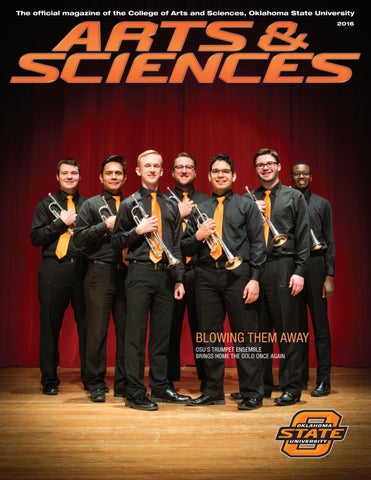
BLOWING THEM AWAY OSU’S TRUMPET ENSEMBLE BRINGS HOME THE GOLD ONCE AGAIN
\ I
A&S Dean Bret Danilowicz (in front) did a tandem skydive with Sgt. 1st Class Noah Watts of the Army’s Golden Knights in January.
p l a y b i l l
PHOTOGRAPHY / COLLEGE OF ARTS & SCIENCES
10
On The Cover
School of Visual and Performing Arts
O S U ’s Tr u m p e t E n s e m b l e once again brought home
10
the gold from the National
M U S I C : O S U ’s t r i p t o t h e N a t i o n a l
Tr u m p e t C o m p e t i t i o n .
Tr u m p e t C o m p e t i t i o n
2 A new course is teaching anyone who wants to learn how brewing beer works. Tu r n s o u t , a l o t o f p e o p l e w a n t t o l e a r n .
16 A R T: N e w M FA p r o g r a m b r i n g s together array of perspectives.
20 T H E AT R E : Tu l s a B a l l e t s t a r d i r e c t s new minor in dance.
2016 v18
C A S .OK S TAT E .E DU
Arts and Sciences Magazine is a publication of the Oklahoma State University College of Arts and Sciences. All communications should be mailed to OSU College of Arts and Sciences ATTN: Arts and Sciences Magazine 205 Life Sciences East Stillwater, OK 74078-3015 2 0 1 6 © O K L A H O M A S TAT E U N I V E R S I T Y
Oklahoma State University, in compliance with Title VI and VII of the Civil Rights Act of 1964, Executive Order 11246 as amended, and Title IX of the Education Amendments of 1972 (Higher Education Act), the Americans with Disabilities Act of 1990, and other federal and state laws and regulations, does not discriminate on the basis of race, color, national origin, genetic information, sex, age, sexual orientation, gender identity, religion, disability, or status as a veteran, in any of its policies, practices or procedures. This provision includes, but is not limited to admissions, employment, financial aid, and educational services. The Director of Equal Opportunity, 408 Whitehurst, OSU, Stillwater, OK 74078-1035; Phone 405-744-5371; email: eeo@okstate.edu has been designated to handle inquiries regarding non-discrimination policies. Any person (student, faculty, or staff) who believes that discriminatory practices have been engaged in based on gender may discuss his or her concerns and file informal or formal complaints of possible violations of Title IX with OSU’s Title IX Coordinator 405-744-9154. This publication, issued by Oklahoma State University as authorized by the College of Arts & Sciences, was printed by Heritage at a cost of $6,619/6,000 . #6409 9/16
s t a f f Editor
Dorothy L. Pugh ’83
Art Director
Valerie C. Kisling
Photographers
Phil Shockley Gary Lawson ’83
Writers
Brian Petrotta Karolyn Bolay Jamie Hadwin, ’10, ’15 Shelby Holcomb, ’15
College of Arts and Sciences
Dean
Bret Danilowicz
Senior Director for Development
Jayme Ferrell
Communications Coordinator Brian Petrotta
YEAR INDICATES OSU COLLEGE OF ARTS AND SCIENCES GRADUATES.
From the Dean … Editor’s Note: We thought a quick Q&A session with Dean Bret Danilowicz would be an excellent way to kick off this year’s A&S magazine. Enjoy!
You are in your fifth year as dean of the College of Arts & Sciences at OSU. What have you most enjoyed?
A
Without a doubt, witnessing the experiences and successes of students, faculty and staff is the most enjoyable part of being dean. Each day, I learn new stories that involve the amazing people of this college; it makes each and every day as dean rewarding.
In January, you participated in a tandem skydive with the Army’s Golden Knights. Describe that experience.
A
The Council of College of Arts & Sciences (CCAS) elected you to serve as one of 12 deans on its board of directors. How does CCAS enhance arts and sciences higher education across the country?
A
CCAS is comprised of deans of arts & sciences across the country, with over 700 members. Deans discuss what worked — and did not work — with administrative initiatives at their institutions, from student success to new academic programs to fundraising. Beyond a traditional conference, there are roundtable discussions of how to implement high-impact practices. You become networked to deans who can help you solve problems on your campus; it is reassuring to know that you are not facing these problems alone.
It was an absolute thrill! I was partnered with Sgt. 1st Class Noah Watts. He had over 4,000 jumps behind him, and he was funny and good-natured (the number of What is your ideal way to jumps being his most important unwind after a long day of leading quality, of course!). I was apprehen24 academic departments in the largsive through training and getting est college at OSU? onto the plane — but from the moment I jumped, the nervousness vanished and the 60-second free fall When it is not too hot, I was incredible. It was below freezing, unwind by going for a long run with but I never noticed the cold! I appre- my wife, Kay. Yes, running for me ciate the opportunity to work with is relaxing! Another would be playour ROTC cadre and future officers ing board games with my family (e.g. here at Oklahoma State! 7 Wonders, Carcassonne, “penny” poker); the laughter from those games is a great tonic!
A
In what ways do you hope to see A&S grow in the coming years?
A
Oklahoma State has asked the colleges to focus efforts on student success over the past few years. I’ve been proud to see the outcome in this college; our majors have had increased retention each year since 2012. Additionally, all majors at Oklahoma State rely on courses offered through Arts & Sciences, and our departments have really stepped up to enhance student success across the university. A great example would be the Success in Undergraduate Mathematics initiative and its associated Mathematics Learning Success Center; our students are thriving in their mathematics courses, and we have become a national model for best practices in helping students learn math. I would love to see our success with students continue to grow; every student we help graduate is one more student who will have a successful career and help boost the state and national economies.
Brewing Something New
New online course teaches ‘why’ microbrewing works
COLLEGE~ ARl'SAND SCIENCES
PHOTO: BRIAN PETROTTA/A&S
By Brian Petrotta
T
yrrell Conway pulls on his lab coat and prepares to deliver a lecture. It would be an ordinary day for the professor and head of the Department of Microbiology and Molecular Genetics at Oklahoma State University except that instead of interacting directly with college students, Conway is speaking to a camera lens. He is lecturing on the metabolism of yeast as part of the College of Arts & Sciences’ first Massive Open Online Course (MOOC) titled, “Brewing Microbiology.” This is new territory for the scientist and the college but the MOOC generated immediate interest as both a credit and non-credit offering. In fact, by making the class available in both formats, it allowed for an unusual makeup of students. “What I think is really interesting is when I hear a student is enrolled for credit and they’re taking it with their parent, who is enrolled in the open course,” Conway says. The idea to teach a course on the microbiology of microbrewing sprouted from two seeds: Conway’s growing interest in a rapidly growing industry and his department’s desire to build student credit hours. Noting there are “thousands of courses” that teach the how of brewing, Conway saw an opportunity to discuss why the process works. It proved to be an easy sell after meeting with Arts & Sciences Associate Dean for Outreach Bobbi Kay Lewis. She saw an opportunity to turn Conway’s idea for an online credit course into a MOOC. “I thought it sounded like a fascinating course,” she says. “It went from conception to development very quickly after the initial discussion.”
LOCAL TIES It does not hurt to have a popular local brewery on board with the production. Iron Monk Brewery Company, founded in 2014 by OSU alumni Dave Monks and Jerod Millirons, not only opened their doors for portions of the video shoot but
also worked to promote the class. It just so happens Monks and Millirons share the professor’s passion for science. Monks earned his doctorate in molecular biology and Millirons graduated from OSU with a bachelor’s degree in biology before pursuing his MBA. The two met while teaching biology at North Central Oklahoma College in Stillwater and discovered their mutual love of home brewing. Now their product is being broken down to its most basic elements for a worldwide internet audience to witness. Their cooperation proved vital to the project. “We can’t offer this course without those guys,” Conway insists. Part of Iron Monk’s corporate ethic is to use grain from Oklahoma, which led Conway to make a connection with J.D. Drennen of 46 Grain Co. in Ames,
Brewing Microbiology: What to Know Open to OSU students for credit or for free as a noncredit course to anyone with an internet connection.
100 percent online course • Students who take the course for credit will receive three credit hours of upper division science. There are no prerequisites, though high school or freshman level biology and chemistry is suggested. • Teaches the science behind microbrewing, convering topics such as microbiology of yeast, biology of grain, biochemistry in malted barley, chemistry of water, preservative nature of hops, and the human physiology of taste and smell. Inaugural course began in August 2016 and future offerings are in the works. For current information, visit: http://asoutreach. okstate.edu/students/online/brew
3
OSU 125TH ANNIVERSARY TIMELINE
LEARNING
4 COLLEQE2!;
ARTS AND SCIENCES
You might think a professor with Conway’s years of experience and level of expertise would be content to spit out a lecture and call it day. However, Conway took on the project to be a student himself. “The MOOC has been a labor of love because I get to study,” he says. “I am having the most fun when I’m learning something new.” That love of learning began in earnest his senior year at OSU. The late Dr. Ed Grula offered a spot in his lab, and jumped at the chance. “Big Ed” I Conway passed away at age 54 while Conway was still a graduate student, but the beloved professor left a huge impact on the department. So did his wife, Mary. “She was an amazing, brilliant, strong, sweet woman,” Conway says. He recalls her stepping in to try to pick up the The late Dr. Ed Grula (left) offered Tyrrell Conway a spot in his lab, sparking the then-student’s love of microbiology. His wife, Mary (right), stepped in to help the pieces in the department just two weeks department after Dr. Grula’s death. after Big Ed passed. Grula’s legacy lives on today, thanks to a graduate fellowship he started at OSU. One of his first Ph.D. students, John Okla. He allowed the video crew to Whitney, completed the endowment on record some of the lectures in his rye that fellowship. Whitney retired as vice fields, giving the course a true “on-locapresident of the Eli Lilly and Co. research tion” feel. labs and was honored as the 2016 Arts On-campus collaborations also made Brewing Microbiology a success. Conway & Sciences Distinguished Alumni for Microbiology. is quick to credit A&S Outreach with Conway stayed in academia. He promoting the class and the Institute for secured a postdoctoral position at the Teaching & Learning Excellence with providing the technical talent and exper- University of Florida, where he received the U.S. Patent Office’s 5 millionth patent tise to produce a quality online product. (for creating recombinant E. coli that “The university resources have been made ethanol) — a notable enough event great,” Conway says. “They think of that CNN found time around its Desert things from the student’s perspective.” Help also came within the department Storm coverage for a report. The University of Nebraska hired from first-year postdoctoral associate Conway out of Florida and granted Jerreme Jackson. He handled much of the him tenure. He moved on to Ohio State lab work, which often commanded two University before returning to Oklahoma or three days of prep before the lecture at the other Big XII institution. That could be recorded. move shocked family members; his broth“I can’t put into words how much ers, aunts, uncles and father all graduated groundwork goes into making a course available online for anyone in the world,” from Oklahoma State. Jackson says.
LEGACY Conway just completed his first year as the microbiology head at OSU, where he is building his own legacy. From instituting a tagline, “Think big about small things,” to enlisting his dog, Chunk, in the Pete’s Pet Posse program, he has worked to build an identity for the program. Brewing Microbiology is his latest success. “The high enrollment in both the credit and free MOOC indicates it will be successful reaching and engaging learners on campus and across the globe,” Lewis says. “The MOOC is an excellent example of the land-grant legacy emphasizing educational access and outreach.” With the university as a whole trying to manage budget cuts, positive numbers are welcome — especially for one of the smaller departments on campus. Conway feels generating student credit hours through the MOOC serves the microbiology and molecular genetics department as well as Arts & Sciences as a whole. “I think it’s important for us to contribute back to the college,” he says.
PHOTO: BRIAN PETROTTA/A&S
While the MOOC is bringing an unusual amount of attention to the department, Conway knows it is the quality of faculty, students and staff that makes the biggest difference. Just as he has enjoyed learning about microbrewing, Conway appreciates perspectives other than his own, and that quality helps attract talented people like Jackson. Believe it or not, the Brewing Microbiology MOOC was not part of the sales pitch to entice Jackson to OSU. When he did find out about the course, though, his reaction was similar to many others: “I was going to ask Dr. Conway if I could enroll and take it myself.” Instead, Jackson became involved in nearly every step of the project including speaking roles on topics he was particularly qualified to talk about “off the dome.” Jackson sees the value of the course is in teaching students to look deeper. “The whole idea is to encourage students to think outside the box,” he says. “We want them to think of what they can do with the different curricula they’re taking, and that there is a scientific component to the products we consume on a daily basis.”
Tyrrell Conway (left) and Jerreme Jackson prepare a lesson in Brewing Microbiology for the cameras.
5
Arts and Sciences? Yes, please Both sides of OSU’s largest college blend perfectly with this study abroad course
By Karolyn Bolay
Many students working toward a science degree rarely have the opportunity to learn how to properly sketch and paint a landscape scene. But a study abroad trip to the Bahamas through the College of Arts and Sciences provides this unique opportunity. one island, you have rock being made, rock being Associate professor Liz Roth and professor Todd dissolved and the water changing from salt water to Halihan combined arts and sciences for the study freshwater, so you have all the reactions.” abroad course. Students researched the hydrogeolThe research projects led the students to several ogy of carbonate platforms for the science part of interesting parts of the islands, including a blue hole the class. that the late Jacques Cousteau — known for his “Very few arts and sciences courses are actually research on all water life forms — dove himself. both arts and science,” Halihan says. The art of the class included sketching and waterSeveral parents of participants wondered, why colors. The nature and landscape of the Bahamas the Bahamas? Halihan says it was the perfect location for students to perform their own hydrogeology provided a perfect background for students to learn. “I was able to teach a quick class for them on research projects. how to draw,” says Roth, associate professor in the “There are very few places in the modern world department of art, graphic design and art history. where limestone actually forms, so the Bahamas “Some of the students did really well with the is one of the few active carbonate platforms in the world,” says Halihan, a geology professor. “All on
PHOTOS COURTESY TODD HALIHAN \..
A rainbow crosses the sky at the Forfar Field Station, where students stayed during the course.
m ~ group
ph Bahamas.
Research findings are logged into a computer while diving at Cousteau’s Blue Hole.
I I II \\ I I I
I
I
\
\
I
\
“They [students] got to sing in the Christmas pageant because the locals fully expected us to, so it was hard to turn them down.” — Todd Halihan Pickens says the study abroad trip offered him drawing. At one point, we went to Fresh Creek and opportunities to learn about multiple areas, not just some of the students who weren’t eating conch were hydrogeology. out sketching.” “It was a whole new world,” he says. “We didn’t “She [Liz Roth] actually taught us how to draw and learn just hydrogeology, we learned everything from there were plenty of drawing opportunities, especially marine biology to history to culture to food. They had for landscape,” says Cullen Pickens, graduate student in geology. “I really enjoyed the drawing aspect. It was unique, very interesting food and the snorkeling was great. Going around and just seeing how the island fun to sit there and sketch and see it [the Bahamas] works.” from that perspective.” The course had 10 students. Halihan and Roth are The course also provided a lesson in culture and planning to continue the course next year and open it hospitality. up to the broader university. “We snuck in quite a bit of culture,” Halihan says. “They also got to eat a bunch of food they never had in their life.” Roth agreed the conch was great, as was the local generosity. “The folks who work there at the field station were very informative and really assisted people to understand a bit about the unique ecological environment they have there,” Roth says. The students also took care of the Forfar Field Station — located in North Blanket Sound, Andros Island. “We stay at the field station, which is somewhere in between because it is not a resort paradise,” Halihan says. “It is a family island. So you’re staying in a Liz Roth’s sketch of Cousteau’s Blue Hole in the Bahamas. cabin with no AC and no heat. You’re eating cafete“This next fall will be a little bit different, since we ria style — by no means fancy. It is old school, cabin are adapting it to be an introductory geology class,” style camping. But the other thing is that the students says Halihan. “This will allow more students to got to see a different version of life than what you see participate.” up here.” That included being responsible for serving Halihan also has a long-term goal for the hydrogethe food at the field station. The students also experienced true island life, which ology course. “[Forfar Field Station] is a really good facility for involves importing food and other necessities. geologists, and we have some of the best carbon“We ran out of coffee for a day and the reason we ate geologists in the world in our department,” says did is because one of the storms came by and the food barge couldn’t get in to give us food and coffee,” Halihan. “So it ties in with our research and teaching efforts. It is also home of the Bahamian Ag School Pickens says. “So half of us had to go without coffee that is trying to get started. It meets well with all the for a day.” missions of OSU. So if we ended up with a long-term Because the trip took place during the holiday program, where we did work with College of the season, students experienced the local holiday tradiBahamas and some of their programs, that would be tions, including the annual Christmas pageant. “They [students] got to sing in the Christmas pageant really useful for both campuses.” because the locals fully expected us to, so it was hard to turn them down,” Halihan says.
9
Blowing Them Away
OSU ensemble tops National Trumpet Competition again BY GRANT HARPER PHOTOS: PHIL SHOCKLEY
The National Trumpet Competition Large Ensemble Division Winners: (from left) Ian Mertes, Lorenzo Diaz, Grant Harper, Noah Mennenga, Greg Evraets, Daniel Montalvo, and Kevin Kamau.
Editor’s Note: Grant Harper is an OSU senior, majoring in trumpet performance and vocal music education. He kept a travel log for A&S magazine during his recent trip to the National Trumpet Competition. The highlights follow:
DAY 1
runs. The Silver Ensemble, a quartet, begins with their arrangeNTC: The National Trumpet Competition. This year, Columbus ment of J.S. Bach’s Prelude and Fugue in G minor. Next, the Black State University in Georgia Ensemble, a septet that I am in, hits graciously played host. Hundreds our problem spots and performs of soloists and ensembles ranga full run, an arrangement of ing from junior high to graduate Rimsky-Korsakov’s Russian Easter students showcased their talents for Overture, arranged by Dr. Gardner. the best players and teachers from Finally, the Orange Ensemble, across the country. a quintet that is performing For us, the students of “Bacchanale” from Camille SaintOklahoma State University, NTC Saens’ opera Samson et Delila, has become an annual trip. In thought that they would do spot 2016, four soloists (two underchecks, but instead they cranked graduate and two graduate) and out the best full run of their piece three ensembles were competing. to date! So we packed up and Dr. Ryan Gardner, our teacher and called it a night. ensemble coach, has built an NTC
During our second rehearsal of the day, all three groups performed well, but we each needed to work on intonation and being together throughout the entire piece. After dinner (capped off by a cookie sundae and a “Happy Birthday” serenade to me on my 22nd birthday), we settled in for the evening, all of us feeling some level of nerves over tomorrow’s competition.
DAY 3
Competition day has arrived for the ensemble division semifinalists. “Next to perform, the Oklahoma State University ensemble performdynasty at OSU. ing Russian Easter Overture by We have been preparing for this DAY 2 Rimsky-Korsakov, arranged by competition since August, and Gardner.” Day 2 of our trip was much finally the day came for us to Sophomore Kevin Kamau led more relaxed, with no flying and depart. Tuesday, March 8, began us onto stage. We looked out into minimal driving. The only thing with every member of the truma 2,000-seat hall that dwarfs the on our minds was the competipet studio meeting at the Seretean Seretean Concert Hall of only tion. One day left to improve and Center to load cars and head to the solidify our ensembles. Morning 800. Lorenzo Diaz, a second-year Tulsa airport. We arrived in Atlanta rehearsals at CSU were simple: spot master’s student, leads our bow. around 5 p.m. Eastern, rented cars checks and runs. All three groups I heard the breathing of everyand got on the road to Columbus. came in, acted like it was the actual one down the line: a bit shallow My car was filled with a great but still confident. Freshman Ian competition day, and each group amount of enlightening conversaMertes began the piece, and we performed wonderfully. tion as well as the 1979 recording took off. Seven and a half minutes After lunch, Dr. Gardner, the of Leonard Bernstein conducting four soloists and I returned to CSU later, we finished with our unison a performance of Symphony No. D, hearing our sounds resonate for to rehearse with pianists. Each 5 by Shostakovich with the New what seems like ages. The audience soloist had 30 minutes with a York Philharmonic. We have to be pianist to rehearse — the only time erupts. Now it was up to the judges nerds somehow. to decide if we were good enough the soloists get to work with the After checking into our hotel pianists until they take the stage on to make the cut. and getting dinner, we found a When the OSU quartet finally Friday. The times were all back-tojanitor who opened the orchesback, and we returned to the hotel took the stage, our nerves were tra room at CSU for our rehearsal. around 4:30 p.m. a little visible from the audience. All three groups ran our compeSophomore Bryson Tuttle, who tition day routine: small spots began completely alone, had shakfrom our pieces followed by full ing hands. The performance went
11
OSU trumpet performance and vocal music education senior Grant Harper celebrated his 22nd birthday at the 2016 National Trumpet Competition in Columbus, Georgia. He helped OSU win a national championship in the large ensemble division.
12 COLLEQE2!;
ARTS AND SCIENCES
factory to try out horns that wonderfully as the group his students will get to play for put more music into a Bach prelude and fugue than should free when we’re at the school. However, this is a great place be allowed. We headed back into Legacy for the students to try out horns on their own. Hall to prepare for our quinWith our experiences at tet’s performance. This group the exhibits wrapped up, we being the reigning national began our first of four competchampions, the crowd grew. itors in the solo division. The group was greeted by a First up was Lorenzo Diaz, a large gust of applause and second-year master’s student cheering. By the end of the from Duncan, Okla., who is piece, no one could believe also a part of the large ensemwhat was just heard. The ble. He stepped on stage in sounds filled Legacy Hall for several seconds after the cutoff. a regal purple button-down shirt and played The American It was phenomenal. As the opening concert was Concerto by Ellen Taafe Zwilich. It’s not a very wellcoming to a close, the audience got more and more antsy, known piece of music, but it awaiting the results. Finally, an is one of the hardest from the NTC board member took the modern repertoire. Next was Justin Weisenborn, stage: “The Large Ensemble a first-year master’s student finalists are the University and member of OSU’s quinof Texas, Oklahoma State tet. He performed the Tamberg University and Central Trumpet Concerto, another Michigan University.” of the hardest pieces in the modern repertoire. Tyler DAY 4 Murray was the last of the With the ensemble compefour OSU performers for tition over with, we looked the day. The senior from forward to a more relaxed Checotah, Okla., filled much day going to the exhibits and of the 2,000-seat concert hall listening to solo performances. with his sound. The exhibits are a special part of the competition. DAY 5 Companies that produce everything trumpet show up Dr. Gardner asked us with their shiniest and best to attend the high school products to tout to young semi finals around 11:30 musicians looking to push a.m. to hear some prospectheir playing to the next level. tive OSU students. The three Many times, students will were really talented and walk out with new horns. It impressed us greatly, playing is also a good time for teachpieces that some of us college ers to try horns that they may students would not dare to want to buy for their schools. play because of their level of Dr. Gardner goes straight difficulty. to the source for us. He is a A short lunch later, perforBach performing artist, so he mance preparations swung makes the exodus to the Bach into high gear.
Dr. Ryan Gardner has built a National Trumpet Competition dynasty at OSU.
chipped notes, chords not as well We struggled to find an open room suitable for warm-ups, which in tune) but no glaring problems, didn’t help the tension level among and for that I was grateful. After getting coffee and a little us. The 10 minutes we were to shopping, we returned to the get in our official warm-up room didn’t help that much; room moni- RiverCenter to hear the graduate tors interrupted us every couple of and undergraduate solo finalists as our Justin Weisenborn was one. minutes to count down how little time we had left to prepare in there. His second run of the Tamberg The University of Texas Trumpet Concerto was even better than the Ensemble preceded us on stage. Its day before. I knew that he would wonderful performance motivated be hard to beat — and he won the Graduate division of NTC. us further. I took the stage with A little while later, another the ensemble, feeling confident and announcement regarding the knowing we would do well. Maller Trumpet Large Ensemble Ian Mertes began our piece, Division: and from the first note I could tell something was wrong: There was “In first place, with a a weird fuzz in his sound. After the cash prize of $5,000, longest eight minutes of my life, we finished our run. There were lots of Oklahoma State little mistakes (slight timing errors, University.”
PHOTO: BRUCE WATERFIELD
13
We have a tremendous history of music in our state. The McKnight Center will attract distinguished and emerging Oklahoma artists, songwriters and producers not only for performances, but also the opportunity to work with our students and enrich the performing arts culture at Oklahoma State.” - B U R N S H A R G I S , OSU P RES I D E N T
The McKnight Center for the Performing Arts at OSU will be an epicenter for the arts, attracting celebrated national and international programs, featuring notable performing arts productions. The center is named for OSU alumni Ross and Billie McKnight, whose $25 million gift to create a programming endowment was announced in March 2016. They are joined by other arts visionaries who have donated $1 million or more to the project. Known as the McKnight Center Patrons, the group is growing as fundraising for the project continues. OSU and the OSU Foundation seek to raise an additional $25 million to complete the vision for the building and program endowment. The McKnight Center will ENCOURAGE discovery, PUSH educational boundaries and REDEFINE Oklahoma State’s influence in the arts with world-class programming unique to the region. It will be a modern venue for OSU’s talented students, accomplished faculty and members of the community to enjoy. Programming will encompass a variety of musical offerings and theatrical performances. It will celebrate the rich and thriving
Oklahoma music community that produces impressive Grammy, Emmy and Tony Award winners in addition to successful professionals in the music industry. The new center will serve as a creative melting pot for Oklahoma State. Theatre and music students will interact with touring artists, attend masterclasses and participate in performances and productions. The McKnight Center will enrich and enhance all aspects of the Oklahoma State family. It will attract and bring together students, professors, performers and the art community around the nation to enjoy and create expressive works of art. Please contact McKnightCenter@OSUgiving.com or 800.622.4678 to find out how you can support this project.
ARTS AND SCIENCES
rapidly expanding fields of Interaction Design and Motion Design.
Jim Hamilton Jr., OSU Spirit Rider © 1984. Estate of Jim Hamilton Jr.
COLLEQE2!;
The Master of Fine Arts (MFA) in Graphic Design at Oklahoma State University (OSU) is a new graduate
16
program that offers an interdisciplinary perspective on Visual Communication with specializations in the
New MFA program brings together array of perspectives
Department of Art, Graphic Design and Art History 108 Bartlett Center 405-744-6016 Stillwater, OK 74078 mfa.design@okstate.edu
DESIGN YOUR FUTURE & EXPAND YOUR CAREER HORIZONS
APPLICATION DEADLINE: FEB. 15, 2016
A Diverse Future — By Design GRAPHIC
DEPARTMENT OF ART, GRAPHIC DESIGN & ART HISTORY, OKLAHOMA STATE UNIVERSITY INTERACTION
MOTION
Associate professor Phil Choo’s design of this brochure captured a regional award
Designers Association, who also exhibited the piece at the 2016 UCDA conference.
by Art Directors Club Tulsa and a national award from the University & College
FOR MORE INFORMATION ABOUT THE PROGRAM PLEASE VISIT WWW.ART.OKSTATE.EDU
BECOME A
By Brian Petrotta
O
ne boy moved from Mexico to the United States at age 12. Another earned a college degree in South Korea before immigrating. And a third left Iran at age 13, finished his high school equivalency in the U.K. and started junior college in the U.S. at age 15. Two things tie the three of them together: taking risks and starting a Master’s of Fine Arts in Graphic Design at Oklahoma State University. Mario Bocanegra, the boy from Mexico, will be one of six newly admitted graduate students in the program. Phil Choo, from Seoul, South Korea, is the graduate program director, and Pouya Jahanshahi is a third-year assistant professor in graphic design. Each brings a fascinating perspective to the discipline, which is exactly what faculty members had in mind when creating the program. “We wanted a diverse group so they could complement each other,” Jahanshahi says. “Much of graduate learning is to learn from each other.” OSU’s MFA in graphic design becomes its first graduate program in studio art (there is an existing program in art history). It will encompass three distinct areas: visual communication, motion graphics, and interaction design (sometimes called user experience design or UX design). According to Choo, no other program in the Big 12 Conference has that combination. With national organizations already noticing OSU’s undergraduate work, all six allotted slots were quickly filled. In fact, the goal for 2016-17 was to offer three or four spots and grow the program from there. “We’re very thrilled,” Choo says. “Fortunately we have a good group of students from different backgrounds, geographical locations and age groups.” Indeed, with students from India, Korea, New York and Oklahoma, ranging in age from recent college graduate to 44 years old, the student body is a diverse cohort. That level of diversity reflects the faculty and helped persuade Bocanegra to
continue his studies after graduating with his bachelor’s degree in fine arts from OSU in May 2016. “I feel like there will be more surprises,” he says. Bocanegra had many of the faculty members as an undergraduate, and he’s looking forward to all aspects of the graduate program, including research and teaching. Each student is required to take a teaching practicum during their first year and will be able to teach lowerdivision design courses. That is all part of what makes the MFA a terminal degree for the discipline. Graduates of the program will have the ability to work in industry or academia, making the MFA equivalent to a doctorate. Choo is excited by what OSU has accomplished in getting the program off the ground but feels the success of the program ultimately relies on its graduates. “I want the students to become professors or leaders in graphic design, and our program will grow up with that support,” he says. Both Choo and Jahanshahi feel they grew up during their graduate school years. For Jahanshahi, this was almost literally the case. He was 15 when he came to the United States to live with his uncle in Los Angeles. At 13, his parents moved him from Iran to London. His father was allowed to leave Iran for business purposes and the whole family migrated to the U.K. to at least temporarily escape the bloody Iran-Iraq War. In his two years there, Jahanshahi studied for and passed all five equivalency exams in the U.K. to qualify for college. All he had to do next was change his country, his language, and start college at age 15. “Luckily, I was tall,” he jokes. Because Jahanshahi was not born into the family of a master artist, he had no future as one in Iran. In the U.S., he discovered all sorts of careers he could pursue as an artist. Still, he had to sell his parents on the idea.
PHOTO: BRIAN PETROTTA
17 Pouya Jahanshahi, a third-year assistant professor in graphic design, says the new program is designed with diversity in mind.
“We looked at what we are as a landgrant institution and saw that what distinguishes us from purely fine arts schools is a spectrum of science and knowledge they don’t have.” — Pouya Jahanshahi
Mario Bocanegra created this poster for his senior capstone graphic design project at OSU.
18 COLLEQE2!;
ARTS AND SCIENCES
“I had to convince my parents, who had that designer for taking him out of his sent me across the ocean at great expen- “safe space” and pushing him to truly diture, that a career in the arts and design define who he was. “That’s what I needed to do the whole had a future,” Jahanshahi says. time,” he says. “It brought out the He eventually moved on to obtain Iranian in me and the immigrant in me, his master’s degree with a focus on motion and semiotics, at California State the hybrid visual thinker. It was about University, Fullerton, where he was intro- both finding my identity and allowing myself to fail to find something new out duced to the first Macintosh computers. of that.” Jahanshahi still keeps one of the relics Choo also sees success coming from in his office at OSU. That degree led to work with advertising and design compa- taking risks. Like Jahanshahi, Choo found work as a professional designer nies, but something was missing. immediately after graduating from college Twenty years after leaving Iran, he but felt there was more to know. He returned and came face-to-face with decided to study in the U.S. and found a his ethnic visual culture — the missing piece. He pursued his MFA at California home at Iowa State University. It was not an easy transition for he Institute for the Arts, keen to develop could read and translate English but a hybrid visual identity for his personal speaking the language had not been graphic voice. part of his education. He soon found Jahanshahi credits a class called his American classmates were happy to “Image Making” that involved picking a help him practice his English. He enjoyed designer and trying to make things like researching interaction design, which had just begun to be studied at the time, and especially took to leading a classroom. “I didn’t know I could teach until I had an opportunity,” he says. “Since then it’s become a career, and that’s been 14 years now.” Bocanegra never had Choo for a teacher as an undergraduate, but he got to know the professor through an internship with SST Software in Stillwater. Choo pushed the soon-to-be graduate to apply. “He mentioned the MFA program to me and I was fascinated by it,” Bocanegra says. The department, under the guidance of Rebecca Brienen (who also serves as the director for OSU’s School of Visual and Performing Arts), is justifying such enthusiasm with cutting-edge equipment such as eye-tracker technology, laser cutters, and 3D printers. The department also offers unique opportunities for interdisciplinary collaboration with entities across campus such as the App Center, engineering, broadcast journalism, and fashion
merchandising. As much as anything, that is what will set OSU apart from the competition. “We looked at what we are as a landgrant institution and saw that what distinguishes us from purely fine arts schools is a spectrum of science and knowledge they don’t have,” Jahanshahi says. Bocanegra is one of six who will be the first to take advantage of these opportunities in the new MFA program at OSU. They will be pushed, pulled, and offered a broad range of possibilities and perspectives. What they take from the program will ultimately come from within. “The most important thing is the curiosity and willingness to take a risk,” Choo says. PHOTO: BRIAN PETROTTA
19 OSU student Garrett Adams created these branding materials for a fictional restaurant called “Gigabytes.” These examples were featured at OSU’s 2016 Senior Graphic Design Capstone exhibit.
,----
Shall We Dance?
OSU’s Department of Theatre adds a dance minor
By Shelby Holcomb
--
COLLmllB.111:
PHOTOS: GARY LAWSON, UNIVERSITY MARKETING
T
his semester, Oklahoma State University’s Department of Theatre is turning a new page: Students will finally be able to earn a dance minor, an opportunity that will do wonders for aspiring performers and educators, as well as possibly open doors for future changes in OSU’s College of Arts and Sciences. Powered by department head and professor Andrew Kimbrough and adjunct instructor of dance Alexandra Bergman, the program will be on par with those offered by nearby universities due to this fresh emphasis on the arts. The program is open to students just beginning their undergraduate journeys as well as those wanting to broaden and further develop their artistic knowledge and skills. Because the program doesn’t require an audition process or previous experience, it has already set itself apart from similar programs. A year ago, OSU began offering dance classes such as modern and ballet — and to say they are a hit is a bit of an understatement. “Every course has been filled to capacity, and students from every college on campus have enrolled,” Kimbrough says. “And this was before the minor was announced. Clearly, students have the desire to continue their education in dance even though they are majoring in other subjects.” A key player in the OSU dance world is Bergman, who came from Tulsa Ballet with an outrageously impressive dance career. “I cannot overstate just how significant Alexandra has been for dance at OSU,” Kimbrough says. “Her background and expertise are not easy to come by, even at the university level. The students have loved her and know that, in her, they have a rare treasure.” Centered on fundamentals and flexibility, Bergman’s teaching methods are sound and effective, formulated in such a way that they can be successfully implemented with all levels of dancers. She tends to follow the Russian Vaganova
method — a ballet approach, created by Russian dancer and pedagogue Agrippina Vaganova, that fuses components of traditional technique-driven French style with the strength, artistry and musical proficiency of Italian technique. She also improvises as needed to accommodate students. “I want my students to walk away with the knowledge of correct working habits in the fundamental exercises used in ballet and modern classes,” Bergman says. “This knowledge will allow them to continue to improve while keeping their bodies free from injury in any future dance classes they take.” Full of encouragement, creativity and challenges, Bergman’s classroom is a
For students enrolled in ballet, a day in the classroom typically consists of a wellrounded warm-up centered on stretching, barré, and center and across-the-floor exercises. Bergman performs alongside the students — with exemplary technique — and often walks around the room providing one-on-one critiques and tips. Students concentrate and work diligently, improving and broadening their overall sense of technique and artistry while performing to a selection of tasteful, complementary music. Bergman’s methods center on helping students learn about and connect with their bodies, as well as understand rhythm, timing and efficiency. Toward the end of the session, the class may occa-
PHOTO COURTESY OF TULSA BALLET
Alexandra
Bergman
performs
Vertiginous
Thr/11 of Exactitude
a grand
Jet6 In WIiiiam
Forsytha's
with Tulsa Ballet.
place where students can focus on themselves, the art and the two combined. Bergman has high expectations, as most of what she knows and has lived is everything ballet and modern. “I would say that Alexandra’s teaching method is challenging but incredibly helpful,” says Scarlett Cox, a recent OSU Spanish program graduate who took Ballet II as an elective. “She’s a strict teacher but also very understanding and patient. I would definitely recommend her to anyone wanting to take ballet. Her passion for the art is very obvious and contagious!”
sionally learn, review and/or perform a routine or two. The structure of each class is always the same, but the exercises and combinations are ever-changing within the classes’ fundamental framework. “I want students to leave with a greater appreciation for dance as an art form,” Bergman says. “I want students to understand the discipline and high expectations necessary to be a professional dancer, and I want them to see those results on stage when they attend live performances by professional companies. I also want them
to enjoy the movement of dance and realize that it is also a wonderful form of recreational exercise and expression.” Bergman, who retired from the stage in May 2013 after performing and teaching all over the world, was born in Sweden and spent most of her early years on Long Island, N.Y. There, she attended Seiskaya Ballet Academy, where she trained under the great Valia Seiskaya. Bergman then joined the Huntington (N.Y.) Ballet as a continuation of her
I and II, Jazz, Tap, Dance Ensemble Practicum, Musical Theatre Dance and Choreography. “I hope the dance minor program will allow students with prior dance experience the opportunity to continue that training at OSU,” Bergman says. “It is hard for many students who have danced through out their childhood to give up that portion of their well-being once they go to college. The dance minor is also a wonderful complement to the Theatre
LEFT: Student
Allie Miller
II class repertoire RIGHT: Ballet
ends the Ballet with a final pose.
II students
class repertoire,
review
a piece they've
been working on all semester.
education, before kicking off her professional career with Tulsa Ballet. There, she served as an apprentice and rose through the ranks to principal. She performed lead roles in countless classical and contemporary works by prominent choreographers, including Val Caniparoli’s Lambarena, Ma Cong’s Carmina Burana, Nacho Duato’s Arenal and Rassemblement, Balanchine’s Theme and Variations, and others. While she serves as an adjunct dance instructor at OSU, she continues to teach for Tulsa Ballet. The dance minor is composed of a minimum of 16 credit hours — five credits in theory, four credits in required technique courses and seven credits of technique electives. Some examples of classes are Introduction to Dance, Dance Improvisation, Ballet I and II, Modern
Department.” “President Hargis has been investing so much energy in enhancing the landscape of the Arts at OSU, and we are trying our best to complement his vision,” Kimbrough adds. “The dance minor is our first step toward a more comprehensive vision for performing arts programs, especially in musical theatre and opera. “We’ve still got some big obstacles to overcome,” he continues. “OSU Stillwater does not have a dance studio available for classroom instruction, and the budget situation challenges our ability to bring in full-time instructors. But we’re working to address these issues.” For more information about the dance minor program, visit theatre.okstate.edu/ minor-in-dance.
“There is a vitality, a life force, an energy, a quickening that is translated through you into action, and because there is only one of you in all time, this expression is unique. And if you block it, it will never exist through any other medium and will be lost.” — Martha Graham
~
23
Tell Me a Story
New SMSC head believes in strong foundation for success
By Dorothy L. Pugh
PHOTO: PHIL SHOCKLEY/UNIVERSITY MARKETING
“Being a great storyteller leads to being great in anything we do — being a great journalist, a great
24 COLLEQE2!;
ARTS AND SCIENCES
PR person, a great ad person, a great doctor, lawyer, president of a company.” — Craig Freeman
S
tories. Where would we be without them? Reading a blank magazine, that’s for sure! Stories form the basis of everything we do: They help us relate to other people, find success in our careers, keep relationships on the level and so much more. That’s why Craig Freeman, the new head of the School of Media and Strategic Communications in Oklahoma State University’s College of Arts and Sciences, sets his school’s main goal as creating great storytellers. “I think what we do is make great storytellers,” he says. “Being a great storyteller leads to being great in anything we do — being a great journalist, a great PR person, a great ad person, a great doctor, lawyer, president of a company. Sometimes people change careers, and we want to make sure that they are great communicators, great storytellers every day, in everything they do.”
it to 20,” Freeman says. “I don’t think you can teach Think about it, he says: “If you’re an entreprewriting to 150 people at a time. We are making sure neur, you have to tell your story. If you’re a journalstudents know how to write well.” ist, you’ve got to tell the story about the things that Other innovations include a partnership with the you’re covering.” Edmon Low Library that focuses on working with As prime examples, Freeman cites such alumni as Ziva Branstetter and Cary Aspinwall, who were final- virtual reality. Another library partnership focuses on the use of social media in determining what attracts ists for the 2015 Pulitzer Prize in Local Reporting and keeps readers. A student in multimedia journalfor their Tulsa World stories on a botched execuism is doing her thesis in conjunction with OSU’s tion in Oklahoma (see the impressive entry at okla. Department of Theatre, using analytics and social st/2aEdMqj). media to help attract larger audiences for OSU Branstetter praises the school: “I wouldn’t be the productions. A television show produced on gameday journalist I am without that education.” Freeman, who came to OSU two years ago after 14 Saturdays at OSU with Tyler Media is opening eyes and doors. years at Louisiana State University, sees the skills the “We want to share our knowledge with everyone, so SMSC teaches as vital everywhere. “We stick to the values that are most important: You we can make our community better,” Freeman says. Barbara Allen, the director of student media, has want to be able to read analytically, you want to be able to write effectively, you want to be able to think taken steps to enhance student offerings and experiences, he says, calling her an “‘edupreneur’ who is critically. And so those are the basics.” helping us figure out what’s next.” Sticking to the basics is certainly paying off for “Barbara Allen has turned student media around,” the SMSC. Two students were selected to participate Freeman says. “Student media was losing money; in the 2016 William Randolph Hearst Foundation’s now it’s not. She created Archhouse Media, which Journalism Awards, and the Society of Professional does social media, websites and integrated marketing Journalists honored entries from the O’Colly. campaigns for local businesses. We’d always get calls, “In terms of potential, our students are nation‘Can you get me a kid who can do a website?’ And ally competitive right now,” Freeman notes. “But we now it’s all in-house and somebody is accountable. want to compete on a regular basis. We get amazing Student media gets the money and the students, who students from across the country. We’ve got students are paid, gain experience. Our video production is the from 38 different states now. best in town.” “We’re America’s best-kept secret.” Freeman doesn’t let alumni off the hook when it The secret may be out as OSU students are making comes to supporting the SMSC. names for themselves, he says. “We need more help from our alums,” he says “Hands down, in this country, nobody outworks a bluntly. “I need you to come back, to let us come to Cowboy. Nobody. They go to New York (to work), you or to write big, fat checks. We would rather you and they just kill. They go to Amsterdam, and they just kill,” he says, noting that their work ethic begins come back. It’s in that order for a reason: Come back to us. If you can’t come back, let us come to you. If early: “Nobody works harder than our awesome you can’t do either, write a check.” students. The way they work makes us work harder. It’s vital that today’s students interact with successWe can’t coast. These students are going to put in the ful alumni, he says. work, so you’ve got to put in the work to stay a step “When one of our great alums comes back, our ahead of them every day — which is a ton of fun.” students get to see them and get to see, ‘This is what Freeman also heaps praise on the “awesome faculty” and the innovations the school is continually devising. I could do.’ I can tell the students they’re great but when they get a chance to see Ziva Branstetter, that’s Some are major lower-level changes, such as rethinking the introduction to writing class. “We used like, ‘That’s how I can do this.’ to teach our intro class to 150 people. Now we teach
25
Out of Tragedy, Honor Homecoming crash coverage takes 2 O’Colly staffers to national contest By Brian Petrotta Photos: Jakub Moser and Erin Lubin
OSU student reporters Kaelynn Knoernschild and Cody Stavenhagen worked around-the-clock at the 2016 Hearst Foundation Journalism Awards to produce three challenging articles.
“I
t’s a story you never want to write.” Even if it leads to a national award? Cody Stavenhagen, a recently graduated sports media major from Oklahoma State University, still would have preferred a normal day of covering a Homecoming football game over adding a trophy to his mantle. On Oct. 24, 2015, Stavenhagen and classmate Kaelynn Knoernschild produced memorable coverage of the car crash at the Homecoming parade that killed four people and injured more than 40. Due to their commendable reporting, the two were selected to compete at the 2016 William Randolph Hearst Foundation’s
Journalism Awards in San Francisco. The annual competition recognizes the finest student journalism in the country. The fact that two OSU students were among eight finalists in the writing category to attend the competition in California speaks to their mature handling of a tragic event as well as the O’Colly’s surging presence among national heavyweights. OSU finished third in the writing category after placing 10th in 2015 (the first year OSU cracked the top 10). Barbara Allen, director of student media at OSU, says students who have actively pursued positions in student media are proving to be successful. “You find that students who take advantage of opportunities in student media tend to get better awards, better internships and when they graduate, there are a variety of job offers out there,” Allen says. Stavenhagen and Knoernschild were selected from 1,261 entrants from 108 colleges and universities with accredited undergraduate journalism schools. Stavenhagen (who became the first OSU student to compete in the event in 2015) won the Sports Writing qualifier for his article, “And Then There Was a Football Game,” while Knoernschild won the Breaking News Writing qualifier for her article, “ ‘I can’t recall an incident of this magnitude’: Community mourns after homecoming parade.” In addition to the
Cody Stavenhagen won the Hearst Award qualifier in Sports Writing for his article, “And Then There Was a Football Game.”
, •
Jr~.(~· ✓rif ... - ·/ ~
~'•lV///r\-f'~~
'l/,, ~1/
i."
~
'I •
' I
;;;.·.'.':·J· f, ~z~.;.'·.·. ,,:J:-, \ • ''' {J
,;.-
in the crowd of 40,000 at the game probably processed the day’s events in similar fashion. Allen feels Stavenhagen’s ability to tap into that shared experience caught the attention of the Hearst judges. “I think the reason he won such a prestigious award is that he was able to put into words what people were incapable of saying at the time,” she says. Knoernschild produced her award-winning piece with a classic style and relentless reporting. Allen
'
they had to cover an unimaginainvite to San Francisco, they each received a $2,600 scholarship from ble subject. Knoernschild, as the O’Colly managing editor, coordithe Hearst Foundation. nated photographers and reportThe week in San Francisco was ers while working on the story not all trophies and sightseeing. The Hearst Championships deliver herself. A day that began with notions of tailgating at a footrigorous assignments to competball game quickly turned into a itors. The eight-person writing marathon shift. She eventually left competition charged the students with interviewing Oakland Mayor the O’Colly around 1 a.m. for a few hours of sleep before preparLibby Schaaf, then writing both ing to be interviewed during a live a news story and personality/ profile piece. In addition, they were national news broadcast on Fox & Friends at 5 a.m. Sunday mornassigned an on-the-spot article about the city’s homelessness crisis. ing. By Sunday night, she had her “It is really a test of time manage- story ready for Monday’s issue of ment, ability to follow good leads, the O’Colly. Stavenhagen had a similar expeand acclimate yourself to a beat rience. He was set to cover what you’re unfamiliar with,” Allen says. In setting out to cover the home- everyone thought would be an lessness crisis, Knoernschild found easy Homecoming football win herself drawing on lessons learned over Kansas. Instead he was jarred during the Homecoming tragedy. In awake by calls and texts from shock and mourning like the rest of friends and family asking if he was Stillwater, Knoernschild battled to all right. Once he figured out why balance her reporting with her own those calls were coming in, he went straight to work. troubled feelings. “One of the things about being “Interviewing people in the community but also being a human a journalist is you don’t have a lot of time to process something like was really difficult for me,” she that,” he says. says. “I was constantly reminding While Knoernschild hunted myself itself it’s OK to be human down details of what happened, and to have these emotions as a Stavenhagen made his way to the reporter.” intersection of Main Street and Similar emotions stirred in Hall of Fame Avenue. He surveyed Knoernschild when she met a homeless woman in San Francisco the scene, paying close attention to each “eerie” detail that gave him whose daughter had been chills. By the time he reached the kidnapped. The woman lost her press box inside Boone Pickens job when her efforts to search Stadium, he had a framework in for her daughter overlapped with mind for his story. He also knew he her work schedule. It was not a did not want to write it. story Knoernschild could have “I remember talking with Nathan anticipated. Ruiz, the sports editor for the “I did not expect to talk with O’Colly, and telling him, ‘I do not someone involved in kidnapping care about this football game,’ ” and who was so open and honest Stavenhagen recalls. with me about it,” she says. In his story, Stavenhagen wove Both Knoernschild and the details of the game with the Stavenhagen look back at the Homecoming tragedy with weary “horrific event that had rocked the entire community.” Many people sadness. Not only were they processing their own emotions,
Stavenhagen (far left) and Knoernschild (bottom right) were two of eight national qualifiers in the annual William Randolph Hearst Foundation Writing Competition. They were selected from 1,261 entrants.
28 COLLEQE2!;
ARTS AND SCIENCES
gives her the ultimate compliment by calling her an “oldschool journalist.” Thanks to the School of Media and Strategic Communications at OSU and student media outlets like the O’Colly, Stavenhagen and Knoernschild have learned “old school” ethics in the age of modern media. Allen believes quality writing bridges reporting and communication. “We feel that having great writers in a vibrant student media program that is visible on a national level to other academics and professionals is really important,” she says. The industry seems to be taking notice. Stavenhagen graduated in December 2015 and, after landing competitive internships with MLB. com, The Oklahoman and The Minneapolis Star-Tribune, began full-time work at the Tulsa World. Knoernschild
graduates in May 2017 and spent the summer of 2016 in Washington, D.C., interning for the Student Press Law Center. Both students secured scholarships before even setting foot on campus in Stillwater. Stavenhagen hails from Amarillo, Texas. He was drawn to OSU for the sports media program and received enough financial assistance to make OSU more affordable than the major in-state Texas schools. Knoernschild calls Edmond, Okla., home, and both of her parents are OSU alumni. Though they encouraged her to apply to several different schools, they made it clear that wherever she went, she would still bleed orange. As with Stavenhagen, OSU presented her an influential level of scholarship money, and one
visit to the campus sealed the deal. “I felt right at home,” she says. This fall, she returns to Stillwater as editor of the investigative team at the O’Colly. Knoernschild heaps praise upon Allen, her SMSC professors and the student editors who preceded her for helping an inexperienced freshman blossom into an awardwinning student journalist. “As an editor in the fall, I hope I’ll be able to do some of the same and give back to the organization that helped me fall in love with journalism,” she says. Stavenhagen is similarly fond of his time at OSU, calling the O’Colly his most rewarding student experience. “You’re out there and doing stuff that matters and can have an impact on this campus,” he says.
ALUMNI HONORS
2015 A&S Hall of Fame Ziva Branstetter Ziva Branstetter first became known for her unwavering investigative journalism skills in journalism school at Oklahoma State University, where she earned a bachelor’s degree in 1988. She and reporting partner Cary Aspinwall were named finalists for the 2015 Pulitzer Prize in Local Reporting for their coverage on the botched execution of Clayton Lockett.
Edwin Chappabitty Dr. Edwin Chappabity graduated from OSU in 1967 with a bachelor’s degree in zoology. He was also a member of Scabbard and Blade for the OSU Army ROTC. He has gone on to demonstrate incredible support for Native American education, a record of distinguished service to his country and to the field of medicine and has brought distinction to OSU.
Bradford Gray Bradford H. Gray, Ph.D., earned a bachelor’s degree in business in 1964 and a master’s degree in sociology in 1966 from OSU. He was a member of the inaugural class of U.S. Office of Education fellows. He is also a senior fellow at the Urban Institute in Washington D.C., editor emeritus of leading health journal The Milbank Quarterly, and a senior adviser to the Harkness Fellowship Program and the Commonwealth Fund in New York.
2015 A&S Rising Star Kendall Gipson Kendall Gipson graduated from OSU with degrees in communication sciences and disorders, her bachelor’s in 2005 and her master’s in ’07. She has enjoyed working as a speech-language pathologist for Green Country Rehabilitation in Tulsa for the past six years.
29
PHOTO: GARY LAWSON/UNIVERSITY MARKETING
Students in OSU’s Juntos program use model kits developed by assistant chemistry professor Chris Fennell.
A Summer of Science OSU assistant professor’s volunteer work expands minds By Jamie Hadwin, OSU High Performance
3
Computing Center
COLLEQE2!;
ARTS AND SCIENCES
I
past two summers titled “Molecular n the short time Oklahoma State World Building,” which he describes as University chemistry assistant “Minecraft for molecules.” professor Chris Fennell has been By improving upon existing moleculein Stillwater, he has already built a notabuilding model kits, Fennell has been ble history of outreach, including two able to show the importance of molecule programs he volunteered for this past shape and size within molecular systems summer. in his outreach efforts over the past “As you know, new faculty, we probafew years. This summer, he went a step bly don’t know any better, so we volunfurther, using the chemistry department’s teer for everything under the sun,” Fennell jokes, describing how he became 3D printers to make model kits that each involved with one of those programs, the student could take home. “I’m trying to push the limits on how OSU Alumni Association’s Grandparent small we can get the kits, so we can build University. them for many students in a reasonable For the past 13 summers, GPU has amount of time,” Fennell explains. “They welcomed “legacies,” children or grandget to take something away from the children of OSU Alumni Association members, aged 7-13 and their grandpar- event and actually have it be useful later ents to spend a few days on the Stillwater in life. Also, building new teaching tools with 3D printing is all sorts of fun.” campus to engage kids in academics at Just after this summer’s GPU, Fennell OSU and create fun family memories. had even more “fun” when he began In the fall of 2013, the OSU Alumni modifying the course and model kits for Association began recruiting faculty and a July workshop he would be teaching for staff from the chemistry department for OSU’s Juntos (“Together”) program. GPU’s summer 2014 session. Fennell, in Formed in 2007, Juntos is a parthis first faculty position after finishing three years as a research fellow, immedi- nership between the OSU Cooperative Extension and Family Consumer Sciences ately volunteered programs that seeks to help Oklahoma’s Since 2014, Fennell has gone from at-risk Latino youth graduate from high hosting the GPU welcome sessions school and enroll in higher education. to teaching his own course for the
PHOTO: GARY LAWSON/UNIVERSITY MARKETING
“I view science as telling stories. You can do something that is very exciting to you, and, if you do a good job of telling that story, it can open up new doors for others.” — Chris Fennell
Fennell describes his Grandparent University course as “Minecraft for molecules.” Students who took his class left with model kits produced by the chemistry department’s 3D printers.
Dr. Ronald Cox, director of OSU’s Juntos program, said the program addresses three areas that research shows can increase educational success in Latino youth: • Enhance family support through workshops and community events. • Provide success coaches who serve as liaisons between the family and the education system. • Engage students in fun and positive learning activities with their peers. The third area is where professors like Fennell come in. At the end of an eightweek summer academy, Latino middle school students spend two days on the OSU campus participating in workshops in various disciplines. The purpose isn’t to have the students walk away as experts but to envision themselves being at and succeeding on a college campus. “We are looking for people like Chris, who see themselves as more than just a professor or researcher,” Cox says. “They
better,” Fennell says. “It’s something I care see themselves as a link to help the next generation of students become interested about for teaching and research purposes, and it’s just fun, too.” in the sciences.” It’s obvious that outreach is important to Fennell, but he points out that as a land-grant institution, it is also important PHOTO: GARY LAWSON/UNIVERSITY MARKETING to OSU’s mission to serve the community. A big push from national funding agencies has also elevated the importance of outreach in higher education and research. The result ensures researchers can continue their work while also getting out of their labs and into the community. For the past two years of GPU, Fennell recruited another new chemistry faculty member, Dr. Gabriel Cook, and has had several of his lab students help with the course. This also develops their appreciation for future outreach. “I probably do a little too much of it, Fennell is “more than just a professor but you can get addicted to it to some and researcher,” says Ronald Cox, degree by wanting to continue to make it director of OSU’s Juntos program.
31 AWE.S
0
c; U
/I
20 Years On ... OSU proves to be fertile ground for Apblett By Brian Petrotta
Dr. Allen Apblett was recently inducted as a fellow of the National Association of Inventors. He is currently working on projects ranging from aircraft to solar energy harvesting.
PHOTO: GARY LAWSON/UNIVERSITY MARKETING
W
hen Allen Apblett was grow- “I thought if this place was willing ing up in the Canadian to support research like that, provinces of Alberta and it was the place to be.” New Brunswick, his father often put on — Allen Apblett Merle Haggard records for the Sunday soundtrack. However inspirational the music, it was not “Okie from Muskogee” success has come from seeking an answer to a question and simply following where that brought Apblett to Oklahoma. Instead, it was a restless curiosity rooted it leads. “My research has taken me so many in chemistry. As he enters his 20th year at different ways,” he says. Oklahoma State University, Apblett has For example, how could he have proven himself as an educator, researcher guessed delivering a lecture in Texas and inventor. The National Association of Inventors would land him in Saudi Arabia inducted Apblett as a fellow on April 15 for a week each year? That journey began when Apblett’s post-doc adviat the U.S. Patent Office in Washington, D.C. Though he has garnered an enviable sor at Harvard University went to Rice University just as Apblett was moving number of awards and grants throughfrom Tulane University to OSU. On the out his career, the NAI ceremony was way to Stillwater, Apblett gave his lecture humbling for Apblett. at Rice, and an attendee from Saudi “I wasn’t sure I fit the crowd,” he Arabian Basic Industries Corp. soon sent laughs. NAI fellows produce an average of 33 a student to study under him at OSU. The relationship has since blossomed, patents and Apblett lands on the lower and Apblett has welcomed a stream of side of that number. But quality over Saudi students. quantity counts: “A patent does not Apblett estimates the number of his really mean much unless somebody uses former students in academia and industry it,” he notes. He co-founded (along with OSU chem- at 50-50. One of the latter includes Cody istry department head Nick Materer and Cannon, a senior research scientist at Magnesium Products in Tulsa, who credOSU graduate Shoaib Shaikh) Xplosafe, its Apblett’s success as a researcher and which primarily produces products to instructor to the academia-industry dualtest for and neutralize explosives and to ity of his approach. purify water. “He gives students a broader underJust as importantly in Apblett’s eyes, Xplosafe has helped attract several Small standing of chemistry through different methods of instruction,” Cannon says. Business Innovation Research grants from Homeland Security, USDA and the “He has so many different ideas, if you’re ready to take on more projects, he will Department of Defense, creating opporencourage you.” tunities for his OSU students. These Cannon recalls Apblett always making grants provide seed money for small businesses specializing in technology commer- time for students, even those in other groups. cialization. Apblett calls the grants “He’s very open and helpful,” he says. critical to innovation because of their Following a career in chemistry must flexibility. have barely registered on young Apblett’s “With SBIR grants you can make the radar, though. His father was a miliargument that an idea should be tried, tary man (Apblett is a self-described instead of having five people tell you “base brat”) who thought his sons could something won’t work,” he explains. only be successful in one of two ways — The availability of such seed money was a major attraction for Apblett when sports or the Air Force. he arrived at OSU in 1997. Much of his
“Unfortunately, I inherited his ability for sports and I can’t take orders,” Apblett jokes. While his brother followed his father into the military, Allen earned a degree with honors at the University of New Brunswick and a doctorate from the University of Calgary. Following a twoyear postdoctoral fellowship at Harvard, he landed at Tulane in New Orleans. Though he enjoyed his colleagues and the school itself, Apblett began to search for a place he could comfortably raise his family and a university where he could really dig into research. OSU proved to be the perfect place. He recalls learning the chemistry department had obtained a new piece of equipment but they needed more space — so OSU built a building. “I thought if this place was willing to support research like that, it was the place to be,” Apblett says. He quickly found the research infrastructure (help with budgets, paperwork, etc.) a welcome change. Additionally, the quality instrumentation available to undergraduates and the availability of seed money proved that OSU was dedicated to research. Even better, he was able to step into a lab tailored to his interests from the start and quickly built collaborations with the engineering college. “At this point in my career, nobody will chastise me for working on a little bit of everything,” Apblett says. As of mid-2016, he was trying to solve problems with aircraft, production of chemicals for medical applications and working on kits for measuring chemicals in oil fields. He is even collaborating with faculty members from other universities on solar energy harvesting. “There’s nothing like going in having little clue what the people are doing and then trying to solve their problems. You both learn something new and manage to accomplish something that will make a lasting impact.”
3
Safety First Physics doctoral candidate presents solutions to extreme risks of deep space travel BY SHELBY HOLCOMB
I
t’s no question that great risk is involved in successfully getting people to deep space for extensive missions. In the 2030s, NASA is planning to send people outside Earth’s orbit — specifically Mars — but much must be done before it can happen. Of course, keeping astronauts safe — especially when they face exposure to high doses of radiation — is a top priority. Kahli Remy, a physics doctoral candidate, addressed this issue in her presentation, “High Dose Radiation Effects in Tissue Equivalent Materials.” She won first place in the 2016 College of Arts & Sciences 3 Minute Thesis Finals and second place universitywide.
PHOTOS: OKLAHOMA STATE UNIVERSITY
“It is no surprise to me that Kahli did so well,” says Stephen McKeever, a MOST Chair of Experimental Physics, Regents Professor and Noble Research fellow who served as Remy’s research adviser throughout the entire process. “Her enthusiasm shines through in the lab.” McKeever along with Eduardo Yukihara, associate professor in OSU’s physical sciences department, and others helped Remy prepare her thesis, attended her competitions and gave her beneficial feedback. Remy’s thesis centered on the high levels of radiation that could be found in space and identifying and testing materials that could absorb radiation like human tissue does. In her 3MT talk, she defined radiation as “simply waves or subatomic particles that transport energy to another entity, whether it’s an astronaut or spacecraft component.” To Remy, the 3MT was more of an application-based presentation, which is much more than simply explaining the science of what one’s doing — a concept that can be difficult to play out in the realm of science. “This really broke the ice for me regarding presenting in front of people I don’t know,” Remy says.” It was a good first step in gathering information, organizing it in a concise manner — what I want to talk about and why I want to talk about it — and hitting important points, which is hard sometimes in science.” She focused on relaying her message to the audience in a conversational manner — in a way that is relatable, easily understandable and publicly relevant. It left the audience with a call to action — and she did it all in three minutes with only one static slide.
Above: Physics doctoral candidate Kahli Remy hopes her research will lead to more concrete safety measures for astronauts traveling to deep space. She won first place in the 2016 A&S 3MT Finals and second place universitywide. Left: Sheryl Tucker, associate dean provost for OSU’s Graduate Education and dean of the Graduate College, stands with forensic science master’s student Dane Robertson and Remy. Both students tied for second place and were awarded $750 at the fourth OSU 3MT competition for thesis master’s and Ph.D. students held on March 3 in the Student Union Theater. This was the first tie in an OSU 3MT finals.
In particular, she spoke about the kinds energy and thus damage materials, i.e., of particle radiation doses that astronauts human tissue. The big picture: she’ll be would experience during prolonged deep able to equally compare how such materispace missions and why it’s an important, als/tissue are damaged by certain types of relevant issue that needs to be addressed radiation at differing levels with what will and resolved. happen to the astronauts and how much It’s no question that space radiation radiation they can endure. exposure is extremely hazardous, but Remy hopes her research will lead it becomes even more so when we’re to more concrete safety measures for not entirely sure what levels will be astronauts. encountered. Originally from Leona Valley, Calif., The bottom line is that high dose radi- Remy completed her undergraduate degree ation exposure passes through the body’s at Southern Arkansas University, where she cells and DNA and can kill them — the majored in engineering physics. higher the dose, the faster cells die along Soon after, Remy ventured to OSU for with a lower probability of surviving. graduate school — a simple choice she Remy highlighted the bigger risks made after visiting campus for the first of exposure, such as increased risk for time. cancer and the possibility of acute radia“She is a leader among the students and tion sickness during an actual mission — is always ready with a smile and a laugh,” including the risk of cognitive issues if McKeever says. “Her hard work, persisparticles were to directly affect the brain. tence, patience and communication skills She explained the process of how — and her grasp of the ‘big picture’ — she would dose specific materials with mean that she is on her way to becoming a various types and high levels of radiavery capable research scientist and education, and then devise an energy depositor. With her positive personality, she will tion profile to study how particles deposit be a great success.”
53
Beginning August 23, you’ll be able to access the world with two daily hassle-free flights to D/FW from Stillwater. Factor in free parking and quick boarding with short lines. Factor out travel time and expense to either OKC or Tulsa, and you’ll see the convenience and simplicity of Stillwater Regional Airport and American Airlines.
Time is money. Save both. Fly Stillwater.
AmericanAirlinesti... FlyStillwaterOK.com
Aircraft operated by Envoy ®
W h a t e v e r i s h a p p e n i n g i n y o u r l i f e , there’s a good chance your college exp e rie nce help e d you get to whe re you are to day. Whe n you refle c t on that tim e , you may b e ove r whelm e d by fond me morie s — me eting your sp ouse , cele brating a big football win , pulling an all- nighte r to stu dy or laughing with p e ople who b e came your lifelong frie n ds . To day ’s O kla h oma State U nive r sit y students are having the same experiences as they pur sue bright orange futures . Visit OS Ugiving.com to learn how you can b e a par t of their journey. Lauren Kidd from the OSU Foundation is also available to help unite your passions with university priorities to achieve excellence. She can be reached at lkidd@OSUgiving.com or 405. 385.0724.
Oklahoma State University
NO N- PR OF IT O R G A N IZAT ION
College of Arts & Sciences
U.S . POS TAGE P A I D
201 Life Sciences East
S T I L LWAT E R , OK P ER M IT N O. 1 9 1
Stillwater, Oklahoma 74078-3015
Alumni Association membership is an easy and affordable way to stay connected and impact the university every day.
ORANGECONNECTION.org/join
A portion of your dues are returned to the College of Arts & Sciences to support our alumni activities and services.
I fw-~/okstatealumni