The official magazine of the College of Arts and Sciences, Oklahoma State University 2015
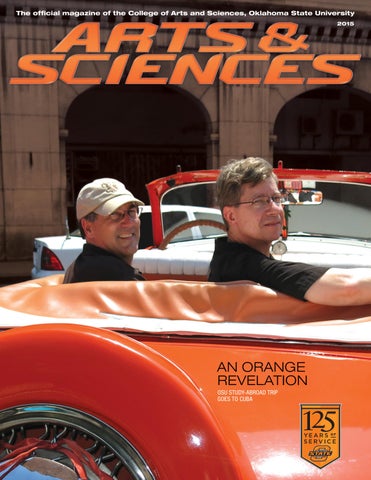
AN ORANGE REVELATION OSU STUDY-ABROAD TRIP GOES TO CUBA
125
YEARS!! SERVICE
PHOTOGRAPHY / PHIL SHOCKLEY
p l a y b i l l 2
30
8
On the Cover
Starting the Conversation
Art + Math = Amazing
During a study-abroad trip to
The Critical Conversation series and
O S U ’s H e n r y S e g e r m a n s e e s m o r e t h a n
C u b a , D r. To m W i k l e ( l e f t ) a n d
the Center for Africana Studies are
equations in mathematics — he sees
D r. D a l e L i g h t f o o t s o u g h t o u t
promoting important discussions
w o r k s o f a r t . A n d w i t h t o d a y ’s 3 - D p r i n t i n g
an orange vintage auto for
about race and multiculturalism.
t e c h n o l o g y, h e ’s s h a r i n g h i s v i s i o n .
their photo. “We must have s e a r c h e d f o r a n h o u r, ” L i g h t f o o t says. “But we really wanted orange for OSU.” Learn more about the fascinating trip beginning on Page 2. (Photo c o u r t e s y D r. D a l e L i g h t f o o t )
2015 v17
41
22
Leading the City
Talent Abounds
Gina Noble, a professor in the OSU
The A&S Student Council is using two new
School of Media & Strategic
events to recognize the talents in the
Communications, is taking the
college with the Autumn Arts Gala and the
h e l m a s m a y o r o f S t i l l w a t e r.
A&S Undergraduate 3MT® Competition.
C A S .OK S TAT E .E DU
Arts and Sciences Magazine is a publication of the Oklahoma State University College of Arts and Sciences. All communications should be mailed to OSU College of Arts and Sciences ATTN: Arts and Sciences Magazine 205 Life Sciences East Stillwater, OK 74078-3015 2 0 1 5 © O K L A H O M A S TAT E U N I V E R S I T Y
Oklahoma State University, in compliance with Title VI and VII of the Civil Rights Act of 1964, Executive Order 11246 as amended, and Title IX of the Education Amendments of 1972 (Higher Education Act), the Americans with Disabilities Act of 1990, and other federal and state laws and regulations, does not discriminate on the basis of race, color, national origin, genetic information, sex, age, sexual orientation, gender identity, religion, disability, or status as a veteran, in any of its policies, practices or procedures. This provision includes, but is not limited to admissions, employment, financial aid, and educational services. The Director of Equal Opportunity, 408 Whitehurst, OSU, Stillwater, OK 74078-1035; Phone 405-744-5371; email: eeo@okstate.edu has been designated to handle inquiries regarding non-discrimination policies. Any person (student, faculty, or staff) who believes that discriminatory practices have been engaged in based on gender may discuss his or her concerns and file informal or formal complaints of possible violations of Title IX with OSU’s Title IX Coordinator 405-744-9154. This publication, issued by Oklahoma State University as authorized by the College of Arts & Sciences, was printed by University Printing Services at a cost of $8250/9.5M. #6130 9/15
s t a f f Editor
Dorothy L. Pugh ’83
Art Director
Paul V. Fleming ’90, ’00
Photographers
Phil Shockley Gary Lawson ’83
Writers
College of Arts and Sciences
Dean
Bret Danilowicz
Senior Director for Development Lauren Kidd
Communications Coordinator Brian Petrotta
Brian Petrotta Jamie Hadwin, ’10, ’15 Karolyn Bolay YEAR INDICATES OSU COLLEGE OF ARTS AND SCIENCES GRADUATES.
FROM THE
Dean’s Office
W
elcome, alumni and friends, to the 2015 Arts & Sciences magazine! With so many positive things happening, it was hard to choose what to include in our annual magazine. To enjoy even more achievements, come see it for yourself and visit us on campus. It was wonderful to see the undergraduate student body become more invested in the college in 2014-15 through two new events. The A&S Student Council created the Autumn Arts Gala and the Undergraduate 3MT® Competition with the idea these would become annual events. These public displays — student-run productions that featured student work and research — gave all of us a chance to observe the high level of talent within the college and pushed undergraduates to think critically about what they want to accomplish and how to present it to a broad audience. Our student achievements continued. Political science undergraduates captured the award for Best Overall Delegation at last year’s Oklahoma Intercollegiate Legislature (O.I.L.) competition. Thirty-two first-year students comprised the initial cohort of Life Sciences Freshman Research Scholars. Three OSU students were honored for outstanding research presentations at the Society for the Advancement of Chicanos and Native Americans in Science national conference. Two students placed at the Oklahoma Association of Professional Historians, and for the second straight year, the OSU Small Trumpet Ensemble topped 63 other programs to claim the 2015 National Trumpet Competition championship. And chemistry junior Meaghan Murie was selected as a Udall Scholar, one of the nation’s most prestigious academic awards for an undergraduate student. To match the talent of our students, we continue to complement them with outstanding faculty members. John Chaney received a $1.2 million grant from Indian Health Services to continue his highly successful American Indians Into Psychology (AIIP) program for another five years. This program is responsible for OSU graduating the largest number of American Indian psychology doctorates in the country. His department-mate, Larry Mullins, received a $3 million NIH grant to research psychosocial intervention
for parents of children newly diagnosed with cancer. Henry Segerman (mathematics) drew national attention by using 3D printers to create geometrical models and artwork (thereby blending both the art and science of our college’s name). Meanwhile, Joe Haley (physics) led, and still leads, a team at CERN in Geneva, Switzerland, to search for billion-year-old subatomic particles. Our faculty members have received distinguished awards and appointments. Jack Pashin was honored with the Cady Award, the highest honor in the discipline of coal research, from the Geological Society of America. The aforementioned Chaney and Mullins were both named Fellows of the American Psychological Association’s Society of Family Psychology (Division 43). Physics professor Aihua Xie was elected to chair the International Union of Pure & Applied Physics. The next year will undoubtedly bring more good news to share. One piece I can offer now is the creation of the School of Visual & Performing Arts. This school will lend more prestige to the Departments of Theatre, Music, and Art, Graphic Design, and Art History and coincides with plans to build a new Performing Arts Center on campus. I can only imagine the creative activity these changes will inspire. For now, please enjoy the following stories that show how our Arts & Sciences community continues to increase the impact of education and research across this great state and nation. Best Wishes
BRET S. DANILOWICZ DEAN, COLLEGE OF ARTS AND SCIENCES
PHIL SHOCKLEY / UNIVERSITY MARKETING
Land of Enchantment OSU group experiences life in Cuba with study-abroad trip STORY BY Brian Petrotta | PHOTOGRAPHY BY Dale Lightfoot
CUBA IS A MYSTERIOUS ISLAND TO MOST AMERICANS — 50 YEARS OF ISOLATION WILL DO THAT. YET EVEN BEFORE ICY U.S.-CUBAN RELATIONS BEGAN TO THAW, A GROUP OF OSU STUDENTS AND FACULTY SIGNED ON FOR A STUDY-ABROAD CLASS TO WITNESS FIRSTHAND WHAT DIFFERENCES — AND SIMILARITIES — EXIST.
2
D
uring an eight-day journey over spring break in March 2015, the party experienced
stunning natural beauty, architectural achievements, structural ruins, a hopeful population, a socialist country struggling to embrace tourism-inspired capitalism, excellent food and an incredible number of 1950s-era American automobiles cruising down city streets. On Dec. 17, 2014, President Obama announced an unexpected major shift in U.S. relations with Cuba. With the OSU trip already organized through a Canadian travel agency, no one anticipated the speech when they enrolled in the study abroad class. Still, nearly everyone in the group expressed a desire to visit Cuba “before it changed.” Department of Geography head Dale Lightfoot and A&S Associate Dean for Academic Programs Tom Wikle led the class. Both are seasoned overseas travelers and frequent study-abroad collaborators Many of the vehicles driving past the Grand Theater of Havana are vintage American models from the 1950s and earlier.
at OSU. Cuba proved to be a special destination. “It exceeded all expectations,” Wikle says. CONTINUES
3
“My perception was I would be going into Cuba as the enemy, but it turned out to be very far from the truth.” — Tyler Wilson, Spanish and history major
A group of OSU students got to visit Cuba over spring break for a study-abroad course.
4
Even with the prescribed reading and Some were not even aware it was possiWhether piling into a 1952 Chevy for a personal preparation, none of the travel- cab ride or peering out the hotel window ble to visit the country. “I was walking through Morrill Hall ers knew quite what to expect. The most to see a convertible straight out of an and saw a flyer with ‘Cuba’ in big letters common concern was how the Americans Elvis movie, group members found 1950s American automobiles plentiful. and I thought, ‘No way, you can’t go to would be received by the Cuban people. “It was weird to wake up in the mornCuba,’” says Tyler Wilson, a Spanish and “My perception was I would be going history major from Frisco, Texas. into Cuba as the enemy, but it turned out ing and see these cars that the only other Traditional tourist travel to Cuba is to be very far from the truth,” Wilson times I’d seen them were in auto auctions still prohibited, but the OSU visit fell says. “It felt very open, and the people or the back of my grandfather’s garage,” under an exemption for educational were very warm and welcoming.” Gliedt says. activities. The “study” in “study abroad” Jordan McAlister, a geography doctoral The group also had to adjust to Cuba’s consisted of a considerable amount of student at OSU, best summarized one dual-currency system. Workers are paid reading material, over which the travelpiece of unanimous advice as: “Keep an in the national currency, the Cuban peso, open mind, and be ready to learn new but all foreign money must be exchanged ers were tested. They were also required for a separate tourist currency, the Cuban to keep detailed journals and deliver final things.” Not only were the Cubans eager Convertible Peso, better known as CUC papers after the experience. to speak, often in English, with (pronounced “kook”). Because certain Alexis Gliedt, a strategic communicathe American tourists, but pieces of goods and services can only be purchased tions major from San Antonio, eagerly Americana were scattered throughin CUCs, the foreign currency is in high devoured the provided material — then demand. Locals often work a second job went further. out the country. For instance, at a base“I watched a lot of old Cuban films and ball game they spotted a man wearing an in the tourism industry to secure this currency. read Ernest Hemingway novels,” she says. Alpha Chi Omega sorority t-shirt and a “Also The New York Times had just come woman wearing U.S. flag pants. The most “It’s partly 1959 time capsule and partly morphing into pseudo-capitalism,” out with a list of the top Cuban books, common piece of American culture was Lightfoot explains. and I read all of those. I wanted to see seen on the road. Cuban doctors or lawyers make the how artists portrayed Cuba.” equivalent of $350-$400 a month, with approximately 90 percent going toward
basic living expenses. Modern conveniences, such as televisions or washing machines, are only obtained with CUCs so those same doctors and lawyers may moonlight as cab drivers or wait tables. With Canadians and Europeans supporting Cuba’s tourism industry, especially during winter months, the island nation is in good shape to welcome a potential influx of American travelers. “They do have a nice tourism infrastructure in place,” says McAlister. He was especially interested in the cultural geography of Cuba and enjoyed the charm of Old Havana. “I loved seeing the old Spanish colonial architecture,” he says. One of the highlights of a visit to the Cuban countryside was a stop at an organic tobacco farm in the limestone
hills of the Viñales Valley. The tobacco produced in the area is considered among the best in the world, hence the reputation of Cuban cigars. Untouched by American agricultural practices, Cuban farmers developed efficient organic methods more out of economic necessity than ideology. Now those methods could appeal to modern Americans. “They’re at the forefront of farm-totable organic farming, which is sort of a new wave of activity here,” Lightfoot says. “They adopted it out of emergency financial exigency, and now they’re experts in the field.” While the schedule was packed with planned activities, participants had time to explore on their own. One group attended a baseball game featuring Havana’s most storied team, the
Industriales. As if to cement their education on Cuban economics, the group members discovered their cab driver once played for the very Industriales team they were going to see. Enthusiasm for baseball in Cuba is perhaps exceeded only by enthusiasm for change. “There is a pervading sense of optimism,” Lightfoot says. In part, that attitude convinced Lightfoot and Wikle to schedule another study-abroad course in Cuba for 2016. Now that one group has successfully completed the course, future travelers will have a better idea of what to expect. The 2015 travelers may not be finished with the mysterious island of Cuba, either. Gliedt says, “As soon as the embargo lifts, I will be going back.”
“They’re at the forefront of farm-to-table organic farming, which is sort of a new wave of activity here.” — Dale Lightfoot, OSU Department of Geography head
The limestone hills of the Viñales Valley is home to some of the top tobacco produced in the world.
5
“The core strength of this ensemble is its work ethic. Their talent is very high, but the one thing that stands out to me is the work ethic is second to none.” — Z. Randall Stroope, professor, OSU School of Music
6 OSU’s Concert Chorale performed at New York’s Carnegie Hall in March.
PHOTO / GROUPPHOTOS.COM
In Perfect Harmony ‘America’s Brightest Orange’ performs in America’s greatest concert hall
I
Brian Petrotta
:ii
Nick Chabot, a vocal music “The core strength of this ensemn only 20 minutes, 44 education major from Dallas, ble is its work ethic,” he says. Oklahoma State University recognizes the significance of “Their talent is very high, but the students realized a dream. performing at Carnegie Hall: “It is The members of the OSU Concert one thing that stands out to me is a breathtaking and humbling expeChorale performed at legendary the work ethic is second to none. Carnegie Hall in New York City in If they don’t get it in rehearsal the rience to be able to perform in a March 2015. first time, you can bank on them space like that.” OSU professor Z. Randall getting it the second time.” The audience was appreStroope conducted the choir, which Stroope takes his proud descrip- ciative and responsive, the performed as part of the historic applause for the 20-minute tion a step further. venue’s annual Masterworks “As educators, we should mostly set overwhelming vocal Festival. He has conducted this be about creating great individuals music education junior Judith festival for years, but 2015 was the who happen to have this passion, Prenzlow. first time OSU participated. Five “I might have shed a tear or yes, but no matter what they universities from across the countouch, they approach their life with two,” she says. “It was a very powerful experience.” try made up the festival choir, and purpose, meaning and the necesPrenzlow, a Stillwater native, OSU began the program with a sary work ethic to get whatever it had performed at Carnegie 20-minute solo set. is done.” Hall when she was still in high “I thought this time it would Getting the trip to New York be lovely to bring an OSU group City done required creative funding school. Did that previous expeand do our own special thing,” from a collection of student contri- rience lessen the impact of performStroope says. butions, ticket income from OSU’s ing there? Such a huge opportunity “Not at all,” she says enthusiastiannual “Messiah” concert, and the required a memorable piece to cally. “It’s amazing. In the rehearsal Doug & Nickie Burns Endowed perform; Stroope selected Mozart’s Chair, held by Stroope. room, they have pictures of all “Coronation” Mass. All of those sources allowed the these greats, like Yo-Yo Ma, and “It is not an easy work by any chorale to perform in one of the to know that we were being placed means, but it is a very accessigreat concert halls in the world. on the same pedestal, for want of a Stroope has conducted other ensem- better word, was incredible.” ble, uplifting work,” junior vocal The travelers did explore New education major Reagan Pool says. bles in Carnegie many times and The trip took place over spring holds the venue in the highest regard. York. Many attended Broadway plays or the Metropolitan Opera. break, allowing the chorale ample “In my view, Carnegie and Some simply took in the sites practice time. Rehearsals, with five Chicago Orchestra Hall are the and did the things that tourists different ensembles from across the two finest acoustics in the United do. Energy from the city and the country, lasted several hours a day States,” he says. “It is still iconic. for three days. Stroope knew his Anyone on the street would readily venue combined to give this group students could handle the grind. know that Carnegie Hall is one of of OSU students an unforgettable the finest performing arts centers in experience. “It was our chance to say we are the United States.” creating some seriously great music at OSU,” Chabot says.
Z. RANDALL STROOPE
7
Dialogues in Diversity STORY BY Jamie Hadwin
Two OSU programs promote conversations on multiculturalism OKLAHOMA STATE UNIVERSITY’S EFFORTS TO INCREASE DIVERSITY ON CAMPUS AREN’T LIMITED TO BRINGING IN A MORE DIVERSE STUDENT BODY. IN LIGHT OF RECENT NATIONWIDE EVENTS INVOLVING MATTERS OF RACE, OSU RECOGNIZES THAT SERIOUS AND SINCERE EFFORTS TO PROMOTE DISCUSSION ABOUT RACE AND MULTICULTURALISM ARE A STEP IN THE RIGHT DIRECTION.
8
“Obviously OSU is not OK with racism.” — Lawrence Ware, OSU Department of Philosophy lecturer and diversity coordinator
Dr. Jason Kirksey, OSU’s vice president of Institutional Diversity, works with several offices on campus to address issues unique to underrepresented or underserved OSU students. Since being appointed in 2010, he has seen OSU increase its diversity initiatives under President Burns Hargis. Examples of those initiatives include scholarship opportunities, leadership programs and diversity education. The College of Arts & Sciences’ Center for American Indian Studies, Gender and Women’s Studies program and the OSU Ethics Center all work to provide diversity education. Inspired by their success, Kirksey looks forward to developing the Center for Africana Studies and the Critical Conversation series by the OSU Ethics Center as multicultural resources at OSU. CONTINUES
9
Dr. LaRicka Wingate took over as director of the OSU Center for Africana Studies in 2013.
PORTRAIT BY KIRSTEN JUDAH PHOTOGRAPHY
CENTER FOR AFRICANA STUDIES
Established in 2006, the Center for Africana Studies at OSU has seen a reinvigoration under its new director, Dr. LaRicka Wingate of the OSU Department of Psychology. Africana studies involve the collection of materials (literature, art, music, documents, etc.) that reflect the geographical, historical and cultural development of the nations of Africa and its peoples. PHOTO / THE CENTER FOR AFRICANA STUDIES / A&S
Dr. LaRicka Wingate and David Hollingsworth, a 2015-2016 graduate assistant for the Center for Africana Studies, attend the 2014 Association of Black Psychologists International Conference.
10
Since her arrival at OSU in 2006 Wingate has supported the Center for Africana Studies. When Dr. Bret Danilowicz arrived in 2012 as the dean of the College of Arts & Sciences, he wanted to revive some less active centers, including the Center for Africana Studies. In 2013, with encouragement from Danilowicz, Wingate became the center’s director. “When I started at OSU, the college had the structures in place to support education and research on issues of race, ethnicity and gender, but the area of black studies was relatively inactive,” Danilowicz says. “Dr. Wingate was engaged and passionate when discussing the Center of Africana Studies. She didn’t realize it at the time, but I knew I had just met the center’s future director.” Since taking over, Wingate has increased awareness about the center with educational events promoting discussions about race and by publicizing OSU’s 18-credithour Africana Studies minor. Courses from several departments fit the requirements for the minor, but two courses created by the center were offered for the first time this summer. Introduction to Africana Studies and Black Psychology were online courses with plans to offer them again next spring.
Thanks to her persistence, the center has a temporary office and more funding for its budget. Recently, alumna Brenda Neal gave the center $5,000. Continued funding and other gifts will help keep the Center for Africana Studies running so opportunities and resources are available to those who are interested in Africana studies. “Students and faculty are already approaching the center to talk about current events, so the interest is there,” Wingate says. “However, my immediate goal is to make the minor strong. Eventually, I do want to establish a council that works on larger events for the community.” Wingate’s background provides a personal perspective on the importance of the Center for Africana Studies. Raised in Honolulu, Hawaii, Wingate came from a community that she describes as a “melting pot.” Her father is black and her mother is white, but her biracial identity never was an issue. When she moved to north Florida to attend Florida State University, she had quite the cultural shock.
“I hope the center helps to add more of a cultural, inclusive feeling to the university, and people won’t feel as left out.” — Dr. LaRicka Wingate, director, OSU Center for Africana Studies
“All of a sudden, random people would number of people of color. Fewer such African or African-American people come up to me and ask, ‘What are you?’,” students at OSU made talking about race who are encouraged to attend. Many of in her Multicultural Psychology course an the center’s events have featured speakWingate says. “People would call me emotionally charged topic, and many of ‘Red,’ referring to my skin color. It’s part ers of all ethnicities. Once people attend her students believed racism didn’t exist of the culture in the South, but I didn’t the events, they will see an inclusive anymore. grow up with that, so I didn’t know.” environment. Wingate also noticed students were Interest in her racial identity led “I want our students to learn about uncomfortable attending events such Wingate to learn more about Africanthese systems so, if they have a concern, American history, literature and psychol- as Black Student Orientation because they can speak up,” Wingate says. ogy. She began exploring multiculturalism they thought white people wouldn’t be “I hope the center helps to add more of a welcome. That wasn’t the case, as her from a new perspective. In her classcultural, inclusive feeling to the university, students learned. The same applies to and people won’t feel as left out.” rooms in Florida, there were a large the center’s activities where it’s not just CONTINUES
The Center for Africana Studies staff meets performers from Cirque Zuma Zuma. OSU Allied Arts helped bring the African-style dance troupe to campus PHOTO / THE CENTER FOR AFRICANA STUDIES / A&S
11
PHOTO / GARY JONES / A&S
“Racism is not just the problem of the victims. … these are the conversations everyone is saying we need to have. We’re having them at OSU.” — Lawrence Ware, OSU Department of Philosophy lecturer and diversity coordinator
LAWRENCE WARE
CRITICAL CONVERSATIONS
Lawrence Ware, lecturer and diversity coordinator for the OSU Department of Philosophy, has also helped create what he considers muchneeded discussions surrounding race through Critical Conversations, a series that is housed under the philosophy department’s Ethics Center. Ware, who received his master’s from the OSU philosophy program, specializes in issues concerning race, gender, religion and economics.
12
After teaching a well-received Philosophies of Race course during the 2013-2014 academic school year, Ware was approached about serving as diversity coordinator for the department. Around this time, the death of Trayvon Martin in Florida sparked national attention, and Ware says even the Stillwater community needed an outlet to discuss what was happening. “We formed a town hall-style discussion with OSU students and faculty to discuss what was occurring,” Ware says. “It was the basis for knowing we were ready to talk about these issues intelligently, as a community.” Since the Critical Conversations series officially began last year, it has quickly garnered interest, with attendance consistently around 150. The series has focused on a variety of topics including beauty standards for women of color, economic injustice and race, Islamaphobia, and a re-examination of voting rights coinciding with the 50th anniversary of the Selma march of 1965. The past year has also seen many significant events directly related to the mission of the series.
The discussion that drew the most people (around 200) involved reactions to the death of Michael Brown in Ferguson, Mo. Ware put together a September discussion that included two OSU police officers and advocates for the #BlackLivesMatter movement. The conversation revolved around the role of police in urban environments, and despite the tension in the room, the panelists and audience members were able to communicate respectfully with one another. The discussion, Ware notes, also helped provide context and language to discuss similar events throughout the year. In response to the racist chant video made by a fraternity at the University of Oklahoma, Ware formed a discussion in April about unintentional racism. This discussion was particularly close to home as it centered on OSU’s Murray Hall, which was named after former Oklahoma Gov. William H. Murray (1931-35), an openly racist politician. After having heard from multiple sides of the issue, Ware believes most people left the event in agreement that open conversation can provide educational opportunities to learn about civil rights matters — and the complexities behind Murray Hall’s name.
PHOTO / THE OSU ETHICS CENTER
Activist Ayah Abo-Basha (from left), Dr. Charles Hughes and Dr. Jason Kirksey participate on the panel discussing Murray Hall’s name.
“Obviously OSU is not OK with racism,” Ware says. “But when events [like the SAE chant] happen, people ask questions. If you pretend like these questions are not being asked, people are going to walk away with their own assumptions. No one hears everything they want to hear, but it gets people talking and listening.” Similar to Wingate, Ware works hard to ensure that his panelists are chosen based on what they can bring to the discussion, not necessarily to the panel’s racial composition. Through his attendance of the National Conference of Race and Ethnicity, he has met a wide variety
PHOTO / THE OSU ETHICS CENTER
Students gather during a Critical Conversations event to discuss Murray Hall’s name.
of scholars of all races and academic backgrounds who have been willing to contribute their expertise to the series. With the Critical Conversations series gaining serious momentum in its first year, Ware is ready to continue the series and promote open and informed conversations about race at OSU. This fall, he plans to host a discussion about the Confederate flag and the “n” word and their places in modern society. He also wants to expand the discussions to include issues of gender and class. By forming relationships with student groups, campus organizations, OSU branch campuses and Langston University, he wants to establish a pattern of outreach and “allyship” with the community that will encourage more people of all backgrounds to participate. “Racism is not just the problem of the victims,” Ware says. “The work doesn’t need to just happen from the oppressed. This is bigger than one person and one race, and these are the conversations everyone is saying we need to have. We’re having them at OSU.”
13
14
We are trying to understand what it is that happens to this bacterium when it enters a human body …. — Dr. Marianna Patrauchan (right, with Manita Guragain)
Progress via Passion
OSU’s Patrauchan and her team leads the way toward treating cystic fibrosis
STORY BY Karolyn Bolay | PHOTOGRAPHY BY Gary Lawson / UNIVERSITY MARKETING
Dr. Marianna Patrauchan, an associate professor in Oklahoma State University’s department of microbiology and molecular genetics, has followed her passion for the past seven years — a passion that will pave the way for developing a treatment for cystic fibrosis patients. Working with a bacterial pathogen, Pseudomonas aeruginosa, Patrauchan is hoping to identify what exactly causes cystic fibrosis patients’ infections, which eventually lead to suffocation. This pathogen can form biofilms, which contain layers and layers of cells in very complex structures. These biofilms are highly resistant to host responses and antimicrobial treatments and therefore are extremely difficult to eradicate. However, this pathogen isn’t always harmful. It occurs naturally and only becomes a problem when it enters a human body with an underlying medical condition, such as cystic fibrosis. “We are trying to understand what it is that happens to this bacterium when it enters a human body and makes it pathogenic,” says Patrauchan. “What are the signals that this bacterium will recognize coming from the host that could trigger this transition between non-pathogenic and pathogenic state?” Patrauchan and her team are researching if calcium is the signal triggering the transition in Pseudomonas aeruginosa. Cystic fibrosis produces calcium
concentrations that are increased in the liquids associated with the mouth, nose or lungs. “We already know that when we add calcium to the bacterial growth medium, it enhances production of certain virulence factors in P. aeruginosa,” says Patrauchan. “These factors assist bacteria in forming biofilms and becoming more resistant.” While cystic fibrosis is a genetic disease, people do not die from having the genetic mutations. The bacterial infections cause the complications that eventually lead to death. “The genetic disease will change the environment in the human body in such a way it will be predisposed for infection,” says Patrauchan. While there is a line of treatments trying to address the genetic side of cystic fibrosis, Patrauchan and her team are focusing on trying to overcome the infection part of the disease. “We’ve made quite a bit of progress,” she says. “We started from just trying to understand how calcium affects growth of these bacteria and the virulence of these bacteria. We started very
broad and first had to identify all kinds of proteins that may be responding to the calcium.” Because there is no cure for cystic fibrosis, an abundance of basic research is required to determine exactly what is happening with cystic fibrosis patients. “There is a gap in the basic science about calcium signaling in bacteria and its role in hostpathogen interactions … if we are missing basic science, we cannot progress in developing therapies,” says Patrauchan. “Only by utilizing the advancements in basic science, we can come up with effective treatments.” Four graduate students and nine undergraduates work alongside Patrauchan in her lab. The lab has been able to maintain its team despite funding challenges. Manita Guragain, a Ph.D. candidate working in the lab, has been helping develop this research for five years. “I hope that through my research, I’ll be able to contribute a lot to the scientific society and ultimately contribute to human life,” says Guragain. “I want to help contribute to the betterment of human life.” CONTINUES
15
“We are at the point now infections in the lungs as well of testing the role of these as the heart,” says Patrauchan. proteins by using animal “Calcium signaling plays a models,” says Patrauchan. major role in cystic fibro“We are marching forward as sis and the heart diseases that fast as we possibly can, and are associated with infecwe are testing these proteins tion caused by several bactethrough a variety of studies.” ria including Pseudomonas Once the identified proteins aeruginosa.” are tested and yield positive Patrauchan and her team Dr. Marianna Patrauchan (from left) with members of her team, results, the research will focus are paving the way for treatManita Guragain, Michelle King and Sharmily Khanam. on how those proteins can be ment for a variety of diseases targeted or silenced. through their research on “What can we treat Pseudomonas aeruginosa. Pseudomonas aeruginosa with “We are really pioneerso it will no longer recognize ing this research in calcium “There are a number of other “We have a lot of undercalcium?” says Patrauchan. signaling in bacteria,” says research teams working in the standing of what kind of “What can we do so it will Guragain. “We are doing the field of P. aeruginosa infecbacterial pathogens are not be able to adjust to the research that is really trying tions in cystic fibrosis patients. involved in this process and host environment and become to develop solid evidence their mechanisms of resisOur group collaborates more virulent and resistant as that could open a whole new with several labs including tance, but this information is well as it does when recogniz- dimension.” those led by Dr. Erika Lutter not enough to come up with Considering that possibiling elevated levels of calcium (Oklahoma State University), a cure,” says Patrauchan. in cystic fibrosis patients?” ity brings Patrauchan to a full Dr. Michael Franklin “We need to generate more It isn’t just cystic fibrostop. What would it mean to (Montana State University), in-depth knowledge about her if her research leads to a sis patients who can potenDr. Terry Machen (University the interactions between host tially benefit from Patrauchan’s treatment of cystic fibrosis? and pathogens to come up of California), and Dr. “It would mean the whole research. Many other diseases with novel approaches for Kangmin Duan (University world to me,” says Patrauchan, and medical conditions are treatment. of Manitoba, Canada),” says her eyes starting to water from also associated with elevated “We are trying to underPatrauchan. “Science doesn’t the strong emotions. “The true levels of calcium and bactework through individual stand the molecular mechamotivation for this research rial infections. That’s why works anymore. It is through nisms of the communication isn’t coming from the exciteDr. Patrauchan’s lab has working together and combin- between the infection agent been partially funded by the ment from positive results, ing efforts, expertise and skills or pathogen and the host. If American Heart Association, the excitement from getting we are successful in identithat enables our progress.” along with the Oklahoma funded, the excitement from Ultimately, Patrauchan says, fying the molecular mechain treating chronic infectious nisms involved, these proteins Center for the Advancement of getting published or the excitediseases, the battle boils down may become novel targets for Science and Technology and the ment of your colleagues buildNational Institutes of Health. ing on your work. The true to between the bacterial cells treatment.” “The American Heart motivation is coming from the growing in the biofilm and Patrauchan’s lab has idenunderstanding that one day becoming resistant and scien- tified several specific proteins Association is interested in advancing our understandwhat you worked on will be that play a role in recogniztists trying to come up with helping people who are suffernew and more efficient antimi- ing calcium and responding to ing of the molecular mechanisms triggering bacterial ing. That’s what makes my crobial treatments to clear the it by regulating P. aeruginosa work meaningful to me.” virulence. infection.
16
W h a t e v e r i s h a p p e n i n g i n y o u r l i f e , there’s a good chance your college experience helped you get to where you are today. When you reflect on that time, you may be overwhelmed by fond memories — meeting your spouse, celebrating a big football win, pulling an all-nighter or laughing with people who became lifelong friends. Today’s Oklahoma State University students are having the same experiences as they pursue bright orange futures. Visit OSUgiving.com to learn how you can be a part of their journey. Lauren Kidd from the OSU Foundation is also available to help unite your passions with university priorities to achieve excellence. She can be reached at lkidd@OSUgiving.com or 405. 385.0724.
~
•
MR.
AP Chemistry OSU’s Gelder maintains passion for chemical education for more than 40 years STORY AND PHOTOS BY Jamie Hadwin
7
(
1975 JOHN GELDER RECEIVES HIS DOCTORATE IN INORGANIC CHEMISTRY FROM THE UNIVERSITY OF ARIZONA.
1977 GELDER BECOMES A PROFESSOR OF CHEMISTRY AT OKLAHOMA STATE UNIVERSITY.
2015 THIS SUMMER HE RETURNS TO HIGH SCHOOL.
18
18
Dr. John Gelder is playing a key role in training high school Advanced Placement (AP) chemistry teachers to teach their students at levels similar to an introductory college chemistry course. “It’s an opportunity for students in high school to be challenged with content and expectations that are going to happen when they go to college,” Gelder says. “Chemistry is unique in some respects because students who receive a 4 or a 5 on the AP chemistry exam would receive nine hours of college credit at most universities.” His introduction to AP chemistry began in 1989 when Gelder and a former colleague at OSU, Dwaine Eubanks, were awarded a National Science Foundation endowment to develop an AP chemistry satellite course as part of an online course initiative from the former dean of the OSU College of Arts & Sciences, Dr. Smith Holt. CONTINUES
--
25
8
26
9
27
10
1
n Fe Co Ni
3805
55.845
58.9332
58 6934
19
For his efforts on that initiative, the AP chemistry board invited Gelder to participate as a reader during a seven-day summer meeting where the essay portions for AP chemistry tests were graded. After participating as a reader for more than a decade, Gelder served as chief reader from 2002-2005. The chief reader ensures the exams are graded according to a rubric he or she has developed. “So from the chief reader to the question leaders to the table leaders and then to the readers, it’s a wonderful top-down scheme,” Gelder says. “I’ve had experience in all the different levels of grading the AP chemistry exam.” Gelder was learning from the hundreds of high school and college teachers who were coming in to help grade the exams, and he was getting feedback through the grading process. He could identify patterns of error within the responses, learning more about students’ misunderstandings of chemistry concepts and taking that information back to the teachers.
20
Apart from working with AP chemistry exams, in the late ’90s, Gelder also began working in summer workshops for AP chemistry teachers in Oklahoma, Arkansas, Texas, Indiana, Kansas and Louisiana. He also does consultant work in high schools across the nation from Massachusetts to Alaska. The teaching, training and consulting keeps him busy, but a few years ago, he took on a new challenge. In 2012, the College Board, the organization that provides resources such as AP classes and testing for high school students, created a new curriculum that focused more on inquiry-based approaches. All AP chemistry teachers had to submit a course syllabus that met the College Board’s criteria versus any less strict district or state guidelines. Gelder was a huge proponent of using computer technology in teaching chemistry, having worked on chemical education software dating back to early Apple I and II computers. He thought he’d be able to
help the AP chemistry teachers develop programs to use in their classrooms that would meet the new criteria. “I use the computer in as many different ways possible both inside and outside the classroom,” Gelder says. “We had already been using inquiry-based approaches in our chemistry classes at OSU; now we just had to figure out how to make activities that would be relevant in a high school classroom.” For the project, he reached out to Dr. Michael Abraham at the University of Oklahoma, who was also interested in developing computer-based learning programs. The two began working with OSU student programmer Kirk Haines to develop a series of JAVA-simulated computer-based molecular laboratory experiments that students could view via Internet browsers. Haines wrote the software for the graphics while Gelder and Abraham wrote the activities.
Haines first heard about the NSF proj- to Abraham so they could update and develop more comprehensive programs ect through a friend in the computer that anyone could use. science department, who took him to a Gelder estimates that thousands meeting with Gelder. of teachers now use the simulation “I actually had been helping another programs in high school and college classone of my friends with their computer graphics assignment where their projrooms around the country. When develect involved an animation that had realis- oping his college programs, he takes into tic motion of billiard balls,” Haines says. account that students bring a variety of educational backgrounds to the table. “When Dr. Gelder was describing how Macey Colbert, a political science/prehe wanted the program to work, it was the same type of collisions as the billiard law and pre-medical senior, recently took Gelder’s Chemistry I and II courses and balls. I showed that project to him, and says his programs helped her understand he decided to bring me on board.” The team formally completed the NSF the material despite her limited backproject in 2005 but used these simuground in chemistry. “With chemistry, it’s a difficult subject lations as a foundation to continue to to understand to begin with, and that’s develop technology that would begin popping up in more chemistry classrooms. why labs are an important part,” Colbert says. “But you only do labs once a week. The new College Board curricuWith the simulations, you can watch lum offered the perfect opportunity for them anytime and really get to underGelder to bring this technology to high school teachers who needed it and to stand the concepts at the particulate level other university personnel who weren’t that before you were only talking about aware of their existence. He again turned abstractly.”
With a nationwide emphasis on increasing the number of Science, Technology, Engineering and Mathematics (STEM) majors over the past decade, Gelder sees his programs as a win-win for OSU and the STEM initiative. He is helping to make it easier for high school students interested in STEM careers to grasp chemistry concepts and is bringing that technology to his students at OSU. For the past 25 years, Gelder has become an expert in the ways chemistry affects students and teachers across the country. He loves working with teachers who work hard every day to help their students succeed. Gelder met his wife, an AP chemistry teacher, through one of his workshops, so the passion for chemical education runs deep in his household. Students, he notes, are equally amazing. “You will have students coming out to study chemistry on the weekends,” Gelder says. “The interest and dedication they show just amazes me. If I can help to keep students motivated like this, then it all pays off in the end.”
“With the simulations, you can watch them anytime and really get to understand the concepts at the particulate level that before you were only talking about abstractly.” — Macey Colbert, political science/pre-law and pre-medical senior
21
Gina Noble learns
NOBLE
a
CAUSE STORY BY Jamie Hadwin | PHOTO BY Rachael Maltby
22
Stillwater’s new mayor makes changes in the classroom and the community Thirteen years ago, Gina Noble had no idea that her future would lie in Stillwater, Okla. Noble left Stillwater after receiving her bachelor’s in journalism from OSU in 1985. Even when she returned to OSU as a graduate student in 1999, she started by taking classes at the OSU-Tulsa campus. After she graduated with her master’s, Noble and her son moved in with her father at his home in Joplin, Mo. Their stay was short-lived because two weeks later, the director of OSU’s journalism school called.
she’s been elected mayor of Stillwater.
“Stillwater is truly my home, and there’s no better city in Oklahoma. I can’t think of anything better than keeping some of the talent coming through to stay here and help Stillwater grow.” — Stillwater Mayor Gina Noble
“They just had someone quit, and they When former Mayor John Bartley’s offered me a visiting position just for one term was coming to an end this year, year because they thought I had been a Noble realized that with her son leavgood T.A. [teaching assistant],” Noble says. ing for college in the fall, the timing for a “It’s been 13 years, and I’m still here.” mayoral run couldn’t be better. Noble, who was recently promoted She began her campaign in early 2015, to associate clinical professor in the and many of her students and colleagues OSU School of Media & Strategic pitched in with television ads, radio spots Communications, is ready and willing to and overall campaign management. teach whatever courses the school asks Jarilyn Blaine, an OSU junior in multiof her. She has taught almost every PR media journalism, has had Noble as an or strategic communications course the internship adviser and says the decision to school offers, as well as reporting and work on her campaign was an easy one. sports media courses. Her enthusiasm is “I am interested in politics and was CITY OF STILLWATER also part of the reason why Noble evenexcited to work on a campaign,” Blaine tually found herself becoming involved says. “I was really excited to work with As a faculty member at OSU, she is in with the Stillwater City Council. Gina because after talking to her I knew a unique position to bridge the city and A zoning issue caused Noble to realize she could help Stillwater move in the university communities. Stillwater Public how much city government affected her right direction.” Schools have a high number of teachers and her neighbors. As a neighborhood Noble had the support of the OSU leader, she addressed the city council community, but how would the Stillwater with master’s degrees, and Stillwater High School students often take free classes planning commission; soon, her neighcommunity respond? On April 7, the through OSU to give them a head start bors and her son were encouraging her to community answered when Noble won on college. run for city council. the mayoral race. Noble wants to take advantage of “It made me think that people have to Now that she is Mayor Gina Noble, Stillwater’s “education community” — do this, and I could do this,” Noble says. what will happen to professor Gina it houses OSU’s main campus, Meridian “This is something that is an important Noble? Technology Center and the headquarters job in the city. I just decided I would try.” Noble knew she couldn’t afford to In 2013, Noble was elected as a city leave her students, both emotionally and of Oklahoma CareerTech — for her platform of encouraging OSU graduates to councilor. Over two years, she worked financially, as the position of mayor is “work, play and stay” in Stillwater. with Stillwater residents to address issues voluntary and unpaid. She is prepared to “Stillwater is truly my home, and there’s such as zoning, city infrastructure and find a balance between professor, mayor no better city in Oklahoma,” Noble says. budget concerns. She grew more passion- and mom. “I can’t think of anything better than keepate about public service and felt good “I’m already really organized and plan ing some of the talent coming through to about helping Stillwater and its people things down to the minute,” Noble stay here and help Stillwater grow.” move forward. says. “I’ll continue to do what I did for city council because it’s worked well for me. On a daily basis, I’ll get up early and check and answer all my emails and do a little work on everything in the evenings. I do my real ‘homework’ during the weekends.”
23
06.25.2015
VIEW OF LED SCREEN FROM WALL CAST LAWN
J O I N T H E A R T S R E N A I S S A N C E AT O K L A H O M A S T A T E U N I V E R S I T Y 06.25.2015
The arts are integral to our mission of improving lives through teaching, research and outreach. Because of this, Oklahoma State University will soon build the Performing Arts Center and home for the School of Music, which will greatly enhance the study, creation, demonstration and appreciation of music and theatre. The Performing Arts Center will host traveling theatrical performances, operas, orchestra, student-led performances, guest lectures, and other concerts and events. This will help recruit top faculty across the university system and elevate the reputation of the Department of Music and its acclaimed professors. This monumental project will enhance the quality of life on campus, elevate the value of an Oklahoma State degree and further establish OSU as a premier land-grant university. It will broaden outreach opportunities, strengthen community connections and provide a place where creativity, inspiration and dreams thrive. Find out how you can get involved by visiting OSUgiving.com.
Dr. Christopher Crick works with “Baxter” in the robotics lab of OSU’s computer science department. PHOTO / JAMIE HADWIN
26
Rise of the Robots? Not quite, but OSU’s computer science department has a broad impact STORY AND PHOTOS BY Jamie Hadwin
I, for one, welcome our new computer overlords.” — Ken Jennings, Jeopardy’s biggest winner, upon losing to IBM’s Watson supercomputer
Even though computers are growing exponentially more powerful, Ken Jennings may have spoken a little early there in 2011.
Just look at the work Dr. Christopher Crick of the Oklahoma State University Department of Computer Science and his students are doing with computers and robots. Robots have inspired numerous Hollywood films and science fiction novels. More recently, news sources such as National Public Radio and network broadcasts, as well as numerous science and economic journals, have covered a future with robots. So will robots eventually overtake the human race? Spending a day with Crick’s robots makes it seem like that won’t be happening anytime soon. He is quick to point out, however, that with human guidance, robots could eventually fulfill a variety of functions that are dangerous or unpleasant for humans. “It would be nice, for example, if we could send a bunch of robots out to explore a disaster scene to find danger zones and find where people might be buried and then come back and tell us about it,” Crick says. “We’re nowhere near having robots that can do that, but we need to use our resources to start working with robots, instead of them working for us.” Crick and his students are working on a project that involves robots trying to solve mazes with human guidance. As the mazes become more complicated, the researchers expect the humans to make mistakes as pressure mounts for quick decisions. The purpose: See if robots can detect when their human guides begin to struggle and realize they should “back off” in requests for instructions. CONTINUES
27
The VidNow app will allow users to live-stream video through a secure connection.
This ability could allow robots to “They’re taking direction from us,” determine the priority of their requests Crick says. “But they’re doing it in a and act accordingly. With the disaster much smarter way than our having to be scene example, a robot’s human partresponsible for everything the robot does. ner might be preoccupied with members It makes our lives a lot easier and our reach a lot farther.” of the media or emergency management teams. The robot can wait its turn or SAFELY STREAMING alert its human partner if there is a highSMARTPHONES priority request. While not everyone may have a robot Matthew Atkins, a junior in computer handy, many Americans do have smartengineering, is head of the student team. phones they use daily. He heard Crick talking about the projDr. Eric Chan-Tin and his students ect in his Computer Science II class have been working to develop secure nearly two years ago and got involved. mobile applications for smartphones. He hopes to complete the research this One mobile app they are in the end stages summer. of developing will allow smartphone “We’re trying to see if the robot will users the ability to safely live-stream know when it is stressing its user, and in video through the app they’ve named certain instances, act autonomously if VidNow. it thinks the user is making an incorrect “One day while talking with [OSU decision,” Atkins says. “As I’ve gotten computer science department head] Dr. more deeply involved, I honestly can’t tell George, he mentioned it would be nice if sometimes who is the test subject: me or he was at an event and could record that the robot.” event and broadcast it live to his family Other projects involve collaborations and friends,” Chan-Tin says. “Right now with OSU’s electrical engineering and you have YouTube and Facebook, but mechanical and aerospace engineering you have to record everything first and departments to improve robots’ tool use. then upload it.” Crick says people are much better at idenChan-Tin looked into apps that did tifying what needs to be done, but robots the live-streaming George described. He are better at figuring out how to do it found a few, but all were using a central once they have been told what to do. It’s server, which he says can result in a lot this balance of strengths between humans of security issues. He decided to take his and robots that Crick and other research- experience with network privacy and ers are trying to get right. security to develop a mobile app that
28
would live-stream video using end-toend encryption, which prevents a central server from accessing data from either the sender or receiver. Arjun Reddy Lingala, a graduate student of the OSU computer science department, began working with ChanTin to learn more about programming and ultimately wanted to become involved in a project. “He told me about the basic idea for the video app,” Lingala says. “In December 2013, he gave me a simple task to work on, and after completing most of it over Christmas break, he decided we could move forward in developing the two main parts of the app: recording and receiving.” Over the span of a year and a half, the programming portion of the project seemed to go by quickly. The longer stages of development involved testing the app, correcting performance issues and further testing. VidNow has recently completed beta testing through OSU’s App Center, a division of the OSU Technology Development Center that brings together students, faculty, alumni and companies for app development. The App Center will help VidNow with its public release, which will initially be only through the Apple App Store. After its release, Lingala expects his team will work to continue adding new features and updates.
VidNow is not the first mobile app to come through the OSU computer science department, and it certainly won’t be the last. With professors like Chan-Tin working with students on app development, and with the OSU App Center committed to helping students and faculty, the future for mobile app development at OSU is as bright as one of those handy smartphone flashlight apps. With all of this research involving robotics and smartphone technology, the OSU Department of Computer Science proves it is increasingly multifaceted. Perhaps the next technological breakthrough that will make life easier is being worked on right now in a computer science lab in Stillwater, Okla. ~ Dr. Eric Chan-Tin (left) and Arjun Reddy Lingala helped to make the VidNow app a reality.
29 Computer science students dominate contest California-based graphic designer The OSU App Center completed its third annual App Competition this spring. The theme for the 2014-2015 competition was “Insurance Telematics.” Participants could choose to develop mobile apps in two categories. The “Drive to Win” category apps were to encourage safer driving habits, while the “Fitness Telematics” category apps were to track fitness data. For the second consecutive year, computer science sophomore Marcus Gabilheri won first place and $4,000 for his “Fitness Telematics” app, FitHub, which tracks data collected from multiple fitness devices. Gabilheri and
Jeremy Avery had placed first in the 2013-2014 competition for their “Insuring My Life” app, splitting the $5,000 prize. Computer science students Chris Portokalis and Aaron Weaver, with teammate Alex Melton, won the “Drive To Win” category and $4,000 for their prototype application to monitor a
the necessary equipment and programs
driver’s habits in order to improve road
for students to facilitate this process for
safety and reduce insurance rates.
free. The OSU App Center and its annual
The OSU App Center is a space
competitions have enjoyed sponsor-
where students can turn their appli-
ship from AAA Oklahoma and its parent
cation ideas into functioning web and
company, CSAA Insurance Group, since
mobile apps. The App Center houses
its launch in 2012.
[Henry Segerman] is very highly thought of as a research mathematician, but now he is becoming better known as a mathematical artist. — Dr. William “Bus” Jaco, OSU Regents Professor and mathematics department head
30
Art
The of 3-D Mathematics One man’s passion results in a beautiful blending of arts and sciences STORY BY Jamie Hadwin | PORTRAIT BY Phil Shockley / UNIVERSITY MARKETING
Warhol. Picasso. Pollack. All common names in big-city art galleries. But OSU’s Henry Segerman?
S
egerman, an assistant profesHe came to the United States where he received his doctorate in mathematics sor with the Oklahoma State from Stanford University. After completUniversity Department of Mathematics, has turned his passion for ing post-doctoral work at the University and understanding of mathematics into of Texas and the University of Melbourne, 3-D works of art that are displayed in he found his way to OSU. galleries across the country, including When OSU Regents Professor and an exhibit at New York’s Stony Brook mathematics department head Dr. William University last fall. “Bus” Jaco looked at Segerman’s backDespite being what some might ground and areas of interest, he began consider an established artist, Segerman working to get the Englishman to OSU. doesn’t have any plans to quit his day “I convinced him to join OSU before job at OSU. He has always been interfinishing his post-doc in Australia,” says ested in visualizing abstract mathematical Jaco, who is internationally known in geometric topology. “We’re both very ideas — how theoretical objects can be represented in a three-dimensional space. strong in hyperbolic geometry. We have Easier access to 3-D printing has allowed different approaches to the same kind of problems, but we complement each other.” him to turn his interests into reality and Segerman’s research is often published provides a way to share his passion with in the more traditional mathematics jourthe public. “With 3-D printing, we can make nals, but there are growing contributions models that we can touch and play with,” to blending math with art. Segerman Segerman says. “You can show somebody attends annual conferences and contribone of these models and even if they don’t utes to academic journals such as the understand everything, they know there’s Journal of the Mathematics and Arts. something cool there that they haven’t While mathematics as a science requires seen before. Hopefully it will at least get creativity in itself, sometimes Segerman people interested in the topic.” must think outside the box with his 3-D Segerman grew up in Manchester, models, as they don’t always turn out like England, and received his master’s in he anticipates. CONTINUES mathematics from Oxford University.
31
32
“I’ve definitely had that experience of taking something out of the packet and being surprised or realizing I needed to change this bit or that bit,” Segerman says. “For some objects, there isn’t much of a leap from what you see on screen to it being turned into a physical object. But geared objects, for example, you can’t really see what will happen until it’s printed.” Companies and websites provide Segerman and others interested in 3-D printing the freedom to upload and download 3-D designs. Shapeways is a New York-based 3-D printing company that Segerman uses to upload his designs and have the 3-D printed object mailed to his doorstep. Websites like Thingiverse allow users to share their designs and print them if they have access to a 3-D printer. This technology opens the door for other mathematical illustrators such as Dr. Saul Schleimer, a frequent collaborator of Segerman’s. Segerman and Schleimer, a reader at the Mathematics Institute at the University of Warwick, have been featured in numerous publications. Last fall, the British newspaper The Guardian, whose combined print and online editions reach nearly 9 million readers worldwide, published an article about the duo’s work on stereographic projection. When 3-D printed spheres with geometric cutouts are introduced to a light source, they cast a 2-D pattern on flat surfaces around the sphere. Cartographers and astronomers used stereographic projection to make maps of the Earth and sky. Segerman and Schleimer have taken this old practice and put their own spin on it.
Segerman’s work was featured at Stony Brook University’s “Illustrating Geometry” exhibit in the fall of 2014.
This isn’t the only venture into older techniques Segerman has taken an interest in. Nineteenth-century mathematicians often constructed 3-D geometric models using plaster. Over the years, the mathematics community has shifted its focus between visualization and abstract theory, and the plaster models fell out of fashion in the early 20th century. Computergenerated images and technologies, such as 3-D printing, reinvigorated the visualization movement. Segerman sees his work as following in the tradition of some of the older visualization methods. Segerman looks forward to sharing his knowledge with others through a book he is releasing in 2016 and a course he will be teaching next spring at OSU about the geometry and algorithms behind 3-D design. He and Jaco are also excited that the OSU Department of Mathematics was recently awarded funding to construct a 3-D printing lab. Segerman, other mathematical artists and hopefully students will also soon have space in OSU’s Mathematics Learning Success Center to display their work. “We’ve always been supportive of his work,” Jaco says of Segerman. “He is very highly thought of as a research mathematician, but now he is becoming better known as a mathematical artist. The things we’re doing with him now will help develop his students’ interest in mathematics and 3-D printing for the future.” PHIL SHOCKLEY / UNIVERSITY MARKETING
The Mathematics Learning Success Center PHOTOGRAPHY BY Gary Lawson / UNIVERSITY MARKETING
Established in 1985 to serve undergraduate mathematics students, the Mathematics Learning Success Center (MLSC) at OSU remains one of the premier mathematics tutoring centers in the nation. With more than 8,000 students enrolled in lowerdivision mathematics courses each academic year, the MLSC is an essential part of the OSU Department of Mathematics’ Success in Undergraduate Mathematics (SUMS) initiative. In 2013, the MLSC moved to its new state-of-the-art location on the fifth floor of the Edmon Low Library. With three times the capacity of its previous location, the new facility features highly trained tutors and staff, a 124-seat computer lab, two tutoring labs for pre-calculus and calculus students, private tutoring spaces with white board walls and future plans to designate display space for mathematical art.
For questions about the MLSC, call 405-744-5688 or visit math.okstate.edu/mlsc.
33
Suicide Prevention
STORY BY Brian Petrotta
OSU lab aims to use research to help save lives
34
I refer to [Ray Tucker] as a superstar of the lab. — Dr. LaRicka Wingate
Ray Tucker PHOTO / PHIL SHOCKLEY / UNIVERSITY MARKETING
■
■
YOU’RE AT A PARTY, LAUGHING, TALKING AND MEETING NEW PEOPLE. YOU ASK A NEW ACQUAINTANCE, A 20-SOMETHING MALE, WHAT HE DOES FOR A LIVING.
Cue an ear-splitting record scratch, stopping the music and replacing it with a sudden silence. Ray Tucker, a fifth–year graduate student at Oklahoma State University, is used to semi-stunned reactions with his uncommon answer. He takes it in stride and seizes an opportunity to talk about a subject that, at best, is rarely discussed socially and, at worst, teeters on the taboo. “There are so few of us who do this work and are comfortable talking about this,” Tucker says. “I feel like I get a chance to educate people about suicide through those moments. Some people are really starved to talk about it, but some are still uncomfortable — and understandably so.” He is one of a group of dedicated graduate students studying under Dr. LaRicka Wingate, who started a laboratory to research suicide at OSU in 2007. The program has grown from a few undergraduates to a motivated group of five graduate students. While each student approaches suicide research from a different angle, the driving principle is a relatively new branch of psychology, dubbed “positive psychology.” Dr. Collin Davidson was one of the first graduates of the program and is a senior clinical psychologist at Hennepin County Medical Center in Minneapolis. He describes positive psychology as an emphasis on drawing from people’s strengths rather than focusing entirely on what is “wrong” with them. As a clinician, he has a goal of getting his patients to answer one major question: “How can I flourish and really live the life I want to live?”
The seeds to that question were planted in Wingate’s lab. Davidson studied psychology at the University of Kansas and worked for a crisis hotline during his time in Lawrence, Kan. When it came time for graduate school, OSU’s entire program stood out to him. Wingate was his first clinical supervisor, and the two quickly found common ground with this positive approach. The success of former students such as Davidson elevates the reputation of VICTORIA O’KEEFE OSU’s psychology program. Graduate student candidates from across the counInside Wingate’s lab, a passion for try identify OSU as a prime destination. Victoria O’Keefe, a Cleveland native, was helping others is not unique to O’Keefe. The graduate students encourage introduced to the lab and Dr. Wingate each other, a collaborative environment when she was accepted as an American Wingate heartily endorses. While each Indians Into Psychology (AIIP) Fellow in student follows an individual path, they 2009. She is Seminole and Cherokee. also work on others’ projects. The unifyO’Keefe focused her research on ethnic ing force is that shift from approaching minorities, specifically the vastly undersuicide in the traditional manner of cliniserved American Indian population. While at OSU, O’Keefe says her research cal psychology to the relatively new field and public speaking skills saw the great- of positive psychology. While the work at OSU is centered on est growth. suicide, Wingate sees potentially wide“Now I actually like presenting and spread applications for positive psycholdisseminating research,” she says. ogy concepts. Such enthusiasm was on display “It is not just for suicide but for those in 2012 at OSU’s TEDx presentation. who are living life with everyday probO’Keefe’s talk titled “Researching the Taboo — Understanding Suicide” demon- lems and helping them rise above,” Wingate says. She notes positive psycholstrated how suicide research at OSU ogy attempts to use hope as a protective could help carry out the university’s factor of suicide, or something that helps land-grant mission. She detailed alarmsomeone be resilient from suicide, not ing statistics of suicide within Native just showing who is at risk, as has tradiAmerican communities and showed how tionally been the case. From that standher research would attempt to assess risk factors and ultimately suggest prevention point, it is a more proactive approach, and that helps the researchers and clinimeasures. cians keep an upbeat attitude, as well. CONTINUES
PHOTO / BRIAN PETROTTA / A&S
“I’m a suicidologist.”
35
NATIONAL
SUIC:IDE PREVENTION
LIFELINE
“I think that there is such an optimistic Wingate herself was a superstar graduate component of this profession that it just natu- student at Florida State University, where she suic1deprevent1onl1fel1ne.org rally keeps you wanting to come back and help studied under Dr. Thomas Joiner, a leading people,” Davidson says. expert on suicide. She began to explore gender and ethnic As Wingate’s lab nears the end of its first differences after discovering some surprising decade, she continues to adjust and refine facts about suicide: the direction of the research. She expects to IF SOMEONE YOU KNOW EXHIBITS WARNING SIGNS expand the lab’s efforts in exploring posi»»Women are more likely to attempt OF SUICIDE: tive psychology while also moving even more suicide but men are more likely to die. towards studies in suicide of ethnic minori»»Black women have the lowest è DO NOT LEAVE THE ties, particularly the idea of historical loss or rates of death by suicide. PERSON ALONE historical trauma, which represents how tragic »»Older white men have the highest rates of enacting suicide. events experienced by past generations (such as è REMOVE ANY slavery in African-Americans or removal from FIREARMS, ALCOHOL, The last two points in particular seemed to tribal land in Indigenous peoples) may factor DRUGS OR SHARP contradict widely accepted risk patterns and OBJECTS THAT COULD into suicide rates of younger generations. she wanted to find out why that was the case. O’Keefe, who is in her fifth year in the BE USED IN A SUICIDE That work continues at OSU with her own program, recently landed a prestigious internATTEMPT graduate students. Part of the deal with studyship with the Veteran’s Affairs Health Care ing suicide is taking the time to dispel common è CALL THE U.S. System in Puget Sound, Wash. She will gain misunderstandings about the subject. NATIONAL SUICIDE valuable clinical experience with veterans while “There are so many myths and stigmas about PREVENTION LIFELINE continuing her research at the University of mental health in general and suicide specifiAT 800-273-8255 Washington into American Indian suicides. cally,” O’Keefe says. Tucker elected to remain on campus Researching new ways to assess and treat è TAKE THE PERSON TO at OSU for his fifth year. He has already those who attempt suicide can be an espeAN EMERGENCY ROOM defended his dissertation and plans to focus cially challenging task. Wingate says, “One of OR SEEK HELP FROM on the many publications he has in the works. the biggest difficulties is that while too many A MEDICAL OR MENTAL In addition, he is Wingate’s lab manager, a people die by suicide, it is still a rare event.” HEALTH PROFESSIONAL position he has held since his second year, Additionally, if they come across someone who Source: ReportingOnSuicide.org and provides behavioral health counselis believed to be at high risk, the study must ing at the Payne County Health Department end, and all efforts must be made to save that for those in the Stillwater community and person’s life. trains clinical staff at the health departMoments such as those are ultimately what ment in mental health treatment efforts. On make the work so rewarding. a wider scale, Tucker has worked diligently “I want to work in this field,” Tucker says. with contemporaries from across the coun“I feel like there is a lot of change and a lot of try to give graduate students interested in good that can come from the research.” suicide prevention a voice with the American Association of Suicidology (AAS). “I refer to him as a superstar of the lab,” Wingate says. “I have great students in general, so by all means me talking about Ray is not at all a put-down of others.”
1-800-273-TALK (8255)
WHAT TO DO
36
Geo logy Cor e R E S E ARC H L ABO R ATO RY A new Core Re search Facilit y will spring b oard re search an d teaching within the Boone Pickens School of Geolog y, elevating OSU ’s international presence when it comes to geosciences . The 6 , 500 - square - foot facility w i l l b e a s t o r e h o u s e f o r a c t i ve r e s e a r c h w i t h d e d i c a t e d s p a c e f o r layou t , examination and analysis and will pr ovide a one - stop shop f or cor e t r eat me nt . Studying core rock sample s helps students and facult y alike solve e nviro nm e ntal , in du strial , an d e ngin e e ring p ro ble m s . T h e new Core Research Facility will make OSU graduates more well-rounded, marketable profe ssionals . Find out how you can get involved. Contact Lauren Kidd at the OSU Foundation at lkidd@osugiving.com or 405. 385.0724.
Caitlin Barnes, program coordinator for OSUTeach, enjoys the new workroom, located on the first floor of Life Sciences East.
No First-Year Jitters Here STORY BY Karolyn Bolay
Inaugural OSUTeach program wins accolades PHOTO / ASHLEY RAY / A&S
Caitlin Barnes, program coordinator for OSUTeach, enjoys the new workroom, located on the first floor of Life Sciences East.
38
OSUTEACH MADE IT THROUGH ITS FIRST YEAR SANS GLITCHES. “This first year of OSUTeach has been great for This collaborative initiative our students,” says Caitlin Barnes, OSUTeach between the College of Arts program coordinator. “It has been challenging, but and Sciences and the College we have students who really care about the program, of Education to provide and that makes it so rewarding. We are excited to see the program grow with these students.” an opportunity to explore teaching as a career for science OSUTeach helps students earn a mathematics or and mathematics majors has science degree while simultaneously earning their teaching certification without extra time or cost. proven successful for both Students who participate in OSUTeach receive a students and mentors. $125 stipend for completing each of the two introductory courses, plus a variety of scholarships are available to them.
“There is no better way to learn than hands-on experience.” — Laurianne Fisher, chemistry junior
“I would definitely recommend this program to incoming freshmen because your first two semesters you get to take the recruitment courses where you try out teaching and really learn what it is like,” says Laurianne Fisher, a junior majoring in chemistry with a secondary education option. “You get reimbursed for these classes so you actually get paid to take them! If you don’t like teaching and learn that it is not for you, then you can pick something else — but you get to keep the money.” These introductory courses allow students to experience teaching in the classroom early in their academic careers. With these opportunities, students can polish such skills as curriculum development and classroom management for elementary, middle school and high school classes. “OSUTeach helped me determine which grade I want to teach upon graduation,” says Danielle Cain, a sophomore majoring in mathematics with an option of secondary education. “So far, I know that I’m called more to middle school than
elementary because we had the experience to teach in both classrooms. So now it is between middle school and high school, which OSUTeach will help me determine further down the road of my college classes for the program.” The partnership between OSUTeach and Stillwater Public Schools allows students into real classrooms for observations and teaching experience. The mentor teachers also provide feedback to the OSUTeach students. “OSUTeach has outstanding support from Stillwater Public Schools,” Barnes says. “We really enjoy working with the teachers.” Interacting with teachers in the classroom often turns out to be a favorite part of the OSUTeach program for many students. “My favorite part of the OSUTeach experience is actually going out and teaching in schools around Stillwater,” Fisher says. “There is no better way to learn than hands-on experience, especially when you are a science major.”
Many students struggle to see how a mathematics or science degree may be applicable in a particular career field. “These paid internships allow our OSUTeach students to see how they can apply what they learn in class to real careers,” says Barnes. “It gives them an opportunity to utilize their knowledge in a different way.” Cain says her summer internship allowed her to use her mathematics degree and skills. “I am interning at FabLab Tulsa, which has been extremely fun,” Cain says. “We have had two sessions for students in sixth through ninth grades to come into the lab for skateboard camp. They design the outline of their board on a computer program, a giant cutting machine cuts out their boards, and the students then create designs for their boards. I’ve never seen such creativity before; their ideas amazed me!” CONTINUES
39 PHOTO / BRIAN PETROTTA / A&S
About the money … OSUTeach is funded by a five-year, $1.45 million grant from the National Mathematics and Science Initiative and is modeled after the UTeach program at the University of Texas-Austin. It’s the only such program in Oklahoma. OSUTeach will have five years to firmly establish the program into the cultures of the College of Arts and Sciences and the College of Education. But after five years? You can be part of the solution. Several funding opportunities are available to secure the future of OSUTeach. Options include:
»»Professorships in integrative biology and mathematics »»Scholarships »»Internships »»Stipends for mentor teachers and students »»Summer academy for mentor teachers With your help to continue the OSUTeach initiative, OSU will lead in STEM education.
For more information on donating, contact Denise Unruh at 405-385-5663 or at dunruh@OSUgiving.com.
OSUTeach provides an irreplaceable opportunity for students and serves as a pathway to a solution for the shortage of science, technology, engineering and mathematics (STEM) education professionals in Oklahoma. OSUTeach is meeting a need for many schools across the state and the country. “There is a huge need for qualified teachers, especially in mathematics and science in Oklahoma,” says Barnes. “This program is reaching out to students interested in STEM who maybe haven’t considered teaching as a career.” OSU was one of five U.S. universities in 2014 to receive a five-year grant to implement the UTeach model, made possible by the Howard Hughes Medical Institute, National Mathematics and Science Initiative and the UTeach Institute. OSUTeach has been setting records since the idea was put into motion. As part of the grant, the university had to provide some
40
matching funds. Working with the OSU Foundation, OSUTeach raised $900,000 within the first year, which is unprecedented in the UTeach community. “Part of the reason we were so successful in raising this money within the first year is many corporations and foundations realize the need for STEM education,” says Denise Unruh, senior director of development with the OSU Foundation. “The fundraising goal now is to establish a $5 million endowment to sustain the program beyond the five years of the grant.” This endowment would also help fund a Mentor Teacher Academy on the OSU campus. The Academy would bring together the mentor teachers to better prepare them to guide the students through the OSUTeach program. It would also create a networking opportunity and camaraderie among the teachers.
PHIL SHOCKLEY / UNIVERSITY MARKETING
“The Mentor Teacher Academy would bring the mentor teachers on campus and get them excited about teaching mathematics and science,” Unruh says. Students involved in OSUTeach praise the program. “Working with actual teachers through OSUTeach has been great because you get a glimpse of what you can become in the future,” says Cain. “They are great examples both in the classroom and behind the scenes of what goes on in the classroom.” “I think the student teaching is what makes OSUTeach so special,” says Fisher. “Not only do we receive two degrees, but we also get real-life experience of what it is like to be a teacher in the real world.” “We really hope these students will go into teaching upon graduation,” says Barnes. “They will be successful no matter what path they choose, but it would be really special to see them become educators.”
Presenting a World of Talent A&S Student Council events honor student contributions Last year, the College of Arts & Sciences Student Council took on the challenge of establishing a large-scale recognition of student contributions from both the arts and the sciences.
41
STORY BY Jamie Hadwin PHOTOGRAPHY BY Phil Shockley / UNIVERSITY MARKETING AND Brian Petrotta / A&S
Forrest Rogers, the 2014-2015 council president, says the group understood that the council needed to recognize A&S students internally and share their talents with the world at large. “Over the past few years, the student council has been thinking that we needed to expand what we do within the college,” Rogers says. “We saw a need to showcase the college and decided this was the year to do it.” After brainstorming ideas, the council decided on a two-part approach. The Autumn Arts Gala recognizes the arts and humanities in the fall, and the A&S Undergraduate 3MT® Competition recognizes sciences and research in the spring. CONTINUES
PHOTO / ANDREA SKIMBO / A&S
PHIL SHOCKLEY / UNIVERSITY MARKETING
INAUGURAL AUTUMN ARTS GALA
Every year the council hosts Arts & Sciences Week (last year’s ran Nov. 10-14). Council members stayed busy throughout the week with smaller events, such as handing out free hot chocolate to students. They also organized the A&S Student Organization Fair, which gave several A&S student organizations the opportunity to raise awareness for their work within the OSU community.
42
Arts & Sciences Week concluded with the inaugural Autumn Arts Gala, an exhibition of student work from the visual and performing arts and humanities departments. A series of musical performances, dramatic pieces and poetry readings from students in OSU’s music, theatre and English departments took place in the Seretean Center’s Concert Hall. Afterward, attendees were invited to walk across the street to a reception at the Gardiner Art Gallery, where visual art pieces from several OSU art students were on display. “We didn’t really have a ceremony or any speeches,” says Zach Miller, who graduated with a bachelor’s degree in fine arts in December and had work on display at the reception. “But honestly, I think people were glad to just walk around and see the work that all of us had done and get a chance to talk to us if they wanted to. It was different from your usual juried exhibition or competition. And the performances before [the reception] were absolutely amazing!” The council planned the gala with financial support from the College of Arts & Sciences Dean’s Office. The gala was free, and food and drinks were provided at the reception.
PHIL SHOCKLEY / UNIVERSITY MARKETING
In recognition of the council’s commitment to serve OSU and the surrounding community, any monetary donations went to the Stillwater Multi-Arts Center, a city-operated center that fosters a creative environment to develop, explore and engage the community through the arts. Lindsey Brownlow, the 2014-2015 student council adviser, praised her students for planning the gala, almost entirely on their own.
PHOTO / JAMIE HADWIN PHOTO / JAMIE HADWIN
UNDERGRADUATE 3MT® COMPETITION
Rogers, who graduated in May with a bachelor’s in biological science, knew from personal experience that undergraduate research often was not recognized on the same level as graduate research. So how could the student council best showcase the undergraduate research at OSU? “As far as we knew, it [an undergraduate 3MT® Competition] had never been done here, and it may not have been done anywhere else other than Australia,” Rogers says. “In showcasing these students, we were putting on display the future of research. We believed we should provide any and every opportunity to help students develop themselves personally and professionally.” The first 3MT® Competition began at the University of Queensland, Australia, in 2008 as a research communication skills development activity. Students had only three minutes and one static slide to convey their research and its importance to a non-specialist, but educated, audience. Graduate programs across the globe soon began hosting their own 3MT® Competitions based on this model.
After receiving permission to use the 3MT® Competition format for undergraduates, the council opened the application process for College of Arts & Sciences students. In its first year, almost 40 undergraduate students applied. After narrowing the field down to 13 through preliminary rounds, the council was ready to proceed with the final round. On the evening of Feb. 19, a panel of alumni judges and a large audience listened as the 13 finalists explained their research. After the students had presented, the audience participated in a Q&A session with Dr. Toby Nelson of the OSU chemistry department, who is researching synthesized conducting plastics for sustainable energy. Scholarship money was awarded to the first-through fifth-place winners. Ahmad Jamaleddine, a PHOTO / JAMIE HADWIN
E11,:.t,n11~il
-,s.t,lp,"l'ldl
lrr11J)Mal, ,l ,t,,.,
neThousand
\\'I'
microbiology sophomore, received first place and $1,000 for his research on the effects of glycosylation on muscular dystrophy patients. The OSU Graduate College began hosting its graduate-level 3MT® Competition in 2012, enjoying sponsorship from Halliburton for the past three years. For the 2015 A&S Undergraduate 3MT® Competition, ConocoPhillips stepped in as a sponsor. ConocoPhillips’ sponsorship and assistance from the Dean’s Scholarship and Excellence Fund provided the scholarship money and a reception. The Autumn Arts Gala and the A&S Undergraduate 3MT® Competition are to become annual events. While the gala is more familiar to the college with its visual and performing arts theme, there is hope to expand the research competition. “For the 3MT® Competition, I’d like to see the competitors expand to different areas and see a larger variety of applicants,” 2015-2016 council President Carlie Pearson says. “I’m really excited, especially for the gala, because it went so well last year even with all the other events that were going on. I think we can have an even bigger audience this year.”
43
100 years of Orange and Green OSU Army ROTC honors a community a century in the making. STORY BY Jamie Hadwin
OSU ARMY ROTC
44
THE ARMY ROTC’S PRESENCE AT OKLAHOMA STATE UNIVERSITY ISN’T ALWAYS VISIBLE UNTIL THERE’S A HOME FOOTBALL GAME WHERE FOOTBALL FANS CHEER ON THE OSU PUSH UP BOARD CREW, MADE UP OF ROTC CADETS. IN 2016, THE PROGRAM WILL CELEBRATE ITS FIRST 100 YEARS.
COLLEQES!!;
ARTS AND SCIENCES
OSU ARMY ROTC
PHIL SHOCKLEY / UNIVERSITY MARKETING
T
he Army ROTC program, also referred to as the Department of Military Science, has plans to celebrate its centennial in grand fashion. During the 2016-17 OSU football season, ROTC will pay tribute to its past and present cadets, many of whom have gone on to establish distinguished and diverse military careers. Retired Maj. Michael Dale, the recruiting operations officer of OSU’s Army ROTC program, explains its cadets coming from a wide range of academic majors, strengthens the program and Dale says many former cadets often helps to produce its outstanding officers. “We have pre-vet med, chemistry, ento- donate to specific projects. However, there mology, accounting, engineering and even has been no general fund established that would help fill in the gaps for various education majors,” Dale says. “That’s the good thing about the Army. You can other opportunities that might arise. “I know our cadets would really like be pretty much any major and become a to participate in the Army 10-miler,” lieutenant in the U.S. Army.” Dale says. “It costs money for us to go, Over the past 100 years, the program and it’s one of those projects we haven’t has commissioned more than 6,000 Army officers, with 90 becoming generals. gotten to take on yet. Even for last year’s Bataan March, one of our freshman The incentives to join the Army ROTC cadets was instrumental in raising the program include more than just scholarships and career opportunities. Dale says funds for us to go.” Former cadets of the program offer the program is a community for its cadets. career advice and mentoring to current Every year, the cadets have opportunicadets, Dale says. Last year, an Army ties to participate in unit projects, such captain stopped by Thatcher Hall while as the Army Ranger Challenge and unit projects with the National Society of the he was in the area. The cadets were full of questions for this former OSU cadet Pershing Rifles. Last year, OSU cadets who has achieved significant milestones traveled to White Sands, N.M., for the in his young military career. Bataan Memorial Death March for the first time. Unfortunately, the Army doesn’t pay for these projects, so the cadets rely on the generosity of contributions and creative funding strategies.
OSU ARMY ROTC
“He talked mostly about expectations after leaving the ROTC and his assignments and career progression,” Dale says. “He was commissioned as an infantry officer out of Oklahoma State. He went to the 173rd infantry regiment in Italy. He successfully made it through Ranger School and the Special Forces selection course, and he did three tours in Afghanistan. Cadets are excited to hear about these types of experiences.” Scholarships, unit projects and relationships with former cadets are all benefits OSU Army ROTC cadets receive. Also, Oklahoma Gov. Mary Fallin recently approved House Bill 138, which gives in-state tuition rates to out-of-state ROTC cadets. Because of these opportunities, Dale looks forward to another 100 years of working with even more cadets and honoring the Army ROTC tradition at OSU.
45
THE BIANNUAL ROTC ALUMNI BURGER BURN Both the Army and Air Force ROTC programs host biannual OSU ROTC Alumni Burger Burns that encourage their alumni to return to campus and interact with returning and new cadets. The Burger Burns take place toward the beginning of the fall and spring semesters.
Visit rotc.okstate.edu or call 405-744-2055 for more information.
2014 College of Arts & Sciences
Homecoming Alumni Tailgate COLLEGE
OF
Arts & Sciences
The OSU College of Arts & Sciences hosted a Homecoming alumni tailgate on Oct. 25, where 25- and 50-year alumni were recognized during a pinning ceremony. Above are (from left) Dixon C. Johnson, Carolyn Johnson, John Cross, Lou Watkins, Thomas Patterson, Marsha Patterson, Sue Sesstak, Linda Robertson and Dean Bret Danilowicz.
2015 College of Arts & Sciences
Honors & Awards Banquet
PHOTOS / BRIAN PETROTTA / A&S
46
More than 150 College of Arts & Sciences students were recognized for their academic achievements at the annual Honors & Awards Banquet on April 16. The college’s Top 10 Seniors were (from left) Katie Parish, Brandon Hubbard, Lauren Foley, Nina Williams, Alex Batchelor-Strohm, Samantha Hise, Harrison Schroeder, Hannah Kadavy, Caitlyn Cloud and Forrest Rogers.
PHOTOS / BRIAN PETROTTA / A&S
PHOTOS / BRIAN PETROTTA / A&S
2015 College of Arts & Sciences
3MT® Preliminary Round On April 16, 15 graduate students from the College of Arts & Sciences competed for spots for the OSU Graduate College’s 3MT® Competition — explaining their research projects in three minutes or less to a lay audience. Six students (above, from left) were chosen to go to the finals: Dean Bret Danilowicz, Manita Guragain, Akhileshwar Guli, Connor Patros, Ray Tucker, Matt Judah, Evangeline Rekundo (winner) and interim Dean for Research Jeanette Mendez.
47
2015
National Trumpet Competition The OSU Small Trumpet Ensemble took first place for the second consecutive year at the 2015 National Trumpet Competition March 19-21 at Messiah College in Mechanicsburg, Pa. From left: Cleon Chai, Benjamin Miles, Tyler Murray, Natalie Upton and Nick Doutrich PHOTO / BILL KEATING
“Winning the National Trumpet Competition for the second consecutive year is truly inspiring and a testament to the students’ talent and strong work ethic,” says OSU assistant professor of trumpet Ryan Gardner. “I am so proud of these students, who played with such heart and musicality.” The OSU Large Trumpet Ensemble also placed third in the National Trumpet Competition’s large ensemble competition. PHOTO / OSU DEPARTMENT OF MUSIC
The 2015 OSU Large Trumpet Ensemble
COLLEGE OF ARTS & SCIENCES
2014 Distinguished Alumni Four alumni from Oklahoma State University’s College of Arts & Sciences were honored at the college’s Distinguished Alumni Luncheon on Oct. 24. The Distinguished Alumni award recognizes alumni who attain distinctive success in their field or profession, and perform outstanding service to their community. The Rising Star award recognizes alumni who have graduated within the past 10 years and who demonstrate the promise of future leadership and bring distinction to the college.
PHOTO / BRIAN PETROTTA / A&S
48
From left: Dean Bret Danilowicz, Katy Kite, Jeffrey Medders, Brenda Neal, and on behalf of Burris DeBenning: Annawyn Shamas, Ellen Shamas-Brandt and Jon Jefferson DeBenning.
BURRIS DEBENNING, a 1959 theatre graduate, went on to achieve an impressive list of TV and film credits during h i s a c t i n g c a r e e r. H i s proudest successes, h o w e v e r, w e r e h i s two sons. DeBenning, who died in 2003 was honored posthumously as an A&S Distinguished Alumnus.
BRENDA NEAL, a 1965 A&S graduate, is a senior vice president of wealth management with global financial services firm Morgan S t a n l e y. S h e h a s m o r e than 33 years in the i n d u s t r y. N e a l h e l p s high school students understand the investment process and has received several awards for her charitable efforts.
JEFFREY MEDDERS, a 1985 radio, TV and film graduate, is presi d e n t / C E O o f Tu l s a based Geronimo Productions. Geronimo produces shows such as the Wrangler National Finals Rodeo, Championship Bull Riding and Xtreme Bulls. M e d d e r s l i v e s i n Tu l s a with his wife, Diana, and their four children.
K AT Y K I T E , a 2 0 0 9 graphic design alumna, r e c e i v e d t h e c o l l e g e ’s Rising Star award. Kite is the art director for Littlefield Brand D e v e l o p m e n t i n Tu l s a and was named one o f t h e c i t y ’s 4 0 u n d e r 40 awardees. Her w o r k h a s w o n n u m e rous awards and been featured in several publications.
I NT RODUCI N G THE SCHO O L O F V I SUAL & P ER FO R M I N G A RTS AT OKLAHO M A STATE U NI V E R SI TY
The new School of Visual and Performing Arts draws upon the combined strengths and talents of the Departments of Theatre, Music, Art, Graphic Design, and Art History to promote and support dynamic opportunities at Oklahoma State University. The School is a direct result of the work being done at OSU to elevate the arts, which has recently seen the creation of the Postal Plaza Gallery in downtown Stillwater and the 2014 announcement for the new Performing Arts Center. Sponsorships help the university achieve its outreach mission to enrich lives, promote learning and advance knowledge by strengthening programs and creating new opportunities for students, staff and communities across the regional. Sponsorships can be directed to support the work of an individual department or the SVPA as a whole. A full performance schedule can be found at svpa.okstate.edu.
Learn how you can be a part of the arts movement at OSU today! Contact Jayme Ferrell at jferrell@OSUgiving.com or 405.385.0729.
Oklahoma State University
NO N- P ROF IT O R G ANIZAT ION
College of Arts & Sciences
U.S . P O S TAGE P A I D
201 Life Sciences East
S T I L LWAT E R , OK P ER M I T N O. 1 9 1
Stillwater, Oklahoma 74078-3015
Alumni Association membership is an easy and affordable way to stay connected and impact the university every day.
ORANGECONNECTION.org/join
A portion of your dues are returned to the College of Arts & Sciences to support our alumni activities and services.
I fii,~/okstatealumni