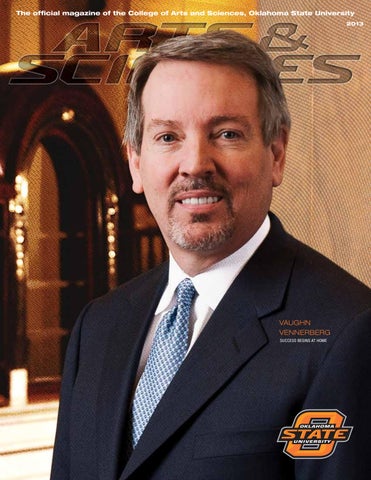
The official magazine of the College of Arts and Sciences, Oklahoma State University 2013
Vaughn Vennerberg Success Begins at Home
Gary Lawson / University Marketing
p l a y b i l l 2
10
12
28
On the Cover
Political Play
Leading the Way
Tracking Tolerance
OSU a l u m n u s a n d
A r e c e n t OSU g r a d u a t e
T h r e e OSU g r a d u a t e
A n OSU p r o f e s s o r i s
successful oilman
boosts her résumé
students played
leading a research
Va u g h n Ve n n e r b e r g
with a communications
leading roles in the
team focused on an
credits his family for
internship in
relief and recover y
ex tremely resistant alga
his accomplishments
O k l a h o m a G o v. M a r y
ef for ts following the
(a b o v e) t o s e e i f i t s t o x i n
— and shows that age
F a l l i n’s o f f i c e.
devastating May tornado
tolerance can be shared.
50 is not too late to
in Moore, Okla.
s t a r t h i s o w n f a m i l y.
2013 v15
cas . okstate . edu
Arts and Sciences Magazine is a publication of the Oklahoma State University College of Arts and Sciences. All communications should be mailed to OSU College of Arts and Sciences ATTN: Arts and Sciences Magazine 205 Life Sciences East Stillwater, OK 74078-3015 2 0 1 3 © O k l a h o m a S tat e U n i v e r s i t y
Editor
Dorothy L. Pugh ’83
Art Director
Paul V. Fleming ’90/’00
Photographers
Phil S hockley Gar y Lawson ’83
Designer
Mark Pennie
Oklahoma State University, in compliance with Title VI and VII of the Civil Rights Act of 1964, Executive Order 11246 as amended, Title IX of the Education Amendments of 1972, Americans with Disabilities Act of 1990, and other federal laws and regulations, does not discriminate on the basis of race, color, national origin, sex, age, religion, disability, or status as a veteran in any of its policies, practices or procedures. This includes but is not limited to admissions, employment, financial aid, and educational services. Title IX of the Education Amendments and Oklahoma State University policy prohibit discrimination in the provision of services or benefits offered by the University based on gender. Any person (student, faculty or staff) who believes that discriminatory practices have been engaged in based upon gender may discuss their concerns and file informal or formal complaints of possible violations of Title IX with the OSU Title IX Coordinator, Mackenzie Wilfong, J.D., Director of Affirmative Action, 408 Whitehurst, Oklahoma State University, Stillwater, OK 74078, (405) 744-5371 or (405) 744-5576 (fax). This publication, issued by Oklahoma State University as authorized by the College of Arts & Sciences, was printed by University Printing Services at a cost of $9,000/9M. #xxxx 10/13
s t a f f Writers
Lorene A. Roberson ’84 Austin Chappell Mat t Elliot t S ylvia E. King- Cohen ’81 Jonathan L. Lacaba ’13 Jim Mitchell ’81 R yan Tomlinson
College of Arts and Sciences Dean
Bret Danilowicz
Senior Director for Development Lauren Kidd
Communications Coordinator Lorene A. Roberson ’84
Year indicates OSU College of Arts and Sciences graduates.
From the
Dean’s Office
W
hat an amazing year to have been at Oklahoma State! The Gamma Chapter of Phi Beta Kappa was installed, we surpassed $1 billion in the Branding Success: The Campaign for Oklahoma State University drive well ahead of schedule — and the momentum for accomplishment shows no signs of slowing. Students and faculty across the College of Arts and Sciences received numerous awards and honors for their scholarship, research and creative activities. J.C. Hallman was awarded a Guggenheim Fellowship, high school student Nicole Biddinger of Bartlesville worked with assistant zoology professor Punidan D. Jeyasingh to place first at the National Junior Science and Humanities Symposia, and music major Michael Barnes of Lawton traveled the globe over the summer after earning a place as percussionist in the National Youth Orchestra of the United States of America. The campus and our college also experienced record enrollments this year. To support our growing student body, we welcomed 23 new faculty members and nine new endowed chairs and professors to our community. The expanding campus will also benefit from our renewed commitment to the arts and creative opportunities with the opening of two new facilities this fall: the Postal Plaza Art Museum in downtown Stillwater, and the Doel Reed Center for the Arts in Taos, N.M. We anticipate these facilities will be followed by a new performing arts center in the not-too-distant future. All of this means greater opportunity for involvement by alumni as well as students. We always have opportunities for alumni to get more involved — just ask me if you’re interested!
In fact, alumni are already getting more engaged with our students overseas each year. A recent example includes the reunion of alumni and faculty in the United Kingdom, as we celebrated the 10th anniversary of our Cambridge Study Abroad program. Another example was the decision by two of our college’s most steadfast supporters, Mike and Anne Greenwood, to accompany our wind ensemble and hear it perform at the Japan Band Clinic. So if you like to travel and you like OSU, be like the Greenwoods and our Cambridge alums and join our students to create an unforgettable, international experience for everyone. We’re just a phone call away. As you read this magazine, you’ll get a glimpse into some of our students’ capabilities since the interviews, writing and photography were done by a combination of staff, freelancers and student interns, many of whom are majors in or alumni of our media and strategic communication programs. I can only imagine what the future holds for our graduates! Please don’t be a stranger when you come back through Stillwater. I always look forward to meeting alumni and hearing your stories about your time at OSU and since. I am confident I will have a few wonderful stories to share with you as well. Go Pokes!
Bret S. Danilowicz Dean, College of Arts and Sciences
Phil Shockley / University Marketing
story by Lorene A. Roberson
photography by Matt Strasen
Oilman Vaughn Vennerberg credits his parents and a stable childhood for his success
2----- M
uch of who 1976 alumnus Vaughn O. Vennerberg II is goes back to his childhood. He was born and raised in Midwest City, Okla., by parents who were products of the military. Mom was in the Women’s Army Corps; Dad in the Army Air Corps. They settled in Midwest City, where his dad worked for Tinker Air Force Base as a civilian.
The family remained in the same house, allowing him and his sister to attend the same public schools all 12 years. Today, the 58-year-old has a stellar reputation in the energy world. But oil and gas wasn’t on his radar at Midwest City High School, where Vennerberg’s dream was to study developmental psychology. He took intro psychology classes, served as co-editor of the newspaper and participated in intramural sports.
In 1971, he attended the American Legion’s Boys State at Oklahoma State University. “It was my first foray to Stillwater — one entire week in Stillwater,” he says. “I was duly impressed with the campus and the facilities. That stuck with me when I later was making a decision on where to go for college.”
Most of his high school friends were headed to the University of Oklahoma. He wanted to try something different than his older sister, Pam, who had chosen OU. (Pam Olson went on to become the first woman to anchor a primetime newscast in Oklahoma.) “The things I was really interested in were at OSU,” he says. “The psychology department here has always had a great reputation.” Vennerberg excelled at OSU. He served as president of the Interfraternity Council, Student Union Activities Board and Blue Key Honor Society. He was a senator for the College of Arts and Sciences and served on the college’s student council. He received the Bob Cox Award for Outstanding Senior of Delta Tau Delta fraternity and was a member of Omicron Delta Kappa, a national leadership honor society.
For eight months, Vennerberg traveled In 2010, Vennerberg helped negotiate with the Kamms. the sale of XTO Energy to ExxonMobil “We visited every city in Oklahoma, Corp. — called one of the largest energy went to every county fair and every mergers in history by The New York Rotary lunch,” Vennerberg recalls. Times. The $31 billion stock sale gave The pay was low, yet the experience Exxon the equivalent of about 45 trillion incredible, he says. After the campaign, cubic feet of natural gas throughout the he intended to return to grad school to United States. finish his master’s in psychology. There Vennerberg is discovering life after was one problem: no money. the sale. Some folks Vennerberg had met on the In the spring of 2012 Vennerberg campaign trail urged him to apply for a job received an honorary doctorate from at Texaco, which was hiring people with OSU, where he was one of the commencea liberal arts background. He was offered ment speakers. a position as a landman in Tulsa, Okla. — Earlier this year, he and three partners an offer too good to pass up, he says. formed MorningStar Partners, a company “And that is how I entered the oil and in Fort Worth that focuses on oil producgas business.” tion in West Texas and New Mexico. In 1987, he moved to Fort Worth, Meanwhile, Vennerberg is dedicating Texas, to work for startup XTO Energy time to his three sons, whose ages range Inc., where he oversaw contract negofrom 6 to 8 (Story, Page 4). Trey, the tiations, regulatory relations, acquisioldest, has bought a new aspect to his life. tion and divestment strategy, land, gas The boy was born with a rare chromomarketing, property management and somal disorder that remains unidentified. human resources.
The things I was really interested in were at OSU. The psychology depar tment here has always had a great reputation.” — Vaughn O. Vennerberg II, with his sons Trey (from left), Luke and Zach
He earned a bachelor’s degree in XTO had an emphasis on giving back. psychology in 1976 as one of the College In 2008, Vennerberg — by then president of Arts and Sciences’ Top 10 Seniors. and director of XTO — partnered with A month later, he started grad school the company to establish three endowed at OSU. faculty positions at OSU, which were the During that first graduate year, Robert first of their kind in the microbiology and Kamm, the former OSU president and molecular genetics, art and psychology Arts and Sciences dean, called Vennerberg. departments. Kamm, who had entered the Oklahoma senatorial race, wanted Vennerberg to hit the campaign trial with him and his wife.
“My philanthropy now is three little boys and keeping them active,” the Dallas resident says. Vennerberg hopes to instill in his three sons the same values his parents taught him and his sister. “Our parents had a lot of humility and drive, and were hard workers and solid citizens. My sister’s and my successes are a true compliment to them.”
3
Lorene A. Roberson / Words Matt Strasen / photography
Family at 50
For more than 30 years, oil and gas executive Vaughn O. Vennerberg II’s life focused on his career.
4-----
So at the age of 50,
Trey, born with a rare chro-
Vennerberg decided to
mosomal disorder, spent his
start a family, using the help
first eight weeks in a neona-
of surrogates. Today, the
tal intensive care unit. He
58-year-old has three biolog-
was not expected to survive.
sively, 12-hour days, six
ical sons: Trey, 8; Luke, 7; and
Family and friends helped,
and seven days a week,”
Zach, 6. The boys are biologi-
“I worked all my life, exten-
staying by Trey’s side night
Vennerberg says. “During that cal brothers. period of my life, I watched Vennerberg didn’t start
and day while Vennerberg XTO Energy.
continued to work full-time for
many of my friends with
out planning to have three
children. I watched their
sons. But a curve ball came
“Trey was in severe condi-
kids grow up, and it was a
with the first one, and it was
tion, and it was hit or miss,”
wonderful thing.
devastating.
“I knew if I was going to
He still remembers the
he says. “I wouldn’t wish this upon any parent, but I
have children, I needed to do
obstetrician’s first words
something soon, or it wasn’t
to him after Trey was born
What he learned, in part,
going to happen.”
prematurely: “I know this is
is that genetics is one of the
not the news you wanted
greatest frontiers in science,
to hear.”
and money is desperately
learned from the experience.”
needed for research.
“I want to give other families hope. I want this gif t to improve the qualit y of life for individuals with genetic Trey is now 8 but has been
disorders, as well as give hope to their families.”
walking for only two years.
— Vaughn O. Vennerberg II
Younger brothers Luke and Zach keep close watch on their older brother, who cannot talk. Trey has frequent seizures and regular trips to the emergency room. In 2008, Vennerberg and XTO gave $1 million (matched by Boone Pickens and the state of Oklahoma to make it a total $4 million gift) to OSU to create three endowed faculty positions in microbiology and molecular genetics, psychology, and art. The Vaughn “Trey” O. Vennerberg III Chair in Bioinformatics and Molecular Genetics, held by Robert L. Burnap, is named for Vennerberg’s oldest son. Vennerberg also chose subjects dear to him for the other two chairs: the The oilman sought out the best geneticists in the country. They mapped out Trey’s chromosomal disorder, finding no chromosomal abnormalities in the family tree. Trey’s genetic disorder just happened, and nobody can say why. The syndrome is so rare that it doesn’t carry a name, only a number. The long leg of his chromosome No. 1, band 31.1 through 32.1, is missing. So far, Vennerberg has found only one, perhaps two, other children in the world born with the same genetic deletion.
Vennerberg Professorship in Developmental Disabilities in Psychology, held by Larry L. Mullins, reflects the oilman’s bachelor’s degree in psychology. And he is an art collector, hence the Vennerberg Professorship of Art, held by Rebecca Parker Brienen, an art historian who specializes in 17th-century Dutch art and museum collections and history. All three posts are the first endowed chairs in their departments. Still, it’s the chair in genetics that is closest to Vennerberg’s heart. “I want to give other families hope,” he says. “I want this gift to improve the quality of
life for individuals with genetic disorders, as well as give hope to their families.” Today, Trey is doing well.
Meanwhile, Vennerberg says, he is having fun watching his sons grow and develop — and just like
In August, Trey’s pediatri-
any other parent, it’s not
cian commended the family
always easy.
for the extraordinary progress the boy has made
He continues to work at his newest venture, MorningStar
through intensive therapy and Partners, but these days, it’s stimulation.
on a more flexible schedule.
“He is never down, never
His days now include drop-
discouraged and never gives
ping kids off at school, riding
up,” his father says. “And
bikes and organizing birth-
while he cannot talk, he can
day parties and swimming
express his feelings, and
lessons. He’s learned about
he is always happy.” Trey
Dora the Explorer and her
loves guitar music, other
adventures, thanks to Luke
people’s eyeglasses, riding
and Zach’s summer camps,
in a car, swimming and
and the family enjoys attend-
the movie Mary Poppins,
ing Texas Rangers baseball
Vennerberg says. He is
games.
enrolled in a special-needs
“Luke and Zach look out for
class at an elementary school their older brother every day,” outside Dallas. Vennerberg is blunt about
Vennerberg says. “They do not understand the details of
the enormous resources
his issues, but they do know
it takes to raise his special-
Trey has special needs, and
needs son. Trey needs 18
they know a family is a place
hours of supervision a day,
where people take care of
which includes three full-time
each other.
nannies and others, he says.
“Every once in a while, I get
The nannies, who happen
to close my door and have a
to be three sisters, have a
little quiet time to myself,” he
great bond with his sons,
says. But he doesn’t care if
Vennerberg says. The family’s he has much privacy these support system includes his
days. “You just plow in and
sister and her husband, two
make it work. It’s hard to
nieces and friends, as well as
imagine what life was like
the boys’ godparents, who
without my sons. They are
are also family members.
my greatest blessing.”
5
Energy Boom is a Boon for OSU Geology
“Ours is the first project to really go out and tr y to understand what are the reser voir
t ypes, how they are distributed, how you can find them and how you can produce
them.” — Michael Grammer, OSU professor
6----- --
klahoma State University’s partnership with 11 oil companies will give new life to old oil fields behind the booms of yore. The companies, including Devon and Chesapeake Energy Corp., are working with OSU’s Boone Pickens School of Geology to better understand Mississippian midcontinent carbonates. The ancient seabeds of Oklahoma and Kansas limestone are believed to encase nearly 6 billion barrels of oil — just under what the United States consumes in a year. Those fields have been in business for more than 40 years, says Michael Grammer, the OSU professor leading the effort. More than 14,000 wells, drilled with the conventional vertical method, pumped out billions of barrels before the accessible stuff was tapped out. But energy companies now have new ways of getting previously non-recoverable oil and gas out of the ground with methods such as hydraulic fracturing, developed by engineers in West Texas, the Michigan Basin and elsewhere. With that in mind, the OSU group is looking at how the Mississippian reservoirs are built and what might be the best ways to get at what’s inside them.
“Ours is the first project to really go out and try to understand what are the reservoir types, how they are distributed, how you can find them and how you can produce them,” says Grammer, who helped start the partnership after his hiring at OSU in July 2012. Oil companies, including one of the OSU program’s partners, SandRidge Energy, have jumped at the midcontinent plays. But the region is not without its challenges. It’s a complex play, Grammer says, with very different characteristics across its reservoirs, ranging from how easily liquid moves through its rock to its seismic properties. The companies will rely on Grammer and his colleagues Darwin Boardman, Jay Gregg, Priyank Jaiswal and Jim Puckette, for research and development. They’ll be using hightech, three-dimensional modeling to show the companies the equivalent of a road map telling them where and how to drill. Normally, companies buy such information on the open market. And because the Mississippian is booming, those costs would be astronomical. With the consortium, the companies benefit from the research efforts of OSU’s faculty and graduate students while providing new scientific data that will be published by OSU scientists. It’s a win-win for all involved, Grammer says.
To drill a single well, hydraulic fracturing uses the high-pressure spraying of millions of gallons of water to break up rock and release hydrocarbons. Using the method in Oklahoma and Kansas has drawn fire from some in the scientific and environmental communities because some of the worst droughts in history have plagued the areas since 2010. Grammer says that won’t be an issue with the Mississippian midcontinent limestone. The drilling water comes from deeply buried saline aquifers several times saltier than seawater. The aquifers are typically hundreds to thousands of feet below any potable water source. “The salinities are such that you basically could not use them for any kind of freshwater purposes,” he says, noting that the water is then pumped back into the saltwater aquifer after it is used. Fracking has also drawn fire because of concerns that the drilling water with possibly numerous chemicals, many of which are hazardous if not properly disposed, could migrate into freshwater supplies. Those problems can be avoided, Grammer says, if companies do sound geological surveys of where they’ll be drilling. That’s part of what OSU is doing through this partnership. “It’s just like the potential for hazardous waste to migrate from landfills or underground waste injection programs,” he says. “These techniques, when done within the constraints of accurate geologic knowledge of the subsurface, can be done in both an economically viable and environmentally sound manner by targeting zones that are encased by nonpermeable rock above and below the zone of interest.”
7
he found the geology program at OU “just too e s ote r i c,” but OSU turned out to be right for him.
8
GARY LAWSON / University Marketing
Richard D. “Rick” Fritz says
2013 Distinguished Alumnus
Perseverance Pays Rick Fritz followed his heart into the energy business
He honed his treasure-finding skills at and Singapore. One of his proudOSU and found some great wealth above est accomplishments was helping raise more than $35 million for the global ground as well, in the form of mentors. support of geoscience through the AAPG “Drs. John Shelton, John Naff, Gary Foundation. It was also during his time Stewart and Zuhair Al-Shaieb — not at the association that Fritz worked with only did they teach us to work hard, OSU’s most generous alumnus, Boone but they taught us to love what we Pickens, on a special project. were doing.” “We were trying to build a connection And as much as he still loves his work, between AAPG and OSU. Mr. Pickens Fritz counts his beloved wife Mary as pledged $10 million for a groundhis most valuable find ever. The couple breaking consortium including OSU, recently celebrated their 41st wedding AAPG and the industry to develop GIS anniversary. [geographic information systems] proj“Her name was Mary Carl, and she ects related to geology,” explains Fritz. was my high school sweetheart. We “By 2004, we had re-established the OSU married at the start of my junior year Geology Alumni Council with the goal at OSU, and we enjoyed married life in Stillwater,” he says, adding, “Mary is my to make the Boone Pickens School of best friend and counselor. She grew up in Geology one of the top schools in the nation, and with Mr. Pickens’ help, we’re Skiatook, and we were both looking to well on our way.” get out into the world.” As much as he appreciated his time at Following his graduation with his master’s in geology in 1977, the couple’s AAPG, Fritz was ready to go when he was offered a chance to explore liquid new world started with Exxon in Kingsville, Texas — specifically, the King resource plays in North America as senior geologist with SM Energy in Tulsa Ranch of South Texas. in 2011. “One-point-two million acres to “Petroleum geology is my work and explore! It was an exciting time. My team proposed and Exxon drilled almost passion, but my family is my life and my 100 wells in a 2½-year period,” says Fritz. comfort,” says Fritz. He and Mary have two kids: Ian, Over the next 20 years, Rick and 21, is studying to be a geologist and Mary Fritz would truly see the world, mechanic, and Zoe, 13, is “a daddy’s girl mostly with Masera Corp., where Fritz became vice president in 1989, supervis- and very talented in sports and music,” ing major exploration projects in the U.S., Fritz says. “Faith is my core and what keeps me the Middle East and Africa. strong,” concludes Fritz. “I have faith in He accepted the executive director position with the American Association God, in my family, in this country, and of Petroleum Geologists in 1999 and for of course, OSU. Go Pokes!” Jim Mitchell 12 years provided oversight for numerous programs in the U.S. and around the world. He supervised the opening of AAPG offices in the U.K., Bahrain
31
Though he knew he wanted to be a petroleum geologist even as a youngster, the 2013 Distinguished Alumnus for the College of Arts and Sciences Richard D. “Rick” Fritz experienced a few early tests of that conviction when it was time to enroll in college. The first came in Norman in 1970, when he walked away from freshman orientation scratching his head. “My family was excited about OU football, but I left the orientation session with the feeling that the geology program there was just too esoteric, so I stopped at OSU on my way back to Tulsa,” explains Fritz. “I was immediately impressed by the faculty at OSU because many had worked in the petroleum industry for years. Their approach fit my background, so I signed up. My parents soon became big OSU fans.” His next test came during a meeting with a freshman adviser: “He told me, ‘Don’t go into petroleum geology — you will never find a job and will wind up pumping gas!’ I majored in geology anyway and by the time I had my master’s degree, I also had about seven [job] offers,” says Fritz. He was just 13 when he started working in the oil fields of Osage County with his father, the late Charles Fritz, who came from a long line of farmers and oilfield workers. “My dad was an independent pumper in the ’60s, and it was a good life. He and my mother Marilyn worked real hard, but they also taught me to have fun. While working in the oil fields, I met several geologists, and I liked ‘talking rocks’ with them and the fact that they were essentially exploring for buried treasure,” Fritz says.
9
MATHEMATICS LEARNING SUCCESS CENTER
BY THE NUMBERS
The new Mathematics Learning Success Center opened this summer on
9 hours of lowcost tutoring for area high school students each week
the fifth floor of the Edmon Low Library on the OSU-Stillwater campus. The center is available to all students in lower-level mathematics courses looking for resources in addition to the classroom. Math department head and Regents Professor William Jaco says the center is a cornerstone to building OSU’s program of student learning and success in mathematics. “Mathematics is the key to opening doors to opportunity and careers for students. It is the foundation to the STEM subjects (science, technology, engineering and mathematics),” he says. 7t
To learn more, visit www.math.okstate.edu/mlsc. Pres iden t Bu rn s Ha rg is c u t s th e r i b b o n c e l e b r a ti n g th e c o m p l eti o n of th e O S U Mathem atic s Lea rn i n g S u cces s Cen ter i n A p r i l. Fro m l ef t: W illia m Jac o, m a th d e p a r tm e n t h e ad; Ch ris Bu rnet t, p re s i d e n t, N a b h o l z Co n s tr u c ti o n S e r v i c e s O p e r a ti o n s; Bret Da n il ow i cz, d e a n, Co l l e g e of A r t s a n d S c i e n c e s; S heila Jo h n so n, d e a n, L i b r a r i e s; Ha rg is; Ca l v i n A n th o ny, OSU/A& M B oa rd of R e g e n t s; Ro ber t S tern berg, th e n-p rovo s t a n d s e n i o r v i c e p re s i d e n t; a n d Ch ris Fra n c isco, a s s o c i a te h e ad of l owe r d i v i s i o n m a th e m a ti c s.
10 -----
r
3 SMART boards for presenting examples and storing online for future student use
2 large tutoring areas for 1000-level courses and calculus classes
i
5 tutoring rooms for small-group tutoring
10 laptops available for check-out
40 percent improvement in student success rates in college algebra and precalculus since the Success in Undergraduate MathematicS (SUMS) initiative began
i
r
126 computers available in the computer lab
7,500 square feet
i 20 hours of free tutoring for math placement exam the week before classes begin
27 student 14 dif ferent
of space devoted to tutoring
1985 the year the Mathematics Learning Resource Center, one of the first of its kind in the countr y, opened
62+ hours that the MLSC is open per week
i
employees in fall 2013
classes suppor ted
3,800 students used the facility this summer for computer training during new student orientation
i
8,000 students per year take classes that the MLSC tutors
Bruce Waterfield / University Marketing
1111
11
•
12 --
Austin Chappell / words Gov. Mary Fallin’s office / photography
Political Play OSU graduate puts a Capitol internship on her résumé A recent OSU graduate shadowed Academy, the Peoria Tribe and the audi“The whole learning Spanish thing has some of Oklahoma’s political leaders ence at a National Cowboy and Western actually become one of my most valuable this past spring while taking part in her Heritage Museum gala. assets,” Lopez says. “I definitely feel like dream internship. Lopez says writing in Fallin’s words it’s something that will be able to help Laura Lopez, a native of Altus, Okla., was a challenge at first, but it eventually me in my professional life.” spent the last semester of her collegiate became second nature to her. During her internship, Lopez also career serving as a communications “It’s not every day that you get to draft saw how valuable certain aspects of her intern for Gov. Mary Fallin at the state a letter for the governor of Oklahoma,” education at OSU were in a professional Capitol in Oklahoma City. Lopez says. “It was nerve-wracking at setting. Lopez, a public relations major, says times, but my supervisor was great to For instance, a political storm over her love for politics sparked her desire to work with and was able to help me learn gun control at the legislature gave her pursue the position at the Capitol. throughout the process.” an opportunity to face a real-life crisis “Growing up, I was always much more At OSU, Lopez built a strong set and use the basics she learned at OSU, interested in politics and governmental of leadership skills and academic including crisis management, governaffairs than most of my friends and class- achievements. ment relations, and ethical guidelines. mates were,” Lopez says. “Coming to While at Oklahoma State, Lopez Lopez plans to take the skills study journalism at OSU only increased served on the Arts and Sciences Student she’s developed to law school in Denver, that interest. I quickly found that the best Council, Student Alumni Board and OSU where she’ll work toward her dream of way to get involved with the field of poli- Leadership Conference. She also was a becoming a lawyer. tics would be to use my writing skills to member of the President’s Partners and “I expect to work for more governmy advantage.” the OSU French Club. ment organizations and it’s possible that Some of Lopez’s duties included Lopez earned spots on the Dean’s and I’ll try to intern at another state capiattending legislative sessions to take President’s Honor Rolls as well as several tol,” says Lopez. “I know I’ve got a long notes and listen to the announced admin- different scholarships. way to go before becoming a lawyer, but istration of bills, as well as writing press Lopez’s accomplishments at OSU I’m ready to test the waters and be fully releases about events at the Capitol. She solidified her status as a determined, prepared for my professional career.” also shadowed Meg Dubray, communica- hard-working leader. She also displayed tions director at the Capitol, while occa- impressive time management skills by sionally working with Fallin. becoming fluent in Spanish in her spare Lopez considers the letters she drafted time. for the governor as her most important contribution as an intern. She outlined documents addressed to the Oklahoma
L au ra Lo pez (r i g h t) i n te r n e d i n Gov. M a r y Fa l l i n’s c o m m u n i c a ti o n s of f i c e. “ I t ’s n ot eve r y d ay th a t yo u g et to d r a f t a l et te r fo r th e g ove r n o r of O k l a h o m a ,” s h e s ay s.
13
14 COLLEQE2!:
ARTS AND SCIENCES
OSU graduate students step up in aid efforts after Moore tornado Jonathan L. Lacaba / STORY
After this year’s tornado devastated Moore, Okla., three graduate students from OSU’s Fire and Emergency Management program played an important role in the Oklahoma City suburb’s recovery.
The students played prominent roles on their relief teams, helping the community begin to recover from the tragedy. While on site, they put into practice what they had learned in the classroom, with each of them responsible for one of the three phases of disaster recovery. Here are their stories.
Brandon Kobs / Kobra Creative
I
Stage 1 — Emergency and first response
A s a tr a i n i n g m a j o r fo r th e M i d wes t Ci t y Fi re Depa r tmen t, Rod ney Fos ter i s of te n o n e of th e f i r s t re s p o n d e r s to d i s a s te r s s u c h a s th e M o o re to r n ad o.
As one of the first to arrive in Moore after the tornado hit on May 20, Rodney Foster helped rescue people from under the rubble and contained a natural gas leak that could have led to a disaster of its own. Foster is a training major for the Midwest City Fire Department. He develops curriculums and trains emergency response personnel to help people when a crisis strikes. He makes sure that firefighters adhere to guidelines, including those from OSHA, the Occupational Safety and Health Administration. Foster also steps in when his fellow firefighters are not at the station.
“I often take their place on the fire engine, and that was the case on the day of the tornado in Moore,” he says. Foster has been involved in five major disaster relief efforts, including the May 3, 1999, tornado that hit Moore. Despite having seen the destruction of that 1999 tornado in Moore, Foster was in awe from the latest strike. “I had a feeling of what I would see when I was called out, but I was still shocked. The looks in victims’ eyes were compelling,” he says. A desire to help people in need combined with a team environment and a taste for the rush of adrenaline common for first responders led Foster to choose this line of work. Foster earned a master’s degree in fire and emergency management administration this summer from OSU. The program has encouraged him to view his work with a holistic approach and consider all aspects of a disaster. He better understands how victims react and what they’re going through in trying times, he says.
continues
15
Phil Shockley / University Marketing
16
Stage 3 — Long-term recovery efforts
Rebuilding homes and lives doesn’t occur overnight. Center at the Capitol. There, Often, organizations unite to Ricketts and representatives create long-term plans to help from the Red Cross, Salvation Stage 2 — Backup comes in the people who are affected by Army and other nonprofits After the first responders teamed up to begin helping disasters. arrive at a disaster site, offi— such as medical and mental That’s where John Ricketts people. cials determine whether the health professionals, as well as “Several organizations were comes in. disaster is beyond the scope of non-medical volunteers. coming together to make Ricketts is the manager of their agencies. Wagner’s animal response disaster services for Feed The sure that activities don’t overIf more help is needed, and triage plan started out as Children, overseeing the orga- lap and that we help as many they call the Oklahoma a class project at OSU. It was nization’s plan to help those in people as we can in the fastest Medical Reserve Corps. The put into action following the need following a disaster. He way possible,” Ricketts says. program is administered by May tornadoes — veterinarShortly after first aid is working on his master’s in the Oklahoma Department ians and vet techs were the supplies and services were fire and emergency manageof Health and coordinated first teams Wagner dispatched provided to the residents of ment administration. by Debra Wagner, who overto the affected areas. The Moore, Ricketts and his teams One aspect of the sees and supports 34 volunteer Medical Reserve Corps began distributing supplies Oklahoma City native’s job coordinators and more than doesn’t typically respond and food to the disaster surviis his involvement with the 5,200 volunteers in the state. within the first operational vors as they began rebuilding Voluntary Organizations Wagner, who is certified in period of a disaster, but the their lives. Active in Disaster alliance, volunteer administration, is animal needs were immediate. Ricketts and his teams made up of organizations working toward a master’s The health and wellworked at several distribution and governmental agencies degree in fire and emergency being of everyone in a family, points, including the Lowe’s on local, state and national management administration including animals, is among levels that collaborate to help home improvement store at OSU. the many responsibilities in Moore and nearby Platt disaster survivors and their “I started with the Medical Wagner addresses. College. About 30 volunteers communities. Ricketts was Reserve Corps as a clerical from Ricketts’ group handed named the organization’s volunteer handling logistics out boxes with laundry deterchair-elect in January, a role in a post-disaster simulagent, cleaning supplies and he will assume in 2015. tion in July 2005 at the Cox hygiene products to more than As Feed The Children’s Convention Center in national representative to the 250 people. Oklahoma City. Since then, Ricketts and alliance, he’s one of the first “The drill opened my eyes to people to know about recovery Feed The Children have wanting a career that would efforts. Ricketts was involved provided aid to more than 50 give me the opportunity to be organizations with 1.6 million with the relief efforts followin the middle of things and pounds of in-kind donaing the 2010 earthquake in make a difference, “ she says. tions through 184 shipments, Haiti, flooding in Nashville, When disaster strikes, state he says. Tenn., the 2011 tornadoes in and local agencies and relief Ricketts says he is in it for Joplin, Mo., and in Alabama, organizations contact the the long haul. as well as 2012’s Hurricane Medical Reserve Corps for “Going back to normal isn’t Sandy. backup. The organization going to be easy for the citiFor the disaster in Moore, brings in additional volunteers zens of Moore, but we’re Ricketts was called to the going to be there for them as State Emergency Operations long as they need our help.” Jo h n R ic ket t s a n d Deb ra Wag ner a t th e Feed T he Ch ild ren wa re h o u s e i n O k l a h o m a C i t y
17
SOCIETY FOR THE ADVANCEMENT OF CHICANOS AND NATIVE AMERICANS IN SCIENCE / COURTESY
The Scientific Process
story by Sylvia E. King-Cohen
Gilbert John took words of wisdom from a mentor for his career path and his service toward students
18
Gilbert John’s love of science has taken him from his home on a Navajo Reservation in Arizona to all over the United States. Along the journey, the Oklahoma State University associate professor has worked hard to share his trek with other Native Americans.
“I didn’t fit the characteristic mold of the stereotypical scientist,” John, 50, says of his circuitous route to become both professor and science mentor. “My interest in science began with my love of animals.” His original plan at Colorado State University was to be a veterinarian. “As I got closer to graduation, a mentor, an immunologist, talked to me about science and careers other than becoming a vet. He taught
me about the whole world of scientific research, teaching and service activities. It changed my career path.” That career change has benefited current OSU students who spend summers assisting in John’s research. He heads Science Scholars: The Native American Path, a program that guides Native American students at OSU who are pursuing degrees in science, technology, engineering and mathematical fields. It is funded by the Society for
poster presentations, where the Advancement of Chicanos consumed through food or water contamination, some of students are eligible for cash and Native Americans in awards up to $500. However, these dyes can cause cancer. Science. Stillwater’s student the conference offers more “We’re interested in how chapter is one of 40 in the than cash awards. the enzyme works,” John United States and the only “Our students meet with college chapter in Oklahoma. says. “I’ve been studying them top-notch minority scien“We want to give our minor- for the past 15 years. BNL, they’re experts. The structural tists who are dedicated to ity students an opportunity helping them,” John says. “It to excel,” John says. “SSNAP biology department at BNL can help determine the struc- is a low-key environment provides opportunities for ture of the enzyme through a where Hispanic and Native our student to participate in American students can feel technique called crystallizatraining sessions focused on academic success and profes- tion. When we know its struc- comfortable.” John hopes his mentorture, it allows us to do a lot to sional development.” ing and this program will understand its function.” In fall 2012, the socidraw more Native Americans This summer, John’s ety awarded OSU $40,000 into science fields. He offers students learned the science and is committed to fundconcrete suggestions for ing the program for two more that goes into the process. “It gives them an indication parents who want to encouryears. The society uses funds age their children toward of what scientific research is obtained from the National all about,” says John. A ques- science and math careers. Institutes of Health to tion about whether his 15-year “First, encourage them to support SSNAP. do well in school,” says John, This summer, John and two quest would scare most thinking back to his own students away from a life in students — Lindsey Burger says John, who also relies the sciences makes him laugh. parents. “Encourage them to and Amber Anderson — go as far with their education on advice from other faculty worked on his research project “It takes time and a special members. “Of course, my as they can.” individual to dedicate their at the Brookhaven National students have an advanHe says it is important life to cure a disease. And, it Laboratory (BNL) on Long tage because I know a lot may take my lifetime. My 15 to spend time talking with Island in New York. Both kids about the importance of about them: their characterstudents are incoming seniors. years is very small compared istics and character, interests, education. to what some scientists have Burger is a zoology major “You also need to do things whether the program would dedicated in their careers.” and a member of the Otoe benefit them.” with your kids, not just tell The SSNAP funding also Missouria tribe. Anderson, a Interestingly, John’s own them not to play video games,” allows John to attend the Cherokee, is a biochemistry children aren’t in scientific John continues. SACNAS national confermajor. fields. His oldest daughter, “And, if you’re not that ence. This year’s conference “I study an enzyme found 26, is completing a master’s is in San Antonio in October. comfortable with math or in bacteria that is found in degree in political science, and More than 3,000 professional science, find them a mentor the human intestine,” John his youngest, 22, is earning a who can help them. That is scientists of predominately says. “The enzyme breaks doctorate in education. down different dyes found in Hispanic/Chicano and Native the missing link,” he adds. “I consider that a testament consumer products, the color American origin are expected “There are opportunities to my letting them become to attend. Because the confer- out there, but students are you see in food, clothes and what they wanted to be,” ence is within driving distance lost without mentoring. We other things.” he says. have to be able to share that The common colorants are of Stillwater, John says he information.” plans to take all 22 students called azo dyes. He explains John also has advice for in the OSU program to the that some azo dyes could those students who want to be conference. become toxic when broken considered for next summer’s “We hope to make a major down. A variety of azo dyes hands-on internship. impact,” John says. are used throughout the “You have to have the By impact, John means world. If they’re accidentally participating in competitions grades, a desire to learn, the ability to follow directions,” that include peer-reviewed
19
ti.
photos / courtesy
Journey to Japan OSU Wind Ensemble offers energizing performance
above The OSU Wind E n sem b le p e r fo r m s a j o i n t c o n c e r t w i th Japanese school band m e m b e r s i n Fu s s a Ci t y. center Mo u n t Fu ji B r i d g e (be l ow) to th e I m peria l Pa lace i n To k yo. S h o p p i n g d i s tr i c t (fa r ri g ht) i n To k yo.
20
T
he OSU Wind Ensemble received a standing ovation, 12 curtain calls and played four encores at the 44th annual Japan Band Clinic on May 19 before a crowd of about 2,700 at the ACT City Concert Hall in Hamamatsu City. “There are rare performances where the audience and performers seem to completely feed off each other’s energy. This concert was such an experience,” says Joseph Missal, OSU music professor and the ensemble’s conductor. Selected to perform by juried invitation, the ensemble was making its second trip to the conference since 2006. Only OSU and Indiana University have performed twice at this conference.
A total of 52 graduate and undergraduate students and four faculty members made the eight-day trip, which included stops in Tokyo, Fussa City and Hamamatsu City. The ensemble joined Japanese school band members for a joint concert in Fussa City and held several open rehearsals for public school band teachers and their students in Tokyo. The band clinic included selections by Bach, Shostakovich, Grainger, Sousa, Mackey, Bryant, Wagner, Lindroth and others, as well as the world premiere of “Peace and Light Rising” by Edward Knight. President Burns Hargis and Dean Bret Danilowicz of the College of Arts and Sciences covered the largest share of the financial obligations. OSU donors and philanthropists Michael and Anne Greenwood accompanied the ensemble to Japan.
21
rr
22
rJ\
JTr
PHIL SHOCKLEY / UNIVERSITY MARKETING
High-Energy Research story by Matt Elliott
OSU Regents Professor Babu is lending a hand to set up a national lab
O
professor can receive — in ne of the newest Babu helps a team of 364 2012, came to OSU in 1998 Regents Professors researchers from about 10 after several postdoctoral in the College of countries. If the lab is estabfellowships at Princeton and Arts and Sciences is getting lished, Babu will provide the universities of Maryland a unique opportunity to the Sanford Underground and Rochester. When he help set up a national Research Facility the theoarrived, he found only one laboratory — 5,000 feet retical background for one other person in high-energy underground. of its major projects: beamphysics on campus, professor Kaladi Babu is part of a ing tiny subatomic particles team of researchers attemptcalled neutrinos underground Satya Nandi. Together, they ing to turn a South Dakota from Chicago’s famous Fermi drummed up funding from gold mine into a virtual gold Lab to a massive detector deep the Department of Energy and founded the Oklahoma Center mine for high-energy physiinside the gold mine. for High Energy Physics cists who study rare “I will do the theory of collaboration among OSU, phenomena. neutrinos relevant for that the University of Oklahoma experiment,” Babu says. “The collaboration is and Langston University and active, but it is not helped hire three new faculty ready to take data.” members at OSU. “We’re very proud of what Babu, who was we have set up here,” says appointed Regents Professor — the high- Babu, a native of south India’s est promotion an OSU Kerala Province. continues Ka l ad i Ba b u i s p rov i d i n g th e th e o reti c a l b a c kg ro u n d fo r a m a j o r p ro j e c t by th e S a n fo rd U n der g ro u n d Resea rc h Fac i l i t y i n S o u th D a kot a .
23
“If protons decay, then that would tell us that ultimately mat ter is not stable. It will be one of the most profound discoveries in science — implying all mat ter will eventually decay away. That will be the ultimate fate of the universe if protons are unstable.” — Kaladi Babu
His involvement in the national lab based in Lead, S.D., (pronounced “leed”) is due to his considerable expertise in physics’ Grand Unified Theory. The theory, an attempt at merging the fundamental forces behind the universe into one simplified theory, attempts to explain how matter and forces interact to create what we see, hear and feel. “It’s the ultimate beauty of nature that will show up in this, if it’s proven,” says Babu. He has been helping with international fundraising for the lab, which has already secured about $867 million from the U.S. Department of Energy. It will take a bit more to build the detector and acquire the 34,000 tons of ultra-pure liquid argon needed for testing. The National Science Foundation selected the mine as the site for the underground lab in 2007 but in 2010 stopped funding project
24 COLLEGES!!: ARTS AND SCIENCES
American Physical Society, the discoveries in science — designs. The Department of implying all matter will even- OSU Regents Distinguished Energy took it over, funding Research Award, serving on tually decay away. That daily operations along with the “theory panel” of the will be the ultimate fate of the state of South Dakota, American Physical Society’s the universe if protons are while also looking at longerDivision of Particles and Fields unstable.” term research through an and organizer of the Center Babu, the son of a teacher, agreement between the state for Theoretical Underground came to the United States to technology authority and Physics summer program in work on his doctorate at the Lawrence Berkeley National Lead. University of Hawaii after Laboratory, the lab’s website Babu says earning the finishing college in Mumbai. states. Regents Professorship has His younger brother is a “It’s not completely clear been a humbling event, one chemical engineer, and his whether it will be successful or not, but this discussion older brother is an economist. that is especially meaningHe enjoys teaching students. ful to him because he worked has been going on for seven or his way up to OSU’s higheight years, and the process is He has a lively way of talkvery slow,” Babu says. “After ing about physics and is quick est promotion from assistant professor. a certain amount of approval, with a laugh, which makes “I am very grateful for the him an entertaining teacher it will have to go through honor,” he says. “There are so Congress, so we are dependent of the introductory physics courses the department offers. many incredible researchers at on the Congress.” “I love undergraduate teach- OSU who could’ve received it.” If the lab is established, He lives in Stillwater with ing,” he says. “There are so it’ll join 18 other national many bright and very enthusi- his wife Kime. Their daughlabs, some of which, includastic students. It’s always fun ter Maya graduated last May ing New Mexico’s Los Alamos National Laboratory to talk to them. Many of them from Stillwater High School and is enrolled at Boston come by after class to talk and Tennessee’s Oak Ridge University. They enjoy travelabout what they find interNational Laboratory, have ing to exotic locales in their esting in popular literature. been behind the greatest spare time, including recent We also get very good gradinventions of the last 100 destinations such as Trieste, uate students in the physics years. The South Dakota lab Italy; Ljubljana, Slovenia; and program, so I can challenge and the neutrino project will them a bit more in specialized Split, Croatia. They’ve also be worthwhile investments, topics, such as advanced quan- been to Japan, Russia, India, Babu says, because they will Poland, Mexico, Taiwan, complement work at Europe’s tum mechanics.” Korea, Sweden and the Babu’s work has appeared Large Hadron Collider (which Netherlands. in dozens of journals, and recently turned the physics he has won numerous world on its head by discovering the elusive Higgs boson awards and honors, including being elected Fellow of the particle, explaining why matter has mass) by focusing on projects the super collider isn’t addressing, such as whether protons can decay. “If protons decay, then that would tell us that ultimately matter is not stable. It will be one of the most profound
Through the Doel Reed Center for the Arts in Taos, N.M., OSU is offering students and lifelong learners unique academic opportunities. Next summer’s course offerings will be posted soon. For more information, visit drca.okstate.edu. If you would like to help us enhance educational experiences through the Doel Reed Center for the Arts, please contact Debra Engle at the OSU Foundation at 405-385-5600 or dengle@OSUgiving.com.
The Doel Reed Center for the Arts is named for the renowned artist who directed OSU’s Department of Art from 1924 until retiring to the family estate in northern New Mexico in 1959. Thanks to the generosity of his daughter, Martha, the picturesque property and three historic adobe structures now serve as an inspiring setting for teaching, research and outreach related to the Southwest.
gary lawson / University Marketing
R e g e n t s Profe s s o r Dav i d K n o t tneru s h a s d eve l o p e d a fo r m a l th e o r y o n r i tu a l s, h ow th ey wo r k a n d th e i r impact on individuals a n d g ro u p s w i th h i s wo r k d u r i n g th e l a s t 16 ye a r s.
26
Working Together
story by Ryan Tomlinson
Knottnerus studies collaborations — and practices what he researches OSU sociology and
A former student, Jason Ulsperger, now an assoKnottnerus first saw his stud- ciate professor of sociolies come to life during the ogy at Arkansas Tech, has Vietnam War. known Knottnerus for more He was drafted in 1969, just than 15 years. Together they weeks after earning a bachehave published one book, lor’s degree in sociology. The co-authored nine articles and Army assigned him to a medi- book chapters and teamed cal evacuation unit outside to present papers at regional, of Tokyo, where he saw his national and international fellow soldiers — all from conferences. diverse backgrounds — over“Dr. Knottnerus was the look their differences and first person to help me realwork together to save the ize how important scholwounded. And he found the arly activity is if I want to living examples of his studies be a successful educator,” fascinating. Ulsperger says. “He also “We worked, ate and lived taught me the value of encourtogether 24/7,” Knottnerus agement and mentorship.” says. “So obviously, conflicts Knottnerus mentored and tensions arose. But I was Ulsperger on several papers, struck by how well we worked including one based on his together as a team.” dissertation, The Social More than 40 years later, Dynamics of Elder Care. The Knottnerus continues to be paper won the Mid-South part of a team, motivated by Sociological Association’s his work with others. Today, Research Article of the Year he gives his college students a in 2008. lot of credit for his success. “He mentored me on how to “I make a big point of structure the paper, express trying to pull students in and my ideas and in general to work with and collaboenhance the quality of my rate with them on research,” writing,” Ulsperger says. “I Knottnerus says. couldn’t have done this without Dr. Knottnerus.” Regents Professor David
Jennifer Edwards, now an associate professor in sociology at Northeastern State University in Tahlequah, Okla., also sings Knottnerus’ praises. “If he’s mentoring you, he’s putting in 100 percent,” she says. “He mentored me for six years, and he was a fantastic teacher. He was very instrumental in building my career. We still work, publish and present together. I was very fortunate to have the opportunity to have Dr. Knottnerus as a professor and mentor.” Basudhara Sen, another graduate student of Knottnerus’ who recently received her doctorate, chimes in: “Dr. Knottnerus has proven himself exceptional in both his graduate student advising and his scholarly work. He has been a friend, a guide, a colleague and a mentor. … His inspiring comments and positive attitude helped me to grow as a scholar. He instilled confidence in me to carry on with my professional goals as a future sociologist and an academician. He maintains his friendly, caring ways and scholarly knowledge within the classroom as well. He is continues
27
“Dr. Knot tnerus was the first person to help me realize how impor tant scholarly activit y is if I want to be a successful educator.” — Jason Ulsperger, about his mentor
Courtesy Jason Ulsperger
28 COLLEOE2!: ARTS AND SCIENCES
19th- and Early 20th-Century an inspiring teacher and … I know he always is there as my French Elite Educational inequalities. The main goal in System: Rituals and Total friend and a guide.” all of this research is to apply Institutions. it to everyday life.” EARLY DAYS His studies, done with STUDY OF RITUALS Knottnerus was born and collaborators, have encomraised in Alton, Ill., a small Why do people do what passed all sorts of groups town on the Mississippi River. they do? That’s exactly what and many different situaAt age 18, he enrolled at Beloit Knottnerus’ research seeks tions, ranging from the social College in Wisconsin to study to answer. dynamics in ancient Sparta chemistry. Once he realWithin the field of sociology, ized that chemistry wasn’t his Knottnerus has several inter- (“That paper is getting a global response,” he says) to passion in life, he took some ests, including social theory, Ireland’s Orange Order to time to determine what that social psychology and social the Notting Hill Carnival in actually was. An introducinequality. However, his main tory course in sociology later, interest is the study of rituals. London, from the development of golf in America to Knottnerus fell in love with Over the past 16 years, coping with life in concentrathe subject. Knottnerus has developed a tion camps including Russian After earning his master’s formal theory on rituals, how labor camps, Nazi camps, and doctorate from Southern they work and their impact POW camps and Japanese Illinois University in on individuals and groups. He internment camps in the Carbondale, Knottnerus defines a ritual as a routine U.S. during World War II, as taught at Florida’s University or a patterned behavior that of Tampa. In 1989, he brought has a higher meaning and that well as an intense look at the culture inside Enron and the his talents to Oklahoma aids people in coping with various practices there that led State, where he could focus on their situations. His theory to its meltdown. research and other scholarly is defined in his book Ritual A current example of work in addition to teaching. as a Missing Link: Sociology, Knottnerus’ research involves At OSU, he met another Structural Ritualization analyzing social interacnew professor, Frederique Van Theory and Research. tions among members of an de Poel, who would become “The concept of rituals Antarctic crew working under his wife. She is a profesis underutilized and often extreme conditions. He and sor of French and has collab- ignored,” Knottnerus says. his collaborators, graduate orated with Knottnerus on “It is essential to use this student Kevin Johnson and several articles and two knowledge to alleviate and James Mason, a lecturer in the books, The Social Worlds of reduce social problems and Department of Marketing in Male and Female Children the Spears School of Business, in the 19th-Century French are reviewing and analyzEducational System: Youth, ing the diaries and memoirs Rituals and Elites and of crew members from several Literary Narratives on the
Courtesy Basudhara Sen
extreme conditions they expe- time filling out paperwork can impede creating those rienced during these Arctic/ emotional connections. Antarctic expeditions.” “I have a great deal of As Knottnerus and his respect for [Knottnerus’] work collaborators examined the on the book,” Ulsperger says. various crews, he found he In his latest project, could classify each expediKnottnerus and his collabotion as a failure, a success rators, professor and departor a super-success. But those ment head Duane Gill and weren’t based on what the expedition itself brought back; graduate student Kevin it was based on team morale. Johnson, are studying the social response to the torna“Super successful leaders does that swept through were the ones who brought Moore and El Reno and how those items (music, chocodaily life in the Oklahoma late, etc.) and who had much cities was disrupted. The analtighter crews,” he notes. ysis will be used to develop Another research interest that Knottnerus is passionate more sophisticated disaster about is nursing home condi- response policies. Simple steps can help tions. He and Ulsperger wrote victims cope. Knottnerus Elder Care Catastrophe: suggests these steps can Rituals of Abuse in Nursing Ba s u d h a ra S en c e l e b r a te s g r ad u a ti o n w i th h e r m e n to r, Dav id K n o t tneru s. Homes & What You Can Do involve rituals such as talkAbout It. In it, the two discuss ing with victims, hosting social events or celebrations how bureaucracy can lead to the objectification and neglect to highlight accomplishments expeditions to the Arctic and increased their margin of or holding memorials for the of nursing home residents. safety and brought more food Antarctic. A book on the lives lost in a disaster. Nursing home residents or fuel?” results is under contract. Outside of teaching, are under the supervision of The short answer could be: strangers, who often have So far, their research has Knottnerus has held posiWith music, chocolate and turned up items brought little to no emotional connec- tions with the American alcohol, life in such harsh to Antarctica that could be Sociological Association, tion with their patients, conditions becomes more considered luxuries: musical Mid-South Sociological Knottnerus says. The lack of instruments, wine, liquor and bearable. And that’s what such a connection can lead to Society and other professional Knottnerus found: “In this chocolate. associations. insufficient care. book, I argue that the ritu“The Antarctic is the Knottnerus and his wife Knottnerus also says that als associated with these and harshest climate on earth,” live in Stillwater. During his government regulations other items increased people’s that require caretakers to Knottnerus says. “Why did free time, he enjoys exercising, ability to cope with the explorers bring such trivial reading and traveling. spend excessive amounts of items when they could have
29
andreas p.m. weber / university of dusseldorf
and enzymes that origiits neighbors. Many genes that contribute to Galdieria’s nated in genes it swiped from adaptations were not inherited bacteria. It also copied genes offerfrom its ancestor red algae but were acquired from bacteria or ing tolerance to high salt concentrations and ones with archaebacteria. This “horizontal gene trans- an ability to make use of a fer” is typical for the evolution wide variety of food sources. The genes were copied from of bacteria, researchers say. bacteria that live in the same However, Galdieria is the extreme environment as first known organism with a Galdieria. nucleus (called a eukaryote) “Why reinvent the wheel that has adapted to extreme if you can copy it from your environments based on horineighbor?” asks Lercher. “It is zontal gene transfer. OSU professor usually assumed that organ“The age of comparative leads team isms with a nucleus cannot genome sequencing began only researching copy genes from different slightly more than a decade extremely ago and revealed a new mech- species — that’s why eukaryresistant algae anism of evolution — horizon- otes depend on sex to recomtal gene transfer — that would bine their genomes. How has Galdieria managed to overnot have been discovered come this limitation? It is an any other way,” says Matt Kane, program director in the exciting question.” What Galdieria did is “a National Science Foundation’s dream come true for biotechDivision of Environmental nology,” says Weber. Biology, which funded the “Galdieria has acquired research. “This finding extends our understanding of genes with interesting properties from different organthe role that this mechanism n the movie Alien, the How has a one-celled alga isms, integrated them into a plays in evolution to eukarytitle character is an acquired such flexibility and functional network and develotic microorganisms.” extraterrestrial creature resilience? oped unique properties and Galdieria heat tolerance that can survive brutal heat To answer this quesseems to come from genes that adaptations.” and fend off toxins. tion, an international Future genetic engineerexist in hundreds of copies In real life, organisms with research team led by Gerald ing may allow other algae in its genome, all descendsimilar traits exist, such as Schönknecht of Oklahoma the “extremophile” red alga State University and Andreas ing from a single gene copied to make use of the proteins Galdieria sulphuraria. Weber and Martin Lercher of millions of years ago from an that offer stress tolerance to Galdieria. archaebacterium. In hot springs in Heinrich-Heine Universitat Such a development would “The results give us new Yellowstone National Park, (Heinrich-Heine University) be relevant to biofuel producinsights into evolution,” Galdieria uses energy from in Dusseldorf, Germany, tion, says Schönknecht, as oilSchönknecht says. “Before the sun to produce sugars decoded genetic information this, there was not much indi- producing algae don’t yet have through photosynthesis. in Galdieria. cation that eukaryotes acquire the ability to withstand the In the darkness of old mineThey are three of 18 same extreme conditions that genes from bacteria.” shafts, in drainage as causco-authors of a paper Galdieria does. The alga owes its ability to tic as battery acid, it feeds on published in Science. Matt Elliott bacteria and survives high The scientists found that the survive the toxic effects of concentrations of arsenic and Galdieria genome shows clear such elements as mercury and heavy metals. signs of borrowing genes from arsenic to transport proteins
Living in Hell
I
30 -----
Gera l d S c h ö n k nec h t s ay s th e re s u l t s of h i s te a m’s s tu d i e s i n to Gald ieria su l phu ra ria h ave of fe re d n ew i n s i g h t s i n to evo l u ti o n.
PHIL SHOCKLEY / University Marketing
31
Homecoming Receptions Hundreds of alumni, students and friends attend the A&S homecoming reception. In 2012, A&S divided its 24 departments to host four different receptions. Alumni from 1962 and 1986 received 50- and 25-year pins respectively at each reception. Profe s s o r s a n d a l u m n i f ro m th e zo o l o g y, g e o l o g y, m i c ro b i o l o g y a n d b ot a ny re c e pti o n i n c l u d e (f ro m l ef t) D r. Ga m a l Aa l A bdel, Bri t t a ny Fo rd, Pride A bo n gwa a n d Mercy Ac h a n g.
A m o n g th e f a c u l t y, s t a f f a n d a l u m n i a t th e p o l i ti c a l s c i e n c e re c e pti o n we re (f ro m l ef t) Ed No l ten s meyer, Jea net te Men dez, Eve R i n g s m u th, Da n a Glen n c ros s, V i n cen t Bu rke, Ji m Dav is, Teres a Tac ket t, Ci n d y H u tc h i n so n, Pa m A m os, S teven Webs ter, N i k E m m a n uel a n d Ben Pr yo r. Phy s i c s a l u m n i g a th e r i n g w i th f a c u l t y m e m b e r s a re (f ro m l ef t) Jo h n M i n tm i re, Doy le Fou q uet, Bill S tec kel ber g a n d Ji m W ic ks ted.
32
S o m e of th o s e a t th e b ot a ny homecoming re c e pti o n i n c l u d e d (f ro m l ef t) Gera l d S c h ö n k nec h t, M a rk Fis h bei n, N i c o le Br ya n t, Lu p i t a Bo rja , Li n d a Wat so n, Zoe Au s ti n a n d Ch ri s Wood.
Top Ten Seniors More than 175 scholarships and awards were presented at the OSU College of Arts and Sciences honors and awards banquet. Among those recognized were the Top Ten Seniors , who were honored for their academic excellence and campus and community involvement. They are (from left): A nna Gear y , Mackenzie McDaniel , Rosalina Yorks , Caleb Ketcham , Erin Nally , Sara Fevurly , Bridget Hark in , Dawson Metcalf , A ndrea Cerar, Sara Rober ts with A&S Dean Bret Danilowicz .
Commencement OSU senior John Leos led the processional alongside the dean at the 2013 A&S commencement ceremony on May 4. Leos, a theater major, was named a Senior of Significance by the OSU Alumni Association and an O u ts tanding Senior by the OSU Department of Theatre. He is also the recipient of the Honors College Degree , the highest academic distinction awarded to undergraduates at OSU.
33
Advisory Board for the Boone Pickens School of Geology The annual advisory board meeting for the Boone Pickens School of Geology was held at the Boone Pickens Ranch . During the meeting, board members discussed the goals and directions for the School of Geology . Board members include (from left) Kris tie Luchtel Ferguson , John Bret t , Ja son Hamilton , L anny Holman , Boone Pickens , Rick Frit z , Jim Pucket t , Rick Ely , Bar t Ga sk ill and Gar y Ford .
Rising Star: Adley Stump Singer and songwriter Adley Stump is the 2013 Rising Star for the College of Arts and Sciences.
34 COLLEQE2!:
ARTS AND SCIENCES
Stump, who graduated in 2011 with a bachelor’s degree in journalism and broadcasting, kicked off her singing career in front of a global television audience as a contestant on NBC’s The Voice . She recently finished an album and is on tour.
Stump is also working with fellow Oklahomans and Nashville songwriters to bring more attention and support for the victims of the recent tornado. She has recorded a song, “Weather the Storm,” with all the proceeds going to the Red Cross to be used for Oklahoma tornado victims.
C S R W E A c ti A e H te C ti G O M C s c a L D C C H c ti n H O L D C C H c ti n H O L D C
Cowboy Corral. Grandparent University. OrangeBytes. Car Decal Scholarships. Homecoming. Student Recruitment. Official OSU Clas Ring. Chapters. Orange Savings Connection. STATE Magazine. Car Tag Watch Clubs. Legacy Program. Alumni Awards. Cowboys for Highe Education. Cowboy Corral. Grandparent University. OrangeBytes Affinity Groups. Car Decal. Scholarships. Homecoming. Student Re cruitment. Official OSU Class Ring. Chapters. Orange Savings Connec ion. STATE Magazine. Car Tag. Watch Clubs. Legacy Program. Alumn Awards. Cowboys for Higher Education. Cowboy Corral. Grandpar ent University. OrangeBytes. Affinity Groups. Car Decal. Scholarships Connect to the Homecoming. Student Recruitment. Official OSU Class Ring. Chap ers. College Orange Savings STATE Magazine. Car Tag. Watch of ArtsConnection. and Sciences Clubs. Legacy Program. Alumni Awards. Cowboys for Higher Educa with a membership in the ion. Cowboy Corral. Grandparent University. OrangeBytes. Affinity OSUScholarships. Alumni Association . Groups. Car Decal. Homecoming. Student Recruitment Official OSU Class Ring. Chapters. Orange Savings Connection. STATE Magazine. Car Tag. Watch Clubs. Legacy Program. Alumni Awards Cowboys for Higher Education. Cowboy Corral. Grandparent Univer OSU Alumni Association sity. Your OrangeBytes. Affinity Groups. Car Decal. Scholarships. Home membership directly support: coming. Studentdues Recruitment. Official OSU Class Ring. Chapters. Or ange Savings Connection. STATE Magazine. Car Tag. Watch Clubs Legacy Program. Alumni Awards. Cowboys for Higher Education. Ca Decal. Scholarships. Homecoming. Student Recruitment. Official OSU College alumni events Class Ring. Chapters. Orange Savings Connection. STATE Magazine Car Tag. Watch Clubs. Legacy Program. Alumni Awards. Cowboys fo scholarships Undergraduate Higher Education. Car Decal. Scholarships. Homecoming. Student Re cruitment. Official OSU Class Ring. Chapters. Orange Savings Connec Alumni chapters nationwide ion. STATE Magazine. Car Tag. Watch Clubs. Legacy Program. Alum ni Awards. Cowboys for Higher Education. Car Decal. Scholarships Homecoming activities Homecoming. Student Recruitment. Official OSU Class Ring. Chapters OrangeStudent Savings STATE Magazine. Car Tag. Watch Clubs andConnection. alumni awards Legacy Program. Alumni Awards. Cowboys for Higher Education. Ca Decal. Scholarships. Homecoming. Student Recruitment. Official OSU Class Ring. Chapters. Orange Savings Connection. STATE Magazine LearnWatch more about about connecting to Car Tag. Clubs. Legacy Program. Alumni Awards. Cowboys fo theEducation. College of Arts and Sciences through Higher Car Decal. Scholarships. Homecoming. Student Re an Alumni Association membership cruitment. Official OSU Class Ring. at Chapters. Orange Savings Connec ion. orangeconnection.org/join. STATE Magazine. Car Tag. Watch Clubs. Legacy Program. Alum ni Awards. Cowboys for Higher Education. Car Decal. Scholarships Homecoming.201Student Recruitment. Official OSU Class Ring. Chapters ConocoPhillips OSU Alumni Center Stillwater, OK 74078-7043 Orange Savings Connection. STATE Magazine. Car Tag. Watch Clubs TEL 405.744.5368 • FAX 405.744.6722 info@orangeconnection.org • orangeconnection.org Legacy Program. Alumni Awards. Cowboys for Higher Education. Ca Decal. Scholarships. Homecoming. Student Recruitment. Official OSU Class Ring. Chapters. Orange Savings Connection. STATE Magazine
Your
CONNECTION
For Life
In Memoriam “The continuing theme in zoology is diversity,” Dr. Bruneau said. The Stillwater, Okla., resident retired in 1995 and established the Herbert and Betty Bruneau Endowed Zoology Seminar Fund in 2013, which covers speakers’ seminar expenses to address the diverse program.
Raymond Paul Boosahda, (physics, ’56), died Sept. 24, 2012. Mr. Boosahda, a longtime physics, science and math teacher in the Dallas Independent School District, was 84. He was born in Worcester, Mass., and graduated from Commerce High School in Worcester. He served in the U.S. Army during the occupation of Japan following World War II and later in the U.S. Air Force during the Korean War. He earned a bachelor’s degree in physics from Oklahoma State University and a master’s degree from East Texas State University. Mr. Boosahda taught physics, science and math in Dallas junior high and high schools. He also taught in the Dallas County Community College District. The Carrollton, Texas, resident volunteered at an animal shelter and shared his home for 17 years with his favorite cat, Snicks. He closely followed politics. He was preceded in death by his wife, Billie Jean Blackburn. He is survived by a son, Bishop Paul Wayne Boosahda; three daughters, Patricia Miller, Dr. Rachel Griffin and Linda Rahm; four grandchildren; three greatgrandchildren; two brothers; and many family members, nieces and nephews.
L. Herbert Bruneau, zoology professor emeritus, died April 12, 2013. Dr. Bruneau, a longtime zoology professor at Oklahoma State University, was 84. He arrived in 1955 at then-Oklahoma A&M College. For the next 40 years, he advised zoology undergraduates and taught genetics and evolution, appreciating the wide range of the field of zoology.
Dr. Bruneau taught biological sciences, genetics and cytology, as well as the first departmental courses in evolution and human heredity. He received the Amoco and Regents Teaching Awards and was involved with the National Science Foundation Academic Year and Summer Institute Programs for High School Science Teachers. He was a member of the Council of Teacher Education, the Allied Arts Committee and the PreMedical Advisory Committee, to name a few. The Cornwall, Ontario, Canada, native was educated in New Brunswick. He majored in general science at Montreal’s McGill University before earning a master’s degree and a doctorate from the University of Texas at Austin, where he studied cytology and genetics. He is survived by his wife Betty Leifheit (they married in 1953); a daughter, Carol Bruneau; and a son, David Bruneau.
Henry J. Dishburger (chemistry, ’53) died Sept. 26, 2012. Mr. Dishburger, an employee of Dow Chemical Co. for 35 years, was 85. The longtime resident of Midland, Texas, earned a bachelor’s degree from Stephen F. Austin State College in 1950 and was named its 1993 Distinguished Alumnus. He earned a master’s degree in chemistry from Oklahoma State University in 1953. Mr. Dishburger served in the U.S. Navy aboard ships in the Pacific theater during World War II. He worked in research and development for agrochemicals for Dow. At retirement, he was global quality assurance manager for the agricultural products department. His work at Dow resulted in several patents and numerous professional research papers in agricultural products
and pesticide residues. He organized the Dow Residue Laboratory in Lake Jackson, Texas. Prior to Dow, he worked for General Electric Co. at the Hanford Atomic Products Operation in Richland, Wash. Mr. Dishburger was a 60-year member of the American Chemical Society, where he was a Fellow, chairman, vice chairman and treasurer of the agrochemical division. He is survived by his wife, E. Merle Cox (they married in 1951); two daughters, DeAnn Lee and Denise Clark; a son, Paul T. Dishburger; and other family members.
Rita Kathryn Copeland Matthews (humanities, ’55) died Dec. 26, 2012. Mrs. Matthews, a wife, mother, grandmother and friend, was 78. She was born in Idabel, Okla., and graduated from high school in Aberdeen, Wash. While attending Oklahoma A&M College in 1953, she met Paul W. Matthews on a blind date. They married in 1955. Mrs. Matthews was a past president of Oklahoma City Kappa Delta Alumnae and received its highest national honor, the Emerald Award for outstanding service. She led the Bear Pal program, which provided teddy bears to children affected by the Oklahoma City bombing and later benefited victims of abuse. Mrs. Matthews was active at Fifth Church of Christ, Scientist in Oklahoma City for 37 years, serving as a reader, lecture chairwoman, Sunday school teacher and superintendent. For more than 30 years, she was a full-time practitioner who was listed in the worldwide directory published in The Christian Science Journal.
She is survived by her husband, Paul W. Matthews; two sons, Douglas Matthews and David Matthews; and nine grandchildren; and many family members.
Karen Lynne Smith (physiology ’87/psychology ’90) died Nov. 2, 2012. Ms. Smith, a senior academic counselor at Oklahoma State University, was 50. As a child, Ms. Smith traveled throughout the world because of her father’s military service. Some of the places she lived included Oklahoma, North Carolina, Kansas and Germany. In 1980, she graduated from high school in Junction City, Kan. She earned a bachelor’s degree in physiology in 1987 and a master’s degree in psychology in 1990, both from OSU. After graduation, Ms. Smith worked as a sales manager and purchasing agent at Nomadics Inc. in Stillwater for 10 years. She joined OSU in 2010 as an academic counselor in the College of Arts and Sciences. She later was named senior academic counselor and advised students majoring in botany and zoology. Ms. Smith was involved with the OSU Student Council, OSU Office of Institutional Diversity Selection Committee and United Way. In 2007, she was awarded the College of Arts and Sciences Outstanding Adviser Award. In 2012, to honor Ms. Smith’s advising efforts, the OSU Department of Zoology created the Karen L. Smith Undergraduate Research Symposium. Ms. Smith is survived by her mother, Esther Smith; seven siblings, Janice Newsom, Patricia Smith, Cynthia Farrell, Lisa Smith, Robert MartinSmith, James Smith and Walter Smith; and many other family members.
Memorial Scholarships To learn more about memorial scholarships, contact Lauren Kidd at 405-385-0724 or email lkidd@osugiving.com
Oklahoma State University
No n - P rof it o r g an izat ion
College of Arts & Sciences
U.S . P O S TAGE P A I D
201 Life Sciences East
S t i l lwat e r , OK P er m i t N o. 1 9 1
Stillwater, Oklahoma 74078-3015
You may not be thinking about coming back home today.
But you will. until then, CONNECT with us at okstate.edu cas.okstate.edu t wit ter.com/OSUartssciences or angeconnection.org osugiving.com