S TA R O F T H E S I LV E R SCREEN
|
TRAILER: BRAND OF SUCCESS
|
NOW PERFORMING AT A CLASSROOM N E A R YO U
COLLEGE OF
Arts & Sciences
O K L A H O M A
S T A T E
U N I V E R S I T Y
M A G A Z I N E2 0 1 0
STAR POWER A Salute to Fine Arts and Exceptional Sciences
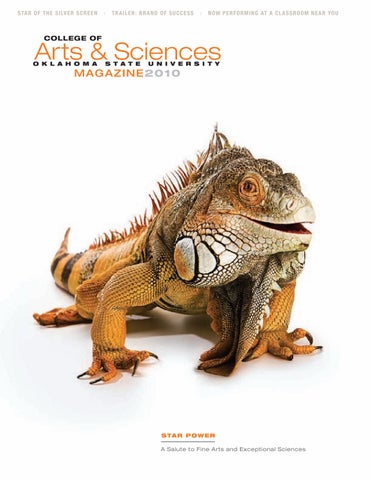
COVER Like his namesake, Elvis the iguana is a charismatic celebrity whose unique performances captivate young audiences around the state. As both an artist and a zoological phenomenon, Elvis embodies the inclusiveness of the college that’s home to 24 art and science disciplines. Cover photography is by Phil Shockley.
This scene, photographed by Phil Shockley, is from an OSU opera production, The Medium, performed at the Seretean Center in 2008.
c o n t e n t 2
18
Star of the Silver Screen
Trailer: Brand of success
O S U ’s t a l e n t e d a l u m n i
Now performing at a classroom near you
excel in all areas of
T h i s p a s t y e a r, t h r e e
r e s p o n d e d t o O S U ’s
the fine arts, including
outstanding professors
$1 billion Branding
the movie and
in the college received
Success campaign to
television industries.
Regents Professor
place their personal
d e s i g n a t i o n , O S U ’s
marks on the future
e q u i v a l e n t o f t h e O s c a r.
of the college.
2 0 1 0 © O K L A H O M A S TAT E U N I V E R S I T Y Oklahoma State University, in compliance with Title VI and VII of the Civil Rights Act of 1964, Executive Order 11246 as amended, Title IX of the Education Amendments of 1972, Americans with Disabilities Act of 1990, and other federal laws and regulations, does not discriminate on the basis of race, color, national origin, sex, age, religion, disability, or status as a veteran in any of its policies, practices or procedures. This includes but is not limited to admissions, employment, financial aid, and educational services. Title IX of the Education Amendments and Oklahoma State University policy prohibit discrimination in the provision of services or benefits offered by the University based on gender. Any person (student, faculty or staff) who believes that discriminatory practices have been engaged in based upon gender may discuss their concerns and file informal or formal complaints of possible violations of Title IX with the OSU Title IX Coordinator, Mackenzie Wilfong, J.D., Director of Affirmative Action, 408 Whitehurst, Oklahoma State University, Stillwater, OK 74078, (405) 744-5371 or (405) 744-5576 (fax). This publication, issued by Oklahoma State University as authorized by the College of Arts & Sciences, was printed by University Printing Services at a cost of $7200.00/7M. #3281 10/10
Three alumni have
s t a f f
2010 v12 C A S . O K S T A T E . E D U Arts and Sciences Magazine is a publication of the Oklahoma State University College of Arts and Sciences. All communications should be mailed to OSU College of Arts and Sciences, ATTN: Arts and Sciences Magazine, 205 Life Sciences East, Stillwater, OK 74078-3015.
38
Editor
Writers
Eileen Mustain
Joseph Dunn Matt Elliott Abby Fox ’08 Lorene Roberson Hickey ’84 Sylvia E. King-Cohen ’81 Jacob Longan ’05 Stacy Pettit ’09 Timothy R. Ryan ’84
Art Director Paul V. Fleming ’90/’00*
Photographers Phil Shockley Gary Lawson
Associate Editor Janet Varnum’86
Dean of the College of Arts and Sciences Peter M.A. Sherwood
Associate Vice President for Development College of Arts and Sciences Jason J. Caniglia
Media and Alumni Relations College of Arts and Sciences Lorene Roberson Hickey ’84
*YEAR INDICATES OSU COLLEGE OF ARTS AND SCIENCES GRADUATES.
Lorene Roberson Hickey ’84 PHOTO
Welcome, Friends and Alumni. THIS ISSUE OF OUR ALUMNI MAGAZINE INCLUDES STORIES ABOUT OUTSTANDING E D U C AT O R S , SCIENTISTS AND ALUMNI IN BOTH THE
These are exciting developments By highlighting these alumni, in visual arts including the acquisiwe wish to draw attention to our tion of the old post office building W E A L S O F E A T U R E performing and visual arts proin downtown Stillwater, which will grams, which we are very proud ALUMNI WHOSE become a location for art exhibiof at OSU. We want to focus on IMPRESSIVE CAREERS tions and other art-related activities. ways to enhance the support and AS ENTERTAINERS The Doel Reed Center for the Arts facilities needed for these excellent BEGAN HERE IN THE continues to develop, and we are programs. COLLEGE OF ARTS all very grateful for the outstandTo achieve this we have made A N D S C I E N C E S . the fine arts a major funding priing support provided by numerous donors to help this project. Our ority for the College of Arts and course offerings at the center in Sciences in Branding Success: The Campaign for Oklahoma State Uni- Taos, N.M., have grown significantly this year. versity. We currently are working I am thrilled to see the many with OSU to plan for the development of a new performing arts cen- advances in the fine arts, and I am sure you will enjoy reading about ter and new visual art facilities. I am delighted at the prospect of the many achievements in this key area, as well as the many articles a new performing arts center. Our music and theater departments from all parts of the college. have many achievements and have presented outstanding performances in facilities that have been ABOVE especially challenging. This is an excellent time to provide a worldPeter M.A. Sherwood, dean of OSU’s College of Arts and Sciences, waves from the cockpit class facility for two departments of the supersonic jet fighter, T-38 Talon, prior Peter M.A. Sherwood, Dean, that have so much to contribute to to an hour-long flight from Vance Air Force OSU, to the Stillwater region and Base in Enid, Okla., to 20,000 feet over College of Arts & Sciences western Oklahoma. Sherwood visited Vance, to the State of Oklahoma. ARTS AND SCIENCES.
often the first stop for cadets commissioned
at OSU, to broaden his understanding of student Air Force training, which is one of two military science programs in the college.
2 COLLEGE~ ARTS AND SCIE'NCES
© CBS Entertainment PHOTOS
The Luckiest Guy on the Planet STORY BY
Lorene Roberson Hickey ’84
It’s been quite a life for 1980 alumnus Rex Linn, the actor who co-stars in CSI: Miami and who has appeared in more than 35 films alongside actors such as Kevin Costner, Tom Selleck and Sylvester Stallone. Today, people easily recog“I buried my hero, so these nize Linn, 53, as homicide Det. have been a tough few months,” Frank Tripp on the enduring CBS Linn says of his dad who was a trial attorney representing clients hit CSI: Miami. who included rock star David There’s one constant in his Bowie, the former Philippine first career — perseverance. Linn never forgot advice from the late lady Imelda Marcos and former OSU football coach Jim Stanley. actor Roy Scheider. Scheider and Linn had just ON SAFARI wrapped up Night Game in In 1956, Rex Maynard Linn, Galveston, Texas. “All I wanted the third child of James Paul and was Roy Scheider’s autograph Darlene Linn, was born in Hanssince it was the first time in my ford County, Texas. In 1969, the career that someone really gave elder Linn moved the family from me a chance,” says Linn. Spearman, Texas, to Oklahoma Linn got the autograph (he City, so he could practice law. still has it at his Sherman Oaks, When 5 years old, Linn Calif., home) and solid wisdom wanted to be three things when from Scheider, who told him, he grew up — an actor like Boris “One of the things I realize about Karloff who played Frankenstein you is that you listen and that’s or Lon Chaney Jr. who played important for an actor to do. I Wolf Man, a football player at can tell you’re raw, but you have the University of Texas and a veta lot of talent. Just remember, it erinarian. doesn’t matter what coast you’re Linn’s come close to reaching on, perseverance is the key.” those goals but not without a few Linn now gives the same advice detours. to new actors. “Hit the street He hasn’t forgotten his first and do whatever you can. It’s the day at Heritage Hall School, a toughest business you can be in.” private prep school in north Linn talks easily about HolOklahoma City. “I walk into a lywood and the many actors (he classroom with a flattop and red doesn’t like calling them movie grease in my hair wearing penny stars) he has worked with over the loafers and white socks. This years. However, thoughts of Oklaone guy, Anthony Meyers, wearhoma pepper his conversation. ing his T-shirt and tie-died jeans Recently, Linn returned to with long hair says to me, ‘What help pack the belongings at his planet you from, dude?’” dad’s home in the Waterford comMeyers and Linn became lifemunity in Oklahoma City. James long friends. Paul Linn died at the age of 83 on Oct. 24, 2009.
In the summer of 1970, Linn met Greg Curtis when they both worked at the Oklahoma City Zoo. Linn worked in the concession stand. While behind the counter, Linn would peek out and observe the tram drivers. On breaks, he would walk down to the herpetarium — the snake house. “All I wanted to do was be around the animals,” he says. By the third summer, Linn donned a zoo uniform and safari hat to give a 25-minute tram tour of the 110-acre zoo. Both he and Curtis memorized 23 pages of dialogue. “Now that I think about it, memorizing the long spiel helped me in acting a lot,” Linn says. His passion for animals didn’t completely overshadow Linn’s mischievous side or forestall the dubious activities of racing the trams or overstaying a break at the herpetarium when a new shipment of snakes arrived. The zoo fired and rehired Linn and Curtis four times in five years. “Greg and I had the coolest job in the state of Oklahoma, but we got in more trouble than you could imagine. Working at the zoo is one of the highlights of my life,” he says. “Except for getting fired.” CONTINUES
3
I RIDE INTO TOMBSTONE IN LATE AFTERNOON WITH PURPLE SKIES AHEAD OF ME. I’M ON MY KICK-ASS HORSE NAMED DALLAS, HAVE ON THE COOLEST WARDROBE, A SIX-GUN AND A SCAR ON MY FACE, AND THINK TO MYSELF, ‘I DREAMED ABOUT THIS AS A KID. HELL, I’D PAY THEM TO DO THIS. THANK YOU, LORD. I WILL NEVER FORGET THIS MOMENT. NEVER.’
THE 88-CENT LEAN YEARS
4 COLLEQEOI"
ARTS AND
SCIE'NCES
Theta Pond. The caper involved a plan, a truck and a chain. “It Linn graduated from Casady was a great feat, and we were School in Oklahoma City. At all so happy until we learned the OSU, he roomed with Tom Tag(Stillwater) detectives were invesgart, now a successful veterinartigating it.” ian in Minnesota. In 1980, Linn earned a bachThere was always a pack of elor’s in radio-television-film. dogs at their house on Fourth His dad hung the diploma in his Street in Stillwater. Despite Linn’s law office. Linn recalls his dad’s love of animals, vet school was words: “I thought this would not in the cards. “To be a vet, never happen, but I don’t want to you have to hit the books hard, know all the particulars.” and you can’t go to Pokes or The From 1980 to 1990, Linn Attic and stay out until 2 in the worked as a loan officer for two morning,” he says. banks in Oklahoma City and Again, the mischievous side later oversaw oil field operations had a way of coming out, and in western Oklahoma. Linn participated in his share of At the same time, Linn audicollege pranks. He might know tioned for acting roles. He recalls something about how a 1,800shooting some very bad compound plastic cow “borrowed” mercials. from Sirloin Stockade restaurant “The first time I was in front of on Sixth Street found its way into a camera I did a commercial for Safeway,” Linn ruefully tells of
shilling beef brisket in a firefighter’s uniform. “Beef brisket for only 88 cents a pound. Now that’s a hot deal.” In 1986, he worked with Oklahoma Publishing Company president E.K. Gaylord II on a film called Shadows on the Wall. “My acting career started behind the camera thanks to Ed Gaylord,” he says. “I was a nervous wreck, but I hung in there.” At his dad’s urging, Linn sold his home, packed up a U-Haul and finally made the move to Hollywood at the age of 32. PHOTO / COURTESY
TALL IN THE SADDLE
A LONGHORN COWPOKE In April, Linn emceed the Western Heritage Awards for the Fast forward 21 years and Linn may deny he’s a cowboy, but he’ll admit to being a Linn plays the cynical police Det. National Cowboy and Western cowpoke even though he’s been Frank Tripp on CSI: Miami oppo- Heritage Museum in Oklahoma a Longhorn fan since he was a site David Caruso starring as Lt. City. The Hall of Great Western Performers inducted Linn’s close toddler. Horatio Caine. “But I am a longhorn and “It’s great working with David friend Tom Selleck with whom he a cowpoke, baby! Longhorns Caruso. He raises the bar profes- has filmed four westerns. “I have seen my dad on the and cowpokes never argue. We sionally. I do 99 percent of my stage at the Cowboy Hall a lot of have one thing in common. OSU scenes with him, and you have times,” Linn says. “So inducting wants to beat OU. Texas wants to be prepared to come to work Tom Selleck was a great thing to to beat OU!” with David. He has helped me do and really special. It was my Last year, Linn saw the Boone become a better professional.” tribute to my dad.” Pickens Stadium for the first Fans also know Linn for his In the 1980s, Linn’s dad gave time when Texas played OSU. “I bad-guy role in Cliffhanger starlegal advice to help the museum walked in the stadium and said, ring Sylvester Stallone and John weather a financial crisis that ‘Wow.’ The stadium is unbelievLithgow. One of Linn’s favorite experi- almost forced a move out of state. able. I am so proud of OSU fans. Linn remembers his father’s It’s good to be a part of Stillwater.” ences was playing cowboy Frank last words before walking on the There’s no doubt Linn loves McLaury in the 1994 Wyatt his life — football, family, friends Earp film featuring Kevin Costner. stage to induct Selleck, “Carry the torch and represent the Linn and then the acting … one thing “I ride into Tombstone in family well.” seems to elude him, however. late afternoon with purple skies “I’ve acted in a lot of successMarriage, he says. ahead of me,” Linn recalls. “I’m That’s about to change. “I on my kick-ass horse named Dal- ful westerns, and it has helped las, have on the coolest wardrobe, me growing up around cowboys,” came all the way to California to Linn says. “I’m a good rider, and find my Texas girl,” Linn says of a six-gun and a scar on my face I don’t have to fake much. But Renee Derese, a trauma unit nurse. and think to myself, ‘I dreamed I have never considered myself “The guys on the (CSI: Miami) set about this as a kid. Hell, I’d pay said I have met my match. them to do this. Thank you, Lord. good enough to ease into the cowboy world.” “I am the luckiest guy on the I will never forget this moment. Never.’” planet.” More recently, he appeared in Appaloosa, written by fellow Oklahomans Ed Harris and Robert Knott. Although Linn had worked with Knott several times as an actor, he had never worked with longtime friend Harris until Appaloosa.
,
T O P L E FT One of Rex Linn’s favorite experiences was playing cowboy Frank McLaury in the 1994 Wyatt Earp film featuring Kevin Costner. Adam Baldwin, left, played his brother Tom McLaury. B O T T O M LEFT Rex Linn and fiancee Renee Derese, a trauma unit nurse, are both native Texans. BELOW Rex Linn plays homicide Det. Frank Tripp on the CBS hit CSI: Miami starring David Carusco, left, as Lt. Horatio Caine.
5
6
Stacy Boge PHOTOGRAPHY
Talent and Resolve
STORY BY
Matt Elliott
Rejected by Juilliard. Sarah Coburn, an OSU alumna and operatic soprano with a stage voice like liquid gold, can put it on her résumé.
In addition, she can add that, as Bajazet’s daughter Asteria, she shared the stage with Spanish tenor Placido Domingo during a 2009 production of Tamerlano with the Los Angeles Opera. She soared as a soloist in Handel’s Messiah with the Seattle Symphony Orchestra and in the title role of the Cincinnati Opera’s production of Lucia de Lammermoor. And those are just a few snapshots of a year that took her from Cardiff, Wales, to Los Angeles, Calif. By the way, The Huffington Post called her “stunning” and “stellar.” The Cincinnati Enquirer, “breathtaking.” “Luminous,” states the Financial Times. Juilliard or not, Coburn’s young career is taking off. “It’s a great school, absolutely,” she says, in an interview from her home in Greenwich, Conn. “But, no, you do not have to go to Juilliard. Save your money and stay home. I would’ve been lost in the crowd and totally intimidated at Juilliard in New York City.” Coburn grew up in Muskogee, a small manufacturing town in northeast Oklahoma. Her father, 1970 OSU alumnus and Republican U.S. Sen. Tom Coburn, is a physician there. She spent her childhood growing up around family in the close-knit community and attending OSU football games with her parents.
“She has, and did from the She came to OSU in 1995 beginning, a truly beautiful voice because of its music education — just one of those voices that program and her family conreally comes along very rarely,” nections to the university that says Julie McCoy, who also notes include grandparents, great Coburn has an innate underuncle, cousins and a sister. Her standing of music that makes her mother, 1970 alumna, Carolyn Denton Coburn, is a former Miss a good musician as well. “That kind of a combination in a singer OSU. Coburn says she always is rare.” wanted to be a Kappa Alpha The life of an opera singer can Theta sorority member at OSU like her mother, sister and aunts. be hectic. Sometimes Coburn has to memorize 250 pages of So naturally, her whole family, music in a few days. The OSU packed with talented musicians, program’s theory and analysis was ecstatic about her decision to courses help her during crunch study music education at OSU. time, as does what she learned “I think OSU has a fantastic music school,” says Coburn, who from other instructors, including graduated in 1999. “When I was Tom Lanners, Brant Adams and there, the faculty challenged me, Gerry Frank. “I’ve seen many, many of my and I thought the curriculum was academic and competitive. It friends who’ve gone to very repucould hold up against any conser- table conservatories but have less knowledge of musical basics,” she vatory out there.” says. An OSU background “helps She praises her OSU profesyour enjoyment of an art form sors, including her voice and chorale instructors, Julie McCoy, when you understand the way it’s constructed. You can enjoy it now at Texas Wesleyan, and regardless of performance.” Julie’s husband, Jerry McCoy, now at the University of North CONTINUES Texas. The two inspired her to love what she sang and exposed her to new repertoires.
A LOT OF REALLY TALENTED PEOPLE GIVE UP, AND THERE ARE A LOT OF AVERAGE SINGERS MAKING A GREAT LIVING BECAUSE THEY STUCK IT OUT.
7
Stacy Boge PHOTOGRAPHY
I’VE SEEN MANY, MANY OF MY FRIENDS WHO’VE GONE TO VERY REPUTABLE CONSERVATORIES BUT HAVE LESS KNOWLEDGE OF MUSICAL BASICS.
8 COLLEGE~ ARTS AND SCIE'NCES
However, she took McCoy’s Since she graduated, she has been all over the nation, married advice, and the rest is history. in 2008 to a consultant with Ora- Keller honed her on-stage perforcle, and had her first child, Katie mance craft and, thanks to a bit of luck, some hard work and no Rose. Between being a singer, small amount of expensive vocal new mother and a wife, her life doesn’t allow much time to make lessons and rejections, some great it back to Stillwater, she says, and opportunities came along. She ended up in New York some opera assignments can last City anyway, but it wasn’t to as long as seven weeks, such as attend Juilliard. While she was her trip to Cardiff last summer. finishing her master’s degree But she was on campus last in voice with Keller, she was a January for a performance with OSU’s Allied Arts series. She told national grand finalist in the 2001 Metropolitan Opera National a master class that while some success in music is due to talent, Council Auditions in New York City. She would move there in it’s mostly due to perseverance. “A lot of really talented people 2002 after an apprenticeship with the Seattle Opera. give up, and there are a lot of Since then, there have been average singers making a great living because they stuck it out,” too many highlights for her to remember them all, but a big she says. “In this business, you get rejected much more than you one was singing with Placido Domingo. These days, she’s conget accepted. You have to have sidering pulling back a bit so she a thick skin about it. You never can spend more time being a wife know why companies decide and a mother, and she admits it’s they’re not going to hire you or have no desire to listen to you. It a struggle balancing work with enjoying her life. just happens to everybody.” “So many things have been That persistence comes in part great, and I’m very thankful. It’s from her stubborn nature, she one of the most fun careers. It says, but she also attributes it to can be crazy at times, exhaustthe seed Julie McCoy planted ing and lonely,” she says. “But I when she encouraged her protégée to audition with Larry Keller feel very blessed to do what I do. at Oklahoma City University. The I get to play dress up and sing beautiful music with an orchesnew graduate was getting ready for a job interview at an Edmond tra and play pretend on stage for a living. I have many things to elementary school. “I had applied to several — lots be thankful for.” of them, actually — big, important music schools, conservatories, and didn’t get into any of them. So, I thought, ‘Well, that’s obviously not meant to be.’”
Jason Caniglia invites you to join him in the well of knowledge that brands success at OSU. As a land-grant university, OSU is here to serve the state and nation. Let Jason help you … help OSU. Contact him today.
Jason J. Caniglia, M.P.A. Associate Vice President of Development — A&S Oklahoma State University Foundation 400 South Monroe | Stillwater, OK 74074 (405) 880-2430 | (405) 385-5619 fax jcaniglia@OSUgiving.com | www.OSUgiving.com
10
Taking a Chance
Chance Hays describes himself as a real cowboy. Anyone who has seen him riding his horses or doing competitive roping for the rodeo would have to agree. But as the rodeo winds down and the horses rest, most spectators and competitors alike put the excitement aside until the next event.
Stacy M. Pettit ’09 WORDS courtesy PHOTO
Not Hays. With thoughts of horses, riding and the thrill of the rodeo still on his mind, Hays sets down his rope, takes off his dusty boots, and his calloused hands pick up the tool needed for his other passion — a paintbrush. “I’m a tall, lean guy who lifts weights and works for a sport, but my passion is on the canvas,” Hays says. “I’m blessed that I’ve been able to travel the world with the sport of rodeo and use that in my art.” Others have noticed this connection as well. Even though Hays graduated from OSU with a bachelor’s in fine arts in May 2009, his work has already become a well-known statement of western culture. Hays’ art, which typically ties together his love of the Midwest with expressionist techniques, has caught the eye of Oklahomans such as Bob Funk, founder of Express Employment and majority owner of the Oklahoma City RedHawks, as well as several Stillwater business owners.
Hays realized he could be on his way toward becoming a successful artist when admirers of his work purchased his entire senior show at OSU. “When I was leaving, I was delivering all my paintings throughout Stillwater,” he says. The stack of pieces Hays delivered burst with color, as most of his artwork does. Many of Hays’ creations pop with expressionist techniques and bright colors. They feature anything from horses to Native Americans to eagles — anything that has inspired Hays. Even at an early age, Hays’ unique talents were catching others’ attention. His mother, an art teacher, hoped to encourage those talents when Hays began drawing at 5 years old. “While she cooked in the kitchen, she would give me huge rolls of paper, but she never let me have a coloring book,” he says. “She’d make me illustrate my own stories.”
One of these stories, titled Dragonfly, became Hays’ big break into the art world. Dragonfly won a children’s book contest, and the story landed in the Library of Congress. Hays was making a name for himself, all at the age of 12. His father, a rodeo cowboy, encouraged Hays to rope and ride horses as he was growing up. Soon, roping tied his two worlds into one passion. “I had a real connection to what I did with artwork and rodeo and horses,” Hays says. “My parents pushed me to explore and find out who I was and not take the easy road.” After graduating from high school in Bristow, Okla., Hays received a rodeo scholarship at Panhandle State University in Goodwell, Okla., where he studied art for two years. Hays then took a cue from his name and decided to take a chance. He packed up his books, paintbrushes and canvases and walked onto the OSU campus for the first time as an OSU Cowboy. CONTINUES
11
Michael Schumacher PHOTOGRAPHY Amarillo Globe-News
IT WAS ALWAYS MY DREAM TO GO TO OSU. AS A KID, I JUST ALWAYS KNEW I WOULD BE CONNECTED FOR LIFE IF I WENT THERE.
12
“It was always my dream to go to OSU,” he says. “As a kid, I just always knew I would be connected for life if I went there.” At OSU, Hays says he discovered his way to express life through every two-dimensional medium, including watercolors, acrylics, oils and charcoals. Of course, Hays still had to find time to practice for the OSU rodeo team. Hays worked to find the balance between competing for the team and constructing his pieces. “There are not many people who are the real deal in the rodeo world and the real deal in the art world and are still chasing an education,” he says. Hays continues to be this unique individual as he continues to pursue his education. He now attends West Texas A&M University in Canyon, Texas, where he is studying to earn his master’s degree in fine arts. “I’ve taken chance after chance,” Hays says. “You get what you put into whatever it is you do. I put in full days every day with the rodeo, my artwork and my education.” Even at WTAMU, Hays stays true to his cowboy roots. When he is not putting his vision from his OSU rodeo days on canvas or reading up for one of his graduate courses, Hays, wearing those same dusty boots and calloused hands, is helping the WTAMU rodeo team get ready for the next competition. “I’m a cowboy at heart,” he says. “I’m out here riding every day.” Riding through a life different than most, this Cowboy is excited to see where the next chance he takes will lead him. “People ask me why I chose art,” he says. “I think it’s all summed up with the freedom of being who I want to be.”
COLLEGE OF
Arts & Sciences
College of Arts and Sciences Alumni: Stronger Every Day This is an exciting time for the College of Arts and Sciences
For more information or to join
at OSU. Our remarkable college continues to grow, and today
the OSU Alumni Association, visit
we have more than 42,000 alumni. The Office of Alumni Relations for the College of Arts and Sciences serves as the constituency to the OSU Alumni Association and, since 1896, has served to strengthen ties among its alumni and friends through its programs and services.
www.orangeconnection.org/ng, or phone Lorene Roberson Hickey, media and alumni relations for College of Arts and Sciences, at (405) 744-7497 or e-mail lorene.hickey@okstate.edu.
Alumni Board of Directors
Office of the Dean
PRESIDENT
201 LIFE SCIENCES EAST STILLWATER, OK 74078 (405) 744-5663
Dr. Timothy Geib, ’98 NATIONAL BOARD REPRESENTATIVE
Dana Glencross ’82/’86 MEMBERS
Carol Ringrose Alexander ’86
WWW.CAS.OKSTATE.EDU DEAN
Peter M.A. Sherwood, Ph.D., Sc.D.
Dr. D. Erik Aspenson ’89
ASSOCIATE DEAN FOR INSTRUCTION AND PERSONNEL
Claudia Holdridge Bartlett ’80
Bruce C. Crauder, Ph.D.
Dr. Carla Britt ’83
ASSOCIATE DEAN FOR ACADEMIC PROGRAMS
Matt Caves ’97
Thomas A. Wikle, Ph.D.
Stacy Dean ’86 Doug Fort, Ph.D., ’88/’90 The Rev. Mark Foster, ’90 Christopher Gafney ’90
ASSOCIATE DEAN FOR RESEARCH
Ron Van Den Bussche, Ph.D. DIRECTOR OF OUTREACH
Dana Glencross ’82/’86
H. Walter Shaw
Lisa Helms-Suprenand ’01
DIRECTOR OF FISCAL AFFAIRS
Brian Huseman ’94
Renee G. Tefertiller
Scott Levy ’99 Amy Logan ’97 Theresa McClure ’78 Pam Mowry ’04 David Parrack ’80 Annawyn Shamas ’56 Sara Sheffield-Forhetz ’04 ALUMNI LIAISON
Lorene Roberson Hickey ’84
ASSOCIATE VICE PRESIDENT OF DEVELOPMENT
Jason Caniglia DIRECTOR OF STUDENT ACADEMIC SERVICES
Amy Martindale, Ed.D.
13
THAT’S WHAT I THINK LIFE IS ABOUT — MAINTAINING BALANCE IN WHATEVER YOU DO, WHETHER IT’S YOUR FRIENDSHIPS, YOUR ARTWORK OR THE WAY YOU LIVE.
14 RIGHT The Moon or Sun, in color; Harjo The Age of Sacrifice, black and white
Phil Shockley PORTRAIT
Harjo’s Art, on Balance
STORY BY
Matt Elliott
Each day is a balancing act between the personal and spiritual, the business world and the art world, says the soft-spoken Shawnee and Seminole Indian artist Benjamin Harjo Jr. That search, laced with a fair amount of good-natured humor, has endeared the ’74 OSU art alumnus’ work to Oklahomans and Indian art lovers all over the nation.
Harjo has made his name “Sometimes I ask people what uses to explain how he sees alienation of modern Indians from eschewing romanticized notions they see in my work because of Indian art. There are no some of it has no story,” he says. their past. images of teepees or buffalo “It’s just because I wanted to paint. “We’ve always had people in religion who were prophets hunts in his work. Instead, he Some of it doesn’t have a story draws upon his heritage and until I finish it. And then I come — the same thing with Indian people. We’ve always had mediwhimsical sense of humor shown up with a meaning to it.” cine men who would tell what in bright acrylic and gouache His work has a dark side to was going to happen in the future, paintings, pen and inks and it as well. The Age of Sacrifice woodblock prints inspired by depicts an Indian prophet herald- and I really don’t know if we Native American fables, spiritual- ing a time of suffering and strife. have any of those people today,” he says. ity and religions. The prophet’s weather-beaten “You know, when you live Those works have appeared in face has whited-out eyes against museums ranging from the Smith- a background of sharp black and close to the earth, you can predict things. By moving away from the sonian’s National Museum of the white squares and an image of a American Indian to the Heard snake taken from Central Ameri- earth, by living in houses, by Museum in Phoenix, Ariz. can civilizations, which Harjo CONTINUES
15
WHEN I LAY MY DRAWING ON THE BLOCK OF WOOD AND START TO CARVE INTO IT, IT’S LIKE PEACE OF MIND. I’M CARVING AND SEEING THINGS FALL AWAY AND REVEAL THEMSELVES ON THE BLOCK OF WOOD.
16 COLLEGE~ ARTS AND SCIE'NCES
wearing shoes and getting disconnected from a lot of things that are here on the earth, maybe we lose that ability,” he says. “The Shawnees have a prophet who said that when the earth became covered with spider webs, it would end. What did he mean by spider webs? It could be all the telephone poles and the high line wires that are going across the country.” It is his brighter works that have made him a household name in Oklahoma’s arts community. Oklahoma commissioned him to create a poster and used it along with another Harjo piece, A Returning of Nations, to promote its centennial celebration in 2007. The Oklahoma Museum of Natural History and the Red Earth Center have displayed his work, and state officials have given his work as gifts to visiting dignitaries, such as Supreme Court Judge Ruth Bader Ginsburg. That didn’t happen overnight. Living with his grandparents on their farm outside of the southern Oklahoma town of Byng, he spent his childhood running around the backwoods of Pontotoc County with a sketchpad. After high school graduation in 1965, he attended Santa Fe’s Institute of American Indian Arts where he met his mentor, the famed painter, printmaker and sculptor Seymour Tubis, who encouraged the aspiring cartoonist to do printmaking. Harjo spent two years in Santa Fe while his love of printmaking grew.
“Before I enclosed it with “When I lay my drawing on the two circles, it vibrated. I the block of wood and start could see it in my eye moving. to carve into it, it’s like peace Then when I closed it up, it of mind,” Harjo says. “I’m quit vibrating. I added those carving and seeing things fall away and reveal themselves on little design elements that the block of wood. Then, once are in between the women I I’ve carved out the basic block, painted. And then coming out of the center, going in all direcif I add other colors to it, I have to do more woodcarving. tions are birds, and birds repWhen I discovered I wanted to resent prayer to the Creator.” Drafted in 1969, he spent a print, I wanted to print trees. year in Vietnam attached to an I wanted to print concrete. I wanted to print anything that I artillery regiment. He prefers could find.” to keep his distance from VietAfter he graduated from the nam, and it doesn’t appear in arts institute, Tubis talked him his work. into attending OSU, where he He returned to OSU after found a good friend in Moses two years in the military to Jackson, a 1969 art graduate, finish his degree. Afterward, and inspiring professors in he moved to Tulsa where he Dean Bloodgood, Dale McKcaught the attention of famed inney and Nick Bormann, who country music promoter Jim allowed him to work more Halsey. Halsey bought several with Native American topics. of Harjo’s paintings and set His work became more up a mobile art gallery with a abstract, often with backlocal collector, Diane Henry, stories that would be unnowho showed some of the artticeable to others, such as My ist’s early work. Daddy’s House, a painting The ’70s was a time full that’s not a painting of a of Indian artists, Harjo says, house, but of a series of conand it lasted until the oil bust centric circles, symbols and and bank failures of the late colors arranged like points on 1970s and early 1980s. While a compass. He only called it many of his peers sought that because he expected it to other careers, he stuck out the sell for enough money to buy downturn. his dad a house. He credits Barbara, his “It’s the four directions, wife of 27 years, with keeping white, red, yellow and black. them on track. She freed him Yet other cultures also have to focus solely on his art when those colors as their direcshe began handling the busitions. The red circle around it ness of booking shows and fesis continuing life. The hands tivals. They live in Oklahoma that are around it represent City where Harjo, now an friendship. The trees represent award-winning, internationthe earth. The forest and the ally known artist, continues half mountains represent the his search for balance working earth,” Harjo says. in his home studio.
“When I was growing up, we would go to stomp dances. If we went to the dance, my grandmother would say, ‘Don’t tell anybody at the church,’ because there was a separation. It was not right if you were a Christian to go to the dance — to practice the other way of seeing the Creator,” he says. “And I think that’s a great detriment to a lot of our people. Once you become totally absorbed in Christianity, or one belief in God, you repudiate your tribal belief in the Creator and all living things. “There are the positive aspects of the medicine people who can help heal with the mind. Yet at the same time, you can carry that too far and always try to heal with the mind when there is help such as drugs that can alleviate the situation. “There’s got to be a happy balance. And that’s what I think life is about — maintaining balance in whatever you do, whether it’s your friendships, your artwork or the way you live.”
1
~
Along Came a Spider
A Student of Nature’s Forces
18
Shelly Elizondo got more than an expert background in nanotubes and computational methods for materials from her thesis adviser, Regents Professor and physicist John Mintmire. He inspired the future Raytheon engineer to think creatively in physics and communicate her ideas.
STORY BY
Matt Elliott
I WAS FASCINATED WITH THE MATH AND UNDERSTANDING THE FORCES OF NATURE. I THINK MOST PHYSICISTS ARE ATTRACTED TO THAT. ESSENTIALLY, A LOT OF US TEND TO BE PROBLEM SOLVERS, MORE INTERESTED IN THINGS WE HAVE TO FIGURE OUT.
Gary Lawson PORTRAIT
college’s early accounting main“He taught me how to com“Our computational simulaframe computer, typing in his municate well — writing publica- tions and related theoretical tions, preparing posters and slides work stimulated a large group of input using punch cards. He graduated from the Univerfor presentations, helping with experimentalists who were trying grant proposals and delivering to make these carbon nanotubes sity of Florida with his doctoral effective presentations,” says Eli- in pure form to test whether they degree in 1980 before beginning his postdoctoral work at the zondo, who works in advanced were really conducting,” Mintinfrared imaging for military use. mire says. “With devices, we have Navy’s corporate research laboratory. In 2001, he came to OSU “He had many tips and tricks that hit a limit as far as performance for the opportunity to work with I have often kept for myself over goes. You can see this in the students and develop a thriving the years.” increasing number of cores in physics department. An expert in computational computers. The limits in switchAccepting a department head physics, Mintmire is one of the ing speeds for processors in PCs three College of Arts and Sciences’ are pushing us toward other ave- position at OSU, Mintmire faculty members OSU named nues for improved computational became the College of Arts and Sciences associate dean of Regents Professor in 2009. performance.” research two years later. He spent He began his career nearly Mintmire, an avowed science five years as an administrator, but 30 years ago as a theorist at the fiction lover, began his fascinaU.S. Naval Research Laboratory. tion with physics when he was a these days he prefers teaching and working with his computational There the University of Florida kid growing up in rural Russell materials physics research group. alumnus cut his teeth modeling Springs, Ky., and read his older Last January, he finished a carbon nanotubes and electroac- brother’s college physics textbook. grant from the Department of tive polymers (special compounds “I was fascinated with the math Energy to study nanostructures that conduct electricity) in the and understanding the forces of laboratory’s chemistry division. nature. I think most physicists are (objects somewhere between attracted to that. Essentially, a lot atomic and microscopic in size) of us tend to be problem solvers, and is now finishing a Departmore interested in things we have ment of Defense grant to develop nanoscale models of ionic to figure out. I must have been materials. seven to nine years old when I He has published more than read it.” 100 journal articles and other He also remembers a math publications, as well as given teacher in high school who used presentations from Washington, to take him to the local junior D.C., to Saint Petersburg, Ruscollege where he learned about computer programming using the sia. He is on the editorial boards of the International Journal of Quantum Chemistry and Advances in Quantum Chemistry and is a Fellow of the American Physical Society and the International Union of Pure & Applied Chemistry. He received a University of Florida Outstanding Alumni Award and was a finalist in 2000 for the Foresight Institute’s Feynman Award in Nanotechnology.
19
20
Preston’s 50-Year Love Affair
Oklahoma is a state of contrasts, says linguist Dennis Preston, but “fixin’ to” is the great equalizer. “All Oklahomans like ‘fixin’ to,’” says Preston, with a twinkle in his eye, “even those fancy pants smart alecks in Tulsa. They all say ‘fixin’ to.’ They wouldn’t say ‘pin’ and ‘pen’ the same if you paid them. And they certainly wouldn’t say things like ‘might could’ and a lot of other southernisms Oklahomans use, but ‘fixin’ to’ seems to be a matter of state pride.”
Matt Elliott WORDS Gary Lawson PHOTOGRAPHY
OSU named Preston a Regents Professor in 2009 for his work delving into the “fixin’ to’s” of the world of sociolinguistics and dialects. In fact, his telling of its history is a good explanation of what he does at OSU. The linguist, who has spent nearly 50 years in his field, studies how people talk and uses sociology, ethnography, history and psychology to weave a tapestry that depicts peoples’ movements over time. The movement of “fixin’ to” from rural Oklahoma to urban
He moved around at different colleges for a few years, receiving his bachelor’s degree in 1962 from the University of Louisville. By 1969, he had his doctoral degree from the University of Wisconsin-Madison and began his career teaching at Ohio State. Several university teaching jobs later, he has learned no less than eight languages, including Polish, Spanish, Portuguese, German, Italian, English Caribbean Creole and Xhosa (the Bantu dialect
ALL OKLAHOMANS LIKE ‘FIXIN’ TO,’ EVEN THOSE FANCY PANTS SMART ALECKS IN TULSA. THEY ALL SAY ‘FIXIN’ TO’ … ‘FIXIN’ TO’ SEEMS TO BE A MATTER OF STATE PRIDE.
areas shows in part how popula- prominent in South Africa) and tions moved within the state dur- a perfect Louisville dialect, but ing the last 65 years. adds he doesn’t sound like “Li’l “Before 1945, there was no Abner.” presence in Oklahoma of ‘fixin’ to’ At OSU, he’s working on a in the urban areas,” Preston says. grant with the Research Insti“It was only in the countryside. tute for the Languages of FinNormally, what happens is it goes land to study language among from the city to the country. Here, Helsinki residents. However, his it’s been just the opposite.” main project is something he Preston came to OSU in calls RODEO, or Research on 2008 wanting his own research the Dialects of English in Oklaprogram, bored after retiring homa, with a former student from Michigan State University, and Langston University profeswhere he spent 17 years as a sor Darnell Williams. sociolinguist and dialectologist. Previous projects in the state That’s the latest chapter in what have ignored blacks, Native has been a long love affair with Americans and certain immiwords. grant populations in Oklahoma, Growing up in Harrisburg, Ill., he says, including Oklahoma’s his dad’s side of the family was Czech descendants. His drive is to from Hungary, and his grandcatalog their dialects and undermother didn’t speak English. His stand how they fit in the state’s mom’s family, his “hillbilly side,” language picture. was full of coal miners from the “Blacks in Oklahoma have Louisville, Ky., area. been completely ignored in previous dialect work, both in urban and rural areas. There’s
not one minute of tape of residents from the traditional black towns of Oklahoma. It’s also unthinkable in Oklahoma that there’s been no study of what traditional Native American English sounds like.” Although he’s dedicated to his research, he keeps lifelong ties with many of his former students, who end up becoming friends as well as protégés. Terumi Imai, a Japanese linguist, studied under Preston (whom some of his former students call “Grampaw”) at MSU, and she credits his guidance with helping her obtain her doctoral degree in 2004. She and other former students regularly send him their articles and research for his feedback, and he’s always willing to help. She says they all reconnect each year at the annual Linguistic Society of America conference. “He taught me a lot of things,” says Imai, now a professor at Wittenberg University, a liberal arts college in Springfield, Ohio. “I learned from him how to be a good mentor to students. When I first came to MSU, I was getting my master’s in semantics, but his sociolinguistics class was eye opening. I never knew that it was so deep and had such a great influence over people’s lives.” Preston received the Officer’s Cross of the Order of Merit of the Polish Republic, an Erskine Fellowship at the University of Canterbury in Christchurch, New Zealand, and the Paul Varg Arts & Letters Alumni Association Distinguished Faculty Award from Michigan State University’s College of Arts & Letters. He is also a Fellow of the Japan Society for the Promotion of Science.
21
22
Beyond Gotham City STORY BY
Matt Elliott
Zoologist Ron Van Den Bussche teaches his graduate students they need to get out of their labs and hoof it into the wilderness to understand the species they study.
Gary Lawson PHOTOGRAPHY
plant ended up in the journal, Van Den Bussche has a host Nature, in 1996, one year after of grants looking into the anihe started at OSU. mals’ mysteries, as well as those The power plant’s meltdown of other small mammals. One and explosion in 1986 contamiincluded a Fulbright Fellowship that sent him to the Polish Acad- nated thousands of square miles, rendering the region uninhabitemy of Sciences’ Museum and able to humans and making it Institute of Zoology in Warsaw where he set up a lab that special- a prime location to study how wildlife recovers after a nuclear izes in ancient DNA and got the chance of a lifetime to work with accident. Braving enough radiation to some rare bat fossils. When bats die, they decay too fry a Geiger counter, Van Den quickly in most climates to form Bussche made his first trip to the fossils due to their small, delicate burnt-out plant and the abanbodies and the effects of moisture. doned nearby city of Pripyat, Ukraine, in 1992 while finishing That makes the animals’ fossil his postdoctoral work at the Unirecord spare and adds to their versity of Idaho. mystery. However, the bat cave “When I first started going over in the Caucasus was dry — prime there, there were tons of rats, but for fossilized remains. around 1997 or 1998, wolves, “We pulled out these dead moose and Russian wild boar bats, and initially we thought they were ones that had just died. became a problem. They were When we carbon-dated them, we destroying our traps. We were seeing them all over the place. found they were about 5,000 In this big enclosed area where years old. They were preserved humans will never live again, the that well.” animals are doing great. That It was part of an effort to showed me that humans are far resolve a long-running controworse on animals than radiation.” versy over whether two types Although he doesn’t make any of bats that used the cave, both more trips to Chernobyl, he says he’ll continue his research into IN THIS BIG ENCLOSED AREA WHERE HUMANS WILL NEVER small mammals while also joining LIVE AGAIN, THE ANIMALS ARE DOING GREAT. THAT SHOWED his wife, fellow zoologist MerME THAT HUMANS ARE FAR WORSE ON ANIMALS THAN edith Hamilton, on research trips to the jungles of Honduras with RADIATION. their graduate students. Van Den Bussche holds a “The evolution that’s had to termed the lesser mouse-eared bat, happen with these animals is just were different species or subspe- doctoral degree in zoology from fascinating,” he says. “We’ve got cies. Using DNA from a ground- Texas Tech University, a master’s solitary bats. We have bats that up tooth, researchers determined degree in biology from Memphis State and a bachelor’s degree in form harems. Anything you can the animals were very similar think of happens in bats. Look at genetically, but their reproduction wildlife management from Eastern Kentucky. He is a winner of vampire bats. If they don’t have a and feeding habits differed sigmeal in three days, they’ll die. So nificantly, indicating they may be the Southwestern Association of Naturalists Donald W. Tinkle if somebody hasn’t had a meal, different species. somebody else will regurgitate its Earlier in his career, his studies Research Excellence Award and blood meal for it. They’re very of genetic changes in rodents col- the OSU College of Arts and Sciences Outstanding Professor social animals.” lected in the exclusion zone surrounding the Chernobyl nuclear Award.
From the Amazon rainforest to the doorstep of Chernobyl’s Reactor No. 4, the College of Arts and Sciences associate dean for research has practiced what he preaches. He has studied small mammals in Texas, Oklahoma, Honduras, Siberia, Poland and the exclusion zone surrounding the world’s worst nuclear accident. That, as well as his more than 100 published articles, is part of why last year he became one of the college’s three new Regents Professors for 2009. Balancing research with teaching and administrating is a lot like working two full-time jobs, Van Den Bussche says. Yet he enjoys being an administrator, helping fellow professors get funding for their work while also keeping up his own research. Much of his work deals with bats, which he says make up onefourth of the world’s more than 4,000 species of mammals. That means he often ends up bending his lanky, 6-foot 3-inch frame into caves, attics, rotted trees and other dark nooks and crannies in nearly every climate in the world.
23
24
Elvis Has Left the Building STORY BY
Timothy R. Ryan ’84 Phil Shockley
PHOTOGRAPHY BY
When the announcement comes that Elvis has left the building, he’s either headed for a leisurely bask in the sun by the fountain at the Edmon Low Library or off to a classroom to help teach such weighty topics as evolution, adaptation and osmoregulation. Accompanied by an interesting Much like his namesake, this variety of reptiles, amphibians, Elvis has a growing fan club of spiders and insects, Elvis also some 200 Facebook friends and is pampered, bathed and fed by a travels to K-12 schools across coterie of attentive handlers dedi- Oklahoma as the centerpiece of the Elvis and Friends Educational cated to his care and comfort. Outreach Program. The comparisons to the legThe enormously successful endary pop star end here. This Elvis is a strict vegetarian program brings science alive in who tips the scales at 13 pounds the classroom with hands-on lessons in natural history, wildlife and is more renowned for his abstract expressionist art than his preservation and the often too demanding responsibilities of vocal styling. exotic pet care. OSU’s famous Elvis is an artElvis regularly visits schools ist, teacher’s aide and literacy and libraries as part of a childrenadvocate. reading-to-animals program. The He is a 5-foot, black-andmild-mannered and people-loving orange Mexican subspecies of Green Iguana that calls the Learn- lizard makes the perfect listening Resource Center on the third ing partner for children who are floor of Life Sciences West home. just beginning to read, helping to He is the reptilian star of the zool- build their self-confidence. ogy department’s introductory biology course where he helps students understand basic principles of evolution and physiology.
RIGHT Moria G. Harmon, zoology department lecturer and lab coordinator for the introductory biology course, has been Elvis’ handler for the last eight years. The iguana’s original owner, Jim Bidlack, a biology professor at the University of Central Oklahoma, gave Elvis to the zoology department in 2002.
Equally remarkable are Elvis’ talents in the studio. Using waterbased paints and his whip-like tail, he creates elaborate abstract paintings on 18-inch by 24-inch canvases that the department sells or auctions to raise funds for the Elvis and Friends traveling classroom. The department posts Elvis’ art endeavors and outings along with the occasional science facts tidbits on his Facebook page found at Elvis Iguanidae. When Elvis leaves the building there is no doubt he is the most beloved reptile in the state. On a warm day when this unlikely social media star announces a lunchtime appearance on campus via Facebook, his two-legged fans line up to see him, eager as the autograph seekers that once followed his musical namesake. 71 MORE
25
FIND ELVIS ON FACEBOOK BY SEARCHING FOR ELVIS IGUANIDAE AND ADDING HIM AS A FRIEND.
26 MUCH LIKE HIS NAMESAKE, THIS ELVIS HAS A GROWING FAN CLUB OF SOME 200 FACEBOOK FRIENDS AND IS PAMPERED, BATHED AND FED BY A COTERIE OF ATTENTIVE HANDLERS DEDICATED TO HIS CARE AND COMFORT.
~~· ~() \
~
i~!ig-.r~z®5r ELVIS AND FRIENDS ATTRACTS PATRON
Elvis’ program caught the attention of 1969 economics alumna Delores Wright, who became a zoology department donor whose financial aid helps undergraduate students gain experience in exotic animal husbandry and supports the Elvis and Friends Educational Outreach Program. “Her generosity means the department can continue to reach out to Oklahoma children and communities,” says Moria G. Harmon, zoology department lecturer, lab coordinator and Elvis’ primary handler. “It also means our animals can continue receiving quality care from undergraduate caregivers.” To recognize Wright’s important financial contributions and her patronage of the arts, the zoology department gave this Elvis aficionada his first painting.
LEFT Since Harmon began the Elvis and Friends Educational Outreach Program in 2005, Elvis has inspired the imaginations of hundreds of Oklahoma schoolchildren. The children enjoying a romp with Elvis on the Edmon Low Library lawn are visiting campus for the College of Engineering Architecture and Technology Kids’ Discovery Camp.
27
When it comes to teaching, OSU Computer Science Professor Subhash Kak takes a decidedly philosophical approach.
“The best way to teach a subject is to teach it indirectly,” says Kak. “You can grab the students’ attention indirectly while you have them do something else they enjoy.” Kak uses this approach in a quest to make a complex academic discipline more understandable and attractive to students. So just what is attractive to today’s student? That’s a no-brainer.
Thinking Outside the Xbox STORY BY
Lorene Roberson Hickey ’84 Gary Lawson
PHOTOGRAPHY BY
Kak and his team recently introduced Video Game Design, an upperclassman elective so popular in its first semester that enrollment maxed out with 22 students. After all, students now could play BioShock, Halo 3 and Fallout 3 on Xbox without fear of reprimand. Along the way, the students started to grasp computer science theories while developing entertaining video games. Kak’s philosophy was working.
28 RIGHT Computer Science Professor Subhash Kak, far right, and computer science junior Parth Dalal, whose theory that innovative teaching methods may bridge the digital divide, are part of an OSU research team beginning to explore how creating games can foster critical thinking skills.
TAKING GAMES SERIOUSLY
The Ivory Tower has been slow in responding to the videogame industry. Many academics believe video games may shorten attention spans, distract in the classroom or prove to be a passing fad. Kak thinks differently. Computer science enrollments, which began dropping after the dot-com bust in the 1990s, have been dismal in the past decade, Kak says. While others blamed the decline on the fears of outsourcing to programmers overseas, Kak firmly believes most technology companies want work done in the U.S. “In recent years, there is a perception that a lot of computerscience jobs are leaving the U.S. That’s not true,” he says. “The U.S. is number one in all creative endeavors.” To win back students, Kak and his colleagues decided to avoid the pointy-headed scholar approach and try the geek-chic attraction of a hardcore gamer.
29
CONTINUES
Gary Lawson PHOTOGRAPHY
CRITICAL THINKING IS THE CAPACITY TO CREATE DISTANCE BETWEEN YOU AND THE PROBLEM AND THEN LOOK AT THE PROBLEM FROM VARIOUS PERSPECTIVES … I FIRMLY BELIEVE CREATIVITY IS THE ABILITY TO GET OUT OF THAT BOX AND THAT COMFORTABLE SPACE.
30 COLLEGE~ ARTS AND SCIE'NCES
Parth’s father, Nik Dalal, a So the researchers examine Kak agrees that late night management science and inforthinking skills. “Critical thinking “cram sessions” with an Xbox is the capacity to create distance will not necessarily lead a student mation systems professor in between you and the problem to a degree. “However, when we the OSU Spears School of Business, leads the team along with and then look at the problem ask our students to design some from various perspectives,” Kak very simple computer games, we Kak and Pasha Antonenko, an says. “It can help you find a soludiscover that the process teaches assistant professor in education technology. tion if a problem is posed in a the students more subtle comParth Dalal and graduate creative perspective. puter-science concepts,” he says. “I firmly believe creativity is “Our main goal is to get students students Praveen Kuruvada in computer science and Daniel Asathe ability to get out of that box to think.” Computer science junior Parth moah in MSIS complete the team. and that comfortable space.” They agree the digital divide Professor Dalal’s role is to Dalal is a good example. is troubling and hope RDGC will examine the relationship between In 2009, the 22-year-old’s sidestep the need for students learning and wisdom, and paper appeared in an issue of to have any prior knowledge of Antonenko takes the findings and International Journal of Social develops assessment tools based and Humanistic Computing. His computer programming. on education theory. Kak’s role paper, titled “Rapid Digital Game SEEKING on the research team is to study Creation for broadening particiPHILOSOPHICAL GAMERS the type of computer games that pation in computing and fostering may be created to lead students crucial thinking skills,” garnered The work is just beginning to different types of skills. media coverage from publications with surveys showing positive For example, games may help including The Oklahoman. outcomes. military veterans cope with postThe concept of Rapid Digital Participants use off-the-shelf traumatic stress disorder or may Game Creation — RDGC — is tools like GameMaker that proassist biology students in graspunique to OSU. Dalal’s theory vides a tutorial to build video ing the inner workings of the suggests that using innovative games quickly. Students learn immune system. Kak also hopes teaching methods may bridge the about storytelling, character digital divide between people with development, plot evaluation and the research will lead to games computer skills and those without. how to work with digital images that help older people keep up The concept served as a cataand music. their cognitive skills. “There’s an lyst for OSU researchers who are Thus far, research suggests entire spectrum of possibilities,” in the beginning stages of explor- that using GameMaker is helpful he says, “and a whole new world ing how creating computer games in introducing programming con- out there for us in the academic can foster critical thinking skills. cepts. For example, while creatcommunity to analyze and study.” ing a game, students learn about As for Kak, was he ever that properties such as object-oriented kid in the basement playing video programming, known as OOP. games? Simply put, OOP is used to His two kids play video games, design applications and computer but, no, video games were never programs. It’s how humans talk part of his generation growing up with computers. in Srinagar, Kashmir, in India. The OSU researchers want Then again, there was that more than just game builders, game in the 1990s. however. They want deep thinkers. “Let me confess, many years “As teachers, we find it prob- ago I was obsessed with a game lematic that students do things called Tetris. I wanted to beat the because they are comfortable machine.” doing them,” says Kak. “It is difficult to get out of the box they are used to.”
Gary Lawson PHOTO
Alumni, sometimes it’s okay to ‘toot your own horn.’ Especially, if your story helps current OSU students explore the possibilities in their futures. SHARE YOUR CAREER STORIES — THE HIGH NOTES AND THE LOW NOTES. SOMEONE WILL HEAR AND LEARN FROM YOU. EMAIL YOUR STORY, RÉSUMÉ AND BUSINESS CARD TO ASCAREERS@OKSTATE.EDU OR MAIL TO OSU, A&S CAREER SERVICES, 213 LIFE SCIENCES EAST, STILLWATER, OK 74078
32
Today’s Scientists Keep a Suitcase Handy
Joseph Dunn WORDS Phil Shockley PHOTO
“Today’s scientists-in-training must be effective in the global environment,” says Eliot Atekwana. In July, he and fellow OSU geology professor Anna Cruse took three students deep into Botswana to learn research techniques and survival skills. Research opportunities like this give students an advantage in the workplace, he says. Making the opportunity possible was a three-year, $150,000 National Science Foundation grant awarded Atekwana and Cruse to follow carbon in the water cycle of the Okavango Delta. The Okavango Delta, the world’s largest inland delta, is in a Kalahari Desert basin. Located on the eastern side of the delta is a national park, the Moremi Game Reserve. Every year, almost 11 cubic kilometers of water irrigate the 15,000-square-kilometer area. Some of the floodwaters drain into the nearby Lake Ngami. Most of the area’s water is lost to transpiration and evaporation rather than flowing out to the sea. The trip involved more than just collecting water samples, says Atekwana, who previously investigated rift basins in Botswana. The project paired the OSU group with students, professors and scientists from the University of Botswana and the Harry Oppenheimer Okavango Research Center, and the researchers observed indigenous groups in Botswana. “The students lived in the elements,” he says, “and we all slept in the compound with little contact to the outside world. There wasn’t any sort of cellular service.” The professors developed a better understanding of the area. “That was the great thing about this project,” Cruse says. “The students learned from each other and the professors, but the faculty received training as well. It was a great opportunity.” LEFT OSU geology professors and students traveled to Botswana for research this summer. Pictured, from left, are Eric Akoko, doctoral student; Nicole Paizis, sophomore; Anna Cruse, professor; Christopher Geyer, senior; and Eliot Atekwana, professor.
33
34
Sylvia E. King-Cohen ’81 WORDS Phil Shockley PHOTOGRAPHY
Leading the Pilgrimage When he became an OSU student, Arts and Sciences Distinguished Alumnus Bill Goldston forged a lifelong relationship with his alma mater. The 1966 fine arts graduate has never forgotten his Oklahoma roots and the growth that comes from experiencing great art. Goldston, master printer for Universal Limited Art Editions in Long Island, N.Y., believes in giving artistic opportunities to other OSU students. Each year for 23 years the fine art print publisher, which has a staff of 10, sponsors three all-expenses-paid internships for OSU art history, graphic design and studio students to spend a semester at ULAE.
IT’S NOT JUST ABOUT THE INTERNSHIP. IT’S THE EXPOSURE TO ART. IT’S IMPORTANT THAT OKLAHOMANS COME TO NEW YORK CITY OR OTHER ARTISTIC MECCAS AND EXPERIENCE THE ART FOR THEMSELVES.
LEFT Alumnus Bill Goldston, pictured with art graduates Hali Lynn ’10, left, and Emily Kern ’10, visited campus in January to speak with OSU students about the printmaking operation and internships at Universal Limited Art Editions. Lynn and Kern interned for ULAE as part of their fine arts studies.
“It’s not just about the internship,” Goldston says. “It’s the exposure to art. While here, they can go to the Metropolitan, the Guggenheim, the Museum of Modern Art, The Frick and the Whitney Museum. It’s important that Oklahomans come to New York City or other artistic meccas and experience the art for themselves.” Goldston’s own odyssey took him from the life of an Oklahoma farm boy to OSU, where he tried to study mechanical engineering for two years before finally succumbing to his interest in art, and then to graduate school at the University of Minnesota, where he studied lithography under master printer Zigmunds Priede. A tour in Vietnam interrupted his studies, and when he returned to graduate school, his journey took a new turn. “I walked in the door and Zigmunds asked me if I wanted to work in New York,” he says. “I commuted back and forth between Minneapolis and New York while I finished graduate school.” Working for ULAE making limited-edition lithographs from original art, Goldston’s deft touch caught the eye of Tatyana Grosman, who founded the company in 1957.
Goldston tells of the day that Grosman became his mentor. She had prepared lunch for the staff, a common occurrence at the tightknit business. Goldston, in the middle of a project, continued to work unaware she was watching. Impressed with his attention to detail, she said, “‘Bill, you have it, you really have it,’” Goldston remembers. “After that, she pestered me all the time with ‘Let me show you how to do this. Let me show you how to do that.’” In time, he convinced her to use the offset press process to produce more lucrative high-quality posters and books in addition to the company’s limited editions. Grosman eventually put him in charge of running the business in 1976 and left ULAE in Goldston’s capable hands at her death in 1982. Since then, he has added studios, printers and presses and invited new groups of young artists to work at the studio. Art was always an integral part of Goldston’s life. “My mother insisted my brother and I study something to do with the arts when we were in school,” he says. “She didn’t know much about fine arts, so it is hard to say why she pushed us toward the arts. “I remember that my mother bought a set of encyclopedia from a garage sale,” Goldston laughingly recalls. “They were already old when she bought them.” Even outdated, they offered Goldston a glimpse into a world that he now is trying to share with other Oklahomans — one OSU student at a time.
35
Drawing a Larger Circle “Sometimes it is challenging being a member of an underrepresented group on a college campus,” says Choctaw and Muscogee Creek tribal member Ashleigh Coser. It’s a challenge OSU is addressing through its American Indians Into Psychology program. The program, one of only three Indian Health Service programs of its kind in the nation, is bolstering the Native American presence in the field of psychology. AIIP consists of two components, a scholarship program and a six-week summer enrichment program, during which junior and senior undergraduates attend classes designed to prepare them for graduate school. They also participate in research and work in a tribal urban mental health facility. Scholarships are available to Native American students working on a doctorate in clinical psychology at OSU. “AIIP is a great opportunity for Native American students to come together,” says Coser, a 2010 graduate and former AIIP Fellow. “The program allows you to meet with Native American professionals who have been in your position and are now in the community.”
36 __ -· ,_,_
Coser hopes to follow in “My staff and I work all year the footsteps of several of the recruiting students from across program’s alumni, including B.J. the nation to participate in the Boyd, deputy director of Chero- program,” says John Chaney, a member of the Muscogee Creek kee Nation Behavioral Health tribe who is an OSU psychology Services in Tahlequah, Okla., professor and project director of and Chris Fore of the Choctaw tribe, who is the director of AIIP. “We feel that it is critical behavioral health for the Albu- to have a very diverse group of querque Area Indian Health students.” Service. The program began in 1997 and receives federal funds on Other program alumni are three-year cycles. Under the making an impact across the nation in places like California, direction of Chaney and Patricia New Jersey, New Mexico, Rhode Alexander, director of the OSU Island, Texas, Washington and Psychology Diversified Students Washington, D.C., as well as in program, AIIP has founded a stuOklahoma. dent mentor program that pairs Of the 116 former summer psychology undergraduate students enrichment participants, 26 have with graduate students to discuss earned a doctorate or are enrolled job opportunities. '.'I in doctoral programs nationwide while 24 have earned or are currently enrolled in master’s programs throughout the U.S. The program represents many Native American tribes, including the Cherokee, Choctaw, Muscogee Creek and Navajo tribes. In its 13-year history, students representing 34 RIGHT tribes have participated in the summer program. John Chaney, OSU psychology professor and project director of the American Indians Into Psychology program, left, and 2010 graduate Ashleigh Coser talk about the program’s effectiveness in increasing Native American representation in clinical psychology.
Joseph Dunn WORDS Phil Shockley PHOTOGRAPHY
37
IT TAKES GREAT FACULTY TO MAKE A GREAT UNIVERSITY, AND IT TAKES RIGHT Zoology alumnus Dr. Daniel Dennehy, says the key to OSU’s success is top faculty, such as zoologist Joseph Bidwell, pictured, who studies the effects of contaminants on aquatic organisms.
38
MONEY TO OBTAIN GREAT FACULTY.
Abby Fox ’08 WORDS
Dennehy’s Brand of Success PHOTOGRAPHY BY
Gary Lawson
Dr. Daniel Dennehy, ’72 zoology alumnus, grew up loving the university his parents and relatives attended, and he couldn’t wait to follow their example. “I grew up thinking that next to Satan and the Soviet Union, the worst thing in the world was OU,” Dennehy says. “There was never any question about where I’d go to school.” And while others in the academic community may debate what it takes to make a successful university, Dennehy has no doubt. “The faculty is key to success,” he says. Dennehy, who graduated from the University of Oklahoma Medical School in 1976, began his career with a threeyear stint as an Army doctor and then
practiced radiology for nearly 20 years. Today he is a clinical associate professor of radiology at OU Medical Center in Tulsa, and he credits his success to the high-quality instruction of OSU faculty. To thank the many faculty members who made his education possible, Dennehy has ensured that a portion of his estate will help recruit and keep top faculty in zoology, chemistry and physics. His planned gift establishes a $1 million endowment. One-third of the endowment’s annual earnings will fund faculty needs in zoology with the remaining two-thirds going to zoology, chemistry or physics, based on need. Dennehy made many unforgettable memories at OSU but none quite as fond as the night his jazz band played to an empty house at Stillwater’s Colony Club.
“It was dead because there was a concert going on at Gallagher-Iba, and no one was there. We were playing to the bartender,” he says. “At 10:30 p.m., two customers walked in, sat down 10 yards from us, smiled and ordered. Then for the next two hours, I had the pleasure of playing for the Carpenters, the brother and sister pop duo who had been playing at Gallagher. That was a neat event.” Dennehy wants to do his part so future generations can make extraordinary memories at OSU. “It takes great faculty to make a great university,” he says, “and it takes money to obtain great faculty. “Asking why I want to give is like asking, ‘Why do you stay married to your wife?’ You love her. I can’t say any more than that. I just love this school.”
39
BELOW Zoology alumnus Dr. Daniel Dennehy, pictured here visiting the zoology department’s species bone collection in Life Sciences West, credits his success to the high-quality instruction of OSU faculty.
PHOTO / JASON CANIGLIA
Jacob Longan, ’05 WORDS Hawta Khayyat PHOTOGRAPHY / DALE LIGHTFOOT Jason Caniglia PHOTO / T. BOONE PICKENS AND GROUP
Pickens’ Brand of Success “You have to take the hardcopy stuff and turn it into digital stuff or you can’t use it,” says ’86 geography alumnus Dale Lightfoot.
As head of OSU’s department of geography, Lightfoot knows a new OSU partnership will profoundly affect GIS research. OSU’s new alliance with the American Association of Petroleum Geologists Foundation will create a geographic information system digital geology consortium. “This is providing a source of information that heretofore has been in the archives of the AAPG but not readily accessible in a digital format that field scholars and researchers can use anywhere in the world,” Lightfoot says.
40 --
As with many transforming new AAPG, the world’s largest professional geosciences organization, has OSU initiatives, alumnus T. Boone Pickens, ’51 geology alumnus, made an extensive digital database, with online search-and-retrieval of the full this first-of-its-kind partnership possible with a $9.4 million gift from the archive of its special publications, T. Boone Pickens Foundation to the including its 91-year-old scientific AAPG Foundation. journal, plus the publications of “We were looking for a way to other notable organizations. bring OSU and AAPG together,” says Mike Larson, ’93 geology alumnus coordinator for OSU cartography Rick Fritz, ’74 geology alumnus services, and students in OSU’s geol- and executive director of the AAPG ogy and geography departments will Foundation. “Boone’s primary interest is OSU, research the database and compile but he’s been a good, active member geologic and scientific resource of AAPG since 1954. We realized the information to produce GIS mapbased products for professionals and geography department had such a good GIS program, and we were actuthe public. For students this means industry- ally looking, at the time, for a contractor. It was just a natural fit,” Fritz specific research projects and the says. “We went to Boone, discussed it enhanced skill sets that attract employers. For the public, the new with him and he loved the idea.” GIS digital geology consortium means an unprecedented access to geosciences information.
T. Boone Pickens, above, met with a group from OSU’s College of Arts and Sciences, below, at his ranch in Texas this spring to discuss a new partnership that will increase student research opportunities and provide a valuable new tool for researchers and the public.
Among Pickens’ guests from Arts and Sciences are, pictured from left, Dean Peter M.A. Sherwood and Boone Pickens School of Geology faculty members: Priyank Jaiswal, Estella Atekwana, Jay Gregg, Tracy Quan, Anna Cruse, Jeffrey Byrnes, Eliot Atekwana, Todd
-·
Halihan, Daniel Lao Davila, Darwin Boardman and Jim Puckette.
•
•
Dale Lightfoot, professor and head of the OSU geography
••
•
BEL O W
•
•
department pictured here in a dry streambed in the Kurdistan region of northern Iraq surveying
•
traditional karez irrigation systems for the United Nations
-
Educational, Scientific and Cultural Organization in 2009, says the
new digital geology consortium will profoundly affect GIS research.
.,
41
r
Jacob Longan ’05 WORDS courtesy PHOTO
Gaskins’ Brand of Success Mike Gaskins grew up on a farm between two small Oklahoma towns, Beggs, with a population of about 1,500, and Slick, population 150. Growing up in a poor community led him to believe his career options were limited, he says.
I’VE HAD AN INCREDIBLY SUCCESSFUL CAREER AT EXXONMOBIL. MY DEGREES AT OSU MADE
42 COLLEGE~ ARTS AND SCIE'NCES
THE DIFFERENCE. I’VE FELT SO GRATEFUL FOR THAT. THAT’S WHY MY WIFE AND I FEEL STRONGLY ABOUT GIVING BACK TO THE SCHOOL.
But they weren’t. “The things I learned at OSU opened doors I never would have had open to me,” says Gaskins, a 1980 geology graduate and geosciences technical manager with U.S. Production of ExxonMobil. “I’ve had an incredibly successful career at ExxonMobil. My degrees at OSU made the difference. I’ve felt so grateful for that. That’s why my wife and I feel strongly about giving back to the school.” By taking advantage of ExxonMobil’s three to one charitable gift program, Gaskins and his wife, Sue, quadrupled their donations to OSU. Add T. Boone Pickens’ $100 million challenge gift — which doubles qualifying scholarship gifts — and the Gaskins’ donations will multiply by eight. Once matched by Pickens, this endowment, the Michael and Susan Gaskins Geology Graduate Fellowship Fund, will produce $10,000 per year in fellowships for graduate students in the Pickens School of Geology, Gaskins says. “My wife and I decided that would be a great way to help support the school and the students.”
courtesy PHOTO
Vennerberg is president and director of XTO Energy Inc., based in Fort Worth, Texas. Under his leadership, the company’s acquisition of oil and gas properties propelled the company to the top of the New York Stock Exchange. His numerous awards include the 2008 Professional Landman of the Year from the 11,000-member American Association of Professional Landmen. However, he says, “Very few honors measure up to receiving one from the college you graduated from.” In 2008, Vennerberg created three endowed faculty positions in OSU’s departments of microbiology and molecular genetics, art and psychology. His long-term goal is to help recruit talented faculty and students and to bring national academic recognition to OSU through outstanding research. “Genetic research is an issue that is very close to my heart and something that’s affected my family personally,” says Vennerberg, who hopes the gift will eventually help improve the quality of life for individuals with genetic disorders and give their families hope.
43
Vaughn O. Vennerberg II, 1976 psychology graduate and president of one of the largest producers of natural gas in the U.S., accepted the College of Arts and Sciences 2010 Distinguished Alumnus Award at the college’s honor banquet in April.
’76 PSYCHOLOGY
The College of Arts and Sciences Alumni Board is accepting nominations for the college’s 2011 Distinguished Alumni Award. To receive a nomination form, e-mail Lorene Roberson Hickey, media and alumni relations, at lorene.hickey@okstate.edu. Nominations are due by Dec. 6, 2010.
Vaughn O. Vennerberg II DISTINGUISHED ALUMNUS 2010
October 2009
A&S Homecoming Reception More than 125 alumni and friends turned out for the A&S homecoming reception at the newly renovated Murray Hall. Alumni from 1959 and 1984 received 25- and 50-year pins presented by A&S alumni board president Dr. Tim Geib ’98 and Regents Professor Peter M.A. Sherwood, A&S dean. YEAR INDICATES A&S GRADUATES. A&S alumni from the class of 1959. From left, Jerry Stover, Bill Varnum, George Long, Larry Buie, Esther Holmes, Hugh Barton and Regents Professor Peter M.A. Sherwood.
A&S alumni from the class of 1984. From left, Tracy Schanbacher, Lorene Roberson Hickey, Dorothy Pugh, Sarah Barndt Khalil, Tim Moore, Sherwood and Tim Ryan.
October 2009
History Housewarming
44 --
The OSU Department of History hosted a housewarming for its alumni and friends. Events included a formal dinner in the Murray Hall parlor with a performance by the Red Dirt Rangers. History Emeritus Professor Douglas Hale and Lou Hale.
-·
A&S alumni board member Christopher Gafney ’90 and Lisa Kraft, A&S research support manager.
History Regents Professor James Huston and Kathy Huston.
From left are, Wayne Wanta, WelchBridgewater chair in sports journalism; Yongtao Du, assistant professor of history; Angie Kelly, A&S outreach coordinator; Williams and Nancy Sherman, A&S outreach coordinator.
November 2009
Dean’s Bus Tour
A&S alumni Joe Williams ’67 and Barbara Williams hosted a luncheon for new faculty members at their home in Bartlesville.
March 2010
Geography Weekend Gala The OSU Department of Geography hosted a two-day alumni event to celebrate the department’s new home in Murray Hall. More than 100 people attended with events including a golf outing, GPS and geo-caching events, tours of the historic Murray Hall and campus, and two evening socials. The Keso Seminar Room, named after Edward Keso who was the first head of geography hired by Oklahoma A&M in 1946, was dedicated.
45
The children of the late Olive and Edward
Keso (shown in portraits) from left, Kaye Keso Thorne, Dr. Larson Keso ’53 and Shirley Keso Andersen.
Dale Lightfoot, professor and head of the OSU Department of Geography, welcomes alumni and friends. The alum travelling the farthest was alumna Jennifer Spencer ’10, of Kaiserslautern, Germany. Shown with Spencer is guest Brent Payne.
--
March 2010
Boone Pickens School of Geology Jason French, director of governmental affairs at BP, presented an electric cart to the Boone Pickens School of Geology.
From left, geology faculty members Jeff Byrnes, Tracy Quan, Estella Atekwana, Anna Cruse, French, geology school head Jay Gregg ’76, Mary Hileman, Priyank Jaiswal, Todd Halihan and Jim Puckette ’76/’90/’96.
April 2010
Honors and Awards Banquet Vaughn O. Vennerberg II, 2010 Distinguished Alumnus for A&S, was the keynote speaker at the annual honors and awards banquet. A 1976 psychology graduate, he is president and director of Fort Worth, Texas-based XTO Energy Inc.
46 --
From left, Bruce Crauder, A&S associate dean for instruction and personnel, Vennerberg and Amy Martindale, A&S director of student academic services.
Front row from left, Karen Smith, co-adviser for A&S Student Council, students Stacey Brandhorst, Brooke Hill, Sadie Stockdale, Robert Wittrock and
-·
Jack Laurent; back row from left, Martindale, Vennerberg, Sherwood and students Blake McMahon and Gregory File.
I
From left, alumnae Dee Robertson ’10 and Henrietta Mann
John P. Laurent ’10 led A&S carrying its gonfalon in the student
’70, who both earned master’s degrees at OSU, are shown at the
processional on May 8. The march was led by Lauren and Regents
inaugural OSU Diversity Convocation.
Professor Peter M.A. Sherwood, dean of the College of Arts and Sciences. GENESEE PHOTO SYSTEMS
GENESEE PHOTO SYSTEMS
Lauren Sturgeon ’10 is awarded a bachelor’s degree in political
Jeffrey Anderson ’07/’10 is awarded a doctorate in psychology
science by OSU President Burns Hargis.
by Regents Professor Peter M.A. Sherwood, dean of the
47
College of Arts and Sciences, and associate psychology professor Melanie Page.
May 2010
A&S’ Newest Alumni Nearly 3,000 undergraduate and graduate students were awarded degrees at OSU in Stillwater on May 7 and 8. Of the 3,000, about 600 were A&S students earning a bachelor’s degree.
Three A&S students were named 2010 Outstanding Seniors by the OSU Alumni Association. From left, Stacey Brandhorst, Jared Robert Whittington and Sadie Stockdale. GENESEE PHOTO SYSTEMS
In Memory
Tiffani Raynae Vogan , ’08,
sociology, died Aug. 23, 2009, at age 27.
earned a master’s degree. The couple moved to Madison, Wis., where he earned a doctorate. During the 1940s and 1950s, he was a professor of plant pathology and botany at the Connecticut Experimental Station, Purdue University and the University of Wales, Swansea. The couple moved to Tucson in 1960 where he headed the plant pathology department at the University of Arizona. He also served as acting head of botany and head of the department of biological sciences at the University of Arizona. In the late 1960s, he was named the dean of the College of Arts and Sciences at OSU. In 1982, the couple retired to Green Valley, Ariz., where Dr. Gries volunteered for many gardening organizations. In 1999, the Gardeners of America presented him with the Johnny Appleseed Award. He also was an enthusiastic supporter of the Boy Scouts. Mary Lou Gries preceded him in death in 2006. He is survived by two children, James C. Gries, San Francisco; Judylynn Gries, Green Valley; and many nephews and nieces.
Nation Science Fair. Through a NASA grant, he ran a summer camp for American Indian junior high science students in the 1990s. At the time of his death, he was serving as chapter adviser to the American Indian Science and Engineering Society and was a Sequoyah Fellow.
William Jordan Welch , 2010 campaign chair for Arts and Sciences at OSU, died July 8, 2010.
Dr. Warde was a board member of the University and Community Federal Credit Union for about 30 years, a founding member of Stillwater’s Centennial Rotary Club and a Paul Harris Fellow. He attended the Perkins Church of Christ in Perkins, Okla. In October 2009, he became an American citizen.
For 59 years, he was involved in Boy Scouting. He became a Cub Scout in Singapore and rose Mr. Welch was a lifelong Tulsan, born March 4, to Queen’s Scout, the equivalent of an American 1934, to Taft and Mary Virginia Jordan Welch. Eagle Scout. He earned his Wood Badge at Gilwell He attended Sidney Lanier, Woodrow Wilson Park, England. In Stillwater, he served as Scout and Central High schools. He graduated from Master of Troop 818, First United Methodist the University of Oklahoma in business and in Church; Assistant Scout Master of Troop 828, law. He attained the rank of captain in the U.S. University Heights Baptist Church; and with Cub Army. In his business career, he was officer Scout packs at Sangre Ridge Elementary School and director of Scott-Rice Co., Scott and Welch and Highland Park Elementary School. Drilling Company, Republic Bank, Commercial He took leadership positions in Will Rogers Council, Bank, Western National Bank and Geodyne now Cimarron Council, and served as Council Resources. He was a member of First PresbyCommissioner for several years. He earned almost terian Church. He was influenced by Kanakuk every award given in Boy Scouting, including the Kamp, which he attended every summer from Silver Beaver Award, the highest honor given at the age of 9, and began the tradition for the next the council level. Dr. Warde also was awarded the three generations of Welches. “I’m Third” was Vigil rank of the Order of the Arrow. He attended his way of life. He was currently on the Board every National Boy Scout Jamboree from 1977 of Trustees of Whitworth University, Spokane, to 2010 as a Scout master or as a volunteer. Washington. He donated the Welch Collection He is survived by his wife Dr. Mary Jane Warde, to the University of Tulsa, and created endowed Stillwater; two sons, Colin W. Warde and Mark professorships at Oklahoma State University, Christopher Warde, Stillwater; and a grandson. University of Oklahoma and Whitworth. He was a member of Sigma Chi fraternity and recently Danny Logan Rowe, ’83, geology, Rolan V. Decker, ’58, chemistry, had been awarded the honor of becoming a died Nov. 4, 2009, at age 53. died Jan. 22, 2010, at age 73. “Significant Sig.” He is survived by his wife of 26 Mr. Rowe was a resident of Norman, Okla. He Dr. Decker was born Nov. 4, 1936, in Bartles- years Peggy Layman Welch ’73; four sons, Bill was born Sept. 1, 1956, in Seminole and graduville, Okla. He was a 1958 graduate of Okla- Jr., Steve, Doug, Paul and David; their wives; ated from Ponca City High School. He was pashoma State University and in 1965, earned a 12 grandchildren; two great-grandchildren; and sionate about flying and geology. His colleagues doctorate in biochemistry from Purdue Univer- a brother, James Welch. spoke highly of Mr. Rowe saying he represented sity. He taught in the chemistry department at everything good about the oil business. He is Southwest Oklahoma State University from survived by his wife, Candy, Norman; children, 1965 to 1996. During his tenure at SWOSU, Nikki Jones, Stillwater, Ashley Rowe, Denver, he served as president of the faculty senate Logan Rowe, Norman, Jeff Jones, Norman, and and was active in the Oklahoma chapter of Megan Erickson, Denver; mother, Jeanne Rowe, American Association of University Professors Lawrence Lindsay Gibbs, ’72, Ponca City; father, Del Rowe, Ponca City; two serving twice as state president. He received journalism, died Aug. 10, 2010, at age 67. brothers, Patrick Rowe, and his wife, Monah, a 50-year membership pin from the American Houston, and David Rowe and his wife Debbie, Mr. Gibbs was born Oct. 21, 1942, in Tulsa, Okla. Chemical Society. As an undergraduate stuDublin, Ohio; and two grandchildren. He grew up in Oklahoma City, where he attended dent at Oklahoma State University, he was a Harding School. He earned a bachelor’s degree in member of Omicron Delta Kappa as well as journalism in 1972 from OSU. He received a 50-year other honor societies, was co-chair of Reliaward from the Oklahoma Press Association. gious Emphasis Week, and was a member of Miss Vogan was born on June 19, 1982, in Bartlesville, Okla., and was a graduate of Bartlesville High School. In 2008, she earned a bachelor’s degree in sociology from OSU. She was a full-time employee at Eskimo Joe’s Restaurant in Stillwater. She enjoyed socializing, meeting new people and hearing their laughter. She also enjoyed photographing social gatherings. “Tiffani had an incredible impact on the people in her life and passionately pursued fun. She had an extraordinary ability to empathize with others and had a great sense of humor,” says Roger Hale. Her favorite quote was “Treasure each other in the recognition that we do not know how long we shall have each other,” by American rabbi and author Joshua Liebman. She is survived by her parents Roger and Teri Hale, Bartlesville; a brother, Ryan ’02; a sister, Angela; a grandmother; two uncles; a cousin; and many friends.
48
COLLEGE~ ARTS AND SCIE'NCES
OSU bands for four years serving as president of Kappa Kappa Psi his senior year. He was named to Who’s Who in American Colleges and Universities in 1958. His interests were many including music and theater, and he was proficient on piano, clarinet and cello. He also enjoyed singing with or directing choral groups. While teaching, he completed the requirements for a music degree at SWOSU. He participated in theater at Southwest Playhouse in Clinton George A. Gries, former dean of where he was both an actor and director. He the College of Arts and Sciences at OSU, served a term on the board of the Oklahoma Community Theater Association. Dr. Decker died Nov. 11, 2009, at age 92. is survived by his wife of 49 years, Priscilla Born to John M. and Ethel Goff Gries on May 2, Smith Decker, ’61; four children, including 1917, in Cambridge, Mass., Dr. Gries spent his Joel K. Decker ’89; eight grandchildren; and youth in Washington, D.C. and summers at the three great-grandchildren. family farm in Ohio. He met Mary Lou Carpenter while an undergraduate at Miami University and married her in 1939 in Wichita, Kan., where he
He was a member of the Red Red Rose organization, Model Rail Road Club, Elks Lodge and Oklahoma statistics professor, died Aug. 3, 2010, Steam Threshing Association. He was a Boy Scout at age 67. leader and received the Silver Beaver Award of In 1965, Dr. Warde earned bachelor’s degrees the Boy Scouts. He had many hobbies including in mathematics with statistics, and geography traveling, riding trains, going to auctions, writing, from Sir John Cass College, University of photography and old tractors. London. In 1967, he earned a master’s in sta- He is survived by his wife Peggy Gibbs, Stillwater; tistics from Florida State University. He earned two sons, Gregory Gibbs, Disney, Okla., and Lindsay a doctorate in applied statistics in 1972 at Iowa Gibbs, Stillwater; a sister, Ann Gibbs, Valley VilState University. lage, Calif.; an aunt, Mignon and Carl Thomas, W i l l i a m Do u g l a s Wa r d e ,
At OSU, he was a statistics professor for 38 Stillwater; and two cousins, Sam Hamilton, Stillyears heading the department for 10 of those water, and John Hamilton, Waxahachie, Texas. years. He chaired the OSU Faculty Council and was president of the OSU chapter of the Phi Kappa Phi National Honor Society. He had a fellowship at the U.S. Department of Agriculture in Washington, D.C., from 1985 to 1986. He judged state science fairs and the Cherokee
Passing Through: A View from the Train
Janet Varnum ’86 WORDS Charles M.P. Sirait PORTRAIT
When the poet Ai died March 20, 2010, following a brief illness, she left behind grieving OSU students and faculty and a celebrated body of work that reveals an eloquent insight into human suffering and the triumphant human spirit.
AI, 1947–2010
She was one of OSU’s most acclaimed scholars and in 2009 became the only Oklahoman to receive a U.S. Artists Ford Fellowship in Literature Award for creativity, a $50,000 prize to encourage artists to continue their work. “I feel really honored,” she said. Ai authored seven books of poetry and won many national literary awards. This September, W.W. Norton & Company will release her eighth book, No Surrender. While people often mistake Ai’s free-verse poetry, typically written as first-person monologues, as autobiographical, her work actually gives voice to people of all ages, races, professions and socioeconomic backgrounds. Her characters, both victims and abusers, range from children to the elderly, predatory priests to war veterans, abusive parents to pop culture icons. “I feel more like a playwright,” she said. “Monologues are a blend of poetry and playwriting where I can be the actor, director and producer — all the roles.” Like one of her favorite writers, Shakespeare, she created characters with fatal flaws and failures, who like Ai often faced “outrageous fortune” in life. “I feel I’ve done pretty well in my career,” she said noting that the U.S. Artists Award represented triumph over a lifetime of challenges. “I could have given in and not gone anywhere with my work, but being a writer, an artist, is so fulfilling. It’s an inspiration. It would keep me going. “I found my gift and took it all the way.”
… SHE TURNS BACK TO THE WINDOW TO CATCH THE LAST GLIMPSE OF THE SUNFLOWERS THAT SENT HER THOUGHTS ON A JOURNEY FROM WHICH SHE KNOWS SHE WILL NEVER RETURN, ONLY GO ON AND ON AND THEN JUST GO.
49
— Ai, from “Passage,” from Dread, W.W. Norton (2003)
AI’S NATIONAL AWARDS 2009 United States Artists Ford Fellowship in Literature 1999 National Book Award for Poetry for Vice 1978 Lamont Award for the Best Second Book published in the country, Killing Floor, presented by the Academy of American Poets 1987 American Book Award for Sin presented by the Before Columbus Foundation 1978 and 1985 National Endowment for the Arts awards 1975 Guggenheim Fellowship
The Department of English plans to establish a creative writing scholarship in Ai’s memory. Please send contributions to Ai Scholarship, Department of English, 205 Morrill Hall, Stillwater, OK 74078. Please make out checks to the “OSU Foundation.” The memo line should read “Ai Memorial Scholarship Fund in English.”
Oklahoma State University
N O N - P ROFIT
College of Arts & Sciences
U . S . P OSTAGE
O R G A N I ZATION P A I D
201 Life Sciences East
S T I L LWATER, OK
Stillwater, Oklahoma 74078-3015
P E R M I T NO. 191
You may not be thinking about coming back home today.
BUT YOU WILL.
until then, CONNECT with us at CAS.OKSTATE.EDU TWITTER.COM/OSUARTSSCIENCES ASHONORS.OKSTATE.EDU ORANGECONNECTION.ORG OSUGIVING.COM