College of
Arts & Sciences
o k l a h o m a state u n i v e r s i t y • 2 0 0 9
The Elite 50: An issue dedicated to the College’s 50 Distinguished Alumni whose successful careers started at OSU. A Q&A with Dean Peter M.A. Sherwood | page ii Centers Create New Partnerships, Knowledge | page 14 Alumni Album | page 24
To Our Alumni and Friends, In every issue of the College of Arts and Sciences alumni magazine, I write a letter to our many alumni and friends. My challenge is to draft an insightful letter that motivates and encourages. This year I thought we’d try a new approach. In this issue, I will address three questions regarding our centers, featured on pages 14–20. The college is home to nine centers focused on interdisciplinary activities and six interdisciplinary programs. Many of the most exciting new developments occur at the interface between different disciplines, and the centers provide a means to bring together a group of faculty with complementary skills to tackle exciting new areas. Most of the centers include both an undergraduate and graduate student component. The college plans a new “front office” for these centers on the first floor of Life Sciences East in 2011.
Q. What excites you most about the centers? Shortly after I came to OSU as dean, I encouraged faculty across the college to submit proposals for new centers. I was delighted by the response, and it was a tough task to select the initial group of centers for seed funding. I am excited that our faculty have come together to form centers that embrace new areas where OSU can be in a strong leadership position. These areas include the fine arts, humanities, social sciences and the sciences. Some of our centers have been around for many years, such as the very successful Cimarron Review, which in 2007 celebrated its 40th birthday. Others such as the Center for Oklahoma Studies and the Doel Reed Center are very recent. While our centers reside in the college, its role as the intellectual core of the university has meant that faculty and students from other colleges have been welcomed.
Q. One of the newest centers in the college is the Center for Oklahoma Studies, which has real potential in reaching alumni and parents of future students. What does this mean for new students? Oklahoma has a unique history, and the Center for Oklahoma Studies will not only play an important role in researching and documenting this history and culture but also in contributing to the development of a creative vision for the state’s future. The core faculty consists of two senior members from the college and one from the library. We anticipate other faculty with an Oklahoma interest to become involved in the center that will become the link for all Oklahoma-related activities. We are working to establish Oklahoma support for students, especially graduate students working toward a Ph.D. degree.
Q. What are the benefits of the centers to students, faculty or alumni? The centers are poised to place Oklahoma in a leadership position in a number of important areas. I am delighted by the support the centers have received from federal and state agencies, corporations and donors. The support of our alumni has been key to developing the centers. For example, the Doel Reed Center has become a reality because of the generous support of our alumni and friends. The centers have provided faculty with new research opportunities and collaborations. Our students have received opportunities in very diverse areas, such as helping the victims of Hurricane Katrina, learning how we can minimize the effects of future natural disasters, studying about exciting fields of art in beautiful Taos, N.M., understanding the operations of literary journals, and appreciating the importance of peer-reviewed journals in disseminating academic research. The centers represent an important developing area in college activities, providing additional opportunities to partner with alumni and an important vehicle for enhancing the college and OSU.
Thank you for encouraging our growth and providing us with opportunities. Your support and enthusiasm play a pivotal role in serving the college, Oklahoma State University and our state.
Peter M.A. Sherwood, Dean, College of Arts & Sciences
Dean’s Message C o l l e g e o f A r t s a n d Sci e n c e s
.2009 V11
College of
cas.okstate.edu
Arts & Sciences Alumnus and master printer Bill Goldston went to work for Universal Limited Art Editions in 1969.
Dean of the College of Arts and Sciences Peter M.A. Sherwood Media and Alumni Relations College of Arts and Sciences Lorene Roberson Hickey ’84* Editor Eileen Mustain Art Director Paul V. Fleming ’90, ’00 Associate Editor Janet Varnum Writers Matt Elliott Lorene Roberson Hickey ’84 Maggie Kierl Jacob Longan ’05 Sylvia E. King-Cohen ’81 Eileen Mustain Stacy Pettit ’09 Cori Urrutia ’09 Photographers Phil Shockley Gary Lawson Arts and Sciences Magazine is a publication of the Oklahoma State University College of Arts and Sciences. All communications should be mailed to OSU College of Arts and Sciences, ATTN: Arts and Sciences Magazine, 205 Life Sciences East, Stillwater, OK 74078-3015. Oklahoma State University in compliance with Title VI and VII of the Civil Rights Act of 1964, Executive Order 11246 as amended, Title IX of the Education Amendments of 1972, Americans with Disabilities Act of 1990, and other federal laws and regulations, does not discriminate on the basis of race, color, national origin, sex, age, religion, disability, or status as a veteran in any of its policies, practices or procedures. This includes but is not limited to admissions, employment, financial aid, and educational services. Title IX of the Education Amendments and Oklahoma State University policy prohibit discrimination in the provision of services of benefits offered by the University based on gender. Any person (student, faculty or staff) who believes that discriminatory practices have been engaged in based upon gender may discuss their concerns and file informal or formal complaints of possible violations of Title IX with the OSU Title IX Coordinator, Director of Affirmative Action, 408 Whitehurst, Oklahoma State University, Stillwater, OK 74078, 405-744-5371 or 405-744-5576 (fax). This publication, issued by Oklahoma State University as authorized by the College of Arts & Sciences, was printed by University Printing Services at a cost of $5430.00/7M. #2765 09/09
© 2009 Oklahoma State University
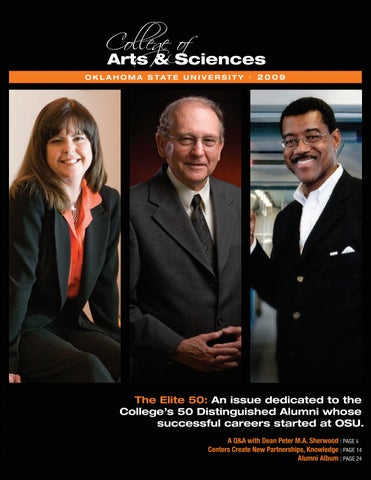
On The CoveR: The cover honors the college’s distinguished alumni, Rhonda Hooper, left (read more on page 8); Ira Scott, right (read more on page 6); and Robert Purcell, a 1957 chemistry graduate and co-chief of the laboratory of infectious diseases at the National Institutes of Health. Purcell, who played a major role in the development of all five hepatitis vaccines, accepted the distinguished alumnus award at the college’s honor banquet in April. The photos of Hooper and Purcell are by Phil Shockley, and the photo of Scott is by Diana Porter.
2
Excelling in many worlds The 50 alumni who have received the college’s highest honor shine in their chosen careers.
Making the future brighter
10
Alumni gif ts suppor t student success and elevate expectations and standards.
Achievement at the center
14
College centers promote multidisciplinar y research, build new collaborations and create new oppor tunities.
Educators of distinction
21
Ar ts and Sciences Regents Professors model determination, commitment and joy of learning. 24
Remember when In revisiting old memories, alumni make new ones.
d e p artments 2 Alumni 10 Development
14 College News 21 Faculty News
* Year indicates OSU College of Arts and Sciences graduates.
24 Alumni Album 28 Memorials
OSU College of Arts and Sciences Distinguished Alumni and Friends 1975 to present
Head of the Class One strives for peace in third world
Rober t B. Kamm – 1975 William R. Pogue – 1975 Schiller Scroggs – 1975 Otto M. Miller – 1976 Paul Miller – 1976 Valerie Colvin – 1977 M.B. Seretean – 1977 William P. Hytche – 1978
conflicts. Another works with some of the world’s most influential artists while yet another lays inroads for women in
Paul N. McDaniel – 1978 Earl Richer t - 1978 George A, Moore – 1979 William T. Payne – 1979 Clyde A. Wheeler Jr. – 1979 T. Boone Pickens – 1980 A.J. Vlitos – 1980 Danny H. Conklin – 1989 Jay Daniel – 1989
marketing.
Bill C. Goldston – 1989 Wayman R. Spence – 1989 Herber t G. Davis – 1990
Although their lives are very different, each
Donald F. Ferrell – 1990 Eugene W. Jackson – 1990 Rober t D. King – 1990
thrived at OSU and in the careers that
Jenk Jones Jr. – 1991 David L. Jorns – 1991 Rober t E. Webster – 1991
followed. They are members of an elite
Gene R. Nichol Jr. – 1993
group of 50 alumni who have received the
Cynthia Round – 1995
Thomas E. Bennett Jr. – 1994 L.E. “Dean” Stringer – 1994 Brooks Mitchell – 1996
College of Arts and Sciences’ highest honor
Helen L. Newman – 1996 John Niblack – 1997 Jean Clinton – 1998
— A&S Distinguished Alumni.
Blaine Greteman – 1998 J.B. and Richard E. Bailey – 1999 Myron C. Ledbetter – 2000 James M. Whiteneck - 2000
Here are a few stories of their travels along the creative paths they have chosen.
Rober t J. Baker – 2001 Karen N. Keith – 2001 Jan Riggs Cloyde – 2002 Rhonda Hooper – 2003 Rober tson Work – 2003 Charles F. Dambach – 2004 Michael T. Ryan – 2005 Keith McGlamer y – 2006 Ira B. Scott Jr. – 2007 Richard T. Jennings – 2008 Rober t Purcell – 2009
alumni 2
S ciences C o l lC eollege g e o f of A rAtrts s a and n d Sc iences
Distinguished Alumnus 1989
Bill C. Goldston ’66 Art
When you talk to Bill Goldston, it is clear that his passion is art. Hard to imagine that art was his fallback plan. Really. Goldston, who lives in Oyster Bay, N.Y., started his career at Oklahoma State University as a mechanical engineering major. “My father had an auto repair shop,” Goldston says, “so I thought I could be a mechanical engineer. They had a good engineering program. I started in the fall of 1961. I hated it. I suffered through the first two years.” After those two years, dismissed for low grades, Goldston sought out the art department, which was then an adjunct to the architecture department and housed in Whitehurst Hall. “I saw all these drawings on the wall,” he says. “I walked into the office and told the man at the desk ‘I want to be an artist.’ ”
The Art Experience
Bold words to say, especially to J. Jay McVicker who was then head of the art department. McVicker phoned the dean of arts and sciences and arranged Goldston’s transfer from engineering to fine arts. Goldston graduated with a bachelor’s degree in fine arts and attended graduate school at the University of Minnesota where he was a studio assistant in lithography to master printer Zigmunds Priede, who has worked with now legendary artists including Robert Rauschenberg, Jasper Johns, Barnett Newman, Robert Motherwell, James Rosenquist, Helen Frankenthaler and Jim Dine. The Vietnam War altered Goldston’s plans a year later. “I was drafted and didn’t receive a deferment,” Goldston says. After the military he returned to graduate school. “I walked in the door and Zig asked me if I wanted to go to New York. I commuted back and forth between Minneapolis and New York while I finished graduate school.” Fancy doings for a man who grew up hunting rabbits, ducks, squirrel and other wildlife for dinner, herded cattle, hauled hay, slopped hogs, plucked chickens, drove big trucks and lived the life of Oklahoma farm boys in the 1950s and 1960s. That meant muscled arms and callused hands. It may have been those workman’s hands that endeared him to Tatyana Grosman, who founded Universal Limited Art Editions in 1957. The company makes original limitededition lithographs. Goldston credits Grosman, who started the business with little money and no help, with rekindling the art of lithography in the United States. Goldston tells of the day that Grosman became his mentor. She had prepared lunch for the staff, a common occurrence at the tight-knit business. Goldston, in the middle of a project, continued to work, unaware she was watching. Impressed with his attention to detail she said, “ ‘Bill, you have it, you really have it,’” Goldston remembers. “After that, she pestered me all the time with ‘Let me show you how to do this, let me show you how to do that.’” continues next page
O k lahoma S tate universit y
3
Photos Provided
Bill Goldston was the first printer to dedicate himself to intensive technical experimentation at Universal Limited Art Editions in Long Island, N.Y. In the late 1970s, Goldston assumed responsibility for the business purchasing different and larger presses, establishing additional studios, hiring more printers and inviting a new group of young artists to work at the studio. Today ULAE’s archives (above) include works by legendary artists Jasper Johns and Robert Rauschenberg and architect R. Buckminster Fuller.
This impromptu relationship eventually led her to leave the business in his capable hands. Goldston eventually convinced Grosman to use the offset press to produce more lucrative high-quality posters and books in addition to the company’s limited editions. Among those artists who took to the process were Johns, who used it to complete “Decoy” in 1971. Dine’s “Flaubert’s Favorites” and Rosenquist’s “Off the Continental Divide” also were printed on the press. Goldston, who counts Dine, Sam Francis, Buckminster Fuller, Enrique Chagoya and Jane Hammond among the artists he has worked closely with and called friends, believes in giving artistic opportunities to other OSU students. Each year for 23 years the company, which has a staff of 10, sponsors three art students for internships. The company pays for room and board, transportation and all other expenses, Goldston says.
“It’s not just about the internship. It’s the exposure to art. While here, they can go to the Metropolitan, the Guggenheim, the Museum of Modern Art, The Frick and the Whitney Museum,” he says. “It’s important that Oklahomans come to New York City or other artistic meccas and experience the art for themselves.” Despite his parents’ hardscrabble educational background — his father was illiterate and his mother only finished the eighth grade — art was an integral part of Goldston’s life. “My mother insisted we study something to do with the arts when we were in school,” says Goldston, who talks of having only one book in the house — written by Western novelist Zane Grey — most of his growing up years. “She didn’t know much about fine arts, so it is hard to say why she pushed us toward the arts.
alumni 4
C ollege of A rts and S ciences
“When I was growing up, I remember that my mother bought a set of encyclopedias from a garage sale,” says Goldston, who laughingly remembers, “They were already old when she bought them.” Even outdated, they offered Goldston a glimpse into a world that he now is trying to expose other Oklahomans to, one OSU student at a time. He considers art a connection to the soul and mind of another. Goldston says Buckminster Fuller, “Bucky,” taught him that people live on in our memories, our thoughts and our hearts. As long as we remember them, they are still here. “My mother is in my blood, the very fiber of my being,” he says. “My father’s blood is my blood. He is in the fiber of my being. The soul of a person is in you.” Sylvia E. King-Cohen ’81
Distinguished Alumnus 2004
Charles F. Dambach
photo by Genesee Photo Systems
’67 Speech
Peace First
During the 1960s, studying speech communications at OSU, Charles F. “Chic” Dambach did not know he would later visit 55 countries and help negotiate peace for quarrelling countries. He did not foresee caring for the broken and helpless left behind after the Rwanda genocide. Instead, Dambach focused on causing some trouble at OSU. “Any time there was a demonstration, other students would call me to organize it,” he says, “civil rights and anti-war protests — anything that would stir up trouble.” In fact, Dambach says he helped arrange an anti-war demonstration that resulted in the university cancelling classes for the rest of the day. Decades later, when some of the students reunited, Dambach learned that many of those who went to protest the Vietnam War at New York’s Columbia University or the University of California, Berkeley, found it boring because everyone was doing it. “They told me that doing it in Oklahoma took more courage,” he says. After graduating, Dambach joined the Peace Corps and volunteered in Colombia, sparking his life of service into motion.
“Being exposed to a much larger world and the way others live, I learned about how to enjoy life. If they had enough food to eat, they were happy,” he says. “After doing that, I couldn’t imagine doing anything else with my life other than serving.” After returning to OSU to pursue a master’s degree, Dambach began a consulting firm with speech professor and debate coach Dale Stockton. “He included me in a group of students who would stay up until 2 or 3 in the morning just talking,” Dambach says. “He was my Socrates — he would pose a question, I’d give an answer, and he’d say it wasn’t good enough. We’d dig deeper and deeper.” In 1970, when waiting at the airport to pick up Stockton, who was returning from a debate tournament in Dallas, Dambach learned that an unknown assailant had murdered Stockton in his motel room. “Much of my life has been dedicated to the memory of Dale Stockton,” Dambach says. As president of the National Peace Corps Association, Dambach focused his attention on the news coming from Rwanda in 1994. Dambach, outraged at the lack of response from the international community, worked to mobilize about 30 former Peace Corps volunteers who had previously served in Rwanda to help with the immediate stabilization process after the genocide. “The importance and value of that program led us to believe maybe we can do some other pretty special things where there is a need,” he says. When war broke out between Ethiopia and Eritrea, Dambach and California Lt. Gov. John Garamendi created another team of former Peace Corps volunteers that became the primary voice of communication between the prime minister of Ethiopia and the president of Eritrea. On the phone, Eritrea’s President Isayas Afwerki made one last concession to end the war. Dambach took a cab to the Ethiopian embassy to deliver the news. “A couple of weeks later, the prime minister of Ethiopia was in Washington and invited us to breakfast,” Dambach says. “I’ll never forget it — at breakfast, he leaned forward and said, ‘I want you to know the war’s over, and I want to thank you for making it happen.’” Today, Dambach is CEO and president of the Alliance for Peacebuilding, which works with organizations, government leaders and professionals to help build peace worldwide. He says his passion to help will never be extinguished. “It is pure luck of the draw that we are born in America,” he says. “We didn’t earn it. Let’s help people so that they can have a small portion of the comfort that we have.” Stacy M. Pettit ’09
photo / Genesee Photo Systems
O k lahoma S tate universit y
5
Distinguished Alumnus 2007
Ira B. Scott
’67 Mathematics
Swipe Card Fuels Alumnus’ Dreams Swipe. It’s one quick motion at the gas station and the customer is ready to remove the gas cap, refuel the car and return to the traffic-filled street. Within the past few years, Americans have learned to use their plastic debit or credit cards to save precious time at the gas station. One OSU alumnus was at the forefront of this pay-at-thepump invention. While working for Exxon, Ira Scott put together a team to drive this idea toward becoming a reality.
“While it wasn’t an original idea, it was a real novel one — using computer technology,” Scott says. “The technology was out there. As I did presentations across the country, I worked to push it forward.” Pushing forward has been a recurring theme in Scott’s life. While studying at OSU, Scott was a part of the championshipwinning basketball team playing under legendary coach Henry Iba. “He was very demanding but really taught me about teamwork and agility,” Scott says. “As I was playing basketball, I had my books up too.” Those books ranged from physics books to statistics books, but Scott decided to study mathematics, earning his degree in 1967.
photo by Diana Porter
“The College of Arts and Sciences is so diverse — there are so many different disciplines,” Scott says. “Those changes helped me identify where I needed to land. “After college, that thought process helped me throughout my career.” Scott has learned to master many different subjects, including finance, computer technology and engineering. This ability to understand diverse subjects has helped Scott land jobs ranging from being a business consultant to working for a large engineering firm. Scott also found himself to be a driving force behind political campaigns in Houston. Scott did fundraising and campaigning for his friend Lee Brown, who became the first African American mayor of Houston in 1997. “Anyone who would let me talk, I would let them know about Lee Brown,” Scott says. Scott also helped to bring a different newcomer to the city of Houston. While serving as vice president for the Metropolitan Transit Authority board, Scott assisted in breaking ground for light rail transit, a public transportation rail system. With all these accomplishments, Scott promised never to forget his roots — and even managed to help expand those for future OSU graduates. Scott served as the Houston chapter president of the OSU Alumni Association and was a member of the national alumni board. He was an active recruiter in the Houston area of high school students and student athletes to attend OSU, and he recruited many OSU graduates for employment with Exxon. But Scott felt something was missing. “In Houston, I looked around and didn’t see any African Americans or other minorities really participating,” he says. “I talked with a number of people, and we started cranking out ideas.” One of these ideas was to create OSU’s first Black Alumni Association. Scott quickly became a founding member and the first president for the group, which exists today. Today, Scott is “trying to be retired” and enjoys traveling, fishing and exercising. The time he finds to exercise is precious to him and pays off. He says that even after graduating more than 40 years ago, he still hasn’t lost his basketball skills on the court. Stacy M. Pettit ’09
alumni 6
C ollege of A rts and S ciences
Distinguished Alumna 1995
Cynthia L. Round
’75 Speech
Creating Your Own Luck
If you’re a math major, it’s a good bet you’ll spend the day in the company of numbers. If you’re studying veterinary medicine, you’ll probably get a chance to talk with the animals. It is doubtful when Cynthia Round graduated from OSU in 1975 with a bachelor’s degree in speech that she envisioned herself traveling around the world. “It is the kind of degree where you are qualified for nothing or everything,” says Round, who can’t imagine living any place else but Manhattan, N.Y.
Round, who has been with United Way since 2002, is executive vice president of brand leadership for the worldwide not-for-profit organization. Managing a staff of nearly two dozen, she’s responsible for United Way’s brand stewardship, marketing — advertising, public relations, corporate sponsorship — and field communications in 45 countries. Those who know her well aren’t surprised at Round’s success and the pioneering spirit of the former OSU Top 10 Freshman Woman. In the 1970s, she was among 30 women to have a brand management position at Procter and Gamble, where she worked for seven years. She was the first American woman to request and receive an overseas brand management assignment. “I was sent to Procter and Gamble Italia in Rome to launch Pampers in that market. No women had been sent abroad from P&G headquarters before 1980,” she says. Round, named Distinguished Alum in 1995, is a former senior partner and executive group director for Ogilvy & Mather Advertising. During her 15 years with O&M New York, she helped create, build and renovate domestic and global brands for clients that included General Foods, AT&T, Unilever, Maidenform, Pepperidge Farms, Kimberly Clark and U.S. Satellite Broadcasting. “I suppose back then I was breaking through barriers,” says Round, a member of Chi Omega Sorority who also can count being Outstanding Greek Woman among the accolades during her time in Stillwater. “Now it is all very normal. At the time, I was lucky. But I also think you create your own luck. When opportunity crosses your path, you have to be ready to jump on it. I believe you have to live expecting opportunities to come your way. Photo provided
O k lahoma S tate universit y
“You also have to be willing to see the hidden opportunities in times of adversity,” she says, mentioning the way Americans pulled together after the terrorist attacks of Sept. 11, 2001, and after Hurricane Katrina in 2005. “I love that today’s college kids are eager to spend their spring break helping rebuild homes in New Orleans,” Round says. “This generation of young people is very connected to their fellow human beings in need. It is exciting to be in a career that helps them act on that impulse.” Round, who is a firm believer in giving back, shares this philosophy with OSU students whose paths she crosses thanks to a program that brings 20 to 30 business majors to New York City each year for a visit to the Stock Exchange, Madison Avenue and other business meccas. The program is especially dear to Round’s heart because she believes the opportunity to travel and experience other people, ideas and cultures is an advantage no matter what one’s degree. “I love Oklahoma, and I’m proud to be an OSU grad,” she says. “My experience in Stillwater helped shape my outlook and gave me a healthy perspective.” Round has many. She commutes to Washington, D.C., weekly for work and travels internationally for her job. She also is a guest lecturer on global branding and advertising at campuses across the country and volunteers for the board of the Advertising Educational Foundation, the Ad Council’s Advisory Committee and God’s Love We Deliver. She is chair of the 2009 American Marketing Association Non-Profit conference in Chicago. “I’d say my OSU speech communications degree has served me well,” she says. Sylvia E. King-Cohen ’81
7
Distinguished Alumnus 2003
Rhonda F. Hooper
’78 Journalism, Advertising
OSU taught Rhonda Hooper many things about marketing and advertising. How to relate concepts and ideas. How
Broader Horizons
Photo by Phil Shockley
to get people’s attention. It also taught her a great deal about herself. However, Bonaparte’s, a smoky bar in the corner of Shepherd Mall in Oklahoma City that catered to law students, showed her how to listen, says Hooper, now CEO of Jordan Associates in the city. The former journalism major bartended there for several months between graduation in 1978 and her first advertising job at Ackerman & McQueen. Bonaparte’s, which closed years ago, taught her the service business. It gave her a greater empathy for people’s problems and frustrations and the way they think. Today, in her third year leading Jordan Associates, Hooper says those skills have been invaluable as she steers the advertising firm through new media, new ideas and new trials. “My job is about actively listening to clients and consumers as well as figuring out how to solve their problems,” she says. A little horizon broadening doesn’t hurt either. For her, that started at OSU in 1974 when she decided to focus on advertising and hasn’t looked back since. Thirty years later, she’s only the third Jordan Associates CEO in its 48-year history, ascending to the position in 2006 after 20 years working for the company. It’s one of the largest firms in the Southwest working with notable clients — ONEOK, Kraft Foods, Blue Cross Blue Shield, Cellular One, Hardee’s/Carl’s Jr., Stetson and the American Dental Association. Now it’s enduring one of the most difficult economic times in history, but Jordan Associates has persevered, says Hooper. That’s because of marketing 101. Cutbacks by the competition leave openings for smart marketers to step in and take advantage of low advertising rates or previously owned premium sponsorships to strengthen their voice in the marketplace. “A recession is the best time to build a brand and market share,” she says. “When others are cutting back, you can get more for less, so we’ve been very resourceful for our clients in identifying and seizing opportunities.”
alumni 8
C ollege of A rts and S ciences
Hooper says her preparation at OSU has helped her weather other market conditions and the latest in communication crazes. “I’m a loyal Cowboy,” she says. “OSU provided me a secure and nurturing environment in which to think differently, to be engaged, to be involved and to make a difference. It didn’t matter your background, who you knew, or your financial means.” Her strong belief in OSU led her to become a Cowgirl ambassador to alumni all over the country as the national president of the OSU Alumni Association in 2001. Hooper chairs the Oklahoma City Convention & Visitors Commission and serves on the executive committees of the Oklahoma City Chamber of Commerce and Leadership Oklahoma as well as the regional board of governors of the American Association of Advertising Agencies. She still sees the benefits of that little bit of listening education she received in the shopping mall bar. “I find that prospective employees are better at grasping how our agency delivers smarter ideas, results and customer satisfaction if they have had real-world internships with creative companies or if they’ve worked in restaurants or other service industries. And if they’ve graduated from OSU, that makes them even better.” Matt Elliott
Photo by Gary Lawson
Distinguished Alumnus 1998
Blaine Greteman
’98 English
In League with the Best Blaine Greteman becomes animated when he talks about literature, history, politics or his poor wife and four kids temporarily crammed into their Stillwater apartment. No matter the subject, he fidgets, squirms and adjusts the sport coat on the back of his chair as he talks, raising his voice for emphasis inside his office, perched in a dark corner of Morrill Hall’s third floor. His love of literature, he says, started when he was a kid growing up in Hydro, a town of about 1,000 along Route 66 in western Oklahoma. “One of the first books that I really fell in love with was The Grapes of Wrath. One of the towns the Joads go through is Hydro,” he says. “Often, you sort of discover yourself and your history in a book like that … that’s an amazing experience.” Greteman, who won a Rhodes Scholarship in 1998, also loves his alma mater and its staff, who gave him a scholarship that allowed him to study without student loans. After graduating in 1998, he became the youngest to be named a Distinguished Alumnus of the College of Arts and Sciences, a fact which astounds him today because, he says, he knows of many peers who were better students than he.
Now, armed with a master’s degree from Oxford and a doctorate from Berkeley, he gets to teach literature, a job that equates to pure pleasure for him. He also relishes his role as an educator and an encourager to his students, many of whom come from small towns similar to Hydro. He says Oklahomans seem to have an inborn self-deprecating nature that keeps them admirably humble, but may hold them back. One day in class, his students laughed at him when he suggested they could do work on par with elite students at Ivy League schools.
“Coming back, for me, confirmed what I had been telling people for a long time about OSU — that the students here are just as good as the students anywhere. They have the ability to achieve on the same level as the top students from the Ivy League schools or any of those sorts of places. That’s the line that I’ve been giving everybody for years and years.” Greteman’s desk could be a metaphor for his numerous responsibilities. Paintings from his son Finn hang over it. A tape recorder for his freelancing work with the magazine Ode sets next to the phone. Books are marked and dog-eared. A cell phone rings several times. Discussion continues from his days in London as a TIME journalist covering events leading up to the Iraq war to the British relationship between government and the media.
He marvels at how he ended up back at OSU, even though he’s leaving in the fall for a position at the University of Iowa, where he’ll be teaching students from the renowned Writers’ Workshop. “Oklahoma is home and it always has a way of bringing you back,” Greteman says. He came to OSU after finishing his doctoral degree in 2008. He had left TIME some years before to be policy director for Oklahoma senatorial candidate Brad Carson. Leaving OSU for Iowa was a difficult decision for him, but he realizes he does his best work under duress in new foreign places that ratchet up his stimulation and observational skills. He says that’s part of what OSU did for him when he was an undergraduate. “Also, I think part of me realizes I just have this kind of wanderlust,” Greteman says. Matt Elliott
alumni O k lahoma S tate universit y
9
Investing in the Future Sadie Stockdale is racking up some impressive accomplishments at OSU. She is president of the Arts and Sciences Student Council, a Truman Scholar nominee, vice president of the Political Honor Society, former president of the Pre-Law Club, a Top Ten Freshman and the Top Greek Sophomore and Junior. The political science senior expects to earn her degree in May with a minor in gerontology. She then plans to attend law school, followed by a career helping the elderly with cases of abuse, neglect and Social Security claims. By all accounts, Stockdale is the type of student OSU and Arts and Sciences wants to attract, but she would not have come to Stillwater from Springfield, Mo., without the scholarships she receives. Among those are the A.R. Bert and Anne Larason President’s Distinguished Scholarship endowed by the late Margaret Larason; a nonresident achievement scholarship that covers out-of-state tuition; and a Fourjay Foundation Scholarship. She is also a Wentz Scholar. “OSU has offered me great scholarships,” Stockdale says. “The people here are so generous and friendly. I can’t even express how grateful I am to the school for giving me all they have.” Not only did the scholarships attract her to Stillwater, but they also have been vital to her success here. “I only have to work one job, which the university helped me find in the Honors College,” Stockdale says. “That has given me time to sit down and focus on my studies. It’s definitely made me into the person I’m going to be.” Her accomplishments now are an investment in her future, as is her debt-free education. For Stockdale, that is especially important because she knows she will have to take on debt to pay for her law degree. But her benefits thus far will ultimately be OSU’s gain — she plans to return the favor to her alma mater. “I’m going to give back to the school,” Stockdale says. “I want to help kids, out-of-state especially, come to the school I love.” Photo by Chris Lewis
development 10
C ollege of A rts and S ciences
Every Gift Makes a Difference Amy Martindale, director of student academic services in the College of Arts and Sciences, says the college is grateful to have the scholarships it does thanks to donors. Still, with about 6,000 undergraduate and graduate students, more student support of any amount is always appreciated. Martindale says one of the main reasons students leave a university is because of the financial burden. “We know that aid for their returning years is very important in keeping them,” she says. “Substantially more funding is typically available for incoming freshmen than for sophomores, juniors and seniors. That is an area of need and tremendous opportunity to support students in a truly meaningful way.” The cost of higher education continues to rise, as does the need for a college degree in order to be competitive in the marketplace. Charlie Bruce, senior director of scholarships and financial aid for OSU, says the number of students applying for financial aid increased 20 percent in the past year. “The need is great,” Bruce says. “We are having more students report to us that there have been significant decreases in their family income due to job loss or reduction in hours. Scholarships go a long way in helping to fill the gap.”
Students Benefit from More Than Scholarships Alone Scholarships are not the only area where donors are making a difference for A&S students. Donors also help with graduate fellowships, travel-abroad opportunities and other student enrichment activities such as mentoring and guest speakers. As Martindale points out, every gift helps support students’ work toward their educational goals. “It’s a very selfless thing to give money to help somebody you may never meet, but it really does impact their lives,” Stockdale says. “The people you help are going to impact the world, and it impacts their future careers because you gave them money, because you were a selfless donor.” Jacob Longan ’05
The College of Arts and Sciences has introduced a new website that recognizes excellence among its many faculty, students and alumni. To learn about honors and scholarships awarded, visit http://ashonors.okstate.edu.
here to help Jason Caniglia and Damien Williams are in the dream
business. As development officers for the College of Arts and Sciences, they unite donor and university passions and priorities to achieve excellence. If you see a need or are looking for a way to help improve the College, let them know. They will help you transform OSU, as they have done countless times, facilitating the addition of scholarships, endowed chairs and professorships, graduate fellowships, and other studentenrichment opportunities that change lives. FOR MORE INFORMATION CONTACT THEM AT:
jcaniglia@OSUgiving.com, dwilliams@OSUgiving.com or 1-800-622-4678.
» damien williams
» jason caniglia
OKLAHOMA STATE UNIVERSITY FOUNDATION | 400 S. Monroe | Stillwater, OK | 1.800.622.4678 O k lahoma S tate universit y
11
Alumni Provide Gifts of Hope, Integrity
Last summer, when the OSU Foundation raised funds in 40 days to endow more than 175 chairs and professorships, the College of Arts and Sciences was one of the big winners. That historic achievement included securing funds for nine chairs and professorships for the college, bringing its total to 24. Endowed professorships and chairs provide support for faculty salaries, graduate assistantships, equipment and other research needs. These endowed faculty positions allow a university to attract and retain the best and brightest academic minds in the world. But these gifts do even more. They help the college maintain certain ideals important to its students, alumni and constituents.
Professional Integrity Tulsa residents Bill and Peggy Welch, 1973 journalism alumna, donated $250,000 to establish a sports journalism chair in the School of Journalism and Broadcasting. Matched by Boone Pickens, the Regents and the Ethics and Excellence in Journalism Foundation, the gift’s impact is $1.5 million in endowed funds. The couple gave the gift to honor a friend, sports writer B.A. Bridgewater, and to teach quality sports reporting and writing as exemplified by the writing of Bridgewater and his protégé, Bill Connors, both of whom worked for the Tulsa World.
development 12
C ollege of A rts and S ciences
“These two individuals were contemporaries of writers Red Smith, Bob Considine, John R. Tunis, Grantland Rice, Jim Murray, Harold Keith, John Cronley and others who set the gold standard of reporting honestly and accurately without abusing the enormous power that goes with sports reporting, sports writing and commenting,” says Bill Welch.
Photo OSU Foundation
Photo Provided
Hope Vaughn O. Vennerberg II, a 1976 psychology alumnus and president of XTO Energy Inc. of Fort Worth, and his company teamed up for a $1 million donation that provides $4 million in impact when matched by Boone Pickens’ $100 million chair commitment and the Oklahoma State Regents for Higher Education. The gift establishes the Vaughn “Trey” O. Vennerberg III Chair in Bioinformatics and Molecular Genetics, the Vennerberg Professorship in Art and the Vennerberg Professorship in Developmental Disabilities in Psychology. Each is the first endowed position in its department.
Vennerberg’s long-term goal is for the three positions to help recruit talented faculty and students and to bring national academic recognition to OSU through outstanding research. A psychology graduate and proponent of genetic research, he chose to make the gifts in areas that played a part in shaping who he is today. “Genetic research is an issue that is very close to my heart and something that’s affected my family personally,” Vennerberg says. “Maybe this gift will eventually help improve the quality of life for individuals with genetic disorders as well as giving their families hope.”
cas.okstate.edu
Jacob Longan ’05
development O k lahoma S tate universit y
13
Centers Create New Knowledge, Explore New The College of Arts and Sciences at Oklahoma State University boasts nine dedicated research centers, Approaches including its newest, the Center for Oklahoma Studies. The centers are hidden jewels. Their work may involve faculty and graduate students trying to understand how countries cope with devastating tsunamis or may entail working to bring together folks to discuss explosive issues. Whatever the focus, the centers address a broad range of Ron McCoy, a history professor and the co-director for the Center for Oklahoma Studies, is currently researching the painted tipis and shield designs of the 19th-century Kiowa. The first three images are Kiowa artist Silver Horn’s graphite and colored pencil drawings of Kiowa shield designs, circa 1904 – 1906. The fourth image is an anonymous Kiowa drawing of two women standing between two painted lodges with a lance hanging on a pole, circa 1875 – 1877. The last image, Lodges of chiefs, 1875, is by an anonymous Kiowa artist.
interdisciplinary interests. Here is an overview.
college news 14
C ollege of A rts and S ciences
Taking a Closer Look at Oklahoma John Steinbeck’s depiction of the Depression Era-migrant workers in The Grapes of Wrath swept across the national consciousness like an Oklahoma prairie fire. It burned away other images of Oklahomans and left behind the charred term “Okie.” A word once used solely to refer to the state’s residents became a generalized pejorative descriptor of Oklahomans. Okie, like Steinbeck’s novel, kindles ambivalence among Oklahomans. Some wear the label with pride, associating it with loyal, hardworking, friendly people, while others cringe at its use, particularly by non-residents. Everyone mounts a defense of some type. Still, the word lingers and with it the negative perception of Oklahomans as poor, uneducated, indigent farm workers. Oklahomans have been trying to overcome the Steinbeck image for 70 years, yet how Oklahomans perceive themselves and the effects of those views remain largely unknown. Who are Oklahomans? How do they think? What forces shaped their perceptions? How do their perceptions influence policy — essentially, what makes an Oklahoman an Oklahoman? Finding answers to these questions stimulates numerous research opportunities, many of them multidisciplinary. But until now, there has been no place to gather information about ongoing university research, exchange ideas or form collaborations — no clearinghouse for Oklahoma studies.
OSU Library Dean Sheila Johnson, along with Carol Moder, head of OSU’s English Department, and history professor Elizabeth Williams, proposed a new Center for Oklahoma Studies “to illuminate the state’s history, culture and current affairs.” Their plan recommends specialized studies in Oklahoma history and dialects to work in tandem with the library’s oral history project. In support, the College of Arts and Sciences has hired two new faculty members to develop the proposal: Western historian Ron McCoy and Dennis Preston, an expert in sociolinguistics and dialectology. The library recruited Mary Larson, anthropologist and oral historian, who recently assumed leadership of the library’s Oklahoma Oral History Research Program.
“People in Oklahoma are like a mosaic,” says McCoy, who is currently researching Lakota winter counts and the painted tipis and shield designs of the 19th-century Kiowa. “Put it all together, and you start getting a very multifaceted picture of Oklahoma — a complex history. By bringing people and ideas together, the center becomes a way the university can contribute to the overall culture, to an overall awareness and appreciation of one of the most diverse heritages a state could possible have,” he says. “Culturally and ethnically, Oklahoma has been at a crossroads long before statehood. We need to learn where we are. How we got here, and maybe where we’re going to go. Many people aren’t particularly aware of how diverse Oklahoma is or the tremendous strength and opportunity that come from this diversity.” continues next page
--------~
...
Smithsonian Institution National Anthropological Archives
. ..
college news O k lahoma S tate universit y
15
Officially adopted in 1925, the Oklahoma flag honors more than 60 groups of Native American Indians and all their ancestors.
“The way people talk reveals their history, perceptions, values, even their future,” Preston says. Nowhere is that study more exciting than Oklahoma, which “is at enormous linguistic crossroads” as well. Oklahomans’ speech is both diverse and distinct. Although influenced by bordering states, it differs from other regional dialects and even from section to section within the state, he says. “What makes Oklahomans distinctive from a linguistic point of view? And what does that tell us about the way Oklahomans perceive themselves and the way they think,” he asks. “In one study, more than half say Oklahomans’ speech is most similar to Southern
speech. Is that because of the vocabulary, grammar and vowel sounds, or does it have more to do with perception?” Preston explores these questions along with others about dialect differences among Oklahomans: “Do those living in the Panhandle sound like those living in Little Dixie? What is language like in the state’s small, immigrant and African-American communities?” While McCoy and Preston’s credentials lend prominence to the Oklahoma studies project, their role as co-directors involves more than their individual research. “Ron and I want to go beyond history, English and the library to engage other departments and facilitate cross-disciplinary research,” says Preston, who already envisions collaborative projects with cultural geography, experimental psychology and art. “We want to get people from other departments involved. We want to bring together people who are interested in Oklahoma but who haven’t shared information before.” The Center for Oklahoma Studies will facilitate information flow, McCoy says. “It’s as if building a bee colony that adds to itself as it goes along — just as Preston’s dialect studies bring in history and psychology. By bringing in new perspectives and letting them ferment, calling attention to an area and drawing in resources, a rounded, fuller picture emerges.”
Johnson says the library’s main emphasis will be expanding the oral history programs. Larson, who has experience in creating oral history research programs, will work collaboratively with other faculty to teach students oral history methodology that meets national standards. As a repository, the library plans to make interviews widely available through the Internet. The emphasis on oral history also involves reaching out to communities, another crucial element in its development. “Since this is for Oklahoma studies, it’s not just to engage the interest of academics. We want to engage people outside academe,” Preston says. “The center will be doomed if it doesn’t have a very strong outreach component so that Oklahomans are engaged in it and by it.” As it matures, the co-directors expect the center will provide resources for teachers as well as presentations for the public. “Ten years from now I see it bringing together faculty and students from across campus to identify, study and preserve Oklahoma’s vibrant culture, history and ethnic and linguistic diversity,” Johnson says. “We have much to be proud of including some very talented and successful Oklahomans who have made wonderful contributions to music, theater, arts, dance, commerce — in all areas actually.” Perhaps it is time to retire the “Okie” image. Eileen Mustain
college news 16
C ollege of A rts and S ciences
In support of the Center for Oklahoma Studies, the library recruited Mary Larson who is an anthropologist and oral historian. Larson recently assumed leadership of the library’s Oklahoma Oral History Research Program. She will oversee projects such as the Women of the Oklahoma Legislature Oral History Project. Larson works in sync with center co-directors Ron McCoy (pictured) and Dennis Preston (photo on page 18).
Lamar Looney 1920-1928
Bessie McColgin 1920-1924
Lulu Anderson 1 1922-1924
Anna Laskey 2 1922-1928
Edith Mitchell 2 1922-1924
Ida Robertson 3 1924-1926
Gladys Whittett 3 1924-1926
Elma Eylar 4 1928-1930
Ila Huff 1940-1944
Grace Mitchelson 1944-1948
Mona Jean Russell 1944-1948
Pauline Tabor 1962-1970
Ruth Patterson 1964-1968
Texanna Hatchett 1966-1972
Anna Belle Wiedemann 1966-1972
Hannah Atkins 1968-1980
Jan Turner 1972-1974
Dorothy Conaghan 1973-1986
Mina Hibdon 1973-1976
Joan Hastings 1974-1984
Mary Helm 1974-1978
Judy Swinton 1974-1978
Helen Arnold 1976-1982
Cleta Deatherage 1976-1984
Helen Cole 78-84, 84-88, 91-96
Alene Baker 1980-1984
Rebecca Hamilton 1980-1986, 2002-
Maxine Kincheloe 1980-1986
Twyla Mason 1980-1984
Bernice Shedrick 1980-1996
Freddye Williams 1980-1990
Penny Williams 80-88, 88-04
Nancy Virtue 1982-1986
Jan Collins 1984-1986
Billie Jean Floyd 1984-1988
Linda Larason 1984-1994
Sue Milton 1984-1986
Carolyn Thompson 1984-1992
Kay Dudley 1986-1990
Claudette Henry 1986-1988
Maxine Horner 1986-2004
Vicki Miles-LaGrange 1986-1993
Wanda Jo Peltier 1986-1996
Vickie White 1986-1990
Joan Greenwood 1988-2004
Alice Musser 1988-1990
Trish Weedn 1988-2000
Betty Boyd 1990-2000
Carolyn Coleman 1990-2002
Mary Fallin 1990-1994
Angela Monson 90-93, 93-05
Laura Boyd 1992-1998
Jari Askins 1994-2006
Debbie Blackburn 1994-2006
Odilia Dank 1994-2006
Carol Martin 1994-2002
Barbara Staggs 1994-2006
Mary Easley 96-04, 04-
Kathleen Wilcoxson 1996-2008
Susan Winchester 1998-2008
Nancy Riley 2000-2008
Sue Tibbs 2000-
Daisy Lawler 2002-2006
Debbe Leftwich 2003-
Judy Eason McIntyre 2003-2004, 04-
Lisa Johnson Billy O k l a h2004oma
Ann Coody 2004-
Marian Cooksey 2004-
Lee Denney 2004-
Sally Kern 2004-
Oral History www.library.okstate.edu/oralhistory/wotol/ Research Project
Jeannie McDaniel 2004-
Susan Paddack 2004-
Pam Peterson 2004-
Constance Johnson 2005-
Skye McNiel 2006-
Anastasia Pittman 2006-
Leslie Osborn 2008-
Senate House Unless otherwise noted in 1-4 below, photos are courtesy of Legislative Service Bureau-Photo Division 1. Lulu Anderson-From the photo archives of The Oklahoma Publishing Co. 2. Anna Laskey, Edith Mitchell-Research Division, Oklahoma Historical Society 3. Ida Robertson, Gladys Whittett-Copyright 1925, The Oklahoma Publishing Co. 4. Elma Eylar-Reprinted with permission from The Oklahoma Publishing Co. Copyright © 2009 Oklahoma State University Board of Regents
college news O k lahoma S tate universit y
17
centers
Center for Africana Studies and Development Director: Jason F. Kirksey
The Center for Africana Studies and Development was created in 2007 to foster and enhance interest and knowledge in the continent of Africa and its Diaspora with an emphasis on North America. The center’s interdisciplinary approach focuses on scientific, social, political, economic, religious or cultural developments drawing participation from departments throughout the College of Arts and Sciences. As a result of the center, students may now earn a minor in Africana studies through OSU’s political science department. Two of those leading the effort are Estella Atekwana, a professor and Sun Chair in the Boone Pickens School of Geology, and her husband, Eliot Atekwana, an associate professor in geology. The National Sciences Foundation awarded the couple $179,792 to investigate the rift basins in Botswana and Zambia. The site provides a unique opportunity to study the early stages of continental extension and represents a natural laboratory. Estella Atekwana hopes the research can help with hazard mitigation in the earthquake prone zone.
OSU journalism student Maggie Kierl, Lorene Roberson Hickey ’84, Stacy Pettit ’09, and Cori Urrutia ’09 all contributed to this story.
Both OSU students and students from universities in Africa participate. “Our students get extensive experiences in the geosciences as well as an international research experience,” she says. So far, seven OSU students have had the opportunity to travel to Botswana and Zambia to acquire that hands-on experience. “The nature of the Atekwanas’ research is essential, not just to the mission of the center, but more importantly it is potentially critical to the survival of many of the world’s citizens beyond the couple’s specific efforts in Africa,” says Jason F. Kirksey, interim associate vice president for institutional diversity and Hannah D. Atkins Endowed Chair associate professor of political science. Since its beginnings, the center has hosted several programs including a lecture by Paula Giddings, an expert on journalist and Civil Rights Movement leader Ida B. Wells; an African-American Art Expo that included black artists, authors and musicians from throughout Oklahoma; and a screening and panel discussion of the documentary, Invisible Children. The center also sponsored OSU’s first annual Africa Week celebration. One of Kirksey’s long-range plans is to host an annual research symposium on Africa and its Diaspora. The forum will allow faculty and students in Oklahoma to share research efforts with the global community, as well as relay information on the center’s website. “The ultimate goal of the center is to be recognized as a premier scholastic resource on Africa and its Diaspora,” Kirksey says.
Photo by Gary Lawson
college news 18
C ollege of A rts and S ciences
Center for Application of Remote Sensing Coordinator: Bruce L. Battles
CARS was established in the mid-1970s and is a one-of-a-kind center in Oklahoma because it uses space-based sensing. And what does that mean? The center gets information about the Earth from an aerial view vs. a ground approach. Computer manipulation of the aerial images allows faculty and students to research environments and natural resources. From there, they can map geographical features and identify patterns. CARS and the researchers associated with the lab conduct research in a wide range of areas. A recent example of this research is in the field of crop science. Researchers used remotely sensed data to evaluate the health of a crop and pinpoint problem areas. They can also use the information to initiate selective chemical application, which means lower costs for the producer and less environmental impact on the ecosystem. CARS clients include the Oklahoma Department of Transportation, Grand River Dam Authority, Conoco Pipe Line Company, Grand Gateway Economic Development Association, Oklahoma Conservation Commission, U.S. Fish and Wildlife Service, Oklahoma Office of State Finance and NASA-EPSCoR.
Directors of centers in the College of Arts and Sciences are, from left, Jason F. Kirksey, Center for Africana Studies and Development; Gary R. Webb, research specialist, Center for the Study of Disasters and Extreme Events; Dennis R. Preston and Ronald T. McCoy, Center for Oklahoma Studies; Michael W. Palmer, Dynamic Ecosystem Biodiversity Observatory (DEBO); Rebecca L. Damron, Writing Center; Sallie M. McCorkle, Doel Reed Center; and Edward J. Jones, Milton Center.
Center for the Study of Disasters and Extreme Events Director: David M. Neal
It could be said that the Center for the Study of Disasters and Extreme Events evolved from one of the most devastating natural disasters in human history. In May 2005, three OSU professors and two graduate students went to Chennai, India, to learn how government officials and citizens coped with the 2004 Indian Ocean tsunami that claimed nearly 300,000 lives in more than 13 countries. A few months later, the Center for the Study of Disasters and Extreme Events was born at OSU. And for more than three years, the researchers have been searching for answers and solutions to aid victims of catastrophic events here and across the world. OSU joins a number of U.S. colleges that are using the Indian Ocean tsunami, Hurricane Katrina and other natural disasters to teach students about geography and emergency management, among other things. The center’s ongoing mission is to suggest practical recommendations for dealing with and coordinating large-scale disasters on international, national, regional, state and local levels. “We have discovered that flexibility is the most crucial component in dealing with such disasters,” says David M. Neal, the center’s director and a political science professor. In 2005, political science professor Brenda Philips and geography professor Thomas Wikle examined shelters for Hurricane Katrina victims. Gary Webb, an associate professor of sociology, is a co-principal investigator for a study that is examining first responder creativity in the wake of the World Trade Center and Oklahoma City bombing disasters. Philips also is leading a team that is trying to find ways to help people with multiple special needs so they can be protected in disasters.
“The center has a multidisciplinary focus, which engages many of the departments in arts and sciences, but also others across OSU,” Neal says. It draws participation from political science, sociology, geography, psychology, computer sciences and art, as well as from education, engineering, business and the OSU administration. But the real value of these studies is the knowledge gained by graduate students. “Large research institutions like OSU focus on graduate education,” says Neal. “So as professors, we realize that, as difficult as it may be, our graduate students learn an incredible amount at these disaster sites. “Our students will be the teachers of the next generations.”
Cimarron Review Director: Edward P. Walkiewicz
The Cimarron Review has been identified by Esquire as “one of America’s literary roots” and has been nurturing creative writing since 1967. “The Cimarron Review is unquestionably an OSU product,” says Edward P. Walkiewicz, English professor and director of literature. The senior editors all are current or former members of the faculty. The managing editors and editorial assistants all are graduate students in creative writing. Every issue is edited and designed on the Stillwater campus. The journal publishes the best poetry, fiction and non-fiction it can obtain, he says. The peer-reviewed Cimarron Review accepts manuscripts based on submission guidelines at http://cimarronreivew.okstate.edu. Young writers can make a name for themselves, even become famous, after being published in the Cimarron, says Walkiewicz. “It has also made a big impact on people such as Pulitzer Prize winner Robert Olen Butler, whom Cimarron published before his career blossomed.” Cimarron also published Jose’ Saramago’s work shortly before he was awarded the Nobel Prize for Literature.
Doel Reed Center Founding Director: Sallie M. McCorkle
In 2006, the Doel Reed Center in Taos, N.M., was created to establish a national/ international artist and scholar residency program along with a student internship program and a faculty residency program. The center is named after Doel Reed, considered a master of the aquatint — a type of etching that looks almost like a watercolor painting. His relationship with OSU began in 1924 when he joined the staff at Oklahoma A&M as a professor in the art department, a department that did not yet exist until that time. During his 35-year tenure with the university, Reed established and headed the art department. After retiring in 1959, Reed and his wife retreated to their second home in Taos, N.M. He died in 1985, but his legacy lives on. Reed’s daughter, Martha, bequeathed OSU the family’s property in Taos, which includes a one-and-a-half-acre lot with two century-old adobe homes and Reed’s personal artist studio. Part of OSU’s mission is to facilitate restoration of the property. The center benefits many. “When people first start looking at Reed’s property, they may see it as only an opportunity to involve students,” says Kent Young, Doel Reed Center for the Arts campaign chair. “But it has a much broader aspect to it in that it involves artists, writers, architectural students and botanists. It has a multidisciplinary use that reaches far beyond art students.” Art professor Sallie M. McCorkle heads the center.
continues next page
college news O k lahoma S tate universit y
19
Ethics Center Director: Scott D. Gelfand
Dynamic Ecosystem Biodiversity Observatory Director: Michael W. Palmer
The DEBO Center for Scholarship is named in honor of OSU librarian and historian Angie Debo (1890-1988) who was the leading scholar of the Oklahoma landscape. DEBO works closely with Tulsa University and the Nature Conservancy, which manages the Tallgrass Prairie Preserve just north of Pawhuska, Okla. OSU graduate students provide walking tours, identify research techniques and collect small mammals for their research projects. “The Tallgrass Prairie Preserve is the closest we can get to prehistoric landscape,” says Michael W. Palmer, the center’s director and a Regents Professor in botany. “The preserve is unparalleled in the world with an incredible, expansive area that hasn’t been plowed.” He says the soil is intact and offers at least 760 species of plants. Some DEBO projects involve understanding fire regimes over the past 300 years; examining biodiversity of plant viruses; researching sustainable grazing of livestock in a way that helps nature rather than hurts; studying the effects of tornadoes on forests; and analyzing bison behavior.
Arts and Sciences center directors are, from left, Bruce L. Battles, coordinator of the Center for Application of Remote Sensing; David M. Neal, Center for the Study of Disasters and Extreme Events; and Edward P. Walkiewicz, Cimarron Review. Not pictured is Scott D. Gelfand, director of the Ethics Center.
The Ethics Center, which has been affiliated with the OSU Department of Philosophy for about seven years, is the only college or university ethics institute or center in the state. It works to engage people in ethical thought and deliberation on controversial topics so they can better understand each side of an argument. The center hosts public panel discussions with panelists coming from the philosophy department or other areas of OSU. Topics range from law enforcement to health care. They also host conferences in Tulsa and Stillwater. “We do not favor one argument over another,” says Scott D. Gelfand, the center’s director and an associate professor of philosophy. He also says the center doesn’t sponsor debates because there is no decisive winner or loser. “We simply make both sides of an argument available,” Gelfand says.
Milton Center Director: Edward J. Jones
The Milton Center is the academic home of the Milton Quarterly, the first journal in the U.S. devoted exclusively to in-depth articles, review essays, book reviews, abstracts and miscellaneous notes and notices about John Milton’s works, career, literary surroundings and place in cultural history. Now in its fifth decade of publication, the journal has become the most reliable and up-to-date source of information about John Milton worldwide.
Photo by Gary Lawson
In 2005, Peter M.A. Sherwood, dean of the College of Arts and Sciences, established the Milton Center when Edward Jones, associate professor of English, took over as editor. The center houses an extensive library of primary and secondary materials related to Milton scholarship. Jones and the Sherwood Fellow, a graduate student in English who also assists with the production of the Milton Quarterly, oversee the library. Since 2005, every book published on Milton has become part of the library, and efforts continue to obtain books from previous years. The benefit of the archive extends to graduate students in English who are pursuing Milton as their primary or secondary research area.
Student Centers While the College of Arts and Sciences is home to eight centers with interdisciplinary programs, other centers provide assistance to challenges students may face in the classroom. Two of the college’s most used centers are the Writing Center and the Math Learning Resource Center. Rebecca L. Damron, assistant professor of English, is the director of the Writing Center that was formed in 1976 with the primary goal of helping individuals one-on-one to become more effective writers. Anywhere from 1,500 to 1,600 contacts are made for tutorials throughout a semester, a number that has doubled in the last two years. “Our existence revolves around writing and helping people write,” says Damron. “We provide our service to everyone on campus. Sometimes we are here to be cheerleaders for outstanding work or simply to just read the text and provide a different opinion.” The Math Learning Resource Center was established in 1985 to serve undergraduate mathematics students. Professor and head of the mathematics department Dale E. Alspach oversees the center that provides tutoring. The center averages approximately10,000 student visits in the fall; 6,500 in the spring, and 600 in the summer.
college news 20
C ollege of A rts and S ciences
Holder of seven degrees. Engineer. An instrument and multi-engine rated airplane and helicopter pilot. Skydiver. Airplane mechanic. FAA-certified flight instructor. Star gazer. Administrator. It’s a wonder where Gordon Emslie finds the time. Photo by Phil Shockley
And, yet, the graduate college’s dean added another notch to his résumé last June. OSU named Emslie Regents Professor four years after he came to campus from the University of Alabama-Huntsville’s physics department, where he spent 23 years as the university’s first Wernher von Braun Fellow. His fascination with astrophysics, especially using math to understand things we could never see, began when he was a child growing up outside the Scottish shipbuilding metropolis of Glasgow. When Emslie was a child, his grandfather gave him a copy of astronomer Sir Fred Hoyle’s textbook, Frontiers of Astronomy. “It’s not a book you typically give a seven year old,” he says. “To this day I’m amazed that we actually know what the inside of a star looks like, but we really do.” In 1972, he began studying physics and astronomy at the University of Glasgow and worked in the steelworks during the summer. One year, his adviser saved him from another round of shoveling shale by inviting him to study at Harvard, where he conducted research. He graduated with a bachelor’s degree in 1976 and a doctoral degree in 1979, both from the University of Glasgow. He joined UAHuntsville in 1981. An expert in solar flare theory, Emslie’s research took off soon afterward with a satellite team from the University of California Berkeley and NASA’s Goddard Space Flight Center outside Washington, D.C. The work culminated in the Reuven Ramaty High Energy Solar Spectroscopic Imager, a satellite launched in 2002 to study, among other things, particle acceleration and energy release in flares, the bursts of energy that explode across the sun’s surface and release the equivalent radiation of millions of 100-megaton hydrogen bombs.
“We’ve used the satellite to study how particles are accelerated in general, whether it’s black holes in galaxies or whatever,” says Emslie, who rose to dean of UAHuntsville’s graduate school. “The sun is our closest laboratory to do this — eight light minutes away. The closest star is four light years away.” In Huntsville, he picked up flying and skydiving, completing 3,000 jumps and a 246-person formation that set a skydiving world record in 1999. He worked weekends for a Georgia airfreight company where he learned to fly a DC-3, a World War II-era cargo plane, and became an airplane mechanic. “If anyone wants to fly a DC-3 for an hour, he first has to spend two to get it running,” he says. One day, Emslie took a call from someone with OSU asking him if he’d be interested in its graduate college dean position. He interviewed in 2004 and fell in love with the campus. “Joe St. John (a former Student Government Association president) and his buddies were playing cricket on the library lawn, and it’s February, for God’s sake. And, I thought, ‘Okay, I’ve got to go to this place. This is a real campus. It has a football team, people with orange on all the time. They love it here, and I’m going to be a part of a real university.’ I was fortunate they offered me the job.” He teaches astrophysics at OSU, as well as engineering certification courses, and has taught an honors seminar. Fellow physics professors Jim Wicksted and Steve McKeever nominated him for a Regents Professorship. “I’m honored to be selected and hope I can live up to it,” he says. That shouldn’t be a problem. Emslie, who also teaches flying at the OSU Flight Center at the Stillwater Regional Airport, throws himself into whatever task he fancies, whether it’s studying particle physics or hurling himself out of airplanes.
Regents Professor
Wholehearted Engagement
Matt Elliott
facult y News O k lahoma S tate universit y
21
Regent’s Professor
A Quest for Understanding
Photo by Phil Shockley
To William “Bus” Jaco, math is more than his lifelong career. It’s fun. Ever since he can remember, the OSU Regents Professor has been obsessed with math problems. In fact, when he was a kid growing up in a small West Virginia railroad town, he taught himself how to add. “I don’t subtract like other people do,” says Jaco, seated in his office with a large computation-smeared wipe board hanging next to him. “I add digits to the smaller number to get the correct answer instead of borrowing digits from the larger number. Others are confused when I do this in front of them.” He has his own Wikipedia page, which says Jaco works on three-manifolds and is a co-discoverer of the JSJ Decomposition, named for its discoverers, Jaco, Peter Shalen and German mathematician Klaus Johannsen. To explain, Jaco clears off a portion of his board and patiently describes his work during the 41 years since receiving a doctoral degree from the University of Wisconsin. “My career has been simply to understand these three-dimensional objects and how they behave,” says Jaco, who came to OSU in 1982 as math department head after teaching for 13 years at Rice.
“Think of a two sphere — the boundary of a ball. If you stand in one spot of it, it looks like a plane, but the two sphere is globally different from the plane. Mathematicians have classified all possible objects that are like the plane locally but differ globally. My work is the study and understanding of all objects that locally look like three-dimensional space but globally are different.” Jaco grew up in a family of railroad workers and coal miners from Grafton, W.Va. After high school in 1958, he worked as a mechanic, tinkered with his ’56 Chevy V-8 drag racer and did math problems. “I never knew that people did mathematics, never knew they did research in universities. I remember as an auto mechanic, I’d work on geometry problems during lunch. Then, I’d take them over to my high school teacher. He told me he didn’t think I was doing all these problems, that
somebody must’ve been helping me,” Jaco says. “I decided to go to college and take his job.” He went to Fairmont State, a nearby teacher’s college, where a math instructor encouraged him to continue. He earned a master’s degree in mathematics at Penn State while working in a Navy underwater acoustics laboratory before going to Wisconsin for his doctoral degree. “I never thought about what I was doing,” Jaco says. “I just loved doing it. I never thought what my life was going to be like. I just went along doing mathematics all the time.” After a post-doctoral fellowship at the University of Michigan, he took a job at Rice and has since studied at the Institute for Advanced Study at Princeton, the American Institute of Mathematics in Palo Alto, Calif., California Institute of Technology and the University of Melbourne, among others.
facult y News 22
C ollege of A rts and S ciences
He left OSU from 1988 to 1995 to lead the American Mathematical Society in Providence, R.I., an international mathematics society that reviews about 60,000 papers per year. An endowed chair at OSU lured him back in 1995. He sees his future work continuing to push his understanding of how objects exist in three-dimensional spaces. Some of his theoretical work has shown promise for DNA studies and protein folding theory — an effort to understand how proteins form before carrying out their functions. However, Jaco eschews application and prefers the pure realm of theoretical work. “There’s an old story of Euclid. One of his students asked him, ‘What’s this good for?’ He called his servant over and said ‘give him some coins if he has to have remunerations for what he’s doing.’” Matt Elliott
Regents Professor Michael W. Palmer’s world centers around all things green. One energy project, in particular, has him mighty concerned. Much of Palmer’s time is devoted to education and research. He says his favorite part of the job is learning every day. “It’s wonderful to have an excuse to actually study things in the great outdoors,” he says. “There are so many unanswered questions that we are just on the cusp of understanding.” Seeing this same spark go off in students keeps Palmer excited about teaching. Even after OSU named him a Regents Professor, his proudest accomplishment is seeing graduating students go on to make a difference. Although many of these students were able to see Palmer’s deep-rooted love for the Earth as they studied the outdoors, they were probably unaware of how strong this plant-passion grows. For example, Palmer loves to cook. He enjoys gathering his own wild foods for use in his meals, such as wild persimmons, pawpaws and lettuce. Palmer also uses these persimmons to make homemade persimmon wine. Whether learning to create a natural meal or researching Oklahoma plants, Palmer loves discovery. “It is not so much about knowing a lot of things,” he says. “It is really about striving to learn what you don’t know.”
Regents Professor
Most travelers see weeds on the side of Oklahoma roads. Palmer, a botany professor, sees so much more. Growing within those weeds, he sees a possible answer to one of the country’s leading problems. As much of the nation’s efforts to solve the energy crisis move toward biofuel, Palmer has become increasingly worried. “The thing I find somewhat ironic is that worldwide, people are clearing natural vegetation to plant biofuel crops,” he says. “The act of clearing the land actually produces greenhouse gases in the process.” Palmer says he is particularly concerned with the idea of replacing Oklahoma grasslands with genetically modified switchgrass. He recommends using natural vegetation from grasslands in the eastern Great Plains and growth alongside Oklahoma roads to produce energy. “If you just harvest that, you don’t have to turn the soil, and you’re right on the road,” he says. “You don’t have any problem taking the fuel to market.” Palmer says supplanting natural vegetation could cause further economic and environmental problems. He worries that without more research plowing these ecosystems to create room for genetically modified plants will result in the loss of biodiversity. “You have to look at all the costs, not just a few benefits,” says the Duke University graduate. “And if we decide to go full-speed ahead, it should be done with full knowledge of the consequences.”
Photo by Gary Lawson
Where Palmer Stands
Stacy M. Pettit ’09
facult y News O k lahoma S tate universit y
23
April 2008
College of Arts and Sciences Spring Alumni Event Tulsa, Oklahoma
Alumni and friends from Tulsa and surrounding areas grooved to an Evening of Jazz at The Summit in downtown Tulsa on April 17. From left, Geraldine Gaines with Jewel and Marshall Bryant.
Abby Fox ’08.
From left, Beth Caniglia, associate professor of sociology at OSU; Judy Logan; Jason Caniglia, OSU Foundation.
College alumni board member Claudia Holdridge Bartlett ’80 with son Trey.
The OSU Jazz Ensemble provided entertainment.
From left Peter M.A. Sherwood, dean of the College of Arts and Sciences, Bob Miller ’68, assistant professor of microbiology and molecular genetics at OSU; Gillian Sherwood; and James Orbison.
alumni album 24
C ollege of A rts and S ciences
From left, Kelsey Williams ’08, a recipient of the Oxford Clarendon Press Scholarship; Peter M.A. Sherwood; Jennings; and Christy Milliken ’08, a recipient of the U.S. Fulbright Scholarship.
Karen Smith, ’87, ’90, senior academic counselor for student academic services in Arts and Sciences, and Joshua Ward ’08, a threetime Lew Wentz Foundation Research Scholar.
April 2008
Arts and Sciences Honors and Awards Banquet, Distinguished Alumnus 2008 Stillwater, Oklahoma
Richard Jennings ’71, an expert in aerospace medicine, was named the 2008 Distinguished Alumnus for the College of Arts and Sciences. He was the keynote speaker at the College’s annual honors and awards banquet on April 11.
October 2008
College of Arts and Sciences Homecoming Reception Stillwater, Oklahoma
The Seretean Center for the Performing Arts saw its last College of Arts and Sciences alumni reception held on Oct. 20. The 2009 homecoming reception moves to the newly renovated Murray Hall.
Far right, Jay Gregg, head of the geology department, with a geology alumnus.
From left, Cori Urrutia ’09, Jeannie Sneed, Steve Hickey ’87, Lorene Roberson Hickey ’84 and Crystal Guthrie.
From left, Dale Alspach, head of the mathematics department, with Margie Alspach; Nicki and alum C.J. Clark ’46, ’48, ’53.
alumni album O k lahoma S tate universit y
25
April 2009
Arts and Sciences Honors and Awards Banquet, Distinguished Alumnus 2009 Stillwater, Oklahoma
Robert Purcell, ’57 chemistry alumnus, was named the 2009 Distinguished Alumnus for the College of Arts and Sciences. Purcell, one of the lead researchers behind hepatitis vaccines, was the keynote speaker at the college’s honors and awards banquet in April. He is the co-chief of the Laboratory of Infectious Diseases at the National Institutes of Health in Bethesda, Md. Following his speech, the college presented more than 60 scholarships and awards, recognizing about 200 students including national scholarship recipients and Top 10 Seniors.
From left,, Robert Purcell with Peter M.A. Sherwood and Gillian Sherwood.
From left, Mark Nelson, a senior pursuing degrees in aerospace engineering and Russian; Robert Purcell; Kyle Ensley ’09; and John Cooper, a senior pursuing degrees in chemistry and microbiology.
From left, Robert Purcell with 2009 alumnus Kyle Ensley. Ensley was the recipient of a Thomas R. Pickering Graduate Foreign Affairs Fellowship and a National Phi Kappa Phi Fellowship.
From left, Damien Williams, OSU Foundation; Pattie Haga, OSU Alumni Association; and Robert Purcell ’57.
Robert Purcell and Lorene Roberson Hickey ’84, media and alumni relations for the College of Arts and Sciences, tour the Stillwater campus.
alumni album 26
C ollege of A rts and S ciences
April 2009
College of Arts and Sciences Spring Alumni Event
Oklahoma City It was a jazzy evening for more than 100 alumni and friends on April 2 at the Oklahoma City Golf and Country Club. Members of the OSU Jazz Ensemble were led by Jonathan Martin, assistant professor of music. Special guests included Michael D. Lorenz, dean and professor of the Center for Veterinary Health Sciences, and Velda Lorenz, and Ann Hargis, First Lady of OSU. Photos by Ann Sherman
3
2
1
5
4
6
7
8
August 2009
Big 12 Alumni Night with the Staten Island Yankees Staten Island, New York
Alumni from the College of Arts and Sciences joined fellow New York City Cowboys on Aug. 1 to watch the Staten Island Yankees take on the Brooklyn Cyclones.
9
1 From left, Conner Steen ‘06, Laura Steen ’05, Anna Rosenthal ’05 and Todd Rosenthal. 2 Ramona Wolf ’80 and John Wolf ’82. 3 From left, Thomas Dean and alumni board member Stacy Dean ’86 visit with Peter M.A. Sherwood. 4 From left, Mary Stovall, Mike Stovall, Lisa Springer, Peter M.A. Sherwood and Bob Springer ‘77. 5 From left, Ann Hargis and Peter M.A. Sherwood visit with Loren Smith, head of the zoology department. 6 From left, Jason Hoey ’03, Elizabeth Fleet ’76 and Stephanie Fleet ’07. 7 From left, J. Leland Gourley and Vicki Gourley ’64. 8 Carol Stringer and Dean Stringer ’58. 9 Priscilla Decker ’61 and Rolan Decker ’58.
College alumni, from left, include: membership and student recruitment chair Megan Wheeler ’09, Eric Martin ’07 and chapter president Bill Callaham ’96.
alumni album O k lahoma S tate universit y
27
Steven J. Sandtner, ’33, chemistry, died Feb. 6, 2009, at age 101. Mr. Sandtner was born Dec. 22, 1907, in Chicago to immigrants from Hungary. When he was 4 years of age, his mother died, and he and his three sisters were sent to an orphanage. He was reunited with his father and siblings when his father remarried four years later. Mr. Sandtner spent most of his youth in Chicago. While in grade school, he delivered milk in four-story buildings starting at 4 a.m. for 50 cents a day. He spent his professional life as a chemist. He owned and operated Sandtner and Valentine Laboratory. According to his obituary in the Missoulian (Mont.) newspaper, he developed the formula for the 25-second-instant dessert that later become Jell-O instant pudding. The newspaper also said that he developed a formula for the decontamination of radiation and cooling agents for nuclear reactors in Hanford, Wash., and created lotions and soaps for the military. He created a cosmetic line named “Smoothie,” as well as perfumes for his wife. In 2007, he co-published his last paper titled “Hydrogen Perodize as a soil amendment for Greenhouse Nasturtium Production (Tropaeolum majus L).” Mr. Sandtner was a member of the OSU Alumni Association, American Cancer Society, American Chemical Society and the Shriners International. He died in Missoula, Mont.
George W. Pluto Jr., ’49, mathematics and physics, died Dec. 26, 2008, at age 84. Mr. Pluto was president and owner of the Dallas-based Texas Testing Laboratories. He served in the military in World War II. Afterward he attended then- Oklahoma A&M where he
earned degrees in mathematics and physics in 1949. He died in Dallas.
Judith Long Derrick, ’56, sociology, died June 10, 2009, at age 73. Mrs. Derrick graduated with a bachelor’s degree in sociology from then- Oklahoma A&M in 1956. After graduation, she toured Europe by bicycle before starting a job as a statistician at the U.S. Census Bureau in Washington, D.C. In 1960, she married William Richard Derrick in Stillwater. After residing in Maryland, Virginia, New York, Indiana and Utah, the family eventually settled in Missoula, Mont., in 1972. Mrs. Derrick’s love for animals and the environment was evidenced by her donations to several conservationist organizations. She also was a member of Girl Scouts of America, the Faculty Wives Club at the University of Montana and the Holy Spirit Church choir. Mrs. Derrick served as a hospital volunteer. She and her husband traveled extensively including trips to Australia, and Columbia and Vancouver, British Columbia, as well as Arcata, Calif., and Chapel Hill, N.C. She also traveled to Europe, New Zealand, Tasmania, Mexico, Greece, Turkey and the Caribbean. She died in Missoula, Mont.
Rex D. Russell, ’63, physical sciences, died Jan. 29, 2009, at age 68. Dr. Russell was a resident of Fort Smith, Ark., for 34 years. He was a National Football Hall of Fame Scholar, Athlete of the Year in
1962. He received his education from OSU and Baylor College of Medicine. He served an internship through the University of Kentucky and his residency at Mayo Clinic in Rochester, Minn. Dr. Russell retired from Sparks Regional Medical Center, in Fort Smith, after 29 years of practice as an invasive radiologist. He was a member of the Society of Cardiovascular and Interventional Radiology. He was a speaker on “Evidences on Scientific Creation” and “If a Perfect God Created Us, Why Do We Get Sick.” In 1996, he authored What the Bible Says About Healthy Living. He was a longtime supporter of the Fellowship of Christian Athletes. He died in Houston.
Terry Harper, ’86, political science, died June 2, 2009, at age 45. From February 2002 through May 2009, Mr. Harper was the executive director of the Society of Professional Journalists. He took the helm of SPJ after a series of short-term executive directors. While there, he encouraged the organization to enhance professional development training programs at the local level, as well as train in partnership with other journalism groups. During his dual tenure as executive director of SPJ and its non-profit educational arm, the Sigma Delta Chi Foundation, Mr. Harper marshaled the Foundation’s financial support for a wide range of journalism, First Amendment and diversity efforts. Though trained in association management and development, Mr. Harper liked to note that
memorials 28
C ollege of A rts and S ciences
his first paying job was in journalism — as a paperboy for the Yukon Review in his hometown of Yukon, Okla. Mr. Harper was a Certified Association Executive. He had 19 years of nonprofit association management experience, including 13 years with Phi Kappa Psi fraternity, where he served as executive director from 1990 to 1999. From 1999 to 2001, he was a financial adviser at UBS Paine-Webber (now UBS Financial Services) where he worked in a partnership providing investment management consulting to nonprofit organizations and foundations. Immediately before coming to SPJ and the SDX Foundation, Mr. Harper was director of fundraising for the Kiwanis International Foundation. He died in Indianapolis.
Kerri Maureen Duffy, ’94, art, died June 21, 2009, at age 38. Ms. Duffy was born on Dec. 29, 1970, in Vineland, N.J. She died on June 21, 2009, after an extended battle with diabetes and complications thereof. She graduated from Jenks (Okla.) High School. In 1994, she received a bachelor of fine arts in art from OSU During her time at OSU, she was the recipient of many honors including a Faculty Award for her work in the 1992 Annual Juried Student Exhibition. Ms. Duffy worked for a number of corporations in Tulsa, including Brothers and Company, PennWell Publishing and Winnercomm. She died in Tulsa.
C OL L E GE OF
Arts & Sciences Alumni: Stronger Every Day This is an exciting time for the College of Arts and Sciences at OSU. Our remarkable college continues to grow, and today we have more than 42,000 alumni. The Office of Alumni Relations for the College of Arts and Sciences serves as the constituency to the OSU Alumni Association and since 1896 has served to strengthen ties among its alumni and friends through its programs and services. We encourage every alum to join the association. For more information or to join the OSU Alumni Association, visit www.orangeconnection.org/ng or phone Lorene Roberson Hickey, alumni relations and media relations for the College of Arts and Sciences, at (405) 744-7497 or e-mail lorene.hickey@okstate.edu.
qThis year Matt Caves steps down as president of the College of Arts and Sciences Alumni Board. Caves earned his bachelor’s in wildlife, fisheries ecology in 1997. Today he is an attorney for the Oklahoma Department of Environmental Quality. Dr. Timothy Geib, president-elect, assumes the presidency. Geib earned his bachelor’s in biological sciences in 1998. He is an orthopedic surgeon for the Oklahoma Sports and Orthopedics Institute. From left, Caves, Paul Matthews ’54, Rita Matthews ’56, Geib and Jenny Geib at the 2009 College of Arts and Sciences Spring Alumni Event.
President Matt Caves ’97 President-Elect Dr. Timothy Geib ’98 National Board Representative The Rev. Mark Foster ’90 Members Carol Ringrose Alexander ’86 Dr. D. Erik Aspenson ’89 Claudia Holdridge Bartlett ’80 Dr. Carla Britt ’83 Stacy Dean ’86 Doug Fort Ph.D. ’88, ’90 Christopher Gafney ’90 Dana Glencross ’82, ’86 Lisa Helms-Suprenand ’01 Brian Huseman ’94 Scott Levy ’99 Amy Logan ’97 Theresa McClure ’78 Pam Mowry ’04 David Parrack ’80 Annawyn Shamas ’56 Sara Sheffield-Forhetz ’04 Alumni Liaison Lorene Roberson Hickey ’84 Office of the Dean 201 Life Sciences East Stillwater, OK 74078-3015 (405) 744-5663 cas.okstate.edu Dean Peter M.A. Sherwood, Ph.D. Associate Dean for Instruction and Personnel Bruce C. Crauder, Ph.D. Associate Dean for Academic Programs Thomas A. Wikle, Ph.D. Associate Dean for Research Ron Van Den Bussche, Ph.D. Director of Development Damien Williams Director of Outreach H. Walter Shaw Director of Fiscal Affairs Renee G. Tefertiller Associate Vice President of Development Jason Caniglia Director of Student Academic Services Amy Martindale, Ed.D.
Ok l a h o m a S t a t e u n iv e r s i t y
29
Oklahoma State University College of Arts & Sciences 201 Life Sciences East Stillwater, Oklahoma 74078-3015
Non-Profit organization U.S. POSTAGE PAID Stillwater, OK Permit No. 191
The College hosts an annual event each Spring bringing together alumni and friends for an Evening of Jazz. This year, mix with College alumni living in the Tulsa area. More details coming soon at http://asalumni.okstate.edu To join the OSU Alumni Association visit http://orangeconnection.org Photos by Ann Sherman