8daaZ\Z d[
Arts & Sciences
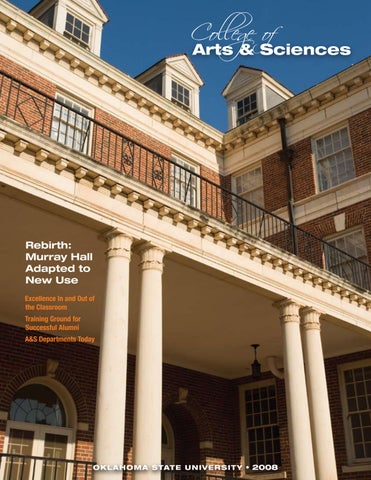
Rebirth: Murray Hall Adapted to New Use Excellence In and Out of the Classroom Training Ground for Successful Alumni A&S Departments Today
okl ahoma state u n ive r s i ty • 2008
DEAN’S MESSAGE
Recalling the Past, Embracing the Future Oklahoma’s centennial anniversar y, celebrated Nov. 16, 2007, provided a per fec t oppor tunity to reflec t on Oklahoma State University’s definitive role in shaping the state’s histor y. From 17 years before statehood to today, OSU has continued to fulfill its land- grant
Gary Lawson
university mission to educate the next generation of leaders. Integral to this process, the College of Arts and Sciences underpins the university’s educational mandate with its devotion to academic excellence and innovation, as well as its determination to give all students a balanced education that includes extracurricular and interdisciplinary activities. In this issue, we highlight our illustrious College of Arts and Sciences Student Council. The members featured here, both past and present, are prime examples of how leadership opportunities nurture leaders whose successes benefit the university, the state, nation and world. Representing the intellectual core of OSU, the College of Arts and Sciences is the largest with 24 departments, more than 80 degree options, nearly 400 faculty members, more than 5,300
undergraduates and 800 graduate students. Our council is equally diverse and provides each member with opportunities to reach out in limitless directions. From ecology to politics to medicine to charity, our council delves into many aspects of community while learning invaluable lessons in management, organization and communication. A groundbreaking ceremony in November formally beginning the renovation of Murray Hall symbolizes the rebirth of an OSU landmark. The $23.8 million project, partially funded through an $8.8 million bond issue by the Oklahoma Higher Education Capital Bond Program, allows the venerable old building — a history of place for many alumni — to become home to six departments within the College of Arts and Sciences.
Acquiring additional space with the Murray renovation and the new Interdisciplinary Science and Research Building, currently under construction, is one of many exciting developments occurring in the past few years. Other successes include nurturing outstanding student achievement, hiring exceptional new faculty and department heads and developing new centers, such as the Center for Africana Studies and Development and the Center for Oklahoma Studies. I hope you will join me in celebrating the College of Arts and Sciences’ key contributions to the history of the university and our state. Your support and enthusiasm play a pivotal role in serving Oklahoma and encouraging growth and opportunity for our next exciting chapter. Thank you for being a part of that future.
Peter M.A. Sherwood, Dean, College of Arts & Sciences
.2008 V10
8daaZ\Z d[
cas.okstate.edu
Arts & Sciences
contents
On The CoveR: The renovation of Murray Hall will turn the stately old residence into classrooms and offices for six departments in the College of Arts and Sciences. Photography by Phil Shockley.
OSU Special Collections
President Burns Hargis Dean of the College of Arts and Sciences Peter M.A. Sherwood Director of Marketing Kyle Wray Coordinator of Communications and Alumni Relations College of Arts and Sciences Lorene Roberson Editor Eileen Mustain Art Director Paul V. Fleming Associate Editor Janet Varnum Writers Alex Denkinska Matt Elliott Lisa Frein Lauren Lawson Abby Taylor Photographers Phil Shockley Gary Lawson
© 2008 Oklahoma State University
Practicing the art of leadership
Honing leadership skills remains central to a liberal arts education. 8
Thriving on experience
Today’s students expand their opportunities through real-world experience. 13
Making the old new again
Finding new uses for Murray Hall realizes the college’s need for space while fulfilling an important public component of the history department’s mission. 18
Leading by example
Arts and sciences’ Regents professors show students the nature of scholarship.
Arts and Sciences Magazine is a publication of the Oklahoma State University College of Arts and Sciences. All communications should be mailed to OSU College of Arts and Sciences, ATTN: Arts and Sciences Magazine, 005-D Life Sciences East, Stillwater, OK 74078-3015. Oklahoma State University in compliance with Title VI and VII of the Civil Rights Act of 1964, Executive Order 11246 as amended, Title IX of the Education Amendments of 1972, Americans with Disabilities Act of 1990, and other federal laws and regulations, does not discriminate on the basis of race, color, national origin, sex, age, religion, disability, or status as a veteran in any of its policies, practices or procedures. This includes but is not limited to admissions, employment, financial aid, and educational services. Title IX of the Education Amendments and Oklahoma State University policy prohibit discrimination in the provision of services of benefits offered by the University based on gender. Any person (student, faculty or staff) who believes that discriminatory practices have been engaged in based upon gender may discuss their concerns and file informal or formal complaints of possible violations of Title IX with the OSU Title IX Coordinator, Dr. Carolyn Hernandez, Director of Affirmative Action, 408 Whitehurst, Oklahoma State University, Stillwater, OK 74078, 405-744-5371 or 405-744-5576 (fax). This publication, issued by Oklahoma State University as authorized by the College of Arts & Sciences, was printed by Heritage Press at no cost to the taxpayers of Oklahoma. #2061 05/08
2
22
A natural evolution
Departmental seeds planted early in the history of arts and sciences thrive today.
d ep ar tments Thomas H. Uzzell shot this photograph of Dianna Howard at Theta Pond across from Murray Hall for the 1957 college yearbook, The Redskin.
2 Alumni 8 Students 10 Development
18 Faculty 22 College News 28 Memorials
alumni success
Time-Tested Leadership Many of the 42,000 College of Arts and Sciences alumni refined their leadership abilities as student council participants. On the following pages, sample alumni stories thread common experiences across the decades from today’s students to the class of 1957, honored at the 2007 homecoming during Oklahoma’s centennial year. These alumni say the student council taught lessons invaluable to their lives — working in teams, defining and reaching goals, gaining confidence and building relationships that will last a lifetime. photos/OSU Special Collections
2
C o l l e g e o f A r t s a n d Sc i e n c e s
a kid Land-Grant whoForgrew up in the 1940s Institution during an era few rural Prepared when schools offered or Him Well chemistry physics classes, Dr. Robert Purcell has made a name for himself in the world of science. Purcell, a 1957 chemistry alumnus of OSU, is the co-chief of the Laboratory of Infectious Diseases at the National Institutes of Health in Bethesda, Md. The boy from Haileyville, Okla., now oversees more than 100 scientists who study and seek cures for viruses including West Nile and hepatitis. Purcell arrived at the institute in 1963. “After the first 15 years, I came to the realization that I was going to stay here,” he says. “It’s a very positive lab to work in and just an exciting place to be.” Purcell’s journey has taken him from Eastern Oklahoma A&M Junior College in Wilburton, where his love of science blossomed, to OSU and then to medical school at Baylor and Duke Universities.
In 1962, Purcell completed an internship in pediatrics at Duke Hospital in Durham, N.C. Practicing medicine was not his goal, however. Gaining invaluable medical knowledge was. The tools he gained were for his one passion — scientific research. In 1963, Purcell became an officer at the prestigious Epidemic Intelligence Service for the Communicable Diseases Center in Atlanta. After a crash course in epidemiology, Purcell’s next stop was the Laboratory of Infectious Diseases, where he has been ever since. The newcomer’s assignment? Work on vaccine evaluation. The 72-year-old says his most important research findings were somewhat unexpected. Purcell recalls his mentor and lab chief, Robert Chanock, walking from lab to lab trying to convince one of the scientists to tackle hepatitis virus research. Purcell, who has played a major role in the development of all five hepatitis vaccines available today, was at the end of the line. “I was the low man on the totem pole,” he says. OSU Special Collections
“Working on hepatitis A has opened up all these other possibilities,” he says. “That period was a wonderful convergence of history and science because at that time nothing — I mean nothing — was known about viral hepatitis.” Purcell holds more than 45 U.S. patents and has published more than 700 papers. He is the recipient of more than 40 honors, including the U.S. Public Health Service Distinguished Service Award and the King Faisal International Prize in Medicine, and holds membership in the National Academy of Sciences. His tenure as president of the Arts and Sciences Student Council seems a long time ago. In his two years at Oklahoma A&M, he recalls most hours were in the chemistry lab where he found a mentor in larger-than-life Virginia Lippert, who was a chemistry faculty member from 1946 until 1980. “She was very influential in my career and just an outstanding person in her own right,” he says. “I was the last class to graduate from Oklahoma A&M before the name change,” says Purcell who is proud of OSU’s landgrant history. “I see having that historic name on my diploma as a real plus. “It’s a place that put me in good stead.” Lorene Roberson
1957
STUDENT COUNCIL O k l a h o m a S tat e U n i v e r s i t y
3
alumni success
Scott’s Road to Success Started Anne Scott’s at OSU
career brings She taught one life-changing history to junior adventure after high students in another.
Clinton, Okla. She guided fashion students at Tulsa Technology Center, Southwest Missouri State University and Colorado State University. She owned a clothing business in Springfield, Mo. Scott returned to OSU, which she calls home, in 1994. From then until last fall, as program director for the OSU Alumni Association, she oversaw homecoming events and student programs. In October, Scott started a new adventure at Texas Women’s University in Denton where she heads its alumni program.
“We have lost one of our franchise players,” says Larry Shell, vice president and chief operating officer of the OSU Alumni Association. “I cannot begin to tell you how much of a loss this is for OSU. “She brought a lot of professionalism and a lot of understanding of alumni relations,” Shell says. “She was excellent in working with the students and understanding their needs. She just created a real stable environment.” Scott earned a bachelor’s degree from OSU in 1967 and a master’s degree in 1975. Her professional journey started when she served on the College of Arts and Sciences Student Council during her senior year. “The leadership opportunities that I had on the OSU campus, including the Arts and Sciences Student Council, have always stood me in good stead throughout my life,” Scott says.
“The organizations I was a part of taught me management and organizational skills,” says Scott, who also was a twirler with the OSU marching band as well as a member of Mortar Board and Kappa Delta. “While I had a very good academic experience, the leadership opportunities really gave me the extras.” Scott credits Zelma Patchin, then OSU’s dean of women, and former OSU President Robert Kamm, dean of the College of Arts and Sciences at that time, for providing direction. Scott worked for a time in Patchin’s office and was mentored by Kamm. Scott’s new career adventure has taken her to Texas, but the Perry, Okla., native will always love her alma mater. “OSU is terrific. There is such spirit on campus,” she says. “It will always be home.” Matt Elliott
OSU Special Collections
1967
STUDENT COUNCIL
Melissa Mourer
4
C o l l e g e o f A r t s a n d Sc i e n c e s
1977
Tending the Next Generation of Cowboys
STUDENT COUNCIL Gary Lawson
OSU Special Collections
Dr. Mark Ebert was a busy OSU pre-med student in 1974, but that didn’t stop him from getting involved in the College of Arts and Sciences Student Council.
“When I started at OSU, I knew I was going to have to keep my nose in the books,” Ebert says. His choice of roommates, a pre-veterinary major and a pre-dental major, made simpler Ebert’s mission to keep up his GPA. “It was an easy environment in which to study,” says the Bartlesville, Okla., native. Ebert is from a brood of OSU loyalists. His father, brother and sister all earned their degrees from OSU, but he was the only one to tackle medicine. Before he started his junior year, he married his wife of 30 years, Bartlesville native and fellow OSU student, Renee. He served on the President’s Leadership Council at OSU and was a student academic adviser for incoming and undecided freshmen. He also was on the President’s Honor Roll and a member of the pre-med students’ honor society, Alpha Epsilon Delta. Following his graduation from OSU in 1978, Ebert graduated from the College of Medicine at the University of Oklahoma and completed his residency in gynecology in 1985 at the college’s Tulsa branch. But Stillwater lured Ebert back. In 1985, the young gynecologist joined the Stillwater Women’s Clinic, where he has worked ever since. “It’s always been rewarding to develop relationships with patients and their families,” Ebert says. In 2005, he stopped delivering babies but says those 20 years are some of his most memorable. “Working in obstetrics with patients and their families and being involved in starting their families was one of the most rewarding parts of the practice,” he says. As a student, Ebert could never catch enough OSU football games. And that hasn’t changed. Today, Ebert and his family are entrenched in the Stillwater community and attend as many games as they can to root for their Cowboys. Matt Elliott
O k l a h o m a S tat e U n i v e r s i t y
5
alumni success
Building a Solid Foundation Marcia Asquith traces 20 years of a fast-paced career and lasting friendships back to her time as president of the College of Arts and Sciences Student Council.
OSU Special Collections
Asquith, who came to OSU on a scholarship, earned a bachelor’s degree in economics with a minor in history. The Muskogee, Okla., native recalls getting involved with the council her freshman year. As leader of the student body her senior year, Asquith says she learned organizational skills and how to communicate with others. “I enjoyed working with the other leaders on the arts and sciences student council,” she says, noting she particularly enjoyed beating the business student council in College Bowl.
After graduating from OSU in 1987, Asquith studied law at the College of William and Mary. Following her graduation in 1990, she went to work for the federal government as an attorney on Capitol Hill. Asquith spent seven years as counsel to the U.S. Senate Agriculture, Nutrition and Forestry Committee, advising lawmakers on issues such as food safety, teacher training and commodities. The committee deals with everything from farming to crop insurance to public school nutrition programs.
Today, Asquith is the deputy corporate secretary for the Washington, D.C.-based Financial Industry Regulatory Authority, the largest nongovernmental securities regulating agency in the country. There, working in corporate governance and policy-making, she reports to the company chief executive officer, Mary Shapiro, and deals with its 23-person board of governors. The habits she developed at OSU, including those honed in student council service, still help her today. “I developed a lot of my leadership skills during that time of my life,” she says. “Connecting with people, finding people who had the same academic interests, and bonding over things we had in common, I think that serves you well throughout life.”
1987
Asquith lives with her husband in Arlington, Va. Despite ending up so far away, the friendships she formed during her time on the student council still exist today. She says a few of her close OSU friends were among the guests at her wedding last summer in Virginia. “There are friends I have stayed in contact with over the years,” Asquith says. “I didn’t know I would at the time, but I did know they were people with similar interests who I enjoyed working with.”
STUDENT COUNCIL
6
C o l l e g e o f A r t s a n d Sc i e n c e s
Matt Elliott
Gary Lawson
Learning to Accomplish Common Goals Student council gave Matt Caves the ability to work with people of different backgrounds, and in return, Caves diversified the council roll. Few, if any, within his college major of wildlife and fisheries ecology had previously served on the College of Arts and Sciences Student Council when Caves led the assembly in 1997. As a result, he brought a unique perspective to the table. During his tenure, the student council focused on broadening its base. “At the time only a few majors — including public relations, journalism and political science — were present in the council,” he recalls.
As president, Caves, an Oklahoma City native, also served as a student representative on the college’s faculty advisory council. “Some of my professors didn’t know I was involved in the student council,” he says. “And then, when I showed up for the faculty advisory meetings, they looked at me differently, knowing that we had common goals of improving the college.” The 1997 graduate says he will never forget the relationships he forged with faculty, students and staff during his time on student council. “The relationships you build with people while attending OSU carry over into the business community. You see some of them from time to time, either at business functions or at OSU events and games.”
Participation in student council taught Caves how to use his science background while working with others. He says he took those skills with him to law school at the University of Oklahoma and continues to use them today as an attorney with the Oklahoma Department of Environmental Quality. He works with national and state industries, guiding them through the regulatory and permitting process for handling and discharging wastewater into streams, lakes and rivers. “It seems like everybody is in student council for a different reason, but their goals are the same. They just want to be successful,” says Caves, who resides with his wife and two children in a Victorian home they are restoring in Chickasha. “Everyone on the council wants to make a difference. They want to be helpful where they can.” Matt Elliott
1997 STUDENT COUNCIL
O k l a h o m a S tat e U n i v e r s i t y
7
Student achievement
2007
STUDENT COUNCIL
Today’s Opportunities for Tomorrow’s Leaders Student Credits Professors for D.C. Internship Lewis, a Stillwater resident, has made the most of his time on campus. In addition to his work on the arts and sciences student council, he has minors in economics and Middle Eastern studies — a new program in which he will be the first graduate. While in Washington, Lewis was able to apply what he has been learning in school toward fundraising and communication with representatives, lobbyists and the press. He says he particularly enjoyed talking with different senators and representatives who phoned the office. With all the hard work came perks, which included meeting a number of influential people such as presidential candidates Sen. Barack Obama and former Sen. John Edwards.
Senior Trey Lewis spent his summer in Washington, D.C., serving as an intern for the Democratic Legislative Campaign Committee. The 22-year-old political science major helped the Democratic Party in its efforts to win a majority of the Oklahoma’s legislative seats.
“I felt like an actual employee and not just an intern,” says Lewis, who learned about the internship from Oklahoma Sen. Mike Morgan, whom he knew through the Young Democrats. With the help of Robert England, James Davis and James Scott, professors in the political science department, Lewis received OSU’s Henry Bellmon Leadership Scholarship to help pay for the high cost of living in Washington. The scholarship, named after former governor Henry Bellmon, is available to undergraduates who schedule internships at state or national levels of government. Lewis has advice for fellow students interested in receiving internships. “There are thousands of opportunities, and all you need to do is look for them. Scholarships are available to help students pay for the expeditions,” he says. “I couldn’t have done it without my professors and OSU.” Lewis plans to enter graduate school to work toward a master’s in global environmental policy. After graduate school, he wants to work in the developmental program for the United Nations. He also has fallback options, including working for the State Department, the Central Intelligence Agency or becoming a diplomat and working in an embassy. Lauren Lawson
Gary Lawson
8
C o l l e g e o f A r t s a n d Sc i e n c e s
From Council to the World Milliken, a senior Christy Milliken English and economics believes becoming involved in student major from Edmond, council exposed her Okla., is a junior fellow of to different worlds the American Academy of while also fueling Political and Social Science, her interest in OSU, a member of the OSU its faculty, staff and Student Honors Council students. and the 2007 student council historian. She helmed the arts and sciences student council in 2007, guiding it through a service project, a volleyball tournament with other college councils and a college banquet. For her council’s service project, she and her fellow students created Christmas cards for area nursing home residents.
“It’s work, yet it never seems to feel like that,” Milliken says. “It’s always the type of work I look forward to doing.” The college’s diverse disciplines made for an exciting mix of peers and colleagues and gave her experience in dealing with people from other cultures. She believes her crowning achievement was organizing a conference on Islam that featured speakers from across the nation, including Sarwat Hussein with the Texas chapter of the Council on American-Islamic Relations. About 600 people attended the council, which featured discussions of issues dealing with popular misconceptions of the religion. Through OSU study abroad programs, she studied the European Union in Dijon, France, in 2005; 17th century news books in Cambridge, England, in 2006; and humanities in Spain and Morocco in March 2007. In June, Milliken visited China, where she taught English classes in the city of Xuzhou and made recordings for languageinstruction tapes. The twomonth trip resulted from her work in an OSU English class.
Although she does not speak Chinese, she taught three classes of fourth-, fifth- and seventhgraders who had studied English throughout their schooling. She taught with the aid of an overhead projector, the internet and videos. The language barrier was surmountable, she says. She still receives occasional emails from the kids. “They tell me how their school year is going,” she says. “They’re cute emails. They are excited to share their lives and hear back about mine.” Milliken says her host family in China helped guide her through the customs and cuisine. As a blond she also was the butt of numerous Paris Hilton jokes, she says. She also visited the Great Wall and learned that Chinese clothing sizes are much smaller than sizes in the United States. “You learn a lot about yourself, too, and how you react to completely foreign situations,” she says. These days, she is on the cusp of plunging into life after college. Milliken plans to continue her teaching experience overseas. She has received a Fulbright grant and will spend next year in Indonesia as a Fulbright English Teaching Assistant. “No matter what path I choose, student council has provided me with invaluable leadership experience,” she says. Matt Elliott
continues next page
Gary Lawson O k l a h o m a S tat e U n i v e r s i t y
9
Student achievement
Internship Offers Insight
“Start early,” says the public relations For students major. Paul says early interested in preparation gives students getting an intern- a head start and puts them ship, OSU junior ahead of potential recipiand arts and ents. sciences student When he learned council treasurer, through an email that Germaine Paul Exxon Mobil was offering has a piece of an internship for public advice. relations and marketing majors in Texas, Paul followed his own advice. The Euless, Texas, native interned last summer with the End Stage Renal Disease Network of Texas, also referred to as the ESRD Network, which gave him the task of planning a campaign to raise awareness about chronic kidney disease in Texas. “The internship experience gives you a chance to apply what you learn in the classroom,” Paul says. At the ESRD Network, Paul set up a bowling tournament called Strikeout Kidney Failure that will take place in 10 regions of Texas. In May 2008, the winners of each region competed for the title of the “the ultimate kidney fighter.”
Through this experience, Paul says he gained a respect for people working in non-profit organizations as well as those who have to go to dialysis three or four times a week. “Having to beg for donations was the only downside to the program. But it was a learning experience, and now I’m better at it,” he says. Paul became interested in the public relations field because it combined everything he loved to do, including writing, planning and being around people. It also gave him a chance to be outgoing. He realized early on that these were his interests and public relations gave him the opportunity to put them all together. Through the work with the ESRD Network, he also realized he liked public relations even more than he had before he took the internship. “I’ve gained greater insight about myself through this internship,” he says. Lauren Lawson
Gary Lawson
Media Degree Attracts Support, Students It was not their first gift, nor their largest gift, but the recent $75,000 grant the Ethics and Excellence in Journalism Foundation made to OSU’s School of Journalism and Broadcasting proved to be one with the most impact. The gift funded the school’s launch of a new undergraduate degree program in sports media, making OSU one of only two major colleges in the nation to offer the degree.
10
“When people ask me where I attend school and what my major is, I’m proud to tell them I’m an OSU student and a member of a degree program that only a few schools across the country offer,” says Chad Marshall, a sports media junior from Abilene, Texas. “By offering a sports media degree, OSU attracts more in-state students who are trying to decide between schools, as well as
C o l l e g e o f A r t s a n d Sc i e n c e s
non-residents like me. As an aspiring sports broadcaster going into a popular field, I want to stand out from students across the country, and the sports media degree will help me do that.” Although the journalism and broadcasting department established the program only two years ago, three students have already graduated with the sports media degree and the program now has 59 students enrolled.
Thank You For Making A Difference!
THANK YOU for your support in raising more than $50,000 in private funding to create and sustain scholarships and programs for students in the College of Arts & Sciences this past year.
Funding from this campaign will be used to provide financial assistance to deserving OSU students, recruit and retain the finest professors, and acquire the best technology and resources possible. Your donation is powerful because it starts working for OSU students immediately. We applaud your commitment to the future of Oklahoma State University and its students. Look for our 2008 appeal in the mail this spring or make a donation by calling (405) 744-8214 or by logging onto http://asdevelopment.okstate.edu/
YourLmact beginshere.
EEJF Gifts to the School of Journalism and Broadcasting $52,000 in July 2003 to upgrade television studio equipment $105,000 in March 2004 to support equipment upgrades and replace all remaining analog broadcast equipment $13,000 in January 2005 to purchase a channel lighting controller board for the television studio $75,000 in September 2005 to print promotional materials $250,000 in March 2007 to help establish a professorship in sports media
“This degree offers an opportunity to learn the basics of journalism and to specialize in the field of sports,” says Jordan Woodruff, sports media senior from Gans, Okla. “Learning from faculty with experience in the field gives us a head start over others who have to learn sports journalism on their own.” In addition to the $75,000 grant, the foundation is providing
$250,000 in partial funding for an endowed professorship in sports media that will increase the integrity and prominence of the developing program. “The School of Journalism and Broadcasting could not provide the educational experience or grow as rapidly as it has without the generous support of the Ethics and Excellence in Journalism Foundation,” says Tom Weir, director of the school.
While the journalism school will seek support from other sources for the remaining $250,000 needed to fund a professorship, the foundation has created an optimal situation to encourage the additional support. Weir’s goal for the professorship is to attract a nationally known sports journalist to serve as a cornerstone for the rapidly growing program.
“We have been fortunate to develop a close relationship with the Ethics and Excellence in Journalism Foundation and have benefited from the board of directors’ generosity over the past several years,” he says. “The foundation has given the university more than $625,000, and the close relationship with the School of Journalism and Broadcasting is expected to continue far into the future.” Lisa Frein
O k l a h o m a S tat e U n i v e r s i t y
11
►
Endowing a scholarship at OSU makes your single gift historical
With the help of scholarships I have been able to work with many distinguished history professors at OSU. My research allows a depth of study that I could not receive without financial assistance.” -Trey, ’09 History Graduate
OKLAHoMA
STATEUNIVERSITY
a.I.
FOUNDATIONJl
College of Arts & Sciences 405.744.8214 | asdevelopment.okstate.edu 204 Life Science East Stillwater, OK 74078
OSU Special Collections
Building for the future
Murray Hall Transforms the College During WW II, OSU turned over Murray Hall to the U.S. Navy. The WAVES contingent training at OSU relax in Murray’s reception area. (Centennial Histories Series)
Elegant and modern in its early days, Murray Hall housed OSU female students for most of 50 years, from 1934 until 1984 when OSU shut the doors of the no-longer-fashionable residence hall. In its heyday, Murray’s central campus location, spacious parlor and welcoming veranda made it a natural host for dance hour and other socials. Many OSU women called it “home.” The days when residents challenged their 8 p.m. lock-down — lowering buckets out the windows for hamburgers from a local eatery or scooting in the front door just as the chimes rang — belong to the past, along with curfews and the popularity of traditional residence halls. But memories are another matter entirely, and for several generations of students Murray Hall remains a vital part of the OSU experience, a physical link to the university’s past. “No one wanted to tear down the beautiful old building,” says Tom Wikle, associate dean of the College of Arts and Sciences and a member of the Murray planning committee. “Murray, which was used for storage after closing, entered a period of
neglect, but no funds were available for restoration. By the time a statewide bond issue passed in 2005, renovating Murray Hall was a university priority.” With partial funding of $8.8 million from the Oklahoma Higher Education Capital Bond Program, OSU officially launched a $23.8 million project in fall 2007 to resurrect Murray Hall. The renovation will turn the stately old residence into classrooms and offices for six departments in the College of Arts and Sciences.
Respectful change When its transformation is complete in spring 2009, “Murray will once again be a state-of-the-art facility that fits in well with campus needs today and in the future,” says Mike Buchert, director of long-range facilities planning. The building will be more efficient with new windows and new mechanical and electrical systems, and it will be fully accessible to the disabled. Buchert predicts these additions to Murray’s already excellent structure will extend the building’s functional life 50-plus years.
There will be changes, such as the addition of a 150-seat theater classroom and terrace on the west side of the building, but he says the neo-Georgian approach by architects PSA-Dewberry, the firm that renovated Willard Hall, will keep Murray elegant and functional. The architects have taken special care to restore original entrances, wood floors and the parlor. Alumni who are troubled by the renovation can be confident they will recognize Murray Hall, Wikle says. “Maintaining Murray’s historical integrity was a concern of the planning committee, and the architects have felt strongly about retaining some of the really significant elements. “We don’t want it changed too much. We love the look of it right now.” continues next page OSU Special Collections
O k l a h o m a S tat e U n i v e r s i t y
qWhen Murray Hall opened in 1934, it brought a new degree of opulence to the OSU campus. (Centennial Histories Series)
13
Building for the future
A door of their own How OSU would use a renovated Murray was an open book when the committee began its work in 2005, Wikle says, noting the administration had long recognized the College of Arts and Sciences’ need for additional space. The planning committee, chaired by Joe Weaver, associate vice president of administration and finance, reached a consensus the former residence hall could ultimately provide a front door to the university’s humanities and social sciences, scattered across campus in halls and buildings identified with other disciplines.
OSU constructed Murray Hall with OSU blend brick and trimmed with crab-orchard stone in a modified Georgian style. (Centennial Histories Series))
photos / Phil Shockley
The six departments chosen to relocate to Murray are geography, communication sciences and disorders, history, philosophy, sociology and political science. “Awareness of our location has always been a problem. No one knows where geography is,” says Dale Lightfoot, head of the department. Geography currently occupies the second floor of Scott Residence Hall, which continues to function as a residence for overnight campus guests. “Everyone knows Murray Hall, giving us a recognizable location,” he says. Similarly isolated, sociology is housed in the Classroom Building; history in the Life Sciences Building and political science in the Math Building. Philosophy and communication sciences and disorders occupy Hanner Hall, a dormitory built in 1925. “For the first time, these departments are not just being relegated to what space is available,” Wikle says.
14
C o l l e g e o f A r t s a n d Sc i e n c e s
Growing pains Designed to suit Having a custom-built facility tailored specifically to their needs is another first for these departments, which have been involved throughout the planning process. While the space improves for all the departments, specialized facilities are important to geography and communication sciences and disorders. “Ownership over our own space is a big improvement — particularly new space we had a hand in designing according to the geography department’s needs,” Lightfoot says. Murray will contain geography’s special-use facilities, geographic information system and remote sensing teaching labs, physical geography
laboratory, cartography services and the Center for Applications of Remote Sensing. After enduring Hanner Hall’s limited space and noise, including clunking window units, “We are thrilled,” says Randolph Deal, head of the communication sciences and disorders department.“Just the fact that the facility will have central air conditioning will improve the signal-to-noise ratio so necessary to effective diagnosis and treatment. The increased space will allow our speech-language-hearing clinic to serve more patients more efficiently.” Murray also will accommodate a central audio-visual control room for diagnostic and therapeutic sessions, customized rooms to include soundproof booths for hearing evaluations, laryngeal stroboscopy and flexible endoscopy as well as acoustic and aerodynamic capture and analysis.
“This renovated facility will provide the framework to be more competitive with other Big 12 institutions and to realize our long-term goal of proposing a clinical doctorate in speech-language pathology,” Deal says. Deal’s department isn’t the only one anticipating that the improved location will stimulate growth. “We’re very excited about the opportunity for continued growth in our program,” says James Scott, head of political science. “It’s a wonderful improvement,” he says. “We’ll have office space for graduate students and a work area for undergraduates as well as room for expanding our faculty. All the department’s activities will be well served in the new space. It will enable us to put the pieces of our program together, to create the culture of interaction we’re seeking.” The history department’s cramped quarters, offices with double occupancy and the lack of student work areas restrict its growth, says head Elizabeth Williams. By moving to Murray, the department will gain one-third more space and places for graduate assistants. Likewise, the new location gives philosophy room for new faculty and students to enter the program. “There is no room to grow in Hanner,” says department head Doren Recker. “The elevators in Murray will allow students and others with disabilities to actually enter the department. This is not so in Hanner, where we occupy the second and third floors with no elevators. Students must make arrangements for faculty to meet them elsewhere.” continues next page Gary Lawson
O k l a h o m a S tat e U n i v e r s i t y
Murray Hall
Into the 21st Century 1930
1940
1950
A historical time1960
line of significant milestones in the 1970 history of Murray Hall
can be found at http:// 1980 murray.okstate.edu/
1990
2000
qFrom left, celebrating the renovation of Murray Hall are Peter M.A. Sherwood, dean of the College of Arts and Sciences; Marlene Strathe, former interim president and system CEO; Lou Watkins, Board of Regents for Oklahoma A&M Colleges; Lee Denney, state representative of Cushing; and Tom Wikle, associate dean of the college.
15
Building for the future Jana Duffy
College of Arts and Sciences department heads are, from left, James Scott, political science; Patricia Bell, sociology; Randolph Deal, communication sciences and disorders; Dale Lightfoot, geography; and Tom Wikle, associate dean.
Coming of age Although less tangible, professional growth and enhanced academics are a likely outgrowth of the move to Murray. Consolidating related disciplines is a goal of OSU’s long-range plan, Buchert says. “Having faculty and staff in one location where they can coordinate greatly improves the education to students and provides additional research opportunities.” Until now, coordinated teamwork has not been feasible, Wikle says. “These departments, which have a lot in common, will no longer be like parts of an archipelago out there by themselves with limited ability to come together.” Murray’s new seminar rooms, renovated parlor and other common areas will support student and faculty interaction and collaboration. “Sharing space with other departments will be intellectually stimulating,” Recker says. “It’s always good to have opportunities for informal discussions with colleagues from other disciplines. In Murray, this will be a daily occurrence instead of a rarity.” The political science department sees the potential for extensive interdisciplinary collaboration when relocated to Murray Hall. Scott says those prospects expand with the proximity of the psychology department in neighboring North Murray Hall. The sociology department’s move from the basement of the classroom building, home to the department for several decades, is a welcome event for head Patricia Bell. “We’ll enjoy the friendship of our new neighbors and
having a place for social interaction. We’re hopeful for the cross-disciplinary collaborations this new residence will inspire.” Bell’s colleague, professor emeritus Charles Edgley, expects the benefits to be intellectual and long-term. “Scattered across campus for so many years, few members of the social science faculty had the opportunity to see each other, much less work together on projects of mutual benefit. This new facility in Murray Hall will change all of that, and generations will thank those who made this progress possible,” he says. “The heightened opportunity for collaboration is a big step in the right direction for the history department,” Williams says. “From a historical perspective, this signals OSU’s development from its beginnings as a landgrant university to a comprehensive university offering first-rate programs and instruction in many disciplines. “It’s a validation of our efforts,” Williams says.
Paying homage to history According to Williams, Murray’s renovation also will be a dramatic example of historic preservation, which is an emphasis in the department’s nationally admired applied history program developed by associate history professor William Bryans.
Applied history, aimed at public presentation, examines structures, documents and other artifacts to interpret, analyze and teach history. “As a building significant to the university’s past, this is a very appropriate home for a program teaching applied history generally, and historic preservation specifically,” Bryans says. Murray is a well-executed renovation of an older building to serve a contemporary purpose, he says. “Adaptive use is as much a part of historic preservation as bringing a building back exactly as it appeared at a particular point in the past. Buildings are dynamic, and almost all experience changes over time.” Along with exhibits portraying Murray’s history displayed on the first floor, the building itself will stand as an excellent example of the adaptive use practice. “It fulfills an important public component of our department’s mission,” Williams says. “A building of great value in the memory of people who have visited and loved OSU over many decades will now become a showplace for its own history as well as a showplace for the College of Arts and Sciences.” Eileen Mustain
OSU Special Collections
Henry G. Bennett, visionary president of OSU from 1928–1961, strived to bring orderly development to the campus with his 25-year master plan. (Centennial Histories Series)
16
C o l l e g e o f A r t s a n d Sc i e n c e s
Phil Shockley
The College of Arts and Sciences opens Student Success Center Housed on the second floor of the historic Life Sciences East Building, the OSU College of Arts and Sciences Student Success Center brings together academic, pre-professional and career advising facilities in one seamless operation. Included are student academic services, career services, outreach and the pre-law and pre-health advising centers.
Morrill Hall Good Match for English Department For the first time in Morrill Hall’s 101-year history, a single department, English, becomes the sole occupant of the venerable building. Over the years, the historic building has lent its space to almost every department on campus. And while the structure still provides classrooms for several others, the English department occupies all of Morrill Hall’s office space. This has brought unity to the department because its entire faculty and all but one of its publication offices are now in the same building. Carol Moder, associate professor and head of the English department, says Morrill Hall is a fitting location for one of the oldest areas of study. “The English department values the university’s history and tradition and is happy to celebrate it by using a building with historical associations,” she says.
Morrill Hall opened for occupancy in October 1906 as one of the largest public buildings constructed in Oklahoma Territory. Angelo C. Scott, the president of Oklahoma A&M College, proposed naming the building after Sen. Justin Morrill because of his support of the Land Grant Act of 1862. This act gave rise to America’s land-grant colleges. “Morrill Hall was named after the senator as a recognition and honor because without the land-grant bill, there would not have been a university in Stillwater,” says David Peters, who oversees OSU’s special collections and university archives. The English department moved into Morrill Hall in 1966, making it the department with the longest tenancy. The department adds to the building’s already established background and importance. “English is one of the key disciplines encouraged under the Morrill Act,” Moder says. “Our presence here is quite appropriate.”
“This center is the realization of a dream for the College of Arts and Sciences,” says Peter Sherwood, Regents professor and dean of the college. “One of the major goals of our college is to increase contact among students, faculty and advisers, and this center plays a key role in making that happen. Now students can visit one place and find all the resources they need.” The college’s student council hosted the celebration. Council president Jenny Colton says, “With the student success center and resources now available, college isn’t so scary, and students don’t have to be afraid when graduation comes.” The center houses 10 academic advisers, three career consultants and student interns, as well as seven outreach staff. The facility, which is wireless and includes four computer stations for student use, features an academic information center that permits students to become familiar with academic disciplines and programs offered at OSU. A career resources library provides job and internship search information. Students pursuing admission to medical, dental or allied health programs now can access up-todate resources and professional guidance. Lorene Roberson
Abby Taylor and Alex Denkinska
O k l a h o m a S tat e U n i v e r s i t y
17
faculty excellence
Regents Professor Teaches Students Analytical ‘Beehavior’ Regents Professor Charles Abramson is a psychologist, but he’s not likely to ask about his patients’ relationships with their parents.
Abramson, also a zoology and entomology adjunct professor, has a background in physiological psychology. He studies how an animal’s environment influences its learning. He has examined everything from ant to elephant behavior but is also fond of honeybees. The variety keeps him on his toes. “One of the greatest thrills I’ve ever had in research was working with honeybees one day and then working with elephants the next. That was quite remarkable,” he says. Abramson has studied the effect of alcohol on bees and its possible application to human alcoholism problems, as well as the purported effects of cell phone signals on the health of
bees. He’s also studied the effect of pesticides on the learning abilities of honeybees and Africanized honeybees, known as killer bees. The newly-minted Regents professor has authored researchbased books garnering honors such as the 1994 Washington Edpress Excellence in Print Award. He has also received top teacher awards from the Oklahoma and the American Psychological Associations. He came from medical school, the State University of New York Health Sciences Center at Brooklyn, to OSU to work with a variety of subjects and disciplines. He found in OSU a place that supplies him with apt pupils and the freedom to do his research. A popular teacher, Abramson teaches by involving students in his research, an approach that has taken his students from Stillwater’s red dirt to Brazil’s rain forests.
Part of Abramson’s focus is to teach his students to be more critical of research so they will recognize innovation. He encourages his students to question him, albeit respectfully. “I don’t think we teach students how to think, how to take this data and ask critical questions, like ‘where does this data come from,’” he says, noting his goal is to reverse the trend. His students have gone on to careers as diverse as Abramson’s research. One is a professor who studies the behavior of rattlesnakes. Another studies how to teach people to fly airplanes, while yet another makes toys for elephants. “Hands-on research and challenging students to question data is the way to students get interested,” he says. Matt Elliott
Several years ago, a group of admiring students commissioned an action figure in the likeness of their favorite teacher, Regents Professor Charles Abramson.
Gary Lawson
Regents Professor Charles Abramson, shown here with student Andrew Mixson, tend Abramson’s bees at his home outside Stillwater.
18
C o l l e g e o f A r t s a n d Sc i e n c e s
Enlightening Work Regents professor Girish Agarwal came to OSU in 2004 looking for a place to research quantum optics — the application of quantum mechanics to study how light interacts with matter. Agarwal, a native of India, earned his doctoral degree from the University of Rochester in 1969. The theoretician spent much of his career in India, where he was the director of the Physical Research Laboratory in Ahmedabad for 10 years and held the Einstein chair of the Indian National Science Academy. He joined OSU partly because the American university system allows him to continue his research without the constraint of the mandatory retirement age imposed on workers in India. Now, as a Regents professor, he has found a home at OSU and is free to pursue his work while also mentoring graduate students. His research has earned him global acclaim in his discipline. His monograph “quantum optics,” which introduces new theoretical techniques, has been cited more than 600 times.
Agarwal’s work is applicable to industries dealing with optical imaging and high image resolutions where breakthroughs in optical sciences can be applied to everything from contact lenses to cameras. His accolades include winning Germany’s Humboldt Research Award, the Max Born prize of the Optical Society of America, the Third World Academy of Sciences Prize in Physics and the Shanti Swarup Bhatnagar Prize from the Indian government. “I enjoy my research,” he says. “I have collaborators who are spread in various parts of the world — the U.S., Europe and India.” He enjoys teaching and interacting with students, some of whom have gone on to work in the industrial realm, applying their skills for defense contractor Northrop Grumman Corp. and the U.S. Air Force. Currently, he has four doctoral students at OSU and several he’s working with from other universities, including one from Germany and another from Belgium. “I love to educate and train students,” Agarwal says. Matt Elliott Phil Shockley O k l a h o m a S tat e U n i v e r s i t y
19
faculty excellence
Right Man at the Right Time Talk to any environmental sociology professor, and it’s a good bet he knows the name Riley Dunlap.
Dunlap, OSU Regents professor, is one of the founders of the field that studies the relationship between human societies and the environment. The discipline took off in the 1970s after the first Earth Day, April 22, 1970, generated a growing attention to environmental problems. His publications, including the Handbook of Environmental Sociology, are staples for any course on the subject. “I tell students I’m trying to raise their awareness and understanding of environmental problems, but my job is certainly not to turn them into environmental activists,” he says. “Ironically, I just heard from a student who said, ‘I want you to know that I’ve been actively recycling for two months as a result of your class.’” A California native, Dunlap graduated from San Francisco State University in 1966 and earned a doctoral degree from the University of Oregon in 1973. He spent 30 years teaching at Washington State University in Pullman before teaching in Finland and joining OSU in January 2006.
Phil Shockley
20
C o l l e g e o f A r t s a n d Sc i e n c e s
Dunlap has seen the field evolve from a focus on specific problems such as water and air pollution to a broader concern with environmental degradation, ranging from local toxic contamination to tropical deforestation and global climate change. As a past president of the International Sociological Association’s environmental sociology group, Dunlap has stimulated interest in his discipline worldwide, particularly in Korea, Japan and China. Despite his position at the forefront of his field, Dunlap says he was mostly just lucky to be in the right position at the right time, but he is pleased at the growth of his study. “It is exciting to see my field spread internationally, most recently in China, where I helped organize an environmental sociology conference last summer,” he says. “One might say the future of the world, to a considerable degree, depends upon how well China deals with its environmental problems over the next 10 or 20 years. I feel privileged to have the opportunity to help stimulate the growth of interest in environmental issues there.” Matt Elliott
Dean’s Honor Is ‘Peer’ Pleasure OSU Arts and Sciences Dean and Regents Professor Peter Sherwood wouldn’t be where he is today if it weren’t for a sudden gust of wind. It was early July 1945, and Adolf Hitler’s V rockets fell on London’s civilians who were used to dodging air raids during the blitz. One day, one of those rockets was headed straight for the Sherwood family’s flat when a high wind blew it across the street and into a second apartment building. That boy saved by chance was born in July 1945 and grew up in London and developed a taste for chemistry, later receiving a first-class honors bachelor of science degree from St. Andrews University in Scotland. While there, he won the Forester Prize and the Irvine Jubilee Medal, which are awarded to the highest-ranked undergraduate chemistry student. Sherwood earned two graduate degrees from Cambridge University, entered the field of surface science, the study of properties that exist on the surface of solids, and then became a faculty member — the youngest faculty member at the time at Downing College, Cambridge.
Gary Lawson
In addition to Cambridge he has taught at Newcastle University in Newcastle upon Tyne, United Kingdom, as well as the University of Bari in Italy, Kansas State University at Manhattan and the University of California at Berkeley. His career yielded him the Outstanding Performance Award from the National Science Foundation for his work in 1990 as an analytical and surface chemistry program officer. In 2003, he received Kansas State’s Presidential Award for Outstanding Department Head. He led the chemistry department at Kansas State from 1997 to 2004 and is now a distinguished professor emeritus. Since becoming dean at OSU in 2004, Sherwood dedicates much of his time to administrative work but still finds time to teach freshmen research classes and conduct his own research, which has appeared in more than 200 publications.
O k l a h o m a S tat e U n i v e r s i t y
“I have less time to be in the laboratory; however, we continue to publish a number of papers a year,” Sherwood says. “This work helps me be more effective as a dean because I’m doing the same sort of things that the faculty is doing, albeit I have less time to do them.” Sherwood, a Fellow of the Royal Society of Chemistry, the Institute of Physics and the AVS Science and Technology Society, is pleased to be at OSU and excited about the direction of the college. He says he is particularly delighted with his most recent tribute. “I’m honored to be named a Regents professor and especially appreciated being nominated by physics faculty. I very much appreciate that.” Matt Elliott
21
r--
News from A to z
Art
Chemistry
Head Sallie McCorkle, M.F.A.
Chair Neil Purdie, Ph.D.
Beginnings Art was part of the school of
College of Arts and Sciences
A Rich Tradition The College of Arts and Sciences is deeply rooted in OSU’s history as one of the nation’s leading land-grant universities. Three of the first five teachers at Oklahoma
domestic science and arts until the 1913–1914 school catalog showed a new department called drawing and artwork. In 1917, the art department named its first head, who was also the first female department head in science and literature. News The department recently opened the Doel Reed Center for the Arts in Santa Fe, N.M. The center will provide an artist and scholar residency program, a student internship program and a competitive faculty residency program. Four new faculty members, who bring experience from such universities as Cambridge and Stanford, joined the department in 2007. The department offers more than six scholarships that range from $450 to $1,500. In 2007, the department awarded more than $19,000 in scholarships and several apprenticeships. Website: http://art.okstate.edu
Agricultural and Mechanical College were scientists, according to OSU’s Centennial Histories Series. One book in the series details the evolution of arts and sciences from its beginnings as the School of Science and Literature to its position as OSU’s largest academic unit. The following pages recap the history of the college’s 24 departments, summarize the latest news and introduce the department heads, more than half of whom joined OSU in the past three years. Leading the college today is Peter M.A. Sherwood, dean and Regents professor. The college boasts more than 400 tenured and tenure-track faculty, 170 temporary faculty and 150 staff members. More than
Botany Head William Henley, Ph.D. Beginnings OSU offered botany as early as 1899. During its history, the department has combined with such areas as entomology, plant pathology and microbiology. In 1990, botany separated from microbiology to become a stand-alone department for the first time. News The department recently hired two faculty members and expects to replace a retiring member in 2009 as it moves toward a five-year target of 12 permanent faculty members. The department’s faculty research spans from plant ecology, evolution, taxonomy, physiology and developmental genetics to cellular biology. Its recent funding sources include the National Science Foundation, U.S. Environmental Protection Agency, U.S. Department of Fish and Wildlife, The Nature Conservancy, The Sam Roberts Noble Foundation, Oklahoma Department of Wildlife Conservation and the Oklahoma Center for the Advancement of Science and Technology. The department advises 250 biological science students each school year. Website: http://botany.okstate.edu
55 percent of OSU students pass through its doors.
Beginnings The department organized in 1918 and formalized its structure in 1923. News The department has made advances in the creation of new materials, the synthesis of biological agents to treat a variety of disorders and the development of catalysts to aid in the production of useful compounds. Funding has come from several sources including the National Science Foundation, Department of Homeland Security, NASA, Oklahoma Center for the Advancement of Science and Technology, The Coca-Cola Company, ConocoPhillips Company, Chevron Phillips Chemical Company Inc., American Chemical Society and International Flavors & Fragrances. The department is in the process of filling a faculty position and hopes to fill up to three more positions. One faculty member received the 2007 Sigma XI Award in Research; another received the 2007 Oklahoma Chemist Award, the 10th time OSU chemists have won the award. Nine faculty members have won the Oklahoma Scientist of the Year Award, and four have won the Oklahoma Medal of Excellence, the highest teaching honor given to an instructor at the college or university level. No other department in the state has been so honored. On a weekly basis, more than 1,500 to 2,000 OSU students use the chemistry labs. Website: www.chem.okstate.edu
Communication Sciences & Disorders Head Randolph E. Deal, Ph.D. Beginnings Since 1910, the department fell under many domains including English and journalism. In 1970, the speech department began to change direction as a professional discipline, and speech communication theory and consultancy replaced the emphasis on rhetoric and dramatic expression. In 2002, the department’s official name became communication sciences and disorders. News The OSU-Tulsa Speech-Language-Hearing Clinic opened in 2007. The clinic specializes in pediatric speech-language pathology with a full range of services that include diagnostic evaluations, speech-language therapy, pre-school screenings, consultations and telepractice. Affiliated with the clinic, a new program at OSU-Tulsa allows undergraduate and graduate students to get hands-on experience while earning degrees with a focus on speech-language pathology. Website: http://cdis.okstate.edu
22
C o l l e g e o f A r t s a n d Sc i e n c e s
Computer Sciences Head Subhash Kak, Ph.D. Beginnings The computing and information
sciences department formed in 1969 under the administration of the vice president for academic affairs and research. In 1970, the department moved to arts and sciences. The department was unique for having a master’s program before it had a department or bachelor’s degree. The regents approved the master’s in 1968, the bachelor’s in 1977 and the doctorate in 1981. News The department recently introduced new courses on computer games and robotics. It also entered into an alliance with Central Rural Electric Cooperative of Stillwater to design new kinds of social computing networks to help revitalize rural America. The department plans to strengthen its offerings in gaming, multimedia, security and social computing in the coming years. Website: http://www.cs.okstate.edu
Foreign Languages and Literatures Head Perry Gethner, Ph.D. Beginnings The German and Latin Department was the department’s name in 1909. In 1914, introducing both Spanish and French, the department formally became the foreign languages department. News The department’s thriving research efforts include many projects focusing on women’s cultural contributions. Over the next five years, scholars and classrooms in both Europe and the U.S. will use a five-part anthology showcasing the works of French female playwrights. A book about Mexican feminist author Elena Garro is now available in Spanish. Soon to be published is a study about German writers and their works in Africa. The department also manages a website that focuses on foreign films. To learn more visit http://fllcourses.okstate.edu/Medialab.php. Website: http://fllcourses.okstate.edu/index.php
English Head Carol Moder, Ph.D.
Geography Head Dale Lightfoot, Ph.D. Beginnings Geography formed as a department in the school of commerce in 1942 because the specialization was useful for the military training schools. By 1946, the school of commerce and arts and sciences jointly administered the geography department, which made the complete transition to arts and sciences in 1951. News The department graduated its first group of doctoral students in 2007. Three of the four graduates are now tenure-track professors. In 2007, the department, working with the management information systems program in OSU’s William S. Spears School of Business, introduced a new degree in business geographics. The degree analyzes business and public information for marketing location analysis, systems development and socio-demographic research. The department’s funding comes from several institutes including the National Science Foundation, U.S. Agency for International Development, National Academy of Science and NASA. Website: http://www.geog.okstate.edu
Beginnings An English professor has had a
continues next page
presence on the campus since as early as 1894. News The department, already the editorial home of two nationally-known scholarly publications, Milton Quarterly and Cimarron Review, recently began an online journal dedicated to theoretical approaches to film and media, World/ Picture. In association with the journal, the screen studies program also sponsors an annual conference of film and media scholars, the World/Picture Conference. The department, in cooperation with the OSU library and the history department, is establishing a new research initiative, the Center for Oklahoma Studies, which will focus on research and creative initiatives that reflect and celebrate the diversity of the state. Beginning in summer 2008, the department will offer a four-course TESOL Certificate program, which will provide public school teachers with instruction in teaching limited English proficiency students and will train individuals who wish to teach English abroad.
Gary Lawson
Website: http://english.okstate.edu
College of Arts and Sciences department heads are, from bottom left, Sallie McCorkle, Perry Gethner, Randolph Deal; second row from left, Elizabeth Williams, Neil Purdie, James P. Wickstead, James Scott; third from left, Jay Gregg, Judith Cronk, Julia Combs, Maureen Sullivan, Bill Warde, Kenneth Konicki; and, back from left, Peter M.A. Sherwood, Dale Alspach, William J. Henley, Subhash Kak and Dale Lightfoot.
O k l a h o m a S tat e U n i v e r s i t y
23
News from A to z
Geology
History
Head Jay M. Gregg, Ph.D.
Head Elizabeth Williams, Ph.D.
Beginnings The department of geology began in
1949 as the department of geology and geography. News The department recently raised $250,000 from alumni and industry for the rebuilding of the Canyon City, Colo., Les Huston Geology Field Camp, flood-damaged in 2006. Geology students from OSU, the University of Oklahoma and several other universities throughout the nation attend the camp. Students have traveled to Antarctica, Botswana and Ireland for fieldwork. In 2009, three students will conduct fieldwork in Turkey, sponsored by the National Science Foundation. Geology graduates continue to be in demand in the petroleum industry. Website: http://geology.okstate.edu/
qCollege of Arts and Sciences department heads are, front from left, Tom Weir, Loren Smith, Carol Moder and Patricia Bell; and, back from left, Jeffrey Hensley, Robert Miller and Doren Recker.
Beginnings In 1912, history separated from pedagogy and became a free-standing department within science and literature though without a department head of its own. News Two history faculty members received prestigious fellowships. One from the American Council of Learned Societies focuses on law and society in Ming China; and the second, received from the Institute for Advanced Study at the University of Helsinki, studies the spread of Lutheranism in 16th-century Finland. Four faculty members hold leadership positions in professional societies that include the National Council of Public History, Society of Historians of Scandinavia, Southwestern Historical Association and Society for Ming Studies. A search is underway for a professor of Oklahoma history who will launch the Center for Oklahoma Studies in cooperation with faculty in English and the Edmon Low Library. With the support of the Arts and Humanities Lecture Series, the department hosted several outstanding speakers this spring, including, among others, Carlos Eire, Yale University, who spoke on religion in early modern Europe and discussed his memoir Waiting for Snow in Havana, which won the National Book Award in 2007.
Journalism & Broadcasting Head Tom Weir, Ph.D. Beginnings OSU offered its first journalism class in 1908 and founded a formal department of journalism in 1937 and the school in 1970. OSU restored departmental status to arts and sciences in 1980. The school of journalism and broadcasting is the only area to have retained status as school. News OSU launched an undergraduate degree in sports media in fall 2006. OSU is one of only two major colleges in the country offering the degree, which is attracting the attention of journalists and students nationally. In 2007, the school formally developed a journalism ambassador program staffed with students who participate in all university recruitment events and visit high schools to promote the school and its programs. Also in 2007, the school reached a new record in student scholarships, distributing more than $60,000. The school has received more than $1 million from internal and external sources, which has allowed the school to completely renovate the broadcast facilities and offer students the experience of working with high-end digital and highdefinition equipment. Website: http://journalism.okstate.edu
Website: http://history.okstate.edu
Gary Lawson
Mathematics Head Dale Alspach, Ph.D. Beginnings Mathematics was one of the five departments at OSU in 1894. In 1904, mathematics became a two-person department. The department began to develop a research faculty in the late 1930s. News The department is on a mission to help undergraduates survive college algebra. Several faculty members are working with the National Center for Academic Transformation to redesign the delivery of algebra at OSU with the goal to raise proficiency levels for more students. Two faculty members recently published an innovative textbook, Geometric Structures: An Inquiry-Based Textbook for Prospective Elementary and Middle School Teachers. The department has received funding from several institutions, including the American Institute of Mathematics, National Science Foundation, National Security Agency, Alexander von Humboldt Foundation, Oklahoma State Regents for Higher Education and Office of the State Board of Education. Faculty members are invited guest lecturers at universities throughout the U.S. and the world, most recently in the Republic of China, Japan, South Korea, Canada, Australia and Iceland. Website: http://www.math.okstate.edu
24
C o l l e g e o f A r t s a n d Sc i e n c e s
Microbiology & Molecular Genetics Head Robert V. Miller, Ph.D.
Regents professor Beginnings The department’s roots are in bacteriology and veterinary medicine, which split in 1949 leaving bacteriology under the arts and science’ umbrella. In 1962, the department adapted its current name to be in accordance with the name change of the national professional society. In 1992, the department changed its name to microbiology and molecular genetics. News Faculty members have been invited lecturers in Australia, Belgium, Canada, China, France, Germany, Italy, Japan, New Zealand, Spain and the United Kingdom. The department is involved in the American Society for Microbiology, the oldest and largest single life science organization in the world. The department head serves on its board, and the society recently presented one of its three international awards to an OSU microbiology student. The department has undergraduate research scholars and maintains 13 laboratories headed by faculty with a goal that each microbiology major gain research lab experience. In 2007, two new faculty members joined the department. Three research priorities focus on microorganisms and the interaction with the environment, microorganisms and the adaptations to hosts and the analysis of genetic research using computer technology, which is a new collaborative project with the statistics department and the OSU Division of Agricultural Sciences and Natural Resources. The department’s funding sources include the National Renewable Energy Laboratory, National Science Foundation, National Institutes of Health, United States Department of Agriculture, Oklahoma Center for the Advancement of Science and Technology and the Oklahoma Department of Wildlife Conservation. Website: http://microbiology.okstate.edu/
Music Head Julie Combs, D.Mus. Arts Beginnings OSU appointed its first full-time music director in 1908. The department existed in a category of its own outside the science and literature course of study until 1922. News The department recently placed students in the graduate programs at The Juilliard School. OSU graduates are employed as performers and university and public school teachers as well as in the music industry and musical theatre.
The OSU Wind Ensemble recently was the featured wind band at the 37th Japan Band Clinic in Hamamatsu City, Japan. The OSU Chamber Singers and Concert Chorale toured Italy this spring and will perform at Carnegie Hall in February 2009. Faculty members are internationally known performers and scholars with recent engagements in Romania, Poland, British Columbia, Belgium and Italy. The department has added several named scholarships and planned estate gifts. Website: http://music.okstate.edu
Philosophy Head Doren Recker, Ph.D. Beginnings OSU introduced classes in philosophy in the school of education in 1938. Philosophy became a full member of arts and sciences in 1967. News The department is working closely with the teaching hospital at the OSU College of Osteopathic Medicine in Tulsa to introduce ethical training across their curricula. The department also is working on a grant to facilitate ethical training for science graduate students and faculty seeking government grants. Website: http://philosophy.okstate.edu
Political Science Head James Scott, Ph.D. Beginnings Political science achieved department status by separating from the history department in 1944. News The department is expanding on both the Stillwater and Tulsa campuses due to increasing student enrollment and recruitment of new faculty members (five since 2004). The department also has increased both the number and amount of student scholarships and plans to add more over the next 10 years. The department is restructuring its academic programs to better serve students and is aggressively expanding experiential learning opportunities for both undergraduate and graduate students. In 2008, the department will add a state-of-the-art mobile computer laboratory to support students and classes. Faculty research productivity continues to increase, as does its success in acquiring external funding from such prestigious agencies as the National Science Foundation. Website: http://polsci.okstate.edu
Psychology Head Maureen A. Sullivan, Ph.D.
Physics Beginnings Physics was a part of the electrical engineering department in 1896 and became an independent department in science and literature in 1915. News The department’s research interests include both experimental and theoretical programs in biophysics, condensed matter, complex fluids, surface sciences, radiation dosimetry, nanomaterials, optics and photonics as well as theoretical and experimental high-energy physics and astronomy. Six of the department’s 25 faculty members are American Physical Society Fellows and five are OSU Regents professors. Three have received Regents Distinguished Research Awards. The department has collaboration throughout the world resulting in many distinguished scholars visiting OSU, including two Nobel Laureates who recently visited.
Beginnings The school of education created a department of psychology in 1938. The department became a full member of arts and sciences in 1982. News Psychology recently hired several new faculty members and will hire faculty next year, making the unit fully staffed with 22 members. The department plans to increase scholarships for both graduate and undergraduate research and to continue its emphasis on diversity through the Psychology Diversified Students Program and the American Indians Into Psychology Program. Faculty and student research continues to grow with funding from the National Science Foundation, National Institutes of Health, U.S. Department of Agriculture, U.S. Department of Health and Human Services Indian Health Service and the American Psychological Association as well as several state agencies. In 2006 the department helped establish the Oklahoma Network for the Teaching of Psychology and co-hosted the first annual conference.
Website: http://physics.okstate.edu
Website: http://psychology.okstate.edu
Head James P. Wicksted, Ph.D.
continues next page
cas.okstate.edu O k l a h o m a S tat e U n i v e r s i t y
25
r--
News from A to z
Sociology
Theatre
Head Patricia Bell, Ph.D.
Chair Judith Cronk, M.F.A.
Beginnings The department originally began as sociology and rural life in the department of commerce in 1937. The department joined arts and sciences in 1949. News The department’s environmental sociology program is one of the best in the country. It is comprised of five well-published faculty whose works ranges from environmental attitudes surveys organized for the Gallup Poll to studying water problems in Oklahoma to analyzing disaster response and emerging environmental movements in developing nations in Europe and Africa to organizing an international conference in China and work with the United Nations. Other studies focus on the impact of internet usage on community involvement. The department participates in other academic programs at OSU including the International Studies Program, Women’s Studies, Africana Studies and Native American Studies. Sociology offers eight scholarships including its newest, the Oretha D. Swartz Native American Fund. Website: http://sociology.okstate.edu
Proud History. Bright Future.
Beginnings The department blossomed in the 1960s. In the 1970s, theater, which had always been a part of speech, joined the school of humanistic studies. News The department is renovating and upgrading the lighting systems in the Vivia Locke Theatre and the Jerry L. Davis Studio Theatre as well as expanding and upgrading its computer lab and design studio. In 2007, the theatre department created two endowed scholarships in the names of Billye Sue Harmon and Jeanne Adams Wray. The department continues to attract wellknown visiting lecturers including Tony Wolf, a fighting styles director for Lord of the Rings, and Judith Hawking, a Broadway actor. Theatre alumni are currently working on Broadway and in Hollywood, directing New Year’s Eve in Times Square, completing internships at The Juilliard School and working for MTV. Website: http://theatre.okstate.edu
Zoology Head Loren Smith, Ph.D.
Statistics Head Bill Warde, Ph.D. Beginnings The department was a spin-off
from mathematics. Interest in statistics as a field of individual study began in the 1930s. OSU hired its first statistics department head in 1965. News The department has reintroduced a course in the growing area of genetic statistics, a science concerned with the genetic structure of populations. The department continues to provide collaborative research through its statistics lab with one of its main collaborators being the Oklahoma Agriculture Experiment Station. Its graduates continue to work at well-known organizations including the U.S. Department of Agriculture, U.S. Census Bureau, Aventis pharmaceutical and lab assay testing company, Koch Industries Inc. and Oak Ridge National Laboratory. Alumni serve in academic capacities that include the University of Florida, University of Minnesota, New Mexico State University and Daejong University in Korea.
Beginnings The science departments at Oklahoma A&M grew during the 1920s. In 1923, zoology separated from bacteriology and veterinary medicine. Zoology was one of the first areas in arts and sciences to grant a doctorate. News Since 2003, faculty and student research has led to advances in molecular genetics, conservation biology, vertebrate physiology and systematics with funding from the National Science Foundation, Environmental Protection Agency, Oklahoma Department of Wildlife Conservation, and the U.S. Fish and Wildlife Service. Revised undergraduate courses in biology, zoology and physiology create “inquiry-based” courses that promote interactive learning. The department recently replaced four faculty members and plans to replace three more as OSU reorganizes research and academic programs throughout. A departmental goal is to increase scholarships and fellowships by adding 16 named endowments by 2017. Website: http://zoology.okstate.edu
Website: http://statistics.okstate.edu
cas.okstate.edu 26
C o l l e g e o f A r t s a n d Sc i e n c e s
OSU has a strong military history. By the end of World War II, more than 40,000 military students had received education certificates at Oklahoma A&M — more than at any other college in the nation. Today OSU has two ROTC programs that continue to thrive.
Aerospace Studies Head Col. Kenneth Konicki Beginnings In 1946, the order of Gen. Dwight D. Eisenhower, Army chief of staff, established the Air Force ROTC on the Stillwater campus. News Air Force ROTC, Detachment 670, supports 11 university and college campuses with these partners making up 16 percent of the detachment’s 76 undergraduate students. In the U.S. and Puerto Rico, 144 detachments host college and university campuses where students may attend classes through 1,025 separate enrollment programs or consortium agreements. Aerospace studies achieved financial support for 2006 and 2007. The Air Force paid cadets $627,844 toward tuition and fees, as well as $482,845 toward books and stipend. OSU’s Air Force ROTC scholarship program awarded Air Force cadets $208,250. The OSU program commissioned 45 second lieutenants from 2006 to 2007 and 538 since 1976. Website: http://afrotc.okstate.edu/
Military Science Head Lt. Col. Jeffrey Hensley Beginnings The department of military science and tactics was first introduced in 1916. News The OSU Army ROTC Program continues to be one of the top ROTC Battalions in the 10th ROTC Brigade that includes 22 universities in Illinois, Arkansas, Missouri and Oklahoma. The department continues to grow and is at a 17-year high for enrollment. During 2007, the department recruited 20 freshmen from around the U.S. to enter the program on four-year scholarships. Alumni support for 2007 and 2008 includes support from the Ed Glover endowment, the use of Rex Holland’s land for navigation training and the mentorship from Maj. Gen. Doug Dollar. The program has commissioned more than 6,000 officers for the U.S. Army and its other services with 97 of the graduates attaining the rank of general officer or admiral. In 2007 at Fort Lewis, Wash., OSU cadets excelled at the leadership development and assessment course with more than 40 percent of its cadets earning an excellence rating, a rating reserved only for top graduates. Website: http://rotc.okstate.edu
Alumni Board of Directors President Matt Caves
C OL L E GE OF
Arts & Sciences Alumni: Stronger Every Day This is an exciting time for the OSU College of Arts and Sciences. Our remarkable college continues to grow, and today we have more than 42,000 alumni. Our Office of Alumni Relations serves as the constituency to the OSU Alumni Association and, since 1896, has strengthened ties among alumni and friends through its programs and services. We encourage you to get involved. To learn more or to join the OSU Alumni Association, visit www. orangeconnection.org/ng, or email Lorene A. Roberson, coordinator of communications and alumni relations for the College of Arts and Sciences, at lorene.roberson@okstate.edu or phone (405) 744-7497. To learn how you can help grow the college, visit www.osuf.org/ artssciencesneeds.htm, or contact the college’s office of development at (405) 744-8214 or jduffy@osugiving.com. As the pages of this magazine show, your gifts help strengthen student scholarships, improve facilities and bolster faculty support.
qAlumni board members include, from left, Pam Mowry, Matt Caves, Dana Glencross and Annawyn Shamas; and, back from left, Carol Ringrose-Alexander, D. Erik Aspenson, Christopher Gafney, Mark Foster and Claudia Holdridge Bartlett.
National Board Representative The Rev. Mark Foster Members Carol Ringrose Alexander Dr. D. Erik Aspenson Claudia Holdridge Bartlett Stacy Dean Dr. Doug Fort Christopher Gafney Tim Geib Dana Glencross Dr. Carla Britt Lisa Helms-Suprenand Brian Huseman Scott Levy Amy Logan Theresa McClure Pam Mowry David Parrack Annawyn Shamas Sara Sheffield-Forhetz Alumni Liaison Lorene A. Roberson Office of the Dean 201 Life Sciences East Stillwater, OK 74078 (405) 744-5663 cas.okstate.edu Dean Peter M.A. Sherwood, Ph.D. Associate Dean for Instruction and Personnel Bruce C. Crauder, Ph.D. Associate Dean for Academic Programs Thomas A. Wikle, Ph.D. Associate Dean for Research Ron Van Den Bussche, Ph.D. Director of Development Jana Duffy Director of Outreach H. Walter Shaw Director of Fiscal Affairs Renee G. Tefertiller Senior Director of Development Suzanne Thompson Director of Student Academic Services Susan Weir, Ph.D.
O k l a h o m a S tat e U n i v e r s i t y
27
In Memoriam
Sarah Jean Clark, ’04, studio art and graphic design, died Aug. 11, 2007, at age 26. Ms. Clark was an artist from the day she first picked up a crayon and that love for art never left her. At the time of her death, she was preparing to begin an internship with the Dallas Museum of Art. She graduated from Woodward High School, where she excelled in academics and art and won many honors. At OSU, Ms. Clark was active with Alpha Delta Pi sorority, serving as chapter president while a student and, later as an alumna, as state chapter officer. She also discovered her passion for printmaking, particularly lithography, at OSU and decided to pursue an advanced degree from the University of Tulsa, which she earned last May. Ms. Clark loved working with children and spent summers working at the Kirk of the Hills Preschool and Summer Arts Ministry. She had recently returned from a trip to Africa, where she worked with Masai children at a boarding school.
L. Todd Epperson, ’84, radiotelevision-film, died Oct. 19, 2007, at age 45. Born in Bartlesville, Okla., Mr. Epperson attended elementary school in Tulsa and graduated from high school in 1980 in Coalgate, Okla.
28
He was a reporter for The Daily O’Collegian and a member of Sigma Chi fraternity while at OSU. In the 1980s, he was an account executive for Rosenthal-Truitt and Neiman Marcus, both in Dallas. In the 1990s, he lived in Chicago, where he held several positions with an advertising agency and Spiegel Inc. Mr. Epperson returned to Dallas in 2001, where he was a freelance writer for many feature sections of The Dallas Morning News. He also wrote for other publications, including Better Homes & Gardens. Since 2003, he had been senior art director for J.C. Penney Co.
Robert Carl Fite, retired OSU professor of geography and meteorology, died Feb. 28, 2008, at 92. Mr. Fite was born July 26, 1915, in Brinkman, Okla. He served in the U.S. Navy during World War II. He flew typhoon reconnaissance in the Pacific and developed several textbooks and training materials during and after the war. He earned a doctorate from Northwestern University in Evanston, Ill., before joining the OSU faculty. He also worked for a year at the National Science Foundation in Washington, D.C. Mr. Fite owned a farm in Ripley for several years. He enjoyed golfing and gardening, especially cultivating roses. He was a member of the Methodist Men, Kiwanis, OSU Emeriti Association and the Retired Naval Officers Association.
Phillip “Ed” Paulin, retired OSU professor of broadcasting, died March 1, 2008, at age 83. The Oklahoma Association of Broadcasters Hall of Fame inducted Mr. Paulin in 1990, about the time he retired from teaching at OSU. He began his sportscaster career with WCMI in Ashland, Ky. After 24 years, he took a job at WMRN in Marino, Ohio, where he became a broadcaster of high school basketball games and the Marion Barons hockey games. He was recognized as Ohio’s Top Sports Broadcaster in 1960. After earning a bachelor’s degree from the University of Kentucky, Mr. Paulin moved to Stillwater so he could become general manager of KOSU-FM, a new radio station on the OSU campus and Oklahoma’s first National Public Radio affiliate. He earned a master’s degree via correspondence from the University of Kentucky and began teaching OSU broadcasting courses. OSU appointed him chair of the OSU Radio-TV-Film Department, a position he held until 1984. Teaching became his full-time interest. He earned a doctorate in 1979. From 1990 through 2007, he was the announcer heard in the press box for OSU Cowboy football games. He was a SilverHaired Legislator for several years and a delegate to the National Silver-Haired Congress. He was a 1988 nominee as Outstanding Older Oklahoma and a board member on the Oklahoma Alliance on Aging.
C o l l e g e o f A r t s a n d Sc i e n c e s
M.B. “Bud” Seretean, ’49, marketing, died Aug. 13, 2007, at age 83. The co-founder of Coronet Industries Inc., he was a native New Yorker who served as a field artillery officer during World War II before coming to OSU and, later, New York University. He began his career as an assistant floor coverings buyer for Allied Stores in New York and later spent 30 years as chair and chief executive officer of Coronet Industries. Other successful business ventures included co-founding Opti World in Atlanta, co-founding ABC-TV affiliate WGXA in Macon, Ga., and becoming co-owner of the Atlanta Hawks. He also served as president of the Jewish Welfare Federation and built a Holocaust memorial near Jerusalem to the Jews of Dorohoi, Romania, in recognition of his Romanian heritage. During his lifetime, Mr. Seretean was an ardent supporter of OSU, providing primary funding for the M.B. Seretean Center for the Performing Arts and for the Seretean Wellness Center. In 1999 upon the 50th anniversary of his graduation, OSU presented him with an honorary doctorate for his professional achievements and philanthropic activities.
Charles Sprague, ’51, mathematics, died Oct. 28, 2007, at 78. Dr. Sprague earned one of the first doctoral degrees in computer science in the United States during an era when supercomputers and personal computers didn’t exist and mainframes were often the
size of mobile homes. A pioneer in computer science, he developed a way to make projections in hours that would typically take months of hand labor to produce. He was born July 16, 1929, in Enid, Okla. After completing his bachelor’s at OSU, he spent three years working at Los Alamos National Laboratory while he earned a master’s in mathematics from the University of New Mexico in 1955. In 1956 he moved to La Jolla, Calif., where he developed software for General Atomics, which then employed only about 24 workers. In 1960, he earned a doctorate in operations research from the Case Institute for Technology in Cleveland and was one of only 15 people in the United States to hold a doctorate in the field. He worked on software that helped military aircraft distinguish between friendly and enemy planes. In 1963, Dr. Sprague worked with Walter Munk at the Scripps Institution of Oceanography to develop software that would forecast unusual wave patterns, an application to help Navy landing craft during war. Dr. Sprague worked on artificial-intelligence programs for Systems, Science and Software in the late 1960s and early 1970s before he started Policy Development Corp. to work with the publishing industry. He revolutionized the magazine publishing industry by creating software programs that allowed publishers to forecast circulation based on thousands of variables. His work assisted publishers in long-range planning, budgeting and growth projections. Magazines such as U.S. News & World Report, Texas Monthly, Architectural Digest and New York later used the software program he developed in 1972 for Psychology Today. By the 1980s, 150 publications were using the program. He retired in 2000.
Dr. Don Adams Drs. Douglas Aichele & Kathryn Castle Mrs. Judy Allen Mr. Tate Allen Dr. Wilton Anderson & Ms. Jacqueline Adair Dr. Stephen & Mrs. Patricia Armbruster Mr. Jim & Mrs. Joyce Barnes Mr. Gary Bartlett & Ms. Andrea Nielsen-Bartlett Mr. Hugh & Mrs. Anna Lee Barton Mr. David Bennett Ms. Grace Berlin Mr. Richard Bivins Mr. Jack Bobek Mr. Paul Bohannon Mr. Chris Bolding & Mrs. Ursula Skuta-Bolding Mr. and Mrs. Fred Bost Mr. Joseph & Mrs. Hazel Bowers Mr. & Mrs. John Brett Mr. Robert & Mrs. Betty Brotherton Dr. Linda Burks Dr. Gerald & Mrs. Mary Burson Mr. Terry & Mrs. Pamela Carpenter Mr. Barrett & Mrs. Suzann Cieutat Dr. Emery Cleaves Mrs. Jan Cloyde Dr. Mike Coltrin Mr. Michael Cummings Mr. & Mrs. Herbert Davis Dr. Jerry & Mrs. Judy Davis Mrs. Verne Dermer Drs. John & Cynthia Dobson Dr. Richard & Mrs. Gearaldine Dodder Dr. Karen & Mr. Samuel Dowds Ms. LeAnn Drummond Dr. Jonathan Drummond Mrs. Patricia Durfey Mrs. Anna Lynn Durr Dr. Edmund & Mrs. Joyce Eisenbraun Mr. Peter Erdoes Dr. Raymond Estep Mr. Alan Eyler Dr. LeRoy & Mrs. Martha Fischer Mr. Dick Fischer & Mrs. Malinda Berry Fischer Dr. Donald Fisher Dr. Bob & Mrs. Lucy Fite Mr. Gary Fleener Mrs. Kathryn Fleming Dr. Scott Fooshee Mrs. Ruth Gabriel Mr. G. Mike & Mrs. Susan Gaskins Mr. Robert Gates Dr. Barbara George MAJ(RET) Kevin & Mrs. Priscilla Gerfen Dr. Perry Gethner Mr. Hugh Gibson Mr. Edwin Glover Mr. Douglas & Mrs. Jennifer Gray Dr. Jay & Mrs. Mickey Gregg Dr. George Gries Mr. R. Kim Guyer
Dr. Raymond Habiby Dr. James & Mrs. Ann Halligan Mr. Jason & Mrs. Julie Hamilton Mr. Karl Hamilton Mr. Steve Harrison Dr. Merrillyn Hartman Ms. Ardoth Hassler Mr. Richard & Mrs. Debe Hauschild Mr. Hiram Henry Mr. James & Mrs. Kathy Higgins Mr. George & Mrs. MariBeth Hixon Mr. David Hogan Mr. Terry Hollrah Mr. Matthew & Mrs. Amy Huhnke Mrs. Corinne Hutchison Mrs. Susan Ingham Dr. Thomas Isern Mrs. Marie Louise Jackson Dr. William & Mrs. Linda Jaco Dr. Richard & Mrs. Sarah Jennings Dr. John & Mrs. Caryl Jobe Mr. Dennis & Mrs. Cheryl Jones Mr. Thomas & Mrs. Marie Jones Mr. Jenk Jones Dr. Melvin & Mrs. Margaret Keeney Mr. Dan & Mrs. Nancy Kennedy Mr. & Mrs. Carl Kerfoot Drs. William & Janet Knight Dr. Roger & Mrs. Norma Koeppe Mr. Tony Kroll Ms. Barbra Lafon Dr. Gladys Lewis Mr. John & Mrs. Kathy Lippert Ms. Jacqueline Lochmiller Mr. Dennis & Mrs. Judy Logan Mr. Chris Loomis Mr. Jerry Looper Dr. Robert & Mrs. Pauline Maddox Dr. Robert Mahnken Mr. Ed & Mrs. Mary Malzahn Mr. Richard & Mrs. Sandra Marlin Miss Ashlee Martin Ms. Theresa McClure Mrs. Katherine McCollom Mr. James & Mrs. Carolyn McGhay Mr. Ray & Mrs. Patricia McGinnis Dr. Julia McHale Mrs. Liz McKinley Mrs. Martha McLachlan Mr. Kristopher McPhail Mrs. Iris McPherson Mr. Jeffery Medders Mr. John & Mrs. Lori Meinders Dr. Robert & Mrs. Barbara Miller Mr. Paul Miller Dr. Glen & Mrs. Carmel Mitchell Ms. Jane Mitchell Mrs. Mary Monnett Ms. Leone Monroe Mrs. Margaret Morrison
Dr. George Moses Mr. David Murphy Mr. Alvin & Mrs. Carolyn Nuckolls Mrs. Jean O’Connell Mr. Donald & Mrs. June Peters Ms. Linda Petrie Mr. Carl & Mrs. Janice Phelps Mr. Mark Phelps Mrs. Judy Phelps Mr. Boone Pickens Mr. Carl & Mrs. Grace Provence Ms. Elnor Ragan Ms. Shirley Ray Mr. Steve & Mrs. Susan Raybourn Mr. Stuart & Mrs. Jennie Reeves Mr. Robert & Mrs. Priscilla Rives Dr. John & Mrs. Sandra Rooney Mr. Patrick & Mrs. Marianne Rooney Mr. Danny & Mrs. Candace Rowe Mr. Michael & Mrs. Sophie Rydin Dr. John Sadler Ms. Pauline Sampson Dr. Harold & Mrs. Mary Lou Sare Dr. Merrill & Mrs. Winona Schnitzer Mr. Daniel Schroeder Mrs. Julie Schultz Mr. Bruce Schultz Mrs. Beverly Schwarzkopf Mr. Roy & Mrs. Sharon Scott Mr. Carson Scott Mr. Neal & Mrs. Hazel Seidle Dr. M. B. Seretean Mr. Milo Shedeck Dr. Peter & Mrs. Gillian Sherwood Mr. Dale & Mrs. Carol Shipley Mr. Robert & Mrs. Debbie Skinner Mr. Billy Smith Ms. Mary Smith Mrs. Betty Speairs Mrs. Donna Spence Slette Mr. Robert Springman Mr. Thomas Steele Mr. James Steele Ms. Michelle Strabala Dr. Marlene Strathe Mrs. Dorothy Striegel Mr. Dean & Mrs. Carol Stringer Drs. James Struthers & Gladeen Allred Mrs. Oretha Swartz Mrs. Betty Synar Mr. Kevin Talley Mrs. May Tang Ms. Jeannette Taylor Ms. Janis Tietgens Mr. William & Mrs. Carol Tietgens Mr. Robert & Mrs. Betty Tippeconnie Mr. Harry Vest Mr. James & Mrs. Ann Vining Dr. Helen Vishniac
Mr. Kenneth Wade & Mrs. Myr-Lou Rollins-Wade Mr. James Waters & Ms. Luann Sewell Waters Mr. William & Mrs. Peggy Welch Dr. Jerry & Mrs. Winona Wilhm Mr. John & Mrs. Ann Wilkes Dr. Sandra Williams Mrs. Bernadine Wold Dr. Richard & Mrs. Janet Wood Dr. Edward & Mrs. Norma Woods Mr. Michael Yeager Mr. Stuart & Mrs. Teresa Yelton Ms. Mita Young Amerimed Consulting Inc AT&T Foundation Bank of America United Way /Michael Yeager Brett Exploration LLC Carl Dumsday Consulting Inc Chevron Phillips Chemical Company LP CITGO Petroleum Corporation Conoco Inc ConocoPhillips Devon Energy Corp Dominion Exploration & Production Inc EnCana Oil & Gas USA Inc EOG Resources ExxonMobil FAA Credit Union General Electric Corp Golconda Foundation Inc Gulf Publishing Company Hanover Veterinary Clinic PLLC Heavy Construction Systems Specialists Inc Kent Bowker Geological Consulting LLC Kirpatrick Oil Company Lakes at Cross Timbers OERB OG&E OK Press Association Paul Miller Family Foundation Phillips Petroleum Co Planned Parenthood of Central OK Questar Educational Foundation Raydon Exploration Inc Samson Stillwater National Bank Stillwater National Bank/Tulsa Sunoco Inc United Way of Central New Mexico/ Robert Skinner Noble Foundation Presser Foundation Sol Goldman Charitable Trust Vaughn Foundation Fund William Randolph Hearst Foundation AAF Advertising Club/OSU OSU Alumni Band Association Stillwater Boys Choir Tau Beta Sigma Sorority Tulsa Sports Charities Inc Edward E & Helen Turner Bartlett Trust EE Withgott Living Trust
V
Membership in the College of Arts & Sciences Associates is reserved for loyal and true supporters who are committed to advancing education. Members of the A&S Associates society have displayed their commitment to education by making a $1,000 or more annual gift to the College of Arts and Sciences, establishing an endowed scholarship, or naming the College of Arts and Sciences as an estate recipient. For more information on becoming a member of the A&S Associates, please contact Jana Duffy at 405.744.8214 or jduffy@OSUgiving.com. '-V
O k l a h o m a S tat e U n i v e r s i t y
29
Mark Your Calendar
Homecoming 2008 Friday and Saturday October 17 and 18
Oklahoma State University Stillwater
America’s Greatest Homecoming Honoring the Class of 1958 Don’t miss the College of Arts and Sciences class reunion on October 17 and 18. Each year prior to kickoff, the college hosts its annual reception to welcome alumni and honor 25- and 50-year graduates with the presentation of alumni pins. The OSU Alumni Association will mail details in July. To stay up-to-date on the latest news, visit http://www.orangeconnection.org/ng or http://cas.okstate.edu. Remember to check hotel availability today!
Pictured is Peter M.A. Sherwood, dean of the College of Arts and Sciences, fifth from left, with the class of 1957 at Homecoming 2007.
Oklahoma State University College of Arts & Sciences 201 Life Sciences East Stillwater, Oklahoma 74078-3015
Non-Profit organization U.S. POSTAGE PAID Stillwater, OK Permit No. 191