I
2005 A Year in Review
DEAN’S MESSAGE Keely James
Reaching Out June 30, 2005, marked the end of my first year as Dean of the College of Arts and Sciences. This exciting time brought my wife, Gillian, and me a very warm welcome from the Stillwater community, a significant wardrobe of orange garments (Gillian even has an orange watch!) and lessons in OSU’s wonderful traditions and history. Getting to know the faculty, staff and students of our 24 departments is a joy. Our student body consists of a quality found in the very best universities. This year, OSU fostered two of the 35 national Gates scholars, one of whom, Joel Halcomb, is an Arts and Sciences student. Dr. Bob Graalman, director of scholar development, inspires and connects our outstanding students with opportunities through such prestigious scholarships. Further impressive is the quality of our faculty and the potential for further growth and development with nearly 50 new faculty members expected for fall. It is an equal pleasure to work with and recognize an excellent group of associate deans and support staff.
I am very fortunate to be here at an especially exciting time for the college and for Oklahoma State University. In addition to our dedicated personnel, approximately $100 million of state-appropriated funds will come to Arts and Sciences to refurbish Murray Hall and construct a new interdisciplinary science building. Nearly all of our departments will benefit from improved space. Additionally, the university recognized our music program through the provision of $1 million for instruments, a sound system and marching band uniforms. The general theme of our 2005 Arts & Sciences magazine, “reaching out,” shows how core Arts and Sciences disciplines provide a foundation preparing our students for the challenges and opportunities in the world outside the university. In these pages, you will discover a few of the real-world connections we see every day.
pPeter Sherwood, dean of the College of Arts and Sciences, is pictured at center in this photograph of the May 2005 graduation processional.
Through the support received from alumni, foundations and corporate donors, we continue our dedication to educational innovation. Suzy Thompson, senior development officer, has done an outstanding job, and we now have a second development officer and added support for A&S development. Most exciting this year is Devon Energy’s vision of an undergraduate teaching laboratory linking our students with their geologists in the field. The Devon partnership, funded at $2.3 million, is a prime example of “reaching out” that ensures our students the best connections between the corporate and academic worlds. We thank you for your support and for your excitement about our future. You are key partners with us as we reach beyond the university walls and seek to ensure the college’s role in effectively serving Oklahoma, as we invest in our future.
Peter Sherwood, Dean College of Arts & Sciences
contents 8
table of
2005 / Volume 9
w w w . cas . o k s t a t e . e d u
ARTS & SCIENCES Magazine is a publication of the Oklahoma State University College of Arts and Sciences designed to provide information on college issues and concerns while fostering communication among OSU alumni and friends. Please contact A&S with information and suggestions for the magazine.
13
Faculty members across the Arts and Sciences spectrum produce outstanding work ranging from detoxifying TNT-contaminated water to writing an authorized biography to eradicating sexism and racism.
10 Through the Lens Faculty determination and dedication give astronomy and history programs a clearer view of time.
College of Arts & Sciences Oklahoma State University Stillwater, Oklahoma 74078-3015 405-744-7547 missy.wikle@okstate.edu
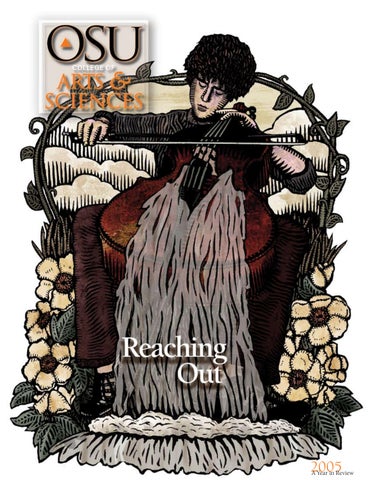
qCover The illustration featured on the cover, titled Spring of the Soul, is the art of Bri Hermanson, who graduated in May 2005 with a bachelor’s degree in graphic design. Her work is already receiving national recognition with winning entries in the Society of Illustrators of Los Angeles competition and the Dallas Society of Visual Communicators National Show. Read about Hermanson on page 29, and log onto www.brihermanson.com to see more of her work.
2 Savoring Success
12 In-Step Experience Activities at OSU provide the impetus and foundation for students’ future success.
18
14 The Best of Both Worlds Faculty members who teach and practice their disciplines blend experience and theory to prepare students for the move from the classroom to the workplace.
16 Experience May Not Be the Best Teacher, but … Off-campus learning opportunities help students excel academically and initiate productive careers.
24 The Deal Maker Gifts from corporate partners and individual donors provide the means and the encouragement for students to pursue education.
26 Taking Flight 23
The college saw the launch of successful new programs and faculty publications in 2005.
Suzanne Thompson
2–9 Faculty
Missy Wikle
10–11 Programs
Senior Director of Development Oklahoma State University in compliance with Title VI and VII of the Civil Rights Act of 1964, Executive Order 11246 as amended, Title IX of the Education Amendments of 1972, Americans with Disabilities Act of 1990, and other federal laws and regulations, does not discriminate on the basis of race, color, national origin, sex, age, religion, disability, or status as a veteran in any of its policies, practices or procedures. This includes but is not limited to admissions, employment, financial aid, and educational services. Title IX of the Education Amendments and Oklahoma State University policy prohibit discrimination in the provision of services of benefits offered by the University based on gender. Any person (student, faculty or staff) who believes that discriminatory practices have been engaged in based upon gender may discuss their concerns and file informal or formal complaints of possible violations of Title IX with the OSU Title IX Coordinator, Dr. Carolyn Hernandez, Director of Affirmative Action, 408 Whitehurst, Oklahoma State University, Stillwater, OK 74078, 405-744-5371 or 405-744-5576 (fax). This publication, issued by Oklahoma State University as authorized by the College of Arts & Sciences, was printed by Heritage Press at no cost to the taxpayers of Oklahoma. #1118 01/06
© 2006 Oklahoma State University
Coordinator of Career Services & Alumni relations
24
Eileen Mustain Editor Paul V. Fleming Art Director Janet Varnum Associate Editor Phil Shockley Photography Erika Contreras Assistant Photographer Kyle Wray Director, OSU Marketing
12–13 Alumni 14–23 Students 24–25 Development 26–28 College Briefs
d e p a r tm e n t s
faculty excellence
‘Green’ Solution for Pink and Red Water An OSU research team working with the United States Army Defense Ammunition Center (DAC) in McAlester, Okla., has developed a functional prototype that uses only sunlight and a proprietary catalyst to detoxify water containing the dissolved explosives created during the manufacture of TNT and the salvaging of obsolete or unserviceable munitions.
pPhysics professor Jim Harmon, top left, led the team of researchers and students that developed a device to detoxify water containing dissolved explosives. Harmon uses a smaller, labsized version to demonstrate the process but says it can easily be “ramped up” to handle much larger quantities of TNT-contaminated liquids.
The device provides a simple, low-cost, but very effective way to deal with a global environmental challenge and has the potential to save the military millions of dollars. DAC officials say the technology comes at a critical time because America and other nations face severe environmental challenges due to the de-commissioning of huge stockpiles of excess, obsolete or unserviceable munitions. “America currently has a stockpile of more than 400,000 tons that must be destroyed,” says James Q. Wheeler, DAC director. “The military services add another 50,000 tons every year, and almost every industrialized nation in the world has the same challenge.” Munitions can currently be destroyed in an environmentally sound way, but the process
is expensive, says Solim S.W. Kwak, DAC’s science and technology advisor. Under its Resource Recovery and Recycling (R3) program, the U.S. military has sought ways to recycle munitions components. However, some demilitarization processes produce a substance called “pink water,” which is water contaminated with TNT. Treating and de-toxifying pink water using current chemical and biologically based methods is slow, cumbersome and expensive. DAC contracted with physics professor Jim Harmon and his team to investigate alternative methods. The team developed a photo-catalytic method in which material within the device is coated with a catalyst developed at OSU. When exposed to sunlight, the catalyst neutralizes pink and red water, which is another highly toxic liquid produced during the manufacture of TNT.
Erika Contreras
Selling America
Phil Shockley
As U.S. diplomats continue international efforts to shore up old alliances and build new ones, Jami Fullerton, associate professor of advertising, says effective advertising could be a powerful tool to change attitudes and open dialogues with diverse peoples.
C o l l e g e o f A r t s a n d Sc i e n c e s
“The best way to describe it is reverse photosynthesis,” Harmon says. “The sunlight and catalyst create a reaction that turns nitro compounds into compounds such as ammonia.” The process works in ambient temperatures in any sunlit location, and special lights can be used on cloudy days, he says. “The device will also be very useful as the U.S. again begins producing TNT at a facility in Virginia,” Kwak says. America has not produced TNT since the 1980s due to excess stocks and the red water challenge. Since then, the U.S. has purchased TNT from international sources. “A large device could handle as much as 15,000 gallons of contaminated liquid per day, about the same amount of red water produced when making 10,000 pounds of TNT. The next step is to conduct tests on a larger scale and work with an Oklahoma company that will mass-produce the devices,” Harmon says. “We’re also working to arrange tests to see if the same system will destroy nerve agents like VX that were incorporated into some shells. According to a recent article in C&E News, some 250,000 gallons of the stuff awaits destruction, but the planned procedure has been aborted because of serious fire hazards.” Nestor Gonzales
“The principles of advertising that help sell goods and services can also be applied to promoting ideals and changing attitudes about America,” she says. “A focused, concentrated, consistent ad campaign could help set the stage for America’s diplomatic efforts by telling America’s story to the world.” Fullerton is currently conducting experimental research to measure the effectiveness tJami Fullerton, associate professor of advertising, says her research indicates effective advertising can change international attitudes toward America and open dialogue.
When he reached his mid-life crisis, research mathematician John Wolfe didn’t follow a stereotypic path. “I got interested in education,” he says. For the past six years, funded by National Science Foundation grants, the 31-year veteran of the OSU math department has channeled his interest in education into the development of a geometry course for prospective kindergarten through eighth grade teachers. Wolfe and colleague Doug Aichele will submit the final manuscript for the text in 2006, but the course is already attracting the attention of their peers. The course, which is taught at OSU, is being used in preliminary form at seven other universities. The math department has also extended the instruction to summer workshops attended by teachers from across the country. “We’ve been using the course in various formats for several years for students who are working on a teaching degree,” he says. “The feedback we receive is generally good.”
Although Wolfe, a recipient of the Regents Distinguished Teaching Award, says there are no easy answers as to what makes a good teacher, he does believe the teacher’s attitude is critical. “Teaching becomes more and more mysterious and magical the more I teach,” he says. “It’s hard to put my finger on what and how it is, but teachers have a powerful influence on students, both positively and negatively. “I love math. It’s a beautiful, exciting and engaging subject. If kids are to have a positive attitude about math, a sense of adventure, it sure helps if the teacher has it,” he says. “I believe as a teacher I need to model and stimulate in my students the art of staying in touch with our sense of curiosity.” Weekly Reader magazine surveys show mathematics, such as counting and shapes, to be the favorite subject in the first few grades, but something happens to kill that interest, Wolfe says. The geometric structures course is designed to help teachers rekindle their own sense of adventure and teach them how to nurture their students’ curiosity. “This course is an expression of my teaching philosophy based on assuming people, by nature, have a desire to learn and to make sense of the world,” he says. “As a teacher I want to spark that fascination as well as give imaginative presentations of material.” Wolfe, who says he teaches “all flavors of math,” is the math department’s undergraduate director and adviser to the math club. During the summers he has often worked with high school students attending summer
Erika Contreras
Reclaiming the Math Adventure
pJohn Wolfe, professor of mathematics and recipient of multiple teaching awards, says, “At the heart of it, teaching and learning are still as much mystery as science.”
academies at OSU. This spring, nominated by his colleagues in the professional organization of college math teachers, the Oklahoma-Arkansas Section of the Mathematical Association of America named Wolfe Distinguished Teacher of 2005. Eileen Mustain
of television commercials in improving international viewer attitudes toward America. The research attracted national attention last fall when it became part of the Senate Sub-Committee hearing on Public Diplomacy and was published in the prestigious Journal of Advertising Research. She is testing a series of commercials that were developed in 2002 by the U.S. Department of State as part of an unprecedented public diplomacy campaign known as the Shared Values
Initiative. The commercials aired in several Muslim countries throughout the Middle East and Asia for two months, but the campaign was discontinued prematurely, Fullerton says. “The campaign was stopped before research could show it had actually achieved its goal to create an international dialogue,” she says. “The results of my research have verified that the commercials, in fact, were effective.” In studies performed in London and Singapore, participants were asked for their attitudes
toward the U.S. government and its people before and after the commercials. The results revealed a significant attitude shift post viewing. Currently, a Hong Kong study is being planned. “These findings are really exciting because I feel this kind of research could impact public diplomacy by opening the lines of international communication,” Fullerton says. “I think the evidence suggests advertising can and should be one of many tools America uses in a longrange plan to build friendships and alliances.” Alanna Bradley
O k l a h o m a S tat e U n i v e r s i t y
faculty excellence
Erika Contreras
Exploring the Third Dimension Early explorers discovered that the flat geometry of Euclid did not explain the shape of the earth, but it took another two millennia for mathematicians to explain the richness and the shape of 2-dimensional objects. Today, mathematics professor William Jaco is studying the geometry and shape of 3-dimensional objects, which includes the shape of our universe. Jaco’s area of expertise is topology, or the mathematical study of the properties of intangible objects that remain unchanged under special correspondences, which include stretching and shrinking but not tearing. “We ask questions such as, ‘What is the shape of space? Or, are two objects positioned the same in space?’” “We are in some sense where our ancestors were in wondering if the earth is flat,” Jaco says. “Is our universe flat? What is the shape of our universe?” tAlthough mathematics professor William Jaco had previously been invited to China, his visit to lecture to advanced mathematics students at The Institute of Mathematics at Peking University in summer 2004 was his first. “This was an honor and an opportunity I could not miss,” he says. “And it was a terrific experience.”
This past summer Jaco, the Grayce B. Kerr Professor of Mathematics at OSU, was among a handful of internationally renowned experts invited to Beijing to lecture to advanced mathematics students at The Institute of Mathematics at Peking University. “The organizers of the Summer School at China’s flagship university select individuals recognized as leaders in an area of specialization who are actively engaged in new research,” says Jaco. “The Chinese have quickly become a major force in mathematics,” he says. “Chinese students dominate the application pool of students applying for advanced study in mathematics, and many of the most highly regarded new doctorates in mathematics are Chinese.” Despite the language barrier and an auditorium lacking air-conditioning in 90-degree heat, the 70-plus Chinese students were attentive to Jaco’s lecture. Some have since applied to OSU’s Graduate College to study topology, and one was offered a graduate teaching assistantship at OSU.
A ‘Moore’ Grounded Biography After more than 20 years, Marianne Moore’s poetry still intrigues Linda Leavell. The OSU associate professor of English and official Moore biographer says she is drawn to Moore’s unexpected combinations of words and images. “I like the way she takes a reader’s expectations and playfully turns them on their heads,” she says. “I find her work to be funny, playful, surprising.” And difficult, which Leavell says may explain why the Pulitzer Prize-winning American poet has not received more attention — an oversight Leavell hopes to remedy with the first authorized Moore biography. Leavell received an American Philosophical Society grant to
complete most of the archival research for the project in Philadelphia in 1999-2000. Most recently, she obtained a National Endowment of the Humanities Fellowship that will enable her to spend the upcoming academic year completing secondary research and writing. Receipt of the very competitive NEH fellowship underscores the significance of Leavell’s work. Although she has written extensively about Moore’s poetry, including a book published in 1995, Leavell says the authorization she received from the poet’s estate in 1999 allows her to quote
from Moore’s letters and other unpublished sources, an advantage the earlier unauthorized biographer lacked. Moore scholars will learn new information about this poet whose work was admired by contemporaries T.S. Eliot and Ezra Pound. But literary biographies are not written for scholars alone, Leavell says. “Biographies are widely read, not just by scholars but a broad general audience as well. This biography will reach a ‘real’ audience because of general interest in its historical content.” Leavell’s book will explore the culture of
uLinda Leavell, associate professor of English and official Marianne Moore biographer, rejects the popular perception that taking leave for research detracts from teaching. “I am taking two years away from the classroom for this project, but the work will add to OSU’s reputation and benefit students. Learning new information makes professors more dynamic and engaging,” she says.
Moore’s time, 1887–1972, and include such topics as women in higher education, osteopathic medicine and early kindergarten. “The nature of biography, because lives are complicated, grounds literature in the real world in a very concrete way,” she says. And it’s just that connection Leavell is striving for in this literary biography. “I want to draw readers to Moore and help create a better appreciation for her work. “I feel a great responsibility,” she says. “A biography has the power to shape a reputation.” Eileen Mustain
C o l l e g e o f A r t s a n d Sc i e n c e s
Erika Contreras
Jaco joined OSU in 1982 following postdoctoral training at the University of Michigan and twelve years on the faculty at Rice University. He has held research appointments at The Institute for Advanced Study in Princeton, the Mathematical Sciences Research Institute in Berkeley and the American Institute of Mathematics in Palo Alto. He served as executive director and CEO of the American Mathematical Society, living in Providence, RI, from 1988 to 1995. This next academic year, Jaco will take a sabbatical from OSU to accept the Gehring Distinguished Visiting Professorship at the University of Michigan-Ann Arbor, where he will conduct research in topology. The Gehring Chair has special meaning to Jaco, who was hired as executive director of the American Mathematical Society by Fred Gehring, who was chair of the board of trustees at the time.
Research May Lead to New Anti-Viral Drugs
Janet Varnum
Erika Contreras
OSU scientist Stacy Benson says research conducted by him and other scientists indicates that certain double-stranded viruses may have evolved from a common ancestor and that such knowledge may lead to new types of anti-viral drugs. Benson, assistant professor of chemistry, recently collaborated with researchers from around the world at The Wistar Institute in Philadelphia to discover structural similarities among viruses that infect hosts from each of the three domains of life — plants, animals and other higher-order organisms, bacteria and archaea (microorganisms commonly found in extreme environments such as geysers and alkaline, acidic and salty waters). “Similar viral structures can indicate relationships and common ancestry that will help the medical industry develop new anti-viral drugs,” Benson says. “If we understand their structure then we can develop ways of disabling the virus and, thus, stop it from infecting other cells.” Because viruses live inside their hosts and adopt host traits,
pStacy Benson, assistant professor of chemistry, recently collaborated with other researchers to discover structural similarities in viruses. He uses X-ray crystallography to continue the structural study of viral proteins and the mutations in human enzymes that lead to metabolic disorders.
he says examining structural similarities may be the only evidence left to indicate a genetic link. While serving on the Wistar team, Benson found a similarity between the major coat proteins of a bacterial and human virus. “This relationship (major coat proteins) expanded our research to begin looking at which other viruses are related. Current findings indicate that these are structurally related, and presumably evolutionarily related,” he says. Benson, who worked at Wistar as part of his post-doctoral research, is pursuing similar work at OSU. His research focuses on related viruses and the structure of human metabolic enzymes. The team’s research paper, “Does Common Architecture Reveal a Viral Lineage Spanning All Three Domains of Life?” appeared in the Dec. 3, 2004, issue of Molecular Cell. Alanna Bradley
O k l a h o m a S tat e U n i v e r s i t y
faculty excellence Erika Contreras
Raising Awareness In 1999, Utah Valley State College invited Jean Van Delinder, an expert on the landmark civil rights case Brown vs. Board of Education, to serve as the keynote speaker for its observation of the Martin Luther King Jr. holiday. Impressed by the small institution’s exhaustive itinerary of presentations and seminars, Van Delinder, associate professor of sociology, shared the program with her department head at OSU. When Patricia Bell saw what Utah had done, she showed the program to Earl Mitchell, who was assistant vice president for institutional diversity at the time. “Dr. Mitchell remarked how OSU faculty members were being invited to other schools for Martin Luther King celebrations, and we weren’t doing anything here,” says Van Delinder. “The next year, OSU had a Martin Luther King celebration, and the framework for it was the Utah Valley State program.” A faculty member since 1996, Van Delinder has toiled quietly to improve the status of diversity education at OSU. A one-time coordinator of the AfricanAmerican Studies program, she will serve this fall as inaugural director of Women’s Studies as it makes the transition from certificate to minor degree program.
“We’ve had the civil rights and equal rights movements, legislation, affirmative action, but still, during our day-today interactions, racism and sexism are still present, and they’re not going away until people are made aware.” Combining elements of the College of Arts and Sciences’ English, foreign language, history, political science and sociology departments, the program will be headquartered in a new Women’s Studies Center within the sociology department. It has been written that in America, race is never not an issue. The same can be said of gender, according to Van Delinder. “We can’t really talk about women’s issues without talking about race, and we can’t talk about race without considering gender,” she says.
“It’s part of our democratic values to believe that we’re all equal, we’re all the same, but the reality is if you’re a person of color or if you’re a woman, you’re going to be treated differently,” Van Delinder says. “The importance of having programs like Women’s Studies and African-American Studies is they remind people — particularly, white people — of their privilege. “We’ve had the civil rights and equal rights movements, legislation, affirmative action, but still, during our day-to-day interactions, racism and sexism are still present, and they’re not going away until people are made aware.”
Van Delinder’s interest in minority and women’s issues was stimulated, particularly, during her graduate study at the University of Kansas. While pursuing her master’s, she worked as a freelance researcher for the National Civil Rights Museum in Memphis. “I did a lot of traveling through the South, and talking to people got me interested in why so many risked their lives for the civil rights movement,” Van Delinder says. She subsequently penned her doctoral dissertation on Brown vs. Board of Education, actually five separate anti-segregation lawsuits brought in South Carolina, Delaware, Virginia and Washington, D.C., as well as Kansas. Her interviews, writings and research on the civil rights struggle in states along the Mason-Dixon Line will be published as a book, Border Campaigns, later this year. Adam Huffer
C o l l e g e o f A r t s a n d Sc i e n c e s
Hanks Offers Solutions to Conflict Caught between Iraq’s instability and China’s mounting political tensions, Central Asia has erupted as a source of political unrest. Now, one
Chemists Work to Solve World Problem
A $1 million prize may be a substantial incentive to solve the problem of arsenic-contaminated drinking water, but the environmental chemists at OSU say the seriousness of the problem motivates their work. “One-quarter of the Bangladeshi population drinks water that contains up to 50 times the amount of arsenic the U.S. Environmental Protection Agency considers safe, but it’s not just developing countries,” says Allen Apblett, associate professor of chemistry. “Arsenic, which is naturally occurring, is also a big problem in the U.S.” Millions drink arsenic-tainted well water in the U.S., China, Mexico, Peru, India and many other countries. Although the symptoms of chronic arsenic exposure — skin lesions, kidney and liver failure, loss of limb movement and cancer — may not appear for a decade or more, the illnesses are debilitating and can be fatal, Apblett says. “We have always heard, ‘What doesn’t kill you makes you stronger.’ But that’s not the case with arsenic.” Underdeveloped countries are not equipped to handle the problem, which is qThe American Chemical Society, Division of Environmental Chemistry, awarded Abdulaziz Bagabas, left, a certificate of merit recognizing “outstanding material content and manner of presentation” when he presented his research using zinc oxide nanoparticulate materials to remove arsenic from water at the society’s annual meeting in March. Bagabas works with associate professor of chemistry Allen Apblett, right.
why the National Academy of Engineering is offering the $1 million Grainger Challenge Prize for Sustainability to the individual or team that designs a practical, economical and sustainable point-of-use water treatment system for arsenic-contaminated groundwater in developing countries. While OSU scientists don’t have a practical solution yet, they could have one soon. Doctoral student Abdulaziz Bagabas and Apblett have developed an adsorption technique using zinc oxide and other transition metal oxide nanoparticulate materials to remove arsenic from water. “We succeeded in the fabrication of new metal complexes that possess low thermal stability,” Bagabas says. “These complexes serve as excellent sources for the production of nanocrystalline metal oxide ceramics that show promising results for arsenate removal from water at room temperature and at the natural pH of water.” “A large chunk of zinc oxide in its basic form doesn’t work,” Apblett says, “but breaking it down into extremely small particles changes its chemical properties and creates high surface area. Arsenic binds to the surface of the material and is effectively removed.” Apblett’s lab is currently licensing the technology and is working on application in a more condensed form. “Right now, one of the problems is the particles are so fine it’s hard to keep them in one place,” he says. “Remediation of arsenic by adsorption technique is cheap and highly effective,” Bagabas says. “The technique has many attractive features, including simplicity of operation, feasibility for small-scale requirements and low maintenance.” Eileen Mustain Erika Contreras
OSU researcher has a chance to do something about it. Reuel Hanks, associate professor of geography, was chosen to offer solutions to the U.S. Department of State to resolve conflicts in Central Asia. Honored with a Policy Seminar on Conflict in Eurasia fellowship, Hanks is one of only 10 fellows in the nation who traveled to Washington, D.C., in May to present his research. According to Hanks, Central Asia is an important region to examine because of its status as an emerging geo-political region marred with ongoing political tension. “This is a unique region because it is surrounded by large markets in China, Russia and the Middle East that will not tolerate an unstable border. “Central Asia is a crossroads for a number of major political players and is forced to become involved, whether it wishes to or not,” Hanks says. “We need to be proactive and try to maintain its stability.” One goal is to encourage the U.S. Department of State to implement academic centers in Central Asia similar to the Institute for Conflict Analysis Research in South America and Armenia. Another goal is to influence Central Asian universities to provide public education on how to effectively resolve current and future conflicts, pReuel Hanks, Hanks says. associate professor of Aiming to influence Amerigeography, is can policy, Hanks says he one of only 10 fellows in the hopes the research will also nation selected lead to meetings in Europe to offer conflict with European scholars adding resolutions for Central their efforts. Asia to the U.S. “Our ultimate goal is to see Department of State in May. democracy and a civil society,” Hanks says. “The sooner we start working toward those goals, the sooner we can achieve them.”
Arsenic and Nanoparticles
Sheila Dohmann
O k l a h o m a S tat e U n i v e r s i t y
faculty excellence
Applying Knowledge to the Real-World
Exploring the Universe
Dr. Peter Shull, professor of physics and astronomy and 2004 Regents Distinguished Teacher, has turned his lifelong fascination with space into an astronomy program with the goal to teach his students to appreciate the process of science.
Geography professor Allen Finchum, recipient of the 2004 Regents Distinguished Teaching Award, believes teaching is more than simply conveying information to a student. His colleagues and students say he practices his philosophy. They credit Finchum’s hardware, software and networking improvements for giving the department one of the best educational setups in the country. They also say his emphasis on the applied use of GIS (geographic information systems) technologies and problem solving enlarges student understanding of geography. Erika Contreras
qCarlos Cordova, below right, collects samples in Qa’ Abu Nukhayla in the Wadi Rum Region of southern Jordan as part of two international programs investigating the prehistory of Jordan. The associate professor of geography is working with Regina Kalchgruber of the physics department. Cordova is obtaining proxy data for reconstructing effects of the northwestward enhancement of the Indian Ocean monsoon approximately 7,000 to 9,000 years ago. The project, led by anthropologist Donald Henry of the University of Tulsa and funded by the National Science Foundation, aims to obtain paleoecological and geomorphological information that may link human activities with climatic conditions. The other project focuses on the alleged coexistence of Neanderthals and anatomically modern humans in the area. This project, which is directed by archaeologists from the University of Victoria, British Columbia, and McGill University, Montreal, is part of an effort to understand hominid migration pathways from Africa into Asia and Europe.
His office, they say, is a meeting ground for undergraduate and graduate students where technical problems are solved on a one-on-one and small-group basis. Former student Jeffrey Amos says he recently found himself explaining the geographic importance of urban areas to a friend. “That knowledge came directly from Dr. Finchum’s lectures,” Amos says. “He presents materials in a way the student can easily understand and apply to real-world situations.” This is just what Finchum hopes to achieve. “The student needs to be shown how the topic can be used in everyday application,” he says, “and how the continued development of knowledge in the subject can aid in furthering their goals and providing them a better understanding of the world around them.” Janet Varnum
C o l l e g e o f A r t s a n d Sc i e n c e s
His students use the new H.S. Mendenhall Observatory, located southwest of Stillwater, during special evening sessions, and juniors and seniors also process data gathered at the observatory for further study. Shull uses these observations and analyses to teach freshman-level courses the importance of the observatory and student participation in its operational use. “I want my introductory classes to understand how scientists figured out answers to questions in the past and how they continue to do it today,” he says. “I also try to prepare students to become scientifically literate students who will use their knowledge to benefit both society and themselves.”
Erika Contreras
“Dr. Shull is OSU’s astronomy program,” says Smith Holt, former director of OSU’s Center for Science Literacy. “Peter has long sponsored the Astronomy Club, and in 1998 he began a major effort to establish an observatory for the university, which became a reality in 2002.” Shull developed and teaches two astronomy courses at OSU and is coauthor of a book of weekly astronomy exercises for the Voyager solar-system simulator program, which allows students to grasp astronomical concepts while watching the 3-D movement of stars, planets, eclipses and other phenomena on a computer screen.
A New Feather in His Cap Warren Ford says he was both gratified and surprised when the Arts and Sciences student council named him the college’s Outstanding Professor for 2005.
Erika Contreras
Janet Varnum
On the Surface of Things When talking about Nicholas Materer’s work, surface does not mean superficial. courtesy
The Regents professor of chemistry has received numerous honors for his research and has been named Scientist of the Year by the Oklahoma Academy of Science and Oklahoma Chemist of the Year by the Oklahoma Section of the American Chemical Society, but this student honor is Ford’s first teaching award. And it is particularly gratifying because the students who nominated him were in his rigorous 3000-level organic chemistry class. “I use a no-nonsense approach,” he says, explaining that he designed the course to challenge his students, 280 of them per class on the average. “I set high standards. My aim is to help them prepare for their professions and to meet their career aspirations.” Ford, who has been an OSU faculty member for 27 years, coordinates the Oklahoma Network for Nanostructured Materials project (NanoNet) and directs OSU’s nanotechnology portion of a statewide program funded by the National Science Foundation and the Oklahoma State Regents for Higher Education. He says a well-organized class helps his students learn as does providing incentives. “I treat my students as the professionals they are becoming,” he says. “Some will do better than I, and I’m pleased to help along their development.”
Eileen Mustain
O k l a h o m a S tat e U n i v e r s i t y
Erika Contreras
Materer says he tries to modify surfaces so they do something interesting and useful. “I want to control chemistry on very small surfaces, particularly at interfaces. It’s structure and functionality at the nanoscale.” This year the Arts and Sciences Faculty Council awarded the assistant professor of chemistry its Junior Faculty Award for Scholarly Excellence, and the OSU Chapter of Sigma Xi named him the 2005 Young Investigator of the Year, an award given to a scientist who has already established a national reputation for research within 10 years of receiving his or her highest degree. Materer’s research includes the development of a process that senses explosives, particularly triacetonetriperoxide (TATP), a favored explosive of terrorists, and neutralizes them by chemical neutralization rather than exploding them. His research also involves modifying the silicon surfaces of computer chips to make smaller devices that can do more. “Chemical reactions occurring at surfaces play a critical role in the manufacturing of electronic devices,” he says. “Dr. Materer works in the area of surface science that addresses critical issues in the development of semiconductors, sensors, catalysts and homeland security,” physiological sciences professor Jerry Malayer said when presenting Materer the Sigma Xi Award. “His research has a huge impact in paving the way for a whole new generation of sensors and devices that combine organic and silicon-based electronics.”
Eileen Mustain
enlarging opportunities courtesy
OSU sky-gazers have captured remarkable images of Earth’s celestial neighbors such as the Moon and nearby planets as well as the remote Andromeda Galaxy and Crab Nebula.
New Telescope Brings Astronomy Program into View As a result of the students’ demonstrated capability to observe and photograph these objects with their existing 14inch telescope, the U.S. Department of Defense has awarded more than $230,000 to OSU to purchase a 24-inch telescope. When OSU’s new telescope arrives next summer, it will be the biggest and most advanced in Oklahoma, says Dr. Peter Shull, astronomer and physics professor who developed and teaches OSU’s two astronomy courses.
“This will be a real observatory-grade telescope,” he says. The remote-control function will enable Shull and his research students to collect data from the H.S. Mendenhall Observatory located southwest of Stillwater without leaving campus — a feature that will be especially welcome on cold, clear nights when observations run for hours at a time. Pre-programmable robotics will automatically open and close the retractable opening of the observatory’s dome, rotate the telescope to a specific object in the sky, and operate the electronic camera for routine observations during normal sleeping hours. The new telescope’s adaptive optics will cancel the blurring effect caused by the atmosphere. “Adaptive optics is particularly of interest to the Air Force,” Shull says, “and familiarity with this technology will give our students an edge in Air Forcerelated jobs and careers.” Shull says the Air Force is also interested in near-Earth asteroids. These are asteroids
that have been knocked off their normal orbit by a collision with another asteroid in the asteroid belt. Because this happens all the time, OSU students will often use the telescope to map the asteroids’ altered orbits. “We will be able to precisely nail down their new orbits to see if they are a threat and then forward the information to a national database,” Shull says. Shull believes the new telescope and additional astronomy options will attract more students, particularly undergraduates and women, to OSU’s physics department. Statistics show higher percentages of women enroll in physics programs that have an astronomy component. The new telescope also offers OSU researchers the ability to discover exoplanets, which are planets outside our solar system orbiting their own stars. “We’re starting to see a lot of journal articles about how to detect transiting exoplanets and what you need to do the job,” Shull says. “This field is very exciting, and the scientific skills
OSU students will master in the process are highly regarded by the Air Force as well as science and engineering employers. “We hope the addition of this observatory-grade telescope will attract more students to the physics program and lead to phase two, the expansion of our astronomy facilities as well as the addition of a second astronomy professor and astronomy minor.” Phase two will fund an observer support building next to the OSU observatory that will provide a restroom, kitchenette, shelter from the heat or cold, a storage facility and a telescope control room. “This will allow us to host open houses, improve image quality by moving computers and observers out of the observatory, and give students the same comfort level they have when they’re working in other labs on campus,” Shull says. “While taking a long series of exposures, students want to be comfortable and maybe even finish homework or take a nap while they’re waiting!” Janet Varnum
10
C o l l e g e o f A r t s a n d Sc i e n c e s
Bringing History into the Present
Support the Heart of OSU … join the A&S Associates.
Norbert Mahnken had already retired when William Bryans joined OSU’s history department in 1987. But the emeritus professor of history and the former head of the history department crossed paths in the public realm where they taught Elderhostel classes and worked together in local and state historical societies. The two shared an affinity for public history. As researchers and interpreters of history, public historians are educators, Bryans says, but instead of the classroom, they work in archives, museums, historic preservation organizations, historic sites and government agencies. “An academic historian’s research and writing is usually aimed at other historians whereas a public historian has a wider audience and the potential of having a greater impact on the perception of history,” he says. Mahnken, who taught history at OSU from 1947 until he retired in 1983, certainly helped shape the history department and record the state’s history. His research and writings focused on Oklahoma history, and he had numerous articles published in the Chronicles of Oklahoma. But he also accomplished a great deal as a public historian, Bryans says, especially in recording the area’s social history and documenting historic sites such as Pleasant Valley School in Payne County. “Norbert Mahnken was a gracious, intelligent and thoughtful man. He was knowledgeable and always willing to share his knowledge with others.” And that thoughtfulness and willingness to share is part of the legacy Mahnken, who died in 2004, and his predeceased wife, Anita, leave to the OSU history department. Their planned gift, the Dr. Norbert and Anita Mahnken Distinguished Graduate Fellowship, will fund internships in the study of applied history, also known as public history. OSU’s program, which offers emphases in historic preservation and museum studies, requires a six-credit- hour internship. “Sometimes the internship is a paid position and sometimes not,” says Bryans, noting that tuition is also an expense on top of the internship. “I can’t envision doing this program without the internship. It’s essential for students to apply the theories they’ve studied. Their education is not complete until they actually practice,” he says. “The Mahnkens’ gift boosts the competitiveness and adds value to the program. It will help us recruit top students and find the best internship placements we can, which will increase employment opportunities for our graduates. “We are very appreciative.”
Don & Sue Adams Wilton Anderson & Jacqueline Adair Theodore Agnew Stephen & Patricia Armbruster Glenda Balint Grace E. Berlin Clinton Bissell Joseph & Hazel Bowers Gladys T. Burris Gerald & Mary Burson Douglas Aichele & Kathryn Castle Shu-Tsing Cheng Bob & Barbara Chitwood Jan R. Cloyde Michael R. Cummings David & Gina Dabney Jerry & Judy Davis John & Cynthia Dobson Jonathan & LeAnn Drummond Albert & Anna Lynn Durr Richard & Judith Edmonson Peter & Kimberly Erdoes Raymond & Teresa Estep Alpha Fiegel Dick Fischer & Malinda Berry Fischer Bob & Lucy Fite Kathryn Fleming Chip & Shannon Fudge Edwin E. Glover George & Mary Gries James & Ann Halligan Pamela Harkema Steve L. & Teresa Harrison Mary Hazeldine George & Beth Hixon Kevin & Peggy Huston Thomas D. Isern Stuart & Julie Jackson Linda Jamison Richard & Issy Jennings Steve & Mary Jennings John & Caryl Jobe Jenk & Jerri Jones Tony L. & Beth Kroll Theodore & Alfreda Legg William & Penny Long Chris & Jamie Loomis Robert & Pauline Maddox Patricia Ross
Robert F. Mahnken Richard & Sandra Marlin Richard & Mary Marquardt Theresa M. McClure Katherine McCollom Keith & Sammy McGlamery Julia McHale Charles Mehr John H. & Lori Meinders Richard Melot Glen & Carmel Mitchell Jeff & Jane M. Mitchell Susan Mitchell Leone L. Monroe James Morrison Dale & Connie Osborn Brad & Anne Patton Donald & June Peters Boone & Madeleine Pickens Carolyn & Ronald Poe Richard & Karyl Price Carl & Grace Provence Robert & Priscilla Rives Pauline Sampson David & Mary Scheidt Carson Scott M.B. Seretean Milo & Lucy Shedeck Peter & Gillian Sherwood Billy Joe Smith Gary & Soon Smith Mary M. Smith James R. & Erma Steele Marlene Strathe Michelle A. Strabala Dean & Carol Stringer Charles & Barbara Swinton Betty J. Synar Kevin & Lesa Talley Robert & Betty Tippeconnie Evan Tonsing Kenneth & Myr-Lou Rollins-Wade Orville & Jeanne Webb William & Peggy Welch Jerry & Winona Wilhm Lynn Wilson Richard G. & Janet Wood Stuart & Teresa Yelton
(reflects membership from July 1, 2004 – October 30, 2005)
Membership in the A&S Associates is open to alumni and friends dedicating $1,000 in annual gifts or planned giving commitment.
Eileen Mustain
see related story on page 26 For information on becoming a member of the A&S Associates, contact Jana Duffy at 405-744-8214, jduffy@osuf.org.
SSOCIATE O k l a h o m a S tat e U n i v e r s i t y
11
Alumni success
Finding Truth
Denver Post investigative reporter Miles Moffeit, a 1987 alumnus, first experienced the power of the press while writing evocative editorials and columns for the Daily O’Collegian in the mid-1980s. “It’s a much better use of my time and readers’ time to thoroughly investigate an issue, sometimes for months, and then let them know what I’ve found,” says the former Fort Worth StarTelegram and Dallas Times-Herald reporter. “That’s public service.”
Denver Post exposed how the U.S. military fails victims of sexual and domestic violence. The series, nominated by the Post for the Pulitzer in investigative journalism, helped bring a murder suspect to trial and prompted Congress to pass a series of
courtesy
Within the living laboratory of the O’Colly, he found his niche experimenting with the complexities and responsibilities of the First Amendment right to a free press. Since then Moffeit has received numerous journalism
awards and his articles have appeared in more than 50 newspapers and magazines. Last spring he returned to OSU to discuss “Justice Through Journalism” as the featured speaker of the 2005 Paul Miller Lecture Series. Moffeit, a news/editorial major from 1982-87, says he has mixed feelings about his college writings. “Though I did some good work, such as examining how badly the Stillwater jails handled a string of suicides, I wrote too many opinions for the editorial page that were based on thin research or were simply knee-jerk reactions to an issue,” he says.
12
“There’s no better feeling than to help achieve some semblance of justice through journalism, whether it’s helping correct an environmental problem or helping bring a killer to trial ….” Moffeit’s articles on social justice and corruption have led to government reform and criminal prosecutions. In 2001, his Star-Telegram series on Dallas-Fort Worth International Airport’s mishandling of industrial waste helped trigger public expenditures of more than $20 million in pollution controls to protect public waters. In 2003, his three-part series “Betrayal in the Ranks” for the
legislative reforms dealing with sexual assault cases. In 2004, Moffeit’s coverage of prisoner abuse in Iraq triggered changes in how the military investigates deaths of detainees. “There’s no better feeling than to help achieve some semblance of justice through journalism, whether it’s helping correct an environmental problem or helping bring a killer to trial — and a sense of closure to the
C o l l e g e o f A r t s a n d Sc i e n c e s
victim’s family — as we did through our ‘Betrayal in the Ranks’ series,” he says. “The free press is the great leveler of society’s playing field. Reporters’ questions, unfettered by bonds to government, can give voice to the voiceless while holding government accountable. “The best press is a watchdog for the underdog.” Besides working full-time for the Denver Post, Moffeit is the senior Dart Center Ochberg Fellow through the University of Washington, studying the psychological effects of trauma on victims and the journalists who witness and report it. “Through this program, I’m constantly learning new ways to take more sensitive and proper approaches to covering victims of violence and, hopefully, I’m helping other journalists become more compassionate and ethical reporters,” he says. Moffeit says building relationships with the courageous people at the center of his stories gives him personal satisfaction, but being a catalyst for change is even more satisfying. “The impact of a story is what it’s all about for me,” Moffeit says. “If I write a story that barely registers a whisper, it’s very depressing. “I try to tell myself that raising awareness about a problem is important. But the projects that result in governmental actions or reform give me a special feeling that is rather difficult to describe. It’s the knowledge you’ve done a good deed, and it’s incredibly empowering.” Janet Varnum
Phil Shockley
Join a Century-old Tradition The OSU Bands are celebrating their 100th anniversary with the creation of the Cowboy Marching Band Fan Club.
Members of the OSU Cowboy Marching Band Fan Club receive a newsletter and, depending on their membership level, merchandise ranging from window decals to stadium blankets to OSU Pep Band performances at tailgate parties. Higher donations bring the opportunity to guest conduct in pre- or post-game concerts and the opportunity to send a “band-o-gram” performed by members of the OSU bands. Membership contributions will purchase and maintain equipment, uniforms and other peripherals.
Life in the Reel World
-
efllllllilY
Michael Ryan
It’s a long way from Varsity Revue to Hollywood.
courtesy
And for Michael Ryan, who graduated in 1985 with a bachelor’s in music education, the journey has been a dream come true. “As music arranger for Varsity Revue for three years, I knew music and drama belonged together, but I didn’t know what type of formal education I would need to become a music editor,” he says. Today, as a two-time winner of the Motion Picture Sound Editors Golden Reel Award for The Passion of the Christ and Naomi and Wynonna – Love Can Build a Bridge, it’s fair to say Ryan has figured it out. He’s also chief executive officer of Mad 4 Music, a music editing company in Sherman Oaks, Calif., which he and three partners formed in 2003. After graduating from OSU, Ryan accepted a job in California as a high school band director and was soon taking classes in film scoring on the side. In 1988, he left the teaching profession and moved to Burbank, Calif., to pursue his dream of music editing.
To get his foot in the door, he started working as a driver and office assistant for West Production, a sound effects and editing company, and eventually was promoted to supervising dialogue editor. His credits include television shows such as The Wonder Years and small feature films such as Crime Zone and The Terror Within. When an opportunity to work for Segue Music arose in 1991, Ryan took a cut in pay and prestige to join the company as assistant music editor. He spent 12 years with Segue, working his way up to supervising music editor on numerous projects such as The Muse with Elton John, Mr. Holland’s Opus and The Fighting Temptations. “I’ve always loved music and listening to film scores,” says Ryan, whose 13 Golden Reel Award nominations include Raise Your Voice, Save the Last Dance, Anna and the King, 101 Dalmatians, The Three Musketeers and The Last of the Mohicans. Music editors serve as the liaison between a project’s director and composer, he says. “We’re the coordinator — the wrangler — of all things musical for a film or other project.” The music editor keeps track of the cues during the recording session, and once the music is recorded he spends days working with digital editing equipment to ensure the sounds are in sync with the action and dialogue. “It’s an arduous project,” he says, “because each sound and its placement must be at exactly the right time and the right level whether it’s a melody or a dog barking in the background.” When the project is done, the impact of the music and the sound can be amazing, even for the people involved in the project, he says. “Director Steve Herek gave me one of the nicest compliments I’ve ever had after I had finished the sound for 101 Dalmatians,” Ryan says. “He said, ‘Now, it feels like a movie.’” Janet Varnum
O k l a h o m a S tat e U n i v e r s i t y
13
BRIDGING TWO WORLDS
A Powerful Connection Ron Thrasher is equally comfortable at a crime scene or in the classroom. By day, he is the deputy chief of the Stillwater Police Department, and by night — and sometimes during the lunch hour — he is a visiting assistant professor in the OSU sociology department whose classes are in high demand. Thrasher, who says he sometimes doesn’t know what hat he’s wearing, finds the dual role invigorating for himself, his students and his community. photos/courtesy
The ivory tower came down some time ago although there was no bang to mark the occasion. Instead, the boundaries between campus and community quietly began to fade as more and more frequently the community looked to academe for innovation and the university enhanced opportunities for career preparation. Today’s Arts and Sciences students engage in experiential learning through internships and study abroad, learn from professors who work in both academe and the community and are recipients of gifts from corporations that further connect the academic and real worlds. They graduate with knowledge, experience and connections that reach well beyond the classroom.
Ron Thrasher
14
“I love to stand up in front of a class and be challenged by the young.” He has always been interested in law enforcement as well as deviant behavior and treatment. “Police work is exciting. You never know with that 3 a.m. call what you’re going to be asked to be — a lawyer, doctor, marriage counselor or nurse. There is a family history. My great uncle was a lawman in Oklahoma Territory,” he says, “but I think altruism is a strong motivator for becoming a law officer.” Already a graduate of the FBI National Academy, he completed his doctorate in sociology at OSU in 1999 and has since divided his free time between teaching and consulting for numerous government agencies on subjects ranging from crime scene investigation to sociological autopsy to therapeutic courts. He combines the worlds of academe and law enforcement by drawing on his experiences as a law officer to teach graduate forensic courses through the OSU Center for Health Sciences in Tulsa and forensics, criminal behavioral analysis and a number of other classes on the OSU-Stillwater campus.
C o l l e g e o f A r t s a n d Sc i e n c e s
“I love to stand up in front of a class and be challenged by the young,” he says. And the experience appears to be reciprocal. Students seek out Thrasher’s classes, and many enroll in all the courses he teaches, according to Arts and Sciences Student Services. “Many of my students are repeat folks,” Thrasher says. “The most frequent comment from students is that they like the application of research and theory to real-life situations they can relate to. Having a story helps them remember the theory.” His students ask direction from him for a wide assortment of personal problems, he says. “And more and more frequently, when I phone the FBI, the probation and parole office, the Department of Corrections or any number of criminal justice agencies, the person on the other end of the phone says, ‘I remember your class.’” Thrasher’s academic experience has likewise benefited the Stillwater Police Department, where he spent seven years in a “black and white” and 15 years commanding criminal investigation. He has secured grants to purchase laptops for Stillwater police and to establish work-study and internship programs that allow students to experience municipal police work.
tRon Thrasher, deputy chief of the Stillwater Police Department and visiting assistant professor in the OSU sociology department, top right, helps apprehend a rape and murder suspect at the corner of 10th and Knoblock in Stillwater during a 1988 investigation.
Staging Reality When OSU theatre students receive instruction from Richard Mahaney, they’re learning from someone who practices what he teaches.
uRichard Mahaney, assistant professor of theatre, spent 11 years in Los Angeles doing freelance design and production work and continues to devote summers to freelance design projects there. He has worked on television and feature films such as S.W.A.T., The Princess Diaries, Babylon 5, Threat Matrix, Terminator 3 and Nurse Betty.
possible because he spent 11 years in Los Angeles developing his craft and building his network and his reputation. “You have to have your own network,” he says. “Even as a member of the union, no work is guaranteed.” He finds every job himself and is also responsible for his own hand tools (in the film industry, every craftsman is responsible for his or her own equipment — from the cameramen to the gaffers). While moonlighting helped him make a name for himself, it also left little time at the end of the day. “I always thought I’d like to go back to teaching, and when the OSU position opened, I seized the opportunity to leave the LA rat race and move back home,” he says. Mahaney teaches courses in stage construction, drafting, sound design and advanced stage mechanics and oversees all main stage and studio theatre productions for the department. Moving from set creation in Los Angeles to the OSU world of academe requires a mind shift, Mahaney says. “In LA, the job is a craft you complete, and with the call of ‘pick it up’ you put your tools away and go home, leaving the work behind. You can turn it off,” he says. “Work, classes, projects and students consume my thoughts all day long, but I don’t mind taking my work home. Working with students in theatre and working in professional film and television is as different as two things can be. “I love teaching, and I love the theatre. Theatre work is different. It brings props to life because they’re not just background. A chair becomes a throne and might be something very different in the next scene. The theatre has more power to change people’s attitudes because it is more open and ethereal. “In LA, we re-create reality. The detail work done through sets and props is everywhere, creating a ‘visual feast’ for the eyes.” Erika Contreras
He also provides “social autopsies,” which are not unlike the autopsy of a body, to help the city diagnose problems adversely affecting the community. “I hope I can bring something from OSU to the community and something from the community to OSU,” Thrasher says. When asked if these worlds ever collide, Thrasher tells about an incident more than 15 years ago. He received permission from the court to use drug forfeiture money to pilot the police department’s college intern and work-study programs. “Everything worked well,” he says, “until I showed up at the university to pay cash for the programs. Even the cash was fine until I pulled the money from a plastic bag releasing the aroma of marijuanasaturated bills. This began a checkpaying tradition for the police department. “The mixing of two worlds is what makes Stillwater unique. You can’t talk about one without the other. It’s a powerful connection. The citizens of this town indebted themselves to build Old Central — not for themselves but for their children and grandchildren. That takes special people,” he says. “I love this town and gown community.”
Before the assistant professor joined OSU’s theatre department last year, he worked in freelance design and production work in Chicago theatre and in television, film and theatre production in Los Angeles. This summer found Mahaney once again on a television set, Universal Studio’s Wisteria Lane, where he renovated the old Munsters’ house for incorporation in this season’s Desperate Housewives series. He also worked on The Shield and an HBO project called Big Love. While he doesn’t actually design the sets, he does make decisions about how they look and how they become a part of the overall set. “I float from set to set checking the millwork and the details being created by the crew and adding my own finishing touches,” he says. “My strong design and theatre background bring me the ‘icing on the cake’ jobs. Those are the ones where you’re doing all the detail work that ultimately makes the set crisp and clean,” he says. “They call it the ‘hero elements’ because the finishing work is what ends up in the foreground of every shot. It makes the tightest of shots clean, nice and believable, allowing the audience to concentrate on the characters.” Mahaney, who holds a bachelor’s degree in theatre from OSU and a master’s in theatrical design from the University of Illinois, built scenery during the day and worked on design projects at night and on weekends. “Someone just starting out couldn’t just jump in where I am without paying his dues along the way,” he says, noting that his summer job is
Missy Wikle
Eileen Mustain
O k l a h o m a S tat e U n i v e r s i t y
15
student achievement
Senior Has a Bang-up Summer
Exceptional Scholarship Nick Rasmussen, a zoology major in the OSU Honors College, received a Morris K. Udall Foundation Scholarship for his senior year. The 2005 Udall Scholarship provides an outstanding
Most OSU seniors do not spend their summer examining bullets under a microscope, but for Jennifer VanDeventer this was part of her responsibilities as an intern in a forensic lab at the Federal Bureau of Investigation.
M
student of the environment $5,000 for educational expenses. Rasmussen also won the Goldwater Scholarship for Science in 2004. “Winning both scholarships is a rare accomplishment,” says Robert Graalman, director of the OSU Office of Scholar Development and Recognition, “and places Nick at the very top of his field at a remarkably young age.” In addition to the Udall and Goldwater Scholarships, Rasmussen won three straight Wentz Research Scholarrr is ships and K . U d a ll the 2004 Research Symposium Award for the best poster presentation in biological sciences at OSU. He also spent the summer of 2004 studying Darwin and the history of science at Cambridge. Phi Rasmussen, who plans to l Sh ock ley become a zoology professor, says his commitment to the environment began as a small child. “Growing up, I spent a great deal of time exploring the stream and associated riparian habitat near my house in search of frogs, snakes and weird bugs. To a great degree, my dedication to biology is a direct result of the countless hours I spent in this tiny piece of wilderness pNick watching the small wonders of nature unfold Rasmussen’s research includes the before my eyes,” he says. impact of game fish stock“I hope to make contributions that will beting on the damselfly, a close relative of the dragonfly that’s ter mankind and preserve the natural world important to the environment for future generations.” o
for its role in controlling mosquito populations.
16
VanDeventer, a biological sciences senior, was selected in a nationwide search for the FBI honors internship. For 10 weeks, she worked under a qualified firearms examiner in the firearms and toolmarks unit of the FBI Laboratory in Quantico, Va.
courtesy
Jennifer VanDeventer
Dottie Witter and Cory Cheney
C o l l e g e o f A r t s a n d Sc i e n c e s
“Behind every case there is a victim,” VanDeventer says. “I am drawn to this field because I want to help the victims.” Watching shows such as Law and Order and Forensic Files sparked her interest in forensics. However, her internship brought the unsettling reality of working in a real forensic lab. Even though VanDeventer never visited a real crime scene, she was able to comprehend what examiners deal with everyday. “Forensics is a noble field but certainly not a glamorous one,” she says. “This internship showed me the reality that Hollywood likes to gloss-over.” VanDeventer came across this career-boosting experience in a local oncampus advertisement. She simply pursued a job posting in The Daily O’Collegian for students interested in an internship with the FBI.
Career Destination: Hollywood The honors internship is one of the few the FBI sponsors. The agency selects interns based on academic achievement, area of study and work experience as well as who best fits the FBI’s current specific needs. Each field in the FBI nominates the small number of applicants that fit the profile of a successful candidate to work in their areas. Finalists undergo extensive background checks and drug-screening tests, and the director of the FBI gives final approval. In addition to a handson internship, VanDeventer also gained valuable research experience, publishing two papers in the Association of Firearms and Toolmarks Examiners Journal. Her first experiment studied how prolonged exposure to various bodily fluids affects the ballistic identification of bullets fired from the same gun. The experiment sought to answer legal questions about the effect of a bullet’s exposure to certain liquids. “There was little research to supply answers to those questions,” she says. “The purpose of my experiment was to establish a preliminary analysis to develop future study suggestions.” The history of serial number restoration on firearms is the subject of
VanDeventer’s other published study. She researched different techniques and then conducted experimental comparison restorations with each process. Examiners will use the procedure she recommended to read and restore eradicated serial numbers on damaged or old firearms. “Obliterated serial numbers are restored in hopes of identifying a potential suspect and providing leads for the case,” she says. Not confined to the lab full time, VanDeventer filled the rest of her time doing what most 22-yearolds only dream about. For example, she attended private addresses by President George W. Bush, watched actors from CBS’s Numb3rs research upcoming TV roles and practiced shooting MP5 firearms as entertainment. “The most exciting thing about working in the unit was that no two days were the same. Whether I was test firing into the water tank, examining bullets under a comparison microscope or researching a paper, everyday was something new,” she says. Graduating in December of 2005, VanDeventer looks back at her time at OSU as a time of learning and growth and her FBI internship as preparation for a thriving future in a forensic laboratory. Sheila Dohmann
Nick Webb knows what it takes to be a successful intern. “Never say no. Always do what they ask. Try to make yourself needed. Make them unable to go on without you,” says the broadcasting senior from Harrah, Okla. In Webb’s case, he helped the Screen Actors Guild Foundation move into new offices the first day of his summer internship. “The foundation doesn’t want to lose me. There was some talk, kind of joking, of having me transfer to a college out there and having them pay for it,” Webb says. The Screen Actors Guild Foundation, the charitable arm of the Screen Actors Guild, provides services and benefits to SAG members, including career development, housing resources, casting access and health benefits. One of the foundation’s services is to record guild members discussing their careers. The foundation makes a DVD of the interview and then distributes it. Webb spent part of his internship managing distribution of the DVDs. He also answered phones, wrote articles and worked with the foundation’s scholarship program. He helped plan and worked a foundation event to benefit the Actors Resource Center, a facility where actors can attend classes and workshops and have access to computers, audio and video equipment and rehearsal space.
During the summer of 2004, Webb attended the L.A. Intensive, an educational program offered by The American Pavilion and designed to give film students a crash course in the movie business. The program accepts approximately 20 students each year. “We went to two television tapings, took tours of Universal Studios and Fox Studios and visited the Writers and Directors Guilds of America,” says Webb. “One of the people that talked to us was from the Screen Actors Guild.” Maintaining contact with the SAG representative throughout the year led to Webb’s internship with the foundation. He says he would not have gotten the internship without the assistance of Arts and Sciences Career Services where he learned what to do on the job and how an intern should act. “I cannot stress enough that if career services had not helped me out, I wouldn’t have been there.” The internship experience solidified Webb’s desire to work in the film industry. “I’ll probably finish out the year at OSU then go back out there,” says Webb. “I’ll try to find a job as a production assistant. I’ve made enough contacts, and I know where to look for jobs like that.” Cory Cheney
Nick Webb
frJ1j Erika Contreras
O k l a h o m a S tat e U n i v e r s i t y
17
student achievement
Disaster Geography Aswin Changes graduate Subanthore was way to DalStudent’s onlashisto visit friends Direction on Dec. 26, 2004, when he learned
An Education Fit for a Queen Although Kellie Carr didn’t travel the usual route, the rodeo queen from Nebraska is delighted to have arrived at OSU where she found just what she wanted. Her plans to attend another college in Oklahoma dulled when the college misplaced her papers, costing Carr her scholarship funding. She was even less thrilled when the college refused to accept the “late” papers after finding them in another office on campus. So when the disenchanted Carr saw the Stillwater exit while driving south on I-35 to the other college, she turned, spontaneously deciding to attend the university she had only once visited. “I was a transfer student, and my biggest regret was that I didn’t start out at OSU,” she says. “It was the best experience, and I hope my own children will go there someday.” Carr, who graduated in May earning a bachelor’s degree in journalism with an emphasis in public relations, says OSU prepared her well. “Journalism at OSU is so hands-on and applicable
18
to what we’ll be doing. The professors have worked in the field and know what they’re talking about,” she says. “I feel like I can go everywhere.” Armed with training and confidence and helped by A&S Career Services, Carr landed an internship with the National High School Rodeo Association in Denver, Colo., and turned the180-hour spring internship into a job custom-made for someone who has been involved with rodeo her entire life. “I grew up on a ranch. My parents have horses and cattle,” she says, “so it was a natural progression from how we made a living to our hobbies and recreation.” Carr’s knowledge of rodeo as well as her personality, appearance, horsemanship and communication skills have earned her the titles of Clearwater Rodeo Queen, Miss Logan County Rodeo Queen, Miss Oregon Trail
Rodeo Queen, Miss Northwest and Miss Harvest of Harmony as well as the horsemanship and 1st runner-up titles in the 2004 Miss Rodeo Nebraska Pageant. As an employee of the NHSRA, which has a membership of 30 states, Carr wrote for the organization’s monthly magazine, NHSRA Times, and worked as organizer and media coordinator for the national rodeo finals. With a staff of eight, NHSRA coordinates events at the national level and annually awards high school and junior high finalists over $1 million in scholarships funded by corporate sponsors. “I was part of a small staff for a huge operation, and I loved it,” says Carr, who recently moved to Texas to start her own business as a freelance writer for local and national publications. “It was awesome to go back to OSU for graduation. Everyone else was going for job interviews, and I was going to work on Monday.” Eileen Mustain
C o l l e g e o f A r t s a n d Sc i e n c e s
Erika Contreras
courtesy
“In India, the impact from National of the tsunami had the Public Radio heaviest toll on the state about the tsuof Tamil Nadu, and the nami that struck district of Nagapattinam his home. had the heaviest casualties or victims,” Subanthore says. “So really Nagapattinam was the epicenter of the tsunami impact in India.” Subanthore’s family lives in the capital city near the coast. Approximately 6,000 of the 10,000 people killed in India by the tsunami were from this district. “My parents are there, and all the people I grew up with are there,” he says. “I spent my childhood there. It’s my people, and my heart went out to all of my people and my culture. I couldn’t even imagine what impact it had because those people were helpless. There are fishermen, shop vendors, villages that have been living by the shore for many generations.”
Landing That Dream Job Amanda Brashears’ dream became a reality when she accepted a summer internship with the U.S. Department of State.
Although it was a close call for Subanthore’s family, they survived the tsunami. Subanthore wanted to find a way to help his people, and research being conducted by Brenda Phillips and David Neal in political science and Tom Wikle in geography gave him the opportunity to help and hone his research skills as well. Their research was funded by Millersville University, the National Science Foundation, the OSU Dean of Arts & Sciences, Peter Sherwood, and the School of International Studies. The research was on tShireen Hyrapiet and Aswin Subanemergence, a concept thore at the Nagapatof community-based tinam Fire Department conducted interviews preparedness for disaster and translated for OSU researchers in the after- where you look at disasmath of the tsunami. ters and how the local people in a community get together and try to help each without any assistance from external government or military. “We were trying to understand emergence in the tsunami in India, and mostly wanted to see how emergence had an impact on mass burials, how the locals helped each other to bury the bodies in mass graves, and how emergence helped them in conducting search and rescue missions,” Subanthore says. courtes
The research team operated out of Chennai, the capital of the state, and from there traveled eight hours south to Nagapattinam. Phillips, Subanthore and Shireen Hyrapiet, an OSU fire and emergency management graduate student from Calcutta, conducted the interviews. Subanthore and Hyrapiet were responsible for translating all the interviews from administrators to local fishermen. “The local language and local culture has a lot of informal communications, and we were trying to be sensitive to the culture,” he says. Subanthore and Wikle later studied the mass burial sites using GPS technology that allowed them to map the sites’ locations. Because bodies had to be buried quickly, the graves were not marked. In all, Subanthore spent 40 days in India, including two weeks with his parents while doing groundwork. “Emotionally, it was very moving for the research team to see these people and the impact,” he says. “It has changed my life. I guess I’ve become more empathetic to disasters.” It also has changed the direction of his life. After completing his master’s degree in geography, Subanthore plans to work toward a doctorate in geography and later work with the research team under guidance of Phillips, Neal and Wikle to pursue future studies in disasters. Dottie Witter
y photo
“I first heard about internships with the Department of State when I was in high school. I was enthusiastic about the idea of working at State but discovered I would have to have 60 college credits to apply. Ever since then, I have kept the internship in the back of my mind,” she says. Brashears, an OSU senior majoring in political science, began her 10-week internship in Washington, D.C., this past May for the Department of State’s Office of UNESCO (United Nations Educational, Scientific and Cultural Organization) Affairs within the International Organization Affairs Bureau. UNESCO is an international organization with 191 member states that promotes peace by
s
attempting to forge universal agreements on emerging ethical issues. It also serves as a “clearinghouse” for disseminating and sharing knowledge among member nations around the world. The Office of UNESCO Affairs where Brashears interned works on U.S. government policy for UNESCO and serves as the executive secretariat for the U.S. National Commission for UNESCO. Brashears, who plans to attend law school after graduation, drafted letters, summarized transcripts, performed research and helped with the nomination process for the UNESCO Young Professionals Program. She also created information sheets about the U.S.’s involvement in
UNESCO and helped with the first meeting in 20 years of the U.S. National Commission for UNESCO. Landing the internship was not easy, she says. After a lengthy application process that began seven to eight months in advance, Brashears also had to go through a grueling security clearance. Brashears recommends that students of all majors seek internships and advises them to begin as soon as possible if they are interested in government internships. “It’s amazing how many groups there are working on a variety of programs,” she says. “There are so many opportunities within the U.S. government that there really is something for everyone.”
O k l a h o m a S tat e U n i v e r s i t y
She says her dream job was demanding but allowed her the precious chance to gain applied experience, something she says the classroom couldn’t offer. “The executive director is a great person to work for. She pushed us to hold a high standard and that is an extremely valuable learning experience about what it takes to make it in the real world,” Brashears says. “After working there, I now feel more confident about entering the workforce.” Alanna Bradley
19
A Quest for Knowledge When Erin Dominick graduated in May 2005, she accomplished what few can.
Erin Dominick
A third-generation OSU alumna, she earned her bachelor’s degree in psychology with a minor in German in only three years as a full-time student. And she did so while providing leadership in multiple campus organizations and volunteering in the community as an English conversation tutor for international students and their families. Although a leader in several organizations, including the President’s Leadership Council, the Native American Student Association, the Greek Life Advisory Board, Phi Alpha Delta and the German Club, Dominick’s legacy lies in founding the Alpha Pi Omega Native American Sorority and establishing the Multicultural Greek Council. “I push myself,” says Dominick, one of the College of Arts and Sciences Top Ten Seniors. “I’m kind of driven like that.” But even she admits to sometimes surprising herself. “In fact,” she says, “I surprise myself a lot.” A desire to learn motivates Dominick, who says she sees something unique in everything she does. “I like to learn new things,” she says. “I’m fascinated with other cultures. It’s interesting to meet people from other countries and learn about their societies.” Dominick says the OSU environment and people provided guidance when she needed it while allowing her the freedom to choose her own way. “I learned about different cultures and how to work with people from different cultures and positions in life, how to build consensus. And I learned time management skills,” she says. This fall she will attend Oklahoma City University law school, and after earning her jurist doctorate, Dominick plans to earn a master’s degree in library and information science. Her goal is to work as a law librarian for the federal government and become a fourth-generation federal employee. She only recently decided not to pursue the two degrees simultaneously. “I became goal-oriented in high school. Now, I’m becoming more laid back,” she says.
Maximizing Experience Eric Davis already had a goal in mind when he came to OSU, but he took full advantage of the many available opportunities to sharpen his abilities and shape his plans. The Arts and Sciences 2005 Top Ten Senior was unsure about his OSU experiences at first. “I thought college would be easy,” Davis says. “But it was overwhelming and scary, and I was terrified. “The Honors College helped boost me,” he says. “I became an Honors College Ambassador, and the experience helped me jump into other campus experiences. My fraternity, Delta Tau Delta, also helped me adjust to campus life and get involved.” By the time Davis graduated in May with a bachelor’s degree in political science and a minor in American Indian studies, his campus activities had grown to include membership in the Student Alumni Board, the University Honors Council and the President’s Posse. He also provided leadership as co-director of the A&S Freshmen Forum, as a teaching assistant for freshmen orientation and as a student coordinator of the Student Academic Mentor Program. Taking on new experiences didn’t stop with on-campus activities. Between his sophomore and junior years, Davis interned with Legal Aid Services of Western Oklahoma in Oklahoma City where he helped people with legal paperwork and referred cases to attorneys. Now in law school at the University of Michigan, Davis says law seems like a natural progression for him because of his lifelong interest in politics. “Besides, I’m a fierce debater, and I’m inspired by history and those seeking social justice. I’ve always admired Thurgood Marshall,” he says.
“Everything I’ve learned in college has made me more progressive. It’s broadened my perspective, taught me to be organized and to think more critically.” Davis, who studied tribal justice systems for his Honors College thesis, says it is likely he will study American Indian federal law. “I’m interested in aboriginal law around the world and in mediation.” He advised OSU freshmen to attend class and be prepared to work. “You hear ‘college is a blast, the best years of your life.’ But it’s real life, and it’s going to be hard. Come in knowing it will be hard and get involved. With 400 organizations, there is something for everyone,” he says. “OSU was a great experience and was my springboard to law school. I had amazing opportunities there.”
photos/Erika Contreras
r--
student achievement
Eric Davis 20
C o l l e g e o f A r t s a n d Sc i e n c e s
John Ross Miller
Sometimes an internship helps a student with multiple interests choose an educational path. At least it was so for biology student John Ross Miller III whose internship convinced him to pursue a career in rural medicine.
Nothing Fishy About This Choice At one time Miller, who graduated in May with a bachelor’s degree in biological sciences, considered a career in wildlife and fisheries. But he was also interested in healthcare and was successful as an undergraduate researcher in microbiology for the OSU Native Americans into Biological Sciences (NABS) program. The Arts and Sciences Top Ten Senior presented his research at a regional American Association of Microbiology meeting last spring, and his mentor, Dr. Gilbert John, is seeking its publication. Although Miller is drawn to research, his internship two years ago with the Oklahoma
Aquarium, a public nonprofit aquarium located in Jenks, taught him how much he values interaction with people. “I was lucky to be chosen,” Miller says. “The experience helped me understand problems of cross contamination and the feeding patterns of different organisms.” But he missed communicating with others. “I like to help people,” he says. “There was no opportunity to speak to the aquatic patients and know how I affected their lives. In healthcare, I will be able to interact with people and get feedback.” OSU furthered peaked Miller’s interest by helping him find employment at the Stillwater Medical Center’s dialysis unit, an experience he says has helped push him toward a medical field. He says his general experiences at OSU interacting with a variety of people from divergent backgrounds will be helpful for a career in medicine. “It gave me a broad perspective and the ability to speak with someone and understand where that person is coming from.” Miller, who is currently working as a research assistant in the lubricants division of Citgo Petroleum Corporation, plans to attend medical school and is leaning toward the OSU Center for Health Sciences, Tulsa. A native Tulsan, Miller wants to continue his research and practice in rural Oklahoma. “I enjoy the setting and the people,” he says. “Many towns have no doctor. Rural telemedicine helps but doesn’t give the patient someone to relate to. I can see myself doing that for a long time. “Going to OSU has deepened my sense of helping the community.”
Stepping Out
When it comes to study abroad, Katie Thomason is unequivocal. “Do it,” she says. Thomason’s own experiences studying at the University of Hertfordshire in the United Kingdom left her a strong advocate. “I really wanted to share those experiences,” she says. “I started working at OSU’s Study Abroad office right after I got back.” As a peer adviser she encouraged OSU students to step out into the world and experience another culture just as she and her husband, Bryan, did in spring 2004. Thomason, who graduated in May with a bachelor’s degree in English, says studying in another country is life-altering.
Katie Thomason
“We didn’t realize we’d make such good friends,” she says. “And there was no possible way to imagine beforehand how the experience would change us.” While their studies were challenging and maneuvering a different educational system intimidating, she says, “It taught us a lot about study skills and the library.” Her studies of early 17th century pamphlets also inspired her honors thesis, which deals with how writers present women in literature.
O k l a h o m a S tat e U n i v e r s i t y
“Being in a culture you don’t know about teaches you about your own culture,” Thomason says. “The world is aware of us as Americans, but we’re not aware of others. When we become part of another culture we become more aware of Americans’ actions. “We’re much more conscious that we’re not in a bubble, that our country’s actions do impact the rest of the world, and it’s not just our policies. The actions of individuals also have an impact, especially individuals who are not being good ambassadors,” she says.“We’ve become more globally-minded.” Part of the change in world view is learning to back up beliefs when challenged, Thomason says, noting that Americans are not accustomed to having their opinions questioned. “The problem with Americans is that we’re so arrogant we don’t respect other cultures,” she says. “But the change in mindset forces us to re-evaluate ourselves and consider that maybe, just maybe, someone else has it right.” The experience also teaches self-reliance, Thomason says. “Bryan and I traveled on the weekends, like to Spain. We’d land in a foreign town where we could not speak the language and know we would survive. I learned I can survive an ocean away from my parents.” And that’s a real confidence builder for Thomason, now at Harvard Law School. “At first, I worried about going from OSU to Harvard, but I made the transition from Waukomis, Okla., with a population of 1,200 to OSU. And then I made the transition from Oklahoma to Europe,” she says. “I realized how strong I am in myself.” stories by Eileen Mustain
21
student achievement
Who ya gonna call? Computer scientists may well be the unsung heroes of modern society.
qFrom left, math student David Starner and computer science students Justin Smith, Max Hamilton, Eric Warren, Terry Sherman and Ashley Lux represented OSU at the regional competition of the Association for Computing Machinery last fall in Baton Rouge, La. Earlier, two different teams of OSU students won first and fifth place in state competition.
Jonyer’s students also took 13th place in regional competition in Baton Rouge, La., in November. Each three-person team tackles problems ranging from searching for a missing boat at sea and triangulating the location of a faulty transmitter to computing golf handicaps, coding or decoding messages and processing satellite images. Groups are given five hours to work on the problems, sharing a single com-
“The problems could be mathematical in nature or they could be algorithmic. Solving them requires good problemsolving skills and good computer-programming skills.” Computer science majors are hired by all kinds of industries. In the telecommunications field, for example, they might work on networking and switching equipment or on the phones themselves. In the airline industry they might create software for flight simulators or ticket-booking
Assistant professor Istvan Jonyer is adviser to OSU’s Code Orange and Code Black teams of computer science students who are members of the local chapter of the Association for Computing Machinery. Both teams showed off their expertise this spring by placing first and fifth in state competition against other major universities including the University of Oklahoma and the University of Tulsa.
puter per team, says Jonyer, who teaches courses that are simulcast on the Stillwater and Tulsa campuses via compressed video. “During competition, the teams must first solve each problem conceptually and then create a computer program to solve the problem specifically,” says Jonyer, who selects students for the teams, helps them sharpen their skills and assigns practice problems before competition.
systems, and in the military they might develop software for tanks and fighter jets. Jonyer’s research interest is in artificial intelligence, specifically in genetic programming and data mining. “I guess you could say computer science is a quiet skill,” he says. “Most people just expect their computer programs to work and don’t think about the people who make it happen.”
courtesy Istvan Jonyer
They’re called upon to solve some of the most complex and multifaceted challenges of homeland security, healthcare and telecommunications using finely tuned skills in logic and computer programming.
22
Janet Varnum
C o l l e g e o f A r t s a n d Sc i e n c e s
A Staged Adventure Emily Herbel expected to learn the ins and outs of professional theater during an internship in Germany last year. What she didn’t expect was how much she would learn about herself. “Immersing yourself in a foreign culture in a foreign city where you know no one and your entire circle of comfort is removed provides an opportunity for self-exploration that is unparalleled,” says the theater major who is also acquiring a minor in German. After two years at OSU, Herbel decided to create a personalized internship for herself to strengthen her German language skills and obtain practical theater training. Instead of interning for college credit, she opted to take a year off from school to work in three German theaters. “I wrote emails to a multitude of theaters and opera houses in Germany, telling them who I was and asking if they had any internships available,” she says. “Of course, many of them yielded no response at all. But I finally did get offered a position at the German Opera in Berlin.” Herbel says the OSU theater faculty were helpful and supportive, especially Heidi Hoffer and Jeffrey Stephens, as well as her German professor John TeVelde. Now that she’s resumed her studies at OSU, she counts the German adventure as one of the highlights of her life. “The experiences I gained through work and travel have helped to break down some of my own mental limitations and to realize I can go anywhere and do and be anything I want to be,” she says. “It’s one thing to always be told that as a little kid, it’s another thing to actually realize it.” Herbel’s internship began in September 2004 at the German Opera in Berlin where she worked in the scene-painting shop preparing furniture and props for the shows. “I also got to do some projects that were just for me for my own experience. I tried my hand at marble imitation and also did a lot of drawing and painting.” While in Berlin, she set up two subsequent internships in Muenster, Germany, working for the Roland Theater in February and the
courtesy
It’s Academic, Dr. Watson When Joel Halcomb realized his ambitions were academic in nature, he ended his after-high-school career as an electrician. He enrolled at OSU as a math and history major and excelled.
Wilhelm Borchert Theater in April and May. “I was supposed to be doing a theater-management internship at the Roland Theater, but what I ended up doing was a lot of advertising and publicity work for them.” The Wilhelm Borchert Theater offered more opportunities, she says. “I was hired to work as an assistant for costume production for their big summer show, which opened in May. Since it was such a small theater, I ended up also working on some set pieces as well as assisting the stage manager and director during many rehearsals.” Herbel says the three different theaters gave her invaluable insight into her future career. “I definitely learned a lot about how different types of theaters operate and also what working in the professional theater is like. And of course, I learned to really speak the German language, although people there often wanted to practice their English skills with me, so a few times I had to ask them to please speak to me in German.” Herbel says Europeans impressed her with their tangible support of theater and art. “As a society, Germany simply places a greater value on art than we do as a society in Oklahoma. I saw many plays in Germany and other places that one
would never be able to see in Oklahoma because there wouldn’t be enough interest to sell a sufficient number of tickets. And yet, in Germany, these performances were almost always sold out.” Between her internships and afterward, Herbel traveled extensively with various friends and relatives throughout much of Germany as well as Belgium, Switzerland, Austria, the Czech Republic, Italy, Egypt, France, Hungary and the Slovak Republic. “I think my experiences of this past year will help both my education and my career, in that I have given myself a whole new viewpoint and frame of reference,” says the Denver, Colo., native. For example, while organizing the internships two years ago Herbel was amazed at her friends who said they wished they could do something similar but automatically decided it was impossible. “If you think that way, of course you can’t!” Herbel says. “I have a whole new world of possibilities open for me. When I graduate, I am planning to apply for job offers that interest me not only in the United States but in Europe as well,” she says. “I mean, why not? I don’t think I would have ever even thought of that as a possibility if I hadn’t had this adventure.”
making him one of only 15 students in the nation to be named a 2004 Gilder/Lehrman Scholar. This year Halcomb’s academic accomplishments earned him membership in another select group of students, the Gates/Cambridge scholars. He received a full-cost merit award funded by the Gates Foundation for graduate study at Cambridge University, which he will use to pursue his doctorate in religious history while studying with the most influential scholar in the field. Cory Cheney
Joel Halcomb
Phil Shockley
Emily Herbel
A 2005 graduate, Halcomb’s OSU studies earned him two Wentz research awards and a scholarship that took him to York University in England where he conducted original research on 17th century religious history. Halcomb also traveled with OSU’s Office of Scholar Development and Recognition students to Oxford, England, where he studied literature with Blaine Greteman, OSU’s first Rhodes Scholar. That experience inspired him to apply for the British Marshall Scholarship, for which he was a finalist in 2005. In addition, the Gilder Lehrman Institute of American History selected him for a summer internship in New York City,
Janet Varnum
O k l a h o m a S tat e U n i v e r s i t y
23
Developing opportunities
Devon Gift Expands Geology Program Melissa Stefos, who graduated in 2005 with a master’s in geology, credits her promising career as a geologist to the superb education she received at OSU as well as an internship with Devon Energy Corp., where she made a substantial discovery for the worldwide leader in coal-bed methane exploration. “My internship responsibilities included developing new lead areas and prospects for the coal-bed methane play in southeastern Oklahoma for Devon Energy,” she says.
“As part of my internship, I presented maps to management showing Hartshorne Coal thickness. They felt confident that it would be a good prospect and had landmen working on leaseholds the next day. It was a successful project,” says Stefos, who now works full time as a geologist for Devon. Stefos says she is proud of her employer’s continuing ties with OSU, which includes Devon Energy’s recent donation of $2.3 million to OSU for scholarship programs in geology and engineering and for a new worldclass geology laboratory in the Noble Research Center. “It is so impressive to see such a large company place a high priority on education,” Stefos says. The renovated 3,300-squarefoot Devon Energy Geology Laboratory in the Boone Pickens School of Geology will be one of the most advanced in the nation. It will include an advanced graphic station, screens, projectors and Ethernet links enabling the use of advanced technology with real-time, high-speed Internet access.
In addition, two-way communication using SmartBoards between the laboratory and Devon research teams will enhance interaction between the company’s geoscientists and OSU students and faculty. “Joint projects like the Devon Laboratory are critical in our effort to prepare future geoscientists for the formidable challenges that lie ahead,” says Devon chief executive officer Larry Nichols. “Industry and teaching institutions must continue pushing the limits of technology to keep pace with the world’s growing demand for energy.” The Devon Laboratory will facilitate interaction between student recipients and Devon geoscientists working on real-world projects in the field. This unique industry-university partnership supports OSU’s collaborative and problem-solving tradition in geological studies and will sharpen students’ analytical skills. “The Devon Laboratory will make a huge impact on the Boone Pickens School of Geology at a critical time when we
are developing plans to grow our faculty and our undergraduate and graduate programs,” says Peter Sherwood, dean of the College of Arts and Sciences. “The new scholarships will help us attract the best students into our growing undergraduate program,” Sherwood says, “while the graduate fellowship program will make a substantial impact on our plans to expand the scope of our graduate program.” The Devon Laboratory will be pivotal to future developments in the school, he says. “It will provide new space that is essential because nearly two-thirds of the undergraduate courses in the School of Geology have a laboratory component. The unique partnership we will develop with Devon Energy will shape the training of our undergraduate and graduate geologists, allowing OSU to embrace new opportunities in geology education and research.” Janet Varnum
qProud to be an employee of Devon Energy Corp, geology graduate Melissa Stefos credits her education at OSU and Devon Energy for her success. Phil Shockley
“The new scholarships will help us attract the best students into our growing undergraduate program.”
24
C o l l e g e o f A r t s a n d Sc i e n c e s
A dance professor at OSU for 30 years, Myr-Lou Rollins-Wade brought the latest interpretive dance techniques to campus when she joined the faculty in 1956.
“I loved ballet until I realized I could dance barefoot and quickly switched to modern dance,” she says. “Back then we didn’t have hip-hop, and my body is thankful for that!” After 30 years at Oklahoma State, Rollins-Wade retired from the first and only job she ever held in 1986. She remains involved in the Emeriti Association and College of Education and A&S Associates Group and enjoys ballroom and country dancing with her husband, Ken. Inspired by the integration of dance classes into the theater program, Rollins-Wade established two scholarships in the COE and College of Arts and Sciences.
“Even though times change and priorities shift, I wanted to remind students that there’s still such a thing as dance,” RollinsWade said. “I don’t want the day to come when the art of dance is completely forgotten.” Rollins-Wade plans to remain involved in OSU life, and hopes her donation will inspire others to do the same. For more information about the Myr-Lou Rollins-Wade Endowed Scholarships, please contact Suzanne Thompson at 405-744-6469. Katie Treadwell
Influencing Life’s Dance Myr-Lou Rollins-Wade’s childhood dance classes lasted a little longer than expected — 46 years to be exact. The former OSU professor and dancer dedicated her career to teaching students to love dancing. And today, she continues to inspire them with an endowed scholarship. “OSU was the last stop on our dance tour my senior year at Texas Woman’s,” Rollins-Wade says. “A lady sat down next to me on the bus and offered me a job teaching at the university. I hadn’t even considered career options because at the time I just wanted to graduate. But I fell in love with OSU.” Enticed by Oklahoma State’s beautiful springtime campus, Rollins-Wade accepted a professor position in OSU’s College of Arts and Sciences (A&S) dance program. She taught dance majors as well as students fulfilling physical education requirements. Although modern dance was her specialty, Rollins-Wade taught ballet, tap, jazz, “acrobatics” (gymnastics) and “body mechanics” (aerobics).
O k l a h o m a S tat e U n i v e r s i t y
qMyr-Lou Rollins-Wade and her husband, Ken Wade, who still love to go dancing, hope their endowed scholarship will encourage students to pursue dance. photos/courtesy
“Students were the prime reason I loved teaching at OSU,” Rollins-Wade says. “Hopefully students who are seriously interested in dancing will try a little harder if they know there’s money available.” Rollins-Wade, a Texas native, took private dance lessons and began teaching children’s dance classes as a teen. After graduating from high school, she traveled to Hollywood to pursue a career in dancing and show business but quickly realized it wasn’t her dream. She returned to Texas to enroll in Texas State College for Women (now Texas Woman’s University) in Denton. While a student, Rollins-Wade joined a dance group and traveled around the country to perform. She received a bachelor’s degree in dance recreation in 1956 and a master’s degree in 1958.
25
college briefs
Alumnus Named President of William and Mary Gene R. Nichol, who became the 26th president of the College of William and Mary in July, graduated with a bachelor’s degree
www.wm.edu
in philosophy from OSU in 1972. His days at OSU, where he also played quarterback for the Cowboys in 1971-1972, are only the beginning of an illustrious career, according to the William and Mary News. Nichol graduated from the Nichol has served as a memUniversity of Texas Law School ber of the Colorado Bar Associin 1976. He served at William ation’s board of governors and and Mary from 1985 to 1988 as the Colorado Reapportionment Cutler Professor of Constitutional Commission, and as chair of Law and director of the Institute the Governor’s Bipartisan Comof Bill of Rights Law and was mission on Campaign Finance named law dean at Chapel Hill in Reform (Colorado) and a task 1999. Prior to that, he served as force on the quality of justice professor and dean at the Univerestablished by the Colorado sity of Colorado Law School. Supreme Court. He has taught courses on He also was named special constitutional law, federal courts, master by a three-judge federal political reform and civil rights. court in Martinez v. Romer to He has also taught at the uniresolve a dispute between the versities of Oxford and Exeter governor and legislature over the in the United Kingdom, and at drawing of federal congressional the law school of West Virginia districts. University, where he was a threetime winner of the Posten Faculty Research Award.
Norbert Mahnken 1915 – 2004 Norbert Mahnken, a native Nebraskan, made Oklahoma his home and became a student of the state’s history when he joined the OSU faculty in 1947. During his 36-year tenure
as professor of history, Mahnken developed and coordinated OSU’s social sciences general course and served as director of general education courses and social sciences from 1954 to 1966.
N or
b er
tM
As a specialist in Oklahoma history, Mahnken authored numerous historical articles published in the Chronicles of Oklahoma. From his retirement in 1983 until his death in 2004, Mahnken remained an active public historian recording area history and documenting historical sites as well as teaching in the Elderhostel program. He also belonged to the Oklahoma State Historical Society, the Payne County Historical Society and the Pleasant Valley School Association. ah Mahnken attended St. John’s Lutheran College in Winfield and Concordia Theologink en cal Seminary in St. Louis and received a bachelor’s degree from Southwestern College. He earned his master’s degree and doctorate from the University of Nebraska. A World War II veteran, Mahnken served in the U.S. Army from 1942 to 1945 and taught at Bethany College in Lindsborg from 1945 until he began his OSU career. Eileen mustain
26
C o l l e g e o f A r t s a n d Sc i e n c e s
Brief Courses Win Big Honor A popular Arts and Sciences program that helps students earn a few credit hours during the winter break is now garnering national attention. The Association for Continuing Higher Education named “December Short Courses” as an outstanding credit-course program. By earning the national award, Arts and Sciences Outreach will receive the Region VIII Exceptional Program Award. “December Short Courses” is a 10-day program offered between the fall and spring semesters during the winter intersession. The program features a variety of A&S courses. Beginning in 1997 with three courses and an enrollment of 84 students, the program has seen explosive growth with 429 students and 11 courses by December 2004. The program is in such demand that student inquiries begin four months in advance. Angie Kelly, program coordinator for A&S Outreach and author of the winning proposal, says the program is well-liked because it’s flexible and is successful because of motivated students and supportive faculty members. Alanna Bradley
Since its release this year by Centaur Records, Thomas Lanners’ Touches of Bernstein: The Complete Published Piano Music of Leonard Bernstein has been well received. ClassicsToday gave the CD a strong review, complimenting the associate professor of piano’s mastery and the recording’s sound quality. The CD’s success prompted the Tulsa World to feature Lanners in a July 24 article by classical music columnist James Watts, and National Public Radio’s “Performance Today” program aired a portion of the CD in September to an audience of 1.5 million listeners. Lanners also won a grant from the Aaron Copland Fund for Music Recording in New York City to record the three piano sonatas written by renowned American composer Ned Rorem. The works have never been recorded on one CD. Release of the Norem CD is tentatively planned for the fall of 2006.
Grant Boosts American Indian Program The OSU American Indians Into Psychology (AIIP) program will use the grant, awarded by Indian Health Services, to recruit and fund American Indian students pursuing bachelors and doctoral degrees in psychology. John Chaney, professor of psychology and director of the AIIP program, says OSU ranks second nationally in the number of doctorates in psychology awarded to American Indians. In the combined fields of psychology, engineering and science, OSU ranks first in the nation. The AIIP program at OSU has been continuously funded since 1997 — totaling nearly $2.1 million in funding.
Learning the Language of Flying
The Mighty Pen
OSU’s English department and the Federal Aviation Administration are producing curriculum to bolster the English language skills of nonnative English-speaking air traffic controllers in the hope of preventing deaths attributed to inadequate English language skills. An estimated
Arts & Sciences faculty continue their tradition of creative and scholarly excellence. Here are some publications of note.
800 lives have been lost due to inadequate language proficiency on the part of aviation professionals, according to the International Civil Aviation Organization. Carol Moder, associate professor and head of the English department, says OSU is well suited for developing a program of this specialty because of its long history of aviation training and the English faculty’s experience in the applied linguistics program. To prevent future accidents, the ICAO will require air traffic controllers to meet a higher standard of English proficiency by the year 2008, Moder says. This proficiency will require clear delivery and understanding of the English language along with the knowledge of standard “phraseologies,” English phrases used internationally by aviation professionals to communicate in the air. The intensive curriculum, launched in May, runs for five weeks and is offered on the OSU-Stillwater campus and at universities abroad. “We believe that through this program OSU will be making a major contribution to improving air safety around the world,” Moder says.
ra
Striking the Right Key
Alanna Bradley
O k l a h o m a S tat e U n i v e r s i t y
Chinnubbie and the Owl: Muscogee (Creek) Stories, Orations, and Oral Traditions, University of Nebraska Press (2005), editor Matthew Wynn Sivils, doctoral student of English. This volume, containing nine stories, nine works of oral tradition and five orations, is the first edited collection of the works of 19th century Muscogee (Creek) poet, journalist and humorist Alexander Posey. Posey used his unique style, influenced by Muscogee oral tradition and Euro-American literary studies, to champion his people during an intensely oppression period. Sivils’ collection brings these rare and important literary and historical works to today’s readers. Hello Life, Soho Press (2005). Andrea Koenig, associate professor of creative writing. Koenig’s second novel focuses on the friendship of two quite different, but both unique and universal, 16-year-old girls in the Pacific Northwest to explore the themes of jealousy, love, youthful resiliency, rootlessness, loneliness and the search for self. An engaging read, the book teaches readers as well as its youthful protagonists that differences don’t necessarily divide when confronting life headon without protection. Reviewers describe it as a solid example of finely honed fiction in addition to being heartfelt and compelling. Waiting for Elvis, Leapfrog Press (2005), Toni Graham, assistant professor of English. Described as brainy, bitingly funny, zany, over-the-top and sexy, these 11 interconnected comic stories focus on middle-aged psychotherapist Dr. Jane McAllister, who appeared as a character in Graham’s award winning collection, The Daiquiri Girls. Avoiding stereotypes with a poignantly real character, Graham presents the funny side of loneliness and an unapologetic look at the vulnerabilities and confusion framing woman’s longing for a meaningful relationship that is as scarce as a proposal from Elvis.
27
college briefs
Dean
&
Arts Sciences
College of
Alumni Make the Difference
Peter Sherwood
Associate Dean for Instruction and Personnel
Bruce Crauder
Associate Dean for Academic Programs
Thomas Wikle
Associate Dean for Outreach
Thomas Walker
Director of Student Academic Services
Susan Weir
Senior Director of Development
Suzanne Thompson
A&S Department Heads Aerospace
Kenneth Konicki
Become an Arts & Sciences Alumni Mentor
Sponsor an Intern at Your Place of Employment
A&S alumni mentors discuss career options in their fields and provide job search advice and networking opportunities for current students. The new 20042005 Mentor Program pairs alumni and students for education and networking opportunities.
A&S students make tremendous contributions as they learn. Hiring interns gives students the experience they need and provides alumni new ideas and an extra set of hands.
Speak to A&S Student Organizations or Help Present a Career Workshop
Art
Sallie McCorkle
Botany
William Henley
Chemistry
Neil Purdie
Communication Sciences and Disorders
Randolph Deal
The College of Arts and Sciences Career Services and Alumni Programs offer a variety of on- and off-campus opportunities for alumni contributions to student success.
A&S Career Services presents workshops to current students regarding careerrelated issues. Alumni participation makes presentations more meaningful by bringing real-world experiences to students.
Help “Behind the Scenes” Students often ask, “What can I do with my degree?” By sharing the evolution of their careers, alumni provide invaluable information to current A&S students who are wondering where their degrees can take them. You can help us educate students by sending a business card and description of your journey from degree to career. For more information, to get involved or to send career success stories, contact:
Computer Science
George Hedrick
English
Missy Wikle, Coordinator A&S Career Services and Alumni Relations 203 LSE Stillwater, OK 74078-3016 405-744-7547 missy.wikle@okstate.edu
Carol Moder
Foreign Languages and Literatures
Perry Gethner
Geography
Dale Lightfoot
Geology
Jay Gregg
History
Elizabeth Williams
Journalism and Broadcasting
Tom Weir
Mathematics
Alan Adolphson
Microbiology
Robert Miller
Military Science
Jeffrey Hensley
Music
Julia Combs
Philosophy
Doren Recker
Physics
James Wicksted
Political Science
James Lawler
Psychology
Maureen Sullivan
Sociology
Patricia Bell
Statistics
It’s Never Too Early
It’s never too early to plan a trip home. Homecoming 2006 is Oct. 21, 2006, and it will arrive sooner than we think. We welcome you to join us once again to celebrate America’s greatest homecoming. Every year prior to kickoff, the College of Arts and Sciences holds its annual A&S reception to welcome alumni and to honor 25- and 50-year graduates with the presentation of their alumni pins. Please plan now to join A&S alumni and friends in 2006. As plans unfold, information about OSU Homecoming 2006 will be posted at http://osu.okstate.edu.
William Warde
Theatre
Go Pokes!
Bruce Brockman
Zoology
Ron Van Den Bussche
28
C o l l e g e o f A r t s a n d Sc i e n c e s
Graphic artist Bri Hermanson graduated in May 2005, but she already has some impressive credits on her résumé.
During the 2004 spring semester, Hermanson interned at Universal Limited Art Editions, a fine art print facility on Long Island, N.Y., under the mentorship of OSU alumnus Bill Goldston, master printer and president of ULAE. Goldston has provided the art department a semester-long internship with his firm since 1987. “It was an incredible opportunity,” Hermanson says. “I lived in the house where the business started and was surrounded by amazing art. I worked with established artists and attended openings. I spoke to people I’d read about in art history and saw how high-end art is created and produced. The experience gave me more selfconfidence and influenced my art. “The company paid for everything — a place to live, food, even train fare if I wanted to go to Manhattan.” Along with the ULAE experience, Hermanson took the opportunity to look at graduate schools. “The internship led to future plans,” she says. This year Hermanson won a certificate of merit in the annual competition of the Society of Illustrators of Los Angeles for two pieces, one of her tarot cards and Fried Piper. The Tulsa Art Directors Club awarded her the best of student illustration, and she won best of category in the Dallas Society of Visual Communicators National Show with her tarot cards, titled My Major Arcana: An Experiment in Social Tarotism, and Reflecting on Picasso (shown on this page). She can also add to her résumé working as a graphic designer for Eskimo Joe’s, where she was employed this past summer.
Hermanson didn’t begin college as an artist. “I came alive in college. That’s where it all started. I didn’t think I could draw until I met Mark Sisson. Working with faculty can bring out things in you that you didn’t know were there,” she says, naming faculty member Carey Hissy as another influential figure. Hermanson’s future plans include earning a master’s in illustration at the Fashion Institute of Technology in New York and then working as a freelance illustrator. “A lot of illustration is commercial, soulless, with no life behind it. But it can be so much more. It can be art. It’s not just a craft for me,” she says. “I try to connect personally to get the audience to connect.” For instance, the illustrations on her tarot cards reflect her beliefs and values, she says. “My boyfriend posed for Spring of the Soul (cover art), and I used photos taken behind the Subway. These connect to me, to my experiences. And Picasso connects directly to my work, the abstracting. How he viewed his art and himself in it is how I view myself in my art — reflection reflecting reflection.” Eileen Mustain
AP Conerso ne na ct l io n
AT UNIVERSITY CENTER Seretean Center Concert Hall 2005 – 2006 Season Preview The OSU music department offers 37 performances during the 2005–2006 season. The following schedule is but a sampling. Please note the dates and times are subject to change, and please confirm by calling 405-744-6133 (events line, ext.1). The general concert admission is $5 and $3 for students and senior citizens unless otherwise indicated. There is no admission for faculty and guest artist recitals.
Vivia Locke Theatre 2005 – 2006 Season
Gardiner Art Gallery 2005 – 2006 Schedule
Feb. 22 – 26..................Playboy of the Western World
Monday – Friday, 8 a.m. – 5 p.m., Saturdays, 9 a.m. – 1 p.m. Sundays, 1 p.m. – 5 p.m. (weekends west entrance only), closed holidays.
(all audiences) Feb. 22, 23, 24, 25 at 7:30 p.m.; Feb. 26 matinee at 2:30 p.m.
April 19 – 23.............................................. Crazy for You (all audiences) April 19, 20, 21, 22* at 7:30 p.m.; April 23 matinee at 2:30 p.m. * Grand Applause Scholarship Benefit
For theatre information visit http://theatre.okstate.edu/upcoming.html or call the box office at 405-744-9208.
Recent works by senior Studio Art students scheduled for graduation, Fall 2005. Reception, 2 – 4 p.m., Sunday, Jan.22
Feb. 1 – Feb. 24 ................................................Kim Beck Recent works by Tennessee artist. Reception and lecture, TBA
Feb. 3, 8 p.m., .......................OSU Opera & Orchestra Feb. 25 at 8 p.m. & Feb. 26, at 2:30 p.m., President’s Masterworks Concert
Jan. 11 – Jan. 27..............................................Studio Art Invitational Exhibition
W9men'sFilm Festival
Mar. 1 – Mar. 24 ................................Dean Bloodgood Retrospective
2005 – 2006 Schedule
Recent works by Emeritus Faculty. Reception and artist lecture, 5 – 7 p.m., Friday, March 3
Mar. 23, 8 p.m., . .........OSU Faculty Chamber Recital
Spring 2006...............................Date/Times TBA
Apr. 7, 8 p.m., ....................................OSU Jazz Festival
Standing on My Sisters’ Shoulders
Mar. 29 – Apr. 14 . ............................... Graphic Design Portfolio Exhibition
Apr. 27, 8 p.m., .....OSU Symphonic & Concert Bands
The Edge of Each Other’s Battles
($10 Reserved Seating/ $7 Students)
USA, Documentary, 2002, 61 minutes
USA, Documentary, 2002, 59 minutes
Inside Deep Throat USA, Documentary, 2005. All films are free and followed by a discussion panel.
Andrew Cheetham directs the OSU Jazz Ensemble, shown here.
Oklahoma State University College of Arts & Sciences 204 Life Sciences East Stillwater, Oklahoma 74078-3015
For information about the OSU Women’s Film Festival schedule visit http://home.okstate.edu/homepages.nsf/toc/WFF or contact Laura Belmonte at 405-744-8198 or labelmonte@hotmail.com or Trish Long at 405-744-7575 or longt@okstate.edu.
Works by senior Graphic Design students scheduled for graduation, Spring 2006. Reception, TBA
Apr. 19 – May 4 ...................................... Annual Juried Student Art Exhibition Recent works of Art and Design by students at Oklahoma State University. Reception and Award Ceremony (3 p.m.); 2–4 p.m., Sunday, April 30
If you wish to recieve email reminders of openings and schedule changes, please contact the Art Department at 405–744–6016.
Non-Profit organization U.S. POSTAGE PAID Stillwater, OK Permit No. 191