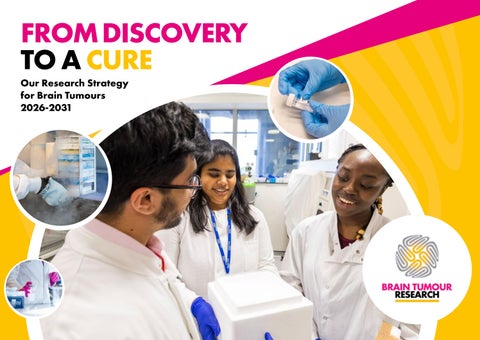
FROM DISCOVERY TO A CURE
Our Research Strategy for Brain Tumours 2026-2031
CONTENTS FOREWORD..................................................................................................................................3 CONNECTING OUR RESEARCH STRATEGY TO OUR VISION.........................4 OUR RESEARCH IMPACT.......................................................................................................6 OUR RESEARCH STRATEGIC AIMS:................................................................................8 Grow research capacity and infrastructures.....................................................8 Advance knowledge and deliver breakthroughs........................................12 Accelerate treatment development.......................................................................14 HOW WE WORK.....................................................................................................................17 WHAT WILL SUCCESS LOOK LIKE?..............................................................................18
2
FOREWORD Brain tumours kill more children and adults under the age of 40 that any other cancer. More than 100,000 people in the UK are estimated to be living with a brain tumour or the long-term impact of their diagnosis, yet the disease remains devastatingly underfunded. Brain Tumour Research is working tirelessly to change this. As the only national charity focused on finding a cure for all types of brain tumours, we are incredibly proud of what we have achieved so far. We have invested £37.5 million in research since 2009. We are supporting world-leading teams delivering science that will benefit brain tumour patients in generations to come, and initiatives which are underpinning the success of the UK and international brain tumour research communities. Our Brain Tumour Research Centres of Excellence are delivering real innovation. They are uncovering new knowledge about what drives tumour growth and how this can be targeted with personalised treatments. Their work is accelerating and underpinning new clinical trials for high-grade, low-grade and paediatric brain tumours. They are finding ways to improve existing treatments, enhancing their effectiveness and reduce their harm, and repurposing drugs to test whether these could prove effective for brain tumours. And they are collaborating with experts across the globe to share the knowledge and expertise that will get us closer to a cure. As of today, we are supporting 217 research personnel across our Centres of Excellence and Funded Initiatives who are dedicating their time and work to helping find a cure. This is the largest number we have ever had and this team continues to grow. Their work provides an inspiration to the brain tumour community in the UK and beyond.
But there is still a way to go. The simple truth is we need more researchers, more research and more scientific discovery so we get closer, quicker, to finding a cure. Our aim is to continue to grow our income through fundraising, so that we are able to invest more in our research community. We stand at a pivotal and profoundly hopeful moment for research into brain tumours. Rapid advances in science – fuelled by the data and artificial intelligence revolution, breakthroughs in genomics and the rise of personalised medicine – are transforming how we understand and treat diseases. In the UK, the unique potential of the NHS to support large-scale patient studies offers an unparalleled foundation for progress, provided regulatory frameworks evolve to keep pace with innovation. These shifts herald real opportunities to develop impactful treatments and, ultimately, cures for all types of brain tumours.
Dan Knowles, CEO Brain Tumour Research
Our Research Strategy 2026-2031 sets out an ambitious and focused framework for how we will use the funds we raise to drive research that delivers meaningful benefits for patients. It has been developed through extensive engagement with our Scientific and Medical Advisory Board (SMAB), and our research, patient and policy communities. This strategy reflects our commitment to being a catalyst for change – investing in research, infrastructure and partnerships that have the greatest possible impact. We invite researchers, clinicians, policymakers, funders and supporters to engage with our strategy and join us in accelerating progress towards a future where cures for brain tumours are within reach.
3
CONNECTING OUR RESEARCH STRATEGY TO OUR VISION Our Research Strategy 2026-2031 sets out how we will fund the research that brings us closer to our vision to find a cure for all types of brain tumours.
By tracking our progress against these strategic aims and being agile to adapt as needed, we will ensure the strategy stays effective and relevant.
Over the next five years, we will spend £24.3 million focused on three connected strategic aims.
How we work
Our research strategic aims:
GROW RESEARCH CAPACITY AND INFRASTRUCTURES
Our research strategy is underpinned by four enablers that shape how we work. Combining rigorous scientific oversight with a patient-centred approach, we will fund research that is both world-class and aligned with patient priorities. We’ll continue to deliver a programme of targeted policy and advocacy to create a favourable environment for research into brain tumours in the UK. And by forging strong partnerships and collaborations we will amplify the impact of our funding, complement the work of others and drive innovation.
Our foundations ADVANCE KNOWLEDGE AND DELIVER BREAKTHROUGHS
ACCELERATE TREATMENT DEVELOPMENT 4
Brain Tumour Research is built on strong foundations, which ensure the Charity operates with integrity and impact. Robust grant and financial management mean that every donation we receive is used responsibly and effectively to support highquality research. Being a trusted, professional and values-driven organisation allows us to build strong relationships with all our communities. And having a positive and inclusive working culture ensures that our organisation continues to thrive and our team can turn ideas into action.
“
Through the strategic allocation of our resources, we are strengthening the conditions for innovation, collaboration and scientific progress. In doing so, we are accelerating the development of new treatments in order to improve outcomes for people affected by brain tumours. We are striving towards a future where a brain tumour diagnosis is no longer defined by uncertainty, distress and limited options, but where patients have hope, personalised care pathways and a realistic expectation that they will get better.
“
Dr Karen Noble, Director of Research and Policy at Brain Tumour Research
OUR STRATEGY OUR VISION OUR STRATEGIC AIMS
HOW WE WILL ACHIEVE OUR AIMS
To find a cure for all types of brain tumours
Grow research capacity and infrastructures
Build a network of UK Research Centres of Excellence to drive priority research and train research leaders
Engage crossdisciplinary expertise
HOW WE WORK
OUR FOUNDATIONS
Rigorous scientific oversight
Robust grant and financial governance
Accelerate treatment development
Advance knowledge and deliver breakthroughs
Invest in collections, tools and resources
Strengthen translation capacity for research into brain tumours
Patient-centred research approach
Targeted policy and advocacy
Trusted, professional and values-driven organisation
Foster collaboration and knowledge sharing Drive more treatments into clinical trials and speed up patient access to trials
Partnerships and collaborations
Positive and inclusive working culture
5
OUR RESEARCH IMPACT Brain Tumour Research has been driving progress towards a cure since the Charity was launched in 2009.
315
research personnel supported
We have contributed
£79.2 MILLION
to the national investment in research into brain tumours through our funding and leveraged funding by our Centres 6
Brain Tumour Research has funded
Centres of Excellence have leveraged
£41 MILLION
54
and forged 181 national and international collaborations
PhD studentships
Total of
More than
directly awarded to research
awarded to Centres of Excellence
£37.5 MILLION Research we have supported underpins
8
clinical research studies
£30.1 MILLION
Brain Tumour Research funds
6 CENTRES of Excellence and 4 Funded Initiatives
7
OUR RESEARCH STRATEGIC AIMS Grow research capacity and infrastructures We will build and strengthen the foundations for research into brain tumours in the UK – investing in the infrastructure and talent needed to drive innovation, discovery and impact for patients.
By building a network of world-class UK Centres of Excellence to attract, train and inspire outstanding researchers to take on the complex challenge of brain tumours. Our aim is that our Centres grow into selfsustaining global hubs, attracting further investment and delivering lasting impact. We have awarded £37.5 million to research with £30.1 million of this invested directly into our Centres of Excellence since the Charity was launched in 2009. Our innovative Centre-funding model has enabled our researchers to leverage an additional £41.6 million from other funders, resulting in a total contribution to the national research investment of £79.2 million. This focus on leverage and growth for impact remains a priority. As research evolves, our funding approach must be agile – ready to adapt to new science, technologies and patient needs. With guidance from our SMAB, we’ll regularly review our Centres portfolio, launching new ones in priority areas and stepping back from those that are thriving independently, enabling us to focus where our investments are most needed. 8
“
The long-term vision of Brain Tumour Research and its sustained investment is key to our ambition of delivering a cure for glioblastoma. We were awarded £2.6 million to fund a five-year research programme that’s the first of its kind. For every pound the Charity invests, we are aiming to leverage further funding and philanthropic investment. This funding is enabling us to deepen our understanding of the biology of these aggressive and complex brain tumours, in order to improve treatments and ultimately achieve our goals to increase patient survival and improve their quality of life. Professor Ruman Rahman, Director of the Brain Tumour Research Centre of Excellence at the University of Nottingham
“
By supporting our Centres to create vibrant research environments where the next generation of research leaders is developed. And we expect our Centres to put special focus on:
• Nurturing the next generation of brilliant scientists – we’ll support our Centres to provide early career researchers with the funding, mentorship and career development opportunities they need to establish themselves in the field • Securing clinician involvement – recognising the critical role of clinicians in taking research to patients in the clinic, we’ll support our Centres to provide protected time for clinical academics to lead and contribute to the research programmes
“
For many researchers, one of the main challenges is the uncertainty linked to an academic career. Support from Brain Tumour Research has enabled me to establish myself and develop my career in this notoriously challenging area of science. Thanks to the Charity’s funding, I have been able to publish groundbreaking results in medulloblastoma, the most common aggressive paediatric brain tumour. I have progressed from postdoctoral researcher to Junior Principal Investigator, and now am on the path towards securing tenure at the university. Brain Tumour Research has been fundamental to the success of my career so far.
“
Dr Sara Badodi, Co-Investigator, paediatric brain tumour projects at the Brain Tumour Research Centre of Excellence at Queen Mary University of London
9
By providing funding for essential collections, tools and resources that the brain tumour research community needs to drive discovery. In our previous research strategy, we provided funding for BRAIN UK, a world-leading virtual brain tissue bank that has become a vital resource for many researchers working across the UK and internationally. Managing a database of more than 235,000 tumour tissue samples from the NHS Neuropathology centres, BRAIN UK acts as a “matchmaker”, connecting researchers with the samples they need to study neurological diseases, including brain tumours. Since 2022, we have partnered with the charity brainstrust to fund its Patient Research Involvement Movement (PRIME) to improve patient and public involvement in brain tumour clinical research. PRIME ensures that patient and caregiver insights shape the design of studies, helping make new treatments more responsive, supportive and aligned with real needs. As part of our Research Strategy 20262031, we will strengthen our existing partnerships and provide support for other essential research infrastructure.
10
By building strong connections and synergy across our funded portfolio. We will expand the opportunities for joint projects, secondments, and researcher exchanges across our Centres and Funded Initiatives. To support our Centres to further develop and thrive, we will establish a Coordinating Centre of Excellence. This Centre will establish infrastructure support to facilitate collaborations across our network. It will support collaborative research projects and funding applications, grow and develop the skills of researchers across our Centre network, and enable efficient resource and infrastructure sharing.
11
Advance knowledge and deliver breakthroughs With the oversight and expertise of our SMAB, we will ensure that our research portfolio maintains the breadth and depth needed to deliver impact for patients with all types of brain tumours.
By investing in Centres of Excellence focused on the highest priority and most impactful areas of research into brain tumours. Our Centre-funding model is a distinctive feature of how we work – supporting leading researchers to build multi-disciplinary teams that can take on complex challenges. In January 2025, we launched the Scottish Brain Tumour Research Centre of Excellence. Based across the University of Edinburgh and the University of Glasgow, the Centre is home to the UK’s largest group of glioblastoma researchers, working to bridge the gap between laboratory discovery and future treatments for patients. The Centre brings together expertise in drug discovery, radiotherapy, gene therapy and advanced laboratory modelling. This multidisciplinary approach is helping researchers develop new therapies, improve how medicines are tested in the laboratory and generate the preclinical data needed to attract investment into future clinical trials.
12
By providing targeted funding for strategic partnerships and initiatives. We’re always open to exploring the potential for partnership and initiatives where our support can help make a difference. Additionally, by collaborating with experts and organisations working in areas allied to the brain tumour field – such as improving drug delivery to the brain – we can bring in fresh perspectives and expertise to drive innovation and deliver breakthroughs. In 2023, we partnered with the UK Medical Research Council (MRC) to fund a three-year project at Cardiff University to develop a new surgical approach to deliver drugs directly to the brain. Supporting bold ideas and new collaborations remains a core part of our research strategy.
By prioritising knowledge sharing across all the research we fund, we enable research findings to reach those who need them faster. We will require all funded research to be published open access and will support the sharing of findings – including null and negative results, data, tools, and materials like tissue samples and in vitro models. We’ll also create more opportunities for researchers across our Centres and projects to collaborate and share expertise and insights.
13
Accelerate treatment development Through all our funding, campaigning and policy work, we will accelerate treatment development for all types of brain tumours, focusing on growing the pipeline of available treatment and innovative therapies. We will make sure that more treatments make it into clinical trials, while increasing equitable patient access to trials and treatments.
By continuing to invest in the Brain Tumour Research Novel Therapeutics Accelerator (BTR-NTA). Turning promising research into effective treatments means overcoming key hurdles – like building strong preclinical evidence, meeting safety and regulatory requirements, and designing practical clinical trials. To tackle these challenges, we established the BTR-NTA in 2023 with the Tessa Jowell Brain Cancer Mission. This initiative offers expert, independent advice to help academic and industry teams reduce risk and speed up the development of new drugs and devices. At the time of writing, the BTR-NTA Committee has received more than 33 applications and supported the development of 15 potential therapies. But there is more to do. In our Research Strategy 2026-2031, we will explore providing support for research teams to advance the most promising therapeutic candidates identified by the BTR-NTA toward clinical development.
“
The BTR-NTA programme provided robust translational support, helping us to advance our preclinical work with models that better represent the complexity of the disease. In addition, it offered valuable guidance across several highly relevant sectors, including engagement with patient advocate groups. Importantly, the programme expanded our network and enabled concrete collaborations in both preclinical and clinical development. Overall, the accelerator has provided a powerful platform to strengthen our science, broaden our partnerships and accelerate the path towards meaningful therapeutic impact for brain tumour patients.
“
Anonymised feedback from BTR-NTA applicant, August 2025 14
By building strategic partnerships to strengthen the translational research environment in the UK. We will work closely with healthcare providers, government, regulators, industry, funders and research bodies, so that promising discoveries can move more quickly from the lab to patients, and brain tumour patients can access the trials and treatments they need without delay.
By strengthening translational capabilities across our Centre network. We will build awareness and facilitate collaboration between our Research Centres and the BTRNTA. We will also ensure that our Centres have access to the expertise, skills and networks that are needed to rapidly turn scientific discoveries into clinical advances.
By delivering on our pledge to increase the number of brain tumour patients in clinical trials. As one of our key campaigning commitments, we are calling on the UK Government to work with us to increase the number of brain tumour patients who are part of a clinical trial. To achieve this, we will continue to campaign for more discovery research into new treatments that will have an impact on the long-term; seek to make the UK a more attractive environment for pharmaceutical companies to invest in drug development and clinical trials and push for commitment to 100% access to whole genome sequencing for brain tumour patients alongside fresh frozen tissue storage in all possible instances.
15
16
HOW WE WORK “
The SMAB provides expert, transparent and independent assessment of the research activity at the Brain Tumour Research Centres of Excellence and other Funded Initiatives, aiming to ensure the Charity is investing in the most promising science and building capacity to drive progress towards a cure for all types of brain tumours. All members of the Board bring world-leading expertise and experience, and have been recruited to strengthen its depth and breadth, and bring a fresh perspective. Professor Tony Marson, Chair of the Brain Tumour Research SMAB, Professor of Neurology and Dean of the Institute of Systems, Molecular and Integrative Biology at the University of Liverpool
“
Rigorous scientific oversight
Targeted policy and advocacy
Our SMAB plays a vital role in guiding our funding decisions to maximise the impact of our research investments. It is comprised of internationally recognised experts and patient representatives to ensure that our funding decisions are informed by rigorous and independent peer-review and aligned with our strategic aims.
Working closely with government, healthcare, and industry partners we will prioritise research into brain tumours. Through our new strategy, we’ll lead targeted policy and advocacy efforts to improve funding, deliver on our campaigning commitments, and, build on the full release of the £40 million pledged in 2018 for research into brain tumours – a longstanding campaigning priority.
From 2026, we’ve given the SMAB a bigger role in guiding our research. Each year, it will review our research portfolio to ensure that our funding remains focused on areas with the greatest potential for impact for patients. We’re also committed to regularly evaluating all Funded Initiatives and Centres and conducting in-depth five-year (quinquennial) reviews of our awards to make sure our funds are being used in the most effective way.
Patient-centred research approach Patients are at the heart of everything we do. Their experiences and insights are crucial to making sure that the research we fund is aligned with the priorities of people affected by brain tumours. In addition to including patient representatives in our SMAB, our dedicated patient advisory group brings lived experience perspectives into our decision making. We will also continue our investment in the PRIME – helping to ensure that patients are actively involved in shaping research that makes a real difference to lives.
We will increase our advocacy outreach involving even more of the UK brain tumour community in groups and forums, and maintain regular communications continuing our position as a portal connecting patients and families to changemakers.
Working through partnerships and collaborations We know that no single organisation can tackle brain tumours alone. That’s why we’re committed to building strong partnerships with others who share our goals – including charities, research funders, universities, healthcare providers and industry. By working together, we can share knowledge, unlock more funding, and make sure our efforts complement each other – making every pound raised go further in funding vital research into brain tumours. Our game-changing collaboration with Beatson Cancer Charity to launch the Scottish Brain Tumour Research Centre of Excellence leveraged our extensive experience in the medical research field and Beatson Cancer Charity’s strong community presence and expertise in cancer care in Scotland. This partnership is supporting world-leading brain cancer experts to accelerate research into glioblastoma, and demonstrates how working together we are bridging the gap, providing preclinical proof-of-concept data to support the development of new clinical trials. 17
WHAT WILL SUCCESS LOOK LIKE? Over the next five years, we expect to see the impact of our approach through the continued growth of a vibrant, well-supported UK brain tumour research community with a strong international reputation. Our Centres of Excellence will be key to this, attracting and developing research leaders and leveraging additional funding and collaborations. We also want to see our investment in critical tools, collections, and resources benefiting researchers across the UK and beyond. This is a promising time for research in the brain tumour field. Our aim is to deepen our understanding of all types of brain tumour and deliver better treatments and outcomes for patients. We will support this through our Centres of Excellence, Funded Initiatives and strategic collaborations – focusing on urgent research questions and underpinned by a culture of knowledge sharing and multi-disciplinary teamwork and partnerships. Ultimately, success means ensuring that discoveries translate into real-world benefits. Through our support, partnerships and collaborations, we want to see more treatments advancing into clinical trials and fairer, faster access for patients across the UK. At its core, success is about improving lives – helping people with brain tumours live longer, with more treatment options, and with greater hope of cures for all types of brain tumours.
18
“
Being told you have an aggressive brain tumour is absolutely terrifying. I was told I have brain cancer and without surgery I have just three months to live. The game-changing research that the Charity is funding is incredibly exciting and I am hopeful it will lead to new clinical trials, treatments and, ultimately, cures for patients like me. This work is so important; it’s giving so many in our community hope and a genuine belief that in the future, people who are diagnosed with a brain tumour will have options and a real chance that they will get better and not worse.
“”
Antiques Roadshow expert and mum-of-one Theo Burrell was diagnosed with glioblastoma in 2022. She became Patron of Brain Tumour Research the following year and worked tirelessly alongside the Charity to fundraise to support research, campaign for greater national investment and raise awareness of this devastating disease. Sadly, Theo passed away in July 2026, at the age of 39. – THEO BURRELL – PATRON 1 September 1986 – 8 July 2026
19
Brain Tumour Research Suite 37, Shenley Pavilions Chalkdell Drive, Shenley Wood Milton Keynes MK5 6LB Phone: 01908 867200 Web:
www.braintumourresearch.org
info@braintumourresearch.org
Registered Charity 1153487 (England and Wales) and SC046840 (Scotland) Company Limited by Guarantee 08570737