Issue 032 – Autumn 2026
The news magazine for
brain tumour activists
‘Mini brains’ accelerating childhood tumour treatments
+
First new adult brain tumour treatment in 20 years
&
COVER STORY
“ IT’S TIME
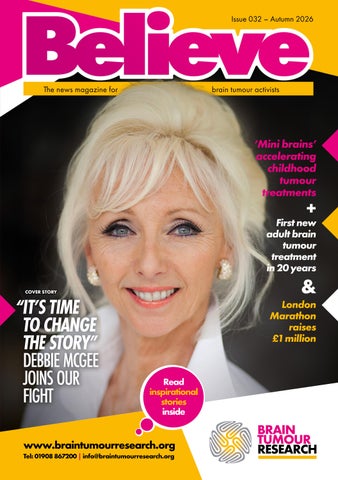
TO CHANGE THE STORY” DEBBIE MCGEE JOINS OUR FIGHT
London Marathon raises £1 million
Read inspirational stories inside
www.braintumourresearch.org Tel: 01908 867200 | info@braintumourresearch.org
OUR VISION
IS TO FIND A CURE FOR ALL TYPES OF BRAIN TUMOURS One in three people in the UK knows someone affected by a brain tumour. This disease is indiscriminate; it can affect anyone at any age. What’s more, brain tumours continue to kill more children and adults under the age of 40 than any other cancer.
Brain Tumour Research is determined to change this. A powerful campaigning organisation, Brain Tumour Research is the leading voice of the brain tumour community. Unique and much needed, we are the only national charity focused on finding a cure for all types of brain tumours. We are campaigning to increase the national investment in research into brain tumours to at least £45 million a year, while fundraising to create a network of seven sustainable Brain Tumour Research Centres of Excellence across the UK.
Help fund the fight Together we will find a cure
www.braintumourresearch.org Registered charity number 1153487 (England and Wales) SC046840 (Scotland).Company limited by guarantee number 08570737.
Contents 4 An update from our CEO 6 ‘Mini brain’ breakthrough for medulloblastoma treatment
22 Fundraise your way and help find a cure 24 New drug brings hope
8 Turning steps into hope
26 Finding a cure for glioblastoma
10 Debbie McGee: “It’s time to change the story”
28 Remembering our Patron
12 Ministers urged to prioritise brain tumours
30 My story: Young patients deserve better 32 Powering progress through partnership 34 Improving radiotherapy for glioblastoma
29 Championing change
36 You make life-changing work happen 37 Stay part of our community
14 My story: Honouring Alicia through action
38 Forever in our hearts
16 Accelerating transformative treatments for meningioma 18 One million reasons to run 20 Take on the ultimate ultra challenge
Cover story 10
“It’s time to change the story” Debbie McGee joins our fight
24
First new adult brain tumour treatment in 20 years
18
London Marathon raises £1 million
COVER HIGHLIGHTS 6
’Mini brains’ accelerating childhood tumour treatments
Edited by: Susan Castle-Smith, Alexa Copson, Liz Fussey and Atiyah Wazir at Brain Tumour Research, Suite 37, Shenley Pavilions, Chalkdell Drive, Shenley Wood, Milton Keynes MK5 6LB Printed by: Pollards, 1 Osier Way, Swan Business Park, Buckingham, Buckinghamshire MK18 1TB www.wearepollards.com Designed by: Clearthinking Creative, 51 Church Street, Hungerford, West Berkshire RG17 0JH www.clearthinkingcreative.co.uk Brain Tumour Research makes all reasonable efforts to ensure that the information in this magazine is correct at the time of printing. www.braintumourresearch.org Autumn 2026
3
FOREWORD
DRIVING PROGRESS, DELIVERING HOPE
Charities fund 74% of research into brain tumours. The Government contributes just 26%
It is estimated that 100,000 people in the UK are living with a brain tumour or the long-term impacts of their diagnosis. Yet, research into the disease remains unacceptably underfunded. Brain Tumour Research is working tirelessly to change this. This summer we launched our new Research Strategy 2026-2031, which will ensure that the funds you raise and donate are invested in research that will get us closer to our vision to find a cure for all types of brain tumours. Over the next five years, we will invest £24.3 million into research focused on three strategic aims: grow research capacity and infrastructure; advance knowledge and deliver breakthroughs; and accelerate treatment development. Our new strategy builds on more than 17 years of impact, during which time Brain Tumour Research has invested £37.5 million directly in research, supported 315 research personnel and contributed £79.2 million to the national investment through our funding and leveraged funding by our Brain Tumour Research Centres of Excellence. But we know that charities cannot do it alone – and it remains unacceptable that charities fund 74% of research into brain tumours, while the Government contributes just 26%. That is why campaigning for governments and larger charities to increase their investment remains at the heart of our mission. Campaigning is a long game, but we have helped drive a number of significant milestones in 2026. Not least, the passing of the Rare Cancers Act, which we helped shape from the outset and which has the potential to transform outcomes for brain tumour patients. We also played our part in ensuring the
4
Autumn 2026 www.braintumourresearch.org
approval of vorasidenib, the first new adult brain tumour treatment in 20 years. Vorasidenib is now available on the NHS to treat certain types of low-grade glioma. I am proud of the role Brain Tumour Research played in supporting the case for this new drug as it moved through the lengthy regulatory and approval process. On pages 24-25 you can read what this means to patients. Poignantly, vorasidenib’s approval came during Brain Tumour Awareness Month, when our community comes together to raise awareness and demand governments do more. Thank you to all of you who stood with us during our biggest Brain Tumour Awareness Month yet. Brain Tumour Awareness Month was established more than two decades ago by a group of charities that went on to become founding members of Brain Tumour Research. Those founding members remain part of our family today and the impact they have made is beyond measure. And I am delighted that our family continues to grow, with the Anni Hofmann Foundation joining us as our newest Member Charity. With a personal connection to brain tumours, the Foundation is committed to funding research into the disease. You can read more on pages 32-33.
d Dan Theo an
Celebrating the passing of the Rare Cancers Act
Finally, I would like to pay tribute to our phenomenal Patron, Theo Burrell, whom we sadly lost to glioblastoma on 8th July 2026. Theo was a powerhouse and constantly inspired us with her absolute determination to make a difference for others. I encourage you to read more about her support of our Charity and our community on page 28 of this magazine.
Every day 35 people are diagnosed with a brain tumour. Those people will have limited treatment options and for many, their prognosis will be lifelimiting. Our work gives them hope. But it is your support that makes this hope possible. I hope you find this latest issue of Believe a source of inspiration for how you can get involved and fundraise, donate, campaign and raise awareness to help us change the story for brain tumour patients across the UK. Together we will find a cure
In the lab at the Institute of Cancer Research
Dan Knowles CEO
P.S. Could you help us spread the word by sharing Believe in your community? To find out more, visit: www.braintumourresearch.org/ pages/believe-magazine
HELP US campaign for a
CURE www.braintumourresearch.org Autumn 2026
5
RESEARCH UPDATES
‘MINI BRAINS’ BREAKTHROUGH FOR MEDULLOBLASTOMA TREATMENT Medulloblastoma is the most common type of brain cancer in children with around 50 new diagnoses every year in the UK. In the last decade, Brain Tumour Research has committed £1.8 million to research into this devastating tumour type, and now, in a laboratory breakthrough, scientists at the Brain Tumour Research Centre of Excellence at Queen Mary University of London have identified the earliest steps in the development of medulloblastoma, a discovery which could transform the way the disease is studied and treated. Only 60% of children survive a medulloblastoma diagnosis beyond five years. Treatments are limited to surgery, radiotherapy and chemotherapy, which are not always effective and can result in long-term side effects.
Led by Professor Silvia Marino, a team has created 3D ‘mini brains’ in the laboratory – accurately recreating the environment in the developing embryonic brain where medulloblastoma originates. This technique not only has revealed insights to the development of medulloblastoma tumours, but it also provides a drug testing platform that replicates the human brain and is potentially better than existing animal models. By combining patient samples with mini brains grown in the lab, they can test drugs whilst monitoring toxicity to identify treatment options that specifically target cancer cells but spare healthy brain tissue, limiting the long-term impacts of therapy on children.
Together we will find a cure Professor Silvia Marino 6
Autumn 2026 www.braintumourresearch.org
Craig and Helen Forbes-Low, William’s parents
Helen Forbes-Low is from Member Charity, The William Low Trust, which funded Thomas Willott, a PhD student who carried out this research.
She said: “Our son, William, was just five when he was diagnosed with medulloblastoma and sadly didn’t see his 18th birthday. Since then, we have been committed to funding research to help make sure no one else has to go through what we did. We are proud of the role we have played in ensuring research like this at Queen Mary gets off the ground and can hopefully one day make a difference to children and families facing this devastating diagnosis.”
William after surgery
PhD student Thomas Willott
Your donation of £25 could provide the tools needed for an hour of discovery research by a PhD student in one of our Centres of Excellence. All donations of any amount make a difference. Visit: www.braintumourresearch.org/donate to give what you can. www.braintumourresearch.org Autumn 2026
7
WALK OF HOPE
Left: Lee with his sisters and partner Above: 2025 Walk of Hope inspired by Lee
Albie with Lauren and Hayley
8
Autumn 2026 www.braintumourresearch.org
TURNING STEPS INTO
HOPE
Our annual Walk of Hope brings people together to raise awareness and fundraise to support our work to find a cure for all types of brain tumours. Join us on Saturday 26th September at our flagship Walk of Hope at Chatsworth or organise your own walk at any time in a place that holds special meaning, in honour of someone you love. When you take part, you’re not walking alone. You’re part of a national movement, united in the hope of improving outcomes for brain tumour patients. Lauren and Hayley Bayliss-Watts, founders of our Fundraising Group Albie and Beyond, host a Walk of Hope each year in memory of their two-year-old son. Lauren said: “Inviting friends and family to a Walk of Hope each year gives us something positive to focus on. It’s an important part of the legacy we are building for Albie, whom we lost to an aggressive brain tumour after all treatment options were exhausted. “We walk through the beautiful Oxfordshire countryside, between two pubs, asking for a minimum donation per person, which includes a drink and a burger at the finish. The route is pushchair-friendly, so it’s perfect for families – and we make sure it’s a day everyone can enjoy.” Walkers supporting Brain Tumour Research
Paula Masters organised her first Walk of Hope five years ago to honour her brother Lee, who was diagnosed with an astrocytoma. She said: “Lee joined us for five Walks of Hope, but we sadly lost him in April 2026. This year will feel very different without him. As we walk along the Devon coastline, we’ll wear pink shirts with Lee’s name and photo, walking in his memory and bringing hope to others.”
Step forward to help find a cure for brain tumours wherever you are. It’s your walk, your way. We’ll support you with a digital guide and help from your local Community Fundraiser.
Walk of Hope officially takes place in September, but you can do your walk, your way, at any time. More information at:
www.walk-of-hope.org
www.braintumourresearch.org Autumn 2026
9
PATRONS AND AMBASSADORS
DEBBIE MCGEE: IT’S TIME TO CHANGE THE STORY
“
”
Television, radio and stage star, Debbie McGee, is the newest Patron of Brain Tumour Research.
Debbie has long championed the Charity, but is stepping up her support as she marks a decade since losing her husband, magician Paul Daniels, to a brain tumour.
“I’m incredibly honoured and humbled to become Patron of Brain Tumour Research. After this disease tore through my life, I began campaigning with the charity, which has done so much to highlight the injustice faced by patients and their families, creating a growing sense of momentum so now, finally, there is hope,” said Debbie, who is marking an illustrious 50 years in showbusiness. Having spent decades on our TV screens in The Paul Daniels Magic Show, the pair were starring in panto together when Paul began suffering lethargy and dizzy spells at the end of 2015. Despite an initial diagnosis of anaemia, Debbie noticed changes in her “bubbly” husband’s personality. Paul’s symptoms worsened and, in February 2016, the couple received the devastating news that he had a glioblastoma and had just weeks to live.
Debbie and Paul
10
Autumn 2026 www.braintumourresearch.org
Debbie cared for her partner of 38 years at their home until Paul died just a month later, in March 2016, at the age of 77. Shocked by the lack of treatment options, even in the decade after Paul’s death, Debbie began campaigning with us to highlight the injustice faced by brain tumour patients and their families. “Thanks to Brain Tumour Research, there is greater awareness and funding but much more needs to be done to get research out of the lab and into patients in the clinic. It’s important to me to campaign on behalf of all those people who are facing and will face a diagnosis. They deserve more – more treatments, more clinical trials, more time with their loved ones,” added Debbie.
Main image: Debbie sporting our Lock & Co. pink top hat Inset: Paul and Debbie on their wedding day
first Debbie’s as ent engagem lead to Patron is t our rs a supporte ope at Walk of H orth Chatsw
Follow Brain Tumour Research on social media for more updates.
www.braintumourresearch.org Autumn 2026
11
CAMPAIGNING
MINISTERS URGED TO PRIORITISE BRAIN TUMOURS Brain tumours kill more children and adults under the age of 40 than any other cancer. Despite this, brain cancer clinical trials have the lowest recruitment levels of all cancer clinical trials. Brain Tumour Research is campaigning for governments across the UK to address barriers in accessing trials and increase research funding.
Theo Burrell and Wes Streeting
Our calls for change are growing ever louder, and we are proud to have engaged with influential political leaders to ensure brain tumours are made a priority. During Brain Tumour Awareness Month in March, we welcomed Wes Streeting MP, then Secretary of State for Health and Social Care to our Scottish Brain Tumour Research Centre of Excellence. Mr Streeting toured facilities dedicated to testing innovative new approaches – including gene therapy – to tackling glioblastoma, a deadly brain cancer with an average prognosis of just 12 to 18 months. He met our Patron, Theo Burrell, who urged the Government to invest in research to bridge the gap between discoveries in the lab and new treatments reaching patients. Sadly, Theo died just a few months after the meeting, in July 2026, aged 39.
Mr Streeting’s response was encouraging: “We are losing far too many people, and far too much precious time to brain cancer, and we have a responsibility to do something about it.”
12
Autumn 2026 www.braintumourresearch.org
HELP US
to continue to fund long-term, life-saving research
Influencing UK Governments and larger cancer charities to invest more in brain tumour research
In Westminster, Sharon Hodgson MP, then Parliamentary Under Secretary for the Department of Health and Social Care, attended the All-Party Parliamentary Group on Brain Tumours (APPGBT) on Tuesday 2nd June, hearing accounts from patients and their families about accessing trials and treatments, and inequity in research across cancers.
Ms Hodgson acknowledged calls for faster diagnosis and treatment, improved survival, and better support saying: “Rare and less common cancers, including brain tumours, are a priority for this government. We are appointing a National Clinical Lead for Rare Cancers. As set out in our 10-Year Health Plan, we will make the UK a global leader in clinical research. This underlines our commitment to deliver for rare cancer patients and give all patients access to a clinical trial if they want one.” P
odgson M
Sharon H
We continue to work with parliamentarians, ministers, civil servants and charity partners to ensure that the plans laid out in the National Cancer Plan and Rare Cancers Act in 2026 are implemented in order to improve brain tumour patient options and outcomes.
Find out how you can help us drive change by campaigning with us: www.braintumourresearch.org/ campaign-with-us
www.braintumourresearch.org Autumn 2026 13
MY STORY
HONOURING ALICIA THROUGH ACTION Alicia
As we welcome Alicia-Adele’s Angels to our growing family of Fundraising Groups, we are inspired by Amanda Axiak’s determination to turn unimaginable loss into something positive following the devastating death of her only daughter. 14
Autumn 2026 www.braintumourresearch.org
“
I never imagined I would lose my daughter just 15 days after her first symptoms. Alicia-Adele was just 11 when she woke up with a numb arm on 10th April 2025. Within hours, it had spread to her face and leg. We were told it could be a stroke, so I rushed her to A&E. Two days later, we were given the devastating diagnosis: an inoperable and incurable brain tumour, a diffuse midline glioma. I had never heard of it – yet it would take my daughter’s life just 13 days later.
In Alicia’s memory, I’ve set up Alicia-Adele’s Angels to support Brain Tumour Research and help drive change. Our community is already standing with us – from friends and family to pupils and staff at Alicia’s schools – all coming together to fundraise and raise awareness. Please stand with families like mine. Support Brain Tumour Research, raise your voice, and help demand the action that patients so desperately need.
I will carry Alicia with me always. By sharing her story, I hope we can create change – Alicia was full of life – a talented dancer and and give other families the future gymnast, a loving sister, and the kindest soul. Even in hospital, she was comforting other children. we were denied. That was Alicia: always putting others first. Since losing her, I have learned the shocking truth. Brain tumours are the biggest cancer killer of children and the under-40s. Yet, treatment options have barely changed in decades. Families are being failed.
”
Amanda and Alicia
I am speaking out because this cannot continue. We urgently need the Government to invest more in research and ensure patients have access to clinical trials that could save lives.
hilly 10k
The Caerp
y
ia’s memor
ers in Alic
60 runn attracted
Find out about our family of Fundraising Groups: www.braintumourresearch.org/ our-fundraising-groups www.braintumourresearch.org Autumn 2026
15
RESEARCH UPDATES
ACCELERATING TRANSFORMATIVE TREATMENTS FOR MENINGIOMA Meningioma is the most common type of primary brain tumour, accounting for a third of all diagnoses. Yet, treatments have remained unchanged for decades, with risky surgery and damaging radiotherapy the only options. But your support is helping change the story. A £2.8 million investment, which we announced at the end of 2025, is helping the Brain Tumour Research Centre of Excellence at the University of Plymouth accelerate research to find new treatments for low-grade brain tumours, including meningioma. At the Centre, Dr Leandro Jose de Assis is leading research to develop non-surgical treatments. His work focuses on how meningioma cells use a protein called hexokinase 2 (HK2) to produce the energy they need to grow. But because HK2 is also used by healthy cells, it cannot be turned off without causing harm. Instead, Dr de Assis is investigating how HK2 interacts with other molecules within tumour cells to identify safer therapeutic targets. His research has revealed an unexpected link between HK2 and the androgen receptor – a protein inside cells that acts like a sensor for hormones such as testosterone. By targeting this interaction using a combination of enzalutamide (a hormone therapy already approved for treating prostate cancer) and hemin (a medicine used to treat a rare blood disorder), he has been able to significantly slow tumour cell growth in the lab. 16
Autumn 2026 www.braintumourresearch.org
Dr Leandro Jose de Assis
“Our next steps will focus on testing these approaches and understanding how best to target the pathways tumours rely on to survive,” Dr de Assis said.
Alongside surgery, radiotherapy remains a key treatment for many meningioma patients, helping to control tumour growth and relieve symptoms. However, it is not always effective, particularly for aggressive tumours. Some tumours can recur, grow more quickly and eventually become resistant. Dr Juri Na is leading research to understand why radiotherapy resistance develops and how it can be made more effective. She is examining how meningioma cells and their surrounding environment change after radiation, and the role of immune cells in treatment response. Dr Na aims to identify weakness that could be targeted to stop aggressive meningiomas from becoming resistant to radiotherapy.
Creating a network of seven sustainable Brain Tumour Research Centres of Excellence across the UK to find a cure
Together we will find a cure
The team is also investigating whether combining radiotherapy with specific drugs could enhance its effectiveness without needing to increase the radiation dose, to reduce side effects and protect healthy brain tissue. They are focusing on repurposing drugs already approved for other diseases – an approach could lead to more effective treatments reaching meningioma patients faster.
Dr Na said: “By understanding why tumours become resistant and identifying ways to enhance radiotherapy without increasing toxicity, we hope to pave the way for more effective and longer lasting treatments for patients with aggressive disease.”
Dr Juri Na
For regular updates on how your support is helping us get closer to a cure, subscribe to receive our weekly emails: www.braintumourresearch.org/subscribe www.braintumourresearch.org Autumn 2026
17
FUNDRAISING Tom and Vicky
ONE MILLION REASONS TO RUN The 2026 TCS London Marathon once again proved to be our biggest fundraising event of the year. A remarkable team of 162 runners crossed the finish line, raising an unprecedented £1 million to bring hope of better outcomes for people affected by brain tumours.
Among them were Charity Ambassadors and rugby players Tom and Vicky Chapman, who proudly earned their first marathon medals while raising more than £30,300. Tom’s achievement is especially extraordinary. Diagnosed with a grade 4 astrocytoma in 2025 at just 31, he completed his ninth round of chemotherapy shortly before race day.
Trevor Harding also raised more than £17,000, running for his son Conor, who was diagnosed with a glioblastoma aged 20 in 2025, after battling leukaemia on four separate occasions throughout his childhood. Meanwhile, Stefan Winder ran in support of his partner, Abi Feltham – influencer, podcaster, and one of our dedicated Ambassadors – raising close to £9,400. Abi is living with a grade 3 oligodendroglioma.
Trevor and Conor
18
Autumn 2026 www.braintumourresearch.org
Diagnosed with a high-grade medulloblastoma at 19, Ned Hilton has endured surgery, radiotherapy and chemotherapy, leaving him with life-changing hearing loss. Now 25, he added £9,700 from the Marathon to the £4,500 he had already raised through a skydive. For some, the journey to the start line spanned continents. Jack Wong flew from Singapore, determined to honour his friend Andrew Blatchford, who died from a glioblastoma in 2021 aged 30. Jack’s incredible effort raised almost £5,000. Stefan
Jack
Others ran to support loved ones living with the condition. Fifty-year-old teacher Sally Harley took part after her partner Bob was diagnosed with multiple meningiomas and later NF2 schwannomatosis.
She said: “Training gave me focus, routine and a real sense of purpose. I’m running because I can – and because Bob is living with something he can’t escape.”
Sally
Ned
Feeling inspired? Visit our website to find your perfect challenge: www.braintumourresearch.org/ events or turn over to discover a truly epic way to fundraise for us. www.braintumourresearch.org Autumn 2026
19
FUNDRAISING CHALLENGES
TAKE ON THE ULTIMATE Take on an Ultra Challenge for Brain Tumour Research, push your limits and help fund life-changing research while supporting our influential campaigning.
ott on ra and Sc lt Lauren ssic Coast U ra the Ju
Whether you want to get fitter or take on a new personal goal, these events offer the perfect opportunity to make every step count. Walk, jog or run, go solo or sign up with friends, family or colleagues, knowing your efforts are giving hope to people affected by brain tumours. Brain Tumour Research has partnered with Ultra Challenge to offer 22 events across the UK, including the Jurassic Coast and North Norfolk. With distances ranging from 10km up to 100km, you can find the perfect challenge for you. Choose from stunning coastlines or rolling countryside with full support along the way, including rest stops with food and drink. You will also have access to a challenge app, plus GPS navigation and route maps to keep you on track, so your sole focus is reaching the finish line.
And when you cross the finish line, you’ll get your well-earned medal, a glass of fizz, a welcome massage and a rejuvenating meal.
CHALLENGES INCLUDE: London Winter Walk Saturday 30th or Sunday 31st January 2027 Distances from 5km up to a full marathon
The Borders Ultra Challenge Saturday 28th and Sunday 29th August 2027 10 miles, 42km or 84km
Start at the Oval Cricket Ground and take in London’s iconic landmarks.
Follow the Berwickshire Coastal Path north from Berwick-upon-Tweed. Optional overnight camping.
Bath 50 Ultra Challenge Saturday 20th March 2027 10km, 25km or 50km
Set off from Bath Racecourse, pass the famous Royal Crescent and follow the River Avon. Lake District Ultra Challenge Saturday 5th and Sunday 6th June 2027 10km, 25km, 50km or 100km
Take in spectacular fells, lakes and forests, with optional camping. 20
Autumn 2026 www.braintumourresearch.org
Right: Hariette finishes the South Coast 25 Below: Israr ahead of the Isle of Wight Ultra
ULTRA CHALLENGE
Main image: Kent Downs 50 Ultra finishers
Take on an Ultra Challenge and help us move closer to a cure for all types of brain tumours. www.braintumourresearch.org/events www.braintumourresearch.org Autumn 2026
21
FUNDRAISE
FUNDRAISE
YOUR WAY From hosting games nights for friends to taking on sub-zero Arctic treks, fundraising comes in all different shapes and sizes. It’s a cliché but it’s true, every pound really does count in our fight against brain tumours. And fundraising is more than just the money raised. It’s a way to support loved ones, bring communities together, and give hope in the midst of heartache. It’s the knowledge that you are changing the story for people affected by this devastating disease. To inspire you, here are a few amazing supporter stories.
In Glamorgan, Kerry Byles and 10 colleagues took the plunge and braved a cold water dip, raising nearly £600. Kerry was just 23 when she was diagnosed with a low-grade brain tumour.
22
Autumn 2026 www.braintumourresearch.org
After meeting during a Sahara trek for Brain Tumour Research, a six-strong team completed a gruelling 100km canoe across the Scottish Highlands. The ‘Paddles for Progress’ challenge raised more than £9,000. Hannah King-Page, who launched Fundraising Group Hannah’s Kingdom following her glioblastoma diagnosis in 2020, said the epic feat was a “challenge, but truly exhilarating”.
Patron Pete Waterman is best known for being a music mogul. But he’s also a keen railway enthusiast and signed first-day covers for postage stamps celebrating Hornby Hobbies’ 125th anniversary and the best of model railways. Sales of the stamps raised more than £1,000.
Keen crown green bowler, Bev Beeley, gathered players at her club for a second year running, where they indulged in a friendly competition, food and a raffle. Committed fundraiser Bev has supported Brain Tumour Research, inspired by her son Dan Wilkinson, who died of glioblastoma in 2023. Dan’s memory has now inspired more than £10,000 in fundraising.
Whether you know what your next fundraiser will be or you’re just starting to think about supporting Brain Tumour Research, your Community Fundraiser is here to help with everything you need, including practical guidance for planning your event and ideas to inspire you, and encouragement to make your experience unforgettable.
Ready to get started? Scan the QR code or visit: www.braintumourresearch.org/ get-fundraising
www.braintumourresearch.org Autumn 2026
23
CAMPAIGNING
NEW DRUG CURE BRINGS HOPE HELP US campaign for a
Sally collecting her first dose of vorasidenib with husband Brett
Vorasidenib, a new drug to treat low-grade glioma, has been approved for use on the NHS. As the first new adult brain tumour treatment in 20 years, it’s being offered to patients who have undergone surgery, but where radiotherapy and chemotherapy aren’t immediately necessary.
It can be used to treat adults and children aged 12 years and older with grade 2 astrocytoma or oligodendroglioma with a susceptible isocitrate dehydrogenase mutation (IDH1 or IDH2) – and helps to stop or slow tumour growth.
“
I’ve got many years ahead of me because of vorasidenib
”
Sally Penny, 43, was diagnosed with a grade 2 oligodendroglioma in September 2024. The mumof-two found out about vorasidenib after searching online for tumour treatments when she was in A&E. She was referred to an oncologist who explained she’d be eligible for vorasidenib via a special access scheme. She’s been taking the drug since April 2025 and has scans every three months alongside monthly blood tests.
24
Autumn 2026 www.braintumourresearch.org
Sally is doing well and is passionate about the need for better patient outcomes. She said: “It’s essential to have access to drugs and every patient deserves this opportunity. When I was diagnosed, I cried for three months and was frightened. Because of vorasidenib, I will be able to witness the important milestones in my children’s lives. My family and I are full of hope and we want to see more investment in research to find successful treatments, and a cure.”
Dr Scott Arthur MP with Abi Feltham
Rare Cancers Act: a milestone for the brain tumour community The Rare Cancers Act became law this year, enabling a review of the UK’s Orphan Drug Regulations so that more patients could access innovative new treatments. It could also pave the way for more clinical trials and prioritise research to improve survival rates for rare cancers, including brain tumours. Working closely with Dr Scott Arthur MP and other charities, we’ve helped to shape this landmark Act which could bring real benefit to the brain tumour community. Our Ambassador Abi Feltham, who lives with an incurable oligodendroglioma, attended the House of Lords to witness the Act being enshrined in law and welcomed this landmark moment for the brain tumour community.
There are lots of ways to get involved with our campaigning. Find out more: www.braintumourresearch.org/campaign-with-us
www.braintumourresearch.org Spring 2026
25
RESEARCH UPDATES
FINDING A CURE FOR GLIOBLASTOMA Every year, around 3,200 people in the UK are diagnosed with a glioblastoma.
These fast-growing tumours are incredibly challenging to treat due to their complex nature. Glioblastoma cells invade healthy areas of the brain and, even when removed by surgery, the tumour will always come back. Scientists at the Brain Tumour Research Centre of Excellence at the University of Nottingham are reshaping how we study glioblastoma, paving the way for new treatments. Using a technique called mass spectrometry imaging, PhD student Une Kontrimaite is analysing individual cells in glioblastoma tumour margins (where the tumour spreads into healthy tissue). She is able to see how tumour cells differ from each other, how they change when healthy cells are nearby, and how the healthy cells are affected by the cancer cells.
Brain tumours are indiscriminate; they can affect anyone at any age
“We are working to understand how important these molecules are in shaping cell behaviour, and if disrupting the biological processes linked to these molecules will impact the tumour. This will help us identify which processes could be targeted in future treatments,” said Une.
Glioblastoma cells and astrocytes co-cultured to investigate metabolic interactions Credit: Brain Tumour Research Centre of Excellence at the University of Nottingham 26
Autumn 2026 www.braintumourresearch.org
Dr Ben Newland in his research lab
Building a network of experts in sustainable brain tumour research
A key challenge facing glioblastoma patients is the fact that treatments for the disease have not improved in more than 20 years. A £75,000 funding boost from Brain Tumour Research is extending the pioneering ‘super sponge’ project at Cardiff University. Led by Dr Ben Newland, and bringing together researchers from across the UK, the project aims to develop a unique sponge-like system that delivers drugs directly to the brain, to kill the glioblastoma cells left behind after surgery and prevent the tumour from returning. Dr Newland knows the devastation of a glioblastoma diagnosis – his father, Nick, sadly died of the disease in 2023.
The investment builds on a £500,000 award, delivered in partnership with the Medical Research Council (MRC), which has supported the project for three years. The additional funding will help to refine the ‘super sponge’ delivery system and enable further testing to generate the data needed to take this approach to clinical trial.
Your support enables us to sustain these innovative research projects. To set up a regular donation, or donate what you can, today, visit: www.braintumourresearch.org/ donate-now www.braintumourresearch.org Autumn 2026
27
PATRONS AND AMBASSADORS
REMEMBERING OUR PATRON We were heartbroken to learn that Theo Burrell died at just 39 from glioblastoma in July 2026. An extraordinary Patron and deeply valued friend, Theo was a tireless campaigner who challenged inequalities faced by brain tumour patients while raising funds for life-changing research. Diagnosed in 2022, and fully aware of her prognosis, she was determined to use her voice to make a difference for others. Theo Burrell 1st September 1986 – 8th July 2026
Theo became a Patron of Brain Tumour Research in 2023 and played a pivotal role in launching the Scottish Brain Tumour Research Centre of Excellence, where scientists are working to move new glioblastoma treatments into clinical trials. She passionately supported campaigns including Wear A Hat Day and Walk of Hope, took on fundraising challenges, and organised her own events, including a memorable whisky tasting at The Caledonian Club in London. Her powerful speech at our 15th anniversary gala remains unforgettable. Even during treatment, Theo remained an active campaigner, visiting the Scottish Centre with Health Secretary Wes Streeting and later supporting the launch of our Manifesto at Holyrood. 28
Autumn 2026 www.braintumourresearch.org
Our CEO, Dan Knowles, said: “We are heartbroken to have lost the phenomenal, determined and truly inspiring Theo Burrell. She inspired us all with her courage and generosity, and we will continue our mission in her honour.”
CHAMPIONING CHANGE
This spring, Patron Alfie Boe used his ‘Facing Myself’ tour to spotlight our cause inspired by the loss of his father, to a brain tumour. Performing across the UK, he invited volunteers to collect donations, raising £10,000, as well as increasing awareness of our cause. Alfie also continues to champion others within the brain tumour community and supported 20-yearold student Rafe Colman-Chadwick during his run from John O’Groats to Land’s End. Meeting in Manchester, they bonded over losing their fathers to brain tumours.
Alfie and Rafe
Alfie said: “Losing his father to a brain tumour at just 12 years old is something no child should have to experience. Yet Rafe has turned that heartbreak into a challenge that will make a real difference for others.”
Rafe to ok 874-mil on an epic e run
www.braintumourresearch.org Autumn 2026
29
MY STORY
YOUNG PATIENTS DESERVE BETTER Following her daughter Connie’s tumour diagnosis when she was just 11, Tina Smith has been campaigning for better outcomes for young people. She says:
“
After experiencing sickness and migraines, Connie eventually underwent several scans followed by surgery to remove an orangesized tumour. As a parent you never forget that raw pain, of hearing such awful news and having to accept it. You fear you’ll lose your child to this disease, but you do whatever it takes to stay optimistic. A biopsy revealed a grade 4 medulloblastoma which required radiotherapy and chemotherapy. As a high-risk medulloblastoma patient who has already undergone surgery, chemotherapy and radiotherapy, Connie was eligible to participate in a clinical trial which we were told offered her the best chance of recovery.
Connie
We feel lucky that Connie was able to access a trial in the UK, but sadly this is not the case for many families, and many end up self-funding treatments overseas as they seek the hope they so desperately need.
We must do better in this country, so this hope is at home, and more clinical trials are available, so people don’t feel the need to travel. I met with my MP, Iain Duncan Smith to explain how treatments have affected Connie. She still has scans every year and we live with a dark cloud over us, knowing the tumour could return. I take her to get hair extensions as she’s lost so much of her natural hair from chemotherapy. Tumours in young people are not given the same attention as adults and support is limited. I’ve found holistic therapies help Connie and nutrition plays a key role in maintaining her health. She’s 15 now and enjoys dancing and musical theatre but I worry about her future because she still has cognitive issues – a long-lasting impact of radiotherapy. 30
Autumn 2026 www.braintumourresearch.org
Mr Duncan Smith acknowledged that young patients deserve more effective, less debilitating treatment options.
He said: “I will continue to campaign for greater investment in research, expanded access to clinical trials, and improved outcomes for brain tumour patients. I look forward to working with colleagues across Parliament and the wider brain tumour community to help drive the progress that patients and families deserve. Being a campaigner is easy; one story can influence change. I speak out so that one day other families won’t have to experience what we have.
Brain tumours are indiscriminate; they can affect anyone at any age
”
Iain Duncan Smith with Tina Smith
Contacting your MP is just one of the ways you can help us change the story. Find out more: www.braintumourresearch.org/ campaign-with-us www.braintumourresearch.org Autumn 2026
31
PARTNERSHIPS
POWERING PROGRESS THROUGH PARTNERSHIP Partnering with Brain Tumour Research helps change the future for people affected by brain tumours.
We are proud to welcome corporate partner Lovell Housing, which has committed to raising more than £100,000 over the next two years for Brain Tumour Research. The partnership was inspired by the loss of former Managing Director Mick Laws who died in January 2026, just 15 months after his diagnosis with a glioblastoma. The residential construction company launched its fundraising efforts this summer with two Big Golf Day Brainwaves in Wales and Manchester, raising £16,500.
Steve Coleby, Managing Director of Lovell, said: “This campaign is about turning grief into action – funding vital research and bringing hope to families affected by brain tumours.”
Manchester Golf Day
32
Autumn 2026 www.braintumourresearch.org
Mick and wife Jo
JOIN IN, DONATE,
help us fund the fight. Together we will find a cure
Jack and his mum Michelle
We have also announced a partnership with sports performance brand Cramp Killa, which will donate £1 from every sale of its anti-cramp products to Brain Tumour Research. Founder and endurance athlete Jack Dilger was inspired by his mother Michelle, who is living with a glioblastoma more than seven years after her diagnosis. Jack said: “Mum’s experience transformed my outlook on life and inspired me to build a brand with a purpose beyond sport.”
His decision to partner with the Charity is also influenced by his friendship with elite swimmer Archie Goodburn, who is living with three oligodendrogliomas.
Anni Hofmann
We are proud to welcome the Anni Hofmann Foundation as our first international Member Charity, joining our growing network working towards a cure for all types of brain tumours. The Foundation was established in memory of Anni, who died from a glioblastoma in 2012.
Chairman Harald Wack said: “The Anni Hofmann Foundation is committed to improving understanding of glioblastoma and funding research into more effective treatments. It’s great to be collaborating with Brain Tumour Research and we look forward to jointly supporting a dedicated research programme.”
Archie and Jack
Whether you’re a business looking to make an impact or a charity with a shared ambition, we’d love to hear from you. For more information, go to: www.braintumourresearch.org/ corporate-partnerships
www.braintumourresearch.org Autumn 2026
33
RESEARCH UPDATES
IMPROVING RADIOTHERAPY FOR GLIOBLASTOMA Radiotherapy is a key treatment for many brain tumours so finding ways to increase its effectiveness could prove game-changing for patients diagnosed with the disease. Recent findings from the Brain Tumour Research Centre of Excellence at Imperial College London are showing promising progress towards making radiotherapy work better against glioblastoma, the most common high-grade brain tumour affecting adults.
Dr Nelofer Syed
Radiotherapy works by damaging the DNA inside tumour cells. But glioblastoma tumours are able to repair this damage, meaning the tumours are resistant to the effects of the treatment. Dr Nelofer Syed and her team are exploring ways to stop this repair process and investigating a drug called ADI-PEG 20 which depletes cells of arginine, a key nutrient that some tumour cells depend on. Dr Syed’s team has revealed in laboratory experiments that ADI-PEG 20 can weaken glioblastoma’s ability to repair itself after radiation. They showed for the first time that this effect is linked to changes in the way the tumour controls its genes and, importantly, a reduction in the activity of key DNA repair genes. Because these genes are ‘turned down’, cancer cells are unable to repair radiation damage as effectively and accumulate damage, and as a result, the tumour cells are less able to survive the treatment.
Dr Syed said: ”Our findings suggest that combining this approach with radiotherapy, or with other treatments that damage tumour DNA, could help overcome resistance and make tumours more responsive, which could lead to better outcomes for patients.” 34
Autumn 2026 www.braintumourresearch.org
A ‘window of opportunity’ trial is now exploring when best to administer the treatment to maximise its effectiveness. The research team also plans to test it in combination with other therapies to see if it makes tumours more responsive to radiotherapy. Excitingly, early evidence suggests that the treatment activates the immune system, potentially paving the way for immunotherapy to be used in glioblastoma. This cutting-edge cancer treatment has so far failed in glioblastoma because these tumours effectively shut down the immune response. More research is needed, but these findings could open the door to unlocking this powerful treatment strategy for these aggressive tumours.
RECOGNISING RESEARCH EXCELLENCE
Brain Tumour Research is proud to co-sponsor the British Neuro-Oncology Society (BNOS) Young Investigator Award, which recognises young researchers who have made outstanding contributions to neuro-oncology in the UK. Our congratulations to Michael Bryan, who received the recognition for his work into how artificial intelligence (AI) could help design cancer vaccines for glioblastoma. BNOS President Professor Andrew Brodbelt, Michael Bryan and Brain Tumour Research Director of Research and Policy Dr Karen Noble
Glioblastoma accounts for one in three primary brain tumour diagnoses
Together we will find a cure
For regular updates on the research we fund, our support of the wider research landscape and all our latest news, subscribe to our Weekly Newsletter: www.braintumourresearch.org/subscribe www.braintumourresearch.org Autumn 2026
35
DONATE
YOU MAKE LIFE-CHANGING WORK HAPPEN Did you know that every donation to Brain Tumour Research helps us get closer to a cure for this devastating disease? Here’s how you can help drive vital progress:
help provide the £10 could tools needed for our
scientists to work out new ways to stop brain tumours growing
fund an hour of £25 could one of our researchers’
£50
time identifying targets for brain tumour treatments could fund two hours of a specialist scientist’s time investigating whether drugs for other diseases could have an impact on brain tumours ...and regular donations go even further, helping provide sustainable funding for life-changing research. Just £12 a month could help pay for everyday lab essentials that researchers need to beat brain tumours, while £25 a month could support MRI scan data analysis, revealing clues about brain tumours.
To donate what you can today, scan the QR code or visit: www.braintumourresearch.org/donate 36
Autumn 2026 www.braintumourresearch.org
STAY IN TOUCH
STAY PART OF OUR COMMUNITY We hope you have enjoyed reading the inspiring supporter stories, fundraising feats and updates on the work that your support is driving forward within this magazine. This is just a snapshot and there are lots of ways you can stay up to date with all the latest from Brain Tumour Research. ON SOCIAL MEDIA: For daily updates, news and the chance to connect with the community, search for ‘Brain Tumour Research’ on your preferred platforms and hit follow. VIA EMAIL: Subscribe to our Weekly Newsletter and receive a curated email in your inbox every Friday: www.braintumourresearch.org/subscribe ON OUR WEBSITE: Find everything you need to know about brain tumours, what we’re doing to find a cure and how you can get involved. IN YOUR HOME: Get the latest edition of Believe through your letterbox twice a year when you opt in to receive our postal mailings: www.braintumourresearch.org/ postal-mailings.
GIVE HOPE Fast forward to the festive season and we know many people will be looking for ways to support causes that matter to them. If you’re thinking of supporting Brain Tumour Research this December, keep an eye on our website and social media for details of our 2026 Christmas Appeal. And we’re excited to share that our popular Christmas cards will be back for 2026. You’ll be able to bag your favourites via: www.braintumourresearch.org/shop from October. www.braintumourresearch.org Autumn 2026 37
IN MEMORY
forever
in our hearts
38
From all of us at Brain Tumour Research, our love and thoughts are with all of you who inspire us and continue to support us in memory of your loved ones and colleagues, year after year.
Charlotte Alcock
Kathleen Campbell
Steve Fenty
Cara Hudnott
Peter Allen
Amy Carr
David Howard Field
Terry Jackson
Rosemary Allerton
Chris Carrington
Steven Forsyth
Adrian Jones
Alicia-Adele Axiak
Fiona Charles
Jean Frake
Brian Jones
Kim Ayres
Matthieu Chassagne
Philip Goater
Ellis Pritchard Jones
Sue Balcombe
Doreen Clarke
Phyllis Goldsmith
Amanda Jorgenson
Lucy Bancroft
Timothy Clews
Kevin Gratton
Samuel Keeble
David Basleigh
Nigel Coleman
Elizabeth Green
Jay Kennedy
Jason Bassett
Nicola Cooper
Karly Dawn Green
Gordon Kidling
Diane Bell
Gary Cragg
Taylor Grindley
Rodney Kindon
George Birch
Alec Dean
Gary Hannyngton
Andrew John Knight
Rosemary Birch
Christopher Delnon
Simon Hartshorne
Alan Lambert
Linda Bowden
Isabella (Bella) Depreli
Rosie Hassall
Mick Laws
John Brackston
Andrew Dumolo
Nicola Hepple
Susan Layton
Brenda Brook
Toni Dutton
Judith Hetherington
Dave Lee
Mike Brown
Ronald Eades
Rosemary Hill
Pamela Linham
Sara Burnell
Gary Edwards
Michael Hodgson
Lesley Lloyd
Lilian Butcher
Susan Edwards
Mandy Holden
Alexandra Lloyd-Head
Mervyn Evans
Brenda Hothi
Linda Lynch-Smith
George Fassenfelt
Andy Hubbard
Autumn 2026 www.braintumourresearch.org
We thought of you with love today, but that is nothing new. We thought about you yesterday, and days before that too. You are forever in our hearts.
Loved ones here include those lost to a brain tumour for whom we received funeral donations between January and June 2026.
Maureen Mace
Stephen Moy
Jean Plowright
Ray Sweeney
Alexander Mailer
Michael Mullarkey
Marguerite Pratt
Allan Tanswell
John Marshall
Susan Norel-Wilson
Terry Reed
Carol Taylor
Lee Masters
Patricia Norwood
Lindsay Richard
Tracey Jane Taylor
Martin Mayberry-Walker
Brian O’Connor
Graham Roberts
Robert P Thomson
Roger Mayhew
James Oram
Judith Sawyers
Kevin Towill
Sean McHugh
Richard Orna
Roger Seve
Steve Turnbull
Elsie Mills
Janice Owen
Eileen Sharman
John Vilton
Esteban Molina
Raymond Pape
Mark Simpson
Barbara Vond
Darren Morgan
Rev Angus Parker
Austen Smith
Christopher Wakefield
Christine Morrell
Marjorie Parkes
Clara Smith (Leila)
Gary Wheeler
Debbie Morris
Harish Patel
Mervyn Smith
Elaine Whitmore
Dave Mortby
Andrew Peck
Pamela Ann Smith
Eileen Wilkinson
David Perry
Tessa Smith
Margaret Willis
Allan Piper
Nicola Stretton
Isaac Wilton
John Platt
Iris Suters
Mark Winterslow
Toby Swann
Mary Ann Young
www.braintumourresearch.org Autumn 2026 39
LEAVE HOPE AS YOUR LEGACY After taking care of those you love, many supporters choose to leave a gift in their will to charity. It’s a deeply personal decision, but one that can create powerful new hope and lasting change for generations to come. Would you like your kindness to change someone’s future?
SCAN FOR MORE INFO
Together we will find a cure
www.braintumourresearch.org/legacy Registered charity number 1153487 (England and Wales) SC046840 (Scotland). Company limited by guarantee number 08570737.