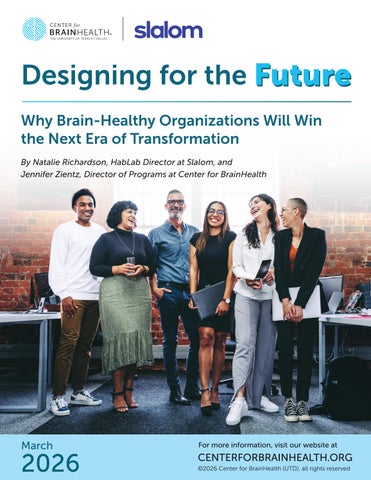
Designing for the Future: Why Brain-Healthy Organizations Will Win the Next Era of Transformation
Why Brain-Healthy Organizations Will Win the Next Era of Transformation
During BrainHealth Week 2026, Slalom and Center for BrainHealth co-hosted a conference called Designing for the Future: Brain-Healthy Organizations, sparking a strategic dialogue about economic competitiveness, adaptability, and what it will take for organizations to thrive in an era deļ¬ned by disruption.
A Stark Reality
We are living through a period of sustained cognitive intensity. Generative AI is reshaping how knowledge work is performed. Hybrid environments continue to redeļ¬ne collaboration. Entire industries are undergoing identity shifts. Leaders are asking their organizations to transform faster than ever before, all while maintaining performance, innovation, and engagement.
The central question facing business today is not whether change will continue. It is whether our organizations will have the cognitive capacity to keep up.
There is a fundamental friction between how we work and how our brains are wired. Despite this, only 5% of organizational transformations actually account for employee brain health.
The average American will spend about 90,000 hours at work in their lifetime.
Thatās a lot of opportunity for the workplace to build, mold and shape how our brains function. Mostly we do it in maladaptive ways, but we can change that.
In their presentation, Brain Healthy Tactics to Transform Organizations, Slalom leaders KC Hall and Ryan McCreedy, PsyD, posed a vital question:
What kind of brain is your workplace building?
Ultimately, true transformation is just behavior change at scale ā and it won't stick unless we protect the brains tasked with doing the work.
Science Meets the Real World
For decades, brain health has been categorized as a personal wellness issue, often relegated to beneļ¬ts programs or mental health resources. But advances in neuroscience underscore that brain health is ultimately about the continual, proactive development of the brainās potential for growth, to help us thrive in our lives. In fact, decades of research conducted at Center for BrainHealth demonstrates that the multiple components of the brainās health are tightly integrated, and that cognitive ļ¬tness creates change across all the components.
As director of programs, Jennifer Zientz is one of the architects of the Centerās Strategic Memory Advanced Reasoning Tactics
(SMARTā¢) brain training protocol: āOur team works with populations ranging from students to professionals and corporate executives, to military service members and veterans. Over and over, we demonstrate that empowering individuals and teams to be proactive in how they use and care for their brains can measurably improve brain health, no matter the starting point.ā
And increasingly, economic data is telling the brain health story. Cognitive capacity is a performance asset. It determines how e ectively leaders make decisions under uncertainty, how quickly
how resilient teams remain when under pressure, and how innovative organizations can be when faced with complexity.
During the panel, Leading with Brain Health, panelists discussed their experience turning human potential into measurable results. the question was posed:
A lot of employees pay for a gym for physical ļ¬tness. But are we investing in a gym for our brains?
Brain Health in the Workplace
When brain health erodes, the economic consequences follow. Burnout reduces productivity and increases turnover costs. Cognitive overload slows learning during technology adoption. Chronic stress diminishes creativity and impairs judgment. Disengagement erodes culture and customer experience. These are not abstract human resource concerns ā they are measurable ļ¬nancial risks.
Conversely, organizations that intentionally build brain-healthy environments strengthen their competitive position. They improve decision quality. They
accelerate adaptation during transformation. They increase retention of high-performing talent. They reduce the drag created by resistance and fatigue. They create cultures capable of navigating ambiguity without fracturing. And all the while, they decrease absenteeism due to mental illness or disease and increase overall productivity.
Slalom sees this dynamic play out in every major transformation e ort. Whether organizations are modernizing their technology stack, integrating
generative AI, redesigning their operating model, or evolving their culture, the greatest constraint is rarely strategy ā it is cognitive bandwidth.
Transformation is not just a systems event. It is a brain event.
Designing Transformation through a Brain Health Lens
Change can activate threat responses in the brain. Prolonged uncertainty depletes focus and executive function. Identity shifts, particularly during AI integration, create neurological friction that manifests as hesitation, resistance, or confusion. If leaders do not design transformation with the brain in mind, what appears to be a culture problem is often a biological one.
This is where the economic perspective becomes urgent. Organizations are investing millions ā and in some cases billions ā into digital
transformation and AI capabilities. Yet many fail to see expected returns
human cognitive infrastructure required to absorb and sustain change.
Strategy That Scales
Brain health not a wellness perk, but a performance driver.
Validated measurement tools āsuch as the BrainHealth Index developed at Center for BrainHealth ā can help demonstrate return on
investment to leadership. Securing leadership commitment is essential, particularly at the middle management level. E ective strategies include building business cases grounded in
data, sharing personal and peer success stories, facilitating open conversations, and identifying individuals with high social capital to serve as internal champions through peer-driven advocacy.
Leaders from a variety of industries shared their experience with implementation.
⢠ā¢
According to corporate consultant and former Shell executive Krystal Sexton, PhD, a small improvement in psychological capital can produce a measurable improvement in safety performance, a result she observed consistently over multiple measurement cycles.āWhat surprised me the most is how few people are required to implement it and make it successful, and how little capital investment is required,ā she said.
ā¢
Tate Ringer, chief strategy o cer at Metrocare, shared the experience of implementing brain healthy practices across the entire 1,200-person mental health services organization in four six-week sprints. Designated champions and department liaisons were given agency to disseminate information in the way that worked best for their teams. āI was surprised at how quickly people adapted, and the other surprise was it surfaced a problem we didnāt know we had ā related to multitasking and a [culture of] urgency.ā
Another organization working with Center for BrainHealth to implement brain-healthy strategies across its workforce over the past several years is HKS. āWe were amazed to see an 18% reduction in multitasking over a three-month period, along with greater mental energy linked to greater sense of accomplishment,ā stated Sam Mudro, president and CFO.
During his presentation, Making Brain Health a Performance Advantage, Kevin Gatley, operations o cer with the Optimal BrainHealth for Warļ¬ghters program at Center for BrainHealth, challenged the audience: āWe spend a trillion dollars developing AI, but nothing on developing our own brain. Your brain can become anything that you want it to become - you need the belief in change, agency to create change, and a process.ā
Technology investments without parallel investments in brain health create diminishing returns.
A brain-healthy organization is not one that simply reduces
stress. It is one that designs clarity to preserve cognitive resources, sequences change to prevent overload, fosters psychological safety to accelerate learning, and strengthens social connection to build trust. These are not abstract ideals. They are design principles that directly inļ¬uence productivity, innovation velocity, and the speed at which transformation delivers value.
Generative AI makes this reality even more pronounced. AI is not merely a technological upgrade; it is a cognitive shift. It alters how
decisions are made, how expertise is deļ¬ned, and how value is created. Organizations that rush to deploy AI tools without strengthening cognitive adaptability risk fragmentation, confusion about roles, fear about relevance, and erosion of conļ¬dence.
Organizations that invest in brain health during AI adoption, however, create something far more powerful. They cultivate curiosity instead of fear. They build ļ¬uency instead of fatigue. They increase learning agility instead of resistance. In economic terms, they accelerate time-to-value and sustain return on investment.
An Investment in Core Infrastructure
Clearly, brain health is not an expense line item. It is a capital investment. It is infrastructure. As director of Slalomās future of work lab, HabLab, this belief drives Natalie Richardsonās work every day. Richardson said, āBrain health is the infrastructure of transformation. If we want organizations that can adapt, innovate, and thrive through disruption, we must invest in the cognitive capacity of our people. This isnāt just about well-being āitās about ROI for organizations, industries, and economies. The future belongs to organizations that design for the brain.ā
In an economy increasingly deļ¬ned by knowledge work, human insight, and technological augmentation, cognitive capacity is the ultimate di erentiator.
Capital can be raised. Technology can be purchased. But adaptability āthe ability to think clearly under pressure, learn quickly, and collaborate e ectively āmust be cultivated.
BrainHealth Week presented a moment of alignment. The work ahead is execution. One participant shared how she will be incorporating the learnings. Jordan Lamar from WebMD Health Services shared, āAttending Brain Health Week at the Center for BrainHealth shifted my perspective on brain health in the workplace. As an epidemiologist with WebMD supporting organizations like bp, I initially assumed we needed to build entirely new
A Deļ¬ning Choice
programs to support brain health. Instead, I realized many organizations already have the building blocks in placeāitās about clearly deļ¬ning brain health, connecting employees to existing resources, and having leaders model those behaviors from the top down.ā
The organizations that will deļ¬ne the next decade will not simply be the most technologically advanced. They will be the most cognitively resilient. They will recognize that sustainable performance depends on protecting and strengthening the very organ that drives decision-making, innovation, and trust.
āThe workplace is where the adult brain is either built or destroyed,ā said Sandra Bond Chapman, PhD, founder and chief director of Center for BrainHealth. āNearly half of what we do at work is toxic to our cognitive health, so we must be proactive in building cognitive capacity, including our ability to synthesize new ideas and connect with others. If we want to stay competitive, we must stop treating brain health as an afterthought and start treating it as a strategic requirement. By protecting the brainās ability to think clearly and connect deeply, we don't just improve well-being, we future-proof the organization.ā
Business leaders now face a deļ¬ning choice: design organizations that deplete cognitive capacity in pursuit of short-term output, or design organizations that strengthen
brain health as a long-term performance strategy. The data, the neuroscience, and the economics all point in the same direction.
The future of transformation is brain-informed. And the future of competitive advantage belongs to organizations that treat brain health as the strategic asset it truly is.
Taking the Next Step
To see which of your own habits are helpful or harmful to your brainās health, take the Toxic Habits Quiz.
If you would like to continue this conversation ā to learn
cultivating a science-informed culture, measuring and tracking change ā the experts at Slalom and Center for BrainHealth stand ready to help you take the next step. Connect with us here