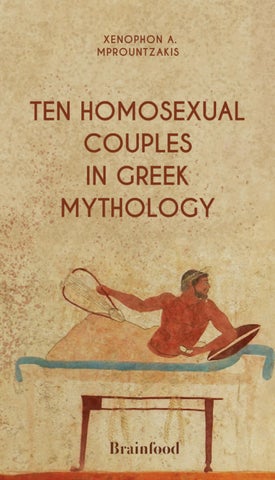
Ten homosexual couples in Greek mythology
XENOPHON A. BROUNTZAKIS
Ten homosexual couples in Greek mythology COPYRIGHT © BR AINFOOD DIGITAL MEDIA AND PUBLISHING M.E.P.E & X ENOPHON A . BROU N T Z A K IS PUBLISHING DIRECTOR
Nikos Chatzopoulos SERIES DIRECTOR
Xenophon A. Brountzakis TRANSLATED BY
Mike French & Vittorio Mattioli DESKTOP PUBLISHING & COVER DESIGN
Kostas Kofinas BR AINFOOD DIGITAL MEDIA AND PUBLISHING 28 Empedokleous Str., 12131 Peristeri, Athens, GREECE Tel.: +30 210 2514123 Email: contact@brainfood.gr www.brainfood.gr January 2026 ISBN: 978-618-5903-43-5 All rights reserved. No portion of the book may be reproduced, stored in a retrieval system, or transmitted in any form or by any means, mechanical, electronic, photocopying, recording, or otherwise, without written permission from the publisher.
Xenophon A. Brountzakis
Ten homosexual couples in Greek mythology
TABLE OF CONTENT Short essays about a little-known antiquity Introduction
9 11
Zeus–Ganymede Poseidon–Pelops Laius–Chrysippus Apollo–Hyacinth Apollo–Cyparissus Ameinias–Narcissus Dionysus–Ampelus Heracles–Iolaus Minos–Miletus Achilles–Patroclus
21 27 36 39 46 51 58 63 73 75
Appendix – Sappho the Lesbian Epilogue Author’s note Bibliography
86 96 99 102
SHORT ESSAYS ABOUT A LITTLE-KNOWN ANTIQUITY There is no such thing as a single ancient world; there are many. Most are not taught to people. We have learned to see ancient Greece through its marbles and statues, the catalogues of names of great men, lawmakers, generals, tragedians, philosophers. However, amongst the inscriptions and the stele, there were those who never found themselves in the picture. Those who talked, loved, challenged; those who contested, blasphemed, cried and were lost without getting statues made of them. This series is for those people. It is for the unofficial ancients. It is for Thersites with his deformity, who dared disrupt the rallying of the Achaean army. It is for Archilochus, who dragged the lyre from the ethereal down into the mud of life. It is for the wives, who contested the right to divorce in Athens. It is for the accused poet, the poor citizen, the Athenian citizen, who ended up in court for something he said, wrote or loved. These small essays resemble gestures that turn the gaze from the Pnyx to the shadow of the Athenian Agora; from the orator’s podium to the mouth of the everyday person; from the freezing cold of the immortals to the breath of mortals. 9
XENOPHON A. BROUNTZAKIS
Our goal is not truth but to follow those tracks that were left in the margins of texts, in the footnotes of commentators, in the dusty words that are seldom read, which carry another world that is as real as the main one. The ancient world was not monophonic. There was noise and silence, sweet words and cursing, song and mockery. This series is like a post scriptum: it is a supplementary voice that is written after the end of the main body. Just like letters that end too soon, leaving room for a sentence or two more, it is more real, more personal, more true. It looks through the small cracks that were left out of the official accounts. After all, the choice of sources always implies the exclusion of others. Each exclusion gives birth to its own postscript. Xenophon A. Brountzakis
10
INTRODUCTION We could say that homosexual relationships are as old as humankind. Our attempt focusses on a purely historical analysis without ideological, social or cultural bias: Culture, a product of consciousness and free will, paradoxically involves elaborate systems of prohibition. Different societies have different codes of sexual conduct, but in every society individuals transgress. The idea that there is a sexual line that must not be crossed but in practice often is, is far older than the story of Eve’s temptation by the serpent.1 Sexual dimorphism is not a modern discovery of some ‘corrupt souls’ but an ancient manifestation of sexual urges. In the history of humankind, around the world, there have been men and women who felt emotional and sexual intimacy with people of the same sex. So, we find stories referring to 1. Timothy Taylor, The Prehistory of Sex: Four Million Years of Human Sexual Culture, 1996, p. 10. 11
XENOPHON A. BROUNTZAKIS
souls and bodies of homosexual couples. Greek and Judaic sources are rich in such relationships, and these include similar occasions of love, friendship and companionship that have shaped the modern Western culture. To make these stories clearer, it is worth highlighting that some words do not have the same meaning today: for example, there are many ancient Greek words that do not distinguish between a ‘friend’ and a ‘lover’, just as they denote a male ‘partner’ as a companion but a female one as a whore. It was Plato himself who referred to the archetype of Attic lovers, Harmodius and Aristogeiton, who are considered to be the founders of Athenian democracy, by using the words ‘love’ and ‘friendship’ in the same sentence to describe their relationship: ‘for Aristogeiton’s love and Harmodius’s friendship grew to be so steadfast that it wrecked their power.’2 Ancient texts brim with similar examples of the use of these words, not just in ancient Greek but in other languages too. In Homer’s Iliad, the greatest heroic epic ever written by a human, we are told of the companionship between Achilles and Patroclus. We are shown a relationship between two bright men, who share in morality, manliness and beauty. The Iliad is dated to the early 12th century BCE. During the 2. Plato, Symposium, 182c. 12
TEN HOMOSEXUAL COUPLES IN GREEK MYTHOLOGY
6th century BCE, the lyric poet Sappho described the longing brought about by the love of a woman for another woman with unparalleled emotional clarity. Her words were so powerful that Sappho’s motherland, the island of Lesbos, has given us the term ‘lesbianism’, which describes female homosexuality. At this point, I would like to note that there are many more sources describing male homosexuality than female. This may be because most texts from that period were written by men and were written for men. Women are usually portrayed either as property or as the objects of lust. Even starting from Greek mythology, there are many more references to homosexual love than one would expect for a ‘rare’ and ‘deviant’ behaviour. We rarely find an ancient Greek source without at least some allusion to it: ‘They have a peculiar custom in regard to love affairs, for they win the objects of their love, not by persuasion, but by abduction […],’3 writes Strabo, the 2nd-century BCE historian, using a now-lost text by Ephorus, a historian and geographer of the 4th century BCE. This source makes me think of the story of Ganymede, with whom Zeus was smitten. It is one of the best-known mythological traditions from Crete. In Greek mythology, just like in others, we find many homosexual stories: 3. Strabo, Geographica, 10.4.2. 13
XENOPHON A. BROUNTZAKIS
[…] while the fashion of making favourites of boys was first introduced among the Grecians from Crete, as Timaeus informs us. But others say that Laius was the originator of this custom, when he was received in hospitality by Pelops; and that he took a great fancy to his son, Chrysippus, whom he put into his chariot and carried off, and fled with to Thebes.4 Athenaeus (c.170–223 CE) shifts the Cretan innovation to Thebes. It is Apollodorus who then adds an interesting detail. When Labdacus died, Laius was only one year old and it was first Lycus and then his nephews Amphion and Zethus who usurped the crown and exiled Laius near Pelops. There, he fell in love with his son Chrysippus while teaching him to drive a chariot and abducted him. The analogies are clear here: Laius was the trainer of Chrysippus, just like Poseidon was the trainer of Pelops: trainers and lovers concurrently. The poet Praxilla (mid-5th century BCE) swaps Laius with Zeus, but Pindarus also compared the abduction of Pelops by a god with the abduction of Ganymede by Zeus. In Greek mythology, there are many different sources that want to lay claim to ‘discovering’ pederasty. The stories of Hyacinth, Narcissus and Cy4. Athenaeus, Deipnosophistae, 13.79. 14
TEN HOMOSEXUAL COUPLES IN GREEK MYTHOLOGY
parissus have Sparta, Boeotia, Thessaly and Thrace as the birthplaces. But generally, there is no place in which there is no homosexual mythical-historical recollection. For Hyacinth, Apollodorus remembers two traditions – one for Thessaly and one for Sparta. According to the first, Hyacinth was the son of the muse Cleio and Pierus. A man named Thamyris fell in love with him, and he is considered to have introduced pederasty.5 Scenes depicted on Attic pottery show the strikingly beautiful Narcissus in the act of intercourse with Zephyrus. In most cases, homosexual intercourse is depicted with both men standing up: Greek mythology contains a number of important stories of pederasty. It is not hard to demonstrate that each of these originates in a particular region, and often it is clear that the myth in question is the myth of origin of homosexuality in a specific province or city. These are the grounding myths of a type of social behavior. […] Since we know that Greek myths preserve the memory of many vanished institutions, and in particular of ‘initiation rituals’, it is reasonable to assume that myths in which initiatory homosexuality occurs represent an 5. Pseudo-Apollodorus, Bibliotheca, 1.3. 15
XENOPHON A. BROUNTZAKIS
ancient form of Greek homosexuality. To put it another way, it is reasonable to assume that the Cretan ritual described by Ephorus is nothing other than a remarkable survival, in historical Greece, of an institution that was once much more widespread, and hence that initiatory homosexuality was in fact the prehistoric ante- cedent of the homosexuality of the classical era.6 In mythological references to homosexual relationships, myth usually acts as a mirror to history. It is clear that it is not possible for someone to thoroughly research the sexual history of a society that existed, with all its differences compared to modern society, 3,000 years ago. By considering this issue, one has to keep in mind that Greece, for example, was not a single entity in the way it is perceived to be nowadays. Each city had its own customs, beliefs and laws. Most of what we know comes from Athens, with homosexual references surviving in philosophical texts, tragedies and comedies, or in legal speeches, painting and sculpture. We even have a few surviving testimonies in medical texts in which ancient Greek doctors attempted to understand the biological dimensions of sexuality. A general conclusion is that homosexuality was a core element of Greek education and was not something people cared to discuss or comment on as they considered it normal. 6. Bernard Sergent, Homosexuality in Greek Myth, 1986, p. 57. 16