December, 2019
Volume IV, Issue III
Fall XlX
BracU bids farewell to graduates were able to overcome the obstacles in their lives and gain success. He then stated the 4 maxims that guided these individuals, “follow your heart, dare to be different, embrace failure, and walk your own path.” He encouraged the graduates to follow these steps as well. After his speech, the respected Chairperson of BracU’s Board of Trustees, Tamara Hasan Abed gave a heartfelt speech about the history of BracU and how the university has transformed into one of the best private universities in the country. She hoped that this legacy will continue with what Professor Chang calls Brac University 2.0. Following this, the convocation was dignified with the attendance of former United Nations Secretary-General, Ban Ki-Moon who delivered a motivating speech to the graduating students, where he affirmed that the students hold the key to unlocking a more sustainable, peaceful, and prosperous world and hoped that the new graduates will open the door for a better future for all. Moreover, honourable Minister of Education Dipu Moni, and Minister of Foreign Affairs Dr A K Abdul Momen were some of the guests of honour BracU was privileged to have. They shared their thoughts and journeys through their speeches.
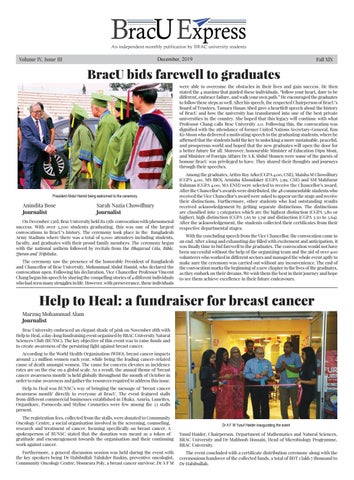
President Abdul Hamid being welcomed to the ceremony
Anindita Bose Sarah Nazia Chowdhury Journalist Journalist On December 23rd, Brac University held its 13th convocation with phenomenal success. With over 3,200 students graduating, this was one of the largest convocations in BracU’s history. The ceremony took place in the Bangladesh Army Stadium where there was a total of 9,000 attendees including students, faculty, and graduates with their proud family members. The ceremony began with the national anthem followed by recitals from the Bhagavad Gita, Bible, Quran and Tripitaka. The ceremony saw the presence of the honorable President of Bangladesh and Chancellor of Brac University, Mohammad Abdul Hamid, who declared the convocation open. Following his declaration, Vice Chancellor Professor Vincent Chang began his speech by sharing the compelling stories of 4 different individuals who had seen many struggles in life. However, with perseverance, these individuals
Among the graduates, Aritro Roy Arko (CGPA 4.00, CSE), Maisha M Chowdhury (CGPA 4.00, MS BIO), Arnisha Khondaker (CGPA 3.99, CSE) and SM Mahfuzur Rahman (CGPA 4.00, MA ENH) were selected to receive the Chancellor’s award. After the Chancellor’s awards were distributed, the 48 commendable students who received the Vice Chancellor’s award were asked to appear on the stage and receive their distinctions. Furthermore, other students who had outstanding results received acknowledgement by getting separate distinctions. The distinctions are classified into 3 categories which are the highest distinction (CGPA 3.80 or higher), high distinction (CGPA 3.65 to 3.79) and distinction (CGPA 3.50 to 3.64). After the acknowledgement, the students collected their certificates from their respective departmental stages. With the concluding speech from the Vice Chancellor, the convocation came to an end. After a long and exhausting day filled with excitement and anticipation, it was finally time to bid farewell to the graduates. The convocation would not have been successful without the help of the organizing team and the aid of over 400 volunteers who worked in different sectors and managed the whole event aptly to make sure the ceremony was carried out without any inconvenience. The end of the convocation marks the beginning of a new chapter in the lives of the graduates, as they embark on their dreams. We wish them the best in their journey and hope to see them achieve excellence in their future endeavours.
Help to Heal: a fundraiser for breast cancer Marzuq Mohammad Alam Journalist Brac University embraced an elegant shade of pink on November 18th with Help to Heal, a day-long fundraising event organised by BRAC University Natural Sciences Club (BUNSC). The key objective of this event was to raise funds and to create awareness of the persisting fight against breast cancer. According to the World Health Organisation (WHO), breast cancer impacts around 2.1 million women each year, while being the leading cancer-related cause of death amongst women. The cause for concern elevates as incidence rates are on the rise on a global scale. As a result, the annual theme of ‘breast cancer awareness month’ is held globally throughout the month of October in order to raise awareness and gather the resources required to address this issue. Help to Heal was BUNSC’s way of bringing the message of ‘breast cancer awareness month’ directly to everyone at BracU. The event featured stalls from different commercial businesses established in Dhaka. Azuria, Lunettes, Organikare, Parmeeda and Styline Cosmetics were few among the 23 stalls present. The registration fees, collected from the stalls, were donated to Community Oncology Centre, a social organisation involved in the screening, counseling, research and treatment of cancer, focusing specifically on breast cancer. A spokesperson of BUNSC stated that the donation was meant as a token of gratitude and encouragement towards the organisation and their continuing work against cancer.
Yusuf Haider, Chairperson, Department of Mathematics and Natural Sciences, BRAC University and Dr Mahboob Hossain, Head of Microbiology Programme, BRAC University.
Furthermore, a general discussion session was held during the event with the key speakers being Dr Habibullah Talukder Ruskin, preventive oncologist, Community Oncology Centre; Hosneara Poly, a breast cancer survivor; Dr A F M
The event concluded with a certificate distribution ceremony along with the ceremonious handover of the collected funds, a total of BDT 1 lakh 7 thousand to Dr Habibullah.
Dr A F M Yusuf Haider inaugurating the event
2 | BRACU Express
BRIEFS Asir Newaz takes on Voice of Business Irfan Akram On November 18th, Voice of Business’s signature event VoB week 2019 took place to celebrate the unveiling of the 10th issue of the annual publication. The event was organised by students from the Faculty of Business Studies Club of Dhaka University. The event had several exciting segments and sessions. Asir Newaz (Senior, Department of Economics and Social Sciences, BracU) took part in the writing competition that took place during the event and emerged as the first runner up. The topic given was “sharing economy”, and Asir’s essay discussed a system to include education into the sharing economy.
How to get a job at Google Tiash Roy On November 17th , BRAC University Computer Club (BUCC) organized a seminar on how to get a job at Google. The seminar was conducted by Fahim Ferdous Neejhor, a lecturer at the Department of Computer Science and Engineering (CSE) at BracU who was hired by Google. During the session, he talked about Google’s recruitment process and the requirements to join the company. Moreover, he divulged how he prepared before he applied for the job and showed some job circulars from Google. During the session, he said, “Don’t follow my path, it is better if you illustrate your own path.”
A film to remember Rifa Tamanna On 25th November, the day designated as the International Day for the Elimination of Violence against Women by the United Nations, BRAC University Law Society (BULS) partnered with Students for Liberty (SFL), the world’s largest voluntary pro-liberty student’s group, to screen the film, Rising Silence. The film was shown as part of the elective course Law 447, which is based on the study of Human Rights and is taught by the provost, Dr. Saira Rahman Khan. The film charted the sufferings of the Birangonas after the onset of the 1971 war and their subsequent stigmatisation by the state.
December, 2019
CAMPUS NEWS
4th BIRDS International Workshop Jamiur Rahman Journalist The Joint Global Multi-Nation Birds Satellite Project, also known as the BIRDS Project is a multinational project which aims to develop new space programs among non-space faring countries. The project is supported by the Kyushu Institute of Technology (Kyutech) in Japan and brings together students, professors and other stakeholders connected to the institution. Since 2016, Kyutech has been organising workshops in different countries around the world. This year the workshop venue was Dhaka, where the 4th session of the event was jointly hosted by Brac University, the Japan Society for the Promotion of Science ( JSPS), and Bangabandhu Sheikh Mujibur Rahman Aviation and Aerospace University (BSMRAAU). The inauguration ceremony for the workshop was held on November 25th at Pan Pacific Sonargaon Dhaka. The ceremony attendees were a diverse group of guests from Bangladesh and abroad. Among them were 19 international delegates from several countries and chief guests Professor Vincent Chang, Vice Chancellor of Brac University; Dr Shahjahan Mahmood, Chairman of Bangladesh Communication Satellite Company Limited; Air Vice Marshal AHM Fazlul Haque, Vice Chancellor of BRMRAAU; Professor Dr Mohammad Arshad M. Chowdhury, Dean, School of Engineering of Brac University; Professor Mohammad Tamim, Pro-VC of Brac University, and many others from relevant fields. Throughout the day, many of the guests delivered speeches to enlighten the audience about how satellites work, how satellites contribute to our ecosystem, how the BIRDS project contributes to the cause internationally, and why more people should be educated about this sector. The inauguration ceremony kick-started the workshop by demystifying satellites to the eager enthusiasts present. The Institute of Electrical and Electronics Engineers (IEEE) BRACU Student Branch organised an inter-university paper writing contest known as Satellite Mission Idea Contest 2019, which took place during the workshop. With the help of 27 campus ambassadors from 19 separate institutions who promoted the contest, the competition ultimately resulted in the registrations of 43 teams from 18 different institutions in Bangladesh. As the competition progressed, the 43 teams were reduced to 8 teams in the final round. The finalists were from Ahsanullah University of Science and
Resonance hosts Café Compose: a writing workshop Joutha Monisha Journalist
Participants, judges, and guests of Satellite Mission Idea Contest 2019
Technology (AUST), Rajshahi University of Engineering and Technology (RUET), Bangladesh University of Engineering and Technology (BUET), Islamic University of Technology (IUT), Jahangirnagar University, Dhaka University, and Brac University. On November 26th, the final round of the competition took place at BRAC Centre Inn. Starting from 10 am, the finalists presented their papers in front of the judges after a few kind words from the Pro-Vice Chancellor Professor Mohammad Tamim. The final round was judged by Omar Shahjalal Shantonu, Satellite Operation Manager of Spectra International Limited, and Sanando Jagati Chayan, Project Supervisor at Bangladesh Communication Satellite Company Limited. Shortly after the judges exchanged a few words about the presentations, the winning teams were announced. The winning team of the Satellite Mission Idea Contest 2019 was team Ulysses from Dhaka University and Jahangirnagar University. The first-runner up team was Oscillation from Brac University and BUET. The second runner up team was Sentinel from Brac University. The teams were awarded prize money of BDT 15, 12, and 10 thousand respectively. During the prize-giving ceremony, Professor Mohammad Tamim gave a speech about how being an expert in a particular field is no longer adequate and why it is important to have knowledge about multiple interconnected fields to become successful. The response to the competition indicates the existence of many enthusiasts of the field in our country, and an initiative like this is sure to open doors for people interested in the field from all around the world. After the lunch break, the second session on bilingual fiction was led by yet another lecturer from ENH, Mohammad Mahmudul Haque. As a short-story writer and translator, he provided attendees tools to handle both Bangla and English. He began with an engaging discussion about prose and writing. He also helped students with re-writing paragraphs in both languages, giving them constructive criticism to help them in the future.
Resonance, the bilingual creative writing journal by the Department of English and Humanities (ENH), arranged a writing workshop titled Café Compose on November 28th. The aim of the workshop was to provide the necessary guidelines to allow students of all departments to flourish in the art of writing. Through the workshop, the speakers stressed that rather than a skill that can be taught, creativity and its expression through language is a skill that must be honed.
The third and final session of the workshop was conducted by Shahnaz Munni. Shahnaz Munni is a noted poet, novelist, and journalist. She led an engaging discussion on Bengali non-fiction and its broad range. She also spoke about her experience as a young journalist in the 90s. Furthermore, she discussed how truth and fact can be presented through stories. She then invited the attendees to try their hand at creative non-fiction.
Café Compose was divided into 3 sessions and began without ceremony at 12 pm. The first session was English Poetry conducted by Seema Amin. Seema Amin is a poet, editor, and a lecturer of ENH. She gave the attendees prompts to help them hone their senses. She also introduced new and unconventional forms of poetry so that the attendees have space to explore and find their voices.
After the final session, Rukhsana Rahim Chowdhury, Editor-in-Chief and Founder-Advisor of Resonance, thanked the speakers and encouraged the students present to submit their works to Resonance. The workshop came to an end with parting remarks by Professor Firdous Azim, the chairperson of ENH. She hoped to collaborate with the speakers more and promised future workshops.
BRACU Express | 3
December, 2019
OPINIONS & ACADEMICS
The home we build together commenced with a keynote address by Dr Seuty Sabur, Advisor of the Anthropology Forum. She stressed the importance of creating a nurturing space for all. She further stated that given the complexities and taboo surrounding mental health in our society, such events are necessary to pave way for a more complementary relationship between the university administration, students, and the faculties themselves. The new provost of the university, Dr Saira Rahman Khan, was also present and spoke on the disillusions created by pride and shame that affect students’ well-being and in turn their interactions with the rest of society. 3 panel discussions were conducted and saw the involvement of students, faculties, well-known guests and alumni from the Anthropology department. The first discussion, centered on ragging and bullying, was moderated by Aftab Alam, a lecturer from the ESS department and featured Mashaekh Hassan (Freshman, ESS), Anika Bushra, a student from Dhaka University and Mashahed Hassan Simanta, a best-selling author. All 3 shared their collective experiences of being bullied or shamed for being different in the eye of others. They all agreed that bullying is a vicious cycle perpetuating shame and guilt, which needs to be broken.
Masnoon Khair moderating the third discussion
Israr Hasan Mashaekh Hassan Journalist Journalist BRAC University’s Anthropology Forum has always been at the forefront of creating positive changes and empowering unheard voices within the premises of our university campuses. Their poster event, Alaap, which recently had its 2nd event on the 5th of December titled, ALAAP: Don’t you know that you are toxic? was one such undertaking. The event was a continuation of the first Alaap held in February of 2019, and extends its conversation to mental health, ragging, and relationships. The event
The second discussion revolved around the issue of “Toxic Relationships”, and featured a wide array of students from different departments who spoke about the need to have more self-affirming relationships both amongst themselves along with the environments around them. Shezad M. Arifeen (Senior Lecturer, ESS) was the moderator of the panel. The topic of the third discussion was “Language of Mental Health” and was moderated by Masnoon Khair (Lecturer, ESS). The discussion featured students from the department who spoke on the importance of mental health and the overriding stigma around it. The 3sessions were punctuated with interactive Q/A sessions where many students relayed their concerns regarding the university. The last session involved the faculties and alumni, who shared their different viewpoints and ended with solemn promises to make some solid changes to the university’s approach to the students’ well-being. At the end, we are all woven into the story of Alaap.
BUCuC hosts Mrinmoy, an intrauniversity cultural festival
Rifa Tamanna Journalist
Shanchary Kader Orpa Journalist Mrinmoy was organized by the BRAC University Cultural Club (BUCuC) on November 25th at the Building 2 Indoor Auditorium. Mrinmoy refers to the soil, made up of many roots and cultures, and the event was a portrayal of the different roots and cultures within each club of the university, coming together to produce something truly wonderful.
SoL hosts orientation on students’ fellowship The constitution of Bangladesh recognises the equal rights of people of all sexual orientations and gender identities. Although Bangladesh now identifies the transgender people as the third gender, the rights of the gender diverse population (GDP) have always been ignored in Bangladesh and they are heavily discriminated against in society.
A perfect portrayal BuCuC’s motto - work, bond and glow
During the event members from 10 different clubs graced the stage, with BUCuC as the hosts, turning the auditorium into a festival of melodies and performances. BRACU Express had a chance to speak to Shoaib Kamal, the President of BUCuC, and he had this to say about the experience, “It has turned out to be an amazing and a great learning experience. It was indeed difficult to pull off an event on such a large scale with 10 clubs performing; persuading the performers, scheduling and fixing the continuous slots for more than 30 without compromising with the performers’ academic schedules, arranging sponsors all proved to be quite strenuous. However, I believe great team effort and cooperation made everything go smoothly and everyone had fun.” The event concluded with a performance from Black, and audience reaction was very positive. BUCuC stated that event could not have been possible without the contributions from the sponsors and the hard work of both the organisers and performers. The organisers also expressed their gratitude towards the photography partner - Memory Lane; food partner - TAKEOUT; education partner - PEEC GLOBAL; media partner - Jamuna TV; radio partner - Radio Dhol, and campus partner - BRACU Express.
With the motto “Bringing Changes, Improving Lives, Keeping Promises,” Bandhu Social Welfare Society (BSWS) was founded in 1996 with an aim to help the GDP who undergo unlawful and arbitrary detentions and torture, and to ensure that they are given basic rights such as freedom of speech and right to property. In order to increase sensitisation on the GDP and to facilitate future awareness and empathy on gender diversity issues in respective areas of work, BSWS has been offering student fellowships since 2017. On December 9th, the Orientation on Students’ Fellowship of USAID’s Rights for Gender Diverse Population Project was held in the Indoor Games Room of Brac University. In the orientation session, the Executive Director of BSWS gave a brief introduction about BSWS and illustrated how the people of the third gender community are poorly treated in the country. Soon after, an officer of BSWS introduced the pattern and mode of operation of the fellowship program. At the end of the orientation, Professor Saira Rahman Khan from the School of Law (SoL) introduced the 5 fellows - Tanzum Abid Khan (senior, SoL), Suraiya Kamol (senior, SoL), Rifa Tamanna (senior, SoL), Subrina Reza (senior, SoL), and Humaira Anjum (senior, SoL) before the audience. The fellows will be working with BSWS until March to draft their research paper titled “Ensuring Legal Status of the Gender Diverse Population in Bangladesh: Defining Gender Terminologies.” Through their research paper, the fellows aim to define the gender terminologies, keeping the legal and social scenario of Bangladesh in mind.
4 | BRACU Express
December, 2019
SPECIAL FEATURE Once upon
A new semester dwells upon us unwelcome and unwanted every university, we are all burning in the
Here’s where it starts “New semester, new me.” “I will study better this time.” We also realise that this is as far as it will go, and we will be back to square one before we know it. The term starts off well. We make ourselves a tumbler full of coffee every night and study diligently, whole-heartedly. We take notes in class, not a single word from the Professor’s mouth missed. We get home and turn them into a treasure of knowledge that we share with our friends. We quiz one another in group study and let the news of test date be spread to every unaware soul. The first quiz seems breezy; we all score decent to stellar grades. The world is our oyster and the course is our niche. We are at the top of our game. Then, mid-week arrives and the sky descends upon our fates, grayed by clouds. When the topics were studied individually, we had a better hold on them. Now that we have to study all of them together, alongside other courses, we realise that whatever knowledge we had gathered was fleeting. Even now, we make ourselves tumblers full of coffee, but the coffee is black. We go around asking people how far their preparation has gotten along as if that would provide us some consolation. Times are such that naps have taken over sleep. So many lectures, too little time. The day before the exam, we sit down with all the books and notes we ever made, our coffee scorching hot and black as the night before us. The ink in our pen runs dry and so do our eyes as we struggle to focus on the material before us, our vision straining. Some of us become fallen soldiers as they give in to the temptation of sleep. We are caught between having to eat or not eat; too much food in the system begets drowsiness and too little puts forth little energy to conquer the syllabus. We can only now rummage through highlighted contents in our notes and hope whatever it is, will pass by.
Still surviving... Just after the midweek ends, the terror of finals starts to brew. A series of new deadlines- presentations, assignments, lab reports, projects and quizzes, all scheduled right before finals week. No silly coincidence. To avoid losing yourself, writing down a to-do list, pretending to have it all together is the way to go. You plan things on the way home. Study for the IDC401 quiz 3, get started on the report for WTH302 and so on. You intend to conquer the world. You decide to get a short nap and wake up four hours later only to realize there is a quiz scheduled tomorrow on three brand-new lectures. This is just how it is. This is how easy it is to forget at university. You cram and shove a gazillion slides in your head which feels hauntingly leaky. You now need a reward. One Netflix episode turns into an accidental binge. All your plans to study are pushed back. There is a presentation due tomorrow and you haven’t chosen a topic yet. The rest is history. This is the point where you give up how you dress for class, you barely show up for attendance. The cause behind this suffering is you all along and you know it. You try and try to somehow pull up your grades. Mental breakdowns are commonplace, unlike sleep and happiness.
BRACU Express | 5
December, 2019
SPECIAL FEATURE a semester
y 4 months, 3 times a year. While some of us are still new to the e same hell, albeit at different levels.
And... respawning Grades, exams, what? Does not ring a bell. The days roll by gently. You return home after a well-deserved trip. Your phone auto-connects to the WiFi and you hear a ping. It’s an e-mail from your professor asking you to drop by for script-checking. Suddenly, the sense of relaxation evaporates, and anxiety rushes in. That message is a fearful dose of reality you cannot escape. In a moment, your mind gets frenzied with thoughts. Was C the right answer? You did hear the answer to question 6 was 4.78. Yours was something close to 11.
The last straw It’s that time of the year, again. Our heads are buried in books, although we wish it was us who were buried 6 feet under. Panicky all-nighters, insane pressure and panda eyes. There is no bigger emergency than finishing off your syllabus for each of the courses. For some students, exam season can be a breeze; revision is second nature to them and they can ace it a thousand times over. At this time, you will be subjected to lost notebooks, torn notes and missing quiz papers. You come across gaps in concepts. You text the class-nerd only to get an overly-delayed reply. It is simply hard to rely on people and you choose to get along with Google instead. You discover that you are capable of covering a lot of ground when you decide to shut off all distractions. It is a lesson worth remembering. You learn more in the day before the exam than you have in the past three months.
Either you end up with a good or a bad grade, nothing in between. You can only pray for the best luck when asking your professor to curve your grade. It is a different story for every one of them, every time. At the end what remains is the CGPA, the reason we are chained to the university. Did it go up? Just by 2 points. Too less? For all that you’ve been through? Or maybe, nothing. Still a better deal than a drop. With these thoughts running wild, the next thing we know is that we are waking up at 7.30 am again, skipping breakfast and rushing to class. ...and life goes on, one payment slip at a time.
Cherry on top, there is the pre-advising where nothing ever goes right. Server error, bad network or just late slots will always be there to ruin the next semester before it starts. We get stuck with courses or faculties we do not want. We may also get stuck with the people we do not want to have classes with. But that is a luxury very few of us can afford by being super sneaky. There is no time to whine. Because, you may have 2 exams to sit for in the same day. Worrying about courses is not an option, unless you do not have the correct number of them. The hellish week has ended. You wake up alarm-free. It’s 12.48 pm. You are just catching up on lost sleep. You have made tonnes of plans- trip to Sajek, hangouts with friends and some shopping. Life is good.
Contributed By: Puja Sarkar Aysha Zaheen Shehreen Ferdous Sadrina Afrin Mowna Illustration By: Saad Ahmed Baset
6 | BRACU Express
Aysha Zaheen Journalist
December, 2019
হাজার বছেরর বাংলা কিবতা: an RS-52 seminar
On November 15, students attending the residential semester of Fall 2019 had the pleasure of attending হাজার বছেরর বাংলা কিবতা, a thorough seminar on the history and culture of our deeply-rich Bangla literary canon. The key organiser and master of ceremonies of the event was Dr Nemai Mondal, coordinator of the Bangla Language and Literature course and Assistant Professor (BRAC Institute of Languages, BracU), who also has the distinction of being the only Bangladeshi to have a Doctorate in recital. Given that Bangla is a newly-introduced course and has been offered only since last year, Lady Syeda Sarwat Abed, Senior Director of BIL, wanted to introduce a seminar that would further educate the students of BRAC University on Bangla literature and inspire them to acquaint themselves with the language better. Language is extremely mobile and alive, Dr Mondal remarked, and the best expression of this dynamic nature is the evolution of literature. Dr Mondal’s impeccable recital brought this very evolution to life.
OFF CAMPUS
Dr Nemai Mondal hosting the event
At the onset of the seminar, Mr Rehan Ahmed,
Protibha: a social business tinged with art
director of the residential campus, delivered the welcome speech. Then, Dr Mondal reincarnated poems from the old age, middle age, and modern age of Bangla literature, taking the students on a literary journey through the ages. Before every poem, Dr Mondal went to great lengths to discuss the background and meaning of each poem, in case the language proved to be archaic or unfamiliar to the audience. This helped the attendees fully appreciate the recitals. The recitations were conducted in phases, starting with old sagas such as Charyapada, Shrikrishnakeertan, Baishnab Padabali, Mangalakabya, Punthi, and the sagas of the Bauls. In the latter half of the seminar the representational poems of Michael Madhusudan Dutt, Rabindranath Thakur, Sukanta Bhattacharya, Satyendranath Dutta, Kazi Nazrul Islam, Jibanananda Das, Mahbubul Alam Chowdhury, Shamsur Rahman, Syed Shamsul Huq and Nirmalendu Goon were recited. The two-hour-long seminar was attended by more than a thousand participants, which included students and staff. The reaction to the event was overwhelmingly positive, and the people who attended expressed their desire for more events like this in the future, not only in the Savar campus but in the main campus as well.
An evening with Ghaashphoring Choir
Sadia Sultana Journalist In 2010, MD. Adnan Hossain, a BRAC University Alumni, started It’s Humanity Foundation as an initiative to aid and nurture unprivileged children. IHF’s operations started in Saidpur, and the organisation now supports approximately 300 students enrolled in 4 different schools. Protibha, a corollary to IHF, is a small project that was devised to raise funds Team Protibha for IHF’s free schools. The idea of Protibha was born when Adnan read a headline that said, “UNESCO recognizes Bangladesh’s Rickshaw Painting as cultural heritage”. To provide children in need with education and to save the culture of rickshaw painting from the verge of extinction, Protibha started its expedition in 2014. Protibha tries to incorporate the instantly recognizable and much loved aesthetic of rickshaw art on all their products, which include glassware, ceramics, crockeries and backplates of rickshaws. The art is mostly handled by 3 very talented local Rickshaw artists. Apart from the 3 artists, Protibha also consists of 3 BRACU graduates whose unparalleled contributions are essential to Protibha’s success. Maisha Lubaba, a Computer Science graduate from BRACU, is the current head of the whole team. She is supported by Afroza Tanzi , a Biotechnology student who works as the Communication and PR Manager, and Nafis Ansar Chowdhury, a student from the BBS Department who is the current product development manager. Protibha currently has 4 training centers. 2 are located in Tongi, and the other 2 are in Saidpur. In these training centres, over 50 women are currently getting trained in crochet, stitching, block-batik and handicrafts. Protibha even provides training to those who aim to develop their crafting skills and earn, but are not able to do so due to various social or personal constraints. Protibha’s aims to create eco-friendly and recyclable products for individuals who value art and nature, and provide a platform where every purchase creates a consequential impact on someone’s life. With its unique practices, Protibha aims to uphold the traditional Bengali Rickshaw art on an international level, while promoting a green and social business model.
Ghaasporing Choir
Halima Hasin Tofa Maliha Marzan Tomo Journalist Journalist Most of us have already heard about Ghaashphoring Choir, as they have recently released their cover of one of the best known Bengali classics, “Aha Ki Anondo”. All their members being passionate fans of Satyajit Ray chose to cover one of his most popular compositions, and it certainly has not failed to grasp the attention of listeners. We decided to interview them and get to know a little more about this promising, wonderful choir. The choir was formed in January 2015 by Armeen Musa, a graduate of Berklee College of Music and Director of the choir, as he had always hoped to bring a Bengali choir into the spotlight. When asked about the naming of the choir, they explained that they wanted a beautiful Bangla name to reflect the essence of singing together, and this name has been there with them ever since. Ghaasphoring’s main purpose is to produce music that serves as a bridge that connects souls by creating Bengali music with different layers of harmony and bringing a unique fusion to the genre. They are also open to playing all genres of Bengali music. Ghaashphoring Choir strongly believe that peace and harmony can be brought about by music, and music can also serve as an expression of protest. The change they hope to bring is to make the listeners grow a keen interest towards Bengali music, while also acknowledging this as a valued profession to ensure that this artform lives on. The choir has been covering songs that they admire, and those which were commissioned. They have also collaborated with very well-known bands and artists such as Meghdol, Leemon, Elita Karim and Sovvota. However, their future plans remain a mystery, so look out for updates by keeping an eye on their Facebook page!
BRACU Express | 7
December, 2019
SPORTS NEWS
BRAC University Indoor Games Club triumphs in BUPL 2019 more surprises, with BRAC University Pharma Society (BUPS) beating BRAC University Cultural Club (BUCuC) in a super over, while the underdogs BULS lost to BUCuC in their first match of the tournament. In the semifinals, BRAC University MONON (BUMonon) were pitted against BUIGC, while BULS fought against BRAC University Electrical and Electronic Clubs (BUEEC), where BUIGC and BULS came out as the victors to qualify for the finals.
Tanvir Mahtab Journalist Cricket BRAC University (CBU) hosted the ninth season of BRAC University Premier League (BUPL), the most anticipated sporting event of the year in Fall 2019. Contested by 12 major clubs of Brac University, the tournament commenced on 15th November at Shyamoli Club Field. BRAC University Indoor Games Club (BUIGC) were crowned the champions in this edition of BUPL, while BRAC University Law Society (BULS) followed as the runner-up.
The final match took place on 6th December between BUIGC and BULS. Batting first, BULS gathered 122 runs for 5 wickets off their 12 overs. BUIGC played valiantly and reached the target The proceedings of the tournament BULS, the runner up of BUPL 2019 within the eleventh over of their innings, started with the highly buzzing Grand sparing 5 wickets. Rakib Ullah Towfique Auction on 8th November. With some (BUIGC) was crowned both the man of the final and the best batsman of the intense rounds of bidding, all the 12 clubs battled it out with each other to get tournament for his consistent batting throughout the tournament. Nayim Hazari their desired 4 pool players, with the registration of 11 off-pool players bringing a (BUIGC) was declared the best bowler of the tournament for his economical completion to the roster of 15 players for the squad. The tournament went underway bowling outing and Abrar Mahmood (BULS) was announced the player of the with the opening match between BRAC University Film Club (BUFC) and BUIGC, tournament for his excellent captaincy in the tournament. with BUFC carrying the day in a last-ball thriller. The group stage consisted even
Intra University Rapid Chess Tournament: a battle of wit and endurance
A battle of minds
Sheersho Zaman Journalist On November 30th, BRAC University Chess Club (BUCHC) organized the Intra University Chess Tournament at the conference room located on the 19th floor of Brac University Building 2. A total of 38 participants took part in the tournament. The tournament had 6 rounds and followed the Swiss League system. The stakes were high and the competition was fierce, but Abdullah Al Muhit (BBS) reigned supreme by the end of the tournament with a perfect score of 6 out of 6. Following this, Sarower Hossain (CSE) and Kaji Sadman Sakib (CSE) were adjudged the first and second runners up, with their scores being 5 and 4.5 respectively. The fourth and fifth spots were held by Mohammad Shakil (EEE) and Kgordonm Kisuule (MNS) respectively, as they both scored 4.5. Following that, Sadman Sakif (EEE), Arnob Rahee (CSE), Fahim Shahrear (CSE) and Tabassum Sadia Shahjahan (CSE) were all placed from the sixth to the tenth spot, with all of them scoring 4 points each. The top ten competitors were all awarded with medals. The top rated player of the tournament, Ahmed Al Asad (CSE), and the top female player of the tournament, Nawshin Nower (ESS), were also given awards. Alongside medals, the top 3 players, the top rated player and the top female player were all given chess boards to commemorate their achievements.
Women’s football team: the resurrection
Practice session underway
Nairita Ahsan Faruqui Sadrina Afrin Mowna
Sk. Shahiduzzaman Siam Journalists
The last time Brac University had a female football team was back in 2017, following which no further initiatives were taken to fill up the pipeline with more squad members. However, with the newly formed panel of the Football Club of BRAC University (FCBU), the female football team has come back into the limelight, with the panel using their Facebook page as a portal to recruit female players. Sanjida Rahman (Sophomore, BBS), one of the most experienced and enthusiastic players of the team, spoke to us regarding her passion for football and how it was shaped from a very young age. She was a part of the girls’ football team in her school, and they actively participated in tournaments. Thus, she was in touch with football since the sixth grade and to her, playing football meant an escape from reality. She added that the practice sessions are held at a field in Banani usually on the weekends. The sessions comprise of basic football drills conducted by the players of the male football team along with other FCBU members. When asked about her future plans with the team, she said, “I want to participate in the inter and intra university tournaments that take place.” Sanjida, along with everyone involved with the team, dreams of competing in future tournaments once the team is properly groomed. They want more women to be aware of this opportunity. As a message to the students of BracU, Sanjida shares that she wants to see more trophies on the shelves shining in all their glory.
Header Designed By: Farhan Hasin Dipro
8 | BRACU Express
December, 2019
Abbey Road: 50 years later record came out. Following their tense recording sessions for the Let It Be album, the fans thought that the band was finally on the verge of breaking. Despite internal conflict, the band members decided to give it one last shot. And the result? Abbey Road - one of the most influential albums ever made. From the iconic opening baselines of “Come Together” to the gentle hum of “Her Majesty”, Abbey Road blends the pop essence with ambitious experimental elements to create a sonically pleasing album. Divided into two sides, the record portrays the band’s artistic vision as well as their collective musical imagination. Side 1 consists of catchy, radio-friendly pop ballads like “Something” and “Octopus’s Garden”, while side 2 focuses on the thematic aspect, beginning with the soulful “Here Comes The Sun” and ending with the mesmerising 16 minute medley.
Ahsab Rahman Journalist Not many bands in the music world ended their careers on a high note, let alone delivering the greatest record as their final output. The legendary pop-rock band, The Beatles, however, is an exception as their swan song Abbey Road is considered to be the best album in their discography. Released on 26th September, 1969, the seminal album paved the way for many aspiring musicians and proved that the band was still in its prime when the
Upon its release, Abbey Road debuted at number one in the UK and stayed there for 11 weeks. As of 2011, almost 31 million copies of the album have been sold. It also became critically acclaimed, scoring a perfect 10 on Pitchfork. After 50 years of its release, Abbey Road still sounds fresh, proving its capability to stand the test of time. So, it’s safe to say that the Earth’s most celebrated band will continue to rock their fans for at least 50 more years to come.
Executive Panel Editor-in-Chief - Shahad Muktadir Managing Editor - Hiya Islam Creative Head - Sajid Hossain Administrative Director - Md Tawsif Ur Rashid Web Media Manager - Afra Antara Anjum
Editors News - Jahin Kaiissar Opinions and Academics - Farah Anjum Husain Features - Hiya Islam Off Campus - Zaria Amreen Sports - Samiu Mostafa Ishan Entertainment - Subyeta Binte Sarwar
@bracuexpress
fb.com/bracuexpress
Advisory Panel Anika Saba Masnoon Khair Roohi Huda Seema Nusrat Amin Shehzad M. Arifeen Correction Policy BRACU Express will only accept corrections for any misquotes, misrepresentations, or factual errors for an article within the semester that it is printed. Contact us at - bracuexpress@gmail.com.
No Dorai: attacking social gender norms or just melodrama? Puja Sarkar Journalist Bangladesh’s first film about surfing, No Dorai highlights an aspiring female surfer, Ayesha. It portrays the terrifying, yet true horrors she had to face since her childhood because of her love for surfing. The concept of the movie puts forth how women are still repressed in many parts of Bangladesh because of social norms and prejudices.
of the story, the local surfing scene, was also emphasised upon. Hence, the movie itself had a lot to live up to. The plot is exemplary in stirring up debate about the reality of women’s repression. However, did the movie’s execution manage to portray the situation’s gravity, or is it filled with classic melodramatic dialogue and exaggeration?
Imagine being degraded as a human being for following your passion — the movie brings this imagination to reality. Based on the true story of a Bangladeshi surfer, Nasima, the film focuses on the challenges she faced living in a conservative, religious society and how she learned to overcome it.
Despite attempting to bring light to delicate issues like women empowerment, the movie hardly succeeds in its execution. Furthermore, when talking about a film on surfing, one would expect to see a lot of surfing. However, there are barely any scenes of the sport. This brings everyone to the question, “what did this movie end up showcasing?” A question which can be answered by the viewers themselves based on their individual perception of the movie.
In the trailer, Ayesha’s perspective was highlighted and the viewers got to see life through Ayesha’s eyes. The other side