

![]()


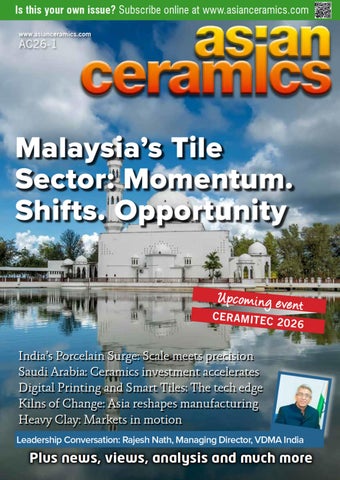
Malaysia’s tile manufacturers are under pressure from rising competition and costs, but new investments in capacity expansion show growth potential, writes Rohan Gunasekera.
Malaysia’s ceramic tile industry is navigating one of its most demanding periods in recent years. Squeezed by rising input costs, intensifying competition from low-priced imports and signs of cooling demand in parts of the construction sector, manufacturers are being forced to rethink long-standing business models. Yet, beneath the surface pressures, a quieter transformation is under way. Capacity expansions, investments in automation, energy efficiency and higher-value products suggest an industry that is adapting rather than retreating – and positioning itself for a more competitive, sustainable future.
The pressures are coming from several directions, including intensifying competition from cheap imports, rising costs and a slowdown in demand in some markets. A few companies are even making losses. However, this has not stopped new investments to expand capacity, improve production efficiency and upgrade product quality. Manufacturers in Malaysia are investing in brand development and value-added products to command higher prices, while also looking to expand exports.
Tile manufacturers face rising costs, such as increased sales and service tax rates and the removal of diesel subsidies, as well as labour shortages. They also contending with signs of a slowdown in the domestic property market.
Bank Negara Malaysia, the country’s central bank, reported that the Malaysian economy recorded strong growth of 5.2% in the third quarter of 2025, driven by sustained domestic demand and higher net exports.
Household spending was supported by positive labour market conditions, income-related policy measures and cash assistance programmes.
Investment activity was underpinned by continued capital expansion by both the private and public sectors. Net exports showed higher growth as export growth outpaced import growth.
The bank said that despite the challenging external environment, Malaysia’s economic outlook remains on track to achieve growth between 4.0% and 4.8% in 2025, supported by resilient domestic demand. Household spending will be supported by continued employment and wage growth. Investment activity will be sustained by progress on infrastructure projects, further realisation of approved private investments and the implementation of national master plans. Export growth is expected to be impacted by tariffs and more moderate external demand.
However, the latest sentiment survey by the Real Estate and Housing Developers’ Association (REHDA) points to a slowdown in the property market. The survey, conducted between June and August 2025 among REHDA members in Peninsular Malaysia, shows sentiment has reversed from the earlier optimism. Developers are now concerned about higher construction costs, financing and the sales and service tax (SST).
The majority of respondents reported an increase in overall business costs, with 73% in 2H 2024 and 74% in 1H 2025. In 1H 2025, 51% of respondents reported being affected by economic conditions. The primary cost-cutting measures in operations included a recruitment freeze, reduced benefits or perks and retrenchment. Meanwhile, in production and delivery, respondents implemented measures such as postponing or rescheduling planned project launches, delaying projects due to weak demand and reducing the scale of launches.
The REHDA survey covered residential launches and sales performance, with 36% of respondents having launched their projects in the first half of 2025 (2H 2024: 36%), totalling 12,938 units, a decline from 17,404 units in the previous half year. In the

first half of 2025, sales performance recorded a total of 3,125 units sold, with a take-up rate of 24% (2H 2024: 55%). As of 30th June 2025, 52% of respondents reported having unsold completed residential units.
According to Terra Group, a real estate company, the commercial property sector in Malaysia – comprising shoplots, shop offices, retail spaces and purpose-built offices – continued its slow recovery in 2025. Malaysia’s commercial segment has been under pressure in the last few years, but data for 2025 shows signs of stabilisation. Retail occupancy in Klang Valley is maintaining steady levels. Purpose-built office space remains oversupplied, but vacancy rates are slowing.
The office market is showing high supply and slow absorption, but the segment is stabilising, Terra Group says. New office completions are slowing, reducing future supply pressure. In retail and shopping complexes, consumer recovery is driving performance with prime malls showing strong occupancy. Retail remains a resilient commercial segment, especially in high-density residential areas.
White Horse Ceramic Industries, which makes ceramic and porcelain tiles, says group business is linked with the construction and renovation industries, where its markets coverage is fairly distributed into property development and replacement sectors, for both local and exports markets.
“Business operations are still challenging in terms of market competitiveness, pricing strategy, marketing structure, fluctuation in foreign currencies, high production and operating costs,” the company says. These factors have a significant impact on the group’s bottom-line, which reported losses in 2023 and 2024.
Counter measures to address these challenges include enhancing the manufacturing efficiency and productivity, new products development, cost-control and market restructuring.
White Horse Ceramic Industries Group has two manufacturing facilities in Johor, Malaysia. Its products are sold both domestically and internationally to more than 30 countries. The Malaysia operation consists of manufacturing and distribution activities, while the Vietnam and other operations were merely distribution functions in the ASEAN region and China. The main business in Malaysia has been making losses recently while its sales operations Vietnam and elsewhere have been profitable. The revenue for the latest 2025 quarter was lower by 9.8% as compared with the same corresponding period of last year, mainly due to stiff market competition. However, the loss was lower due to lower operating costs resulting from cost-control measures.
Hong Leong Industries, which sells tiles under the Guocera brand, is committed to strengthening its market position by investing in brand development and product quality. These efforts include leveraging digital technologies across the value chain, focusing on research and development activities, and pursuing increased energy efficiency and raw material optimisation. Such measures serve to mitigate the rising costs from increased sales and service tax rates and the removal of diesel subsidies.
Kim Hin Industry Berhad (KHIB), an investment holding company that specialises in producing high-quality glazed ceramic and porcelain tiles, has been making losses for five years since 2020. KHIB has three manufacturing plants, two of which are located in Malaysia (Kuching, Sarawak and Senawang, Seremban) and the third is located in Shanghai, the People’s Republic of China, which ceased manufacturing activity in January 2024. Except for the Malaysian segments, there was a decline in revenue for all overseas segments of the group due mainly to softer market conditions amid an uncertain and challenging global economy. KHIB sales are mainly in Malaysia and Australia. However, only its China business is profitable.
KHIB says it is facing challenging and difficult times amid the persistence of weak property markets. In the domestic market, the group faces rising operating costs, disruption in the supply chain of raw materials and volatility in raw materials prices. It also faces a gradual increase in natural gas prices due to the Malaysian government’s subsidy rationalisation, as well as rising liquefied petroleum gas prices consumed by the group’s Kuching plant, which will affect future operating costs.
According to KHIB, its rapid cycle roller kilns have installed highly efficient burners and heat-recovery systems as part of energy-saving efforts. Although continuous losses over recent years have limited the group’s flexibility in obtaining credit facilities from financial institutions, it managed to secure additional banking facilities for one of its Malaysian subsidiaries in April 2025.
In Malaysia’s domestic market, consumer preferences are changing towards contemporary and eco-friendly designs, prompting a marked shift towards premium and customised tiles. In the medium to long term, market studies show urbanisation and large-scale infrastructure development will increase demand for aesthetically appealing tiles in residential, commercial, and public buildings. The continued growth of Malaysia’s middle class and rising disposable incomes will support demand for premium and designer tiles. Government policies promote eco-friendly building materials and sustainable development practices that will encourage the adoption of environmentally friendly tiles.
According to studies by the Mecs Research Centre, Malaysia is among the top five countries for China’s tile exports. China’s exports fell in 2024 for the second year running, but it remains the world’s top tile exporter. Asian countries are absorbing a larger share of Chinese exports. Several of China’s top markets saw sharp declines in sales volumes in 2024, but Malaysia is among the countries where Chinese exports grew sharply.
Malaysia’s Ministry of International Trade and Industry (MITI) launched an investigation into Chinese ceramic floor and wall tile imports in 2020 after a petition by the Federation of Malaysian Manufacturers – Malaysian Ceramic Industry Group on behalf of the domestic industry producing similar products. This was conducted under the Safeguards Regulation. Domestic manufacturers alleged that increased imports of ceramic floor and wall tiles in absolute terms and relative to domestic production from 2017 to 2019 had caused serious injury to the domestic industry in Malaysia. In their petition, domestic manufacturers said they were seeking temporary relief to build up their competitiveness by seeking a safeguard measure and that they were ready to invest to expand production and improve efficiency if safeguard duties were imposed.
However, in 2021, MITI announced it had decided not to proceed with the probe, as there was no evidence domestic tile makers had been hurt by Chinese imports. It said it completed the investigation and made a negative preliminary determination, as there was no increase in imports of the product under investigation (PUI) in absolute terms.
“The government was also not able to ascertain the import volume of the PUI in relative terms to the domestic production of the like products during the period of investigation,” MITI said. “Moreover, the government was unable to ascertain the existence
MALAYSIAN TILE MANUFACTURERS ARE POSITIONING THEMSELVES TO DECARBONISE THEIR PRODUCTION PROCESSES AND MEET GROWING DEMAND FOR ECO-FRIENDLY PRODUCTS OR THOSE MADE WITH MORE SUSTAINABLE METHODS. SOME RECYCLING EFFORTS ARE ALSO UNDERWAY.

of a causal link between the increase in imports of the PUI and the serious injury of the domestic industry in Malaysia producing the like products due to lack of information.”
White Horse Ceramic Industries made a loss in 2020 after the Covid-19 pandemic. Losses declined in 2023 and 2024 after profits in the previous two years, mainly due to higher market demand and lower production costs, while sales were increasing. It says the increase in revenue was mainly due to higher demand and an improvement in the market sentiment. The group has implemented several initiatives, such as stringent credit control, to improve cash inflow and to reduce the risk of non-performing trade receivables. It is also continuing to develop and launch new products with higher margins, launching them into the market regularly.
White Horse Ceramic Industries has a strong marketing network of 11 marketing offices, 10 distribution centres and five major showrooms to serve the domestic market. The group says its business operates in a stiffly competitive environment with local manufacturers and importers. To remain competitive, the group focuses on the wide product range and high-quality products so as to uphold its premium pricing over competitors. The group is dependent on foreign workers to a certain extent,
and it feels the strain of the current nationwide shortage of foreign labour, and is unable to increase production capacity due to manpower shortages.
KHIB says the ceramic tile industry is highly competitive in the domestic market: “Intense industry competition and aggressive pricing strategies among the manufacturers, distributors and dealers are common in the industry. This is further aggravated by the influx of tiles produced by manufacturers in countries such as Thailand, Indonesia, Vietnam, India and China.”
Pricing pressures due to competition, the evolution in style preferences and the cost and availability of competitive materials will affect consumer demand for the group’s products. To remain competitive, the KHIB group aims to reinforce its positioning as one of the market leaders in ceramic tile manufacturing and the sale of ceramic and porcelain tiles. This will be supported by the group’s continued efforts promote and organise well-established training programmes for its management and employees, improve customer satisfaction and apply new technology for product improvements.
through the cycle
Despite stiff competition and market difficulties, new investments have been made in Malaysia’s tile industry after the pandemic, and more are planned. China’s Deer Tiles put into operation Malaysia's largest ceramic production line in November 2025. This is the second production line at the Deer Tiles factory in Kluang, Malaysia, to be launched since the company acquired a stake in the factory. The kiln, originally with a daily output of 5,000 square metres, was upgraded and the internal width expanded to 2.05 metres After the upgrade, its output increased to 19,00020,000 square metres a day. Deer Tiles also introduced artificial intelligence (AI)-powered sorting equipment to this production line to reduce reliance on manual labour in the quality inspection process. Once the upgrade of the third production line is completed, the plant’s capacity will reach 75,000 square metres a day, making it the largest ceramic factory in Malaysia.
Another company which has invested in expanding capacity is Niro Ceramic Group. In April 2025, it announced the launch of its new kiln at the Pasir Gudang factory, reinforcing the company’s commitment to sustainability and better operational efficiency.
“The new kiln represents a major step forward in sustainable manufacturing, delivering significant reductions in greenhouse gas (GHG) emissions, energy consumption, and production costs,” the company says. “With a more efficient firing process, the new production line has successfully reduced factory-wide GHG emissions by 10.7%, while electricity consumption for the kiln has been cut by 50%. Additionally, the use of natural gas in the kiln has decreased by 39%, with heat recovery technology leading to an 80% reduction in natural gas consumption for the horizontal dryer.”
Beyond its environmental benefits, the kiln also enhances production capacity and efficiency, Niro Ceramic says. At its initial stage, productivity has improved by 10%, with expectations of reaching 20% improvement in subsequent phases. The kiln’s wider structure allows for greater throughput, aligning with industry best practices to support higher manufacturing efficiency.
Hong Leong Industries plans to build a new Guocera tiles plant in 2026. Hong Leong is an investment holding company. Its subsidiaries are primarily in the consumer products segment involving the manufacturing, assembling and distribution of motorcycles, scooters and related parts and products, and
manufacturing and sale of ceramic tiles. The tile business is smaller than the motorcycle business. Its tile plant utilisation level has increased to 80%-85% from 70%-80% last year. The planned new fully automated plant can produce bigger format tiles which command a higher margin compared to the existing production line. Guocera Group focuses on producing porcelain tiles with distinctive product features and concept-based selling for the mid- to high-end market segments.
While revenue for Guocera Group registered a decline in 2024 from the year before, it has nonetheless marked a turnaround from a loss in 2023 to profit in 2024. The company attributes the turnaround to significant strides made in achieving higher production efficiency and improved profitability, notably in terms of better product mix, economies of scale and reduced energy costs. In 2023, the performance of ceramic tiles was adversely impacted by the significant hike in natural gas prices and electricity rates. The company says performance in 2024 was encouraging given the challenging market conditions faced, primarily due to the continued influx of lower-cost tile imports from China.
Guocera Group’s response to market competition is to further harness economies of scale by streamlining manufacturing operations. That included the decommissioning of its Meru plant in January 2024 and consolidating production to a single location at Kluang. The move aims to reduce redundancies and eliminate inefficiencies, better optimise machinery and productive capability, and achieve improved resource deployment.
Malaysian tile manufacturers are positioning themselves to decarbonise their production processes and meet growing demand for eco-friendly products or those made with more sustainable methods. Some recycling efforts are also underway. The growth of the construction sector since 2022 has been marked by a growing number of green construction projects. White Horse Ceramic Industries says this is because the government is promoting sustainable development through green building initiatives. The company has obtained the Green Building Product Certification from Singapore Green Building Council to substantiate its long-term goals towards sustainability.
White Horse Ceramic Industries has yet to establish its greenhouse gas emissions baseline, but has started collecting data from selected locations so that it can use the information to establish such a baseline. “We aim to analyse and establish a baseline data for us to work on managing our carbon emissions. For now, our carbon emissions are only restricted to electricity energy usage in our manufacturing plants,” the company says.
KHIB recycles a certain percentage of the raw materials used in the production of tiles. A crushing process is in place to enable reuse of reject tiles. Green tiles and powder from reject products manufactured are gathered and recycled in the manufacturing process.
With manufacturers under pressure from intense competition in the domestic market, more efforts are being made to ramp up tile exports. However, there is awareness that this will not be easy in the face of new trade barriers that have come up this past year.
White Horse Ceramic Industries has an international sales team to service overseas customers in other countries, apart from the overseas subsidiaries in Singapore, the Philippines, Thailand and China.
KHIB exports about 20% of its production from the Malaysia plants to overseas markets, mainly Australia, Middle East, Taiwan and Pakistan. The company is strengthening efforts to increase exports and revenue growth of its overseas operations. “The group is concentrating its efforts and focus on securing export sales, to address the declining demand as well as the better utilisation of production capacity for the group's manufacturing plants in Malaysia,” the company says.
KHIB has expanded its operations in its traditional stronghold market, Australia, by venturing into retail activities through its wholly owned subsidiary in Australia, Australian Tiles Pty Ltd. It operates a retail chain that further enhances the group’s distribution channels in Australia.
“The contributions from the group’s overseas operations act as the shield for the group’s market diversification strategy and reduce its reliance on the Malaysia operations,” KHIB says. However, it
continue to test margins. At the same time, investments in modern kilns, automation, premium formats and decarbonisation point to a strategic shift towards resilience, efficiency and differentiation. While export growth offers diversification, it also exposes producers to new tariff risks and geopolitical uncertainty. The industry’s ability to balance cost discipline with innovation, sustainability and brand strength will determine which players emerge stronger. For those willing and able to invest through the cycle, Malaysia’s tile sector still offers long-term opportunity – but the path ahead will demand sharper focus, faster adaptation and greater scale than ever before.


Rajesh Nath, managing director of VDMA India – the Indian arm of VDMA, Germany’s leading mechanical engineering industry association – reflects on the evolution of the Indian ceramics industry, the deepening Indo-German collaboration, and the role of advanced European engineering in building sustainable, globally competitive manufacturing. He also shares a leadership perspective on technology, exports, and innovation. This interview was conducted shortly before Indian Ceramics Asia 2026, held from 28th-30th January in Gujarat, India.
Q. Please introduce yourself, your organisation, and your association with ceramics in India.
I am Rajesh Nath, managing director of VDMA India, the Indian arm of the German Engineering Federation (VDMA), which is one of the largest industrial associations in Europe, representing over 3,600 member companies in mechanical and plant engineering. VDMA India has been active for more than two decades, fostering IndoEuropean trade relations by promoting advanced European engineering solutions across sectors. Our association with the ceramics industry has been rooted in supporting the ceramic machinery division of VDMA, which includes leading German manufacturers supplying cutting-edge technology for tile production, sanitaryware, tableware, technical ceramics, and raw material processing. Through strategic partnerships, technical symposia and active involvement in major exhibitions like ceramitec and Indian Ceramics Asia, we have worked to strengthen the Indo-German collaboration in this sector.
Q: What are your thoughts on the Indian ceramics industry? How do you see the sector?
The Indian ceramics industry has evolved significantly over the past decade and has now established itself as a global leader, especially in tile manufacturing. India currently ranks as the second-largest producer of ceramic tiles in the world, trailing only China, and exports to over 170 countries. The sector is growing steadily at an annual rate of around eight to 10% and is expected to surpass $10 billion in market value by 2026. What is particularly impressive is how the industry has transitioned from being largely unorganised to becoming more structured, export-driven, and quality-focused. India’s increasing prominence in global supply chains, especially in the wake of geopolitical shifts and supply diversification trends, further enhances its strategic position in the global ceramics landscape.
Q: How does your role as a representative of VDMA’s Indian chapter relate to providing a bridge between the German and Indian ceramics industries? Over the last few years, how have German collaborations with Indian ceramic firms fared? Our role at VDMA India is essentially to serve as a facilitator and enabler of technology transfer and strategic dialogue between the German and Indian ceramic industries. German ceramic machinery is globally renowned for its precision, automation, energy efficiency, and long-term reliability.
Over the last several years, we have seen a surge in collaborations between Indian manufacturers – particularly in Gujarat, which is the hub of India’s ceramic
What is particularly impressive is how the industry has transitioned from being largely unorganised to becoming more structured, exportdriven, and quality-focused.

industry – and German technology providers. These collaborations have gone beyond mere supply contracts and have grown into strategic partnerships, joint ventures, and long-term technical service arrangements. Indian firms are increasingly turning to German partners not just for advanced equipment, but also for know-how, digital innovation, and sustainable production practices. Over the years, several European companies have also established their presence in India and are now not only producing here but also undertaking R&D work activities.
Q: Are there any areas and segments in the Indian ceramics industry where German technology has proved to be influential? German technology has been highly influential in several key areas of the Indian ceramics sector. In particular, German kiln and firing systems have set new standards for energy efficiency and emission control, which are critical as India moves towards greener manufacturing practices. Additionally, in the domain of material preparation, German solutions for grinding, mixing, and conveying have helped improve consistency and product quality. Another transformative area has been digital printing technology, where German firms have enabled Indian manufacturers to offer world-class design and finish. Moreover, German expertise in integrating Industry 4.0 tools – such as predictive maintenance and automated quality control – has significantly modernised Indian ceramic production facilities and made them globally competitive.
Q: Can you describe some of the challenges faced by ceramics companies, particularly those operating in India and Asia?
Ceramics companies across India and Asia face a range of operational and structural challenges. One of the most pressing issues is the rising cost of energy, especially natural gas, which constitutes a significant portion of production expenses. Environmental regulations are becoming more stringent, requiring investments in emission control and water conservation systems. Another ongoing challenge is the volatility in the supply and pricing of raw materials, particularly those imported from regions like Ukraine and Turkey. Logistics and infrastructure bottlenecks, though gradually improving, still impact export efficiency and timelines. Additionally, the sector is grappling with a shortage of skilled technical manpower, which becomes even more critical as companies look to adopt more automated and digital production systems.
Q: What are the weak points in the entire ceramics value chain in India, and how can the German industry contribute to strengthening them?
There are a few weak points in India’s ceramics value chain that warrant attention. Many production units still operate with outdated equipment, leading to inefficiencies in energy usage and quality control. There is also a relatively limited focus on in-house R&D and product innovation, which can hinder global competitiveness in the long term. Supply chains remain somewhat fragmented, particularly in raw material sourcing and logistics. Moreover, sustainability practices such as recycling, waste heat recovery, and closed-loop water systems are yet to be widely adopted. German companies can play a pivotal role here by offering turnkey solutions that are energy-efficient and environmentally compliant. They can also support joint R&D initiatives and offer training modules to upskill Indian engineers and technicians, ultimately strengthening the entire value chain from production to final delivery.
Q: If ceramic companies in India are planning ahead, what are some critical factors to consider?
As Indian ceramic companies look toward the future, several factors will be critical for sustained growth. Sustainability must be a central consideration, with growing pressure from both regulators and international buyers to adopt low-carbon and ecofriendly manufacturing processes. Digitalisation is another essential area; embracing Industry 4.0, real-time data analytics, and AI-based quality assurance will be vital in maintaining a competitive edge. Further, changing consumer preferences will require evolving designs and patterns. Companies must also align their operations to meet evolving global standards, particularly if they aim to expand exports to Europe, North America, and the Middle East. Supply chain resilience –especially through localisation and strategic sourcing – will be crucial in a post-pandemic world. Lastly, significant investments in skill development and workforce training will be necessary to manage increasingly complex and automated production systems.
Q: In your opinion, how robust and progressive is the Indian ceramics sector in comparison to other countries?
India’s ceramics sector is one of the most dynamic in the world. It has scale, costefficiency, and a strong domestic market base, which gives it a unique advantage. While countries like Italy, Spain and Germany continue to lead in high-end technical ceramics and innovation, India has made remarkable progress in segments like tiles, sanitaryware, and tableware. Its manufacturers are now not only costeffective but increasingly quality-conscious. With the continued adoption of advanced technology – much of it from Germany – the Indian sector is steadily narrowing the gap with global leaders. Moreover, its increasing emphasis on exports and sustainable production is a sign of growing maturity and global alignment.
Q: What are your predictions for the Indian ceramics industry in 2026 and over the next five years?
Looking ahead to 2026, we foresee the Indian ceramics industry crossing a market value of $12-$13 billion. Export volumes are likely to account for nearly 45% of total production, with growing penetration into Africa, the Middle East, Latin America, and parts of Europe. There will be a significant rise in green and smart factories, especially in Gujarat and Rajasthan, with a growing emphasis on automation and clean energy usage. Over the next five years, India could very well emerge as the global leader in several ceramic segments, provided it continues to invest in modernising infrastructure, strengthening R&D, and building a highly skilled workforce. We may also see a diversification into advanced technical ceramics, catering to sectors such as electronics, automotive, aerospace, and healthcare.
Q: How do you view the upcoming Indian Ceramic Asia exhibition scheduled for January 2026?
The Indian Ceramic Asia exhibition in January 2026 is poised to be a landmark event for the industry. It serves not only as a major business platform but also as a hub for innovation, learning, and international cooperation. I expect a strong presence from European companies, showcasing cutting-edge solutions applicable to the ceramic industry. For Indian manufacturers, the exhibition will be a unique opportunity to explore the latest technologies, forge global partnerships, and prepare for the next phase of industrial transformation. The 2026 edition is likely to focus heavily on automation, energy efficiency, and ESG-driven solutions – trends that are now shaping the future of ceramics.
Q: What is your opinion of the current state of world ceramics? What is Germany’s position within this market?
Globally, the ceramics industry is undergoing a major transition, shaped by a growing emphasis on sustainable production, digital integration, and innovation in materials science. While China continues to lead in terms of production volume, Germany remains a global leader in ceramic technology and engineering. German companies are especially dominant in highprecision machinery, technical ceramics and process automation. Even amid global economic uncertainties, the demand for German ceramic solutions remains strong, particularly in developing markets such as India, Southeast Asia, and parts of Latin America. Germany’s commitment to innovation, coupled with its focus on environmentally responsible manufacturing, continues to set the benchmark for the global ceramics industry.


