
“THIS IS

“THIS IS
The Boston Palestine Film Festival ran its 18th season from October 18-27. The festival highlights and centers Palestinian narratives as an affirmative expression of Palestinian existence and resistance to dehumanization. Showing at the Museum of Fine Arts, Coolidge Corner Theatre, and other venues, this year’s program contained a robust variety of narrative films, shorts, and documentaries that explore themes of displacement, family, memory, and survival.
On October 23, the festival hosted a screening of No Other Land at the Regent Theatre in Arlington. This documentary is a collaboration between Palestinian filmmakers Basel Adra and Hamdan Ballal and Israeli filmmakers Yuval Abraham and Rachel Szor. The film is a brutal, moving documentation of the ethnic cleansing of Masafer Yatta, a collection of villages in the mountains of the West Bank near the Green Line.
Masafer Yatta was declared a “firing zone” in 1980 by the Israeli military with the stated purpose of removing its Palestinian inhabitants to reserve the land for Israeli settlement. The people of Masafer Yatta are primarily farmers and shepherds, with connections to the land that trace back generations—their villages are visible on maps from the 19th century. Over the course of five years (2019-2023), the documentary follows the first-hand perspective of Adra as he records and resists the destruction of his home and


Though the Israeli-Palestinian conflict has a long, complex history, its root is simple and irreducible: settler colonialism destroys to replace. This ugly, central function of settler colonialism is on full display in No Other Land. The viewer witnesses how, through the continuous demolition of homes and vital infrastructure in Masafer Yatta, the Israeli military seeks to destroy Palestinian life in the region. Construction vehicles thunder into towns and bulldozers demolish Palestinian homes. They raze houses and schools, fill wells with cement and puncture water pipes. The people march and protest for their right to live on the land. They are assaulted with shock grenades and tear gas. An Israeli soldier shoots a man, paralyzing him from the neck down.
When the lights came on in the Regent Theatre after the credits rolled, the packed room was profoundly silent. After a moment, someone in the audience spoke up, voice wavering with emotion but resolute: “This has to stop. It’s unacceptable that we can just go home at the end of the day while people are suffering like this.” They said, “I don’t know what to do, but we have to do something.” As I left, an older woman said to her friend, “It’s a little hard to stand up against that.”
What do you do in the face of overwhelming, intransigent power? This question is one the filmmakers ask as they struggle against the ethnic cleansing of Masafer Yatta. After witnessing more than a year of accelerated genocide in Gaza supported by our tax dollars, many Americans confront the same challenge. Despite mass demonstrations and direct actions, the US government continues to arm and empower a rogue genocidal state.
Since 1970, Indigenous people and their allies have gathered at noon on Cole›s Hill in Plymouth to commemorate a National Day of Mourning on the US Thanksgiving holiday. Many Native people do not celebrate the arrival of the Pilgrims and other European settlers. Thanksgiving Day is a reminder of the genocide of millions of Native people, the theft of Native lands and the erasure of Native cultures. Hosted by the United American Indians of New England (UAINE), the National Day of Mourning is an opportunity for participants to honor Indigenous ancestors and Native resilience. It is a day of remembrance and spiritual connection, as well as a protest against the racism and oppression that Indigenous people continue to experience worldwide.
Join us on Thursday, November 28, 2024 at 12 p.m. at Cole’s Hill in Plymouth, MA, as we continue to create a true awareness of Native peoples and history.
As I write this, a genocide is being carried out in northern Gaza. The occupation is enacting the so-called “General’s Plan,” published by the Israeli NGO Forum of Commanders and Soldiers in the Reserves in late September 2024, to expel the entire population of the region and declare it a “military zone.” Besieged and under media blackout, the stories that have emerged are horrific.
In Masafer Yatta, the people repeatedly express a simple desire: “We want to live.” Amidst so much misery, they are fiercely resilient and committed to life, land, and people. Under cover of darkness, people work together to rebuild their homes. Even as the occupation wears on him, Basel remarks, “With all their strength, they will fail.”
CLAIRE HARRISON
Cole’s Hill is the hill above Plymouth Rock in the Plymouth historic waterfront area. The rallies and marches will last until approximately 3 p.m. While many supporters will attend in person, we will livestream the event from Plymouth at http:// bit.ly/3NIqUul. COVID-19 has hit Indigenous communities very hard, and we want to ensure that no one gets sick from attending the event. Please wear a mask!
Help shatter the untrue image of the pilgrims, and the unjust system based on racism, settler colonialism, sexism, homophobia, and the profit-driven destruction of the Earth that they and other European settlers introduced to these shores.
Solidarity with Indigenous struggles throughout the world. From Turtle Island to Palestine, colonialism is a crime!
You can learn more about the event by visiting the UAINE Facebook event page at https://bit.ly/NDOM2024. You can learn more about the organization by visiting the website at www.uaine.org or following at @mahtowin1 on Instagram.



This edition of experimental excursion will focus on three recent perfor mances at Transporter, an experimental concert series hosted at the Boston Cyberarts Gallery that focuses on sound and perfor mance. MX Blaire perfor med at the series’ seventh show in August.
Qu33rbait is a three-to-twenty piece experimental meme ensemble spearheaded by three individuals worthy of bossing the boss. The opening of this set led with full-time qu33rbait extraordinaire Emerson Mullane introducing the inspiration behind the set: a story of how her great-great-great grandfather saved a small child from being hit by a train. Coincidentally, the venue for the Transporter show is in the same building as the MBTA’s Green Street Station on the Orange Line. In ter ms of the more musical part of the set, it resonated hard and har monically with a lot of my most ambitious attempts of putting soft, ambient sounds together with harsh and abrasive
all). The qu33rbait show had 13 members on stage all playing with intentional syncopation, which I believe was an attempt to produce syncopated rhythms that clashed together with more droning angelic tones. If you haven’t seen qu33rbait play yet, all that I can say is that they’re a must-watch.
in a euphoric dream-like state. Her maximal utilization of a relatively minimal setup never
disappoints. Having an electric guitar, drum pad, and some pedals is always nice and all, but I never expect something symphonic to perfor mances and studio work. Her ability to use polarizing sequences against each other to har monize impeccably well is impressive, and even more stunning to see live. In her music, albeit experimental, Tiefling has an outstandingly versatile collection of singles, EPs, and albums, with none of them sounding quite alike.
Retribution Body and MX Blaire did two solo sets and provided very polarizing experiences. On one hand, Retribution Body presented very dismal, gloomy, grumbling, and harsh noise-wall-synth-like music. I was very impressed with the pulsing and unapologetic aura of the entire set. On the other hand, MX Blaire’s portion was danceable, rhythmic, and upbeat, as they dabbled with minimal house, techno, and hip of high adrenaline while adding in mindful selections and skills.
Transporter generally has multiple events a month at Boston Cyberarts, a gallery space built into the Green Street MBTA station on the Orange Line. Go see for yourself and have a blast.
Visit https://www.bostoncyberarts.org/ transporter for more infor mation on upcoming shows and laboratory sessions.


Halloween may be freshly past us,
THEV’s latest EP and its accompanying visuals are sure to keep you in the holiday’s spirit for the weeks and months to come A Sharp, Deep Chill To The Soul debuted right at the tail end of October, and native s sprawling and impressive discography If STEFAN THEV’s name sounds familiar to you, it may be because he recently perfor med at this year ’ s Boston Calling music festival It could also be due to the fact that he was previously featured in the Boston Compass as an Artist To Watch in 2023. Following the material he’s released since that feature, including this EP it’s safe to say that the Los Angeles transplant is meeting, and even exceeding, the expectations laid before him
Though many contemporary artists lay claim to the multi-hyphenate label, STEFAN THEV is one of the few who is actually deserving of this description. As is evident on this most recent release, STEFAN s artistry knows no bounds—nestling its way it be the cover art, visual treatment, or of course, the music, STEFAN THEV has a distinctive creative vision that is palpable from
Fur nished with a total of six songs, A Sharp, Deep Chill To The Soul tells the story of love, desire, vulnerability, lust, and heartbreak. As the EP’s tracklist unfolds STEFAN THEV details a jour ney from unremitting love to romantic defeat The underlying presence of indie/alter native rock instrumentation empowers every syllable that he utters and adds to the entrancingly melancholy essence of the project A single listen is all it takes for listeners to be transported into an emotive state that mimics what you d see on one of those W inter nights in Easter n Europe” TikToks
If the sonics aren’t enough to hold you over, then the visual elements that accompany the EP are sure to pack the extra punch you need. Impressively cinematic in nature, STEFAN THEV has already debuted videos for “She’s Not Coming Back Is She” ft Embergeists, “Don’t Smile At Me; I Might Fall In Love,” and “I Fantasize About You.” Each of which are a wondrous extension of the wider EP As the dust settles around this project we ’ re certain it will go on to be one of the most prominent from any Massachusetts creative in 2024 The only question that remains is whether it will carry him to the title of Alt/Indie Artist of the Year at this year ’ s Boston Music Awards Only time will tell


After spending 11 years floating between iconic Camberville venues (and a quick break for COVID), Boston’s Fuzztival returned for its 10th run, featuring two packed evenings of New England’s music scene highlights. Presented by Illegally Blind (aka Jason Trefts), October 18-19 saw Somerville’s Arts at the Armory filled with 20 bands, veteran fans of the local music scene, and the exact type of Tufts postgrads you’d expect to see at a local music show.
Each band took up half of the Armory’s stage for their thirty-minute set, while stagehands and the next performers set up on the other side. The performers, many of whom hailed from the Boston and New England rock/alt scene, praised the festival for giving them the opportunity to play at a high-quality venue.
“Venues and places for bands…are not an optimum environment right now. There’s a lot of really great clubs, and there’s a lot of cool, little clubs, like with basically no PA [sound systems] and there isn’t a lot in between,” said Chris Brokaw, vocalist and guitar player for Lupo Citta.
Abby Zachko, vocalist and guitar player of Mingko, who uses they/she pronouns,
echoed this sentiment. “Giving these bands a proper stage, a proper sound system, and a good audience, [grants them] a platform to play their music well…people can show their art in the way it was intended.”
Creating an environment where the bands took center stage was a clear focus of the night. Instead of video or designs behind the performers while they played, the festival chose to project the band’s name on stage, ensuring that everyone knew exactly who they were listening to.
“I saw a few new bands on the bill that I had never heard of before that I ended up really liking and ended up checking out,” Zachko said. “I think there was a real sense of excitement for the community and for the scene.”
After two nights at the Armory with proper sound and adoring fans of the Boston scene, it was clear that the event would not have been as successful without the energy of the local music lover community.
I, like many, have a love-hate relationship with Boston, Massachusetts. Like, have you ever tried traveling north in this city? Try getting from Mission Hill to Fenway and you’re absolutely and royally screwed. On the other hand, there’s a genuine (and unexpected) kindness that I’ve received from my fellow Bostonians, especially in our local creative community. I’d like to give a shout out to the girl who yanked me back to my feet when I almost fell on my ass in the Tiberius mosh pit. Thank you wherever you are.
This column exists because of that kindness, and the many other instances of support that I’ve been lucky enough to receive from my fellow creatively-minded folks. “Play It Forward” is for music-makers, Boston-originated-or-currently-Boston bands, to be connected and held in our community. With every iteration of this column, I will interview a band that tells me about another band that inspires them, and so on and so forth.
I interviewed Gigi Greaves and Willie Swift, the co-founders of Main Era, a band whose experimental shoegaze (neugaze?) sound I heard live at a show inside a movie theater. Listening to the band, especially live, is a great reminder of how a universe can be created when creatives with a care for their medium and each other enter into and remain in the same room. As far as their lineup goes, you’ll find Gigi Greaves on guitar, Willie Swift on guitar, Maeve Malloy on drums, and Jack Halberian on bass with vocals coming from all four band members.
A mix of classic shoegaze-y vibes with new experiments in dynamics and rhythm, Main Era is one of many gems in Boston’s aliveand-kicking music scene. Though the band still receives confused reactions when telling other bands they’re from the city.
“From our experience talking to people, there’s a lot left to be developed about people’s perceptions,” Swift said. “Because a lot of people don’t think anything’s happening here [in Boston], they don’t think there’s any good music going on. It’s pretty bizarre because you’re like, what, dude? There’s like 100 amazing bands in the city!”
that art persists.” said Greaves. “To me, it’s like a positive sign of the indomitable human spirit that art persists despite all of the roadblocks…there’s a significant lack of infrastructure for arts and extremely high cost of living. And somehow despite all that the torch is being carried, which is really sad sometimes, but also really encouraging.”
And that torch comes alongside inspiration as well. Malloy, another band member, reflected on how the band has sonically evolved over the years.
“It’s kind of funny. I feel like at this point I’m probably more influenced by the bands we play shows with than big artists or whatever,” said Malloy.
Main Era, in a long list teeming with kind shoutouts and memories of shows past, selected slow quit as a local band that inspires them. The “knuckle-dragger gaze” band consists of Nick Watter on guitar, Adam Straus also on guitar, Jeff Carol on bass, and Lauren Crosser on drums. The band’s sound is full of guitar riffs to walk down Commonwealth Ave to (good luck attempting to stop yourself from bobbing your head).
Their band originated as somewhat of a joke, but as their collaboration continued and grew, it became a more serious investment and artform. Three-quarters of their band originally hail from California, but the members have become entrenched in Boston’s creative scene after years of living in it. The members of the latter band, who I met via Zoom, celebrated that aforementioned Boston kindness.
“People in Boston are very kind despite any kind of stereotype that they wouldn’t be,” said Crosser. During her experience in the music scene with organizations such as Candlepin Records, Crosser explained that she has seen people attend shows for the sake of maintaining the scene and the community rather than wanting to be seen there.
Due to the statistically abnormal number of parks and trees for an urban center, Boston has an endless network of roots that support its cobblestone streets. It creates this thrumming nervous system of our city that I sometimes take a moment and appreciate underfoot.
“[Fuzztival] takes months and months of work. It takes a community effort,” said volunteer Laura Francis. “It’s awesome to see that these things are possible with the effort and care of this community.” --------------------------------------- JOSIE
DIY venues (which won’t be named here for the sake of their survival), bolster this ever-evolving, revolving door of local talent that originally inspired Main Era. Although there are always people in any creative space looking to use its scaffolding to turn a quick buck or climb towards a certain follower count, those people aren’t going to show up to the shows that matter. And that scaffolding isn’t always steady.
WAGNER

“Some part of me feels like it’s like a miracle that anything happens here at all or
The people and places I’ve been introduced to in Boston’s music scene remind me of that root system. Although it doesn’t seem to make sense upon first inspection, our network of ancient tree roots supported by electrical wiring, college students, endless DIY venues, and kindness support the heart of this city. And in return, its inhabitants will play it forward.
---------------------------------------------------
IMAGE CREDIT: YOUNG YE (@THISISMYDADSCAMERA)
GWEN EGAN


11/6 Monterey Mountain, Wes Buckley @ The Square Root Cafe 8pm
11/7 Creative Music Series presents: Paul r. Harding's Juju Seahorse The Creative Music Series welcomes this dynamic band, whose sound centers on the words and voice of this most unique American poet. Feat. Paul r. Harding, Eric Barber (saxophone), Hilliard Greene (bass), Michael Wimberly (drums). @ Lilypad 8pm10pm $15 students, $20 gen
11/7 Queeraoke Running for over 15 years, this staple Boston queer karaoke night welcomes all who dig a friendly, fabulous, laid-back queer scene! @ Midway Cafe 8pm 21+ $10 cover
11/8 Pasithea Productions presents Dirty Disco: Indie Sleaze Prom w/ Dutch Tulips & DJ Knife @ Deep Cuts Deli 7pm 18+ $17
11/9 HIXXSGIVING feat. Black Clouds, HIXX, Freeloader, & Strangemen. @ Midway Cafe 3pm6pm All Ages $10
11/9 New England Synth Fest is a loose-knit, inclusive community of synthesizer hardware and music enthusiasts. @ Northeastern University 12pm-6pm All Ages
11/13 Get To The Gig presents: Trauma Ray, and Joyer @ The Capitol Theatre 7pm 18+ $17
11/13 Fully Celebrated Orchestra w/Mixed G + Fenno Street Jazz @ Midway Cafe 8pm 21+ $10
11/14 Willzyx, Fed Ash, Rong, Valediction @ O'Briens Pub 8pm 21+ $10
11/15 Arts at the Armory Spotlight Series presents: Lakou Mizik The Center Arts at the Armory is proud to welcome back Haitian Roots band Lakou Mizik. Opening the show is Boston-based Rara Band Bel Poze. ROOTED Armory Café will host a free opening reception with an exhibition by Haitian photographer Daniel Morel from 5-7pm @ Arts at the Armory 8pm10pm $35 adv, $40 door
11/15 Kris Thompson's Birthday Bash ft. Daughter of the Vine, Bong Wish, Spectre Folk @ Lilypad 7:30pm-10pm $15
11/16 Cuck Zine & Cursa Records present MELTING FACE ft. The Modern Faces, Friend, The P.A.'s, The Infinite Wet Secret, Pink Lids, Balloon Thief, Live Visuals by Digital Awareness @ Spontaneous Celebrations 8pm
11/16 Kal Marks, Paper Lady, Black Beach @ Deep Cuts Deli 7pm-11pm $18 @paprlady
11/16 Dark Spring Boston feat. ACTORS, Pilgrims of Yearning, Llynks @ Sonia 7pm 21+ $18
11/16 Girl Power, Adult Learners, K.O. Queen, Feeling
Machine, Misuser @ O'Briens Pub 8pm 21+ $12 adv/ $15 dos
11/18 Content Brakes presents: Ed Schrader's Music Beat @ O'Briens Pub 8pm 21+ $15
11/21 Laura Jinn and Tatum Gale, LAVAGXRL, & Battlemode @ Lilypad 7:30pm-10:30pm 18+
Supreme Saturdays BIG ENERGY in the side room every Saturday! Your favorite afrobeats, dancehall, hip-hop and more! Powered by: H.I.M Entertainment x BVD Boston x Elite Affairs @ Icon Nightclub 10pm 21+ $35
11/8 Kubrick’s The Killing is an underrated gem, full of suspense and epic shots @ Brattle Theatre 3:30pm $12.50
11/13 Food and Country gives an honest and captivating look at the US food system, farming and community @ Somerville Theatre 7:30pm $16
11/15 & 11/16 Louder Than You Think is the new tripped out biopic on Gary Young of Pavement @ Brattle Theatre $14.50
11/16 Celebrate trans lives with Any Other Way, the Jackie Shane Story is about a Black Trans soulsinging icon, who lived way before her time @MFA Boston 2:30pm $15 (includes museum admission)
11/10-11/17 Boston Jewish Film Festival always features a range of poignant and personal stories @ MFA Boston $15 (includes museum admission) @ Brattle Theatre $15.50
11/10-11/20 Wicked Queer Docs is back with true stories from the LGBTQ+ community including Teaches of Peaches (on 11/16), Reas (on 11/17), The Life of Sean DeLear (on 11/17) and more @ Brattle Theatre $15.50
Opens 11/22 Basquiat Julian Schnabel’s beautiful (and arguably exploitative) debut film, featuring the best ensemble of all time, gets a re-release in Black & White. @ Coolidge Corner @ Somerville Theatre @ Kendall Square Cinema
Thru 11/30 Davis Lynch takes over Coolidge After Midnite all month with metal, mellowdrama and mayhem with highlights including Eraserhead (on 11/1), Blue Velvet (on 11/9), Wild at Heart (on 11/15), Lost Highway (on 11/22) and more! @ Coolidge Corner Theatre $15.50
Music from Bars Over Bars and pop-up arcade from Super Party Bros. (We’ll still have the election streaming in the background so you can keep up with the results!) @ Crystal Ballroom 8pm 18+ $20
11/5 Weather is Happening Live Electionite Coverage Live Results and Commentary from the Weather Man. Only on Youtube. 9pm FREE
11/8 The Big Dinner Drag Show A fabulous night of drag, dining, and drinks. Hosted by Big Jahnelle and Big Atlas. @ Dorchester Brewing Company 7:30pm-9pm 21+ $16
11/10 Bonus Hole (All POC Edition) Hole Show is a queer art, drag, and dance party. People of color only are invited, queer is assumed, pronouns are not, and consent is mandatory! @ Crystal Ballroom 8pm 18+ $25
11/14 Popcorn Comedy with Ray Harrington You’re invited to Popcorn Comedy, a unique standup comedy experience at the historic Capitol Theater in downtown Arlington! Our comedians have been featured on The Laugh Factory, The Second City, Don’t Tell Comedy, and more. @ The Capitol Theatre 7:30pm 18+ $20
11/15 ALTARS, The Live Experience An evening of multidisciplinary performances by Boston-based artists celebrating the power of community. @ Hibernian Hall 7pm-9pm $10
Thru 11/16 Pru Payne is a sharp witted and touching story of a brilliant writer and thinker’s mind that starts to fade in the final phase of her incredible life, as she attempts to write her biography @ Speakeasy Stage Co Tix at SpeakeasyStage.com $25+
11/18 Bleeding Hearts: Putting the Emotion in Drag & Burlesque Hosted by Witje Craft. Feat. Killah Croc, Bossi Boots, Thea Lucia, James Bondage, Hawkeye Fierce, Baby Buinnicula, Peewee Vermin, and more. @ Midway Cafe 8pm11pm 21+ $10
11/19 + 11/20 Acrobatic Conundrum: The Circus of Second Chances Seattle’s premier contemporary circus arts company Acrobatic Conundrum creates technically rigorous, ensemblebased circus shows that seek to contribute to a more courageous and connected world. @ Arts at the Armory 7:30pm-9:30pm $20
Thru 12/1 Sojourners A young Nigerian couple temporarily move to Houston in ‘78 for school but one of them develops an American dream in Mfoniso Udafia’s play @ The Huntington Theater Tix at HuntingtonTheatre. org $29+
Somerville. 6-7pm at Curtis Hall in JP @ FREE @punk_rock_aerobics
11/8 Cuck Prom 80's prom themed show w/ le bang, tiberius, dinos, anna gurl, hollow earth, the tourniquet, and petra. doors & food @ 5pm, music @ 5:30pm @ Spontaneous Celebrations 5:30pm-9pm 18+ $15
11/10 Boston Public Living Room Back & Forth Flea is collaborating with Public Living Room Boston to provide a free and welcoming space: an opportunity to connect through crafts, conversation, games, and more. @ Warehouse XI 12pm-5pm All Ages FREE
11/12 Boston Comics in Color Drink & Draw Join the Boston Comics in Color Festival as they kick off our 5th Anniversary Celebration with an evening packed with fun and creativity. Hosted by Barrington Edwards. @ Long Live Roxbury 6pm-9pm 21+ $25 @studiovexer
11/12 Climate Designers Boston Meetup The Boston Chapter of Climate Designers is seeking to gather creatives who are interested in or already involved in climate work. @ Lamplighter Brewing Company - Broadway 6pm-8pm 21+ FREE
11/15 Full Moon Meditation Psychedelic Breath Work and Sound Bath Learn the practice of standing meditation, microcosmic orbit and circular breathing, with a goal to refresh your mind, body and spirit in a safe group setting. @ Museum of Modern Renaissance 7pm-9pm $25
11/17 The Sunday Bazaar 2024 Season Finale Over 100 small local businesses are popping up to sell art, vinyl, vintage, & more! @ Brighton Elks Lodge 11am-6pm
11/17 Oaxacan Woodcarving Sale Open House Buy beautiful, affordable, eccentric wood carvings direct from Oaxacan wood carver Norberto Fabian, son of the late master carver Ventura Fabian. @ 36 Beecher St 2pm-5pm
11/17 Paint & Sip with Kellymoon Craft @ Fiesta Boston 6pm-8pm $45
11/20 Robin Wall Kimmerer at First Parish Church presenting The Serviceberry: Abundance and Reciprocity in the Natural World in conversation with Tiya Miles @ First Parish Church Cambridge 7pm $35
11/23 Brickbottom Open Studios 2024 @ Brickbottom Studios 12pm All Ages FREE
11/23 Grand Opening of justBook-ish A brand new literary gathering space for creative communities in Fields Corner. @ 1463 Dorchester Ave, Boston 11am All Ages FREE
11/13 Roslindale for Palestine and JP For Palestine Fall Festival Mutual Aid Fundraiser for Gaza Families. Crafts, jewelry, yard sale, bake sale, raffle & food drive. Please bring donations! Join for a standout for Palestine at 4! @ First Baptist Church 12pm-4pm
11/14 FoodxClimate Boston Networking Mixer This event is for you if you care deeply about the intersection of food systems and the climate crisis. @ Remnant Brewing 6pm-8pm 21+ FREE
11/21 Survivors of Homicide Victims Awareness Month Opening Ceremony SHVAM is a month-long effort organized by the Louis D. Brown Peace Institute to inform, influence and impact how society views and responds to murdered victims and their families. @ Massachusetts State House 10am-12pm All Ages @peaceinstitute
11/28 National Day of Mourning Since 1970, Indigenous people & their allies have gathered at noon on Cole's Hill in Plymouth to commemorate a National Day of Mourning on the US Thanksgiving holiday. @ Cole's Hill (above Plymouth Rock), Plymouth, MA 123pm All Ages
11/7 Is This Thing On? An Orientation to Podcasting & the Podcast Garage Start your podcasting journey learning from experts about the industry and a wide variety of topics you need to know when creating a podcast @ PRX Podcast Garage 6:30pm8:15pm $8-$95
11/10 Oaxacan Woodcarving Workshop Learn basic tools and techniques of this folk art form, passed down through generations, from master carver Norberto Fabian, who lives and works in the woodcarving village of San Martín Tilcajete, Oaxaca, Mexico. @ Eliot School for the Arts 9am-5pm $325
11/13 #BlackTrust: Black Utopias, Then & Now Join Boston Ujima Project for a special #BlackTrust w/ Aaron Robertson, author of The Black Utopians: Searching for Paradise and the Promised Land in America & Stacey Sutton, Associate Professor in the Department of Urban Planning and Policy at University of Illionis. This event is organized in collaboration with just book-ish. @ 1463 Dorchester Avenue 6pm8pm FREE
11/5 The Presidential Erection Got 2016/2020 election trauma? Do the election right this year. Don’t go home and stress watch the results; instead come to the Crystal Ballroom to dance the night away and catch some voting themed drag from: Ricky Mortis, Mia Culpa, Complete Destruction, Stroke The Clown, and more.
11/2 Somerville Winter Farmers Market Arts at the Armory is proud to offer a weekly winter market with 71+ local food vendors with the best locally grown and regionally produced foods, Our market accepts SNAP/EBT and HIP benefits, and we offer a $15 SNAP match to customers each week. Every Sat from 9:30am-1:30pm starting 11/2. @ Arts at the Armory 9:30am-1:30pm All Ages FREE
11/6 Punk Rock Aerobics for Kidz Every Wednesday! Games, songs and activities to boost self esteem, build community and have fun. Ages 6-10. 5-6pm at Play Union in
11/29 Holiday Small Biz Market Get ready to jingle all the way with over 30 fabulous vendors celebrating the magic of small businesses this holiday season hosted by Fertility Inspired and 1012 Candle Company. @ Arts at the Armory 5pm-10pm
Make and Mend Secondhand art & craft supplies based in Somerville. Get a membership, shop online (at makeandmendshop.com) or visit in-person at their shop in Union Square!
Cultural Sustainability Grant is a one-time grantmaking and learning program delivered regionally by the U.S. Regional Arts Organizations. New England Foundation for the Arts is delighted to offer non-matching operating support grants up to $100,000 to arts organizations of color with annual operating expenses under $500,000. Deadline to apply is 11/21.


The BFAC is an “art gym” and shared studio space located in Union Square, Somerville. Our sunny, expansive studio is open daily, 11am11pm, for people to use freely, whether for their personal artwork, co-working, or to hang out. Our foundation is drawing and painting the human figure, but we function as a space open to all creative pursuits, not just visual arts. Along with our regular figure drawing sessions and painting/drawing workshops, we also host literary readings, film nights, yoga and sound meditation, music events, and more. Full access to the space and other offerings are available for $75-$150 per month, so ditch your private studio or your bedroom for a community art making space. We offer student pricing as well. Come by for a free tour at 285 Washington St Somerville, MA! Visit us online at www.BostonFAC.com and Instagram @bostonfigurecenter or send us an email at draw@bostonfac.com.
11/6 + 11/20 Stitch n B*tch
Our biweekly fiber arts meet-up, BYOCP...(BYOCP = bring your own [unfinished or not-yet-started] creative projects!) Join us for a relaxing and social evening coworking session in the BFAC's “living room."" Professional Artist and Fashion Designer Mary Kahle of Kahle Studios will be on site to trouble-shoot and provide feedback! All experience levels + ages welcome! Snacks will be provided. $10
11/7 Zine Workshop with ZINE
SPACE An all-ages zine-making workshop where you’ll be guided on how to create a 1-page foldable zine. No artistic background required. Materials will be provided. Bring your friends! 7pm-9pm All Ages $15
11/8 Portrait Party Speed Dating
Join us for speed dating with a special twist: portrait drawing! Don’t worry, you need ZERO artistic experience—the drawing activities will be beginner—friendly and silly, we’re not here to create any masterpieces tonight. Just to have fun and meet some new people! 18+
11/10 Intro to Watercolors Join artist and instructor Alex Mafusalov to learn the basics of watercolor painting! Alex will break down the process into simple steps, going over the foundational principles of the medium: light, color, shape, and edges. Prompts and references will be provided, and you will receive individualized feedback and advice so that you
walk away with a piece you are proud of. Basic drawing experience is expected, but no painting experience is required. All supplies included. 5:30pm-7:30pm 18+ $50
11/18 Figure Drawing Basics Class New to figure drawing? Practicing, but feel stuck or in need of a new perspective? Illustrator, Cartoonist, and Figure Drawing Instructor Chris O’Neill (@ thumbsoneill) shares his approach to nailing proportions, making faster drawings, getting loose, and having more fun at figure drawing! This workshop will include 3 demos and individual instruction throughout the evening. 7pm9:30pm 18+ $40
11/22 Friendsgiving Potluck Mixer We are so grateful for our lovely creative community here at Boston Figure! Let's get together and celebrate with a FRIENDSGIVING PARTY, especially now that we're approaching our 1-year anniversary here in Union Square! The BFAC monthly potluck mixer is a great chance to get to know our community and meet other creative people in the Somerville area. This is a free event for all, so bring your friends. Make crafts, play boardgames, maybe even sing some karaoke… who knows where the night will take us! Bringing a potluck item is optional; we encourage you to sign up with the link on our website if you are able, but no pressure! 7pm-10pm All Ages FREE
It's been over a month since our friends at High Energy Vintage sustained a fire that curtailed business at their Somerville thrift store location. Although nobody was hurt and the fire was prevented from spreading beyond the shop, a good amount of items incurred smoke and water damage. Fortunately, their insurance company has approved their claim, so they will be able to access funds to replace inventory.
While High Energy Vintage recuperates their shopfront, we are hoping readers of the Boston Compass will support their staff. Shannon (@wildplanetshop) has an amazing variety of buttons, prints, and vintage finds for you to peruse. Pete (@beardedtalesofwoe), who you may remember as the featured artist of our July issue, is a freelance illustrator and graphic designer you can commission to make a sign for your small business or flyer for your next show. Jessamy (@jessamy.shay)
High Energy itself will appear at Brighton Bazaar at Brighton Elks Lodge on November 7, Brighton Bazaar at the Charles River Speedway on November 24, and Bow Market Small Business Day on November 30. The store also has a spot on the fourth floor of the Cambridge Antique Market (which is open everyday but Monday) where vintage lovers can shop their remaining wares. Customers can also purchase gift cards on their website (www.highenergyvintage.com) and some sweet tapes from the story highlights on their Instagram (@highenergyvintage).
Follow along with their account for more information and keep an eye out for some fundraiser events coming up!



of
So follow our storytellers online and at comics shows throughout New England! See you next month for a new season of Boston's finest!


I didn’t quite realize it while compiling pieces for this layout, but this November issue marks my first full year (of issues) as the editor in chief of the Boston Compass! While editorial has always been my bread and butter, the Compass has been a sandwich of new challenges and triumphs. Take that as you will. Maintaining a record of Boston’s lesser-known arts and culture scene has been an incredibly fulfilling part of my life, and I hope that the artists, creatives, and people who have been featured and interacted with this paper know that they e living in a magical, eve time and place—BOSTON RIGHT NOW!

To commemorate past year s worth papers, I am bringing back the Compass tradition of having a big party! Mark your calendars: we hosting our annual front Your Issues” party cember 14 at the Boston Figurative Art Center in Somerville (exact time TBD). We are inviting the past handful of featured artists
to showcase their work, be celebrated, and mingle with our newspaper staff and audience. Be on the lookout for the event details in December s issue of the Compass!
As always, this nonprofit newspaper would not be where it is without our local readership, our sponsors, and the wonderful people who support us on Patreon. If you are interested in getting a couple of copies delivered to you at the monthly subscription rate of $10, sign up to be a patron at patreon com/c/BostonCompassNewspaper. We also have a $5/month tier that allows subscribers to get a sneak peek of the paper before it’s distributed. If you are looking to make a one-time donation, you can visit withfriends co/brain_arts_organization_inc/join and scroll to the bottom of the page. Finally, if you are an artist, an activist, or a local organization who is interested in collaborating with the Compass, you can contact me by filling out the (new) call for contributors for m at for ms.gle/Dmtp5U6QHyWBNKmY7. I’ll be very happy to meet you, whether it’s inperson at our party, or over a couple emails.
On the climate page of Gover nor Maura Healey’s website, her team writes that “the climate crisis is our greatest risk and our greatest opportunity.” However, the question remains, what is Massachusetts doing to be a sustainability leader? We’ve all just witnessed the damage caused by Hurricane Helene and Milton. We’ve all just experienced the hottest summer in history which was three degrees hotter than pre-industrial recordings. The connection? War mer temperatures caused by climate change, which are providing the fuel for the historical stor ms we are continuing to be bombarded with. We will be feeling the effects of today s (in)actions for years to come as greenhouse gasses continue to accumulate in the atmosphere.
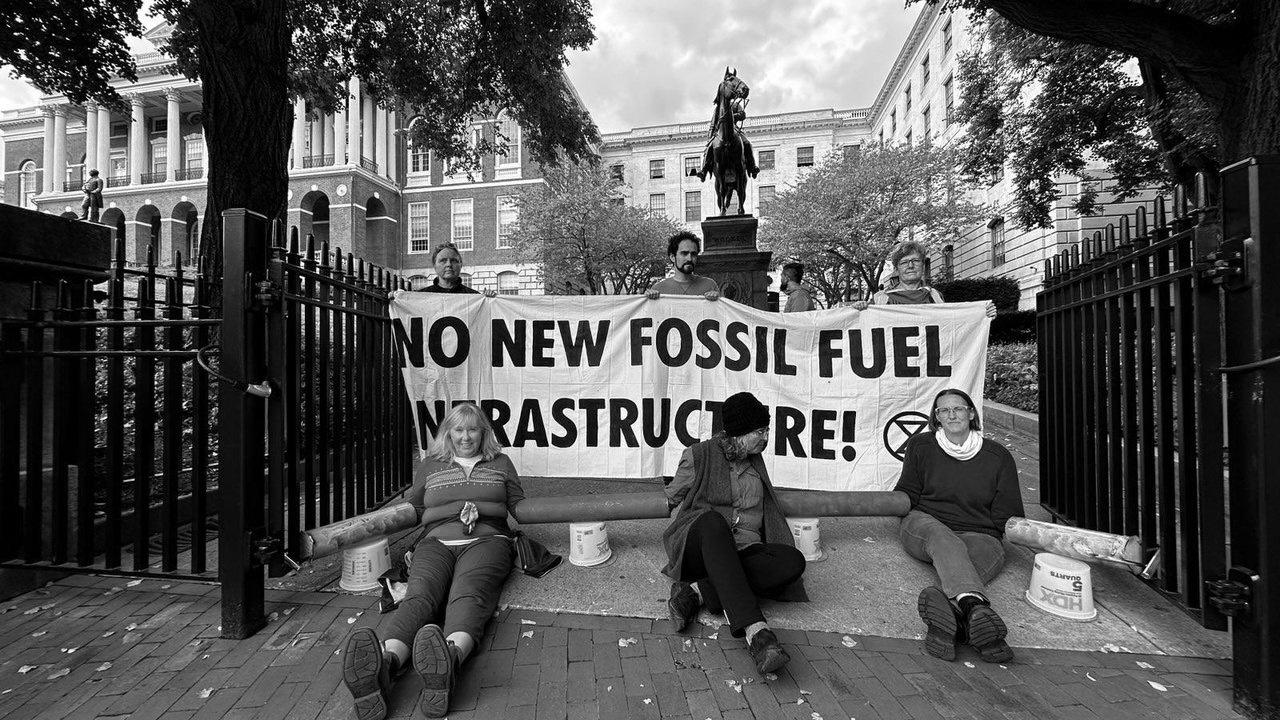
W ith new fossil fuel projects being greenlit and the legislature failing to pass a climate bill during the official legislation session, Extinction Rebellion (XR) Boston decided to have a peaceful protest at the statehouse in September to highlight the need for urgent action in passing a climate bill that details the phase-out of fossil fuels. This standout tur ned into a lockdown as XR Boston defenders created a barricade that blocked one entrance to the statehouse for three days.
One major source of outrage is fossil fuel company Enbridge’s “Project Maple,” which entails the expansion of the company ’ s fracked natural gas pipeline that runs through the Northeast. The initiative, which is being split into small projects to fly underthe-radar, will increase Massachusetts's greenhouse gasses for decades to come. XR Boston is calling for a halt of this project and any new fossil fuel expansions.
Further, the Hanscom airfield which overlaps Bedford, Concord, Lincoln, and Lexington in MA is still being considered for an expansion that would increase its private jet services substantially This project would primarily benefit the region s wealthy, whose short-hop flights sometimes average to as little as 15 minutes, according to a report published in October 2023 by the Institute for Policy Studies that analyzed private flights traveling to and from Hanscom Field over an 18-month period.
We are in a “code red” crisis. We must act together now to hold Gover nor Healey and the Massachusetts Legislature accountable to their environmental promises by demanding a ban on new fossil fuel infrastructure. We cannot allow projects like Enbridge’s pipeline and the airfield expansion poison our air and our futures.
The current demands of XR Boston remain clear:
1. Chart a path towards the state s goal of reducing emissions 50% by 2030.
2. Stop new fossil fuel infrastructure.
3. Prioritize environmental justice communities.
4. Ensure good jobs for workers building our new infrastructure and good benefits for workers displaced by the gas transition.
Please get involved with local climate advocacy groups. For Civil Disobedience, see Climate Defiance (@climatedefiance on IG) and Extinction Rebellion Boston (@XRBoston on IG). For traditional advocacy: 350 MA (@350mass on IG) and Mothers Out Front MA (@mothers.out.front).

Katiana Rodriguez-V eytsman
As a young Puerto Rican girl in the Bronx, my life was rarely lacking in artistry or joy The visuals I create are meant to express the war mth and adoration I feel whenever I think of home. To me, home will always be the people. The never-ending music. The deep rooted sense of community I create with my spirituality family and younger self front of mind. W ithin each artwork, I attempt to capture the nuances of growing up as queer, plus sized, and one of the more monolingual members of my vfamily I strive to capture the beauty and liveliness of my people and my surrounding environment. By exploring diversity body positivity, and urban culture, mainly through portraiture, I hope to inspire a sense of familiarity and connection between myself and my viewers.




Despite its strong arts and culture scene, Boston isn’t known to be the most stylish destination. But that stereotype doesn’t stop designers at House Fashion Week from envisioning the future of fashion in our Celtics-and-sweatpants-clad city
As part of Boston Fashion Week, House Fashion Week hosted a long weekend of festivities from October 9-12, with a museum installation and kick-off event on Thursday, the Collective show on Friday, and a main runway series on Saturday Friday s show drew a well-dressed crowd eager to see the distinct, forward-looking visions of nine emerging designers.
Audience member and Bostonian Pablo Castillo attended the runway event to support his cousin, an aspiring model who walked this and last year ’ s show While Castillo acknowledged the lack of a solid fashion scene in Boston, he also highlighted his desire to encourage its growth.
“It’s so academic here compared to cities like New York, Milan, and Los Angeles. People don t really have the time to be playing around in fashion,” he said. “But there are a lot of creatives in Boston, so I thought, of course, I want to support them.”
A core theme of the night was sustainability with several of the designers’ lines focused on encouraging consumers to be more conscientious about their consumption. Naz, Jacqui, and Maryam of 3NDOLITH, a brand named after the organisms that thrive in extreme environments, modeled their pieces to stand the test of time. Their “Remember to Breathe” collection included royal-blue mitochondrial masks, webbed bodysuits, and crocheted vests.
“We don’t want to be bound by seasons or anything—that just makes things more unsustainable,” said Jacqui. “Hopping on trends is just going to make you want more things, rather than saving pieces that you can have with you for more than ten years.”
By upcycling unconventional and deadstock material to create long standing pieces, the design trio hopes to reduce the amount of fashion waste destined for landfills. In fact, when customers are done with 3NDOLITH clothes, they are able to send them back to
the brand for reuse or responsible disposal in what the team dubbed an “end-of-life cycle.”
“Fashion is one of the biggest contributors to pollution, especially [in regards to] textile waste,” said Naz. “We wanted to lead by example.”

Similarly, other designers like Boston-based Nathan Domingos of MINTED SUPPLY transfor med second-hand and vintage pieces into one-of-a-kind works of art with bleached-shoestring tops and ribboned trousers. Designer Lillian Pexton of Princess Chicken drew inspiration from her adventurous childhood with sea-faring parents and upcycled sails to create playful and colorful outfits.
The designers could not have executed their visions without the aid of a local cadre of models. Models representing Princess Chicken played with the audience by twirling a sky-blue umbrella or rotating a lifebuoy, while one model that walked for Designer H X Jia dragged his feet along the floor to emphasize the constriction of his straitjacket-type top.
“Models bring personality into the outfit,” said Model Alexis Noel, who traveled to Boston from Cape Cod to walk for the show “There are specific looks that designers go for and getting the right models will bring the look to life.”
Boston-based Model Henry Rank, who debuted his runway skills at the event, agreed with Noel: “You don’t have as much freedom as a model, but you can definitely put your own twist on it. That’s what separates good models from bad ones.”
Whether you’re a designer, model, fashion lover, or organizer, it takes a collective to imagine and enact a sustainable, beautiful vision for the future.
Reflecting on the success of House Fashion Week, Castillo agreed with this sentiment: “The beauty in this show was watching it both from last year to this year, and seeing how everything has sustained itself and how everyone just keeps going forward.”