Welcome to spring
After the long slog of late winter, spring comes bursting onto the scene like a tap-dancing, hand-waving Broadway star, bursting with colour and charisma. As the days lengthen and the temperature rises, what you’ll find at Borough Market is a full Bob Fosse stageshow.
Over the course of a few weeks in April and May, the market’s stalls are transformed as the stage is cleared for an uplifting show of lightness, verdancy and crunch: wild garlic, asparagus, radishes, rhubarb, all manner of fish. And the good news is that spring ingredients rarely demand much work to bring the best out of them. Show offs they may be, divas they are not.
Explore more spring content
Wild produce SPRING
Look out for: Morels
St George’s mushrooms
Stinging nettles
Three cornered leeks
Wild garlic
Wood pigeon
Read our guide to foraging
Wild at heart
Noel Fitzjohn of Fitz Fine Foods on the springtime glut of foraged foods
Mark Riddaway
A few years ago, Borough Market published its first-ever Food Policy, which described in simple terms the principles should define its food offering. Environmental sustainability was prominent among these. Variety was another – foods that are rare or unique, reflect the changing seasons and support the survival of traditional skills. So too flavour that comes from ingredients grown in their native environment with minimal intervention.
It’s hard to think of many things more representative of these principles than the wild foods that make up a small but important slice of the market’s vast offering: the game birds and venison, wild mushrooms and truffles, foraged vegetables and herbs. Gathered by responsible hands, the natural bounty of untamed land isn’t a source of harm to the environment – it is the environment. It tastes unlike anything else and comes with a strong sense of the place it was found. And as for being rare, try finding any of it in a supermarket.
For most of human history, foraging wasn’t anything special – wild food was just food. Now, beyond plucking the odd ripe blackberry from a bramble at the park, most of us in the UK are no more capable of gathering wild plants than we would be bringing down a mammoth. If we want to eat something that grew without direct human intervention, we have to rely on the increasingly arcane skills of people who won’t accidentally pick something toxic or get
arrested for trespass – people like Noel Fitzjohn of Borough’s Fitz Fine Foods, a professional forager and producer of beautiful handmade mustards, vinegars, pestos and terrines.
Right now, Noel is a very busy man. This is a period when wild mushrooms are plentiful: morels, St George’s, chicken of the woods, scarlet elf cups, fairy rings and a host of other fabulously named fungi. There are stinging nettles and dandelions. There’s three-cornered leek, a wild allium. Most prolifically, there’s wild garlic, which flourishes in the dappled shade created by trees not yet in leaf, filling the air with the scent of a French kitchen.
Noel became a commercial forager almost by accident. Raised in rural Lincolnshire, he’s been gathering wild foods his whole life. “I didn’t even know I was foraging,” he says. “We didn’t think there was anything unusual or special about it.” After realising that the most popular products on his stall included those made with the small hauls of wild vegetables and herbs he’d gathered in his leisure time, foraging became a key part of his business.
For years, he foraged in Sussex, now he’s mainly operating in Kent, and he knows these famously verdant southern counties like the back of his hand. The most demanding part of his work is the back-bending graft of plucking plants from the ground for hours on end, but the most skilled element is finding those rich,

garlic to add pungency to an omelette, but they’re rarely ideal for commercial foragers: confined, busy and colonised by our fourlegged friends. “If you forage in areas favoured by dog walkers, it’s inevitable that your favourite patch will one day be used as a dog latrine,” says Noel. “Essentially, any public land where dogs are common is off limits to me.”
LOCATION IS EVERYTHING. IF YOU WANT THE BEST QUALITY PRODUCE, YOU NEED TO FIND A LOCATION WITH THE IDEAL CONDITIONS. PLANTS CAN OFTEN GAIN A FOOTHOLD IN LESS-THAN-IDEAL PLACES, BUT THEY WON’T BE AT THEIR BEST.
The forager’s craft is, therefore, as much about gathering permissions as is about gathering plants. “One thing is crystal clear: if you forage on private land for commercial purposes, you have to obtain the landowner’s permission. Tracking down the owner can be tricky, but it’s absolutely essential.” Often, though, the relationship between forager and landowner proves mutually beneficial. Noel tells of fruitful visits to a private wood used for timber, where the wild garlic was so out of control that the owner was delighted for him to take away as much as he needed.
Noel uses much of his three-cornered leek and wild garlic to flavour his handmade mustards and pestos, thereby extending the otherwise short life of the plants. Bought fresh, they’ll need using quickly, but that’s hardly a hardship. The crunchy leeks are great in salads or stir fries, and wild garlic leaves can be cooked into a multitude of dishes.
sources of wild food – a treasure hunt that requires a deep understanding of topography and climate. “Location is everything,” says Noel. “If you want the best quality produce, you need to find a location with the ideal conditions for that specific plant. Plants can often gain a foothold in less-than-ideal places, but they won’t be at their best there – if you want the really good stuff you need to understand the environments in which they really flourish.”
One challenge is that the vast majority of British land is in private hands, with no inherent right to roam – and certainly no right to be making off with sacksful of food. There are, of course, public spaces where a keen-eyed amateur will be able to gather enough wild
If all you want is for someone to cook them for you, April at Padella sees the brief but doubtless much-photographed appearance of stinging nettle tagliolini. At Elliot’s, the highly seasonal menu abounds with foraged vegetables. The market’s cheesemakers also make use of this short-lived bounty. Jumi Cheese sells a Wild Garlic La Bouse, a soft, smooth cow’s milk cheese bisected by a seam of gently garlicky cream, available for just a few weeks of the year. At Neal’s Yard Dairy, you’ll find Cornish Yarg, which comes wrapped in nettles foraged from local hedgerows.
None of this will last. Three-cornered leek is around for just a few weeks. Most of the wild garlic is gone by the end of May. Morels are a fleeting presence, as are many of the other wild mushrooms. Spring’s festival of foraged food doesn’t last for long. While it does, go wild.
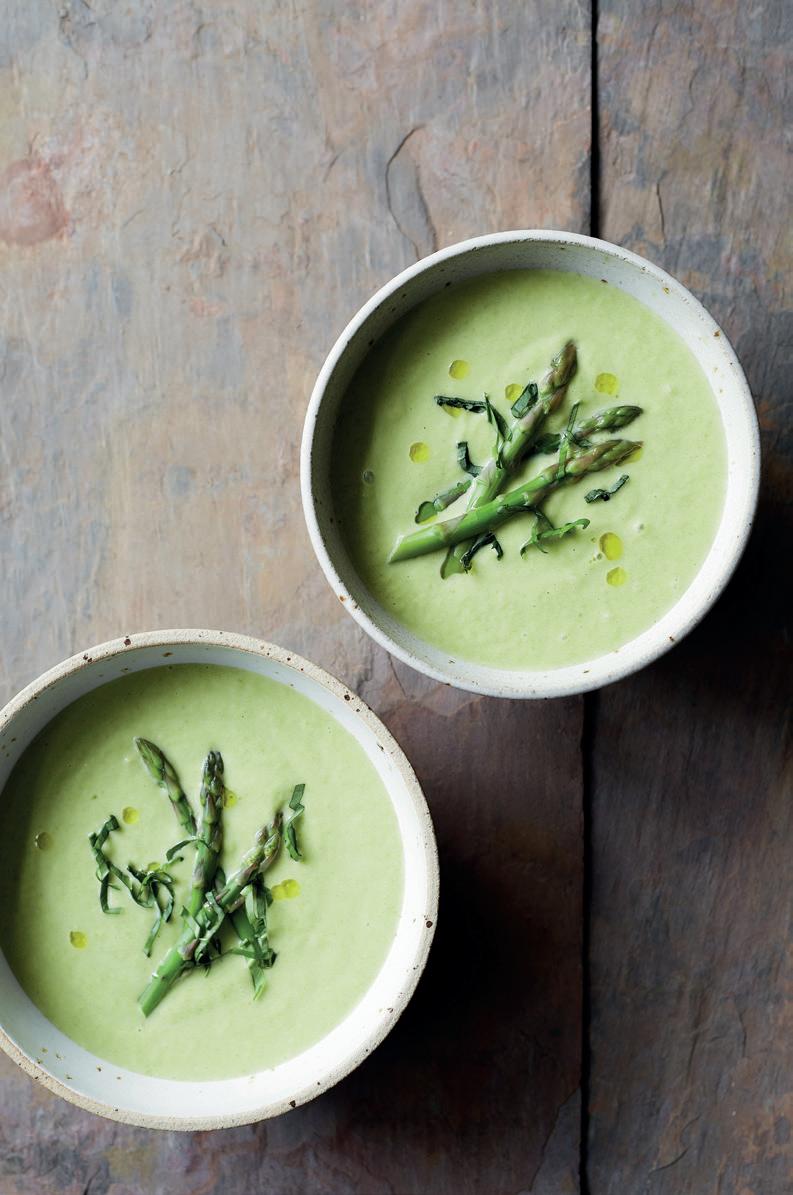
ASPARAGUS & WILD GARLIC SOUP
Jenny Chandler
Serves: 4 | Prep: 10 mins | Cook: 25 mins
The sheer simplicity of this soup is its strength – no rich chicken stock or exotic garnishes required. It’s all about the pure, unadulterated taste of asparagus. Wild garlic adds a perfect, subtle hint of garlic and makes a great excuse for a walk in the woods or a trip to see Noel at Fitz Fine Foods. You could add peas (fresh or frozen) to the soup too and perhaps garnish with some crispy bits of bacon.
INGREDIENTS
— 200g woody asparagus stumps
— 2 medium leeks
— 50g butter
— 1 tbsp flour
— 300g tender asparagus
— 50ml double cream
— 10 young wild garlic leaves
METHOD
Roughly chop the woody asparagus and simmer in 1 litre water for about half an hour. Strain off the stock and throw out the asparagus. Top up with a little water if your stock has reduced a lot – you require about 1 litre.
Meanwhile, chop the remaining asparagus roughly, perhaps keeping a few tips aside for a garnish (just blanch these for 2 mins in boiling water).
Prepare the leeks, discarding the outer layer and tough green tops. Chop finely and rinse to remove any grit. Melt the butter in a large saucepan, add the leeks with a pinch of salt and cook over a low heat until soft but not coloured.
Once the leeks are soft, stir in the flour and cook for 2 mins before slowly adding the asparagus stock, stirring all the time.
Add the chopped asparagus and cook for about 5 mins, or until just tender (it will depend a little on the thickness). Blend the soup, add the cream and balance with salt and pepper.
Slice the garlic leaves as finely as possible and garnish the soup before serving. Add the asparagus tips too if using.
Fruit & veg SPRING
Look out for:
Artichokes
Asparagus
Broad beans
Elderflowers
Jersey royal potatoes
Mangoes
Peas
Pea shoots
Radishes
Rhubarb
Sorrel
Spinach
Spring greens
Spring onions
Explore our fruit and veg traders
Hot tips
The definitive guide to cooking asparagus using methods other than boiling
Bee Wilson
“What if you do not possess an asparagus boiler?” asked Jane Grigson in her Vegetable Book. It is not a dilemma that troubles many cooks now. But back in 1978, when Grigson’s book was first published, there was only one way to cook asparagus: boiled, standing in a bundle. Not owning an asparagus boiler could make this tricky task even trickier.
An asparagus boiler – for the uninitiated –consists of a tall cylindrical lidded pan with an inner basket. The bundle of asparagus is put in the basket, stalks down, with a few inches of salted water. The idea is that in the time it takes every last bit of stringiness to be boiled out of the stalks at the bottom, the tips will steam to tender-crisp. To readers who did not possess this elaborate vessel, Grigson suggested using some other tall saucepan and a “wire blanching basket”. As for those who had no wire blanching basket, she recommended tying the asparagus in a bundle in a normal saucepan and improvising a domed lid of foil for the tips. The one thing Grigson didn’t suggest was cooking this sublime spring vegetable by any other method.
Thinking about asparagus, it struck me that modern cooks express our love of ingredients very differently from cooks of yesteryear. In the past, asparagus lovers worshipped this expensive vegetable by cooking it in one way only. To respect asparagus was to know that it needed to be
kept in a bundle and boiled upright, with obsessive care for not overcooking the tips. By contrast, cooks now celebrate these vibrant spears by cooking them in as many different ways as possible. We griddle asparagus and we braise it; we shred it and eat it raw; we toss it with pasta and noodles; we use it to add spring freshness to minestrone or risotto.
When I started cooking in the 1990s, I was firmly of the boiled asparagus school. Someone gave me an asparagus boiler for a wedding present and I was determined to master making proper bundles, like a Dutch still life. I knew that some recipe writers had started blackening asparagus on a char-grill, but the first few times I tried it this way, it tasted harsh and burned and half-raw, a waste of those expensive spears. So, I persevered with my asparagus boiler, even though I found the process frustratingly hit and miss.
The recipe that changed the way I thought about asparagus was River Cafe penne with asparagus carbonara, which I first read about in 2000. This was a carbonara, but with spears of asparagus cut on the diagonal in place of the pancetta. The thing that startled me was the wondrous economy of the method. While the pasta boiled until al dente for nine minutes, you cooked the asparagus in a separate pan. The stalks were added first, then after two minutes, the tips, which cooked for a further four minutes. The blanched
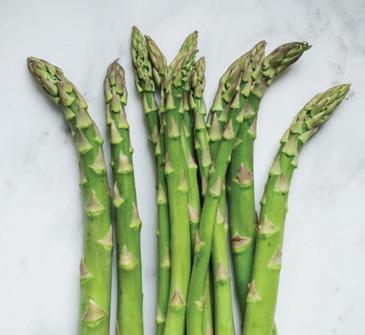
THE RECIPE THAT CHANGED THE WAY I THOUGHT ABOUT ASPARAGUS WAS A CARBONARA WITH SPEARS OF ASPARAGUS CUT ON THE DIAGONAL IN PLACE OF THE TRADITIONAL
PANCETTA
asparagus is tossed with pasta, egg yolks, parmesan, butter and thyme to make a richly spring-like dish: green and golden. The first time I made it, I couldn’t believe that the asparagus had come out so perfectly with so little effort. I never used my asparagus boiler again, realising that I could boil the spears unbundled in a big pan for five minutes, with none of the fuss and better results.
Over the past decade, chefs and cookery writers have developed a much more experimental and playful approach to asparagus. We have thrown out the asparagus rule book. Take the controversial question of snapping versus slicing. Many cooks used to
swear by the tradition of snapping each stalk to separate the edible top from the inedibly woody bottom. But in 2009, food writer Harold McGee experimented by snapping 130 spears and found that the snapping method was far less reliable than simply looking at the spears and cutting them at what seems to be the right point. Don’t discard the stalks. Much of the bottom part is still edible too, if you slice it very thinly and add it to a soup or stir-fry.
It was Yotam Ottolenghi who convinced me that chargrilled asparagus could make a welcome change from plain-boiled. Freshly harvested asparagus contains a lot of natural sugar and charring it accentuates both the sweetness and umami. Ottolenghi’s first cookbook contained a recipe for chargrilled asparagus, courgette and halloumi salad. The asparagus was blanched before it was charred with thin slices of courgette and anointed with garlicky basil oil, and the firm, bright spears took on a savoury depth that was a revelation. I have since discovered that I like charred asparagus even more if it is sliced up, tossed with salt and oil and browned for between five and 10 minutes under a very hot grill, with lemon zest added at the end.
If you don’t try different things out, you will never know what you’re missing. The best of all ways to cook asparagus, I am now convinced, is neither boiled nor grilled, but braised. By braising, I mean browning the asparagus in a single layer in a paella pan or similar before cooking with butter and a splash of water or stock until the liquid emulsifies to a glossy sauce, which takes less than 10 minutes. Braised asparagus offers both the browned intensity of charred asparagus and the delicacy of boiled.
With middle age, asparagus season has started making me feel wistful. It lasts such a short time, and who can say how many more asparagus seasons remain? This is yet another reason to expand your horizons beyond boiled asparagus. Not possessing an asparagus boiler is no loss. The real pity would be to miss out on squeezing every ounce of asparagusjoy from the season before it is gone.
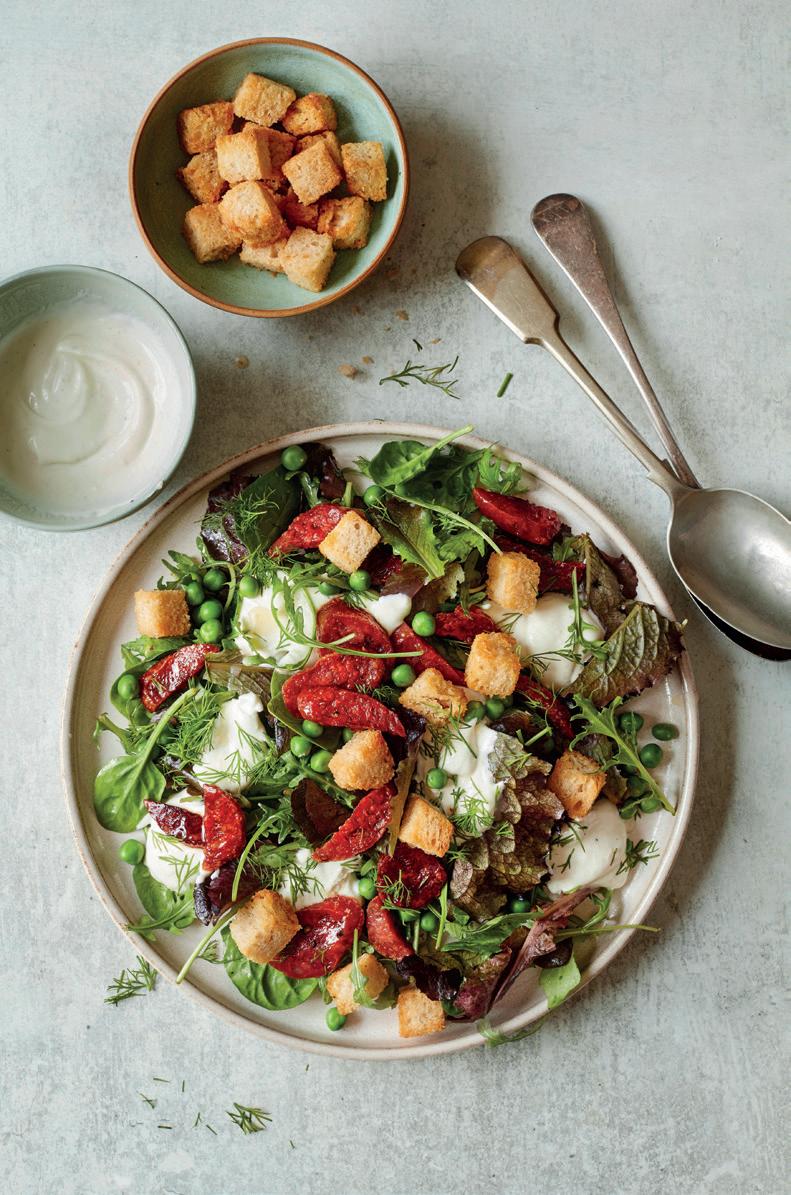
PEA, WHIPPED GOAT’S CHEESE & HONEYED SAUCISSON SALAD
Leah Hyslop
Serves: 4 | Prep: 10 mins | Cook: 10 mins
INGREDIENTS
— 200g soft goat’s cheese
— 80g cream cheese
— Zest of 1 lemon, plus a generous squeeze of juice
— 150g saucisson or other cured meat, cut into thin discs, then again into half-moons
— 1 tbsp honey
— 200g fresh peas, out of their pods
— 200g salad leaves
— 20g dill, tarragon or other soft green herb, finely chopped
— 100g croutons or crumbled crackers
METHOD
First, make your whipped goat’s cheese. Put the goat’s cheese, cream cheese and lemon zest into a food processor. Add a generous squeeze of lemon juice and season lightly, then pulse to a smooth, creamy mixture. Leave to one side.
Heat 1 tbsp olive oil in a frying pan over a medium heat. Add the saucisson and fry gently for about 3 mins, until the edges are starting to curl. Add the honey and stir quickly to coat the saucisson. Leave on the heat for a further minute, just so the honey starts to go sticky and a darker gold, then take off the heat and leave to one side.
Bring a saucepan of water to the boil, then add the peas and cook for 1-2 mins. Drain.
Put the peas, salad leaves and dill into a large bowl with 1 tbsp olive oil. Toss, then portion onto plates. Dollop on the whipped goat’s cheese and divide the saucisson between the plates. Finally, drizzle over any oil left in the pan and scatter over your croutons or crumbled crackers.
Saucisson
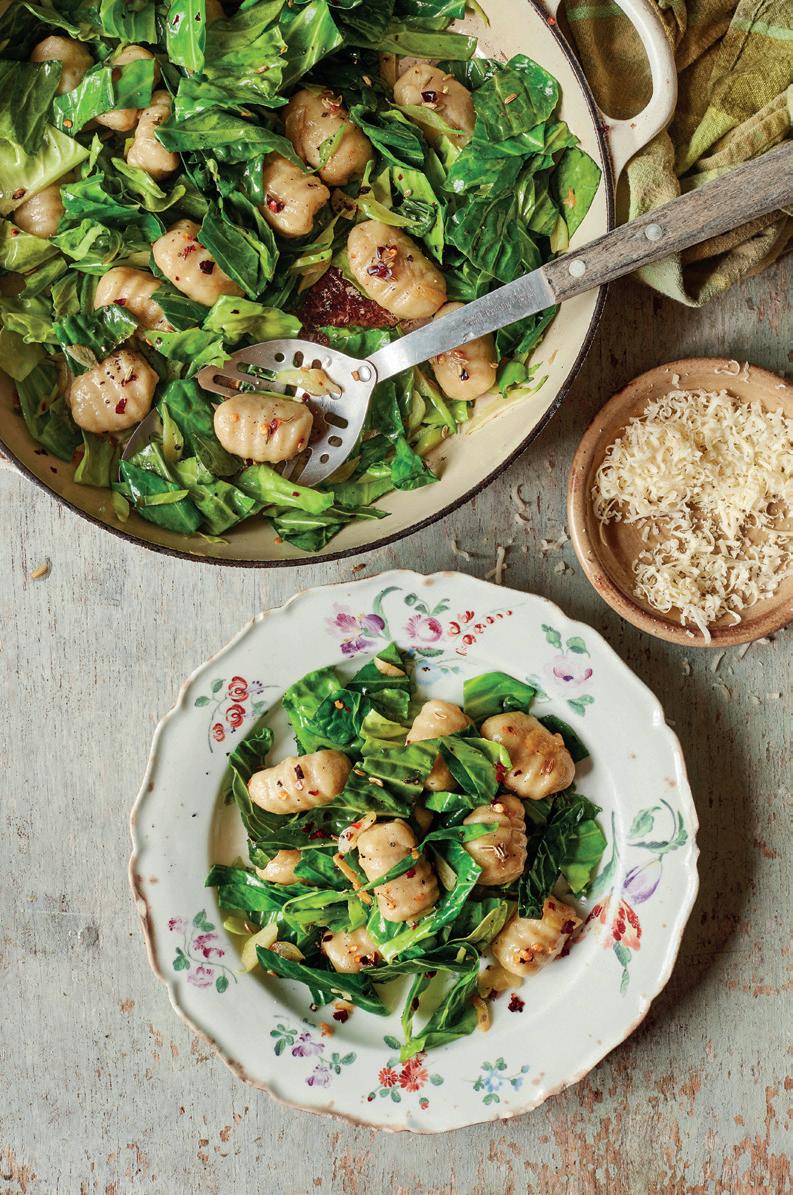
GNOCCHI, SPRING GREENS & CHILLI
Tim Maddams
Serves: 4 | Prep: 20 mins| Cook: 1 hour 10 mins
This simple spring dish can be adapted in a multitude of ways. Add a few good anchovies at the same time as the garlic. Use spinach or wild garlic instead of spring greens. Use bacon fat and cubes of bacon instead of olive oil. Or replace the Montgomery’s with parmigiano or pecorino.
INGREDIENTS
— 2 large waxy baking potatoes
— 1 egg
— 100g organic white spelt flour
— 25g fine organic semolina
— 200ml very good olive oil
— 500g spring greens, or new kale, or a mixture
— 4 cloves garlic, peeled and sliced
— Chilli flakes, to taste
— ½ tsp fennel seeds
— 100g mature Montgomery’s cheddar
METHOD
Heat the oven to 180C. Scrub your spuds and pop them in the oven to bake for 1 hour. Once tender, allow to cool enough for some tentative handling. Cut in half and scoop out the innards, saving the skins for another time. Push the hot potato flesh through a sieve so you have a very fine, smooth paste. Beat an egg into the potato and enough of the flour to make the mixture just about dry enough to handle.
Divide the mix into six equal pieces and roll out on a lightly floured surface to form sausage-shapes the thickness of a thumb. Using a table knife, slice these into 2cm pieces. Now, roll each piece over the back
of a fork, to create a divot in the middle and some groovy ridges on the outside. Place the finished gnocchi on a surface lightly dusted with semolina.
Place a large pan of water on the stove, salt it well and bring to the boil. In another large cooking pot, place the olive oil over a moderate heat. Wash, trim and slice your spring greens, separating the tough stems and chopping them finely. Place the tough stems into the pan with the oil and add the garlic, some chilli and the fennel seeds. Cook the stems until tender, then add the rest of the greens. Season and cook until just tender. Drop the gnocchi into the water pot and cook on a rapid boil until they float. Gently lift them out with a slotted spoon and add them to the spring greens pan, turning off the heat.
Carefully dress the gnocchi in the greens, place the whole show on the table and serve with loads of grated cheese. And, if you are like me, more of the very good olive oil… and wine.
Fish SPRING
Look out for:
Brill
Brown shrimp
Brown trout
Cherrystone clams
Crab
Grey mullet
Mackerel
Plaice
Rock oysters
Sea bass
Wild sea trout
Explore our fishmongers
Fish tales
Max Tucker, manager of Furness
Fish Markets, on spring fish, careful sourcing, and the importance of communicating with customers
Interview: Mark Riddaway
How did you come to be a fishmonger? I used to run a pub just round the corner from here. It didn’t open at weekends, so I would to come to the market on a Saturday. I’d get some oysters, have a pint of Guinness over in the Market Porter, and just soak it all up. I was always fascinated by the way Les Salisbury, the owner of Furness, used to put his counter out. I’d watch him setting up. It was something I hadn’t seen before – definitely one of the most attractive stands in terms of the colours. I’ve always been interested in fishing – I used to fish as a kid, over at Hampstead Heath. Anyway, my life circumstances changed, and Les ended up offering me a job. That was 20 years ago. The rest is history, as they say.
The fish counter is still a thing of beauty. Who’s responsible for that? When I first started here, Les wouldn’t let anybody else touch the counter. About 10 years ago he let go of the reins a little bit and handed it over to me. Now I’ve handed it down to one of my guys, Harry. It’s a real art. It’s like a painting: the contrast of colours, textures, different levels of ice, bits of wood, other decoration. It can take anything up to two hours. It’s got a bit more difficult recently because the fish isn’t as cheap as it used to be, so we buy a little more frugally – you can’t afford to waste anything – but we still make it look amazing. It only works because of the
quality of the fish, and that comes down to the sourcing. I believe the reason for our success over 20-odd years is that we really do pride ourselves on quality.
How does your approach
to
sourcing affect the quality of the fish you sell?
It’s all about the process. I remember reading about these big American fisheries that fish for the supermarkets. They catch a load of fish out in the North Atlantic. The boat’s out there fishing for about five days at a time. When they dock, they send the catch off to China to be processed and packed. From there, it’s sent on to a distribution centre in the UK, where they repackage it and send it out again. That can be a 10-day process. By the time it’s on the shelves, that fish is nearly at the end of its life. As a small business, we’re able to work on sourcing quality over quantity, and that’s the difference. If I’m getting my fish from the Shetland Islands, it’s here in two days.
How do you avoid waste?
It’s about getting the ordering right, it’s about the turnover of stock, how you manage your fridge. We’re also blessed with the paella. The last thing I want is for one of our customers to take a piece of fish home, leave it in their fridge for another couple of days and it be no good. At that point, I’ll put it into the paella, so the paella changes from day to day, week to week.
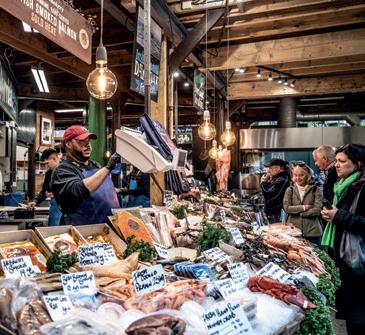
FOR ME PERSONALLY, COMING INTO SPRING AND SUMMER, IT’S ALWAYS GOING TO BE ABOUT SEA BASS AND MACKEREL. I CAN’T WAIT TO GET MY HANDS ON A REALLY NICE CORNISH DAY-BOAT SEA BASS.
be coming soon to the counter. That’s amazing. You’re also going to get wild sea trout through May until August. That’s amazing too.
So, do you fillet everything on site?
Yes, we buy whole fish and we fillet here. If you buy fillets in, the quality is terrible. It’s a real skill. When I was young, my mum would say: “You need to get a trade.” Back then, I wouldn’t have thought about this. My dad was a mechanic, my uncle’s an electrician, another uncle works for BT. But this is a trade too. Once you’ve learned it, you can go anywhere in the world and use it. If you can handle a knife, if you can fillet a fish, if you know a bit about fish and fishing, you’ll always find work. I’m in a different role now within the company, so I’m not on the block as much as I used to be, but when I get the chance, I do love it.
There are so few fishmongers left these days. Are some people a little intimidated by what’s on offer?
Our counter can be very daunting for some people. There are certain things we have on here that you’re never going to see in a supermarket. That’s why it’s so important that we talk to people. I’m on at my guys all the time: if someone walks into that shop, you have to engage with them. “How are you doing? Is there anything I can do for you?”
As spring gets underway, what should people be looking out for on the Furness Fish stand?
For me personally, coming into spring and summer, it’s always going to be about sea bass and mackerel. I can’t wait to get my hands on a really nice Cornish day-boat sea bass. Mackerel is also just coming back into season. They migrate twice a year, once for food purposes and once for reproducing. There’s nothing like fresh mackerel. It’s fat, it’s plump, it’s firm. The inside will be grey, almost translucent, not flaky and brown like the pre-filleted stuff you find. For me, there’s nothing better than fresh mackerel chargrilled on a barbecue, so I love it when spring comes around. Brown trout will
Presumably that means everyone in your team needs to know a lot about preparing and cooking fish. That’s the business. You have to be able to educate people. You have to know what you’re talking about. If you tell a customer something and they go home and it’s no good, they’re not going to come back.
When I came here, I had no idea about cooking fish. But what I’ve learnt over the years is, it’s so simple. I don’t really season fish –when it’s good, I want to really taste it. A little bit of pepper, a little bit of lemon when it’s cooked, but that’s all you need. It’s the speed as well – you can cook a sea bass fillet in four or five minutes, and you’ve got your dinner ready.
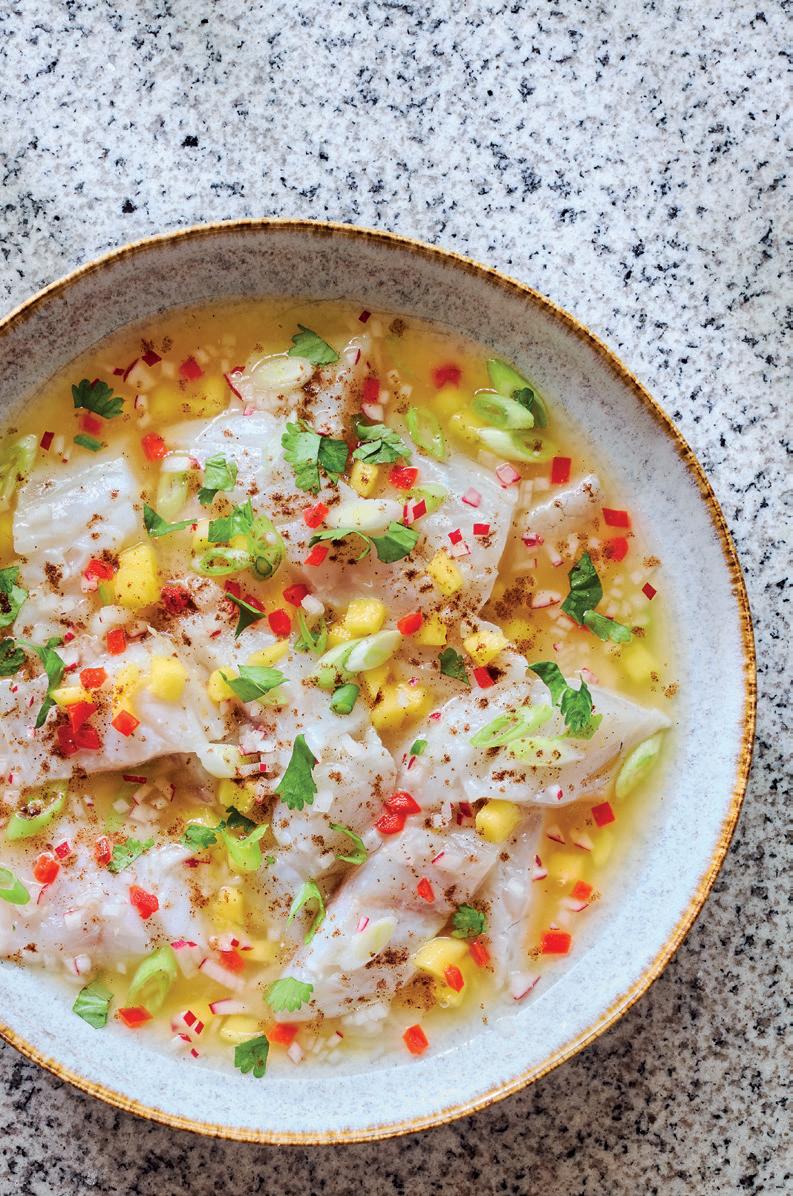
SEA BASS CEVICHE WITH RADISH & MANGO
Marie Mitchell
Serves: 2 as a main, 4 as a side | Prep: 15 mins
Spring is hinting at us, and like the tease it is, it gets us thinking of balmy evenings and fresh produce. This is a wonderful recipe for the mango season, with the peak Indian and Pakistani harvest arriving on our shores in April and May. This ceviche keeps things light and fresh, perfect nestled with some fresh warm bread, dips and grilled vegetables.
INGREDIENTS
— 120ml fresh orange juice
— 60ml fresh lemon juice
— 60ml fresh lime juice
— 3 spring onions, thinly sliced
— 1 small mango, finely diced (around 70g)
— 50g radishes, finely diced
— ¼ scotch bonnet chilli, ribs and seeds removed, rinsed and finely diced
— A pinch of ground pimento (allspice)
— 250g seabass, deboned, skinned and cut into 2cm pieces
— 10g coriander or 5g chadon beni
METHOD
Pour the citrus juices (ideally freshly squeezed) into a medium mixing bowl
Slice the spring onions and dice the radishes and mango before adding to the mixing bowl, along with the scotch bonnet and pimento. Mix and set aside.
Cut the seabass into pieces and roughly chop the coriander or chadon beni, then add to the bowl. Mix thoroughly. Set aside for 5 minutes so that the citrus can work its magic.
Season to taste with salt and pepper then serve immediately.
Where to buy
Sea bass
Shellseekers Fish & Game
Easter SPRING
Look out for: Chocolate Eggs
Hogget
Hot cross buns
Lamb
Salt cod
Sugared almonds
Explore our Easter recipes
The Easter feaster
A look at Easter culinary customs, with the help of Borough Market’s cosmopolitan cast of traders
Ed Smith
After the fast
Traditionally, Christians have observed a period of fasting for the 40 days between Ash Wednesday and Easter Sunday. Today, strict observance of the sacrifices of this period is relatively rare. However, many denominations and cultures do still give up meat, dairy and eggs for some or all of the period (in particular Ash Wednesday and all Fridays). And those traditions do continue to inform contemporary eating, in particular around the period from Good Friday to Easter Monday. Across Europe, and in other countries and communities where the more traditional Christian faiths are followed, it is the case that most people will centre a Good Friday meal around either vegetables or fish; that eggs and dairy will play a key role through the weekend; and that on Easter Sunday, to break the fast, there will be a meaty centrepiece. We also see a wide variety of sweet leavened breads being consumed over the period.
Fish
Some Catholics abstain from eating meat on on Ash Wednesday and Fridays through Lent. Fish flesh, however, is different, and so the tradition of eating fish on fasting days has informed European diets for millennia. Inspiration for a fishy Good Friday feast this Easter is plentiful, if not particularly prescriptive.
Walking round the Market there are plenty of ideas – starting with grabbing a fish pie mix from the fishmongers. Maybe pick up some white fish and make Mexican Baja fish tacos. Or buy some salt cod from Brindisa and make traditional salt cod pil pil – succulent flakes of cod under an oily blanket, wonderful with roasted peppers.
Eggs
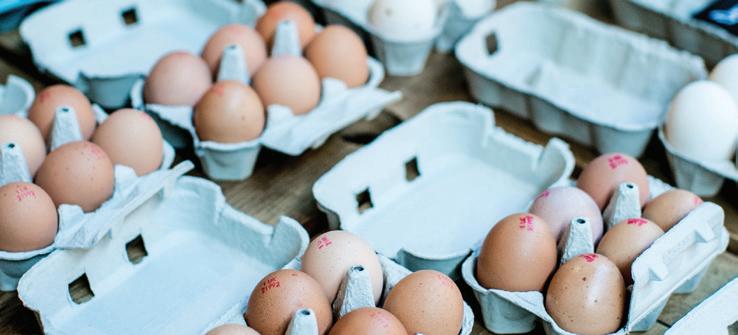
Of course, to most of us Easter means eggs. At a base level, they represent new life and rebirth, hence their ubiquity in this particular festival. The tradition of foil-wrapped chocolate eggs evolved from painted or died Paschal eggs being given as gifts. Marianna from Oliveology recalls that at home in Greece it is customary to stain eggs red using natural dye (a packet version of which she sells at her stall). Those eggs can be blessed at a midnight service on Good Friday, and often sit decoratively atop braided breads. Having been forbidden during Lent, they’re also made use of with gusto over the weekend, for example in galatopia, a delicious egg, semolina and milk pie.
Breads and cakes
Speaking with Borough Market traders from around Europe, it was interesting to find that, as in Britain, there tend to be few absolutely prescriptive dishes or meals
over the Easter period. It is more the case that people follow hyper-localised (or even familial) interpretations of the general themes discussed in this piece. One of the themes to bring the broadest smiles is that of enriched, sweetened, leavened breads.
The tradition for such breads arises from the deep-seated Judeo-Christian significance of breaking bread, and the symbolism of the leavening reflecting the resurrection.
In Britain we have hot cross buns. Elsewhere there’s Greek lambropsomo and tsoureki: soft, fluffy, aromatic braided bread with a golden-brown crust. Or Italian pane di Pasqua, a brioche-style bread likely decorated with bright sprinkles and braided to look like a nest holding a colourful died egg. There’s also colomba di Pasqua – a cake not dissimilar to panettone, in the shape of an Easter dove –which you’ll find at Gastronomica.
A meaty centrepiece (or not)
And so to the Easter Sunday meal. Chatting to traders with links to Spain, Italy, Croatia, Greece, eastern Europe and elsewhere, they all have a common response to the traditional Easter meal: “Yes... there is meat.” However, few of them cited anything as specific to the occasion as the British Christmas turkey and trimmings, or Italian braised lentils and cotechino at New Year.
The meat is often lamb or mutton,
THERE TEND TO BE FEW PRESCRIPTIVE DISHES OR MEALS OVER THE EASTER PERIOD. IT IS MORE THE CASE THAT PEOPLE FOLLOW HYPER-LOCALISED (OR EVEN FAMILIAL) INTERPRETATIONS OF THE GENERAL THEMES.
although obviously where sheep are not common, it might very well be veal or pork instead. As in the UK, the lamb will generally be cooked quite simply – roasted, grilled or barbecued. It’s typically a large joint or, in countries like Spain and Greece, a whole milk-fed lamb, no doubt because the meals in which it is eaten tend to be relatively large family gatherings.
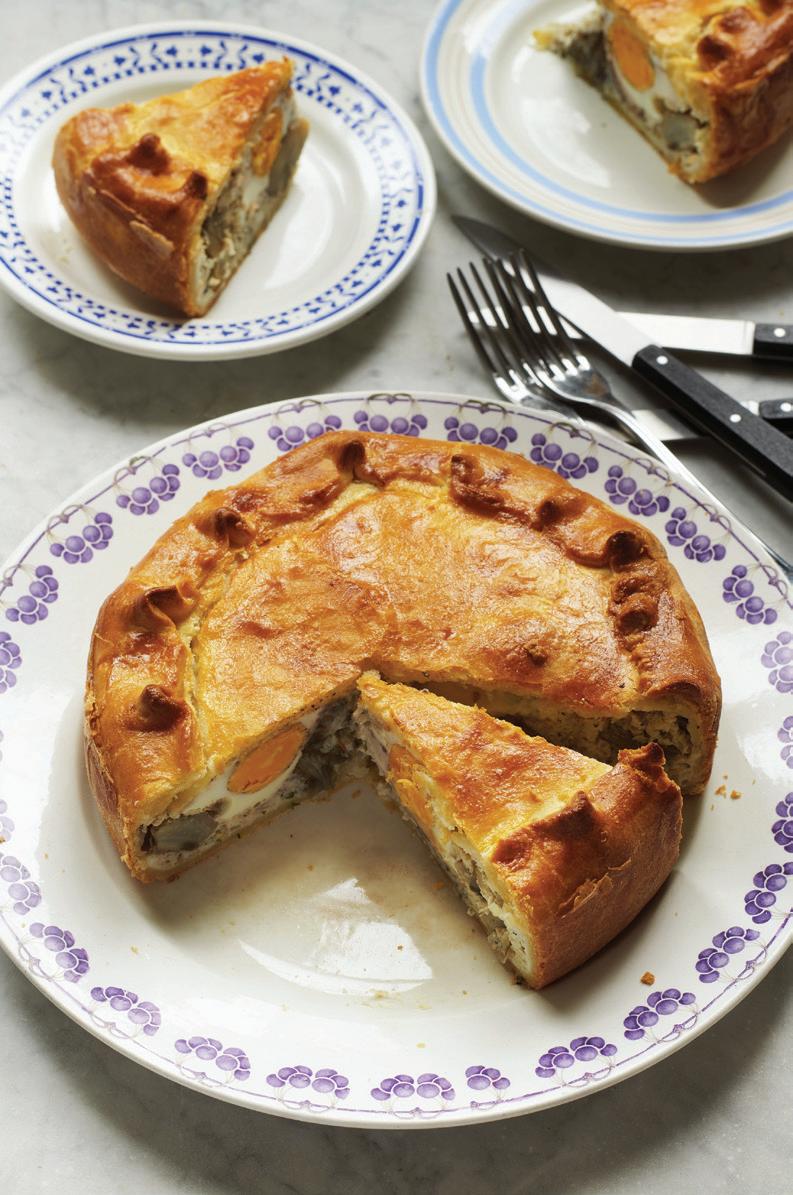
Or, if you or others around the table plan to abstain from red meat for just a little longer, try a torta Pasqualina. This traditional Italian savoury pie (from Liguria) involves the symbolism of eggs, and makes a mightysatisfying centrepiece. It’s also excellent for an Easter Monday lunch table or picnic.
TORTA PASQUALINA (EASTER RICOTTA & ARTICHOKE PIE)
Ed Smith
Serves: 6-8 | Prep: 30 mins | Cook: 1 hour 15 mins
Speaking to a number of the Italian traders, it’s clear that, true to so much of Italy’s food culture, every town and region has different Easter customs and dishes. Popular in Liguria is torta Pasqualina: an egg, ricotta, marjoram and vegetable pie, typically eaten at room temperature on Easter Sunday. Often, you’ll see this made with spinach or chard, but for this version we’re celebrating artichokes, which are bang in season.
INGREDIENTS
For the pastry
— 300g plain flour, plus extra for dusting
— 160g salted butter, cubed
— 200g ricotta, drained
— A large pinch of flaky sea salt
For the filling
— 4 large artichokes, trimmed, or 350-400g cooked artichoke hearts, stored in water (drained weight)
— Juice of 1 lemon
— 1 large shallot, finely diced
— 175ml dry white wine
— 10g marjoram, leaves picked and chopped
— 300g ricotta, drained
— 60g parmesan, finely grated
— ¼ tsp freshly grated nutmeg
— ½ tsp ground black peppercorns
— 6 medium eggs
METHOD
Rub together or pulse in a food processor the flour and butter until they resemble breadcrumbs. Add 200g ricotta plus salt, bring together, then kneed to a silky dough. Divide into two parts, one almost twice as big
as the other. Cover and refrigerate for at least 1 hour.
Meanwhile, with a bowl of lemon juice and water nearby, trim the artichokes one at a time, cutting away all the leaves and fine hairs until left with the hearts. Cut into 6-8 wedges, then drop into lemon water so they don’t oxidise, before starting the next artichoke.
Soften the shallots gently in extra virgin olive oil for 6-7 mins, then add the artichoke hearts and sauté for another 3-4 mins. Increase the temperature, add the wine, then stew and steam for 15-20 mins with the lid ajar, until the hearts are tender. Remove from the heat, stir the marjoram through and leave to cool.
Beat two eggs together. Then, in a mixing bowl, combine almost all of the beaten eggs, plus the remaining ricotta, parmesan, the artichokes, nutmeg and pepper.
Heat the oven to 200C. Oil and flour a deep 20cm, spring-release cake tin. On a floured surface roll the larger piece of pastry 2-3mm thick, into a shape that will fill the tin, leaving a 1-2cm overhang. Line the tin and fill with the artichoke mix. Make four indentations in the mix and crack an egg into each one.
Roll the second piece of dough into a disc to fit the top, add that, then fold and crimp the overhang. Paint with the remaining egg and bake in the hot oven for 40-45 mins until golden. Remove and leave to cool for at least 30 mins before slicing and serving.
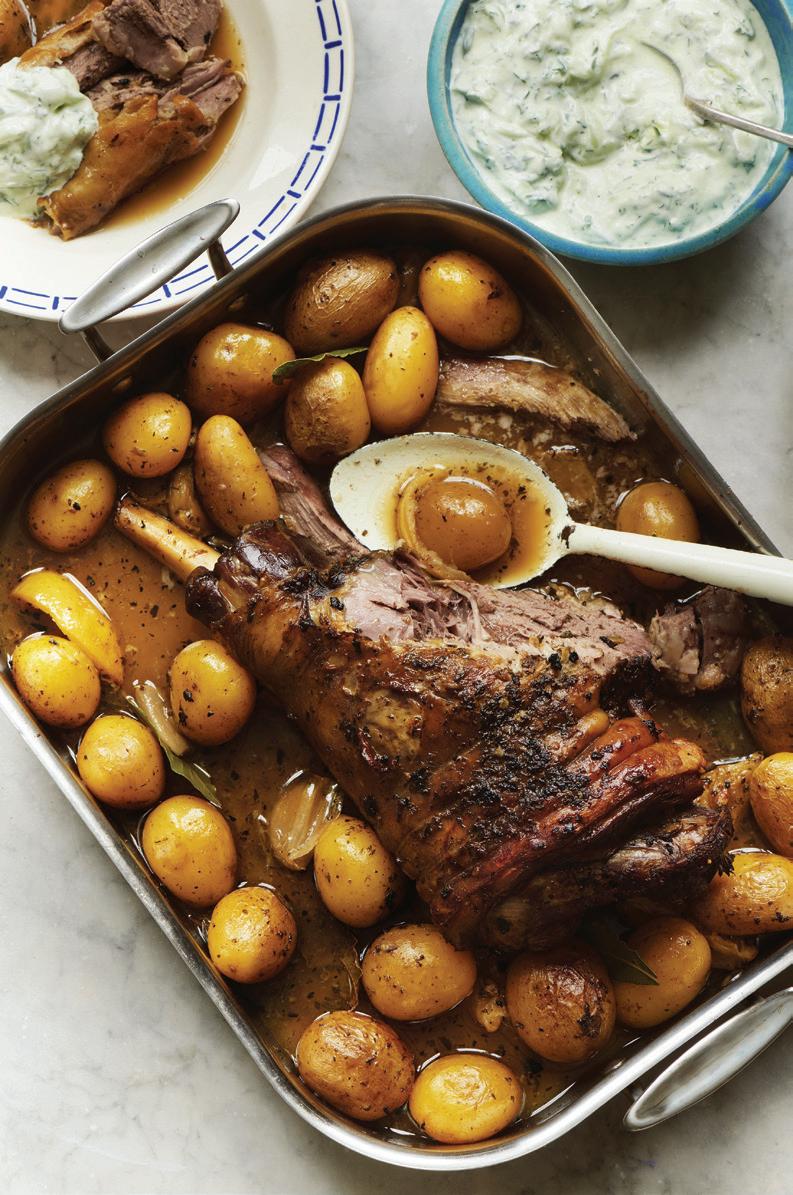
SLOW-ROASTED LEG OF LAMB WITH LEMON & BAY POTATOES
Ed Smith
Serves: 6-8 | Prep: 15 mins | Cook: 4 hours
This Easter Sunday recipe takes inspiration from Greek flavours – dried oregano, lemons and bay. The dish is absolutely made by adding spoonfuls of tzatziki, from a recipe shared by Marianna, founder of Oliveology.
INGREDIENTS
For the lamb
— 2kg leg of lamb
— 1 bulbs of garlic
— 2 tbsp dried oregano
— 350ml dry white wine
— 1kg waxy new potatoes
— 1 lemon, cut into 6 wedges
— 6 bay leaves
For Marianna’s tzatziki
— 500g Greek yogurt
— 1 large cucumber
— 1 handful of dill
— 1 clove of garlic
— 2 tbsp white wine vinegar
— 2 tbsp olive oil
METHOD
Heat the oven to 240C. Place the lamb in a roasting tin or other oven-proof dish into which it fits fairly snuggly.
Cut the garlic bulb in half through its middle (rather than root to tip). Pop the equivalent of three full cloves from the bulbs, roughly chop, then use a pestle and mortar to pound into a puree with a pinch of flaky salt as an abrasive. Add 2 tbsp olive oil, plus 1 tbsp dried oregano. Rub the lamb, paying particular attention to the flesh (as opposed to the fat). Transfer to the roasting tin and cook for 20 mins, so the
meat is burnished. Remove the lamb from the oven and reduce the temperature to 160C.
Lift the meat from its tin and set aside. Pour in the wine and 350ml water, and add in the remaining 1 tbsp oregano, the bay leaves, potatoes, garlic and lemon quarters. Nestle the lamb back in. Carefully tent the tray with foil, then return to the cooler oven for 3½ hours.
Meanwhile, make the tzatziki. Grate the cucumber and squeeze to remove excess liquid. Finely chop the dill. Mince the garlic with a little salt. Mix everything together and add the vinegar and olive oil.
Remove the roasting tin from the oven and increase the temperature to 180C. Check the lamb – it should feel as though the meat will come apart with just a little push from a spoon and fork. If cooked, transfer the lamb to a warm plate and cover with the foil. Return the potatoes and juices to the oven for a 20-30 mins blast. They won’t become crispy, but they will take on a little more colour.
Serve the lamb in large chunks with plenty of broth, the potatoes, and loads of tzatziki. Perhaps a green or Greek salad for luck.