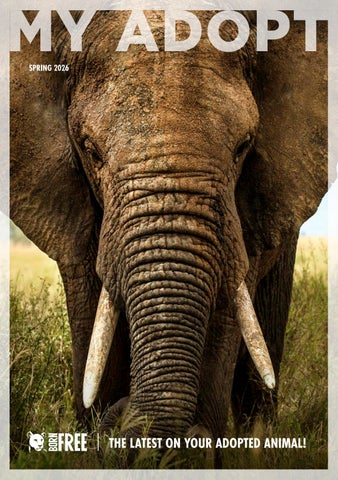
Take My Adopt everywhere you go. Perfect for any device, our online mag is no print, no post, low carbon and low cost, which means max help for wild animals! To go green, email info@bornfree.org.uk or call 01403 240170.
King the Lion
The Pangolin Family
The
Gopal the
The
Family Have a happy holiday
Kyriakos the Brown Bear
Elsa’s Pride
The Leopard Family
The Gorilla Family
The Elephant Family
The Rhino Family
Springer the Orca
Timtom the Orangutan
Cheetah Family
Tiger
Giraffe
@bornfreefoundation
Like you, we’re wild about animals. We’ve been a voice for wildlife for over 40 years. You play a vital role in wild animal care and conservation. But, why not get even more involved? Visit bornfree.org.uk and join us on social media:
STORIES OF HOPE: THANKS TO YOU!
This wonderful little magazine fills me with such joy and optimism – I hope you feel the same way?!
First look for the fascinating update on the animal you adopt, then turn the pages to enjoy many more heart-warming stories. You’ll discover rare species thriving in the wild, as well as rescued individuals nurtured at worldclass sanctuaries.
This life-changing, positive work is funded with the help of your animal adoption. You can see why I’m so happy! But, when you adopt, you support the wider work of our charity as well.
Find out more by visiting bornfree.org.uk/news, but remember, all this action for wild animals is only possible thanks to incredible YOU!
With gratitude and best wishes,
Will Travers OBE Executive President
PS Don’t forget to sign up to our FREE monthly enews at bornfree.org.uk/subscribe, and to our monthly kids’ email at bornfree.org.uk/kids-club
bornfreefoundation @bornfreefdn
bornfreefoundation bornfreefdn
bornfreefoundation
bornfreefoundation
bornfreefoundation
None of our rescued animals in permanent care are allowed to breed; we vasectomise males or spay/give hormone implants to females. We do not want to add to captive populations, plus sanctuary space is in short supply, so we keep these precious spaces for animals most needing rescue.
Home: Living wild in Meru, 220 miles northeast of Nairobi
Family: Several adult females, plus sub-adults and cubs, led by males King and General
Background: One of Meru’s oldest lion families, named after the lioness star of Born Free, returned to the wild by George and Joy Adamson in 1958
Find out more about the lions you help protect, in a sneak preview of our new fundraising film at: bit.ly/protect-the-pride
DID YOU KNOW?
This year is the 60th anniversary of the classic film Born Free, starring our Co-Founders Dame Virginia McKenna and Bill Travers MBE. The true story of Elsa the lioness, and her journey to freedom in Meru, inspires everything we do as a charity.
LATEST NEWS
Liz is a towering figure in Elsa’s Pride and her resilience is truly inspiring. Through seasons of plenty, devastating droughts, and clashes with rival prides, her power and endurance has kept the pride strong.
Lionesses typically live to be 10 to 14 years in the wild. At 11 years, Liz is the oldest lioness in the pride and carries the hard-won wisdom of countless seasons. The monitoring team and tourist guides – who show visitors around the park and support our work – have grown fond of her, recognising her instantly by the distinctive scar beneath her nose, a natural mark that tells its own story of survival (as you can see in her photo).
Her presence is intricately woven into the daily life of the pride. Whether nursing small cubs or teaching young lionesses to hunt, she is a repository of knowledge. The lionesses watch her closely, mimicking her movements, learning how to stalk prey silently through tall grass, or wait for the perfect moment before the chase.
Three of Liz’s offspring – Nala, Ahadi and Chephirah, remain in Elsa’s Pride to this day, alongside their mother. We recently spotted Liz mating with male lion Kimeu, who typically associates with the Mulika Pride. We’ll keep a close eye for signs of cubs. As her years advance, this could be her final litter reaping the benefits of her wisdom.
Michael Mugo & Moses Nyagah Programme Manager & Field Supervisor Pride of Meru, Born Free
WHY ARE ORANGUTANS ORANGE?
We’re not sure! Africa’s great apes –gorillas, chimps and bonobos – are all black. But orange fur might help orangutans blend into the forest’s dappled light, and hide from predators like leopards (who see orange as green, or grey). But, orangutans see colours as we do, so it might also help them spot each other!
TIMTOM’S STORY
Home today: Gradually preparing for life in the wild at Camp Buluh
Background: Taken from her wild mother as a baby and kept illegally as a pet
Rescued: January 2016, aged nine months
Age today: Ten years
Timtom and her best friend Sinta go for a paddle
Enjoy some heartwarming film of Timtom playing in the treetops and having a good old splash at: bit.ly/ Timtom-spring
LATEST NEWS
Each orangutan that enters our care has their own personality – and there’s no one quite like Timtom! From an early age, her playful nature shone, with branches and leaves used as props for games. Soon after came the discovery of water, and playing in the swamp around camp became her favourite pastime – from blowing bubbles, to jumping from up high to see how big a splash she can make.
Encouraging Timtom to spend more time in the trees was no easy task –she climbs as and when she pleases! But she’s become an avid forager, with a long and healthy coat to show for it. And, as you might recall, she recently reached a major milestone – she built her very first nest!
Timtom has since spent many nights in the forest, as we encourage her to practice this skill, as she gets ready for her life in the wild. Although she has built a second nest, in true unique style she’s added her own creative twist. Instead of building a fresh nest each evening like most orangutans, she prefers to renovate the ones she’s previously made. A true budding designer!
Meanwhile Timtom’s campmate Sinta is happy to forage in the forest all day, taking a more ‘serious’ approach to life. But, that doesn’t stop the pair play-fighting, leaping from tree to tree for hours on end. There is truly never a dull day at Camp Buluh!
Zoe Bizicki Communications & Operations Officer Orangutan Foundation
AMBOSELI NATIONAL PARK KENYA
THEIR STORY
Home: Wild in Amboseli, a 150-square-mile park at the foot of Mount Kilimanjaro
The EB Family: Dozens of members including sub-group led by Edwina (born in 1982), granddaughter to Echo, the matriarch star of BBC’s Echo of the Elephants, who died in 2009
Background: Amboseli is renowned for its 1,800-strong elephant population, studied by Amboseli Trust for Elephants since 1972, supported by Born Free since 1992
Find out more about how beehive fences save elephants through our short film: bit.ly/ elephants-spring
DID YOU KNOW?
Elephants are afraid of honeybees! So, we use beehive fences to help local people protect their crops in Kenya AND make money through selling honey. What a bee-rilliant way to help people live alongside elephants without conflict.
LATEST NEWS
Amboseli experienced an elephant baby boom in 2025, with close to 200 births recorded. When rains returned after the drought of 2022, females recovered body condition and many came into oestrus (became fertile), resulting in a surge of births roughly two years later. With your support, the EB family is caring for several young calves. As you can see from the photo, we observe frequent play and close social contact – key components of healthy calf development.
We watched the EBs interact with another elephant family called the PC2s, not least extended play between Pink and Enid’s calves – Enid is Edwina’s mother. It developed from gentle contact into more energetic play-fighting, normal and important behaviour through which calves build strength, coordination, and social confidence. Although only around three months apart in age, small differences in size and confidence were already evident, with Enid’s calf dominating the play.
Enid was seen together with her daughter Elise, and her niece Entito, who was accompanied by a female calf just three days old. Newborns rely heavily on close physical contact and the protection of family members, and she was surrounded by attentive females and older calves. Seeing multiple young calves within the EB family is encouraging and highlights the importance of strong family bonds in supporting calf survival during their most vulnerable early months.
Tal Manor Communications & Outreach Manager Amboseli Trust for Elephants
HANSON ISLAND
JOHNSTONE STRAIT CANADA
SPRINGER’S STORY
Home: Living wild as part of British Columbia’s Northern Resident population monitored by OrcaLab, which has studied orca since 1970 and has been supported by Born Free since 1994
Family: 25-year-old Springer gave birth to Spirit in 2013, Storm in 2017 and a new calf in 2025
Background: In 2002, Springer’s mother Sutlej died and she became lost near Seattle, USA. Identified by her unique calls, with our help she was taken 250 miles by boat back to her wild family, the A4 pod, in the waters near OrcaLab
Springer was just a baby when rescued
DID YOU KNOW?
Sadly at least 54 orca live in captivity, held in concrete tanks and shallow sea-pens, and trained to perform unnatural tricks. But in the wild orca can dive 200m and swim 100 miles a day. Imagine how captive orca must suffer! They belong in the wild with their families.
LATEST NEWS
Learn more about the fascinating work of OrcaLab at: bit.ly/ discover-OrcaLab
We are continually amazed at the story of Springer: her resilience, her adaptability, and the legacy she will leave behind. The most recent sighting of Springer and her family was in Ketchikan, Alaska.
As the crow flies, this marks an incredible 600 miles north of northeastern Vancouver Island, where we have often seen her! We are delighted to see that her newest baby is looking healthy, and that they were foraging for salmon alongside members of their closest kin, the A35 pod.
While we await seeing Springer’s family at OrcaLab this year, we could not pass up the opportunity to add their newest member, born last year, to our ‘Welcome Home Springer’ sign (see photo). This has sat proudly upon our Lab roof for 24 years since her return. Every boater, kayaker and cruiser sees this sign as they round the corner into Blackney Passage, and we hope it has inspired many to read about her journey.
Looking to 2026, we eagerly await the announcement of the new calf’s name. The naming of orca calves in Canadian waters is coordinated by Vancouver Aquarium. In addition, we hope Springer decides to come further south once again, so we might hear their calls as a new family of four.
King was the 42nd lion Born Free rescued. Our first lions Anthea and Raffi, rescued in 1995, also enjoyed life at Shamwari. We’ve since given a home to an incredible 59 lions, 39 living at Shamwari. This is thanks to our super supporters, not least YOU!
KING’S STORY
Background: Rescued from illegal pet trade in France, 2017
Home today: Lifetime care in a spacious enclosure with companion Thea, also rescued from the illegal pet trade
Arrived at Shamwari: July 2018
Age today: Eight years
Before Born Free, and you!
Total lions rescued Have lived at Shamwari
Our 42nd rescued lion King
Enjoy a fascinating short film about Martin’s work caring for King at: bit.ly/hero-martin
LATEST NEWS
South Africa’s summertime brings long, sunny days, warm evenings, and a relaxed, carefree atmosphere. King spends most of his time outdoors, enjoying the bright weather and fresh air. He particularly enjoys his large climbing platform, where he can sleep peacefully or sit upright, calmly observing his surroundings. From this vantage point, he watches birds flying and listens to distant animal calls.
The cooler mornings are usually the most active time for King. He begins his day by stretching his massive paws, yawning, and shaking out his mane. He then walks around the enclosure, sniffing the air and checking for any changes that may have occurred overnight.
By the heat of late morning, King settles into a more relaxed routine. This is his quieter time, when he grooms himself or his beloved companion Thea. They often lie close together, softly growling and calling to each other — a reminder that lions are social animals for whom companionship is essential. Then, as the day cools in the afternoon, King becomes more alert once again.
King is eating very well, it does your heart good to see him enjoying his meal! After feeding he rests in a cool, shaded area or clambers up to his climbing frame, gradually becoming calmer, then snoozing. You’ll be happy to hear that health-wise, King is doing extremely well and, with your support, is in excellent physical condition.
Martin Miritiawo Animal Care Supervisor, Born Free
DID YOU KNOW?
While not every rescue story has a happy ending, each animal Lilongwe Wildlife Trust takes in represents a victory against wildlife crime. Every release is a step toward restoring balance in nature, and every animal in rehab is a promise of hope for the future.
LILONGWE
WILDLIFE TRUST
LILONGWE
WILDLIFE CENTRE
MALAWI
THEIR STORY
Home today: Malawi’s only wildlife sanctuary gives expert one-on-one treatment to rescued Temminck’s pangolins, returning them to the wild if possible. Lilongwe Wildlife Trust also fights wildlife crime and supports conservation
Background: Injured and orphaned pangolins, especially victims of illegal wildlife trade, are rescued, rehabilitated, then released and monitored in safe places
Action: In 2007, Born Free helped Lilongwe Wildlife Centre to develop from a former zoo. Today their pangolin work includes two regional hubs which act as ‘first response units’
You can see some fascinating footage of Dzuwa’s care at: bit.ly/Pangolinsspring
We’re glad to see Dzuwa is gaining weight
LATEST NEWS
In recent months four pangolins, rescued from illegal trade but in good health, were released back into the wild, without needing extended rehabilitation. They were tagged and, encouragingly, progress is looking positive. This ongoing monitoring ensures they are adjusting to their natural habitats and doing well after rescue.
Currently in rehab are two Temminck’s pangolins Thope and Dzuwa. Thope (‘mud’), was named during her pick-up, when our emergency vehicle got stuck in the mud! She was discovered alone outside a national park and, although in good health, as a pup weighing only 4kg, requires care before release. An ideal weight for her would be over 5kg.
Dzuwa (‘Sunshine’), named due to her yellow-tinged scales, was rescued from illegal trade and arrived severely dehydrated and slightly underweight for her age at 7.8kg. She has since been on regular fluids and a good diet, and has shown encouraging growth, now weighing 8.2kg.
The pair go for daily foraging walks of up to three hours, and are often up at night as well as early in the morning. They have both been tagged and ID’d, set for release very soon.
Maria Thundu Copywriter Lilongwe Wildlife Trust
BANNERGHATTA
TIGER
SANCTUARY
INDIA
GOPAL’S STORY
Home today: Lifetime care in a spacious forest enclosure
Background: Born in the wild but captured when he came into conflict with people by preying on cattle and goats
Arrived at sanctuary: 2014
Age today: 17
DID YOU KNOW?
Since our first tiger rescue in 1987 (we took six tigers from a UK circus to a forest sanctuary in India), Born Free has rescued 20 tigers. Today we care for two –Sandro rescued from a terrible zoo in Spain (thankfully now closed) who now lives with our colleagues at Animanatura Wild Sanctuary, and Gopal.
Enjoy glorious new footage of Gopal at: bit.ly/Gopal-spring
LATEST NEWS
Winter brought cooler days that gently shifted Gopal’s routine. He became a little less active in the mornings, resting longer in warm, sunny patches, stretched out behind the dense bushes he loves so much, perfectly camouflaged and content in his favourite hiding spots.
Gopal has always been a little shy, and prefers to stay tucked away, watching quietly from behind the foliage. But, if you’re patient enough, you may catch the soft ‘chuff’ calls he makes while resting. Currently 200kg, Gopal remains healthy and alert. He receives regular multivitamin and mineral supplements, to support his immunity and overall wellness, and his annual vaccination protecting him from three viruses – calicivirus, rhinotracheitis, and panleucopenia. Gopal isn’t a fan of injections, but after a little grumble and a side-eye at the vets, he lets them do their job and then strolls off with his usual allure.
Food-based enrichments remain an important part of his daily routine. He has taken well to the hanging meat enrichments we set up to encourage natural behaviours like stretching, swiping, and exploring. His appetite remains good and his carefully measured meals meet his nutritional needs.
Gopal’s caregivers keep a close watch on his behaviour and comfort when temperatures drop, ensuring he has access to sheltered spaces. Thanks to your generous support, he continues to live peacefully in a safe, nurturing, and enriching environment.
Rishabh Mehta Communications Manager Wildlife SOS
With your help, rhinos have recovered so well in Meru, they’re now boosting numbers hundreds of miles away! Led by Kenya Wildlife Service, ten white rhinos were moved to Loisaba Conservancy, including four from Meru. DID YOU KNOW?
MERU NATIONAL PARK KENYA
THEIR STORY
Home: Rhino Sanctuary within Meru National Park
Family: An important population of 104 white and 45 black rhinos, protected by rangers with our help
Background: After a poaching epidemic in the 1980s, Born Free has been helping Kenya Wildlife Service (KWS) since 2014 to restore Meru’s wildlife, including rhino, to its former abundance
Rhino calves stay with their mum until up to four years, learning essential survival skills
Samim Kaari is a Community Conservation Ambassador and part of our Saving Meru’s Giants team. Enjoy a short film about her work at: bit.ly/hero-samim
LATEST NEWS
Meet Jamhuri – she’s a 13-year-old adult female southern white rhino, born on 25th November 2012, in the warm plains of Meru National Park. During her early years, Jamhuri was given an ear notch and assigned the identification number ‘70W86’, a vital mark that allows rangers to recognise her safely from a distance.
Her mother, Jennifer, had been translocated from Solio Ranch in Laikipia, in central Kenya. With an incredible four sisters and three brothers (well done Jennifer!), Jamhuri grew up surrounded by a large, dynamic family. Interestingly, her own first calf, Komu, born in May 2019, was one of the rhinos translocated to Loisaba Wildlife Conservancy last year to strengthen this rhino population (see box).
Jamhuri welcomed her second calf in December 2022, followed by her third in April 2025, a spirited youngster who rarely leaves her side. Today, Jamhuri confidently roams Meru’s rhino sanctuary safely, moving together with her calf with quiet synchronicity. They are occasionally joined by familiar companions, including her brother Tiapar and two other males, Obama and Gakuya.
Jamhuri’s strength lies in her lineage, resilience, and steady presence in Meru. As a mother and sister, she embodies deep family bonds, enduring challenges, and resilient hope for her species’ future. Her quiet strength endures, guiding her species toward a better future.
Rita Kulamo Saving Meru’s Giants Project Officer Born
Free
DID YOU KNOW?
With the incredible help of Born Free donors and supporters, we have rescued a fantastic 14 leopards over the years. Our very first – Rikki the sweet-natured, cross-eyed leopard, rescued from a roof in Tenerife – arrived at Shamwari in 1996.
LATEST NEWS
BORN FREE’S SANCTUARY SHAMWARI PRIVATE GAME RESERVE SOUTH AFRICA
THEIR STORY
Home today: Lifetime care in their own spacious bush enclosures
Background: Rescued from a failed zoo in South Africa in 2020
Age today: Mowgli seven, Zeiss twelve
Enjoy a fascinating short film about Glen’s work caring for Mowgli and Zeiss at: bit.ly/hero-glen
Although leopards are naturally more active at dawn and dusk, Zeiss is often seen during the day. He engages in short bursts of play or exploration, then climbs on his climbing frame and rests, stretching out comfortably on his side or belly. He clearly enjoys observing his surroundings from safe, elevated spots, quietly listening and scanning the area.
I’m so pleased with his progress – he appears to feel safe, comfortable, and well-established in his territory. Zeiss is also eating well and has never skipped a meal! He carries food to the quiet back part of his enclosure, where he can eat undisturbed.
Mowgli is also thriving, and maintains a private demeanour – preferring the seclusion of the thickets and bushes. Occasionally, during our routine fence inspection, we hear him quietly following us, without revealing himself. Like many leopards living in the wild, he prefers to stay hidden.
We understand building trust takes time, and support Mowgli through this process. Given his distressing experiences at the zoo, we hope these memories will gradually fade, and don’t place any pressure on him to be visible. I believe Mowgli appreciates this, which may explain why he chooses to follow us. This subtle form of acknowledgment is extremely meaningful to us and allows him to progress at his own pace.
Glen Vena Animal Care Manager, Born Free
Rather apprehensive, Mowgli first arrives at Shamwari
Enjoy some wonderful film of Bobo and family at: bit.ly/gorilla-food
THEIR STORY
Home today: Cared for in a spacious rainforest enclosure, at Ape Action Africa’s sanctuary
Family: A large rescued group of Critically Endangered western lowland gorillas, led by the mighty silverback Bobo
Background: Since July 2024, Born Free has supported the care of our new family of adopted gorillas, at this renowned sanctuary
UPDATE ON BARBIE
The AAA team is so pleased with the progress of their youngest gorilla orphan, Barbie – rescued after being shot by poachers. She’s growing fast, has huge amounts of confidence and lots of energy. The youngster still stays close to rescued adults Luci and Chickaboo, who provide comfort, reassurance and protection –especially from some of the boisterous young males in the group, and teach her essential social behaviours. But Barbie also enjoys lots of play with another infant female, Nouji. Hitching
LATEST NEWS
Silverback Bobo and his group now share their forested enclosure with two more rescued individuals –guenon monkeys, Kit and Buddy. The introduction of the two male long-tailed monkeys went very smoothly, with Bobo’s group fascinated by the new arrivals, observing the two monkeys from the edge of their forest before their release into the main enclosure.
After several weeks, when both gorillas and monkeys were more accustomed to each other, the day arrived for Kit and Buddy to be released into Bobo’s enclosure. Buddy was the first to step into the forest, eagerly running into the enclosure to start finding his way around his new home. Though Kit was a little more unsure of himself, he too soon found the confidence to begin exploring the forest.
The gorillas, particularly Bobo and the females of the group, were very curious about the two monkeys. Naturally, a little nervous about being approached by such large individuals, Kit and Buddy kept their distance at first, disappearing into undergrowth if the gorillas tried to get too close. Over time, the guenons familiarised themselves with their new home and learned that Bobo and his troop pose no threat. We’re delighted that the monkeys and gorillas are now comfortably sharing their forest home, happily spending time in close proximity and very relaxed in each other’s company.
Jo Gaweda Assistant Manager Ape Action Africa
THEIR STORY
Home: Kenya is a vital home for rare, reticulated giraffes and Born Free has taken action to save them in Meru, since 2021
Family: So far, Born Free has identified 613 individual giraffes in Meru
Background: Meru is an important home for reticulated giraffe. With your support, their population is increasing in Kenya.
Our Twiga team in action, removing snares to keep giraffes safe
Jackline Ntinyari is a key member of our Twiga* Team. Enjoy a fascinating short film about her work at: bit.ly/hero-jackie
*Swahili for ‘giraffe’
Zuberi is easily recognised by his heart-shaped patch
LATEST NEWS
Meet Zuberi, one of the most prominent bull giraffes in Meru. Officially known as ‘SMG050’, he’s been affectionately named Zuberi by the team, meaning ‘strong’ in Swahili. True to his name, Zuberi exudes dominance and confidence as he roams Meru National Park.
Zuberi is easily recognisable by the distinct heart-shaped patch on his right shoulder, a natural mark that makes him stand out even from a distance. What makes him even more unique is his five ‘ossicones’, a rare feature among giraffes. Often mistaken as horns, ossicones are the bony protrusions on a giraffe’s head, covered in furred skin, which grow from birth until maturity.
During ‘necking bouts’, a way male giraffes can display strength, Zuberi uses his ossicones to deliver powerful, heavy blows, asserting his place as one of the most dominant bulls in the area. His presence is both commanding and graceful, truly symbolising strength and pride.
We estimate he is over nine years old due to his dark colouration and large size.
DID YOU KNOW?
Reticulated giraffes have been upgraded from a sub-species to a species, following genetic analysis. In a major breakthrough for conservation, scientists now recognise four species, with Kenya home to three: reticulated, northern and Maasai giraffe.
One of the most regularly sighted giraffes in our database, we’re always delighted to see him again! With your support we can protect giants like Zuberi, ensuring giraffes not only survive but flourish in Merus’s wild heartland.
Irene Kanga Dzuwamwenga Saving Meru’s Giants Monitoring Officer Born Free
ENSESSA KOTTEH RESCUE CENTRE ETHIOPIA THEIR STORY
Home today: Spacious natural enclosures with undergrowth to explore and room to run
Background: Mostly victims of the illegal pet trade, stolen from the wild as cubs
Arrived at Ensessa Kotteh: 2011 to 2026
Age today: From four months, to 15 years
Your cheetahs:
Girls Rescued
Blue Aug 24
Fasika Apr 23
Sisay (aka Jijiga) Dec 21
Konjo (aka Tamu) Apr 15
Choa (aka Nura) Apr 15
Boys Rescued
Ramadan Apr 23
Dima June 22
Dehar Jan 22
Timkat Jan 11
Cheetah cub rescue
Three extremely young cheetahs – all girls, have been rescued, and brought to the safety of our rescue centre. Very sadly, a fourth – a little boy, did not survive. Our team is literally working around the clock to give these fragile infants, saved from the cruel illegal pet trade, the best possible care. Read the latest news at bornfree.org.uk/news
LATEST NEWS
Led by Tilahun Bayena, Senior Animal Carer, our dedicated cheetah care team consists of three passionate members who work every day to the highest standard of care. With your support, we provide a safe home, daily enrichment, and renewed hope for these remarkable animals.
Including the three new cubs (see box), we currently care for 12 cheetahs in several enclosures, each with their own unique history, behaviour, and individual needs. Konjo and Chewa are thriving in a spacious, newlyrenovated and expanded enclosure. They particularly enjoy playing with a hessian sack filled with hay and aromatic herbs — their favourite form of enrichment.
Timket and Jijiga love to rub against brushes tied to tree trunks, which helps with grooming, and provides comfort and relaxation. Meanwhile Dima and Dehare are especially food-motivated. To encourage natural hunting instincts and physical activity, strips of meat are hung from low branches.
Our most energetic pair, Fasika and Ramadan, love playing with their beloved boomer balls — durable toys to keep them active and mentally engaged. Meanwhile in the intensive care area, young Blue continues to recover well after being hit by a car. As you can see in the photo, she has shown significant improvement and we’re planning appropriate enrichment activities, alongside a long-term recovery pathway. Her strength and resilience continue to inspire us all.
Thanks to your support, each cheetah receives care tailored to their individual needs. Your generosity truly transforms lives!
Bereket Girma Country Director, Ethiopia, Born Free
bornfree.org.uk | Spring 2026
Enjoy some wonderful film of Kyriakos at: bit.ly/ Kyriakos-spring
ARCTUROS
KYRIAKOS’ STORY
Home today: Lifetime care in a spacious beech forest enclosure
Background: Rescued from Kastoria in northern Greece as a four-month-old, wild-born cub, with his twin brother Manolis, when their mother was killed
Arrived at sanctuary: 2004
Age today: 21
Tiny when rescued, today Kyriakos is the biggest bear at Arcturos
DID YOU KNOW?
Whenever they can, Arcturos prepares orphan bear cubs for life back in the wild. Martha was released into a remote forest area last year, after being rescued as a terrified cub in 2024, then given expert care. Sadly, this isn’t possible for Kyriakos, who became too used to human company when first taken in by a kindly shepherd.
LATEST NEWS
As winter loosened its grip on the mountains, Kyriakos is enjoying the final stretch of his well-earned seasonal rest. Before retreating into his den late last year, he spent the autumn in true Kyriakos fashion: with boundless curiosity, a tremendous appetite, and an ever-growing waistline confirming he’s the largest bear at Arcturos!
In the weeks leading up to his winter sleep, Kyriakos was wonderfully energetic and determined to fatten up. He devoured astonishing quantities of plums, carrots, and apples, leaving his caretakers speechless at the speed he polished them off. If you look closely, you can see remnants of a strawberry feast smooshed across his muzzle and fur. By late autumn he looked magnificent – bigger, rounder, and more imposing than ever, a true gentle giant preparing for the cold.
He also showed great dedication to home improvements, pushing armfuls of leaves into the cosy pit he dug, crafting a snug nest. At time of writing, Kyriakos is still resting deeply, tucked into his leaf-lined den. But, once he wakes, he’ll be ready for his trademark spring routines: splashes in the pool, impressive rock-tumbling, and his famous mid-air bread catches. For now, we let him sleep peacefully. And, when he stirs with the first signs of spring, we’ll be there to welcome back the king of the mountain in all his glory.
Panos Stefanou Director of Communications Arcturos
As a precious adopter, you help care for rescued animals and protect rare species in the wild. Thank you! But that’s not all. You also help fight cruelty.
Sadly, wild animals are exploited in captivity for human entertainment. Born Free wants to stop this suffering. This Easter holiday, please pledge to avoid:
Zoos
Circuses
Dolphinaria
Selfish Selfies
(having your photo taken with an animal)
Please spread the word – encourage your family, friends, colleagues to take our pledge and not to support suffering.
Be our eyes and ears on holiday – if you see animals being exploited, please let us know and find out how to raise your concerns at: bornfree.org.uk/raise-the-red-flag/
Jo-Anne McArthur, Dirklan Ranzijn (Flickr cc),
Born Free
Raise funds for your favourite animal
Could you raise funds with your school or family? How about a talent show for tigers, a raffle for rhinos, or popcorn sale for pangolins?
From a fancy dress day to a dance-a-thon, a cakes stall or car wash, you and your friends can have fun and fundraise for Born Free!
Download your FREE fundraising pack for all the ideas and materials you need at: bornfree.org.uk/fun-fundraising-ideas
Or email us at: gowild@bornfree.org.uk
Or scan me!
Our Junior Ambassador Thea ran the Great North Run, while High March School raised funds with a snack sale, a colouring competition, and a guess the name of the Loch Ness monster!