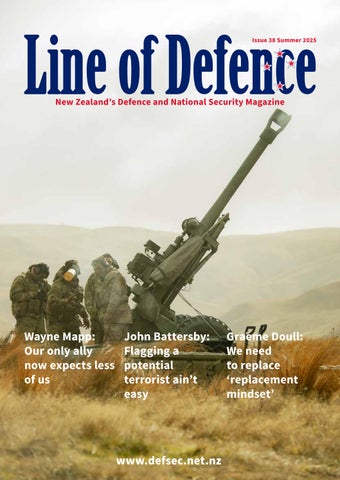
Line of Defence Magazine - Summer 2025-26

Page 1


The Summit Shaping NZ’s Cybersecurity Landscape

National Policy, Strategy

Gain C-level cyber risk leadership and resilience. Real-World Threats, Real Solutions

Explore AI attacks, live-breach lessons, identityfirst & zero-trust. Peer Insight, Valuable Connections

High-value networking with 400+ delegates. Join roundtables.

Headline sponsor

EDITOR’S NOTE

Kia ora and welcome to the Summer 2025-26 edition – and 38th issue – of Line of Defence Magazine!

In this edition, we’re privileged to be joined by contributing writers former Defence Minister Hon Dr Wayne Mapp QSO, Editor-at-Large Dr Peter Greener, University of Waikato Prof Alexander Gillespie, Massey University’s Dr John Battersby, and former NZ Army Officers Josh Wineera and Graeme Doull

Some excellent updates also from Line of Defence sponsors Shield AI and GA-ASI and messages from Ventia and Brightstar. These leading organisations make our publication possible.

In this ultimate issue of Line of Defence Magazine for 2025, we are once again joined by our most prolific contributor, Wayne Mapp, who observes that with waning capability relative to Australia, New Zealand is no longer expected to be the ally it once was. What does this mean, and what does it suggest for the future of our place among friendly military powers?

In the first of his two articles in this issue, Graeme Doull recommends that the NZDF remove its ‘replacement mindset’ when it comes to major platform procurement. In this second article, he argues that the NZ Army has become overly process-minded to its detriment, and that more strategic thinking is needed to restore the balance.

Peter Greener returns to our pages to break down New Zealand’s deliberations over the ANZAC frigates replacement – and why two ships should not be an option, while Josh Wineera digs into history to find strong precedent for reimagining existing air platforms in the context of manned-unmanned teaming.

In the wake of the tragic attack at Sydney’s Bondi Beach, John Battersby explains just how difficult it is for authorities to flag a potential terrorist. Accurately divining a person’s future intentions, he writes, is a devilishly difficult undertaking to pull off. Alexander Gillespie writes that the onus is now on New Zealand to learn from the Bondi experience and any gun law changes Australia enacts in its aftermath.

All this, and much more in this issue of Line of Defence, including the Tahu Awards, new security and defence agreements with Japan, Police body-worn cameras, and the latest Defence Industry news.

Season’s greetings from the Line of Defence team, and here’s to a fantastic 2026!

Nicholas Dynon, Auckland.

Hon Dr Wayne Mapp QSO Professor Alexander Gillespie

Dr Peter Greener

LTCOL (Ret) Josh Wineera

Mr Nicholas Dynon

GA-ASI

Shield AI CONTRIBUTORS

Dr John Battersby

Mr Graeme Doull

SIPRI

SPONSORS & PARTNERS

GA-ASI

Ventia

Babcock

Brightstar

Shield AI

Massey University Centre for Defence & Security Studies

COVER IMAGE

Cover image courtesy NZDF. L119, 105mm Light Gun

UPCOMING ISSUE

AUTUMN – March 2026

Main themes: Air domain, AUKUS, surface fleet, critical infrastructure

Copy Deadline: 28th February 2026

Publication: 15th March 2026

INDUSTRY ASSOCIATION

CONTACT DETAILS

DEFSEC

Chief Editor: Publisher:

Nicholas Dynon

M: +64 (0)22 366 3691

E: nick@defsec.net.nz

Postal and delivery address: 27 West Cresent, Te Puru 3575, Thames RD5, New Zealand

SOCIAL MEDIA

Craig Flint

T: +64 (0) 274 597 621

E: craig@defsec.net.nz

www.linkedin.com/company/defsec-media-limited www.facebook.com/defsecmedia/

DEFENCE

6 V-BAT: A new era of maritime surveillance for New Zealand

9 Creation of new Motorised Infantry Battalion at Linton

10 Less Offered, Less Expected: New Zealand’s change in circumstances

12 Safeguarding New Zealand’s Future with the MQ-9B SeaGuardian®

14 Sweating the Fourth Generation Fighters: What Project Kahu can teach us about MUM-T

17 Tohu Awards celebrate part-time Defence commitments

18 Frigates, flexibility, and the case for a smarter New Zealand fleet

20 Rebalancing the New Zealand Army’s Thinking

24 Two, Three, Four? The Royal New Zealand Navy’s new frigates

INTERNATIONAL SECURITY

28 Top 100 arms producers revenues surge as states expand arsenals

31 NZ and Japan sign defence and security agreements

HOMELAND SECURITY

32 Opinion: The Bondi beach attack and the illusion of security

34 What NZ needs to watch as Australia reforms gun laws after the Bondi terror attack

36 Privacy Commissioner talks police body-worn cameras

40 Converged Security gets an Institute. Who knew?

42 Victoria introduces tough new retail crime laws

43 Public Safety Network access for more emergency responders

Defsec Media Limited publishes Line of Defence, FireNZ Magazine and New Zealand Security Magazine premier publications covering industry sectors that help keep Kiwis safe. Find us online www.defsec.net.nz

Copyright: No article or part thereof may be reproduced without prior consent of the publisher.

Disclaimer: The information contained in this publication is given in good faith and has been derived from sources believed to be reliable and accurate. However, neither the publishers nor any person involved in the preparation of this publication accept any form of liability whatsoever for its contents including advertisements, editorials, opinions, advice or information or for any consequences from its use.

DEFENCE

V-BAT: A New Era of Maritime Surveillance for New Zealand

The tyranny of distance defines the Pacific, serving so often as a buffer, offering security against the threats faced by many others around the world. However, that security is slowly being eroded by the proliferation of new technologies to defeat traditional border security defences. The discovery of lowobservable and semi-submersible vessels for illicit activities is allowing drug smugglers to drastically increase the importation of narcotics into New Zealand and Australia. Recent reports indicate a 266% increase in the quantity of methamphetamine seized in New Zealand and offshore over the last five years.

Similarly, rates of incursions into the region’s respective economic exclusion zones highlight the need for increased maritime domain awareness for all Pacific nations. As our geopolitical rivals and other threats are adopting and harnessing emerging technologies, so too must we adapt at the speed of relevance to protect ourselves. These new technologies need to be acquired and deployed with speed and intent. They need to be employed in a distributed nature, not reliant on fixed locations, allowing for adaptability and deployability.

Persistent maritime domain awareness has become indispensable in the Pacific, where distances are vast and operational challenges significant. Uncrewed vertical takeoff and landing (VTOL) systems, such as the Shield AI V-BAT, offer a proven, cost-effective solution to strengthen sovereign surveillance, deter illicit activity, and accelerate response to emerging threats.

As a VTOL unmanned aerial system (UAS), V-BAT provides a combination of flexibility, endurance, and ease of deployment that traditional intelligence, surveillance, and reconnaissance (ISR) systems cannot match. Its tailsitting, ducted-fan design requires only a 4.6 x 4.6 metre pad, allowing operations from small naval vessels, cutters, civilian ships, or austere shore sites without the need for runways.

The enclosed rotor system and precision autonomous controls enable safe and automated launch and recovery on crowded decks and in winds up to 25 knots, making it ideal for maritime environments where space and conditions are often challenging.

This compact design translates into simple logistics. The entire system packs into transit cases that can be transported by ute or helicopter; a two-person team can assemble and launch the aircraft in under 30 minutes. Precision autonomous flight management further lightens operator workload,

enabling crews to focus on mission execution rather than aircraft handling.

V-BAT’s performance is driven by its endurance and range, ideal for Pacific environments. With more than 13 hours of flight time and nearly 1,000 nautical miles of coverage per sortie, it can patrol well beyond a host vessel’s visual horizon. Powered by a heavy-fuel engine, V-BAT transforms maritime operations: it supports persistent monitoring of smuggling routes and remote atolls, maintains awareness over vast ocean areas, and provides real-time intelligence to cue maritime patrol aircraft or interdiction teams.

Equally important is the platform’s sensor versatility. With an 18-kg payload capacity, the V-BAT supports high-resolution EO/IR cameras, synthetic aperture radar, Automatic Identification System (AIS) receivers, and advanced detection tools such as Shield AI’s ViDAR. ViDAR, wide-area motion imagery system, autonomously scans thousands of square nautical miles per hour, identifying small vessels or

DEFENCE

subtle wakes that human observers could easily miss. Once a contact is detected, the system immediately geolocates it and streams imagery to command centres, enabling rapid and accurate interdiction.

(This combination of deployanywhere flexibility, long-endurance coverage, and advanced sensing gives the V-BAT the ability to deliver high-impact ISR at a fraction of the cost of runway-dependent systems. For maritime forces tasked with monitoring vast areas on limited budgets, it offers a practical and scalable way to increase domain awareness, strengthen deterrence, and respond quickly to emerging

threats.

Under a $198 million contract awarded by the United States Coast Guard (USCG) in 2024, V-BAT deployed aboard National Security Cutters have delivered persistent ISR. Operational deployments have proven highly successful, providing continuous surveillance of suspicious vessels, improving cueing for interdiction teams, and ultimately enabling faster, more effective maritime operations. The results speak for themselves. In 2025 alone, the Coast Guard attributed more than US$1 billion in narcotics seizures to V-BAT-enabled operations.

Anthony Antognoli, the U.S. Coast Guard’s program executive officer for robotics and autonomous systems, stated, “A drone that can travel around a thousand nautical miles… can do the work of ten cutters.” While that comparison may seem bold, Shield AI’s V-BAT has already proven it true.

From delivering electronicwarfare–resilient ISR in Ukraine, to assisting wildfire response efforts in Bulgaria, to being the first-ever maritime-based ISR platform to be deployed on Japanese Maritime Self Defence Force surface vessels, V-BAT continues to prove its versatility and reliability in some of the world’s most demanding operational environments.

For New Zealand, adopting a common VTOL UAS across both the Royal New Zealand Navy and the New Zealand Customs Service would create immediate advantages delivering meaningful capability without an exquisite price tag.

Offshore patrol vessels could deploy V-BAT detachments for fisheries protection, illegal entry detection, and enhanced searchand-rescue coverage. Meanwhile, Customs could operate the same platform from chartered vessels to counter drug-trafficking networks exploiting Pacific transit routes. Shared training, maintenance, and data practices would generate powerful interagency synergies and reduce costs, strengthening the country’s maritime security posture.

As Antognoli said, “It is impossible to do that work with humans and patrol cutters alone.”

These examples only hint at the broader potential. In practice, integrating compact, ship-deployable VTOL drones like the V-BAT across New Zealand’s maritime forces would fundamentally enhance the nation’s defense posture, enabling agile, affordable, and persistent protection of its waters and those of its Pacific partners.

Creation of new Motorised Infantry Battalion at Linton

1 RNZIR and QAMR amalgamate as a motorised infantry battalion as Army aims for greater agility, adaptability, and lethality.

At a parade and ceremony held at Linton Military Camp on 05 December, the official amalgamation of 1st Battalion, Royal New Zealand Infantry Regiment (RNZIR) and Queen Alexandra’s Mounted Rifles (QAMR) took place with Chief of Army, Major General Rose King, in attendance.

“This marks an exciting new chapter for Ngāti Tūmatauenga,” said Major General King.

“The amalgamation of the two units was a deliberate decision made to enhance and better enable the combat readiness of one of our key military outputs – that of a Motorised Infantry Battle Group. In today’s uncertain strategic environment we need to be ready to fight tonight, and today marks the next step in our journey to become a more agile, adaptable and lethal combat force.”

The new unit will retain the name 1 RNZIR and will be organised as a Motorised Infantry Battalion, with one of its sub-units retaining the QAMR name.

Major General King said the resulting concentration of expertise in 1 RNZIR will enable the unit to deliver more consistent, higher quality collective training, in a safer manner, which will ultimately ensure soldiers are more prepared to respond to the increasing challenges in our region.

“What this new unit will show is that our adaptability, and readiness to evolve to the current state of

warfare and the future fight, is a fundamental strength,” Major General King said.

The Chief of Army also acknowledged the significant and rich history of both units, which will never be forgotten.

“Today is not about losing our identity, nor are we turning our backs on our heritage and traditions, but rather it is the forging of a new strength in our Army. The legacies of both infantry and armour are not in competition, but rather they are complementary to each other.”

Lieutenant Colonel Caleb Berry, formerly Commanding Officer of QAMR, has been given command of the new Linton-based unit.

“I am incredibly proud to be leading this new battalion, and my intent coming into the role is clear: everything we do will enhance our

lethality, survivability and cohesion,” he said.

“We will train hard, integrate our mounted and dismounted expertise, and master the fundamentals. When New Zealand calls, we must be ready to fight and win—anywhere, anytime.”

Lieutenant Colonel Berry also praised the outgoing Commanding Officer of 1RNZIR, Lieutenant Colonel Jason Tinsley, for leading the battalion through a significant transition period.

“Our infantry are a fundamental tenet of our Army, and Lieutenant Colonel Tinsley has maintained incredibly high standards within the unit, which puts us in a great place to capitalise on this opportunity to forge two of our most storied units together for the betterment of our Army, our capabilities and ultimately our people.”

Less Offered, Less Expected: New Zealand’s change in circumstances

As an Australian ally, New Zealand is bringing less to the party than in decades past, and it seems that the Australians are now expecting less of us, writes Wayne Mapp.

Senior Contributor Hon Dr Wayne Mapp QSO was New Zealand’s Minister of Defence and Minister of Science and Innovation from 2008 to 2011.

Is New Zealand’s strategic position changing in a fundamental way that will become increasingly evident within a few short years?

New Zealand’s challenge, as always, is relevance. This question essentially is the extent to which New Zealand still counts with friends and allies. Or to put it another way, Is New Zealand essentially part of Australasia or should it be seen as the largest of the Pacific Island nations?

Determining New Zealand’s path will largely determine our strategic situation. Being seen as primarily an Australasian nation

inevitably networks New Zealand into the broader Western Alliance. In contrast, being seen as a Pacific Island state removes New Zealand from these concerns. In that case New Zealand would substantially cease to have the obligations that comes from being part of the wider western alliance.

Of course, things are not nearly as definitive as the above dichotomy postulates. New Zealand will continue to be part of the broader Western alliance for many years to come. The issue is more about the extent and relevance of New Zealand within the western alliance.

ANZAC class frigate HMNZS Te Mana. Image courtesy NZDF.

Less expected

The government seems very aware of the delicate state of New Zealand’s position. New Zealand remains a strong contributor, relative to our size, to Western issues. Witness New Zealand’s contribution in training Ukrainian soldiers, to the antipiracy mission against the Houthis, and most recently, to the multinational naval mission enforcing the embargo against North Korea.

But there are also indications that less is expected of New Zealand than previously was the case.

For instance, in the late 1980s there was a great deal of public pressure from Australia that New Zealand join the ANZAC ship programme. It was anticipated that New Zealand would order four ships out of twelve. At the time of the programme, the ANZAC frigates were seen as the backbone of Australasian naval capability. In the event, New Zealand only purchased two with an option for two more ships.

I know from direct experience, the unhappiness of Australian officials when New Zealand did not follow through with the option for the two additional ships.

In contrast there is no apparent public pressure that New Zealand should sign on to the Australian

Mogami ship programme. I have no doubt that Australia would welcome a New Zealand decision to join the programme, but if there is any serious political pressure to do so, it seems quite muted.

Less offered

Australian military capability has been deviating away from that of New Zealand’s for at least two decades. Throughout the twentieth century New Zealand maintained a certain level of military capability with Australia, typically in the order of one sixth or one seventh, when taking into account the full array of military capability of both nations. This is no longer the case.

Even on a generous measure, New Zealand would barely have one tenth of Australia’s overall capability. The deviation first occurred with the ANZAC ship programme when New Zealand only purchased two ships instead of the anticipated four.

The deployments to East Timor, Afghanistan and the Solomons did disguise the growing gap, with New Zealand going to tremendous lengths to deploy at least a quarter of the overall Australasian contribution. However, that scale of deployment proved to be unsustainable for the NZDF, given that the size disparity of the two militaries was

considerably greater than the scale of the deployments indicated.

It seems unlikely that the NZDF would now be able to replicate what was done in the first decade of the twenty-first century, and, in my view, it seems unlikely that Australia would now expect such an effort from New Zealand.

Their expectations of the transTasman alliance are not what they once were. It is not only a question of military capability, but also the level of commitment to the ANZAC alliance. This is particularly so when taking into account the range of political views across the New Zealand parliament. If Australia is New Zealand’s only ally, does New Zealand act in a way that fully accepts the obligation of being an ally?

Future questioned

This article poses the fundamental question as to whether New Zealand should simply accept the change in our circumstances: that New Zealand’s economic and political circumstances are such that New Zealand can now only play a lesser role than once was the case.

That rather being seen primarily as part of the Australasian nexus, New Zealand is taking more of a hybrid role. That New Zealand should be seen as being as not only as an Australasian nation but also be seen as a nation that has much in common with the Pacific Island nations, that is, smaller and less capable than once was the case. Less is expected and less is offered.

I am certain the current government would strenuously argue that is not the case. I suspect that the Labour party would also have a similar view. But would Labour’s potential partners in government share Labour’s view?

Will this issue play a part in the coming election? Probably not, at least directly. But I suspect this issue underlies the present malaise about the future of New Zealand.

Seasprite aboard HMNZS Te Kaha. Image courtesy NZDF.

Safeguarding New Zealand’s Future with the MQ-9B SeaGuardian®

General Atomics Aeronautical Systems, Inc.’s MQ-9B SeaGuardian conducting a maritime surveillance mission.

The 2023 Defence Policy Review identified the accelerating pressures of climate change, rising transnational crime, intensifying strategic competition, and the increasing tempo of search and rescue events as core risks shaping New Zealand’s future operating environment.

The vast expanse of the Pacific Ocean is both a blessing and a challenge for New Zealand.

Its maritime area of responsibility is 23 times the size of its landmass. Its waters are rich in resources and vital to trade, yet they also serve as a gateway for transnational crime, illegal unreported and unregulated fishing, and other threats to national security.

As these challenges evolve, one thing is clear: for a country whose identity and prosperity are defined by the ocean, persistent maritime domain awareness is no longer a discretionary capability—it is an essential function of national defense and regional leadership.

New Zealand must overcome these challenges with a small number of platforms across a geographic area far too large for crewed ships or aircraft to monitor effectively.

The MQ-9B SeaGuardian®, developed and built by General Atomics Aeronautical Systems Inc., offers a proven, cost-effective solution to address these pressing needs.

With its unmatched endurance and range, comprehensive sensor suite, and certified ability to operate safely in civilian airspace, the MQ-9B SeaGuardian is uniquely equipped to monitor vast ocean spaces, providing real-time intelligence to decisionmakers.

Capable of flying for up to 30 hours, in some configurations, and covering distances of up to 5,000 nautical miles, the SeaGuardian would ensure persistent surveillance across New Zealand’s vast area of interest, including deep into the Southern Ocean.

Unlike smaller uncrewed systems or short-endurance crewed aircraft, the SeaGuardian can remain on-station for day-long cycles, providing continuous, cost-effective coverage that would otherwise require multiple aircraft rotations and significant personnel resources.

This is critical in detecting and deterring threats such as illegal fishing, narcotics smuggling, and grey zone activities.

For example, the recent interception of a narcosubmarine near the Solomon Islands highlighted the sophisticated methods employed by transnational criminal groups to smuggle contraband—including deadly drugs—in ways that only a few years ago might have seemed impossible.

Artist rendering of a narco-submarine being seized, the type of vessel used by transnational criminal groups to smuggle narcotics across the Pacific.

The SeaGuardian’s advanced sensor suite includes a multi-mode maritime radar, electro-optical/infrared and electronic surveillance capabilities, and an automatic identification system that can identify and track even the smallest vessels, enabling authorities to act before threats reach New Zealand’s shores.

A Multi-Mission Platform for Civil and Military Roles

The MQ-9B is not just a military asset; it is a versatile platform that supports a wide range of civil security and humanitarian missions.

Its ability to operate in all weather conditions, thanks to features like anti-ice, de-ice, lightning protection, and airframe ruggedization, makes it ideal for disaster response and resource monitoring.

Whether it’s tracking illegal fishing in New Zealand’s exclusive economic zone or providing situational awareness during natural disasters, the SeaGuardian delivers timely, actionable intelligence when it matters most. For example, providing high-fidelity imagery to first responders on mobile devices would dramatically improve the speed and effectiveness of a humanitarian response.

In the aftermath of a cyclone, flood, earthquake, or volcanic eruption, the SeaGuardian can rapidly survey affected areas, identify critical infrastructure damage, and assist in coordinating relief efforts. Its ability to operate from remote airfields with minimal personnel further enhances its utility in challenging environments.

Interoperable, Trustworthy, & Cost-Effective

New Zealand’s 2025 Defence Capability Plan rightly emphasizes the importance of coalition interoperability.

The MQ-9B SeaGuardian is fully compatible with the communications systems and data standards used by

the New Zealand Defence Force, enabling seamless integration with allied platforms.

This interoperability fosters closer governmentto-government cooperation and enhances regional stability, particularly in the South Pacific, where strategic competition and transnational crime are on the rise.

The SeaGuardian’s certified airworthiness also sets it apart from other uncrewed platforms. Recently approved for operations over dense urban populations in the United Kingdom, the MQ-9B is paving the way for similar certifications across NATO countries.

In today’s resource-constrained environment, the MQ-9B offers a compelling alternative to crewed aircraft for routine surveillance missions.

Its endurance and sensor performance far exceed those of smaller manned platforms, while its operational costs are significantly lower than high-end systems like the P-8A Poseidon.

For New Zealand, this means more coverage and capability for less investment—a win-win scenario. Moreover, the growing global fleet of MQ-9Bs is driving down support costs and creating synergies among operators.

Nations such as India, Japan, Belgium, Canada, Poland, and Denmark have already embraced the MQ9B for its proven operational pedigree and multi-mission versatility.

This collective adoption reflects the platform’s scalability and adaptability to diverse regional needs.

A Proven Solution for Tomorrow’s Challenges

For New Zealand, investing in the MQ-9B SeaGuardian would be both a strategic decision and a commitment to safeguarding national interests while promoting regional stability.

With more than nine million flight hours recorded across GA-ASI-built aircraft, the SeaGuardian builds on a combat-proven legacy derived from the MQ-9A Predator® and Reaper®.

Its capabilities span land and maritime domains, making it a trusted solution for counter-narcotics, border protection, resource monitoring, and disaster response.

As the Pacific faces evolving threats, persistent intelligence, surveillance, and reconnaissance capabilities are essential to staying ahead. The SeaGuardian delivers this with unmatched versatility, cost-effectiveness, and operational reliability.

By embracing this mission-ready platform, New Zealand can reinforce its leadership in maritime domain awareness and security, ensuring peace and prosperity for generations to come.

The MQ-9B SeaGuardian is the optimal tool for today’s challenges and a bridge to tomorrow’s opportunities.

Aerial view of flood damage in Wauchope, NSW, Australia, in May 2025. Photo credit: mikulas1, Getty Images.

Sweating the Fourth Generation Fighters: What Project Kahu can teach us about MUM-T

For small states, the upgrade of New Zealand’s A-4 Skyhawks provides a valuable lesson from history, writes Josh Wineera. Maintaining airpower relevance doesn’t necessarily mean paying for the latest platforms.

Josh Wineera is a former New Zealand Army forward air controller who has conducted live controls of A-4K Skyhawk, Aermacchi MB-339CB, F/A-18 Hornet, and F-111 aircraft. He is director and co-founder of Latent, a defence and national security consultancy.

When New Zealand upgraded its A-4 Skyhawks under Project Kahu, it quietly proved a point that matters even more today. New Zealand did not buy a new fleet; it took a 1960s airframe and gave it a modern radar, avionics, weapons and cockpit.

The result was an A-4K that, in combat systems terms, lived in the same conversation as contemporary F-16s – without ever being one.

Kahu was a small-state answer to a big-state problem: how to stay credible in the air without matching the major powers platform-forplatform. New Zealand used integration and brains rather than brute force and budget.

Fast-forward to the present, and the question has returned in a sharper form. Many nations –including New Zealand’s regional neighbours and global partners will be flying fourth generation (and 4.5 generation) fighters over the coming decades. Threats are more complex, drones are everywhere, and talk has quickly shifted to sixth generation concepts and loyal wingmen.

The issue rings similarly to the one Kahu answered in its time: How do small air forces keep older fighters militarily relevant in a new, more challenging environment?

Today’s airpower forces also face similar ‘small’ nation challenges of

A RNZAF Skyhawk at Clark Air Base in the Philippines, in 1984

insufficient ‘mass’: too few fighters and a dwindling percentage of younger pilots to fly them. Simply buying more aircraft (even if they could afford to) would not solve this mathematical problem.

An emerging solution is mannedunmanned teaming (MUM-T). And my argument is that this, in many ways, represents the new Kahu.

MUM-T will not magically turn a fourth generation fighter into a stealth aircraft but it will surround current fighters with a multitude of loyal wingmen (machines) where the human pilot represents the manned, sovereign centre of a much larger combat system.

The small-state fighter problem

Small air forces live with hard arithmetic:

• Limited numbers of aircraft and experienced crews, and large areas of ocean, polar caps, and land to cover.

• Partners and potential adversaries are modernising and multiplying fast.

• Fourth-generation jets, whether they are F-16s, Gripens, F-18 Hornets, or other types, are still highly capable, albeit they cannot leverage stealth. As stand-alone platforms, they risk becoming strategically marginal as sensor ranges, missile envelopes and

unmanned systems expand. These aircraft are not obsolete - but they are incomplete.

Project Kahu showed that part of the modernisation gap can be closed with more advanced sensors, avionics and weapons. Today, with budgets tight and technology moving quickly, we need to think in systems againthis time not just inside the airframe, but around it.

What MUM-T offers a fourth generation fleet

MUM-T is often presented as high-end future warfare: stealthy loyal wingmen, AI copilots and swarms. For small states, the value is more grounded. It comes down to three things: reach, resilience and cognition:

• Reach. Uncrewed systems, from modest ISR drones to more capable unmanned aircraft, allow a manned fighter to influence parts of the battlespace it cannot safely enter itself. Forward sensors can map threats and find targets at range. Stand-in jammers or decoys can operate inside hostile envelopes, forcing adversary systems to reveal themselves while the crewed aircraft stays safely back.

• Resilience. Small fleets cannot afford to trade away aircraft or

experienced pilots. Attritable unmanned systems can absorb much of the early risk. If a reconnaissance drone or decoy is lost, the national cost is acceptable. If an aircraft and crew are lost doing the same job, it may take years to recover.

• Cognition. Done well, MUM-T lets one crew command a more complex pattern of activity than would otherwise be possible. A fighter directing a small team of uncrewed assets multiplies the quantity of sensors and weapons available to the system - able to see further, shape more of the battlespace and create dilemmas for an adversary that outstrip the unitary fighter.

The important shift is this: The fighter is no longer just a single weapons platform (or in New Zealand parlance a ‘Toyota Hilux’); it becomes a human judgement node in a dispersed, manned-unmanned web. That logic should feel familiar. Kahu’s upgrades turned the A-4 cockpit into a more effective decision space by improving what the pilot could see and do. MUM-T is the same principle, but projected outwards into the wider battlespace.

The cognitive trap

But there is a risk attached to this, and small states cannot ignore it. Every additional sensor, datalink, and unmanned wingman is another potential demand on the crew’s attention.

If we simply bolt drones onto the mission set without redesigning roles and interfaces, the pilot becomes a bandwidth bottleneck - overloaded with information and tasks at the exact moment judgement matters most. Technology moves quickly. The human brain does not.

If MUM-T is to be the ‘next Kahu’, we must treat it first as a human–machine teaming problem, and only second as a procurement

DEFENCE

DEFENCE

problem. This means asking: which decisions truly require human involvement, and which can be delegated to automation under clear rules? And where the human ‘needs to know’, how do we present that information so it better supports decision making, rather than drowning it?

For small states, advantage will lie with those who design MUM-T architectures that respect human cognitive limits and then train deliberately against them. If we get the human side wrong, more drones just mean more noise.

Practical steps for small air forces – the triple helix

Triple helix thinking is the discipline of designing defence programmes so that policy, industry and academia move in lockstep. The good news is that the first moves do not require a clean-sheet fleet or a blank cheque.

Start with realistic use cases. Look at actual geography and missions – maritime surveillance, EEZ protection, air defence of key points, and support to partners. Identify where simple mannedunmanned pairings could add reach or resilience. A fighter working with

a small ISR drone, or directing a decoy platform, for example.

Experiment in simulators first. Use existing simulators and synthetic environments to rehearse MUM-T scenarios. Stress-test crews’ cognitive load by adding or removing unmanned assets, changing who controls what, and debriefing how decisions were made. This costs little but generates real insight.

Write short, clear playbooks. Document a small set of MUM-T ‘plays’: who has authority over which systems, how control is handed over, what unmanned assets do if links are lost. The goal is shared mental models, not a thick “concept of operations” binder.

Pull academia and industry into the tent early. Uncrewed platforms and payloads are precisely where intellectual thought and local industry can contribute.

Partnering too with primes who are comfortable with open architectures and sovereign tailoring matters. The aim is to move from pure buyer to sovereign integrator, just as New Zealand did when it wrapped Project Kahu around its own Skyhawks.

Several European and Nordic nations, and countries such as

Canada now exploring new fighters and AEW&C platforms, are already framing their modernisation in these terms: not just ‘which aircraft’?, but ‘how does this aircraft sit at the centre of a wider manned–unmanned and surveillance system?’.

Relevance through integration

New Zealand’s A-4K Skyhawks never became F-16s. They did not need to. Kahu turned them into something more important: our aircraft, integrated on our terms, good enough to be taken seriously in the company they would have kept.

Fourth-generation fighters today are in a similar position. They will not become stealth platforms. But with thoughtful MUM-T, they can become the human heart of a much larger, more survivable, more adaptable combat system.

For small states, that is the real choice. It is not between fourth and sixth generation. It is between treating fighters as single aircraft – or as the manned centre of a network we design, own and understand.

That, in the end, is the spirit of Kahu - and astute observers will know that the same logic applies in the maritime, land, and space domains.

Image courtesy US Air Force.

Tohu Awards celebrate part-time Defence commitments

Hosted in November, the 2025 Tohu Awards recognise excellence in the Reserve Force, Cadet Force Officers and Limited Service Volunteer (LSV) graduates, and the organisations who support them.

Reservist of the Year

Lance Corporal Sophie Toohey has demonstrated her capability and dedication as a junior leader, her commitment, and maintenance of core military skills and physical fitness. In 2023 she trained alongside an ADF Reserve Mounted Rifle Regiment and was a key member of the top NZ Army Reserve team winning the Harding Cup in 2024. She earned a Commander’s Commendation last year for her outstanding contribution supporting the Royal Gurkha Rifles’ training efforts where she worked alongside a Gurkha unit, adapting her instructional style, building relationships and learning two languages to a basic level, to help break down communication barriers.

Reserve Employer of the Year

Large Employer Category

Apollo Project Ltd enables staff to dedicate significant time to military service. The organisation is flexible and supportive, providing reassurance of financial and job security during deployments and training. Apollo Project Ltd consistently acknowledges the strengths that NZDF personnel contribute to the organisation and utilises the transferrable skills of leadership, organisational and interpersonal skills developed on NZDF training.

Small Employer Category

Mayne Wetherell creates a supportive environment for Reservists through its comprehensive policies. The firm’s leave policy includes an extra fifth week of leave, allowing reservists to attend training and fulfil military commitments without compromising their civilian roles. A mentoring program ensures regular check-ins, helping Reservists balance their dual responsibilities and demonstrating genuine concern for their well-being.

Cadet Force Officer Employer of the Year

Giltrap Group has shown outstanding commitment to supporting its staff who serve in the New Zealand Cadet Forces. Giltrap Group demonstrates exceptional

flexibility and understanding, fostering a culture of genuine encouragement and trust. The company provides flexibility for urgent cadet duties and actively recognises the value of voluntary service.

Limited Service Volunteer of the Year

Michael Reynolds has shown the skills and confidence he gained from the LSV programme. He has continued his personal growth, engaged in employment, and been a role model to others. He shines as an example of the personal growth that can be achieved when positive guidance and determination are combined with hard work and perseverance.

Outstanding Contribution to the LSV Programme

Miru McLean has supported the programme for over 20 years, providing a powerful and enduring influence on many trainees and is the cornerstone of cultural leadership within the programme. His commitment has contributed to a training atmosphere that builds confidence and resilience, equipping trainees with a strong sense of identity and purpose. He has been a powerful influence on the programme’s success.

Employer Recognition to the LSV Programme award

The team from City Care provide employment and training opportunities to the trainees through their own organisation, and they ensure they advocate for the value the trainees offer throughout the industry, actively reinforcing a narrative that hard work, reliability and commitment can result in employment opportunities that lead to successful careers.

Frigates, flexibility, and the case for a smarter New Zealand fleet

We should stop asking which frigate to buy and start asking how to build a force designed for a future in which sea battles are fought by drones, writes former New Zealand Army Officer Graeme Doull.

The conservative New Zealand Defence Force (NZDF) and Ministry of Defence remain focused on replacing what we already have, rather than critically assessing what will give New Zealand the greatest flexibility into the future. The current enthusiasm for frigates – and in particular the assumption that the Mogami class is the obvious answer to the Navy’s future – is a classic example of this thinking.

Frigates are impressive. They look serious, signal intent, and fit neatly into allied fleet constructs. But they are also expensive, manpower-hungry, and optimised for a narrow slice of high-end warfare that is unlikely to be fought as once imagined. For a country whose navy spends most of its time moving people, equipment, aid, and influence around the South Pacific, the frigate-first mindset deserves to be challenged.

The future of warfare is drones, in all domains. It is naive to assume that everything our friends and allies are developing is not also being replicated by potential adversaries.

Undersea drone missile platforms, not crewed surface combatants, are likely to be the frigates of the future, and we should be thinking about how we sustain them.

The United States Navy has already walked away from its latest frigate programme after cost and complexity spiralled out of control, pivoting instead toward a medium landing ship based on Damen’s LST-100 design. Australia, while committing to Mogami-class frigates for high-end combat, has also selected the same hull for its Landing Craft Heavy programme and is building them domestically.

For New Zealand, interoperability matters – but it should not mean following blindly, particularly when such a purchase could consume so much of the total defence budget.

An LST option – specifically the stretched LST-120H variant –offers something a frigate never will: volume, access, and adaptability. These ships can move vehicles, engineers, relief supplies, unmanned systems, and troops in meaningful

Damen’s LST-100
Graeme Doull is a former New Zealand Army officer.

numbers. They can beach, operate from austere ports, and sustain operations across the Pacific without the fragile logistics chains a frigatecentric fleet demands.

Multirole ships are neither defenceless nor irrelevant in a contested environment; they are simply optimised differently. An LST-120H fitted with a dedicated Seahawk hangar fundamentally changes what such a platform can contribute. Organic aviation enables surveillance, credible anti-submarine warfare, and surface warfare capabilities that, in practical terms, mirror those of a frigate.

Firepower no longer needs to be fixed to the hull. Containerised weapon systems, including verticallaunch options, can be embarked when required and removed when they are not, allowing lethality to scale with the mission. The Mark 70 vertical launch system, with four Mark 41 tubes, can in practice be stored on deck anywhere a standard 40-foot ISO container would normally be positioned.

Just as importantly, the volume and endurance of an LST-120H make it an ideal mothership for autonomous and uncrewed systems.

It could deploy, recover, and sustain platforms such as Anduril’s Ghost Shark and future missile-capable underwater vehicles, extending reach and deterrence without committing scarce high-end combatants. In aggregate, these systems could see a multirole ship carrying more practical firepower than a frigate alone.

Flexibility is the key. A frigate is excellent at being a frigate – but poor at almost everything else. A multirole ship can be a disaster-relief platform one month, a logistics node the next, a command ship for regional operations, or a mothership for drones and autonomous systems. It can operate independently or as part of an Australian-led task group.

There is also a hard-nosed financial argument. For the cost of one high-spec frigate, New Zealand could plausibly acquire multiple multirole ships, each delivering real utility while freeing resources for drone missile platforms, modular containerised vertical-launch systems, and additional Seahawk helicopters.

Numbers matter. A fleet of flexible ships with a common platform, in my view, trumps a couple of high-end fighting ships with limited adaptability.

None of this is an argument against allies or interoperability. On the contrary, choosing the same LST family as Australia and the United States would strengthen both. Common hulls mean shared training, spares, upgrades, and the ability to slot seamlessly into allied operations. It also opens the door to regional industrial participation, sustainment, and resilience.

The real question is not whether frigates are good ships. They are –and if we go down that path, we should buy a common platform with Australia such as the Mogami. The question is whether they are the best answer to New Zealand’s needs, constraints, and geography.

A navy built around multirole platforms accepts reality: that New Zealand’s strength lies in mobility, support, and regional leadership, not in mirroring the surface combat fleets of much larger powers.

If we want a Navy that is credible, affordable, and useful every day – not just impressive on paper – we should stop asking which frigate to buy, and start asking how to build a force designed for a future in which sea battles are fought by drones.

Damen Landing Ship Transport 120H

Rebalancing the New Zealand Army’s Thinking

The officer’s job, in essence, is to challenge convention, to inject strategic thought, and creative friction into an institution that naturally tends toward order, writes former New Zealand Army officer Graeme Doull.

The New Zealand Army has been hollowed out by successive governments’ underfunding and a high tempo of deployments that has tested its resilience. Since 2000, over 12,000 personnel have deployed across missions from Timor-Leste and Afghanistan to the Solomon Islands, South Sudan, and Iraq.

The Army was further tested by the requirement to support Managed Isolation and Quarantine (MIQ) facilities. Over this period, training and development was often curtailed, impacting professional development, promotion courses, and job satisfaction. Soldiers who had signed up to serve their country and seek adventure found themselves working as security guards.

Over time, baseline pay and conditions were also eroded. This particularly affected officers and soldiers at critical mid-career levels – important both for the leadership they provide and as the candidate pool for future senior roles.

New Zealand’s Army now faces a severe personnel crisis, struggling to field more than a few hundred combat soldiers, while its infrastructure has become dilapidated and in urgent need of renewal.

That said, perhaps the greatest damage to the Army has been the mental attrition within the Officer Corps, eroding the Army’s ability to remain agile and innovative.

To explore this, we first need to ask: why do modern armies maintain an Officer Corps? And how might we restore the ‘balance of thinking’ needed to keep New Zealand’s Army intellectually sharp and strategically innovative?

Why Officers matter

It’s an old question: if senior noncommissioned officers (SNCOs) hold decades of experience, why are commissioned officers needed? Popular culture tends to celebrate the seasoned sergeant and diminish the young lieutenant - a trope that resonates with many who remember their own green years of command. It’s true that a twenty-something officer leading a SNCO with over a dozen years of service can be an awkward arrangement.

Some argue that the Officer Corps is a relic of the class system – upper-class officers commanding working-class soldiers. While that may have been its origin, it would be a poor organisation that preserved such a structure for tradition’s sake alone.

Others claim that officers exist to bring intellectual horsepower to the Army - a misguided and arrogant view in my opinion - anyone who believes this has clearly never worked with SNCOs; they are highly knowledgeable, intellectually formidable, and deeply attuned to the nuances of warfighting.

Graeme Doull is a former New Zealand Army officer.

Rather, the difference between officers and NCOs lies primarily in how they think. Understanding this distinction explains why both are indispensable and why the Army suffers when the balance tilts too far toward one side.

Thinking Styles: Two

complementary modes

Decades of research into cognitive and leadership styles – from Sternberg’s Thinking Styles to Herrmann’s Whole Brain Model and Kirton’s Adaptation–Innovation Theory, among others –show that people approach problems through a wide range of mental frameworks. These models describe many possible dimensions of thought, from analytical to interpersonal, adaptive to innovative.

For the purposes of this discussion, however, I want to focus on just two that are particularly relevant to military culture – what I’ve labelled as process-oriented and strategic-oriented thinking. Each represents a distinct way of making sense of the world and solving problems. Each brings its own strengths; together, they create the productive tension every healthy organisation needs.

Process-oriented thinkers

Process-oriented thinkers – what Sternberg calls local thinkers and

Herrmann calls practical thinkers – are the superstars of most large organisations. In the business that I work in, most of our senior leaders fall into this category. They excel at detail, planning, and organisation.

You can spot them instantly. Even in civilian workplaces, they are impeccably presented, with fresh haircuts and polished shoes. They value certainty, structure, and rules, and are essential to the smooth running of any large organisation.

To influence a process-oriented thinker, provide an agenda in advance, allow time to consider options, and treat them with respect. Status matters to them – and they respect the status of others. They prefer to minimise disruption, favouring time-tested models and lessons learned from experience.

Process-oriented leaders focus on continuous improvement, taking action while adhering to established processes. They are compliant, disciplined, efficient, and excel at execution – they are the people who make things happen.

Strategic-oriented thinkers

Strategic-oriented thinkers are conceptual and often a little messy –sometimes literally. Herrmann calls them experimental, and Kirton calls

them innovators. They synthesise multiple elements simultaneously and have a strong grasp of the big picture. They love ideas and can occasionally get lost daydreaming when they should be executing.

To engage a strategicoriented thinker, challenge them intellectually and present new ideas. The mundane is punishing for them. They are creative, unorthodox, and comfortable with uncertainty. They take risks and don’t necessarily always follow the rules.

Strategic-oriented leaders do things differently, constantly seeking new solutions. They set the course but may not know how to make the engine run. They challenge their superiors and are confident to lead – guided by their own sense of direction. Without them, any business – or the Army –would risk going in circles.

The power - and danger - of efficiency

Efficiency is seductive. In both business and the military, it is seen as virtue: doing more with less, tightening the system, driving out waste. Process-oriented thinkers excel at this. But efficiency without innovation can become a trap.

History is full of organisations that optimised themselves into irrelevance. Armies that become too

Image courtesy NZDF.

DEFENCE

DEFENCE

efficient – too focused on procedure, risk management, and compliance –lose the creative flexibility required to fight and win in a changing world. For businesses, the cost is bankruptcy. For armies, the cost is measured in lives.

That’s why every successful military maintains a dual-thinking system: commissioned officers as the advocates for innovation, and non-commissioned officers as the custodians of discipline and process. The goal is not hierarchy for its own sake but cognitive diversity –ensuring the organisation can both execute and adapt.

The officer’s job, in essence, is to challenge convention. Not recklessly, but purposefully – to inject strategic thought and creative friction into an institution that naturally tends toward order. When this balance works, the result is a military that is simultaneously disciplined and dynamic, efficient yet inventive.

When this balance breaks down – through an officer cohort failing to achieve influence or itself becoming overly process-oriented – the result is stagnation and, in the worst case, an erosion of values.

While process-oriented thinking brings many strengths, it also has a darker side. Processoriented thinking prefers stability over confrontation; it respects hierarchy, avoids conflict, and defers to established authority. An overly process-driven culture can see misconduct normalised or hidden under the guise of protecting reputations and preserving cohesion.

In such environments, good politics trump good governance, mistakes can be concealed, and embarrassment avoided. This potentially undermines the integrity and moral courage we expect of leaders in organisations such as the NZ Army.

The disturbing findings of the recent IPCA McSkimming report into the NZ Police illustrate how excessive proceduralism and deference can allow unacceptable behaviour to persist unchallenged.

An organisation out of balance

The NZ Army today finds itself caught in a lopsided mindset. Years of budget strain, manpower shortages, and constant operational demands have shifted its Officer

Corps into a process-oriented mode. Risk aversion, compliance, groupthink, and managerial focus now dominate where once there was experimentation, curiosity, candour, and vision.

This isn’t about individual officers – many are exceptional leaders who I respect – but about a collective drift in how the organisation thinks. When resources are tight, it’s natural to hunker down and prioritise efficiency. But the result is an Army that’s become cautious, reactive, and inward-looking.

This is not a uniquely New Zealand problem. Peacetime militaries often become administrative machines, losing the combat edge that war naturally sharpens. For the NZ Army, which already operates at small scale and on limited means, the cost of this imbalance is especially acute. Officers, who should be the strategic counterweight to this tendency, have instead been drawn into its gravitational pull.

A process-oriented Army focuses on what it can control: shutting down activities to save costs, deferring maintenance, and

Image courtesy NZDF.

delaying innovation. The danger is that even when funding returns, such an organisation invests in what it already knows – safe familiar projects and known capabilities rather than the transformation that is needed.

Finding a balance

There’s a reason the Officer Cadet School maintains a strong regimental focus – officers must understand and integrate within the broader processoriented culture of the Army. Too much innovation would be reckless, and being too far out of step with the wider organisation would be counterproductive.

Research shows that you can’t sustain both a strong processoriented and a strong strategicoriented mindset simultaneously; they sit at opposite ends of the same scale. The good news is that while thinking styles are influenced by personality, they are not fixed. The Army doesn’t need to discard its existing officers and start again – but they do need a reset.

The Army needs a renewed focus on warfighting. Officers have become too preoccupied with administration. Under the current mindset, colonels and generals find themselves debating which buildings get painted, when, and how threadbare a carpet must be before it’s replaced.

We need to delegate or outsource the process-oriented aspects of officers’ roles to free up headspace for innovation. Officers shouldn’t be balancing budgets between painting buildings and buying bullets - some baseline fundamentals should be centrally set and funded outside the NZ Army operational budgets.

Creating Conditions for Innovation

Fixing this is not simply about funding. Money will helpupgrading housing, replacing worn infrastructure, and easing the daily friction of under-resourcing - but

restoring the Army’s creative capacity demands intentional cultural and structural change too.

Some improvements are straightforward ‘hygiene’ factors resetting standards to what any large organisation should expect: functional barracks and accommodation - training rooms and offices equipped to a modern standard. Buildings should be refurbished on a schedule, with issues addressed promptly and managed outside the chain of command to ensure ongoing renewal, rather than recurring neglect.

Leaders can’t thrive while covering for crumbling foundations. This is why the Defence Estate Portfolio Plan is essential.

But revitalising the Army’s thinking goes beyond ensuring the basics are maintained. Officers at all levels need both mental and organisational space to think, test, and take calculated risks. That means embracing controlled failure in peacetime, establishing safe-to-fail experimentation zones, and building partnerships that expand the Army’s imagination.

Those partnerships should include external innovators. The NZDF could engage companies such as Anduril Industries, or others, to accelerate drone and counter-drone capability, or fund small think tanks of ambitious outsiders to challenge conventional doctrine. Such initiatives may feel radical in a small force accustomed to self-reliance, but they are exactly what’s needed to reignite the Army’s strategic spark.

To have effective leadership, the Army should be deeply suspicious of officers who dress too well, show too much respect, and have a history of compliance. Preference should go to those with strong views, curious minds, and the confidence to rub people the wrong way. Generals need flair and ideas – not meekness and conformity.

Final Thoughts and Hope for the Future

I recently sat quietly in our kids’ school chapel service. Our chaplain had served as an RNZAF chaplain on Operation INTERFLEX in the UK. He spoke about supporting Ukrainian soldiers who were heading straight from that training to the front line. It was deeply poignant, many of those soldiers were the same age as his own children. Today, some of those soldiers will be dead, injured, or captured by the Russians.

While his message focused on spiritual preparation, it made me reflect on what military capabilities I would want for my own children if they were ever deployed to a future conflict. With a family history of service, and increasing regional tensions, this is a plausible scenario. It certainly sharpens the mind on how we should be preparing our military.

When I look at what capabilities we have versus what I believe we need, the gap is wide. Some of it can be addressed through funding, but the mindset must change too. We urgently need innovation –otherwise someone’s children, mine or yours, will pay the price of inaction.

The list shouldn’t be long: drones, counter-drone systems, surveillance, and strike. These are the areas officers across the Army should be fixated on – innovating, developing new doctrine and capabilities, testing, trialling, simulating, and adapting. Perhaps breaking a few rules… or writing new ones.

To end on a positive note, I recently had the privilege of meeting several current officer cadets, and I’m genuinely excited about what they can bring to the Army’s future. They were smart, articulate, and carried exactly the kind of spirit we need to nurture. My hope is that they will be given the space to lead, innovate, and drive our military forward.

Two, Three, Four? The Royal New Zealand Navy’s new frigates

Editor-at-large Dr Peter Greener explains New Zealand’s deliberations over the ANZAC frigates replacement – and why two ships should not be an option.

Dr Peter Greener is Line of Defence Magazine’s Editor-at-large.

He is a former Academic Dean at the Command and Staff College of the New Zealand Defence Force.

When the Defence Capability Plan 2025 was released on 7 April this year, I subsequently noted that whilst any new DCP is a significant event, the Defence Capability Plan 2025 was more significant than most.

From a naval perspective a commitment was made in the DCP that the two ANZAC frigates would be replaced with contemporary frigates. It was recognised that the RNZN’s two Offshore Patrol Vessels would also need replaced and that consideration should be given to see whether “commonality of design or systems with the frigates may be possible.”

Since then matters have moved apace and this article will consider what vessels may be under consideration for the ANZACs

replacement, and just how many hulls might be desirable.

With the release on 4 August 2023 of the Defence Policy and Strategy Statement 2023 , New Zealand’s decades old dream that we were surrounded by the world’s largest moat was shattered. Speaking at the launch of the Statement, Defence Minister Andrew Little emphasised that we no longer lived in a benign strategic environment and that we would undoubtedly be required to spend more on defence.

Two days later speaking to Jack Tame of TVNZ, when asked directly about the replacement of the frigates, the Minister said “We have two frigates at the moment…The question is, is what we’ve got enough to equip us for what the future might hold?”

Japanese Defence Minister Nakatani with Chief of Navy RADM Garin Golding and NZDF Air Component Commander CDRE Andy Scott. Image courtesy Japanese Government.

Following the release of the DPSS, the RFI for the maritime fleet replacement , released on 7 September 2023, made clear that a significant level of overall capability was being sought. Among the requirements identified, naval combat capabilities were the first to be mentioned.

In response to this RFI, on 25 October 2023 Babcock was first out of the blocks when it confirmed that it would present its proven Arrowhead 140 platform (the basis for the Royal Navy’s Type 31 frigate) as the future solution for the RNZN, though little further information about the RFI response was made available publicly.

The Australian dimension

The next salient development was when the Australian Government released its Independent Analysis into Navy’s Surface Combatant Fleet on 20 February 2024. This review had been recommended by the Defence Strategic Review (DSR) which had been publicly released on 24 April 2023.

The DSR had recommended independent analysis into the composition of the Navy’s future surface fleet. Subsequently the Independent Analysis Team, led by US Navy Vice Admiral (Ret’d)

William Hilarides, assisted by former Commander Australian Fleet Vice Admiral (Ret’d) Stuart Mayer, found that the RAN needed to grow and embrace a two-tiered structure. They recommended that the RAN acquire nine Tier 1 vessels and a fleet of 11 Tier 2 general purpose frigates – the replacement for the ANZACS.

On 08 July 2024, Australian Defence Magazine noted that Australia had selected five ship designs from an original list of twenty. Those designs were: Mitsubishi Heavy Industries’ Mogami-class, ThyssenKrupp Marine Systems’ MEKO A-200 (a child of the current ANZACS), Navantia’s Alfa 3000, Hanwha Ocean’s Daegu-class or the FFX Batch II, and Hyundai Heavy Industries’ Chungnam-class or FFX Batch III.

Conspicuously absent from this list was the Arrowhead 140. It was not to be long before the original shortlist had been culled.

On 8 November 2024, ABC News announced that multiple sources had confirmed that cabinet’s National Security Committee (NSC) had chosen Japan’s upgraded Mogami 30FFM and Germany’s MEKO A-200 as the final two designs ahead of a final selection the following

year. An official government press release was made on 25 November 2024, highlighting that the first three frigates would be built offshore and the remaining eight would be built at Henderson in Western Australia.

The long awaited Defence Capability Plan 2025 , released some four months later on 7 April 2025, made it very clear that New Zealand was to align itself much more closely with Australia. Former Royal New Zealand Navy Captain Andy Watts noted in the Winter 2025 issue of Line of Defence that the alliance with Australia, and the need for interoperability, was mentioned fully 33 times throughout the document.

Of particular significance were the following observations in the DCP:

i) What is the Australian approach, and is there any reason for New Zealand to take a different approach?

ii) New Zealand and Australia have committed to prioritising combined defence procurement as an enabler of interoperability.

iii) New Zealand will seek to procure the same assets and equipment as Australia where it makes sense to do so. This will help with interoperability.

Mogami class frigate. Image courtesy Australian Government.

DEFENCE

The imperative for interoperability with Australia took on some substance on 21 August 2025, when the purchase of five MH-60R Seahawk helicopters was announced by Defence Minister Judith Collins and Foreign Affairs Minister Winston Peters, as the preferred option to replace the existing ageing maritime helicopters.

The total cost for the helicopter package is to be some $2 billion. Australia currently has some 23 Seahawks, with another 13 to be delivered in 2026.

The New Zealand frigate contenders

Whilst there was a great deal of publicity about the purchase of the new maritime helicopters - and two new Airbus A321XLRs for strategic airlift – there was no further news on deliberations with regards to New Zealand’s frigate replacements.

Some two weeks earlier, on 05 August 2025, the Australian Government had issued a press release which indicated that an upgraded Japanese Mogami-class frigate would be its ANZAC frigate replacement. With a range of up to 10,000 nautical miles, a 32 Cell Vertical Launch System, and fitted with surface-to-air missiles and anti-

ship missiles, the upgraded Mogamiclass frigate is a very well specified general-purpose frigate.

It wasn’t then to be long before there was news about New Zealand’s considerations. On 23 September, Babcock partnered with the New Zealand Defence Industry Association to showcase new opportunities for local businesses wishing to explore opportunities in the Defence and Maritime industries. Here again Babcock outlined potential opportunities to support the delivery of the Arrowhead 140 , which it was continuing to propose as a future solution for the Royal New Zealand Navy (RNZN). This news though was soon to be eclipsed by news media reports from Japan.

Lost in translation?

On 20 October 2025, two major Japanese news agencies each posted similar exciting stories. The release from Nikkei News said, “New Zealand Navy Commander Admiral Golding met with Defense Minister Gen Nakatani at the Ministry of Defense in Ichigaya, Tokyo. He conveyed his willingness to introduce Japanese destroyers. ‘We are proposing within the New Zealand government that they become a new naval asset,’ he said.”

Kyodo News reported that “On the 20th, Defense Minister Gen Nakatani met with Commander Golding of the New Zealand Navy at the Ministry of Defense. Golding conveyed the Navy’s intention to introduce an upgraded version of the Maritime Self-Defense Force’s state-of-the-art destroyer, the FFM (Mogami-class), into its navy.”

Some three days later on 23 October, Washington based The Defense Post carried a more restrained headline, New Zealand Mulls Japan’s Next-Gen Mogami Frigates as Pacific Pressures Grow Whilst The Defence Post emphasised that there was no contract decision, nevertheless it suggested that “the meeting positioned the new FFM as the leading option for New Zealand’s next-generation frigate program.”

Just over a week later on 02 November Nikkei again posted a short article, Defense Minister Koizumi meets with New Zealand Defense Minister to discuss export of Mogami-class destroyer. The article indicated that the two Ministers had met in Kuala Lumpur, where Minister Collins had expressed an interest in the Mogami frigate and that there would be “future discussions toward the introduction of the vessels.”

RADM Golding with Japanese Ambassador to New Zealand Makoto Osawa. Image courtesy Japanese Government.

Arrowhead 140. Image courtesy Babcock.

What about Babcock’s Arrowhead 140?

On 13 November 2025, in a post on LinkedIn, the British High Commission stated, “ This morning our Defence Advisor, Cdr Michael Proudman , was privileged to have the opportunity to talk to the NZ Prime Minister to discuss the strong and enduring UK–NZ defence partnership. An insightful conversation reaffirming the deep bond and shared commitment between our nations.” In response, former Rear Admiral Jim Gilmour posted that it was “Encouraging to consider that an alternative to Mogami Frigate option might have come up in this discussion.”

More recently, on 15 December in fact, the assumption that the leading contenders were indeed the Arrowhead 140 and upgraded Mogami class was given more substance by the publication of an article in Navy Lookout titled, New Zealand’s frigate choice: Mogami or Type 31?

The arguments in favour of each of the designs are carefully spelt out in the article, though it is made clear that the Arrowhead has an edge in terms of adaptability and the potential for the same hull to perform many of the wide range of

tasks spelt out in the original RFI for maritime fleet replacement.

Whichever platform is chosen, and whether the ships are built in Rosyth, Henderson, or Nagasaki, New Zealand will, as with the ANZACs, seek to maximise local industry participation in the project. Whether such participation could ever be as generous as with the ANZAC build, where fully $800 million of the $1.219 billion cost was spent with New Zealand firms , remains to be seen.

How many ships?

Again in the 2025 Winter issue of Line of Defence Magazine, former RNZN Officer Andrew Watts highlighted that operational research had repeatedly demonstrated that a minimum of three ships were needed to ensure the reasonable availability of one fully effective ship at any given time.

This had been brought home forcefully in the NZDF Annual Report for 2020-21 where, under the heading Performance Measures and Standards, the response for Naval Combat is “no capability” for both 2020 and 2021.

In fact, as long ago as 1997, when a third ANZAC was being considered for purchase, an academic research report was commissioned

by Treasury. Written by Professor G.A. Vignaux from the School of Mathematics and Statistics at Victoria University of Wellington, it concluded that “A frigate force of 2 frigates cannot carry out the Government requirement. A force of 3 frigates is marginal…”

Given the imperative in the DCP to reduce the number of ship classes in the Navy, whilst some may consider that three fully fitted frigates may be adequate, four hulls might be preferable. Cost will ultimately be a consideration, but either Mogami or Arrowhead could provide two fully fitted frigates, with two ‘fitted for but not with.’ This would provide the Navy with four ships with common systems, reducing the training burden, yet providing the opportunity to up-arm if circumstances dictated it.

Some twenty years ago I interviewed Sir Geoffrey Palmer about the initial decision to purchase the two ANZACS, and he said:

I felt then that we needed a four frigate Navy, and I still feel that now. I couldn’t have lived with myself if we hadn’t bought them. It never occurred to me that we’d not end up buying the four.

Perhaps now is the time to remedy the situation?

Top 100 arms producers revenues surge as states expand arsenals

Revenues from sales of arms and services by the 100 largest arms-producing companies rose 5.9 percent in 2024, reaching a record $679 billion, according to the Stockholm International Peace Research Institute (SIPRI).

Global arms revenues rose sharply in 2024, as demand was boosted by the wars in Ukraine and Gaza, global and regional geopolitical tensions, and ever-higher military expenditure. For the first time since 2018, all of the five largest arms companies increased their arms revenues.

Although the bulk of the global rise was due to companies based in Europe and the United States, there were year-on-year increases in all of the world regions featured in the Top 100. The only exception was Asia and Oceania, where issues within the Chinese arms industry drove down the regional total.

The surge in revenues and new orders prompted many arms companies to expand production lines, enlarge facilities, establish new

subsidiaries or conduct acquisitions.

“Last year global arms revenues reached the highest level ever recorded by SIPRI as producers capitalised on high demand,” said Lorenzo Scarazzato, Researcher with the SIPRI Military Expenditure and Arms Production Programme. “Although companies have been building their production capacity, they still face a range of challenges that could affect costs and delivery schedules.

US arms revenues grow but delays and cost overruns persist

In 2024, the combined arms revenues of US arms companies in the Top 100 grew by 3.8 percent to reach $334 billion, with 30 out of the 39 US companies in the ranking

increasing their arms revenues. These included major arms producers such as Lockheed Martin, Northrop Grumman and General Dynamics.

However, widespread delays and budget overruns continue to plague development and production in key US-led programmes such as the F-35 combat aircraft, the Columbiaclass submarine and the Sentinel intercontinental ballistic missile (ICBM). Several of the USA’s largest arms producers are affected by overruns, raising uncertainty about when major new weapon systems and upgrades to existing ones can be delivered and deployed.

“The delays and rising costs will inevitably impact US military planning and military spending,” said Xiao Liang, Researcher with the SIPRI Military Expenditure and Arms Production Programme. “This could have knock-on effects on the US government’s efforts to cut excessive military spending and improve budget efficiency.”

Europe rearmament underway, but supply chain threats loom

Of the 26 arms companies in the Top 100 based in Europe (excluding Russia), 23 recorded increasing arms revenues. Their aggregate arms revenues grew by 13 percent to $151 billion. This increase was tied to demand stemming from the war in Ukraine and the perceived threat from Russia.

Norinco headquarters in Beijing.

The Czech company Czechoslovak Group recorded the sharpest percentage increase in arms revenues of any Top 100 company in 2024: by 193 percent, to reach $3.6 billion. The company attributes the majority of its revenue to Ukraine.

Czechoslovak Group benefited from the Czech Ammunition Initiative, a government-led project to source artillery shells for Ukraine. Ukraine’s own JSC Ukrainian Defense Industry increased its arms revenues by 41 percent to $3.0 billion.

“European arms companies are investing in new production capacity to meet the rising demand,” said Jade Guiberteau Ricard, Researcher with the SIPRI Military Expenditure and Arms Production Programme. “But sourcing materials could pose a growing challenge. In particular, dependence on critical minerals is likely to complicate European rearmament plans.”

As an example of the risks of such dependence, the trans-European

company Airbus and France’s Safran met half of their pre-2022 titanium needs with Russian imports and have had to find new suppliers. Furthermore, in light of Chinese export restrictions on critical minerals, companies including France’s Thales and Germany’s Rheinmetall warned in 2024 of the potential high costs of restructuring their supply chains.

Russian arms revenues grow despite sanctions and skilled labour shortage

The two Russian arms companies in the Top 100, Rostec and United Shipbuilding Corporation, increased their combined arms revenues by 23 percent to $31.2 billion, despite international sanctions that led to a shortage of components. Domestic demand was enough to more than offset the revenues lost due to falling arms exports.

“Besides sanctions, Russian arms companies are facing a shortage of skilled labour. This could slow

production and limit innovation,” said Diego Lopes da Silva, Senior Researcher with the SIPRI Military Expenditure and Arms Production Programme. “However, we need to be cautious making such predictions, as Russia’s arms industry has proved resilient during the war in Ukraine, contrary to expectations.”

Asia and Oceania: problems in Chinese arms industry drive down regional total

Asia and Oceania was the only world region to see an overall decline in arms revenues among Top 100 companies in 2024, falling to $130 billion, 1.2 percent less than in 2023. However, the picture was highly varied within the region. The regional drop was due to a combined 10 percent decline in arms revenues among the eight Chinese arms companies in the Top 100. Most prominent was the 31 percent fall in the arms revenues of NORINCO, China’s primary producer of land systems.

Remains of a Russian tank in Ukraine.

“A host of corruption allegations in Chinese arms procurement led to major arms contracts being postponed or cancelled in 2024,” said Nan Tian, Director of the SIPRI Military Expenditure and Arms Production Programme.

“This deepens uncertainty around the status of China’s military modernisation efforts and when new capabilities will materialise.”

In contrast, arms revenues continued to grow among Japanese and South Korean companies in the Top 100 on the back of strong European and domestic demand.

The five Japanese companies increased their combined arms revenues by 40 percent to $13.3 billion, while the four South Korean producers increased their arms revenues by 31 percent to $14.1 billion. South Korea’s largest arms company, Hanwha Group, recorded a 42 percent increase in its arms revenues in 2024, with more than half coming from arms exports.

Record number of Middle East companies in the Top 100

For the first time, nine of the Top 100 arms companies were based in the Middle East, with combined arms revenues of $31.0 billion.

Arms revenues in the region grew by 14 percent. The three Israeli arms companies in the ranking increased their combined arms revenues by 16 percent to $16.2 billion.

“The growing backlash over Israel’s actions in Gaza seems to have had little impact on interest in Israeli weapons,” said Zubaida Karim, Researcher with the SIPRI Military Expenditure and Arms Production Programme. “Many countries continued to place new orders with Israeli companies in 2024.”

The 2024 ranking includes five Turkish arms companies (with combined arms revenues of $10.1 billion, an 11 percent year-on-year increase), after MKE entered the Top 100 for the first time. The United Arab Emirates’ state-owned conglomerate EDGE Group reported arms revenues of $4.7 billion in 2024.

Other notable developments

The combined arms revenues of the three Indian companies in the Top 100 increased by 8.2 percent to $7.5 billion on the back of domestic orders.

The four German companies in the Top 100 saw their combined arms revenues go up by 36 percent to

$14.9 billion, boosted by increased demand for ground-based air defence systems, ammunition and armoured vehicles due to the perceived threat from Russia.

US company SpaceX appeared in the SIPRI Top 100 for the first time, after its arms revenues more than doubled compared with 2023, to reach $1.8 billion. Also for the first time, an Indonesian company entered the Top 100. DEFEND ID reported a 39 percent increase in its arms revenues to $1.1 billion, boosted by industry consolidation and increased domestic procurement.

About the SIPRI Arms Industry Database

The SIPRI Arms Industry Database was created in 1989. At that time, it excluded data for companies in China, the Soviet Union and countries in Eastern Europe. The current version contains data for 2002–24, including data for companies in Russia. Chinese companies have been included from 2015 onwards.

‘Arms revenues’ refers to revenues generated from the sales of military goods and services to military customers domestically and abroad. Unless otherwise specified, all changes are expressed in real terms and all figures are given in constant 2024 US dollars.

Note that the 14 percent year-onyear increase in arms revenues in the Middle East excludes EDGE Group due to a lack of revenue data for 2023.

The SIPRI Arms Industry Database, which presents a more detailed data set for the years 2002–24, is available on SIPRI’s website.

This is the first of three major data launches in the lead-up to the release of SIPRI’s flagship publication in mid-2026, the annual SIPRI Yearbook. The other data launches are SIPRI’s international arms transfers data and its world military expenditure data.

Munitions wreak devastation in Gaza.

NZ and Japan sign defence and security agreements

19 December saw New Zealand and Japan agree on defence and security arrangements covering logistical support and information security.

“The defence Acquisition and Cross Servicing Agreement sets out how logistical support, including the provision of supplies and services, will be managed when the New Zealand Defence Force and the Self-Defence Forces of Japan operate together,” said Defence Minister Judith Collins, who signed the agreements in Tokyo.

“This could include refuelling activities at sea using HMNZS Aotearoa, or the reciprocal provision of food or medical supplies during joint humanitarian assistance and disaster relief activities.

Our forces already work well together, and this agreement will create the conditions for even more seamless cooperation.

New Zealand is stepping up on the world stage, and this agreement will ultimately strengthen our interoperability and ability to work closely with our partners.

The Information Security Agreement provides a legal framework and procedures for the two countries handling each other’s classified information.

“This agreement will make it easier to share a wider range of information securely with Japan,” said Foreign Minister Winston Peters.

The signing of these two agreements with Minister for Foreign Affairs Toshimitsu Motegi is an important step in strengthening security cooperation between New Zealand and Japan.

Japan is a crucial partner for New Zealand. In these times of increasing international tension, strengthening interoperability with our partners is vital as we work to uphold the international rules-based order and maintain regional security and prosperity.

Ms Collins travelled to Japan on 18 December for the meetings. Before departing she commented that she was looking forward to her discussions with Defence Minister Shinjiro Koizumi and Minister for Foreign Affairs Toshimitsu Motegi. She returned to New Zealand on 20 December.

Earlier in the month, Foreign Minister Peters and Defence Minister Collins announced a $15 million

Judith Collins seals agreement with Japanese Minister for Foreign Affairs Toshimitsu Motegi.

contribution to a NATO and United States initiative to supply Ukraine with weapons and equipment.

“The defence of Ukraine has significant implications not only for the security of Europe, but also for the IndoPacific,” Mr Peters said.

“This is why New Zealand and Australia have today announced significant contributions to the Prioritised Ukraine Requirements List (PURL). We are working together to support Ukraine as we navigate an increasingly challenging strategic environment.”

The PURL aims to speed up the delivery of critical weapons and equipment to Ukraine, so it can defend itself – its number one priority while peace efforts continue.

“New Zealand stands in solidarity with Ukraine as it enters a fourth winter defending itself from Russian aggression,” Ms Collins says.

New Zealand’s contribution to the PURL will only be used for the procurement of weapons or equipment that align with New Zealand’s international obligations and domestic policies.

Opinion: The Bondi beach attack and the illusion of security

Flagging a potential terrorist is no easy feat. Accurately divining a person’s future intentions is a devilishly difficult undertaking to pull off, writes Dr John Battersby.

Dr John Battersby is a lecturer at Massey University’s Centre for Defence and Security Studies. He is also Managing Editor of the National Security Journal.

The attack on Jewish participants at a Hanukkah celebration at Sydney’s Bondi Beach is a tragic reminder of the risk public mass killings present to modern societies and the near impossible challenge of preventing all of them.

Any mass killing regardless of the perpetrators’ motives is a challenge to the state. Law enforcement and intelligence agencies purport to deliver a safe, secure and peaceful environment for their citizens. A careful and conscientious effort is undertaken to deliver on this promise – but it is a promise that simply cannot be completely fulfilled.

Security is the acceptance that we are safe, regardless of whether we are. It is the illusion that police and intelligence agencies have the resources, people and knowledge to perfectly triage the genuine threats from the milieu of potential risks that exist.

These often present as people resistant to authority, socially illfitting and often criminally violent. Others lurk in the darker encrypted spaces of the internet or in more open ones posting extremist and violent views using pseudonyms. These people occasionally surface to be more than their rhetoric but most of the time their risk to society is minimal.

Vastly more dangerous are the quiet and careful planners who watch for our vulnerabilities and are mindful that the police and

intelligence agencies are looking for them. They are careful not to draw attention to themselves and work hard to circumvent the security measures deployed against them. Ultimately, they know the state’s limits in this regard – we cannot fully secure urban shopping centres and we cannot fortify a beach.

One of the Bondi perpetrators had failed to keep his head down. He was flagged for further investigation some years ago but was deemed not to be a concern at the time. Omar Mateen, perpetrator of the Orlando attack in 2016 was twice on an FBI watchlist and twice discounted as a potential threat before killing 49 people. Accurately divining a person’s future intentions is a devilishly difficult undertaking to pull off.

This week a man was sentenced for plotting a mass killing in Hawkes Bay last year. Similar interceptions of IS inspired plots in Germany and Poland in recent days demonstrate that searching for prospective threats is an effective means to stop them. However, the killings in Sydney demonstrate it simply does not work all the time.

The IRA riposte following the failure to kill British Prime Minister Margaret Thatcher in 1984 sums up the security challenge “We (the IRA) only have to be lucky once. You (the security services) will have to be lucky always.”

Successful plot interceptions get reported once or twice and then are

easily forgotten. The success of the security services in these cases is understated, and the consequences avoided. They produce no graphic imagery and no memorable story.

A mass killing on the other hand creates a media sensation, the event prompting day after day of copy, amplifying the act of terrorism.

easily forgotten. The success of the security services in these cases is understated, and the consequences avoided. They produce no graphic imagery and no memorable story. A mass killing on the other hand creates a media sensation, the event prompting day after day of copy, amplifying the act of terrorism.

Acting in the public interest to report an event, the media becomes the chronicler of the plot and with that an essential part of it.

Acting in the public interest to report an event, the media becomes the chronicler of the plot and with that an essential part of it.

Terrorism is a political challenge casting a brutal light on the limitations of the state to protect its citizens. It is a challenge politicians cannot resist. Israeli Prime Minister Benjamin Netanyahu pounced on the occasion to further his long running criticism of Australia’s policy on Gaza. Australian opposition politicians have accused

Terrorism is a political challenge casting a brutal light on the limitations of the state to protect its citizens. It is a challenge politicians cannot resist. Israeli Prime Minister Benjamin Netanyahu pounced on the occasion to further his long running criticism of Australia’s policy on Gaza. Australian opposition politicians have accused

its government of not doing ‘enough’ to curb antisemitism. The definition of ‘enough’ is not given, and detail on exactly what ‘enough’ will comprise is conspicuously lacking.

its government of not doing ‘enough’ to curb antisemitism. The definition of ‘enough’ is not given, and detail on exactly what ‘enough’ will comprise is conspicuously lacking.

The celebrations by certain individuals and groups in Australia after the 7 October 2023 attack on Israel were appalling, crass and incited anti-Israeli/Jewish feeling. But we need to think very carefully before proscribing speech, or topics of speech – and in determining the punishment to be meted out for it. In Russia prison terms are given for criticising Vladimir Putin. Is that the extent we want to go to?

The celebrations by certain individuals and groups in Australia after the 7 October 2023 attack on Israel were appalling, crass and incited anti-Israeli/Jewish feeling. But we need to think very carefully before proscribing speech, or topics of speech – and in determining the punishment to be meted out for it. In Russia prison terms are given for criticising Vladimir Putin. Is that the extent we want to go to?

Australia has also determined to review its gun regulations, which are already among the most restrictive in the world. Making it tougher on the vast bulk of law-abiding gun owners

Australia has also determined to review its gun regulations, which are already among the most restrictive in the world. Making it tougher on the vast bulk of law-abiding gun owners

is unlikely to have any effect on terrorism occurrences in the future. The Lindt cafe attacker in 2014 acquired his firearm illegally. The Bondi attackers possessed improvised explosive devices. Firearms were not their only option.

is unlikely to have any effect on terrorism occurrences in the future. The Lindt cafe attacker in 2014 acquired his firearm illegally. The Bondi attackers possessed improvised explosive devices. Firearms were not their only option.

There is no question the attack at Bondi was an atrocity. That one of the victims had survived the Nazi holocaust in Europe only to be killed at a beach in Australia in 2025 is a grim testament to the brutal tragedy that has taken place. But as one lone voice in Congress, Barbara Lee, warned in 2001, making rash decisions in the emotional aftermath of such a tragedy can have far reaching and unintended consequences.

There is no question the attack at Bondi was an atrocity. That one of the victims had survived the Nazi holocaust in Europe only to be killed at a beach in Australia in 2025 is a grim testament to the brutal tragedy that has taken place. But as one lone voice in Congress, Barbara Lee, warned in 2001, making rash decisions in the emotional aftermath of such a tragedy can have far reaching and unintended consequences.

This article was first published in Massey News on 18 December.

This article was first published in Massey News on 18 December.

What NZ needs to watch as Australia reforms gun laws after the Bondi terror attack

The onus is now on New Zealand to learn from the Bondi experience and any law changes Australia enacts in its aftermath, writes Alexander Gillespie, Professor of Law at the University of Waikato.

Dr Alexander Gillespie is Professor of Law at the University of Waikato.

The Bondi terror attack on Sunday has seen Australian federal, state and territory governments agree to the biggest overhaul of firearms regulations since the 1996 Port Arthur massacre.

For New Zealanders, with memories of the horrific 2019 Christchurch terror attacks still vivid, and with domestic gun laws now being rewritten again , how Australia responds will be of intense interest.

Future terror attacks are always a possibility. The best jurisdictions can do is reduce their risk and scale, while balancing the liberties and freedoms central to liberal democracies.

As Canada did with its Mass Casualty Commission following a 2020 rampage in Nova Scotia, and New Zealand did with its 2020 Royal Commission into the Christchurch attacks , Australia may now hold a high level inquiry. This should lead to further recommendations – particularly about security intelligence and the regulation of firearms. New Zealand will watch closely.

A gold-standard firearms regime

Aside from in the United States – where firearms are a right, not a privilege – there is a pattern to what follows a mass shooting.

Laws are reformed and, typically, the type of firearms used are either prohibited or highly regulated. This has been the case throughout the Commonwealth, in Britain, Canada, New Zealand and Australia.

The New Zealand government, to its credit, has not attempted to roll back restrictions on highpowered semi-automatic weapons in its rewrite of the Arms Act after Christchurch.

To date, Australia has been the gold-standard for firearms reform , producing many influential ideas other countries have been able to learn from.

Without the post-Port Arthur reforms , it has been estimated 16 more mass shootings may have occurred. But as Bondi has shown, the risk can never be reduced to zero.

Regulations and limits

Apart from restricting certain types of firearms used in mass shootings, jurisdictions such as New South Wales have required evidence of licence applicants having a “genuine reason” to possess firearms: specialised gun club memberships and mandatory attendance at club events.

The thinking is that greater self-regulation and identification of risk within those communities will promote an obligation to recognise and report any concerning signs of

extremism Quebec in Canada has similar requirements.

In New Zealand, however, such genuine reasons are not required to prove you are a “fit and proper” applicant. New Zealand only requires mandatory club membership for pistol shooters. There is no obligation to report concerning behaviour.

Given one of the the Bondi shooters was licensed and supposedly had to comply with the New South Wales rules, it will now be important to evaluate what happened and whether such protections are working.

While it is currently unknown what type of firearms were used in the Bondi attack, their legal status , modification and ammunition capacity will now all be examined.

All of these pieces of the puzzle now become important because the Bondi shooters apparently used multiple standard firearms to do so much damage, not semi-automatic rifles and large capacity magazines.

In New Zealand, a person can own up to 12 pistols, but there is no limit on how many other standard firearms a licensed person may possess, nor how much lawful ammunition they can have.

Australian regulators will probably look closely at the current limits in Western Australia , which stipulate a maximum of five firearms if someone possesses a hunting or recreational licence.

Reporting risk

Perhaps the biggest question from the Bondi tragedy is how someone could lawfully hold firearms in a household connected to an unlicensed person who had been previously examined by the spy agency ASIO

The licencing process needs to consider risks beyond the individual applicant to those they are closely connected to (including if they have records of domestic violence, self-harm, organised crime or extremism).

Australian authorities will also be scrutinising the evidence to see if any flags were raised by medical and/or firearms licensing professionals. It is possible a review might recommend shorter relicensing periods, with greater involvement by medical and security officials.

General practitioners in Western Australia and Britain are now responsible for conducting physical and mental health assessments for anyone applying for or renewing a firearms licence.

There are limits to what risks GPs can foresee. But it is a reasonable requirement, especially for licence renewals by people possessing the highest-risk firearms.

At the moment in New Zealand, a health practitioner is only notified after a licence is issued. If they are concerned a person is unfit to use a firearm, they “may” contact the police.

This is a lower standard than for a driver’s licence, where a medical professional must report someone they consider unsafe to drive.

Ultimately, the onus is now on New Zealand to learn from the Bondi experience and any law changes Australia enacts in its aftermath. The victims of terrorism deserve no less.

This article was first published in The Conversation on 17 December 2025.

Privacy Commissioner talks police body-worn cameras

New Zealand Privacy Commissioner Michael Webster CVO addresses the Police Association Annual Conference, focusing on the issue of body-worn cameras.

The Privacy Commissioner’s 16 October speech covered the topical subject of body-worn cameras and, in particular, the privacy implications of the use of this technology. This following is an abridged version of part of his speech:

At the outset, we should acknowledge that body-worn camera technology poses serious implications for individuals’ right to privacy. Recording individuals’ actions and conversations is inherently privacy intrusive.

Addressing those privacy considerations can allow an appropriate balance to be achieved between the needs of law enforcement and the privacy rights of individuals.

An organisation thinking of using this sort of technology needs to identify its lawful basis for collecting personal information using the technology. There must be a demonstrable operational need that a body-worn camera programme is designed to address.

The cameras should meet the test of being an effective solution to the operational needs that have been identified.

Any identified privacy intrusion must be minimised to the extent possible and offset by significant and definable benefits.

A comprehensive analysis would also include a consideration of whether any less-privacy intrusive measures would achieve the same objective.

At this point, can I do a shout out for Privacy Impact Assessments?

A privacy impact assessment or PIA is a tool used by organisations to help them identify and assess the privacy risks arising from their collection, use or handling of personal information. A PIA will also propose ways to mitigate or minimise these risks.

A PIA can be particularly useful when an organisation is considering introducing a new policy or operating system, or when making changes to an existing process.

So, in the case of body-worn cameras, those preparing the PIA can work up a use case, or multiple use cases, for cameras, to enable themselves to work through the Privacy Act obligations.

Noting my earlier comments on social licence [refer to full text of speech], I’m of the view that with something as significant as bodyworn cameras, a PIA should also include a plan for consulting and engaging with the community on what is proposed.

A PIA might also introduce the idea of conducting a pilot or trial of the use of this technology. And employee privacy should also be taken into account. Transparency and openness are also key to building social licence.

This suggests that there should be reasonable efforts made to raise public awareness that officers are equipped with cameras, and that people’s actions and words may be

recorded when they interact with, or are near, officers.

I know that the question of access to camera footage is a muchdiscussed topic, both here and overseas.

Any camera proposal will need to work through the relevant law – both the Privacy Act, and the Official Information Act.

Under the Privacy Act, people have a right to ask for access to their personal information. In most cases people must be given their information, but sometimes there may be good reasons to refuse access.

One of the key issues which can be worked through in a PIA will be the question of continuous versus intermittent recording – whether the cameras should record continuously or whether officers should have

Privacy Commissioner Michael Webster

the discretion or duty to turn them off and on, and under what circumstances.

My observation of overseas experience is that, from an accountability perspective, continuous recording may be preferable because it captures an unedited recording of an officer’s actions, and the officer cannot be accused of manipulating recordings for his or her own benefit.

However, from a privacy perspective, collecting less personal information is always the preferred option.

If it is decided, because of the identified purpose for the use of the technology, to proceed with an approach involving continuous recording, then what will be critical is policies and controls on retention and use to ensure proportionality, and to mitigate the impact on privacy – along with clear operational thresholds and discretion for officers to turn cameras off in some sensitive situations.

But, as I said earlier, these are the sorts of challenging issues that need to be fully explored in a PIA.

A PIA should also address the need to minimise, to the greatest extent possible, the recording of innocent bystanders, or innocuous interactions with the public.

I acknowledge that that won’t be possible all the time, and so setting and implementing limited and appropriate retention periods, and restricting access to recordings databases to a need-to-know basis, will help address privacy concerns.

On this access point, my Office has noticed that unauthorised employee browsing is increasingly becoming a source of privacy breaches – and I’m sure we’ve all seen stories about this in the media.

So, the issue of proper safeguards, retention, destruction and storage of camera recordings is one that also deserves careful consideration and investment – in both technical systems, and also in training and reinforcing an appropriate culture.

Overseas, steps to safeguard recordings include encrypting them and storing them on a secure server, restricting access to recordings on a need to know basis, having edit-proof video and audio, and implementing audit trails to provide assurance that recordings have not been modified or accessed inappropriately.

Returning to the theme of data minimisation, under the Privacy Act, an organisation must not keep personal information for longer than is required for the purposes for which the information may lawfully be used – in short, don’t keep personal information for longer than is necessary.

Indefinite retention is incompatible with the Privacy Act

Setting and respecting access limits and retention periods will limit any opportunities for inappropriate disclosure or misuse of the information, including the potential for monitoring individuals without an authorised basis or good reason.

HOMELAND SECURITY

When a retention period is up, recordings need to be disposed of in a secure manner in accordance with agreed policies and law.

The governance of all this is of fundamental importance; as with all aspects of a body-worn camera system, there should be systems in place to ensure that safeguarding, retention and destruction policies are respected.

Use of body-worn cameras in New Zealand

So, what does this all mean for any proposed use of body-worn cameras in New Zealand?

The use of body-worn cameras is becoming an increasing feature of those who work in certain areas – we will be hearing about the Department of Corrections’ experience later – but people here may have seen them in use by council staff, by fisheries inspectors, and by bailiffs.

My Office has had a longstanding position on their use.

It is quite possible to use bodyworn cameras within the Privacy Act regulatory framework.

I appreciate that there might be some operational difficulties or

regulatory challenges to be overcome, but they can be successfully worked through.

As my earlier comments reinforce, it’s important that you define exactly what you are going to use the cameras for – and, therefore, how they will not be used.

Information Privacy Principle 1 in the Privacy Act is quite clear: you can only collect personal information if it is for a lawful purpose connected with a function or an activity of an agency, and the information is necessary for that purpose.

The purpose question is critical – this is not about untethered intelligence gathering or recording – and clearly defining the purpose for collection is an important step in minimising the unnecessary collection of personal information.

Once you are clear on your purpose, it will also be clear that to achieve this purpose there will be some personal information that you will not need to collect – such as private conversations between passing members of the public.

Organisations using body-worn cameras also need to think about how the wearer can retain some privacy – is the camera able to be

turned off during breaks, or personal conversation?

My starting point would also be that the cameras should not be used to monitor the officer’s own performance or working hours, as there are less intrusive ways to achieve this.

Since the cameras will capture personal information about the wearers as well as the general public, both should be adequately notified about what information will be collected and what will be done with it.

Developing a user guide for officers will help ensure that they are aware when the camera needs to operate, and how to use the cameras appropriately.

I’m not going to run through every possible scenario now, but, for example, if an abusive situation arises, the guide might state that officer should tell people that they are being filmed and that the recording may be used as evidence.

Other matters to consider include how audio/visual material will be stored securely, and how long it will be retained.

How such material is used once captured will also need careful

thought; for example, if images or audio are shared with the public for the purposes of identifying someone, other persons in the image should be obscured.

Some of these are matters or questions that come with significant resourcing implications – privacy issues are of course only some of the matters that will need to be considered.

Conclusion

I want to acknowledge something that is a day-to-day reality for the members of the Police Association: we all live in what has become an increasingly fractious and fractured world.

And it’s a world where personal data – including visual and audio data - has significant value - and that is seeing governments and businesses reach for solutions that have both known and unknown consequences for privacy.

At the same time, privacy regulators and human rights advocates are, in their own way, and under their own legislation, working to maintain our civil and political rights.

As we all go about our respective roles, let us all please remember that

our ability as citizens to make our own decisions as to what we want to keep private – to exercise our own agency – gives us the space and freedom to exercise our other civil and political rights:

• the reasons behind why our voting is by secret ballot,

• what we decide to share about ourselves when seeking a rental property or a job,

• the views we express to only those we trust to share them with,

• the groups or causes we belong to,

• and so it goes on.

If our citizens lose their own agency over their personal information, they risk losing more than that. The right to privacy, and living in a free and democratic society, are precious taonga.

It is for this reason that I am absolutely focused on the need to re-frame the language of privacy, and protecting and respecting personal information, in New Zealand.

We need to break what I call the false dichotomy narrative … that we live in a world of either/ or … that you can either have public safety, or privacy … that you can either have law and order, or

maintain a right to privacy … that you can either have technological innovation, or privacy … that you can either embrace AI within your organisation, or protect and respect personal information.

In the language we use … in addressing complex public policy problems … in developing new operational strategies, we need to own and communicate that it’s not an either/or – but that it’s an “and”, or a “while”.

It’s keeping people safe while protecting individuals’ privacy rights.

It’s implementing new technology, while giving people confidence it’s being done fairly and in a manner that protects and respects privacy.

It’s rolling out data collection initiatives and ensuring personal information is kept safe and secure.

It’s doing privacy well.

As discussions on initiatives like body-worn cameras progress, my Office will be focused on ensuring that New Zealanders can have trust and confidence in the way their personal information is collected, stored, used and shared … for the benefit of all.

Converged Security gets an Institute. Who knew?

Writing about ‘converged security’, or ‘security convergence’, has tended to be an exercise in frustration over many years, writes Nicholas Dynon, but the emergence of a new entity has – all of a sudden – made things interesting.

The global security industry has been talking about ‘converged security’ for the better part of two decades. In 2005, ASIS International, ISACA, and ISSA together cofounded the Alliance for Enterprise Security Risk Management (AESRM), which commissioned two Booz Allen Hamilton research reports: Convergence of Enterprise Security Organizations (2005) and Convergence of Enterprise Security Organizations: International Views (2006).

At that time, while the idea of security convergence largely centred around the convergence of physical security and information (cyber) security in the context of technological developments, the definition has undergone various iterations. In addition to the original physical-digital dichotomy, subsequent definitions have included additional domains, such as business continuity, health and safety, and many others.

There’s also been shifts in focus on the dynamics of convergence, with some descriptions focusing on converging risks faced by organisations, and others focusing on converging security functions within organisations or converged security solutions. While the AESRM appears to have become defunct at some stage, ASIS International has continued its drive to position itself at the forefront of converged security research.

In 2019, the ASIS Foundation published The State of Security Convergence in the United States, Europe, and India , which combined a survey of 8,000 senior level professionals and insights from respected security industry leaders to present a snapshot of the state of security convergence within organisations.

That study found that just 24% of respondents had converged their physical and cybersecurity functions despite “years of predictions about the inevitability of security convergence”

In 2024, the US Security Industry Association (SIA) published Security Convergence 2024 , a review of organisational drivers and approaches for converging cybersecurity, physical security and risk management, noted that convergence had been a buzzword for decades but had “sometimes been slow to produce results and may look different now than we originally envisioned.”

“Analysis of how convergence was promoted and applied in the past reveals that despite the topic being novel, concepts that were presented fell short on value, were too challenging to execute or both,” states the report.

Having written about and worked within the converged security space for many years, it certainly appears to me that the ‘converged security’ buzzword has tended to fall short in all but the most innovative of mission-critical settings where a small cohort of organisations are

Nicholas Dynon is Chief Editor of Line of Defence Magazine.

operating blended cyber-physical teams or converged security operations centres.

For the rest of us, the idea of converged security has remained, well, just an idea.

That was the case, I thought, until I recently stumbled across the work of the so-called Converged Security Institute (CSI).

In September, the CSI published ST-CSF.001 Converged Security Framework , a standard, it says, “that provides best practices for implementing unified risk management through converged security frameworks,” including defining “the requirements for integrating cybersecurity, physical security, and operational technology security into a cohesive organisational approach that addresses hybrid, systemic, and cascading risks.”

By its scope and detail, it’s the first substantial attempt I’ve read to create a meaningful standard for security professionals around implementing converged security. And it’s not the only document of its type that this entity has published recently.

Just last month, the Institute released ST-CSF.RMA.001 Converged Security Risk Management and Assessment Standard: Comprehensive Strategic Excellence Framework.

This standard establishes converged security risk management protocols, strategic assessment methodologies, and unified governance frameworks that organisations “must implement to achieve measurable operational superiority and competitive advantage across all security domains.”

It shall provide specific requirements for implementing unified risk assessment, comprehensive threat analysis, and integrated compliance management within the abovementioned STCSF.001 Converged Security Framework

Offering professional education and certification in converged security systems and cyber-physical infrastructure, the Institute is led by Dr. Vladimir Bunic who, states its website, is “a leading authority in cybersecurity and digital resilience, with over two decades of experience designing and implementing integrated cyber–physical security solutions.”

“While others are still preaching slides and holding “high-level” discussions without truly engaging with the substance of converged security, the Converged Security Institute is doing the work,” stated Dr Bunis in a recent LinkedIn post.

“We don’t stop at theory. CSI delivers strategic standards

for unified risk management and organisational resilience, operationalised across 22 critical domains,” he continued. “These domains are not abstract - they are mandatory, measurable, and aligned with real-world threats: hybrid, systemic, and cascading risks.”

In addition to a range of professional certifications for individuals, the CSI has launched the CSI Trustmark Program, which is a certification that validates an organisation’s commitment to industry-leading security practices and standards.

“This is not about slides,” stated Dr Bunic. “This is about clarity, capability, and standards that transform organisations and products alike.”

The Institute appears to already have delivered training and certification to a range of customers, including reputable organisations in the global security industry.

While I am yet to road test and analyse the offerings within the CSI catalogue, its entry onto the converged security stage is longawaited. At the very least it will have turned out to have been a worthwhile contributor to the production of converged security knowledge, and at best it may well turn out to be the catalyst for a new and important chapter in the so far underwhelming story of converged security.

Victoria introduces tough new retail crime laws

New retail crime laws passed by the Victorian state parliament aim to protect retail, hospitality and transport workers ahead of the festive season.

Abusing shop assistants, assaulting fast-food workers, threatening rideshare drivers and even throwing coffee at waiters will now mean serious consequences under new laws passed in the Australian state on 02 December.

The Crimes Amendment (Retail, Fast Food, Hospitality and Transport Worker Harm) Act 2025 creates new offences to crack down on abuse, threats and assaults against hardworking Victorians who serve others and keep Victoria moving.

Under the new laws which will be enacted ahead of the Christmas season, a serious new indictable offence will apply to anyone who assaults or threatens to assault a retail, fast food, hospitality or transport worker. Those charged face up to five years’ imprisonment under this offence.

Separate summary offences will also apply for lower-level assaults and threatening or intimidating conduct – including profane, obscene or insulting language – with penalties of up to six months’ jail. These offences have a lower threshold to give police a flexible range of options to intervene early and protect workers.

If the conduct occurs in connection with the person’s work – while serving customers, transporting passengers, making deliveries, stacking shelves, or even when arriving, leaving or on breaks –the new offences will apply.

The new protections cover all customer-facing workers – from retail and hospitality staff to security,

cleaners, delivery riders, taxi and rideshare drivers, public transport operators and even contractors working on-site.

ASIAL, Australia’s peak security industry body, has welcomed the new laws, stating that it has long advocated for these changes.

Around 800,000 retail crime incidents were reported across Australia in the last year. The Australian Retail Association said that on top of 70 percent of retailers reporting an increase in customer theft, more than half of retailers experience physical abuse monthly or more often.

Ram raids will now also be recognised as aggravated burglary, carrying a maximum penalty of 25 years’ imprisonment, and serious or repeated offending will fall under Adult Time for Violent Crime.

“We’ve listened to workers, unions and industry – and these

laws respond directly to the disturbing rise in abuse and violence in workplaces across Victoria,” said state Attorney-General Sonya Kilkenny

“Every Victorian deserves to be safe at work. These laws strengthen protections and we’ll continue that work with Workplace Protection Orders.”

Next year the Victorian government plans to introduce new laws to establish Workplace Protection Orders that will ban individuals from workplaces if they are violent to retail.

New South Wales, Western Australia, South Australia, Queensland, Tasmania and the Northern Territory have all passed laws strengthening penalties for assaults on frontline or retail workers, while South Australia and the ACT have already introduced Workplace Protection Orders.

Public Safety Network access for more emergency responders

New Zealand’s emergency responder capability to be strengthened by new entity and expansion of the mandate of Next Generation Critical Communications.

Emergency Management and Recovery Minster Mark Mitchell has announced the widening of access to the Public Safety Network to more emergency responders with the PSN’s Cellular Services available on a user-pays basis to eligible organisations from mid2026.

“Around 25,000 frontline responders already use the Public Safety Network cellular services, improving coverage and reliability during emergencies. Cabinet has now given Next Generation Critical Communications (NGCC) the mandate to expand these services to the wider emergency management sector,” said

NGCC is a government entity exclusively focussed on critical communications for public safety. It is responsible for delivering the new Public Safety Network solutions and cellular Location Information Services, and its mission is to modernise the communications capability of emergency services.

New Zealand’s Emergency Services are made up of approximately 35,000 staff and volunteers who attend over five million calls for help every year.

“Our first responders and those who work in public safety, are simply outstanding. They go willingly into situations and places that most New Zealanders do not have to go.

This change will support them in operational situations, and enable them to keep themselves and the public safe.”

Since 2020 NGCC been working on behalf of Police, Fire and Emergency New Zealand, Hato Hone St John, and Wellington Free Ambulance to deliver the $1.4b Public Safety Network. NGCC will now support a larger eligible customer group of central and local government entities, not-for-profit organisations and infrastructure and lifelines companies.

“With top-tier emergency communications in place, New Zealand will be better prepared to respond to the variety of disasters we have seen over the past few years, such as Cyclones Gabrielle or Tam”.

The new limited liability company will be listed in Schedule 4A of the Public Finance Act 1989. Shareholding Ministers of the

new company will be the Minister for Emergency Management and Recovery and the Minister of Finance.

The Public Safety Network (PSN) consists of a digital Land Mobile Radio network under construction, live Cellular Roaming, Priority and Network Visibility Services, and the ongoing provision of personal alerting. It commenced following Cabinet approval in 2022 of an investment of $1.4 billion to be spent over 10 years.

The ability of emergency services to communicate effectively and securely with their staff is fundamental to the safety of over 35,000 frontline responders and the communities through New Zealand that they serve.

Babcock plays a crucial role in international defence, ensuring critical services and readily available, affordable and long-lasting.

Now more than ever, what we do matters.

Turn static files into dynamic content formats.

Create a flipbook
Issuu converts static files into: digital portfolios, online yearbooks, online catalogs, digital photo albums and more. Sign up and create your flipbook.