

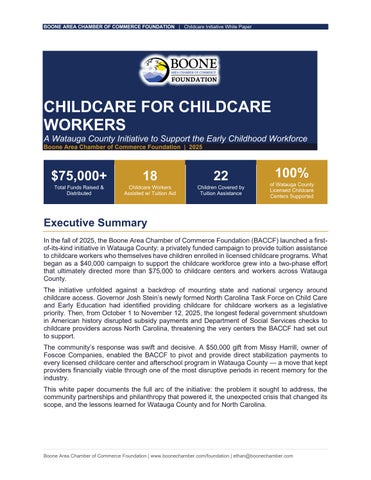
A Watauga County Initiative to Support the Early Childhood Workforce Boone Area Chamber of Commerce Foundation | 2025
$75,000+
18
22
In the fall of 2025, the Boone Area Chamber of Commerce Foundation (BACCF) launched a firstof-its-kind initiative in Watauga County: a privately funded campaign to provide tuition assistance to childcare workers who themselves have children enrolled in licensed childcare programs. What began as a $40,000 campaign to support the childcare workforce grew into a two-phase effort that ultimately directed more than $75,000 to childcare centers and workers across Watauga County.
The initiative unfolded against a backdrop of mounting state and national urgency around childcare access. Governor Josh Stein’s newly formed North Carolina Task Force on Child Care and Early Education had identified providing childcare for childcare workers as a legislative priority. Then, from October 1 to November 12, 2025, the longest federal government shutdown in American history disrupted subsidy payments and Department of Social Services checks to childcare providers across North Carolina, threatening the very centers the BACCF had set out to support.
The community’s response was swift and decisive. A $50,000 gift from Missy Harrill, owner of Foscoe Companies, enabled the BACCF to pivot and provide direct stabilization payments to every licensed childcare center and afterschool program in Watauga County a move that kept providers financially viable through one of the most disruptive periods in recent memory for the industry.
This white paper documents the full arc of the initiative: the problem it sought to address, the community partnerships and philanthropy that powered it, the unexpected crisis that changed its scope, and the lessons learned for Watauga County and for North Carolina.
The urgency behind the BACCF’s 2025 initiative was not based on instinct alone. In April 2024, the Watauga Economic Development Commission and the Boone Area Chamber of Commerce published a comprehensive Watauga County Childcare Study a data-driven assessment of the local childcare ecosystem conducted by researchers from Dancy Research and Appalachian State University, engaging more than 731 individual stakeholders including parents, providers, employers, and community partners.
The study confirmed what many in the community already knew: Watauga County is facing a genuine childcare crisis — one that constrains workforce participation, limits economic growth, and places an unsustainable burden on the families and workers who hold the childcare system together.
WATAUGA COUNTY BY THE NUMBERS 2024 Childcare Study
579
additional licensed childcare seats needed for children birth–5 years
1,672
additional after-school and outof-school program seats needed
$30,600
average annual pay for a childcare worker in Watauga County
Sources: Watauga County Childcare Study, Dancy Research / Appalachian State University, April 2024; JobsEQ 2023
As of December 2023, Watauga County had just 34 licensed childcare operations serving approximately 913 enrolled children across a county with nearly 2,000 children under the age of five. The study modeled that 579 additional licensed childcare seats are needed just to meet the demand of families with working parents who prefer a structured program or classroom setting for their young children. The after-school gap is even larger: the study estimated a shortage of 1,672 seats for elementary and middle school children whose parents are in the workforce.
Among parents surveyed, 64% said finding childcare in Watauga County was “Very Difficult” and another 27% said it was “Somewhat Difficult.” Wait lists are long one parent described putting her child on every available list while eight weeks pregnant and not securing full-time care until the child was 15 months old. The study also found that improved childcare access could add as many as 300 workers to the Watauga County labor force, particularly among parents currently sidelined by the lack of affordable, available options.
The 2024 study documented that the average childcare worker in Watauga County earns just $30,600 per year nearly $14,000 below the county-wide average wage of $44,535 across all industries, and well below the $40,206 living wage for a single adult household with no children. For a childcare worker raising their own child, the gap between wages and the true cost of living is stark.
The study found that only 41% of childcare workers have employer-provided health insurance, only 38% have paid sick leave, and just 22% receive any form of reduced-fee childcare as a job benefit. Turnover runs at roughly 17% annually higher than the 12% average across all occupations driven by wages that cannot compete with other industries requiring similar levels of education and commitment. More than half of childcare operators surveyed identified staff salaries as their top operational challenge.
The median monthly cost of childcare in Watauga County for a child birth to five years is $900. For a childcare worker earning $30,600 annually, enrolling even one child in care consumes roughly 35% of gross income. This is the paradox the BACCF set out to address: the people providing childcare for the community’s families often cannot afford it for themselves.
“Childcare workers do some of the most important work in our communities. They are teaching and fostering growth in our next generation of leaders. Yet too often, their work goes unseen and underappreciated.”
Halee Hartley, Owner, Kid Cove
The 2024 study documented the fragile economicsof childcare providers themselves. Economists at the Minneapolis Federal Reserve estimate that most childcare businesses operate at less than a one percent profit margin. Raising wages to retain staff requires raising tuition but tuition is already unaffordable for many families. The study found Watauga County families spending between 11% and 21% of their household budget on childcare, well above the 7% threshold the U.S. Department of Health and Human Services considers affordable.
Among local employers surveyed, 76% reported observing employee challenges related to childcare including late arrivals, frequent absences, distracted work, and job loss. More than one-third said their employees had cited childcare issues as their reason for leaving a job. Among the study’s 26 recommendations was a specific call for free or subsidized childcare for childcare workers a recommendation the BACCF would move to implement just one year later.
Then, in 2025, the situation grew more acute. North Carolina’s Child Care Stabilization Grants which had supported provider wages and capital expenses through the COVID-19 pandemic ended in March 2025. With no new state investment to follow, 280 licensed childcare providers closed across North Carolina between January and October 2025, with family childcare homes accounting for 97% of that net loss.
The BACCF recognized an opportunity to act on the evidence the community had already gathered and to demonstrate locally what state leaders had been discussing in Raleigh.
The BACCF’s initiative did not emerge in a vacuum. In March 2025, Governor Josh Stein signed Executive Order No. 10, creating the North Carolina Task Force on Child Care and Early Education, co-chaired by Lt. Governor Rachel Hunt and Senator Jim Burgin. The Task Force was
charged with identifying strategies to expand access to affordable, high-quality childcare across North Carolina.
Among the Task Force’s six recommendations issued in June 2025 was a call to explore subsidized or free childcare for childcare teachers. The Task Force’s Workforce Compensation and Supports Work Group studied models from 13 other states where childcare professionals receive enhanced subsidy access and identified Kentucky’s program as the leading national model, serving over 5,500 families and 9,600 children as of December 2025.
“Supporting the workforce behind our workforce has been a staple priority of the Foundation since its inception.”
David Jackson, President/CEO, Boone Area Chamber of Commerce
The Task Force’s December 2025 Year-End Report specifically cited the BACCF’s 2025 pilot as a local example of this concept in action, noting that through a privately funded pilot program, the Boone Area Chamber of Commerce Foundation provided one month of childcare tuition assistance to 18 childcare employees and their 22 children in Watauga County.
The BACCF’s work placed Watauga County on the statewide map as a community that was not waiting for Raleigh to act it was demonstrating what local leadership and private philanthropy could accomplish now, and what a replicable model might look like for all 100 counties.
In August 2025, the BACCF publicly announced a new October fundraising campaign with a goal of raising $40,000 to cover one month of childcare tuition for childcare workers in Watauga County who had their own children enrolled in licensed care. The campaign was designed to coincide with a major North Carolina legislative priority, bringing local visibility to an issue being discussed at the highest levels of state government.
The concept was straightforward but meaningful: licensed childcare centers would apply on behalf of qualifying staff members, identifying employees with children enrolled in licensed care and the monthly tuition costs involved. Approved grants would provide tuition assistance averaging $684 per child for the month, redeemable at any licensed childcare program in the community.
The campaign launched with a fundraising kick-off event at Cobo Sushi and Bistro in Boone, NC. The event brought together local business leaders, community members, and childcare advocates to learn about the initiative and make early commitments.
James Milner of Appalachian Commercial Real Estate stepped forward with a $10,000 lead gift, setting a tone of local business investment that would define the campaign. His commitment
signaled to other donors that the business community saw childcare workforce support not as charity, but as economic investment.
The BACCF developed a streamlined application process administered through licensed childcare centers. The Childcare Tuition Aid Application required:
• Verification of the employee’s position and hire date at a licensed Watauga County center
• Information on dependent children currently enrolled in licensed childcare
• Monthly tuition cost documentation for each enrolled child
• Director/administrator certification of accuracy and employment status Applications were reviewed on a rolling basis with funding awarded based on available resources. The program’s design prioritized simplicity for centers and workers, minimizing administrative burden on providers already stretched thin.
The tuition assistance pilot reached 18 childcare employees and covered tuition for 22 children across Watauga County. The response from participants was described by the NC Task Force as “overwhelmingly positive.” As checks were delivered and distributed to childcare centers, the BACCF was encouraged to learn that multiple centers offer free or discounted tuition to their employees. Three employees who have multiple children in childcare were highly grateful for the tuition reimbursement, with one receiving $1,875: the cost for one month of care for her three children.
Despite this effort, the campaign had no impact on the in-home childcare centers in Watauga County, who are particularly vulnerable to an unstable economy. Feedback was offered by these centers and the lack of opportunities they have to secure additional funding, and the multiple roles performed by a single employee in-home childcare worker. As noted above in the childcare center closures, Watauga County has lost 6 in-home childcare centers in the last 18 months.
The completion of the Childcare for Childcare Workers campaign yielded valuable data, strong relationships across the childcare industry, invested partnerships, and a brief reprieve from the month-to-month bill paying routine many of these centers face.
As the BACCF was distributing tuition assistance and building momentum in its campaign, a crisis of national proportions arrived. On October 1, 2025, the federal government entered a shutdown that would last 43 days until November 12 making it the longest federal funding lapse in American history.
The shutdown had immediate and severe consequences for childcare providers across North Carolina. The NC Task Force Year-End Report documented that six Head Start and Early Head Start programs due to receive funds on November 1 were directly impacted, resulting in temporary closures, furloughs of hundreds of staff, and thousands of families scrambling for alternative care. In Watauga County, the shutdown disrupted the flow of subsidy payments and Department of Social Services reimbursement checks that childcare centers depend on to meet payroll, cover operating costs, and pay bills. Providers who had already been operating under financial strain following the end of stabilization grants earlier in the year faced the real prospect of closure.
“Childcare businesses are finding themselves in positions of financial insecurity now that our state driven stabilization grants have ended… Missy Harrill’s gift to The BACC Early Care Fund has allowed a very timely and needed gift to stabilize our local childcare industry.”
Halee Hartley, Owner, Kid Cove
In response to the deepening crisis, Missy Harrill, owner of Foscoe Companies, made a $50,000 contribution to the BACCF’s Early Childcare and Development Fund. Her gift was motivated by a striking statistic: childcare centers in Watauga County collectively serve the families of more than 700 local businesses. Without stable childcare infrastructure, the local economy itself is at risk.
“I was stunned to learn that the childcare centers in our area serve the families of over 700 local businesses. Without this precious resource, our local economy takes a dramatic hit.”
Missy Harrill, Owner, Foscoe Companies
Paired with existing Foundation funds, Harrill’s gift enabled a total allocation of $62,500 in direct stabilization payments.
The BACCF distributed stabilization grants to every licensed childcare center and afterschool program in Watauga County. The allocation methodology was designed for equity and impact:
• Grants were sized based on the number of children each center served
• Family childcare homes which operate on the tightest margins received heightened emphasis
• Funds were designated for business stabilization and/or direct family assistance
• Licensed Pre-K classrooms and afterschool programs were included alongside traditional childcare centers
BACCF Director of Development Ethan Dodson personally delivered many of the checks to center directors, gaining firsthand understanding of the varied and urgent needs across the county from food costs and utility bills to delayed tuition payments from families navigating their own
financial strain. One center received their check on a Monday, which enabled them to fulfill payroll two days later Wednesday.
The BACCF’s 2025 initiative is significant precisely because it was local, privately funded, and fast. It did not wait for state appropriations, federal programs, or bureaucratic timelines. It responded to community need with community resources and in doing so, generated real data and real outcomes that advocates can bring to Raleigh.
The NC Task Force has recommended that the North Carolina General Assembly establish a statewide pilot program for childcare for childcare professionals. The BACCF’s Watauga County pilot is proof of concept. It demonstrates that the logistics are manageable, the demand is real, the response from workers and centers is positive, and the community impact is measurable.
Missy Harrill’s framing that childcare centers serve the families of over 700 local businesses captures the economic reality that policymakers and employers are increasingly acknowledging. Childcare is not a social welfare issue. It is economic infrastructure, as essential to workforce participation as roads, broadband, and utilities.
ExcelNC, a business-led initiative focusing on highlighting the economic importance of childcare in North Carolina, reported that Watauga County loses $11.5 million in economic activity and $1 million in local government revenue due to the current childcare crisis. Current childcare rates across the state (an average of $10,000 for infants and $9,600 for toddlers) are higher than instate tuition at Appalachian State University and every single UNC System institution.
When childcare centers close or destabilize, the ripple effects touch every sector of the local economy. Parents reduce work hours or leave employment. Employers struggle to recruit and retain talent. Small businesses can’t grow. The BACCF’s willingness to act as a first mover both on workforce support and on emergency stabilization reflects an understanding of this interconnection that more communities and chambers of commerce acrossthe state would benefit from adopting.
The 2025 initiative also illustrates the powerful intersection of private philanthropy and public policy. The BACCF did not act in isolation from the broader policy landscape it acted in deliberate alignment with it. By timing the Childcare for Childcare Workers campaign to coincide with the NC Task Force’s legislative priorities, the Foundation gave local donors a reason to engage with a state-level issue in a tangible, local way.
The result is a virtuous cycle: local action generates state-level evidence; state-level policy creates frameworks for local replication; and private philanthropy bridges the gap between current need and future public investment.
The BACCF intends to build on the momentum of 2025 with an annual October campaign for early childhood initiatives. The 2025 experience yielded several insights that will shape future efforts:
The federal shutdown exposed a vulnerability that is not going away. Future federal budget uncertainty, combined with the ongoing absence of a North Carolina state budget as of late 2025, means that Watauga County’s childcare providers will continue to face periodic financial shocks. The BACCF should explore building a dedicated stabilization reserve within its Early Childcare and Development Fund that can be deployed quickly in future emergencies.
The tuition assistance model works and should be continued. Future campaigns should aim to expand the number of participating childcare employees and increase the per-child assistance amount. Pairing the campaign with data collection on workforce retention outcomes will strengthen the evidence base for state-level advocacy.
Missy Harrill’s insight that childcare centers serve the families of more than 700 local businesses is a compelling ask for employer engagement. The BACCF and the broader Boone Area Chamber of Commerce are well-positioned to make the case to local employers that investing in childcare stability is investing in their own workforce pipeline. Future campaigns should systematically target employer donors alongside individual philanthropists.
The BACCF should continue to share its data and experience with the NC Task Force on Child Care and Early Education, with members of the General Assembly representing the High Country, and with statewide childcare advocacy organizations. Watauga County’s story is a compelling addition to the evidence base for statewide legislation.
In 2025, the Boone Area Chamber of Commerce Foundation demonstrated what is possible when a community decides not to wait. Faced with a workforce that was undervalued and an industry under financial siege, the BACCF raised funds from local businesses and philanthropists, built a practical assistance program from scratch, navigated an unexpected national crisis, and delivered meaningful support to every licensed childcare center and afterschool program in Watauga County.
The initiative was modest in scale compared to what state-level action could accomplish but it was real, it was fast, and it worked. It provided relief to childcare workers and their families. It helped stabilize providers through a period of historic disruption. And it showed state leaders in
Raleigh that North Carolina communities are ready to partner in solving the childcare crisis, if the state will meet them there.
The BACCF staff and board are already planning for a Fall 2026 initiative. If you would like to support the this important work, you can do so by contacting Ethan Dodson or by making a gift at www.boonechamber.com/foundation and you may choose the Early Childhood and Education Fund as your area of impact.
The childcare workforce deserves to be supported the same way it supports everyone else: with consistency, respect, and genuine investment. That is what the BACCF committed to in 2025. It is the commitment that will carry this work forward.
Ethan Dodson, Director of Development
Area Chamber of Commerce Foundation