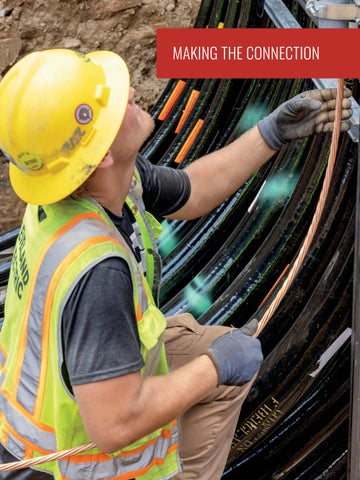
MAKING THE CONNECTION
MAKING THE CONNECTION
100 YEARS OF CLEVELAND ELECTRIC COMPANY
Copyright 2024 Cleveland Electric All rights reserved. No part of this book may be reproduced or transmitted in any form or by any means, electronic or mechanical, including photocopying or recording, or by any information storage and retrieval system, without permission in writing from Cleveland Electric.
Cleveland Electric 3715 Northside Parkway NW Bldg. 100-800 Atlanta, GA 30327 404-696-4550 www.clevelandelectric.com Editors Ken Harbour James Cleveland Jr. Vann Cleveland Project Coordinator Ashley Schling BOOK DEVELOPMENT Author Amy Meadows Editor Rob Levin Photography Lisa Means Cover and Book Design Rick Korab Index Alexandra Nickerson Project Management Stacy Moser Image Management and Production Renée Peyton
Covington, Georgia www.bookhouse.net Manufactured in South Korea
Cleveland Electric Company employee Tony Gilleland completes a quality-control inspection.
TABLE OF CONTENTS FOREWORD XI PROLOGUE
MAN AND MACHINE XIII
CHAPTER ONE
STATE OF REPAIR
The Founding of the Cleveland Electric Company 1
CHAPTER TWO
INDUSTRIAL STRENGTH
Cleveland Electric Company Cements Itself in the Industrial Arena 25
CHAPTER THREE
A COMMERCIAL BREAK
Adding Industry Verticals 51
CHAPTER FOUR
THE OPPORTUNITY TO LEAD
The People of Cleveland Electric Company 83
EPILOGUE
THE FAMILY PLAN This timeline gracing a wall of Cleveland Electric’s lobby shares the company’s important achievements from 1925 to the present day.
95
INDEX 99
In Cleveland’s fabrication shop, the company can more efficiently assemble large components for a job that are then transported and installed on-site later. (L to R) Jacob Slay, Bryce Carter, Jonathon Darrow, Kamren Adams, Michael McConico, Simon Bright, Victoria Shelton, Cliff Bettis, Christian Correa, and Cody Morris.
A Cleveland electrician completes cable terminations in an electrical panel.
FOREWORD
As we celebrate one hundred years of being in
ny. But I do know that he laid a foundation com-
business, we first and foremost recognize the gift
prised of good family principles and demonstrated
of family and business that was given to us by God.
by example a pathway to success which ran right
God continues to bless our family and our business
through its employees to the customer.
just as He did from the very beginning. The Cleve-
Mary Kay Ash, founder of the highly successful
land family is a Christian family firmly acknowledg-
Mary Kay Cosmetics, once said, “People are defi-
ing our Lord and Savior Jesus Christ and we are
nitely a company’s greatest asset. It doesn’t make
forever grateful for the blessings He has bestowed
any difference whether the product is cars or cos-
upon us and our business.
metics. A company is only as good as the people
Most people have had the opportunity to experi-
it keeps.” Our company has been built by so many
ence family. Most people also have had the op-
wonderful employees.
portunity to experience business. But few people
This book celebrates the employees of Cleveland
get to experience the combination of family and
Electric Company. We could not have done it with-
business together. At Cleveland Electric Company,
out you. On behalf of the entire Cleveland family,
for the past one hundred years we have been able
Thank You!
to combine family and business together for thousands of people to experience in a very positive way and enriching way. And it is not just five generations of the direct Cleveland family, because we have always considered each and every employee of the company to be an extended family member. I have no idea if Ras H. Cleveland was able to see a century in front of him when he started Cleveland Electric Compa-
Ken Harbour Chief Executive Officer
XI
Vann Cleveland, pictured here in 1960, knew from an early age that Cleveland Electric would be an important part of his life. Vann’s dad was Louie “Buster” W. Cleveland Jr., and his grandfather Ras was the company’s founder.
PROLOGUE
MAN AND MACHINE Vann Cleveland fondly recalls his first memories of the business that has been an integral part of his family since 1925. The first great-grandchild of Ras H. Cleveland, founder of Cleveland Electric Company, Vann always enjoyed visiting the company’s headquarters at 557 Marietta Street in Atlanta. His father, Louie W. Cleveland Jr., known as Buster, often would take his six-year-old son to the office on weekends to spend time with Ras, who was in his eighties. Together, the pair would enjoy Coke and peanuts in the break room and even take a ride on the overhead crane. Yet, it was in those moments when they would walk around the motor repair shop floor that Vann truly got to know to his great-grandfather. “He would be out in the shop looking at the equipment. He was a mechanic, and that’s where Ras H. Cleveland his heart was,” explains Vann, who joined the family business in 1983 and now serves as vice president of business development. “He had a great business sense, but that was not what he liked. He liked the equipment, being out in the trenches with his sleeves rolled up. That’s where he was in his element.” Today, the small electric motor repair company founded by that mechanic-at-heart is
recognized as one of the most prolific, innovative, and successful specialty contractors in the country. In fact, over the course of a century, Cleveland Electric Company has grown and evolved to offer a comprehensive array of electrical and mechanical construction services to customers across a host of industrial and commercial market sectors. Boasting more than one thousand employees and over $350 million in annual revenues, Cleveland Electric Company prides itself on partnering with customers to develop pioneering solutions that promise to take every project to unprecedented levels. The company has been able to accomplish all of this while maintaining the family creed that has always been at its core. As the Cleveland family mission statement notes, “Our family has been richly blessed with resources and opportunities. Our family business is an extension of our family and its values.” Those values include hard work, honesty, and service to others in business and daily life. This is the exceptional story of how one man’s vision was transformed into a thriving organization that has been able to meet the demands of an ever-changing construction market while offering the highest possible level of quality and integrity for one hundred years.
XIII
In 1965, a Cleveland employee, known as an armature winder, checks for broken electric motor parts where coils might have been damaged so he can repair or completely replace them, a process called rewinding.
CHAPTER ONE
MAKING THE CONNECTION 100 YEARS OF CLEVELAND ELECTRIC COMPANY
STATE OF REPAIR
The Founding of Cleveland Electric Company Ras Hitson Cleveland knew that he was ready to hand over the reins of Cleveland Electric Company Inc. in the late 1950s. He had recently survived a heart attack, and he decided that it was time for his sons, Louie W. Cleveland and James R. Cleveland, to take over the organization that he founded as the Cleveland-Browning Electric & Elevator Company in 1925. He knew that Louie was steadfast, conservative-minded, dedicated, and extremely knowledgeable about his father’s core business. And he admired James as an innovative risk-taker who loved a challenge and wanted to see how he could expand his father’s legacy in new directions. Together, the two brothers were prepared to take control of the burgeoning company that he launched as a forty-year-old who had found his passion for electrical work as a teenager a quarter-century earlier during the earliest days of the industry. n “I don’t think I ever really made a decision about going into the business,” James said in 1991. “It was just natural because it was what I always wanted to do. You know, like a kid who wants to do what his father does—that’s the way it was for me. It was the same for my brother, Louie. We had a close relationship with our father, and we wanted to do what he did.”
1
MAKING THE CONNECTION 100 YEARS OF CLEVELAND ELECTRIC COMPANY
According to Louie, who also spoke of his father’s company in 1991, “I’ve been with the company since I got out of school, so I’ve been through every phase of it. It was sort of understood that whenever you finished with your schooling—however much you were going to take—that you’d go to work in this business. I came to work for my dad and did whatever needed to be done to help hold the thing together.” Of course, it wasn’t easy. When Ras Cleveland started his own motor repair shop, he had no idea that the country would fall into the Great Depression four years later. He already had very little capital to invest in his business, as well as no credit, and the nation’s financial devastation only made it harder for him to pay for parts and equipment, let alone make payroll. Just to stay afloat, he often had one group of employees work for three days one week and two days the next, while doing the same with a second group—working them two days and then three just to make sure that everyone could put bread on the table. In many cases, his employees had to wait for weeks on end to receive their hourly wages. And at times, he even had to borrow money from those same individuals just to pay for motor parts that were shipped cash on delivery. Fortunately, as James R. Cleveland Sr. noted, “In those days, your word was as good as you could have. That’s the way
“In those days, your word was as good as you could have. That’s the way business was done then. Employees trusted Ras, and key workers stayed with him for many, many years.” — James R. Cleveland Sr. 2
business was done then. Employees trusted him, and many key employees stayed with him for many, many years.” That level of struggle was all Ras ever knew. Holding only a fourth-grade education, he had to leave school as a child after the death of his mother so he could work and help his father and two brothers make ends meet. He picked up odd jobs throughout Atlanta, his hometown, and found
Workers repaired and rewound motors of all sizes in Cleveland Electric’s early days.
CHAPTER ONE STATE OF REPAIR: THE FOUNDING OF CLEVELAND ELECTRIC COMPANY
his way into the electrical field as a teenager. He worked at companies like Watton Manufacturing Company, South Electric Company, Carter & Gillespie, Georgia Power Company, and Drum Electric, spending a few years at each stop. Through his various jobs, a spark was lit as he rose up through the fledgling industry and learned every skill he could about repairing direct current, or DC, motors. After marrying his love, Emma Bradley, and
starting a family, he made his way to Bryant Electric Company, which had a machine shop and did electrical work. As son Jimmy Sr. once noted, “He definitely ran Bryant Electric Company. He was the person that everyone came to or called to go get them out of their miseries. So, I would think he had a following of people around Atlanta that he knew, and that helped when he went out to start a business of his own.”
3
MAKING THE CONNECTION 100 YEARS OF CLEVELAND ELECTRIC COMPANY
Seizing an Opportunity In the early 1920s, Ras worked for Browning Electrical Motor Repair Company. He was ready to strike out on his own and build a business, and a unique opportunity presented itself when his employer offered to sell the com-
pany to him. He leapt at the chance and took on a partner: S. H. Browning. Together, they officially formed Cleveland-Browning Electric & Elevator Company in 1925. Initially, the company strictly was a repair shop, handling the type of work that Ras had done for so many years. The business was headquartered in a
This Wright-Way electric chain hoist is used by a Cleveland Electric employee to lift a large piece of machinery in 1972.
4
two-story building made of terra-cotta tiles at 557 Marietta Street. The building and the land it sat upon were owned by Ras, who rented space in the building next to the CR Spark Plug Company, even though he had plans for the eventual growth of his own company. When Louie joined the business in 1930, he recalled the jobs that helped keep the company, which had twelve employees at the time, running— even through difficult times. “When I went to work, I was unskilled at repairing motors,” he once said about the early days of Cleveland Electric Company. “I just learned by experience, working with other, older people—like an apprenticeship. I would do whatever needed to be done on a particular motor. I learned all the phases of it; I learned to go out and do a little troubleshooting, to take a motor off and bring it into the shop. I got to learn how to be a machinist, wind coils, rewind a motor. Electronics were nonexistent then. We worked on such things as ceiling fans; it was before air conditioning. Everybody had a desk fan—every office had a fan on every desk. We would send a truck and pick up two hundred fans at Western Electric Company, bring them in, and repair them so they’d be ready for summer.” That was the crux of the business: repairing and rewinding motors of all sizes and horsepower. From those small fan motors to massive on-site motors that ran manufacturing and transportation equipment, Ras was able to use his expertise to figure out how to fix any and every one of them. According to son Jimmy Sr., “Dad was a very hands-on person—very hands-on. He would go out with his men on occasion, on difficult jobs, and they would do the job together. He had a following of people around town who would call continued on page 8
A FAMILY AFFAIR In the early 1990s, the Cleveland family got together and decided to draft a family mission statement. The reason was simple, according to Chris Cleveland, who was put in charge of the effort, which was spearheaded by Carol Harbour, the daughter of James R. Cleveland Sr. He wrote, “By looking at our family, we realized that we had enjoyed some success and had been greatly blessed for close to five generations. What we wanted to do was to put down on paper the reasons for this success, outlining the building blocks that had gotten the Cleveland family to the point where it is today. After much discussion, we concluded that many of the values and characteristics of our family had trickled down from the foundation of our family, Ras and Emma Cleveland. Furthermore, their children had continued to ingrain these values and characteristics in each successive generation, which led our family to its current state.” n Upon the completion of the family mission statement, Chris offered advice to any and every family member who read it. “I leave you all with a challenge. Do not let this statement become an antiquated wall ornament or a piece of paper in the back of a desk drawer. Outlining the keys to our family’s success is just the beginning. I challenge you to continue to live these values, passing them on to new family members, never allowing the legacy of Ras and Emma Cleveland to stop growing.” 5
Cleveland Electric employee Fred Dudash performs a quality-control inspection.
MAKING THE CONNECTION 100 YEARS OF CLEVELAND ELECTRIC COMPANY
James Cleveland Sr. (left) and Louie Cleveland Sr. at the 1971 groundbreaking of the new Cleveland Electric Company Motor Shop on MLK Jr. Blvd.
continued from page 5
him to do work. At that time, electricity was fairly new, and nobody knew much about it. But he’d been in electricity since he was fifteen years old. [And] my father worked eighteen to twenty hours a day all of his life.” As motor repair was a skill that very few people had, hardly any businesses offered 8
the service, which is essential for motors that have a natural lifespan. As Ken Harbour—Ras’s great-grandson and CEO of Cleveland Electric Company since January 2024—who began in the mechanical group and worked in the company alongside his father, George Harbour, explains, “When [motors] get to the end of that lifespan, they have to be ‘rewound.’ There are motors of such a size that we could physically remove them, take them to the shop, rewind them, recoat the exterior, and then bring them back to the end user. Other motors are so large that they cannot be removed, so we would have to go to the facility and actually do that same process on the motor in place.” The ability to do this kind of work gave the business a genuine edge in the industry, especially since Ras was so dedicated to getting the job done right. “All [my father] had going for him was his knowledge of electrical apparatus, and that’s what the business started on,” Louie recalled, noting how Ras leaned into what he did best. “One of the reasons we were successful was my dad’s reputation for fixing things. When he got a
CHAPTER ONE STATE OF REPAIR: THE FOUNDING OF CLEVELAND ELECTRIC COMPANY
job in the shop, he just turned heaven and Earth over until he got it back into operation because that just shut somebody else’s operation down. He was really tough on that. I worked all night— many, many a night—to get something ready. But he had a reputation for knowing how to get [a motor] done and get it back. We still strive to do that because when industry loses a large motor, it slows them down.” Within a few years of joining the business, Louie, who left his studies at the Georgia Institute of Technology to join his father’s company, became one of Ras’s most dependable motor repair experts, and he ultimately specialized in the coil and winding aspect of the motor repair process. He even designed special coil-winding
equipment that was used to wind armature coils for the Pullman Company, which manufactured rail cars in Atlanta, not far from Cleveland Electric Company’s headquarters. What’s more, Louie created an array of forms for recording data for coil-winding testing procedures, which allowed the company to develop new techniques along the way. That masterful level of specialization allowed the business to carve out an impressive niche in what became a booming electric industry over the next several decades.
A COMMUNITY MEMBER FIRST According to James R. Cleveland Sr., his father, Ras Cleveland, worked every day of his life and never had a hobby. However, he did have a passion for being a contributing member of society and the community in which he lived. He was a trustee of Scottish Rite Hospital in Atlanta, as well as a Mason and an active member of the Yaarab Shriners, where he served on the director’s staff. The Shriners even named a large class of candidates in his honor in January of 1960. Not only did these activities allow him—and ultimately his entire family—to give back to the community, but they also helped him develop relationships that would benefit Cleveland Electric Company for many years.
A nurse and her patients enjoy the sunshine outside the Scottish Rite Hospital for Crippled Children circa 1915, reading Valentine’s Day cards they’d received that day. Ras Cleveland was a trustee of this hospital.
9
MAKING THE CONNECTION 100 YEARS OF CLEVELAND ELECTRIC COMPANY
Rewinding armature on a DC motor circa 1973.
10
CHAPTER ONE STATE OF REPAIR: THE FOUNDING OF CLEVELAND ELECTRIC COMPANY
A New Direction Atlanta proved to be an excellent location for the Cleveland-Browning Electric & Elevator Company, which became the Cleveland-Browning Electric Company when elevator work began to dissipate over time. Ras, his business partner, and their team began focusing on other industries that the local market could offer, such as the newspaper industry, which allowed the company to repair the motors and equipment that helped produce The Atlanta Journal and The Atlanta Constitution newspapers. By the late 1930s and early 1940s, Ras, who eventually bought out S. H. Browning’s interest in the company and renamed it Cleveland Electric Company Inc., turned his attention to the paper and textile mills that surrounded Atlanta. His son Jimmy Sr. became a route salesman, traveling around the northern part of Georgia and selling Cleveland Electric Company’s motor repair services. Jimmy Sr. once recalled, “In those days, cotton mills were humming, running, and were big business,” he said. “They had a lot of motors in them, and they burned them up quite frequently. They didn’t have the electrical protection we have nowadays, and when there would be an electrical storm, it would burn out fifteen or twenty-five electrical motors in somebody’s cotton mill somewhere. So, we would make a ‘milk run,’ you might call it, out about a hundred-mile radius of Atlanta, and we would call on those mills and pick up electrical motors
that had been burned out. We’d bring them to Atlanta, repair them, and take them back to the mills the following week.” For those motors that could not be repaired in paper and textile mills and other types of businesses, Cleveland Electric Company also offered the chance to purchase new motors. In fact, it did not take long for the business to become the largest independent supplier and distributor of electric motors, and the company garnered exclusive contracts with an array of motor companies across the country, including General Electric Company and Reliance Electric Company. What’s more, Ras officially launched a service department to support all of the motor work; Lawrence Bobo, who joined the company in 1946 and acted as a jack-of-all-trades across the organization, was instrumental in developing that department. The overall diversification was good for the business, and it encouraged Ras to consider other lines of business that would complement the work he had been doing for so many years. Then an idea presented itself to him. As Louie says, “It became apparent that people who might call [my father] for work on apparatus might also want him to do some wiring in of material, so he soon had to start a construction or contracting phase of the business.” When Ras established a new electrical contracting division that would support construction projects across Atlanta, he knew he would need help to get it up and running, as he was still focused on the motor repair side of the business. He continued on page 15
11
12
13
MAKING THE CONNECTION 100 YEARS OF CLEVELAND ELECTRIC COMPANY
In 1976, Ron Benier, a Cleveland Electric employee, monitors equipment inventory in the huge company warehouse.
14
CHAPTER ONE STATE OF REPAIR: THE FOUNDING OF CLEVELAND ELECTRIC COMPANY
continued from page 11
hired N. G. Harrison to manage the electrical contracting work, going so far as to offer him stock in return for coming on board. Initially, the deal was a good one, with Harrison helping to grow the construction business quickly in its earliest days. For several years, the company worked on everything from small warehouse buildings to more complicated projects over time. However, things began to change as Harrison aged. According to Jimmy Sr., who started driving a route truck when he officially joined the company, Harrison simply did not keep up with growing the business and eventually stopped all new business development efforts in the electrical contracting arena. Jimmy Sr. recognized the issue and addressed his concerns with his father. As the father and son began to consider what would need to happen to advance the electrical contracting work, Ras’s health took a turn with the first of a series of heart attacks—and one that would change the way the company would operate into the future.
A Tale of Two Businesses In his early eighties, Ras Cleveland survived a heart attack that led him to recognize his need to step back from the company that he founded. He charged his sons, Louie and Jimmy Sr., with taking over the organization, each one assuming responsibility for a particular side of the business. Louie, who had made a name for himself in the motor repair shop, became head of that division, while Jimmy Sr. took charge of the electrical contracting division. While Harrison was still with the company, Ras informed him that Jimmy Sr. would assume control of that element of the business. Within a couple of years, Harrison retired, giving Jimmy Sr. the
WHERE NO ONE HAS GONE BEFORE Dating back to 1952, Cleveland Electric Company contributed to the country’s booming space and missile program, participating in the Navaho, Vanguard, Bomarc, Jupiter, Thor, Atlas, Titan, Perishing, and Polaris missile launches over the years. The company technicians worked on thirty-five specialized projects, including the installation of electrical equipment for complex units at Cape Canaveral in Florida. The projects encompassed installation of electronic components and all major wiring phases for the missile launches and they extended beyond Cape Canaveral to the Redstone Arsenal in Alabama and Vandenberg Air Force Base in California. The work illustrated how flexible and adaptable Cleveland Electric Company could be, with its comprehensive knowledge about the industrial electrical field, laying the groundwork for the company to continue building its reputation in the technology sector in the years to come. 15
MAKING THE CONNECTION 100 YEARS OF CLEVELAND ELECTRIC COMPANY
complete freedom he needed to advance his plans for the division. “We had a pretty good volume of electrical contracting work. At that time, that part of the business was not particularly interesting to me, but [Harrison] was not growing the business, and that bothered me,” Jimmy Sr. recalled years later. “At the time, we had five electricians working. I just decided we’d better do something with that outfit, and we did. Our growth hasn’t been with any design or formula. It’s just been by working hard and growing through the years. We had to get some business. I became involved and began to do things—some of the things, I didn’t really know what I was doing, but I did them anyway.
We kept pushing, shoving, doing more, getting good people to come work for us, still doing the right things, still following my father’s operating principles and maintaining the reputation he had. Really, our growth is almost directly responsible to the contacts he had made early on. We did not have doors closed in our face because of his reputation. We elevated ourselves a little by doing much larger work than we had tackled before.” For instance, Cleveland Electric Company turned the motor repair work it had been doing for years for The Atlanta Journal and The Atlanta Constitution newspapers into much bigger electrical contracting projects, according to Jimmy Sr. “Big” contracts representing $15,000 jobs for
Newspaper presses, such as this one at the Atlanta Journal-Constitution in 1972, often required maintenance and repair, a reliable source of work for Cleveland Electric.
16
CHAPTER ONE STATE OF REPAIR: THE FOUNDING OF CLEVELAND ELECTRIC COMPANY
companies throughout Atlanta were brought into the mix, and those contracts eventually grew into million-dollar projects decades later. “We took some chances. Sometimes I had our neck stuck out as far as a giraffe’s,” Jimmy Sr. says. “We were always trying to find a niche others were not involved in. We have elevated ourselves up to where we’re on the level of being a select bidder, I would say. That comes about by your past type of work that you’ve done, the size of it, who the companies were, who the architects were. There’s a certain gamble on lump sum projects. You just have to know what you’re doing.” To complement the electrical contracting work, Jimmy Sr. added a mechanical contracting
element to the work done by Cleveland Electric Company. He explains that working with mechanical engineers during on-site jobs could be very challenging, stating, “You’re trying to install your electrical work over, under, or around his mechanical work, or he’s trying to do his mechanical work around your electrical work. So it was a hassle. We made a decision that we needed to get into the mechanical business to get rid of that adversity.” Initially, the company lost money on the proposition, spending nearly five years trying to get its footing in the mechanical arena. However, through diligence and honest hard work, that continued on page 20
Shown here in 1959 are (L to R) Louie Cleveland Sr., his father, Ras Cleveland, and his brother James Cleveland Sr., who prized their solid reputation in the community and frequently strategized about ways to expand the company.
17
18
19
MAKING THE CONNECTION 100 YEARS OF CLEVELAND ELECTRIC COMPANY
continued from page 17
division also began to take root. Soon enough, civil engineering also became part of the picture, with Jimmy Sr. adding another new division to the company. He says, “We got to the point where we were a prime contractor. That is, we put together all parts of the bid—the electrical part, the mechanical part, and the civil part of a construction job.” These efforts essentially made Cleveland Electric Company a one-stop shop for a range of companies, including renowned ones Jimmy Cleveland Sr. like General Electric, which hired the company to do the electrical work for the construction of its new transformer manufacturing plant in Rome, Georgia, in the early 1960s. The work with General Electric actually stemmed from the longtime relationship the organization had with Ras Cleveland. As Jimmy Sr. built the electrical contracting division, Louie kept his eye on the motor Louie Cleveland Sr. repair business, which had been his focus since his earliest days with the company. In his new role at the helm of that side of the business, he worked to grow and expand both the repair and new motor sales elements; over the years, Cleveland Electric Company became a major distributor for 20
GE, selling its motors all over the South. In fact, Cleveland Electric opened branch sales offices in North Carolina; South Carolina; and Augusta and Savannah, Georgia, at various points, and sales took off every time. The company even built its salesforce, giving individuals their own territories to visit regularly. In 1991, Louie Sr. reflected on those opportunities, stating, “My daddy handled GE motors going way back. They know us, and now they’re learning we can do more than we have done. So they’re giving us more territory, more executive sales advice, and holding sales meetings. They have real confidence in us.” In 1960, Cleveland Electric Company added an entirely new electronic control department to complement both the motor and electrical contracting sides of the business. The department offered complete industrial electronic control service and panel fabrication and worked with companies like Lanham Machinery Company Inc. of Atlanta, which had Cleveland Electric Company fabricate a control panel that would allow it to operate the motors and associated equipment on a bakery conveyor system that it manufactured. The new division boasted a group of qualified elec-
CHAPTER ONE STATE OF REPAIR: THE FOUNDING OF CLEVELAND ELECTRIC COMPANY
tronic control technicians to be on call to serve customers, and it further diversified the company’s burgeoning suite of services. As both sides of the business grew, the Cleveland Electric headquarters on Marietta Street could no longer support them. By 1968, the electrical contracting division relocated to a new facility at 1281 Fulton Industrial Boulevard. The motor repair operations followed suit a few years later, moving to a building at 3795 Wendell Drive in Atlanta. And not long after that, the construction side of the business expanded even further with a warehouse and fabrication space located at 260 Six Flags Road. Additionally, over the years,
sales offices dedicated to pursuing construction projects opened in Macon and Savannah, Georgia, thus cementing Cleveland Electric Company’s reputation not only in Atlanta, but also in the Southeast and beyond. Collectively, it was an impressive feat for the sons of the man who had a very specific vision. “Our philosophy has always been that we bend over backwards to do things right, even if it’s out of pocket. We go over and beyond if the customer—even if the customer is wrong—thinks we ought to do it. That was my dad’s philosophy. He treated everyone so good. That’s where our reputation comes from,” Jimmy Sr. says.
21
This photo, taken in 1966, shows a Cleveland employee overseeing the dynamic balancing of a rotor, a process that improves its performance by adjusting its mass evenly around its axis, reducing vibration and avoiding extra wear and tear on its components.
By 1967, when this photo of Betty Stanfield was taken, women began to join the ranks of technical repair 24workers at Cleveland Electric Company.
CHAPTER TWO
MAKING THE CONNECTION 100 YEARS OF CLEVELAND ELECTRIC COMPANY
INDUSTRIAL STRENGTH
Cleveland Electric Company Cements Itself in the Industrial Arena In 1962, James R. Cleveland Jr., the grandson of Ras Cleveland, joined the family business. Recently released from the U.S. Navy as a supply officer and boasting an MBA from Emory University’s Business School, Jimmy Jr., as he was known, was ready to become part of his grandfather’s legacy as the third generation to work for the company. He even turned down the opportunity to remain in the reserves after being asked by the navy. However, his father, James R. Cleveland Sr., who was serving as president at the time, had some decisions to make. n “My dad, bless him, didn’t know what to do with me,” James Cleveland Jr. recalls of the fact that not only did he have no training in the electrical field, but he also had a graduate degree—an MBA from Emory, something no one else in his family had ever secured at the time. His father decided to lean into his son’s experience as a supply officer who could manage materials and he sent Jimmy Jr. to oversee a 25
MAKING THE CONNECTION 100 YEARS OF CLEVELAND ELECTRIC COMPANY
material-and-equipment project for Bahama Cement Company at Freeport on Grand Bahama Island. The two-year project involved coordinating and supervising the shipping of all materials by boat or air to the project site, the installation of all electrical and mechanical work in the $50 million cement plant by more than 400 individuals, and the construction of a 26,000-kilowatt powerhouse facility to fuel the entire plant.
26
“It was a $5 million project in the early 1960s, so it was a huge job,” Jimmy Jr. reveals of the electrical work required, adding that his father nearly failed to obtain the payment-performance bond needed to take on the project. Jimmy Sr. headed to Chicago when the insurance company rejected his request and tried to convince the agent to approve the bond. The only way the agent would budge was if James Cleveland
CHAPTER TWO INDUSTRIAL STRENGTH: CLEVELAND ELECTRIC COMPANY CEMENTS ITSELF IN THE INDUSTRIAL ARENA
Sr. provided a personal financial guarantee by the entire Cleveland family, including Louie and Ras. “He had to come back to town and tell [my uncle and grandfather] that he gave all of their guarantees,” Jimmy Jr. continues. “So they had all of their money behind this thing.” Fortunately, although the project was incredibly challenging, it was a great success and illustrated Cleveland Electric Company’s
ability to manage a major electrical contracting project in the industrial sector—namely in power generation, a market segment that would become critical for the company over the years. Of course, as Jimmy Sr. continued to expand the electrical contracting side of the business, which was operating as Cleveland Consolidated Inc., he knew he needed to take advantage of the industrial construction boom that was happening in Atlanta throughout the 1960s. For example, in 1964 alone, Georgia saw industrial capital investment soar to $200 million, with industrial buildings popping up across the Atlanta skyline and throughout the surrounding areas. With this in mind, Cleveland Electric Company set out to win bids for a wide variety of industrial projects, such as a 300,000-square-foot engineering office for Lockheed-Georgia Company; an Owens/Corning Fiberglass plant; and a Continental Can Company plant in Hodge, Louisiana, among many others. The effort also included a project that Jimmy Jr. worked on immediately after returning from the Bahamas: the construction of the 50,000-seat Fulton County Stadium, a project that began on April 5, 1964, and finished
“It was a $5 million project in the early 1960s, so it was a huge job. He [James Cleveland Sr.] had to come back to town and tell [my uncle and grandfather] that he gave all of their guarantees, so they had all of their money behind this thing.” A large modular lathe, used to rough or finish parts, is serviced by Cleveland employee Hubert Cato in 1975.
— James Cleveland Jr. 27
MAKING THE CONNECTION 100 YEARS OF CLEVELAND ELECTRIC COMPANY
exactly one year later. The company installed all electrical components for the project, including almost 3,000 floodlights and more than 235 miles of wiring cable. The success of those projects drew the attention of both new and longtime customers, including the Georgia Power Company, which soon tapped Cleveland Electric Company to handle the electrical work for two 800-mega-
In 1975, John Jones demonstrated operation of this vacuum pressure impregnation (VPI) system, used to seal porous materials together by submerging them in resin, part of the process used to insulate armatures, motor stators, and field coils, ensuring the longevity of these mechanical components.
28
watt generating units at Plant Bowen, one of the largest coal-fired power plants in North America, located just outside of Cartersville, Georgia. And it was this project, completed in the early 1970s, that eventually opened the door to a major project in the power-generation arena several years later: the Alvin W. Vogtle Electric Generating Plant in Waynesboro, Georgia.
CHAPTER TWO INDUSTRIAL STRENGTH: CLEVELAND ELECTRIC COMPANY CEMENTS ITSELF IN THE INDUSTRIAL ARENA
A Power Move The construction of a two-unit nuclear power plant in Burke County, Georgia, certainly was never something that Ras Cleveland could have imagined when he founded Cleveland Electric Company. Yet, in the mid-1970s, based on the work his grandfather’s company had already done, James Cleveland Jr. decided to focus heavily on potential projects in the power-generation sector. He started discussions with the manager of construction at Georgia Power about the plants it was building throughout the state, which actually led to an opportunity on the Edwin I. Hatch Nuclear Power Plant project in Baxley, Georgia. That project produced the perfect circumstances for Cleveland Electric Company to be considered for the Plant Vogtle project, which at the time was noted as the largest construction project in the history of Georgia. “Business is always done based on relationships,” James Cleveland Jr. asserts, explaining how Georgia Power Company put out a bid package for the project, which it estimated to be worth $100 million, and Cleveland Electric Company submitted its proposal. Jimmy Jr. negotiated the initial terms of the agreement—a lump-sum fee for the management of the work—with the manager of construction by writing on a cocktail napkin over a round of golf, and, in 1979, Cleveland Electric Company found itself as the prime electrical contractor for Units 1 and 2 of Plant Vogtle, which comprised two 1,160-megawatt pressurized water reactors. However, it did not take long for Jimmy Jr. to realize that Georgia Power had grossly underestimated what the continued on page 32
ON THE MOVE When Buster Cleveland began working with Westinghouse Electric Company on repairing the motors for the Atlanta airport’s people mover, he never could have imagined that airport-based transit systems would become part of Cleveland Electric Company’s future as well. In the mid-2010s, Mitsubishi Heavy Industries America brought the company to airports in Orlando and Tampa to serve as the prime contractor for SkyConnect, its Automated People Mover (APM) system. According to Delbert Metz, who worked with Corey Bobo as Cleveland Electric’s superintendent on the simultaneous projects that finished in 2017, the successful completion of the work showed how capable the company is when it comes to working in challenging environments like an airport, where windows of opportunity for construction and electrical contracting activity are small because of the around-the-clock nature of the setting. He says, “Cleveland’s able to provide just about any resource you could want. We have a strong support group and set of resources. Sometimes you have to get a bit creative and figure how you’re going to do the work, and we are always able to come up with a plan to implement the work and limit the downtime.” 29
30
31
MAKING THE CONNECTION 100 YEARS OF CLEVELAND ELECTRIC COMPANY
Veteran Cleveland employee “Bugs” Brannon uses a hand-held control to operate a WSF Industries vacuum pressure impregnation tank circa 1975.
continued from page 29
project was really worth to all of the trades involved in it. “It turned out that the project was $300 million worth of work for Cleveland Electric’s portion alone,” he notes, recognizing that the total cost of the project would be much higher for everyone involved, particularly when the cost of materials was included. “So I got all of the trades together and said, ‘We can’t do this work. The job is bigger than they knew about.’ So we got a committee together to meet with the purchasing department, and we renegotiated the fee on a cost-plus basis.” The ability to work on a cost-plus contract genuinely changed the game and actually helped the company survive the economic recession of the early 1980s. And the project itself gave the company steady work for ten years, which it 32
spent on site, breaking record after record with its efforts. Over the course of a decade, the company installed nearly 300 million feet of cable tray, over 664,000 feet of PVC conduit, and more than 1 million feet of rigid conduit. Additionally, more than 17 million feet of wire and cable went into the project. Even more impressive, though, was the fact that Cleveland Electric Company’s safety record remained second to none throughout the project, with a lost-workday accident or incident rate that was 92 percent below the national average, even with more than 1,800 electricians and 250 staff members working at the plant. “The nuclear project was a turning point for the company,” Jimmy Jr. states. However, after putting all of Cleveland Electric Company’s “eggs in one basket” with the Plant Vogtle project, the company did have trouble landing new
CHAPTER TWO INDUSTRIAL STRENGTH: CLEVELAND ELECTRIC COMPANY CEMENTS ITSELF IN THE INDUSTRIAL ARENA
electrical contracting jobs for more than a year, decades earlier. “We recently were able to particularly in the power-generation sector. In bring mechanical in on a really big job, as well fact, after the completion of Unit 2 at Plant Vogtle as electrical. We got those projects because of in 1989, no new nuclear reactors were built in the relationships that were built on past history, and United States for decades, making Cleveland we did very well,” notes Robert Siegworth, who Electric Company the last specialty electrical became COO of Cleveland Electric Company in contractor to work on such a project until Plant January of 2024. “It was a standout opportunity Vogtle finally brought Unit 3 online in 2023. because we did bring in both mechanical and However, there was still work to do in power electrical, and we were able to keep the client generation, and Cleveland extremely happy with us Electric Company broke on the back end of it. When through again in 1992 you leave a job and the with a joint venture client is saying, ‘I wish we with Rust Engineering had five more projects to and Pullman Power for build with your team,’ that the Tennessee Valley makes you feel special.” Authority (TVA); together, the companies, known Expanding Its Reach as RPC (Rust, Pullman, and Cleveland), were By the late 1970s and charged with upgrading early 1980s, as both Louie the security of one of the Cleveland Sr. and his TVA nuclear power plants. brother, James Cleveland The two-year project was Cleveland employees inspect a rooftop HVAC system in 1976. Sr., were considering successful and allowed the company to not only the line of succession for Cleveland Electric maintain important relationships in the industry, Company, their sons, Louie (often referred to but also acquire new work over the years. This as Buster) and Jimmy Jr., the latter of whom included the mechanical work for the fourhad been making his mark with the electrical turbine powerhouse at Hartwell Dam and contracting division, took on more active Powerplant, the installation of the Atomic Energy executive roles in the organization; Jimmy Jr. Commission’s production reactor at Hanford ultimately would take over as president of the Works in Washington State, and the rewinding organization in the 1990s. And the younger of the stator section of the J. Percy Priest Cleveland men had a vision that would take the turbo generator at Stones River in Tennessee. family firm into the future. Seeing the stability Additionally, Georgia Power once again called provided by the motor repair shop and the on Cleveland Electric Company in 2023 to offer impressive growth of the electrical contracting electrical and mechanical contracting services side of the business, the company as a whole for several key emission-control projects at began considering ways to expand its reach Plant Bowen, where the company worked five in both areas. In 1982, the company initiated 33
MAKING THE CONNECTION 100 YEARS OF CLEVELAND ELECTRIC COMPANY
the purchase of the assets of Fagan Company Inc., one of Arkansas’s biggest electrical and mechanical contractors, which recently had filed for Chapter 11 bankruptcy. Fagan Company, based in Little Rock, was a perfect fit for Cleveland Electric Company’s expansion efforts, as it offered both construction services and a large motor repair shop, the latter of which increased Cleveland Electric Company’s number of motor repair employees and brought in a new motor repair and sales client base while serving as the first expansion of the motor repair division west of the Mississippi. The new location operated as Cleveland
Electric Company of Arkansas Inc., opening for business on April 2, 1982. For a few years, the Arkansas location successfully balanced its electrical contracts and motor repair service offerings, completing construction projects for customers like the Arkansas Gazette, Chicopee Manufacturing Company, and Safeway’s Little Rock ice cream plant. The company even worked on the forty-story First Federal of Arkansas Capitol office building. Additionally, the motor repair shop quickly outshone its competitors in the region with a $1 million expansion, which allowed it to take on a greater capacity of motor repair projects.
GOING GREEN Cleveland Electric Company was well ahead of the curve when it comes to green energy. In 2009, Robert Siegworth approached Danny Bobo—Corey Bobo’s father and one of several generations at Cleveland—with an idea. He had heard industry rumblings about the advent of green energy production, namely solar farms. He thought that Cleveland Electric Company should look for opportunities in the solar field and, to his delight and somewhat surprise, Bobo agreed. n “The greatest guy who ever came into my life besides my priest was a guy named Danny Bobo,” says Siegworth, now COO of Cleveland Electric Company. “I said, ‘Danny, you won’t believe this. Check this out. I’ve got an idea.’ Danny said, ‘Robert, so far, you’ve done pretty good around here. You’ve taken a lot of chances, and they worked out. Let’s try it.’” n So, for five years, Cleveland Electric Company installed solar farms at locations around the Southeast. Ultimately, the solar farm concept did not work out well for the company, according to Siegworth, who explains that the industry simply got too competitive for the company. “We were trying to figure out this green energy industry as the rest of the world figured it out,” he says. “The other companies became more efficient because that’s all they did. They were solar farm companies. We had a good fiveyear run, but we couldn’t compete. So I had another conversation with Danny. I said, ‘I can’t cut the margin so low to do this work. I think we’re getting outpaced.’ And Danny said, ‘What’s next?’ And that was that. This company has always been willing to try just about anything if it makes even a remote amount of sense. And it feels pretty good for somebody to believe in you.” 34
Robert Siegworth
CHAPTER TWO INDUSTRIAL STRENGTH: CLEVELAND ELECTRIC COMPANY CEMENTS ITSELF IN THE INDUSTRIAL ARENA
After the purchase of Stratton & Company, the renamed subsidiary, Aviation Constructors Inc., helped move the Cleveland organization into the booming aviation markets. Even after the dissolution of ACI, Cleveland Electric Company continued to expand its aviation service offerings and now does the lion’s share of major electrical work at Atlanta’s Hartsfield-Jackson International Airport.
In 1983, Vann Cleveland, Buster’s son, joined Cleveland Electric Company and was assigned to the Little Rock location by James Cleveland Jr. New to the family company, he began in the motor rewind area. “I think Jimmy Jr., in his mind, was saying, ‘You need to establish some credibility with [the employees there] because this is a place that you may ultimately manage as you progress in the business,” Vann says. “I stayed there a year and, before I left, I was in the sales department. I had a sales territory, and I was going back and forth to Memphis, Tennessee, which was only two hours away. From Little Rock, I would go to Memphis for three days and try to drum up business there.” While Vann did find some sales success across the region, he was ready to return to Cleveland Electric’s Atlanta headquarters and focus his sales efforts there. Not long later, the Little Rock experiment came to an end when James Cleveland Jr. ultimately decided to sell Cleveland Electric Company of Arkansas in 1986, recognizing that the company needed to focus on building on its reputation in Atlanta. Bigger customers were out there, and the
company had to figure out how to gain access to them to offer its motor repair and electrical contracting services. Fortunately, around the time of the sale of the Arkansas location, several big opportunities presented themselves, with customers that would become longstanding clients—and Cleveland Electric Company never looked back.
MARTA: A Rapid Response When Atlanta got its own rapid transit system, the Metropolitan Atlanta Rapid Transit Authority, known as MARTA, in 1979, it came with 1,500 motors that had to be managed and maintained. Buster Cleveland saw an opportunity and quickly responded to foster a relationship between Cleveland Electric Company and the authority. It was the right decision because, according to Vann Cleveland, “MARTA was sending their motors to California to get repaired. My dad recognized that as an opportunity to see if we could repair those electric motors when they would burn up on the trains. So we got that contract, and that kicked off our relationship with MARTA.” 35
MAKING THE CONNECTION 100 YEARS OF CLEVELAND ELECTRIC COMPANY
Andrew Williford (left) and Greg Beasley review Cleveland Electric jobsite conditions and monitor progress.
36
CHAPTER TWO INDUSTRIAL STRENGTH: CLEVELAND ELECTRIC COMPANY CEMENTS ITSELF IN THE INDUSTRIAL ARENA
According to a June 1985 article in Electriects, including station renovations throughout cal Apparatus, at the time, “The MARTA repair the Atlanta area and much of the highly techshops have neither facilities nor experience for nical electrical work that comes with the manmotor repair. All such work is sent to Cleveland agement of a rapid-transit system. The relaElectric Company of Atlanta, under a three-year tionship between the two entities continues to repair contract awarded in early 1984. Occupythis day, with Cleveland Electric Company having a six-acre site west of the city, Cleveland’s ing employees on-site for MARTA practically seventy-three-thousand-square-foot shop emaround the clock every month of the year to ploys about one hundred fifmeet the needs of its longtime ty people on three shifts. It’s customer. equipped for complete electrical and mechanical repairs on both Landing the Airport a-c and d-c machines of all sizes. Present shop equipment inThe mid-1980s were very significludes a ten-foot vacuum prescant when it came to the growth sure impregnation tank, a lathe of Cleveland Electric Company’s with more than eight-foot swing, industrial work across the counand a-c test power of five huntry. James Cleveland Jr. was dred kva up to five kV.” The artirunning the company by that cle also quoted Jarey Downing, time, and he had set his sights manager of the large-motor reon a very specific sector of the pair department, who noted that market: airports. The compaCleveland Electric Company avny already had a connection to eraged two traction motors per Atlanta’s airport, the busiest airweek, which the department report in the world, now known as worked and then sent back. The Hartsfield-Jackson Atlanta Intercompany also had a truck on call national Airport. In 1986, CleveThis brochure, used by the outside every other day to go to Avon- sales team in the late 1960s, attests land Electric Company landed a dale for pick up and delivery and to Cleveland Electric’s comprehensive motor repair service job through capabilities. spent a good bit of time putting Westinghouse Electric Corporatogether its own motor overhaul spec book to tion, the company that manufactured the unhelp service the MARTA train motors. derground people-mover transit system at the As Cleveland Electric Company proved itairport. Cleveland Electric Company began self to be a beneficial partner in terms of morepairing motors for the people-mover train, tor repair for MARTA, the authority also recwith Buster Cleveland serving as the liaison ognized the company’s ability to support it in between the airport and Westinghouse. other ways. By the mid-1990s, MARTA tapped This work further spurred Jimmy Jr. in his Cleveland Electric Company’s construction debusiness-development efforts aimed at the partment to complete a wide variety of projcontinued on page 41 37
Cleveland workers work together to verify voltage utilizing a fluke meter.
MAKING THE CONNECTION 100 YEARS OF CLEVELAND ELECTRIC COMPANY
Corey Bobo
40
CHAPTER TWO INDUSTRIAL STRENGTH: CLEVELAND ELECTRIC COMPANY CEMENTS ITSELF IN THE INDUSTRIAL ARENA
continued from page 37
aviation market. He laid the groundwork for his plan when Cleveland Electric Company joint-ventured with Atlanta-based Stratton and Company to construct Concourse D for Delta Air Lines in Cincinnati, Ohio. During that project, he learned that $50 billion had been earmarked for construction projects at airports across the country over the next decade, and he knew his company had to take action. With that, Jimmy Jr. once again joined forces with Stratton & Company to initiate the purchase of Aviation Constructors Inc. (ACI) in June of 1987. The new subsidiary would go well beyond electrical contracting alone, though, as ACI would pursue a full suite of general contracting and construction-management work within the aviation industry. Terry Stratton was placed at the helm of the new company, which quickly began airport work throughout the nation and, by 1993, had a backlog of $100 million worth of work. Yet, ACI had not yet found its opportunity in Atlanta’s booming airport. “I kept saying to my son, John, who was involved in managing by then, that we needed to get involved at the airport,” Jimmy Jr. recalls. “I said, ‘Look at everything they’re doing down there.’ He resisted for a while, but we finally moved forward.” The hesitancy may have been related to the fact that there were some internal issues with ACI, which had moved into more general contracting work over the years as aviation work across the country began to diminish. In fact, the company changed its name to ACI Construction Services Inc. and worked on building a number of schools, some beachside condos, and projects at Embry Riddle Flight School in Daytona, Florida. Eventually, ACI was dissolved, and Cleveland
Electric Company began to focus again on its core specialty contracting business. With the renewed focus, Jimmy Jr. was almost singleminded about his plans for the company to get into the Atlanta airport, working to place bids directly as Cleveland Electric Company. Soon, Jimmy Jr. and John devised an innovative way for the company to be seen as a viable vendor for projects being bid in the mid-1990s. Work at Hartsfield Airport flowed through Atlanta City Hall, which had a variety of bid requirements for all of its airport-related work, including, in some cases, the minority status of its vendors. Cleveland Electric built a relationship with Yukon Electric Company, a small minority-owned vendor that was already doing a few projects for the airport. Yukon, which became UpTime Electric Company in 1996, welcomed the opportunity to jointventure with Cleveland Electric, which tapped A Cleveland employee repairs an electric motor. Over time, a motor’s insulation degrades, requiring the need for its copper coils to be replaced—a process called “rewinding.”
41
MAKING THE CONNECTION 100 YEARS OF CLEVELAND ELECTRIC COMPANY
“Bugs” Brannon, a coil winder, tests the integrity of coils in this newly wound electric motor in a Cleveland Electric motor repair shop.
Corey Bobo, the third generation of Bobos to work at the Cleveland, to manage the onsite Terminal Hold Back Screening Project, or HBS. The project involved excavating both sides of the north and south terminals to build 150-square-foot vaults to place bomb detection equipment for all of the baggage moving through the airport. “The job was a huge success,” says Bobo, who became president of Cleveland Electric Company in 2024. “The airport had seemed like this big scary monster with all of its requirements and areas to navigate. But what I figured out pretty quickly is that they have a lot of work to do, and they want competent people to do 42
that work. All of that other background noise doesn’t really matter. They really just want a good contractor out there.” The HBS became the first in a partnership that has lasted more than twenty-five years and continues unabated with Cleveland Electric Company employees working on-site at Hartsfield-Jackson Atlanta International Airport. According to Ken Harbour, over the years, there have been an array of milestone projects at the airport, including running all of the electrical work for the Maynard H. Jackson Jr. International Terminal, which was a four-year project between 2008 and 2012, and the SkyTrain that transports passengers to the auto-rental center. Dana Woods, who replaced Corey Bobo on-site at the airport in 2010 and became vice president in 2024, notes that there continues to be a litany of projects the company has on tap at the airport, from installing the electrical power for a conveyor system on Concourse E and completing midpoint expansions on Concourse C to working on deicing facilities, a new Georgia Power transformer vault, and an array of equipment replacements. “All of this equipment has a life cycle, and the City of Atlanta does a great job at forecasting ahead and making sure they have a design in place and the funds to support that design to replace that equipment before its end of life,” Woods states, adding that Cleveland Electric also worked on various projects during the airport’s exterior facelift throughout the 2010s, installing components like fire alarms and a wide array of additional equipment. What’s more, Atlanta brought Cleveland Electric in to install resiliency generators on every concourse after a major power failure in continued on page 47
CHAPTER TWO INDUSTRIAL STRENGTH: CLEVELAND ELECTRIC COMPANY CEMENTS ITSELF IN THE INDUSTRIAL ARENA
Dana Woods
43
44
45
MAKING THE CONNECTION 100 YEARS OF CLEVELAND ELECTRIC COMPANY
Ken Harbour
46
CHAPTER TWO INDUSTRIAL STRENGTH: CLEVELAND ELECTRIC COMPANY CEMENTS ITSELF IN THE INDUSTRIAL ARENA
continued from page 42
2017 shut down the airport. “The City of Atlanta, and especially Delta, said, ‘This can’t happen again.’ They had to find a solution to ensure that if there were ever a utility failure, they would still be able to maintain 100 percent of their operations,” Woods recalls. “We’ve been working on that project since 2021.” What’s more, the company has been working on an expansion of Concourse T since 2023 and is able to set its list of airport projects as the years go by, choosing the opportunities that will work best for its schedule and resources. Woods adds, “This is a very unique situation, and it’s all due to the relationships and long-lasting reputation we have built out here. Even before I arrived at the airport, the precedent was set. That legacy was built. And you have to continue to nourish those relationships because it’s very uncharacteristic for any electrical contractor to be invited to the table with general contractors and be told, ‘These are the projects, and these are the timelines. How much can you perform?’ It’s incredible.”
Driving It Home Over the years, industrial work has remained a critical element for Cleveland Electric, with a host of projects illustrating what the company can do. From the Anheuser-Busch plant in Cartersville and the F. Wayne Hill water treatment plant in Buford to the Gaston Steam plant in Alabama and Georgia Power’s various power-plant projects, Cleveland Electric undoubtedly has secured its reputation as one of the most renowned specialty contracting firms in the industrial arena. Customers also include major automotive companies, which have called on the organization for its indus-
trial electrical and mechanical contracting services for a number of significant projects. For instance, before Ford Motor Company asked the company to work on projects at its plant in Hapeville, Georgia, which has been in operation since 1946, General Motors brought the company in on the construction of two of its plants in Lakewood and Doraville, Georgia. Of course, with so many industrial projects spread out across the country in the early and mid1990s, Cleveland Electric Company’s employees found themselves traveling regularly, and the effort to find outstanding local union labor posed its own challenges. Jimmy Jr. wanted to change all of that. “We were hard-bidding industrial power plants all around the country,” Vann Cleveland recalls. “We were working all over the place. We made some money on projects, and we lost some money on projects. Jimmy Jr. said, ‘The Atlanta business environment—why don’t you see if you can help us grow the Atlanta market so that we are not all over the place, hard-bidding jobs?’ He said, ‘Let’s build some relationships in our own backyard.’” With that statement, a new era was ushered in at Cleveland Electric Company—one that would take the organization into new industries and change the trajectory of its future.
Vann recalled Jimmy Jr. saying: “Why don’t you see if you can help us grow the Atlanta market so we are not all over the place, hard-bidding jobs? Let’s build some relationships in our own backyard.” 47
Elijah Usher performs a Cleveland standard safety procedure called Lock Out—Tag Out.
Sam Leggett and Chris Johnson plan out the project for the day.
50
CHAPTER THREE
MAKING THE CONNECTION 100 YEARS OF CLEVELAND ELECTRIC COMPANY
A COMMERCIAL BREAK
Adding Industry Verticals Cleveland Electric Company was riding high on the rise of its electrical and mechanical contracting business. However, the other side of the business— the one that comprised the foundation of the entire company—was not enjoying the same level of success. “The motor repair business required a lot of capital investment in the machinery that was required to do that work,” CEO Ken Harbour explains. “What happened over time was that if a motor under fifty horsepower needed repair, it was cheaper to buy a new motor than to get it rewound. Manufacturers began to build more efficient and less-expensive motors, and imports of Japanese motors were much cheaper. So our rewinding business was very much in decline. That began the demise of that business.” n A decision was made to sell the motor repair business, and James Cleveland Jr. had to have a conversation with Louie Cleveland Sr. After a great deal of persuading, Louie agreed to the sale and announced his retirement from Cleveland Electric Company. n “It hurt my uncle more than anybody because he had been running the motor repair business since he first came to the company,” Jimmy Jr. says. “We brought some people over from that division into the construction side and retrained them, but the hardest thing I’ve ever had to do was tell the staff over there that we were going to get out of the business. Two of them cried right on the spot. I never want to have to do that again.” Harbour adds, “Selling that business was extremely emotional. It wasn’t a hard business case to make, but it was a hard emotional case to make.” 51
MAKING THE CONNECTION 100 YEARS OF CLEVELAND ELECTRIC COMPANY
A New Direction The situation was made even more difficult considering the juxtaposition with the construction side of the business, which Jimmy Jr. was taking to new heights, thanks to the strategic business-development effort focused firmly on the Atlanta business community, which experienced an exceptional amount of commercial development in the 1990s. Cleveland Electric’s initiative began in earnest in 1994 when Jimmy Jr. decided to hire Phil Waggner, who spent several years managing Dynalectric in Atlanta in the late 1980s and early 1990s. Jimmy Jr. had become aware of Waggner thanks to his term as president of the Atlanta chapter of the National Electrical Contractors Association, as well as some of the jobs for which they competed in the industry, and he was interested in Waggner’s operations expertise in the commercial market. After Dynalectric was purchased by JWC and ran into financial trouble, losing its bonding, Jimmy Jr. reached out to Waggner to offer him a job. Waggner initially turned down the opportunity; however, Jimmy Jr. did not give up and, a year later, after some encouragement from Cleveland Electric Project Manager Claude Wimpey, Waggner accepted the position. Upon transitioning to Cleveland Electric Company, Waggner was able to bring some
“We hit Atlanta at a good time, when it really started to blossom. But we were a new player in the market.” — Vann Cleveland 52
of the jobs he had not been able to complete without bonding at Dynalectric, including an Atlanta water treatment plant, a parking garage, and a data center for the city’s traffic-control system, located on Confederate Avenue. But he soon faced a major challenge. Waggner remembers, “It was at that time that Cleveland Electric got the big job at General Motors in Doraville, so all of the crews and materials went
The Cleveland Electric motor repair shop circa 1976.
CHAPTER THREE A COMMERCIAL BREAK: ADDING INDUSTRY VERTICALS
there. So it was just me and Steve Davis, who I brought over from Dynalectric.” Of course, even when Waggner was able to access labor for his jobs, he realized something very important: industrial electricians are not suited to work in the commercial arena. Jimmy Jr. recalls, “He said to me, ‘Jimmy, I can’t make this work with your workforce.’ And I said, ‘Well, what do you think we ought to do?’ He said, ‘I have to get
supervision from the old company to come over here with me.’” Waggner quickly reached out to a dozen of his former colleagues at Dynalectric, who, as union members, were unable to simply move from one company to another. They had to be out of work for two weeks before being able to move on to other jobs. To make the leap, the group of twelve went en masse to Dynalectric,
53
MAKING THE CONNECTION 100 YEARS OF CLEVELAND ELECTRIC COMPANY
got on the out-of-work list, and waited out the two weeks before joining Cleveland Electric Company. And with a new crew in place, Waggner was able to focus on reaching out to the commercial market to try and land business. “Atlanta is a commercial market. At that time, it was a growing commercial market. It was hospitals, office buildings, higher education buildings, water treatment plants, rapid
transit. And Atlanta was really starting to grow; there were more people coming in, more Fortune 500 businesses coming in. We really hit Atlanta at a good time, when it really started to blossom,” says Vann Cleveland, who Jimmy Jr. installed as Waggner’s right-hand salesperson. “But we were a new player in the market. Phil and I went to see general contractors in Atlanta that had already been awarded work,
(L to R) Buck Henderson, Andrew Ward, Vincent Ambrosia, Eli Mills, and Hoke Deaton inside Cleveland’s MARTA Team Headquarters at Cleveland Electric’s 260 Six Flags Parkway facility.
54
CHAPTER THREE A COMMERCIAL BREAK: ADDING INDUSTRY VERTICALS
and they knew Cleveland as an industrial contractor. Phil would say, ‘No. We are in the commercial business now. You need to give us a shot.’ We got some opportunities, and Phil would work night and day to get jobs priced. Our competition wasn’t going out and selling; people just brought work to them. So the people I was calling on were glad to see a fresh face: a guy named Cleveland calling on them who they felt was a conduit to the top of the business. I could say, ‘If you need something done, I can get it done for you.’ And we did really good work out in the field. So it was the perfect storm, and we started to grow.” What’s more, with the approaching 1996 Olympic Games in Atlanta, the city was abuzz with commercial construction opportunities. “What really flipped a switch for us was the 1996 Olympics,” Harbour says. “Five or six years before the Olympics was when the city really started to build infrastructure here in preparation for that. And so there began to be plenty of work here locally. We pulled our work from all over the country into the local market.” In the early 1990s, Cleveland Electric Company signed a service agreement with the Atlanta Committee for the Olympic Games (ACOG), which positioned the company as a key service contractor for the organization and allowed it to complete projects like the Georgia Tech Aquatic Center, which housed the swimming pools used during the Games. Other electrical work also was undertaken at facilities across the area for the historic international event. “The Olympics really filled the bucket for us,” Harbour maintains. What’s more, spurred by the efforts of Phil Waggner and Vann Cleveland, Cleveland Electric Company’s budding relationships with architects and general
Betty Browning
THE IT GIRL When Betty Browning arrived at Cleveland Electric Company in 1995, there were no computer servers. There was no network. There was no email. The company used carbon paper and copy machines. n “They said people didn’t want email. They would never use it,” Browning recalls. “They were stuck in the 1970s and 1980s. I knew we needed to get started with something simple, a gateway: PCs.” With a few computers, Browning began to build out the structure of a network. And then she set out to convince everyone that technology was the way to go. “People don’t like change, but if it’s going to make their job easier, they’re going to accept it,” she observes. “So that was what we sold people on. We told them how much easier things would be for them.” n Over the next decades, Browning brought Cleveland Electric Company into the future with a comprehensive information technology department, complete with more than ninety different pieces of software on a Microsoft platform that serve all of the company’s departments, from estimating and accounting to pre-construction and beyond. She also has added cybersecurity to the system to ensure that the company is protected from top to bottom. And when the company moved from its headquarters on Fulton Industrial Boulevard to a new building on Northside Parkway in May of 2023, she spearheaded the effort to set up a new infrastructure and move all of the hardware, using her own car to transport machines at thirty miles per hour on the highway. “It was a caravan of cars with our flashers on,” she muses. But it’s that kind of dedication that has allowed Cleveland Electric to get ahead of the curve. “We’re always progressing. We’re always moving to the next best thing,” Browning concludes. “And that really keeps me going.” 55
MAKING THE CONNECTION 100 YEARS OF CLEVELAND ELECTRIC COMPANY
Katherine Chavez carries a cable ladder tray in Cleveland’s fab shop.
56
CHAPTER THREE A COMMERCIAL BREAK: ADDING INDUSTRY VERTICALS
contractors, who could bring the company into projects before they even began, started to pay off as more projects came in, including an array of office buildings from Buckhead to Midtown Atlanta, where new structures were changing the Atlanta skyline. That includes the Federal Reserve Bank of Atlanta, which was built in 1999, and became a hallmark project for the company. Yet, it was the dot-com boom of the early 1990s that really brought something new to the table for Cleveland Electric Company.
Data Mining “A data center is forty percent electrical. It has to be. It’s all big power,” Waggner reveals. Robert Siegworth adds, “It’s heavy industrial in a commercial environment.” That made Cleveland Electric the perfect specialty contractor for the data centers that were popping up all across the Southeast to support the information technology infrastructure of a wide range of companies—and Phil Waggner actively pursued those data facility projects. According to Corey Bobo, one of the first data centers the company worked on was a downtown location for Digital Realty Trust, a real estate investment firm that offers data center, colocation, and interconnection services. “It snowballed from there,” Bobo says. “We took that work and began working for other clients in the mission critical market. Our footprint with mission critical work just really expanded, and we were
doing a really good job. We were responsive, we did what we said we were going to do, and we did it well.” Data centers became such a key segment for Cleveland Electric Company that Danny Bobo approached John Cleveland, who would become president of the company in 2010, about creating a separate group within the organization dedicated just to data center work. John agreed and set the effort in motion. Corey Bobo was tasked with managing the new group in collaboration with Phil Waggner’s group. And as Atlanta continued to boost its reputation as a key technology hub not only in the Southeast, but also in the nation, the work in the data center arena grew exponentially. By the 2020s, data centers accounted for 40 percent of Cleveland Electric Company’s annual revenue. “It’s our biggest market right now,” Bobo reveals.
Safety First Cleveland Electric’s demonstrated ability to handle projects for facilities that cannot at any time lose power caught the attention of other businesses and organizations that need the same type of service, such as hospitals and laboratories at medical facilities and universities. “Hospitals are very complex electrically and have very unique code requirements, very similar to data centers,” Waggner says. The continued on page 60
57
Blake Crowe and Tyler Myers plan the day’s jobsite activities on a project.
MAKING THE CONNECTION 100 YEARS OF CLEVELAND ELECTRIC COMPANY
continued from page 57
PEERING OUT: THE ELECTRIC ROUNDTABLE Peer groups have been an integral part of the electrical contracting industry for many years. But twenty-five years ago, ten of the most prominent union electrical contractors in the country had a visionary idea to create their own peer group. Strategically representing a variety of geographical locations from around the nation, the best-of-class companies aimed to develop a process through which they could learn from each other. They would travel to each other’s locations and critique their internal processes, interviewing everybody in the office, covering every department over the course of three days, and develop reports about each organization and any issues that needed to be addressed. It was called the Electric Roundtable, and Cleveland Electric Company was one of the founding members. n “Jimmy Jr. was the principal in charge at the time, so it was him and his generation of company leaders,” CEO Ken Harbour explains. “That has trickled down as new leadership has come in.” In most cases, the companies are privately held or family owned, and the new leadership has been passed the torch to carry on the work of the group. That includes following a five-year schedule to ensure that every company is visited and evaluated at some point. What’s more, the members come together for an annual summer retreat. Together, these opportunities allow the companies to learn about themselves while also sharing their best practices with other members of the group. In addition, Harbour notes, “It allows all of our employees a platform to be real and authentic about what they think is going well and not going well in the company—things they may not tell us. It really gives them an opportunity to speak and be heard and feel important.” n The group remains small, with only ten members, to ensure that every member company can get the most out of the networking and assessments. “The bottom line for us is that it has helped us learn what makes other very successful electrical contractors best in class,” Harbour says. “It has allowed us to significantly improve the way we go about doing our business.” 60
first hospital the commercial division handled was Gwinnett Medical Center, and it added to the list with celebrated medical organizations like Emory Healthcare. Much of the company’s ability to take on such projects can be attributed to the introduction of Wayne Binkins, who actually joined Cleveland Electric in 1995 as a temporary safety supervisor for the General Motors plant project in Doraville. A native of Australia, Binkins discovered the opportunity with Cleveland Electric Company through a recruiter, as GM required the company to have a safety person on site at all times, particularly to manage arc flash protection regulations put forth by the Occupational Health and Safety Administration. As he had specialized in arc prevention for years in his homeland, Binkins was the ideal candidate for the job. Within a few months, James Cleveland Jr. asked him to stay on permanently as the company’s corporate safety director. “Jimmy Jr. was innovative and thought outside the box. They had never had anybody in that safety role, and they needed it immediately,” Binkins says. “The work I did helped them get out of being a heavy industrial company only.” This was key, as Binkins also brought with him from Australia (which was far ahead of America in terms of its safety measures) a clean build philosophy that aligned beautifully with Cleveland Electric’s efforts to move into the mission critical space. “Cleveland, at the time, was a dinosaur in terms of safety. Their whole safety program was inadequate. It was a generic safety plan that was very small,” asserts Binkins, who wrote an entirely new, extensive safety plan for the company that covered everything from the wearing of personal
CHAPTER THREE A COMMERCIAL BREAK: ADDING INDUSTRY VERTICALS
(L to R) Vann Cleveland, Ken Harbour, and John Cleveland at The Breakers in Palm Beach, Florida, while hosting the annual ERT Peer Group summer retreat in 2015.
protective equipment to the implementation of the NFPA 70E standard, which covers workplace injuries and fatalities due to shock, electrocution, arc flash, and arc blast. “By the time I finished writing, it was 1,000 pages. I had to cut it down to about 600, and then I put it on DVDs so we wouldn’t have to kill as many trees and the general contractors could handle it. Eventually, when everyone was up on the IT side of things, I put the program on thumb drives.” Getting the electricians to follow the new manual proved challenging at first. “It was a step-by-step standard operating procedure of how we would do certain things. And here’s this dumb tourist from Australia coming in and telling experienced electricians that their process has to be done with extra steps,” continues Binkins, who actually went to the labor
union and became certified as an electrician so he could connect with employees. “The construction division employees were very easy to get on board, but the service department technicians were much harder back then. They had been there longer and doing it their own way for a much longer time. After a short period, Jimmy Jr. told everyone what we were going to do as a company or they could go find employment elsewhere. And he gave me open range on any project at any time; I could show up without notice and had the authority to make changes. I was lucky that I had great support from the top.” Soon, customers who needed vendors that understood the clean build philosophy, which dealt with mold, dust, soot, and moisture in facilities like hospitals and labs, began to turn to 61
MAKING THE CONNECTION 100 YEARS OF CLEVELAND ELECTRIC COMPANY
Cleveland Electric Company. At the time, electrical contracting firm Inglett & Stubbs had a monopoly on hospitals in the Atlanta market. But, after Cleveland Electric landed several projects with the Centers for Disease Control and Prevention (CDC), the hospitals followed. Binkins, who retired in 2023, wrote a safety program specifically about the clean build philosophy, which was adopted across the nation.
62
Binkins’ presence even helped with bids at Hartsfield-Jackson Atlanta International Airport, which required those in charge of safety procedures to have at least ten years’ experience, which he had. “Without safety, all of this work wouldn’t have happened, couldn’t have happened,” he says. “You had to have the safety records and ability to be competitive. We were on the leading edge.”
CHAPTER THREE A COMMERCIAL BREAK: ADDING INDUSTRY VERTICALS
Quality Is Key Developing a corporate safety program was just one of the ways that James Cleveland Jr. sought to formalize programs across the board at Cleveland Electric Company. In 1995, he actually launched that effort by approaching the Georgia Institute of Technology to help him develop structure across the organization.
Cleveland Electric benefits in many ways from its internalvendor partner Mayer Electric— shown here are Mayer employees Joey Martin (left) and Ryan Siegel.
It was there that he met Ken Charon, who taught business management at the renowned educational institution. Charon recommended that Cleveland Electric introduce Total Quality Management (TQM), a system of management based on the idea that every member of a company must be committed to maintaining the highest standard of work across operations. He suggested that Jimmy Jr. reach out to Betty Browning, an engineer whose background included working at Lockheed Martin in Florida on the space shuttle program; she had even been named the first female engineer of the year for Lockheed before transferring to Dobbins Air Reserve Base in Marietta, Georgia. That led to her move to Georgia Tech, where she worked with Ken Charon. “Ken was consulting with Cleveland Electric about improvements they needed to make to their quality efforts, and they needed someone to take over there,” Browning recalls. “I was in engineering, but Ken said I would be fine. So I moved to Cleveland Electric, and I never left.” Coming in as quality manager, Browning helped institute a total quality management program that involved gathering teams of continued on page 66
“Without safety, all of this work wouldn’t have happened. You had to have the safety records and ability to be competitive. We were on the leading edge.” — Wayne Binkins 63
64
65
MAKING THE CONNECTION 100 YEARS OF CLEVELAND ELECTRIC COMPANY
continued from page 63
employees together to work on problems instead of tasking one manager alone with developing solutions. The construction side of the business was quick to adopt the initiative, while the motor shop, which had not been sold yet, found it a bit more difficult to implement the TQM concept. It had well-established protocols that had foremen going out onto the floor to
In this September 2016 issue of ENRSoutheast, Cleveland Electric is named its Specialty Contractor of the Year. Reprinted courtesy of Engineering News-Record, copyright BNP Media, September 12, 2016, all rights reserved.
solve problems when they appeared instead of discussing them as a group. However, Browning was able to develop a program for both sides of the business that did see the workforce and management collaborating on task teams to deal 66
with issues that had to be addressed. And while the program was successful, after ten years, Cleveland Electric Company began to transition to another quality program that became a hallmark for it: ISO Certification. “ISO is more formalized. It’s a quality standard that is recognized worldwide,” Browning says of the Switzerland-based International Organization for Standardization, which certifies businesses in 160 countries to demonstrate that they are well-run, stable, and ready for growth. The core of the effort is to craft formalized manuals that set out rules, guidelines, and procedures and then have a third-party auditor come in and assess how well a company is following those stringent rules and regulations. Browning was tasked with writing the manuals for the entire company, comprising both sides of the business, which had to cover everything from purchasing and accounting to every procedure that happened on the motor shop floor and on the administrative side of on-site electrical contracting jobs. It took her eighteen months to write the manuals. “I had to go through and decide what processes were already in place, define each process, and interview senior people to get more information. Then we all sat down in meetings to talk about everything, using flow charts to figure everything out,” recalls Browning, who worked closely with David Cleveland to write the construction manual and Rob Cleveland to write the manual for ACI, which had not yet been dissolved at that time. The manuals had to include a hierarchy of information, moving from overall basic information to individual procedures to recordkeeping. The biggest challenge on the motor shop side derived from the fact that Cleveland Electric had no documented procedures; people who
CHAPTER THREE A COMMERCIAL BREAK: ADDING INDUSTRY VERTICALS
Josh Langley (standing) supervises a summer intern as they work on VDC modeling.
67
MAKING THE CONNECTION 100 YEARS OF CLEVELAND ELECTRIC COMPANY
worked for the company for so long simply had verbal conversations with each other about how to handle issues that arose. Nothing was in writing, meaning that the intrinsic knowledge of highly skilled employees could not easily be transferred to the next generation of labor. ISO certification ensured that key information was collected and recorded for posterity. On the construction side, there were issues with the frequency of management review meetings, implementing corrective action when needed, and conducting root-cause analyses if problems occurred on jobsites—and all of those steps needed a formalized procedure. Upon completion, the manuals were large books that everyone had to be able to access to look up standards and procedures; a master set resided in the quality department, and additional copies were distributed to various locations throughout the company. And any time a standard was changed, the books had to be revised. Browning notes, “If there was a change, we had to put a red border around the page so people could flip through the book and find it instead of having to read the entire thing over again.” After two years of work, the ISO auditing process came into play. The company had to go through a round of internal auditing before a third party was brought in to review the manuals and assess the entire company to see how well it adhered to its own procedures. The first official external audit took place in 1997. “It was scary because you didn’t know what to expect,” Browning observes. “You had a stranger coming in who doesn’t know your industry. You have to walk them through every piece of documentation, they look at all of your records, they go out onto the floor to talk to individuals, they make 68
sure all of the records complied with what the procedures say. It’s very thorough, and it took three and a half days.” Fortunately, there were no major issues with the first audit. The process was repeated twice a year initially and then moved to an annual review once a baseline was set. Browning reported directly to Jimmy Jr., who not only instilled a great deal of faith in Browning to get the job done, but also was willing to put his
CHAPTER THREE A COMMERCIAL BREAK: ADDING INDUSTRY VERTICALS
name to the finished product. “He’s the one who had to ‘write’ the quality policy for the entire company. So he signed it, which meant as president and CEO, he was behind this. So that gave the program some teeth,” she says, adding, “I think he wanted to future-proof the company.” The motor shop was the first division to receive its ISO certification, with the construction division following not long after. The company
as a whole diligently kept up its certification year after year until 2019, when Cleveland Electric Company decided not to pursue certification any longer. As CEO Ken Harbour explains, “It was a big audit process, and we just felt that we had peaked. The process was more beneficial for us internally than it was externally because, although we could advertise ourselves continued on page 72
Cleveland employee Robert Edwards analyzes a job using Revit modeling 69
Cleveland electricians install underground conduit duct banks, which will be encased in concrete—a system that protects underground utility wires.
MAKING THE CONNECTION 100 YEARS OF CLEVELAND ELECTRIC COMPANY
continued from page 69
Getting an Assist
as an ISO-certified contactor, everybody in our world didn’t really know what that was. The certification is almost exclusively geared to the manufacturing industry, and we had to stretch the boundaries with the certification professionals to fit the construction industry. It really wasn’t for us, but it helped us document all of our internal processes. We got to a point internally where we felt we had everything documented and could continue to follow our processes. We could move to self-auditing without the third party. In the end, ISO certification was just a good strategic decision that we made to better our operations.”
Having formal systems in place across the organization became essential as James Cleveland Jr. worked with Cleveland Electric Company’s growing staff to add new verticals to its repertoire. Phil Waggner keenly understood the need for this type of structure, particularly since pre-construction services—such as estimating, design-build and design-assist, virtual construction, and prefabrication—were becoming increasingly important when it came to bidding and winning jobs. “As we grew, I was doing more negotiated jobs, budgeting
Robert Chesser (seated) and Dennis Taylor review customer-provided project design documents in preparation for an internal VDC drawing.
72
them from the front of the job and including pre-construction services,” Waggner says. “As my business side grew, I had a lot of other things to do, but nobody else in the company could do pre-construction. There was a ton of business in Atlanta that we needed to be chasing, but I couldn’t do all of the pre-construction necessary. I was limited in how many jobs I could handle.” A meeting between Waggner, Danny Bobo, Jimmy Jr., John Cleveland, and Ken Charon led to Tom Shelton, who Waggner had met during a joint-venture on another project. “Tom had just left the company he was working with, and my old company, Dynalectric, was trying to hire him. I interviewed him. Danny interviewed him. And he told John, ‘I’ve already had one job offer. I’m going to California this week to see my dad. When I get back, I plan to go to work on that Monday,’” Waggner says. “I said to John, ‘Go to your office and call him right now. Offer him the job. Hire him.’ When Tom got back, he went to work for us. He took over pre-construction.”
CHAPTER THREE A COMMERCIAL BREAK: ADDING INDUSTRY VERTICALS
Tom Shelton
73
MAKING THE CONNECTION 100 YEARS OF CLEVELAND ELECTRIC COMPANY
In addition to enhancing the company’s estimating and prefabrication services, Shelton turned his attention to the engineering department in the early 2000s. Rick Bartlett originally joined the company as an engineer in the mid1980s and returned to his engineering roots in 2003 after serving as a project manager. He recalls, “In the first engineering group we had back in the 1980s, I did some scheduling and estimating. I remember my first computer with
The planning process often includes collaboration between departments in the headquarters’ communal workspaces.
74
five-and-a-quarter-inch floppy drives. It had a thirteen-inch amber screen and a monitor that was two feet deep. We started teaching ourselves AutoCAD. I became the go-to guy for that technology.” When he returned to the engineering department, Shelton asked if Bartlett would like to run it; he respectfully declined and recommended Mike Jensen, who started with Cleveland Electric Company as an apprentice and showed his technology prowess while
CHAPTER THREE A COMMERCIAL BREAK: ADDING INDUSTRY VERTICALS
working on a CDC job with project manager Jay Bryant. At the time, the company was mainly using 2D slab drawings for its pre-construction services, but Jensen was interested in learning about 3D CAD. “When I came in, the goal was to move into 3D CAD coordination because that’s where the industry was headed,” Jensen says. “I was hired into that role to help us take that next step.” Thanks to its expanding AutoCAD capabili-
ties, the engineering team became an integral part of the estimating process, with Tom Shelton offering the department’s help whenever possible. Soon, Cleveland Electric found itself on the ground floor of many projects, brought in at the very beginning before designs were even complete. And when Kaiser Permanente requested a bid for two of its jobs but required the use of Revit, a new architecture and design-build software, Cleveland Electric offered to learn it on the spot. “There were two identical projects but two different general contractors. Vann Cleveland told me that nobody would get both of them,” Jensen says. “We wound up being the only contractor on both jobs. That was because we committed to working in the software they wanted us to work in, and nobody else would. And we became the first in the industry to use Revit consistently.” In fact, Revit is now an industry standard, and Cleveland Electric blazed the trail for using it. For instance, the company used the software for its work on the Children’s Hospital of Atlanta. According to preconstruction manager David Newton, the team was able to use Revit to model out 2 million feet of conduit, taking into account where the feeders, the primary branch, and the first junction box would need to be in the design. “The benefit of 3D modeling is that we can find problems before they become real-world problems,” he says. “We can draw a conduit run, look at it, and say, ‘That’s not the best we can do. We can draw it again.’ In the field, that’s a tremendous amount of work. We can draw much faster, review it, and fine-tune it. So you end up with more efficient runs.” By the time the children’s hospital project came online, Cleveland Electric Company had continued on page 78
75
The ability to fabricate its own mechanical components in-house for complicated projects allows Cleveland Electric to maintain highly efficient work schedules.
MAKING THE CONNECTION 100 YEARS OF CLEVELAND ELECTRIC COMPANY
continued from page 75
already transformed its engineering department into a comprehensive Virtual Design Construction (VDC) and Building Information Modeling (BIM) department, which has grown to nearly forty people over the years. The nature of the company’s VDC and BIM services has encouraged many customers to place the coordination of all of the trades on a job in the hands of Cleveland Electric. “We’re probably one of the only electrical contractors that I know of that actually gets put in charge of the coordination effort,” Mike Jensen reveals. “Normally, if the general contractor doesn’t do it, then it would be the mechanical team.” That was the unique case for the construction of Mercedes-Benz Stadium, which began construction in 2014. In addition to managing all of the electrical work, from deciding where to put the electrical rooms and panels to handling all of the calculation for the electrical wiring, Cleveland Electric managed the entire coordination effort for the threeyear project. Jensen continues, “I was in charge of the coordination. It’s really not normal for an electrical contractor to be put in that role. But it shows where we stood with the general contractors and how they viewed our department.” As technology changes, Cleveland Electric Company, which was named Specialty Contractor of the Year by Engineering News-Record in 2016, strives to constantly be at the forefront, learning new software and trying to anticipate where the industry will go. “We keep adapting and changing,” Rick Bartlett says. “Mike Jensen used to have a picture in his office. It was a picture of the fall foliage. It was beautiful. And it showed us that change is inevitable. You can choose to embrace it or not.”
78
CHAPTER THREE A COMMERCIAL BREAK: ADDING INDUSTRY VERTICALS
A Cleveland electrician installs electrical conduit.
79
Andrew Roberts using Revit modeling software.
A critical component of Cleveland’s success is its focus on assembling teams of highly qualified workers for each project. 82
CHAPTER FOUR
MAKING THE CONNECTION 100 YEARS OF CLEVELAND ELECTRIC COMPANY
THE OPPORTUNITY TO LEAD
The People of Cleveland Electric Company In 2012, Cleveland COO Robert Siegworth unexpectedly lost his mother. He flew to Pittsburgh to deal with the funeral arrangements and everything that needed to be handled. The service was small, with only about thirty people in attendance. While walking out of the church with his mother’s casket, he looked up and saw John Cleveland and Danny Bobo. He recalls, “I didn’t tell them when the funeral would be. My wife didn’t tell them when and where it would be. But they got on a plane and flew up to Pittsburgh to sit there for a forty-minute ceremony. Then they got back on a plane and flew back. I know the jobs these men were in. I know how busy they were. But they did that. I will never forget it. Who gets any deeper than that with family? That’s what this company is about. This company is not about making the family money. It’s about the people. We don’t just say we’re family-oriented and we’re a Christian-based company. We don’t look at the money. We look at the people. That’s the secret sauce.” n That’s the way it has always been at Cleveland Electric, since Ras Cleveland found a way to make sure that every employee could put food on the table, even during the Great Depression.
83
MAKING THE CONNECTION 100 YEARS OF CLEVELAND ELECTRIC COMPANY
That’s because, as Jimmy Jr. says, “We’ve surrounded ourselves with the best people, and they’re our most valuable asset. It’s always been strange to me in accounting and finance, when you look at your balance sheet to see your most valuable asset. What do you have on your balance sheet for people? That’s the asset—the people.” According to Vann Cleveland, the philosophy really did begin with his greatgrandfather. “He instilled in us the need to take care of our people, to take care of our customers, to take care of others before we take care of ourselves financially if we want to have a long-term viable business. And that’s what I got out of seeing, as a young boy, my great-granddad and how he took care of people and his family.”
The Line of Succession While family is at the heart of Cleveland Electric Company, there has never been a free ride for someone who carries the Cleveland name. In fact, in the past, Cleveland family members have been released from the company if they have not brought their best to the job at hand. “Sometimes, these kids come in and their name’s Cleveland, and they think they can act like somebody different,” Jimmy Jr. asserts. “We say, ‘No. You’re going to get the opportunity to lead, but if you can’t keep up with the culture, then you won’t be here.’” Fortunately, many people from the Cleveland family have been up to the challenge and taken on key roles on the leadership team. As
“We’ve surrounded ourselves with the best people, and they’re our most valuable asset.” — James Cleveland Jr.
Cleveland Electric employee An Pham carries PVC conduit to the final installation location on a jobsite.
84
Ken Harbour notes, “One of the really good things about our family is that the lower generations—my generation is the fourth generation— were never treated by my uncle or my grandfather any differently than any other employee. We were never given any position just because we were a family. We had to earn it just like anybody else.” And what worked well is that every family member had something special to bring to the table, making them exceptional collaborators. He continues, “What was great about the folks on my generational level was that we just ended up having different interests, different skill sets, and we all found our niche in the
CHAPTER FOUR THE OPPORTUNITY TO LEAD: THE PEOPLE OF CLEVELAND ELECTRIC COMPANY
Vann Cleveland
85
MAKING THE CONNECTION 100 YEARS OF CLEVELAND ELECTRIC COMPANY
next level of business management. That’s allowed us to be successful through multiple family generations. We had different personalities, and they all matched up really well. We were all working toward the same goal, and we never competed with each other for a position. We all worked really well together.” For instance, this was illustrated in 2010 when Jimmy Jr., who was president of the company, and Bill Mellon, then the CFO, decided to retire from the day-to-day operations of Cleveland Electric. John Cleveland, Jimmy Jr.’s son, took over as president, and his nephew, Ken Harbour, assumed the role of CFO. “John and I managed the business for ten years just like that,” Harbour recalls, adding that John unfortunately had to take a medical leave of absence in March of 2020—it was then that Harbour took over the role of president as well. “I was totally comfortable doing that,” he says. “I knew the business inside and out, so we didn’t really miss a beat.” Of course, as members of the Cleveland family took retirement, the line of succession became a bit blurry in the 2020s. James Cleveland Jr., however, has strived to assure employees that the Clevelands do not plan to sell the company that has been at the center of the family for a century. “We have no desire or interest in selling the company,” he declares. “We could sell it and make a lot of money. But we don’t need it. So we plan to continue owning the business.”
The Beginning—and End—of an Era Of course, owning a company and operating it are two different things, and Cleveland Electric Company has devised a rather resourceful way of keeping a strong line of succession intact. In early 2024, a series of internal promotions 86
CHAPTER FOUR THE OPPORTUNITY TO LEAD: THE PEOPLE OF CLEVELAND ELECTRIC COMPANY
Jimmy Cleveland Jr. brought the family business into the modern era and grew it exponentially during his tenure as CEO.
87
MAKING THE CONNECTION 100 YEARS OF CLEVELAND ELECTRIC COMPANY
LET’S HAVE LUNCH Every three months, a group of Cleveland Electric Company retirees get together for lunch. Phil Waggner arranges the gathering, and the faces around the table are familiar and comforting. From James Cleveland Jr. to Danny Bobo and Wayne Binkins, they’re the people who helped the company grow over the years and to reach levels of success that no one could have pictured back in 1925. During the lunch, they catch up on each other’s lives, reminisce about their experiences in the industry, and share the type of fellowship that can only come from working so closely together for so many years.
launched a new era for the company, with Ken Harbour becoming CEO, Corey Bobo taking on the role of president, and Robert Siegworth moving into the position of COO. The changes mark the first time in the company’s one hundred-year history that the Cleveland family owns but does not fully operate the organization. And while the latter two gentlemen do not bear the Cleveland name, they are family just the same. Harbour says, “They may not be Clevelands, but they embody the family standards that we have carried into the business since the beginning.” And that is what Siegworth wants every employee to know and feel about working for Cleveland Electric Company. “What I tell people when I interview them now is that I’m looking for new family members,” he says. “If you’re looking for a paycheck, this probably isn’t the place for you. If you’re looking for a paycheck, then please keep interviewing somewhere else. But if you’re willing to be part of something bigger, to be part of a family that says when times are good, 88
they’re good—and when times are bad, they’re still good—then this is the place. When you fall down, we’ll pick you up. When you have a problem, we’ll fix you. It’s a special place here.” That’s something that members of the younger generation, who are just stepping into roles at the company, undoubtedly can feel as they begin their journey with Cleveland Electric. For example, An Pham, who went through the five-year apprentice program from the local union, the International Brotherhood of Electrical Workers Local 613, and “turned out,” or graduated, into a full-time job as a journeyman with the company, understands the opportunities that lie ahead for him. He says, “There is a lot of opportunity in terms of benefits, pay, and general diverse experiences so I can expand my electrical skills. But Cleveland also has a culture of wanting to cultivate you to what you
“What I tell people when I interview them now is that I’m looking for new family members. If you’re looking for a paycheck, this probably isn’t the place for you. But if you’re willing to be part of something bigger, to be part of a family, then this is the place.” — Robert Siegworth want to become. I was given several opportunities to transfer into other areas of the company once I turned out. And I hear other people saying they also were given plenty of opportunities to follow different directions they wanted continued on page 93
CHAPTER FOUR THE OPPORTUNITY TO LEAD: THE PEOPLE OF CLEVELAND ELECTRIC COMPANY
Derrick Morton operates a construction fork lift, called a lull, to move material on a jobsite.
89
90
91
MAKING THE CONNECTION 100 YEARS OF CLEVELAND ELECTRIC COMPANY
The Cleveland Electric crew assembles trench boxes for safe underground work.
92
CHAPTER FOUR THE OPPORTUNITY TO LEAD: THE PEOPLE OF CLEVELAND ELECTRIC COMPANY
continued from page 88
to go. It’s a highlight of the culture.” His goal is to eventually transition to either the VDC/BIM group after he gains enough experience in the field or look at opportunities in construction management. Whatever he ends up doing, he knows that Cleveland Electric will support him. “Cleveland Electric tries to give a wide berth to those who have new ideas and methods they want to explore. The company has both the financial leverage and the human factor that you have to have in order to really succeed. There’s a different attitude, a different approach, and a different culture.” Fostering those opportunities for the people who make up Cleveland Electric Company is key to the family that started it all. As Harbour concludes, “We as a family are not successful in our business because of anything we’ve done. We are only successful because of the efforts and the work that so many people over so many years have done. They have made the businesses successful and allowed us to continue. It’s pretty rare to be able to do what we have done.”
“We are only successful because of the efforts and the work that so many people over so many years have done. They have made the businesses successful and allowed us to continue. It’s pretty rare to be able to do what we have done.” — Ken Harbour 93
(Back row, L to R) David Cleveland, Ken Harbour, Nick Harbour, and Vann Cleveland. (Front row, L to R) Isabel Harbour and J. R. Cleveland Jr.
EPILOGUE
MAKING THE CONNECTION 100 YEARS OF CLEVELAND ELECTRIC COMPANY
The Family Plan As Cleveland Electric Company moves into the future, it will do so smartly and strategically, looking at business verticals and markets that make sense for the organization. Vann Cleveland, who now serves as vice president of business development, notes, “There aren’t a lot of specialty contractors that have lasted one hundred years. A lot of people take on projects that don’t work out well. They take too much risk. They take on too much work. I think we’ve been able to survive and thrive in a marketplace that’s growing because we’ve been smart about how to grow. We don’t take on more than we can do. We grow our resources instead of going out and finding them. It’s organic growth, and it takes time.” n For Corey Bobo, the objective is to maintain the incredible work started by the Cleveland family so many years ago while having a vision for what needs to come next. “I have five key elements that I focus on. They’re what the family has tasked me with, and they are the north stars that will help us make decisions for the company,” the newly installed president says. “First and foremost, we focus on safety. Second, we focus on operating this place in an honest, ethical manner. Third, we focus on our employee experience, our employee satisfaction. Fourth, we have to make money to do all of these things. And fifth, which is really important, is longevity. We want this company to go on for another one hundred years.” 95
(L to R) Brandyn Melton, Lara Maynard, Chad McKnight, David Gilleland, Matt Freeman, Patrick Warren, Andrew Richardson, Phillips Murray, and Kenneth Turco in the fab shop.
The performance of each task on a Cleveland Electric Company jobsite, no matter how seemingly simple, builds on the last to achieve the highest-quality result for the client.
INDEX
Page numbers in italics indicate photos.
A
ACI Construction Services Inc., 41 Adaptability of Cleveland Electric, 15 Airport-based transit systems, 29, 29, 37, 42 Alvin W. Vogtle Electric Generating Plant, 28, 29 Ambrosia, Vincent, 54 Anheuser-Busch plant, 47 Atlanta, City of airport and. See Hartsfield-Jackson International Airport bid requirements for minorities and, 41–42 Cleveland Electric’s decision to focus on market, 47 as commercial market, 54–55, 57 forecasting by, 42 Atlanta Committee for the Olympic Games (ACOG), 54 Atlanta Constitution, 11, 21 Atlanta Journal, 11 Atlanta Journal-Constitution, 16 AutoCAD, 74, 75 Automated People Mover (APM) system, 29, 37 Aviation Constructors Inc. (ACI), 35, 41 Aviation service, 35, 37, 41–42, 47
B
Bahama Cement Company, 26–27 Bartlett, Rick, 74, 78 Beasley, Greg, 36 Benier, Ron, 14 Binkins, Wayne, 60–62, 63, 88 Bobo, Corey, 29, 40 aviation services under, 42 becomes president, 88 on company focus, 95 on data center construction, 57 Bobo, Danny, 72 attends Siegworth’s mother’s funeral, 83 data center construction and, 57 green energy and, 34 lunch with other retirees, 88 Bobo, Lawrence, 11 Bradley, Emma (Mrs. Ras Cleveland), 3, 5 Brannon, “Bugs,” 32, 42 Browning, Betty, 55, 55 quality program and, 63, 66, 68 Browning, S. H. bought out by Ras Cleveland, 11 partnership with Ras Cleveland, 4 Browning Electrical Motor Repair Company, 4
Bryant, Jay, 75 Bryant Electric Company, 3 Building Information Modeling (BIM) services, 78
C
Carter & Gillespie, 3 Cato, Hubert, 27 Centers for Disease Control and Prevention (CDC), 62 Charon, Ken, 63, 72 Chavez, Katherine, 56 Chesser, Robert, 72 Chicopee Manufacturing Company, 34 Children’s Hospital of Atlanta, 75 Christian basis of company, 83 Civil engineering, addition of, 20 Clean build philosophy, 60–62 Cleveland, Chris, 5 Cleveland, David, 66, 94 Cleveland, Emma (Bradley), 3, 5 Cleveland, James R. (Jimmy), Jr., 87, 94 aviation market and, 37, 41 Cleveland Electric’s decision to focus on Atlanta market and, 47 on company leadership, 84 construction side of business and, 52, 53 Electric Roundtable and, 60 increasing responsibility assumed by, 33 joins Cleveland Electric, 25 lunch with other retirees, 88 people orientation of company and, 84 Plant Vogtle contract and, 29, 32 pre-construction services and, 72 quality program and, 63, 68–69 on Ras Cleveland’s skills, 5, 8–9 retirement of, 86 safety program and, 60, 61 sale of motor repair business and, 51 Cleveland, James R. (Jimmy), Sr., 8, 17, 20 Bahama Cement Company project and, 26–27 characteristics of, 1 civil engineering under, 20 on conduct of business, 2 electrical contracting division and, 15–17, 26–27 James Jr.’s position in the company and, 25–26 mechanical contracting under, 17, 20 on N. G. Harrison, 15 on Ras Cleveland’s community activities, 9 as route salesman, 11 steps up to take leadership of company, 1, 15 Cleveland, John, 41, 61, 72 attends Siegworth’s mother’s funeral, 83
99
INDEX
aviation market and, 41 becomes president, 86 data center construction and, 57 Cleveland, Louie, Jr. (Buster), 29, 33 Cleveland, Louie W., Sr., 8, 17, 20 characteristics of, 1 early career of, 5 motor repair business under, 20 motor repair skills of, 9 on Ras Cleveland’s construction business startup, 11 on Ras Cleveland’s skills, 8–9 retirement of, 51 sale of motor repair business and, 51 steps up to take leadership of company, 1, 15 Cleveland, Ras Hitson, 17 community activities of, 9 construction business begun by, 11, 15 early career of, 3–4 early life of, 2–3 motor repair business and, 11 people orientation of company and, 83 retirement of, 1, 15 service department launched by, 11 skills of, 5, 8–9 work with General Electric and, 20 Cleveland, Rob, 66 Cleveland, Vann, 61, 85, 94 on Atlanta market, 54 commercial construction business and, 55, 57 on company growth, 95 company’s decision to focus on Atlanta market and, 47 joins company, 35 on MARTA, 35 Revit modeling and, 75 Cleveland Electric Company formation, 11 Cleveland Electric Company of Arkansas, Inc., 34, 35 Cleveland-Browning Electric Company, 11 Cleveland-Browning Electric & Elevator Company, 4–5, 11 Commercial construction services, 54–55, 57 Company philosophy, 21 employee cultivation culture and, 88, 93 family orientation and, 5, 83 leadership and, 83–84, 86 people orientation and, 83–84, 86 Construction division expansion of, 21 ISO certification of, 69 Continental Can Company, 27 Coto, Hubert, 26 100
CR Spark Plug Company, 5 Crowe, Blake, 58–59
D
Data center construction, 57 Davis, Steve, 53 Deaton, Hoke, 54 Delta, 47 Digital Realty Trust, 57 Downing, Jarey, 37 Drum Electric, 3 Dudash, Fred, 6–7 Dynalectric, 72 Waggner hired from, 52 workers hired from, 53–54 Dynamic balancing a rotor, 22–23
E
Edwards, Robert, 68–69 Edwin I. Hatch Nuclear Power Plant Project, 28–29, 32–33 Electric Roundtable, 60 Electrical conduit installation, 70–71, 78–79 Electrical contracting division expansion in 1980s, 33–34 growth under Jimmy Cleveland Sr., 26–27 under Jimmy Cleveland, Sr., 15–17 MARTA and, 37 nuclear power project and, 28–29, 32–33 relocation of, 21 Electronic control service, added by Cleveland Electric, 20–21 Embry Riddle Flight School, 41 Emission-control projects, 33 Emory Healthcare, 60 Employee cultivation culture, 88, 93 Engineering department, 74–75, 78 ENRSoutheast, 66
F
F. Wayne Hill water treatment plant, 47 Fagan Company Inc., 34 Family mission statement, 5 Family orientation, 5, 83 Federal Reserve Bank of Atlanta, 57 First Federal of Arkansas Capitol office building, 34 Flexibility of Cleveland Electric, 15 Fluke meter, 38–39 Ford Motor Company, 47 Freeman, Matt, 97 Fulton County Stadium, 27–28
INDEX
G
Gaston Steam plant, 47 General Electric Company, 11, 20 General Motors, 47, 52, 60 Georgia Institute of Technology, 63 Georgia Power Company, 3, 28, 47 emission-control projects for, 33 Plant Vogtle project and, 28–29, 32–33 Georgia Tech Aquatic Center, 54 Gilleland, David, 97 Green energy production, 34 Gwinnett Medical Center, 60
H
Hanford Works production reactor, 33 Harbour, Carol, 5 Harbour, George, 8 Harbour, Isabel, 94 Harbour, Ken, 46, 61, 94 on aviation projects, 42 becomes CFO, 86, 88 on Electric Roundtable, 60 on family orientation of company, 84, 86, 93 on ISO certification, 69, 72 on motor repair, 8, 51 Harbour, Nick, 94 Harrison, N. G., 15 Hartsfield-Jackson International Airport, 35, 37 bid requirements for jobs at, 41–42 growth of Cleveland Electric’s work for, 41–42, 47 people mover and, 29, 37, 37, 42 safety program and, 62 Hartwell Dam and Powerplant, 33 HBS (Terminal Hold Back Screening Project), 42 Henderson, Buck, 54 HVAC installation, 33
I
Industrial work, 47 Inglett & Stubbs, 62 In-house fabrication, 76–77 ISO Certification, 66, 68, 72 IT department, 55
J
J. Percy Priest turbo generator, 33 Jensen, Mike, 74–75, 78 Johnson, Chris, 50–51 Jones, John, 28 Jupiter missile, 15 JWC, 52
K
Kaiser Permanente, 75
L
Langley, Josh, 67 Lanham Machinery Company Inc., 20 Leadership company philosophy of, 83–84, 86 line of succession for, 84, 86, 88 Leggett, Sam, 50–51 Lock Out--Tag Out procedure, 48–49 Lockheed Martin, 63 Lockheed-Georgia Company, 27
M
MARTA (Metropolitan Atlanta Rapid Transit Authority), 35, 37 Martin, Joey, 62–63 Mayer Electric, 62–63 Maynard, Lara, 96 Maynard H. Jackson International Terminal, 42 McKnight, Chad, 96 Mechanical contracting, addition of, 17, 20 Mellon, Bill, 86 Melton, Brandyn, 96 Mercedes-Benz Stadium, 78 Metropolitan Atlanta Rapid Transit Authority (MARTA), 35, 37 Metz, Delbert, 29 Mills, Eli, 54 Minorities, Atlanta bid requirements and, 41–42 Missile launches, Cleveland Electric’s work on, 15 Mission statement, 5, 5 Modular lathe, 26–27 Morton, Derrick, 89 Motor repair, 1–2, 22–23, 24, 41 Cleveland Electric’s specialization in, 9 under Louie Cleveland, 20 Louie Cleveland’s skills in, 9 for MARTA, 35, 37 need for, 8 Ras Cleveland’s focus on, 11 Motor repair division, 52–53 expansion in 1980s, 33–35 ISO certification of, 69 relocation of, 21 sale of, 51 Murray, Phillips, 97 Myers, Tyler, 58–59
101
INDEX
N
Newspaper presses, 16, 16 Newton, David, 75 Nuclear power projects, 28–29, 32–33
Specialty Contractor of the Year award, 78 Stanfield, Betty, 24 Stratton, Terry, 41 Stratton & Company, 35, 41
O
T
Olympic Games, 55 Owens/Corning Fiberglass plant, 27
P
People orientation of company, 83–84, 86 Pham, An, 84, 88, 93 Power-generation services, 28–29, 32–33 Pre-construction services, 72, 74–75, 74–75 Procedure manuals, development of, 63, 66, 68 Pullman Company, 9 Pullman Power, 33
Q
Quality program, 63, 66, 68, 72
R
Reliance Electric Company, 11 Revit modeling software, 68–69, 75, 80–81 Rewinding, 10, 41 Richardson, Andrew, 97 Roberts, Andrew, 80–81 Rooftop HVAC system, 33 RPC (Rust, Pullman, and Cleveland), 33 Rust Engineering, 33
S
Safety program, 57, 60–62 Safety record, 32 Safeway ice cream plant, 34 Scottish Rite Hospital, 9, 9 Service department, launch of, 11 Shelton, Tom, 72, 73, 74, 75 Siegel, Ryan, 62–63 Siegworth, Robert, 34 becomes COO, 88 data center construction and, 57 on emission-control projects, 33 on family orientation of company, 83 green energy and, 34 on interviewing prospective employees, 88 SkyConnect, 29 SkyTrain, 42 Software, expanding capabilities with, 75, 78 Solar farms, 34 South Electric Company, 3 Space program, 15
102
Taylor, Dennis, 72 Teamwork, 82 Tennessee Valley Authority (TVA), 33 Terminal Hold Back Screening Project (HBS), 42 Total Quality Management (TQM), 63, 66 Transit systems airport-based, 29, 29, 37, 42 MARTA, 35, 37 Trench box assembly, 92–93 Turco, Kenneth, 97
U
Underground conduit duct bank installation, 70–71 UpTime Electric Company, 41–42 Usher, Elijah, 48–49
V
Vacuum pressure impregnation (VPI) system, 28, 32 Values, family mission statement and, 5 Virtual Design Construction (VDC) services, 78
W
Waggner, Phil, 72 Atlanta market and, 55 commercial construction business and, 55, 57 construction side of business and, 52–54 data center construction and, 57 lunch with other retirees, 88 Ward, Andrew, 54 Warren, Patrick, 97 Watton Manufacturing Company, 3 Westinghouse Electric Corporation, 37 Williford, Andrew, 36 Wimpey, Claude, 52 Women as technical repair workers, 24 Woods, Dana, 42, 43, 47 Wright-Way electric chain hoist, 4 WSF Industries, vacuum pressure impregnation tank, 32
Y
Yaarab Shriners, 9 Yukon Electric Company, 41