Bon Homme Yankton Electric February 2021 Vol. 21 No. 10
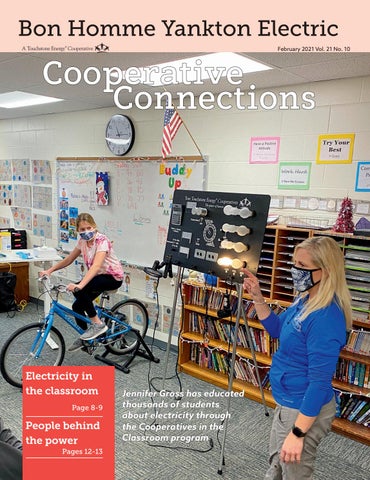
Electricity in the classroom Page 8-9
People behind the power Pages 12-13
Jennifer Gross has educated thousands of students about electricity through the Cooperatives in the Classroom program
OPERATIONS COLUMN
Increasing Our Reliability:
OCR Testing Program One way Bon Homme Yankton Electric increases reliability and safety for our members is by using oil circuit reclosers (OCRs). OCRs are an automatic, high-voltage electric switch. Like a circuit breaker on household electric lines, it shuts off electric power when trouble occurs. Where a household circuit breaker remains shut off until it is manually reset, a recloser automatically tests the electrical line to determine whether the trouble has been removed. If the problem was only temporary, then the recloser automatically resets itself and restores the electrical power. OCRs contain a coil that senses currents and can detect when something disrupts the line. For example, say a squirrel was on our line, the OCR would sense the squirrel and open the circuit. An instant later, the OCR would test if the object has been removed from the line and keep the power restored if the trouble is gone. This process can cause brief blinks in power. Common causes for temporary faults are birds, small animals, tree branches, ice, and lightning.
Ken Carda kcarda@byelectric.com
OCRs save considerable time and expense, since they allow power to be restored automatically, after only a flicker or two.
If the trouble persists on the line, say a tree branch is caught, the OCR is programmed to consider the problem permanent and keep the power off. Bon Homme Yankton Electric would then send an outage restoration crew to fix the problem. OCRs save considerable time and expense, since they allow power to be restored automatically, after only a flicker or two. For outages that require a repair crew, OCRs minimize the outage area and help crews quickly locate the problem and restore power. Bon Homme Yankton Electric contracts Solomon Corporation to service our OCRs every year. We test all our OCRs on a three year rotating basis, and we test an average of 75 to 100 OCRs a year. Solomon Corporation is based in Kansas, but they have seven locations throughout the Midwest. To service our OCRs, they take them apart, service them, repaint them, replace parts and oil, and test them for safety and function. View inside OCR Chris, one of the technicians that serviced our OCRs this year said, “Our main goal is that everybody goes home in the same condition they went into work.�
Solomon technician servicing an OCR
OCRs waiting to be serviced 2
Cooperative Connections | February 2021
Bon Homme Yankton Electric (USPS No. 018-973)
Bon Homme Yankton Electric Association, Inc PO Box 158 134 S Lidice St Tabor, SD 57063 Office Hours: Monday through Friday 7:30am - 4:30pm To pay by phone, call: 1-888-395-5315 To report an outage, call: Local call from Tabor, Tyndall and Yankton: 605-463-2507 Toll Free in South Dakota: 1-800-925-2929 NOTICE: Electric bills must be paid by 10:00am on the 20th of each month to avoid a $10 late fee. Bon Homme Yankton Electric Cooperative Connections is published monthly by Bon Homme Yankton Electric Association, Inc., PO Box 158, 134 S. Lidice St., Tabor, SD 57063-0158 for its members. Families subscribe to Bon Homme Yankton Electric Cooperative Connections as part of their electric cooperative membership. Bon Homme Yankton Electric Cooperative Connection’s purpose is to provide reliable, helpful information to electric cooperative members on matters pertaining to rural electrification and better rural living. Subscription information: Electric cooperative members devote $6.00 from their electric payments annually for a subscription. Nonmember subscriptions are available for $12 annually. Periodicals Postage Paid at Tabor, SD 57063 and at additional mailing offices. POSTMASTER: Send address changes to Bon Homme Yankton Electric Cooperative Connections, Bon Homme Yankton Electric, PO Box 158, Tabor, S.D. 57063 TELEPHONE (605)463-2507: FAX (605) 463-2419. Design assistance by TDG Communications, Deadwood, S.D.
CO-OP NEWS
2021 Scholarships Bon Homme Yankton Electric is now taking applications for one $1,000 and two $500 academic scholarships for the 2021-2022 school year. The Basin Electric Power Cooperative Scholarship is in its 31st consecutive year and is funded by Basin Electric Power Cooperative of Bismarck, ND. Bon Homme Yankton Electric is offering the two additional $500 scholarships. These scholarships are designed to recognize and encourage the academic and community achievements of the students in our area. Applicants must be a dependent of an active electric member and must be students enrolled or planning to enroll in a full-time undergraduate or graduate course of study at an accredited, two-year or four-year college, university or vocational-technical school. For more information and for a scholarship application form, contact Bon Homme Yankton Electric, your school’s guidance counselor or visit our website: www.byelectric. coop/scholarships. Applications must be returned to Bon Homme Yankton Electric, PO Box 158, Tabor, SD 57063 by 4:30pm, February 12, 2021.
Deadline: February 12, 2021, 4:30pm
Applications Online at byelectric.coop/scholarships
Applications available at your school’s guidance office
For More Information Call: 605-463-2507
Mail Complete Application And All Supporting Documentation To: Bon Homme Yankton Electric PO Box 158 Tabor, SD 57063 Or Email To: Jaclyn Arens at jarens@byelectric.com Contact Marketing and Communications Coordinator Jaclyn Arens for more information at 605-463-2507 or email: jarens@byelectric.com February 2021 | Cooperative Connections
3
EFFICIENCY TIPS
Lighten Your Laundry Load Laundry isn’t a task that many people relish, but if the process can be tweaked to save money, conserve electricity and prolong the life of your clothes, some minor adjustments may be worth your time. Here are some suggestions from Consumer Reports.
Visit the new SDREA.coop Want to know more about South Dakota’s rural electric cooperative system? Check out our newly redesigned website at www.sdrea.coop. You’ll find lots of useful information about our generation, transmission and distribution systems, energy efficiency ideas, legislative issues that impact electric rates, a statewide outage map and much more.
Opt for cold water. Hot water is only needed for laundering oily stains, cloth diapers and sheets and towels used by a family member who has been sick. Use high-efficiency detergent for front-loaders, high-efficiency top-loaders and where otherwise recommended by the machine’s manufacturer. Conventional detergents create more suds, which can cause the washer to repeatedly rinse laundry, wasting water and time. Increase the spin speed to extract more water from your laundry, reducing dryer time. Shake clothes out before transferring them from the washer to the dryer to avoid wrinkles. Clean the dryer’s lint screen before every load. This improves air circulation and prevents fires. Dryer sheets can leave a film on the filter, so if you use them, scrub the filter with a brush monthly.
KIDS CORNER SAFETY POSTER
Clean the dryer duct regularly to increase airflow, which dries your clothes faster and prevents fires. Clean the dryer’s moisture sensors. Dryer sheets can leave residue on the sensors that affects their ability to gauge how dry laundry is. Check the owner’s manual for instructions on how to clean them. Dry similar items together. Don’t mix heavy cottons with lightweight fabrics. Wash and dry towels and sheets separately, for example. Use the automatic cycle instead of timed drying. If the moisture sensors are working properly, the automatic cycle avoids over-drying, which shortens the life span of clothes and can shrink them. And for the least expensive, most efficient method, dry your laundry on a clothesline or use a drying rack indoors. This approach takes a bit more time but is gentler on your clothing, keeping it nicer looking for longer - a savings in itself. 4
Cooperative Connections | February 2021
“The Electric Fence is Unsafe!” Gabbie Eichmann, 11 years old Gabbie is a resident of rural Canistota. She is the child of Jeremy and Melanie Eichmann, members of Southeastern Electric Cooperative. Kids, send your drawing with an electrical safety tip to your local electric cooperative (address found on Page 3). If your poster is published, you’ll receive a prize. All entries must include your name, age, mailing address and the names of your parents. Colored drawings are encouraged.
RECIPES
Recipes to Power Up Your Day Bacon and Egg Lasagna 12 uncooked lasagna noodles 1/3 c. bacon drippings (or oil) 1/3 flour 1/4 t. pepper 2 c. Swiss cheese 2 T. parsley
Breakfast Bread Pudding
or crumbled
Butter
1/2 teaspoon salt
1 lb. bacon/turkey bacon/ sausage, cut up
2/3 cup creamy peanut butter, divided
1 c. chopped onions
2 eggs
4 cups cubed brioche or challah bread, cut into 3/4-inch cubes
1/2 t. salt
1/2 cup granulated sugar
4 c. milk
2/3 cup milk
1/2 c. grated Parmesan cheese
1-1/2 teaspoons pure vanilla extract
12 eggs, hard cooked, sliced Cook lasagna noodles per directions on package. In large skillet cook bacon until crisp (or cook other meat of choice). Reserve 1/3 c. bacon drippings (or use oil) and cook the onion until tender. Add the flour, salt and pepper. Stir until smooth and bubbly. Gradually add the milk, cook until mixture boils and thickens. Stir continuously. Heat oven to 350 degrees. Grease 9x13 pan. Spoon a small amount of the sauce onto the bottom of the pan. Layer the noodles, sauce, cheese and bacon (or other meat). Pour the remainder of the sauce over the last layer and sprinkle with the Parmesan cheese. Bake for 25-30 minutes or until thoroughly heated.
2/3 cup pure maple syrup 1/3 cup crushed peanuts Powdered sugar, for garnish
Heat oven to 350 F. Butter four 4-ounce ramekins. In bowl, mix 1/3 cup peanut butter, eggs, sugar, milk, vanilla and salt. Toss bread cubes in mixture until thoroughly coated. Divide evenly among prepared dishes. Bake until custard is set in middle and tops are golden, about 35-40 minutes. If tops of bread brown too quickly, cover ramekins loosely with aluminum foil. In small saucepan over low heat, combine remaining peanut butter and maple syrup until thoroughly warmed. To serve, drizzle ramekins with maple-peanut sauce and garnish with chopped peanuts and powdered sugar. Substitution: Whole wheat rolls may be used in place of brioche or challah bread. culinary.net
Kristine Shaffer, Lennox, SD
Apple Cranberry Muffins 1-3/4 c. brown sugar
1/2 tsp. salt
1/2 c. vegetable oil
2 eggs
2 c. flour
1 tsp. vanilla
1 tsp. baking soda
2 c. thinly sliced apples
1 tsp. cinnamon
1/2 lb. cranberries, halved
1 tsp. nutmeg
1/2 c. nuts, chopped
Cream oil and sugar; add eggs and vanilla and beat well. Sift flour, baking soda and salt together and add to mixture. Add spices next. Stir in apples, nuts and cranberries. For Streusel: 1/2 c. flour; 1/3 c. brown sugar; 3 tbsp. butter. Cut butter into flour and sugar until crumbly. Pour into muffin tins and sprinkle with Streusel. Bake at 400 degrees for 20-25 minutes. Ruth E. Schilberg, Viborg, SD
Baked Eggs Line muffin pans with 2 wafer thin slices of chicken, beef or pork. Break an egg into each cup. Add a 3/4 tsp. halfand-half and a bit of butter. Sprinkle with salt and pepper. Bake at 400 degrees for about 15 minutes, or until eggs are cooked to desired firmness. Elaine Rowitt, Sturgis, SD
Please send your favorite seafood recipes to your local electric cooperative (address found on Page 3). Each recipe printed will be entered into a drawing for a prize in December 2021. All entries must include your name, mailing address, telephone number and cooperative name. February 2021 | Cooperative Connections
5
BOARD REPORT
WELCOME MEMBERS Avon Ron Leasure Springfield Jeffrey Warembourg Tabor Wayne Juhnke Nathan & Linda Bares Aiden Banks Loving Hands Creations Don Allaway Yankton Lester & Diane Kruse Anthony Mau Brightway Electric, LLC Ronald Schlautman Wade Erickson Susan Behrens Tom Schall
Statement of non-discrimination
This institution is an equal opportunity provider and employer. If you wish to file a Civil Rights program complaint of discrimination, complete the USDA Program Discrimination Complaint Form, found online at http://www.ascr.usda.gov/ complaint_filing_cust.html, or at any USDA office, or call (866) 632-9992 to request the form. You may also write a letter containing all of the information requested in the form. Send your completed complaint form or letter to us by mail at U.S. Department of Agriculture, Director, Office of Adjudication, 1400 independence Avenue, S.W., Washington, D.C. 20250-9410, by fax (202) 690-7442 or email at program.intake@usda.gov. 6
February Holidays February 2
Groundhog Day
February 7
Super Bowl Sunday
February 7
National Send a Card to a Friend Day
February 12 Lincoln’s Birthday February 14 Valentine’s Day February 15 President’s Day and Washington’s Birthday February 16 Mardi Gras Carnival February 17 Ash Wednesday February 23 World Spay Day
Cooperative Connections | February 2021
BOARD REPORT STATISTICAL COMPARISON
3,865
3,902
Total Revenue
$929,777
$490,685
$9,652,655
BOARD MEETING HIGHLIGHTS
Cost of Power
$519,651
$446,806
$5,759,519
December 2020
Total Cost of Service
$799,279
$765,304
$9,189,665
kWhs Purchased
8,811,096
7,464,819
89,553,974
kWhs Sold
8,328,560
7,130,050
85,621,408
Line Loss %
5.15%
4.13%
4.14%
Residential Average kWh
1,830
1,490
Residential Average Bill
$201
$105
The December board meeting was held on December 23, at 8am via Zoom. All board members were present. Others present were Attorney Sheila Woodward, General Manager Stephanie Horst, Office Manager Nicole Einrem, Operations Manager Ken Carda, and Communications/Marketing Coordinator Jaclyn Arens.
NOVEMBER Number of Meters
2019
2020
2020 YTD
The board reviewed and approved: Minutes of the Previous Meeting New Members & Cancellations Capital Credits to Estates in the amount of $5,876.66 Closed Work Order Inventory totaling $50,540.17
December Solar Stats Energy to grid
Consumed Directly
5 kW Solar array used by Bon Homme Yankton Electric since 2018
The board reviewed and approved reports: East River Cyber Security/IT Report Reports from staff members as to the activities in their departments. • Office: Monthly Financial Report, Check Register, Bill Credit Recommendations, 2020 Write Offs, and 2021 Operating Budget • Member Service/ Communications Report • Operations Report • Safety Report • 2020 ERP Table Top Planning Drill • General Manager’s Report Reports from board members • South Dakota Rural Electric • East River Electric Power Cooperative • Attorney Report 2020 Audit Eide Bailly Engagement Designate 2021 NRTC Voting Delegate Executive Session Next meeting date set for Wed., Jan. 20, at 8 am.
February 2021 | Cooperative Connections
7
CO-OPS IN THE CLASSROOM
Jennifer Gross teaches the fundamentals of electricity to students at Warner Elementary. Photo by Ben Dunsmoor.
ENLIGHTENING STUDENTS Teachers, Co-ops Take Energy Education to the Classroom Billy Gibson billy.gibson@sdrea.coop
Jennifer Gross doesn’t know it for a fact, but she has a sneaking suspicion she has saved someone’s life. Maybe more than once. Gross is not a nurse, or a doctor, or a firefighter or an emergency medical technician. She serves as the education and outreach coordinator at Madison-based East River Electric and oversees the organization’s Co-ops in the Classroom program. In that role over the past five years, Gross has instructed thousands of students on the importance of electric safety. She goes into the classroom and covers a wide range of concepts in less than an hour, including how electricity is generated, how it can be conserved and how potentially dangerous it can be. She’s been accused of speaking at the speed of light because there’s so much for the students to grasp. “Our follow-up evaluations sometimes show that I talk too quickly,” Gross said with a chuckle. “But there’s a lot to cover, so many things they need to know that could keep them safe and free from harm. These are things they’re going to learn and use for the rest of their lives. It’s a lot to pack into an hour, but it’s important information.” Gross is one of many cooperative employees across the state who teach students the importance of understanding the benefits and potential dangers of electricity and how to use it wisely. In fact, member and community education is one of the Seven Cooperative Principles that guide South Dakota’s electric cooperatives. 8
Cooperative Connections | February 2021
The classroom program that Gross delivers includes how electrical power is generated, how it’s transmitted, how it’s conserved and how use it safely. The program also includes information that distinguishes electric cooperatives from investor-owned and municipal electric utilities. And one of those differences is a commitment to education and youth leadership development. “We teach them that there are all kinds of cooperative businesses out there – food co-ops, clothing co-ops, housing co-ops, marketing co-ops and others – and we’re here to do more than Students learn incandescent light bulbs cost more to operate compared to LEDs.
CO-OPS IN THE CLASSROOM
“These are things they’re going to learn and use for the rest of their lives. It’s a lot to pack into an hour, but it’s important information.” A student reacts with surprise when making contact with a Van de Graaff device.
- Jennifer Gross just provide electrical power. We’re here to deliver this information because we care about the welfare and well-being of our members, and we’re always here for them if they have questions about electricity.” Gross was a social worker before she joined East River as support staff in the engineering department more than 10 years ago. Since taking over the Co-ops in the Schools program, she has interacted with many primary and secondary educators who also see the need to teach the fundamentals of electricity. One of those is Jami Heinrich, a fifthgrade teacher at Warner Elementary School where Gross recently delivered her presentation. She has seen how students respond to discussions about electricity and see the direct application to their everyday lives. “It’s something that’s always around them and they deal with all the time,” Heinrich
said. “It’s good to get them the information they need to make better choices. When Jennifer was talking about insulators, one of my students brought up that his grandparents’ cell phone chargers were worn out and you could see the wires. He said, ‘So, this is a bad idea.’ It brought up a good discussion in the classroom. Safety around electricity is definitely a priority, and teaching children about it will lead them to make safer choices.” South Dakota’s electric cooperatives extend their education outreach well beyond elementary school classrooms. The cooperatives have invested in an electrical safety demonstration trailer that makes its way around the state not only to instruct linemen but also to attend public events and show the various components of a grid-based power delivery system. During the demonstration, facilitators send an electrical current through a hotdog, grapefruit and tree branch to show how much destruction unharnessed and mishandled electricity can do. To view a video of the safety demonstration trailer, visit youtube. com/watch?v=FBzB1bBYsH0&t=55s.
Science is at the center of learning about how electricity is generated and used.
Cooperatives have also supported programs such as the Washington D.C. Youth Tour and the Youth Excursion
that teach high school students not only about electricity but also some of the political considerations surrounding the electric utility industry and the history of the country’s rural electric cooperative movement. Many elementary and secondary school educators throughout the state – including Gross – have attended the annual teacher education seminar sponsored by the Lignite Energy Council, which attracts 130 participants from Minnesota, Montana, South Dakota and North Dakota. The four-day program takes place at Bismarck State College and offers professional development credits for attendees. The seminar focuses on how lignite is mined and used to produce electricity for homes, farms and businesses. In addition, the seminar covers lignite’s economic impact on the region, as well as important environmental issues affecting the lignite industry. Since 1986, more than 3,400 teachers have attended the seminar. Roger Lawien, director of member services at Moreau-Grand Electric in Timber Lake, underscores the importance of electric education: “Member education is a vital part of what we do as co-ops. We have a program we call ‘Neon Leon,’ and one day after a safety demonstration a woman came up with her two boys and said, ‘I just wanted to thank you for what you do here. Because of what you taught my boys at last year’s demonstration, my husband is alive.’ That really shows how important it is.”
February 2021 | Cooperative Connections
9
CO-OP NEWS
CLASSIFIEDS March Issue Deadline: February 1, 2020. Email your classified ad to: jarens@byelectric.com. Members can post one free ad per year. Repeats or longer ads are $1/ column inch. FOR RENT: 1 bedroom apartment. Tabor Manor. Contact Gary at 605-463-2209 or Ron at 605-463-2256. Beseda Hall, Tabor, SD for rent for any special occasion such as weddings, anniversaries, graduation or birthdays! For more information contact Linda Bares at 605-661-6220 or snlbares@ gmail.com. FOR RENT: Tabor Self Storage. Call 605-660-0274 or 605-6603497.
Renewable Energy Credit (REC) Program Showcase your support for renewable energy Bon Homme Yankton Electric has Renewable Energy Credits (RECs) available for purchase to offset electric use with 100% renewable energy. Bon Homme Yankton Electric is making those credits available to members through the REC Program. The electricity co-op members receive will still be the same reliable and affordable energy they have always received from the co-op. Businesses can add value to their products or services and showcase their support for renewable energy by participating in the REC Program.
What is a REC? 1 MWh (megawatt hour) produced by a renewable energy source equals 1 REC RECs are also called green tags RECs represent the valuable renewable attributes of wind, solar, and renewable energy
FREE Classified Ad Service
Members can submit classified ads for the following categories: Giveaway, For Sale, For Rent, and Wanted Ads. All ads must be received by the first of the month to be included in the following month’s issue. Ads will run one time unless resubmitted. Bon Homme Yankton Electric reserves the right to edit content or exclude ads due to space restrictions. Email ads to Jaclyn Arens at jarens@byelectric.com.
How much does it cost? $1 per MWh (megawatt hour) For Example: If a member uses 1,200 kWh (1.2 MWh) of electricity per month, the REC Program would add $1.20 plus tax to the monthly bill.
Do you need to purchase any special equipment? No, Bon Homme Yankton Electric will continue to fulfill all the electric needs of the participant so they can enjoy the benefits of renewable energy.
Where do the RECs come from? The RECs come from several wind, solar, and recovered-heat generation projects in the region that supply renewable energy to Bon Homme Yankton Electric.
How do I sign up for the REC Program? Bon Homme Yankton Electric consumers who would like to participate simply need to call the office at (605) 463-2507 and speak with a member services representative.
CALENDAR CORRECTION NOTICE Kevin Henseler submitted the photo for the month of November for our 2021 calendar that was sent out with our last Cooperative Connections issue. See photo to the right. 10
Cooperative Connections | February 2021
SAFETY NEWS
Shedding Light on Safety for Solar Installations The sun provides light, warmth, vitamin D, and an abundant renewable energy source. In an increasingly popular trend, many people are turning to solar power for electricity. If you are considering adding solar to your home or business, first do a thorough assessment to make sure you do not get burned. “A renewable energy system can be a valuable long-term investment,” says Erin Hollinshead, executive director of the Energy Education Council’s Safe Electricity program. “Homeowners and small business operators should do some good hard looking before leaping into one to ensure they will get value for their investment.” While it is important to consider if solar energy can help meet your goals, be cost effective, and if it is even possible for your location, it is even more important to investigate solar panel electrical safety issues before installing the system.
If you have any questions about solar please contact us at (605) 463-2507.
Make sure to hire a qualified installer of the system. Improperly installed solar panel systems increase the chance of a faulty unit, which could cause shock or fires.
One of the most common types of solar systems in the U.S. is a photovoltaic (PV) system. PV devices convert sunlight into electrical energy. These solar panels use both direct and scattered sunlight. For homeowners, these are commonly mounted on the roof for easy access to the sun and to save space. Make sure your roof ’s structure is strong enough to hold the additional weight of a solar system. These systems are exposed to outdoor weather conditions which increase the aging process. According to the Fire Protection Research Foundation (FPRF), heavy wind can stress the panel, hail can cause cracking on the panel, and snow and debris can affect the energy performance.
Therefore, an on-going maintenance schedule should be developed to ensure the safe operation of these systems. The FPRF suggests maintenance procedures to help prevent fire or damage, including: Visually inspect the equipment and connections for signs of damage or degradation. Visually inspect electrical junction boxes and raceways to see if conductors are damaged and in need of repair or replacement. Visually inspect string conductors to identify physical damage that needs repair. It is important to provide easy and safe access to the roof to allow for effective inspection, maintenance, and repair for the PV system. However, roof-mounted panels could cause problems in the case of a fire. The FPRF explains that solar panels cannot easily be shut down, so electric shock is the primary danger, especially during the day when sunlight is powering the system. A PV solar system damaged during a nighttime fire, which once exposed to sunlight, could begin to generate electricity, and create a shock hazard or re-kindling of the fire. On roofs where solar panels take up a large amount of space, these installations can inhibit emergency responders from doing their job efficiently during structural fires. Vertical ventilation, where a hole is cut through the roof of a building to release smoke, is a common maneuver that has been used to save lives and increase visibility of victims. When solar panels prevent firefighters the ability to gain direct access to the fire, a person or family is put at a higher risk of smoke inhalation and risk of death. The solar panel equipment can also pose tripping, slipping, and snagging hazards, and broken panel glass can cause cutting hazards to first responders and equipment. If you have any questions about solar please contact us at (605) 463-2507. If you are interested in solar, the first step is to contact us and fill out an application. February 2021 | Cooperative Connections
11
BEHIND THE POWER
Antelope Valley Station control room operator J.D. Wolf sits at the control center where he monitors the facility operations.
The People Behind the Power Power Providers Take Pragmatic Approach to Fuel Use Billy Gibson billy.gibson@sdrea.coop
With every change in presidential administrations, there comes a predictable shift in policy positions surrounding coal and the fossil fuels used to generate the electricity that drives the country’s economic engine and allows for the conveniences of modern life. The Obama Administration, for instance, waged what many described as a “war on coal.” It pursued an agenda that focused on imposing stringent regulations designed to push the power generation market toward renewable resources and eliminate fossil fuels. It was an effort to reduce greenhouse gas emissions and accelerate an emerging renewable industry. The next administration followed with President Donald Trump declaring an end to the “war on coal” during his first State of the Union address. President Trump signed executive orders revoking various rules regarding carbon emissions enacted by his predecessor. He vowed to revive the coal mining industry and “put those miners back to work.” And with yet another change in political 12
power, President Joe Biden has started the pendulum swinging back in the other direction. His energy approach, which he dubs the “Clean Energy Revolution and Environmental Justice Plan” involves reinstating many of the Obama-era policies including restrictions on oil and gas leases and investing $400 billion in clean energy technology and innovation over the next 10 years. It also includes pushing the ag sector toward net-zero emissions. While these policies play out in the political arena, those who bear the responsibility of actually generating the power the country needs have their own perspective. Working diligently and silently in the background of the high-profile political battles pitting climate change activists against climate change deniers are thousands who see these issues as a lot less political and much more practical. Pundits and ideologues suit up each day to argue over policy. Power generators suit up every day to keep the lights on 24/7 at rates people can afford. For South Dakota’s electric cooperative members, that responsibility falls on the staff, management and board members of Basin Electric Power Cooperative (Basin Electric). Owned by the members it serves, Basin Electric generates electricity
Cooperative Connections | February 2021
for 140 transmission and distribution co-ops in nine states. The massive power co-op has professionals in place to deal with the political considerations of power production, but most are concerned with keeping the ions flowing toward three million homes, businesses, farms and ranches across the region. For those individuals, policy decisions have real consequences in terms of how they carry out their work. For example, while some lawmakers roll out plans intended to push the industry in the direction of net-zero emissions, engineers, rate designers, operators, financial experts and others are dealing with the realities of making that happen. According to Andrew Buntrock, Basin Electric’s director of strategic planning, so often it comes down to a delicate balance – a three-legged stool – between on-demand accessibility, zero emissions and low rates. It’s practically impossible to achieve all three at optimal levels simultaneously. “Someone explained it like this: Let’s say a rancher wants a vehicle that’s affordable, cheap to operate and has zero carbon emissions,” said Buntrock. “But he’s not going to be able to pull his loaded cattle trailer with a Prius. He needs the power
BEHIND THE POWER
of an F-350 to do what he needs to do, to make a living, to bring his product to market and contribute to the economy. Sometimes we want to have it all, but that’s not always possible.” He explained that power generators experience constant pressure to curb greenhouse gas emissions and eliminate fossil fuels in favor of renewable power while staying in compliance with governmental and regulatory agencies. To many vocal environmentalists, no realistic timeline to make the country completely energy independent is fast enough. Basin Electric, Buntrock explained, has long been working to reduce emissions. For instance, in 2000 roughly 85 percent of the cooperative’s power was generated with coal as the primary fuel source. Today that percentage is around 44 percent, with nearly $2 billion spent on environmental emissions control technology. The co-op also has renewable power projects underway including the Wild Springs,
Tom White serves as a mechanic technician at Basin Electric’s Deer Creek Station. from a podium or street protest is often difficult to carry out in the trenches. “We’ve been working on this for 20 years and we’ve been making strides. We’re proud of our efforts to accomplish the thing that we all want: a clean environment. But we also want affordable, accessible power and for now and the foreseeable future, that’s going to include
noted that price is even more of a priority since the pandemic struck a blow to the economy. “Our approach and our strategy is ‘all of the above.’ We can’t put all of our eggs in one basket,” Buntrock said. “We’re mindful of the concerns expressed by environmentalists because we share those concerns. But we think we’re moving in the right direction. We just want our members and the public to understand that a plan or a goal may be easy to formulate, but actually making it happen often entails complex challenges that most people aren’t aware of. The story behind the switch isn’t one that people hear very often.” Even if fossil fuels could be eliminated altogether and baseload demand could be met entirely with renewable sources, the transition would still leave power producers – and consumers – in a financial lurch.
Antelope Valley Station employees Ricky Mitzel and Roger Reed monitor operations of the generation facility. West River and Cabin Creek solar farms and Northern Divide Wind Project. There is also a division dedicated to conducting research on renewable energy sources and applying the most cost-effective implementation. Buntrock said most power providers welcome and embrace efforts to reduce emissions, but the timetables should be realistic and take into account the fact that formulating a plan that sounds attractive
fossil fuels because it’s the best source for being able to control the power production process. You can’t always depend on the wind blowing and the sun shining.” Basin recently conducted an extensive survey of its members in an effort to identify their top priorities. The list of responses was led by price, followed by reliability, the two factors necessary for providing power that people can afford and they can access on demand. Buntrock
“It’s like having two cars. You have one that you’re still paying for. But then you want another model and you can’t just dump the first one. You end up having two car notes, but you can only drive one to work,” Buntrock said. As the rest of the country watches the Biden Administration and congress negotiate on policy, Buntrock said Basin Electric will continue to produce on-demand power for its members. “We know we’re moving in the right direction and we know our members are confident that we’re doing our best to look out for their interests, deliver the power they need and strive to be a good and trusted partner.”
February 2021 | Cooperative Connections
13
DE-STRESSING
Jaclyn Arens of Bon Homme Yankton Electric Association in Tabor practices yoga during her vacation breaks.
DE-STRESSING
Shed the Stress of a Busy Life: Take it Easy on Yourself Billy Gibson billy.gibson@sdrea.coop
Take it easy on yourself. That bit of advice was dispensed by Country Music Hall of Famer Don Williams back in the late 1990s, and it’s the same wisdom imparted by Kristie Ching, a certified health and life coach. Ching, an employee at Basin Electric Power Cooperative’s Deer Creek station near Elkton, works with clients who find themselves being overwhelmed by the breakneck speed of modern life and feeling lost and ridden with angst. What can you do to stay centered while the flurry of activity and information all around you is leaving you exhausted and reducing your quality of life? Ching believes she has the answer. After earning her master’s degree in human science in 2014, Ching has helped many clients find the balance they need to regain control of their lives and thrive. But if she had to boil it all down to one pearl of wisdom, she’d say the most important consideration is to make your own success a priority and take it easy on yourself during those times you don’t always hit the bullseye. “You have to give yourself some grace and understand that you don’t have to be perfect and it’s okay to make a mistake,” Ching said. Maintaining a close mind/body connection is also paramount in being able to cope with the stress and pressures that come to 14
Cooperative Connections | February 2021
bear on any given day filled with family and work responsibilities, Ching said. Over the past seven years, she has led classes in PiYo, a blend of pilates and yoga training. Classes usually include meditation techniques, deep and controlled breathing exercises and vigorous physical movements. The idea is to slow down your mind while moving your body. Some prefer to call it “yoga on crack.” In her work, Ching has discovered that the most helpful directive for many clients is to intentionally take an extended hiatus from the news and generally spend less time in front of a phone, computer or television screen. The results can be transformative, she said. “The biggest ‘aha’ moments I get with my clients is when they unclutter their lives and just quiet their minds. We take in so much information from hour to hour. In order to absorb it all, you have to push all of that chaos out with the old stuff cluttering your mind,” she said. “One client said what brought her the most peace is when she stopped watching the nightly news. It would literally bring her down. Take some time away from the world and feed your soul. Spend some time laughing with friends or reading a book before you go to bed, not watching TV or scrolling through Facebook.”
DE-STRESSING
Tips for Dealing with Stress By Kristie Ching Be thankful. Showing gratitude for all you DO have in your life brings more good into your life. Move your body. Do the things you enjoy, attend a class at the local gym, go for a walk or run, dance in the kitchen, play with your kids or grandkids, play a game of basketball with friends. The main thing is to find a physical activity you enjoy. Unplug. Put down the phone, iPad, computer. Meditation or deep breathing. There are a ton of meditation resources on YouTube, or I teach my clients to utilize a 5-5-7 breathing technique that can be done in just 2 minutes. Set your intention of what you want and just breathe. Breathe in for 5 seconds, hold for 5, exhale for 7. Get enough sleep. When you are tired you tend to make more poor choices. Write it down. When stress is high it’s often a good practice to write it down and get all the frustration One thing that Ching is sure to bring up with her clients is the connection of food, eating, the body and the mind. She said one highly effective way of losing weight is to unclutter the mind before approaching the dinner table. While many succumb to overeating due to worry and stress, managing the spirit and the mind typically results in fewer bad dietary habits and prolonged body weight control. Less stress leads to fewer calories, and fewer calories leads to weight loss. She calls it food freedom. “When you achieve food freedom, you don’t have to diet all the time and deal with the stress that comes with always being on a diet.” Ching said. “Stress can
down on paper. Then throw it away and release it. Slow down and eat with all your senses. We often add stress to our bodies just by scarfing down our food. Slow down. Enjoy the smells and tastes. Spend time with people who lift you up and make you laugh. Laughter is the best medicine! Make time to do the things you enjoy. Reading, blogging, going for a walk, watching your favorite TV show, draw, color, anything to let your inner child come out. Unclutter. I encourage clients to first look at areas they need to unclutter. In order to bring in the new you need to take out the old, just like when you buy a new couch, you get rid of the old one.
lead to overeating. If you’re under stress, don’t reach for those potato chips or candy bar. Go find a quiet place and relax for a moment and meditate. If you can meditate for a few minutes before you sit down to eat, that can help you relax, and it will also aid in your digestion.” Jaclyn Arens sometimes experiences stress in her role as marketing and member services coordinator at Bon Homme Yankton Electric Association in Tabor. She was a fixture at the Soul Story Yoga Studio before the local business shut down its facility due to concerns over the pandemic. Arens said the concepts and techniques she has learned can be practiced anywhere. She sometimes pauses during vacation trips to center herself and
prepare herself for a day of outdoors fun. “Yoga is adaptable for any fitness level and can be practiced pretty much anywhere,” she said. “I do yoga to increase my strength, balance, and flexibility, and to take time to think and breathe. One thing I appreciate about yoga is the supportive community, and I look forward to returning to the studio when the pandemic is under control and feeling that sense of community again!” Soul Story Studio owner Rebecca Johnson said she has no timetable to re-open the studio but has begun offering classes online at www.soulstoryyoga.com/onlineclasses.
Visit Co-op Connections Plus Take a moment to visit our new online companion to Cooperative Connections. Co-op Connections Plus is a YouTube channel that features a more in-depth treatment of stories appearing in this publication as well as other subjects of interest to rural South Dakotans. Search for “Co-op Connections Plus” and you’ll find videos on human trafficking, support programs for veterans, grain bin safety, the Co-ops Vote campaign and more. Be sure to “like” and “subscribe.” February 2021 | Cooperative Connections
15
Note: Please make sure to call ahead to verify the event is still being held.
January 18-25
Chinook Days, Spearfish, SD 605-717-9294
January 21-24
Elf The Musical, Area Community Theatre, Mitchell, SD 605-996-9137
January 23
Treasured Lives Presents: Bazzel Baz, Rushmore Plaza Civic Center, Rapid City, SD 1-800-468-6463
January 29-30
Pro Snocross Races, Days of ‘76 Rodeo Grounds, Deadwood, SD 605-578-1976
January 29-February 6
Black Hills Stock Show & Rodeo, Rushmore Plaza Civic Center, Rapid City, SD 605-335-3861
January 29-31
Winterfest, Lead, SD 605-335-3861
February 5-6
Mardi Gras Weekend, Main Street, Deadwood, SD 605-578-1976
February 10-13
Watertown Winter Farm Show, Codington County Extension Complex, Watertown, SD 605-886-5814
February 12-13
SD High School State Gymnastics Meet, Watertown Civic Arena, Watertown, SD
Pro Snocross Races, Jan. 29-30, 2021 February 18
The Q’s High Line to Deadwood – A 130-year Retrospective, Homestake Adams Research and Cultural Center, Deadwood, SD 605-722-4800
February 18-25
Twelfth Annual Black Hills Film Festival, Virtual 605-574-9454
February 20-27
SD State High School Wrestling Tournament, Rushmore Plaza Civic Center Barnett Arena, Rapid City, SD
February 25
Daniel Tiger’s Neighborhood Live: Neighbor Day, Washington Pavilion, Sioux Falls, SD 605-367-6000
March 5-6
SD High School State Debate & IE Tournament, Central High School, Aberdeen, SD
March 12-13
St. Patrick’s Day Weekend, Main Street, Deadwood, SD 605-578-1976
March 13
28 Below Fatbike Race, Ride and Tour, Spearfish Canyon Lodge, Lead, SD 605-641-4963
March 13
St. Patrick’s Day Celebration, Knights of Columbus Hall, Watertown, SD 605-886-5814
March 13-14
Philip Area Annual 2021 Gun Show, American Legion Hall, Philip, SD 605-859-2280
March 19-20
Annual Schmeckfest, Freeman Academy, Freeman, SD 605-925-4237
March 23-24
Shen Yun, Rushmore Plaza Civic Center Fine Arts Theatre, Rapid City, SD 605-394-4115
March 25
A Lakota View of the Dead Hills, Homestake Adams Research and Cultural Center, Deadwood, SD 605-722-4800 To have your event listed on this page, send complete information, including date, event, place and contact to your local electric cooperative. Include your name, address and daytime telephone number. Information must be submitted at least eight weeks prior to your event. Please call ahead to confirm date, time and location of event.