Bon Homme Yankton Electric June 2018 Vol. 19 No. 2
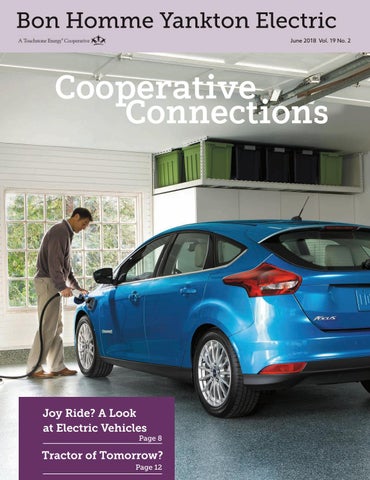
Joy Ride? A Look at Electric Vehicles
Page 8
Tractor of Tomorrow? Page 12
MANAGER’S COLUMN
Inspite of the weather:
Ready for Construction As we held our breath during the April 14th blizzard, memories of damage and outages came flooding back from last year’s May 1st storm at Bon Homme Yankton Electric. How would we fare this year compared to last? Luckily, only the western edge of our territory was affected. Our line crews were responding to outages in the Avon area because of ice accumulation on the line the size of pop cans aggravated by high winds. We got away with minimal damage and were able to keep up with the outages, but our neighbor, Charles Mix Electric, to the west of us was hit much harder. Since we were able to handle our outages, we sent crews to help them, as they did for us last year.
Stephanie Horst horst@byelectric.com
We strive to provide our members with timely, exceptional service and can achieve that with proper planning.
The snow and rain has slowed our construction from beginning but soon will be in full swing. New service installations, service retirements, line maintenance, tree trimming, and various underground projects will sure make for a busy summer for our line crews. If you are planning any additional electric load to your service or needing a new service placed, please contact Robert Ulmer to get on the schedule. We strive to provide our members with timely, exceptional service and can achieve that with proper planning. Did you know that we do electrical work on the member’s side of the meter, too? Bon Homme Yankton Electric has an electrical department that is available for wiring projects. Contact Bob Felber or Kevin Meyer to get a quote for your wiring needs. They are also expanding their skills to distributed generation. They are gearing up for the installation of a 5 kW solar project that will be located on the southwest lawn of our main office building in Tabor. Once it is fully installed, we will have its production details available for our members. Having this information available to our members is another source for our members to look at when deciding to invest in solar. If you are wanting to install solar or have questions about solar, contact Bob Felber. As you prepare to do yard work or construction that requires digging, please remember to call 811 so that all utilities can be located before you dig. Underground utilities are expensive to repair and can be dangerous like electrical and gas lines. When you call 811, they contact all the utilities about your project. The utilities then will mark their underground lines. It is beneficial that you mark in white paint or white flags where you will be digging to ensure that utilities know where to locate. Safety is not only a concern for our employees, but for our members, too. Not only calling 811, but our members that are farmers need to be aware of electrical hazards. As you purchase new farm equipment, consider that it may be larger than your previous equipment and clearance under and around electric lines needs to be reassessed. We have worked with farmers to replace overhead wires in their yards to underground for safety. Contact Robert Ulmer if you are needing this done in your yard. I wish everyone an enjoyable safe summer. I hope to see you August 28 at your annual meeting in Tabor.
2
Cooperative Connections | June 2018
Bon Homme Yankton Electric
YOUTH PROGRAMS
Katie Hammond Wins DC Trip Katie Hammond was selected to participate in the annual Washington DC Youth Tour.
(USPS No. 018-973)
Bon Homme Yankton Elecric Assocation, Inc PO Box 158 134 S Lidice St Tabor, SD 57063 Office Hours: Monday through Friday 7:30am - 4:30pm
As a current junior at Yankton High School, she has been active at school participating in HOSA-Future Health Professionals, choir, shooting sports in 4-H and high school, track and field and volleyball. She was a founding member of YHS Book Club and has participated in Science Olympiad since seventh grade bringing home several gold and silver medals. Katie represented Bon Homme Yankton Electric on the 2017 Youth Excursion to North Dakota. Katie is the daughter of Joe and Tina Hammond of Yankton, SD.
To report an outage call: Local call from Tabor, Tyndall and Yankton: 605-463-2507 Toll Free in South Dakota: 1-800-925-2929 NOTICE: Electric bills must be paid by 10:00am on the 20th of each month to avoid a $10 late fee. Bon Homme Yankton Electric Cooperative Connections is published monthly by Bon Homme Yankton Electric Association, Inc., PO Box 158, 134 S. Lidice St., Tabor, SD 57063-0158 for its members. Families subscribe to Bon Homme Yankton Electric Cooperative Connections as part of their electric cooperative membership. Bon Homme Yankton Electric Cooperative Connection’s purpose is to provide reliable, helpful information to electric cooperative members on matters pertaining to rural electrification and better rural living. Subscription information: Electric cooperative members devote $6.00 from their electric payments annually for a subscription. Nonmember subscriptions are available for $12 annually. Periodicals Postage Paid at Tabor, SD 57063 and at additional mailing offices. POSTMASTER: Send address changes to Bon Homme Yankton Electric Cooperative Connections, Bon Homme Yankton Electric, PO Box 158, Tabor, S.D. 57063 TELEPHONE (605)463-2507: FAX (605) 463-2419. Design assistance by TDG Communications, Deadwood, S.D.
Statement of non-discrimination
This institution is an equal opportunity provider and employer. If you wish to file a Civil Rights program complaint of discrimination, complete the USDA Program Discrimination Complaint Form, found online at http:// www.ascr.usda.gov/complaint_filing_cust.html, or at any USDA office, or call (866) 632-9992 to request the form. You may also write a letter containing all of the information requested in the form. Send your completed complaint form or letter to us by mail at U.S. Department of Agriculture, Director, Office of Adjudication, 1400 independence Avenue, S.W., Washington, D.C. 20250-9410, by fax (202) 690-7442 or email at program.intake@usda.gov. June 2018 | Cooperative Connections
3
SAFETY TIPS
Electrical Safety on the Farm
Primary Elections Near
Farming is among the more dangerous occupations for several reasons, including potential for encounters with electrical hazards. Before taking to the fields, the Safe Electricity program urges farm workers to be aware of overhead power lines and to keep equipment and extensions far away from them.
A primary election determines which candidates will be on the ballot in the November general election.
Safe Electricity encourages farm managers to share this information with their families and workers to keep them safe from electrical accidents. Start each morning by planning your day’s work. Know what jobs will happen near power lines and have a plan to keep the assigned workers safe. Keep yourself and equipment at least 10 feet away from power lines in all directions, at all times. Use a spotter when moving tall equipment and loads. Use care when raising augers or the bed of a grain truck. It can be difficult to estimate distance and sometimes, a power line is closer than it looks. Use a spotter to make certain you stay far away from power lines. Always lower equipment extensions, portable augers or elevators to their lowest possible level, under 14 feet, before moving or transporting them. Wind, uneven ground, shifting weight or other conditions can cause you to lose control of equipment and make contact with power lines. Be aware of increased height when loading and transporting larger modern tractors with higher antennas. Never attempt to raise or move a power line to clear a path. If power lines near your property have sagged over time, call your utility to repair them. Don’t use metal poles when breaking up bridged grain inside and around bins. As in any outdoor work, be careful not to raise any equipment, such as ladders, poles or rods, into power lines. Remember, non-metallic materials, such as lumber, tree limbs, tires, ropes and hay, will conduct electricity, depending on dampness and dust and dirt contamination. Use qualified electricians for work on drying equipment and other farm electrical systems. If you are on equipment that contacts a power line, do not exit the equipment. When you step off the equipment, you become the electricity’s path to ground and receive a potentially fatal shock. Wait until utility workers have de-energized the line and confirmed it is safe for you to exit the vehicle. If the vehicle is on fire and you must exit, jump clear of the vehicle with both feet together. Hop as far from the vehicle as you can with your feet together. Keep your feet together to prevent current flow through your body, which could be deadly. Electrical work around the farm can also pose hazards. Often, the need for an electrical repair comes when a farmer has been working long hours and is fatigued. At such times, it’s best to step back and wait until you’ve rested. Source: safeelectricity.org 4
Cooperative Connections | June 2018
Voters in South Dakota head to the polls in June for the primary election while voters in Minnesota follow suit Aug. 14.
In South Dakota, there are 24 House and Senate races with primary elections that will be decided on June 5. Those wishing to vote in the primary election have until May 21 to register to vote. Absentee voting began on April 20. Minnesota’s Primary Election Day is Tuesday, Aug. 14. Minnesotans can vote by mail or in person from June 29 through Aug. 13. As part of the election cycle, co-ops across the county are engaging in Co-ops Vote, a non-partisan program developed by the National Rural Electric Cooperative Association (NRECA), the national service organization that represents the nation’s more than 900 private, not-for-profit, consumer-owned electric cooperatives. The Co-ops Vote campaign seeks to help get out the vote and insert issues important to co-ops and their communities into the public discussion.
KIDS CORNER SAFETY POSTER
“Never play or climb on power lines.” Caroline Ekberg, 9 years old
Caroline is the daughter of Lance and Doris Ekberg, Hamill, S.D. They are members of Rosebud Electric Cooperative, Gregory, S.D. Kids, send your drawing with an electrical safety tip to your local electric cooperative (address found on Page 3). If your poster is published, you’ll receive a prize. All entries must include your name, age, mailing address and the names of your parents. Colored drawings are encouraged.
RECIPES
Dairy Delicious Cream Cheese Chicken Taquitos
Lemon Ginger Blueberry Muffins
2 boneless chicken breasts
1 (8 oz.) pkg. cream cheese
2 cups flour
1/4 cup milk
1 tsp. chili powder
1/3 cup water
2/3 cup sugar
1/4 cup vegetable oil
1 tsp. garlic powder
1/2 cup shredded cheese
1-1/2 tsp. baking powder
1 egg, lightly beaten
1 tsp. cumin
12 6-inch flour tortillas
1 tsp. McCormick® ground ginger
1 tsp. McCormick® pure lemon extract
1/2 tsp. baking soda
1 cup blueberries
Place chicken, chili powder, garlic powder, cumin, cream cheese and water in crock pot. Cover and cook on LOW for 8 hours or 4 hours on HIGH. Place 1/4 cup of the chicken mixture into each tortilla. Top with 1 to 2 T. shredded cheese. Roll tightly and place in a single layer on greased baking sheet. Bake at 400°F. for 10 minutes or until tortillas are slightly browned and cheese is melted. Cortney Reedy, Tea, S.D.
Crunchy Ice Cream Bars 1/2 cup light corn syrup 1/2 cup peanut butter, creamy or chunky
4 cup Kellogg’s Cocoa Krispies 1 pint ice cream
Mix corn syrup thoroughly with peanut butter. Pour over Cocoa Krispies and stir until well coated. Press mixture into a 9x13-inch buttered pan. Place in freezer to firm up. Cut into 12 3-inch squares. Place a slice of ice cream between 2 squares. Cut each square into 2 bars. Wrap individually in foil and keep in freezer until needed. Cindy Reu, Luverne, Minn.
Lightly grease 12 muffin cups or line with paper baking cups. Set aside. Mix flour, sugar, baking powder, ginger and baking soda in large bowl. Mix sour cream, milk, oil, egg and lemon extract in medium bowl. Add to flour mixture; stir just until dry ingredients are moistened. (Batter will be thick and slightly lumpy.) Gently stir in blueberries. Spoon batter into prepared muffin cups, filling each cup 2/3 full. Bake at 400°F. 20 to 25 minutes or until toothpick inserted in center of muffins comes out clean. Serve warm. Makes 12 (1 muffin) servings. Nutritional Information Per Serving: Calories 213, Total Fat 9g, Sodium 122mg, Cholesterol 29mg, Carbohydrates 30g, Protein 3g, Dietary Fiber 14g Pictured, Cooperative Connections
Cowboy Caviar 2 cans Mexicorn
Strawberry Cheesecake Pie 2 cups sliced fresh strawberries
1 (8 oz.) pkg. cream cheese, softened
1/4 cup chopped almonds
2 cups cold milk, divided
1 T. sugar
1 (3.4 oz) pkg. instant vanilla pudding
1 9-inch graham cracker crust
1 cup sour cream
In a bowl, combine strawberries, almonds and sugar. Pour into crust. In a mixing bowl, beat cream cheese until smooth; gradually add 1/2 cup milk. Add pudding mix and remaining milk. Beat for 1 minute or until blended; pour over strawberries. Cover and refrigerate for 2 hours or until set. Stephanie Fossum, Hudson, S.D.
2 cups shredded Cheddar cheese 1 cup Miracle Whip
1 can diced tomatoes and green chilies 6 green onions, chopped Fritos Scoops corn chips
1 cup sour cream Mix together all ingredients; serve with corn chips. Jane Ham, Rapid City, S.D.
Please send your favorite dessert, salad and garden produce recipes to your local electric cooperative (address found on Page 3). Each recipe printed will be entered into a drawing for a prize in June 2018. All entries must include your name, mailing address, telephone number and cooperative name. June 2018 | Cooperative Connections
5
CO-OP NEWS
Items for Sale by Sealed Bids Bon Homme Yankton Electric is offering the following pieces of equipment for sale by sealed bids. Submit your bid to: Sealed Bids, Bon Homme Yankton Electric, PO Box 158, Tabor, SD 57063 by 4:30pm on Friday, June 1, 2018 to be considered. Include your name, address, phone number and which equipment you would like to bid on and your bid for that equipment. Contact the office at 605-463-2507 to make an appointment to see the equipment during regular office hours which are weekdays from 7:30am to 4:30pm. Winners will be notified June 4, 2018 and will have one week to claim their purchase. Bon Homme Yankton Electric reserves the right to refuse any or all bids.
#1 1996 Honda 4 Wheeler TRX300
Director Petition Filing Deadline June 28, 2018 Districts up for election: 3 and 5 Contact the office for more information 6
Cooperative Connections | June 2018
CO-OP NEWS
#2 2004 Polaris Snowmobile
June 2018 | Cooperative Connections
7
INNOVATION
The 2017 Ford Focus, with a price tag in the $35,000 dollar range, can accelerate from 0 to 60 mph in 6 to 11 seconds, which is about average for all U.S. cars.
What You Don’t Know about Electric Cars Could
THRILL YOU
Electric Vehicles Aren’t Just for City Driving. Paul Wesslund
Photo Caption NRECA Contributing Writer
If you want a really powerful car, maybe one that can accelerate from 0 to 60 mph in less than 3 seconds, consider an electric vehicle like the NIO EP9. You’re right, that’s too powerful. The NIO EP9 would also cost you more than a million dollars. But even more modest versions offer a respectable kick. The Chevy Bolt and Ford Focus, with price tags in the $35,000 dollar range, make the jump to 60 mph in 6 to 11 seconds, which is about average for all U.S. cars. There’s a built-in reason electric cars hold their own in performance, says Brian Sloboda, a program and product manager at the National Rural Electric Cooperative Association. “In an electric car, all of the power is going into the wheels. With a gas-powered car, a lot of power is lost inside the mechanical engine,” says Sloboda. “If you sit in an electric car and the driver smashes down on the accelerator, you are going to be thrown into the back of your seat, much more so than many gasoline cars.” In March, Goodyear announced a new tire that would hold up better under the “instant torque from electric motors.” 8
Cooperative Connections | June 2018
But wait, there’s more. “The battery is at the bottom of the car, so you have a lower center of gravity, which means you can take the corners crisper,” says Sloboda. “If you do a lot of driving in the hills or mountains, they are fun.” Electric vehicles hold a lot of other surprises compared to the
INNOVATION traditional view of them as a glorified golf cart. Even electric co-op in rural parts of the country are hearing interest from their members. About 700,000 electric vehicles drive on U.S. roads today, according to an analysis by CoBank, a financier for electric co-ops. That number could jump to 3 million in the next five years, says CoBank. The U.S. Department of Energy’s Energy Information Administration projects electric vehicle sales growing from about 1 percent of the market today, to 12 percent by 2050. Car makers are pushing those trends. In October, General Motors said it would launch 20 new electric vehicles by 2023. In January, Ford announced plans to invest $11 billion in a lineup of 40 hybrid and electric vehicles by 2022. In March, Volkswagen said it had secured $25 billion in electric car batteries and technology and plans to scale that up to $60 billion. One of the most radical new notions about electric vehicles, advises Sloboda, is to think of them not as cars or trucks, but as consumer electronics. “The internal combustion engine is a perfected technology, so those cars aren’t improving at a very rapid pace,” says Sloboda. “But electric vehicles are evolving at a very rapid pace, so you’re really kind of comparing it to a cell phone or a computer.” What that means for consumers, says Sloboda, is that they might consider leasing an electric car rather than buying one, to make it easier to trade in the car to take advantage of the annual improvements in battery life, and other features. Other unexpected benefits of electric vehicles that could speed their acceptance, says Sloboda, include range, maintenance and more competitive costs.
Will I run out of juice? The electric vehicle industry has a term for the biggest roadblock to its growth—range anxiety. But Sloboda says the fear of getting stranded far from home with no way to refuel may be overblown, and getting less concerning. “The range on the electric cars you can buy today is perfectly sufficient to cover almost everyone’s daily commute,” he says. Sloboda says that while electric cars won’t work for someone regularly commuting 100 miles a day, “For most people, even in rural areas, that number is under 40 miles a day. Most electric cars on the market today have between a 120 mile range and some of them are getting close to a 200 miles.” The Federal Highway Administration reports the average American drives 37 miles a day.
Less hassle Electric car acceptance doesn’t need to wait for a network or charging stations to appear around the country, says Sloboda. He sees refueling more like this: you plug your car into an outlet in your garage at the end of each day, and by morning it’s fully charged. “No more having to stop and fill your tank up once or twice a week,” he says. “You can charge it at home while you’re sleeping and wake up to a full tank every single day.” Electric cars can also save on maintenance, says Sloboda.
“With an electric vehicle, you don’t have oil changes, and you don’t really have transmission fluid changes,” he says. And regenerative braking in electric cars uses the electric motor to slow the car rather than relying only on brake pad friction. Sloboda says, “A lot of electric vehicle owners are saying they’ve never replaced their brakes because you just don’t have the physical wear and tear on the brake pad.”
Costs are coming down. Sloboda says electric car costs today make them a luxury car, but that’s changing. As electric car research, development and production increases, costs will be coming down. Tax breaks for electric cars at the federal level and in some states can reduce costs by several thousand dollars. And Sloboda notes that electricity costs less per mile than gasoline. But one of the main reasons drivers buy electric cars is for environmental reasons. Sloboda says an electric car “is cleaner than a gas-powered car, no doubt about it.” Another advantage of an electric car, he adds, is that “you’re powering it with electricity from your local electric co-op.” Paul Wesslund writes on cooperative issues for the National Rural Electric Cooperative Association, the Arlington, Va.-based service arm of the nation’s 900-plus consumer-owned, not-for-profit electric cooperatives. June 2018 | Cooperative Connections
9
YOUTH PROGRAMS
CLASSIFIEDS July Issue Deadline: June 1, 2018. Email your classified ad to: by@ byelectric.com. Members can post one free ad per year. Repeats or longer ads are $1/column inch. FOR RENT: 1 bedroom apartment. Tabor Manor. Contact Gary at 605-463-2209 or Ron at 605-463-2256. Beseda Hall, Tabor, SD for rent for any special occasion such as weddings, anniversaries, graduation or birthdays! For more information contact Linda Bares at 605-661-6220 or snlbares@ gmail.com. FOR RENT: Tabor Self Storage. Call 605-660-0274 or 605-6603497.
WELCOME MEMBERS Scotland
Scholar of the Year Banquet Touchstone Energy® Cooperatives in eastern South Dakota and western Minnesota honored some of the area’s most impressive high school seniors Saturday, April 28, during the 16th annual Touchstone Energy Scholar of the Year banquet and recognition on the campus of Lake Area Technical Institute.
Trevor Case, a senior at Webster Area High School within Lake Region Electric’s service territory, and Alexander Palecek, a senior at Yankton High School within Clay-Union Electric’s service territory, were both chosen to receive $500 scholarships. The names were drawn from among the attendees.
The event honored the 33 high school students who were chosen each week throughout the school year as the Touchstone Energy Scholar of the Week. It’s a program which recognizes students for academic achievement, co-curricular involvement and community service. The students are featured in weekly segments which air on KSFY Television and each student receives a $100 scholarship for being chosen as the Scholar of the Week.
Mike Sees and Member Service Advisor Bob Felber represented Bon Homme Yankton Electric at the banquet.
Nathan Hulscher, a senior at Florence High School within Codington-Clark Electric’s service territory, was selected during the banquet as the Touchstone Energy Scholar of the Year. Hulscher, who plans to attend Augustana University in the fall, received a $1,000 scholarship.
Lake Area Technical Institute’s President Michael Cartney was the keynote speaker for the Scholar of the Year banquet. KSFY News anchor Brian Allen served as the master of ceremonies. Touchstone Energy Cooperatives in eastern South Dakota and western Minnesota provide safe and reliable electricity to more than 113,000 homes and businesses. The cooperatives have sponsored the Scholar of the Week program since 2002. In that time Touchstone Energy Cooperatives have awarded over $80,000 in scholarships as part of the Scholar of the Week program.
Anthony Walloch Springfield David Lindeman Tripp Drew Avant Yankton Mileidys Villarejo Dale Walter Kevin Opsahl & Courtney Villalobos Elizabeth Alderson Stephen & Cynthia Green Brenda Warfel
The following scholars attended the Scholar of the Year Banquet held on April 28: From left, Back Row: Ethan Geraets, Nathan Hulscher, Alexander Palecek, Trevor Case, Michael Sees, Lincoln Turman, Dylan Northrop; Middle Row: Madisen Martinez, Libby Bailey, Sadie Vander Wal, Minda Warns-Bartelt, Miranda Lakness; Front Row: Hailey Fergen, Olivia Christensen, Gracelyn Fast, Kalista Vanden Berge.
10
Cooperative Connections | June 2018
MARKETPLACE HEATING & COOLING
2401 Broadway Suite #3 Yankton, SD 57078
60 5- 665- 9 4 61 800-491-9461
Warm Air, Air to Air, Geothermal Heat Pumps
GT Repair & Autobody Glenn Tycz Tyndall, SD 57066
605-589-3018 Marine Boat Repair Aluminum & Fiberglass We Repair and Install Windshields
BOHEMIAN FARMERS R. Martin Koch, Secretary PO Box 206 Tabor, SD 57063
Koranda Well Company LLC Tabor, SD 57063
605-463-2244 Well drilling, repairing and cleaning Water Systems – Artesian Wells Sales and Installation Earth-Coupled Heat Pump
Emergency Service Free Estimates
MUTUAL
605-463-2558 605-589-3572
If only the future was predictable. Farming is always a gamble. You never know when bad weather or other problems will strike. The only thing you can be sure of—you need quality insurance protection. Call our office today for a competitive quote.
Sanders Heating & Cooling 300 W 17th Tyndall, SD 57066
Yankton, Tabor, Tyndall, Menno
605-665-9679
Preplanning will give you peace of mind and may save money
K CONSTRUCTION AND PAINTING New Construction Remodel - Roofing Flooring
Jason Finck Tabor, SD 57063
605-589-3228 1-800-894-3228 Furnaces, Heat Pumps and Air Conditioners Free Estimates
Feel the power of data in your hands with SmartHub mobile and web apps. SmartHub allows you to view your usage data and manage your account right from your mobile device in a secure environment. Go to www.byelectric.coop and follow the link to the SmartHub site or download the free app on Google Play or iTunes.
605-660-3204 June 2018 | Cooperative Connections
11
INNOVATION
Meet the Electric John Deere Battery-run Tractor Showcased in Paris Kaley Lockwood editor@sdrea.coop
In order for the SESAM to take off, the battery capacity will need to expand to support the sun-up to sun-down longevity of farm work. A peak under the hood of John Deere’s first, fully battery-powered tractor. The all-electric tractor is modeled after John Deere’s 6r series tractors.
Green and yellow are arguably the second-most American set of colors, behind red, white and blue of course. This rings true particularly for those who operate John Deere machinery on a daily basis, as the growth of our nation is supremely dependent on the country’s agriculture industry, including the good folks who support it. Technology in recent years has been the catalyst for the boom and bust of many industries. In the past decade or so, advancements in farming technology have primarily been focused on automation and precision, but with the automobile industry moving towards electric vehicles, the ag-industry is following suit.
John Deere showcased the first, fully battery-powered tractor in 2017 at SIMA, an international agribusiness tradeshow in Paris. This technological innovation was given a ‘special mention’ as it truly the first of its kind. Nicknamed SESAM, for Sustainable Energy Supply for Agricultural Machinery, this all-electric tractor is modeled after John Deere’s 6r series tractors. 12
Cooperative Connections | June 2018
In a press release by John Deere, SESAM is said to have all of the same “features and functionality of a ‘conventional’ tractor while offering the benefits of electric power.” This emissions-free tractor runs at a lower noise level than other traditional tractors and is operated using two independent electric motors. The electrification of this tractor simplifies the moving parts and thus, greatly reduces the need for maintenance. These two motors power an adapted DirectDrive transmission, producing 130 kilowatts of continuous power with a peak output of 400 horsepower, according to Farm-Equipment.com. The website also affirms that the tractor takes three hours to fully charge and can run up to four hours in the field with speeds ranging from 2 mph to 30 mph. As a comparison, the Tesla model 3 may have a capacity of up to 75 kilowatt hours of battery storage (kWh), providing a range of about 310 miles. The SESAM has a capacity of 130 kWh with a range of about 34 miles, which
INNOVATION
means that this tractor uses a lot more electricity in a shorter period of time. In order for the SESAM to take off, the battery capacity will need to expand to support the sun-up to sun-down longevity of farm work. In fact, the President and CEO of Autonomous Tractor Corporation, Kraig Schulz, purported that a 200 horsepower electric tractor would hypothetically need about 1,500 kWh of batteries to complete a full day’s work. As energy storage technology continues to advance, it’s only a matter of time before John Deere manufactures a tractor that can meet this need. Although SESAM’s battery technology may not yet be practical for a full day of farming, the all-electric tractor is a very exciting development for the agriculture industry. This is one of many future steps in the direction of electrifying agricultural machinery and integrating this equipment with renewables. As the press release
stated, “The SESAM tractor is a major part of John Deere’s vision of the energy-independent farm of the future.” This push towards electrification of farm machinery in lieu of using fossil fuels directly supports the beneficial electrification movement. This concept, known fully as “environmentally beneficial electrification,” is gaining traction among a growing number of groups in the U.S. including local electric cooperatives. Frequently promoted as a means to reducing greenhouse gases and helping the environment, beneficial electrification also helps consumers by providing products that are cleaner, quieter and easier to maintain. John Deere’s SESAM tractor does just that. Kaley Lockwood writes on cooperative issues for the National Rural Electric Cooperative Association, the Arlington, Va.-based service arm of the nation’s 900-plus consumer-owned, not-for-profit electric cooperatives.
The tractor takes three hours to fully charge and can run up to four hours in the field with speeds ranging from 2 mph to 30 mph.
In 2017, John Deere showcased the first, fully battery-powered tractor. This technological innovation is truly the first of its kind. Nicknamed SESAM, for Sustainable Energy Supply for Agricultural Machinery, this all-electric tractor is modeled after John Deere’s 6r series tractors.
June 2018 | Cooperative Connections
13
BASIN ELECTRIC NEWS
Matt Greek, Basin Electric senior vice president of Research, Development, and Technology (second from left); and Doug Hardy, general manager of Basin Electric Class A member Central Montana Electric Power Cooperative (third from left), were among witnesses testifying before the U.S. Senate Committee on Energy and Natural Resources April 19 in Washington, D.C.
Basin Electric, Member Co-op Staff Testify on
CAPITOL HILL Basin Electric Power Cooperative April 24, 2018
Matt Greek, Basin Electric senior vice president of Research, Development, and Technology; and Doug Hardy, general manager of Basin Electric Class A member Central Montana Electric Power Cooperative, testified before the U.S. Senate Committee on Energy and Natural Resources April 19 in Washington, D.C. The purpose of the hearing was to examine energy-related challenges and opportunities in remote and rural areas of the United States. “We have rural and remote communities all over the United States,” said U.S. Sen. Lisa Murkowski (R-AK), committee chairman. “We’re here today to focus on their energy challenges and opportunities, in hopes of moving the ball forward on more affordable, more reliable, and increasingly clean energy for all of them.” Greek shared the challenges Basin Electric and its members are facing in order to continue providing reliable and affordable energy in a carbon-constrained future. “Basin Electric has a fiduciary responsibility to its members to provide electric generation at the least cost,” Greek said. “The cooperative has worked to achieve this goal by diversifying its portfolio with wind and market purchases.” According to Greek, Basin Electric is also investing in the development of carbon capture solutions to help “crack the code” with respect to cost-effective technologies that capture, utilize, and sequester carbon dioxide, such as the Integrated Test Center and Allam Cycle. 14
Cooperative Connections | June 2018
Matt Greek, Basin Electric senior vice president of Research, Development, and Technology, shares about Basin Electric’s efforts to reliably and economically serve its members-consumers in a carbon-constrained environment. Dale Niezwaag, Basin Electric vice president of government relations, is pictured back left. Hardy discussed challenges of serving the rural areas in Montana, as well as the importance of federal power marketing administrations, and the cooperative’s hydropower purchased from Western Area Power Administration. “The challenges of serving these rural areas are great,” Hardy said. “These challenges include high, fixed costs of the power lines and the associated power system infrastructure, across vast distances, with fewer customers per mile of line to pay those costs.” Find video of the full committee hearing and transcripts of Greek’s and Hardy’s testimony on the Committee on Energy and Natural Resources webpage at https://www.energy.senate.gov.
BASIN ELECTRIC NEWS
UREA Production Facility Reaches Milestone The first unit train carrying urea fertilizer pulled away from Dakota Gasification Company’s Great Plains Synfuels Plant at about 10 p.m. April 5, marking another significant milestone regarding the new urea production facility. Urea is one of 12 products and one of three fertilizers produced at the Synfuels Plant. The 65-railcar unit train carried 6,523 tons of urea, or about 100 tons per railcar. Spencer Wagner, Dakota Gas fertilizer production executive sales account manager, said unit trains will generally move throughout the year to the large terminals around the state. “Our heaviest unit train traffic is expected to be in the winter and spring when our customers will need to get product in place for farmers,” he said. “There are several unit-train capable facilities in North Dakota that will be potential locations where we will sell urea unit trains.” Wagner said the current advantage of moving urea by train includes lower freight costs. “It is a cost-effective way to move a lot of product fast,” he said. “It is a quick way to fill up storage facilities across the region, allowing farmers quick access to product when they are ready to apply it.” Another milestone was accomplished in early April when the first batch of diesel exhaust fluid was produced. Commissioning also continues on the carbon dioxide liquefaction unit, with startup planned for late April.
Last Remaining Original Incorporator Says Basin Electric Today Is
‘Beyond His Wildest Imagination’ Leroy Schecher was just 29 years old, and a newly hired manager for Grand Electric Cooperative in Bison, South Dakota, when he signed his name on May 5, 1961, to incorporate Basin Electric, a cooperative that today serves a 550,000 square mile territory in nine states and provides electricity to 3 million consumers.
LeRoy Schecher Original Incorporator, Basin Electric Power Cooperative
Schecher says he remembers that day well. He and four board members drove to Bismarck, N.D., because something needed to be done about power supply. Shortly before that, Fred Aandahl, assistant secretary of Interior during the Eisenhower administration, had been telling cooperatives that all the power that could be generated from the Missouri River dams had been allocated, so it was up to them to find a way to generate their own power. “There were a lot of people there, but not a soul present on incorporation day would have ever dreamed Basin Electric would become what it is today,” Schecher says. “Forming it was just something we felt we needed to do to provide for ourselves.”
Schecher says he remembers many milestones throughout the years, including when it was just Jim Grahl, Basin Electric’s first general manager, and the day the co-op bought Dakota Gasification Company for $85 million. Today, 57 years after signing those papers that brought Basin Electric into being, Schecher is the last remaining original incorporator. And while he has been retired from his nearly five decades of service to the electric co-op industry for 22 years, he still is genuinely interested in what is going on with the co-op he helped form, still receiving every year’s annual report, reading every issue of “Basin Today” magazine, and even attending special events, such as Basin Electric’s 50th anniversary celebration.
BNSF Railway Conductor Dan Bitner, left, and Bruce Banks, Dakota Gas fertilizer shift supervisor, shake hands at the exchange of the first unit train carrying urea fertilizer from the urea production facility.
“It feels funny,” he says. “When you do something, you don’t typically look ahead and think about what consequences that action is going to have in 50 or 60 years. What Basin Electric is today was beyond my wildest imagination.” June 2018 | Cooperative Connections
15
DATELINE
May 19-20, May 26-27
Northeast Area Pari-Mutuel Horse Racing, Aberdeen, SD, 605-715-9580
June 15-16: Czech Days, Tabor, SD, www.taborczechdays.com, taborczechdays@yahoo.com
May 25-September 30
Legends in LightÂŽ Laser Light Show at Crazy Horse Memorial, Crazy Horse, SD, 605-673-4681
May 25-27
Photo courtesy: Becky Tycz, Tyndall Tribune
South Dakota Kayak Challenge, Yankton, SD, 605-864-9011
May 26-27
Annual SDRA Foothills Rodeo, Wessington Springs, SD, 605-770-4370
June 1-2
South Dakota BBQ Championships, Huron, SD, 605-353-7354
June 1-3
Fort Sisseton Historical Festival, Lake City, SD, 605-448-5474
June 1-3
June 2-3
Spring Volksmarch at Crazy Horse Memorial, Crazy Horse, SD, 605-673-4681
June 2, 16, July 7, 21, Aug. 25, Sept. 8, 22
Lawn Mower Races, Pukwana, SD, 605-680-1718 or 605-682-9781
Annual Black Hills Quilt Show & Sale, Rapid City, SD, 605-394-4115
June 7-9
June 1-3
June 7-10
Wheel Jam, Huron, SD, 605-353-7340
June 1-3
Fish Days, Lake Andes, SD, 605-487-7694
June 2
Annual Casey Tibbs Match of Champions, Fort Pierre, SD, 605-494-1094
June 2
Dairy Fest, Brookings, SD, 605-692-7539
Senior Games, Sioux Falls, SD, Contact Nick at 605-978-6924
June 15-16
June 29
June 15-17
June 30
June 16
July 1
June 16-17
July 10-15
Wild Bill Days, Deadwood, SD, 605-578-1876 Black Hills Fat Tire Festival, Rapid City, SD, 605-394-5223 Vinegar Festival, Roslyn, SD, 605-486-0075 South Dakota Peach Festival, Sioux Falls, SD, 605-789-4098
South Dakota Shakespeare Festival, Vermillion, SD, 605-622-0423
June 21-23
June 8-9
June 21-23
Senior Games, Spearfish, SD, Contact Brett Rauterhaus at 605-772-1430
Senior Games, Mitchell, SD, Contact Howard Bich at 605-491-0635
June 9-10
June 22-23
Siouxland Renaissance Festival, Sioux Falls, SD, 866-489-9241
Oahe Days Arts & Music Festival, Pierre, SD, oahedaysinfo@gmail.com
June 14-17
June 22-24
Jamboree Days, Hartford, SD, 605-359-4929
Crystal Springs Rodeo, Clear Lake, SD, 605-874-2996
Annual Main Street Arts and Crafts Festival, Hot Springs, SD, 605-440-2738
Naja Shrine Circus, Wall, SD, 605-342-3402 Naja Shrine Circus, Deadwood, SD, 605-342-3402 Naja Shrine Circus, Lemmon, SD, 605-342-3402 4th Annual 3 Wheeler Rally, Deadwood, SD, 605-717-7174, www.d3wr.com To have your event listed on this page, send complete information, including date, event, place and contact to your local electric cooperative. Include your name, address and daytime telephone number. Information must be submitted at least eight weeks prior to your event. Please call ahead to confirm date, time and location of event.