JULY 2016
VOL. 17 NO. 3
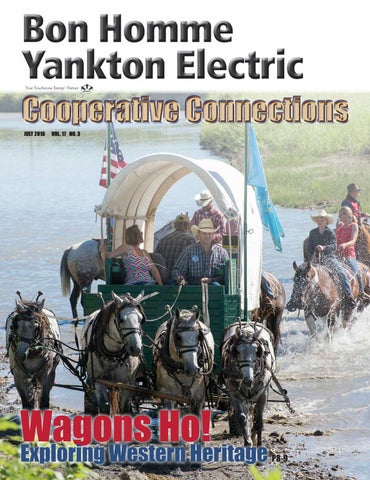
Wagons Ho!
Exploring Western Heritage
P8-9
Manager’s
Column
Members Top Priority Many businesses use the word “member” to describe their customers. Places like Sam’s Club or Costco and even American Express like to refer to their customers as members. You pay a fee to buy their goods and services, but that is really all you get for the “membership.” No right to vote for the Board of Directors or to participate Merlin Goehring in any meaningful way in the General Manager Bon Homme Yankton Electric organization. In cooperatives like Bon Homme Yankton Electric, membership really does mean something more than just the right to buy electricity. Co-ops of all types are founded on seven cooperative principles that give us guidance and strategic direction. Membership also gives you rights as an owner of this co-op. Brett Fairbairn is the director of the Center for the Study of Co-operatives at the University of Saskatchewan in Canada. He makes the case that member relations is not just part of what co-ops should be doing, but in fact is the fundamental core business of the cooperative. He further lays out the three strategic concepts that any co-op must get right in order to survive and thrive: Economic linkage Bon Homme Yankton Electric is connected to you. There is a business relationship that serves you (the member) and the co-op. Since co-ops are solely owned by people in the community, they have a mutual interest to ensure that both the co-op and the member do well and prosper. Transparency As an owner of the co-op, you have a right to
2 July 2016 • Cooperative ConneCtions
know how it operates and how decisions are made that directly impact you. If the co-op is transparent and combines this trait with integrity and fairness, it will build trust with the members. Cognition In this case, cognition is best defined as how your co-op thinks. It includes the current and historical identity, the mission and the sense of shared values with co-op members. Research, education and training are critical functions that Bon Homme Yankton Electric must conduct on an ongoing basis to ensure that we always have the best information to make decisions.
In cooperatives like Bon Homme Yankton Electric, membership really does mean something more than just the right to buy electricity. The cooperative business model is the best one on earth, but like any enterprise, it is up to the human beings who work at the co-op, who serve on the board and the members like you to ensure that the principles and values do not fade over time. First and foremost, Bon Homme Yankton Electric strives to be thought of as a memberowned cooperative that gives you the best value of any utility. If we succeed, our community thrives and you will always value being a member – not a customer. Make sure to exercise your rights as a member. Attend the annual meeting scheduled for August 16, 2016. You will hear reports on the state of the cooperative and vote for members running for a seat on the Board of Directors.
Board
report
Capital Credit Refund (USPS No. 018-973)
Bon Homme Yankton Electric Assn, Inc. PO Box 158 134 S Lidice Tabor, SD 57063 Office Hours: Monday through Friday 7:30am to 4:30pm
To Report an Outage Call: Local From Tabor, Tyndall and Yankton 605-463-2507 or Toll Free in South Dakota 1-800-925-2929 NOTICE: Electric bills must be paid by 10:00am on the 20th of each month to avoid a $10 late fee. Bon Homme Yankton Electric Cooperative Connections is published monthly by Bon Homme Yankton Electric Association, Inc., PO Box 158, 134 S. Lidice St., Tabor, SD 57063-0158 for its members. Families subscribe to Bon Homme Yankton Electric Cooperative Connections as part of their electric cooperative membership. Bon Homme Yankton Electric Cooperative Connection’s purpose is to provide reliable, helpful information to electric cooperative members on matters pertaining to rural electrification and better rural living. Subscription information: Electric cooperative members devote $6.00 from their electric payments annually for a subscription. Nonmember subscriptions are available for $12 annually. Periodicals Postage Paid at Tabor, SD 57063 and at additional mailing offices. POSTMASTER: Send address changes to Bon Homme Yankton Electric Cooperative Connections, Bon Homme Yankton Electric, PO Box 158, Tabor, S.D. 57063 TELEPHONE (605)463-2507: FAX (605) 463-2419. Design assistance by TDG Communications, Deadwood, S.D.
In addition to the regular monthly reports, the board discussed rates and capital credits. Cost of Service Study The preliminary results of the Cost of Service Study were presented. It was agreed to try to hold off on any more rate changes this year until the final study is presented. Capital Credit Refund The board discussed doing a capital credit refund again this year. It was agreed to go forward with a refund late this fall as long as the cash flow is sufficient to send out the checks. This will begin with the remainder of 1995 and go forward from there depending on the amount refunded. Legislative Rally Director Ernest Namminga reported on the NRECA Legislative Rally in Washington, DC. Issues of interest
to rural electric cooperatives include Broadband, Coal Ash, Electric Water Heaters, Endangered Species Act, Energy Legislation, Fair Value Accounting, FEMA, Geothermal, Grid Security & Cybersecurity, Health Care Reform, Low Income Home Energy Assistance Program, PMAs and Hydropower, Pole Attachments, Rural Utilities Service Programs and Waters of the US (WOTUS). Members can sign up and learn more about issues affecting their rural electric cooperative at www.action.coop. Obsolete Items The board declared several items as obsolete some of which will be sold at a later date.
Welcome new Members Mission Hill Tomasz P Stys Tabor Elmer Herman Mallory Wriedt Tyler Sindt Yankton Bryan Trusty David B Stokes Donna M Henshall Josh Hackney Leon Wassenaar Mike Van Ballegooyen Patrick R Hochstein Pronghorn Creek Land & Grain Partner Rick Robinette
Download the SmartHub App for your Mobile Device Today!
statement of non-Discrimination This institution is an equal opportunity provider and employer. If you wish to file a Civil Rights program complaint of discrimination, complete the USDA Program Discrimination Complaint Form, found online at http://www.ascr.usda.gov/complaint_filing_cust.html, or at any USDA office, or call (866) 632-9992 to request the form. You may also write a letter containing all of the information requested in the form. Send your completed complaint form or letter to us by mail at U.S. Department of Agriculture, Director, Office of Adjudication, 1400 independence Avenue, S.W., Washington, D.C. 20250-9410, by fax (202) 690-7442 or email at program.intake@usda.gov.
Cooperative ConneCtions • July 2016 3
Safety
Tips
Current
Issues
Air Conditioner and Fan Safety
Tell Congress to Extend the Geothermal Tax Credit Today
Hot weather brings increased use of air conditioners. Contact with electric current from air conditioners accounts for a significant number of electrocutions and electrical injuries each year. ESFI recommends that you always contact a qualified, licensed electrician to perform any electrical work in your home, including the installation and services of air conditioning and other cooling equipment.
Across the nation, electric cooperatives and public power districts help our member-owners save energy and money by promoting the use of geothermal heat pumps. These super-efficient heat pumps can cut home heating and cooling bills by up to 70 percent. Many member-owners install geothermal units with assistance from the geothermal tax credit. The tax credit expires at the end of this year, jeopardizing the continued use of this energy efficient technology. Co-ops and their members are asking Congress to extend the credit. Go to the Cooperative Action Network’s action.coop and ask your Member of Congress to extend this credit by supporting H.R. 5167. The Cooperative Action Network is the advocacy hub for America’s electric cooperatives. It’s more important than ever to band together and promote common sense solutions to the problems facing our nation. Join our growing grassroots army today and become part of our team of more than one million advocates around the nation. By signing up, you’ll maximize your voice as you hold elected officials accountable and promote the importance of electric cooperatives across the nation. The Cooperative Action Network is the grassroots arm of the NRECA – the national service organization for more than 900 not-for-profit rural electric cooperatives that provide electricity to more than 42 million consumers across 47 states. Together, rural electric cooperatives serve 75 percent of the nation’s landmass and account for approximately 12 percent of total electricity sales in the United States.
Facts and Statistics • According to the CPSC, 15 percent of consumer-product related electrocutions are attributed to large appliances. These electrocutions occur most commonly while someone is attempting to service or repair the appliance. • In 2006, an estimated 33,500 injuries were reported to hospital emergency rooms as involving air conditioners, fans, humidifiers, dehumidifiers, air purifiers, and heat pumps. The leading types of injuries were laceration (14,890), contusion or abrasion (6,110) and strain or sprain (4,430). • In 2006, air conditioning or related equipment was involved in an estimated 7,400 reported U.S. home structure fires, with associated losses of 270 civilian injuries and $200 million indirect property damage. • In 2003 to 2006, the 7,000 reported home structure fires per year involving air conditioning and related equipment included 2,400 per year involving central and room air conditioners specifically and 3,700 per year involving fans. • In 1995 to 2003 (excluding 1999, which was not reported), there were 11.5 electrocution deaths per year involving air conditioners and 4.3 electrocution deaths per year involving fans. Cooling Equipment Safety Tips • Keep safety in mind when selecting cooling equipment for your home. • Have a qualified, licensed electrician install and service any electrical equipment in your home. • Have electric-powered equipment inspected and maintained regularly for safety. • Make sure your equipment has the label showing that it is listed by a recognized testing laboratory. Source: esfi.org 4 July 2016 • COOPERATIVE CONNECTIONS
Kidsʼ Corner Safety Poster “Don’t play by wires.” Alandra Kontz, 10 years old Alandra was 10 years old when she submitted this safety poster. She is the daughter of Kelly and Val Kontz, Pipestone, Minn. They are members of Sioux Valley Energy, Colman, S.D. Kids, send your drawing with an electrical safety tip to your local electric cooperative (address found on Page 3). If your poster is published, youʼll receive a prize. All entries must include your name, age, mailing address and the names of your parents. Colored drawings are encouraged.
Reader
Recipes
Delectable Desserts Anzac Biscuits 1 cup quick cooking oats 3/4 cup flaked coconut 1 cup all-purpose flour 1 cup sugar
Spiced Triple Berry Shortcakes 1/2 cup butter 1 T. golden syrup (honey works) 1 tsp. baking soda 2 T. boiling water
In a bowl, mix together oats, coconut, flour and sugar. In a small saucepan over low heat, melt butter and syrup. Dissolve soda in boiling water; add to melted butter and syrup. Add butter mixture to dry ingredients. Drop by teaspoonfuls on greased cookie sheets (or baking paper). Bake at 350°F. for 18 to 20 minutes. Clarice Roghair, Okaton
Apple Dumplings 1 apple, cored and cut into 8 pieces 1 (8 oz.) can crescent rolls Cinnamon
2/3 cup sugar 8 pats butter 1 cup Mountain Dew soft drink
Spiced Shortcakes: 1-1/2 cups reduced fat baking mix 3 T. sugar 3/4 tsp. ground cinnamon 1/2 tsp. ground ginger 6 T. fat free milk 2 cups thawed fat free whipped topping
For filling, mix berries and vanilla in large bowl. Mix sugar, cinnamon and ginger in small bowl. Sprinkle over berries; toss to coat well. Let stand 30 minutes to allow berries to release their juices, stirring occasionally. For the spiced shortcakes, mix baking mix, sugar, cinnamon and ginger in large bowl. Add milk; stir to form a soft dough. (If necessary, knead dough in bowl to incorporate dry ingredients.) Drop dough by 6 spoonfuls onto sprayed baking sheet. Bake at 425°F. for 10 to 12 minutes or until golden brown. Cool slightly on wire rack. To serve, split warm shortcakes. Place 1 shortcake bottom on each plate. Top each with 2/3 cup berry filling and 1/3 cup whipped topping. Cover with shortcake tops. Makes 6 servings. Nutritional Facts Per Serving: Calories 266, Total Fat 2g, Cholesterol 0mg, Sodium 280mg, Carbohydrates 58g, Dietary Fiber 4g, Protein 4g
Place 1 apple slice on widest end of crescent roll; roll up starting at wide end. Pinch and seal shut. Place in an 8x8-inch pan. Continue until all slices are used. Sprinkle with cinnamon and sugar. Top with a pat of butter on each. Pour Mountain Dew over all. Bake at 350°F. for 45 minutes. Velma Schmitz, Bonesteel
Earthquake Cake 1 box German chocolate cake mix 3 eggs 1-1/3 cups water 1/2 cup oil 1 cup coconut 1/2 cup chopped walnuts
Berry Filling: 2 cups sliced strawberries 1 cup blueberries 1 cup raspberries 2 tsp. pure vanilla extract 1/3 cup sugar 1/2 tsp. ground cinnamon 1/4 tsp. ground ginger
1 (8 oz.) pkg. cream cheese, softened 1 stick butter, softened 2 cups powdered sugar 1 tsp. vanilla 1 pkg. chocolate chips Whipped topping
Pictured, Cooperative Connections
Rhubarb Cobbler 4 to 5 cups diced rhubarb 1-3/4 cups sugar, divided 1/8 tsp. plus pinch salt, divided 1 cup flour 1 tsp. baking powder
1/2 cup butter 1/2 cup milk 1 T. cornstarch Pinch of salt 1 cup boiling water
Spread rhubarb in a 9x13-inch glass pan. Combine 1/2 cup sugar, 1/8 tsp. salt, flour, baking powder, butter and milk. Place over rhubarb. Mix together remaining sugar, cornstarch and pinch of salt. Sprinkle mixture over batter. Pour boiling water over all. Bake at 375°F. for 1 hour. Darlene Meyer, Florence
Lightly spray a 9x13-inch pan with cooking spray. Put coconut and nuts in bottom of pan. Mix cake mix according to package directions. Spread batter over nuts and coconut. In a bowl, mix cream cheese, butter, vanilla and powdered sugar until fluffy. Spread over batter. Sprinkle with chocolate chips. Bake at 350°F. for 50 minutes. Cool. Serve with Cool Whip. When this comes out of the oven, it looks like it has exploded (it does not actually explode, so it won’t mess up your oven!). That’s why it’s called an Earthquake Cake. The cream cheese mixture sinks and the nuts and coconut rise.
Beat pudding with milk for 1 minute; let set 5 minutes. Fold in Cool Whip and cookies. Spoon into crust; freeze.
Rowena Wipf, Doland
Debbie Hinman, Carter
Cookies and Cream Pie 1 pkg. white chocolate pudding 1-1/2 cups milk 8 oz. Cool Whip
1 cup chopped regular or Mint Oreos 1 graham cracker crust
Please send your favorite dessert, salad and garden produce recipes to your local electric cooperative (address found on Page 3). Each recipe printed will be entered into a drawing for a prize in December 2016. All entries must include your name, mailing address, telephone number and cooperative name.
COOPERATIVE CONNECTIONS • July 2016 5
Energy Cents
Ideas
Select, Size, Locate and Use Ceiling Paddle Fans for Year-Round Comfort, Savings
Jim Dulley www.dulley.com
Dear Jim: I want to install ceiling fans in several rooms. With so many models and prices, what factors should I consider when selecting them? Can I also run them in the winter to lower my heating costs? – Carol B.
Dear Carol: People typically think of fans only for summertime comfort and lower air-conditioning costs. Ceiling fans are unique in that they can also reduce your wintertime heating bills with proper use. Before installing a ceiling fan, it is important to understand how one functions. A ceiling fan does not cool a room like an air conditioner. It actually heats the room whenever it is running. All of the electricity it uses ends up as heat. Always turn the fan off when no one is in a room.
Ceiling fans are unique in that they can also reduce your wintertime heating bills with proper use. You feel cooler under a ceiling fan because it creates a downward breeze over your skin. If you feel cooler, you can run your air conditioner less or set its thermostat a few degrees higher without sacrificing comfort. If you do not do this, running the ceiling fan will increase your electric bills. During winter, reverse the rotation of the fan blades so the air flows up toward the ceiling. Run it on low speed. This gently moves the hotter air, which collects up near the ceiling, throughout the room without creating a chilly breeze. This allows you to set the heating thermostat a few degrees lower for savings. The simplest way to select an efficient ceiling fan is to pick one which is ENERGY STAR® certified (www. energystar.gov). To be certified, a ceiling fan must meet certain air flow rates per watt used at various speeds. This is similar to miles-per-gallon efficiency ratings for cars. When selecting a typical lower-cost four- or five-
blade fan, a rule-of-thumb for sizing is (room size vs. diameter of blades): up to 75 sq. ft. – 36 in., 75 to 144 sq. ft. – 36 to 42 in., 144 to 225 sq. ft. – 44 to 50 in., and 225 to 400 sq. ft. – 50 to 54 in. The ideal height for the fan blades is about eight feet above the floor. A three-inch downrod is included with most fans to provide the proper height. For high ceilings, downrods up to six feet long are used to get the fan low enough. For safety reasons, never have the blades closer than seven feet from the floor. Many new stylish fans have from only one to six blades with three being common. Pay attention to the pitch angle of the blades to get an idea of how strong a breeze it creates. A steeper pitch moves more air at a slower speed. This often indicates a more powerful and quiet motor. The newest and most efficient motors are DC (direct current) motors. These are similar in design concept to the variable speed motors in new heat pumps. Some offer up to six speeds and use only 33 watts of electricity. Most people install a lighting kit under the ceiling fan. Select one with LED lighting. It is not only efficient, but it lasts for many years and most are dimmable. A model with a hand-held remote control is most convenient to adjust the speed and switch it off when leaving a room. Some new high-tech fans can be controlled by a cell phone with a special fan app.
Replacement Windows Dear Jim: I do a lot of indoor gardening and I plan to install new efficient replacement windows. I wonder if the low-emissivity coating on the glass will interfere with my indoor plant growth? – Todd K. Dear Todd: Efficient low-emissivity (low-e) glass has become the standard for replacement windows. Although it looks clear, it blocks heat transfer and some ultraviolet (UV) rays both summer and winter. Since it allows nearly the entire visible spectrum of light through, low-e glass should not adversely affect plants. Some plants actually prefer reduced UV rays, the same rays that fade your furniture.
Send inquiries to James Dulley, Publication Name, 6906 Royalgreen Dr., Cincinnati, OH 45244 or visit www.dulley.com. 6 July 2016 • COOPERATIVE CONNECTIONS
News
Briefs
South Dakota PUC Considers Motions on Territory Case During a June 7 Public Utilities Commission meeting in Pierre, S.D., commissioners considered a series of motions in Docket EL16-013, a petition by Dakota Plains Ag Center, LLC, to have electrical services provided by Northwestern Energy in the service area of Bon Homme Yankton Electric Association, Inc., (BY) headquartered in Tabor, S.D. Dakota Plains wishes to receive electrical services through Northwestern Energy under a provision in South Dakota law that allows electric utilities to serve large loads in the territory of another electric utility if approved by the Commission. In separate motions, BY asked the Commissioners to compel Northwestern to relase information BY considers important to a Commission decision in the case and Northwestern asked the Commision to quash a BY subpoena for that information. Brett Koenecke, representing Dakota Plains, argued that Dakota Plains has the right to use its electricity as it chooses and gain its electric services through the business of its choice. Koenecke also maintained that only information relevant to the case should be considered and BY is requesting the inclusion of information that does meet the test of relevancy. Nick Moser, an attorney for BY, argued that BY Electric has the right to motion to compel Dakota Plains to provide any and all information that may play a factor in this case. Moser maintained that every fact needs to be known in order for a decision to be made if the information is relevant. This information would pertain to the services provided by Northwestern to Dakota Plains. The Public Utilities Commission meeting minutes and recording for the June 7 session are available on the Public Utilities Commission Meeting Archives’ webpage at https:// puc.sd.gov/Archives/2016/default.aspx. A hearing on this docket will take place on Wednesday, July 13.
Jaspers Named S.D. Secretary of Agriculture South Dakota Gov. Dennis Daugaard has appointed Mike Jaspers of rural Minnehaha County to serve as South Dakota’s Secretary of Agriculture. Jaspers will begin July 5. “I am very excited to have Mike serve as ag secretary,” Daugaard said. “His background in agriculture production, policy and administration makes him a great fit to lead the department.” “I am honored that Gov. Daugaard has given me this opportunity,” Jaspers said. “I look forward to working with the men and women who make agriculture our state’s No. 1 industry.” A native of northeast South Dakota, Jaspers operates a diversified crop and livestock farm in McCook, Hutchinson and Marshall counties. He received his bachelor’s degree in mechaMike Jaspers nized agriculture from South Dakota State University in 1993. South Dakota In addition to operating his farm and holding management positions in several agricultural businesses, Jaspers served in the Agriculture Secretary South Dakota State Legislature from 1997-2005. In 2007, President George W. Bush appointed him state director of USDA-Rural Development, where he served until June 2008. Jaspers currently serves as vice chairman of the board for Sioux Falls Catholic Schools and is a graduate of the South Dakota Agriculture and Rural Leadership (SDARL) program. He and his wife, Robin, have two children.
¢ 50¢ to Protect a Child The cost of installing a TRR in a newly constructed home is only about 50¢ more than a traditional d receptacle.
Existing homes can be retrofitted with TRRs for as little as $2.00 per outlet.
TRRs should only be installed by a licensed electrician.
What are Tamper Resistant Receptacles (TRRs)? Though they look like standard outlets, only TRRs include a built-in shutter system that prevents foreign objects from being inserted. Only a plug that applies simultaneous, equal pressure to both slots will disengage the cover plates, allowing access to the contact points. Without this synchronized pressure, the cover plates remain closed, preventing the insertion of foreign objects.
Be sure to purchase TRRs that have been certified by a nationally recognized, independent testing lab (i.e. UL, ETL, or CSA).
The curiosity of kids knows no boundaries and sometimes leads to dangerous behaviors. Located in practically every room in every house throughout the United States, electrical receptacles present a constant and real danger to these little explorers.
TRRivia Each year 2,400 children suffer severe shock and burns
COOPERATIVE CONNECTIONS • July 2016 7 It is estimated that 6-12 child fatalities each year
Tamper Resistant Receptacles (TRRs)
On the Trail, Time Slows Down and
History Comes Alive F
When Cowan and his wife, Loretta, started participating in wagon trains about 10 years ago, it took him a bit to recall all the steps involved in relying on horsepower. “The skills I had learned as a boy took a while to remember,”said Cowan. But those skills came back as did the realization that when on the ride, one is focused on the task at hand – caring for the horses, looking for obstacles and moving toward one’s destination at a speed that allows one to really observe and enjoy the surroundings. For the Cowans, who are no strangers to rodeo and western life (Willie himself was a state high school saddle bronc champion in the mid-1950s), the wagon trains are a family affair. Their children and grandchildren also participate, either with one of the family’s various wagons or as outriders with the train.
PHotos by Colleen McCurrin
By Brenda Kleinjan
or a few days each summer, participants in area wagon trains slow it down a notch as they roll across the prairie, often times retracing portions of the state’s history. Large wagon trains have been organized for the past several years, one in 2014 commemorated South Dakota’s 125th year of statehood, tracing a route from the former Territorial Capitol of Yankton, S.D., to the State Capitol in Pierre, S.D., during a 17-day ride. Others have wound through the state connecting communities via horse- and oxen-drawn conveyances. “It’s our heritage; if we don’t pass it on down, it will get lost,” said Willie Cowan of Pierre who has participated in several wagon trains and is an organizer of the upcoming one-day event planned for the Dakota Western Heritage Festival Sept. 16 in Fort Pierre.
8 July 2016 • COOPERATIVE CONNECTIONS
“The most enjoyable part is the kids and observing what they get out of the experience,” said Willie. As one rolls along the prairie behind the team of horses, Cowan says one ponders things. “The first thing you wonder is how they got across the prairies with water. They had to follow creeks and rivers,” noted Cowan. “It gives you a greater appreciation for what those people went through,” said Loretta. Willie says he has nothing to prove with his wagons and favors modern improvements over authenticity on his wagons. “The ride on our big wagon is like a Cadillac, not bone jarring,” said Willie. Nylon ropes rather than leather are less likely to break and cause problems, rubber tires smooth out the ride compared to the jarring of wooden wheels. For the Cowans’ daughter, Colleen McCurrin, the entire process of the wagon train builds a better understanding of western history. “It’s part of the heritage; it’s how we got here. The people who settled the area arrived in wagons of many shapes and doctor buggies – everyone hitched up a team to do their jobs,” said McCurrin. The variety of wagons that show up for a wagon train ride bring that heritage to life, and help participants envision days gone by. For Loretta, the wagon trains helped realize a
life-long dream. “It was always a dream of mine to stand in the wagon ruts of the freight trains that ran from Fort Pierre to Deadwood,” said Loretta. In the Fort Pierre to Deadwood ride a few years back, she achieved that dream. Her daughter is quick to expand on the comment. “It’s a tangible thing – you can touch the history,” said Colleen. And one connects. “It takes a bit to getting away from needing to get from point A to point B in three hours; on the rides, you might have 10 days,” said McCurrin. “You have to gear down and change mentality.” The Cowans note that another feature of wagon trains is the camaraderie amongst the participants. “Everyone helps everybody. If your outfit breaks down, they’re all there to help,” said Willie. In 2015, the Dakota Western Heritage Festival took participants through a buffalo farm near Fort Pierre and over to the Scotty Phillips Cemetery, named for the Scottish-born rancher and state politician who is credited as “the man who saved the buffalo.” The 2016 train will take a different trek exploring history to the southwest of town. The public is welcomed to attend the Dakota Western Heritage Festival. There are limited opportunities for individuals to ride with a wagon.
“It’s a tangible thing – you can touch the history.”
Above: The Fort Pierre Livestock cattle yard is visible in the background of this photo taken during the wagon train at the Dakota Western Heritage Festival. Opposite page: Willie Cowan of Pierre drives a wagon in a train in western South Dakota. Cover: A wagon and outriders make a crossing of a waterway during a wagon train in western South Dakota.
COOPERATIVE CONNECTIONS • July 2016 9
Co-op
news
Safety Demo Member Service Advisor Bob Felber presented electrical safety using the Safety Town display at the Yankton County 4-H Farm Safety Day Camp on June 10, 2016. He presented situations where the kids could come into contact with energized overhead lines such as moving a ladder, flying a kite, climbing a tree and vehicle accidents. They learned that electricity is invisible and is always looking for a path to ground. If you are in an accident with any electric equipment, the best thing to do is stay put. If you have a phone, call 911. Do not try to get out of the vehicle unless it is more dangerous to stay in. If it is necessary to exit, Bob demonstrated the proper way to jump as far away from the vehicle as possible and hop away with both feet together until reaching a safe distance. You never want to be touching the vehicle and the ground at the same time. He called attention to the green boxes they may see in their yard. Everyone should stay away from these boxes as they contain energized lines that run underground. While normally safe to touch, a loose wire or a car accident can energize the case. He reminded the participants it is required by law to dial 811 and have all underground utilities marked before digging to avoid coming into contact with underground cables. Bob Felber is available for safety demonstrations for any group of any age in our area using the Safety Town display or the larger outdoor safety trailer.
1 0 July 2016 • Cooperative ConneCtions
Thank You Notes Dear B-Y Electric, Thank you for choosing me as a recipient of your scholarship. It will assist me in paying for college at SDSU. Thank you for all you have done, Spencer Huber I would like to thank the crew for getting my electricity back on in the early hours of Sunday morning. It was very much appreciated. Ruth Berndt Avon, SD
Classifieds August Issue Deadline: July 1, 2016. Email your classified ad to: by@byelectric.com. Members can post one free ad per year. Repeats or longer ads are $1/column inch. FOR RENT: 1 bedroom apartment. Tabor Manor. Contact John at 605-463-2478 or Gary at 605-463-2209.r Thinking about building a home? Don’t pick a floor plan or a builder until you’ve talked with the area’s ONLY Certified Aging-in-Place specialist, Certified Green Professional Builder and ENERGY STAR Partner Builder. Call 4 Life Homes today. 605-661-4488.r Beseda Hall, Tabor, SD for rent for any special occasion such as weddings, anniversaries, graduation or birthdays! For more information contact Linda Bares at 605-661-6220 or snlbares@gmail.com.r FOR RENT: Tabor Self Storage. Call 605660-0247 or 605-660-3497.r FOR SALE: Flat top, white, Cockatiel cage. $60. Call 605-260-5114.
haase heaTinG & CoolinG
Dan Haase
Heating, Cooling, Heat Pumps We sell the best and service the rest
Scotland, SD 57059 605-583-4490
GT RepaiR & auTobody Glenn Tycz Tyndall, SD 57066
605-589-3018
Marine Boat Repair Aluminum & Fiberglass We Repair and Install Windshields
If only the future was predictable. Farming is always a gamble. You never know when bad weather or other problems will strike. The only thing you can be sure of—you need quality insurance protection. Call our office today for a competitive quote.
Check out our website at:
KoRanda Well Company llC Tabor, SD 57063 605 - 463- 2244
WWW.BYELECTRIC.COOP
Well drilling, repairing and cleaning Water Systems – Artesian Wells Sales and Installation
Like us on Facebook: BonHommeYanktonElectric Art & Antique GAllery Custom Matting & Framing Original Art/Gifts/Cards Handmade Glass Beads & Jewelry
1610 Main St Tyndall, SD
605-589-4050 Open Wednesday through Saturday
Earth-Coupled Heat Pump
Emergency Service Free Estimates
sandeRs heaTinG & CoolinG
ConsTRuCTion and painTinG
300 W 17th Tyndall, SD 57066
New Construction Remodel - Roofing Flooring
605- 589-3228 1- 800-894-3228
Jason Finck
Furnaces, Heat Pumps and Air Conditioners Free Estimates
Tabor, SD 57063
605-660-3204 opsahl-KosTel FuneRal home
Handicap and Accessible Home Modifications • Ramps • Grab Bars • Stair Lifts • Walk-in Showers www.4lifehomes.net • Kitchen and Bathroom Remodels
Yankton, Tabor, Tyndall, Menno
605-665-9679
Preplanning will give you peace of mind and may save money
Wellmark Has You Covered, No Matter What Your Stage of Life. CALL TODAY to learn more.
CameRon insuRanCe
Brad Cameron Tyndall, SD 57066
605-589-4176
An Authorized Independent Agent For
bohemian FaRmeRs muTual
R. Martin Koch, Secretary PO Box 206 Tabor, SD 57063 605-463-2558 1-800-868-1756
605-463-2786
FREE HOME DAMAGE ASSESSMENT following a storm
INSURANCE CLAIM SPECIALIST GENERAL CONTRACTOR • Roofing • Gutters • Siding • Painting • Windows • Doors
Wellmark Blue Cross and Blue Shield of South Dakota is an Independent Licensee of the Blue Cross and Blue Shield Association. ©2012 Wellmark, Inc. SD-20-P-12
heaTinG & CoolinG 920 Broadway Yankton, SD 57078
60 5 -6 6 5 -9 4 6 1
800-491-9461
HOME REPAIR HOTLINE
605-661-4488
Warm Air, Air to Air, Geothermal Heat Pumps WE DO EMERGENCY HOME REPAIRS Cooperative ConneCtions • July 2016 1 1
Innovation Could Put Coal Use in a Whole New Light
S
ince coal generated more than half the
By Paul Wesslund
nation’s electricity as recently as 10 years ago, that share has fallen to one-third as of last year. The decline of coal generation will continue as new environmental rules are set in place and prices for natural gas remain relatively low. So it’s curtains for coal, right? Not so fast. The Environmental Protection Agency’s Clean Power Plan still calls for more than one-fifth of our electricity to come from coal by its 2030 target date. Even President Obama’s Energy Secretary sees a future for coal. “We are talking about a progressively lowercarbon future, but we have not abandoned coal as part of that future,” Secretary Ernest Moniz told the Lexington (Kentucky) Herald-Leader in April. “Coal can play a major role in a low-carbon economy.” A role for coal is important, says Daniel Walsh, senior program manager for generation, environment and carbon at the National Rural Electric Cooperative Association (NRECA). Citing the huge coal supply in the U.S., Walsh sees coal as a key
12 July 2016 • COOPERATIVE CONNECTIONS
to energy security. “We need to use this valuable resource we have in this country.” Achieving that brighter future for coal could depend on huge improvements to a technology called carbon capture. Carbon capture seeks to solve a top environmental complaint about coal, which is that burning it releases carbon dioxide, a greenhouse gas that has been linked to climate change. Grabbing the carbon dioxide before it leaves the power plant would keep it out of the atmosphere. Carbon capture is still a developing technology, with 15 test plants in the world and seven more coming online by 2017, according to an international industry group. One of the main holdups to that development is that the technology is expensive to build and operate. Really expensive. Running carbon capture equipment at a power plant uses about one-third of the electricity produced by that power plant. As daunting and inefficient as that sounds, Moniz cites $6 billion spent on carbon capture research by the Department of Energy as proof of his
optimism. NRECA’s Walsh believes in the power of researchers to make carbon capture costs competitive. “We will continue to see innovation,” says Walsh. “We’re going to be successful.” One reason for that sunny outlook comes from a 35-year trend of finding cleaner and more efficient ways to burn coal. Since 1970, electric utilities in the U.S. have reduced pollution regulated by the federal Clean Air Act by more than 60 percent. Techniques have ranged from washing coal with water, to burning it at lower temperatures to release less harmful chemicals, to large and expensive flue gas desulfurization equipment, also called scrubbers. Over the decades, those technologies improved, says Kirk Johnson, NRECA senior vice president for government relations. He says those improvements can be a model for carbon capture. “We didn’t start out with scrubbers that achieved a better-than 90 percent reduction in sulfur dioxide removal, but we ultimately got there,” says Johnson. “The future has got to be in continued research.” Electric co-ops launched a drive to that success with the April ground breaking for the Integrated Test Center in Wyoming. Operation is scheduled for summer 2017. The state of Wyoming is funding $15 million of the center, which will be built at the site of the existing Dry Fork Station, a coal plant owned by Basin Electric Cooperative, a regional co-op based in North Dakota. Another $5 million of support will come from another regional co-op, Denver-based Tri-State Generation and Transmission Association, and $1 million from NRECA. The test center aims to advance carbon capture research by focusing on a looming question about the technology – once you capture the carbon dioxide, what do you do with it? The test center focus will be on a new area of carbon capture work that is even changing the name of the technology. For years the process has been referred to as CCS – for Carbon Capture and Storage (or Sequestration). Geologists looked for underground formations where the carbon dioxide could be stored safely and permanently. An evolving terminology refers to CCU, for Carbon Capture and Utilization, or CCR, for Carbon Capture and Recycling. The idea is that one way to make carbon capture more cost-effective would be to find commercial or other uses for the carbon dioxide that produces a better return on investment than burying it underground. Researchers at the test center will be able to use carbon dioxide from the Dry Fork Station to run tests. Among the first researchers, the test center will host teams competing for part of $20 million
in XPRIZEs on ways to use carbon dioxide (CO2) at power plants. The XPRIZE Foundation supports innovation in several areas, and its recent call for entries reads, “Do you have what it takes to turn CO2 emissions into valuable products?”
CAPTURING CARBON Researchers around the world are studying ways to capture carbon from coal-fired power plants to keep the greenhouse gas from entering the atmosphere. There are 15 test plants around the world that remove flue gas to test the technology for removing the greenhouse gas.
There’s reason to believe that lofty challenge might succeed at the test center, says NRECA Communications Manager John Pulley. He describes the plans as bringing researchers in to develop their ideas in the “real-world” setting of a power plant. “Once you have a facility like this in place that will allow people to test their great ideas, the sky’s the limit,” he says. “People might look at coal in an entirely new light.” Paul Wesslund writes on cooperative issues for the National Rural Electric Cooperative Association, the Arlington, Va.-based service arm of the nation’s 900-plus consumer-owned, not-for-profit electric cooperatives. COOPERATIVE CONNECTIONS • July 2016 13
Electrifying Ways
to Help Kids be Smart Energy Users
D
By Justin LaBerge
iD you turn off the lights in your room?” “We’re not paying to heat the whole neighborhood!” “Save some hot water for the rest of us!” Across America, parents utter these phrases to their children countless times each day. Despite their best efforts, it can be tough to help kids understand the importance of saving energy – and to put that knowledge into action. Few people have more experience talking about energy efficiency than the communication professionals who work at America’s electric cooperatives. So we asked them how they persuade the toughest audience they face every day: their kids. Here are a few of their tips.
Deputize an “energy enforcer” Several parents recommended deputizing children to investigate wasteful energy practices. When her children were young, Heidi Smith
14 July 2016 • COOPERATIVE CONNECTIONS
of Tideland Electric Membership Corporation in North Carolina let them take turns playing the role of energy deputy. Each week, the appointed child was given a badge and empowered to seek out energy waste and hold the offending party accountable. “My youngest son took it so seriously that he once cracked open the bathroom door and reached in to turn off the light on his dad after he decided daddy had been in there long enough,” Smith said. “All five of my children are now grown, but they continue to practice energy efficiency in their own lives.” Diana Hersch of Hancock-Wood Electric Cooperative in Ohio offered a slightly different twist on the same idea. She suggests offering your little energy deputies a bounty for finding leaks, drafts and other wasteful energy practices around the house. Their progress can be tracked with stickers on a calendar and when the kids reach their goal, they
can be rewarded with a sheriff ’s badge or another small toy of their choice.
Penalty stroke In addition to teaching her patience and discipline, the rounds of golf Jim Nimmo plays with his 11-year-old-daughter have turned into valuable lessons in energy conservation. Nimmo, of Farmers Electric Cooperative in Texas, has started adding a penalty stroke to his daughter’s score for each time he’s had to turn off her bedroom light and fan since their last round. “It gives new meaning to the term penalty stroke,” Nimmo said. “We don’t have much of a problem anymore.” No word on whether his daughter is allowed to return the favor. The invisible hand If your child’s hand never seems to find its way to the light switch, perhaps the invisible hand of the free market can help them out. Katie Kothmann Haby of Medina Electric Cooperative in Texas said her dad used to fine her 25 cents for every light bulb she and her siblings left on in their rooms. For her ceiling fan with four bulbs, that was a costly mistake. “It taught us that electricity really did cost money since we had to pay when we didn’t conserve it,” Haby said. Though her daughter is only 2 years old, Haby says she plans to use the same approach when she’s older. Game Theory Other creative strategies to inspire kids to do their chores and keep peace in the home can be found in The Game Theorist’s Guide to Parenting. The recently published book, written by Paul Raeburn and Kevin Zollman, shows how Game Theory can be applied to many of daily transactions of parenting, such as sharing, dividing, collaborating and compromising. No matter what the approach, talking to kids about energy use is sure to pay dividends. They might not always follow through, but they’ll be learning important lessons about the value of energy and the importance of conservation that can last a lifetime. Justin LaBerge writes on consumer and cooperative affairs for the National Rural Electric Cooperative Association, the Arlington, Va.-based service arm of the nation’s 900-plus consumer-owned, not-for-profit electric cooperatives.
COOPERATIVE CONNECTIONS • July 2016 15
Regional Dateline June 26-September 4 Sunday Services at Oahe Chapel, 8 a.m. CDT, Pierre, SD 605-773-3458
July 1-3 Wahpeton Oyate 149th Annual Wacipi, Agency Village, SD 605-698-8217 July 1-4 97th Annual Black Hills Roundup, Belle Fourche, SD 605-723-2010 July 3-4 4th of July, Springfield, SD July 4 4th of July Fireworks Celebration, Yankton, SD July 4 Street Bandits Car Show City Park, Gregory, SD 605-654-2017 July 7 Naja Shrine Circus, 6 p.m. Faith, SD, 605-342-3402 July 7-10 Hot Harley Nights Sioux Falls, SD, 605-334-2721 July 8-10 Badlands Astronomy Festival Interior, SD, 605-433-5243 July 8-10, 15-17, 22-24 Laura Ingalls Wilder Pageant De Smet, SD, 800-776-3594 or 800-880-3383
June 24-25 South Dakota Senior Games, Mitchell, SD, Barb Pierkowski at 605-995-8048 June 25-26 Amateur Radio “Field Day” City Park, Tyndall, SD Contact Ed Gray, W0SD at w0sd@triotel.net 605-425-2354
Photo CoURtESY oF hoWARD BICh
July 1-3 Supermoto, Sturgis, SD 605-720-0800
Events of Special Note
To have your event listed on this page, send complete information, including date, event, place and contact to your local electric cooperative. Include your name, address and daytime telephone number. Information must be submitted at least eight weeks prior to your event. Please call ahead to confirm date, time and location of event.
July 9 Naja Shrine Circus, Rodeo Grounds, 2 and 7 p.m. Deadwood, SD, 605-342-3402 July 9 Dare to Dream Conference Convention Center Watertown, SD, 605-361-3171 www.sdparent.org July 10 Naja Shrine Circus, Rodeo Grounds, 2 p.m., Philip, SD 605-342-3402 July 12-17 Corn Palace Stampede Rodeo Mitchell, SD, 605-770-4919 July 12-17 Deadwood Three Wheeler Rally/Brothers of the Third Wheel National Trike-In Deadwood, SD, 605-717-7174 July 14-16 JazzFest, Sioux Falls, SD 605-335-6101
July 14-16 Black Hills Corvette Classic Spearfish, SD, 605-759-4530 July 15-17 Stampede Rodeo, Burke, SD 605-830-0304 July 15-17 Horse and Buggy Days Sisseton, SD, 605-698-7261 sissetonchamber@ venturecomm.net July 16-17 39th Annual Festival in the Park, Spearfish, SD 605-642-7973 July 22-23 South Dakota Senior Games Brookings, SD, Traci Saugstad at 605-692-4492 July 22-23 2016 Rock-N-Rumble Motorcycle Rally, Yankton, SD 605-665-3636
July 30 RSVP Outdoor Vendor and Craft Show, 9 a.m. to 5 p.m. In conjunction with Crazy Days Mitchell, SD, 605-995-8440 July 30 Black Hills Music & Food Festival, Rapid City, SD 605-645-1880 August 5-6 South Dakota Senior Games Yankton, SD, Kristi Hauer at 605-665-4685 or Tracy Grotenhuis at 605-668-5238 August 19-21 Riverboat Days and Summer Arts Festival, Yankton, SD August 20 Riverboat Days Extreme Bull Riding, 7:30 p.m., Rodeo Arena, West 31st St (Hwy 50) Yankton, SD, 605-760-2153