NOVEMBER 2014
VOL. 15 NO. 7
Manager’s
Column
Learning the Cooperative Principles One of my favorite bumper stickers is, “If you can read this, thank a teacher.” It is no accident that we educate children from a very early age while our young minds are still dry sponges willing to absorb so much. The original seven co-op principles set forth in 1844 contained the simple phrase, “Promotion Merlin Goehring of Education.” General Manager Bon Homme Yankton Electric Today Principle Five states that all co-ops should promote “Education, Training and Information.” This is intended for the employees, members and the community at large. It is based on the simple premise that if people know more about the cooperative business model, they will be in a much better position to understand the benefits and promote better use of the co-op and its resources. While there are almost one million people in the U.S. that work for cooperatives of all types (agriculture, housing, credit unions and many others in addition to electric co-ops) very few of us learn about cooperatives in school. That creates a real challenge when trying to explain the cooperative difference. People understand an investor-owned business is designed to make a profit or that a non-profit, like the Red Cross, is designed to serve the community. Co-ops have both an economic and social purpose. We operate on a not-forprofit basis so that we can pass along the best price for our good or service to you, the member–owner. 2 November 2014 • Cooperative Connections
Due to the fact that the co-op business model is normally not taught by teachers, it is up to us at Bon Homme Yankton Electric through publications like this one to ensure that you know about the differences and benefits of being a co-op member. Consumer surveys by Touchstone Energy® and others consistently affirm that people prefer to do business with a cooperative if given a choice. So why don’t they teach about co-ops in school? There are several theories about this including that there is not enough academic research about co-ops, which is often the source for curriculums. Another reason offered is that the co-op community is so diverse that teaching about it only creates more confusion. The first issue about research is being addressed by the Cooperative Business Research Institute at Indiana University. The second can be addressed by answering the old question: How do you eat an elephant? One bite at a time. Simply by taking an interest in learning about Bon Homme Yankton Electric through our web site, annual meeting, stopping by the office or talking to your fellow co-op members are all good ways to better understand the cooperative model you’re a part of. By knowing more about how cooperatives operate, you are in a better position to participate as member-owners. We always welcome your questions and comments to help us promote the Cooperative Way of doing business.
Board
Report
Disaster Drill Certified (USPS No. 018-973)
Bon Homme Yankton Electric Assn, Inc. PO Box 158 134 S Lidice Tabor, SD 57063 Office Hours: Monday through Friday 7:30am to 4:30pm
To Report an Outage or For Internet Tech Support, Call: Local From Tabor, Tyndall and Yankton 605-463-2507 or Toll Free in South Dakota 1-800-925-2929 NOTICE: Electric bills must be paid by 10:00am on the 20th of each month to avoid a $10 late fee. Bon Homme Yankton Electric Cooperative Connections is published monthly by Bon Homme Yankton Electric Association, Inc., PO Box 158, 134 S. Lidice St., Tabor, SD 57063-0158 for its members. Families subscribe to Bon Homme Yankton Electric Cooperative Connections as part of their electric cooperative membership. Bon Homme Yankton Electric Cooperative Connection’s purpose is to provide reliable, helpful information to electric cooperative members on matters pertaining to rural electrification and better rural living. Subscription information: Electric cooperative members devote $6.00 from their electric payments annually for a subscription. Nonmember subscriptions are available for $12 annually. Periodicals Postage Paid at Tabor, SD 57063 and at additional mailing offices. POSTMASTER: Send address changes to Bon Homme Yankton Electric Cooperative Connections, Bon Homme Yankton Electric, PO Box 158, Tabor, S.D. 57063 TELEPHONE (605)463-2507: FAX (605) 463-2419. Design assistance by TDG Communications, Deadwood, S.D.
The Board of Directors certified the Emergency Response Plan’s annual table top drill. This year’s drill focused on the cooperative getting hit with a storm. To add to the situation, two management staff members were listed as out of town and radio and cell phone communications were down or spotty. These drills are a very good training tool for employees to practice what to do in the case of these assorted emergencies. RUS Loan Acceptance The Board has acknowledged and accepted the cooperative’s loan through the Rural Utilities Service for the next four year construction work plan. After receiving the acceptance letter, RUS will issue the official loan documents which will be signed at the following board meeting. Other Business A new irrigation contract was approved.
Welcome New Members Scotland McNinch, Jeremy Springfield Deal, Norman & Clarice Young, Nancy Zacharias, Charles & Kimberly Tabor Miller, Rickey Lee & Lueann Neumayer, Brian & Jenna Pinkelman, Aaron Souhrada, Tim & Ann Yankton Dethlefsen, Eric & Lori Fenner, Margue Johnson Rentals Johnson, Brandon Kastler, Lou Knecht, Cathy Llewellyn, Shanna Martinez, Reynol Matos, Ana Singer, Brad Stultz, Jeremy Tjeerdsma, Harold Van Alst, Kylene
The board planning session as scheduled for January. They discussed Policy 10-04 Distributed Generation. Some changes may be made to this policy at a future meeting.
Holiday Energy Efficiency The holidays are almost upon us! It’s that special time of year when we spend a great deal of time with friends and family, either in the kitchen or out and about shopping for the perfect gift. As you find yourself wrapped up in the holiday excitement, Bon Homme Yankton Electric reminds you to be energy efficient during this busy time of year. Cooking efficiently • Be kind to your oven. Every time you open the oven door to check on that dish, the temperature inside is reduced by as much as 25 degrees. This forces the oven to use more energy in order to get back to the proper cooking temperature. Try keeping the door closed as much as possible. Also, remember to take advantage of residual heat for the last five to 10 minutes of baking time – this is another way to save energy use. If you’re using a ceramic or glass dish, you can typically set your oven 25 degrees lower than stated, since these items hold more heat than metal pans. • Give your burners some relief. The metal reflectors under your stovetop burners should always be clean. If not, this will prevent your stove from working as effectively as it should. • Utilize small appliances. During the holidays, the main appliances used are the oven and stovetop. Try using your slow cooker, microwave, toaster oven or warming plate more often. This will result in substantial energy savings.
Cooperative Connections • November 2014 3
SafetyTips
Halloween Safety A few safety tips from the U.S. Consumer Product Safety Commission can protect children who plan to go trick-or-treating this Halloween.
Kids’ Corner Safety Poster “Don’t leave bare wires laying around.”
Treats: Warn children not to eat any treats before an adult has carefully examined them for evidence of tampering. Flame Resistant Costumes: When purchasing a costume, masks, beards and wigs, look for the label Flame Resistant. Although this label does not mean these items won’t catch fire, it does indicate the items will resist burning and should extinguish quickly once removed from the ignition source. To minimize the risk of contact with candles or other sources of ignition, avoid costumes made with flimsy materials and outfits with big, baggy sleeves or billowing skirts. Costume Designs: Purchase or make costumes that are light and bright enough to be clearly visible to motorists. • For greater visibility during dusk and darkness, decorate or trim costumes with reflective tape that will glow in the beam of a car’s headlights. Bags or sacks should also be light colored or decorated with reflective tape. Reflective tape is usually available in hardware, bicycle, and sporting goods stores. • To easily see and be seen, children should also carry flashlights. • Costumes should be short enough to prevent children from tripping and falling. • Children should wear well-fitting, sturdy shoes. Mother’s high heels are not a good idea for safe walking. • Hats and scarfs should be tied securely to prevent them from slipping over children’s eyes. • Apply a natural mask of cosmetics rather than have a child wear a loosefitting mask that might restrict breathing or obscure vision. If a mask is used, however, make sure it fits securely and has eyeholes large enough to allow full vision. • Swords, knives, and similar costume accessories should be of soft and flexible material. Pedestrian Safety: Young children should always be accompanied by an adult or an older, responsible child. All children should WALK, not run from house to house and use the sidewalk if available, rather than walk in the street. Children should be cautioned against running out from between parked cars, or across lawns and yards where ornaments, furniture, or clotheslines present dangers. Choosing Safe Houses: Children should go only to homes where the residents are known and have outside lights on as a sign of welcome. • Children should not enter homes or apartments unless they are accompanied by an adult. • People expecting trick-or-treaters should remove anything that could be an obstacle from lawns, steps and porches. Candlelit jack-o’-lanterns should be kept away from landings and doorsteps where costumes could brush against the flame. Indoor jack-o’-lanterns should be kept away from curtains, decorations, and other furnishings that could be ignited. Source: cpsc.gov 4 N ovember 2014
•
COOPERATIVE CONNECTIONS
Hannah Leana Bartscher, 10 years old Hannah is the daughter of Jon and Tanya Bartscher, Mitchell, S.D. They are members of Central Electric Cooperative, Mitchell, S.D. Kids, send your drawing with an electrical safety tip to your local electric cooperative (address found on Page 3). If your poster is published, you’ll receive a prize. All entries must include your name, age, mailing address and the names of your parents. Colored drawings are encouraged.
Our families can’t afford
higher energy costs. MAKE YOUR
VOICE HEARD!
Reader Recipes
Wild Game Recipes Roast Raccoon 3 to 4 raccoons, 4 to 6 lbs. each 5 T. salt 2 tsp. pepper 2 cups flour 1 cup shortening
Impossible Meat Pie 8 medium onions 12 small bay leaves Rice Sherry cooking wine, optional
Skin, drain and clean raccoons. Remove without breaking the brown bean-shaped kernels from under fore legs and each thigh. Cut into pieces. Reserve meaty back and legs for baking. Cook bony pieces in water to make broth for gravy and stuffing. Add small amount of seasoning. Simmer until meat is tender; strain and use only the broth. Sprinkle back and leg pieces with salt and pepper. Dredge in flour. Heat shortening in heavy skillet. Add meat, browning on all sides. Transfer pieces to roaster. Add onions and bay leaves; cover. Bake at 350°F. for 2 hours or until tender. Make gravy by adding flour to pan drippings. Use 2 to 3 T. flour for each cup of broth. Add sherry if desired. Prepare rice according to package directions. Spoon rice onto platter. Cover with meat and gravy. Sharon Hennies, Rapid City
Apricot Honey-Glazed Duck 1 duck Garlic Sage
Onions Apples Oranges
Preheat oven to 400°F. Rub duck inside and out with garlic and sage. Stuff with quartered onions, apples and oranges, to be removed before serving. Place duck on rack in roasting pan; place pan in oven. Reduce oven to 350°F. Cook until tender, about 20 minutes per pound. Remove from oven; coat duck with following glaze:
1 cup apricot preserves 1/2 cup honey 1 T. brandy
1 T. Cointreau or any orange liqueur
Return to oven for 10 to 15 minutes until glaze caramelizes. Lois Sears Ahrendt, Sioux Falls
Storing Game
1 lb. rabbit meat, cooked, in pieces 1/2 cup part-skim mozzarella cheese, shredded 1 (6 oz.) can tomato paste 1 tsp. oregano, dried 1/2 teaspoon basil, dried
1/2 cup 1% cottage cheese 2/3 cup biscuit mix 2 eggs 1 cup skim milk 1/2 tsp. pepper 1 tsp. salt
Combine meat, cheese, tomato paste, oregano and basil in a small bowl. Combine biscuit mix, eggs, milk, pepper and salt in a small bowl. Spread cottage cheese into a 9-inch deep-dish pie pan. Spread meat mixture over cottage cheese. Spread biscuit mix mixture over meat. Sprinkle with cheese. Bake at 350°F. for 30 minutes or until brown and knife comes out clean. Let stand 5 minutes before slicing. Nutritional information (1/4 slice): 290 calories, 39g protein, 15g carbohydrate, 8g fat. Pictured, Cooperative Connections
South Dakota Pheasant Supreme 2 boned pheasant breasts (4 pieces) 4 T. butter, divided Flour
1 cup chicken broth 1 or 2 T. fresh lemon juice Fresh mushrooms, whole or sliced
Pound pheasant breasts to about 1/4- to 1/2-inch thickness. Melt 3 T. butter in fry pan over medium heat. Flour breasts and sauté in butter for about 4 minutes per side, until a light golden brown. Remove pheasant from pan and place on separate plates in warm oven. Add chicken broth, 1 T. butter and lemon juice to leftovers in fry pan. Stir mixture with wooden spoon, scraping browned bits otff bottom of skillet. Simmer 5 minutes; add mushrooms. Spoon sauce over individual breasts. Serve hot with toasted French bread that can be dipped in the sauce. Variations: A dry, white wine can be added to the sauce. Larry Simpson, Isabel
Venison Stew 1-1/2 lbs. venison, cut into bite-size pieces Flour 2 large green peppers, diced 1 medium onion, sliced 2 medium carrots, sliced 1-1/2 cups diced celery 2 T. lemon juice
1/2 tsp. garlic powder 3 T. honey 3/4 tsp. salt 1/2 tsp. ginger 1 T. cornstarch 1 T. soy sauce 1-1/2 cups water
Please send your favorite holiday favorites, soup and bread/ breakfast recipes to your local electric cooperative (address found on page 3). Each recipe printed will be entered into a drawing for a prize in December 2014. All entries must include your name, mailing address, telephone number and cooperative name.
Refrigerate game meat as soon as possible after the kill. Blood may be removed from meat by allowing the meat to soak in salted water overnight. Then rinse, dry well and prepare or freeze for later use. To freeze meat, use an airtight, moistureDredge meat in flour; sear in cooking oil. Add peppers, onion, proof container or wrap in freezer-safe plastic wrap with an carrots and celery. Combine remaining ingredients; pour over meat. overlay of aluminum foil. Be sure to label the contents. Game Continue cooking until meat is tender, approximately 1 hour. meat can be safely stored in the same way as domestic meat. Linda Goulet, Tea
COOPERATIVE CONNECTIONS
• N ove m b e r 2014
5
Energy Cents
Ideas
In-floor Electric Heating Options Dear Jim: I often feel chilly in my home, especially during the winter months. I know electric resistance heating can be expensive to use, but I really like the idea of in-floor heating. Does it only work with tile flooring or can it Jim Dulley be used under carpet? What www.dulley.com types are available? – Ron A. Dear Ron: You’re absolutely right. Electric resistance systems are expensive to use for heating the home. This is why most homes with all-electric heating use heat pumps, which are more energy efficient. Geothermal heat pumps can be several times more efficient than resistance heating and provide inexpensive central air-conditioning. Electric in-floor heating, which can be used under tile, carpeting and hardwood, is technically no more efficient than an electric resistance furnace. However, it can be less expensive to operate because it pinpoints and improves comfort. And besides, what’s better than stepping onto a heated-tile bathroom floor in the morning? A home loses less heat through the walls, ceiling and windows when the indoor temperature is lower. The amount of electricity used is typically several percentage points less for each degree the thermostat is set lower. With improved comfort from in-floor heating, you should be able to lower the thermostat setting considerably and not feel chilly. Another energy-saving advantage of in-floor heating is the fact that each room can have a separate thermostat, allowing you to set different temperatures in various rooms and heat as needed. Instead of heating the room air, a warm floor radiates heat upward to your body. When one’s feet are warm, your entire body feels warm. In-floor heating reduces the extent of heat stratification where the hot air from a forced-air furnace naturally collects upward, near the ceiling. In-floor heating is most commonly used in a concrete or tile floor with high thermal mass, but some types are specifically designed to be used under carpeting, hardwood or laminate flooring. It can actually provide better comfort under carpet and hardwood because their low thermal mass allows the system to respond faster to thermostat changes. In a concrete slab or under a tile floor, electric heating cable is usually laid in a serpentine pattern. In one design by Nuheat, long cable guides are nailed along the outer edges of the floor.
Selecting how many slots to skip between cables determines the total cable length and heat output. It also simplifies even spacing. Once the cable is in place, it is covered with concrete or thinset for tiles. For use with carpeting, thin mats or sheets with electric cable embedded in them are placed on the floor before the carpeting is laid. The manufacturer can calculate the amount your rooms need and the cable is available in 120 or 240 voltages. Some of the systems for smaller areas are designed for do-ityourself installation. WarmlyYours has a unique design with thin electric heating cables embedded in a strong fiberglass mesh. This is particularly effective for use under hardwood flooring and laminate. If you’re thinking about this option, first check with the hardwood-flooring manufacturer about the maximum allowable temperature to avoid excessive drying of the wood. Consider installing a special programmable thermostat with a laminate and engineered wood setting to protect the materials. Another design by Heatizon uses a low-voltage heating mesh. This mesh is only about one-eighth inch thick and is stapled directly to the subflooring. Being a safe low-voltage, installation is relatively easy. WarmlyYours also offers a wafer-thin heating kit which is placed between the pad and the carpet. With in-floor heating, you do not have to cover your entire house (or even an entire room), so you can add to the system as your budget allows. People sometimes add small custom mats or sheets in front of a mirror in a dressing area or workspace to pinpoint heating needs. At a home center store, a 10foot by 30-inch heating mat costs about $200 and a matching programmable thermostat is about $140. Also, if you’re away from home for extended periods of time during winter and set your thermostats low to save energy, there’s a chance a pipe may freeze during a severe cold snap. Self-regulating electric heating cables, which attach along water pipes, are available from the in-floor heating cable manufacturers. They automatically self-adjust the heat output depending upon the temperature of the pipe. The following companies offer electric in-floor heating systems: Calorique, 800- 922-9276, www.calorique.com; Emerson, 800-621-1506, www.emersonindustrial.com; Heatizon, 888239-1232, www.heatizon.com; Nuheat, 800-778-0276, www. nuheat.com; Orbit Radiant Heating, 888-895-0958, www. orbitrdiantheating.com; Suntouch, 888-432-8932, www.suntouch.net; and WarmlyYours, 800-875-5285, www.warmlyyours.com.
Have a question for Jim? Send inquiries to: James Dulley, Cooperative Connections, 6906 Royalgreen Dr., Cincinnati, OH 45244 or visit www.dulley.com. 6 November 2014 • Cooperative Connections
News
Briefs
Veterans Sought The South Dakota Department of Veterans Affairs (SDDVA) is winding down the year designated to reach out to all 75,000 South Dakota veterans. The outreach project – Operation Reaching All Veterans (Operation RAV) – kicked off in January to ensure veterans and their families are aware of the many programs and services that are available to them. “Operation RAV is our campaign to identify and make direct contact with South Dakota’s veterans and to make them aware of the benefits and services available to them,” said SDDVA Secretary Larry Zimmerman. “As the advocate for South Dakota’s veterans, our team is at the forefront of the most demanding challenges confronting our state’s veterans.” Operation RAV is designed to assist all veterans, young and old, with disabilities and without, from all eras and branches of the U.S. military. “We are taking a proactive approach to enhance the lives of our veterans,” said Zimmerman. “We walk among veterans every day and yet may not even realize the magnitude of their sacrifices to serve our country. We owe them so much.” SDDVA and county and tribal Veterans Service Officers hosted more than 130 open houses throughout the state. Service officers and SDDVA staff answer veterans’ questions about their benefits, including compensation, education, pensions, healthcare and death benefits. Operation RAV Open Houses scheduled for the remainder of 2014 include: Oct. 28 – Butte County Court House, Belle Fourche Oct. 30 – Mitchell Technical Institute Nov. 5 – Canova, S.D., American Legion Hall Nov. 6 – Castlewood, S.D., Fire/Legion Hall Nov. 11 – Clear Lake School, Clear Lake Nov. 18 – Carpenter Community Center Nov. 20 – Trojan Center, DSU Campus, Madison Nov. 21 – Gayville, S.D., Community Center If you are a veteran and haven’t been contacted, please contact your county or tribal veterans service officer or call 605-773-3269.
FEMA, State Funds Help Co-ops Bury Power Lines A year after an early-October blizzard left thousands of people in western South Dakota without electricity, five rural electric cooperatives are using federal and state disaster funds to bury hundreds of miles of power line and reduce the chances of such widespread outages in future storms. The cooperatives are burying more than 530 miles of line damaged in a powerful storm that struck 14 western counties on Oct. 3, 2013, shutting down traffic, killing thousands of head of livestock and leaving nearly 50,000 people without power, some for several days. Total cost of the line-burying projects is estimated at more than $32 million. Funding came through the publicassistance program, which reimburses a portion of the eligible cost of damages caused by the blizzard. The Federal Emergency Management Agency (FEMA) reimbursed 75 percent of eligible costs. The state provided 10 percent and the cooperatives paid the remaining 15 percent.
The total eligible damage from last year’s storm was more than $56 million, officials say. “Instead of simply placing new poles in the ground and stringing new wire, the cooperatives chose, where appropriate, to bury power lines,’’ said Kristi Turman, director of the State Office of Emergency Management. “That greatly reduces the chance of damage to the lines in future disasters, resulting in more reliable service to customers of the cooperatives.’’ The 530 miles of buried lines represent about two-thirds of all the power lines damaged by the storm. Participating in the line-burial program are Grand Electric Cooperative, Bison; MoreauGrand Electric Cooperative, Timber Lake; West Central Electric Cooperative, Murdo; Butte Electric Cooperative, Newell; and West River Electric Association, Wall.
Teens Earn generationOn Student Service Project Grants The Electric Cooperative Youth Tour recently partnered with generationOn, a global youth service movement, to provide service project grants to 2014 Youth Tour participants. GenerationOn is dedicated to igniting the power of kids to make their mark on the world. Maria Schwader, Winfred, S.D., was one of 19 teens across the country to receive a $500 grant. Schwader represented Central Electric Cooperative of Mitchell, S.D., on the 2014 Youth Tour. Maria will use her grant to launch an event for residents of her local assisted living center. The event will include interactive games, snacks and a short program. Designed to break up the monotony of winter for students and
residents alike, the program will be aptly named the “I Hate Winter Party.” Aaron Bible, of St. Cloud, Minn., who represented Stearns Electric Association, received the Minnesota grant. As part of his Eagle Scout project, Aaron will purchase and install a viewing telescope and informational sign about bald eagles in Rockville County Park. The project will help educate visitors and will bolster park attendance. Cooperative Connections • November 2014 7
Geography and Geology Make
Great Places S
By Elizabeth Mayrose
outh Dakota is often known for Mount Rushmore, the Corn Palace and how there are more cattle than people. What people often don’t know is that South Dakota is a treasure chest of geological wonders. Nestled in the middle of North America, South Dakota has only been a state for 125 years but has been shaped and formed by millions of years of oceans, glaciers and tectonic plate shift. Thanks to the work put in by Mother Nature millenniums ago, there are now many geographical attractions spread across the state.
Lemmon’s Petrified Wood Forest: Lemmon, S.D. Located on the border separating North Dakota and South Dakota, Lemmon’s Petrified Wood Forest is both an ode to some of Earth’s geological creations, as well as man-made artistry. Boosting a 300-ton castle and more than 100 sculptures and spires, the one-block park is made up of petrified wood, which is the name given to a rock-like remain of what was once a tree or a tree-like plant. Touted as a
8 November 2014 • Cooperative Connections
“never to be forgotten experience” (tripadvisor.com), the Petrified Wood Forest is a mustsee for all visitors. Since its creation in 1932, Lemmon has maintained the park as a living testament to some of Earth’s most impressive tribute to early vegetation.
Spirit Mound: Vermillion, S.D. The seemingly never-ending prairie of eastern South Dakota is famous for its overall rather flat appearance. However, in the far southeastern corner is a location that is note-worthy not only because of what it is, but for who visited. Known geographi-
cally as a “bedrock knob,” Spirit Mound is a gently sloping hill that stands out sharply against its level surroundings. While the rest of the surrounding prairie was eroded away by a glacier, this one particular rock formation stood the test and maintained integrality. However, its geological makeup isn’t the only thing unique about it. In 1804, the Lewis and Clark Expedition, staying with a local tribe nearby, sent 10 men, including both Lewis and Clark, to explore the location. Thought by Native American tribes to be populated by “Little People,” miniature devils carrying arrows, the small expedition explored the area for said beings. Despite not finding any people occupying the hill, Lewis and Clark left behind a legacy in that locality as it is now one of the few precise whereabouts that they are known to have visited.
Photos by Chad Coppes/South Dakota Tourism
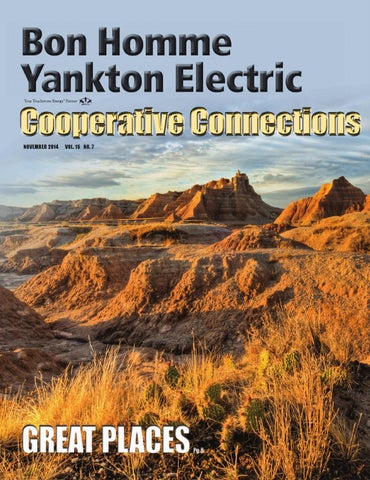
Badlands National Park, S.D. The eroded walls of Badlands National Park create an everchanging kaleidoscope of hues as sun and season cycle through, illuminating the rugged landscape. Located in southwestern South Dakota, the park consists of 244,000 acres of sharply eroded buttes, pinnacles and spires surrounded by a mixed-grass prairie ecosystem. The National Park Service notes that the mixed-grass prairie is a transitional zone between the tall-grass prairie to the east and the short-grass prairie to the west. The Badlands were formed by the geologic forces of deposition and erosion. Deposition of sediments began 69 million years ago when an ancient sea stretched across what is now the Great Plains. After the sea retreated, successive land environments, including rivers and flood plains, continued to deposit sediments. Although the major period of deposition ended 28 million years ago, significant erosion of the Badlands did not begin until a mere half a million years ago. Erosion continues to carve the Badland’s buttes today. Wind Cave National Park: Hot Springs, S.D. Above ground the bison roam and prairie flowers bloom, below ground is another world. Wind Cave National Park is not only home to some of South Dakota’s most beloved wildlife, but also plays host to an underground cave with a network of passages and box work mineral formations. Named for how the cave was discovered, in 1881 two men heard an unmistak-
able whistling nose that lead them to investigate, and eventually find, the opening to an underground cavern. Its eventual establishment as a national park in 1903 was culminated by the more than 130 explored miles of passages, cementing a position early on as one of the world’s longest caves. Formed when rainwater absorbs carbon dioxide in the atmosphere and becomes acid, then seeps into cracks of rocks comprising the ground, caves often require more than 100,000 years of seepage and erosion to form in their entirety. Along with the sheer size of this particular cave was the uniqueness of the calcium formations found within its natural chambers. Instead of the expected dripping stalactites growths that most caves share, Wind Cave boasts a unique box work décor – often referred to as honey-comb-like formations covering the ceilings. This unique formation is thought to happen when calcite fills the “veins” of rock sheets and then the original rock wears away, leaving behind a lacey reminder of what used to be. Wind Cave is considered to be a world marvel and a must see for visitors and natives alike.
Bear Butte: Sturgis, S.D. To the Lakota, this place is known as Bear Mountain or “Mato Paha.” The Cheyenne people know it by the name “Noahvose.” Today, it is widely known as Bear Butte and is regarded still as both a spiritual place and a geological spectacle. Rising 4,422 feet, the best way to describe what Bear Butte is comprised of is by saying it was almost a volcano. Formed when magma underground pushed upwards, there was enough pressure to cause a shift among plates of the Earth’s crust, but not enough force to cause an eruption. While the Black Hills is known for large rising hills, Bear Butte stands out as being a region unique to its surroundings. Harney Peak: Pennington County, S.D. Looking out soundlessly over the sprawling Black Hills, Harney Peak rises high above the neighboring hills. At 7,242 feet tall, the elevation of this mountain puts it as the highest point in the Black Hills and therefore the state. Used as a fire lookout from 19111967, Harney Peak has served as a silent servant to the area in which it was formed. James River Valley, S.D. As the James River flows more than 470 miles from its start in North Dakota to its joining with the Missouri River near Yankton, it has the distinction of having one of the lowest gradients of any river of similar length on the continent. From roughly the North Dakota border to Huron, the river drops about one inch every half mile; from Huron to Yankton, the river drops less than five inches over .62 miles. Cooperative Connections • November 2014 9
Chesney Nagel Receives Rodeo Recognition
General Manager MJ Goehring presents Chesney with her shirt between classes at Dakota Wesleyan in Mitchell.
Bon Homme Yankton Electric congratulates Chesney Nagel on her strong finish at the South Dakota High School Rodeo Association’s finals this summer. Chesney is the daughter of Blane and Cindy Nagel of Springfield, SD. In recognition of her accomplishments and finish in the Goat Tying, Breakaway Roping and Barrel Racing, we are pleased to present her with a Touchstone Energy® shirt. Bon Homme Yankton Electric and South Dakota’s Touchstone Energy® Cooperatives are proud supporters of South Dakota High School Rodeo and we are proud of Chesney. Touchstone Energy® Cooperatives nationwide are committed to the
OFFICIAL NOTICE OF PUBLICATION STATEMENT OF OWNERSHIP, MANAGEMENT AND CIRCULATION (REQUIRED BY 39 U.S.C. 3685) 1. Publication Title:Bon Homme Yankton Electric Cooperative Connections 2. Publication No.: 018-973 3. Filing Date: 9/30/2014 4. Issue Frequency: Monthly 5. No. of Issues Published Annually: 12 6. Annual Subscription Price: $6.00 Members $12.00 Non-Members 7. Complete Mailing Address of Known Office of Publication: 134 S Lidice, PO Box 158, Tabor, SD 57063 8. Complete Mailing Address of Headquarters or General Business Office of Publisher: 134 S Lidice, PO Box 158, Tabor, SD 57063 9. Full Names and Complete Mailing Address of Publisher, Editor & Managing Editor: Publisher: Bon Homme Yankton Electric Association, Inc. Editor: Nicole Einrem Managing Editor: Nicole Einrem 10. Owner: Bon Homme Yankton Electric Association, Inc.,134 S Lidice, PO Box 158, Tabor, SD 57063 11. Known bondholders/mortgagees, and Other Security Holders Owning or Holding 1 Percent or More of Total Amount of Bonds, Mortgages, or Other Securities: Rural Utilities Service, National Rural Utilities Cooperative Finance Corporation, CoBank 12. Tax Status: Purpose, function and nonprofit status of this organization and the exempt status for federal income tax purposes: Has Not Changed During Preceding 12 Months 13. Publication Title: 14. Issue Date of Circulation Below: Oct. 2014 Bon Homme Yankton Electric Cooperative Connections Avg. No. of Copies Each Single Issue 15. Extent and Nature Issue During Nearest to of Circulation Preceding 12 Months Filing Date A. Total number of copies (net press run)..................................................... 2897.............................2927 B. Paid and/or Requested Circulation 1. Paid/Requested Outside County Mail Subscriptions..................... 2843.............................2869 2. Paid In-County Subscriptions............................................................. 0...................................0 3. Sales Through Dealers, Carriers, Street Vendors &Counter Sales......... 0...................................0 4. Other Classes Mailed Through the USPS............................................ 0...................................0 C. Total Paid and/or Requested Circulation................................................. 2843.............................2869 D. Free Distribution by Mail............................................................................ 45.................................48 E. Free Distribution Outside the Mail................................................................ 7...................................7 F. Total Free Distribution................................................................................ 52.................................55 G. Total Distribution.................................................................................... 2894.............................2924 H. Copies Not Distributed................................................................................. 3...................................3 I. Total........................................................................................................ 2897.............................2927 Percent Paid and/or Requested Circulation.....................................................98%............................. 98%
Statement of Ownership, Management and Circulation as of October 1, 2014 1 0 November 2014 • Cooperative Connections
core values of innovation, integrity, accountability and commitment to community. Student athletes such as Chesney embody our state’s future and many of these values. The dedication she’s demonstrated to excelling in her sport has a very close tie to the commitment Bon Homme Yankton Electric has to our members.
Thanks!
I would like to thank you for the nice crock pot that I won at your annual meeting. Millie Sternhagen Dear B-Y Electric, Thank you for the tool set I received as a door prize at the annual meeting! Joel Finck
Classifieds December Issue Deadline: November 1, 2014. Email your classified ad to: by@ byelectric.com. Members can post one free ad per year. Repeats or longer ads are $1/column inch. FOR RENT: 1 bedroom apartment. Tabor Manor. Contact John at 605-463-2478 or Gary at 605-463-2209.r FOR RENT: Tabor HRC, 2-bedroom townhome w/ single attached car garage, 1100 plus square feet, handicap Facility/ Accessible, washer and dryer hookups, dishwasher, lawn/snow maintenance provided. All one level living convenience. Please contact Jen Carda 605-463-2575.r Thinking about building a home? Don’t pick a floor plan or a builder until you’ve talked with the area’s ONLY Certified Aging-in-Place specialist, Certified Green Professional Builder and ENERGY STAR Partner Builder. Call 4 Life Homes today. 605-661-4488.r Beseda Hall, Tabor, SD for rent for any special occasion such as weddings, anniversaries, graduation or birthdays! For more information contact Linda Bares at 605-661-6220 or snlbares@gmail.com. WANTED: Homelite Super XL chainsawrunning or not. For Sale: Eleven used chimney blocks. 17”x17”x8”. Could be used for flower planters. $30.00. Call 605463-2270 after 5:00pm.
HAASE HEATING & COOLING
Dan Haase
Heating, Cooling, Heat Pumps We sell the best and service the rest
GT REPAIR & AUTOBODY Glenn Tycz Tyndall, SD 57066
605-589-3018
Scotland, SD 57059 605-583-4490
We Repair and Install Windshields
DON WYNIA’S SHOP
BOHEMIAN FARMERS MUTUAL
R. Martin Koch, Secretary PO Box 206 Tabor, SD 57063 605-463-2558 1-800-868-1756
If only the future was predictable. Farming is always a gamble. You never know when bad weather or other problems will strike. The only thing you can be sure of—you need quality insurance protection. Call our office today for a competitive quote.
KORANDA WELL COMPANY LLC Tabor, SD 57063 605 - 463- 2244
Dixon ZTR Mowers - Kohler Tecumseh Briggs & Stratton Major Overhaul Repair - All Makes of Mowers Small Engine - Skid Loader - Snow Blower Welding & Pick Up Service Call Don, 2 miles south of Tyndall 41566 306th St Tyndall, SD 57066
Well drilling, repairing and cleaning Water Systems – Artesian Wells Sales and Installation Earth-Coupled Heat Pump
Emergency Service Free Estimates
605-589-3713 or 605-661-1960
ART & ANTIQUE GALLERY Custom Matting & Framing Original Art/Gifts/Cards Handmade Glass Beads & Jewelry
1610 Main St
Tyndall, SD
605-589-4050
Open Wednesday through Saturday
605-660-3204
Tyndall, SD 57066
605-589-4176
An Authorized Independent Agent For
Handicap and Accessible Home Modifications • • • • •
605-665-9679
CALL TODAY to learn more.
Furnaces, Heat Pumps and Air Conditioners Free Estimates
Tabor, SD 57063
Preplanning will give you peace of mind and may save money
Brad Cameron
605- 589-3228 1- 800-894-3228
Jason Finck
Yankton, Tabor, Tyndall, Menno
CAMERON INSURANCE
300 W 17th Tyndall, SD 57066
New Construction Remodel - Roofing Flooring
OPSAHL-KOSTEL FUNERAL HOME
Wellmark Has You Covered, No Matter What Your Stage of Life.
SANDERS HEATING & COOLING
CONSTRUCTION AND PAINTING
Ramps Grab Bars www.4lifehomes.net Stair Lifts Walk-in Showers Kitchen and Bathroom Remodels
605-463-2786
FREE HOME DAMAGE ASSESSMENT following a storm
INSURANCE CLAIM SPECIALIST GENERAL CONTRACTOR • Roofing • Gutters • Siding • Painting • Windows • Doors
Wellmark Blue Cross and Blue Shield of South Dakota is an Independent Licensee of the Blue Cross and Blue Shield Association. ©2012 Wellmark, Inc. SD-20-P-12
To save energy this month, try lowering your water heating costs. Water heating accounts for 14 to 25 percent of the energy you consume.
HEATING & COOLING 920 Broadway Yankton, SD 57078
60 5 -6 6 5 -9 4 6 1
800-491-9461
Turn the water heater’s temperature to the warm setting, which is
HOME REPAIR HOTLINE
605-661-4488
Warm Air, Air to Air, Geothermal Heat Pumps WE DO EMERGENCY HOME REPAIRS
around 120 degrees Fahrenheit. This will save energy – and help you save on your monthly bill. Source: U.S. Department of Energy
Cooperative ConneCtions • November 2014 1 1
Building Block No. 1
Increasing Coal Plant Efficiency M
Photo by Otter Tail Power Company
By Brenda Kleinjan
South Dakota’s only coal-based power plant is the Big Stone Plant, located near Milbank, S.D. It is co-owned by three regional investorowned utilities: Otter Tail Power Company, NorthWestern Energy and Montana-Dakota Utilities.
eeting the requirements of the first of
four building blocks that create the foundation of the Environmental Protection Agency’s proposed Clean Power Plan rule could lead to the shuttering of the state’s only coal power plant. “We believe the application of Building Block 1 to South Dakota is technically infeasible,” said Jeff Endrizzi, Big Stone Plant Manager, at the South Dakota 111(d) Forum hosted by the South Dakota Public Utilities Commission in July. Building Block 1 calls for physical and operational changes at coal-based power plants to improve heat-rate efficiency. The Big Stone Plant, located near Milbank, S.D., is co-owned by three regional investor-owned
12 November 2014 • Cooperative Connections
utilities: Otter Tail Power Company, NorthWestern Energy and Montana-Dakota Utilities. The region’s electric cooperatives are not a partner with the plant, nor do they receive power from it. However, the plight of the plant may impact co-ops as states begin writing their plans to comply with the proposed EPA rule. (In September, the EPA extended its public comment period on its proposed “Clean Power Plan” rule under section 111(d) of the Clean Air Act that will require CO² emissions reductions from existing power plants in 49 states [Vermont and the District of Columbia are not covered because they have no fossil-fuel based generation.] The rule was announced June 2, 2014. The EPA intends to issue
a final rule in June of 2015, and states will then have one year to develop implementation plans, or if they collaborate on multi-state or regional plans, they are allowed two years to develop their plan. Case by case, states can seek a one-year extension from the EPA. Therefore, in some states it may take until June of 2018 to fully understand what compliance with this proposal will mean.) “Big Stone Plant is the one coal-fired generating unit in South Dakota,” Endrizzi told those gathered at the PUC meeting. “It has already performed, or in the process of performing all the major projects identified in the report.” The Big Stone Plant is in the midst of a nearly $400 million project to make improvements at the plants. While the improvements will help the plant meet EPA Regional Haze rules, the improvements will actually make it harder for the plant to meet the proposed new heat rate. Heat rate is the measure of efficiency of a power plant – energy in versus energy out. The plant has already performed the large heat rate improvement projects available (and which, in part the EPA used in calculating its numbers for South Dakota). Endrizzi explained that before the investment, the plant consumed about 20 MW as its in-house load. “That equipment is going to add a significant amount. The investments increase the plant’s power needs by another 8 MW. That in itself make us less efficient,” said Endrizzi. The scenario encountered by Big Stone Plant is not isolated. Cooperatives, through the National Rural Electric Cooperative Association, have a list of concerns with the EPA’s proposed rules. First, the EPA has overestimated the potential for heat rate improvements. Co-op power plants are well maintained and most of the efficiency improvements – such as the ones currently being implemented at Big Stone – have already been done in co-op facilities. NRECA estimates that only a 1 percent or 2 percent gain is all that is left. Second, co-ops are uncertain how – and if – improvements made prior to 2012 factor in to the EPA’s proposals. Finally, making improvements to existing plants to meet the proposed rules could trigger New Source Review and add significant hidden costs to the EPA proposal. NRECA maintains that the proposed EPA rules are complex with unintended consequences and that the EPA is overreaching its legal authority. For co-op members, the additional costs hit member-owners hardest. The not-for-profit co-op business model forces any costs from upgrades or shuttered power plants to be borne directly by co-op members. According to the American Coalition for Clean Coal Electricity, the EPA’s proposed rule – encompassing its four building blocks – could have annual costs of $13 billion to $17 billion. ACCCE further estimates that the plan would force the retirement of 30,000 megawatts to 80,000 megawatts of coal-based generation and could cause more than 200,000 jobs to be lost in 2020. The projected global climate benefits are a less than 1 percent reduction in CO2 concentrations, a reduction in global average temperature of 0.016 degree and a reduction in sea level rise of 1/100th of an inch. Electric cooperatives, through the Cooperative Action Network, are in the midst of gathering public comments to submit to the EPA during the agency’s comment period on the proposed rule. Go to www.action.coop to learn more and send your message. Editor’s Note: This is the second of a five-part series that will explore each of the EPA’s Building Blocks. The four building blocks are: (1) making coal plants more efficient; (2) displacing existing coal with existing natural gas plants; (3) increasing the use of nuclear and renewable energy; and (4) decreasing electricity consumption by increasing end-user energy efficiency.
EPA’s “Building Blocks” Coal Plant Efficiency Make physical and operational changes at existing coal-based power plants to improve heat-rate efficiency by 6 percent, which reduces the amount of coal needed per MWh of generation, thereby reducing CO² emissions.
+
Natural Gas Existing natural gas combined cycle plants are used more or less frequently, depending upon a variety of factors. EPA’s CO² reduction goals are based on dispatching those natural gas plants more frequently (up to 70 percent capacity factor) while closing or curtailing existing coal-based generation sources.
+
Renewable and Nuclear Power Nuclear power and renewable resources like hydro, wind, and solar power do not have direct CO² emissions. EPA’s goals are based on keeping some existing nuclear power plants (that are at risk of closing operating, ensuring that new nuclear plants under construction get finalized, and that more sources of renewable energy are developed.
+
Consumer Energy Efficiency Improving energy efficiency by consumers reduces the need for power generation. EPA’s CO² reduction goals envision all states increasing energy efficiency programs to result in the avoidance of 1.5 percent of energy demand per year.
=
State Carbon Intensity Goal State
2012 Final Emissions Goal Final Rate (lbs/ (2030 & Reduction MWh) After)
Final Percent Reduction
Iowa
1,552
1,301
-251
-16.2%
Minnesota
1,470
873
-597
-40.6%
Montana
2,246
1,771
-475
-21.1%
Nebraska
2,009
1,479
-530
-26.4%
N. Dakota
1,994
1,783
-211
-10.6%
S. Dakota
1,135
741
-394
-34.7%
Wyoming
2,115
1,714
-401
-19.0%
Cooperative Connections • November 2014 13
Shining Brightly As South Dakota Celebrates 125 Years as a State, Electric Co-ops Are Proud to Have Illuminated the Past 75+ Years
D
riving through rural South Dakota after dusk has fallen is simply beautiful. Every few miles, a small gathering of buildings, a farm house and scattered farm equipment is illuminated and softly covered in a glow even after the sun has set. This glow is often accompanied by lights gleaming from the inside of a house, brightened and hinting at the family that resides within. This picture represents so many South Dakota families, who make their living away from the constant buzz of a town or city. South Dakota has been a state for 125 years, and for the last 75, the South Dakota’s electric cooperatives have helped to illuminate and advance rural living. The vastness of the prairie and the simplicity of the life offered attracted many. South Dakota was settled by farmers and ranchers who worked back breaking hours to provide for their families. During the day, the hot sun would scorch on the backs of laborers, while at night; darkness took on a new meaning. In 1935, President Franklin Roosevelt issued an executive order that would change the way rural areas across the nation looked. Executive
Photo by Mike Kjose/Clay Union Electric
By Elizabeth Mayrose
14 November 2014 • Cooperative Connections
Order, Number 7037 established the Rural Electrification Administration; an administration that would set apart $100 million that would go directly to rural areas in the form of loans and grants for electric generation, transmission, and distribution. It was up to individuals within states to form groups to apply for such funds, but the message was clear from President Roosevelt: the United States would support efforts to bring electricity and an improved way of life to the rural areas of the country. At this point in South Dakota history, most cities were already aglow with electricity. With the exception of a few water-powered generators scattered throughout the state, most cities ran on generators fueled by gasoline. At the same time President Roosevelt was pledging money to help electrify all areas South Dakota was considering harnessing another form of power: the Missouri River. With the introduction of the power it produced, more electricity would be available to be purchased, as well as cheaper. Fast forward to today, South Dakota’s hydroelectric power production is one of the top in
the Midwest, with up to 65 percent of renewable energy used powered by the mighty Missouri. After Executive Order 7037 was signed, things started moving in South Dakota, albeit slowly. The first organized group was founded in a general store in Burbank. This gathering of fifteen men went on to organize the Fairview Rural Electric System. Their official charter was recognized in November of 1935. After that, it took a bit more time for organizations to begin popping up. There was skepticism on behalf of the farmers that this program was being catered to: the $5 signup fee was a deterrent, as well as the worries that they could lose their farm land if the system did not pan out. Despite all of skepticisms, progress was made. In the fall of 1937, the first line of rural electricity was energized in the area now known as Clay-Union Electric Corporation. This created a bit of a domino effect: other rural dwellers saw the possibilities and wanted electricity themselves. Within the next few years, an additional 33 groups had sprung up, signing up potential members, applying for loans, and stringing up wire. As more lines were going into the sky, more people were getting connected to electricity through their respective small cooperatives. However, these groups of consumers were not yet connected to one another. In 1942, that changed. On Dec. 7, a group of farmers came together for what would be the first official meeting of the South Dakota Rural Electric Association. This group didn’t intend to stay banded together though; in fact, it was thought at the time that it was only a ‘temporary organization’, one that would disband after finalization of each individual co-op’s successful acquisition of electricity. After the success of the idea share and support, it was later determined that there was in fact merit in joining together for the common cause while still working on individual progression. The numbers of farms being serviced grew. In 1944, 4,612 farms were connected. Only four short years later the number had climbed to 21,207. Over the next decades, the state’s electric cooperatives grew. It underwent issues with legislation on both the state and national level, forcing advocates to voice just how important it was for rural families to be able to invest in their own electricity, as opposed to being required to purchase power from providers that turned a profit. Since their origination, co-ops were not out to make money. They instead focused on bringing education, outreach and youth development in addition to electricity to each rural consumer. In the last 75 years, the SDREA has transcended above anything that those original 15 in Burbank could have hoped for. Having come this far in half of South Dakota’s history, there’s no limit on where the next 75, and then 125 years will take the organization that brought light to the country.
On the Road to Statehood By Jim Soyer
The first organized effort to separate Dakota Territory into parts occurred in 1871 when the territorial Legislature petitioned Congress for the creation of two territories with the division line being the 46th parallel. It failed. In 1877, a proposal to create a new territory called “Eldorado” or “Lincoln” from near the Missouri River to the Big Horn Mountains in Wyoming also failed. In 1879, General Williams Beadle began another effort to promote division and also statehood. In 1882 and 1883, conventions were held in Canton, Huron and Sioux Falls. In spite of Territorial Gov. Nehemiah Ordway’s objections, in November, 1883, the people ratified a state constitution that had been written at the Sioux Falls meeting. Both Ordway and the statehood promoters went to Washington and lobbied Congress. The southern faction also attempted to remove Ordway from office after the Territorial Capital was moved from Yankton to Bismarck in 1883. But, the push for statehood was stopped. Events of the 1880s began to solidify the notion that any division of Dakota Territory should be north and south instead of east and west as some residents preferred. But, as late as 1886, Congress considered legislation that would have created an East Dakota and a West Dakota with the division being the Missouri River. Separate railroad systems in the north and the south, economic ties to different major eastern cities and the growth of separate systems of public institutions moved public opinion to favoring a north/south division. The question of statehood was a very partisan issue at the local and national levels. Some Democrats wanted the continuation of territorial status to retain the power and perks of appointive office from the national Democrat administration of President Grover Cleveland. If statehood was to be approved, national Democrats hoped the Dakota Territory would be admitted as one state because the population was perceived to be largely Republican. They preferred two new Republican senators coming to Washington, D.C., from one Dakota over four coming from two Dakotas. The same logic existed at the local level. With territorial status, most official positions were appointive and in the hands of Democrats. With statehood, most offices would be elective and probably held by Republicans. Even though another election in 1887 showed that the people favored two states, Cleveland’s newly appointed territorial governor, Louis K. Church, continued to support statehood on the condition of admitting Dakota as one state. In the summer of 1888, territorial Democrats and Republicans both met in Jamestown. Democrats endorsed one state. Republicans passed a resolution calling for division and two states. Nationally, the Democrats re-nominated President Cleveland and endorsed the one-state position with the added feature that the residents of Dakota could divide into two states at a later date if they so desired. Texas has a similar provision in their admission to the Union which allows them to divide into as many as five states. Republicans nominated Ohio Senator Benjamin Harrison for President and endorsed the two-state idea. For several years in Congress, Harrison had championed the idea of two states. The question of division was one of the major issues debated in the presidential elections of 1888 and Harrison’s victory at the polls assured statehood for two Dakotas. Cooperative Connections • November 2014 15
Regional Dateline
October 30 Thunder From Down Under Deadwood, SD, 605-559-1188 November 1 SD R&R Hall of Famers 4th Dimension in Concert Watertown, SD, 605-878-4677 November 1 Fall Coin and Currency Show Watertown, SD, 605-882-4663
Events of Special Note
PHOTO COURTESY OF STEPHANIE HORST, FEM ELECTRIC ASSOCIATION
October 25-26 Gun Show, Mitchell, SD 605-268-0254 www.dtgca.net
November 7-8 Paralyzed Veterans of America Pheasant Hunt, Platte, SD 605-337-2170 www.plattesd.org November 9 Holiday Fair, Irene/Wakonda High School, 11 a.m. to 3 p.m. Irene, SD, 605-660-3363 To have your event listed on this page, send complete information, including date, event, place and contact to your local electric cooperative. Include your name, address and daytime telephone number. Information must be submitted at least eight weeks prior to your event. Please call ahead to confirm date, time and location of event.
November 7 Jon Crane Show Sioux Falls, SD, 605-336-9737 www.rehfeldsonline.com
November 15 Fall Buffalo Auction Custer, SD, 605-255-4515 www.gfp.sd.gov
November 29 James Valley Model Railroad Open House, Aberdeen, SD 605-226-2139
December 6 James Valley Model Railroad Open House, Aberdeen, SD 605-226-2139
November 7 38 Special in Concert Deadwood, SD, 605-559-1188 deadwoodmountaingrand.com
November 15 Holiday Open House Extravaganza, Sisseton, SD 605-698-7425
November 7-8 Pheasant Fiesta Watertown, SD, 605-758-8743 glaciallakesguideservice.com
November 15 Women’s Escape Expo Watertown, SD, 605-886-5814
November 29 Platte Area Seed Stock Pen Expo & Cattle Dog Trial Platte, SD, 605-337-2275 www.plattesd.org
December 6 Christmas at the Redlin Art Center, Watertown, SD 605-882-3877 www.redlinart.com
November 29 Greater Madison Chamber Show and Sell, Madison, SD 605-256-2454 www.chamberofmadisonsd.com
December 6-7 Aberdeen Area Living Christmas Tree, Aberdeen, SD 605-626-7015
November 7-8 Culturefest, Aberdeen, SD 605-626-3011
November 21 Lighted Parade & Chili Cook-Off, Sisseton, SD 605-698-7261
November 9 28th Annual Wall Community Center Craft Show Wall, SD, 605-279-2665
November 22-23 Winterfest, Aberdeen, SD 605-226-1557 www.aberdeenartscouncil.com
November 14 Hairball in Concert Deadwood, SD, 605-559-1187 deadwoodmountaingrand.com
November 25-December 27 Christmas at the Capitol Pierre, SD, 605-773-4010 www.sd.gov/christmas2014
November 29-30, December 5-7, 12-14, 19-21, 26-28 Winter Wonderland Watertown, SD, 605-881-1348 www. visitwatertownsd.com November 29-January 2, 2015 East River Snowmobile Trails Season, Pierre, SD 605-773-3391, www.gfp.sd.gov
December 6-7 11th Annual Fezziwig Festival at Prairie Berry Winery Hill City, SD, 605-574-3898 www.prairieberry.com December 15-March 31, 2015 Black Hills Snowmobile Trails Season, Lead, SD 605-584-3896 www.gfp.sd.gov