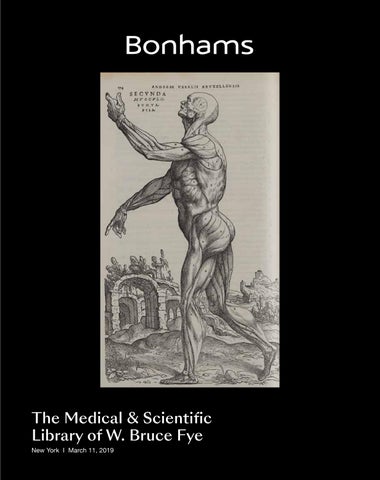
The Medical & Scientific Library of W. Bruce Fye New York I March 11, 2019
The Medical & Scientific Library of W. Bruce Fye New York | Monday March 11, 2019, at 10am and 2pm
BONHAMS 580 Madison Avenue New York, New York 10022 www.bonhams.com PREVIEW Thursday, March 7, 10am to 5pm Friday, March 8, 10am to 5pm Saturday, March 9, 12pm to 5pm Sunday, March 10, 12pm to 5pm SALE NUMBER: 25418 CATALOG: $35 BIDS +1 (212) 644 9001 +1 (212) 644 9009 fax bids.us@bonhams.com To bid via the internet please visit www.bonhams.com/25418 Please note that telephone bids must be submitted no later than 4pm on the day prior to the auction. New bidders must also provide proof of identity and address when submitting bids. Please contact Client Services with any bidding inquiries.
Bonhams © 2019 Bonhams & Butterfields Auctioneers Corp. All rights reserved. Bond No. 57BSBGL0808 Principal Auctioneer: Matthew Girling, NYC License No. 1236798-DCA
LIVE ONLINE BIDDING IS AVAILABLE FOR THIS SALE Please email bids.us@bonhams. com with “Live bidding” in the subject line 48 hrs before the auction to register for this service. Bidding by telephone will only be accepted on a lot with a lower estimate in excess of $1000 Please see pages 228 to 231 for bidder information including Conditions of Sale, after-sale collection and shipment. All items listed on page 231, will be transferred to off-site storage along with all other items purchased, if not removed by Thursday March 14.
INQUIRIES New York Ian Ehling Director +1 (212) 644 9094 ian.ehling@bonhams.com Tom Lamb, Director Business Development +1 (917) 921 7342 tom.lamb@bonhams.com Darren Sutherland, Specialist +1 (212) 461 6531 darren.sutherland@bonhams.com Tim Tezer, Junior Specialist +1 (917) 206 1647 tim.tezer@bonhams.com Mary-Kate Grohoski, Administrator +1 (917) 206 1608 mary-kate.grohoski@bonhams.com Los Angeles Dr. Catherine Williamson Vice President, Director +1 (323) 436 5442 catherine.williamson@bonhams.com Rachel Zimmerman, Administrator +1 (323) 436 5506 rachel.zimmerman@bonhams.com San Francisco Adam Stackhouse, Senior Specialist +1 (415) 503 3266 adam.stackhouse@bonhams.com
CLIENT SERVICES Monday – Friday 9am-5pm +1 (212) 644 9001 +1 (212) 644 9009 fax ILLUSTRATIONS Front cover: Lot 188 Inside front cover: Lot 53 Inside back cover: Lot 261 Back cover: Lot 361 REGISTRATION IMPORTANT NOTICE Please note that all customers, irrespective of any previous activity with Bonhams, are required to complete the Bidder Registration Form in advance of the sale. The form can be found at the back of every catalogue and on our website at www.bonhams.com and should be returned by email or post to the specialist department or to the bids department at bids.us@bonhams.com To bid live online and / or leave internet bids please go to www.bonhams.com/auctions/25418 and click on the Register to bid link at the top left of the page.
W. Bruce Fye: Physician, Historian, and Bibliophile Of the many friends I have made over the past five decades in the book trade Bruce Fye stands out for the passion of his collecting and the quality of his scholarship. Paralleling a distinguished medical career that began at Johns Hopkins and ended when he retired recently from the Mayo Clinic, Bruce wrote more than 100 historical and biographical articles and three books: The Development of American Physiology: Scientific Medicine in the 19th Century (1987), American Cardiology: The History of a Specialty and Its College (1996), and Caring for the Heart: Mayo Clinic and the Rise of Specialization (2015). He also served as president of the American College of Cardiology, the American Association for the History of Medicine, and the American Osler Society. Now an Emeritus Professor of Medicine and the History of Medicine at the Mayo Clinic, he was the Senior Historical Consultant for the 2018 Ken Burns film The Mayo Clinic: Faith, Hope, Science.
As a book collector since the 1960s Bruce acquired a remarkable number of medical classics and reference works, about 15,000 of which he has donated to the Mayo Clinic. Through this auction he has chosen to return some of the treasures of his personal library to the market place so that other collectors can enjoy the pleasure of their ownership. Because Bruce collected with a passion informed by a deep knowledge of history, and a willingness to explore the history of medicine in its widest sense, you will find in this sale an extraordinary variety of famous and not so famous rarities, remarkable autograph letters, artistic medical photography, association and presentation copies, very rare offprints, and other gems for the discerning. Some of these gems are obvious; others are more subtle, but just as worthy in their own way. I highly recommend reading this auction catalogue, and the online-only auction catalogue that will follow the March 11 sale, with more than the usual care. Jeremy M. Norman
From Vesalius to the Artificial Heart: An lllustrated History of Cardiology and Cardiac Surgery Featuring Highlights from the Auction By W. Bruce Fye, MD Bonhams, 580 Madison Avenue, New York Sunday, March 10, 2019 at 2:00 p.m.
Lot 188 Achilles Pirmin Gasser, ownership inscription in Vesalius, De humani corporis fabrica libri septem Basel: Johannes Oporinus, June 1543 (details)
ORDER OF SALE:
1-210 211-305 306-316 317-405
Classics of Medicine Johns Hopkins and its First Faculty Early Medical Photography Classics of Cardiology
IMPORTANT NOTICES Subject to the Limited Right of Rescission regarding Authorship, lots are sold with all faults and imperfections. However, if on collation any printed book in this catalog is found to be materially defective in text or illustration, the same may be returned to Bonhams within 20 days of the sale; the undisclosed defect must be detailed in writing.
advertisements; damage to bindings, stains, tears, foxing or other cosmetic defects, unless resulting in loss to text or illustration; defects to atlases, manuscripts, music, periodicals, and items sold as collections, archives, association copies, extra-illustrated copies, or bindings.
The following shall not constitute the basis for a return under the foregoing provision: defects stated in the catalog or announced at the time of sale; un-named items, blanks, half-titles, or
Items indicated in the catalog as “framed” have not been examined out-of-frame, unless specifically stated.
Classics of Medicine Lots 1-210
Morning Session 10am (Lots 1-210)
2
1
2
1 ADDISON, THOMAS. 1793-1860. On the Constitutional and Local Effects of Disease on the SupraRenal Capsules. London: Samuel Highley, 1855. Large 4to (327 x 254 mm). 11 hand-colored lithographed plates. Publisher’s green cloth with gilt stamped upper cover, rebacked retaining original cloth. Corners bumped, erased library stamps, free front endpaper loose and held in place with tape. Provenance: Logan Clendening (bookplate); University of Kansas (bookplate on back paste-down).
2 ALBINUS, BERNARD SIEGFRIED. 1697-1770. Tables of the Skeleton and Muscles of the Human Body. [Bound with:] A Compleat System of the Blood-Vessels and Nerves. London: John and Paul Knapton, 1749 and 1750. 2 works in 3 parts in one volume. Broadsheets (675 x 506 mm). 3 engraved title vignettes, 40 engraved plates (12 in outline), and 11 plates in second work. 20th century half morocco. Clean repaired tear to first title, some light dust soiling.
FIRST EDITION. “Addison was the first to realize the importance of the adrenal in clinical medicine” (Garrison-Morton). This study first appeared in a shorter version in the London Medical Gazette (1849), but was expanded for this first edition in book form. It describes the condition which later became known as “Addison’s disease.” Addison stumbled upon adrenal disease while trying to find the cause of pernicious anemia, and was the first to suggest that the adrenal glands were essential for life. Garrison-Morton 3864; Heirs of Hippocrates 1502; Norman 8; Osler 1744; Waller 225 $4,000 - 6,000
FIRST EDITION IN ENGLISH. “AMONG THE MOST ARTISTICALLY PERFECT OF ANATOMICAL ATLASES... Wandelaar placed his skeletons and musclemen against lush ornamental backgrounds to give them the illusion of vitality, using contrasts of mass and light to produce a three-dimensional effect. The most famous plate in the atlas depicts a skeletal figure standing in front of an enormous grazing rhinoceros, sketched by Wandelaar from the first living specimen in Europe, which had arrived at Amsterdam zoo in 1741” (Norman). See Garrison-Morton 399; See Norman 29; Wellcome II, p. 26. WITH: The Explanation of Albinus’s Anatomical Figures of the Human Skeleton and Muscles. London: John and Paul Knapton, 1754. 4to (248 x 206 mm). 19th century half brown morocco and marbled boards. Joints starting, soiling to first few leaves, foxing. The text volume published to accompany the Tables of the Skeleton and Muscles and A Compleat System of the Blood-Vessels and Nerves. The text is translated from Albinus’s original Latin, but no translator is credited on the title page. Russell 6 and 8. $3,000 - 4,000
THE MEDICAL & SCIENTIFIC LIBRARY OF W. BRUCE FYE | 7
3
4
3 ALBINUS, BERNHARD SIEGFRIED. 1697-1770. Explicatio tabularum anatomicarum Bartholomaei Eustachii. Leiden: Johannes and Herman Verbeek, 1761. Folio (430 x 270 mm). Engraved vignette on title page, 89 engraved plates. Contemporary half calf and marbled boards. Hinges cracked, minor wear to binding, light spotting. Provenance: Dr. J. Van der Hoeven (bookplate and owner’s inscription on front paste-down).
4 ALPINI, PROSPERO. 1553-1617. De medicina Aegyptiorum, libri quatuor. Venice: Franciscus de Franciscis Senensem, 1591. 4to (235 x 176 mm). Later lithograph portrait bound in at front, woodcut vignette on title page, woodcut illustrations in text. Front hinge cracked, dampstaining to a few page margins, browning. Provenance: A. Bernardes de Oliviera (bookplate).
SECOND EDITION. The plates were prepared originally by Bartholomeo Eustachi (Eustachius), and completed in 1552, but they were lost until Lancisi published them in 1714. Albinus created carefully copied line drawings to mirror each of the original Eustachius plates, having them engraved by Jan Wandelaar to create the full set of 89 plates. Heirs of Hippocrates 326; Wellcome II, p 26. $1,000 - 1,500
The “first important work on the history of Egyptian medicine” (Garrison-Morton). Alpini was a professor of botany at the University of Padua, who lived in Egypt for 3 years between 1580 and 1583. There he observed the sexual differentiation of date palms, and introduced a number of plant species to European botanists that were previously unknown. This work contains the first known account of the coffee plant published in Europe. The Norman copy of this book reproduces the woodcut that appears on the verso of leaf 101. It is more detailed than the woodcut that is depicted with the first edition described in detail by Mortimer; this copy conforms to Mortimer’s description. She notes that the British Museum has a variant copy that would seem to be the same printing as the Norman copy. Durling 178; Garrison-Morton 6468; Hunt 161; Mortimer/ Harvard Italian 16; Norman 39. $2,000 - 3,000
8 | BONHAMS
5
6
5 ANDERSON, ELIZABETH GARRETT. 1836-1917. Autograph Note Signed integrally (“Mrs. Garrett Anderson”) to Miss Fox, 1 p, 16mo, London, June 3, 1878, on her Upper Berkeley Street calling card; WITH: Partial Autograph Letter Signed (“Elizabeth Garrett”) to a Mr. Arnold, being the final leaf of a longer letter, 1 p, 8vo (2nd leaf only of bifolium), n.d., folds.
6 ARETAEUS OF CAPPADOCIA. HENISCH, GEORG. 1549-1618. Editor. Aetiologica, simeiotica et therapeutica morborum acutorum & diuturnorum.... Augsburg: Georg Willer and David Franck, 1603. Folio (305 x 206 mm). Woodcut device on title. Printed in two columns in Greek and Latin. Contemporary vellum, some wear to spine, some staining. Provenance: John Latham (1761-1843) physician-extraordinary to the Prince of Wales (signature on front free endpaper and marginalia).
FIRST WOMAN IN BRITAIN TO QUALIFY AS A DOCTOR, AND FOUNDER OF THE NEW HOSPITAL FOR WOMEN. Two autograph notes from the remarkable woman who was also the first female mayor in England in 1908. Inspired by meeting Elizabeth Blackwell in 1859, “she obtained a medical education and a registrable medical qualification. Barred from admission as a medical student to a university or London teaching hospital, she completed the required courses as a private student of teachers of recognized medical schools, and passed the examination for the License of the Society of Apothecaries. In 1865 her name was entered on the medical register, the second woman and the first British-trained woman; no more women were added until 1876. In 1870 she became the first woman to obtain an MD from the University of Paris. Admitted to the British Medical Association in 1873, she remained the only woman member for nineteen years” DMB 1, pp 113-114.
Later edition. The works of Areteus of Cappadocia, originally translated by Junius Paulus Crassus and published in Venice in 1552, are corrected here in Henisch’s edition, using excerpts from Galen, Alexander Trallianus, and Paulus Aegineta. “Aretaeus left many fine descriptions of disease; in fact Garrison ranks him second only to Hippocrates in this respect” (Garrison-Morton). This copy, formerly the property of physician John Latham, includes his inked margin notes. The editor Georg Henisch (1549-1618), an Augsburg physician, was also an astronomer and made contributions to the calendar reform of Gregory XIII. See Garrison-Morton 22; Krivatsy 380. $1,500 - 2,500
$400 - 600
THE MEDICAL & SCIENTIFIC LIBRARY OF W. BRUCE FYE | 9
7
7 ARISTOTLE. 384-322 B.C. AND THEOPHRASTUS. D.C.287 B.C. En tibi candide lector, Aristotelis et Theophrasti historias, quibus cuncta fere quae Deus Opt. Max. homini contemplanda & usurpanda exhibuit, adamussim complectuntur. Basel: Andreas Cratander, March 1534. 2 parts in one volume. Folio (283 x 188 mm). Titles and colophon with woodcut printer’s device, numerous woodcut initials. Early vellum, spine with gilt lettered morocco label. Minor marginal worming at beginning, some minor staining. Latin translations by Theodore Gaza and Pietro Alcionio of the principal zoological writings by Aristotle, and Historia plantarum and De causis by Theophrastus. His treatises on plants, written as counterparts to Aristotle’s works on animals, came to be regarded as part of the Aristotelian corpus. Book IX of the Historia includes a discussion of the medicinal properties of plants, one of the earliest surviving herbals. Durling 271; See Garrison-Morton 275. $3,000 - 4,000
8
8 AUENBRUGGER, LEOPOLD. 1722-1809. Inventum novum ex percussione thoracis humani ut signo abstrusos interni.... Vienna: J.T. Trattner, 1763. 8vo (212 x 125 mm). 95 pp. Woodcut device on title page and endpiece on last page of text. Modern vellum, inked title on spine, renewed endpapers, pages untrimmed. Minor spotting throughout. FIRST EDITION, SECOND ISSUE with text identical to the first edition of 1761, but with a different woodcut device on title (see P.J. Bishop, “A bibliography of Auenbrugger’s ‘Inventum novum’ (1761).” This variation is rarer than the first issue, with none known at auction since 1965. “Auenbrugger founded the practice of chest percussion, a method that gave a new and dependable foundation to the diagnosis of chest diseases by permitting determination of disease-caused changes in the lungs and hearts of living patients. The discovery appears to have been based on the analogy between the chest cavity and wine casks, which Auenbrugger, the son of an innkeeper, had learned to thump as a means of determining their fullness” (Norman 81). PMM 280. $1,500 - 2,500
10 | BONHAMS
9 9 AURELIANUS, CAELIUS. FL.420. Tardarum Passionum, Libri V. Basel: Henricus Petrus, 1529. 4to (288 x 189). Rebacked retaining early calf top and bottom covers. Wear, light dampstaining. Provenance: Dr. Gordon M. Jones (bookplate). FIRST EDITION of Caelius Aurelianus’ Latin translation from Greek texts of Soranus of Ephesus. The writings of Soranus represent the pinnacle of Graeco-Roman medical literature. In it are descriptions of the symptoms of numerous diseases, including coronary artery disease, atrial fibrillation, coronary thrombosis, and one of the earliest descriptions of epilepsy. “In Caelius Aurelianus’ book one is astonished to find, as early as the fifth century A.D., a very detailed account of circulatory failure and a discussion of its causes ... He also seems to have observed cases of shock which accompany acute onset of atrial fibrillation. He discussed the possible differentiation between primary diseases of the stomach or heart. The cardinal symptoms of acute coronary thrombosis also can be found in these chapters.... He was guided by his clinical instinct and the knowledge of earlier writers. He left us a more detailed description of his various observations than any other medical writer of antiquity” (Rudolph Siegel, American Journal of Cardiology, volume 7, pp 427431, 1961. Durling 358; Garrison-Morton 1959.1; Norman 386. $1,500 - 2,500 10 BAGLIVI, GIORGIO. 1668-1707. Four titles, comprising: 1. De fibra motrice, et morbosa EpIstola ad Alexandrum Pascoli. Perugia: Constantino, 1700. 4to (207 x 155 mm). Engraved frontispiece. Modern brown morocco, decorated in blind. Ink notations, some canceled, on free front endpaper. First Edition. Norman 104.
10
2. De praxi medica ... accedunt dissertationes novae. Rome: Domenico Antonio Hercules, 1696. 8vo (160 x 105 mm). Engraved plate. Contemporary vellum. Ink notations, browning. First edition. Provenance: Haskell F. Norman (bookplate). 3. Opera omnia medico-practica et anatomica. Lyons: Anisson and Jean Posuel, 1704. 4to (224 x 171 mm). Engraved portrait and one engraved plate. Contemporary vellum. Covers soiled, browning. Provenance: Charles Lucas, M.D. (armorial bookplate on front pastedown); Haskell F. Norman (bookplate on front paste-down). Garrison-Morton 68. 4. The Practice of Physick, Reduc’d to the Ancient Way of Observations. London: Printed for Andrew Bell, et. al., 1704. 8vo (188 x 112 mm). Modern calf, gilt titles on spine, marbled endpapers. Lacking tarantula plate, extensive notations on rear blank leaves, browning. Wellcome II, p 84. “Baglivi, professor of anatomy at Rome, had a short but brilliant career. He wrote Praxis Medica and de Fibra Motrice, and originated the so-called ‘solidar’ pathology.... He was able to distinguish between the smooth and striated muscles; and he discovered the histological distinction between the two categories of fibers. His fundamental research concerning the fibers made him one of the most important students of muscle physiology before Haller” (Garrison-Morton). Beyond the physiology of nerves and muscles, Baglivi also wrote an important medical work on one of the most controversial epidemics of the 16th and 17th centuries: Tarantism, “a nervous disease characterized by hysteria and a mania for dancing,” which was thought to be a disease caused by the bite of a tarantula spider, the malady having spread from Taranto in southern Italy to the surrounding regions. $1,200 - 1,800
THE MEDICAL & SCIENTIFIC LIBRARY OF W. BRUCE FYE | 11
11 BAILLIE, MATTHEW. 1761-1823. A series of Engravings, accompanied with Explanations, which are intended to illustrate the Morbid Anatomy of some of the most important parts of the Human Body. London: W. Bulmer, 1812. Large 4to (333 x 268 mm). 73 engraved plates dated 1798-1802. 19thcentury calf. Some wear to edges. Some foxing and offsetting. Provenance: The Purple Collection, Library of the Medical Society of the County of Kings (bookplate, small stamp on title and verso of plates). WITH: The Morbid Anatomy of Some of the Most Important Parts of the Human Body. London: J. Johnson, 1793. 8vo (209 x 130 mm). Modern burgundy morocco, gilt ruled and titled in gilt on spine. Library stamps, ownership inscriptions, mild spotting. FIRST EDITION INSCRIBED on verso of title page “From the Author.” Second edition of the first systematic atlas of pathology. The present engravings originally issued in 10 parts from 1798-1802 were executed to accompany Baille’s Morbid Anatomy. “With its extensive descriptive text for each plate, it may be appreciated separately. The black & white engravings were prepared by John Hunter’s artist in amanuensis, William Clift, and depict numerous specimens from Hunter’s collections” (Garrison-Morton 2282). Heirs of Hippocrates 1179; Norman 109 (first edition); Wellcome II, p 87. 11
$1,500 - 2,000 12 BANTING, FREDERICK. 1891-1941. Diabetes and Insulin. Nobel Lecture Delivered at Stockholm on September 15th, 1925. Stockholm: Imprimerie Royale. P.A. Norstedt & Fils, 1925. 8vo (246 x 164 mm). Publisher’s printed wrappers, minor soiling. INSCRIBED by Banting; WITH: “Medical Research.” [Offprint from:] The Canadian Medical Association Journal, XVI, 1926. Original wrappers. INSCRIBED by Banting. INSCRIBED COPY OF BANTING’S NOBEL PRIZE LECTURE, 1925, which he shared with J.J.R. Macleod for their discovery of insulin. “Insulin does not belong to me, it belongs to the world,” he said, when he sold the patent rights to his discovery to the University of Toronto. Accompanied by a contemporary photogravure of the iconic image of Banting holding a rabbit. $1,200 - 1,800
12
13
13 BARKER, BENJAMIN FORDYCE. 1818-1891. Manuscript ledger of patient visits and charges. 433 pp recto and verso, folio (322 x 195 mm), Norwich, 1841 to 1850. Full calf. First ledger leaf missing, calf dry and worn, cracked at joints. WITH: “Annual Address by the President of the American Gynecological Society.” [Offprint from:] Gynecological Transactions, volume 1: 1876. 8vo (216 x 147). Publisher’s wrappers. Fold line and minor soiling to wrappers, library stamps and labels. Inscribed by Barker. WITH: Two printed receipts for services rendered by Barker (198 x 66 mm). July 1847 and February 1848. Provenance: Patrick J. Cassidy (four handwritten notes with his letterhead laid in). “AMERICA’S BEST KNOWN OBSTETRICIAN,” Barker began practicing medicine in Norwich, Connecticut in 1841. In 1850 he moved to New York City, where he was a cofounder of the New York Medical College. Barker was also a cofounder of the American Gynecological Society and served as its first president. This ledger encompasses his first years of practice in Norwich, Connecticut. The entries include the patient’s name, dates and reasons for his visits, and the charges. Occasionally, Barker wrote “good for nothing” after the balance due, indicating the patient did not pay for his services. There are occasional references to procedures he performed, such as amputation of finger, application of leeches, bleeding, cupping, obstetrical attendance, and other procedures. Accompanied by a stipple portrait of Barker c. 1878, with a facsimile signature. $1,000 - 1,500
12 | BONHAMS
14 BARTHOLINUS, THOMAS. 1616-1680. Institutiones Anatomicae. Leiden: F, Hack, 1645. 8vo (185 x 112 mm). Engraved title page, portrait frontispiece, 6 folding engraved plates, numerous engraved illustrations in text, some full page. Contemporary calf, gilt-ruled, gilt titles on spine. Wear to covers, slightly soiled. SECOND EDITION. This work, a revision of the anatomical treatise of the author’s father, Caspar, “included the first depiction of the fissure of Sylvius, the lateral cerebral fissure, and the only part of the cerebral hemispheres to be given a name between 1641 and the 19th century” (Garrison-Morton 6964). Krivatsy 736; Wellcome II, p 106. $400 - 600
14 15 BARTHOLINUS, THOMAS. 1616-1680. Anatomia, ex Caspari Bartholini Parentis Institutionibus, Omniumque Recentiorum & propriis Observationibus, Tertium ad Sanguinis Circulationem Reformata. The Hague: Adriaan Vlacq, 1655. 8vo (203 x 120 mm). Engraved frontispiece, engraved portrait, 8 folding plates, 66 illustrations in text. 17th century sheep, spine gilt, marbled endpapers. Wear to covers, first two plates with old tape repair over tears, browning. Thomas Bartholin (Latinized as Bartholinus), first published a revision of his father Caspar Bartholin’s anatomy text in 1641, but this 1655 edition featured greatly improved illustrations. His observations on the lymphatic system, identifying it as an entirely independent system within in the body, were his most significant contributions. It also includes an important discussion of the heart and circulatory system. Heirs of Hippocrates 514; Krivatsy 775. $800 - 1,200
15
16 BARTHOLINUS, THOMAS. 1616-1680. Anatome ex omnium Veterum Recentiorumque Observationibus. Leiden: Hackian, 1673. 8vo (188 x 114 mm). Extra engraved title, engraved portrait before main text, 109 engraved illustrations in text, 14 plates (12 folding). Contemporary vellum, yapp edges, red morocco gilt spine label. Slight marginal dampstaining, ownership stamp on title, browning. FIRST EDITION IN THIS FORM, this is the definitive edition, enlarged significantly both in terms of text and illustrations, containing the entire works of both Thomas Bartholinus and his father, Caspar. It also presents the then-new discoveries of Wharton, Steno, Graaf, and Malpighi, additional observations on Harvey’s discovery of the circulation, and an appendix on the discovery of the lymphatics. See Garrison-Morton 1097; Krivatsy 781. Wellcome II, p 107. $400 - 600
16
THE MEDICAL & SCIENTIFIC LIBRARY OF W. BRUCE FYE | 13
17 BASKIN, LEONARD. 1922-2000. Ars Anatomica: A Medical Fantasia. New York: Editions Medecina Rara, 1972. Folio. A double suit of 13 loose plates (26 in total). Publisher’s quarter morocco and linen box, wood edges. LIMITED EDITION, number 43 of 300 copies, signed by Baskin on the limitation page. WITH: Figures of Dead Men. Cambridge, MA: University of Massachusetts Press, 1968. 4to. Publisher’s quarter cloth and boards, pictorial dust jacket. Photographs by Hyman Edelstein. SIGNED by Baskin and Edelstein. WITH: BASKIN, ESTHER. 1925-1973. The Poppy and Other Deadly Plants. New York: Delacorte Press, 1967. 4to. Publisher’s black cloth, pictorial dust jacket. Illustrated by Leonard Baskin. SINGED AND INSCRIBED (“Esther & Leonard Baskin”) in Esther’s hand.
17
Baskin was one of the foremost illustrators of the mid 20th century, elected to the Society of Illustrators’ Hall of Fame in 1969. “Anatomical illustrations and their assemblages from the Fabrica of Vesalius in 1543 through their dwindling output in the last half of the nineteenth century were essentially created and reproduced to serve as tools of learning and a reference resource in the development of diagnostic and therapeutic medical skills. Many of these works which have endured by virtue of their beauty, scholarly import, or artistic merit seem to have qualities which transcend the illustrations of the human figure as a craft important as craftsmanship may be per se. These contemporary drawings, however, were created by the artist without the necessity of concern for scientific accuracy and logical sequence. Conscious and measured distortion of the figure, organs, muscles, bones, digits, and sensory elements, in these drawings compounds a directness and ambiguity that provokes the beholder to interpret a condition probably beyond comprehension. They proclaim the mortality of man without screaming a conclusion” (John E. Marqusee in the introduction to Ars Anatomica). $600 - 800
18 BATESON, WILLIAM. 1861-1926. Reports to the Evolution Committee of the Royal Society. Reports I-V. 1902-09. London: Harrison & Sons for The Royal Society, 1910. 5 parts in one volume, 8vo. Plates and illustrations. Contemporary blue half cloth, spine gilt lettered, preserving part wrappers. Some minor staining to edges. FIRST EDITION. “The rediscovery of Mendel’s work transformed Bateson’s career. He reinterpreted experimental data already available in Mendelian terms. As spokesman for the new discipline, Bateson knew no peer, yet his work was financed with great difficulty. The reports to the evolution committee of the Royal Society were the main vehicle of Mendelian publication in Britain until 1910” (DSB). See Garrison-Morton 242.3. $1,000 - 1,500
18
14 | BONHAMS
19 BAUHINUS, CASPAR. 1560-1624. Theatrum anatomicum. Frankfurt: [de Bry, 1600, Appendix and] Matthew Becker, 1605. 8vo (185 x 120 mm). Engraved title, engraved portrait and approximately 150 full-page engravings illustrations in text. Contemporary vellum gilt, initials “S.R.D.” and date 1619 in gilt on upper cover, with large coat of arms at center. Some browning, stain at lower gutter throughout second half of volume. Minor worming affecting engraved title and portrait on verso. Some minor soiling to covers. Provenance: unidentified armorial bookplate on flyleaf; Alfred Jerome Brown (bookplate); Irwin J. Pincus (his sale, Christie’s New York, 12 June 2004, lot 33). FIRST EDITION. “In 1605, all [of Bauhin’s] anatomical writings were brought together, revised and enlarged and published in Bauhin’s most celebrated anatomical textbook, ‘Theatrum anatomicum,’
which was accompanied by copper engravings based on the drawings of Vesalius and entitled ‘Vivae imagines partium corporis.’ The ‘Theatrum anatomicum’ soon acquired the reputation of being the best anatomical textbook available. It was systematic, gave adequate consideration to the ancient authorities, did not go into too much detail over the controversies, had a series of eminently useful footnotes, and mentioned anatomical anomalies and pathological findings. Its illustrations, although poor in comparison with those of Vesalius, were adequate for anyone using the book to accompany an actual dissection. It was this work that William Harvey chose as the basis for his Lumleian Lectures to the College of Physicians in London in 1616” (J. Bylebyl in DSB 6, p 151). See Garrison-Morton 379; Heirs of Hippocrates 392 (“a very popular text”); Krivatsy 948; Wellcome I, p 724 (Theatrum only). $2,000 - 3,000
THE MEDICAL & SCIENTIFIC LIBRARY OF W. BRUCE FYE | 15
20 20 BAUMGÄRTNER KARL HEINRICH. 1798-1886. Physiognomice pathologica. Krankenphysiognomik. Atlas. Stuttgart: L. F. Rieger & Freiburg im Breisgau: Herder, 1839. Folio (512 x 330 mm). Atlas (only, without the 4to text). Lithograph title, 72 hand-colored lithographic plates. Modern half calf. Plates mounted on new tabs, blank portion of plates 68 torn and repaired, a few short marginal tears, some light offsetting and light browning. FIRST EDITION. An atlas with remarkable hand-colored portraits of patients suffering from various diseases. “The patients portrayed suffer from aneurysm of the aorta, asthma, cholera, dysentery, encephalitis, epilepsy, jaundice, hydrocephalus, pleurisy, gonorrhoea, hydrophobia, dropsy, bilious fever, stomach cancer, scorbutus, amaurosis, phthisis, pneumonia crycipleas, rheumatic fever, idiocy, imbecility and other mental debilities such as melancholy, and monomania etc. are depicted” (Garrison-Morton). The plates were lithographed by B. Herder in Breisgau after the hand-colored drawings by Karl Sandhaas (1801–1859). [With:] Baumgaertner. Kranken-Physiognomik. Neuausgabe. Dresden 1929. GarrisonMorton 10589. $3,000 - 4,000
16 | BONHAMS
21 BECQUEREL, HENRI. 1852-1908. “Recherches sur une propriété nouvelle de la matière: activité radiante spontanée ou radioactivité de la matière.” [Offprint from:] Memoires de l’Academie des Sciences de l’Institute de France, 46. Paris: Firmin-Didot & Cie., 1903. 4to (281 x 229 mm). Original blue wrappers. 13 plates from photographs. Creasing to spine, a few tears to paper of spine, chip to bottom corner of one plate. Housed in custom slipcase. FIRST EDITION IN ORIGINAL WRAPPERS of Becquerel’s seminal publication on radioactivity. This work constitutes a chronological narrative of his findings starting in 1896, the year he discovered spontaneous radioactivity, up until 1903, the year he shared the Nobel Prize for Physics with Marie and Pierre Curie. “Becquerel continued to work on the subject until 1903 [when] ... he published the above massive volume of some 360 pages, which is his definitive work, containing a chronological narrative of his investigations, his mature conclusions and a bibliography of 214 treatises on radioactivity” (PMM 393). Dibner 163. Norman 158. $500 - 800
22 22 BELL, CHARLES. 1774-1842. Essays on the Anatomy of Expression in Painting. London: Longman, Hurst, Rees, and Orme, 1806. 4to (300 x 244 mm). 6 engraved plates, numerous engraved illustrations in the text. Contemporary quarter brown morocco and textured cloth, marbled endpapers. Chipping to spine, library stamps to title and first and last pages of text, spotting. Provenance: Oddfellows Library Association of San Francisco (bookplate and stamps). FIRST EDITION, PRESENTATION COPY, inscribed on the title page “From the Author.” The first treatise on anatomy and physiology directed toward painters. “Bell’s artistic and literary skills combined with his knowledge of anatomy and physiology to make this work a tour de force of art history and the anatomical and physiological basis of facial expression” (Garrison-Morton, 6604.92). Norman 170. $600 - 800 23 BELL, CHARLES. 1774-1842. Illustrations of the Great Operations of Surgery. London: Longman, Hurst, Rees, Orme, and Brown, 1821. Oblong folio (285 x 393 mm). 20 engraved plates. Contemporary boards with later cloth backstrip. Chipping to corners of boards, light offsetting from plates, spotting.
23
FIRST EDITION, FIRST PRINTING of “one of the most remarkable illustrated books in the history of surgery....” (Norman). Bell’s drawings of the operations he had performed were the basis of the engravings, prepared by Thomas Landseer (1794-1880). GarrisonMorton 5588; Heirs of Hippocrates 1305; Norman 174; Waller 857; Wellcome II, p 136. $1,000 - 1,500 THE MEDICAL & SCIENTIFIC LIBRARY OF W. BRUCE FYE | 17
24 24 BELL, CHARLES. 1774-1842. Autograph Letter Signed (“Charles Bell”), to Marie-Jean-Pierre Flourens, discussing his discoveries and the dispute with Magendie, 3 pp, 4to, Edinburgh, September 24, [1841], repaired tears at folds. AN IMPORTANT LETTER TO FELLOW SCIENTIST FLOURENS, SHEDDING LIGHT ON THE BELL-MAGENDIE DISPUTE. Max Neuburger considered the elucidation of the “Bell-Magendie law of the function of the spinal roots to be the greatest physiological discovery since Harvey’s discovery of the circulation” (GarrisonMcHenry, History of Neurology, p 189). In this fascinating letter, Bell discusses with Flourens (who had recently published a history of the subject) the history of his own experiments and “reflexions,” and writes of his decades-long dispute with Magendie over credit for the discovery of the roots of motor and sensory nerves: “Is it not strange, is it not lamentable to witness such unwillingness in the medical profession to acknowledge discovery until the author is dead or indifferent! My life would have been one of more activity and pleasure had any one done for me what you have done in this volume. But on the contrary, the manner in which my observations have been received, from the beginning, the impudence with which they have been stolen has disgusted me. And worst of all, when acknowledgements have been made, I found myself associated with men with whom it was no honor to be joined so that what might have brought credit and advantage has been on the contrary a source of positive unhappiness.” Accompanied by the June 1906 issue of the Medical Library & Historical Journal (with an article on Flourens’s defence of Bell in Magendie’s presence); Cranefield’s facsimile edition of Documents and Dates of Modern Discoveries in the Nervous System [by Alexander Walker], (“an important document in the BellMagendie controversy”); and an 1839 engraved portrait of Bell by James Thompson (London, 1839). $1,500 - 2,500
25
18 | BONHAMS
25 BELL, JOHN. 1763-1820. Discourses on the Nature and Cure of Wounds. Edinburgh: Bell & Bradfute, 1795. 3 parts in 1 volume. 8vo (228 x 133 mm). 2 engraved plates and 1 engraved illustration in text, advertisement on verso of half-title, binder’s instructions at end. Early 19th century half calf gilt with marbled boards. Wear to covers, corners slightly bumped, a few stains and minor browning. Provenance: John Beattie Bowers (ink owner’s inscription, dated 1799).
26
27
FIRST EDITION. Bell is widely regarded as one of the founders of surgical anatomy. His lectures were considered progressive at the time, because of his outspoken criticism of established surgical procedures and the unnecessary pain they inflicted on the patients. Nonetheless, they attracted large crowds to the anatomical lecture theatre at Surgeons’ Square at the Royal College of Surgeons of Edinburgh. His brother, Charles Bell, was a successful surgeon and anatomist and prolific author. See Wellcome II, p 137.
27 BELLINI, LORENZO. 1643-1704. De urinis et pulsibus. Bologna: Anton Pisarri, 1683. 4to (210 x 163 mm). Woodcut vignette on title and in a few other places. Contemporary vellum. Vellum slightly wrinkled. Some light marginal staining. Provenance: Joannis Bruno (early name on title).
$800 - 1,200 26 BELLERS, JOHN. 1654-1725. An Essay towards the Improvement of Physick in Twelve Proposals.... London: Assigns of J. Sowle, 1714. 4to (198 x 161 mm). Modern calf and marbled boards. Minor soiling and spotting, upper corners chipped, first and last leaf with repairs at upper corners.
FIRST EDITION. Bellini recognized the significance of urine as a diagnostic aid, and “insisted on its chemical analysis in pathological conditions” (Garrison-Morton). A pupil of Giovanni Borelli (see lot 39), he applied his teacher’s mechanical philosophy to medical theory. In this work he “began to develop his hydraulic iatromechanics theory ... in which he considered the blood as a physical fluid with simple mechanical and quantifiable properties” (Norman). Garrison-Morton 4162 and 762.1; Krivatsy 1069; Norman 178; Wellcome II, p 140. $1,000 - 1,500
FIRST EDITION of Bellers’ recommendations to improve the health and prosperity of the people of Great Britain, dedicated to the British Parliament. Among his other proposals, Bellers encourages the building of hospitals and the dissemination of information about diseases. Blake p 40; Kress 2896; Wellcome II, p 139. $1,000 - 1,500
THE MEDICAL & SCIENTIFIC LIBRARY OF W. BRUCE FYE | 19
28 BENIVIENI, ANTONIO. 1443-1502. De abditis nonnullis ac mirandis morborum et sanationum causis. Florence: Filippo Giunta, 1507. 8vo (203 x 142 mm). a-f8 g6. 54 leaves. Roman type. Initial spaces with guide letters. Contemporary limp vellum. Some minor staining. Provenance: Liechtensteinhaus (bookplate); Logan Clendening (bookplate); Clendening Medical Library, University of Kansas (bookplate). VERY RARE FIRST EDITION of the first treatise on pathology based on post-mortem examinations. Edited by Girolamo Benivieni (c. 1453-1542) and Giovanni Rosati (fl. 1480-1507). “Antonio Benivieni was a friend and colleague of several of his distinguished contemporaries, including Angelo Poliziano, Marsilio Ficino, Benedetto Varchi, and Lorenzo de’ Medici; during his thirty years of medical practice he attended the most important families in Florence. However, his fame today rests on the posthumous De abditis, edited by his brother, the poet Girolamo Benivieni, and the physician Giovanni Rosati. The title of the book, which translates as ‘On the several hidden and strange causes of disease and cure,’ reflects the author’s interest in ascertaining, via postmortem examination, the reasons for death in cases where diagnosis during life had been obscured ... De abditis, was derived from the large number of manuscript records that Benivieni left behind him at his death. The work was originally conceived as a treatise of 300 sections to be published in three series or centuriae; however, Benivieni completed only 160 sections, and of these the editors selected 111” (Grolier). WITH: First English translation of this work, by Charles Singer, 1954. With a biographical appreciation by Esmond Long, SIGNED AND INSCRIBED by Long. Adams B-664; Garrison-Morton 2270; Grolier, Medicine 12; Durling 528; Norman 183; Waller 894. $8,000 - 12,000
20 | BONHAMS
29 BERENGARIO DA CARPI, GIACOMO. 1460-1530. Isagogae breves perlucide ac uberrimae in Anatomiam humani corporis. Bologna: Benedictus Hectoris, 15 July 1523. 4to (206 x 144 mm). Collation: A-K8. 80 leaves. Roman type, shoulder notes in gothic type. Architectural woodcut title border, 23 large woodcut anatomical illustrations (one with some early handcoloring), and printer’s woodcut device below colophon Early 19thcentury half sheep and speckled boards, gilt-ruling to spine with gilt lettered leather label. D1 with minor marginal repair, D8 with two tears patched affecting woodcut border partially on verso, internal tear on A8 crossing illustration and text, some pale mostly marginal dampstaining. Provenance: Johannes Silvestris (“Sum Johannis Silvestri de Gennariis a civitate Sancti Sepulchri,” contemporary inscription on title); some early marginalia. Second edition of Berengario’s Isagogae, and the first to include illustrations of the heart based on dissections. Berengario earned a medical degree from the University of Bologna in 1489. In the first edition of this book, published in 1522, he claims to have performed hundreds of dissections. In his description of the heart, Berengario “sought a compromise between the Aristotelean description of a three-chambered heart and the Galenic description of a twochambered one by declaring that the third ventricle posited by
Aristotle was in the traditionally accepted Galenic pores of the cardiac septum. Although erroneous, this assertion was of some significance, for Niccolo Massa answered it in 1636 with the declaration that the heart’s midwall was solid. Although Massa seems not to have realized the significance of his statement, he and Berengario unwittingly preluded the dispute that developed later in the century over the correct course of the blood from the right to the left side of the heart. Berengario was the first to describe the aorta as arising from the left ventricle” (DSB 1, pp 617-621). The lower woodcut title-border, showing the author conducting a dissection, was first used in his Commentaria of 1521. In this edition the border text has been slightly altered to read “Maria” instead of “Leo P.X.,” and Berengario’s name “Carpus” has been supplied in two places. The shield on the architrave has been changed to read “YHS,” instead of the Medici coat-of-arms. WITH: Berengario da Carpa. A short introduction to Anatomy (Isagogae Beves). Translated by L. R. Lind. Chicago 1959. INSCRIBED AND SIGNED by the author to Dr. W. Bruce Fye. Choulant-Frank pp. 136-42; Cushing, Vesaliana 34; Garrison-Morton 368; Heirs of Hippocrates 161; see Harvard/ Mortimer Italian p 12; Herrlinger pp 80-83; Putti pp 150-54; Norman 189 (this copy). $15,000 - 25,000
THE MEDICAL & SCIENTIFIC LIBRARY OF W. BRUCE FYE | 21
30 BERNOULLI, DANIEL. 1700-1782. Hydrodynamica, sive de viribus et motibus fluidorum commentarri. Strassburg: Johann Heinrich Decker [for] Johann Reinhold Dulssecker, 1738. 4to (254 x 200 mm). Title printed in red and black. Engraved vignette on title-page, 12 engraved folding plates by Johann Martin Weis (1711-1751). Modern sheep-backed boards. Staining to title, some light browning and pale spotting. Provenance: Haskell F. Norman (his sale, Christie’s New York, 15 June 1998, lot 291). FIRST EDITION. The beginning of modern hemodynamics. “Daniel Bernoulli’s Hydrodynamica (a term he coined) contains his formulae
22 | BONHAMS
for calculating the velocity, duration and quantity of liquid issuing from an opening in a container. The treatise also contains chapters on water oscillations, a theory of machinery (including an extensive treatment of the screw of Archimedes), and the properties and motions of elastic fluids (i.e. gases); in the chapter on gases, Bernoulli sketched a kinetic gas theory that allowed him to explain the basic gas laws and to anticipate Van der Waal’s equation of state. Chapter 12 contains a derivation of the so-called Bernoulli equation for stationary currents, later refined by Johann Bernoulli and Euler” (Norman 215). See PMM 179. $6,000 - 8,000
31 BERRETTINI, PIETRO (PIETRO DA CORTONA). 1596-1669. Tabulae anatomicae. Rome: Antonio de Rossi for Fausto Amidei, 1741. Folio (466 x 320 mm). Title printed in red and black, engraved vignette on title, engraved headpieces and initials, 27 engraved plates at end. Rebound to style in modern calf gilt, pages uncut. Marginal stains to lower outside corner affecting most leaves. SECOND EDITION with revised plates, removing superfluous details and restoring them to a form closer to Berettini’s original drawings. Berrettini, usually referred to in art circles as Pietro da Cortona, was best known for his ceiling frescoes at the Barberini Palace in Rome and Pitti Palace in Florence. Choulant-Frank, pp 235-239; Heirs of Hippocrates 470; Garrison and Morton 395.2; Waller 983; Wellcome II, p 146 (all for 1741 edition). $5,000 - 8,000
31 32 BERT, PAUL. 1833-1886. Archive of 15 Autograph Letters Signed (“P. Bert” and “Paul Bert”), 1 Letter Signed (“P. Bert”), and 1 letter from Mme Bert on mourning stationery, to Armand Du Mesnil, 46 pp total, 1867 - 1881, on various papers, and diverse subjects, two letters with small sketches by Bert in closing. An interesting archive of correspondence from the “Father of Aviation Medicine,” recommending diverse artists and scientists for official positions, and discussing institutional and government business with Du Mesnil. Paul Bert (1833-1886) succeeded Claude Bernard as chair of physiology at the Sorbonne. “As a student and collaborator of Bernard, he became acquainted with the methods of experimental physiology, the critical evaluation of experimental findings, and the attempt to describe the basic laws of physiology. Bert was deeply impressed by Bernard’s concept of an internal environment” (DSB 2, pp 59-63. In this DSB article, Nikolaus Mani discusses Bert’s classic studies on atmospheric pressure and anesthesia). See GarrisonMorton 922; See Grolier Medicine 77. $400 - 600
32 THE MEDICAL & SCIENTIFIC LIBRARY OF W. BRUCE FYE | 23
33 BIDLOO, GOVARD 1649-1713. Anatomia humani corporis, centum & quinque tabulis, per artificiossis. G. de Lairesse ad vivum delineatis. Amsterdam: for the widow of Joannes van Someren, the heirs of Joannes van Dyk, Henry Boom and widow of Theodore Boom, 1685. Large folio (505 x 358 mm). Additional engraved title, engraved portrait by Abraham Bloteling after Gerard de Lairesse, 105 numbered engraved plates after Lairesse, probably by Bloteling (number 10 printed on two sheets and plate 23 folding), printer’s woodcut device on title, woodcut initials and tailpieces. 18th-centruy vellum, some staining and soiling. Some light staining a few marginal tears. Provenance: Johann Georg Friedrich Henning (1763-1823) author of various medical books (his ownership inscription dated 18 March 1798 on front free endpaper); presented by Ernst Hart to the British Library Association (old ink stamp on title and other places).
FIRST EDITION of the first large scale anatomical atlas since Vesalius’ De humani corporis fabrica (1543). “The value of Bidloo’s Anatomia lies chiefly in the 105 fine copperplate engravings drawn by G. de Lairesse (1640-1711)” (Garrison-Morton). “For Lairesse, the anatomical illustrations Bidloo asked him to undertake were an occasion for an artistic meditation on anatomy: he displayed his figures in an emotional, almost tender manner, contrasting the raw dissected parts with the full, soft surfaces of uncut flesh, placing flayed, bound figures in ordinary nightclothes or bedding, setting ordinary household objects such as books, jars, or cabinets in the same scene as cut-up torsos or limbs. His illustrations brought the qualities of Dutch still-life painting into anatomical illustration, and gave a new, darker spiritual expression to the significance of the act of dissection” (Norman). Choulant-Frank, pp. 251-252; Garrison-Morton 385; Heirs of Hippocrates 667; Norman 231; Wellcome II, p 165. $8,000 - 12,000
24 | BONHAMS
34
35
34 BIGELOW, HENRY J. 1818-1890. Insensibility During Surgical Operations Produced by Inhalation.. [In:] Boston Medical and Surgical Journal, volume 35, number 16, pp 309-317, November 18, 1846. 8vo (240 x 154 mm). 26 issues of volume 35, complete. Original wrappers printed with tables of contents. Numbers 16 and 18 lacking wrappers, minor chipping to edges, browning. ONE OF THE MOST IMPORTANT PUBLICATIONS IN THE HISTORY OF MEDICINE AND SURGERY, in the rare original issue form. This is the first description of ether anesthesia. Bigelow watched John C. Warren perform the operation at the Massachusetts General Hospital on October 16, 1846, with William Morton administering the anesthetic. This original issue is rarer than the offprint of Bigelow’s article. Garrison-Morton 5651; Norman 233. $4,000 - 6,000 35 BIGELOW, JACOB. 1787-1879. American Medical Botany, Being a Collection of the Native Medicinal Plants of the United States.... Boston: Cummings and Hilliard, 181720. 3 volumes in 1. 8vo (248 x 160 mm). 60 engraved color plates, the first 10 hand-colored and the others color-printed. 19th century half morocco and brown cloth. Cover worn at corners and edges, front hinge cracked, library stamps and markings. Provenance: Dr. Russell Murdoch (presentation stamp on free front endpaper); Library of the Medical and Chirurgical Faculty of Maryland (bookplate). FIRST EDITION OF THE FIRST AMERICAN BOTANICAL BOOK as well as the first book with color-printed plates produced in America. Bigelow received his medical degree from the University of Pennsylvania and was professor of medicine and botany at Harvard College. He was eventually appointed Rumsfield Professor there from 1816-1827. Garrison-Morton 1842; Nissen BBI 164; Norman 234; Reese Stamped with a National Character 10; Sabin 5294.
38 37 BLASIUS, GERARD. 1627-1682. Observata anatomica in homine.... Leyden and Amsterdam: Gaasbeeck, 1674. Small 8vo (155 x 94 mm). Extra engraved title, 15 engraved illustrations on 12 leaves. Contemporary vellum, rebacked in paper. Browning throughout. FIRST EDITION of this very early book on comparative anatomy, based upon Blasius’ dissections at the the Athanaeum Illustre in Amsterdam, where he taught medicine. He discusses and illustrates several aspects of cardiac anatomy and neurology. Krivatsy 1349; Wellcome II, p 179. $800 - 1,200 38 BONET, THÉOPHILE. 1620-1689. A Guide to the Practical Physician... ... to which is added an appendix concerning the office of a physician. London: Printed for Thomas Flesher, 1684. Folio (337 x 213 mm). Half-title, printed in double columns. Contemporary mottled calf, spine elaborately gilt, some rubbing and light wear. Some minor browning and staining. Provenance: John Gordon 16th Earl of Sutherland (1660-1733) (armorial bookplate on verso of title page); William Lord Strathnaver, the son of John Earl of Sutherland (signature on the title page). First edition in English. Also know as the Mercurius, this guide brought together in one place a summary of opinion from ancient to current times in a form susceptible of correction and improvement as new knowledge accrued. It is organized like a dictionary. Each book is devoted to diseases that begin with a specific letter. Bonet discusses signs and symptoms that relate to cardiovascular diseases, such as aneurism, apoplexy, dropsy, palpitation, and shortness of breath. Krivatsy 1506; Wing B-3591. $500 - 800
$1,500 - 2,500 36 No lot
THE MEDICAL & SCIENTIFIC LIBRARY OF W. BRUCE FYE | 25
39 BORELLI, GIOVANNI ALFONSO. 1608-1679. De motu animalium. Rome: Angeli Bernabo, 1680-1681. 2 volumes. 4to (212 x 153 mm). Woodcut ornament on titles, 18 folding engraved plates. Contemporary vellum. Some light rubbing and staining. Occasionally some light browning. Provenance: Ippoliti di Hencini, Pistoia (each volume inscribed by the author “Ippoliri di Heneinis Pistoriensis” on front free endpaper); Lister Holte of Afton in Warwickshire (armorial bookplate). FIRST EDITION, PRESENTATION COPY OF A FOUNDATIONAL WORK OF BIOMECHANICS. “Borelli originated the neurogenic theory of the heart’s action and first suggested that the circulation resembled a simple hydraulic system. He was the first to insist that the heart beat was a simple muscular contraction. One of the founders of biomechanics, Borelli was a representative of the IatroMathematical School, which treated all physiological happenings as rigid consequences of the laws of physics and mechanics” (GarrisonMorton). Heirs of Hippocrates 496; Garrison-Morton 762; Norman 270; Osler 2087. $4,000 - 6,000
26 | BONHAMS
40 BOURGERY, JEAN BAPTISTE MARC. 1797-1849. Traité complet de l’anatomie de l’homme, comprenant la médicine opératoire. Paris: C.-A. Delaunay, 1831-54. 16 volumes (including 8 plate atlases). Folio (427 x 322 mm). 8 engraved titles, hand-colored lithographed frontispiece, and 726 lithographed plates (mostly hand-colored, 10 folding) after Nicolas Henri Jacob. Contemporary French half morocco gilt, top edge gilt, minor rubbing to extremities. Occasionally some light browning and staining. FIRST EDITION of “one of the most beautifully illustrated anatomical and surgical treatises ever published in any language” (Heirs). The work was published in parts over 23 years and represented the life work of Bourgery, who died before its completion. “The complete treatise of human anatomy by J. M. Bourgery and N. H. Jacob, published between 1831 and 1854 ... represents one of the most remarkable works in the whole history of anatomy, and in any case is the most outstanding to be published in the 19th century. The work is monumental: in large folio format, it comprises eight volumes of text totaling 2108 pages, and atlas volumes with 725 plates,
representing a total of 3750 figures” (Le Minor and Sick). The handcolored lithographs were executed after drawings by Nicolas Henri Jacob (1781-1871), a pupil of David. Jacob made his drawings from dissections and other anatomical preparations, some of which were prepared by Claude Bernard. The detail of the illustrations and quality of the coloring are unsurpassed. In addition to the anatomical plates, there are 191 hand colored plates that graphically depict all of the major operations performed in the pre-anesthesia and pre-antisepsis era. This is without a doubt the most spectacular anatomical atlas ever produced. [With:] 1) BOURGERY. Notice sur les Titres de M. Bourgery, comme candidat... dans la section de medicine et de chirurgie de l’Academie des Sciences. 4to, original wrappers. INSCRIBED BY BOURGERY. 2) TISSERON and DE QUINCY. “Notice sur M. le docteur Bourgery.” Paris, 1846. Offprint from Archives des hommes du jour. 3) Bourgery and Jacob. Atlas of Human Anatomy and Surgery.... complete edition of the coloured plates... Edited by Jean-Marie le Minor and Henri Sick. Cologne: Taschen, 2005. Heirs of Hippocrates 1569; Roberts & Tomlinson pp 537-38; Waller 1372; Wellcome II, p 214. $15,000 - 25,000
THE MEDICAL & SCIENTIFIC LIBRARY OF W. BRUCE FYE | 27
41 BOYLE. ROBERT. 1627-1691. Some Considerations Touching the Usefulness of Experimental Naturall Philosophy. Oxford: Henry Hall for Richard Davis, 1663. WITH: Of the Usefulness of Naturall Philosophy, the Second Part. Oxford, 1671. 2 parts in 1 volume. 8vo (195 x 152 mm). Contemporary calf. Top joint cracked, old crease to I1, K2 and K3, with darkening to paper around crease.
41
FIRST EDITION of both works. Part 1 gives an argument in favor of the experimental approach to science championed by Boyle, while part 2 goes into specifics of human physiology. “The work as a whole shows a most surprising knowledge of natural history, medicine, physics, and chemistry, in many respects far in advance of his age, and it is of special importance for its comments on medicine” (Fulton). Boyle also summarizes the experiments that he had undertaken to investigate the Harvey-Cartesian controversy about the motion of the heart and circulation. Fulton 50 and 43; Wing B4029 and B4031. $4,000 - 6,000 42 BOYLE, ROBERT. 1627-1691. Medicinal Experiments; Or, A Collection Of Choice Remedies, For The Most Part Simple, And Easily Prepared. London: Sam Smith, 1692. 2 volumes bound as one as issued. 12mo (137 x 80 mm). Contemporary calf, rebacked. Very minor marginal worming, one leaf torn with small loss to text.
42
FIRST EDITION. This volume is Boyle’s only publication entirely devoted to medicine, consisting of the author’s preface, where he gives a history of his own health, including his kidney troubles, and a short catalogue of various ailments and their remedies typical to Boyle’s day. “There are numerous statements in this astonishing collection of nostrums which might shatter one’s confidence in Boyle’s judgment, but in charity it is perhaps better to look upon them as a commentary on the state of medicine in the 17th century...” (Fulton, A Bibliography of the Honourable Robert Boyle, 118). Boyle lists remedies such as “an amulet against agues,” “a rare medicine to take away gouty and other arthritick pains,” “a water for ulcers and sores,” and “an experienc’d medicine for strengthning a weak sight.” $800 - 1,200
43 BOYLE, ROBERT. 1627-1691. The Works of the Honourable Robert Boyle: In Five Volumes. London: A. Millar, 1744. 5 volumes, folio (368 x 236 mm). Engraved portrait frontispiece of author, 15 folding plates. Modern quarter calf antique and marbled boards. Library stamps and foxing to engravings, paper repairs to frontispiece. Provenance: New York Academy of Sciences (stamp). FIRST COMPLETE EDITION, including Thomas Birch’s biography of Boyle. A founder of the modern field of chemistry, Boyle’s scientific rigor and skepticism established many of the principles which scientific method is based upon today. These complete works include Boyle’s experiments with air pressure, his denouncement of Aristotelian views of form and matter, and his discovery of the relationship between the temperature and pressure of gas. $2,000 - 3,000 43
28 | BONHAMS
44 BRIGHT, RICHARD. 1789-1858. Reports of Medical Cases, Selected with a View of Illustrating the Symptoms and Cure of Diseases by a Reference to Morbid Anatomy. London: Longman, Rees, Orme, Brown, and Green, 1827-1831. 2 volumes (Volume I and Volume II, Part I), large 4to (308 x 244 mm). 30 hand-colored engraved plates. 20th century black morocco, letter from Erik Waller to Dr. Ralph Major describing his willingness to sell these volumes tipped to free front endpaper of Volume II. Lacking Volume II, Part II, very light toning and spotting. Provenance: Dr. Ralph Major (letter); Dr. Logan Clendening (18841945, bookplates).
FIRST EDITION OF BRIGHT’S MOST IMPORTANT WORK, based upon his extensive clinical researches. Volume I contains his case histories of kidney disorders, including those now identified as “Bright’s disease.” Volume II is mostly devoted to cases relating to diseases of the brain and nervous system. According to the publisher’s ledgers, 243 copies of Volume I, and 171 copies of both parts of Volume II were sold between 26 September 1827 and 5 September 1861, when the last remaining copies were destroyed by the fire at Longman’s warehouse. Garrison-Morton 2285 & 4206; Grolier Medicine 60A; Heirs of Hippocrates 1451; Norman 341; Osler 1340; Waller 1460; Wellcome II, p 239. $15,000 - 20,000
THE MEDICAL & SCIENTIFIC LIBRARY OF W. BRUCE FYE | 29
45 BROWNE, JOHN. 1642-1700. A Compleat Treatise of the Muscles, as they appear in Humane Body, and Arise in Dissection.... London: Thomas Newcombe for the Author, 1681. Small folio (318 x 195 mm). Engraved portrait frontispiece, 37 engraved plates. Rebacked retaining contemporary calf covers and original morocco gilt spine label. Repairs to hinges and endpapers, a few pages with small tears repaired, ownership markings to front paste-down and flyleaf. Provenance: Duke of Leeds (armorial bookplate and old bookseller’s listing on front paste-down); Joseph Lyon Miller, M.D. (bookplate); Gordon Jones, M.D. (bookplate). FIRST EDITION. John Browne published the first description of cirrhosis of the liver six years before he brought out this anatomical atlas. An English surgeon, Browne was one of the first medical authors to publish in English. Cushing B762; Heirs of Hippocrates 642; Russell 101; Wellcome III, p 251; Wing B-5126. $800 - 1,200 45 46 BROWNE, THOMAS. 1605-1682. Pseudodoxia Epidemica: or, Enquiries into very many received Tenents, and commonly presumed Truths. London: printed by T.H. for Edward Dod, 1646. 4to (266 x 179 mm). Half morocco, a.e.g. Some staining and wear to first and last few leaves. Provenance: William Jenkins (ink signature); Thomas Ledgingham (ink signature); John Smith (ink signature); Lawrason Brown (bookplate).
46
FIRST EDITION of Browne’s book denouncing common beliefs and superstitions of his time. Widely read, the book underwent six editions during Browne’s lifetime. “[It] now seems more quaint than scientific, but it was practical in an age bound by traditional fallacies. Its purpose was to induce inquiries into popular delusions; for example, Browne denies that elephants lack knees, that crystal is hard ice, and that rubbing with garlic inhibits a magnet’s power to attract” (DSB 2, pp 522-523). Lawrason Brown studied under William Osler at Johns Hopkins. As the resident physician at the Adirondack Cottage Sanitarium, Brown became a renowned specialist in tuberculosis, and Osler sent several friends and relatives to recuperate under his care. Garrison-Morton 10032; Heirs of Hippocrates 487. $600 - 800
47 BROWNE, THOMAS. 1605-1682. Pseudodoxia Epidemica: or Enquiries into very many received Tenents and commonly presumed Truths. London: A. Miller for Edward Dod and Nathaniel Ekins, 1650. 4to (283 x 180 mm). Contemporary blind-ruled calf, rebacked with original morocco gilt spine label laid down. Covers worn, some chipping, especially to free endpapers, browning. Provenance: William Greenwell (1820-1918) English physician (ownership inscription dated 1842). Second Edition. Better printed and “considerably less common than its predecessor” (Keynes). Browne created this work of encyclopedic scope to dispel misconceptions about science, medicine, natural history, and other topics in the popular imagination. Keynes 74; Wing B-5160. $800 - 1,200 47
30 | BONHAMS
48 BROWNE, THOMAS. 1605-1682. The Works of Sir Thomas Browne, edited by Geoffrey Keynes. London: Farber, 1928-1931. 6 volumes. 8vo. Contemporary blue half morocco and cloth, spines gilt in six compartments. LIMITED EDITION number 25 of 210 sets SIGNED BY GEOFFREY KEYNES [WITH:] Geoffrey Keynes. A Bibliography of Sir Thomas Browne. Cambridge 1924. 8vo. Contemporary cloth, dust jacket. Limited edition number 201 of 500 copies. K. Garth Huston (bookplate). tipped in is an ALS from Keynes to an unknown correspondent. “In this edition the entire text has been revised, from manuscript sources whenever possible, these being freshly transcribed” (Keynes 207a). $500 - 800 49 BURNS, ALLAN. 1781-1813. Autograph Letter Signed (“Allan Burns”), to Gabriel De Lys describing the ailment which would kill him 6 months later, 1 p, with internal address leaf, 4to, December 4, 1812, tear in margin from seal removal.
48
A REMARKABLE LETTER FROM THE RENOWNED SURGEON AND AUTHOR GIVING A DETAILED DESCRIPTION OF THE AILMENT WHICH WOULD LEAD TO HIS DEATH. Best known for his Observations on Some of the Most Frequent and Important Diseases of the Heart (1809; see GM 2738 and 2889), and Observations on the Surgical Anatomy of the Head and Neck (1811; see GarrisonMorton 405 and 3055), Allan Burns writes to De Lys in December 1812, six months before his death on June 22, 1813. See W. Bruce Fye, “Allan Burns,” Clinical Cardiology 13, pp 301-302, 1990, an offprint of which accompanies this lot. $800 - 1,200 50 CARREL, ALEXIS. 1873-1944. Three items: 1. “Transplantation in Mass of the Kidneys.” [Offprint from:] The Journal of Experimental Medicine, Vol X, No 1, January, 1908. 4to. 3 full page plates. Printed wrappers, leaves unopened. INSCRIBED by Carrel. GM 4235. 2. “Uniterminal And Biterminal Venous Transplantations.” [Offprint from:] American Journal of the Medical Sciences, September, 1906. 8vo. Printed wrappers. INSCRIBED by Carrel, “Respectueux hommage des auteurs. A. C.” 3. Autograph Letter Signed (“Alexis Carrel”) in French, to Louis Gallavardin, 4 pp, 8vo, September 2, 1937, mentioning his work with Charles Lindbergh “in a primitive laboratory he set up in the deepest solitude of St Gildas,” toned at the margins.
49
Carrel was awarded the Nobel Prize in 1912 “in recognition of his work on vascular suture and the transplantation of blood vessels and organs.” He also collaborated with Charles Lindbergh on a “perfusion pump,” which was designed to allow living organs to exist outside the body during surgery. This was an important precursor to medical devices like the heart-lung machine. “Alexis Carrel, Nobel Prize winner in 1912, revolutionized vascular surgery. He transplanted the kidney from one animal to another, an operation later carried out successfully in man” (GM 4235). His paper (“Transplantation in Mass of the Kidneys”) is of great significance in the history of vascular surgery. “Subsequent progress in surgery of the heart and blood vessels and in transplantation of organs has rested upon the foundation he laid down between 1904 and 1908” (DSB 3, pp 9092). Accompanied by a chromolithograph caricature depicting Carrel holding a platter with bizarre creatures created by grafting heads of one species onto another (1914). $1,200 - 1,800
50
THE MEDICAL & SCIENTIFIC LIBRARY OF W. BRUCE FYE | 31
51 CARSWELL, ROBERT. 1793-1857. Pathological Anatomy. Illustrations of the Elementary Forms of Disease. London: Longman, Orme, Brown, Green and Longman for the author, 1838. Folio (370 x 267 mm). 48 hand-colored lithograph plates by and after Carswell. 19th-century half leather, some rubbing to joints and corners. Provenance: London, Royal College of Veterinary Surgeons (ink stamp on title and a few other leaves). FIRST EDITION IN BOOK FORM. “One of the finest pathological atlases ever produced.” Sir William Osler, who began his career as a pathologist, wrote: “Carswell ... studied morbid anatomy in Paris under Louis. He was commissioned by University College, 32 | BONHAMS
London, to prepare a collection of pathological drawings, and in about three years (1828-31) he completed a series of 2,000 watercolour drawings of diseased structures, which is still preserved at the College, where he was appointed professor of anatomy. The plates for his great work on pathological anatomy were furnished from his own drawings and put upon the stone by himself. These illustrations have, for artistic merit and for fidelity, never been surpassed, while the matter represents the highest point which the science of morbid anatomy had reached before the introduction of the microscope” (Osler). Garrison-Morton 2291; Heirs of Hippocrates 1501; Norman 408; Osler 2250. $12,000 - 18,000
52 CELSUS, AULUS CORNELIUS. C.25 B.C.-C.50 A.D. BARTHOLOMAEUS FONTIUS, Editor. 1445-1513. De medicina. Florence: Nicolaus Laurentii, 1478. Chancery folio and royal half-sheet 4to (264 x 188 mm). Collation: π6 a4 b-i6 l-z6 &6 aa-gg6 hh4 A8 (πlr blank, πlv letter by Fonzio to Francesco Sassetti, π2r text, hh4v colophon; A1r table, A8 blank). 196 leaves. 34 lines and headline. Types 2:iO6R (text), 3:92R (table). Initial spaces with printed guide letters, catchword at end of gathering π only. Modern gilt-paneled calf antique, gilt spine. Gathering A bound in at beginning. Some dampstaining to upper margins and throughout first and last gatherings, some light foxing, many leaves strengthened in inner margin, hhl with closed tear touching three lines of text, hh4 short at head and tail and reinforced on verso with some loss of text, printing flaw on c2r resulting from a crease in the paper. Provenance: extensive 15th-16th century marginalia in Latin and Greek (cropped); Haskell F. Norman (bookplate, his sale, Christie’s New York, 18 March 1998, lot 56). FIRST EDITION of the oldest Western work on medicine after the Hippocratic writings. “Written about A.D. 30, it remains the greatest medical treatise from ancient Rome, and the first western history of
medicine” (Garrison-Morton). “One of the first medical books to be set in type. Celsus’s eight books on medicine originally formed part of a larger encyclopedic work (now lost) entitled Artes, compiled in the first century A.D. De Medicina deals with diseases treatable by diet and regimen, and with those amenable to drugs and surgery. In the first category are the earliest references to insanity and heart disease, while the surgical chapters contain the first accounts of the use of ligature, excellent descriptions of lateral lithotomy, and herniotomy, and the earliest discussion, in reference to the repair of mutilations, of what we now call plastic surgery” (Norman). “Celsus’s treatise on medicine contains one of the first accounts of heart disease. It is now considered one of the greatest medical classics of antiquity” (Acierno p 9). In this copy, o5r has the correct reading “quintus” in the headline (see BMC). VERY RARE according to American Book Prices Current, the last copy sold at auction was this, the Norman copy, in 1998. BMC VI, 627 (lB. 27079, 27079a-b); BSB Ink. C-207; Dibner Heralds of Science 119; Flodr, Celsus 1; Garrison-Morton 20; Goff C-364; GW 6456; HC *4835; IGI 2674; Norman 424; Osler Incunabula medica 147; Proctor 6116. $20,000 - 30,000
THE MEDICAL & SCIENTIFIC LIBRARY OF W. BRUCE FYE | 33
53 CESALPINO, ANDREA. 1519-1603. Peripateticarum Quaestionum Libri Quinque. Venice: Giunta, 1571. 4to. 211 x 163 mm. Woodcut printer’s device on title, a few woodcut diagrams in text, numerous wooduct initials, many historiated. Contemporary limp vellum; leather chemise and morocco slipcase. Title with minor staining to edges and stamp removed from blank margin, some dampstaining to upper inner margins, minor marginal worming, printing flaw on 02r affecting some letters, occasional pale spotting or light browning. Provenance: Haskell F. Norman (bookplate, his sale, Christie’s New York, 18 March 1998, lot 61). FIRST EDITION of this rare work in a contemporary binding. “Cesalapino preceded Harvey in the discovery of the concept of the circulation, and Harvey must have known of his ideas, but Cesalapino’s idea of the circulation was not supported by convincing experimental work or quantitative evidence” (Garrison-Morton). “In Quaestio IIII (ff. 107-112) of his Peripatetic problems, Cesalapino first made the critical point, repeated in his later works, that blood flows in a perpetual movement into the heart from the veins and from the heart to the arteries. This statement, as Pagel has noted, marked a ‘breakaway from Galen and a stepping-stone for Harvey’ ... Cesalapino ‘replaced [Galen’s doctrine] by the more sophisticated idea of arterio-venous plexuses in which the blood is conveyed to the organs by the arteries, although part of it comes from the veins. With this Cesalapinus seems to have taken a progressive step in the direction of the truth — however far this is still removed from Harvey’s idea of the closed arterio-venous circle’ ....” (Norman). Garrison-Morton 755; Norman 430 (this copy); Pagel William Harvey’s Biological Ideas (1967) p 187; Waller 1877. $40,000 - 60,000
34 | BONHAMS
54 CESALPINO, ANDREA. 1519-1603. Quaestionum peripateticarum lib.V ... Daemonum inuestigatio peripatetica ... Secunda editio. Questionum medicarum libri II. De medicament. facultatibus lib.II ... Nunc primum editi. Venice: Giunta, 1593. 4to (207 x 148 mm). Small woodcut device on title and at end, with the final blank. Contemporary paper covered boards. Some light rubbing. Minor marginal staining. Second edition. “A greatly expanded second edition. The results of tying a vein and the centripetal flow in veins were first recorded by Cesalpino” (Garrison-Morton). “The second edition of Quaestionum peripateticarum, greatly expanded from the first, was printed with the second edition of Cesalpino’s Daemonum investigatio peripatetica (first published in 1580) and with first editions of Quaestionum medicarum and De medicament facultatibus. Quaestionum peripateticarum was the first work to record the centripetal flow of blood in veins and the results of tying a vein” (Norman). An English translation, with commentary, of the portions of this work relevant to the circulation by Clark, Nimis and Rochefort is included with this copy. Durling 925; Garrison-Morton 756; Norman 431. $15,000 - 25,000
THE MEDICAL & SCIENTIFIC LIBRARY OF W. BRUCE FYE | 35
55 CHANNING, WALTER. 1786-1876. A Treatise on Etherization in Childbirth. Boston: William D. Ticknor & Co., 1848. 8vo (240 x 146 mm). Publisher’s green cloth. Rubbed, minor spotting. Provenance: Adino P. Hall (ink ownership inscription on free front endpaper). WITH: ESDAILE, JAMES. 1808-1859. Mesmerism in India, and its practical application in surgery and medicine. London: Longman, Brown, Green, and Longmans, 1846. 8vo (171 x 117 mm). Publisher’s black cloth. Sunned, scattered spotting. Bookplate of W.L. Necker on front paste-down. ASSOCIATION COPY of the first title. Channing was an early advocate of anesthesia, and the first professor of obstetrics at Harvard Medical School. In this work he frankly discusses the use of ether as an alternative to chloroform during childbirth. This copy belonged to Adino B. Hall (1819-1880), an 1846 Dartmouth medical graduate who spent most of his career in Boston. Hall was “among the first to administer ether” (Cross, History of Northfield, New Hampshire, 1905). Garrison-Morton 5661.
55
James Esdaile “performed a variety of surgical operations on Hindus, upon many of whom he appears successfully to have induced hypnotic anesthesia” (Garrison-Morton). A Scottish surgeon who spent several years in India, Esdaile reported 73 operations that he performed using hypnosis. These procedures included a mastectomy and operations for hydrocele and tumors of various structures. Garrison-Morton 5650.3; Osler 1387. $500 - 800 56 CHARCOT, JEAN-MARTIN. 1825-1893; AND PAUL RICHER. 1849-1933. Les démoniaques dans l’ art. Paris: Adrian Delahaye & Emile Lecrosnier, 1887. 4to. 67 illustrations in the text. Publisher’s wrappers. Spotting to wrappers, book label applied to inside front wrapper, thumbed. FIRST EDITION of a rare reference work by French physician Charcot, working with anatomist and artist Richer to analyze the depiction of “hysterical” individuals in art, in order to determine which of them had been created from pure imagination and which depicted accurate representations of neurological or mental illness. Charcot, a founder of modern neurology, was among Freud’s teachers. Garrison-Morton 6605.
56
$600 - 800 57 CHARCOT, JEAN MARTIN. 1825-1893. Two Autograph Letters Signed (“Charcot”) in French: 1. to “cher colligue et ami,” probably Alphonse Daudet, thanking him for dedicating his “plus belles ‘observations’” to him, 1 p, 8vo, Paris, November 6, 1882, on his Quai Malaquois letterhead, pencil note to upper corner re: Daudet’s L’evangeliste; 2. to “Cher confrere et ami,” discussing his own declining health, 1 p, 8vo, Paris, December 30, 1891, on his Boulevard St-Germain letterhead. Often called THE FATHER OF NEUROLOGY Jean Martin Charcot was one of the most influential physicians of the second half of the nineteenth century, and his students included Sigmund Freud among others. “Among the multitude of names that illumine the pages of neurology none shines with greater brilliance than that of Charcot” (Haymaker, The Founders of Neurology Springfield, 1970, pp 420424). Alphonse Daudet dedicated his L’evangeliste, which appeared in Figaro on December 6, 1882, and was published early 1883, to Charcot, “Je dedie cette observation.” Daudet often referred to the work as his clinical observation, echoing Charcot’s language in the first letter. Accompanied by a photogravure of Pierre-Andre Brouillet’s painting of Charcot exhibiting a patient to his class at the Salpêtrière.
57
36 | BONHAMS
$800 - 1,200
58 58 COCAINE IN ANESTHESIA. KOLLER, CARL. 1857-1944. Group of items related to Cocaine and its use as a local anesthetic, comprising: 1. Autograph Letter Signed (“Carl Koller”), to Dr. Edward Collins, informing his colleague that has settled in New York, 1 p, 8vo, New York, [1888-89], folded, minor staining. 2. BECKER, HORTENSE KOLLER. Autograph Letter Signed (“Hortense K. Becker”), to Charles G. Roland, stating that she could not provide copies of her father’s articles, 1 p, 8vo, Highland Park, IL, November 4, 1964, adhesive stains. 3. ---. “Carl Koller and Cocaine.” [Offprint from:] The Psychoanalytic Quarterly, Vol 32, pp 309-373, 1963. Publisher’s printed wrappers. Glue residue on inside front wrapper from letter previously laid down (see item 2 above). 4. MORTIMER, W. GOLDEN, Peru. History of Coca “The Divine Plant” of the Incas. New York: J.H. Vail & Co., 1901. Illustrations in text. Publisher’s cloth gilt. Shelfwear. Garrison-Morton 2040.1. 5. KNAPP, H. Cocaine and Its Use in Ophthalmic and General Surgery. New York: G.P. Putnam’s Sons, 1885. Contemporary brown cloth gilt. Top cover detached, first two blank leaves loose, U.S. Patent Office library markings. Garrison-Morton 8655. 6. CORNING, J. LEONARD. Local Anaesthesia. New York: D. Appleton & Co., 1886. Publisher’s brown cloth gilt. Rubbed, spine label lacking, ink notations on copyright page. 7. FINK, RAYMOND. “Leaves and Needles: The Introduction of Surgical Local Anesthesia.” [Reprinted from:] Anesthesiology, volume 63, number 1, July 1985. Without wrappers or binding. Signed by the author. 8. HERSCHFELD, JERRY J. “Classics in Dental History. Carl Koller and the Discovery of Local Anesthesia.” [Reprinted from:] Bulletin of the History of Dentistry, volume 34, number 2, October 1986. Signed by the author. Carl Koller writes to Dr. Edward Treacher Collins, thanking him for his hospitality in London. Edward Treacher Collins (1862-1932) was
59
house surgeon at the Moorsfield Eye Hospital from 1884 to 1887, when Koller, an ophthalmologist in Vienna, visited the institution. One of Koller’s papers was translated by Knapp into English and published by American surgeons who had recently experimented with cocaine as a local anesthetic. $600 - 800 59 COLOMBO, MATTEO REALDO. C.1516-1559. De re anatomica libri XV. Venice: Niccolo Bevilacqua, 1559. Folio (317 x 222 mm). Woodcut title page, woodcut initials in text, woodcut device on colophon. 19th century marbled paper boards, custom cloth covered box. Dampstaining, worming to top margin not affecting text, ink marginalia and underlining, repair to colophon leaf. Provenance: Dr. N.C. Husted, Tarrytown, NY (book label). FIRST EDITION, SECOND ISSUE, with dedication page to Pope Pius IV. A pupil of Vesalius, Colombo succeeded his teacher as chair of anatomy at the University of Padua. He shows a great understanding of the action of the heart, including the working of the pulmonary and aortic valves, but uses Servetus and Valverde’s earlier works as his sources. William Harvey was aware of Colombo’s description of the heartbeat published in 1559, and was clearly influenced by it. Colombo shed new light on the heart’s movements, noting the dilation of the arteries heart is contracted, and the contraction of the arteries when the heart is in a more relaxed phase. He also noted the passage of blood through the lungs from the right ventricle of the heart to the left. WITH: FYE, W. BRUCE, “Realdo Colombo.” Offprint from Clinical Cardiology, Volume 25, pp 135-137, 2002. Signed by the author. Adams C-2402; Garrison-Morton 378.1; Norman 501; Osler 897. $6,000 - 8,000
THE MEDICAL & SCIENTIFIC LIBRARY OF W. BRUCE FYE | 37
60 COWPER, WILLIAM. 1666-1709. Myotomia Reformata: Or an Anatomical Treatise on the Muscles of the Human Body. Illustrated with Figures after the Life.... London: Robert Knaplock, William and John Innys, and Jacob Tonson, 1724. Folio (510 x 332 mm). Engraved frontispiece, title printed in red and black, double-page engraved table, and 67 engraved plates (numbered 1-66, plate 13 in 2 states), engraved illustrations, diagrams, head- and tail-pieces and initials. Rebound in modern full calf retaining contemporary spine, gilt in 8 compartments. Minor wear and browning.
38 | BONHAMS
FIRST FOLIO EDITION, remarkable not only for the quality of the large plates but for “the ingenious historiated initials wittily decorated with myotomical motifs” (Norman). First appearing in 1694 in an octavo edition with only 10 plates, it was brought into this richly illustrated folio form by Richard Mead (1673-1754) after Cowper’s death, using plates by Michael Vender Gucht (1660-1725), some after drawings by Rubens and Raphael. Choulant-Frank, p 253; Garrison-Morton 392.1; Heirs of Hippocrates 723; Norman 530; Osler 2384; Russell 210; Wellcome II, p 401. $4,000 - 6,000
61 COWPER, WILLIAM. 1666-1709. The Anatomy of Humane Bodies, with Figures drawn after the Life ... illustrated with large explications, containing many new anatomical discoveries, and chirurgical observations, to which is added an introduction explaining the animal oeconomy ... revised and publish’d by C. B. Albinus. Leiden: J. A. Langerak, 1737. Folio (538 x 373 mm). Engraved additional title and 105 numbered engraved plates after Lairesse, probably by Bloteling (number 10 printed on two sheets and plate 23 folding) and an appendix with 9 engraved plates by van der Gucht, uncut. Contemporary boards, rebacked with calf. Plate 75 with short tear just touching image, some minor mostly marginal staining.
Second edition, first published in 1698, of this important work with anatomical illustrations, among the best of the 17th-century. “The most elaborate and beautiful of all 17th century English treatises on anatomy and also one of the most extraordinary plagiarismus in the entire history of medicine” (Garrison-Morton). The work by Cowper is mainly an English translation of Bidloo’s work (see lot 33), and is illustrated with copperplates that had been produced for Bidloo. Cowper, for his edition, commissioned nine new plates, which were drawn by Henry Cooke and engraved by Michiel van der Gucht. See Garrison-Morton 385.1; Heirs of Hippocrates 724; Russell 212; Waller 2192. $3,000 - 4,000
THE MEDICAL & SCIENTIFIC LIBRARY OF W. BRUCE FYE | 39
62
62 CRILE, GEORGE. 1864-1943. Group of 5 first editions, inscribed by Crile, comprising: 1. An Experimental Research into Surgical Shock. Philadelphia: J. B. Lippincott Company, 1899. Publisher’s green cloth. First edition, inscribed by the author. Scraping to front pastedown from bookplate removal. GM 5622. 2. An Experimental and Clinical Research into Certain Problems Relating to Surgical Operations. Philadelphia: J. B. Lippincott Company, 1901. Publisher’s green cloth. First edition, inscribed by the author. Minor staining to rear cover, pencil notations to rear endpapers. GM 5624. 3. A Physical Interpretation of Shock, Exhaustion, and Restoration: An Extension of the Kinetic Theory. London: Henry Frowde, 1921. Publisher’s red cloth. First edition, inscribed by the author. Some warping to covers, front joint starting. 4. Diseases Peculiar to Civilized Man: Clinical Management and Surgical Treatment. New York: The MacMillan Company, 1934. Publisher’s red cloth. First edition, inscribed by the author. 5. The Surgical Treatment of Hypertension. Philadelphia: W.B. Saunders & Company, 1938. Publisher’s black cloth. First edition, inscribed by the author. Foxing to first and last few leaves. George W. Crile “was an innovator in the field of surgery and pioneered in researching the effects of physiology and emotional factors on successful surgery ... He was among the first to recognize the need to monitor a patient’s blood pressure during surgery; that hemorrhaging was only one of many variables in shock; and that prevention of shock was of greater importance than treatment...” (ANB 5, pp. 734-735). Crile is credited as the first surgeon to
40 | BONHAMS
63
successfully use direct blood transfusion during surgery and was a cofounder of the Cleveland Clinic. The group is accompanied by a copy of George Crile: An Autobiography. Edited, With Sidelights, by Grace Crile (Philadelphia, 1947), the first volume is signed by Grace Crile, and Peter C. English’s Shock, Physiological Surgery, and George Washington Crile: Medical Innovation in the Progressive Era (Westport, 1980). $1,000 - 1,500 63 CRUMPE, SAMUEL. An Inquiry into the Nature and Properties of Opium.... London: G.G. and J. Robinson, 1793. 8vo (207 x 131 mm). Rebound in modern linen. Lacking half-title, crease and short tear through leaves R3 and R4, small chip to margin of last page of text. FIRST EDITION. “Crumpe undertook extensive experiments to understand the effects of opium. His book provided the first detailed description of the effects of narcotic withdrawal” (Garrison-Morton). Crumpe was an Irish physician and 1788 Edinburgh medical graduate who wrote on medical and social issues. In this work he describes the consequences of withdrawal: “This can be the most painful experience imaginable, only physical weakness preventing the victims from destroying themselves ... Nothing will relieve the suffering but more opium.” Samuel Taylor Coleridge is known to have taken opium shortly after this book was published. $500 - 800
64
65
64 CRUVEILHIER, JEAN. 1791-1874. Anatomie pathologique du corps humain. Paris: J. B. Bailliere, 18291842. 40 parts in 4 volumes. Folio (471 x 306 mm). Half-titles, subscribers’ list in volume 1, tables and lists of plates at end of each volume, general index at end of volume 2. 233 lithographed plates on 231 sheets (2 folding, 167 hand-colored) by J. G. Martin and A. Chazal. Contemporary red quarter morocco gilt, splitting to backstrips of some volumes, some wear to edges. Some leaves loose with minor marginal tears and soiling. Provenance: University of Kansas, Library of the History of Medicine (bookplate).
65 CURIE, PIERRE. 1859-1906; AND MARIE CURIE. 1867-1934. “Sur une nouvelle substance radio-active, contenue dans la pechblende.” [In:] Comptes rendus hebdomadaires des séances de l’Académie des sciences, volume 127, number 3, pp 175-178, and number 26, pp 1215-1217. Paris: Gauthier-Villars, 1898. 4to. Contemporary marbled boards, paper spine label, untrimmed. Wear to covers, light browning. FIRST EDITION OF THE CURIE’S NOBEL-PRIZE-WINNING FINDINGS. “The Curies, studying the radioactivity of minerals containing uranium and thorium, isolated from pitchblend, a substance which they called radium which they showed to possess an astonishing degree of radioactivity. Since then radium has proved to be a valuable agent in the treatment of cancer. They shared the Nobel Prize for Physics with Becquerel in 1903” (Garrison-Morton). This volume also includes Demarcay’s report that confirmed the presence of radium in pitchblend. Garrison-Morton 2003; Norman 545.
FIRST EDITION OF THE MOST COMPREHENSIVE OF THE EARLY ATLASES OF PATHOLOGY, published as a series of 40 parts over thirteen years. “The fine hand-colored lithographs of gross pathology make this one of the greatest works of its kind. Cruveilhier, first Professor of Pathological Anatomy in Paris, gave the first description of multiple sclerosis and an early description of ‘Cruveilhier’s palsy’” (Garrison-Morton). The lithographs are by the experienced anatomical illustrator Antoine Chazal (1793-1854). Garrison-Morton 2286; Heirs of Hippocrates 1479; Norman 538. WITH: JEANCON, JOHN A. Pathological Anatomy, Pathology, and Physical Diagnosis. Cincinnati: Progress Publishing Co., 1885. Folio. 100 chromolithographic and lithographic plates. Contemporary half brown morocco and marbled boards. Peeling to leather at corners, light browning. The only English translation of Cruveilhier’s Anatomie pathologique, reproducing the lithographs of the original. Published in parts, in 10 sections, and ordered here probably in the sequence in which they were issued.
WITH: CURIE, MARIE. Rayons emis par les compose de l’uranium et du thorium. [In:] Comptes rendus hebdomadaires des séances de l’Académie des sciences, volume 126, pp 1101-1103, Paris: Guathier-Villars, 1898. 4to. Half-title, title page and pp 1059-1110 bound together (remainder of pages omitted). 20th century blue morocco and marbled boards. FIRST EDITION of this seminal paper by Marie Curie which coined the term “radioactivity” and identified it for the first time as a property of atoms. Garrison-Morton 2003. $1,500 - 2,500
$3,000 - 4,000 THE MEDICAL & SCIENTIFIC LIBRARY OF W. BRUCE FYE | 41
67
66
66 DARWIN, CHARLES. 1809-1882. On the Origin of Species by Means of Natural Selection. New York: D. Appleton and Company, 1860. 8vo. Folding lithographed plate. Publisher’s brown blind-stamped cloth. Chipping to head of spine, corners bumped, browning. Provenance: William Coleman (1934-1988), President, History of Science Society (partially erased pencil ownership inscription). FIRST AMERICAN EDITION, FIRST PRINTING, with two quotations on the verso of the half-title. “Darwin not only drew an entirely new picture of the workings of organic nature; he revolutionized our methods of thinking and our outlook on the natural order of things. The recognition that constant change is the order of the universe had been finally established and a vast step forward in the uniformity of nature had been taken” (PMM). Noting the Origin of Species’ dramatic impact in Britain in November of 1859, American scientist Asa Gray was eager to bring Darwin’s book to the American public as soon as possible and began to arrange its publication in Boston in 1860. However, the New York firm of Appleton had beat him to it by mid-January, printing the first American appearance of “the most important biological work ever written” (Freeman 377); see GarrisonMorton 220 and PMM 344. $4,000 - 6,000
42 | BONHAMS
67 DARWIN, CHARLES. 1809-1882. On the Origin of Species by Means of Natural Selection. London: John Murray, 1860. 8vo. Publisher’s green cloth, gilt decorations on spine. Corners bumped, glue mark on front paste-down. SECOND EDITION of Darwin’s most significant work, marked “5th Thousand” on the title page. There were three printings of the first edition prior to this one. This example lacks the publisher’s advertisements, which appear only in some copies of this edition. Freeman 376. $3,000 - 4,000
69
68
68 DARWIN, CHARLES. 1809-1882. The Variation of Animals and Plants under Domestication. London: John Murray, 1868. 2 volumes. 8vo. Publisher’s catalogue dated April 1867 and February 1868. Wood-engraved illustrations in text. Original green cloth, blindstamped, spines gilt-lettered. Small chips to spines, soiling to covers, light foxing. Provenance: Henry Reeve (1813-1895), Editor of Edinburgh Review (armorial bookplate). FIRST EDITION, FIRST ISSUE, with 5 lines of errata in volume I and 7 lines in volume II. Publisher’s presentation copy, with “Presented by Mr. Murray” blind stamp on title page of volume I. This work “intended to provide overwhelming evidence for the ubiquity of variation” and refuted the idea “that variations had not occurred purely by chance but were providentially directed” (ODNB). It also included the first appearance of the phrase “survival of the fittest.” Freeman 877; Garrison-Morton 224.1; Norman 597. $3,000 - 4,000
69 DARWIN, CHARLES. 1809-1882. The Descent of Man, and Selection in Relation to Sex. London: John Murray, 1871. 2 volumes. 8vo (189 x 126 mm). Half-titles, engraved illustrations. 16 pp publisher’s catalogue dated January 1871 at end of each volume. Original green cloth, blind-stamped, spines gilt-lettered. Hinges of first volume cracked, lower upper corner bumped. FIRST EDITION, FIRST ISSUE, the first appearance of the word “evolution” in Darwin’s works. “In the Origin, Darwin had avoided discussing the place occupied by Homo sapiens in the scheme of natural selection, stating only that ‘life will be thrown on the origin of man and his history.’ Twelve years later he made good his promise with The Descent of Man, in which he compared man’s physical and psychological characteristics to similar traits in apes and other animals, showing how even man’s mind and moral sense could have developed through evolutionary processes. In discussing man’s ancestry, Darwin did not claim that man was directly descended from apes as we know them today, but stated simply that the extent ancestors of Homo sapiens would have to be classified among the primates; however, this statement, as misinterpreted by the popular press, caused a furor second only to that raised by the Origin” (Norman). First issue, with the errata on the verso of volume 2 title-page, the “Postscript” leaf in Vol II tipped in after page viii, and “transmitted” appearing as the first word on page 297 of Vol I. Freeman 937; Garrison-Morton 170; Norman 599. $6,000 - 8,000
THE MEDICAL & SCIENTIFIC LIBRARY OF W. BRUCE FYE | 43
70 DARWIN, CHARLES. 1809-1882. Photograph Signed (“Ch. Darwin”), 4 x 2 1/2 inch albumen print carte-de-visite, portrait of Darwin by his eldest son William, signed on the verso and dated “1864,” minor spotting to mount. A STRIKING SIGNED DARWIN PHOTOGRAPH, depicting him for the first time with his iconic beard and one of two taken between 1860 and 1864 with which Darwin was most satisfied. It is one of two portraits “Darwin was willing to allow others to see following the publication of On The Origin of Species” (www.darwinproject.ac.uk). $20,000 - 30,000
44 | BONHAMS
71 DAVY, HUMPHRY. 1778-1829. Researches, Chemical and Philosophical chiefly concerning Nitrous Oxide or Dephlogisticated Nitrous Air, and its Respiration. London: J. Johnson, 1800. 8vo (215 x 134 mm). Engraved frontispiece illustration. 20th century quarter calf and marbled boards. Slight offsetting from frontispiece, minor spotting. FIRST EDITION. Davy published this work when he was just 22 years old, after trying the anesthetic on himself the year before. In the second part of the book, there are testimonials of patients describing their use of nitrous oxide, including Samuel Taylor Coleridge, Josiah Wedgwood, and the poet Robert Southey. Garrison Morton 5646; Norman 607. $3,000 - 4,000
71
72 DEKKERS, FREDERICK. 1644-1720. Exercitationes medicae practicae circa medendi methodum observationibus illustratae. Leiden: Daniel, Abraham and Adrian Gaesbeek, 1673. Small 8vo (155 x 95 mm). Extra engraved title, woodcut vignette on title. Contemporary vellum. Lacking engraved portrait at front, light dampstaining to lower outside corner through several leaves, small marginal tears. Provenance: Ralph W. Major (bookplate); University of Kansas, Library of the History of Medicine (bookplate). FIRST EDITION. An important association copy of a rare book, arranged in order of remedies, rather than by diseases. Dekkers was the first to describe albumin in the urine, in chapter 5. Ralph Major, who owned this copy and donated it to the University of Kansas, described the book in his Classic Descriptions of Disease: “The frontispiece of this work shows the physician with his healing wand passing among the sick, many of whose ailments the artist has depicted with startling accuracy.” Garrison-Morton 4161; Krivatsy 3083. $700 - 900 72 73 DESCARTES, RENÉ. 1596-1650. De motu cordis & circulatione sanguinis. In BEVERWIJK, JOHAN VAN. 1594-1647. Epistolicae quaestiones, cum doctorum responsis...., pp 118-149. BOUND WITH: Medicinae encomium. Rotterdam: Arnold Leers, 1644. 2 parts in 1 volume. 8vo (153 x 92 mm). Engraved illustrations in text. Contemporary calf. Rubbed, browning, ownership inscriptions on title. WITH: LINDEBOOM, G.A. Descartes and Medicine. Amsterdam: Rodopi, 1979. Containing an English translation of Descartes’ letter. Beverwijk assembled medical correspondence with colleagues throughout Europe and published them in these two works, including the letter from Descartes. The section by Descartes is “of great interest in connection with Descartes’ views on the circulation. He was the first foreigner of distinction (though really at the time he was not known as an author) to accept Harvey’s views” (Osler). Beverwijk inquired of Descartes whether he had clearly established the circulation of the blood beyond a doubt, and in reply Descartes fully accepted Harvey’s views, with the excpetion of some of his ideas about functions of the heart. Osler 722. $1,500 - 2,500 73
THE MEDICAL & SCIENTIFIC LIBRARY OF W. BRUCE FYE | 45
74
75
74 DESCARTES, RENÉ. 1596-1650. De homine figuris et latinitate donatus a Florentio Schuyl. Leiden: Franciscus Moyardus and Petrus Leffen, 1662. WITH: SWAMMERDAM, JAN. 1637-1680. Miraculum naturae sive uteri muliebris fabrica. Leiden: Matthaei, 1672. Bound before the first work. 2 works in one volume. 4to (197 x 150 mm). Woodcut devices on both title pages, 10 engraved plates (one with overlays, 5 folding), engraved and woodcut illustrations in text on first work; 2 folding plates in second work (plus 1 in facsimile, loosely inserted). Contemporary vellum. Dampstaining to title page of second work, staining to binding, mild spotting.
75 DESCARTES, RENÉ. 1596-1650. L’Homme de René Descartes et un traitte de la formation du foetus.... Paris: Jacques Le Gras, 1664. 4to (230 x 171 mm). Numerous woodcut illustrations in text. Contemporary calf, spine gilt in 6 compartments. Corners bumped, ink and pencil notations and doodles on front endpapers, margin notes on some pages.
FIRST EDITION of Descarte’s textbook on physiology, the first published in Europe. Based on his concept of the human body as a machine, Descartes explains the body’s function in purely mechanistic terms. He described for the first time involuntary movements brought on by external stimuli, closely approximating what would be described today as reflex actions. Garrison-Morton 574; Krivatsy 3120; Norman 627; Waller 2376. $4,000 - 6,000
46 | BONHAMS
The French text of Descartes’ work first appeared in 1664, from four publishers: Jacques Le Gras, his brother Nicolas Le Gras, Charles Angot, and Theodore Girard. All were printed from the same set of plates, but with each publisher adding his own name and vignette on the title page. See Garrison-Morton 574 notes; Wellcome II, p 453. $2,000 - 3,000
76 DIEMERBROECK, ISBRAND VAN. 1609-1674. Anatome corporis humani: plurimis novis inventis intructa.... Utrecht: Meinard a Dreunen, 1672. 2 volumes. 4to (195 x 150 mm). Additional engraved title, 13 engraved folding plates. Contemporary calf, rebacked retaining original covers and spines, spines gilt in 6 compartments, morocco spine labels. Wear and small chips to covers, 40 mm closed tear to leaf Pp4, light spotting. Provenance: Winslow Lewis, Jr. (1799-1875, ink inscription on front paste-down). FIRST EDITION of Van Diemerbroeck’s most important work. The Dutch physician, best known for his case studies of plague victims, was a professor of medicine and anatomy at the University of Utrecht. This work, re-published numerous times in Latin, English and French, includes his observations on anatomy and the circulatory system. Heirs of Hippocrates 497; Krivatsy 3203; Wellcome II, p 466. $700 - 900 76
77 DIEMERBROECK, ISBRAND VAN. 1609-1674. Opera omnia, anatomica et medica. Utrecht: M. a Dreunen & G. a Walcheren, 1685. 3 parts in 2 volumes. 4to (323 x 197 mm). Additional engraved title, folding portrait frontispiece, 16 folding engraved plates. Contemporary calf, spines gilt in seven compartments. Repaired tears on portrait and 7 plates, scattered dampstaining through both volumes, lacking final blank in volume 2. The collected works of van Diemerbroeck, edited by his son Tieman, also a physician, and published posthumously. This copy contains a privilege page tipped in at the end of volume 1, not known in other copies. Cushing D153; Garrison-Morton 9575; Krivatsy 3200; Wellcome II, p 467. $400 - 600 77 78 DIGBY, KENELM. 1603-1665. Two Treatises: in the one of which, the Nature of Bodies in the other, the Nature of Mans Soule is looked into.... Paris: Gilles Blaizot, 1644. Folio (363 x 238 mm). Woodcut ornaments. Contemporary calf, rebacked with original spine laid down. Covers worn, minor dampstaining, browning. FIRST EDITION of Digby’s most important work on natural history, touching on a number of fields of science. He defends Harvey’s theory of circulation, discusses theories of atomism or corpuscular theory, gives a description of the nervous system that predates that of Descartes, provides ground-breaking insights on embryology, and gives the first printed account of sign language. It “contains the first fully developed atomistic system of the seventeenth century ... [and] also contains the first important defense in English of Harvey’s theory of the circulation” (Norman 639). Wing D-1448. $1,500 - 2,500
78
THE MEDICAL & SCIENTIFIC LIBRARY OF W. BRUCE FYE | 47
79 ENGELMANN, GEORGE JULIUS. 1847-1903. Bound autograph manuscript, entitled “Case Book I,” 286 pp recto and verso (some left blank), 4to (260 x 196 mm), [St. Louis], April 1873 to February 1877, in ink, on lined paper, two leaves excised and two others inserted. Contemporary calf, marbled endpapers. Covers worn, several chips and worming to spine, minor dampstaining. WITH: Related ephemera, including: 4 prescription blanks filled with Engelmann’s notes, 4 loose pages of notes, and a letter from a patient, 1 p, August 22, 1877.
George Julius Engelmann graduated from Washington University in 1867, went to Europe to study medicine at the Universities of Berlin and Tubingen, and received his medical diploma in Germany in 1871. He began practicing in St. Louis in 1873, and also taught at the St. Louis Medical College. The first entry in this highly detailed ledger, which marks the beginning of his practice, is dated April 21, 1873. It exemplifies the approach he used throughout. Almost every entry provides a unique window into the practice of an American who received his medical training at the best European centers. Please see the online listing for a more detailed description. $2,000 - 3,000
48 | BONHAMS
80 ESTIENNE, CHARLES. C. 1505-1564. De dissectione partium corporis humani libri tres. Una cum figuris, & incisionum declarationibus, a Stephano Riverio Chirurgo compositis. Paris: Simon de Colines, 1545. Folio (363 x 245 mm). Collation: *-**6; A-Z8 AA6. 202 leaves. Roman type, side-notes and index in italic. Printer’s woodcut device (Schreiber’s “Tempus I”) on title. 62 full-page woodcut illustrations printed from 56 blocks, one signed S.R. (Stephanus Riverius), 7 others signed by Jean Jollat, either with his name or with his Mercury symbol, a few dated 1530, 1531 or 1532, 4 of these plus one other cut signed with the Lorraine cross and cut possibly workshop of Geofrey Tory, 101 small woodcut diagrams in the text (including repeats). 9-, 6- and 3-line white-on-black crible initials, a few 3-line woodcut initials. 19th-century quarter vellum, light wear to edges. Some light browning and occasional minor marginal staining. Provenance: Warren G. Smirl (his sale, Sotheby’s London, 11 November 1994, lot 129). FIRST EDITION OF THE FINEST ANATOMICAL WORK OF THE FRENCH RENAISSANCE. The “first published work to include illustrations of the whole external venous and nervous systems ... The physician author was the son of Henri Estienne, the founder of the Estienne dynasty of scholar-printers, and the son-in-law of the printer of this book, Simon de Colines. The magnificent woodcuts
in this work were by Jean (“Mercure”) Jollat and the surgeon/artist and collaborator on the work, Estienne de la Riviere, possibly after designs by the Florentine artist/architect Giovanni Battista Rosso. The cuts were begun as early as 1530 by Jollat, and Estienne and Riviere collaborated on the book as early as 1539. However publication of this manual of dissection was delayed because of a lawsuit brought against Estienne by Riviere. Had the book appeared prior to 1543 as planned, it would have eclipsed some of the innovation of Vesalius’s Fabrica” (Garrison-Morton). “Most of the cuts have the anatomical portions of the figure on separate pieces inserted into the blocks. Kellett suggests that the male figures in this series which are clearly corpses supported by trees and masonry may be based on anatomical designs known to have been made by Giovanni Battista Rosso from disinterred bodies from a burial ground at Borgo, the Rosso sketches providing the figure into which the La Rivière dissections could be inserted” (Mortimer). Adams S-1725; BM STC French 155; Brunet II, 1073; Choulant-Frank, pp 152-155; Cushing (Vesalius), pp 33-35; Durling 1391; Garrison-Morton 378; Heirs of Hippocrates 256; Mortimer/Harvard French 213 (the 1546 French edition); Norman 728; Renouard, Simon de Colines, pp 409410; Waller 2819; Wellcome I, p 6076. $15,000 - 25,000
THE MEDICAL & SCIENTIFIC LIBRARY OF W. BRUCE FYE | 49
81 EUSTACHIUS, BARTOLOMAEUS. C.1505-1574. Tabulae anatomicae. Edited by Giovanni Maria Lancisi. Rome: Francisco Gonzaga, 1714. Folio (394 x 265 mm). Large engraved vignette on title, engraved graduated scale plate and 47 engraved plates. Contemporary boards, rebacked in modern calf, uncut. Some rubbing and staining to boards. Some marginal browning and staining, plate 29 with marginal tear touching platemark. Provenance: J. Summers (18th-century signature and purchase note in pounds on front free endpaper); Warden H. Ayer (signature on front free endpaper and title-page, dated 1934); Haskell F. Norman (bookplate, his sale, Christie’s New York, 18 March, 1998, lot 86). FIRST EDITION. 47 plates were prepared in 1552 to illustrate a book by Eustachius, De dissensionibus ac controversiis anatomicis,
50 | BONHAMS
which was never realized. Early in the 18th-century the plates were discovered and Giovanni Maria Lancisi, who published the full series of 47 plates along with his notes. “Had Eustachi’s full series of [47] anatomical copperplates been published at the time of their completion in 1552, Eustachi would have ranked with Vesalius as a founder of modern anatomy” (Norman). “Eustachio’s plates are remarkable not only for the advanced anatomical knowledge shown, but also for the original method of identification of structures drawn on the plates, and for their artistic qualities” (Heirs). Brunet V:1068; Durling 4532; Heirs of Hippocrates 324; Mortimer/Harvard Italian 513; Norman 740 (this copy). $8,000 - 12,000
82 FABRIZIO, GIROLAMO. C.1533-1619. De venarum ostiolis. Padua: Lorenzo Pasquato, 1603. Folio (388 x 266 mm). 13 leaves. One double-page and 7 full-page engraved illustrations; printer’s woodcut device on title, ornamental woodcut initials, head- and tail-pieces. Modern boards. Title with blank lower and fore-margin renewed and with patch in lower blank margin, double-page plate with fore-margins and lower margins renewed touching outer portion of image and supplied in facsimile, plate 4 slightly cropped at bottom, some show-through of engravings, several illustrations cropped to or within plate mark. Provenance: Irwin J. Pincus (his sale, Christie’s New York 6 June, 2004, lot 100). FIRST EDITION of the first systematic and accurate study of the structures, distribution and position of the venous valves. “Fabricius, teacher of Harvey at Padua, discovered the venous valves, and illustrated them in life-size copperplates in this monograph. He
failed to recognize their true function, however, considering this to be merely a delaying of the blood flow. This work must have influenced Harvey to turn his experimental efforts toward an accurate explanation for the existence of the venous valves. This line of research eventually led him to develop an accurate knowledge of how the circulation worked” (Garrison-Morton). Fabrici’s plate illustrating the valves of the arm was the model for the plates illustrating Harvey’s De motu cordis. WITH: FRANKLIN, KENNETH J. Translator. De venarum ostiolis 1603 of Hieronymus Fabricius of Acquapendente (1553-1619), Facsimile Edition. Baltimore: Charles C. Thomas, 1933. 8vo. Publisher’s blue cloth, printed dust jacket. Includes supplementary Biographical Note, grey printed wrappers, bound with staples. Minor wear, some chipping to dust jacket. Garrison-Morton 757; Grolier Medicine 27B (27A is Harvey’s De motu cordis); NLM/Krivatsy 3831; Norman 750; Waller 2886. $15,000 - 25,000
THE MEDICAL & SCIENTIFIC LIBRARY OF W. BRUCE FYE | 51
83 FABRIZIO, GIROLAMO. C.1533-1619. Opera Chirurgicae. Venice: Paolo Meglietti, 1619. 2 parts in 1 volume. Woodcut vignette on title, special title page for part 2, also with woodcut vignette. Folio (322 x 225 mm). Contemporary limp vellum. Spine chipped at head, chipping and holes to front blank and first title, browning and minor dampstaining. PUBLISHED IN THE YEAR OF THE AUTHOR’S DEATH as an addendum to his Pentateuchos chirurgicum of 1592. Girolamo Fabrizi d’Acquapendente (also known by his Latin name, Heironymus Fabricius) was a pupil of Fallopio at Padua and one of William Harvey’s teachers. Krivatsy 3805. $800 - 1,200
83
84 FABRIZIO, GIROLAMO. 1533-1619. Opera omnia anatomica & physiologica. Leipzig: Gleditsch 1687. Folio (332 x 203 mm). Title printed in red and black. 61 engraved plates, some folding. 18th-century vellum. Some browning and staining. FIRST COLLECTED EDITION of the anatomical and physiological treatises. Fabricius, teacher of Harvey at Padua, discovered the venous valves. His work must have influenced Harvey to turn his experimental efforts toward an accurate explanation for the function of the venous valves. See previous lot. Krivatsy 3803; Wellcome III, p 4; Waller 2891. $1,000 - 1,500
84
85 FALLOPIUS, GABRIEL. 1523-1562. Observationes anatomicae. Cologne: Heirs of Arnold Birckmann, 1562. 8vo (152 x 91 mm). Woodcut printer’s device on title. 20th century leather, backstrip lacking. Some minor browning. First German printing of Fallopius’s important commentary on De humani corporis fabrica by Vesalius. “Fallopius studied under Vesalius and became professor of anatomy at Ferrara (1547) Pisa (1548), and Padua (1551). He was a careful dissector, great observer, and an accurate recorder. He discovered and first described the chorda tympani and semicircular canals and correctly described the structure and course of the cerebral vessels. He enumerated all the nerves of the eye and introduced a number of anatomical names. He is eponymously remembered by the Fallopian tube and the Fallopian aqueduct” (Garrison-Morton). The first edition was published in Venice in 1561. Adams F-143; Garrison-Morton 378.2, 1208, and 1537; See Norman 757. $800 - 1,200 85 52 | BONHAMS
87
86
86 FERNEL, JEAN FRANÇOIS. 1497-1558. Medicina. Paris: Andreas Wechel, 1554. 3 parts in one volume. Folio (337 x 219 mm). Woodcut portrait, numerous woodcut initials, woodcut printer’s device at end. Rebound in vellum, with old reverse vellum pasted over (binding tight). Provenance: Irwin J. Pincus (his sale, Christie’s New York, 12 June 2004, lot 107). FIRST EDITION OF “THE FIRST SYSTEMATIC TREATISE ON PATHOLOGY, which also introduced the names for the sciences of pathology and physiology” (Garrison-Morton). In the second part, entitled “Pathologia,” Fernel provided the first systematic essay on the subject, methodically discussing the diseases of each organ. “Fernel was the first to describe appendicitis, endocarditis etc. He believed aneurysms to be produced by syphilis, and differentiated true from false aneurysms. He was physician to Henry II of France. The first section of the above work is the second edition of Fernel’s classic treatise on physiology” (Garrison-Morton); Adams F-248; Garrison-Morton 2271; Durling 1459; Norman 785; see PMM 68 note; Waller 2993. $3,000 - 4,000
87 FLUDD, ROBERT. 1574-1637. Integrum morborum mysterium: Sive medicinae catholicae tomo primi Tractatus secundus, in Sectiones distributus duas. Frankfurt: Wolfgang Hofmann for William Fitzer, 1631 and 1629. 3 parts in one volume. Folio (305 x 197 mm). 3 engraved title vignettes, engraved portrait, one folding plate, numerous engraved illustrations in text (one double-page, one folding), and woodcut illustrations in text. Contemporary blind-stamped pigskin over wooden boards, two clasps. Without 2 folding tables (as often), browning and staining, tiny repair to blank corner of title. Provenance: Ownership inscription (dated “1701” on title); unidentified early ink stamp on title). FIRST EDITION. Important compendium of the occult medicine of the English theosophist, physician and philosopher Fludd. After studying medicine at Oxford University, Fludd practiced medicine in London. His theosophical-philosophical thinking was influenced by Paracelsus. Of great importance is the dualism between the secrets of death and the forces of life. In addition to medical content, chiromancy, numerology, astrology, physiognomy, geomancy, and meteorology are also covered. “Robert Fludd was one of Harvey’s colleagues in the Royal College of Physicians. The folding table sometimes found at the end of the third part, does not pertain to the Pulsus text and forms a separate publication. Bedford 21; Brüning, Alchemica, 281; Krivatsy 4139; Waller 3095. $3,000 - 4,000
THE MEDICAL & SCIENTIFIC LIBRARY OF W. BRUCE FYE | 53
88 FORBES, JOHN. 1787-1861. Original Cases with Dissections and Observations illustrating the Use of the Stethoscope and Percussion.... London: T. & G. Underwood, 1824. 8vo (205 x 125 mm). 3 engraved plates in back. Contemporary half calf and marbled boards. Wear to covers, upper joint cracked, ownership inscriptions to front endpapers. FIRST EDITION of Forbes’ work, the first English language description of the use of the stethoscope. The first 60 pages are translated directly from Auenbrugger, followed by selections from Corvisart and Laennec, and then illustrated by case studies presented by Forbes. See Garrison-Morton 2672 and 2673 (notes); Bedford 466. $1,500 - 2,000
88 89 FRACASTORO, GIROLAMO. 1478-1553. De sympathia et antipathia rerum liber unus. De contagione et contagiosis morbis et curatione libri iii. Venice: Heirs of Lucantonio Giunta, 1546. 4to (210 x 155 mm). Woodcut device on title page and verso of last text page. Rebacked in vellum, retaining contemporary vellum covers, red cloth slipcase. Renewed endpapers, scattered staining and browning. FIRST EDITION of Fracastoro’s most important scientific work, forming “the foundation of all modern views on the nature of infectious diseases” (Heirs of Hippocrates). In it he identified the means by which diseases are spread, centuries before the discovery of microorganisms. Adams F-821; Heirs of Hippocrates 101; Garrison-Morton 2528; Norman 827; Osler 2652; Waller 3163; Wellcome I, p 2393. $1,500 - 2,500 89
90 FRACASTORO, GIROLAMO. 1478-1553. Syphilis : or, a poetical History of the French Disease. London: Jacob Tonson, 1686. Small 8vo (175 x 109 mm). Modern half red morocco and marbled boards. Lacking A1 (“Licensed” leaf); marginal chipping to title and final text leaf, minor browning and spotting. Provenance: Logan Clendening (bookplate). First edition in English. “The most famous of all medical poems. It epitomized contemporary knowledge of syphilis, gave to its name and recognized the venereal cause. Fracastorius refers to mercury as a remedy” (Garrison-Morton). This is the first translation of Fracastoro’s poem into any language, and includes an amusing anecdotal biography of the author. Rare in this edition, with only 2 other copies known at auction in the last 40 years. Garrison-Morton 2364; Krivatsy 4242; Olser 4822; Wellcome III, p 50; Wing F-2049. $2,000 - 3,000 90
54 | BONHAMS
92 91
91 FRANKLIN, BENJAMIN. 1706-1790. Experiments and Observations on Electricity, made at Philadelphia in America ... to which are added, Letters and Papers on Philosophical Subjects. London: for David Henry and sold by Francis Newbery, 1769. 4to (247 x 187 mm). Half-title, advertisement and errata leaf, 7 engraved plates, 2 folding. Contemporary boards, uncut. Some chipping to backstrip. Light browning to text and plates. FIRST COLLECTED EDITION, and fourth edition of Franklin’s most important scientific publication. “This edition is especially important because it includes additional material not present in the first edition of 1751” (Norman). “The most important scientific book of 18th century America” (PMM). This edition is the first to include complete notes on all of Franklin’s important experiments on electricity. Norman 830; Howes F-320; PMM 199; Sabin 25506; Wellcome III, p 62.
92 FREUD, SIGMUND. 1856-1939. Autograph Letter Signed (“Freud”) in German, to “Mr. Rubin,” 1 p, 4to, Vienna, September 20, 1928, on his “Bergstrasse, 19” letterhead, lightly toned. Translated in part: “Dear Mr. Rubin, I thank you for your kind news reports. For your first meeting I am sending you and your Society my warmest wishes ... Your very devoted, Freud.” The Library of Congress has a fragment of a letter from Freud to Rubin (mss 39990, box 40). $2,000 - 3,000
$10,000 - 15,000
THE MEDICAL & SCIENTIFIC LIBRARY OF W. BRUCE FYE | 55
93 GAMELIN, JACQUES. 1738-1803. Nouveau recueil d’ostologie et de myologie, dessin d’apres nature ... pour l’utilit des sciences et des arts. Toulouse: J.F. Desclassan, 1779. 2 parts in one volume, broadsheets (550 x 403 mm). Title-pages for each part with etched vignette, 2 etched frontispieces, etched portrait of Baron de Puymaurin with a dedication by Gamelin below, 10 large etched vignettes in text, 82 etched and engraved plates, including 11 preceded by outline plates keyed to the text, 26 text leaves. Early 20th century quarter morocco, joints and corners repaired, endpapers detached. Some light mostly marginal staining, one plate with short marginal tear, one with repair on verso. Provenance: Juan Carlos Akumada (1890-1976), Buenos Aires surgeon (ink stamp on verso of frontispiece and last leaf, bookplate). FIRST EDITION. “The plates in this work are more fantastic than any other anatomy, suggesting the work of Goya, who may have known or studied with Gamelin since Gamelin taught in Rome during the time Goya was there” (Garrison-Morton). Jacques Gamelin (17381803) “is acknowledged as one of the ‘little masters’ of French
56 | BONHAMS
eighteenth-century painting. The plates for his anatomical atlas, issued in an edition of only 200 copies, were prepared from drawings made at his own dissection facility; they are distinct from the plates of other works of its type, being larger, more artistically varied, and more expressive and fantastic in their conception. Gamelin’s plates show a constant interplay between the artistic and the anatomic: emblematic images in the seventeenth-century tradition, vignettes in the coquettish eighteenth-century manner, and classic studies of figures in repose and movement vie with straightforward ‘medical’ depictions of bones and muscles” (Norman). Although all the plates were designed by Gamelin and 18 bear his signature, most were executed by Jacques Lavalle (and a few by Martin). WITH: MOUTON, SIMONE. Editor. J. Gamelin, 1738-1803. Carcassone, France: Musee Municipal, 1938. 8vo. Black and white photographic illustrations. Printed wrappers. Museum exhibition catalog. Wear to wrappers, some corner creasing. Choulant-Frank, p 352; Garrison-Morton 401.1; Blake, p 165; Norman 872; Waller 3404. $20,000 - 30,000
94 GARROD, ARCHIBALD E. 1857-1936. Inborn Errors of Metabolism. London: Henry Frowde/Hodder & Stoughton, 1909. 8vo. Publisher’s blue cloth gilt. Light shelfwear, small stain through lower outside corner of first three leaves. Provenance: Dr. Thomas B. Futcher (ownership inscription on free front endpaper). FIRST EDITION IN BOOK FORM, INSCRIBED BY THE AUTHOR on the free front endpaper: “With the compliments of the author.” A transcript of Garrod’s lecture to the Royal College of Physicians in June, 1908, in which he outlines a direct relationship between enzymes and genes on a one-to-one basis. This relationship was further developed by George Beadle and Edward Tatum in the 1940s, and formed a link between traditional clinical medicine and genetic science. Garrison-Morton 3687; Norman 1511. $2,000 - 3,000
94
95 GARROD, ARCHIBALD EDWARD. 1857-1936. Two Typed Letters Signed and one Autograph Letter Signed (“Archibald E. Garrod”), to Walter Bett, two of them regarding J.M.J. Parrot, 4 pp total, 8vo, February 8, and April 19, 1930, and May 19, 1933, different papers, the last with a sticker affixed to the upper corner. Archibald Edward Garrod “established chemical individuality as a paradigm of Mendelian variation. His study, which began around the turn of the 20th century, coincided with the rediscovery of Mendel’s laws of inheritance in 1900. He realized that alkaptonuria (black urine disease) behaves like one of Mendel’s recessive gene traits, and guessed that people with alkaptonuria have a defective gene that produces a faulty enzyme that interrupts an important metabolic pathway. This was the first recognition of the possibility that genes direct the assembly of enzymes, and more specifically, that each gene codes for one enzyme” (Garrison-Morton 244.1 and 3921). $600 - 800
95
96 [GEMINUS, THOMAS. FL. 1510-1562.] [Compendiosa totius anatomie delineatio, aere exarta, per Thomam Geminum.] London: [J. Kingston for] Thomas Gemini, September 1559. Folio (362 x 252 mm). Lacking engraved title and 2 preliminary leaves. Double-page woodcut depicting the Anatomy of a naked man and woman with 9 (of 10) flaps to reveal the interior organs by “RS,” and 34 (of 40) engraved plates including the double-page plate of Adam and Eve. Later calf-backed boards, upper cover detached, worn. Woodcut plate with horizontal repaired tear and clean tear along center fold, browning and staining to plates and text, some plates trimmed, some margins frayed, last leaf torn with minor loss to text. Second issue of the English edition of Geminus’s abridgement of Vesalius, and an early substantial use of engraving in any medical book. “Although by tradition and Vesalius’s own comments this work has been considered the first of many plagiarisms of Vesalius’s Fabrica and Epitome, Geminus gave full credit to Vesalius in a bold headline on the first leaf of text. He did, however, redraw Vesalius’s woodcuts without permission ... The new medium of copperplate engraving used by Geminus allowed a sharpness of line impossible for the wood engravers employed by Vesalius” (Choulant-Frank, pp 193-194). With a facsimile of the first English edition. Cushing, Vesalius, VI.C-4; ESTC (RLIN), S115175; ESTC S128 (woodcut); Garrison-Morton 376.1 (first English edition); Russell 833; STC 11718; Wellcome I, p 2733. $2,000 - 3,000
96
58 | BONHAMS
97
98
97 GENGA, BERNARDINO. 1655-1734. Anatomia per uso et intelligenza del disegno ricercata non solo su gl’ossi, e muscoli del corpo humano; ma dimostrata ancora su le statue antiche piu insigni di Roma. Edited and with commentary by Giovanni Maria Lancisi (1654-1720). Rome: Domenico de Rossi, 1691. Folio (480 x 348 mm). 56 leaves, engraved throughout. Title, frontispiece, 15 tables and indices (printed on rectos only), 40 fine engraved plates probably by Francois Andriot after designs by Charles Errard. 19th-century half sheep and marbled boards, some light wear, endpapers renewed Some occasional staining, one table with short closed tear to blank margin. Provenance: Warren G. Smirl (his sale, Sotheby’s London, 11 November 1994, lot 151).
98 GERARD, JOHN. 1545-1612. The Herball or Generall Histories of Plantes ... Very Much Enlarged and Amended by Thomas Johnson. London: Adam Islip, Joice Norton and Richard Whitakers, 1633. Folio (340 x 230 mm). Engraved title page, numerous woodcut illustrations. Rebacked retaining contemporary calf, gilt ruled and titled and decorated in blind, edges gilt. Corners bumped, renewed endpapers, lacking initial and final blank leaves. Provenance: Constance Melanie Hills (bookplate); Dorothy and Clinton Josey (bookplate).
FIRST EDITION OF ONE OF THE FINEST ANATOMY BOOKS FOR ARTISTS. The French artist, Charles Errard (ca 1606-89), a court painter to Louis XIV, founding member of the Royale Academy of Painting and Sculpture, and first director of the French Academy in Rome, drew the famous frontispiece and probably also some or all of the plates of classical statuary. The work was conceived for the use of the French Academy. Choulant-Frank, pp 254-55; GarrisonMorton 386; Heirs of Hippocrates 531; Norman 888; Waller 5540.
FIRST EDITION of Thomas Johnson’s expanded version, which corrects many of the errors found in Gerard’s original edition of 1597, adding descriptions of some 800 plants and upwards of 650 woodcuts. Johnson’s edition gave Gerard’s work the importance that it holds in the history of botany. Nissen BBI 698; Hunt 223. $2,000 - 3,000
$4,000 - 6,000
THE MEDICAL & SCIENTIFIC LIBRARY OF W. BRUCE FYE | 59
99 GRAY, HENRY. 1826-1861. Autograph Letter Signed (“H. Gray”) to Henry Hancock of King’s College Hospital seeking information on class fees and structure, 3 pp, 8vo, bifolium, 8 Wilton Street, [London,] early 1850s?, repaired at the fold, remnants of old mount along fold, original transmittal envelope tipped at fold, some soiling. INTERESTING INQUIRY FROM DR. HENRY GRAY, whose Anatomy, Descriptive and Surgical “remains today a standard work on the subject in the English-speaking world” (GM 418). Here he writes from his post at St George’s Hospital Medical School to fellow instructor Henry Hancock at King’s College Hospital, “Can you inform me if you have a class for ‘Operative Surgery’ at your Hospital? If so, will you tell me the fees charged, for the course, and if the fee includes payment for subject use of instruments, &c. I should thank you for this information as I am instructed to make such enquiries previous to the Medical School Committee establishing a proposed course of instruction on that subject at our Hospital.” The 41st edition of Gray’s Anatomy appeared in 2015. Autograph material relating to Henry Gray is rare in commerce.
99
$1,000 - 1,500 100 GREGORY, JOHN. 1724-1773. Observations on the Duties and Offices of a Physician; and on the Method of Prosecuting Enquiries in Philosophy London: W. Strahan and T. Cadell, 1770. 8vo (208 x 130 mm). Full contemporary calf by Alexander Milne. Spine worn. FIRST EDITION. Provenance: Cullen House Library (bookplate). WITH: Lectures on the Duties and Qualifications of a Physician. Philadelphia: M. Carey & Son, 1817. 8vo (200 x 115 mm). Recent quarter calf. Occasional pencil notations, printer’s error affecting text of p 84. FIRST AMERICAN EDITION. Provenance: Joshua Riley (ink inscription).
100
THE FIRST MODERN THEORY OF MEDICAL ETHICS. Gregory was “the first in the English-language literature to employ philosophical methods to address ethical challenges in medicine and to do so in a self-consciously secular fashion ... In the course of inventing philosophical, secular medical ethics, Gregory also laid the conceptual, secular foundations for the profession of medicine as an intellectual and moral enterprise” (McCullough, 1998). His ideas on medical ethics and the responsibilities of physicians soon spread through Great Britain and the new United States. Among those he influenced was Benjamin Rush, who studied under Gregory at Edinburgh. Accompanied by a copy of Lawrence B. McCullough’s John Gregory and the Invention of Professional Medical Ethics and the Profession of Medicine (Dordrecht, 1998) and an engraved portrait of Gregory (1787). GM 8132. $1,000 - 1,500 101 GROSS, SAMUEL D. 1805-1884. Autograph Letter Signed (“S.D. Gross”) to George Randolph Patton, discussing a “so very sad” case history, 2 pp, bifolium, 4to, Philadelphia, August 16, 1869, creases, remnants of paper to verso final leaf from old mount.
101
“How curious it is that such an affection should be so painfully transmitted through so many generations! There are many things in Heaven and earth that our philosophy has not dreamed of, on which are certainly inexplicable in the existing state of the science of medicine!” A friendly letter from Gross thanking Patton for his case histories and addressing one in particular. “Samuel Gross must be ranked among the most important surgeons that the United States has produced. The range of his intellectual work, his prodigious literary output, and his outstanding clinical acumen explain his enormous influence of the practice of medicine and surgery at this critical juncture in American history” (Rutkow, American Surgery: An Illustrated History, 1998, p 165). Accompanied by a steel engraved portrait. $400 - 600
60 | BONHAMS
102
102 HAHNEMANN, SAMUEL. 1755-1843. Autograph Letter Signed (“Samuel Hahnemann”), to his new wife, Melanie d’Hervilly [Hahnemann], being thoughts and expressions on the nature of love, 2 pp, 8vo, Paris, August 15, 1835, remnants of stub along left hand edge, verso.
103
AN IMPASSIONED LOVE LETTER TO HIS NEW WIFE, headed “Thoughts and love offering to my dear wife, / Melanie d’Hervilly. / By Samuel Hahnemann.” He begins, “My dear, protecting angel! Where is there among the many thousands whose name ‘Marie’ is celebrated to day only one who could equal you as regards even a single of your innumerable virtues and qualities?” He continues to explain that he is writing in English as she “would like to learn the characters used in German letter-writing,” before providing two paragraphs meditating on love: “True love is joyful admiration and sincere veneration of the noble moral and physical qualities which we ourselves possess, or, at least, wish to possess ... Life without love is like a day without the sun — Hence, I cannot exist without thee, for, though art grown fast to my heart, separated from thee, even for a short time, my heart would break.” A remarkably personal letter by the founder of homeopathy to his new French-born wife Melanie Hahnemann (1800-1878). They arrived in Paris in July 1835 and began practicing homeopathy in the city the following month. Hahnemann had spent part of his early life as a translator and teacher of English and several other languages. His letter explains why he wrote to his French wife in English. She studied homeopathy with him and is considered to be the first female homeopathic physician. See Hobhouse, Life of Christian Samuel Hahnemann: Founder of Homeopathy, (London, 1933). Accompanied by Handley, A Homeopathic Love Story: The Story of Samuel and Melanie Hahnemann, (Berkeley, 1990), an indispensable reference, as well as an engraved portrait of Samuel Hahnemann.
103 HALES, STEPHEN. 1677-1761. Vegetable Staticks: Or, An Account of some Experiments on the Sap in Vegetables. London: W. & J. Innys and T. Woodward, 1727. 8vo (193 x 115 mm). 19 engraved plates. Contemporary calf. Top joint cracking, corners bumped, endpapers browning.
$4,000 - 6,000
$1,000 - 1,500
FIRST EDITION of this scarce volume on the physiology of plants and hemodynamics. “... I made several hemostatic experiments on dogs ...” he writes in the preface, “and six years afterwards repeated the same on horses and other animals, on order to find out the real force of blood in the arteries.” Hales was a clergyman, who wrote on a variety of fields, including botany, chemistry, and physiology. This, his best-known work, was the first publication to chronicle the measurement of blood pressure. Henrey 777; Norman 970; Osler 1081; PMM 189a; Waller 11527; Wellcome III, p 194.
THE MEDICAL & SCIENTIFIC LIBRARY OF W. BRUCE FYE | 61
104
105
104 HALES, STEPHEN. 1677-1761. Statical Essays: Containing Vegetable Staticks; Or, An Account of Some Experiments on the Sap in Vegetables. London: W. Innys, T. Woodward, and J. Peele, 1731. WITH: Statistical Essays: Containing Haemastaticks; Or, An Account of Some Experiments Made on the Blood and Blood-Vessels of Animals. London: W. Innes, R. Manby, and T. Woodward, 1733. 2 volumes. 8vo (193 x 121 mm) in matching bindings. 19 engraved plates. Rebacked retaining contemporary calf covers. Wear to covers, minimal browning.
105 HALLER, ALBRECHT VON. 1708-1777. Iconum anatomicarum quibus praecipuae partes corporis humani delineatae continentur. Goettingen: Abram Vandenhoeck (fascicules I-IV), Widow of Abram Vandenhoeck (fascicules V-VIII), 1743-1756. 8 parts in one volume. Folio (469 x 289 mm). 47 engraved plates (some folding). Contemporary calf, rebacked, with old spine label laid down, corners expertly repaired. A few plates torn, some light staining. Provenance: Haskell F. Norman (bookplate; his sale Christie’s New York, 15 June 1998, lot 489); Dean Edell (his sale, Christie’s New York, 5 October 2007, lot 79).
SECOND EDITION OF THE FIRST TITLE, TOGETHER WITH A FIRST EDITION OF THE SECOND TITLE, probably sold as a set after publication of the second in 1733. An important pair of works on the biology of plants and animals, including a description of the author’s invention, the manometer, which was the first instrument to measure blood pressure. Hales employed a statistical methodology that used precise measurements and controls to arrive at his conclusions. He was also the first to suggest that electrical impulses played a part in the activity of the muscles. Norman 970; PMM 189a; Waller 11526; Wellcome III, p 194. $1,500 - 2,500
FIRST EDITION. Published in eight parts, each with a separate title-page, between 1743 and 1756, the complete work contains a total of forty-seven plates by Joel Paul Kaltenhofer (d. 1777), C. J. Rollinus, and others. “The order of the subjects is purely accidental, depending upon the author’s occasional necessities of making some accurate dissections of certain organs. Besides the general views of the system of the arteries of the whole body, as given in the last four plates, various other plates represent on a larger scale almost all the arteries of special sites and organs, with the surrounding parts. There will further be found special representations of the diaphragm, the spinal cord, the uterus and its appendages, the omentum, the base of the skull, and the heart” (Choulant-Frank, pp 289-90). GarrisonMorton 397; Heirs of Hippocrates 881; Norman 974; Osler 1153; Roberts & Tomlinson pp 347-356; Waller 4011; Wellcome III, p 198. $5,000 - 8,000
62 | BONHAMS
106
107
106 HALLER, ALBRECHT VON. 1708-1777. Opuscula pathologica . . . quibus sectiones cadaverum morbosorum potissimum continentur. Accedunt experimenta de respiratione. Lausanne: Bousquet, 1755. 8vo (204 x 135 mm). Title page in red and black with engraved portrait after the medal by J.M. Mörikofer, 3 folding engraved plates. Contemporary marbled boards, page edges untrimmed. Rubbed, spine label lacking, browning.
107 HARRISON, ROSS G. 1870-1959. “The Outgrowth of the Nerve Fiber as a Mode of Protoplasmic Movement.” [Offprint from:] The Journal of Experimental Zoology, Vol 9, No 4. [Philadelphia: Wistar Institute of Anatomy and Biology, [1910.] 4to (268 x 182 mm). 3 folding plates. Publisher’s printed wrappers. Minor chipping to wrappers, light toning.
FIRST EDITION. Consisting of reports of Haller’s most interesting post mortem examinations, this scarce work includes a wide range of pathological observations. His classic studies on the role of the intercostal muscles in respiration are included. One of the three folding engraved plates is a large depiction of an aneurism of the ascending aorta. Haller first described the gradual changes that characterize the development of atherosclerosis in this work. Heirs of Hippocrates 884; Waller 4015; Wellcome III, p 199.
“THE INAUGURATION OF TISSUE CULTURE was made possible by Harrison’s proof of the outgrowth of nerve fibers from ganglion cells” (Garrison-Morton). The discovery of tissue culture was “one of the most important discoveries in Western medicine. Without tissue culture, much of what is known about the growth and character of tumors, as well as normal cells of all sorts, could not have been learned. Moreover, since viruses can grow only in living cells, the development... made it easier to manufacture vaccines...” (Grolier Medicine 91B). Garrison-Morton 558.
$600 - 800
$1,500 - 2,500
THE MEDICAL & SCIENTIFIC LIBRARY OF W. BRUCE FYE | 63
108
109
108 HARRISON, ROSS G. 1870-1959. Group of 9 offprints, comprising: “The growth and regeneration of the tail of the frog larva....” 1898, inscribed by the author. * “An experimental study of the relation of the nervous system to the developing musculature in the embryo of the frog.” 1904 * “Further experiments on the development of peripheral nerves.” 1906 * “Experiments in transplanting limbs and their bearing upon the problem of the development of nerves.” 1907 * “Observations on the living developing nerve fiber.” 1907 * “Regeneration of peripheral nerves.” 1908 * “Embryonic transplantation and development of the nervous system.” 1908 * “The development of peripheral nerve fibers in altered surroundings.” 1910 * “Science and practice.” 1914. 8vo. Publisher’s wrappers. Mild browning and handling.
109 HELMHOLTZ, HERMANN VON. 1821-1894. Beschreibung eines Augen-Spiegels zur Untersuchung der Netzhaut im lebenden Auge. Berlin: A Förstner, 1851. 8vo (199 x 135 mm). One engraved plate at back. Rebacked with paper spine only, lacking wrappers, custom cloth folder and slipcase. Minor soiling.
“Harrison demonstrated the development of nerve fibers by independent growth from cells outside the organism” (GarrisonMorton). The first item, inscribed by the author on the front wrapper “Dr. Abel with the kind regards of Ross Granville Harrison,” demonstrates Harrison’s further study of Gustav Born’s method of embryonic grafting. The inauguration of tissue culture was made possible by Harrison’s proof of the outgrowth of nerve-fibers from ganglion cells. His pioneering work inspired the use of tissue and cell culture, which was of the greatest importance not only in embryology, but in genetics, oncology, and other numerous other fields of medicine. See Garrison-Morton 521. $4,000 - 6,000
64 | BONHAMS
FIRST EDITION, describing Helmholtz’s invention, the ophthalmoscope, one of the most important clinical tools in medicine. The invention also stimulated the development of specialization in surgery and medicine. Garrison-Morton 5866; Heirs of Hippocrates 1886; Norman 1041. $2,000 - 3,000
110
111
110 HENRY, WILLIAM. 1774-1836. “Experiments on the Quantity of Gases Absorbed by Water at Different Temperatures and under Different Pressures.” [Offprint from:] Philosophical Transactions of the Royal Society of London, vol 93. London: Printed by W. Bulmer and Co., 1803. FIRST APPEARANCE OF HENRY’S LAW. The rare offprint in which Henry first describes his discovery of the proportional relationship between a gas absorbed in a liquid and the pressure of the gas over the liquid, now known as Henry’s Law. Significant in itself, Henry’s discovery was also crucial to the development of his contemporary John Dalton’s atomic theory. See “The Origin of Dalton’s Chemical Atomic Theory,” Isis, 1956. With Henry’s clipped signature mounted on a slip of paper and laid-in. $1,500 - 2,500
111 HERTWIG, OSCAR. 1849-1922. Beiträge zur Kenntniss der Bildung, Befruchtung und Theilung des thierischen Eies. Leipzig: Wilhelm Engelmann, 1875. 8vo (237 x 155 mm). 4 lithographic plates. Contemporary black cloth gilt. Joints starting, corners bumped, hinges cracked. Provenance: Botanical Institute of the Royal University of Bonn (canceled library stamp on title); Eduard Strasburger (ink stamps on title). TRUE FIRST EDITION of Oscar Hertwig’s breakthrough publication on fertilization. Oscar and his brother Richard were prominent German zoologists, working together early in their careers before Richard moved to the Ludwig Maximilians Universität in Munich. Oscar demonstrated that “... fertilization occurs by the union of the nuclei of the male and female sex cells. Hertwig also established the transfer of hereditary material is part of the same nuclear process” (GarrisonMorton 495, referring to an 1876 journal publication of this same work). $800 - 1,200
THE MEDICAL & SCIENTIFIC LIBRARY OF W. BRUCE FYE | 65
112
113
112 HILL, THOMAS. FL. 1590. The proffitable Arte of Gardening. London: Thomas Marshe, 1568. 2 parts in 1 volume. Small 8vo (130 x 85 mm). Floral border on title page, woodcut illustrations in text. 17th century calf. A few stains to exterior, margin notes on several pages, second part lacking leaves Ii3 through Ii6, and everything after Kk7 (Kk8, Ll1 through Ll4, colophon, blank). Provenance: Giles Gilby, botanist (ownership inscription on endpaper stub).
113 HODGKIN, THOMAS. 1798-1866. “On Some Morbid Appearances of the Absorbent Glands and Spleen.” [In:] Medico-Chirurgical Transactions, volume 17, pp 68114. London: Longman, Rees, Orme, Brown, and Longman, 1832. 8vo (210 x 130 mm). Modern half calf and marbled boards. Light browning.
THIRD EDITION, greatly expanded from the preceding two editions, which were titled A Most Briefe and pleasante treatise, teachyng how to dresse, sowe, and set a garden..... Considered the earliest book in English on general gardening, only 3 copies of this edition are known in auction records. British Bee Books 7; Henrey 195; Hunt 102. $800 - 1,200
66 | BONHAMS
THE FIRST DESCRIPTION OF HODGKIN’S DISEASE, published while Hodgkin was a lecturer and curator at the museum at Guys Hospital in London. He collaborated with Joseph Lister on an innovative microscope design, but is best known for his own contributions to pathology, and the discovery of the disease that bears his name. Garrison-Morton 3762. $2,000 - 3,000
114 HOOKE, ROBERT. 1635-1703. Micrographia: or some Physiological Descriptions of Minute Bodies made by Magnifying Glasses. London: John Martyn and James Allestry for the Royal Society, 1665. Folio (296 x 196 mm). Title-page printed in red and black with engraved arms of the Royal Society. 38 engraved plates, by and after the author and possibly also Christopher Wren (29 folding), woodcut head-pieces and five-line initials. Contemporary mottled calf, rebacked, old spine laid down. Plates trimmed closely, sometimes touching plate margins, some minor marginal staining. FIRST EDITION, FIRST ISSUE OF HOOKE’S MOST CELEBRATED WORK, with the title printed in red and black and dated 1665. “THE MOST INFLUENTIAL WORK IN THE HISTORY OF MICROSCOPY,
CONTAINING THE DISCOVERIES MADE WITH HOOKE’S NEWLY PERFECTED COMPOUND MICROSCOPE. Micrographia was not only the first book devoted entirely to microscopical observations, but also the first to pair its descriptions with profuse and detailed illustrations, and this graphic portrayal of a hitherto unseen world had an impact rivaling that of Galilieo’s Sidereus nuncius ... his famous and dramatic portraits of the flea and louse, a frightening eighteen inches long, are hardly less startling today than they must have been to Hooke’s contemporaries” (Norman). Dibner Heralds of Science 187; Garrison-Morton 262; Heirs of Hippocrates 599; Horblit Science 50; Keynes Dr. Robert Hooke 6; Norman 1092; PMM 147. $30,000 - 40,000
THE MEDICAL & SCIENTIFIC LIBRARY OF W. BRUCE FYE | 67
115
116
115 HOPE, JAMES. 1801-1841. Principles and Illustrations of Morbid Anatomy. London: Whittaker & Co., 1834. 8vo (252 x 160 mm). 48 hand-colored lithographed plates. Green cloth, rebacked preserving original morocco gilt spine label. Corners worn, title page repaired with replaced text at lower inside corner, scattered foxing. FIRST EDITION of Hope’s atlas of pathology, with 260 vivid handcolored illustrations. “While the book does not equal the atlases of Cruveilhier and Carswell, it is important as being a great stimulus to the study of pathology in England” (Garrison-Morton 2289). Bedford 271 (3rd edition); Heirs of Hippocrates 1629; Norman 1104; Wellcome III, p 299. $2,000 - 3,000
116 HUNTER, JOHN. 1728-1793. The Natural History of the Human Teeth: Explaining their Structure, Use, Formation, Growth & Diseases. WITH: A Practical Treatise on the Diseases of the Teeth Intended as a Supplement to the Natural History of Those Parts. London: Printed for J. Johnson, 1778. 2 works in 1 volume. 4to (248 x 197 mm). 16 engraved plates. Contemporary tree calf, spine gilt in 6 compartments. Top joint cracked through, scattered browning, Maggs Bros. receipt tipped onto rear paste-down. Provenance: Logan Clendening (bookplate). FIRST EDITION OF BOTH WORKS, bound together, with a cancel title page added to reprinted text of the 1771 edition of Natural History, as issued after the publication of the second work in 1778. Hunter was the first to study the teeth in a scientific manner, and the first to recommend complete removal of the pulp in filling them. “This classical work revolutionized the practice of dentistry, and provided a basis for later dental research. Hunter introduced the classes cuspids, bicuspids, molars and incisors; he also devised appliances for the correction of malocclusion. In part 2 of the above work he included instructions with regard to the operation of tooth transplantation” (Garrison-Morton). The first edition of the Natural History is rare, especially when bound with the Practical Treatise. Crowley 1521; Garrison-Morton 3675-3676; Norman 1116; Russell 433 and 434; Waller 10650; Wellcome III, p 317. $2,000 - 3,000
68 | BONHAMS
117
117 HUNTER, JOHN. 1728-1793. A Treatise on the Blood, Inflammation, and Gun-Shot Wounds. London: John Richardson for George Nicol, 1794. 4to (265 x 209 mm). Engraved portrait frontispiece of the author and 9 plates. Contemporary mottled calf, expertly rebacked and corners repaired in calf antique. Contents toned with varying foxing on text leaves and plates. FIRST EDITION. “Hunter’s last work, published the year after his death, contained his studies of inflammation and of the management of gunshot wounds, both of which subjects had been imperfectly understood before his time. He recognized the process of inflammation as one of the most widespread phenomena in pathology, and classified it into three types: adhesive, in which adherence of contiguous parts caused localization of disease; suppurative, in which pus was formed; and ulcerative, in which tissue loss occurred through the action of the lymphatics. Hunter was ahead of his time in recognizing and describing the three basic factors of wound pathology ... Hunter’s treatise was the last work to be issued from his private press at Castle Street; 992 copies of the first edition were printed. Hunter was in poor health when the work went to press, and died after correcting only a third of the proofs. The remainder of the work’s publication was supervised by Matthew Baillie and Evard Home” (Norman). This treatise is of great significance in the history of cardiology and includes an important sections devoted to the vascular system as well. Garrison-Morton 2283; Norman 1122.
118
118 HUNTER, JOHN. 1728-1793. Autograph Letter Signed (“John Hunter”), to “Dear Lysons,” asking him to meet at the back house early Friday, 1 p, 8vo, with printed identification slip affixed to lower margin, mounted to a stub on cardstock guard. A FURTIVE NOTE FROM FAMED SURGEON JOHN HUNTER, likely to physician Daniel Lysons, “Woolf will be able to assist after Thursday. Can you meet him in the back house on Friday any time in the morning, the sooner the better.... Hunter “is considered one of the most influential surgeons of all time. He extended the horizons of surgery, medicine, and science. Because of Hunter surgery came to be recognized as a branch of scientific medicine firmly backed by physiology and pathology” (Rutkow, Surgery: An Illustrated History, (1993), p 273). In 1783, Hunter purchased houses at 12 Leicester Square in affluent London, and the adjoining lot in the back, at 13 Castle Street (now Charing Cross Road). The “back house” at 13 Castle Street contained rooms for Hunter’s pupils as well as his dissection rooms. See Paget, John Hunter, Man of Science and Surgeon, (London, 1897). Accompanied by an engraved portrait by George Adcock (1838). $2,000 - 3,000
$2,000 - 3,000 THE MEDICAL & SCIENTIFIC LIBRARY OF W. BRUCE FYE | 69
119
120
119 HUXLEY, THOMAS HENRY. 1825-1895. Autograph Letter Signed (“T.H.Huxley”), to Howard Williams, defending vivisection, 6 pp recto and verso, 8vo, London. March 23,1876, fold creases, browning at edges. Docketed by the recipient (“In reply to a letter from me asking Prof Huxley upon what satisfactory grounds Evolutionists, who teach the near relationship of the non-human races to us, defend Vivisection”). With mailing envelope. WITH: Portrait Woodburytype photograph, 120 mm in height, in oval paper mat. [London]: Lock and Whitfield, [1880].
120 JACOBI, MARY PUTNAM. 1842-1906. Autograph Letter Signed (“Mary Putnam Jacobi”) to Everett Pepperell Wheeler regarding opening a new dispensary for poor women in New York, 2 pp, bifolium, 8vo, New York, January 8, 1903, light stain to verso of 2nd leaf, folds.
Huxley explains that he is “convinced of the absolute necessity of experimentation on living animals as the condition of the progress of medicine.” Huxley received his medical degree from University College, London, but he devoted his career to science, and was an ardent supporter of Darwin’s theories. His correspondent, Williams (1837-1931), was a Cambridge graduate who had become a vegetarian in 1872 and was a prominent anti-vivisectionist. Seven years after he received Huxley’s response to his inquiry, Williams published The Ethics of Diet: A Cantena of Authorities Deprecatory of the Practise of Flesh-Eating. His work is considered a seminal publication on the ethics of vegitarianism. $400 - 600
70 | BONHAMS
RARE AUTOGRAPH LETTER FROM “THE GODMOTHER OF AMERICAN MEDICINE.” Jacobi, the first woman to graduate from the L’Ecole de Medecine, was “one of the most distinguished and important women physicians of the late nineteenth century... Jacobi’s work as a physician and researcher was closely tied to her role as a political activist, for matters of health intertwined with questions about the status of women” (DMB 3, pp 698-699). Letters of Jacobi are rare in the marketplace, with no sales in rarebookhub or ABPC. See Swaby, Rachel, “The Godmother of American Medicine,” The Atlantic, April 8, 2015. $2,000 - 3,000
121 JENNER, EDWARD. 1749-1823. An Inquiry into the Causes and Effects of the Variolae Vaccinae, a Disease discovered in some of the Western Counties of England, particularly Gloucestershire, and known by the name of the Cow Pox. London: Sampson Low, for the author, 1798. 4to (267 x 210 mm). 4 engraved plates by William Skelton, colorprinted in sanguine and enhanced with some hand-coloring (artist’s name cropped off or shaved in three plates). Half title, errata leaf. Contemporary half calf, joints repaired, some rubbing. Some very light browning and occasional foxing to text and plates. Cloth folding case. FIRST EDITION, A MEDICAL CLASSIC, ANNOUNCING “ONE OF THE GREATEST TRIUMPHS IN THE HISTORY OF MEDICINE” (Garrison-Morton), and “the basis of the modern science of
immunology” (PMM). “Jenner was the first to test experimentally the folk belief that cowpox conferred immunity to its deadly relative smallpox, and the first to transmit the cowpox virus from person to person in order to build a population immune to smallpox” (Norman). “Jenner started one of the greatest practical advances in preventive medicine and today there are inoculations ... against scarlet fever, typhoid fever, diptheria, whooping-cough and tetanus, as well as ... bubonic plague, cholera and yellow fever” (PMM). Dibner Heralds of Science 127; Garrison-Morton 5423; Grolier/Horblit 56; Grolier Medicine 53; Heirs of Hippocrates 1086; William Lefanu A bibliography of Edward Jenner 8 (1985); Norman 1162; PMM 250; Wellcome III, p 351. $20,000 - 30,000
THE MEDICAL & SCIENTIFIC LIBRARY OF W. BRUCE FYE | 71
122 JENNER, EDWARD. 1749-1823. Autograph Letter Signed (“Edwd. Jenner”) to an unidentified correspondent (“My Lord”) applauding him for seeking a second opinion, 2 pp, 4to, October 18, 1804, minor foxing. A warm letter expressing pleasure for a patient’s seeking a second opinion, “I am truly happy at your Lordship’s having consulted Sr. Walter Farquhar. Indeed I am quite flattered at the result, as our opinions respecting the medicinal plan you should pursue, harmonize so exactly. If anything could vex me, it would be your Lordship’s having troubled yourself in making an apology.” In 1796,
72 | BONHAMS
Jenner demonstrated that smallpox could be innoculated against using a mild strain of cow-pox, and by 1798 had assembled 23 case reports in support. Thomas Jefferson wrote to him in 1806, “Medicine has never before produced any single improvement of such utility.” Indeed, he provided “the first proof that a population could be immunized against disease” (Grolier Medicine 53). His work effectively represents “the foundation of the modern science of immunology” (PMM 250). Accompanied by a steel engraved portrait by Edward Scriven (1836). $3,000 - 5,000
123 123 JOHANNSEN, WILHELM. 1857-1927. Elemente der exakten Erblichkeitslehre. Jena: Gustav Fischer, 1909. 8vo. Tables in text. Early 20th-century cloth-backed marbled boards. Provenance: Friedrich Schwangart (1874-1958) doctor of zoology and a recognized Felidae specialist (owner’s stamp on title and some pencil notes to margins); William Coleman (1934-1988), historian of science (“Cambridge, 1960,” owner’s name on paste-down). FIRST EDITION OF THE FIRST AND MOST INFLUENTIAL TEXTBOOK ON GENETICS ON THE CONTINENT. “Johannsen was one of the founders of the science of genetics. His view of the unit of heredity, to which he first gave the name ‘gene’ (1909), has survived the changes brought about by the discovery of the physical basis of heredity, first in the chromosomes and then more precisely in the structure of the nucleic acids” (DSB 7, pp 113-115). $1,000 - 1,500 124 KAHN, FRITZ. 1888-1968. Das Leben des Menschen. Stuttgart: Frankh’sche Verlagshandlung, 1923-1931. 5 volumes. Small 4to. Numerous illustrations in text, large color lithographic poster in rear pocket of volume 5, 3-D “glasses” in rear pocket of volume 5, various publisher’s blow-ins loosely inserted. Quarter blue cloth and boards, volumes 2 and 4 with pictorial dust jackets, each volume with original card carton with paper spine label. A few chips to jacket of volume 4, some spotting and yellowing. INCLUDES KAHN’S ICONIC COLOR POSTER DER MENSCH ALS INDUSTRIEPALAST.
124
Filled with images that reflected the varying stylistic influences of the Weimar era, Kahn’s book was published in these 5 volumes over a period of years. Work on the illustrations began as early as 1912, and poster depicting the body as a “human factory” was reprinted and widely distributed throughout Germany, even after the books were banned by the Nazi regime and Kahn forced to flee the country. The first state of the poster, as it appears here, was originally published as a supplement to volume 3 in 1926, and provided with a convenient pocket to insert it into at the back of volume 5. It was reprinted in 1931 in a second state (with the man at upper left standing in the center of the control panel, rather than to the left of it). See Uta and Thilo von Debschitz, Fritz Kahn: Man Machine, New York, 2009, and Michael Sappol, Body Modern: Fritz Kahn, Scientific Illustration, and the Homuncular Subject, Minneapolis, 2017. $2,000 - 3,000
THE MEDICAL & SCIENTIFIC LIBRARY OF W. BRUCE FYE | 73
125
126
125 KIDNEY DIALYSIS. Kolff, Willem J. Archive of 18 publications on dialysis and the artificial kidney including an autographed copy of Kolff’s 1946 book De Kunstmaige Nier, 14 offprints, 4 other autographed items and a biography, comprising: 1. The artificial kidney: A dialyser with a great area, 1944, pp. 121134, [In:] Acta Medica Scandinavia (volume 117, fasc. 2), complete issue in original printed wrappers, uncut and untrimmed in pristine condition [Garrison Morton 4255]; 2. De Kunstmatige Nier. Uitgave 1946, stiff wrappers, 200pp. Fine. First edition. INSCRIBED AND AUTOGRAPHED BY KOLFF: “To Dr. C. B. Chapman in return for a pleasant and scholarly presentation. Wm. Kolff, Sept. 20, 1963.” With Carleton Chapman’s bookplate and receipt for the book (from B. M. Israel); WITH: 16 others. For a full description, see on-line listing.
126 KOCH, ROBERT. 1843-1910. “Die Aetilogie der Tuberculose.” Pp 221-230, [In:] Berliner klinische Wochenschrift, 10 April, 1882, Number 15. Berlin: Hirschwald 1882. Large 4to (306 x 241 mm). Woodcut illustrations in text. Small abrasion to first leave affecting a few letters, single fold in center, some short marginal tears. Leather backed folding case. Provenance: Dr. Thor Jager (bookplate); Clendening Medical Library, University of Kansas (bookplate).
A unique archive including the major highlights of Kolff’s long-term effort to establish hemodialysis as a viable treatment for kidney failure. “Pioneers of dialysis were regarded as mavericks — perhaps even dangerous men — by their colleagues for more than two decades. The first of these unusual men was a tenacious and talented Dutchman, Willem Johan Kolff ... Together with Hendrik Berk, head of the local enamel factory and a practical engineer, he went on to design and construct a ‘dialyser with a large surface area’ whose design has become one of the icons of nephrology ... At the end of the war Kolff published an expanded version of his thesis in a now classic monograph” (Cameron, History of the Treatment of Renal Failure by Dialysis, Oxford 2002, pp 74-80, citing the 1947 English edition). This archive includes an autographed copy of the true first edition of this “classic monograph” that was first published in Dutch in 1944. $2,000 - 3,000
74 | BONHAMS
FIRST EDITION of the first work on the etiology of tuberculosis. Using the plate culture technique Koch developed for cultivating bacteria, “the first consistent method for obtaining pure cultures of virtually any species of bacteria ... and applying his skill in the use of the microscope and experimental animals, Koch was able to show that tuberculosis was caused by a specific bacterium ... Koch was awarded the Nobel Prize in 1905, primarily for his work on tuberculosis and cholera” (Grolier). PMM 366; Garrison-Morton 2331; Grolier Medicine 80. $1,000 - 1,500
127 LAENNEC, RENÉ-THÉOPHILE-HYACINTHE. 1781-1826. Autograph Letter Signed (“Laennec”) in French, to his father, “Mon Cher Papa,” as a student asking for money and addressing the political/economic situation in France, 1 p, integral address leaf, 8vo, December? 15, 1804, tear to integral sheet from seal removal, old folds; WITH: Autograph Document Signed (“Rene Laennec”), being a prescription form for Looch Album according to the recipe of the Codex Parisensis, for a Mssr Bayard, small 8vo, Paris, May 5, 1817, centerfold, small piece of tape to verso. An important family letter combining Laennec’s concerns about the social conditions in France with a description of his trajectory toward a career in medicine. With a rare Laennec autograph prescription. Laennec transformed physical diagnosis as a result of his invention of the stethoscope and his emphasis on clinic-pathological correlation. See DMB 3, pp 757-761. Grolier Medicine 57. Also, accompanied by an engraved portrait by Ambroise Tardieu (Paris 1822) $2,000 - 3,000
128 LANCISI, GIOVANNI MARIA. 1654-1720. De subitaneis mortibus libri duo. Rome: Francesco Bugnani, 1707. WITH: Dissertation de nativis, deque adventitiis romani coeli qualitatibus, cui accedit historia epidemiae rheumaticae.... Rome: Francesco Gonzaga, 1711. 2 works in one volume. 4to (238 x 180 mm). Large engraved papal shield on title page of first work, engraved allegorical scene of Rome on title page of second work. 20th century calf and marbled boards, spine gilt. Wear to corners, diagonal crease through last 60 leaves, spotting.
127
Lancisi’s most important publication, bound here with his Dissertatio de nativis ..., which was also of significant importance. This second work examines the hygienic conditions of the city of Rome, particularly the water supply. “Lancisi’s work laid the foundation for a true understanding of cardiac pathology” (Garrison-Morton). The first work has the Kligfield “c” type title page (large engraved papal shield), and 9 errata. Garrison-Morton 2731; Heirs of Hippocrates 689 (2nd work); Norman 1273 and 1274; Waller 5542 and 5543; Wellcome III, p 441. $2,000 - 3,000
128 129 LANCISI, GIOVANNI MARIA. 1654-1720. De noxiis paludum effluviis, eorumque remediis. Rome: Giovanni Maria Salvioni, 1717. 4to (235 x 167 mm). Engraved folding map, engraved chapter headers and initials in text, introductory text in Latin and Greek. Contemporary vellum, gilt-titled morocco spine label. Minor staining to covers, stains to margins, spotting. Provenance: Janus Foundation (bookplate). Lancisi noted the correlation between drainage of marshes and occurrences of malaria, and correctly ascribed the transmission of the disease to mosquitoes. He also held the belief that quinine could be used to treat the disease. The folding map suggests a plan for draining the marshy areas south of the city. Garrison-Morton 5232; Heirs of Hippocrates 447; Wellcome III, p 441. $800 - 1,200
129
THE MEDICAL & SCIENTIFIC LIBRARY OF W. BRUCE FYE | 75
130 LEBERT, HERMANN. 1813-1878. Traité d’anatomie pathologique générale et spéciale. Paris: J.B. Bailliere, 1857-61. 4 volumes. Folio (457 x 315 mm). 200 engraved plates printed in colors and finished by hand. Contemporary half brown morocco and textured cloth gilt. Volume 1 spine separating from text block, wear and corner chipping to all bindings, scattered foxing throughout. Provenance: Stanford University Library (bookplate). FIRST AND ONLY EDITION. “Lebert set out to cover both general and special pathology. The superb hand-colored engravings of macroand micropathology in this work are among the finest ever published” (Garrison-Morton). The scope of Lebert’s work is greater than that of his predecessor, Cruveilhier, covering general and special pathology, with numerous detailed illustrations. Many plates depict a wide range of cardiovascular diseases, such as endocarditis, congenital and acquired valvular disease, atherosclerosis, aneurysms, etc., in a quality that could only be surpassed by modern color photography. Garrison-Morton 2297.1. $1,200 - 1,800 130
131 LE CLERC, DANIEL. 1652-1728; AND JEAN JACQUES MANGET. 1652-1742. Bibliotheca anatomica; sive, recens in anatomia inventorum thesaurus locupletissimus.... Geneva: Jean-Antoine Chouet, 1685. 2 volumes. Folio (355 x 207 mm). Engraved title vignettes, engraved frontispiece in Volume I, 87 engraved plates. Contemporary calf, morocco gilt title labels. FIRST EDITION. This massive compendium of seventeenth century anatomy includes the works of Harvey, Lower, Malpighi, Swammerdam, Vieussens, and Willis, among others. The text is complemented by the numerous engraved plates. Their contribution to the literature of William Harvey is especially significant. Geoffrey Keynes explains that this is the first publication of Harvey’s collected works, preceding the Leiden edition of 1737 and the London edition of 1766. Moreover, he writes, “This compilation includes almost all the most important anatomical texts of the century” (Keynes, Harvey Bibliography (3rd ed.) p 101). Cushing L 111; Krivatsy 6758; Osler 3192; Russell 388; Wellcome III, p 470. 131
$1,000 - 1,500
132 LISTER, JOSEPH. 1827-1912. “Observations on Ligature on the Antiseptic System.” [In:] The Lancet, 1869, volume 1, pp 451-455, London 1869. 4to. Contemporary half calf and marbled boards. Shelfwear. Lister describes a carbolized catgut ligature that he developed, which was tied in a unique way to eliminate the ends of the ligature protruding out of the wound. Lister writes in this article: The Antiseptic System... places the branch of surgery, like most others, in a new light.” Garrison-Morton 2964. $1,500 - 2,500
132
76 | BONHAMS
133 LISTER, JOSEPH. 1827-1912. “On a New Method of Treating Compund Fracture, Abscess, etc. With Observations on the Conditions of Suppuration.” [In:] The Lancet 1867, volume 1, pp 326-29, 357-59, 387-89, 507-09, and volume 2, pp 95-96, London, 1867. WITH: “On the Antiseptic Priciple in the Practice of Surgery.” In: The Lancet. 1867, volume 2, pp 353-56 and 668-69, London, 1867. 2 volumes. 4to. Contemporary half calf and marbled boards. Shelfwear. Published in sequential volumes of the Lancet these articles “represent two of the most epoch-making contributions to surgery”(Garrison-Morton). While managing the surgical wards at the Royal Infirmary in Glasgow, Lister observed first-hand the high mortality rate caused by post-operative infections. The writings of Louis Pasteur confirmed the beliefs that Lister had already formed himself: that infections such gangrene and septicemia were caused by living micro-organisms. He used carbolic acid as an antiseptic in several cases, and 9 of 11 patients in his study recovered. He published the results in the articles here, in the 1967 issues of The Lancet. Garrison Morton 5634 and 5635; Grolier Medicine 75; Norman 1367. $1,500 - 2,500
133
134 LISTER, JOSEPH. 1827-1912. Autograph Letter Signed (“Lister”) to Rene Vallery-Radot complimenting his “Vie de Pasteur,” which had just been published, 1 p, 8vo, November 5, 1900, on his Park Crescent letterhead, old folds, with original transmittal envelope. Interesting letter linking Lister with Louis Pasteur, whose research contributed significantly to the surgeon’s elaboration of his antiseptic system. Accompanied by photogravures of both Lister and Pasteur. $800 - 1,200
134
135 LIVINGSTONE, DAVID. 1813-1873. Missionary Travels and Researches in South Africa. London: John Murray, 1857. 8vo. Folding tinted lithographic frontispiece, engraved portrait of the author, 2 full-page lithographs (one tinted), numerous wood engraved plates and wood engraved illustrations in text, folding chart, 2 folding maps. Publisher’s blind decorated brown cloth, spine lettered in gilt. Top cover detached, rubbed, foxing throughout. FIRST EDITION inscribed on front blank leaf “Ann G. Jones from her cousin W. J. W. Nov. 1857.” Physician-explorer David Livingstone (1813-1873) provided the English-speaking world with detailed information on African geography and ethnography based on this and two later expeditions. “Livingstone gave an accurate account of the tsetse fly Glossina morsitans and of the disease in cattle following its bite” (Garrison-Morton 5269). Abbey, Travel 347; PMM 341. $300 - 400
135
THE MEDICAL & SCIENTIFIC LIBRARY OF W. BRUCE FYE | 77
136 LIZARS, JOHN. 1792-1860. A System of Anatomical Plates of the Human Body. Edinburgh: W.H. Lizars, 1822-26. 3 volumes. Folio atlas (438 x 269 mm) and two 8vo text volumes (213 x 130 mm). Engraved title and 101 hand-colored plates. Contemporary non-uniform half calf and marbled boards. Text volumes rubbed, corners bumped, light foxing; atlas with staining to marbled boards, dampstaining to first few leaves, not affecting plates.
136
FIRST EDITION, ALL FIRST PRINTINGS of this impressive and highly successful collaboration between anatomist John Lizars and his brother William Home Lizars, a talented artist and head of the publishing and engraving firm established by the brothers’ father, Daniel Lizars (1754-1812). John Lizars studied under John Bell and later became a partner in Bell’s anatomy school. The partnership with Bell was eventually dissolved but Lizars continued to teach on his own, and also maintained a private surgical practice. In 1825 Lizars became the first surgeon in Britain to perform an ovariotomy (see Garrison-Morton 6026), and in 1831 he was appointed professor of surgery at the Royal College of Surgeons in Edinburgh. Lizars’s System of Anatomical Plates was by far his most successful work, going through many editions; “the sale of the book in its various forms was reported to be immense” (Roberts & Tomlinson p 505). The first edition of the folio atlas illustrating Lizars’s System was issued in both uncolored and hand-colored versions, although the 15 plates devoted to the brain and spinal cord are colored in all copies of the first edition. All first editions of this work are rare, and because the plates were issued in folio, and the text of the first edition was issued in 12 parts in octavo, most often the first edition of the atlas is not found with the text. W.H. Lizars’s fame as engraver led John James Audubon to engage him to engrave the plates for the elephant folio Birds of America; however, after Lizars had engraved the first ten plates, he recommended to Audubon that this enormous project (requiring over 76,000 elephant folio hand-colored plates for the 175 copies in the edition) be turned over to Robert Havell in London. Lizars’s atlas for his brother’s System of Anatomical Plates represents the highest quality of artistic production available in Scotland at the time. Cushing L313; Roberts & Tomlinson, The Fabric of the Body, pp 504-8; Waller 5950; Wellcome III, p 531. $800 - 1,200 137 LOWER, RICHARD. 1631-1691. The Method observed in Transfusing Bloud out of one Animal into another. [In:] Philosophical Transactions, Number 20. London: Moses Pitt, December 17, 1666. WITH: An Account of the Experiment of Transfusion, practised upon a Man in London. [In:] Philosophical Transactions, Number 30. London: T.N. for John Martyn, December 9, 1667. Both lacking wrappers, stored in custom tan cloth case. Provenance: Dr. Logan Clendening (bookplate); University of Kansas, Library of the History of Medicine (bookplate).
137
FIRST EDITIONS of Lower’s early publications on the transfusion of blood. He successfully transfused blood in dogs in 1666, and found an eccentric volunteer in the part of a scholar named Arthur Coga, who agreed to receive a transfusion of sheep’s blood in a demonstration before the Royal Society in November 1667. The risks associated with the transfusion of blood between humans were not entirely resolved until the discovery of blood types in the 20th century. $800 - 1,200
138
78 | BONHAMS
139
138 [LOWER, RICHARD. 1631-1691.] The Heart, and Its Use: with the Circulation Of the Blood, and the Parts of which this Sanguinary Mass is Made. [In:] BROWNE, JOHN. 16421702. Myographia Nova: or, a Graphical description of all Muscles in Humane Body. London: Thomas Milbourn for the author, 1697. Folio (350 x 225 mm). Portrait frontispiece, 40 plates. Rebacked retaining contemporary specked calf gilt covers, marbled endpapers. Corners chipped, light foxing. Provenance: Sir Robert Clayton (armorial bookplate and family inscription on front blank leaf). FIRST ENGLISH LANGUAGE EDITION including the FIRST EDITION of Richard Lower’s essay, added an appendix to this treatise by Browne, and published after Lower’s death. “Lower was the first to demonstrate the scroll-like structure of the cardiac muscle” (GarrisonMorton). Browne was an English surgeon who described cirrhosis of the liver and was one of the first medical authors to publish in English, rather than Latin. Sir Robert Clayton was the mayor of London and the president of the London Hospital, with which Browne was affiliated, so the possibility exists that this may have been a presentation copy from the author. Garrison-Morton 761; Wing B-5129 (not this imprint).
140
$1,500 - 2,500 139 MACLISE, JOSEPH. 1815-1880. Surgical Anatomy. London: John Churchill, 1851. Folio (525 x 363 mm). 35 partially hand-colored lithographed plates. Modern half morocco and marbled boards. Dampstaining to bottom margins, light foxing. WITH: Second edition. London: John Churchill, 1856. Folio (525 x 370 mm). 52 partially hand-colored lithographed plates. Contemporary half brown morocco and textured cloth, marbled endpapers. Joints cracking, chips to spine, scattered foxing. This impressive atlas is notable for its dramatic lithographic illustrations, extremely detailed and lifelike, with hand-coloring only as needed to highlight significant anatomical features. “In a class by itself is the work of the London anatomist Joseph Maclise.... The Maclise volume represents a supreme artistic achievement in anatomical illustration, and it anticipates the work of the Johns Hopkins medical illustrator, Max Broedel” (F. Cordasco, American Medical Imprints, 1985). Maclise studied at University College, London, a student of Robert Liston and Samuel Cooper. His fine anatomical publications are reminiscent of the style of his famous artist brother, Daniel Maclise (1806-1870). The plates for this work show both his considerable artistry as well as fine scholarship. Heirs of Hippocrates 1751.
140 MASCAGNI, PAOLO. 1752-1815. Anatomia Universale. Florence: Batelli, 1833. 2 volumes. Folio (462 x 308 mm). 150 engraved plates (75 partially printed in color and hand-finished, 75 duplicates in outline) by Serantoni. Modern half morocco, one original printed wrapper bound in. Some occasional spotting, tiny embossed stamp to margins of some plates. FIRST EDITION IN ITALIAN AND FIRST “SMALL-FORMAT” EDITION. The smaller format edition, itself a generous folio, was prepared by the original artist/engraver of the elephant folio edition Serantoni, who realized that the life-size version, the labor of Mascagni’s entire career, would be seen and owned by only a few. The original 88 plates were increased to 150 plates so that certain details could be separated out, and in some cases this resulted in a clearer presentation of the subject matter than in the large format edition. Garrison-Morton 409.1; Roberts & Tomlinson p. 390; Wellcome IV, p 73. $8,000 - 12,000
$1,000 - 1,500 THE MEDICAL & SCIENTIFIC LIBRARY OF W. BRUCE FYE | 79
141 MATISSE, HENRI. 1869-1954. René Leriche. Lithographic portriat, 191 x 128 mm, [1949], signed in pencil and numbered 180 of 300 at bottom margin, float mounted and matted. WITH: 1. Eight photographic prints, 90 x 90 mm and smaller, depicting Rene Leriche. One of the images included is the photograph Matisse used to create the lithograph above. 2. LERICHE, RENÉ. 1879-1955. La Chirurgie, Discipline de la Connaissance. [Paris]: La Diane Francaise, 1949. 8vo. Red textured cloth gilt. INSCRIBED AND SIGNED on the front blank: “A mon ami, Maurice Gervais, Souvenir de l’Hopital Americain.” LIMITED EDITION number 213 of 300. Signed portrait removed (see above). 3. ---. La Chirurgie a l’Ordre de la Vie. [PARIS]: La Presse Francaise et Etranger, 1945. Blue cloth gilt. 4. ---. Souvenir de ma Vie Morte. Paris: Editions du Seuil, 1956. Green textured cloth gilt. INSCRIBED by Madame Leriche to Maurice Gervais, with her calling card laid in on half-title. With fragment of original dust jacket. 5. ---. Les Embolies de L’Artere Pulmonaire et des Arteres des Membres. Paris: Masson, 1947. Printed wrappers. 6. ---. Lettres Choisies du Professeur Rene Leriche. Paris: G. Arnulf and A. Morel, 1990. Red printed wrappers. Sunned. 7. GEORGE, ANDRE. Editor. Stele pour Rene Leriche, Chirurgien Francais. Paris: Lardanchet, 1958. Printed wrappers. Memorial publication for Rene Leriche.
141
Henri Matisse produced a lithograph portrait of his surgeon Rene Leriche in 1949. Matisse biographer Hilary Spurling describes Leriche as “the surgeon who had saved his life in Lyon ... Matisse was seventy-one years old when he returned from the grave in the spring of 1941.” The artist had been having recurrent attacks of abdominal pain for a year when he was hospitalized in Nice in December 1940. After deteriorating dramatically, he was transferred to Lyon just after the New Year. Leriche and fellow surgeon Paul Santy recommended an emergency operation. Matisse underwent a two-stage colostomy in mid-January, but he had a near-fatal pulmonary embolism shortly after surgery. He left the hospital in April 1941 and stayed in a nearby hotel. Matisse was a semi-invalid for the rest of his life, but knew that he had barely survived and referred to the period after the operation and recovery as his “second life.” The eight photographs that accompany this lot are candid snapshots of Leriche in his home or garden in Cassis, France. Leriche’s widow sent these original snapshots to her late husband’s former pupil Maurice Gervais (19141998). Gervais worked with Leriche in Paris at the Hopital Americain during World War II, when Leriche was chief of surgery at the hospital. Gervais became a prominent vascular surgeon in Montreal after the war. See Hilary Spurling, Matisse the Master 2003. $3,000 - 5,000
142
80 | BONHAMS
143
144
142 MATISSE, HENRI. 1869-1954. Autograph Letter Signed (“H. Matisse”) to Henry de Montherlant describing his improved surroundings at the Clinique du Parc in Lyon, 2 pp, 4to, Clinique du Parc, Lyon, January 13, 1940 [but 1941], with additions in the margins. “I AM PERFECTLY SERENE WHICH SURPRISES ME....” In late 1940, Matisse was hospitalized for abdominal pain in Nice. Just after the New Year, he was transferred to Lyon where he would undergo a two-stage colostomy. Here he writes to his friend Henry d Montherlant (1895-1972) a scant two days before his dire operation describing his new hospital, and comparing its care, reviewing the new doctors who would ultimately save his life. “Matisse was seventy-one years old when he returned from the grave in the spring of 1941” (Spurling, Matisse: The Life, p 477). This was not hyperbole. “Beginning with Matisse’s serious operation in 1941 and ending with his death in 1954, these last years saw an extraordinary blossoming of his art.” Without Leriche’s involvement in his care, Matisse might not have had this “second life” Finsen, Matisse: A Second Life, 2005). In 1944, Matisse would illustrate Montherlant’s Pasiphae, creating 147 linocuts for the purpose. Included here is the 1982 Patrick Cramer catalogue for an exhibition of a selection of Matisse lithographs for Pasiphae, limited to 1500 copies. $2,000 - 3,000 143 MAYO, WILLIAM J. AND CHARLES H. A Collection of Papers Published Previous to 1909. Philadelphia: W.B. Saunders & Company, 1912 2 volumes. 8vo (248 x 157 mm). Publisher’s blue cloth. Minor wear to cloth, ex-library, with call numbers to spines and stamps to title pages. Provenance: John George Adami (bookplate); University of Liverpool (bookplate). FIRST EDITION INSCRIBED AND SIGNED BY THE MAYO BROTHERS. Inscribed “With kind regards, W. J. Mayo” with Charles H. Mayo’s signature underneath. A rare presentation copy of this compilation from the Mayo brothers’ early years in medicine. While their development of the hospital through an innovative model of multispecialty group practice remains profoundly influential, the Mayo
brothers were both highly skilled surgeons in their own right. Charles specialized in surgery relating to the thyroid and nervous system, while William focused on surgery of the abdomen, pelvis, and kidneys. After Harvey Cushing visited Rochester in 1905 he informed his physician father that the Mayo brothers “have built up a wonderful operative clinic and are well protected by an able staff of internists, specialists, etc. and are little likely to make mistakes....They do as good and as much surgery in their own particular lines as any other two men in the world” (Fye, Caring for The Heart: Mayo Clinic and the Rise of Specialization, p. 23). $800 - 1,200 144 MAYOW, JOHN. 1641-1679. Tractatus Quinque Medico-Physici, quorum Primus agit da SalNitroet Spiritu Nitro-Aereo.... Oxford: Sheldonian, 1674. 8vo (179 x 112 mm). Engraved portrait frontispiece, 6 engraved folding plates at back. Rebacked retaining contemporary paneled calf gilt, original spine laid down, custom brown cloth box. Marginal repair to last page of text, very minor spotting. Provenance: Haskell F. Norman (bookplate; his sale Christie’s New York, 15 June 1998, lot 658). FIRST EDITION. “Mayow was the first to locate the seat of animal heat in the muscles ... He was the first to make the definite suggestion that it is only a special fraction of the air that is of use in respiration. His Tractatus, embodying all his brilliant conclusions, is one of the best English medical classics. “ (Garrison-Morton). Mayow believed that the muscles of the body were sustained by particles in the air, and that respiration served to transport these particles through the blood. He devised a set of experiments demonstrating that air in an enclosed space was reduced by breathing or by combustion. This confirmed his assertions, and Hooke’s ideas, that only part of the air breathed into the lungs was used by the body, and that the process that took place in the body was a form of combustion. This work was a key influence on Lavoisier, who had a copy in his library, and surely provided an insight that led to his discovery of oxygen in 1778. Garrison-Morton 578; Krivatsy 7653; Norman 1474 (this copy); Russell 566; Waller 6392. $6,000 - 8,000
THE MEDICAL & SCIENTIFIC LIBRARY OF W. BRUCE FYE | 81
145 MCHENRY, JAMES. 1753-1816. Letter Signed (“James McHenry”) to Tennessee Agent David Henley of the War Department, informing him of an increase in the “stores of medicine, hospital stores, stationary, etc” in order to support Federal troops headed to Knoxville, 1 p, 4to, War Office, February 23, 1797, docketed to the verso, minor staining, folds. An important letter reflecting McHenry’s recognition of the necessity of providing members of the American military forces with medical resources. “In 1797 and 1798 McHenry reorganized the frontier constabulary, promoted the development of arsenals, and made the secretary the department’s sole authority on financial matters” (ANB 15: pp 80-82). McHenry’s notable career as a military surgeon was followed by service in the Maryland Senate, then as Secretary of War under George Washington. Fort McHenry, the location of the War of 1812 naval battle that inspired “The Star-Spangled Banner,” was named in his honor. $800 - 1,200 145
146 MERCKLIN, GEORG ABRAHAM. 1644-1702. Tractatio Medica Curiosa, De Ortu & Occasu Transfusions Sanguinis.... Nuremberg: Johannes Zieger, 1679. 12mo (164 x 92 mm). Engraved frontispiece. Contemporary vellum. Browning and some foxing to leaves, tape-repaired wormhole to title. Provenance: Domenico Cotugno (bookplate). EARLY BOOK ON BLOOD TRANSFUSION. “In this work Mercklin recognizes and understands what is now known as a transfusion reaction, and he was not entirely convinced of the wisdom of performing transfusions. Transfusions were then done from an animal, usually a sheep, to a human being, or from person to person. The technical difficulties were great and Mercklin pointed out the dangers and drawbacks as he understood them ... Mercklin discusses case histories, indications, and diseases that were improved or left unchanged by blood transfusion” (Heirs of Hippocrates 653). The frontispiece, by Cornelius Nicolaus Schurtz, displays three scenes of early transfusion. Garrison-Morton 10604; Osler 3384; Krivatsy 7774; Waller 6478. $400 - 600 146 147 MERCURIALIS, HIERONYMUS. 1530-1606. De arte gymnastica libri sex. Venice: Juntas, 1573. 4to (240 x 178 mm). 2 plans, 21 full-page woodcut illustrations. Modern quarter red morocco and marbled boards, gilt titles on spine. Margins repaired though approximately the first half of text block, a few minor dampstains, early marginal notations. SECOND EDITION, AND FIRST ILLUSTRATED EDITION. De arte gymnastica is considered the first book on sports medicine. “One of the earliest books to discuss the therapeutic value of gymnastics and sports generally for the cure of disease and disability, and an important study of gymnastics in the ancient world” (Garrison-Morton 1986.1). Adams M-1320; Durling 3088. $2,000 - 3,000
147
82 | BONHAMS
148
149
148 MONARDES, NICOLAS. 1498-1588. Joyfull Newes out of the New-found Worlde, Wherein are declared, the rare and singuler vertues of divers Herbs.... London: E. Allde, by the assigne of Bonham Norton, 1596. 4 parts in 1 volume, small 4to (181 x 136 mm). Woodcut illustrations in text, woodcut borders on title page and one section title. Modern vellum. Repairs to margins of several leaves at front and back, endpapers renewed, staining from outside edge throughout.
149 MORGAGNI, GIOVANNI BATTISTA. 1682-1771. Autograph Letter Signed (“Giambattista Morgagni”) in Italian, to Dr. Baldissera Ippoliti de Paradiso regarding his manuscript, 1 p, folio, integral address leaf, Padua, August 1, 1756, later ink notations to margin, some staining.
THIRD ENGLISH EDITION, translated by John Frampton from the work of Spanish physician Monardes. This is the first work to describe the medicinal plants of the Americas, and the first to describe tobacco and nicotine. The various parts were first published by Monardes in Spanish between 1565 and 1574. The first English edition was published in 1580. Hunt 173; Nissen BBI 1397nc; Norman 1535. $6,000 - 8,000
In part: “I have received from my colleague and friend [Francesco] Vandelli, the manuscript of your very illustrious person. Mr. Vandelli and I join and give approval and justice on the first point....” Morgagni is widely considered the father of modern anatomical pathology, and his De Sedibus (1761) “established a new era in medical research” Grolier Medicine 46. “By this great work, one of the most important in the history of medicine, Morgagni was the true founder of modern pathological anatomy. The work consists of a series of 70 letters reporting about 700 cases and necropsies. As best he could, he correlated the clinical record with the post mortem findings. Morgagni gave the first descriptions of several pathological conditions” (Garrison-Morton 2276). Accompanied by a steel engraved portrait of Morgagni by William Holl (1838). $2,000 - 3,000
THE MEDICAL & SCIENTIFIC LIBRARY OF W. BRUCE FYE | 83
150 150 [MORTON, WILLIAM T.G. 1819-1868.] RICE, NATHAN PAYSON. 1829-1900. Trials of a Public Benefactor, as illustrated in the Discovery of Etherization. New York: Pudney & Russell, 1859. 8vo (185 x 120 mm). Engraved frontispiece, 3 plates. Publisher’s blind-stamped cloth. Stains to cover, offsetting from frontispiece, browning. Provenance: Sarah Carrington (presentation inscription from Morton: “Mrs. Sarah Carrington with the kind regards of Wm. T. G. Morton”). FIRST PUBLISHED EDITION, PRESENTATION COPY. The first, and until recently, the only full-length biography of William T. G. Morton, the Boston dentist who in 1846 demonstrated to the medical profession the efficacy of sulfuric ether as a general surgical anesthetic. Completed in three months, Trials of a Public Benefactor was first issued in October 1858 in an un-illustrated advance “press copy” edition with title-page dated 1858. The published edition, with the date changed to 1859 and quotations from Shakespeare and Burns added to the title, appeared a few months later. Trials of a Public Benefactor, with its self-serving rendition of Morton’s role in the discovery of ether anesthesia, is a key document in the history of the ether controversy. “As the account most readily available, this has been the principal document that historians and researchers have depended upon for what they believed were the facts of the matter ... Over-reliance on the Rice version, to the exclusion of looking beyond it, has largely been responsible for legitimizing the claim of
84 | BONHAMS
151
William T.G. Morton while at the same time abrogating the claims of his principal rivals, Horace Wells and Charles T. Jackson, or, at least, diminishing the critical roles they played in Morton’s ultimate success” (Wolfe p 62). Fulton & Stanton IV.66; Osler 1432; Wolfe Tarnished Idol pp 62; 407-11. $3,000 - 5,000 151 MÜLLER, JOHANNES. 1801-1858. Handbuch der Physiologie des Menschen. Coblenz: J. Hölscher, 1833-1844. 2 volumes in 3. 8vo. 1 lithographic plate. Contemporary boards with leather spine labels. Corners bumped, wear to bindings, foxing throughout. A key work in physiology, originally issued in parts between 1833 and 1844. This book introduced a number of new findings, including the excretory systems of glands, insights into the lymphatic system, and the origin of fibrin. It also established an important interaction between physiology and clinical practice. Garrison Morton 601; Heirs of Hippocrates 910; Norman 1568; Waller 6730. $1,000 - 1,500
153
152
152 NEW YORK HOSPITAL. Group of 5 publications, one with manuscript additions, comprising: 1. An Account of the New-York Hospital. New York: Collins & Co., 1811. Two folding frontispiece engravings. Disbound, lacking endpapers, library copy with stamp to title. First edition. In custom clamshell box. Provenance: Valentine Mott (ink inscription). 2. Pharmacopoeia Nosocomii Neo-Eboracensis; or, the Pharmacopoeia of the New York Hospital. New York: Collins & Co., 1816. Quarter calf. Library stamps to title page, dampstain to top margin of a few leaves. First edition. Provenance: Boston Athenaeum (stamp). 3. Robert Ray, Jr. A Catalogue of the Pathological Cabinet of the New York Hospital. New York: S.S. & W. Wood, 1860. Engraved frontispiece portrait. Chipping to head and tail of spine, library label to tail. First edition Provenance: Massachusetts General Hospital, Treadwell Library (bookplate). 4. Charter of the Society of the New-York Hospital, and the Laws Relating Thereto, With the By-Laws and Regulations of the Institution, and Those of the Bloomingdale Asylum for the Insane. New York: Daniel Fanshaw, 1856. 8 floor plans. Quarter morocco. First edition. 5. Charter of the Society of the New-York Hospital, and the Laws Relating Thereto, Together with the By-Laws and Regulations of the Institution, and Those of the Bloomingdale Asylum for the Insane. New York: D. Van Nostrand, 1878. Black morocco. A bit of rubbing to corners. Pp. 22-70 interleaved, with extensive manuscript additions. William D. Morgan’s copy. First edition.
153 NIGHTINGALE, FLORENCE. 1820-1910. Notes on Nursing: What it is and What it is Not. London: Harrison, [1860]. 8vo. Yellow endpapers with publisher’s advertisements. Publisher’s black pebbled cloth, gilt titles on cover. Wear to spine, spotting, text block cracking after 2nd leaf. FIRST EDITION, FIRST PRINTING, without the phrase “The right of translation is reserved” on title page, and with uncorrected printer’s errors, but with the yellow endpapers with printed advertisements. “The earliest known copy of the Notes is in the Nurses’ Home at St. Thomas’s Hospital and bears the inscription in Florence Nightingale’s hand: ‘For my dear Beatrice from her loving F.N. New Year’s Day 1860. This copy does NOT carry ‘[The right of translation is reserved]’ on the title page under the publisher’s imprint and the end papers are plain yellow. Almost immediately the publishers put in advertisement end papers. Some time in February 1860 the book was reissued, its many textual errors still uncorrected, but with ‘[The right of translation is reserved]’ inserted on the title page” (Bishop & Goldie. A Bio-Bibliography of Florence Nightingale, London, 1962). Considered the greatest figure in the history of nursing, Florence Nightingale managed and trained nurses during the Crimean War, and strove to improve the standard of quality of nursing care worldwide. Bishop & Goldie, pp 15-18; Garrison Morton 1612; Norman 1602. $2,000 - 3,000
THE NEW YORK HOSPITAL is the second oldest hospital in the United States. “Although the New York Hospital obtained a Royal Charter in 1771, it did not function during the colonial period. Its original buildings were destroyed by fire as they were nearing completion in 1775, and new buildings were under construction when British troops occupied New York City. These buildings served as soldier’s barracks during the war and were not utilized as a hospital until 1791” (Bordley and Harvey, Two Centuries of American Medicine. Philadelphia, 1976). $1,000 - 1,500
THE MEDICAL & SCIENTIFIC LIBRARY OF W. BRUCE FYE | 85
154 NIGHTINGALE, FLORENCE. 1820-1910. Autograph Letter Signed (“F. Nightingale”) to an unnamed recipient, but possibly Lady Louisa Ashburton, recommending potential nurses, 1 p, 4to, 30 Old Burlington St, [London,] Wednesday, [c.1857,] minor soiling, folds.
154
AN IMPORTANT LETTER ABOUT COORDINATING CARE AND REFERENCING HER EXPERIENCE IN THE CRIMEAN WAR, from “...the greatest figure in the history of nursing” (ODNB 40, pp 904912). Nightingale here writes of a Mrs. [Susan] Cator, “From her real goodness & respectability I used to employ her in the Crimean work to sit up with the sick officers, a task I would only share with the most trustworthy. But, if you take her, I should like to tell her myself that she must be obedient.” There are three similar letters at the National Library of Scotland written to Louisa Ashburton in 1857, that reference the same set of nurses (Cator, Montague, and Robbins), but in a later setting. One begins “Cator, the nurse I so highly recommended to you, has long been placed in a very good situation, which I do not think her likely to leave.” See Grolier Medicine 71. Accompanied by a steel engraved portrait (1872). $1,200 - 1,800 155 OTTO, JOHN. 1774-1844. “An Account of an Hemorrhagic Disposition Existing in Certain Families.” [In:] The Medical Repository and Review of American Publications on Medicine, Surgery, and the Auxiliary Branches of Science, volume 6, pp 1-4. New York: T. & J. Swords, 1802. 8vo (214 x 125 mm). Full calf. Occasional foxing, small tear to rear pastedown with paper flaw to rear free endpaper. WITH: KRUMBHAAR, EDWARD B. “John Conrad Otto and the Recognition of Hemophilia.” [Offprint from:] Bulletin of the Johns Hopkins Hospital, volume 46, no. 1, pp 123-140. N.p.: Johns Hopkins, 1930. 8vo. Publisher’s original wrappers. EARLY TEXT ON HEMOPHILIA. Writes Krumbhaar, “... to Otto belongs the distinction of having first adequately recognized and described hemophilia and so brought it to the attention of the medical world that it at once took its position as a separate and important disease.” After graduating from Princeton, Otto apprenticed under Benjamin Rush, becoming one of his favorite students, and a close friend. He set up practice in Philadelphia, and, when Rush passed in 1813, he succeeded him in his position as a physician and clinical lecturer at the Pennsylvania Hospital. Garrison-Morton 3054.
155
$600 - 800 156 PANCOAST, JOSEPH. 1805-1882. A Treatise on Operative Surgery. Philadelphia: Carey & Hart, 1844. Large 4to (310 x 254 mm). 6 pp publisher’s advertisements at head, 80 lithographic plates. Publisher’s blue cloth, decorated in blind and titled in gilt. Covers worn, corners bumped, scattered foxing. WITH: Second edition, 1846. 80 hand-colored lithographic plates. Rebound, with original black top and bottom cover cloth laid down. Scattered foxing. FIRST AND SECOND EDITIONS, the latter with hand-colored plates. The highly detailed and graphic plates illustrate 19th century surgical procedures, prior to the discovery of anesthesia. Pancoast included some of the earliest and most extensive descriptions of plastic surgery published in America. “Copies with hand-colored plates are among the most magnificent of all American surgical books issued in the 19th century and are exceptionally rare” (Rutkow, The Hisory of Surgery in the United States, 1775-1900, volume 1). Garrison-Morton 5598; Heirs of Hippocrates 1677; Waller 5598 & 7083. $2,000 - 3,000
156
86 | BONHAMS
157
158
157 PARÉ, AMBROISE. C.1510-1590. The Workes of the famous Chirurgion Ambrose Parey translated out of Latine and compared with the French by Th: Johnson. London: Printed by Th. Cotes and R. Young, 1634. Folio (330 x 214 mm). 323 woodcut illustrations, some full-page. Contemporary calf. Title page and first leaf lacking, joints cracked, stains and creasing. See Garrison-Morton 5565. WITH: Opera chirurgica. Frankfurt: Jacob Fischer, 1612. Folio (329 x 208 mm). Contemporary calf, spine decorated in gilt. Joints cracked, first few leaves separating, repairs to first several pages, lacking leaves Zz1 through Aaa1 and Bbb4 through Ddd3. Rare in this edition. Garrison-Morton 3668.1 and 5564 (first edition of 1564); Russell 646. Ambroise Paré served as surgeon to Kings Henry II, Francis II, Charles IX and Henry III of France. He pioneered surgical techniques and military medicine in his time, and is known as one of the fathers of forensic pathology. $800 - 1,200 158 PASTEUR, LOUIS. 1822-1895. Etudes sur le vin. Paris: L’Imprimerie Imperiale, 1866. 8vo. Half-title. 32 colored plates. 19th-century morocco backed boards. Some scattered light staining. Light rubbing to spine and edges. Provenance: Dr. Venancio Augusto Deslandes (1829-1909, decorative bookplate with motto “Semper honore meo”). FIRST EDITION. This publication led to the widespread practice of heat sterilization of wine and vinegar. “Although Pasteur’s method of preserving wine by partial heat sterilization (‘pasteurization’) turned out to be a revival of Appert’s invention, Pasteur did rescue the method from oblivion and established on the basis of rigorous scientific experiments what had been only a poorly tested and entirely empirical technique” (Garrison-Morton 2479). Simon Bibliotheca Vinaria, p 23. $600 - 800
159 159 PASTEUR, LOUIS. 1822-1895. Autograph Letter Signed (“L. Pasteur”) to an unnamed colleague, 1 p, 8vo, bifolium, Paris, May 30, 1882, old fold. The remarkable career and contributions of Louis Pasteur (18221895) are reflected in his 23 Garrison Morton citations. His stature and lasting significance is also evident from the extraordinary length of his biography in the DSB. See DSB 10, pp 350-416. Accompanied by a photogravure portrait of Pasteur. $1,000 - 1,500
THE MEDICAL & SCIENTIFIC LIBRARY OF W. BRUCE FYE | 87
160 PAULUS AEGINETA. C.625-C.690. Opera, a J. Guinterio Andernaco Medico exercitatissimo, summique judicii conversa, & illustrata Commentariis. Strassburg: Wendel Rihel, 1542. Folio (319 x 204 mm). 20th century calf antique, red morocco gilt spine labels. Ownership stamp on title; Dampstaining to bottom margins starting at Dd1. WITH: ADAMS, FRANCIS. TRANSLATOR. 1796-1861. The Seven Books of Paulus Aegineta. London: Sydenham Society, 18441847. 3 vols. 8vo (220 x 143 mm). Publisher’s green cloth. Corners bumped, rubbed, minor spotting.
160
“Paulus Aegineta was the most important physician of his day and a skillful surgeon. He gave original descriptions of lithotomy, trephining, tonsillectomy, paracentesis and amputation of the breast; the first clear description of the effects of lead poisoning also comes from him. His work first appeared in Greek from the famous Aldine Press in Venice in 1528” (Garrison-Morton). In Paulus Aegineta’s 7 books he writes about the pulse, and cites Galen extensively. The translator of the 1542 title, Johann Winter von Andernach, provides commentaries in 7 appendices at the back of the text. The Adams translation, published in three volumes between 1844 and 1847, was the first English translation of the works of Paulus Aegineta. Garrison-Morton 36 and 8306; Heirs of Hippocrates 57 (first title). $800 - 1,200 161 PENICILLIN. CHAIN, ERNST BORIS; FLOREY, HOWARD WALTER; ET AL “Penicillin as a Chemotherapeutic Agent” pp [In:] The Lancet, Vol II, No VIII, August 1940. London: The Lancet, 1940. 4to (282 x 220 mm). Publisher’s staplebound wrappers, complete issue.
161
“Proof of the therapeutic action in vivo of penicillin against streptococcal and other bacterial infections. Building upon Flemings work [1929], the consequences of which had originally been widely unappreciated, even by Fleming himself. Chain and his co-workers concentrated penicillin and showed that it was probably the most effective chemotherapeutic drug known, and that it was relatively non-toxic. This led to mass production of the drug, which has saved untold millions of lives. Chain and Florey shared the Nobel Prize with Fleming in 1945” (Garrison-Morton 1934). Copies of this seminal paper in the history of medicine in the entire bound volume are now uncommon (and most bear library markings). Copies of the complete original issue of the journal (with the covers and advertisements) are very rare, especially in pristine condition. $600 - 800 162 PLINY THE ELDER. C.23-79 A.D. HOLLAND, PHILEMON, Translator. 1552-1637. The Historie of the World. Commonly called, The Naturall Historie.... London: Adam Islip, 1601. 2 volumes. Folio (322 x 215 mm). Large woodcut printer’s device to titles, head and tail pieces, decorative initials, woodcut device to colophon. Early 20th century half calf and marbled boards. Slight cracking to joints, chipping to head of spine, marginal repairs to first few pages, scattered dampstaining, especially in volume I. FIRST EDITION IN ENGLISH. “This encyclopaedia of ancient knowledge about the natural world had already had a great indirect influence in England, as elsewhere in Europe, but had not been translated into English before, and would not be again for 250 years. Indeed, after four centuries, Holland is still the only translator of this work to attempt to evoke its literary richness and beauty” (ODNB). STC (2nd ed) 20029; Pforzheimer 496; see PMM 5.
162
88 | BONHAMS
$2,000 - 3,000
164 163 163 PRINGLE, JOHN. 1707-1782. Autograph Letter Signed (“John Pringle”) to an unnamed recipient, but likely David Erskine, Earl of Buchan, in response to an inquiry “concerning disability,” 2 pp, folio, September 29, 1777, foxing, margins trimmed, folds. “As to my inquiries concerning disability, they have gone no further than to learn that mankind in general are right-handed; and not only in such parts of the globe that have been the most frequented, but likewise in the lately discovered islands in the South Sea. I had also some notion that cattle were more disposed to begin their movements with the right foot than the left; but there I stop; nor have I any notion how your Lordship has been able to turn this subject so as to answer any philosophical point that remains as yet undiscussed. Assuming however that Your Lordship may be thinking of publishing something upon the question, I heartily wish success to the undertaking; & Your Lordship may be assured that I shall not fail to be one of your earliest readers here.” Erskine, the 11th Earl of Buchan, was an antiquary and frequent correspondent with scientific and literary luminaries. In his essay “On the Varieties of Men” (The Bee,” June 12, 1793), he makes reference to Pringle’s response here, as well as to a similar letter from surgeon John Hunter (dated December 18, 1778, at the New York Academy of Medicine). Pringle’s primary work was his 1752 Observations on the Diseases of the Army. “This watershed work has probably not received the credit it deserves. Like his countryman James Lind, Pringle had quickly recognized hospitals as the chief cause of sickness and death in the army. His chief contributions were the first scientific account of epidemiology in the field and prevention of cross infection” (ODNB 45, pp 398-400). See Garrison-Morton 2150, 2156 and 5374. See Grolier Medicine 73B. Accompanied by a copperplate engraved portrait by William H. Mote, after a 1774 oil painting by Joshua Reynolds.
164 RIVIERE, LAZARE. 1589-1655. Opera medica universa quibus continentur . . . editio ultima auctior et correctior. Frankfurt: Johann Peter Zubrodt 1669. 3 parts in one volume. Folio. (346 x 207 mm). Title printed in red and black with engraved vignette. Contemporary blind-stamped pigskin over paste-boards. Some light browning and staining. SECOND EDITION and first Frankfurt edition. The dedication leaf is dated August 1668. Garrison-Morton 2727 (cites same city and printer, but gives the date as 1674); Krivatsy 9691; Wellcome IV, p 535. WITH: Institutiones medicae, in quinque libros distinctae.... Lyon: Antoine Cellier, 1656. BOUND WITH: Observationum medicarum, & Curationum insignium Centuriae tres.... Lyon: Antoine Cellier, 1659. 2 works in 1 volume. 4to (214 x 151 mm). Engraved portrait frontispiece, title pages in red and black with engraved vignette, 5 folding tables in first work. 18th century speckled sheep, spine gilt in 6 panels. Rubbed, cancelled ownership inscriptions on first title page, browning. Provenance: Haskell F. Norman (bookplate). Krivatsy 9702 and 9718; Norman 1836 and 1837. “Riverius was the first to note aortic stenosis” (Garrison-Morton). More than anyone else, Riverius was responsible for encouraging the French to accept Harvey’s theory of the circulation. Lazare Riviere was physician to the King of France and professor of medicine at Montpellier. $1,000 - 1,500
$1,200 - 1,800
THE MEDICAL & SCIENTIFIC LIBRARY OF W. BRUCE FYE | 89
165
166
165 ROE V. WADE. Supreme Court of the United States. Syllabus, Roe et. al., v. Wade, District Attorney of Dallas County. Washington, DC: [General Printing Office], [1973]. 8vo. self-wrappers, staple bound pamphlet. Minor smudging to exterior, staples slightly corroded.
166 RUSH, BENJAMIN. 1745-1813. Six Introductory Lectures, to Courses of Lectures, upon the Institutes and Practice of Medicine, Delivered in the University of Pennsylvania. Philadelphia: John Conrad and Company, 1801. 8vo (204 x 127 mm). Contemporary sheep. Top joint cracked, scattered spotting.
FIRST OFFICIAL PUBLICATION OF THE SUPREME COURT’S DECISION. The rare “Slip Opinion” detailing the landmark Roe v. Wade case brought before the Supreme Court in 1971 and decided in 1973. The court’s decision in Roe v. Wade held that restricting a woman’s right to have an abortion prior to the third trimester of pregnancy was unconstitutional, based upon a right to privacy guaranteed in the 14th Amendment. The decision had a profound impact upon women’s rights, and on the responsibilities and authority of physicians in making reproductive decisions. It has been, and remains one of the most controversial and galvanizing political issues in the country to this day.
Rare and important volume of essays that provide unique insight into American medical practice in the late 18th century. Benjamin Rush, a signer of the Declaration of Independence, was a prominent Philadelphia physician who served as Surgeon General of the Continental Army, and later a professor of chemistry and medicine at the University of Pennsylvania. Austin 1682.
$1,000 - 1,500
90 | BONHAMS
$500 - 700
167 RUSH, BENJAMIN. 1745-1813. Five volumes, comprising: 1. Medical Inquiries and Observations. Philadelphia: Richard and Hall, 1789. BOUND WITH: Appendix: Containing the New Method of Inoculating for the Small-Pox ... also, Observations on the Duties of a Physician. Philadelphia: Prichard & Hall, 1789. 8vo (200 x 114 mm). Contemporary sheep. Covers worn, browning. In addition to Rush’s account of the bilious remitting fever, this work also contains the first publication of several of Rush’s essays, including chapters on cancer, tuberculosis, and military medicine. 2. Medical Inquiries and Observations. Volume II. Philadelphia: T. Dobson, 1793. 8vo (206 x 120 mm). Early calf. Browning. SECOND EDITION, with sections on the effects of alcohol, dropsy of the brain, influenza, and the diseases of old age. The section on dropsy (pp 161-197) includes a discussion of the value of digitalis, explaining that he has used it. Austin 1659. 3. An Account of the Bilious Remitting Yellow Fever, as it Appeared in Philadelphia in the Year 1793. Philadelphia: Thomas Dobson, 1794. 8vo (208 x 123 mm). Modern quarter calf and marbled boards. Ownership inscription on title, browning throughout. Provenance: Paul F. Eve, M.D. (1806-1877), Civil War surgeon with the Confederate Army (signature on title). FIRST EDITION of Rush’s classic record of the 1793 Yellow Fever epidemic. 4. Medical Inquiries and Observations: Containing an Account of the Bilious Remitting and Intermitting Yellow Fever, as it Appeared in Philadelphia in the Year 1794. Together with an Inquiry into the Proximate Cause of Fever; and a Defense of Blood-letting as a Remedy for Certain Diseases. Philadelphia: Thomas Dobson, 1796. 8vo (214 x 126 mm). Contemporary sheep. Hinges cracking at head of spine, tear to fore-edge of page. Provenance: Thomas Kennedy (ink inscription); John N.C. Grier (ink inscription, dated 1815).
FIRST EDITION of Rush’s fourth volume on the nearly annual yellow fever epidemics that struck Philadelphia at the end of the eighteenth century. This volume also includes Rush’s important essay on bloodletting. “Whereas Cullen had made the nervous system the center of his theory, Rush narrowed his focus to the responsiveness of the arterial system. Using fever as a paradigm, he said that a state of motion in the arteries was the sole cause of disease. Since the majority of illnesses appeared to him to arise from increased tension, he logically but over-enthusiastically applied bleeding and other depleting remedies to his patients. History has roundly but often excessively condemned him for the vigor of this treatment” (DSB 11, p 616). Austin 1660. 5. Medical Inquiries and Observations: Containing an Account of Yellow Fever, as it Appeared in Philadelphia in 1797, and Observations upon the Nature and Cure of the Gout, and Hydrophobia. Philadelphia: Thomas Dobson, 1798. 8vo (219 x 133 mm). Contemporary sheep. Library stamps, light spotting to edges of leaves. Provenance: John M. Semple (ink inscription); William Lowell (ink inscription, dated 1800 on title); Spokane Medical and Dental Library (stamp). FIRST EDITION of the fifth and final volume of Rush’s Medical Inquiries and Observations. Although published as a series, each volume is complete in itself. Rush revisits the topic of yellow fever, with his account of the 1797 epidemic, and writes extensively in the second half of the volume on gout and hydrophobia. See GarrisonMorton 5453. Benjamin Rush, a signer of the Declaration of Independence, was a prominent Philadelphia physician who served as Surgeon General of the Continental Army, and later a professor of chemistry and medicine at the University of Pennsylvania. $1,500 - 2,500
THE MEDICAL & SCIENTIFIC LIBRARY OF W. BRUCE FYE | 91
168 RUSH, BENJAMIN. 1745-1813. Autograph Letter Signed (“Benjn Rush”), and by Philip Syng Physick (“Philip S. Physick”), describing the conditions for treatment of Yellow Fever during the epidemic, 2 pp, folio, [City Hospital, Philadelphia], August 29, 1799, separated at center fold, tears at edges of folds, dome toning. Provenance: Irwin J. Pincus (his sale, Christie’s New York, December 6, 2004, lot 242). AN IMPORTANT LETTER WRITTEN AT THE HEIGHT OF THE 1799 YELLOW FEVER EPIDEMIC, Rush (and Physick) offer a defense of their prescriptions for treatment of Yellow Fever at the City Hospital. Responding to an inquiry (likely from the Board of Health) as to the “practice in the city hospital now in our care,” Rush writes forcefully. “Such is the disparity in the violence of this disease, that medicines of the same force in all cases, would be as absurd as it would be to make clothes of the same size for all the inhabitants of our city ... We are bound by no System, not books, nor names, in our prescriptions, but according to the force of the disease, we adopt different remedies. While we prescribe powerful medicines in cases that require them, we are sometimes happy in using such as are
92 | BONHAMS
mild by lenient means. We lament that remedies of the latter kind are not constantly indicated. It would be to trifle with human life ... to prescribe them in all cases....” He concludes imploring that the Board of Health take measures “as will dispose the poor to come to the hospital as soon as the first Symptoms of the disease are felt by them. They may be assured that their accomodations, comforts, and attendance, will be far superior to what persons of the same Condition in life, can obtain in private houses.” Rush had come under fire for his treatment methods, which included blood-letting and purging, and as the Yellow Fever returned to the city in August 1799, he here defends his practice and the city hospital. Not recorded in Butterfield. “The first period of Rush and Physick’s association ended with the last of the great yellow fever epidemics of the 1790s. During this period Rush’s writings indicate that Physick, his junior by twenty-two years, was first his follower, then his friend and associate, and finally his equal.” See George Sheldon, Rush and Physick: An Important Medical Friendship. Trans. Stud. Coll. Phys. Phila. 19611962, pp 28-38. $3,000 - 4,000
169 RÖNTGEN, WILHELM CONRAD. 1845-1923. “Ueber eine neue Art von Strahlen. (Vorläufige Mittheilung).” WITH: “Eine neue Art von Strahlen. II. Mittheilung.” Offprints from: Sitzungsberichten der Würzburger Physik-medic. Gesellschaft, no 9, 132-41 & nos 1-2, 11-19. Würzburg: Stahl, 1895; 1896. 2 volumes. 8vo. First volume partially unopened. Original printed wrappers. Some minor darkening and staining, second volume with minor marginal chipping. Cloth folding case. FIRST SEPARATE EDITION OF RÖNTGEN’S FIRST ORIGINAL COMMUNICATION OF THE DISCOVERY OF THE X-RAY WITH THE FIRST AND ONLY SEPARATE EDITION OF HIS FOLLOW UP COMMUNICATION. The most important contribution to medical diagnosis in a century, and the key to modern physics, Röntgen’s paper was in immediate demand; there were five separate printings, in six issues, in two months. The follow up announcement, published
a year later, introduces a scale for measuring X-ray intensity and an improved tube. “Discovery of x-rays, which Kolliker later renamed ‘Röntgen Rays’; the foundation stone of the science of roentgenology. For his work, Röntgen was awarded the first Nobel Prize for physics in 1901” (Garrison-Morton). Cushing R 193-94; Garrison-Morton 2683; Horblit 90; Klickstein Roentgen pp 24-30; Osler 1700; PMM 380; Waller 8078. WITH: The Mallinckrodt Classics of Radiology, Volume I. 1966. 8 volumes, 8vo. Publisher’s wrappers, black card slipcase. Consisting of 7 reprints of Röntgen’s publications, including both of the above, and Wilhelm Conrad Röntgen, On a New Kind of Rays, A Bibliographical Study by Herbert S. Klickstein. $6,000 - 8,000
THE MEDICAL & SCIENTIFIC LIBRARY OF W. BRUCE FYE | 93
170
171
170 SCHOOL OF SALERNO. Regimen sanitatis Salerni. The Schoole of Salernes most learned and iuditious Directorie ... for the guide and governing the health of Man. London: Bernard Alsop, 1617. Small 4to (170 x 120 mm). Late 19th century calf, gilt titles on spine. Lacking 7 leaves with tables at the end, title page soiled, top corner of dedication page torn away. Provenance: Ralph H. Major (bookplate); Hugh Tempest, Sheringham (bookplate). WITH: MOREAU, RENE. 1587-1656. ET. AL. Schola salernitana hoch est, de valedutine tuenda, opus nova methodo instructum infinitis versibum auctum.... Paris: Thomas Blaise, 1625. 8vo (175 x 105 mm). 1 folding plate. Contemporary vellum, yapp edges. Library stamp on title page, light soiling to covers, minor browning.
171 SANDIFORT, EDUARD. 1825-1889. Observationes anatomico-pathologicae. Leiden: Pieter van der Eyk and Daniel Vygh, 1777-1781. 4 volumes in 2. 4to (268 x 223 mm). 36 engraved plates. Contemporary quarter calf and boards, morocco gilt spine labels. Corners chipped, rubbed, worming through bottom margin of volume 1. Provenance: Ralph Major (bookplate); University of Kansas, Library of the History of Medicine (bookplate). WITH: BENNETT, L.R. “Sandifort’s ‘Observationes.’ Chapter I, Concerning a Very Rare Disease of the Heart.” In Bulletin of the History of Medicine, volume XX, number 4, pp 539-570. Baltimore: Johns Hopkins Press, November 1946.
The Schola Medica Salernitana, founded in the 9th century, “dispelled the stagnation of medicine which had persisted throughout the dark ages. Its masters were the first medieval physicians to cultivate medicine as an independent science” (Garrison-Morton). There were a number of instructional books published for the school by its physician instructors, of which Regimen Sanitatus Salerni was among the earliest, with editions as early as 1535. Krivatsy 9489 (second title).
“Sandifort’s beautifully illustrated work on pathological anatomy included records of ulcerative aortic endocarditis, renal calculi, herniae, bony ankyloses, and congenital abnormalities.” Accompanied by the first (and unabridged) version of Bennet’s translation of the section describing what is now called the tetralogy of Fallot. Sandifort’s book is notable for its exquisite plates, several of which depict cardiac anatomy and pathology. Cruveilhier called Sandifort the “father of pathologic iconography.” Bedford 792 & 793; Garrison-Morton 2278; Heirs of Hippocrates 1044; Waller 8456a.
$600 - 800
$1,000 - 1,500
94 | BONHAMS
172
172 SCARPA, ANTONIO. 1752-1832. Tabulae neurologicae ad illustrandam historiam anatomicam cardiacorum nervorum, noni nervorum cerebri... Pavia: B. Comini, 1794. Broadsheets (582 x 470 mm). 14 engraved plates (7 in outline). 19thcentury half calf and marbled boards, rebacked. A few creases, some light staining. FIRST EDITION. SCARPA’S ANATOMIC MASTERPIECE with seven life-size plates, engraved from Scarpa’s own drawings by Faustino Anderloni (1766-1847). “This elegantly illustrated anatomical atlas is regarded as Scarpa’s greatest work. The result of 20 years of research, it includes the first proper delineation of the glossopharyngeal, vagus, hypoglossal, and cardiac nerves, and the first demonstration of cardiac innervation. Scarpa was a skillful draughtsman. He personally trained Faustino Anderloni, the artist who made the drawings and engraved the copperplates for his books” (Garrison-Morton). “Scarpa’s anatomic masterpiece... Scarpa was the first to delineate correctly the nerves of the heart, and showed that the terminal ramifications of the cardiac nerves are directly connected to the cardiac muscular fibers. Scarpa also showed that nerves are not always excited by a stimulus, which shed light on the inhibitory function of the cardiac nerves” (Norman). Choulant-Frank 299; Garrison-Morton 1253; Heirs of Hippocrates 1105; Norman 1897; Waller 8545.
173
173 SCARPA, ANTONIO. 1752-1832. Memoria sulla legatura delle principali arterie degli arti con una appendice all’opera sull’aneurisma. Pavia: Pietro Bizzoni, 1817. 4to (332 x 233 mm). Half leather and marbled boards. Rubbing and small chips to binding, very light spotting. FIRST EDITION, LARGE-PAPER COPY. “Scarpa ... was an eminent anatomist, a skilled surgeon, and one of the powerful teachers at Pavia University during its period of greatest renown” (DSB). This work supplements Scarpa’s 1804 monograph on aneurysms. “Scarpa continued to perform pioneering research in this field, reporting his results in the present work” (Norman 1902, giving incorrect date of 1813). Garrison-Morton 2940. $800 - 1,200
$3,000 - 4,000
THE MEDICAL & SCIENTIFIC LIBRARY OF W. BRUCE FYE | 95
175
174
174 SCARPA, ANTONIO. 1752-1832. Sull’aneurisma, riflessioni ed osservazioni anatomico-chirugiche. Pavia: Bolzani, 1804. Broadsheets (640 x 468 mm). 15 engraved plates. Modern half calf. Some light staining at end.
175 SCARPA, ANTONIO. 1752-1832. Collection of 10 Autograph Letters, 3 Signed (“A. Scarpa”), all in his autograph, to the Rector of Bognaco, 11 pp, 4to, Pavia, 1812-1820, condition varies, some soiling, one letter missing lower left corner, with text loss, and two others with marginal tears affecting text.
FIRST EDITION of the first accurate description of arteriosclerosis. “Scarpa distinguished true from false aneurysms. He introduced the concept of arteriosclerosis” (Garrison-Morton). Antonio Scarpa “was one of the most excellent men of his day, inventive, and of untiring diligence. Finer anatomy, especially the anatomy of the nerves and operative surgery, owes to him most vital advancements. He was besides an admirable artist and had studied representation of anatomic subjects in wax under Professor Calza” (ChoulantFrank). “These magnificent anatomical drawings are still considered tremendously important in the study of this well-determined subject today” (Loria). WITH: WISHART, JOHN HENRY. 1781-1834. Translator. A Treatise on the Anatomy, Pathology, and Surgical Treatment of Aneurism. Edinburgh: Mundell, Doig & Stevenson, 1808. 8vo (212 x 130 mm). First English translation of Scarpa’s work. Choulant-Frank p.298; Garrison-Morton 2975; Loria, Antonio Scarpa, p.62; See Norman 1902.
Antonio Scarpa “was an eminent anatomist, a skilled surgeon, and one of the powerful teachers at Pavia University during its period of greatest renown” (DSB 12, pp 136-139). Scarpa’s greatest work is his 1794 neurological atlas, Tabulae nevrologicae: “This elegantly illustrated atlas is regarded as Scarpa’s greatest work. The result of 20 years of research, it includes the first proper delineation of the glossopharyngeal, vagus, hypoglossal, and cardiac nerves, and the first demonstration of cardiac innervation” (Garrison-Morton 1253). Accompanied by a stipple engraved portrait by Ambroise Tardieu (c.1820).
$2,000 - 3,000
96 | BONHAMS
$1,500 - 2,500
176 SEMMELWEIS, IGNAZ PHILIPP. 1818-1865. Die Aetiologie, der Begriff und die Prophylaxis des Kindbettfiebers. Budapest, Vienna and Leipzig: Hartleben, 1861. 8vo. Original half cloth and marbled boards. Some minor staining. Joints cracked, upper joint repaired, some light marginal wear. Provenance: Walther Pfeilsticker (owner’s name dated 1911 on front free endpaper); Logan Clendening (bookplate).
FIRST EDITION. “One of the epoch-making books in medical literature” (Garrison-Morton). This very rare volume summarizes Semmelweis’s classic observations on the etiology, contagiousness and prevention of puerperal fever. Garrison-Morton 6277; Grolier/ Medicine 72A; Heirs of Hippocrates 1851; Norman 1926; PMM 316b2. $8,000 - 12,000
THE MEDICAL & SCIENTIFIC LIBRARY OF W. BRUCE FYE | 97
177
177 SHERRINGTON, CHARLES. 1857-1952. Autograph Letter Signed (“C.S. Sherrington”) to Charles S. Myers giving a detailed discussion of inhibition, including two neurophysiological diagrams, 8 pp, on two bifolia, 8vo, February 11, 1909, on his Grove Park letterhead, light soiling. AN IMPORTANT LETTER ON ONE OF SHERRINGTON’S FAVORITE SUBJECTS. Sherrington was awarded the Nobel Prize in 1932, along with Edgar Adrian, “for their discoveries regarding the functions of neurons,” and he has been described as “the most outstanding and versatile neurophysiologist of the modern era” (McHenry, Garrison’s History of Neurology, Springfield, 1969, p 227). In this letter to Myers (who wrote the first paper on shell shock, in 1915), he describes experiments and reacts to one of Myers’s recent publications on inhibition. He summarizes some of his own recent experiments on inhibition just reported in the Proceedings of the Royal Society, writing, “These show I think that one of the uses of inhibition is to grade muscular excitations by moderating them, the Excit. & the Inhib. fusing algebraically to a resultant as if we expressed them by numerals having + & - signs prefixed. When fatigue comes in, seems to be as a weakening of Excit. (or of Inhib.) so that the number we might express it by in the algebraical sum becomes a smaller one....” One of the two diagrams depicts how excitatory and inhibitory afferent neurons merge at a synapse to influence a muscular response. “After 1906 one of the chief problems occupying
98 | BONHAMS
178
Sherrington’s attention was inhibition. By 1925, in ‘Remarks on Some Aspects of Reflex Inhibition,’ he was ready to state his concept of central excitatory and inhibitory states and, as he had first suggested in 1908, of excitation and inhibition interacting algebraically at the synapse” (DSB 12, pp 395-403). An important and detailed neurophysiological letter with diagrams. $800 - 1,200 178 SOEMMERRING, SAMUEL THOMAS VON. 1755-1830. Abbildungen des Menschlichen Auges. Frankfurt & Mainz: Varrentrapp & Wenner, 1801. Folio (410 x 282 mm). 16 engraved and stipple-engraved plates, 1 partly color-printed in sanguine, uncut. Modern half cloth. Some minor staining to text and plates. FIRST EDITION, of this remarkable volume of illustrations of the human eye. “This is Soemmerring’s most perfect work and has... become the foundation for all modern researches on the structure of this organ.” Choulant-Frank (1945) 310. Garrison-Morton 1489; Heirs of Hippocrates 1134; Wellcome V, p 143. $1,000 - 1,500
179 SPIEGHEL, ADRIAAN VAN DEN. 1578-1625. De humani corporis fabrica libri decem. Edited by Daniel Bucretius (ca 1600-1631). Venice: Evangelista Deuchinus, 1627. WITH: CASSERIO, GIULIO. C.1561-1616. Tabulae anatomicae LXXIIX ... Daniel Bucretius ... XX que deerant supplevit et omnium explicationes addidit. Venice: Evangelista Deuchinus, 1627. WITH: SPIEGEL. De formato foetu liber singularis. Padua: Martini and Pasquatus, [1626]. 3 works in 1 volume. Folio (406 x 258 mm). Two engraved titles with architectural border by F. Valesio after O. Fialetti and 106 engraved plates (9 plates in Foetu liber) probably by and after J. Maurer, 20 by Valesio after Fialetti, woodcut initials and ornaments. Contemporary mottled calf, rebacked old spine laid down. Some mostly marginal worming and staining, slight offsetting. FIRST EDITIONS of this magnificent series of anatomical plates. Spieghel succeeded Casseri in the chair of anatomy at Padua. “First publication of the very beautiful copper plates engraved
by Francesco Balesio after Odoardo Fialetti, a pupil of Titian. Casseri commissioned these plates covering the whole field of human anatomy for his unfinished master work entitled Theatrum Anatomicum. For this publication, the editor, Daniel Rindfleisch added another 20 plates by the same artist/engraver team” (Garrison-Morton). The plates first published in this volume “are among the finest produced in the seventeenth century and are remarkable for their accuracy, beauty of execution, and tasteful arrangement” (Heirs). Recent scholarship reveals that tables 9 and 10 of Casserius’s anatomy represent “the first accurate portrayal of the arterial anastomosis at the base of the brain” (Bender), known as the Circle of Willis. See Bender, “Julius Casserius and the First Anatomically Correct Depiction of the Circulus Arteriosus Cerebri of Willis,” World Neurosurgery pp 791-797; Cushing C114 and S361; Garrison-Morton 381; Heirs of Hippocrates 414. $10,000 - 15,000
THE MEDICAL & SCIENTIFIC LIBRARY OF W. BRUCE FYE | 99
180 180
180 SPIEGHEL, ADRIAAN VAN DEN. 1578-1625. Opera quae extant omnia. Edited by Johannes vander Linden. Amsterdam: J. Blaeu, 1645. 2 volumes in 1. Folio (440 x 279 mm). Engraved title, engraved portrait, 116 engraved plates, and one engraved illustration in text. Contemporary mottled calf, gilt paneling of double fillets, spine in 7 compartments, gilt-lettered red morocco spine labels in second, spine ends repaired, some rubbing. Light browning and staining. FIRST COLLECTED EDITION. “Spieghel succeeded Giulio Casserio to the chair of anatomy at the University of Padua; his name survives in the terms linea Spigelii (the linea alba on the midline aponeurosis of the abdominal muscles) and lobus caudatus hepatis Spigelii. This collected edition of his works, edited by Johannes vander Linden, contains the three published during his lifetime: Isagogae in Rem Herbariam (1606), De lumbrico lato liber (1618) and De semitertiana
100 | BONHAMS
(1624), as well as De Humani Corporis Fabrica Libri X (1627), and De Formatu Foetu (1626), left in manuscript on Spiegel’s death ... De Formatu Foetu was edited by Spieghel’s son-in-law Liberalis Crema, who illustrated the 1626 edition with nine copperplates purchased from Casserio’s grandson” (Norman). These plates, which depict the pregnant uterus, placenta and fetus, are among Odoardo Fialetti’s most beautiful anatomical engravings. In the Opera Omnia, vander Linden added to De Formatu Foetu a tenth engraving representing the hymen. The volume also includes the 4th complete edition of Harvey’s De motu cordis. Keynes points out that an open copy of Spieghel’s folio is laid before Harvey in the contemporary portrait now in the Hunterian collection. Garrison-Morton 61.2; Heirs of Hippocrates 415; Keynes, Harvey, 5; Krivatsy 11294; Norman 1987; Russell 354; Waller 9124. $8,000 - 12,000
181
181 SPRATT, GEORGE. 1784-1840. Obstetric Tables: Comprising Graphic Illustrations, with Descriptions and Practical Remarks; Exhibiting on Dissected Plates Many Important Subjects in Midwifery. Philadelphia: James A. Bill, [1850]. 4to (280 x 219 mm). 20 colored lithographic plates, most with moveable flaps. Publisher’s full sheep. Minor wear to sheep, dampstaining to margins of some leaves, affecting the edges of a few illustrations, scattered foxing and soiling. FIRST AMERICAN EDITION. MEDICAL ILLUSTRATIONS WITH MOVEABLE FLAPS. First American edition, second printing, with lithographs by Philadelphia printers Wagner & M’Guigan after drawings by Spratt. “Spratt was a member of the Royal College of Surgeons, a fellow of the Linnaean Society, a male midwife, and an active printmaker” (Heirs of Hippocrates 1398.5). He writes in the preface, “No single pictures could ever convey the same ideas, and enable the student to understand the descriptions; but these dissected plates are almost equal to the Mannikan itself.” Many of the plates have several consecutive tipped-on flaps, some with as many as four or five flaps on a single illustration. Includes advertising leaf for Wagner & M’Guigan. Waller 9135. $400 - 600
182
182 STENSEN, NIELS. 1638-1686. De musculis & glandulis observationem specimen cum epistolis duabus anatomicis. Copenhagen: Matthias Godicchen, 1664. 4to (193 x 151 mm). Fine additional engraved title of fruits and flowers enclosing four small anatomical figures, woodcut initials. Contemporary vellum. Some browning and staining, some worming to endpapers. FIRST EDITION. “Stensen described the structure of muscles, the fibra motrix, confirming that contraction actually occurs in the muscle fibers, not in the tendon as Galen had thought. He attempted a geometrical description of muscle contraction. He described the anatomy of the heart and its function as a muscle, and described the anatomy and function of the respiratory muscles including the diaphragm” (Garrison-Morton). “From [his] research [reported in this volume] Stensen drew comprehensive conclusions regarding the structure of the muscles: in each muscle there are arteries, veins, fibers and fibrals, nerves, and membranes; that each muscle fiber ends in a tendon on both sides ... he then applied all his findings to the heart and proved its muscle structure from both positive and negative evidence. He stated that the muscle possesses all the characteristics of a muscle structure and that it is neither the seat of joy nor the source of the blood or of the spiritous vitales. The automatic movement, independent of the will, is shared by the heart with other muscles” (DSB). Garrison-Morton 576; Krivatsy 11429; Norman 2011; Waller 9217. $6,000 - 8,000 183 Not lot
THE MEDICAL & SCIENTIFIC LIBRARY OF W. BRUCE FYE | 101
184 SYDENHAM, THOMAS. 1624-1689. Observationes medicae circa morborum acutorum historiam et curationem. London: Andrew Clark for Walter Kettilby, 1676. 8vo (177 x 110 mm). Portrait frontispiece. Contemporary calf. Slight chipping and wear to covers, dampstain at top corner margin through several leaves, inked ownership inscription on title and notations on front paste-down. FIRST EDTION of Sydenham’s revised book, drawn from his 1666 publication Methodus curandi febres, and essentially a third edition of the previous title. This updated version is considerably enlarged, and includes his observations on epidemics that occurred between 1661 and 1675, making it a fundamental work on epidemiology. GarrisonMorton 2198; Grolier Medicine 35; Heirs of Hippocrates 549; Krivatsy 11627; Norman 2038; Osler 994; Waller 9402; Wing S-6314. $800 - 1,200
184
185 TARIN, PIERRE. C.1735-1761. Myo-Graphie ou Description des Muscles du Corps Humain. Paris: Briasson, 1753. 4to (250 x 199 mm). Woodcut vignette on title page, 38 engraved plates, 1 folding. Contemporary calf, spine gilt in seven compartments, red morocco label. Wear to corners, joints starting, light spotting. FIRST EDITION of this work by French anatomist Tarin, using illustrations after Bernard Albinus, from his Tabulae sceleti et musculorum corporis humani (1744). Tarin provides the text, in Latin and French, for the illustrations from Albinus. The number of plates in known examples of this work varies, with some as high as 47 plates, but the most commonly known count is 38 plates, as in this example. Graesse VI, 29; Wellcome V, p 235. $600 - 800 186 THOMPSON, WILLIAM GILMAN. Papers and Discussions Upon Medical Topics. Scrapbook, containing approximately 200 items proofs, extracts, and clippings, [New York], 1883-1910. Folio. Half calf and marbled boards. Spine starting to detach, wear to covers, pages browned and chipping.
185
186
102 | BONHAMS
Large scrapbook containing proofs, extracts, and clippings of Thompson’s medical publications, newspaper clippings regarding the tensions surrounding the founding of Cornell University Medical College. Items related to his medical associations and organizations include programs of meetings of the American Society for Physical Research, the New York Academy of Medicine, the New York Clinical Society, Practitioners’ Society of New York, the Sanitary Aid Society, and a 13-page typewritten document Report of the Library Committee [of the New York Academy of Medicine] for the Year 1898. Hospital related correspondence include notices of his staff positions at the New York Cancer Hospital, New York Hospital, and the Woman’s Medical College of the New York Infirmary. There are also course lists detailing classes he taught at Bellevue Hospital and the Medical Department of the University of the City of New York, and advertising leaflets and other ephemera relating to books he authored, edited, or contributed to. The numerous other pieces of ephemera include announcements for the Summer and Winter Quiz at Roosevelt Hospital for 1884 and 1885, which Thompson taught with William S. Halsted. WITH: Photogravure portrait of Gilman, 255 x 180 mm, with facsimile signature at bottom. Sheet size 390 x 280 mm. Browning at margins. WITH: Broadsheet with a biographical sketch of Gilman, 388 x 281 mm, written in the present tense (thus during Gilman’s lifetime), with the title “Professor of Medicine, Cornell University Medical College, New York City.” $800 - 1,200
187 VALVERDE DE HAMUSCO, JUAN DE. FL. 1560. Anatomia del corpo humano. Rome: Antonio Salamanca and Antonio Lafrery, 1560. Folio. (290 x 195 mm). Engraved title-page within an architectural border with skeletons and small scenes of anatomy lessons and 42 full-page engraved plates. 18th-century Spanish limp vellum, edges expertly repaired, endpapers and hinges reinforced. Some pale dampstaining and occasional pale spotting. Quarter cloth folding case. Provenance: Conde de Fuentes (bookplate on verso of title). FIRST EDITION IN ITALIAN, second-issue title-page (dated MDLX). Valverde, a student of Realdo Colombo and a contemporary of Vesalius, first published his book in Rome in 1556. The original edition was in Spanish, but the same publisher printed an edition in Italian four years later. The plates were engraved by Nicolas Beatrizet (fl. 1550), very likely after drawings Gaspar Becerra (1520-1570) both associated with Michelangelo. The plate of a muscleman holding his own skin (see illustration) has been compared to Michelangelo’s painting of Saint Bartholomew in the Last Judgment fresco in
the Sistine Chapel. “The success of the book owed much to the copperplate illustrations, nearly all of which were taken over from the woodcuts in the Vesalian books. As Valverde explains to the reader: ‘Although it seemed to some of my friends that I should make new illustrations without using those of Vesalius, I did not do so, in order to avoid the confusion that would follow ... and because his illustrations are so well done it would look like envy or malignity not to take advantage of them.’ ... To what can we attribute the success of Valverde’s anatomy? First, its format, although folio, was significantly smaller than Vesalius’. The text, entirely by Valverde though using Vesalius as a guide, was shorter, more direct, rearranged in a simpler manner, and less scholarly ... Lastly, in Valverde’s illustrations ... many points were noted as being corrected or improved (from Vesalius)” (Roberts and Tomlinson). Valverde’s text is the first where a broad public could find a substantiated account the pulmonary circulation. Adams V-230 (first edition); Brunet V:1067-8; Choulant-Frank, pp 205-8; Garrison-Morton 378.02 (first edition); NLM/Durling 4532; Roberts and Tomlinson pp 210-217. $4,000 - 6,000
THE MEDICAL & SCIENTIFIC LIBRARY OF W. BRUCE FYE | 103
104 | BONHAMS
188 VESALIUS, ANDREAS. 1514-1564. De humani corporis fabrica libri septem. Basel: Johannes Oporinus, June 1543. Folio (404 x 291 mm). Collation: *6; A-Z6 a-l6 m6(2+1 + fold-out sheet, both signed m3) n-o6 p4(3 + fold-out sheet signed p4) q-z6 Aa-Ll6 Mm8. 355 leaves and two folding sheets. Roman and italic types, occasional use of Greek and Hebrew types, printed shoulder notes. Woodcut pictorial title, author portrait, and printer’s device; 7 large, 186 mid-sized, and 22 small woodcut initials; more than 200 woodcut illustrations, including 3 full-page skeletons, 14 full-page muscle-men, 5 large diagrams of veins and nerves, 10 mid-sized views of the abdomen, 2 mid-sized views of the thorax, 13 mid-sized views of the skull and brain, and numerous smaller views of bones, organs and anatomical parts. Late 19th-century vellum-backed boards, sides from an illuminated antiphonal leaf, some minor rubbing and staining. Title, colophon leaf and a few other leaves reinforced along inner margin, edges strengthened on verso, some light darkening, portrait laid down with loss to blank margins, some light marginal dampstaining, heavier at beginning, b6 with small paper flaw affecting a few letters, a few short marginal tears, folding plates m3 and p4 torn and repaired with loss to blank margin. Provenance: Achilles Pirmin Gasser (1505-1577), Augsburg physician
and astrologer (his signature and notes dated 24 October 1543 on the title page: “Sum Achillis Pyrm[ini] Gassari Lindauiensis / E Noriberga Feldkirchium 24 Octobris post natum sal=uatorem 1543 anno pro quinque florenis allatus” (“I belong to Achilles Pirmin Gasser from Lindau / From Nurnberg brought to Feldkirchen on the 24 October after the birth / of the Savior in the year 1543 for the price of 5 florins”), his initials on Kk2, and his initials and astrological drawing on the colophon leaf); Jeremias Martius (1537- c.1585), also an Augsburg physician and translator (presentation inscription dated 25 December 1566, from his friend Achilles Gasser, on second to last leaf, Mm 7: “Achilles P[irminus] Gasserus L[indauiensis] medicine doctor, libro hocce / amicitiae ergo donabat Dn. Hieremiam Martium / illustris reipublicae Augsburgensis physicum doctorem / 25 die Septembris anno d[omi]ni 1566” (“Achilles Pirmin Gasser from Lindau, doctor of medicine, has gifted this / book out of friendship to master Jeremias Martius, the physician of the / famous republic of Augsburg, on 25 December in the year of the Lord 1566”); unidentified armorial stamp on verso of title, *3 verso, and second to last leaf; Caironi Agostino, Milan (1820-1907) painter and collector (ink stamp on title, dated “1873”); Henry H. Donaldson (his calling card on front pastedown, and his blindstamp on front free endpaper); Pittsburgh, University, Falk Library of the Health Sciences.
THE MEDICAL & SCIENTIFIC LIBRARY OF W. BRUCE FYE | 105
FIRST EDITION, AN IMPORTANT ASSOCIATION COPY FROM THE LIBRARY OF VESALIUS’S FRIEND, THE AUGSBURG PHYSICIAN ACHILLES PIRMIN GASSER, AND THE FOUNDATION OF THE ACCURATE STUDY OF HUMAN ANATOMY. “Published when the author was only 29 years old, the Fabrica revolutionized not only the science of anatomy but how it was taught. Throughout this encyclopedic work on the structure and workings of the human body, Vesalius provided a fuller and more detailed description of the human anatomy than any of his predecessors, correcting errors in the traditional anatomical teachings of Galen. Even more epochal than his criticism of Galen and other ...
106 | BONHAMS
authorities was Vesalius’s assertion that the dissection of cadavers must be performed by the physician himself. As revolutionary as the contents of the Fabrica and the anatomical discoveries which it published, was its unprecedented blending of scientific exposition, art and typography” (Garrison-Morton). ONE OF THE MOST IMPORTANT ASSOCIATION COPIES IN EXISTENCE. Achilles Pirmin Gasser, a close friend of Vesalius, was born at Lindau, on 3 November 1505, studied at Wittenberg, Vienna, and Montpellier, and became M.D. at Avignon in 1528. Gasser later practiced at Feldkirchen and Augsburg. He was a physician, astrologer and
THE MEDICAL & SCIENTIFIC LIBRARY OF W. BRUCE FYE | 107
notable German humanist scholar. Gasser contributed to Sebastian Muenster’s Cosmographia, taught Rheticus and was an early supporter of Copernicus. Gasser meet Vesalius in Augsburg. Vesalius was the Court physician to Charles V, a position he held since 1544 and stayed numerous times in Augsburg, where he befriended Gasser. They shared the conviction that a physician could learn much from performing postmortem examinations on their deceased patients. In 1557 Vesalius wrote to Gasser regarding his patient Leonhard Welser, who Vesalius had diagnosed with a pulsating tumor in the region of the vertebrae: “I have received your [letter], most eminent and friendly Master Achilles, in which you describe the case of the later Master Leonard as it was carefully observed by you at autopsy....” Gasser’s autopsy report confirmed Vesalius’s original diagnosis. Gasser purchased the present copy on 24 October 1543 in Nuremberg, just a month after its publication, for “5 florin,” and was given a copy of the second edition by Vesalius on May 1,
108 | BONHAMS
1557. Gasser’s library and his copy of the second edition was at the Bibliotheca Palatina in Heidelberg in 1581; the library was taken as war booty in 1622 and was donated to Vatican (Biblioteca Apostolica Vaticana) in 1623 where the library still remains. (See Burmeister II/150). WITH: a mezzotint portrait of Gasser by Johann Jakob Haid (17041767). Adams V-603; Choulant-Frank, pp 178-80; Cushing VI.A.-1; Dibner Heralds of Science 122; Garrison-Morton 375; Grolier/Horblit 98; Grolier Medicine 18A; Durling 4577; Norman 2137; PMM 71; Stillwell Science 710; See Burmeister, Achille Pirmin Gasser 1505-1577. Arzt und Naturforscher, Historiker und Humanist. 3 volumes (included with this lot). Wiesbaden 1970-1975. $300,000 - 500,000
THE MEDICAL & SCIENTIFIC LIBRARY OF W. BRUCE FYE | 109
189
189 VESALIUS, ANDREAS. 1514-1564. De humani corporis fabrica libri septem. Basel: Johannes Oporinus, August 1555. Folio (410 x 273 mm). Collation: a-z6 A-T6 V6(6 + fold-out sheet signed X, 6+1 signed X2) Y-Z6 aa6 bb6(5 + 1 fold-out sheet) cczz6 Aa8 Bb-Ee6. 441 leaves and 2 folding sheets. Roman and italic types, occasional use of Greek and Hebrew types, printed shoulder notes. Woodcut dedicatory title showing Vesalius lecturing from the dissection table, portrait of Vesalius, about 200 woodcut text illustrations, 23 full-page, and two folding plates; numerous historiated initials. Late 19th or early 20th century half vellum and paper covered boards, some light rubbing. Overall some light browning, some mostly marginal dampstaining, a few marginal tears, tiny burn hole in woodcut portrait, i3-n4 and Y1-bb5 with marginal worming, y2, K5, V6, X2 torn and repaired, folding plate X1 with loss of 1/3 of the page affecting woodcut illustration, folding plate bb6 with small portion missing affecting text.
110 | BONHAMS
Provenance: Logan Clendening (bookplate); Clendening Medical Library, University of Kansas (bookplate). Second edition, especially significant because it includes the author’s final additions and corrections. These include Vesalius’s rejection of the Galenic teaching that there are pores in the ventricular septum of the heart. This anatomical fact was significant for Harvey’s ultimate discovery of the circulation. This publication is “even more lavish than the first” (Heirs of Hippocrates) with the woodcut title recut (now with a previously naked person on the left dressed) and a new set of woodcut initials. It was printed on heavier paper with larger type (49 instead of 50 lines to the page). Adams V-605; Choulant-Frank, pp 181-82; Cushing VI.A.-3; Garrison-Morton 377; Durling 4579; Norman 2139; Osler 568; Waller 9901; Wellcome I, p 6562. $30,000 - 40,000
THE MEDICAL & SCIENTIFIC LIBRARY OF W. BRUCE FYE | 111
190 VESALIUS, ANDREAS. 1514-1564. De humani corporis fabrica. Venice: Franciscus Francisci and Johannes Criegher, 1568. 2 parts in one volume. Small folio (312 x 220 mm). Large woodcut device on title, numerous woodcut anatomical illustrations, woodcut initials and head-pieces, leaf 2d5 (p321) contains figures to be cut out and superimposed on the illustration on 2d3 is left intact in this copy. Contemporary deerskin over paste-boards, upper spine end expertly repaired, some rubbing. Some minor marginal worming, blank corner of V6 and X1 torn away, a few short marginal tears, some light marginal staining. Provenance: early marginalia in a few places; Francois Petit (16811766), physician of the Duke of Orleans and a member of the Academy of Sciences (armorial bookplate “Ex Libris Francisci Petit Doct. Med. Suessionaei”).
Third illustrated edition of Vesalius and the 4th edition of the text. “In 1564, the year of his death, Vesalius stopped in Venice on his way to the Holy Land and submitted his last book, a reply to Fallopius, to the printer Francesco Senense for publication. This same printer, four years later, in collaboration with a Pomeranian engraver, Johannes Criegher, whose name he generously coupled with his own as printer, ventured to print a complete text of the 1555 Fabrica in a smaller format and with all of the wood-blocks recut in smaller size....The new woodcuts for the illustrations, however, were so well executed that the engraver might almost have passed for the same person who in Venice at the behest of Vesalius had cut the original blocks for the larger work. It must have been not only an expensive undertaking but a venturesome one” (Cushing). The collaboration with Johannes Criegher is mentioned by Franceschi in his dedication to Antonio Montecatini. Adams V-606; Cushing VI.A-4; Harvard Italian 529; Osler 569. $6,000 - 8,000
112 | BONHAMS
191 VESALIUS, ANDREAS. 1514-1564. Anatomia. [De humani corporis fabrica.] Venice: Giovanni Antonio and Giacomo de Franceschis, 1604. 2 parts in one volume. Small folio (312 x 220 mm). Engraved title with Vesalius performing a dissection within elaborate architectural border incorporating skeletons and small dissection scenes by Francesco Valegio, large woodcut device on second title, numerous woodcut anatomical illustrations, woodcut initials and head-pieces, half-title, leaf 2d5 (p321) contains figures to be cut out and superimposed on the illustration on 2d3 is left intact in this copy. Contemporary vellum over paste-boards, contemporary ink title on lower margins, wear to spine ends. Some minor mostly marginal browning and staining, L2/5 possible supplied from another copy. Fourth illustrated (fifth edition of the text) of De humani corporis fabrica, closely following the 1568 Francesco de’ Franceschis edition and using the same woodcut blocks by Johannes Criegher. The volume was probably published as a textbook for students of Fabrizio di Acquapendente, professor of anatomy at Padua. See preceding lot for a note on the illustrations. The last 20 pages consist of a separately titled appendix Universa antiquorum anatome tam ossium ... Cushing VI.A.-5; Heirs of Hippocrates 285; Krivatsy 12318; See Mortimer/Harvard Italian 529; Waller 9903. $4,000 - 6,000
THE MEDICAL & SCIENTIFIC LIBRARY OF W. BRUCE FYE | 113
193 192
192 VESALIUS, ANDREAS. 1514-1564. Opera omnia. Anatomica & chirurgica. Edited by Hermann Boerhaave (1668-1738) and Bernhard Siegfried Albinus (1697-1770). Leyden: Johannes du Vivie, Johannes and Herman Verbeek, 1725. 2 volumes. Folio (393 x 254 mm). Half-title, titles to each part in red and black with engraved vignette, engraved portrait, engraved title and 79 (of 82? see below) full-page plates, including 8 folding, and c. 38 text illustrations of human anatomy, all engraved by Jan Wandelaar, numerous woodcut text diagrams, ornamental initials and tailpieces. Contemporary calf, joints and corners repaired. Some rubbing and light wear to edges. Engraved title trimmed closely slightly affecting image, some light staining at beginning and end of each volume, a few minor tears. Provenance: Aberdeen, Medico-Chirugical Society (early inscription on title and old ink stamp “Med. Chir. Soc.” in a few other places). ONLY COLLECTED EDITION OF VESALIUS’S WORKS. Edited by Hermann Boerhaave, an influential 18th-century physician, who was also interested in historic and contemporary theories of medicine. He collaborated with his younger colleague, the anatomist Bernhard Siegfried Albinus. This collected edition includes De humani corporis fabrica in volume one and the Epitome, the China-root Letter, Vesalius’s response to the Anatomical Observations of Gabriele Falloppio, and the Chirurgia magna, attributed to Vesalius in volume two. “This elaborate edition of Vesalius was put out without regard for expense. The topography is excellent and the plates skillfully engraved. The majority are copper plates but a few of the smaller are wood-blocks” (Cushing). It is probable that this is the first issue of the book and that plates 76a-c were only inserted in the second issue. As indicated by Cushing (and noted in descriptions of other copies) only 12 plates are found in volume 2, which is the case here. Cushing VI.D.-8; G.A. Lindeboom, Bibliographia Boerhaaviana (Leiden 1959) 554; Norman 2143. $3,000 - 4,000 114 | BONHAMS
193 VESALIUS, ANDREAS. 1514-1564. Icones anatomicae. Munich: The Bremer Press for the New York Academy of Medicine and the University of Munich Library, 1934 [i.e., 1935]. Large folio (548 x 385 mm). Original publisher’s half pigskin and boards by Frieda Thiersch, upper cover and spine gilt-lettered, publisher’s plane dust-jacket and board folding case. Splitting to case. LIMITED EDITION, number 104 of 615 copies. This copy includes the “Characterum Indices”, letterpress transcriptions of Vesalius’s explanatory notes keyed to the woodcuts, printed from 227 of the original woodblocks used for Vesalius’s De humani corporis fabrica and his Epitome which were tragically destroyed during World War II. The impressions in this modern fine press edition are darker and clearer than the original 1543 and 1555 editions of the Fabrica. Laid in is the 4 page prospectus for the publication issued by McFarlane, Warde, McFarlane Publishers (worn) and the “To the Reader” leaf. A pristine copy. WITH: Samuel W. Lambert, Willy Wiegand, and William M. Ivins, Jr. Three Vesalian essays to accompany the icones anatomicae of 1934. New York 1952, Archibald Malloch’s copy with a letter to him from William Ivins concerning the book tipped in. Cushing VI.A.-16; Norman 2145. $4,000 - 6,000
194
195
194 VESALIUS, ANDREAS. 1514-1564. HENERUS, RENATUS. Fl. 1550. Adversus Iacobi Sylvii Depvlsionvm anatomicarvm calvmnias, pro Andrea Vesalio apologia: in qua præcipuæ totius negotij anatomici pene controuersiæ breuiter explicantur... Venice, 1555. 8vo (159 x 98 mm). Contemporary limp boards. Worming to upper margins affecting headings and a few letters.
195 VESLING, JOHANN. 1598-1649. Syntagma Anatomicum. Padua: Paolo Frambotti, 1647. 4to (250 x 199 mm). Extra engraved title page, woodcut vignette on title page, 24 engraved plates. Contemporary calf. Wear and chipping to binding, front hinge cracking, scattered spotting throughout.
FIRST EDITION. The first significant published defense of Vesalius against Jacobus Sylvius (Jacques Dubois). “Sylvius was a very popular teacher of anatomy who, unlike many of his contemporaries, was not unwilling to perform his own dissections. His most distinguished student was Andreas Vesalius; but since Sylvius was the arch-Galenist of Paris, wholly confident of Galen’s medical omniscience and determined at all costs to defend him against open, critical attack, he became intensely hostile to his former student upon publication of Vesalius’s Fabrica (1543)” (DSB 4, p 198). Durling 2264. $400 - 600
RARE FIRST PRINTING OF THE SECOND EDITION. “The present work is his most important contribution and was popular as a textbook for a number of years. Vesling aimed to explain the parts of the body as they were encountered during dissection and to avoid discussion of theoretical matters in order not to create confusion. However, he departed from his stated purpose to give a clear picture of the circulation of the blood and action of the heart based on Harvey’s research” (Heirs of Hippocrates). Vesling was not just a professor of anatomy and surgery at the University of Padua, but also a botanist, director of the University’s botanical garden, and a student of the flora of Egypt and Crete. Heirs of Hippocrates 476; Krivatsy 12328. $2,000 - 3,000
THE MEDICAL & SCIENTIFIC LIBRARY OF W. BRUCE FYE | 115
196 196 VIRCHOW, RUDOLF. 1821-1902. Die Cellularpathologie in ihrer Begründung auf physiologische und pathologische Gewebelehre. Berlin: August Hirschwald, 1858. 8vo. Half-title. 144 wood engravings in the text, several white-onblack. Original quarter leather and paper covered boards. Some minor marginal browning or staining, front free endpaper and half-title loos. Some wear to spine and edges. Provenance: N. Gutmann, Berlin (bookseller’s label); Dr. Konrad Liepelt (early ink stamp on front free endpaper); E.P. Goldschmidt (bookseller’s description pasted in); Logan Clendening (bookplate). FIRST EDITION OF THE FOUNDATION WORK OF CELLULAR PATHOLOGY AND “ONE OF THE MOST IMPORTANT BOOKS IN THE HISTORY OF MEDICINE” (Garrison-Morton). Basically a transcription of 20 lectures Virchow delivered at the new Pathological Institute in Berlin in February-April 1858. His research benefited from technical improvements in the microscope and in biochemical techniques. “For Virchow the microscope became the central tool for reducing pathological processes to alterations occurring at the cellular level. Hence, the cell became the fundamental living unit in both health and disease — a biological rather than a mechanical entity. Virchow’s notion of cellular pathology implied that all the manifestations of disease could be reduced to disturbances of living cells. Moreover, according to Virchow’s famous principle, ‘omnis cellula e cellula,’ all cells originated from other cells. Cellular function, in turn, depended on intracellular physiochemical changes which were reflected in the varying morphology” (DSB). “Every morbid structure therefore consists of cells, which, according to this axiom themselves come from pre-existing cells. The seat of any disease must therefore be in the cell. On this basis, Virchow analyzed disease 116 | BONHAMS
197
and diseased tissue and proposed the idea that disease is a conflict between healthy and morbid cells. This was the beginning of modern pathology...” (Grolier Medicine). Dibner, Heralds of Science 132; Garrison-Morton 2299; Grolier/Horblit 99; Grolier Medicine 69; Heirs of Hippocrates 1892; Norman 2156; Osler 1624; PMM 307c; Waller 9996. $1,500 - 2,500 197 WATERHOUSE, BENJAMIN. 1754-1846. A Prospect of Exterminating the Small-Pox. Being the History of the Variolae Vaccinae.... Cambridge, MA: William Hilliard/University Press, 1800-1802. 2 volumes. 8vo (212 x 131 mm & 203 x 119 mm). Volume I disbound, with blue cloth chemise and morocco slipcase, volume II rebacked in quarter calf and marbled boards, retaining original spine and boards, with custom brown cloth slipcase. Traces of binding leather on spine of volume I, corners bumped, spotting throughout both. Waterhouse, one of the founders of Harvard Medical School, introduced vaccination against smallpox to the United States. Using cowpox vaccine obtained from England, he vaccinated his young son and another boy, and published the report of his findings in 1800. After two years of using vaccines in America, he published the second part with his further findings. Austin 2012 and 2013. $1,200 - 1,800
198
199
198 WATSON, JAMES D. B.1928; CRICK, FRANCIS. 1916-2004. “A Structure for Deoxyribose Nucleic Acid,” pp 737-738, [In:] Nature, Vol 171, No 4356, April 25, 1953 [Complete Issue]. 4to (254 x 178 mm). Publisher’s illustrated wrappers.
199 WATSON, JAMES D. B.1928; AND FRANCIS CRICK. 1916-2004. “Genetical Implications of the Structure of Deoxyribonucleic Acid,” pp 964-967, [In:] Nature, Vol 171, No 4361, May 30, 1953 [Complete Issue]. 4to (253 x 178 mm). Publisher’s illustrated wrappers. Stamps to cover. Provenance: A.M. Stone/ F.T. McClure (note to upper cover); Engineering Library, Republic Aviation Corp (stamp); Johns Hopkins University Applied Physics Laboratory (stamp, discarded).
“...THE MOST SIGNIFICANT SINGLE CONTRIBUTION TO BIOLOGY AND MEDICINE IN THE TWENTIETH CENTURY” (Grolier Medicine 99). “Watson and Crick shared the Nobel Prize with M. F. H. Wilkins for the discovery of the molecular structure of DNA” (Garrison-Morton 256.3). Stephen Greenberg, head of Rare Books and Manuscripts at the National Library of Medicine, wrote in 2018, that a “striking example of the importance of preserving context can be found in examining the issue of the journal Nature containing the brief but momentous announcement by James Watson and Francis Crick of their discovery concerning the structure of DNA. The same issue has two other articles on the subject; one coauthored by Rosalind Franklin, who did not know that Watson and Crick had been given access to her X-ray diffraction photographs without her knowledge, and a second by Maurice Wilkins, who is alleged to have leaked the photographs to Watson and Crick” (Greenberg, The Hunt of the Unicorn, 2018). A very fine, bright copy of the complete issue, extremely rare.
WATSON & CRICK’S HIGHLY IMPORTANT SECOND ARTICLE ON DNA, submitting that they have uncovered the “molecular basis of the template needed for genetic reproduction.” They have “proposed how DNA might explain the chemical mechanism by which cells passed on their character accurately” (Garrison-Morton 256.3). Copies of the original issue are now extremely rare. $1,500 - 2,500
$4,000 - 6,000
THE MEDICAL & SCIENTIFIC LIBRARY OF W. BRUCE FYE | 117
200 CRICK, FRANCIS. 1916-2004. “On Protein Synthesis.” [In:] Symposia of the Society for Experimental Biology: The Biological Replication of Macromolecules. No 12, pp. 138-163. Cambridge: University Press, 1958. Large 8vo. Publisher’s green cloth with printed dust jacket. A bit of soiling to top edge of leaves. WITH: First day of issue cover of 20 cent stamp Health Research, issued May 17, 1984, signed by Crick. GROUNDBREAKING PAPER WITH CRICK’S SIGNATURE. “Crick proposed two general principles: 1) The Sequence Hypothesis: ‘The order of bases in a portion of DNA represents a code for the amino acid sequence of a specific protein. Each “word” in the code would name a specific amino acid. From the two dimensional genetic text, written in DNA, are forced the whole diversity of uniquely shaped three-dimensional proteins’, and 2) The Central Dogma: ‘Information transmitted from DNA and RNA to proteins, but information cannot flow from a protein to DNA” (Garrison-Morton 6895). These concepts are even more remarkable in the context of the scientific uncertainty of the time. “...as Crick pointed out, at the time, not everyone accepted that nucleic acids were involved in protein synthesis. In 1957, ribosomes were known only as microsomes ... messenger RNA was still undreamt of...” (Cobb, “60 years ago, Francis Crick changed the logic of biology.” PLOS Biology, 2017).
200
$800 - 1,200 201 [WATSON, JAMES. B.1928.] CRICK, FRANCIS. 1916-2004; ET AL. “General Nature of the Genetic Code for Proteins,” pp 1227-1232, IN: Nature, Volume 192, No. 4809, December 30, 1961 [Complete Issue]. London: “Nature,” Macmillan & Co, 1961. 4to (265 x 195 mm). Publisher’s illustrated wrappers. Provenance: Marillac College Library (stamp to cover).
201
“In 1961, Crick, Barnett, Brenner, and Watts-Tobin (Crick et al., 1961) designed an elegant experimental strategy to determine the nature of the genetic code. Remarkably, they reached the correct conclusion despite the absence of technology to analyze and compare DNA and protein sequences. The initial description of the linear duplex structure of DNA by James Watson and Francis Crick in the early 1950s was a truly monumental advance. At the time, technology did not exist for isolating a gene, determining its nucleotide sequence, or relating such a sequence to the amino acid sequence of the corresponding protein....In their landmark 1961 Nature paper entitled ‘General Nature of the Genetic Code for Proteins,’ Francis Crick, Leslie Barnett, Sydney Brenner, and Richard Watts-Tobin (Crick et al., 1961) finally solved the riddle. They concluded correctly that the genetic code is a triplet code, the code is degenerate, triplets are not overlapping, there are no commas, and each nucleotide sequence is read from a specific starting point” (Yanofsky, “Establishing the Triplet Nature of the Genetic Code,” Cell, Vol 128, pp 815-818, 2007. A particularly bright, fresh copy, with just the single stamp to the cover. Garrison-Morton 756.8. $600 - 800 202 WEBSTER, NOAH. 1758-1843. A Brief History of Epidemic and Pestilential Diseases; with the principal phenomena of the physical world, which precede and accompany them.... Hartford: Hudson & Goodwin, 1799. 2 volumes. 8vo (215 x 128). Modern quarter morocco and buckram, paper covered board slipcase. Some pages rippled, minor spotting and browning.
202
The great lexicographer Noah Webster compiled this summary of epidemiological opinions, among the most complete of its time. Although a layman, Webster’s work was admirable in its completeness and accuracy to the prevailing knowledge of the time. Evans 36687; Garrison-Morton 1675.1; Sabin 102341. $800 - 1,200
118 | BONHAMS
203
204
203 [WILLIAMS, CHARLES J.B. 1805-1899.] CLOVER, JOSPEH THOMAS. 1825-1882. Manuscript notebook, in ink, entitled “Williams’s Pathology,” 172 pp recto and verso, 4to (230 x 188 mm), London, December 3, 1846 to April 12, 1847, being the hand-written notes of Joseph Thomas Clover recording lectures by Williams at University College Hospital. Contemporary cloth, gilt titles on spine. Wear and staining to covers, minor browning. Joseph Thomas Clover was a pioneer of inhalation anesthesia who entered University College Hospital in London in 1844, where Joseph Lister and Henry Thompson were his fellow students. Clover’s notes of lectures delivered by Charles J. B. Williams provide insight into knowledge about diseases of the heart and lungs when anesthesia was first introduced. Much of this manuscript is devoted to diseases of the chest, and there are important sections dealing with auscultation. Williams noted in his autobiography that Clover was one of his students. Clover observed Robert Liston perform the first operation in Europe under ether anesthesia on December 21, 1846 (less than three weeks after his notes began). See Bedford 473-475.
204 WILLIS, THOMAS. 1621-1675. Cerebri anatome: cui accessit nervorum descriptio et usus. London: Thomas Roycroft, for J. Martyn & Ja. Allestry, 1664. 8vo (138 x 93 mm). 15 folding plates. Contemporary vellum, endpapers renewed. With unnumbered leaf (to accompany unnumbered plate between pages 56 and 57), lacking license leaf A1, plates 5, 9, and 11 with clean tears, plate 10 neatly repaired. Provenance: Clendening Medical Library, University of Kansas (small ink stamp). FIRST OCTAVO EDITION, with the engravings printed from the original plates for the quarto edition of the same year. “The most complete and accurate account of the nervous system which had hitherto appeared, and the work that coined the term ‘neurology’” (Garrison-Morton). ESTC (RLIN 2000) R24571; See Garrison-Morton 1378 (quarto edition); Krivatsy 13010; Russell 868; Wing W-2823. $1,000 - 1,500
$1,000 - 1,500
THE MEDICAL & SCIENTIFIC LIBRARY OF W. BRUCE FYE | 119
205
206
205 WILLIS, THOMAS. 1621-1675. The London Practice of Physick... London: Thomas Basset and William Crooke, 1685. 8vo (182 x 113 mm). Engraved portrait frontispiece. Contemporary calf, gilt lettered red leather spine label. Provenance: Rob. Monk (contemporary signature on front free endpaper); Haskell F. Norman (bookplate, his sale, Christie’s New York, 15 June 1998, lot 663).
206 WISEMAN, RICHARD. C.1622-1676. Severall Chirurgicall Treatises. London: Flesher and Macock for Royston, 1676. Folio (296 x 188 mm). Modern calf antique with raised bands. Lacking the half-title, some light marginal browning.
FIRST EDITION. “Willis was remarkable for his careful clinical observation. He was second only to Sydenham in his day. To him we owe the original descriptions of several conditions” (GarrisonMorton). This rare volume is “a synopsis of the practical clinical information contained in five of Willis’s works” Norman. Krivatsy 13042; Norman 2249; Wing W-2838. $400 - 600
120 | BONHAMS
FIRST EDITION. “Wiseman ranks in surgery as high as does Sydenham in medicine. He made many valuable contributions to the subject” (Garrison-Morton). Wiseman summarized his surgical knowledge, based on his many years of military, naval, and civilian experience, the work encompasses 600 case histories. GarrisonMorton 5573; Heirs of Hippocrates 547; Krivatsy 13083; Norman 2253: Wing W-3107. $1,000 - 1,500
207 WITHERING, WILLIAM. 1741-1799. An Account of the Foxglove, and some of its Medical Uses. Birmingham: M. Swinney for G.G.J. and J. Robinson, 1785. 8vo (203 x 125 mm). Engraved plate by James Sowerby. Quarter calf antique and marbled paper boards; cloth folding case. Some light browning, inscription trimmed by the binder, lacks half-title. “ONE OF THE CLASSICS IN PHARMACOLOGY” (Heirs of Hippocrates). FIRST EDITION, PRESENTATION COPY, inscribed “from the author” on the title page. The earliest issue with the uncolored folding plate (see Norman). Withering was one of the greatest medical botanists and his book is one of the most important pharmacological works. It contains the results of ten years of observations of the treatment of congestive heart failure with the leaves of the common foxglove (Digitalis purpurea). Heirs of Hippocrates 1039; Garrison-Morton 1836; Hunt 676; Norman 2255; Waller 10378. $10,000 - 15,000
THE MEDICAL & SCIENTIFIC LIBRARY OF W. BRUCE FYE | 121
208
208 WUNDERLICH, CARL AUGUST. 1815-1877. Das Verhalten der Eigenwärme in Krankheiten. Leipzig: Otto Wigand, 1868. 8vo. 7 folding tables. Later boards. Chipping to head of spine. Provenance: Logan Clendening (bookplate). FIRST EDITION. “This classical work on temperature and diseases laid the foundation of modern knowledge regarding clinical thermometry” (Garrison-Morton 2677). Norman 2268. $500 - 800 209 X-RAYS. WILLIAMS, FRANCIS H. 1852-1936. A method for more fully determining the outline of the heart by means of the fluoroscope together with other uses of this instrument in medicine. Boston: Damrell & Upham, 1896. 8vo (195 x 132 mm). 6, [2] pp. Folding plate. Offprint, publisher’s printed wrappers. WITH: The Röngten rays in thoracic diseases. [Boston:] 1897. 8vo. 24pp; 8 unnumbered leaves containing 11 photographic figures. Offprint, publisher’s printed wrappers. Clean. RARE OFFPRINT, INSCRIBED BY WILLIAMS, CONTAINING “THE FIRST APPLICATION OF X-RAYS TO CARDIOLOGY” (GarrisonMorton 2686.1). Ruth and Edward Brecher devote a chapter to Williams in their book The Rays: A History of Radiology in the United States and Canada, (1969), pp 70-80. They conclude, “A search of the medical literature reveals no one else in the United States or Canada during 1896 who ranked with Francis H. Williams in breadth of radiological experience ... He was the first to bring to radiology the full range of skills which now characterize it, and can therefore properly be cited as ‘America’s first radiologist.’” With a second 1897 offprint from Williams, this one not inscribed. $1,500 - 2,500
122 | BONHAMS
210
209
210 X-RAYS. SHRADY, GEORGE F. EDITOR. 1861-1933. “Photographing The Invisible.” [In:] Medical Record, A Weekly Journal of Medicine and Surgery, vol 49. New York: William Wood and Company, 1896. 4to (315 x 208 mm). Calf-backed. Small tear to head of spine, foxing to top edge of leaves. THE FIRST X-RAY PUBLISHED IN AMERICAN MEDICAL LITERATURE. In December 1895, Wilhelm Roentgen produced the first medical x-ray photograph of his wife’s hand. On February 15, 1896, another of Roentgen’s x-rays was published the Medical Record, bringing x-ray photography to the United States. Writes the journal’s editor, “...may we not hope, with the perfection of methods, that all hitherto hidden recesses of the body may yet yield their tribute to the new light and open view to many, if not all, of the abnormal processes of the living body...?” $800 - 1,200
Johns Hopkins and its First Faculty Lots 211-305
Afternoon Session 2pm (Lots 211-405)
303
211 211 CLINTON, HILLARY RODHAM. B.1947. Group of material relating to Johns Hopkins University School of Medicine Celebrating 100 Years: Centennial Symposium, Thursday, June 10, 1993, featuring a keynote address by then First Lady Hillary Clinton on health care reform, containing 4 items: 1. Printed schedule of events, INSCRIBED BY CLINTON, “Happy 100th Birthday to Johns Hopkins! Hillary Rodham Clinton;” 2. Transcript of her complete address as recorded by Bruce Fye; 3. Original photograph of Hillary Clinton at Johns Hopkins at the time of her address, 5 x 7 inch c-print on Kodak paper, 1993; 4. Original issue of Johns Hopkins Medical News, with Clinton cover, and article “Hillary at Hopkins,” pp 44-49, including a photograph of this unique signed copy of the schedule of events. According to Dr. Fye: “I sat with A. McGehee Harvey at this event that was held in Turner Auditorium. In fact, I recorded an oral history interview of him at this time for my book American Cardiology, which was published in 1996. At the conclusion of the program I went to the front of the auditorium where there were two men in her Secret Service detail standing in front of the closed curtains. Through a crack in the curtains, I could see Mrs. Clinton sitting in a chair backstage and asked them if they would ask her to sign the program. They informed me that she would not be signing autographs. I persisted, mentioning the historic significance of the event and my interest in the history of medicine and Johns Hopkins. One of them went back stage and Mrs. Clinton’s assistant came out to tell me directly that the First Lady would not be signing autographs. I explained why I thought this would be something she might consider, and the assistant then asked me what I wanted her to write on the program. I said, ‘Happy 100th Birthday Johns Hopkins.’ In a few minutes the assistant returned with the program signed ‘Happy
212
100th Birthday to Johns Hopkins, Hilary Rodham Clinton.’ I sent a color print of the signed program to the Johns Hopkins Medical News, and they published it with an article about the First Lady’s speech about health care reform.” A unique collection of Johns Hopkins ephemera. $1,500 - 2,000 212 CUSHING, HARVEY. 1869-1939. Surgery of the Head. Extracted from Surgery: Its Principles and Practice. Philadelphia: W.B. Saunders, 1908. 8vo. Charts and photographic illustrations in text. Quarter green cloth and mottled boards. Wear to covers. PRESENTATION COPY inscribed: “Dr. George Heuer, with sincere regards, Harvey Cushing.” “This is Dr. Cushing’s first systematic treatise on the technique of neurological surgery” (A Bibliography of the Writings of Harvey Cushing Prepared on the Occasion of his Seventieth Birthday, April 8, 1939). “As a result of this detailed monograph, neurological surgery became almost at once recognized as a clear-cut field of surgical endeavor” (Fulton, Harvey Cushing). Heuer (1882-1950) was Cushing’s first personal clinical assistant at Johns Hopkins. He later practiced and taught at the University of Cincinnati and at Cornell University Medical College. Cushing Bibliography 93; GarrisonMorton 4880.1. $10,000 - 15,000
THE MEDICAL & SCIENTIFIC LIBRARY OF W. BRUCE FYE | 125
213 CUSHING, HARVEY. 1869-1939. The Pituitary Body and its Disorders. Philadelphia and London: J.P. Lippincott, 1912. 8vo (244 x 161 mm). Colored photographic frontispiece and 319 photographic illustrations in text, including one large folding plate. Original red cloth, spine gilt lettered. Provenance: Henry Fairfield Osborn (1857-1935) president of the American Museum of Natural History (presentation inscription “Henry Fairfield Osborn with the regards of Harvey Cushing,” bookplate); American Museum of Natural History (bookplate). FIRST EDITION, SECOND ISSUE, PRESENTATION COPY of “the work that established the field of clinical endocrinology” (Grolier Medicine). “The first clinical monograph on the hypophysis. Cushing, outstanding neurological surgeon of the 20th-century, added much to our knowledge of the pituitary body and its disorders. The above work includes a description of his own method of operating on the pituitary. He assumed that in diabetes insipidus the pituitary was involved” (Garrison-Morton). Henry Fairfield Osborn (1857-1935) graduated from Princeton, and later studied with John Call Dalton of the College of Physicians and Surgeons of New York and William H. Welch at Bellevue Hospital. In 1891 he accepted an appointment at the American Museum of Natural History and became president of that institution in 1908. RARE: according to American Book Prices Current only one other inscribed copy (the Norman copy) sold at auction in the past 40 years. Cushing Bibliography 1; GarrisonMorton 3896; Grolier Medicine 93; Norman 549; Waller 2252.
213
$2,500 - 3,500 214 CUSHING, HARVEY. 1869-1939. The Life of Sir William Osler. Oxford: Clarendon Press, 1925. 2 volumes, 8vo (240 x 153 mm). Publisher’s blue cloth, dust jacket, original pictorial slipcase. Abrasion to front free endpaper of volume 2, a few pages roughly opened, toning to dust jacket spines, wear to slipcase.
214
FIRST EDITION, FIRST PRINTING, inscribed by Grace R. Osler, on the date of publication, “From Grace Osler. Oxford. April 16, 1925.” Grace Osler asked Cushing to write this definitive biography of her husband, for which he won the Pulitzer Prize. Writes Michael Bliss, “Grace loved the Cushings more than anyone else in Osler’s medical circle. She felt an especially strong bond with the man who had been present at Revere’s death” (Bliss, Harvey Cushing, 364). Cushing Bibliography 6. $1,500 - 2,500 215 CUSHING, HARVEY. 1869-1939. The Life of Sir William Osler. Oxford: Clarendon Press, 1925. 2 volumes in 1. 8vo. Portrait frontispiece in each volume, and additional illustration plates. Publisher’s maroon cloth, top edge gilt. Wear to covers, browning. FIRST EDITION, ON INDIA PAPER, limited to 100 copies in this form. First impression of the first edition, released in this form simultaneously with the standard 2-volume edition in blue cloth. After Osler’s death, Lady Grace Osler wrote to Cushing asking him to write this memoir, as he was her late husband’s closest friend. Cushing Bibliography 7. $1,000 - 1,500
215
126 | BONHAMS
216 CUSHING, HARVEY. 1869-1939. The Doctor and His Books. Cleveland: Privately printed, 1926. 8vo (227 x 150 mm). Publisher’s printed wrappers. Shallow creasing to wrappers affecting leaves. PRESENTATION COPY, INSCRIBED BY CUSHING, “For Howard Townsent with the writer’s regards.” From Cushing’s address at the opening of the Allen Memorial Building of the Cleveland Medical Library Association. He discusses medical book collecting and the value of books to the medical profession, writing, “when a doctor feels himself lost or astray over some difficult problem, there’s just one thing for him to do—to betake himself to a library, a place whence knowledge radiates.” Cushing Bibliography 247. $500 - 800
216
217 CUSHING, HARVEY. 1869-1939. Papers Relating to the Pituitary Body, Hypothalamus and Parasympathetic Nervous System. Springfield: Charles C Thomas, 1932. Large 8vo (248 x 173 mm). 2 color plates. Publisher’s gilt-stamped green cloth, printed dust jacket. Two leaves adhered together. Minor chipping to corners of jacket. FIRST EDITION, with printed presentation slip laid-in. Collecting Cushing’s principal works on pituitary-hypothalamic interrelationships. Cushing Bibliography 20; Garrison-Morton 3552. $400 - 600
217
218 CUSHING, HARVEY. 1869-1939. “Dyspituitarism”: Twenty Years Later, with Special Consideration of the Pituitary Adenomas. Chicago: American Medical Association, 1933. 4to (254 x 175 mm). Publisher’s printed wrappers. Offprint from Archives of Internal Medicine, vol 51, pp 487-557. Mild creasing to corners of wrappers, occasional ink notations. PRESENTATION COPY, INSCRIBED BY CUSHING, “Greetings, H.C.” Cushing’s first Harvey Lecture in 1910, titled ‘Dyspituitarism’ resulted in his 1912 monograph, The Pituitary Body and its Disorders. This second lecture summarizes Cushing’s two decades of progress on the topic, with particular attention to pituitary adenomas, specifically pituitary basophilism. Cushing Bibliography 307. $500 - 800 218
THE MEDICAL & SCIENTIFIC LIBRARY OF W. BRUCE FYE | 127
219
220
219 CUSHING, HARVEY. 1869-1939. From A Surgeon’s Journal, 1915-1918. Boston: Little, Brown, and Company, 1936. 8vo (235 x 160 mm). Publisher’s blue cloth, original dust jacket panels tipped in, typed note from Cushing’s secretary and Cushing’s bookplate tipped in, review slip laid in. Faint soiling to covers, slight rubbing to spine. Dust jacket supplied from another volume. FIRST EDITION, INSCRIBED BY CUSHING. Provenance: Walter Miles (bookplate); WITH: CUTLER, ELLIOTT CARR. A Journal of the Harvard Medical School Unit to The American Ambulance Hospital in Paris. New York: Privately Printed, [1916]. 8vo (232 x 158 mm). Original paper-covered boards. Slight bumping to corners, offsetting to a few leaves, likely from newspaper clippings. FIRST EDITION, INSCRIBED BY CUTLER; WITH: CUSHING, HARVEY and HATCH, J. PHILIP. Concerning Base Hospital No. 5. Boston: Barta Press, [1920]. 4to (270 x 205 mm). Original blue paper-covered boards. Minor bumping to corners of covers. FIRST EDITION.
220 CUSHING, HARVEY. 1869-1939. A Bibliography of the Writings of Harvey Cushing. Prepared on the Occasion of his 70th Birthday, April 8, 1939, by the Harvey Cushing Society. [Menasha, Wisconsin]: Charles C. Thomas, 1939. 8vo. Photographic frontispiece with facsimile signature of Cushing. Publisher’s green cloth, tan dust jacket with caduceus. Small tears to dust jacket, thumbed.
FIRST EDITION, FIRST PRINTING, INSCRIBED BY CUSHING, “For Walter Miles from his colleague Harvey Cushing. May 8, 1939.” Cushing kept a journal throughout his service in World War I. “This book is made up of extracts from Dr. Cushing’s voluminous War Diary ... The volume covers the period from March 1915, when Dr. Cushing first went to Europe to the Ambulance Americaine with a Harvard Unit, until November 14, 1918 ... The book is illustrated with Dr. Cushing’s photographs, maps and pencil sketches of contemporary events.” (Cushing Bibliography). Collection is accompanied by a copy of Goodwin and Royer’s Walter Miles and His 1920 Grand Tour of European Physiology and Psychology Laboratories (Akron, 2010). Cushing Bibliography 22. $1,500 - 2,500 128 | BONHAMS
SIGNED PRESENTATION COPY, FROM A LIMITED EDITION OF 400. The inscription on the free front endpaper reads: “For Florence and her’s who are much better than the soroarity [sic] girls. With apologies of H. Cushing,” featuring an outline drawing of a straw hat over the letter “C” in his signature. $1,500 - 2,500
222
221
221 CUSHING, HARVEY. 1869-1939. Autograph Note Signed (“H.C.”), to Thomas Cullen, regarding Cullen’s co-authored book Myomata of the Uterus, 2 p, recto and verso, 90 x 112 mm, Baltimore, October 8, [1909], on card with Cushing’s return address pre-printed at upper left.. WITH: KELLY, HOWARD A. 1848-1953; and CULLEN, THOMAS STEPHEN. 1868-1953. Myomata of the Uterus. Philadelphia: W.B Saunders, 1909. 8vo. Green cloth gilt. Calling card of Cullen loosely inserted. Ownership inscription on free front endpaper, rubbed, light browning. WITH: ROBINSON, JUDITH. Tom Cullen of Baltimore. Toronto: Oxford University Press, 1949. Publisher’s beige cloth, pictorial dust jacket. INSCRIBED on free front endpaper “With kind regards, Thomas S. Cullen, Oct 11 (?), 1949.” Sunned on spine, tears to jacket. WITH: Photogravure portraits of Kelly and Cullen, 259 x 179 mm and 207 x 159 mm, both with facsimile signatures printed at bottom margin. Cushing writes to Cullen “Dear Tom, the long awaited Myomata volume is bully. It more than makes up for the hard work and long pull for home put in it.... Would that I had the energy — and information — for something as good in my own line.” Cullen was an 1890 graduate of the University of Toronto who began his lifelong career at Johns Hopkins in 1892 as Howard Kelly’s assistant. Their collaboration is notable for its 388 illustrations, which the authors describe in their preface: “The illustrations have been made with wonderful accuracy in detail by Mr. August Horn and Mr. Hermann Becker. Further comment is unnecessary.... $1,000 - 1,500
222 CUSHING, HARVEY. 1869-1939. Selected Reprints of the Surgical Staff of the Brigham Hospital. [Cambridge, MA]: 1924. Volume containing 48 reprints of articles and monographs published by the surgical staff at Peter Bent Brigham Hospital (now part of Brigham and Women’s Hospital), compiled by the Dr. Harvey Cushing. 4to. Half morocco and marbled boards, with gilt stamped titles on spine. Rubbed, contents showing light wear and minor browning. PART OF CUSHING’S OWN COMPILATION OF HIS STAFF’S PUBLICATIONS, including The Surgical Treatment of Mitral Stenosis by Elliott Cutler, Samuel Levine and Claude Beck, SIGNED AND INSCRIBED by Cutler to Cushing: “To Dr. Cushing, with his affectionate regards and everlasting gratitude of all the authors.” Also tipped into this monograph is a typed letter signed from Cutler to Cushing regarding the publication of this piece. Cushing and Cutler both served as Surgeon-in-Chief of the hospital — this compilation also includes Cushing’s report as Surgeon-inChief in 1924. Cutler, Levine and Beck’s monograph is of particular importance, as it details Cutler’s pioneering operation for mitral stenosis. Surgeon Howard Lilienthal described it in his 1925 monograph on thoracic surgery: “Cutler, as well as Cushing, under whose auspices this epoch-making work was done, prefer the transventricular direct valvotomy” (H. Lilienthal, Thoracic Surgery, Philadelphia, 1925). WITH: ZOLLINGER, ROBERT. Elliot Carr Cutler and the Cloning of Surgeons. Mount Kisco, NY: Futura Publishing, 1998. 8vo. Publisher’s cloth. SIGNED AND INSCRIBED BY THE AUTHOR. WITH: FULTON, JOHN. Harvey Cushing: A Biography. Springfield, IL: Charles C. Thomas, 1946. 8vo. Publisher’s cloth. INSCRIBED AND SIGNED BY THE AUTHOR. WITH: BLISS, MICHAEL. Harvey Cushing: A Life in Surgery. Toronto: Oxford University Press, 2005. 8vo. Publisher’s cloth, dust jacket. SIGNED AND INSCRIBED BY THE AUTHOR. $3,000 - 4,000 THE MEDICAL & SCIENTIFIC LIBRARY OF W. BRUCE FYE | 129
223
224
223 CUSHING, HARVEY. 1869-1939. Autograph Letter Signed (“Harvey Cushing”) to Mrs. Reed on his recently published biography of Osler, 3 pp, Boston, November 7, 1925, on his Peter Bent Brigham Hospital letterhead, lightly toned at spine.
224 CUSHING, HARVEY. 1869-1939. Typed Letter Signed (“Harvey Cushing”) to Dr. Emil A. Falk, on Cushing’s basophilism paper and its upcoming republication in a book, 1 p, 4to, Boston, August 5, 1932, on official Peter Bent Brigham Letterhead, folds.
A WARM, FASCINATING LETTER TO A MRS. REED ON HIS RECENTLY PUBLISHED WORK THE LIFE OF SIR WILLIAM OSLER. Cushing responds to a Mrs. Reed, of Cobourg, Ontario, knew many of the personalities in his Life of Osler: “...That the narrative strung out in those two fat volumes should have called for such a delightful letter from you shows , more than could anything else, that the long labor of writing the biography has not been wholly in vain. I am so amused by your calling up Dr. Shepherd to ask who it was on p. 201. I’m quite overwhelmed by what you say — or imply — that I caught the color of the early days. Gracious! I had little enough to go on. And you from Cobourg [Ontario, Canada]! And Minnie Johnson your girl friend! No, I never got any trace of her, though the Rev. J. B. Johnson helped me more than anyone by sending his father’s diaries. Some one should write Father Johnson’s ‘Life - and Bovells.” An important letter that reflects Cushing’s efforts to collect material from William Osler’s Canadian period for his Pulitzer Prize winning biography of the English-speaking world’s most influential physician.
“...this paper with two or three others on co-related topics are in process of being reprinted by Charles Thomas, publisher....” “The Basophil Adenomas Of The Pituitary Body And Their Clinical Manifestations (Pituitary Basophilism)” (Garrison-Morton 3904), according to Bliss, stands as “his most enduring contribution to clinical medicine ... it was immediately realized in the medical world that Cushing had identified a distinct disease pattern ... Medical journals immediately named it after him: ‘Cushing’s syndrome.’ He was very pleased. [Cushing wrote to a friend], ‘Judging from the reactions I have received from all sides, it looks as though I may have made a ten-strike’” (Bliss, Harvey Cushing, pp 476477). The original journal issue of Cushing’s landmark article is included here, as it appeared in the complete issue of Bulletin of the Johns Hopkins Hospital, March, 1932.
$800 - 1,200 130 | BONHAMS
$1,000 - 1,500
226
225 225 CUSHING, HARVEY. 1869-1939. Typed Letter Signed (“Harvey Cushing”) to Clarice Rosenbaum with a reflection on his own care while hospitalized, 1 p, 8vo, New Haven, December 30, 1933, on New Haven Hospital letterhead, uneven toning. WITH: original photograph of Cushing with cigarette taken on his 60th birthday, a 5x6 inch gelatin silver print, published in Bliss’s Harvey Cushing, after p 372. WITH: BUERGER, LEO. “Thrombo-angiitis obliterans: A study of the vascular lesions leading to presenile spontaneous gangrene.” 8vo, wrappers, an offprint from the American Journal of Medical Sciences, October, 1908. Original wrappers. “Meanwhile, I have learned a good deal about hospitals and how I might have taken care of my own patients better, yourself included.” Cushing had moved to New Haven in October, 1933, after beung appointed the Sterling Professor of Neurology. Cushing’s biographer Michael Bliss describes his deteriorating health at this time: “When he reached New Haven in 1933, he collapsed like an exhausted runner, suffering from a gastric ulcer and the effects of Buerger’s disease in his feet and legs. He never fully recovered, and periodically he was hospitalized or confined to a wheelchair and crutches ... The vascular problems in his lower legs incapacitated him for much of the winter of 1934-5 and again in the autumn of 1936. Several toes became ulcerous and gangrenous and excruciatingly painful. In December 1935 various colleagues who examined him in New Haven Hospital ... thought it would be necessary amputate toes or a foot ... In January 1936 most of [one] toe had to be removed. Cushing also managed to break his heavy cigarette habit. Noticing an immediate improvement in his condition, he instantly became a convert to ‘nicotine teetotalism’” (Bliss, Harvey Cushing, pp 482, 507). Included is an original 5 x 6 inch gelatin silver print of Cushing with a cigarette, taken on his 60th birthday, as well as a rare offprint of Leo Buerger’s important paper, which “gives the first comprehensive report of the clinical and pathological aspects of the disease” (Garrison-Morton 2912).
226 CUSHING PRESENTATION COPY. CANANO, GIOVANNI BATTISTA. 1515-1578. Musculorum Humani Corporis Picturata Dissectio (Ferrara 1541?) Facsimile Edition annotated by Harvey Cushing & Edward C. Streeter. Florence: R. Lier & Co., 1925. 12mo (220 x 167 mm). Publisher’s linen backed boards. Small stain to front cover, some pencil notations. Provenance: Thomas B. Futcher; Palmer Futcher (last name penciled on front pastedown). FIRST EDITION TO INCLUDE CUSHING’S ANNOTATIONS, A PRESENTATION COPY. Inscribed by Cushing to Thomas B. Futcher, “For T.B.F. from HC. Xmas 1925.” Futcher became William Osler’s chief resident in 1898, and he and Cushing shared a house during this period. Canano’s text was “the first book in which each muscle was illustrated separately, with copper-plates of the bones and muscles of the upper limb from drawings by Girolamo da Carpi” (Garrison-Morton 373). Cushing Bibliography 243. $1,000 - 1,500
$2,000 - 3,000 THE MEDICAL & SCIENTIFIC LIBRARY OF W. BRUCE FYE | 131
227
227 HALSTED, WILLIAM S. 1852-1922. Group of 57 offprints and 3 biographical works, comprising: 1) MACCALLUM, WILLIAM G. William Stewart Halsted: Surgeon. Baltimore: 1930. Publisher’s cloth, printed dust jacket. INSCRIBED: “Wm. F. Rienhoff, With gratitude for many favors, W. G. MacCallum. Nov. 17, 30”. 2) KELLY, EMERSON CROSBY. William Stewart Halsted. Medical Classics. Volume 3, no. 4, December 1938, wrappers; 3) CROWE, SAMUEL JAMES. Halsted of Johns Hopkins: The Man and His Men. Springfield, IL, 1957. Publisher’s cloth, printed dust jacket. First edition. WITH: 54 others. For a full description, see on-line listing. Halsted (1852-1922) was a “world-famous surgeon, clinical teacher, and member of the Johns Hopkins ‘Big Four’ who left an indelible impress upon an entire generation of American surgeons. He combined experimental work in physiology and pathology with innovative surgical techniques; originated the procedure of ‘blood refusion’ for carbonic oxide poisoning; pioneered the use of cocaine for local anesthesia; introduced a host of new surgical techniques and procedures dealing with cancers, hernias, goiters, and aneurysms; was an early proponent of aseptic surgery; and emphasized the need for careful exacting procedures in the operating room. Over and above his skill and originality in surgery, Halsted made significant physiological and clinical studies of cancer, thyroid and parathyroids, blood vessels and other subjects” (DAMB, p 320). Halsted did not publish any books. This comprehensive lot of his offprints includes Garrison-Morton 2966, 2969, 3599, 3639.1, 3860, and 5778. $1,200 - 1,800 228 HALSTED, WILLIAM S. 1852-1922. Autograph Letter Signed (“W.S. Halsted”), to William H. Howell, regarding some offprints sent to Howell, 1 p, 12mo, Baltimore, MD, December 10, 1904, with unstamped envelope bearing Howell’s name, but no address, fold crease, light soiling to envelope. WITH: 6 publications by Halsted, comprising: 1. The Johns Hopkins Hospital Reports. Report in Surgery, I: The Treatment of Wounds With Especial Reference to the Value of the 132 | BONHAMS
228
Blood Clot in the Management of Dead Space. Baltimore: Johns Hopkins Press, 1896. Printed wrappers. Garrison-Morton 5776. 2. An Experimental Study of the Thyroid Gland of Dogs, with Especial Consideration of Hypertrophy of this Gland. Baltimore: Johns Hopkins Press, 1896. Printed wrappers. STAMPED “From the Author” 3. A Clinical and Histological Study of Certain Adenocarcinomata of the Breast and a Brief Consideration of the Supraclavicular Operation and of the Results of Operations for Cancer of the Breast from 1889 to 1898 at the Johns Hopkins Hospital. [Offprint from:] Transactions of the American Surgical Association, 1898. Printed wrappers. Garrison-Morton 5778. 4. Successful Removal of Large Foreign Body from the Head. [Offprint from:] The Philadelphia Medical Journal, Special X-Ray Number. [Philadelphia], 1900. 5. A Contribution to the Surgery of Foreign Bodies. [Offprint from:] Johns Hopkins Hospital Reports, volume 9. Baltimore: Johns Hopkins Press, 1900. Printed wrappers. 6. The Cure of the More Difficult as well as the Simpler Inguinal Hernias. [Offprint from:] The Johns Hopkins Hospital Bulletin. Baltimore: The Lord Baltimore Press, 1903. WITH: Photogravure portrait of Halsted, 143 x 110 mm image size; Photogravure portrait of William H. Howell, 254 x 175 mm; and a printed biographical broadsheet of Howell, 390 x 289 mm. Halsted writes “This is the better set because the thyroid article is fully illustrated & the reprint on Results of Ops. for Breast Cancer is from the Johns Hopkins Reports, not from the Annals of Surgery. There is not a single copy of Surgical Fasciculus, No. 1, of the Hosp. Reports. This was Pot Pori of the work of the first year, experimental & clinical.” This grouping of Halsted’s publications, which attempts to reproduce what he likely sent to Howell with this letter, includes the very rare Surgical Fasciculus, No. 1, of the Johns Hopkins Hospital Reports, which Halsted indicated that he had no copies left. The other offprints are some of his most important publications from the early Hopkins period. William H. Howell (1860-1945) was “the nation’s most eminent physiologist in the early twentieth century” (Dictionary of American Medical Biography), and was Dean of the Johns Hopkins Medical School when Halsted wrote to him. $800 - 1,200
229 HALSTED, WILLIAM S. 1852-1922. Typed Letter Signed (“W.S. Halsted”) to Thomas S. Cullen regarding Dr. Dean Lewis, 1 p, bifolium, 8vo, March 20, c.1920, on his 1201 Eutaw Place stationery, minor soiling at folds. AN INTERESTING NOTE TO CULLEN INTRODUCING DR. DEAN LEWIS. Lewis would succeed Halsted in 1925 as the second Surgeon-in-Chief of the Johns Hopkins Hospital. Accompanied by a photogravure of Halsted in 1922 by Stockdale, and a second of Lewis (c.1925). $400 - 600 230 HALSTED, WILLIAM S. 1852-1922. Typed Letter Signed (“Wm Halsted”) to Thomas S. Cullen, referring a question on the use of catgut, 1 p, 8vo (135 x 210 mm), Baltimore, January 31, 1921, on his Eutaw Place letterhead, autograph post script, light paperclip mark to lower margin, folds; WITH: “The employment of fine silk in preference to catgut and the advantages of transfixing tissues and vessels in controlling hemorrhage,” Offprint from The Journal of American Medicine, Vol LX, No 15, 1913, original wrappers.
229
“Am very sorry to trouble you, hope you can pass the buck,” reads the autograph postscript. A brief letter to Howard Kelly protégé Thomas S. Cullen, one of the leading gynecologists of a generation. See Halsted’s 11 Garrison-Morton citations; see Garrison-Morton 5640 for the 1913 offprint. Accompanied by a photogravure of Halsted in 1922, by John H. Stockdale. $1,000 - 1,500 231 HALSTED, WILLIAM S. 1852-1922. Typed Letter Signed (“W.S. Halsted”) to a patient, Henry Kindervatter, discussing a previous operation, 1 p, 8vo (111 x 210 mm), March 20, 1922, on his 1201 Eutaw Place letterhead, folds. Writing 6 months before his death in 1922, Halsted inquires of an old patient for the results of a 1914 operation performed by “Dr. Dandy,” the renowned Hopkins neurosurgeon Walter Dandy. Accompanied by a photogravure portrait of Halsted in 1922. $1,000 - 1,500
230
231
THE MEDICAL & SCIENTIFIC LIBRARY OF W. BRUCE FYE | 133
233
232
232 HEAD, HENRY. 1861-1940. Two offprints bound together, comprising: 1. “The Afferent Nervous System from a New Aspect.” 2. “The Consequences of Injury to the Peripheral Nerves in Man.” Both works from From Brain, Part 110, Summer 1905, London: John Bale, Sons & Danielsson. 8vo. Half green cloth and marbled boards, original printed blue wrappers bound in. Rubbed, cloth missing on corners of boards. Provenance: Harvey Cushing (bookplate, pencil signatures on internal wrappers). HARVEY CUSHING’S COPY of two publications by one of Britain’s most illustrious neurologists. The first work “opened up a new field in the study of the sensory functions of the skin, and the theories put forward in it dominated neurological thought until 1940” (GarrisonMorton). The wrapper of the second work is signed in pencil by Head, creating an association between the author and Cushing, who was just beginning to publish his own articles on the nervous system. It is likely that the two met in England during Cushing’s visit in 1904. Garrison-Morton 1298 & 1299. $600 - 800
233 HERRICK, JAMES B. 1861-1954. Group of 7 offprints, and one first edition by Herrick, with two publications by Fye related to sudden coronary obstruction and acute myocardial infarction, comprising: “Certain popular erroneous notions concerning angina pectoris.” In: JAMA 1910.* “Pain in disease of the heart.” In: Journal of the Iowa State Medical Society 1911. * “Clinical features of sudden obstruction of the coronary arteries.” In: Transactions Association of American Physicians, 1912. * “Clinical features of sudden obstruction of the coronary arteries.” In: JAMA, 1912 * “Concerning thrombosis of the coronary arteries.” In: Transactions of the Association of American Physicians, 1918. WILLIAM S. THAYER’S COPY WITH HIS SIGNATURE. * “An intimate account of my early experience with coronary thrombosis.” In: American Heart Journal, 1944. * Memoirs of Eighty Years. Chicago: 1949. Cloth with dust jacket. Signed first edition * “Landmark Article: Clinical features of sudden obstruction of the coronary arteries. James B. Herrick [1912].” [Offprint from:] JAMA, 1983 * FYE, W. BRUCE. “Acute myocardial infarction: A historical summary.” 1990, offprint. SIGNED * FYE, W. BRUCE, editor. “Classic papers on coronary thrombosis and myocardial infarction.” Birmingham, AL: 1991. SIGNED AND WITH FYE BOOKPLATE. Herrick was one of the first physicians to describe myocardial infarction (heart attacks). His findings became widely known after the publication of his article in item 4, which is and “outstanding description of coronary thrombosis” (Garrison-Morton). However, looking back, in item 6, Herrick explains that it was in his earlier 1911 paper that he first introduced his ideas, “It is evident that, long before May, 1912, when I read my paper at the Association of American Physicians, I had become much surer of my ground, for, in May, 1911, at Des Moines, in the course of an address on ‘Pain in Diseases of the Heart,’ ... I devoted about 1,500 words to acute obstruction of the coronary artery ... The final paragraph is perhaps worth quoting, as it shows that my ideas at that time were pretty well crystallized.” Garrison-Morton 2839. $1,000 - 1,500
134 | BONHAMS
234
234 JOHNS HOPKINS HOSPITAL — PHOTOGRAPHY ALBUM. Album containing 55 photographs, mounted 1 per page on black paper, gelatin silver prints, each roughly 98 x 75 mm, 1906-1907, of the original staff in the early years of Johns Hopkins Hospital, in black morocco album, stamped “Johns Hopkins” in gilt to front cover, 8vo, 100 pp, photographs mostly mounted on rectos, small chip to spine of album, one photo with tear to lower corner. RARE PHOTOGRAPH ALBUM FROM THE EARLY YEARS OF JOHNS HOPKINS HOSPITAL, including portraits and photographs of work in the field of Daniel Coit Gilman, William Welch, William Osler, William Halstead, Harvey Cushing, Howard Kelly, as well as views of the Hospital, both interior and exterior and an operating theatre view of Halsted’s famous “All-Star Operation.” Most likely made up from photographs taken by Dr. Clinton E. Brush, these albums were produced for Hopkins students and faculty in small numbers, each with a different arrangement and selection of photographs. Highlights included here: Daniel Coit Gilman in profile; Women’s
Fund Memorial Building and Physiology Building; Franklin Paine Mall in oval; John Auer looking into a microscope; William Osler with his left hand on a patient’s chest; Osler looking at patient with nurse in foreground; Lewellys F. Barker; William S. Thayer standing over a patient; William Halsted in formal suit walking through operating room; William Halsted in operating groom with full gallery behind him and Harvey Cushing turned away from the operating table; Halsted in formal suit holding an x-ray up to a window in the operating room; William Halsted operating with Harvey Cushing looking at the operating field and instrument trays in foreground; Harvey Cushing in a straw hat and holding a cane outside; Howard A. Kelly in operating room wearing a short white coat; Thomas S. Cullen standing in an operating room; Johns Hopkins Medical School Class of 1907; FOR A COMPLETE LISTING OF PHOTOGRAPHS, PLEASE SEE DESCRIPTION ON-LINE. These albums are very rare in commerce. $6,000 - 8,000
THE MEDICAL & SCIENTIFIC LIBRARY OF W. BRUCE FYE | 135
235
236
235 JOHNS HOPKINS. Photographs of trainees and staff at the Johns Hopkins Hospital. Baltimore, c. 1936. Twenty-six loose photographs in archival sleeves. 4 x 4 7/8 inches. This unique collection of mostly candid photographs of medical students, residents, and staff members was taken at the Johns Hopkins Hospital around 1936. The photographs are a mix of individual and group shots, in both educational and social settings, including two of operating rooms. The subjects, identified on the back of the photos, include Thomas Cullen, Walter Dandy, Frank Ford, Harriet Guild, Dean Lewis, Adolph Meyer, Arnold Rich, Hugh Young, and many others. $800 - 1,200 236 JOHNS HOPKINS MEDICAL SCHOOL. OSLER, WILLIAM. 1849-1919. Whole-Time Clinical Professors. A letter to President Remsen, Johns Hopkins University. [Oxford: Privately printed, 1911.] 8vo (223 x 146 mm). Publisher’s string-bound wrappers, creased throughout. Provenance: Samuel Amberg (1874-1966, ink name to front cover). WITH: Flexner, Abraham. From the Report on the Johns Hopkins Medical School. [Privately printed, 1911.] 8vo (229 x 157 mm). 25, [1] pp. TWO WILLIAM OSLER/JOHN HOPKINS ITEMS OF THE GREATEST RARITY. “NOT FOR PUBLICATION” is printed at the bottom of the front wrapper of the first. The second item printed “Confidential” on the first page. As Osler explains, “This is a family letter, strictly confidential and not for publication. It is sent only to the President and the Trustees of the University, the President and Trustees of the Hospital, to Mr. Abraham Flexner, to Dr. Hurd, Dr. Winford Smith and Dr. Norton of the Hospital, and to the Professors in the Medical School. Other copies are not to be had.” Osler refers to Flexner’s 1911 report in his [printed] letter to President Ira Remsen: “Let me thank you, first, for Mr. Flexner’s Report [referring to this confidential report, and not his well-known 1910 report on medical education in the U.S. and Canada] ... It is a pity the report was allowed to go out in its present form, as his remarks show a very feeble grasp of the clinical situation at the Johns Hopkins Hospital.” Osler details his strong opposition to expanding the full-time faculty system from the medical scientists to the clinical faculty. “I take it,” he told Remsen,
136 | BONHAMS
237
“the special advantage claimed for the whole-time system is that the Professors will be better able to promote research.” But Osler feared the plan would encourage “the evolution throughout the country of a set of clinical prigs, the boundary of whose horizon would be in the laboratory, and whose only human interest was research.” Meanwhile, he appreciated the financial incentives held out to Johns Hopkins to adopt the plan. Speaking candidly, Osler declared: “We are all for sale, dear Remsen. You and I have been in the market for years, and have loved to buy and sell our wares and brains and books — it has been our life. So with institutions.” See Fye, The Origin of the Full-time Faculty System, 1991 (an offprint of this article is included with the lot). $2,000 - 3,000 237 JOHNS HOPKINS. BILLINGS, JOHN SHAW, ET AL. Hospital Plans: Five Essays Relating to the Construction, Organization & Management of Hospitals, Contributed by Their Authors for the Use of the Johns Hopkins Hospital of Baltimore. New York: William Wood & Co., 1875. 8vo (248 x 157 mm). Publisher’s original cloth. Some scuffing and soiling to cloth, foxing to edges of leaves, pencil notations throughout. WITH: BRIEGER, GERT H. “The Original Plans for the Johns Hopkins Hospital and Their Historical Significance.” [Offprint from:] Bulletin of the History of Medicine, vol 39, no 6. [Baltimore: Johns Hopkins University Press], 1965. 8vo (253 x 175 mm). Original blue wrappers. INSCRIBED BY BRIEGER (“For Bruce Fye with best wishes, Gert”). RARE VOLUME OF ESSAYS ON HOSPITAL ORGANIZATION, including one by John Shaw Billings, who was chosen by the hospital’s trustees to plan its construction. Brieger writes: “These five original plans are far from dry-as-dust construction plans. They harbor some of the thoughts of medical men when the germ theory was still new, when Lister’s principles had not yet won widespread acceptance, but when many of the evils of hospital management and construction were well recognized ... The five plans were published in 1875 because the Trustees believed they would benefit the medical profession, and they thought such a valuable body of information should not be with-held from the public ... Many of the suggestions made by the five planners were incorporated into the final plans of the actual hospital when it was built.” Garrison-Morton 10652. $800 - 1,200
238
239
238 JOHNS HOPKINS. GILMAN, DANIEL COIT. 1831-1908. Autograph Letter Signed (“Daniel C. Gilman”) to John Arnold Rockwell raising money for Yale to purchase a bust of Professor Benjamin Silliman, 1 p, bifolium, 12mo, Yale College, [New Haven,] July 19, 1860, written on the first page of a printed fundraising leaflet, creases, toning. WITH: Photograph Signed (“Daniel C. Gilman”), an albumen print oval portrait, 150 x 119 mm at the center, mounted on board and signed beneath, matting residue along the left-hand margin of mount, mounted photograph signed “S.N. Johnson” to the verso. Gilman, the founding president of Johns Hopkins University, at the time was the Director of the Yale Library, which was attempting to raise $700 for a bust of Silliman by C.B. Ives, to be placed next to busts of Professors Day and Taylor (also by Ives). Rockwell, a former U.S. Congressman, graduated Yale, Class of 1822. During this time at Yale, Gilman was “propagandizer, lobbyist, money raiser for the Yale Scientific School, [and] reforming librarian of Yale College” (Hawkins, Pioneer: A History of the Johns Hopkins University, Ithaca, 1960, p 16. The Osler biographer Michael Bliss calls him “the far-sighted founding president of Johns Hopkins University.” Accompanied by an engraved portrait of Silliman (1851). $400 - 600 239 JOHNS HOPKINS. GILMAN, DANIEL COIT. 1831-1908. Two Autograph Letters Signed (“D.C. Gilman”) to Eli Todd Tappan, discussing the hiring of faculty for the nascent Johns Hopkins University, each 1 p, 4to, January 8, and February 28, 1876, on two different official Johns Hopkins University letterheads, one from the “(President’s Office),” folds. THE INCEPTION OF JOHNS HOPKINS AND THE AMERICAN UNIVERSITY SYSTEM. Daniel Coit Gilman was the first president of Johns Hopkins University and played a pivotal role in the emergence of the American university movement following the Civil War. Here he discusses hiring, and alludes to a possible job, with Eli Todd Tappan (1824-1888), a professor of mathematics and political economy at Kenyon College, where he had previously served as president from 1869 to 1875. “Two factors in the history of American graduate education in the last quarter of the nineteenth century are indisputable. One is the tremendous growth of American
240
graduate education in the period defined; the second factor is the constantly reiterated acknowledgment of the influence of Gilman in the promotion of graduate studies in America ... Gilman’s first contribution to American graduate education was the Johns Hopkins Ph.D., which by definition contrasted the difference between undergraduate and graduate study ... By assembling the core of strong graduate faculty (with supplemental nonresident lecturers to boot), Gilman solved the problem of a new university and the problem of student migration as well. In Baltimore, the Johns Hopkins graduate student found talent enough to bring research projects to completion while Gilman’s support of scholarly journals ensured that worthwhile results were disseminated” (ANB 9, pp 5659). $800 - 1,200 240 JOHNS HOPKINS. ULMANN, DORIS. 1882-1934. A Book of Portraits of the Faculty of the Medical Department of the Johns Hopkins University of Baltimore. Baltimore: Johns Hopkins Press, 1922. Folio (402 x 268 mm). 37 photogravure plates with tissue guards. Publisher’s cloth-backed blue boards. Faint offsetting from plates. RARE BOOK OF PORTRAITS BY ULMANN, a leading photographer of the day. Henry Hurd, one of her subjects and the former superintendent of the Johns Hopkins Hospital, described this volume as “an effort on the part of Miss Ulmann to portray the personality and character of the Faculty of the Medical Department of the Johns Hopkins University ... In future years, the book will possess great value as an historical representation of the men who made the Medical School a genuine power in advancing medical education in the United States” (“Johns Hopkins Hospital Bulletin,” volume 34, 1922). The subjects of the portraits include several leaders of 20th century American medicine, including John J. Abel, Lewellys F. Barker, Joseph C. Bloodgood, Max Broedel, Thomas S. Cullen, Thomas B. Futcher, William H. Howell, Henry M. Hurd, Howard A. Kelly, Florence R. Sabin, William S. Thayer, William H. Welch, J. Whitridge Williams, and Hugh H. Young. See P.W. Jacobes, The Life and Photography of Doris Ulmann, Lexington, KY: 2001. $400 - 600
THE MEDICAL & SCIENTIFIC LIBRARY OF W. BRUCE FYE | 137
241
242
241 KELLY, HOWARD A. 1858-1943; AND CULLEN, THOMAS S. 1868-1953. Collection of 11 offprints by Howard A. Kelly, many inscribed and most Thomas A. Cullen’s copies, with 3 biographical offprints of Kelly by Cullen (inscribed), including: 1. “Hysterorrhaphy,” New York: W. Wood & Co., 1887. Inscribed. Garrison-Morton 6086; 2. “Examination of the ureters,” 1888. Inscribed secretarially: “Compl. of H. A. Kelly, Johns Hopkins Hospital, Baltimore, Md.” with Cullen stamp; 3. “Cephalaematoma verum exteruun,” 1890. INSCRIBED TO HIS MOTHER: “To the authoress of the author with the author’s compliments”; WITH: 8 others. For a full description of the offprints included, please see the on-line catalogue. An important collection that links Howard A. Kelly and Thomas S. Cullen. Kelly was appointed the first chief of gynecology at the Johns Hopkins Hospital in 1889 and was a member of the staff until his death. “During his years at Johns Hopkins, Kelly did much to develop the fields of gynecology, abdominal surgery, and urology. He devised techniques for the diagnosis and treatment of diseases of the kidneys, ureters, and bladder....His name was eponymized in the Kelly pad for obstetrical and surgical tables, the Kelly cystoscope for visualization of the female bladder, the Kelly tubular vaginal and rectal speculae through which diagnostic and therapeutic procedures could be undertaken, and the Kelly operation for the correction of urinary incontinence in women” (ANB 12, pp 522-523). Cullen’s long career at Johns Hopkins began in 1891 when he worked in William H. Welch’s pathology laboratory. He subsequently served as Kelly’s resident and spent the rest of his career as a member of the Hopkins faculty. Cullen played a vital role in obtaining a faculty position for medical illustrator Max Broedel who produced many illustrations for Cullen’s books. See Garrison-Morton 6110, 6124.1, and 6220. Accompanied by large photogravure portraits of Kelly and Cullen. $1,000 - 1,500
138 | BONHAMS
242 MALL, FRANKLIN PAINE. 1862-1917. Archive of 7 early Autograph Letters Signed (“F.P. Mall” and “Mall”), 6 of them on postcards, all to Andrew W. Hoisholt, and two offprints: 1) Postcard, Leipzig, May 10, 1885; 2) 4 pp, 4to, Leipzig May 31, 1885, with original transmittal envelope; 3) Postcard, Berlin, May 26, 1885; 4) Postcard, Leipzig, July 14, 1885; 5) Postcard, Leipzig, July 31, 1885; 6) Postcard, Leipzig, October 15, 1885; 7) Postcard, Leipzig, April 26, 1886; WITH: Meyer, A.W. “Franklin Paine Mall: An Appreciation.” Offprint, wrappers, 1918; INSCRIBED by Meyer; WITH: Sabin, Florence Rena. Franklin Paine Mall: The Story of a Mind. Baltimore, 1934. Original dust jacket. First edition. INSCRIBED by Sabin; WITH: Sabin. “Franklin Paine Mall, 1862-1917.” Offprint, wrappers, 1934. SEVEN EARLY LETTERS CHRONICLING THE DEVELOPMENT OF MALL BEFORE HIS ARRIVAL AT JOHNS HOPKINS. Written to his close friend, Andrew Hoisholt, these letters provide insight into the critical European period of Mall’s medical career, before being hired by Welch as the first anatomist at Johns Hopkins, before founding the Department of Embryology at the Carnegie Institute. These letters, which are long despite being on postcards, discuss his early laboratory work with Wilhelm His in Leipzig, show him seeking advice before he moves onto work for the eminent German physiologist Karl Ludwig, and describe his ongoing research in Ludwig’s laboratory. $1,000 - 1,500
243
244
243 MARTIN, H. NEWELL. 1848-1896. Group of 10 items, comprising: 1. Physiological Papers. Baltimore: Johns Hopkins Press, 1895. 4to. Publisher’s blue cloth gilt. Rubbed, light spotting. 2. On a method of isolating the mammalian heart. , In: Johns Hopkins University Circulars, number 10, April 1881, p 127. Bound with numbers 1 through 17. Baltimore: Johns Hopkins Pres, 1880-1882. 4to. Contemporary textured red cloth gilt. George Dobbin’s copy with his signature. 3. Autograph Note Signed (“H. Newell Martin” and “H.N.M.”), confirming that a student worked at the Johns Hopkins Biological Laboratory, 1 p, 8vo, October 18, 1880. 4. BREATHNACH, C.S. Henry Newell Martin (1848-1893). A Pioneer Physiologist. [Offprint from:] Medical History, volume 13, number 3, July 1969. Green printed wrappers. INSCRIBED AND SIGNED on the wrapper: “To W.Bruce Fye, with misgivings, C.S. Breathnach.” 5. FYE, W. BRUCE. The Development of American Physiology. Baltimore: Johns Hopkins University Press, 1987. Yellow cloth, pictorial dust jacket. SIGNED by the author. 6. ---. H. Newell Martin — A Remarkable Career Destroyed by Neurasthenia and Alcoholism. [Offprint from:] Journal of the History of Medicine and Allied Sciences, volume 40, number 2, April 1985. Printed wrappers. SIGNED by the author on front wrapper. 7. ---. H. Newell Martin and the isolated heart preparation: The link between the frog and open heart surgery. [Offprint from:] Circulation, volume 73, number 5, May 1986. SIGNED by the author. 8. ---. Profiles in Cardiology: H. Newell Martin. [Reprint from:] Clinical Cardiology, volume 16, pp 631-632, 1992. SIGNED by the author on front page. 9. ---. Profiles in Cardiology: H. Newell Martin. Typescript for the above article. SIGNED by the author on front wrapper. 10. ---. Martin, Henry Newell. [Xerographic copy from:] American National Biography, volume 14. New York: Oxford University Press, 1999. SIGNED by the author. “Martin devised a form of perfusion of the isolated mammalian heart — one of the greatest single contributions ever to come from an American physiological laboratory” (Garrison-Morton). The Irish-born physiologist co-wrote Practical Instruction in Elementary Biology with Thomas Huxley. At Johns Hopkins he developed the first isolated mammalian heart lung preparation, which was later used by E.H. Starling to further the knowledge of the function of the heart. Garrison-Morton 827, 828, 832 and 945. $500 - 700
245 244 MUIRHEAD, ARNOLD. 1900-1988. Grace Revere Osler, a Brief Memoir. Oxford: Oxford University Press, 1931. 8vo. Photographic portrait frontispiece, 2 photographic plates, letter from Susan Revere Chapin in envelope adhered to front paste-down. Contemporary blue cloth. Light shelfwear, thumbed. ASSOCIATION COPY of this book printed for private circulation. The letter inserted at the front is from Susan Revere Chapin, Grace Osler’s sister, to James Ballard, director of the Boston Medical Library. Susan played a vital role in the publication of this memoir, and wanted a blue cloth binding to resemble that used on William Osler’s biography by Harvey Cushing. The author, however, did not agree, and it was published in quarter parchment and grey boards. This example, therefore, is bound in the blue cloth that Susan Revere Chapin preferred. Susan and Grace were great-granddaughters of Revolutionary War patriot Paul Revere. $800 - 1,200 245 OSLER, WILLIAM. 1849-1919. An Account of Certain Organisms Occurring in the Liquor Sanguinis. [Offprint from:] The Proceedings of the Royal Society, number 153, [London], 1874. 8vo. Plain wrappers, stitched, hand-titled on cover in ink. Minor spotting, vertical crease, a few margin notes. PRESENTATION COPY, inscribed “With the Author’s kind regards” on the first text page. “One of the best early descriptions of the blood platelets was given by Osler. He noticed that white thrombi were almost entirely composed of them” (Garrison-Morton) Osler undertook the research that he reported in this paper when he was working in John Burdon Sanderson’s physiology laboratory at University College, London. He was just twenty-four years old when he submitted this article for publication in the Proceedings of the Royal Society. “One of the most important of Dr. Osler’s contributions to medicine” (W. T. Councilman, “Some of the Early Medical Work of Sir William Osler,” Johns Hopkins Hospital Bulletin, 1919). Inscribed offprints from Osler’s earliest period are extremely rare. Cushing 1, pp 117-119; Garrison-Morton 875; Golden & Roland 5. $1,500 - 2,500
THE MEDICAL & SCIENTIFIC LIBRARY OF W. BRUCE FYE | 139
246 OSLER, WILLIAM. 1849-1919. The Gulstonian Lectures, on Malignant Endocarditis. London: The British Medical Association, 1885. 8vo (215 x 139 mm). Offprint from the British Medical Journal, March 7, 1885. Publisher’s printed self-wrappers, creased, minor tears at edges, spine starting. Provenance: Austin Flint (presentation inscription from the author). PRESENTATION COPY, INSCRIBED BY OSLER to “Dr Flint / With the Author’s Complts.” Dr. Austin Flint is best known as the author of A Practical Treatise on the Diagnosis, Pathology, and Treatment of Diseases of the Heart” (Philadelphia, 1859), the “first authoritative American book on diseases of the heart” (Bedford 351). An important association copy of Osler’s landmark lectures which constitute the “first comprehensive description of subacute bacterial endocarditis” (Garrison-Morton 2790). Accompanied by a mezzotint portrait of Dr. Flint (1878). Bedford 351; Cushing 1, pp 267-269. Golden & Roland 244. $2,000 - 3,000 246
247 OSLER, WILLIAM. 1849-1919. Case of cholesteatoma of floor of third ventricle and of the infundibulum. New York, 1887. 8vo (236 x 160 mm). 7 figures drawn by the author. Offprint from The Journal of Nervous and Mental Disease, Vol XIV, November-December, 1887. Publisher’s printed wrappers, chipping to upper spine, minor soiling. Provenance: Dr. F.X. Dercum (pencil note to cover). PRESENTATION COPY, INSCRIBED BY OSLER, “With kind regard.” “In this, one of his longest case histories, the post mortem, the slides, and apparently the drawing were made by Osler himself” (Golden & Roland 311). Neurologist Francis Dercum (1856-1931) joined with Osler, Joseph Leidy, William Pepper, and a few other prominent Philadelphia physicians and natural scientists agreed to donate their brains to the Wistar Institute for study after their deaths. Cushing I, p 196; Golden & Roland 311. $1,000 - 1,500 247
248 OSLER, WILLIAM. 1849-1919. The Principles and Practice of Medicine. New York: D. Appleton and Company, 1892. 8vo. Publisher’s brown cloth, spine titled in gilt. Wear to covers, front and rear endpapers chipped at margins. Provenance: Haskell F. Norman (bookplate, his sale, Christie’s New York, 29 October, 1998, lot 1227). FIRST EDTION, SECOND ISSUE, ASSOCIATION COPY, INSCRIBED BY OSLER: “Miss Humpton, with the kind regards & best thanks of the the author.” Miss B.O. Humpton prepared the index for this work, but more importantly she was Osler’s stenographer at Johns Hopkins, and he dictated the text of the work for her to transcribe. Osler kept in touch with her until the end of his life: one of his last letters was to her, in which he refers to this work as “your book.” Osler 1, p 349; Golden & Roland 1378. $6,000 - 8,000 248
140 | BONHAMS
249 OSLER, WILLIAM. 1849-1919. The Principles and Practice of Medicine. New York: Appleton, 1892. 8vo. Original green cloth. Slightest wear to head and tail of spine, small stain to upper cover, minor rubbing to joints. Cloth folding case. Provenance M. Boots (owner’s name on the front free endpaper). “ONE OF THE MOST INFLUENTIAL TEXTBOOKS OF GENERAL MEDICINE EVER WRITTEN” (Norman). FIRST EDITION, FIRST ISSUE with title of Plato’s Socratic dialogue Gorgias misspelled “Georgias” (on the verso of the third leaf), and the publisher’s advertisements dated November 1891. William Osler was already well known in North American and European medical circles when he became physician-in-chief of the Johns Hopkins Hospital in 1889. His stature increased steadily after his textbook was published three years later. By the early 20th-century, Osler was
recognized as the world’s leading internist. His account “The Writing of a Text-Book” was published in the Bibliotheca Osleriana (Oxford, 1929), 315-316. Three thousand copies of the first printing were sold in just two months. Michael Bliss writes, “The timing of the textbook was almost perfect. Principles and Practice was at once a monument to the achievements of nineteenth-century scientific medicine and a gateway to the twentieth century ... Its merits, apart from the upto-date content, were its extreme clarity, Osler’s straightforward style, and the sense he conveyed that medicine was anything but cut-and-dried” (Michael Bliss, William Osler: A Life in Medicine, New York, 1999, pp 185-186). A very fine copy of the earliest issue of the first printing of Osler’s monumental textbook. Garrison-Morton 2231; Golden & Roland 1375; Norman 2231: Osler 3543. $4,000 - 6,000
THE MEDICAL & SCIENTIFIC LIBRARY OF W. BRUCE FYE | 141
250 OSLER, WILLIAM. 1849-1919. Nurse and Patient. Baltimore: John Murphy & Co, 1897. 8vo (241 x 158 mm). Publisher’s printed wrappers, chipped front cover detached. PRESENTATION COPY, INSCRIBED BY OSLER to “Mrs. Slack / with sincere / regards of / the Author.” Rare pamphlet which was included by Osler in Aequanimitas and Other Addresses. Golden & Roland 1154. $1,000 - 1,500
250 251 OSLER, WILLIAM. 1849-1919. Lectures on Angina Pectoris and Allied States. New York: D. Appleton and Company, 1897. 8vo. 8 pp. Publisher’s advertisements at rear. Publisher’s brown cloth. Top joint starting, hinges cracked, light browning. PRESENTATION COPY TO DR. THOMAS B. FUTCHER, inscribed on front blank leaf “Dr. Futcher, from W.O., 3.31.97,” and bearing Futcher’s inked ownership inscriptions on free front endpaper. This monograph, based on seven lectures Osler delivered at Johns Hopkins, is his longest publication dealing with heart disease. He discusses the history of the recognition of angina, the pathophysiology of coronary artery disease, various types of angina, the epidemiology of angina and what would come to be called cardiac risk factors, angina’s various clinical presentations, associated conditions, theories regarding angina, and the diagnosis, treatment and prognosis of angina. An important association copy to Futcher, who was mentored by Osler and succeeded William S. Thayer as Osler’s chief resident. Golden & Roland 669. $3,000 - 4,000 251
252 OSLER, WILLIAM. 1849-1919. Aequanimitas: With other Addresses to Medical Students, Nurses and Practitioners of Medicine. Philadelphia: P. Blakiston’s Son & Co, 1904. 8vo (204 x 134 mm). Publisher’s red cloth. Light fraying to spine ends and corners, closed tear to top edge of front free endpaper. FIRST EDITION, FIRST PRINTING, inscribed by Grace R. Osler to Campbell P. Howard, “Campbell P. Howard from G.R. Osler, Christmas 1904.” As Michael Bliss explains, “Osler cheerfully acted as replacement dad to anyone who seemed to need it, and he was particularly close to the children whom his own mentor, Palmer Howard, had fathered during a second marriage” (Osler, 340). Garrison-Morton 7206; Folden & Roland 1477. $1,000 - 1,500
252
142 | BONHAMS
253
254
253 OSLER, WILLIAM. 1849-1919. Science and Immortality. The Ingersoll Lecture, 1904. Boston: Houghton Mifflin Company, 1904. 8vo (177 x 115 mm). Original blue cloth, publisher’s dust jacket. Some mottling to cloth on front cover, chipping to edges of jacket. Provenance: Marion Turner Brockway (inscription).
254 OSLER, WILLIAM. 1849-1919. The Master Word in Medicine. Baltimore: Johns Hopkins, 1904. 8vo (236 x 146 mm). Offprint from The Johns Hopkins Hospital Bulletin, Vol XV, No 154, January, 1904. Publisher’s printed wrappers. Provenance: William Osler (presentation inscription); A.R.L. (another inscription, in the hand of:) Leonard L. Mackall (dated Christmas 1905).
PRESENTATION COPY INSCRIBED BY OSLER for Marion Turner Brockway: “With the sincere regards of Wm. Osler / May 13, 1905 / May 13, 1889.” Brockway was the first official student of the Johns Hopkins Hospital Training School of Nursing. The May 1889 date in the inscription refers to the arrival date in Baltimore of her future husband, Dr. Frederick J. Brockway (an original photograph of Dr. Brockway is laid-in). WITH: Doctor and Nurse: Remarks to the First Class of Graduates from the Training School for Nurses of the Johns Hopkins Hospital. Baltimore: J. Murphy, 1891. 4to. Original printed wrappers. Provenance: Elisabeth S. Thies (signature to front cover, above “Johns Hopkins Hospital”). ASSOCIATION COPY OF THIS VERY RARE OSLER ADDRESS. It was never published in a journal, so no offprints exist. Elisabeth Thies was librarian at the Johns Hopkins Hospital, and as Harvey Cushing recalls, Osler fondly called her by a variety of names, especially “Miss Thesis.” Cushing I, p 483; Golden & Roland 964.
ASSOCIATION COPY INSCRIBED BY OSLER, and subsequently inscribed by “Leonard L. Mackall / from A.R.L. / Christmas 1905.” Mackall graduated from Johns Hopkins in 1900, and would become Osler’s close friend, functioning as the “anonymous fourth editor” of the Bibliotheca Osleriana. See Osler Library Newsletter No. 30 (February 1979). Osler’s address was “”An appeal to the practicing members of his profession to remember that education is a life-long business” (Cushing 1, p 602). Golden & Roland 1173. $800 - 1,200
$1,500 - 2,500
THE MEDICAL & SCIENTIFIC LIBRARY OF W. BRUCE FYE | 143
255 OSLER, WILLIAM. 1849-1919. The Principles and Practice of Medicine. New York: D. Appleton and Company, 1905. 8vo (245 x 166 mm). Publisher’s red cloth. Bumping to edges of covers and spine ends, dust-soiling to edges of leaves. Provenance: G.R. Butler (pencil inscription).
255
PRESENTATION COPY, numbered “110” on the inserted presentation leaf, inscribed by Osler. “Two states of the sixth edition (1905) were produced. The first contained an added leaf on heavier stock preceding the title page, with the printed note, ‘PRESENTATION COPY. This is No.__ of the first 105,000 copies printed ... Some copies of the first state bear the holographic inscription ‘Sincerely yours, Wm. Osler’ on the supernumerary leaf, apparently for later presentation. The second state may be distinguished by the absence of the presentation page” (Golden, A History of William Osler’s The Principles and Practice of Medicine, Montreal). This edition was published in 1905, the same year he was appointed to the Regius Chair of Medicine at Oxford. In his preface he writes, “So many sections have been rewritten, and so many alterations made, that in many respects this is a new book ... I have tried to make the work a reflex of current knowledge in the symptomatology and treatment of disease, based upon the literature and upon our experience at the Medical Clinic of the Johns Hopkins Hospital.” Golden & Roland 1399. $800 - 1,200
256 OSLER, WILLIAM. 1849-1919. The Growth of Truth: As Illustrated in the Discovery of the Circulation of the Blood. London: Henry Frowde, 1907. 8vo (228 x 155 mm). Publisher’s printed wrappers. Light soiling to margins of wrappers. Provenance: Miss Jordan (presentation inscription from the author). PRESENTATION COPY, INSCRIBED BY OSLER to “Miss Jordan, from the author/ Oxford, Nov. 14, ‘07.” The first printing of Osler’s Harveian oration is rare. Osler himself possessed only this third impression. Golden & Roland 974. Osler 773. $1,200 - 1,800 256
257 OSLER, WILLIAM. 1849-1919. On Multiple Hereditary Telangiectases with recurring Hemorrhages. [Oxford;] The Quarterly Journal of Medicine, 1907. 8vo (256 mm x 181 mm). 2 color plates. Offprint from The Quarterly Journal of Medicine, Vol 1, No 1, October, 1907. Publisher’s printed wrappers, creased with minor soiling. Provenance: William Osler (autograph note to front cover). OSLER’S OWN COPY WITH HIS AUTOGRAPH NOTE TO FRONT COVER: “Please return, my only copy.” His classic summary of the Osler-Weber-Rendu syndrome. See Garrison-Morton 2711; Golden & Roland 996. $800 - 1,200
257
144 | BONHAMS
258 OSLER, WILLIAM. 1849-1919. Man’s Redemption of Man. London: Constable & Co., 1910. 12mo (141 x 106 mm). Publisher’s blue cloth with printed dust jacket. A few tears to dust jacket, with faint stain to rear panel. Provenance: Campbell Howard (pencil inscription). FIRST EDITION, FIRST PRINTING, of an important association copy. Campbell P. Howard was the son of Palmer Howard, who acted as Osler’s mentor at McGill. After Palmer and his wife passed, “Marjorie and Campbell Howard found loving substitutes in ‘Doccie O’ and ‘Aunt Grace’” (Bliss, Osler, 340). Osler was Campbell’s godfather, who in turn was godfather to Osler’s only son Revere. Golden & Roland 996. $400 - 600
258 259 OSLER, WILLIAM. 1849-1919. Science and War: An Address delivered at the University of Leeds Medical School. Oxford: Clarendon Press, 1915. 8vo (217 x 139 mm). Publisher’s gray printed wrappers, chipping to spine, light pencil notations to front cover. PRESENTATION COPY INSCRIBED BY OSLER to an unknown recipient: “Best Wishes for 1916,/ WO.” Osler delivered this address at the University of Leeds Medical School less than a month after his return to England from France. It includes sections devoted to war and history, scientific methods of destruction, the submarine, the modern battleship, the enormous power of present-day artillery, irrepressible gas, aircraft, care of the wounded in Napoleon’s time and today, a hospital camp, reception of a convoy of wounded, progress of the wounded, the prevention of disease, and the treatment of wounds, among other topics. Revere Osler, the Osler’s only child, would die on the front in August 1917, eleven months after his visit. Golden & Roland 1327. $800 - 1,200
259 260 [OSLER, WILLIAM. 1849-1919.] DONALDSON, HENRY H. 1857-1938; AND CANAVAN, MYRTELLE M. 1879-1953. A Study of the Brains of Three Scholars: Granville Stanley Hall, Sir William Osler, and Edward Sylvester Morse. [Offprint from:] Journal of Comparative Neurology, volume 46, number 1, August 1915, Philadelphia: Wistar Instiute Press. 4to. 12 plates. Grey printed wrappers. In a study conducted at Philadelphia’s Wistar Institute, the brains of three scholars were examined and compared. This offprint includes photographs of the brains from every angle. Osler wrote a few weeks before he died, “Autopsy, most careful by Gibson & Edwin. The brain goes to the Wistar Institute Philadelphia for description.” Henry Donaldson wrote to Harvey Cushing from the Wistar Institute in 1920: “The brain is here and in good order but I have not studied it. Have you any suggestions as to such a study especially in relation to the use which you would like to make of the results?” (See William Feindel, “Osler’s Brain Again.” Osler Library Newsletter number 64, June 1990 — xerographic copy included). $800 - 1,200
260
THE MEDICAL & SCIENTIFIC LIBRARY OF W. BRUCE FYE | 145
261
262
261 [OSLER, WILLIAM. 1849-1919.] The Old Humanities and the New Science. New York: Houghton Mifflin Company, 1920. 8vo. Photolithographic frontispiece. Publisher’s green cloth gilt, printed dust jacket. Corners worn, chipping to corners of jacket, light browning. Provenance: Charlotte Osler Gwyn (inscription).
262 OSLER, WILLIAM. 1849-1919. The Principles and Practice of Medicine. New York: D. Appleton and Company, 1920. 4to (242 x 164 mm). Publisher’s original red cloth, skillfully recased. Pencil notations throughout.
FIRST EDITION IN BOOK FORM OF OSLER’S FINAL PUBLIC ADDRESS, INSCRIBED TO HIS SISTER by Dr. Harvey Cushing, who wrote the introduction: “To Mrs. Gwyn, With the regards of Harvey Cushing.” Beneath the photograph on the frontispiece, Cushing has added the hand-written caption “From a Kodak taken in the Bodleian in 1909.” In Cushing’s own biography of Osler, the same photograph appears with a caption dating it to June 1912, but the accompanying text explains the 1909 visit to the Bodleian, where Osler and Cushing examined the 1538 edition of Vesalius’s Epitome that appears in the photograph. Cushing Bibliography 177; Golden & Roland 1065. $3,000 - 4,000
146 | BONHAMS
PRESENTATION COPY. Inscribed by Grace R. Osler to Marshall N. Fulton while he was a Rhodes Scholar at Oxford. Fulton explains how he received the book, after making Lady Osler’s initial acquaintance, writing, “I found, on returning from a Christmas vacation, a sizable book, enclosed with a note: ‘Dear Mr. Fulton: I should like you to become used to reading ‘Osler’ while you are in Oxford - I send you the next Edition (English) so that it may become part of your life here and be associated with what I hope proves more interesting every term. A Happy New Year to you’” (“Sir William Osler’s Better Half,” Rhode Island Medical Journal 1978). Golden & Roland 1416. $1,500 - 2,500
264
263
263 OSLER, WILLIAM. 1849-1919. Page proofs of The Evolution of Modern Medicine. [New Haven]: [Yale University Press], 1921. Folio. Sarting with page 17. Publisher’s black cloth, ‘revised page proof’ stamp to first page. WITH: The Evolution of Modern Medicine. New Haven: Yale University Press, 1921. 4to. Publisher’s green cloth, typed letter signed tipped-in, two fold lines to letter. Typed letter signed from Fielding Garrison (“F.H. Garrison”), to Lawrason Brown. PAGE PROOF AND FIRST EDITION ASSOCIATION COPIES OF OSLER’S POSTHUMOUS WORK. “This book is based on the Silliman Lectures delivered at Yale in 1913. It remained unfinished at Osler’s death, and Osler requested in his will that it and his other unfinished works not be published. In spite of this, work was prepared for the press by Harvey Cushing, Archibald Malloch and others” (Garrison-Morton 6414). In his letter to Brown, Garrison, who wrote the preface of the book, writes, “...I am glad to know that you have seen the Osler book and that you are pleaser with it. It is a nice piece of press work and I think the illustrations particularly interesting.” Garrison wrote Introduction to the History of Medicine, the foundation of what later became Garrison and Morton’s A Medical Bibliography.
264 OSLER, WILLIAM. 1849-1919. Incunabula Medica: A Study of the Earliest Printed Medical Books, 1467-1480. Oxford: Bibliographical Society, 1923. 4to. Frontispiece portrait of Osler with facsimile signature, 16 plates. Publisher’s beige cloth over plain boards. Light staining to spine, corners bumped, browning to endpapers. INSCRIBED BY HARVEY CUSHING on the free front endpaper: “Paul Worthington Ford, With the regards of Harvey Cushing.” This work, expanded from Osler’s address to the Bibliographical Society in 1914, outlines 217 medical books printed before 1481. Paul Worthington Ford was an American historian, writer and editor. See Golden & Roland 1024. $1,000 - 1,500
$1,500 - 2,500
THE MEDICAL & SCIENTIFIC LIBRARY OF W. BRUCE FYE | 147
265
266
265 OSLER, WILLIAM. 1849-1919. On a Form of Purpura Associated with Articular, Gastro-Intestinal, and Renal Symptoms. [Offprint from:] The New York Medical Journal, December 22, 1888. 8vo. Printed wrappers. OSLER’S COPY WITH EXTENSIVE ADDITIONS AND CORRECTIONS IN HIS HAND. WITH: On The Visceral Complications Of Erythema Exudativum Multiforme. [Offprint from:] The American Journal of the Medical Sciences, December, 1895. WITH: BENEDEK, THOMAS. William Osler and Development of the Concept of Systemic Lupus Erythematosus. [Offprint from:] Seminars in Arthritis and Rheumatism, volume 27, number 1, August 1997, pp 48-56. Pittsburgh: University of Pittsburgh School of Medicine, 1997. INSCRIBED AND SIGNED on front page.
266 OSLER, WILLIAM. 1849-1919. The Principles and Practice of Medicine. New York: D. Appleton and Company, 1909. 8vo (245 x 157 mm). Publisher’s red cloth, rear hinge cracked. PRESENTATION COPY TO WILLIAM SYDNEY THAYER. Golden & Roland 1403. WITH: THAYER, WILLIAM SYDNEY. Osler and Other Papers. Baltimore: The Johns Hopkins Press, 1931. 8vo (230 x 146 mm). Publisher’s blue cloth, advance copy slip tipped-in. Gutter cracked at half-title. PRESENTATION COPY WITH INSCRIBED CALLING CARD. Thayer’s calling card inscribed to Abbott Lawrence Lowell (“To A.L.L. from W.S.T.”) laid-in; WITH: HARVEY, A. MCGEHEE. MCKUSICK, VICTOR A. Osler’s Textbook Revisited. New York: Appleton-Century-Crofts, 1967. 8vo (242 x 160 mm). Publisher’s red cloth. FIRST EDITION, SIGNED by both Harvey and McKusick.
Osler’s notes in his copy of the 1888 article include subsequent histories of the two patients he reported, as well as several corrections and additions to the text. The first patient in the 1888 paper (a six-year-old boy) is presented as the third patient in the 1895 paper. The second patient in the 1888 paper (a forty-sixyear-old man) is presented as the fourth patient in the 1895 paper. Garrison-Morton 4121 (second paper). Golden & Roland 558. $1,000 - 1,500
ADVANCE COPY INSCRIBED BY OSLER TO WILLIAM SYDNEY THAYER (“W.S.T. from W.O.”). Thayer was a Harvard Medical School graduate who became Osler’s second resident in 1890. He was appointed professor of clinical medicine in 1905, the year Osler left Johns Hopkins for Oxford. When preparing the seventh edition of his textbook, Osler wrote to his successor at Johns Hopkins Lewellys Barker regarding subsequent editions: “It would be very nice if you and Thayer came in with me as joint authors. It would be possible, I think, to arrange to have the work kept up as a Johns Hopkins Hospital Text-book of Medicine” (Golden, A History of William Osler’s The Principles and Practice of Medicine). Although Barker and Thayer would not take up this responsibility, Thayer went on to serve as director of the Department of Medicine and Physician-in-Chief of the Johns Hopkins Hospital from 1919 to 1921. $2,500 - 3,500
148 | BONHAMS
268 267 267 OSLER, WILLIAM. 1849-1919. Farewell Address of Dr. William Osler at the Johns Hopkins University, Baltimore, MD. February 22, 1905. Providence: Snow & Farnham, 1905. 8vo. Publisher’s green printed wrappers. See Golden & Roland 1179. WITH: 8 related publications, comprising: 1. TROLLOPE, ANTHONY. The Fixed Period. Leipzig: Bernhard Tauchnitz, 1882. 8vo. Half leather and marbled boards. 2. WILLIAMS, HUNTINGTON. Dr. Osler and “The Fixed Period.” n.p., [but Montreal] 1923, unbound excerpt, INSCRIBED AND SIGNED . 3. ROLAND, CHARLES G. The Infamous William Osler. [Offprint from:] The Journal of the American Medical Association, volume 193, pp 436-438, August 1965. 4. ---. Osler. The Fixed Period. In: Sir Wiliam Osler 1849-1919: A Selection for Medical Students, pp 9-25,Toronto 1982. 5. BEAN, WILLIAM B. Osler, Trollope and the Fixed Period. [Offprint from:] Transactions of the American Clinical and Climatological Association, volume 78, 1966. SIGNED. 6. GRUMAN, GERALD. Editor. The “Fixed Period” Controvery: Prelude to Ageism. New York: Arno Press, 1979. Publisher’s green cloth. Printed bibliography laid in. 7. BERK, STEVEN. Sir William Osler, Ageism, and “The Fixed Period,” a Secret Revealed. [Offprint from:] Journal of the American Geriatric Society, volume 37, pp 263-266, 1989. SIGNED AND INSCRIBED. 8. GOLDEN, RICHARD L. Sir William Osler: Humanistic Thanatologist. [Offprint from:] Omega. Journal of Death and Dying, volume 36, number 3, 1997-1998. INSCRIBED AND SIGNED
Period] arose a misunderstanding of classic dimensions. Fanned by headline-seeking newspapers, a few critics accused Osler of openly advocating the chloroforming of our elder citizens, a posture so foreign to Osler’s true temperament that it should have been obviously false.” $2,000 - 3,000 268 OSLER, WILLIAM. 1849-1919. Registration ticket, signed (“Wm. Osler MD”), registering student Emdon Fritz at McGill University for 1877-1878, 1 p, 123 x 92 mm, [Montreal], 1877, on card stock pre-printed form with inked dates and student’s name in Osler’s hand. One corner slightly chipped, light soiling. Filled out by Osler when he was just twenty-eight years old and had been on the McGill faculty for three years. Emdon Fritz was born in Bridgetown, Nova Scotia, in 1854, and died in South Portland, Maine, in 1931. Fritz served as president of the New Hampshire Medical Society in 1916-1917. See C. B. Perloff and D. M. Albert, Tickets to the Healing Arts: Medical Lecture Tickets of the 18th and 19th Centuries (New Castle, DE, 2015). $1,000 - 1,500
An unrecorded printing of Osler’s popular (and problematic) farewell address that included his greatly misunderstood comments on chloroform at sixty. Williams’s piece was never published. Charles Roland, in item 4, writes “From this innocent reference [to the Fixed
THE MEDICAL & SCIENTIFIC LIBRARY OF W. BRUCE FYE | 149
269 269 OSLER, WILLIAM. 1849-1919. Autograph Manuscript, likely a fragment of a draft for an address to nurses in training at the Johns Hopkins Hospital, 1 p, trimmed to 110 x 118 mm, in pencil, [Baltimore, c1891,] chip to corner. In full: “The development of our Training School has been I know a source of unfettered pleasure to the Trustees & the members of the Medical Board. [Four words crossed out] As the other departments of the Johns Hopkins foundations, it has from the start had natural, rather I may say continual affiliations. Tis a pleasant thought that through the benign influence of these Institutions will be scattered far and wide, that you will carry.” This text does not appear in Osler’s address “Doctor and Nurse” that he delivered in 1891 to graduates of the first class of graduates from the Johns Hopkins Training School for Nurses. See GR 1141. $1,000 - 1,500 270 OSLER, WILLIAM. 1849-1919. Typed Letter Signed (“Wm Osler”) to Dr. Algernon Coolidge, noting an editorial by Osler on Coolidge’s recent work, 1 p, 8vo, Baltimore, July 23, 1889, on Johns Hopkins Hospital letterhead, with autograph additions, old folds, with original autograph transmittal envelope.
270
AN EARLY JOHNS HOPKINS HOSPITAL LETTER, written just 8 weeks after it had opened. In part, “I have been going over your work with the greatest interest and profit, particularly as it bears out the views I have expressed ... you will see in the News for this week a brief review [“review” overwritten “editorial” by Osler] which I had the pleasure of writing.” With autograph postscript offering kind regards to his father. The “editorial” mentioned was published anonymously in the Medical News (1889, Vol LV), a review of Coolidge’s “The Mortality of Acute Lobar Pneumonia.” See Golden & Roland 571. $800 - 1,200
150 | BONHAMS
271 271 OSLER, WILLIAM. 1849-1919. Typed Manuscript Signed in type (“William Osler, MD”), carbon copies with extensive autograph additions and emendations, being two drafts of his 1897 article “Internal secretions considered in their physiological, pathological, and clinical aspects: Sporadic cretinism in America,” 10 pp, folio, [c.1897,] some soiling, with small tears to the edges of the horizontal fold; WITH: “Internal Secretions; considered in their Physiological, Pathological and Clinical Aspects: On Sporadic Cretinism in America,” offprint from Transactions of the Congress of American Physicians and Surgeons, Vol IV, 1897, Provenance: Rupert Norton (1867-1914, inscription, with manuscript note to endpaper, From the Author”); Library of the Medical and Chirurgical Faculty of Maryland (withdrawal stamp). PRESENTATION COPY; and his earlier article, “On Sporadic Cretinism in America,” offprint from The American Journal of the Medical Sciences, November, 1893, both in original publisher’s wrappers. RARE OSLER MANUSCRIPT, EXTENSIVELY REWORKED, including cancelled information not included in the published article. The 1897 article as published included 60 cases: this manuscript includes the first 14, with a final leaf of statistics that includes data on 56 cases. According to biographer Michael Bliss, “The greatest purely medical success story of the 1890s was the introduction of thyroid extract to treat the disease known as cretinism or myxedema. In 1893 Osler was among the first American physicians to use the treatment. He made a special study of the disease, corresponding with physicians across the continent to try to determine its prevalence. In the 1895 revision of his text he hailed the results of thyroid feeding as ‘unparalleled by anything in the whole range of curative measures. Within six weeks a poor, feeble-minded, toadlike caricature of humanity may be restored to mental and bodily health.’ In 1897 he delivered a major paper, ‘Sporadic Cretinism in
272
America,’ to a Washington Congress of Physicians and Surgeons in which he used stunning before-and-after lantern slides to show marvelous transformations and ‘undreamt-of transfigurations,’ and in addition to citing all the medical literature on the subject also referred to descriptions by Milton, Shakespeare, and an instance of ‘the brave kiss of the daughter of Hippocrates’” (Bliss, William Osler: A Life in Medicine, pp 243-244). Osler medical manuscripts in the marketplace are exceedingly rare, with neither ABPC and rarebookhub recording a sale. $6,000 - 8,000 272 OSLER, WILLIAM. 1849-1919. Autograph Letter Signed (“Wm Osler”) to [James B.] Herrick following Osler’s 1901 address at Rush Medical College, 2 pp, 12mo, Sunday [May 1901,] on his Franklin St letterhead, minor toning, folds. The visit did me good - ‘tis stimulating to see so many good earnest fellows.” James B. Herrick (1861-1954) was professor of medicine at Rush Medical College when Osler visited and delivered this address on “the natural method of teaching the subject of medicine” to the Society of Internal Medicine. Herrick, who would publish classic descriptions of sickle cell anemia and coronary thrombosis, wrote in his autobiography, “No member of the Association of American Physicians had a more marked influence on me in my formative years than did William Osler” (Herrick, Memories of Eighty Years, Chicago, 1949, pp 211-217. See also Cushing 1, pp 552-553. Golden & Roland 1169. $1,000 - 1,500
THE MEDICAL & SCIENTIFIC LIBRARY OF W. BRUCE FYE | 151
274
273
273 OSLER, WILLIAM. 1849-1919. Autograph Letter Signed (“Wm Osler”) to [William S.] Thayer, congratulating him on his recent wedding, 3 pp, bifolium, 8vo, September 1, 1901, on his Icheuen letterhead, minor soiling to first page, folded. A WARM LETTER TO WILLIAM SYDNEY THAYER, OSLER’S FIRST RESIDENT AT JHH. In part: “I suppose by this time you have joined the ranks. Many congratulations & much & privileged happiness to you both ... It is delightful to hear that you have got a house so near to us & on the road to the hospital ... I am sending this to Bar Harbor as I suppose you will take the bride to see your people....” Thayer became one of Osler’s “latch-keyers,” his neighbors who figure prominently in Cushing’s biography. “Despite being overshadowed by William Osler and William H. Welch, Thayer contributed significantly to the reputation of Johns Hopkins as one of the leading research and teaching hospitals in the United States” (ANB 21, p 496). Thayer married Susan Chisolm Read in the summer of 1901. Their only child died in infancy. $1,500 - 2,500 274 OSLER, WILLIAM. 1849-1919. Autograph Manuscript Signed (“W.O.”), with numerous deletions and emendations, being the submitted manuscript for his “Fracastorius on contagion in phthisis,” (published in The Outdoor Life, 1904), 6 pp, 8vo, Pointe-à-Pic?, 1904, some toning, minor wear to edges. Provenance: William Osler; sent to Lawrason Brown at the Journal of the Outdoor Life (letter dated July 11, 1904); the Library of the Trudeau Sanitorium; the Rittenhouse Book Store in Philadelphia, 1987; purchased by the present owner. VERY RARE AUTOGRAPH MANUSCRIPT OF WILLIAM OSLER. Originally published in Lawrason Brown’s Journal of the Outdoor
152 | BONHAMS
Life at the Trudeau Sanitorium in Saranac Lake, NY, the article is “a commentary on the remarkable knowledge of tuberculosis and its contagiousness that Fracastorius shows in his De contagione et contagiosis morbis et curatione, 1546” (Golden & Roland 963). Cushing published Osler’s letter which accompanied this manuscript when Osler submitted it to Brown: “I enclose you a little memo of Fracastorius on the contagiousness of Phthisis which may be of interest enough to put in your useful paper. It was nice to see Trudeau looking so well...” (Cushing 1, p 646). Of Fracastorius, Osler begins the manuscript (which was published verbatim): “At one of the meetings of the Johns Hopkins Hospital Historical Club this year Dr. Welch gave us a most interesting account of Jerome Fracastor, the founder of the germ theory of disease, and the author of the most celebrated medical poem in literature. I was fortunate enough to secure the original editions of these works, and glancing through the little book on contagion (De Contagione et Contagiosis Morbis et Curatione, 1546) I was astonished to find an extraordinarily modern statement on the subject of tuberculosis. The contagiousness of the disease was not unknown to the ancients, but I know of no such strong expression of this as in this Chapter IX, headed De Phthisi Contagiosa.” In December of 1904, Osler would read for the first time his address on Fracastoro to the Charaka Club (an offprint of this address is included here, the copy of his godson and protegee Campbell Howard). “Fracastoro was the first to state the germ theory of infection. He suggested the contagiousness of tuberculosis. Haeser even describes him as the ‘founder of scientific epidemiology.’ This book [De contagione et contagiosis morbis et curatione, 1546, the work referenced by Osler] which contains one of the first accounts of typhus (pp. 43-44), marks an epoch in the history of medicine, since Fracastorius enunciated in it, perhaps for the first time, the modern doctrine of the specific characters and infectious nature of fevers” (Garrison-Morton 2528 and 5371). Osler manuscripts are very rare in the marketplace. Also included is an offprint of Lyman’s biography of Lawrason Brown. $6,000 - 8,000
275 OSLER, WILLIAM. 1849-1919. Autograph Letter Signed (“Wm Osler”), to Dr. [James] Bordley, 1 p, 12mo, Osler, Pointe a Pic, Quebec, September 14, 1904, centerfold, with original transmittal envelope. A FAREWELL NOTE UPON HIS DECISION TO LEAVE HOPKINS. James Bordley Jr (1874-1956) served on the Johns Hopkins Dispensary staff until 1911. Osler wrote similar letters to a few of his close friends, colleagues, and trainees who had expressed dismay at his decision to leave Johns Hopkins (and North America) to become Regius Professor of Medicine at Oxford University. For a detailed study of this major career transition see W. Bruce Fye, “William Osler’s Departure from North America: The Price of Success,” New England Journal of Medicine, 1989, vol 320, pp 1425-1431 (a signed copy of the reprint of this article is included). See also Cushing 2, pp 649-656. $1,000 - 1,500 276 OSLER, WILLIAM. 1849-1919. Autograph Letter Signed (“Wm Osler”) to Frederick T. Gates discussing a prospective endowment following the 1907 fire at McGill, 3 pp, [May] 2nd, [1907], Toronto, minor tears at edges of folds, light creases, staple holes to upper margin.
275
TO THE REVEREND FREDERICK T. GATES, KEY FINANCIAL ADVISOR TO THE ROCKEFELLERS, seeking $500,000 after a fire destroyed much of the McGill Medical Building on April 15, 1907. Gates read the second edition of Osler’s Principles and Practice of Medicine in 1897, an experience that led him to encourage the Rockefellers to endow the Rockefeller Institute for Medical Research (1901) and the General Education Board (1903). Many of the pathological specimens that had been prepared by Osler a quartercentury earlier were destroyed in the fire. Osler’s letter did not result in a Rockefeller grant, but Lord Strathcona contributed $450,000 that was combined with $360,000 from insurance to build a new building and support the faculty. Hanaway, Cruess and Darragh, McGill Medicine (Montreal, 2006) 2, pp 64-67. For the relationship between Gates, Osler, and the Rockefellers, see C. S. Bryan, “Mr. Gates’s Summer Vacation: A Centennial Remembrance,” Ann. Int. Med. 1997, vol 127, pp 148-153. $1,000 - 1,500
276
277 OSLER, WILLIAM. 1849-1919. Autograph Letter Signed (“Sir Billy!!!!!”), to his sister Charlotte Elizabeth Osler, regarding his award of a baronetcy, 1 p, 8vo, [Oxford], [June 21, 1911], fold creases, ink stain near top margin, slight browning. Osler wrote this letter to his sister Charlotte Elizabeth “Lisbeth” to explain his feelings and the overwhelming response from England and North America to the news that a baronetcy would be conferred upon him. “You must have had a shock yesterday morning when you saw Billy’s name in the Coronation honours list. We had word about ten days ago from Mr. Asquith, but nothing could be said. I did not know when it was to come out. I thought not till after the coronation, but yesterday before I was out of bed the telegrams began to rain in.... These things had never bothered me & we have had so much & have been so happy that we really did not need it as much as some poor fellow who has done more, but who has not caught the public eye. I am glad for the family. I wish Father & Mother had been alive & poor B.B. & Nellie.” He signs the letter, evidently enjoying his new title as a Baronet: “ Your affec bro. ‘Sir Billy’!!!!!” $1,000 - 1,500 277
THE MEDICAL & SCIENTIFIC LIBRARY OF W. BRUCE FYE | 153
278 OSLER, WILLIAM. 1849-1919. Typed Letter Signed (“Wm. Osler”) to Roger Bacon, discussing medical troops and nurses in the Great War, 1 p, 12mo (110 x 178 mm), Oxford, April 14, 1915, on his Regius Professor of Medicine stationary, old fold. In full: “Dear Bacon, I enclose the schedules from the War Office. As you see, it makes up a long total without the nurses. It would be very much better I should think to have people from this side from the quartermasters down. Sincerely yours, Wm Osler./ P.S. [in Osler’s hand:] Let me know what Cushing thinks.” “Robert Bacon [was] an old friend who at this time [1915] was endeavouring to get the American Commission for Belgium to put him in the way of helping the French behind the lines” (Cushing 2, p 459). 278
$1,500 - 2,500 279 OSLER, WILLIAM. 1849-1919. Autograph Letter Signed (“Wm Osler”) to [Jesse M.] Mosher, offering information on the Albany Medical School Base Hospital Unit No 33, 2 pp, 12mo, December 24, 1918, on his 13 Norham Gardens stationery, remnants of old stub to edge of verso. OSLER NOTES THE EARLY EXPERIENCE OF THE ALBANY MEDICAL SCHOOL BASE HOSPITAL AT PORTSMOUTH. Writing to Jesse M. Mosher, in part, “I have no record of my flag-raising remarks - so sorry. They did not amount to much. The unit has had a brief but interesting experience at Portsmouth. Elting made things hum at first; & Corning has been an unqualified success as his successor. The clin. & path. laboratory was one of the very best I have ever seen & the x-ray outfit was extraordinarily good...” He also requests a visit from Mosher’s son, “I should be so pleased to show him my books. Mosher was a specialist in neurology and psychiatry at Albany Medical College, establishing the first psychiatric ward within a general hospital. With the US entry into the Great War, the Albany Medical College and Hospital sent a unit of 24 physicians, 152 enlisted men, 65 nurses and 6 civilians to establish Base Hospital Unit No 33. They arrived at Portsmouth, England in May 1918 with the expectation of serving in France. Osler, who often acted as a consultant for Army medical units, was on hand for the flag-raising ceremony and commissioning. 279
$800 - 1,200 280 OSLER, WILLIAM. 1849-1919. Autograph Letter Signed (“Wm Osler”)to Dr [Thomas Percy] Kirkpatrick, mentioning his book collection and catalogue, 2 pp, 12mo, Oxford, July 26, 1919, on his 13 Norham Gardens stationery, with original transmittal envelope. OSLER ON HIS 70TH BIRTHDAY, WITH MENTION OF HIS LIBRARY AND CATALOGUE. Just 6 months before his death, Osler writes “We had a delightful gathering at the R.S.M. and my brother Regius of Cambridge was splendid ... I think you would be interested in my library & the catalogue I am trying to make....” Thomas Percy Claude Kirkpatrick (1869-1954) was a Dublin physician and medical historian, “...an inspiration and source of information to successive generations of Irish medical historians” (ODNB 31, pp 812-813). Cushing describes the celebration of Osler’s seventieth birthday at the Royal Society of Medicine on July 11, 1919, and four days later Osler was in bed with a cough and high fever. This would be Osler’s last birthday. See Cushing 2, pp 656-665. $800 - 1,200
280
154 | BONHAMS
281
282
281 OSLER, WILLIAM. 1849-1919. Autograph Letter (not signed) to Joseph Pratt, 1 p, 12mo, [July] 27, 1919, [Oxford], on his 13 Norham Gardens letterhead, minor soiling, centerfold.
282 OSLER, WILLIAM. 1849-1919. Photograph Signed (“Wm Osler”) and Inscribed, 148 x 100 mm gelatin silver print, on a 167 x 107 mm Hills & Saunders, Oxford” card mount, a seated half-length portrait, inscribed across image lower left, “Sincerely Yours, Wm Osler,” matted and framed.
A WARM LETTER TO HIS LONG-TIME FRIEND. Pratt was a member of the second class at the Johns Hopkins Medical School, and wrote two well-regarded memoirs of his time with Osler, “Osler as his students knew him” (1920), and A Year with Osler 1896-1897: Notes Taken at His Clinic in the Johns Hopkins Hospital (Baltimore, 1949), inscribed copies of both are included here. $600 - 800
RARE SIGNED PHOTOGRAPH OF OSLER, seated with his left arm resting on the arm of the chair, staring directly at the camera. This is almost certainly the first formal photograph of Osler taken after he arrived in Oxford to be Regius Professor of Medicine in June 1905. A drawing based on this photograph appeared in the July 1906 issue of The Munsey magazine (a copy of which is included here). The Osler Library has an unmounted example of this photograph (Image number CUS_064-071_P). $4,000 - 6,000
THE MEDICAL & SCIENTIFIC LIBRARY OF W. BRUCE FYE | 155
283
284
283 OSLER, WILLIAM. 1849-1919. Brödel, Max, illustrator Photogravure inscribed (“Wm. Osler”), being a photomechanical reproduction Max Brödel’s iconic drawing, “The Saint - John’s Hopkin’s Hospital,” 210 x 126 mm, mounted on board, inscribed by Osler to mount beneath illustration, “Angelically yours, Wm. Osler,” discoloration to mount, matted.
284 OSLER PRESENTATION COPY. ATKINSON, JAMES. 1759–1839. Medical Bibliography: A. and B. [York: Gazette-Office, 1833]. 4to (256 x 155 mm). Half calf. Top edge gilt. Cracking to leather at joints, chip to head of spine. Two small abrasions to front pastedown.
An extremely rare inscribed copy of Max Brödel’s iconic and imaginative image of a winged Osler floating above the Johns Hopkins Hospital. The inscription reads, “Angelically yours, Wm. Osler.” Max Brödel was America’s leading medical illustrator during the first four decades of the twentieth century. See Crosby and Cody, Max Brödel: The man who put art into medicine, (New York, 1991), pp 330-331 for a discussion of this image. For Thomas Cullen’s 1949 essay on the image (and a reproduction of it) see Golden and Roland, Sir William Osler: An Annotated Bibliography, (1988), pp 178-181. $3,000 - 4,000
PRESENTATION COPY, INSCRIBED BY OSLER TO THOMAS MCCRAE. Thomas McCrae studied under Osler as an assistant resident at Johns Hopkins starting in 1895, and was later appointed an instructor in medicine. McCrae assisted Osler in editing the eighth edition of Principles and Practices of Medicine and went on to become its solo editor upon Osler’s death in 1919. Atkinson’s Medical Bibliography “is the most humorous bibliography of medical literature ever published. Atkinson, surgeon to the Duke of York and senior surgeon to York County Hospital, published this work when he was 74 years old. There is nothing in it to indicate that he ever intended to continue the work beyond the letter B” (Garrison-Morton 6754.1). $800 - 1,200
156 | BONHAMS
285 OSLER PRESENTATION COPY. The Holy Bible: A Facsimile in a Reduced Size of the Authorized Version Published in the Year 1611 with an Introduction by A.W. Pollard and Illustrative Documents. Oxford: University Press, 1911. Folio (300 x 214 mm). Publisher’s full blind-stamped calf with raised bands and gilt-stamped spine label. Worn, joints starting. PRESENTATION COPY INSCRIBED BY WILLIAM OSLER TO HENRY OGDEN: “Henry V. Ogden from Wm. Osler, Oxford, July 17, 1911.” Osler and Ogden’s decades-long friendship started during their days at McGill University, and lasted until Osler’s death in 1919. Writes Ogden’s biographer, “Probably the greatest influence of his life, was that of Sir William Osler, whose pupil he was at McGill. Together they shared that great interest in natural history, literature, as well as many other sides of the study of medicine. Their friendship continued throughout Dr. Osler’s life.” Osler himself owned a copy of this facsimile of the 1611 authorized Bible in English. Leonard Weistrop, The Life & Letters of Dr. Henry Vining Ogden, 1857-1931. Osler 68.
285
$2,000 - 3,000
286 [OSLER, WILLIAM. 1849-1919.] The Book of Common Prayer, and Administration of the Sacraments, and other Rites and Ceremonies of the Church, According to the Use of the Church of England. London: George E.B. Eyre and William Spottiswoode, [1883]. 32mo (113 x 65 mm). Polished calf gilt. Wear to covers, front hinge cracked, some leaves separating from text block. PRESENTATION COPY FROM OSLER TO HIS GODSON inscribed on the front flyleaf “Campbell Howard, with Dr. Osler’s love. 10/9/84.” Below that, in Osler’s hand, are inscribed two verses from Psalm 119: “Teach me, O Lord, the way of thy statutes & I shall keep it unto the end. Give me understanding & I shall keep thy law.” Osler’s father was an Anglican clergyman. In this early inscription, he presents this prayer book to Campbell Howard (1877-1936), the son of Osler’s mentor at McGill, Palmer Howard. Osler had a close relationship with Campbell, especially after the young man’s parents died. $1,500 - 2,500
287 OSLER PRESENTATION COPY. BROWNE, THOMAS. 1605-1682. Religio Medici, Letter to a Friend &c. And Christian Morals. London: MacMillan and Co., Limited, 1898. 12mo (162 x 105 mm). Publisher’s blue gilt-stamped cloth. Occasional pencil notations. Paper of back hinge torn.
286
PRESENTATION COPY. Inscribed by William Osler to Henry V. Ogden. Ogden studied under Osler at McGill University, where they also boarded in the same house for two years. The two became close friends, and exchanged frequent correspondence until Osler’s death. Russell 386 and 387. $1,000 - 1,500 287
THE MEDICAL & SCIENTIFIC LIBRARY OF W. BRUCE FYE | 157
288 OSLER PRESENTATION COPY. BROWNE, THOMAS. 1605-1682. Browne’s Religio Medici and Digby’s Observations. Oxford: Clarendon Press, 1909. 8vo (195 x 130 mm). Publisher’s blue cloth, typed letter signed laidin. Offsetting to front free endpaper, small abrasion where letter was previously attached, paper of gutter at half-title torn. WITH: Typed Letter Signed (“Wm Osler”) presenting the book, 1 p, 4to, December 13, 1909, single fold, toned at fold. Provenance: Frank Taylor Fulton (1867-1961) physician (bookplate).
288
PRESENTATION COPY FROM WILLIAM OSLER WITH TYPED LETTER SIGNED to Frank Taylor Fulton, a former student of Osler’s at Johns Hopkins. The letter, printed on his Regius Professor letterhead, reads: “Dear Fulton, I am sending you for Christmas a reprint of the authorized edition of the ‘Religio’ which they have published at the Press. You will be interested also to know that it is printed with, perhaps, the oldest font of type in use in England, that designed by Bishop Fell about 1660. Sincerely yours, Wm Osler.” This edition was printed from copies of the books lent by Osler from his library. $1,000 - 1,500
289 OSLER PRESENTATION COPY. DONCASTER, LEONARD. 1877-1920. Heredity in the Light of Recent Research. Cambridge: Cambridge University Press, 1911. 8vo (167 x 122 mm). Publisher’s red cloth. Fading to spine, with small tear to head, a few pen markings to margins. PRESENTATION COPY INSCRIBED BY WILLIAM OSLER. Osler’s interest in the recent rediscovery of Gregor Mendel’s work on heredity, and its implications for the study of disease, can be seen in his decision to present this book to an unnamed friend as a Christmas gift. Leonard Doncaster, an early Mendelian geneticist, was a fellow at Cambridge University when he published this book. See Victor McKusick, “Osler as a Medical Geneticist,” Johns Hopkins Medical Journal, 1976. 289
$600 - 800
290 OSLER PRESENTATION COPY. GOODRICH, EDWIN S. 1868-1946. The Evolution of Living Organisms. London: T.C. & E.C. Jack, n.d. 8vo (163 x 112 mm). Publisher’s green cloth. Fading to spine. Cracking to gutters at front and rear of book. PRESENTATION COPY, INSCRIBED BY WILLIAM OSLER. English zoologist and comparative anatomist Edwin Stephen Goodrich was a Fellow of Merton College, Oxford, during Osler’s time there as Regius Professor of Medicine. Osler’s choice of his book as a gift is indicative of his ongoing interest in heredity and evolution spurred by the rediscovery of Gregor Mendel’s work. See Victor McKusick, “Osler as a Medical Geneticist,” Johns Hopkins Medical Journal, 1976. $600 - 800
290
158 | BONHAMS
291 OSLER PRESENTATION COPY. MACMICHAEL, WILLIAM. 1783-1839. The Gold-Headed Cane. London: John Murray, 1827. 8vo (200 x 128 mm). Woodcut illustrations throughout text. Red half-calf, gilt. T.e.g. Front joint starting, minor foxing to leaves, small dampstain to fore-edge of several leaves. FIRST EDITION, PRESENTATION COPY INSCRIBED BY WILLIAM OSLER to Campbell Howard. “This charming ‘autobiography’ tells of the adventures of the famous gold-headed cane, successively in the possession of Radcliffe, Mead, Askew, William and David Pitcairn, and Baillie, and then retired to a glass case in the library of the Royal College of Physicians of London” (Garrison-Morton 6709). Osler provided the introduction to the 1915 edition of this work. Campbell Howard was the son of Osler’s mentor from his student days, Robert Palmer Howard, and Osler’s godson. Osler “guided Campbell through medical school at McGill, advised him on presenting and publishing papers, and enthusiastically supported a move back to McGill” (Michael Bliss, William Osler 340). $1,000 - 1,500
291
292 OSLER PRESENTATION COPY. MORGAGNI, GIOVANNI BATTISTA. 1682-1771. De sedibus, et causis morborum per anatomen indagatis libri quinque. Padua: Redmondini, 1765. 2 volumes. Folio (378 x 227 mm). Engraved portrait frontispiece, title page of first volume in black and red. Contemporary vellum, red morocco gilt spine labels. Wear and slight cracking to vellum, scattered spotting. Provenance: Irving Addison Beck (bookplates); William S. Thayer, gift of William Osler (inscription on free front endpaper). SECOND EDITION, WITH PRESENTATION INSCRIPTION FROM WILLIAM OSLER to William S. Thayer. This edition appeared 2 years before Morgagni’s death. Garrison-Morton 2276; Heirs of Hippocrates 793; PMM 206; Waller 6673; Wellcome 4, p 178. $3,000 - 4,000 292
293 OSLER PRESENTATION COPY. PAYNE, JOSEPH FRANK. 1840-1910. Thomas Sydenham (Masters of Medicine). New York: Longmans, Green & Co., 1900. 8vo (195 x 136 mm). Publisher’s gilt-stamped green cloth. Browning to leaves, small tear to top edge of half-title. Provenance: Dorothy Reed (1874-1969, her signature, dated “JHH” 1900). PRESENTATION COPY TO DOROTHY REED with Osler’s calling card, on which he has written “With Xmas Greetings” corner mounted on the endpaper. Reed, one of the first women to attend Johns Hopkins, interned under Osler starting in 1900. The following year, she joined William Welch’s lab as a pathology fellow. There, at only 28 years of age, she discovered the Reed-Sternberg cell. This discovery enabled the clear diagnosis of Hodgkin’s disease, and proved that it was a form of cancer, not tuberculosis. See Garrison-Morton 3780. $1,000 - 1,500
293
THE MEDICAL & SCIENTIFIC LIBRARY OF W. BRUCE FYE | 159
294
295
294 OSLER PRESENTATION COPY. CHARLES SAYLE. 1864-1924. The Ages of Man. London: John Murray, 1916. 8vo (204 x 149 mm). Publisher’s blue gilt-stamped cloth. A few small tears to spine ends, gutters cracked in a couple places.
295 OSLER PRESENTATION COPY. SHAKESPEARE, WILLIAM. 1564-1616. Shakespeare’s Merry Wives of Windsor. Oxford: Clarendon Press, 1910. 8vo (194 x 143 mm). Publisher’s original coated paper boards, rubbing, a few small tears to fore-edges of covers. Provenance: Frances H. Ogden, wife of Henry V. Ogden (ink inscription).
PRESENTATION COPY, INSCRIBED BY WILLIAM OSLER, “With Xmas Greetings from Wm. Osler, 1916.” Charles Sayle was a poet, as well as a bibliographer and librarian at Cambridge University. He edited a three-volume edition of Sir Thomas Browne’s works and catalogued the seventeenth-century books at St. Johns College. Osler had a copy of this book, a collection of quotations for each year in a man’s life, in his personal collection. Osler 4526. $1,000 - 1,500
PRESENTATION COPY, INSCRIBED BY WILLIAM OSLER. “It was altogether natural that Ogden and Osler, kindred spirits from similar backgrounds, became fast friends. They had each attended frontier Canadian schools sponsored by the Church of England, and graduated from Trinity College. Both of English ancestry, they were Anglophiles, with a consuming interest in English culture - especially its literature” (Leonard Weistrop, The Life & Letters of Dr. Henry Vining Ogden, 1857-1931). $1,000 - 1,500
160 | BONHAMS
296 OSLER FAMILY. OSLER, WILLIAM. 1849-1919.; et al]. Records of the lives of Ellen Free Pickton and Featherstone Lake Osler. [Oxford]: Printed for Private Circulation, 1915. 4to (258 x 189 mm). Original green cloth. Frontispiece portraits of the subjects of the book, a large folding genealogical table, and 11 additional inserted plates (including facsimiles of letters and documents). Minor wear at edges; WITH: Typed Letter Signed (“Wm Osler”) to Herber [Britton Gwyn], discussing the collection among other friendly matters, 1 p, on Oxford letterhead, [Oxford], July 3, 1915, old folds; WITH: an additional ALS from Edmund Boyd Osler. Provenance: Dr. Frederick Le M. Grasett (presentation from Edmund Boyd Osler, armorial bookplate). INSCRIBED BY EDMUND BOYD OSLER, “ONE OF THE RAREST OF OSLER’S PUBLICATIONS, privately printed for distribution to members of the family” (Golden and Roland, Sir William Osler: An Annotated Bibliography, San Francisco, 1988, reproducing the title page of this volume from the “W. Bruce Fye Collection”). Shortly after the book was printed at the Oxford University Press, William Osler informed his long-time friend and frequent correspondent Mabel Brewster, “I must send you a copy of my father’s journal & papers which my brother E.B. has had printed here. You will be interested to look it over. It is a private, family affair, not for distribution.” Quoted in Cushing 2:489. Bibliotheca Osleriana 3594. The inscription in this unique copy reads, “Dr. Grasett from Edmo. B. Osler.” Edmund Boyd
Osler (1845-1924) was one of William Osler’s older brothers, and a prominent Canadian investment banker, politician, and philanthropist, knighted in 1912. Dr. Frederick Le M. Grasett, the recipient of this copy (with his armorial bookplate) was professor of surgery at the University of Toronto. Grasett received his medical degree in 1872 from the University of Edinburgh, where he served as Joseph Lister’s dresser in 1870, his clerk in 1871, and as house surgeon in 1874. He settled in Toronto in 1875 and presented the first paper on antiseptic surgery in Canada the following year. For Grasset’s memoir of his experiences with Lister see A. L. Turner, ed. Joseph, Baron Lister (Edinburgh 1927) 109-113. The letter from Edmund Boyd Osler, written on his 21 Jordan Street, Toronto stationary and included as an example of his signature, was sent to Dr. Clarence M. Hincks at the University of Toronto Psychological Laboratory on July 17, 1918. The letter from William Osler, dated 3 July 1915, reads, “I knew you would be greatly interested in father’s journal, and when you go to Toronto do see all the letters and papers which we have had bound together...,” and continues to give an account of the family, including Revere, Campbell, and Norman Gwyn. Herbert Britton Gwyn (18731934) was Osler’s nephew, the son of his sister Charlotte Elizabeth Osler Gwyn. Osler’s son Revere was fatally wounded in France in 1917. For Campbell and Norman Gwyn see Cushing 2:483-484 and the genealogy table in this book. For Edmund Boyd Osler, see Dictionary of Canadian Biography, volume 15. Golden & Roland 1361. $2,500 - 3,500 THE MEDICAL & SCIENTIFIC LIBRARY OF W. BRUCE FYE | 161
297 OSLER, GRACE. 1854-1928. Autograph Letter Signed (“Grace R. Osler”) to Frank L. Pleadwell mourning her late husband, 2 pp, 12mo, Oxford, December 12, [c.1925,] on her mourning stationery, small strip to tape to outside fold (stamped “F.L. Pleadwell”), original transmittal envelope. A LETTER REVEALING HER DEEP SENSE OF LOSS SOME YEARS AFTER HER HUSBAND’S PASSING. “...Well, I remember the day you arrived during the War - What days those were! - I little thought then that my life would be so wrecked!” Pleadwell, an accomplished Naval surgeon and medical historian, was posted to the American embassy in London in 1916, and served as Commanding Officer of Naval Hospitals Pearl Harbor in 1925-1926. See Wilbur, “The Inimitable Surgeon Pleadwell,” U.S. Navy Medicine 73(3), May-June, 1983, pp 5-7. $600 - 800
297 298 OSLERIANA. MITCHELL, S. WEIR. 1829-1914. Books and the Man [Sir William Osler]: Read to the Charaka Club of New York, March 4, 1905. [New York, 1906.] 8vo (241 x 154 mm). Original stringbound wrappers, separating at spine, minor soiling to front cover. FIRST EDITION OF MITCHELL’S POETIC TRIBUTE TO SIR WILLIAM OSLER, signed by Mitchell at the end. “Only fifty copies were printed” (BAL 14234). Rare. WITH: FYE, W. BRUCE. “William Osler’s Departure from North America: The Price of Success.” 1989. Offprint, wrappers; AND: “William Osler’s Bibliomania.” 1992, Osler Library Newsletter (no. 98), pp 1-8. $800 - 1,200
298
299 OSLERIANA. Dinner to Dr. William Osler Previous to His Departure for England to Assume the Regius Professorship of Medicine in the University of Oxford. May Second, Nineteen Hundred and Five. Waldorf-Astoria. New York: [Printed for] Black, Starr & Frost, 1905. 8vo (216 x 158 mm). Publisher’s printed wrappers, original loose folded sheet listing the toasts laid-in. VERY RARE PROGRAM FOR THOSE IN ATTENDANCE AT OSLER’S FAREWELL DINNER AT THE WALDORF-ASTORIA. Printed for the prestigious New York City jewelry firm Black, Starr & Frost. This program was unknown to Golden and Roland when they published their definitive bibliography. In Golden’s Addenda, published in 1997, he adds a note to entry 1183: “A similarly titled brochure, New York, printed by Black, Starr & Frost, 1905, in a smaller format, was distributed at the dinner and gave the seating arrangements and the list of guests (with minor variations in spelling and initials.)” Golden makes no mention of the folded leaf laid into this copy (and presumably all copies distributed at the dinner) that lists the toasts.
299
162 | BONHAMS
$500 - 800
300 REID, EDITH GITTINGS. B.1863 The Great Physician. A Life of Sir William Osler. New York: Oxford University Press, 1931. 8vo. 10 photographic illustration plates. Two letters from the author and a clipping tipped in at back. Publisher’s brown cloth gilt, pictorial dust jacket. Rubbed, slightly sunned, minor browning to endpapers. Provenance: Harvey Cushing (book label); Yale University Medical Library (bookplate). HARVEY CUSHING’S COPY, with two hand-written letters to Cushing from Edith Reid tipped in at the rear, along with a clipping of Archibald Malloch’s published review of the book. Reid’s first letter reads, “Of course I know that you & Billy Thayer are the ones who have wished me on the Oxford Press. I have had the courage - or audacity? to say yes to their suggestion for a short life of Sir William to be ready by the 1st of January next. Your own life is so utterly satisfying to the friends of Sir Wm that what I do will be something to catch the eyes of those who did not know him - and if I do my work at all well then they will turn to your real Life and live with him.” The second letter refers to Muirhead’s memoir of Lady Osler, which Reid had not seen.
300
$600 - 800 301 SMITH, STEPHEN. Doctor in Medicine: and Other Papers on Professional Subjects. New York: William Wood & Co., 1872. 8vo. Collotype photographic portrait frontispiece tipped in before title page. Publisher’s green cloth decorated in blind, gilt titles on spine. Rubbed, glue residue and offsetting around portrait, light browning. SIGNED AND INSCRIBED on the free front endpaper: “Mrs. M.P. Richards, Kind regards of Stephen Smith.” This collection of 58 papers by Smith, previously published in periodicals, cover a wide range of subjects relating to the practice of medicine in the 19th century, including the use of anesthetics, conservative surgery, nostrum advertising, the care of infants, foreign emigration, the relations of physicians to each other and to patients, women physicians, female nurses in hospitals, incurable diseases, prescription writing, physicians in old age, specialists in medicine, modern military science, medical fees, medical education, medical ethics, and many other subjects. Smith was a pioneer in public health in America, playing a major role in the creation of the New York Metropolitan Board of Health. He was also one of the earliest Americans to advocate antiseptic surgery, was a principal founder of the American Public Health Association, the initiation of sundry reforms in hospital service in New York, founded and organized Bellevue Medical College, laid out plans for Roosevelt Hospital in New York, and he was one of five physicians who contributed to the 1875 book Hospital Plans, which addressed options regarding the structure and organization of the Johns Hopkins Hospital. See Garrison-Morton 5805; Sabin 84257
301
$800 - 1,200 302 TAUSSIG, HELEN BROOKE. 1898-1986. Congenital Malformations of the Heart. New York: The Commonwealth Fund, 1947. 4to. 46 colored plates. Publisher’s beige cloth, yellow printed dust jacket. Edges worn, small chips to dust jacket. FIRST EDITION, INSCRIBED AND SIGNED BY THE AUTHOR on the free front endpaper: “Inscribed to Dr. Bruce Fye, with warm regards and wishing him a great career. Helen B. Taussig.” Taussig “was a brilliant physician whose contributions advanced the status of women in medicine ... she developed a new subspecialty in pediatrics and wrote its definitive textbook” (DMB 5, p 1221). Taussig discovered the concepts that made it possible to correct the tetralogy of Fallot, a congenital disease affecting infants. This was further advanced into a surgical procedure by Alfred Blalock and Vivien Thomas at Johns Hopkins Hospital, and became known as the Blalock-ThomasTaussig shunt. Bedford 821; Garrison-Morton 2878.
302
$400 - 600 THE MEDICAL & SCIENTIFIC LIBRARY OF W. BRUCE FYE | 163
303
304
303 [TAUSSIG, HELEN BROOKE. 1898-1986.] BAUERNSCHMIDT, PATRIC. 1912-1985. Dr. Helen Taussig. Painting, oil on board, 1982, 18 x 14 inches (457 x 357 mm), signed in pencil at lower left, and marked “Prelim Sketch — 5/82, Dr. Helen Taussig, Johns Hopkins School of Med, Baltimore, Maryland.” Pediatric cardiologist Mary Ellen Engel arranged for Patric Bauernschmidt to paint a portrait of her mentor Helen B. Taussig for the Johns Hopkins Medical Institutions, after Jamie Wyeth’s formal portrait of Taussig was unveiled at Hopkins in 1964 to a negative reception. Wyeth was just seventeen years old when he undertook Taussig’s portrait, and it ws his first commissioned portrait. Taussig was present for the unveiling of a final version of Bauernschmidt’s portrait of her on her 84th birthday in May 1982. Patric Bauernschmidt worked primarily as a medical illulstrator. She studied at the Memphis Art Institute, the University of Tennessee Medical School, the University of Maryland Medical School, and the Maryland Institute College of Art. Among other positions, she was Director of Art for the Operative Surgery Department at the University of Maryland, and Medical Illustrator at Doctors Hospital in Washington, DC. $2,000 - 3,000 304 THAYER, WILLIAM S. 1864-1932. Archive of manuscripts and printed material, comprising: 1. Autograph Manuscript Signed (“W.S. Thayer”), being a book of original poetry, including “Osler” and other titles, 76 pp recto and verso, 12mo (130 x 94 mm), n.p., 1914-1924, in ink, with numerous emendations and corrections. Bound in vellum, with hand-painted design on cover in antique style, and titled Date Book. Soiling to covers. 2. Typescript poem entitled “Osler,” 1 p, 4to, Baltimore, May 1919. Chipping to margins, a few stains. 3. Bulletin of the Johns Hopkins Hospital. William Osler Birthday issue, July, 1919. 4to. Printed wrappers. Slight chipping to spine, minor browning. 4. THAYER, WILLIAM S., ET AL. Sir William Osler, Bart. Brief Tributes to His Personality, Influence and Public Service. Baltimor: Johns Hopkins Press, 1920. Contemporary green cloth, gilt titles. Reprinted from “Bulletin of the Johns Hopkins Hospital,” July, 1919. CHARLES G. ROLAND’S COPY (book label). 5. THAYER, WILLIAM S. Osler and Other Papers. Baltimore: Johns Hopkins Press, 1931. Publisher’s cloth, printed dust jacket. INSCRIBEED “To W.T.L. [Warfield T. Longcope] from W.S.T.” on Thayer’s calling card, pasted to free front endpaper, and additionally signed by Longcope. 6. ---. America - 1917 and Other Verse Baltimore: The Norman, Remington Co., 1926. LIMITED EDITION, with only 200 copies printed. Includes the poem “Osler”. INSCRIBED “To E.F.B. [Edward Farquhar Buzzard] from W.S.T.” on free front endpaper, with Buzzard’s bookplate on front pastedown. Manuscript excerpt from Rennell Rodd’s poem “An Attic Night” on half title. 7. RODD, RENNELL. 1858-1941. “An Attic Night.” In: The Violet 164 | BONHAMS
305
Crown. London: Edward Arnold, 1913. Quarter white paper and pale blue boards. Boards sunned, light foxing. Second edition, with the first appearance of this poem. 8. REID, ELIZABETH GITTINGS. B.1863. The Life and Convictions of William Sydney Thayer. New York: Oxford University Press, 1936. Publisher’s blue cloth. First edition. 9. Photogravure portrait of William Thayer by Doris Ulmann. [Baltimore 1922], image size 208 x 157 mm, with facsimile autograph below. A few minor smudges to margins. 10. Photogravure portrait of Warfield T. Longcope by Doris [Ulmann] Jaeger. [New York 1919], 198 x 155 mm image size, with facsimile autograph below. 11. Engraved portrait of William Osler by Frederick C. Smillie [New York 1919], image approximately 78 mm in height, sheet size 236 x 149 mm. Slight browning at margins. This archive traces the creation and sequential publications of an iconic poem celebrating William Osler written by his protégé and successor William Sydney Thayer . The manuscript poem “Osler,” written in May, 1919, appeared in a number of publications, most of them in item 6 in this lot. Thayer carried this vellum-bound pocket notebook to Europe during World War I and elsewhere. Almost every handwritten poem in the notebook includes a notation of when and where it was written. Thayer became Osler’s resident a year after graduation from Harvard Medical School, and in 1898 he was appointed associate professor of medicine and visiting physician in charge of the outpatient department at Johns Hopkins Hospital. He was one of Osler’s next door neighbors, the so-called “latch-keyers.” $3,000 - 5,000 305 WELCH, WILLIAM H. 1850-1934. Autograph Letter Signed (“William H. Welch”) to Robert S. Woodward, president of the Carnegie Institution of Washington, regarding an address for the opening of a new laboratory building in New York, 2 pp, 8vo, Baltimore, March 9, 1906, on his Saint Paul Street letterhead, folds, “Carnegie Institution” stamp to corner of first page; WITH: Welch, “An Address at the Formal Opening of the Laboratories of the Rockefeller Institute for Medical Research on May 11, 1906,” offprint, wrappers, INSCRIBED to Dr. Barker; WITH: The Rockefeller Institute for Medical Research: Description of Buildings. Addresses Delivered at the Opening of the Laboratories in New York City. Lancaster, PA, 1907, photographic plates and folding floor plans. First edition. UPON THE OPENING OF THE NEW YORK LABORATORIES OF THE ROCKEFELLER INSTITUTE. William H. Welch, “the Dean of American Medicine,” invites Woodward to speak at the dedication ceremony. Woodward apparently declined, and Welch gave the address, included here. $500 - 800
Early Medical Photography Lots 306-316
306
307 306 BROWN, BUCKMINSTER. 1819-1891. Cases in Orthopedic Surgery. Boston: David Clapp & Son, 1868. 8vo. Illustrated with 8 albumen photographs bu J.J. Hawes. Publisher’s green cloth, gilt titles on spine, top edge gilt. Corners bumped, top hinge cracked, two blank leaves loose. PRESENTATION COPY inscribed by the author: “G.F. Arnold, M.D., with the respects of Buckminster W. Brown, March 1869.” The text is from a presentation by Brown before the Massachusetts Medical Society in June 1868, to which has been added the photographic illustrations by Hawes. Brown was one of the first American physicians to specialize in orthopedic surgery. Hawes was a partner in the Boston photographic firm of Southworth and Hawes, known for their portraits of notable Bostonians. $2,500 - 3,500
307 CURSCHMANN, HEINRICH. 1846-1910. Klinische Abbildungen. Sammlung von Darstellungen der Veränderung der äusseren Körperform der inneren Krankheiten. Berlin: Julius Springer, 1894. Small folio. 57 heliogravure reproductions of clinical photographs on 55 leaves with accompanying text. Half morocco antique preserving original boards. Endpapers renewed. Small blank corner of one plate chipped. Provenance: Washington University, Medical School, Library (small ink stamp on title). FIRST EDITION of this landmark work in the history of photography and medicine. The striking heliogravure photographs in this very rare iconography of illness depict patients with muscular dystrophy, aortic aneurysm, athetosis, cancer, Graves disease, hemiparesis, myxedema, and Parkinson diesase, among other disorders. “The most extensive photographically illustrated nondermatological work to date. Few medical texts published since have surpassed the quality or quantity of its compelling, artistic images of clinical conditions” (Burns). RARE. S. Burns. A Morning’s Work: Medical Photographs from The Burns Archive (Santa Fe 1998), images 68 and others; Garrison-Morton 10595. $1,500 - 2,500
166 | BONHAMS
308 DALTON, JOHN CALL. 1825-1889. Topographical Anatomy of the Brain. Philadelphia: Lea Brothers & Co., 1885. 3 volumes in 1. 4to. 48 heliotype plates. Contemporary half morocco and marbled boards, marbled endpapers and edges. Rubbed, some chipping to spine at top and bottom. FIRST EDITION of one of the first photographic atlases of the brain. Dalton is considered the first American experimental neurophysiologist. The plates, photographed by Oscar G. Mason of Bellevue Hospital, are accompanied by outline drawings, and were printed by the Heliotype Printing Company of Boston. Only 250 copies were printed. ChoulantFrank p 409; McHenry, Garrison’s History of Neurology p 179. $1,000 - 1,500 309 DUCHENNE, GUILLAUME-BENJAMIN-AMAND. 1806-1875. Mécanisme de la physionomie humaine. ou, Analyse électrophysiologique de l’expression des passions. Paris: Bailliere et fils, 1876. 4to. Frontispiece with albumen photograph, 9 plates with albumen print composite photographs, Dupre publisher’s cancellation slip pasted over imprint on title page. Contemporary half red morocco and marbled boards. Wear to corners, repair to first leaf of part two, introduction to second part lacking (not bound with this copy). Second edition. WITH: The Mechanism of Human Facial Expression. R.A. Cuthbertson, translator. Cambridge: Cambridge University Press, 1990. English translation of Duchenne’s work. 8vo. Publisher’s green cloth. WITH: DARWIN, CHARLES. 1809-1882. The Expression of Emotions in Man and Animals. London: John Murray, 1873. 7 heliotype plates (3 folding). Publisher’s cloth. First edition, tenth thousand.
308
RARE SECOND EDITION, revising and expanding. “Amongst the most remarkable of all the early photographically illustrated books” (Martin Kemp, The Human Animal in Western Art and Science. Chicago, 2007). The 1862 original edition of Duchenne was the first medical book with photographic illustrations of living subjects. Duchenne describes the 9 “synoptic tables,” containing 144 separate photographic images, on the pages following the plates. Darwin was allowed by Duchenne to copy these photographs for his book, and duly gave credit for Duchenne’s careful study and its contribution to the study of human physiology. Garrison-Morton 1862 (first edition of first title). $3,000 - 4,000
309
310 FOX, GEORGE HENRY. 1846-1937. Photographic Illustrations of Skin Diseases. New York: E.B. Treat, 1800. 4to (300 x 236 mm). 48 hand-colored collotype plates. Three quarter morocco. Wear to morocco. Provenance: R.W. Ramsey (ink inscription and stamp). FIRST EDITION, FIRST PRINTING of this important atlas of skin diseases. Fox writes in his preface, “The study of Skin Diseases without cases or colored plates is like the study of osteology without bones, or the study of geography without maps. However comprehensive or practical a text-book may be, its verbal descriptions cannot compare in value with a sight of the things described, or, what is next best, its faithful representation.” Known as the ‘dean of dermatology,’ Fox was one of the founders of the American Dermatological Association. The photographic plates in this volume and later ones were printed by Edward Bierstadt and hand-colored by Joseph Gaertner. Garrison-Morton 3996; Heirs of Hippocrates 2094. WITH: Reminiscences. New York: Medical Life Press, 1926. 8vo (206 x 135 mm). Publisher’s red cloth. FIRST EDITION, INSCRIBED BY FOX to Henry E. Michelson.
310
$800 - 1,200 THE MEDICAL & SCIENTIFIC LIBRARY OF W. BRUCE FYE | 167
311 311 KOCH, ROBERT. 1843-1910. “Zur Untersuchung von pathogenen Organismen.” Offprint from: Mittheilungen des Kaiserlichen Gesundheits-Amtes. Berlin: Norddeutsche Buchdruckerei und Verlagsanstalt, 1881. Large 8vo (300 x 220 mm). Caption title. 14 collotype plates, each with 6 microphotographic images. Original linen-backed printed gray boards. Some light wear to edges, light staining and darkening. Hinges cracked, becoming loose in binding. Provenance: Emil Ponfick (1844-1913) German pathologist, assistant to Rudolf Virchow (presentation inscription by the author: “Herrn Professor Dr. Ponfick, Hochachtungsvoll, Der Verf.”); Logan Clendening (bookplate). FIRST EDITION, PRESENTATION COPY, RARE OFFPRINT ISSUE, of Koch’s continued research on methods of studying, conserving and photographing bacteria. The work “long remained the basic instructional manual for bacteriological laboratories” (DSB). Koch describes his methods for growing bacterial cultures in gelatin solutions, for “dry-fixing thin films of bacteria on glass slides, for staining them with aniline dyes, and for recording their structure by micro-photography” (DSB). Koch’s “application of bacteriology to medicine can be said to have provided the first scientific approach to the control of infectious disease” (Grolier Medicine). Emil Ponfick “recognized the positive role of actinomyces in human actinomycosis; he established the identity of the human and animal forms of the disease” (Garrison-Morton 5512). Garrison-Morton 2495.1 (journal issue); see Grolier, Medicine 80 (journal issue); Norman 1230. $2,000 - 3,000 312 ROBERT KOCH PUBLISHED THE FIRST PHOTOMICROGRAPHS OF BACTERIA. KOCH, ROBERT. 1843-1910. Sammelband of 6 monographs on microbiology, including: 1. KOCH, ROBERT. 1843-1910. Die Aetiologie der MilzbrandKrankheit, begrundet auf die Entwicklungsgeschichte des Bacillus anthracis. Breslau: 1876. 2. ---. Verfahrungen zur Untersuschung, zum Conserviren und Photographiren der Bacterien. Breslau: 1877. 168 | BONHAMS
312
3. COHN, FERDINAND. 1828-1898. Unterzuchungen uber Bacterien. In Beitrage zur Biologie der Pflanzen. Breslau: Ferdinand Cohn, 1872. 4. ---. Unterzuchungen uber Bacterien. II. Breslau: 1875. 5. EIDAM, EDUARD. 1845-1901. Unterzuchungen uber Bacterien. III. Breslau: 1875. 6. COHN, FERDINAND. Unterzuchungen uber Bacterien. IV. Breslau: 1876. 6 works in 1 volume. 8vo. 4 colored lithographic plates and 3 leaves mounted with photomicrographic prints of bacteria. 20th century brown cloth. Text block separating in places, light browning. Two seminal publications on microbiology by Nobel Prize laureate Robert Koch, bound together in one volume. “C. J. Davaine, a doctor in Paris, had reported in the Comptes rendus the first identification of a specific micro-organism as the cause of a disease. This was the anthrax bacillus. Robert Koch, a provincial doctor in Posen, followed up Davaine’s discovery and in the fifth of a series of ‘Investigations into Bacteria’ in course of publication in Cohn’s Beitrage, he became the first to describe the complete life-history of a micro-organism, ‘The Etiology of Anthrax’ ((a), v). In the following paper - ‘Experiences in attempting the Preservation and Photography of Bacteria’ ((a) vi) — he detailed his methods of growing bacterial cultures in gelatine solutions and differential staining with aniline dyes discovered by W. H. Perkins in 1856. These two papers form the basis of modern bacteriological practice - indeed of the very science itself” (PMM). Koch’s biographer Thomas Brock notes that the second of Koch’s treatises “not only contained the first photomicrographs of bacteria ever published, but also described in detail all of Koch’s procedures, including slide separation, staining, and preserving of specimens” (Thomas Brock, Robert Koch (Madison, WI, 1988). The volume also includes works by Ferdinand Cohn, a professor at the University of Breslau and the publisher of the Beitrage zur Biologie der Pflanzen, who printed Koch’s two papers, works 5 & 6 in this sammelband, in 1876-1877. Koch’s publications described the life cycle of a microorganism in unprecedented detail, illustrated with the first photomicrographs of bacteria ever published. The monograph on photographing bacteria is extremely rare, and marked the starting point of modern bacteriology. Garrison-Morton 2488; PMM 366a and 366b; Norman 1227 and 1228 (Koch), and 494 (Cohn). $3,000 - 5,000
313 MAURY, FRANCIS FONTAINE. 1840-1879; AND LOUIS A. DUHRING. 1845-1913. EDITORS. Photographic Review of Medicine and Surgery: a bi-monthly Illustration of interesting Cases, accompanied by Notes. Philadelphia: J.B. Lippincott & Co, 1871-1872. 2 volumes in one. 8vo. 48 photographs mounted on card. Late 19th century half morocco, spine gilt lettered. Slight rubbing to edges. “ALMOST EVERY PHOTOGRAPH IS ASTOUNDING ... NO COPIES HAVE BEEN AVAILABLE FOR PURCHASE FOR MANY YEARS.” STANLEY BURNS FIRST EDITION. All published. “The preeminent publication with early American medical photography is this now rare periodical. The intended purpose was to publish on a monthly basis two unusual and interesting cases with photographs. After 48 photographs and two years of publishing, the journal was suspended. Each year was considered a volume and was usually bound as such with 24 photographs each. Almost every photograph is astounding. Many
of the pictures depict the ravages of disease long conquered and additionally are artistically posed. Some of the photographs were used for years as illustrations in various textbooks and articles since they depict extreme and/or classic examples of the diseases illustrated. The journal is one of the most desirable of all early American photographic publications. No copies have been available for purchase for many years” (Garrison-Morton). “The images, among the most dramatic and important of early medical photographs, were reproduced for decades by various authors. Their journal was the most important and valuable of all American photographic publications” (Burns). The contributors include Samuel D. Gross, William W. Keen, Silas Weir Mitchell, Joseph Pancoast, Louis A. Sayre, and other leading American physicians and surgeons of the day. Perhaps the finest copy in existence of this extraordinarily rare publication. Burns Early Medical Photography in America (18391883), pp 1236-1239 (reproducing 12 photographs); GarrisonMorton 10585. $20,000 - 30,000
THE MEDICAL & SCIENTIFIC LIBRARY OF W. BRUCE FYE | 169
314 GALTON, FRANCIS. 1822-1911. Inquiries into Human Faculty and its Development. London: MacMillan & Co., 1883. 8vo (225 x 140 mm). Mounted albumen photographic frontispiece. Publisher’s red cloth. Chipping to head of spine, frontispiece starting, library markings. Provenance: H.J. Willing (typed name to front pastedown), Francis S. Willing (ink inscription to title), Mark Skinner Library (blind-stamp). WITH: “An Inquiry into The Physiognomy of Phthisis by the Method of ‘Composite Portraiture.’” pp 475-495. [Offprint from]: Guy’s Hospital Reports, 3rd series, vol 49. London: J. & A. Churchill, 1881. 8vo (218 x 137 mm). 4 albumen photographic prints. Original clothbacked wrappers, unopened. Minor chipping to spine ends, library labels and stamps Provenance: Texas Medical Association Library (stamp).
314
EARLY EXAMPLES OF COMPOSITE PORTRAITURE. These two works are important examples of Galton’s early forays into composite portraiture, a practice in which he combined multiple images of different subjects into a single blended image. He hoped through such blending to reveal different ‘types,’ particularly the criminal and the sick. This technique developed parallel to Galton’s foundational writing in the field of eugenics, as, “Galton introduced the word ‘eugenics’ in this volume on p. 24 and defined it as ‘the science of improving stock,’ encompassing not only judicious selective breeding but all the various factors that give superior traits an improved chance of prevailing over inferior ones. A large part of the work is devoted to Galton’s investigations in experimental psychology, including sense perception and mental imagery” (Norman 866). Garrison-Morton 230. $400 - 600 315 MOORE, CHARLES H. 1821-1870. Rodent Cancer: With Photographic and Other Illustrations of its Nature and Treatment. London: Longmans, Green and Co., 1867. 8vo. 2 folding illustration plates, the first with 5 albumen photographs, the second with 4 woodcut illustrations, publisher’s catalog at back. Publisher’s brown cloth decorated in gilt and blind. Light wear, chip to top end of spine, library label on lower spine, Provenance: Worcester District Library (bookplate, blind stamp on title page). FIRST EDITION. A rare early study on cancer by Charles Hewitt Moore, who studied in Berlin and Vienna before taking a position at Middlesex Hospital in London. He wrote on a number of general topics, including vascular pathology, studies of the lymphatic system, and pelvic anatomy, but he is perhaps best known for his specialization in the treatment of cancer using surgery and Zinc Chloride directly applied to tumors. Rare, and previously unknown at auction. “Modern surgical treatment of cancer is based upon principles laid down by Moore” (See Garrison-Morton 2619); see Gernsheim 361.
315
$1,000 - 1,500 316 ROTH, BERNARD. ACTIVE 1880S. The Treatment of Lateral Curvature of the Spine, with an Appendix on the Treatment of Flat-Foot. London: H.K. Lewis, 1889. 8vo. 8 Woodburytype photographs mounted on 4 leaves before title page, woodcut illustrations in text. Publisher’s gilt-titled cloth. Rubbing and tears to cloth on spine, photographic leaves curling slightly, minor spotting.
316
FIRST EDITION, FIRST PRINTING. “Roth ... spins forth his remedies of poor posture in school children with numerous woodcut illustrations interspersed in the text. The photographs, however, are what make the book a prize: six views of a young woman posed dishabille, and two dorsal views of a seven year old, both subjects suffering from moderate declination of the spine” (Mark Rowley, Photo Illustrated Medical Literature, 2004). $600 - 800
170 | BONHAMS
316A STOUT, ARTHUR B. 1814-1898. “Successful Operation on Harelip.” [In:] Pacific Medical and Surgical Journal, volume 1 (new series), pp 150-152. San Francisco, Bancroft & Co., 1868. 8vo. Albumen print photographic illustration on first page of article. Modern buckram. Library stamps on endpapers and edges, light browning and creasing. Provenance: Lane Medical Library, Stanford University (cancelled bookplate on front paste-down).
RARE EARLY USE OF A MOUNTED PHOTOGRAPH TO DOCUMENT A CONGENITAL ABNORMALITY. Stout opens his article by declaring, “Surgery will acquire an additional interest from the aid of Photographic illustration. The operator cannot exaggerate the deformity, and an amiable artist cannot flatter the curative result.” The composite photograph depicts a child with hare lip before operation at 8 months and a follow-up photograph when he was 2 years and 9 months old. San Francisco surgeon Arthur Stout was originally from New York. He was surgeon on the steamship California, which was the first steamship to round the Horn taking passengers to the Gold Rush in 1849. An undocumented, significant, and very early example of medical photography in America. $2,000 - 3,000
THE MEDICAL & SCIENTIFIC LIBRARY OF W. BRUCE FYE | 171
Classics of Cardiology Lots 317-405
124
376 (details)
317 ARTIFICIAL HEART. Cooley, Denton; and Michael DeBakey. Archive of 14 items that provide perspective on the Cooley-DeBakey feud about the development of an artificial heart and its implantation in humans, including 6 offprints, 4 photographs, a book and other items, most signed. For complete listing of contents, see on-line catalogue. This unique archive, which includes several signed items, provides valuable insight into the origins of the “feud” that resulted from Denton Cooley implanting an artificial heart without discussing his plan with DeBakey. The very rare reprint of DeBakey’s article reveals his desire to document his own efforts as soon as possible after Cooley reported his operation in April, 1969. The key stages in the development and early clinical application of an artificial heart are summarized in Westaby and Bosher, Landmarks in Cardiac Surgery (Oxford 1997) 279-294. $1,000 - 1,500 318 ARTIFICIAL HEART. Kolff, Willem J. Archive of 24 publications on the artificial heart including 18 offprints and 6 autographed items. For a complete list, please see on-line description.
317
A unique archive of publications that Kolff identified as major stages in the development of an artificial heart. The first article in the collection, “Permanent substitutes for valves and hearts” (1958), “reports the creation and first application of a total artificial heart (TAH) in an animal model at the Cleveland Clinic in December of 1957 ... Dr. DeBakey soon started research efforts with heart assist devices and artificial hearts ... The first implantation of a permanent TAH (Jarvik-7) was performed by Jarvik and colleagues in 1982 ... This initial clinical experience was based to a great extent on the pioneering work of Willem Kolff, who was one of the authors of [Clinical use of the artificial heart]” (Stephenson and Ruggiero, Heart Surgery Classics, Boston, 1994, pp 339-352). $1,200 - 1,800 319 ARTIFICIAL HEART. Cooley, Denton; Michael DeBakey; William DeVries; Robert Jarvik; Lyle Joyce; Willem Kolff; and others. Archive of 35 items relating to the development of an artificial heart and its implantation in humans, including 16 offprints, 5 books, 3 signed photographs, and other items. For a complete listing see the on-line catalogue.
318
This unique archive documents several critical steps in the development and implantation of total artificial hearts into humans. The archive includes significant background articles and several of the most important publications documenting various aspects of the earliest human artificial heart operations performed by William DeVries and Lyle Joyce, as well as Cooley’s 1969 First implantation of cardiac prosthesis for staged total replacement of the heart, the first published report of an attempt to use an artificial heart in a human. DeBakey’s Orthotopic cardiac prosthesis appeared shortly thereafter, reflecting his desire to claim priority for the technology that Cooley deployed without his permission. This tension led to the “feud” between the two Houston surgeons who had collaborated for almost two decades. The key stages in this controversial technological breakthrough are summarized in Westaby and Bosher, Landmarks in Cardiac Surgery (Oxford, 1997), 279-294. See also Shelley McKellar, Artificial Hearts: the Allure and Ambivalence of a Controversial Medial Technology. Baltimore, 2018. $1,000 - 1,500 319
THE MEDICAL & SCIENTIFIC LIBRARY OF W. BRUCE FYE | 175
320
321
320 AUENBRUGGER, LEOPOLD. 1722-1809. Nouvelle methode pour reconnaitre les maladies internes de la poitrine par la percussion de cette cavite. Paris: Imprimerie de Migneret, 1808. 8vo. Publisher’s gray wrappers with paper spine label. Backstrip partially perished, chipping and curling to edges of leaves, ownership labels on front wrapper. Provenance: Carleton Chapman, M.D. (bookplate); Emmet Field Horne (bookplate). FIRST EDITION of Corvisart’s translation of Auenbrugger’s work, which expanded the original 95 pages into 440 pages with the addition of Corvisart’s notes and comments. Corvisart “really created cardiac symptomatology and made possible the differentiation between cardiac and pulmonary disorders. His translation of Auenbrugger’s book on percussion resulted in the universal adoption of that procedure” (Garrison-Morton 2737). Norman 83. $1,000 - 1,500
321 BURDON-SANDERSON, JOHN. 1828-1905. AND FREDERICK PAGE. Two inscribed offprints: 1. On the Time-Relations of the Excitatory Process in the Ventricle of the Heart. [Baltimore, 1880.] 8vo (234 x 159 mm). Offprint from The Journal of Physiology, Vol II, Nos 5 & 6. Original rose wrappers, some soiling. THE CLASSIC STUDY ON THE ELECTROPHYSIOLOGY OF THE HEART, INSCRIBED BY BURDON-SANDERSON. “These workers were among the first to study the action currents of the heart, and made the first records (with the capillary electrometer) of the minute electrical current produced by the beating of the heart” (GarrisonMorton 824). 2. On the Electrical Phenomena of the Excitatory Process in the Heart of the Frog and of the Tortoise, as investigated photographically. [Baltimore, 1884]. 8vo (238 x 163 mm). 8 folding plates. Offprint from The Journal of Physiology, Vol IV, No 6. Original rose wrappers, leaves unopened. Soiling, ink notations to covers, some chipping to spine, started. INSCRIBED BY BURDON-SANDERSON TO FRONT COVER. In their history of electrocardiography, Burch and DePasquale reproduce illustrations from this classic paper and note that they were the “first undistorted tracings of the electrical activity of the heart” (Burch and DePasquale, A History of Electrocardiography, San Francisco, 1990, p 102). Garrison-Morton 831. $600 - 800
176 | BONHAMS
323
322
322 CARDIAC SURGERY. BAILEY, CHARLES. 1910-1993. Archive of 28 items on the development of cardiac surgery, including: Typed Manuscript signed and inscribed (“Charles P. Bailey”), entitled “Closed Commissurotomy for Mitral Stenosis,” unpublished, 11 pp, c.1981, inscribed on the first page, “Dr. Bruce Fye: See how one can lose priority because publication is delayed! Charles P. Bailey”; WITH: Surgery of the Heart. Philadelphia: Lea and Febiger, 1955. Original cloth. Inscribed “To Dr. Myron Prinzmetal. One of the great investigative cardiologists of all time. With my very best, Charles P. Bailey.” Bedford 947; WITH: 7 offprints inscribed by Bailey, 2 offprints signed by Bailey, and 16 related items. For a complete list see on-line catalogue. An extraordinary archive, including a fine association copy of Bailey’s classic 1955 book on heart surgery. Bailey, in his senior year medical school yearbook (item 28), is described: “Originality, enthusiasm, individuality ... Hardly had he shaken hands with the circulatory system before an artificial heart and aorta had scrambled forth from his nimble brain. So far no surgeon has been found with sufficient intrepidity to do the transplantation, so Charlie will probably have to do it himself.” “The modern era of mitral valve surgery began at the end of the 1940s in Philadelphia with Charles P. Bailey ...” GonzalezLevin (1992). See also S. L. Johnson, The history of cardiac surgery, 1896-1955 (Baltimore, 1970), pp 93-99, and Westaby and Bosher, Landmarks in Cardiac Surgery (1997), pp 43-44, 146-148. Items 15 and 16 refer to an important innovation in the surgical treatment of coronary artery disease: “The major advance of 1968 was the implementation of internal mammary grafting by several groups ... Bailey was the first to perform the procedure that year” (Mueller, Rosengart and Isom, “The history of surgery for ischemic heart disease,” Ann. Thorac. Surg. 63 (1997): 869-878. Garrison-Morton 10654 (item 2) and Garrison-Morton 10655 (items 16 and 17). $1,500 - 2,500
323 CARDIAC SURGERY. Blalock, Alfred; and Helen Taussig. The surgical treatment of malformations of the heart in which there is pulmonary stenosis or pulmonary atresia. Chicago: American Medical Association, 1945. 8vo (216 x 137 mm). 43, [1] pp. Offprint from The Journal of the American Medical Association, Volume 128, May 19, 1945, pp. 189202. Publisher’s printed wrappers. WITH: 8 additional items. For complete list, see on-line catalogue. RARE OFFPRINT OF THE LANDMARK OF CARDIAC SURGERY, INSCRIBED by Taussig, as well as by long-time Blalock laboratory assistant Vivien T. Thomas, and Denton Cooley, who here describes himself: “Surgical intern on first subclavian to pulmonary artery anastomosis. November 1944.” “Cardiac surgery owes much to the team from Johns Hopkins that developed an operation for tetralogy of Fallot, a common form of cyanotic congenital heart disease. The ‘Blalock-Taussig’ or ‘blue baby’ operation, first performed by Alfred Blalock in 1944, was immediately recognized as a major advance ... Helen Taussig, the pioneer pediatric cardiologist, was the first to suggest the creation of an anastomosis between the systemic and pulmonary circulation, and she urged Blalock to develop the innovative operation. Blalock, working with his African-American laboratory assistant Vivien Thomas, eventually succeeded in finding a means of connecting the left subclavian artery to the pulmonary artery, thus creating a shunt that dramatically increased the pulmonary blood flow” (Grolier Medicine 97). “The conception and execution of this operation was brilliant in several ways. It was a triumph of technique ... It was brilliant in conception as a method of relieving severe disability, and ... Last and perhaps most important of all, it showed that cyanotic congenital heart disease, previously incurable and always fatal, could be cured by surgery. This inspired and stimulated the enormous advances in cardiac surgery which followed with almost breathless rapidity within a very short period of time” (Lord Russell Brock in Westaby and Bosher eds., Landmarks in Cardiac Surgery, Oxford, 1997), p 112. “Helen Taussig was a brilliant physician whose contributions advanced the status of women in medicine, her insightful observations influenced the development of cardiac surgery, and she developed a new subspecialty in pediatrics and wrote its first definitive textbook” DMB 5, p 1221. Vivien Thomas was the subject of the 2004 HBO movie Something the Lord Made, and intern Denton Cooley would become a world leader in cardiac surgery. A magnificent association copy. Garrison-Morton 3043. $4,000 - 6,000
THE MEDICAL & SCIENTIFIC LIBRARY OF W. BRUCE FYE | 177
324
325
324 CARDIAC SURGERY. Cooley, Denton A. Archive of 26 signed offprints, including two biographical, and a signed photograph. For complete description see on-line catalogue. This unique collection of autographed offprints reflects the scope of Denton A. Cooley’s contributions to the development of cardiovascular surgery in children and adults. Cooley (1920-2016) assisted Alfred Blalock in performing the first Blalock-Taussig or “blue-baby” operation in 1944 and during his long career performed or supervised more than 100,000 operations. Cooley performed the first successful human heart transplant in the United States, implanted the first artificial heart (leading to a long-standing conflict with his mentor and former associate Michael DeBakey), and developed many procedures for the treatment of congenital and acquired diseases of the heart and aorta. Westaby and Bosher, Landmarks in Cardiac Surgery (Oxford 1997) 233-234; 246-248, 265-266. $500 - 800
178 | BONHAMS
325 CARDIAC CATHETERIZATION: A CENTERPIECE OF MODERN CARDIOLOGY. Cournand, Andre; Dickinson W. Richards, and colleagues. Archive of 14 items by or about the pioneers of cardiac catheterization who shared the 1956 Nobel Prize (6 inscribed and signed by Cournand or Richards). For complete list see on-line description. An important archive documenting a centerpiece of modern cardiology, including Cournand and Ranges “Catheterization of the right auricle in man” (1941), Garrison-Morton 2871: “First investigations with the cardiac catheter as a clinical method of investigation. For his work in this field, Cournand in 1956 shared the Nobel Prize with Forssmann (Garrison-Morton 2858) and Richards (Garrison-Morton 2883.2).” Also, contains the first appearance of Cournand’s “Double lumen catheter for intravenous and intracardiac blood sampling...,” the first description of the “Cournand catheter.” Five items are inscribed and autographed by Cournand, and one is inscribed and autographed by Richards. $1,000 - 1,500
326 326 CARDIAC SURGERY. GIBBON, JOHN H., JR. 1903-1973. Archive of 8 items regarding Gibbon’s development of the heart-lung machine. For complete listing, see on-line catalogue. An important archive which includes a number of articles documenting the early development and use of the “Gibbon” heart-lung machine, including “An oxygenator with a large surface-volume ratio” (1939, Garrison-Morton 3938.1: “First heart-lung machine used successfully on an animal”), and “Application of a mechanical heart and lung apparatus to cardiac surgery” (1954; Garrison-Morton 3047.1: “First pump oxygenator used on humans. Performed on May 6, 1953, this was the first successful intracardiac operation in a patient with the use of total heart-lung bypass.”) Also included is Gibbon’s 1954 report in a very rare monograph edited by physiologist Grace Roth, which contains all of the presentations at the Minneapolis symposium. The articles also appeared separately in the journal Minnesota Medicine in 1954. In addition to Gibbon’s classic article, this separate monograph contains contributions by many of the pioneers of cardiac catheterization and cardiac surgery, such as William Bigelow, Lewis Dexter, Charles Dotter, Dwight Harken, Willis Potts, H.J.C. “Jeremy” Swan, and Earl Wood, among others. Regarding Gibbon’s initial clinical experience using his heart-lung machine, cardiac surgeon and historian Stephen Westaby writes, “On 6 May 1953, 18 years after Gibbon’s bypass of the heart and lungs of a cat, his Model II heartlung machine allowed open and bloodless repair of Cecilia Bavolek, an event which formed the basis of modern cardiac surgery.” Westaby continues, “Had Clarence Dennis not asked him to describe his one successful operation to the Symposium on Recent Advances in Cardiovascular Physiology and Surgery at the University of Minnesota on 16 September 1953, it would not have been recorded. Gibbon thought the apparatus could not be accepted on the basis of one positive outcome, but Dennis insisted that success in even one case warranted publication.” There is a lively discussion of this technique that catalyzed the development of modern cardiology and cardiac surgery. Items 6-9 provide valuable perspective on the significance of Gibbon’s development of the heart-lung machine. For the Minneapolis symposium, see W. Bruce Fye, Caring for the Heart, (New York, 2015), pp 211-212. See also Ada Romaine-Davis, John Gibbon and His Heart-Lung Machine, (Philadelphia, 1991).
327 327 CARDIAC SURGERY. Gross, Robert E. ARCHIVE OF 19 ITEMS COMPRISING 13 OFFPRINTS, 3 BOOKS, AND 3 ARTICLES IN THE ORIGINAL JOURNAL ISSUE. For a complete listing, see on-line catalogue. All of the offprints are in the original printed wrappers, 5 items have small stains on the inner margin of the wrappers. A fascinating archive from “one of America’s great pioneers of surgery” (National Academies Press), including a collected volume of “Collected Papers of the Surgical Staff/ Peter Bent Brigham Hospital,” containing the report “Surgical ligature of a patent ductus arteriosus” (Garrison-Morton 3039). The volume was originally owned by Elliott Cutler, who succeeded Harvey Cushing as surgeon-inchief of the Peter Bent Brigham Hospital. It contains a total of 55 offprints, including 17 by Cutler. Robert E. Gross (1905-1988) “first successfully ligated a patent ductus arteriosus. Clearly, this epochmaking procedure, carefully planned and practiced on animals, inaugurated the era of pediatric cardiovascular surgery [see item 1]. In 1945, with Charles A. Hufnagel, Dr. Gross reported on aortic resections and re-anastomosis in animals with intent ultimately to repair coarctation of the aorta in humans. Appended to this report were the case histories of two recently operated children with coarctation, one of whom survived ... In 1970, Dr. Gross published his third and last book, An Atlas of Children’s Surgery, which includes a wide range of pediatric cardiac surgical procedures ... This inspiring leader, innovative thinker, lucid writer, and gifted surgeon was surely the most influential pediatric surgeon of [the 20th century]” Castaneda, “Robert E. Gross.” IN: Hurst, Conti and Fye, eds, Profiles in Cardiology, (2003), pp 328-329. Garrison-Morton 3039 (item 1) and 6357.59 (item 17). $1,000 - 1,500
$1,000 - 1,500 THE MEDICAL & SCIENTIFIC LIBRARY OF W. BRUCE FYE | 179
328
329
328 CARDIAC SURGERY. JEGER, ERNST. 1884-1915. Die Chirurgie der Blutgefässe und des Herzens. Berlin: August Hirschwald, 1913. Small 4to (245 x 156 mm). 231 illustrations. Black cloth, titled in gilt to spine. Provenance: John B. Murphy (bookplate). WITH: DAVIS, LOYAL. 1896-1982. J.B. Murphy: Stormy Petrel of Surgery. New York: J.P. Putnam’s Sons, 1938. 8vo (218 x 140 mm). Publisher’s blue cloth. FIRST EDITION, SIGNED BY DAVIS. FIRST EDITION OF PIONEERING BOOK ON HEART AND VASCULAR SURGERY, INSCRIBED BY THE AUTHOR to John B. Murphy, “Herrn Professor Murphy, respektvollst überreicht vom Verfasser.” Jeger was not yet 30 years old when he published this book, which provides both a thorough overview of the field of vascular surgery at the time, and discussions of his own experiments, techniques, and specially designed instruments. “Jeger was the first to advocate the bypass principle for management of peripheral aneurysms” (Garrison-Morton 2915.1). John B. Murphy was a pioneering surgeon whose accomplishments include the development of bone-grafting techniques and the reported successful suture of the femoral artery in 1896, “one of the earliest end-to-end anastomoses of arteries ever performed” (Garrison-Morton 2967). $1,500 - 2,500 329 CARDIOLOGY. ABBOTT, MAUDE. 1869-1940. Atlas of Congenital Cardiac Disease. New York: The American Heart Association, 1936. Folio (354 x 275 mm). Publisher’s red cloth. Ex-library markings. 180 | BONHAMS
With group of items relating to Abbott and congenital heart disease comprising: 1. BAUER, DONALD and EFFIE C. ASTBURY. “Congenital Cardiac Disease: Bibliography of the 1000 Cases Analyzed In Maude Abbott’s Atlas.” [Offprint from]: American Heart Journal, volume 27, no 5, pp. 688-732. St. Louis: American Heart Journal, 1944. Publisher’s wrappers. 2. MACDERMOT, H.E. Maude Abbott: A Memoir. Toronto: MacMillan Company, 1941. Publisher’s blue cloth, pictorial dust jacket. A few chips and tears to dust jacket. Signed by the author, with gift inscription from Harold Segall to Myron Prinzmetal. Provenance: Myron Prinzmetal (bookplate). 3. DOBELL, ANTHONY R.C. “Maude Abbott: Portrait of a Pioneer.” [Offprint from:] Second Clinical Conference on Congenital Heart Disease. N.p.: Grune & Stratton, 1982. Publisher’s wrappers. Signed by the author. 4. Atlas of Congenital Cardiac Disease, with introduction by Richard Fraser. Montreal: McGill-Queen’s University Press, 2006. Facsimile of 1936 edition. Inscribed by Fraser. FIRST EDITION, INSCRIBED BY ABBOTT. Abbott’s classic atlas, based on one thousand cases, includes discussions and illustrations of the clinical, electrocardiographic, radiological and pathological aspects of congenital heart defects. Abbott was one of Canada’s earliest female medical graduates, and an international renowned expert on congenital heart disease. She served as the curator of the McGill Medical Museum for over thirty years, and her work collecting specimens there served as the basis of the atlas. Garrison-Morton 2865. $1,000 - 1,500
330 CESALPINO, ANDREA. 1519-1603. Katoptron, sive Speculum Artis Medicae Hippocraticum. Frankfurt: Matthäus Becker, 1605. Small 8vo (152 x 95 mm). Contemporary vellum. Soiling to covers, minor spotting. Provenance: Paul Dudley White (bookplate); B. Richard Stuehler, M.D. (bookplate). IMPORTANT ASSOCIATION COPY from the library of Dr. Paul Dudley White, America’s first academic cardiologist. Second edition, having been previously published in Rome in 1602-1603 under the title Artis Medicae in 3 parts. Krivatsy 2343; Osler 904. $400 - 600
331 CHAUVEAU, JEAN-BAPTISTE AUGUSTE. 1827-1917; AND ETIENNE-JULES MAREY. 1830-1904. Appareils et Experiences Cardiographiques. Paris: J.B. Bailliere et Fils, 1863. 4to (277 x 203 mm). 23 illustrations in text. Later gray cloth, original wrappers bound in. Corners slightly bumped, wrappers browning at edges.
330
FIRST EDITION. “In 1863 Chauveau and Marey presented what is perhaps their definitive report on the entire problem of intracardiac pressure recording and its interpretation. The report gives full details of the design, construction, and operation of the recording system. The report is, furthermore, excellently illustrated and contains several reproductions of intraventricular pressure recordings ... This work unquestionably is a milestone in the physiology of the heart” (Cournand). Marey was a physiologist who focused on cardiac function and Chauveau a pioneering physiologist and veterinarian. Together they developed a technique to record intracardiac pressure between ventricles, and were the first to identify the isometric phase of contraction of the left ventricle. A. Cournand, “Cardiac Catheterization: Development of the Technique, Its Contributions to Experimental Medicine, and Its Initial Applications in Man” Acta. Med. Scand. suppl. 579 (1975), pp.3-32; Garrison-Morton 816. $1,000 - 1,500
331
332 CHIRAC, PIERRE. 1657-1732. De motu cordis adversaria analytica. Montepellier: Martel, 1698. 12mo (140 x 79 mm). Engraved folding plate with 23 figures. Contemporary calf spine gilt. Minor chipping to spine ends. FIRST EDITION “Experimental studies of coronary function began as early as 1698 when Chirac reported the tying-off of these vessels in a dog, thus producing cardiac arrest” (Garrison-Morton 10657); Krivasky 2449. $800 - 1,200
332
THE MEDICAL & SCIENTIFIC LIBRARY OF W. BRUCE FYE | 181
333
333 CORONARY ANGIOPLASTY. Gruentzig, Andreas, and others. Archive of 26 items documenting the introduction and very early clinical experience with percutaneous transluminal coronary angioplasty. For a complete list see on-line description. This archive documents the introduction, early experience, and diffusion of percutaneous transluminal coronary angioplasty (PTCA), including two of Andreas Gruentzig’s publications that preceded his landmark Nonoperative Dilatation of Coronary-Artery Stenosis: Percutaneous Transluminal Coronary Angioplasty in the New England Journal of Medicine (present in three formats). “The Gruentzig technique took the cardiologic community by storm, and the era of interventional cardiology was born” (Mehta and Khan, “Cardiology’s 10 greatest discoveries of the 20th century,” Texas, 2002: 164171). PTCA revolutionized cardiology and cardiac surgery. See Michel Bertrand ed. The Evolution of Cardiac Catheterization and Interventional Cardiology. St. Albans, UK, 2006, and W. B. Fye, “Transforming cardiac catheters into treatment tools.” IN: Caring for the Heart: Mayo Clinic and the Rise of Specialization (New York, 2015), 363-395. $800 - 1,200 182 | BONHAMS
334
334 CUSHING, HARVEY. 1869-1939. BRANCH, JOSEPH R.B. “Experimental and clinical notes on chronic valvular lesions in the dogs and their possible relation to a future surgery of the cardiac valves.” [Offprint from] The Journal of Medical Research, Vol XVII, No 4, pp 471-486, February 1908. 4to (245 x 149 mm). Publisher’s printed wrappers, minor toning along edges. EXTREMELY RARE OFFPRINT OF CUSHING AND BRANCH’S LANDMARK WORK IN THE DEVELOPMENT OF CARDIAC SURGERY, offering “the first real proof that operative creation of valvular defects could be carried out with a high degree of certainty, that each attempt would be successful and with a sufficiently low mortality (they reported 11 recoveries in 25 attempts) to hope that, with improvements in technique, the risk could be almost negligible” (Cutler, et al, The surgical treatment of mitral stenosis, 1924, Garrison-Morton 10592). “Cushing and Branch’s work was a key step in the early development of surgery of the mitral valve, later realized by Cushing’s students Elliott Carr Cutler and Claude Beck in 1924” (Garrison-Morton 10591). $1,000 - 1,500
336 335 CUSHNY, ARTHUR. 1866-1926; AND CHARLES W. EDMUNDS. 1873-1941. “Paroxysmal Irregularity of the Heart and Auricular Fibrillation.” [In:] Studies in Pathology, pp. 95-110. Aberdeen: Aberdeen University, 1906. 4to (260 x 188 mm). Publisher’s blue cloth, publisher’s presentation slip tipped in. Slight warping to boards, uneven toning to presentation slip and front free endpaper, library stamps. Provenance: Royal Society of Edinburgh (stamps).
336 CUTLER, ELLIOTT. 1888-1947; AND CLAUDE S. BECK. 18941971. Surgery of the Heart and Pericardium. Reprinted from Nelson’s Loose Leaf Surgery. New York: Thomas Nelson and Sons, 1927. 4to. Illustrated in text. Half green morocco and textured cloth, gilt titles on spine. Wear to covers, minor staining. Provenance: Elliott Cutler (stamped signature to free front endpaper); Haskell F. Norman (bookplate, his sale, Christie’s New York, 29 October 1998, lot 1003).
“FIRST RECOGNITION OF AURICULAR FIBRILLATION IN MAN” (Garrison-Morton 2822). Writes Fye, “Their report was prompted by the case of a 64-year-old woman who had undergone surgery at the University of Michigan Hospital five years earlier. On palpation, her pulse was very irregular; this finding was documented by arterial pulse tracings.... Cushny and Edwards speculated that the woman’s totally irregular pulse was a manifestation of the same arrhythmia they had observed in some dogs - atrial fibrillation” (“Tracing Atrial Fibrillation,” 2006).
CUTLER’S OWN COPY, WITH TIPPED-IN LETTERS TO HIM. A classic monograph on cardiac surgery, which Cutler and Beck pioneered at Peter Bent Brigham Hospital. The letters are from Harvey Cushing, and prominent Philadelphia surgeon W.W. Keen. Cushing writes “Nothing so good about the surgery of the heart has ever been written... ,” while Keen writes “What wonderful work you are doing in Cardiac Surgery!” An important association copy of an historic work in cardiology and cardiac surgery.
$400 - 600
$4,000 - 6,000
THE MEDICAL & SCIENTIFIC LIBRARY OF W. BRUCE FYE | 183
338
337
337 DEVELOPMENT AND FIRST HUMAN IMPLANTATION OF AUTOMATIC DEFIBRILLATOR. Mirowski, Michel; Morton Mower; Philip Reid; Levi Watkins and colleagues. archive of 11 items relating to the automatic implantable defibrillator: 1) Mirowski et al. Chronic Animal and Bench Testing of the Implantable Automatic Defibrillator, 1979, offprint of presentation; 2) Mirowski et al. Termination of malignant ventricular arrhythmias with an implanted automatic defibrillator in human beings. 1980, pp 322-324, [In:] New England Journal of Medicine (complete issue of August 7, 1980, with advertisements and printed covers). Very fine; 3) Mirowski et al. Termination of malignant ventricular arrhythmias with an implanted automatic defibrillator in human beings. 1980, offprint (of item 2); WITH 8 additional items. For complete listing, see on-line description. Mehta and Khan include automatic implantable cardiac defibrillators in their list of cardiology’s 10 greatest discoveries of the 20th century, writing, “This device was meant to abort ventricular fibrillation at its onset, thus averting the inevitably fatal outcome ... In February 1980, after extensive animal research, Mirowski’s team successfully treated their first human patient with an AICD [citing items 2 and 3] ... Soon the AICD became the treatment of choice for patients with life-threatening ventricular tachyarrhythmias” (Mehta and Khan, “Cardiology’s 10 greatest discoveries of the 20th century,” Texas Heart Institute Journal 29, 2002, pp 164-171). Levi Watkins Jr. (1944-2015) was the surgeon who implanted the first defibrillator in a human. He was a cardiac surgery resident at the Johns Hopkins Hospital when W. Bruce Fye was a cardiology fellow and junior faculty member there (1975-1978). $500 - 800
338 THE INTRODUCTION AND EARLY APPLICATION OF ECHOCARDIOGRAPHY. EDLER, INGE; AND C. HELLMUTH HERTZ. Archive of 25 publications on the development of echocardiography (15 inscribed and/or autographed by Edler or Hertz). For a complete listing, see on-line sale. Important archive containing the history, development and application of echocardiography, including the landmark paper, “The Use of Ultrasonic Reflectoscope for the Continuous Recording of the Movements of Heart Walls,” in three formats, cited as GarrisonMorton 2883.01: “Echocardiography, from which the field of medical ultrasonics developed.” Mehta and Kahn, along with others, consider echocardiography to be one of the ten greatest discoveries in 20th century cardiology: “The pioneers of echocardiography were Inge Edler, a cardiologist at Lund University in Sweden, and Hellmuth Hertz, a Swedish physicist. Edler and Hertz borrowed a sonar device from a local shipyard, improved it, and recorded cardiac echoes from Hertz’s own heart. With the development of this ultrasonic ‘reflectoscope,’ the new field of echocardiography emerged. Edler and Hertz first reported the continuous recording of movements of the heart walls in 1954 [in “The Use of Ultrasonic Reflectoscope ....”] and described the use of the ultrasonic cardiogram for mitral valve diseases in 1956 [in “Die registrierung von Herzwandbewungen mit helfe des Ultraschall-Impulsverfahrens”] ... In 1977, Edler and Hertz were joint recipients of the Lasker Prize, which is the American equivalent of the Nobel Prize in Medicine” (Mehta and Khan, “Cardiology’s 10 greatest discoveries of the 20th century,” Texas Heart Journal 29, 2002: pp 164-171). “In 1954, Edler and Hertz published their pioneering paper [in “The Use of Ultrasonic Reflectoscope....”] in English in Kunlg. Fysiografiska Sallskapets I Lund Forhandlingar. Distinguished though this journal is, it has never been one that is regularly read by the international scientific community ... however, a growing circle of ultrasound enthusiasts began to become aware of Edler’s work, particularly after the prestigious English-language journal Acta Medica Scandinavia published a substantial supplement on Ultrasoundcardiography in 1961 ... Less than 40 years after the original work of Edler and Hertz, ultrasonic techniques have completely revolutionized the practice of cardiology” (Wells, “Milestones in cardiac ultrasound,” 1993, see item 21). $800 - 1,200
184 | BONHAMS
339 339 EINTHOVEN, WILLEM. 1860-1927. Galvanometrische Registratie van het menschelijk Electrocardiogram. In Herinneringsbundel Professor S.S. Rosenstein. Leiden: Eduard Ijdo, 1902. 8vo. Text in Dutch, 1 photographic plate (with this article). Publisher’s brown cloth, white titles. FIRST EDITION preciding Einthoven’s 1903 article “Die galvanometrische Registrierung des menschlichen Elektrokardiogramms...,” once considered to be the earliest known publication on the use of the electrocardiogram, by one year. But the author had published the identical monograph in Dutch in 1902. “First description of Einthoven’s string galvanometer that recorded electrical changes occurring in the human heart. Includes the first illustration of an EKG (ECG) recording” (Garrison-Morton 842). Grolier Medicine 89 (illustrated, this copy exhibited). $3,000 - 4,000
340 340 ELECTROCARDIOGRAPHY. BARKER, LEWELLYS F. 1867-1943. “Electrocardiography and Phonocardiography: A Collective Review.” [Offprint from:] The Johns Hopkins Hospital Bulletin, Vol XXI, No 237, December 1910. 8vo. 61 figures. Publisher’s printed wrappers, minor fading to margins; WITH: “On Some of the Clinical Methods of Investigating CardioVascular Conditions.” [Offprint from:] The Johns Hopkins Hospital Bulletin, Vol XX, 1909. 8vo. Publisher’s printed wrappers. WITH: “The Electrocardiogram in Clinical Diagnosis.” [Offprint from:] The Journal of the American Medical Association, Vol LV, Oct 15, 1910. 8vo. Publisher’s printed wrappers. THE FIRST COMPREHENSIVE AMERICAN REVIEW OF ELECTROCARDIOGRAPY. Barker succeeded William Osler as Physician-in-Chief of the Johns Hopkins Hospital in 1905. An American pioneer of electrocardiography, he published this important review in December 1910, just one year after the first electrocardiograph machine arrived in the United States. “Barker reorganized the Department of Medicine at Johns Hopkins to emphasize research as well as teaching; established laboratories within the divisions of the department to investigate the medical problems encountered on the wards. He stressed the importance of research laboratories in clinical medicine both for studying fundamental disease processes and as an aid to diagnosis” (DAMB 36). See Garrison-Morton 3798, 4584 and 7336. Accompanied by an autographed offprint of W. Bruce Fye, “A history of the origin, evolution, and impact of electrocardiography,” 1994. $600 - 800
THE MEDICAL & SCIENTIFIC LIBRARY OF W. BRUCE FYE | 185
341 JAMES, WALTER B.; AND HORATIO B. WILLIAMS. The electrocardiogram in clinical medicine: The string galvanometer and the electrocardiogram in health. [Philadelphia and New York: American Journal of Medical Sciences], November 1910. 4to (242 x 156 mm). 40 pp. Offprint. Publisher’s printed wrappers, minor soiling. Provenance: Johns Hopkins Hospital (stamp to front cover). “THE FIRST CLINICAL PAPER ON ELECTROCARDIOGRAPHY TO APPEAR IN AN AMERICAN JOURNAL” (Burch & DePasquale, A History of Electrocardiography, (1990), p 163. Referring to this paper, which includes 21 figures (most of them ECG tracings), Geddes and Wald explain that James and Williams “published the first ECG recordings in the western hemisphere. The theme of their first paper was tutorial and encouraged physicians to be interested in ECG. To make these recordings, James needed the expertise of Williams, who was technically trained in physics and was a physician as well” (Geddes and Wald, “Horatio B. Williams and the first electrocardiographs made in the United States,” IEEE Eng. Med. Biol. 19: pp 117-121, 2000). $400 - 600
341
342 ELECTROCARDIOGRAPHY. SAMOJLOFF, ALEXANDER. Elektrokardiogramme. Jena: Verlag von Gustav Fischer, 1909. 8vo (244 x 168 mm). 37, [1] pp; 22 figures. Original publisher’s wrappers, untrimmed. Leaves unopened. FIRST EDITION OF “THE FIRST BOOK ON ELECTROCARDIOGRAPHY” (Krikler). Born in Odessa in 1867, Samojloff developed a deep interest in cardiac physiology when he spent a year working with Pavlov (1893-1894). He met Einthoven in 1904 and had one of the Dutch physiologist’s technicians make a string galvanometer for him, which he used to record some of the electrocardiograms reproduced in this very rare book. Samojloff bought one of the first commercially produced electrocardiographs in 1908. See Dennis Krikler, The Search for Samojloff: A Russian Physiologist in Times of Change. Br. Med. J. 295: pp 16241627, 1987. A beautiful copy and very rare, with 5 copies located worldwide in OCLC. WITH: an offprint of Krikler’s article, inscribed “Bruce - in warm friendship, Dennis.” 342
$1,000 - 1,500 343 FLOYER, JOHN. 1649-1734. The Physician’s Pulse-watch; or, and an Essay to Explain the Old Art of Feeling the Pulse. London: Samuel Smith and Benjamin Walford, 1707. Small 4to (192 x 118 mm). Contemporary calf. Wear to binding, corners bumped, browning throughout. FIRST EDITION of the first of Floyer’s two books on measuring the pulse using a watch. Floyer’s technique became a standard medical procedure, still in use to this day. He also made many observations of pulse rates, relating them to age, gender, emotional states, diet, climate, drugs and disease. In 1710 he published a second volume (really an entirely separate book), which was a translation of Andreas Cleyer’s work on the Chinese art of feeling the pulse. Bedford 27. $1,000 - 1,500
343
186 | BONHAMS
344 FORSSMANN, WERNER. 1904-1979. Die Sondierung des Rechten Herzens. [In:] Klinische Wochenschrift, volume 8, number 2, pp 2085-2087 and 2287 (supplement), Berlin: Julius Springer, 1929. 4to. Illustrated with halftone photographic prints. Contemporary half calf and marbled boards. Wear, corners bumped, light browning to margins. WITH: Berliner Klinische Wochenschrift, volume 29, number 32, Berlin, August 1912. 4to. Later patterned boards, spine gilt. Includes BLEICHROEDER, FRITZ, Intraarterielle Therapie, UNGER, ERNST, Bemerkungen zur intraarteriellen therapie, and LOEB, WALTER, Bemerkungen zur intraarteriellen therapie, pp 1503-1505. FIRST EDITION. Werner Forssmann shared the 1956 Nobel Prize in Physiology or Medicine with Andre Cournand and Dickinson Richards for his vital role in the invention of cardiac catheterization. Cournand wrote “the self-experiment reported by Werner Forssmann in 1929 provides a dramatic prelude to the era of cardiac catheterization in man. Forssmann was at the time 25 years of age. He had recently graduated from medical school and was pursuing his surgical training at the clinic of Eberswalde, a small town near Berlin. With the boldness of youth and against the advice of colleagues who had
made an abortive prior attempt on him, he exposed one of his own left arm veins, introduced a ureteral catheter into his venous system, and advanced it, under fluoroscopic control and using a mirror, up to his right atrium. Forssmann allowed the catheter to remain in this position at least long enough that he could climb a few stairs to the X-ray department, where chest films were taken.... Attempts have been made to disclaim Forssmann’s priority. In an addendum to his first report, published a month later, he acknowledged that Unger had informed him of earlier work by Bleichroder’s group. Indeed, in 1912, Bleichroder, Unger, and Loeb reported several successful passages of a catheter into arm or leg veins of patients with subsequent advancement of its tip into the axilla, or into the inferior vena cava. Some of these experiments were made on themselves or their assistants. However, these investigators did not control the exact location of the catheter tip by X-ray....Other claims of priority do not even deserve mention.” (Cournand, Cardiac catheterization: Development of the technique, 1975). Forssmann’s article includes the iconic X-ray image that documents the position of the catheter in his right atrium. $800 - 1,200
THE MEDICAL & SCIENTIFIC LIBRARY OF W. BRUCE FYE | 187
345
346
345 FOTHERGILL, JOHN. 1712-1780. “Case of an Angina Pectoris, With Remarks” and “Farther Account of the Angina Pectoris.” In Medical Observations and Inquiries by a Society of Physicians in London, volume 5. London: T. Caddell, 1776. 8vo (203 x 228 mm). 7 folding plates (none related to Fothergill’s entries). Contemporary calf, spine gilt. Joints cracked, browning, ownership inscription on title dated 1796. Provenance: Francis Rigby Broadbelt, M.D. (1746-1795), Scottish physician (bookplate). “Fothergill’s observations on the disease were highly original and of considerable significance, for he was the first physician to suspect on clinical grounds that the heart might be affected in this condition, and he was the first to record abnormalities of the myocardium and coronary arteries of patients who died suddenly with this disease ... [Fothergill’s second paper] contains the first description of calcification of the coronary arteries in a patient suffering from angina pectoris” C. Booth, “Dr. John Fothergill and the angina pectoris” in Medical History, volume 1 (1957). In his second paper Fothergill includes the post-mortem findings of his patient recorded by John Hunter who performed the autopsy. Hunter reported that the heart’s “substance was paler than common, more of a ligamentous consistence, and in many parts of the left ventricle it was become almost white and hard.... The two coronary arteries, from their origin to many of their ramifications upon the heart, were become one piece of bone.” Dr. Francis Rigby Broadbelt, whose bookplate appears on the front paste-down, died in 1795, but an ownership inscription of the same name appears on the title page with the date 1796. This can be explained as the signature of his son, Francis Rigby Broadbelt, Jr. Bedford 607. $400 - 600
188 | BONHAMS
346 GALENUS, CLAUDIUS. 129-C.216. De pulsibus libellus passim ex Galeno collectus.... Paris: Christian Wechel, 1537. 4to (205 x 143 mm). Woodcut printer’s device on title page and verso of blank after final page of text. Modern vellum. Early, possibly contemporary ink marginalia throughout, slight browning. EXTREMELY RARE work by Galen on the pulse. Of the 1537 edition, only two copies are found in libraries on Worldcat, and it was not known to Durling when he published “A Chronological Census of Renaissance Editions and Translations of Galen” in the Journal of the Warburg and Courtauld Institutes, 1961. $1,200 - 1,800
347 348
347 HALLER, ALBRECHT VON. 1708-1777. Deux Memoires sur le Mouvement du Sang, et sur les Effets de la Saignee; fondees sur des Experiences faites sur des Animaux. Lausanne: Bousquet 1756. 8vo (180 x 118 mm). Engraved frontispiece. Contemporary vellum backed limp boards, uncut. FIRST EDITION of Haller’s most important contribution to the physiology of the circulation. This rare work includes a description of 235 vivisections performed by the Swiss physiologist. “In these memoirs he supported Harvey regarding the heart as the sole source of the circulation, but he noted the effect of respiration on the jugular veins” (Bedford 243). The engraved frontispiece by Joubert depicts Haller and an assistant performing an experiment on the cadaver of a man. Heirs of Hippocrates 885.
348 HALLER, ALBRECHT VON. 1708-1777. Sur la formation du coeur dans le poulet; sur l’oeil, sur la structure du jaune. Lausanne: Marc-Michael Bousquet, 1758. 2 volumes. 12mo (160 x 94 mm). One engraved plate. Contemporary calf, spines gilt. FIRST EDITION. This classic work summarizes Haller’s important observations on the embryology, anatomy and physiology of the heart. “One of the most imposing figures in all medical history and the master physiologist of his time” (Garrison-Morton 317). Heirs of Hippocrates 559. $600 - 800
$400 - 600
THE MEDICAL & SCIENTIFIC LIBRARY OF W. BRUCE FYE | 189
349 HARVEY, WILLIAM. 1578-1657. De motu cordis & sanguinis in animalibus Anatomica Exercitatio. Leiden: Joannis Maire, 1639. 2 parts in one volume. 4to (183 x 138 mm) Woodcut device on title, 2 engraved plates (and 4 additional plates in the Aselli). Contemporary calf, wear and chipping to spine and edges. Slight dampstaining to inner margin at beginning, some light browning and staining. Provenance: Guillaume de Lamoignon (1617-1677), (crowned cyper “L” on A2, printed paper label “Bibliotheca Lamoniana” on inside front cover; his library was later bought by Thomas Payne, who added the label, and auctioned in 1793). SECOND COMPLETE EDITION (first 1628) of one of the most important books in the history of medicine, comprising Harvey’s discovery and experimental proof of the circulation of the blood.
190 | BONHAMS
“Together with Vesalius’s Fabrica (1543), Harvey’s De motu cordis shares the honor as the greatest book in the history of medicine ... the cornerstone of modern physiology and medicine.” (GarrisonMorton.) The first edition was insufficient in several aspects: it contained a long list of errata and was printed during the 30-year war on poor paper. The second edition, printed in Venice in 1635, was published with a shorter introduction, without chapters I and XVI, and without the important copper plates. This 1639 edition, however, contains the complete text, the copper plates, and includes the counter arguments of Parisano (1567-1643), and Primerose (c15981659). All early editions are very rare. See Garrison-Morton 759; Heirs of Hippocrates 417; Keynes 3; See PMM 127; Waller 4089; Wellcome I, p 3070. $25,000 - 35,000
THE MEDICAL & SCIENTIFIC LIBRARY OF W. BRUCE FYE | 191
350 HARVEY, WILLIAM. 1578-1657. Recentiorum disceptationes de motu cordi, sanguinis, et chyli, in animalibus. quorum feries post alteram paginam exhibetur. Leiden: J. Maire, 1647. WITH: ASELLI, GASPARE. 1581-1625. De lactibus sive lacteis venis quarto vasorum mesaraicorum genere novo invento ... dissertatio. Leiden: J. Maire, 1640. 5 parts in one volume, 4to (189 x 135 mm). Printer’s woodcut device on 3 titles, 6 engraved plates (2 in De moto cordis and 4 in Aselli), three woodcut illustration in text (Walaeus). Contemporary mottled calf gilt, spine in six compartments, gilt lettered in second, minor repairs to spine ends. Some minor marginal staining and light worming at end. This volume is the reissue of the 1639 edition (Lot 349) with the preliminary leaves reset, containing a new notice by Maire and with the addition of letters of Walaeus and related works. “It includes reissues of the 1644 edition of Primrose’s Antidotum and the 1640 edition of Aselli’s De Lactibus” (Keynes). The other works in the second part are by Roger Drake and Henricus Regius. Keynes 6; Krivatsy 5331 and 447 (Aselli). $4,000 - 6,000
192 | BONHAMS
351 HARVEY, WILLIAM. 1578-1657. De motu cordis et sanguinis in animalibus anatomica exercitatio, cui postremam hac editione accesserunt Johannis Walaei epistolae duae. Padua: Sebastian Sardum 1643. 12mo (164 x 93 mm). Woodcut printer’s device on title, 2 engraved folding plates. Contemporary Italian limp boards, uncut. Some minor browning and staining, marginal paper flaw to I6 and I7. Second authorized edition of Harvey’s discovery and experimental proof of the circulation of blood. This is the second printing of Harvey’s complete text without refutations interspersed. Harvey was not responsible for the 1639 edition and his text is split up into dozens of paragraphs interspersed with refutations by Parisanus. This 1643 edition includes additional material of interest. Walaeus’s letters were first published in 1641 in Thomas Bartholin’s Institutiones Anatomicae. This is the second appearance of these important letters that report Walaeus’s classic experiments. A remarkable survival, this is an untrimmed copy in a contemporary binding. Heirs of Hippocrates 418; Keynes 4; Russell 353; Waller 4090. $8,000 - 12,000
THE MEDICAL & SCIENTIFIC LIBRARY OF W. BRUCE FYE | 193
352 HARVEY, WILLIAM. 1578-1657. Exercitatio anatomica de circulatione sanguinis. Cambridge: Roger Daniels, 1649. 12mo (110 x 61mm). Errata leaves at end. Modern calf antique. Tiny rust hole affecting a few leaves. FIRST EDITION, FIRST PRINTING OF HARVEY’S RAREST WORK. The book was also published in 1649 by Arnold Leers of Rotterdam. “In this work Harvey first described the circulation of blood through the coronary arteries. Harvey also described experiments that he made to provide further support to his theory of the circulation. Published simultaneously by Daniel in Cambridge and Arnold Leers in Rotterdam” (Garrison-Morton). “The two treatises which form De Circulatione Sanguinis have for too long been considered as merely an appendix to De Motu Cordis. They are far more important than that. The First Letter is a direct criticism of Encheridium. It is not a general discussion of the circulation but treats only the points raised by Riolan. The greater part of the Second Letter is a restatement of Harvey’s hypothesis concerning the circulation of the blood supported by further experimental proof, and for this reason it is different in character from the first. It is concerned to affirm a truth and prove its validity by arguments drawn from experimental evidence not, as in the case of the First Letter, to deny a falsity. The argument is not as tightly worked out as in De Motu Cordis but weaves around the theme of
194 | BONHAMS
the movement of the blood in the arteries and veins and its immediate cause and manner. The points discussed are chosen to answer specific criticisms or to refute alternative notions” (Keynes, pp 7374). The appreciation of this work has grown during the 20th century because it describes for the first time the circulation of blood through the coronary arteries. Harvey’s discovery of the coronary circulation is a milestone, especially in view of the growing significance during the 20th century of coronary artery disease. “The most learned man in this place might have added the third circulation, which is a very short one, one out of the left ventricle into the right, drawing about a part of the blood through the coronall arteries and veins, by its branches, which are distributed about the bodie, walls, and septum of the heart” (translated by Whitteridge, 1989, p 186). The first title page of the Cambridge edition was canceled (no examples are known), and the substituted title-page is found in two states. In the first state has a word erased from the imprint. VERY RARE. The Cambridge printing is so rare, Keynes notes, that a previous Harvey bibliographer doubted its existence. According to American Book Prices Current only 2 copies sold at auction in more than 40 years. ESTC R21044; GarrisonMorton 10658; The Grolier Club Collects, New York, 2002, p 154 (this copy exhibited): Keynes, Harvey, 30; Russell 371; Wellcome III, p 219; Wing H-1087. $12,000 - 18,000
353 353 HARVEY, WILLIAM. 1578-1657. Exercitationes duae anatomicae de circulatione sanguinis. Rotterdam: Arnold Leers, 1649. 12mo (123 x 68 mm). Contemporary blind ruled calf. Upper joint starting. FIRST EDITION (see below). “One of [Harvey’s] major contributions to medical science” (Keynes). “In this work Harvey first described the circulation of blood through the coronary arteries. Harvey also described experiments that he made to provide further support to his theory of the circulation” (Garrison-Morton). “In 1649, after maintaining a twenty-one year silence against his detractors, Harvey published two essays addressed to Jean Riolan the younger, a Parisian professor of anatomy who had put forth a rival theory of the circulation in his Encheiridium anatomicum (1648). Harvey demolished Riolan’s arguments point by point in the first essay, and in the second essay refuted Descartes, who had denied Harvey’s claims about the movements of the heart” (Norman). It was not until the 20th century that doctors and medical scientists began to focus attention on the problem of coronary artery disease. The invention of the stethoscope in 1816 led 19th century doctors to emphasize valvular heart disease. The invention of the electrocardiograph in 1902 led to a growing appreciation of the vital importance of the heart as a pump. With the invention of selective coronary angiography in 1958 and coronary artery bypass surgery a decade later cardiologists and cardiac surgeons began to diagnose and treat coronary artery disease. The Exercitationes duae were published in two editions in 1649, the present Rotterdam edition and a Cambridge edition by Roger Daniels (Wing H-1087). Garrison-Morton 10658; Keynes Harvey 32; Krivatsy 5340; Norman 1010; Russell 373; Waller 4116;.
354
354 HARVEY, WILLIAM. 1578-1657. Exercitationes de generatione animalium. London: Du Gard, for Octavian Pulleyn, 1651. Small 4to (218 x 158 mm). Engraved frontispiece illustration of Zeus (opposite preface). Later vellum, morocco gilt spine label, custom cloth slipcase. Shelfwear, minor browning. FIRST EDITION of what Harvey considered his most significant work and the culmination of his career. The book was the most significant contribution to the study of embryology ever undertaken in its time. The frontispiece depicts Zeus with an egg in his hand, with the inscription “Ex Ovo Omnia” (All From the Egg), emphasizing the concept of the origin of all living organisms that Harvey expounds throughout the book. Garrison-Morton 467; Keynes 34; Norman 1011; Russell 351; Wing H-1091. $4,000 - 6,000
$10,000 - 15,000
THE MEDICAL & SCIENTIFIC LIBRARY OF W. BRUCE FYE | 195
355 HARVEY, WILLIAM. 1578-1657. Anatomical Exercitations, concerning the Generation of Living Creatures. London: James Young for Octavian Pulleyn, 1653. 8vo (164 x 104 mm). Engraved portrait frontispiece of Harvey by William Faithorne, errata leaf at end. Contemporary calf, rebacked. Some light browning and staining a few repaired tears. Provenance: John Pulford (early signature on title). FIRST EDITION IN ENGLISH with the often lacking portrait of the author. “Harvey considered this to be the culminating work of his life, and more significant than de Motu Cordis. ... Harvey was among the first to disbelieve the erroneous doctrine of the ‘preformation’ of the foetus; he maintained that the organism derives from the ovum by the gradual building up and aggregation of its parts. The chapter on midwifery in this book is the first work on that subject to be written by an Englishman” (Garrison-Morton 467, 1651 edition in Latin). Keynes 43; Russell 384; Wing H-1083. $3,000 - 4,000
196 | BONHAMS
356 HARVEY, WILLIAM. 1578-1657. AND ZACHARIAH SYLVIUS. 1608-1664. HARVEY, WILLIAM. The anatomical exercises of Dr. William Harvey ... concerning the motion of the heart and blood. ZACHARIAH SYLVIUS. The preface ... upon the anatomical exercises of Doctor William Harvey. JACOBUS DE BACK. The Discourse. WILLIAM HARVEY. Two anatomical exercitations concerning the circulation of the blood. London: Francis Leach, for Richard Lowndes, 1653. 8vo (156 x 100 mm). 191 leaves. With the cancel title leaf. Ornamental woodcut initials, woodcut or typographical headpieces. Contemporary English calf, ruled in blind, worn; folding case. Provenance: John Crewe (1598-1679) of Steane, Northants (“Jo: Crewe” ownership inscription, manuscript index and notes, initials on fore-edge and lower edge). FIRST EDITION IN ENGLISH of Harvey’s De motu cordis presenting his discovery of the circulation of the blood. John Stuart White’s 1999 study reveals how this English translation is of much greater significance than previously recognized. He explains, “From a comparative study of the first Latin edition of William Harvey’s De motu cordis published in
1628, and the first English edition published in 1653, it is argued that the latter is the printed copy of Harvey’s original manuscript written in the vernacular ... Harvey’s surviving manuscripts show that between 1616 and 1653 he consistently wrote in both Latin and English, often in the same sentence. It will be shown that Harvey’s use of analogies with contemporary technology, for which there were no equivalent Latin terms, are the occasions when his use of the vernacular can be clearly shown.” Also included in this edition are a translation of James De Back’s treatise on the blood in which he offers a “defence of Harvey’s circulation,” and Harvey’s essays (“Two anatomical exercitations”) written in response to Jean Riolan’s criticisms. Heirs of Hippocrates 422; Keynes Harvey 19; Osler 7698; Krivatsy 5338 (with the cancel title); Russell 368; Waller 4105; Wellcome III, p 219; Wing H-1083; Norman 1008. [WITH:] White, “The 1653 English edition of De motu cordis, shown to be Harvey’s vernacular original and revealing crucial aspects of his pre-circulation theory and its connection to the discovery of the circulation of the blood,” in History and Philosophy of the Life Sciences 21 (1999) pp 65-91. $25,000 - 35,000 THE MEDICAL & SCIENTIFIC LIBRARY OF W. BRUCE FYE | 197
357 HARVEY, WILLIAM. 1578-1657. Exercitationes anatomicae de motu cordis & sanguinis circulatione. Cum duplici indice capitum & rerum. Accessit dissertatio de corde [by Jacob de Back]. Rotterdam: Arnold Leers, 1654. 2 parts on one volume. 12mo (123 x 74 mm). Engraved title and 2 engraved plates. Contemporary calf, rebacked, old spine laid down. Some minor browning. Provenance: Petri Viuien, (ownership inscription “Chirgurgi” dated 1697 on front pastedown); S. Barbier (early owners name on engraved title). Later edition, but the first to include Harvey’s complete writings on his discovery of the circulation, De motu cordis, and De circulatione sanguinis. For this reason, and because it was published during his lifetime, this 1654 edition is arguably the most important one after the first edition of 1628. “De Circulatione Sanguinis was first published with De Motu Cordis in 1654 (no. 8) and as the two works have usually been printed together since that date, their bibliographical history largely overlaps. The two treatises which form
198 | BONHAMS
De Circulatione Sanguinis have for too long been considered as merely an appendix to De Motu Cordis. They are far more important than that. The First Letter is a direct criticism of Encheridium. It is not a general discussion of the circulation but treats only the points raised by Riolan. The greater part of the Second Letter is a restatement of Harvey’s hypothesis concerning the circulation of the blood supported by further experimental proof, and for this reason it is different in character from the first. It is concerned to affirm a truth and prove its validity by arguments drawn from experimental evidence not, as in the case of the First Letter, to deny a falsity. The argument is not as tightly worked out as in De Motu Cordis but weaves around the theme of the movement of the blood in the arteries and veins and its immediate cause and manner. The points discussed are chosen to answer specific criticisms or to refute alternative notions” (Keynes, pp 73-74). Keynes 8; Krivatsy 15333.; Russell 357. $1,500 - 2,500
358 HARVEY, WILLIAM. 1578-1657. “Anatomia thomae Parri annum centefimum quinquagesimum secundum & novem menses agentis.” pp. 317-325, [In:] John Betts, De ortu et natura sanguinis. London: E. T. for W. Grantham 1669. 2 parts in one volume. 8vo (176 x 112mm). Modern quarter leather and marbled boards. Some light browning. First edition. Contains a posthumously published work by William Harvey. “Harvey’s miscellaneous writings are not extensive. One item published posthumously was his account of the post-mortem examination of the body of Thomas Parr who died in 1635 at the reputed age of 153 years. The MS was given to Michael Harvey, a nephew of the author, to John Betts, with whose writings it was printed in 1669” (Keynes). An abstract of this “anatomical account” was printed in the Philosophical Transactions of the Royal Society in 1669. Keynes 54; Krivatsy 1177; Russell 79; Wellcome II, p 158; Wing B-2087. $2,000 - 3,000
358 359 HARVEY, WILLIAM. 1578-1657. Opera omnia: A collegio medicorum Londinensa edita. London: William Bowyer, 1766. 4to (305 x 233 mm). Engraved frontispiece portrait and one plate. Half calf. Library bookplate to front cover, stamps to title and to verso of frontispiece, foxing to frontispiece, with dampstain to margin. Provenance: Brighton and Sussex Medico-Chirurigical Society. WITH: The Works of William Harvey, M.D. Translated from the Latin with a Life of the Author by Robert Willis. London: printed for the Sydenham Society, 1848. 8vo (227 x 143 mm). Half morocco. Fye bookplate. First edition. HARVEY’S MAJOR WORKS IN LATIN AND ENGLISH. “Harvey’s chief works in Latin have only twice been printed in a collected form, first by van Kerckhem at Leyden in 1737, and secondly by Bowyer for the Royal College of Physicians in 1766. The latter is an imposing volume with a fine engraved portrait” (Keynes Harvey p. 100). The collection was edited by Mark Akenside, with a life of Harvey by Thomas Lawrence. Robert Willis was a Scottish physician who served as librarian of the College of Physicians from 1827 to 1845. After retiring from this position, he translated and wrote a number of medical writings, including William Harvey: a History of the Discovery of the Circulation, in which he included information not published in previous lives of Harvey. Keynes 47. Keynes 48. Garrison-Morton 61.1.
359
$800 - 1,200
360 HARVEY, WILLIAM. 1578-1657. 1. HARVEY, WILLIAM. Exercitatio anatomica. De motu cordis & sanguinis. Rotterdam: Leers, 1648. First (of 2 parts). 12mo. 2 engraved plates. Later vellum. Seventh edition, first part of Harvey’s text only, without second part. Keynes 7. 2. WALAEUS, JOHANNES. Methodus medendi brevissima, ad circulationem sanguinis adornata, ac ante annos xii. Ulm: Kuehnen, 1660. 12mo, Calf antique. First edition. Walaeus was the first to confirm Harvey’s discovery of the circulation. Krivatsy 12529; Russell 356. $4,000 - 6,000
360 THE MEDICAL & SCIENTIFIC LIBRARY OF W. BRUCE FYE | 199
361 HARVEY, WILLIAM. 1578-1657. Letter signed (“Will: Harvey”) in English, 1 p, 4to (243 x 141 mm), n.p., dated January 4, 1639/40 [the 14th year of the reign of Charles I, in Latin]. Some restorations, minor dampstaining to upper margin. Tipped into a gilt lettered modern morocco binding by Alix of Paris that also contains a stipple portrait of Harvey and a letter from Geoffrey Keynes to Hans P. Kraus (transcribed below). In a matching slip case by Axis from black morocco and balsa wood. Provenance: Unidentified private collector mentioned by Silas Weir Mitchell in Some Memoranda in Regard to William Harvey, 1907); HP Kraus, 1957 (catalogue 85 item 44); Max Thorek (1880-1960) Chicago surgeon (his sale, Parke-Bernet 15 November, 1960, lot 263); unnamed consignor (Parke-Bernet 11 April, 1967 lot 113); unnamed consignor (Sotheby’s New York, 22 May, 1985, lot 322); Jean-Louis Moses (his sale, Christie’s Paris, 25 June 2004, lot 94, bound as the above). Order to the Exchequer issued in his capacity of physician in ordinary to Charles I. Geoffrey Keynes published the text of Harvey’s letter in his biography of William Harvey (Oxford 1966). Keynes wrote, “One duty of the royal physician was the control of the medicines dispensed for the use of the members of the royal household. Two documents signed by Harvey in this connexion have survived. One dated 4 January 1639/40 is as follows: ‘Quarto die Januarii anno Regis: Charoli Angliae, Scotiae, Frantiae et Hiberniae decimo quarto. Adriaen Metcalfe deputy Apoth[ecary] for his Ma’ties most honourable household desireth allowance for Phisicall stuff delivered & spent upon his highness poore household servants from the feast of St. Michal the Arch Angell until the feast of the Birth of our blessed Saviour last past the some of fifteen pounds to be paid out on the receipt of his highness Exchequer accordinge to a warrant dormant in that behalfe. Will Harvey’” (Keynes). Accompanied by an autograph letter referring to this Harvey letter signed by Geoffrey Keynes, and dated 1957, to H.P. Kraus: “I am particularly interested to see that you have a Harvey signature. I think your claim that it is the only one in the U.S.A. is quite correct. Very few documents of Harvey’s have survived.” The catalogues for the sales listed in the provenance (Kraus, Thorek, Sotheby’s and Moses) are also included. See Keynes William Harvey (1966) p 280; for Adrian Metcalfe, see L. G. Matthews The Royal Apothecaries (1967), pp 100-101. $25,000 - 35,000
200 | BONHAMS
THE MEDICAL & SCIENTIFIC LIBRARY OF W. BRUCE FYE | 201
362 362 THE FIRST SUCCESSFUL HEART-LUNG TRANSPLANT. REITZ, BRUCE; and NORMAN SHUMWAY. Archive of 9 items relating to heart lung transplantation, most signed. For a complete list, please see on-line description. Includes the landmark article “Heart-lung transplantation: Successful therapy for patients with pulmonary vascular disease” (1982), both as it appeared in the New England Journal of Medicine, and the rare offprint, signed by Shumway, cited as Garrison-Morton 10659: “First successful heart-lung transplant.” Stanford University cardiac surgeons Bruce Reitz and Norman Shumway “performed the first successful heart-lung transplant [on March 9, 1981] after nearly four years testing in primates. Encouraged by the animal work, Reitz and his team looked for potential recipients. Mary Gohlke, the first patient, contacted Reitz after reading a newspaper account of his work. According to Reitz, she served as an inspiration for many subsequent patients facing the ordeal of heart-lung or lung transplantation.” Westaby and Bosher, Landmarks in Cardiac Surgery (Oxford 1997) 277, 640-646 (reprinting item 3). With a PDF printout of Reitz, “The first successful combined heart-lung transplant” (2011, 3 pp). $800 - 1,200 363 HEART TRANSPLANTATION. Barnard, Christiaan. A Human Cardiac Transplant: An Interim Report of a Successful Operation Performed at Groote Schuur Hospital, Cape Town [In:] In South African Medical Journal, Volume 41, Number 48, December 30, 1967]. Cape Town: December 1967. 4to (273 x 214 mm). pp 1271-1274. Original publisher’s wrappers. INSCRIBED AND SIGNED BY NORMAN SHUMWAY. WITH: Barnard, C.N. The Present Status of Heart Transplantation. 4to. 5, [1] pp. Offprint from the S.A. Medical Journal, 1975. SIGNED BY BARNARD.
202 | BONHAMS
363
AN IMPORTANT ASSOCIATION COPY of the rare special heart transplantation issue of the South African Medical Journal in which all aspects of the first human heart transplant are described in detail, inscribed on the front cover to Bruce Fye from Norman Shumway, the “father of heart transplantation” (Cooper). Christiaan Barnard and his team operated on Louis Washkansky on December 3, 1967. He survived for eighteen days. This special issue, published less than a month after the operation and just nine days after Washkansky’s death, includes articles (most of which deal with this case) on the experimental background of human heart transplantation, issues relating to the selection of a donor, the preoperative assessment of the recipient, tissue typing tests, the anesthetist’s view (with a chronology of the operation), the interim report on the case, and the provisional autopsy report on the first human to undergo a heart transplant. Cardiac surgeon and historian David Cooper writes, “Norman Shumway is recognized as the ‘father’ of heart transplantation. Although James Hardy and Christiaan Barnard performed this operation in patients before Shumway, it was largely through his previous experimental studies that the feasibility of the operation became accepted. His group perfected the operative technique and demonstrated that the immunosuppressive drugs available at the time could prolong graft survival and reverse an acute rejection episode ... In the eyes of many Americans, including many of Shumway’s supporters and protégés, Chris Barnard had ‘jumped the gun’ when he performed the first transplant in a patient. The implication was that if Barnard had been a decent and honorable man, he would have left it to Shumway, who had done so much of the background experimental work ... Chris Barnard, who led the surgical team that stunned the world by performing the first humanto-human heart transplant in December 1967, literally became famous overnight. The daring operation captured the public’s attention as no other before or since” (David K. C. Cooper, Open Heart: The Surgeons Who Revolutionized Medicine, 2010). $1,500 - 2,500
364 365 364 HEBERDEN, WILLIAM. 1710-1801. “Some Account of a Disorder of the Breast.” [In:] Medical Transactions, Published by the College of Physicians in London volume 2, pp 59-67. London: Baker and Dodsley, 1772. WITH: volume 1 (1768) and volume 3 (1785) of the Medical Transactions 3 volumes. 8vo (207 x 123 mm). Contemporary polished calf, spines elaborately gilt, each with gilt lettered red and green morocco labels. Provenance: William Constable (1721-1791) fellow of the Royal Society (armorial bookplate); Selbourne Library (tiny circular ink stamp). FIRST EDITION of one of the most important papers in the history of medicine as well as several other significant contributions. Heberden’s account of “angina pectoris ... is so perfect that it might well have been written today” (Garrison-Morton). Evan Bedford described the significance of Heberden’s 1772 article on angina pectoris (GarrisonMorton 2887) as “probably the most concise and precise original description of a new disease in the history of medicine.” Volume 2 includes five articles by Heberden in addition to his monumental paper on angina. William Constable was a fellow of the Royal Society who was mainly interested in botany, geology, and zoology. An avid collector, he was obviously interested in contemporary contributions to medicine, as evidenced by his acquisition of this set. The Medical Transactions also include: Volume 1 Garrison-Morton 5831 (Heberden on night-blindness), Garrison-Morton 2096 (Baker on colic), and Garrison-Morton 5438 (Heberden on chicken pox). E. Bedford, “William Heberden’s Contribution to Cardiology,” J. Royal Coll. Phys. London, 1968, pp 127-135. Bedford 42; Garrison-Morton 2887; See Norman 1033. $4,000 - 6,000 365 HERRICK, JAMES. 1861-1954. Archive of 20 offprints, mainly on coronary artery disease, comprising: 1. “Clinical features of sudden obstruction of the coronary arteries.” 1912. 2. “Thrombosis of the coronary arteries.” 1919. * “Acute obstruction of the coronary artery.” 1925. * “Syphilis of the aorta.” 1926.* “On the combination of angina pectoris and severe anemia.” 1927. * “Some of the more favorable features of heart disease.” 1927. * “William Heberden.” 1928. * “Comments on the treatment of heart disease.” 1928. * “Atypical features of acute coronary occlusion.”
1929. INSCRIBED AND AUTOGRAPHED, part of inscription trimmed off by binder, not affecting signature. * “The coronary artery in health and disease.” From Harvey Lectures, 1930-1931 * “The coronary artery in health and disease.” From American Heart Journal, 1931. * “Common errors in the treatment of heart disease.” 1931. INSCRIBED AND AUTOGRAPHED * “Allan Burns: 1781-1813. Anatomist, surgeon and cardiologist.” 1935. * “On mistaking other diseases for acute coronary thrombosis.” 1938. * “Some features of present day diagnosis.” 1938. * “Jean-Baptiste Bouillaud and his contributions to cardiology.” 1940. * “A note concerning the long neglect of Auenbrugger’s inventum novum.” 1943. INSCRIBED AND SIGNED. * “An intimate account of my early experience with coronary thrombosis.” 1944. INSCRIBED AND SIGNED. The above 18 offprints bound together in black cloth by William B. Bean. 19. James B. Herrick, Memories of Eighty Years. Chicago: University of Chicago Press, 1949. 8vo. Publisher’s blue cloth, pictorial dust jacket. SIGNED by the author on the free front endpaper. First edition. 20. A xerographic copy of a letter from Herrick to Bean explaining that he will send Bean “some of the reprints requested.” 1 p, November 3, 1937. 21. BEAN, WILLIAM, Photograph Signed, inscribed: “For Bruce Fye, with good wishes. Bill Bean. June 1978.” 22. “The William B. Bean Festschrift.” In: Archives of Internal Medicine, volume 134, number 5, November, 1974. Original pictorial wrappers. SIGNED by one of the contributors (“Irving A. Beck”) on the front wrapper. 23. FYE, W. BRUCE. Acute myocardial infarction: A historical summary. New York: Elsevier Science Publishing Company, 1990. Publisher’s printed wrappers. SIGNED on front wrapper. Herrick was credited with the discover of sickle-shaped red blood cells in 1910, and was the first to describe sickle-cell disease. In 1912 he published a breakthrough article in the Journal of the American Medical Association describing the symptoms of myocardial infarction and linking the attacks to coronary thrombosis. He was also a pioneer in promoting the use of the electrocardiogram in the diagnosis of myocardial infarction. William B. “Bill” Bean (1899-1989) was the first president of the American Osler Society. He became a good friend (and father figure) to Bruce Fye through their involvement in the American Osler Society and the American Association for the History of Medicine. $3,000 - 4,000 THE MEDICAL & SCIENTIFIC LIBRARY OF W. BRUCE FYE | 203
366
367
366 HEWSON, WILLIAM. 1739-1774. An Experimental Inquiry into the Properties of the Blood.... London: T. Caddell, 1771. 12mo. Contemporary calf. Top edge of spine chipped, top margin of half-title clipped, a few tears.
contemporary blind-ruled calf covers, marbled endpapers. Corners chipped, old ownership inscriptions and extensive margin notes. Provenance: Library of the Medical and Chirurgical Faculty of Maryland (bookplate).
FIRST EDITION. “Hewson established the fact that fibrinogen is responsible for the clotting of blood; he first described the lymphocyte” (Garrison-Morton 863). “He gave the first valid account of coagulation, was the first to observe the lymphocytes in the thymus and spleen and concluded that their production was the function of these glands, and was also the first to describe clearly the three parts of the blood” (DSB 6, p 367). Hewson, in this volume, “gave the first accurate account of blood coagulation” (Norman 1069, the 2nd edition). Russell 406. $600 - 800 367 HIGHMORE, NATHANIEL. 1613-1685. Corporis humani disquisitio anatomica in qua sanguinis circulationem. The Hague: Samuel Broun, 1651. Small folio (278 x 179 mm). Leaf of letterpress description bound before frontispiece, engraved portrat frontispiece tipped in, additional engraved pictorial title, one engraved plate (numbered XII), 18 engraved illustrations in text. Rebacked long ago, retaining 204 | BONHAMS
FIRST EDITION. Dedicated to William Harvey, the Corpus humani disquisitio anatomica was intended “to redesign physiology and anatomy in the direction of Harvey’s theory of the circulation of the blood.... Agreeing with Harvey that the heart’s sustaining relationship to the body was analogous to the sun in the wider macrocosm, Highmore explicitly defined the origin and function of circulation beyond Harvey’s more circumspect treatment” (ODNB). “This was the first English work to accept Harvey’s ideas on the circulation. The interesting engraved title compares the body allegorically to a garden” (Garrison-Morton). There are spectacular illustrations of the heart and vascular system. They represent the first original interpretation of the cardiovascular system after Harvey’s discovery (which contained no illustrations save for the Fallopius/Bauhin illustration of the venous valves in the forearm. Highmore devotes the entire second part of his second book (pages 131-163) to the heart and circulation. Plates 13 and 14 are fine copper engravings that depict the interior of the opened heart with the connections of the great vessels. These are the first original anatomical plates of the heart published after the discovery of the circulation. Garrison-Morton 382; Krivatsy 5602; Norman 1071; Russell 416; Wellcome II, p 263. $3,000 - 5,000
368
369
368 HODGSON, JOSEPH. 1788-1869. A treatise on the diseases of the arteries and veins containing the pathology and treatment of aneurisms and wounded arteries. London: Thomas Underwood, 1815. 2 volumes. 8vo (242 x 142 mm) and folio atlas (335 x 255 mm). 8 engraved plates. Text volume in 20th century quarter parchment and blue paper covered boards, atlas in contemporary speckled calf, black morocco spine label. Staining to endpapers of atlas, ink spatter to first text page and tissue guard accompanying plate II.
369 HOFMANN, CASPAR. 1572-1648. De thorace, eiusque partibus commentarius tripartitus. Frankfurt: Wechel, 1627. Folio (316 x 202 mm). Woodcut vignette on title page, repeated on verso of final text leaf. 20th century half tan morocco and marbled boards. Browning throughout, lacking final blank (N4).
FIRST EDITIONS. Hodgson’s highly detailed illustrations were unmatched prior to the advent of photography. The work includes the first description of non-sacculated dilation of the aortic arch, which came to be known as Hodgson’s disease. Bedford 706-707; Garrison-Morton 2741.
This rare work compares Aristotelian and Galenic views regarding the heart and lungs. Published just one year before Harvey’s De motu cordis, Hofmann’s book represents an important step in rejecting Galen’s teaching that arterial blood reached the lungs through the pulmonary veins (Pagel). “Caspar Hofmann [was] ... one of the few contemporaries quoted in Harvey’s book ... Hofmann rejects with great emphasis and finality the interventricular pores of Galen” (Walter Pagel, William Harvey’s Biological Ideas, p 190). Krivatsy 5912.
$2,000 - 3,000
$1,500 - 2,500
THE MEDICAL & SCIENTIFIC LIBRARY OF W. BRUCE FYE | 205
370
371
370 KEATING, JOHN. 1852-1893; AND WILLIAM EDWARDS. 18601933 Diseases of the Heart and Circulation in Infancy and Adolescence. Philadelphia: P. Blakiston Son, & Co., 1888. 8vo (240 x 154 mm). Two mounted albumen photographs, colored frontispiece. Bound in green cloth. Light soiling and wear to cloth, library stamps and remnants, front free endpaper nearly detached. Provenance: William Pepper (bookplate); University of Pennsylvania, William Pepper Library (bookplate).
371 KEILL, JAMES. 1673-1719. An account of Animal Secretion, the Quantity of Blood in the Humane Body, and Muscular Motion. London: for George Strahan, 1708. 8vo (185 x 113 mm). A few diagrams in text. Contemporary calf. Corner of front free endpaper renewed, chip to blank corner of title, some minor browning. Rebacked. Provenance: John Shipton (1680-1748), admitted to the Company of Barber Surgeons in 1703 (name on title and manuscript note at end).
RARE BOOK ON PEDIATRIC HEART DISEASE WITH ALBUMEN PHOTOGRAPHS. One of the earliest books devoted to the subject, with two albumen photographs of excised human hearts, one from a patient with mitral stenosis and the other from a patient with mitral regurgitation. A contemporary review commends the work as “a painstaking effort to collect and compare data of all kinds bearing upon the subject” (Edinburgh Medical Journal. 1888, p. 465). $1,500 - 2,500
206 | BONHAMS
FIRST EDITION. Keill examined the problems suggested in the title by using measurement and mathematics in general, and more particularly by positing an attractive force between particles of matter. John Shipton was a successful London practitioner and was consulted when Caroline, the wife of George II, was mortally ill with a strangulated hernia. In 1704 he held the office of steward of anatomy. Russell 511; Wellcome III, p 381. $800 - 1,200
373
372
372 LAENNEC, RENÉ-THÉOPHILE-HYACINTHE. 1781-1826. De l’auscultation mediate, ou traite du diagnostic des maladies des poumons et du coeur. Paris: J.A. Brosson & J.S. Chaudé, 1819. 2 volumes. 8vo (207 x 140 mm). Half titles, 4 folding engraved plates at end of volume I. Publisher’s wrappers, contained in modern burgundy cloth chemise and slip case. Chipping to corners of wrappers, both bottom wrappers lacking, volume II top wrapper and half title detached. Provenance: Logan Clendening (bookplate, detached from half-title of volume II).
373 LANCISI, GIOVANNI MARIA. 1654-1720. De motu cordis et aneurysmatibus.... Rome: Giovanni Maria Salvioni, 1728. Folio (348 x 233 mm). Engraved portrait frontispiece, title printed in red and black with engraved vignette, 7 engraved plates after N. Ricciolini, with final errata leaf. Contemporary vellum, in custom red inner and outer slipcases. Minor Staining and wear to binding, scattered browning, plate V bound out of sequence after p 56. Provenance: Dr. Crawford W. Adams (bookplate and printed naming on outer slipcase).
FIRST EDITION, FIRST PRINTING, in which Laennec reports on his invention of the stethoscope. This was an important advance from Auenbrugger’s percussion method of examination. His new device allowed him to hear the sounds made by the heart and lungs. “Laennec’s stethoscope not only increased the relevance of pathological anatomy to bedside medicine, it contributed to a reconceptualization of diseases, from clusters of symptoms ... to products of organic changes detected objectively by physicians. With this tool, Laennec could distinguish between mild and dangerous illnesses, and he could detect signs of disease even when the patient felt entirely well” (DMB 3, pp 757-761). He also described a liver condition that came to be called “Laennec’s cirrhosis.” 2019 marks the 200th anniversary of this first published description of Laennec’s stethoscope. Exceptionally rare in original wrappers. Garrison-Morton 2673; Norman 1253; PMM 280.
FIRST EDITION, posthumously published. “Lancisi shares with Vieussens the honour of laying foundation of the pathology of heart disease” (Garrison-Morton). This work continues Lancisi’s study of cardiac pathology begun in De subitaneis mortibus. Garrison-Morton 2973; Norman 1275; Osler 3152; Wellcome III, p 441. $800 - 1,200
$2,000 - 3,000
THE MEDICAL & SCIENTIFIC LIBRARY OF W. BRUCE FYE | 207
374
375
374 LAVELLIO, JACOBO. FL. 1600. De pulsibus ad tyrones, liber et commentarii in primum librum prognosticorum hippocratis. Venice: Apud Ioannem Baptistam Ciottum Senesem, 1602 and 1601. 2 parts in one volume. 4to (197 x 143 mm). Titles printed in red and black, woodcut device on titles colophon leaves. Contemporary limp vellum, edges gnawed, stained. Lower margin of first 30 leaves gnawed.
375 LEWIS, THOMAS. 1881-1945. Mechanism of the Heart Beat. London: Shaw and Sons, 1911. 4to. Publisher’s green cloth gilt. Wear to corners, chipping to head and tail of spine, minor browning. Provenance: Dr. J.R. Greer, from Dr. James B. Herrick (presentation inscription, Chicago, December 25, 1913).
FIRST EDITION. “A very rare early commentary on Galenic pulse doctrines, not cited by historians of the pulse” (Bedford). The colophon leaves both dated 1601. Bedford 17. $400 - 600
FIRST EDITION, ASSOCIATION COPY of the “Bible of electrocardiography” — James B. Herrick’s copy. Inscribed by Herrick “To Dr. J.R. Greer from James B. Herrick, Chicago, Dec. 25, 1913.” This association copy represents a vital link between the American physician who described the clinical syndrome of acute myocardial infarction with survival, and the British physiological cardiologist who popularized electrocardiography in the English-speaking world. Importantly, Herrick popularized the electrocardiograph as a tool to document acute coronary thrombosis in 1919. James Richard Greer (1876-1942) received his PhD from the University of Chicago in 1909 and his MD from Rush Medical College in 1912. He was an instructor at Rush when Herrick presented him with this book. $1,500 - 2,500
208 | BONHAMS
376 LOWER, RICHARD. 1631-1691. Tractatus de corde. Item de motu & colore sanguinis et chyli in eum transitu. London: John Redmayne for James Allestry, 1669. 8vo (165 x 103 mm). 7 engraved folding plates and leaf A6 in its original state. Modern calf antique. Minor marginal repairs to first blank, title, and last two leaves. Provenance: Cambridge, Queen’s College (“Coll. Regin. Cant” contemporary inscription on first blank). “THE NEXT GREAT ADVANCE AFTER HARVEY IN THE PHYSIOLOGY OF BLOOD CIRCULATION” (NORMAN). FIRST EDITION, FIRST ISSUE, (see below). “Lower was the first to demonstrate the scroll-like structure of the cardiac muscle. He was one of the first to transfuse blood. Chapter III of the above work records how Lower injected dark venous blood into the insufflated lungs; he concluded that its subsequent bright red colour was due to its absorption of some of the air passing through the lungs” (Garrison-Morton). “Lower made the next great advance after Harvey in the physiology of blood circulation when he determined
experimentally, with the assistance of Robert Hooke, that venous blood is changed to arterial blood in the lungs by virtue of its contact with air. The experiments leading to this discovery are reported in the third chapter of Lower’s De corde, a work that also contains a number of other important observations, such as the scroll-like structure of the cardiac muscle (confirmed 250 years later by Mall), the heart’s contractive and expulsive movements, the tamponade effect of pericardial effusion and the limiting effect of pericardial adhesions on the heart. The fourth chapter contains a brief review of the history of blood transfusion and an account of a transfusion from dog to dog, ‘the first demonstration of the potential safety of a method which three centuries later was to revolutionize surgery’” (Norman). One of the rare copies in which leaf A6 is present and not a cancel. In 1935 Fulton references only 6 copies of the first issue and 8 of the second issue. Fulton 5; Garrison-Morton 761; Krivatsy 7157; Norman 1397; PMM 149; Russell 539; Waller 6046; Wellcome III, p 552; Wing L-3310. $20,000 - 30,000
THE MEDICAL & SCIENTIFIC LIBRARY OF W. BRUCE FYE | 209
377
378
377 LOWER, RICHARD. 1631-1691. Tractatus de corde, item de motu & colore sanguinis.... Amsterdam: Daniel Elsevier, 1671. Small 8vo (159 x 93 mm). 6 folding plates at back. Rebacked, retaining contemporary calf covers, morocco gilt spine label. Rubbed, tear to bottom edge of final blank, folding plates with multiple creases.
378 [MALPIGHI, MARCELLO. 1628-1694.] BARTHOLIN, THOMAS. 1616-1680. De pulmonum substantia & motu diatribe. Copenhagen: Henricus Goedianus, 1663. Small 8vo (159 x 90 mm). Modern black morocco gilt with yapp edges. Soiling to title page, library stamps to verso of title, some browning. Provenance: Wellcome Library (stamps).
PRESENTATION COPY inscribed on the front blank leaf “Ex dono Autoris. Januarii vicesimo sexto 1671,” in an unknown hand. The most important monograph on the heart following Harvey’s discovery of the circulation. This edition is significant because it is based on the second London edition of 1670. “Bibliographically the book is of considerable interest because of the changes in the text and in the illustrations which occurred in the early editions” (Fulton). The plates, though taken from the figures in this 1670 edition, were newly engraved for this edition. Fulton 8; Garrison-Morton 761 (earlier edition); Krivatsy 7159; Russell 543; Wellcome III, p 552.
Containing the second printing of Malpighi’s “De pulmonibus observationes anatomicae,” which announced his discovery of capillary circulation, added as an appendix to Bartholin’s work. Malpighi wrote to Giovanni Alfonso Borelli (1608-1679) describing observations he had made of the lung tissue of a living frog through the microscope. He described tiny vessels connecting arteries with veins - proving that blood circulated within a closed hydraulic system. This rare 1663 volume includes not only Malpighi’s two epistles on the lungs, but also reprints Borelli’s observations on the subject and his own conclusions. Borelli saw Bartholin’s book before Malpighi did, and was very critical of Bartholin’s text. Garrison-Morton 760 (first printing of Malpighi); Krivatsy 818.
$2,000 - 3,000
$4,000 - 6,000
210 | BONHAMS
379
380
379 MALPIGHI, MARCELLO. 1628-1694. Autograph Letter Signed (“Mario Malpighi”) to an unnamed recipient addressed as “Ecc.mo Sig.” (“Your Excellence”), discussing Sig. Adriano and thanking him for gifts, 2 pp, bifolium, 4to, Bologna, May 2, 1676, light foxing, old folds.
380 MURRELL, WILLIAM. 1853-1912. “Nitro-glycerine as a Remedy for Angina Pectoris.” London: T. Richards, 1880. [Offprint from:] The Lancet, volume 113, issue 2890. London: 1879. 8vo. Offprint bound in boards. Minor rubbing to boards. Inscribed by the author. Provenance: Haskell F. Norman (bookplate). WITH: FYE, W. BRUCE. “Nitroglycerin: a homeopathic remedy.” [Offprint from:] Circulation, volume 73, no 1: January 1986. 4to. Publisher’s wrappers. Signed by author. WITH: FYE, W. BRUCE. “Vasodilator Therapy for Angina Pectoris: The Intersection of Homeopathy and Scientific Medicine.” [Offprint from:] Journal of the History of Medicine and Allied Sciences, vol 45, no 3: July 1990. 8vo. Publisher’s wrappers. Signed by author.
Malpighi hopes that Sig Adriano will return to Bologna soon, so that he can benefit from his teachings and share his own observations with him. Malpighi mentions he is unable to leave Bologna with the large number of sick people he is caring for. “Malpighi’s greatest scientific contribution was his demonstration, in 1661, of capillary circulation in the lung, which provided the ‘missing link, in Harvey’s theory of the circulation of the blood — an anatomical connection between the arterial and venous circulations” (W. Bruce Fye in Grolier Club One Hundred Books Famous in Medicine, 1995, p 115). Accompanied by a steel engraved portrait by William Holl (1838). $3,000 - 5,000
INTRODUCTION OF NITROGLYCERINE AS A REMEDY FOR ANGINA PECTORIS, INSCRIBED “with the author’s compliments” by Murrell. Angina pectoris is an acute chest pain caused by the inadequate flow of oxygen and blood to the heart. Nitroglycerine corrects this imbalance of flow. Writes Fye, “Nitroglycerine, the mainstay therapy for angina pectoris, is one of the few remedies discovered before the twentieth century that is still in the pharmacopeia. It also has the distinction of being one of the few drugs adopted by regular physicians from homeopaths.” Garrison-Morton 2892. $600 - 800
THE MEDICAL & SCIENTIFIC LIBRARY OF W. BRUCE FYE | 211
381
382
381 PACEMAKERS. BAKKEN, EARL, VINCENT GOTT, C. WALTON LILLEHEI and WILLIAM WEIRICH. Group of 4 items related to the development of light-weight, batteryoperated pacemakers, comprising:
382 PACEMAKERS. CHARDACK, WILLIAM; ANDREW GAGE; AND WILSON GREATBATCH. Archive of 11 items on the invention and early clinical application of a permanent pacemaker, many signed. For complete listing see on-line catalogue.
1. “The treatment of complete heart block by the combined use of a myocardial electrode and an artificial pacemaker.” [In:] Surgical Forum (volume 8, pp. 360-363). Chicago 1958. 8vo, publisher’s green cloth. Inscribed by Gott and Bakken. 2. “Control of complete heart block by use of an artificial pacemaker and a myocardial electrode.” [In:] Circulation Research (volume, pp 410-415). New York 1958. Minimal ex-library (no markings on spine or title page). 4to, red cloth. Ex-library with markings to endpapers. 3. University of Minnesota Department of Surgery’s 1st Annual Bakken Surgical Device Symposium “Celebrating 50 Years of Wearable Battery-Powered Pacemakers.” Minneapolis 2007. Folded leaflet. Signed by Bakken. 4. Black and white photograph of Bakken. 5 x 7 inch. Inscribed by Bakken, “To Bruce Fye, With best wishes, Earl Bakken. Jan. 1993.”
Wilson Greatbatch, an electrical engineer in Buffalo, developed the first implantable pacemaker that was subsequently commercialized by Medtronic. Greatbatch’s two-year collaboration with surgeon William Chardack led to the implantation of a pacemaker in a 77-year-old man on June 6, 1960 (reported in item 4).”The achievement of Chardack and Greatbatch has been recognized then and since as a defining event in the history of cardiac pacemaker implantation” (Jeffrey and Parsonnet, “Cardiac pacing, 1960-1985,” Circulation, 1998;97:1978-1991). Pacemaker pioneer Seymour Furman explained, “With the Chardack-Greatbatch implant, and their subsequent agreement with Medtronic for manufacture, the era of implantable pacing began” (Furman, foreword to Greatbatch: The Making of the Pacemaker, see item 10). Medtronic signed an agreement with Chardack and Greatbatch in October 1960. Medtronic co-founder Earl Bakken recalled in 1999, “By the end of the year, as we began production back in Minneapolis, Medtronic had 50 orders for the new device at $375 apiece. Our formal relationship with Chardack and Greatbatch lasted for more than a decade. My fondness and admiration for the two men - bold and brilliant biomedical innovators both - continues to this day” (Bakken One Man’s Full Life, p 53).
GROUNDBREAKING ARTICLE ON ARTIFICIAL PACEMAKERS, INSCRIBED by Bakken and Gott. Earl Bakken was an electrical engineer working with the University of Minnesota when he produced the first light-weight, battery-powered pacemaker at the request of C. Walton Lillehei. Gott was working as a surgical resident in Lillehei’s laboratory at the time. The inscriptions in item one were written at the 50th anniversary celebration of the invention of the pacemaker in Minneapolis on December 13, 2007. Gott’s reads, “Bruce Congratulations on your outstanding pursuit of medical history Nobody does it better,” and Bakken’s reads “I built the featherweight transistorized pacemaker mentioned on page 362. The rest is history. Earl E. Bakken. Best wishes to Bruce Fye. Dec. 13, 07.” GarrisonMorton 3047.11. $1,000 - 1,500 212 | BONHAMS
$400 - 600
383
384
383 PACEMAKERS. FURMAN, SEYMOUR. 1932-2006; DORIS ESCHER, ET. AL. Archive of 55 items authored by these pioneers of cardiac pacemakers (41 autographed by Furman and/or Escher). For full description, see online catalogue.
384 PARRY, CALEB HILLIER. 1755-1822. An Inquiry into the Symptoms and Causes of the Syncope Anginosa, commonly called Angina Pectoris. Bath: R. Crutwell for Cadell and Davies, 1799. 8vo (210 x 129 mm). 20th century calf, morocco gilt spine label. Library stamp to title page, staining to corners of first several leaves, light browning. Provenance: Mott Memorial Medical Library, New York (stamp to title).
Includes “The use of an intracardiac pacemaker in the correction of total heart block”(IN: Surgical Forum, volume 9, Chicago 1959), and “An intracardiac pacemaker for Stokes-Adams seizures”(IN: N. Engl. J. Med. (complete issue of November 5, 1959), the two cited as Garrison-Morton 3047.10: “First use of pacemaker for StokeAdams syndrome, using dogs as subjects. External power source.” German cardiologist-historian Berndt Luderitz describes Furman as “the father of transvenous endocardial pacing, which enabled modern electrophysiology including diagnostic and therapeutic modalities” (Luderitz, History of the Disorders of Cardiac Rhythm, 3rd ed, NY, 2002, p 230). Pioneering cardiac surgeon Dwight Harken described Furman as “the midwife to pacing” and Doris Escher as “the Grand Dame of cardiac pacing. Wherever you look, wherever you go in the world of pacing, from its exciting beginnings into the future, t-h-e-r-e-’s Doris” (Harken, Pacemakers, past-makers, and the paced: An informal history from A to Z (Aldini to Zoll), Biomedical Instrumentation & Technology,1991, pp 311-312). See also Kirk Jeffrey, Machines in Our Hearts: The Cardiac Pacemaker, the Implantable Defibrillator, and American Health Care, (Baltimore, 2001).
FIRST EDITION. Parry’s case studies of patients suffering what is now known as angina pectoris led him to conclude that the condition was a disease of the coronary arteries. Parry’s case reports were remarkably detailed and included the relevant pathological findings. Based on his experience he concluded that “there is an important connection between the rigid and obstructed state” of the coronary arteries and angina pectoris. Bedford 609-610 (German and French editions); Garrison-Morton 2888; Heirs of Hippocrates 1127; Norman 1646; Osler 3622; Wellcome IV, p 309. $3,000 - 4,000
$500 - 800
THE MEDICAL & SCIENTIFIC LIBRARY OF W. BRUCE FYE | 213
385
386
385 PISSINO, SEBASTIANO. FL 1600. De cordis palpitationi cognoscenda ‘curanda, libri duo. Frankfurt: Marinus, 1609. 8vo. (164 x 106 mm). Woodcut printer’s device on title. Contemporary limp vellum. Some browning and staining. Provenance: A. Bernardes de Oliveira (bookplate).
386 RIOLAN, JEAN. 1577-1657. Encheiridium anatomicum et pathologicum, in quo ex naturali constitutione partium, recessus a naturali statu demonstratur.... Paris: Gaspar Meturas, 1648. 12mo (127 x 74 mm). Contemporary calf, spine gilt in six compartments. Spine ends chipped, joints starting, mild staining and browning.
FIRST EDITION. Pissini’s research on the function of the heart and the movement of the blood and its diseases predates Harvey’s finding on the circulation of blood by nearly 20 years. RARE: According to Rare Book Hub only this copy has appeared at auction, in 1981. Krivatsy 9037. $3,000 - 4,000
RARE FIRST EDITION of Riolan’s most significant work, in which he accepts certain aspects of Harvey’s discoveries regarding circulation, but rejects other vital concepts. Riolan was a firm supporter of Galen’s theories, but his rejection of portions of Harvey’s ideas spurred Harvey to conduct further experiments, proving his theories beyond a doubt. Providing that impetus to Harvey was perhaps Riolan’s greatest contribution to our understanding of the circulatory system. Harvey’s first letter in response to Riolan, published in 1649, stated that he had two goals: “To refute Riolan on every point and to show that his own doctrine of the total circulation of the blood does not destroy the ancient physic but further[s] it” (Whitteridge, William Harvey and the Circulation of the Blood). The second letter that Harvey wrote in response to Riolan’s work “is a restatement of his hypothesis concerning the circulation of the blood, supported by further experimental proof. Riolan’s thesis had been completely and satisfactorily demolished in the First Letter and the Second is not concerned to answer him....” (Whitteridge). The 1649 Leiden edition of this work is often erroneously referred to as the first edition. No copies of this edition are known to have appeared previously at auction. Cushing R167 (4th edition of 1658); Krivatsy 9667; Osler 3809 (2nd edition of 1649); Waller 7997; Wellcome IV, p 530. $1,500 - 2,500
214 | BONHAMS
387
388
387 RIOLAN, JEAN. 1577-1657. A Sure Guide, or the Best and Nearest Way to Physick and Chyrurgery.... London: Peter Cole, 1657. Small folio (267 x 178 mm). 24 engraved plates. Contemporary calf. Upper cover detached, wrinkling and creasing to several leaves, including last plate, some marginal tears. Provenance: John Jackson (early signature); William Such (early signature); Pat Campbell (early signature); Joseph Buckshorn, 1695 (early signature); Dean Edell (his sale, Christie’s, October 5, 2007, lot 35).
388 ROKITANSKY, CARL VON. 1804-1878. Die Defecte der Scheidewaende des Herzens. PathologischAnatomische Abhandlung. Vienna: Braumueller, 1875. Large 4to. 50 chromoxylographic illustrations in text. Original printed boards. Chipping and splitting to spine. Provenance: Logan Clendening (bookplate).
FIRST EDITION of the English translation of Encheiridium Anatomiem et Pathologicum, originally published in Latin, and translated into English by Nicholas Culpepper. It includes Riolan’s discussion on blood circulation, in which he accepts certain aspects of Harvey’s discovery, but rejects other vital concepts. Riolan’s rejection of portions of Harvey’s ideas spurred Harvey to conduct further experiments, proving his theory. The plates were copied from Vesling’s Syntagma Anatomicum, having previously appeared in Culpepper’s 1653 translation of Vesling’s work. Heirs of Hippocrates 451; Krivatsy 9670; Osler 3810; Russell 704; Wing R-1525.
FIRST EDITION. Carl Freiherr von Rokitansky was the founder of the Vienna school of pathological anatomy. His name is associated with the second great period of the medical school of Vienna. “Rokitansky’s memoir on defects of the septum of the heart was his last work, and probably his greatest. It represented 14 years’ study of the subject” (Garrison-Morton). VERY RARE according to American Book Prices Current, only one other copy sold at auction 1976. Garrison-Morton. 2778. $2,000 - 3,000
$2,000 - 3,000
THE MEDICAL & SCIENTIFIC LIBRARY OF W. BRUCE FYE | 215
389
389 RUDIUS, EUSTACHIUS. 1551-1611. De virtutibus, et viciis cordis. Libri tres.... Venice: Paulus Meietus, 1587. 4to (194 x 143 mm). Printer’s device on the title and final leaf. Modern vellum. FIRST EDITION. “THE EARLIEST SEPARATE TREATISE ON CARDIAC PHYSIOLOGY AND PATHOLOGY” (Garrison-Morton). Eustachio Rudio studied at Padua where Fabrici d’Acquapendente was one of his teachers. In 1599 he was appointed to the chair of practical medicine at Padua, and William Harvey probably attended his lectures. Durling 3975; Garrison-Morton 10660; Osler 916. $4,000 - 6,000
390
390 RUDIUS, EUSTACHIUS. 1551-1611. De pulsibus libri duo. Qui omnia, quae a Galeno decem et octo libris de pulsibus dicta sunt, brevi...accurata methodo complectuntur. Frankfurt: Johannes Spies & heirs of Romanus Beatus, 1602. 8vo (151 x 94 mm). Modern vellum. Margins trimmed affecting a few shoulder notes, some browning. FIRST EDITION. This synopsis of Galenic pulse doctrine by Eustachius Rudius is very rare. Born in Belluno, Rudius studied at Padua and in 1599 was appointed to succeed Alessandro Massaria who held the chair of practical medicine at Padua. Whitteridge believes that Harvey attended his lectures at Padua while he was a student at the ancient university. Whitteridge, William Harvey and the Circulation of the Blood pp 32-33. Very rare. Wellcome I, p 5608. $800 - 1,200
216 | BONHAMS
391
392
391 RUYSCH, FREDERIK. 1638-1731 Epistola problematica, prima[-decima & sexta]. Amsterdam: J. Wolters, 1696-1714. 16 parts in 1 volume. 4to (230 x 170 mm). 19 engraved plates, 8 folding. Rebacked retaining contemporary calf top and bottom covers, marbled endpapers. Wear to covers with some chips repaired, some foxing. Dutch anatomist Ruysch’s series of publications address difficult points in anatomy and pathology, submitted by various other authors to Ruysch, along with his replies, each illustrated with detailed engraved plates. Ruysch was a pioneer of injection techniques of the coronary arteries to obtain highly visible detail in his specimens. Bound in this volume are 2 copies of Responsio ad Godefridi Bidloi, 1697, one between Epistola 13 and 14, and one after Epistola 16. Osler 2869; Wellcome IV, pp 597-598. $1,000 - 1,500
392 SANTORIO, SANTORIO. 1561-1636. Methodi vitandorum errorum omnium, qui in arte medica contingunt libri quidecim. Venice: Francesco Bariletti, 1603. Folio (316 x 217 mm). Small woodcut world map on title, initials and a few woodcut headpieces, with the final errata leaf. Contemporary vellum, spine in four compartments, ink lettered in second. Vellum of lower compartment missing. Some mostly marginal worming heavier at end, some light marginal staining. Cloth folding case. FIRST EDITION. “First mention of Santorio’s pulse-clock (‘pulsilogium’) and his scale. Through most of the 17th and 18th centuries Santorio’s name was linked with that of Harvey as the greatest figure in physiology and experimental medicine because of his introduction of precision instruments for quantitative studies. He was also the founder of modern metabolic research” (GarrisonMorton). Alden and Landis 603/101; Garrison-Morton 572.1; Gedeon pp.36-37; Krivatsy 10250; Wellcome I, p 5757; the world map vignette not in Shirley. $3,000 - 4,000
THE MEDICAL & SCIENTIFIC LIBRARY OF W. BRUCE FYE | 217
393
394
393 SENAC, JEAN BAPTISTE. 1693-1770. Traité de la structure du coeur, de son action, et de ses maladies. Paris: Jacques Vincent, 1749. 2 volumes. 4to (248 x 119 mm). 17 folding engraved plates, lacking portrait frontispiece (as often). Contemporary mottled calf, spine gilt in 6 compartments, marbled endpapers. Rubbed, inked corrections to plate numbering errors, rear endpaper and final blank partially loose. Provenance: Logan Clendening (bookplates). FIRST EDITION, FIRST PRINTING. “Senac’s valuable treatise on the heart added much to the knowledge of the anatomy and diseases of that organ; he mentioned leucocytes, which he considered to belong to the chyle, and he described pericarditis. Senac was the first to use quinine for palpitation” (Garrison-Morton). He also discussed the transfusion of blood, noted the relationship between advancing age and the increase in incidence of cardiac disease, and observed that dilation was the most common cardiac condition. Garrison-Morton 2733; Heirs of Hippocrates 823; Norman; 1929; Osler 3960 $800 - 1,200
394 [SERVETUS, MICHAEL. C.1510-1553.] WOTTEN, WILLIAM. Reflections Upon Ancient and Modern Learning. London: J. Leake for Peter Buck, 1694. 8vo (194 x 115 mm). Rebacked retaining contemporary paneled calf covers. Dampstaining, library stamps. Provenance: Oriel College Library (stamps, label on front paste-down). WITH: ALLWOERDEN, HEINRICH VON. B. 1703. Historia Michaelis Serveti. Helmstedt: Bucholtz, 1727-1728. 4to (230 x 180 mm). Portrait of Servetus on frontispiece. Contemporary plain boards, paper spine label, untrimmed. Staining to covers, spine label text worn away, browning. Provenance: Leonard Mackall (signature on free front endpaper, marginal notations); G.S.T. Cavanagh (bookplate). Wotton’s volume contains what is considered to be the first reference to Servetus’s 1553 book Christianiasmi Restitutio. Chapter 18 is devoted to the circulation of the blood, where he discusses Harvey’s contribution but writes, “The first that I could ever find that had a distinct idea of this matter [the circulation of the blood] was Michael Servetus, a Spanish physician who was burnt for arianism, at Geneva, near 140 years ago ... in a book of his, entitled ‘Christianismi Restitutio,’ printed in the year 1553, he clearly asserts that the Blood passes through the lungs from the right to the left ventricle of the heart and not through the partition which divides the two ventricles, as was at that time commonly believed.” Von Allwoerden’s book is the first to describe Servetus’s life and work in detail. This copy includes the additional leaf dated 1728, and the ownership inscription and marginal notes of Leonard Mackall. The portrait frontispiece was discussed by Mackall in 1919: “Osler and Garrison naturally preferred Fritzsch’s frontispiece in Allwoerden’s ‘Historia,’ 1728 (not 1727, cf. Mosheim’s letter, 1728, at the end of most copies)” (L. Mackall. Servetus Notes. In: Contributions to Medical and Biological Research Dedicated to Sir William Osler. New York 1919). Osler 854 (second title). $1,200 - 1,800
218 | BONHAMS
395
396
395 SKODA, JOSEPH. 1805-1881. Abhandlung uber Perkussion und Auskultation. Vienna: Widow of J.G. Ritter von Mosle & Braumuller, 1839. 8vo (230 x 143 mm). Errata page at back. Publisher’s printed green wrappers, untrimmed. Wear and soiling to wrappers, ink ownership inscription on front wrapper, scattered browning.
396 SPALLANZANI, LAZZARO. 1729-1799. De’ fenomeni della circulazione observata nel giro universale de’ vasi.... Modena: Societa Tipografica, 1773. 8vo (209 x 135 mm). Woodcut device on title page, 1 engraved plate. Contemporary vellum, red morocco gilt spine label. Front endpaper lacking, minor spotting. Provenance: Myron Prinzmetal (1908-1987), (bookplate). WITH: Dell’azione del cuore ne’ vasi sanguigni nuove osservazioni. Modena: Giovanni Montanari, 1768. 8vo (211 x 150 mm). Modern morocco gilt retaining original marbled wrappers. Dampstaining to margins, mild spotting, last 6 leaves trimmed at outer margin. WITH: Memoires sur la respiration traduits en francais d’apres son manuscrit inedit par Jean Senebier. Geneva: J.J. Paschoud, 1803. 8vo (191 x 126 mm). Contemporary calf and plain boards, morocco gilt spine label. Minor wear and soiling, browning throughout.
FIRST EDITION of a classic treatise on diagnosis using Auenbrugger’s percussion method, and the auscultation method pioneered by Laennec. Skoda’s early clinical studies in these methods at the General Hospital of Vienna met with the disapproval of his superiors, resulting in a punitive transfer to the mental ward, but he persisted and was appointed professor at the medical clinic. Because he delivered lectures in German rather than Latin, he earned the admiration of his students and eventually the medical establishment. Garrison-Morton 2676; Norman 1953; Waller 8978. $600 - 800
THREE FIRST EDTIONS of the principal works of Lazzaro Spallanzani, a Catholic priest and educator whose contributions to the knowledge of circulation and the development of living organisms may not have been fully appreciated until long after his death. In the first classic monograph here, he outlines his investigations into blood flow and the effects of gravity. The second monograph is an expansion of the first, recording his observations on the effect of the action of the heart on blood flow. His posthumously-published Memoires, translated and assembled by Senebier, demonstrated that Lavoisier’s conception of respiration was inaccurate, and laid the groundwork for our modern understanding of respiratory physiology. $2,000 - 3,000 THE MEDICAL & SCIENTIFIC LIBRARY OF W. BRUCE FYE | 219
397
398
397 STOKES, WILLIAM. 1804-1878. An Introduction to the Use of the Stethoscope. Edinburgh: Maclachlan and Stewart, 1825. 8vo (195 x 121 mm). Contemporary quarter green cloth and boards. Soiling to binding, spine label heavily chipped, hinges repaired.
398 STOKES, WILLAM. 1804-1878. The Diseases of the Heart and the Aorta. Dublin: Hodges and Smith, 1854. 8vo (220 x 140 mm). Publisher’s cloth. Endpapers renewed, sunning and stains to cloth, light spotting. Provenance: James Simson, Melrose, Scotland (ownership inscription dated 1869). FIRST EDITION of this classic monograph on heart disease, in which the leading Irish physician gives the first description of paroxysmal tachycardia. Garrison-Morton 2760; Norman 2024.
FIRST EDITION. “Stokes, famous member of the Irish School of Medicine, published the first systematic treatment on the use of the stethoscope” (Garrison-Morton). He would go on to write some of the seminal works in the diagnosis and treatment of cardiopulmonary diseases. Garrison-Morton 2674; Norman 2022. $2,000 - 3,000
WITH: A Treatise on the Diagnosis and Treatment of Diseases of the Chest. Part I. Diseases of the Lung and Windpipe. Dublin: Hodges and Smith, 1837. 8vo (210 x 135 mm). Publisher’s textured brown cloth, paper spine label. Joints and hinges cracked, spine label chipped, foxing throughout. FIRST EDITION. “Stokes, most prominent of the Irish school of medicine, established his reputation by his book on diseases of the chest. Important among its contents are his discovery of a stage of pneumonia prior to that described by Laennec as the first, his observations that contraction of the side has sometimes followed the cure of pneumonia and that paralysis of the intercostal muscles and diaphragm may result from pleurisy, and his employment of the stethoscope as an aid to the detection of foreign bodies in the air passages” (Garrison-Morton 2213). Bedford 280; Norman 2023. $1,000 - 1,500
220 | BONHAMS
399
400
399 STRUTHIUS, JOSEPHUS. 1510-1568/69. Sphygmicae artis iam mille ducentos annos perditae & desideratae Libri V. Basel: Johannes Oporinus, 1555. 8vo. (155 x 100 mm). Large folding table, a few woodcut illustrations in text. Contemporary limp vellum, missing ties. Upper right corner of title missing affecting authors name and title lettering, some light staining. Provenance: Bibliotheque de la Ville de Vitry Francois (ink stamp on p 101 and blank verso of final leaf of index).
400 VIEUSSENS, RAYMOND. 1635-1715. Traite nouveau de la structure et des causes du mouvement naturel du coeur. Toulouse: Jean Guillemette, 1714-1715. WITH: Traite nouveau des liqueurs du corpos humain. 2 works in 1 volume. 4to (255 x 195 mm). Engraved portrait frontispiece, 20 engraved plates. Contemporary calf, spine gilt, labeled as volume 1 (of 2). Joints cracking, frontispiece portrait tipped onto a stub, Plates 1-6 of first work misbound and switched with the 6 plates for the second work (but all plates present). Provenance: Logan Clendening (bookplate).
FIRST EDITION. “Considered the most significant work on the pulse between Galen and Harvey. The work includes what is probably the earliest graphic representation of the pulse” (Garrison-Morton). Struthius (1510-1568) was on the faculty at Padua at the same time that Vesalius was there. This very rare book was printed by the same publisher of Vesalius’s Fabrica 12 years earlier. RARE: According to American Book Prices Current only one other copy sold at auction in the past 40 years. Bedford 18; Durling 4279; Garrison-Morton 10601; Osler 4051; Waller 9328. $800 - 1,200
FIRST EDITION of the first 2 of 3 parts, bound together, forming a complete work. Vieussens’s work on the liquids of the human body, not present here, would have formed part 3. A rare and important early work on cardiology. Vieussens was the first to accurately describe the left ventricle of the heart, and gave his name to a number of anatomical structures of the heart, cardiovascular system, and nervous system. Waller 9965. $1,200 - 1,800
THE MEDICAL & SCIENTIFIC LIBRARY OF W. BRUCE FYE | 221
401 401 WARREN, JOHN COLLINS. 1778-1856. Cases of organic diseases of the heart. Boston: Thomas B. Wait, 1809. 8vo (242 x 154 mm). 2 engraved plates. Publisher’s printed wrappers, worn to edges, lacking upper portion of rear cover, and 22 mm at each spine end. Provenance: Dr. Amos Holbrook (1754-1842, ink signature). “THE FIRST MONOGRAPH ON HEART DISEASE WRITTEN AND PUBLISHED IN THE UNITED STATES” (Garrison-Morton 10602). John Collins Warren was a graduate of Harvard College who served as an apprentice to his father, Revolutionary War surgeon John Warren, before spending two years abroad studying in London, Edinburgh, Leiden, and Paris (where he attended Jean Nicolas Corvisart’s clinic). Three years after his monograph on heart disease appeared, Warren founded the New England Journal of Medicine and Surgery with James Jackson. “Dr Warren early distinguished himself by the publication of a small but excellent Memoir of Organic Diseases of the Heart, illustrated by cases and dissections, which evince great acuteness of observation, and originality of thought. The justly celebrated work of Corvisart had appeared in Paris in 1806, but was still little known in other European countries, from the restraints in communication with the continent; and in the brief essay of Dr. Warren, which appeared in Boston in 1809, were given in the English language the first sound and rational notions on the nature, diagnostic symptoms, and characteristic effects of diseases of the heart, the confirmation and diffusion of which has formed the honour and value of modern pathology” (Anon. Edinburgh Med. Surg. J. 48, (1837), pp 482). Warren’s book, which is very rare, includes eleven detailed case reports, one of which details Massachusetts governor James Sullivan’s illness. In this report, Warren clearly describes a breathing pattern known as Cheyne-Stokes respiration a decade before those Irish physicians published their description of the phenomenon (W. Bruce Fye, “John Collins Warren,” (Clin. Cardiol. 24: pp 93-94, 2001). Sold with a signed copy of Fye’s offprint, as well as an 1860 engraved portrait of Warren, after a painting by Gilbert Stuart. $2,000 - 3,000
222 | BONHAMS
402 402 WEBER, ERNST HEINRICH. 1795-1878; AND WILHELM EDUARD WEBER. 1804-1891. Wellenlehre auf experimente gegruendet oder ueber die Wellen tropfbarer Fluessigkeiten mit Anwendung auf die Schall-und Lichwellen. Leipzig: Gerhard Fleischer, 1825. 8vo (210 x 210 mm). Letterpress folding table, 18 folding engraved plates. Contemporary German mottled boards. Some minor foxing. Light wear to joints and edges. Provenance: Dr. A. Clarus (ink stamp on title-page); Haskell F. Norman (his sale, Christie’s New York, 15 June 1998, lot 1336). FIRST EDITION. “The first work to apply hydrodynamics to the circulation of the blood” (Garrison-Morton 766); Norman 2190. $800 - 1,200 403 WENCKEBACH, KAREL FREDERIK. 1864-1940. Arhythmia of the Heart: A Physiological and Clinical Study. Edinburgh: William Green & Sons, 1904. 4to. 7 folding engraved plates, diagrams in text. Publisher’s cloth, gilt titles on spine. One corner bumped, shelfwear, endpapers browning. Provenance: Dr. Thomas Lewis (bookplate and ownership inscription). WITH: FYE, W. BRUCE. “Karel Frederik Wenckelbach, 1864-1940.” From Clinical Cardiology, volume 13, number 146-148, 1990. Signed by the author. ASSOCIATION COPY of Wenckebach’s work, from the library of Welsh cardiologist and electrocardiographer Thomas Lewis. Wenckebach conducted his studies on arrhythmia (spelled with only one “r” in the title of this work) using polygraphs, before the introduction of the electrocardiograph. Lewis made many classic contributions to our modern understanding of cardiac arrhythmia. The date of Lewis’s ownership inscription, September 5, 1908, was just a month before he published his first paper on the subject. Bedford 523. $1,500 - 2,500
404 WHITE, PAUL. 1886-1973; AND SIR THOMAS LEWIS. 1881-1945. Heart Disease. New York: Macmillan, 1931. 8vo. Original cloth. publisher’s dust jacket. Some rubbing to cloth, jacket with tears and tape repairs. Provenance: Paul Dudley White (presentation inscription in the month of publication); Sir Thomas Lewis (bookplate). WITH: Three 1914 offprints co-authored by Lewis and White, original printed wrappers: 1) The susceptible region in A-V conduction; 2) The effects of premature contractions in vagotomized dogs, with especial reference to atrio-ventricular rhythm; 3) The excitatory process in the dog’s heart. Part I. The auricles. WITH: Oglesby, Paul, Take Heart: The Life and Prescription for Living of Paul Dudley White, Boston, 1986, dw, INSCRIBED “To Harold Segall, With warm regards, Oley Paul.” (Segall’s bookplate and marginal notations in pencil). With an additional biography. FIRST EDITION OF WHITE’S “EPOCH-MAKING” CLASSIC, INSCRIBED TO SIR THOMAS LEWIS IN THE MONTH OF PUBLICATION: “To Sir Thomas Lewis. In grateful appreciation from a pupil. Paul D. White. April 21, 1931.” This unique copy links America’s first academic cardiologist and electrocardiography pioneer with his mentor, Thomas Lewis, who catalyzed the creation of cardiology as a specialty. White graduated from Harvard Medical School in 1911 and served as a house office at Massachusetts General Hospital before traveling to Europe in 1913. He began working with Lewis, the English-speaking world’s pioneer of electrocardiography, in the fall. White wrote to his father on October 22, 1913: “Yesterday I took my first electrocardiographic tracings, they are not so difficult to obtain; the difficulty comes rather, I suppose, in the interpretation of them after they have been acquired.” Two weeks later, he informed his father, “In regard to Lewis, I am now quite enthusiastic about him and I don’t think unwisely so. He’s ‘coming fast’ and before many years if my guess is correct will be the world’s greatest cardiologist” (Oglesby, pp 34-35). “For more than a generation, Boston cardiologist Paul Dudley White was America’s most influential academic cardiologist” (Fye, American Cardiology: The History of a Specialty and Its College (1996), p 34). Arthur Hollman explains that in 1913 Lewis had “commenced a very difficult and ultimately a very fine experimental study in dogs on the spread of the excitatory process in the heart. The work was in process when Paul D. White aged 27 from Boston, who became one of the world’s leading cardiologists, arrived in the autumn of 1913.” Referring to the research that Lewis undertook with White and Canadian Jonathan Meakins, Hollman writes, “In May 1914, the first paper by Lewis, White, and Meakins was published in Heart, and it shows how much detailed work went into this study of electrical stimulation of the dog’s heart ... Lewis was now at the peak of his electrophysiological studies ... and his experimental work was remarkable for its scope and technical virtuosity.” Arthur Hollman, Sir Thomas Lewis: Pioneer Cardiologist and Clinical Scientist (1997), pp 55, 58. Cardiologist-historian Evan Bedford declared, “Paul White’s epoch-making book for long remained unrivaled and set a new standard in cardiological text-books.” Bedford 357. Harold Segall, who was a resident in White’s cardiac clinic in 1923-1924, was a pioneer of Canadian cardiology.
403
404
$1,500 - 2,500 405 WOOSTER, DAVID. 1825-1894. Diseases of the Heart: Their Diagnosis and Treatment. San Francisco: H.H. Bancroft & Company, 1867. 8vo. Publisher’s blue cloth. Rubbed, minor foxing. FIRST EDITION of what is believed to be the first English-language medical book published in California. Published by Hubert Howe Bancroft, it was Wooster’s first book. Wooster, a descendant of the Revolutionary War general who shared his name, was an Army assistant surgeon during the Mexican War, then received an M.D. degree in 1849 before moving to California to mine for gold. In 1856 he began practicing medicine in San Francisco, and edited the Pacific Medical and Surgical Journal from 1858 to 1861, after which he returned to the military as a surgeon for the duration of the Civil War. $400 - 600
405
THE MEDICAL & SCIENTIFIC LIBRARY OF W. BRUCE FYE | 223
Index ABBOTT, MAUDE....................................................................329 ADDISON, THOMAS...................................................................1 ALBINUS, BERNHARD SIEGFRIED.........................................2, 3 ALPINI, PROSPERO....................................................................4 ANDERSON, ELIZABETH GARRETT...........................................5 ANESTHESIA............................................................................58 ARETAEUS OF CAPPADOCIA.....................................................6 ARISTOTLE.................................................................................7 ARTIFICIAL HEART......................................................... 317-319 ATKINSON, JAMES.................................................................284 AUENBRUGGER, LEOPOLD...............................................8, 320 AURELIANUS, CAELIUS..............................................................9 AUTOMATIC DEFIBRILLATOR.................................................337 BAGLIVI, GIORGIO....................................................................10 BAILEY, CHARLES..................................................................322 BAILLIE, MATTHEW..................................................................11 BAKKEN, EARL.......................................................................381 BANTING, FREDERICK.............................................................12 BARKER, BENJAMIN FORDYCE...............................................13 BARKER, LEWELLYS F. ..........................................................340 BARNARD, CHRISTIAN...........................................................363 BARTHOLINUS, THOMAS........................................... 14-16, 378 BASKIN, LEONARD...................................................................17 BATESON, WILLIAM..................................................................18 BAUERNSCHMIDT, PATRIC....................................................303 BAUHINUS, CASPAR................................................................19 BAUMGÄRTNER KARL HEINRICH............................................20 BECK, CLAUDE S. .................................................................336 BECQUEREL, HENRI................................................................21 BELL, CHARLES................................................................. 22-24 BELL, JOHN..............................................................................25 BELLERS, JOHN.......................................................................26 BELLINI, LORENZO...................................................................27 BENIVIENI, ANTONIO................................................................28 BERENGARIO DA CARPI, GIACOMO........................................29 BERNOULLI, DANIEL................................................................30 BERRETTINI, PIETRO (PIETRO DA CORTONA).........................31 BERT, PAUL..............................................................................32 BIDLOO, GOVARD ...................................................................33 BIGELOW, HENRY J. ...............................................................34 BIGELOW, JACOB....................................................................35 BILLINGS, JOHN SHAW.........................................................237 BLALOCK, ALFRED................................................................323 BLASIUS, GERARD...................................................................37 BONET, THÉOPHILE.................................................................38 BORELLI, GIOVANNI ALFONSO................................................39 BOURGERY, JEAN BAPTISTE MARC........................................40 BOYLE, ROBERT................................................................ 41-43 BRANCH, JOSEPH R.B..........................................................334 BRIGHT, RICHARD....................................................................44 BRÖDEL, MAX........................................................................283 BROWN, BUCKMINSTER.......................................................306 BROWNE, JOHN.......................................................................45
BROWNE, THOMAS........................................... 46-48, 287, 288 BURDON-SANDERSON, JOHN..............................................321 BURNS, ALLAN.........................................................................49 CANANO, GIOVANNI BATTISTA..............................................226 CANAVAN, MYRTELLE M. ......................................................260 CARDIAC CATHETERIZATION.................................................325 CARDIAC SURGERY....................................................... 322-328 CARDIOLOGY.........................................................................329 CARREL, ALEXIS......................................................................50 CARSWELL, ROBERT...............................................................51 CELSUS, AULUS CORNELIUS..................................................52 CESALPINO, ANDREA................................................53, 54, 330 CHAIN, ERNST BORIS............................................................161 CHANNING, WALTER................................................................55 CHARCOT, JEAN MARTIN..................................................56, 57 CHARDACK, WILLIAM............................................................382 CHARLES SAYLE....................................................................294 CHAUVEAU, JEAN-BAPTISTE AUGUSTE...............................331 CHIRAC, PIERRE....................................................................332 CLINTON, HILLARY RODHAM................................................211 CLOVER, JOSPEH THOMAS..................................................203 COCAINE..................................................................................58 COLOMBO, MATTEO REALDO.................................................59 COOLEY, DENTON A..............................................317, 319, 324 CORONARY ANGIOPLASTY...................................................333 COURNAND, ANDRE..............................................................325 COWPER, WILLIAM............................................................60, 61 CRICK, FRANCIS............................................................ 198-201 CRILE, GEORGE.......................................................................62 CRUMPE, SAMUEL...................................................................63 CRUVEILHIER, JEAN.................................................................64 CULLEN, THOMAS S. ............................................................241 CURIE, MARIE and PIERRE.......................................................65 CURSCHMANN, HEINRICH....................................................307 CUSHING, HARVEY................................................ 212-2263, 34 CUSHNY, ARTHUR.................................................................335 CUTLER, ELLIOTT...................................................................336 DALTON, JOHN CALL.............................................................308 DARWIN, CHARLES............................................................ 66-70 DAVY, HUMPHRY......................................................................71 DEBAKEY, MICHAEL.......................................................317, 319 DEKKERS, FREDERICK............................................................72 DESCARTES, RENÉ............................................................ 73-75 DEVRIES, WILLIAM.................................................................319 DIEMERBROECK, ISBRAND VAN.......................................76, 77 DIGBY, KENELM.......................................................................78 DONALDSON, HENRY H. ......................................................260 DONCASTER, LEONARD........................................................289 DUCHENNE, GUILLAUME-BENJAMIN-AMAND......................309 DUHRING, LOUIS A................................................................313 ECHOCARDIOGRAPHY..........................................................338 EDLER, INGE..........................................................................338 EDMUNDS, CHARLES W. ......................................................335
EDWARDS, WILLIAM..............................................................370 EINTHOVEN, WILLEM.............................................................339 ELECTROCARDIOGRAPHY............................................340, 342 ENGELMANN, GEORGE JULIUS..............................................79 ESCHER, DORIS.....................................................................383 ESTIENNE, CHARLES...............................................................80 EUSTACHIUS, BARTOLOMAEUS..............................................81 FABRIZIO, GIROLAMO........................................................ 82-84 FALLOPIUS, GABRIEL...............................................................85 FERNEL, JEAN FRANÇOIS.......................................................86 FLOREY, HOWARD WALTER...................................................161 FLOYER, JOHN.......................................................................343 FLUDD, ROBERT......................................................................87 FONTIUS, BARTHOLOMAEUS .................................................52 FORBES, JOHN........................................................................88 FORSSMANN, WERNER.........................................................344 FOTHERGILL, JOHN...............................................................345 FOX, GEORGE HENRY...........................................................310 FRACASTORO, GIROLAMO................................................89, 90 FRANKLIN, BENJAMIN.............................................................91 FREUD, SIGMUND....................................................................92 FURMAN, SEYMOUR..............................................................383 GAGE, ANDREW.....................................................................382 GALENUS, CLAUDIUS............................................................346 GALTON, FRANCIS.................................................................314 GAMELIN, JACQUES................................................................93 GARROD, ARCHIBALD EDWARD.......................................94, 95 GEMINUS, THOMAS.................................................................96 GENGA, BERNARDINO.............................................................97 GERARD, JOHN........................................................................98 GIBBON, JOHN H., JR............................................................326 GILMAN, DANIEL COIT...................................................238, 239 GOODRICH, EDWIN S. ..........................................................290 GOTT, VINCENT......................................................................381 GRAY, HENRY...........................................................................99 GREATBATCH, WILSON.........................................................382 GREGORY, JOHN...................................................................100 GROSS, ROBERT E................................................................327 GROSS, SAMUEL D. ..............................................................101 GRUENTZIG, ANDREAS.........................................................333 HAHNEMANN, SAMUEL.........................................................102 HALES, STEPHEN...........................................................103, 104 HALLER, ALBRECHT VON..............................105, 106, 347, 348 HALSTED, WILLIAM S. ................................................... 227-231 HARRISON, ROSS G. ....................................................107, 108 HARVEY, WILLIAM.......................................................... 349-361 HEAD, HENRY........................................................................232 HEART TRANSPLANTATION...........................................362, 363 HEBERDEN, WILLIAM.............................................................364 HELMHOLTZ, HERMANN VON...............................................109 HENISCH, GEORG......................................................................6 HENRY, WILLIAM....................................................................110 HERRICK, JAMES B. ......................................................233, 365
HERTWIG, OSCAR..................................................................111 HERTZ, C. HELLMUTH...........................................................338 HEWSON, WILLIAM................................................................366 HIGHMORE, NATHANIEL........................................................367 HILL, THOMAS........................................................................112 HODGKIN, THOMAS...............................................................113 HODGSON, JOSEPH..............................................................368 HOFMANN, CASPAR..............................................................369 HOLLAND, PHILEMON...........................................................162 HOOKE, ROBERT...................................................................114 HOPE, JAMES........................................................................115 HUNTER, JOHN.............................................................. 116-118 HUXLEY, THOMAS HENRY.....................................................119 JACOBI, MARY PUTNAM........................................................120 JAMES, WALTER B.................................................................341 JARVIK, ROBERT....................................................................319 JEGER, ERNST.......................................................................328 JENNER, EDWARD.........................................................121, 122 JOHANNSEN, WILHELM.........................................................123 JOHNS HOPKINS........................................................... 234-240 JOYCE, LYLE..........................................................................319 KAHN, FRITZ...........................................................................124 KEATING, JOHN.....................................................................370 KEILL, JAMES.........................................................................371 KELLY, HOWARD A. ...............................................................241 KIDNEY DIALYSIS...................................................................125 KOCH, ROBERT.....................................................126, 311, 312 KOLFF, WILLEM J. ................................................125, 318, 319 KOLLER, CARL.........................................................................58 LAENNEC, RENÉ-THÉOPHILE-HYACINTHE...................127, 372 LANCISI, GIOVANNI MARIA....................................128, 129, 373 LAVELLIO, JACOBO................................................................374 LE CLERC, DANIEL.................................................................131 LEBERT, HERMANN................................................................130 LEWIS, SIR THOMAS..............................................................404 LEWIS, THOMAS....................................................................375 LILLEHEI, C. WALTON ............................................................381 LISTER, JOSEPH............................................................ 132-134 LIVINGSTONE, DAVID.............................................................135 LIZARS, JOHN........................................................................136 LOWER, RICHARD..........................................137, 138, 376, 377 MACLISE, JOSEPH.................................................................139 MACMICHAEL, WILLIAM.........................................................291 MALL, FRANKLIN PAINE.........................................................242 MALPIGHI, MARCELLO..................................................378, 379 MANGET, JEAN JACQUES ....................................................131 MAREY, ETIENNE-JULES........................................................331 MARTIN, H. NEWELL..............................................................243 MASCAGNI, PAOLO................................................................140 MATISSE, HENRI.............................................................141, 142 MAURY, FRANCIS FONTAINE.................................................313 MAYO, WILLIAM J. and CHARLES H......................................143 MAYOW, JOHN.......................................................................144
MCHENRY, JAMES.................................................................145 MERCKLIN, GEORG ABRAHAM.............................................146 MERCURIALIS, HIERONYMUS................................................147 MIROWSKI, MICHEL...............................................................337 MITCHELL, S. WEIR................................................................298 MONARDES, NICOLAS...........................................................148 MOORE, CHARLES H. ...........................................................315 MORGAGNI, GIOVANNI BATTISTA..................................149, 292 MORTON, WILLIAM T.G. ........................................................150 MOWER, MORTON.................................................................337 MUIRHEAD, ARNOLD.............................................................244 MÜLLER, JOHANNES.............................................................151 MURRELL, WILLIAM...............................................................380 NEW YORK HOSPITAL...........................................................152 NIGHTINGALE, FLORENCE............................................153, 154 OSLER, GRACE REVERE........................................................297 OSLER, WILLIAM............................................................ 236-299 OTTO, JOHN...........................................................................155 PACEMAKERS................................................................ 381-383 PAGE, FREDERICK.................................................................321 PANCOAST, JOSEPH..............................................................156 PARÉ, AMBROISE...................................................................157 PARRY, CALEB HILLIER..........................................................384 PASTEUR, LOUIS............................................................158, 159 PAULUS AEGINETA.................................................................160 PAYNE, JOSEPH FRANK.........................................................293 PENICILLIN.............................................................................161 PISSINO, SEBASTIANO..........................................................385 PLINY THE ELDER..................................................................162 PRINGLE, JOHN.....................................................................163 REID, EDITH GITTINGS...........................................................300 REID, PHILIP...........................................................................337 REITZ, BRUCE........................................................................362 RICE, NATHAN PAYSON.........................................................150 RICHARDS, DICKINSON W. ...................................................325 RICHER, PAUL..........................................................................56 RIOLAN, JEAN................................................................386, 387 RIVIERE, LAZARE....................................................................164 ROE V. WADE..........................................................................165 ROKITANSKY, CARL VON.......................................................388 RÖNTGEN, WILHELM CONRAD.............................................169 ROTH, BERNARD...................................................................316 RUDIUS, EUSTACHIUS...................................................389, 390 RUSH, BENJAMIN.......................................................... 166-168 RUYSCH, FREDERIK...............................................................391 SAMOJLOFF, ALEXANDER.....................................................342 SANDIFORT, EDUARD............................................................171 SANTORIO, SANTORIO..........................................................392 SCARPA, ANTONIO........................................................ 172-175 SCHOOL OF SALERNO..........................................................170 SEMMELWEIS, IGNAZ PHILIPP...............................................176 SENAC, JEAN BAPTISTE........................................................393 SERVETUS, MICHAEL.............................................................394
SHAKESPEARE, WILLIAM.......................................................295 SHERRINGTON, CHARLES.....................................................177 SHRADY, GEORGE F. .............................................................210 SHUMWAY, NORMAN.............................................................362 SKODA, JOSEPH....................................................................395 SMITH, STEPHEN...................................................................301 SOEMMERRING, SAMUEL THOMAS VON..............................178 SPALLANZANI, LAZZARO.......................................................396 SPIEGHEL, ADRIAAN VAN DEN......................................179, 180 SPRATT, GEORGE..................................................................181 STENSEN, NIELS....................................................................182 STOKES, WILLAM........................................................... 397-398 STOUT, ARTHUR B. ............................................................ 316A STRUTHIUS, JOSEPHUS........................................................399 SUPREME COURT OF THE UNITED STATES..........................165 SYDENHAM, THOMAS...........................................................184 SYLVIUS, ZACHARIAH............................................................356 TARIN, PIERRE........................................................................185 TAUSSIG, HELEN BROOKE....................................302, 303, 323 THAYER, WILLIAM S. .............................................................304 THEOPHRASTUS........................................................................7 THOMPSON, WILLIAM GILMAN..............................................186 ULMANN, DORIS....................................................................240 VALVERDE DE HAMUSCO, JUAN DE......................................187 VESALIUS, ANDREAS..................................................... 188-194 VESLING, JOHANN.................................................................195 VIEUSSENS, RAYMOND.........................................................400 VIRCHOW, RUDOLF................................................................196 WARREN, JOHN COLLINS.....................................................401 WATERHOUSE, BENJAMIN....................................................197 WATKINS, LEVI.......................................................................337 WATSON, JAMES D. ..............................................198, 199, 201 WEBER, ERNST HEINRICH and WILHELM EDUARD..............402 WEBSTER, NOAH...................................................................202 WEIRICH, WILLIAM ................................................................381 WELCH, WILLIAM H. ..............................................................305 WENCKEBACH, KAREL FREDERIK........................................403 WHITE, PAUL..........................................................................404 WILLIAMS, CHARLES J.B.......................................................203 WILLIAMS, FRANCIS H. .........................................................209 WILLIAMS, HORATIO B...........................................................341 WILLIS, THOMAS............................................................204, 205 WISEMAN, RICHARD..............................................................206 WITHERING, WILLIAM............................................................207 WOOSTER, DAVID..................................................................405 WOTTEN, WILLIAM.................................................................394 WUNDERLICH, CARL AUGUST..............................................208 X-RAYS...........................................................................209, 210
The Medical and Scientific Library of W. Bruce Fye, Part II Online | March 12-21
INQUIRIES Ian Ehling +1 (212)-644-9094 ian.ehling@bonhams.com bonhams.com/auctions/25419 © 2019 Bonhams & Butterfields Auctioneers Corp. All rights reserved. Bond No. 57BSBGL0808
SAYRE, LEWIS. SPINAL DISEASE AND SPINAL CURVATURE, THEIR TREATMENT, SUSPENSION AND THE USE OF THE PLASTER OF PARIS BANDAGE. LONDON, 1877. WITH 21 MOUNTED ORIGINAL ALBUMEN PHOTOGRAPHIC PRINTS. $2,000 - 3,000
CONDITIONS OF SALE The following Conditions of Sale, as amended by any published or posted notices or verbal announcements during the sale, constitute the entire terms and conditions on which property listed in the catalog shall be offered for sale or sold by Bonhams & Butterfields Auctioneers Corp. and any consignor of such property for whom we act as agent. If live online bidding is available for the subject auction, additional terms and conditions of sale relating to online bidding will apply; see www.bonhams.com/WebTerms for the supplemental terms. As used herein, “Bonhams,” “we” and “us” refer to Bonhams & Butterfields Auctioneers Corp. 1. As used herein, the term “bid price” means the price at which a lot is successfully knocked down to the purchaser. The term “purchase price” means the aggregate of (a) the bid price, (b) a PREMIUM retained by us and payable by the purchaser EQUAL TO 25% OF THE FIRST $250,000 OF THE BID PRICE, 20% OF THE AMOUNT OF THE BID PRICE ABOVE $250,000 UP TO AND INCLUDING $4,000,000, AND 12.5% OF THE AMOUNT OF THE BID PRICE OVER $4,000,000, and (c) unless the purchaser is exempt by law from the payment thereof, any Alabama, Arizona, California, Colorado, Connecticut, Florida, Georgia, Hawaii, Idaho, Illinois, Iowa, Indiana, Kentucky, Louisiana, Maine, Massachusetts, Michigan, Minnesota, Nevada, New Jersey, New York, North Carolina, Ohio, Pennsylvania, Rhode Island, Texas, Utah, Virginia, Washington, D.C., Washington state, Wisconsin, Wyoming or other state or local sales tax (or compensating use tax) and other applicable taxes. With regard to New York sales tax, please refer to the “Sales and Use Tax” section of these Conditions of Sale. 2. On the fall of the auctioneer’s hammer, the highest bidder shall have purchased the offered lot in accordance and subject to compliance with all of the conditions set forth herein and (a) assumes full risk and responsibility therefor, (b) if requested will sign a confirmation of purchase, and (c) will pay the purchase price in full or such part as we may require for all lots purchased. No lot may be transferred. Any person placing a bid as agent on behalf of another (whether or not such person has disclosed that fact or the identity of the principal) may be jointly and severally liable with the principal under any contract resulting from the acceptance of a bid. Unless otherwise agreed, payment in good funds is due and payable within five (5) business days following the auction sale. Whenever the purchaser pays only a part of the total purchase price for one or more lots purchased, we may apply such payments, in our sole discretion, to the lot or lots we choose. Payment will not be deemed made in full until we have collected good funds for all amounts due. Payment for purchases may be made in or by (a) cash, (b) cashier’s check or money order, (c) personal check with approved credit drawn on a U.S. bank, (d) wire transfer or other immediate bank transfer, or (e) Visa, MasterCard, American Express or Discover credit, charge or debit card. A processing fee will be assessed on any returned checks. Please note that the amount of cash notes and cash equivalents that can be accepted from a given purchaser may be limited. To the fullest extent permitted by applicable law: The purchaser grants us a security interest in the property, and we may retain as collateral security for the purchaser’s obligations to us, any property and all monies held or received by us for the account of the purchaser, in our possession. We also retain all rights of a secured party under the California Commercial Code. If the foregoing conditions or any other applicable conditions herein are not complied with, in addition to all other remedies available to us and the consignor by law, we may at our election: (a) hold the purchaser liable for the full purchase price and any late charges, collection costs, attorneys’ fees and costs, expenses and incidental damages incurred by us or the consignor arising out of the purchaser’s breach; (b) cancel the sale, retaining as liquidated damages all payments made
by the purchaser; and/or (c) cancel the sale and/or resell the purchased property, at public auction and/or by private sale, and in such event the purchaser shall be liable for the payment of all consequential damages, including any deficiencies or monetary losses, and all costs and expenses of such sale or sales, our commissions at our standard rates, all other charges due hereunder, all late charges, collection costs, attorneys’ fees and costs, expenses and incidental damages. In addition, where two or more amounts are owed in respect of different transactions by the purchaser to us, to Bonhams 1793 Limited and/or to any of our other affiliates, subsidiaries or parent companies worldwide within the Bonhams Group, we reserve the right to apply any monies paid in respect of a transaction to discharge any amount owed by the purchaser. If all fees, commissions, premiums, bid prices and other sums due to us from the purchaser are not paid promptly as provided in these Conditions of Sale, we reserve the right to impose a finance charge equal to 1.5% per month (or, if lower, the maximum nonusurious rate of interest permitted by applicable law), on all amounts due to us beginning on the 31st day following the sale until payment is received, in addition to other remedies available to us by law. 3. We reserve the right to withdraw any property and to divide and combine lots at any time before such property’s auction. Unless otherwise announced by the auctioneer at the time of sale, all bids are per lot as numbered in the catalog and no lots shall be divided or combined for sale. 4. We reserve the right to reject a bid from any bidder, to split any bidding increment, and to advance the bidding in any manner the auctioneer may decide. In the event of any dispute between bidders, or in the event the auctioneer doubts the validity of any bid, the auctioneer shall have sole and final discretion either to determine the successful bidder or to re-offer and resell the article in dispute. If any dispute arises after the sale, our sales records shall be conclusive in all respects. 5. If we are prevented by fire, theft or any other reason whatsoever from delivering any property to the purchaser or a sale otherwise cannot be completed, our liability shall be limited to the sum actually paid therefor by the purchaser and shall in no event include any compensatory, incidental or consequential damages. 6. If a lot is offered subject to a reserve, we may implement such reserve by bidding on behalf of the consignor, whether by opening bidding or continuing bidding in response to other bidders until reaching the reserve. If we have an interest in an offered lot and the proceeds therefrom other than our commissions, we may bid therefor to protect such interest. CONSIGNORS ARE NOT ALLOWED TO BID ON THEIR OWN ITEMS. 7. All statements contained in the catalog or in any bill of sale, condition report, invoice or elsewhere as to authorship, period, culture, source, origin, measurement, quality, rarity, provenance, importance, exhibition and literature of historical relevance, or physical condition ARE QUALIFIED STATEMENTS OF OPINION AND NOT REPRESENTATIONS OR WARRANTIES. No employee or agent of Bonhams is authorized to make on our behalf or on that of the consignor any representation or warranty, oral or written, with respect to any property. 8. All purchased property shall be removed from the premises at which the sale is conducted by the date(s) and time(s) set forth in the “Buyer’s Guide” portion of the catalog. If not so removed, daily storage fees will be payable to us by the purchaser as set forth therein. We reserve the right to transfer property not so removed to an offsite warehouse at the purchaser’s risk and expense, as set forth in more detail in the “Buyer’s Guide.” Accounts must be settled in full before property will be released. Packing and handling of purchased lots are the responsibility of the purchaser. Bonhams can provide packing and shipping services for
certain items as noted in the “Buyer’s Guide” section of the catalog. 9. The copyright in the text of the catalog and the photographs, digital images and illustrations of lots in the catalog belong to Bonhams or its licensors. You will not reproduce or permit anyone else to reproduce such text, photographs, digital images or illustrations without our prior written consent. 10. These Conditions of Sale shall bind the successors and assigns of all bidders and purchasers and inure to the benefit of our successors and assigns. No waiver, amendment or modification of the terms hereof (other than posted notices or oral announcements during the sale) shall bind us unless specifically stated in writing and signed by us. If any part of these Conditions of Sale is for any reason invalid or unenforceable, the rest shall remain valid and enforceable. 11. These Conditions of Sale and the purchaser’s and our respective rights and obligations hereunder are governed by the laws of the State of California. By bidding at an auction, each purchaser and bidder agrees to be bound by these Conditions of Sale. Any dispute, controversy or claim arising out of or relating to this agreement, or the breach, termination or validity thereof, brought by or against Bonhams (but not including claims brought against the consignor by the purchaser of lots consigned hereunder) shall be resolved by the procedures set forth below. SALES AND USE TAX New York sales tax is charged on the hammer price, buyer’s premium and any other applicable charges on any property collected or delivered in New York State, regardless of the state or country in which the purchaser resides or does business. Purchasers who make direct arrangements for collection by a shipper who is considered a “private” or “contract” carrier by the New York Department of Taxation and Finance will be charged New York sales tax, regardless of the destination of the property. Property collected for delivery to a destination outside of New York by a shipper who is considered a “common carrier” by the New York Department of Taxation and Finance (e.g. United States Postal Service, United Parcel Service, and FedEx) is not subject to New York sales tax, but if it is delivered into any state in which Bonhams is registered or otherwise conducts business sufficient to establish a nexus, Bonhams may be required by law to collect and remit the appropriate sales tax in effect in such state. Property collected for delivery outside of the United States by a freight-forwarder who is registered with the Transportation Security Administration (“TSA”) is not subject to New York sales tax. MEDIATION AND ARBITRATION PROCEDURES (a) Within 30 days of written notice that there is a dispute, the parties or their authorized and empowered representatives shall meet by telephone and/or in person to mediate their differences. If the parties agree, a mutually acceptable mediator shall be selected and the parties will equally share such mediator’s fees. The mediator shall be a retired judge or an attorney familiar with commercial law and trained in or qualified by experience in handling mediations. Any communications made during the mediation process shall not be admissible in any subsequent arbitration, mediation or judicial proceeding. All proceedings and any resolutions thereof shall be confidential, and the terms governing arbitration set forth in paragraph (c) below shall govern. (b) If mediation does not resolve all disputes between the parties, or in any event no longer than 60 days after receipt of the written notice of dispute referred to above, the parties shall submit the dispute for binding arbitration before a single neutral arbitrator. Such arbitrator shall be a retired judge or an attorney familiar with commercial law and trained in or qualified by experience in handling arbitrations. Such arbitrator shall make all appropriate disclosures required by law. The arbitrator shall be drawn from a panel of a national arbitration service agreed to by the parties, and shall be NY/MAIN/1.2019
CONDITIONS OF SALE - CONTINUED selected as follows: (i) If the national arbitration service has specific rules or procedures, those rules or procedures shall be followed; (ii) If the national arbitration service does not have rules or procedures for the selection of an arbitrator, the arbitrator shall be an individual jointly agreed to by the parties. If the parties cannot agree on a national arbitration service, the arbitration shall be conducted by the American Arbitration Association, and the arbitrator shall be selected in accordance with the Rules of the American Arbitration Association. The arbitrator’s award shall be in writing and shall set forth findings of fact and legal conclusions. (c) Unless otherwise agreed to by the parties or provided by the published rules of the national arbitration service: (i) the arbitration shall occur within 60 days following the selection of the arbitrator; (ii) the arbitration shall be conducted in the designated location, as follows: (A) in any case in which the subject auction by Bonhams took place or was scheduled to take place in the State of New York or Connecticut or the Commonwealth of Massachusetts, the arbitration shall take place in New York City, New York; (B) in all other cases, the arbitration shall take place in the city of San Francisco, California; and (iii) discovery and the procedure for the arbitration shall be as follows: (A) All arbitration proceedings shall be confidential; (B) The parties shall submit written briefs to the arbitrator no later than 15 days before the arbitration commences; (C) Discovery, if any, shall be limited as follows: (I) Requests for no more than 10 categories of documents, to be provided to the requesting party within 14 days of written request therefor; (II) No more than two (2) depositions per party, provided however, the deposition(s) are to be completed within one (1) day; (III) Compliance with the above shall be enforced by the arbitrator in accordance with California law; (D) Each party shall have no longer than eight (8) hours to present its position. The entire hearing before the arbitrator shall not take longer than three (3) consecutive days; (E) The award shall be made in writing no more than 30 days following the end of the proceeding. Judgment upon the award rendered by the arbitrator may be
entered by any court having jurisdiction thereof. To the fullest extent permitted by law, and except as required by applicable arbitration rules, each party shall bear its own attorneys’ fees and costs in connection with the proceedings and shall share equally the fees and expenses of the arbitrator. LIMITED RIGHT OF RESCISSION If within one (1) year from the date of sale, the original purchaser (a) gives written notice to us alleging that the identification of Authorship (as defined below) of such lot as set forth in the BOLD TYPE heading of the catalog description of such lot (as amended by any saleroom notices or verbal announcements during the sale) is not substantially correct based on a fair reading of the catalog (including the terms of any glossary contained therein), and (b) within 10 days after such notice returns the lot to us in the same condition as at the time of sale, and (c) establishes the allegation in the notice to our satisfaction (including by providing one or more written opinions by recognized experts in the field, as we may reasonably require), then the sale of such lot will be rescinded and, unless we have already paid to the consignor monies owed him in connection with the sale, the original purchase price will be refunded. If, prior to receiving such notice from the original purchaser alleging such defect, we have paid the consignor monies owed him in connection with the sale, we shall pay the original purchaser the amount of our commissions, any other sale proceeds to which we are entitled and applicable taxes received from the purchaser on the sale and make demand on the consignor to pay the balance of the original purchase price to the original purchaser. Should the consignor fail to pay such amount promptly, we may disclose the identity of the consignor and assign to the original purchaser our rights against the consignor with respect to the lot the sale of which is sought to be rescinded. Upon such disclosure and assignment, any liability of Bonhams as consignor’s agent with respect to said lot shall automatically terminate. The foregoing limited right of rescission is available to the original purchaser only and may not be assigned to or relied upon by any subsequent transferee of the property sold. The purchaser hereby accepts the benefit of the consignor’s warranty of title and other representations and warranties made by the consignor for the purchaser’s benefit. Nothing in this section shall be
construed as an admission by us of any representation of fact, express or implied, obligation or responsibility with respect to any lot. THE PURCHASER’S SOLE AND EXCLUSIVE REMEDY AGAINST BONHAMS FOR ANY REASON WHATSOEVER IS THE LIMITED RIGHT OF RESCISSION DESCRIBED IN THIS SECTION. “Authorship” means only the identity of the creator, the period, culture and source or origin of the lot, as the case may be, as set forth in the BOLD TYPE heading of the print catalog entry. The right of rescission does not extend to: (a) works of art executed before 1870 (unless these works are determined to be counterfeits created since 1870), as this is a matter of current scholarly opinion which can change; (b) titles, descriptions, or other identification of offered lots, which information normally appears in lower case type below the BOLD TYPE heading identifying the Authorship; (c) Authorship of any lot where it was specifically mentioned that there exists a conflict of specialist or scholarly opinion regarding the Authorship of the lot at the time of sale; (d) Authorship of any lot which as of the date of sale was in accordance with the then generally-accepted opinion of scholars and specialists regarding the same; or (e) the identification of periods or dates of creation in catalog descriptions which may be proven inaccurate by means of scientific processes that are not generally accepted for use until after publication of the catalog in which the property is offered or that were unreasonably expensive or impractical to use at the time of such publication. LIMITATION OF LIABILITY EXCEPT AS EXPRESSLY PROVIDED ABOVE, ALL PROPERTY IS SOLD “AS IS.” NEITHER BONHAMS NOR THE CONSIGNOR MAKES ANY REPRESENTATION OR WARRANTY, EXPRESS OR IMPLIED, AS TO THE MERCHANTABILITY, FITNESS OR CONDITION OF THE PROPERTY OR AS TO THE CORRECTNESS OF DESCRIPTION, GENUINENESS, ATTRIBUTION, PROVENANCE OR PERIOD OF THE PROPERTY OR AS TO WHETHER THE PURCHASER ACQUIRES ANY COPYRIGHTS OR OTHER INTELLECTUAL PROPERTY RIGHTS IN LOTS SOLD OR AS TO WHETHER A WORK OF ART IS SUBJECT TO THE ARTIST’S MORAL RIGHTS OR OTHER RESIDUAL RIGHTS OF THE ARTIST. THE PURCHASER EXPRESSLY ACKNOWLEDGES AND AGREES THAT IN NO EVENT SHALL BONHAMS BE LIABLE FOR ANY DAMAGES INCLUDING, WITHOUT LIMITATION, ANY COMPENSATORY, INCIDENTAL OR CONSEQUENTIAL DAMAGES.
SELLER’S GUIDE SELLING AT AUCTION Bonhams can help you every step of the way when you are ready to sell art, antiques and collectible items at auction. Our regional offices and representatives throughout the US are available to service all of your needs. Should you have any further questions, please visit our website at www.bonhams.com/us for more information or call our Client Services Department at +1 (212) 644 9001. AUCTION ESTIMATES The first step in the auction process is to determine the auction value of your property. Bonhams’ world-renowned specialists will evaluate your special items at no charge and in complete confidence. You can obtain an auction estimate in many ways: • Attend one of our Auction Evaluation Events held regularly at our galleries and in other major metropolitan areas. The updated schedule for Bonhams Auction Evaluation Events is available at www.bonhams.com/us. • Call our Client Services Department to schedule a private appointment at one of our galleries. If you have a large collection, our specialists can travel, by appointment, to evaluate your property on site. • Send clear photographs to us of each individual item, including item dimensions and other pertinent information with each picture. Photos should be sent to Bonhams’ address in envelopes marked
as “photo auction estimate”. Alternatively, you can submit your request using our online form at www.bonhams.com/us. Digital images may be attached to the form. Please limit your images to no more than five (5) per item. CONSIGNING YOUR PROPERTY After you receive an estimate, you may consign your property to us for sale in the next appropriate auction. Our staff assists you throughout the process, arranging transportation of your items to our galleries (at the consignor’s expense), providing a detailed inventory of your consignment, and reporting the prices realized for each lot. We provide secure storage for your property in our warehouses and all items are insured throughout the auction process. You will receive payment for your property approximately 35 days after completion of sale. Sales commissions vary with the potential auction value of the property and the particular auction in which the property is offered. Please call us for commission rates. PROFESSIONAL APPRAISAL SERVICES Bonhams’ specialists conduct insurance and fair market value appraisals for private collectors, corporations, museums, fiduciaries and government entities on a daily basis. Insurance appraisals, used for insurance purposes, reflect the cost of replacing property in today’s retail market. Fair market value appraisals are used for estate,
tax and family division purposes and reflect prices paid by a willing buyer to a willing seller. When we conduct a private appraisal, our specialists will prepare a thorough inventory listing of all your appraised property by category. Valuations, complete descriptions and locations of items are included in the documentation. Appraisal fees vary according to the nature of the collection, the amount of work involved, the travel distance, and whether the property is subsequently consigned for auction. Our appraisers are available to help you anywhere and at any time. Please call our Client Services Department to schedule an appraisal. ESTATE SERVICES Since 1865, Bonhams has been serving the needs of fiduciaries – lawyers, trust officers, accountants and executors – in the disposition of large and small estates. Our services are specially designed to aid in the efficient appraisal and disposition of fine art, antiques, jewelry, and collectibles. We offer a full range of estate services, ranging from flexible financial terms to tailored accounting for heirs and their agents to world-class marketing and sales support. For more information or to obtain a detailed Trust and Estates package, please visit our website at www.bonhams.com/us or contact our Client Services Department. NY/MAIN/1.2019
BUYER’S GUIDE BIDDING & BUYING AT AUCTION Whether you are an experienced bidder or an enthusiastic novice, auctions provide a stimulating atmosphere unlike any other. Bonhams previews and sales are free and open to the public. As you will find in these directions, bidding and buying at auction is easy and exciting. Should you have any further questions, please visit our website at www.bonhams.com or call our Client Services Department at +1 (212) 644 9001. Catalogs Before each auction we publish illustrated catalogs. Our catalogs provide descriptions and estimated values for each “lot.” A lot may refer to a single item or to a group of items auctioned together. The catalogs also include the dates and the times for the previews and auctions. We offer our catalogs by subscription or by single copy. For information on subscribing to our catalogs, you may refer to the subscription form in this catalog, call our Client Services Department, or visit our website at www.bonhams.com/us. Previews Auction previews are your chance to inspect each lot prior to the auction. We encourage you to look closely and examine each object on which you may want to bid so that you will know as much as possible about it. Except as expressly set forth in the Conditions of Sale, items are sold “as is” and with all faults; illustrations in our catalogs, website and other materials are provided for identification only. At the previews, our staff is always available to answer your questions and guide you through the auction process. Condition reports may be available upon request. Estimates Bonhams catalogs include low and high value estimates for each lot, exclusive of the buyer’s premium and tax. The estimates are provided as an approximate guide to current market value based primarily on previous auction results for comparable pieces, and should not be interpreted as a representation or prediction of actual selling prices. They are determined well in advance of a sale and are subject to revision. Please contact us should you have any questions about value estimates. Reserves Unless indicated by the ¤ symbol next to the lot number, which denotes no reserve, all lots in the catalog are subject to a reserve. The reserve is the minimum auction price that the consignor is willing to accept for a lot. This amount is confidential and does not exceed the low estimate value. Auction House’s Interest in Property Offered at Auction On occasion, Bonhams may offer property in which it has an ownership interest in whole or in part or otherwise has an economic interest. Such property, if any, is identified in the catalog with a symbol next to the lot number(s). Bonhams may also offer property for a consignor that has been guaranteed a minimum price for its property by Bonhams or jointly by Bonhams and a third party. Bonhams and any third parties providing a guarantee may benefit financially if the guaranteed property is sold successfully and may incur a financial loss if its sale is not successful. Such property, if any, is identified in the catalog with a symbol next to the lot number(s). Bidding at Auction At Bonhams, you can bid in many ways: in person, via absentee bid, over the phone, or via Bonhams’ live online bidding facility. Absentee bids can be submitted in person, online, via fax or via email. Valid Bonhams client accounts are required to participate in bidding activity. You can obtain registration information online, at the reception desk or by calling our Client Services Department. By bidding at auction, whether in person or by agent, by absentee bid, telephone, online or other means, the buyer or bidder agrees to be bound by the Conditions of Sale. Lots are auctioned in consecutive numerical order as they appear in the catalog. Bidding normally begins below the low estimate. The auctioneer will accept bids from interested parties present in the saleroom, from telephone bidders, and
from absentee bidders who have left written bids in advance of the sale. The auctioneer may also execute bids on behalf of the consignor by placing responsive or consecutive bids for a lot up to the amount of the reserve, but never above it.
Unless specifically illustrated and noted, fine art frames are not included in the estimate or purchase price. Bonhams accepts no liability for damage or loss to frames during storage or shipment.
We assume no responsibility for failure to execute bids for any reason whatsoever.
All sales are final and subject to the Conditions of Sale found in our catalogs, on our website, and available at the reception desk.
In Person If you are planning to bid at auction for the first time, you will need to register at the reception desk in order to receive a numbered bid card. To place a bid, hold up your card so that the auctioneer can clearly see it. Decide on the maximum auction price that you wish to pay, exclusive of buyer’s premium and tax, and continue bidding until your bid prevails or you reach your limit. If you are the successful bidder on a lot, the auctioneer will acknowledge your paddle number and bid amount. Absentee Bids As a service to those wishing to place bids, we may at our discretion accept bids without charge in advance of auction online or in writing on bidding forms available from us. “Buy” bids will not be accepted; all bids must state the highest bid price the bidder is willing to pay. Our auction staff will try to bid just as you would, with the goal of obtaining the item at the lowest bid price possible. In the event identical bids are submitted, the earliest bid submitted will take precedence. Absentee bids shall be executed in competition with other absentee bids, any applicable reserve, and bids from other auction participants. A friend or agent may place bids on your behalf, provided that we have received your written authorization prior to the sale. Absentee bid forms are available in our catalogs, online at www.bonhams.com/ us, at offsite auction locations, and at our San Francisco, Los Angeles and New York galleries. By Telephone Under special circumstances, we can arrange for you to bid by telephone. To arrange for a telephone bid, please contact our Client Services Department a minimum of 24 hours prior to the sale. Online We offer live online bidding for most auctions and accept absentee bids online for all our auctions. Please visit www.bonhams.com/us for details. Bid Increments Bonhams generally uses the following increment multiples as bidding progresses: $50-200..............................................by $10s $200-500............................................by $20/50/80s $500-1,000.........................................by $50s $1,000-2,000.....................................by $100s $2,000-5,000.....................................by $200/500/800s $5,000-10,000…................................by $500s $10,000-20,000.................................by $1,000s $20,000-50,000.................................by $2,000/5,000/8,000s $50,000-100,000...............................by $5,000s $100,000-200,000.............................by $10,000s above $200,000.................................at auctioneer’s discretion
The auctioneer may split or reject any bid at any time at his or her discretion as outlined in the Conditions of Sale. Currency Converter Solely for the convenience of bidders, a currency converter may be provided at Bonhams’ auctions. The rates quoted for conversion of other currencies to U.S. Dollars are indications only and should not be relied upon by a bidder, and neither Bonhams nor its agents shall be responsible for any errors or omissions in the operation or accuracy of the currency converter. Buyer’s Premium A buyer’s premium is added to the winning bid price of each individual lot purchased, at the rates set forth in the Conditions of Sale. The winning bid price plus the premium constitute the purchase price for the lot. Applicable sales taxes are computed based on this figure, and the total becomes your final purchase price.
Payment All buyers are asked to pay and pick up by 3pm on the business day following the auction. Payment may be made to Bonhams by cash, checks drawn on a U.S. bank, money order, wire transfer, or by Visa, MasterCard, American Express or Discover credit or charge card or debit card. All items must be paid for within 5 business days of the sale. Please note that payment by personal or business check may result in property not being released until purchase funds clear our bank. For payments sent by mail, please remit to Cashier Department, 220 San Bruno Avenue, San Francisco, CA 94103. Sales Tax Residents of states listed in Paragraph 1 of the Conditions of Sale must pay applicable sales tax. Other state or local taxes (or compensation use taxes) may apply. Sales tax will be automatically added to the invoice unless a valid resale number has been furnished or the property is shipped via common carrier to destinations outside the states listed in the Conditions of Sale. If you wish to use your resale license please contact Cashiers for our form. Shipping & Removal Bonhams can accommodate shipping for certain items. Please contact our Cashiers Department for more information or to obtain a quote. Carriers are not permitted to deliver to PO boxes. International buyers are responsible for all import/export customs duties and taxes. An invoice stating the actual purchase price will accompany all international purchases. Collection of Purchases Please arrange for the packing and transport of your purchases prior to collection at our office. If you are sending a third party shipper, please request a release form from us and return it to +1 (212) 644 9009 prior to your scheduled pickup. To schedule collection of purchases, please call +1 (212) 644 9001. Handling and Storage Charges Please note that our office has requirement for freight elevator usage. Please contact us to schedule an elevator appointment for pickup of any large or awkward items. On Thursday 14 March oversized lots (noted as W next to the lot number and/or listed on page 231) will be sent to Door to Door Services where transfer and full value protection fees will be immediately applicable. Storage charges for all W lots will begin accruing for any lots not collected within 5 business days of the date of auction. All other sold lot will be retained in Bonhams Gallery until Monday 25 March. Collection of lots will be by appointment only. Please call +1 (212) 644 9001 at least 24 hours in advance to make an appointment. Storage charges of $5 per lot, per day will begin accruing for any lots not collected within 14 calendar days. Bonhams Reserve the right to remove uncollected sold lots to the warehouse of our choice at the buyer’s risk and expense. Further transfer, handling, storage and full value protection fees will apply if move to a warehouse of our choice. Auction Results All you need is a touch-tone telephone and the lot number. Auction results are usually available on the next business day following the sale or online at www.bonhams.com/us.
NY/MAIN/1.2019
IMPORTANT NOTICE TO BUYERS COLLECTION & STORAGE AFTER SALE
HANDLING & STORAGE CHARGES
PAYMENT
Please note that all oversized lots listed below and marked with a W in the catalogue will be removed to the warehouse of Door to Door Services herein referred to as Door To Door on Thursday 14 March. Lots not so listed will remain at Bonhams.
Please note: For sold lots removed to Door To Door there will be transfer and Full value protection charges but no storage charge due for lots collected by Monday 18 March. For sold lots that remain at Bonhams, there will be no storage charge for lots collected within 14 days of the sale date.
All amounts due to Bonhams and all charges due to Door To Door Services must be paid by the time of collection of the property from their warehouse.
W LOTS WILL BE AVAILABLE FOR COLLECTION FROM DOOR TO DOOR BEGINNING AT 9AM ET ON FRIDAY 15 MARCH.
The per-lot charges levied by Door To Door Services are as follows (plus any applicable sales tax):
Address Door To Door Services 50 Tannery Rd #8A Somerville, NJ 08876
FURNITURE/LARGE OBJECTS Transfer .................. $75 Daily storage........... $10 Insurance (on Hammer + Premium + tax) 0.3%
Lots will be available for collection 24hrs following transfer to Door to Door every business day from 9am to 5pm ET.
SMALL OBJECTS Transfer ................. $37.50 Daily storage........... $5 Insurance (on Hammer + Premium + tax) 0.3%
Collections appointments must be booked 24 hours in advance (subject to full payment of all outstanding amounts due to Bonhams and Door To Door) by contacting Door To Door at 1-908-707-0077 ext 2070
Please contact Michael Van Dyke at Door To Door +1 908 707 0077 ext 2070 +1 908 707 0011 (fax) quotes@dtdusa.com For more information and estimates on domestic and International shipping Please contact Michael Van Dyke at Door To Door +1 908 707 0077 ext 2070 +1 908 707 0011 (fax) quotes@dtdusa.com
TO MAKE PAYMENT IN ADVANCE Telephone +1 (908) 707 0077 ext 2070 to ascertain the amount due, payable by cash, check, or credit card. PAYMENT AT TIME OF COLLECTION May be made by cash, check, or credit card. Lots will only be released from Door To Door’s warehouse upon production of the “Collection Slip” obtained from the Cashier’s office at Bonhams. The removal and/or storage by Door To Door of any lots will be subject to their standard Conditions of Business, copies of which are available at Bonhams. PLEASE NOTE Door To Door does not accept liability for damage or loss, due to negligence or otherwise, exceeding the sale price of such goods, or at their option the cost of repairing or replacing the damaged or missing goods. Door To Door reserves a lien over all goods in their possession for payment of storage and all other charges due them.
OVERSIZED LOTS
NY/MAIN/1.2019
Bonhams Specialist Departments 19th Century Paintings London Charles O’ Brien +44 20 7468 8360 New York Madalina Lazen +1 212 644 9108 20th Century British Art London Matthew Bradbury +44 20 7468 8295 20th Century Fine Art San Francisco Sonja Moro +1 415 503 3412 Aboriginal Art Australia Francesca Cavazzini +61 2 8412 2222 African, Oceanic & Pre-Columbian Art Los Angeles Fredric W. Backlar +1 323 436 5416 • American Paintings New York Jennifer Jacobsen +1 917 206 1699 Elizabeth Goodridge +1 917 206 1621
Australian Colonial Furniture and Australiana +61 2 8412 2222 Books, Maps & Manuscripts London Matthew Haley +44 20 7393 3817 New York Ian Ehling +1 212 644 9094 Darren Sutherland +1 212 461 6531 Los Angeles Catherine Williamson +1 323 436 5442 San Francisco Adam Stackhouse +1 415 503 3266 British & European Glass London John Sandon +44 20 7468 8244 British Ceramics London John Sandon +44 20 7468 8244
Antiquities London Francesca Hickin +44 20 7468 8226
California & Western Paintings & Sculpture Los Angeles Scot Levitt +1 323 436 5425 Kathy Wong +1 323 436 5415 San Francisco Aaron Bastian +1 415 503 3241
Antique Arms & Armour London David Williams +44 20 7393 3807
Carpets London Helena Gumley-Mason +44 20 8393 2615
Art Collections, Estates & Valuations London Harvey Cammell +44 (0) 20 7468 8340 New York Sherri Cohen +1 917 206 1671 Los Angeles Leslie Wright +1 323 436 5408 Joseph Francaviglia +1 323 436 5443 Lydia Ganley +1 323 436 4496 San Francisco Victoria Richardson +1 415 503 3207 Celeste Smith +1 415 503 3214
Chinese & Asian Art London Asaph Hyman +44 20 7468 5888 New York Bruce MacLaren, +1 917 206 1677 Ming Hua +1 646 837 8132 Harold Yeo +1 917 206 1628 • Los Angeles Rachel Du +1 323 436 5587 San Francisco Dessa Goddard +1 415 503 3333 Henry Kleinhenz +1 415 503 3336 Daniel Herskee +1 415 503 3271 Lingling Shang +1 415 503 3207 • Amelia Chao +1 415 503 3397
Australian Art Australia Merryn Schriever +61 2 8412 2222 Alex Clark +61 3 8640 4088
Hong Kong Xibo Wang, +852 3607 0010 Australia Yvett Klein, +61 2 8412 2231 Clocks London James Stratton +44 20 7468 8364 New York Jonathan Snellenburg +1 212 461 6530 Coins & Medals London John Millensted +44 20 7393 3914 Los Angeles Paul Song +1 323 436 5455 Entertainment Memorabilia London Katherine Schofield +44 20 7393 3871 Los Angeles Catherine Williamson +1 323 436 5442 Dana Hawkes +1 978 283 1518
Golf Sporting Memorabilia Edinburgh Kevin McGimpsey +44 131 240 2296 Hamish Wilson +44 131 240 0916 Irish Art London Penny Day +44 20 7468 8366 Impressionist & Modern Art London India Phillips +44 20 7468 8328 New York Caitlyn Pickens +1 212 644 9135 Los Angeles Kathy Wong +1 323 436 5415 Indian, Himalayan & Southeast Asian Art New York Mark Rasmussen +1 917 206 1688 Hong Kong Edward Wilkinson +852 2918 4321
European Ceramics London Sebastian Kuhn +44 20 7468 8384
Islamic & Indian Art London Oliver White +44 20 7468 8303
European Paintings London Charles O’ Brien +44 20 7468 8360 New York Madalina Lazen +1 212 644 9108 Los Angeles Mark Fisher +1 323 436 5488 Rocco Rich +1 323 436 5410
Japanese Art London Suzannah Yip +44 20 7468 8368 New York Jeff Olson +1 212 461 6516
European Sculptures & Works of Art London Michael Lake +44 20 8963 6813 Furniture and Decorative Art London Thomas Moore +44 20 8963 2816 Los Angeles Angela Past +1 323 436 5422 Anna Hicks +1 323 436 5463 Greek Art London Anastasia Orfanidou +44 20 7468 8356
Jewellery London Jean Ghika +44 20 7468 8282 Emily Barber +44 20 7468 8284 New York Brett O’Connor +1 212 461 6525 Caroline Morrissey +1 212 644 9046 Camille Barbier +1 212 644 9035 Los Angeles Dana Ehrman +1 323 436 5407 Emily Waterfall +1 323 436 5426 San Francisco Shannon Beck +1 415 503 3306 Hong Kong Paul Redmayne +852 3607 0006 Marine Art London Veronique Scorer +44 20 7393 3962
Mechanical Music London Jon Baddeley +44 20 7393 3872
Museum Services San Francisco Laura King Pfaff +1 415 503 3210
Modern & Contemporary African Art London Giles Peppiatt + 44 20 7468 8355 New York Hayley Grundy +1 917 206 1624
Native American Art San Francisco Ingmars Lindbergs +1 415 503 3393
Modern & Contemporary Middle Eastern Art London Nima Sagharchi +44 20 7468 8342 Modern & Contemporary South Asian Art London Tahmina Ghaffar +44 207 468 8382
Natural History Los Angeles Claudia Florian +1 323 436 5437 +1 310 469 8567 • Thomas E. Lindgren +1 310 469 8567 • Old Master Pictures London Andrew Mckenzie +44 20 7468 8261 Los Angeles Mark Fisher +1 323 436 5488
Russian Art London Daria Khristova +44 20 7468 8334 New York Yelena Harbick +1 212 644 9136 Scientific Instruments London Jon Baddeley +44 20 7393 3872 New York Jonathan Snellenburg +1 212 461 6530 Scottish Pictures Edinburgh Chris Brickley +44 131 240 2297 Silver & Gold Boxes London Ellis Finch +44 20 7393 3973
Modern Decorative Art + Design London Mark Oliver +44 20 7393 3856 New York Benjamin Walker +1 212 710 1306 Dan Tolson +1 917 206 1611 Los Angeles Jason Stein +1 323 436 5466
Orientalist Art London Charles O’Brien +44 20 7468 8360
Sporting Guns London Patrick Hawes +44 20 7393 3815
Photography New York Laura Paterson +1 917 206 1653 Los Angeles & San Francisco Morisa Rosenberg +1 323 436 5435 +1 415 503 3259
Space History San Francisco Adam Stackhouse +1 415 503 3266
Motor Cars London Tim Schofield +44 20 7468 5804 New York Rupert Banner +1 212 461 6515 Eric Minoff +1 917 206 1630 Evan Ide +1 917 340 4657 Los Angeles Jakob Greisen +1 415 503 3284 Michael Caimano +1 929 666 2243 San Francisco Mark Osborne +1 415 503 3353 Europe Philip Kantor +32 476 879 471
Post-War and Contemporary Art London Ralph Taylor +44 20 7447 7403 New York Muys Snijders, + 212 644 9020 Jeremy Goldsmith, + 1 917 206 1656 Jacqueline Towers-Perkins, +1 212 644 9039 Lisa De Simone, +1 917 206 1607 Los Angeles Sharon Squires +1 323 436 5404 Laura Bjorstad +1 323 436 5446
Automobilia London Toby Wilson +44 20 8963 2842 Adrian Pipiros +44 20 8963 2840 Motorcycles London Ben Walker +44 20 8963 2819 James Stensel +44 20 8963 2818 Los Angeles Craig Mallery +1 323 436 5470
Prints and Multiples London Lucia Tro Santafe +44 20 7468 8262 New York Deborah Ripley +1 212 644 9059 Los Angeles Morisa Rosenberg +1 323 447 9374
Travel Pictures London Veronique Scorer +44 20 7393 3962
Client Services Departments U.S.A.
San Francisco (415) 861 7500 (415) 861 8951 fax Monday - Friday, 9am to 5pm Los Angeles (323) 850 7500 (323) 850 6090 fax Monday - Friday, 9am to 5pm New York (212) 644 9001 (212) 644 9009 fax Monday - Friday, 9am to 5pm Toll Free (800) 223 2854 U.K.
Monday to Friday 8.30 to 6.00 +44 (0) 20 7447 7447 Bids +44 (0) 20 7447 7447 +44 (0) 20 7447 7401 fax To bid via the internet please visit bonhams.com
Watches & Wristwatches London Jonathan Darracott +44 20 7447 7412 New York Jonathan Snellenburg +1 212 461 6530 Hong Kong Tim Bourne +852 3607 0021 Whisky Edinburgh Martin Green +44 131 225 2266 Hong Kong Daniel Lam +852 2918 4321 Wine London Richard Harvey +44 20 7468 5811 San Francisco Christine Ballard +1 415 503 3221 Hong Kong Daniel Lam +852 2918 4321
• Indicates independent contractor G-NET4/2/19
Bonhams Global Network International Salerooms London 101 New Bond Street London W1S 1SR +44 20 7447 7447 +44 20 7447 7400 fax
New York 580 Madison Avenue New York, NY 10022 +1 (212) 644 9001 +1 (212) 644 9007 fax
Hong Kong Suite 2001 One Pacific Place 88 Queensway Admiralty Hong Kong +852 2918 4321 +852 2918 4320 fax
London Montpelier Street London SW7 1HH +44 20 7393 3900 +44 20 7393 3905 fax
Offices and Associated Companies AFRICA
AUSTRALIA
ASIA
EUROPE
Nigeria Neil Coventry +234 (0)8110 033 792 +27 (0)7611 20171 neil.coventry@bonhams. com
Sydney 97-99 Queen Street, Woollahra, NSW 2025 Australia +61 (0) 2 8412 2222 +61 (0) 2 9475 4110 fax info.aus@bonhams.com
Beijing Jessica Zhang Suite 511 Chang An Club 10 East Chang An Avenue Beijing 100006 +86(0) 10 6528 0922 +86(0) 10 6528 0933 fax beijing@bonhams.com
Austria Thomas Kamm +49 (0) 89 2420 5812 austria@bonhams.com
Singapore Bernadette Rankine 11th Floor, Wisma Atria 435 Orchard Road Singapore 238877 +65 (0) 6701 8038 +65 (0) 6701 8001 fax bernadette.rankine@ bonhams.com
France 4 rue de la Paix 75002 Paris +33 (0) 1 42 61 10 10 paris@bonhams.com
South Africa Johannesburg Penny Culverwell +27 (0)71 342 2670 penny.culverwell@bonhams. com
Melbourne Como House Como Avenue South Yarra Melbourne VIC 3141 Australia +61 (0) 3 8640 4088 +61 (0) 2 9475 4110 fax info.aus@bonhams.com
Taiwan 37th Floor, Taipei 101 Tower No. 7 Xinyi Road, Section 5 Taipei, 100 +886 2 8758 2898 +886 2 8758 2897 fax taiwan@bonhams.com
Belgium Boulevard Saint-Michel 101 1040 Brussels +32 (0) 2 736 5076 belgium@bonhams.com
Germany - Cologne Katharina Schmid +49 (0) 221 9865 3419 +49 (0) 157 9234 6717 cologne@bonhams.com Germany - Hamburg Marie Becker Lingenthal +49 (0) 17 4236 0022 hamburg@bonhams.com Germany - Munich Maximilianstrasse 52 80538 Munich +49 (0) 89 2420 5812 munich@bonhams.com Germany - Stuttgart Neue Brücke 2 New Bridge Offices 70173 Stuttgart +49 (0) 711 2195 2640 +49 (0) 157 9234 6717 stuttgart@bonhams.com Greece 7 Neofytou Vamva Street Athens 10674 +30 (0) 210 3636 404 athens@bonhams.com Ireland 31 Molesworth Street Dublin 2 +353 (0) 1 602 0990 ireland@bonhams.com
NORTH AMERICA Italy - Milan Via Boccaccio 22 20123 Milano +39 0 2 4953 9020 milan@bonhams.com Italy - Rome Via Sicilia 50 00187 Roma +39 06 485 900 rome@bonhams.com The Netherlands De Lairessestraat 154 1075 HL Amsterdam +31 (0) 20 67 09 701 amsterdam@bonhams. com Portugal Rua Bartolomeu Dias nº160. 1º Belem 1400-031 Lisbon +351 218 293 291 portugal@bonhams.com Spain - Barcelona Teresa Ybarra +34 930 156 686 +34 680 347 606 barcelona@bonhams. com Spain - Madrid Núñez de Balboa no 4-1C 28001 Madrid +34 915 78 17 27 madrid@bonhams.com Switzerland - Geneva Rue Etienne-Dumont 10 1204 Geneva +41 (0) 22 300 3160 geneva@bonhams.com Switzerland - Zurich Andrea Bodmer Dreikönigstrasse 31a 8002 Zürich +41 44 281 9535 zurich@bonhams.com
USA Representatives: Arizona Terri Adrian-Hardy +1 (602) 859 1843 arizona@bonhams.com California Central Valley David Daniel +1 (916) 364 1645 sacramento@bonhams. com California Palm Springs Brooke Sivo +1 (760) 350 4255 palmsprings@bonhams. com California San Diego Brooke Sivo +1 (760) 567 1744 sandiego@bonhams. com Colorado Lance Vigil +1 (720) 355 3737 colorado@bonhams. com Florida April Matteini +1 (305) 978 2459 Miami@bonhams.com Alexis Butler +1 (305) 878 5366 Miami@bonhams.com Georgia Mary Moore Bethea +1 (404) 842 1500 georgia@bonhams.com Illinois & Midwest Natalie B. Waechter +1 (773) 267 3300 chicago@bonhams.com
Edinburgh 22 Queen Street Edinburgh EH2 1JX +44 131 225 2266 +44 131 220 2547 fax
Los Angeles 7601 W. Sunset Boulevard Los Angeles CA 90046 +1 (323) 850 7500 +1 (323) 850 6090 fax
San Francisco 220 San Bruno Avenue San Francisco CA 94103 +1 (415) 861 7500 +1 (415) 861 8951 fax
UNITED KINGDOM Massachusetts Amy Corcoran +1 (617) 742 0909 boston@bonhams. com
Canada
Nevada David Daniel +1 (775) 831 0330 nevada@bonhams. com
Toronto, Ontario Kristin Kearney 340 King St East 2nd Floor, Office 213 Toronto ON M5A 1K8 +1 (416) 462 9004 info.ca@bonhams. com
New Mexico Terri Adrian-Hardy +1 (602) 859 1843 newmexico@ bonhams.com
Montreal, Quebec David Kelsey +1 (514) 894 1138 info.ca@bonhams. com
Oregon Sheryl Acheson +1 (971) 727 7797 oregon@bonhams. com Texas – Dallas Mary Holm +1 (214) 557 2716 dallas@bonhams.com Texas – Houston Lindsay Davis +1 (713) 855 7452 texas@bonhams.com Virginia Gertraud Hechl +1 (202) 422 2733 virgina@bonhams. com Washington Heather O’Mahony +1 (206) 566 3913 seattle@bonhams. com Washington DC Mid-Atlantic Region Gertraud Hechl +1 (202) 422 2733 washingtonDC @bonhams.com
MIDDLE EAST Israel Joslynne Halibard +972 (0)54 553 5337 joslynne.halibard@ bonhams.com SOUTH AMERICA Brazil +55 11 3031 4444 +55 11 3031 4444 fax
South East England Guildford Millmead, Guildford, Surrey GU2 4BE +44 1483 504 030 +44 1483 450 205 fax Isle of Wight +44 1273 220 000 Representative: Brighton & Hove Tim Squire-Sanders +44 1273 220 000 West Sussex +44 (0) 1273 220 000 South West England Bath Queen Square House Charlotte Street Bath BA1 2LL +44 1225 788 988 +44 1225 446 675 fax Cornwall – Truro 36 Lemon Street Truro Cornwall TR1 2NR +44 1872 250 170 +44 1872 250 179 fax Exeter The Lodge Southernhay West Exeter, Devon EX1 1JG +44 1392 425 264 +44 1392 494 561 fax
Tetbury Eight Bells House 14 Church Street Tetbury Gloucestshire GL8 8JG +44 1666 502 200 +44 1666 505 107 fax Representatives: Dorset Bill Allan +44 1935 815 271 East Anglia and Bury St. Edmunds Michael Steel +44 1284 716 190 Norfolk The Market Place Reepham Norfolk NR10 4JJ +44 1603 871 443 +44 1603 872 973 fax Midlands Knowle The Old House Station Road Knowle, Solihull West Midlands B93 0HT +44 1564 776 151 +44 1564 778 069 fax Oxford Banbury Road Shipton on Cherwell Kidlington OX5 1JH +44 1865 853 640 +44 1865 372 722 fax
Yorkshire & North East England Leeds The West Wing Bowcliffe Hall Bramham Leeds LS23 6LP +44 113 234 5755 +44 113 244 3910 fax North West England Chester 2 St Johns Court, Vicars Lane, Chester, CH1 1QE +44 1244 313 936 +44 1244 340 028 fax
Scotland Bonhams West of Scotland Kirkhill House Broom Road East Newton Mearns Glasgow G77 5LL +44 141 223 8866 Wales Representatives: Cardiff Jeff Muse +44 2920 727 980
Manchester The Stables 213 Ashley Road Hale WA15 9TB +44 161 927 3822 +44 161 927 3824 fax Channel Islands Jersey La Chasse La Rue de la Vallee St Mary Jersey JE3 3DL +44 1534 722 441 +44 1534 759 354 fax Representative: Guernsey +44 1481 722 448
G-NET21/1/19
Auction Registration Form
(Attendee / Absentee / Online / Telephone Bidding) Please circle your bidding method above.
Sale title: The Medical & Scientific Library of W. Bruce Fye
Sale date:
Paddle number (for office use only)
Sale no. 25418
Sale venue: New York
General Notice: This sale will be conducted in accordance with Bonhams Conditions of Sale, and your bidding and buying at the sale will be governed by such terms and conditions. Please read the Conditions of Sale in conjunction with the Buyer’s Guide relating to this sale and other published notices and terms relating to bidding. Payment by personal or business check may result in your property not being released until purchase funds clear our bank. Checks must be drawn on a U.S. bank.
General Bid Increments: $10 - 200 .....................by 10s $200 - 500 ...................by 20 / 50 / 80s $500 - 1,000 ................by 50s $1,000 - 2,000 .............by 100s $2,000 - 5,000 .............by 200 / 500 / 800s $5,000 - 10,000 ...........by 500s
Notice to Absentee Bidders: In the table below, please provide details of the lots on which you wish to place bids at least 24 hours prior to the sale. Bids will be rounded down to the nearest increment. Please refer to the Buyer’s Guide in the catalog for further information relating to instructions to Bonhams to execute absentee bids on your behalf. Bonhams will endeavor to execute bids on your behalf but will not be liable for any errors or non-executed bids. Notice to First Time Bidders: New clients are requested to provide photographic proof of ID - passport, driving license, ID card, together with proof of address - utility bill, bank or credit card statement etc. Corporate clients should also provide a copy of their articles of association / company registration documents, together with a letter authorizing the individual to bid on the company’s behalf. Failure to provide this may result in your bids not being processed. For higher value lots you may also be asked to provide a bankers reference. Notice to online bidders; If you have forgotten your username and password for www.bonhams.com, please contact Client Services. If successful I will collect the purchases myself Please contact me with a shipping quote (if applicable) I will arrange a third party to collect my purchase(s) Please email or fax the completed Registration Form and requested information to: Bonhams Client Services Department 580 Madison Avenue New York, New York 10022 Tel +1 (212) 644 9001 Fax +1 (212) 644 9009 bids.us@bonhams.com
Type of bid (A-Absentee, T-Telephone)
Lot no.
March 11, 2019
$10,000 - 20,000 .........by 1,000s $20,000 - 50,000 .........by 2,000 / 5,000 / 8,000s $50,000 - 100,000 .......by 5,000s $100,000 - 200,000 .....by 10,000s above $200,000 ...........at the auctioneer’s discretion The auctioneer has discretion to split any bid at any time.
Customer Number
Title
First Name
Last Name
Company name (to be invoiced if applicable) Address City
County / State
Post / Zip code
Country
Telephone mobile
Telephone daytime
Telephone evening
Fax
Telephone bidders: indicate primary and secondary contact numbers by writing 1 or 2 next to the telephone number. E-mail (in capitals) By providing your email address above, you authorize Bonhams to send you marketing materials and news concerning Bonhams and partner organizations. Bonhams does not sell or trade email addresses.
I am registering to bid as a private client
I am registering to bid as a trade client
Resale: please enter your resale license number here
We may contact you for additional information.
SHIPPING Shipping Address (if different than above): Address: _____________________________________
Country: _____________________________________
City: _________________________________________
Post/ZIP code: _________________________________
Please note that all telephone calls are recorded.
Brief description (In the event of any discrepancy, lot number and not lot description will govern.) If you are bidding online there is no need to complete this section.
You instruct us to execute each absentee bid up to the corresponding bid amount indicated above.
MAX bid in US$ (excluding premium and applicable tax) Emergency bid for telephone bidders only*
* Emergency Bid: A maximum bid (exclusive of Buyer’s Premium and tax) to be executed by Bonhams only if we are unable to contact you by telephone or should the connection be lost during bidding.
BY SIGNING THIS FORM YOU AGREE THAT YOU HAVE READ AND UNDERSTAND OUR CONDITIONS OF SALE AND SHALL BE LEGALLY BOUND BY THEM, AND YOU AGREE TO PAY THE BUYER’S PREMIUM, ANY APPLICABLE TAXES, AND ANY OTHER CHARGES MENTIONED IN THE BUYER’S GUIDE OR CONDITIONS OF SALE. THIS AFFECTS YOUR LEGAL RIGHTS. Your signature:
Date: NY/MAIN/07.17
Bonhams 580 Madison Avenue New York, NY 10022 +1 212 644 9001 bonhams.com AUCTIONEERS SINCE 1793