New Bond Street, London | Thursday 21 May 2026 at 11am
101 New Bond Street London W1S 1SR bonhams.com
SALE NUMBER
32276 Lots 1 - 283
Front and back: lot 204 Inside front: 230 Inside back: 169
Sunday 17 May, 12am-4pm Monday 18 May, 9am-5pm Tuesday 19 May, 9am-5pm Wednesday 20 May, 9am-5pm
Oliver White Head of Department +44 (0) 20 7468 8303 oliver.white@bonhams.com
Matthew Thomas Senior Specialist +44 (0) 20 7468 8270 matthew.thomas@bonhams.com
Helena Davies Cataloguer +44 (0) 20 7468 8302 helena.davies@bonhams.com
Enrica Medugno
Sale Coordinator Manager +44 (0) 20 7468 8387 enrica.medugno@bonhams.com
CONDITION REPORTS
Requests for condition reports for this sale should be emailed to: islamic@bonhams.com
Bid online/APP New to Bonhams?
To be able to place bids, you must have an active bonhams account.

Bid online/VIA OUR APP Register to bid online by visiting www.bonhams.com/32276
Bid through the app. Download now for android and iOS.
You will be required to provide a valid credit card in your name which must be verified before you are able to place bids. if you are placing bids on behalf of a company, please ensure you indicate this when registering. We reserve the right to request further information from you (including your government issued ID) where you are the successful bidder, in particular in relation to any lot where the purchase price is over £5000. Please note all successful corporate bidders will berequired to provide additional information.
Bid by telephone/absentee bid
We require a completed Bidder Registration Form returned by email to bids@bonhams.com The Bidder Registration Form can be found at the back of every catalogue and on our website at www.bonhams. com. If you already have an account with Bonhams, please indicate this on the form. If you are new to Bonhams, please also send us your government issued ID plus proof of address. Corporate entities must provide a copy of their Certificate of Incorporation, a letter confirming authority to act plus ID of the person acting on behalf of the company, and written confirmation of the company’s UBOs owning 25% or more in that company. Please note we cannot guarantee bids within 24 hours of the sale. Bidding by telephone will only be accepted on a lot with a lower estimate in excess of £1,000.
Bid in person
You can collect a paddle at our Registration Desk by completing our Bidder Registration Form. If you already have an account, please state your client number if known. If new to Bonhams, you will be required to provide your government issued ID and proof of address. Corporate entities will be required to provide the documentation listed above.
For all other enquiries, contact our Client Services department on: +44 (0) 207 447 7447 or bids@ bonhams.com Please see back of catalogue for important notice to bidders To submit a claim for refund of VAT, HMRC require lots to be exported from the UK within strict deadlines. For lots on which Import VAT has been charged (marked in the catalogue with a * or Ω) lots must be exported within 30 days of Bonhams’ receipt of payment and within 3 months of the sale date. For all other lots export must take place within 3 months of the sale date.
Please note from 28 June 2025 there may be additional requirements for the import into the EU of certain items of non-EU origin property. If you are an EU buyer of such items, please ensure you are fully informed of the requirements of the relevant EU Regulation.
Bonhams 1793 Limited
Registered No. 4326560
Registered Office: Montpelier Galleries
Montpelier Street, London SW7 1HH
+44 (0) 20 7393 3900

+44 (0) 20 7447 7447
To bid via the internet please visit www.bonhams.com
Buyers
+44 (0) 20 7447 7447
Sellers
Payment of sale proceeds +44 (0) 20 7447 7447
VALUATIONS, TAXATION & HERITAGE
+44 (0) 20 7468 8340 valuations@bonhams.com
For information and estimates on domestic and international shipping as well as export licences, please contact Sterling Art Services on +44 (0) 1753 699 750 Email: sales@sterlingartservices.co.uk or Alban Shipping on enquiries@albanshipping.co.uk or +44(0) 1582 493 099.
For more information, or a full list of recommended art shipping services, please contact the department directly.
All sold lots will remain in the Collections room at Bonhams New Bond Street free of charge until 5.00pm Friday 5 June 2026. Lots not collected by this time will be returned to the department, storage charges may apply. All lots marked ‘W’ will be removed to Bonhams Oxford at 9am Tuesday 26 May 2026 and will be available for collection from 9.30am Wednesday 27 May 2026 and then every working day between 9.30am-4.30pm.
Collections are by appointment only and a booking email is required in advance to ensure lots are ready at time of collection. Photographic ID will be required at time of collection and if a third party is collecting written authorisation from the successful buyer is required in advance.
To arrange a collection time please email : oxford@bonhams.com
VAT
The following symbol is used to denote that VAT is due on the hammer price and buyer’s premium
† VAT 20% on hammer price and buyer’s premium
* VAT on imported items at a preferential rate of 5% on hammer price and the prevailing rate on buyer’s premium
Y These lots are subject to CITES regulations, please read the information in the back of the catalogue.
P Please note that online bidding will not be available for Premium Lots, indicated with a “P” next to the lot number. If you wish to bid on a Premium Lot, Bonhams will require that you obtain a bank letter of reference confirming your ability to remit payment for any and all purchases. Please contact the specialist department at least one business day in advance of the auction date to arrange a telephone bid or an absentee bid by contacting islamic@bonhams.com or on +44 20 7468 5873, or our Client Services Office by emailing bids@bonhams.com or on +44 20 7447 7447.
Payment in Advance Payment in Advance (Telephone to ascertain amount due) by credit or debit card Payment at time of collection by: credit or debit card.
POST BREXIT NOTICE FOR EU BUYERS SHIPPING PURCHASED LOTS OUTSIDE THE UK
Please note that as of 1 January 2021 for Margin Scheme and Imported Lots VAT on the Buyer’s Premium will be refunded by Bonhams on valid proof of export of your Lot from the UK within 90 days of full payment of your invoice.
What else has changed since 1 January 2021 for EU Buyers? If you buy a Lot in this sale and intend to ship the Lot outside the UK, you will need to pay local Import Tax when you bring your Lot into the country of destination.
What do the Star (*) and Omega (Ω) symbols mean? If you buy in this sale you will pay import VAT of 5% (* symbol) or 20% (Ω symbol) on the Hammer Price. As of 1 January 2021, for EU buyers shipping purchased Lots outside the UK, this tax will be refunded by Bonhams on valid proof of export of your Lot from the UK within 30 days of full payment of your invoice
Condition is not stated in the catalogue. The absence of such reference does not imply that the lot is in good condition or free from faults. Prospective buyers should satisfy themselves by inspection as to the condition of each lot. Condition reports can, however, be provided on request, but are for general guidance only and any such report is, of necessity, subjective.
Some countries, e.g., the US, prohibit or restrict the purchase by its citizens (wherever located) and/or the import of certain types of works of particular origins. As a convenience to buyers, Bonhams has marked with the symbol R all lots of Iranian (Persian) and Syrian origin. It is each buyer’s responsibility to ensure that they do not bid on or import a lot in contravention of the sanctions or trade embargoes that apply to them.







Oliver White Head of Department, Islamic and Indian Art
Matthew Thomas Senior Specialist, Islamic and Indian Art
Helena Davies Cataloguer, Islamic and Indian Art
Enrica Medugno Sale Coordinator Manager, Islamic and Indian Art
Nima Sagharchi Group Head, Middle Eastern, Islamic and South Asian Art
Noor Soussi Head of Department, Modern & Contemporary Middle Eastern Art
Priya Singh Head of Department, Modern & Contemporary South Asian Art
a
of Art including property from a London Private Collection
Tipu Sultan and the Siege of Seringapatam including property from a descendant of Charles Cornwallis, 1st Marquess Cornwallis
Works of Art
The collection of David Howard Maude-Roxby-Montalto, 14th Duke of Fragnito
1 • R
ZAYN AL-DIN JURJANI (D. 1136), AL-AGHRADH AL-TIBBIYAH
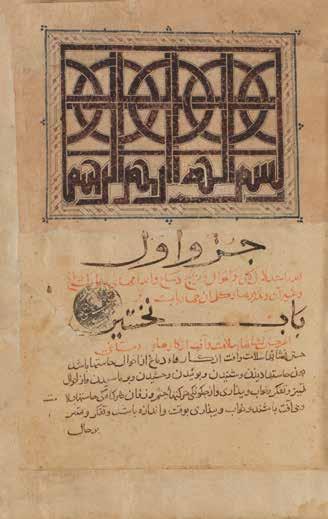
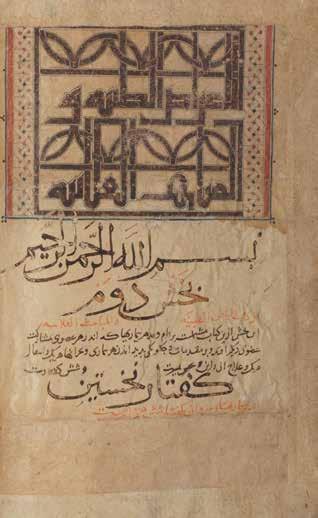
WA’L-MABAHITH AL-’ALA’IYAH, THE MEDICAL OBJECTIVES AND THE ELEVATED DISCUSSIONS, PART TWO, IN PERSIAN, WITH TWO TITLES IN STYLISED KUFIC ILKHANID PERSIA, LATE 13TH/EARLY 14TH CENTURY
Persian manuscript on paper, 125 leaves, 19 to 23 lines to the page, written in more than one hand in black and brown naskhi, titles in darker muhaqqaq, catchwords and headings in red ink, some replacement folios, second kufic title possibly added later, several seal impressions throughout, ownership inscriptions on the interior of the brown leather binding 235 x 170 mm.
£60,000 - 80,000
€69,000 - 92,000
US$81,000 - 110,000
Provenance
Formerly in a private UK collection since the 1980s.
With Robert Frew Ltd, London, antiquarian book dealer.
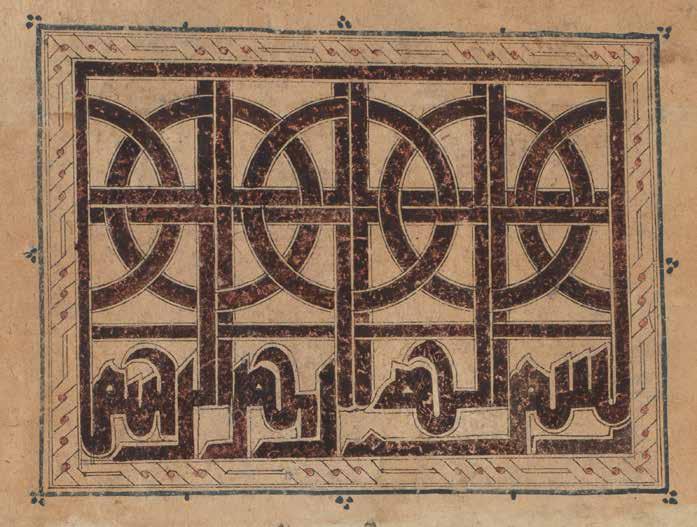
The opening heading in decorative kufic gives the title of the book, al-aghradh al-tibbiyah wa’l-mabahith al-’ala’iyah. The text has 26 sections. The opening to the first section has a heading in decorative kufic, similar to the opening heading, but incorporating the bismallah
There is a round seal impression of the early 16th Century, which reads in Persian: The servant [of God] Haji ‘Ali made waqf his books to those students of the Twelvers [Shi’i imams], with the date AH 937[?]/AD 1530-31[?]. On the opening leaves there are possession notes by a certain ‘Abd al-Jabbar and his descendants, two dated AH 1238/AD 1822-23, and Muharram 1247/June-July 1831.
This manuscript of Zayn al-Din Jurjani’s influential medical text features two unusual headings in geometric kufic. For a very similar heading in a manuscript of Minhaj al-Bayan fi-ma yasta’miluhu al-insan, a work on pharmacopaeia, by Abu ‘Ali Yahya bin ‘Isa bin Jazlah al-Baghdadi (d. 1099), Seljuk or Ilkhanid Persia, 13th Century (Christie’s South Kensington, Islamic Manuscripts featuring the Mohamed Makiya Collection, 18th April 2016, lot 157). This manuscript is now in the Islamic Arts Museum Malaysia, and the heading appears on the cover of the book accompanying the exhibition Al-Tibb: Healing Traditions in Islamic Medical Manuscripts, 2022.
Comparison can also be made with a heading in floriated kufic in a manuscript of al-Ikhtiyar fi’l-adwiyah al-mufradah (The Abridged Selection of Simple Medicines), by Abu’l Makarim Hibatallah ibn Jumay al-Isra’ili (d. 1198), Near East, second half of the 12th/first half of the 12th Century, Sotheby’s, Arts of the Islamic World and India, 26th April 2023, lot 18.
The author
Zayn al-Dīn Sayyid Ismā‘īl al-Jurjānī, often called Sayyid Ismā’īl alJurjānī, was a leading Persian physician of the 12th century, born in Gorgān (Jurjān) and active across Khwārazm and Khorasan. He pursued a career both as courtier and scholar at the Khwārazm-Shāh court, first under Quṭb al-Dīn Muhammad (reg. 1097–1127) and then under his successor ‘Alā’ al-Dīn Atsīz (reg. 1127–1156). He died in Marv in 1136.
His major achievement was the monumental ten-volume Dakhīraye Khwārazmshāhī (Treasure of the Khwarazmshah), the largest encyclopaedia of Galenic medicine composed in Persian. It combines Greco-Arabic (Avicennan and Galenic) theory with clinical observation, organising anatomy, physiology, pathology, pulse and urine, pharmacology, compound remedies, and therapy into an orderly reference for physicians. The Dakhīra became a cornerstone of Persian medical literature and a principal conduit for technical medicine in Persian, complementing the Arabic canon.
Al-Jurjānī also produced concise derivatives of the Dakhīra, notably our text, al-aghradh al-tibbiyah wa’l-mabahith al-’ala’iyah, compiled under ‘Alā’ al-Dīn Atsīz. He cultivated a precise Persian medical lexicon while retaining established Arabic technical terms, which influenced later Persian medical and scientific writing. Al-Jurjānī’s medical thought is frequently discussed in histories of Islamic medicine for its careful clinical descriptions and organisation of practice. His discussions
of diagnosis and regimen, therapeutics, and pharmacology were especially influential, and the sustained transmission of his works from the 12th century into the Ilkhanid and Timurid eras attests to their importance in both teaching and practice. By condensing an encyclopaedic treatise into a portable manual, Jurjānī produced a text that could be easily consulted by practising physicians, or studied by students without access to the ten-volume Dakhīra. Its was a standard reference for centuries.
Part One laid out the conceptual framework of Galenic medicine as adapted in the Islamic tradition. It begins with anatomy and physiology; the theory of temperaments (mizājāt), the balance of hot, cold, moist, and dry qualities; growth, respiration, sensation, and movement; preventive medicine - diet, exercise, bathing, sleep, and sexual health. Diagnostic methods - pulse and urine examination.
Part Two (our manuscript) deals with more practical and applied medicine. It begins with herbs, minerals, and animal-derived drugs and compounds, often with the Persian names alongside their Arabic equivalents; pathology and therapeutics, organised from head to toe; definition of ailments, causes explained, symptoms catalogued, therapies prescribed; diet and minor surgical procedures; general prescriptions for chronic conditions, balanced regimens and lifestyle.
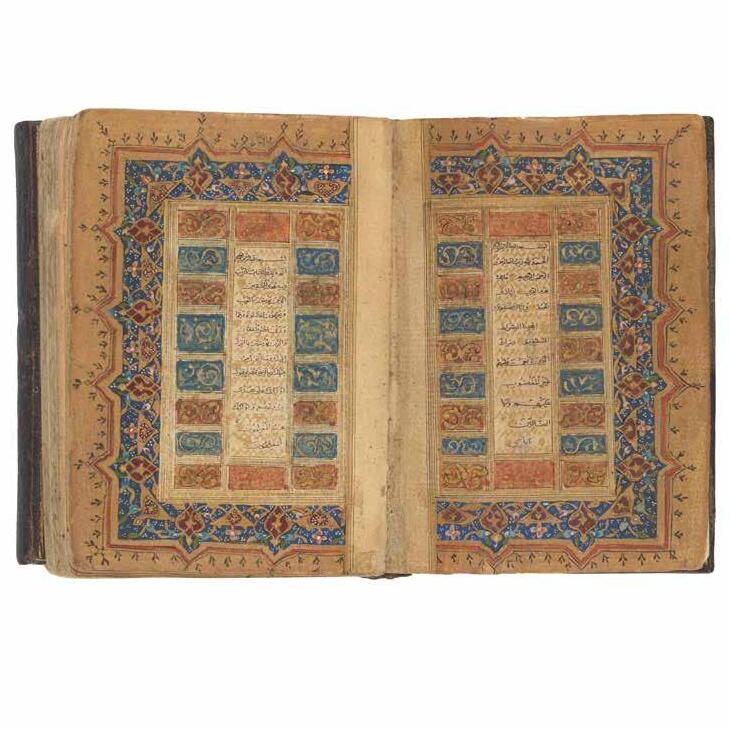
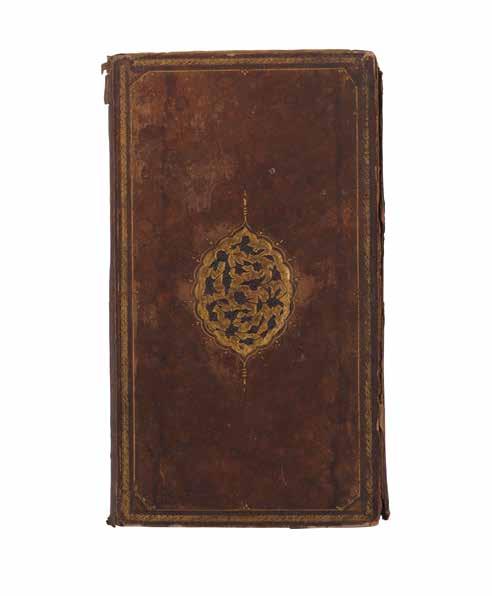
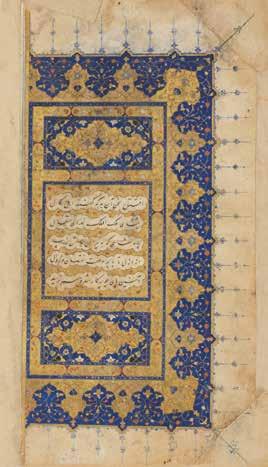
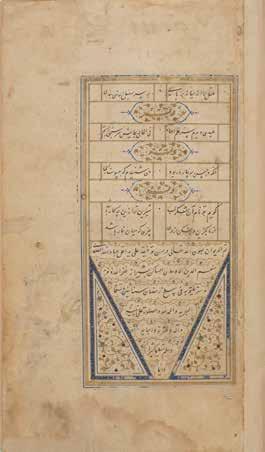
naskhi in black ink, ruled in gold and black, verses separated by gold roundels, sura headings in gold naskhi, f.1b and f.2a with double-page illuminated frontispiece, gilt-stamped brown leather binding, with flap, gilt leather doublures 98 x 75 mm.
£15,000 - 20,000
€17,000 - 23,000
US$20,000 - 27,000
EBUSU’UD EFENDI [MUHAMMAD ABU AL-SU’UD (ABU SU’UD EFENDI)] (D. 1574)
OTTOMAN TURKEY, LATE 16TH/EARLY 17TH CENTURY
Ottoman Turkish manuscript on paper, 36 leaves, 13 lines to the page written in nasta’liq in black ink, further text written diagonally within panels in margins, headings in red, inner margins ruled in gold, blue and black, one illuminated headpiece, further illumination on last page, prayers at end, contemporary binding with central stamped medallion, with flap 180 x 108 mm.
£6,000 - 8,000
€6,900 - 9,200
US$8,100 - 11,000
Provenance
Acquired in an estate sale, Washington DC, in February 2026. Private collection, USA.
A fine copy of this famous text, possibly copied in the author’s lifetime, or soon afterwards.
On the front flyleaf, in a late 16th or early 17th Century naskhi hand, is a description of the work: müfti-i sekalayn ebu’s-su’ud efendi hazretlerinin vezir-i a’zam ‘ali paşa’ya te’lifen irsal ve ihda buyurdığı du’a-namedur: ‘This is the Du’a-name written by His Excellence the Mufti of the Men and of the Jinn, Ebussu’ud Efendi, sent to and dedicated to the Grand Vizier ‘Ali Pasha’.
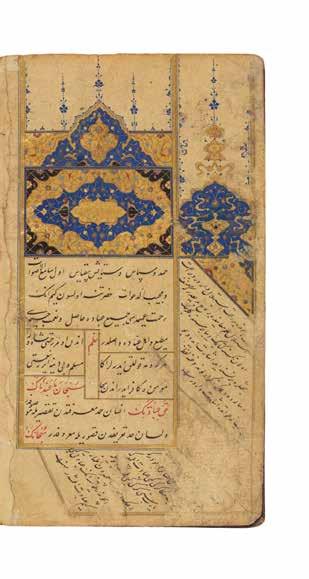
The work consists of seven chapters and is on the subject of the importance and benefits of supererogatory prayer. It is written in plain Turkish, and is therefore considered to an important text in the development of Turkish literature. Judging by the number of surviving copies, it was extremely popular. As the note discussed above states, the work was dedicated to (Semiz) ‘Ali Pasha, who was Grand Vizier in 1561-1565. For the work, see Abdullah Kaleli, Du’ânâme (İncelemeÇeviri Yazılı Metin-Özel Adlar Dizini-Tıpkıbasım), MA thesis, Adıyaman University, 2014.
For another early copy of the text, dated AH 1008/AD 1599-1600, signed by Muhammad Amin al-Husaini al-Tirmidhi, see Christie’s South Kensington, Arts and Textiles of the Islamic and Indian Worlds, 11th April 2014, lot 265.
Ebusu’ud was the most famous of all Ottoman jurists and Shaykh alIslam’s. The standard English-language work on him is Colin Imber, Ebu’s-Su’ud: the Islamic Legal Tradition, Edinburgh, 1997. The most up-to-date bibliography, in Turkish, is Pehlül Düzenli, ‘Şeyhülislam ebus- suûd efendi: bibliyografik bir değerlendirme’, in Türkiye Araştırmaları Literatür Dergisi, 3:5 (2005), pp. 441–75, esp. p. 453.
‘Sultan Suleyman the Lawgiver respected and trusted Ebussuud Efendi the most among his friends. Ebussuud was his close friend and confidant. The Sultan asked for Ebussuud’s opinion in many matters concerning his affairs. His high prestige by the Sultan, fame as a great scholar and wisdom made him a second ‘Magnificent’ person of the XVI century’. (A. Celebioglu, ‘Turkish Literature of the Period of Sultan Suleyman the Magnificent I’, in Divan Edebiyati Arastirmalari Dergisi 18, 2017, pp. 563-623).
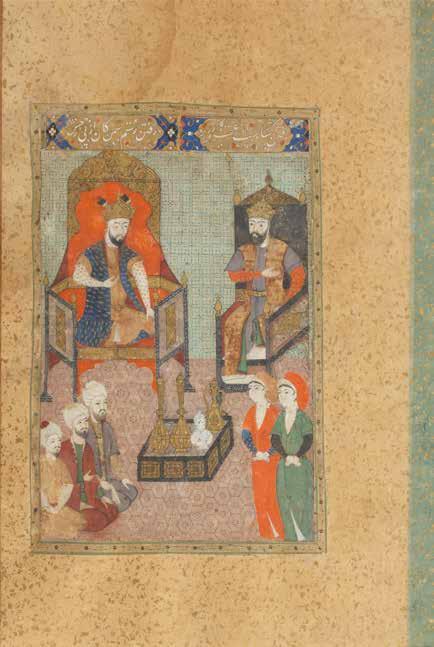
TWO ENTHRONED RULERS SEATED IN DISCOURSE, ATTENDED BY COURTIERS
OTTOMAN TURKEY, PROBABLY ISTANBUL, CIRCA 1580
gouache and gold on paper, two text panels at top excised from a Persian manuscript of the Shahnama, probably Shiraz, 16th Century, outer borders gold-sprinkled on a light brown and green ground; verso a leaf from another manuscript pasted to the reverse of the painting, 12 lines of nasta’liq text in two columns, upside down in relation to the painting leaf 265 x 180 mm.
£4,000 - 6,000
€4,600 - 6,900
US$5,400 - 8,100
The text of the leaf on the reverse is from the Yusuf and Zulaykha section of Jami’s Haft Awrang, probably from a late 16th Century manuscript, perhaps copied in Khorasan.
R
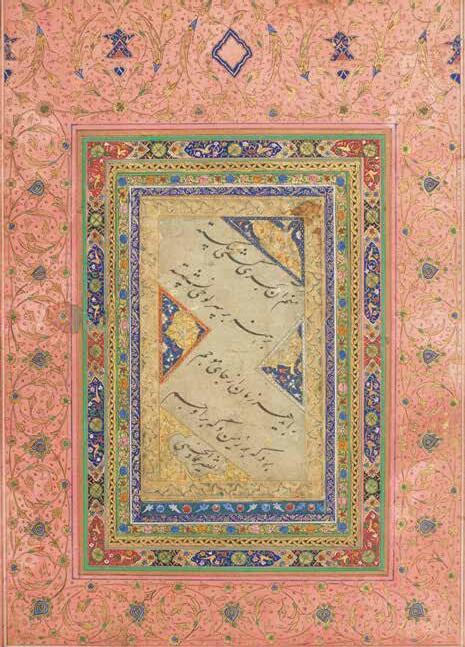
A CALLIGRAPHIC ALBUM PAGE CONSISTING OF TWO COUPLETS FROM JAMI’S YUSUF AND ZULAYKHA, SIGNED BY ‘IMAD AL-HASANI PERSIA, 16TH CENTURY
Persian manuscript on grey-green paper, two couplets written diagonally in fine nasta’liq in black ink, illuminated inner borders, outer borders with scrolling stylised floral and vegetal motifs on a pink ground calligraphic panel 95 x 50 mm.; album page 237 x 170 mm.
£3,000 - 5,000
€3,400 - 5,700
US$4,100 - 6,800
The scribe signs ‘The needy ‘Imad al-Hasani’.
One of the most celebrated nasta’liq calligraphers, Imad al-Hasani was born in Qazvin. Judged by his recorded work, he travelled much visiting Ottoman Turkey, Hijaz and Baghdad, later he worked at the court of Farhad Khan Qaramanlu in Semnan. After Farhad Khan was executed by Shah ‘Abbas, he returned to Qazvin and then to Isfahan, where he joined the court of Shah ‘Abbas. Another court calligrapher, ‘Ali Reza, became the favourite of the Shah, which upset Mir ‘Imad, who wrote unkind poems about the king, which caused an attempt at the court to get rid of him and accused him of being a Sunni and resulted in him being assassinated by the order of Shah ‘Abbas on 15th August 1615.
His recorded work is dated between AH 972/AD 1564-65 and AH 1024/AD 1615-16. See Mehdi Bayani, ahval va athar-e khushnavisan, vol. 2, Tehran, 1346 sh, pp. 518-538.
MIR ‘ALI SHIR NAVA’I, KHAMSA, IN TURKISH JAGHATAI, WITH 10 ILLUSTRATIONS
WESTERN PERSIA OR OTTOMAN EMPIRE, COPIED BY AT LEAST TWO DIFFERENT SCRIBES, ONE NAMED MAHMUD, DATED RAJAB 992/JULY-AUGUST 1584 AND WEDNESDAY 22ND DHI’L-QA’DA 1018/16TH FEBRUARY 1610
Turkish Jaghatai manuscript on paper, 307 leaves, incomplete, 21 lines to the page written in nasta’liq in black ink in four columns, intercolumnar rules in gold, inner margins ruled in gold in two versions, black and blue, headings in gold and blue, five fine illuminated headpieces, ten illustrations in gouache and gold, some spaces left blank for further illustrations, later brown morocco, with stamped central medallions containing painted lacquer 308 x 207 mm.
£6,000 - 8,000
€11,000 - 17,000
US$14,000 - 20,000
Provenance
Probably in the Persian royal library, in the Safavid, Afsharid or Zand periods.
Later acquired by ‘Ali Naqi, possibly a Major-General under Fath ‘Ali Shah Qajar, circa AH 1234/AD 1818-19 (his seal impressions).
With Bernard Quaritch, Grafton Street, London, 1919.
Acquired from the above by Captain G. L. M. Clausen (Quaritch invoice for £65, accompanied by catalogue description). Thence by descent in a private UK collection.
The illustrations are as follows:
From the Hayrat al-Abrar section:
1. An old woman seeks redress from the king for the death of her son in the presence of a qadi
2. A story concerning Hatim al-Ta’i and a labourer
3. During a battle led by Timur against India, two friends ask that their respective life be taken in place of the other’s. Timur subsequently commands that no more lives should be shed.
4. Shaykh Suhrawardi honours Yaqut in the presence of the Caliph
5. ‘Abdullah b. Mubarak wears a veil in battle
From the Layli and Majnun section:
6. Layli and Majnun at school
7. Majnun is taken to Mecca
8. Majnun in the wilderness
9. Majnun and Layli are found among animals in the wilderness. 10. Majnun and Layli are united.
The style of the illustrations are the same as the Qisas al-Anbiya’ manuscripts of the same period (circa 1570-90), discussed in Rachel Milstein et al, Stories of the Prophets: Illustrated Manuscripts of Qisas al-Anbiya’, Costa Mesa 1998, and the so-called ‘truncated’ Shahnamas discussed in Karin Rührdanz, ‘About a Group of truncated Šāhnāmas: A Case Study in the Commercial Production of Illustrated Manuscripts in the second part of the sixteenth century’, in Muqarnas 14, 1997, pp. 118-134. These are typically attributed to Western Persia or the Ottoman Empire.
There are two colophons: one says that the manuscript was completed by a certain Mahmud, dated Rajab 992/July-August 1584. Absence of an attribute makes it impossible to identify the scribe. The second colophon, at the end of Hayrat al-Abrar (the first book of the Khamsa), is in a different hand and in a mixture of Persian and Arabic, and gives the date Wednesday 22nd Dhi’l-qa’da 1018/16th February 1610, and the name Malik ‘Ali, in the corner, who may be the scribe.
There are a few library notes (many badly damaged) and seal impressions on the recto of the opening leaf, describing the manuscript and registering inspections of it manuscript, dated between AH 1105/AD 1693-94 and AH 1160/AD 1747-48. There are oblong seal impressions of Ahmad, Sayyid Murtaza al-Husayni, Muhammad Husayn al-Husayni and Muhammad. One note seems to be a presentation note to a royal official with its value (not clear). There are three different seal impressions of a certain ‘Ali Naqi, one dated AH 1234/AD 1818-19, placed on many leaves. He may be the Qajar Major-General, who was in Tabriz during the war between Persia and Russia and later in command of the army in Hamadan.
The Timurid courtier Mir ‘Ali Shir Nava’i was a highly influential figure in 15th Century Persia, and a leader of Turkic literature. He was born into a high-ranking Timurid family and was foster-brother to the future sultan Husayn Bayqara. While he unwillingly accepted political posts and excelled in them, he was primarily exercised by literature and art.
For a manuscript of Nava’i’s Diwan, see Sotheby’s, Arts of the Islamic World, 18th April 2007, lot 20, in Ottoman Turkish, dated to the second quarter of the 16th Century, copied by ‘Abdallah ibn Sheikh Murshid al-Shirazi.
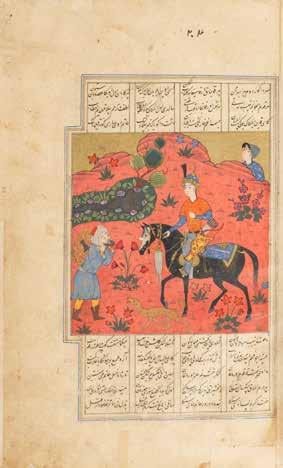
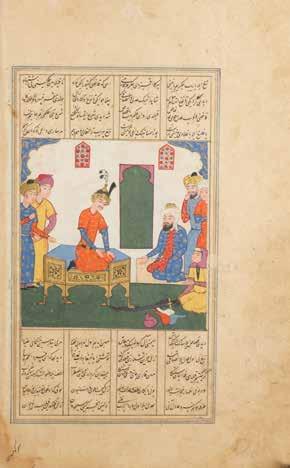
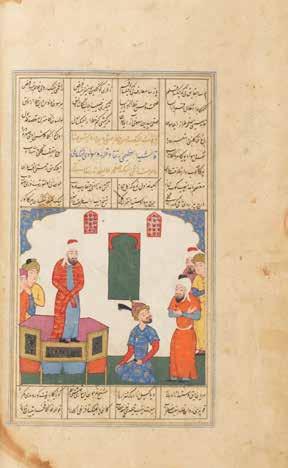
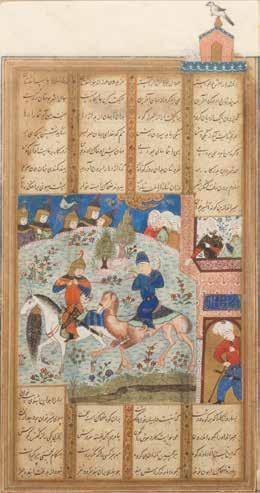
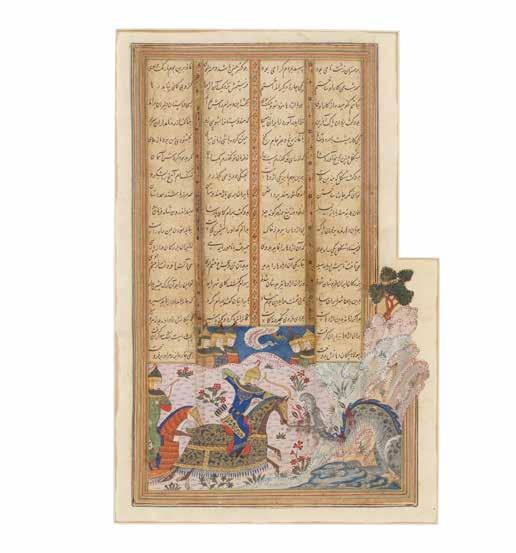
AN ILLUSTRATED LEAF FROM A MANUSCRIPT OF FIRDAUSI’S SHAHNAMA, DEPICTING FARIDUN CATCHING ZAHHAK AND LEADING HIM OFF IN CHAINS PERSIA, SHIRAZ, AQ-QOYUNLU PERIOD, CIRCA 1480-90
Persian manuscript on paper, text written in delicate nasta’liq script in black ink in four columns, intercolumnar rules in gold with small floral motifs, inner margins ruled in colours and gold, illustration in gouache and gold
visible leaf 275 x 140 mm.
£1,500 - 2,000
€1,700 - 2,300
US$2,000 - 2,700
Three illustrated leaves from the same dispersed Shahnama manuscript are in the David Collection, Copenhagen (inv. 48, 50, 51/2006). See J. Meyer, P. Wandel, Shahnama: the Colourful Epic about Iran’s Past, Copenhagen 2016, pp. 96-97, no. 14, 23 and 39. Other leaves are in the Art Institute of Chicago (1976.524 & 525), and in the Harvard Art Museum (2002.50.20).
For another leaf from the manuscript see lot 8 in this sale. Three further leaves have been sold in these rooms, Islamic and Indian Art Online, 28th November-6th December 2024, lots 5, 6 and 7. See also Sotheby’s, Arts of the Islamic World, 5th October 2011, lot 126 (three leaves).
8 R
AN ILLUSTRATED LEAF FROM A MANUSCRIPT OF FIRDAUSI’S SHAHNAMA, DEPICTING BAHRAM GUR SLAYING A DRAGON PERSIA, SHIRAZ, AQ-QOYUNLU PERIOD, CIRCA 1480-90
Persian manuscript on paper, text written in delicate nasta’liq script in black ink in four columns, intercolumnar rules in gold with small floral motifs, inner margins ruled in colours and gold, illustration in gouache and gold visible leaf 175 x 270 mm.
£1,500 - 2,000
€1,700 - 2,300
US$2,000 - 2,700
Provenance
Acquired in London, 1980s.
Three illustrated leaves from the same dispersed Shahnama manuscript are in the David Collection, Copenhagen (inv. 48, 50, 51/2006). See J. Meyer, P. Wandel, Shahnama: the Colourful Epic about Iran’s Past, Copenhagen 2016, pp. 96-97, no. 14, 23 and 39. Other leaves are in the Art Institute of Chicago (1976.524 & 525), and in the Harvard Art Museum (2002.50.20).
See also lot 7 in this sale. Three further leaves have been sold in these rooms, Islamic and Indian Art Online, 28th November-6th December 2024, lots 5, 6 and 7. See also Sotheby’s, Arts of the Islamic World, 5th October 2011, lot 126 (three leaves).
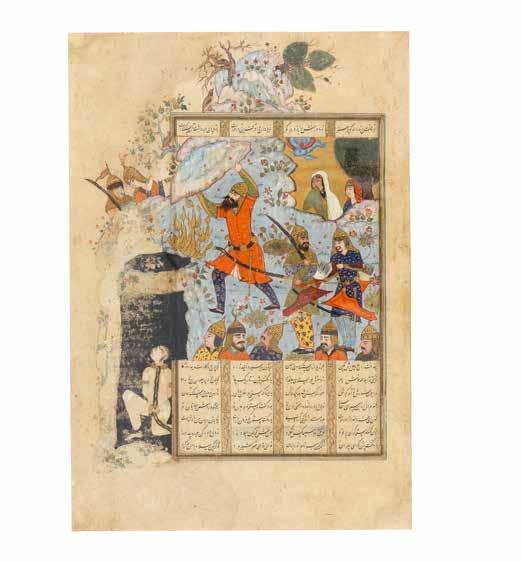
† R
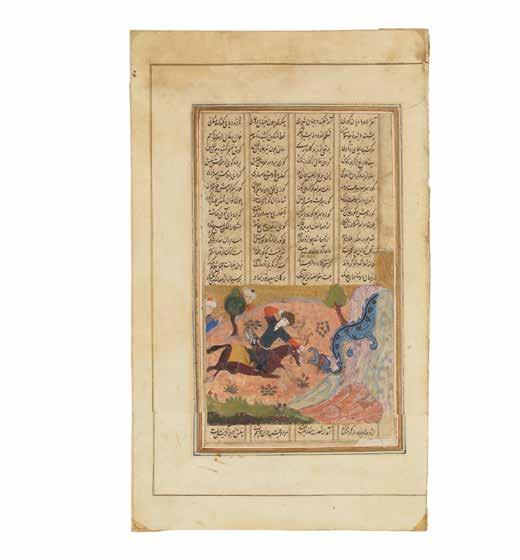
A LARGE LEAF FROM A MANUSCRIPT OF FIRDAUSI’S SHAHNAMA, DEPICTING RUSTAM RESCUING BIZHAN FROM THE PIT
PERSIA, QAZWIN OR MASHHAD, CIRCA 1580
gouache and gold on paper, 8 lines of text recto written in nasta’liq in black ink in four columns, inner margins ruled in gold, blue and black 345 x 235 mm.
£5,000 - 7,000
€5,700 - 8,000
US$6,800 - 9,500
AN ILLUSTRATED LEAF FROM A MANUSCRIPT OF NIZAMI’S HAFT PAYKAR, DEPICTING BAHRAM KILLING THE DRAGON TURKMAN, 15TH CENTURY
Persian manuscript on paper, 14 lines, text written in four columns of small nasta’liq in black ink, inner margins ruled in colours and gold, illustration in gouache and gold, pasted down on card, no text visible verso
leaf 282 x 167 mm.
£2,000 - 3,000
€2,300 - 3,400
US$2,700 - 4,100
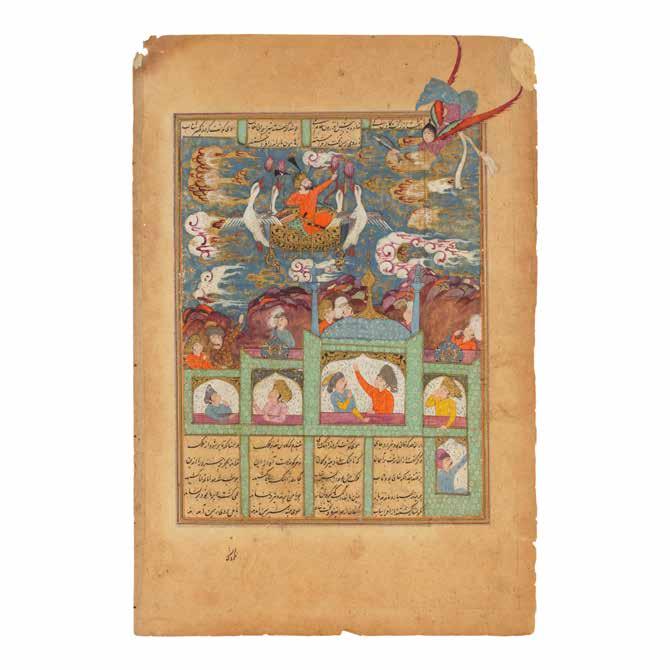
R
AN ILLUSTRATED LEAF FROM A DISPERSED MANUSCRIPT OF FIRDAUSI’S SHAHNAMA, DEPICTING KAY KAVUS ASCENDING TO THE SKY ON HIS THRONE PERSIA, SECOND HALF OF THE 16TH CENTURY
Persian manuscript on paper, 6-7 lines (recto) written in nasta’liq in black ink in four columns, painting in gouache and gold, inner margins ruled in colours and gold, 23 lines (verso) some written diagonally, with one heading in red leaf 320 x 217 mm.
£4,000 - 6,000
€4,600 - 6,900
US$5,400 - 8,100
Compare an early 16th Century depiction of the same subject in Shah Tahmasp’s Shahnama in the Metropolitan Museum of Art (inv. 1970.301.21).
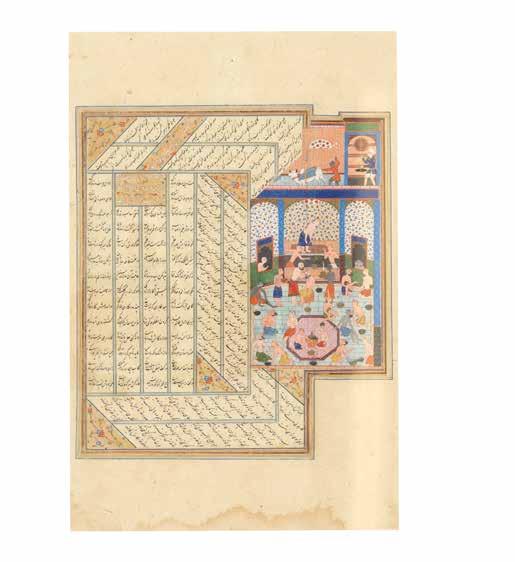
AN ILLUSTRATED LEAF FROM A MANUSCRIPT OF NIZAMI’S MAKHZAN AL-ASRAR, PART OF THE KHAMSA, DEPICTING HARUN AL-RASHID IN THE BATH HOUSE, WITH THE BARBER ASKING THE CALIPH FOR HIS DAUGHTER’S HAND PERSIA, SHIRAZ, CIRCA 1570
Persian manuscript on paper, text written in nasta’liq in black ink in four columns horizontally, further text written diagonally, intercolumnar rules in blue, headings in nasta’liq in white within illuminated panels, painting in gouache and gold, inner margins ruled in colours and gold leaf 355 x 230 mm.
£3,000 - 5,000
€3,400 - 5,700
US$4,100 - 6,800
Provenance
Cornet Gallery, Bayswater, London, 1980s.
13 † R
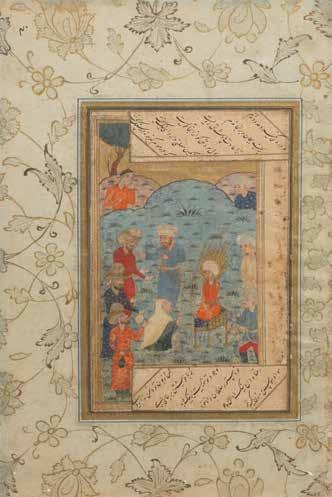
AN ILLUSTRATED LEAF FROM A MANUSCRIPT OF PERSIAN POETRY, PROBABLY DEPICTING THE DAUGHTER OF THE GENEROUS HATIM BEFORE THE PROPHET PERSIA, PERHAPS SHIRAZ, 16TH CENTURY
Persian manuscript on paper, text written diagonally in fine nasta’liq in black ink, illustration in gouache and gold, inner margins ruled in colours and gold, outer borders with naturalistic foliate motifs, some in gold, on a grey-green ground 237 x 150 mm.
£1,500 - 2,000
€1,700 - 2,300
US$2,000 - 2,700
The text above the image is from Sa’di’s Bustan, from the first section on the subject of justice, judgement and prudence. The text below the image is also from the Bustan but from the seventh section, on education.
For another depiction of the scene, in a manuscript of Sa’di’s Gulistan and Bustan, Shiraz, dated AH 1006/AD 1598, see Sotheby’s, Arts of the Islamic World, 24th April 2013, lot 60.
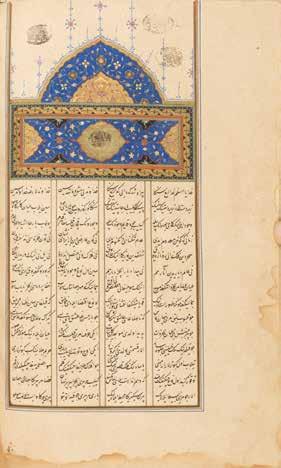
KAMAL KHOJANDI, DIWAN, POETRY, COPIED BY MUN’IM AL-DIN AL-AWHADI, RESIDENT OF SHIRAZ, PERHAPS FOR A ROYAL LIBRARY
PERSIA, SHIRAZ, DATED THE LAST DAY OF RAMADAN 902/1ST JUNE 1497
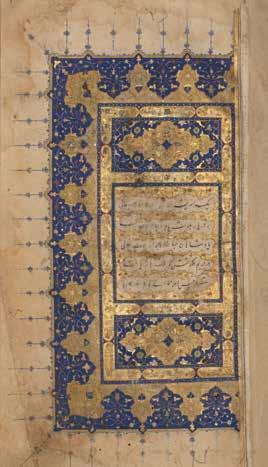
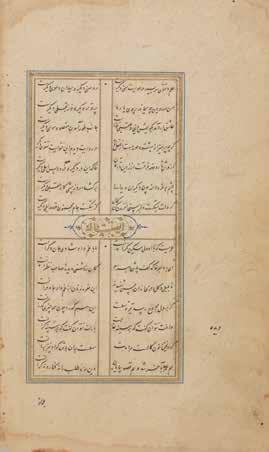
Persian manuscript on paper, 255 leaves, 14 lines to the page written in fine nasta’liq in black ink in two columns, intercolumnar rules in gold, inner margins ruled in gold, blue and black, headings written in nasta’liq in gold surrounded by floral illumination, one doublepage illuminated frontispiece, preceded by an illuminated shamsa containing a dedication, perhaps contemporary gold embossed covers incorporated in modern binding 240 x 145 mm.
£30,000 - 50,000
€34,000 - 57,000
US$41,000 - 68,000
Kamal Khojandi (d. 1400) was a Persian poet and Sufi. His Divan is written in ghazals, totalling 980 poems.
The opening cartouche contains a dedication: be-rasm-e khazaneh alsultan al-a’zam al-a’dal abu’l-fath sultan ahmad khallada mukuhu: ‘For the library of the Most Great Sultan, the most Just, Abu’l-Fath Sultan Ahmad, May (God) make his kingdom everlasting’. However, there is no Sultan Ahmad who appears to fit the date of the manuscript.
Mun’im al-Din is recorded as a calligrapher of the 15th-16th Centuries. His recorded work is dated between AH 894/AD 1488-89 and AH 927/AD 1520-21. See Mehdi Bayani, ahval va athar-e khushnavisan, vol. 3, Tehran 1348 sh, pp. 921-922.
For a manuscript of the same text, formerly in the library of Sultan Mehmed the Conqueror, Ottoman Turkey, circa 1460, see Christie’s, Art of the Islamic and Indian Worlds including a Private Collection Donated to Benefit the University of Oxford, 10th April 2014, lot 184; and the same manuscript subsequently at Sotheby’s, Arts of the Islamic World and India, 27th October 2020, lot 408.
15 * R
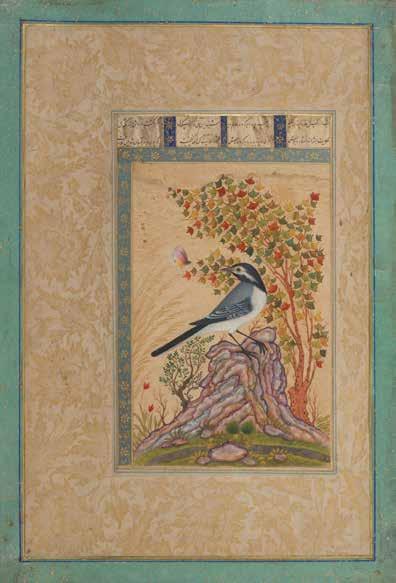
A BIRD PERCHING ON A ROCK BENEATH A TREE PERSIA, ISFAHAN, CIRCA MID-17TH CENTURY
gouache on paper, illuminated inner border, two lines of text in nasta’liq in four columns excised from a manuscript of Persian poetry, outer borders with naturalistic foliate motifs in gold, gold-sprinkled green edging the page painting 183 x 118 mm.; album page 355 x 243 mm.
£15,000 - 20,000
€17,000 - 23,000
US$20,000 - 27,000
Provenance
Private collection, Belgium.
Several similar examples of paintings depicting perching birds have appeared at auction, some attributed to artists including Mu’in Mussavir and Reza ‘Abbasi. There was a fashion at the time for paintings of birds, whether the long-tailed type seen in our painting, bulbuls, or seated partridges: an album of such paintings was known to exist, commissioned by Shah Abbas II. For comparison, see for example:
Christie’s, Islamic, Indian, Southeast Asian Manuscripts, Miniatures and Works of Art, 28th November 1983, lot 125, signed by Reza ‘Abbasi, dated 15th Shaban 1043/24th February 1634, in which the tree and its leaves are painted in a very similar manner.
Sotheby’s, Oriental Manuscripts and Miniatures, 29th April 1998, lot 64, attributable to Muhammad Qasim or Muhammad Yusuf, Isfahan, circa 1650 (though with a distinctively different way of modelling the tree).
Christie’s, Art of the Islamic and Indian Worlds, 17th April 2007, lot 240, signed Mu’in Musavvir, Isfahan, dated 16th Rajab 1097/29th June 1684; previously offered at Sotheby’s, Fine Oriental Manuscripts and Miniatures, 20th November 1986, lot 185 (illustrated on catalogue cover).
Christie’s, Art of the Islamic and Indian Worlds, 25th April 2024, lot 78, a white-eared bulbul, ascribed to Reza ‘Abbasi, Isfahan, dated Rajab 1037/March-April 1628, with possible later additions by the artist’s son Shafi’ ‘Abbasi in AH 1046/AD 1636.
16 * R
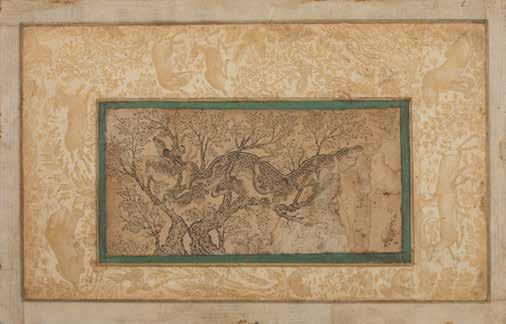
A DRAWING OF A DRAGON WRITHING AMIDST THE BRANCHES OF A TREE, LAID DOWN ON AN ILLUMINATED ALBUM PAGE
PERSIA, ISFAHAN, 17TH CENTURY
pencil on paper, laid down on an illuminated album page, with a narrow gold-sprinkled green inner border, outer borders with lions in pursuit of deer and other animals amidst trees and rocks, all depicted in gold
drawing 86 x 179 mm.; album page 198 x 311 mm.
£4,000 - 6,000
€4,600 - 6,900
US$5,400 - 8,100
Provenance
Private collection, Belgium.
17 * R
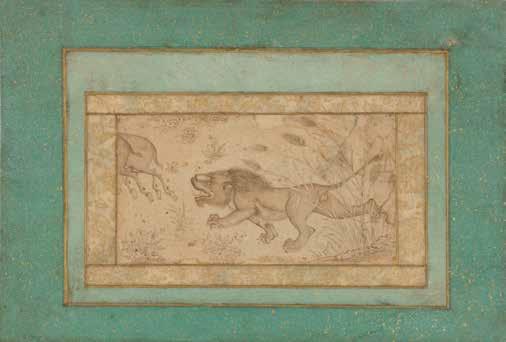
A DRAWING OF A LION IN PURSUIT OF IBEX, LAID DOWN ON AN ILLUMINATED ALBUM PAGE
PERSIA, ISFAHAN, 17TH CENTURY
pencil on paper, laid down on an illuminated album page, inner borders with naturalistic flowers and leaves in gold, gold-sprinkled green outer borders
drawing 76 x 143 mm.; album page 178 x 263 mm.
£1,500 - 2,000
€1,700 - 2,300
US$2,000 - 2,700
Provenance
Private collection, Belgium.
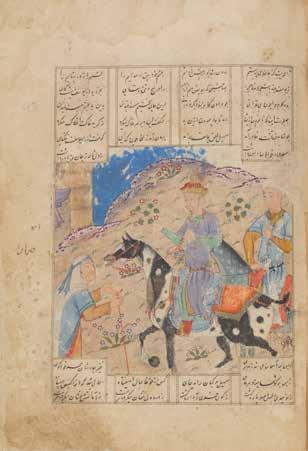
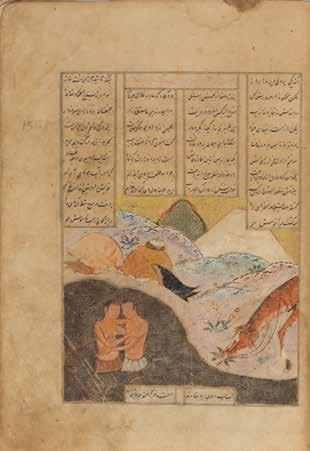
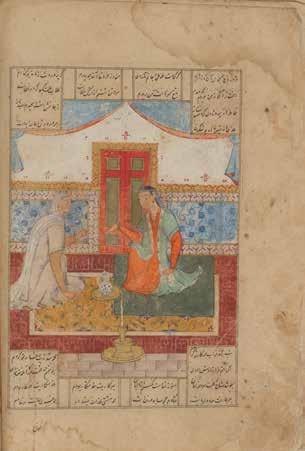
JAMI, HAFT AWRANG, FOUR PARTS ONLY (YUSUF AND ZULAYKHA, LAYLA AND MAJNUN, KHERADNAMEH-YE ISKANDARI, SUBHAT AL-ABRAR)
PERSIA, SECOND HALF OF THE 15TH CENTURY
Persian manuscript on paper, 180 leaves, misbound, 21 lines to the pages written in nasta’liq in black ink in four columns, four illuminated headpieces at the beginning of each book with the names of God in kufic, headings in eastern kufic in white, 8 paintings, date AH 813 added crudely at the end of each book at a later date, 18th Century morocco rubbed and tooled in blind with blind-stamped central cartouches
235 x 170 mm.
£15,000 - 20,000
€17,000 - 23,000
US$20,000 - 27,000
Provenance
The collection of H. Kevorkian (label on upper pastedown, no. 550).
The manuscript contains four (out of seven) books of Jami’s Haft Awrang, starting with the Yusuf and Zulaykha (5th), Layla and Majnun (6th), Kherad nameh-ye Iskandari (7th), Subhat al-abrar (with the prose preface and a few couplets at the beginning omitted) (4th). The first 3 books are missing, and the fourth book comes at the end.
The subjects of the paintings are as follows:
Zulaykha’s nurse finding out the cause of Zulaykha’s change of mood (from Yusuf and Zulaykha).
Zulaykha as a beggar stops Yusuf (from Yusuf and Zulaykha).
Layla meets Majnun on his return and declares her love (from Layla and Majnun).
Weeping Filqus [Philip] asks Aristotil for advice (from the Kheradnameh).
Shaykh Ruzbehan tells the mother that she is unwise to keep her daughter and her beauty concealed (from the Kheradnameh). The lover sees his beloved beauties and discovers that divine beauty is what is important (from the Subhat al-abrar).
The slave girl and the servant drown themselves in Tiger (from the Subhat al-abrar).
Moses watches a man being killed by a youth (from the Subhat alabrar).
The last page is the end of Subhat al-abrar
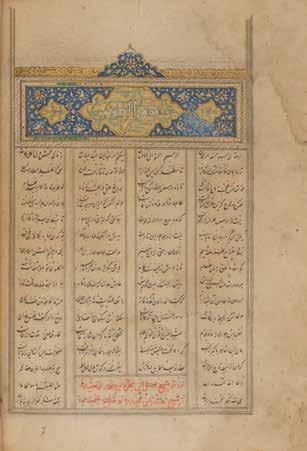
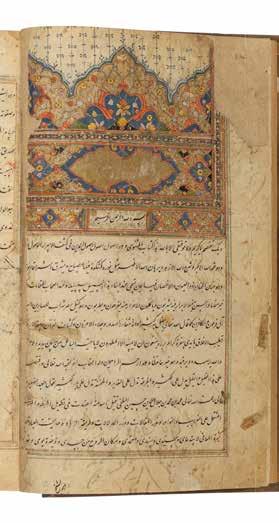
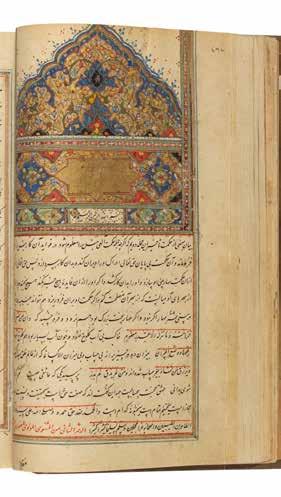
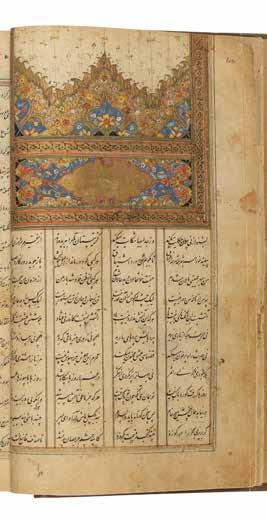
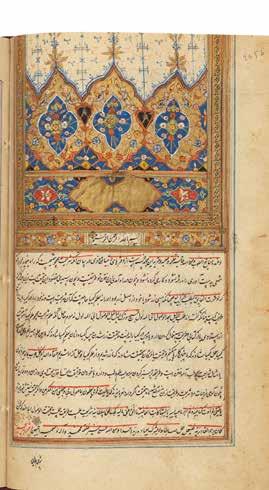
JALAL AL-DIN MUHAMMAD RUMI, MATHNAVI PERSIA, COPIED BETWEEN 11TH RABI’ I 1122/10TH MAY 1710 AND 22 RAJAB 1122/16TH SEPTEMBER 1710
Persian manuscript on paper, 406 leaves, 19 lines to the page written in nasta’liq in black ink in four columns, intercolumnar rules in gold, inner margins ruled in gold, blue and orange, headings in nasta’liq in red, six illuminated headpieces at the start of each book, modern leather binding with floral onlay 270 x 180 mm.
£6,000 - 8,000
€6,900 - 9,200
US$8,100 - 11,000
The scribe’s name is not given, but there is a prose section at the end of the fourth book which states that the text of this copy is taken from a master text which ‘Abd al-Latif ibn ‘Abdullah al-’Abbas put together after having studied 80 copies of the six books, wrote prefaces for each, corrected mistakes, gave references to the quotations from the Qur’an in the mathnavi, gave Persian translations of the Arabic, references to the stories and the number of folios of each story to make it easy for the readers to find certain passages. This is followed by an index to the fifth book.
‘Abd al-Latif ibn ‘Abdullah al-’Abbas Gujarati is recorded as working at the court of Shah Jahan and the first to add to the prefaces of each book of the Mathnavi and to give references to them, which he worked on between the years AH 1024/AD 1615-16 and AH 1032/AD 162223.
The text has five colophons, giving the dates of the completion of each book. It opens with the preface to the first book in prose with an illuminated heading. Each prose preface to each book has an illuminated heading.
The colophon of the first book is dated Sunday 11th Rabi’ I 1122/10th May 1710.
There is no colophon for the second book.
The colophon of the third book is dated Thursday 25th Jumadi I 1122/2nd July 1710.
The colophon of the fourth book is again dated Wednesday 25th Jumadi I 1122/2nd July 1710.
The colophon of the fifth book is dated Monday 22 Jumadi II 1122/18th August 1710.
The colophon of the sixth book is dated Monday 22 Rajab 1122/16th September 1710.
20 R
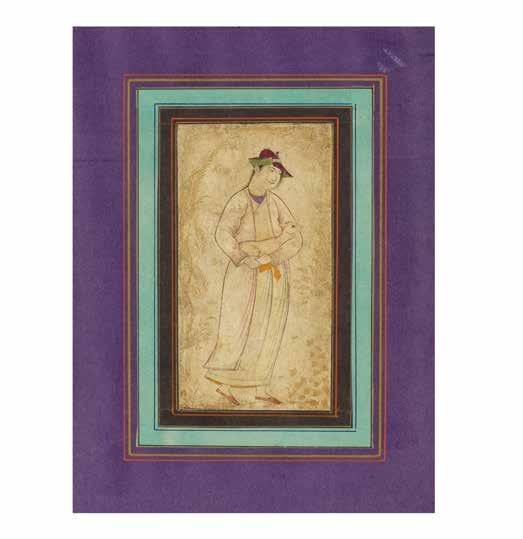
A YOUTH CRADLING A LAMB PERSIA, MID-17TH CENTURY
21 R
gouache and gold on paper, indistinct inscription at lower centre, laid down on 19th Century album page borders painting 140 x 75 mm.; album page 373 x 240 mm.
£4,000 - 6,000
€4,600 - 6,900
US$5,400 - 8,100
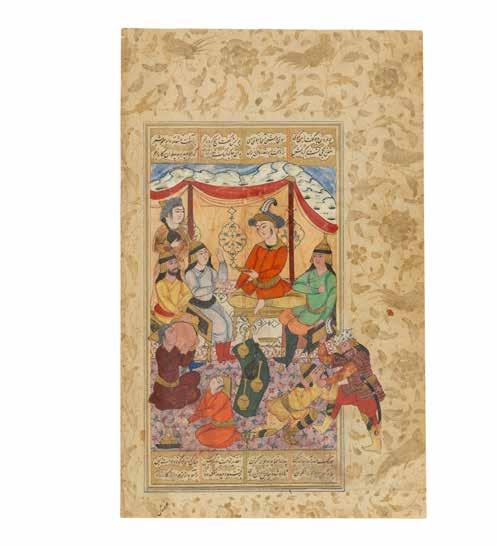
Zhendeh Razm was the son of the king of Samangan, who came to the palace of Afrasiyab to recognise Rustam and was killed by him with a single blow of the fist. 20 21
AN ILLUSTRATED LEAF FROM A MANUSCRIPT OF FIRDAUSI’S SHAHNAMA, DEPICTING RUSTAM KILLING ZHENDEH RAZM WITH A BLOW OF HIS FIST PERSIA, 17TH CENTURY
gouache and gold on paper, four lines of text recto written in four columns in nasta’liq in black ink within cloudbands on a gold ground, inner margins ruled in blue and gold, wide outer margins with birds amidst flower and leaves, all in gold leaf 355 x 218 mm.
£1,500 - 2,000
€1,700 - 2,300
US$2,000 - 2,700
Provenance
Acquired in London in the 1980s.
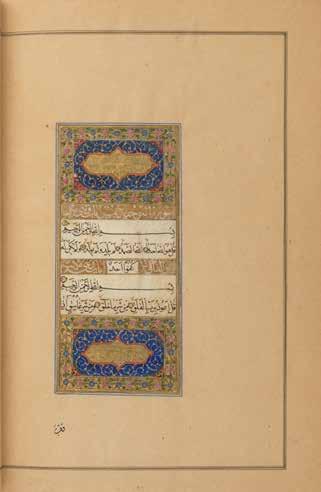
22 •
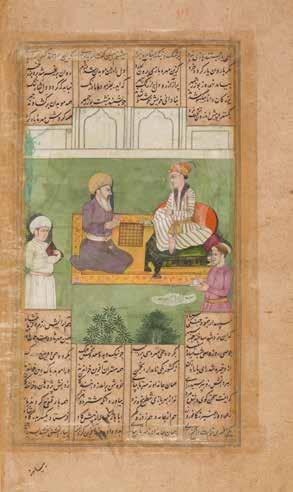
FIRDAUSI, SHAHNAMA, THE BOOK OF KINGS, WITH 12 ILLUSTRATIONS
NORTH INDIA, 18TH-19TH CENTURY
Persian manuscript on different-coloured paper, 218 leaves, incomplete, misbound, written in at least two hands, 25 lines to the page written in nasta’liq in black ink in four columns, intercolumnar rules in gold, inner margins ruled in gold, black and blue, headings in gold, red or left blank, 12 illustrations in gouache and gold, later halfcalf rebacked in blue cloth 288 x 185 mm.
£1,200 - 1,800
€1,400 - 2,100
US$1,600 - 2,400
Provenance
By repute, formerly in the collection of A. C. Ardeshir. Private UK collection.
For the full note on this lot, see the online catalogue.
23 • AN ILLUMINATED QUR’AN
PROBABLY OTTOMAN TURKEY, WITH LATER ADDITIONS, 17TH CENTURY, AND LATE 19TH CENTURY
Arabic manuscript on paper, 375 leaves, 14 lines to the page written in naskhi in black ink with diacritics and vowel points in red and black, verse-endings marked with gold cusped roundels, inner margins ruled in gold, blue and black, sura headings in naskhi in white on a gold ground, double-page illuminated frontispiece, illumination probably added in the late 19th Century, further illumination on last two leaves, Qajar leather binding with floral lacquer onlay
206 x 155 mm.; text area 105 x 47 mm.
£1,500 - 2,000
€1,700 - 2,300
US$2,000 - 2,700
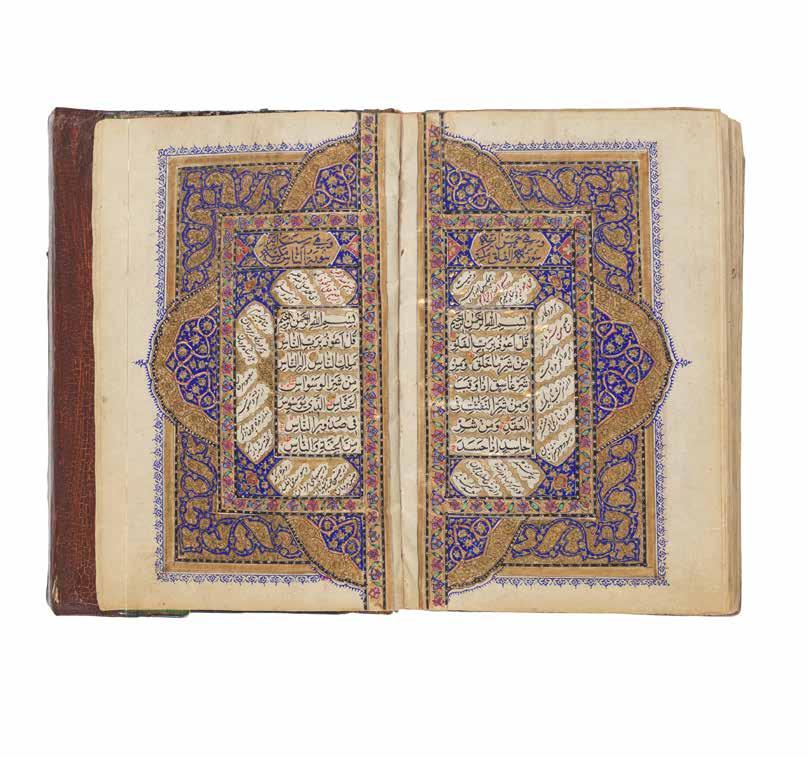
Arabic manuscript on paper, 390 leaves, 15 lines to the page written in fine naskhi in black ink within cloudbands on a gold ground, inner and outer margins ruled in gold and blue, marginal commentaries written in nasta’liq, marginal text division markers in red, sura headings written in riqa’ in blue on a gold ground, one double-page illuminated frontispiece preceded by another illuminated double-page with hadith on reading the Qur’an, followed by an illuminated headpiece, a further illuminated bifolio within the text, two double-page illuminated endpieces, contemporary Kashmiri floral painted lacquer binding, inside covers with stylised cypress trees, with flap 205 x 145 mm.
£7,000 - 9,000
€8,000 - 10,000
US$9,500 - 12,000
Qur’an in his later years.
• R
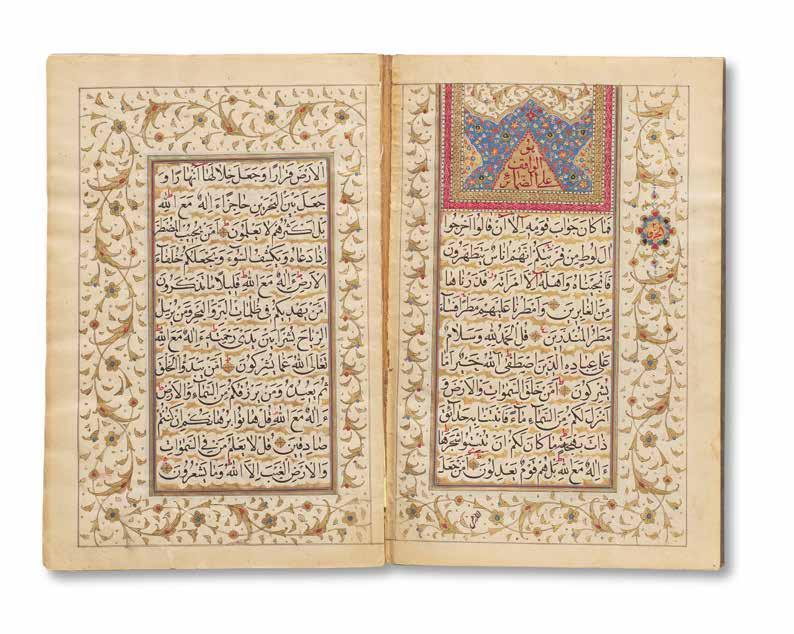
TWENTY-NINE ILLUMINATED QUR’AN AJZA’, COPIED BY MUHAMMAD SADIQ AL-HUSAINI AL-YAZDI
QAJAR PERSIA, DATED AH 1243/AD 1827-28
Arabic manuscript on paper, each volume with 12 lines to the page written in naskhi in black ink, inner margins ruled in red, green, gold and blue, verse-endings marked by illuminated rosettes, sura headings in white or blue or pink riqa’ against a gold ground within polychrome cartouches, illuminated marginal devices marking hisb, the illuminated opening double pages of each juz’ decorated with a gold and polychrome border of interlacing flowers and an illuminated heading, juz I with a double-page opening illuminated frontispiece, green leather binding
257 x 167 mm.(29)
£6,000 - 8,000
€6,900 - 9,200
US$8,100 - 11,000
Provenance
The Shakerine Collection.
Literature
N. Safwat, A Collector’s Eye: Islamic calligraphy in Qur’ans and other manuscripts, London 2010, pp. 62-63, no. 11.
For a Qajar Qur’an in thirty sections, with fitted case and dated AH 1271/AD 1854-55, see Christie’s, Art of the Islamic and Indian Worlds, 21st April 2016, lot 120. For another comparable set, in sixty volumes and dated AH 1258-59/AD 1842-44, in a lacquered wood box, see Sotheby’s, Arts of the Islamic World, 1st May 2019, lot 52.
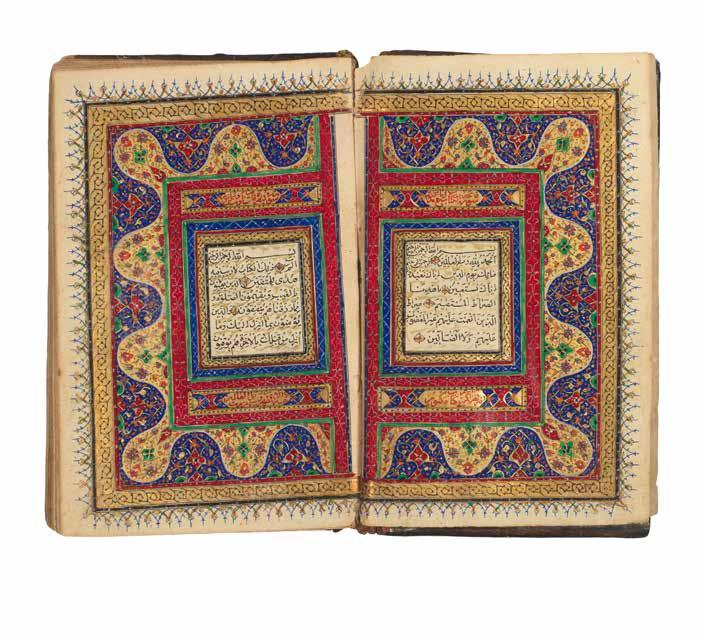
Arabic manuscript on paper, 169 leaves, 23 lines to the page written in small naskhi script in black ink within gold cloudbands, inner margins ruled in gold and black, marginal illuminated devices including chapter titles, sura headings in red naskhi on a gold ground within illuminated panels, double-page illuminated frontispiece preceded by two leaves with prayers to be recited before reading the Qur’an, within stylised cypress trees, floral lacquer binding 106 x 70 mm.
£1,500 - 2,000
€1,700 - 2,300
US$2,000 - 2,700
The scribe is recorded as a teacher of Muhammad Mirza Kalhor (d. 1892). He wrote in nasta’liq and naskhi. His only recorded work is a Qur’an in the National Library of Tehran, dated AH 1291/AD 1875-76.
See Mehdi Bayani, ahval va athar-e khushnavisan, vol. 3, Tehran, 1348 sh, p. 712 and vol. 4, 1358 sh., p. 155.
27 No lot
OTTOMAN TURKEY, DATED AH 1199/1784-85
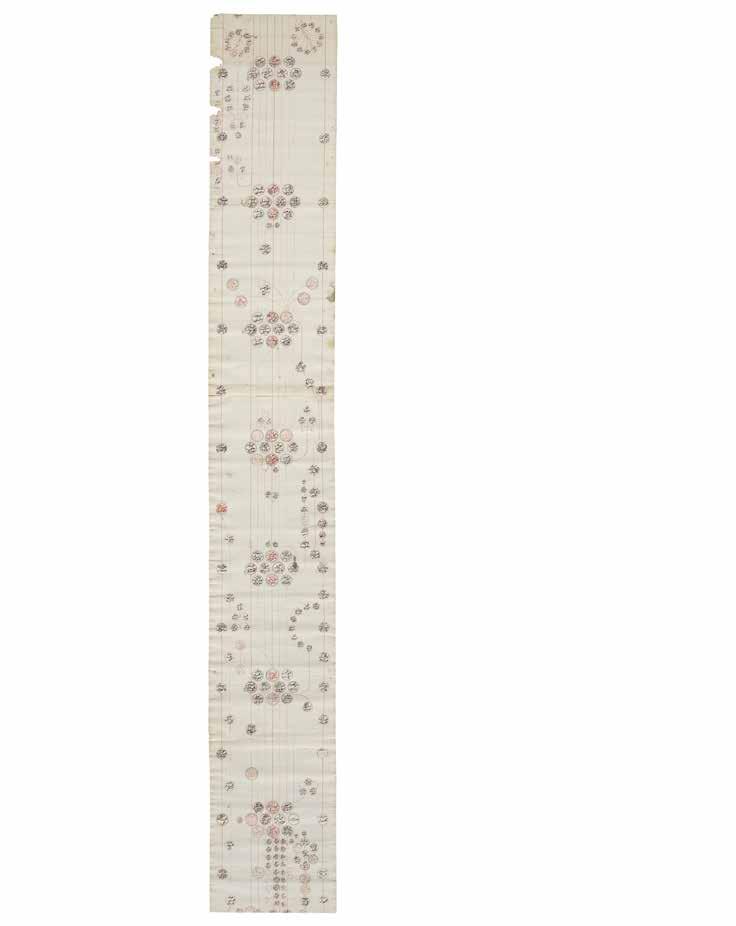
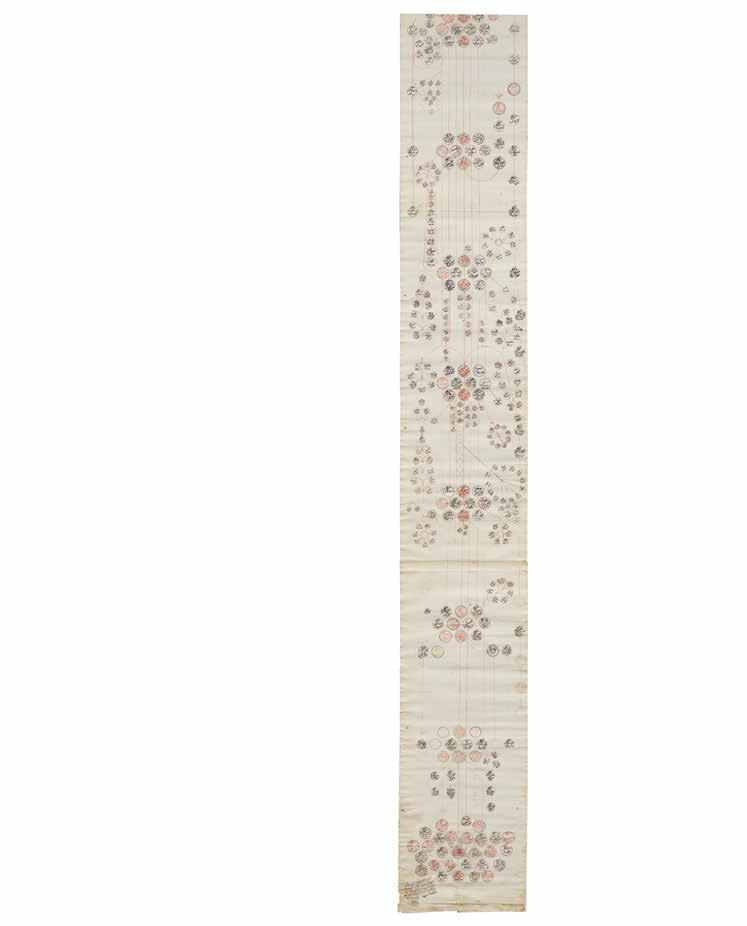
Arabic and Ottoman Turkish manuscript on paper, roundels outlined in red, black and green containing names and titles of historical figures in naskhi script in red and black, roundels linked by ruled red lines, in two parts, each section incomplete, framed 174 x 24.5 cm.; 177 x 24.5 cm.; frames 200 x 50 cm.
£4,000 - 6,000
€4,600 - 6,900
US$5,400 - 8,100
Provenance
Property from a Princely Collection.
Genealogical manuscripts (silsilename) in the form of a scroll or a book were popular in the Ottoman period. Although generally classed as genealogies they in fact do not function strictly as such. They usually begin with an account of the Prophet Muhammad, followed by a history of the world from Adam to the reigning Ottoman Sultan, in our example is Sultan Suleyman the Magnificent.
For a similar example see Christie’s, Art of the Islamic and Indian Worlds, 8th October 2015, lot 116 (dated AH 1255/AD 1839-40), and Sotheby’s, Arts of the Islamic World, 9th April 2008, lot 29 (a bound manuscript of sixteen leaves, dated AH 978/AD 1570 and AH 981/AD 1573; and Sotheby’s, 9th October 2013, lot 56 (still in scroll form, mid19th Century).

31 R
PERSIA, 12TH/ 13TH CENTURY
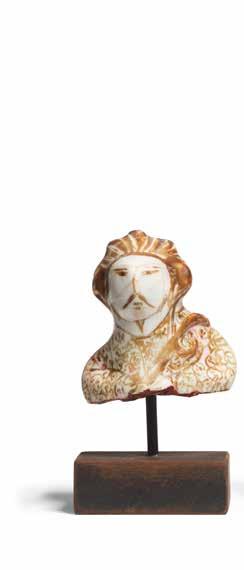
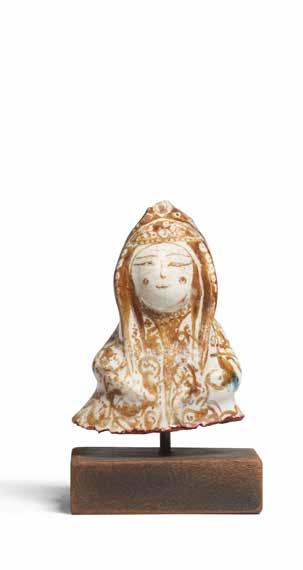
comprising a female and male bust, decorated in golden-brown lustre on a white ground with spiral and vegetal motifs to their clothing, the woman with headpiece, the man with remains of a turban, both on stands the largest 10.5 cm. high (excluding stand)(2)
£1,500 - 2,000
€1,700 - 2,300
US$2,000 - 2,700
In the late Seljuk period figures came to occupy a large part of ceramic production in Kashan. Alongside figures of animals, human figures, including musicians and horsemen, were popular among potters. For further discussion, see Oliver Watson, Ceramics from Islamic Lands, Kuwait 2004, pp.344-345.
29 R
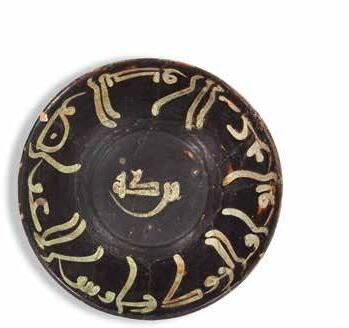
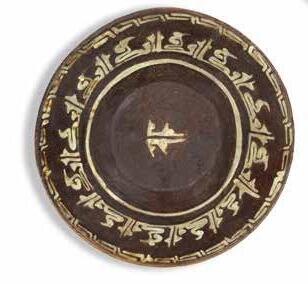
TWO SAMANID SLIP-PAINTED POTTERY BOWLS
PERSIA, 10TH CENTURY
each of conical form on a short foot, decorated in cream and aubergine slip, the first with inscriptions in kufic; the second with a pseudo-inscriptions with avian lettering and geometric band to rim; each with stripe and arrow motifs to exterior and ‘Bluett & Sons London’ label to base the largest 21.5 cm. diam.(2)
£2,000 - 3,000
€2,300 - 3,400
US$2,700 - 4,100
Provenance
Formerly with Bluett and Sons, London.
Inscriptions: to walls, al-jud haris al-a’rad, ‘Generosity is the guard to honour’, to well, barakah ‘Blessing’.
30 No lot
R
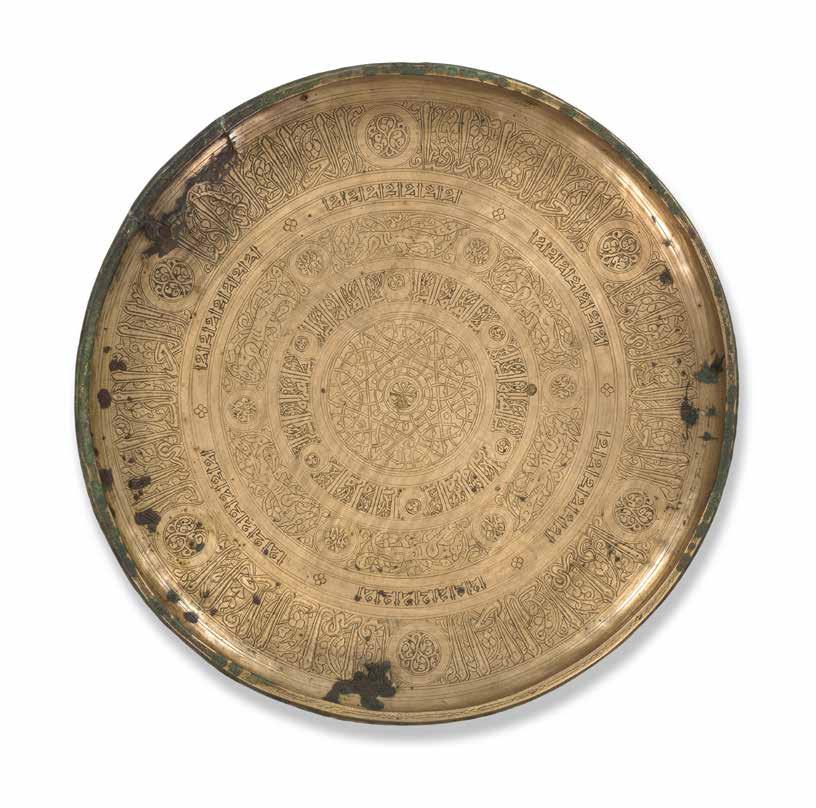
A FINE KHORASAN BRONZE TRAY PERSIA, EARLY 13TH CENTURY of shallow rounded form, profusely engraved to the interior with central roundel filled with geometric interlace, surrounded by a series of bands with inscriptions and quadrupeds, scrollwork band to exterior 33 cm. diam.
£8,000 - 12,000
€9,200 - 14,000
US$11,000 - 16,000
Inscriptions: to bands sequentially from outside in, in cursive, repeat of al-’izaa al-da’im iqba[l], ‘perpetual glory, prosperity’; in Kufic, al’izz al-d[a’im], ‘perpetual glory’; in Kufic, repeat of bi’l-yumn wa al-bara[ka], ‘with good-fortune and blessing’.
For a very similar tray in the Victoria and Albert Museum, see A.S. Melikian-Chirvani, Islamic Metalwork from the Iranian World: 8-18th Centuries, London 1982, cat. no. 27, pp. 96-98.
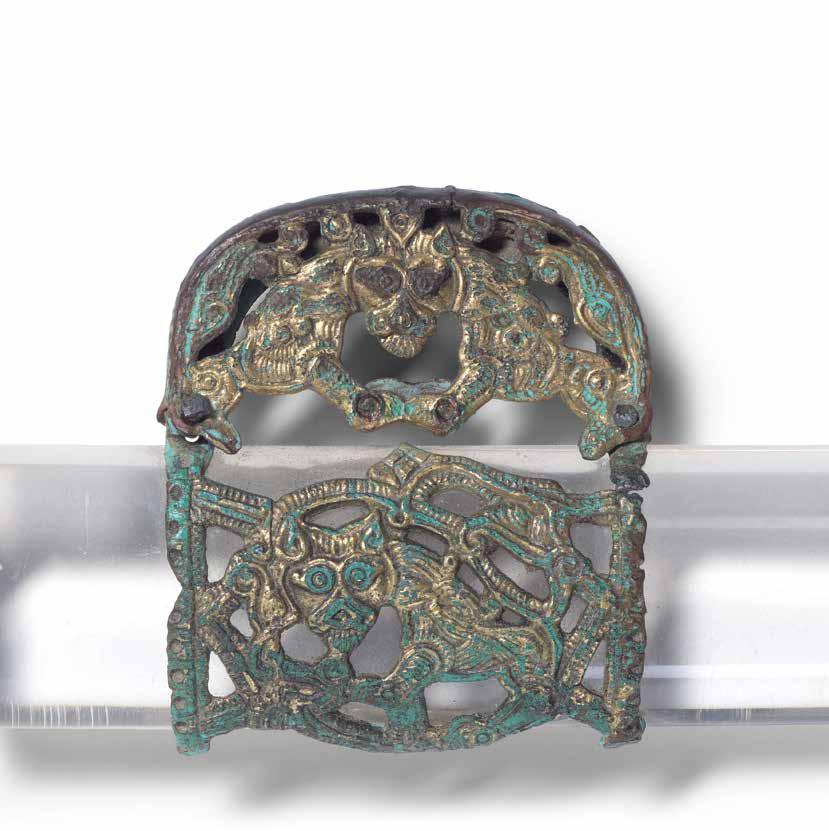
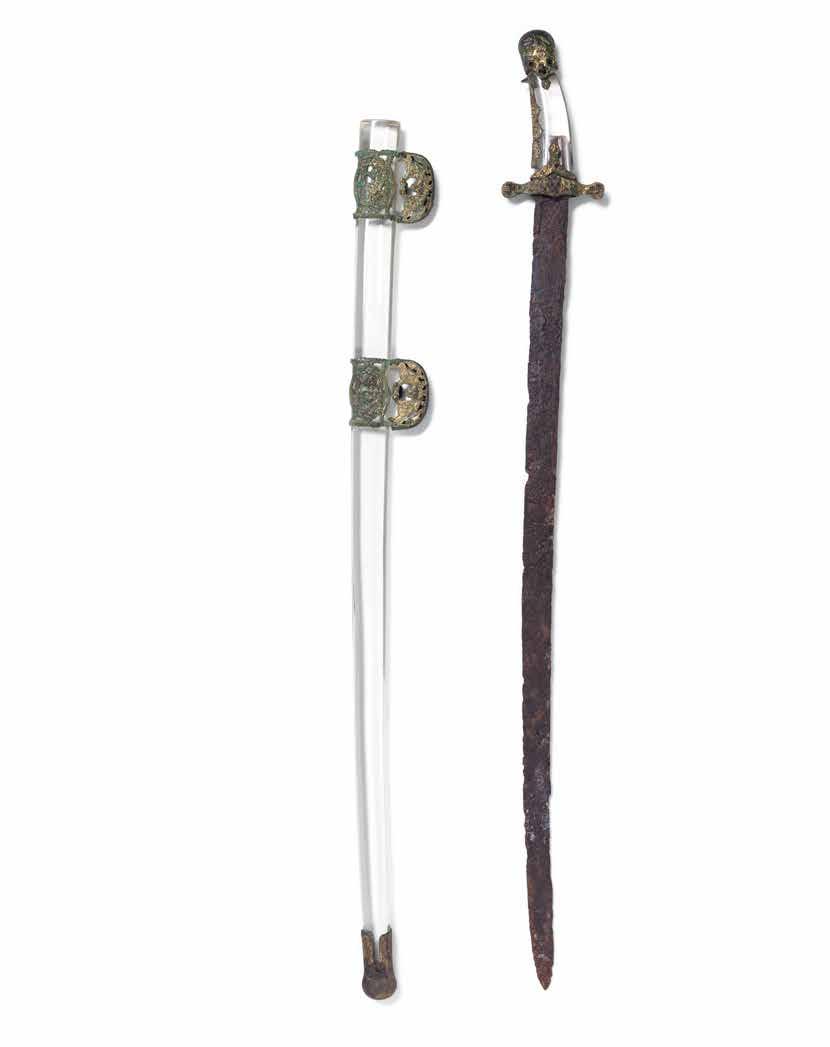
the single-edged iron blade of slightly curved form, the gilt bronze hilt and scabbard mounts consisting of a rounded pommel decorated to each side with a lion, suspension ring to one side; a cross guard with bud-shaped quillons, decorated with lions to each side; a further mount above the guard with foliate decoration; and another attached to the inner grip decorated with vegetal decoration; all attached to a reproduction perspex hilt; the scabbard mounts consisting of two suspension mounts decorated in openwork with paired confronting lions and single lions surrounded by vegetal interlace, the chape of bulbous form with vegetal decoration; all attached to reproduction perspex hilt
85.5 cm. long
£50,000 - 70,000
€57,000 - 80,000
US$68,000 - 95,000
Provenance
Private German collection since 1991.
Private UK collection acquired in 2004.
The Khazar Khaganate was a powerful steppe empire that flourished roughly between the 7th and 10th centuries, stretching across parts of modern southern Russia, Ukraine, and Kazakhstan. It was strategically positioned along major trade routes between Europe and Asia, which made it both wealthy and culturally diverse. Khazar art reflected this mix of influences. Archaeological finds show finely worked metal objects, jewellery, and decorative items which blend steppe nomadic styles with Byzantine and Islamic motifs. Their craftsmanship often emphasized intricate geometric patterns and animal designs, typical of steppe cultures. The Khazars were skilled mounted warriors who relied heavily on bows, sabres and lances, suited to fast cavalry tactics. Their military strength, combined with fortified cities and defensive earthworks, allowed them to control trade and resist expansion from neighbouring powers for several centuries. For a very similar sword with mounts also depicting lions, and further discussion of the type see Bashir Mohamed, The Arts of the Muslim Knight: the Furusiyya Art Collection, Milan, 2007, pp. 30-31, no. 1.
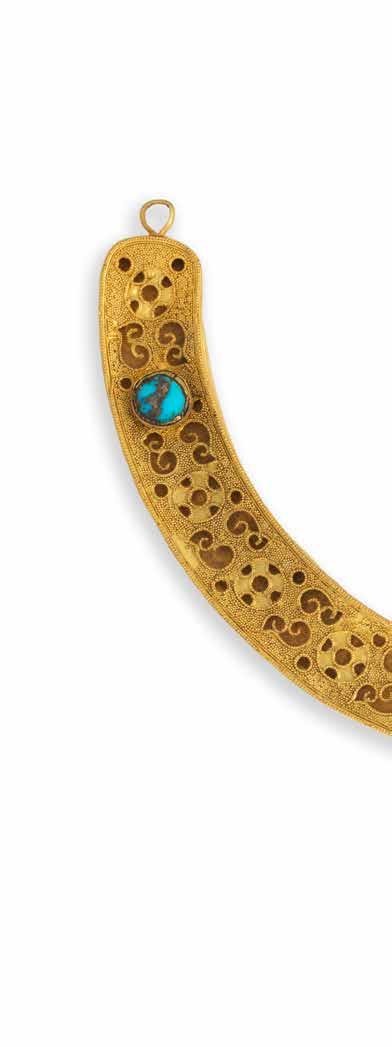
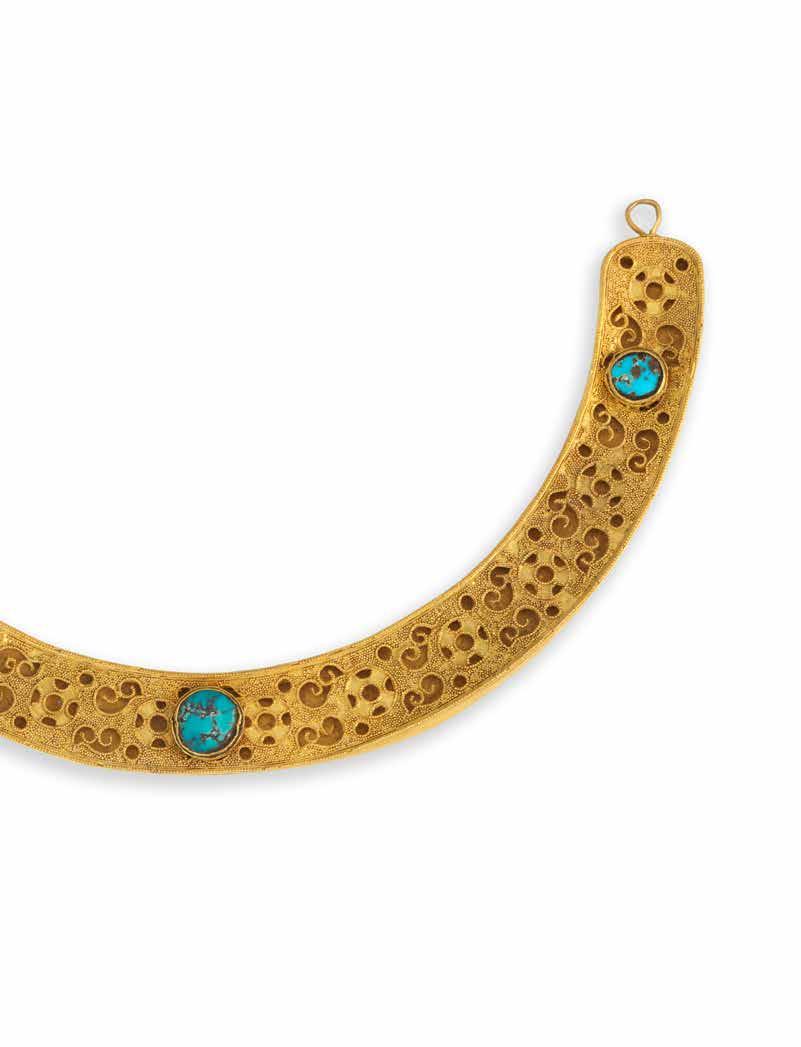
A RARE GOLDEN HORDE TURQUOISE-INLAID GOLD NECKLACE
CENTRAL ASIA, 13TH/ 14TH CENTURY of crescent form, decorated in filigree with repeated medallion motifs interspersed by foliate scrollwork, set with three turquoises, suspension loops to each end 16.9 cm. wide; 70 g.
£20,000 - 30,000
€23,000 - 34,000
US$27,000 - 41,000
Provenance
Formerly in a UK private collection. Acquired in London in the 1980s.
Led initially by Gengis Khan’s son, Juchi, the Golden Horde was established in the lower Volga and Crimea in the thirteenth century. The work of Russian archaeologist M. G. Kramarovsky and his study of the Treasure of Niezatski in Crimea has been cited in relation to Golden Horde jewellery production. His work explored a trove of jewellery including bracelets and phylacteries in the form of pendants. It is these pendants that share the same box construction as this lot (Kramarovsky, M.G., ‘Niezatski Treasure: Crimea and Asia Minor in the 14th century’, Bizantiya i blizhni Vostok Gosudarstvennugo Ermitazha, XLVII, St. Petersburg, 1994). Another example exists in the Hermitage Museum (Masterpieces of Art in the Hermitage Museum, exhibition held in the Dar al-Athar al-Islamiyyah, Kuwait, 1990, no. 48). This pendant has a similar box construction, and the same combination of filigree and granulation interspersed with set stones.
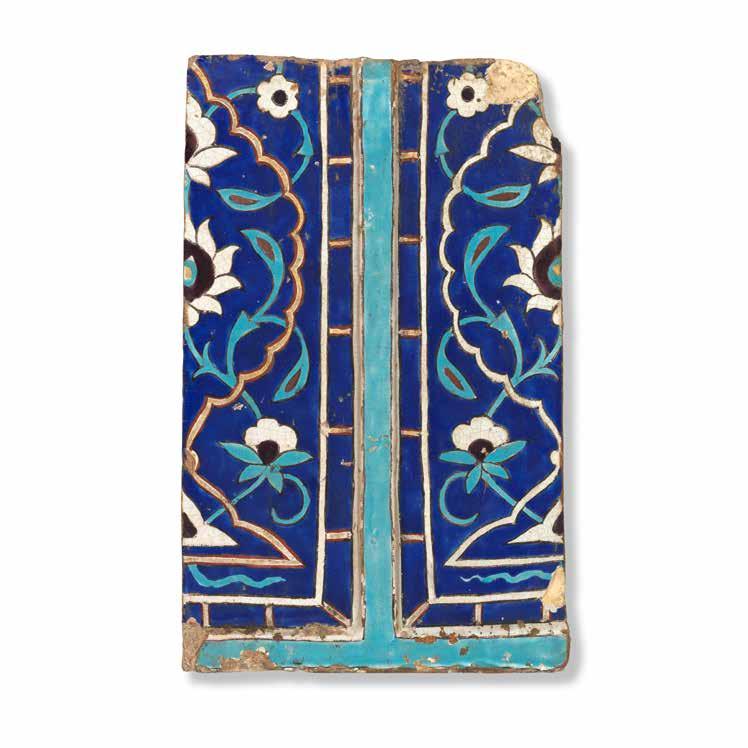
A LARGE TIMURID MOULDED CUERDA SECA POTTERY TILE
CENTRAL ASIA, PROBABLY UZBEKISTAN, EARLY 15TH
CENTURY
of rectangular form, decorated in cobalt-blue, turquoise, manganese and red on a cream ground with a pair of partial lobed cartouches containing floral interlace, panels separated by ridged border
51 x 31.5 cm.
£7,000 - 9,000
€8,000 - 10,000
US$9,500 - 12,000
Provenance
Formerly in a private collection, London, since the late 1980s.
35 R
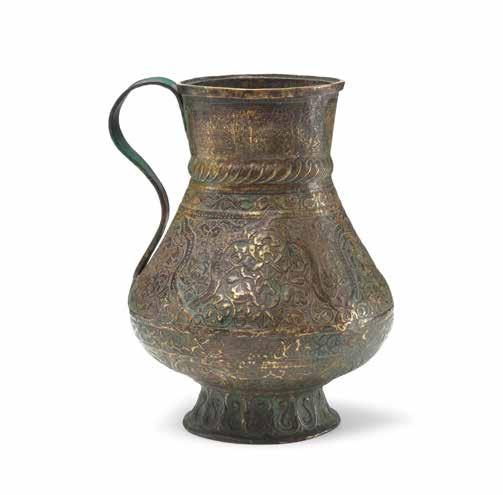
AN ILKHANID BRONZE JUG
PERSIA, 13TH/ 14TH CENTURY
of bulbous form on a splayed foot with slightly flaring neck and strap handle, engraved and decorated with lobed arches to central body filled and interspersed with floral sprays, flower-filled bands to upper and lowers sections with strapwork borders, inscriptions in thuluth on scrolling ground to neck, foliate and ‘s’-shaped motifs to foot 19.2 cm. high
£6,000 - 8,000
€6,900 - 9,200
US$8,100 - 11,000
Inscriptions: wa al-baqa’ wa al-baqa’ wa al-baqa’ wa al-baqa’, ‘... and long life and long life and long life and long life and ...’.
For an Ilkhanid candlestick with comparable motifs, see Douglas Barrett, Islamic Metalwork in the British Museum, London 1949, pl.35.
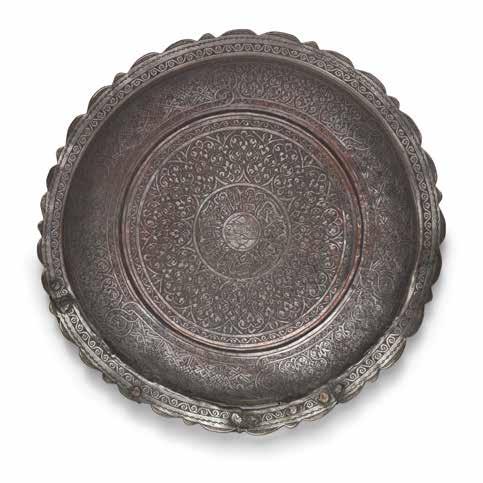
EGYPT OR SYRIA, EARLY 16TH CENTURY
of shallow circular form with lobed rim, profusely engraved with a central roundel filled with inscriptions in thuluth around a heraldic blazon, with arabesques to the well and walls interspersed by knot motifs, geometric bands to rim, ownership inscriptions to rim and exterior 39.5 cm. diam.
£3,000 - 5,000
€3,400 - 5,700
US$4,100 - 6,800
Inscriptions: to well, mimma ‘umila [bi-rasm?] almaqarr al-ashraf al-’ali al-mawlawi al-sayfi sayyidi muhammad bin Iyas ‘azza ansarahu, ‘One of what was made [for] the Noble Authority, the High, the Lordly, al-Sayfi (Sayf al-Din), my master, Muhammad bin Iyas, may his victories be glorious’; to rim, sahibihi Abou Tajwa Said Hossein Efendi, ‘its owner [is] Abu Tajwa Hossein Efendi’; tughra,’Abu Bahou [Muhammad?]’, 1163 (1749-50)’.
The tripartite heraldic blazon comprises a napkin to the upper field, a cup with pen-box and two trouserlegs to centre, and an additional cup to lower register. According to L.A. Meyer this blazon was utilised by numerous Mamluk figures towards the end of the fifteenth century (L.A. Meyer, Saracenic Heraldry, Oxford 1933, pp.30-32, cat. no. 28). For instance, Governor of Alexandria, Emir Saif al-Din Khudabirdi Ashrafi (d.1516), used the same coat of arms, see a lobed tray in Gaston Wiet, General Catalogue of the Arab Museum of Cairo: Copper Objects, Cairo 1932, pp.122-123 inv. no. 4456.
For a comparable dish, see Christie’s, Islamic, Indian and South-East Asian Manuscripts, Miniatures and Works of Art, 24th November 1987, lot 166.
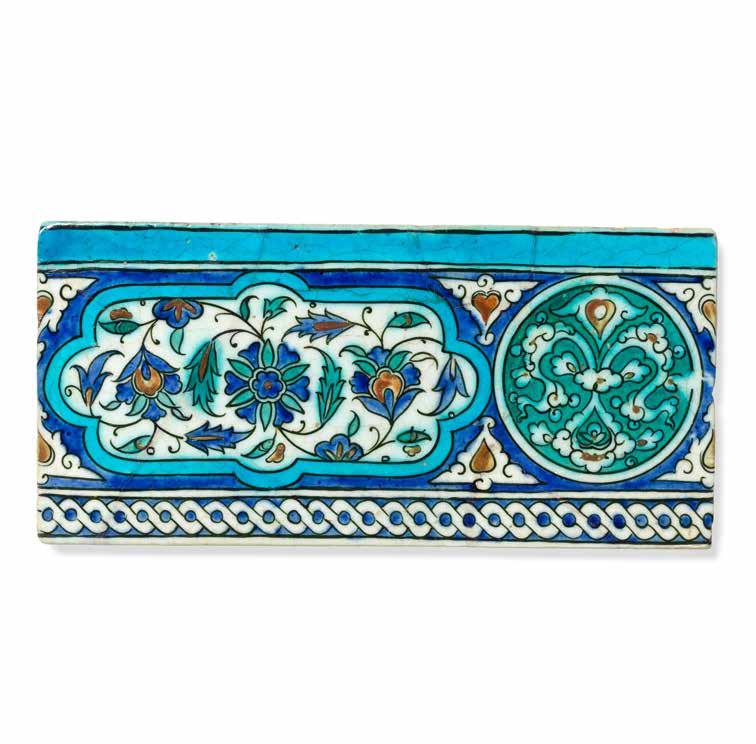
AN OTTOMAN POTTERY TILE
TURKEY, IZNIK OR DIYARBAKIR, 16TH CENTURY of rectangular form, decorated underglaze in raised-red, cobalt blue, turquoise, green and black outline on a white ground with a cartouche and roundel filled respectively with floral interlace and split palmettes, interspaced by hillock motifs, girih pattern to border 32.8 x 15.6 cm.
£4,000 - 6,000
€4,600 - 6,900
US$5,400 - 8,100
The Louvre holds several border tile fragments of lesser quality with a similar design attributed to Diyarbakir and produced between 15751625 (inv. nos. AD PR 2009/83 .1 a.1, AD PR 2009/83 .1 d.1, AD PR 2009/83 .1 e, AD PR 2009/83 .1 f, AD PR 2009/83 .1 i, AD PR 2009/83 .1 a.2).
Alongside the famed Iznik, the city of Diyarbakir in Southeastern Anatolia was known to produce Ottoman tiles in the second half of the sixteenth century. While outwardly similar, Julian Raby notes that Diyarbakir tiles are distinguishable by their blueish glaze, compact composition, softer fritware and subtle craquelures. For further discussion, see N. Atasoy & J. Raby, Iznik, the pottery of Ottoman Turkey, London and New York 1989, p.74.
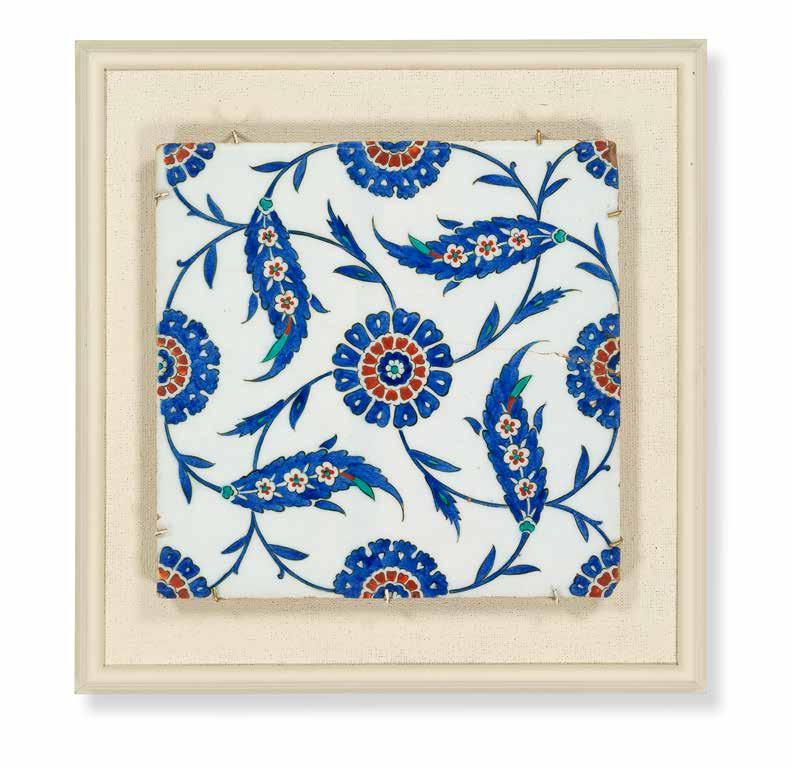
AN IZNIK POTTERY TILE
TURKEY, CIRCA 1570 of square form, decorated in raised-red, cobalt blue and turquoise with black outline on a white ground with central rosette encircled by four saz leaves and eight further rosettes, mounted 28 x 28 cm.
£8,000 - 12,000
€9,200 - 14,000
US$11,000 - 16,000
Oliver Hoare (1945-2018). Acquired by the vendor’s father from Oliver Hoare in the 1980s.
Tiles with the same design were used widely within the Library of Ahmet III in Istanbul’s Topkapi Palace (b. 1719), where tiles were reused from earlier constructions. A similar tile, dated 1566-74, is within the Calouste Gulbenkian Museum (inv. no. 1579).
39
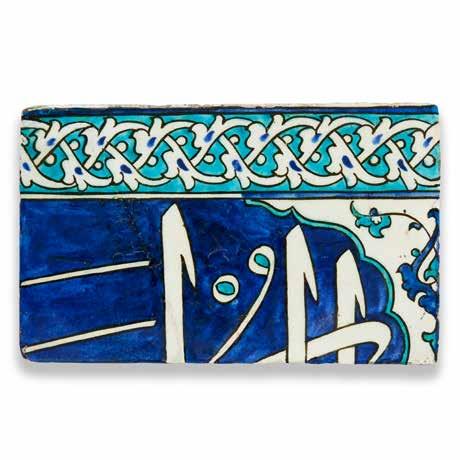
AN IZNIK CALLIGRAPHIC POTTERY TILE
TURKEY, EARLY 17TH CENTURY
of rectangular form, decorated underglaze in cobalt blue, turquoise and black on a white ground with partial inscription in thuluth in lobed cartouche alongside partial split palmette, vegetal interlace to border
25.4 x 15.6 cm.
£2,000 - 3,000
€2,300 - 3,400
US$2,700 - 4,100
This tile matches twenty four other tiles in the Louvre, all of which form a long wall panel. For examples see inv. nos. AD 5993/10, AD 5993/15, AD 5993/18. Comparable tiles were also sold at Sotheby’s, Arts of the Islamic World, 18 April 2007, lot 165.
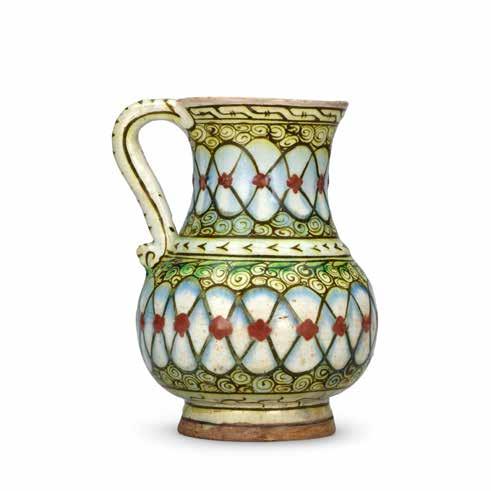
AN IZNIK POTTERY JUG
TURKEY, CIRCA 1600
of piriform with waisted cylindrical neck and simple handle on a short splayed foot, decorated in raisedred, cobalt-blue, green and black outline on a white ground with bands of overlapping circles and rosettes at intersections, surrounded by rock and wave motifs
19.6 cm. high
£6,000 - 8,000
€6,900 - 9,200
US$8,100 - 11,000
For an Iznik tankard with comparable motifs, see the Victoria & Albert Museum, inv. no. 730-1893.
41 R
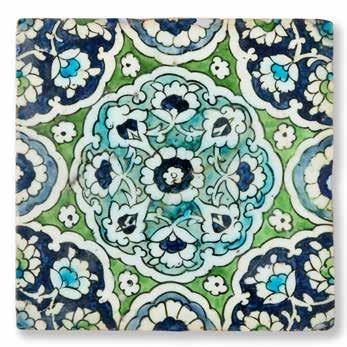
A DAMASCUS UNDERGLAZE-PAINTED POTTERY TILE
SYRIA, LAST QUARTER OF THE 16TH CENTURY
of square form, decorated underglaze in cobalt blue, turquoise, green with black outline on a white ground with lobed roundel to centre enclosing interlinking flowerheads, partial repeated pattern to corners interspersed by rosettes 24 x 23.5 cm.
£2,000 - 3,000
€2,300 - 3,400
US$2,700 - 4,100
Provenance
Acquired in London in the 1980s or 1990s.
Similar tiles can be seen in the Darwishiyya Mosque, Damascus. See Arthur Millner, Damascus Tiles: Mamluk and Ottoman Architectural Ceramics from Syria, London 2015, p.146 fig. 4.34.
42 R
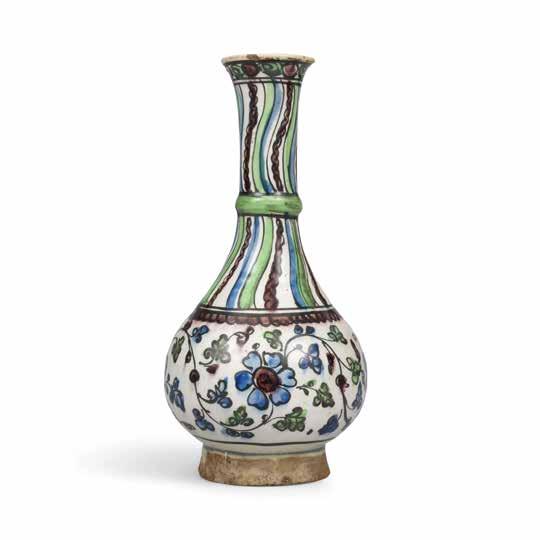
A DAMASCUS UNDERGLAZE-PAINTED
POTTERY WATER BOTTLE (SURAHI)
SYRIA, 16TH CENTURY
of piriform, the long flaring neck with torus moulding and everted rim on a slightly splayed foot, decorated underglaze in cobalt-blue, green, manganese and black on a white ground with a band of floral motifs interspersed by scrolling vines to the body, the neck with vertical s-shaped bands of alternating colours 27.4 cm. high
£2,000 - 3,000
€2,300 - 3,400
US$2,700 - 4,100
Provenance
Formerly in a French private collection.
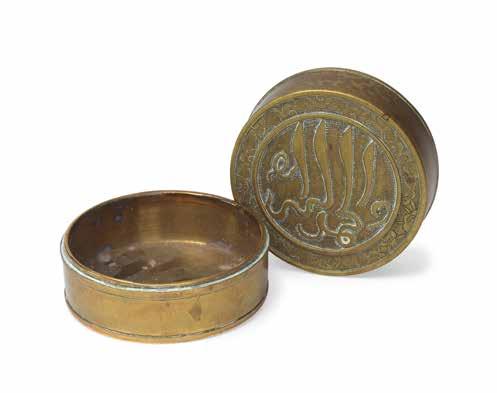
CHINA,
of cylindrical form, the flat cover cast to the top with a roundel containing an inscription in Arabic, the roundel surrounded by partial flowerhead motifs, all on a ringpunched ground
10.2 cm. diam.
£2,000 - 3,000
€2,300 - 3,400
US$2,700 - 4,100
Inscriptions: al-hamdulillah, ‘Praise be to God’.
The present lot is inscribed in sini, an Arabic script developed in the early Ming dynasty. For a comparable box sold in these rooms, see Bonhams, Islamic and Indian Art, 12 November 2024, lot 77. Similar boxes were also sold at Sotheby’s New Important Chinese Art, 13 September 2017, lot 144, and 15 March 2017, lot 560.
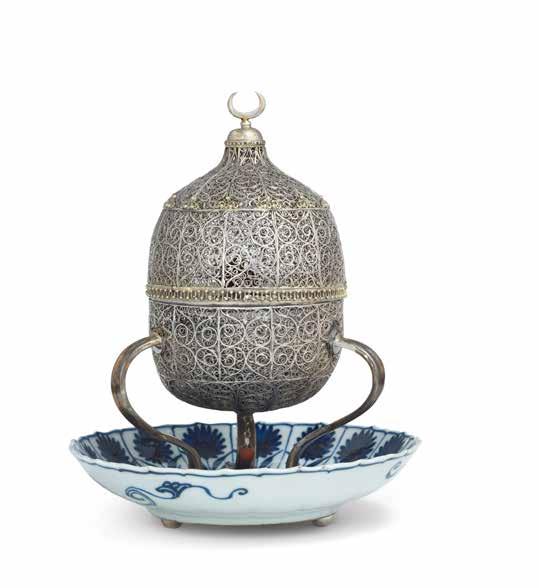
of ovoid form with hinged lid on three curved feet, comprising panels of filigree forming scrolling vines, surmounted by crescent, a suspension loop with hanging coral (corallium ) bead to underside of body, mounted on Kangxi ‘Aster pattern’ porcelain dish with foliated rim, decorated in cobalt blue on a white ground with floral sprays to border and spiral motifs to centre, on three ball feet
£4,000 - 6,000
€4,600 - 6,900
US$5,400 - 8,100
The Ottoman world witnessed a notable influx of Chinese porcelain during the leadership of Selim I whose campaigns in Persia in 1514, and in Syria and Egypt in 1516 and 1518 obtained sixty-four Chinese porcelain objects in Tabriz and an unspecified number in Cairo and Damascus. The collections would be supplemented further by diplomatic gifts and through the process of muhallefat, or the confiscation of items, seen to have been gained at the expense of the state or which could aid the furtherance of Holy War. Unlike Europe, the Ottomans did not have direct routes to Chinese factories or trading intermediaries, meaning muhallefat was one of the key means by which porcelain became available.
Popular items converted by the Ottomans with gilt-silver mountings included incense burners, drinking flasks and wash bowls. Jean-Baptiste Tavernier (1605-1689) comments on the Ottoman tendency to pass around an incense-burner with aloes wood, so that the ‘suffumigation of the Lignum not only dries up the water but also sticks so much closer to the hair of the Head and Beard.’ To read further on Ottoman use of Chinese porcelain, see Regina Krahl, Chinese Ceramics in the Topkapi Saray Museum, Istanbul: , London 1986, pp. 13-54.
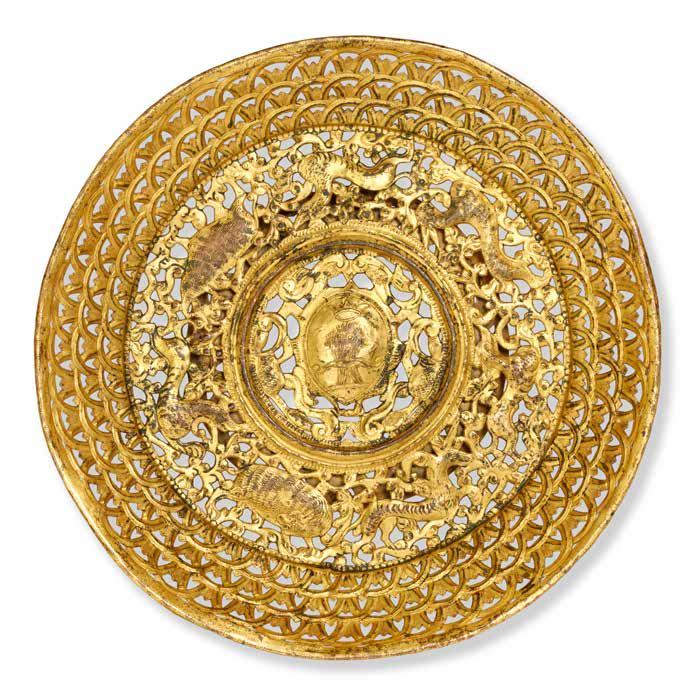
AN OTTOMAN GILT-COPPER (TOMBAK) DISH
BALKANS, 17TH/ 18TH CENTURY of shallow rounded form on short, splayed foot with an openwork body, raised central boss engraved with wheatsheaf surmounted by crown, surrounded by arabesque motifs and fantastical beasts and animals, hemispherical interlace to walls 29.8 cm. diam.
£8,000 - 12,000
€9,200 - 14,000
US$11,000 - 16,000
The Louvre holds an openwork gilt-copper dish of great similarity to this lot (inv. no. QA 763), which has been been loosely attributed to early 17th-century Spain or France.
46
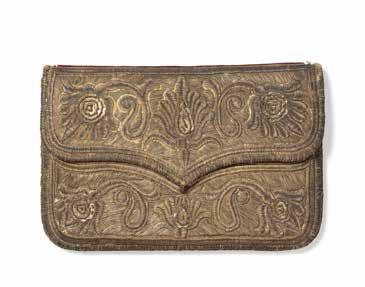
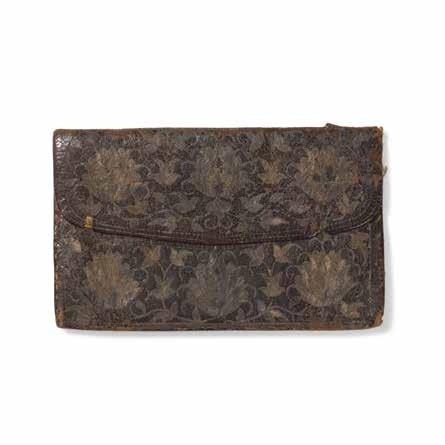
A METAL-THREAD EMBROIDERED VELVETMOUNTED LEATHER WALLET
OTTOMAN TURKEY OR CAUCASUS, 17TH CENTURY of rectangular form with cusped flap, the red morocco profusely embroidered in gilt silver thread with floral motifs, three further leather flaps to interior, the reverse with a panel containing vegetal interlace and the initials ‘H S’ and ‘IIB’ 14.5 x 9.5 cm.
£2,000 - 3,000
€2,300 - 3,400
US$2,700 - 4,100
A similar wallet with inscription dating its presentation to 1617 is in the National Trust Collection at Seaton Delaval Hall, Northumberland (NT 1276903).
47 AN OTTOMAN METAL-THREAD EMBROIDERED LEATHER WALLET
TURKEY, EARLY 18TH CENTURY of rectangular form with shaped flap, the brown morocco embroidered in silver and gilt thread with six floral rosettes to one side, the inscription ‘Constantinople’ surrounded by floral interlace to reverse, the flap lifting to reveal the inscription ‘James Boddington’, brown suede lining 17.5 x 10.8 cm.
£1,500 - 2,000
€1,700 - 2,300

US$2,000 - 2,700
Provenance
James Boddington (1653-1731).
The Mitford-Baxendale family. Private UK Collection.
James Boddington, himself a banker, was a member of the prominent mercantile-banking family, which included his brother, George Boddington, who served as founding director of the Bank of England between 1694 and 1695.
48
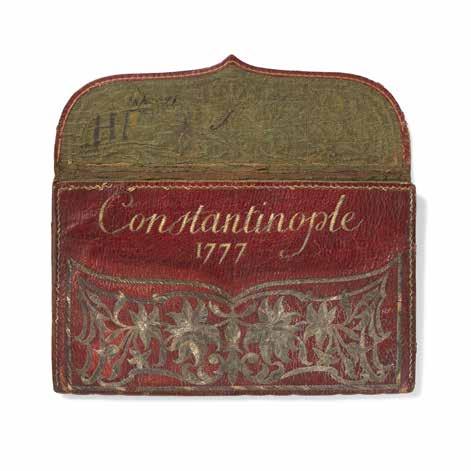
AN OTTOMAN METAL-THREAD EMBROIDERED WALLET
CONSTANTINOPLE, TURKEY, DATED AD 1777 of rectangular form with cusped flap, the red morocco embroidered in gilt-silver thread with cartouches filled with floral interlace to front, floral spray and arabesque border to reverse, the flap lifting to reveal the inscription ‘Constantinople, 1777’, green silk lining 18.5 x 11.2 cm.
£2,000 - 3,000
€2,300 - 3,400
US$2,700 - 4,100
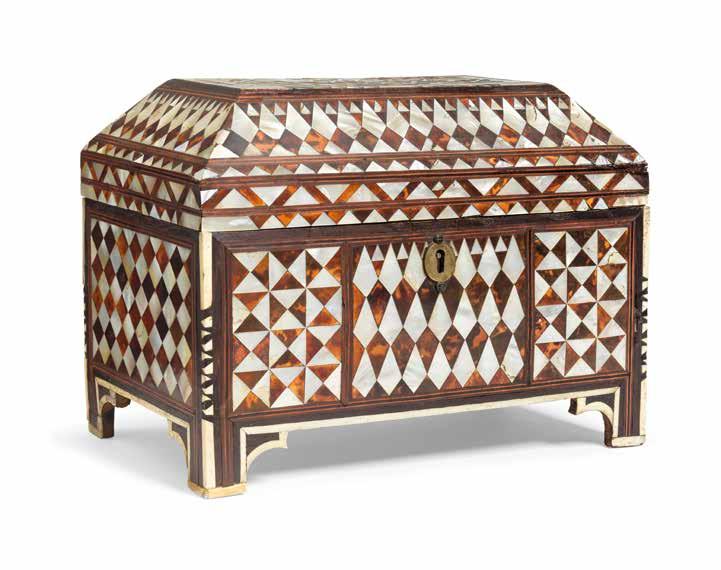
of rectangular form on four bracketed feet, the hinged lid with sloped edges, profusely decorated in mother-of-pearl and tortoiseshell inlay with panels of geometric design, the edges inlaid with bone and wood, the lid with central panel of arabesques, velvet lined interior
32 x 24.4 x 20 cm.
£2,000 - 3,000
€2,300 - 3,400
US$2,700 - 4,100
50
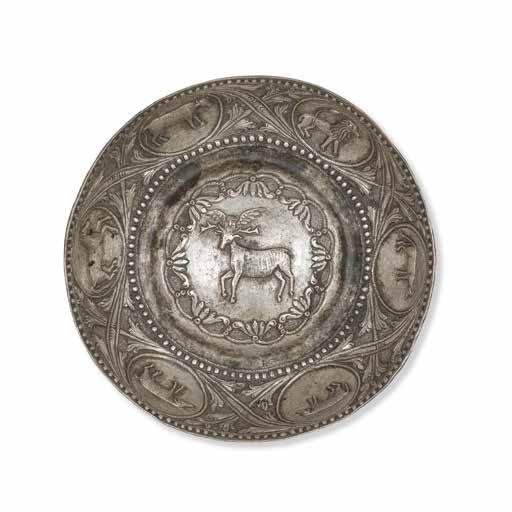
of rounded form with domed centre, decorated in repoussé with deer and owl to centre with floriated border, roundels with quadrupeds to walls surrounded by acanthus interlace
13.3 cm. diam.; 128 g.
£2,000 - 3,000
€2,300 - 3,400
US$2,700 - 4,100
For similar examples, see Christie’s, Arts & Textiles of the Islamic & Indian Worlds, 24th April 2015, lot 354 and Art of the Islamic and Indian Worlds including Oriental Rugs and Carpets, 28th October 2020, lot 123.
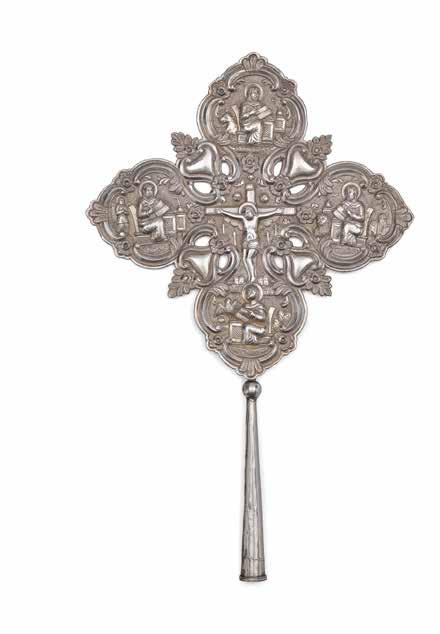
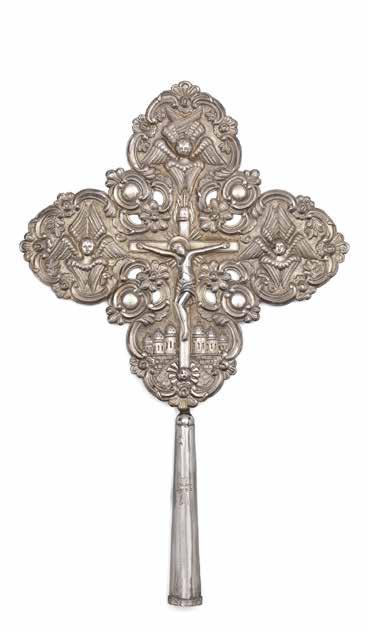
TWO ARMENIAN SILVER ALTAR
TURKEY, LATE 18TH CENTURY
the first decorated in repoussé with Christ crucified surrounded by the four evangelists, the borders with rococo style floral and foliate decoration, the second with Christ crucified surrounded by three seraphim, at his foot the Holy Sepulchre, each with flaring ferules, one with inscriptions in Armenian 51.4 and 51.7 cm. high; 410 and 398 g.(2)
US$11,000 - 16,000
Formerly in the collection of Ana and James
Inscriptions: including the name Mardiros
52
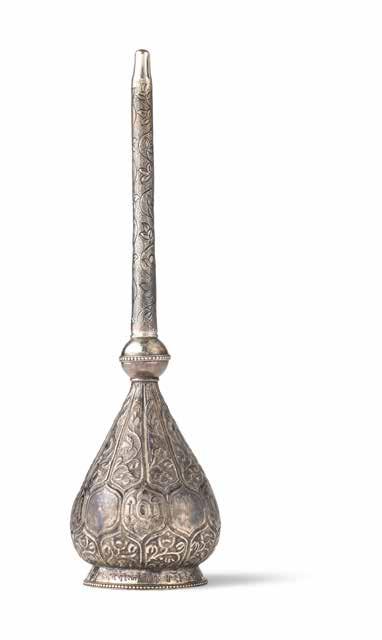
AN ARMENIAN SILVER HOLY WATER SPRINKLER (ASPERSORIUM)
TURKEY, 18TH CENTURY
of piriform on a splayed foot, the slightly tapering neck rising from a spherical element, decorated in repoussé with a series of medallions alternately containing flowerheads, above and below panels containing floral vines, the neck with undulating vines, the foot with inscription in Armenian 30 cm. high; 190 g.
£2,000 - 3,000
€2,300 - 3,400
US$2,700 - 4,100
Provenance
Formerly in the collection of Ana and James Melikian.
Inscriptions: Yeghisapet Mahdesi Garabedi dustry, ‘Elizabeth daughter of Mahdesi Garabed’.
*
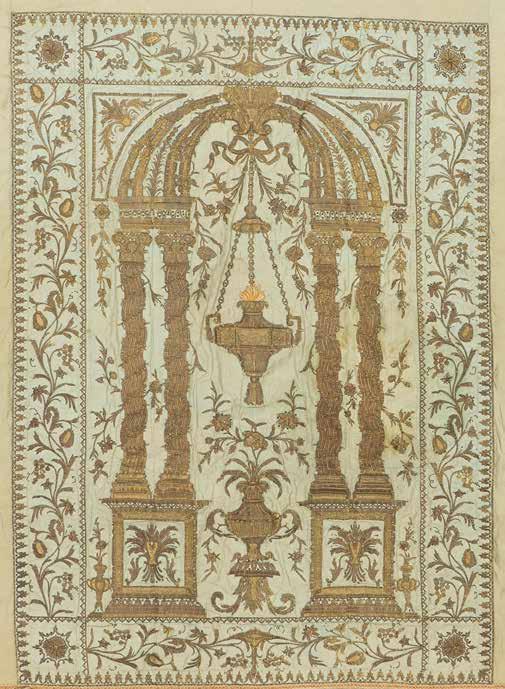
A FINE OTTOMAN METAL THREAD EMBROIDERED SILK MIHRAB PANEL, TORAH ARK CURTAIN (PAROCHET) OR SANCTUARY CURTAIN TURKEY, EARLY 19TH CENTURY
of rectangular form, the pale blue silk ground profusely embroidered in silver thread, polychrome silks and sequins with an archway with a hanging lamp and floral spray issuing from an urn, the borders with undulating floral vines, the corners with rosettes, later backing with tasselled edge the embroidered panel 178 x 123 cm.
£15,000 - 20,000
€17,000 - 23,000
US$20,000 - 27,000
A similar curtain from the Halpern Judaica Collection (see Sotheby’s, The Halpern Judaica Collection: Tradition and Treasure, Part III, 14 December 2023, lot 86) was described as a Torah Curtain, due to the portal and hanging lamp which allude to the biblical verses ‘Open the gates of righteousness for me that I may enter them and praise the Lord’ (Ps. 118:19) and ‘Your word is a lamp for my feet, a light on my path’ (Ps. 119:105). Another similar panel, depicting a church was used as a Sanctuary curtain in the Greek church of Kayseri (object no. ΓΕ 33732).
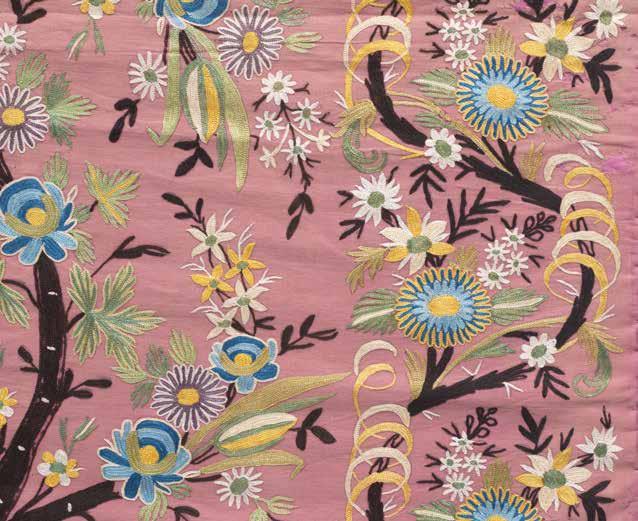
(detail)
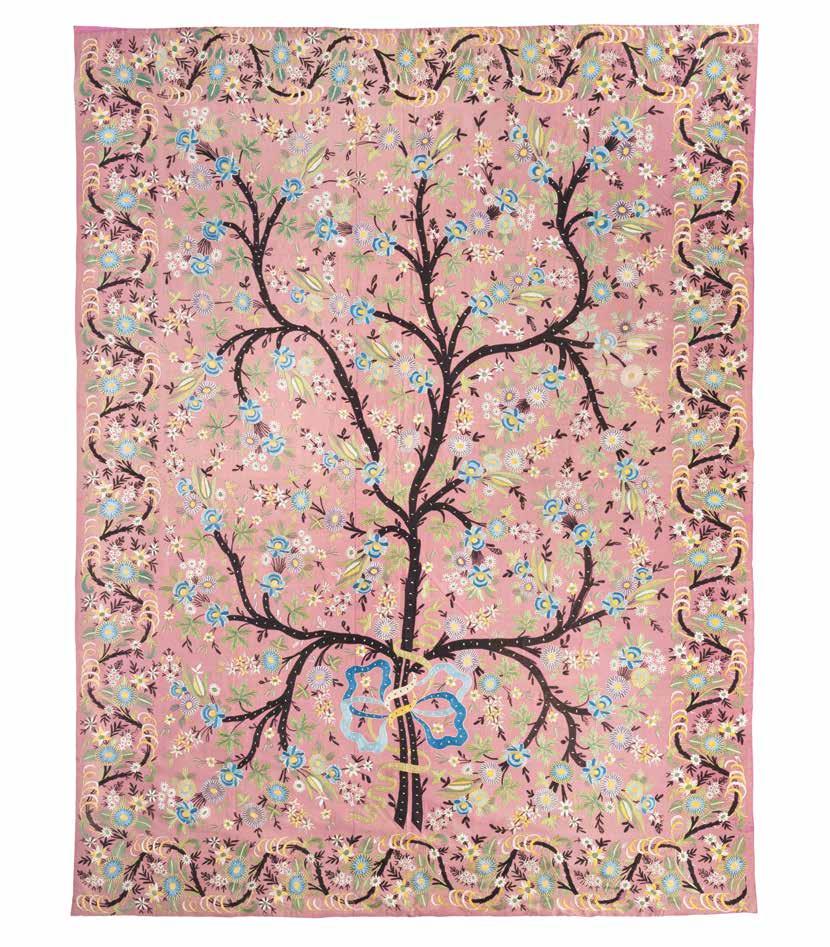
AN OTTOMAN SILK EMBROIDERED TREE OF LIFE COVERLET (YORGAN YÜZÜ)
TURKEY, 18TH/ 19TH CENTURY of rectangular form, the mauve silk ground chain-stitch embroidered in polychrome with a flowering tree adorned with blue and yellow ribbons, the borders with sprays of flowers issuing from a floral vine adorned with yellow ribbons, backed, mounted on a stretcher 172 x 221 cm.
£15,000 - 20,000
€17,000 - 23,000
US$20,000 - 27,000
55 *
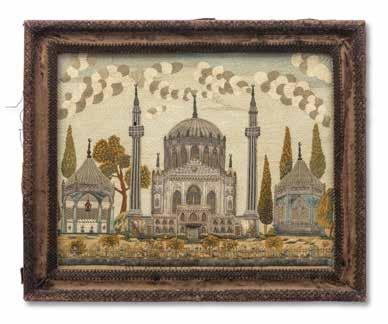
AN OTTOMAN SILK AND METAL-THREAD EMBROIDERED AND APPLIQUÉ PANEL DEPICTING THE PERTEVNIYAL VALIDE
SULTAN MOSQUE, ISTANBUL TURKEY, 19TH CENTURY
of rectangular form, embroidered in polychrome silks with applied stumpwork section with silver thread, the frame clad in velvet with embroidered metalthread ornamentation
74 x 58 cm. excluding frame
£3,000 - 5,000
€3,400 - 5,700
US$4,100 - 6,800
The Pertevniyal Valide Sultan Mosque in Istanbul, also known as the Aksaray Valide Mosque, was completed in 1871 and was inaugurated by the mother of Sultan Abdülaziz (reg. 1861-1876). Its architecture exemplifies Turkish Baroque, combining an amalgamation of Ottoman, Moroccan, Gothic and Renaissance elements, resulting in a unique blend of Ottoman and Western aesthetics.
56
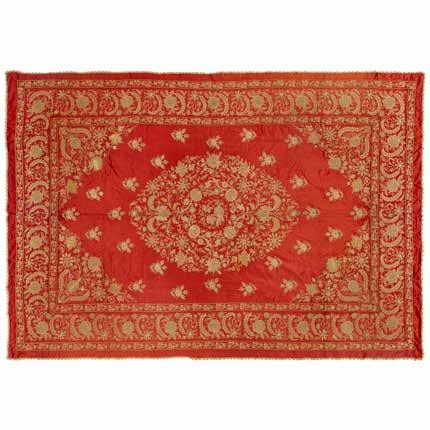
AN OTTOMAN SILK AND METAL-THREAD EMBROIDERED COVERLET
TURKEY, 19TH CENTURY of rectangular form, the red silk ground embroidered in yellow and metal threads with ovoid medallion to central panel containing an interlace of flowerheads, pomegranates and foliate motifs, repeat floral sprays to ground and to each corner, the border with pomegranates intersected by saz leaves, scalloped metal-thread fringe to edges, backed 274 x 191 cm.
£3,000 - 5,000
€3,400 - 5,700
US$4,100 - 6,800
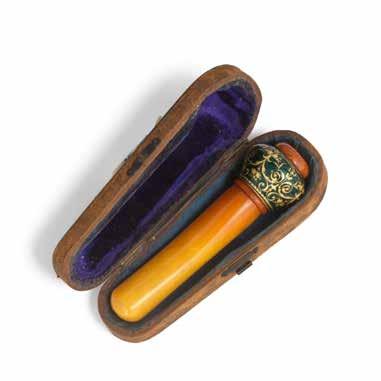
57 AN ENAMELLED-GILT-COPPER AND AMBER HUQQA MOUTHPIECE FOR THE OTTOMAN MARKET
EUROPE, LATE 19TH CENTURY
comprising three amber components on a central wood pipe interspersed by a gilt-copper element decorated in green and black enamel with gilt baroque adornments featuring acanthus interlace and floral sprays from vases, accompanying leather box
10.8 cm. long(2)
£1,500 - 2,000
€1,700 - 2,300
US$2,000 - 2,700
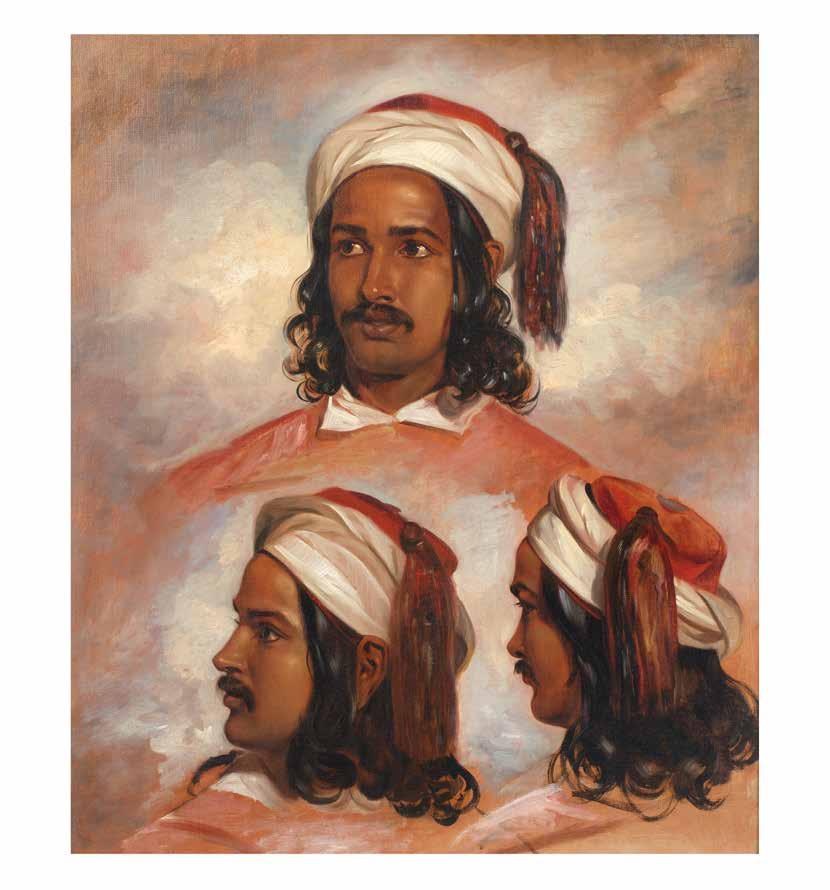
A PORTRAIT OF A GREEK OR BALKAN YOUTH, WEARING A TASSELLED CAP, SEEN FROM THREE VIEWPOINTS
CIRCLE OF WILLIAM ETTY RA (BRITISH, 1787-1849)
oil on canvas
76 x 64 cm.
£8,000 - 12,000
€9,200 - 14,000
US$11,000 - 16,000
Provenance
Sotheby’s, British Paintings 1500-1850, 9th July 1997, lot 104 (as William Etty).
With The Parker Gallery, UK (as William Etty).
This portrait study is closely related to two other finished portraits. The first, a portrait of the Greek War of Independence hero, Prince Johannis Mavromichaeli, Prince of Mainottas, or Old Spartans, was previously attributed to the Bristol-born artist, William James Müller (see Christie’s, The Collection of Sir Nicholas Goodison - British Art: Innovation and Craftsmanship, 25th May 2022, lot 73). That portrait may be related to the present portrait in terms of the sitter’s glance to the right, the swirling clouds in the background, the fine locks of hair, the sketchy finish of the dress and the rendering of the face and particularly the glassy whites of the eyes (which are illuminated with vertical strokes of bright white around the corners). Comparison with other signed portraits by Müller, however, which are in general far more sombre and stylised, would rule out an attribution for either of these portraits to him.
Another portrait of an oriental male (described as an ‘Indian boy’) sold in Sotheby’s (Important British Pictures, 20th April 1990, lot 50), was attributed to the British artist, William Etty (1787-1849). The Sotheby’s portrait can also be compared to the present portrait in terms of the subject, composition on a background of swirling clouds and the rendering of the face and eyes. This suggests that all three of the paintings discussed here were executed by the same hand, suggesting the artist was a significant figure. The lighter colour palette and rendering of the clouds are unlike most of Etty’s work, however, making an attribution to him less probable.
It seems likely, therefore, that the present painting was a preparatory sketch for a larger portrait, executed by an accomplished British artist who was working in the circle of Etty in London.
60
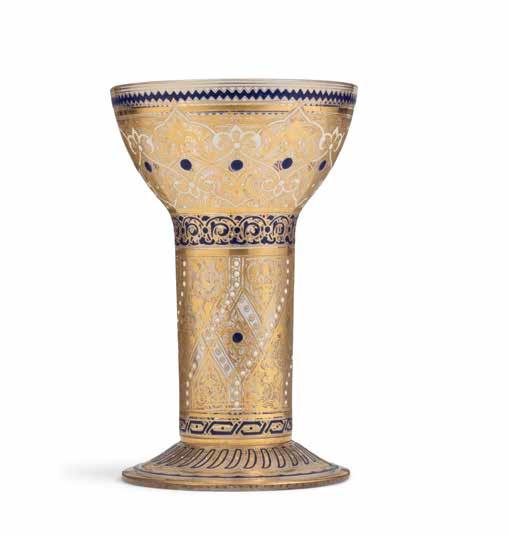
A LOBMEYR ENAMELLED GLASS GOBLET FOR THE ISLAMIC MARKET
AUSTRIA, CIRCA 1878
of cylindrical form rising to cup on a splayed foot, decorated in blue and white enamel and gilt with bands filled with floral interlace interspersed by dots and stars, ogival and arabesque motifs to cup, geometric bands to base and rim, enamelled maker’s monogram to base
18.8 cm. high
£4,000 - 6,000
€4,600 - 6,900
US$5,400 - 8,100
For an identical example see Olga Drahotova, European Glass, London 1983, pl. 130 p.183 and Waltraud Neuwirth, Orientalisierende Gläser, J & L Lobmeyr, Vienna 1981, vol.1 pl.13. According to Neuwirth, this vase’s design is dated 7.11.1878 in the Lobmeyr archive. Another was sold at Sotheby’s Arts of the Islamic World, 18 April 2007, lot 221.
61
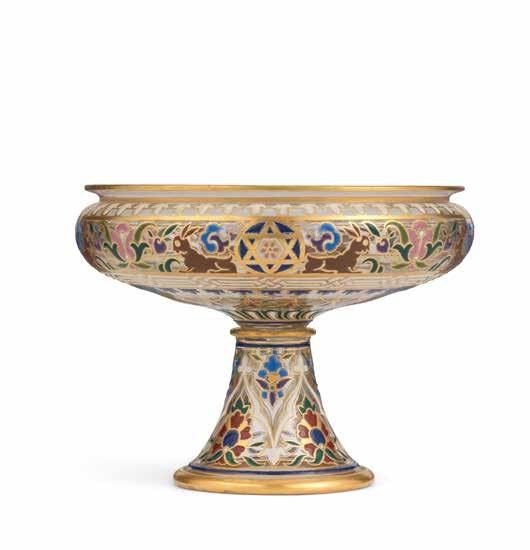
A LOBMEYR ENAMELLED GLASS TAZZA FOR THE ISLAMIC MARKET
AUSTRIA, LATE 19TH CENTURY
of shallow rounded form on a tall splayed foot, decorated in polychrome enamel and gilt with alternating hare and floral motifs to body with two star-filled medallions and geometric bands, flowerheads and cusped ogival arches to foot, gilt maker’s monogram to base 12.7 cm. high
£2,500 - 3,500
€2,900 - 4,000
US$3,400 - 4,700
Ludwig Lobmeyr (1855-1902), son of the company founder, oversaw the production of the famed Arabian Series, working closely with architects Johann Machytka and Franz Schmoranz to create these orientalised pieces from 1887; in the same year, examples were exhibited at the Exposition Universelle in Paris.
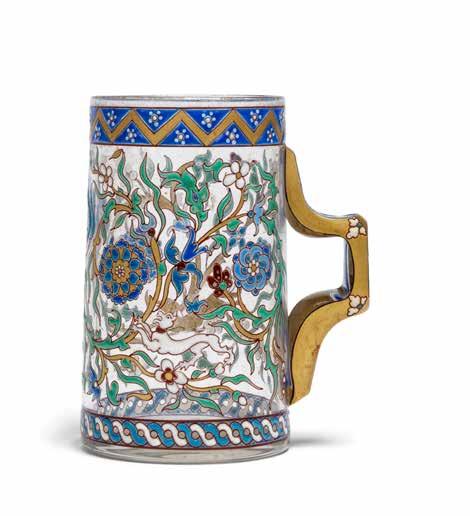
in the form of an Iznik tankard, profusely decorated in polychrome enamel and gilt to body with floral interlace to central panel interspersed with canine and bird figures, bands with zig-zag and knot designs to the rim and base, floral motifs to handle, signed and inscribed ‘E Gallé à Nancy’ to base 11.2 cm. high
£4,000 - 6,000
€4,600 - 6,900
US$5,400 - 8,100
Emile Gallé (1846-1904) was a French glass-maker who took over the family business when his father retired in 1874. His pieces gained widespread recognition and were acquired by prominent collections including the Philadelphia Museum of Art and the Russian and Danish royal families.
Gallé soon began experimenting with enamels and themes from Ancient Egypt and Islamic history, writing to the jury of the Paris exposition in 1889: ‘Since 1878, I have devoted myself continually to developing a palette that would allow me to decorate glass with the aid of colours and low-temperature vitrifiable enamels...I also developed reflecting colours by mixing them with hard Arabian enamels. Finally, in 1884, I produced for the Union Centrale des Arts Decoratifs a new series of transparent enamels in relief...I therefore present you today with the results of my continued research: opaque enamels with artificial and bizarre colours, muted nuances designed to add
63
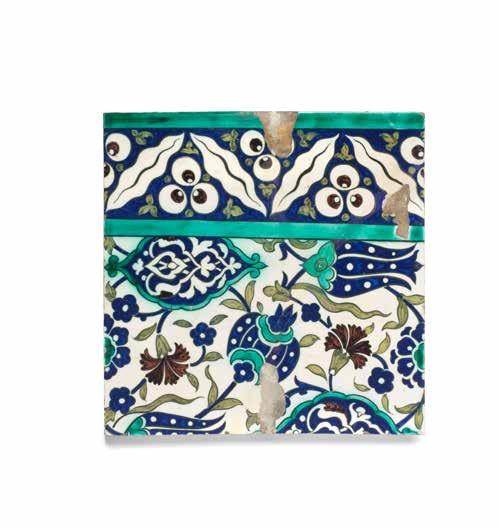
of square form, decorated underglaze in turquoise, cobalt-blue, green and manganese with black outline on a white ground with tulip heads, pomegranates and polylobed cartouche containing interlacing split palmettes, border with alternating cintamani and bubri motifs on vegetal ground, ‘Cantagalli Firenze’ stamped to reverse 23.5 x 23.5 cm.
£1,500 - 2,000
€1,700 - 2,300
US$2,000 - 2,700 62
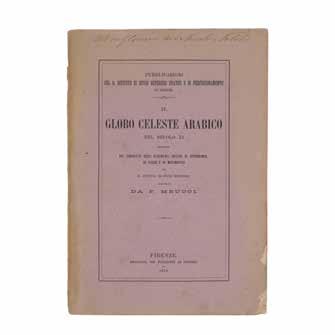
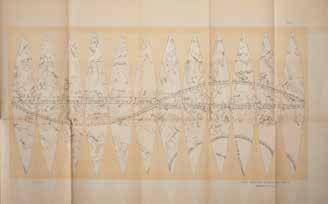
FERDINANDO MEUCCI, IL GLOBO CELESTE
ARABICO DEL SECOLO XI [THE ARAB CELESTIAL GLOBE IN THE 11TH CENTURY] FLORENCE, SUCCESSORI LE MONNIER FOR INSTITUTO DI STUDI SUPERIORI, 1878 pp. 13, Italian text, 3 double-page tables at end, one large folding plate of celestial gores printed in black and sepia, one smaller folding plate large octavo (275 x 180 mm.)
£2,000 - 3,000
€2,300 - 3,400
US$2,700 - 4,100
Provenance
Instituto di Studi Superiori, Florence (publisher’s stamp on title page.
Niccolò Nobili (1830-1900), lawyer and Italian MP who became superintendent of the Istituto di studi superiori, as well as shareholder and partner in the Successori Le Monnier publishing house from the 1870s onwards (presentation inscription at top edge of front cover.
The first published description of one of the oldest extant Arab celestial globes.
Ferdinando Meucci (1823-93) was an Italian archivist and historian of science, employed at the Royal Museum of Physics and Natural History in Florence. Under the direction of Filippo Parlatore, the museum separated those instruments meant for practical application, and those that had an historical value. Parlatore curated the pieces kept in the Tribuna di Galileo, and added to the collection. At his retirement in 1874, the museum was entrusted to the care of Meucci, who the following year commissioned the first catalogue of the instruments, complete with dating, information on the provenance, and inventory numbers. Upon Parlatore’s death in 1877, Meucci became the Director of the museum in name, and made further purchases.
Il Globo Celeste Arabico del Secolo XI is Meucci’s description of an 11th century Arab celestial globe which he himself had purchased in 1876, and which is considered to be the oldest in existence.
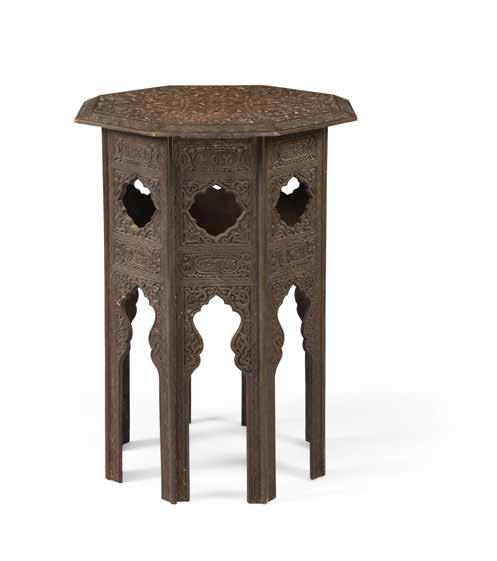
65
A NASRID STYLE BRONZE TABLE
EUROPE, 19TH CENTURY of octagonal form, cast with radiating palmettes around two eight-pointed stars, the sides with foliate motifs with openwork niches and lobed cartouches with bands overlaid with cartouches containing the Nasrid motto, girih pattern to borders 51.5 cm. high
£3,000 - 5,000
€3,400 - 5,700
US$4,100 - 6,800
Inscriptions: la ghalib illa allah, ‘There is no conqueror except God’ (Nasrid motto) and repeat of Qu’ran Chapter IV (al-Nisa’), a part of verse 103.
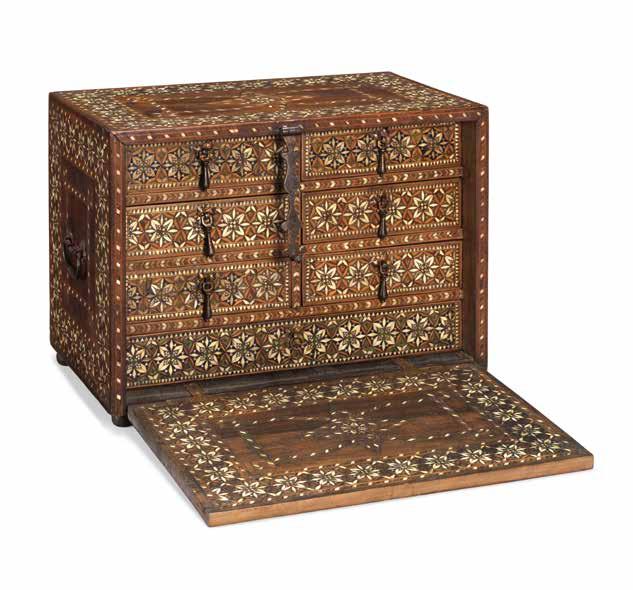
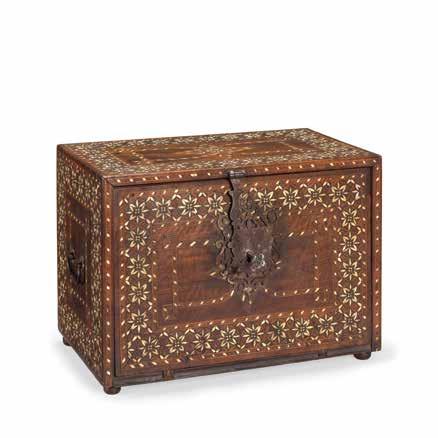
A POST-NASRID SILVER- AND BONE-INLAID TARACEA CABINET
SPAIN, 16TH CENTURY
of rectangular form with hinged fall front opening to reveal seven drawers within, profusely inlaid and decorated with silver tesserae, ebony, bone, with stellate motifs within octagons and strapwork to upper and interior panels, to front a hinged lock with working key, hinges chased with scrolling floral interlace 36.6 x 27.1 x 22.9 cm.
£6,000 - 8,000
€6,900 - 9,200
US$8,100 - 11,000
The Nasrids developed a distinct aesthetic defined by elaborate geometric motifs which evolved from North African and Iberian sources. It was in particular the Almoravids and Almohads whose courtly commissions incorporated these micromosaics, later coined by the Spanish as taracea from the Arabic tarsi or ‘incrustation’. These Maghrebi dynasties had themselves borrowed the technique from earlier 10th century traditions, most famously evidenced in the minbar of the Great Mosque of Cordoba dated to the period of al-Hakim II (r.961-978 AD) (Jerrilyn D. Dodds, Al-Andalus: the Art of Islamic Spain New York 1992, p. 373).
For comparable chests, see Christie’s, Art of the Islamic and Indian Worlds, 10 October 2014, lot 229 and Sotheby’s, Arts of the Islamic World & India, 23 October 2024, lot 114.
AN UNUSUAL GEM-SET ENAMELLED SILVERGILT HILTED STEEL CEREMONIAL SWORD COMMEMORATING THE FAMILY OF THE SHAYKHS OF THE AL AL-’ABID, THE LEADERS OF THE ALBU DIRAJ CLAN IN IRAQ, WITH THE NAMES OF THREE OF ITS RECENT LEADERS LONDON, 20TH CENTURY, THE HILT HALLMARKED 1995
the single-edged steel blade of curved form, engraved to each side with foliate motifs, inscription-filled cartouches and stylised palmettes, the gilt-silver hilt with pommel in the form of a lion wearing a crown, the eyes set with green gemstones, hallmark for London to lower mane, the knuckle-guard dividing into three parts towards the forte, one terminating in a single quillon in the form of a lion, the eyes set with green gemstones, inner guard with hallmarks for London, maker’s mark ‘CW’ and date letter for 1995, circular green enamelled plaque to guard engraved with a tughra surrounded by a wreath, applied silver plaque in the form of a palmette engraved with tughra enamelled in green near forte, black leather and gilt-silver thread grips, gilt-silver thread braid to guard terminating in two brass elements decorated with giltsilver thread and green silk; the wood scabbard clad in black leather, gilt-silver mount to top engraved with inscription-filled medallion of stellar form surmounted by a foliate motif, above an applied silver rosette engraved with inscriptions and decorated in green and yellow enamel, above a ‘v’ shaped band of green gemstones, four further silver mounts variously engraved with inscriptions and inscription-filled cartouches, gilt-silver chape engraved with foliate motif, two suspension loops; the wood stand with five applied silver plaques variously engraved with tughras and inscriptions, one with matching hall marks to hilt 91 cm. long(2)
£8,000 - 12,000
€9,200 - 14,000
US$11,000 - 16,000
Provenance
Private UK collection.
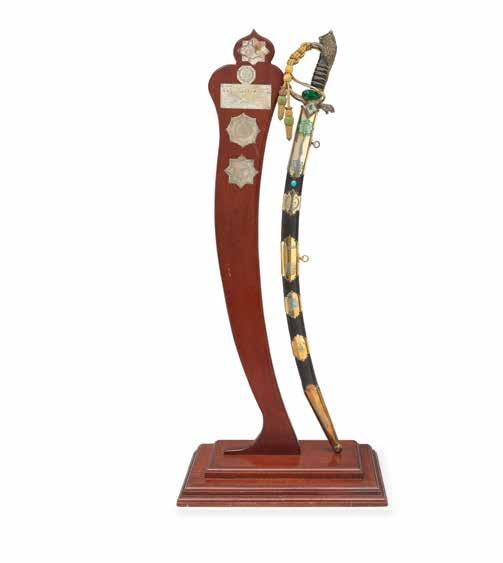
Three of the Shaykhs whose names are mentioned ruled over the family during the late 19th and 20th Century:
al-Sayyid al-Shaykh ‘Ali al-Sayyid ‘Abdullah al-’Abid’ (whose dates are recorded as 1860-1940, but on the sword the dates are given as 1855-1940).
al-Sayyid al-Shaykh Husayn al-Sayyid ‘Ali al-’Abid (whose dates are recorded as 1895-1978).
al-Sayyid al-Shaykh ‘Abd al-Khaliq al-Sayyid al-Hasan al’Abid (the most recent, though no dates are recorded).
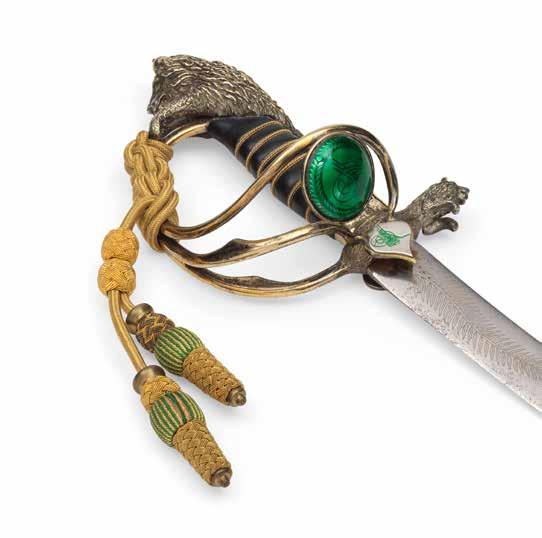

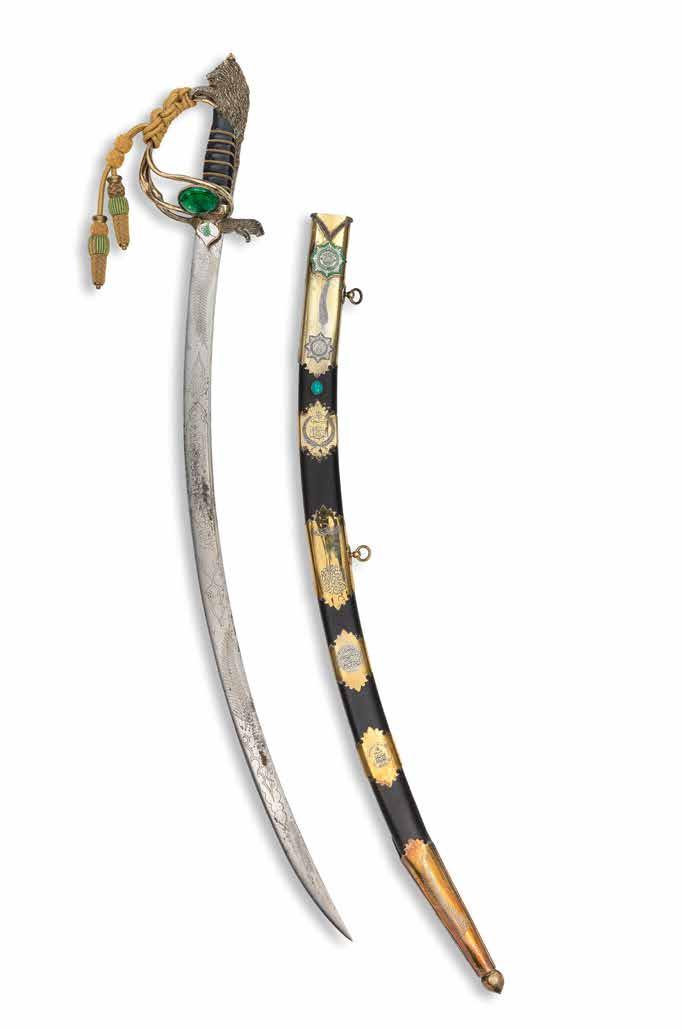
The numerous inscriptions are as follows:
To the guard, the basmala in tughra form.
To the blade, to one side the names ‘al-Sayyid al-Shaykh ‘Abdullah al-Sayyid al-Shaykh ... al-’Abid’ and ‘al-Sayyid al-Shaykh ‘Ali al-Sayyid ‘Abdullah al-’Abid’; to the other side the name ‘al-Sayyid al-Shaykh ‘Abd al-Khaliq al-Sayyid al-Hasan al-’Abid’.
To the scabbard, in the lobed green device: a tughra (undeciphered); in the small roundel, possibly ‘Sayyid al-’Abid’; to the border of the roundel, in black, the shahada, ‘Wisam al-’Abid’ and possibly the date 1291 (AD 1874-5); to the centre, in green Qur’an, chapter III (Al ‘Imran), verse 8; to the pointed star, possibly the basmala in tughra form; around the roundel, ‘Remember me al-Sayyid!’, ‘Husayn, 1319, 1897, 1976’; to the centre, ‘The basmala, Sayyid al-’Abid’; to the device below the above, ‘In the name of God, Sayyid al-’Abid’; to the long device below the above, the shahada, Qur’an, chapter XV (al-Hijr), verse 46, Qur’an, chapter XVII (al-Isra’), part of verse 1; to the device below, around the roundel ‘remember me al-Sayyid!’ ‘Ali;’ and the dates ‘1275, 1855, 1362, 1940’.
To the stand, the basmala in tughra form; to the octagonal plate, ‘In the name of God, Sayyid al-’Abid’; to the rectangular plate, ‘The sword of the Family of the Shaykhs of al-’Abid’; to the lobed plate, the basmala in tughra form; to the small roundel, ‘In the name of God, Sayyid al-’Abid’; to the border of the roundel, the shahada, ‘ ... al-Sayyid al-’Abid’, and the dates 1301 and 1881 (repeated); to the middle, Qur’an, chapter III (Al ‘Imran), verse 8; to the star, possibly the basmala in tughra form, to the border of the roundel, ‘Remember me al-Sayyid!’, the name Husayn, with only two dates clear 1895 and 1978, to the centre, ‘In the name of God, Sayyid al-’Abid’.
This is a sword bearing the names of the Shaykhs of the Al al-’Abid, the leaders of the Albu Diraj clan in Iraq, who played a prominent role in society and politics, particularly in the city of Samarra. The Albu Diraj are the descendants of the head (naqib) of the Sayyids (descendants of the Prophet) Durj al-Din, who protected the Sunni Sayyids and various shrines, including that of Abd al-Qadir Gilani, after the Shi’i Safavids took Iraq.
The heads of the clan from the 19th Century onwards were the Al al-’Abid, the Family of al-Abid, named after al-Shaykh ‘Abd Allah b. Ahmad, known as al-’Abid, who was head of the Qadiriyya Sufi order in Samarra and whose own tomb is in that city. After a successful delegation was sent to Istanbul asking for permission from the Sultan Abdülhamid for the foundation of a madrasa in Samarra, the Shaykhs of the Al al-’Abid were awarded their own insignia and seal consisting of the basmala in tughra form which was used on the stick and sword they used on ceremonial occasions, and which appears to be the type here. He was succeeded by his son Shaykh ‘Ali (1860-1940), who was undisputed chief of the shaykhs of Samarra and who hosted King Faisal when he visited the city. He was succeeded by his son Shaykh Husayn (1895-1978), who also played a leading political, social and charitable role in Samarra. For discussion of this family, see ‘Abbas al-’Azzawi, Mawsu’at ‘Asha’ir al-’Iraq, Beirut 2005, vol. 3, pp. 295-301.
R
EGYPT OR SYRIA, LATE 19TH/ EARLY
of cylindrical form with three baluster sections, a stepped domed base and flaring neck, profusely engraved and decorated in silver inlay with alternating swirling bands of calligraphy and floral openwork, interspersed by horizontal bands containing flower-filled ogival cartouches, calligraphic cartouches to base with rosette terminals 154 cm. high
£6,000 - 8,000
€6,900 - 9,200
US$8,100 - 11,000
Provenance
Formerly in the George Farrow Collection, (Roseberys, Farrow Collection
The inscriptions are undeciphered, but are possibly from a poem.
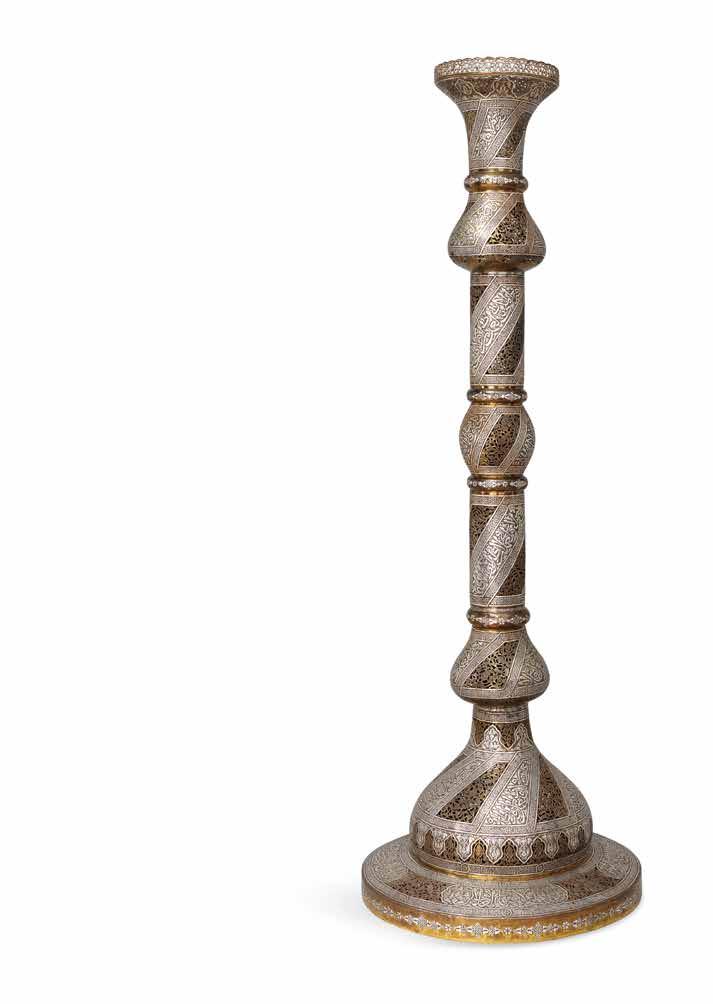
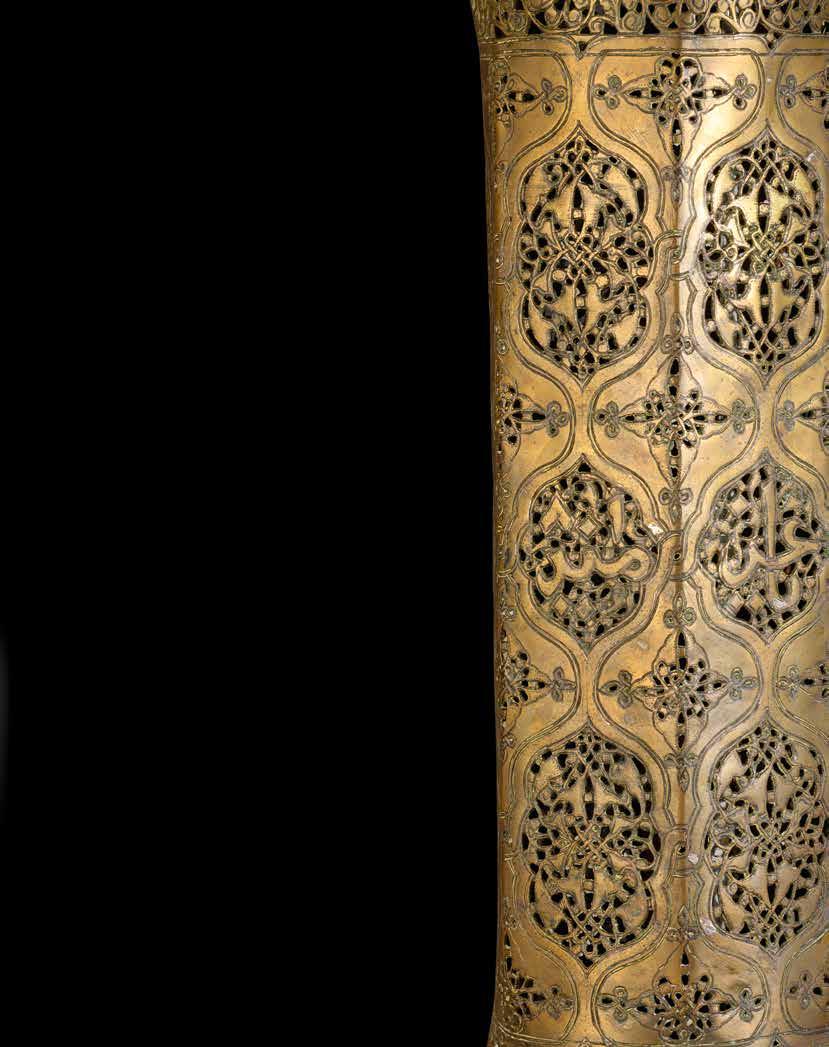
A monumental pair of post-Mamluk silver-inlaid brass Candlesticks from the Church of St. John the Divine in Lincolnshire
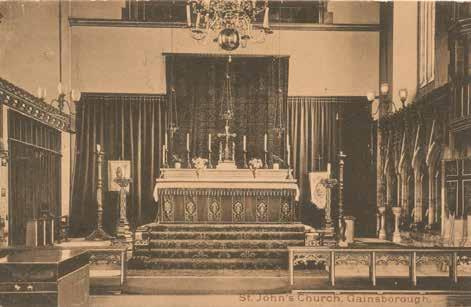
69 W R
A MONUMENTAL PAIR OF POST-MAMLUK SILVER-INLAID
BRASS CANDLESTICKS FROM THE CHURCH OF ST. JOHN THE DIVINE IN LINCOLNSHIRE
EGYPT OR SYRIA, 19TH CENTURY OR EARLIER
identically decorated, topped with circular rimmed trays with continuous Arabic inscription to the underside, detachable drip-trays, the shafts with openwork foliate arabesque detailing, three balustershaped sections with continuous Arabic inscriptions against openwork, interspersed with three hexagonal sections, the central one with further short Arabic phrases within cartouches, the cartouches in the other sections blank, the flaring base with nine quatrefoil cartouches containing inscriptions, below a band of nine pierced arrow-shaped cartouches, with church candle fittings
236 cm. high; base 75 cm. wide(2)
£45,000 - 55,000
€52,000 - 63,000
US$61,000 - 74,000
Provenance
Sir Hickman Beckett Bacon (1855-1945).
The Church of St. John the Divine, Gainsborough, Lincolnshire, by 1882.
Bonhams, Islamic & Indian Art including Contemporary Indian and Pakistani Paintings,12th and 13th October 2005, lot 206.
Private UK collection, Chilham Castle, Kent.
Literature
Nikolaus Pevsner and John Harris, The Buildings of England, Lincolnshire, London, 1964, p. 242 (‘CANDLESTICKS. Tall, C18(?), Italian(?), of wood. They are said to come from Egypt.’)
Inscriptions: in Arabic, some appear to be Christian prayers and invocations, using metaphors of light (and hence highly appropriate for such objects). Those that have been deciphered read:
to underside of trays, Qur’an, chapter IX (al-Tawba) part of verse 51; to horizontal bands to body ‘We praise and magnify you... and joy to [all] men [...] Glory be to God on high and peace to people on earth [...] Exalted is the sublimity of your glory, we bow to you and we thank you and we thank...’ [...] The Lord said to my Lord: Sit at my right until I make your enemies (your footstool)’; to cartouches around base, repeat of part of a Psalm of David, known as Zabur in Arabic.
Sir Hickman Beckett Bacon (1855-1945) was 11th Baronet of Redgrave and 12th Baronet of Mildenhall. He is best known as a collector of watercolours: the Hickman Bacon Collection consists of 400 works by various artists including Turner, Girtin, and Parkes Bonington. But he also travelled and collected abroad, especially in the Middle East. When a ‘bazaar’ was held in order to raise funds in 1882 on the consecration of St. John the Divine (the site for which had been donated by Sir Hickman in 1878), he presented, as his niece wrote, ‘some brass candlesticks which he had brought back from Cairo’.
(See Lavinia Gibbs, Uncle Hicky: Sir Hickman Bacon, an Edwardian Eccentric, Dougarie 2001, p. 38). The candlesticks remained in the church, which fell out of use in recent years, and are depicted in various postcards of the interior of the church dating to the early 20th century.
The candlesticks, or lampstands, predate the Mamluk Revival style which originated in the late 19th Century in Cairo and Damascus. The craftsmanship of the candlesticks is of a more conservative character which continues the tradition of earlier Mamluk metalwork, outlasting the Ottoman conquest of Egypt and Syria. Such a style might be described as ‘post-Mamluk’. However, there is no precedent in Mamluk metalwork for the sheer variety of shapes of large candlesticks, suspension lamps, and standing lamps. There is evidence that comparable pairs of candlesticks possessing vaseshaped upper structures for holding a candle were already being used in mosques in the mid-17th Century, and a number of other similarlydecorated suspension lamps can be attributed by their inscriptions and signatures to early 18th Century Damascus. The timing of their arrival in England (not later than 1882) would also imply that they do not fall into the category of Mamluk Revival. In addition, Sir Hickman was an avid collector of tiles, rugs and textiles, amongst other things, and it would have been highly unlikely that he would have acquired newly-produced objects.
Very little scholarship exists on this subject: reference should in the first instance be made to Doris Behrens Abouseif, Mamluk and PostMamluk Metal Lamps (Institut Francais d’Archaeologie Orientale, Cairo, 1995).
It has been suggested that the Christian phrases relate to Coptic liturgy, and that the candlesticks may therefore have been initially made for a Coptic church.
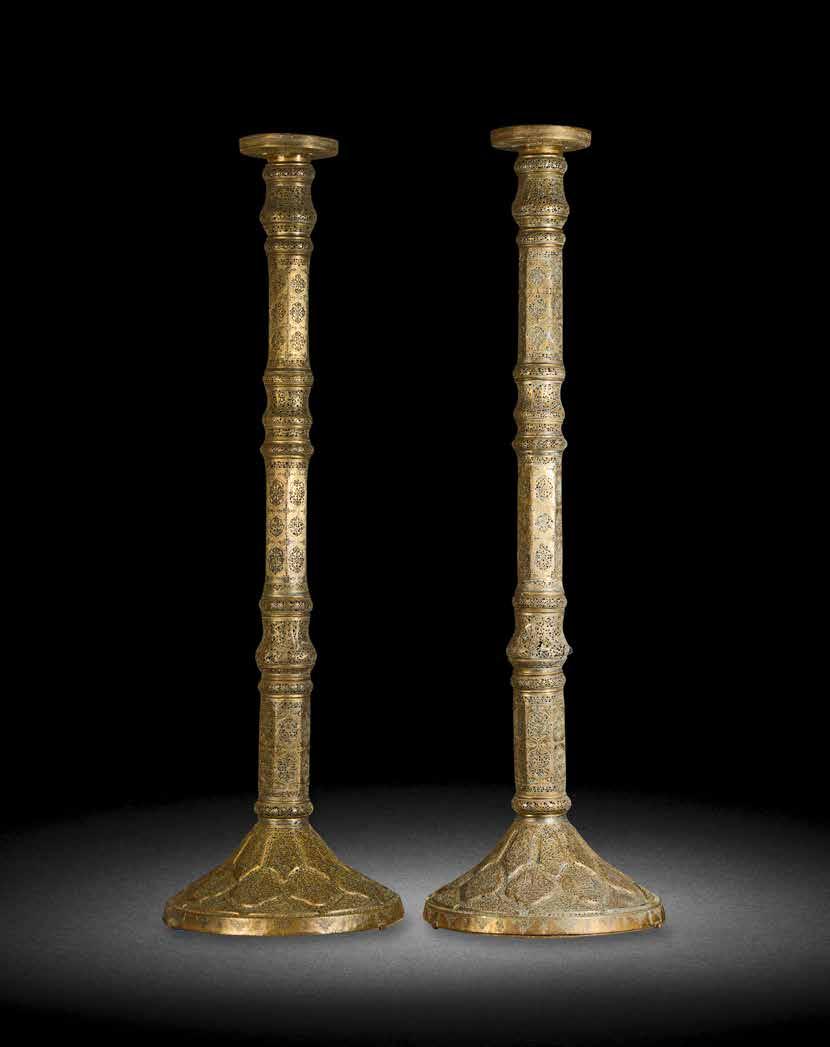
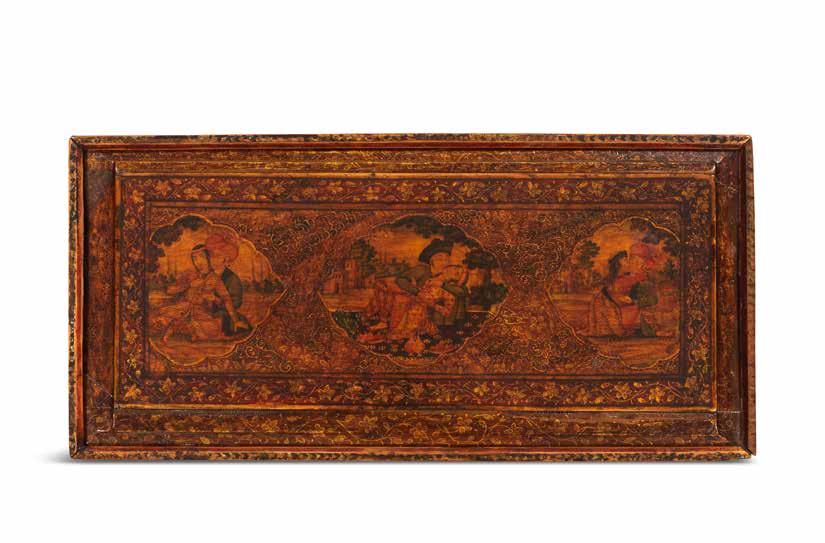
R
A SAFAVID LACQUER WRITING BOX BY AN ARTIST IN THE CIRCLE OF MUHAMMAD ZAMAN OR HAJI MUHAMMAD PERSIA, LATE 17TH/ EARLY 18TH CENTURY of rectangular form with sliding lid opening to reveal six compartments, decorated in polychrome and gilt with three lobed cartouches to lid containing embracing lovers, floral interlace and cloud motifs to ground and borders, the sides decorated ensuite with chevron bands to vertices
35.5 x 17.4 x 7.5 cm.
£15,000 - 20,000
€17,000 - 23,000
US$20,000 - 27,000
Provenance
Christie’s, Islamic Art, Indian Miniatures, Rugs and Carpets, 26th April 1994, lot 124.
Muhammad Zaman ibn Yusuf (1673-1713) came to prominence in the late 17th Century at a time when production of lacquer book bindings was in decline, with tastes instead moving to lacquered stationary boxes and mirror cases (Khalili, Robinson and Stanley, Lacquer of the Islamic Lands, The Nasser D. Khalili of Islamic Art, Part One, London and New York, 1996, p.55-57). Muhammad Zaman’s new Europeanised style of painting would characterise this artistic flux and remain prevalent in lacquer drawings well into the 20th Century. His figural work is characterised by his three-dimensional pastoral backgrounds and unique treatment of faces featuring heavy lids and prominent noses. These features are seen in a Safavid papier-mâché mirror case from Christie’s, Arts of the Islamic and Indian Worlds including Oriental Rugs and Carpets, 27th October 2022, lot 57. Similarly, the central cartouche with the embracing, supine lovers evokes the famous penbox signed by Haji Muhammad, dated to 1712-1713, in the Khalili Collection (inv. no. LAQ361). For another comparable penbox, see the Hermitage Museum, St Petersburg (inv. no. VR-123).
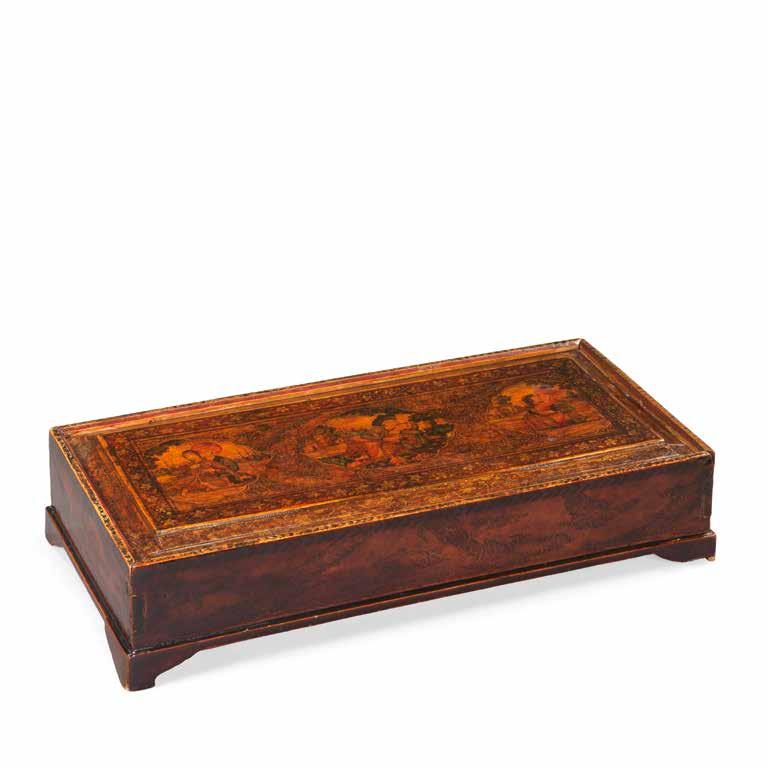
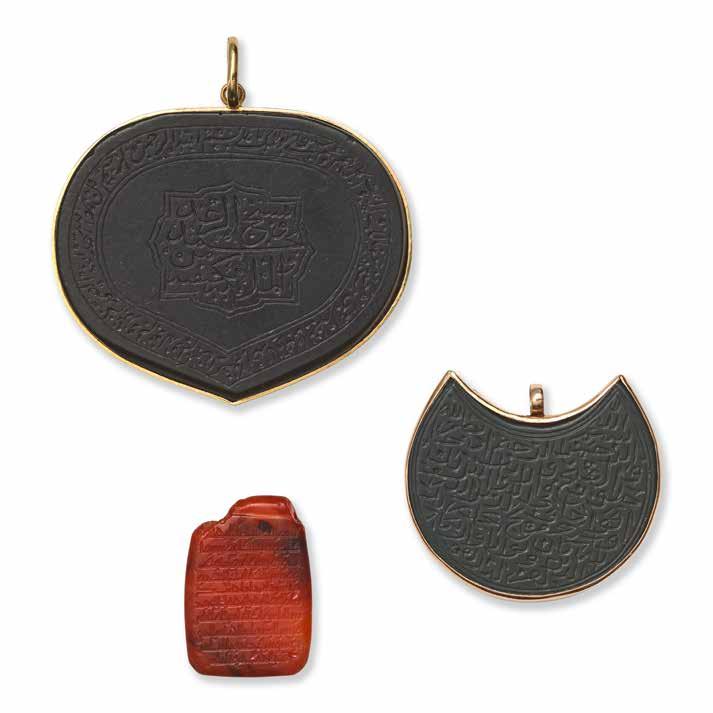
R
TWO JADE TALISMANIC PLAQUES PERSIA, 17TH-19TH CENTURY of heart and crescent form, the first engraved with inscriptionfilled central cartouche and border in thuluth and nasta’liq script respectively, the second profusely engraved with inscriptions to front in thuluth script and magic numbers to reverse, later gold mounts; AND A CARNELIAN TALISMANIC BEAD, PERSIA, 10TH/ 11TH CENTURY, of rectangular form, engraved with inscription in linear kufic script the largest 6.1 cm. wide(3)
£1,500 - 2,000
€1,700 - 2,300
US$2,000 - 2,700
Inscriptions: to border of heart-shaped plaque, Qur’an, chapter CXII (al-Ikhlas) and the nada’ali quatrain, to cartouche, Qur’an, chapter XLIII (al-Ra’d), part of verse 13; to front of crescent-shaped plaque, Qur’an, chapter CIII (al-Nasr) and the beginning of chapter LV (al-Qalam); to rectangular bead, Qur’an, chapters CXIII (al-Falaq) and CXIV (al-Nas).
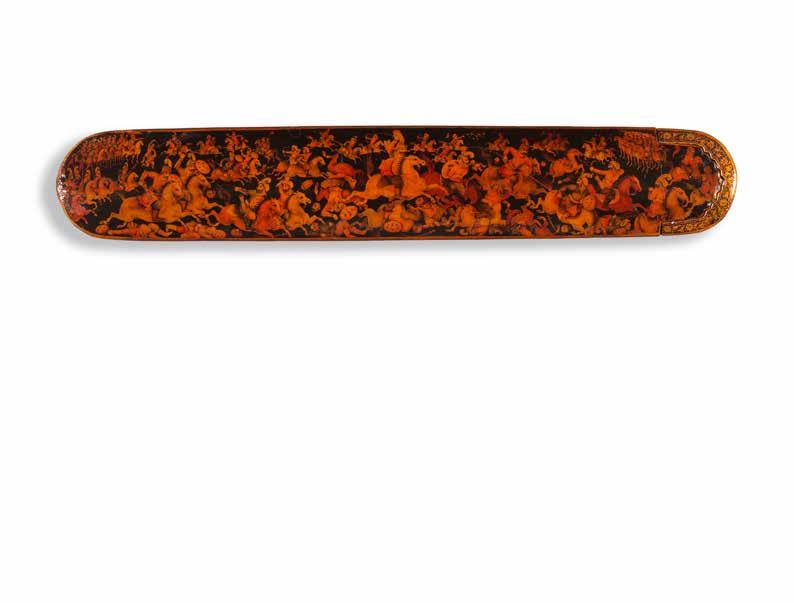
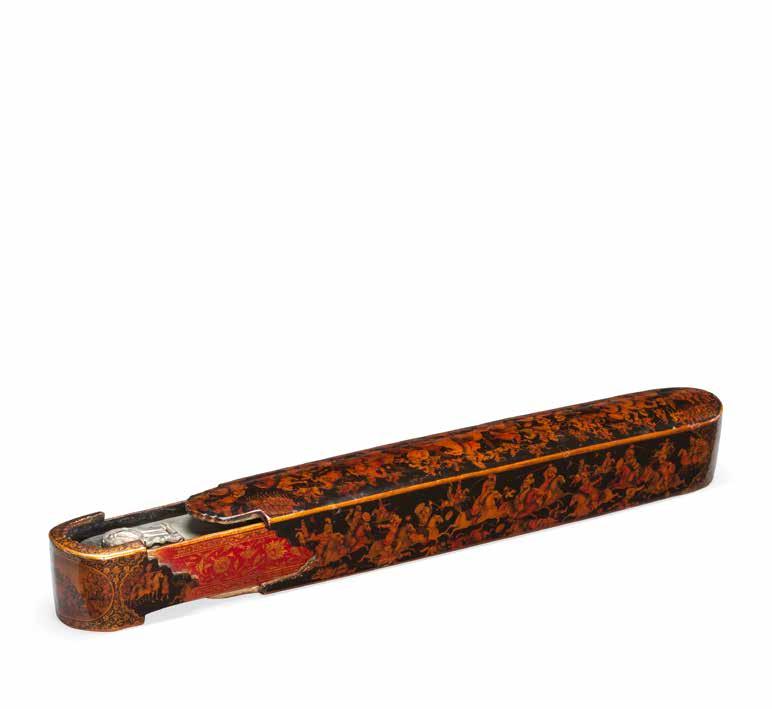
A FINE QAJAR LACQUER PENBOX (QALAMDAN) DEPICTING THE BATTLE OF CHALDIRAN PERSIA, 19TH CENTURY
with rounded ends and sliding tray, decorated in polychrome and gilt, to the top and sides with depictions of the Battle of Chaldiran with smaller skirmishes in ovoid cartouches to ends, the base and sides of tray with foliate scrollwork on a red ground, the inkwell with bee to lid, inscription to lid 22.5 cm. long
£6,000 - 8,000
€6,900 - 9,200
US$8,100 - 11,000
Inscriptions: ‘Ali Quli Bayg [12]99 (1881-2)’
The Battle of Chaldiran, fought on the 23 of August 1514, was a decisive confrontation between the Ottoman Empire under Sultan Selim I (reg. 1512-1520) and the Safavid Empire led by Shah Ismail I (reg. 1501-1524). It is widely regarded as a turning point in Middle Eastern military history due to the Ottomans’ effective use of gunpowder weaponry, particularly artillery and firearms, against the Safavid forces, who relied primarily on cavalry. The Ottoman victory secured control over eastern Anatolia and exposed structural weaknesses in Safavid military organization. In the longer term, the battle contributed to the consolidation of a political and religious divide between the Sunni Ottomans and the Shiʿi Safavids, shaping regional dynamics for centuries.
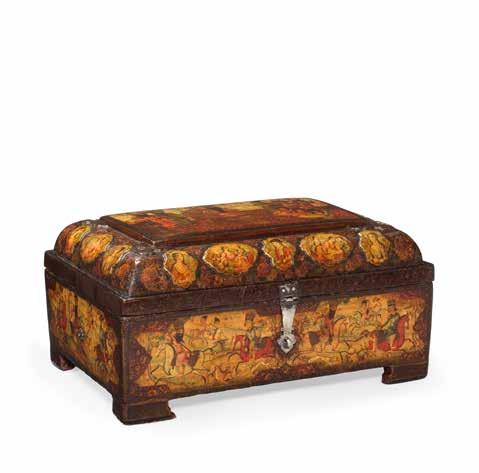
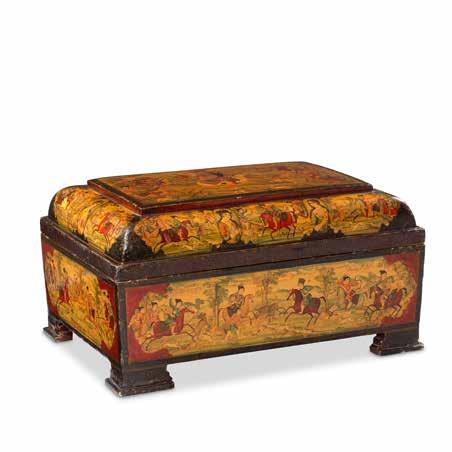
73 R A LARGE QAJAR LACQUER PAPIER-MÂCHÉ
BOX DEPICTING FATH ‘ALI SHAH ENTHRONED PERSIA, 19TH CENTURY
of rectangular form on four feet, the lid with curved sides, decorated in polychrome and gilt with Fath ‘Ali Shah on the peacock throne encircled by courtiers and his sons to the lid, surrounded by a series of cartouches with European figures, the sides and interior of lid with courtly hunting scenes, the base with gilt floral sprays on red ground 42.2 x 29.6 x 20.3 cm.
£4,000 - 6,000
€4,600 - 6,900
US$5,400 - 8,100
74 † R A LARGE QAJAR LACQUER PAPIER-MÂCHÉ
BOX DEPICTING FATH ‘ALI SHAH AND SCENES FROM YUSUF AND ZULAYKHA PERSIA, 19TH CENTURY of rectangular form on four feet, the lid with curved sides, decorated in polychrome and gilt with Fath ‘Ali Shah, his sons and courtiers on a hunting expedition to the sides and lid, the lid interspersed with a series of cartouches with figures, interior of lid with scenes from Jami’s Yusuf and Zulaykha base with black floral sprays on red ground 42.5 x 29.8 x 21 cm.
£3,000 - 5,000
€3,400 - 5,700
US$4,100 - 6,800
Provenance
Formerly in a Private Swiss collection, acquired in the 1980s.

A PAIR OF QAJAR GOLD AND SILVERDAMASCENED STEEL BOTTLES
PERSIA, 19TH CENTURY
of piriform with long tapering necks, flattened rims and removable pointed stoppers, the bodies and necks profusely engraved and decorated in gold and silver overlay, the bodies with lobed cartouches and perching bird motifs on a scrollwork ground, floral sprays to necks and stoppers
56.5 cm. high(2)
£8,000 - 12,000
€9,200 - 14,000
US$11,000 - 16,000
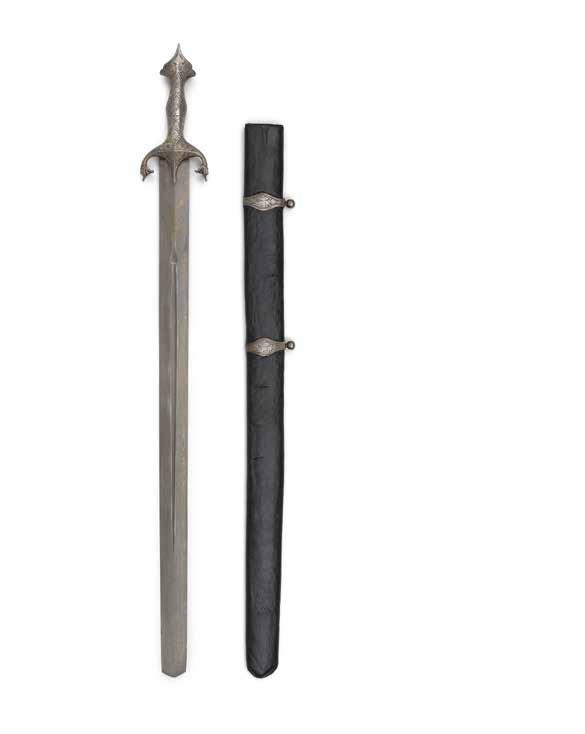
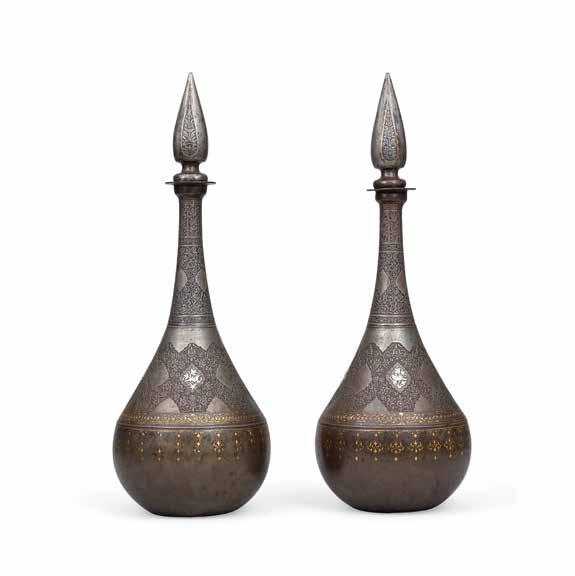
A QAJAR ‘SAFAVID REVIVAL’ GOLDDAMASCENED WATERED-STEEL SWORD PERSIA, 19TH CENTURY
the double-edged watered-steel blade with single fuller, decorated in gold overlay with an inscriptionfilled cartouche to each side, the hilt with dragonhead, chiselled with perching birds, figures and floral interlace, the wood scabbard clad in black leather with steel mounts engraved with perching birds
US$2,000 - 2,700
Inscriptions: a couplet from Sa’di’s Gulistan and Yusuf and Zulaykha
For a similar sword in the Mohammed Khalil Collection see M. K. Ibrahim, Islamic Arms and , Vol. II, United Arab Emirates, p. 858, cat.
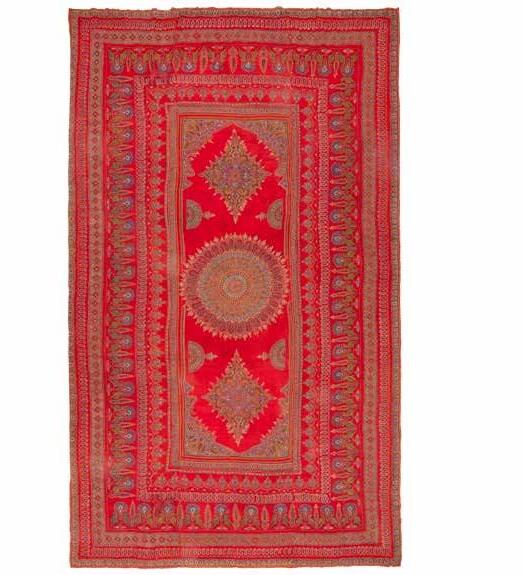
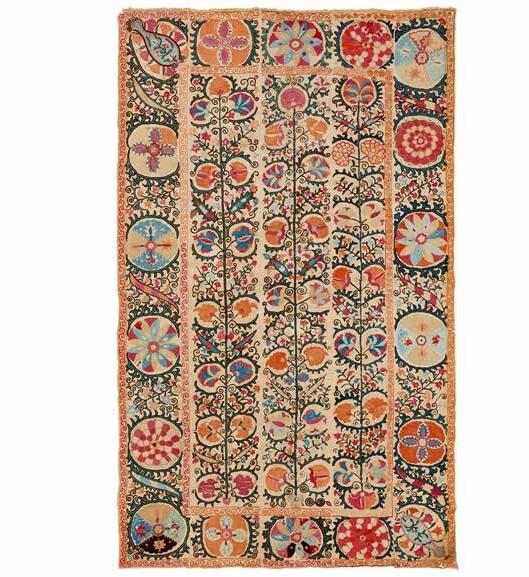
78
77 R
A LARGE QAJAR EMBROIDERED WOOL PANEL
KIRMAN, PERSIA, 19TH CENTURY
of rectangular form, the red wool embroidered in polychrome wools, the central panel containing a medallion comprising boteh and floral interlace, surrounded by similar semi-circular and crenellated designs, the border with parrots, peacocks, boteh, cypresses, and vegetal motifs, backed approx. 408 x 238 cm.
£3,000 - 5,000
€3,400 - 5,700
US$4,100 - 6,800
For a panel with comparable motifs, see Parvis Nemati, Shawls of the East: from Kerman to Kashmir, New York 2003, p.135.
78
A BOKHARA SILK EMBROIDERED LINEN PANEL (SUSANI) UZBEKISTAN, LATE 19TH CENTURY
of rectangular form, the natural linen ground embroidered in polychrome silks with a central panel containing three sets of undulating floral vines, the border with flowerheads on a foliate lattice ground
250 x 150 cm.
£2,000 - 3,000
€2,300 - 3,400
US$2,700 - 4,100
Provenance
Formerly in the collection of Harry Radliffe II, Stamford, Connecticut, purchased in London in the 1980s when he was London Bureau Chief for CBS News. 77
For details of the charges payable in addition to the final Hammer Price of each Lot please refer to paragraphs 7 & 8 of the Notice to Bidders at the back of the catalogue.
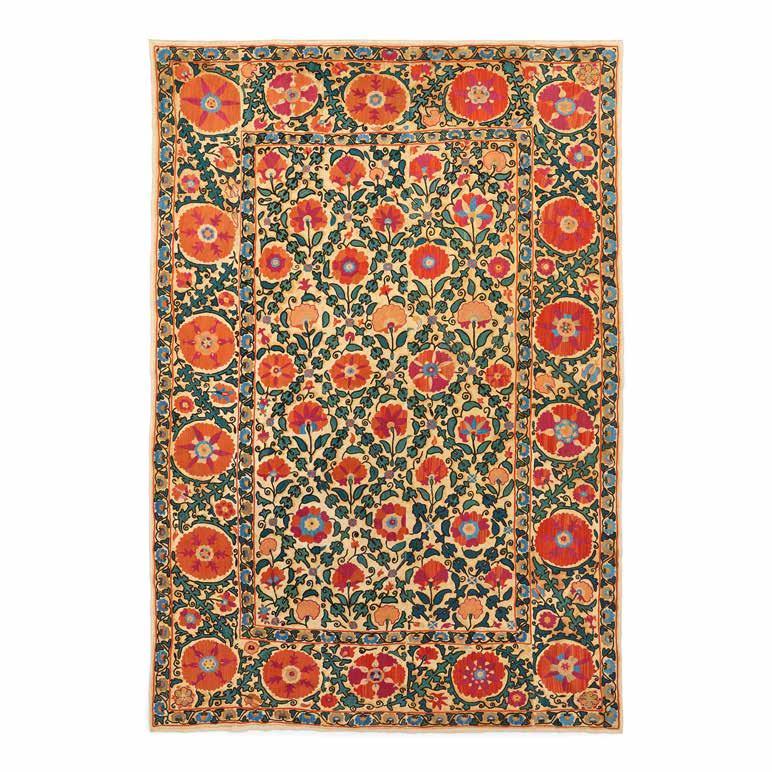
A BOKHARA SILK EMBROIDERED LINEN PANEL (SUSANI)
UZBEKISTAN, 19TH CENTURY of rectangular form, the natural linen ground embroidered in polychrome silks with a repeat design of floral sprays and flowerheads within a foliate interlace, the borders with alternating flower and foliate motifs, backed 153 x 232 cm.
£4,000 - 6,000
€4,600 - 6,900
US$5,400 - 8,100
Provenance
Private UK collection, acquired at Bonhams, Islamic and Indian Art, 2 April 2009, lot 116.
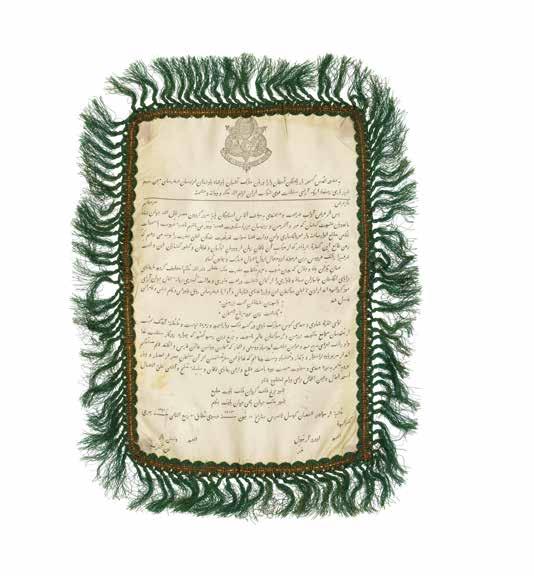
SILK, IN THE FORM OF AN ADDRESS OF WELCOME, FOR THE VISIT OF NASR AL-DIN SHAH QAJAR TO THE PORT OF DOVER ENGLAND, DATED 21 RABI II 1290/18TH JUNE 1873
Persian text printed on pale cream silk, coat of arms of the Port of Dover at top, edged with green cloth tassels and a gold-embroidered border
41 x 29 cm. including tassels
£1,000 - 1,500
€1,100 - 1,700
US$1,400 - 2,000
The text was most probably written by someone British, and consists of the authorities of the Town and Port of Dover addressing Nasr alDin Shah, welcoming him and paying respect to him on his way to visit Queen Victoria, hoping for unbroken unity and friendship between the two nations. It is signed by Edward Ruttley Mowell, the Mayor of Dover, and Edward Wollaston Nadir Knocker, the Town Clerk (18381907, later Sir Edward, knighted in 1901).
Nasr al-Din Shah Qajar was the first Persian monarch to visit the West. During his visit to the United Kingdom in 1873, Queen Victoria, whom he met at Windsor, appointed him a Knight of the Order of the Garter. He also visited, for example, the authorities of the City of London, who issued a bronze medallion (examples of which have been sold in these rooms) to commemorate his visit in a limited edition of 400, presented to those who attended a reception held by the Corporation of the City of London at the Guildhall on Friday 20th June 1873.
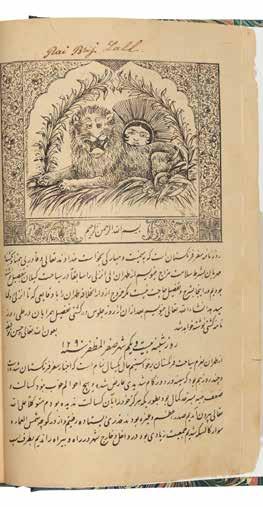
TRAVELS AND ADVENTURES OF THE SHAH OF PERSIA IN EUROPE [ENGLISH TITLE], WITH THE REMAINDER OF THE TEXT IN PERSIAN
PRINTED IN BOMBAY, DATED 27 JUMADI I, 1297/8TH MAY 1880 pp. 216 as numbered, lithograph frontispiece portrait of Nasr alDin Shah, Lion and Sun lithograph headpiece on p. 2, occasional words printed in Latin text, mostly foreign names, frequent notes in pencil with English translations of Persian words, 7 albumen prints of European rulers (and one view of the interior of the Aya Sufiya, Istanbul) pasted on to blank sheets interspersed in the text, with Persian (and in some cases also English and German) titles within the prints, modern binding with marbled covers 255 x 175 mm.
£1,500 - 2,000
€1,700 - 2,300
US$2,000 - 2,700
For the full note on this lot, see the online catalogue.
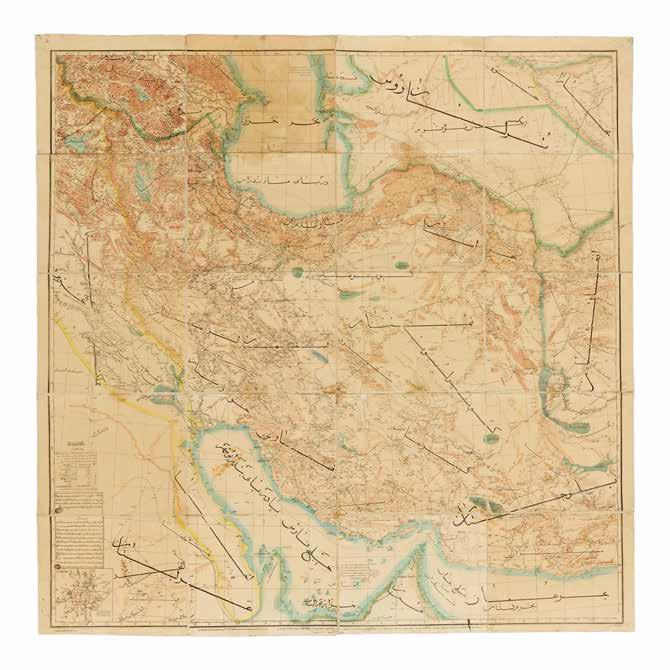
A PRINTED MAP OF IRAN, WITH A SMALL INSET MAP OF TEHRAN, AND INCORPORATING PARTS OF THE GULF AND SOUTHERN RUSSIA
QAJAR PERSIA, PRODUCED BY MIRZA ‘ABD AL-RAZZAQ
KHAN, DATED AH 1316/AD 1898-99 printed with colour, folding, backed with cloth 152.5 x 152.5 cm.; folded 31 x 38.5 cm.
£4,000 - 6,000
€4,600 - 6,900
US$5,400 - 8,100
The text on the map states that it was produced by Mu’tamid al-Sultan Mirza ‘Abd al-Razzaq Khan Sartip [brigadier] Muhandis [engineer], who studied at the Dar al-Funun under ‘Abd al-Ghaffar. ‘Abd al-Razzaq is praised for his work and the map is said to be perfect. It bears the seal impression of Najm al-Dawlah (‘Abd al-Ghaffar Najm al-Dawlah, a famous astrologer, and a teacher at the Dar al-Funun, d. 1909).
Another note praises the work of Mirza ‘Abd al-Razzaq, and states that all the mistakes in previous maps have here been corrected. It is
signed Ja’far Quli with his seal impression as vazir-e ‘ulum (Minister of Science); he was also titled Nayyir al-Mulk and was the director of Dar al-Funun
Another note gives the time of journeys from various places including Bombay, from Karachi to the Persian Gulf and back. A further note states that no copying of this is allowed without permission.
For other examples of late Qajar printed maps sold in these rooms, see Bonhams, Islamic and Indian Art:
24th April 2018, lot 224 (Persia and the surrounding countries, dated AH 1287/AD 1870-71); and lot 225 (the city of Tabriz, dated 12 Sha’ban 1297/20th July 1880).
22nd May 2025, lot 89, a printed map of the city of Tabriz, dated 12 Sha’ban 1297/20th July 1880; lot 90, a large printed map of the city of Tehran, 20th Century, copying an original map made in Muharram 1309/August-September 1891.
For an earlier example, of Tehran, dated Jumada I 1275/December 1858-January 1859, see Christie’s, Art of the Islamic and Indian Worlds, 5th October 2010, lot 253.
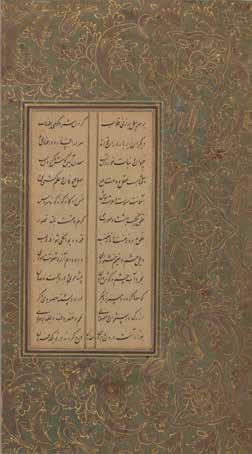
83 R
A DOUBLE-SIDED ILLUMINATED LEAF FROM A MANUSCRIPT OF THE JAM-E JAM OF AWHAD AL-DIN MARAGHI’I (D. 1338) PERSIA, 16TH CENTURY
Persian manuscript on cream-coloured and gold-sprinkled paper, 12 lines to the page written in two columns in small and elegant nasta’liq script in black ink, double intercolumnar rules in gold, inner margins ruled in blue, green, dark red and gold, outer borders of orange (recto) and green (verso) paper richly decorated with fantastic birds amidst stylised serrated leaves and flowerheads outlined in gold, the folio with the number 41 in Persian numerals written in upper right corner of text area
245 x 135 mm.
£1,500 - 2,000
€1,700 - 2,300
US$2,000 - 2,700
Provenance
Property from a distinguished private collection, London.
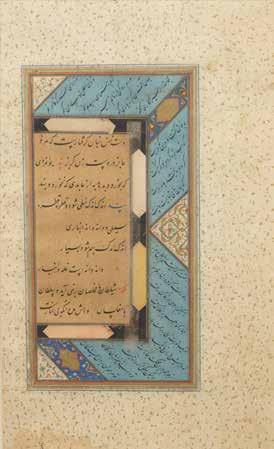
84 R
A DOUBLE-SIDED ILLUMINATED LEAF FROM A MANUSCRIPT OF THE POEMS OF SA’DI WRITTEN IN NASTA’LIQ PERSIA, 16TH CENTURY
Persian manuscript on paper, central text panel recto and verso with 9 lines written in fine nasta’liq in black ink with some words picked in gold, blue and red, further text outside this written diagonally on skyblue paper, inner margins ruled in colours and gold, illuminated floral triangular cornerpieces, gold-sprinkled wide outer borders leaf 250 x 150 mm.
£1,200 - 1,500
€1,400 - 1,700
US$1,600 - 2,000
Provenance
Property from a distinguished private collection, London.
The text in the central panel is from the Gulistan of Sa’di, that in the margins is from the Bustan
A group of thirty-six leaves from the same manuscript were sold at Christie’s, Art of the Islamic and Indian Worlds, 26th October 2023, lot 6.
Another folio from this manuscript is in the Metropolitan Museum of Art (inv. no. 1978.84).
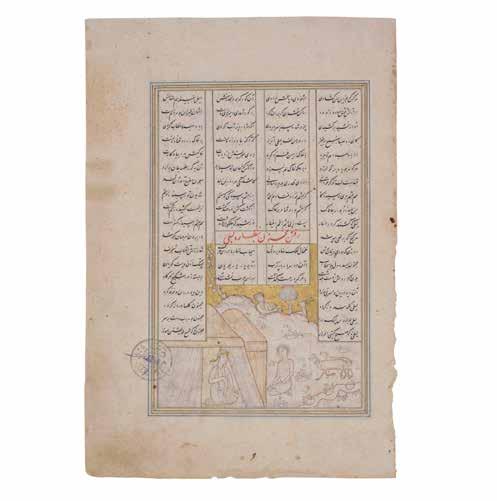
85 R
A LEAF FROM AN ILLUSTRATED MANUSCRIPT OF NIZAMI’S KHAMSA, DEPICTING LAYLA AND MAJNUN IN CONVERSATION OUTSIDE AN ENCAMPMENT PERSIA, 16TH CENTURY
Persian manuscript on paper, 23 lines to the page (verso), 18 lines (recto) written in nasta’liq in black ink in four columns, inner margins ruled in gold, black and blue, headings recto and verso in nasta’liq in red, illustration in pen and ink, gouache and some gold leaf 302 x 202 mm.
£1,000 - 1,500
€1,100 - 1,700
US$1,400 - 2,000
Provenance
Property from a distinguished private collection, London.
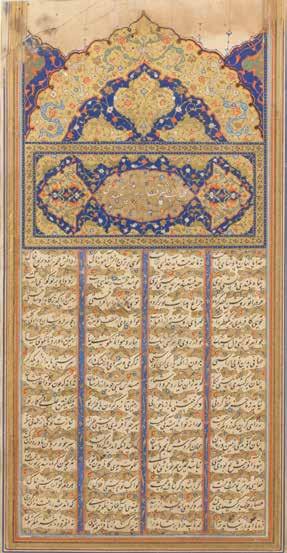
86 R A FINE ILLUMINATED FRONTISPIECE FROM A MANUSCRIPT OF NIZAMI’S SHARAF-NAMEH PERSIA, OR PERHAPS INDIA, 16TH CENTURY
Persian manuscript on paper, 14 lines to the page written in nasta’liq in black ink in four columns within cloudbands on a gold ground, intercolumnar rules with gold scrolling motifs on a blue ground, inner margins ruled in colours and gold, illuminated headpiece in colours and gold with a heading in white nasta’liq within a cartouche 308 x 155 mm.
£1,500 - 2,000
€1,700 - 2,300
US$2,000 - 2,700
Provenance
Property from a distinguished private collection, London.
A note on the backboard compares the illumination with that of a large Qur’an copied and decorated in the Deccan, Golconda, circa 15601600, sold at Sotheby’s, Oriental Manuscripts and Miniatures, 27th April 1994, lot 17.
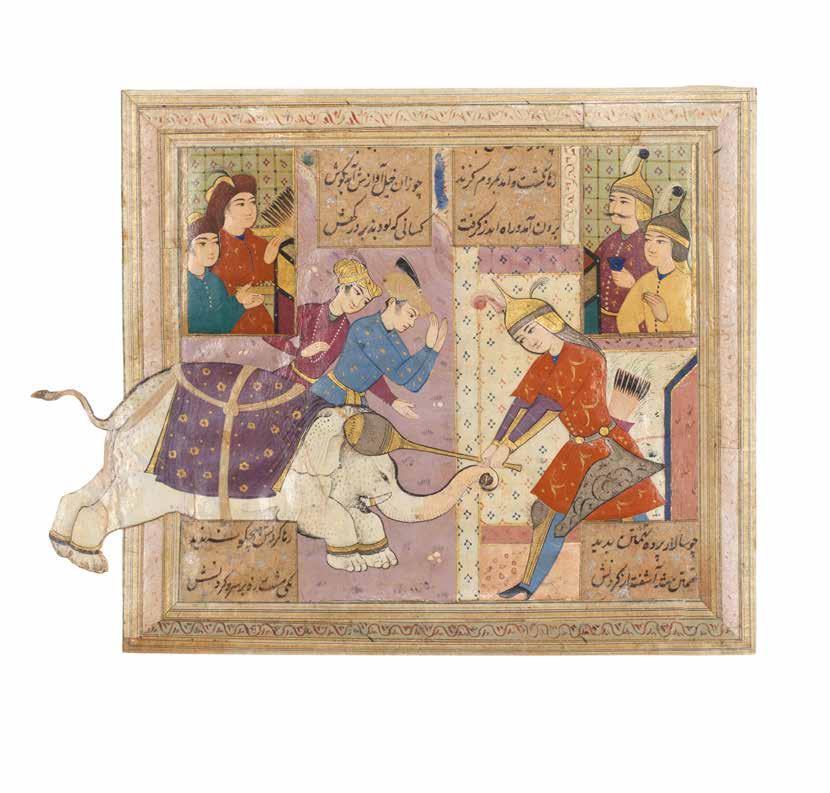
gouache and gold on paper, the surface lacquered, text panels in nasta’liq script in black ink in four columns, decorated borders and margin rules, verso with thirteen lines of text in four columns 148 x 183 mm.
£1,500 - 2,000
€1,700 - 2,300
US$2,000 - 2,700
Provenance
Property from a distinguished private collection, London.
88 No lot
89
THE DEATH OF IMAM HASAN WITHIN THE PRECINCTS OF A PALACE OTTOMAN TURKEY, EARLY 17TH CENTURY pen and ink, gouache and gold on paper laid down on card, ebru borders album page 290 x 195 mm.
£2,000 - 3,000
€2,300 - 3,400
US$2,700 - 4,100
Provenance
Sotheby’s, Arts of the Islamic World, 5th October 2011, lot 154.
Property from a distinguished private collection, London.
90
A CALLIGRAPHER’S DIPLOMA (IJAZET), WRITTEN BY THE CALLIGRAPHER AL-SAYYID AHMAD NAZIF, KNOWN AS FAKHRI AFANDI (FAHRI EFENDI), LICENSED BY AL-HAJJ AHMAD FAKHRI (AHMED FAHRI)
OTTOMAN TURKEY, DATED AH 1290/AD 187374
Arabic manuscript on paper laid down on card, an upper line in large black thuluth within stylised cloudbands, with three lines beneath this written in neat naskhi, lower left cartouche giving the details of the ijazet, lower right cartouche blank, text bordered by floral sprays illuminated in colours and gold, outer borders decorated with vine leaves interspersed by a zigzag line in gold on a green ground, backed with marbled paper 193 x 247 mm.
£1,500 - 2,000
€1,700 - 2,300
US$2,000 - 2,700
Provenance
Property from a distinguished private collection, London.
The first line in a larger hand consists of Qur’an, sura XXXV, Fatir, verse 28. The remainder of the text consists of two different hadiths of the Prophet on the learned ones.
One further ijazet approved by Ahmed Fahri seems to be recorded, dated AH 1281 and licensing a certain Mir Izzet Efendi. Neither of the scribes mentioned in this piece are recorded in Mahmud Kemal Inal’s Son Hattatlar, the major source for information on late Ottoman calligraphers.
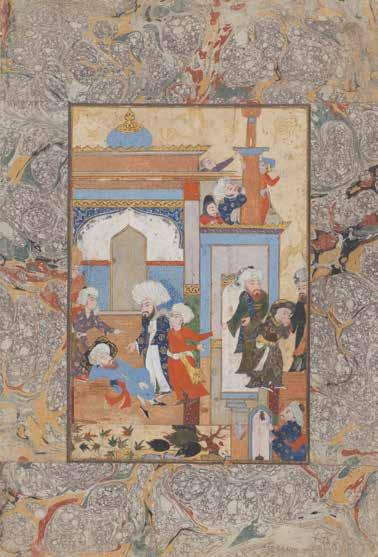
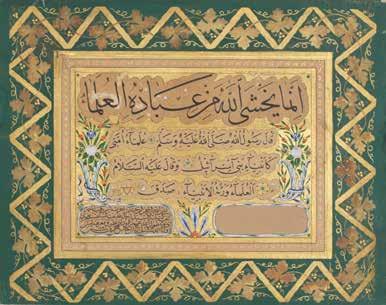
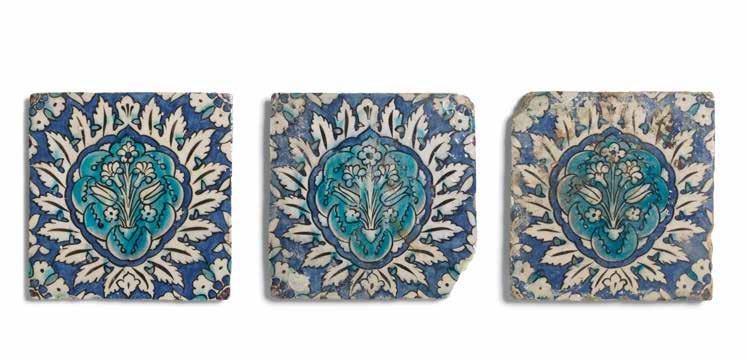
91 R
THREE DAMASCUS UNDERGLAZE-PAINTED POTTERY TILES
SYRIA, 17TH CENTURY
each of square form, decorated in cobalt-blue and turquoise with black outline on a white ground with a foliate lobed cartouche containing a vase issuing floral sprays, partial rosettes to each corner each approx. 23 x 22.5 cm.
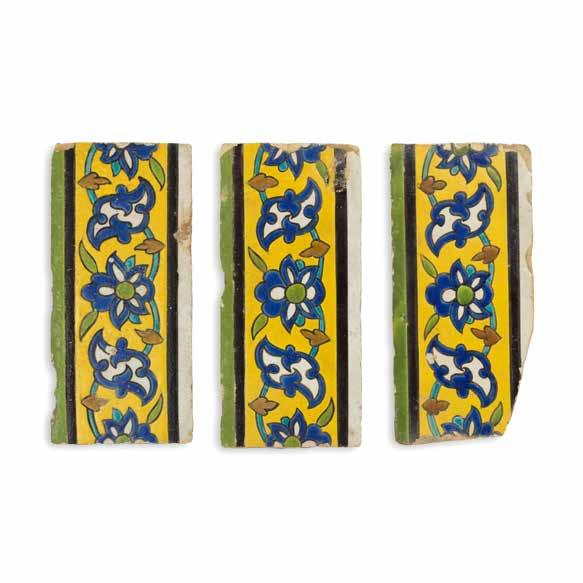
£1,500 - 2,000
€1,700 - 2,300
US$2,000 - 2,700
Provenance
Property from a distinguished private collection, London.
For tiles of similar design, see Sotheby’s, Oriental Miniatures and Manuscripts, Antiquities, Islamic and Indian Art, 23rd and 24th April 1997. See also Yanni Petsopoulos, Tulips, Arabesques & Turbans: Decorative Arts from the Ottoman Empire, London 1982, no.106 and Arthur Millner, Damascus Tiles, London 2015, fig.4.
POTTERY BORDER TILES
each of rectangular form decorated in yellow, blue, turquoise, ochre, manganese, green and white, with undulating floral and foliate vines
£1,500 - 2,000
€1,700 - 2,300
US$2,000 - 2,700
Provenance
Property from a distinguished private collection, London.
93 R
A SAFAVID CUERDA SECA POTTERY TILE
PERSIA, 17TH CENTURY of square form, decorated in yellow, cobalt-blue, turquoise, green, ochre and manganese on a white ground with floral and foliate interlace to central section and scrolling vines to border 22.7 x 22.6 cm.
£2,000 - 3,000
€2,300 - 3,400
US$2,700 - 4,100
Provenance
Property from a distinguished private collection, London.
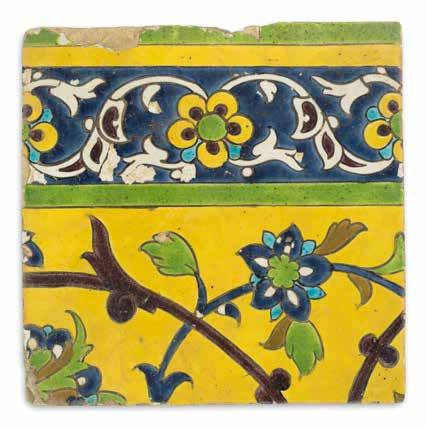
94 R
A SAFAVID CUERDA SECA POTTERY TILE
PERSIA, 17TH CENTURY of square form, decorated in cobalt-blue, green and yellow with black outline with swirling vines terminating in flowerheads and a half palmette 23.2 x 22.3 cm.
£2,000 - 3,000
€2,300 - 3,400
US$2,700 - 4,100
Provenance
Property from a distinguished private collection, London.
Tiles with comparable motifs were sold at Christie’s, Islamic Art & Manuscripts including Property from the Theodor Sehmer and Heidi Vollmoeller Collections, and including The Clive of India Treasure, 27th April 2004, lot 220, and Sotheby’s, Antiquities and Islamic Art, May 31st 1997, lot 402.
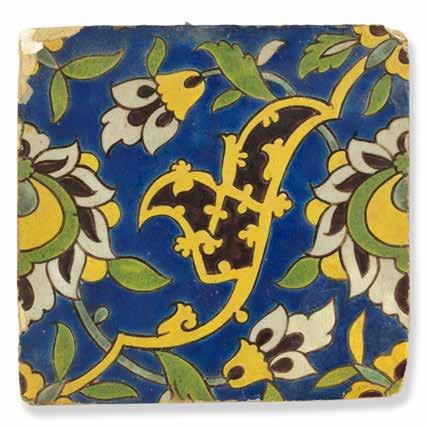
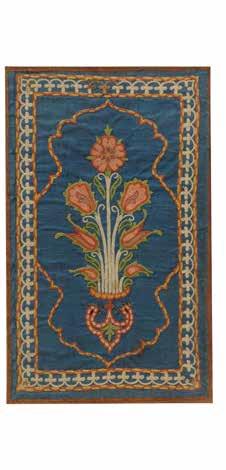
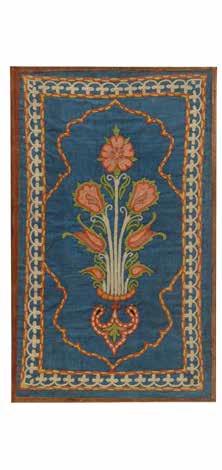
95 R
A PAIR OF SAFAVID EMBROIDERED-SILKMOUNTED LEATHER BOOKBINDINGS
PERSIA, CIRCA 1700
each of rectangular form, the leather boards mounted with blue silk embroidered in polychrome with medallions containing floral sprays, the borders with bands of trefoils, gilt trefoil borders to reverse each 17.5 x 10.8 cm.
£2,000 - 3,000
€2,300 - 3,400
US$2,700 - 4,100
Provenance
Sotheby’s, Arts of the Islamic World, 3 October 2012, lot 27.
Property from a distinguished private collection, London.
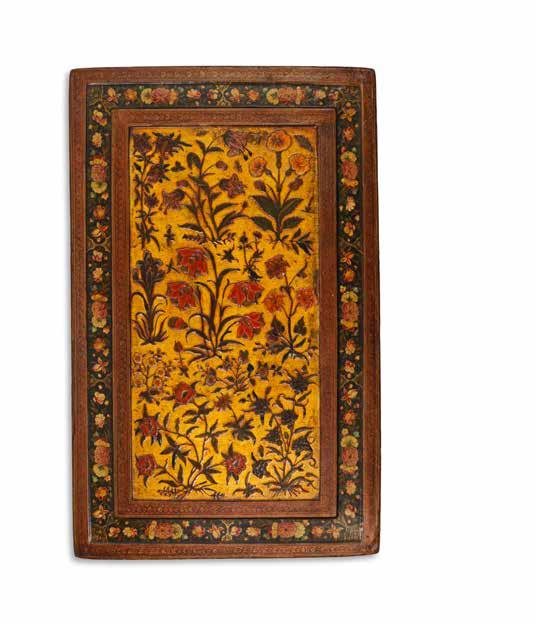
A QAJAR LACQUER MIRROR CASE FROM THE COLLECTION OF SIR HOWARD HODGKIN (1932-2017)
PERSIA, 19TH CENTURY
of rectangular form, moulded and decorated in polychrome and gilt with a central panel containing floral sprays, the border with a series of cartouches filled with floral motifs, Howard Hodgkin Portrait of the Artist sticker to reverse 33.8 x 21.2 cm.
£1,500 - 2,000
€1,700 - 2,300
US$2,000 - 2,700
Provenance
Formerly in the collection of Sir Howard Hodgkin (1932-2017).
Property from a distinguished private collection, London: acquired at Sotheby’s, Howard Hodgkin, Portrait of the Artist, 24th October 2017, lot 391.
97 R
A LARGE GULZAR CALLIGRAPHIC COMPOSITION, SIGNED BY HASAN ZARRIN QALAM
QAJAR PERSIA, DATED AH 1312/AD 1894-95
pen and ink and watercolour on paper 360 x 450 mm.
£2,000 - 3,000
€2,300 - 3,400
US$2,700 - 4,100
Provenance
Property from a distinguished private collection, London.
For the full note on this lot, see the online catalogue.
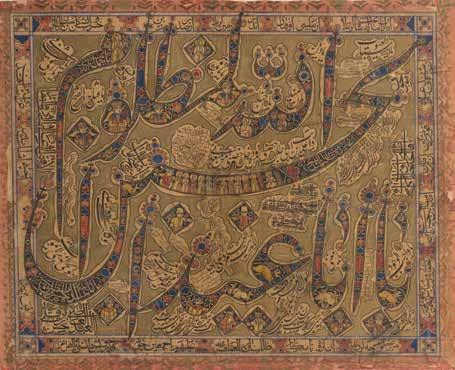
98 R
TWO PAINTINGS DEPICTING SEATED DERVISHES, ATTRIBUTED TO LUTF’ALI SHIRAZI
QAJAR PERSIA, ONE DATED AH 1272/ AD 1856-57
watercolour on paper, each octagonal with illuminated borders, laid down on album pages, one with signature and date AH 1272
album pages 334 x 210 mm.(2)
£1,500 - 2,000
€1,700 - 2,300
US$2,000 - 2,700
Provenance
Property from a distinguished private collection, London.
The signature reads: ‘Its drawer, the smallest servant [of God], Lutf’ali 1272 (1856-57)’.
Lutf’ali Shirazi (d. 1871-72) was a wellknown painter of the Qajar period who worked in different techniques, lacquer, oil, water-colour and siyah qalam, and his recorded works are dated between AH 1257/AD 1841-42) and AH 1282/AD 186566). See M. A. Karimzadeh Tabrizi, The Lives & Art of Old Painters of Iran, vol. 2, London 1990, pp. 561-568); and Nasser D. Khalili, B. W. Robinson, T. Stanley, Lacquer of the Islamic Lands: Part One, 1996, p. 206.
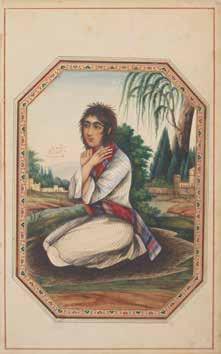
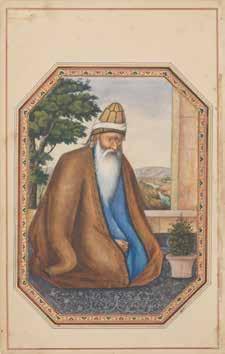
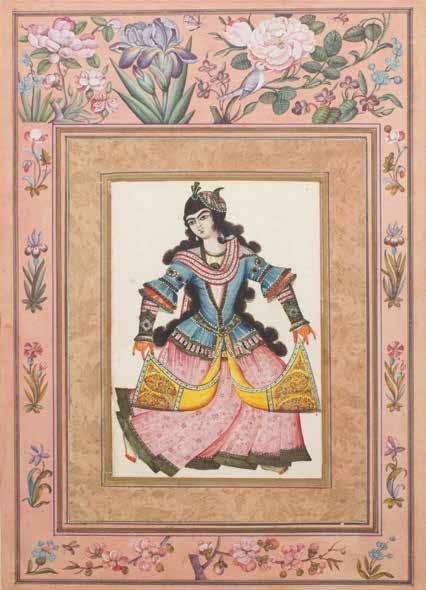
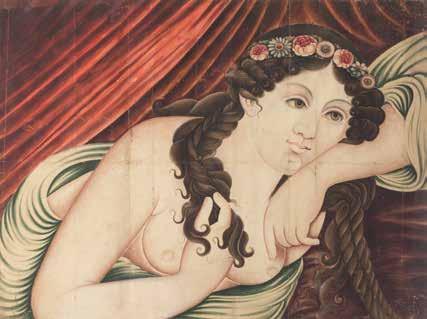
99 R A PAINTING OF A DANCING GIRL, LAID DOWN ON AN ALBUM PAGE WITH DECORATED FLORAL BORDERS
QAJAR PERSIA, MID-19TH CENTURY gouache with some gold on paper, inner border with naturalistic foliate motifs in gold on a light pink ground probably excised from Safavid album page borders, outer borders with Qajar floral sprays and a bird perched amidst flowering branches, on a pink ground album page 298 x 207 mm.
£1,200 - 1,500
€1,400 - 1,700
US$1,600 - 2,000
Provenance
Property from a distinguished private collection, London.
100 R A COURTESAN RECLINING IN A DRAPED INTERIOR
QAJAR PERSIA, MID-19TH CENTURY watercolour on paper 350 x 470 mm.
£800 - 1,200
€920 - 1,400
US$1,100 - 1,600
Provenance
Bonhams, Islamic and Indian Art, 6th October 2008, lot 438.
Property from a distinguished private collection, London.
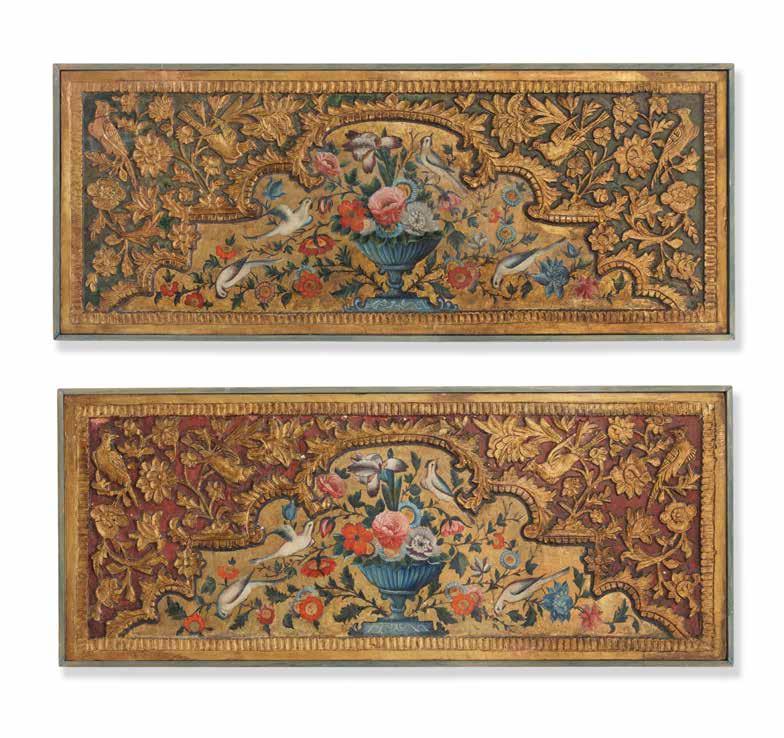
each of rectangular form, carved and painted in polychrome and gold with a cusped arch containing a floral spray issuing from an urn with perching birds, the spandrels carved with birds amongst floral interlace (gol-o bolbol), framed
105 x 41 and 103 x 41 cm. excluding frames(2)
£1,500 - 2,000
€1,700 - 2,300
US$2,000 - 2,700
Provenance
Property from a distinguished private collection, London.
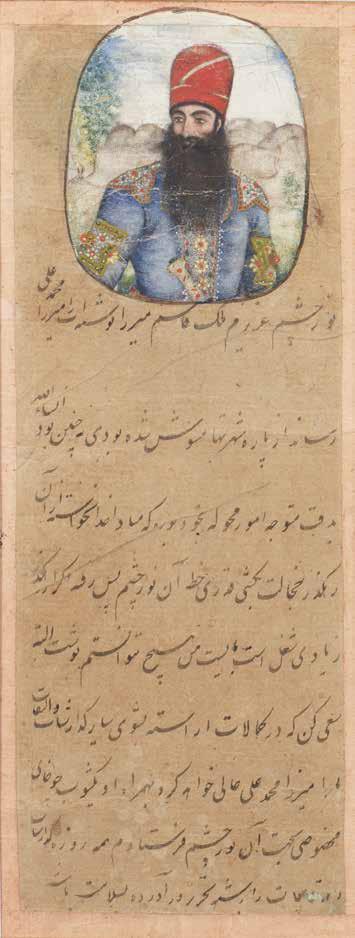
102 R A LETTER ADDRESSED TO MALIK QASIM
MIRZA, PERHAPS FROM HIS FATHER FATH ‘ALI SHAH QAJAR, INCORPORATING A PORTRAIT OF A PRINCE QAJAR PERSIA, EARLY 19TH CENTURY
Persian manuscript on paper, 9 lines written in nasta’liq script in black ink, surmounted by an oval portrait in ink and gouache, outer borders of coloured paper 210 x 80 mm.
£1,500 - 2,000
€1,700 - 2,300
US$2,000 - 2,700
Provenance
Bonhams, Islamic and Indian Art, 28th April 2005, lot 77.
Sotheby’s, Arts of the Islamic World, 5th October 2011, lot 128.
Property from a distinguished private collection, London.
Malik Qasim Mirza (1807-59), the twenty-fourth son of Fath’ Ali Shah, served in the office of ‘Abbas Mirza in Adharbayjan until AH 1248/1832-33. See M. Bamdad, Dictionary of National Biography of Iran 1700-1900, vol. IV, Teheran 1966, pp. 138-139.
This letter is addressed to him as nur-e chashm, ‘The light of my eyes’. The sender points out that the Prince’s handwriting has deteriorated and that accompanying the letter is a chukh (a woollen garment woven in Mazandaran). A daily report is also demanded.
For a similar letter, also with a portrait of a prince as headpiece, described as a letter from Abbas Mirza to his uncle, see Christie’s, Islamic Art and Indian Miniatures, 28th April 1998, lot 93.
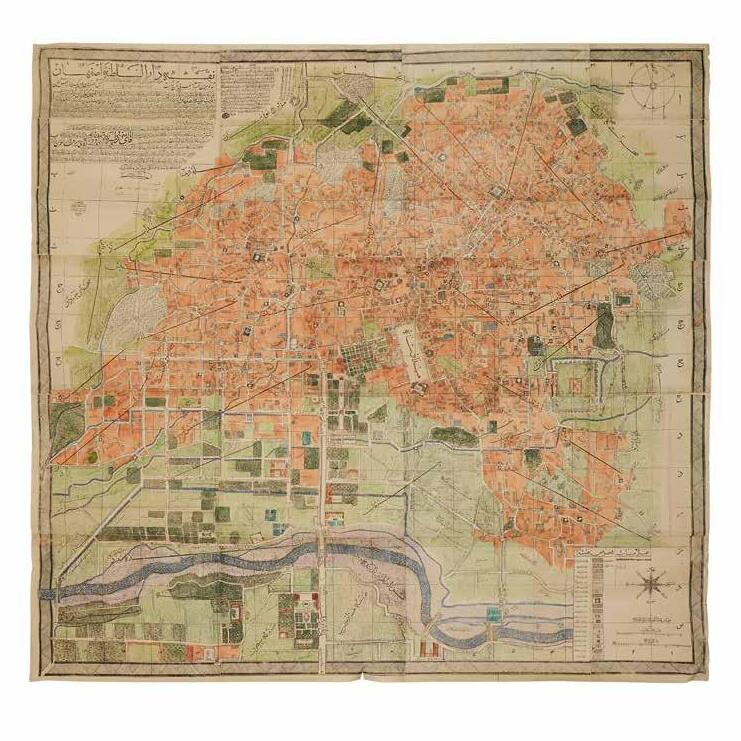
A LARGE PRINTED MAP OF THE CITY OF ISFAHAN QAJAR PERSIA, IN THE PRINT HOUSE OF MIRZA HUSAYN FARHANG IN ISFAHAN, DATED IN POETIC FORM IN ABJAD, ALSO CONVENTIONALLY 9 JUMADI II 1342/17TH JANUARY 1924, AND IN SOLAR 25 JADY 1302/17TH JANUARY 1924
printed with use of colour, street names and other text in Persian, key to features at lower right, publication and other details at upper right 134 x 142 cm.
£3,000 - 4,000
€3,400 - 4,600
US$4,100 - 5,400
Provenance
Property from a distinguished private collection, London.
For the full note on this lot, see the online catalogue. For details of the charges payable in addition to the final Hammer Price of each Lot please refer to paragraphs 7 & 8 of the Notice to Bidders at the back of
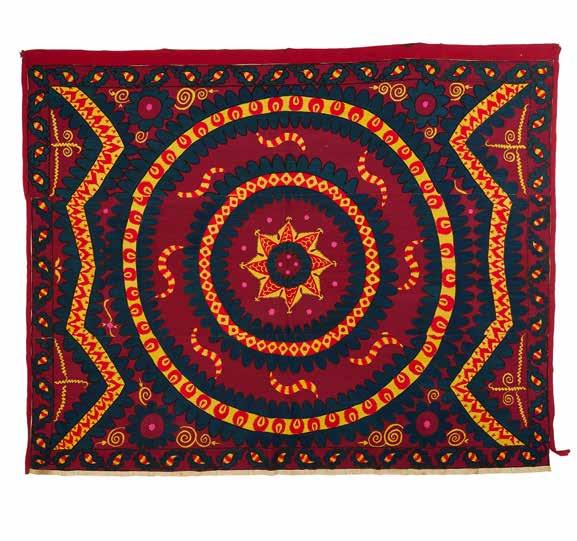
of rectangular form, the red wool ground embroidered in polychrome with stellate motif to centre surrounded by lobed concentric circles and zigzag bands, foliate scrollwork to border 201 x 248 cm.
£1,500 - 2,000
€1,700 - 2,300
US$2,000 - 2,700
Provenance
Property from a distinguished private collection, London.
105 R
“THE LETTER THAT NEVER ARRIVED’ OR NAMEH-I KE HARGEZ NARESID (CARPET CLOAK) BY BITA GHEZELAYAGH IRAN, 2013
comprising a Hamadan and Mahal carpet fragment forming a cloak, the cotton warp knotted in polychrome wools with an interlace of floral sprays and split-palmettes to upper panel and geometric floral and foliate motifs to lower panel, the upper front section with applied metal flowers, keys, crowns and portraits of a man, accompanying stand 161.8 cm. high
£2,000 - 3,000
€2,300 - 3,400
US$2,700 - 4,100
Provenance
Property from a distinguished private collection, London.
Ghezelayagh (b.1966) is an Italian-born artist, who was brought up in Iran, and began her career as an architect, specialising in the restoration of historic sites. This interest in rejuvenation carried through into her series, “The Letter That Never Arrived”. Combining and layering threadbare Persian and Middle Eastern carpets, Ghezelayagh reworked them as shepherd cloaks. She then embellished each piece with metal charms and embroidery, evoking not just Iranian carpetmaking traditions but the practice of wearing charms in clothing and hair as tokens of good luck and protection. The final piece therefore pays respect to artisanal tradition, while reconciling this craft with modernity. As Ghezelayagh and her gallerist notes, her work returns to carpets their ‘honourable function’ and ‘dignity’, while ‘taking the pulse of Iran, the loss of craftsmanship, bad economy, carpet weavers and felt-makers losing their jobs... [she seeks to] maintain what is best in her culture when all is falling apart.’
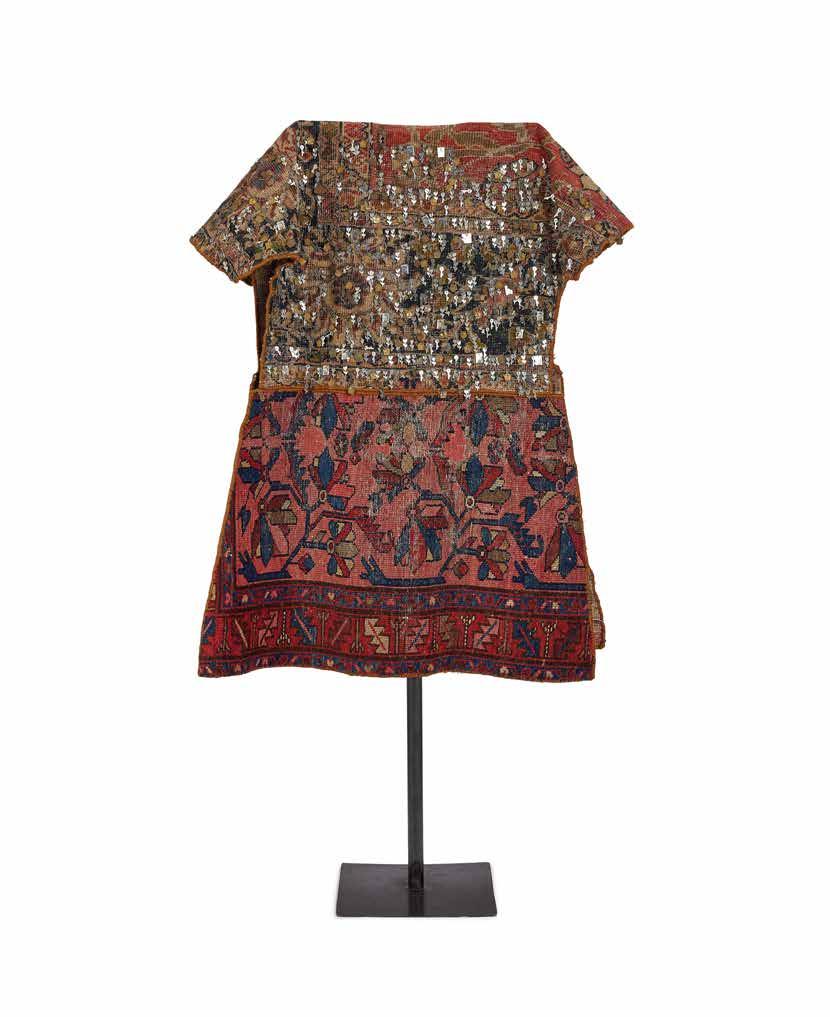
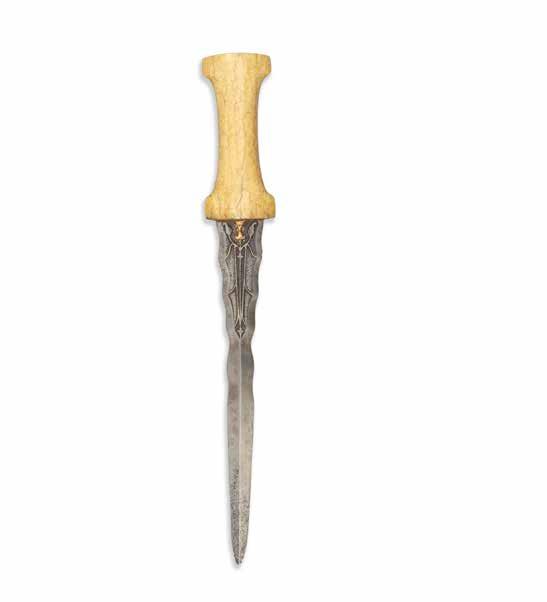
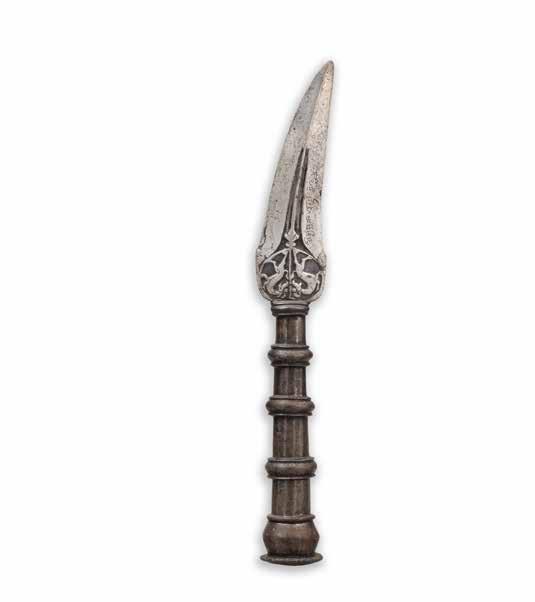
106 Y R
WALRUS IVORY-HILTED DAGGER PERSIA, 18TH/ 19TH CENTURY
the double-edged blade of undulating form, decorated in gold overlay to forte on each side and chiselled with a group of three trefoils and foliate motifs, the walrus-ivory hilt with waisted grip, khatamkari flowerhead motif to pommel 35.5 cm. long
£1,200 - 1,500
€1,400 - 1,700
US$1,600 - 2,000
Provenance
Property from a distinguished private collection, London.
For a comparable walrus ivory-hilted dagger with khatamkari detail, see Bonhams, Islamic and Indian Art including Contemporary Indian and Pakistani Paintings, 28th April 2005, lot 502.
the double-edged steel blade of curved form with raised spine and two chiselled fullers intersecting a pair of confronting quadrupeds at the forte, on tapering tubular socket with four prominent circular mouldings and disc-shaped basal mount, inscriptions in Kannada to blade and socket, accompanying perspex stand 48 cm. high
£1,500 - 2,000
€1,700 - 2,300
US$2,000 - 2,700
Provenance
Property from a distinguished private collection, London.
For further examples of this type, see the Collection of H.M. the Queen at Sandringham House, Norfolk, where there are comparable spearheads, presented to the Prince of Wales by the Princess of Tanjore during his visit to India in 1875-6. See C. Purdon Clark, Arms and Armour at Sandringham, 1898, Huntingdon 2008, figs. 46, 47, 103, 104, 155, 156, 236 and 237.
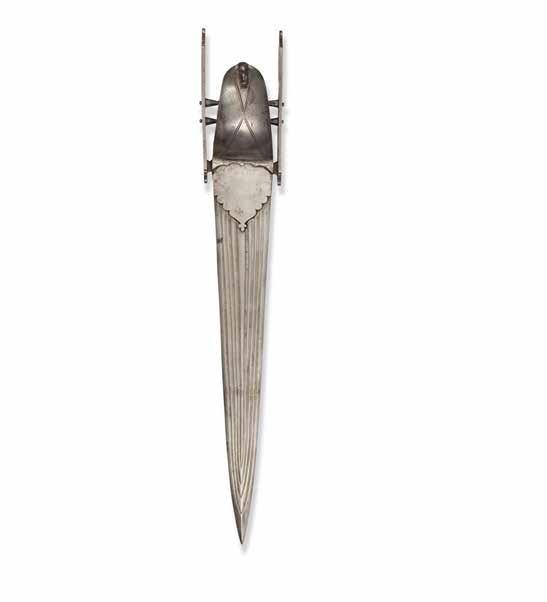
STEEL PUSH DAGGER (KATAR)
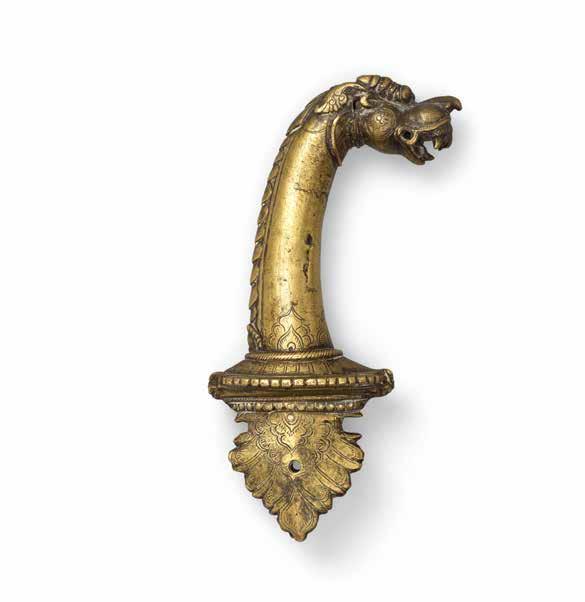
VIJAYANAGARA, 17TH/ 18TH CENTURY
the double-edged steel blade with eight fullers and armour piercing tip, the hilt of typical form with faceted baluster crossbars with spherical elements, sidebars with lobed terminals, hand-guard with engraved cross motif and Makara-head finial, lobed plate with trefoil motif to forte 58 cm. long
£2,000 - 3,000
€2,300 - 3,400
US$2,700 - 4,100
Provenance
Property from a distinguished private collection, London.
A BRASS HILT IN THE FORM OF A MAKARA HEAD SOUTH INDIA, POSSIBLY TANJORE, 18TH/ 19TH CENTURY
the ricasso of foliate form, makara head quillons in the form of makara masks, the grip in the form of a long slightly curving neck with scales to outer curve, makara head pommel, engraved foliate decoration and other details 16 cm. long
£2,000 - 3,000
€2,300 - 3,400
US$2,700 - 4,100
Provenance
Property from a distinguished private collection, London.
A RARE MAIL AND PLATE HELMET
DECCAN, 16TH/ 17TH CENTURY
comprising ten panels linked to each other with mail rings, surmounted by a circular crest with cruciform applied loops to top, earflap to each side, the nasal bar with recurved eye-guard panel; each panel inscribed with inscriptions in thuluth, the earflaps, eye-guard and crest with vegetal decoration, the upper finial with further inscriptions 29 cm. high
£3,000 - 5,000
€3,400 - 5,700
US$4,100 - 6,800
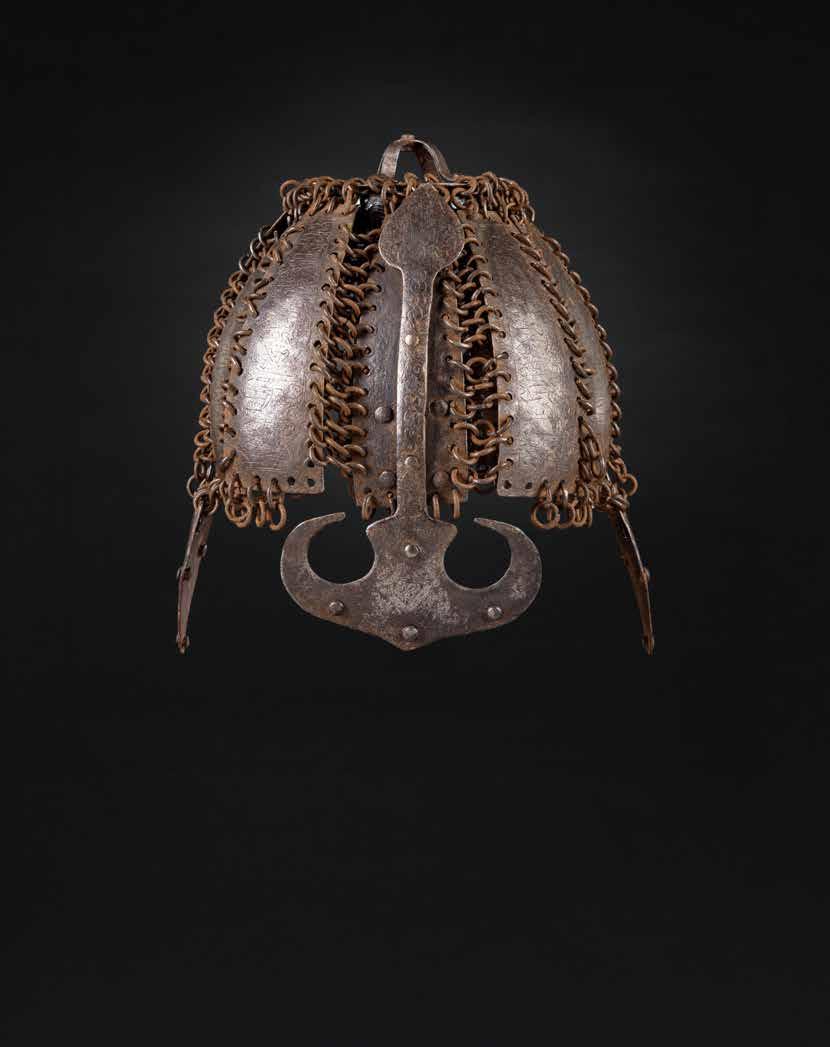
Private UK collection, London, acquired in the early 1990s. Property from a distinguished private collection, London.
Inscriptions: undeciphered.
For a Deccani helmet of similar form, see Bashir Mohamed, The Arts of the Muslim Knight: The Furusiyya Art Foundation Collection, cat. no. 319. While the Furusiyya helmet dates to the sixteenth or seventeenth century, this type with mail, plates and ear flaps persisted within Indian martial history. As Mohamed notes, this style was still being worn by the cavalry of Tipu Sultan in Mysore in the late 18th Century (p.332).
A RARE MAIL AND PLATE HELMET
SOUTH INDIA, POSSIBLY HYDERABAD, 16TH/ 17TH CENTURY
comprising six panels linked to each other with mail rings, surmounted by a slightly domed crest with bulbous finial, earflap to each side, one probably associated, the front panel with rectangular staple and sliding nose guard terminating in a large palmette at each end
37 cm. high
£10,000 - 15,000
€11,000 - 17,000
US$14,000 - 20,000
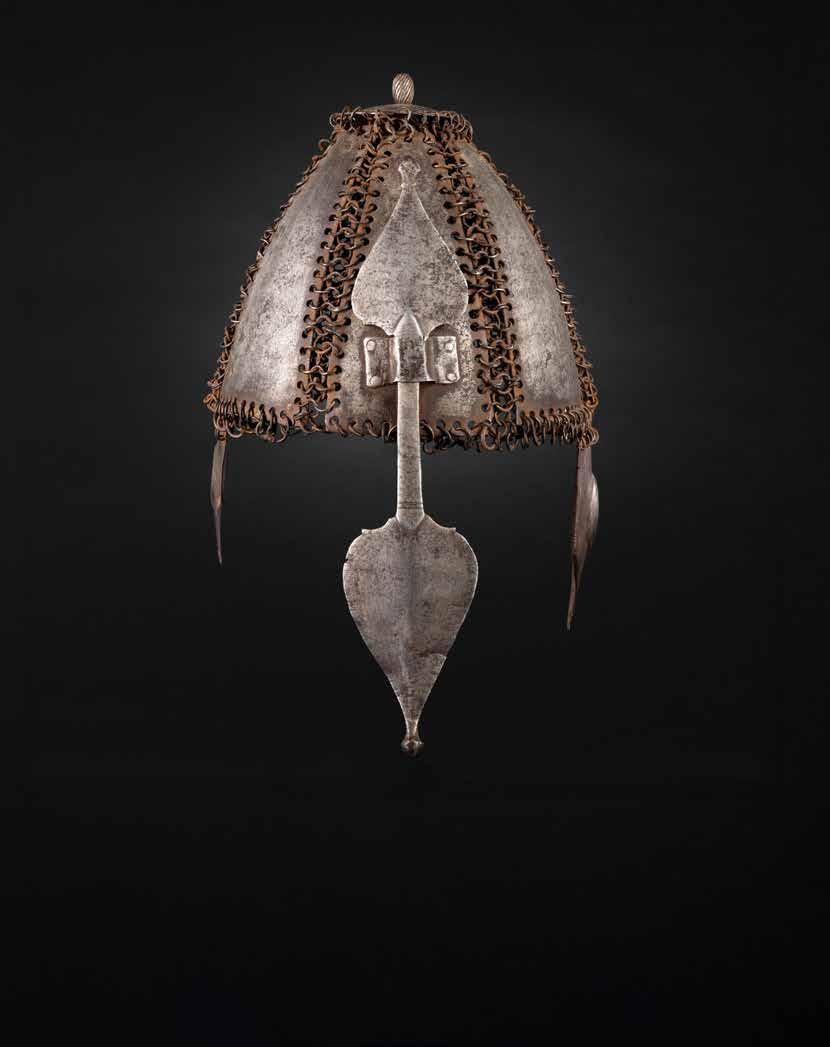
Provenance
Property from a distinguished private collection, London.
For a comparable helmet in the British Museum, see Robert Elgood, Hindu Arms and Ritual: Arms and Armour from India 1400-1845, Delft 2004, cat. no.5.3, p.58. For another similar helmet with a crescentic face-guard formerly in the Roy Elvis Collection see The Roy Elvis Collection of South Indian Arms and Armour, cat. no. A07.
A CHAINMAIL AND PLATE STEEL SHIRT FROM THE BIKANER ARMOURY
DECCAN, 16TH/ 17TH CENTURY
the thigh-length shirt with long sleeves and composed of riveted links, the front with four rectangular plates each with two buckles in the form of flowerheads with palmette terminals, to reverse a series of overlapping plaques with alternating cusped edges, four panels to each flank, inscriptions in devnagari and Persian to two plates
96 cm. long
£2,000 - 3,000
€2,300 - 3,400
US$2,700 - 4,100
Provenance
Property from a distinguished private collection, London.
Inscription: to breastplate, ‘Salabat Khan’, to flank panel, undeciphered.
Chain-mail coats of this type were produced at Bijapur for the armoury of Bikaner, the capital of the Adilshahi dynasty which came to an end in 1689 following defeat by Maharajah Abup Singh at Adoni. For a similar mail and plate shirt see Robert Hales, Islamic and Oriental Arms and Armour, 2013, p. 299, no. 718.
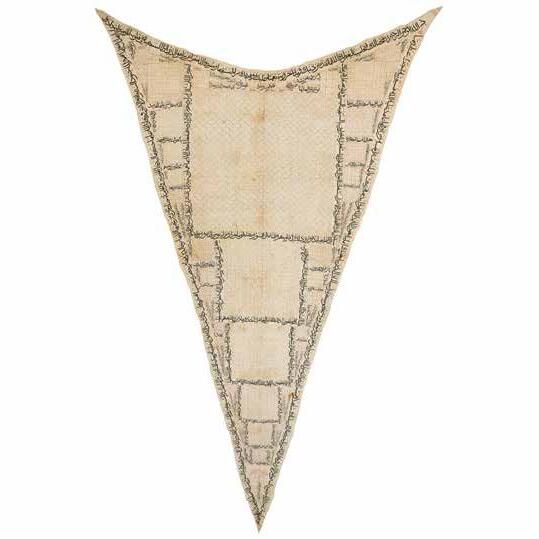
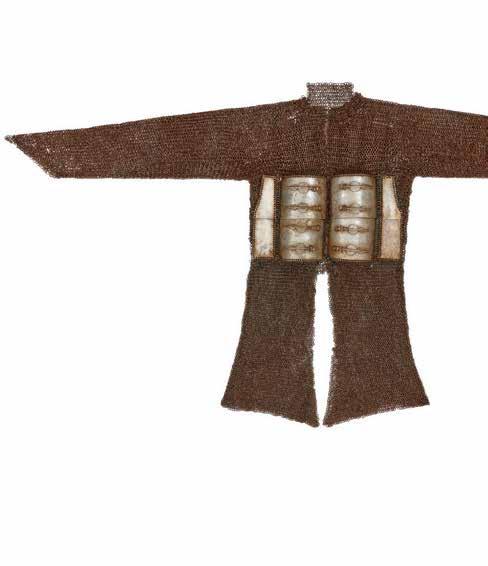
grids filled with magic numbers, the borders with bands of inscriptions in naskh script, bifurcated sword motif to tip with floral sprays to pommel 465 x 260 cm.
£1,500 - 2,000
€1,700 - 2,300
US$2,000 - 2,700
Provenance
Property from a distinguished private collection, London.
Inscriptions: Qur’an chapters XLVIII ( ), part of verse 13; to smallest grid of magic numbers, the name Muhammad in the centre and Fatima, Hasan and Husayn to the corners.

A comparable banner, dated to the 17th Century or later, is in the Nasser D. Khalili Collection (inv. no. TXT233), which Francesca Leoni suggests acted as a ‘visual tour de force’ intended to hang from a pole, forming an integral part of a Muslim army’s equipment. This hypothesis is strengthened by the presence of Surat alor ‘The Victory’, a Qur’anic chapter which ‘stresses God’s assistance of believers fighting in His cause, as well as the rewards for those honouring Him and leading a life on the straight path.’ (Leoni, Francesca, Power and Protection: Islamic Art and the Supernatural, Oxford 2016, pp.66-77, cat. no. 42). A very similar banner to this lot was in the collection of Saeed Motamed (19252013) (see Nagel Auctions, Six Continents, 11 March 2026, lot 12065).
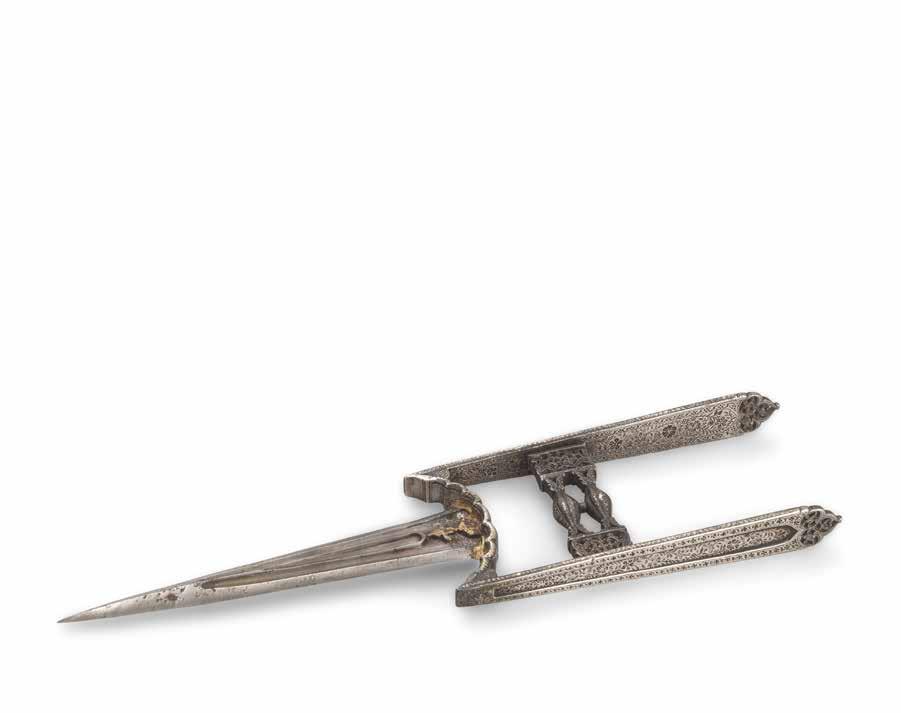
A FINE ENAMELLED-SILVER HILTED STEEL PUSH DAGGER (KATAR)
PROBABLY HYDERABAD, 18TH CENTURY, THE BLADE 17TH CENTURY
the double-edged steel blade with armour-piercing tip, chiselled and decorated in gold overlay to each side with converging fullers, the forte with a palmette, painted inventory number to one side, the silver hilt with openwork baluster grips supported by openwork foliage with addorsed birds, engraved and decorated in black enamel with floral interlace 35.3 cm. long
£3,000 - 5,000
€3,400 - 5,700
US$4,100 - 6,800
Provenance
Formerly in the Collection of Roy Elvis (1944-2022). Property from a distinguished private collection, London.
Published
The Roy Elvis Collection of South Indian Arms and Armour, cat. no. D108, p. 276.
For a contemporaneous silver huqqa base and tray with similar black enamel detail, see Simon Ray, Indian and Islamic Works of Art, November 2012, no.19.
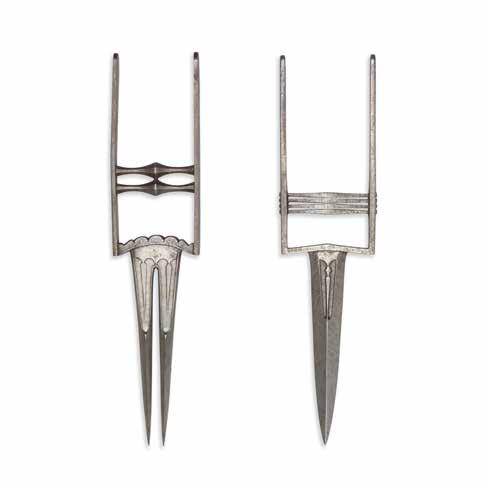
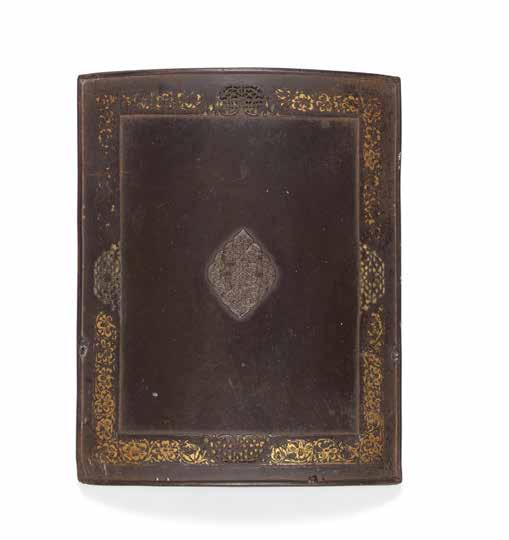
115
TWO STEEL PUSH DAGGERS (KATARS) INDIA, 18TH/ 19TH CENTURY
each of typical form, the first with bi-furcated blade with chiselled palmettes to forte, lobed guard with sidebars and grips comprising two baluster crossbars, the second with double-edged, triangular blade with raised spine and trefoil motif to forte, with sidebars and four horizontal grips the longest 33 cm. (2)
£1,500 - 2,000
€1,700 - 2,300
US$2,000 - 2,700
Provenance
Property from a distinguished private collection, London.
116
A GOLD KOFTGARI STEEL ARMOUR PANEL NORTH INDIA, 19TH CENTURY
of convex rectangular form, decorated in gold overlay with bands of floral and foliate scrollwork to border interspersed by engraved swirling palmettes, applied openwork lobed cartouche containing arabesques to centre, remains of buckle attachments to reverse 24.3 x 19.3 cm.
£1,000 - 1,500
€1,100 - 1,700
US$1,400 - 2,000
Provenance
Property from a distinguished private collection, London.
117
A LARGE BRONZE KIRTIMUKHA MASK SOUTH INDIA, PROBABLY DECCAN, 18TH CENTURY
with protruding eyes, short horns and open mouth with protruding fangs and tongue, flanked by elephant heads, engraved detail, mounted 32 cm. max.
£1,000 - 1,500
€1,100 - 1,700
US$1,400 - 2,000
Provenance
Property from a distinguished private collection, London.
The kirtimukha or ‘face of glory’ is a mythical lion-like beast which appears most commonly on the prabha or aureole of Hindu and Buddist images, and at the entrances to holy places, either over the doorway on the lintel or on the front door. It is viewed as a powerful protector of pilgrims and shrines and is seen in Tibet, India, Nepal and Bhutan.
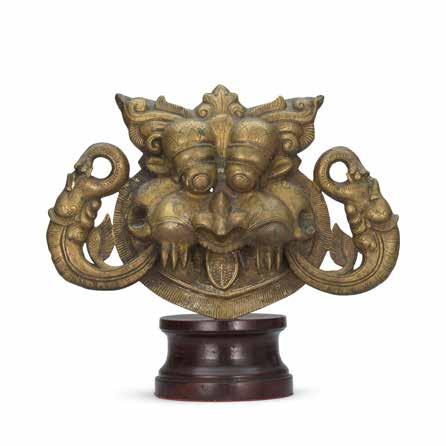
118
A MUGHAL ENGRAVED COPPER TRAY NORTH INDIA, LATE 17TH CENTURY
of circular form with curved rim, profusely engraved with rosettes within within a lattice formed by foliate vines radiating from a central medallion, inscription to base
46.8 cm. diam.
£1,500 - 2,000
€1,700 - 2,300
US$2,000 - 2,700
Provenance
Sotheby’s, Arts of the Islamic World, 3rd October 2012, lot 204.
Property from a distinguished private collection, London.
Inscription: barakat ziyadah ‘[May it have] abundant blessing’.
For a comparably decorated tray, see Mark Zebrowski, Gold, Silver & Bronze from Mughal India, London 1997, p.260, no.442.
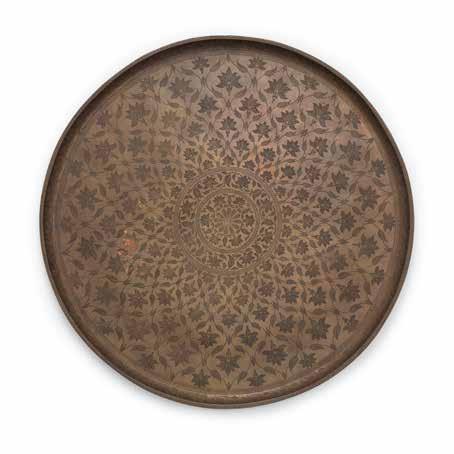
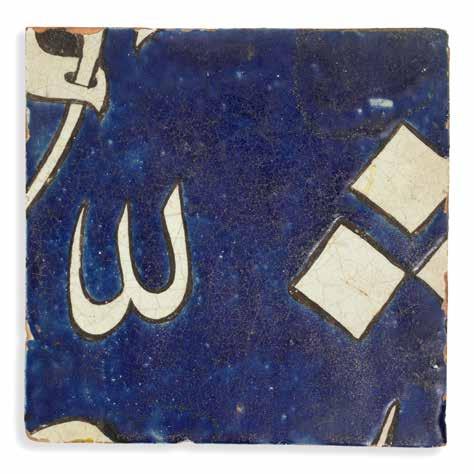
119
A MUGHAL CALLIGRAPHIC CUERDA SECA POTTERY TILE
NORTH INDIA, 17TH CENTURY
of square form, decorated in cobalt blue and white with black outline with calligraphic elements including a shaddah, a nuqat and some partial lettering to one corner 19 x 18.6 cm.
£1,500 - 2,000
€1,700 - 2,300
US$2,000 - 2,700
Provenance
Property from a distinguished private collection, London.
120
THE CENOTAPH OF SHAH JAHAN COMPANY SCHOOL, DELHI OR AGRA, CIRCA 1820-30
pen and ink and watercolour on paper 492 x 696 mm.
£3,000 - 5,000
€3,400 - 5,700
US$4,100 - 6,800
Provenance
Property from a distinguished private collection, London.
The text on the cenotaph reads: marqad-e motahhar-e a’lahazrat-e ferdousashiyani sahib qiran-e thani shah jahan badshah taba tharahu sana 1076
‘The pure tomb of His Most Exalted Majesty, Dweller in Paradise, Second Lord of the Auspicious Conjunction, Shah Jahan Padshah, may its soil be fragrant! Year 1076 [1665-66]’.
121
A STUDY OF THE FLORAL PIETRA DURA WORK ON THE CENOTAPH SCREEN AT THE TAJ MAHAL COMPANY SCHOOL, DELHI OR AGRA, CIRCA 1810-30
watercolour on paper watermarked George Taylor 1802
495 x 720 mm.
£2,000 - 3,000
€2,300 - 3,400
US$2,700 - 4,100
Provenance
Property from a distinguished private collection, London.
For a large painting of four very similar studies ranged side by side, see Simon Ray, Indian and Islamic Works of Art, November 2012, no. 89 (on paper watermarked 1813). The plants depicted there are stylised versions of lilies and columbines.
A sheet of three similar studies were part of an album by the Agra artist Shaykh Latif, prepared for the British artist Robert Home, circa 1820-34. Latif sold paintings to a number of British visitors to Agra, including John Bax of the Bombay Civil Service in around 1820-22, and the traveller Fanny Parks in 1835. See D. J. Ehnbom, Indian Miniatures: the Ehrenfeld Collection, New York 1985, pp. 174-175, no. 82.
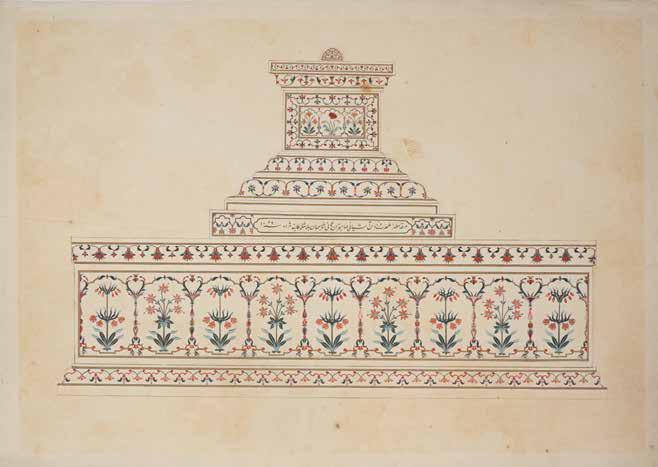
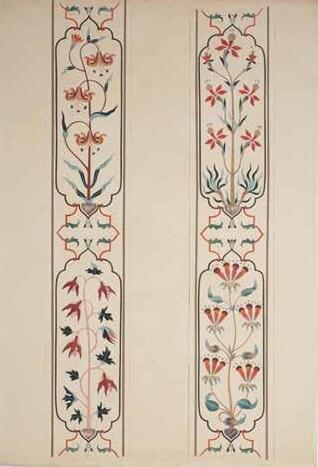
122
A COPPER ALLOY FIGURE OF PARVATI
TAMIL NADU, CHOLA PERIOD, CIRCA 11TH CENTURY
standing in tribhanga on a lotus pedestal, wearing a closely-fitting dhoti tied with a sash at the waist, her left arm in lolahasta mudra and adorned with bracelets accompanying her necklace and earrings, her hair piled high in a jatamukuta with the karanda mukata crown 48.1 cm. high
£30,000 - 50,000
€34,000 - 57,000
US$41,000 - 68,000
Provenance
Marinos Costeletos Collection, acquired in London in the early 1980s. John Bowden Collection, acquired from Jeremy Knowles Indian Works of Art, London on the 21st of December, 2006. Private Collection, London.
Parvati is associated with fertility, love, and devotion. Considered the epitome of female perfection, particularly as it expresses itself in alignment with marital, societal, and dharmic concord, she is beloved as the ideal maiden, wife, and mother. Moreover, through the prism of Shaktism, she is the active animating force, enlivening her counterpart Shiva with skill, power, and prowess.
Here, she wears a tall crown resembling piled rings of diminishing size topped by a lotus bud called a karanda mukata. Her right hand is raised in the gesture of holding a flower (kataka mudra) while the left hangs beside her thigh. The iconography suggests she would have been made to partner a Shiva, perhaps a Nataraja, as Shivakamasundari, or as a combined Umasahati Deva (cf. Nagaswamy, Timeless Delight, Ahmedabad, 2006, nos.2 & 14, respectively), among several other possibilities.
She is cast with an elegant silhouette, agile with a degree of naturalism and fluidity about her tribhanga pose that otherwise becomes hardened and static in later Chola bronzes of the 12th and 13th centuries. She is comparatively slender, with modest and less overtly globular bosom in keeping with earlier Chola bronzes. Her small sirischakra intact behind her head, and the absence of ornaments hugging the arcs of her ears, also suggest an early period. However, other regalia associated with the mature Chola style, such as her makara-snout earrings, the layered design of her necklaces, the numerous rings, and her tall crown type situate the bronze within the 11th century - around the transition between traditionally regarded early and late Chola periods (cf. Sivaramamurti, South Indian Bronzes, New Delhi, 1963, pp.24-43).
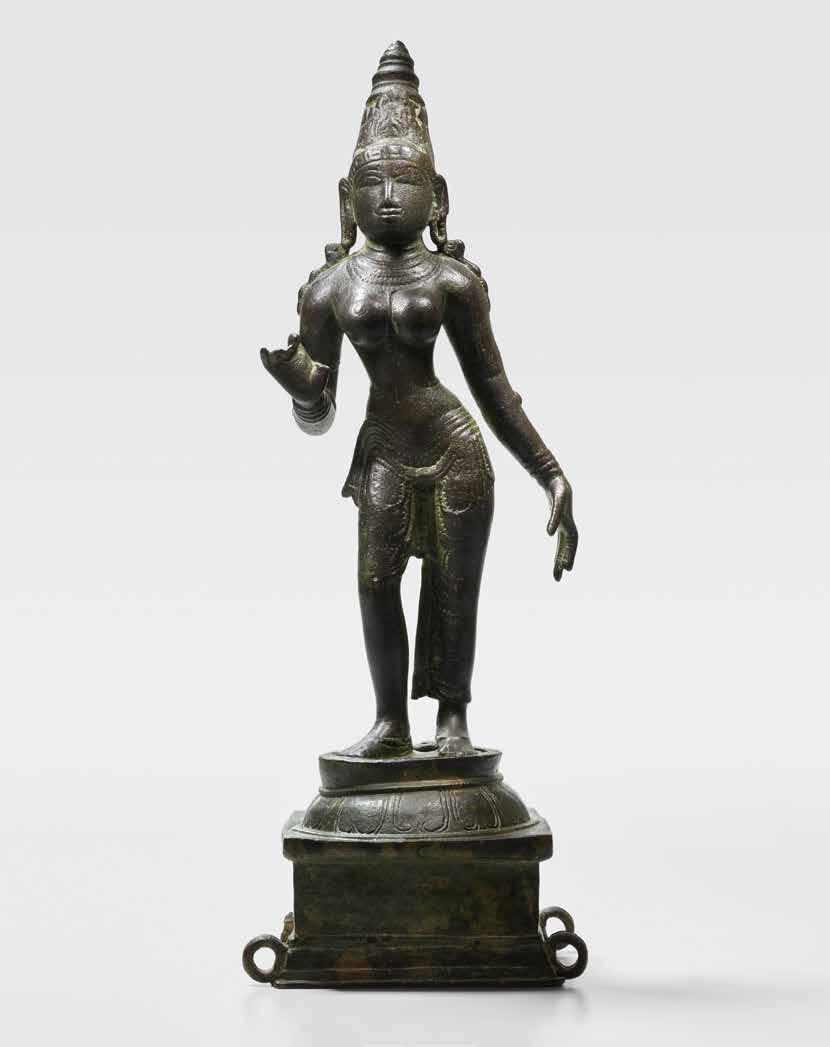
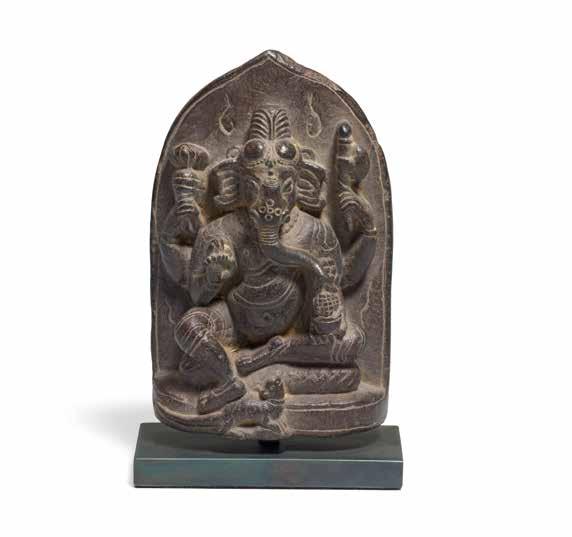
A BLACK STONE FIGURE OF GANESH NORTH EAST INDIA, 11TH/ 12TH CENTURY
Ganesh is seated in royal ease, his pendent foot resting on his vehicle, the rat, his four arms holding a radish, axe, rosary and bowl of sweets in which his trunk is placed, mounted 11.5 cm. high (excluding stand)
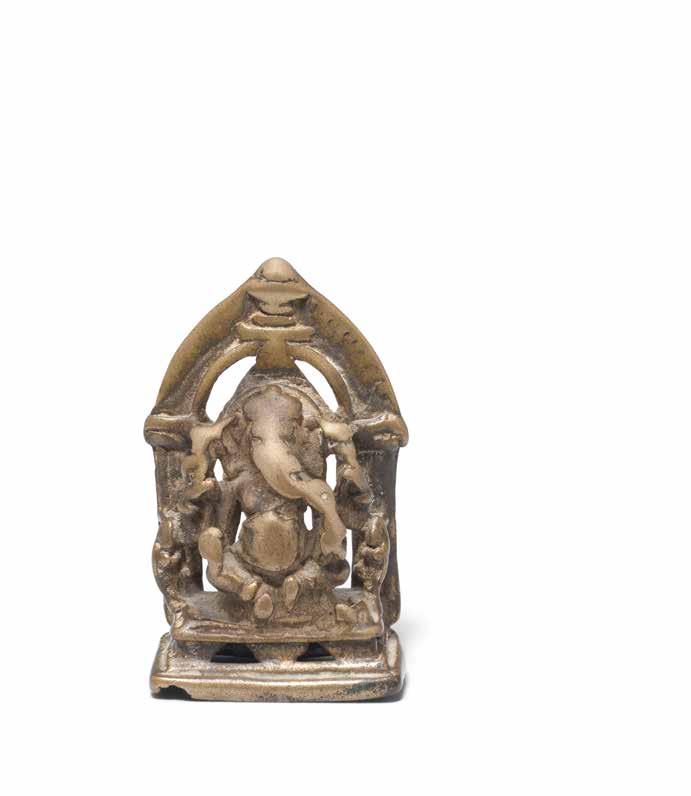
Private UK collection, London acquired from Christophe Hioco on the 29th of March, 2013.
seated on a rectangular throne with arched back
Private UK Collection, London, acquired at John
Small icons like this were often used in personal shrines or placed at entrances to invite good fortune, their surfaces worn smooth from devotional
125
A GROUP OF FIVE BRONZES INDIA, 16TH-18TH CENTURY
comprising a figure of Nandi, recumbent, adorned with jewellery, on a cruciform base; a figure of Ganesh seated on a throne with arched back; a figure of Hanuman standing on a square base with hands in an adoration gesture; a figure of Lakshmi seated on a lotus throne; and an altar (Krishna’s bed)
the altar 9.2 x 9 x 10.6 cm.(5)
£1,500 - 2,000
€1,700 - 2,300
US$2,000 - 2,700
Provenance
Private UK collection, London.
Krishna’s bed or seat, is a bronze throne used to hold a small figure of Krishna, usually as a child, for a household shrine.
125A
A BRONZE FIGURE OF GANESH INDIA, 16TH CENTURY
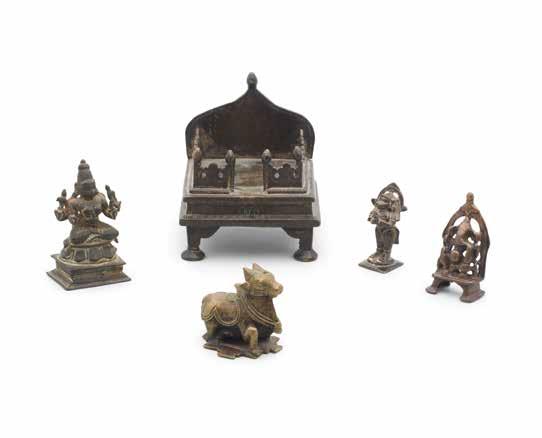
on a square pedestal surmounted by a lotus throne, flanked by bandicoots, his consort on his left knee 8.5 cm.
£500 - 700
€570 - 800
US$680 - 950
Provenance
Private UK collection, acquired from Joost van den Bergh on the 15th of January, 2013.
126
A BRONZE FIGURE OF SEATED BUDDHA BURMA, 18TH CENTURY
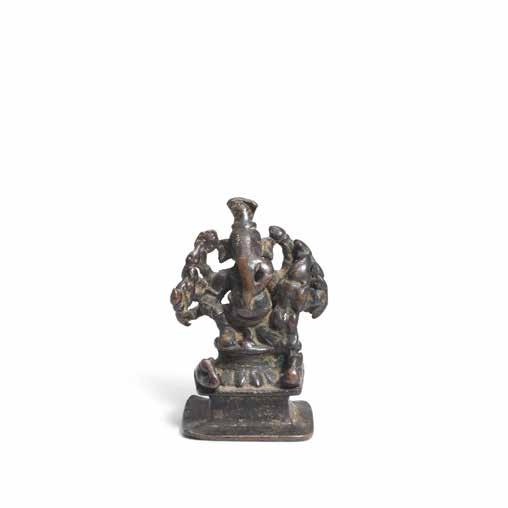
wearing monastic robes and seated on a plain lotus pedestal, touching the earth with his right hand to bear witness to his victory over Mara at the moment of Enlightenment (bhurmisparsa mudra) 13.5 cm. high
£1,000 - 2,000
€1,100 - 2,300
US$1,400 - 2,700
Provenance
Private UK collection, London, acquired from Jonathan Tucker on the 8th of November, 2016.
For a group of related Buddhas, see Somkiart Lopetcharat, Myanmar Buddha: The Image and its History, Bangkok 2007, pp. 296-301 and 362.
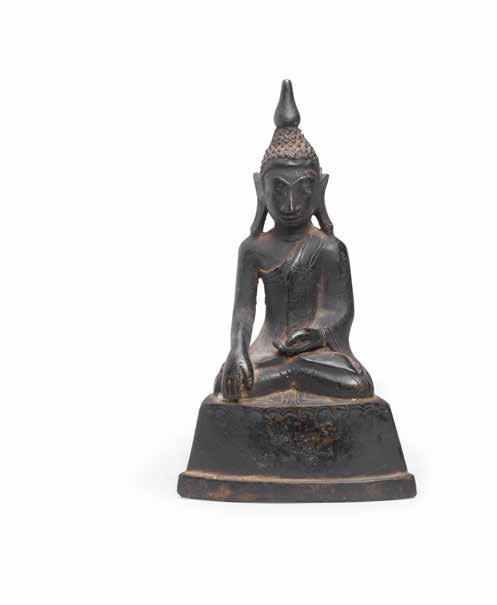
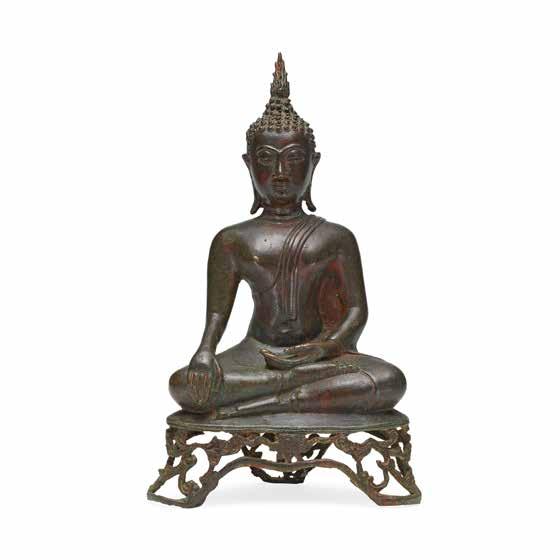
THAILAND, 18TH CENTURY
the blades of foliate form, the ends of the handle terminating in a pointed finial, decorated in gold inlay with swirling floral and foliate motifs 35.9 cm. long
£1,500 - 2,000
€1,700 - 2,300
US$2,000 - 2,700
Scissors such as these were used to cut the hair at the coming of age ceremony (kone-chook) for boys and girls between the ages of seven and thirteen. At the ceremony, portions of hair from the top-knot were ritualistically cut by a Buddhist monk, the parents and other respected elders, and then placed in a floating lotus leaf whilst prayers were said for the child.
Comparable scissors are in the Victoria and Albert Museum (inv. no. 402-1894).
AYUTTHAYA, THAILAND, 16TH/ 17TH CENTURY
seated cross-legged on an openwork scrolling lotus pedestal, touching the earth with his right hand to bear witness to his victory over Mara at the moment of Enlightenment (bhurmisparsa mudra) 33.5 cm. high
£3,000 - 5,000
€3,400 - 5,700
US$4,100 - 6,800
Provenance
Private UK collection, London.
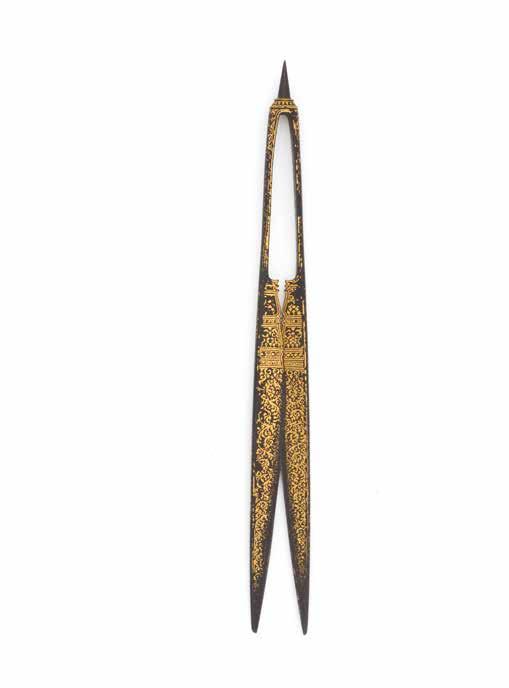
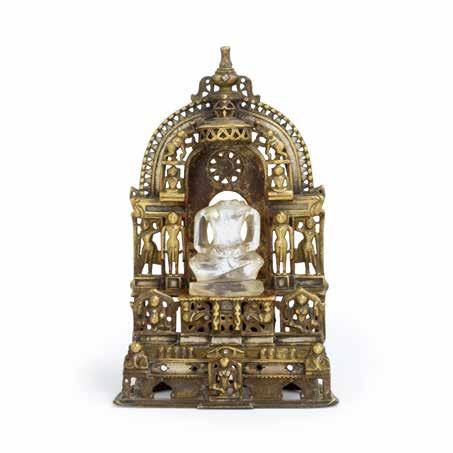
130
A SANDSTONE FIGURE OF A CELESTIAL BEAUTY (SURASUNDARI)
NORTH INDIA, 10TH/ 11TH CENTURY
carved in deep relief and stylistically with exaggerated contortion to torso and prominent breasts, shawl to shoulders and legs, adorned with elaborate jewellery comprising necklaces, earrings, arm bands and beaded garlands from loincloth, mounted 63 cm. high (including stand)
£2,000 - 3,000
€2,300 - 3,400
US$2,700 - 4,100
Provenance
Formerly in the collection of Jean-Charles Tauzin (1889-1957).
This figure is not consciously posing, she is a surasundari, a celestial beauty whose presence on the exterior temple wall is auspicious. In Hinduism, surasundaris strengthen the potency of prayers offered in the temple as their beauty beckons the deity to listen to them. Produced in a tenth- to eleventh-century style seen in North Indian sculpture particularly in Rajasthan and Madhya Pradesh, this surasundari’s hair, face, and jewellery are redolent of images of loving couples (mithuna) seen on the early eleventh-century Chitragupta temple of Khajuraho, built circa 1025 (cf. Béguin, Khajuraho, Milan 2017). Her lower garments also recall those seen on the surasundari in the Metropolitan Museum, New York, inv. no. 69.247.
129
A JAIN SILVER-INLAID BRASS SHRINE
WESTERN INDIA, 15TH/ 16TH CENTURY in the form of a throne supported by two addorsed lions and surrounded by jina and attendants, the canopy supported by two elephants, heightened with silver overlay, engraved to the reverse with inscriptions in nagari, with later rock crystal jina 18.4 cm. high
£2,000 - 3,000
€2,300 - 3,400
US$2,700 - 4,100
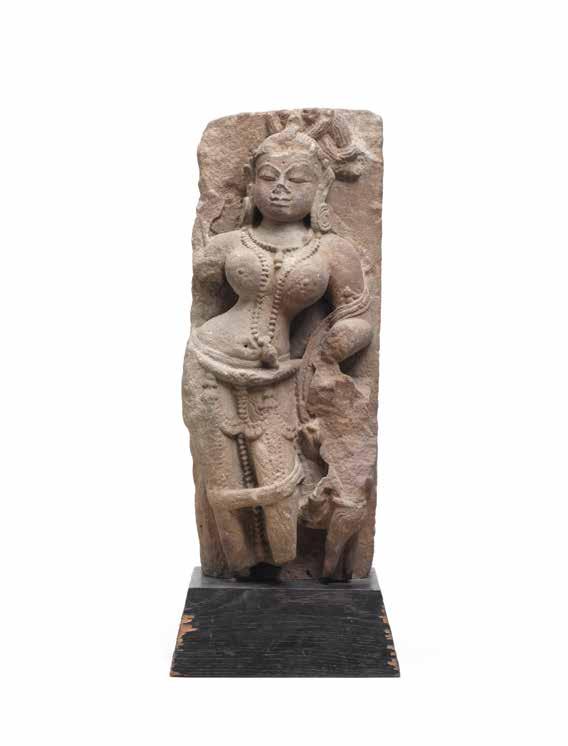
* W
A LARGE PAINTED WOOD MASK OF BHAIRAVA
NEPAL, MALLA PERIOD, 16TH CENTURY
depicted with ferocious expression, rotund face with wide mouth, bulging eyes and curling arched brows, flanked by earrings in the form of curled serpents, serpent necklace, surmounted by a foliate tiara bearing skulls, the hair standing wildly on end, with crescent moon 98.4 cm. high
£25,000 - 35,000
€29,000 - 40,000
US$34,000 - 47,000
Provenance
Sotheby’s, New York, Indian and South East Asian Art, 26th March 1998, lot 193.
With Carlton Rochell in September, 2004. Private US collection.
Published
Icons of Devotion, Carlton Rochell Asian Art, New York, 2004, no. 19
This large mask, carved with a third eye, crawling snake jewellery, and a crescent moon set amidst flaming hair, represents Bhairava, the fierce incarnation of the Hindu god Shiva. Masks of this size are not worn but displayed for annual festivals.
Each September, during the Indrajatra and Pachali Bhairabjatra festivals in the Kathmandu Valley, such masks are exhibited outside temples and homes. While Indrajatra honours Indra, the Vedic god of rain and prosperity, Pachali Bhairabjatra emphasizes Bhairava’s protective power. His presence is believed to ward off evil and safeguard the community.
Behind the mask, a jar of beer or rice wine is placed, with a bamboo pipe extending through the mouth to distribute the drink. This offering is considered prasad, a divine gift and blessing for devotees.
For a closely related example of similar size, see Bonhams, New York, 13 September 2011, lot 1008. Also compare with a larger mask published in Nies, Spirit of Compassion, Antwerp, 1995, pp.28-9.
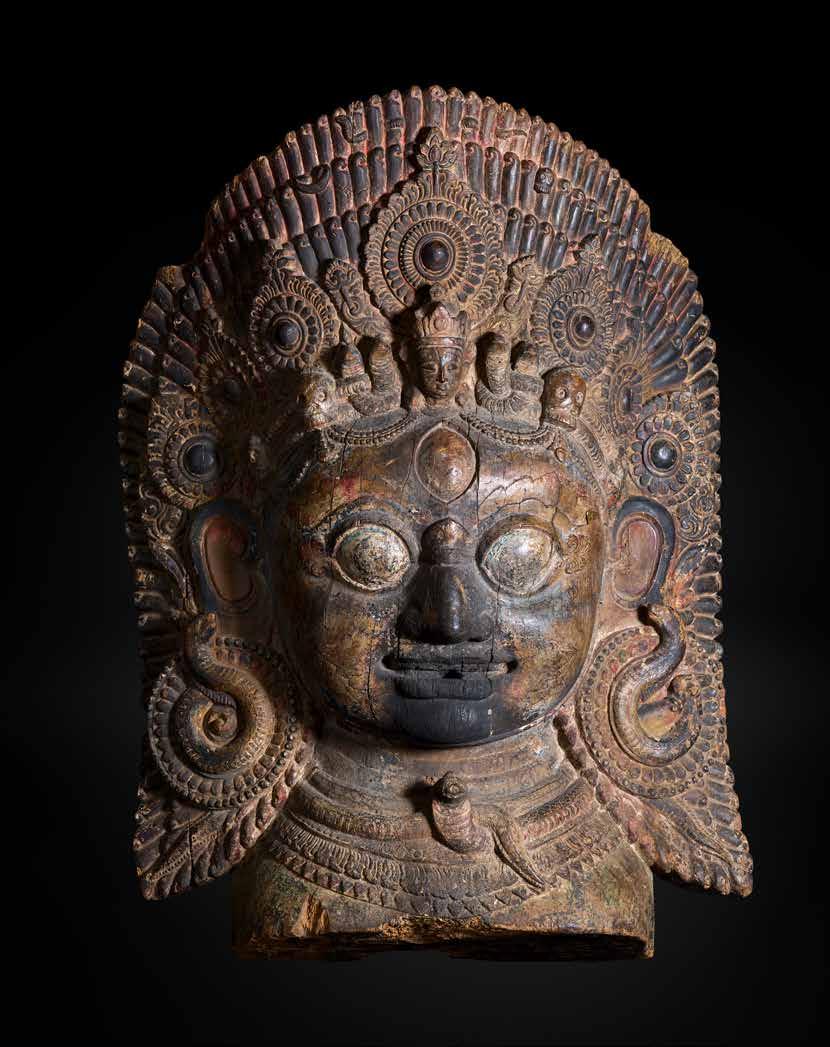
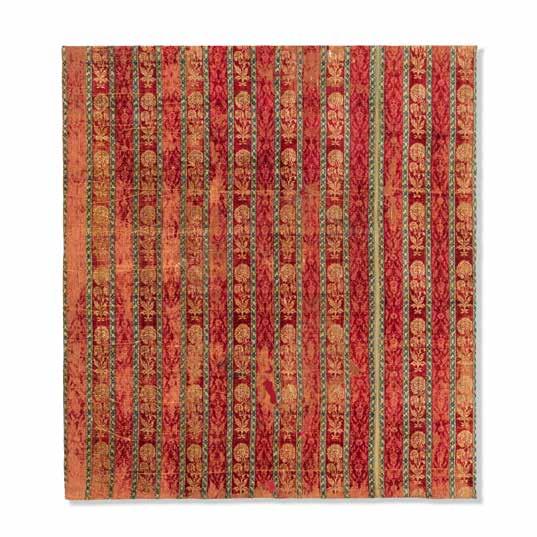
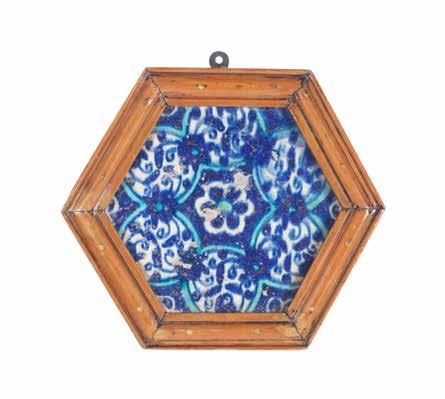
A MUGHAL VELVET PANEL
NORTH INDIA, 17TH CENTURY
of rectangular form, woven red, blue and cream silk with a series of wide vertical bands alternately containing a repeat design of floral spays and floral and foliate interlace, interspersed by vertical bands of undulating floral vines, mounted 109 x 99 cm.
£6,000 - 8,000
€6,900 - 9,200
US$8,100 - 11,000
Provenance
Sotheby’s, 21 April 1999, lot 7 (part lot).
Sotheby’s, Arcade Sale, 18-25 March, 2025, lot 23 (part lot).
For a comparable panel see Flora, The Flower of the Textile Arts, Bernheimer Fine Arts, London, 1990,
133
A MUGHAL UNDERGLAZE-PAINTED POTTERY TILE
SINDH, 16TH CENTURY
of hexagonal form, decorated in cobalt blue and turquoise on a white ground with a central rosette surrounded by interconnected circular motifs enclosing foliate designs, framed 23.2 cm. max.
£1,500 - 2,000
€1,700 - 2,300
US$2,000 - 2,700
A comparable tile is published in Arthur Millner, Indian Tiles: Architectural ceramics from Sultanate and Mughal India and Pakistan, London 2021, p.273, cat. no. 126. Also in Henry Cousens, Portfolio of Illustrations of Sind Tiles, London 1906, plate 18. Cousens attributes this design to Tatta or Thatta in modern day Pakistan, more specifically to Makli Hill.
AND IVORY-INLAID CABINET
WESTERN INDIA, POSSIBLY GUJARAT, EARLY 18TH CENTURY
of rectangular form with six drawers and hinged lid opening to reveal shallow compartments and two drawers, profusely decorated with panels of carved ivory with scrollwork on mica backing, and tortoiseshell with painted gilt floral motifs, all with green stained ivory borders and bone handles 41.6 x 30 x 27.8 cm.
£6,000 - 8,000
€6,900 - 9,200
US$8,100 - 11,000
For contemporaneous cabinets with similar tortoiseshell elements, see Christie’s, Gloria: Property from the late Dowager Countess Bathurst 22th July 2020, lot 43, and Sotheby’s, Indian & South-East Asian Works of Art October 1993, lot 643.
In Gujarat, tortoiseshell goods were produced largely in the centres of Cambay and Surat whose long-standing mercantile history had welcomed visiting Persians, Chinese, Japanese, Malays and Portuguese traders, creating new hybridised artistic aesthetics (Calouste Gulbenkian Museum, the Portuguese Discoveries and the Renaissance Kunstkammer, Lisbon 2001, p.142.
The item within this lot containing ivory has been registered in accordance with the Ivory Act (Section 10), reference no. MR9DCAJE.
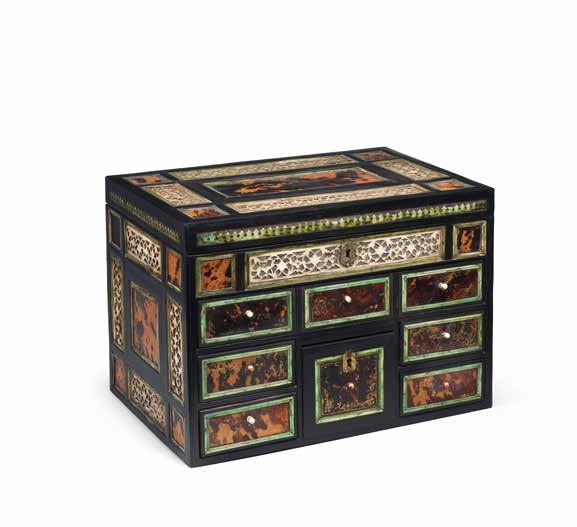
of globular form on splayed foot and rising to a slightly flared neck, faceted spout terminating in a makara head, further makara heads to top and base of handle, the hinged stepped lid with bud finial, engraved and decorated to the body and lid with flower-filled bands and vegetal scrollwork, punched inscription in nagari to body 36 cm. high
£2,500 - 3,500
€2,900 - 4,000
US$3,400 - 4,700
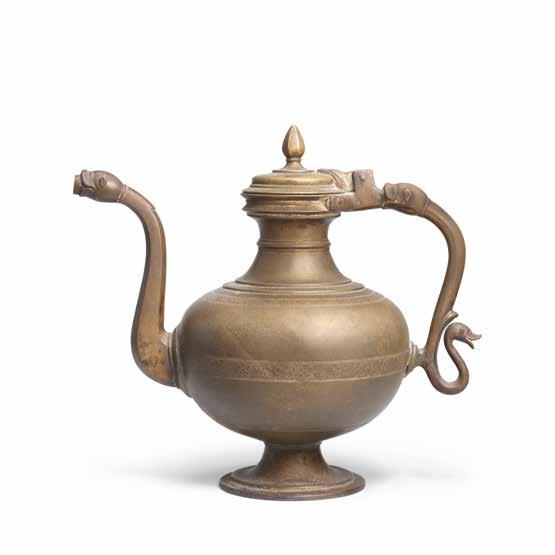
(detail)
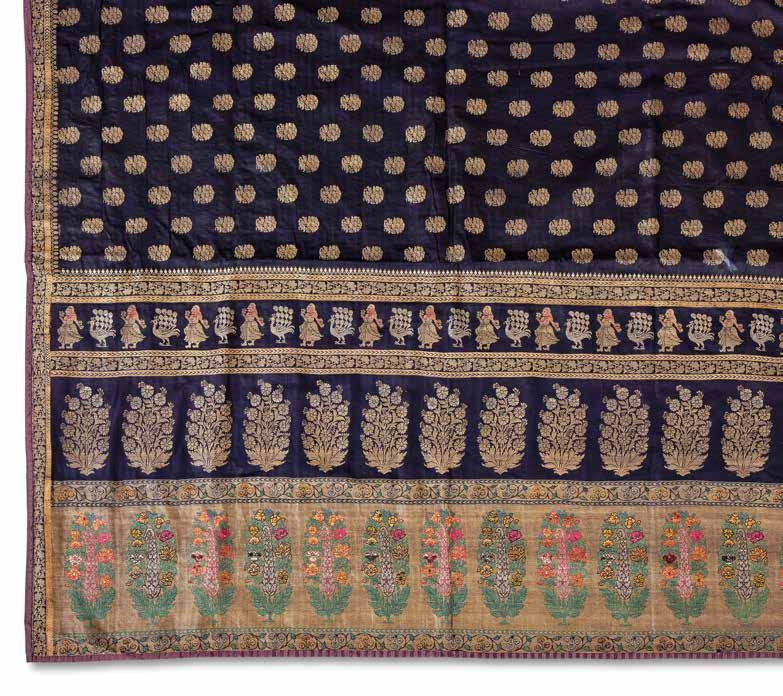
A SILK AND METAL THREAD EMBROIDERED SARI (KIMKHWAB)
NORTH INDIA, 18TH/ 19TH CENTURY of rectangular form, woven on a blue ground in polychrome silks and gilt silver thread, with a repeat design of floral motifs, the end with three panels containing floral sprays, alternating hamsa birds and female figures, backed 455 x 119 cm.
£8,000 - 12,000
€9,200 - 14,000
US$11,000 - 16,000
Provenance
Private UK collection.
For textiles with comparable motifs, see John Gillow and Nicholas Barnard, Traditional Indian Textiles, London 1991, pp.30 and 51.
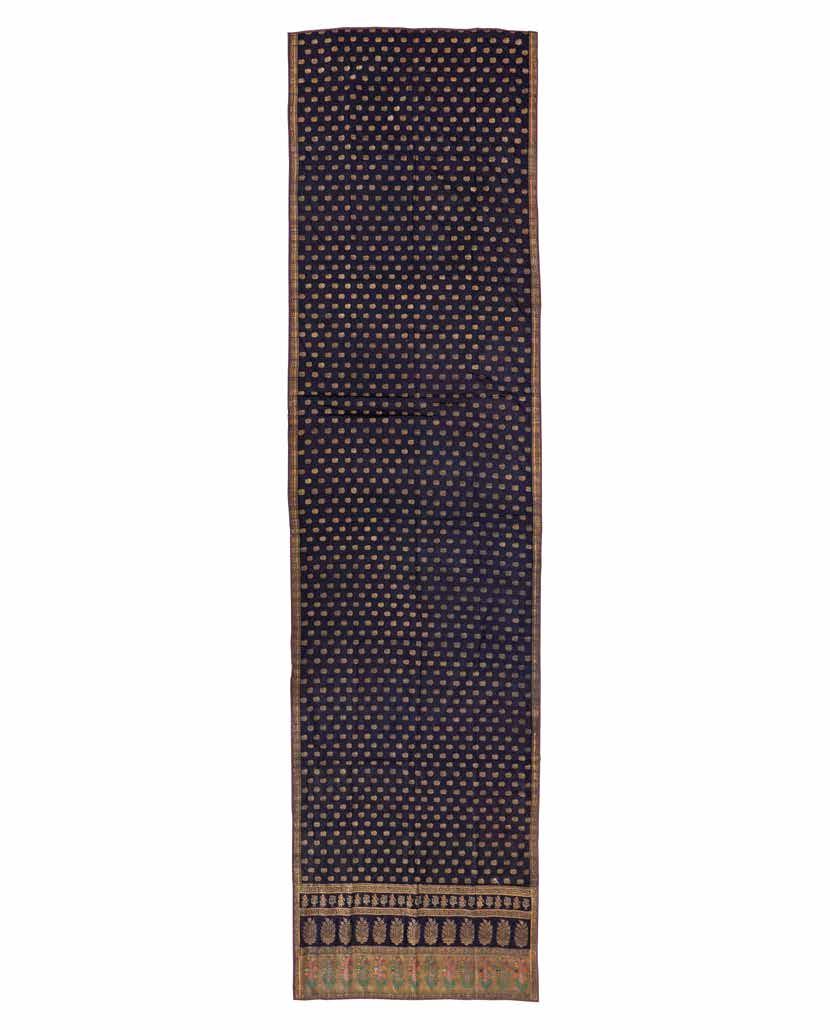
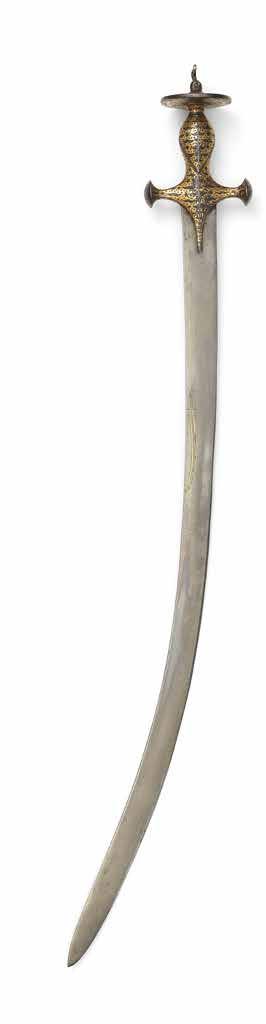
137
A MUGHAL SILVER-HILTED STEEL DAGGER (KHANJAR)
INDIA, 17TH/ 18TH CENTURY
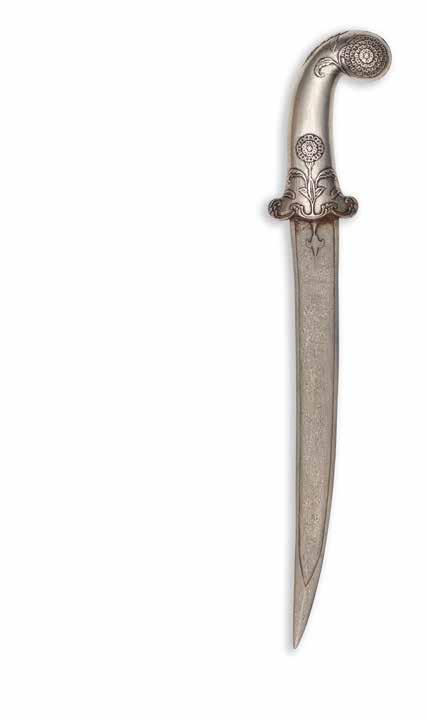
the double-edged watered-steel blade of curved form, terminating in armour piercing tip, chiselled fleur-de-lis motif to forte, the sheetsilver hilt of pistol-grip form with curved foliate quillons, engraved and decorated with flowerheads 39 cm. long
£3,000 - 5,000
€3,400 - 5,700
US$4,100 - 6,800
For comparable hilts, see the Victoria & Albert Museum, inv. no.s IS.232-2006 and IS.21-1997.
138
A GOLD KOFTGARI HILTED STEEL SWORD (TULWAR) WITH BUBRI DECORATION
INDIA, 19TH CENTURY
the single-edged watered-steel blade of curved form, engraved with gold-inlaid sword motif and punched with inscription in devnagari to spine, the hilt of typical form, decorated in gold overlay with interchanging bubri and floral motifs; the wood scabbard clad in black leather 91 cm. long
£3,000 - 5,000
€3,400 - 5,700
US$4,100 - 6,800
Inscriptions: 4141 Kōtari wāli si 1842 Vilās ji 9 pra 19, ‘Sword in the armoury of Vilasji from 1842 vikram samvat (1785 CE)’.
139 A WATERED STEEL CUIRASS FROM THE ARMOURY OF MIR NIZAM ‘ALI KHAN BAHADUR (1734-1803)
HYDERABAD, DATED AH 1192/ AD 1778-79
comprising a breastplate and backplate of watered steel with hinged joints at sides and shoulder, median ridge and moulded pectorals to front plate, applied steel borders with palmette motifs to shoulders and neck, curved collar, inscription to left shoulder in naskh script 44 cm. high (from base to neckguard)
£4,000 - 6,000
€4,600 - 6,900
US$5,400 - 8,100
Inscriptions: to left shoulder on breastplate, 1192 or 1162, ‘Sarkar...’, to left shoulder of backplate, ‘99’.
This cuirass bears a strong similarity to those sold at Christie’s, Art of the Islamic and Indian Worlds, 10th October 2013 and 27th April 2023, lots 189 and 82, as well as to those held by the Metropolitan Museum of Art (inv. no. 29.158.165a) and the Nasser D. Khalili Collection (inv. no. MTW 1157). All have been confirmed as belonging to the armoury of the second Nizam of Hyderabad Nizam ‘Ali Khan (r.1762-1803) or Asaf Jah II, with the ruler’s name and respective inventory number engraved to their shoulders. Asaf Jah II would oversee an economic and cultural boom in Hyderabad, as well as furnishing an arsenal. These cuirasses are thought to have been specifically commissioned for the ruler’s personal bodyguards. To read more, see David G. Alexander, Islamic Arms and Armor in the Metropolitan Museum of Art, New York 2015, pp.52-53. The example in the Khalili Collection is inscribed ‘Sarkar Mir Nizam ‘Ali Khan Bahadur’, whilst that in the Metropolitan Museum is also dated AH 1192(1778/9 CE). It is likely that our example once also bore this inscription.
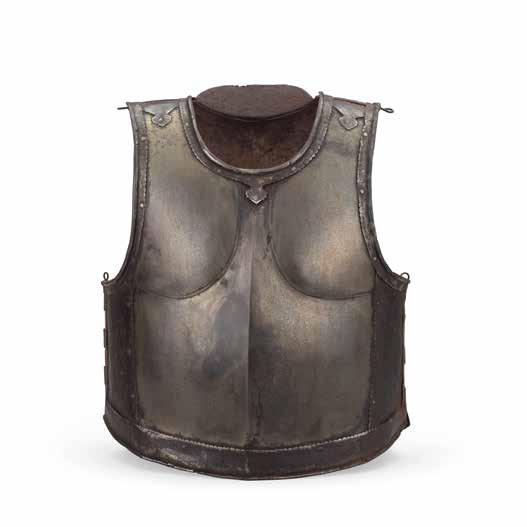
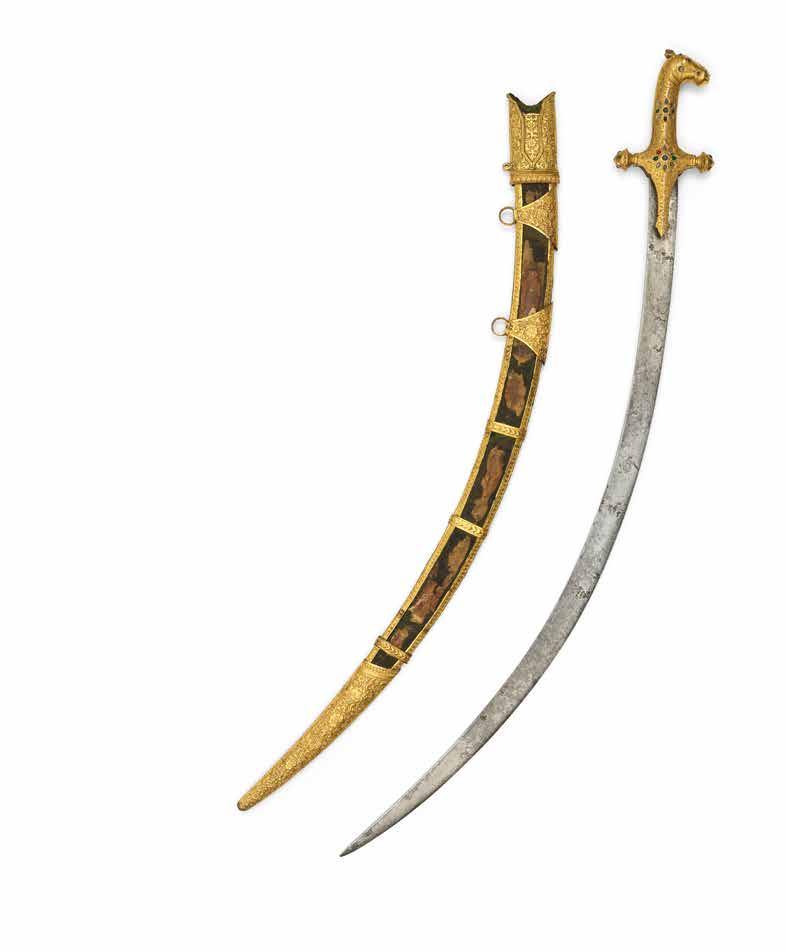
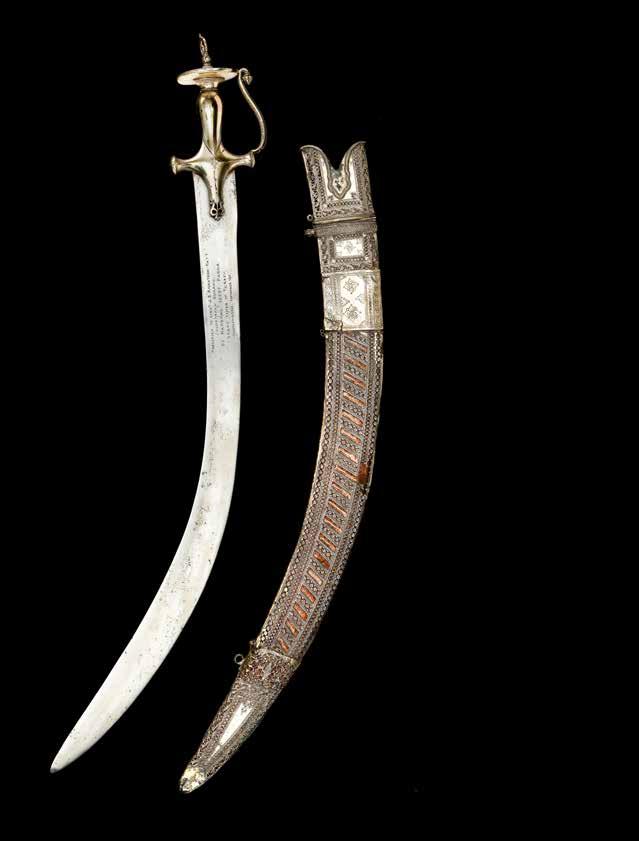
A SILVER-HILTED STEEL SWORD (TULWAR) PRESENTED BY AHMED IZZET PASHA (1864-1937), FORMER GRAND VIZIER OF THE OTTOMAN EMPIRE AND LATER MINISTER OF FOREIGN AFFAIRS, TO LIEUTENANT J. B. RICKATSON-HATT IN CONSTANTINOPLE IN SEPTEMBER 1921
INDIA, 19TH CENTURY
the steel blade of curved form with flattened spine, becoming double-edged towards the point, engraved to one side ‘PRESENTED TO LIEUT. J.B. RICKATSON-HATT / COLDSTREAM GUARDS
/ BY MARSHAL IZZET PASHA / GRAND VIZIER OF TURKEY / CONSTANTINOPLE, SEPTEMBER 1921’, maker’s stamp and punched inscriptions to the other, the silver hilt with engraved rosettes and foliate decoration, hinged element to pommel of floral form, the wood scabbard clad in velvet and mounted in silver engraved and decorated in openwork with floral and foliate bands, rosettes and floral interlace
73.5 cm. long
£6,000 - 8,000
€6,900 - 9,200
US$8,100 - 11,000
Provenance
Formerly in the collection of Bernard Rickatson-Hatt (1897-1966).
Bernard Rickatson-Hatt, an officer of the Coldstream Guards during the First World War, exemplifies the transition from traditional military service to the more ambiguous spheres of intelligence and international influence that characterised the early twentieth century. Following active service on the Western Front, he was subsequently posted to Constantinople. In the unsettled conditions of the post-Ottoman city, then a focal point of Allied occupation and political intrigue, RickatsonHatt undertook duties connected with military intelligence and internal security, ostensibly serving as a provost marshal. This experience, acquired in a milieu defined by competing powers and covert negotiation, appears to have been formative in shaping his later career. He was presented this sword in 1921 by Ahmed Izzet Pasha who had been a general during Wolrd War I and was at the time Minister for Foreign Affairs under Sultan Mehmed VI (reg. 1918-1922).
After leaving the army, he entered journalism and rose to prominence within Reuters, eventually serving as editor-in-chief. In this capacity he operated at the intersection of information, diplomacy, and influence, a role that drew upon the discretion and strategic awareness developed during his earlier service. His career coincided with a period in which the control and dissemination of news carried increasing political significance, and he became known for his ability to navigate these complexities.
Rickatson-Hatt was also acquainted with Ian Fleming, whose own background in intelligence informed the creation of James Bond. Although not identifiable as a direct prototype for Bond, Rickatson-Hatt belonged to the same cultivated and discreet milieu of internationally experienced figures whose careers spanned military service, intelligence work, and high-level communication. His experiences, particularly those in Constantinople, resonate with the cosmopolitan and politically charged settings that would later characterise Fleming’s fiction.
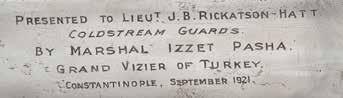
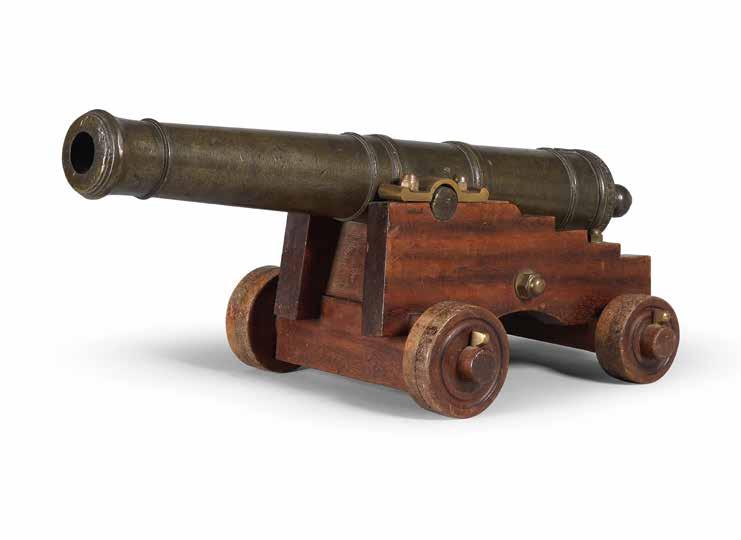
of European form, multi-staged with raised mouldings and bell-shaped muzzle, touch-hole with raised border forming a pan, the base-ring cast ‘General. Claude. Martin. Lucknow. 1800.’, plain trunnions, knobshaped cascabel, on later brass-mounted stepped wooden carriage of naval type with wood trucks 64.3 cm. long
£15,000 - 20,000
€17,000 - 23,000
US$20,000 - 27,000
Provenance
Bonhams, Antique Arms and Armour Including items from the E.A. Christensen Collection, 28 November 2012, lot 214.
For an almost identical example see Howard L. Blackmore, ‘General Claude Martin, Master Gunmaker’, The Canadian Journal of Arms Collecting, vol. 27, no. 1 (February 1989), p. 4, pl. 2. Another cannon, believed to be from the Lucknow Arsenal, was sold in these rooms, Antique Arms and Armour, 11 May 2016, lot 131.
Claude Martin was born in 1735 in Lyon, France. He served with the French army between 1752-60, subsequently deserting in India and joining the East India Company forces. Commissioned as Ensign in 1763, he was later promoted to Captain and appointed Superintendent of Artillery and Arsenals to the Nawab of Oudh. With the rank of Major, he established the Lucknow Arsenal in 1779. Under his supervision and training, a number of fine arms were produced by European and local Indian armourers, examples of which are in the collections of the Royal Armouries, Leeds. Martin reached the rank of Major General and died in Lucknow in 1800. For further information on Claude Martin, patron of Zoffany and founder of La Martinière College, see Howard L. Blackmore, op. cit., pp. 3-12.
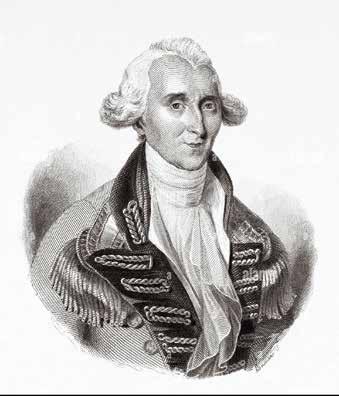
the single-edged English blade of curved form with central fuller and armour piercing tip, the hilt of cast brass in the form of a tiger head at the forte chiselled with bubri and punched motifs, tiger-head pommel with small tiger-heads to quillons and knuckle-guard 89.5 cm. long
£20,000 - 30,000
€23,000 - 34,000
US$27,000 - 41,000
Provenance
Formerly in the collection of Robin Wigington (1933-2002).
For a sword with an almost idential hilt, also with a captured British blade, see Sotheby’s, Art of Imperial India, 9th October 2013, lot 249. Comparable examples are in the National War Museum, Edinburgh (inv. no. M.2004.53). Further examples are published in Robert Hales, Islamic and Oriental Arms and Armour: A Lifetime’s Passion, London 2013, p.185 (cat. no. 439 and 440). Hales notes ‘Tipu may well have delighted in the irony of taking a captured English blade and using it against his hated foe.’
Indeed, Tipu, famously uttered: “I would rather live a day as a tiger than a lifetime as a sheep” adopted the royal tiger as his personal emblem. The association of a tiger with a dynasty was not unique to him, but he took the use of this to new heights and customised everything that might be associated with him, including his throne, ornamentation on his buildings, arms and armour, textiles such as tent panels, the uniforms of his courtiers and soldiers, and was even said to have a tiger-stripe or bubri motif as the watermark on the paper he used for official edicts. When travelling outside his court, he was known to wear a red coat emblazoned with bubris. The tiger was symbolic of power and Tipu objects are easily identified by this decoration. Tipu even dreamed of tigers and recorded such an incident in his notebook, which was discovered by Col. William Kirkpatrick after the fall of Seringapatam (William Kirkpatrick (transl.), Select Letters of Tippoo Sultan, London, 1811). He saw himself as the royal tiger, the instrument of God, appointed to devour God’s enemies, in particular the British. He even went so far as to order the walls of houses in the city to be painted with scenes of tigers mauling Europeans and there were stories of enemies being thrown into the tiger-pit within the palace.
Tipu Sultan was the East India Company’s most tenacious enemy and the Company wanted to take over Mysore and seize its considerable mineral riches. Tipu was a tough and brilliant general: in the course of five wars against the Company, he inflicted on them the most humiliating defeat ever suffered by the British at Indian hands - the Battle of Pollilur in 1780. This was a tactically brilliant victory by Tipu, and led to the capture of no less than one in five of all British soldiers in India. In total, more than 7,000 British men, along with an unknown number of women, were held captive by Tipu.
Tipu, it is now clear, was one of the most creative, innovative and capable rulers of the pre-colonial period. Tactically, the Mysore forces equalled those of the East India Company and their weapons, which were based on the latest French designs, were superior to the Company’s old matchlocks. He studied European economic methods and put in place a number of extremely imaginative measures which quickly transformed the economy of Mysore. He imported French technology and welcomed French artisans to train the craftsmen of Mysore. Tipu sent envoys to southern China to bring back silkworm eggs and established sericulture in Mysore - an innovation of his that still enriches the region today. He set up a department of animal husbandry to breed superior strains of draught cattle and horses, and he built a network of new roads. More remarkably still, he created what amounted to a large State Trading Company with its own ships and factories dotted across the Persian Gulf, through which he began to open up a profitable trade with the Middle East.
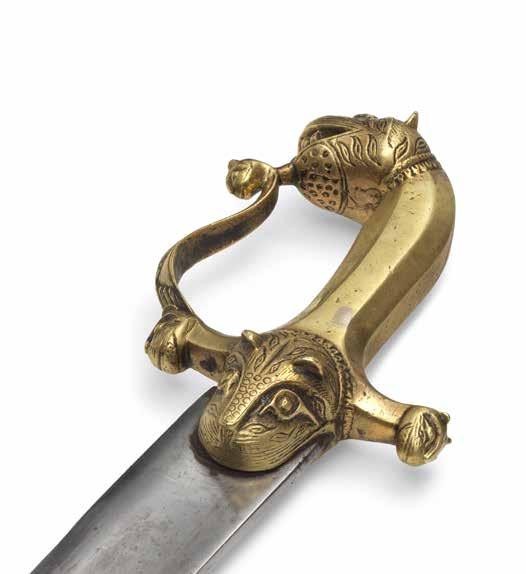

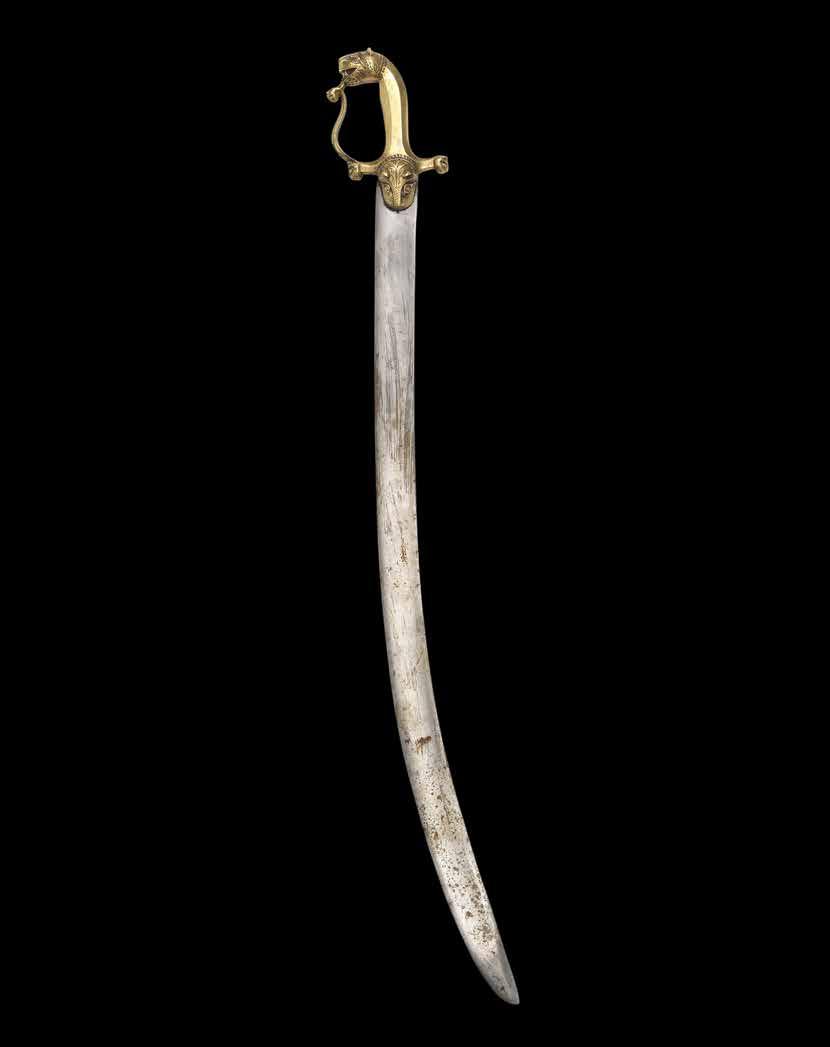
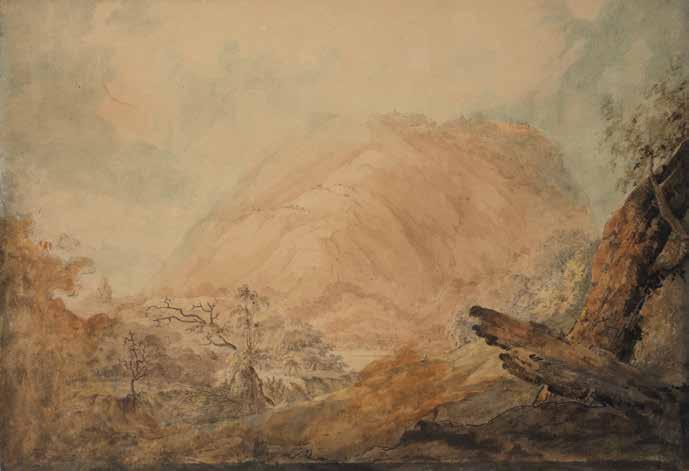
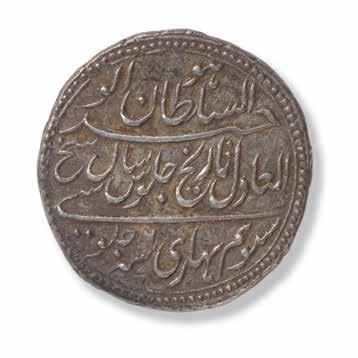
144
TIPU SULTAN’S FORT AT SAVENDROOG, MYSORE, BY GENERAL SIR JAMES LILYMAN CALDWELL (1770-1863)
SOUTH INDIA, CIRCA 1790-95 watercolour on wove paper, inscribed on the reverse in a contemporary hand 414 x 600 mm.
£3,000 - 5,000
€3,400 - 5,700
US$4,100 - 6,800
For the full note on this lot, see the online catalogue.
145 A SILVER RUPEE COIN FROM THE REIGN OF TIPU SULTAN (1787-1799)
PATAN, MYSORE, DATED MAWLUDI 1216/ AD 1788-9 of circular form, struck to each side with inscriptions in nasta’liq, the initial letter ‘Ha’ to centre 2.4 cm. diam.; 11.4 g.
£1,000 - 1,500
€1,100 - 1,700
US$1,400 - 2,000
For a previous Tipu Sultan-era silver rupee sold in these rooms and dated to Mawludi 1217/ AD 1788-9, see Islamic and Indian Art, 22nd May 2025, lot 157.
For details of the charges payable in addition to the final Hammer Price of each Lot please refer to paragraphs 7 & 8 of the Notice to Bidders at the back of the catalogue.
146
THE HEAD OF THE ADVANCED GUARD OF THE MAHRATTA ARMY COMING TO JOIN EARL CORNWALLIS NEAR SERINGAPATAM, MAY 28TH 1791
PUBLISHED BY JAMES RENNELL, MARCH 30TH 1792
hand-coloured engraving
327 x 530 mm.
£1,500 - 2,000
€1,700 - 2,300
US$2,000 - 2,700
Provenance
Property from a descendant of Charles Cornwallis, 1st Marquess Cornwallis (1738-1805).
By late May, 1791, during the Third Anglo-Mysore War, the campaign between Tipu Sultan and the British East India Company had reached a critical phase following the British capture of Bangalore earlier that year. Under the command of Lord Cornwallis, British forces were advancing toward Seringapatam but were encountering severe difficulties. Around this date of the events depicted in this print, Tipu Sultan was effectively employing scorched-earth tactics, destroying supplies and harassing the advancing army, which led to worsening shortages of food and transport. Although no major pitched battle is recorded specifically on May 28, the British position was rapidly deteriorating, marking a turning point in the campaign. These pressures soon forced Cornwallis into a retreat in June 1791, demonstrating the effectiveness of Tipu Sultan’s defensive strategy in delaying the eventual British victory.
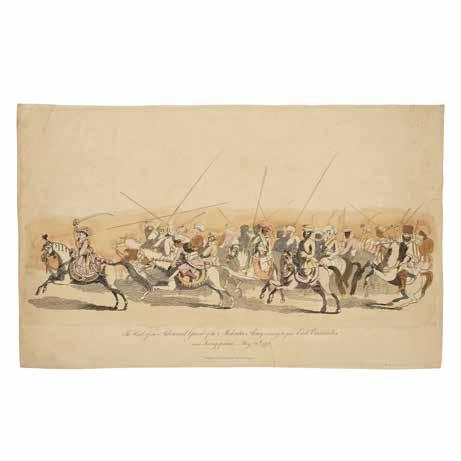
147
THREE CONTEMPORARY ENGLISH NEWSPAPERS WITH ARTICLES RELATING TO TIPU SULTAN, CORNWALLIS, AND EVENTS IN SOUTH INDIA
EDINBURGH AND NORTHAMPTON, 24TH MAY, 5TH JULY 1792, AND 1ST FEBRUARY 1794
comprising two editions of The Edinburgh Evening Covenant, 24th May (two pages, four sides of text) and 5th July 1792; and the Northampton Mercury 1st February 1794
47 x 32 cm.; 46.5 x 31 cm.; 51 x 35.5 cm.(3)
£1,500 - 2,000
€1,700 - 2,300
US$2,000 - 2,700
For the full note on this lot, see the online catalogue.
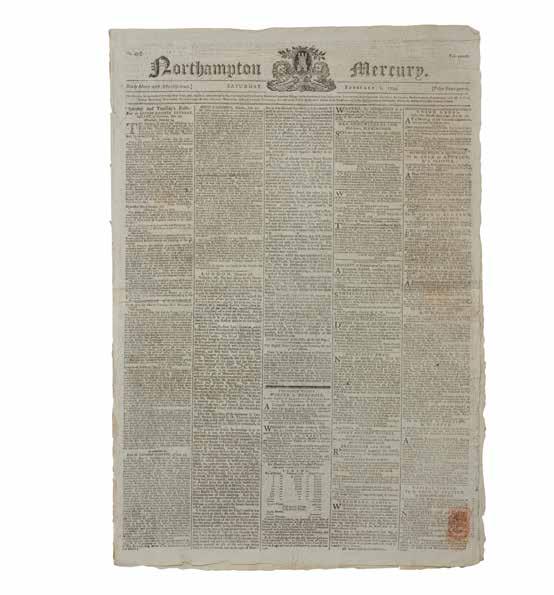
A RARE ANNOTATED MAP OF THE 1792 ASSAULT BY CORNWALLIS ON SERINGAPATAM, TIPU SULTAN’S FORTRESS SOUTH INDIA, LATE 18TH CENTURY
pen and ink and watercolour on watermarked paper, handwritten key to locations at bottom 275 x 208 mm.
£6,000 - 8,000
€6,900 - 9,200
US$8,100 - 11,000
Provenance
Formerly in the collection of Dr Alan York; his estate sale, Roland Auctions, Glen Cove, New York, USA, 25th October 2019, lot 53.
A similar, slightly smaller, diagram is in the National Maritime Museum, Greenwich, London (GREN71/7). The list of locations is very similar, even down to the wording, though the Greenwich painting combines a diagrammatic plan view of the fortress against a perspectival background of the surrounding landscape.
The February 1792 siege and assault of Seringapatam marked the end of the Third Anglo-Mysore War, with Lord Cornwallis commanding British forces against those of Tipu Sultan.
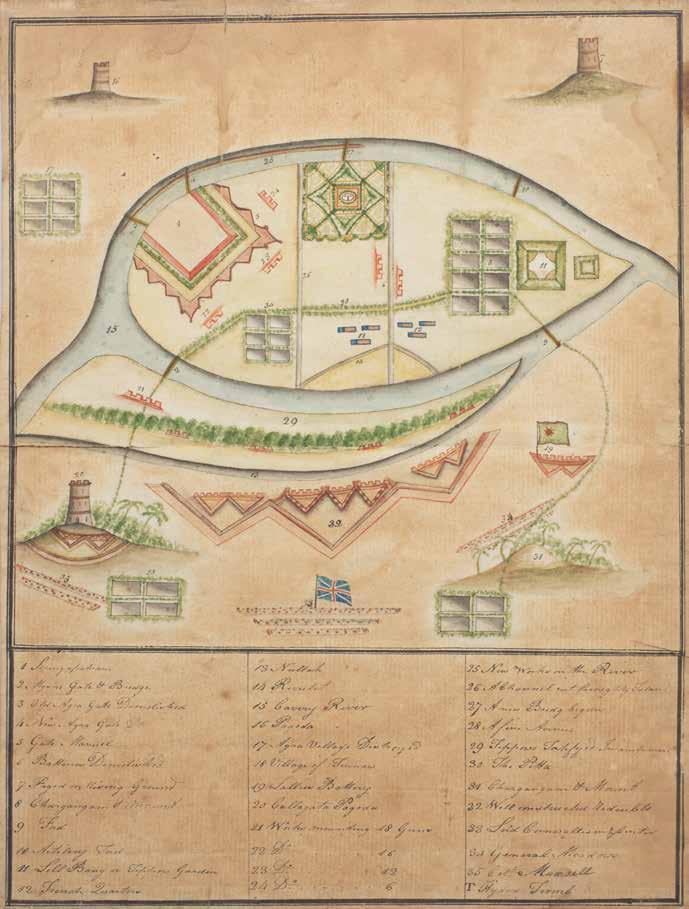
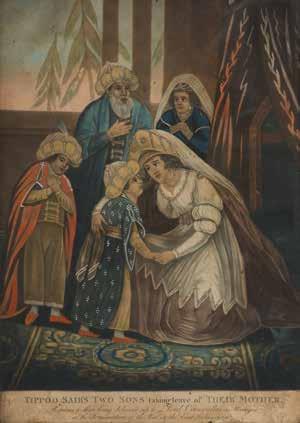
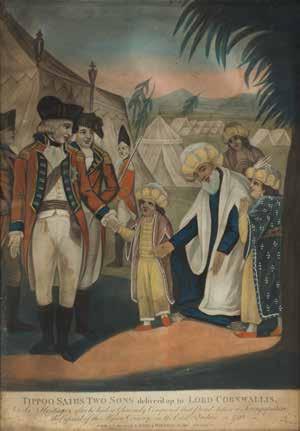
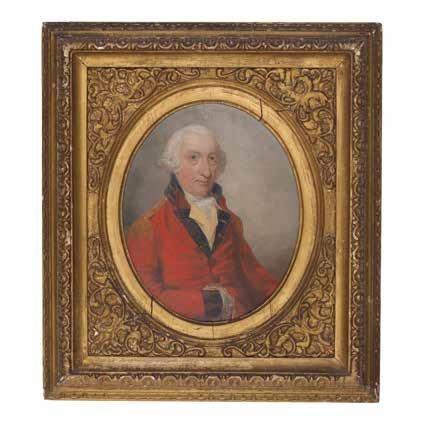
149
TIPPOO SAIB’S TWO SONS TAKING LEAVE OF THEIR MOTHER; AND TIPPOO SAIB’S TWO SONS DELIVER’D UP TO LORD CORNWALLIS
LAURIE & WHITTLE, LONDON, PUBLISHED 12TH MAY 1794
hand-coloured mezzotints on paper, captions and publishing details in lower border, numbered 286 and 287 380 x 275 mm.(2)
£1,500 - 2,000
€1,700 - 2,300
US$2,000 - 2,700
Provenance
Property from a descendant of Charles Cornwallis, 1st Marquess Cornwallis (1738-1805).
The text continues in each respectively: Previous to their being deliver’d up to Lord Cornwallis as Hostages at the Termination of the War in the East Indies in 1792; and As Hostages, after he had so Gloriously Conquered that proud Sultan at Seringapatam the capital of the Mysore Country in the East Indies, in 1792
150
A PORTRAIT OF AN OFFICER, THOUGHT TO BE CHARLES, 1ST MARQUESS CORNWALLIS (1738-1805), GOVERNOR-GENERAL AND COMMANDER-IN-CHIEF IN INDIA, 1786-1793
BRITISH SCHOOL, LATE 18TH/EARLY 19TH CENTURY
oil on copper, oval, reverse of frame inscribed twice in a roughly contemporary hand Lord Cornwallis, in gilt gesso frame 28 x 23 cm.; frame 46 x 41 cm.
£2,000 - 3,000
€2,300 - 3,400
US$2,700 - 4,100
Provenance
Property from a descendant of Charles Cornwallis, 1st Marquess Cornwallis (1738-1805).
151
CHARLES, 1ST MARQUESS CORNWALLIS (1738-1805), GOVERNOR-GENERAL AND COMMANDER-IN-CHIEF IN INDIA 1786-1793
BRITISH SCHOOL, LATE 18TH CENTURY oil on canvas
77.5 x 64.5 cm.
£5,000 - 7,000
€5,700 - 8,000
US$6,800 - 9,500
Provenance
Property from a descendant of Charles Cornwallis, 1st Marquess Cornwallis (1738-1805).
With Miles Barton, London.
Cornwallis had returned from his American campaigns in January 1782. Early in 1783 he and Lord Rawdon, a fellow officer from the American war, were sitting to Gainsborough for their portraits, for presentation to each other. Cornwallis’s picture was hung in the Royal Academy exhibition that year and was considered a good likeness. It is now in the National Portrait Gallery, London (NPG281: illustrated and discussed in, for example, C. Bayly, The Raj: India and the British 1600-1947, London 1990, p. 127, no. 152).
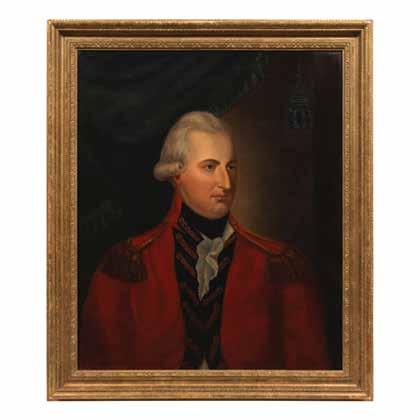
152
A GROUP OF FOUR LETTERS, THREE WRITTEN BY ARTHUR WELLESLEY TO CAPTAIN MAITLAND, AN OFFICER OF ENGINEERS; AND A LONGER LETTER WRITTEN LATER BY MAITLAND TO A FRIEND IN ENGLAND, TELLING OF HIS EARLIER ACTIVITIES IN INDIA SOUTH INDIA, DATED BETWEEN 1802 AND 1806 manuscript letters on watermarked paper (two with watermark 1799) the largest 327 x 200 mm.(4)
£2,000 - 3,000
€2,300 - 3,400
US$2,700 - 4,100
The letters were written by Wellesley instructing Maitland to build infrastructure and improve the road during the campaign against the Rajah of Bullum.
A. Camp at Bareilly, dated January 21st 1802, ordering Maitland to proceed with the Corps of Pioneers, open up the road, and send the working party back tomorrow evening. Two sides of text, watermark of Joseph Coles, 1799, 325 x 198 mm.
B. Camp at [...?], dated January 27th 1802, ordering Maitland to stay in position while Wellesley moves north, and requesting him to build a redoubt near a certain ghaut, four sides of text, watermark as above, 325 x 200 mm.
C. dated February 27th 1802: regarding the poor state of the road, and the attempts at repair, two sides of text, 220 x 182 mm.
D. From Maitland to ‘My Dear Friend’ (Mrs Hoffham, Edgar House, Bath), dated 86 Hatton Gardens, 27th March 1806, discussing his earlier career in the 1780s, in operations against the French in south India, four leaves, conjoined in two pairs, 7 pages of text, 305 x 190 mm.
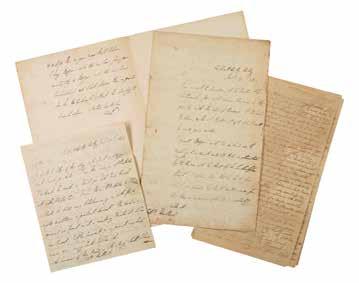
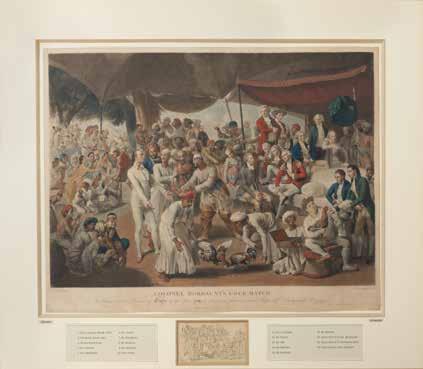
153
COLONEL MORDAUNT’S COCK MATCH, AFTER JOHANN ZOFFANY RA, ENGRAVED BY RICHARD EARLOM
LONDON, [1794]
hand-coloured mezzotint, inscribed in lower border with the title and subtitle At Lucknow in the Province of Oude in the year 1786, at which were present several High and Distinguished Personages, card mount with modern key to figures and small-scale reproduction of original key 524 x 675 mm.; frame 84 x 96.5 cm.
£2,000 - 3,000
€2,300 - 3,400
US$2,700 - 4,100
For the full note on this lot, see the online catalogue.
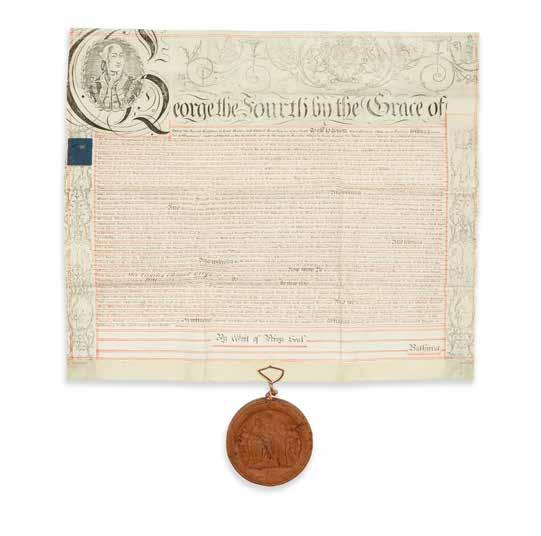
THE LETTERS PATENT FOR SIR CHARLES GREY’S APPOINTMENT AS CHIEF JUSTICE OF THE SUPREME COURT IN CALCUTTA LONDON, WESTMINSTER, THE SEVENTEENTH DAY OF FEBRUARY IN THE SIXTH YEAR OF OUR REIGN [1825]
manuscript on paper, ornate Royal Arms at top with vignette portrait of King George IV, further rococo designs in borders, interlinear rules in red, wax seal, affixed with cord to lower edge, depicting George IV enthroned and (obverse) on a galloping charger, Latin legend to rim (within metal case); together with a Humble Petition addressed to Sir Charles Edward Grey, Chief Justice, from James Weir Hogg, relating to the matter of the late William Bell having died at Calcutta intestate, dated 8th May part-printed, with additions in pen, with cover paper; and a 19th Century leather-bound, paperlined box
document 60 x 72 cm.; metal case 18 cm diam.; petition 320 x 200 mm.; leather-bound box 23 x 31
£1,500 - 2,000
€1,700 - 2,300
US$2,000 - 2,700
For the full note on this lot, see the online catalogue.

155
A MUGHAL SILVER-MOUNTED BOWENITE BOX
NORTH INDIA, 19TH CENTURY
of rectangular form with hinged lid and bevelled edges, silver mounts and handle with foliate motifs to latch
24.5 x 13.7 x 9.7 cm.
£4,000 - 6,000
€4,600 - 6,900
US$5,400 - 8,100
For a comparable jade example, see Christie’s, Indian & Islamic Works of Art and Textiles October 2010, lot 551.
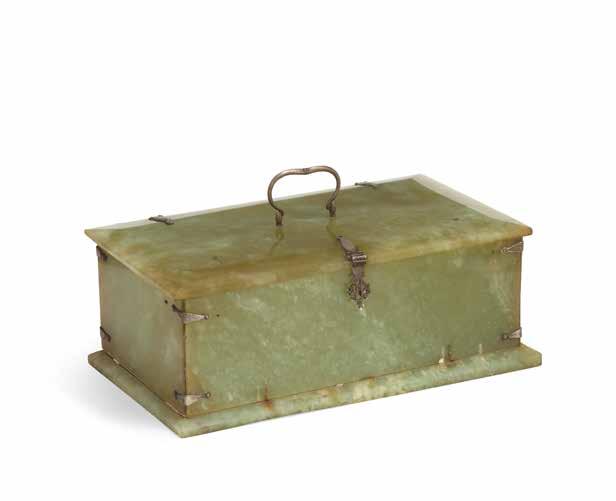
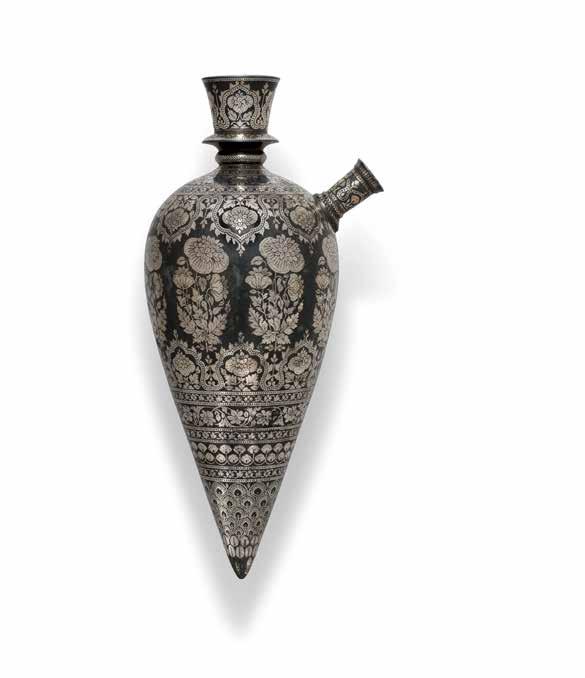
A SILVER-INLAID BIDRI HUQQA BASE DECCAN, 18TH CENTURY
of bulbous conical form, the flaring neck with raised ring, decorated in silver inlay with floral sprays and vegetal bands, lower body with peacock feather
For a comparable bidri huqqa base, see Christie’s, Art of the Islamic and Indian Worlds including Oriental Rugs and Carpets, 2 May 2019, lot 108.
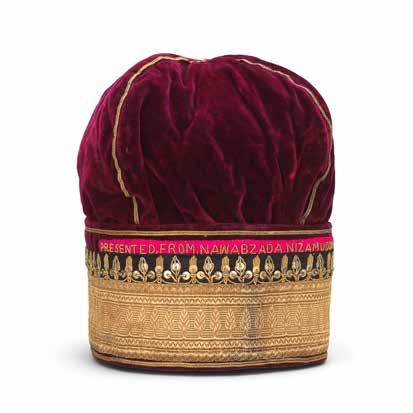
157
A METAL-THREAD EMBROIDERED VELVET HAT PRESENTED TO HALLAM TENNYSON, 2ND BARON TENNYSON (1852-1928) BY A NAWABZADA OF JHAJJAR
NORTH INDIA, EARLY 20TH CENTURY of maroon velvet, the band embroidered in giltsilver thread and sequins with foliate bands surmounted by the inscription ‘PRESENTED FROM NAWABZADA NIZAMUDDIN OF JNAJJAR TO LORD TENNYSON’, silk lining 22.5 cm. high
£2,000 - 3,000
€2,300 - 3,400
US$2,700 - 4,100
‘Nawabzada Nizamuddin of Jnajjar’ is likely to have been a member of the former ruling family of Jhajjar, a small North Indian state whose Nawabs rose to prominence in the early 19th century. The last Nawab, Abdur Rahman Khan (reg. 1845-57), was executed after the Indian Rebellion of 1857, and the state was annexed by the British, but it is likely that his descendants continued to use titles like ‘Nawabzada’. Hallam Tennyson, 2nd Baron Tennyson (1852-1928), the son of Alfred Lord Tennyson (1809-1892), was the Governor of Madras between 1906 and 1910, and was presumably given the hat during this period.
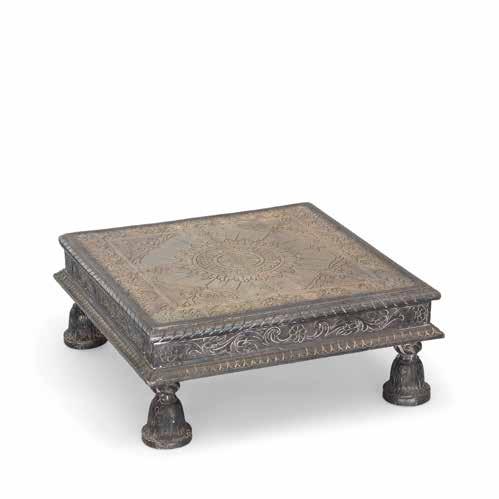
158 A SILVER-MOUNTED WOOD FOOTSTOOL INDIA, 19TH CENTURY
of square form on four legs of bell-shaped form, the teak structures clad entirely in silver profusely decorated in repoussé with a floral medallion to centre, floral interlace to borders and sides
52.5 x 51.7 x 20.5 cm.
£1,000 - 1,500
€1,100 - 1,700
US$1,400 - 2,000
Provenance
The collection of Simon and Jennifer Murray (b. 1940), Hemington House.
Private UK collection, acquired at Dore & Rees Fine Asian Art - Part II (including the Hemington House Collection), 19 May 2025, lot 762.
For a comparable footstool in The Victoria and Albert Museum, see Amin Jaffer, Furniture from British India and Ceylon: A Catalogue of the Collections in the Victoria and Albert Museum and the Peabody Essex Museum, London 2001, p.312, cat no.127.
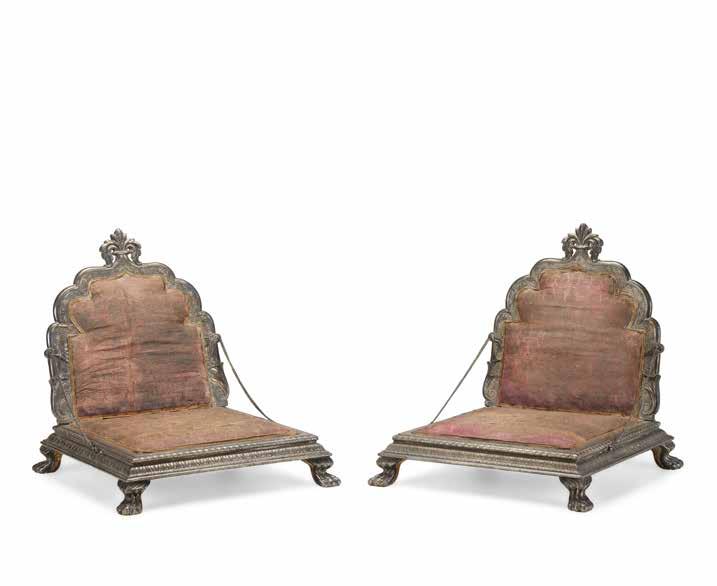
159 W
A PAIR OF SILVER-MOUNTED WOOD THRONE CHAIRS (TAKHT)
each of square form on four lion-paw feet, the teak structures clad entirely in silver, the hinged cusped backs surmounted by fleur-delis and supported by chains to each side, decorated in repoussé with acanthus bands to sides, the backs with large foliate motifs and undulating foliate vines, the reverses with hatched decoration, cushions to seats and backs upholstered in silk and silver-thread brocade decorated with a repeat design of boteh and floral vines each 71 x 71 x 75 cm.(2)
£4,000 - 6,000
€4,600 - 6,900
US$5,400 - 8,100
Provenance
The collection of Simon and Jennifer Murray (b. 1940), Hemington House.
Private UK collection, acquired at Dore & Rees Fine Asian Art - Part II (including the Hemington House Collection), 19 May 2025, lot 762.
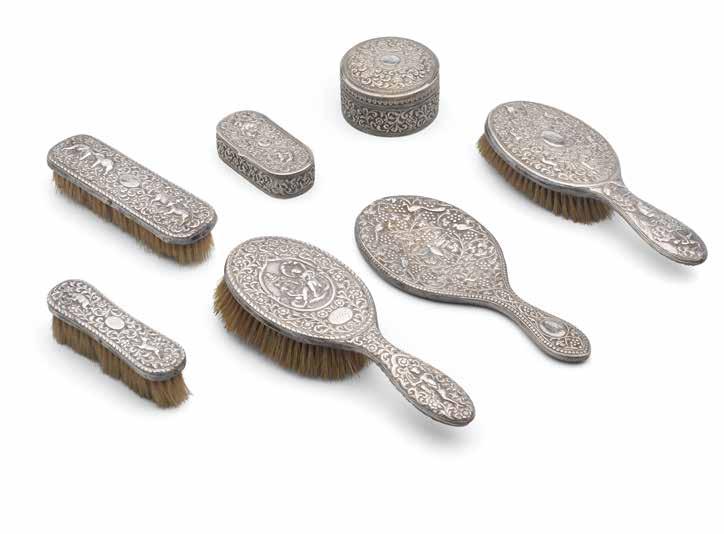
clothes brushes, a cylindrical and a circular lidded box, all profusely decorated in repoussé with floral scrollwork surrounding animal hunting scenes, insects, exotic birds and Hindu deities, including Vishnu, Lakshmi, Brahma and Matsya Avatar, each object stamped ‘O.M’ and ‘BHUJ’ with central roundels hand-engraved with ‘Letty’ the largest hairbrush 25 cm. long(7)
£4,000 - 6,000
€4,600 - 6,900
US$5,400 - 8,100
Provenance
Letitia de la Cloche Gordon Snell, gifted by her husband, LieutenantColonel Hugh Robert Norman Pritchard O.B.E., C.I.E. (1879-1967), and thence by descent.
Letitia ‘Letty’ de la Cloche Gordon Snell (1881-1945) was the wife of Lieutenant-Colonel Hugh Robert Norman Pritchard O.B.E., C.I.E. (1879-1967), who began his career as tutor to Maharaja Kunwar of Sirohi in 1906, before acting as a political agent variously in Loralai, Baluchistan, Bhopal, Rajputana and Haraoti and Tonk. He later became Resident in Mewar in 1924, and Agent to the Governor General in Central India in 1929 earning his eventual recognition as Order of the British Empire (O.B.E.) in 1920 and Companion to the Indian Empire (C.I.E.) in 1929. Letitia accompanied him on these secondments, joining him on official functions such as Viceregal Investitures and tiger hunts.
The workshop under Oomersi Mawji’s guidance raised the quality of Kutch silver to an art form. Mawji was appointed royal silversmith to the Maharao of Kutch and is considered the best silversmith of nineteenth-century India. For a detailed discussion on the work of Oomersi Mawji, see W. Wilkinson, Indian Silver 1858 - 1947, London 1999, pp. 69-70.
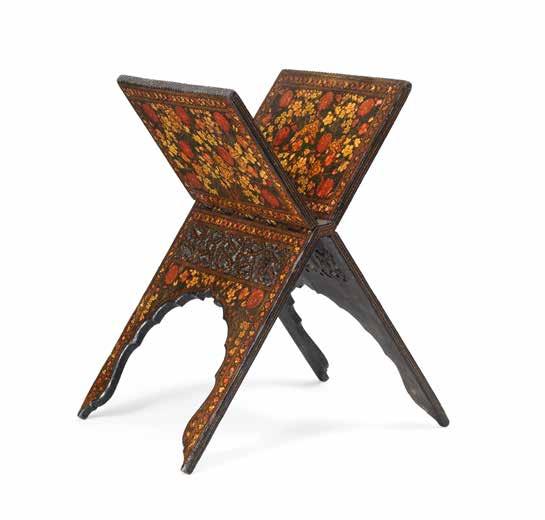
A KASHMIR LACQUERED WOOD QUR’AN STAND INDIA, 19TH CENTURY
of typical folding x-form with cusped arches to lower section and openwork panels below apex, the top with serrated edging, profusely decorated in polychrome and gilt with floral interlace to central panels and borders, scrollwork motif to vertices 61 cm. high (open); 74 cm. high (closed)
£4,000 - 6,000
€4,600 - 6,900
US$5,400 - 8,100
162
A KASHMIR LACQUERED WOOD SCREEN INDIA, 19TH CENTURY
comprising three hinged rectangular panels surmounted by lobed top sections and cusped aprons to feet, openwork to lower panels, each panel profusely decorated with polychrome and gilt with floral sprays
105.4 x 120 cm. (open)
£3,000 - 5,000
€3,400 - 5,700
US$4,100 - 6,800
Provenance
Christie’s, Art of The Islamic And Indian Worlds October 2008, lot 106.
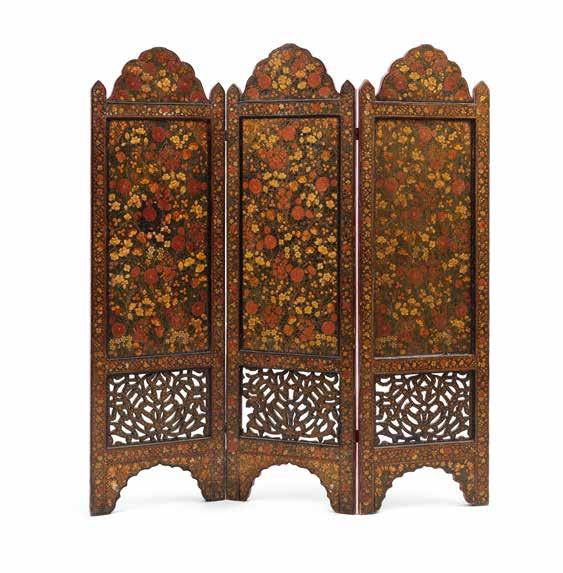
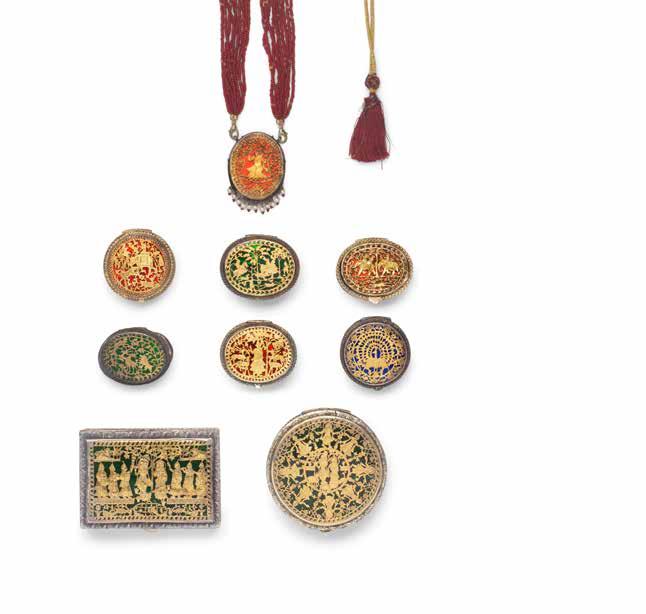
A GROUP OF PRATAPGARH GOLD AND BOXES AND A
NORTH INDIA, RAJASTHAN, 19TH CENTURY
comprising eight silver boxes of circular, ovoid and rectangular form with hinged lids, set with green, red and blue glass panels with incised gold decoration, depicting hunting scenes, a peacock, Krishna and Radha, and Todi Ragini, gilt interiors; the plaque of ovoid form, set with red glass panel with incised gold decoration, depicting a woman with parrot, with imitation pearl fringe, mounted as necklace with
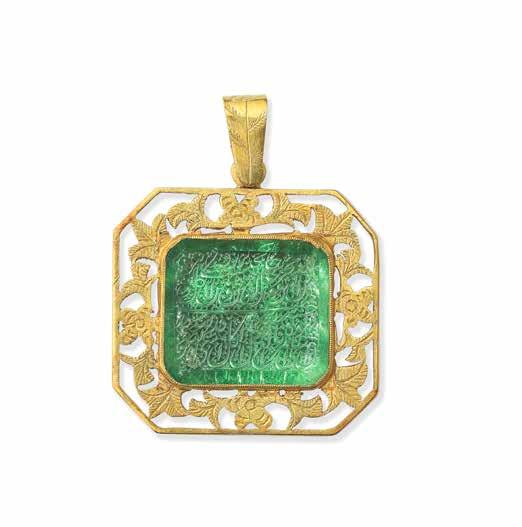
164
A CALLIGRAPHIC EMERALD-SET GOLD PENDANT
NORTH INDIA, 19TH/ 20TH CENTURY
the green emerald of rectangular form with facetted, cut corners, engraved with two lines of inscription in nasta’liq on a ground of floral motifs, set in later gold mount decorated in openwork with foliate designs, engraved decoration to reverse 4.1 cm. max.; 23.7 g.
£3,000 - 5,000
€3,400 - 5,700
US$4,100 - 6,800
Provenance
Property from a Princely Collection, acquired at Christie’s, Art of the Islamic and Indian Worlds including Oriental Rugs and Carpets, 27 April 2017, lot 128.
Inscriptions: Qur’an LXV, Sūra al-Ṭalāq, end of verse 2 to 3.
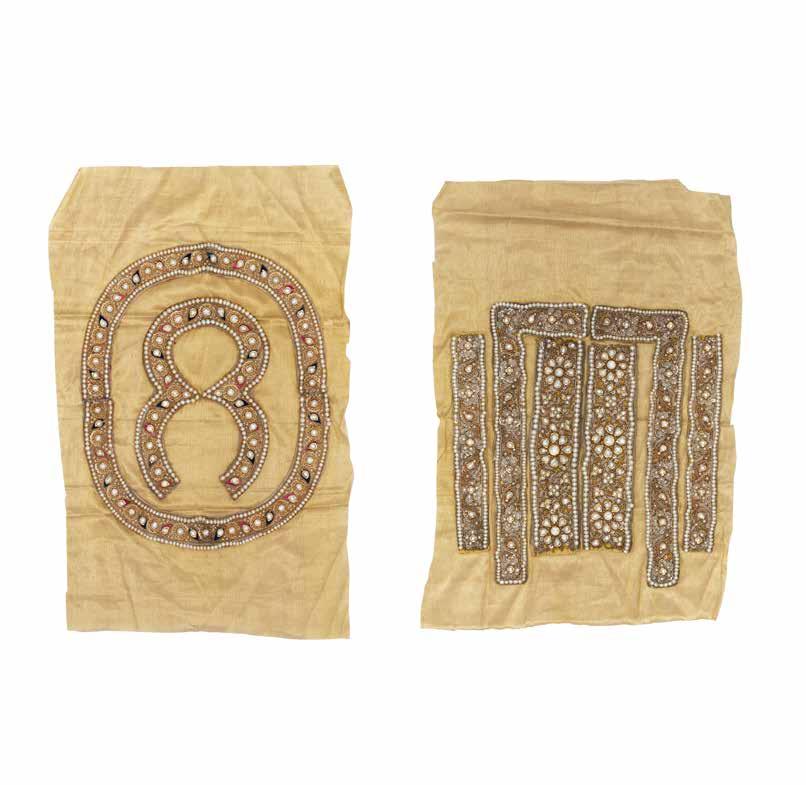
mounted as two panels, the first with fragments of yellow velvet mounted with gold thread, sequins and diamond-set elements forming flowerheads and floral interlace; the second with metal thread backing with blue and pink appliqué velvet, mounted with gold thread, sequins and diamond-set elements forming floral and foliate motifs
27.8 x 29.5 cm. and 32 x 26 cm. (2)
£4,000 - 6,000
€4,600 - 6,900
US$5,400 - 8,100
Provenance
Property from a Princely Collection.
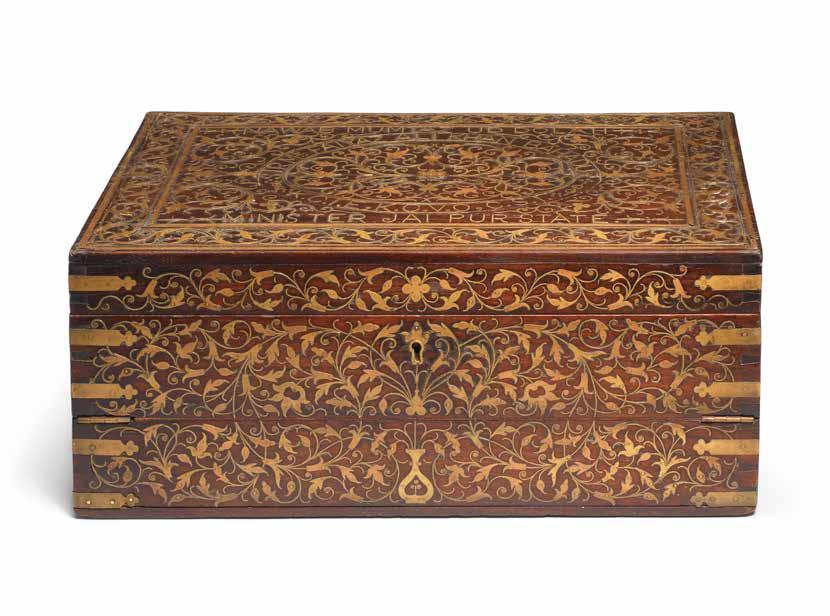
TO THE NAWAB OF PAHASU
NORTH INDIA, PROBABLY MAINPURI, CIRCA 1880S-1900S of rectangular form with hinged lid, opening to reveal storage compartments and a morocco-lined writing slope acting as a two-part lid that conceals two drawers, exterior profusely inlaid with brass wire, the sides with floral sprays issuing from urns, the lid with floral interlace surrounding oval cartouche with inscription ‘Nawab Mumtaz ud-Dolah, Sir Muhammad Faiyaz Ali Khan Bahadur, K.C.I.E., K.C.V.O., C.S.I., Minister Jaipur State’ 45.2 x 18.8 x 30.2 cm.
£3,000 - 5,000
€3,400 - 5,700
US$4,100 - 6,800
Provenance
Nawab Sir Muhammad Faiyaz Ali Khan Bahadur (1851-1922). Private UK collection.
The method of inlaying metal wire, normally brass, into wooden items in India is known as tarkashi (wire drawing). It was a practice that flourished at Mainpuri, a district in the Agra Division of the United Provinces (see A. Jaffer, Furniture from British India and Ceylon, London, 2001, pp. 305-307).
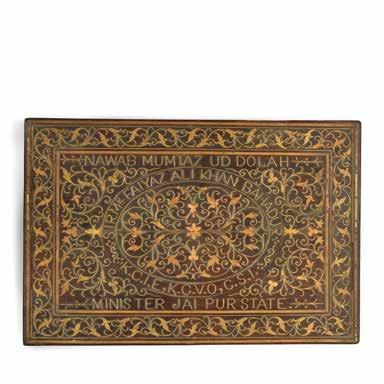
Nawab Sir Muhammad Faiyaz Ali Khan Bahadur (1851-1922) was Nawab of Pahasu and Rampur in Uttar Pradesh, and as member of the legislative councils of Agra and Oudh, before being appointed foreign minister of Jaipur State Council in 1901. He would later attend the coronation of King Edward VII and host the Queen-Empress Mary on her visit to Jaipur in 1911.
167
A LARGE GROUP OF STEREOSCOPE VIEWS OF CITIES AND MONUMENTS IN INDIA, AND A STEREOSCOPIC VIEWER
H. HANDS & SON, LATE 19TH/EARLY 20TH CENTURY
albumen prints, dual images laid down on publisher’s cards, many with contemporary identification inscriptions on the reverse, others titled in the plate, 115 cards (one cut in half); A LATE 19TH/EARLY 20TH CENTURY STEREOSCOPE
VIEWER, the ‘Mercury’ Stereoscope, with padded steel eyepiece and fold-down handle; TOGETHER WITH A PART SET OF 28 GLASS LANTERN SLIDES depicting various Indian subjects, in box cards 88 x 178 mm.; viewer 31 cm. long; lantern slides 82 cm. square(3)
£1,500 - 2,000
€1,700 - 2,300
US$2,000 - 2,700
Ten views of Bombay and environs, including the Elephanta caves.
Six views of Benares and its ghats.
Ten views of Lucknow.
Sixteen views of Delhi monuments.
Twelve views of Agra monuments.
Four views of Alwar and environs.
Six views of Jaipur.
Three views of buildings in Ahmedabad.
Two views of Simla.
One view of ‘Hindoo Temples’, location unknown.
Two views of the Cawnpore Monument.
Twenty various views of peasants, tradespeople,
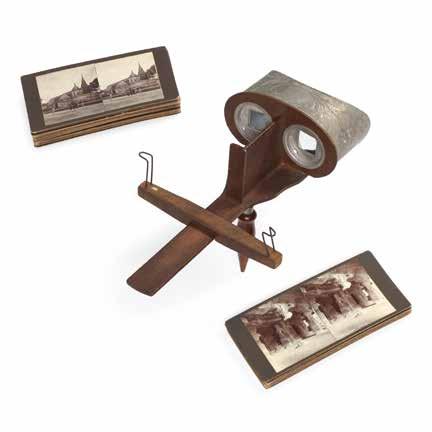
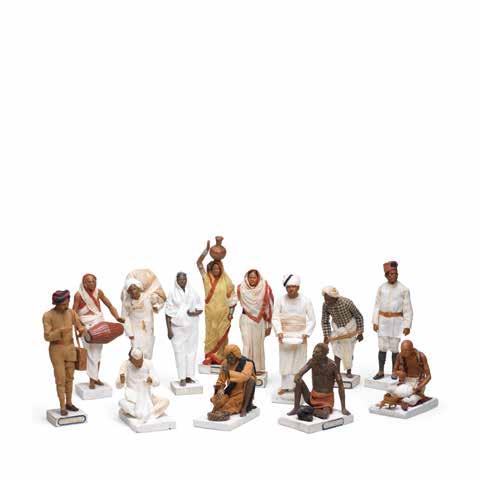
168 A GROUP OF THIRTEEN CLAY FIGURES OF SERVANTS AND TRADESPEOPLE
KRISHNANAGAR, BENGAL, LATE 19TH/ EARLY 20TH CENTURY
decorated in polychrome, clothed and with accoutrements, on rectangular bases, including a snake-charmer, a fakir, a holy man performing puja, a drummer, a postman, a sweeper, a water woman, a butler (khitmatgar), a washer-man (dhobi), a policeman, a nurse (ayah), a tailor and a woman in white, some with labels to bases, some inscribed to bases the largest 29.2 cm. high(13)
£1,500 - 2,000
€1,700 - 2,300
US$2,000 - 2,700
Provenance
Acquired in India by the vendor’s great-grandfather in the early 20th century and thence by descent.
Highly naturalistic sculptures of this type were made at Krishnagar, a village near Calcutta, as well as at Hatwa, Datan (near Saran), Muzaffar-pur, Dacca, Burdwan, and later, Lucknow and Poona. Like Company School paintings, these figurines prefigure photography and were made as souvenirs for Western patrons as early as the 1820s. Their inspiration seems to have been 18th- and 19th-century Neapolitan creche figures. For further discussion, see Stuart Cary Welch, India: Art and Culture 1300-1900, New York 1985, pp. 91-2, fig. 45. 167
David Howard Maude-Roxby-Montalto di Fragnito, known professionally as David Montalto, is a British artist of international standing, whose work encompasses glass engraving, sculpture, painting, and jewellery. Born in Somerset in 1934, he received a cosmopolitan education in England and on the Continent, notably at the Sorbonne in Paris and the Accademia di Belle Arti in Florence. This classical training, combined with a spirit of technical innovation, informed a distinctive artistic practice that has remained consistent in its refinement and intellectual depth.
Montalto is particularly celebrated for his mastery of diamondpoint stipple engraving on glass, a highly exacting technique through which he achieves remarkable subtlety of tone, luminosity, and detail. His compositions, often allegorical or portrait-based, demonstrate an exceptional command of
line and light, placing him among the foremost practitioners of this demanding medium. His work has been exhibited widely across Europe and is represented in important public collections, including the Victoria and Albert Museum, London, and the Corning Museum of Glass, New York, as well as in notable private and royal collections.
Alongside his achievements as an artist, Montalto has been an astute and sensitive collector, guided by a finely honed aesthetic judgement. The present collection of Indian miniature paintings reflects this discerning eye. The group exemplifies the qualities that underpin Montalto’s own artistic practice: precision, delicacy, and a profound appreciation for detail and craftsmanship. As such, the collection stands as a testament to Montalto’s connoisseurship and his enduring engagement with the visual arts across cultures.
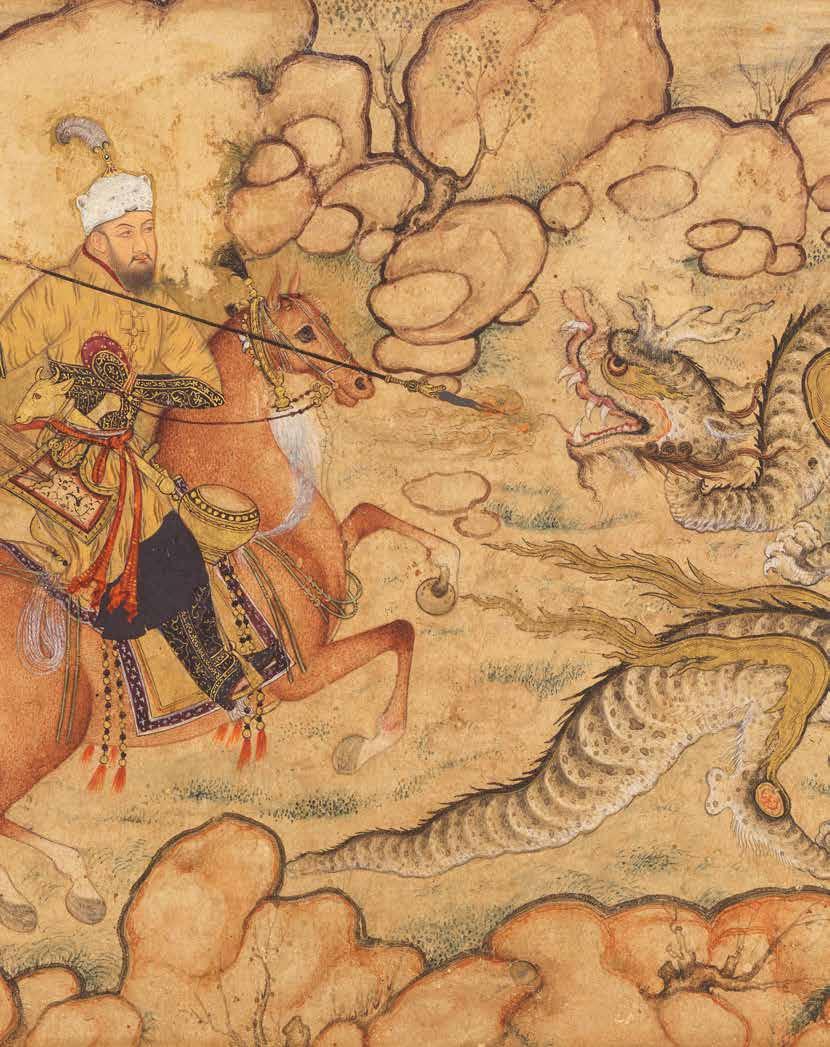
169
A PRINCE SEATED ON A ROCK READING, APPROACHED BY A HOLY MAN
MUGHAL, CIRCA 1630-50
gouache and gold on paper, laid down on an album page with illuminated inner borders, gold-sprinkled outer borders painting 167 x 125 mm.; album page 410 x 278 mm.
£30,000 - 50,000
€34,000 - 57,000
US$41,000 - 68,000
Provenance
With Maggs Bros., London, circa 1970s (remains of printed section of catalogue affixed verso, no. 39).
The collection of David Howard Maude-Roxby-Montalto, 14th Duke of Fragnito (b.1934).
The theme of a dervish or holy man with a young prince, usually the latter visiting the former, often in a wild landscape, is a common one in Mughal painting. Sheila Canby, in her note on a painting of Akbar visiting a dervish of 1586-87, and one depicting a prince visiting a hermit, circa 1580, observes that the theme apparently originated during the reign of that emperor: ‘encounters between noble or princely figures and holy men, dervishes and ascetics was a popular theme during [Akbar’s] reign. As Akbar took control of more of the Indian subcontinent and came to rule increasing numbers of nonMuslims, he became acutely aware of the need for religious tolerance and for ways to demonstrate his openness’. (S. Canby, Princes, Poets and Paladins: Islamic and Indian Paintings from the collection of Prince and Princess Sadruddin Aga Khan, London 1998, pp. 110-112, nos. 80 and 81).
Comparison can be made with a painting in the Victoria and Albert Museum, from the Small Clive Album, 1650-1750 (IS.48:9/B-1956), depicting a Qalandar sufi with a prince, who sits on a rock beneath a tree and wears an orange jama, as does ours, and holds a closed book in his hand. The sufi is a younger man than ours, with his arms bare, and he too holds an open manuscript.
For other examples of the theme see:
Johnson Album 7, no. 12 (T. Falk, M. Archer, Indian Miniatures in the India Office Library, London 1981, no. 36), a prince seated on a boulder reading a manuscript leaf, attributed by Falk to Muhammad ‘Ali, circa 1610-15.
Simon Ray, Indian and Islamic Works of Art, November 2016, no. 44 (a prince visiting an ascetic, circa 1610), now in the David Collection, Copenhagen.
Simon Ray, Indian and Islamic Works of Art, November 2018, no. 12 (a prince and a holy man meeting in a landscape, 1625-50).
Johnson Album 7, no. 7 (T. Falk, M. Archer, Indian Miniatures in the India Office Library, London 1981, no. 88), a dervish and his young disciple, circa 1650.
The roles are reversed, but the composition similar, in a painting of the Akbar period, depicting an elderly poet sitting in the branches of a diminutive tree on a riverbank, reading from a manuscript of poetry to a young pupil: see Francesca Galloway, J. P. Losty, A Prince’s Eye, 2013, pp. 44-45, no. 1L (circa 1595-1600, formerly in the Hagop Kevorkian Collection).
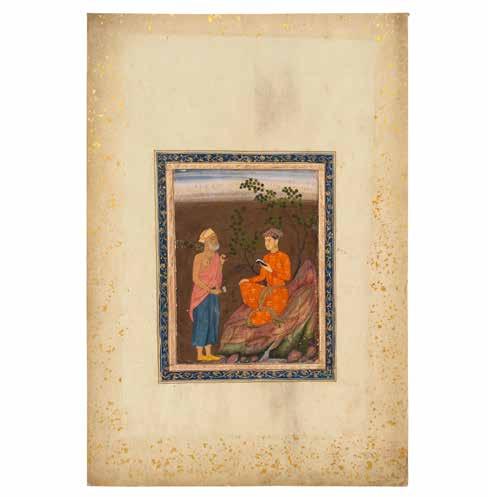
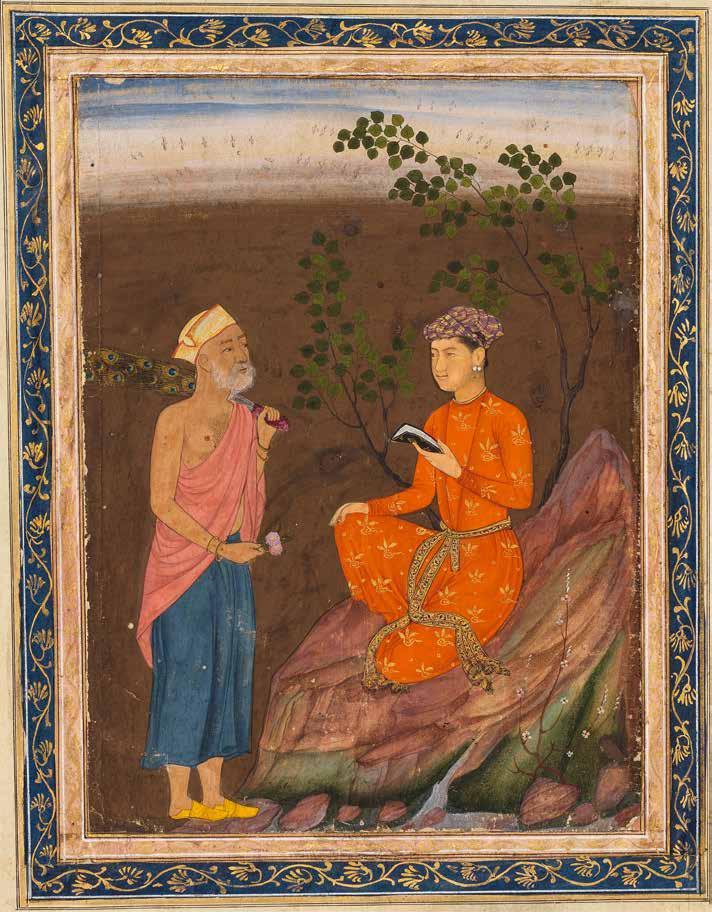
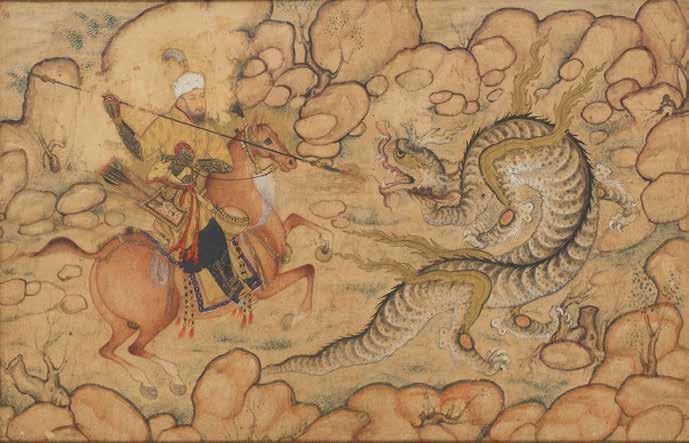
170
RUSTAM SLAYING A DRAGON IN A ROCKY LANDSCAPE MUGHAL, CIRCA 1580
gouache and gold on paper, verso with a fragment of a leaf from a manuscript of Persian poetry written in nasta’liq in two columns 143 x 225 mm.
£8,000 - 12,000
€9,200 - 14,000
US$11,000 - 16,000
Provenance
The collection of David Howard Maude-Roxby-Montalto, 14th Duke of Fragnito (b.1934).
For a later Mughal depiction of the subject (circa 1640-60), see T. Falk, M. Archer, Indian Miniatures in the India Office Library, London 1981, no. 79; Bodleian Library, Oxford, MS. Douce Or.a.1, fol. 26v; and Sotheby’s, Oriental Manuscripts and Miniatures, 22nd October 1993, lot 231, of similar date and composition (both of these with Rustam’s horse, Rakhsh, joining in closer combat with the dragon). The rocky landscape is reminiscent of that depicted in the paintings in a manuscript, Kitab-i-Sa’at, on astrology, dated AH 991/AD 1583.
171
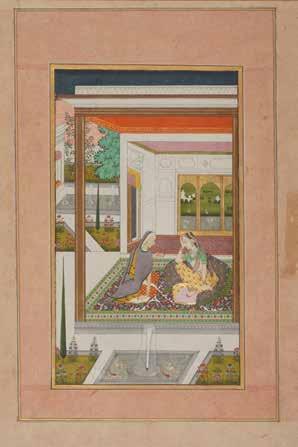
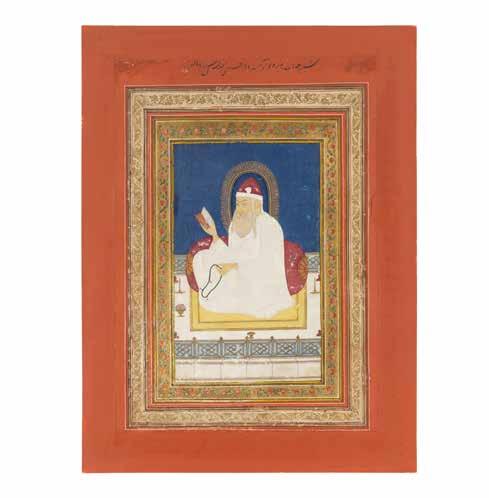
PATMANJARI RAGINI: A LOVELORN MAIDEN WITH A DUENNA IN A PALACE PAVILION
DECCAN, HYDERABAD, 1760-80 gouache and gold on paper, borders of pale pink paper 317 x 217 mm.
£3,000 - 5,000
€3,400 - 5,700
US$4,100 - 6,800
Provenance
The collection of David Howard Maude-Roxby-Montalto, 14th Duke of Fragnito (b.1934).
For the subject, one of a large Hyderabad series, see T. Falk, M. Archer, Indian Miniatures in the India Office Library, London 1981, no. 426ii (Johnson Album 37, the series nos. 1-36): ‘perhaps the most sophisticated of a group of Hyderabad-style ragamala series’. Richard Johnson was British Resident at the court of Nizam ‘Ali Khan at Hyderabad between 1784-85. Two of these are also illustrated in M. Zebrowski, Deccani Painting, London 1983, p. 255, nos. 228, 229. There are also two similar series in the Chhatrapati Shivaji Maharaja Vastu Sangrahalaya (formerly Prince of Wales Museum), Bombay (22.287-322, 22.323-358); the Salar Jung Museum, Hyderabad, and the Indian Museum, Calcutta.
For other closely-related examples, see Christie’s, Arts of India, 23rd September 2005, lot 72 (Sri Raga: subsequently with Simon Ray, Indian and Islamic Works of Art, April 2006, pp. 134-135, no. 62); Sotheby’s, Art of Imperial India, 9th October 2013, lot 204 (Hindol raga); Francesca Galloway, The Divine and the Profane, no. 29 (Syam Kalyan Ragini). J. P. Losty, in Galloway, argues that the Johnson series, and the Galloway painting demonstrate ‘its artist’s fondness for strict linear perspective, a western conceit perhaps introduced into Hyderabad via French topographical and architectural prints by the French officers who played such a part in mid-18th Century Deccan politics’.
172
THE SUFI SAINT KHWAJA ABU HAMIR SEATED HOLDING A MANUSCRIPT OF THE QUR’AN OR A PRAYER BOOK DECCAN, HYDERABAD, CIRCA 1780
gouache and gold on paper, illuminated floral inner borders, redorange outer border, nasta’liq identifying inscription in upper border 302 x 225 mm.
£2,000 - 3,000
€2,300 - 3,400
US$2,700 - 4,100
Provenance
The collection of David Howard Maude-Roxby-Montalto, 14th Duke of Fragnito (b.1934).
For an extremely similar depiction of the saint, in the same attitude but in profile, see Maggs Bros., Oriental Miniatures and Illumination, Bulletin no. 40, October 1986, no. 91.
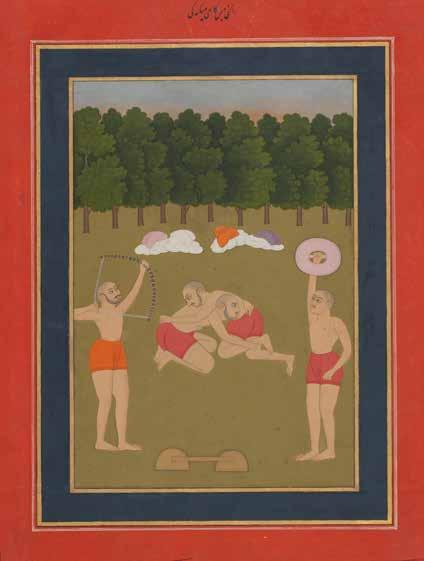
DESHAKHAYA RAGINI: WRESTLERS AND ACROBATS TRAINING WITH WEIGHTS, FROM THE COLLECTION OF SIR ELIJAH IMPEY
PROVINCIAL MUGHAL, PERHAPS BIKANER, LATE 18TH CENTURY
gouache and gold on paper, blue and red borders, nasta’liq inscription in upper border, verso with seal impression of Elijah Impey 325 x 248 mm.
£3,000 - 5,000
€3,400 - 5,700
US$4,100 - 6,800
Provenance
Elijah Impey, Chief Justice of Bengal (1774-89). The collection of David Howard Maude-RoxbyMontalto, 14th Duke of Fragnito (b. 1934).
The painting is very similar in both style and composition to two other depictions of the same ragamala subject, there attributed to Bikaner, circa 1760-70, sold at Sotheby’s New York, The Carter Burden Collection of Indian Paintings, 27th March 1991, lots 24 and 26.
For discussion of the subject, see inter alia C. Glynn, R. Skelton, A. L. Dallapiccola, Ragamala Paintings from India: the Claudio Moscatelli Collection, London 2011, pp. 58-59, no. 10 (Bikaner, by the artist Isa, dated 1714). As noted there: ‘Poetry associated with this image succinctly captures the sights and sounds of the athletic arena: “with quick resounding slapping of body, hair topknots standing on end, long arms held back and checked, tall, fierce...splendid as the moon... (such is) Deshakhya Raga in the form of a wrestler” ‘ (quoting K. Ebeling, Ragamala Painting, 1973, p. 122).
Sir Elijah Impey was Chief Justice of Bengal from 1774 to 1782. Along with his wife, Lady Impey, he was a well-known patron of Indian artists. They are better known for the studies of flora and fauna they commissioned, but Sir Elijah was also an avid collector of Indian miniature paintings. The present lot is an example of this interest, and its subject may well reflect Impey’s desire to form an almost documentary group of portrayals of aspects of Hindu religion and culture in the same manner as the natural history paintings.
For the full note on this lot, see the online catalogue.
174
YUSUF HERDING SHEEP WHILE IN EGYPT DECCAN, 18TH CENTURY
gouache and gold on paper 103 x 65 mm.
£500 - 700
€570 - 800
US$680 - 950
Provenance
The collection of David Howard Maude-RoxbyMontalto, 14th Duke of Fragnito (b.1934).
175
BAZ BAHADUR AND RUPMATI HUNTING ON HORSEBACK
MUGHAL, PERHAPS DELHI, LATE 18TH CENTURY
gouache and gold on paper, gold floral border, reverse with a floral spray and borders in colours and gold, trimmed from a larger album page 154 x 207 mm.
£1,500 - 2,000
€1,700 - 2,300
US$2,000 - 2,700
Provenance
The collection of David Howard Maude-RoxbyMontalto, 14th Duke of Fragnito (b.1934).
This popular subject is frequently portrayed by various schools: two examples close to the present lot are a painting in the Victoria and Albert Museum (IS.4551950), there ascribed to Punjab Hills, 18th Century; and a work in the Ehrenfeld Collection, ascribed to Delhi, mid-18th Century (see Daniel J. Ehnbom, Indian Miniatures: The Ehrenfeld Collection, New York 1985, p. 76-77, no. 30). Both have the same screen of trees behind the figures, with little or no sky, and the composition of the figures in all three cases is extremely similar, almost identical.
The painting evokes one of the great love tragedies of Northern India, that of the mid-16th-century Muslim Sultan Baz Bahadur and his Hindu shepherdess Queen Rupmati. The last independent ruler of Malwa, Baz Bahadur was a handsome and talented musician and lyricist. One day out hunting he was captivated by a beautiful melody rising over the trees and pursued it to its source in Rupmati, the two falling instantly in love. Overcoming familial objection, their romance blazed for a few short years – said to distract him from prudent attention to statecraft, and ended tragically, on the battlefield, under the sword of Akbar’s Mughal general Adham Khan. To avoid capture Rupmati took her own life with poison.
The partial floral spray verso is similar to those often pictured in vases in Oudh painting of the late 18th Century: see, for example, Oliver Forge and Brendan Lynch, Indian Court Painting, 2017, no. 20.
176
A STUDY OF A NIGHTJAR COMPANY SCHOOL, CALCUTTA, CIRCA 1820-40
watercolour on watermarked paper, Persian inscription lower centre 190 x 275 mm. (sight)
£1,000 - 1,500
€1,100 - 1,700
US$1,400 - 2,000
Provenance
The collection of David Howard Maude-RoxbyMontalto, 14th Duke of Fragnito (b.1934).
The Persian inscription is difficult to decipher and reads something like bura’ tuka’ or bur’ tuki’u, which might mean ‘A nightingale is fattened’. The words could be a local variant of the bird’s name, or a misspelling.
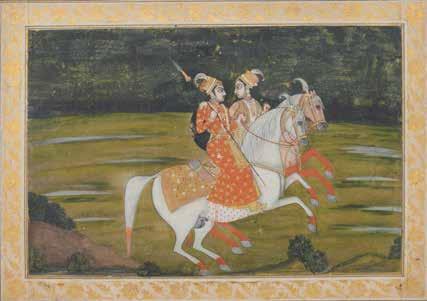
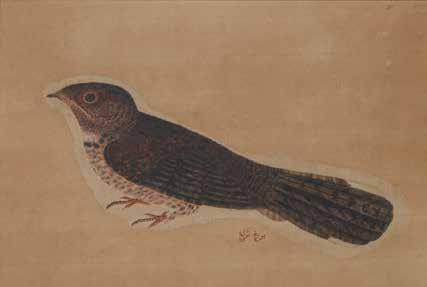
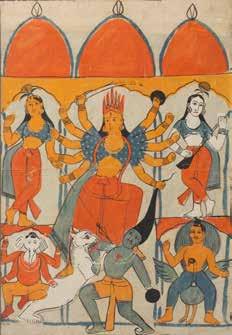
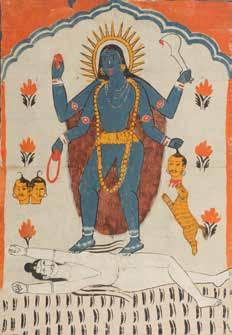
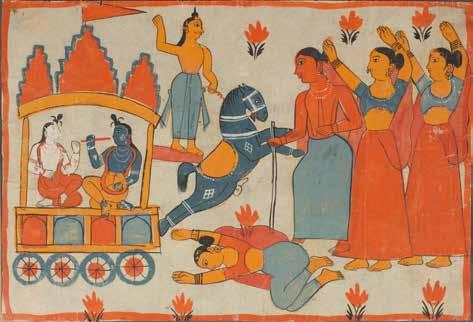
THREE EARLY KALIGHAT PAINTINGS, DEPICTING KALI ON THE PROSTRATE SIVA, DURGA KILLING THE DEMON MAHASHISURA, AND WOMEN GREETING RADHA AND KRISHNA DRAWN IN A CARRIAGE BENGAL, CIRCA 1820, ACCOMPANIED BY AN ENGLISH LETTER DATED JANUARY 11TH 1822
watercolours on paper; the letter in ink on paper, the four pieces framed separately
395 x 275 mm.; 398 x 272 mm.; 395 x 270 mm.; the letter 225 x 260 mm.(4)
£3,000 - 5,000
€3,400 - 5,700
US$4,100 - 6,800
Provenance
The collection of David Howard Maude-Roxby-Montalto, 14th Duke of Fragnito (b.1934).
The letter reads:For Dear Mrs White, with C. J’s love - for her dear little girl to see the difference of the Gods the poor Hindu children worship./ [...]surah, January 11th 1822. All well, will write soon.
While the vast majority of Kalighat paintings seen on the market are dated circa 1860-70, and then later types of circa 1890, this group appears to be a good deal earlier, which is reflected in their slightly different style and palette. The date of the letter argues for this, though in its absence we might suggest a date somewhere between 1830 and 1850.
Compare Sotheby’s, Fine Oriental Manuscripts and Miniatures, 17th October 1983, lot 3, an album of ninety Kalighat paintings (one illustrated) with an English inscription dated 1856.
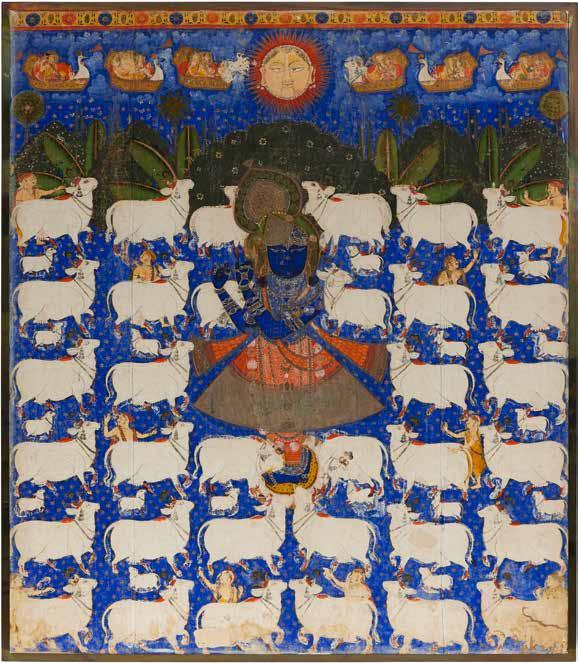
178
A LARGE PICCHAVAI, DEPICTING SRI NATH-JI AT GOPASHTAMI, THE FESTIVAL OF CATTLE NATHDWARA, KOTAH, LATE 19TH CENTURY gouache on cloth, relined, on stretcher, steel frame 197 x 169 cm. (with steel frame)
£8,000 - 12,000
€9,200 - 14,000
US$11,000 - 16,000
Provenance
The collection of David Howard Maude-Roxby-Montalto, 14th Duke of Fragnito (b.1934).
For the subject, and a very similar depiction, see R. Skelton, Rajasthani Temple Hangings of the Krishna Cult, from the collection of Karl Mann, New York, New York 1973, pp. 64-65, no. 17. To quote Skelton (p. 94): ‘On the 8th of the light half of Kartik, Krishna was promoted to a cowherd from a herder of calves. Garlands are suspended from their necks and horns, hooves and bodies are painted’. See also A. Ambalal, Krishna as Shrinathji, Ahmedabad 1987, p. 103 and 153.
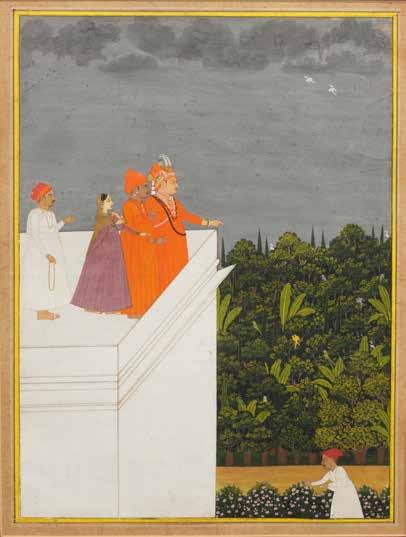
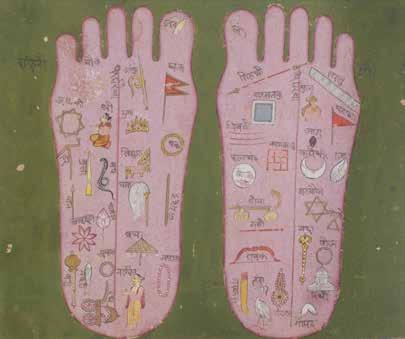
179
A RAJAH WITH COURTIERS AND ATTENDANTS ON A PALACE ROOF DIRECTING SERVANTS IN A GARDEN BELOW JAIPUR, CIRCA 1790
gouache and gold on paper, yellow inner border and white margin rules, plain outer border 323 x 242 mm.
£3,000 - 5,000
€3,400 - 5,700
US$4,100 - 6,800
Provenance
The collection of David Howard Maude-RoxbyMontalto, 14th Duke of Fragnito (b.1934).
180
THE FOOTPRINTS OF VISHNU RAJASTHAN, 18TH CENTURY
gouache and gold on paper, nagari inscriptions 135 x 165 mm.
£1,000 - 1,500
€1,100 - 1,700
US$1,400 - 2,000
Provenance
The collection of David Howard Maude-RoxbyMontalto, 14th Duke of Fragnito (b.1934).
For similar examples, see Tantra, Hayward Gallery, London 1971, p. 40, nos. 156 and 157; Christie’s New York, Indian and Southeast Asian Art, 20th September 2000, lot 237.
To cite the Hayward Gallery catalogue: ‘But to pay true reverence to someone, one may set their feet on one’s own head, and worship them. On the transcendent value scale it is the feet of the deity which are nearest to men. Hence, as the most direct approach to God and as an emblem of one’s own humanity, one may pay worship to the divine footsole, such as the Vishnupada in which the created world is reflected’.
181
A PRINCE WITH HIS MISTRESS ON A PALACE TERRACE RAJASTHAN, UDAIPUR STYLE, 20TH CENTURY
gouache and gold on paper, inner border with decorative cartouches, dark blue outer border concealed beneath mount 140 x 110 mm. (sight); 225 x 203 mm. with borders
£500 - 700
€570 - 800
US$680 - 950
Provenance
The collection of David Howard Maude-Roxby-Montalto, 14th Duke of Fragnito (b.1934).
In the manner of the artist identified as ‘the Stipple Master’, working at the Udaipur court in the late 17th/early 18th Century, discussed by C. Glynn, ‘The Stipple Master’, in M. C. Beach, E. Fischer, B. N. Goswamy, Masters of Indian Painting, vol. II, 1650-1900, 2011, pp. 515-530. He worked in a new style, almost en grisaille, defined by Glynn as ‘painted drawing’. He often portrayed Maharana Amar Singh (reg. 1698-1710).
182
BABUR SEATED AGAINST A BOLSTER ON A DAIS NORTH INDIA, PERHAPS DELHI, LATE 19TH CENTURY
gouache and gold on paper, gold-sprinkled outer borders 247 x 162 mm.
£600 - 800
€690 - 920
US$810 - 1,100
Provenance
The collection of David Howard Maude-Roxby-Montalto, 14th Duke of Fragnito (b.1934).
The composition is based on a depiction of Babur seated in a landscape, with his right-hand outstretched in a similar position, and holding a manuscript in his left hand, circa 1640, from the Late Shah Jahan Album, in the Musee Guimet, Paris (Inv. 7156, App. 3.47).
183
THE EMPEROR AKBAR STANDING A LANDSCAPE WITH A FALCON ON HIS WRIST NORTH INDIA, EARLY 20TH CENTURY gouache and gold on paper 158 x 100 mm.
£500 - 700
€570 - 800
US$680 - 950
Provenance
The collection of David Howard Maude-Roxby-Montalto, 14th Duke of Fragnito (b.1934).
Apparently modelled on a 17th Century original of Akbar with a bird of prey in the Museum of Fine Arts, Boston.
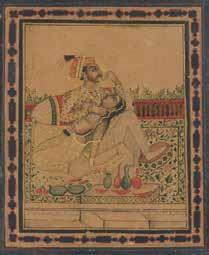
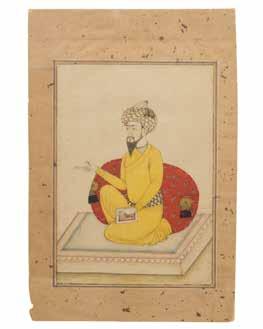
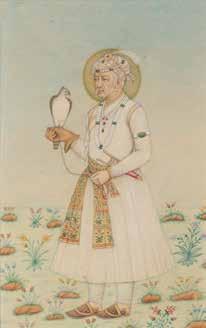
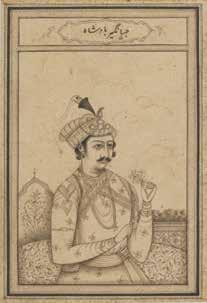
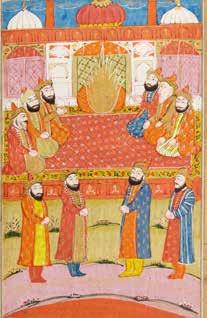
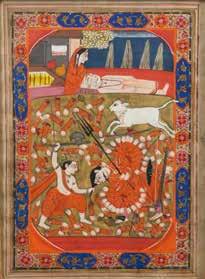
184
A MUGHAL PRINCE HOLDING A FLOWER, SEATED ON A TERRACE
NORTH INDIA, PROBABLY DELHI, LATE 19TH/EARLY 20TH CENTURY
pen and ink with some watercolour on paper, chevron border, black inner margin rules, stippled outer border, panel at top with spurious identifying inscription Jahangir Badshah in nasta’liq within a cartouche 145 x 95 mm. (sight)
£500 - 700
€570 - 800
US$680 - 950
Provenance
The collection of David Howard Maude-Roxby-Montalto, 14th Duke of Fragnito (b.1934).
185
A MANUSCRIPT ILLUSTRATION DEPICTING A MYSTICAL FLAME IN THE ALCOVE OF A MOSQUE, OBSERVED BY NOBLE ONLOOKERS
KASHMIR, 19TH CENTURY
illustration in gouache and gold, Persian text verso from another manuscript, pasted to the reverse of the painting, written in four columns of nasta’liq script in black ink, heading written in two lines of naskhi in red ink within panel, inner margins ruled in blue, black and gold painting 165 x 108 mm.; leaf 235 x 143 mm.
£600 - 800
€690 - 920
US$810 - 1,100
Provenance
The collection of David Howard Maude-Roxby-Montalto, 14th Duke of Fragnito (b.1934).
The motif of the mysterious flame in the illustration resembles those in a group of thirteen leaves from another Kashmiri manuscript of an unidentified text relating to the life of the Prophet Muhammad, sold in these rooms, Bonhams, Islamic and Indian Art, 7th October 2014, lot 4.
The text verso is from a manuscript of Nizami’s Layla and Majnun, in the Khamsa. The heading in red reads Majnun’s father takes him to the Ka’ba. The text before it describes Majnun weeping for love of Layla.
gouache and gold on paper, illuminated floral border 195 x 140 mm.
£500 - 700
€570 - 800
US$680 - 950
Provenance
The collection of David Howard Maude-Roxby-Montalto, 14th Duke of Fragnito (b.1934).
In the background lies Jamadagni, murdered by Kartavirya, his head cradled by his wife Remuka. Surabhi the cow escapes the scene, while Parashurama (Rama) kills Kartavirya.
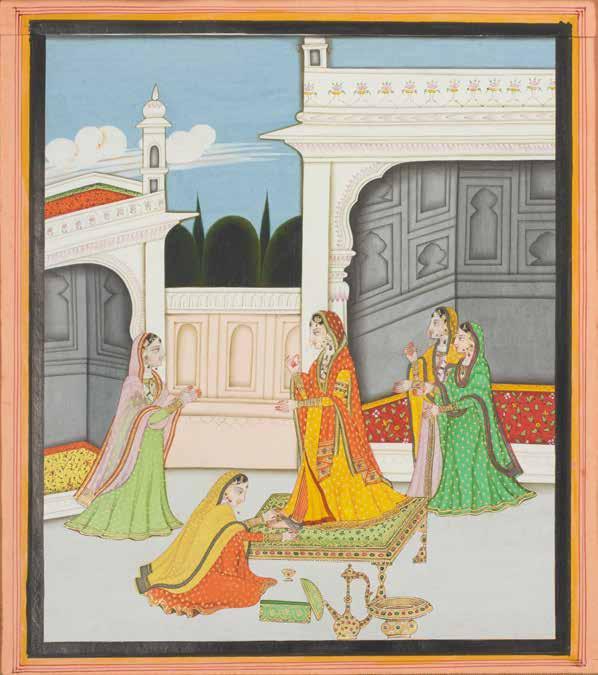
187
A PRINCESS ADORNED BY HER ATTENDANTS ON A PALACE TERRACE PAHARI, KANGRA, CIRCA 1840-50 gouache and gold on paper, pink outer border, English inscription verso
288 x 255 mm.
£2,000 - 3,000
€2,300 - 3,400
US$2,700 - 4,100
Provenance
The collection of David Howard Maude-Roxby-Montalto, 14th Duke of Fragnito (b.1934).
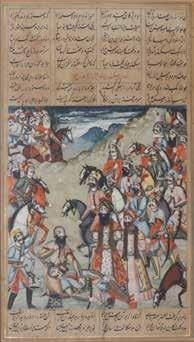
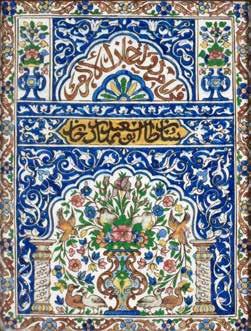
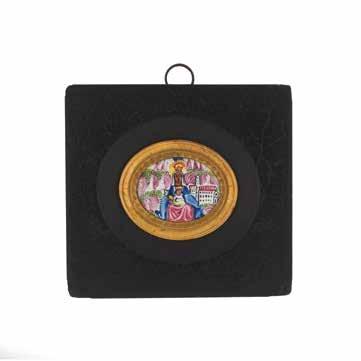
187A R
A LEAF FROM A MANUSCRIPT OF FIRDAUSI’S SHAHNAMA, DEPICTING ISKANDAR COMING TO DARAB TO APOLOGISE
QAJAR PERSIA, SECOND QUARTER OF THE 19TH CENTURY
Persian manuscript on paper, text written in nasta’liq in black ink in four columns, heading written in red ink, inner margins ruled in colours and gold, illustration in gouache visible leaf 300 x 175 mm.
£600 - 800
€690 - 920
US$810 - 1,100
Provenance
The collection of David Howard Maude-Roxby-Montalto, 14th Duke of Fragnito (b.1934).
A leaf from the same manuscript is in the Wellcome Institute (QCC2664.13), depicting the second battle of Kay Khusraw and Afrasiyab: illustrated and discussed in B. Brend, C. Melville, Epic of the Persian Kings: the Art of Ferdowsi’s Shahnameh, Cambridge 2010, pp. 209-210, no. 88.
188 R
A QAJAR UNDERGLAZE-PAINTED POTTERY TILE BEARING THE NAME OF SULTAN ABU SA’ID BAHADUR KHAN
PERSIA, 19TH CENTURY
of rectangular form, decorated in polychrome on a white ground with an architectural composition comprising a lobed colonnaded archway enclosing vases with floral sprays and birds, the façade with inscriptionfilled cartouches and arabesque motifs, the border with floral trellis, framed 49.6 x 40 cm. (including frame)
£2,000 - 3,000
€2,300 - 3,400
US$2,700 - 4,100
Provenance
The collection of David Howard Maude-Roxby-Montalto, 14th Duke of Fragnito (b.1934).
Inscriptions: fi ayyam dawlat khan al-akram/sultan abu sa’id bahador khan, ‘During the time of the reign of the most honourable Khan, Sultan Abu Sa’id Bahadur Khan’.
Sultan Abu Sa’id Bahadur Khan was an Ilkhanid ruler of Persia (13161335 AD), who was described by chroniclers as overseeing the ‘best period of domination of the Mongols’ (Ahari, Tarik-e Sayk, p.51). His father, Öljaitü, became equally renowned, notably for his domed Mausoleum in Soltaniyeh. Five hundred years after its construction, Nasr al-Din Shah Qajar (reg. 1848-1896) visited the then dilapidated tomb, subsequently ordering the restoration of the building. The Mausoleum was one of over a hundred historical monuments, including bridges and caravanserais, regenerated during the Shah’s reign. This particular tile was likely to have been produced for one such project, paying homage through its inscription to the Ilkhanid ruler who originally commissioned the building. For Qajar restorations see, Kahraman, ‘National Identity and Cultural Heritage: The Construction of Conservation Culture During the First Pahlavi Period,’ Heranca, pp. 76-91.
of oval form, painted with the seated Virgin holding Jesus in her lap, the mountains of Montserrat and monastery of Santa Maria de Montserrat to the background, in a lacquer frame with gilt-copper surround, marbled paper to reverse 7.7 x 8.1 cm. (including frame)
£500 - 700
€570 - 800
US$680 - 950
Provenance
The collection of David Howard Maude-Roxby-Montalto, 14th Duke of Fragnito (b.1934), gifted by Mohammad Mosaddegh (1882-1967).
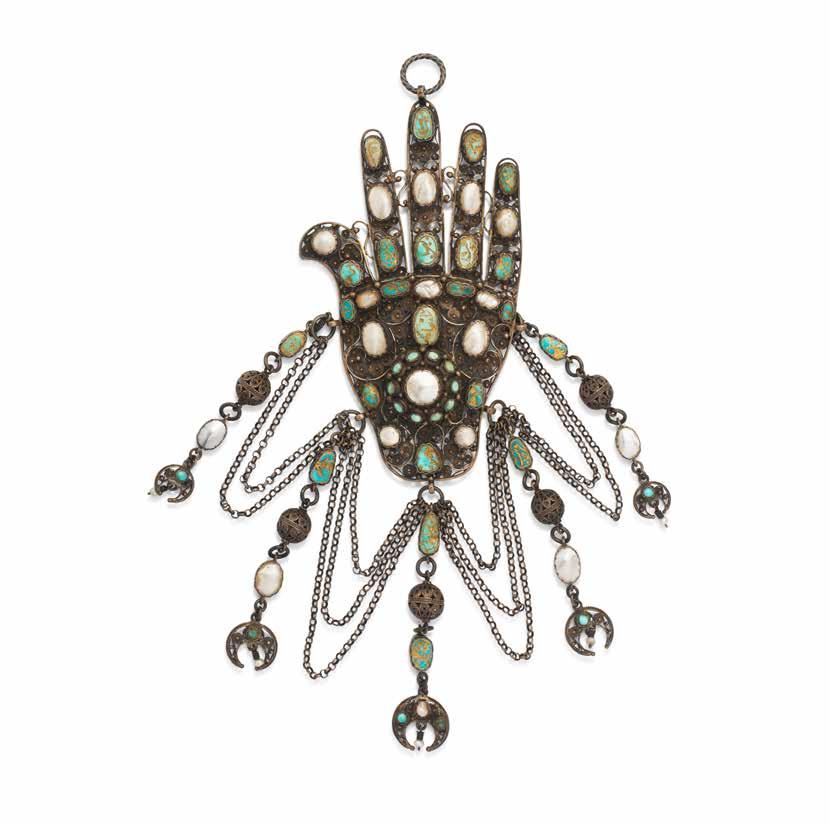
of typical form, the outer frame enclosing filigree and granulations, rosette boss to palm, inlaid with mabe pearls and engraved turquoises with gold-painted inscriptions and floral motifs, five interconnected hanging chains with pearls, turquoises, filigree spheres and crescent terminals, suspension loop to top 31 cm. long; 300 g.
£8,000 - 12,000
€9,200 - 14,000
US$11,000 - 16,000
The collection of David Howard Maude-Roxby-Montalto, 14th Duke of Fragnito (b. 1934).
Inscriptions: turquoises with fragmentary Persian words, possibly from a prayer or benedictory text.
The fifteen paintings presented here (Lots 191–205), drawn from the collection of a distinguished London institution, offer examples of several strands of Indian painting in the eighteenth and early nineteenth centuries. The origins of the paintings range from the Deccan and Oudh to Datia, Marwar, and the Pahari tradition.
We begin with the depiction of authority in Deccani painting, from the Persian, Nadir Shah (lot 191), whose invasion of India in 1739 had such devastating effects, to the dynamic equestrian portrait attributed to the Hyderabad master Rai Venkatchellam (Lot 192), and the depiction of the powerful minister Chandu Lal Bahadur (Lot 193). These works emphasize movement, ceremony, and hierarchy: richly caparisoned horses and elephants, disciplined ranks of attendants, and expansive landscapes all contribute to a vision of rulership grounded in spectacle and control.
Less worldly is the lyrical image of Shiva with Parvati (Lot 194), its Hindu subject combining with the softness of Oudh landscape painting. Hindu subjects continue in the substantial portion of the group devoted to narrative scenes from the Bhagavata Purana (Lots 195–202), produced in Datia around 1800. Especially visually striking are the depiction of Balarama riding on the shoulders of the giant demon Pralamba, and the entry of the gopis into the mouth of the serpent-demon Aghasura. The final moment of the same episode from the story is picked up in lot 204, undoubtedly the artistic and historical apex of the collection, the monumental Bhagavata Purana painting, produced in Guler-Basohli, and attributed to the circle of Fattu or Manaku. The work combines boldness of composition, using the body of the serpent, with boldness of colour, reflecting the drama of the moment.
In contrast to this climactic image, the collection comes to a close with an archetypal Pahari image, the quieter, softer and charming image of Radha and Krishna reclining together in a palace pavilion. The collection, newly appearing on the market, therefore embodies a mixture of religions, courts, regions and styles, reflecting the range and variety of Indian miniature painting.
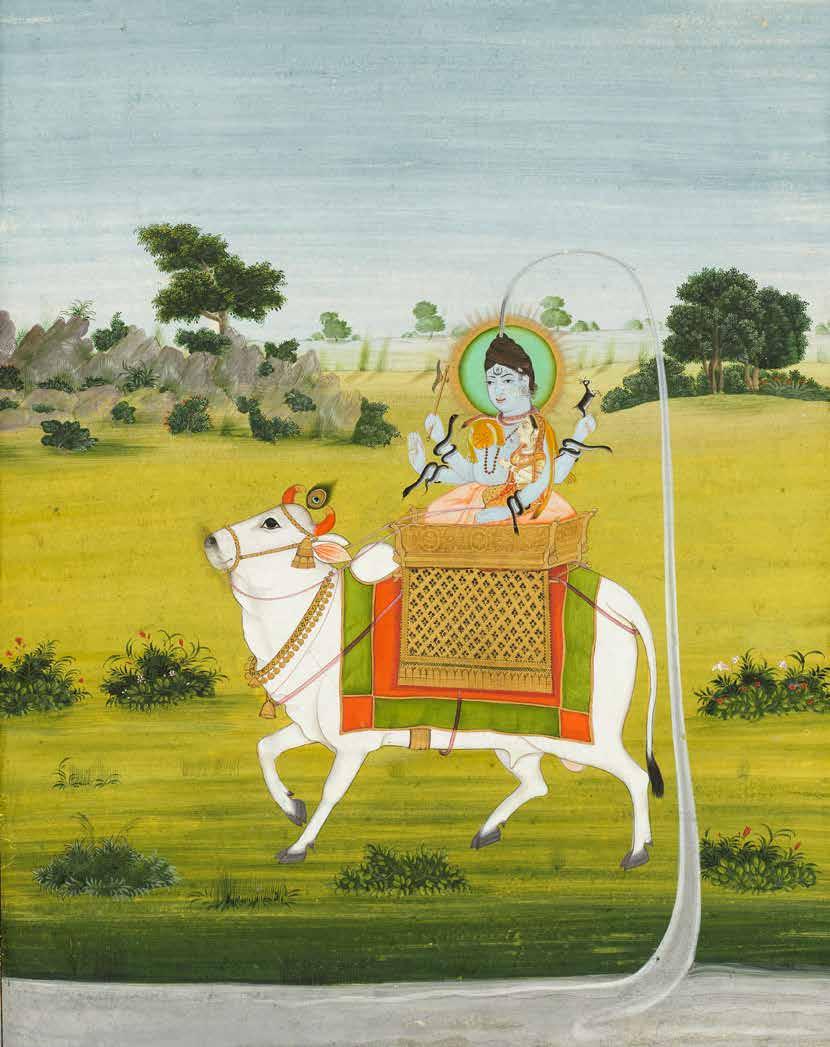
191
NADIR SHAH AFSHAR (REG. 1736-47) ENTHRONED ON A TERRACE
DECCAN, SECOND HALF OF THE 18TH CENTURY
gouache and gold on paper, probably later gold floral borders (Delhi, 19th Century), cartouche in upper border with identifying inscription in nasta’liq
328 x 259 mm.
£5,000 - 7,000
€5,700 - 8,000
US$6,800 - 9,500
Provenance
Property from a distinguished London institution.
For two similar depictions of Nadir Shah, see Christie’s South Kensington, The Saeed Motamed Collection, Part II, 7th October 2013, lot 257, in one of which Nadir Shah sits in the same position and on the same throne.
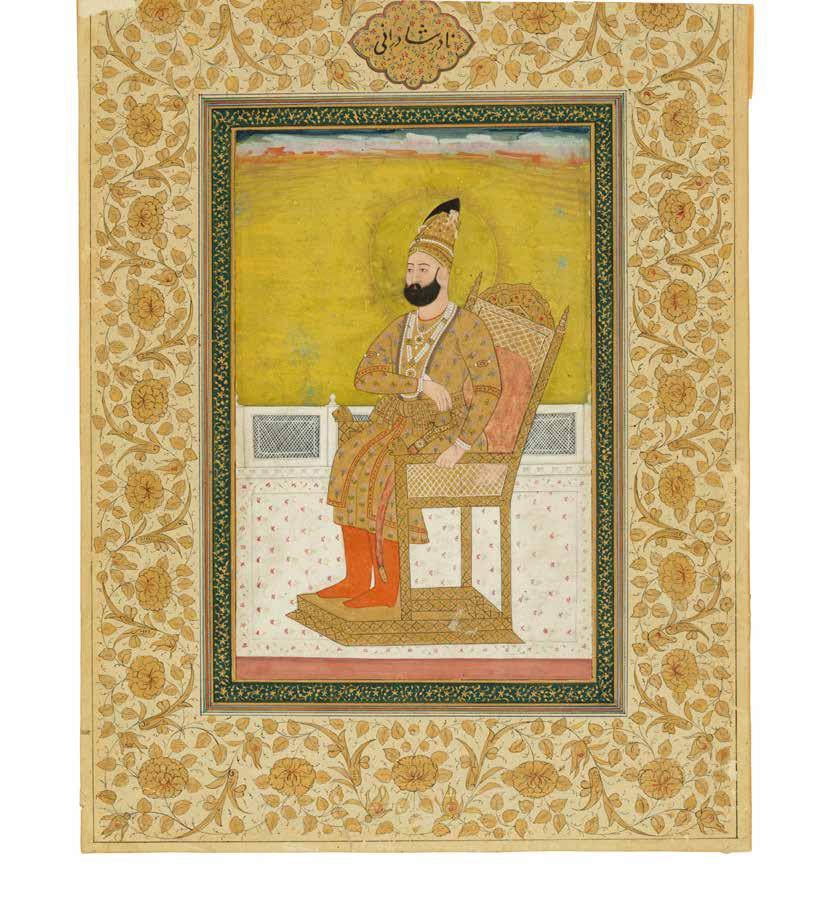
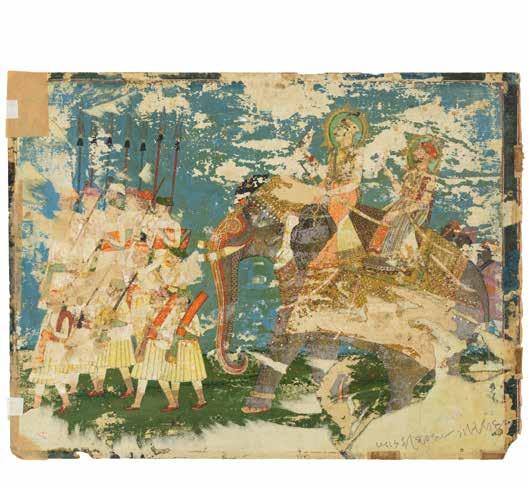
192
A HYDERABAD PRINCE ON HORSEBACK WITH AN EXTENSIVE RETINUE OF SOLDIERS, ATTRIBUTED TO THE ARTIST RAI VENKATCHELLAM
DECCAN, HYDERABAD, CIRCA 1800
gouache and gold on paper, inner border with foliate motifs in gold on a dark blue ground, remnants of light pink floral outer border; verso, a second painting depicting two Hyderabad rulers riding on richlycaparisoned elephants, preceded by a phalanx of spearmen and attendants, fragments of nasta’liq identifying inscriptions above the two figures
305 x 405 mm.
£8,000 - 12,000
€9,200 - 14,000
US$11,000 - 16,000
Provenance
Property from a distinguished London institution.
Compare the large painting (122 x 183 cm.) in the Salar Jung Museum, Hyderabad, depicting the hunting party of Nizam ‘Ali Khan, by Rai Venkatchellam, late 18th Century: elephant and caparison; extensive scene with similar groups of attendants (illustrated in N. Najat Haidar, M. Sardar, Sultans of Deccan India 1500-1700: Opulence and Fantasy, New York 2015, p. 337, fig. 95).
For an extensive landscape scene, with a Maratha ruler on horseback with a large retinue, including a similar group of close-ranked spearmen and riflemen, and a similar depiction of the rolling landscape beyond, Hyderabad, circa 1800, see Sotheby’s, The Indian Sale, 24th May 2007, lot 9.
Prince Suleiman Jah, seventh son of Nizam Ali Khan of Hyderabad (reg. 1762-1803) appears on a similarly rearing caparisoned horse, with a group of attendants carrying spears and bedding-rolls, in a painting attributed to the artist Venkatchellam, Hyderabad, circa 1802: see Francesca Galloway, Treasures from India, 2006, pp. 42-45, no. 17.
For a similar composition with a tightly-packed group of spearmen, see the sale in these rooms, Bonhams, Islamic and Indian Art, 25 October 2007, lot 406 (there attributed to Datia, circa 1800)
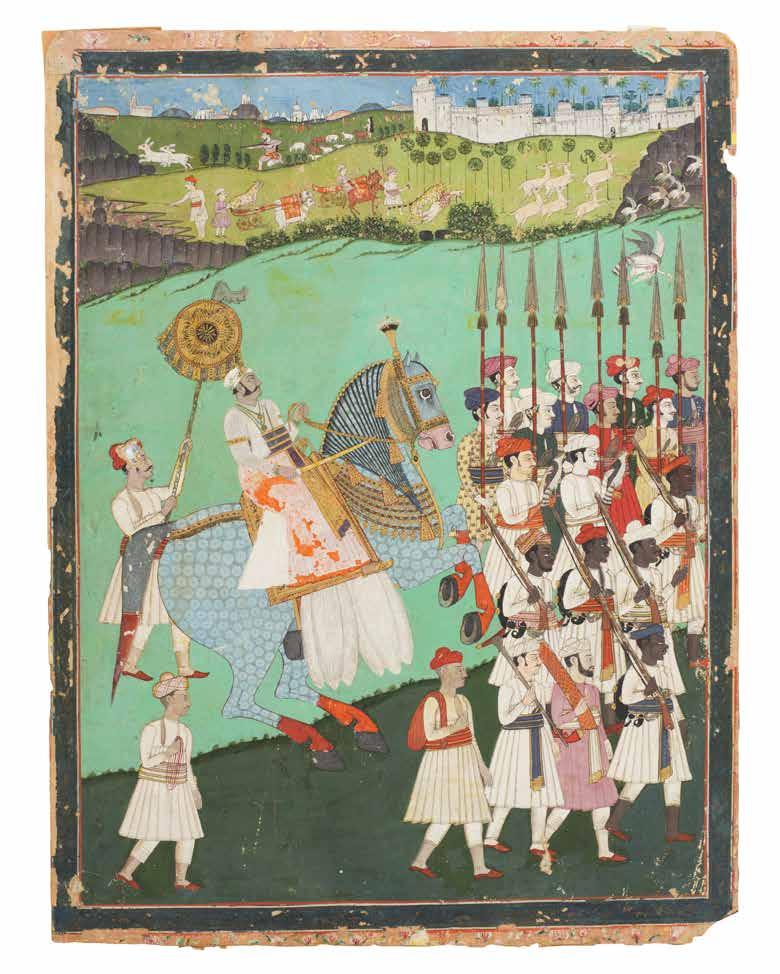
193
RAJAH CHANDU LAL BAHADUR, MINISTER TO NIZAM SIKANDER JAH OF HYDERABAD, RIDING A RICHLYCAPARISONED HORSE, ACCOMPANIED BY AN ATTENDANT ON FOOT HOLDING A PARASOL DECCAN, HYDERABAD, EARLY 19TH CENTURY
gouache and gold on paper, orange border 298 x 220 mm.
£5,000 - 7,000
€5,700 - 8,000
US$6,800 - 9,500
Provenance
Property from a distinguished London institution.
Rajah Chandu Lal Bahadur (1766-1845) was appointed a pishkar in 1806 and after the death of Mir ‘Alam became the minister to the Nizam, was often thought of as the real power behind the throne, and was highly regarded by Henry Russell, the Company Resident at Hyderabad from 1811-20. (See C. E. Buckland, Dictionary of Indian Biography, New York 1968, p.79).
For a depiction of Chandu Lal and another minister with Nizam Sikander Jah, dated to circa 1809-29, see M. Zebrowski, Deccani Painting, London 1983, p. 270, no. 249.
For a painting depicting Nawab Munir al-Mulk, Aristu Jah, Prime Minister (Diwan) of Hyderabad, seated on a terrace with an attendant waving a flywhisk, receiving Rajah Chandu Lal Bahadur, and Chandu Lal’s son, Rajah Bala Prashad, Hyderabad, circa 1815, see the sale in these rooms, Bonhams, Islamic and Indian Art, 30th April 2019, lot 170.
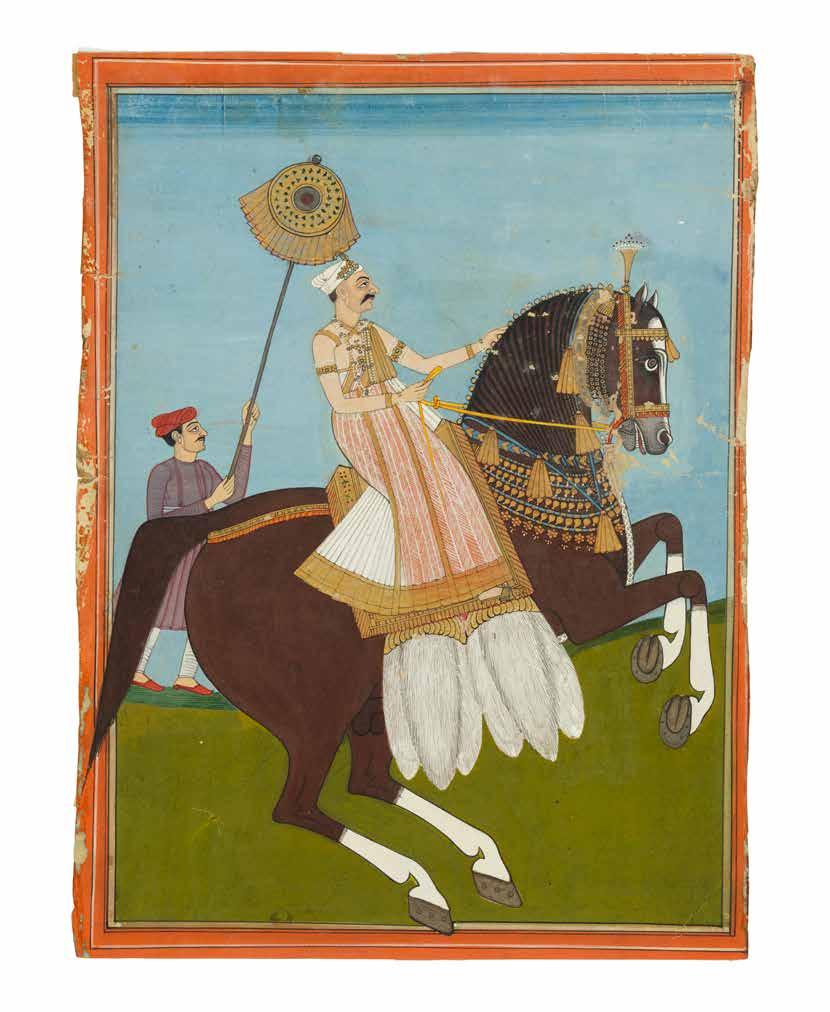
SIVA, THE GANGES FLOWING FROM HIS HEAD, RIDING WITH PARVATI ON NANDI THROUGH A LANDSCAPE
PROVINCIAL MUGHAL, OUDH, SECOND HALF OF THE 18TH CENTURY
gouache and gold on paper, laid down on an album page with stylised floral motifs in gold on light blue and cream grounds album page 372 x 263 mm.
£6,000 - 8,000
€6,900 - 9,200
US$8,100 - 11,000
Provenance
Perhaps with Maggs Bros., London, 1950 (catalogue entry (no. 486) pasted to reverse of page with possible handwritten date).
Property from a distinguished London institution.
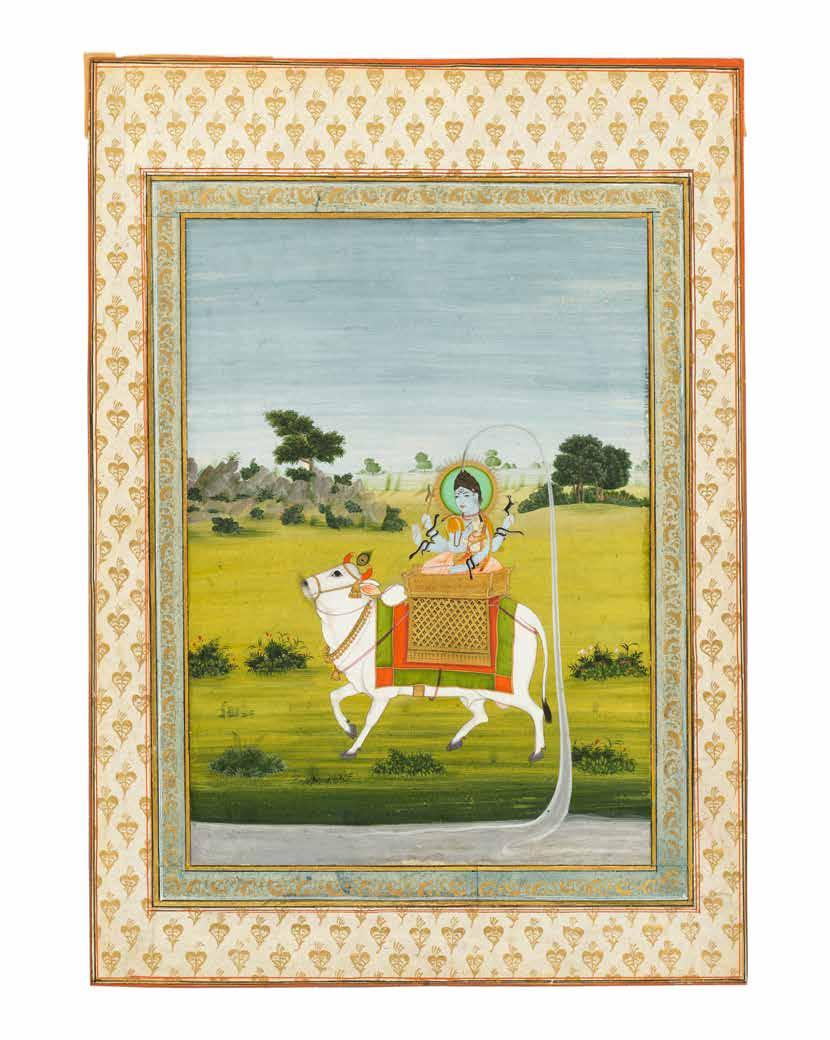
195
A SCENE FROM A BHAGAVATA PURANA SERIES, PERHAPS DEPICTING NANDA AND THE GOPAS APPROACHING THE ENTHRONED KING KHAMSA DATIA, CIRCA 1800
gouache and gold on paper, captions in nagari script in white within image and in red border, yellow and red borders, verso three lines of text in nagari script in black ink 292 x 390 mm.
£4,000 - 6,000
€4,600 - 6,900
US$5,400 - 8,100
Provenance
Property from a distinguished London institution.
For other similar paintings to this lot and the remainder in this group (lots 195-202), see, for example:
Bonhams New York, Indian Paintings Online: including selections from the Conley Harris Collection, 15–22 March 2024, lot 863.
Sotheby’s New York, Important Indian Paintings from the Gloria Katz and Willard Huyck Collection, 22 March 2002, lot 25.
Bonhams New York, Arts of India, Southeast Asia, and the Himalayas Online, 17–24 September 2021, lot 1254.
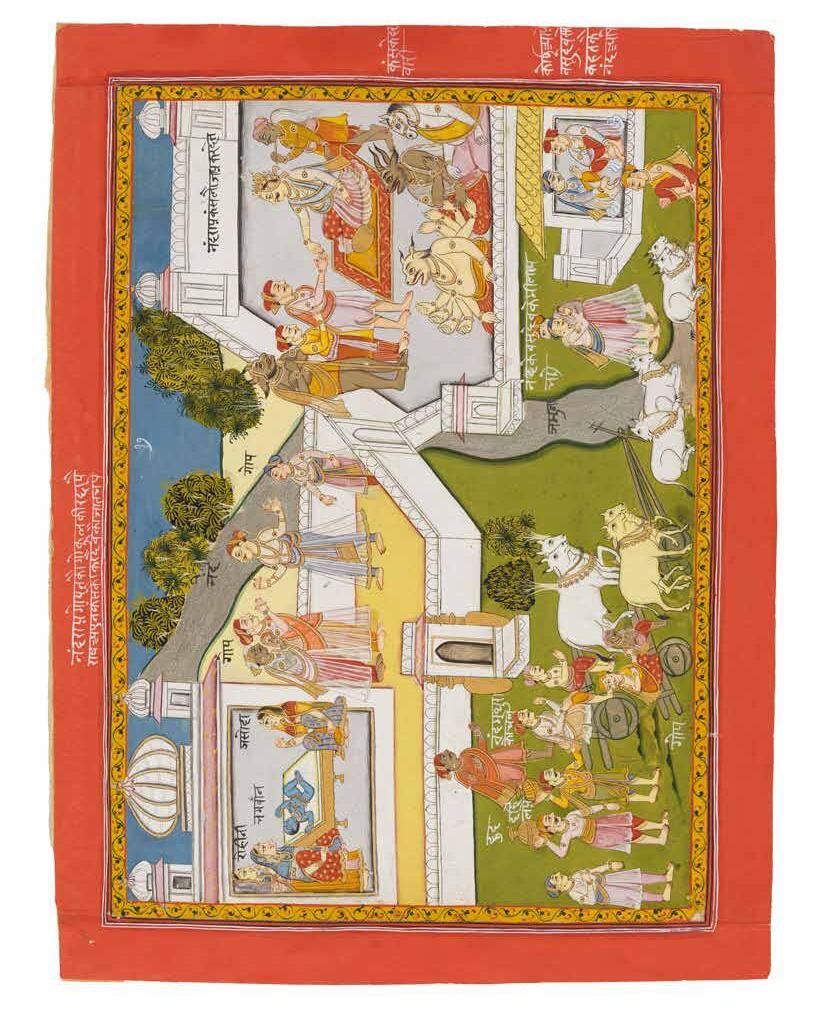
196
A SCENE FROM A BHAGAVATA PURANA SERIES, DEPICTING AN EXTENSIVE WEDDING SCENE
DATIA, CIRCA 1800
gouache and gold on paper, captions in nagari script in white within image and in red border, yellow and red borders, verso thirteen lines of text in nagari script in black ink
302 x 385 mm.
£4,000 - 6,000
€4,600 - 6,900
US$5,400 - 8,100
Provenance
Property from a distinguished London institution.
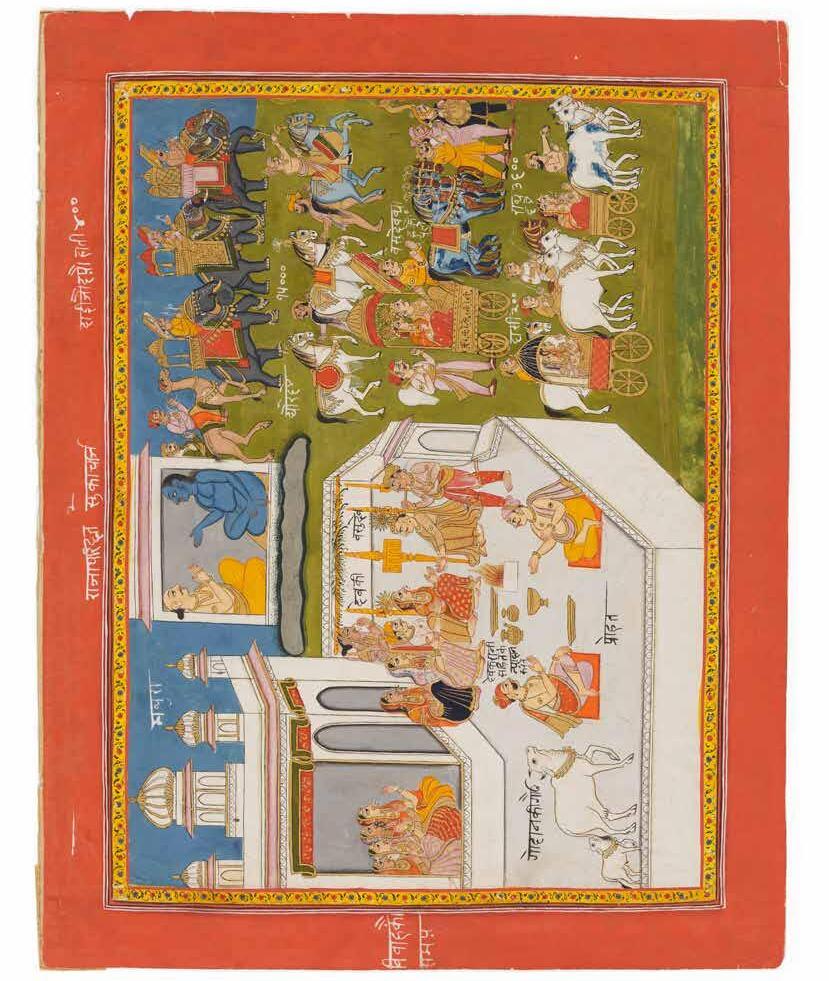
197
A SCENE FROM A BHAGAVATA PURANA SERIES: MUSICAL CELEBRATIONS AT THE BIRTH OF KRISHNA
gouache and gold on paper, captions in nagari script in white within image and in red border, yellow and red borders, verso six lines of text in nagari script in black ink 286 x 388 mm.
£4,000 - 6,000
€4,600 - 6,900
US$5,400 - 8,100
Provenance
Property from a distinguished London institution.
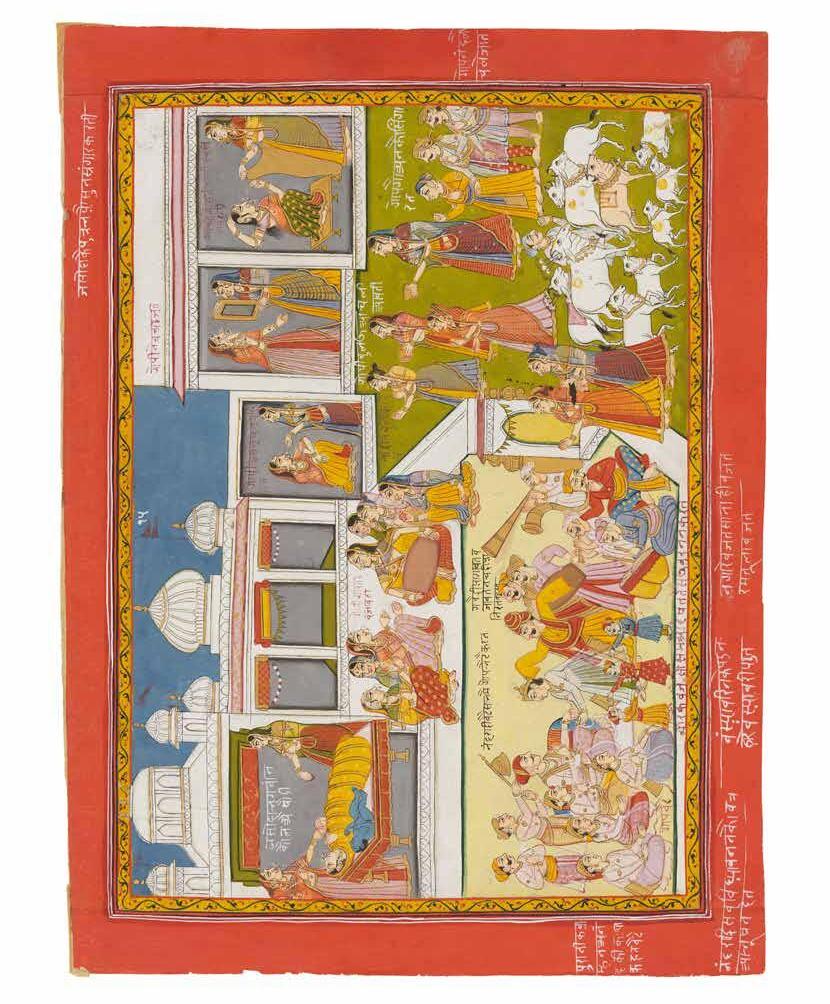
198
A SCENE FROM A BHAGAVATA PURANA SERIES: KRISHNA
STEALING THE GOPIS’ CLOTHES AND HIDING THEM IN A TREE
DATIA, CIRCA 1800
gouache and gold on paper, captions in nagari script in white and black within image and in red border, yellow and red borders, verso five lines of text in large bold nagari script in black ink
285 x 382 mm.
£4,000 - 6,000
€4,600 - 6,900
US$5,400 - 8,100
Provenance
Property from a distinguished London institution.
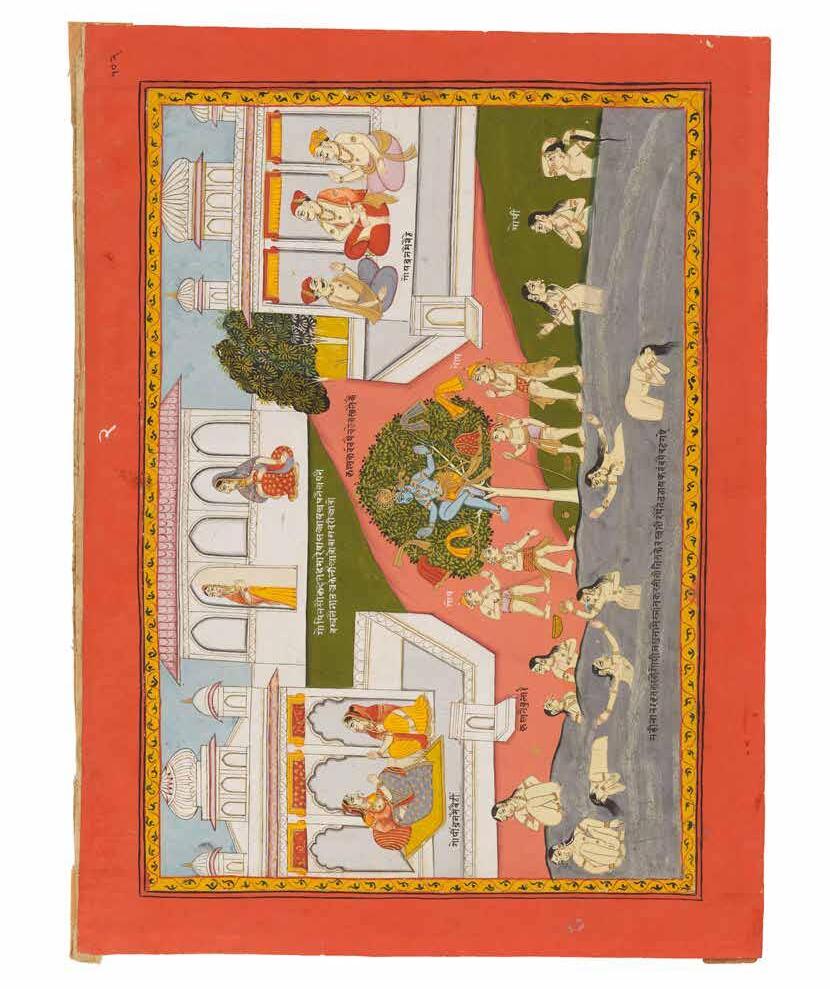
199
A SCENE FROM THE BHAGAVATA PURANA: KRISHNA AND HIS GOPI FOLLOWERS ENTERING THE MOUTH OF THE SNAKEDEMON AGHASURA
DATIA, CIRCA 1800
gouache and gold on paper, captions in nagari script in white within image and in left-hand border, yellow inner and red outer border, verso eight lines of text in nagari script in black ink
296 x 384 mm.
£4,000 - 6,000
€4,600 - 6,900
US$5,400 - 8,100
Provenance
Property from a distinguished London institution.
The story is found in Book 10 of the Bhagavata Purana. Aghasura, the brother of Purana and Bakasura (whom Krishna had already killed) attacked Krishna and his cowherd companions. He took the form of an enormous snake and opened his mouth so wide that the cowherds thought it was a valley, walked into the trap, and were swallowedthe moment seen here. Krishna then strode into the mouth himself, expanded his size and so choked the serpent to death. The cowherds emerged alive.
See lot 204 for a depiction of the same subject - though after the killing of the serpent - from the Guler-Basohli Bhagavata Purana, circa 176065.
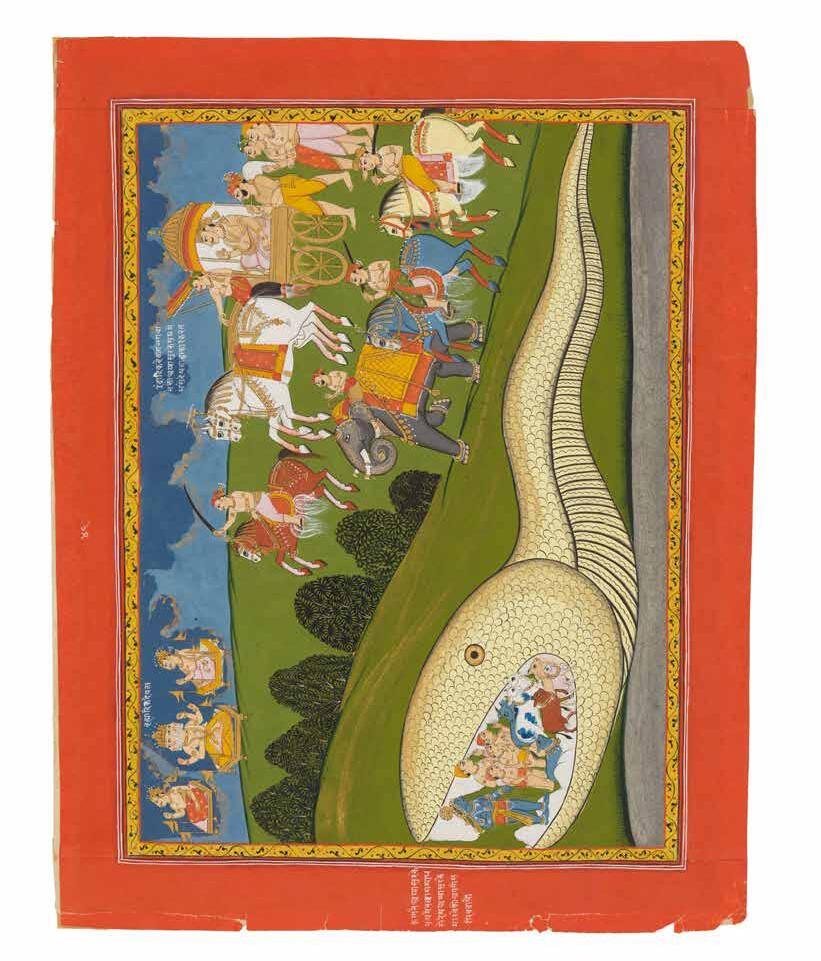
200 A SCENE FROM A BHAGAVATA PURANA SERIES: KRISHNA AS A CHILD WITH YASHODA AND CHILD-GOPIS
DATIA, CIRCA 1800
gouache and gold on paper, captions in nagari script in white within image and in red border, yellow and red borders, verso six lines of text in nagari script in black ink
300 x 381 mm.
£4,000 - 6,000
€4,600 - 6,900
US$5,400 - 8,100
Provenance
Property from a distinguished London institution.
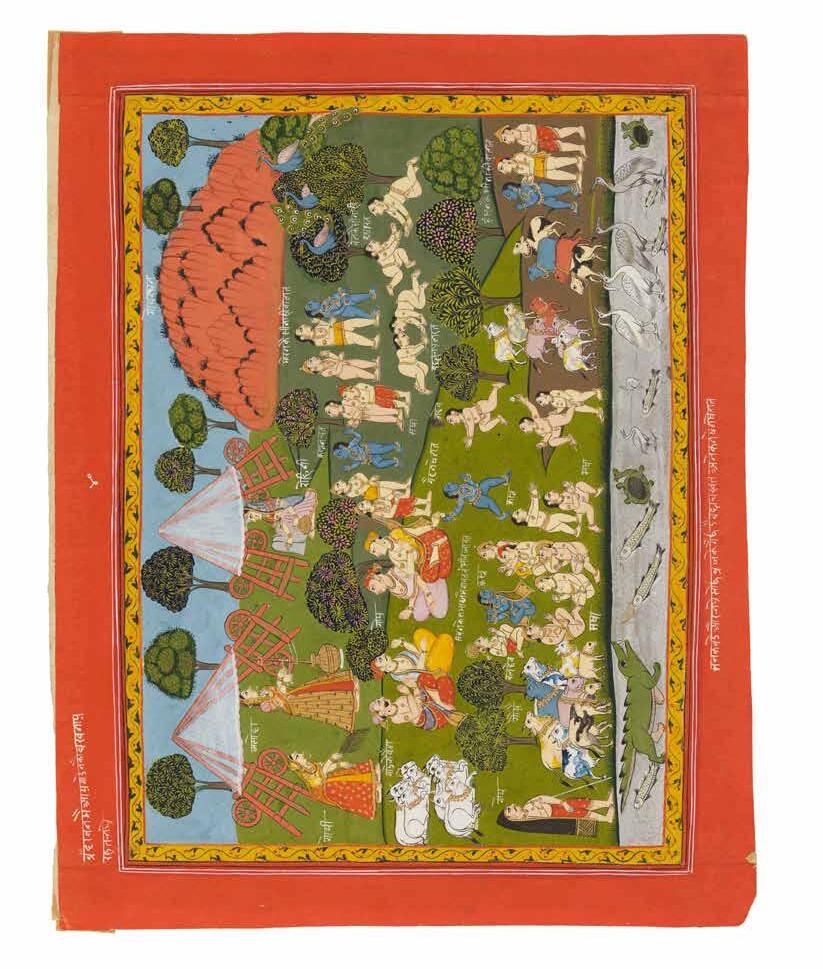
201
A SCENE FROM A BHAGAVATA PURANA SERIES, PERHAPS DEPICTING VASUDEVA GREETING NANDA IN THE FOREST DATIA, CIRCA 1800
gouache and gold on paper, captions in nagari script in white within image and in red border, yellow and red borders, verso six lines of text in nagari script in black and red ink
290 x 378 mm.
£4,000 - 6,000
€4,600 - 6,900
US$5,400 - 8,100
Provenance
Property from a distinguished London institution.
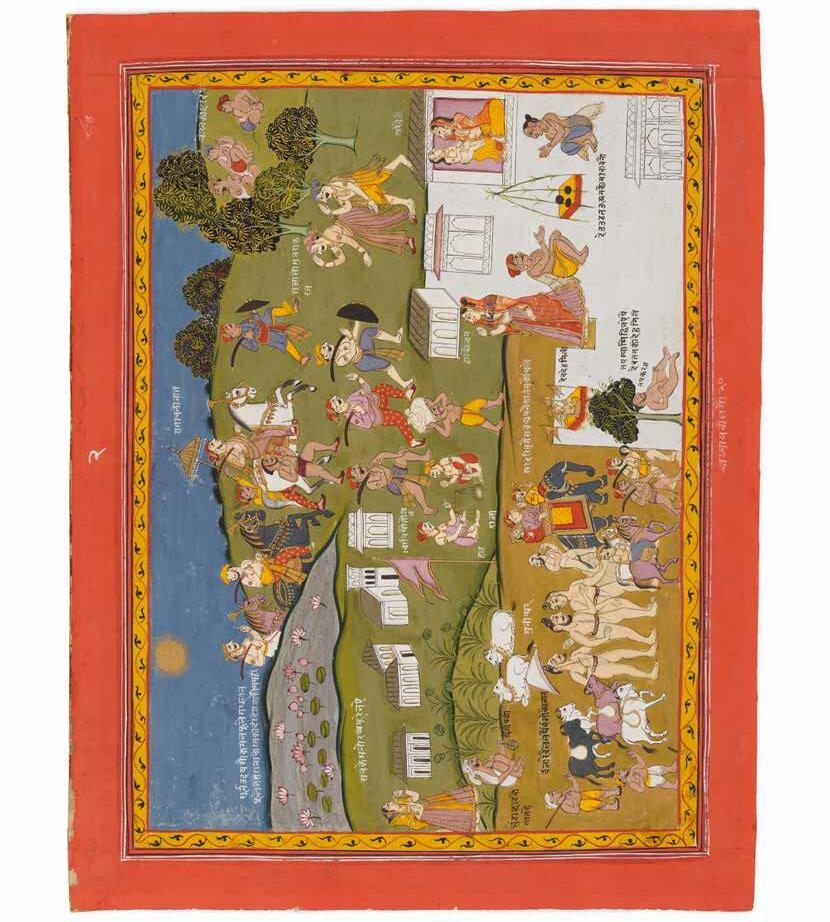
A SCENE FROM A BHAGAVATA PURANA SERIES: BALARAMA RIDING ON THE SHOULDERS OF THE GIANT DEMON PRALAMBA, AS THE COWHERDS PLAY IN THE FOREST DATIA, CIRCA 1800 gouache and gold on paper, captions in nagari script in white and red within image and in red border, yellow and red borders, verso six lines of text in large bold nagari script in black ink 294 x 383 mm.
£4,000 - 6,000
€4,600 - 6,900
US$5,400 - 8,100
Provenance
Property from a distinguished London institution.
The scene depicted here seems to be an early stage in the tale of the gopas and the demon Pralamba. To escape the intense heat, Krishna, Balarama and the gopas bring their herd to the forest... A demon named Pralamba assumes the guise of a cowherd and joins the group with the intention of seizing Krishna and Balarama. Although Krishna knows who the demon really is, he welcomes him into their fellowship, all the while considering how to exterminate him. He divides the gopas into two teams, one led by him and the other by Balarama, and organises games in which the losers must carry the winners on their backs. Pralamba joins Krishna’s side: they lose and have to carry Balarama’s victorious team. Pralamba takes Balarama and spirits him far beyond the perimeter of the grazing herd. In response to his abduction, Balarama begins to increase his weight till it equals that of Mount Meru, making it impossible for Pralamba to proceed any further. Pralamba’s disguise collapses under the strain and he reveals his true form... As he begins to ascend into the sky, Balarama strikes him with a shattering blow to the head and the demon falls to earth with a terrifying roar, vomits blood, falls unconscious and dies.
This violent end to the story is portrayed in a late 18th Century Bilaspur painting, which was with Simon Ray, Indian and Islamic Works of Art, November 2014, no. 59 (from which the above narrative is taken).
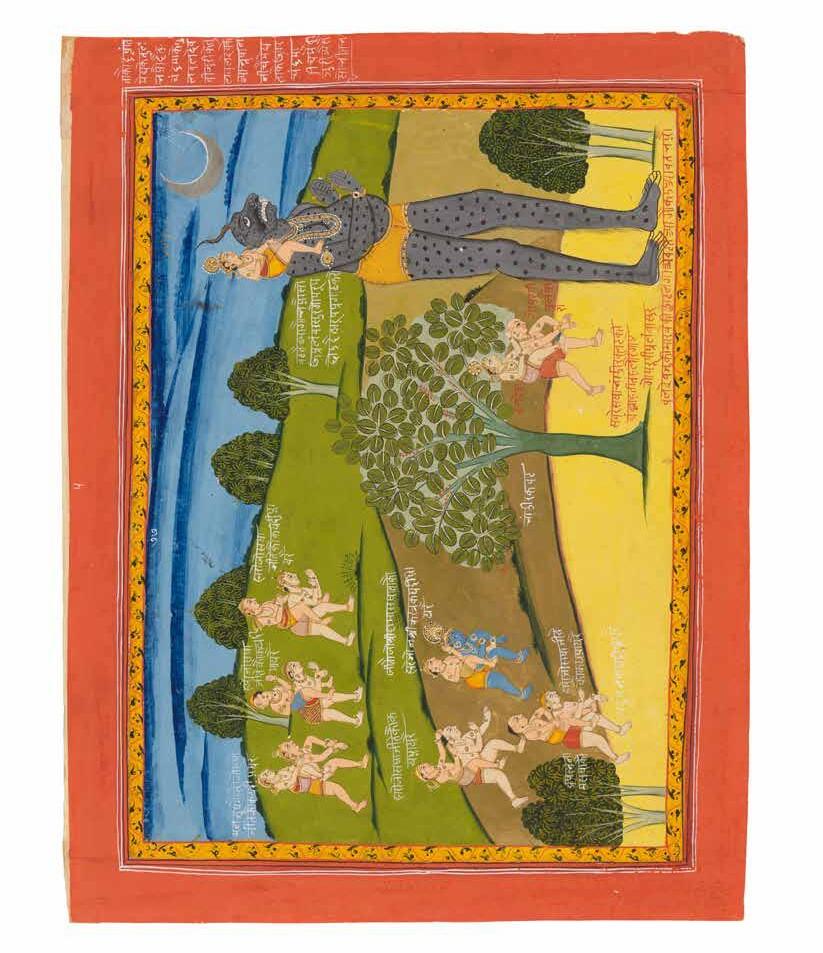
203
A RAJAH WITH MUSICIANS AND ATTENDANTS ON A TERRACE MARWAR, SECOND HALF OF THE 18TH CENTURY gouache and gold on paper, borders trimmed 310 x 227 mm.
£3,000 - 5,000
€3,400 - 5,700
US$4,100 - 6,800
Provenance
Property from a distinguished London institution, perhaps acquired 10th December 1963 (date on reverse).
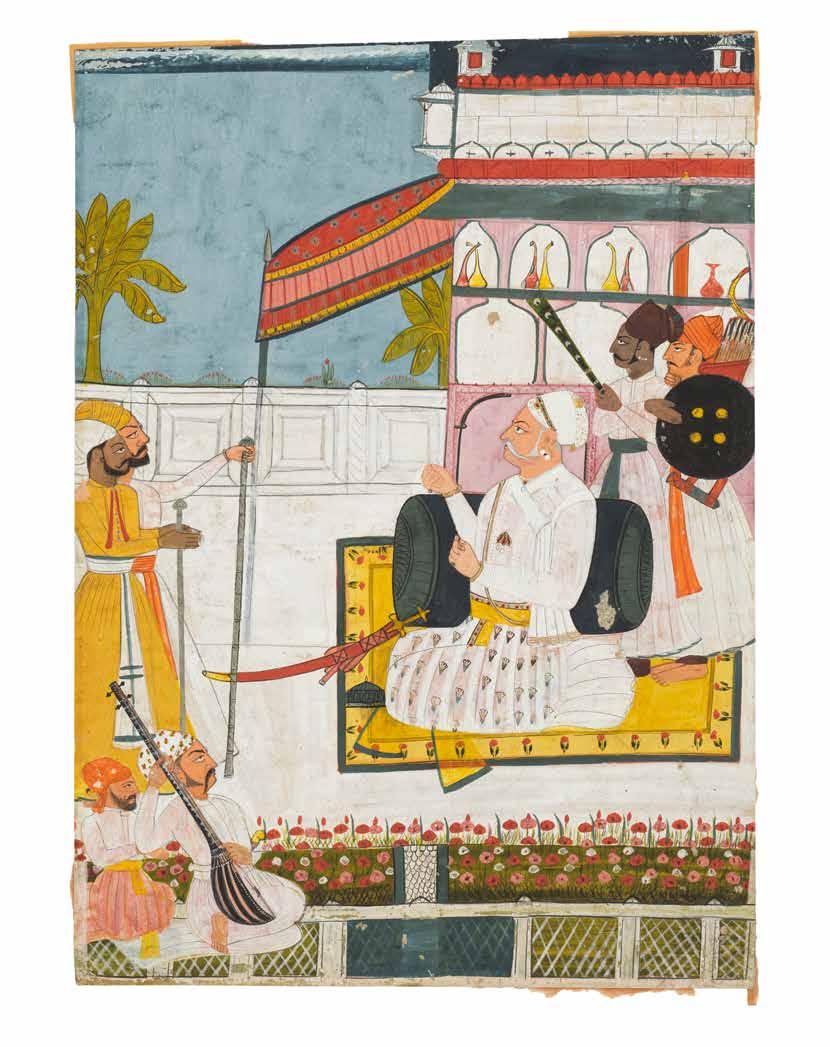
204
AN ILLUSTRATION FROM THE ‘LARGE’ GULER-BASOHLI
BHAGAVATA PURANA SERIES, DEPICTING KRISHNA AND THE GOPIS FORCING THEIR WAY OUT OF THE MOUTH OF THE SNAKE DEMON AGHASURA, AND KILLING HIM ATTRIBUTABLE TO FATTU OR A CLOSE FOLLOWER OF MANAKU, BASOHLI-GULER, CIRCA 1760-65
gouache and gold on paper, black and white inner margin rules, red outer borders, verso inscriptions consisting of verses from the text in nagari and a paraphrase in takri in black and red ink 295 x 410 mm.
£100,000 - 150,000
€110,000 - 170,000
US$140,000 - 200,000
Provenance
Perhaps Sotheby’s, Important Western and Oriental Manuscripts and Miniatures, 1st February 1960 (the property of Mrs F. K. Smith). Property from a distinguished London institution.
The most immediate comparison, in terms of series, style, but primarily because our painting depicts the gruesome events immediately afterwards, is another work from the same superb Bhagavata Purana series, sold at Christie’s, Arts of India, 10th June 2013, lot 277, depicting Aghasura swallowing Krishna, the gopas and their herd.
In her discussion of four paintings from the same set in the Chester Beatty Library, Linda York Leach observes: ‘[They demonstrate] changes that occurred in traditional hill painting during the 18th century. [It] is one of the richest sources of information for our knowledge of Pahari paintings (L. Y. Leach, Mughal and Other Indian Paintings from the Chester Beatty Library, Vol. II, 1995, p. 1048).
That painting (and by extension, probably the present lot) was originally part of a set of sixty-three lots consisting of illustrations to the tenth and eleventh books of the Bhagavata Purana, sold at Sotheby’s on 1st February 1960 (the property of Mrs F. K. Smith). See, for example, a painting from the series (Krishna shows his fellow cowherds his heavenly abode), with Oliver Forge and Brendan Lynch, Indian Paintings, 2016, no. 30 (which was lot 18 in that sale).
The series is known as the ‘Fifth’ or ‘Large’ Guler-Basohli Bhagavata Purana. Characterized by its size and compositions of few figures within large expanses of space, it illustrates a transitional Basohli style that was to be eclipsed by the Mughal idiom from nearby Guler. (W. G. Archer, Indian Paintings from the Punjab Hills, vol. I, London 1973, pp. 49-51).
It is now dispersed in a number of collections, including eight paintings in the Victoria and Albert Museum, one in the Philadelphia Museum of Art (illustrated in S. Kossak, Indian Court Painting, 16th-19th Century, New York 1997, p. 102, no. 61 (Akrura’s vision of Vishnu-Krishna).
In both his 1973 and 1976 publications, Archer makes suggestions about the artist responsible for much of the series. The compositions of a number of paintings are clearly modelled on those of the artist Manaku in the 1735 Gita Govinda series. Archer suggests that the painter is Fattu, Manaku’s eldest son and therefore also Nainsukh’s nephew, who went on later to make his name at Kangra. Whether one follows different suggestions in defining Nainsukh’s main patron, the artist is known to have moved around 1763 to Basohli after the death of his former patron Balwant Singh of Jammu and it is almost certain that his advent would have had a strong influence on the work of other members of his family such as Fattu. Archer speculates that Nainsukh might have had a role in directing this ‘Fifth’ Series in the court atelier.
B. N. Goswamy supports the attribution of most of the paintings of the tenth chapter to Fattu (B.N. Goswamy and E. Fischer, Pahari Masters, Zurich 1992, p. 314). Goswamy suggests that the series may have been started during the lifetime of Manaku but that Fattu gradually came under Nainsukh’s influence. These would support the existence of two distinct styles in the series, marking an important transition in this Pahari school between Manaku’s solid and clear constructions and Nainsukh’s naturalistic refinements and attention to details, particularly in the treatment of faces.
Other paintings from the same series include:
Sotheby’s New York, 30 November 1994, lot 24.
Christie’s New York, 20 March 2002, lot 149 (Muchukanda leaves for the Himalayas).
Christie’s, 7 October 2011, lots 394 and 395 (Akrura’s vision of Krishna; Krishna quelling the serpent Kaliya).
Sotheby’s New York, Indian and Himalayan Art, 21st March 2023, lot 199 (the liberation of Nalakuvara and Manigrivua).
Christie’s New York, Indian, Himalayan and Southeast Asian Works of Art, 20th March 2024, lot 549 (Krishna and the gopas sheltering from a storm).
Christie’s, Art of the Islamic and Indian Worlds, 24th October 2019, lot 132 (Krishna, Balarama and Nanda receive Akrura).
Simon Ray, Indian and Islamic Works of Art, November 2015, no. 54 (Vasudeva crosses the Yamuna with the infant Krishna).
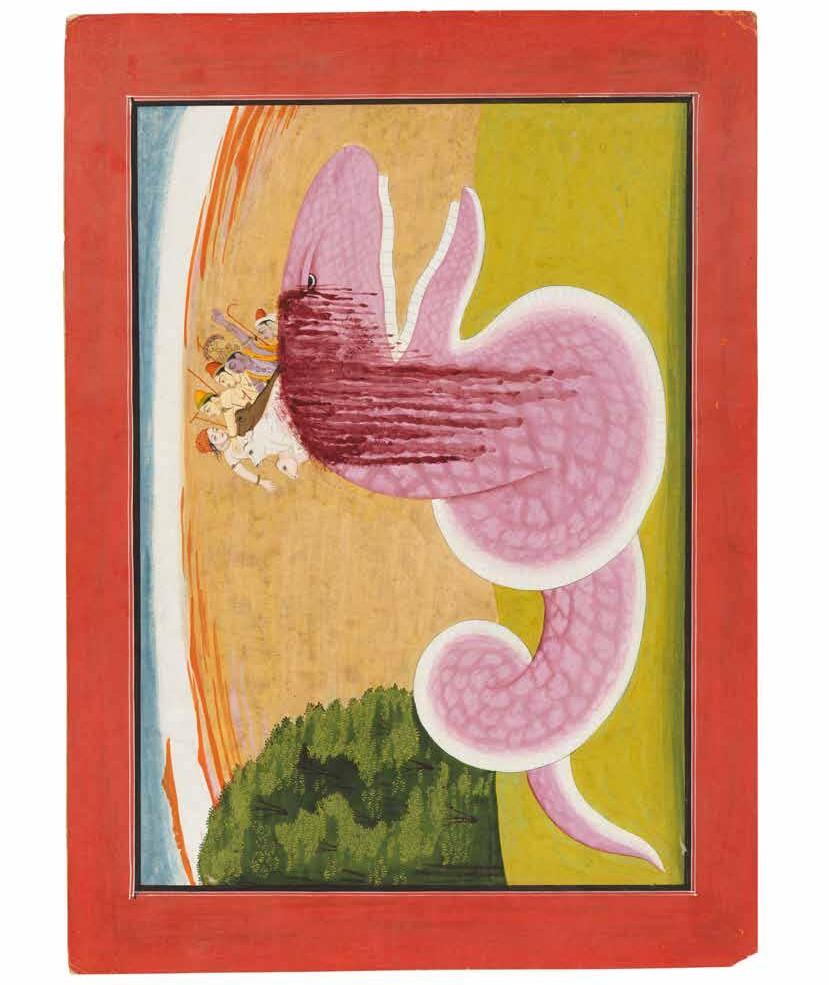
RADHA AND KRISHNA RECLINING IN AN EMBRACE IN A PALACE PAVILION
PAHARI, KANGRA, CIRCA 1820-30
gouache and gold on paper, floral inner border, pink stippled outer border, cover paper with six lines of takri in black ink
292 x 225 mm.
£6,000 - 8,000
€6,900 - 9,200
US$8,100 - 11,000
Provenance
Property from a distinguished London institution.
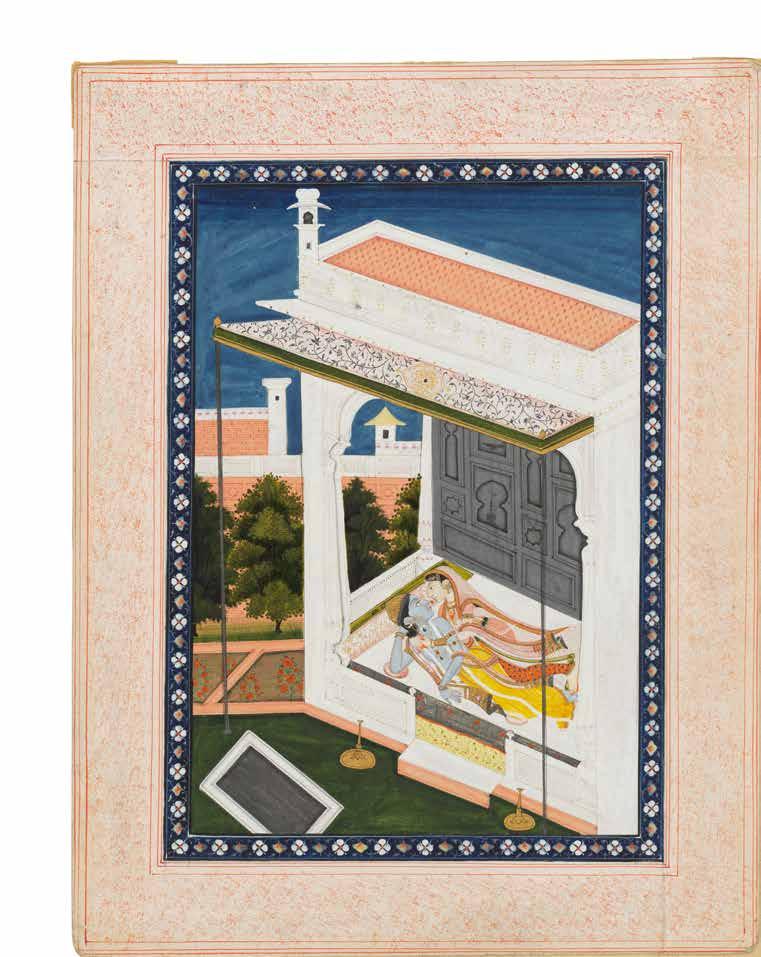
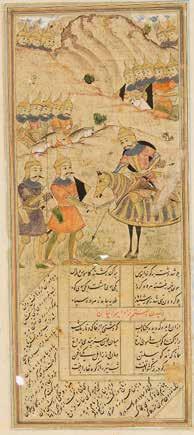
206
206
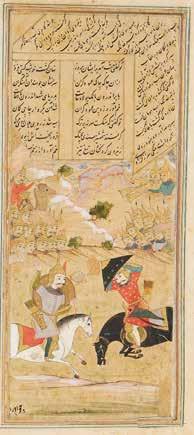
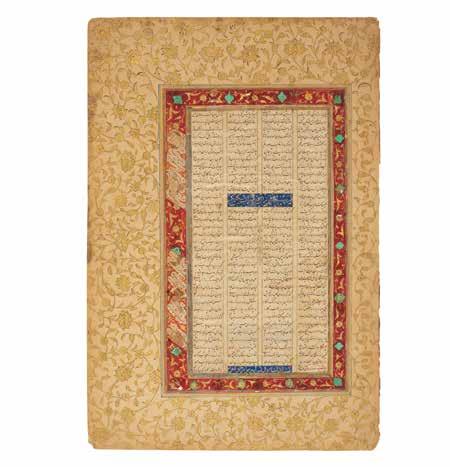
207
TWO ILLUSTRATED LEAVES FROM A MANUSCRIPT OF FIRDAUSI’S SHAHNAMA
MUGHAL, EARLY 17TH CENTURY
Persian manuscript on paper, 23 lines to the page written in two columns of nasta’liq in black ink, text continuation written diagonally in outer panels, headings in red, inner margins ruled in colours and gold, both leaves remargined, illustrations in gouache and gold (gold probably retouched)
inner text panel 200 x 188 mm.; leaf 275 x 170 mm. and slightly smaller(2)
£1,500 - 2,000
€1,700 - 2,300
US$2,000 - 2,700
Provenance
Private London collection since the 1990s.
In the first leaf, the painting and the text deal with Tus, son of Nawdhar, in combat.
In the second leaf, the painting depicts Tus and Giv joining Fariborz to go into battle with Kamus. The heading reads: Rustam reaches the Iranians
Compare a Shahnama leaf, circa 1590-1600, depicting Iskandar and the wall of Gog and Magog: E. Binney, Indian Miniature Painting from the Collection of Edwin Binney III: the Mughal and Deccani Schools, Portland, Oregon, 1973-74, p. 46, no 22.
207
AN ILLUMINATED LEAF FROM A MANUSCRIPT OF FIRDAUSI’S SHAHNAMA
MUGHAL, CIRCA 1610
Persian manuscript on paper, 35 lines to the page, recto and verso, written in small nasta’liq in black ink in four columns, headings in naskhi in gold on a blue ground within illuminated panels, inner border with stylised floral motifs and sections excised from another manuscript written in very small nasta’liq, all on a dark red ground, outer borders with floral and foliate motifs in gold leaf 345 x 232 mm.
£4,000 - 6,000
€4,600 - 6,900
US$5,400 - 8,100
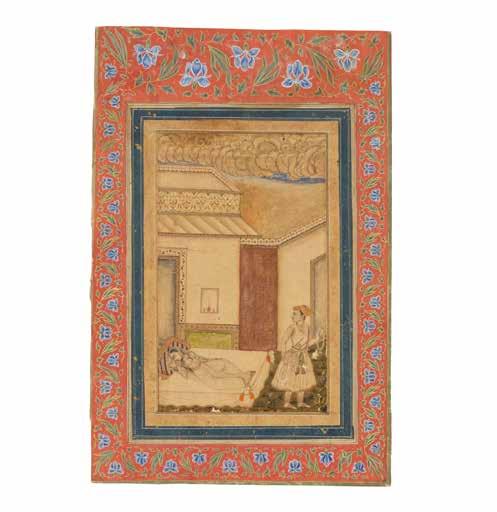
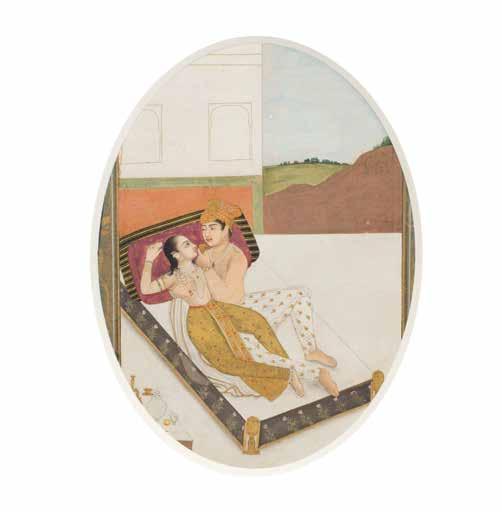
208
LALIT RAGINI: A PRINCE CARRYING A GARLAND LEAVING HIS MISTRESS ASLEEP IN A PALACE CHAMBER
MUGHAL, MID-18TH CENTURY
gouache and gold on paper, laid down on a large album page with gold-decorated and floral borders, inscribed in English verso King of Delhi, pirthi Raj album page 343 x 227 mm.
£3,000 - 5,000
€3,400 - 5,700
US$4,100 - 6,800
209 †
A PRINCE RECLINING ON A BED WITH HIS MISTRESS ON A PALACE TERRACE
MUGHAL, 18TH CENTURY
gouache and gold on paper, verso a calligraphic album page with two couplets of text in nasta’liq in black ink written diagonally, illuminated borders, trimmed to an oval shape 178 x 132 mm. (sight)
£4,000 - 6,000
€4,600 - 6,900
US$5,400 - 8,100
Published
Armand Neven, Rajput Miniatures, Galerie Claude Jongen, Brussels, 15th December 1977–28th January 1978, no. 135.
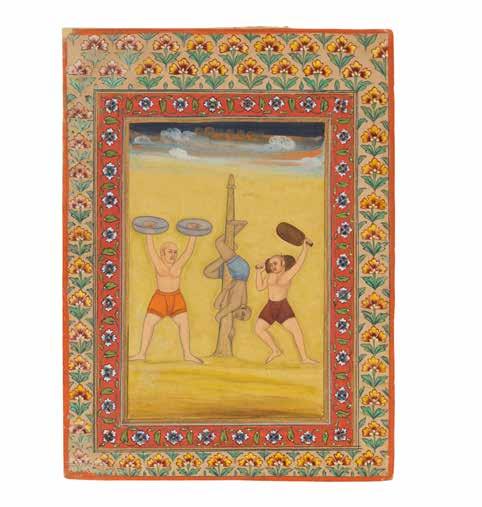
210 †
DESHAKHAYA RAGINI: ACROBATS TRAINING WITH WEIGHTS
PROVINCIAL MUGHAL, LATE 18TH CENTURY
gouache and gold on paper, stylised floral borders, nagari inscription verso
242 x 175 mm.
£3,000 - 5,000
€3,400 - 5,700
US$4,100 - 6,800
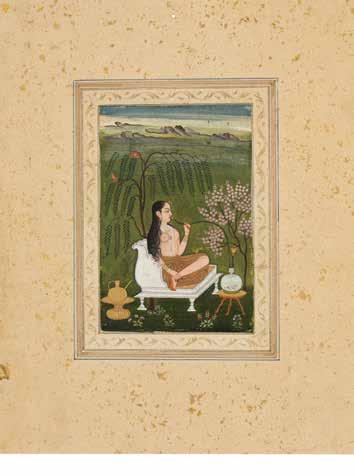
211
A COURTESAN SEATED SMOKING A HOOKAH BENEATH A DROOPING WILLOW TREE DECCAN, 18TH CENTURY
gouache and gold on paper, laid down on an album page with giltdecorated borders, verso a calligraphic exercise consisting of two couplets written diagonally in nasta’liq on a ground of foliate motifs in gold, gold-sprinkled coloured inner borders, inner ruled margins in colours and gold, gold-sprinkled outer borders
painting 160 x 110 mm.; calligraphy 126 x 55 mm.; album page 327 x 263 mm.
£4,000 - 6,000
€4,600 - 6,900
US$5,400 - 8,100
Provenance
Ader Picard Tajan, Paris, 11th May 1982, lot 39 (according to a photocopy of the catalogue entry on the original backboard).
The text of the calligraphic page verso consists of two couplets from a ghazal of Hilali Jaghata’i (d. 1529).
212
SHAHAB AL-DIN YAHYA SUHRAVARDI, THE PERSIAN PHILOSOPHER AND THE FOUNDER OF THE SUHRERVARDI ORDER OF SUFIS, WATCHING FOUR SUFI SHAYKHS IN DISCOURSE SEATED ON A RIVER ISLAND
DECCAN, 18TH CENTURY
gouache and gold on paper, Persian identifying inscriptions, lacking borders
294 x 205 mm.
£6,000 - 8,000
€6,900 - 9,200
US$8,100 - 11,000
The figures seated on the island are, from right to left:
‘La’l Shahbaz’: another name for ‘Uthman Marandi (1177-1274), a Persian sufi and poet who moved to India and settled in Sind.
‘Baha’ al-Haqq’: another name for Baha’ al-Din Zakariya, recorded as a sufi of the 12-13th Century in Multan, and a follower of the Suhravardi Order.
‘Sayyid Jalal’. This may be Jalal al-Din Surkh-Push Bukhari (1190-1295), a follower of the Suhravardi Order.
‘Shaykh Farid’. This may be Farid al-Din Ganj Shakar (1173-1265), an Indian sufi of the Chishtiya Order.
The inscriptions at the upper edge:
‘The Shaykh of all Shaykhs, Suhrevardi’. Shahab al-Din Yahya Suhravardi (1154-91) was a Persian philosopher and the founder of Suhrervardi Order.
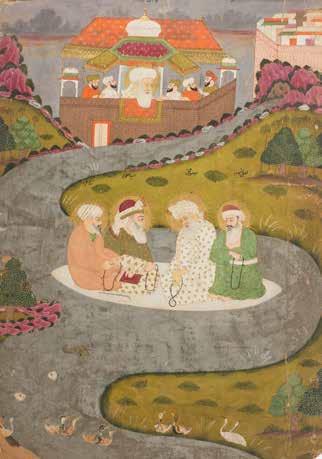
213
AN IMAGINED GATHERING OF FAMOUS SUFI
FIGURES, INCLUDING ‘ABD AL-QADIR GILANI
DECCAN, 18TH CENTURY
gouache and gold on paper, numerous Persian identifying inscriptions, brown border
301 x 205 mm.
£2,000 - 3,000
€2,300 - 3,400
US$2,700 - 4,100
For the full note on this lot, see the online catalogue.
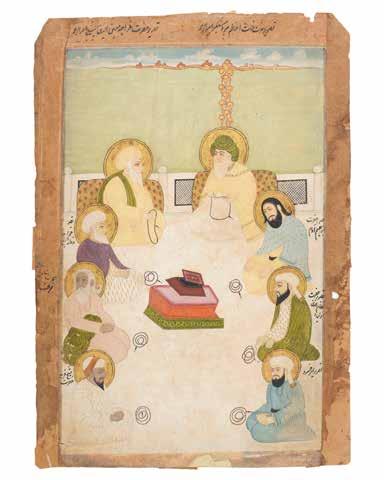
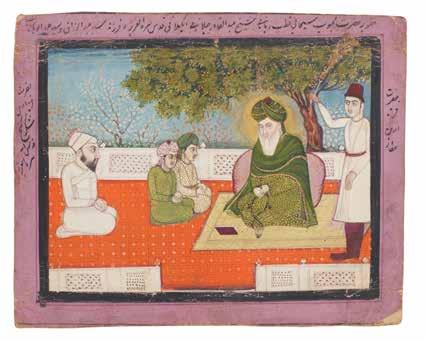
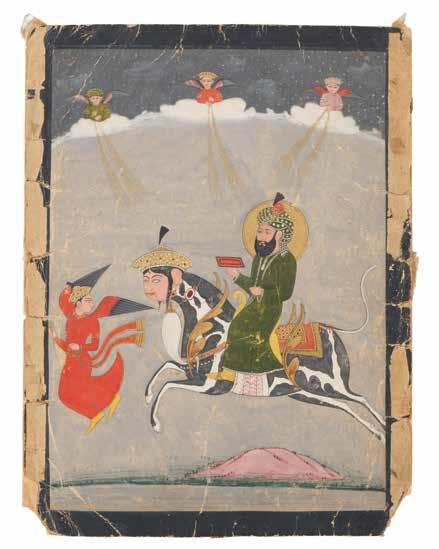
214
AN IMAGINED GATHERING OF SUFIS AND POETS ON A GARDEN TERRACE, INCLUDING ‘ABD AL-QADIR GILANI
NORTH INDIA, LATE 18TH CENTURY
gouache and gold on paper, black and mauve borders, identifying inscriptions in nasta’liq, pasted down on card 150 x 188 mm.
£1,500 - 2,000
€1,700 - 2,300
US$2,000 - 2,700
The painting depicts ‘Abd al-Qadir Gilani (10771166), seated against a bolster and nimbate, a sufi of the Qadiri order, with his two sons ‘Abd al-Razzaq and ‘Abd al-Wahhab seated before him. Behind them in white is Farid al-Din Shakar Ganj (11731265), an Indian sufi of the Chishtiya order. Standing behind ‘Abd al-Qadir Gilani is the Persian poet Farid al-Din ‘Attar (1145-1221).
215
THE NIGHT-RIDE (MI’RAJ) OF THE PROPHET ON BURAQ, ACCOMPANIED BY ANGELS
DECCAN, 18TH CENTURY
gouache and gold on paper, dark blue border 245 x 188 mm.
£3,000 - 4,000
€3,400 - 4,600
US$4,100 - 5,400
For a Deccan depiction of the mi’raj, late 17th/early 18th Century, see Indian Miniature Painting from the collection of Edwin Binney III: the Mughal and Deccani Schools, Portland, Oregon 1973, p. 169, no. 147. ‘Indian pictures of the Miraj are extremely rare, though they are common in Persian painting [...] Since almost no Mughal Miraj depictions are known, a Deccani attribution seems more credible’.
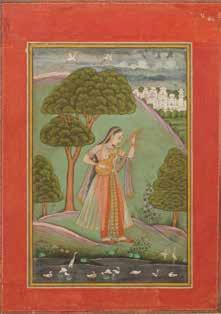
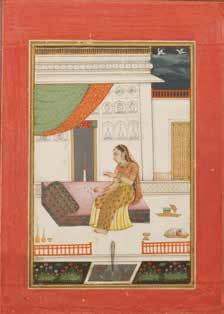
FIVE PAINTINGS FROM A RAGAMALA SERIES
DECCAN, 18TH CENTURY
gouache and gold on paper, red inner borders, brown outer borders, all with nasta’liq identifying inscriptions verso, four with 18th Century seal impressions of a certain Hidayat, with the date AH [1]116 [?]/AD 1704-05 [?]
290 x 220 mm. and slightly smaller(5)
£2,000 - 3,000
€2,300 - 3,400
US$2,700 - 4,100
Provenance
Private US collection.
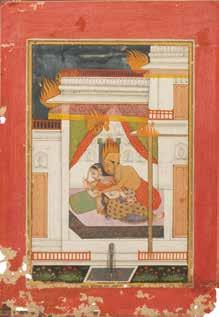
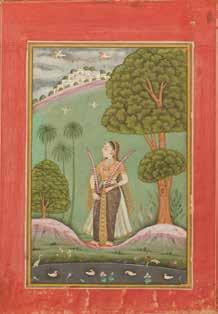
The ragamala subjects are:
Gauri ragini: a maiden holding floral wands, standing in a landscape.
Ramkala ragini: a prince prostrate before his mistress, begging for her forgiveness, two women in attendance.
Dipak ragini: a prince, his head aflame, making advances to a maiden.
Kalyan ragini: a maiden seated alone on a terrace, plucking petals from a lotus as she waits for her lover.
Sarang ragini: a maiden playing a vina in a landscape.
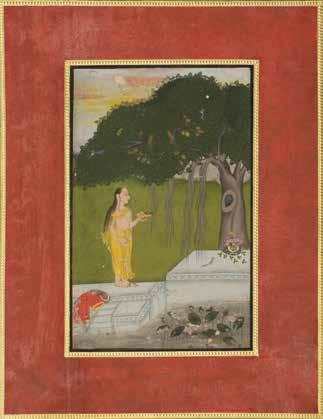
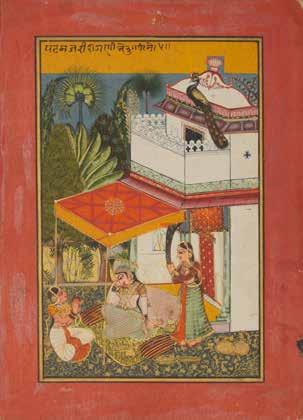
217 *
A MAIDEN AT A LINGAM SHRINE BENEATH AN OVERHANGING TREE
BUNDI, CIRCA 1760-80
gouache and gold on paper, wide red border
253 x 195 mm.
£1,500 - 2,000
€1,700 - 2,300
US$2,000 - 2,700
Provenance
Private US collection.
A lady worshipping at a Shiva lingam is the typical Rajasthani iconography for Bhairavi ragini, the first wife of Bhairava raga (Bhairava, another name for Shiva, being the fierce manifestation of the deity). See for example, Christie’s New York, The Doris Wiener Collection, 20th March 2012, lot 258 (Bundi, circa 1760 - with a very similar folded pile of clothes as in our painting); the same painting was later with Simon Ray, Indian and Islamic Works of Art, November 2012, no. 45. See also Christie’s New York, Indian Art Online, 25th October 2016, lot 27 (with two women).
However, the composition, with the sun just rising above the tree, recalls depictions of Surya puja: see a painting illustrated in A. Topsfield, Paintings from Rajasthan in the National Gallery of Victoria, Melbourne 1980, pp. 158-159, no. 258 (Udaipur, circa 1835). Topsfield comments there: ‘The subject was popular at Udaipur in the early 19th Century, combining as it does the theme of worship of the sun, of whom the Maharanas were considered to be descendants, and erotic elements deriving from Mughal paintings of women at their toilet’.
218 * A MAIDEN WITH TWO ATTENDANTS, A PEACOCK ON THE ROOF OF THE PAVILION ABOVE, PERHAPS ILLUSTRATING PATMANJARI RAGINI
BUNDI, LATE 18TH CENTURY
gouache and gold on paper, yellow panel at top with one line of nagari text, red border
266 x 195 mm.
£1,500 - 2,000
€1,700 - 2,300
US$2,000 - 2,700
Provenance
Private US collection.
219 *
TWO MAIDENS ARM-IN-ARM ON A TERRACE, ONE HOLDING A BOTTLE
BUNDI, LATE 18TH CENTURY
gouache and gold on paper, salmon pink floral border
306 x 226 mm.
£1,500 - 2,000
€1,700 - 2,300
US$2,000 - 2,700
Provenance
Private US collection.
220 *
MAHARAJAH MAN SINGH (REG. 1804-43)
SEATED WITH A CONSORT ON A SWING ON A PALACE TERRACE
JODHPUR, CIRCA 1830-40
gouache and gold on paper, outer border with geometric motifs, nagari inscription verso 395 x 301 mm.
£1,500 - 2,000
€1,700 - 2,300
US$2,000 - 2,700
Provenance
Private US collection.
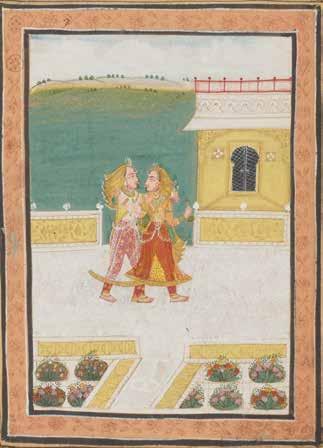
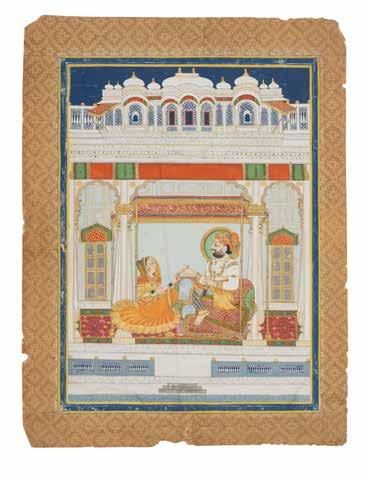
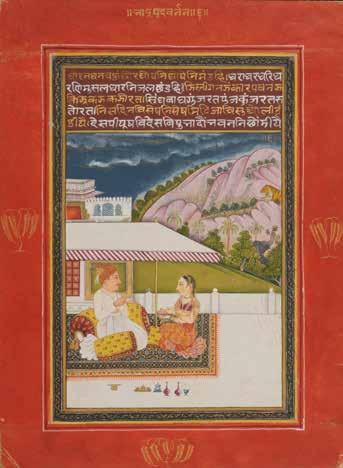
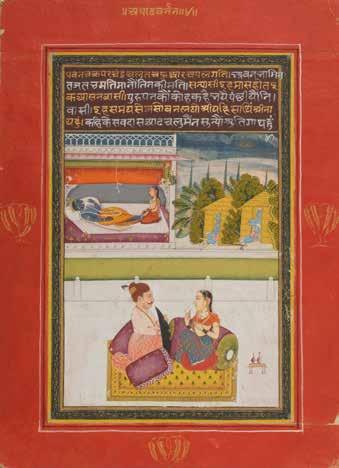
TWO SCENES DEPICTING PRINCES SEATED WITH MAIDENS, FROM A BARAMASA SERIES
RAJASTHAN, PERHAPS ALWAR, 18TH CENTURY
gouache and gold on paper, panel at top with nagari text in white and gold on a brown ground at top, blue and gold inner borders, red outer borders with a single line of nagari text in gold at top, foliate motifs in gold in left, right and lower borders 318 x 232 mm.(2)
£1,500 - 2,000
€1,700 - 2,300
US$2,000 - 2,700
Provenance
Private US collection.
The first painting seems to correspond to the imagery associated with the month of Bhadon (July-August), a description of which is found in the tenth chapter of the Kavipriya of Keshav Das of Orchha (15551617):
The clouds are gathering, thunder rolls and rain pours in torrents. The wind blows fiercely, the cicadas chirp. Lions roar and the elephants fell the trees. Day is dark like night and one’s home is best. Pray leave me not in the month of Bhadon For separation pains like poison.
222
A SCENE FROM AN UNIDENTIFIED SERIES, PERHAPS FROM A BHAGAVATA PURANA OR BHAKHTIRATNAVALI SERIES, DEPICTING BRAHMA WITH DEVOTEES
MEWAR, CIRCA 1720
gouache and gold on paper, yellow panel at top with two lines of text in nagari script 253 x 406 mm.
£2,000 - 3,000
€2,300 - 3,400
US$2,700 - 4,100
The Bhaktiratnavali (‘necklace of devotional gems’) is an anthology of four hundred and five verses illustrating the core precepts of Bhakti or devotion laid out in the religious text Srimad Bhagavata or Bhagavata Purana. These verses were selected and compiled by the Vaishnava ascetic Vishnupuri in the 15th Century. This text gained great currency during the period and remains a highlight of Vaishnava literature to this day. The central principle of Bhakti is that the blessings of the Divine may be attained by those who worship with love and faith rather than the entitlement of rank or privilege. Duty, piety, charity and penance are the true path to achieving Godhood.
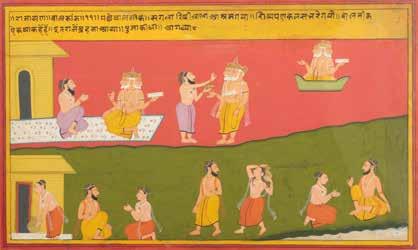
223
A PAINTING FROM A BARAMASA SERIES, REPRESENTING THE TENTH MONTH, VAISAKH, AND DEPICTING KRISHNA SWIMMING WITH MAIDENS IN A PALACE POOL
JAIPUR, CIRCA 1790
gouache and gold on paper, five lines of nagari text in panel above, red inner border, gold sprinkled outer border with English inscription in lower border 298 x 225 mm.
£2,000 - 3,000
€2,300 - 3,400
US$2,700 - 4,100
The English inscription reads: the tenth month, ‘Vaisakh’, corresponding with our own 13th April to 14th May
Another painting from the same Baramasa series was sold in these rooms, Bonhams, Islamic and Indian Art, Knightsbridge, 14th June 2012, lot 269. It too had a similar English inscription in the lower border, noting that the month of Kartik corresponds ‘with our 16th October to 15th November’. Another, there described as ‘Murshidabad, circa 1800’, depicting the month of Asoja, and according to the description with the same English inscription, was with Christie’s, Islamic, Indian, Southeast Asian Manuscripts, Miniatures and Works of Art, 13th-14th June 1983, lot 35.
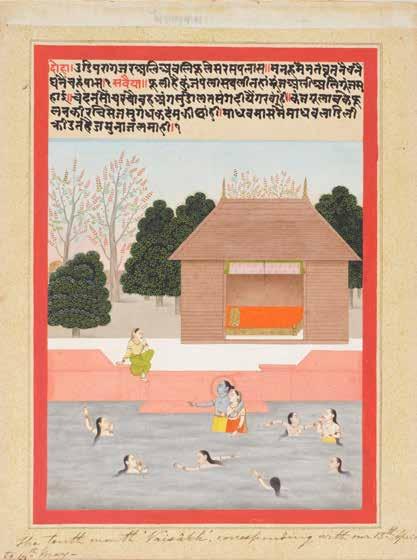
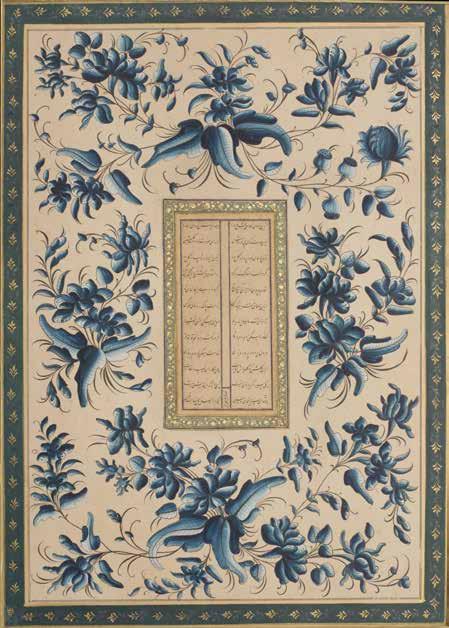
A PAGE FROM THE POLIER ALBUM, DEPICTING A MAIDEN WALKING ON A TERRACE AT NIGHT, SHADING A LAMP WITH HER VEIL, WITH A SAFAVID CALLIGRAPHIC PANEL VERSO BY MUHAMMAD QASIM
LUCKNOW, CIRCA 1760-70
gouache and gold on paper, laid down on a large album page with illuminated floral borders and characteristic outer borders with bold naturalistic floral sprays; verso, a calligraphic page in fine nasta’liq consisting of a mathnavi in Persian, signed by Muhammad Qasim, Persia, first half of the 16th Century, two columns of text in black ink on gold-sprinkled cream ground, illuminated floral inner border, wide floral outer border
painting 178 x 125 mm.; calligraphic panel 140 x 75 mm.; album page 393 x 290 mm.
£15,000 - 20,000
€17,000 - 23,000
US$20,000 - 27,000
For three other examples of Polier Album pages with calligraphic exercises on the reverse, see Christie’s, Islamic Art, Manuscripts and Printed Books of Iranian Interest, 19th-20th April 1999, lot 342 (calligraphy by Imad al-Hassani, Persia, late 16th Century, apparently with nothing on the other side of the page); Christie’s, Arts of India, 12th June 2018, lot 22: the painting recto depicting a princess and her chaperone, verso, a quatrain signed Hafiz Nurullah, India, circa 1760; the same sale, lot 23: the painting depicting a princess holding a candle, verso, once again a quatrain by Hafiz Nurullah; it is this one the borders of which are most comparable to those of our page.
The figure of the maiden is almost exactly reproduced in a Provincial Mughal painting, dated to circa 1800, in which she approaches a shrine carrying a lamp, this time in daylight (or at least in early evening): see Sotheby’s, Arts of the Islamic World and India, 26th October 2022, lot 76.
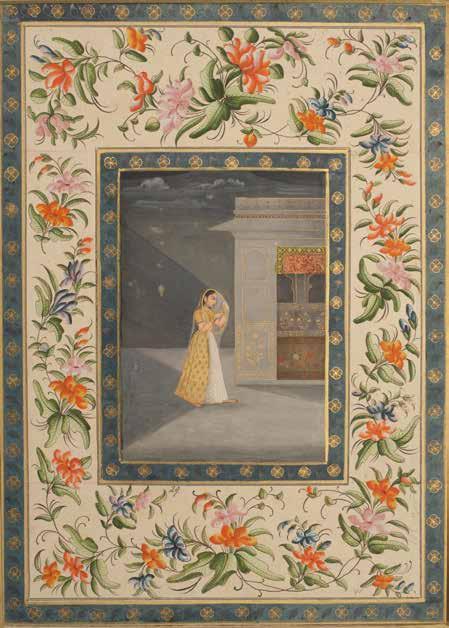
The calligraphy verso is a mathnavi in Persian (poet unidentified), in fine nasta’liq, Persia, first half of the 16th century, signed ‘Muhammad Qasim wrote it’.
There are a few calligraphers with the name Muhammad Qasim, however, the absence of an attribute makes it impossible to identify him. One possible candidate is Muhammad Qasim Shadi Shah. Little is known about his life other than he was a skilled nasta’liq calligrapher, whose hand is compared with those of Sultan Muhammad Nur and Sultan Muhammad Khandan. His recorded work is dated between AH 932/AD 1525-26 and AH 955/AD 1548-49. See Mehdi Bayani, ahval va athar-e khushnavisan, vol. 3, Tehran, 1348 sh, pp. 807-809.
This folio belongs to an album assembled by Colonel Antoine Polier, one of the greatest of early European collectors of Indian miniatures. Antoine Louis Henri Polier was born in Lausanne in Switzerland in 1741 and began his career as a surveyor in the East India Company in 1758. By 1762 he had become Chief Engineer of the Bengal Army in Calcutta and Chief Architect for the Kingdom of Awadh, working within the court of Nawab Shuja al-Daula.
During his time in India, Polier collected a large number of Persian and Sanskrit manuscripts and Indian miniatures. Polier commissioned works himself as well as acquiring earlier works from others. He assembled at least twelve albums of paintings and calligraphy, most of which were later acquired by William Beckford. Several folios which were with Beckford are now in the Museum of Islamic Art in Berlin and in The British Museum in London. For further discussion of Polier and his albums, see M. Roy, ‘Origins of the late Mughal painting tradition in Awadh’ in S. Markel and T. B. Gude, India’s Fabled City: the Art of Courtly Lucknow, Los Angeles 2011, pp. 176-181.
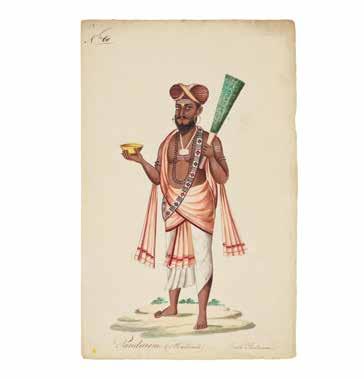
THREE PAINTINGS DEPICTING AN OFFICIAL, A HINDU MENDICANT AND A MUSLIM WATER-CARRIER
SOUTH INDIA, PROBABLY PONDICHERRY, CIRCA 1822 watercolours on watermarked paper, one Whatman 1822, French identifying inscriptions and numbering 388 x 245 mm. and slightly smaller(3)
£2,500 - 3,500
€2,900 - 4,000
US$3,400 - 4,700
The inscriptions read: Cépédar (Chef dionagens[?]de Police), Caste Pally, no. 74. According to an English inscription on a Tanjore painting of circa 1800 in the V&A, a Sopedar was a Gate Watchman. See M. Archer, Company Paintings, London 1992, p. 57, no. 22 (13).
Pandarom (Mendiant), Caste Pandarom, no. 60
Packaly (Sorteur de l’eau), Caste Musulman, no. 91.
Comparison can be made with a painting with a more elaborate landscape background, depicting a barber shaving a European seated in a field, inscribed in French, on paper watermarked E. Wise 182[?], probably Pondicherry, circa 1830: see J. P. Losty, Francesca Galloway, Indian Miniatures from the James Ivory Collection, London 2010, p. 180 and 207, no. 89. For details of the charges payable in addition
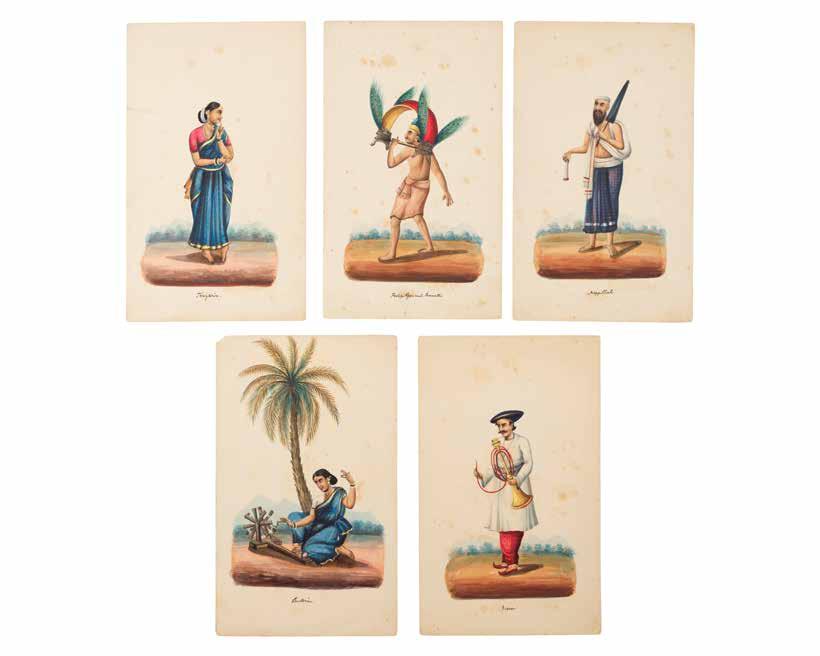
FIVE PAINTINGS OF TRADESPEOPLE AND OTHER FIGURES
SOUTH INDIA, TANJORE, MID-19TH CENTURY watercolours on paper, identifying inscriptions in German 216 x 130 mm.(5)
£1,500 - 2,000
€1,700 - 2,300
US$2,000 - 2,700
The figures are: a man with a parasol (mappillah); a Kavati-bearer, a religious devotee visiting sites sacred to Subrahmanya (Festpilger mit Chavatti); a female dancer (Tanzerin); a woman spinning cotton (Spulerin); a man in livery carrying a hookah (Diener[?]).
For the kavati-bearer, see another portrayal and discussion in A. L. Dallapiccola, South Indian Paintings: a Catalogue of the British Museum Collection, London 2010, p. 185, no. 15.1 (from an album dated 1830-35).
227
THE INTERIOR OF TIRUMALA NAYAK’S PALACE AT MADURA, DEPICTING A MAGISTRATE’S COURT IN SESSION, WITH CHARLES ROBERT BAYNES PRESIDING SOUTH INDIA, CIRCA 1850 watercolour on paper, English inscriptions at bottom 407 x 502 mm.
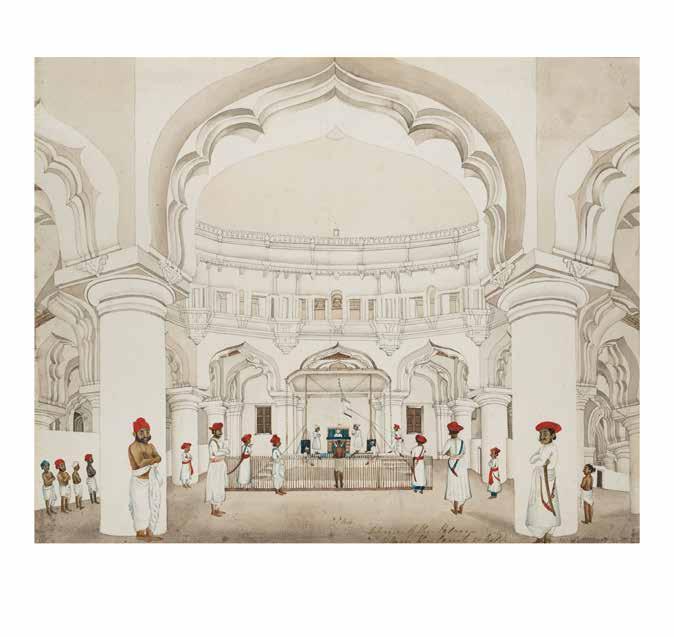
£4,000 - 6,000
€4,600 - 6,900
US$5,400 - 8,100
Provenance
Charles Robert Baynes (1809-1959), High Court Judge, Madras Civil Service, retired 1859.
With Kyburg Ltd., Duke Street, St James’s, London SW1 (label on backboard), probably 1980s.
The inscription reads Interior of the Palace where the Court is held; and a cross with CRB, corresponding to a cross above the figure of the magistrate.
For another depiction of the distinctive interior of the palace, see the sale in these rooms, Bonhams, India in Art, 7th June 2022, lot 15. That painting apparently shows the same space, again being used for a court hearing, with a magistrate on the dais and Indian figures standing around, but seen from a side angle, from a viewpoint off to the right of our painting.
palace of the Rani Mangammal, queen regent of the Nadu kingdom. It was later occupied by the Nawab of the Carnatic, and after that by the East India Company from 1801, functioning as the official residence of the District Collector. From 1959 the palace became the Mahatma Gandhi Museum. With its distinctive ogee arches and massive pillars, it was also depicted by Thomas and William Daniell in the late 18th Century.
For a group of four Company School works depicting the exterior of the palace, and the temples of Minatchy and Vasanta, at Madura, see Sotheby’s, Oriental Manuscripts and Miniatures, 29th April 1998, lots 91-94. These too have identifying inscriptions in English. M. Archer noted that aside from its official status Madura was regarded as a centre for Company officials, who were attracted by its monuments and sculpture. An Indian artist, named Ravanath Naik, appears to have worked in tandem with British amateur painters (Company Drawings in the India Office Library, London 1972, p. 52).
For another painting by an Indian artist, depicting Pudu Mandapa, opposite the Meenakshi Temple, and in the collection of Conway Mordaunt Shipley, see India and Iran: Works on Paper, Oliver Forge & Brendan Lynch, March 2022, no. 25.
228
CIRCLE OF THOMAS DANIELL (BRITISH, 1749–1840), THE OLD FORT GHAUT, CALCUTTA CIRCA 1790
some pencil, pen and ink and watercolour on Honig and Zoonen watermarked laid paper, inscription below in French Vue de Calcutta, ruled black ink border line and grey wash surround sheet 418 x 540 mm.
£10,000 - 15,000
€11,000 - 17,000
US$14,000 - 20,000
Thomas Daniell published the original etching and aquatint The Old Fort Ghaut in his Views of Calcutta (1787), and the present study is directly comparable to this. (An example of the etching is in the Smithsonian, National Museum of Asian Art (S1999.8.6)).
Thomas Twining, arriving in Calcutta in 1792, described the scene:
I quitted the boat at a spacious sloping ghaut or landing place, close to the north-west angle of the old fort. The lower part of the slope went some way into the water, and was crowded with natives, men and women, bathing with their clothes, or rather cloths on, and which they dexterously contrived to change under water, without embarrassment to themselves or the bystanders... [With the building of the New Fort, the Old was] appropriated to the reception of the goods of the Company, and the merchandise of the custom-house, the direction of which was within its walls. Upon the custom-house wharf, extending from one end to the other, I saw immense piles of good of various sorts, imports and exports.
(Quoted in M. Archer, Early Views of India: the Picturesque Journeys of Thomas and William Daniell 1786-94, London 1980, no. 9).
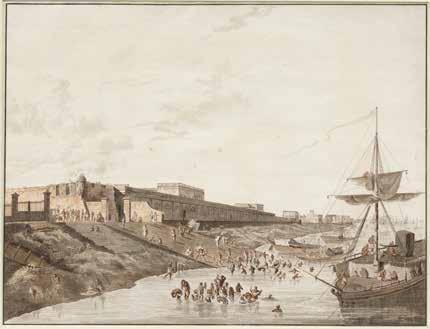
229
THE PEACOCK PHEASANT COMPANY SCHOOL, CALCUTTA, EARLY 19TH CENTURY
watercolour on paper, English inscription at bottom 335 x 225 mm. (sight)
£2,000 - 3,000
€2,300 - 3,400
US$2,700 - 4,100
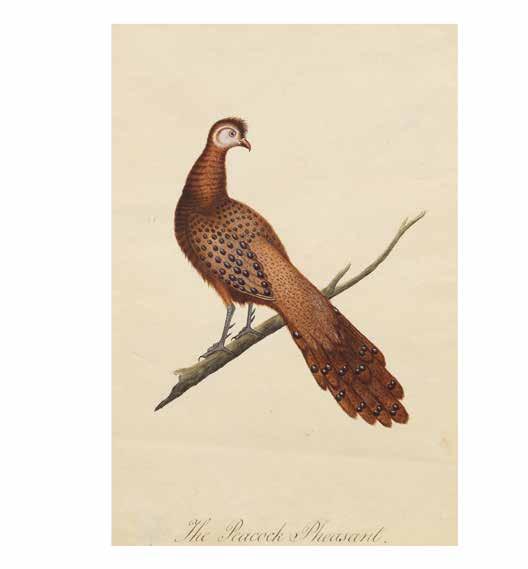
230
A SCENE FROM THE RAMAYANA, DEPICTING THE MONKEYS DEVASTATING THE MADHUVANA GROVE, GORGING THEMSELVES ON FRUIT AND HONEY, BEFORE RETURNING TO RAMA CHAMBA, CIRCA 1800-1810
gouache, silver and gold on paper, blue inner border, red outer border 268 x 365 mm.
£30,000 - 50,000
€34,000 - 57,000
US$41,000 - 68,000
Provenance
The collection of Dr Alma Latifi, CIE, OBE (1879-1959).
Simon Ray, Indian and Islamic Works of Art, November 2017, no. 47.
Exhibited
The Art of India and Pakistan, Royal Academy, London, 1947-48.
Our painting comes from a group of fifteen paintings which illustrate the narrative consecutively (of which nine featured in Simon Ray’s catalogue of 2017) from the fifth book of the Ramayana, the Sundara Kanda, the ‘Beautiful Book’.
After Hanuman has landed triumphantly on Mount Mahendra, fresh from his success in Lanka, he meets the other monkeys and the whole group races down and arrives at the celestial grove of Madhuvana. Its guardian Dadhimukha, Surgriva’s uncle, gives them permission to take some fruit and honey, but the monkeys’ excitement overcomes them and they lay waste to the grove while gorging on the fruit, as seen on the left of the painting.
Dadhimukha goes to complain to Surgriva on Mount Prasravana, but this reveals that the monkeys’ excitement must mean that the Lanka mission was a success and that Sita has been found. Surgriva therefore sends Dadhimukha back to fetch the monkeys. Coming before Rama, Hanuman is rewarded with a necklace for his efforts, which we see in the scene at upper right.
J. P. Losty argues that the series combine features of both Chamba and Garwhal, including the pink striated rocks seen here with plants and trees sticking up from them, as well as smaller dark bushes which look like holes in the rocks. He suggests that there was an exodus of Garwhal artists from Chamba after the Gurkha conquest of 1804. For the full discussion, see Simon Ray, op. cit. 2017, intro. before no. 43.
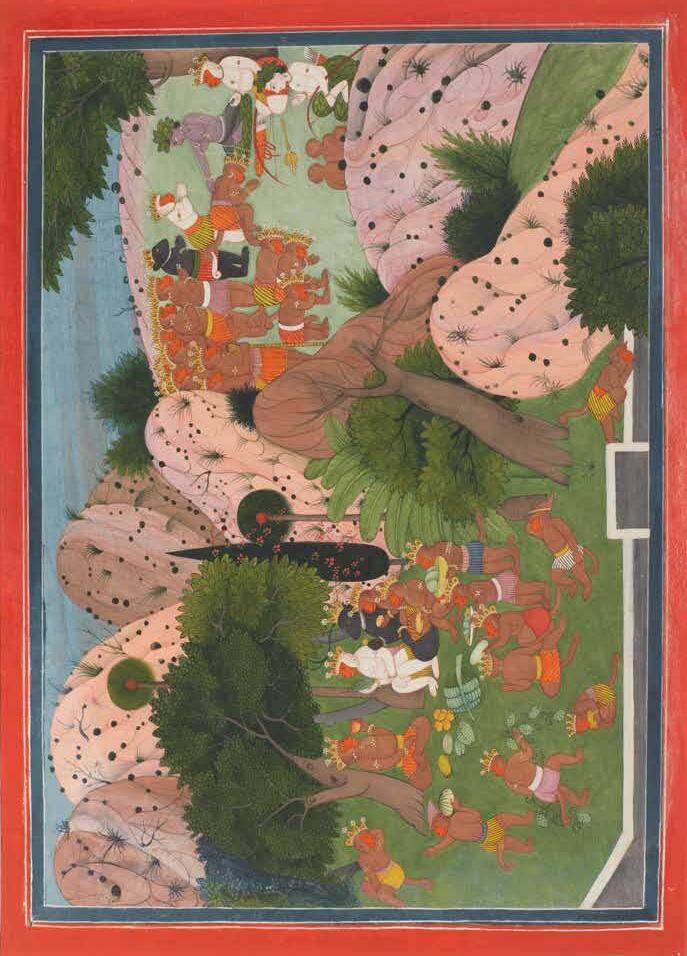
231
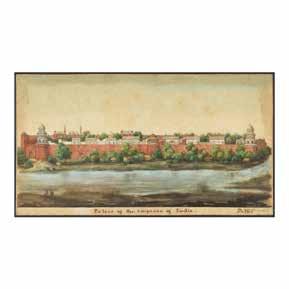
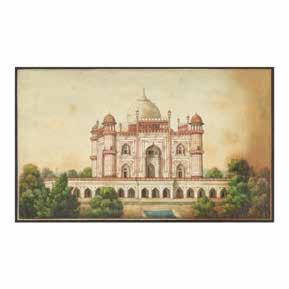
SIX PAINTINGS OF MONUMENTS IN DELHI, BY AN ARTIST IN THE CIRCLE OF GHULAM ‘ALI KHAN OR MAZHAR ‘ALI KHAN DELHI, CIRCA 1840-60
watercolour and gold on paper, black margin rules, English identifying inscriptions in lower borders, three with Persian inscriptions 80 x 135 mm.; framed dimensions of each 20 x 25 cm.(6)
£2,500 - 3,500
€2,900 - 4,000
US$3,400 - 4,700
Provenance
Private UK collection for at least seventy years.
The monuments depicted are as follows:
1. The Mosque of Rawshan al-Dawla near Kutwali in Shah Jahan Abad (A Mosque, Delhi).
2. The Jami Masjid (Front view of the Mosque).
3. (The place of the holy footstep, Delhi); Persian inscription: naqshe-ye dargah-e qadam-e sharif, ‘Image of the place of the noble footstep’.
4. The mausoleum of Nizam al-Din (Tomb of Nazarn O’Dean); Persian inscription: naqshe-ye dargah-e nizam al-din saheb, ‘Image of the tomb of Nizam al-Din Saheb’. (cf. Dalrymple, Sharma, pp. 166-167, no. 74).
5. The Red Fort (Palace of the Emperor of India, Delhi); Persian
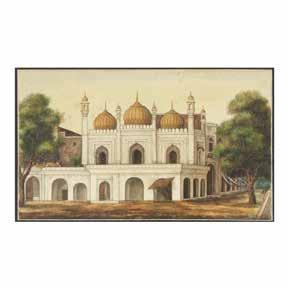
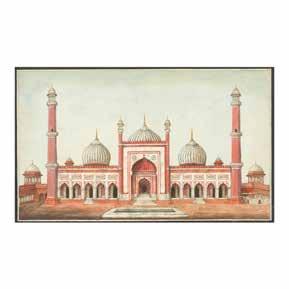
[sic], ‘Image of the emperor’s blessed citadel’.
6. The Mausoleum of Safdar Jang (The tomb of a virgin).
Compare Bonhams, Islamic and Indian Art, 23rd April 2013, lot 352, a group of 31 similar paintings (though larger than the present lot), dated circa 1852-54; Islamic and Indian Art Online, 2nd-12th June 2025, lot 223, two paintings, circle of Mazhar ‘Ali Khan, circa 1840-60; Christie’s, Exploration and Travel with Visions of India, 21st September 2000, lot 332 (attributed to Mazhar ‘Ali Khan), and 333 (Delhi School, circa 1840).
The artist Mazhar ‘Ali Khan was active in Delhi around the middle of the 19th Century. He was the son of Ghulam ‘Ali Khan (fl. 181752). For discussion of his work and milieu, see: J. P. Losty, M. Roy, Mughal India: Art, Culture and Empire, London 2012, p. 229; J. P. Losty, ‘Depicting Delhi: Mazhar Ali Khan, Thomas Metcalfe, and the topographical school of Delhi artists’, in W. Dalrymple, Y. Sharma (edd.), Princes and Painters in Mughal Delhi, 1707-1857, London 2012, pp. 52-59; p. 165, cat. no. 73 (Jami Masjid); and for Ghulam ‘Ali Khan, pp. 217-220; W. Dalrymple (ed.), Forgotten Masters: Indian Painting for the East India Company, London 2019, pp. 140-147.
232
A VIEW OF THE GHATS AT BENARES, WITH THE MOSQUE OF AURANGZEB IN THE BACKGROUND
EUROPEAN SCHOOL, DATED 1924 oil on canvas, indistinctly signed and dated 1924 lower right 51.5 x 60 cm.
£1,500 - 2,000
€1,700 - 2,300
US$2,000 - 2,700
233
A VIEW OF THE GHAT AT BENARES, BY HERCULES BRABAZON BRABAZON (BRITISH, 1821-1906)
CIRCA 1875-76
pencil and watercolour on paper, signed H B B lower right, inscribed Benares lower left 218 x 287 mm. (sight)
£2,000 - 3,000
€2,300 - 3,400
US$2,700 - 4,100
Provenance
With M. Knoedler & Co., 14 East 57th St, New York (gallery label on backboard), between 1925 and 1970.
Knoedler was one of the longest-established commercial galleries in the USA, founded in 1846, and finally closing in 2011. In 1925 its premises moved to 14 East 57th Street, near Madison Avenue, and remained there until 1970, when it moved to a refurbished town house at 19 East 70th Street.
Brabazon spent several months in India from 1875 to 1876, travelling with his nephew Harvey T. B. Combe, during the Prince of Wales’s tour of the Eastern provinces. His experiences caused a profound change in the direction of his work and the watercolours he produced exhibit a much looser style than his previous work. The Taj Mahal was his favourite subject and C. Lewis Hind writes in his biography of the artist ‘Perhaps in no subject was he so personal, so sure of his “audacities and omissions,” so apparently careless, yet so completely the artist, as in his impressions of the Taj Mahal, near Agra...It hardly looks like a real building in Brabazon’s rendering. It is an Eastern dream, that may vanish into air before the wave of a magician’s wand.’ (Hercules Brabazon Brabazon: His Art and Life, London, 1912, pp. 22-23). India saw the start of what is known as Brabazon’s later ‘short hand’.
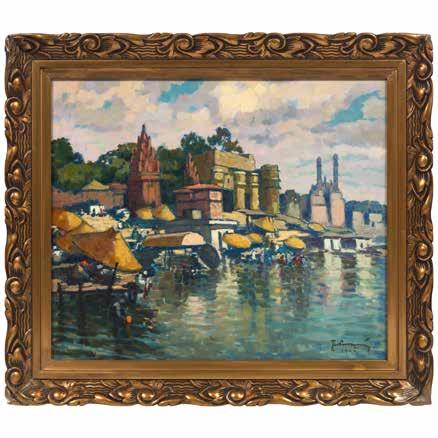
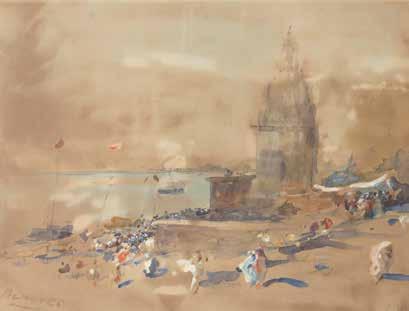
A LITHOGRAPH COPY OF ABUL FAZL’S AI’N-E-AKBARI, THE ADMINISTRATION OF AKBAR, THREE VOLUMES IN ONE, WITH 58 ILLUSTRATED PAGES
THE PUBLISHING HOUSE OF MUNSHI NAWAL KISHORE, LUCKNOW, 1881
lithographed text in Persian in nasta’liq, brown and some pink paper, 391 leaves, at least 11 leaves missing, 58 illustrated pages, mostly full-page, two decorated monochrome frontispieces, followed by a decorated headpiece, two further decorated frontispieces at the beginning of the second and third books, numerous tables and indexes, modern leather binding gilt 358 x 260 mm.
£1,500 - 2,000
€1,700 - 2,300
US$2,000 - 2,700
Another lithographed edition of the text was sold in these rooms, Bonhams, Islamic and Indian Art, 12th November 2025, lot 300, perhaps produced in Bombay, dated AH 1272/AD 1855-56. An illustrated manuscript of the text, copied in the Punjab, and dated sambat [2]95/1822-23, was sold in these rooms, Islamic and Indian Art, 28th April 2005, lot 115.
A Mughal manuscript copy of the late 17th/early 18th Century was sold at Sotheby’s, Arts of the Islamic World and India, 30th April 2025, lot 605.
Shaykh Abul Fazl was Emperor Akbar’s favourite vizier and confidant. He was the son of Shaykh Mubarak, a trusted adviser of Akbar, and the brother of the poet laureate Faizi. He was born at Agra in 1551, and was introduced to the Emperor by his brother the poet in 1573. Abul Fazl soon in his turn became the confidant of Akbar, and was commissioned by the emperor to chronicle his life in 1589. The resulting Akbarnama was completed nine years later in 1598. Abul Fazl was murdered in 1602 on his way back from a campaign in the Deccan at the instigation of Prince Salim. According to Beale ‘Akbar was deeply afflicted by the intelligence of this event; he shed abundance of tears, and passed two days and two nights without food or sleep.’ (T.W. Beale, An Oriental Biographical Dictionary, London 1894, p. 24).
Abul Fazl was the author of the three celebrated works that chronicle the reign of Akbar: the Akbarnama, the A’in Akbari, and the Maktubati-’Allami. ‘The A’in Akbari or The Institutes of Akbar contains a detailed account of the royal establishments, the administration and statistics of the empire, the creeds and institutions of the Hindus’ (C. Rieu, Catalogue of the Persian Manuscripts in the British Library, Part I, Oxford 1966, p. 248.) Annemarie Schimmel adds that the three volumes, including the Akbarnama ‘contains the most comprehensive information about the organisation of the Empire and the army, down to the number of employees in the fruit storerooms, and the food that was given to the best hunting leopards (cheetahs)’. Schimmel concludes that ‘even though much of it is idealised, the ‘A’in is nevertheless an incomparable guide to Mughal administration’ (see A. Schimmel, The Empire of the Great Mughals: History, Art and Culture, London 2004, p. 33).
The present text starts by listing the ten sources used. The illustrations are as follows:
1-4: Four pages with illustrations of the seal impressions of Akbar, and his coins.
5: Drawings of instruments used for the weighing of metal (printed in red).
6: A plan view of a royal encampment (printed in red).
7: The different types of lamps in the (Royal) House of Lamps (cheragh-khaneh), with Akbar sitting in his room after sunset praying before lit candles.
8: Imperial thrones, parasols and standards.
9: Trumpeters and timpani (printed in red).
10: Types of large tent (printed in red).
11: Further illustrations of tents, and watercarts on the move (printed in red, bound upside down).
12-36: 25 pages illustrating plants, trees, some fruit-bearing, printed in green.
37: daggers, axes and other weapons (printed in red).
38: suits of armour and horse-armour (printed in red).
39: chainmail, bows, shields and other arms and armour (printed in red).
40: a large cannon (printed in red).
41: smaller-calibre cannon on carriages (printed in red).
42: a cannon on a carriage, with a diagram of its barrel (printed in red).
43: matchlocks (printed in red).
44: horse armour and other horse-trappings (printed in red).
45: horse caparisons (printed in red).
46: a fold-out image of Akbar in durbar (printed in red).
47: two men playing chess (printed in red).
48-51: four fold-out illustrations of ganjifa cards (printed in red).
52: (volume three): a schematic diagram of the Seven Climes, according to the Greek wise man (hakim).
53: a map of the western hemisphere, with the Americas, based on European projections.
54: a map of the world (minus the Americas).
55-57: three pages depicting necklaces and other pieces of jewellery (printed in red).
58: a large group of men playing a game on a large circular board (printed in red, page loose).
Volume two ends with the colophon: ‘The publishing house of Munshi Nawal Kishore in Lucknow in 1881’. Judged by the index for volume three, there are at least 11 folios missing from the text.
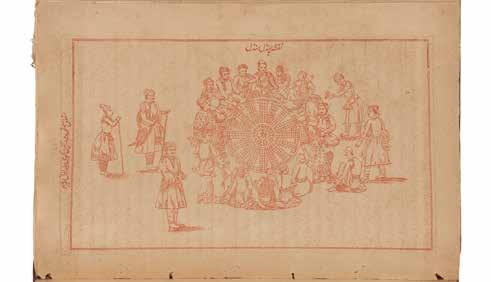
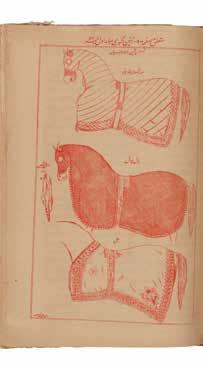
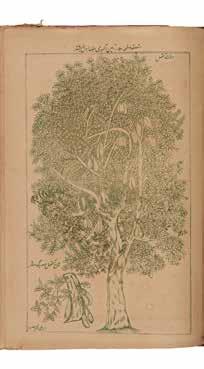
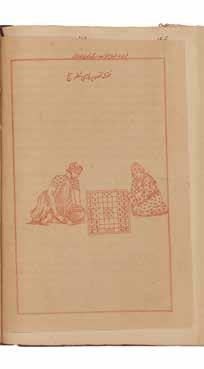
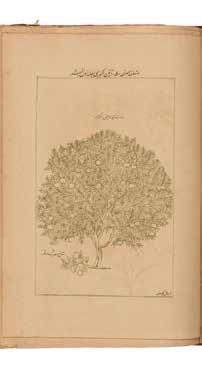
235
A BATTLE SCENE, WITH ELEPHANTS AND INFANTRY IN COMBAT, DEPICTING AN ENGAGEMENT IN THE WARS OF THE 16TH CENTURY BETWEEN THE SIAMESE AND BURMESE THAILAND, CIRCA MID-20TH CENTURY oil on canvas, signed and perhaps dated lower right 70.5 x 98 cm.
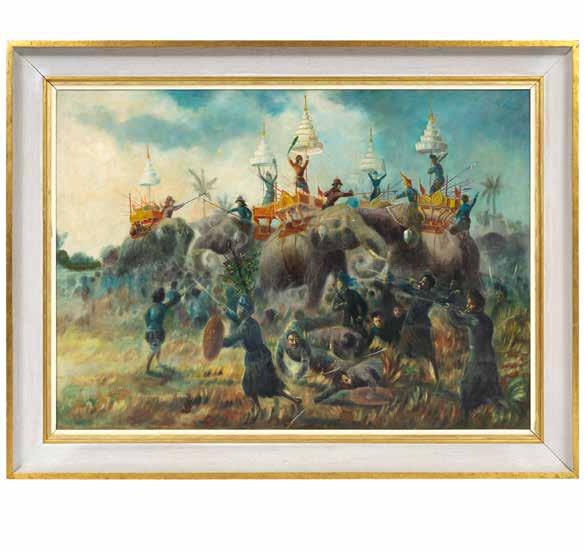
combat as waged during the Ayutthaya period (1351–1767). Possible subjects include the Siamese King Naresuan fighting the Burmese crown prince Mingyi Swa at the battle of Yuthahatthi in January 1593; or the battle between Queen Suriyothai and the Viceroy of Prome in the Burmese-Siamese War of 1548-49 (an example available online, dated 1887, by the artist Prince Narisara Nuvadtivongs).
£3,000 - 4,000
€3,400 - 4,600
US$4,100 - 5,400
Provenance
Private UK collection.
Comparison can be made with a painting sold in these rooms (Bonhams, Islamic and Indian Art, 22nd May 2025, lot 185), depicting a similar battle, dated to the late 19th Century, and formerly in the collection of E. R. Morris: presented to him by Prince Alangkarn (18601921), the brother of the King of Siam, in Bangkok in 1899. The present lot, looking at it stylistically, seems to be a slightly later continuation of the same tradition, discussed below.
As discussed in the note to that lot, another battle scene, Thailand, early 20th century, measuring 91.5 × 109 cm. (with frame), is in The Walters Art Museum, Baltimore (gift from the Doris Duke Charitable Foundation’s Southeast Asian Art Collection, 2002, acc. no. 35.229). The composition similarly depicts, for example, the clash of the two elephants in the foreground; the distinctive tiered white umbrellas; the ranks of soldiers en echelon aiming their muskets.
For a discussion on this genre of paintings, from which much of the note is derived, see Rebecca S. Hall, ‘Painting History: Representing Chronicles in Nineteenth- and Twentieth-Century Siam’, in The Journal of the Walters Art Museum, 73 (2018), pp. 35-42.
Such paintings, as Hall argues, appear to be imaginary representations of a battle from several centuries earlier, incorporating some elements of
While the Burmese were enemies of the Siamese for centuries, and the two kingdoms were frequently at war, the 2025 painting (along with other examples) are (to quote Rebecca Hall) ‘products of a particular historical moment. The colonial powers of Great Britain and France were threatening Siam’s borders, and rather than see his palace overtaken by European armies, as happened in Burma, King Rama V (also known as King Chlalongkorn [reg. 1868–1910]) desired to be viewed by Europeans as an equal [...] These paintings are part of a visual program developed in the late nineteenth century that asserted a national character at a time when the creation of a modern, unified nation was of great concern to Siam’s leaders’.
In 1887, Rama V held a painting competition inviting artists to produce paintings that illustrated the history of Siam. Each painting was to be accompanied by a multistanza poem known as a khlong, which were written after the completion of the compositions. A total of ninety-two paintings resulted from this competition. Many record episodes from the history of the Ayutthaya kingdom, alluding to the kingdom’s status as the foundation of Siamese identity. Some depict historical events from the early years of the towns of Thonburi and Bangkok; others deal with the Ayutthaya kingdom’s and the Rattanakosin kingdom’s relationships with their neighbours from the late 18th Century onwards
After the competition the series of ninety-two paintings was used to decorate the royal cremation grounds. The paintings were then hung in the throne hall at the Grand Palace in Bangkok and at Bang Pa-In, the summer palace near Ayutthaya. Sometime in the twentieth century, the paintings were distributed among a number of royal households, and several entered the collections of the National Museum and the National Gallery in Bangkok.
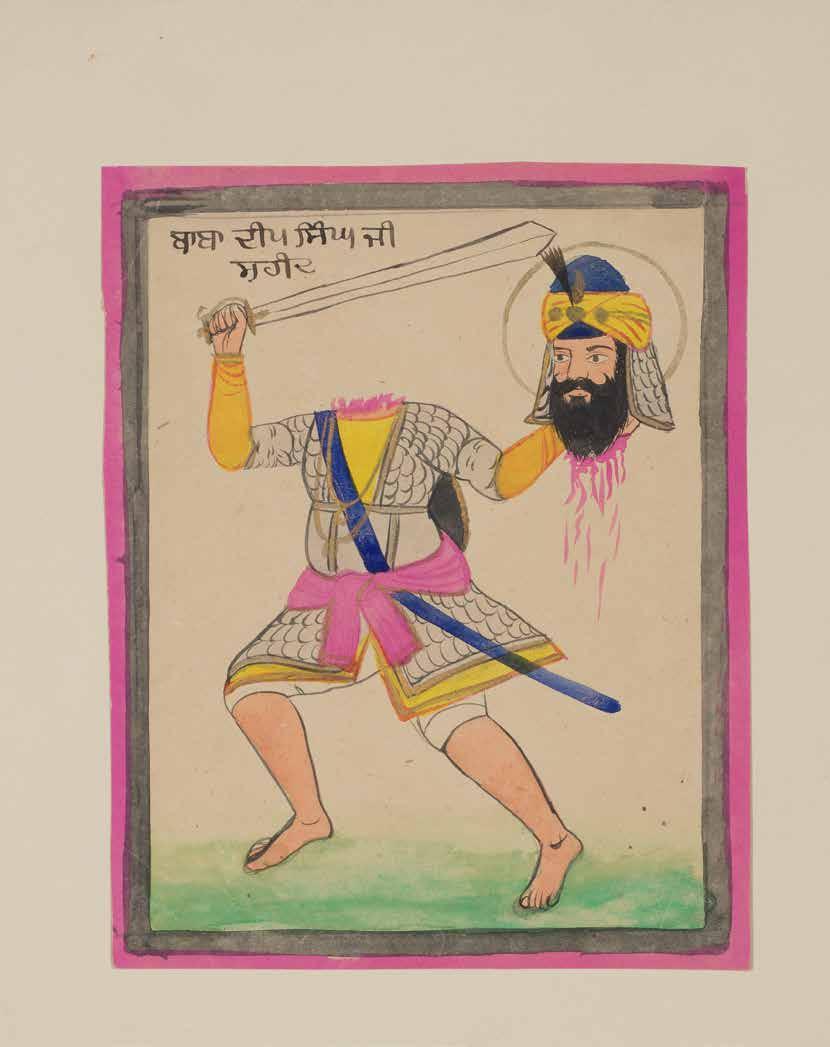
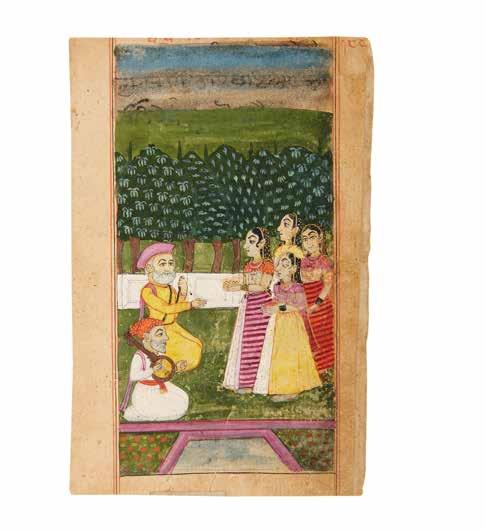
236
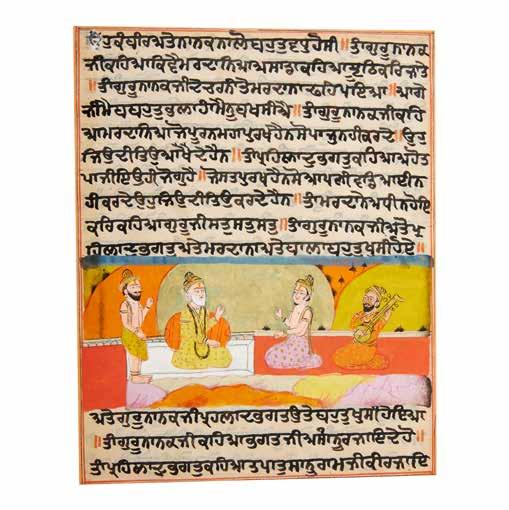
A RARE EARLY FOLIO FROM A JANAMSAKHI MANUSCRIPT DEPICTING A STORY FROM THE LIFE OF GURU NANAK, PERHAPS THE STORY OF THE COURTESANS OF KAMRUP VISITING THE GURU
PUNJAB, CIRCA 1740
gouache and gold on paper, 13 lines of gurmukhi text verso written in black ink
163 x 105 mm.
£2,000 - 3,000
€2,300 - 3,400
US$2,700 - 4,100
Provenance
Formerly in a private German collection since the 1970s.
For a similar example from the Sabi & Amrin Marwah Collection see S. Bharadia, Arts of the Sikh Kingdoms: the Canadian Collections, p 19.
237
A FOLIO FROM A JANAMSAKHI MANUSCRIPT DEPICTING A STORY FROM THE LIFE OF GURU NANAK, POSSIBLY THE GURU’S MEETING WITH DHRUVA AND PRAHLADA ON HIS JOURNEY TO MEET GOD IN HEAVEN
PUNJAB, PERHAPS BY A KASHMIRI ARTIST, CIRCA 1820-40
gouache and gold on paper, gurmukhi text recto and verso, written in black ink, coloured inner margin rules leaf 215 x 170 mm.
£1,500 - 2,000
€1,700 - 2,300
US$2,000 - 2,700
Provenance
Formerly in a private New York collection, from which acquired in 2021.
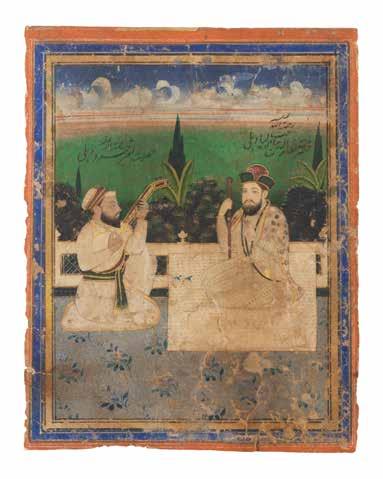
238
GURU NANAK WITH MARDANA PLAYING THE REBEC, IDENTIFIED AS THE SUFI SAINT NIZAM AL-DIN AWLIYA’ SEATED ON A TERRACE, LISTENING TO THE POET AMIR KHUSRAW DEHLAVI PLAYING A MUSICAL INSTRUMENT NORTH INDIA, LATE 18TH CENTURY
gouache and gold on paper, identifying inscriptions in nasta’liq, coloured borders 235 x 185 mm.
£1,500 - 2,000
€1,700 - 2,300
US$2,000 - 2,700
The depiction of both figures is so strongly reminiscent of the typical portrayal of Guru Nanak and his attendants that we must presume that the nasta’liq inscriptions were added later, either in preference to the Sikh sitters, or in ignorance.
The figure on the right is identified as ‘His Holiness Nizam al-Din Sahib-e Awliya’ of Delhi, May God have mercy upon him’. Nizam al-Din Awliya’ (1238-1325) is the most famous Indian Sufi saint of the Chishti Order. The figure on the left as ‘His Holiness Amir Khusraw Dehlavi, May God have mercy upon him’. Amir Khusraw Dehlavi (1253-1325) a poet of mediaeval India, who wrote mainly in Persian, a Sufi, and a disciple of Nizam al-Awliya.
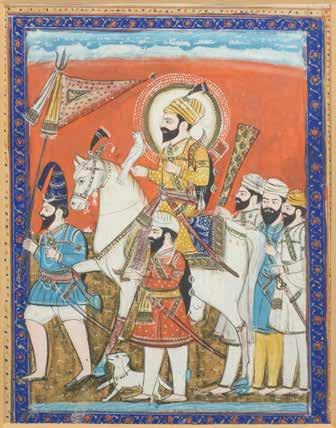
239
GURU GOBIND SINGH ON HORSEBACK WITH AN AKALI AND OTHER ATTENDANTS
PUNJAB, CIRCA 1850 gouache and gold on paper, blue floral border
225 x 170 mm.
£3,000 - 5,000
€3,400 - 5,700
US$4,100 - 6,800
In his entourage are five Sikh representative of the Panj Piare (Five Beloved), first of his devotees to be initiated into the Khalsa order in 1699. Leading the group is an Akali Nihang Sikh warrior carrying a trident-headed battle standard, to which is attached a triangular flag with pennants. Standards of this kind were used by the Sikh armies during the Anglo-Sikh Wars (1845-46, 1848-49).
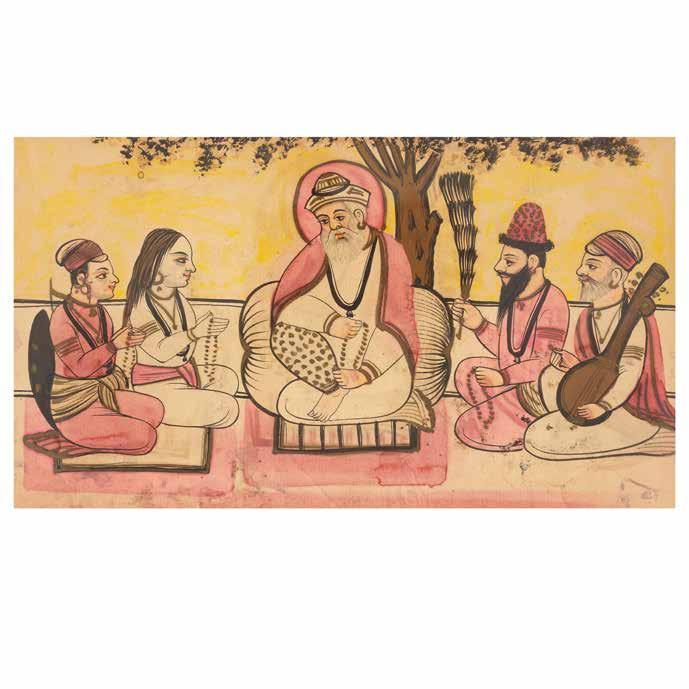
£2,000 - 3,000
€2,300 - 3,400
US$2,700 - 4,100
Provenance
Formerly in a private collection, East Moriches, New York, from which acquired in 2022.
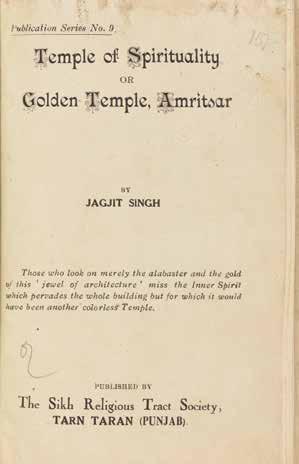
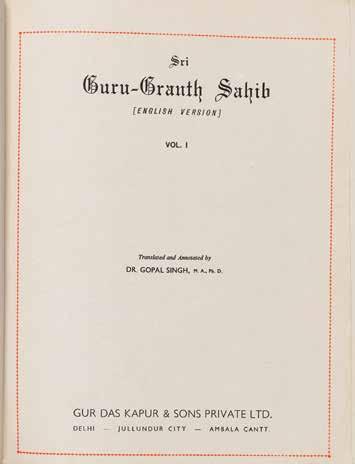
241 •
TEMPLE OF SPIRITUALITY OR GOLDEN TEMPLE, AMRITSAR, BY JAGJIT SINGH
PUBLISHED BY THE SIKH RELIGIOUS TRACT SOCIETY, TARN TARAN (PUNJAB), AND PRINTED AT THE AKALI PATRIKA PRESS, LAHORE, 1935 pp. 103, and pp. xii (introduction), with 12 monochrome plates, with stamp of Saropa, Sri Darbar Sahib (Golden Temple) Amritsar on p. i, modern binding 185 x 125 mm.
£1,500 - 2,000
€1,700 - 2,300
US$2,000 - 2,700
This unusual book was apparently written by an enthusiastic and pious student, Jagjit Singh, ‘who has very kindly spared time from his college studies, to revise his writing, in appreciation of which he was awarded a prize medal worth Rs. 100 by the Macauliffe Memorial Committee, Khalsa College, Amritsar’. After an introduction to the Sikh faith, the Gurus, and a history of the Sikhs up to and including the British period, most of the book deals with the Golden Temple and the city of Amritsar and its other places of worship. It ends with lines of appreciation of the Golden Temple, in the manner of a visitors’ book, from visitors from all over the world.
242 • SHRI GURU GRANTH SAHIB [ENGLISH VERSION], TRANSLATED BY DR GOPAL SINGH, MEMBER OF THE INDIAN PARLIAMENT, COMPLETE IN 4 VOLUMES, FIRST EDITION DELHI, GUR DAS KAPUR & SONS, 1960-64 vol. I, pp. 1-336, vol. II, pp. 337-634, vol. III, pp. 635-944, vol. IV, pp. 945-1351, brown leather 278 x 220 mm.(4)
£1,500 - 2,000
€1,700 - 2,300
US$2,000 - 2,700
Volume I contains forewords and prefaces by Dr Rajendra Prasad, former President of India, Dr S. Radhakrishnan, President of India, Prime Minister Jawaharlal Nehru, and Shri U. N. Dhebar, former President of the Indian National Congress. As well as the main text there are essays on the Sikh religion, the Gurus, and the compilation of the Guru Granth.
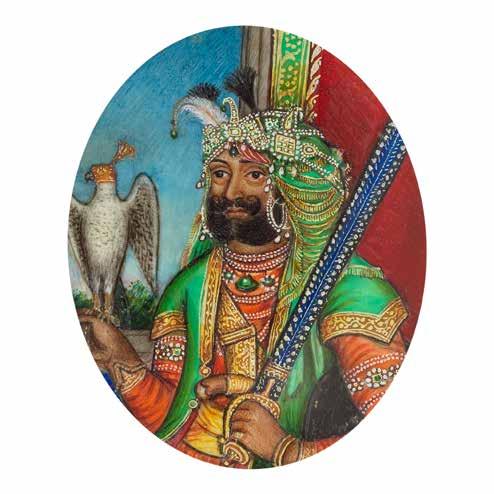
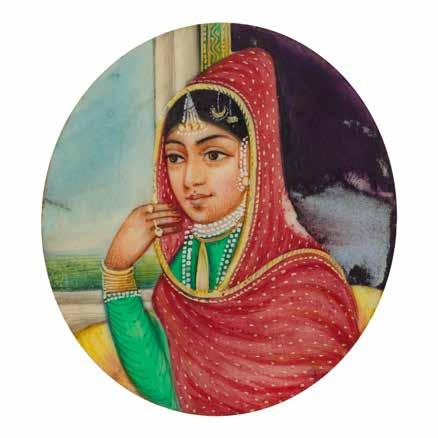
243 Y Ф
A SMALL PAINTING ON IVORY DEPICTING MAHARAJAH SHER SINGH HOLDING A FALCON
NORTH INDIA, CIRCA 1850-55
gouache and gold on ivory, oval, in later circular glazed frame painting 50 x 42 mm.; frame 75 mm. diam.
£1,500 - 2,000
€1,700 - 2,300
US$2,000 - 2,700
The item within this lot containing ivory has been registered in accordance with the Ivory Act (Section 10), reference no. T61LLWRQ.
244 Y Ф
A SMALL PAINTING ON IVORY DEPICTING RANI JINDAN, WIFE OF MAHARAJAH RANJIT SINGH
NORTH INDIA, CIRCA 1850-55
gouache and gold on ivory, attached to a square of watermarked paper, inscribed recto and verso Queen of Punjab and indistinctly recto in pencil painting 48 x 44 mm.; paper 105 x 100 mm.
£1,000 - 1,500
€1,100 - 1,700
US$1,400 - 2,000
The item within this lot containing ivory has been registered in accordance with the Ivory Act (Section 10), reference no. 4E82E1ZG.
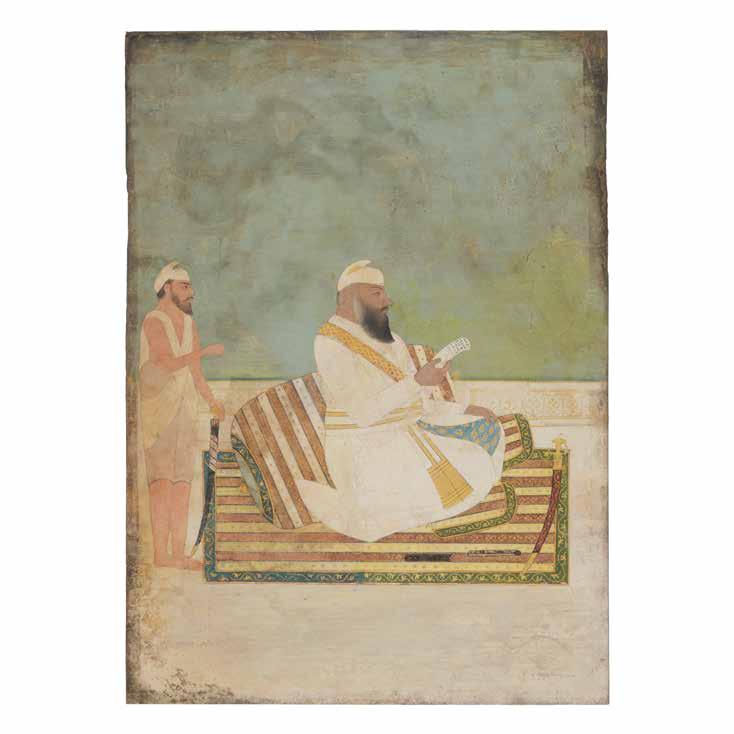
A SIKH NOBLEMAN SEATED ON A TERRACE READING A LETTER, WITH AN ARMED ATTENDANT STANDING BEHIND HIM PUNJAB, EARLY 19TH CENTURY gouache and gold on paper, inscribed in Persian in nasta’liq verso 223 x 160 mm.
£4,000 - 6,000
€4,600 - 6,900
US$5,400 - 8,100
The inscription verso reads ‘The value of this picture...’ (with the value erased).
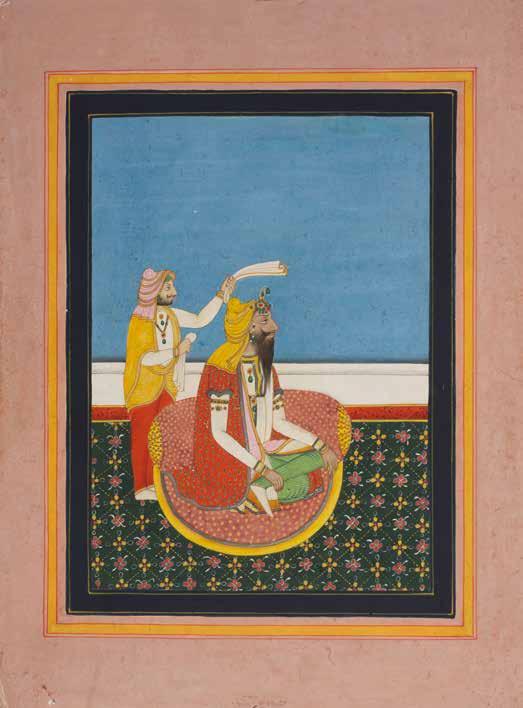
SEATED ON A TERRACE WITH AN ATTENDANT WAVING A FLYWHISK
gouache and gold on paper, dark blue and yellow inner borders, dull pink outer border
310 x 233 mm.
£8,000 - 12,000
€9,200 - 14,000
US$11,000 - 16,000
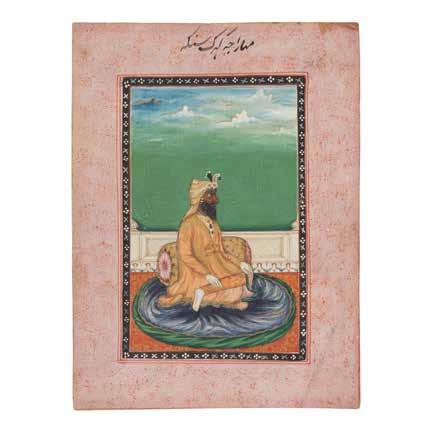
247
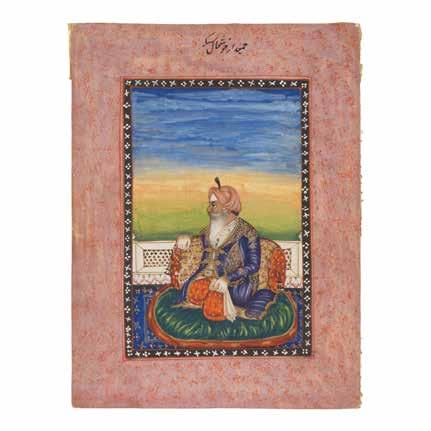
TWO PORTRAITS OF KHARAK SINGH AND JAMADAR KHUSHAL SINGH, BY IMAM BAKHSH LAHORI OR AN ARTIST IN HIS WORKSHOP
PUNJAB, PROBABLY LAHORE, CIRCA 1830-40
gouache and gold on paper, stylised floral inner borders, pink outer borders, nasta’liq identifying inscription in upper borders 178 x 132 mm.(2)
£4,000 - 6,000
€4,600 - 6,900
US$5,400 - 8,100
The inscriptions read respectively: ‘Maharaja Kharak Singh’; jam’dar khushhal singh, ‘The military officer Khushhal Singh’.
Khushal Singh’s interesting career is summarised laconically by W. G. Archer, Paintings of the Sikhs, London 1966, p. 109: ‘Born 1790. Son of a Brahmin shop-keeper. Came to Lahore to seek his fortune, 1807. Joined Ranjit Singh’s bodyguard. Favourite. Promoted Chamberlain, 1811. Embraced Sikhism and took the name Khushal Singh. Superseded by Dhian Singh, 1818, but remained member of Ranjit Singh’s inner council. Governor of Multan. Supervised revenue collections in Kangra Hills. Died, 1839’.
This pair of portraits belong to a dispersed set that were often gifted to European visitors to the Court of Lahore during the reigns of Maharaja Ranjit Singh and his successors. Maharaja Kharak Singh (1801–1840) was the heir and successor of Maharaja Ranjit Singh, ruling the Sikh Empire from September 1839 until his dethronement and imprisonment in February 1840. The crown prince was brought up in his family’s martial tradition and assigned to a variety of military expeditions in his early years. When barely six years old, he was given the command of an expedition to conquer Sheikhupura, and in 1818, he was invested with the command of the siege of Multan, defeating its Afghan ruler, Nawab Muzaffar Khan. Further military commands contributed to the annexation of Kashmir and Peshawar. Though Kharak Singh was courageous and skilful in battle, his mild disposition led some to regard him as simpleminded, in stark contrast to his father who was highly shrewd and often cunning in his actions. On succeeding his father, rumours began to
emerge that Maharaja Kharak Singh and his tutor, Chet Singh Bajwa, who also served as his key advisor, were secretly planning to betray the kingdom to the British and to disband the Sikh Army. This led to the heir apparent, Prince Nau Nihal Singh and the court becoming estranged from the Maharajah. Matters came to a head when Chet Singh was assassinated in October 1839 in the presence of their royal master, who vainly implored them to spare the life of his friend. Kharak Singh was officially deposed and imprisoned for supposed crimes in February 1840. Bedridden, he died on 5 November 1840 in Lahore, possibly from the effects of poisoning rumoured to have been administered by the prime minister, Raja Dhian Singh.
Jamadar Khushal Singh (1790–1844) was a notable figure who began his career as a soldier. As a favourite of Maharaja Ranjit Singh he was appointed personal attendant to the Sikh ruler, rising through the ranks to become lord chamberlain, an office he held for almost fifteen years. This position commanded great influence and authority, as Khushal Singh was master of royal ceremonies and superintendent of both the royal palace and the Sikh court. No one could have access to the sovereign or enter the palace without his prior permission. In addition to his administrative duties, Khushal Singh excelled as a military officer, serving in various military expeditions including Kashmir (1814), Mukerian (1816), Multan (1818), Dera Ghazi Khan (1819), Derajat (1820), Dera Ismail Khan (1821), Leiah (1821), Mankera (1822), Peshawar (1823) and Kangra (1828).
Based on a painting in the Government Museum and Art Gallery, Chandigarh (Acc.no. 3722), which is signed by the artist, our paintings appear to have been produced in the studio of the famed Imam Bakhsh Lahori (fl. 1820–50). This talented Muslim artist was employed by many members of the city’s nobility although he is best known for his paintings commissioned by French and Italian generals employed by the Sikh court of Lahore between 1822 and 1843.
This painting shows an almost identical Kharak Singh as crown prince (seated on a chair and dressed in yellow and green) as our painting. Furthermore, the treatment of Prince Sher Singh’s green jacket with red lining is reproduced almost exactly in the rug appearing in the Khushal Singh portrait.
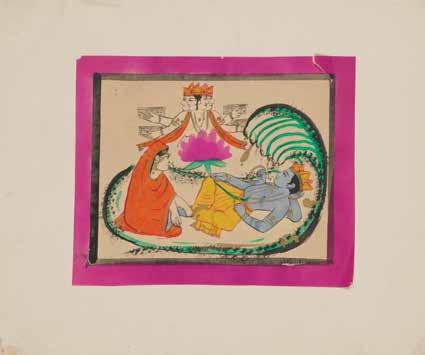
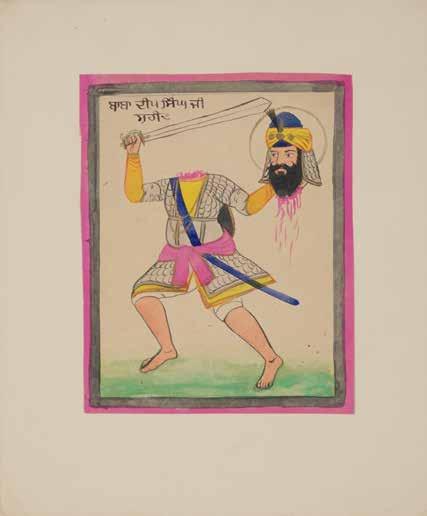
248
THREE PAINTINGS DEPICTING RAMA AND LAKHSHMANA, SIVA AND PARVATI, AND VISHNU, LAKHSHMI AND BRAHMA SEATED ON THE SERPENT SHESHA
PUNJAB, PROBABLY BY AN AMRITSAR ARTIST, EARLY 20TH CENTURY
gouache and gold on paper, black and mauve borders, laid down on larger sheets, one painting using the reverse of a printed British official form paintings 205 x 155 mm. and slightly smaller; sheets 285 x 238 mm.(3)
£1,000 - 1,500
€1,100 - 1,700
US$1,400 - 2,000
249
THE SIKH MARTYR BABADEEP SINGH PUNJAB, PROBABLY AMRITSAR, ATTRIBUTED TO GIAN SINGH ‘NAQQASH’ (1883-1953), EARLY 20TH CENTURY
gouache and gold on paper, black and mauve borders, gurmukhi inscription at upper left, laid down on a larger sheet 187 x 150 mm.
£1,500 - 2,000
€1,700 - 2,300
US$2,000 - 2,700
Baba Deep Singh (1682-1757) is a famous Sikh hero, who was initially a close companion of Guru Gobind Singh. He combined religious life and devotion to the scriptures with military duties in the Khalsa army. He fought under Banda Singh Bahadur against the Mughals, but his best-known actions were against the Afghans during their incursions into India under Ahmad Shah Durrani. At the battle of Amritsar in 1757 (which the Sikhs fought in part to avenge the desecration of the Golden Temple), Baba Deep Singh (who had come out of scholarly retirement in his old age) was decapitated in combat, but according to legend fought on.
A depiction of his confrontation with the Afghan army, by the artist Bodhraj, dated 1984, was sold in these rooms, Islamic and Indian Art, 30th March 2021, lot 120; and another, depicting the decapitated hero fighting on, as in the current painting, by Shankar Lal, circa 1950-60, in the sale of 25th October 2021, lot 322.
Gian Singh (1883–1953), known as Gian Singh ‘Naqqash’, specialised in naqqashi (engraving) and mohrakashi (fresco) methods. He worked at the Golden Temple for more than 33 years, and was instrumental in developing a local Punjabi style in contrast to Pahari painting. For examples of other works by this artist, sold in these rooms, see Bonhams, Islamic and Indian Art, 22nd May 2025, lots 247 and 248.
250
SIX PAINTINGS ON MICA DEPICTING A MARATHA NOBLEMAN, TRADESPEOPLE AND OTHER FIGURES, INCLUDING A SIKH
AKALI NIHANG
SOUTH INDIA, MID-19TH CENTURY
gouache and gold on mica, in pairs in three modern clip frames each painting 110 x 72 mm.; frames 18 x 24 cm.
£1,500 - 2,000
€1,700 - 2,300
US$2,000 - 2,700
251
TWO PAINTINGS DEPICTING A SIKH AND CHILD, AND A PUNJABI DOCTOR TREATING A PATIENT
PUNJAB, CIRCA 1850
watercolours on watermarked paper laid down together on one sheet of card, Persian and English inscriptions, margin rules in gold, red and blue card 176 x 445 mm.
£1,500 - 2,000
€1,700 - 2,300
US$2,000 - 2,700
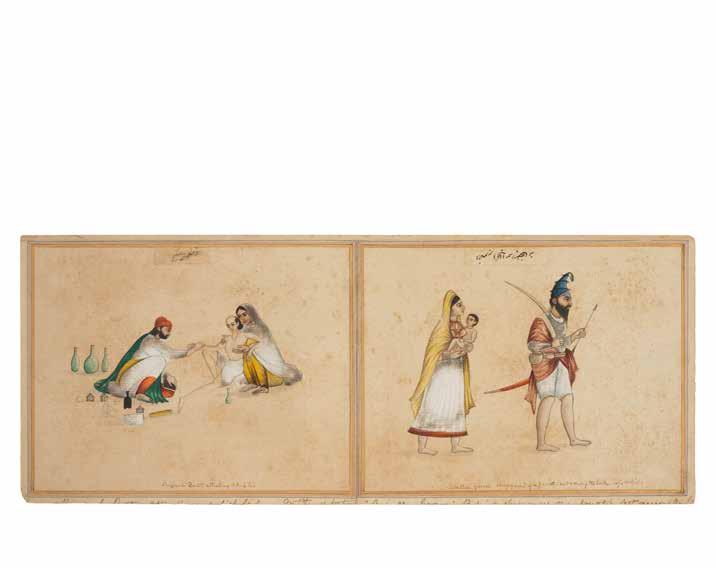
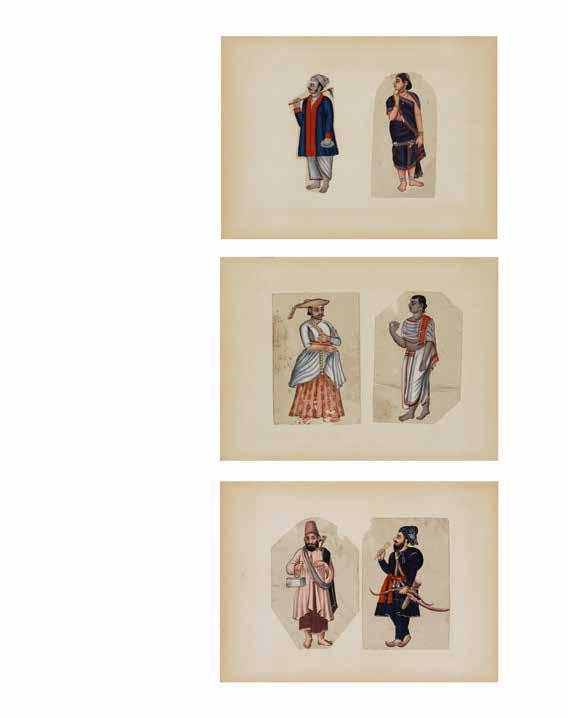
PUNJAB, CIRCA 1850-60
watercolours with some gold on watermarked paper, some leaves embossed with London Serpent stamp, inner margins ruled in gold, blue and red, contemporary English identifying inscriptions in upper borders, contemporary binding, leather over pasteboards, covers with centrally blind-stamped decorative vignettes, ruled within blindstamped floral decorative borders
200 x 245 mm.
£18,000 - 24,000
€21,000 - 28,000
US$24,000 - 32,000
For similar albums, apparently often acquired by British servicemen and visitors to the Punjab, see the sales in these rooms, Bonhams, Islamic and Indian Art, 30th April 2019, lot 212; 26th October 2020, lot 268; 30th March 2021, lot 124; 25th October 2021, lot 334; and various other instances of single paintings or groups of paintings from dispersed albums.
Mildred Archer notes that specific inscriptions indicated these albums were intended for a British audience. One such book in the British Library contains the inscription; ‘All the sahibs take it to show in England’ (Archer, Company Drawings in the India Office Library, London 1972, p. 209). One such collector was Maharajah Duleep Singh’s guardian, Sir John Login. In his letters he notes: ‘the little Maharaja has been collecting for me drawings and paintings done by his best painters. Some are very curious and interesting indeed, representing domestic life in the Punjab, and various trades and professions. He also selected authentic likenesses of great chiefs and men of note’.
The subjects are as follows:
1. Shalimar Gardens, Lahore.
2. Amritsure, Priest’s House [sic: the Golden Temple].
3. Sheesh Mahal of Maharajah Runjeet Singh.
4. Gold Spired Masjid, City of Lahore.
5. Jummer Masjid, City of Lahore.
6. Fort of Govindgarh.
7. Runjeet Singh’s Tomb, Lahore.
8. Palace, Fort of Lahore.
9. Jahangir’s Tomb, Lahore.
10. Wazeer Khan’s Worshipping Place, Lahore.
11. Sirdar Sheer Singh Attareewallah.
12. Rajah Deena Nauth.
13. Sirdar Chutter Singh Attareewallah.
14. Rannee Chundah [Rani Jindan].
15. Deewan Moolraj.
16. Maharajah Runjeet Singh, King of Lahore.
17. Rajah Golaub Singh.
18. Maharajah Sheer Singh.
19. Sirdar Dost Mohamed Khan.
20. Maharajah Dhuleep Singh.
21. Drunkards.
22. Knife Grinders.
23. Conjurers.
24. Sheik Priest, Sheik Priestess [an akali nihang and his wife and child].
25. Punjabee Doctor.
26. Ventoora Kor Sultan [?], Adjutant and a Milk Woman [presumably a Sikh officer serving under General Ventura].
27. Hill man, Khyber robber.
28. Flower Seller.
29. Sweetmeat man.
30. Snake Men.
31. Tiners [metalworkers].
32. Making Liquor.
33. Female Tumbler.
34. Toy Seller.
35. Monkey Dancing.
36. Bell Man and Beggar [two types of fakir].
37. Conjurors.
38. Bear Wrestler.
39. Sportsmen [depicted hunting game].
40. Churup [?] Smokers and Bang Maker.
41. Gold twister, gold beater.
42. Rice Sellers.
43. Milk Man [milking a cow].
44. Water Carrier.
45. Barber.
46. Dyers.
47. Shoe Makers.
48. Bankers.
49. Persian Well.
50. Making Butter.
51. Silk [ribbon] Makers.
52. Potters.
53. Dancing Girl [with musicians].
54. Cotton Beater.
55. Butchers Selling Mutton.
56. Gardener selling fruit.
57. Cashmere Women Making Warm Cloth.
58. Washerman.
59. Cloth Makers.
60. Soomar wallah [?].
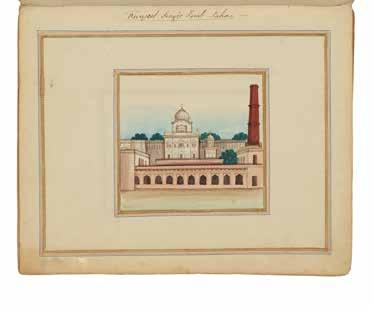
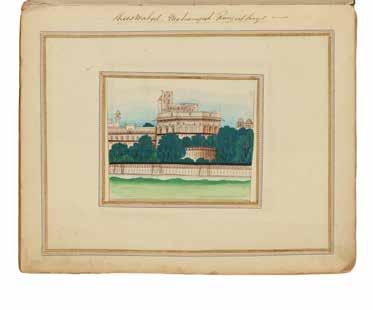
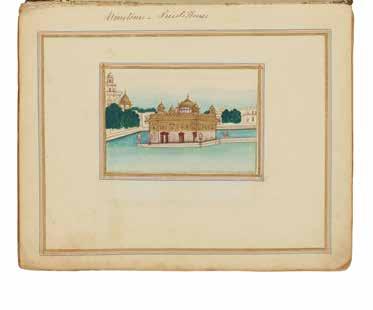
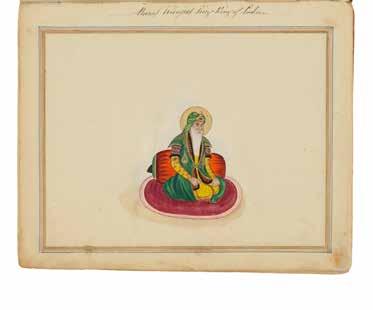
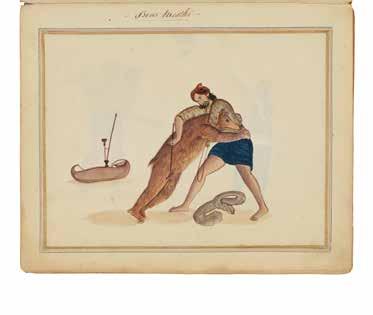
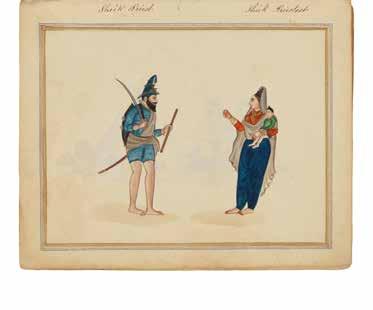
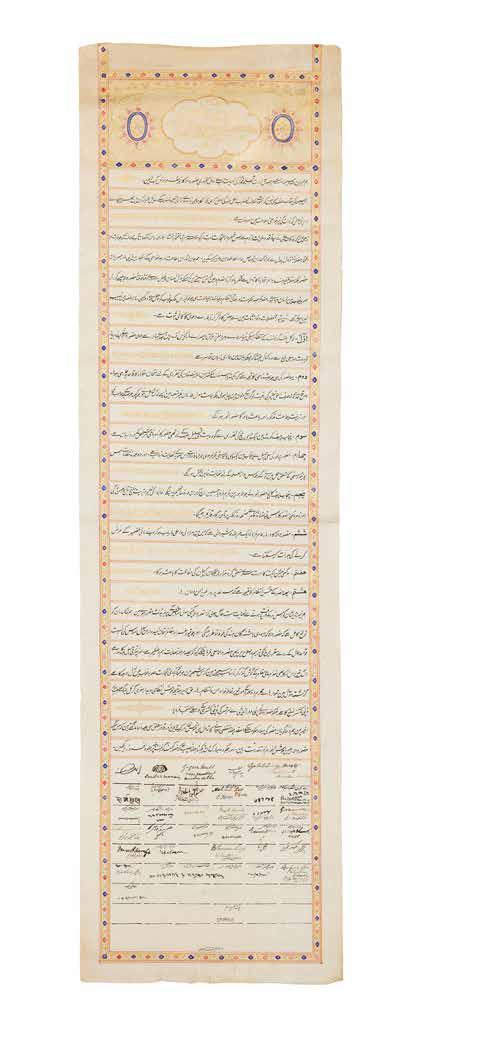
253 † AN OFFICIAL DOCUMENT IN URDU IN SCROLL FORM, PRESENTED TO SIR CHARLES AITCHISON, LIEUTENANTGOVERNOR OF THE PUNJAB, AND FOUNDER OF AITCHISON COLLEGE, CELEBRATING HIS ACHIEVEMENTS IN OFFICE PUNJAB, PROBABLY LAHORE, DATED 23RD NOVEMBER 1886
Urdu manuscript on paper, in scroll form, ornate illuminated headpiece in colours and gold with nasta’liq text in gold within cartouche, 30 lines of text in nasta’liq in black ink interspersed with floral sprays in gold, interlinear rules in red and gold, illuminated margins, panel below main text containing numerous witness signatures and attestations in nasta’liq and nagari, with English translations of names and titles 132.5 x 36 cm.
£6,000 - 8,000
€6,900 - 9,200
US$8,100 - 11,000
The document addresses the Honourable Sir Charles Umpherston Aitchison, KCSI, CIE (183296), Lieutenant-Governor of the Punjab, listing his works and his contributions in the Punjab, including the founding of Aitchison College in 1886, the year of this document. Aitchison College remains one of the foremost schools in Pakistan (the ‘Eton of Pakistan’), educating future Prime Ministers and other public figures.
Aitchison served as Lieutenant-Governor of the Punjab from 1882 to 1887, was made a Knight Commander of the Order of the Star of India (KCSI) in 1881, and a Companion of the Order of the Indian Empire (CIE) in 1882. He served as Chief Commissioner of the British Crown Colony of Burma from March 1878 to May 1880.
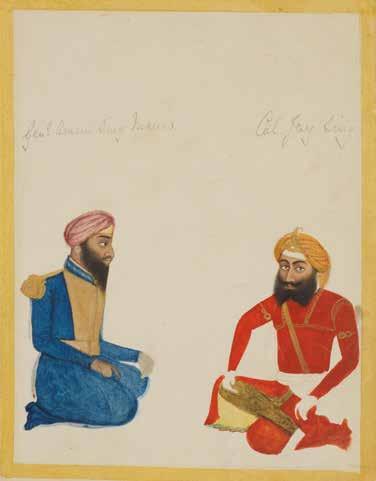
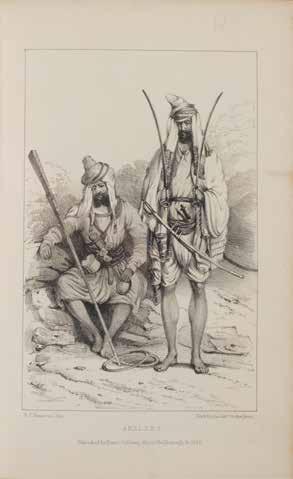
255
254
GENERAL AMAR SINGH MAAN AND COLONEL JAI SINGH, SENIOR OFFICERS OF THE SIKH KHALSA ARMY PUNJAB, MID-19TH CENTURY
gouache and gold on paper, inscribed in English in pencil Genl. Amar Sing Maun and Col. Jay Sing, yellow inner margin 220 x 180 mm.
£1,500 - 2,000
€1,700 - 2,300
US$2,000 - 2,700
This painting was probably part of a commemorative album, which were common in the mid-19th Century when British officials and prominent local figures commissioned artists to document rulers, generals and other notables of the Punjab.
General Amar Singh Maan, on the left, was a member of the influential Maan family, who were prominent sardars and generals under Maharajah Ranjit Singh and his successors. His uniform is heavily influenced by European military dress, adopted by the Sikh empire to modernise its forces.
Colonel Jai Singh sits wearing a striking red uniform and a yellow turban. His rank, as does that of Amar Singh Maan, reflects the semiWesternised organisation and structure of the Sikh forces, where European officers like Jean-Baptiste Ventura and Claude Auguste Court helped train local officers.
255 • W. G. OSBORNE, THE COURT AND CAMP OF RUNJEET SING, WITH AN INTRODUCTORY SKETCH OF THE ORIGIN AND RISE OF THE SIKH STATE
HENRY COLBURN, LONDON, 1840
pp. 236, with sixteen engravings of which one is a facsimile reprint (Ranjit Singh on horseback), ownership inscription of Thomas Barnewall on title-page, half-calf, marbled boards 230 x 150 mm.
£1,000 - 1,500
€1,100 - 1,700
US$1,400 - 2,000
William Osborne was military secretary to the Governor-General, his uncle Lord Auckland. In May 1838 he was sent to Ranjit Singh’s court in Lahore to make arrangements for the the later British mission there. 254
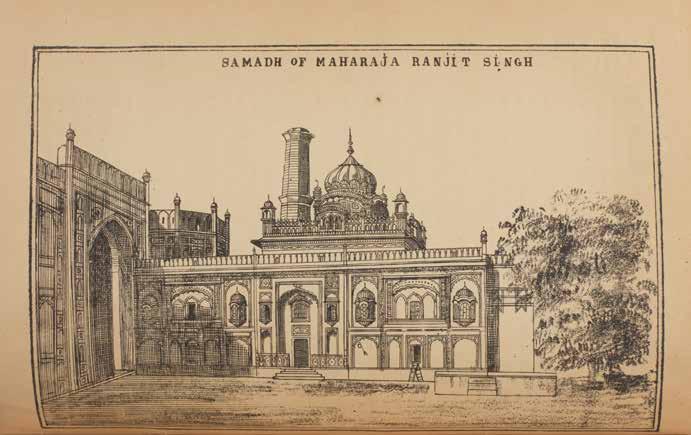
LAHORE: ITS HISTORY, ARCHITECTURAL REMAINS AND ANTIQUITIES, WITH AN ACCOUNT OF ITS MODERN INSTITUTIONS, INHABITANTS, THEIR TRADE, CUSTOMS &C., BY SYAD MUHAMMAD LATIF KHAN BAHADUR, WITH 105 ILLUSTRATIONS
LAHORE, PRINTED AT THE NEW IMPERIAL PRESS, 1892 pp. 426 plus introduction (i-xiii) and index, 105 monochrome lithographic plates, lacking folding map of Lahore as frontispiece, marbled paper doublures, brown leather gilt 235 x 170 mm.
£2,000 - 3,000
€2,300 - 3,400
US$2,700 - 4,100
The author was ‘Extra-Judicial Assistant Commissioner, Gurdaspur, Fellow, Panjab University, and Member of the Bengal Asiatic Society’.
The 105 lithograph illustrations cover the monuments of the city from the high Mughal period, Sikh buildings, then-contemporary British public buildings, Gandharan sculptures in the Lahore Museum, and the Zamzama Gun.
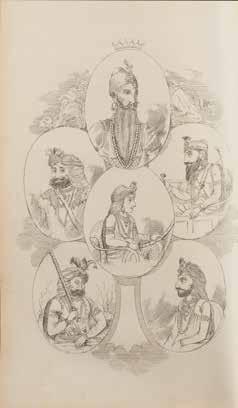
257 •
MAJOR G. CARMICHAEL SMYTH, A HISTORY OF THE REIGNING FAMILY OF LAHORE, WITH SOME ACCOUNT OF THE JUMMOO RAJAHS, THE SEIK SOLDIERS, AND THEIR SIRDARS
W. THACKER & CO., CALCUTTA, 1847
pp. 263, pp. 40 of appendices, five plates showing Sikh notables and one of an akali on horseback, folding family tree of Maharajah Ranjit Singh, lacking folding map of Lahore, contemporary green leather binding, front flyleaf with stamp of H. C. Irwin, BCS 220 x 140 mm.
£2,000 - 3,000
€2,300 - 3,400
US$2,700 - 4,100
Carmichael Smyth was a Major in the 3rd Bengal Light Cavalry. The book begins with the history of the family or Maharajah Ranjit Singh, his rise to power and his achievements, the internecine strife amongst the Sikhs after his death, and the arrival of, and wars with the British. There are also a large number of appendices covering all aspects of Punjab life, from discussions of other writers’ works on the subject to the region’s flora and fauna and its manufactures. The author writes, in a Notice, that ‘unforeseen and unavoidable circumstances and the great distance from Calcutta at which the Editor has been stationed, to whom constant references were made, have delayed this work beyond his expectations’.
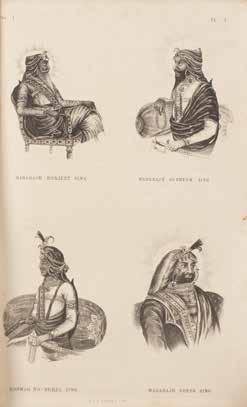
258 • THIRTY-FIVE YEARS IN THE EAST, BY JOHN MARTIN HONIGBERGER, PHYSICIAN AT THE SIKH COURT IN LAHORE H. BAILLIERE, LONDON, 1852
pp. 448, 2 vols. in one, pp. xxix of introduction to this English edition, lithograph frontispiece portrait of the author, numerous lithograph plates including portraits of Sikh notables; the second volume devoted to medical matters, with 31 plates of plants and glossaries of technical terms, original stamped cloth binding 230 x 155 mm.
£2,000 - 3,000
€2,300 - 3,400
US$2,700 - 4,100
Martin Honigberger (1795-1869) was born in Krostadt in Romania, left Transylvania in 1815 and travelled though the Levant, Egypt, Arabia, Persia and then to India. He was in Lahore as physician at the Sikh court between 1829 and 1833, and then again between 1839 to 1849. His account is the main source for the activities of his guest, the artist August Theodor Schoefft (including his run-in with some ferocious akalis while he was sketching in preparation for many of the famous depictions of the Lahore Court. Honigberger’s lithograph illustrations are based on the paintings of artists working in Lahore and Amritsar.
The plates in vol. I include:
Map of Central Asia between Bokhara and Russia.
Plate with portraits of Ranjit Singh and other Sikh notables.
Three sepoys.
Plate with portraits of Rani Jindan, Duleep Singh and others.
Facsimile of a letter in nasta’liq.
Plate with portraits of Maharajah Gulab Singh and other notables.
A Sikh doctor, after the album paintings.
Portraits of Raja Tej Singh and others.
Two horsemen, one an akali.
Portrait of Hari Das.
A barber, after the album paintings.
A seller of perfumes.
Dervishes smoking bhang
Distillers.
Foldout lithograph panorama of the fortress and city of Lahore.
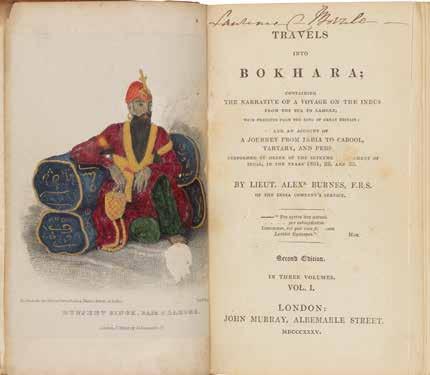
259 • ALEXANDER BURNES, TRAVELS INTO BOKHARA, THREE VOLUMES, SECOND EDITION
LONDON, JOHN MURRAY, 1835 pp. 328 (vol. I), pp. 304 (vol. II), pp. 384 (vol. III), 9 plates in total throughout the three volumes (two double-page, two folding), including frontispiece portrait of Burnes after Daniel Maclise (vol. II), lacking map of Central Asia (vol. I), ownership inscriptions of Lawrence Moude [?], leather boards, spines rebacked with gilt titles and compartments
168 x 110 mm.(3)
£2,000 - 3,000
€2,300 - 3,400
US$2,700 - 4,100
For the full note on this lot, see the online catalogue.
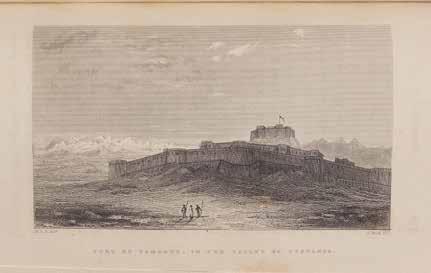
260 • HENRY EDWARD FANE, FIVE YEARS IN INDIA, IN 2 VOLUMES
LONDON, HENRY COLBURN, 1842 vol. I, pp. 323, and pp. 16 (introduction), with two tinted lithographs including frontispiece, several engraved vignette illustrations within text; vol. II, pp. 319 and pp. 12 (introduction), with 10 tinted lithographs including frontispiece, contemporary half-leather binding with gilt compartments on spines
198 x 127 mm.(2)
£1,500 - 2,000
€1,700 - 2,300
US$2,000 - 2,700
The full title reads: Five Years in India: comprising a narrative of travels in the Presidency of Bengal, a visit to the court of Runjeet Sing, a residence in the Himalayah mountains, an account of the late expedition to Cabul and Affghanistan, voyage down the Indus, and journey overland to England
Henry Fane was ‘late aide-de-camp to His Excellency the Commander-in-Chief in India’ (his uncle, General Sir Henry Fane). His account covers the years 1836-40. A well-known lithograph of 1837 of Maharajah Ranjit Singh is after a drawing by G. T. Vigne ‘taken during the visit of HE General Sir Henry Fane GCB, Commander in Chief of the King’s and Honble Compy’s Army in India to Lahore’ (see W. G. Archer, Paintings of the Sikhs, London 1966, pp. 164-165, fig. 68). Chapters VII-X of Vol. I deal with Fane’s time in Lahore and with the Sikhs.
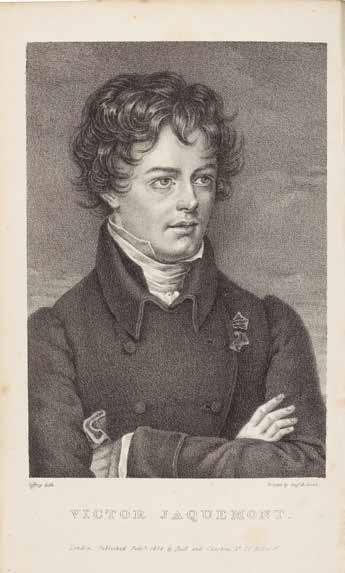
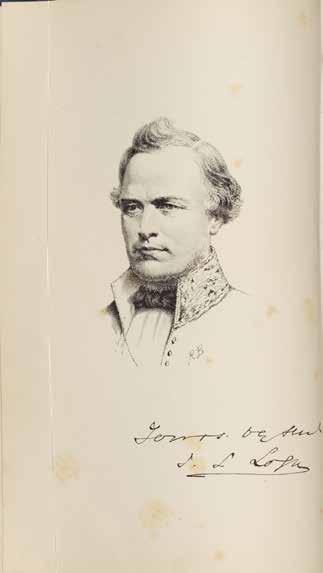
VICTOR JACQUEMONT, LETTERS FROM INDIA, DESCRIBING A JOURNEY IN THE BRITISH DOMINIONS OF INDIA, TIBET, LAHORE AND CASHMERE, DURING THE YEARS 1828, 1829, 1830, 1831, 2 VOLUMES, FIRST EDITION IN ENGLISH LONDON, EDWARD CHURTON, 1834
pp. 409 (vol. I), pp. 378 (vol. II), lithographed portrait frontispiece and large folding map (both these in vol. I), ownership inscription of Geo. Hutchinson on title pages, gilt leather, marbled boards 220 x 140 mm.(2)
£1,500 - 2,000
€1,700 - 2,300
US$2,000 - 2,700
For the full note on this lot, see the online catalogue.
262
LADY LOGIN, SIR JOHN LOGIN AND DULEEP SINGH, FIRST (AND ONLY) EDITION, IN ORIGINAL BLUE CLOTH EMBOSSED WITH THE COAT OF ARMS OF MAHARAJAH DULEEP SINGH
LONDON, W. H. ALLEN & CO., 1890
580 pp., lithographed frontispiece portrait of Sir John Login, introduction by Colonel G. B. Malleson CSI, blue cloth binding, embossed in gold with the coat of arms of Maharajah Duleep Singh 230 x 160 mm.
£1,500 - 2,000
€1,700 - 2,300
US$2,000 - 2,700
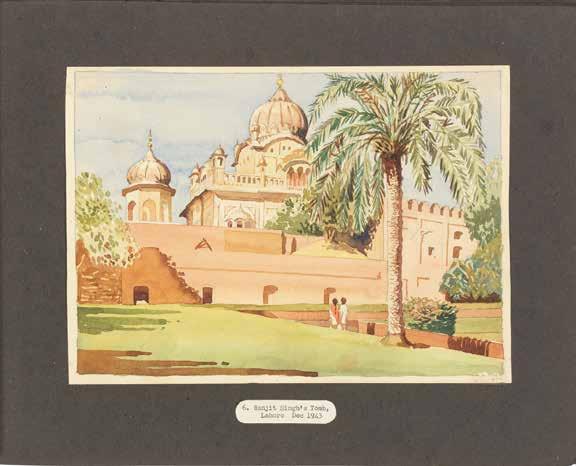
263
AN ALBUM OF THIRTY-TWO WATERCOLOURS DEPICTING VIEWS OF BOMBAY, DELHI, DACCA, ETC., AND LAHORE, INCLUDING THE TOMB OF MAHARAJAH RANJIT SINGH BRITISH SCHOOL IN INDIA, BY CAPT G. WILLIAM DALE, ROYAL ENGINEERS, DATED SEPTEMBER 1943-FEBRUARY 1944
watercolours on paper, and three in pencil, pasted into an album, typewritten captions pasted in, brown leather album apparently contemporary with the paintings (label Made in India) paintings: the smallest 175 x 215 mm.; the largest 310 x 237 mm.; album 265 x 360 mm.
£2,000 - 3,000
€2,300 - 3,400
US$2,700 - 4,100
This fascinating group of paintings in vibrant colours are a record of a British officer’s tour of duty in India, from the voyage out via west Africa to arrival in Bombay, then duty (and presumably tourism) in cities including Lahore, Delhi and Dacca, and smaller places such as Chandernagore (where he sat to be drawn by the artist G. Dass, a student at the School of Art there, in July 1945).
The subjects are as follows:
1. Freetown Harbour [Sierra Leone], May 1943.
2. Indian Ocean, June 1943.
3. Napier Barracks, Lahore, Sept 1943.
4. Indian Ocean, June 1943.
5. Pavilion, Shalimar Gardens, Lahore, Dec 1943.
6. Ranjit Singh’s Tomb, Lahore, Dec 1943.
7. [Portrait of a man], ‘Reblu’, Lahore, Feb 1944.
8. Jem[adar] Des Raj, Lahore, Feb 1944.
9. Hav[ildar] Major Harbans Singh, Lahore, Feb 1944.
10. ‘Irene’, Jhansi, April ‘44.
11. Chhota Masjid, Delhi, Dec 1943.
12. Lohari Gate, Lahore, Jan 1944
13. Villagers, Central Provinces, June 1944.
14. [Portrait of a Woman], ‘Lachhia’, Saugor, June 1944.
15. Making Chapaties, Lahore, December 1943
16. [Female Dancers with Musicians], Nachne Wali, Saugor, June 1944.
17. Plasterers’ Labourers, Lahore, Dec 1943.
18. Bakri Wala, Lahore, Dec 1943
19. Bathing ghat, Saugor, July 1944.
20. Village, Central Provinces, July 1944.
22. Shaila Das, Dacca, Jan 1945.
23. House at Chandernagore, Oct 1945.
24. Tank at Chandernagore, Oct 1945.
25. Wedding, Chandernagore, Nov 1945.
26. Protima Shaha, Dacca, Dec 1944 (also inscribed in pencil).
27. Temple Portico, Muzaffarpur, Dec 1945.
28. Street in Bombay, Nov. 1945.
29. Making film scenery, Tollygunge, Jan 46.
30. Temple steps [no caption].
31. Woman seated on a balustrade [no caption].
32. Portrait of a man in a turban [no caption].
33. British servicemen on the deck of the SS Ranchi [no caption].
34. Portrait of Captain G. William Dale, Royal Engineers, by G. Dass, Chandernagore School of Art, 29.7.1945, in pencil.
35. Portrait of a boy or young man, in pencil.
36. Portrait of a young woman, in pencil.
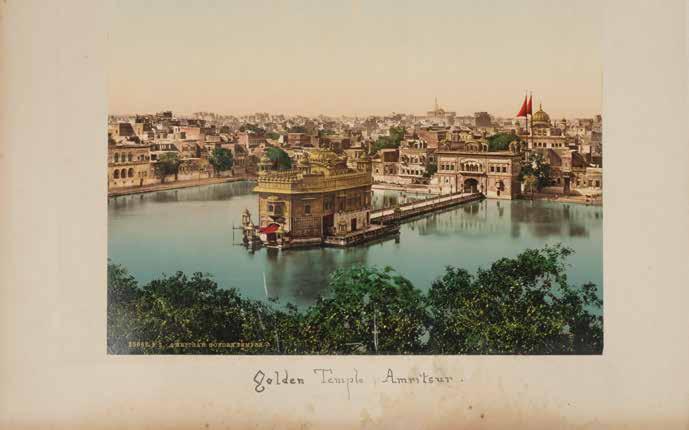
264
TWO LARGE ALBUMS OF A TOTAL OF 163 PHOTOGRAPHS DEPICTING MONUMENTS, STREET SCENES AND TRADESPEOPLE IN AMRITSAR, LAHORE, DELHI, JAIPUR, DARJEELING, BENARES, LUCKNOW, CAWNPORE, AGRA, AHMEDABAD, BOMBAY AND CEYLON VARIOUS PROFESSIONAL AND AMATEUR PHOTOGRAPHERS INCLUDING CHARLES T. SCOWEN, G. W. LAWRIE, APOTHECARIES CO. LTD (CEYLON), BOURNE AND SHEPHERD STUDIO (CALCUTTA), CIRCA 1870-90; ALBUM BINDINGS DATED 1898
albumen and photochrome prints, mounted on card, captioned by hand in ink, lettered in gilt on the front cover, contemporary half-black morocco gilt
the largest approx. 215 x 288 mm.; the smallest 135 x 100 mm.; albums 31 x 42 cm.(2)
£2,500 - 3,500
€2,900 - 4,000
US$3,400 - 4,700
Provenance
Richard Walter Byrd Mirehouse (1849-1914), of The Hall, Angle, Pembrokshire.
For the full note on this lot, see the online catalogue.
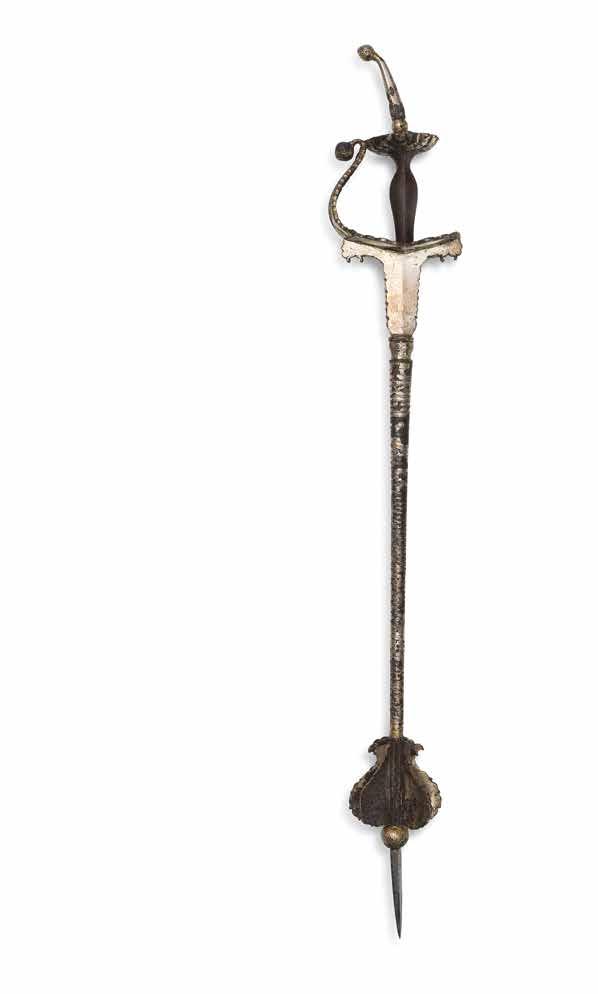
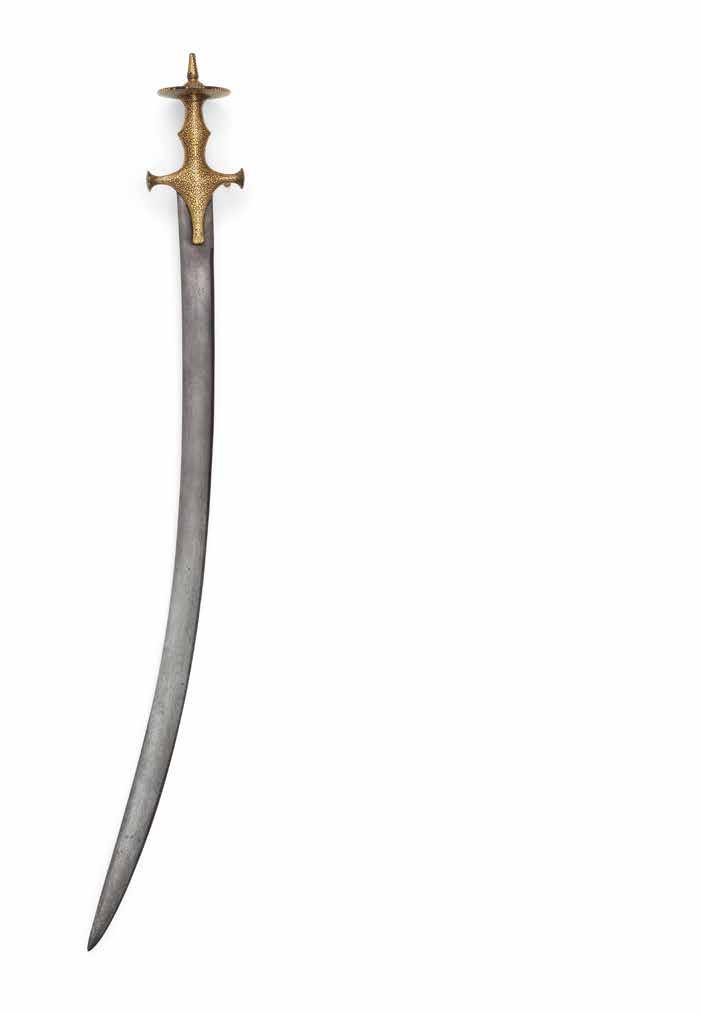
NORTH INDIA, 18TH/ 19TH CENTURY
the curved steel blade with flattened spine becoming double edged towards the point, the hilt profusely decorated in fine gold overlay with floral
Reputedly from the Durbar Hall at Osborne House
Private UK collection: acquired from Jonathan Barrett Antique Arms & Armour in April 2015.
Conceived by Lockwood Kipling (father of Rudyard Kipling), the Durbar Room served as a banqueting hall and entertainment space for Queen Victoria at her Isle of Wight summer residence and was completed in 1891. Its Indian-inspired plasterwork and teak carvings were created by master craftsman Bhai Ram Singh, complemented by a number of artworks, weapons and other objects of intrigue from India. The room acknowledged both the Queen’s role as Empress of India and her affection for the country and its arts. Earlier in her reign, Osborne House often played host to the exiled Sikh Maharajah Duleep Singh (1838-1893), who would become a friend and court favourite of the Queen.
the haft fluted, the basket hilt with foliate and floral motifs and lobed quillons, the pommel of typical form, the knuckle guard terminating in a bud finial, head with seven foliate-edged flanges surmounted by an engraved boss and spearheadshaped point, overlaid in silver with areas of gilding
The hilt of the present lot is similar in form to that of from Lahore sold in these rooms (Islamic
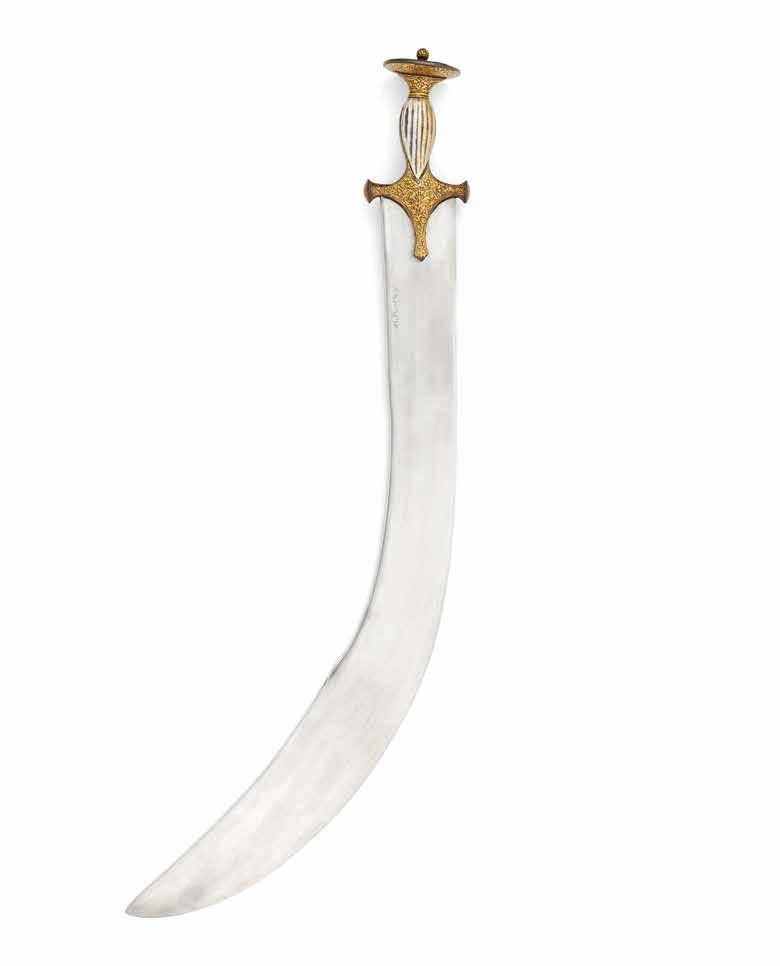
For details of the charges payable in addition to the final Hammer Price of each Lot please refer to paragraphs 7 & 8 of the Notice to Bidders at the back of the catalogue.
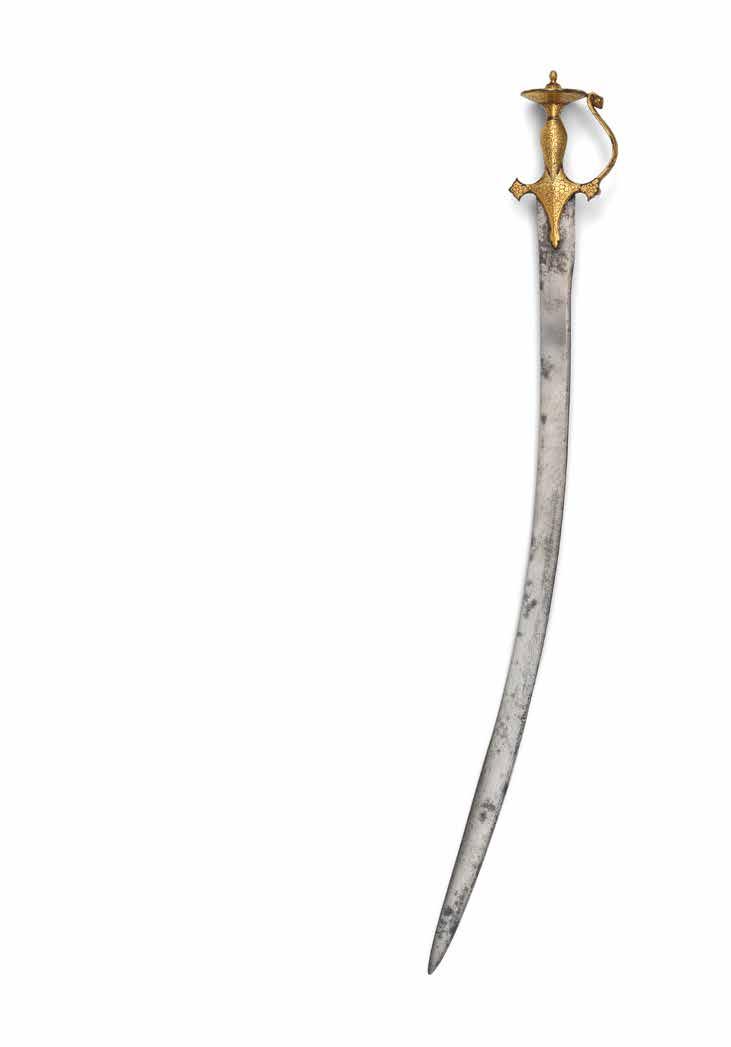
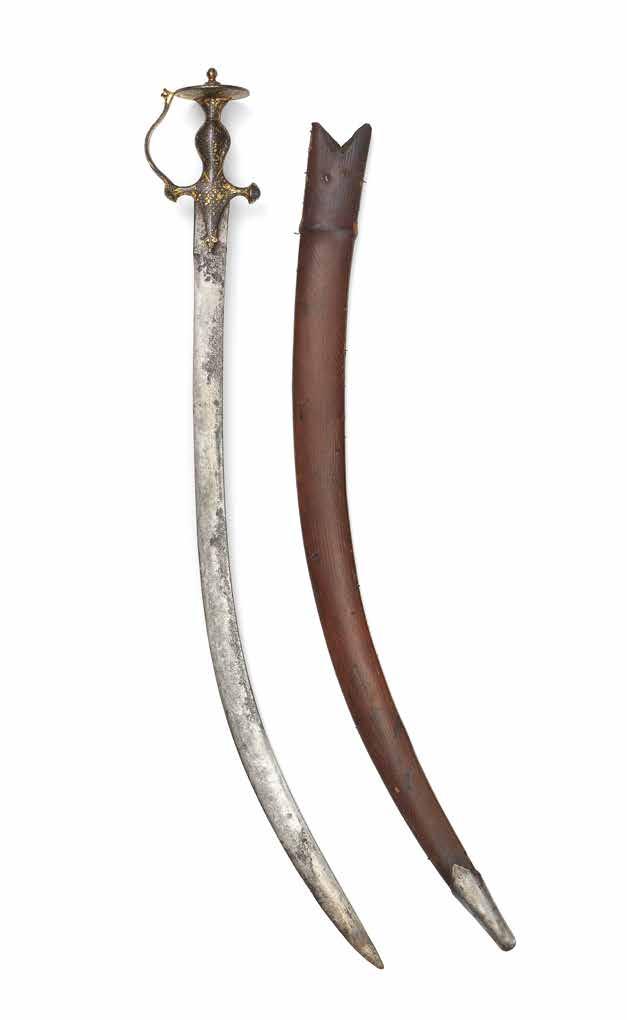
the steel blade of curved form with flattened spine becoming doubleedged towards the point, partial stamp to one side near forte, the hilt decorated in gold-overlay with floral motifs, the inner knuckle guard , the wood scabbard clad in brown leather decorated with tooled geometric decoration, steel chape
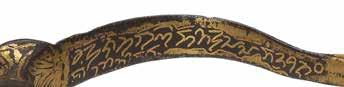
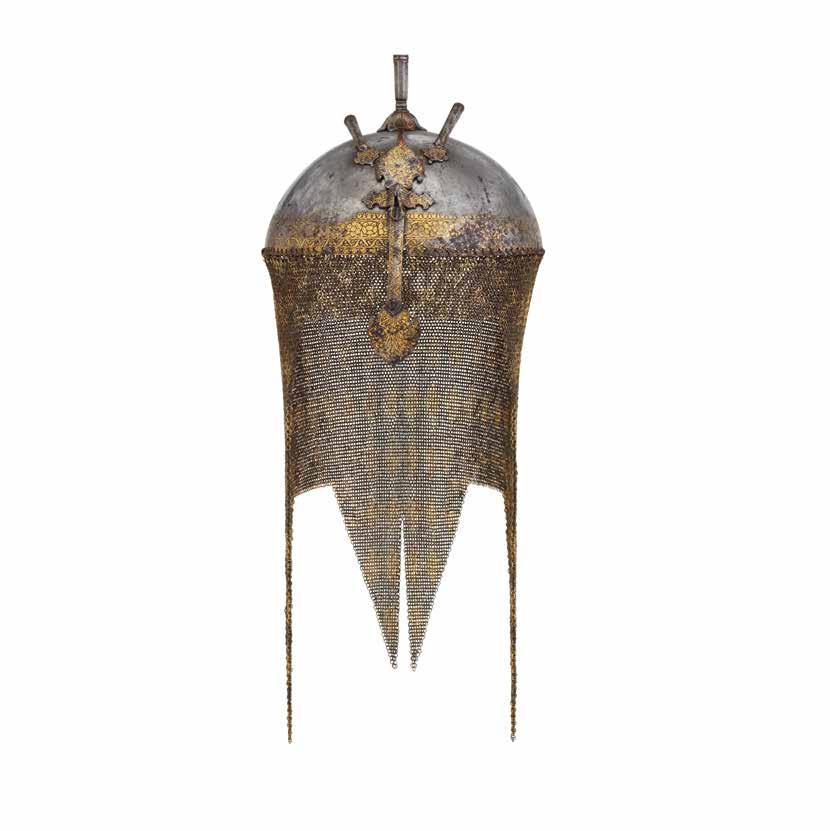
of domed form, with finial in the form of an inverted flowerhead surmounted by a plume holder, the noseguard terminating in palmettes at each end, flanked by two further plume holders and covering remains of an inscription in Gurmukhi, decorated in gold overlay with floral and foliate scrollwork band to rim and floral sprays to applied elements, the camail of brass and steel rings forming a zig-zag design
20.5 cm. diam.
£6,000 - 8,000
€6,900 - 9,200
US$8,100 - 11,000
its geometric zig-zag pattern is known as ‘Ganga-Jamuna’ - the two contrasting colours representing the churning waters at the confluence of two of India’s most sacred rivers, the Ganges and the Yamuna.
For a comparable helmet sold in these rooms, see Bonhams, Islamic and Indian Art, 22 May 2025, lot 271.
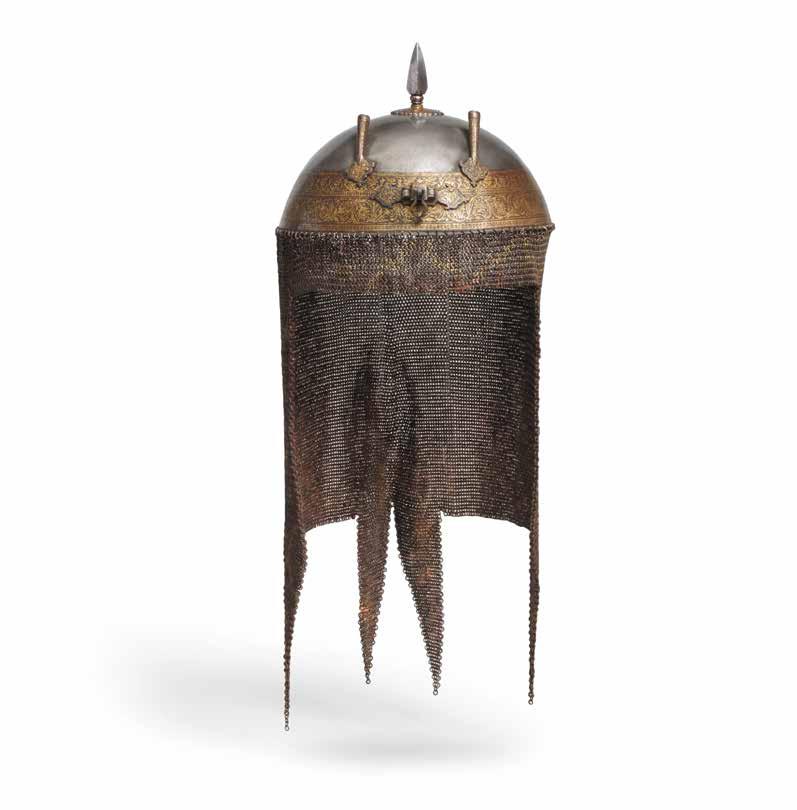
bracket, decorated in gold overlay with bands of floral and foliate scrollwork to the rim and finial, plume holders and noseguard bracket with geometric and floral motifs, the camail of brass and steel rings forming a diamond pattern 20.5 cm. diam.
£6,000 - 8,000
€6,900 - 9,200
US$8,100 - 11,000
For a helmet with comparable koftgari scrollwork, see the Royal Armouries, Leeds (inv. no. XXVIA.110).
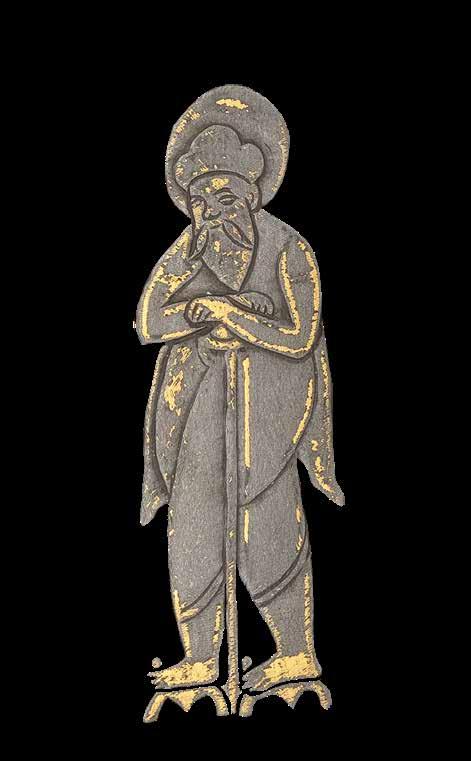
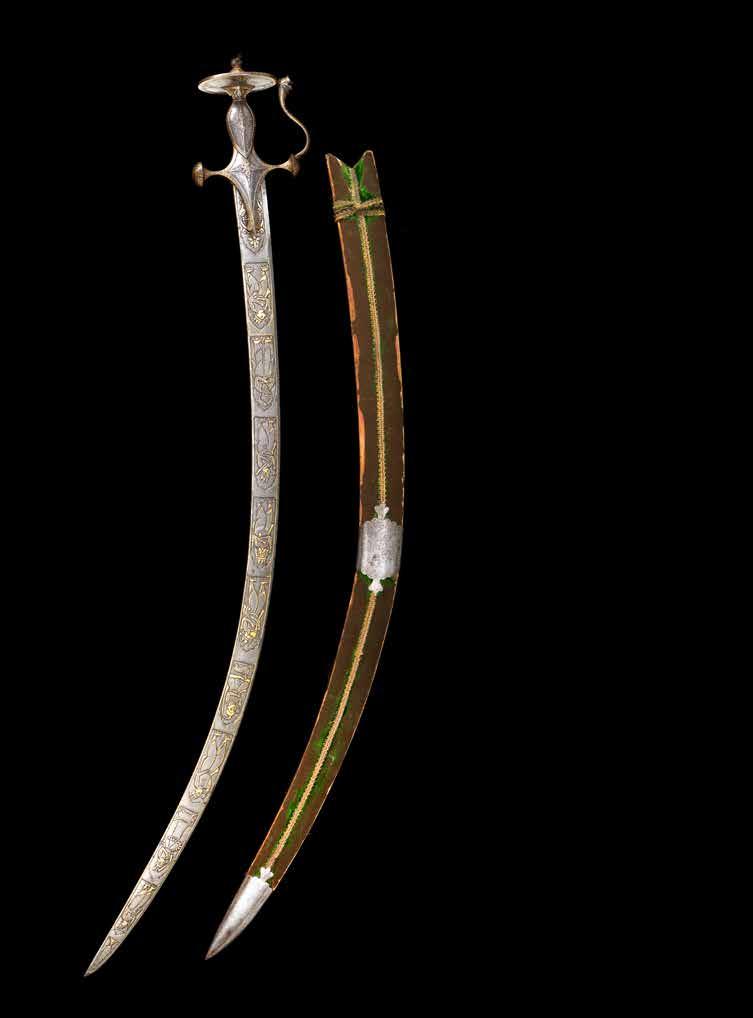
272
A RARE GOLD-KOFTGARI STEEL SWORD (TULWAR) DEPICTING GURU NANAK AND HINDU DEITIES
NORTH INDIA, SECOND HALF OF THE 19TH CENTURY
the single-edged watered-steel blade of curved form, chiselled and decorated in gold overlay to the entire length to both sides with a series of figures within cusped arches, the tip with a boteh, a floral motif and split-palmettes near to the forte, the steel hilt with knuckle guard terminating in a lion head and hinged openwork element to pommel, chiselled and decorated in gold overlay with floral decoration and paired split-palmettes, the wood scabbard clad in green velvet with steel mounts 95 cm. long
£80,000 - 120,000
€92,000 - 140,000
US$110,000 - 160,000
Provenance
Formerly with Robert Hales.
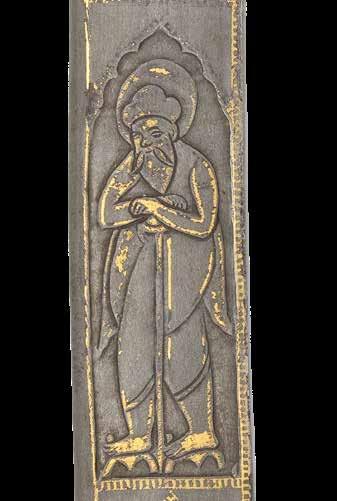
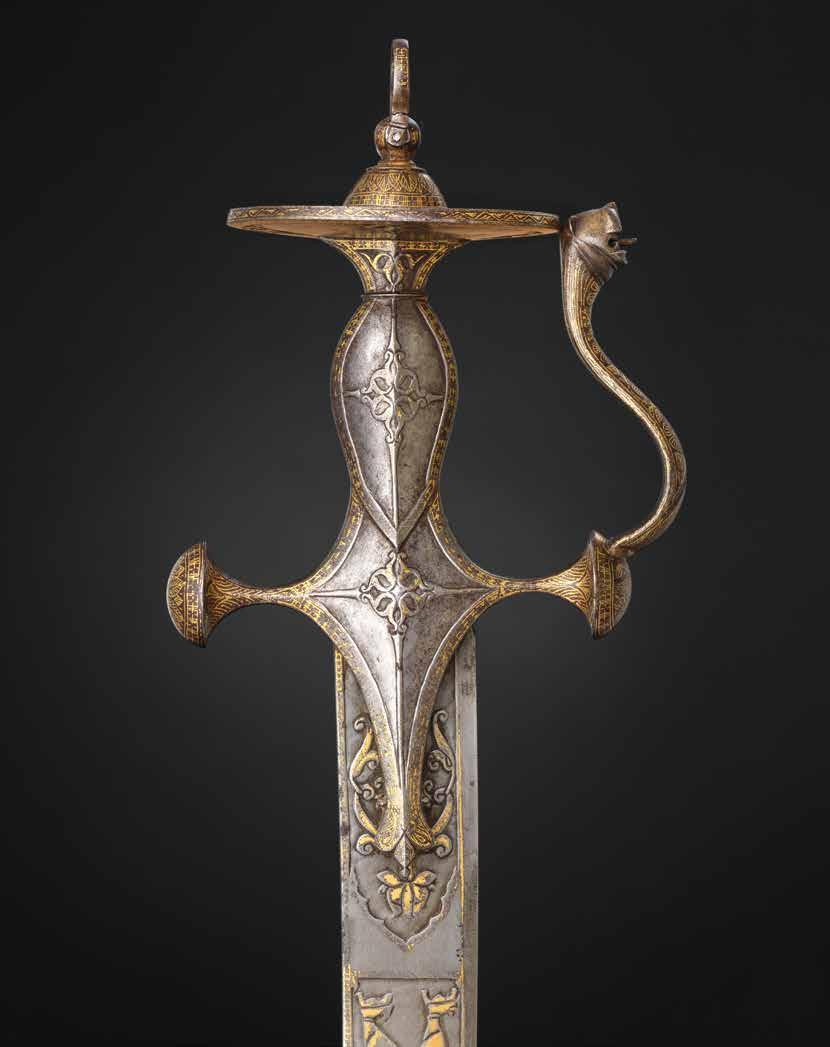
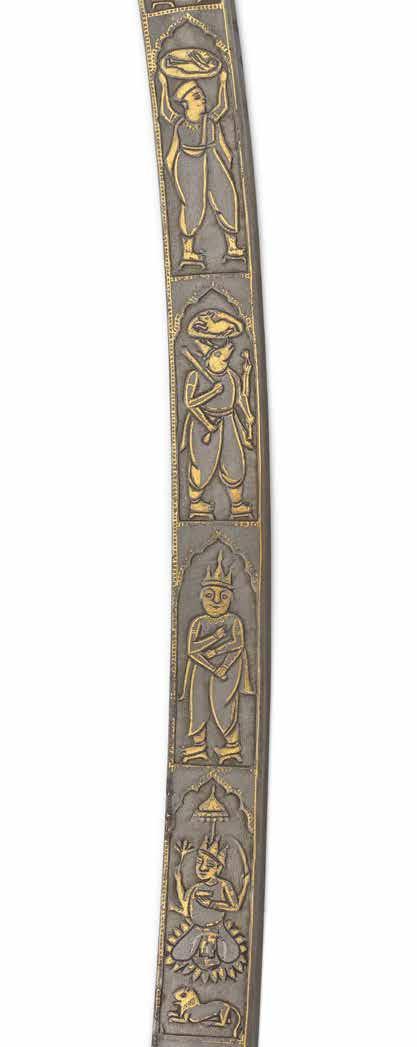
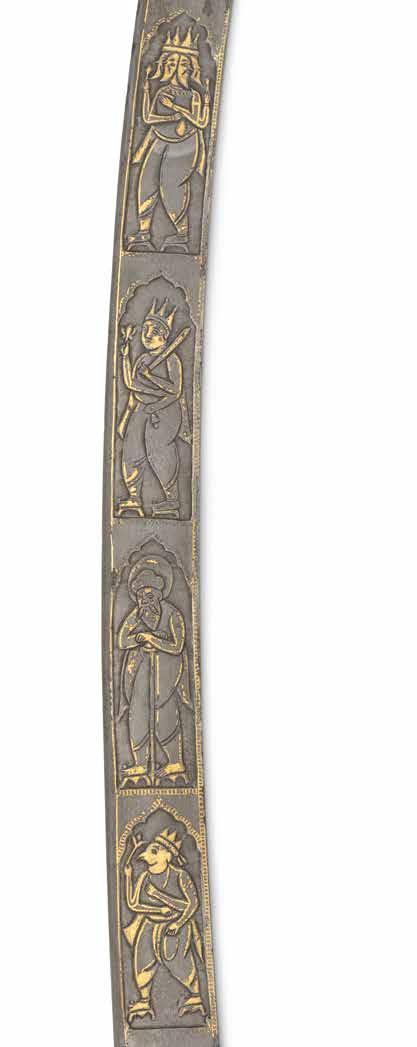
This exceptionally fine and rare sword was produced in either Lahore or Kashmir during the latter half of the 19th century, a period marked by the final continued refinement of Mughal influenced armoury traditions in the Punjab. The hilt, of classical Mughal form, is crisply chiselled in relief with arabesque motifs and overlaid with gold. Its shamshir-like, single-edged watered-steel blade is likewise worked in low relief. The sword is preserved with its original velvet-covered wood scabbard, fitted with steel mounts. Tulwars of this type, forged of watered Damascus steel and enriched with gold koftgari, represent the pinnacle of craftsmanship practiced by armourers serving the ruling elite of the Punjab. Within this tradition, figural decoration flourished. Hunting scenes engraved onto blades gave rise to the category known as shikargarh swords, while other examples paid homage to revered figures or avatars from the Sikh and Hindu pantheons.
The present lot belongs to the latter group and is of exceptional rarity. Its hilt features a depiction of Guru Nanak (1469–1539), the founder of the Sikh faith. Only one other extant sword of comparable iconography is known; it is held in the Royal Collection Trust (RCIN 37828), likely
presented to Edward VII during his tour of India in 1875–76, and published in C. Purdon-Clarke’s Arms & Armour at Sandringham, London, 1910, no. 672, pl. 29. The nimbate Guru Nanak is portrayed here according to his distinctive iconography. He rests on a ‘dervish’ crutch and wears padukas (khadau), the traditional wooden clogs associated with saints, ascetics, and Sikh and Hindu religious practitioners. He also dons the seli-topi, emblematic of his message of unity and inclusivity, incorporating elements resonant with both Hindu and Muslim traditions. As an object of Sikh material heritage, this sword is exceptionally scarce: figural representations of Guru Nanak on weaponry are exceedingly unusual, making this example a rare survival from a period when devotional imagery, courtly patronage, and elite martial culture intersected only briefly. Beyond its rarity, the sword offers a compelling lens into the shared artistic, philosophical, and spiritual currents that shaped the region. Its synthesis of Mughal aesthetics, Sikh devotional reverence, and broader Indic iconography speaks to a world in which craftsmanship and belief coexisted fluidly, bridging cultural boundaries and illuminating the intertwined histories of North India’s communities.
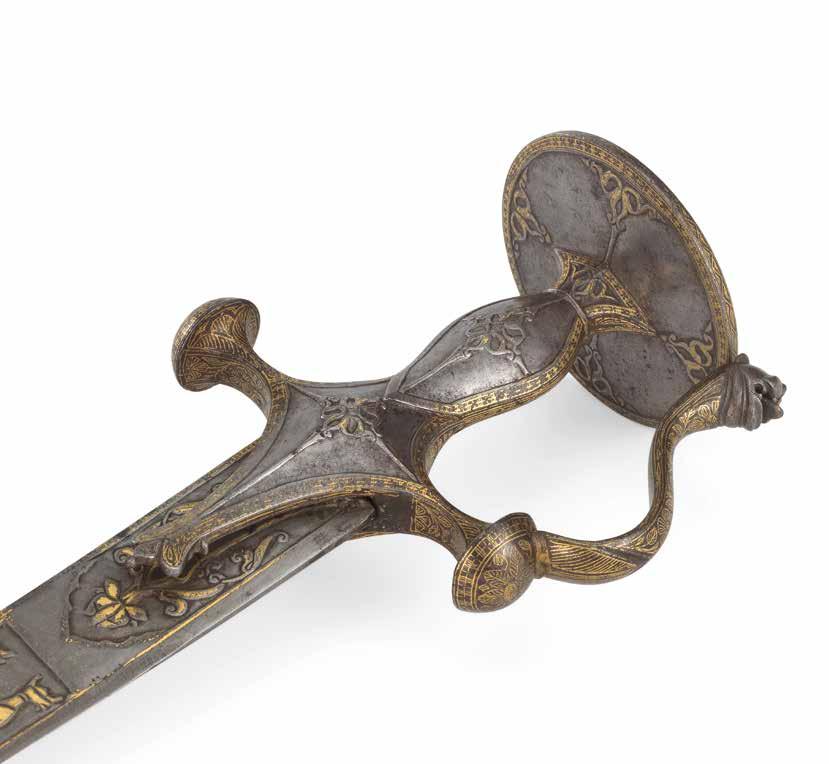
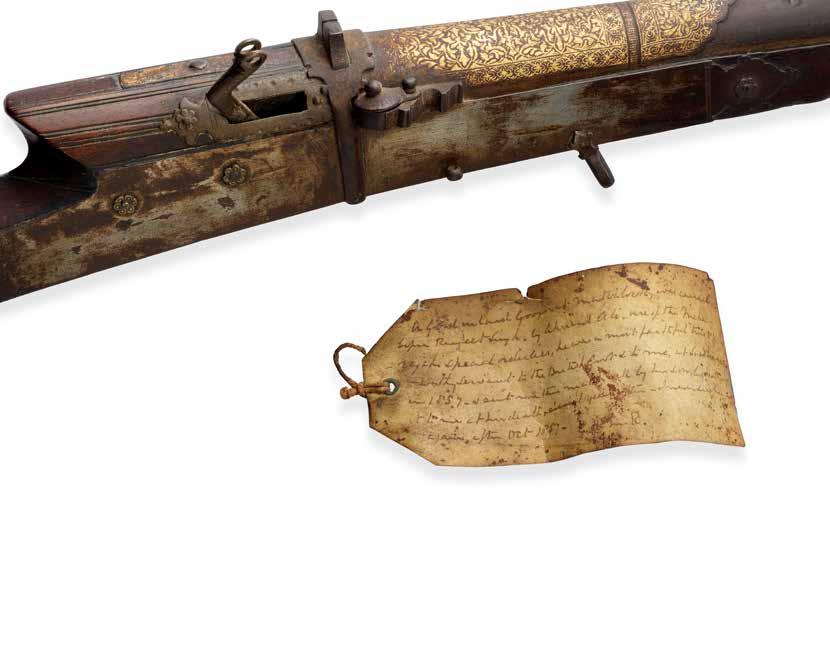
foliate decoration, indistinct gold-overlaid inscription near breech, handwritten vellum label written by George Henry Mildmay Ricketts describing provenance 171 cm. long
£12,000 - 15,000
€14,000 - 17,000
US$16,000 - 20,000
Provenance
Ahmed Ali (b. Bolundshudur), a ‘special orderly’ of Maharajah Ranjit Singh (reg. 1801-1839).
George Henry Mildmay Ricketts (1827-1914), bequeathed by Ahmed Ali, and thence by descent.
Inscriptions: close to breech, in Gurmukhi and reads ‘Akal Sahai [...]’; to label, ‘A good inlaid Goojerat matchlock was carried before Ranjeet Singh, by Ahmed Ali, one of the Maharajah’s special orderlies, he was most faithful trustworthy servant to the British Govnt. & to me at Ludhiana in 1857 & sent me this matchlock by his son, bequeathing it to me at his death several years after - I never saw him again after Oct 1857, G. H. M. R’; to reverse ‘belong to E. W. C. R.’ (Edward Wallace Claud Ricketts 1884-1947).
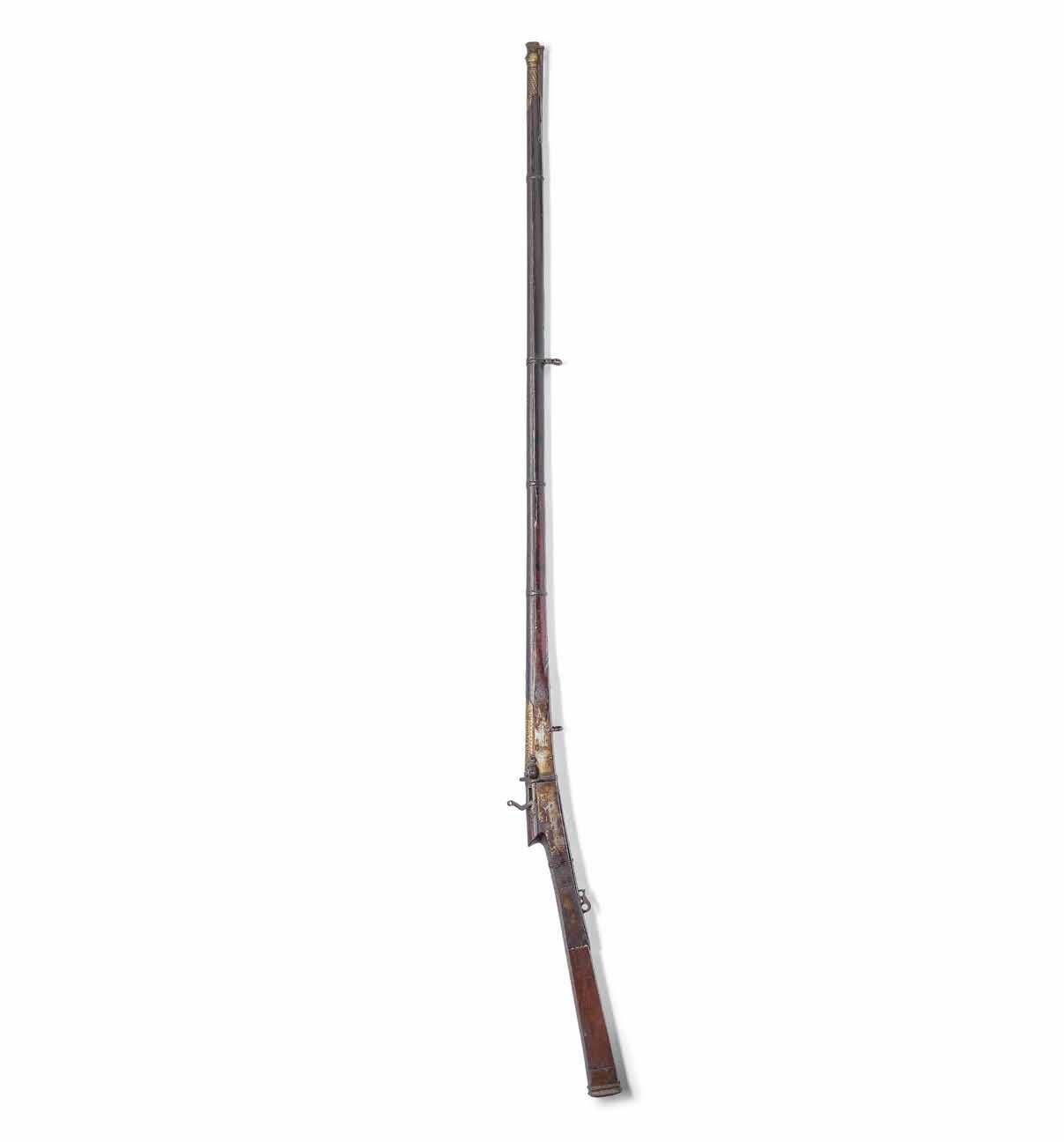
274
TWO SIALKHOT GOLD- AND SILVER-KOFTGARI STEEL SHIELDS (DHAL)
NORTH INDIA, 19TH CENTURY
each of domed circular form with four applied bosses and lobed rim, profusely decorated in gold and silver overlay with radial patterns surrounded by scrolling vegetal interlace and acanthus motifs interspersed with flower-filled cartouches and lotus heads, each with four suspension loops to reverse both 36 cm. diam.(2)
£2,000 - 3,000
€2,300 - 3,400
US$2,700 - 4,100
A CARNELIAN SEAL BELONGING TO MUHAMMAD ‘ALI KHAN PUNJAB, DATED AH 1271/ AD 1854-5 of octagonal form, engraved with inscriptions on a ground of vegetal motifs, chevron border 22 x 18 mm.
£800 - 1,200
€920 - 1,400
US$1,100 - 1,600
Provenance
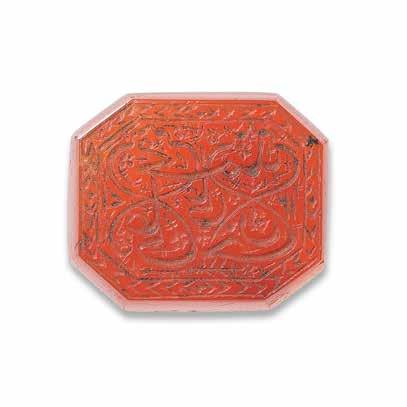
Property from descendants of Charles Theophilus Metcalfe, 1st Baron Metcalfe (1785-1846); Sir Thomas Theophilus Metcalfe, 4th Baronet (1795-1853) and George Henry Mildmay Ricketts (1827-1914).
Inscriptions: ‘Muhammad ‘Ali Khan, 1271 (1854-5).
Muhammad ‘Ali Khan was one of the sons of the Sultan Mahmud Ali Khan (d. 1859), the Punjabi Muslim commander of the Sikh Khasla Army and one of Ranjit Singh’s most important generals. He is best known for his bravery at the battle of Multan. A matchlock probably belonging to his other son, Sultan Ahmad Ali Khan, is lot 204 in this sale.
276
A RARE PHOTOGRAPH OF THE FAMOUS AKALI NIHANG, HIRA SINGH
INDIA, CIRCA 1880
albumen print, laid down on card, contemporary English inscription Chalkar; verso a group photograph of a British family, their Indian servants and their horses and carriage, inscribed on the mount Our Bungalow, Amritsar 1892/’Bob’, ‘Tancie’, ‘Chabuk’, ‘Kitey’, photographs 194 x 131 mm. and 153 x 210 mm. respectively; album page card 257 x 353 mm.; together with The Royal Tour Souvenir Album, India, 1905-1906, in which Hira Singh appears, Johnston & Hoffmann, Calcutta, first edition, 1906, 191 pp. of monochrome plates, index, publisher’s cloth gold-embossed binding 195 x 255 mm.(2)
£3,000 - 5,000
€3,400 - 5,700
US$4,100 - 6,800
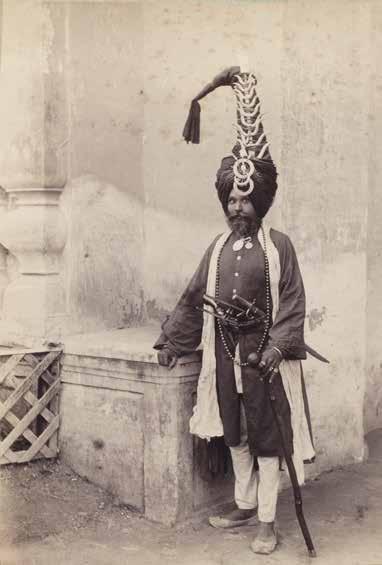
Hira Singh was the scripture reader (granthi) attached to Sikh units who made up part of the expedition to Khartoum to relieve General Gordon, where he was captured in a well-known image by the photographer Felice Beato in around May 1885. Major E. A. De Cosson gave an account of Hira Singh on the Sudan expedition: ‘There is a native priest with the Indian contingent who is quite a character, and his turban has become a marvellous structure, for year by year, as his holiness increased, he has added another storey to it, twisting in a fresh disc, till now it stands nearly six feet high; and according to popular report he never removes it even when he sleeps [...] Apart from this slight leaning to high hats and homicide he is a mild-mannered man, and may be seen preaching in the evening to his co-religionists; he was a soldier himself once’ (Fighting the Fuzzy-Wuzzy: Days and Nights of Service with Sir Gerald Graham’s Field Force at Suakin, p. 302).
Before this religious post he had served as an infantryman on the North West Frontier in the 6th Punjab Regiment. A reporter for The South Australian Advertiser wrote of his appearance at the Calcutta International Exhibition in 1884 (to which he had been taken Edward Nicholl, Municipal Secretary of Amitsar): ‘an extraordinary-looking Sikh from Amritsar [...] From his dress and appearance this man created a sensation amongst the natives [...] He stands about 6 feet 3 inches in height in his slippers, and as he wears a headdress over 2 feet in height his appearance is sufficiently imposing. This headdress is called a guja, and is in the form of a conical puggaree, bound round with massive steel and silver chains [...] The other arms carried by Heera Singh were a tulwar or curved sword, a Colt’s revolver, a dagger, and a katar - an
extraordinary weapon for thrusting, which has the property of opening two blades after the fashion of a pair of tailor’s shears when the thrust has been delivered’.
He was later captured (understandably a favourite subject for photographers) in around 1900, by which time he had a white beard, and at the Delhi Durbar of 1903 (where, amongst several others, Gertrude Bell and Mortimer Menpes took photographs of him). He was part of a delegation of Akali-Nihangs who met the Prince and Princess of Wales on their visit to Amritsar in 1906, an appears in the Album included in the present lot.
For the well-known Sudan image, as well as further discussion and these accounts, see D. Singh Toor, In Pursuit of Empire: Treasures from the Toor Collection of Sikh Art, London 2018, pp. 272-275.
The album illustrates the Indian tour of the Prince and Princess of Wales (later George V and Queen Mary) in 1905 and 1906, ranging from their arrival in Bombay, and subsequently through Indore, Udaipur, Jaipur, Calcutta, Bikaner, Lahore (portraits of the Maharajahs of Patiala, Kapurthala, and Jind, and the Nawab of Bahawalpur); Peshawar, Jammu, Amritsar, Delhi and Agra, Gwalior, Lucknow; further afield to Rangoon and Mandalay; then returning to Madras, Mysore, Bangalore, Hyderabad, Benares, Quetta and Karachi. A plate illustrating the visit to Benares shows ‘The Head Priest of the Sikhs and his staff’; and to Amritsar, a ‘Group of Akilas [sic] at Amritsar. These people are the modern representatives of the ancient Sikh religious ascetics’.
277
A COLLECTION OF STEEL QUOITS, REGIMENTAL TURBAN ORNAMENTS (PUGRI), A GAJGAH AND OTHER ACCOUTREMENTS OF THE SIKH AKALI-NIHANG MOUNTED ON A WOOD SHIELD PUNJAB, SECOND HALF OF THE 19TH CENTURY
comprising three steel quoits, the smallest engraved with three groups of three circle motifs forming triangles, the two larger examples with three groups of four circle motifs in diamond formation joined by lines; six steel regimental turban ornaments of the 45th Rattray’s Sikhs Bengal Infantry in the form of quoits surmounted by khandas and crescent moons, variously decorated with engraved circle motifs; one steel regimental turban ornament of the 45th Rattray’s Sikhs Bengal Infantry in the form of a quoit surmounted by a khanda, engraved with the number ‘1115’; a steel double-edged sword (khanda); six steel single-edged daggers; four steel bangles; two steel rosary chains (mala); and a steel gajgah in the form of a quoit surmounted by a double-edged sword flanked by single-edged daggers, the quoit engraved with three groups of three circle motifs forming triangles the shield 131.5 x 82 cm.
£20,000 - 30,000
€23,000 - 34,000
US$27,000 - 41,000
Provenance
Lieutenant Colonel George Burnett Abercrombie Rind (1880-1958) and thence by descent.
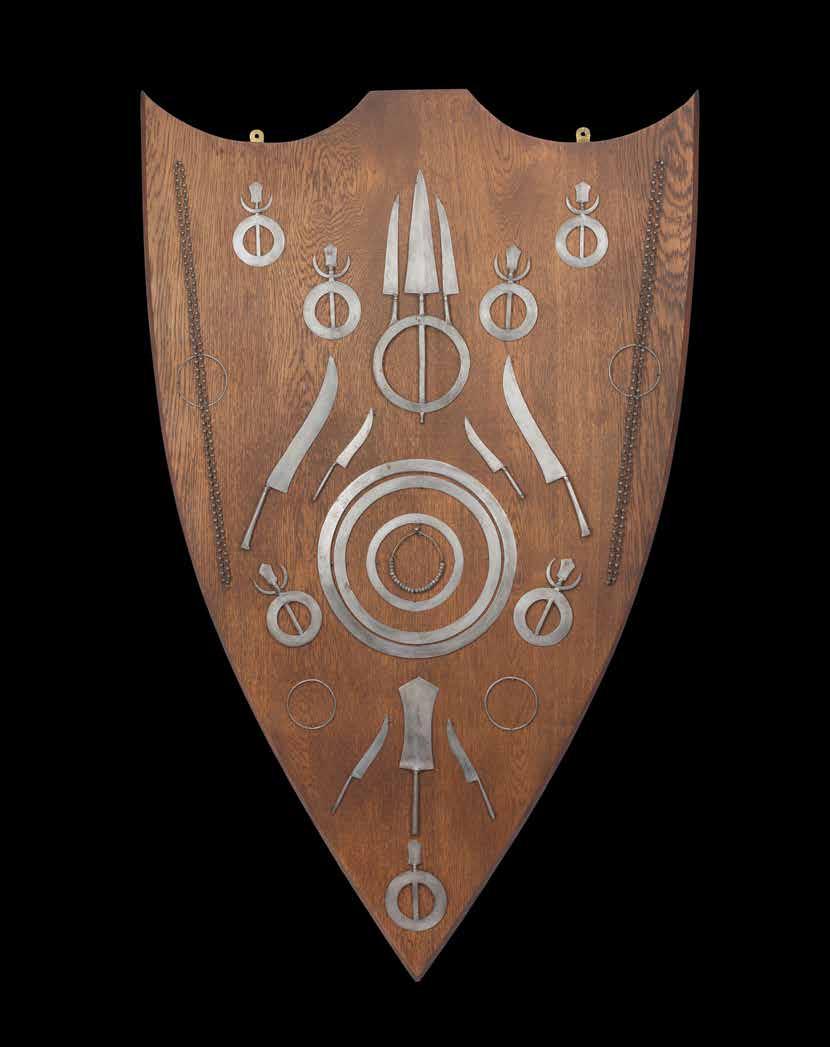
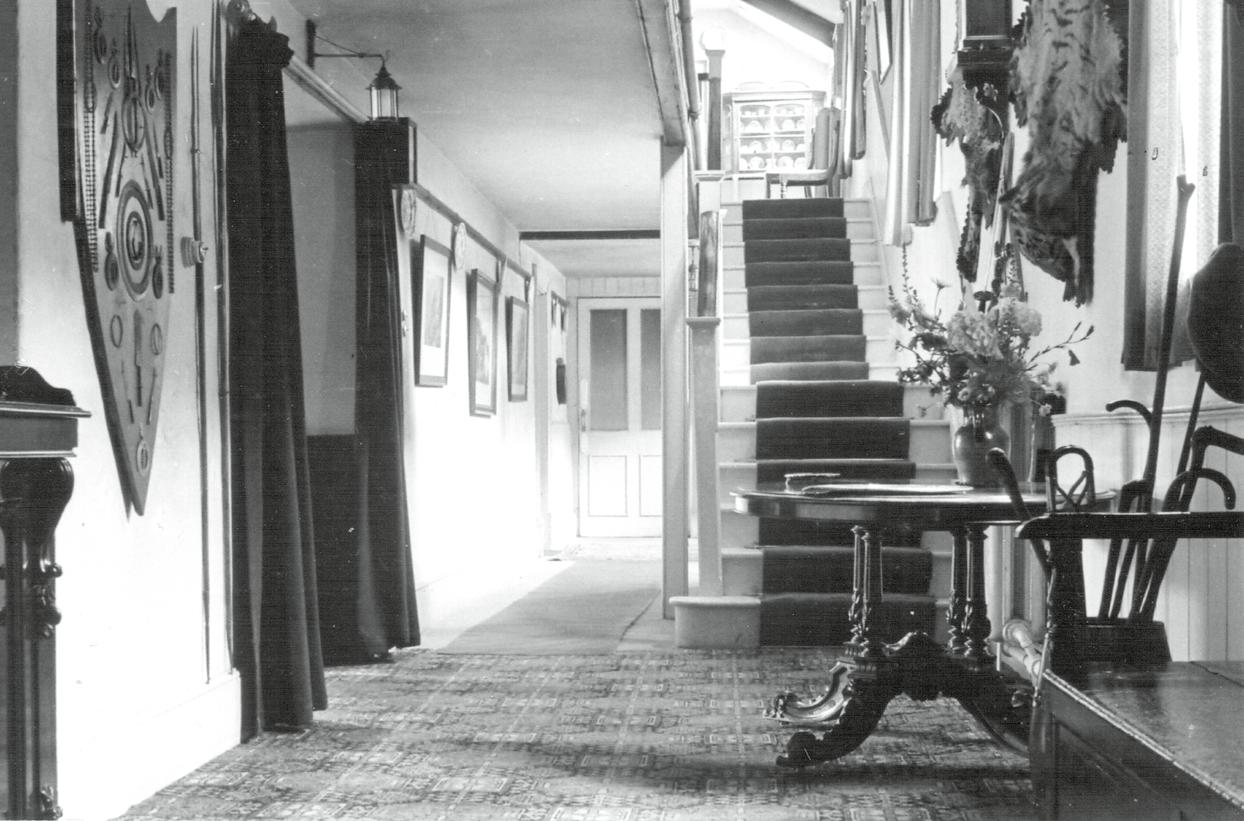
George Burnett Abercrombie Rind was born in 1880 in Mussoorie, a hill station 180 miles north of New Delhi. His first army commission was in 1900 as a Captain in the 33rd Punjabis and he eventually reached the rank of Lieutenant Colonel. In the early 1920s, after retiring from the army, he returned to Wales, to Dale, Pembrokeshire, where he designed Allenbrook, a home to display his collections of ancestral Indian artefacts. George had been born into a family with an illustrious history in India, and more specifically with the Sikhs and the Punjab. His great-uncle James Nathaniel Rind (1809-1842) had been a Captain in the 37th Native Infantry. His grandfather was William James Rind (1806-1869), a Captain in the 71st Native Infantry during the Second Anglo-Sikh war, a regiment which was most notable for its action at the Battle of Chillianwala in 1849. His father, Burnett George Rind, (1854-1924) was an officer associated with the 8th Bengal Native Infantry who later retired to work on his brother Malcolm’s tea plantation.
Allenbrook became the home for George’s own collection and those of his relatives, including perhaps most notably the Company School folios of an earlier ancestor, Major James Nathaniel Rind (1753-1814) who was engaged in scientific surveys of Company territory between 1785 and 1789, including gathering scientific knowledge about the flora and fauna of the region. Whilst posted in Calcutta between 1793 and 1801 he compiled an important collection of Company School depictions of animals and plants, many of which were sold at Sotheby’s Oriental Manuscripts and Miniatures, on the 13th of July, 1971, and are now housed within some of the world’s most famous institutions including the British Museum and the Metropolitan Museum of Art.
Whilst we cannot be sure which ancestor it was who actually collected the Sikh objects in the present lot, we do know that they were on the wall at Allenbrook, mounted on the wooden shield to which they are currently fixed, since at least 1947, as they are depicted in a photograph in a family album dated to that year. We can therefore take the provenance with certainty as far back as George Burnett Abercrombie Rind. The present lot includes seven regimental turban ornaments or pugri from 45th Rattray’s Sikhs which can be dated to between 1864 and 1901 (further examples of both shape of pugri badge are in the National Army Museum - accession nos. NAM. 2013-10-20-37-61 and NAM. 2013-10-20-37-58). It is therefore also possible that they were acquired by his father, Burnett George Rind, who was still present in India following the formation of the 45th Rattray’s Sikhs in 1864.
The remaining objects on the shield make up the accoutrements of the dastar bunga, or ‘turban fortress’, and ‘jewellery’ of the Sikh AkaliNihang warrior. These include Quoits (chakkars), or circular throwing knives, which rested around the base of the conical turban just above the head and represent the cyclical nature of life; the gajgah, which was placed above these at the front, representing superior strength, intellect and daring; and the miniature single edged swords (kirpans) and double-edged swords (khandas), which also adorned the turban. These elements, including a pugri of the 45th Rattray’s Sikhs, can be seen on a dastar bunga in the British Museum which is believed to have been in the collection since the late 19th century (though the blue cloth is a modern replacement). Further to these are the rosary beads and bangles also worn by the Akali-Nihang.
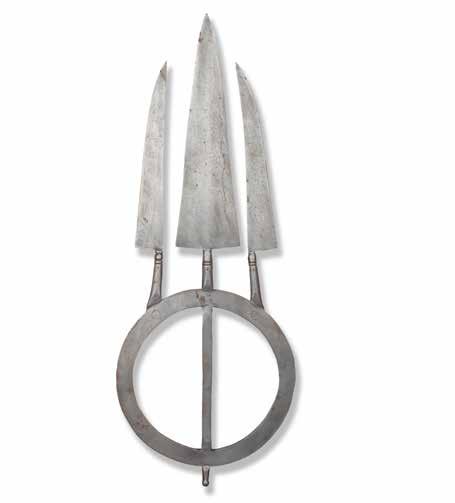
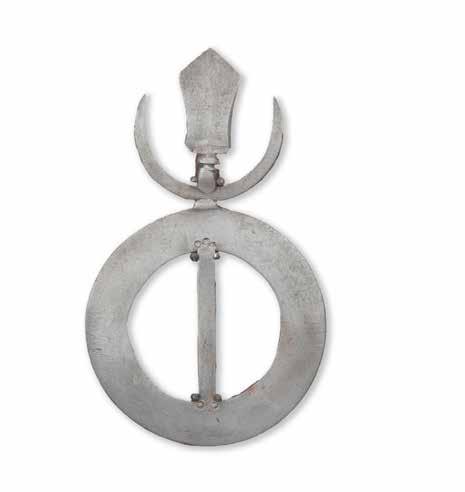
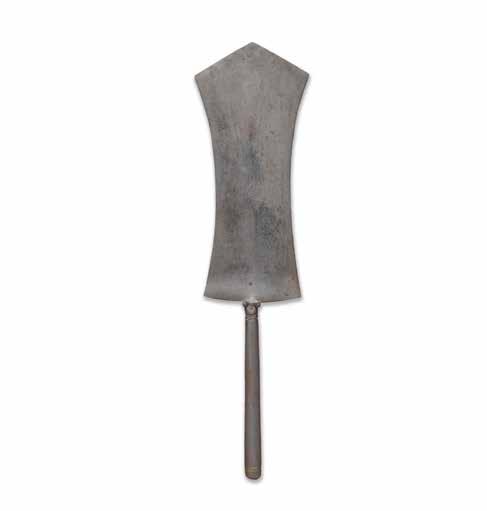

278
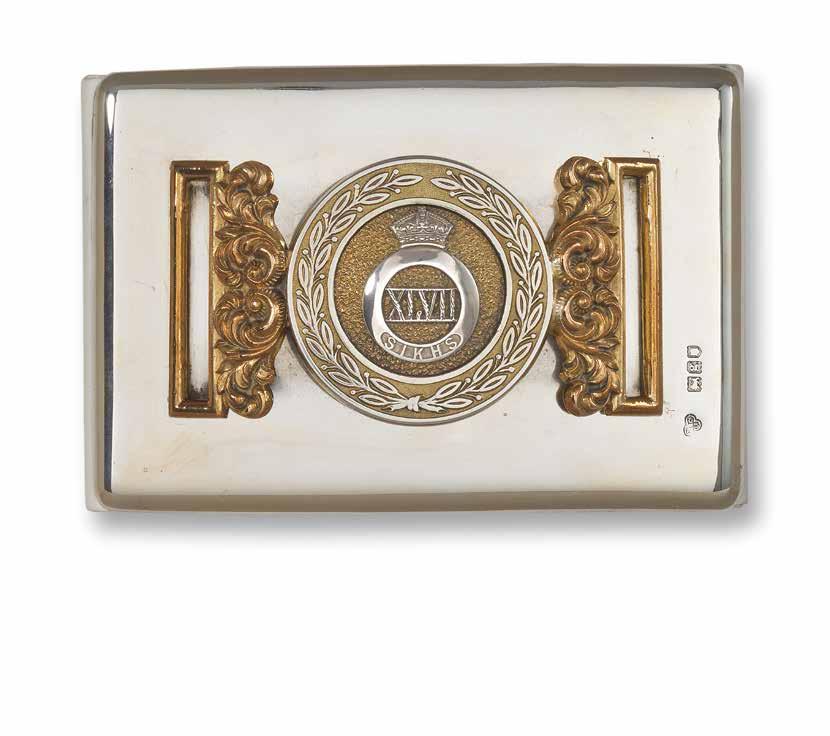
£1,500 - 2,000
€1,700 - 2,300
US$2,000 - 2,700
Raised in 1901 in Sialkot (now in Pakistan), the 47th Sikh Infantry was comprised largely of Jat Sikhs. The regiment served during World War I both on the Western Front and in the Levant, fighting with the 8th Indian Infantry Brigade and at the Battle of Megiddo in 1918. In 1922, the 47th Sikhs became the 5th Battalion, 11th Sikh Regiment, before being allocated to India after Partition.
For a comparable waistbelt plate dated to between 1901 and 1902, see National Army Museum, inv. no. NAM. 2013-10-20-37-118.
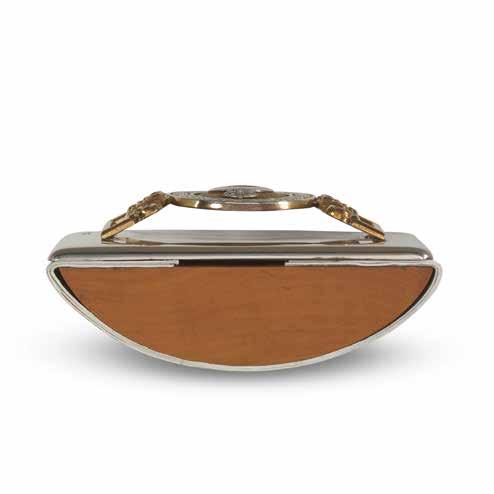
279
A STEAMER TRUNK BELONGING TO MAHARAJKUMARI BIBAJI UMESH KUMARIJI SAHIBA OF PATIALA (B. 1932); TOGETHER WITH A PORTRAIT OF HER IN PENCIL PUNJAB, 20TH CENTURY
the trunk of rectangular form with hinged lid, the interior with linen lining and removable compartment with straps, the exterior decorated in veneer and paint with blue and yellow stripes to edges, inscription to lid ‘1 Her Highness the Maharanee of Patiala Princess Umesh Kumari of Patiala D.13’, two locks and a latch to front, leather handle to end; the drawing on paper laid down on card, signed indistinctly to lower right, sitter’s name inscribed to reverse the trunk 91 x 53 x 41 cm.; the drawing 584 x 450 mm.
£2,000 - 3,000
€2,300 - 3,400
US$2,700 - 4,100
Maharajkumari Umesh Kumari, known as Princess Diamond, was the daughter of Maharajah Bhupinder Singh of Patiala (reg. 1891-1938).
Born at Chail near Simla on the 14th of November 1932, she married Colonel Kanwar Bharat Singh (b. 1919) in 1952.
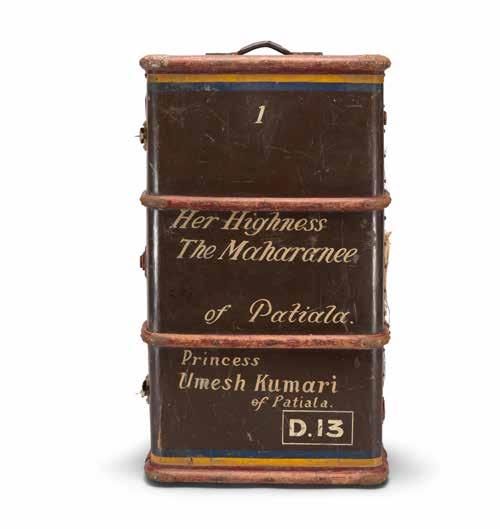
280
PRINCESS SUSHILA DEVI OF KAPURTHALA (1918-74), DAUGHTER OF MAHARAJAH PARAMJIT SINGH OF KAPURTHALA
BY A. W. MALLETT (BRITISH, 20TH CENTURY), FIRST HALF OF THE 20TH CENTURY
oil on canvas laid down on board, signed lower right 51 x 36 cm.
£1,500 - 2,000
€1,700 - 2,300
US$2,000 - 2,700
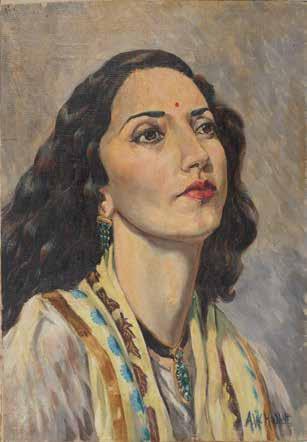
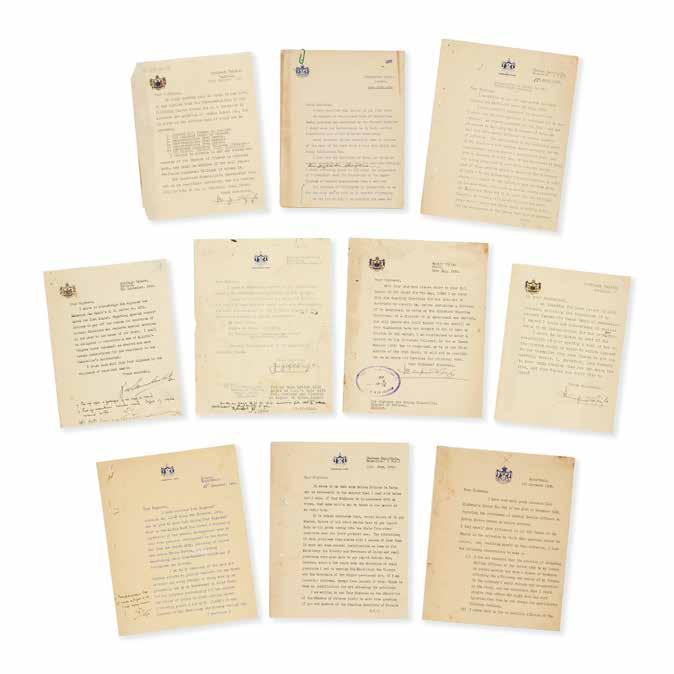
AN INTERESTING GROUP OF 17 TYPED LETTERS AND PRINTED PRESS COMMUNIQUES RELATING TO PATIALA AND KAPURTHALA, SOME SIGNED BY THE MAHARAJAHS OF KAPURTHALA AND PATIALA
KAPURTHALA, PATIALA, LAHORE AND LODHIANA, DATED BETWEEN 1917 AND 1944
official printed matter and typed administrative letters, signed by both rulers and Secretaries, numerous marginal notes for action and official stamps
the largest 345 x 215 mm.; in folder 38 x 27 cm.(17)
£2,000 - 3,000
€2,300 - 3,400
US$2,700 - 4,100
For the full note on this lot, see the online catalogue.
282
A SIGNED PHOTOGRAPH OF JAGATJIT SINGH BAHADUR, MAHARAJAH OF KAPURTHALA (1872-1949, REG. 1877-1949)
BY PIAZ, PARIS, DATED 11TH APRIL 1945
gelatin silver print, photographer’s stamped logo lower left, inscribed in ink upper left by the Maharajah for Bernal [?], photographer’s stamp verso (122 Champs Elysees) 239 x 162 mm.
£800 - 1,200
€920 - 1,400
US$1,100 - 1,600
For a brief discussion of Maharajah Jagatjit Singh, see A. Jackson, A. Jaffer (ed.), Maharaja: the Splendour of India’s Royal Courts, London 2009, pp. 130-131. He travelled extensively in Europe, and was married six times, perhaps most famously to Prem Kaur, born Anita Delgado, known as ‘the Spanish Maharani’.
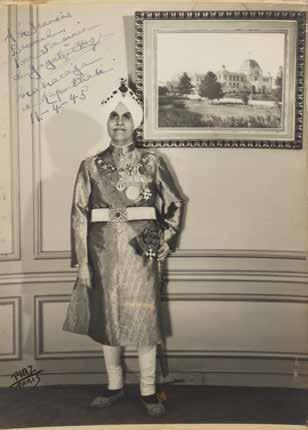
283 Y Ф
A FRAMED PORTRAIT ON IVORY OF ANITA DELGADO BRIONES, PRINCESS PREM KAUR OF KAPURTHALA, THE ‘SPANISH MAHARANI’ BY BOIS TAPONIER, PARIS, CIRCA 1908
gouache on ivory, signed centre right, in silver frame with stylised crown at upper edge, easel stand painting 157 x 110 mm.; frame 205 x 153 mm.
£1,500 - 2,000
€1,700 - 2,300
US$2,000 - 2,700
Anita Delgado Briones (1890-1962) was a Spanish dancer who in 1906 fascinated the Maharajah of Kapurthala, Jagatjit Singh (reg. 1877-1949), when he was visiting Madrid for the wedding of the King of Spain. They married in 1908 in France, and after a Sikh wedding in India, she changed her name to Maharani Prem Kaur. They travelled extensively in both Europe and India, and wrote a memoir Impressions de mes Voyages aux Indes (1915).
When the Maharaja married his seventh wife in 1925, they divorced and Prem Kaur returned to Spain.
The item within this lot containing ivory has been registered in accordance with the Ivory Act (Section 10), reference no. U4PFF599.
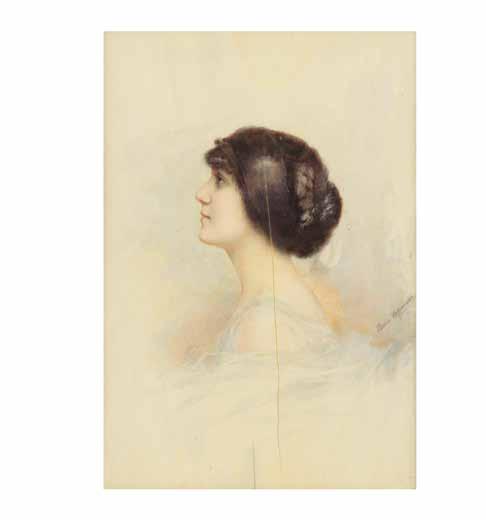
This notice is addressed by Bonhams to any person who may be interested in a Lot, and to all persons participating in the auction process including auction attendees, Bidders and potential Bidders (including any eventual Buyer of the Lot). For ease of reference we refer to such persons as “Bidders” or “you”. Our List of Definitions and Glossary is incorporated into this Notice to Bidders. It is at Appendix 3 at the back of the Catalogue. Where words and phrases are used in this notice which are in the List of Definitions, they are printed in italics. IMPORTANT: Additional information applicable to the Sale may be set out in the Catalogue for the Sale, in an insert in the Catalogue and/or in a notice displayed at the Sale venue and you should read them as well. Announcements affecting the Sale may also be given out orally before and during the Sale without prior written notice. You should be alert to the possibility of changes and ask in advance of bidding if there have been any.
1. OUR ROLE
In its role as Auctioneer of Lots, Bonhams acts solely for and in the interests of the Seller Bonhams’ job is to sell the Lot at the highest price obtainable at the Sale to a Bidder. Bonhams does not act for Buyers or Bidders in this role and does not give advice to Buyers or Bidders. When it or its staff make statements about a Lot or, if Bonhams provides a Condition Report on a Lot it is doing that on behalf of the Seller of the Lot. Bidders and Buyers who are themselves not expert in the Lots are strongly advised to seek and obtain independent advice on the Lots and their value before bidding for them. The Seller has authorised Bonhams to sell the Lot as its agent on its behalf and, save where we expressly make it clear to the contrary, Bonhams acts only as agent for the Seller. Any statement or representation we make in respect of a Lot is made on the Seller’s behalf and, unless Bonhams sells a Lot as principal, not on our behalf and any Contract for Sale is between the Buyer and the Seller and not with us. If Bonhams sells a Lot as principal this will either be stated in the Catalogue or an announcement to that effect will be made by the Auctioneer, or it will be stated in a notice at the Sale or an insert in the Catalogue.
Bonhams does not owe or undertake or agree to any duty or responsibility to you in contract or tort (whether direct, collateral, express, implied or otherwise). If you successfully bid for a Lot and buy it, at that stage Bonhams does enter into an agreement with you as the Buyer. The terms of that contract are set out in our Buyer’s Agreement, which you will find at Appendix 2 at the back of the Catalogue, and this will govern Bonhams’ relationship with the Buyer 2. LOTS
Subject to the Contractual Description printed in bold letters in the Entry about the Lot in the Catalogue (see paragraph 3 below), Lots are sold to the Buyer on an “as is” basis, with all faults and imperfections. Illustrations and photographs contained in the Catalogue (other than photographs forming part of the Contractual Description) or elsewhere of any Lots are for identification purposes only. A photograph or illustration may not reflect an accurate reproduction of the colour(s) or true condition of the Lot Lots are available for inspection prior to the Sale and it is for you to satisfy yourself as to each and every aspect of a Lot, including its authorship, attribution, condition, provenance, history, background, authenticity, style, period, age, suitability, quality, roadworthiness (if relevant), origin, value and estimated selling price (including the Hammer Price). It is your responsibility to examine any Lot in which you are interested. It should be remembered that the actual condition of a Lot may not be as good as that indicated by its outward appearance. In particular, parts may have been replaced or renewed and Lots may not be authentic or of satisfactory quality; the inside of a Lot may not be visible and may not be original or may be damaged, as for example where it is covered by upholstery or material. Given the age of many Lots they may have been damaged and/or repaired and you should not assume that a Lot is in good condition. Electronic or mechanical items or parts are sold for their artistic, historic or cultural interest and may not operate or may not comply with current statutory requirements. You should not assume that electrical items designed to operate on mains electricity will be suitable for connection to the mains electricity supply and you should obtain a report from a qualified electrician on their status before doing so. Such items which are unsuitable for connection are sold as items of interest for display purposes only. If you yourself do not have expertise regarding a Lot you should consult someone who does to advise you. We can assist in arranging facilities for you to carry out or have carried out more detailed inspections and tests. Please ask our staff for details. Any person who damages a Lot will be held liable for the loss caused.
3.
Contractual Description of a Lot
The Catalogue contains an Entry about each Lot. Each Lot is sold by its respective Seller to the Buyer of the Lot as corresponding only with that part of the Entry which is printed in bold letters and (except for the colour, which may be inaccurately reproduced) with any photograph of the Lot in the Catalogue. The remainder of the Entry, which is not printed in bold letters, represents Bonhams’ opinion (given on behalf of the Seller) about the Lot only and is not part of the Contractual Description in accordance with which the Lot is sold by the Seller Estimates
In most cases, an Estimate is printed beside the Entry Estimates are only an expression of Bonhams’ opinion made on behalf of the Seller of the range where Bonhams thinks the Hammer Price for the Lot is likely to fall; it is not an Estimate of value. It does not take into account any VAT or Buyer’s Premium payable or any other fees payable by the Buyer, which are detailed in paragraph 7 of the Notice to Bidders, below. Prices depend upon bidding and lots can sell for Hammer Prices below and above the Estimates, so Estimates should not be relied on as an indication of the actual selling price or value of a Lot Estimates are in the currency of the Sale Condition Reports
In respect of most Lots, you may ask Bonhams for a Condition Report on the Lot’s general physical condition. If you do so, this will be provided by Bonhams on behalf of the Seller free of charge. As this is offered additionally and without charge, Bonhams is not entering into a contract with you in respect of the Condition Report and accordingly does not assume responsibility to you in respect of it. The Condition Report represents Bonhams’ reasonable opinion as to the Lot’s general condition in the terms stated in the particular report, and Bonhams does not represent or guarantee that a Condition Report includes all aspects of the internal or external condition of the Lot. Neither does the Seller owe or agree to owe you as a Bidder or Buyer any obligation or duty in respect of this free report about a Lot, which is available for your own inspection or for inspection by an expert instructed by you. The Seller’s responsibility to you
The Seller does not make or agree to make any representation of fact or contractual promise, Guarantee or warranty and undertakes no obligation or duty, whether in contract or in tort (other than to the eventual Buyer as set out above), in respect of the accuracy or completeness of any statement or representation made by him or on his behalf, which is in any way descriptive of any Lot or as to the anticipated or likely selling price of any Lot. Other than as set out above, no statement or representation in any way descriptive of a Lot or any Estimate is incorporated into any Contract for Sale between a Seller and a Buyer
Bonhams’ responsibility to you
You have the opportunity of examining the Lot if you want to and the Contract for Sale for a Lot is with the Seller and not with Bonhams; Bonhams acts as the Seller’s agent only (unless Bonhams sells the Lot as principal).
Bonhams undertakes no obligation to you to examine, investigate or carry out any tests, either in sufficient depth or at all, on each Lot to establish the accuracy or otherwise of any Descriptions or opinions given by Bonhams, or by any person on Bonhams’ behalf, whether in the Catalogue or elsewhere.
You should not suppose that such examinations, investigations or tests have occurred.
Bonhams does not make or agree to make any representation of fact, and undertakes no obligation or duty (whether in contract or tort) in respect of the accuracy or completeness of any statement or representation made by Bonhams or on Bonhams’ behalf which is in any way descriptive of any Lot or as to the anticipated or likely selling price of any Lot. No statement or representation by Bonhams or on its behalf in any way descriptive of any Lot or any Estimate is incorporated into our Buyer’s Agreement.
Alterations
Descriptions and Estimates may be amended at Bonhams’ discretion from time to time by notice given orally or in writing before or during a Sale
THE LOT IS AVAILABLE FOR INSPECTION AND YOU MUST FORM YOUR OWN OPINION IN RELATION TO IT. YOU ARE STRONGLY ADVISED TO EXAMINE ANY LOT OR HAVE IT EXAMINED ON YOUR BEHALF BEFORE THE SALE
4. CONDUCT OF THE SALE
Our Sales are public auctions which persons may attend and you should take the opportunity to do so. We reserve the right at our sole discretion to refuse admission to our premises or to any Sale and to remove any person from our premises and Sales, without stating a reason. We have complete discretion as to whether the Sale proceeds, whether any Lot is included in the Sale, the manner in which the Sale is conducted and we may offer Lots for Sale in any order we choose notwithstanding the numbers given to Lots in the Catalogue. You should therefore check the date and starting time of the Sale, whether there have been any withdrawals or late entries. Remember that withdrawals and late entries may affect the time at which a Lot you are interested is put up for Sale. We have complete discretion in which to refuse any bid, to nominate any bidding increment we consider appropriate, to divide any Lot, to combine two or more Lots, to withdraw any Lot from a Sale and, before the Sale has been closed, to put up any Lot for auction again. Auction speeds can exceed 100 Lots to the hour and bidding increments are generally about 10%; however, these do vary from Sale to Sale and from Auctioneer to Auctioneer
Please check with the department organising the Sale for advice on this. Where a Reserve has been applied to a Lot, the Auctioneer may, in his absolute discretion, place bids (up to an amount not equalling or exceeding such Reserve) on behalf of the Seller. We are not responsible to you in respect of the presence or absence of any Reserve in respect of any Lot. If there is a Reserve it will be no higher than the lower figure for any Estimate in the Catalogue, assuming that the currency of the Reserve has not fluctuated adversely against the currency of the Estimate. The Buyer will be the Bidder who makes the highest bid acceptable to the Auctioneer for any Lot (subject to any applicable Reserve) to whom the Lot is knocked down by the Auctioneer at the fall of the Auctioneer’s hammer. Any dispute as to the highest acceptable bid will be settled by the Auctioneer in his absolute discretion. All bids tendered will relate to the actual Lot number announced by the Auctioneer. An electronic currency converter may be used at the Sale. This equipment is provided as a general guide as to the equivalent amount in certain currencies of a given bid. We do not accept any responsibility for any errors which may occur in the use of the currency converter. We may use video cameras to record the Sale and may record telephone calls for reasons of security and to assist in solving any disputes which may arise in relation to bids made at the Sale. At some Sales, for example, jewellery Sales, we may use screens on which images of the Lots will be projected. This service is provided to assist viewing at the Sale. The image on the screen should be treated as an indication only of the current Lot. It should be noted that all bids tendered will relate to the actual Lot number announced by the Auctioneer. We do not accept any responsibility for any errors which may occur in the use of the screen.
You must complete and deliver to us one of our Bidding Forms, either our Bidder Registration Form, Absentee Bidding Form or Telephone Bidding Form in order to bid at our Sales
If you are a new client at Bonhams or have not recently updated your registration details with us, you must pre-register to bid at least two working days before the Sale at which you wish to bid. You will be required to provide government-issued proof of identity and residence, and if you are a company, your certificate of incorporation or equivalent documentation with your name and registered address, government issued proof of your current address, documentary proof of your beneficial owners and directors, and proof of authority to transact. We may also request a financial reference and /or deposit from you before allowing you to bid.
We reserve the rights at our discretion to request further information in order to complete our client identification and to decline to register any person as a Bidder, and to decline to accept their bids if they have been so registered. We also reserve the rights to postpone completion of the Sale of any Lot at our discretion while we complete our registration and identification enquiries, and to cancel the Sale of any Lot if you are in breach of your warranties as Buyer, or if we consider that such Sale would be unlawful or otherwise cause liabilities for the Seller or Bonhams or be detrimental to Bonhams’ reputation.
So long as you have pre-registered to bid or have updated your existing registration recently, you should come to our Bidder registration desk at the Sale venue and fill out a Registration and Bidding Form on (or, if possible, before) the day of the Sale. The bidding number system is sometimes referred to as “paddle bidding”. You will be issued with a large card (a “paddle”) with a printed number on it. This will be attributed to you for the purposes of the Sale. Should you be a successful Bidder you will need to ensure that your number can be clearly seen by the Auctioneer and that it is your number which is identified as the Buyer’s. You should not let anyone else use your paddle as all Lots will be invoiced to the name and address given on your Bidder Registration Form. Once an invoice is issued it will not be changed. If there is any doubt as to the Hammer Price of, or whether you are the successful Bidder of, a particular Lot, you must draw this to the attention of the Auctioneer before the next Lot is offered for Sale At the end of the Sale, or when you have finished bidding please return your paddle to the Bidder registration desk.
Bidding by telephone
If you wish to bid at the Sale by telephone, and have pre-registered to bid or have updated your existing registration details recently, please complete a Registration and Bidding Form, which is available from our offices or in the Catalogue. Please then return it to the office responsible for the Sale at least 24 hours in advance of the Sale. It is your responsibility to check with our Bids Office that your bid has been received. Telephone calls will be recorded. The telephone bidding facility is a discretionary service offered at no additional charge and may not be available in relation to all Lots. We will not be responsible for bidding on your behalf if you are unavailable at the time of the Sale or if the telephone connection is interrupted during bidding. Please contact us for further details.
Bidding by post or fax
Absentee Bidding Forms can be found in the back of this Catalogue and should be completed and sent to the office responsible for the Sale, once you have pre-registered to bid or have updated your existing registration details recently. It is in your interests to return your form as soon as possible, as if two or more Bidders submit identical bids for a Lot, the first bid received takes preference. In any event, all bids should be received at least 24 hours before the start of the Sale Please check your Absentee Bidding Form carefully before returning it to us, fully completed and signed by you. It is your responsibility to check with our Bids Office that your bid has been received. This additional service is complimentary and is confidential. Such bids are made at your own risk and we cannot accept liability for our failure to receive and/or place any such bids. All bids made on your behalf will be made at the lowest level possible subject to Reserves and other bids made for the Lot. Where appropriate your bids will be rounded down to the nearest amount consistent with the Auctioneer’s bidding increments. New Bidders must also provide proof of identity and address when submitting bids. Failure to do this will result in your bid not being placed.
Bidding via the internet
In order to bid online in a Sale, you must be 18 or over and you must register to bid via the Bonhams App or www.bonhams.com. Once you have registered, you should keep your account details strictly confidential and not permit any third party to access your account on your behalf or otherwise. You will be liable for any and all bids made via your account. Please note payment must be made from a bank account in the name of the registered bidder.
Individuals: Enter your full name, email, residential address, date of birth and nationality and provide a valid credit card in your name which will be verified via Stripe before you are able to bid. If your credit card fails verification, you will not be permitted to bid and you should contact Client Services for assistance. We may in addition request a financial reference and/or deposit from you prior to letting you bid. If you are bidding as agent on behalf of another party, you agree: (i) to disclose this fact to Client Services; (ii) to provide such information as we require to enable us to complete our identification and anti-money laundering checks on that third party; and (ii) where your bid is successful, you are jointly and severally liable with that other party for the full amounts owing for the successful bid. Where you are the successful bidder for any lot with a hammer price equal to or in excess of £5,000/$10,000/ HKD50,000/AUS$10,000 depending on the jurisdiction and currency of the Sale, and if you have not provided such documents previously, you will be required to upload or provide to Client Services your Government issued photo ID and (if not on the ID) proof of your
address before the lot can be released to you. We reserve the right to request ID documentation from any bidder or successful buyer regardless of these thresholds and to refuse to release any purchased lot until such documentation is provided.
Companies: You must select the option to set up a business account and then provide your full name, email, residential address, date of birth and the full name of the company. You must provide a credit card for verification either in your name or the name of the company but payment must be made from an account in the company’s name. If your credit card fails verification, you will not be permitted to bid and please contact Client Services for assistance. We may in addition require a bank reference or deposit prior to letting you bid. For all successful bids, we require the company’s Certificate of Incorporation or equivalent documentation confirming the company’s name and registered address, documentary proof of each beneficial owner owning 25% or more of the company, and proof of your authority to transact before the lot can be released to you.
We reserve the right to request any further information from any bidder that we may require in order to carry out any identification, anti-money laundering or anti-terrorism financing checks conducted by us. We may at our discretion postpone or cancel your registration, not permit you to bid and/or postpone or cancel completion of any purchase you may make.
Bidding through an agent
Bids will be treated as placed exclusively by and on behalf of the person named on the Bidding Form unless otherwise agreed by us in writing in advance of the Sale. If you wish to bid on behalf of another person (your principal) you must complete the pre-registration requirements set out above both on your own behalf and with full details of your principal, and we will require written confirmation from the principal confirming your authority to bid.
You are specifically referred to your due diligence requirements concerning your principal and their source of funds, and the warranties you give in the event you are the Buyer, which are contained in paragraph 3 of the Buyer’s Agreement, set out at Appendix 2 at the back of the Catalogue.
Nevertheless, as the Bidding Form explains, any person placing a bid as agent on behalf of another (whether or not he has disclosed that fact) will be jointly and severally liable with the principal to the Seller and to Bonhams under any contract resulting from the acceptance of a bid. Equally, please let us know if you intend to nominate another person to bid on your behalf at the Sale unless this is to be carried out by us pursuant to a Telephone or Absentee Bidding Form that you have completed. If we do not approve the agency arrangements in writing before the Sale, we are entitled to assume that the person bidding at the Sale is bidding on his own behalf. Accordingly, the person bidding at the Sale will be the Buyer and will be liable to pay the Hammer Price and Buyer’s Premium and associated charges. If we approve the identity of your client in advance, we will be in a position to address the invoice to your principal rather than you. We will require proof of the agent’s client’s identity and residence in advance of any bids made by the agent on his behalf. Please refer to our Conditions of Business and contact our Customer Services Department for further details. Bonhams undertakes Customer Due Diligence (CDD) into its Sellers and Buyers as required by the Money Laundering, Terrorist Financing and Transfer of Funds (Information on the Payer) Regulations 2017 (“the Regulations”). Bonhams’ interpretation of the Regulations and Treasury Approved industry Guidance is that CDD under the Regulations is not required by Buyers into Sellers at Bonhams auctions or vice versa
6. CONTRACTS BETWEEN THE BUYER AND SELLER AND THE BUYER AND BONHAMS
On the Lot being knocked down to the Buyer, a Contract for Sale of the Lot will be entered into between the Seller and the Buyer on the terms of the Contract for Sale set out in Appendix 1 at the back of the Catalogue. You will be liable to pay the Purchase Price, which is the Hammer Price plus any applicable VAT. At the same time, a separate contract is also entered into between us as Auctioneers and the Buyer
This is our Buyer’s Agreement, the terms of which are set out in Appendix 2 at the back of the Catalogue. Please read the terms of the Contract for Sale and our Buyer’s Agreement contained in the Catalogue in case you are the successful Bidder including the warranties as to your status and source of funds We may change the terms of either or both of these agreements in advance of their being entered into, by setting out different terms in the Catalogue and/or by placing an insert in the Catalogue and/or by notices at the Sale venue and/or by oral announcements before and during the Sale. It is your responsibility to ensure you are aware of the up to date terms of the Buyer’s Agreement for this Sale
7. BUYER’S PREMIUM AND OTHER CHARGES PAYABLE BY THE BUYER
Under the Buyer’s Agreement, a premium (the Buyer’s Premium) is payable to us by the Buyer in accordance with the terms of the Buyer’s Agreement and at rates set out below, calculated by reference to the Hammer Price and payable in addition to it.
For this Sale the following rates of Buyer’s Premium will be payable by Buyers on each Lot purchased:
28% of the Hammer Price on the first £40,000; plus 27% of the Hammer Price from £40,001 and up to £800,000; plus 21% of the Hammer Price from £800,001 and up to £4,500,000; plus 14.5% of the Hammer Price above £4,500,000
A 3rd party bidding platform fee of 4% of the Hammer Price for Buyers using the following bidding platforms will be added to the invoices of successful Buyers – Invaluable; Live Auctioneers; The Saleroom; Lot-tissimo.
Storage and handling charges may also be payable by the Buyer as detailed on the specific Sale Information page at the front of the catalogue.
The Buyer’s Premium and all other charges payable to us by the Buyer are subject to VAT at the prevailing rate, currently 20%.
VAT may also be payable on the Hammer Price of the Lot, where indicated by a symbol beside the Lot number. See paragraph 8 below for details.
On certain Lots, which will be marked “AR” in the Catalogue and which are sold for a Hammer Price of £1,000 or greater, the Additional Premium will be payable to us by the Buyer to cover our Expenses relating to the payment of royalties under the Artist’s Resale Right Regulations 2006, as amended. The Additional Premium will be a percentage of the amount of the Hammer Price calculated in accordance with the table below, and shall not exceed £12,500.
Note: only one debit or credit card may be used for payment of an account balance. If you have any questions with regards to card payments, please contact our Customer Services Department. We reserve the rights to investigate and identify the source of any funds received by us, to postpone completion of the sale of any Lot at our discretion while we complete our investigations, and to cancel the Sale of any Lot if you are in breach of your warranties as Buyer, if we consider that such Sale would be unlawful or otherwise cause liabilities for the Seller or Bonhams, or would be detrimental to Bonhams’ reputation.
10. COLLECTION AND STORAGE
The Buyer of a Lot will not be allowed to collect it until payment in full and in cleared funds has been made (unless we have made a special arrangement with the Buyer). For collection and removal of purchased Lots, please refer to Sale Information at the front of the Catalogue Our offices are open 9.00am – 5pm Monday to Friday. Details relating to the collection of a Lot, the storage of a Lot and our Storage Contractor after the Sale are set out in the Catalogue
11. SHIPPING
SHIPPING For information and estimates on domestic and international shipping as well as export licenses please contact The Packengers Ltd on +44 (0) 203 154 4360 bonhamslondon@thepackengers.com
12. EXPORT/TRADE
8. VAT
The prevailing rate of VAT at the time of going to press is 20%, but this is subject to government change and the rate payable will be the rate in force on the date of the Sale
The following symbols, shown beside the Lot number, are used to denote that VAT is due on the Hammer Price and Buyer’s Premium:
† VAT at the prevailing rate on Hammer Price and Buyer’s Premium
Ω VAT on imported items at the prevailing rate on Hammer Price and Buyer’s Premium
* VAT on imported items at a preferential rate of 5% on Hammer Price and the prevailing rate on Buyer’s Premium
G Gold bullion exempt from VAT on the Hammer Price and subject to VAT at the prevailing rate on the Buyer’s Premium
• Zero rated for VAT, no VAT will be added to the Hammer Price or the Buyer’s Premium
a Buyers from within the UK: VAT is payable at the prevailing rate on just the Buyer’s Premium (NOT the Hammer Price). Buyers from outside the UK: VAT is payable at the prevailing rate on both Hammer Price and Buyer’s Premium. If a Buyer, having registered under a non-UK address, decides that the item is not to be exported from the UK, then he should advise Bonhams immediately.
In all other instances no VAT will be charged on the Hammer Price, but VAT at the prevailing rate will be added to Buyer’s Premium which will be invoiced on a VAT inclusive basis.
9. PAYMENT
It is of critical importance that you ensure that you have readily available funds to pay the Purchase Price and the Buyer’s Premium (plus VAT and any other charges and Expenses to us)in full before making a bid for the Lot. If you are a successful Bidder, payment will be due to us by 4.30 pm on the second working day after the Sale so that all sums are cleared by the eighth working day after the Sale. Payments made by anyone other than the registered Buyer will not be accepted. Bonhams reserves the right to vary the terms of payment at any time. Bonhams’ preferred payment method is by bank transfer. You may electronically transfer funds to our Account. If you do so, please quote your paddle number and invoice number as the reference. Our Account details are as follows:
Bank: National Westminster Bank Plc
Address: PO Box 4RY
250 Regent Street London W1A 4RY
Account Name: Bonhams 1793 Limited
Account Number: 25563009
Sort Code: 56-00-27
IBAN Number: GB 33 NWBK 560027 25563009
If paying by bank transfer, the amount received after the deduction of any bank fees and/or conversion of the currency of payment to pounds sterling must not be less than the sterling amount payable, as set out on the invoice.
Payment may also be made by one of the following methods:
Debit cards issued in the name of the Buyer (including China Union Pay (CUP) cards and debit cards issued by Visa and MasterCard only). There is no limit on payment value if payment is made in person using Chip & Pin verification.
Payment by telephone may also be accepted up to £5,000, subject to appropriate verification procedures. If the amount payable by you for Lots exceeds that sum, the balance must be paid by other means.
Credit cards issued in the name of the Buyer (including China Union Pay (CUP) cards and credit cards issued by Visa and MasterCard only). There is a £5,000 limit on payment value if payment is made in person using Chip & Pin verification.
It may be advisable to notify your debit or credit card provider of your intended purchase in advance to reduce delays caused by us having to seek authority when you come to pay.
It is your sole responsibility to comply with all export and import regulations relating to your purchases and also to obtain any relevant export and/or import licence(s). Export licences are issued by Arts Council England and application forms can be obtained from its Export Licensing Unit. The detailed provisions of the export licensing arrangements can be found on the ACE website http://www. artscouncil.org.uk/what-we-do/supporting-museums/cultural-property/ export-controls/export-licensing/ or by phoning ACE on +44 (0)20 7973 5188. The need for import licences varies from country to country and you should acquaint yourself with all relevant local requirements and provisions. The refusal of any import or export licence(s) or any delay in obtaining such licence(s) shall not permit the rescission of any Sale nor allow any delay in making full payment for the Lot Generally, please contact our shipping department before the Sale if you require assistance in relation to export regulations.
From 28 June 2025, the import into the EU of non-EU origin property of a certain age (and in some categories above a certain value) into the EU is subject to additional requirements. Under the relevant EU Regulation, it is the Buyer’s sole responsibility to assess whether any Lot meets the criteria for import into the EU. The refusal of any required Importer Licence or Importer Statement, or any delay in obtaining such Licence or Statement shall not give rise to the rescission or cancellation of any Sale, nor allow any delay in making full payment for the Lot.
13.
Please be aware that all Lots marked with the symbol Y are subject to CITES regulations when exporting these items outside the UK. These regulations may be found at:
https://www.gov.uk/guidance/apply-for-cites-permits-and-certificatesto-trade-endangered-species#how-to-apply or may be requested from: Enquiries: wildlife.licensing@apha.gov.uk
Applications: CITESapplication@apha.gov.uk
Address: UK CITES Management Authority Centre for International Trade Horizon House, Deanery Road, Bristol BS1 5AH
The refusal of any CITES licence or permit and any delay in obtaining such licences or permits shall not give rise to the rescission or cancellation of any Sale, nor allow any delay in making full payment for the Lot
14. THE SELLERS AND/OR BONHAMS’ LIABILITY
Other than any liability of the Seller to the Buyer of a Lot under the Contract for Sale, neither we nor the Seller are liable (whether in negligence or otherwise) for any error or misdescription or omission in any Description of a Lot or any Estimate in respect of it, whether contained in the Catalogue or otherwise, whether given orally or in writing and whether given before or during the Sale. Neither we nor the Seller will be liable for any loss of Business, profits, revenue or income, or for loss of reputation, or for disruption to Business or wasted time on the part of management or staff, or for indirect losses or consequential damages of any kind, irrespective in any case of the nature, volume or source of the loss or damage alleged to be suffered, and irrespective of whether the said loss or damage is caused by or claimed in respect of any negligence, other tort, breach of contract (if any) or statutory duty, restitutionary claim or otherwise. In any circumstances where we and/or the Seller are liable in relation to any Lot or any Description or Estimate made of any Lot, or the conduct of any Sale in relation to any Lot, whether in damages, for an indemnity or contribution, or for a restitutionary remedy or otherwise, our and/or the Seller’s liability (combined, if both we and the Seller are liable) will be limited to payment of a sum which will not exceed by way of maximum the amount of the Purchase Price of the Lot irrespective in any case of the nature, volume or source of any loss or damage alleged to be suffered or sum claimed as due, and irrespective of whether the liability arises from any negligence, other tort, breach of contract (if any) or statutory duty or otherwise. Nothing set out above will be construed as excluding or restricting (whether directly or indirectly) our liability or excluding or restricting any person’s rights or remedies in respect of (i) fraud, or (ii) death or personal injury caused by our negligence (or by the negligence of any person under our control or for whom we are legally responsible), or (iii) acts or omissions for which we are liable under the Occupiers Liability Act 1957, or (iv) any other liability to the extent the same may not be excluded or restricted as a matter of law or (v) our undertakings under paragraphs 9 (in relation to specialist Stamp or Book Sales only) and 10 of the Buyer’s Agreement. The same applies in respect of the Seller, as if references to us in this paragraph were substituted with references to the Seller
15.
As stated above, all Lots are sold on an “as is” basis, subject to all faults, imperfections and errors of Description save as set out below. However, you will be entitled to reject a Book in the circumstances set out in paragraph 11 of the Buyers Agreement. Please note that Lots comprising printed Books, unframed maps and bound manuscripts are not liable to VAT on the Buyer’s Premium.
All Lots are sold “as is”, and the absence of any reference to the condition of a clock or watch does not imply that the Lot is in good condition and without defects, repairs or restorations. Most clocks and watches have been repaired in the course of their normal lifetime and may now incorporate parts not original to them. Furthermore, Bonhams makes no representation or warranty that any clock or watch is in working order. As clocks and watches often contain fine and complex mechanisms, Bidders should be aware that a general service, change of battery or further repair work, for which the Buyer is solely responsible, may be necessary.
Proof of Firearms
The term “proof exemption” indicates that a firearm has been examined at a Proof House, but not proved, as either (a) it was deemed of interest and not intended for use, or (b) ammunition was not available. In either case, the firearm must be regarded as unsafe to fire unless subsequently proved. Firearms proved for Black Powder should not be used with smokeless ammunition.
The term “Certificate of Unprovability” indicates that a firearm has been examined at a Proof House and is deemed both unsuitable for proof and use. Reproof is required before any such firearm is to be used. Guns Sold as Parts
Barrels of guns sold as parts will only be made available for sleeving and measurements once rendered unserviceable according to the Gun Barrel Proof Act of 1968 to 1978 and the Rules of Proof.
Condition of Firearms
Comment in this Catalogue is restricted, in general, to exceptional condition and to those defects that might affect the immediate safety of a firearm in normal use. An intending Bidder unable to make technical examinations and assessments is recommended to seek advice from a gunmaker or from a modern firearms specialist. All prospective Bidders are advised to consult the of bore and wall-thickness measurements posted in the saleroom and available from the department. Bidders should note that guns are stripped only where there is a strong indication of a mechanical malfunction. Stripping is not, otherwise, undertaken. Guns intended for use should be stripped and cleaned beforehand. Hammer guns should have their rebound mechanisms checked before use. The safety mechanisms of all guns must be tested before use. All measurements are approximate.
Original Gun Specifications Derived from Gunmakers
The Sporting Gun Department endeavours to confirm a gun’s original specification and date of manufacture with makers who hold their original records.
Licensing Requirements
Firearms Act 1968 as amended
Bonhams is constantly reviewing its procedures and would remind you that, in the case of firearms or shotguns subject to certification, to conform with current legislation, Bonhams is required to see, as appropriate, your original registered firearms dealer’s certificate / shot gun certificate / firearm certificate / museum firearms licence / Section 5 authority or import licence (or details of any exemption from which you may benefit, for instance Crown servant status) for the firearm(s) you have purchased prior to taking full payment of the amount shown on your invoice. Should you not already be in possession of such an authority or exemption, you are required to initially pay a deposit of 95% of the total invoice with the balance of 5% payable on presentation of your valid certificate or licence showing your authority to hold the firearm(s) concerned.
Please be advised that if a successful Bidder is then unable to produce the correct paperwork, the Lot(s) will be reoffered by Bonhams in the next appropriate Sale, on standard terms for Sellers, and you will be responsible for any loss incurred by Bonhams on the original Sale to you.
In the case of RFD certificates and Section 5 authorities, we wish to keep an up-to-date copy on file. Please supply us with a Fax or photocopy. It would be helpful if you could send us an updated copy whenever your certificate or authority is renewed or changed.
Lots marked ‘S1´ and bearing red labels are Section 1 firearms and require a valid British Firearms certificate, RFD Licence or import licence.
Lots marked ‘S2’ and bearing blue labels are Section 2 firearms and require a valid British Shotgun certificate, RFD licence or import licence. Lots marked ‘S5´ and bearing specially marked red labels are Section 5 prohibited firearms and require a valid Section 5 Authority or import licence.
Lots marked with a ‘S58´ and bearing yellow labels are for obsolete calibres and no licence is required unless ammunition is held. Unmarked Lots require no licence.
Please do not hesitate to contact the Modern Sporting Gun Department should you have any queries.
Taxidermy and Related Items
On behalf of the Seller of these articles, Bonhams undertakes to comply fully with Cites and DEFRA regulations. Buyers are advised to inform themselves of all such regulations and should expect the exportation of items to take some time to arrange.
18. FURNITURE
Upholstered Furniture
Whilst we take every care in cataloguing furniture which has been upholstered we offer no Guarantee as to the originality of the wood covered by fabric or upholstery.
19. JEWELLERY
Gemstones
Historically many gemstones have been subjected to a variety of treatments to enhance their appearance. Sapphires and rubies are routinely heat treated to improve their colour and clarity, similarly emeralds are frequently treated with oils or resin for the same purpose. Other treatments such as staining, irradiation or coating may have been used on other gemstones. These treatments may be permanent, whilst others may need special care or re-treatment over the years to retain their appearance. Bidders should be aware that Estimates assume that gemstones may have been subjected to such treatments. A number of laboratories issue certificates that give more detailed Descriptions of gemstones. However there may not be consensus between different laboratories on the degrees, or types of treatment for any particular gemstone. In the event that Bonhams has been given or has obtained certificates for any Lot in the Sale these certificates will be disclosed in the Catalogue Although, as a matter of policy, Bonhams endeavours to provide certificates from recognised laboratories for certain gemstones, it is not feasible to obtain certificates for each Lot In the event that no certificate is published in the Catalogue, Bidders should assume that the gemstones may have been treated. Neither Bonhams nor the Seller accepts any liability for contradictions or differing certificates obtained by Buyers on any Lots subsequent to the
Sale
Estimated Weights
If a stone(s) weight appears within the body of the Description in capital letters, the stone(s) has been unmounted and weighed by Bonhams If the weight of the stone(s) is stated to be approximate and does not appear in capital letters, the stone(s) has been assessed by us within its/their settings, and the stated weight is a statement of our opinion only. This information is given as a guide and Bidders should satisfy themselves with regard to this information as to its accuracy.
Signatures
1. A diamond brooch, by Kutchinsky When the maker’s name appears in the title, in Bonhams’ opinion the piece is by that maker.
2. A diamond brooch, signed Kutchinsky Has a signature that, in Bonhams’ opinion, is authentic but may contain gemstones that are not original, or the piece may have been altered.
3. A diamond brooch, mounted by Kutchinsky Has been created by the jeweller, in Bonhams’ opinion, but using stones or designs supplied by the client.
20. PHOTOGRAPHS
Explanation of Catalogue Terms
• “Bill Brandt”: in our opinion a work by the artist.
• “Attributed to Bill Brandt”: in our opinion probably a work by the artist, but less certainty to authorship is expressed than in the preceding category.
• “Signed and/or titled and/or dated and/or inscribed”: in our opinion the signature and/or title and/or date and/or inscription are in the artist’s hand.
• “Signed and/or titled and/or dated and/or inscribed in another hand”: in our opinion the signature and/or title and/or date and/or inscription have been added by another hand.
• The date given is that of the image (negative). Where no further date is given, this indicates that the photographic print is vintage (the term “vintage” may also be included in the Lot Description). A vintage photograph is one which was made within approximately 5-10 years of the negative. Where a second, later date appears, this refers to the date of printing. Where the exact printing date is not known, but understood to be later, “printed later” will appear in the Lot Description
• Unless otherwise specified, dimensions given are those of the piece of paper on which the image is printed, including any margins. Some photographs may appear in the Catalogue without margins illustrated.
• All photographs are sold unframed unless stated in the Lot Description 21. PICTURES
Explanation of Catalogue Terms
The following terms used in the Catalogue have the following meanings but are subject to the general provisions relating to Descriptions contained in the Contract for Sale:
• “Jacopo Bassano”: in our opinion a work by the artist. When the artist’s forename(s) is not known, a series of asterisks, followed by the surname of the artist, whether preceded by an initial or not, indicates that in our opinion the work is by the artist named;
• “Attributed to Jacopo Bassano”: in our opinion probably a work by the artist but less certainty as to authorship is expressed than in the preceding category;
• “Studio/Workshop of Jacopo Bassano”: in our opinion a work by an unknown hand in a studio of the artist which may or may not have been executed under the artist’s direction;
• “Circle of Jacopo Bassano”: in our opinion a work by a hand closely associated with a named artist but not necessarily his pupil;
• “Follower of Jacopo Bassano”: in our opinion a work by a painter working in the artist’s style, contemporary or nearly contemporary, but not necessarily his pupil;
• “Manner of Jacopo Bassano”: in our opinion a work in the style of the artist and of a later date;
• “After Jacopo Bassano”: in our opinion, a copy of a known work of the artist;
• “Signed and/or dated and/or inscribed”: in our opinion the signature and/or date and/or inscription are from the hand of the artist;
• “Bears a signature and/or date and/or inscription”: in our opinion the signature and/or date and/or inscription have been added by another hand.
22. PORCELAIN AND GLASS
Damage and Restoration
For your guidance, in our Catalogues we attempt to detail, as far as practicable, all significant defects, cracks and restoration. Such practicable Descriptions of damage cannot be definitive, and in providing Condition Reports, we cannot Guarantee that there are no other defects present which have not been mentioned. Bidders should satisfy themselves by inspection, as to the condition of each Lot
Please see the Contract for Sale printed in this Catalogue. Because of the difficulty in determining whether an item of glass has been repolished, in our Catalogues reference is only made to visible chips and cracks. No mention is made of repolishing, severe or otherwise.
23. VEHICLES
The Veteran Car Club of Great Britain
Dating Plates and Certificates
When mention is made of a Veteran Car Club Dating Plate or Dating Certificate in this Catalogue, it should be borne in mind that the Veteran Car Club of Great Britain using the services of Veteran Car Company Ltd, does from time to time, review cars already dated and, in some instances, where fresh evidence becomes available, the review can result in an alteration of date. Whilst the Club and Veteran Car Company Ltd make every effort to ensure accuracy, the date shown on the Dating Plate or Dating Certificate cannot be guaranteed as correct and intending purchasers should make their own enquiries as to the date of the car.
24. WINE
Lots which are lying under Bond and those liable to VAT may not be available for immediate collection.
Examining the wines
It is occasionally possible to provide a pre-Sale tasting for larger parcels (as defined below). This is generally limited to more recent and everyday drinking wines. Please contact the department for details. It is not our policy to inspect every unopened case. In the case of wines older than 20 years the boxes will usually have been opened and levels and appearance noted in the Catalogue where necessary. You should make proper allowance for variations in ullage levels and conditions of corks, capsules and labels.
Corks and Ullages
Ullage refers to the space between the base of the cork and the wine. Ullage levels for Bordeaux shaped bottles are only normally noted when below the neck and for Burgundy, Alsace, German and Cognac shaped bottles when greater than 4 centimetres (cm). Acceptable ullage levels increase with age; generally acceptable levels are as follows:
Under 15 years old – into neck or less than 4cm 15 to 30 years old – top shoulder (ts) or up to 5cm
Over 30 years old – high shoulder (hs) or up to 6cm
It should be noted that ullages may change between publication of the Catalogue and the Sale and that corks may fail as a result of transporting the wine. We will only accept responsibility for Descriptions of condition at the time of publication of the Catalogue and cannot accept responsibility for any loss resulting from failure of corks either before or after this point.
Options to buy parcels
A parcel is a number of Lots of identical size of the same wine, bottle size and Description. The Buyer of any of these Lots has the option to accept some or all of the remaining Lots in the parcel at the same price, although such options will be at the Auctioneer’s sole discretion. Absentee Bidders are, therefore, advised to bid on the first Lot in a parcel.
Wines in Bond
Wines lying in Bond are marked Δ. All Lots sold under Bond, and which the Buyer wishes to remain under Bond, will be invoiced without VAT or Duty on the Hammer Price. If the Buyer wishes to take the Lot as Duty paid, UK Excise Duty and VAT will be added to the Hammer Price on the invoice.
Buyers must notify Bonhams at the time of the sale whether they wish to take their wines under Bond or Duty paid. If a Lot is taken under Bond, the Buyer will be responsible for all VAT, Duty, clearance and other charges that may be payable thereon.
Buyers outside the UK must be aware that any forwarding agent appointed to export their purchases must have a movement certificate for Lots to be released under Bond.
Bottling Details and Case Terms
The following terms used in the Catalogue have the following meanings:
CB – Château bottled
DB – Domaine bottled
EstB – Estate bottled
BB – Bordeaux bottled
BE – Belgian bottled
FB – French bottled
GB – German bottled
OB – Oporto bottled
UK – United Kingdom bottled
owc – original wooden case
iwc – individual wooden case
oc – original carton
SYMBOLS
THE FOLLOWING SYMBOLS ARE USED TO DENOTE
Y This lot contains one or more regulated plant or animal species and is subject to CITES regulations. It is the buyer’s responsibility to investigate such regulations and to obtain any necessary import or export certificates. A buyer’s inability to obtain such certificates cannot justify a delay in payment or cancellation of a sale.
TP Objects displayed with a TP will be located at the Cadogan Tate warehouse and will only be available for collection from this location.
W Objects displayed with a w will be located in the Bonhams Warehouse and will only be available for collection from this location.
Δ Wines lying in Bond.
AR An Additional Premium will be payable to us by the Buyer to cover our Expenses relating to payment of royalties under the Artist’s Resale Right Regulations 2006, as amended. See clause 7 for details.
○ The Seller has been guaranteed a minimum price for the Lot, either by Bonhams or a third party. This may take the form of an irrevocable bid by a third party, who may make a financial gain on a successful Sale or a financial loss if unsuccessful.
▲ Bonhams owns the Lot either wholly or partially or may otherwise have an economic interest.
Ф This lot contains elephant ivory and is therefore subject to both CITES regulations and the UK Ivory Act 2018. It has been registered or has an exemption certificate allowing it to be offered for sale and sold under the provisions of the Ivory Act 2018. Property containing African elephant ivory cannot be imported to the USA. The EU and the UK have in place wide-ranging restrictions on dealing with property containing elephant ivory, including restrictions on import and/or export. It is a buyer’s responsibility to obtain any export or import licences, certifications and any other required documentation, where applicable. Bonhams is not able to assist buyers with the shipment of any lots containing elephant ivory into the US, the UK or the EU. A buyer’s inability to export or import these lots cannot justify a delay in payment or cancellation of a sale.
•, †, *, G, Ω, a see clause 8, VAT, for details.
DATA PROTECTION – USE OF YOUR INFORMATION
Where we obtain any personal information about you, we shall only use it in accordance with the terms of our Privacy Policy (subject to any additional specific consent(s) you may have given at the time your information was disclosed). A copy of our Privacy Policy can be found on our Website www.bonhams.com or requested by post from Customer Services Department, 101 New Bond Street, London, W1S 1SR or by email from info@bonhams.com
APPENDIX 1
BUYERS SALE CONTRACT WITH SELLER
IMPORTANT: These terms may be changed in advance of the Sale of the Lot to you, by the setting out of different terms in the Catalogue for the Sale and/or by placing an insert in the Catalogue and/or by notices at the Sale venue and/or on Bonhams’ website, and/or by oral announcements before and during the Sale at the Sale venue. You should be alert to this possibility of changes and ask in advance of bidding if there have been any.
Under this contract the Seller’s liability in respect of the quality of the Lot, it’s fitness for any purpose and its conformity with any Description is limited. You are strongly advised to examine the Lot for yourself and/or obtain an independent examination of it before you buy it.
1 THE CONTRACT
1.1 These terms and the relevant terms for Bidders and Buyers in the Notice to Bidders govern the Contract for Sale of the Lot by the Seller to the Buyer
1.2 The Definitions and Glossary contained in Appendix 3 in the Catalogue are incorporated into this Contract for Sale and a separate copy can also be provided by Bonhams on request. Where words and phrases are used which are in the List of Definitions, they are printed in italics.
1.3 The Seller sells the Lot as the principal to the Contract for Sale, such contract being made between the Seller and you through Bonhams which acts in the sole capacity as the Seller’s agent and not as an additional principal. However, if the Catalogue states that Bonhams sells the Lot as principal, or such a statement is made by an announcement by the Auctioneer, or by a notice at the Sale, or an insert in the Catalogue, then Bonhams is the Seller for the purposes of this agreement.
1.4 The contract is made on the fall of the Auctioneer’s hammer in respect of the Lot when it is knocked down to you.
2 SELLER’S WARRANTIES AND UNDERTAKINGS
2.1 The Seller undertakes to you that:
2.1.1 the Seller is the owner of the Lot or is duly authorised to sell the Lot by the owner;
2.1.2 save as disclosed in the Entry for the Lot in the Catalogue, the Seller sells the Lot with full title guarantee or, where the Seller is an executor, trustee, liquidator, receiver or administrator, with whatever right, title or interest he may have in the Lot;
2.1.3 except where the Sale is by an executor, trustee, liquidator, receiver or administrator the Seller is both legally entitled to sell the Lot, and legally capable of conferring on you quiet possession of the Lot and that the Sale conforms in every respect with the terms implied by the Sale of Goods Act 1979, Sections 12(1) and 12(2) (see the Definitions and Glossary);
2.1.4 the Seller has complied with all requirements, legal or otherwise, relating to any export or import of the Lot, and all duties and taxes in respect of the export or import of the Lot have (unless stated to the contrary in the Catalogue or announced by the Auctioneer) been paid and, so far as the Seller is aware, all third parties have complied with such requirements in the past;
2.1.5 items consigned for sale by the Seller are not connected with or derived from any criminal activity, including without limitation tax evasion, money laundering, terrorist financing or breach of any applicable international trade sanctions;
2.1.6 subject to any alterations expressly identified as such made by announcement or notice at the Sale venue or by the Notice to Bidders or by an insert in the Catalogue or on the Bonhams website, the Lot corresponds with the Contractual Description of the Lot, being that part of the Entry about the Lot in the Catalogue which is in bold letters and (except for colour) with any photograph of the Lot in the Catalogue.
3 DESCRIPTIONS OF THE LOT
3.1 Paragraph 2.1.5 sets out what is the Contractual Description of the Lot. In particular, the Lot is not sold as corresponding with any part of the Entry in the Catalogue which is not printed in bold letters, the remainder of which Entry merely sets out (on the Seller’s behalf) Bonhams’ opinion about the Lot and which is not part of the Contractual Description upon which the Lot is sold. Any statement or representation other than that part of the Entry referred to in paragraph 2.1.5 (together with any express alteration to it as referred to in paragraph 2.1.5), including any Description or Estimate, whether made orally or in writing, including in the Catalogue or on Bonhams’ Website, or by conduct, or otherwise, and whether by or on behalf of the Seller or Bonhams and whether made prior to or during the Sale, is not part of the Contractual Description upon which the Lot is sold.
3.2 Except as provided in paragraph 2.1.5, the Seller does not make or give and does not agree to make or give any contractual promise, undertaking, obligation, guarantee, warranty, or representation of fact, or undertake any duty of care, in relation to any Description of the Lot or any Estimate in relation to it, nor of the accuracy or completeness of any Description or Estimate which may have been Bonhams. No such Description or Estimate is incorporated into this Contract for Sale
4 FITNESS FOR PURPOSE AND SATISFACTORY QUALITY
4.1 The Seller does not make and does not agree to make any contractual promise, undertaking, obligation, guarantee, warranty, or representation of fact in relation to the satisfactory quality of the Lot or its fitness for any purpose.
4.2 The Seller will not be liable for any breach of any undertaking, whether implied by the Sale of Goods Act 1979 or otherwise, as to the satisfactory quality of the Lot or its fitness for any purpose.
5 RISK, PROPERTY AND TITLE
5.1 Risk in the Lot passes to you after 7 days from the day upon which it is knocked down to you on the fall of the Auctioneer’s hammer in respect of the Lot, or upon collection of the Lot if earlier. The Seller will not be responsible thereafter for the Lot prior to you collecting it from Bonhams or the Storage Contractor, with whom you have separate contract(s) as Buyer You will indemnify the Seller and keep the Seller fully indemnified from and against all claims, proceedings, costs, expenses and losses arising in respect of any injury, loss and damage caused to the Lot beyond 7 days from the day of the fall of the Auctioneer’s hammer until you obtain full title to it.
5.2 Title to the Lot remains in and is retained by the Seller until: (i) the Purchase Price and all other sums payable by you to Bonhams in relation to the Lot have been paid in full to and received in cleared funds by Bonhams, and (ii) Bonhams has completed its investigations pursuant to clause 3.11 of the Buyer’s Agreement with Bonhams set out in Appendix 2 in the catalogue.
6 PAYMENT
6.1 Your obligation to pay the Purchase Price arises when the Lot is knocked down to you on the fall of the Auctioneer’s hammer in respect of the Lot
6.2 Time will be of the essence in relation to payment of the Purchase Price and all other sums payable by you to Bonhams Unless agreed in writing with you by Bonhams on the Seller’s behalf (in which case you must comply with the terms of that agreement), all such sums must be paid to Bonhams by you in the currency in which the Sale was conducted by not later than 4.30pm on the second working day following the Sale and you must ensure that the funds are cleared by the seventh working day after the Sale. Payment must be made to Bonhams by one of the methods stated in the Notice to Bidders unless otherwise agreed with you in writing by Bonhams. If you do not pay in full any sums due in accordance with this paragraph, the Seller will have the rights set out in paragraph 8 below.
7 COLLECTION OF THE LOT
7.1 Unless otherwise agreed in writing with you by Bonhams, the Lot will be released to you or to your order only when: (i) Bonhams has received cleared funds to the amount of the full Purchase Price and all other sums owed by you to the Seller and to Bonhams and (ii) Bonhams has completed its investigations pursuant to clause 3.11 of the Buyer’s Agreement with Bonhams set out in Appendix 2 in the catalogue.
7.2 The Seller is entitled to withhold possession from you of any other Lot he has sold to you at the same or at any other Sale and whether currently in Bonhams’ possession or not, until payment in full and in cleared funds of the Purchase Price and all other sums due to the Seller and/or Bonhams in respect of the Lot
7.3 You should note that Bonhams has reserved the right not to release the Lot to you until its investigations under paragraph 3.11 of the Buyers’ Agreement set out in Appendix 2 have been completed to Bonhams’ satisfaction.
7.4 You will collect and remove the Lot at your own expense from Bonhams’ custody and/ or control or from the Storage Contractor’s custody in accordance with Bonhams’ instructions or requirements.
7.5 You will be wholly responsible for packing, handling and transport of the Lot on collection and for complying with all import or export regulations in connection with the Lot
7.6 You will be wholly responsible for any removal, storage or other charges or expenses incurred by the Seller if you do not remove
the Lot in accordance with this paragraph 7 and will indemnify the Seller against all charges, costs, including any legal costs and fees, expenses and losses suffered by the Seller by reason of your failure to remove the Lot including any charges due under any Storage Contract. All such sums due to the Seller will be payable on demand.
8 FAILURE TO PAY FOR THE LOT
8.1 If the Purchase Price for a Lot is not paid to Bonhams in full in accordance with the Contract for Sale, the Seller will be entitled, with the prior written agreement of Bonhams but without further notice to you, to exercise one or more of the following rights (whether through Bonhams or otherwise):
8.1.1 to terminate immediately the Contract for Sale of the Lot for your breach of contract;
8.1.2 to resell the Lot by auction, private treaty or any other means on giving seven days’ written notice to you of the intention to resell;
8.1.3 to retain possession of the Lot;
8.1.4 to remove and store the Lot at your expense;
8.1.5 to take legal proceedings against you for any sum due under the Contract for Sale and/or damages for breach of contract;
8.1.6 to be paid interest on any monies due (after as well as before judgement or order) at the annual rate of 5% per annum above the base rate of National Westminster Bank Plc from time to time to be calculated on a daily basis from the date upon which such monies become payable until the date of actual payment;
8.1.7 to repossess the Lot (or any part thereof) which has not become your property, and for this purpose (unless the Buyer buys the Lot as a Consumer from the Seller selling in the course of a Business) you hereby grant an irrevocable licence to the Seller by himself and to his servants or agents to enter upon all or any of your premises (with or without vehicles) during normal Business hours to take possession of the Lot or part thereof;
8.1.8 to retain possession of any other property sold to you by the Seller at the Sale or any other auction or by private treaty until all sums due under the Contract for Sale shall have been paid in full in cleared funds;
8.1.9 to retain possession of, and on three months’ written notice to sell, Without Reserve, any of your other property in the possession of the Seller and/or of Bonhams (as bailee for the Seller) for any purpose (including, without limitation, other goods sold to you) and to apply any monies due to you as a result of such Sale in satisfaction or part satisfaction of any amounts owed to the Seller or to Bonhams; and
8.1.10 so long as such goods remain in the possession of the Seller or Bonhams as its bailee, to rescind the contract for the Sale of any other goods sold to you by the Seller at the Sale or at any other auction or by private treaty and apply any monies received from you in respect of such goods in part or full satisfaction of any amounts owed to the Seller or to Bonhams by you.
8.2 You agree to indemnify the Seller against all legal and other costs of enforcement, all losses and other expenses and costs (including any monies payable to Bonhams in order to obtain the release of the Lot) incurred by the Seller (whether or not court proceedings will have been issued) as a result of Bonhams taking steps under this paragraph 8 on a full indemnity basis together with interest thereon (after as well as before judgement or order) at the rate specified in paragraph 8.1.6 from the date upon which the Seller becomes liable to pay the same until payment by you.
8.3 On any resale of the Lot under paragraph 8.1.2, the Seller will account to you in respect of any balance remaining from any monies received by him or on his behalf in respect of the Lot, after the payment of all sums due to the Seller and to Bonhams, within 28 days of receipt of such monies by him or on his behalf.
9 THE SELLER’S LIABILITY
9.1 The Seller will not be liable for any injury, loss or damage caused by the Lot after the fall of the Auctioneer’s hammer in respect of the Lot
9.2 Subject to paragraph 9.3 below, except for breach of the express undertaking provided in paragraph 2.1.5, the Seller will not be liable for any breach of any term that the Lot will correspond with any Description applied to it by or on behalf of the Seller, whether implied by the Sale of Goods Act 1979 or otherwise.
9.3 Unless the Seller sells the Lot in the course of a Business and the Buyer buys it as a Consumer
9.3.1 the Seller will not be liable (whether in negligence, other tort, breach of contract or statutory duty or in restitution or under the Misrepresentation Act 1967, or in any other way) for any lack of conformity with, or inaccuracy, error, misdescription or omission in any Description of the Lot or any Entry or Estimate in relation to the Lot made by or on behalf of the Seller (whether made in writing, including in the Catalogue, or on the Website, or orally, or by conduct or otherwise) and whether made before or after this agreement or prior to or during the Sale;
9.3.2 the Seller will not be liable for any loss of Business, Business profits or revenue or income or for loss of reputation or for disruption to Business or wasted time on the part of the Buyer or of the Buyer’s management or staff or, for any indirect losses or consequential damages of any kind, irrespective in any case of the nature, volume or source of the loss or damage alleged to be suffered, and irrespective of whether the said loss or damage is caused by or claimed in respect of any negligence, other tort, breach of contract, statutory duty, restitutionary claim or otherwise;
9.3.3 in any circumstances where the Seller is liable to you in respect of the Lot, or any act, omission, statement, or representation in respect of it, or this agreement or its performance, and whether in damages, for an indemnity or contribution or for a restitutionary remedy or in any way whatsoever, the Seller’s liability will be limited to payment of a sum which will not exceed by way of maximum the amount of the Purchase Price of the Lot irrespective in any case of the nature, volume or source
of any loss or damage alleged to be suffered or sum claimed as due, and irrespective of whether the liability arises from any negligence, other tort, breach of contract, statutory duty, bailee’s duty, restitutionary claim or otherwise.
9.4 Nothing set out in paragraphs 9.1 to 9.3 above will be construed as excluding or restricting (whether directly or indirectly) any person’s liability or excluding or restricting any person’s rights or remedies in respect of (i) fraud, or (ii) death or personal injury caused by the Seller’s negligence (or any person under the Seller’s control or for whom the Seller is legally responsible), or (iii) acts or omissions for which the Seller is liable under the Occupiers Liability Act 1957, or (iv) any other liability to the extent the same may not be excluded or restricted as a matter of law.
10 MISCELLANEOUS
10.1 You may not assign either the benefit or burden of the Contract for Sale.
10.2 The Seller’s failure or delay in enforcing or exercising any power or right under the Contract for Sale will not operate or be deemed to operate as a waiver of his rights under it except to the extent of any express waiver given to you in writing. Any such waiver will not affect the Seller’s ability subsequently to enforce any right arising under the Contract for Sale
10.3 If either party to the Contract for Sale is prevented from performing that party’s respective obligations under the Contract for Sale by circumstances beyond its reasonable control or if performance of its obligations would by reason of such circumstances give rise to a significantly increased financial cost to it, that party will not, for so long as such circumstances prevail, be required to perform such obligations. This paragraph does not apply to the obligations imposed on you by paragraph 6.
10.4 Any notice or other communication to be given under the Contract for Sale must be in writing and may be delivered by hand or sent by first class post or air mail or fax transmission, if to the Seller, addressed c/o Bonhams at its address or fax number in the Catalogue (marked for the attention of the Company Secretary), and if to you to the address or fax number of the Buyer given in the Bidding Form (unless notice of any change of address is given in writing). It is the responsibility of the sender of the notice or communication to ensure that it is received in a legible form within any applicable time period.
10.5 If any term or any part of any term of the Contract for Sale is held to be unenforceable or invalid, such unenforceability or invalidity will not affect the enforceability and validity of the remaining terms or the remainder of the relevant term.
10.6 References in the Contract for Sale to Bonhams will, where appropriate, include reference to Bonhams’ officers, employees and agents and to any subsidiary of Bonhams Holdings Limited and to its officers, employees and agents.
10.7 The headings used in the Contract for Sale are for convenience only and will not affect its interpretation.
10.8 In the Contract for Sale “including” means “including, without limitation”.
10.9 References to the singular will include reference to the plural (and vice versa) and reference to any one gender will include reference to the other genders.
10.10 Reference to a numbered paragraph is to a paragraph of the Contract for Sale
10.11 Save as expressly provided in paragraph 10.12 nothing in the Contract for Sale confers (or purports to confer) on any person who is not a party to the Contract for Sale any benefit conferred by, or the right to enforce any term of, the Contract for Sale
10.12 Where the Contract for Sale confers an immunity from, and/or an exclusion or restriction of, the responsibility and/or liability of the Seller, it will also operate in favour and for the benefit of Bonhams, Bonhams’ holding company and the subsidiaries of such holding company and the successors and assigns of Bonhams and of such companies and of any officer, employee and agent of Bonhams and such companies, each of whom will be entitled to rely on the relevant immunity and/or exclusion and/or restriction within and for the purposes of Contracts (Rights of Third Parties) Act 1999, which enables the benefit of a contract to be extended to a person who is not a party to the contract, and generally at law.
11 GOVERNING LAW
All transactions to which the Contract for Sale applies and all connected matters will be governed by and construed in accordance with the laws of that part of the United Kingdom where the Sale takes place and the Seller and you each submit to the exclusive jurisdiction of the courts of that part of the United Kingdom, save that the Seller may bring proceedings against you in any other court of competent jurisdiction to the extent permitted by the laws of the relevant jurisdiction. Bonhams has a complaints procedure in place.
APPENDIX 2
BUYER’S AGREEMENT WITH BONHAMS
IMPORTANT: These terms may be changed in advance of the Sale of the Lot to you, by the setting out of different terms in the Catalogue for the Sale and/or by placing an insert in the Catalogue and/or by notices at the Sale venue and/or by oral announcements before and during the Sale at the Sale venue. You should be alert to this possibility of changes and ask in advance of bidding if there have been any.
1 THE CONTRACT
1.1 These terms govern the contract between Bonhams personally and the Buyer, being the person to whom a Lot has been knocked down by the Auctioneer
1.2 The Definitions and Glossary contained in Appendix 3 to the
1.3
Catalogue for the Sale are incorporated into this agreement and a separate copy can also be provided by us on request. Where words and phrases which are defined in the List of Definitions are used in this agreement, they are printed in italics. Reference is made in this agreement to information printed in the Notice to Bidders, printed in the Catalogue for the Sale, and where such information is referred to it is incorporated into this agreement.
Except as specified in paragraph 4 of the Notice to Bidders the Contract for Sale of the Lot between you and the Seller is made on the fall of the Auctioneer’s hammer in respect of the Lot when it is knocked down to you. At that moment a separate contract is also made between you and Bonhams on the terms in this Buyer’s Agreement
1.4 We act as agents for the Seller and are not answerable or personally responsible to you for any breach of contract or other default by the Seller, unless Bonhams sells the Lot as principal.
1.5 Our personal obligations to you are governed by this agreement and we agree, subject to the terms below, to the following obligations:
1.5.1 we will, until the date and time specified in the Notice to Bidders or otherwise notified to you, store the Lot in accordance with paragraph 5;
1.5.2 subject to any power of the Seller or us to refuse to release the Lot to you, we will release the Lot to you in accordance with paragraph 4 once you have paid to us, in cleared funds, everything due to us and the Seller and following completion of our enquiries pursuant to paragraph 3.11;
1.5.3 we will provide guarantees in the terms set out in paragraphs 9 and 10.
1.6 We do not make or give and do not agree to make or give any contractual promise, undertaking, obligation, Guarantee, warranty, representation of fact in relation to any Description of the Lot or any Estimate in relation to it, nor of the accuracy or completeness of any Description or Estimate which may have been made by us or on our behalf or by or on behalf of the Seller (whether made orally or in writing, including in the Catalogue or on Bonhams’ Website, or by conduct, or otherwise), and whether made before or after this agreement or prior to or during the Sale. No such Description or Estimate is incorporated into this agreement between you and us. Any such Description or Estimate, if made by us or on our behalf, was (unless Bonhams itself sells the Lot as principal) made as agent on behalf of the Seller
2 PERFORMANCE OF THE CONTRACT FOR SALE
You undertake to us personally that you will observe and comply with all your obligations and undertakings to the Seller under the Contract for Sale in respect of the Lot
3 PAYMENT AND BUYER WARRANTIES
3.1 Unless agreed in writing between you and us or as otherwise set out in the Notice to Bidders, you must pay to us by not later than 4.30pm on the second working day following the Sale:
3.1.1 the Purchase Price for the Lot;
3.1.2 a Buyer’s Premium in accordance with the rates set out in the Notice to Bidders on each lot, and
3.1.3 if the Lot is marked [AR], an Additional Premium which is calculated and payable in accordance with the Notice to Bidders together with VAT on that sum if applicable so that all sums due to us are cleared funds by the seventh working day after the Sale
3.2 You must also pay us on demand any Expenses payable pursuant to this agreement.
3.3 All payments to us must be made in the currency in which the Sale was conducted, using, unless otherwise agreed by us in writing, one of the methods of payment set out in the Notice to Bidders. Our invoices will only be addressed to the registered Bidder unless the Bidder is acting as an agent for a named principal and we have approved that arrangement, in which case we will address the invoice to the principal.
3.4 Unless otherwise stated in this agreement all sums payable to us will be subject to VAT at the appropriate rate and VAT will be payable by you on all such sums.
3.5 We may deduct and retain for our own benefit from the monies paid by you to us the Buyer’s Premium, the Commission payable by the Seller in respect of the Lot, any Expenses and VAT and any interest earned and/or incurred until payment to the Seller
3.6 Time will be of the essence in relation to any payment payable to us. If you do not pay the Purchase Price, or any other sum due to us in accordance with this paragraph 3, we will have the rights set out in paragraph 7 below.
3.7 Where a number of Lots have been knocked down to you, any monies we receive from you will be applied firstly pro-rata to pay the Purchase Price of each Lot and secondly pro-rata to pay all amounts due to Bonhams
3.8 You warrant that neither you nor - if you are a company, your directors, officers or your owner or their directors or shareholders - are an individual or an entity that is, or is owned or controlled by individuals or entities that are:
3.8.1 the subject of any sanctions administered or enforced by the U.S. Department of the Treasury’s Office of Foreign Assets Control, the U.S. Departure of State, the United Nations Security Council, the European Union, His Majesty’s Treasury, or other relevant sanctions authority (“Sanctions” and a “Sanctioned Party”); or
3.8.2 located, organised or resident in a country or territory that is, or whose government is, the subject of Sanctions, including without limitation, Iran, North Korea, Sudan, Russia, and Syria); and further
3.8.3 that the property you purchase will not be transferred to or used in a country in contravention of any Sanctions administered or
enforced by the U.S, the United Nations Security Council, the European Union or His Majesty’s Treasury or any other relevant Sanctions authority.
3.9 You warrant that the funds being used for your purchase have no link with criminal activity including without limitation money laundering, tax evasion or terrorist financing, and that you not under investigation for neither have been charged nor convicted in connection with any criminal activity.
3.10 Where you are acting as agent for another party (“your Principal”), you undertake and warrant that:
3.10.1 you have conducted suitable customer due diligence into your Principal under applicable Sanctions and Anti-Money Laundering laws and regulations;
3.10.2 your Principal is not a Sanctioned Party and not owned, partially owned or controlled by a Sanctioned Party, and you have no reason to suspect that your Principal has been charged or convicted with, money laundering, terrorism or other crimes;
3.10.3 funds used for your or your Principal’s purchase are not connected with or derived from any criminal activity, including without limitation tax evasion, money laundering or terrorist financing;
3.10.4 items purchased by you and your Principal through Bonhams are not being transferred to or used in a country in contravention of any Sanctions administered or enforced by the U.S, the United Nations Security Council, the European Union or His Majesty’s Treasury or any other relevant Sanctions authority, or purchased or to be used in any way connected with or to facilitate breaches of applicable Tax, Anti-Money Laundering or Anti-Terrorism laws and regulations; and
3.10.5 that you consent to Bonhams relying upon your customer due diligence, undertaking to retain records of your due diligence for at least 5 years and to make such due diligence records available for inspection by an independent auditor in the event we request you to do so.
3.11 We reserve the rights to make enquiries about any person transacting with us and to identify the source of any funds received from you. In the event we have not completed our investigations in respect of anti-terrorism financing, anti-money laundering or other financial and identity checks concerning either you or the Seller, to our satisfaction at our discretion, we shall be entitled to retain Lots and/or proceeds of Sale, postpone or cancel any sale and to take any other actions required or permitted under applicable law, without liability to you.
4 COLLECTION OF THE LOT
4.1 Subject to any power of the Seller or us to refuse to release the Lot to you, once you have paid to us, in cleared funds, everything due to the Seller and to us, and once we have completed our investigations under paragraph 3.11, we will release the Lot to you or as you may direct us in writing. The Lot will only be released on production of a buyer collection document, obtained from our cashier’s office.
4.2 You must collect and remove the Lot at your own expense by the date and time specified in the Notice to Bidders, or if no date is specified, by 4.30pm on the seventh day after the Sale
4.3 For the period referred to in paragraph 4.2, the Lot can be collected from the address referred to in the Notice to Bidders for collection on the days and times specified in the Notice to Bidders. Thereafter, the Lot may be removed elsewhere for storage and you must enquire from us as to when and where you can collect it, although this information will usually be set out in the Notice to Bidders
4.4 If you have not collected the Lot by the date specified in the Notice to Bidders, you authorise us, acting in this instance as your agent and on your behalf, to enter into a contract (the “Storage Contract”) with the Storage Contractor for the storage of the Lot on the then current standard terms and conditions agreed between Bonhams and the Storage Contractor (copies of which are available on request). If the Lot is stored at our premises storage fees at our current daily rates (currently a minimum of £3 plus VAT per Lot per day) will be payable from the expiry of the period referred to in paragraph 4.2. These storage fees form part of our Expenses
4.5 Until you have paid the Purchase Price and any Expenses in full the Lot will either be held by us as agent on behalf of the Seller or held by the Storage Contractor as agent on behalf of the Seller and ourselves on the terms contained in the Storage Contract
4.6 You undertake to comply with the terms of any Storage Contract and in particular to pay the charges (and all costs of moving the Lot into storage) due under any Storage Contract You acknowledge and agree that you will not be able to collect the Lot from the Storage Contractor’s premises until you have paid the Purchase Price, any Expenses and all charges due under the Storage Contract
4.7 You will be wholly responsible for packing, handling and transport of the Lot on collection and for complying with all import or export regulations in connection with the Lot
4.8 You will be wholly responsible for any removal, storage, or other charges for any Lot not removed in accordance with paragraph 4.2, payable at our current rates, and any Expenses we incur (including any charges due under the Storage Contract), all of which must be paid by you on demand and in any event before any collection of the Lot by you or on your behalf.
5 STORING THE LOT
We agree to store the Lot until the earlier of your removal of the Lot or until the time and date set out in the Notice to Bidders, on the Sale Information Page or at the back of the catalogue (or if no date is specified, by 4.30pm on the seventh day after the Sale) and, subject to paragraphs 3, 6 and 10, to be responsible as bailee to you for damage to or the loss or destruction of the Lot (notwithstanding that it is not your property before payment
of the Purchase Price). If you do not collect the Lot before the time and date set out in the Notice to Bidders (or if no date is specified, by 4.30pm on the seventh day after the Sale) we may remove the Lot to another location, the details of which will usually be set out in the relevant section of the Catalogue. If you have not paid for the Lot in accordance with paragraph 3, and the Lot is moved to any third party’s premises, the Lot will be held by such third party strictly to Bonhams’ order and we will retain our lien over the Lot until we have been paid in full in accordance with paragraph 3.
6 RESPONSIBILITY FOR THE LOT
6.1 Title (ownership) in the Lot passes to you (i) on payment of the Purchase Price to us in full in cleared funds and (ii) when investigations have been completed to our satisfaction under paragraph 3.11.
6.2 Please note however, that under the Contract for Sale, the risk in the Lot passes to you after 7 days from the day upon which it is knocked down to you or upon collection of the Lot if earlier, and you are advised to obtain insurance in respect of the Lot as soon as possible after the Sale.
7 FAILURE TO PAY OR TO REMOVE THE LOT AND PART PAYMENTS
7.1 If all sums payable to us are not so paid in full at the time they are due and/or the Lot is not removed in accordance with this agreement, we will (without further notice to you unless otherwise provided below), be entitled to exercise one or more of the following rights (without prejudice to any rights we may exercise on behalf of the Seller):
7.1.1 to terminate this agreement immediately for your breach of contract;
7.1.2 to retain possession of the Lot;
7.1.3 to remove, and/or store the Lot at your expense;
7.1.4 to take legal proceedings against you for payment of any sums payable to us by you (including the Purchase Price) and/or damages for breach of contract;
7.1.5 to be paid interest on any monies due to us (after as well as before judgement or order) at the annual rate of 5% per annum above the base lending rate of National Westminster Bank Plc from time to time to be calculated on a daily basis from the date upon which such monies become payable until the date of actual payment;
7.1.6 to repossess the Lot (or any part thereof) which has not become your property, and for this purpose (unless you buy the Lot as a Consumer) you hereby grant an irrevocable licence to us, by ourselves, our servants or agents, to enter upon all or any of your premises (with or without vehicles) during normal business hours to take possession of any Lot or part thereof;
7.1.7 to sell the Lot Without Reserve by auction, private treaty or any other means on giving you three months’ written notice of our intention to do so;
7.1.8 to retain possession of any of your other property in our possession for any purpose (including, without limitation, other goods sold to you or with us for Sale) until all sums due to us have been paid in full;
7.1.9 to apply any monies received from you for any purpose whether at the time of your default or at any time thereafter in payment or part payment of any sums due to us by you under this agreement;
7.1.10 on three months’ written notice to sell, Without Reserve, any of your other property in our possession or under our control for any purpose (including other goods sold to you or with us for Sale) and to apply any monies due to you as a result of such Sale in payment or part payment of any amounts owed to us;
7.1.11 refuse to allow you to register for a future Sale or to reject a bid from you at any future Sale or to require you to pay a deposit before any bid is accepted by us at any future Sale in which case we will be entitled to apply such deposit in payment or part payment, as the case may be, of the Purchase Price of any Lot of which you are the Buyer
7.1.12 having made reasonable efforts to inform you, to release your name and address to the Seller, so they might take appropriate steps to recover the amounts due and legal costs associated with such steps.
7.2 You agree to indemnify us against all legal and other costs, all losses and all other Expenses (whether or not court proceedings will have been issued) incurred by us as a result of our taking steps under this paragraph 7 on a full indemnity basis together with interest thereon (after as well as before judgement or order) at the rate specified in paragraph 7.1.5 from the date upon which we become liable to pay the same until payment by you.
7.3 If you pay us only part of the sums due to us such payment shall be applied firstly to the Purchase Price of the Lot (or where you have purchased more than one Lot pro-rata towards the Purchase Price of each Lot) and secondly to the Buyer’s Premium (or where you have purchased more than one Lot pro-rata to the Buyer’s Premium on each Lot) and thirdly to any other sums due to us.
7.4 We will account to you in respect of any balance we hold remaining from any monies received by us in respect of any Sale of the Lot under our rights under this paragraph 7 after the payment of all sums due to us and/or the Seller within 28 days of receipt by us of all such sums paid to us.
8 CLAIMS BY OTHER PERSONS IN RESPECT OF THE LOT
8.1 Whenever it becomes apparent to us that the Lot is the subject of a claim by someone other than you and other than the Seller (or that such a claim can reasonably be expected to be made), we may, at our absolute discretion, deal with the Lot in any manner which appears to us to recognise the legitimate interests of ourselves and the other parties involved and lawfully to protect our position and our legitimate interests. Without
prejudice to the generality of the discretion and by way of example, we may:
8.1.1 retain the Lot to investigate any question raised or reasonably expected by us to be raised in relation to the Lot; and/or
8.1.2 deliver the Lot to a person other than you; and/or
8.1.3 commence interpleader proceedings or seek any other order of any court, mediator, arbitrator or government body; and/or
8.1.4 require an indemnity and/or security from you in return for pursuing a course of action agreed to by you.
8.2 The discretion referred to in paragraph 8.1:
8.2.1 may be exercised at any time during which we have actual or constructive possession of the Lot, or at any time after such possession, where the cessation of such possession has occurred by reason of any decision, order or ruling of any court, mediator, arbitrator or government body; and
8.2.2 will not be exercised unless we believe that there exists a serious prospect of a good arguable case in favour of the claim.
9 FORGERIES
9.1 We undertake a personal responsibility for any Forgery in accordance with the terms of this paragraph 9.
9.2 Paragraph 9 applies only if:
9.2.1 your name appears as the named person to whom the original invoice was made out by us in respect of the Lot and that invoice has been paid; and
9.2.2 you notify us in writing as soon as reasonably practicable after you have become aware that the Lot is or may be a Forgery, and in any event within one year after the Sale, that the Lot is a Forgery; and
9.2.3 within one month after such notification has been given, you return the Lot to us in the same condition as it was at the time of the Sale, accompanied by written evidence that the Lot is a Forgery and details of the Sale and Lot number sufficient to identify the Lot
9.3 Paragraph 9 will not apply in respect of a Forgery if:
9.3.1 the Entry in relation to the Lot contained in the Catalogue reflected the then accepted general opinion of scholars and experts or fairly indicated that there was a conflict of such opinion or reflected the then current opinion of an expert acknowledged to be a leading expert in the relevant field; or
9.3.2 it can be established that the Lot is a Forgery only by means of a process not generally accepted for use until after the date on which the Catalogue was published or by means of a process which it was unreasonable in all the circumstances for us to have employed.
9.4 You authorise us to carry out such processes and tests on the Lot as we in our absolute discretion consider necessary to satisfy ourselves that the Lot is or is not a Forgery
9.5 If we are satisfied that a Lot is a Forgery we will (as principal) purchase the Lot from you and you will transfer the title to the Lot in question to us, with full title guarantee, free from any liens, charges, encumbrances and adverse claims, in accordance with the provisions of Sections 12(1) and 12(2) of the Sale of Goods Act 1979 and we will pay to you an amount equal to the sum of the Purchase Price Buyer’s Premium VAT and Expenses paid by you in respect of the Lot
9.6 The benefit of paragraph 9 is personal to, and incapable of assignment by, you.
9.7 If you sell or otherwise dispose of your interest in the Lot, all rights and benefits under this paragraph 9 will cease.
9.8 Paragraph 9 does not apply to a Lot made up of or including a Chinese painting or Chinese paintings, a motor vehicle or motor vehicles, a Stamp or Stamps or a Book or Books.
10 OUR LIABILITY
10.1 We will not be liable whether in negligence, other tort, breach of contract or statutory duty or in restitution or under the Misrepresentation Act 1967 or in any other way for lack of conformity with or any inaccuracy, error, misdescription or omission in any Description of the Lot or any Entry or Estimate in respect of it, made by us or on our behalf or by or on behalf of the Seller (whether made in writing, including in the Catalogue, or on the Bonhams’ Website, or orally, or by conduct or otherwise) and whether made before or after this agreement or prior to or during the Sale
10.2 Our duty to you while the Lot is at your risk and/or your property and in our custody and/or control is to exercise reasonable care in relation to it, but we will not be responsible for damage to the Lot or to other persons or things caused by:
10.2.1 handling the Lot if it was affected at the time of Sale to you by woodworm and any damage is caused as a result of it being affected by woodworm; or
10.2.2 changes in atmospheric pressure; nor will we be liable for:
10.2.3 damage to tension stringed musical instruments; or
10.2.4 damage to gilded picture frames, plaster picture frames or picture frame glass; and if the Lot is or becomes dangerous, we may dispose of it without notice to you in advance in any manner we think fit and we will be under no liability to you for doing so.
10.3.1 We will not be liable to you for any loss of Business, Business profits, revenue or income or for loss of Business reputation or for disruption to Business or wasted time on the part of the Buyer’s management or staff or, if you are buying the Lot in the course of a Business, for any indirect losses or consequential damages of any kind, irrespective in any case of the nature, volume or source of the loss or damage alleged to be suffered, and irrespective of whether the said loss or damage is caused by or claimed in respect of any negligence, other tort, breach of contract, statutory duty, bailee’s duty, a restitutionary claim or otherwise.
10.3.2 Unless you buy the Lot as a Consumer, in any circumstances where we are liable to you in respect of a Lot, or any act,
omission, statement, representation in respect of it, or this agreement or its performance, and whether in damages, for an indemnity or contribution or for a restitutionary remedy or in any way whatsoever, our liability will be limited to payment of a sum which will not exceed by way of maximum the amount of the Purchase Price of the Lot plus Buyer’s Premium (less any sum you may be entitled to recover from the Seller) irrespective in any case of the nature, volume or source of any loss or damage alleged to be suffered or sum claimed as due, and irrespective of whether the liability arises from negligence, other tort, breach of contract, statutory duty, bailee’s duty, a restitutionary claim or otherwise.
You may wish to protect yourself against loss by obtaining insurance.
10.4 Nothing set out above will be construed as excluding or restricting (whether directly or indirectly) any person’s liability or excluding or restricting any person’s rights or remedies in respect of (i) fraud, or (ii) death or personal injury caused by our negligence (or any person under our control or for whom we are legally responsible), or (iii) acts or omissions for which we are liable under the Occupiers Liability Act 1957, or (iv) any other liability to the extent the same may not be excluded or restricted as a matter of law, or (v) under our undertaking in paragraph 9 of these conditions.
11 BOOKS MISSING TEXT OR ILLUSTRATIONS
Where the Lot is made up wholly of a Book or Books and any Book does not contain text or illustrations (in either case referred to as a “non-conforming Lot”), we undertake a personal responsibility for such a non-conforming Lot in accordance with the terms of this paragraph, if: the original invoice was made out by us to you in respect of the Lot and that invoice has been paid; and you notify us in writing as soon as reasonably practicable after you have become aware that the Lot is or may be a nonconforming Lot, and in any event within 20 days after the Sale (or such longer period as we may agree in writing) that the Lot is a non-conforming Lot; and within 20 days of the date of the relevant Sale (or such longer period as we may agree in writing) you return the Lot to us in the same condition as it was at the time of the Sale, accompanied by written evidence that the Lot is a non-conforming Lot and details of the Sale and Lot number sufficient to identify the Lot.but not if: the Entry in the Catalogue in respect of the Lot indicates that the rights given by this paragraph do not apply to it; or the Entry in the Catalogue in respect of the Lot reflected the then accepted general opinion of scholars and experts or fairly indicated that there was a conflict of such opinion; or it can be established that the Lot is a non-conforming Lot only by means of a process not generally accepted for use until after the date on which the Catalogue was published or by means of a process which it was unreasonable in all the circumstances for us to have employed; or the Lot comprises atlases, maps, autographs, manuscripts, extra illustrated books, music or periodical publications; or the Lot was listed in the Catalogue under “collections” or “collections and various” or the Lot was stated in the Catalogue to comprise or contain a collection, issue or Books which are undescribed or the missing text or illustrations are referred to or the relevant parts of the Book contain blanks, half titles or advertisements.
If we are reasonably satisfied that a Lot is a non- conforming Lot, we will (as principal) purchase the Lot from you and you will transfer the title to the Lot in question to us, with full title guarantee, free from any liens, charges, encumbrances and adverse claims and we will pay to you an amount equal to the sum of the Purchase Price and Buyer’s Premium paid by you in respect of the Lot
The benefit of paragraph 10 is personal to, and incapable of assignment by, you and if you sell or otherwise dispose of your interest in the Lot, all rights and benefits under this paragraph will cease.
12.1 You may not assign either the benefit or burden of this agreement.
12.2 Our failure or delay in enforcing or exercising any power or right under this agreement will not operate or be deemed to operate as a waiver of our rights under it except to the extent of any express waiver given to you in writing. Any such waiver will not affect our ability subsequently to enforce any right arising under this agreement.
12.3 If either party to this agreement is prevented from performing that party’s respective obligations under this agreement by circumstances beyond its reasonable control (including without limitation governmental intervention, industrial action, insurrection, warfare (declared or undeclared), terrorism, power failure, epidemic or natural disaster) or if performance of its obligations would by reason of such circumstances give rise to a significantly increased financial cost to it, that party will not, for so long as such circumstances prevail, be required to perform such obligations. This paragraph does not apply to the obligations imposed on you by paragraph 3.
12.4 Any notice or other communication to be given under this agreement must be in writing and may be delivered by hand or sent by first class post or air mail or fax transmission (if to Bonhams marked for the attention of the Company Secretary), to the address or fax number of the relevant party given in the Contract Form (unless notice of any change of address is given in writing). It is the responsibility of the sender of the notice or communication to ensure that it is received in a legible form within any applicable time period.
12.5 If any term or any part of any term of this agreement is held to be unenforceable or invalid, such unenforceability or invalidity
will not affect the enforceability and validity of the remaining terms or the remainder of the relevant term.
12.6 References in this agreement to Bonhams will, where appropriate, include reference to Bonhams’ officers, employees and agents.
12.7 The headings used in this agreement are for convenience only and will not affect its interpretation.
12.8 In this agreement “including” means “including, without limitation”.
12.9 References to the singular will include reference to the plural (and vice versa) and reference to any one gender will include reference to the other genders.
12.10 Reference to a numbered paragraph is to a paragraph of this agreement.
12.11 Save as expressly provided in paragraph 12.12 nothing in this agreement confers (or purports to confer) on any person who is not a party to this agreement any benefit conferred by, or the right to enforce any term of, this agreement.
12.12 Where this agreement confers an immunity from, and/or an exclusion or restriction of, the responsibility and/or liability of Bonhams, it will also operate in favour and for the benefit of Bonhams’ holding company and the subsidiaries of such holding company and the successors and assigns of Bonhams and of such companies and of any officer, employee and agent of Bonhams and such companies, each of whom will be entitled to rely on the relevant immunity and/or exclusion and/ or restriction within and for the purposes of Contracts (Rights of Third Parties) Act 1999, which enables the benefit of a contract to be extended to a person who is not a party to the contract, and generally at law.
13 GOVERNING LAW
All transactions to which this agreement applies and all connected matters will be governed by and construed in accordance with the laws of that part of the United Kingdom where the Sale takes (or is to take) place and we and you each submit to the exclusive jurisdiction of the courts of that part of the United Kingdom, save that we may bring proceedings against you in any other court of competent jurisdiction to the extent permitted by the laws of the relevant jurisdiction. Bonhams has a complaints procedure in place.
DATA PROTECTION – USE OF YOUR INFORMATION
Where we obtain any personal information about you, we shall only use it in accordance with the terms of our Privacy Policy (subject to any additional specific consent(s) you may have given at the time your information was disclosed). A copy of our Privacy Policy can be found on our Website www.bonhams.com or requested by post from Customer Services Department, 101 New Bond Street, London W1S 1SR, United Kingdom or by email from info@bonhams.com.
APPENDIX 3
DEFINITIONS AND GLOSSARY
Where these Definitions and Glossary are incorporated, the following words and phrases used have (unless the context otherwise requires) the meanings given to them below. The Glossary is to assist you to understand words and phrases which have a specific legal meaning with which you may not be familiar.
LIST OF DEFINITIONS
“Account” the bank account of Bonhams into which all sums received in respect of the Purchase Price of any Lot will be paid.
“Additional Premium” a premium, calculated in accordance with the Notice to Bidders, to cover Bonhams’ Expenses relating to the payment of royalties under the Artist’s Resale Right Regulations 2006, as amended, which is payable by the Buyer to Bonhams on any Lot marked [AR] which sells for a Hammer Price which together with the Buyer’s Premium (but excluding any VAT) equals or exceeds 1000 pounds.
“Auctioneer” the representative of Bonhams conducting the Sale
“Bidder” Any person considering, attempting or making a Bid, including those who have completed a Bidding Form
“Bidding Form” our Bidding Registration Form, our Absentee Bidding Form or our Telephone Bidding Form.
“Bonhams” Bonhams 1793 Limited or its successors or assigns. Bonhams is also referred to in the Buyer’s Agreement, the Conditions of Business and the Notice to Bidders by the words “we”, “us” and “our”.
“Book” a printed Book offered for Sale at a specialist Book Sale
“Business” includes any trade, Business and profession.
“Buyer” the person to whom a Lot is knocked down by the Auctioneer. The Buyer is also referred to in the Contract for Sale and the Buyer’s Agreement by the words “you” and “your”.
“Buyer’s Agreement” the contract entered into by Bonhams with the Buyer (see Appendix 2 in the Catalogue).
“Buyer’s Premium” the sum calculated on the Hammer Price at the rates stated in the Notice to Bidders
“Catalogue” the Catalogue relating to the relevant Sale, including any representation of the Catalogue published on our Website
“Commission” the Commission payable by the Seller to Bonhams calculated at the rates stated in the Contract Form
“Condition Report” a report on the physical condition of a Lot provided to a Bidder or potential Bidder by Bonhams on behalf of the Seller
“Conditions of Sale” the Notice to Bidders, Contract for Sale, Buyer’s Agreement and Definitions and Glossary.
“Consignment Fee” a fee payable to Bonhams by the Seller calculated at rates set out in the Conditions of Business.
“Consumer” a natural person who is acting for the relevant purpose outside his trade, Business or profession.
“Contract Form” the Contract Form, or vehicle Entry form, as applicable, signed by or on behalf of the Seller listing the Lots to be offered for Sale by Bonhams
“Contract for Sale” the Sale contract entered into by the Seller with the Buyer (see Appendix 1 in the Catalogue).
“Contractual Description” the only Description of the Lot (being that part of the Entry about the Lot in the Catalogue which is in bold letters, any photograph (except for the colour) and the contents of any Condition Report) to which the Seller undertakes in the Contract of Sale the Lot corresponds.
“Description” any statement or representation in any way descriptive of the Lot, including any statement or representation relating to its authorship, attribution, condition, provenance, authenticity, style, period, age, suitability, quality, origin, value, estimated selling price (including the Hammer Price).
“Entry” a written statement in the Catalogue identifying the Lot and its Lot number which may contain a Description and illustration(s) relating to the Lot
“Estimate” a statement of our opinion of the range within which the hammer is likely to fall.
“Expenses” charges and Expenses paid or payable by Bonhams in respect of the Lot including legal Expenses, banking charges and Expenses incurred as a result of an electronic transfer of money, charges and Expenses for loss and damage cover, insurance, Catalogue and other reproductions and illustrations, any customs duties, advertising, packing or shipping costs, reproductions rights’ fees, taxes, levies, costs of testing, searches or enquiries, preparation of the Lot for Sale, storage charges, removal charges, removal charges or costs of collection from the Seller as the Seller’s agents or from a defaulting Buyer, plus VAT if applicable.
“Forgery” an imitation intended by the maker or any other person to deceive as to authorship, attribution, origin, authenticity, style, date, age, period, provenance, culture, source or composition, which at the date of the Sale had a value materially less than it would have had if the Lot had not been such an imitation, and which is not stated to be such an imitation in any description of the Lot. A Lot will not be a Forgery by reason of any damage to, and/or restoration and/ or modification work (including repainting or over painting) having been carried out on the Lot, where that damage, restoration or modification work (as the case may be) does not substantially affect the identity of the Lot as one conforming to the Description of the Lot.
“Guarantee” the obligation undertaken personally by Bonhams to the Buyer in respect of any Forgery and, in the case of specialist Stamp Sales and/or specialist Book Sales, a Lot made up of a Stamp or Stamps or a Book or Books as set out in the Buyer’s Agreement.
“Hammer Price” the price in the currency in which the Sale is conducted at which a Lot is knocked down by the Auctioneer.
“Loss and Damage Warranty” means the warranty described in paragraph 8.2 of the Conditions of Business.
“Loss and Damage Warranty Fee” means the fee described in paragraph 8.2.3 of the Conditions of Business.
“Lot” any item consigned to Bonhams with a view to its Sale at auction or by private treaty (and reference to any Lot will include, unless the context otherwise requires, reference to individual items comprised in a group of two or more items offered for Sale as one Lot).
“Motoring Catalogue Fee” a fee payable by the Seller to Bonhams in consideration of the additional work undertaken by Bonhams in respect of the cataloguing of motor vehicles and in respect of the promotion of Sales of motor vehicles.
“New Bond Street” means Bonhams’ saleroom at 101 New Bond Street, London W1S 1SR.
“Notional Charges” the amount of Commission and VAT which would have been payable if the Lot had been sold at the Notional Price “Notional Fee” the sum on which the Consignment Fee payable to Bonhams by the Seller is based and which is calculated according to the formula set out in the Conditions of Business.
“Notional Price” the latest in time of the average of the high and low Estimates given by us to you or stated in the Catalogue or, if no such Estimates have been given or stated, the Reserve applicable to the Lot “Notice to Bidders” the notice printed at the back or front of our Catalogues
“Purchase Price” the aggregate of the Hammer Price and VAT on the Hammer Price (where applicable), the Buyer’s Premium and VAT on the Buyer’s Premium and any Expenses.
“Reserve” the minimum price at which a Lot may be sold (whether at auction or by private treaty).
“Sale” the auction Sale at which a Lot is to be offered for Sale by Bonhams.
“Sale Proceeds” the net amount due to the Seller from the Sale of a Lot, being the Hammer Price less the Commission, any VAT chargeable thereon, Expenses and any other amount due to us in whatever capacity and howsoever arising.
“Seller” the person who offers the Lot for Sale named on the Contract Form. Where the person so named identifies on the form another person as acting as his agent, or where the person named on the Contract Form acts as an agent for a principal (whether such agency is disclosed to Bonhams or not), “Seller” includes both the agent and the principal who shall be jointly and severally liable as such. The Seller is also referred to in the Conditions of Business by the words “you” and “your”.
“Specialist Examination” a visual examination of a Lot by a specialist on the Lot
“Stamp” means a postage Stamp offered for Sale at a Specialist Stamp Sale
“Standard Examination” a visual examination of a Lot by a nonspecialist member of Bonhams’ staff.
“Storage Contract” means the contract described in paragraph 8.3.3 of the Conditions of Business or paragraph 4.4 of the Buyer’s Agreement (as appropriate).
“Storage Contractor” means the company identified as such in the Catalogue.
“Terrorism” means any act or threatened act of terrorism, whether any person is acting alone or on behalf of or in connection with any organisation(s) and/or government(s), committed for political, religious or ideological or similar purposes including, but not limited to, the intention to influence any government and/or put the public or any section of the public into fear.
“VAT” value added tax at the prevailing rate at the date of the Sale in the United Kingdom.
“Website” Bonhams Website at www.bonhams.com
“Withdrawal Notice” the Seller’s written notice to Bonhams revoking Bonhams’ instructions to sell a Lot
“Without Reserve” where there is no minimum price at which a Lot may be sold (whether at auction or by private treaty).
GLOSSARY
The following expressions have specific legal meanings with which you may not be familiar. The following glossary is intended to give you an understanding of those expressions but is not intended to limit their legal meanings:
“artist’s resale right”: the right of the creator of a work of art to receive a payment on Sales of that work subsequent to the original Sale of that work by the creator of it as set out in the Artist’s Resale Right Regulations 2006, as amended.
“bailee”: a person to whom goods are entrusted.
“indemnity”: an obligation to put the person who has the benefit of the indemnity in the same position in which he would have been, had the circumstances giving rise to the indemnity not arisen and the expression “indemnify” is construed accordingly.
“interpleader proceedings”: proceedings in the Courts to determine ownership or rights over a Lot
“knocked down”: when a Lot is sold to a Bidder, indicated by the fall of the hammer at the Sale.
“lien”: a right for the person who has possession of the Lot to retain possession of it.
“risk”: the possibility that a Lot may be lost, damaged, destroyed, stolen, or deteriorate in condition or value.
“title”: the legal and equitable right to the ownership of a Lot
“tort”: a legal wrong done to someone to whom the wrong doer has a duty of care.
“warranty”: a legal assurance or promise, upon which the person to whom the warranty was given has the right to rely.
The following is an extract from the Sale of Goods Act 1979:
“Section 12 Implied terms about title, etc
(1) In a contract of sale, other than one to which subsection (3) below applies, there is an implied term on the part of the seller that in the case of a sale he has a right to sell the goods, and in the case of an agreement to sell he will have such a right at the time when the property is to pass.
(2) In a contract of sale, other than one to which subsection (3) below applies, there is also an implied term that-
(a) the goods are free, and will remain free until the time when the property is to pass, from any charge or encumbrance not disclosed or known to the buyer before the contract is made, and
(b) the buyer will enjoy quiet possession of the goods except in so far as it may be disturbed by the owner or other person entitled to the benefit of any charge or encumbrance so disclosed or known.
(3) This subsection applies to a contract of sale in the case of which there appears from the contract or is to be inferred from its circumstances an intention that the seller should transfer only such title as he or a third person may have.
(4) In a contract to which subsection (3) above applies there is an implied term that all charges or encumbrances known to the seller and not known to the buyer have been disclosed to the buyer before the contract is made.
(5) In a contract to which subsection (3) above applies there is also an implied term that none of the following will disturb the buyer’s quiet possession of the goods, namely:
(a) the seller;
(b) in a case where the parties to the contract intend that the seller should transfer only such title as a third person may have, that person;
(c) anyone claiming through or under the seller or that third person otherwise than under a charge or encumbrance disclosed or known to the buyer before the contract is made.
(5A) As regards England and Wales and Northern Ireland, the term implied by subsection (1) above is a condition and the terms implied by subsections (2), (4) and (5) above are warranties.”
(Attendee / Absentee / Telephone Bidding)
Please circle your bidding method above.
The Sale, including all bidding and buying, is governed by Bonhams’ Conditions of Sale. You should read the Conditions and any Sales Information prior to bidding and ensure you understand the charges payable on any purchase you make. The Conditions also set out certain undertakings by bidders and buyers and limits Bonhams’ liability to you. Please note an invoice for a purchased lot will be made out in the name as shown on this form and payment will only be accepted from an account in that name (or the name of the company if the bid is on behalf of that company).
Data protection
Where we obtain any personal information about you when you register or bid with us, we shall only use it in accordance with the terms of our Privacy Policy. A copy of our Privacy Policy can be found on our website (www.bonhams.com) or requested by post from Customer Services Department, 101 New Bond Street, London W1S 1SR United Kingdom or by e-mail from info@bonhams.com.
We may from time to time provide you with information about goods and services that we believe may interest you, based on your previous interactions with us. You can opt out of receiving these communications at any time. If you do not want to receive such communications, please tick this box
Notice to Bidders.
At least 24 hours prior to the Sale, you must provide government issued photo ID, e.g., a passport or driving licence and - if not included on the ID document - proof of address, e.g., a current utility bill, or bank/credit card statement. Corporate clients must also provide their company registration documents, documentary proof of beneficial owners owning 25% or more of the company and confirmation of the named individual’s authority to act. Failure to provide these documents may result in your bids not being processed. Clients who are not able to provide documents prior to Sale may opt to bid online using our credit card verification option. Please note we reserve the right to request a bank reference or deposit.
If successful
I will collect the purchases myself
Please arrange shippers to contact me with a quote and I agree that you may pass them my contact details.
Bidder/Agent’s (please delete one) signature:
Paddle number (for office use only)
21 May 2026
If you are not attending the sale in person, please provide details of the Lots on which you wish to bid at least 24 hours prior to the sale. Bids will be rounded down to the nearest increment. Please refer to the Notice to Bidders in the catalogue for further information relating to Bonhams executing telephone, online or absentee bids on your behalf. Bonhams will endeavour to execute these bids on your behalf but will not be liable for any errors or failing to execute bids.
General Bid Increments:
£10 - 200 by 10s
£200 - 500 by 20 / 50 / 80s
£500 - 1,000 by 50s
£1,000 - 2,000 by 100s
£2,000 - 5,000 by 200 / 500 / 800s
£5,000 - 10,000 by 500s
£10,000 - 20,000 by 1,000s
£20,000 - 50,000 by 2,000 / 5,000 / 8,000s
£50,000 - 100,000 by 5,000s
£100,000 - 200,000 by 10,000s above £200,000 at the auctioneer’s discretion
The auctioneer has discretion to split any bid at any time.
Company name (if applicable)
Company Registration number (if applicable)
Post / Zip code
Telephone (mobile)
Telephone (landline)
E-mail (in capitals)
Please answer all questions below
1. ID supplied: Government issued ID and (if the ID does not confirm your address) current utility bill/ bank statement. If a company, please provide the Certificate of Incorporation, your ID (as above) (plus, if not a director, a letter authorising you to act), and documentary evidence of the company’s beneficial owners
2. Are you representing the Bidder? If yes, please complete question 3.
3. Bidder's name, address and contact details (phone and email): Bidder’s ID: Government issued ID and (if the ID does not confirm their address) current utility bill/bank statement
Are you acting in a business capacity? Yes No
If registered for VAT in the EU please enter your registration here:
Please note that all telephone calls may be recorded.
Company Number 4326560.
Date: