New York | Wednesday, May 20, 2026

New York | Wednesday, May 20, 2026
New York | Wednesday, May 20, 2026 at 5pm ET
Bonhams
111 West 57th Street
New York, New York 10019 bonhams.com
31875
Lots 1A - 27A
Front cover: Lot 6A
Inside front: Lot 8A
Frontispiece: Lot 4A
Frontispiece: Lot 13A
Inside back cover: Lot 2A
Back cover: Lot 12A
Friday, May 8, 10am-5pm Saturday, May 9, 10am-5pm Sunday, May 10, 12pm-5pm Monday, May 11, 10am-5pm Tuesday, May 12, 10am-5pm Wednesday, May 13, 10am-5pm Thursday, May 14, 10am-5pm Friday, May 15, 10am-5pm Saturday, May 16, 10am-5pm Sunday, May 17, 12pm-5pm Monday, May 18, 10am-5pm Tuesday, May 19, 10am-5pm Wednesday, May 20, 10am-5pm
New York
Andrew Huber
SVP, Head of Department, 20th & 21st Century Art +1 (917) 206 1633 andrew.huber@bonhams.com
Oliver Morris-Jones Specialist, Head of Sale +1 (917) 206 1634 oliver.morris-jones@bonhams.com
Emily Millier
Specialist, Head of Sale +1 (917) 206 1627 emily.millier@bonhams.com
Los Angeles
Sharon Squires
Regional Director, West Coast +1 (323) 436 5404 sharon.squires@bonhams.com
Condition Reports eveningsaleus@bonhams.com
With thanks
Dr Stephanie Lebas Huber Bonny Guo
Bid online/VIA OUR APP Register to bid online by visiting www.bonhams.com/31875
Alternatively, contact our Client Services department at: bids.us@bonhams.com +1 (212) 644 9001
Verification of a valid credit card in your name may be required before you are able to place bids. If you will bid on behalf of a company, you must disclose this at the time of bidder registration. Successful bidders may be required to provide personal, or, if applicable, entity KYC documentation (including government issued ID and other information we may reasonably require). For telephone or absentee bids a completed Bidder Registration Form must be submitted in advance of the sale. The Bidder Registration Form can be found at the back of every catalogue and on our website at www.bonhams.com and should be returned by email to Client Services at bids.us@bonhams.com 24 hours ahead of the start of the sale.
Lots bearing the “P” symbol will not be available for online bidding, and bidders wishing to register to bid on such lots must do so in advance and may be required to provide a bank letter of reference or other credentials in advance of being permitted to bid on the lot. If you will not be attending the auction in person, contact the Specialist Department managing the auction at eveningsaleus@bonhams. com or +1 (917) 206 1696 or contact Bonhams’ Client Service Office at bids.us@bonhams.com or +1 (212) 644 9001 at least one business day in advance of the auction date to arrange a telephone bid or an absentee bid.
For eligible lots, we endeavor to extended a shipping quote to buyers within 5 business days of the sale. Lots marked “W” are oversized and may be subject to off-site post-sale storage and shipping; please refer to the Oversized Lot information section in the Buyer’s Guide. You may collect or ship your purchases after your payment in full has been received. If you are sending a third party to collect, we will require your advance, written authorization to release the property to your nominee. To schedule a collection, contact our Client Services department at invoices.us@ bonhams.com. Pre-allocated 30-minute slots are available Monday through Friday between 9:00am and 4:30pm.
Please note that starting on June 28, 2025, the import into the European Union of certain property of non-EU origin may be subject to additional import requirements. If you are an EU buyer of such items, please ensure you are fully informed of the applicable EU regulatory requirements regarding import prior to bidding.
1A W
OLGA DE AMARAL (B. 1932)
Imagen perdida 35
signed, inscribed and dated '1117 "IMAGEN PERDIDA 35" OLGA DE AMARAL 2005' (on a label affixed to the reverse) linen, gesso, acrylic, Japanese paper and gold leaf
62 1/2 x 41 in (158.8 x 104.1 cm)
Executed in 2005
US$300,000 - 500,000
£220,000 - 370,000
HK$2,300,000 - 3,900,000
This work is accompanied by a certificate of authenticity issued by the artist and is registered in the Amaral Archives under registration no. OA1117.
Provenance
Bellas Artes Gallery, Santa Fe. Acquired from the above by the present owner in 2005.
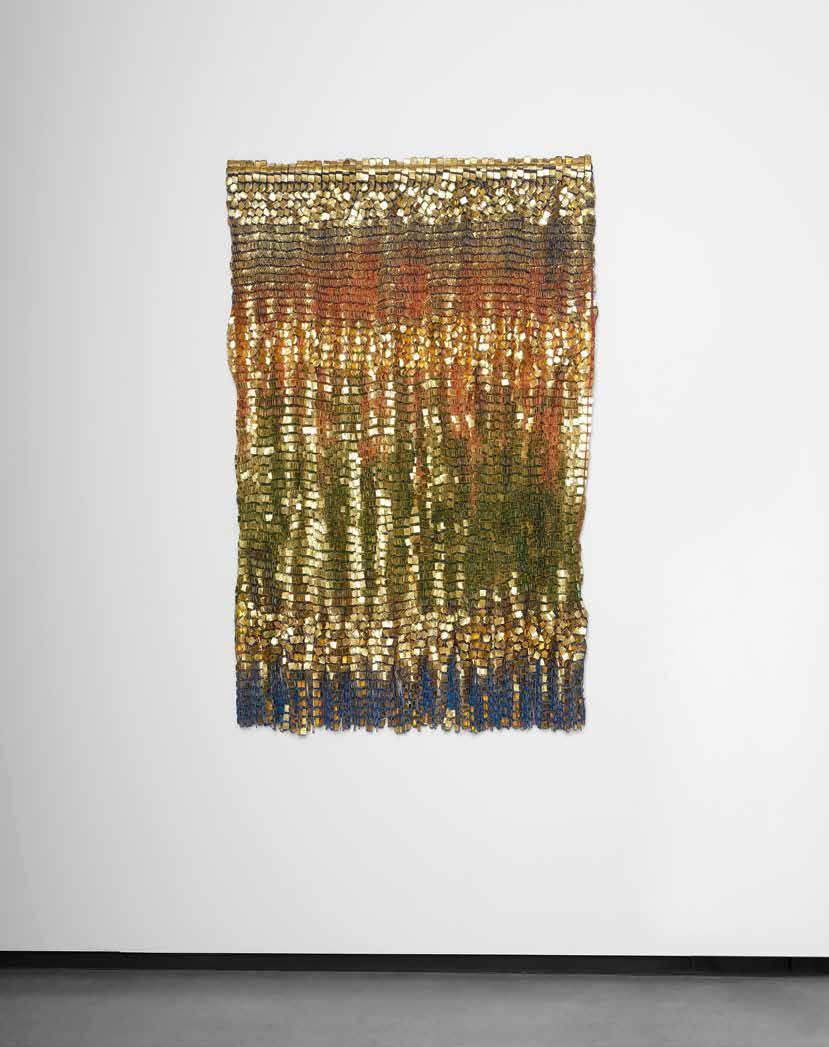
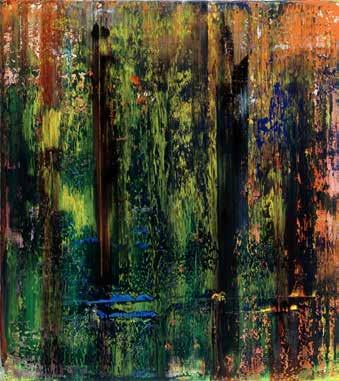
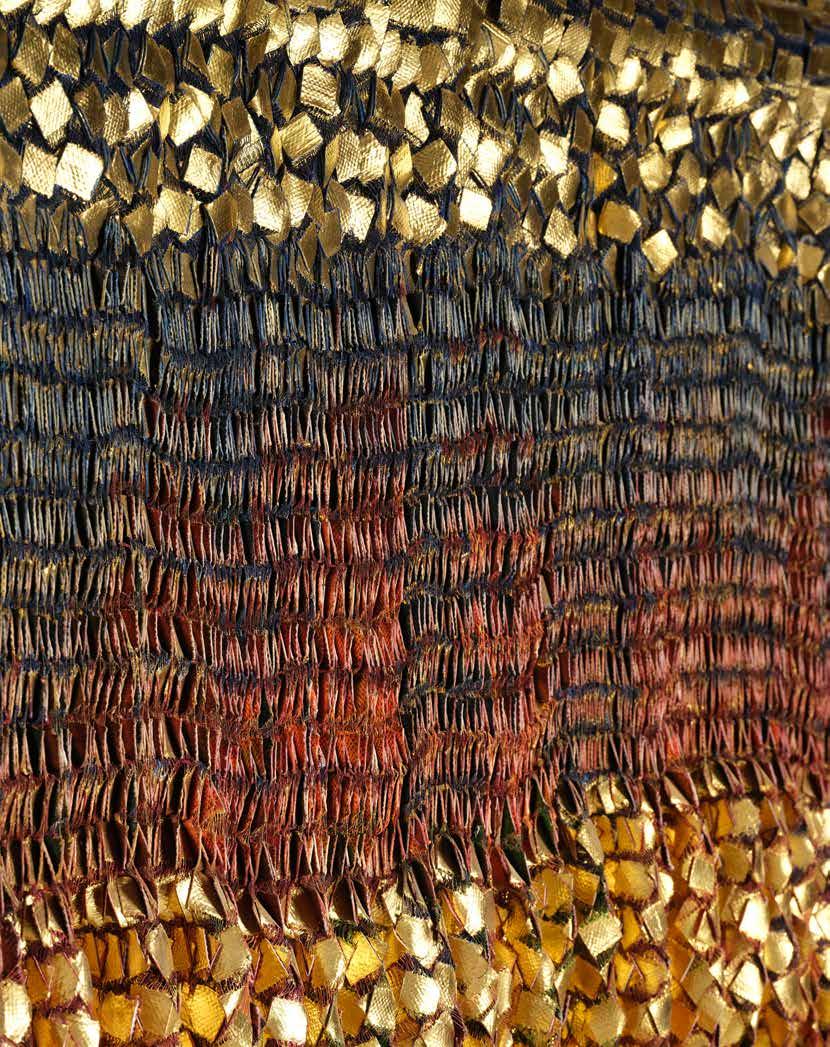
Boasting luminous hues of vibrant gold and mesmerizing color, Imagen perdida 35 epitomizes the signature language and layered meaning in Olga de Amaral's oeuvre. Dexterously woven into a surface which fluctuates with its surroundings, Imagen perdida 35 bridges the ancestral and the modern, the material and the metaphysical, while simultaneously challenging the traditional boundaries of the decorative and the fine arts. At once converging sculpture, painting, and architecture, her work transcends conventional definitions of textile art through pieces that act as constructed environments, evolving in space through light and movement.
Born in Bogotá in 1932, Amaral was trained in architecture before being introduced to textile design at the Cranbrook Academy of Art in Michigan under Finnish textile designer Marianne Strengell. An institution whose curriculum is heavily influenced by the Bauhaus movement—which in turn was influenced by Andean textiles—this education would inform Amaral's lifelong emphasis on structure and materiality as the cornerstone for art and form. Upon returning to Colombia, Amaral studied with local weavers and began to experiment with advanced pre-Columbian weave techniques, marveling at the precision in mathematics and geometry found in both traditions. With these influences from both the Global North and Global South, for decades Amaral has constructed a body of work that defies categorization.
Composed of acrylic, gesso, and gold leaf on pieces of linen which have been painstakingly constructed and interwoven, Imagen Perdida 35 's meaning is deepened through process. Amaral has described the individual linen squares that compose many of her mature works as "woven fragments [that] are the 'words' I use to begin creating landscapes of surfaces, textures, emotions, memories, meanings, and connections" (Lecture given by Olga de Amaral at the Metropolitan Museum of Art, New York, on April 24, 2003, as quoted in Olga de Amaral , p. 131). Fascinatingly,
“AS I BUILD THESE SURFACES, I CREATE SPACES OF MEDITATION, CONTEMPLATION, AND REFLECTION … TAPESTRY, FIBERS, STRANDS, UNITS, CORDS, ALL ARE TRANSPARENT LAYERS WITH THEIR OWN MEANINGS, REVEALING AND HIDING EACH OTHER TO MAKE ONE PRESENCE, ONE TONE THAT SPEAKS ABOUT THE TEXTURE OF TIME.”
–
OLGA DE AMARAL
this approach makes Amaral's visual lexicon both ancient and hyper contemporary, recalling early pictorial languages and the pixels of a digital image simultaneously. The surface texture created by her chosen media also informs her pieces. "I found that gesso and stucco allowed me to create inscriptions and bas-reliefs," the artist has said, "that enriched the meaning of the surface of the final work and endowed it with a timeless quality, like glyphs and inscriptions do to stones" ( Ibid. , p. 132).
In Imagen perdida 35 , layers of color are applied to the underside of the gold leaf, providing a dimensionality that allows for alternating colors—and therefore alternating images—to appear from diverse angles. This creates an image development process not unlike in photography, whereby the image is captured and revealed through mechanics, chemicals, and light. In this way, a parallel can be made to that of Jack Whitten's Developer paintings or Gerhard Richter's Abstraktes Bild series, whereby the abstract image is revealed as layers of paint are exposed. Most notably perhaps in this view is the title of the work, which translates to "Lost Image 35" from Spanish.
Like the Kinetic and Optical Art movements of the 1960s and 70s, Amaral's works require the viewer's active participation to complete their meaning, altering in color and perception as one moves around them. Similar to architectural design, Amaral's underlayering effect was developed in response to a limitation of the medium of weaving itself, the artist saying, "Weaving inherently deals with front and back, between the visible and concealed surfaces, between outside and inside... A variation of this concern is found in the series Imágenes perdidas , in which the strands are placed on edge (so it becomes primary face) and, as a result, both front and back are obliquely visible to the viewer" (Lecture given by Olga de Amaral at the Metropolitan Museum of Art, p. 133).
Like a floating waterfall of shimmering gold, intermittently imbued with subtle pinks, greens and blues, Imagen perdida 35 feels otherworldly, glowing with serene radiance as it interplays with light. Amaral's engagement with gold, the defining material of her practice, began in the 1980s following a formative visit to Japan. Influenced by the philosophy of kintsugi—the art of mending broken ceramics with gold—she embraced gold leaf for its symbolic resonance: representing the divine radiance of the sun, pre-Colombian craftsmanship, and the legacy of colonialism.
The presence of color with the gold adds nuance and complexity to both composition and significance, communicating abstract images and generating an experience of transcendence. As curator María Wills Londoño explains, "Amaral's work is profoundly linked to the spiritual... The sacred nature of the works... involves not only the synthesis of geometry and mathematics to achieve sophisticated abstractions, but perhaps also a deep investigation into color-based knowledge of nature and plants and connected with the effects of light to produce almost mystical variations in perception for the viewer. The importance of color to transmit experiences linked to the spirit is something that the artist has highlighted, as it is not only possibility but a language" ("The Sacred Threads of Olga de Amaral, Olga de Amaral , p. 207).
Imagen Perdida 35 exemplifies the broader triumph of textile art within the canon of contemporary abstraction, a luminous testament to the power of the artist's hand to weave eternity into form. By reinterpreting these materials through a contemporary lens, Amaral created work that is at once archaeological and avant garde, deeply rooted in her heritage yet unmistakably modern.
FADOJUTIMI (B. 1993)
Ribbon of Thought signed, inscribed and dated 'August '20 Jadé Fadojutimi 'Ribbon of Thought"' (on the reverse) oil and oil stick on canvas
43 1/2 x 43 3/8 in (110.5 x 110 cm)
Painted in 2020
US$150,000 - 250,000
£110,000 - 190,000
HK$1,200,000 - 2,000,000
Provenance
Pippy Houldsworth Gallery, London. Acquired from the above by the present owner in 2020.
Literature
J. Higgie, Jadé Fadojutimi: Jesture, London, 2021 (exh. cat., illustrated p. 35).
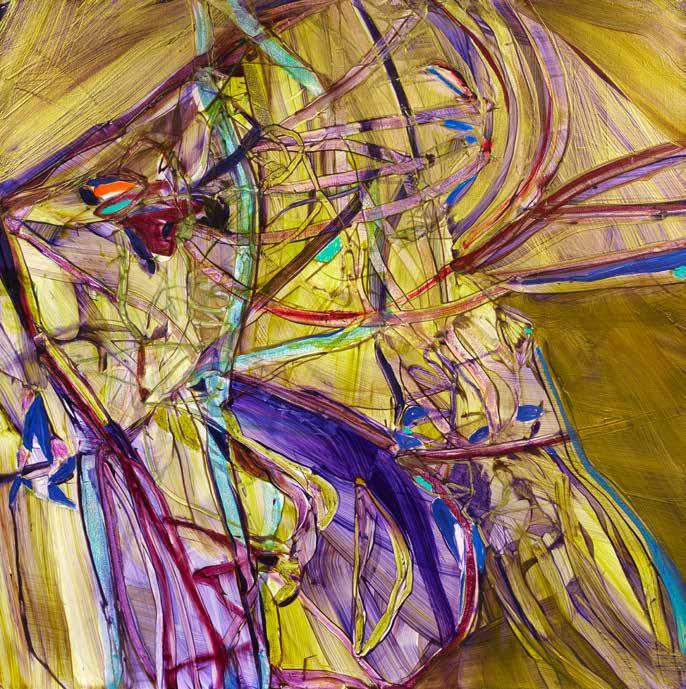
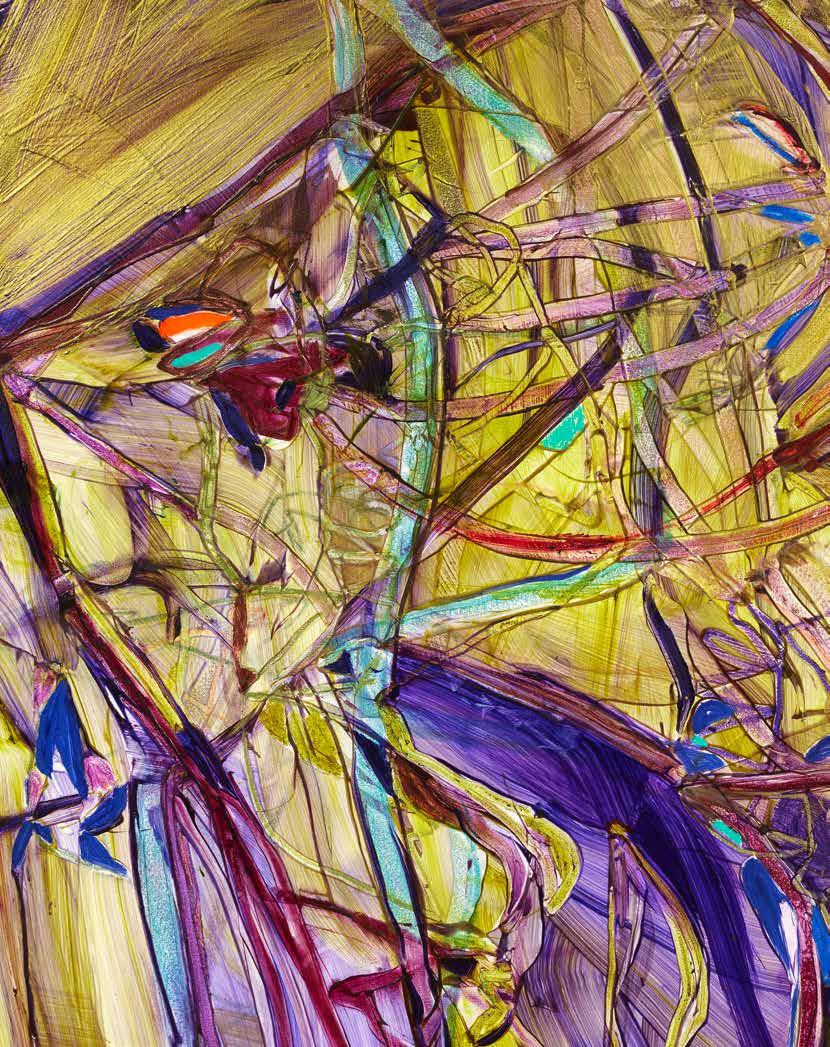
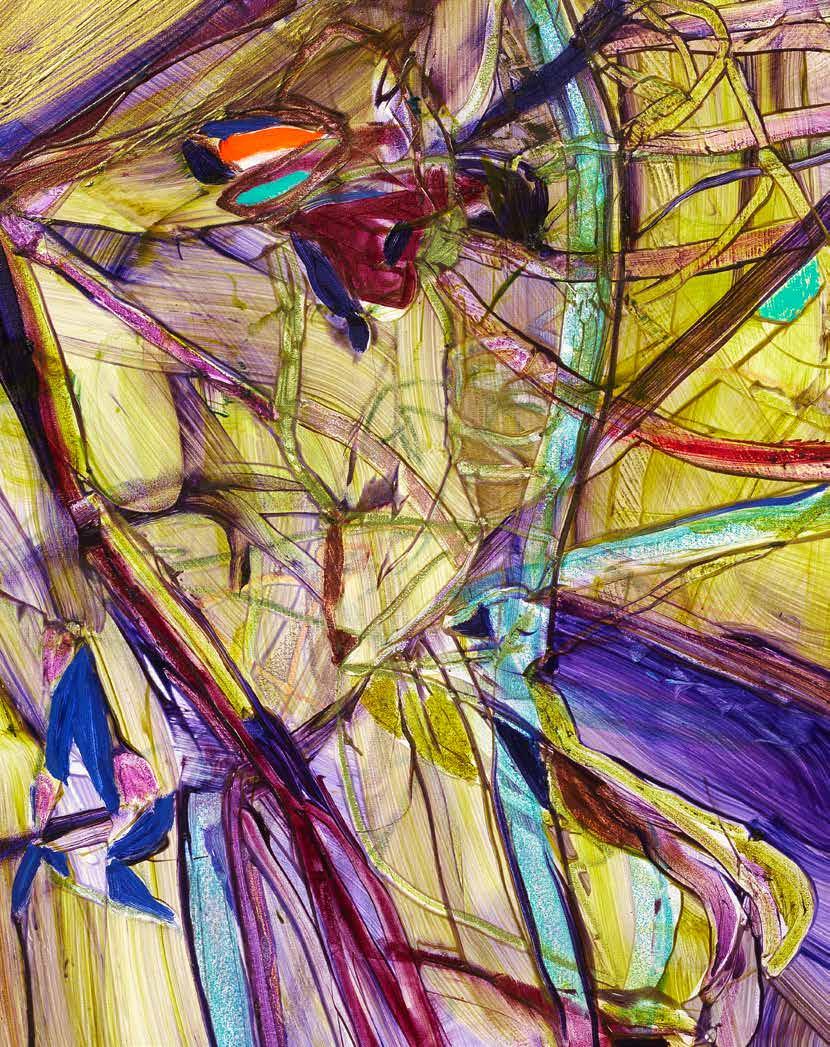
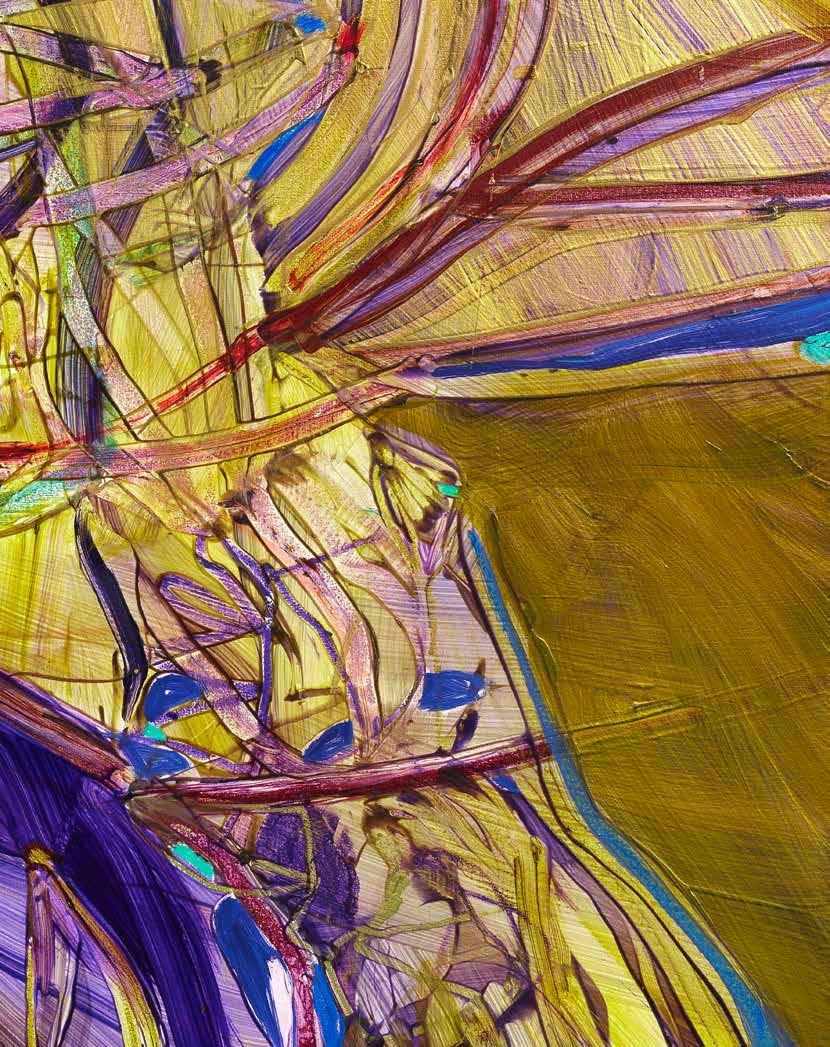
Executed in luminous golden hues interwoven with vibrant purples, violets and soft blues, Ribbon of Thought stands as an exemplary expression of Jadé Fadojutimi's practice. Fadojutimi's work is deeply informed by an internal investigation of identity and self-knowledge. Feelings and thoughts that resist verbal articulation erupt across her canvases, shaping a visual language that reveals the artist's inner world while simultaneously prompting the viewer to investigate their own emotional landscape. Fadojutimi's intricate compositions respond to daily experiences, unfolding as a flow of reflection led by sensation rather than reason. Writing also plays a central role in the artist's practice, adding a guiding layer to interpretation; here, the poetic title Ribbon of Thought evokes the soft impalpability of personal memories and the sprawling architecture of the work.
As the artist has remarked, "[...] when I feel emotion, I see a color and that's how my paintings come to life" (the artist quoted in: 'Painting takes me over – like witchcraft: Jadé Fadojutimi, art's hottest property', The Guardian, September 7, 2022, Online), underscoring the synesthetic relation between feeling and form that drives her practice. In Ribbon of Thought, the composition is marked by a striking dynamism: energetic gestures sweep across the canvas, guided by instinct yet carefully resolved. Variations of density are achieved through the interplay between oil paint and oil stick applied in successive coats that create a complex surface in which thickness and translucency coexist in tension. This balancing act rhythmically produces a movement that feels both structured and unexpected.
Fadojutimi's masterfully abstract vocabulary often strays into figuration, evoking imaginary landscapes. Here, the golden background recalls memories of wheat fields in the late summer, the superimposed bold lines emerging from it like desire paths seen from above. The materiality of the work, with its rich impasto and tactile immediacy, suggests the raw expressiveness of
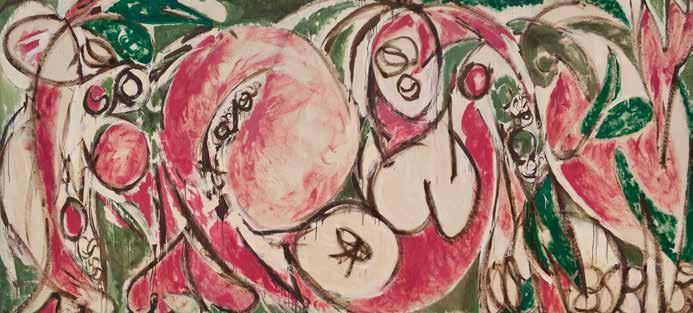
Informalism. At the same time, its vibrant chromatic intensity and gestural freedom resonate with the practices of Cecily Brown and Joan Mitchell, by whose work Fadojutimi is deeply influenced. The artist also draws inspiration from places, objects and sounds, with Japanese culture specifically being of defining relevance in her practice. These sources are not only visible in the vibrancy of her colors and in her use of form, but are an active component in her studio practice, being constantly re-engaged as creation takes place. Fadojutimi further describes how sounds – woven into her practice as she paints to music – translate into color: "to me, color is a sense in itself [...] Color is feeling" (the artist quoted in: R. Mead, 'The Intensely Colorful Work of a Painter Obsessed with Anime', The New Yorker, November 11, 2024, Online).
Intimate but expansive, Ribbon of Thought encapsulates Jadé Fadojutimi's ability to translate emotion into a vivid, immersive language. Poised between instinct and control, the present work affirms her position as a leading voice in contemporary art.
Jadé Fadojutimi has quickly been recognised as one of the most captivating artists of her generation. Just a few years after completing her master's degree from the Royal College of Art in London, her work was presented in solo exhibitions at the Institute of Contemporary Art Miami in 2021 and at The Hepworth Wakefield in 2022. In 2020, Fadojutimi became the youngest artist to enter the Tate's collection.
Fadojutimi's work is held in the permanent collections of renowned institutions worldwide, including the ICA Miami; the Metropolitan Museum of Art, New York; the Walker Art Center, Minneapolis; the Tate Collection, London; the Stedelijk Museum, Amsterdam; and the Musée d'Art Moderne de Paris. Her canvases were also exhibited in the Central Pavilion at the 59th Venice Biennale (2022) and at the 11th Liverpool Biennial (2021).
3A W
RONI HORN (B. 1955)
Untitled ("Peacocks not only eat flowers; they eat them systematically, beginning at the head of a row and going down it. If they are not hungry, they will pick the flower anyway and let it drop. For general eating, they prefer chrysanthemums and roses.")
solid cast glass with as-cast surfaces
19 x 36 x 36 in (48.3 x 91.4 x 91.4 cm)
Executed in 2012-13. This work is unique
US$500,000 - 700,000
£370,000 - 520,000
HK$3,900,000 - 5,500,000
Provenance
Xavier Hufkens, Brussels.
Acquired from the above by the present owner in 2015.
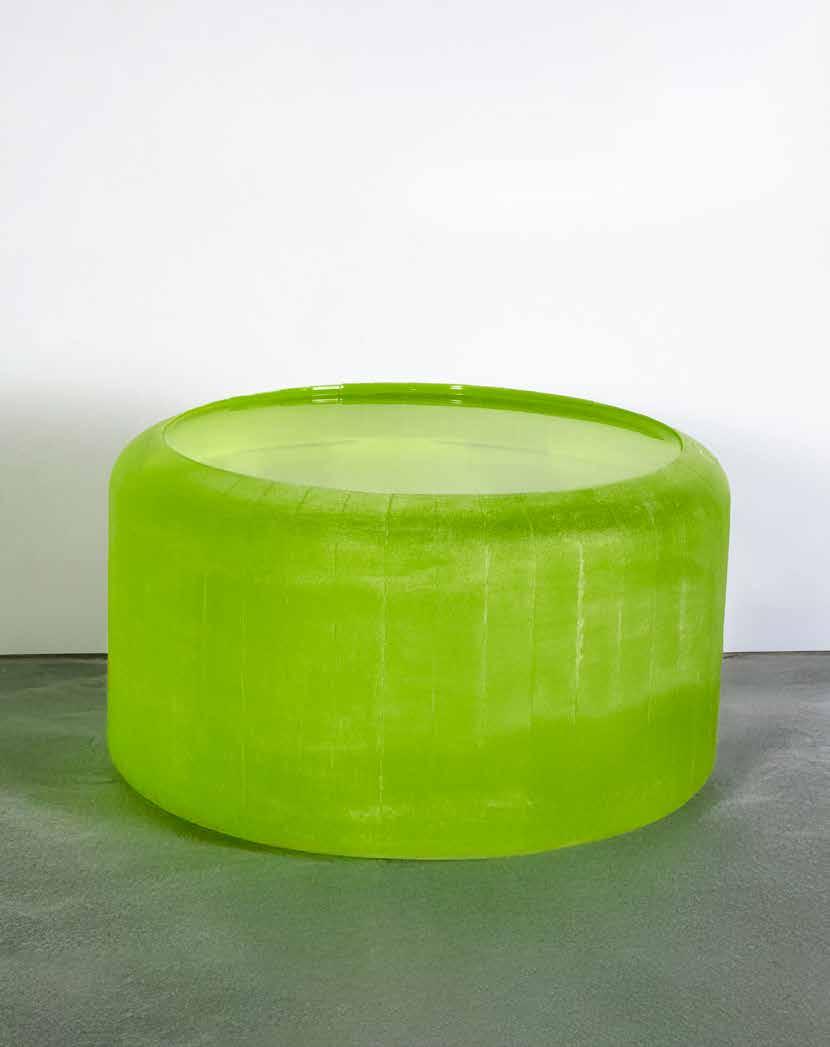
Known for a multidisciplinary practice comprising poetry, drawing, photography, sculpture and other media, Roni Horn has long explored a diversity of themes that hinge on malleability and its relationship to identity, perception, memory and meaning. With their opaque sides and smooth, reflective surfaces, Horn's glass sculptures—her most celebrated body of work—are installed on the floor where they continuously give the illusion of change through their interaction with light and their environments. Composed of solid glass, these illusions are paradoxical as the object itself changes only as its meaning is continuously perceived and experienced by the viewer. These works demonstrate Horn's mastery of skill and her astute ability to capture the nuances of truth and perception.
Horn began making glass sculptures in the 1990s, created by pouring liquid glass into molds, cooling them over several months, and then torching their tops to create a mirror-like finish. Sensuous and alluring, these forms invite the viewer to gaze in, creating active participation as each viewer experiences the reflection of themselves and their surroundings. As Briony Fer writes, "what Horn dramatizes... is that precarious and porous relationship between inside and outside, as if the surface of the image is the most fragile of membranes... This sense of inwardness and introspection is part of the fundamental paradox in all of Horn's work... An image of pure exposure —to the outside, to the elements —can also be seen as an interior monologue, a sequence of the most minute shifts in emotion and feeling" (Briony Fer, "Roni Horn: Face-toface," Roni Horn: The Detour of Identity, Gottingen 2024, p. 445).
In their cylindrical form, these sculptures mimic pools of water and in their rectangular form, cubes of ice. A sculptural trompe l'oeil, herein lies their formal paradox—toeing the line between liquid and solid, the inherent fragility of glass is also juxtaposed by its apparent sturdiness when shaped to this size and weight. As a material, glass must be a liquid before it can be a solid, and its transparent visual appearance alludes to the memory of its past self. In "Heavy Light: Roni in the Arctic Circle," critic Zoë Lescaze explains the materiality of these works inform our experience of them, saying:
"Horn's choice of optical glass—the kind used for the lenses of microscopes, telescopes, and other devices that bring distant landmarks, far away planets, and microbial worlds into focus—hints at the fact that these sculptures are also instruments of perception. What they reveal is ceaseless fluidity: the flux that is the only constant of our world and an inescapable condition of living within it. Placed in natural light (as they always are), the glass cylinders transform with the oscillations of the environment, from warm to cool, dim to
bright, and back again. They have no fixed identity or definitive appearance. The longer we look at them, the more they change and the more unknowable they become. As lenses, these sculptures show the viewers who linger with them that stillness is an illusion, stasis a mirage. Other lenses and scopes involving optical glass are instruments of confirmation and clarity. These sculptures are instruments of doubt" (Roni Horn: Give Me Paradox or Give Me Death, Cologne 2024, p. 225).
Glass as a material further embodies Horn's longtime fascination with the Double and its relationship to identity. A concept first coined by Sigmund Freud in his 1919 text The Uncanny, the Double is that of the inextricable dialectic between Self and the Other, arguing that though paradoxical (and therefore uncanny) the Other is an equally necessary part of the Self. Horn's sculptures therefore allow for the fluid relationship between binaries and the movement between worlds or states of being, such as the conscious and the unconscious, internal and external, sameness and otherness, subject and object. Similar in appearance to water—a recurrent theme in Horn's oeuvre— glass further heightens her emphasis on mutability, also a feature of all things in nature as in life itself.
The present work, Untitled ("Peacocks not only eat flowers; they eat them systematically, beginning at the head of a row and going down it. If they are not hungry, they will pick the flower anyway and let it drop. For general eating, they prefer chrysanthemums and roses.") from 2013 emanates a soft green glow that is both natural and otherworldly. Also a poet, Horn often takes the titles of her works from literature; in this instance from Flannery O'Connor's "Living with a Peacock", a personal essay published in Holiday magazine in 1961. O'Connor raised peacocks on her family farm and in the text speaks of them as the bird of Hera in Greek Mythology, at once representing vanity, beauty and pride. The poem speaks directly to the material nature of glass as a reflective surface that, much like our perceptions, is both stable and ever changing.
The present work's sister work, Untitled ("The peacock likes to sit on gates or fenceposts and allow his tail to hang down. A peacock on a fencepost is a superb sight. Six or seven peacocks on a gate is beyond description, but it is not very good for the gate. Our fenceposts tend to lean and all our gates open diagonally.") is in the permanent collection of the Corning Museum of Glass in upstate New York. Other glass sculptures can be found in the permanent collections of major museums worldwide, including the Museum of Modern Art in New York, the Glenstone Museum in Potomac, the Pinault Collection in Paris, the Louisiana Museum of Modern Art in Humlebaek, Denmark.
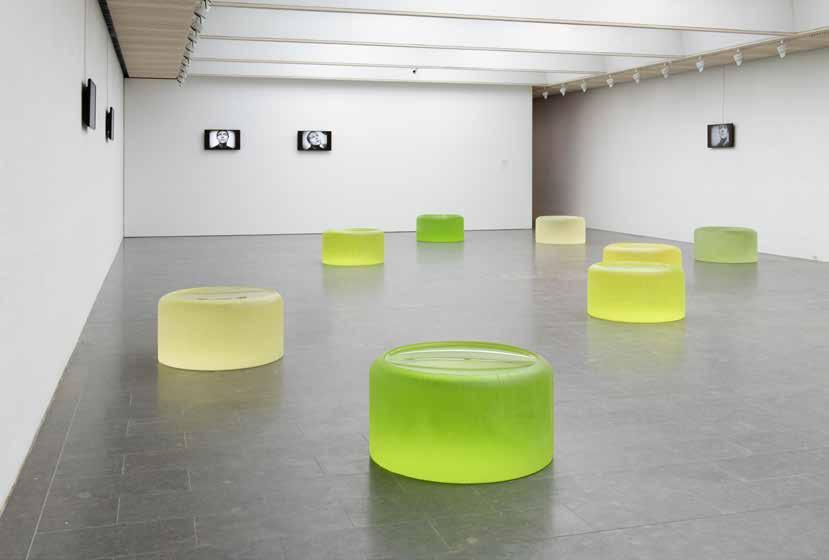
Untitled (“My name is Mary Katherine Blackwood. I am eighteen years old, and I live with my sister Constance. I have often thought that with any luck at all I could have been born a werewolf, because the two middle fingers on both my hands are the same length, but I have had to be content with what I had. I dislike washing myself, and dogs, and noise. I like my sister Constance, and Richard Plantagenet, and Amanita phalloides, the deathcup mushroom. Everyone else in my family is dead.”, 2012–13; Solid cast glass with as-cast surfaces, 10 units, each 18 1/2 x 36 in / 47 x 91.4 cm, Installation view, Louisiana Museum of Modern Art, Humlebæk, Denmark, 2024.
PROPERTY FROM A PRIVATE COLLECTION, WESTCHESTER
4A
HENRY MOORE (1898-1986)
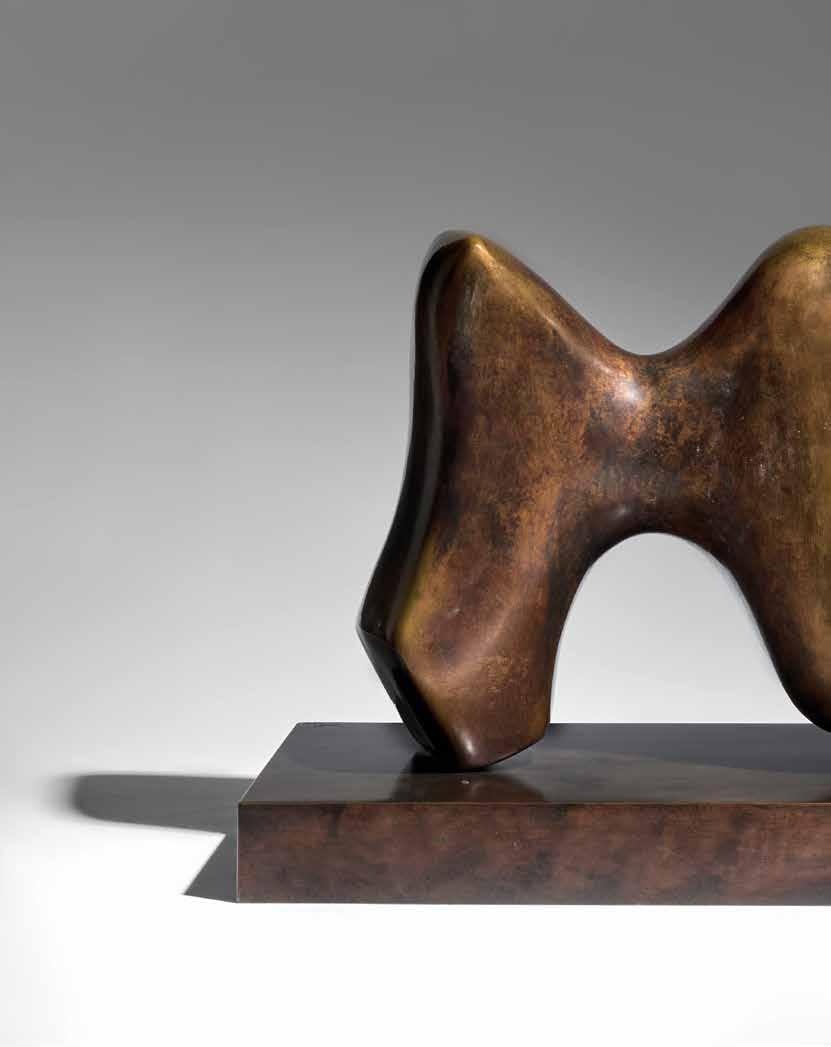
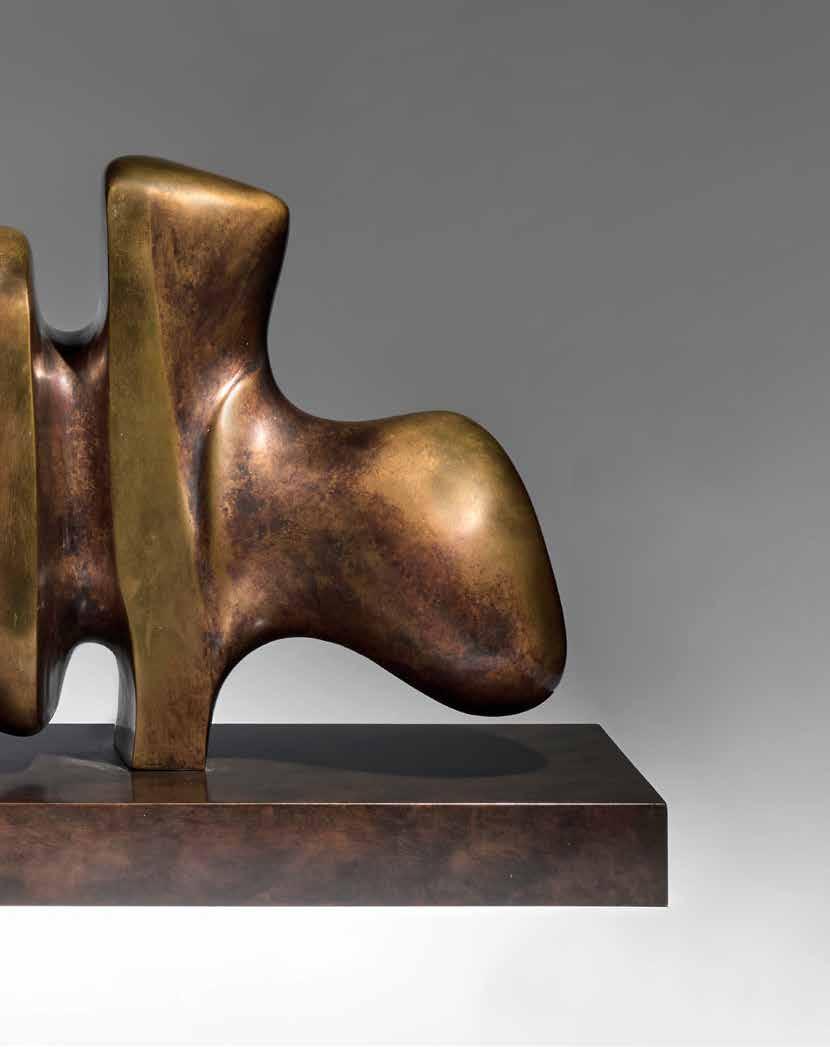
Working Model for Animal Form signed and numbered 'Moore 9/9' (on the top of the base) bronze with brown patina 15 1/8 x 25 3/8 x 8 5/8 in (38.4 x 64.5 x 21.9 cm)
Conceived in 1969-1971, this bronze version cast by the Fiorini Foundry in an edition of 9 plus one artist's proof.
USD250,000 - 350,000
£180,000 - 260,000
HK$2,000,000 - 2,700,000
This work is recorded in the archives of the Henry Moore Foundation under no. LH 615.
Provenance
Raymond Spencer Company Ltd., Much Hadham. Acquired from the above by the late owner on June 18, 1984.
Literature
Exh. cat., Henry Moore: Graphic and Sculpture, Wildenstein Tokyo, Tokyo, 1975, no. 9 (another cast illustrated).
A. Bowness (ed.), Henry Moore, Sculpture and Drawings, Vol. IV, Sculpture 1964–73, London, 1977, no. 615 (another cast illustrated pp. 59 & 160-161).
D. Mitchinson (ed.), Henry Moore Sculpture, With Comments by the Artist, Barcelona, 1981, no. 491 (another cast illustrated p. 226).
Exh. cat., Henry Moore Sculpture, Drawings, Graphics 1921-1981, Parque de El Retiro, Palacio de Velázquez, Madrid, 1981, no. 491 (another cast illustrated p. 226).
W.J. Strachan, Henry Moore, Animals, London, 1983, nos. 94–95 (another cast illustrated p. 108).
Exh. cat., Henry Moore: Maquettes and Working Models, The Nelson-Atkins Museum of Art, Kansas City, 1987, no. 40 (another cast illustrated p. 16).
Exh. cat., Henry Moore, Sculture, Disegni, Incisioni, Arazzi, Fondazione Giorgio Cini, Venice, 1995, no. 111 (another cast illustrated p. 193).
J. Hedgecoe, A Monumental Vision, The Sculpture of Henry Moore, New York, 1998, no. 546 (another cast illustrated p. 234).
Exh. cat., Henry Moore—Animals, Gerhard Marcks-Stiftung, Bremen, 1997, p. 48 (another cast illustrated). Henry Moore Foundation (eds.), The Henry Moore Artwork Catalogue, online catalogue, no. LH 615.

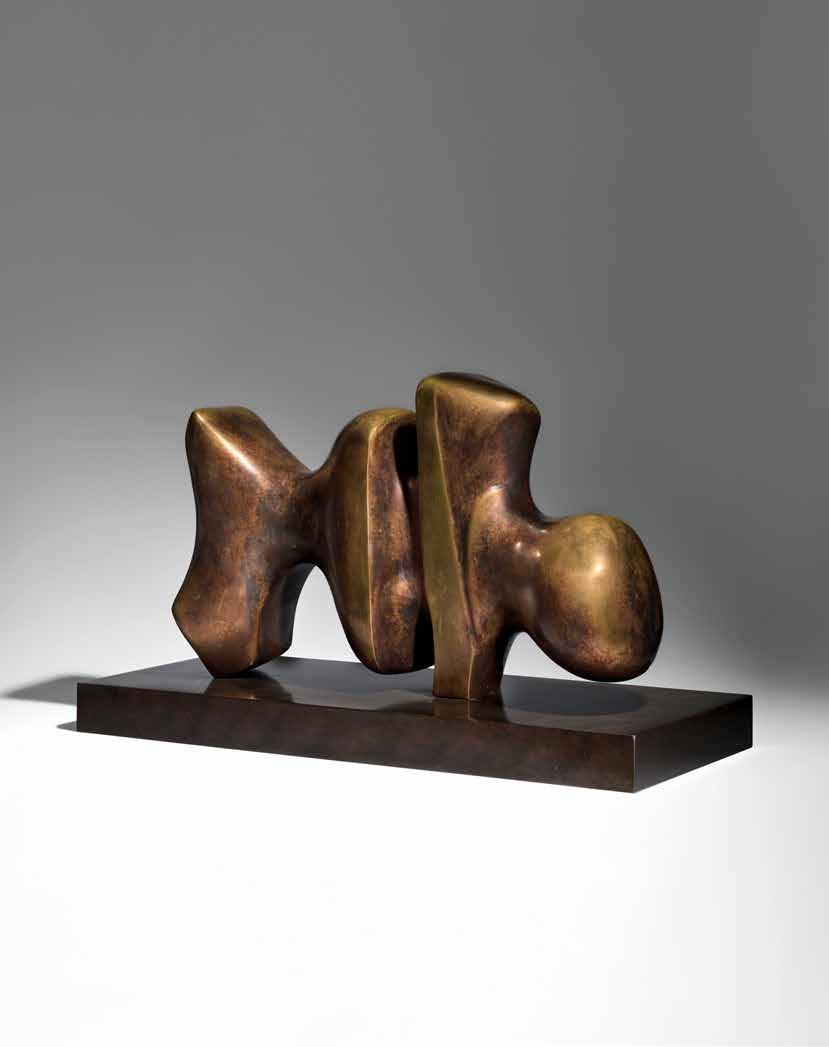
Renowned for his abstracted sculptures of human and animal forms, Working Model for Animal Form (conceived 1969-1971) exemplifies Henry Moore's signature mature style, bringing a blocky, architectural monumentalism to his vision of the natural world. Moore and his wife Irina moved to Hoglands, a Grade II listed medieval house in Perry Green in Much Hadham, Hertfordshire in 1940. The bucolic landscape dotted with flocks of grazing sheep would inform a significant strand of his output, including the present work.
Sheep Sketchbook, completed in 1972 as a gift to his daughter Mary, is Moore's best-known body of work relating to the sheep in his environment, and was later published in 1980 with a forward by celebrated art historian Kenneth Clark. Moore used pen and ink to find monumental and expressive qualities in these quotidian subjects. His most well-known sculpture of the ovine subject is Sheep Piece (1969-1972), produced in three different sizes. This work is comprised of two separate forms which move much further away from the literal forms of sheep than the composition of the present lot.
Occupying the position between sketch, maquette, and fully realized sculpture, working models like the present sculpture acted as an important intermediate step in Moore's creative process, allowing the artist to refine an idea before it was realized at full scale. Speaking in 1978, Moore detailed this process, explaining:
"Sometimes I make ten or twenty maquettes for every one that I use in a large scale – the others may get rejected. If a maquette keeps its interest enough for me to want to realise it in a full-size final work, then I might make a working model in an intermediate size, in which changes will be made before going to the real, full-sized sculpture. Changes get made at all these stages" (quoted in A. Wilkinson, ed., Henry Moore: Writings and Conversations, Aldershot, 2002, p. 217).
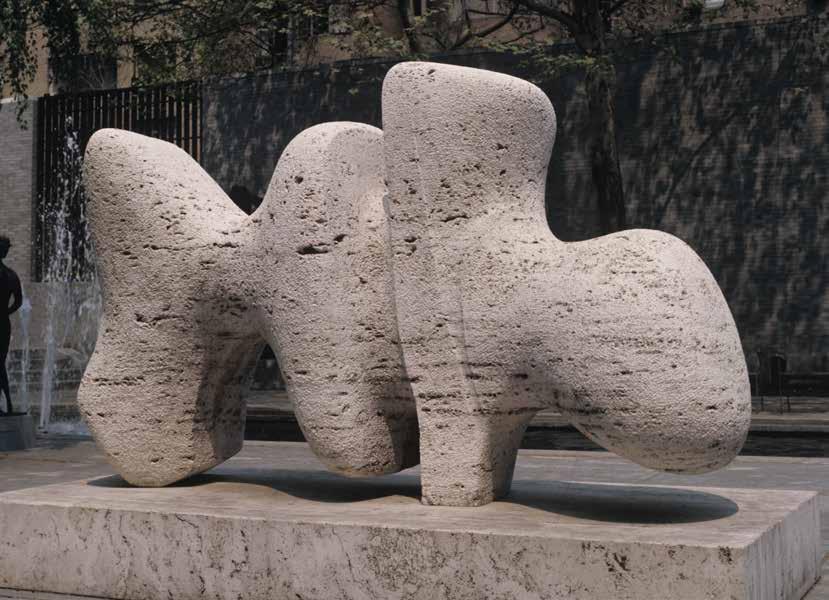
In the case of the present work, this process allowed Moore to assess and explore the volumes, posture, and expressiveness of the figure before he set his tools to large blocks of marble intended for the final sculpture, Large Animal Form, testing the visual and structural potential of his ideas in three dimensions. A marble cast, Animal Form, was offered at auction in 2000; the monumental Large Animal Form in travertine marble was formerly in the collection of the Museum of Modern Art, New York.
This particular example of Working Model for Animal Form, edition 9/9, is elevated by its rich, lustrous, golden-brown patina. The bulbous shape at one end denotes a head, and the two points touching the base represent legs and feet, while the shoulder blades, rump, and midsection are angular, exaggerated, and abstracted. From the 1920s and 1930s, Moore began deriving inspiration from shells, bones, and pebbles, collecting a "library of natural forms" from his visits to the Norfolk coast. Moore studied organic growth, rhythm, and structural form, which heavily influenced his biomorphic sculptures. Working Model for Animal Form is a prime example of how Moore would comingle the form of, for example, a vertebrae bone, with the silhouette of common livestock, playing with expectations of scale and drawing inspiration from one type of natural form to abstract and build a wholly new interpretation of yet another form existing in nature.
Working Model for Animal Form, to be sold by Bonhams this spring, hails from an impeccable provenance. The sculpture has remained with the same family for over forty years, since its purchase from Raymond Spencer Company Ltd. in Much Hadham, England in 1984. In 1977 two new entities were created: the not-for-profit Henry Moore Foundation, as well as Raymond Spencer Ltd, named after Moore's father, which was founded as a commercial enterprise. The latter company, of which Moore was Managing Director, paid Moore a salary, owned his new works, and was developed to conduct transactions with collectors of Moore's art.
Moore's sculptures are included in major public collections across the globe, and Kew Gardens, London is currently presenting Henry Moore: Monumental Nature, the largest exhibition ever of the artist's outdoor monumental sculptures.
"SCULPTURE SHOULD ALWAYS AT FIRST SIGHT HAVE SOME OBSCURITIES, AND FURTHER MEANINGS. PEOPLE SHOULD WANT TO GO ON LOOKING AND THINKING; IT SHOULD NEVER TELL ALL ABOUT ITSELF IMMEDIATELY… IN MY SCULPTURE EXPLANATIONS OFTEN COME AFTERWARDS."
– HENRY MOORE

5A P
CONSTANTIN BRANCUSI (1876-1957)
La Muse endormie II signed 'Brancusi', numbered '7/8' and inscribed with the foundry mark 'Susse Fondeur Paris' (on the underside) polished bronze 6 15/16 x 11 1/8 x 6 11/16 in (17.6 x 28.2 x 17 cm)
Conceived in alabaster in 1917 and bronze in 1922, this polished bronze version cast by the Susse Foundry from the Istrati-Dumitresco plaster in 2010 in a numbered edition of 8.
Five bronze and three plaster versions of this subject were cast during the artist's lifetime. A further numbered edition of 8 were cast beginning in the 1970s by the legatees of Brancusi, Alexandre Istrati and Natalia Dumitresco, from a duplicate of the artist's original plaster. The final four versions were cast by their appointed heir and the Estate of the artist in 2005, 2010 and 2013.
US$3,000,000 - 5,000,000
£2,200,000 - 3,700,000
HK$23,000,000 - 39,000,000
Provenance
Estate of the artist.
Literature
M. de Micheli, 'Constantin Brâncusi,' in I Maestri della Scultura, no. 46, Milan, 1966 (another cast illustrated on the cover). S. Geist, Brancusi, A Study of the Sculpture, New York, 1967, p. 45 (alabaster and polished bronze versions illustrated nos. 78-79; dated '1914?').
S. Geist, Constantin Brancusi 1876-1957, A Retrospective Exhibition, exh. cat., The Solomon R. Guggenheim Museum, New York, 1969 (alabaster and polished bronze versions illustrated pp. 88-89).
S. Geist, Brancusi, The Sculpture and Drawings, New York, 1975, no. 166a (another cast illustrated p. 119).
F.T. Bach, Constantin Brancusi, Metamorphosen Plastischer Form, Cologne, 1987, no. 216 (another cast illustrated p. 480).
P. Hultén, N. Dumitresco & A. Istrati, Brancusi, New York, 1987, no. 132 (another cast illustrated p. 299).
J. Neutres, Brancusi in New York 1913-2013, exh. cat., Paul Kasmin Gallery, New York, 2014, no. 3 (another cast illustrated pp. 114-115, 118-121).
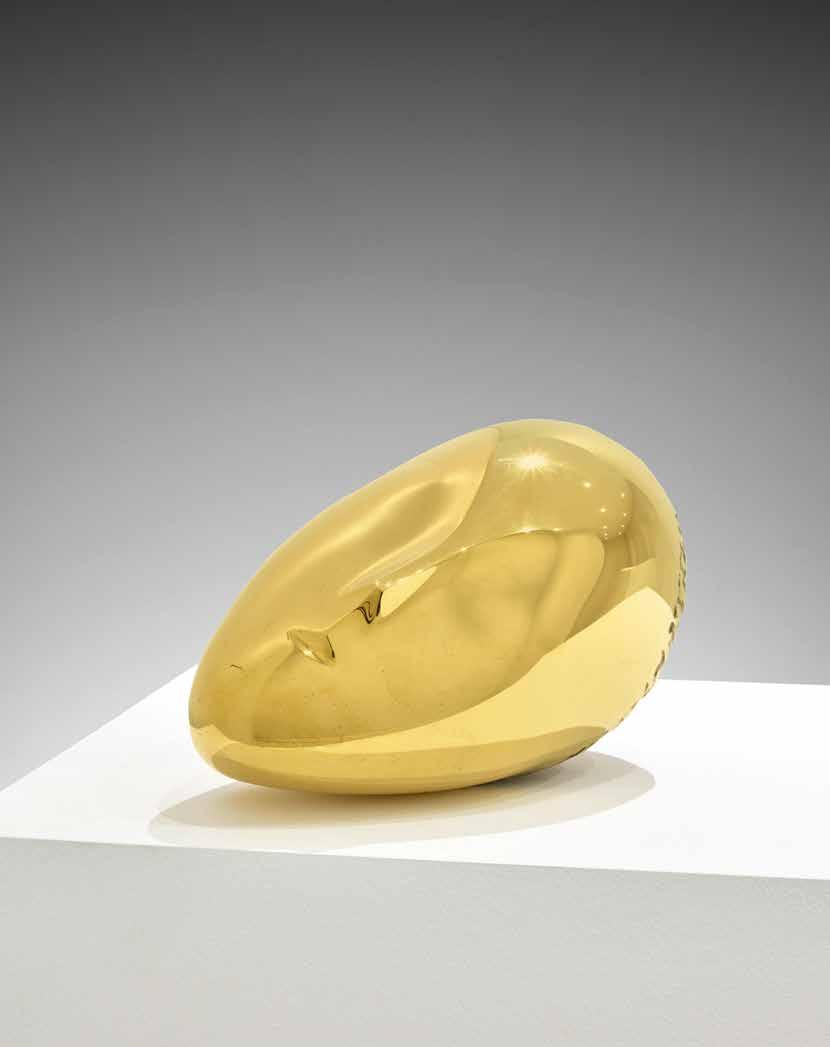
A paragon of modern sculpture, La Muse endormie II stands as an icon of Constantin Brancusi's radical artistic vision—one that would forever change the trajectory of twentieth-century art. Forged in the crucible of Paris's avant-garde ferment and imbued with the quiet force of Brancusi's Romanian heritage, this polished bronze marvel encapsulates the artist's pursuit of essence, transcendence, and form unbound by the material.
Brancusi's path to mastery was neither typical nor easy. Born in the rustic village of Hobita, Southern Romania, in 1876, he was the second of five children in a peasant family. His early years were shaped by hardship and manual labour, experiences that gave him a lifelong reverence for natural materials and craftsmanship. Leaving home as a child, he worked as a shepherd and apprentice before enrolling in the School of Arts and Crafts in Craiova and later, the National School of Fine Arts in Bucharest.
Brancusi's skill in classical figuration was apparent, but even then, he yearned for something deeper—a modern language of form that transcended representation. That quest took him, famously on foot, to Paris in 1904. The pilgrimage through Europe was more than geographic— it was symbolic, a transformation from rural Romania to the cultural epicentre of modernism. After briefly assisting Auguste Rodin in his studio—an experience he swiftly concluded with the quip "Nothing can grow under big trees"—Brancusi set about establishing his singular voice.
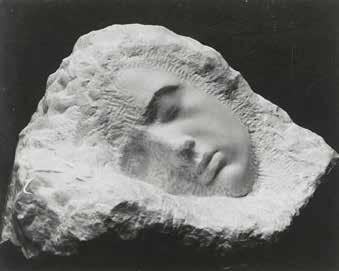
Constantin Brancusi, La Muse endormie I , 1909-10, Hirshorn Museum and Sculpture Garden, Washington, D.C.
He stripped away extraneous detail, seeking instead to distil his subjects to their metaphysical core. Even while moving towards abstraction, however, his work retained the classical ideals of harmony, proportion, and idealized form found in Ancient Greek sculpture.
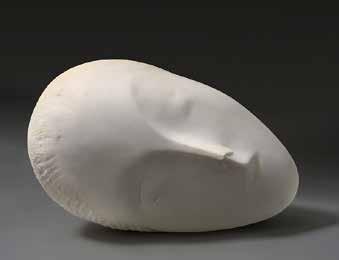
It was in this praxis of idealized refinement that La Muse endormie was born. The subject—Baroness Renée Frachon—was first sculpted by Brancusi in 1908, inaugurating a sequence of works that abandoned descriptive naturalism in favour of elemental purity. Between 1909 and 1910, Brancusi executed his first interpretation of La Muse endormie I , a white marble version which pared the human head down to a serene oval, marked only by faint allusions to facial features. Over the course of 1910, he proceeded to create three plaster and six bronze versions of the radiant, abstracted head. It was in 1917 that the artist started a revised version in alabaster. With La Muse endormie II , Brancusi reached an apex of reductive elegance. Here, the sleeping woman's form is more distilled than ever, her features softened to the brink of abstraction, her essence seemingly suspended between dream and tangible form.
This later iteration reflects Brancusi's relentless pursuit of perfection. As he wrote in 1917 to his patron John Quinn, "They must not be considered as reproductions of the first ones... but to go further." Brancusi subsequently made molds from this alabaster, and in the early-to-mid 1920s, he cast five bronze and three plaster versions of La Muse endormie II . Beginning
in the 1970s, a further numbered edition of eight casts, based from a duplicate of the original plaster, was started by the universal legatees of the sculptor, Alexandre Istrati and Natalia Dumitresco. Istrati and Dumitresco, also originally from Romania, developed a close relationship with Brancusi whilst living and working out of a studio directly adjacent from Brancusi's studio in Paris, France. In his final years, the young couple remained steadfast companions of the artist, and the early posthumous casts were created under their direction. The final four versions from this edition of 8 were cast by their appointed heir and the Estate of the artist in 2005, 2010 and 2013. The present work was cast by the Susse Foundry from the Istrati-Dumitresco plaster in 2010 and is number seven from said edition of eight.
With La Muse endormie II , Brancusi indeed went further—simplifying, refining, and reimagining the form through his rigorous engagement with material and meaning. The bronze surface, highly polished to a mirror-like gleam, is not merely decorative; it is transformative. As curator Sidney Geist describes, " Sleeping Muse II was surely created with a polished metal version in view...the bronzes from this work are dazzling objects, evocations of sleep and feminine beauty whose blending of the fragilely human and the uncompromisingly metallic supplies a new frisson " (S. Geist, Constantin Brancusi 1876-1957, A Retrospective Exhibition , exh. cat., New York, 1969, p. 89). For Brancusi, polish was not a finish but a revelation – a means of animating form with light, space, and spiritual energy.
An accomplished craftsman to the core, Brancusi handled every object himself, believing that only through direct manipulation could a sculpture attain its highest expressive power. His materials—be it marble, wood, or bronze—were not simply passive vessels, but active collaborators. In polished bronze, La Muse endormie II radiates an intensity that transcends its static form, becoming a luminous vessel of consciousness, contemplation, and calm.
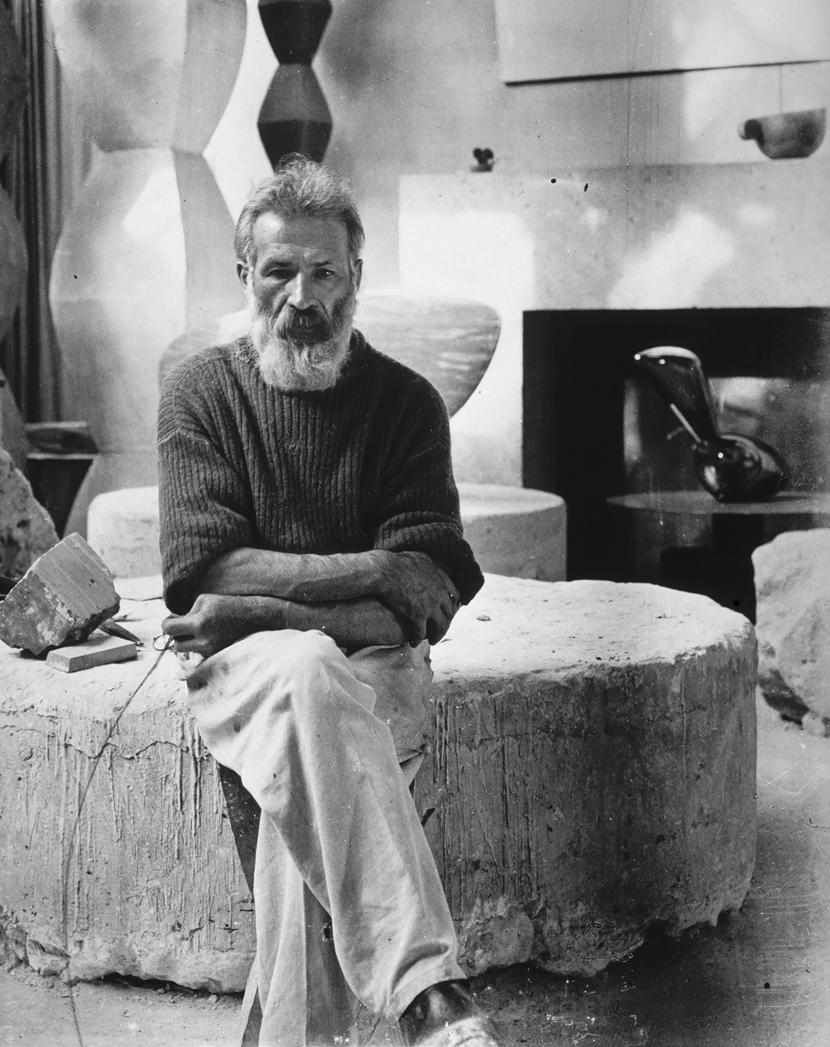
Brancusi's international breakthrough came at the 1913 Armory Show in New York, where his revolutionary forms stunned American audiences. The event marked the beginning of longstanding relationships with influential patrons such as John Quinn and Peggy Guggenheim. Throughout his life, Brancusi remained quietly independent, working from his modest studio on Impasse Ronsin in Paris, a space he arranged like a metaphysical sanctuary—his sculptures positioned like celestial bodies, his photographs chronicling their quiet power.
He lived through two World Wars in self-imposed artistic isolation and died in 1957, having bequeathed his studio to the French state. Today, reconstructed and preserved by the Centre Pompidou, the Atelier Brancusi stands as testament to a life spent in the pursuit of purity.
La Muse endormie II is not simply a beautiful sculpture; it is the masterful Brancusi at his most serene, most radical, and most sublime.
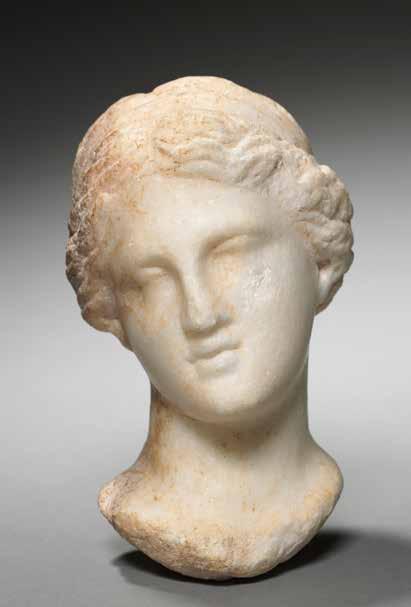
Hellenistic Period, Head of a Woman , 300–200 BCE, The Cleaveland Museum of Art, Ohio.
Le miroir vivant
6A P
RENÉ MAGRITTE (1898-1967)
Le miroir vivant
signed 'Magritte' (upper right) oil on canvas laid down on board 10 5/8 x 7 5/8 in (27 x 19.6 cm) Painted in 1935
US$1,000,000 - 1,500,000
£740,000 - 1,100,000
HK$7,800,000 - 12,000,000
Provenance
Julien Levy Gallery, New York (acquired directly from the artist in 1936). Private collection, Cincinnati (probably acquired from the above in 1938). Thence by descent to the present owner.
Exhibited
New York, Julien Levy Gallery, René Magritte, January 3-20, 1936, no. 19.
New York, Julien Levy Gallery, René Magritte, Paintings, January 4-18, 1938, no. 14. Cincinnati, Cincinnati Modern Art Society, 12 Surrealists, April 20 - May 23, 1943. (Possibly) Cincinnati, Cincinnati Art Museum, on loan, October 11, 1955 - May 21, 1956.
Literature
D. Sylvester (ed.) & S. Whitfield, René Magritte, Catalogue Raisonné, Vol. II, Oil Paintings and Objects, 1931-1948, Antwerp, 1993, no. 374 (illustrated p. 201).
"FOR ME IT’S NOT A MATTER OF PAINTING ‘REALITY’ AS THOUGH IT WERE READILY ACCESSIBLE TO ME AND TO OTHERS, BUT OF DEPICTING THE MOST ORDINARY REALITY IN SUCH A WAY THAT THIS IMMEDIATE REALITY LOSES ITS TAME OR TERRIFYING CHARACTER AND PRESENTS ITSELF WITH MYSTERY ."
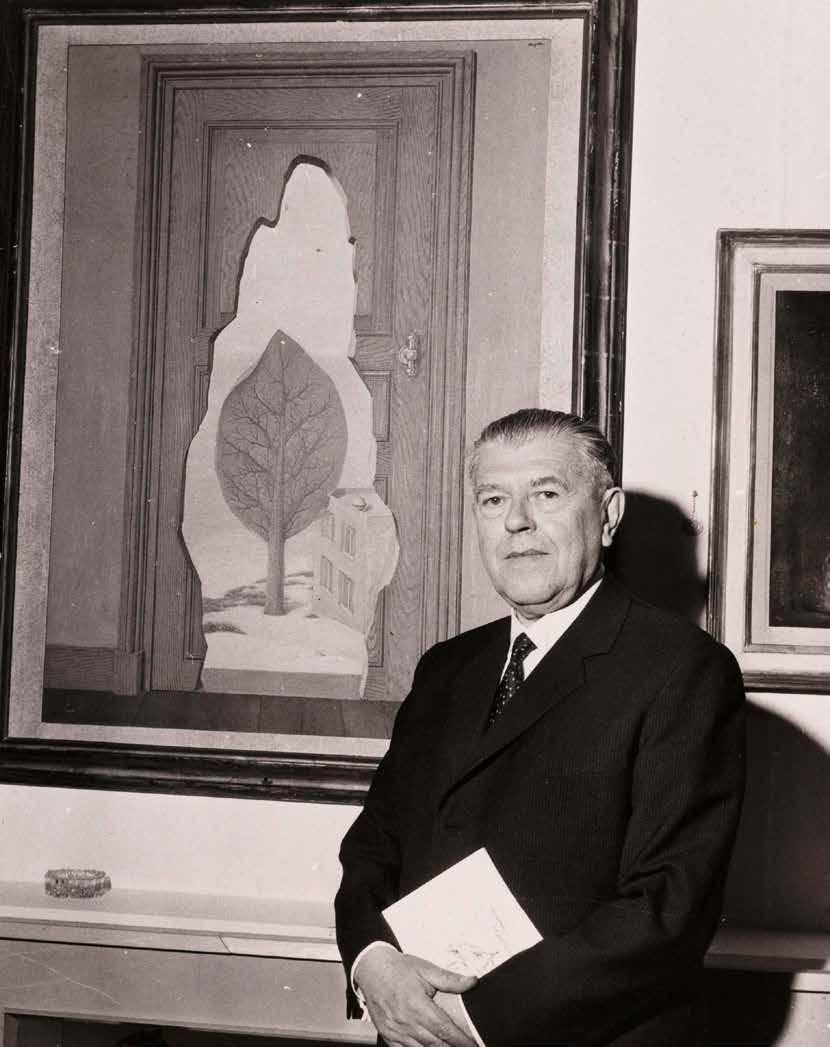
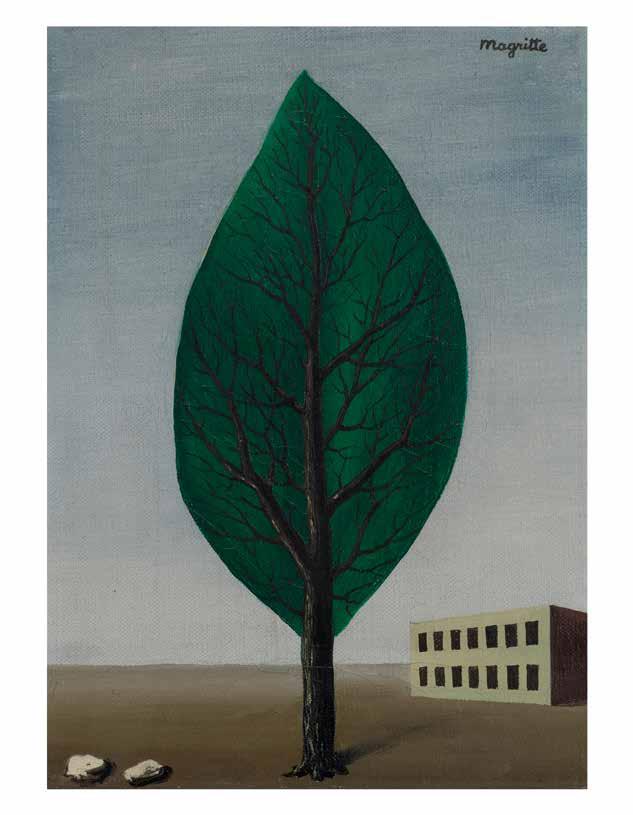
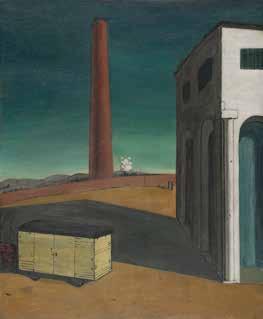
Painted in 1935, Le Miroir vivant (The Living Mirror) belongs to a pivotal moment in the career of René Magritte, when the artist began to fully articulate the visual language that would define his mature Surrealism. Five years after returning to Brussels following his productive but short-lived stay in Paris, Magritte increasingly focused on discovering unexpected realities concealed within the familiar trappings of everyday life. Working from his studio-home on Rue Esseghem, he explored what he described as a hidden "sub-reality" embedded within the ordinary world rather than a fantastical realm removed from it.
By the mid-1930s Magritte had begun to describe his paintings as visual solutions to conceptual problems. Writing to André Breton in 1934, he explained that he was searching for images rooted in reality that could nevertheless produce what he later described as a "disturbing poetic effect" (R. Magritte, trans. A. Elgar, René Magritte: Selected Writings , Minneapolis, 2016, p. 64). This approach gave rise to some of the artist's most celebrated works of the decade, including La Condition humaine and Le Modèle rouge , both painted in 1935. Reflecting on these formative years in his 1938 lecture La Ligne de vie , Magritte described the period between 1925 and 1936 as marked by a "systematic search" for images capable of unsettling habitual ways of seeing.
– RENÉ MAGRITTE
According to Magritte, Le Miroir vivant emerged from his quest for solutions to "problems," which in this case centered around the problem of the tree. In correspondence with Breton, the artist wrote that he was attempting to discover "what it is in a tree that belongs to it specifically but which would run counter to our concept of a tree" (D. Sylvester and S. Whitfield, René Magritte: Oil Paintings and Objects, 1931–48, Catalogue Raisonné II , London, 1993, p. 194). His solution was strikingly simple: the tree becomes a single, monumental leaf. Enlarged and rooted in the ground like a trunk, the leaf assumes the presence of the tree itself, collapsing the relationship between part and whole.
Le Miroir vivant belongs to a small group of works exploring this "leaftree" motif that began with La Géante (The Giantess) , also painted in 1935. Taking its title from a sonnet by Charles Baudelaire, that painting evokes the poet's imaginative projection onto a vast landscape. Magritte subsequently revisited the motif in another painting titled Le Miroir vivant earlier the same year. In these first examples the monumental leaf stands in grass before a body of water and is accompanied by the artist's characteristic grelots , or sleigh bells, a recurring motif in his work recalling childhood memories of horse harnesses.
In the present work Magritte refined the motif further through a striking process of simplification. Removing the bells and reducing the surrounding elements, he leaves little to distract from the central image apart from a modest building and two stones placed within the landscape. The resulting composition heightens the visual paradox of the leaf-tree itself, allowing the viewer to confront the image directly and reconsider the familiar form of the tree from which it derives.
Magritte's titles from this period often reinforce the poetic tension between word and image. The title Le Miroir vivant suggests a "living mirror," an image that reflects the essence of the tree while simultaneously transforming it. Such subtle disjunctions between language and representation were central to Magritte's practice during the 1930s, following earlier explorations in works such as La Trahison des images (1929) and continuing throughout the decade.
Although Magritte gradually moved away from the specific "problem of the tree" after the outbreak of the Second World War, the motif of the leaf continued to evolve in his later work, eventually appearing in hybrid plant-animal forms such as La Saveur des larmes (circa 1948) and Les Grâces naturelles (circa 1961).
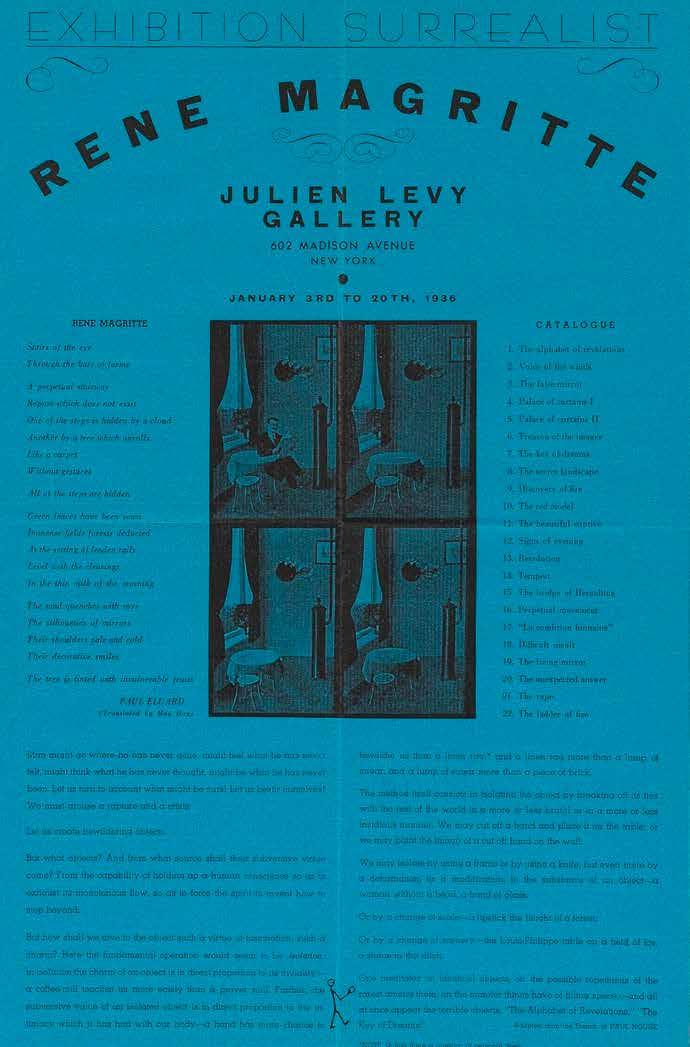
Shortly after its completion, Le Miroir vivant travelled to the United States, where it was exhibited in Magritte's first solo exhibition at the Julien Levy Gallery in 1936 and again in 1938. The gallery, which played an essential role in forging the public reception of Surrealism in the United States, acquired the painting at the time of its first exhibition. It was purchased the same year of the second exhibition by a single family, in whose possession it has remained ever since.
7A W
ROBERT COTTINGHAM (B. 1935)
20th Century Fox
signed and dated 'COTTINGHAM 1969' (lower right); signed and dated 'COTTINGHAM 1969' (on the reverse) oil on canvas
52 x 72 in (132.1 x 182.9 cm)
Painted in 1969
USD150,000 - 250,000
£110,000 - 180,000
HK$1,200,000 - 2,000,000
Provenance
Cara and Kent Wilson Collection, Los Angeles. June and Jon Summerill Collection, Kensington, England. Acquired from the above by the present owner.
Exhibited
Washington, D.C., National Museum of American History, Smithsonian Institution, Hollywood: Legend and Reality, April 17–June 15, 1986 (exh. cat. no. 8/22, illustrated p. 50) (later traveled to New York City, Cooper-Hewitt Museum, The Smithsonian Institution's National Museum of Design; Miami, Center of the Fine Arts; Cincinnati, Cincinnati Art Museum; Denver, The Denver Art Museum; Los Angeles, Los Angeles County Museum of Natural History). Washington, D.C., Smithsonian American Art Museum, Eyeing America: Robert Cottingham Prints, September 25, 1998-January 31, 1999.
Literature
L.K. Meisel, Photorealism, New York, 1989, no. 321 (illustrated p. 164).

"I
- ROBERT COTTINGHAM
Robert Cottingham is best known for his matter-of-fact paintings of signage, ranging from storefronts and neon lights to movie marquees. He is often associated with Photorealism, a movement of the late 1960s and 1970s characterized by a total rejection of abstraction in favor of the faithful translation of photographic sources onto canvas, frequently using mechanical means. Cottingham, however, never embraced the label, instead identifying himself as a realist working within an American tradition rooted in vernacular culture. He claimed to be interested in painting the facades of things, allowing his often-large-scale work—like this painting—to speak for themselves. Although Cottingham traced his fascination with signage to childhood visits to Times Square, his subject matter aligns him with earlier painters such as William Harnett, Charles Demuth, and Stuart Davis, all of whom explored the visual and formal possibilities of typography, whether in whole or fragmented form. Before turning to fine art, Cottingham—like Andy Warhol—had a background in advertising. Born in Brooklyn, he studied graphic design at Pratt Institute and, after graduating in 1963, worked as an art director at agencies in New York and Los Angeles, relocating to the latter in 1964. He became associated with Photorealism following his New York debut at the O. K. Harris Gallery in 1972. By that time, artists such as Richard Estes and Chuck Close had come to define the movement due to their intense, passionless attention to gathering visual information, mimicking the capacity of a camera to record every minute detail. Working largely in isolation in California, Cottingham maintained that his primary interest lay in his subjects rather than in the technical processes used to depict them. His unsentimental approach avoids distracting from the subject and its environment; as he noted, photographs served merely as "stepping-off points" for composing a painting (Six Takes on Photorealism. New York, 1991, p. 9).
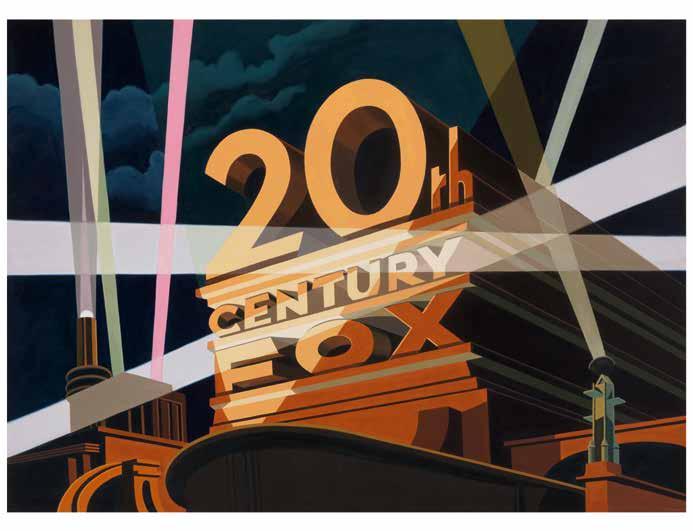
While his earlier work can be seen as an extension of West Coast Pop, TwentiethCentury Fox (1969) marks a shift in direction. Unlike earlier compositions, which often abstracted source imagery through cropping, this work presents its subject more directly, focusing on the production house logo that precedes a motion picture in its theatrical release. Its central motif invites comparison with Large Trademark with Eight Spotlights (1962) by Ed Ruscha, now in the collection of the Whitney Museum of American Art. Whereas Ruscha employs a stylized palette and exaggerated perspective, Cottingham's composition adheres closely to the source image with exacting precision.
Twentieth-Century Fox also precedes one of Cottingham's most successful works, a 1973 lithograph titled Fox, held in the collections of Museum of Modern Art and the Smithsonian American Art Museum. Based on a cropped photograph, the print depicts the marquee logo of Fox Theatres, a prominent chain of cinemas with many locations in California, and which was founded by the same entrepreneur whose name later became associated with 20th Century Fox Studios. The artist made this painting on commission for Cara Wilson as a gift for her husband Kent, who worked with both Cottingham and his wife, Jane, at the ad agency Young and Rubicam.
8A
ED RUSCHA (B. 1937)
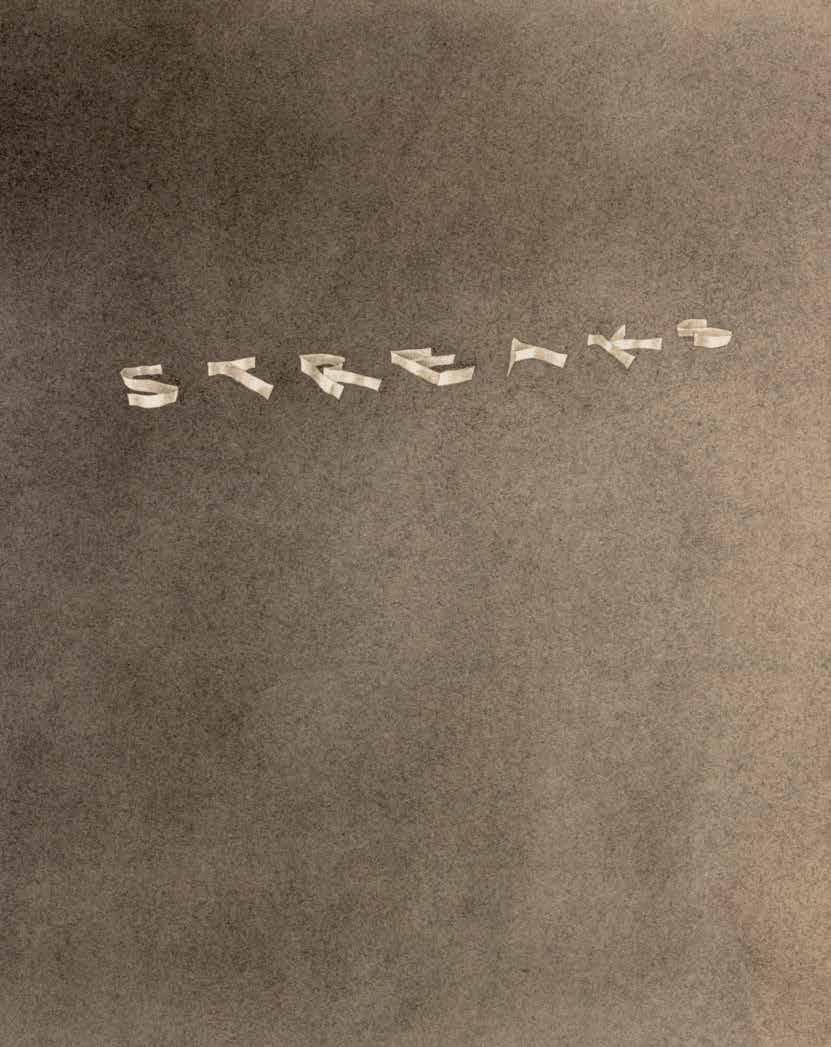
Streaks of Oil signed with the artist's initials, inscribed and dated 'E.R. 1972 Samantha' (lower left); inscribed and dedicated (on a label affixed to the reverse of the frame) gunpowder and pastel on paper 11 1/2 x 29 in (29.2 x 73.7 cm)
Executed in 1972
US$300,000 - 500,000
£220,000 - 370,000
HK$2,400,000 - 3,900,000
Provenance
Private collection, Los Angeles (gifted by the artist). By bequest from the above.
Literature
L. Turvey, Edward Ruscha Catalogue Raisonné of the Works on Paper, Volume 1: 1956-1976, New York, 2014, no. D1972.34 (illustrated p. 315).
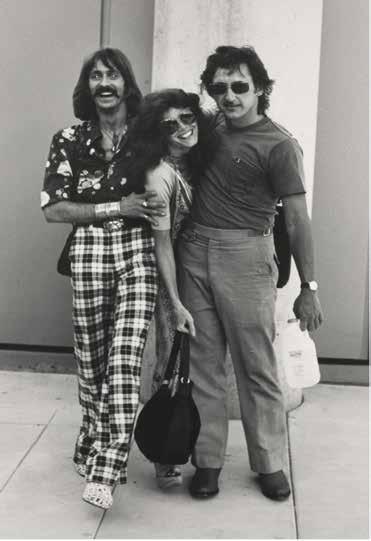
At the start of the 1970s, British actress Samantha Eggar put down roots in Los Angeles to embark on a new chapter in her career, arriving at a moment when the film and television industries were undergoing profound transformation. Hollywood was shifting away from the dominance of the studio system in its Golden Age toward a more experimental director-driven model, a landscape that proved to be fertile for the young ambitious actress. On the heels of an Academy award nomination for her role in William Wyler's The Collector, she embraced a wide range of opportunities across both film and television. Refusing to be confined to a single genre, she began a prolific television career which offered her steady roles between film productions and ample opportunities to expand her craft with each new character. Trained on the stage in Shakespearean theater, she brought a disciplined and thoughtful approach to every role, displaying a remarkable versatility.
The art scene of Los Angeles in the 1970s was also a new, not yet defined era following the closure of Walter Hopps' and Irving Blum's wildly influential Ferus Gallery in 1966. The scene entered a period of reinvention, marked by experimentation with new material and ideas. At a time of unprecedented interdisciplinary exchange in California, artists, actors, and musicians gathered in lively house parties in the Hollywood Hills or Bel Air, where social and creative boundaries dissolved. It was within this milieu that Eggar found not only a new place to call home, but a deeply engaged artistic community. She formed lasting friendships with leading figures of the Los Angeles art world and became an active participant in its ecosystem, attending openings across town and collecting the work of friends Billy Al Bengston, Ken Price, Robert Graham, Larry Bell, and more. Her Beverly Hills home also became a gathering place where she hosted dinner parties that brought together a vibrant cross section of the city's creative circles.
It was in this context that Eggar met a young painter named Ed Ruscha, who had earned his place among the Ferus Gallery "studs" with his large-scale canvases that transformed words into abstract shapes. With Ferus Gallery's closure in 1966, Ruscha had his first solo show in New York the following year at Alexander Iolas Gallery where he debuted his groundbreaking gunpowder drawings. Having grown dissatisfied with graphite, charcoal, and other conventional media, Ruscha turned to new materials he could experiment with and manipulate to concoct his own unique pigments. Gunpowder allowed him to achieve a greater range of tonalities and textures while retaining remarkable precision and control over his compositions, creating the impossibly sharp lines and surreal effects typical of the "finish fetish" movement which Ruscha had an important role in establishing.
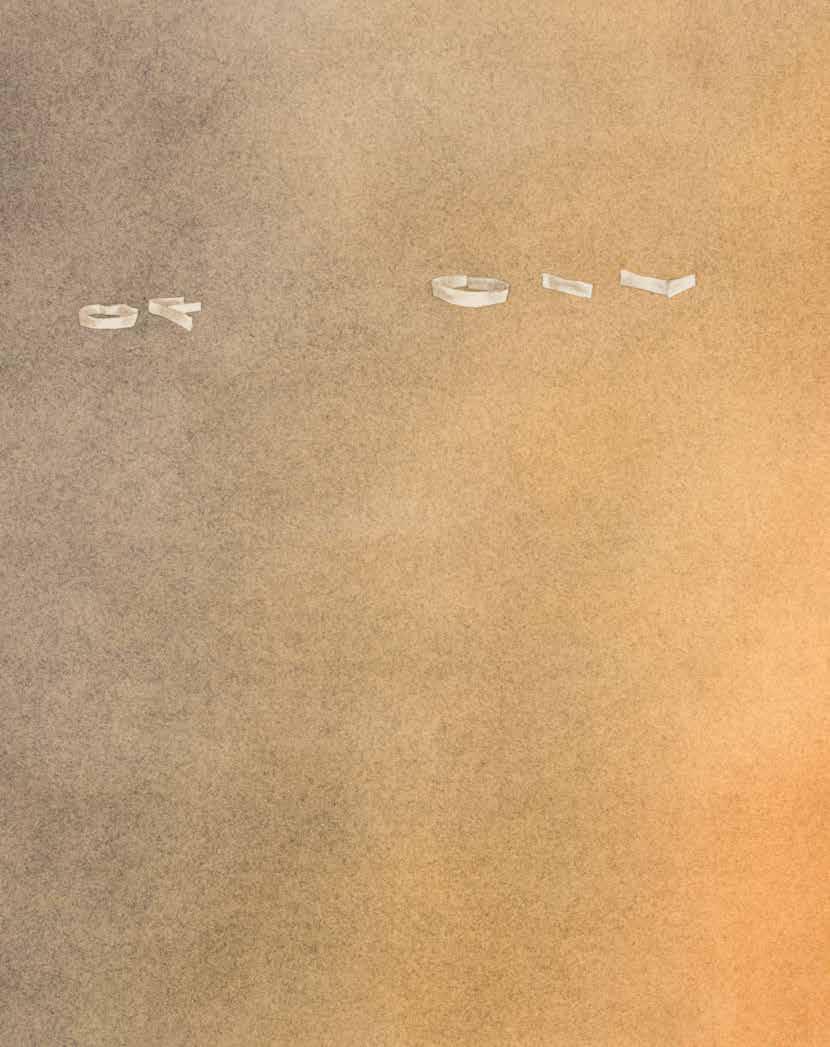
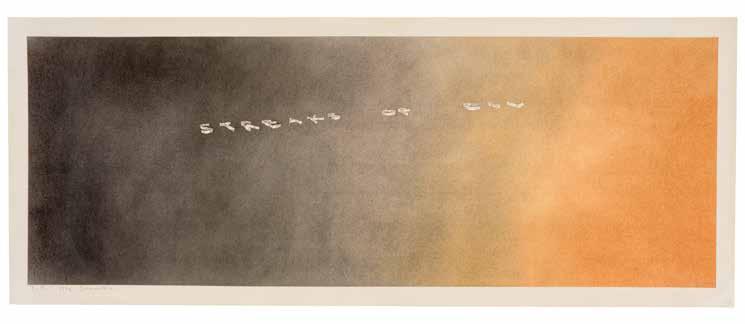
In the present lot, Ruscha combines gunpowder and pigment to produce a luminous, cinematic horizontal gradient that transitions from a dense velvety darkness at the left edge to a glowing field of amber. These subtle gradations drift across the sheet like a golden sunset emerging from a thick layer of smog, a motif that would recur throughout Ruscha's most iconic works including his many depictions of the Hollywood sign.
Suspended in this atmospheric field, delicate thin ribbons of text resist immediate legibility, beckoning the viewer to step closer into its orbit. This playful treatment of words is central to Ruscha's practice; language oscillates between its literal meaning and its visual impact on the picture plane. The elongated sheet further reinforces a sense of cinematic framing, recalling both widescreen film and the vast horizon of Venice Beach or the rolling hills of Los Angeles.
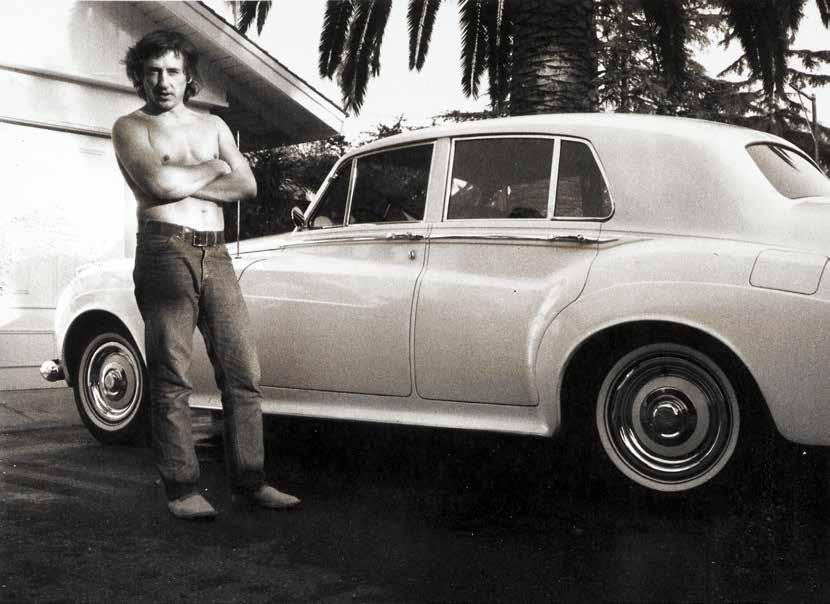
Contemporaneously to the present work's execution, Ruscha navigated the complex network of Los Angeles streets in an impressive but aging Rolls Royce – a potent symbol of the city's car culture, the masculinity associated with it, and the broader industrial landscape that permitted the rapid proliferation of the automobile. Central to the identity of Southern California, the automobile shaped generations of artists including not only Ruscha but also his early
mentors like Robert Irwin. Luxury vehicles that became widely available to the growing upper middle class required constant care and attention in order to maintain both its essential locomotive function and its shiny appearance. An object that essentially decays and depreciates from the moment of acquisition, Ruscha's Rolls had its fair share of routine car troubles. As it sat in the driveway of Samantha Eggar's Beverly Hills home where Ruscha lived during the time of their relationship, it left dark, stubborn oil stains in the pavement, the conceptual basis for Streaks of Oil. Through the execution of this work, Ruscha transforms the pesky residue of everyday life in a modern, industrial world into a poetic meditation on decay and transience, capturing the spirit of Los Angeles at a moment of cultural reinvention.
Other works by Ruscha associated with this period of Eggar's life include a metal contour gauge with which he captured her profile, a limited set of Ruscha's Spooning lithograph with Eggar's own hand coloring using a Revlon lipstick, and a painting made for her birthday in 1974, emblazoned with the word "ACTRESS" across a signature gradient. The present lot and additional works from the Estate of Samantha Eggar coming to auction at Bonhams vividly capture one of the most important defining moments in the cultural history of Los Angeles while also telling the story of a long life lived to the fullest and guided by creativity, passion, humor, generosity, and love.
...Words Mean Nothing at All
9A W P
YOSHITOMO NARA (B. 1959)
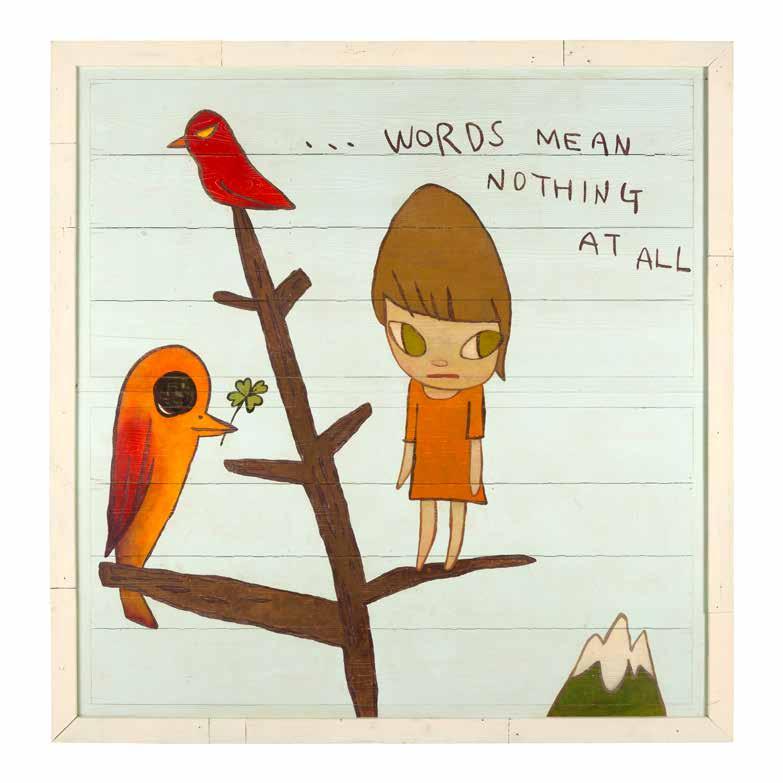
...Words Mean Nothing at All signed and inscribed 'Words mean nothing at all... Nara' (on the reverse) acrylic on wood, in artist's frame
76 1/2 x 74 1/2 x 3 1/2 in (194.3 x 189.2 x 8.9 cm)
Painted in 2012
US$4,000,000 - 6,000,000
£3,000,000 - 4,400,000
HK$31,000,000 - 47,000,000
Provenance
Pace Gallery, New York. Acquired from the above by the present owner in 2013.
Exhibited
Kobe, Hyogo Prefectural Museum of Art, New Phases in Contemporary Painting: A Curator's Message 2012, October 27–December 24, 2012.
New York, Pace Gallery, Yoshitomo Nara, May 10-June 29, 2013.
Literature
The Yoshitomo Nara Foundation, Yoshitomo Nara: The Works, digital, ongoing (illustrated, no. P-2012-022).

Kubo Shunman (Japanese, 1757–1820), Japanese White-eyes on a Branch of Peach Tree,” from the Series An Array of Birds (Tori awase), from Spring Rain Surimono Album (Harusame surimono-jō, vol. 3) (circa 1805–10)
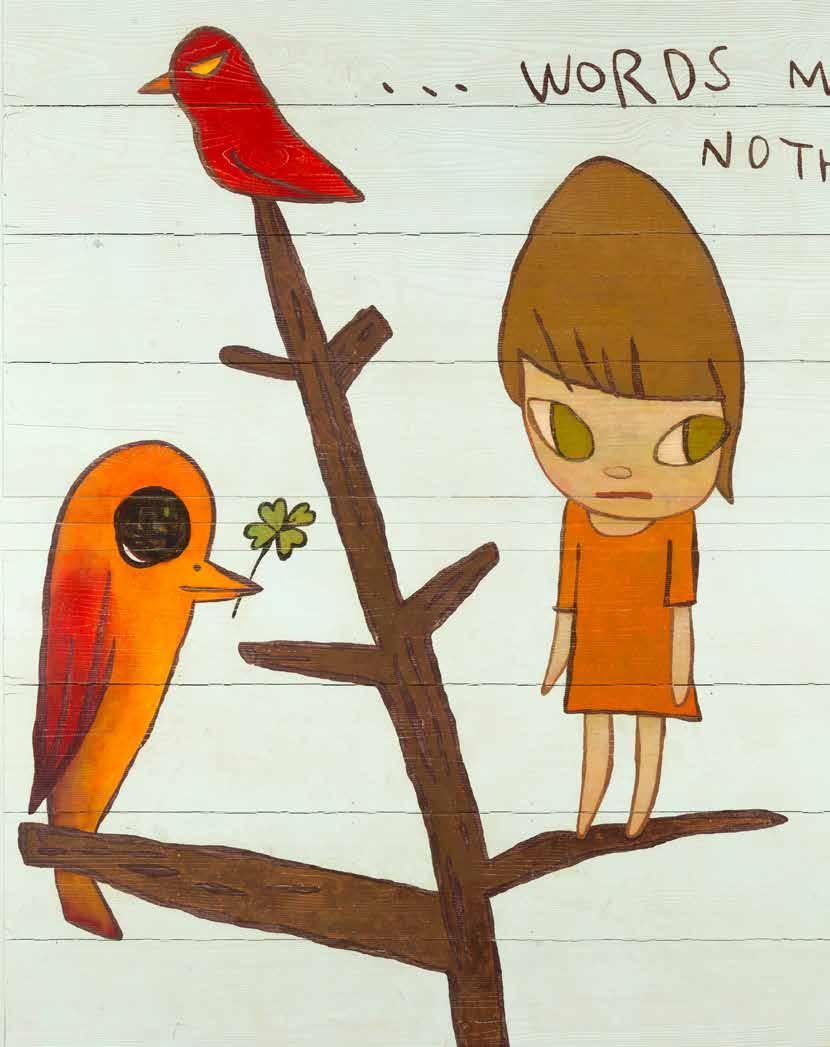
Painted in 2012, Yoshitomo Nara's ...Words Mean Nothing at All belongs to a pivotal moment in the artist's mature practice, when the psychological tension and overt rebellion that defined many of his earlier protagonists gave way to a quieter, more introspective emotional register. Executed just one year after the Great East Japan Earthquake of 2011, the present work reflects a period of profound personal and artistic reassessment, as Nara turned inward to reconsider memory, solitude, and the limitations of language itself. Fresh to market after remaining in the same private collection since 2013, following its inclusion in the artist's New York exhibition that year, the painting stands as an exceptional example of this important transitional phase.
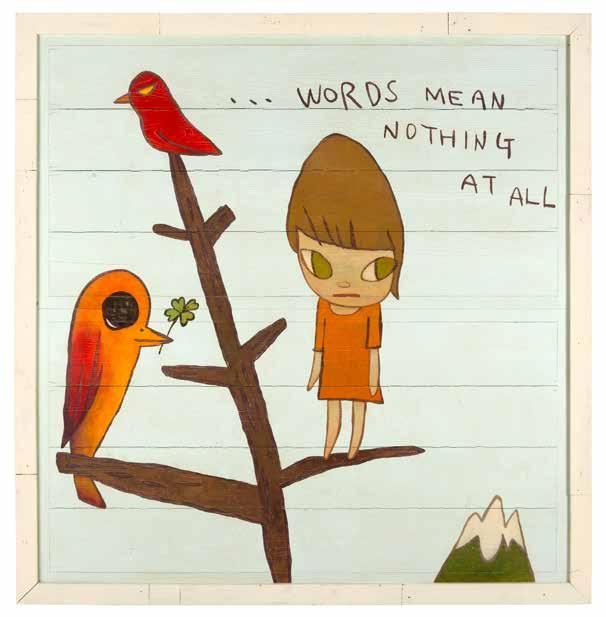
At the center of the composition, a young girl stands delicately balanced on the branch of a tree, accompanied by two birds beneath the handwritten phrase, "...WORDS MEAN NOTHING AT ALL." Rendered in Nara's unmistakable visual language—large eyes, flattened space, and deceptively childlike simplicity—the figure initially appears innocent and vulnerable. Yet, as throughout his oeuvre, emotional complexity lies beneath this surface. Nara's children often occupy an ambiguous psychological space: they are at once sweet and unsettling, fragile yet quietly resistant (Stephan Trescher, "Lullaby Supermarket," Verlag für moderne Kunst, 2001, p.10). Their tightly sealed mouths and watchful expressions suggest not passivity, but withheld emotion—an inner life that resists easy interpretation. In the present work, the child's sideways glance feels less accusatory than in earlier paintings, carrying instead a sense of hesitation, introspection, and vulnerability.
Solitude has always been central to Nara's practice. Raised in rural postwar Japan as a latchkey child, often alone while his working-class parents were away, he has frequently described loneliness as a formative condition rather than simply an absence ('Yoshimoto Nara on the importance of not growing up', Dazed, June 12, 2025, Online). His figures, typically isolated against minimal or empty backgrounds, function less as fictional characters than as emotional doubles—what he has described as different facets of himself. Rather than conventional self-portraits, they operate as psychological stand-ins, carrying memory, vulnerability, and unresolved feelings. In this work, the unusually small scale of the child within the composition heightens that sense of fragility; unlike the confrontational close-ups of earlier "angry girls," this figure feels exposed rather than defiant.
The title and inscribed text, ...Words Mean Nothing at All, deepen the painting's emotional resonance. Language in Nara's work often functions less as direct communication than as atmosphere—fragmented phrases that resemble remembered lyrics, slogans, or passing thoughts. Growing up in northern Japan, he was deeply shaped by music broadcast from the American military
radio station Far East Network, where English lyrics were often heard before they were fully understood. He has repeatedly emphasized that music came before art, and that album covers were his first experience of visual culture ('There Was Music Before Art: Yoshitomo Nara's New London Exhibition Reveals His First Love', Esquire, June 18, 2025, Online). In this context, words become emotional triggers rather than fixed statements: they recall entire moods, songs, and memories without requiring literal explanation. The phrase "words mean nothing at all" therefore reads not as cynicism, but as an acknowledgment that feeling often exceeds language—that silence can hold more truth than speech.
The tree itself carries particular symbolic weight. Nara has described the image of the tree trunk as a metaphor for growth and return: rather than moving linearly forward, life circles back repeatedly to the same emotional center, each time with greater depth and understanding ('The Beginning Place: Long Interview with Yoshitomo Nara', Tokyo Art Beat, February 24, 2024, Online). This idea is especially resonant in a work made after the 2011 earthquake, when questions of memory, home, and emotional grounding became newly urgent. Positioned high among the branches, the child appears suspended between vulnerability and resilience. The two birds introduce further emotional ambiguity: one, bright red and watchful above, recalls the sharper defiance of Nara's earlier imagery, while the larger bird below carries a four-leaf clover, traditionally associated with luck and protection. Together, they suggest both witness and comfort, guardianship rather than threat.
Nara's achievement lies in this delicate balance: innocence without naïveté, rebellion without spectacle, melancholy without despair. His figures remain psychologically open, allowing viewers to recognize both the adults they are and the children they once were. In ...Words Mean Nothing at All, that emotional mirror feels especially tender. The work moves beyond the sharp confrontation of his earlier paintings toward something quieter and more enduring—a meditation on silence, memory, and the fragile hope that remains when language fails.
Combining autobiography with universality, the present painting exemplifies Nara's rare ability to transform the visual language of childhood into something profoundly adult. It is not simply a portrait of solitude, but of resilience: a deeply personal reflection that continues to speak precisely through its refusal to explain everything.


10A
BANKSY (B. 1975)
Girl and Balloon tagged 'BANKSY' (on the right turning edge); numbered and dated '10/25 2003' (on the stretcher)
spray paint on canvas 16 x 16 in (40.6 x 40.6 cm)
Painted in 2003. This work is number 10 from an edition of 25
US$700,000 - 1,000,000
£520,000 - 740,000
HK$5,500,000 - 7,800,000
This work is accompanied by a certificate of authenticity issued by Pest Control Office.
Provenance Lazarides Gallery, London. Acquired from the above by the present owner in 2003.
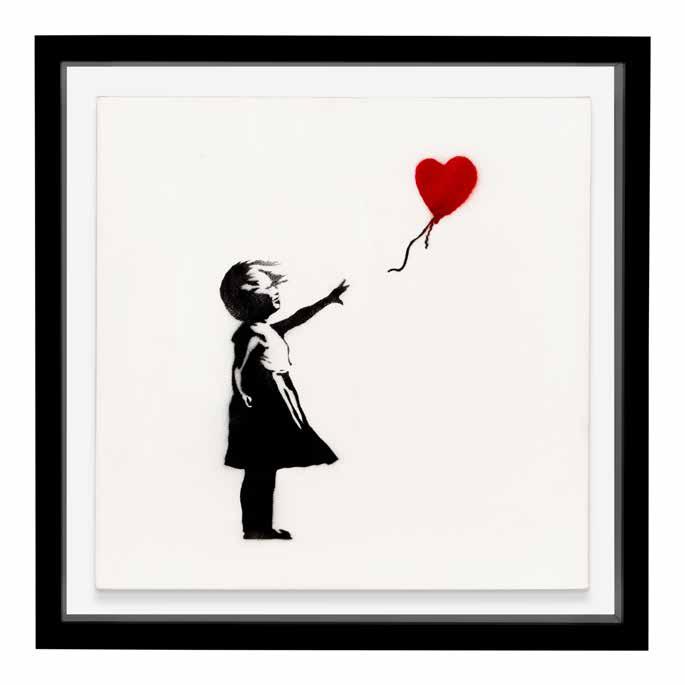
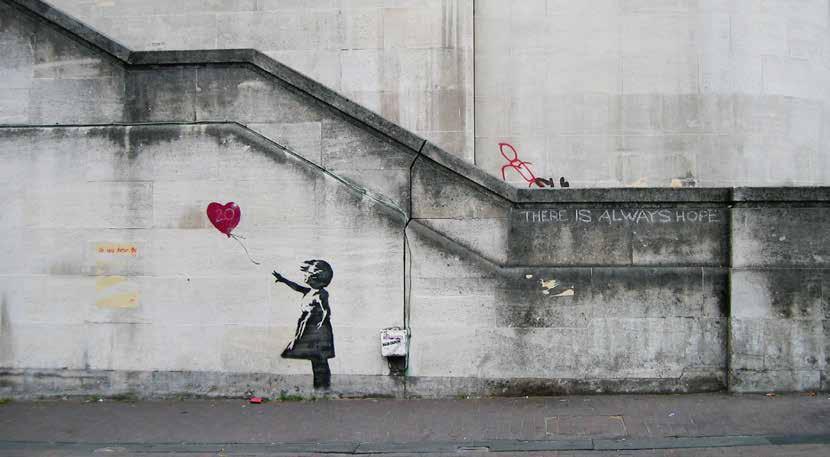
The striking simplicity of Girl and Balloon has made it one of the most recognizable images of the 21st century. Executed in spray paint on canvas, the composition is pure and emphatic: a child, caught in a fleeting moment, stretches out toward a drifting, heart-shaped balloon, her hair and dress swept back by that same gust that has carried it away. The contrast between the monochrome figure and the vivid red of the balloon intensifies the emotional pull, drawing the eye to what is being lost.
The image first appeared as a stencil mural on London's Southbank in 2002, accompanied by the words "There Is Always Hope", a phrase that both anchors and contradicts the scene before it. Since then, the iconic picture has been recreated in various locations across London and around the world, each iteration reshaped by its surroundings. Banksy has returned to this motif as a vehicle for social and political commentary, with a version of it appearing on the West Bank barrier in 2005; addressing the Syrian refugee crisis in 2014; and reimagined with a Union Jack heart-shaped balloon during the UK General Election of 2017. Banksy's ongoing commitment to themes of displacement and migration is also reflected in his 2020 funding of the MV Louise Michel, a rescue vessel – itself marked with a reproduction of the girl with the balloon – supporting refugees crossing the Mediterranean.
Originally conceived as a street intervention, the earliest iterations of the work have since disappeared, leaving no surviving examples in situ. What remains are the translated forms of the image into editioned works: a small series of 2003 canvases and the subsequent prints, both signed and unsigned, released the following year, which together preserve the only concrete record of its original impact. The present work, painted in 2003, is number 10 from an edition of 25 and belongs to this rare first sequence of canvases, marking the point at which the motif began its transition from ephemeral street work to art object.
Banksy's Girl and Balloon has become one of the most recognizable pictures in contemporary art, an icon whose immediacy has contributed to its enduring global appeal. In 2017, it was voted the United Kingdom's favorite artwork in an online poll, underscoring both its popularity and its deep cultural reach. This level of public recognition highlights the image's ability to resonate across different audiences, bridging street and fine art. Its composition has been reproduced, reinterpreted, and circulated extensively since its first appearance, solidifying its status as one of the defining visual motifs of the 21st century.
11A
LYNETTE YIADOM-BOAKYE (B. 1977)
Victory Sweatsuit II signed, inscribed and dated 'Victory Sweatsuit II 2008' (on the reverse) oil on canvas
51 1/4 x 37 1/2 in (130 x 95.4 cm) Painted in 2008
US$350,000 - 550,000
£260,000 - 410,000
HK$2,700,000 - 4,300,000
Provenance
Faye Fleming & Partner, Geneva. Acquired from the above by the present owner in 2010.
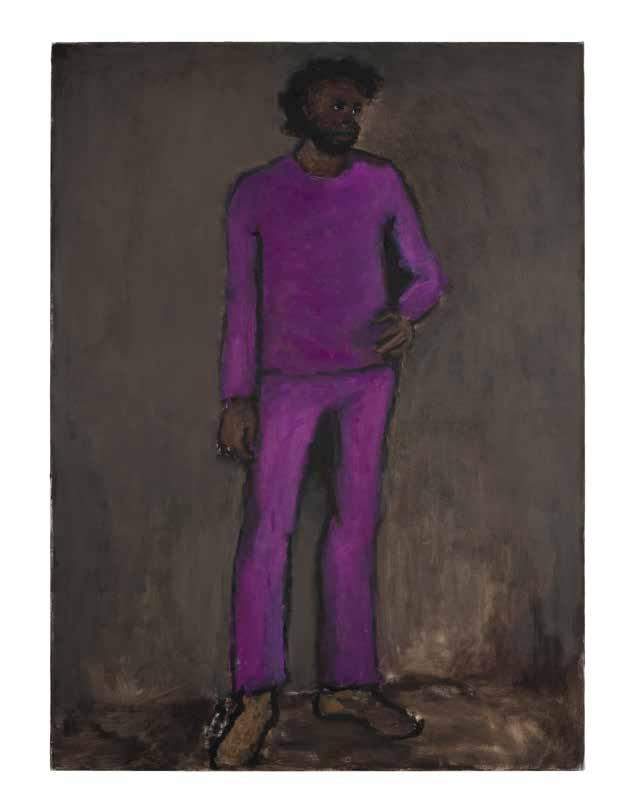
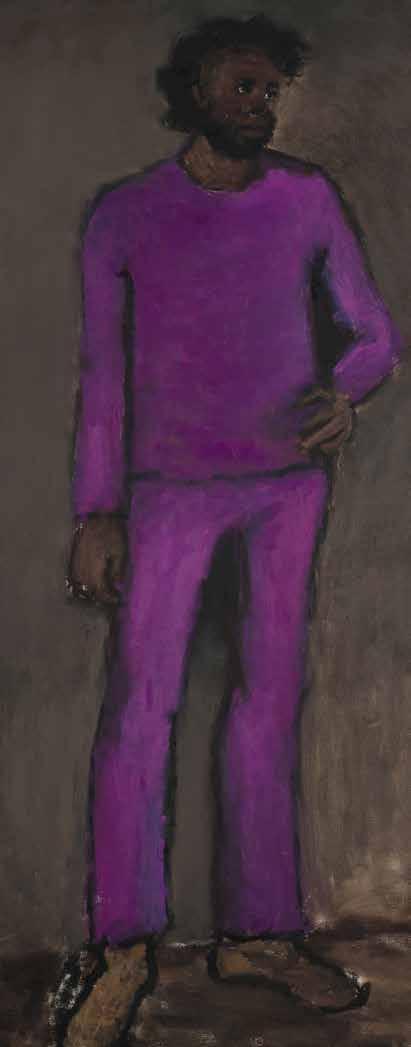
Painted in 2008, Victory Sweatsuit II marks a formative and striking example that encapsulates Lynette Yiadom-Boakye's defining style. Completely fresh to market, this iconic painting boasts all the qualities of an artist whose ascendance and place in the contemporary canon is assured after her recent survey exhibition, organized by the Tate Britain, London, Fly in League with the Night, toured the European institutions between 2021 and 2023, further to her groundbreaking solo exhibition at the New Museum, New York, in 2017, Under-song for a Cipher. Employing found images, excerpts from literature, and her own memories, Yiadom-Boakye conjures fictional scenarios that allow the spectator's vision to wander, whilst situating the compositions between a matrix of canonical reference points. In reducing the composition to its figure alone, the artist showcases what connects the subject to the rest of humankind.
Widely regarded as one of the most compelling figurative painters working today, Yiadom-Boakye's embrace of the conventions of European portraiture, both in use of color and composition, is not solely a homage, but also an act of resistance. By placing Black subjects at the center of a tradition that historically excluded them, and with such solemnity, she interrogates their absence from it. In doing so, her work has contributed to a broader renaissance in the painting of the Black figure, with Victory Sweatsuit II perfectly exemplifying the reclamation of space and visibility.
Painted the year Barack Obama won his first presidency, Victory Sweatsuit II nevertheless carries a quiet, resonant charge. Without overt reference, Yiadom-Boakye's imagined figure inhabits a moment of shifting possibility. The work registers a moment of historical inflection with a poignant dignity and nuance. Reviewing her New Museum exhibition for The New Yorker in 2017, novelist Zadie Smith commented: "we have become used to titles that ironize or undercut what we are looking at, providing conceptual scaffolding for feeble
visual ideas, or weak punch lines to duller jokes. For Yiadom-Boakye, titles are allusive; they should be considered, she has said, simply 'an extra mark in the paintings'" (Zadie Smith, "Lynette Yiadom-Boakye's Imaginary Portraits," The New Yorker, June 12, 2017, Online). This historical tether, worn lightly through its title and recentering of Black identity, confers an elegant and authentic social-political weight upon the painting; an undeniable moment of quiet conquest as the arc of history at last bends toward justice.
In Victory Sweatsuit II, the figure's gaze is averted from the viewer; yet the stark white of his eyes reflects the pensiveness of someone lost in thought. There is something quietly confrontational about his stillness as the onlooker is drawn in, compelled to decipher what he sees and feels. As so often in Yiadom-Boakye's oeuvre, the subject inhabits a private world entirely their own: present before us, yet unreachable, dreamy, and enigmatic.
The apparent simplicity of the figure invites reflections on the artist's use of color and light as Yiadom-Boakye paints quickly, without an imprimatura In Victory Sweatsuit II, the intuitive brushstrokes build a moody ambience, while chiaroscuro's nuances and shades create a dramatic effect, making the figure emerge from the background as if conjured from the ground itself. Rich in color, the oil paint is applied in thin, progressive layers, revealing the texture of the canvas underneath.
Lynette Yiadom-Boakye was awarded the Carnegie Prize in 2018. In 2012 she received the PinchukArtCentre Future Generation Art Prize, and the following year was shortlisted for the Turner Prize and included in the 55th Venice Biennale. Her work has been the subject of several museum exhibitions worldwide. Her pieces are also held in the collections of major institutions such as the Tate Britain in London, the Museo Guggenheim Bilbao, the Kunstmuseum Basel, the Yale Center for British Art in New Haven, the Chicago's Museum of Contemporary Art, the Museum of Modern Art in New York, the San Francisco Museum of Modern Art, and the Smithsonian Institution in Washington D.C.
MURMUROUS MOTO, MAESTRO

12A W
JOHN CHAMBERLAIN (1927-2011) MURMUROUS MOTO, MAESTRO painted and chromed steel
73 1/8 x 65 x 48 in (185.7 x 165.1 x 121.9 cm) Executed in 1991
US$800,000 - 1,200,000
£590,000 - 880,000
HK$6,300,000 - 9,400,000
Provenance
Pace Gallery, New York.
Private collection, Santa Fe.
Sale: Christie's New York, Post-War & Contemporary Art (Morning Session), November 12, 2003, Lot 410. Pace Gallery, New York.
Private collection, New York.
Sale: Sotheby's New York, Contemporary Art Evening Auction, November 11, 2014, Lot 38. Acquired from the above by the present owner.
Exhibited
Los Angeles, Daniel Weinberg Gallery, John Chamberlain, January-March 1992. Santa Fe, Laura Carpenter Fine Art, John Chamberlain: New Sculpture, August 1992. Denver, The Ginny Williams Family Foundation, 2002. New York, Pace Gallery, Chamberlain at Pace, April 15-June 1, 2011. Basel, Switzerland, Lévy Gorvy, ART BASEL, June 19 - 22, 2014.
Literature
U. Fischer, The Tighter They're Wound the Harder They Unravel: John Chamberlain Against the World, Aspen, 2023 (illustrated p. 130).
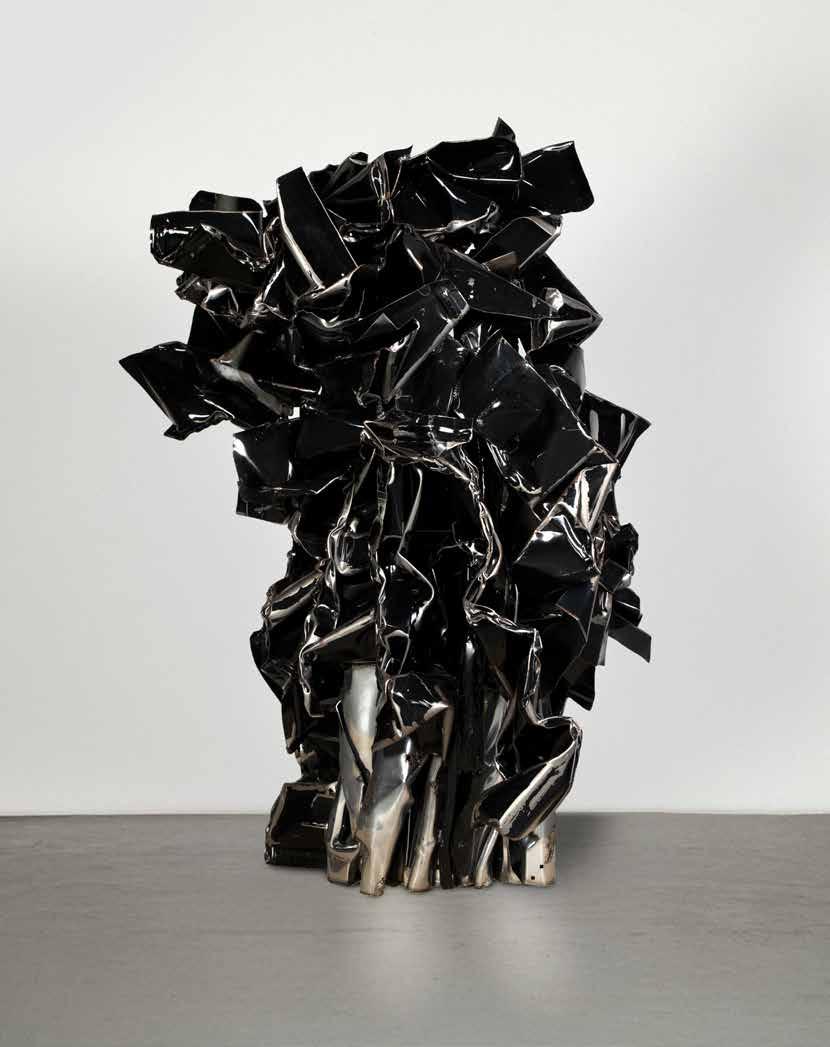
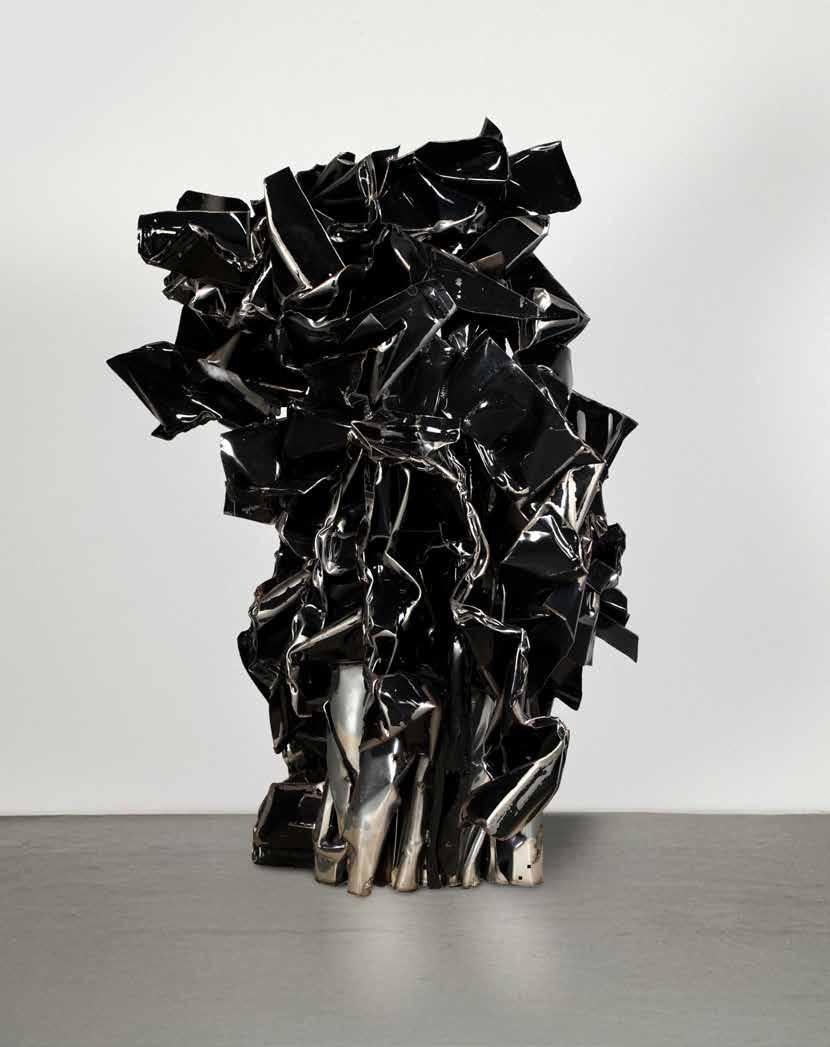
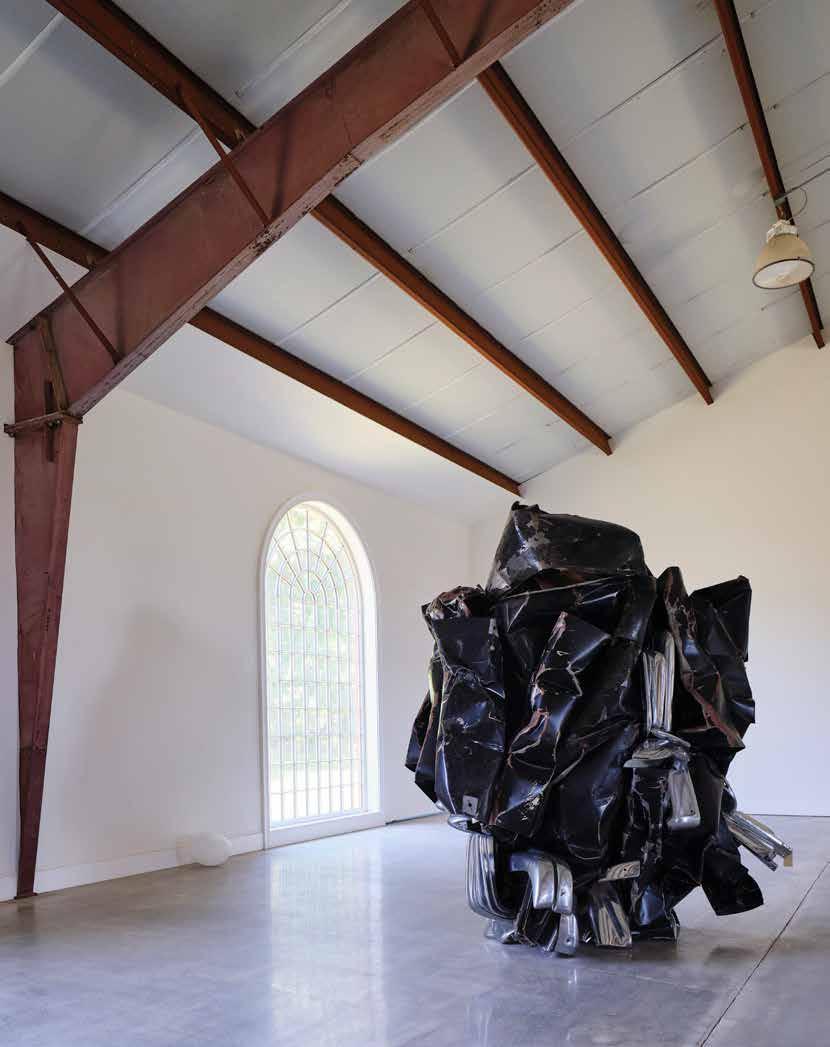
A megalith of bodywork stripped into crumpled ribbons of black; chrome fingers from bonnets and bumpers of mid-century cars; twisting florets and ridges of bare steel. The majesty of John Chamberlain's sculptures is rooted firmly in their physical authority. They do not pose or defy their materiality but, like Abstract Expressionism, exact a raw visual power from their fabric and form. For all the brute force and impenetrability Chamberlain's metal works imply, however, they remain complex objects that sit within a matrix of experimentation and ideational pathways that the artist pursued throughout his life, from poetry to installation and interactive objects. Murmurous Moto, Maestro , from 1991, is the quintessence of Chamberlain's project and one of the most beautifully austere examples of his metal assemblages, resplendent in black and chromed steel.
Born in Indiana in 1927, Chamberlain served in the U.S. Navy at the end of World War II before attending the Art Institute of Chicago, graduating in 1952. His studies at the renowned Black Mountain College in North Carolina between 1954-1956 would mark his departure as an artist, producing his first true body of work, a collection of poems, under the pupilage of Charles Olson, Robert Duncan, and Robert Creeley. Unquestionably a natural wordsmith – evidenced in his laconic and colorful titles – the collaged, mercurial, stream of consciousness that is woven into Chamberlain's early poetry resonates deeply in his sculptural process. "Curiously," Chamberlain commented in the early 1980s, "it's only recently that I've noticed that I'm still making sculptures in the way that I made the poems. It's all in the fit [...] You can play around with it, add to it, or if you want you can take the word apart. You can play with the letters in the word, that's making anagrams. There's also a way of taking the syllables apart, rearranging the syllables. What I do is not unlike this" (the artist quoted in Julie Sylvester, "Black Mountain John Chamberlain: John Chamberlain's Writings at Black Mountain College, 1955," Black Mountain College: Museum + Arts Centre , October 2020, Online). His method of identifying 'fit,' of maneuvering form to achieve a new kind of whole, underpinned his work throughout his life. Murmurous Moto, Maestro , alliterated and suffused with mechanical and musical allusions, boasts all the qualities of this poetic unity. The lightness of its verticality tapers to an attenuated base, and yet the creases of its surface imply a shrugging compression of the form under its own weight. Like many of Chamberlain's great works, there exists an incredible tension between the material, the image, and the words that accompany them: the engine's idle murmur; the motion of the maestro's hand; the masterpiece from the discarded metal.
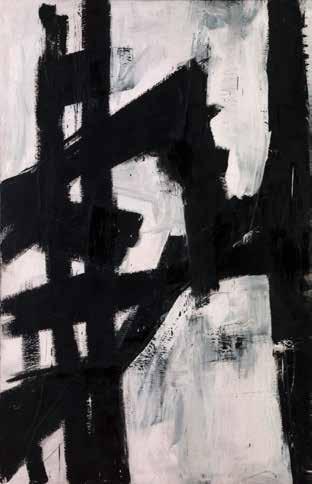
Chamberlain's emergence in the heat of midcentury Abstract Expressionism historically positioned him as the movement's chief sculptor. He nodded to Willem de Kooning as a significant influence, particularly upon seeing the painting Gotham News in 1956. Whilst David Smith, Anthony Caro, and Isamu Noguchi had been critically aligned with the New York School, Chamberlain was arguably the first artist to truly solve for the sculptural problem of color and mass, a problem most adroitly handled by Alexander Calder until then. What Chamberlain achieved was a reconciliation between painterly and sculptural form, allowing for more fluid, expressive utterances in the rigid vocabulary of sculpture. Like the forceful injections of black over white in Franz Kline's canvases or the complex thrashings of pink, yellow and green in de Kooning, the correlation between these and Chamberlain's raw, early output, is striking. It would be a gross disservice to his practice, however, to limit our reading to a formal-historical timeline. His sculpture was truly novel. "The sculpture is redundant," writes Donald Judd in 1963, "there is more metal and space than the structure requires. This voluminousness is a salient aspect of the work. This idea is Chamberlain's alone" (Donald Judd, "Chamberlain: Another View; 1963," in Donald Judd Writings , New York 2016, p. 116). Judd, himself the arch-Minimalist, displayed an acute sensitivity to Chamberlain's sculpture, himself owning Mr Press from 1961, which still resides on the bedroom wall of Judd's SoHo studio and home. Chamberlain sidestepped the critical discourse of the moment that underscored the materialistic and spatial conceptions of art making. At the end of the 1960s, he would pivot away from scrap metal as his primary source material until 1972, experimenting with foam, Perspex, resin and polyurethane. It was a clarifying maneuver; highlighting that the core principles of his practice were not bound by the metal panels that had been his source material for over a decade.
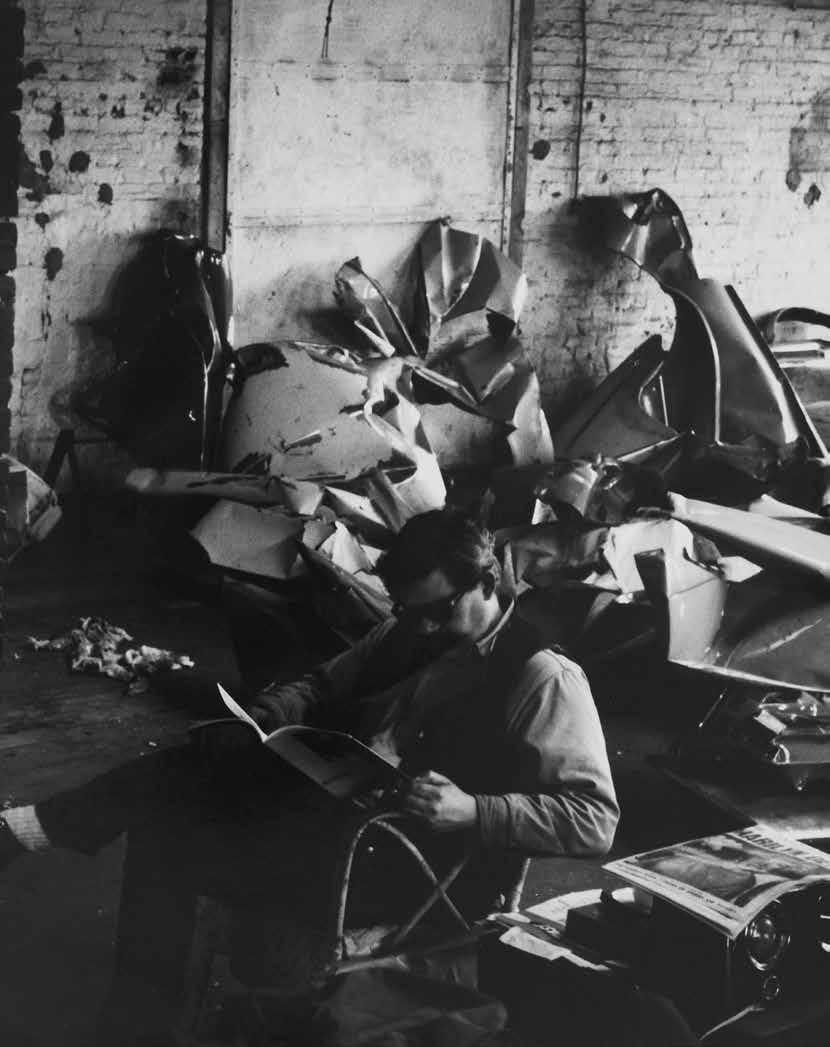
Chamberlain was an artist working in the tradition of the found object; of Dada, what Kurt Schwitters might have termed Merz. His sculptures are a type of assemblage – collages in the expanded field. His practice cannot be divorced from its source material. In truth, the vehicular associations that emerge in his work never sat comfortably with Chamberlain. Interviewed by Phyllis Tuchman for Artforum in 1972, Chamberlain commented: "I've heard those sculptures referred to as furniture of the highway—all sorts of things have been said about them. They say de Kooning had been painting pictures of junkyards a long time before that. People compartmentalize
“THERE ARE NO DENTS IN A CHAMBERLAIN –WHEN WE LOOK FOR THE SPOT WELDS, WE FIND THE BEAUTY OF DELIBERATE DECISIONS”
– CHARLES RAY
my work and I don't have anything to do with that. That's their idea; whatever their ideas, I can't concern myself. You know, it was just free material" (quoted in Phyllis Tuchman, "An Interview with John Chamberlain," Artforum , February 1972, p. 39). For Chamberlain to acquiesce about the technological charge of his "free material" would be a danger to its autonomy. However, acknowledging its mechanical and industrial root enables an intricate and powerful reading of his sculptures, not without their own psychosocial weight. Roland Barthes described the car as the "equivalent of the great Gothic cathedrals" in his 1957 collection of essays, Mythologies . And more has been said about Chamberlain's easy access to junkyards of shaped and painted steel panels; the end of an industrial era marked by the scattering of its ashes across the landscape. J.G. Ballard's Crash exposed the car as the postmodern fetish object in 1973, whilst Jacques Lacan wrote twenty years earlier: "we get the impression that [man's] relationship to [the car] is so very intimate that it is almost as if the two were actually conjoined—its mechanical defects and breakdowns often parallel his neurotic symptoms. Its emotional significance for him comes from the fact that it exteriorizes the protective shell of his ego' (Jacques Lacan, "Some Reflections on the Ego, 1953," published in Influential Papers from the 1950s , London 2003, p. 306). The car embodied all manner of connections and contradictions: sexuality, death, consumerism, counterculture, fashion, freedom, crime. From Al Capone's 1930, black, bulletproof Cadillac to James Dean's 'Little Bastard' that he would drive to his death in 1955, American cultural history is entwined with the history of the motorcar. There is a sumptuous inescapability to this fact in the vortices of Murmurous Moto, Maestro 's folds.
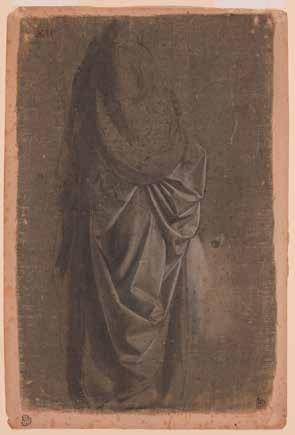
One of the titans of twentieth century art, John Chamberlain's Murmurous Moto, Maestro from 1991 is one of the American sculptors late, great works. Conjuring the cascading drapery of renaissance masters, in concert with the great Abstract Expressionist painters, his work eschews simple categorization and speaks as readily to the graveyard of American industrial might as the refinery of words in the stanzas of Chamberlain's poetry. Their beauteous realism has made them the centerpieces for public museums and private institutions around the world.
13A W
DAMIEN HIRST (B. 1965)
Au-195m
signed, inscribed and dated '2008 Damien Hirst "Au-195m"' (on the reverse) gold enamel and household gloss paint on canvas laid on board
76 x 92 in (193 x 233.7 cm)
Painted in 2008
US$600,000 - 800,000
£440,000 - 590,000
HK$4,700,000 - 6,300,000
Provenance
White Cube, London.
Sale: Christie's, New York, Post-War & Contemporary Art Afternoon Session, May 9, 2012, Lot 502. Acquired from the above by the present owner.
Exhibited Kiev, PinchukArtCentre, Damien Hirst: Requiem, April-September 2009 (exh. cat., illustrated p. 140).
Literature
J. Beard and M. Wilner (eds.), Damien Hirst: The Complete Spot Paintings 1986-2011, London and New York, 2013 (illustrated p. 636).
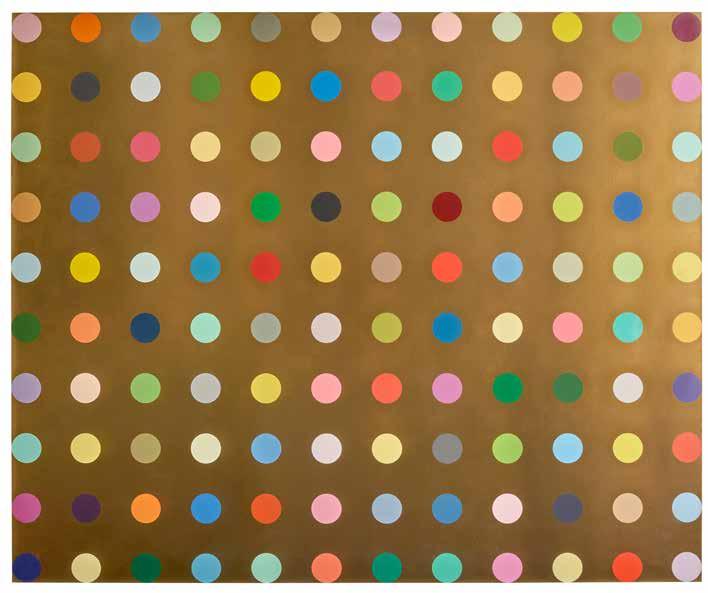
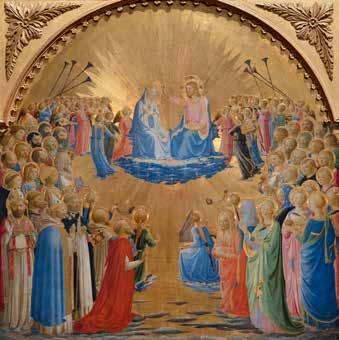
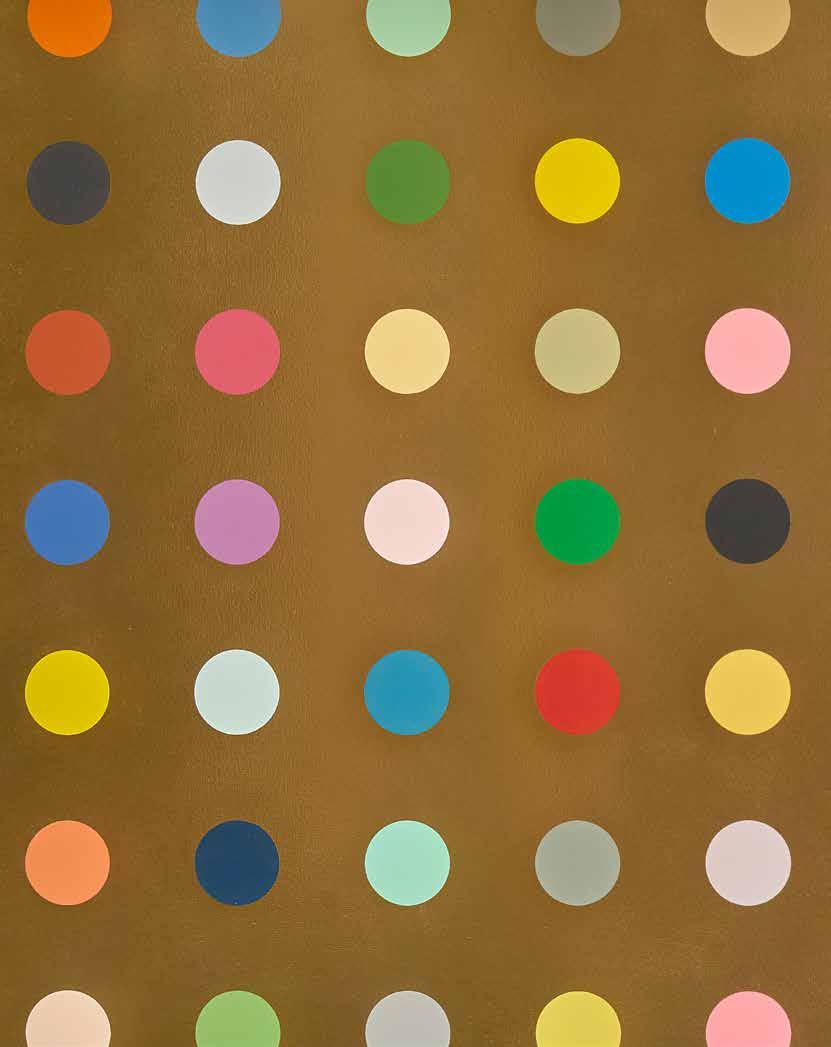
Executed in 2008, Au-195m is a striking example of Damien Hirst's celebrated Spot paintings, a series that has become one of the most recognizable and sought-after bodies of work in contemporary art. Rising to prominence in the late twentieth century as a leading figure of the Young British Artists, Hirst has been widely recognized for his ability to fuse scientific inquiry with visual immediacy, producing works that confront fundamental questions of life, death, and belief. His practice, grounded in the primacy of ideas - what he has described as the true site of artistic creation - has consistently redefined the boundaries between art, science, and popular culture.
Monumental in scale and visually arresting, the present work comprises 120 uniquely colored circles arranged in a precise grid across a luminous gold ground, demonstrating the artist's sustained exploration of color, repetition, and visual harmony within a rigorously controlled system. Each dot is individualized in hue, collectively forming a composition that is at once systematic and optically dynamic.
Central to the significance of Au-195m is its title, which draws on the language of chemistry. "Au," the symbol for gold, is paired with "195m," denoting a metastable radioactive isotope - an excited state of matter that emits energy as it decays. This subtle but powerful reference transforms the gold ground from a symbol of permanence and value into one of latent instability. Beneath its immaculate surface lies the suggestion of invisible energy and gradual transformation, a conceptual tension that echoes Hirst's enduring preoccupation with life, mortality, and the limits of human control.
Hirst's Spot paintings have long been associated with the visual language of pharmacology and scientific classification. Each canvas adopts a systematic structure, in which color is isolated, repeated, and calibrated with near-clinical precision. As the artist has remarked, these works were conceived as part of
an "endless series," reflecting a scientific approach to painting that parallels the pharmaceutical industry's attempt to impose order on the complexities of life (Damien Hirst, I Want To Spend The Rest Of My Life Everywhere, With Everyone, One To One, Always, Forever, Now, London 1997, p. 246.) In Au-195m, this balance between control and unpredictability is particularly resonant: the regularity of the grid suggests rational structure, while the title introduces an underlying condition of flux.
The radiant gold ground further elevates the work's visual and material presence. Historically associated with sacred painting and notions of the eternal, gold here is recontextualized within a contemporary, scientific framework. This dialogue between tradition and modernity - between the symbolic and the empirical - is characteristic of Hirst's practice, in which beauty and unease are held in careful equilibrium.
At once intellectually rigorous and immediately seductive, Au-195m encapsulates the qualities that have positioned Hirst at the forefront of contemporary art. The painting's exceptional scale, pristine execution, and rich chromatic range enhance its visual impact, while its conceptual grounding lends it lasting depth. Works from this series remain highly desirable among collectors for their clarity, iconography, and enduring relevance within Hirst's oeuvre.
Exhibited at the PinchukArtCentre, Kyiv, in 2009 and subsequently retained in a private collection, Au-195m exemplifies a fully realized expression of one of Damien Hirst's most celebrated and recognizable series. Balancing formal clarity with conceptual resonance, the work reflects the artist's sustained engagement with the language of science as a means of exploring value, perception, and the human condition.
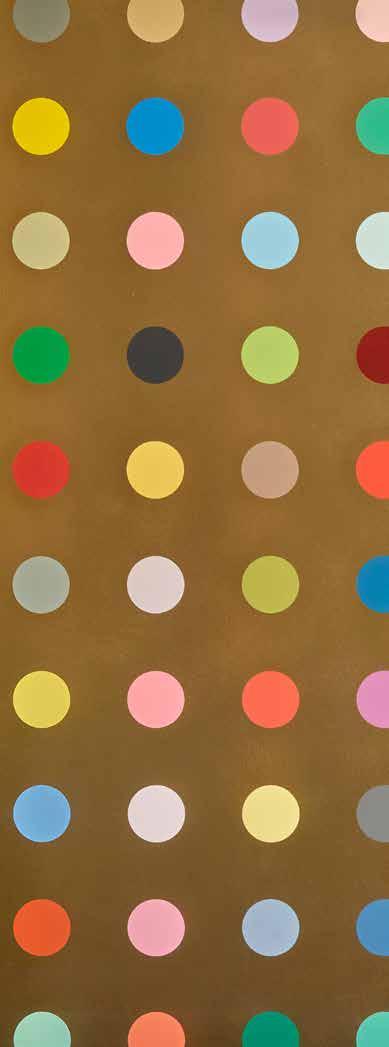
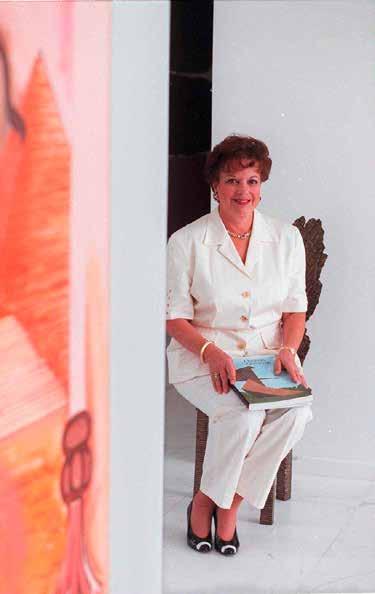
Bonhams is honored to present the following two exceptional works as part of a curated group from the personal collection of the late Gloria Luria, a figure whose vision and conviction were instrumental in shaping the cultural landscape of Miami.
A true pioneer of the city’s art scene, Gloria Luria opened one of the first galleries in Miami dedicated to contemporary art at a moment when such ambition required both foresight and conviction. Born in Brooklyn in 1925 and trained at Skidmore College, Pratt Institute, and the Art Students League of New York, Luria began her career as an interior designer on 57th Street in Manhattan before relocating to Miami in 1960 with her husband, Leonard. Just six years later, in 1966, she founded Gloria Luria Gallery, initially presenting works from her own collection - an early indication of the deeply personal ethos that would define her approach to art.
From the outset, Luria demonstrated an extraordinary ability to recognize and champion artists of lasting significance. At a time when Miami’s cultural infrastructure was still in its infancy, she introduced works by leading figures of Pop and Abstract art, including George Segal, Andy Warhol, Robert Rauschenberg, and David Hockney, later expanding her program to encompass artists such as Helen Frankenthaler, Frank Stella, Joan Mitchell, Sol LeWitt, and Willem de Kooning. As Norman Braman later reflected, “Gloria was the first to recognize the Abstract and Pop Art movements. Her openings were happenings in Miami.” Similarly, Martin Margulies recalled that Luria was “ahead of her time, a pioneer,” her gallery one where visitors encountered major artists in an environment defined by both accessibility and purpose (both quoted in: H. Cohen, “Gallery owner Gloria Luria, whose legacy in Miami led to Art Basel, dies at 97”, Miami Herald, May 27, 2023, Online).
Luria’s influence extended beyond the presentation of internationally celebrated names. She was equally committed to fostering Miami’s local artistic community, championing emerging talents and exhibiting women artists well before such practices became widespread. Her gallery quickly
became a vital nexus for collectors, artists, and curators, helping to establish Miami as a site of meaningful artistic exchange. A founding member and later president of the Art Dealers Association of South Florida, she also played a key role in bringing the first iteration of Art Miami to the Miami Beach Convention Center - an initiative that helped pave the way for the city’s prominence as a global art destination, later cemented by Art Basel Miami Beach.
Central to Luria’s legacy was her deeply held belief in the importance of personal conviction over market trends. As she stated in a 1983 profile with Miami Today, “I don’t change my feeling for art by what would sell.” This philosophy guided not only her gallery program but also her life as a collector. Together with her husband, she assembled a collection of remarkable breadth and quality, living intimately with works by many of the most important artists of the twentieth century. Their home - celebrated in Architectural Digest in 1984 - was conceived as an extension of this vision, where art and architecture existed in dynamic dialogue. “Best of all,” Luria reflected, “the paintings let me dream.” (Avis Berman, “Orchestrating for Fine Art: Contemporary Collection in a Florida Setting.” Architectural Digest, May 1984, p. 164).
Over more than five decades, Luria’s commitment to art was matched by notable generosity. Works from her collection were placed in major institutions, including the Whitney Museum of American Art, The Metropolitan Museum of Art, and the Pérez Art Museum Miami, among others. Her support extended across disciplines, encompassing both the visual and performing arts, and was recognized through numerous honors, including the designation of “Gloria Luria Day” by Metropolitan Dade County Mayor Steven P. Clark on February 7, 1986.
Gloria Luria left behind an enduring legacy defined by curiosity, courage, and an unwavering dedication to the artists she believed in. The works offered here stand not only as exceptional examples of their kind, but as reflections of a life lived in close dialogue with art - guided by instinct, intellect, and a passion for discovery.
See also lots 247 – 251 in Post-War & Contemporary Art.
14A
JAMES ROSENQUIST (1933-2017)
Vanity Unfair for Gordon Matta-Clark each panel signed, variously inscribed and dated 'James Rosenquist 1978
GORDON MATTA-CLARK' (on the reverse) oil on canvas laid on joined panels with wire 62 3/4 x 43 in (159.4 x 109.2 cm)
Painted in 1978
US$300,000 - 500,000
£220,000 - 370,000
HK$2,400,000 - 3,900,000
This work is registered with the James Rosenquist Studio under registration no. 78.06.
Provenance
Leo Castelli Gallery, New York.
The Mayor Gallery, London (acquired from the above in 1978). Private collection, London (acquired from the above in 1979).
Gloria Luria Collection, Miami. Thence by descent to the present owner.
Exhibited
London, The Mayor Gallery, James Rosenquist: Recent Paintings, November 29-December 21, 1978.
Literature
W. Hopps & S. Bancroft, James Rosenquist: A Retrospective, New York, 2003 (illustrated p. 179). J. Rosenquist & D. Dalton, Painting Below Zero: Notes on a Life in Art, New York, 2009 (p. 252). Gertler, Miles & Bragado, Igor, "Fashion: On James Rosenquist, an Interview with Mimi Thompson, Lily Rosenquist and Sarah Bancroft," Paprika! Magazine, 2012, no. 12.
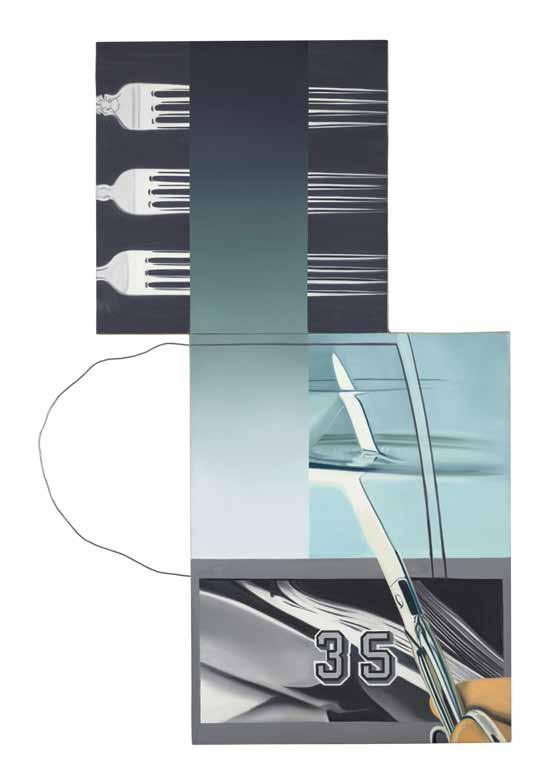
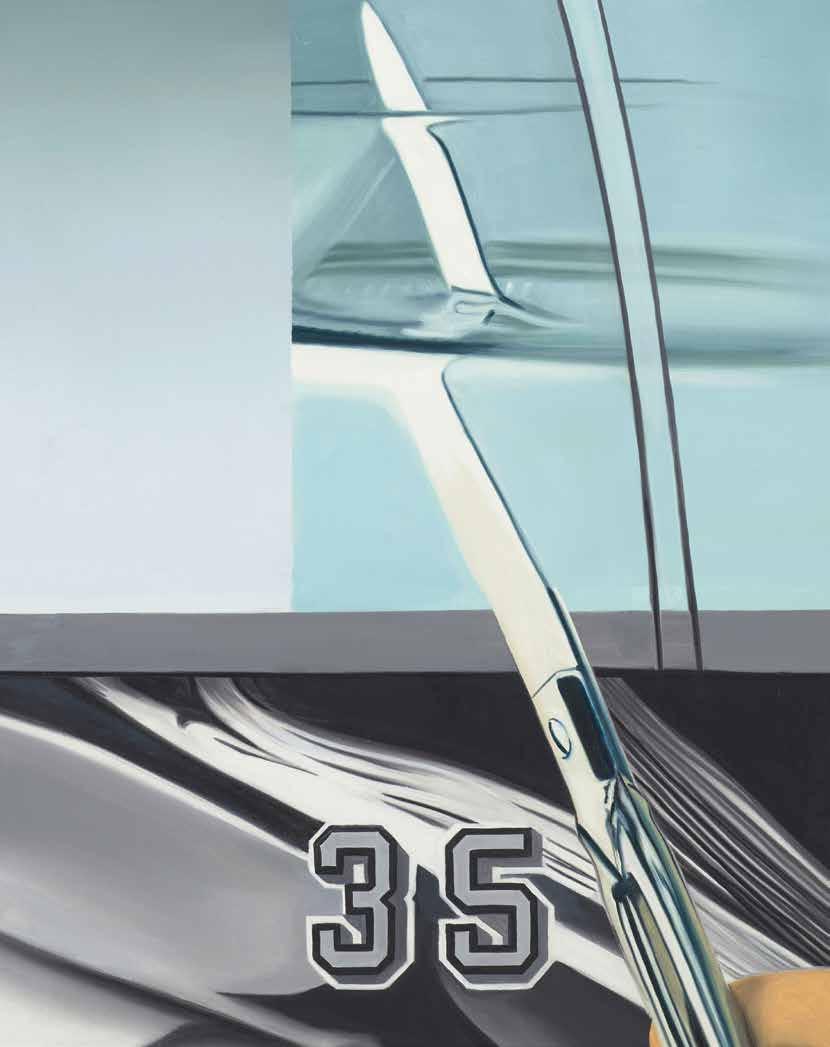
James Rosenquist's Vanity Unfair for Gordon Matta-Clark, from 1978, occupies an esoteric position within the artist's most important period of output in the 1960s and 70s, where the language of Pop is both sharpened and subverted through a sequence of dislocations. Painted across joined panels offset across their middle, the work eschews the seamless billboard logic that first defined Rosenquist's rise, instead presenting a fractured pictorial field in which images are cropped, displaced, and held in precarious alignment.
One of the principal Pop Artists, Rosenquist stands apart from his peers in his Surreal, painterly approach. Whilst the influence of the Readymade and Rauschenberg's Combines is undeniable in the present work, Rosenquist is one of the great painters of the Pop Art canon; employing painting as a process that can alter scale, surface, suggest collisions and transitions that would otherwise be impossible with photographic or sculptural media. Anchored by a series of sharply rendered, almost hyperreal motifs - the repeated tines of forks, gleaming scissors, a football jersey-style '35' - the elements of Vanity Unfair for Gordon Matta-Clark, drawn from the vernacular of advertising and industrial design, retain their seductive clarity while abandoning a stable narrative. Rosenquist's long-standing engagement with scale and fragmentation, rooted in his early work as a commercial billboard painter, here becomes a means of estrangement.
The work's dedication to Gordon Matta-Clark offers a richly historic and important lens through which to interpret the present work. Matta-Clark's practice, defined by acts of architectural incision and spatial deconstruction in the 1970s, finds an oblique analogue in Rosenquist's treatment of the pictorial surface. The painting's segmented structure and discontinuous imagery evoke a kind of visual 'cutting,' as though the canvas itself had been subjected to a process of excision and reassembly. Rosenquist evidences this more transparently in the scissors that enter from outside of the picture plane, bisecting the lower canvas; in addition to the metal wire that imitates the iron rebar bones of stripped concrete structures. A literal and conceptual hook, both artists engage in a dismantling of established systems, architectural or representational, to reveal latent structures, tensions, and anomalies of form.
'Vanity Unfair' further suggests a critical sublimation of the aspirational imagery associated with consumer culture. Where Rosenquist's earlier works often reveled in the glossy allure of mass media, this painting introduces a more ambivalent tone. The chromed surfaces retain their visual appeal, yet their juxtaposition with disjointed framing devices and the conspicuous absence of a unifying ground produces a sense of instability. The viewer is denied the easy consumption of the image, instead, encountering a field of competing fragments that resist resolution.
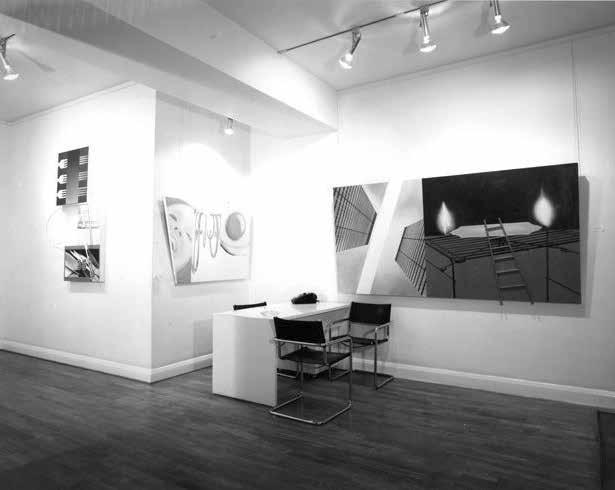
November - 21 December 1978
The painting underscores this tension between cohesion and fracture. The joined panels foreground the objecthood of the painting, emphasizing its constructed nature. This physical articulation mirrors the compositional logic: the painting is not a window but an assemblage, its unity contingent and provisional. The faint linear contour that traces across the surface further destabilizes the image, acting as a connective gesture.
Vanity Unfair for Gordon Matta-Clark is an elegant rumination on the limits of visual coherence from an artist at the very height of his powers by the end of the 1970s. Rosenquist retains the vocabulary of mass culture but subjects it to a process of fragmentation that aligns, in spirit, with the more radical spatial interrogations of his contemporaries. The result is a work that is both visually compelling and conceptually incisive, situating itself at the intersection of image, object, and critique.
15A W
LARRY RIVERS (1923-2002)
Beyond Camel
signed and dated 'Larry Rivers '80' (lower right)
acrylic and graphite on canvas
98 5/8 x 79 1/4 in (250.5 x 201.2 cm)
Painted in 1980
US$250,000 - 350,000
£180,000 - 260,000
HK$2,000,000 - 2,700,000
Provenance
Gloria Luria Collection, Miami (acquired directly from the artist).
Thence by descent to the present owner.
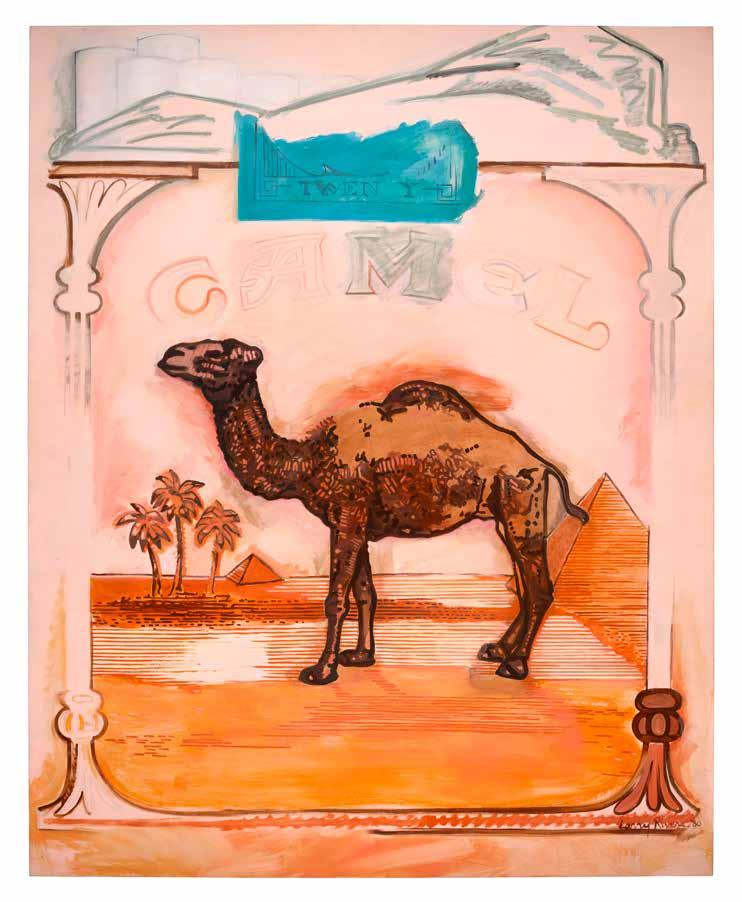
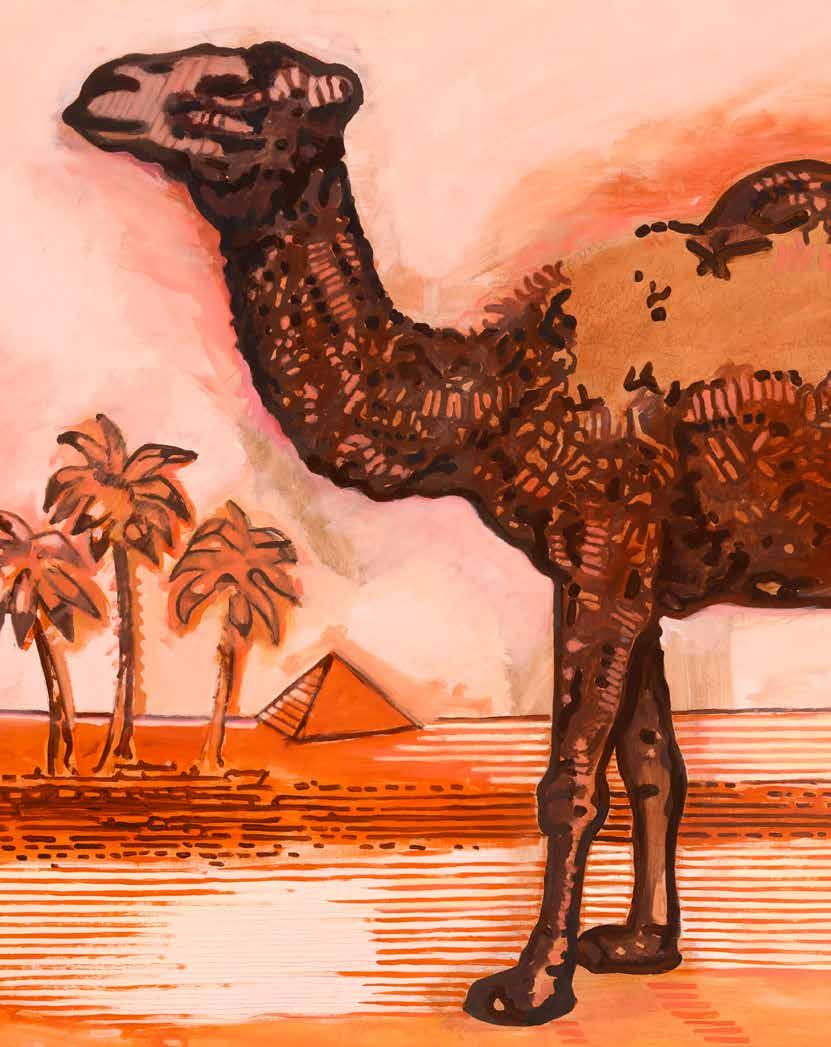
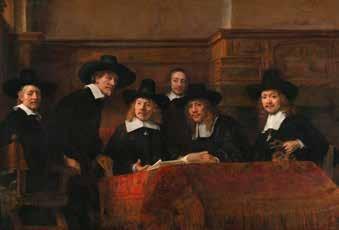
Rembrandt van Rijn, The Sampling Officials of the Amsterdam Drapers’ Guild, Known as ‘The Syndics’ (1662). Rijksmuseum, Amsterdam.
Long regarded as a "godfather" of Pop Art, Larry Rivers (born Yitzroch Loiza Grossberg) developed a distinctive, jazz-inflected improvisational style that merged the painterly traditions of high art with imagery drawn from mass culture. A self-professed student of Red Grooms, Rivers resisted easy stylistic classification, finding his artistic voice within the freeform milieu of the bohemian circles of Greenwich Village and the Hotel Chelsea, where he was a regular at the Cedar Tavern. Before turning to painting, he trained as a saxophonist, and references to smoking and tobacco—integral to both jazz culture and his social environment—recur throughout his work. As his close friend, the poet and MoMA curator Frank O'Hara, famously remarked, Rivers was the only nicotine addict who didn't smoke, despite O'Hara's own threepack-a-day Camel habit.
Painted in 1980, when Rivers divided his time between his East 14th Street loft and his home in Southampton, Beyond Camel draws directly on the visual language of the eponymous cigarette brand. The composition echoes the design of the Camel package while foregrounding Rivers's characteristic vocabulary: an unfinished blue seal hovers at the top, stenciled lettering shifts in and out of legibility, and the architectural framing devices of the commercial design dissolve through painterly intervention. The familiar image is thus destabilized, oscillating between legibility and abstraction.
Despite its overt engagement with commercial imagery, Beyond Camel emerges from two longstanding preoccupations in Rivers's practice: his immersion in the cigarette culture of jazz and bohemian life, and his fascination with the African continent, which dates to the early 1960s. This latter interest was partly shaped by his childhood proximity to the Bronx Zoo, where he developed an early awareness of African wildlife. These concerns first converged after 1961, when Rivers began incorporating advertising imagery and popular logos into his paintings.
Rivers frequently drew on vernacular objects—playing cards, bar menus, and tobacco products among them—and returned repeatedly to specific cigarette brands, including Lucky Strike (lithograph series, 1960–63), Tareyton (oil on canvas, 1967), and Webster (mixed-media series, 1980s), alongside his many references to Camel Cigarettes. He likened his appropriation of such imagery to Yves Klein's use of his signature blue, suggesting that, in his own work, cigarette branding could become a similarly personal and expansive visual language. As he later wrote in his memoirs, "I began to assume that all cigarettes and cigars and their packaging were ripe for my picking" (the artist quoted in: What Did I Do?, New York, 1992, p. 404).
An early example, Dutch Masters and Cigars (1963), reproduces a cigar box label featuring Rembrandt's Syndics of the Drapers' Guild (1662). Rivers was struck by the way a canonical image could be repurposed to market a quotidian commodity, transferring the authority of Old Master painting onto a mass-produced product. By translating such imagery into the vernacular format of commercial packaging, he collapsed distinctions between high and low culture, foregrounding the ways in which encounters with art are mediated through everyday forms of reproduction—from packaging to currency.
At the same time, Rivers initiated his Africa series (1961–62), in which he rendered the continent in a loose, painterly manner that disregarded fixed political boundaries. In Africa I (1961–62), a camel derived from cigarette branding appears outlined across Algeria, labeled in stenciled text. The motif recurs in subsequent works, where, as art historian Sam Hunter observed, "fleeing, diminutive ghosts of camels from the cigarette pack merge with the landscape to which they also belong" (Sam Hunter, Larry Rivers, Waltham, MA, 1965, p. 34), collapsing distinctions of scale and context. A related strategy appears in the collage Camel-Amel (1962), whose overlapping camel forms and fragmented lettering offer a clear precedent for Beyond Camel. Rivers's engagement with Africa extended beyond painting: in 1967–68, he traveled to the continent and produced the experimental documentary Africa and I for NBC's Experiments in Television, articulating an affinity for Black culture rooted in his early engagement with jazz.
By 1980, Rivers was working well beyond the initial moment of Pop Art, developing a prolific, multimedia practice that incorporated techniques such as airbrushing and three-dimensional assemblage. The Camel paintings from this period continue his earlier strategies, combining gestural brushwork with stenciled text, outlined forms, and erasure. This work belongs to a series of acrylic paintings from 1980 that share a common compositional structure while differing in their specific surface effects—smudging, erasure, and painterly additions. Some examples bear descriptive titles based on their unique aesthetic qualities, such as Grey and Shadow Camel, Brushed Camel, Bauhaus Camel, and White Camel. In contrast to other works from this series, Beyond Camel is comparatively complete in its finished detail.
Although removed from the specific historical conditions of 1960s Pop, Rivers remained attuned to the evolving myths of mass marketing, newly inflected in the Reagan era. In this respect, Beyond Camel can be considered alongside contemporaneous practices that critically revisited advertising imagery, such as Richard Prince's rephotographed Marlboro cowboys. Here, Rivers reintroduces the literal contents of the cigarette pack, depicting cigarettes emerging from it. In doing so, he returns to a strategy already present in Dutch Masters and Cigars, creating a pointed oscillation between surface image and material reality—between representation and the object it purports to depict.
16A
JIM NUTT (B. 1938)
Untitled acrylic on canvas, in artist's frame
27 1/4 x 22 1/4 in (69.2 x 56.5 cm)
Painted circa 1968-69
US$150,000 - 250,000
£110,000 - 190,000
HK$1,200,000 - 2,000,000
Provenance
Private collection, Sacramento (acquired directly from the artist circa 1969).
Private collection, Bay Area (acquired from the above).
By bequest from the above.
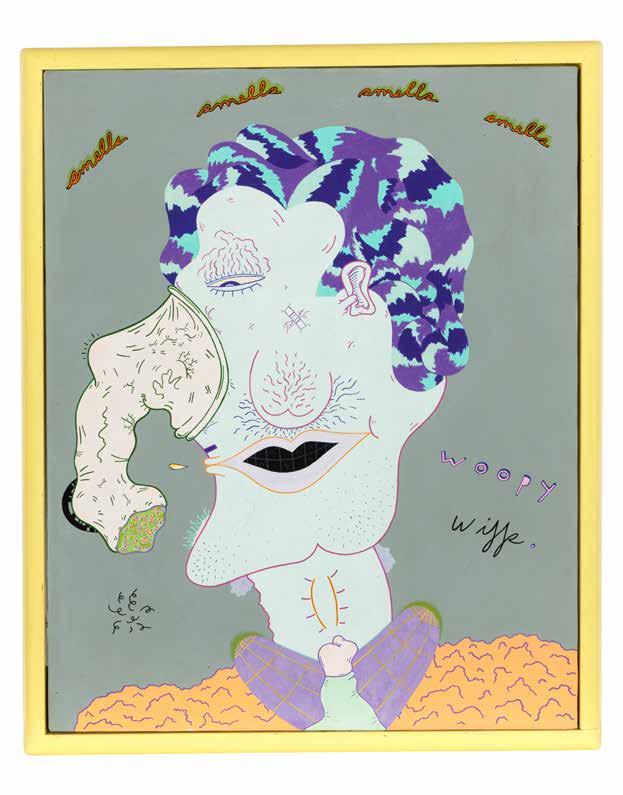
17A W
FRIEDEL DZUBAS (1915-1994)
Sacrum
signed, inscribed and dated 'Dzubas "Sacrum" 1987' (on the reverse)
Magna on canvas
72 x 72 in (182.9 x 182.9 cm)
Painted in 1987
US$100,000 - 150,000
£74,000 - 110,000
HK$780,000 - 1,200,000
Provenance
André Emmerich Gallery, New York. Private collection, New York (acquired from the above). Acquired from the above by the present owner.
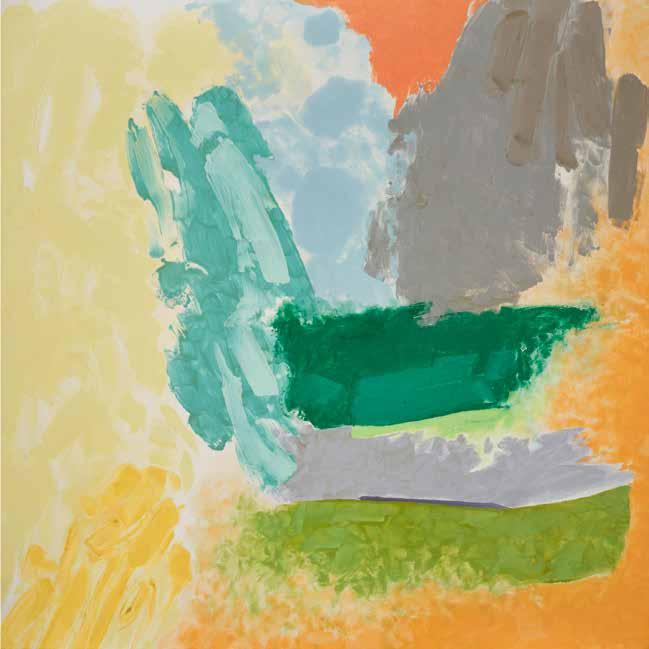
18A
JACOB LAWRENCE (1917-2000)
Two Comedians and a Dancer signed and dated 'J Lawrence 58' (lower right) tempera on hardboard 18 x 24 in (45.7 x 60.8 cm) Executed in 1958
US$400,000 - 600,000
£290,000 - 440,000
HK$3,100,000 - 4,700,000
Provenance
The Alan Gallery, New York.
Flora Whitney Miller Collection, New York (acquired by 1974).
Sale: Sotheby's New York, Important American Paintings, Drawings and Sculpture, May 28, 1987, Lot 328. Terry Dintenfass, Inc., New York (acquired from the above).
Andrew and Ann Dintenfass Collection, Pacific Palisades.
Terry Dintenfass, Inc., New York.
Private collection (acquired from the above in 1987). Acquired from the above by the present owner.
Exhibited
New York, Whitney Museum of American Art, Jacob Lawrence, May 16-July 7, 1974, no. 136 (exh. cat., p. 58) (later traveled to The Saint Louis Art Museum; Birmingham Museum of Art; Seattle Art Museum; Kansas City, William Rockhill Nelson Gallery of Art and Atkins Museum of Fine Arts; New Orleans Museum of Art).
Literature
P.T. Nesbitt & M. DuBois, Jacob Lawrence: Paintings, Drawings, and Murals (1935-1999): A Catalogue Raisonné, Seattle, 2000, no. P58-04 (illustrated p. 141).
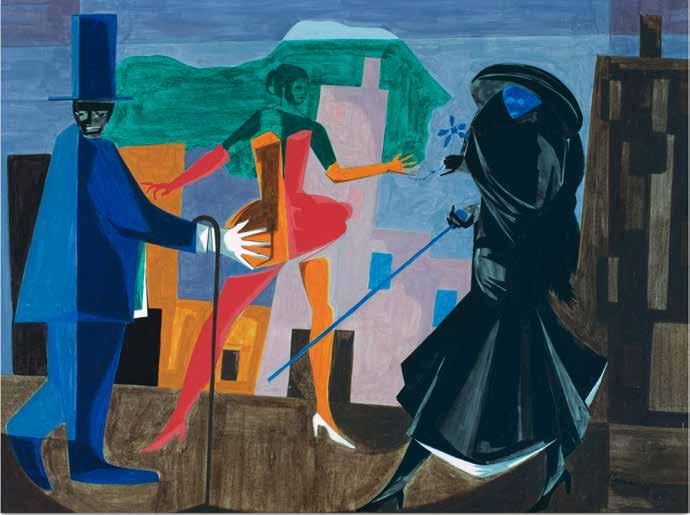
Executed in 1958, Two Comedians and a Dancer reflects a pivotal moment in Jacob Lawrence's mature practice, when his longstanding commitment to narrative had expanded into more allegorical and performative subjects.
As a result, Lawrence's compositions became increasingly distilled, using performers as vehicles to explore human interaction. Rendered in tempera on board, Two Comedians and a Dancer exemplifies his disciplined approach to modernist composition and color, while foregrounding a central theme in his oeuvre: performance as a lens through which to examine human interaction. The composition presents three stylized figures within a shallow, stage-like space. Lawrence reduces the scene to its essentials, employing angular forms, compressed space, and a carefully calibrated palette to convey rhythm and movement. As artist and art historian Richard J. Powell explains, "The shift is important, for it removed him from the social realist painters and their emphasis on sociopolitical redress in art and, instead, pushed him closer to the abstractionists and their preoccupations with intellectual interiority and open-ended interpretations" (R. J. Powell, "Harmonizer of Chaos: Jacob Lawrence at Midcentury," Over the Line: The Art and Life of Jacob Lawrence, Seattle, 2000, p. 147).
Only two years prior, Lawrence completed the first thirty panels of Struggle: From the History of the American People, exhibited in 1956 and 1958 at The Alan Gallery, before deciding not to continue the cycle. His shift away from large-scale historical narratives coincided with a broader cultural moment in New York, including the founding of the Alvin Ailey American Dance Theater in 1958, which signaled renewed visibility for performance in African American artistic life. Figures in these later works function not as portraits but as archetypes, embodying broader cultural energies, while the stage becomes a metaphorical arena in which relationships are enacted and observed. He emphasized gesture over individual identity, while his depictions of musicians, street performers and communal gatherings convey a sense of shared experience, which for the black community in the United States at the time was deeply culturally significant. "From the fiction of Ralph Ellison and James Baldwin... to the subtle yet discernible sociocultural incursions into jazz during the same period by such musicians as Miles Davis, Charles Mingus, and Thelonious Monk, the decade of the 1950s was a watershed for many African American artists" (Ibid., p. 149).
On a personal level, the work emerges from a period after which Lawrence had moved to the Bedford Stuyvesant neighborhood in Brooklyn, leading to a renewed interest in portraying city life. It also recalls his earlier engagement with performance through dance, music, and theater rooted in his experiences in Harlem during the 1920s and 1930s. Raised within the cultural vitality of the Harlem Renaissance, he was exposed early to jazz, social dance, and the expressive possibilities of the stage, an influence that remained foundational to his visual language. Having joined the faculty at Pratt Institute in 1956, Lawrence entered a sustained period of teaching that profoundly shaped his practice. Teaching required him to clarify and formalize his ideas, in turn stimulating new avenues of exploration in the studio. This intellectual rigor is evident here, where compositional discipline and thematic focus are held in careful balance.
Works from this period have been heavily praised by institutional collections, with several works from 1957-1959 now held in major museums across the United States, anticipating the growing recognition that would culminate in his first touring retrospective, organized by the Brooklyn Museum in 1960. The inclusion of Two Comedians and a Dancer in the 1974 to 1975 in his second retrospective at the Whitney Museum of American Art underscores its significance within this key moment in Lawrence's oeuvre. Exhibited alongside key works spanning his career, it contributed to a broader understanding of the artist not only as a chronicler of history, but also as a master of formal invention and thematic range.
LOTS 19A-27A
The following group of nine works hail from a vastly unique yet highly focused distinguished family collection and are a small reflection of the wider collection’s depth and intrigue, curated with a discerning connoisseurship and deep appreciation for the arts that knew no bounds and surpassed categorization. At the heart of this collection, alongside the iconic Main crispée droite by the father of modern sculpture, Auguste Rodin, and a rare sunflower still life by Austrian Expressionist Oskar Kokoschka, are seven exquisite fans by the hands of three of the foremost Modern masters: Paul Gauguin, Camille Pissarro, and Pierre Bonnard.
Offering an exquisitely distinct amalgamation of both the decorative and fine arts, the transformation of the fan from a commodified object to a serious fine art medium in the late nineteenth century was extremely important to the Impressionist art movement. First conceived in twelfth-century Japan for cooling purposes and long since appearing as a decorative status symbol among the upper echelons of society, the paper fan also became an integral object of fine-art within the avant-garde movement. The fan as a vehicle of modern art in the late nineteenth and early twentieth centuries was resultant of numerous cultural forces in effect at the turn of the century, particularly Japonisme, the craze for Japanese art and design in the West. Nowhere was this fascination with the fan-as-fine-art more evident than within the Impressionist’s collective oeuvre. Not only did Impressionist artists feature fan motifs within their works, but many, notably Pissarro and Gauguin, created fan designs that were exhibited amongst their paintings and drawings of similar imagery.
While the production of fans allowed for the transmission of the Impressionist style in a commercially appealing, accessible form, there were many additional reasons this alternate medium appealed artistically to the Impressionists. Typically made on silk or delicate paper, these fans allowed artists to explore brilliant decorative techniques, radical compositional layouts, and increased attention to delicate details. The same imagery used in their paintings and drawings, such as Pissarro’s bucolic landscapes and scenes of rural life, appeared on their fans, emphasizing the Impressionist’s general eagerness for experimentation across various elements of their artistic output. The curved, elongated format of the fan’s paper mount produced the effect of distance receding into space, and lent itself to a panoramic view, challenging how Impressionist artists composed their subjects and balanced foreground against background. When discussing the critical importance of the fan to Pissarro’s artistic development, scholar Christopher Lloyd writes: “to a certain extent the fan may have assisted Pissarro in his search for compositional unity. The emphasis that had to be placed on the two corners of the fan meant that figures were given prominence against the background. Landscapes and horizon lines in the upper half of the fan either have a horizontal emphasis or else echo the curvature of the fan itself. Whilst many of the compositions are reworkings of earlier works, Pissarro also showed considerable originality in this format. He sought different atmospheric effects in compositions of seasonal import, but at the same time did not spurn more 'modern' themes, such as the railway bridge at Pontoise and the port at Rouen" (Lloyd, Pissarro, London, 1980, p. 235).
town and its surroundings during his short stay. Pissarro, who was also living in Rouen prior to his move to Éragny in 1884, served as a guide to Gauguin on his approach to Impressionism. The present work by Gauguin, entitled Route de Rouen and executed in 1884, was most likely the result of encouragement from Pissarro to experiment with the fan medium, as well as the Impressionist palette and brushwork. In fact, the gently curving street lined with trees seen in Route de Rouen draws on imagery from a Pissarro etching of Rouen from around 1883 that he sent to Gauguin. The composition of the sheet is based on a system structured around diagonals and horizontals, which Gauguin found already developed in Pissarro’s fan paintings. Here too, the verticals of the tree trunks, the slender poplars, and the factory chimney enliven the simple rural scene, which, in its airy, light coloration and restless brushwork marked by short strokes, still appears entirely Impressionist. Though Gauguin would go on to produce a small number of fans featuring the “primitive imagery” from his later, pivotal years in the Marquesas Islands, the present work, painted on silk, is unique in its Impressionist subject matter and style, demonstrating the inherent influence of Pissarro on Gauguin’s work.
In Pissarro’s case, many of his fan designs clearly match or develop subjects found in his paintings, including his depictions of Éragny’s sprawling landscapes. Upon moving to Éragny in 1884, a small village town in northern France, Pissarro became enamored with the natural local scenery and surrounding scenes from daily village life. Resultantly, the dappled light and tranquil scenes from rural life became an instant source of artistic inspiration for the artist, and remained the predominant subject matter of his artistic output until his death in 1903. Within the present collection, all five of the fans by Pissarro were created within the span of his Éragny years, and highlight the artist’s once stated wish to express through his art “the true poem of the country side” (Pissarro quoted in R. Thomson, Camille Pissarro: Impressionism, Landscape and Rural Labour, London, 1990, p. 81).
Across the eight Impressionist Exhibitions held between 1874 and 1886, over thirty-five painted fans were exhibited, fourteen of which were made by Camille Pissarro. Aside from eager collectors, these innovative fan paintings would have also certainly caught the eye of the young Gauguin, who first exhibited with the Impressionists at their 1879 exhibition. In 1883, Gauguin decided to move to Rouen in the hope of finding new clientele for his paintings. Though he only stayed ten months, he produced upwards of forty works capturing the
As a Post-Impressionist artist and founding member of the Nabis group, Pierre Bonnard would also go on to adopt the use of the painted fan at the turn of the century. This further dissolved the distinction between fine art and decorative art, illustrating the fan as an enduring medium and further bridging the gap between Impressionism and ever-developing Modernism. This consideration of the fan as a highly finished, sophisticated form of fine art by Bonnard is evident in the present collection’s work, La famille
Executed in 1892, this touching work depicts the artist’s sister, Andrée, her husband Claude Terrasse and their infant son Jean. This familial scene is a quintessential composition for the Nabis, who sought to capture quiet and intimate moments from daily life over larger, sweeping landscapes. Illustrated through flat planes of color, bold outlines, and simplified forms, Nabi works read more like a decorative surface than a window into reality. Often incorporating patterns inspired by textiles and interior wall papers, Andrée’s polka dot sleeve in La famille lends itself to the influence of Japonisme and the woodcuts popularized at the time. Hidden by the mount in its current frame, La famille bears a decorative, frieze-like border tenderly surrounding this intimate portrait of his sister and her family. Further cementing this work’s significance as an important component of Bonnard’s Post-Impressionist development, La famille has been included in several major Bonnard exhibitions at renowned institutions such as the Metropolitan Museum of Art, New York and the Museum of Fine Arts, Boston.
Today, it is widely understood that fewer than one hundred fans were made by avant-garde artists of the late nineteenth and early twentieth centuries. This small number, in relation to the total artistic output of these artists, was likely due to the fact that painted fans would have been considered a decorative art by most, and therefore less respectable than a work on canvas. Today, however, these fans are considered to be a vital aspect of both Impressionist and Post-Impressionist art, influencing the many subsequent movements that unfolded. Highly sought after and rarely seen at auction, their importance has gained further traction with the help of a major exhibition of artist’s fans at the Metropolitan Museum of Art, New York, and the high-profile donation of an exceptional single-owner collection of seventeen fans to the Musée d’Orsay, Paris in the past year.
The fan’s unique shape promoted an imaginative approach and allowed artists to invent new compositional layouts, while the commerciality of the object lent itself to the avant-garde desire to capture the spirit of
daily modern life. An exquisite amalgamation of technical artistry and art historical significance, this robust collection of painted fans offers collectors a unique opportunity to experience the iconic work of modern art’s leading figures.
Bonhams is honored to present this storied collection for sale, with many of the works having remained unseen for decades. Further highlights from the collection will offered at Bonhams’ London and Marlborough salerooms, including works by J.M.W. Turner, Christopher Wood, Duncan Grant, Georgios Klontzas, as well as early English ceramics and fine European furniture, illustrating a wide depth of interest and collecting dedication rarely seen today.
19A
CAMILLE PISSARRO (1830-1903)
Le Retour au village au clair de lune (Eragny) signed and dated 'C. Pissarro. 86' (lower left) gouache and watercolor on silk laid down on paper
7 15/16 x 25 9/16 in (20.2 x 65 cm) (fan)
17 1/2 x 29 1/2 in (44.5 x 75 cm) (support) Executed in 1886
US$150,000 - 200,000
£110,000 - 150,000
HK$1,200,000 - 1,600,000
This work will be included in the forthcoming Camille Pissarro Digital Catalogue Raisonné, currently being prepared under the sponsorship of the Wildenstein Plattner Institute, Inc.
Provenance
Madame de Kerrieu Collection, Paris; her sale, Hôtel Drouot, Paris, February 8-9, 1898, lot 88.
Galerie Durand-Ruel et Cie., Paris (acquired at the above sale).
Jean & Marie-Louis d'Alayer (née Durand-Ruel) Collection, Paris (transferred from the above in 1940).
Sale: Hôtel Drouot, Paris, December 19, 1955, lot 22.
Sale: Drouot Rive Gauche, Paris, June 18, 1976, lot 108.
Sale: Drouot-Richelieu, Paris, May 14, 1997, lot 32.
Galerie Charles & André Bailly, Paris (likely acquired at the above sale).
Acquired from the above by the present owner in August 1997.
Literature
L.-R. Pissarro & L. Venturi, Camille Pissarro, son art – son oeuvre, Vol. I, Paris, 1939, no. 1635 (Vol. II, illustrated pl. 309).
M-J. Pellé, Les Éventails de Camille Pissarro, Paris, 1990, no. 27 (illustrated p. 27; titled 'Le Départ du village, Eragny' and 'Le Chemin de l'atelier').
M-J. Pellé, "Vert Pissarro..." Impressions de Normandie et d'ailleurs, Luneray, 2000, no. 8 (illustrated p. 72).
J. Pissarro & C. Durand-Ruel Snollaerts, Pissarro, Critical Catalogue of Paintings, Vol. I, Paris, 2005, p. 281 (titled 'The Path to the Studio').
20A
PAUL GAUGUIN (1848-1903)
Route de Rouen
gouache and watercolor on silk laid down on canvas
6 5/16 x 22 1/4 in (16 x 56.5 cm) (fan)
12 13/16 x 22 5/8 in (32.5 x 57.5 cm) (support)
Executed circa 1884
US$300,000 - 500,000
£220,000 - 370,000
HK$2,300,000 - 3,900,000
This work will be included in the forthcoming Paul Gauguin Digital Catalogue Raisonné, currently being prepared under the sponsorship of the Wildenstein Plattner Institute, Inc.
Provenance
Anker & Louise Christine Heegaard Collection, Denmark (acquired from the artist through Mette Gauguin, Copenhagen before May 1893).
Stephanie Petrea Ankerita Bernhoft Collection, Hørsholm (by descent from the above circa January 1905).
Herman Anker Bernhoft Collection, Copenhagen (by descent from the above circa February 1936, until at least 1948).
Private collection, Copenhagen (by 1960, until at least 1968).
H. Fischer-Hansen Collection, Copenhagen (by 1970).
Locks Gallery, New York (by 1972).
A.M. Adler Fine Arts, New York (by 1974).
D.H. Vermeulen-van Lutterveld Collection, Hilversum (by 1976).
E. J. van Wisselingh & Co., Amsterdam (by 1984).
Private collection, France (by October 1985); their sale, Christie's, London, December 1, 1987, lot 323. Acquired at the above sale by the present owner through Leggatt Brothers, London.
Exhibited
Copenhagen, Fortegnelse over kunstværkerne paa den Frie udstilling 1893, March 26 - May 31, 1893, no. 135 (titled 'Vifte'; dated '1885').
Copenhagen, Ny Carlsberg Glyptotek, Paul Gauguin 1848-1903, May-June 1948, no. 57 (titled 'Udkast til vifte. Flodlandskab. Fra Rouen?'; dated '1880s').
Amsterdam, E. J. van Wisselingh & Co., Maître Français du XIXeme et XXeme Siècles: exposition organisée à l'occasion du Septième-Centenaire de la Ville d'Amsterdam, May 3 - June 4, 1971, no. 16. Amsterdam, E. J. van Wisselingh & Co., Maître Français du XIXeme et XXeme Siècles, May 2 - June 6, 1975, no. 14.
Stuttgart, Staatsgalerie, Kompositionen im Halbrund, Fächerblätter aus Vier Jahrhunderten, July 1September 2, 1984, no. 78 (titled 'Uferpartie und Seine-Insel in Rouen'; later traveled to Zurich). Copenhagen, Ordrupgaard, Gauguin og van Gogh i København i 1893, December 12, 1984 - February 10, 1985, no. 16 (titled 'Motiver fra Rouen').
St. Germain-en-Laye, Musée Départemental de Prieuré, Le Chemin de Gauguin, genèse et rayonnement, October 7, 1985 - March 2, 1986, no. 38.
Literature
H. Rostrup, 'Eventails et Pastels de Gauguin' in Gazette des Beaux-Arts, no. 56, September 1960, no. 6 (illustrated p. 162; titled 'Environs de Rouen? Eventail'; dated '1883-1884').
G. Wildenstein, Paul Gauguin, Vol. I, Paris, 1964, no. 108 (illustrated p. 43; titled 'Route de Rouen I').
M. Bodelsen, Gauguin og Impressionisterne, Copenhagen, 1968 (illustrated p. 156; titled 'Vifte med motiver fra Rouen'; dated '1885').
M. Kopplin, Das Fächerblatt von Manet bis Kokoschka, Europäische Traditionen und japanische Einflüsse, Cologne, 1981, no. 154 (pp. 135, 138-140, 311).
A.-B. Fonsmark, Manet, Gauguin, Rodin...Chefs-d'oeuvre de la Ny Carlsberg Glyptotek de Copenhague, exh. cat., Musée d'Orsay, Paris, 1995, p. 130 (illustrated).
J-P. Zingg, The Fans of Paul Gauguin, Paris, 2001, pl. III (illustrated p. 19; dated '1885').
21A
CAMILLE PISSARRO (1830-1903)
Berger et bergère à la barrière, Bazincourt stamped with the artists initials 'C.P.' (Lugt 613e; lower left) and inscribed 'Esquisse de l'éventail de Mr Paulin' (lower center) gouache and wash on paper
7 1/16 x 21 5/8 in (18 x 55 cm) (fan)
13 x 24 1/16 in (33 x 61.1 cm) (shaped sheet)
Executed in Bazincourt circa 1885
US$120,000 - 180,000
£89,000 - 130,000
HK$940,000 - 1,400,000
This work will be included in the forthcoming Camille Pissarro Digital Catalogue Raisonné, currently being prepared under the sponsorship of the Wildenstein Plattner Institute, Inc.
Provenance
Jeanne & Alexandre Bonin Collection, Paris (the artist's daughter and son-in-law; by descent from the artist circa 1903); their sale, Hôtel Drouot, Paris, June 26, 1931, lot 22.
Madame Zimmerman Collection, Paris (acquired at the above sale).
Private collection, Paris (by descent from the above); their sale, Sotheby's, London, April 4, 1990, lot 107.
Acquired at the above sale by the present owner through Legatt Brothers, London.
Literature:
L.-R. Pissarro & L. Venturi, Camille Pissarro, son art – son oeuvre, Vol. I, Paris, 1939, no. 1632 (illustrated Vol. II, pl. 309).
M-J. Pellé, Les Éventails de Camille Pissarro, Paris, 1990, no. 22 (illustrated p. 24).
As indicated by the inscription on the surrounding paper 'Esquisse de l'éventail de Mr Paulin' (lower center), the present work is a study for a gouache fan of the same date and titled Bazincourt, le Berger, last known in the collection of M. Paulin, Paris.
22A
CAMILLE PISSARRO (1830-1903)
Etude pour Le Repos des moissonneurs stamped with the artist's initials 'C.P.' (Lugt 613e; lower left) gouache, watercolor and charcoal on paper
11 x 21 7/8 in (28 x 55.6 cm) (fan)
12 15/16 x 23 1/8 in (32.9 x 58.8 cm) (sheet)
Executed circa 1891
US$50,000 - 70,000
£37,000 - 52,000
HK$390,000 - 550,000
This work will be included in the forthcoming Camille Pissarro Digital Catalogue Raisonné, currently being prepared under the sponsorship of the Wildenstein Plattner Institute, Inc.
Provenance
Julie Pissarro Collection, Étude-sur-Epte (the artist's wife; by descent from the artist circa 1903); her Estate sale, Hôtel Drouot, Paris, December 8, 1928, no. 262.
Dr. Georges Viau Collection, Paris (acquired at the above sale).
Sale: Hôtel Drouot, Paris, May 8, 1936, lot 39.
Sale: Hôtel des ventes, Honfleur, July 15, 1989, lot 158.
Sale: Sotheby's, London, November 29, 1989, lot 404.
Acquired at the above sale by the present owner through Leggatt Brothers, London.
Exhibited
Paris, Musée de l'Orangerie, Centenaire de la Naissance de Camille Pissarro, February - March 1930, no. 49 (titled 'Les Moissonneurs; éventail').
Literature
J. Pissarro, Camille Pissarro, New York, 1993, no. 218 (illustrated p. 189; titled 'The Picnic').
23A
PIERRE BONNARD (1867-1947)
La Famille (Conception pour un éventail) signed 'Bonnard' (lower right) gouache, watercolor and pencil on paper
7 3/8 x 20 7/8 in (18.7 x 53 cm) (fan)
13 1/2 x 23 7/16 in (34.3 x 59.6 cm) (sheet)
Executed in 1892
US$100,000 - 150,000
£74,000 - 110,000
HK$780,000 - 1,200,000
The authenticity of this work has kindly been confirmed by Guy-Patrice Dauberville and Floriane Dauberville.
Provenance
Galerie René Drouet, Paris. Private collection.
Sale: Sotheby's, London, December 3, 1986, lot 422. Acquired at the above sale by the present owner through Leggatt Brothers, London.
Exhibited
New York, Metropolitan Museum of Art, Pierre Bonnard: The Graphic Art, December 2, 1989 - February 4, 1990, no. 15 (later traveled to Houston and Boston).
Montreal, The Montreal Museum of Fine Arts, Bonnard, Decorateur, June 18 - October 25, 1998.
Literature
C. Frèches-Thory & A. Terrasse, The Nabis, Bonnard, Vuillard and Their Circle, Paris, 1990, pp. 160-161 (illustrated).
This work depicts Bonnard's sister, Andrée, her infant son Jean (born 1892) and her husband, the composer Claude Terrasse.
24A
CAMILLE PISSARRO (1830-1903)
Éragny
stamped with the artists initials 'C.P.' (Lugt 613a; lower right) watercolor on paper
12 3/16 x 25 3/16 in (31 x 64 cm) (fan)
14 3/4 x 25 3/16 in (37.5 x 64 cm) (sheet)
Executed circa 1890
US$25,000 - 35,000
£19,000 - 26,000
HK$200,000 - 270,000
The authenticity of this work has been confirmed by Dr. Joachim Pissarro. This work will be included in the forthcoming Catalogue Raisonné of Drawings by Camille Pissarro, currently being prepared.
Provenance
Paul-Émile Pissarro Collection, Paris (the artist's son).
A. Krafft Collection, Paris.
Galerie de Soleil, Paris.
Sale: Christie's, London, June 30, 1967, lot 40.
Sale: Parke-Bernet, New York, April 3, 1968, lot 52. Galerie André Weil, Paris.
Sale: Sotheby's, London, March 31, 1982, lot 154.
Private collection, Europe (acquired at the above sale); their sale, Sotheby's, London, October 22, 1997, lot 34. Acquired at the above sale by the present owner through H. Blairman & Sons, London.
25A
CAMILLE PISSARRO (1830-1903)
Etude d'oies au bord d'un étang (recto); Etude de lavandières au bord d'un fleuve (verso) signed and dated 'C. Pissarro. 89' (lower left, recto) gouache and watercolor on paper (recto); pencil on paper (verso)
4 3/4 x 14 3/16 in (12 x 36 cm) (fan)
9 1/16 x 14 3/16 in (23 x 36 cm) (sheet)
Executed in 1889
US$20,000 - 30,000
£15,000 - 22,000
HK$160,000 - 230,000
This work will be included in the forthcoming Camille Pissarro Digital Catalogue Raisonné, currently being prepared under the sponsorship of the Wildenstein Plattner Institute, Inc.
Provenance
Henri Cottereau Collection, Paris.
Pierre Cottereau Collection, France (by descent from the above); his sale, Sotheby's, London, October 13, 1993, lot 33. Acquired at the above sale by the present owner through H. Blairman & Sons Ltd., London.
The drawing on the verso is a study for the painting Paysanne au repos au bord d'un canal (see: L.R. Pissarro & L. Venturi, Camille Pissarro, Son Art et son oeuvre, Paris 1939, no. 1617, illustrated p. 307).
26A
OSKAR KOKOSCHKA (1886-1980)
Stillleben mit Sonnenblumen und Faunskopf (Still Life with Sunflowers and Faun's Head) signed with the artist's initials 'OK' (lower left) oil on canvas
25 1/2 x 31 3/4 in (64.7 x 80.6 cm)
Painted in 1964
US$180,000 - 250,000
£130,000 - 190,000
HK$1,400,000 - 2,000,000
Provenance
Marlborough Fine Art, London. Markus Collection, Chicago (acquired on March 17, 1965).
Sale: Sotheby Parke Bernet & Co, London, December 3, 1980, lot 61. Acquired at the above sale by the present owner through Leggatt Brothers, London.
Exhibited
New York, Marlborough-Gerson Gallery Inc., Oskar Kokoschka, October - November 1966, no. 62 (titled 'Sunflowers and mask').
Appenzell, Stiftung Liner Appenzell, Oskar Kokoschka, Wunderkammer, July 11, 2010 - January 9, 2011, no. 46 (later travelled to Vevey).
Literature
K. Erling, W. Feilchenfeldt & Fondation Oskar Kokoschka (ed.), Oskar Kokoschka. Die Gemälde Online (https://www.oskar-kokoschka.ch/de/1020/Online-Werkkatalog), Vevey, no. 1964/4 (illustrated).
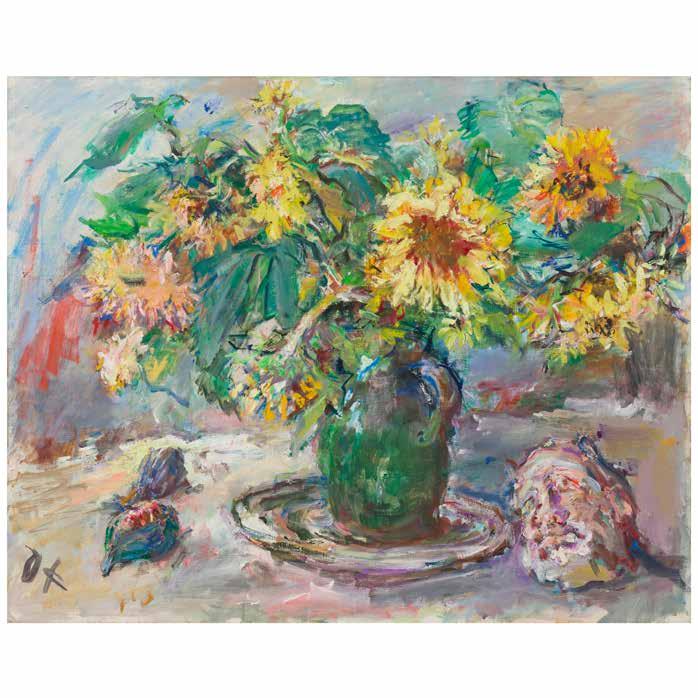
Stillleben mit Sonnenblumen und Faunskopf (Still Life with Sunflowers and Faun's Head)
Considered to be one of the leading figures of Austrian Expressionism, Oskar Kokoschka's extensive and varied oeuvre, spanning nearly eight decades, is often defined by his radical breaches of convention and avant-garde thinking.
Following the Second World War, however, Kokoschka's artistic praxis can be largely defined by his return to figurative representation and an overall preservation of traditional painterly values.
Fleeing to London as refugee from World War II, motifs from nature became increasingly prominent in Kokoschka's work throughout his time in England (1938-1953). Beginning to frequently depict sketches of landscapes, animals, and vibrant flora in the 1930's, Kokoschka's choice in natural pictorial subjects reflected the innate draw he felt to nature. This importance placed upon nature was also a key element of the closely linked Munich-based Expressionist group Der Blaue Reiter, that similarly viewed nature as a spiritual, pure alternative to the industrial modern world. For Kokoschka, who was never a member of Der Blaue Reiter, this shift from the intense, psychologically charged nature of his early Expressionist works was partly due to the fact that he was finally distanced from the personal tumult of war, political persecution, and general upheaval that came with moving between Prague, Vienna, and Dresden in rapid succession.
After residing in London for over ten years, the artist eventually moved with his wife in 1953 to Switzerland, where he would remain until his death in 1980. In the final decades of his life, Kokoschka explored the transformative power and depths of painting, becoming particularly concerned with the process of seeing and representation. Surrounded by the majesty of the Swiss Alps in
his villa in Villeneuve on Lake Geneva, Kokoschka felt even more connected to nature, the flowers in his garden and immediate environ quickly becoming a preferred subject of representation. Of his artistic process in Switzerland, the artist would later muse that he would halt work in his studio to go sit in his garden and: "marvel at what was growing or blossoming again. It really is a paradise, and now I see how necessary contact with nature is for me after 16 years of stinking, noisy big city" (Kokoschka, Briefe, Vol. IV, Düsseldorf, 1954, p. 26).
Despite, or, perhaps, because of, living through the horrors and chaos of both World Wars, Oskar Kokoschka always believed strongly in the transformative powers of art. Not satisfied with representing a mere likeness, Kokoschka strove to draw upon the immaterial forces behind his subjects, capturing their very essence. While Kokoschka painted numerous watercolor studies of flowers and floral still life tableaus in the later decades of his life, very few were executed in oil such as the present work from this Distinguished Family Collection. Stillleben mit Sonnenblumen und Faunskopf (Still Life with Sunflowers and Faun's Head) is an exquisite encapsulation of Kokoschka's vibrant and frenetic painterly style, yet, there is a pervasive note of sadness to the image. The severed faun's head to the right of the vase of sunflowers disturbs the serenity of the idyllic scene and endows the work with an element of shock that so often permeated his early works. The sense of decay instilled by the rotting flesh of the severed head is echoed in the drooping flowers and dead flower buds littering the table's surface, a clear nod to the warning of transience conveyed in Memento Mori or vanitas still life paintings popularized in the seventeenth-century Dutch Golden Age.
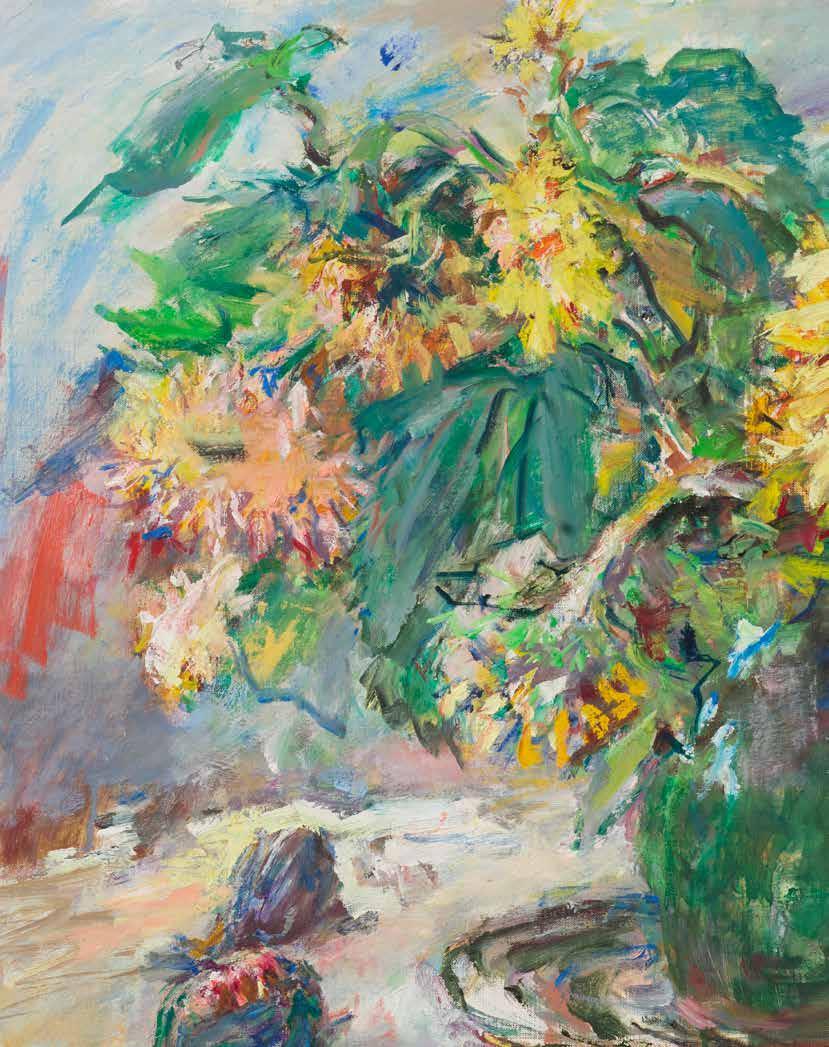
Detail of the present work.
27A
AUGUSTE RODIN (1840-1917)
Main crispée droite, taille originale ou petit modèle dit aussi 'Main griffe' signed 'A. Rodin' (on the right side of the wrist) and inscribed with the foundry mark 'G. Rudier Fondeur' (on the back of the wrist)
bronze with dark brown patina
5 1/4 x 4 x 2 3/8 in (13.4 x 10.2 x 5.8 cm)
Conceived circa 1885, this bronze version cast by the Georges Rudier Foundry in March 1954.
US$40,000 - 60,000
£30,000 - 44,000
HK$310,000 - 470,000
This work will be included in the forthcoming Catalogue Critique de l'Oeuvre Sculpté d'Auguste Rodin, currently being prepared by the Comité Auguste Rodin at Galerie Brame & Lorenceau under the direction of Jérôme Le Blay.
Provenance
Musée Rodin, Paris.
M. Zwenmer Collection, London (acquired from the above in June 1959); their sale, Christie's, London, March 25, 1986, lot 51.
Acquired at the above sale by the present owner.
Literature
O. Mirbeau et al., Auguste Rodin et son oeuvre, Paris, 1900 (other casts illustrated pp. 28–32).
L. Roger-Milés, 'Rodin,' in Figaro Illustré, Vol. XXV, September 1906, Paris (other casts illustrated pp. 68-69).
A.E. Elsen, The Partial Figure in Modern Sculpture. From Rodin to 1969, exh. cat., The Baltimore Museum of Art, Baltimore, 1969 (another cast illustrated p. 20).
J.L. Tancock, The Sculpture of Auguste Rodin, Philadelphia, 1976, no. 119 (the larger version illustrated p. 618).
J. Caso & P.B. Sanders, Rodin's Sculpture, A Critical Study of the Spreckels Collection, California Palace of the Legion of Honor, San Francisco, 1977, no. 69 (other versions illustrated pp. 322 & 324).
A.E. Elsen, In Rodin's Studio, A Photographic Record of Sculpture in the Making, Oxford, 1980 (other casts illustrated pls. 65-70).
Exh. cat., Rodin, les mains, les chirurgiens, Musée Rodin, Paris, 1983 (other casts illustrated pp. 86-87).
A. Pingeot, Le Corps en morceaux, exh. cat, Musée d'Orsay, Paris, 1990 (other casts illustrated pp. 191-192).
P. Nitti & M. Restellini, Rodin en 1900. L'exposition de l'Alma, exh. cat. Musée du Luxembourg, Paris, 2001, no. 32 (plaster version illustrated p. 119).
A.E. Elsen, Rodin's Art, The Rodin Collection of the Iris & B. Gerald Cantor Center for Visual Arts at Standford University, New York, 2003, no. 188 (another cast illustrated p. 582).
B. Maaz (ed.), Druet sieht Rodin, Photographie & Skulptur, exh. cat., Staatlichen Museen, Berlin, 2005 (another cast illustrated pp. 15, 61 & 124).
H. Pinet, Rodin et la photographie, exh. cat., Musée Rodin, Paris, 2007 (the larger version illustrated pp. 79, 82-83).
A. Le Normand-Romain, Rodin et le bronze, catalogue des oeuvres conservées au Musée Rodin, Vol. II, Paris, 2007 (another cast illustrated p. 500).
Auguste Rodin's Main crispée droite is one the artist's most iconic studies of the human hand. Emphasizing his keen observation of the human body, Rodin began to depict the hand in a series of meticulously rendered and anatomically precise sculptures during the 1880s and 1890s. Fascinated by the expressive power of the human hand, Rodin created many works where the hand, as an independent form, becomes a sculptural statement. The sculptor gave a very special status to this small model of a clenched right hand, and had its image reproduced many times, most notably in a series of photographs by Eugène Druet in 1899 where the bronze hand emerges from the folds of a white blanket.
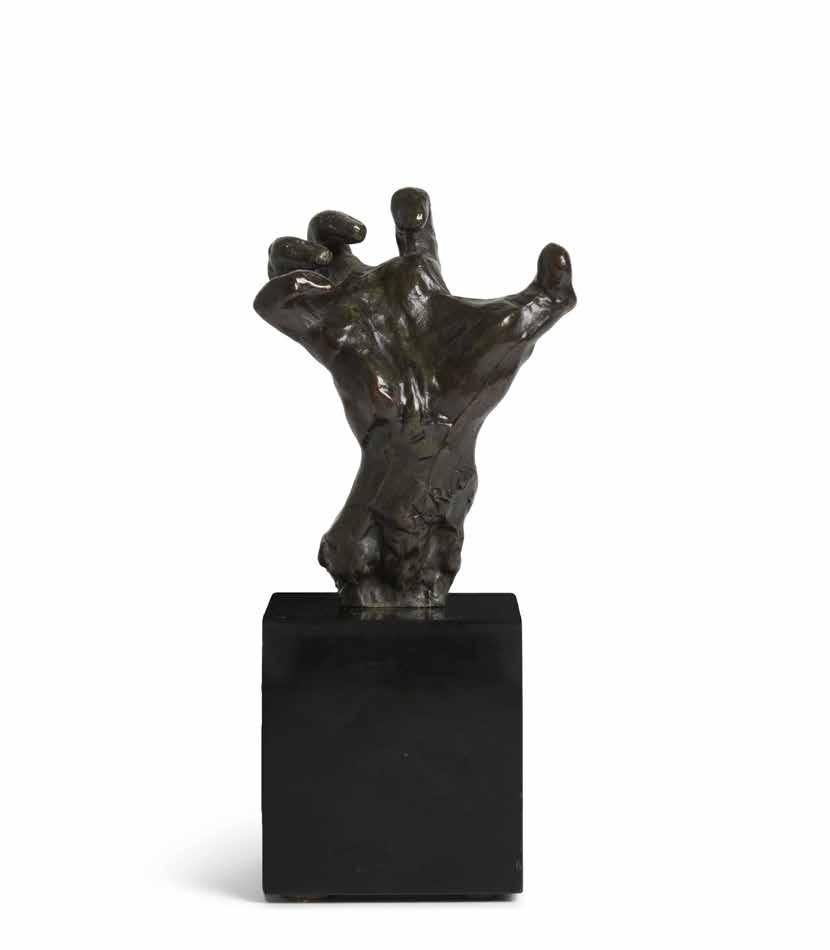
Front Cover, Lot 9A
Artwork: © Yoshitomo Nara, courtesy Yoshitomo Nara Foundation
Back Cover, Lot 12A
Artwork: © 2026 Fairweather & Fairweather LTD / Artists Rights Society (ARS), New York
Lot 1A
Artwork: © Gerhard Richter 2026 (0124).
Lot 2A
Artwork: © The Pollock-Krasner Foundation/Artists Rights Society (ARS), New York
Lot 3A
Artwork: © Roni Horn
Photo: Louisiana Museum of Modern Art, Humlebaek, Denmark / Kim Hansen
Lot 4A
Artwork: © The Henry Moore Foundation. All Rights Reserved, DACS 2026 / www.henry-moore.org
Artwork: © The Henry Moore Foundation. All Rights Reserved, DACS 2026 / www.henry-moore.org
Photo: Henry Moore Archive. Reproduced by permission of the Henry Moore Foundation
Lot 5A
Artwork: © Succession Brancusi - All rights reserved (Adagp) 2026
Photo: © Centre Pompidou, MNAM-CCI, Dist. GrandPalaisRmn / Georges Meguerditchian
Artwork: © Succession Brancusi - All rights reserved (Adagp) 2026
Lot 6A
Artwork: © 2026 C. Herscovici / Artists Rights Society (ARS), New York
Artwork: 2026 Artists Rights Society (ARS), New York / SIAE, Rome
Lot 7A
Artwork: © Ed Ruscha
Lot 9A
Artwork: © Foujita Foundation / Artists Rights Society (ARS), New York 2026
Lot 10A
Photo: Image courtesy of Dominic Robinson, Bristol, UK.
Lot 12A
Artwork: © 2026 The Franz Kline Estate / Artists Rights Society (ARS), New York.
Photo: Buffalo AKG Art Museum / Art Resource, NY.
Photo: © 2026 Fairweather & Fairweather LTD / Artists Rights Society (ARS), New York
Photo: © Adrian Gaut.
Artwork: John Chamberlain, ‘DOGEYEMATADOR,’ 2010 © 2026 Fairweather & Fairweather LTD/Artists Rights Society (ARS), New York. All rights reserved.
Luria Intro
Artwork: © 2026 Estate of Larry Rivers / Licensed by VAGA at Artists Rights Society (ARS), NY.
Photo: © Jeffery Salter
Lot 14A
Artwork: © 2026 James Rosenquist Foundation / Licensed by Artists Rights Society (ARS), NY. Used by permission. All rights reserved.
Photo: Image courtesy of Mayor Gallery, London.
Lot 26A
Artwork: © 2026 Fondation Oskar Kokoschka / Artists Rights Society (ARS), New York / ProLitteris, Zurich

These Conditions of Sale (as defined below) constitute the entire terms and conditions on which property listed in the catalog shall be offered for sale and sold by Bonhams and the sellers of such property for whom Bonhams acts as agent. By registering to bid and/or by bidding on or buying any property offered in the auction, you agree to be bound by these Conditions of Sale.
As used herein, the term “Conditions of Sale” includes (a) the terms and conditions contained in this document, (b) if online bidding is available for the subject auction, the Conditions of Website use at www. bonhams.com/ WebTerms which terms and conditions are incorporated by reference herein, (c) the Lot Symbols Key, and (d) the additional information contained in the Buyer’s Guide, and any other notices published for this auction, in each case as may be amended prior to or during the auction by saleroom notices published in writing or made by oral announcement. Any post-auction sale of property offered in this auction shall be made subject to these same Conditions of Sale.
The terms “Bonhams,” “we,” “us” and “our” refer to Bonhams & Butterfields Auctioneers Corp., a Delaware corporation. The terms “you” and “your” refer to the auction registrant, bidder or buyer of a lot, as applicable.
On occasion, Bonhams or one of its affiliated companies within the Bonhams Group may have an ownership or equivalent economic interest in an item of property, in whole or in part, which interest will be indicated by the ▲ symbol next to the lot number.
1. As used herein, the term “hammer price” means the price at which a lot is successfully knocked down to the buyer (or, for online-only sales, the price acknowledged by Bonhams’ online bidding system). A PREMIUM, retained by us and payable by the buyer, shall be calculated based on the hammer price and payable in addition to it (the “buyer’s premium”). The following buyer’s premium rates shall apply to each lot:
(a) For all auctions except those listed below in subparagraphs 1.(b)-(d): 28% OF THE FIRST $50,000 OF THE HAMMER PRICE, PLUS 27% OF THE AMOUNT OF THE HAMMER PRICE ABOVE $50,000 UP TO AND INCLUDING $1,000,000, PLUS 21% OF THE AMOUNT OF THE HAMMER PRICE ABOVE $1,000,000 UP TO AND INCLUDING $6,000,000, PLUS 14.5% OF THE AMOUNT OF THE HAMMER PRICE ABOVE $6,000,000.
(b) For Wines and Spirits auctions: a flat 25% OF THE HAMMER PRICE.
(c) For Coins and Banknotes auctions: a flat 20% OF THE HAMMER PRICE.
(d) For Arms and Militaria auctions: a flat 17.5% OF THE HAMMER PRICE.
Additionally, a 3rd-party bidding platform fee (the “3rd-party bidding platform fee”) equal to 4% OF THE HAMMER PRICE shall be payable by buyers whose successful bid is submitted via 3rd-party bidding platforms, including Invaluable, Live Auctioneers, The Saleroom and Lot-tissimo.
The term “purchase price” means the aggregate of (a) the hammer price, (b) the buyer’s premium, (c) any 3rd-party biding platform fee, and (d) unless the buyer is exempt by law from the payment thereof, any state or local sales tax (or compensating use tax) and other applicable taxes or duties. With regard to New York sales tax, please refer to the “SALES AND USE TAX” section of these Conditions of Sale.
2. In order to bid at the sale, prospective bidders must submit to Bonhams a completed bidder registration and any other requested information or references. New bidders and bidders who have not recently updated their registration information must pre-register to bid at least two (2) business days before the sale. Individuals will be required to provide governmentissued proof of identity and proof of address. Entity clients will be required to provide documentation including confirmation of entity registration showing the registered name, confirmation of registered address, documentary proof of officers and beneficial owners, proof of authority to transact on behalf of the entity and government- issued proof of identity for the individual who is transacting on the entity’s behalf.
We may also request a financial reference and/ or deposit from bidders before approving the bidder registration. In the event a deposit is submitted, and you are not the successful bidder, your deposit will be returned to you. If you are the successful bidder, any such deposit will be credited to offset the appropriate portion of the purchase price.
We reserve the right to request further information, including regarding the source of funds, in order to complete bidder identification and registration procedures (including completing any anti-money laundering and/or anti-terrorism financing checks we may require) to our satisfaction. If our bidder identification and registration procedures are not satisfied, we may, in our sole discretion, decline to register any bidder or reject any bid or cancel any sale to such bidder.
Every bidder shall be deemed to act as a principal unless prior to the commencement of the sale there is a written acceptance by Bonhams of a bidder registration form completed and signed by the principal which clearly states that the authorized bidding agent is acting on behalf of the named principal. Absent such written acceptance by Bonhams, any person placing a bid as agent on behalf of another (whether or not such person has disclosed that fact or the identity of the principal) may be jointly and severally liable with the principal under any contract resulting from the acceptance of a bid.
Every bidder shall be responsible for any use of its assigned paddle or bidding account, regardless of the circumstances. For all auctions and sales, should your bid be successful, you irrevocably agree to pay the full purchase price. We are not responsible for any errors that you make or that are made through your bidding account in placing a bid on a lot.
3. You represent and warrant that:
(i) you have provided to us, or will provide upon request, true and correct copies of valid identification and proof of residence and, if applicable, financial and/or corporate documents;
(ii) neither you, your principal (if applicable, and subject to Bonhams’ prior written acceptance pursuant to paragraph 2 above), nor any individual or entity with a beneficial or ownership interest in either the purchased property or in the purchase transaction is on the Specially Designated Nationals List maintained by the Office of Foreign Assets Control of the U.S. Department of the Treasury nor subject to any other sanctions or embargo program or regulation in effect in the United States, European Union, England and Wales, or other applicable jurisdictions (such programs and regulations, collectively, “Sanctions”);
(iii) if you are acting as an agent for a principal, you have conducted appropriate due diligence into such principal, and agree that Bonhams shall be
entitled to rely upon such due diligence, you will retain adequate records evidencing such due diligence for a period of five (5) years following the consummation of the sale, and will make these records available for inspection upon Bonhams’ request;
(iv) neither the purchase transaction (including your bidding activity) nor the purchase funds are connected with nor derive from any criminal activity, and they are not designed to nor have they or shall they, violate the banking, anti-money laundering, or currency transfer laws or other regulations (including without limitation, import-export laws) of any country or jurisdiction, or further any other unlawful purpose, including without limitation collusion, anti-competitive activity, tax evasion or tax fraud; and
(v) property purchased by you or your principal (if applicable) hereunder is not and will not be transferred to or used in a country in contravention of any Sanctions.
You acknowledge and agree that we may rely upon the accuracy and completeness of the foregoing warranties.
4. On the fall of the auctioneer’s hammer (or, for onlineonly sales, on the close of the lot by Bonhams’ online bidding system), the highest bidder accepted for the lot shall have purchased the offered lot in accordance and subject to compliance with all of the conditions set forth herein and (a) assumes full risk and responsibility therefor, (b) if requested will sign a confirmation of purchase, and (c) will pay the purchase price in full or such part as we may require for all lots purchased. No lot may be transferred.
Unless otherwise agreed, payment in good, cleared funds is due and payable within five (5) business days following the auction sale. Whenever the buyer pays only a part of the total purchase price for one or more lots purchased, we may apply such payments or any deposits, in our sole discretion, to the lot or lots we choose. Payment will not be deemed made in full until we have received good, cleared funds for all amounts due. Title in any purchased property will not pass until full and final payment has been received by Bonhams. Accounts must be settled in full before property is released to the buyer. In the event property is released earlier, such release will not affect the passing of title or the buyer’s obligation to timely remit full payment.
We reserve the right to refuse to accept payment from a source other than the registered bidder or buyer of record. Once an invoice is issued, we cannot change the buyer’s name on an invoice.
Payment for purchases must be made in the currency in which the sale is conducted. Bonhams’ preferred payment method is by wire transfer. For final purchases exceeding US $25,000, all payments must be in the form of wire transfer unless other arrangements have been approved in advance. For final purchases below US $25,000, payment may also be made in or by the following methods:
(i) Cash. Please note that the amount of cash that can be accepted from a given buyer is limited to US $5,000 per auction sale (whether by single or multiple related payments). If the amount payable exceeds that sum, the balance must be paid by another method.
(ii) Cashier’s check, money order, or personal check with approved credit drawn on a U.S. bank. A processing fee will be assessed on any returned checks.
(iii) Visa, MasterCard, American Express or Discover debit or credit card issued in the name of the buyer or record. Only one debit or credit card may be
used for payment of an account balance. This method of payment may not be available to first time buyers.
To the fullest extent permitted by applicable law, the buyer grants us a security interest in the property, and we may retain as collateral security for the buyer’s obligations to us, any property and all monies held or received by us for the account of the buyer, in our possession. We also retain all rights of a secured party under the Uniform Commercial Code (which shall mean the New York Uniform Commercial Code, except where the Uniform Commercial Code of another state governs the perfection of a security interest in collateral located in that state), and you agree that we may file financing statements without your signature. If the foregoing conditions or any other applicable conditions herein are not complied with, in addition to all other remedies available to us and the seller by law, we may at our election:
(a) hold the buyer liable for the full purchase price and any late charges, collection costs, attorneys’ fees and costs, expenses and incidental damages incurred by us or the seller arising out of the buyer’s breach;
(b) cancel the sale, retaining as liquidated damages all payments and deposits made by the buyer;
(c) cancel the sale and/or resell the purchased property, at public auction and/or by private sale, and in such event the buyer shall be liable for the payment of all consequential damages, including any deficiencies or monetary losses, and all costs and expenses of such sale or sales, our commissions at our standard rates, all other charges due hereunder, all late charges, collection costs, attorneys’ fees and costs, expenses and incidental damages; and/or
(d) reveal the buyer’s identity and contact details to the seller.
In addition, where two or more amounts are owed in respect of different transactions by the buyer to us, to Bonhams 1793 Limited and/or to any of our other affiliates, subsidiaries or parent companies worldwide within the Bonhams Group, we reserve the right to apply any monies paid in respect of a transaction to discharge any amount owed by the buyer. If all fees, commissions, premiums, hammer prices and other sums due to us from the buyer are not paid promptly as provided in these Conditions of Sale, we reserve the right to impose a finance charge equal to 1.5% per month (or, if lower, the maximum nonusurious rate of interest permitted by applicable law), on all amounts due to us beginning on the 31st day following the sale until payment is received, in addition to other remedies available to us by law.
5. We reserve the right to withdraw any property and to divide and combine lots at any time before such property’s auction. Unless otherwise announced by the auctioneer at the time of sale (or, for online-only sales, explicitly stated in the lot description), all bids are per lot as numbered in the catalog and no lots shall be divided or combined for sale.
6. We reserve the right to reject a bid from any bidder, to split any bidding increment, and to advance the bidding in any manner we, as auctioneer, may decide. In the event of any dispute between bidders, or in the event we, as auctioneer, doubt the validity of any bid, we, as auctioneer, shall have sole and final discretion either to determine the successful bidder, re-open the bidding, or to cancel the sale and re-offer and resell the article in dispute. If any dispute arises after the sale, our sales records shall be conclusive in all respects.
We further reserve the right to cancel the sale of any property if: (i) you are in breach of your representations
and warranties as set forth in paragraph 3 above; (ii) we, in our sole discretion, determine that such transaction might be unlawful or might subject Bonhams or the seller to any liability to any third party; or (iii) there are any other grounds for cancellation under these Conditions of Sale.
7. If we are prevented by fire, theft or any other reason whatsoever from delivering any property to the buyer or a sale otherwise cannot be completed, our liability shall be limited to the sum actually paid therefor by the buyer and shall in no event include any compensatory, incidental or consequential damages.
8. All lots in the catalog are offered subject to a reserve unless otherwise indicated in the catalog. The ¤ symbol next to the lot number denotes no reserve. The reserve is the confidential minimum hammer price at which such lot will be sold and it does not exceed the low estimate value for the lot. If a lot is offered subject to a reserve, we may implement such reserve by bidding on behalf of the seller, whether by opening bidding or continuing bidding in response to other bidders until reaching the reserve. If we have an interest in an offered lot and the proceeds therefrom other than our commissions, we may bid up to the reserve to protect such interest. If any opening or subsequent bid is below the reserve for a lot, the auctioneer (or, for online-only sales, on the close of the lot by Bonhams’ online bidding system), may reject such opening bid and withdraw the item from sale. SELLERS ARE NOT ALLOWED TO BID ON THEIR OWN ITEMS.
9. Other than as provided in the “LIMITED RIGHT OF RESCISSION” section of these Conditions of Sale with respect to identification of authorship, all property is sold “AS IS” and any statements contained in the catalog or in any advertisement, bill of sale, announcement, condition report, invoice or elsewhere as to period, culture, source, origin, media, measurements, size, quality, rarity, provenance, importance, exhibition and literature of historical relevance, merchantability, fitness for a particular purpose, or physical condition ARE QUALIFIED STATEMENTS OF OPINION AND NOT REPRESENTATIONS, WARRANTIES, OR ASSUMPTION OF LIABILITY. Neither Bonhams nor the seller shall be responsible for any error or omission in the catalog description of any property. No employee or agent of Bonhams is authorized to make on our behalf or on that of the seller any representation or warranty, oral or written, with respect to any property.
10. All purchased property shall be removed from the premises at which the sale is conducted by the date(s) and time(s) set forth herein, and, if applicable, as further specified in the “Buyer’s Guide” portion of the catalog. Lots designated with a “W” and associated purchased lots, if not removed promptly following sale, will be transferred to an offsite warehouse at the buyer’s risk and expense, as set forth in more detail in the “Buyer’s Guide.” Purchased property that is permitted to remain onsite at Bonhams’ facility must be removed at the buyer’s expense not later than 5:00 p.m. local time five (5) business days following the date of the sale. If not so removed, a storage fee of US $5.00 per lot per day will be payable to us by the buyer beginning at the close of the 14th day following the sale, and we may thereafter transfer such property to an offsite warehouse at the buyer’s risk and expense.
Accounts must be settled in full before property will be released. Packing and handling of purchased lots are the responsibility of the buyer and at the buyer’s
entire risk, as are the identification, application for, and cost(s) of obtaining any necessary export, import, restricted material (e.g. endangered species) or other permit for such lots.
11. The copyright in the text of the catalog and the photographs, digital images and illustrations of lots in the catalog belong to Bonhams or our licensors. You will not reproduce or permit anyone else to reproduce such text, photographs, digital images or illustrations without our prior written consent. Bonhams and the seller make no representation or warranty as to whether the buyer acquires any copyrights on the purchase of an item of property.
12. Bonhams may, in our discretion, as a courtesy and free of charge, execute bids on your behalf if so instructed by you, provided that neither Bonhams nor our employees or agents will be liable for any error or default (whether human or otherwise) in doing so or for failing to do so. Without limiting the foregoing, Bonhams (including our agents and employees) shall not be responsible for any problem relating to telephone, online, or other bids submitted remotely through any means, including without limitation, any human error, telecommunications or internet fault or failure, or breakdown or problems with any devices or online platforms, including third-party online platforms, regardless of whether such issue arises with our, your, or such third-party’s technology, equipment, or connection.
By participating at auction by telephone or online, bidders expressly consent to the recording of their bidding sessions and related communications with Bonhams and our employees and agents, and acknowledge their acceptance of these Conditions of Sale as well as any additional terms and conditions applicable to any such bidding platform or technology.
13. These Conditions of Sale shall bind the successors and assigns of all bidders and buyers and inure to the benefit of our successors and assigns. No waiver, amendment or modification of the terms hereof (other than posted notices or oral announcements during the sale) shall bind us unless specifically stated in writing and signed by us. No act or omission of Bonhams, its employees or agents, nor any failure thereof to exercise any remedy hereunder, shall operate or be deemed to operate as a waiver of Bonhams’ rights under these Conditions of Sale. If any part of these Conditions of Sale is for any reason invalid or unenforceable, the rest shall remain valid and enforceable.
14. You accept and agree that Bonhams will hold and process your personal information and may share and use it as required by law and as described in, and in line with Bonhams’ Privacy Policy, available online at http://www. bonhams.com/legals/9945/. If you desire access, update, or restriction to the use of your personal information, please email data.protection@bonhams.com.
15. These Conditions of Sale and the buyer’s and our respective rights and obligations hereunder shall be governed by and construed and enforced in accordance with the laws of the State of New York. Any dispute, controversy or claim arising out of or relating to this agreement, or the breach, termination or validity thereof, brought by or against Bonhams (but not including claims brought against the seller by the buyer of lots consigned hereunder) shall be resolved by the procedures set forth in the “MEDIATION AND ARBITRATION PROCEDURES” section of these Conditions of Sale.
a. Bidders and buyers must be at least 21 years of age to participate in the auction and have the legal authority to buy, receive and possess the alcoholic beverage lots offered in the sale. Each winning bidder shall present satisfactory legal documentation that he or she is at least 21 years of age. In the case of a purchaser that is a corporation, partnership or similar entity, the person receiving the purchased lots on its behalf must meet the foregoing requirements.
b. All payments for purchased property must be made directly to Bonhams. Accounts must be settled in full before property will be released. All purchases must be removed from the off-site, third-party storage facility designated in the “COLLECTION OF PURCHASES FROM WINE AND SPIRITS AUCTIONS” section of the Buyer’s Guide, where it is stored in climate-controlled conditions, within 30 days of the auction. Bonhams accepts no responsibility or liability for any damage to property that is not collected more than 14 days after the auction. Any property not so collected will incur storage charges, starting on day 15, at the then applicable rates charged by the third-party facility where sold property is stored for post-sale collection by buyers. Such third-party storage facility may charge, and the buyer agrees to pay, storage fees per lot, on a daily or a monthly basis. If any property has not been collected within 30 days from the date of sale, at the option of Bonhams the property may be transferred to and stored at a bonded warehouse the buyer’s sole risk and expense, and the buyer agrees to pay all transfer and storage expenses associated therewith.
c. Packing and handling of purchased lots are the sole responsibility of the buyer. Buyer will bear the cost and risk of any packing, pick-up, shipping, insurance and any applicable taxes thereon. Bonhams assumes no liability for assisting with any packing, shipping or insurance arrangements. Packing and handling arrangements may be available through the third party storage facility where the property is stored for post-sale collection or through other third party service providers. Buyers must arrange for such services directly with the third party provider independently at the buyer’s sole risk and expense. Bonhams and the sellers will not be liable for any acts or omissions of any packers or carriers, whether or not recommended by us.
d. Bonhams makes no representations as to the legal rights of anyone to ship or import alcoholic beverages into or within any state or jurisdiction. Purchasers are required to comply with their respective states’ or jurisdictions’ regulations regarding the importation, exportation and shipment of alcoholic beverages, and purchasers are solely responsible for the importation, exportation and shipment of alcoholic beverage products purchased. All alcoholic beverage property, however shipped or received, requires the recipient to be in possession of photo identification confirming that he or she is 21 years of age or older. In addition, many jurisdictions prohibit the importation, or limit the quantity, of alcoholic beverages entering such jurisdiction, and some jurisdictions require the purchaser, seller and/or shipper to obtain certain permits or licenses prior thereto. It is the purchaser’s sole responsibility to determine whether any such restrictions, limitations or prohibitions are applicable prior to bidding and to obtain any required permits or licenses, and any delay in obtaining or the denial of any such permit or license shall not serve as
the basis for any cancellation or rescission of any purchase made hereunder or any delay in making full payment for the purchase when due.
e. All Wines and Spirits lots are sold in Massachusetts and title passes to the buyer in Massachusetts. All sales are subject to applicable taxes.
a. Bonhams has utilized adjectival, descriptive grading to describe the conditions of coins and banknotes in the catalog rather than the Sheldon numerical scale. Grading is subjective and open to interpretation. Prospective bidders are encouraged to make their own examination of the numismatic lots offered and not rely on any other party’s opinion as to grade or other attributes, as opinions differ and grading standards change over time.
b. Many of the numismatic lots have been graded by third party grading service(s) including but not limited to PCGS, NGC, and/or ANACS. To the extent Bonhams provides such grading information in the cataloguing of a lot, it does so without any express or implied warranty or guarantee, and such information’s inclusion does not mean that Bonhams or the seller agrees or disagrees with the information that such third party grading service(s) have provided. Bonhams and its sellers shall not be bound by any prior or subsequent opinion or certification (or lack thereof) by any third party grading service, and bidders on numismatic lots hereby acknowledge and agree that any such opinion or certification (or lack thereof) shall not be used as the basis for any attempted rescission of sale. THE BUYER ASSUMES ALL RISKS RELATING TO GRADING, CONDITION, RARITY AND VALUATION OF NUMISMATIC LOTS.
c. Catalog illustrations of numismatic lots may not be to scale or reflect the depicted items’ actual size.
a. Certain classifications of firearms require licensures and/or are subject other regulatory restrictions. Prospective bidders are responsible for checking with their local (e.g. state) regulatory authorities regarding any applicable restrictions and/or license/ permit requirements before bidding. Each lot offered in the sale will be classified as “Antique Pre1899,” “Curio/Relic,” Modern firearm,” or “Modern handgun.” Firearms classified as “Antique Pre-1899” do not require any licensing to purchase and can be released directly to the buyer. Firearms classified as “Modern firearm” or Modern handgun” will only be released to persons possessing a valid Federal Firearms Dealer License. Firearms classified as “Curio/Relic” may be released to persons possessing a valid Federal Firearms Dealer License or persons possessing a valid Federal Firearms Collector of Curios and Relics License. Items that meet the age requirements but have been altered from their original configuration may NOT be delivered on a Federal Firearms Collector of Curios and Relics License. The transfer of certain types of firearms (including without limitation handguns and certain rifles) to residents may be regulated by certain state (including Massachusetts) laws. It is the prospective buyer’s responsibility to determine the legality of possession or ownership of any firearms, including transference of such, in his or her state of residence prior to bidding. Additionally, some states have restrictions
on transfers to persons holding a Federal Firearms Collector of Curios and Relics License. If you determine after purchasing a firearm that it is not transferrable in your state, Bonhams will not cancel the sale and you will be responsible for payment in full
b. Persons holding a valid Federal Firearms Dealer License may take possession of any purchase on the day of the sale upon presenting a signed copy of their Federal Firearms Dealer License provided payment to Bonhams has been made in full. If a person holding a Federal Firearms Dealer License is sending an agent to pick up purchased lot(s), that agent must be a bona fide, paid employee of the company.
c. If you possess a valid Federal Firearms Collector of Curios & Relics License, any purchased lots that qualify as such may be transferred directly to you at time of pickup. You must provide a signed copy of your current Federal Firearms Collector of Curios & Relics License at time of pickup. A Massachusetts resident presenting a Federal Firearms Collector of Curios & Relics at time of pickup must also present a copy of their valid Massachusetts License to Carry, Firearms Identification Card, or Machine Gun License.
d. If you are a Massachusetts resident and are the successful bidder on a firearm classified as “Curio/ Relic,” “Modern firearm,” or “Modern handgun” and do not possess a valid Federal Firearms License, you must arrange for the transfer of the firearm from Bonhams to a dealer in Massachusetts holding a Federal Firearms Dealer License of your choice who will then conduct the necessary background check and document the transfer in accordance with Massachusetts law. Any such fees charged by a dealer are solely the responsibility of the buyer.
e. If you live in a state other than Massachusetts, you must arrange for the shipment of firearms lots classified as “Curio/Relic,” “Modern firearm,” or “Modern handgun” to a dealer in your state holding a Federal Firearms Dealer License who will then transfer the firearm to you. A holder of a valid Federal Firearms Dealer License who lives in another state is permitted to pick up firearms lots designated as “Curio/Relic,” “Modern firearm,” or “Modern handgun.” A holder of a valid Federal Firearms Collector of Curios & Relics License who lives in another state is permitted to pick up firearm lots designated as “Curio/Relic” at Bonhams’ Marlborough office. Some states have restrictions on transfers to Federal Firearms Collector of Curios & Relics license holders. It is the buyer’s responsibility to be familiar with all applicable laws and regulations. To purchase with a Federal Firearms Collector of Curio & Relic License, the firearm must be listed as acceptable on the ATF list for collectors of curios, accessible at: https://www.atf.gov/file/128116/ download and https://www.atf.gov/file/2026/ download. Buyers are responsible for checking all regulatory authorities regarding any applicable restrictions and/or license/permit requirements before shipping any lot.
New York sales tax is charged on the hammer price, buyer’s premium and any other applicable charges on any property collected or delivered in New York State, regardless of the state or country in which the buyer resides or does business. Buyers who make direct arrangements for collection by a shipper who is considered a “private” or “contract” carrier by the New York Department of Taxation and Finance will be charged New York sales tax, regardless of the destination of the
property. Property collected for delivery to a destination outside of New York by a shipper who is considered a “common carrier” by the New York Department of Taxation and Finance (e.g. United States Postal Service, United Parcel Service, and FedEx) is not subject to New York sales tax, but if it is delivered into any state in which Bonhams is registered or otherwise conducts business sufficient to establish a nexus, Bonhams may be required by law to collect and remit the appropriate sales tax in effect in such state. Property collected for delivery outside of the United States by a freightforwarder who is registered with the Transportation Security Administration (“TSA”) is not subject to New York sales tax.
If within one (1) year from the date of sale, the original buyer (a) gives written notice to us alleging that the identification of Authorship (as defined below) of such lot as set forth in the UPPERCASE TYPE heading of the catalog description of such lot (as amended by any saleroom notices or verbal announcements during the sale) is not substantially correct based on a fair reading of the catalog (including the terms of any glossary contained therein), and (b) within ten (10) days after such notice returns the lot to us in the same condition as at the time of sale, and (c) establishes the allegation in the notice to our satisfaction (including by providing one or more written opinions by recognized experts in the field, as we may reasonably require), then the sale of such lot will be rescinded and, unless we have already paid to the seller monies owed him in connection with the sale, the original purchase price will be refunded.
If, prior to receiving such notice from the original buyer alleging such defect, we have paid the seller monies owed him in connection with the sale, we shall pay the original buyer the amount of our commissions, any other sale proceeds to which we are entitled and applicable taxes received from the buyer on the sale and make demand on the seller to pay the balance of the original purchase price to the original buyer. Should the seller fail to pay such amount promptly, we may disclose the identity of the seller and assign to the original buyer our rights against the seller with respect to the lot the sale of which is sought to be rescinded. Upon such disclosure and assignment, any liability of Bonhams as seller’s agent with respect to said lot shall automatically terminate.
The foregoing limited right of rescission is available to the original buyer only and may not be assigned to or relied upon by any subsequent transferee of the property sold. The buyer hereby accepts the benefit of the seller’s warranty of title and other representations and warranties made by the seller for the buyer’s benefit. Nothing in this section shall be construed as an admission by us of any representation of fact, express or implied, obligation or responsibility with respect to any lot. THE BUYER’S SOLE AND EXCLUSIVE REMEDY AGAINST BONHAMS FOR ANY REASON WHATSOEVER IS THE LIMITED RIGHT OF RESCISSION DESCRIBED IN THIS SECTION.
“Authorship” means only the identity of the creator, the period, culture and source or origin of the lot, as the case may be, as set forth in the UPPERCASE TYPE heading of the catalog entry for the lot. The right of rescission does not extend to: (a) works of art executed before 1870 (unless these works are determined to be counterfeits created since 1870), as this is a matter of current scholarly opinion which can change; (b) Chinese, Japanese and Korean paintings and calligraphy (unless, within 21 days of the sale of any such lot, the original buyer gives written notice to Bonhams alleging that the lot is a counterfeit and within ten (10) days after giving
such notice returns the lot to us in the same condition as at the time of sale and demonstrates to our satisfaction that the lot is a counterfeit), as current scholarship in these respective fields does not permit unqualified statements as to Authorship or date of execution; (c) titles, descriptions, or other identification of offered lots, which information normally appears in lower case type below the UPPERCASE TYPE heading identifying the Authorship; (d) Authorship of any lot where it was specifically mentioned that there exists a conflict of specialist or scholarly opinion regarding the Authorship of the lot at the time of sale; (e) Authorship of any lot which as of the date of sale was in accordance with the then generally-accepted opinion of scholars and specialists regarding the same; or (f) the identification of periods or dates of creation in catalog descriptions which may be proven inaccurate by means of scientific processes that are not generally accepted for use until after publication of the catalog in which the property is offered or that were unreasonably expensive or impractical to use at the time of such publication. For purposes of subsections (a) and (b) above, “counterfeit” is defined as a work created with intent to deceive.
EXCEPT AS EXPRESSLY PROVIDED ABOVE, ALL PROPERTY IS SOLD “AS IS.” NEITHER BONHAMS NOR THE SELLER MAKES ANY REPRESENTATION OR WARRANTY, EXPRESS OR IMPLIED, AS TO THE MERCHANTABILITY, FITNESS OR CONDITION OF THE PROPERTY OR AS TO THE CORRECTNESS OF DESCRIPTION, GENUINENESS, ATTRIBUTION, PROVENANCE OR PERIOD OF THE PROPERTY OR AS TO WHETHER THE BUYER ACQUIRES ANY COPYRIGHTS OR OTHER INTELLECTUAL PROPERTY RIGHTS IN LOTS SOLD OR AS TO WHETHER A WORK OF ART IS SUBJECT TO THE ARTIST’S MORAL RIGHTS OR OTHER RESIDUAL RIGHTS OF THE ARTIST. THE BUYER EXPRESSLY ACKNOWLEDGES AND AGREES THAT IN NO EVENT SHALL BONHAMS BE LIABLE FOR ANY DAMAGES INCLUDING, WITHOUT LIMITATION, ANY COMPENSATORY, INCIDENTAL OR CONSEQUENTIAL DAMAGES. IN NO EVENT SHALL THE AGGREGATE LIABILITY OF BONHAMS AND ITS SELLER TO A BUYER EXCEED THE PURCHASE PRICE ACTUALLY PAID FOR A DISPUTED ITEM OF PROPERTY.
(a) Within 30 days of written notice that there is a dispute, the parties or their authorized and empowered representatives shall meet by telephone and/or in person to mediate their differences. If the parties agree, a mutually acceptable mediator shall be selected and the parties will equally share the fees and expenses of mediation. The mediator shall be a retired judge or an attorney familiar with commercial law and trained in or qualified by experience in handling mediations. Any communications made during the mediation process shall not be admissible in any subsequent mediation, arbitration or judicial proceeding. All proceedings and any resolutions thereof shall be confidential, and the terms governing arbitration set forth in paragraph (c) below shall govern.
(b) If mediation does not resolve all disputes between the parties, or in any event no longer than 60 days after receipt of the written notice of dispute referred to above, the parties shall submit the dispute for binding arbitration before a single neutral arbitrator. Such arbitrator shall be a retired judge or an attorney familiar with commercial law and trained in
or qualified by experience in handling arbitrations. Such arbitrator shall make all appropriate disclosures required by law. The arbitrator shall be drawn from a panel of a national or international arbitration service agreed to by the parties, and shall be selected as follows: (i) If the arbitration service has specific rules or procedures, those rules or procedures shall be followed; (ii) If the arbitration service does not have rules or procedures for the selection of an arbitrator, the arbitrator shall be an individual jointly agreed to by the parties. If the parties cannot agree on an arbitration service, the arbitration shall be conducted by Judicial Arbitration and Mediation Services, Inc. (“JAMS”) or another national or international alternative dispute resolution (“ADR”) provider of Bonhams’ choice, and the arbitrator shall be selected in accordance with JAMS’ Streamlined Arbitration Rules and Procedures or the rules of the other ADR provider selected by Bonhams. The arbitrator’s award shall be in writing and shall set forth findings of fact and legal conclusions.
(c) Unless otherwise agreed to by the parties or provided by the published rules of the arbitration service:
(i) The arbitration shall occur within 60 days following the selection of the arbitrator;
(ii) The arbitration shall be conducted in New York, New York; and
(iii) Discovery and the procedure for the arbitration shall be as follows:
A. All arbitration proceedings shall be confidential;
B. The parties shall submit written briefs to the arbitrator no later than 15 days before the arbitration commences;
C. Discovery, if any, shall be limited as follows: (I) Requests for no more than 10 categories of documents, to be provided to the requesting party within 14 days of written request therefor; (II) No more than two (2) depositions per party, provided however, the deposition(s) are to be completed within one (1) day; (III) Compliance with the above shall be enforced by the arbitrator in accordance with New York law;
D. Each party shall have no longer than eight (8) hours to present its position. The entire hearing before the arbitrator shall not take longer than three (3) consecutive days;
E. The award shall be made in writing no more than 30 days following the end of the proceeding. Judgment upon the award rendered by the arbitrator may be entered by any court having jurisdiction thereof.
To the fullest extent permitted by law, and except as required by applicable arbitration rules, each party shall bear its own attorneys’ fees and costs in connection with the proceedings and shall share equally the fees and expenses of the arbitration.
The lot symbols used in the catalog have the following meanings:
¤ No Reserve
Unless indicated by the ¤ symbol next to the lot number (or bearing an explicit statement such as “No Reserve” or “Without Reserve”), which denotes no reserve, all lots in the catalog are subject to a reserve. The reserve is the minimum hammer price that the seller is willing to accept for a lot. This amount is confidential and does not exceed the low estimate value.
▲ Bonhams’ Ownership Interest in Property Offered at Auction
The ▲ symbol indicates that Bonhams or one of its affiliated companies within the Bonhams Group
owns the lot in whole or in part or has an economic interest equivalent to an ownership interest in the lot.
∏ Bidding by Interested Parties
We will mark the lost with the ∏ symbol when a party with a direct or indirect interest in the lot who may have knowledge of the lot’s reserve or other material information may be bidding on the lot. Such interested parties may be beneficiaries of an estate that consigned the lot or a joint owner of a lot. Any interested party who is recognized as the successful bidder on a lot must pay the purchase price in full and is subject to these Conditions of Sale.
○ Guaranteed Property/Third Party Irrevocable Bid
The ○ symbol indicates that the seller of the lot has been guaranteed a minimum price for its property by Bonhams or by a third party, or jointly by Bonhams and a third party (called third party guarantor). Such guaranteed minimum price may apply only to the lot or on an aggregate basis to all or a portion of the seller’s consigned property, which may be offered in one or more auctions. Bonhams and/or any third parties providing a guarantee may benefit financially if the guaranteed property is sold successfully and may incur a financial loss if its sale is not successful. The third party guarantor typically provides an irrevocable written bid on the guaranteed lot prior to the auction at a level that ensures the lot will sell. If there are competing bids at the auction, the third party guarantor may also bid a higher amount than the irrevocable bid submitted. In exchange for sharing or assuming in full this risk, Bonhams may compensate the third party guarantor by paying it a fixed and/or contingent financing fee based on the hammer price achieved. Where the third party guarantor is the successful bidder on the lot, the financing fee for providing the bid may be netted against the full purchase price owing, and in such
Ω
case Bonhams will report the purchase price net of such financing fee. Third party guarantors are required by Bonhams to disclose their financial interest to anyone whom they are advising in connection with the guaranteed lot.
The Ω symbol indicates that the lot is subject to US Customs duty or tariff and/or related import fees payable by the buyer as part of the purchase price. Please refer to the Specialist Department managing the auction for details.
A lot with the Y symbol has been identified at the time of cataloguing as made of or containing certain restricted plant or animal material such as tortoiseshell, coral, whalebone, Brazilian rosewood or certain types of reptilian or other exotic skins, fur or feathers woods that may be subject to import or export restrictions or may otherwise require the granting of one or more export or import licenses or certificates, or that may be subject to similar restrictions regulating intrastate or interstate transport or trade within the United States at the state or federal level, or may be banned from export or import altogether by some countries. Please refer to paragraph 10 in the Conditions of Sale or to the Specialist Department managing the auction for details.
A lot with the ↂ symbol may be pictured or displayed with a component, such as a stand, a watchband, or snuff bottle stopper, that is shown for display purposes only and is not part of the lot being offered for sale. In certain instance, the display-only component may be made of or incorporate restricted materials and may be available for personal pick-up, free of charge (separate from the purchased lot) from the saleroom location where the lot was sold. Please refer to paragraph 10 in the Conditions of Sale or to the Specialist Department managing the auction for details.
Starting on June 28, 2025, the import into the European Union (“EU”) of non-EU origin property of a certain age (and in some categories, property above a certain value) is subject to additional EU regulatory requirements. It is the Buyer’s sole and exclusive responsibility to investigate whether property (including any lot) meets the requisite regulatory criteria for import into the EU and to obtain any relevant import(er) license or statement.
Please note that this process is governed by local authorities and may take time. Regardless of any delay in the obtaining of an import(er) license or statement, or denial thereof, purchased lots shall be paid for in accordance with the Conditions of Sale, and any such delay or denial shall not serve as the basis for cancellation or rescission of any sale. Prospective buyers are advised to obtain information from the relevant regulatory authorities regarding import restrictions, requirements, and costs prior to bidding.
Certain third-party agents may be available to assist the buyer in attempting to obtain the appropriate import(er) license or statement, however, there is no assurance that any necessary licenses or statements can be obtained.
The W symbol indicates that the lot is oversized or otherwise such that it must be collected from our designated warehouse.
Please refer to the Offsite Sold Property Storage section of the Buyer’s Guide for details.
P Premium (“Purple Paddle”) Lot Subject to Restricted Bidding
Lots bearing the “P” symbol will not be available for online bidding, and bidders wishing to register to bid on such lots must do so in advance and may be required to provide a bank letter of reference or other credentials in advance of being permitted to bid on the lot. If you will not be attending the auction in person, contact the Specialist Department managing the auction or Bonhams’ Client Service Office at least one business day in advance of the auction date to arrange a telephone bid or an absentee bid.
Lot symbols appear adjacent to the subject lot number in the catalog and are provided as a convenience to bidders; we do not accept any liability for errors or omissions in marking lots.
Whether you are an experienced bidder or an enthusiastic novice, auctions provide a stimulating atmosphere unlike any other. Bonhams previews and sales are free and open to the public. As you will find in these directions, bidding and buying at auction is easy and exciting. Should you have any further questions, please visit our website at www.bonhams.com or contact our Client Services Department at Tel: 1-800-959- 4383 (toll free, within the US) or Tel: 1-908-707-0077 (outside the US).
Catalogs
Before each auction we publish illustrated catalogs. Our catalogs provide descriptions and estimated values for each “lot.” A lot may refer to a single item or to a group of items auctioned together. The catalogs also include the dates and the times for the previews and auctions. We offer our catalogs by subscription or by single copy. For information on subscribing to our catalogs, you may refer to the subscription form in this catalog, call our Client Services Department, or visit our website at www.bonhams.com/us.
Previews
Auction previews are your chance to inspect each lot prior to the auction. We encourage you to look closely and examine each object on which you may want to bid so that you will know as much as possible about it. Except as expressly set forth in the Conditions of Sale, items are sold “as is” and with all faults; illustrations in our catalogs, website and other materials are provided for identification only. At the previews, our staff is always available to answer your questions and guide you through the auction process. Condition reports may be available upon request and are strongly recommended for all intending bidders who cannot view the property in person.
Bonhams’ catalogs include low and high value estimates for each lot, exclusive of the buyer’s premium and tax. The estimates are provided as an approximate guide to current market value based primarily on previous auction results for comparable pieces, and should not be interpreted as a representation or prediction of actual selling prices. They are determined well in advance of a sale and are subject to revision. Please contact us should you have any questions about value estimates
Reserve
Unless indicated by the ¤ symbol next to the lot number, which denotes no reserve, all lots in the catalog are subject to a reserve. The reserve is the minimum auction price that the seller is willing to accept for a lot. This amount is confidential and does not exceed the low estimate value.
On occasion, Bonhams may offer property in which it has an ownership interest in whole or in part or otherwise has an economic interest. Such property, if any, is identified in the catalog with a ▲ symbol next to the lot number(s). Bonhams may also offer property for a seller that has been guaranteed a minimum price for its property by Bonhams or jointly by Bonhams and a third party. Bonhams and any third parties providing a guarantee may benefit financially if the guaranteed property is sold successfully and may incur a financial loss if its sale is not successful. Such property, if any, is identified in the catalog with a ○ symbol next to the lot number(s).
You must be 18 years old or over to bid. At Bonhams, you can bid in many ways: in person, via absentee bid, over the phone, or via Bonhams’ live online bidding facility. Absentee bids can be submitted in person, online, or via email. Irrespective of previous bidding activity a valid Bonhams’ client account is required to participate in bidding activity. You will be required to provide government issued proof of identity, proof of residence, and if you are a company, your certificate of incorporation or equivalent documentation with your name and registered address, proof of your current address, documentary proof of your beneficial owners and directors, and proof of authority to transact. We may also request a financial reference and/or deposit from you
before allowing you to bid. By bidding at auction, whether in person or by agent, by absentee bid, telephone, online or other means, the buyer or bidder agrees to be bound by the Conditions of Sale. Lots are auctioned in consecutive numerical order as they appear in the catalog. Bidding normally begins below the low estimate. The auctioneer will accept bids from interested parties present in the saleroom, from telephone bidders, from online bidders, and from absentee bidders who have left written bids in advance of the sale. The auctioneer (or, for online-only sales, Bonhams’ online bidding system) may also execute bids on behalf of the seller up to the amount of the reserve, but never above it. We assume no responsibility for failure to execute bids for any reason whatsoever.
If you are planning to bid at auction for the first time, you will need to register at the reception desk in order to receive a numbered bid card. To place a bid, hold up your card so that the auctioneer can clearly see it. Decide on the maximum auction price that you wish to pay, exclusive of buyer’s premium and tax, and continue bidding until your bid prevails or you reach your limit. If you are the successful bidder on a lot, the auctioneer will acknowledge your paddle number and bid amount.
As a service to those wishing to place bids, we may at our discretion accept bids without charge in advance of auction online or in writing on bidding forms available from us. “Buy” bids will not be accepted; all bids must state the highest hammer price the bidder is willing to pay. Our auction staff will try to bid just as you would, with the goal of obtaining the item at the lowest hammer price possible. In the event identical bids are submitted, the earliest bid submitted will take precedence. Absentee bids shall be executed in competition with other absentee bids, any applicable reserve, and bids from other auction participants. A friend or agent may place bids on your behalf, provided that we have received your written authorization prior to the sale. Absentee bid forms are available in our catalogs, online at www.bonhams.com/ us, at offsite auction locations and at our Los Angeles, San Francisco and New York galleries.
By Telephone
We can arrange for you to bid by telephone. To arrange for a telephone bid, please contact our Client Services Department a minimum of 24 hours prior to the sale
We offer live online bidding for most auctions and accept absentee bids online for all our auctions. Please visit www. bonhams.com/us for details.
In order to bid online in a sale, you must be 18 years old or over and you must register to bid via MyBonhams.com. Once you have registered, you should keep your account details strictly confidential and not permit any third party to access your account on your behalf or otherwise. You will be liable for any and all bids made via your account. Please note payment must be made from a bank account in the name of the registered bidder.
Online Bidding Registration for Individuals: Enter your full name, email, residential address, date of birth and nationality and provide a valid credit card in your name which will be verified via Stripe before you are able to bid. If your credit card fails verification, you will not be permitted to bid and you should contact the Client Services Department for assistance. We may in addition request a financial reference and/or deposit from you prior to letting you bid. If you are bidding as agent on behalf of another party, you agree: (i) to disclose this fact to the Client Services Department; (ii) to provide such information as we require to enable us to complete bidder identification and registration procedures (including completing any anti-money laundering and/or anti-terrorism financing checks) on that third party; and (iii) that where your bid is successful, you are jointly and severally liable with that other party for the full amounts owing for the successful bid (whether or not you have disclosed that fact or the identity of the principal). Where you
are the successful bidder for any lot with a hammer price equal to or in excess of US $10,000, and if you have not provided such documents previously, you will be required to upload or provide to the Client Services Department your government issued photo ID and (if not on the ID) proof of your address before the purchased lot can be released to you. Notwithstanding the foregoing, we reserve the right to request ID documentation from any bidder or buyer and to refuse to release any purchased lot until such documentation is provided.
Online Bidding Registration for Companies or Other Legal Entities: You must select the option to set up a business account and then provide your full name, email, residential address, date of birth and the full name of the entity. You must provide a credit card for verification either in your name or the name of the entity but payment must be made from an account in the entity’s name. If your credit card fails verification, you will not be permitted to bid and should contact the Client Services Department for assistance. We may, in addition, require a bank reference or deposit prior to letting you bid. For all successful bids, we require the entity’s certificate of formation/incorporation or equivalent documentation confirming the entity’s name and registered address, documentary proof of each beneficial owner owning 25% or more of the entity, and proof of your authority to transact before the lot can be released to you.
We reserve the right to request any further information from any bidder that we may require in order to carry out any identification, anti-money laundering or anti-terrorism financing checks conducted by us. We may at our discretion postpone or cancel your registration, not permit you to bid and/or postpone or cancel completion of any purchase you may make.
For live auctions, Bonhams generally uses the following increment multiples as bidding progresses:
$50-200...................................by $10s
$200-500.................................by $20/50/80s
$500-1,000..............................by $50s
$1,000-2,000...........................by $100s
$2,000-5,000...........................by $200/500/800s
$5,000-10,000….....................by $500s
$10,000-20,000......................by $1,000s
$20,000-50,000......................by $2,000/5,000/8,000s
$50,000-100,000....................by $5,000s
$100,000-200,000..................by $10,000s above $200,000......................at auctioneer’s discretion
For online-only auctions, Bonhams generally uses the following increment multiples as bidding progresses:
$50-200..................................by $10s
$200-500................................by $20/40/60/80s
$500-1,000.............................by $50s
$1,000-2,000..........................by $100s
$2,000-5,000..........................by $200/400/600/800s
$5,000-10,000........................by $500s
$10,000-20,000......................by $1,000s
$20,000-50,000......................by $2,000/4,000/6,000/8,000s
$50,000-100,000....................by $5,000s
$100,000-200,000..................by $10,000s above $200,000......................at auctioneer’s discretion
The auctioneer (or, for online-only sales, Bonhams’ online bidding system) shall have full discretion, as outlined in the Conditions of Sale to split or reject any bid at any time.
Solely for the convenience of bidders, a currency converter may be provided at Bonhams’ auctions. The rates quoted for conversion of other currencies to U.S. Dollars are indications only and should not be relied upon by a bidder, and neither Bonhams nor its agents shall be responsible for any errors or omissions in the operation or accuracy of the currency converter.
A buyer’s premium is added to the winning hammer price of each individual lot purchased, at the rates set forth in the Conditions of Sale. The winning hammer price plus the premium constitute the purchase price for the lot. Applicable sales taxes are computed based on this figure, and the total becomes your final purchase price.
Unless specifically illustrated and noted, fine art frames are not included in the estimate or purchase price. Bonhams accepts no liability for damage or loss to frames during storage or shipment. All sales are final and subject to the Conditions of Sale found in our catalogs, on our website, and available at the reception desk.
Payment may be made to Bonhams by cash, checks drawn on a U.S. bank, money order, wire transfer, or by Visa, MasterCard, American Express or Discover credit or charge card or debit card. All items must be paid for within five (5) business days of the sale. Please note that payment by personal or business check may result in property not being released until purchase funds clear our bank.
Buyers must pay applicable sales tax. Other state or local taxes (or compensation use taxes) may apply. Sales tax will be automatically added to the invoice if Bonhams is required to collect and remit sales tax in the subject jurisdiction based on our local nexus and applicable law, unless a valid resale number has been furnished. If you wish to use your resale license please contact the Client Services Department for our form.
The export of a lot from the United States or import into certain countries may be subject to export or import regulations, licensure and/or other restrictions; in particular, lots containing plant or animal materials such as tortoiseshell, coral, whalebone, Brazilian rosewood or certain types of reptilian or other exotic skins, fur or feathers, irrespective of age or value, may require the granting of one or more export or import licenses or certificates, or may be banned from import altogether by some countries. Moreover, the ability to obtain an export license or certificate does not ensure the ability to obtain an import license or certificate in another country. Lots that contain such regulated species materials may also not be eligible for exportation or for re-importation into the United States. In addition, resales of lots containing certain regulated species materials may be subject to restrictions in some jurisdictions.
Lots noted in the catalog with a “Y” next to the lot number contain one or more such regulated plant or animal materials, however lots containing regulated material may lack the Y notation. It is the buyer’s responsibility to investigate any such restrictions and to obtain any relevant export or import licenses. Please note that this process is governed by local authorities and may take considerable time. Regardless of any delay in the obtaining of an export/import license or certificate or denial thereof, purchased lots shall be
paid for in accordance with the Conditions of Sale, and any such delay or denial shall not serve as the basis for cancellation of any sale. Prospective buyers are advised to obtain information from the relevant regulatory authorities regarding export and import restrictions, requirements, and costs prior to bidding.
Prospective buyers should also check with their local (e.g. state) regulatory authorities regarding any local restrictions and/or permit requirements that may apply with respect to purchases of regulated species materials. Certain third-party agents may be available to assist the buyer in attempting to obtain the appropriate licenses and/or certificates. However, there is no assurance that any necessary licenses or certificates can be obtained. Please contact the relevant Specialist Department for a suggested list of shipping agents prior to placing a bid if you are uncertain as to whether a lot is subject to export/import license or certificate requirements or related restrictions.
Scheduling an appointment and payment in full prior to arrival will facilitate the quick release of your property.
For your convenience, pre-allocated 30-minute collection time slots are available by appointment Monday through Friday between 9am – 4:30pm local time.
If you are sending a third party to collect, please provide details to our Client Services Department prior to your scheduled pickup or we will be unable to release your property.
To schedule collection of purchases:
• For property from NEW YORK Sales and LOS ANGELES auctions: please contact our Client Services Department at Tel: 1-800-959-4383 (toll free, within the US) or Tel: 1-908-707- 0077 (outside the US), or via email at invoices.us@bonhams.com.
• For property form BOSTON Sales and MARLBOROUGH auctions: please use the online scheduler, available at https://skinner. appointlet.com/, or contact our Client Services Department at Tel: 1-508-970-3000 or via email at bids@bonhamsskinner.com.
For an additional fee, Bonhams may provide packing and shipping services for certain items. If you wish to receive a Bonhams’ shipping quote, please indicate this at the time of registration. Carriers are not permitted to deliver to P.O. boxes.
International buyers are responsible for all import/ export customs duties and taxes. An invoice stating the actual purchase price will accompany all international purchases.
Storage charges of US $5 per lot, per day will begin accruing for any lots not collected within 14 calendar days of the auction.
Bonhams reserves the right to remove uncollected sold lots to the warehouse of Door To Door at the buyer’s risk and expense. Handling and storage and Full Value Protection fees will apply, as further set forth in the Offsite Sold Property Storage section (below).
Buyers are to review the Offsite Sold Property Storage section (below) for information regarding lots that will be removed to the offsite warehouse of Door To Door shortly after the sale. These designated lots must be collected by the buyer from Bonhams (at the designated premises where the sale occurred) prior to the day and time designated in the Offsite Sold Property Storage section, or from Door To Door thereafter. If buyers of these designated lots also buy other lots, these lots may also be removed to the warehouse of Door To Door, so all lots remain together and customers can collect or ship from one location. All other items will remain at Bonhams for a period of 14 days, after which time they may be transferred to offsite storage at the buyer’s risk and expense.
All lots marked with a “W” in the catalogue are oversized and subject to additional storage and shipping as set forth below. Lots not so listed will remain at Bonhams; provided, however, THAT IF BUYERS OF W LISTED LOTS ALSO BUY OTHER NON-LISTED ITEMS, THESE OTHER LOTS WILL ALSO BE REMOVED TO THE WAREHOUSE OF DOOR TO DOOR, so that all lots remain together and buyers can collect their entire purchases from one location. For any questions please refer to the Bonhams Client Services Department.
The transfer of lots to the warehouse of Door To Door is at the buyer’s risk and expense. For sold lots removed to Door To Door, there will be transfer and Full Value Protection charges due immediately upon transfer and daily storage charges will begin to accrue five (5) business days after the transfer.
The per-lot charges of Door To Door Services are as follows (plus any applicable sales tax):
FURNITURE/LARGE OBJECTS
Transfer ………...$75
Daily storage …..$10
Full Value Protection (on Hammer + Premium + tax): 0.3%
SMALL OBJECTS
Transfer…..….....$37.50
Daily storage…...$5
Full Value Protection (on Hammer + Premium + tax): 0.3%
Please note, Door To Door does not accept liability for damage or loss due to negligence or otherwise, exceeding the stated value of such goods, or at its option the cost of repairing or replacing the damaged or missing goods.
A. NEW YORK Sales (and New York Online Sales).
Unless you are otherwise notified:
• W lots (and additional purchases) from sales occurring on Tuesdays and Wednesdays will be transferred to offsite storage at Door To Door on the proximate Thursdays . You may collect W lots from Bonhams by 5pm Eastern Time on Wednesdays. Purchases will be available for collection on Fridays of the same week from Door To Door.
• W lots (and additional purchases) from sales occurring on Thursdays, Fridays and Mondays will be transferred to offsite storage at Door To Door on the proximate Tuesdays. You may collect
W lots from Bonhams by 5pm Eastern Time on Mondays. Purchases will be available for collection on Wednesdays from Door To Door.
Collections appointments must be booked 24 hours in advance with Door To Door (subject to full payment of all outstanding amounts due to Bonhams and Door To Door).
Address:
Door To Door Services
50 Tannery Rd. Somerville, NJ 08876
B. LOS ANGELES Sales (and Los Angeles Online Sales)
• You will be notified in advance of the sale of the date and time of the removal of W lots (and additional purchases) to the Door To Door warehouse. Please be advised that removal may occur the day following the day of the sale.
Collections appointments must be booked 24 hours in advance with Door To Door (subject to full payment of all outstanding amounts due to Bonhams and Door To Door).
Address:
Door to Door Services
6280 Peachtree St. Commerce, CA, 90040
For more information regarding storage, shipping, or collection from Door To Door please contact Door To Door directly at auctions@dtdusa.com.
Payments for purchased lots must be made directly to Bonhams. Door To Door will not release property unless the buyer has paid Bonhams in full. All charges for handling and storage due to Door To Door must be paid by the time of collection from their warehouse. Payment may be made by cash, check, or credit card. Please contact Door to Door in advance to ascertain the amount due.
Lots will only be released from the Door To Door warehouse upon production of a “Release Order” obtained from the Cashier’s Office at Bonhams.
The removal/storage and/or shipment by Door To Door of any lots will be subject to their standard Conditions of Business, which can be found at https://www.dtdusa. com/terms-and- conditions and are available upon request from the Bonhams Client Services Department or from Door To Door directly.
All alcoholic beverage property, however collected, shipped or received, requires the recipient to be in possession of photo identification confirming that he or she is at least 21 years of age.
Subject to the terms set forth in this section and in the Conditions of Sale, we will make your purchase(s) available for collection in a manner that is commercially reasonable and facilitates the safe handling of the property. The inherent nature of fine wine and spirits requires that due care be taken in storage and handling. We request your partnership in making sure no harm arises during storage or collection. Bottles that are old
or unusually shaped need to be collected in person. We shall have professional discretion when the circumstance arises.
Full payment must be received and processed by Bonhams following the close of the auction, prior to release of any purchases.
All purchases must be paid for and removed from Gordon’s premises within 30 days of the auction at which they were purchased. Any property not collected within 14 days of the auction in which it was purchased will be subject to storage charges at the then applicable rates charged by Gordan’s starting on day 15 following the auction. The buyer agrees to pay such storage charges which may be calculated and invoiced per lot on a daily or monthly basis. Any applicable payments to Gordon’s or other designated third party shipper must be paid for in full prior to the release of property.
All purchases must be collected from climate-controlled, off-site storage at the location designated below (unless otherwise noticed to you in writing after the auction). Collection is available only by prior appointment at:
Gordon’s Fine Wines Baker’s Best 150 Gould Street Needham, MA 02494
Please schedule your collection with Gordon’s Fine Wines (“Gordon’s”) directly using the automated scheduler (included with your payment confirmation email which you will receive from Bonhams) at least three (3) business days in advance of your desired collection appointment day. For questions please contact wine@ bonhams.com or staff@gordons.com. Contact staff@ gordons.com for additional storage or delivery services.
Full payment of all applicable charges must be received prior to release of any purchases. Purchased property will only be released to those over 21 years of age. Valid government issued proof of age will be required. For any third-party collections (i.e. collection by the buyer’s authorized agent), an Authorized Release Form must be signed by the buyer of record and submitted to Gordon’s prior to collection.
As an ancillary, third-party service, subject to availability, buyers may independently engage Gordon’s directly for the packing and delivery of purchases inside Route 495 for a fee. Deliveries are generally available Monday through Friday during normal business hours. All costs associated with delivery must be paid to Gordon’s directly. Buyers must arrange for such services directly with Gordan’s (or any other the third party service provider of buyer’s choice). Such services shall be independent of Bonhams, and shall be solely at the buyer’s risk and expense. Bonhams will not be liable for any acts or omissions of any packers or carriers, whether or not recommended by us. Such packers or carriers may carry their own insurance and any claim for lost or damaged property should be addressed directly to them. Purchases will only be delivered to, and must be signed for by an individual who is no less than 21 years of age, and presents satisfactory age identification.
Buyers are required to comply with their respective states’ or jurisdictions’ regulations regarding the importation, exportation and shipment of alcoholic beverages. Buyers are solely responsible for the
importation, exportation and shipment of alcoholic beverage products purchased. Many jurisdictions prohibit or limit the importation of alcoholic beverages, and some jurisdictions require the buyer, seller and/ or shipper to obtain certain permits or licenses prior thereto. It is the buyer’s sole responsibility to determine whether any such restrictions, limitations or prohibitions are applicable prior to bidding and to obtain any required permits or licenses.
It is the buyer’s sole responsibility to collect purchased property or to make independent arrangements for collection and delivery service, and to ensure that such service provider is duly licensed or permitted to transport wine and/or spirits, as the case may be, to the relevant destination. Such third party services shall be independent of Bonhams, and shall be solely at the buyer’s risk and expense. Bonhams and the sellers will not be liable for any acts or omissions of any packers or carriers, whether or not recommended by us. Such packers or carriers may carry their own insurance and any claim for lost or damaged property should be addressed directly to them.
(Attendee / Absentee / Online / Telephone Bidding)
Please circle your bidding method above.
Paddle number (for office use only)
General Notice: This sale will be conducted in accordance with Bonhams Conditions of Sale, and your bidding and buying at the sale will be governed by such terms and conditions. Please read the Conditions of Sale in conjunction with the Buyer’s Guide relating to this sale and other published notices and terms relating to bidding. Payment by personal or business check may result in your property not being released until purchase funds clear our bank. Checks must be drawn on a U.S. bank.
Notice to Absentee Bidders: In the table below, please provide details of the lots on which you wish to place bids at least 24 hours prior to the sale. Bids will be rounded down to the nearest increment. Please refer to the Buyer’s Guide in the catalog for further information relating to instructions to Bonhams to execute absentee bids on your behalf. Bonhams will endeavor to execute bids on your behalf but will not be liable for any errors or non-executed bids.
Notice to First Time Bidders: New clients are requested to provide photographic proof of ID - passport, driving license, ID card, together with proof of address - utility bill, bank or credit card statement etc. Corporate clients should also provide a copy of their articles of association / company registration documents, together with a letter authorizing the individual to bid on the company’s behalf. Failure to provide this may result in your bids not being processed. For higher value lots you may also be asked to provide a bankers reference.
Notice to online bidders; If you have forgotten your username and password for www.bonhams.com, please contact Client Services.
If successful I will collect the purchases myself
Please contact me with a shipping quote (if applicable) I will arrange a third party to collect my purchase(s)
Please email the completed Registration Form and requested information to: Bonhams Client Services Department 111 W 57th Street New York, New York 10019 Tel +1 (212) 644 9001 bids.us@bonhams.com
Type of bid
(A-Absentee, T-Telephone) Lot no.
20th and 21st Century Art - Evening Sale May 20, 2026
31875
General Bid Increments:
$10 - 200 by 10s
$200 - 500 by 20 / 50 / 80s
$500 - 1,000 by 50s
$1,000 - 2,000 by 100s
$2,000 - 5,000 by 200 / 500 / 800s
$5,000 - 10,000 by 500s
New York
$10,000 - 20,000 by 1,000s
$20,000 - 50,000 by 2,000 / 5,000 / 8,000s
$50,000 - 100,000 by 5,000s
$100,000 - 200,000 by 10,000s above $200,000 at the auctioneer’s discretion The auctioneer has discretion to split any bid at any time.
Company name (to be invoiced if applicable)
/ Zip code
mobile
Telephone bidders: indicate primary and secondary contact numbers by writing 1 or 2 next to the telephone number.
E-mail (in capitals)
By providing your email address above, you authorize Bonhams to send you marketing materials and news concerning Bonhams and partner organizations. Bonhams does not sell or trade email addresses.
I am registering to bid as a private client I am registering to bid as a trade client
Resale: please enter your resale license number here
We may contact you for additional information.
Shipping Address (if different than above):
Please note that all telephone calls are recorded.
Brief description (In the event of any discrepancy, lot number and not lot description will govern.) If you are bidding online there is no need to complete this section.
MAX bid in US$ (excluding premium and applicable tax) Emergency bid for telephone bidders only*
You instruct us to execute each absentee bid up to the corresponding bid amount indicated above.
* Emergency Bid: A maximum bid (exclusive of Buyer’s Premium and tax) to be executed by Bonhams only if we are unable to contact you by telephone or should the connection be lost during bidding.
BY SIGNING THIS FORM YOU AGREE THAT YOU HAVE READ AND UNDERSTAND OUR CONDITIONS OF SALE AND SHALL BE LEGALLY BOUND BY THEM, AND YOU AGREE TO PAY THE BUYER’S PREMIUM, ANY APPLICABLE TAXES, AND ANY OTHER CHARGES MENTIONED IN THE BUYER’S GUIDE OR CONDITIONS OF SALE. THIS AFFECTS YOUR LEGAL RIGHTS.
Your signature:
Date: