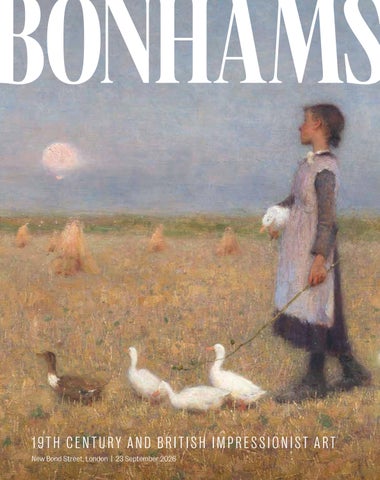
19TH CENTURY AND BRITISH IMPRESSIONIST ART New Bond Street, London | 23 September 2026
1 9TH CENTU RY A ND BR I T I S H I M P R ESS I O NI ST A RT New Bond Street, London | Wednesday 23 September 2026 at 2pm
BONHAMS
ENQUIRIES
BIDS
101 New Bond Street London W1S 1SR bonhams.com
Thomas Seaman Senior Specialist, Head of Sale +44 (0) 20 7393 3960 thomas.seaman@bonhams.com
Bid online/APP New to Bonhams? To be able to place bids, you must have an active bonhams account.
Peter Rees Head of Department +44 (0) 20 7468 8201 peter.rees@bonhams.com
Bid online/VIA OUR APP Register to bid online by visiting www.bonhams.com/32231
32231 Lots 1 - 79
ILLUSTRATIONS Front cover: Lot 60 Inside front cover: Lot 30 Inside front additional: Lot 69 Opposite sale title page: Lot 33 Opposite sale info page: Lot 57 Index: Lot 32 Inside back cover: Lot 41 Back cover: Lot 28
VIEWING Friday 18 September, 9:00am - 5:00pm Sunday 20 September, 12:00pm - 4:00pm Monday 21 September, 9:00am - 5:00pm Tuesday 22 September, 9:00am - 5:00pm Wednesday 23 September, 9:00am -1:00pm
Charles O’Brien Director +44 (0) 20 7468 8360 charles.obrien@bonhams.com Daria Chernenko +44 (0) 207 468 8338 daria.chernenko@bonhams.com Deborah Coy Consultant, New York +1 347 419 0468 d.coy.consultant@bonhams.com Alistair Laird +44 (0) 20 7468 8337 alistair.laird@bonhams.com Deborah Cliffe (Senior sale coordinator) +44 (0) 20 7468 8337 deborah.cliffe@bonhams.com Stefania Lumetta (Paris) +33 (1) 89 20 04 50 stefania.lumetta@bonhams.com
Bid through the app. Download now for android and iOS. Bid by telephone/absentee We require a completed Bidder Registration Form returned by email to bids@bonhams.com. The form can be found at the back of every catalogue and on our website at www.bonhams.com Please note we cannot guarantee bids within 24 hours of the sale. Bidding by telephone will only be accepted on a lot with a lower estimate in excess of £500.00 Bid in person You can pre-register online at Bonhams.com or obtain a paddle at our Registration Desk.
New Bidders You must provide proof of identity when submitting bids. A copy of a government- issued photo identification (driving licence or passport) showing your full name and date of birth, and, if not shown on the ID document, proof of your current address (utility bill or bank statement). For company account or other entities, please contact us in relation to the documents you will need to provide. Failure to do this may result in your bids not being processed. For all other enquiries, contact our Client Services department on: +44 (0) 207 447 7447 or bids@bonhams.com Please see back of catalogue for important notice to bidders To submit a claim for refund of VAT, HMRC require lots to be exported from the UK within strict deadlines. For lots on which Import VAT has been charged (marked in the catalogue with a * or Ω) lots must be exported within 30 days of Bonhams’ receipt of payment and within 3 months of the sale date. For all other lots exportmust take place within 3 months of the sale date.
SALE I NFOR MATION BIDS
Shipping
+44 (0) 20 7447 7447 To bid via the internet please visit www.bonhams.com
For information and estimates on domestic and international shipping as well as export licenses please contact The Packengers Ltd on +44 (0)203 154 4363 hellolondon@thepackengers.com.
Payments Buyers +44 (0) 20 7447 7447 Sellers Payment of sale proceeds +44 (0) 20 7447 7447
Valuations, Taxation & Heritage +44 (0) 20 7468 8340 valuations@bonhams.com
BUYERS COLLECTION &STORAGE AFTER SALE LOTS MARKED TP All sold lots marked TP will be removed to The Packengers, Unit 9, Abbey Mead Industrial Park, Brooker Road, Waltham Abbey, EN9 1HU on Friday 25 September 2026 and will be available for collection from 12pm Monday 28 September 2026 and then every working day between 9.30am and 4pm by appointment only. Storage will be free of charge from & including the sale end date, charges will apply from 9.30am Tuesday 6 October 2026. A booking email or phone call is required in advance to ensure lot sare ready at time of collection. Photographic ID will be required at time of collection. If a third party is collecting for you written authorisation is required in advance from you and photographic ID of the third party is requested at the time of collection. To arrange a collection time please send a booking email to london storage@thepackengers.com or call +44(0) 2031544360. All other sold lots will remain in the Collections room at Bonhams New Bond Street free of charge until Wednesday 7 October 2026. Lots not collected by this time will be returned to the department, storage chargesmay apply.
VAT The following symbols are used to denote that VAT is due on the hammer price and buyer’s premium.
† VAT 20% on hammer price and buyer’s premium
* VAT on imported items at a preferential rate of 5% on hammer price and the prevailing rate on buyer’s premium Y These lots are subject to CITES regulations, please read the information in the back of the catalogue.
R Some countries, e.g., the US, prohibit or restrict the purchase by its citizens (wherever located) and/or the import of certain types of works of particular origins. As a convenience to buyers, Bonhams has marked with the symbol R all lots of Iranian (Persian), Syrian or Afghan origin. It is each buyer’s responsibility to ensure that they do not bid on or import a lot in contravention of the sanctions or trade embargoes that apply to them.
Payment in Advance (Telephone to ascertain amount due) by: credit or debit card Payment at time of collection by: credit or debit card.
POST BREXIT NOTICE FOR EU BUYERS SHIPPING PURCHASED LOTS OUTSIDE THE UK Please note that as of 1 January 2021 for Margin Scheme and Imported Lots VAT on the Buyer’s Premium will be refunded by Bonhams on valid proof of export of your Lot from the UK within 90 days of full payment of your invoice.
What else has changed since 1 January 2021 for EU Buyers? If you buy a Lot in this sale and intend to ship the Lot outside the UK, you will need to pay local Import Tax when you bring your Lot into the country of destination.
What do the Star (*) and Omega (Ω) symbols mean ? If you buy in this sale you will pay import VAT of 5% (* symbol) or 20% (Ω symbol) on the Hammer Price. As of 1 January 2021, for EU buyers shipping purchased Lots outside the UK, this tax will be refunded by Bonhams on valid proof of export of your Lot from the UK within 30 day.
19TH CENTURY AND BRITISH IMPRESSIONIST ART LOTS 1-79
1 * TP GÉZA VASTAGH (HUNGARIAN, 1866-1919) Lioness with cubs signed, inscribed and dated ‘Vastagh Géza 1893/Budapest’ (upper right) oil on canvas 107.5 x 138cm (42 5/16 x 54 5/16in). £10,000 - 15,000 €12,000 - 18,000 US$14,000 - 20,000 Provenance Private collection, USA.
8 | BONHAMS
F O R D E TA I L S O F T H E C H A R G E S P AYA B L E I N A D D I T I O N T O T H E F I N A L H A M M E R P R I C E O F E A C H L O T P L E A S E R E F E R T O P A R A G R A P H S 7 & 8 O F T H E N O T I C E T O B I D D E R S AT T H E B A C K O F T H E C ATA L O G U E .
19TH CENTURY | 9
2 PEDER MØRK MØNSTED (DANISH, 1859-1941) Still water signed and dated ‘P Monsted.1902.’ (lower left) oil on canvas 80.5 x 117.4cm (31 11/16 x 46 1/4in). £5,000 - 7,000 €5,800 - 8,200 US$6,800 - 9,500 Provenance With Eaton Gallery, London. Private collection, UK.
10 | BONHAMS
F O R D E TA I L S O F T H E C H A R G E S P AYA B L E I N A D D I T I O N T O T H E F I N A L H A M M E R P R I C E O F E A C H L O T P L E A S E R E F E R T O P A R A G R A P H S 7 & 8 O F T H E N O T I C E T O B I D D E R S AT T H E B A C K O F T H E C ATA L O G U E .
3 ERIK LUDWIG HENNINGSEN (DANISH, 1855-1930) The milk float signed ‘ErikHenningsen’ (lower right) oil on canvas 71.5 x 89cm (28 1/8 x 35 1/16in). £6,000 - 8,000 €7,000 - 9,400 US$8,100 - 11,000 Provenance Anon. sale, Lauritz Christensen, Copenhagen, 30 August 1988, lot 667. Private collection, UK (acquired at the above sale).
F O R D E TA I L S O F T H E C H A R G E S P AYA B L E I N A D D I T I O N T O T H E F I N A L H A M M E R P R I C E O F E A C H L O T P L E A S E R E F E R T O P A R A G R A P H S 7 & 8 O F T H E N O T I C E T O B I D D E R S AT T H E B A C K O F T H E C ATA L O G U E .
19TH CENTURY | 11
4 TP KONSTANTIN YAKOVLEVICH KRYZHITSKY (1858-1911) A lake landscape with mountains beyond signed in Cyrillic and dated ‘98’ (lower right) oil on canvas laid on board 89.5 x 143cm (35 1/4 x 56 5/16in). £50,000 - 80,000 €58,000 - 94,000 US$68,000 - 110,000 Provenance Anon. sale, Christie’s, London, 6 October 1988, lot 445. Private collection, Spain (acquired at the above sale).
12 | BONHAMS
F O R D E TA I L S O F T H E C H A R G E S P AYA B L E I N A D D I T I O N T O T H E F I N A L H A M M E R P R I C E O F E A C H L O T P L E A S E R E F E R T O P A R A G R A P H S 7 & 8 O F T H E N O T I C E T O B I D D E R S AT T H E B A C K O F T H E C ATA L O G U E .
19TH CENTURY | 13
5 TP IVAN KONSTANTINOVICH AIVAZOVSKY (1817-1900) An oxwagon traversing a ford on a moonlit evening signed in Cyrillic and dated ‘1871’ (lower left) oil on canvas 96 x 125cm (37 13/16 x 49 3/16in). £120,000 - 180,000 €140,000 - 210,000 US$160,000 - 240,000 Provenance Anon. sale, Sotheby’s, London, 5 April 1990, lot 117. Private collection, Spain (acquired at the above sale).
We are grateful to Dr. Gianni Caffiero for inspecting the present lot and confirming the authenticity. Ivan Aivazovsky went down in history as the first Russian marine painter and one of the greatest European masters of the genre. Although seascapes made up the bulk of his oeuvre, he was also one of the first landscape painters to explore the theme of Ukraine in his work. In 1854, due to the Crimean War, he temporarily moved with his family from his native Feodosia to Kharkiv. As he himself wrote: ‘It was with deep sorrow that we had to leave our beloved Crimea, leaving behind all our possessions, acquired through our own labours over the course of fifteen years. In addition to my family, including my 70-year-old mother, I had to take all my relatives with me. Everyone treats us kindly, as if we were in our own town.’
14 | BONHAMS
In Kharkiv, far from the sea, the artist turned for the first time to ‘landbased’ landscapes featuring genre scenes from the lives of Ukrainians. He was inspired by the image of the chumaks, who in the 19th century were engaged in the extraction, transport and sale of salt. It was they who most often became the subjects of his Ukrainian landscapes. The image of these travelling traders became, for the artist, a distinctive symbol of Ukraine, just like mud-brick huts and windmills. In this work, Aivazovsky, remaining true to his romantic sensibilities, turns to his favourite motif of the chumaks, who are as characteristic of Ukraine as the thatched-roof hut occupying the right-hand side of the painting. The artist has depicted a slow-moving procession of ox-drawn carts crossing the river. The landscape is rendered in the romantic style characteristic of Aivazovsky: the cloud-covered sky and the tree towering behind the cottage enhance the romantic atmosphere of this poetic artistic image.
F O R D E TA I L S O F T H E C H A R G E S P AYA B L E I N A D D I T I O N T O T H E F I N A L H A M M E R P R I C E O F E A C H L O T P L E A S E R E F E R T O P A R A G R A P H S 7 & 8 O F T H E N O T I C E T O B I D D E R S AT T H E B A C K O F T H E C ATA L O G U E .
19TH CENTURY | 15
6 ATTRIBUTED TO IVAN IVANOVICH SHISHKIN (1832-1898) A forest stream bears indistinct Cyrillic initials (lower left); inscribed in Cyrillic ‘Study for the painting A Forest Stream at the State Tretiakov Gallery’ (on the stretcher) oil on canvas 27 x 43.5cm (10 5/8 x 17 1/8in). £6,000 - 8,000 €7,000 - 9,400 US$8,100 - 11,000 Provenance Anon. sale, Sotheby’s, London, 5 April 1990, lot 5. Private collection, Spain (acquired at the above sale).
16 | BONHAMS
F O R D E TA I L S O F T H E C H A R G E S P AYA B L E I N A D D I T I O N T O T H E F I N A L H A M M E R P R I C E O F E A C H L O T P L E A S E R E F E R T O P A R A G R A P H S 7 & 8 O F T H E N O T I C E T O B I D D E R S AT T H E B A C K O F T H E C ATA L O G U E .
7 NIKOLAI NIKANOROVICH DUBOVSKOY (1859-1918) Evening signed in Cyrillic and dated ‘1900’ (lower right); further titled, signed and dated (on the reverse) oil on canvas 49 x 67.5cm (19 5/16 x 26 9/16in). £4,000 - 6,000 €4,700 - 7,000 US$5,400 - 8,100 Provenance Anon. sale, Sotheby’s, London, 5 April 1990, lot 131. Private collection, Spain (acquired at the above sale).
F O R D E TA I L S O F T H E C H A R G E S P AYA B L E I N A D D I T I O N T O T H E F I N A L H A M M E R P R I C E O F E A C H L O T P L E A S E R E F E R T O P A R A G R A P H S 7 & 8 O F T H E N O T I C E T O B I D D E R S AT T H E B A C K O F T H E C ATA L O G U E .
19TH CENTURY | 17
8 MIKHAIL MARKIANOVITCH GUERMACHEFF (1867-1930) Winter sunset signed ‘Guermacheff’ (lower right); bears stock number ‘S.614’ (on a label attached to the reverse) oil on canvas 54 x 65cm (21 1/4 x 25 9/16in). £4,000 - 6,000 €4,700 - 7,000 US$5,400 - 8,100 Provenance Private collection, UK.
18 | BONHAMS
F O R D E TA I L S O F T H E C H A R G E S P AYA B L E I N A D D I T I O N T O T H E F I N A L H A M M E R P R I C E O F E A C H L O T P L E A S E R E F E R T O P A R A G R A P H S 7 & 8 O F T H E N O T I C E T O B I D D E R S AT T H E B A C K O F T H E C ATA L O G U E .
9 MIKHAIL MARKIANOVITCH GUERMACHEFF (1867-1930) River landscape in winter signed ‘Guermacheff’ (lower right) oil on canvas 54 x 65cm (21 1/4 x 25 9/16in). £4,000 - 6,000 €4,700 - 7,000 US$5,400 - 8,100 Provenance Private collection, UK.
F O R D E TA I L S O F T H E C H A R G E S P AYA B L E I N A D D I T I O N T O T H E F I N A L H A M M E R P R I C E O F E A C H L O T P L E A S E R E F E R T O P A R A G R A P H S 7 & 8 O F T H E N O T I C E T O B I D D E R S AT T H E B A C K O F T H E C ATA L O G U E .
19TH CENTURY | 19
10 TP VIKTOR IVANOVICH ZARUBIN (1866-1928) Fishermen signed in Cyrillic (lower right) oil on canvas 115 x 215cm (45 1/4 x 84 5/8in). £8,000 - 12,000 €9,400 - 14,000 US$11,000 - 16,000 Provenance Anon. sale, Sotheby’s, London, 5 April 1990, lot 56. Private collection, Spain (acquired at the above sale).
20 | BONHAMS
F O R D E TA I L S O F T H E C H A R G E S P AYA B L E I N A D D I T I O N T O T H E F I N A L H A M M E R P R I C E O F E A C H L O T P L E A S E R E F E R T O P A R A G R A P H S 7 & 8 O F T H E N O T I C E T O B I D D E R S AT T H E B A C K O F T H E C ATA L O G U E .
11 KONSTANTIN EGOROVICH MAKOVSKY (1839-1915) Portrait of a Lady signed in Cyrillic and dated ‘1883’ (centre right) oil on canvas laid on board 115 x 85cm (45 1/4 x 33 7/16in). unframed £15,000 - 20,000 €18,000 - 23,000 US$20,000 - 27,000 Provenance Anon. sale, Sotheby’s, London, 5 April 1990, lot 92. Private collection, Spain (acquired at the above sale).
F O R D E TA I L S O F T H E C H A R G E S P AYA B L E I N A D D I T I O N T O T H E F I N A L H A M M E R P R I C E O F E A C H L O T P L E A S E R E F E R T O P A R A G R A P H S 7 & 8 O F T H E N O T I C E T O B I D D E R S AT T H E B A C K O F T H E C ATA L O G U E .
19TH CENTURY | 21
12 * RUBENS SANTORO (ITALIAN, 1859-1942) Leaving Mass, Venice signed ‘RubensSantoro’ (lower right) oil on canvas 50 x 37cm (19 11/16 x 14 9/16in). £10,000 - 15,000 €12,000 - 18,000 US$14,000 - 20,000 Provenance Private collection, USA.
22 | BONHAMS
F O R D E TA I L S O F T H E C H A R G E S P AYA B L E I N A D D I T I O N T O T H E F I N A L H A M M E R P R I C E O F E A C H L O T P L E A S E R E F E R T O P A R A G R A P H S 7 & 8 O F T H E N O T I C E T O B I D D E R S AT T H E B A C K O F T H E C ATA L O G U E .
13 AR EDOUARD HENRI LÉON CORTÈS (FRENCH, 1882-1969) Les Champs-Élysées, Paris signed ‘EDOUARD CORTÈS.’ (lower right) oil on canvas 46 x 55.2cm (18 1/8 x 21 3/4in). £7,000 - 10,000 €8,200 - 12,000 US$9,500 - 14,000
Provenance Private collection, Belgium. Anon. sale, Bonhams, London, 28 October 2009, lot 76. Private collection, France (acquired from the above sale). Anon. sale, Marc-Arthur Kohn, Drouot-Richelieu, Paris, 10 November 2015, lot 29. With Haynes Fine Art, Broadway. Private collection, UK. The Comité Edouard Cortès has confirmed the authenticity of this painting, which will be included in the forthcoming catalogue raisonné.
F O R D E TA I L S O F T H E C H A R G E S P AYA B L E I N A D D I T I O N T O T H E F I N A L H A M M E R P R I C E O F E A C H L O T P L E A S E R E F E R T O P A R A G R A P H S 7 & 8 O F T H E N O T I C E T O B I D D E R S AT T H E B A C K O F T H E C ATA L O G U E .
19TH CENTURY | 23
14 * FÉLIX FRANÇOIS GEORGES PHILIBERT ZIEM (FRENCH, 1821-1911) Santa Maria della Salute and La Punta della Dogana, Venice signed ‘Ziem.’ (lower right) oil on canvas 65.8 x 89.4cm (25 7/8 x 35 3/16in). £20,000 - 30,000 €23,000 - 35,000 US$27,000 - 41,000 Provenance With Frances Aronson Fine Art, Atlanta Georgia. Private collection, USA (acquired from the above). Exhibited Tulsa, The Philbrook Museum of Art, Felix Ziem: Views of Venice, June 2002 - May 2003, no. TL-28-2002. The Félix Ziem Association, represented by Mathias Ary Jan and David Pluswxa, has confirmed the authenticity of the painting. Certificate of authenticity no. 385/0826 was issued on August 11, 2026, and will be provided to the purchaser.
24 | B O N H A M S
F O R D E TA I L S O F T H E C H A R G E S P AYA B L E I N A D D I T I O N T O T H E F I N A L H A M M E R P R I C E O F E A C H L O T P L E A S E R E F E R T O P A R A G R A P H S 7 & 8 O F T H E N O T I C E T O B I D D E R S AT T H E B A C K O F T H E C ATA L O G U E .
19TH CENTURY | 25
15 TP ALCIDE THÉOPHILE ROBAUDI (FRENCH, 1850-1928) Sur le seuil signed and dated ‘A.Robaudi 1883’ (lower right) oil on canvas 220.5 x 120cm (86 13/16 x 47 1/4in). £15,000 - 20,000 €18,000 - 23,000 US$20,000 - 27,000 Provenance With Thos. Agnew & Sons, Ltd., London. Anon. sale, Christie’s, London, 19 November 1993, lot 127A. Private collection, UK. Exhibited Paris, Salon, 1883, no. 2063. Literature Catalogue Illustré du Salon, Paris, 1883, p. 146, illustrated with line drawing.
26 | BONHAMS
F O R D E TA I L S O F T H E C H A R G E S P AYA B L E I N A D D I T I O N T O T H E F I N A L H A M M E R P R I C E O F E A C H L O T P L E A S E R E F E R T O P A R A G R A P H S 7 & 8 O F T H E N O T I C E T O B I D D E R S AT T H E B A C K O F T H E C ATA L O G U E .
16 TP JUANA ROMANI (ITALIAN, 1869-1924) Titianella signed ‘Juana Romani’ (upper right) oil on panel 130 x 95.5cm (51 3/16 x 37 5/8in). £10,000 - 15,000 €12,000 - 18,000 US$14,000 - 20,000 Provenance The Cornish collection. Presented to Hampstead Public Library, 1928, from the above. Anon. sale, Sotheby’s, London, 20 March 1985, lot 133. Anon. sale, Sotheby’s, London, 17 June 1992, lot 576. Private collection, UK. Exhibited (Probably) Paris, Salon, 1913. Literature The International Studio and Illustrated Magazine of Fine and Applied Art, vol. 49, New York, 1913, page 328, illustrated.
‘Who is there that does not remember the memorable successes gained by Juana Romani at the Paris Salons, at the moment when her marvellously gifted artistic talent first unfolded itself with flower-like naturalness and with the same simple joy in being able to charm the beholder? A virtuoso in technique and in colour, Juana Romani would seem surely to have wrested from the master painters of Italy some of the secrets of their palette. It is not too bold an assertion to make, that she combined in her work a measure of the charm and seductive appeal of the Venetian painters with something of the magnificence and opulent sumptuousness of certain of the Flemish masters. And still from her palette — a palette sparkling with that brilliancy of colours with which she set out —there come new works to delight the numerous admirers of her work. The genre pictures and studies of heads painted by Juana Romani are many in number and most attractive. The readers of The Studio will find here certain reproductions of works which by their originality, their charm, and by their strange beauty have contributed to the success of their author; Primavera, now in the Musée du Luxembourg, Desdemona, Titianella and Reverie.’ (The International Studio and Illustrated Magazine of Fine and Applied Art, Vol. 49, March -June 1913, p. 325). The subject of the present work remains unclear. In 1928, when the work was gifted to the Hampstead Public Library from the Cornish collection, it was recorded as Titianella. When subsequently sold at Sotheby’s in 1992, it was suggested that the subject is a self-portrait.
F O R D E TA I L S O F T H E C H A R G E S P AYA B L E I N A D D I T I O N T O T H E F I N A L H A M M E R P R I C E O F E A C H L O T P L E A S E R E F E R T O P A R A G R A P H S 7 & 8 O F T H E N O T I C E T O B I D D E R S AT T H E B A C K O F T H E C ATA L O G U E .
19TH CENTURY | 27
17 JAN FREDERIK PIETER PORTIELJE (DUTCH, 1829-1908) The love letter signed ‘JPortielje’ (lower left) oil on canvas 70.5 x 50.5cm (27 3/4 x 19 7/8in). £6,000 - 8,000 €7,000 - 9,400 US$8,100 - 11,000 Provenance Collection D’Huyvetter, Antwerp, 1887. Anon. sale, Christie’s, New York, 25 October 2000, lot 86. Private collection, UK. Literature Ineke Bruynooghe, Jan - Gerard - Edward Portielje, Roeselare, 2002, p. 52, illustrated.
28 | BONHAMS
F O R D E TA I L S O F T H E C H A R G E S P AYA B L E I N A D D I T I O N T O T H E F I N A L H A M M E R P R I C E O F E A C H L O T P L E A S E R E F E R T O P A R A G R A P H S 7 & 8 O F T H E N O T I C E T O B I D D E R S AT T H E B A C K O F T H E C ATA L O G U E .
18 TP LAURENCE KOE (BRITISH, 1869-1913) Portrait of Mrs Piffard, full length in a white dress signed and dated ‘LAURENCE KOE/97’ (lower left); titled and indistinctly inscribed (on label attached to the stretcher) oil on canvas 198 x 91cm (77 15/16 x 35 13/16in). £8,000 - 12,000 €9,400 - 14,000 US$11,000 - 16,000 Provenance Anon. sale, Christie’s, London, 3 March 1994, lot 18. Private collection, UK. Exhibited London, Royal Academy, 1897, no. 1064. Literature Royal Academy Pictures, 1897, p. 102, illustrated. The sitter of the present lot is most likely Helena Katherine Docetti Walker, who married the artist and illustrator Harold Piffard (1867-1939) in 1895. The sitter also posed for a number of Piffard’s own works.
F O R D E TA I L S O F T H E C H A R G E S P AYA B L E I N A D D I T I O N T O T H E F I N A L H A M M E R P R I C E O F E A C H L O T P L E A S E R E F E R T O P A R A G R A P H S 7 & 8 O F T H E N O T I C E T O B I D D E R S AT T H E B A C K O F T H E C ATA L O G U E .
19TH CENTURY | 29
19 MYLES BIRKET FOSTER, RWS (BRITISH, 1825-1899) The swing signed with monogram and dated ‘1865’ (lower left) watercolour heightened with white 28.2 x 42.5cm (11 1/8 x 16 3/4in). £6,000 - 8,000 €7,000 - 9,400 US$8,100 - 11,000 Provenance Anon. sale, Christie’s, London, 22 November, 1977, lot 201. With Appleby Bros., London.
30 | BONHAMS
F O R D E TA I L S O F T H E C H A R G E S P AYA B L E I N A D D I T I O N T O T H E F I N A L H A M M E R P R I C E O F E A C H L O T P L E A S E R E F E R T O P A R A G R A P H S 7 & 8 O F T H E N O T I C E T O B I D D E R S AT T H E B A C K O F T H E C ATA L O G U E .
PROPERTY FROM THE BJARNE & IWONA RIEBER COLLECTION 20 TP JOHN LEWIS BROWN (FRENCH, 1829-1890) Journée du 6 Aout 1870, Reichshoffen signed and dated ‘John Lewis Brown/1872’ (lower left) oil on canvas 150 x 150cm (59 1/16 x 59 1/16in).
The Battle of Reichshoffen (also known as the Battle of Wörth) took place near the village of Wœrth in Alsace, on the Sauer River at the beginning of the Franco-Prussian War. It is referred to as the second battle of Wörth (the first occurred during the French Revolutionary Wars in 1793). In the second battle depicted here, troops from Germany defeated the French, primarily due to a much larger army and superior artillery.
£4,000 - 6,000 €4,700 - 7,000 US$5,400 - 8,100 Provenance Collection Villeroy. Private collection, France With James Faber Ltd., London. Purchased from the above by the present owner, 30 January 1993.
F O R D E TA I L S O F T H E C H A R G E S P AYA B L E I N A D D I T I O N T O T H E F I N A L H A M M E R P R I C E O F E A C H L O T P L E A S E R E F E R T O P A R A G R A P H S 7 & 8 O F T H E N O T I C E T O B I D D E R S AT T H E B A C K O F T H E C ATA L O G U E .
19TH CENTURY | 31
21 * ANDREAS SCHELFHOUT (DUTCH, 1787-1870) Skaters on a frozen river, a town beyond signed and dated ‘A Schelfhout 56’ (lower left) oil on panel 36 x 47.6cm (14 3/16 x 18 3/4in).
Literature Willem Laanstra, Andreas Schelfhout 1787-1870, Amsterdam, 1995, cat. no. W 1856-3, p. 111, illustrated.
£7,000 - 10,000 €8,200 - 12,000 US$9,500 - 14,000 Provenance With Leslie Smith, Wassenaar. Private collection, USA.
32 | BONHAMS
F O R D E TA I L S O F T H E C H A R G E S P AYA B L E I N A D D I T I O N T O T H E F I N A L H A M M E R P R I C E O F E A C H L O T P L E A S E R E F E R T O P A R A G R A P H S 7 & 8 O F T H E N O T I C E T O B I D D E R S AT T H E B A C K O F T H E C ATA L O G U E .
OFFERED IN SUPPORT OF THE BARBARA WARD CHILDREN’S FOUNDATION 22 BERNARDUS JOHANNES BLOMMERS (DUTCH, 1845-1914) Waiting in the dunes signed ‘Blommers’ (lower right) oil on canvas 79.4 x 115.6cm (31 1/4 x 45 1/2in). £5,000 - 7,000 €5,800 - 8,200 US$6,800 - 9,500
F O R D E TA I L S O F T H E C H A R G E S P AYA B L E I N A D D I T I O N T O T H E F I N A L H A M M E R P R I C E O F E A C H L O T P L E A S E R E F E R T O P A R A G R A P H S 7 & 8 O F T H E N O T I C E T O B I D D E R S AT T H E B A C K O F T H E C ATA L O G U E .
19TH CENTURY | 33
OFFERED IN SUPPORT OF THE BARBARA WARD CHILDREN’S FOUNDATION 23 CORNELIS SPRINGER (DUTCH, 1817-1891) A city market in the sunlight, a vegetable stall in the foreground signed ‘CSpringer fec’ (lower right), further signed and dated with initials ‘CS54’ (lower left) oil on panel 40 x 48cm (15 3/4 x 18 7/8in). £20,000 - 30,000 €23,000 - 35,000 US$27,000 - 41,000 Literature Laanstra et al, Cornelis Springer (1817-1891), Utrecht, 1984, no. 54-6, p. 88, illustrated.
34 | BONHAMS
F O R D E TA I L S O F T H E C H A R G E S P AYA B L E I N A D D I T I O N T O T H E F I N A L H A M M E R P R I C E O F E A C H L O T P L E A S E R E F E R T O P A R A G R A P H S 7 & 8 O F T H E N O T I C E T O B I D D E R S AT T H E B A C K O F T H E C ATA L O G U E .
19TH CENTURY | 35
24 * ISAAC ISRAELS (DUTCH, 1865-1934) Feeding the ducks signed ‘ISAAC/ISRAELS’ (lower left) oil on canvasboard 37 x 45cm (14 9/16 x 17 11/16in). £4,000 - 6,000 €4,700 - 7,000 US$5,400 - 8,100 Provenance Anon. sale, Mak Van Waay, Amsterdam, 15 July 1946. Private collection, Australia.
36 | BONHAMS
F O R D E TA I L S O F T H E C H A R G E S P AYA B L E I N A D D I T I O N T O T H E F I N A L H A M M E R P R I C E O F E A C H L O T P L E A S E R E F E R T O P A R A G R A P H S 7 & 8 O F T H E N O T I C E T O B I D D E R S AT T H E B A C K O F T H E C ATA L O G U E .
OFFERED IN SUPPORT OF THE BARBARA WARD CHILDREN’S FOUNDATION 25 JAN TOOROP (DUTCH, 1858-1928) Het aanzoek (The proposal) signed and dated ‘J.Toorop/1898’ (lower left) pencil and coloured pencil, heightened with white 21.5 x 13.5cm (8 7/16 x 5 5/16in). £6,000 - 8,000 €7,000 - 9,400 US$8,100 - 11,000 Provenance Anon. sale, Christie’s, Amsterdam, 6 December 1995, lot 230. Private collection, UK.
F O R D E TA I L S O F T H E C H A R G E S P AYA B L E I N A D D I T I O N T O T H E F I N A L H A M M E R P R I C E O F E A C H L O T P L E A S E R E F E R T O P A R A G R A P H S 7 & 8 O F T H E N O T I C E T O B I D D E R S AT T H E B A C K O F T H E C ATA L O G U E .
19TH CENTURY | 37
26 EDGAR MAXENCE (FRENCH, 1871-1954) Dame aux lilas signed and dated ‘EDGAR MAXENCE/1900’ (upper right) oil on canvas 129 x 79cm (50 13/16 x 31 1/8in). £30,000 - 50,000 €35,000 - 58,000 US$41,000 - 68,000 Provenance Private collection, UK.
38 | BONHAMS
F O R D E TA I L S O F T H E C H A R G E S P AYA B L E I N A D D I T I O N T O T H E F I N A L H A M M E R P R I C E O F E A C H L O T P L E A S E R E F E R T O P A R A G R A P H S 7 & 8 O F T H E N O T I C E T O B I D D E R S AT T H E B A C K O F T H E C ATA L O G U E .
19TH CENTURY | 39
27 * EUGEN VON BLAAS (AUSTRIAN, 1843-1931) Confidences signed and dated ‘Eugene von Blaas/1895.’ (lower left) oil on canvas 125.5 x 80cm (49 7/16 x 31 1/2in). £40,000 - 60,000 €47,000 - 70,000 US$54,000 - 81,000 Provenance Acquired by the great-grandmother of the present owner and thence by descent. Private collection, USA.
40 | BONHAMS
F O R D E TA I L S O F T H E C H A R G E S P AYA B L E I N A D D I T I O N T O T H E F I N A L H A M M E R P R I C E O F E A C H L O T P L E A S E R E F E R T O P A R A G R A P H S 7 & 8 O F T H E N O T I C E T O B I D D E R S AT T H E B A C K O F T H E C ATA L O G U E .
19TH CENTURY | 41
28 * JACQUES-ÉMILE BLANCHE (FRENCH, 1861-1942) Le chat Jézabelle signed with initials and inscribed ‘Jézabelle/A mon petit Jacques J.E.B.’ (lower centre) oil on canvas 54.2 x 73cm (21 5/16 x 28 3/4in). Painted circa 1894.
Provenance Musée du Petit Palais, Geneva, no. 14567. With Kunsthandel Ivo Bouwman, The Hague. With Frances Aronson Fine Art, Atlanta Georgia. Private collection, USA (acquired from the above). Listed in the Jacques-Émile Blanche online catalogue raisonné, under RM 809.
£20,000 - 30,000 €23,000 - 35,000 US$27,000 - 41,000
42 | BONHAMS
F O R D E TA I L S O F T H E C H A R G E S P AYA B L E I N A D D I T I O N T O T H E F I N A L H A M M E R P R I C E O F E A C H L O T P L E A S E R E F E R T O P A R A G R A P H S 7 & 8 O F T H E N O T I C E T O B I D D E R S AT T H E B A C K O F T H E C ATA L O G U E .
29 * JACQUES-ÉMILE BLANCHE (FRENCH, 1861-1942) Bar en gelée, pot de miel signed and indistinctly dated ‘J.E.Blanche/94’ (lower right) oil on canvas 59.5 x 73.5cm (23 7/16 x 28 15/16in). Painted in 1894. £8,000 - 12,000 €9,400 - 14,000 US$11,000 - 16,000
Exhibited Brussels, IVème Salon de La Libre Esthètique, 25 February - 1 April 1897, no. 55. Literature Maurice Barrès, ‘La femme et l’enfant par Jacques-Émile Blanche’, Le Figaro illustré, October 1902, no. 151, p. 10, illustrated. Jane Roberts, Jacques-Émile Blanche, Montreuil, 2012, p. 180, illustrated. Listed in the Jacques-Émile Blanche online catalogue raisonné, under RM 527.
Provenance Collection of Madame Paulette Girbal-Addade. Thence by descent. Anon. sale, Beaussant-Lefèvre, 8 July 1998, lot 62. With John Mitchell, London. With Frances Aronson Fine Art, Atlanta Georgia. Private collection, USA (acquired from the above).
F O R D E TA I L S O F T H E C H A R G E S P AYA B L E I N A D D I T I O N T O T H E F I N A L H A M M E R P R I C E O F E A C H L O T P L E A S E R E F E R T O P A R A G R A P H S 7 & 8 O F T H E N O T I C E T O B I D D E R S AT T H E B A C K O F T H E C ATA L O G U E .
19TH CENTURY | 43
A contemporary postcard of the present lot
30 TP HENRI ADOLPHE LAISSEMENT (FRENCH, 1854-1921) Au Salon des Artistes Français en 1911 signed ‘H. Laissement’ (lower right) oil on canvas 125 x 178.5cm (49 3/16 x 70 1/4in). £100,000 - 150,000 €120,000 - 180,000 US$140,000 - 200,000 Provenance Private collection, Paris. Anon. sale, Bonhams, London, 26 September 2019, lot 24. Private collection, UK (acquired at the above sale). Exhibited Paris, Salon des Artistes Français, 1912, no. 1022. Literature Fae Brauer, Rivals and conspirators: The Paris salons and the modern art centre, Newcastle-upon-tyne, 2014, p. 349, illustrated.
44 | BONHAMS
F O R D E TA I L S O F T H E C H A R G E S P AYA B L E I N A D D I T I O N T O T H E F I N A L H A M M E R P R I C E O F E A C H L O T P L E A S E R E F E R T O P A R A G R A P H S 7 & 8 O F T H E N O T I C E T O B I D D E R S AT T H E B A C K O F T H E C ATA L O G U E .
19TH CENTURY | 45
Fig. 1. Salle XI, Salon d’Automne, Paris, 1912. The present lot- surely the magnum opus of an artist better known for painting elegant interiors with cardinals and noblemen in the tradition of Landini and Brunery- offers a wonderful portrayal of Parisian society during the latter years of La Belle Époque. Exhibited at the Salon des Artistes Français in 1912 and depicting at its centre a scene from the previous years’ exhibition, the painting also provides an interesting commentary on the status of the Salon within French society. While it slowly recovered from the social, structural and financial upheavals of the Commune of 1871, Paris remained an important artistic centre. The First Impressionist Exhibition had taken place as early at 1874, and both Cubism and Fauvism were movements developed and practiced by artists based in the city. The Paris Salon, for generations a forum for the artistic elite, lost its official government sponsorship in 1881, when the Third Republic withdrew State approval, wherein the Société des Artistes Français took over the running of the annual exhibition. Various secessions from the Salon came about during this time: the Société des Artistes Indépendants was formed in 1884; the Société Nationale des Beaux-Arts- originally formed in 1862, and often referred to as the ‘Nationale’- was revived in 1890 in response to Bouguereau’s attempt to make the Salon des Artistes Français a forum for young, less well-known artists; and in 1903, the Salon d’Automne was created, in reaction to the perceived conservatism of the Salon. 1911 was a revolutionary year for the Parisian art scene, with the scandal caused by a group of works shown at the Salon des Indépendants and at the Salon d’Automne. These forums provided the largest gathering thus far of a group of artists- such as Metzinger, Gleizes, Le Fauconnier, Delaunay, Léger, Laurencin, Villon, Duchamp and Picabia- whose style was derided by the art critic Louis Vauxcelles as ‘cubic oddities’, giving rise to the term ‘Cubism’, a word intended as a derogatory description of the techniques employed by the group. In 1912, with Le Fauconnier, Gleizes and Léger forming the core of the hanging committee of the Salon des Indépendants, the Cubists were given even greater exposure, their works placed centre stage in the common hall. The Salon d’Automne followed suit, with the Cubists grouped together in Salle XI (fig 1). The polemic against this group in some quarters was severe, with Franz Jourdian, the founder of the
46 | BONHAMS
Society, even accused of a lack of patriotism for allowing works by foreign painters to be exhibited. Writing a few years later, Gleizes noted that ‘Never had the critics been so violent as they were at that time. From which it became clear that these paintings...appeared as a threat to an order that everyone thought had been established forever’1. In an attempt to appease the more traditional critics, Jourdain even organised an exhibition of over 200 19th century portraits as part of the Salon d’Automne for that year, although this rather backfired, as spectators had to pass through the Salle XI to access the exhibition, Gleizes observing that the Cubist room was packed, while no one paid attention to the portrait room.2 In contrast to the controversial art-historical developments taking place at the Independents and Autumn salons, the Salon des Artistes Français -where the present lot was shown in 1912- still retained its status as the most prestigious and potentially lucrative of the Paris exhibition spaces. As Fae Brauer observes: ‘Despite constant rivalry with the other salons and despite the burgeoning spectators that flocked to the Independents, National and Autumn salons, the French Artists Salon attracted the largest audience, the most prestigious dealers and collectors and the most extensive critical coverage up until the outbreak of the First World War. Continually ceded by the state the largest space and best galleries at the Grand Palais, it remained the Salon best able to hold the most sumptuous exhibitions, as testified by Michael Puy in 1911: “Of the four great annual Salons, it is the one most capable of displaying artwork in the most favourable installations. Without its public power the Salon d’Automne and even the National Salon are relegated to the narrowest and darkest parts of the Grand Palais. By contrast the French Artists Salon has the joy of numerous rooms, spacious and well lit, around the lobby.”’3 Born in Paris in 1854, the young Laissement would have witnessed both the radical modernisation of Paris under the direction of Georges-Eugène Haussmann, and the physical and political devastation that followed in the 1870s, caused by the Franco-Prussian War and the Commune. Enrolling at the École des Beaux-Arts under the tutelage of Alexandre Cabanel, the young artist would have encountered the work of the Naturalist painter Jules Bastien-Lepage, and no doubt been exposed
Fig. 2. Un vendredi au Salon des Artistes Français, 1911, Grun, Jules Alexandre (1868-1934) Musee des Beaux-Arts, Rouen, France © Bridgeman Images to the work of the Impressionists. Laissement first exhibited at the Salon in 1879, his early subjects being portraits, and he received regular commendations for his academy submissions. By the late 1880s his work was predominantly humorous depictions of the Catholic clergy, and the burgeoning market for engraved reproductions, plus an interest in French painting among American collectors in the early 20th century, would have provided a regular income.4 Cleverly self-reflective, in the present lot Laissement presents a picture within a picture, drawing the viewer back to previous years of the prestigious exhibition, and in doing so the artist presents a robust defence of the importance of the Salon. The composition centres around a depiction of Jules Alexandre Grun’s monumental painting Un vendredi au Salon des Artistes Français (fig 2) which was a hugely popular work at the 1911 salon. Grun’s work, commissioned in 1909 by the Undersecretary of State for the Fine Arts, Étienne Dujardin-Beaumetz, to celebrate the 30th anniversary of the Société des Artistes Français, is itself a depiction of a previous year’s Salon- a capriccio in which Grun has carefully positioned over a hundred celebrated artists, politicians and socialites. Included in Grun’s work were many well-established painters, ‘those who supported and shaped the most powerful salon. They were not modernists like Picasso, or even Leger, who exhibited at the Independent Artists’ and Autumn Salons but such Academicians as Bonnat, Cormon, Detaille, Ferrier, Laurens, Lhermitte, Merson and Morot who exhibited at the ‘official’ Salon’.5
As Laissement’s work shows, Un vendredi au Salon des Artistes Français was hung ‘on the line’ in 1911, a place reserved for the most prestigious works. Fae Brauer notes that ‘only a first-class medal, position as an academician or a major state commission within this rivalrous hierarchy secured placement with the commission’s premiere ligne of recommended acquisitions destined for the Musée du Luxembourg.’6 The painting, having been acquired by the state, now hangs in the Musée des Beaux-Arts, Rouen. In the present lot, Laissement seamlessly draws the viewer through the crowd and into Grun’s painting. By placing such a prestigious painting at the centre of his own work, and demonstrating the fascination with which the painting is examined, Laissement not only reinforces his belief in the importance of the Salon as the foremost Parisian art forum, but, as Fae Bauer suggests, also draws a further contrast between the traditional and the modern art movements: ‘Since the figures in Un vendredi au Salon des Artistes Français are as naturalistic and legible as those in Laissement’s painting, they are easy to decipher, as are the figures and naturalist motifs in the paintings that flank [the work]...By contrast the paintings by Duchamp, Kupka, Le Fauconnier, Leger, Metzinger and Picabia in the Cubist Room XI at the 1912 Salon d’Automne would have appeared to most Salon spectators in Laissement’s painting as relatively illegible, if not utterly bewildering’.7
1 A key to Grun’s painting, identifying many of the sitters, was published Albert Gleizes, 1925, The Epic, From immobile form to mobile form, 1925. 2 as a guide for viewers in 1911, and Laissement has painted a fascinated Albert Gleizes, Letter to Bernard Dorival, 1953. crowd staring at the work, trying to identify the characters depicted in it, 3 Fae Brauer, Rivals and conspirators: The Paris salons and the modern art while other figures converse or consult the Salon’s notes. Laissement has centre, Newcastle-upon-Tyne, 2014, p. 390. 4 even included Grun in his work, standing, to the far left, leaning forward Dr. Janet Whitmore, Rehs Galleries website. 5 to converse with a seated lady, and it is tempting to see the male figure Brauer, 2014, p. 4. 6 standing at the front of the composition and staring out at the viewer as Brauer, 2014, p. 391. Laissement himself. By contrast, Grun has included himself in Un vendredi 7 Brauer, 2014, p. 348. au Salon des Artistes Français with more modesty, his face obscured by his wife’s hat as the couple attempt to listen in to a conversation between Henri-Joseph Harpignes and Dujardin-Beaumetz.
19TH CENTURY | 47
31 * TP JAMES JACQUES JOSEPH TISSOT (FRENCH, 1836-1902) Départ du fiancé (Departure of the Betrothed) signed and dated ‘James Tissot / 1861’ (lower left) oil on canvas 106 x 184cm (41 3/4 x 72 7/16in). £150,000 - 250,000 €180,000 - 290,000 US$200,000 - 340,000 Provenance The artist. Bought from the artist in 1865 by Adolphe Goupil for 2,500 French francs including frame. Sold by Goupil on 29 June 1871, to art dealer Samuel Avery, of New York, for 2,500 French francs. Probably the painting acquired on 7 March 1877, by Knoedler, New York (as Faust & Marguerite); according to the Knoedler account books, purchased for $2,500 ‘through N. Matthews for Edwin Tufts’. Subsequently listed as ‘Unsold, sent to Doll & Richards, Boston’ (14 February 1879). Sold through Leonard & Co. auctions at Williams & Everett’s Gallery, Boston, 27-28 March 1879, lot 116 (as The Last Walk) for $900 to Bacon. With James Glasgow. Private collection, USA, by descent from the above. Exhibited Paris, Salon, 1863, no. 1802 (as Départ du fiancé). London, French Gallery, 1864, no. 163?, (as The Departure of the Betrothed Soldier). Manchester, Royal Institution, 1864, no. 54 (as Departure of a betrothed soldier). New York, Goupil Gallery, 1866 (as Faust and Marguerite). Literature Explication des ouvrages de peinture, sculpture, gravure, lithographie et architecture des artistes vivants exposées au Palais des Champs-Ėlysées le 1er Mai 1863, Paris, Musées imperiaux, 1863, pp. xv and 223. Louis Auvray, Exposition des Beaux-Arts, Salon de 1863, Paris, A. Lévy Fils, 1863, p. 58. Cham [Amédée Charles Henri, Vicomte de Noé], Cham au Salon de 1863, Paris, Maison Martinet, 1863, n.p., ‘Episode de tableau 1802’. Charles Gueullette, Les Peintres de Genre au Salon de 1863, Paris, Gay, 1863, pp. 49–50. J. Girard de Rialle, A Traves le Salon de 1863, Paris, E. Dentu, 1863, pp. 144–145. Théophile Thoré-Bürger, ‘Salon de 1863’, republished in Théophile Thoré, Salons de W. Bürger 1861 à 1868, Paris, Librairie de Jules Renouard, 1870, pp. 389–390. ‘Exhibition of French and Flemish Pictures’, Reader, 11 June 1864, p. 756. ‘The Lounger at the Clubs’, Illustrated Times, 16 July, 1864. ‘Royal Manchester Institution Exhibition of Modern Paintings, Sculpture, &c.’, Bolton Chronicle, 8 October 1864, p. 4. ‘The Exhibition of Pictures at the Royal Institution’, Manchester Guardian, 18 October 1864, p. 6. ‘Royal Institution / Exhibition of Paintings’, Manchester Courier and Lancashire General Advertiser, 20 October, 1864, p. 4. Arthur Stevens, Le Salon de 1863, Paris, Librarie Centrale, 1866, p. 215. Paletta, ‘Art Matters’, American Art Journal, 2 October 1866, vol. 6, no. 1, p. 7.
48 | BONHAMS
James Jacques Joseph Tissot (French, 1836-1902), Self Portrait (1865) Edward Strahan, Ėtudes in Modern French Art, New York, Richard Worthington, 1882, pp. 50–51, with India proof of Goupil & Co. photogravure inserted opposite p. 49 (as The Exiles). Edward Strahan, Modern French Art ... New and Enlarged Edition, New York, A. W. Lovering, 1883?, pp. 50–51, with steel engraving published by George Barrie (as The Exiles) inserted opposite p. 49. Willard Erwin Misfeldt, James Jacques Joseph Tissot: A Bio-Critical Study, Washington University PhD thesis, 1971, reprinted by University Microfilms International, Michigan, Ann Arbor, 1984, fig. 17, pp. 44 and 335. Willard E. Misfeldt, The Albums of James Tissot, Bowling Green, Bowling Green University Press, 1982, fig. I-23, p. 19. Michael Wentworth, James Tissot, Oxford, Oxford University Press, 1984, pl. 13, pp. 38–38. Krystyna Matyjaszkiewicz, ‘Costume in Tissot’s Pictures’, in Krystyna Matyjaszkiewicz, ed., James Tissot, Oxford, Phaidon Press and Barbican Art Gallery, 1984, pp. 64–65. Pierre-Lin Renié, ‘Tissot, Bingham, Goupil: le peintre et ses éditeurs’ in Cyrille Sciama, ed., James Tissot et ses Maîtres, Nantes, Musée des Beaux-Arts de Nantes, 2005, p. 118. Krystyna Matyjaszkiewicz, ‘Chronology’ in Melissa E. Buron, ed., James Tissot, San Francisco, Fine Arts Museums of San Francisco/Delmonico Books-Prestel, 2019, pp. 253–254. Tissot’s Sales Notebook (Carnet de Ventes) in Buron, James Tissot, pp. 271 and 334 note 57. Peter Trippi, ‘Looking Beyond Paris: Tissot’s Reception in England During the 1860s’, in Buron, James Tissot, p. 41.
F O R D E TA I L S O F T H E C H A R G E S P AYA B L E I N A D D I T I O N T O T H E F I N A L H A M M E R P R I C E O F E A C H L O T P L E A S E R E F E R T O P A R A G R A P H S 7 & 8 O F T H E N O T I C E T O B I D D E R S AT T H E B A C K O F T H E C ATA L O G U E .
19TH CENTURY | 49
Fig. 3. James Jacques Joseph Tissot, Voie des fleurs, Voie des pleurs (Dance of death), 1860 (Museum of Art, Rhode Island School of Design) This major painting is the only one of James Tissot’s large ‘Pre-Raphaelite’ early works still in private hands. It was made to establish his artistic reputation through Paris Salon exhibition, along with companions Départ de l’enfant prodigue à Venise (1863) and Retour de l’enfant prodigue (1862) (both Petit Palais, Musée des Beaux-Arts de la Ville de Paris), and the earlier Rencontre de Faust et de Marguerite (1860, Musée d’Orsay, Paris). Best known today for his modern-life pictures, the French-born JacquesJoseph Tissot, who called himself James, initially focused on historicaldress compositions. Like Pre-Raphaelite artists in Britain and the German Nazarenes, Tissot admired works by Northern Renaissance masters — then considered ‘medieval’ primitives — such as the Van Eycks, Hans Holbein the Younger, Lucas Cranach the Elder and Albrecht Durer. Familiar with their work through engraved reproductions, Tissot travelled in 1859 to Flanders, Belgium, Switzerland and Germany to see original paintings. In Antwerp he also visited the studio of Belgian artist Henri Leys. Tissot’s Départ du fiancé pays homage to the Leys painting Promenade hors les murs (1854, Museum of Fine Arts, Ghent, fig. 1), with family group at slight distance, medieval roofs and portentous sky. Leys depicted Faust, from Goethe’s eponymous drama, fatefully courting the virginal Marguerite on a walk outside their town walls. His Faust and Marguerite were indebted to Holbein’s famous wood engraving of Death and a noblewoman. While echoing the Leys painting, Tissot’s Départ du fiancé also paid homage to two other artists he admired. The lovers’ pose is based on Ary Scheffer’s Faust and Marguerite in the Garden (published by Goupil as photographs and engravings, fig. 2), while the young man’s costume derives from that of Faust in popular outline etchings by Moritz Retzsch. It is therefore unsurprising that art dealer Michael Knoedler described Tissot’s lovers as Faust and Marguerite when the painting was shown at Goupil’s New York gallery. Although a soldier’s parting occurs in Gounod’s Faust (Marguerite’s brother, Valentine, going to war), Tissot’s title for Salon exhibition was Departure of the betrothed; the young man has a
50 | BONHAMS
prominent signet ring, third finger left hand, and his fiancée a plain gold band. There were popular songs at the time in which a soldier exhorts his tearful fiancée to remain hopeful and console his old mother. Tissot provided story clues in his paintings but left precise meanings ambiguous. Edward Strahan and his publisher George Barrie titled their book-illustration of Tissot’s picture The Exiles. Strahan read the painting as an image of Protestant persecution by Catholics during the 16thcentury Reformation, ‘when whole country-sides were depopulated, and the roads filled with expatriated subjects’; a recent picture-library caption described Barrie’s print as ‘Jews migrating into exile’. The chalky terrain, woodland and distant rocky landscape all recall the Jura in southeastern France where Tissot’s family had a country house near the River Loue. That area saw much conflict during the 15th and 16th centuries between France and the Holy Roman Empire, and French wars of religion.
Fig. 1. Henri Leys, La Promenade hors les murs, 1854 (Museum of Fine Arts, Ghent)
Several elements of Départ du fiancé link to earlier Dance of Death pictures by Tissot, notably Voie des fleurs, voie des pleurs (1860; Museum of Art, Rhode Island School of Design, Providence, fig. 3). It presents a cavalcade of people on life’s path, heedless to inevitable death. Like Départ du fiancé it has rocky terrain; young lovers near the front of ‘life’s parade’ wear similar clothes; and a child with close-fitting cap pulls a wooden toy cart. Voie des fleurs features the outlandish costumes of German 16th-century landsknecht —mercenary soldiers — with ribbonlike slashed or ‘paned’ sleeves, bodices and breeches, similar to Vatican Swiss Guard uniforms. Tissot based his doll-like figures in Voie des fleurs on printed images of landsknecht. By contrast, the clothes in Départ du fiancé have real-life substance, Tissot either borrowing theatrical costumes or getting items tailored to order: the red leggings even have seams and wrinkles. Tissot’s betrothed young man wears a fur-trimmed bonnet matching his red clothes. A soldier’s helmet hangs beside his longsword of hand-and-ahalf type (for single-handed or two-handed use) with dragon’s-head ends to the cross-guard. The elderly man is warmly dressed, clothes perhaps layered for journeying. His wife wears the type of pleated cloak and apron found in countless 16th-century prints. The child on the left appears to be waving goodbye to the huntsman aiming his crossbow at fleeing deer, who is oblivious to the drama of departure in the foreground (as subsidiary figures often are in Northern Renaissance paintings). Forlorn on the right is a boy with purse and penknife, perhaps feeling the burden of male responsibility. Tissot captures the fiancée’s sadness with empathy. Her embroidered overskirt demonstrates his skill at drapery-painting. He was also good at portraying dogs. The family’s or departing soldier’s hound stands obedient but alert, sinews strained, unlike the small black-andwhite terrier with ribbon round its neck, yapping at the deer from a safe distance. This terrier was originally painted as a poodle with close-shaved back and curly front, ridiculed at Paris exhibition and later altered. French reviewers criticized Tissot’s inclusion of awkward poses and angular figures. These were emulating 15th and16th-century ‘primitive’ painters as did British Pre-Raphaelite artists. Some of Tissot’s Faust and Marguerite subjects were described as ‘Pre-Raphaelite’ when shown in New York around 1865. Departure of the Betrothed Soldier appears to have been submitted by Tissot for Royal Academy exhibition in 1864 but rejected. It was a late addition to Ernest Gambart’s spring exhibition at the French Gallery in London, and in October 1864 was shown at the Royal Manchester Institution. British reviews were mixed. A Manchester critic disliked the ‘affectation and posturing’ of the couple but liked the ‘manliness’ of the ‘brawny’ soldier and ‘thoroughly feminine character’ of the fiancée, admiring also the way ‘sombre objects’ in the background stood out ‘with almost a spectral aspect through the light thrown behind them’. The Reader critic praised ‘a finely-composed landscape’ and found ‘nothing approaching to an anachronism in the whole composition.’
Fig. 2. After Ary Scheffer, Faust and Marguerite in the Garden
We are grateful to Krystyna Matyjaszkiewicz for compiling this catalogue entry.
19TH CENTURY | 51
32 JOHN RUSKIN (BRITISH, 1819-1900) The right-hand part of the portal of St Alypius on the west front of St Mark’s Basilica, Venice pencil, watercolour and bodycolour heightened with white, on two joined sheets of paper 64.5 x 33cm (25 3/8 x 13in). Painted circa 1876-1877. £50,000 - 70,000 €58,000 - 82,000 US$68,000 - 95,000 Provenance Most likely given by John Ruskin to John Wharlton Bunney before the former left Venice in May 1877, thence by descent to his wife Elizabeth Bunney. By family descent to John N. Bunney. By whom given to the present owner. Exhibited Kendal, Abbot Hall Art Gallery; and Sheffield, Graves Art Gallery, John Ruskin 1819-1900 – an exhibition to celebrate the 150th anniversary of his birth, 1969, no. 91. Venice, Museo Correr, Venezia nell’ Ottocento, 1983-84, no. 145. Kendal, Abbot Hall Art Gallery, Ruskin and the Light of Nature, 2000, no. 21. Kendal, Abbot Hall Art Gallery, Masters of British Art at Abbot Hall – Collecting the Past, Present and Future, 2007 (ex-catalogue). On long term loan to Abbot Hall Art Gallery, Kendal, from 1997. Literature Giuseppe Pavanello & Giandomenico Romanelli, Venezia nell’ Ottocento, 1983, p. 122, illustrated.
52 | BONHAMS
F O R D E TA I L S O F T H E C H A R G E S P AYA B L E I N A D D I T I O N T O T H E F I N A L H A M M E R P R I C E O F E A C H L O T P L E A S E R E F E R T O P A R A G R A P H S 7 & 8 O F T H E N O T I C E T O B I D D E R S AT T H E B A C K O F T H E C ATA L O G U E .
19TH CENTURY | 53
The present drawing was almost certainly done during the long stay in Venice that Ruskin made from September 1876 through until May 1877. It shows the right-hand side of the portal of St Alypius, the most northerly of the five portals on the west front of the basilica of St Mark’s. In the drawing, Ruskin focuses on the two tiers of offset columns and the complex Byzantine capitals, indicating the curvature of their alignment which gives a sculptural dynamic to the enclosed space. Seen as an entity, with the infinite variety of intensity of light and shadow across their surfaces and the depths of darkness glimpsed between each, their serried shafts and capitals represented to Ruskin the essential character of the building. In a diary note of 7 November 1876 he stated his purpose in drawing the columns of the basilica: ‘Measure, weight, number. The glory of pillared architecture as opposed to a wall!’ (The Diaries of John Ruskin, Oxford, 1959, III, p. 913).
than possible that the church authorities would allow him to unleash himself on the west front. Ruskin was appalled: as he wrote ‘It is impossible for any one to know the horror and contempt with which I regard modern restoration – but it is so great that it simply paralyses me in despair.’ (Library Edition, XXXIV, 1908, p. 531). Fortunately, a campaign was mounted to oppose the further desecration of the basilica, led by Count Alvise Zorzi but with Ruskin’s fervent support, while shortly afterwards William Morris and others formed the Society for the Protection of Ancient Buildings (SPAB or, colloquially, ‘AntiScrape’). Thus, a new appreciation of the importance of the preservation of buildings and the avoidance of destructive restoration came about. Drawings such as the present are impassioned and ecstatic explorations of the building’s intrinsic beauty but are imbued also with Ruskin’s anxiety that something of such supreme importance might in effect be destroyed.
For Ruskin, this was a period of alternating shifts of euphoria and distress – much to do with his obsessive thoughts about the young woman Rose La Touche, who had died two years earlier – and the drawings he made likewise range in their approach from works of closely observed detail to frenzied evocations of architectural fragments and with forms made up of latticeworks of feathered touches of chalk and pencil, glazed over with areas of translucent colour. When working in his ecstatic mode, it was no longer his purpose to document specific elements of the building, but instead to give an abstract sense of the imposing volumes of the building. All parts of the structure seem to merge and coalesce with surfaces appearing to vibrate and resonate before the eyes of the observer.
The present drawing has a particularly interesting history, as it was most likely given by Ruskin to the English painter John Wharlton Bunney, a man who had himself joined the campaign to seek to protect St Mark’s. Bunney had first visited Italy in 1859, returning a year later and henceforth deciding to settle there almost completely. He and his wife Elizabeth (née Fallon) lived from the time of their marriage in 1863 at Bellosguardo, overlooking Florence, and then from 1870 until the time of Bunney’s death in 1882 in Venice. As an artist specialising in careful records of architecture and architectural detail, Bunney received many commissions from Ruskin, who sought to acquire such drawings for the collection of the Guild of St George in Sheffield (which was established formally in 1878).
Ruskin had been closely familiar with the portals of St Mark’s, each with its unique disposition of columns and individual capitals as well as the particular decoration of the spaces above and beside the doorways, from the time of his careful measurement of the building in 1849-50. When considering the first, or most northerly, of the portals – usually known at the portal of St Alypius – he particularly admired the so-called ‘double-spurred’ capitals of the lower rank of columns, which were characterised by ‘union of breadth of mass with subtlety of curvature’, as he described them in the first volume of The Stones of Venice (‘The Foundations’, Library Edition, IX, 1903, p. 385).
One of Bunney’s most notable works was the great oil view of the west front of the basilica of St Mark’s (fig. 1), and which occupied the artist for many seasons. This was to be exhibited in London at the Fine Art Society in New Bond Street, where Bunney hoped to be able to see it on display.
Although hardly visible in the present drawing, the first porch has in its bowlshaped vault a mosaic showing the translation of the body of Saint Mark into the church, made in the 1260s. In the mosaic, a view is given of the basilica as it stood in the thirteenth-century, complete with marble cladding, columns and capitals brought to Venice after the sack of Constantinople in 1204. It also shows the three main domes and the bronze horses (also war booty brought from the east), and the five portals and doorways. Ruskin’s second prolonged Venetian research tour, during which he prepared the second and third volumes of The Stones of Venice, was concluded in June 1852, and after which he did not to return to the city until 1869. On the occasion of his later visits to Venice, in the late 1860s and 1870s, his response to the place was less archaeological than it had previously been, and more emotional. A new edition of The Stones of Venice, with additional images based on Ruskin’s own drawings, had been suggested, but instead the author embarked on an entirely new text which became St Mark’s Rest. In this, Ruskin sought to characterise the spiritual power of Venice and of its principal building, the basilica. Even though Ruskin had by this time departed from his earlier purpose of providing obsessively accurate accounts of the basilica, nonetheless he cared passionately about its structure, and especially so at a time when it was threatened with wholesale reconstruction. At the time of Ruskin’s 187677 stay in Venice the architect Giambattista Meduna had proposed to re-build the building’s entire west front, intending to clean and reposition all the columns and capitals, eliminating anything that was damaged, and making everything straight and consistent. Meduna had already caused horrendous damage on the south and north fronts of the basilica, and it seemed more
54 | BONHAMS
Fig. 1. John Wharlton Bunney, Western Façade of the Basilica of San Marco, Venice, Italy Sadly, however he died before setting out to travel from Venice to London, in September 1882. His widow Elizabeth was determined that the exhibition should go ahead, as a memorial to her late husband, and so the view of St Mark’s and other works were shown in the autumn of 1882. The painting entered the Guild collection and was displayed in the Guild museum at Walkley, near Sheffield. Following her husband’s death, Elizabeth Bunney decided to return to live in London, presumably with the intention that her five children should complete their education there. She had very little money and so a memorial fund was set up to which Ruskin and others contributed. Ruskin’s gift of the present drawing to Elizabeth Bunney occurred shortly afterwards. We are grateful to Christopher Newall for composing this catalogue entry.
19TH CENTURY | 55
PROPERTY FROM A DISTINGUISHED PRIVATE COLLECTION LOTS 33-35
33 SIR EDWARD COLEY BURNE-JONES, BT., ARA, RWS (BRITISH, 1833-1898) Euphrosyne Cassavetti signed with initials within a cartouche (lower left) red chalk 37.2 x 29cm (14 5/8 x 11 7/16in). £40,000 - 60,000 €47,000 - 70,000 US$54,000 - 81,000 Provenance Euphrosyne Cassavetti (Euphrosyne Ionides), 1896. Constantine Alexander Ionides, 1896-1900. Anon. sale, Christie’s, London, 24 November 1998, lot 167. Private Collection, UK (acquired from the above sale). Exhibited Burlington Fine Arts Club, Drawings and Studies by Edward Burne-Jones, 1899, no. 24 (as Portrait Study, lent by Constantine Alexander Ionides). Literature Exh. cat., Burlington Fine Arts Club, Drawings and Studies by Edward Burne-Jones, 1899, no. 24, p. 8. Fiona MacCarthy, The Last Pre-Raphaelite: Edward Burne-Jones and the Victorian Imagination, London, 2011, p. 202. The present lot is included in the Burne-Jones catalogue raisonné, www. eb-j.org, as Portrait of the head of Euphrosyne Cassavetti, in Profile to the Right, circa 1870. The sitter in the present lot, painted around 1870, is Euphrosyne Cassavetti (née Ionides), a member of the Anglo-Greek community in London. It was once owned by her nephew, Constantine Alexander Ionides, a great patron of the Aesthetic Art Movement, who lent the work to the Burlington Fine Arts Club exhibition in 1899. Cassavetti, nicknamed ‘The Duchess’, was a popular member of the London art scene. George Frederic Watts painted her when she was a child and she regulary commissioned paintings from Burne-Jones. Her daughter, Maria Zambaco, had a tempestuous affair with BurneJones in the late 1860s. As Fiona MacCarthy notes, in the present work, ‘Euphrosyne Cassavetti, still in her mid-forties, was only twenty years
56 | BONHAMS
older than her daughter.... Burne-Jones makes them almost lookalikes with seductive flying hair and sensual lips.’1 Burne-Jones produced a group of head studies in red chalk during this period, generally using Maria Zambaco as a model. See for example, Study for ‘The Wine of Circe’ (Sotheby’s, London, 27 November 1991, lot 174.) and The head of Cassandra (Ionides Collection at the Victoria and Albert Museum, accession number CAI.12). 1 Fiona MacCarthy, The Last Pre-Raphaelite: Edward Burne-Jones and the Victorian Imagination, London, 2011, p. 202.
F O R D E TA I L S O F T H E C H A R G E S P AYA B L E I N A D D I T I O N T O T H E F I N A L H A M M E R P R I C E O F E A C H L O T P L E A S E R E F E R T O P A R A G R A P H S 7 & 8 O F T H E N O T I C E T O B I D D E R S AT T H E B A C K O F T H E C ATA L O G U E .
19TH CENTURY | 57
34 SIR EDWARD COLEY BURNE-JONES, BT., ARA, RWS (BRITISH, 1833-1898) Two seated female figures in a landscape; one weaving a wreath, the other playing a musical instrument oil on panel 26 x 36.5cm (10 1/4 x 14 3/8in). £20,000 - 30,000 €23,000 - 35,000 US$27,000 - 41,000 Provenance Margaret Burne-Jones (Mrs John William Mackail). Angela Margaret Thirkell (née Angela Margaret Mackail). Colin McInnes, 1976, and thence by descent. Private collection, Canada. Anon. sale, Sotheby’s, London, 14 June 2001, lot 35. With Maas Gallery, London. Private collection, UK. The present lot is included in the Burne-Jones catalogue raisonné. www. eb-j.org, as circa 1875. Probably painted in the late 1860s - although Bill Waters suggests a potential date as late as 1875, with the artist drawing inspiration from the Etruscan painter George Howard, 9th Earl of Carlisle, who Burne-Jones visited in 1874 - the present sketch shows the influence of Burne-Jones’ interest in the early Italian painters such as Carpaccio, Mantegna and Bellini, especially in the tone of the background.
58 | BONHAMS
For an interesting comparison of the figures, see The Lament (Christie’s, London, 25 November 1988, lot 98) where the figures are seated with the mountains beyond (a watercolour version of 1866, in the collection of The William Morris gallery, shows the same composition of figures, with an interior background). The background of the present lot also calls to mind works such as An Idyll, 1862 (Birmingham City Art Gallery).
F O R D E TA I L S O F T H E C H A R G E S P AYA B L E I N A D D I T I O N T O T H E F I N A L H A M M E R P R I C E O F E A C H L O T P L E A S E R E F E R T O P A R A G R A P H S 7 & 8 O F T H E N O T I C E T O B I D D E R S AT T H E B A C K O F T H E C ATA L O G U E .
19TH CENTURY | 59
35 SIR EDWARD COLEY BURNE-JONES, BT., ARA, RWS (BRITISH, 1833-1898), AND STUDIO Study of two seated women looking over a balcony bears initials (lower left); bears inscription ‘52. E. Burne-Jones/Study of 2 girls/1876’ (on label attached to the reverse) watercolour and gouache heightened with gold 15.2 x 20.3cm (6 x 8in). £4,000 - 6,000 €4,700 - 7,000 US$5,400 - 8,100 Provenance Either Lady Evelyn Charteris or her sister-in-law, Lady Elcho, née Mary Constance Wyndham, later Countess of Wemyss and March. By descent to Lady Evelyn’s daughter, Lady Elcho’s niece, the Hon Mary Gertrude Vesey (Mrs Aubrey Herbert) in 1910. Thence by descent to Lady Evelyn’s great-grandson, Bernard Dru. With Maas Gallery, London. Private collection, UK. Exhibited London, Maas Gallery, Burne-Jones, 1992. New York, Shepherd Gallery, English Romantic Art 1840-1920: PreRaphaelites, Academics, Symbolists, 1994, no. 17 (?) London, Maas Gallery, Victorian Pictures, 1996, no. 12. The present lot is included in the Burne-Jones Catalogue Raisonné, www. eb-j.org, as By and Studio of Sir Edward Coley Burne-Jones, Attributed to Maria Zambaco (Mary Tepsithia Cassavetti, Mrs. Demetrius Zambaco), Study of two seated Women Looking over a Balcony, both facing left and looking away related to the story of Sleeping Beauty (Briar Rose Series). It has been suggested the present lot may show the hand of Maria Zambaco, under the guidance of Burne-Jones, with the master adding his own touches to complete the composition, especially to the arm
60 | BONHAMS
of the right-hand girl. The artist employed a similar working method when finishing his assistant’s studies for the Briar Rose series. A similar composition in red chalk, dated to circa 1866, was included in the BurneJones retrospective exhibition at Burlington Fine Arts Club in 1899 (no. 25). This analysis would render the label on the reverse, which is dated 1876, as apocryphal. However, the provenance of the work is persuasive: it was owned by a member of the Charteris family, either Mary, Lady Elcho (a close friend of Georgiana, the artist’s wife) or her sister-in-law Lady Evelyn Charteris, and thence by descent. The number on the reverse, 52, is in the same hand as a work in the Stanway House Collection, entitled Luna and numbered 51.
F O R D E TA I L S O F T H E C H A R G E S P AYA B L E I N A D D I T I O N T O T H E F I N A L H A M M E R P R I C E O F E A C H L O T P L E A S E R E F E R T O P A R A G R A P H S 7 & 8 O F T H E N O T I C E T O B I D D E R S AT T H E B A C K O F T H E C ATA L O G U E .
19TH CENTURY | 61
36 DANTE GABRIEL ROSSETTI (BRITISH, 1828-1882) Portrait of Frederick Richards Leyland, bust-length signed with monogram and dated ‘1879’ (lower left) coloured chalks on pale blue paper 64.5 x 46.5cm (25 3/8 x 18 5/16in). £10,000 - 15,000 €12,000 - 18,000 US$14,000 - 20,000 Provenance Commissioned by the sitter as a wedding present for his eldest daughter on her marriage to Stevenson Hamilton in 1879. By descent to Squadron-Leader D.L. Stevenson. Anon. sale, Christie’s, London, 9 November 1971, lot 150. With The Fine Art Society, London, 1973. Private collection, UK. Literature Virginia Surtees, Dante Gabriel Rossetti: A Catalogue Raisonné, London, 1971, vol. I, p. 171 (referred to under the entry for no. 346). John Bryson Bryson and Janet Camp Troxell (eds.), Dante Gabriel Rossetti and Jane Morris: Their Correspondence, Oxford, 1976, pp. 102 and 149. Betty Elzea, The Samuel and Mary R. Bancroft, Jr., and Related PreRaphaelite Collections (in the Delaware Art Museum), Wilmington, 1978, p. 130. The present lot is a portrait of the Liverpool shipowner and art collector Frederick Richards Leyland (1831-1892). It was commissioned by Leyland to give to his daughter Frances (known as Fanny) on the occasion of her marriage to Hamilton Stevenson, the son of the Newcastle-upon-Tynebased industrialist and collector Alexander Stevenson (1826-1900). Leyland was a handsome man and with a very distinctive physiognomy, being described in Clement Jones’s 1934 history of ship-owning as one who ‘with his fine head and pointed beard, had the appearance of a Spanish Grandee adventurer; and [the description continued] he had the coolness and effrontery to match. His passage through life was mainly in the teeth of a storm.’1 Rossetti’s portrait shows Leyland, head and shoulders, facing slightly to the left. He is wearing a dark coat and with the style of frilled shirt that he habitually wore. Rossetti described his progress on Leyland’s portrait in a letter to Frederick Shields of 16 July 1879: ‘I am doing a head of him for a wedding present to his eldest daughter, but have begun two already without quite pleasing myself. His head is really fine, but there are difficult points in it.’2 The earlier attempts to capture his appearance referred to in the letter to Shields are untraced. Rossetti’s chalk drawing of Leyland in oval format (Bancroft Collection, Delaware Art Museum, Wilmington; Surtees catalogue number 346), although said also to date from 1879, must in fact have originated from several years earlier, as the sitter has there the appearance of a younger man – with dark bushy beard and longer flowing hair than is seen in the present drawing. Four days after writing to Shields, Rossetti reported the completion of the present drawing in a letter to Theodore Watts-Dunton: ‘I’ve given Leyland a frill and everything & he’s All There now.’3 Rossetti explained the sad conclusion to the matter in a letter to Jane Morris of 4th of March of the following year: following their wedding in July 1879 the Stevensons had set out for Italy, being joined there by Alexander Stevenson and his two other daughters. However, and while still in Italy, Frances Stevenson died in childbirth just eight months after her marriage. Rossetti concluded: ‘I made for her a drawing of her father as a wedding present. This (through framing delays) was never sent to Scotland till she had gone to Italy, & now she is dead!’4
Frederick Richards Leyland’s drawing room in 1892. Even despite the tragic circumstances of the present drawing, the work makes an important and fascinating link between two of the most remarkable British collector-patrons of the second half of the nineteenth century. F.R. Leyland had been brought up in circumstances of extreme poverty and had commenced his working life as an errand boy for the Liverpool ship-owner John Bibby. Nonetheless, by hard graft and ruthless business practices, he eventually came to own a fleet of more than twenty ships, operating between Liverpool, Boston, and ports of the Mediterranean. Leyland lived in an Elizabethan country house called Speke Hall near Liverpool, and in a vast mansion in Prince’s Gate in Kensington, which was rebuilt for him by Richard Norman Shaw. In these two houses he assembled collections of Old Master paintings, and which were hung in combination with superb works by Burne-Jones, Albert Moore, Leighton, Ford Madox Brown and James Whistler, displayed together with precious works of art and in astonishing aesthetic style interiors (most notably the ‘Peacock Room’, designed by Whistler). Leyland’s acquisition of a group of about eighteen paintings by Rossetti had commenced in 1867 with the purchase of Monna Rosa, a portrait of Leyland’s wife Frances (Surtees 198). Alexander Stevenson was Glaswegian by birth but was established on Tyneside by the mid-1840s. His wealth seems to have derived principally from the various chemical works for which he worked, notably the Jarrow Chemical Company of which he was a senior partner, as well as from shipbroking. He and his wife Alice lived in Tynemouth but also had an estate in Argyllshire and a house in Surrey. Stevenson possessed a number of works by Rossetti, including autograph replicas of The Loving Cup (Surtees 201 R.3) and Lady Lilith (Surtees 205 R.2), of each of which subject Leyland had the prime version. In addition, and as described by F.G. Stephens in his article ‘The Private Collections of England – Tynemouth – Gateshead’ the collection included a large group of drawings by Simeon Solomon and a painting by Albert Moore.5 Quoted in Stephen Wildman, Waking Dreams – The Art of the PreRaphaelites from the Delaware Art Museum, Alexandria, 2004, p. 204. 2 William E. Fredeman (ed.), The Correspondence of Dante Gabriel Rossetti, volume 8, Woodbridge, 2009, p. 302. 3 Fredeman, op. cit., volume 8, 2009, p. 306. 4 Fredeman, op. cit., volume 9, 2010, p. 78. 5 Athenaeum, 27 September 1873, pp. 406-9.
1
We are grateful to Christopher Newall for composing this catalogue entry.
62 | BONHAMS
F O R D E TA I L S O F T H E C H A R G E S P AYA B L E I N A D D I T I O N T O T H E F I N A L H A M M E R P R I C E O F E A C H L O T P L E A S E R E F E R T O P A R A G R A P H S 7 & 8 O F T H E N O T I C E T O B I D D E R S AT T H E B A C K O F T H E C ATA L O G U E .
19TH CENTURY | 63
37 * TP SIR FRANK (FRANCIS BERNARD) DICKSEE, PRA, RI (BRITISH, 1853-1928) The Ideal, or In Quest of Truth oil on canvas, arched top 307 x 152cm (120 7/8 x 59 13/16in). unframed Painted in 1905, with additions made in 1927. £30,000 - 50,000 €35,000 - 58,000 US$41,000 - 68,000 Provenance The artist, from whom purchased by Frederick Adolphus Konig (18671940), Tyringham, Buckinghamshire, by 3 August 1927, when extended, modified and retitled In Quest of Truth. Thence by descent. Anon. sale, Sotheby’s, London, 19 June 1984, lot 112. With Mark Gregson Fine Art, New York. Property of a gentleman. Exhibited London, Royal Academy, 1905, no. 15, as The Ideal. London, Franco-British Exhibition, 1908, no. 367, as The Ideal. Rome, International Fine Arts Exhibition Rome, 1911, no. 158, as The Ideal. Tyringham, The Temple of Music, on long-term loan. Literature Engraved by Andrè & Sleigh, Ltd., 1905. Royal Academy Pictures 1905, London, 1905, p. 129, as The Ideal. ‘The Pictures of 1905,’ Pall Mall Magazine Extra, London, May 1905, p. 38, illustrated, as The Ideal. ‘Annual Exhibition of the Royal Academy,’ New York Herald, Paris, 30 April 1905, p. 2, as The Ideal. ‘Art Notes: The Royal Academy,’ Truth, vol. LVII, London, 4 May 1905, p. 1145, as The Ideal. ‘The Royal Academy Pictures, 1905: Part II’, The Illustrated Sporting and Dramatic News, London, 13 May 1905, p. 388, as The Ideal. E.R. Dibdin, ‘Frank Dicksee (Royal Academician): His Life and Work,’ The Christmas Art Annual, London, 1905, pp. 20, 22, 25, 32, illustrated, p. 30, as The Ideal. F.G. Dumas, ed., The Franco-British Exhibition Illustrated Review, London, 1908, pp. 65, 304, illustrated, as The Ideal. F.A. Konig, personal diary (unpublished), 3rd August 1927. C. Hussey, ‘Modern Garden Architecture at Tyringham, Buckinghamshire’, Country Life, Bath, 1 June 1929, p. 784, fig. 9. C. Hussey, ‘Tyringham, Buckinghamshire and its Garden Pavilions,’ Country Life, Bath, 1929, n.p., fig. 9. E.L. Luytens, The Temple of Music, Tyringham, Newport Pagnell, 1934, n.p., illustrated opposite the title page and three times within the text. Simon Toll, Frank Dicksee 1853-1928: His Art and Life, Woodbridge, 2016, passim, no. FD.1905.2, illustrated p. 208. Originating from a sketch composed at the Langham Sketching Club in 1904, the present lot was first presented as a 90 x 58 inch rectangular canvas entitled The Ideal, and exhibited at the Royal Academy in 1905, with a subtitle from Robert Browning’s poem Abt Volger, ‘The passion the left the ground to lose itself in the sky’ (see illustration). One critic saw the work as ‘a painted parable of [the artist’s] own life – the pursuit of ideal beauty [which] is ever elusive and disappointing’1.
64 | BONHAMS
The Ideal, Royal Academy Pictures 1905 p. 129.
The work failed to find a buyer at the exhibition, and was returned to Dicksee’s studio, where it remained until spotted by Frederick Adolphus Konig, a New York banker who had purchased the Tyringham estate in Buckinghamshire in 1907. Konig wanted to create a ‘Temple of Music’, an architectural fantasy in the grounds of the estate, and commissioned Sir Edwin Lutyens to work on the project. Visiting Dicksee’s studio, Konig requested that the artist make amendments to the painting, enlarging the dimensions and adding an arched top. As Simon Toll notes, the artist ‘[removed] the drapery concealing the male figure’s nudity ... He also added the arc of a rainbow and altered the shape of the rock so that the apparition is beyond grasp.’ The reworking was undertaken by Dicksee in his studio in the summer of 1927, Konig noting in his diary that he was ‘much struck with the alterations to his picture’2. Now retitled In Quest of Truth with the subtitle ‘Seek Truth, but remember that behind all the new knowledge, the fundamental issues of life will remain veiled’, the work was installed to fit into a space above the high altar in the Luytens conceived temple. Edward Rimbault Dibdin, Art Annual, 1905. Simon Toll, Frank Dicksee 1853-1928: His Art and Life, Woodbridge, 2016, p. 209
1
2
F O R D E TA I L S O F T H E C H A R G E S P AYA B L E I N A D D I T I O N T O T H E F I N A L H A M M E R P R I C E O F E A C H L O T P L E A S E R E F E R T O P A R A G R A P H S 7 & 8 O F T H E N O T I C E T O B I D D E R S AT T H E B A C K O F T H E C ATA L O G U E .
19TH CENTURY | 65
38 * EDWARD LEAR (BRITISH, 1812-1888) Porto Tre Scoglie, Albania oil on canvas 34.1 x 54.5cm (13 7/16 x 21 7/16in). £25,000 - 35,000 €29,000 - 41,000 US$34,000 - 47,000 Provenance With Agnew’s, London. Major Tom C. Harvey, C.V.O., D.S.O. (1918-2001) acquired from the above. Thence by descent to the present owner. Exhibited London, Agnews, Loan Exhibition, Victorian Painting 1837-1887, 1961, no. 58 (lent by T.C. Harvey). London, Gooden & Fox, Loan Exhibition, Edward Lear, October - November 1968, no. 110 (lent by T.C. Harvey).
Lear’s first journey through Albania was an unplanned expedition in late 1848 caused by an outbreak of cholera which blocked all other routes out of Salonica (modern Thessaloniki). The British ambassador in Constantinople managed to get the requisite papers for him to travel through the relatively unexplored area of the Ottoman Empire. Lear found the wild, untouched nature of the country absorbing and his meticulous journals of the journey lend a beautiful insight the profound impact the landscape had on the artist. He writes, ‘You have majestic cliff-girt shores; castle-crowned heights, and gloomy fortresses; palaces glittering with gilding and paint; mountain-passes such as you encounter in the snowy regions of Switzerland; deep bays, and blue seas with bright, calm isles, resting on the horizon; meadows and grassy knolls; convents and villages; olive-clothed slopes, and snow-capped mountain peaks; – and with all this a crowded variety of costume and pictorial incident such as bewilders and delights an artist at each step he takes’ (E. Lear, Journals of a Landscape Painter in Albania, London, 1851, pp. 4-5).
66 | BONHAMS
The present lot dates from a later, short trip to Trescogli (modern Ksamili), north of Butrint in Albania, made in April 1857. Lear sailed across from a winter residence in Corfu with James Bevan Edwards (1834-1922), later a senior British army officer and politician, who was the son of Samuel Price Edwards, a keen patron of the artist. He later recalled, ‘We were off on the 2nd April in Lushington’s boat Midge – I taking George, the canteen or box of cooking things, my bed, paper for drawing, etc., & Edwards taking his servant, Fillipo (a Maltese). We had a perfectly quiet passage across of only 3 hours & anchored in the little harbour of Trescogli – enjoying all the afternoon on making drawings – below the tall white heath all in bloom – & comfortable dinner & quiet night’ (Edward Lear, The Corfu Years, Athens and Dedham, 1988, p. 108).
F O R D E TA I L S O F T H E C H A R G E S P AYA B L E I N A D D I T I O N T O T H E F I N A L H A M M E R P R I C E O F E A C H L O T P L E A S E R E F E R T O P A R A G R A P H S 7 & 8 O F T H E N O T I C E T O B I D D E R S AT T H E B A C K O F T H E C ATA L O G U E .
19TH CENTURY | 67
39 * TP JACOB ALBRECHT MICHAEL JACOBS (BELGIAN, 1812-1879) The harbour, Constantinople signed, inscribed and dated ‘Jacob Jacobs/Antwerp/1854’ (lower right) oil on panel 79 x 105.2cm (31 1/8 x 41 7/16in). £40,000 - 60,000 €47,000 - 70,000 US$54,000 - 81,000 Provenance With Frost and Reed, London. With Frances Aronson Fine Art, Atlanta Georgia. Private collection, USA (acquired from the above).
68 | BONHAMS
F O R D E TA I L S O F T H E C H A R G E S P AYA B L E I N A D D I T I O N T O T H E F I N A L H A M M E R P R I C E O F E A C H L O T P L E A S E R E F E R T O P A R A G R A P H S 7 & 8 O F T H E N O T I C E T O B I D D E R S AT T H E B A C K O F T H E C ATA L O G U E .
19TH CENTURY | 69
40 GEORGE HILLYARD SWINSTEAD (BRITISH, 1860-1926) The road from Gizeh to Cairo signed, inscribed and dated ‘THE ROAD TO CAIRO 1900/G.HILLYARD. SWINSTEAD’ (lower right) oil on canvas 73 x 116.2cm (28 3/4 x 45 3/4in). £10,000 - 15,000 €12,000 - 18,000 US$14,000 - 20,000 Provenance The artist. Gifted to his brother, Frank Swinstead (artist and teacher at the Hornsey School of Art). Thence by descent through to the present owner. Exhibited London, Royal Academy, 1900, no. 270. George Hillyard Swinstead was born in Chelsea, London, in 1860, the son of Charles Swinstead (1815–1890) and Jane Hillyard. His father was himself a painter and art teacher and was head of the North London School of Art. George was one of several artistic children: his brothers Alfred Hillyard Swinstead and Frank Hillyard Swinstead also became artists. Thoughts of an early career in commerce were put to one side as George persuaded his father to allow him to pursue art. Initially he studied under his father, but in 1881 aged twenty, he entered the Royal Academy Schools. Swinstead exhibited at the Royal Academy from 1882, and continued to send work there regularly. One of his early successes was The First Step (1885), a sentimental genre painting of a young girl and a puppy. This established the type of domestic and figure subject for which he became known during the early part of his career. He was also a capable illustrator and draughtsman contributing to publications such as The Strand Magazine.
70 | BONHAMS
The Road from Gizeh to Cairo represents an interesting departure for the artist. Detailed biographical evidence is sparse, but it appears he may have spent three months in Eygpt resulting in a number of Eastern subjects on his return to London. This work was exhibited at the RA in 1900 by which time Swinstead is recorded as living at Weston Park, Crouch End where he had been since 1887, the year in which he married Rosalie Edmonds at St George’s Church, Tufnell Park. In 1901 Swinstead designed and built ‘Atelier’ at 14 Kidderpore Avenue, Hampstead, as both his family home and studio. Following his death in 1926, the family continued to live at Atelier until the second world war when they abandoned the house. Bomb damaged, it was subsequently bought in 1945 by Harold Craxton and his wife Essie after they were bombed out of their home in St John’s Wood. Their six children included the distinguished oboist Janet Craxton and the painter John Craxton RA. Professor Harold Craxton OBE, an eminent and much-loved pianist and teacher taught and entertained at the house and it became an informal salon for London’s musical and artistic establishment attracting major figures from the literary, theatre, music and art world - a tradition carried on by John Craxton after the war. Today it is known as Craxton Studios and is used as an arts, music and film events space.
F O R D E TA I L S O F T H E C H A R G E S P AYA B L E I N A D D I T I O N T O T H E F I N A L H A M M E R P R I C E O F E A C H L O T P L E A S E R E F E R T O P A R A G R A P H S 7 & 8 O F T H E N O T I C E T O B I D D E R S AT T H E B A C K O F T H E C ATA L O G U E .
19TH CENTURY | 71
41 EUGÈNE ALEXIS GIRARDET (FRENCH, 1853-1907) The game of draughts signed and dated ‘Eugene Girardet 1881’ (lower right) oil on canvas 50.5 x 100.4cm (19 7/8 x 39 1/2in). £70,000 - 100,000 €82,000 - 120,000 US$95,000 - 140,000 Provenance Private collection, UK. Eugène-Alexis Girardet was born in Paris on 31 May 1853 into a distinguished family of Swiss Huguenot artists. His father, Paul Girardet, was an engraver, and several of his brothers—including Jules and Léon— also became artists. Girardet initially learned engraving from his father before studying at the École des Beaux-Arts in Paris, where he entered the studio of the celebrated academic and Orientalist painter Jean-Léon Gérôme. Gérôme’s influence was decisive. He encouraged the young Girardet to travel to the Islamic world, and in 1874 Girardet undertook his first journey to North Africa, travelling through Spain to Morocco. This first encounter with the Muslim world was a formative experience that led him to devote much of his career to Orientalist subjects. He subsequently travelled in Tunisia and Algeria, however at this time, his paintings remain anchored in the prevailing academic realism of his education. He employed a limited palette, choosing to depict the daily life of ordinary people. During the late 1870s and 1880s, he made repeated journeys to Algeria sometimes travelling with his brothers Jules and Léon. He was to meet Étienne Dinet in 1877, whose influence was to have a profound effect on the young artist. Academic realism was to give way to a more personal
72 | BONHAMS
response to what he saw. He was fascinated by the daily life and rituals he encountered. His works show considerable attention to detail as can be seen in The game of draughts (1881) where a group of men are seen relaxing, drinking coffee and gaming on a terrace overlooking the sea. Two of the characters are deep in conversation while another one carefully considers his next move. Nearby vegetation is bathed in sunlight with a town and brilliant blue sea beyond. There is a sense of calm as the men take shelter from the sun and every detail is meticulously observed – the straw mat slightly rumpled, shoes discarded on the tiled floor. Back in France, Giradet continued to show his work. He was a founding member of a new organization called the Société des Peintres Orientalistes Français – other members included Dinet, Paul Leroy and Arthur Chassériau; Jean-Léon Gérôme and Benjamin-Constant were honorary presidents. This was to be Giradet’s primary exhibition venue in France, although he also showed his work at the Paris Salon from 18781880 and outside France exhibited in galleries in London, Geneva, Munich and Berlin During the last two decades of the nineteenth century, Girardet continued to travel to North Africa and the Middle East. His later work characterised by a move towards looser brushwork and growing attention to dappled and sparkling light effects. He died in Paris on 31 October 1907.
F O R D E TA I L S O F T H E C H A R G E S P AYA B L E I N A D D I T I O N T O T H E F I N A L H A M M E R P R I C E O F E A C H L O T P L E A S E R E F E R T O P A R A G R A P H S 7 & 8 O F T H E N O T I C E T O B I D D E R S AT T H E B A C K O F T H E C ATA L O G U E .
19TH CENTURY | 73
42 * STANISLAUS VON CHLEBOWSKI (POLISH, 1835-1884) Near Eastern interior with seated figure and attendant signed and dated ‘St. Chlebowski/1880’ (lower right) oil on canvas 53.3 x 41.3cm (21 3/4 x 16 1/4in). £40,000 - 60,000 €47,000 - 70,000 US$54,000 - 81,000 Provenance Private collection, USA.
74 | B O N H A M S
F O R D E TA I L S O F T H E C H A R G E S P AYA B L E I N A D D I T I O N T O T H E F I N A L H A M M E R P R I C E O F E A C H L O T P L E A S E R E F E R T O P A R A G R A P H S 7 & 8 O F T H E N O T I C E T O B I D D E R S AT T H E B A C K O F T H E C ATA L O G U E .
19TH CENTURY | 75
43 * FREDERICK ARTHUR BRIDGMAN (AMERICAN, 1847-1928) Fundouk à Laghouat, Algeria signed ‘F.A.Bridgman’ (lower right) oil on canvas 102.3 x 135.2cm (40 1/4 x 53 1/4in). £100,000 - 150,000 €120,000 - 180,000 US$140,000 - 200,000 Provenance Anon. sale, Hotel Drouot, Paris, 27 June 1979. Private collection, France (acquired from the above sale). Frederick Arthur Bridgman was born in Tuskegee, Alabama, in 1847, the son of a physician. Following his father’s early death, his mother moved with her two sons to New York, where the young Bridgman found work as a draughtsman for the American Bank Note Company while attending evening art classes at the Brooklyn Art Association. Encouraged by early success exhibiting there, he abandoned the engraving trade in 1866 and sailed for France, entering the Paris studio of Jean-Léon Gérôme the following year - the teacher whose masterful technique and taste for Eastern subjects would come to define Bridgman’s own path. Bridgman made his first sustained journey to North Africa between 1872 and 1874, dividing his time between Algeria and Egypt and filling sketchbooks with some three hundred studies made on the spot. He returned repeatedly over the following years, visiting Cairo and Algiers, and amassed alongside his sketches a substantial personal collection of costumes, vessels and architectural fragments, which he kept in his Paris studio as reference material. It is this working method - direct observation supplemented by an archive of local artifacts - that lends paintings such as the present work a documentary authenticity. The whitewashed archway, the laden camels, the pottery and woven goods spread for sale, and the figures resting in dappled shade all read as transcriptions of a scene the artist had witnessed, rather than an imagined ‘Orient’ composed at a Paris easel.
76 | BONHAMS
Bridgman’s growing reputation earned him the sobriquet ‘the American Gérôme’, by which he is still on occasion referred to today. He was made an Officer of the French Légion d’Honneur, and his standing among Salon painters of the period was confirmed when five of his works were selected for the 1889 Exposition Universelle in Paris. The following year, a solo exhibition of some four hundred of his paintings was mounted in New York before travelling to the Art Institute of Chicago. The present work is an excellent example of the lightness and freedom of touch which Bridgman brings to busy compositions, characteristic of his journey away from the minutely precise and often single figure compositions of his teacher Gérôme. The scene is full of light and life, the figures go about their daily lives, intersecting not only with one another but the viewer also; a postcard from Bridgman recounting the scenes and characters he experienced on his travels.
F O R D E TA I L S O F T H E C H A R G E S P AYA B L E I N A D D I T I O N T O T H E F I N A L H A M M E R P R I C E O F E A C H L O T P L E A S E R E F E R T O P A R A G R A P H S 7 & 8 O F T H E N O T I C E T O B I D D E R S AT T H E B A C K O F T H E C ATA L O G U E .
19TH CENTURY | 77
44 * AR FABIO FABBI (ITALIAN, 1861-1946), AFTER JEAN-LÉON GÉRÔME Portrait of Markos Botsaris signed ‘F.Fabbi’ (lower right) oil on canvas 76 x 50.6cm (29 15/16 x 19 15/16in). £30,000 - 50,000 €35,000 - 58,000 US$41,000 - 68,000 Fabio Fabbi was born in Bologna, Italy in 1861. As a young man, he enrolled at the Accademia Di Belle Arti in Florence and studied sculpture and painting in the 1880s, winning prizes in both categories. After his studies, he travelled to Paris, Munich, and finally Egypt. During his stay in Paris, Fabbi trained in Gérôme’s studio where would have likely encountered the master’s version and been encouraged to paint it. Markos Botsaris (1790-1823) was an important leader early in the Greek War of Independence. As a Souliot commander he joined forces with his once enemy Ali Paşa in revolt against the Turkish government and remained committed to the struggle for independence following Ali Paşa’s defeat. Having served in the successful defence of Missolonghi during the first siege in 1822-3, Botsaris was killed during an audacious attack on the Albanian encampment in which his forces were heavily outnumbered. On his death, command of the Souliots passed to his friend, Lord Byron.
78 | BONHAMS
Fanny Hering, in her 1892 biography of Gérôme, observes that ‘one lingers longer over the grim-visaged Greek called Botsaris. Robed in rich apparel and bristling with costly weapons, he sits on his carven and cushioned chair, sombre and listless, gazing moodily into space. Who can divine his thoughts? Does he, like Alexander, sigh only for more worlds to conquer, or has the spirit of modern life, with its weariness and satiety, its melancholy refrain of tout passe, tout casse, tout lasse, penetrated even to this favoured country, where gods and goddesses in their immortal and joyous vigour once deigned to consort with humanity? Whatever the tenor of his gloomy reverie, he furnishes a fine motif for a picture. The tiled wall, with its dado of matting and little niche containing a jar of odorous spices and rose-leaves, forms a pleasing background, and the minor accessories, such as the pendant sabre and cord, the narghileh with the stem coiled like a huge serpent upon a tray, the rug stretched upon a floor covered with strange arabesques, presents a most harmonious ensemble of colouring and design.’ (Fanny Field Hering, The Life and Work of Jean-Léon Gérôme, New York, 1892, p. 235).
F O R D E TA I L S O F T H E C H A R G E S P AYA B L E I N A D D I T I O N T O T H E F I N A L H A M M E R P R I C E O F E A C H L O T P L E A S E R E F E R T O P A R A G R A P H S 7 & 8 O F T H E N O T I C E T O B I D D E R S AT T H E B A C K O F T H E C ATA L O G U E .
19TH CENTURY | 79
45 * PAUL DOMINIQUE PHILIPPOTEAUX (FRENCH, 1846-1923) Fantasia signed ‘P.Philippoteaux’ (lower left) oil on canvas 59.6 x 91.5cm (23 7/16 x 36in). £15,000 - 20,000 €18,000 - 23,000 US$20,000 - 27,000
80 | BONHAMS
F O R D E TA I L S O F T H E C H A R G E S P AYA B L E I N A D D I T I O N T O T H E F I N A L H A M M E R P R I C E O F E A C H L O T P L E A S E R E F E R T O P A R A G R A P H S 7 & 8 O F T H E N O T I C E T O B I D D E R S AT T H E B A C K O F T H E C ATA L O G U E .
46 * SALVATORE VALERI (ITALIAN, 1856-1946) Musicians in Istanbul signed and inscribed ‘S. Valeri / Stamboul’ (upper right) watercolour 45 x 59.6cm (17 11/16 x 23 7/16in). £6,000 - 8,000 €7,000 - 9,400 US$8,100 - 11,000
F O R D E TA I L S O F T H E C H A R G E S P AYA B L E I N A D D I T I O N T O T H E F I N A L H A M M E R P R I C E O F E A C H L O T P L E A S E R E F E R T O P A R A G R A P H S 7 & 8 O F T H E N O T I C E T O B I D D E R S AT T H E B A C K O F T H E C ATA L O G U E .
19TH CENTURY | 81
47 * FRANZ XAVIER KOSLER (AUSTRIAN, 1864-1905) Head of an Eastern girl signed and dated ‘F. Kosler 95’ (lower left) oil on panel 36 x 25.8cm (14 3/16 x 10 3/16in). £7,000 - 10,000 €8,200 - 12,000 US$9,500 - 14,000 Provenance A gift from the artist to Baron Otto Schwadlak-Muller. Thence by family descent to the present owner, private collection, USA.
82 | BONHAMS
F O R D E TA I L S O F T H E C H A R G E S P AYA B L E I N A D D I T I O N T O T H E F I N A L H A M M E R P R I C E O F E A C H L O T P L E A S E R E F E R T O P A R A G R A P H S 7 & 8 O F T H E N O T I C E T O B I D D E R S AT T H E B A C K O F T H E C ATA L O G U E .
48
48 * HENRI ADRIEN TANOUX (FRENCH, 1865-1923) L’Odalisque signed and dated ‘Tanoux.1911’ (upper right) oil on canvas 33.5 x 41cm (13 3/16 x 16 1/8in). £6,000 - 8,000 €7,000 - 9,400 US$8,100 - 11,000
49 * CARL HORN (GERMAN, 1874-1945) Soldier with moukahla signed ‘HORN’ (lower right) watercolour 40.2 x 22.7cm (15 13/16 x 8 15/16in). £4,000 - 6,000 €4,700 - 7,000 US$5,400 - 8,100
49
F O R D E TA I L S O F T H E C H A R G E S P AYA B L E I N A D D I T I O N T O T H E F I N A L H A M M E R P R I C E O F E A C H L O T P L E A S E R E F E R T O P A R A G R A P H S 7 & 8 O F T H E N O T I C E T O B I D D E R S AT T H E B A C K O F T H E C ATA L O G U E .
19TH CENTURY | 83
50 ARTHUR JOHN ELSLEY (BRITISH, 1860-1952) One at a time signed ‘ARTHUR J.ELSLEY/1901’ (lower left) oil on canvas 68 x 89cm (26 3/4 x 35 1/16in). £15,000 - 20,000 €18,000 - 23,000 US$20,000 - 27,000 Provenance The collection of William Penrose Green J.P. 1860-1941 (according to label affixed to the stretcher). With The Cooling Galleries, London. The Tufts collection, Canada. Thence by descent, private collection, Canada. With Rowles Fine Art. Private collection, UK (acquired from the above). Literature Terry Parker, Golden Hours The Paintings of Arthur J. Elsley, 1998, p. 89, illustrated. Arthur J. Elsley was born in London in 1860. He trained at the Royal Academy Schools from 1876 and on completion of his studies took up portraiture of people and animals. In 1889 he became the junior in the studio of Fred Morgan (1847-1927) and under Morgan’s guidance he learned how to compose narrative paintings of children with their pets. Very soon his works were being exhibited prominently at the Royal Academy with titles like An Unwilling Partner, 1890, Don’t Tell and I’se Biggest both 1892. Elsley married in late 1893 and set up his own studio at his new home 28 Finchley Road, St. John’s Wood and at the turn of the century he moved to 26 Queen’s Road (now re-named Queen’s Grove), St. John’s Wood, London. It was here, in his garden studio, that he painted One at a Time, dating it to Elsley’s most proficient and inventive period, when he was perfecting his art.
Elsley’s paintings were in great demand by print publishers, and he exhibited few works. In Britain, reproduction of Elsley’s works far outstripped any of the artists we now associate with this period. His prints were used as promotional pieces and for advertising by various companies (see lot 51 ), and for presentation with special issues of magazines such as The Illustrated London News and the Pears’ Annual. This work was not exhibited; the copyright was bought by the print publisher C. Klackner, who reproduced it as a large sepia photogravure. The painting was bought, around this time, by the engineer William Penrose-Green who was Mayor of Leeds in 1907, and President of Leeds Golf Club in 1911.
The model, an unknown girl, appears in a number of Elsley’s paintings around this time, including You Mustn’t Pull 1901, Here He Comes 1901 and Her New Love 1902. Elsley favoured Rough Collies in his paintings, but the large dog in this work is a tri-colour Border collie. He painted the same dog, the previous year, in This Way 1900 (see Parker p. 64). The white dog appears to be a smooth fox terrier and the small dog at the back is probably a Yorkshire terrier, which would fit in with Elsley’s usual choice of breeds. The girl appears to be trying to find a collar to fit the fox terrier with one on the bench and one on the ground.
84 | BONHAMS
F O R D E TA I L S O F T H E C H A R G E S P AYA B L E I N A D D I T I O N T O T H E F I N A L H A M M E R P R I C E O F E A C H L O T P L E A S E R E F E R T O P A R A G R A P H S 7 & 8 O F T H E N O T I C E T O B I D D E R S AT T H E B A C K O F T H E C ATA L O G U E .
19TH CENTURY | 85
51 ARTHUR JOHN ELSLEY (BRITISH, 1860-1952) Well on the mend signed and dated ‘ARTHUR J ELSLEY/1910’ (lower left) oil on canvas 67.5 x 88cm (26 9/16 x 34 5/8in).
Provenance With Martin Ham, Worcester, 1988. Anon. sale, Sotheby’s, Chester, 14 April 1988, lot 3233. With Rowles Fine Art. Private collection, UK (acquired from the above).
£15,000 - 20,000 €18,000 - 23,000 US$20,000 - 27,000
Literature Terry Parker, Golden Hours The Paintings of Arthur J. Elsley, 1998, p. 166, illustrated. Reproduced as a colour advertising show-card for Wincarnis, the Great Health Restorer.
86 | BONHAMS
F O R D E TA I L S O F T H E C H A R G E S P AYA B L E I N A D D I T I O N T O T H E F I N A L H A M M E R P R I C E O F E A C H L O T P L E A S E R E F E R T O P A R A G R A P H S 7 & 8 O F T H E N O T I C E T O B I D D E R S AT T H E B A C K O F T H E C ATA L O G U E .
52 TP HENRY WILLIAM BANKS DAVIS, RA (BRITISH, 1833-1914) Springtime signed and dated ‘H.W.B.Davis/92’ (lower right) oil on canvas 81.5 x 152.6cm (32 1/16 x 60 1/16in).
Exhibited London, Royal Academy, 1892, no. 191. Literature Royal Academy Illustrated, 1892, p. 107.
£15,000 - 20,000 €18,000 - 23,000 US$20,000 - 27,000 Provenance Private collection, UK.
F O R D E TA I L S O F T H E C H A R G E S P AYA B L E I N A D D I T I O N T O T H E F I N A L H A M M E R P R I C E O F E A C H L O T P L E A S E R E F E R T O P A R A G R A P H S 7 & 8 O F T H E N O T I C E T O B I D D E R S AT T H E B A C K O F T H E C ATA L O G U E .
19TH CENTURY | 87
53 WILLIAM HENRY HAMILTON TROOD (BRITISH, 1848-1899) Hungry little Harriers signed and dated ‘W.H.Trood. 1892.’ (lower right) oil on canvas 32 x 51cm (12 5/8 x 20 1/16in). £7,000 - 10,000 €8,200 - 12,000 US$9,500 - 14,000 Provenance With MacConnal-Mason & Son Ltd., London. Private collection, UK.
88 | BONHAMS
F O R D E TA I L S O F T H E C H A R G E S P AYA B L E I N A D D I T I O N T O T H E F I N A L H A M M E R P R I C E O F E A C H L O T P L E A S E R E F E R T O P A R A G R A P H S 7 & 8 O F T H E N O T I C E T O B I D D E R S AT T H E B A C K O F T H E C ATA L O G U E .
54 WILLIAM HENRY HAMILTON TROOD (BRITISH, 1848-1899) A mother and her puppies signed and dated ‘W.H.Trood. 1887’ (lower left) oil on canvas 51 x 41cm (20 1/16 x 16 1/8in). £8,000 - 12,000 €9,400 - 14,000 US$11,000 - 16,000 Provenance With Haynes Fine Art, Broadway. Private collection, UK.
F O R D E TA I L S O F T H E C H A R G E S P AYA B L E I N A D D I T I O N T O T H E F I N A L H A M M E R P R I C E O F E A C H L O T P L E A S E R E F E R T O P A R A G R A P H S 7 & 8 O F T H E N O T I C E T O B I D D E R S AT T H E B A C K O F T H E C ATA L O G U E .
19TH CENTURY | 89
55 ARTHUR WARDLE, RI (BRITISH, 1864-1949) Gone to ground signed ‘Arthur Wardle’ (lower right) oil on canvas 40.6 x 50.8cm (16 x 20in). £7,000 - 10,000 €8,200 - 12,000 US$9,500 - 14,000 Provenance Anon. sale, Christie’s, London, 7 June 1989, lot 75. With Haynes Fine Art, Broadway. Private collection, UK.
90 | BONHAMS
F O R D E TA I L S O F T H E C H A R G E S P AYA B L E I N A D D I T I O N T O T H E F I N A L H A M M E R P R I C E O F E A C H L O T P L E A S E R E F E R T O P A R A G R A P H S 7 & 8 O F T H E N O T I C E T O B I D D E R S AT T H E B A C K O F T H E C ATA L O G U E .
56 ARCHIBALD THORBURN (BRITISH, 1860-1935) Nesting Woodcock signed and dated ‘Archibald Thorburn/1917’ (lower left) watercolour heightened with white 18.5 x 27.5cm (7 5/16 x 10 13/16in). £6,000 - 8,000 €7,000 - 9,400 US$8,100 - 11,000 Provenance Richard Haworth, Blackburn. Purchased from the above by the grandfather of the present owner.
F O R D E TA I L S O F T H E C H A R G E S P AYA B L E I N A D D I T I O N T O T H E F I N A L H A M M E R P R I C E O F E A C H L O T P L E A S E R E F E R T O P A R A G R A P H S 7 & 8 O F T H E N O T I C E T O B I D D E R S AT T H E B A C K O F T H E C ATA L O G U E .
19TH CENTURY | 91
57 ARCHIBALD THORBURN (BRITISH, 1860-1935) Red Grouse signed and dated ‘A.Thorburn/1902’ (lower left) watercolour heightened with bodycolour 53.5 x 46.5cm (21 1/16 x 18 5/16in). £25,000 - 35,000 €29,000 - 41,000 US$34,000 - 47,000 Provenance With The Moorland Gallery, London. Private collection, UK. Acquired from the above circa 1970.
92 | BONHAMS
F O R D E TA I L S O F T H E C H A R G E S P AYA B L E I N A D D I T I O N T O T H E F I N A L H A M M E R P R I C E O F E A C H L O T P L E A S E R E F E R T O P A R A G R A P H S 7 & 8 O F T H E N O T I C E T O B I D D E R S AT T H E B A C K O F T H E C ATA L O G U E .
19TH CENTURY | 93
58 * WILLIAM HENRY BARTLETT, NEAC (BRITISH, 1858-1932) Fishing at Grez, Fontainebleau signed ‘W.H Bartlett’ (lower left) oil on canvas 65 x 98.8cm (25 9/16 x 38 7/8in). £20,000 - 30,000 €23,000 - 35,000 US$27,000 - 41,000 Provenance Private collection, USA. Exhibited (Probably) London, Royal Academy, 1880, no. 977 as Fishing in the Greg [sic] Fontainebleau. Literature Kenneth McConkey, ‘Life’s most real satisfactions: The Ireland of William Henry Bartlett (1856-1932)’, British Art Journal, 2024, vol. XXIV, no. 1, p. 95 (note 25). When the seasons began to change in 1880 the English art student, William Henry Bartlett, left Paris for the village of Grez sur Loing, eight kilometres south of Fontainebleau. He was twenty-three, had been commuting from his home in Chelsea to the atelier Julian and the École des Beaux Arts for three years, and had made the first of many painting trips to the west of Ireland in 18781. Although captivated by the wild Atlantic coast of Connemara, the pretty French village at the birth of spring had a particular charm. He recalled: ‘It was my first experience of the exquisite delicacy of nature’s colouring. The river Loing at Grez with the tall last year’s reeds and their feathered tops, the tender green of the new grass, the clumps of Lombardy poplars bursting into delicate brown new leaves, all this was fascinating in its novelty for me. A revelation of beauties I had never seen. To drift about here and there with an old boat on the river was a never-failing source of delight.’2 Baudelaire’s moods of luxe, calme et volupté were, nevertheless, tempered with some urgency as Bartlett set about completing six canvases for the forthcoming Royal Academy exhibition, at least three of which were painted at Grez. The present work is one of these. Although likely to be Fishing at Grez, Fontainebleau, since the male peasant is adjusting a fish trap, it is also possible that the present canvas could be On the River, Grez, Fontainebleau 1880, one of the two other paintings identified as ‘Fontainebleau’ during that spring3. The setting is beyond doubt: on stylistic grounds alone, the present work must date to the early years of Bartlett’s career. The ruined ‘Tour de Ganne’ on the left, rises above the garden of the famous artists’ Hôtel Chevillon adjacent to the bridge and partially obscured by the fisherman’s hat, while on the far right, beyond the frieze of other dwellings, is the unmistakable gable wall of the Hôtel Laurent, sometimes known as the ‘Beau Séjour’. Bartlett stayed here, painting the spring planting in its leafless garden under the watchful eyes of its elderly patron and local cure. ‘What a sense of freedom there was in that simple pension Beau Sejour’, he fondly recalled, ‘We have nothing like it in this country.’4 By the time of Bartlett’s visit, the village was burgeoning as an artists’ colony. Having been painted by Jean-Baptiste-Camille Corot in the early 1860s, it began to attract British, American, Scandinavian, French and latterly Japanese art students after a memorable summer sojourn in 1875 by the Irish painter, Frank O’Meara, the Scots, Robert Alan Mowbray Stevenson and his illustrious cousin, the writer, Robert Louis Stevenson5. Important followers were William Stott of Oldham in 1880, the American, Francis Brooks Chadwick, the Irish painter, John Lavery, and the Swede, Carl Larsson, in 1883.6 Direct comparison with the work of others at Grez supported Bartlett’s ambitions for his new paintings, and his first attempt to show at the Academy. Remaining in France, he must have been surprised to learn
94 | BONHAMS
that all six submissions had been accepted, and he had to ask his mother to visit the exhibition Varnishing Day and report back7. Thereafter his career was launched and with the Paris painting, The Neighbours, 1881 (Les Voisins, Private Collection), his pictures began to be illustrated and regularly reviewed.8 The recovery of the present work is thus of wider significance, not only as a springboard, but also for the new light it sheds upon an important international artists’ collective. Its place in Bartlett’s mind was, however, specific and personal. On many occasions in later years on the west coast of Ireland he would depict boats of various types cutting the breakers while ferrying livestock to offshore grazing, and, as in Fishing at Grez, Fontainebleau, many were ranged parallel to the picture plane. Here, however, it was ‘the charm of the spring sunshine outside with the spring tide of life in oneself’ that surged within him. ‘Oh’, he concluded, ‘”la vie à vingt ans” what joy to be alive.’9 We are grateful to Professor Kenneth McConkey for composing this catalogue entry. 1 Although his birth date is frequently given as 1858, Bartlett was born in Marylebone on 5 September 1856. 2 ‘Impressions and Adventures of an Artist’, undated typescript [circa 1925-30], Private Collection, pp. 30-1. 3 Although misprinted in the exhibition catalogue as ‘Greg’ (sic), Bartlett’s paintings were name-checked in The Art Journal 1880, pp. 186, 220, and in Henry Blackburn ed., Academy Notes, 1880, p. 24. Without illustration or detailed verbal description, it is difficult to definitively ascribe a title to the present work. The third Grez painting, Grand Route, Fontainebleau (Private Collection) was accompanied by Happy Days, The Latest News (both unlocated) and Preparing for Spring. It is also likely that these other three works were also painted in or around the village. At Grez, William Stott of Oldham (1881) and John Lavery (1884) painted pêcheur subjects. 4 Typescript, pp. 31-2. He recalled the long spacious dining room with its ‘simple but well-cooked meals’. 5 Prior to 1875, having originally thrived as a waterway to Paris, it had been bypassed in the mid-century with the construction of the Loing canal. 6 From the early 1980s the artists’ colony at Grez sur Loing has generated a substantial literature. For its later iterations see Toru Arayashiki ed., The Painters in Grez-Sur-Loing 2000 (exhibition catalogue, Japan Association of Art Museums); Artistes du bout du monde, depuis 1860, 2016 (Grez sur Loing, Artistes du bout du monde, + annual cahiers); Promenade Loin(g)taine, Les artistes étrangers au fil du Loing, 2023, (Chateau Musée, Nemours). Bartlett’s visit is likely to have coincided with that of a number of other artists, the most important of whom were O’Meara, and the Scots painters, Middleton Jameson, Thomas Millie Dow and Arthur Melville. 7 Typescript, p. 33. 8 McConkey 2023, p. 88 (illus fig 3). 9 Typescript, p. 33.
F O R D E TA I L S O F T H E C H A R G E S P AYA B L E I N A D D I T I O N T O T H E F I N A L H A M M E R P R I C E O F E A C H L O T P L E A S E R E F E R T O P A R A G R A P H S 7 & 8 O F T H E N O T I C E T O B I D D E R S AT T H E B A C K O F T H E C ATA L O G U E .
19TH CENTURY | 95
59 HENRY SCOTT TUKE, RA, RWS (BRITISH, 1858-1929) At the capstan on a Spanish brig signed and dated ‘H.S Tuke.89’ (lower left) oil on panel 36 x 26.7cm (14 3/16 x 10 1/2in). £6,000 - 8,000 €7,000 - 9,400 US$8,100 - 11,000 Provenance Private collection, Australia. Anon. sale, Bonhams, Australia, 7 June 2016, lot 72. Private collection, UK (acquired from the above sale). Exhibited London, Dowdeswell & Dowdeswells Galleries, The Cornish Show, December 1890 (as Spanish Boy). The reference to this painting is in Tuke’s register of paintings under the title of his oil Spanish boy in the rigging R124 of 1889 where Tuke writes that it was painted on board the brig Chile ‘where I did several others and bought numerous shirts and caps.’ The hat the main figure is wearing in the present work was certainly used by Tuke on his models for other works, including Steering the Punt, 1909, watercolour. At the Capstan therefore was painted on board the brig Chile which was moored in Falmouth harbour in Cornwall, England in November 1889, and featured the Spanish crew as the models, not Tuke’s usual models who were local youths from Falmouth. The central figure has a distinctive costume with a blue tunic over a frill-edged shirt, a red sash at his waist which is used to store a whistle and other tools for his job. He is also wearing a knee length pair of black leather boots which were not usually seen worn by English mariners. Tuke painted this picture quite quickly as the brushwork is loose and free with the deck and background of the boat with the rigging and capstan is
96 | BONHAMS
roughly sketched. But the figures themselves are carefully observed and the view underneath the main figure’s arm to the crew member beyond, gives a spatial depth to the painting. This picture was painted the year of his great success with All Hands to the Pumps!, his Royal Academy picture, which was bought by the Chantrey bequest for the nation in the summer of 1889 and is now in the Tate Gallery in London. It also features men working aboard a ship but in a storm and was painted on Tuke’s floating studio the Julie, a French brigantine. He was also painting another large figure composition onboard the Julie in 1889 called Euchre – or Dog Watch of men playing cards on deck. His recent success must have given Tuke the confidence and the curiosity to seek out new subjects on a similar theme. According to the Falmouth Harbour Commissioner’s toll book, the Chile was only one of two Spanish vessels to call into Falmouth in 1889 therefore a ship from Spain was a rare sight. The Chile was on her way from Morocco to Glasgow when she called in at Falmouth. We are grateful to Catherine Wallace for composing this catalogue entry.
F O R D E TA I L S O F T H E C H A R G E S P AYA B L E I N A D D I T I O N T O T H E F I N A L H A M M E R P R I C E O F E A C H L O T P L E A S E R E F E R T O P A R A G R A P H S 7 & 8 O F T H E N O T I C E T O B I D D E R S AT T H E B A C K O F T H E C ATA L O G U E .
19TH CENTURY | 97
60 EDWARD STOTT, ARA (BRITISH, 1855-1918) Harvest Moon signed ‘EDWARD STOTT.’ (lower right) oil on canvas 49 x 66.5cm (19 5/16 x 26 3/16in). £20,000 - 30,000 €23,000 - 35,000 US$27,000 - 41,000 Provenance Collection of E. Thornley, London. Private collection, UK, by family descent from the above. Exhibited London, Institute of Painters in Oil Colours, 1886 (purchased by E. Thornley, 23 Upper Berkeley Street, London). Munich, Annual Exhibition, 1890, no. 1226c. Edward Stott was born on the 25th of April 1855, into a mill-owning family in Rochdale. Although he spent five years working for his father in the family business, his true ambition was to become an artist. Thus, any spare time he had was spent sketching in the surrounding area. W. Knight Keeling, President of the Manchester Academy of Fine Arts, would visit Rochdale and, seeing some of Edward Stott’s sketches, encouraged him to study at the Manchester School of Art. Following this, financial support from an unknown benefactor enabled Stott to go to Paris, where entry was gained into the atelier of EmileAugust Carolus-Duran by way of a letter of introduction given to Edward Stott by an unknown person from Fine Art dealers, Thomas Agnew and Son. Under Carolus-Duran’s expert tuition, Edward Stott would have been taught the importance of drawing and sketching as pre-requisites for the finished work in oil. He would also have impressed upon him the importance of colour, tonal values and atmospheric effects. These painterly skills could only be achieved by sketching and painting en plein air, a method made popular by the Barbizon school and French Impressionists. As a result of his time at Carolus-Duran’s atelier, Edward Stott gained entry into the prestigious École des Beaux-Arts to study under Alexandre Cabanal, considered one of the most successful academic masters of his time. Cabanel’s most promising pupil at the time was Jules Bastien-Lepage and his approach to teaching was to allow for independent thinking in his students, whilst maintaining a strict adherence to teaching methods to prepare students for the competition-led curriculum at the École. An integral part of the École experience was the highly competitive Paris Salon, which enabled artists to showcase their work to their peers, attract patronage and reach an international clientele. Edward Stott had four paintings chosen for exhibition from 1882 to 1884, the subject matter of which reveals his early interest in rural images from the outset. At the culmination of his training, and before his return to England, Stott would have partaken of the ‘colony’ experience. This is where the students chose a region or area which gave them inspiration, a sharing of ideas and forged alliances. Edward Stott chose Auvers-sur-Oise which was a commune in the Paris suburbs. The area was popular among French artists, attracting artists such as Jean-Baptiste-Camille Corot, Camille Pissarro, Paul Cézanne and Vincent van Gogh. On his return to England, Stott stayed briefly in Suffolk, Worcestershire and Hampshire, where he painted some of his earliest exploratory pictures in terms of subject matter and style. However, it was a visit to Amberley, West Sussex, in 1885, where he found his ‘corner of the world’ and ‘ideal sketching ground’, moving there permanently in or around 1886. This small farming community, tucked away in the countryside near Arundel, gave Stott enduring inspiration which lasted until his death on 19th March 1918.
Portrait of Edward Stott by the golden glow of the large harvest moon, a favourite motif used by Stott in other paintings. As harvest moons were larger and brighter than ordinary moons, as a natural light source the illuminated scene would be shown in full colour imbued with atmosphere, and which could only be achieved by witnessing the real event. As a result, Stott would have made many sketches at evening time in order to create this authentic scene. As Anne Dinnage, Edward Stott’s friend and housekeeper recalled, he would walk eight miles a day; two after breakfast, two before and after lunch, and two after supper. 1 On these walks, which would be undertaken in all weathers, he would make numerous sketches in pencil, charcoal and pastel. He would annotate his sketches, recording how colour changed on a variety of surfaces depending on the time of day, or weather conditions. In one of his sketchbooks, he wrote ‘An evening very late (June 25) 9.15 with a slight snow still from the North’ and ‘July 11th (a dry night after 3 weeks dry weather) the grass is certainly darker.’ 2
Harvest Moon was first exhibited in 1886 at an exhibition held by the Institute of Painters in Oil Colours, where a black and white sketch was reproduced in the exhibition catalogue. Purchased directly at the exhibition, the painting entered a private collection, reappearing four years later in Munich at the annual art exhibition held at the Glaspalaste. The painting was subsequently in a private collection until now, almost 140 years later. As an example of Edward Stott’s early work, the painting can be considered important as it represents a distillation of his technique and prevailing themes as a result of his formative years in Paris. Whereas the subject matter can be viewed as ‘rural’ or ‘rustic naturalism’, his style, attention to tone and colour, combined with the atmospheric effect of the Harvest moon, creates a ‘modern’ and poetic work. Contemporary critics spoke of Edward Stott’s paintings as having a ‘modern skill’ 3 and turning a ‘prosaic scene into one of poetry’ 4. Viewed now in full glorious colour, we can witness the artist’s adherence to his training where his choice of a soft and unobtrusive palette, and his application of a temperate and methodical impressionist brushstroke, makes Harvest Moon part of Edward Stott’s visual legacy of a bygone age. Edward Stott was elected an Associate of the Royal Academy in 1906. Had he lived, it is highly likely he would have been elected as a Royal Academician. The art critic, P.G. Konody, writing in the Observer after Edward Stott’s death, stated that ‘Mr. Stott’s death has robbed the Academy of one of the rare modern artists gifted with real imagination and sincerity.’ 5 Dinnage Diary, p. 22 and p. 25, Stott Archive. Sketch Book 1, Box A5, ST/1, Stott Archive. 3 The British Architect, 26 November 1886. 4 Daily News, 22 April 1899. 5 Observer, 5 May 1918, p. 3. Konody was reviewing Edward Stott’s unfinished painting, Orpheus, which was exhibited at the Royal Academy. 1
2
Harvest Moon (1886), is an early example of a series of paintings Edward Stott produced at the time which focussed on one aspect of rural life, that being farming-related tasks carried out by young workers at the close of day, cowherds for example (see, The Young Cowherd [1886] University of Hull, and Homewards [1888], whereabouts unknown). Harvest Moon depicts a young maid leading her ducks across a newly harvested field, which is illuminated
98 | BONHAMS
We are grateful to Dr Valerie Webb for compiling this catalogue entry.
F O R D E TA I L S O F T H E C H A R G E S P AYA B L E I N A D D I T I O N T O T H E F I N A L H A M M E R P R I C E O F E A C H L O T P L E A S E R E F E R T O P A R A G R A P H S 7 & 8 O F T H E N O T I C E T O B I D D E R S AT T H E B A C K O F T H E C ATA L O G U E .
19TH CENTURY | 99
61 * CHARLES CONDER (BRITISH 1868-1909) Cherry blossom signed and inscribed ‘C.CONDER./SOUVENIR POUR. M. CARDONA’ (lower right) oil on canvas 46 x 42cm (18 1/8 x 16 9/16in). £10,000 - 15,000 €12,000 - 18,000 US$14,000 - 20,000 Provenance Private collection, Venice. Acquired from the above by the present owner. Charles Conder (1868 – 1909) was an English-born painter who migrated to Australia in 1884 and settled in Melbourne where he met iconic Australian artists Arthur Streeton and Tom Roberts, the later whom he shared a studio with. Conder’s contribution to the Australian national cultural identity through his historical landscapes, together with that of his Heidelberg school contemporaries, shaped the way generations of Australians identify with the unique qualities of the local landscape. The present work however, dates from after his return to Europe from Australia. Having boarded a boat in 1890, Conder arrived in Naples and travelled through Italy to Paris where he studied at the Academie Julian and at the Louvre under Constant and Doucet. He moved to London in 1894, setting up a studio in Chelsea and was elected a member of the New English Art Club. Conder’s time in Paris and London was spent mixing in artistic circles with the likes of Henri Toulouse-Lautrec (for whom he modelled), Louis Anquetin, Pierre Bonnard and crossing paths with Oscar Wilde. In 1895 Conder married Mrs Stella Maris Belfor, a widowed socialite who provided him much financial security and further contacts. The couple visited Venice in 1903 and considering the recent provenance of this work it is likely that it was painted in this period of his career.
100 | BONHAMS
F O R D E TA I L S O F T H E C H A R G E S P AYA B L E I N A D D I T I O N T O T H E F I N A L H A M M E R P R I C E O F E A C H L O T P L E A S E R E F E R T O P A R A G R A P H S 7 & 8 O F T H E N O T I C E T O B I D D E R S AT T H E B A C K O F T H E C ATA L O G U E .
19TH CENTURY | 101
PROPERTY FROM THE ESTATE OF THE LATE NANCY F. LÖB LOTS 62-67 Rudolf Löb was born in 1877 in Elberfeld (now Wuppertal). After completing a banking apprenticeship, he began his career in 1896 at the private bank Mendelssohn & Co. in Berlin, where he rose through the ranks over the years and ultimately became a partner in 1919. His activities, however, were not confined solely to banking. As a member of numerous supervisory boards, he was involved in the development of other banks, and his extensive expertise in finance gave his voice considerable weight even in political circles. In this capacity, he advised several governments of the Weimar Republic. At the same time, the internationally connected Löb served as Consul General of Belgium.
Martha and Rudolf Löb
to study at Massachusetts Institute of Technology. His brother Erich emigrated to New York and his sister Ursula married a Dutch pilot and moved to Australia. By 1939, due to the increasing danger, Löb and his wife Martha Drews (1877–1962) emigrated to Buenos Aires. After almost a decade in Argentina, the couple emigrated to the United States in 1948, where they took up residence at the Hotel Somerset in Boston. Rudolf Löb died there in 1966.
Martha Löb With the National Socialists rise to power, Löb increasingly became a target of antisemitic propaganda. Shortly after Hitler was appointed Chancellor in 1933, the Löbs decided to move their children and many of their possessions to safety in Amsterdam, where Rudolf’s brother Felix was running the Mendelssohn Branch there. In 1935, Löb became the first non-family member to head the Mendelssohn Bank, after the deaths of Franz von Mendelssohn and Paul Mendelssohn Bartholdy. By 1938, the bank was ‘Aryanized’ in favor of Deutsche Bank. That same year, at the age of 19, Walter Löb, son of Rudolf and Martha Löb emigrated from The Hague, Netherlands to Cambridge, Massachusetts
102 | BONHAMS
The Löb family’s life in Berlin before the the ‘Aryanization,’ was enriched by a community of talented artists, writers and musicians. Rudolf’s Russian born wife Martha was an accomplished violinist who studied under Joseph Joachim. She performed professionally while in Berlin and made sure her children had an appreciation of music and art. Like Mrs. Löb, Leonid Pasternak was Russian born. He became a close personal friend of the family when he was living in Berlin from 1921-1938 and the Löbs became one of his most enthusiastic patrons. Many of the artists the Löbs supported were part of the Berlin Successionist movement. Rudolf and Martha Löb were able to bring their extensive art collection with them into exile by shipping it by steamer in advance of consfication. In addition to the works offered here, their collection included works by Paul Signac, Lovis Corinth, Oskar Kokoschka, Max Lieberman, Hans Balushek, Adolph Menzel, Theo Brockhusen and Emil Nolde.
62 * LEONID OSIPOVICH PASTERNAK (1862-1945) Self-Portrait signed and dated ‘L. Pasternak 1929’ (upper left) watercolour and pastel on paper 56 x 42cm (22 1/16 x 16 9/16in). £15,000 - 20,000 €18,000 - 23,000 US$20,000 - 27,000 Provenance Rudolf and Martha Löb, Berlin, Germany and Boston, Massachusetts. By descent to Walter Löb.
F O R D E TA I L S O F T H E C H A R G E S P AYA B L E I N A D D I T I O N T O T H E F I N A L H A M M E R P R I C E O F E A C H L O T P L E A S E R E F E R T O P A R A G R A P H S 7 & 8 O F T H E N O T I C E T O B I D D E R S AT T H E B A C K O F T H E C ATA L O G U E .
19TH CENTURY | 103
63 * TP LEONID OSIPOVICH PASTERNAK (1862-1945) Portrait of Walter Löb with violin signed and dated ‘L. Pasternak 1928’ (upper left) oil on canvas 145 x 75cm (57 1/16 x 29 1/2in). £40,000 - 60,000 €47,000 - 70,000 US$54,000 - 81,000 Provenance Rudolf and Martha Löb, Berlin, Germany and Boston, Massachusetts. By descent to Walter Löb.
Leonid Pasternak was a painter, graphic artist, and illustrator, best known as one of the leading representatives of Russian Impressionism. Pasternak was born in Odessa and in 1881 completed his secondary education while simultaneously attending the Odessa Drawing School. Later he was admitted to the Royal Academy of Fine Arts in Munich, entering with the highest ranking among applicants. Munich became an important influence in his life and career. In his memoirs, Pasternak recalled the city with great affection, describing its museums, vibrant artistic atmosphere, and Russian émigré community. Germany played a significant role in Pasternak’s later years as well. In 1921, he travelled to Berlin with his wife and daughters for medical treatment. Although the move was initially intended to be temporary, he ultimately decided not to return to Soviet Russia. Berlin had become a major centre of Russian émigré culture, and Pasternak quickly integrated into its artistic and intellectual circles. Thanks to Pasternak’s fluency in German and contacts made during his studies in Munich, he collaborated with Jewish publishing houses, served as artistic director of the publishing house Jibneh, published albums of his artwork, and participated actively in the cultural life of the city.
104 | BONHAMS
During the 1920s, Pasternak experienced a renewed period of artistic productivity and became an important figure within both the Russian and Jewish émigré communities. He created numerous portraits of prominent intellectuals, including the celebrated portrait of Albert Einstein. Yet Germany was for him both a place of creative freedom and a place of exile. While he enjoyed opportunities to exhibit, publish, and work in a stimulating cultural environment, he remained deeply attached to Russia and for a long time considered his stay abroad to only be temporary. When National Socialism because increasingly popular in Germany, it was dangerous for Jewish émigrés to stay there. As anti-Jewish persecution intensified, Pasternak was forced to leave Germany in 1938 and settle in Great Britain. There he spent the final years of his life, continuing to work as an artist until his death in Oxford in 1945.
F O R D E TA I L S O F T H E C H A R G E S P AYA B L E I N A D D I T I O N T O T H E F I N A L H A M M E R P R I C E O F E A C H L O T P L E A S E R E F E R T O P A R A G R A P H S 7 & 8 O F T H E N O T I C E T O B I D D E R S AT T H E B A C K O F T H E C ATA L O G U E .
19TH CENTURY | 105
64 * LEONID OSIPOVICH PASTERNAK (1862-1945) Portrait of Rose Pasternak signed and dated ‘L. Pasternak 34’ (upper left); further signed with dedication and dated ‘20 December 1934, Berlin’ (lower right) charcoal and pastel on paper 59 x 44.5cm (23 1/4 x 17 1/2in). £6,000 - 8,000 €7,000 - 9,400 US$8,100 - 11,000 Provenance Rudolf and Martha Löb, Berlin, Germany and Boston, Massachusetts. By descent to Walter Löb.
1106 0 6 | |B OBONHAMS NHAMS
F O R D E TA I L S O F T H E C H A R G E S P AYA B L E I N A D D I T I O N T O T H E F I N A L H A M M E R P R I C E O F E A C H L O T P L E A S E R E F E R T O P A R A G R A P H S 7 & 8 O F T H E N O T I C E T O B I D D E R S AT T H E B A C K O F T H E C ATA L O G U E .
65 * LEONID OSIPOVICH PASTERNAK (1862-1945) Roses signed ‘L. Pasternak’ (lower left); further inscribed with dedication and dated ‘Rudolph Loeb, Berlin 21 Nov. 1937’ (lower centre on mount) oil on canvas laid on board 24 x 18cm (9 7/16 x 7 1/16in). £4,000 - 6,000 €4,700 - 7,000 US$5,400 - 8,100 Provenance Rudolf and Martha Löb, Berlin, Germany and Boston, Massachusetts. By descent to Walter Löb.
F O R D E TA I L S O F T H E C H A R G E S P AYA B L E I N A D D I T I O N T O T H E F I N A L H A M M E R P R I C E O F E A C H L O T P L E A S E R E F E R T O P A R A G R A P H S 7 & 8 O F T H E N O T I C E T O B I D D E R S AT T H E B A C K O F T H E C ATA L O G U E .
19TH CENTURY | 107
66 * LEONID OSIPOVICH PASTERNAK (1862-1945) String quartet signed ‘L. Pasternak’, dated ‘22. XII.29’, inscribed in German ‘Der ver cholen frau M. Lob ...’ (lower right); further inscribed ‘Berlin 6 III.30’ (lower left) watercolour and pencil 20 x 27cm (7 7/8 x 10 5/8in). £2,000 - 3,000 €2,300 - 3,500 US$2,700 - 4,100 Provenance Rudolf and Martha Löb, Berlin, Germany and Boston, Massachusetts. By descent to Walter Löb.
108 | BONHAMS
F O R D E TA I L S O F T H E C H A R G E S P AYA B L E I N A D D I T I O N T O T H E F I N A L H A M M E R P R I C E O F E A C H L O T P L E A S E R E F E R T O P A R A G R A P H S 7 & 8 O F T H E N O T I C E T O B I D D E R S AT T H E B A C K O F T H E C ATA L O G U E .
67 * LEONID OSIPOVICH PASTERNAK (1862-1945) Stammbaurr (boy with violin) signed ‘L. Pasternak’ (lower left) watercolour 25 x 20.5cm (9 13/16 x 8 1/16in). £2,000 - 3,000 €2,300 - 3,500 US$2,700 - 4,100 Provenance Rudolf and Martha Löb, Berlin, Germany and Boston, Massachusetts. By descent to Walter Löb.
F O R D E TA I L S O F T H E C H A R G E S P AYA B L E I N A D D I T I O N T O T H E F I N A L H A M M E R P R I C E O F E A C H L O T P L E A S E R E F E R T O P A R A G R A P H S 7 & 8 O F T H E N O T I C E T O B I D D E R S AT T H E B A C K O F T H E C ATA L O G U E .
19TH CENTURY | 109
68 JOHN SINGER SARGENT, RA (AMERICAN, 1856-1925) The Hon. Pamela Boscawen signed and dated ‘John S. Sargent 1911’ (along the lower edge) charcoal on paper watermarked ‘MICHALLET/FRANCE’ 62 x 48cm (24 7/16 x 18 7/8in). £60,000 - 80,000 €70,000 - 94,000 US$81,000 - 110,000 Provenance Kathleen, Viscountess Falmouth, the sitter’s mother. Thence by descent, private collection, UK. Literature David McKibbin, Check List of Sargent’s Portraits, 1956, p. 85. Richard Ormond, John Singer Sargent, The Charcoal Portraits, London, 2025, no. 81, pp. 84 and 86, illustrated. The Hon. Kathleen Pamela Mary Corona Boscawen (1902-1995) daughter of the 7th Viscount Falmouth and The Hon. Kathleen Douglas-Pennant is depicted in the present lot as a young girl of around nine years old. During the 1920s - 30s she acted under the stage name of Pamela Carme and is best remembered for her roles in Holiday Lovers (1932), Lazybones (1935) and Alfred Hitchcock’s Young and Innocent (1937). She married the theatrical manager and producer, Henry Sherek in 1937 and became a partner in his business. In a letter of the 25th of July 1967 to David McKibbin, Henry Sherek wrote, ‘Yes, indeed, we have the Sargent of her [Pamela] dated 1911 in our apartment in Geneva & it is a really lovely one. One can almost see the wavy hair move.’ (McKibbin papers quoted in R. Ormond p. 84). The portrait is executed in Sargent’s masterful fluidity and like many similar portraits of this period, the sitter is set against a black background to bring her confident gaze out of the paper. The portrait is also an excellent example of Sargent’s process when commissioned for similar works. Executed on his preferred Michallet paper, the finished portrait would have been sent to Paul Laib for photography to ensure facsimiles could be made for the family, before being framed at his favourite frame maker Chapman Brothers on the King’s Road in Chelsea, whose label is still present on the backboard today.
110 | BONHAMS
Pamela Carme, 1928, silver gelatin print. © Estate of Yvonne Gregory / Camera Press
F O R D E TA I L S O F T H E C H A R G E S P AYA B L E I N A D D I T I O N T O T H E F I N A L H A M M E R P R I C E O F E A C H L O T P L E A S E R E F E R T O P A R A G R A P H S 7 & 8 O F T H E N O T I C E T O B I D D E R S AT T H E B A C K O F T H E C ATA L O G U E .
19TH CENTURY | 111
PROPERTY OF A LADY OF TITLE 69 AR SIR ALFRED JAMES MUNNINGS, PRA, RWS (BRITISH, 1878-1959) Portrait of Waldorf Astor, 2nd Viscount Astor on Bill’s Simondale II signed ‘A.J.Munnings’ (lower right) oil on canvas 71.2 x 92cm (28 1/16 x 36 1/4in). £200,000 - 300,000 €230,000 - 350,000 US$270,000 - 410,000 Provenance Waldorf Astor, 2nd Viscount Astor. William Waldorf Astor, 3rd Viscount Astor, thence by direct descent. Munnings had already worked extensively for the family by the time this portrait was commissioned by William Waldorf in the late 1930s. The exact date is unclear, but likely to have been in 1939. In a letter to his wife, Violet, Munnings writes: ‘What a life. I shall never seriously paint again. Its [sic] all no good – dreadful – small landscapes only – what a bad artist I’ve been miles out ... what great fellows they were long ago. Hope you’re reading Whistler(?). I read a Tolstoi story last night first rate great fellow. I feel I want life & air & movement. I may go to Newbury tomorrow racing. Big steeplechase & National runners. Nice day up here. Bill Astor wants me to paint his Father for him. Settled about picture for Picture Post. The snow from window going in Ascot(?) Royal carriage !! Splendid.’ The present portrait relates to A Summer Evening, Cliveden (Private collection) which was painted in 1939: the trees on the horizon are similar which would suggest that the setting is the paddock beyond the formal gardens at Cliveden. Here Munnings places the sitter on Simondale II, a chestnut horse which belonged to Lord Astor’s eldest son, William, later 3rd Viscount Astor, known as Bill. William Waldorf Astor had bought Cliveden in 1893 for $1.2m and gave it to his son Waldorf to celebrate the occasion of his marriage to Nancy Langhone in 1906 which heralded in a new era for the house. A famous hostess, Nancy entertained many notable literary, political, artistic and royal guests at the house including Charlie Chaplin, Sir Winston Churchill, Rudyard Kipling, F.D Roosevelt and George Bernard Shaw. Munnings writes of his time at Cliveden affectionately: ‘lying on a long sort of garden seat on the terrace at Cliveden, listening to the silvery sounds of fountains on the lawns below, I looked into the western sky and at the elm trees silhouetted against its light. Cutting through the sound of
112 | BONHAMS
Waldorf Astor, 2nd Viscount Astor at his desk in the office room at Cliveden House, 1941. Hulton Archive via Getty Images playing fountains, a shrill whistling of happy birdies of swifts, birds whose ancestors wheeled and whistled over the same site centuries ago and whose descendants will wheel and whistle above the shell of Cliveden for years to come.’ (Reginald Pound, The Englishman, 1962, p.11.) This wonderful portrait shows the artist at his confident best. He clearly enjoyed recording the scene, confident in his knowledge of the subject and at ease with the sitter. Mary Chamot writing in 1937 observed that ‘Munnings holds the field [in sporting painting] almost alone. Perhaps the explanation is that most sporting people have little knowledge of painting and are satisfied with any sufficiently representative rendering of the subject. He is a brilliant technician, knows how to make his brush-work, as well as his colour, expressive of form and of course he has a perfect knowledge of his subject...’ (Mary Chamot, Modern Painting in England, Country Life Ltd., 1937, p.92.) Artist and patron shared a life-long love of horses and racing. Astor, himself a great sportsman, was leading owner in 1925 and 1936 and although he never won the Derby (he came second in five out of seven attempts between 1918 and 1924), he produced winners of eleven classics between 1910 and 1945. We are grateful to Jenny Hand of the Munnings Art Museum and Lorian Peralta-Ramos for their assistance in cataloguing this lot.
F O R D E TA I L S O F T H E C H A R G E S P AYA B L E I N A D D I T I O N T O T H E F I N A L H A M M E R P R I C E O F E A C H L O T P L E A S E R E F E R T O P A R A G R A P H S 7 & 8 O F T H E N O T I C E T O B I D D E R S AT T H E B A C K O F T H E C ATA L O G U E .
19TH CENTURY | 113
70 AR SIR ALFRED JAMES MUNNINGS, PRA, RWS (BRITISH, 1878-1959) Sunset on the river signed ‘A.J.Munnings’ (lower left) oil on canvas 51 x 61.5cm (20 1/16 x 24 3/16in). £40,000 - 60,000 €47,000 - 70,000 US$54,000 - 81,000
114 | BONHAMS
Provenance Commissioned by the grandfather of the present owner. Thence by descent, private collection, UK. The present work can be dated to circa 1909-1911 when Munnings frequently painted near the confluence of the rivers Dove and Waveney at Hoxne near the Mendham Hills, an area which he referred to as Arcadia.
F O R D E TA I L S O F T H E C H A R G E S P AYA B L E I N A D D I T I O N T O T H E F I N A L H A M M E R P R I C E O F E A C H L O T P L E A S E R E F E R T O P A R A G R A P H S 7 & 8 O F T H E N O T I C E T O B I D D E R S AT T H E B A C K O F T H E C ATA L O G U E .
71 AR SIR ALFRED JAMES MUNNINGS, PRA, RWS (BRITISH, 1878-1959) Norfolk river valley signed ‘A.J.Munnings’ (lower left) oil on canvas 51 x 63cm (20 1/16 x 24 13/16in). £20,000 - 30,000 €23,000 - 35,000 US$27,000 - 41,000
Provenance Believed to have been gifted by Munnings as a wedding present to Norwich furrier Michael Carr Warren and his wife Elizabeth Warren, 1942. Thence by family descent. Anon. sale, Bonhams, Knightsbridge, 13 November 2012, lot 62. Private collection, UK (acquired from the above sale). It has been suggested that this painting dates from between 1908 - 1912, a period when Munnings was painting regularly in Ringland Hills and along the banks of the Waveney, Dove and Wensum.
F O R D E TA I L S O F T H E C H A R G E S P AYA B L E I N A D D I T I O N T O T H E F I N A L H A M M E R P R I C E O F E A C H L O T P L E A S E R E F E R T O P A R A G R A P H S 7 & 8 O F T H E N O T I C E T O B I D D E R S AT T H E B A C K O F T H E C ATA L O G U E .
19TH CENTURY | 115
“THE PAINT WAS FRESH AND SHINING, LEMON AND RED [...] A ROW OF ROSY WALLINGPOLES SUPPORTED THE CANVAS, WHICH BY DINT OF ITS OWN WEIGHT FORMED RICH SAGGING CURVES [...] IT WAS WARM IN THERE AFTER THE SPRING KEENNESS OUTSIDE, HAZY AS IF GLAZED WITH A CADMIUM YELLOW, FILLED WITH A SENSE OF PEACE.” - Laura Knight, Oil Paint and Grease Paint, p. 321.
72 AR DAME LAURA KNIGHT, RA, RWS (BRITISH, 1877-1970) Waiting to go in the ring signed ‘Laura Knight’ (lower right); signed and inscribed with title and artist’s address ‘Dame Laura Knight/9 Langford Place/St John’s Wood/N W/”Waiting to go in the...’ (on remnants of a label attached to the reverse) oil on canvas 79 x 64cm (31 1/8 x 25 3/16in). £60,000 - 80,000 €70,000 - 94,000 US$81,000 - 110,000 Provenance Miss Dodd-Noble. Thence by descent, private collection, UK. Exhibited London, Royal Academy, 1930, no. 248. London, Royal Academy, Dame Laura Knight - Retrospective exhibition, 1965, no. 35, as Waiting to go on. The catalogue states that the work was painted ‘from Carmo’s troupe, probably at Bertram Mills’ Circus, 1930. The acrobat is Herbert Hanson; the pony, Hassan; the clown, Joe Bert. Lent by Miss Dodd-Noble.’ Literature Illustrated Sporting and Dramatic News, 10 May 1930 p. 350. The Illustrated London News, 10 May 1930. Laura Knight, Oil Paint and Grease Paint, Norwich, 1936, illustrated opp. p. 340 (as Waiting to go in).
116 | BONHAMS
Dame Laura Knight was deeply engaged by the world of the circus and she regularly visited Bertram Mills’ Circuses at Olympia in the early 1920s. Between 1929 and 1930 she spent extended periods travelling with Bertram Mills Circus, gaining unrestricted access, and becoming friendly with Mills, whom Alfred Munnings introduced her to. She also spent time with Great Carmo’s Circus, observing performers at close quarters. She became close friends with Joe Bert, an ex-acrobat turned clown, and his wife Ally. Joe is featured in a number of Knight’s works, and is immortalised in her 1930 oil painting The Three Clowns. Many of her sketches and paintings were featured in a promotional material for these shows in the 1930s. As with her Ballet and Theatre works, Knight was drawn to the quieter realities of circus life, such as the performers in rehearsal, or in their dressing room preparation. Working directly from life in the busy circus environment, the present work captures the camaraderie and daily rhythms of the circus community. Knight made friends with the performers, who would often pose for her; she would draw them midperformance and was given access to anywhere in Olympia, including the dressing rooms. Backstage circus scenes of this kind are characteristic of Knight’s work from the late 1920s and 1930s, and they remain among the subjects for which she is best known today. We are grateful to John Croft for his assistance in cataloguing this lot. The work is listed in the Laura Knight catalogue raisonné, currently in preparation, under reference #0945.
F O R D E TA I L S O F T H E C H A R G E S P AYA B L E I N A D D I T I O N T O T H E F I N A L H A M M E R P R I C E O F E A C H L O T P L E A S E R E F E R T O P A R A G R A P H S 7 & 8 O F T H E N O T I C E T O B I D D E R S AT T H E B A C K O F T H E C ATA L O G U E .
19TH CENTURY | 117
73 * AR HAROLD SPEED (BRITISH, 1872-1957) The heart of the city signed ‘HAROLD.SPEED’ (lower right); further signed and inscribed with artist’s address ‘HAROLD SPEED/MEADOW COURT WATLINGTON OXON’ (in pencil on the stretcer) oil on canvas 77.5 x 88.9cm (30 1/2 x 35in). £18,000 - 25,000 €21,000 - 29,000 US$24,000 - 34,000 Provenance From the collection of Sir Francis and Lady Cook, Jersey. Exhibited Probably, London, Royal Academy, 1943, no. 462. Bournemouth, Russell Cotes Art Gallery and Museum, Oil Paintings by Present Day Artists, 3 April - 12 June 1954, no. 871. London, R.W.S Galleries, Memorial Exhibition of Paintings by Harold Speed R.B.C., R.P., 21 May - 6 June 1959, no. 38.
118 | BONHAMS
On the 7th of September 1940 German bombers attacked London leaving 430 dead and 1600 injured, marking the beginning of the Blitz which would not relent until the 11th of May 1941. London was bombed for fifty-seven consecutive nights in an attempt to break the spirit of the British public and pave the way for German invasion. Standing tall amidst the debris of neighbouring buildings, Christopher Wren’s masterpiece, St Paul’s Cathedral, became a symbol of national hope and defiance, embodying the indomitable spirit not just of London but the nation. As the bombing reached its most intense and London was set ablaze and at this precarious moment the Cathedral’s importance was not lost on Sir Winston Churchill, leading him to issue his famous edict that St Paul’s must be saved at all costs. Harold Speed frames the iconic building in search lights, bright streaks which give just enough light to illuminate the architecture in an otherwise almost entirely en-grisaille composition. Although not an official war artist, Speed has in The Heart of the City, painted an enduring image of the war away from the frontlines, replete with symbolism and a reminder of the hardship endured on the home front.
F O R D E TA I L S O F T H E C H A R G E S P AYA B L E I N A D D I T I O N T O T H E F I N A L H A M M E R P R I C E O F E A C H L O T P L E A S E R E F E R T O P A R A G R A P H S 7 & 8 O F T H E N O T I C E T O B I D D E R S AT T H E B A C K O F T H E C ATA L O G U E .
19TH CENTURY | 119
74 SIR GEORGE CLAUSEN, RA, RWS (BRITISH, 1852-1944) Twilight signed ‘G. CLAUSEN’ (lower right); further titled and signed ‘Twilight/G. CLAUSEN’ (on the reverse) oil on canvas 40.5 x 48cm (15 15/16 x 18 7/8in). £7,000 - 10,000 €8,200 - 12,000 US$9,500 - 14,000 Provenance Anon. sale, Sotheby’s, London, 10 May 2012, lot 57. With The Fine Art Society, London. Private collection, UK (acquired from the above). Exhibited London, Pyms Gallery, Life and Landscape, 1991, no. 28. London, Pyms Gallery, Truth to Nature, 1996, no. 23. 120 | BONHAMS
F O R D E TA I L S O F T H E C H A R G E S P AYA B L E I N A D D I T I O N T O T H E F I N A L H A M M E R P R I C E O F E A C H L O T P L E A S E R E F E R T O P A R A G R A P H S 7 & 8 O F T H E N O T I C E T O B I D D E R S AT T H E B A C K O F T H E C ATA L O G U E .
75 SIR GEORGE CLAUSEN, RA, RWS (BRITISH, 1852-1944) A jug of wild flowers and fruit in a bowl signed ‘G.CLAUSEN’ (upper right) oil on canvas 40 x 55.5cm (15 3/4 x 21 7/8in). £4,000 - 6,000 €4,700 - 7,000 US$5,400 - 8,100 Provenance With Robertson & Bruce, Dundee. Anon. sale, Christie’s, London, 11 July 1974, lot 115. Anon. sale, Bonhams, London, 21 October 2009, lot 110. With The Fine Art Society, London. Anon. sale, Christie’s, London, 20 June 2013, lot 152. Private collection, UK (acquired from the above sale).
F O R D E TA I L S O F T H E C H A R G E S P AYA B L E I N A D D I T I O N T O T H E F I N A L H A M M E R P R I C E O F E A C H L O T P L E A S E R E F E R T O P A R A G R A P H S 7 & 8 O F T H E N O T I C E T O B I D D E R S AT T H E B A C K O F T H E C ATA L O G U E .
19TH CENTURY | 121
76 FREDERICK HALL (BRITISH, 1860-1948) Morning pastures signed ‘Fred Hall.’ (lower right) oil on canvas 97 x 112.5cm (38 3/16 x 44 5/16in). £8,000 - 12,000 €9,400 - 14,000 US$11,000 - 16,000 Provenance Private collection, UK. Exhibited Penzance, Penlee House Gallery and Museum, Fred Hall: From Newlyn School to Caricature, 26 March - 11 June 2016.
122 | BONHAMS
F O R D E TA I L S O F T H E C H A R G E S P AYA B L E I N A D D I T I O N T O T H E F I N A L H A M M E R P R I C E O F E A C H L O T P L E A S E R E F E R T O P A R A G R A P H S 7 & 8 O F T H E N O T I C E T O B I D D E R S AT T H E B A C K O F T H E C ATA L O G U E .
77 WYNFORD DEWHURST, RBA (BRITISH, 1864-1941) A corner of the garden signed and dated ‘Wynford Dewhurst 1905’ (lower left) oil on canvas 59.4 x 73.1cm (23 3/8 x 28 3/4in). £5,000 - 7,000 €5,800 - 8,200 US$6,800 - 9,500
Exhibited Manchester, Manchester Art Gallery, Wynford Dewhurst: Manchester’s Monet, 8 December 2016 - 23 April 2017. Literature Roger Brown, Wynford Dewhurst, Manchester’s Monet, 2016, p. 80, illustrated. The present lot was painted in the garden of Dewhurst’s house in Crozant in the Creuse Valley in central France.
Provenance Private collection, UK.
F O R D E TA I L S O F T H E C H A R G E S P AYA B L E I N A D D I T I O N T O T H E F I N A L H A M M E R P R I C E O F E A C H L O T P L E A S E R E F E R T O P A R A G R A P H S 7 & 8 O F T H E N O T I C E T O B I D D E R S AT T H E B A C K O F T H E C ATA L O G U E .
19TH CENTURY | 123
78 AR EDWARD SEAGO, RWS, RBA (BRITISH, 1910-1974) A reach on the Stour signed ‘Edward Seago’ (lower left) and titled ‘A REACH ON THE STOUR’ (in pencil on the reverse) oil on board 50.8 x 76.2cm (20 x 30in). £15,000 - 20,000 €18,000 - 23,000 US$20,000 - 27,000 Provenance With Marlborough Fine Art, London. With Richard Green, London.
1 24 | B O N H A M S
F O R D E TA I L S O F T H E C H A R G E S P AYA B L E I N A D D I T I O N T O T H E F I N A L H A M M E R P R I C E O F E A C H L O T P L E A S E R E F E R T O P A R A G R A P H S 7 & 8 O F T H E N O T I C E T O B I D D E R S AT T H E B A C K O F T H E C ATA L O G U E .
“ANCIENT STONE MANSIONS AND TILED HOUSES DISSOLVED UNDER SEAGO’S BRUSH INTO LAMBENT HAZE OF SULTRY PURPLE-BLUES AND RICH HARMONIES OF YELLOW IN TWO STRIKING LARGE OILS INSPIRED BY HIS 1964 VISIT. A BOLD ORANGE RECTANGLE REPRESENTING A LARGE WATERFRONT BUILDING ENGAGES THE EYE IMMEDIATELY IN ‘THE HARBOUR HYDRA’, A PAINTING WHICH REVEALS HOW SEAGO COULD EMPHASIZE A FOCAL POINT WHILE SOFTENING THE HARSH OUTLINES OF ADJACENT HILLSIDE BUILDINGS INTO NEARABSTRACT TOUCHES OF PIGMENT FLICKERING IN THE SHIMMERING HEAT.” - James W. Reid, Edward Seago, The Landscape Art, p. 231.
79 AR EDWARD SEAGO, RWS, RBA (BRITISH, 1910-1974) The harbour, Hydra signed ‘Edward Seago’ (lower left) oil on board 50.8 x 76.2cm (20 x 30in). £8,000 - 12,000 €9,400 - 14,000 US$11,000 - 16,000 Provenance With P. & D. Colnaghi & Co. Ltd., London. With Thos. Agnew & Sons Ltd., London. Literature James W. Reid, Edward Seago, The Landscape Art, London, 1991, pl. 80, pp. 73 and 231, illustrated.
F O R D E TA I L S O F T H E C H A R G E S P AYA B L E I N A D D I T I O N T O T H E F I N A L H A M M E R P R I C E O F E A C H L O T P L E A S E R E F E R T O P A R A G R A P H S 7 & 8 O F T H E N O T I C E T O B I D D E R S AT T H E B A C K O F T H E C ATA L O G U E .
19TH CENTURY | 125
INDEX Makovsky, Konstantin Egorovich Maxence, Edgar Munnings, Sir Alfred James Mønsted, Peder Mørk
11 26 69, 70, 71 2
Pasternak, Leonid Osipovich Philippoteaux, Paul Dominique Portielje, Jan Frederik Pieter
62, 63, 64, 65, 66, 67 45 17
42 74, 75 61 13
Robaudi, Alcide Théophile Romani, Juana Rossetti, Dante Gabriel Ruskin, John
15 16 36 32
Davis, Henry William Banks Dewhurst, Wynford Dicksee, Sir Frank (Francis Bernard) Dubovskoy, Nikolai Nikanorovich
52 77 37 7
Elsley, Arthur John Fabbi, Fabio
50, 51 44
Foster, Myles Birket
19
Santoro, Rubens Sargent, John Singer Schelfhout, Andreas Seago, Edward Shishkin, Ivan Ivanovich Speed, Harold Springer, Cornelis Stott, Edward Swinstead, George Hillyard
12 68 21 78, 79 6 73 23 60 40
Girardet, Eugène Alexis Guermacheff, Mikhail Markianovitch
41 8, 9
Hall, Frederick Henningsen, Erik Ludwig Horn, Carl
76 3 49
Tanoux, Henri Adrien Thorburn, Archibald Tissot, James Jacques Joseph Toorop, Jan Trood, William Henry Hamilton Tuke, Henry Scott
48 56, 57 31 25 53, 54 59
Israels, Isaac Jacobs, Jacob Albrecht Michael
24 39
Valeri, Salvatore Vastagh, Géza
46 1
Knight, Dame Laura Koe, Laurence Kosler, Franz Xavier Kryzhitsky, Konstantin Yakovlevich
72 18 47 4
Wardle, Arthur
55
Zarubin, Viktor Ivanovich Ziem, Félix François Georges Philibert
10 14
Laissement, Henri Adolphe Lear, Edward
30 38
Aivazovsky, Ivan Konstantinovich
5
Bartlett, William Henry Blaas, Eugen von Blanche, Jacques-Émile Blommers, Bernardus Johannes Bridgman, Frederick Arthur Brown, John Lewis Burne-Jones, Bt., Sir Edward Coley
58 27 28, 29 22 43 20 33, 34, 35
Chlebowski, Stanislaus von Clausen, George Conder, Charles Cortès, Edouard Henri Léon
NORTHERN LIGHT
IMPORTANT WORKS FROM THE BJARNE & IWONA RIEBER COLLECTION N E W B O N D S T R E E T, L O N D O N 27 OCTOBER 2026
Michael Peter Ancher (Danish, 1849-1927) Ung pige på Skagen Sønderstrand (Young girl on Skagen Soenderstrand) £100,000 - 150,000 *
Enquiries +44 20 7468 8201 peter.rees@bonhams.com bonhams.com * For details of the charges payable in addition to the final hammer price, please visit bonhams.com/buyersguide
BROW SE AUCT ION
NOTICE TO BIDDERS This notice is addressed by Bonhams to any person who may be interested in a Lot, and to all persons participating in the auction process including auction attendees, Bidders and potential Bidders (including any eventual Buyer of the Lot). For ease of reference we refer to such persons as “Bidders” or “you”. Our List of Definitions and Glossary is incorporated into this Notice to Bidders. It is at Appendix 3 at the back of the Catalogue. Where words and phrases are used in this notice which are in the List of Definitions, they are printed in italics. IMPORTANT: Additional information applicable to the Sale may be set out in the Catalogue for the Sale, in an insert in the Catalogue and/or in a notice displayed at the Sale venue and you should read them as well. Announcements affecting the Sale may also be given out orally before and during the Sale without prior written notice. You should be alert to the possibility of changes and ask in advance of bidding if there have been any. 1. OUR ROLE In its role as Auctioneer of Lots, Bonhams acts solely for and in the interests of the Seller. Bonhams’ job is to sell the Lot at the highest price obtainable at the Sale to a Bidder. Bonhams does not act for Buyers or Bidders in this role and does not give advice to Buyers or Bidders. When it or its staff make statements about a Lot or, if Bonhams provides a Condition Report on a Lot it is doing that on behalf of the Seller of the Lot. Bidders and Buyers who are themselves not expert in the Lots are strongly advised to seek and obtain independent advice on the Lots and their value before bidding for them. The Seller has authorised Bonhams to sell the Lot as its agent on its behalf and, save where we expressly make it clear to the contrary, Bonhams acts only as agent for the Seller. Any statement or representation we make in respect of a Lot is made on the Seller’s behalf and, unless Bonhams sells a Lot as principal, not on our behalf and any Contract for Sale is between the Buyer and the Seller and not with us. If Bonhams sells a Lot as principal this will either be stated in the Catalogue or an announcement to that effect will be made by the Auctioneer, or it will be stated in a notice at the Sale or an insert in the Catalogue. Bonhams does not owe or undertake or agree to any duty or responsibility to you in contract or tort (whether direct, collateral, express, implied or otherwise). If you successfully bid for a Lot and buy it, at that stage Bonhams does enter into an agreement with you as the Buyer. The terms of that contract are set out in our Buyer’s Agreement, which you will find at Appendix 2 at the back of the Catalogue, and this will govern Bonhams’ relationship with the Buyer. 2. LOTS Subject to the Contractual Description printed in bold letters in the Entry about the Lot in the Catalogue (see paragraph 3 below), Lots are sold to the Buyer on an “as is” basis, with all faults and imperfections. Illustrations and photographs contained in the Catalogue (other than photographs forming part of the Contractual Description) or elsewhere of any Lots are for identification purposes only. A photograph or illustration may not reflect an accurate reproduction of the colour(s) or true condition of the Lot. Lots are available for inspection prior to the Sale and it is for you to satisfy yourself as to each and every aspect of a Lot, including its authorship, attribution, condition, provenance, history, background, authenticity, style, period, age, suitability, quality, roadworthiness (if relevant), origin, value and estimated selling price (including the Hammer Price). It is your responsibility to examine any Lot in which you are interested. It should be remembered that the actual condition of a Lot may not be as good as that indicated by its outward appearance. In particular, parts may have been replaced or renewed and Lots may not be authentic or of satisfactory quality; the inside of a Lot may not be visible and may not be original or may be damaged, as for example where it is covered by upholstery or material. Given the age of many Lots they may have been damaged and/or repaired and you should not assume that a Lot is in good condition. Electronic or mechanical items or parts are sold for their artistic, historic or cultural interest and may not operate or may not comply with current statutory requirements. You should not assume that electrical items designed to operate on mains electricity will be suitable for connection to the mains electricity supply and you should obtain a report from a qualified electrician on their status before doing so. Such items which are unsuitable for connection are sold as items of interest for display purposes only. If you yourself do not have expertise regarding a Lot, you should consult someone who does to advise you. We can assist in arranging facilities for you to carry out or have carried out more detailed inspections and tests. Please ask our staff for details. Any person who damages a Lot will be held liable for the loss caused. 3. DESCRIPTIONS OF LOTS AND ESTIMATES Contractual Description of a Lot The Catalogue contains an Entry about each Lot. Each Lot is sold by its respective Seller to the Buyer of the Lot as corresponding only with that part of the Entry which is printed in bold letters and (except for the colour, which may be inaccurately reproduced) with any photograph of the Lot in the Catalogue. The remainder of the Entry, which is not printed in bold letters, represents Bonhams’ opinion (given on behalf of the Seller) about the Lot only and is not part of the Contractual Description in accordance with which the Lot is sold by the Seller. Estimates In most cases, an Estimate is printed beside the Entry. Estimates are only an expression of Bonhams’ opinion made on behalf of the Seller of the range where Bonhams thinks the Hammer Price for the Lot is likely to fall; it is not an Estimate of value. It does not take into account any VAT or Buyer’s Premium payable or any other fees payable by the Buyer, which are detailed in paragraph 7 of the Notice to Bidders, below. Prices depend upon bidding and lots can sell for Hammer Prices below and above the Estimates, so Estimates should not be relied on as an indication of the actual selling price or value of a Lot. Estimates are in the currency of the Sale. Condition Reports
128 | BONHAMS
In respect of most Lots, you may ask Bonhams for a Condition Report on the Lot’s general physical condition. If you do so, this will be provided by Bonhams on behalf of the Seller free of charge. As this is offered additionally and without charge, Bonhams is not entering into a contract with you in respect of the Condition Report and accordingly does not assume responsibility to you in respect of it. The Condition Report represents Bonhams’ reasonable opinion as to the Lot’s general condition in the terms stated in the particular report, and Bonhams does not represent or guarantee that a Condition Report includes all aspects of the internal or external condition of the Lot. Neither does the Seller owe or agree to owe you as a Bidder or Buyer any obligation or duty in respect of this free report about a Lot, which is available for your own inspection or for inspection by an expert instructed by you. The Seller’s responsibility to you The Seller does not make or agree to make any representation of fact or contractual promise, Guarantee or warranty and undertakes no obligation or duty, whether in contract or in tort (other than to the eventual Buyer as set out above), in respect of the accuracy or completeness of any statement or representation made by him or on his behalf, which is in any way descriptive of any Lot or as to the anticipated or likely selling price of any Lot. Other than as set out above, no statement or representation in any way descriptive of a Lot or any Estimate is incorporated into any Contract for Sale between a Seller and a Buyer. Bonhams’ responsibility to you You have the opportunity of examining the Lot if you want to and the Contract for Sale for a Lot is with the Seller and not with Bonhams; Bonhams acts as the Seller’s agent only (unless Bonhams sells the Lot as principal). Bonhams undertakes no obligation to you to examine, investigate or carry out any tests, either in sufficient depth or at all, on each Lot to establish the accuracy or otherwise of any Descriptions or opinions given by Bonhams, or by any person on Bonhams’ behalf, whether in the Catalogue or elsewhere. You should not suppose that such examinations, investigations or tests have occurred. Bonhams does not make or agree to make any representation of fact, and undertakes no obligation or duty (whether in contract or tort) in respect of the accuracy or completeness of any statement or representation made by Bonhams or on Bonhams’ behalf which is in any way descriptive of any Lot or as to the anticipated or likely selling price of any Lot. No statement or representation by Bonhams or on its behalf in any way descriptive of any Lot or any Estimate is incorporated into our Buyer’s Agreement. Alterations Descriptions and Estimates may be amended at Bonhams’ discretion from time to time by notice given orally or in writing before or during a Sale. THE LOT IS AVAILABLE FOR INSPECTION AND YOU MUST FORM YOUR OWN OPINION IN RELATION TO IT. YOU ARE STRONGLY ADVISED TO EXAMINE ANY LOT OR HAVE IT EXAMINED ON YOUR BEHALF BEFORE THE SALE. 4. CONDUCT OF THE SALE Our Sales are public auctions which persons may attend and you should take the opportunity to do so. We reserve the right at our sole discretion to refuse admission to our premises or to any Sale and to remove any person from our premises and Sales, without stating a reason. We have complete discretion as to whether the Sale proceeds, whether any Lot is included in the Sale, the manner in which the Sale is conducted and we may offer Lots for Sale in any order we choose notwithstanding the numbers given to Lots in the Catalogue. You should therefore check the date and starting time of the Sale, whether there have been any withdrawals or late entries. Remember that withdrawals and late entries may affect the time at which a Lot you are interested is put up for Sale. We have complete discretion in which to refuse any bid, to nominate any bidding increment we consider appropriate, to divide any Lot, to combine two or more Lots, to withdraw any Lot from a Sale and, before the Sale has been closed, to put up any Lot for auction again. Auction speeds can exceed 100 Lots to the hour and bidding increments are generally about 10%; however, these do vary from Sale to Sale and from Auctioneer to Auctioneer. Please check with the department organising the Sale for advice on this. Where a Reserve has been applied to a Lot, the Auctioneer may, in his absolute discretion, place bids (up to an amount not equalling or exceeding such Reserve) on behalf of the Seller. We are not responsible to you in respect of the presence or absence of any Reserve in respect of any Lot. If there is a Reserve it will be no higher than the lower figure for any Estimate in the Catalogue, assuming that the currency of the Reserve has not fluctuated adversely against the currency of the Estimate. The Buyer will be the Bidder who makes the highest bid acceptable to the Auctioneer for any Lot (subject to any applicable Reserve) to whom the Lot is knocked down by the Auctioneer at the fall of the Auctioneer’s hammer. Any dispute as to the highest acceptable bid will be settled by the Auctioneer in his absolute discretion. All bids tendered will relate to the actual Lot number announced by the Auctioneer. An electronic currency converter may be used at the Sale. This equipment is provided as a general guide as to the equivalent amount in certain currencies of a given bid. We do not accept any responsibility for any errors which may occur in the use of the currency converter. We may use video cameras to record the Sale and may record telephone calls for reasons of security and to assist in solving any disputes which may arise in relation to bids made at the Sale. At some Sales, for example, jewellery Sales, we may use screens on which images of the Lots will be projected. This service is provided to assist viewing at the Sale. The image on the screen should be treated as an indication only of the current Lot. It should be noted that all bids tendered will relate to the actual Lot number announced by the Auctioneer. We do not accept any responsibility for any errors which may occur in the use of the screen.
5. BIDDING You must complete and deliver to us one of our Bidding Forms, either our Bidder Registration Form, Absentee Bidding Form or Telephone Bidding Form in order to bid at our Sales. If you are a new client at Bonhams or have not recently updated your registration details with us, you must pre-register to bid at least two working days before the Sale at which you wish to bid. You will be required to provide government-issued proof of identity and residence, and if you are a company, your certificate of incorporation or equivalent documentation with your name and registered address, government issued proof of your current address, documentary proof of your beneficial owners and directors, and proof of authority to transact. We may also request a financial reference and /or deposit from you before allowing you to bid. We reserve the rights at our discretion to request further information in order to complete our client identification and to decline to register any person as a Bidder, and to decline to accept their bids if they have been so registered. We also reserve the rights to postpone completion of the Sale of any Lot at our discretion while we complete our registration and identification enquiries, and to cancel the Sale of any Lot if you are in breach of your warranties as Buyer, or if we consider that such Sale would be unlawful or otherwise cause liabilities for the Seller or Bonhams or be detrimental to Bonhams’ reputation. Bidding in person So long as you have pre-registered to bid or have updated your existing registration recently, you should come to our Bidder registration desk at the Sale venue and fill out a Registration and Bidding Form on (or, if possible, before) the day of the Sale. The bidding number system is sometimes referred to as “paddle bidding”. You will be issued with a large card (a “paddle”) with a printed number on it. This will be attributed to you for the purposes of the Sale. Should you be a successful Bidder you will need to ensure that your number can be clearly seen by the Auctioneer and that it is your number which is identified as the Buyer’s. You should not let anyone else use your paddle as all Lots will be invoiced to the name and address given on your Bidder Registration Form. Once an invoice is issued it will not be changed. If there is any doubt as to the Hammer Price of, or whether you are the successful Bidder of, a particular Lot, you must draw this to the attention of the Auctioneer before the next Lot is offered for Sale. At the end of the Sale, or when you have finished bidding please return your paddle to the Bidder registration desk. Bidding by telephone If you wish to bid at the Sale by telephone, and have pre-registered to bid or have updated your existing registration details recently, please complete a Registration and Bidding Form, which is available from our offices or in the Catalogue. Please then return it to the office responsible for the Sale at least 24 hours in advance of the Sale. It is your responsibility to check with our Bids Office that your bid has been received. Telephone calls will be recorded. The telephone bidding facility is a discretionary service offered at no additional charge and may not be available in relation to all Lots. We will not be responsible for bidding on your behalf if you are unavailable at the time of the Sale or if the telephone connection is interrupted during bidding. Please contact us for further details. Bidding by post or fax Absentee Bidding Forms can be found in the back of this Catalogue and should be completed and sent to the office responsible for the Sale, once you have pre-registered to bid or have updated your existing registration details recently. It is in your interests to return your form as soon as possible, as if two or more Bidders submit identical bids for a Lot, the first bid received takes preference. In any event, all bids should be received at least 24 hours before the start of the Sale. Please check your Absentee Bidding Form carefully before returning it to us, fully completed and signed by you. It is your responsibility to check with our Bids Office that your bid has been received. This additional service is complimentary and is confidential. Such bids are made at your own risk and we cannot accept liability for our failure to receive and/or place any such bids. All bids made on your behalf will be made at the lowest level possible subject to Reserves and other bids made for the Lot. Where appropriate your bids will be rounded down to the nearest amount consistent with the Auctioneer’s bidding increments. New Bidders must also provide proof of identity and address when submitting bids. Failure to do this will result in your bid not being placed. Bidding via the internet In order to bid online in a Sale, you must be 18 or over and you must register to bid via the Bonhams App or www.bonhams.com. Once you have registered, you should keep your account details strictly confidential and not permit any third party to access your account on your behalf or otherwise. You will be liable for any and all bids made via your account. Please note payment must be made from a bank account in the name of the registered bidder. Individuals: Enter your full name, email, residential address, date of birth and nationality and provide a valid credit card in your name which will be verified via Stripe before you are able to bid. If your credit card fails verification, you will not be permitted to bid and you should contact Client Services for assistance. We may in addition request a financial reference and/or deposit from you prior to letting you bid. If you are bidding as agent on behalf of another party, you agree: (i) to disclose this fact to Client Services; (ii) to provide such information as we require to enable us to complete our identification and anti-money laundering checks on that third party; and (ii) where your bid is successful, you are jointly and severally liable with that other party for the full amounts owing for the successful bid. Where you are the successful bidder for any lot with a hammer price equal to or in excess of £5,000/$10,000/ HKD50,000/AUS$10,000 depending on the jurisdiction and currency of the Sale, and if you have not provided such documents previously, you will be required to upload or provide to Client Services your Government issued photo ID and (if not on the ID) proof of your
F O R D E TA I L S O F T H E C H A R G E S P AYA B L E I N A D D I T I O N T O T H E F I N A L H A M M E R P R I C E O F E A C H L O T P L E A S E R E F E R T O P A R A G R A P H S 7 & 8 O F T H E N O T I C E T O B I D D E R S AT T H E B A CNTB/MAIN/V1/8.2025 K O F T H E C ATA L O G U E .
address before the lot can be released to you. We reserve the right to request ID documentation from any bidder or successful buyer regardless of these thresholds and to refuse to release any purchased lot until such documentation is provided. Companies: You must select the option to set up a business account and then provide your full name, email, residential address, date of birth and the full name of the company. You must provide a credit card for verification either in your name or the name of the company but payment must be made from an account in the company’s name. If your credit card fails verification, you will not be permitted to bid and please contact Client Services for assistance. We may in addition require a bank reference or deposit prior to letting you bid. For all successful bids, we require the company’s Certificate of Incorporation or equivalent documentation confirming the company’s name and registered address, documentary proof of each beneficial owner owning 25% or more of the company, and proof of your authority to transact before the lot can be released to you. We reserve the right to request any further information from any bidder that we may require in order to carry out any identification, anti-money laundering or anti-terrorism financing checks conducted by us. We may at our discretion postpone or cancel your registration, not permit you to bid and/or postpone or cancel completion of any purchase you may make. Bidding through an agent Bids will be treated as placed exclusively by and on behalf of the person named on the Bidding Form unless otherwise agreed by us in writing in advance of the Sale. If you wish to bid on behalf of another person (your principal) you must complete the pre-registration requirements set out above both on your own behalf and with full details of your principal, and we will require written confirmation from the principal confirming your authority to bid. You are specifically referred to your due diligence requirements concerning your principal and their source of funds, and the warranties you give in the event you are the Buyer, which are contained in paragraph 3 of the Buyer’s Agreement, set out at Appendix 2 at the back of the Catalogue. Nevertheless, as the Bidding Form explains, any person placing a bid as agent on behalf of another (whether or not he has disclosed that fact) will be jointly and severally liable with the principal to the Seller and to Bonhams under any contract resulting from the acceptance of a bid. Equally, please let us know if you intend to nominate another person to bid on your behalf at the Sale unless this is to be carried out by us pursuant to a Telephone or Absentee Bidding Form that you have completed. If we do not approve the agency arrangements in writing before the Sale, we are entitled to assume that the person bidding at the Sale is bidding on his own behalf. Accordingly, the person bidding at the Sale will be the Buyer and will be liable to pay the Hammer Price and Buyer’s Premium and associated charges. If we approve the identity of your client in advance, we will be in a position to address the invoice to your principal rather than you. We will require proof of the agent’s client’s identity and residence in advance of any bids made by the agent on his behalf. Please refer to our Conditions of Business and contact our Customer Services Department for further details. Bonhams undertakes Customer Due Diligence (CDD) into its Sellers and Buyers as required by the Money Laundering, Terrorist Financing and Transfer of Funds (Information on the Payer) Regulations 2017 (“the Regulations”). Bonhams’ interpretation of the Regulations and Treasury Approved industry Guidance is that CDD under the Regulations is not required by Buyers into Sellers at Bonhams auctions or vice versa. 6. CONTRACTS BETWEEN THE BUYER AND SELLER AND THE BUYER AND BONHAMS On the Lot being knocked down to the Buyer, a Contract for Sale of the Lot will be entered into between the Seller and the Buyer on the terms of the Contract for Sale set out in Appendix 1 at the back of the Catalogue. You will be liable to pay the Purchase Price, which is the Hammer Price plus any applicable VAT. At the same time, a separate contract is also entered into between us as Auctioneers and the Buyer. This is our Buyer’s Agreement, the terms of which are set out in Appendix 2 at the back of the Catalogue. Please read the terms of the Contract for Sale and our Buyer’s Agreement contained in the Catalogue in case you are the successful Bidder including the warranties as to your status and source of funds. We may change the terms of either or both of these agreements in advance of their being entered into, by setting out different terms in the Catalogue and/or by placing an insert in the Catalogue and/or by notices at the Sale venue and/or by oral announcements before and during the Sale. It is your responsibility to ensure you are aware of the up to date terms of the Buyer’s Agreement for this Sale. 7. BUYER’S PREMIUM AND OTHER CHARGES PAYABLE BY THE BUYER Under the Buyer’s Agreement, a premium (the Buyer’s Premium) is payable to us by the Buyer in accordance with the terms of the Buyer’s Agreement and at rates set out below, calculated by reference to the Hammer Price and payable in addition to it. For this Sale the following rates of Buyer’s Premium will be payable by Buyers on each Lot purchased: 28% of the Hammer Price on the first £40,000; plus 27% of the Hammer Price from £40,001 and up to £800,000; plus 21% of the Hammer Price from £800,001 and up to £4,500,000; plus 14.5% of the Hammer Price above £4,500,000 A 3rd party bidding platform fee of 4% of the Hammer Price for Buyers using the following bidding platforms will be added to the invoices of successful Buyers – Invaluable; Live Auctioneers; The Saleroom; Lot-tissimo.
Storage and handling charges may also be payable by the Buyer as detailed on the specific Sale Information page at the front of the catalogue. The Buyer’s Premium and all other charges payable to us by the Buyer are subject to VAT at the prevailing rate, currently 20%. VAT may also be payable on the Hammer Price of the Lot, where indicated by a symbol beside the Lot number. See paragraph 8 below for details. On certain Lots, which will be marked “AR” in the Catalogue and which are sold for a Hammer Price of £1,000 or greater, the Additional Premium will be payable to us by the Buyer to cover our Expenses relating to the payment of royalties under the Artist’s Resale Right Regulations 2006, as amended. The Additional Premium will be a percentage of the amount of the Hammer Price calculated in accordance with the table below, and shall not exceed £12,500. Hammer Price From £0 to £50,000 From £50,000.01 to £200,000 From £200,000.01 to £350,000 From £350,000.01 to £500,000 Exceeding £500,000
Percentage amount 4% 3% 1% 0.5% 0.25%
8. VAT The prevailing rate of VAT at the time of going to press is 20%, but this is subject to government change and the rate payable will be the rate in force on the date of the Sale. The following symbols, shown beside the Lot number, are used to denote that VAT is due on the Hammer Price and Buyer’s Premium: † VAT at the prevailing rate on Hammer Price and Buyer’s Premium Ω VAT on imported items at the prevailing rate on Hammer Price and Buyer’s Premium on imported items at a preferential rate of 5% on Hammer * VAT Price and the prevailing rate on Buyer’s Premium G Gold bullion exempt from VAT on the Hammer Price and subject to VAT at the prevailing rate on the Buyer’s Premium • Zero rated for VAT, no VAT will be added to the Hammer Price or the Buyer’s Premium a Buyers from within the UK: VAT is payable at the prevailing rate on just the Buyer’s Premium (NOT the Hammer Price). Buyers from outside the UK: VAT is payable at the prevailing rate on both Hammer Price and Buyer’s Premium. If a Buyer, having registered under a non-UK address, decides that the item is not to be exported from the UK, then he should advise Bonhams immediately. In all other instances no VAT will be charged on the Hammer Price, but VAT at the prevailing rate will be added to Buyer’s Premium which will be invoiced on a VAT inclusive basis. 9. PAYMENT It is of critical importance that you ensure that you have readily available funds to pay the Purchase Price and the Buyer’s Premium (plus VAT and any other charges and Expenses to us)in full before making a bid for the Lot. If you are a successful Bidder, payment will be due to us by 4.30 pm on the second working day after the Sale so that all sums are cleared by the eighth working day after the Sale. Payments made by anyone other than the registered Buyer will not be accepted. Bonhams reserves the right to vary the terms of payment at any time. Bonhams’ preferred payment method is by bank transfer. You may electronically transfer funds to our Account. If you do so, please quote your paddle number and invoice number as the reference. Our Account details are as follows: Bank: National Westminster Bank Plc Address: PO Box 4RY 250 Regent Street London W1A 4RY Account Name: Bonhams 1793 Limited Account Number: 25563009 Sort Code: 56-00-27 IBAN Number: GB 33 NWBK 560027 25563009 If paying by bank transfer, the amount received after the deduction of any bank fees and/or conversion of the currency of payment to pounds sterling must not be less than the sterling amount payable, as set out on the invoice. Payment may also be made by one of the following methods: Debit cards issued in the name of the Buyer (including China Union Pay (CUP) cards and debit cards issued by Visa and MasterCard only). There is no limit on payment value if payment is made in person using Chip & Pin verification. Payment by telephone may also be accepted up to £5,000, subject to appropriate verification procedures. If the amount payable by you for Lots exceeds that sum, the balance must be paid by other means. Credit cards issued in the name of the Buyer (including China Union Pay (CUP) cards and credit cards issued by Visa and MasterCard only). There is a £5,000 limit on payment value if payment is made in person using Chip & Pin verification. It may be advisable to notify your debit or credit card provider of your intended purchase in advance to reduce delays caused by us having to seek authority when you come to pay.
F O R D E TA I L S O F T H E C H A R G E S P AYA B L E I N A D D I T I O N T O T H E F I N A L H A M M E R P R I C E O F E A C H L O T P L E A S E R E F E R T O P A R A G R A P H S 7 & 8 O F T H E N O T I C E T O B I D D E R S AT T H E B A C K O F T H E C ATA L O G U E .
Note: only one debit or credit card may be used for payment of an account balance. If you have any questions with regards to card payments, please contact our Customer Services Department. We reserve the rights to investigate and identify the source of any funds received by us, to postpone completion of the sale of any Lot at our discretion while we complete our investigations, and to cancel the Sale of any Lot if you are in breach of your warranties as Buyer, if we consider that such Sale would be unlawful or otherwise cause liabilities for the Seller or Bonhams, or would be detrimental to Bonhams’ reputation. 10. COLLECTION AND STORAGE The Buyer of a Lot will not be allowed to collect it until payment in full and in cleared funds has been made (unless we have made a special arrangement with the Buyer). For collection and removal of purchased Lots, please refer to Sale Information at the front of the Catalogue. Our offices are open 9.00am – 5pm Monday to Friday. Details relating to the collection of a Lot, the storage of a Lot and our Storage Contractor after the Sale are set out in the Catalogue. 11. SHIPPING SHIPPING For information and estimates on domestic and international shipping as well as export licenses please contact The Packengers Ltd on +44 (0) 203 154 4360 bonhamslondon@thepackengers.com 12. EXPORT/TRADE RESTRICTIONS It is your sole responsibility to comply with all export and import regulations relating to your purchases and also to obtain any relevant export and/or import licence(s). Export licences are issued by Arts Council England and application forms can be obtained from its Export Licensing Unit. The detailed provisions of the export licensing arrangements can be found on the ACE website http://www. artscouncil.org.uk/what-we-do/supporting-museums/cultural-property/ export-controls/export-licensing/ or by phoning ACE on +44 (0)20 7973 5188. The need for import licences varies from country to country and you should acquaint yourself with all relevant local requirements and provisions. The refusal of any import or export licence(s) or any delay in obtaining such licence(s) shall not permit the rescission of any Sale nor allow any delay in making full payment for the Lot. Generally, please contact our shipping department before the Sale if you require assistance in relation to export regulations. From 28 June 2025, the import into the EU of non-EU origin property of a certain age (and in some categories above a certain value) into the EU is subject to additional requirements. Under the relevant EU Regulation, it is the Buyer’s sole responsibility to assess whether any Lot meets the criteria for import into the EU. The refusal of any required Importer Licence or Importer Statement, or any delay in obtaining such Licence or Statement shall not give rise to the rescission or cancellation of any Sale, nor allow any delay in making full payment for the Lot. 13. CITES REGULATIONS Please be aware that all Lots marked with the symbol Y are subject to CITES regulations when exporting these items outside the UK. These regulations may be found at: https://www.gov.uk/guidance/apply-for-cites-permits-and-certificatesto-trade-endangered-species#how-to-apply or may be requested from: Enquiries: wildlife.licensing@apha.gov.uk Applications: CITESapplication@apha.gov.uk Address: UK CITES Management Authority Centre for International Trade Horizon House, Deanery Road, Bristol BS1 5AH The refusal of any CITES licence or permit and any delay in obtaining such licences or permits shall not give rise to the rescission or cancellation of any Sale, nor allow any delay in making full payment for the Lot. 14. THE SELLERS AND/OR BONHAMS’ LIABILITY Other than any liability of the Seller to the Buyer of a Lot under the Contract for Sale, neither we nor the Seller are liable (whether in negligence or otherwise) for any error or misdescription or omission in any Description of a Lot or any Estimate in respect of it, whether contained in the Catalogue or otherwise, whether given orally or in writing and whether given before or during the Sale. Neither we nor the Seller will be liable for any loss of Business, profits, revenue or income, or for loss of reputation, or for disruption to Business or wasted time on the part of management or staff, or for indirect losses or consequential damages of any kind, irrespective in any case of the nature, volume or source of the loss or damage alleged to be suffered, and irrespective of whether the said loss or damage is caused by or claimed in respect of any negligence, other tort, breach of contract (if any) or statutory duty, restitutionary claim or otherwise. In any circumstances where we and/or the Seller are liable in relation to any Lot or any Description or Estimate made of any Lot, or the conduct of any Sale in relation to any Lot, whether in damages, for an indemnity or contribution, or for a restitutionary remedy or otherwise, our and/or the Seller’s liability (combined, if both we and the Seller are liable) will be limited to payment of a sum which will not exceed by way of maximum the amount of the Purchase Price of the Lot irrespective in any case of the nature, volume or source of any loss or damage alleged to be suffered or sum claimed as due, and irrespective of whether the liability arises from any negligence, other tort, breach of contract (if any) or statutory duty or otherwise. Nothing set out above will be construed as excluding or restricting (whether directly or indirectly) our liability or excluding or restricting any person’s rights or remedies in respect of (i) fraud, or (ii) death or personal injury caused by our negligence (or by the negligence of any person under our control or for whom we are legally responsible), or (iii) acts or omissions for which we are liable under the Occupiers Liability Act 1957, or (iv) any other liability to the extent the same may not be excluded or restricted as a matter of law or (v) our undertakings under paragraphs 9 (in relation to specialist Stamp or Book Sales only) and 10 of the Buyer’s Agreement. The same applies in respect of the Seller, as if references to us in this paragraph were substituted with references to the Seller.
1 9 T H CNTB/MAIN/V1/8.2025 ENTURY | 129
15. BOOKS As stated above, all Lots are sold on an “as is” basis, subject to all faults, imperfections and errors of Description save as set out below. However, you will be entitled to reject a Book in the circumstances set out in paragraph 11 of the Buyers Agreement. Please note that Lots comprising printed Books, unframed maps and bound manuscripts are not liable to VAT on the Buyer’s Premium. 16. CLOCKS AND WATCHES All Lots are sold “as is”, and the absence of any reference to the condition of a clock or watch does not imply that the Lot is in good condition and without defects, repairs or restorations. Most clocks and watches have been repaired in the course of their normal lifetime and may now incorporate parts not original to them. Furthermore, Bonhams makes no representation or warranty that any clock or watch is in working order. As clocks and watches often contain fine and complex mechanisms, Bidders should be aware that a general service, change of battery or further repair work, for which the Buyer is solely responsible, may be necessary. 17. FIREARMS – PROOF, CONDITION AND CERTIFICATION Proof of Firearms The term “proof exemption” indicates that a firearm has been examined at a Proof House, but not proved, as either (a) it was deemed of interest and not intended for use, or (b) ammunition was not available. In either case, the firearm must be regarded as unsafe to fire unless subsequently proved. Firearms proved for Black Powder should not be used with smokeless ammunition. The term “Certificate of Unprovability” indicates that a firearm has been examined at a Proof House and is deemed both unsuitable for proof and use. Reproof is required before any such firearm is to be used. Guns Sold as Parts Barrels of guns sold as parts will only be made available for sleeving and measurements once rendered unserviceable according to the Gun Barrel Proof Act of 1968 to 1978 and the Rules of Proof. Condition of Firearms Comment in this Catalogue is restricted, in general, to exceptional condition and to those defects that might affect the immediate safety of a firearm in normal use. An intending Bidder unable to make technical examinations and assessments is recommended to seek advice from a gunmaker or from a modern firearms specialist. All prospective Bidders are advised to consult the ˚ of bore and wall-thickness measurements posted in the saleroom and available from the department. Bidders should note that guns are stripped only where there is a strong indication of a mechanical malfunction. Stripping is not, otherwise, undertaken. Guns intended for use should be stripped and cleaned beforehand. Hammer guns should have their rebound mechanisms checked before use. The safety mechanisms of all guns must be tested before use. All measurements are approximate. Original Gun Specifications Derived from Gunmakers The Sporting Gun Department endeavours to confirm a gun’s original specification and date of manufacture with makers who hold their original records. Licensing Requirements Firearms Act 1968 as amended Bonhams is constantly reviewing its procedures and would remind you that, in the case of firearms or shotguns subject to certification, to conform with current legislation, Bonhams is required to see, as appropriate, your original registered firearms dealer’s certificate / shot gun certificate / firearm certificate / museum firearms licence / Section 5 authority or import licence (or details of any exemption from which you may benefit, for instance Crown servant status) for the firearm(s) you have purchased prior to taking full payment of the amount shown on your invoice. Should you not already be in possession of such an authority or exemption, you are required to initially pay a deposit of 95% of the total invoice with the balance of 5% payable on presentation of your valid certificate or licence showing your authority to hold the firearm(s) concerned. Please be advised that if a successful Bidder is then unable to produce the correct paperwork, the Lot(s) will be reoffered by Bonhams in the next appropriate Sale, on standard terms for Sellers, and you will be responsible for any loss incurred by Bonhams on the original Sale to you. In the case of RFD certificates and Section 5 authorities, we wish to keep an up-to-date copy on file. Please supply us with a Fax or photocopy. It would be helpful if you could send us an updated copy whenever your certificate or authority is renewed or changed. Lots marked ‘S1´ and bearing red labels are Section 1 firearms and require a valid British Firearms certificate, RFD Licence or import licence. Lots marked ‘S2’ and bearing blue labels are Section 2 firearms and require a valid British Shotgun certificate, RFD licence or import licence. Lots marked ‘S5´ and bearing specially marked red labels are Section 5 prohibited firearms and require a valid Section 5 Authority or import licence. Lots marked with a ‘S58´ and bearing yellow labels are for obsolete calibres and no licence is required unless ammunition is held. Unmarked Lots require no licence. Please do not hesitate to contact the Modern Sporting Gun Department should you have any queries. Taxidermy and Related Items On behalf of the Seller of these articles, Bonhams undertakes to comply fully with Cites and DEFRA regulations. Buyers are advised to inform themselves of all such regulations and should expect the exportation of items to take some time to arrange. 18. FURNITURE Upholstered Furniture Whilst we take every care in cataloguing furniture which has been upholstered we offer no Guarantee as to the originality of the wood covered by fabric or upholstery.
130 | BONHAMS
19. JEWELLERY Gemstones Historically many gemstones have been subjected to a variety of treatments to enhance their appearance. Sapphires and rubies are routinely heat treated to improve their colour and clarity, similarly emeralds are frequently treated with oils or resin for the same purpose. Other treatments such as staining, irradiation or coating may have been used on other gemstones. These treatments may be permanent, whilst others may need special care or re-treatment over the years to retain their appearance. Bidders should be aware that Estimates assume that gemstones may have been subjected to such treatments. A number of laboratories issue certificates that give more detailed Descriptions of gemstones. However there may not be consensus between different laboratories on the degrees, or types of treatment for any particular gemstone. In the event that Bonhams has been given or has obtained certificates for any Lot in the Sale these certificates will be disclosed in the Catalogue. Although, as a matter of policy, Bonhams endeavours to provide certificates from recognised laboratories for certain gemstones, it is not feasible to obtain certificates for each Lot. In the event that no certificate is published in the Catalogue, Bidders should assume that the gemstones may have been treated. Neither Bonhams nor the Seller accepts any liability for contradictions or differing certificates obtained by Buyers on any Lots subsequent to the Sale. Estimated Weights If a stone(s) weight appears within the body of the Description in capital letters, the stone(s) has been unmounted and weighed by Bonhams. If the weight of the stone(s) is stated to be approximate and does not appear in capital letters, the stone(s) has been assessed by us within its/their settings, and the stated weight is a statement of our opinion only. This information is given as a guide and Bidders should satisfy themselves with regard to this information as to its accuracy. Signatures 1. A diamond brooch, by Kutchinsky When the maker’s name appears in the title, in Bonhams’ opinion the piece is by that maker. 2. A diamond brooch, signed Kutchinsky Has a signature that, in Bonhams’ opinion, is authentic but may contain gemstones that are not original, or the piece may have been altered. 3. A diamond brooch, mounted by Kutchinsky Has been created by the jeweller, in Bonhams’ opinion, but using stones or designs supplied by the client. 20. PHOTOGRAPHS Explanation of Catalogue Terms • “Bill Brandt”: in our opinion a work by the artist. • “Attributed to Bill Brandt”: in our opinion probably a work by the artist, but less certainty to authorship is expressed than in the preceding category. • “Signed and/or titled and/or dated and/or inscribed”: in our opinion the signature and/or title and/or date and/or inscription are in the artist’s hand. • “Signed and/or titled and/or dated and/or inscribed in another hand”: in our opinion the signature and/or title and/or date and/or inscription have been added by another hand. • The date given is that of the image (negative). Where no further date is given, this indicates that the photographic print is vintage (the term “vintage” may also be included in the Lot Description). A vintage photograph is one which was made within approximately 5-10 years of the negative. Where a second, later date appears, this refers to the date of printing. Where the exact printing date is not known, but understood to be later, “printed later” will appear in the Lot Description. • Unless otherwise specified, dimensions given are those of the piece of paper on which the image is printed, including any margins. Some photographs may appear in the Catalogue without margins illustrated. • All photographs are sold unframed unless stated in the Lot Description. 21. PICTURES Explanation of Catalogue Terms The following terms used in the Catalogue have the following meanings but are subject to the general provisions relating to Descriptions contained in the Contract for Sale: • “Jacopo Bassano”: in our opinion a work by the artist. When the artist’s forename(s) is not known, a series of asterisks, followed by the surname of the artist, whether preceded by an initial or not, indicates that in our opinion the work is by the artist named; • “Attributed to Jacopo Bassano”: in our opinion probably a work by the artist but less certainty as to authorship is expressed than in the preceding category; • “Studio/Workshop of Jacopo Bassano”: in our opinion a work by an unknown hand in a studio of the artist which may or may not have been executed under the artist’s direction; • “Circle of Jacopo Bassano”: in our opinion a work by a hand closely associated with a named artist but not necessarily his pupil; • “Follower of Jacopo Bassano”: in our opinion a work by a painter working in the artist’s style, contemporary or nearly contemporary, but not necessarily his pupil; • “Manner of Jacopo Bassano”: in our opinion a work in the style of the artist and of a later date; • “After Jacopo Bassano”: in our opinion, a copy of a known work of the artist; • “Signed and/or dated and/or inscribed”: in our opinion the signature and/or date and/or inscription are from the hand of the artist; • “Bears a signature and/or date and/or inscription”: in our opinion the signature and/or date and/or inscription have been added by another hand.
22. PORCELAIN AND GLASS Damage and Restoration For your guidance, in our Catalogues we attempt to detail, as far as practicable, all significant defects, cracks and restoration. Such practicable Descriptions of damage cannot be definitive, and in providing Condition Reports, we cannot Guarantee that there are no other defects present which have not been mentioned. Bidders should satisfy themselves by inspection, as to the condition of each Lot. Please see the Contract for Sale printed in this Catalogue. Because of the difficulty in determining whether an item of glass has been repolished, in our Catalogues reference is only made to visible chips and cracks. No mention is made of repolishing, severe or otherwise. 23. VEHICLES The Veteran Car Club of Great Britain Dating Plates and Certificates When mention is made of a Veteran Car Club Dating Plate or Dating Certificate in this Catalogue, it should be borne in mind that the Veteran Car Club of Great Britain using the services of Veteran Car Company Ltd, does from time to time, review cars already dated and, in some instances, where fresh evidence becomes available, the review can result in an alteration of date. Whilst the Club and Veteran Car Company Ltd make every effort to ensure accuracy, the date shown on the Dating Plate or Dating Certificate cannot be guaranteed as correct and intending purchasers should make their own enquiries as to the date of the car. 24. WINE Lots which are lying under Bond and those liable to VAT may not be available for immediate collection. Examining the wines It is occasionally possible to provide a pre-Sale tasting for larger parcels (as defined below). This is generally limited to more recent and everyday drinking wines. Please contact the department for details. It is not our policy to inspect every unopened case. In the case of wines older than 20 years the boxes will usually have been opened and levels and appearance noted in the Catalogue where necessary. You should make proper allowance for variations in ullage levels and conditions of corks, capsules and labels. Corks and Ullages Ullage refers to the space between the base of the cork and the wine. Ullage levels for Bordeaux shaped bottles are only normally noted when below the neck and for Burgundy, Alsace, German and Cognac shaped bottles when greater than 4 centimetres (cm). Acceptable ullage levels increase with age; generally acceptable levels are as follows: Under 15 years old – into neck or less than 4cm 15 to 30 years old – top shoulder (ts) or up to 5cm Over 30 years old – high shoulder (hs) or up to 6cm It should be noted that ullages may change between publication of the Catalogue and the Sale and that corks may fail as a result of transporting the wine. We will only accept responsibility for Descriptions of condition at the time of publication of the Catalogue and cannot accept responsibility for any loss resulting from failure of corks either before or after this point. Options to buy parcels A parcel is a number of Lots of identical size of the same wine, bottle size and Description. The Buyer of any of these Lots has the option to accept some or all of the remaining Lots in the parcel at the same price, although such options will be at the Auctioneer’s sole discretion. Absentee Bidders are, therefore, advised to bid on the first Lot in a parcel. Wines in Bond Wines lying in Bond are marked Δ. All Lots sold under Bond, and which the Buyer wishes to remain under Bond, will be invoiced without VAT or Duty on the Hammer Price. If the Buyer wishes to take the Lot as Duty paid, UK Excise Duty and VAT will be added to the Hammer Price on the invoice. Buyers must notify Bonhams at the time of the sale whether they wish to take their wines under Bond or Duty paid. If a Lot is taken under Bond, the Buyer will be responsible for all VAT, Duty, clearance and other charges that may be payable thereon. Buyers outside the UK must be aware that any forwarding agent appointed to export their purchases must have a movement certificate for Lots to be released under Bond. Bottling Details and Case Terms The following terms used in the Catalogue have the following meanings: CB – Château bottled DB – Domaine bottled EstB – Estate bottled BB – Bordeaux bottled BE – Belgian bottled FB – French bottled GB – German bottled OB – Oporto bottled UK – United Kingdom bottled owc – original wooden case iwc – individual wooden case oc – original carton SYMBOLS THE FOLLOWING SYMBOLS ARE USED TO DENOTE Y
TP W
This lot contains one or more regulated plant or animal species and is subject to CITES regulations. It is the buyer’s responsibility to investigate such regulations and to obtain any necessary import or export certificates. A buyer’s inability to obtain such certificates cannot justify a delay in payment or cancellation of a sale. Objects displayed with a TP will be located at the Cadogan Tate warehouse and will only be available for collection from this location. Objects displayed with a w will be located in the Bonhams Warehouse and will only be available for collection from this location.
F O R D E TA I L S O F T H E C H A R G E S P AYA B L E I N A D D I T I O N T O T H E F I N A L H A M M E R P R I C E O F E A C H L O T P L E A S E R E F E R T O P A R A G R A P H S 7 & 8 O F T H E N O T I C E T O B I D D E R S AT T H E B A C KNTB/MAIN/V1/8.2025 O F T H E C ATA L O G U E .
Wines lying in Bond. An Additional Premium will be payable to us by the Buyer to cover our Expenses relating to payment of royalties under the Artist’s Resale Right Regulations 2006, as amended. See clause 7 for details. ○ The Seller has been guaranteed a minimum price for the Lot, either by Bonhams or a third party. This may take the form of an irrevocable bid by a third party, who may make a financial gain on a successful Sale or a financial loss if unsuccessful. ▲ Bonhams owns the Lot either wholly or partially or may otherwise have an economic interest. Ф This lot contains elephant ivory and is therefore subject to both CITES regulations and the UK Ivory Act 2018. It has been registered or has an exemption certificate allowing it to be offered for sale and sold under the provisions of the Ivory Act 2018. Property containing African elephant ivory cannot be imported to the USA. The EU and the UK have in place wide-ranging restrictions on dealing with property containing elephant ivory, including restrictions on import and/or export. It is a buyer’s responsibility to obtain any export or import licences, certifications and any other required documentation, where applicable. Bonhams is not able to assist buyers with the shipment of any lots containing elephant ivory into the US, the UK or the EU. A buyer’s inability to export or import these lots cannot justify a delay in payment or cancellation of a sale. , †, , G, Ω, a see clause 8, VAT, for details. DATA PROTECTION – USE OF YOUR INFORMATION Where we obtain any personal information about you, we shall only use it in accordance with the terms of our Privacy Policy (subject to any additional specific consent(s) you may have given at the time your information was disclosed). A copy of our Privacy Policy can be found on our Website www.bonhams.com or requested by post from Customer Services Department, 101 New Bond Street, London, W1S 1SR or by email from info@bonhams.com Δ AR
• *
APPENDIX 1 BUYERS SALE CONTRACT WITH SELLER IMPORTANT: These terms may be changed in advance of the Sale of the Lot to you, by the setting out of different terms in the Catalogue for the Sale and/or by placing an insert in the Catalogue and/or by notices at the Sale venue and/or on Bonhams’ website, and/or by oral announcements before and during the Sale at the Sale venue. You should be alert to this possibility of changes and ask in advance of bidding if there have been any. Under this contract the Seller’s liability in respect of the quality of the Lot, it’s fitness for any purpose and its conformity with any Description is limited. You are strongly advised to examine the Lot for yourself and/or obtain an independent examination of it before you buy it. 1 THE CONTRACT 1.1 These terms and the relevant terms for Bidders and Buyers in the Notice to Bidders govern the Contract for Sale of the Lot by the Seller to the Buyer. 1.2 The Definitions and Glossary contained in Appendix 3 in the Catalogue are incorporated into this Contract for Sale and a separate copy can also be provided by Bonhams on request. Where words and phrases are used which are in the List of Definitions, they are printed in italics. 1.3 The Seller sells the Lot as the principal to the Contract for Sale, such contract being made between the Seller and you through Bonhams which acts in the sole capacity as the Seller’s agent and not as an additional principal. However, if the Catalogue states that Bonhams sells the Lot as principal, or such a statement is made by an announcement by the Auctioneer, or by a notice at the Sale, or an insert in the Catalogue, then Bonhams is the Seller for the purposes of this agreement. 1.4 The contract is made on the fall of the Auctioneer’s hammer in respect of the Lot when it is knocked down to you. 2 SELLER’S WARRANTIES AND UNDERTAKINGS 2.1 The Seller undertakes to you that: 2.1.1 the Seller is the owner of the Lot or is duly authorised to sell the Lot by the owner; 2.1.2 save as disclosed in the Entry for the Lot in the Catalogue, the Seller sells the Lot with full title guarantee or, where the Seller is an executor, trustee, liquidator, receiver or administrator, with whatever right, title or interest he may have in the Lot; 2.1.3 except where the Sale is by an executor, trustee, liquidator, receiver or administrator the Seller is both legally entitled to sell the Lot, and legally capable of conferring on you quiet possession of the Lot and that the Sale conforms in every respect with the terms implied by the Sale of Goods Act 1979, Sections 12(1) and 12(2) (see the Definitions and Glossary); 2.1.4 the Seller has complied with all requirements, legal or otherwise, relating to any export or import of the Lot, and all duties and taxes in respect of the export or import of the Lot have (unless stated to the contrary in the Catalogue or announced by the Auctioneer) been paid and, so far as the Seller is aware, all third parties have complied with such requirements in the past; 2.1.5 items consigned for sale by the Seller are not connected with or derived from any criminal activity, including without limitation tax evasion, money laundering, terrorist financing or breach of any applicable international trade sanctions;
2.1.6 subject to any alterations expressly identified as such made by announcement or notice at the Sale venue or by the Notice to Bidders or by an insert in the Catalogue or on the Bonhams website, the Lot corresponds with the Contractual Description of the Lot, being that part of the Entry about the Lot in the Catalogue which is in bold letters and (except for colour) with any photograph of the Lot in the Catalogue. 3 DESCRIPTIONS OF THE LOT 3.1 Paragraph 2.1.5 sets out what is the Contractual Description of the Lot. In particular, the Lot is not sold as corresponding with any part of the Entry in the Catalogue which is not printed in bold letters, the remainder of which Entry merely sets out (on the Seller’s behalf) Bonhams’ opinion about the Lot and which is not part of the Contractual Description upon which the Lot is sold. Any statement or representation other than that part of the Entry referred to in paragraph 2.1.5 (together with any express alteration to it as referred to in paragraph 2.1.5), including any Description or Estimate, whether made orally or in writing, including in the Catalogue or on Bonhams’ Website, or by conduct, or otherwise, and whether by or on behalf of the Seller or Bonhams and whether made prior to or during the Sale, is not part of the Contractual Description upon which the Lot is sold. 3.2 Except as provided in paragraph 2.1.5, the Seller does not make or give and does not agree to make or give any contractual promise, undertaking, obligation, guarantee, warranty, or representation of fact, or undertake any duty of care, in relation to any Description of the Lot or any Estimate in relation to it, nor of the accuracy or completeness of any Description or Estimate which may have been Bonhams. No such Description or Estimate is incorporated into this Contract for Sale. 4 FITNESS FOR PURPOSE AND SATISFACTORY QUALITY 4.1 The Seller does not make and does not agree to make any contractual promise, undertaking, obligation, guarantee, warranty, or representation of fact in relation to the satisfactory quality of the Lot or its fitness for any purpose. 4.2 The Seller will not be liable for any breach of any undertaking, whether implied by the Sale of Goods Act 1979 or otherwise, as to the satisfactory quality of the Lot or its fitness for any purpose. 5 RISK, PROPERTY AND TITLE 5.1 Risk in the Lot passes to you after 7 days from the day upon which it is knocked down to you on the fall of the Auctioneer’s hammer in respect of the Lot, or upon collection of the Lot if earlier. The Seller will not be responsible thereafter for the Lot prior to you collecting it from Bonhams or the Storage Contractor, with whom you have separate contract(s) as Buyer. You will indemnify the Seller and keep the Seller fully indemnified from and against all claims, proceedings, costs, expenses and losses arising in respect of any injury, loss and damage caused to the Lot beyond 7 days from the day of the fall of the Auctioneer’s hammer until you obtain full title to it. 5.2 Title to the Lot remains in and is retained by the Seller until: (i) the Purchase Price and all other sums payable by you to Bonhams in relation to the Lot have been paid in full to and received in cleared funds by Bonhams, and (ii) Bonhams has completed its investigations pursuant to clause 3.11 of the Buyer’s Agreement with Bonhams set out in Appendix 2 in the catalogue. 6 PAYMENT 6.1 Your obligation to pay the Purchase Price arises when the Lot is knocked down to you on the fall of the Auctioneer’s hammer in respect of the Lot. 6.2 Time will be of the essence in relation to payment of the Purchase Price and all other sums payable by you to Bonhams. Unless agreed in writing with you by Bonhams on the Seller’s behalf (in which case you must comply with the terms of that agreement), all such sums must be paid to Bonhams by you in the currency in which the Sale was conducted by not later than 4.30pm on the second working day following the Sale and you must ensure that the funds are cleared by the seventh working day after the Sale. Payment must be made to Bonhams by one of the methods stated in the Notice to Bidders unless otherwise agreed with you in writing by Bonhams. If you do not pay in full any sums due in accordance with this paragraph, the Seller will have the rights set out in paragraph 8 below. 7 COLLECTION OF THE LOT 7.1 Unless otherwise agreed in writing with you by Bonhams, the Lot will be released to you or to your order only when: (i) Bonhams has received cleared funds to the amount of the full Purchase Price and all other sums owed by you to the Seller and to Bonhams and (ii) Bonhams has completed its investigations pursuant to clause 3.11 of the Buyer’s Agreement with Bonhams set out in Appendix 2 in the catalogue. 7.2 The Seller is entitled to withhold possession from you of any other Lot he has sold to you at the same or at any other Sale and whether currently in Bonhams’ possession or not, until payment in full and in cleared funds of the Purchase Price and all other sums due to the Seller and/or Bonhams in respect of the Lot. 7.3 You should note that Bonhams has reserved the right not to release the Lot to you until its investigations under paragraph 3.11 of the Buyers’ Agreement set out in Appendix 2 have been completed to Bonhams’ satisfaction. 7.4 You will collect and remove the Lot at your own expense from Bonhams’ custody and/ or control or from the Storage Contractor’s custody in accordance with Bonhams’ instructions or requirements. 7.5 You will be wholly responsible for packing, handling and transport of the Lot on collection and for complying with all import or export regulations in connection with the Lot. 7.6 You will be wholly responsible for any removal, storage or other charges or expenses incurred by the Seller if you do not remove
F O R D E TA I L S O F T H E C H A R G E S P AYA B L E I N A D D I T I O N T O T H E F I N A L H A M M E R P R I C E O F E A C H L O T P L E A S E R E F E R T O P A R A G R A P H S 7 & 8 O F T H E N O T I C E T O B I D D E R S AT T H E B A C K O F T H E C ATA L O G U E .
the Lot in accordance with this paragraph 7 and will indemnify the Seller against all charges, costs, including any legal costs and fees, expenses and losses suffered by the Seller by reason of your failure to remove the Lot including any charges due under any Storage Contract. All such sums due to the Seller will be payable on demand. 8 FAILURE TO PAY FOR THE LOT 8.1 If the Purchase Price for a Lot is not paid to Bonhams in full in accordance with the Contract for Sale, the Seller will be entitled, with the prior written agreement of Bonhams but without further notice to you, to exercise one or more of the following rights (whether through Bonhams or otherwise): 8.1.1 to terminate immediately the Contract for Sale of the Lot for your breach of contract; 8.1.2 to resell the Lot by auction, private treaty or any other means on giving seven days’ written notice to you of the intention to resell; 8.1.3 to retain possession of the Lot; 8.1.4 to remove and store the Lot at your expense; 8.1.5 to take legal proceedings against you for any sum due under the Contract for Sale and/or damages for breach of contract; 8.1.6 to be paid interest on any monies due (after as well as before judgement or order) at the annual rate of 5% per annum above the base rate of National Westminster Bank Plc from time to time to be calculated on a daily basis from the date upon which such monies become payable until the date of actual payment; 8.1.7 to repossess the Lot (or any part thereof) which has not become your property, and for this purpose (unless the Buyer buys the Lot as a Consumer from the Seller selling in the course of a Business) you hereby grant an irrevocable licence to the Seller by himself and to his servants or agents to enter upon all or any of your premises (with or without vehicles) during normal Business hours to take possession of the Lot or part thereof; 8.1.8 to retain possession of any other property sold to you by the Seller at the Sale or any other auction or by private treaty until all sums due under the Contract for Sale shall have been paid in full in cleared funds; 8.1.9 to retain possession of, and on three months’ written notice to sell, Without Reserve, any of your other property in the possession of the Seller and/or of Bonhams (as bailee for the Seller) for any purpose (including, without limitation, other goods sold to you) and to apply any monies due to you as a result of such Sale in satisfaction or part satisfaction of any amounts owed to the Seller or to Bonhams; and 8.1.10 so long as such goods remain in the possession of the Seller or Bonhams as its bailee, to rescind the contract for the Sale of any other goods sold to you by the Seller at the Sale or at any other auction or by private treaty and apply any monies received from you in respect of such goods in part or full satisfaction of any amounts owed to the Seller or to Bonhams by you. 8.2 You agree to indemnify the Seller against all legal and other costs of enforcement, all losses and other expenses and costs (including any monies payable to Bonhams in order to obtain the release of the Lot) incurred by the Seller (whether or not court proceedings will have been issued) as a result of Bonhams taking steps under this paragraph 8 on a full indemnity basis together with interest thereon (after as well as before judgement or order) at the rate specified in paragraph 8.1.6 from the date upon which the Seller becomes liable to pay the same until payment by you. 8.3 On any resale of the Lot under paragraph 8.1.2, the Seller will account to you in respect of any balance remaining from any monies received by him or on his behalf in respect of the Lot, after the payment of all sums due to the Seller and to Bonhams, within 28 days of receipt of such monies by him or on his behalf. 9 THE SELLER’S LIABILITY 9.1 The Seller will not be liable for any injury, loss or damage caused by the Lot after the fall of the Auctioneer’s hammer in respect of the Lot. 9.2 Subject to paragraph 9.3 below, except for breach of the express undertaking provided in paragraph 2.1.5, the Seller will not be liable for any breach of any term that the Lot will correspond with any Description applied to it by or on behalf of the Seller, whether implied by the Sale of Goods Act 1979 or otherwise. 9.3 Unless the Seller sells the Lot in the course of a Business and the Buyer buys it as a Consumer, 9.3.1 the Seller will not be liable (whether in negligence, other tort, breach of contract or statutory duty or in restitution or under the Misrepresentation Act 1967, or in any other way) for any lack of conformity with, or inaccuracy, error, misdescription or omission in any Description of the Lot or any Entry or Estimate in relation to the Lot made by or on behalf of the Seller (whether made in writing, including in the Catalogue, or on the Website, or orally, or by conduct or otherwise) and whether made before or after this agreement or prior to or during the Sale; 9.3.2 the Seller will not be liable for any loss of Business, Business profits or revenue or income or for loss of reputation or for disruption to Business or wasted time on the part of the Buyer or of the Buyer’s management or staff or, for any indirect losses or consequential damages of any kind, irrespective in any case of the nature, volume or source of the loss or damage alleged to be suffered, and irrespective of whether the said loss or damage is caused by or claimed in respect of any negligence, other tort, breach of contract, statutory duty, restitutionary claim or otherwise; 9.3.3 in any circumstances where the Seller is liable to you in respect of the Lot, or any act, omission, statement, or representation in respect of it, or this agreement or its performance, and whether in damages, for an indemnity or contribution or for a restitutionary remedy or in any way whatsoever, the Seller’s liability will be limited to payment of a sum which will not exceed by way of maximum the amount of the Purchase Price of the Lot irrespective in any case of the nature, volume or source
1 9 T H CNTB/MAIN/V1/8.2025 ENTURY | 131
of any loss or damage alleged to be suffered or sum claimed as due, and irrespective of whether the liability arises from any negligence, other tort, breach of contract, statutory duty, bailee’s duty, restitutionary claim or otherwise. 9.4 Nothing set out in paragraphs 9.1 to 9.3 above will be construed as excluding or restricting (whether directly or indirectly) any person’s liability or excluding or restricting any person’s rights or remedies in respect of (i) fraud, or (ii) death or personal injury caused by the Seller’s negligence (or any person under the Seller’s control or for whom the Seller is legally responsible), or (iii) acts or omissions for which the Seller is liable under the Occupiers Liability Act 1957, or (iv) any other liability to the extent the same may not be excluded or restricted as a matter of law. 10 MISCELLANEOUS 10.1 You may not assign either the benefit or burden of the Contract for Sale. 10.2 The Seller’s failure or delay in enforcing or exercising any power or right under the Contract for Sale will not operate or be deemed to operate as a waiver of his rights under it except to the extent of any express waiver given to you in writing. Any such waiver will not affect the Seller’s ability subsequently to enforce any right arising under the Contract for Sale. 10.3 If either party to the Contract for Sale is prevented from performing that party’s respective obligations under the Contract for Sale by circumstances beyond its reasonable control or if performance of its obligations would by reason of such circumstances give rise to a significantly increased financial cost to it, that party will not, for so long as such circumstances prevail, be required to perform such obligations. This paragraph does not apply to the obligations imposed on you by paragraph 6. 10.4 Any notice or other communication to be given under the Contract for Sale must be in writing and may be delivered by hand or sent by first class post or air mail or fax transmission, if to the Seller, addressed c/o Bonhams at its address or fax number in the Catalogue (marked for the attention of the Company Secretary), and if to you to the address or fax number of the Buyer given in the Bidding Form (unless notice of any change of address is given in writing). It is the responsibility of the sender of the notice or communication to ensure that it is received in a legible form within any applicable time period. 10.5 If any term or any part of any term of the Contract for Sale is held to be unenforceable or invalid, such unenforceability or invalidity will not affect the enforceability and validity of the remaining terms or the remainder of the relevant term. 10.6 References in the Contract for Sale to Bonhams will, where appropriate, include reference to Bonhams’ officers, employees and agents and to any subsidiary of Bonhams Holdings Limited and to its officers, employees and agents. 10.7 The headings used in the Contract for Sale are for convenience only and will not affect its interpretation. 10.8 In the Contract for Sale “including” means “including, without limitation”. 10.9 References to the singular will include reference to the plural (and vice versa) and reference to any one gender will include reference to the other genders. 10.10 Reference to a numbered paragraph is to a paragraph of the Contract for Sale. 10.11 Save as expressly provided in paragraph 10.12 nothing in the Contract for Sale confers (or purports to confer) on any person who is not a party to the Contract for Sale any benefit conferred by, or the right to enforce any term of, the Contract for Sale. 10.12 Where the Contract for Sale confers an immunity from, and/or an exclusion or restriction of, the responsibility and/or liability of the Seller, it will also operate in favour and for the benefit of Bonhams, Bonhams’ holding company and the subsidiaries of such holding company and the successors and assigns of Bonhams and of such companies and of any officer, employee and agent of Bonhams and such companies, each of whom will be entitled to rely on the relevant immunity and/or exclusion and/or restriction within and for the purposes of Contracts (Rights of Third Parties) Act 1999, which enables the benefit of a contract to be extended to a person who is not a party to the contract, and generally at law. 11 GOVERNING LAW All transactions to which the Contract for Sale applies and all connected matters will be governed by and construed in accordance with the laws of that part of the United Kingdom where the Sale takes place and the Seller and you each submit to the exclusive jurisdiction of the courts of that part of the United Kingdom, save that the Seller may bring proceedings against you in any other court of competent jurisdiction to the extent permitted by the laws of the relevant jurisdiction. Bonhams has a complaints procedure in place. APPENDIX 2 BUYER’S AGREEMENT WITH BONHAMS IMPORTANT: These terms may be changed in advance of the Sale of the Lot to you, by the setting out of different terms in the Catalogue for the Sale and/or by placing an insert in the Catalogue and/or by notices at the Sale venue and/or by oral announcements before and during the Sale at the Sale venue. You should be alert to this possibility of changes and ask in advance of bidding if there have been any. 1 THE CONTRACT 1.1 These terms govern the contract between Bonhams personally and the Buyer, being the person to whom a Lot has been knocked down by the Auctioneer. 1.2 The Definitions and Glossary contained in Appendix 3 to the
132 | BONHAMS
1.3
1.4 1.5 1.5.1 1.5.2
1.5.3 1.6
2
3 3.1 3.1.1 3.1.2 3.1.3
3.2 3.3
3.4 3.5
3.6
3.7
3.8
3.8.1
3.8.2
3.8.3
Catalogue for the Sale are incorporated into this agreement and a separate copy can also be provided by us on request. Where words and phrases which are defined in the List of Definitions are used in this agreement, they are printed in italics. Reference is made in this agreement to information printed in the Notice to Bidders, printed in the Catalogue for the Sale, and where such information is referred to it is incorporated into this agreement. Except as specified in paragraph 4 of the Notice to Bidders the Contract for Sale of the Lot between you and the Seller is made on the fall of the Auctioneer’s hammer in respect of the Lot, when it is knocked down to you. At that moment a separate contract is also made between you and Bonhams on the terms in this Buyer’s Agreement. We act as agents for the Seller and are not answerable or personally responsible to you for any breach of contract or other default by the Seller, unless Bonhams sells the Lot as principal. Our personal obligations to you are governed by this agreement and we agree, subject to the terms below, to the following obligations: we will, until the date and time specified in the Notice to Bidders or otherwise notified to you, store the Lot in accordance with paragraph 5; subject to any power of the Seller or us to refuse to release the Lot to you, we will release the Lot to you in accordance with paragraph 4 once you have paid to us, in cleared funds, everything due to us and the Seller and following completion of our enquiries pursuant to paragraph 3.11; we will provide guarantees in the terms set out in paragraphs 9 and 10. We do not make or give and do not agree to make or give any contractual promise, undertaking, obligation, Guarantee, warranty, representation of fact in relation to any Description of the Lot or any Estimate in relation to it, nor of the accuracy or completeness of any Description or Estimate which may have been made by us or on our behalf or by or on behalf of the Seller (whether made orally or in writing, including in the Catalogue or on Bonhams’ Website, or by conduct, or otherwise), and whether made before or after this agreement or prior to or during the Sale. No such Description or Estimate is incorporated into this agreement between you and us. Any such Description or Estimate, if made by us or on our behalf, was (unless Bonhams itself sells the Lot as principal) made as agent on behalf of the Seller. PERFORMANCE OF THE CONTRACT FOR SALE You undertake to us personally that you will observe and comply with all your obligations and undertakings to the Seller under the Contract for Sale in respect of the Lot. PAYMENT AND BUYER WARRANTIES Unless agreed in writing between you and us or as otherwise set out in the Notice to Bidders, you must pay to us by not later than 4.30pm on the second working day following the Sale: the Purchase Price for the Lot; a Buyer’s Premium in accordance with the rates set out in the Notice to Bidders on each lot, and if the Lot is marked [AR], an Additional Premium which is calculated and payable in accordance with the Notice to Bidders together with VAT on that sum if applicable so that all sums due to us are cleared funds by the seventh working day after the Sale. You must also pay us on demand any Expenses payable pursuant to this agreement. All payments to us must be made in the currency in which the Sale was conducted, using, unless otherwise agreed by us in writing, one of the methods of payment set out in the Notice to Bidders. Our invoices will only be addressed to the registered Bidder unless the Bidder is acting as an agent for a named principal and we have approved that arrangement, in which case we will address the invoice to the principal. Unless otherwise stated in this agreement all sums payable to us will be subject to VAT at the appropriate rate and VAT will be payable by you on all such sums. We may deduct and retain for our own benefit from the monies paid by you to us the Buyer’s Premium, the Commission payable by the Seller in respect of the Lot, any Expenses and VAT and any interest earned and/or incurred until payment to the Seller. Time will be of the essence in relation to any payment payable to us. If you do not pay the Purchase Price, or any other sum due to us in accordance with this paragraph 3, we will have the rights set out in paragraph 7 below. Where a number of Lots have been knocked down to you, any monies we receive from you will be applied firstly pro-rata to pay the Purchase Price of each Lot and secondly pro-rata to pay all amounts due to Bonhams. You warrant that neither you nor - if you are a company, your directors, officers or your owner or their directors or shareholders - are an individual or an entity that is, or is owned or controlled by individuals or entities that are: the subject of any sanctions administered or enforced by the U.S. Department of the Treasury’s Office of Foreign Assets Control, the U.S. Departure of State, the United Nations Security Council, the European Union, His Majesty’s Treasury, or other relevant sanctions authority (“Sanctions” and a “Sanctioned Party”); or located, organised or resident in a country or territory that is, or whose government is, the subject of Sanctions, including without limitation, Iran, North Korea, Sudan, Russia, and Syria); and further that the property you purchase will not be transferred to or used in a country in contravention of any Sanctions administered or
enforced by the U.S, the United Nations Security Council, the European Union or His Majesty’s Treasury or any other relevant Sanctions authority. 3.9 You warrant that the funds being used for your purchase have no link with criminal activity including without limitation money laundering, tax evasion or terrorist financing, and that you not under investigation for neither have been charged nor convicted in connection with any criminal activity. 3.10 Where you are acting as agent for another party (“your Principal”), you undertake and warrant that: 3.10.1 you have conducted suitable customer due diligence into your Principal under applicable Sanctions and Anti-Money Laundering laws and regulations; 3.10.2 your Principal is not a Sanctioned Party and not owned, partially owned or controlled by a Sanctioned Party, and you have no reason to suspect that your Principal has been charged or convicted with, money laundering, terrorism or other crimes; 3.10.3 funds used for your or your Principal’s purchase are not connected with or derived from any criminal activity, including without limitation tax evasion, money laundering or terrorist financing; 3.10.4 items purchased by you and your Principal through Bonhams are not being transferred to or used in a country in contravention of any Sanctions administered or enforced by the U.S, the United Nations Security Council, the European Union or His Majesty’s Treasury or any other relevant Sanctions authority, or purchased or to be used in any way connected with or to facilitate breaches of applicable Tax, Anti-Money Laundering or Anti-Terrorism laws and regulations; and 3.10.5 that you consent to Bonhams relying upon your customer due diligence, undertaking to retain records of your due diligence for at least 5 years and to make such due diligence records available for inspection by an independent auditor in the event we request you to do so. 3.11 We reserve the rights to make enquiries about any person transacting with us and to identify the source of any funds received from you. In the event we have not completed our investigations in respect of anti-terrorism financing, anti-money laundering or other financial and identity checks concerning either you or the Seller, to our satisfaction at our discretion, we shall be entitled to retain Lots and/or proceeds of Sale, postpone or cancel any sale and to take any other actions required or permitted under applicable law, without liability to you. 4 COLLECTION OF THE LOT 4.1 Subject to any power of the Seller or us to refuse to release the Lot to you, once you have paid to us, in cleared funds, everything due to the Seller and to us, and once we have completed our investigations under paragraph 3.11, we will release the Lot to you or as you may direct us in writing. The Lot will only be released on production of a buyer collection document, obtained from our cashier’s office. 4.2 You must collect and remove the Lot at your own expense by the date and time specified in the Notice to Bidders, or if no date is specified, by 4.30pm on the seventh day after the Sale. 4.3 For the period referred to in paragraph 4.2, the Lot can be collected from the address referred to in the Notice to Bidders for collection on the days and times specified in the Notice to Bidders. Thereafter, the Lot may be removed elsewhere for storage and you must enquire from us as to when and where you can collect it, although this information will usually be set out in the Notice to Bidders. 4.4 If you have not collected the Lot by the date specified in the Notice to Bidders, you authorise us, acting in this instance as your agent and on your behalf, to enter into a contract (the “Storage Contract”) with the Storage Contractor for the storage of the Lot on the then current standard terms and conditions agreed between Bonhams and the Storage Contractor (copies of which are available on request). If the Lot is stored at our premises storage fees at our current daily rates (currently a minimum of £3 plus VAT per Lot per day) will be payable from the expiry of the period referred to in paragraph 4.2. These storage fees form part of our Expenses. 4.5 Until you have paid the Purchase Price and any Expenses in full the Lot will either be held by us as agent on behalf of the Seller or held by the Storage Contractor as agent on behalf of the Seller and ourselves on the terms contained in the Storage Contract. 4.6 You undertake to comply with the terms of any Storage Contract and in particular to pay the charges (and all costs of moving the Lot into storage) due under any Storage Contract. You acknowledge and agree that you will not be able to collect the Lot from the Storage Contractor’s premises until you have paid the Purchase Price, any Expenses and all charges due under the Storage Contract. 4.7 You will be wholly responsible for packing, handling and transport of the Lot on collection and for complying with all import or export regulations in connection with the Lot. 4.8 You will be wholly responsible for any removal, storage, or other charges for any Lot not removed in accordance with paragraph 4.2, payable at our current rates, and any Expenses we incur (including any charges due under the Storage Contract), all of which must be paid by you on demand and in any event before any collection of the Lot by you or on your behalf. 5 STORING THE LOT We agree to store the Lot until the earlier of your removal of the Lot or until the time and date set out in the Notice to Bidders, on the Sale Information Page or at the back of the catalogue (or if no date is specified, by 4.30pm on the seventh day after the Sale) and, subject to paragraphs 3, 6 and 10, to be responsible as bailee to you for damage to or the loss or destruction of the Lot (notwithstanding that it is not your property before payment
F O R D E TA I L S O F T H E C H A R G E S P AYA B L E I N A D D I T I O N T O T H E F I N A L H A M M E R P R I C E O F E A C H L O T P L E A S E R E F E R T O P A R A G R A P H S 7 & 8 O F T H E N O T I C E T O B I D D E R S AT T H E B A C KNTB/MAIN/V1/8.2025 O F T H E C ATA L O G U E .
of the Purchase Price). If you do not collect the Lot before the time and date set out in the Notice to Bidders (or if no date is specified, by 4.30pm on the seventh day after the Sale) we may remove the Lot to another location, the details of which will usually be set out in the relevant section of the Catalogue. If you have not paid for the Lot in accordance with paragraph 3, and the Lot is moved to any third party’s premises, the Lot will be held by such third party strictly to Bonhams’ order and we will retain our lien over the Lot until we have been paid in full in accordance with paragraph 3. 6 RESPONSIBILITY FOR THE LOT 6.1 Title (ownership) in the Lot passes to you (i) on payment of the Purchase Price to us in full in cleared funds and (ii) when investigations have been completed to our satisfaction under paragraph 3.11. 6.2 Please note however, that under the Contract for Sale, the risk in the Lot passes to you after 7 days from the day upon which it is knocked down to you or upon collection of the Lot if earlier, and you are advised to obtain insurance in respect of the Lot as soon as possible after the Sale. 7 FAILURE TO PAY OR TO REMOVE THE LOT AND PART PAYMENTS 7.1 If all sums payable to us are not so paid in full at the time they are due and/or the Lot is not removed in accordance with this agreement, we will (without further notice to you unless otherwise provided below), be entitled to exercise one or more of the following rights (without prejudice to any rights we may exercise on behalf of the Seller): 7.1.1 to terminate this agreement immediately for your breach of contract; 7.1.2 to retain possession of the Lot; 7.1.3 to remove, and/or store the Lot at your expense; 7.1.4 to take legal proceedings against you for payment of any sums payable to us by you (including the Purchase Price) and/or damages for breach of contract; 7.1.5 to be paid interest on any monies due to us (after as well as before judgement or order) at the annual rate of 5% per annum above the base lending rate of National Westminster Bank Plc from time to time to be calculated on a daily basis from the date upon which such monies become payable until the date of actual payment; 7.1.6 to repossess the Lot (or any part thereof) which has not become your property, and for this purpose (unless you buy the Lot as a Consumer) you hereby grant an irrevocable licence to us, by ourselves, our servants or agents, to enter upon all or any of your premises (with or without vehicles) during normal business hours to take possession of any Lot or part thereof; 7.1.7 to sell the Lot Without Reserve by auction, private treaty or any other means on giving you three months’ written notice of our intention to do so; 7.1.8 to retain possession of any of your other property in our possession for any purpose (including, without limitation, other goods sold to you or with us for Sale) until all sums due to us have been paid in full; 7.1.9 to apply any monies received from you for any purpose whether at the time of your default or at any time thereafter in payment or part payment of any sums due to us by you under this agreement; 7.1.10 on three months’ written notice to sell, Without Reserve, any of your other property in our possession or under our control for any purpose (including other goods sold to you or with us for Sale) and to apply any monies due to you as a result of such Sale in payment or part payment of any amounts owed to us; 7.1.11 refuse to allow you to register for a future Sale or to reject a bid from you at any future Sale or to require you to pay a deposit before any bid is accepted by us at any future Sale in which case we will be entitled to apply such deposit in payment or part payment, as the case may be, of the Purchase Price of any Lot of which you are the Buyer. 7.1.12 having made reasonable efforts to inform you, to release your name and address to the Seller, so they might take appropriate steps to recover the amounts due and legal costs associated with such steps. 7.2 You agree to indemnify us against all legal and other costs, all losses and all other Expenses (whether or not court proceedings will have been issued) incurred by us as a result of our taking steps under this paragraph 7 on a full indemnity basis together with interest thereon (after as well as before judgement or order) at the rate specified in paragraph 7.1.5 from the date upon which we become liable to pay the same until payment by you. 7.3 If you pay us only part of the sums due to us such payment shall be applied firstly to the Purchase Price of the Lot (or where you have purchased more than one Lot pro-rata towards the Purchase Price of each Lot) and secondly to the Buyer’s Premium (or where you have purchased more than one Lot pro-rata to the Buyer’s Premium on each Lot) and thirdly to any other sums due to us. 7.4 We will account to you in respect of any balance we hold remaining from any monies received by us in respect of any Sale of the Lot under our rights under this paragraph 7 after the payment of all sums due to us and/or the Seller within 28 days of receipt by us of all such sums paid to us. 8 CLAIMS BY OTHER PERSONS IN RESPECT OF THE LOT 8.1 Whenever it becomes apparent to us that the Lot is the subject of a claim by someone other than you and other than the Seller (or that such a claim can reasonably be expected to be made), we may, at our absolute discretion, deal with the Lot in any manner which appears to us to recognise the legitimate interests of ourselves and the other parties involved and lawfully to protect our position and our legitimate interests. Without
prejudice to the generality of the discretion and by way of example, we may: 8.1.1 retain the Lot to investigate any question raised or reasonably expected by us to be raised in relation to the Lot; and/or 8.1.2 deliver the Lot to a person other than you; and/or 8.1.3 commence interpleader proceedings or seek any other order of any court, mediator, arbitrator or government body; and/or 8.1.4 require an indemnity and/or security from you in return for pursuing a course of action agreed to by you. 8.2 The discretion referred to in paragraph 8.1: 8.2.1 may be exercised at any time during which we have actual or constructive possession of the Lot, or at any time after such possession, where the cessation of such possession has occurred by reason of any decision, order or ruling of any court, mediator, arbitrator or government body; and 8.2.2 will not be exercised unless we believe that there exists a serious prospect of a good arguable case in favour of the claim. 9 FORGERIES 9.1 We undertake a personal responsibility for any Forgery in accordance with the terms of this paragraph 9. 9.2 Paragraph 9 applies only if: 9.2.1 your name appears as the named person to whom the original invoice was made out by us in respect of the Lot and that invoice has been paid; and 9.2.2 you notify us in writing as soon as reasonably practicable after you have become aware that the Lot is or may be a Forgery, and in any event within one year after the Sale, that the Lot is a Forgery; and 9.2.3 within one month after such notification has been given, you return the Lot to us in the same condition as it was at the time of the Sale, accompanied by written evidence that the Lot is a Forgery and details of the Sale and Lot number sufficient to identify the Lot. 9.3 Paragraph 9 will not apply in respect of a Forgery if: 9.3.1 the Entry in relation to the Lot contained in the Catalogue reflected the then accepted general opinion of scholars and experts or fairly indicated that there was a conflict of such opinion or reflected the then current opinion of an expert acknowledged to be a leading expert in the relevant field; or 9.3.2 it can be established that the Lot is a Forgery only by means of a process not generally accepted for use until after the date on which the Catalogue was published or by means of a process which it was unreasonable in all the circumstances for us to have employed. 9.4 You authorise us to carry out such processes and tests on the Lot as we in our absolute discretion consider necessary to satisfy ourselves that the Lot is or is not a Forgery. 9.5 If we are satisfied that a Lot is a Forgery we will (as principal) purchase the Lot from you and you will transfer the title to the Lot in question to us, with full title guarantee, free from any liens, charges, encumbrances and adverse claims, in accordance with the provisions of Sections 12(1) and 12(2) of the Sale of Goods Act 1979 and we will pay to you an amount equal to the sum of the Purchase Price, Buyer’s Premium, VAT and Expenses paid by you in respect of the Lot. 9.6 The benefit of paragraph 9 is personal to, and incapable of assignment by, you. 9.7 If you sell or otherwise dispose of your interest in the Lot, all rights and benefits under this paragraph 9 will cease. 9.8 Paragraph 9 does not apply to a Lot made up of or including a Chinese painting or Chinese paintings, a motor vehicle or motor vehicles, a Stamp or Stamps or a Book or Books. 10 OUR LIABILITY 10.1 We will not be liable whether in negligence, other tort, breach of contract or statutory duty or in restitution or under the Misrepresentation Act 1967 or in any other way for lack of conformity with or any inaccuracy, error, misdescription or omission in any Description of the Lot or any Entry or Estimate in respect of it, made by us or on our behalf or by or on behalf of the Seller (whether made in writing, including in the Catalogue, or on the Bonhams’ Website, or orally, or by conduct or otherwise) and whether made before or after this agreement or prior to or during the Sale. 10.2 Our duty to you while the Lot is at your risk and/or your property and in our custody and/or control is to exercise reasonable care in relation to it, but we will not be responsible for damage to the Lot or to other persons or things caused by: 10.2.1 handling the Lot if it was affected at the time of Sale to you by woodworm and any damage is caused as a result of it being affected by woodworm; or 10.2.2 changes in atmospheric pressure; nor will we be liable for: 10.2.3 damage to tension stringed musical instruments; or 10.2.4 damage to gilded picture frames, plaster picture frames or picture frame glass; and if the Lot is or becomes dangerous, we may dispose of it without notice to you in advance in any manner we think fit and we will be under no liability to you for doing so. 10.3.1 We will not be liable to you for any loss of Business, Business profits, revenue or income or for loss of Business reputation or for disruption to Business or wasted time on the part of the Buyer’s management or staff or, if you are buying the Lot in the course of a Business, for any indirect losses or consequential damages of any kind, irrespective in any case of the nature, volume or source of the loss or damage alleged to be suffered, and irrespective of whether the said loss or damage is caused by or claimed in respect of any negligence, other tort, breach of contract, statutory duty, bailee’s duty, a restitutionary claim or otherwise. 10.3.2 Unless you buy the Lot as a Consumer, in any circumstances where we are liable to you in respect of a Lot, or any act,
F O R D E TA I L S O F T H E C H A R G E S P AYA B L E I N A D D I T I O N T O T H E F I N A L H A M M E R P R I C E O F E A C H L O T P L E A S E R E F E R T O P A R A G R A P H S 7 & 8 O F T H E N O T I C E T O B I D D E R S AT T H E B A C K O F T H E C ATA L O G U E .
10.4
11
12 12.1 12.2
12.3
12.4
12.5
omission, statement, representation in respect of it, or this agreement or its performance, and whether in damages, for an indemnity or contribution or for a restitutionary remedy or in any way whatsoever, our liability will be limited to payment of a sum which will not exceed by way of maximum the amount of the Purchase Price of the Lot plus Buyer’s Premium (less any sum you may be entitled to recover from the Seller) irrespective in any case of the nature, volume or source of any loss or damage alleged to be suffered or sum claimed as due, and irrespective of whether the liability arises from negligence, other tort, breach of contract, statutory duty, bailee’s duty, a restitutionary claim or otherwise. You may wish to protect yourself against loss by obtaining insurance. Nothing set out above will be construed as excluding or restricting (whether directly or indirectly) any person’s liability or excluding or restricting any person’s rights or remedies in respect of (i) fraud, or (ii) death or personal injury caused by our negligence (or any person under our control or for whom we are legally responsible), or (iii) acts or omissions for which we are liable under the Occupiers Liability Act 1957, or (iv) any other liability to the extent the same may not be excluded or restricted as a matter of law, or (v) under our undertaking in paragraph 9 of these conditions. BOOKS MISSING TEXT OR ILLUSTRATIONS Where the Lot is made up wholly of a Book or Books and any Book does not contain text or illustrations (in either case referred to as a “non-conforming Lot”), we undertake a personal responsibility for such a non-conforming Lot in accordance with the terms of this paragraph, if: the original invoice was made out by us to you in respect of the Lot and that invoice has been paid; and you notify us in writing as soon as reasonably practicable after you have become aware that the Lot is or may be a nonconforming Lot, and in any event within 20 days after the Sale (or such longer period as we may agree in writing) that the Lot is a non-conforming Lot; and within 20 days of the date of the relevant Sale (or such longer period as we may agree in writing) you return the Lot to us in the same condition as it was at the time of the Sale, accompanied by written evidence that the Lot is a non-conforming Lot and details of the Sale and Lot number sufficient to identify the Lot.but not if: the Entry in the Catalogue in respect of the Lot indicates that the rights given by this paragraph do not apply to it; or the Entry in the Catalogue in respect of the Lot reflected the then accepted general opinion of scholars and experts or fairly indicated that there was a conflict of such opinion; or it can be established that the Lot is a non-conforming Lot only by means of a process not generally accepted for use until after the date on which the Catalogue was published or by means of a process which it was unreasonable in all the circumstances for us to have employed; or the Lot comprises atlases, maps, autographs, manuscripts, extra illustrated books, music or periodical publications; or the Lot was listed in the Catalogue under “collections” or “collections and various” or the Lot was stated in the Catalogue to comprise or contain a collection, issue or Books which are undescribed or the missing text or illustrations are referred to or the relevant parts of the Book contain blanks, half titles or advertisements. If we are reasonably satisfied that a Lot is a non- conforming Lot, we will (as principal) purchase the Lot from you and you will transfer the title to the Lot in question to us, with full title guarantee, free from any liens, charges, encumbrances and adverse claims and we will pay to you an amount equal to the sum of the Purchase Price and Buyer’s Premium paid by you in respect of the Lot. The benefit of paragraph 10 is personal to, and incapable of assignment by, you and if you sell or otherwise dispose of your interest in the Lot, all rights and benefits under this paragraph will cease. MISCELLANEOUS You may not assign either the benefit or burden of this agreement. Our failure or delay in enforcing or exercising any power or right under this agreement will not operate or be deemed to operate as a waiver of our rights under it except to the extent of any express waiver given to you in writing. Any such waiver will not affect our ability subsequently to enforce any right arising under this agreement. If either party to this agreement is prevented from performing that party’s respective obligations under this agreement by circumstances beyond its reasonable control (including without limitation governmental intervention, industrial action, insurrection, warfare (declared or undeclared), terrorism, power failure, epidemic or natural disaster) or if performance of its obligations would by reason of such circumstances give rise to a significantly increased financial cost to it, that party will not, for so long as such circumstances prevail, be required to perform such obligations. This paragraph does not apply to the obligations imposed on you by paragraph 3. Any notice or other communication to be given under this agreement must be in writing and may be delivered by hand or sent by first class post or air mail or fax transmission (if to Bonhams marked for the attention of the Company Secretary), to the address or fax number of the relevant party given in the Contract Form (unless notice of any change of address is given in writing). It is the responsibility of the sender of the notice or communication to ensure that it is received in a legible form within any applicable time period. If any term or any part of any term of this agreement is held to be unenforceable or invalid, such unenforceability or invalidity
1 9 T H CNTB/MAIN/V1/8.2025 ENTURY | 133
will not affect the enforceability and validity of the remaining terms or the remainder of the relevant term. 12.6 References in this agreement to Bonhams will, where appropriate, include reference to Bonhams’ officers, employees and agents. 12.7 The headings used in this agreement are for convenience only and will not affect its interpretation. 12.8 In this agreement “including” means “including, without limitation”. 12.9 References to the singular will include reference to the plural (and vice versa) and reference to any one gender will include reference to the other genders. 12.10 Reference to a numbered paragraph is to a paragraph of this agreement. 12.11 Save as expressly provided in paragraph 12.12 nothing in this agreement confers (or purports to confer) on any person who is not a party to this agreement any benefit conferred by, or the right to enforce any term of, this agreement. 12.12 Where this agreement confers an immunity from, and/or an exclusion or restriction of, the responsibility and/or liability of Bonhams, it will also operate in favour and for the benefit of Bonhams’ holding company and the subsidiaries of such holding company and the successors and assigns of Bonhams and of such companies and of any officer, employee and agent of Bonhams and such companies, each of whom will be entitled to rely on the relevant immunity and/or exclusion and/ or restriction within and for the purposes of Contracts (Rights of Third Parties) Act 1999, which enables the benefit of a contract to be extended to a person who is not a party to the contract, and generally at law. 13 GOVERNING LAW All transactions to which this agreement applies and all connected matters will be governed by and construed in accordance with the laws of that part of the United Kingdom where the Sale takes (or is to take) place and we and you each submit to the exclusive jurisdiction of the courts of that part of the United Kingdom, save that we may bring proceedings against you in any other court of competent jurisdiction to the extent permitted by the laws of the relevant jurisdiction. Bonhams has a complaints procedure in place. DATA PROTECTION – USE OF YOUR INFORMATION Where we obtain any personal information about you, we shall only use it in accordance with the terms of our Privacy Policy (subject to any additional specific consent(s) you may have given at the time your information was disclosed). A copy of our Privacy Policy can be found on our Website www.bonhams.com or requested by post from Customer Services Department, 101 New Bond Street, London W1S 1SR, United Kingdom or by email from info@bonhams.com. APPENDIX 3 DEFINITIONS AND GLOSSARY Where these Definitions and Glossary are incorporated, the following words and phrases used have (unless the context otherwise requires) the meanings given to them below. The Glossary is to assist you to understand words and phrases which have a specific legal meaning with which you may not be familiar. LIST OF DEFINITIONS “Account” the bank account of Bonhams into which all sums received in respect of the Purchase Price of any Lot will be paid. “Additional Premium” a premium, calculated in accordance with the Notice to Bidders, to cover Bonhams’ Expenses relating to the payment of royalties under the Artist’s Resale Right Regulations 2006, as amended, which is payable by the Buyer to Bonhams on any Lot marked [AR] which sells for a Hammer Price which together with the Buyer’s Premium (but excluding any VAT) equals or exceeds 1000 pounds. “Auctioneer” the representative of Bonhams conducting the Sale. “Bidder” Any person considering, attempting or making a Bid, including those who have completed a Bidding Form. “Bidding Form” our Bidding Registration Form, our Absentee Bidding Form or our Telephone Bidding Form. “Bonhams” Bonhams 1793 Limited or its successors or assigns. Bonhams is also referred to in the Buyer’s Agreement, the Conditions of Business and the Notice to Bidders by the words “we”, “us” and “our”. “Book” a printed Book offered for Sale at a specialist Book Sale. “Business” includes any trade, Business and profession. “Buyer” the person to whom a Lot is knocked down by the Auctioneer. The Buyer is also referred to in the Contract for Sale and the Buyer’s Agreement by the words “you” and “your”. “Buyer’s Agreement” the contract entered into by Bonhams with the Buyer (see Appendix 2 in the Catalogue). “Buyer’s Premium” the sum calculated on the Hammer Price at the rates stated in the Notice to Bidders. “Catalogue” the Catalogue relating to the relevant Sale, including any representation of the Catalogue published on our Website. “Commission” the Commission payable by the Seller to Bonhams calculated at the rates stated in the Contract Form. “Condition Report” a report on the physical condition of a Lot provided to a Bidder or potential Bidder by Bonhams on behalf of the Seller. “Conditions of Sale” the Notice to Bidders, Contract for Sale, Buyer’s Agreement and Definitions and Glossary. “Consignment Fee” a fee payable to Bonhams by the Seller calculated at rates set out in the Conditions of Business. “Consumer” a natural person who is acting for the relevant purpose outside his trade, Business or profession.
134 | BONHAMS
“Contract Form” the Contract Form, or vehicle Entry form, as applicable, signed by or on behalf of the Seller listing the Lots to be offered for Sale by Bonhams. “Contract for Sale” the Sale contract entered into by the Seller with the Buyer (see Appendix 1 in the Catalogue). “Contractual Description” the only Description of the Lot (being that part of the Entry about the Lot in the Catalogue which is in bold letters, any photograph (except for the colour) and the contents of any Condition Report) to which the Seller undertakes in the Contract of Sale the Lot corresponds. “Description” any statement or representation in any way descriptive of the Lot, including any statement or representation relating to its authorship, attribution, condition, provenance, authenticity, style, period, age, suitability, quality, origin, value, estimated selling price (including the Hammer Price). “Entry” a written statement in the Catalogue identifying the Lot and its Lot number which may contain a Description and illustration(s) relating to the Lot. “Estimate” a statement of our opinion of the range within which the hammer is likely to fall. “Expenses” charges and Expenses paid or payable by Bonhams in respect of the Lot including legal Expenses, banking charges and Expenses incurred as a result of an electronic transfer of money, charges and Expenses for loss and damage cover, insurance, Catalogue and other reproductions and illustrations, any customs duties, advertising, packing or shipping costs, reproductions rights’ fees, taxes, levies, costs of testing, searches or enquiries, preparation of the Lot for Sale, storage charges, removal charges, removal charges or costs of collection from the Seller as the Seller’s agents or from a defaulting Buyer, plus VAT if applicable. “Forgery” an imitation intended by the maker or any other person to deceive as to authorship, attribution, origin, authenticity, style, date, age, period, provenance, culture, source or composition, which at the date of the Sale had a value materially less than it would have had if the Lot had not been such an imitation, and which is not stated to be such an imitation in any description of the Lot. A Lot will not be a Forgery by reason of any damage to, and/or restoration and/ or modification work (including repainting or over painting) having been carried out on the Lot, where that damage, restoration or modification work (as the case may be) does not substantially affect the identity of the Lot as one conforming to the Description of the Lot. “Guarantee” the obligation undertaken personally by Bonhams to the Buyer in respect of any Forgery and, in the case of specialist Stamp Sales and/or specialist Book Sales, a Lot made up of a Stamp or Stamps or a Book or Books as set out in the Buyer’s Agreement. “Hammer Price” the price in the currency in which the Sale is conducted at which a Lot is knocked down by the Auctioneer. “Loss and Damage Warranty” means the warranty described in paragraph 8.2 of the Conditions of Business. “Loss and Damage Warranty Fee” means the fee described in paragraph 8.2.3 of the Conditions of Business. “Lot” any item consigned to Bonhams with a view to its Sale at auction or by private treaty (and reference to any Lot will include, unless the context otherwise requires, reference to individual items comprised in a group of two or more items offered for Sale as one Lot). “Motoring Catalogue Fee” a fee payable by the Seller to Bonhams in consideration of the additional work undertaken by Bonhams in respect of the cataloguing of motor vehicles and in respect of the promotion of Sales of motor vehicles. “New Bond Street” means Bonhams’ saleroom at 101 New Bond Street, London W1S 1SR. “Notional Charges” the amount of Commission and VAT which would have been payable if the Lot had been sold at the Notional Price. “Notional Fee” the sum on which the Consignment Fee payable to Bonhams by the Seller is based and which is calculated according to the formula set out in the Conditions of Business. “Notional Price” the latest in time of the average of the high and low Estimates given by us to you or stated in the Catalogue or, if no such Estimates have been given or stated, the Reserve applicable to the Lot. “Notice to Bidders” the notice printed at the back or front of our Catalogues. “Purchase Price” the aggregate of the Hammer Price and VAT on the Hammer Price (where applicable), the Buyer’s Premium and VAT on the Buyer’s Premium and any Expenses. “Reserve” the minimum price at which a Lot may be sold (whether at auction or by private treaty). “Sale” the auction Sale at which a Lot is to be offered for Sale by Bonhams. “Sale Proceeds” the net amount due to the Seller from the Sale of a Lot, being the Hammer Price less the Commission, any VAT chargeable thereon, Expenses and any other amount due to us in whatever capacity and howsoever arising. “Seller” the person who offers the Lot for Sale named on the Contract Form. Where the person so named identifies on the form another person as acting as his agent, or where the person named on the Contract Form acts as an agent for a principal (whether such agency is disclosed to Bonhams or not), “Seller” includes both the agent and the principal who shall be jointly and severally liable as such. The Seller is also referred to in the Conditions of Business by the words “you” and “your”. “Specialist Examination” a visual examination of a Lot by a specialist on the Lot. “Stamp” means a postage Stamp offered for Sale at a Specialist Stamp Sale. “Standard Examination” a visual examination of a Lot by a nonspecialist member of Bonhams’ staff. “Storage Contract” means the contract described in paragraph 8.3.3 of the Conditions of Business or paragraph 4.4 of the Buyer’s Agreement (as appropriate).
“Storage Contractor” means the company identified as such in the Catalogue. “Terrorism” means any act or threatened act of terrorism, whether any person is acting alone or on behalf of or in connection with any organisation(s) and/or government(s), committed for political, religious or ideological or similar purposes including, but not limited to, the intention to influence any government and/or put the public or any section of the public into fear. “VAT” value added tax at the prevailing rate at the date of the Sale in the United Kingdom. “Website” Bonhams Website at www.bonhams.com “Withdrawal Notice” the Seller’s written notice to Bonhams revoking Bonhams’ instructions to sell a Lot. “Without Reserve” where there is no minimum price at which a Lot may be sold (whether at auction or by private treaty). GLOSSARY The following expressions have specific legal meanings with which you may not be familiar. The following glossary is intended to give you an understanding of those expressions but is not intended to limit their legal meanings: “artist’s resale right”: the right of the creator of a work of art to receive a payment on Sales of that work subsequent to the original Sale of that work by the creator of it as set out in the Artist’s Resale Right Regulations 2006, as amended. “bailee”: a person to whom goods are entrusted. “indemnity”: an obligation to put the person who has the benefit of the indemnity in the same position in which he would have been, had the circumstances giving rise to the indemnity not arisen and the expression “indemnify” is construed accordingly. “interpleader proceedings”: proceedings in the Courts to determine ownership or rights over a Lot. “knocked down”: when a Lot is sold to a Bidder, indicated by the fall of the hammer at the Sale. “lien”: a right for the person who has possession of the Lot to retain possession of it. “risk”: the possibility that a Lot may be lost, damaged, destroyed, stolen, or deteriorate in condition or value. “title”: the legal and equitable right to the ownership of a Lot. “tort”: a legal wrong done to someone to whom the wrong doer has a duty of care. “warranty”: a legal assurance or promise, upon which the person to whom the warranty was given has the right to rely. SALE OF GOODS ACT 1979 The following is an extract from the Sale of Goods Act 1979: “Section 12 Implied terms about title, etc (1) In a contract of sale, other than one to which subsection (3) below applies, there is an implied term on the part of the seller that in the case of a sale he has a right to sell the goods, and in the case of an agreement to sell he will have such a right at the time when the property is to pass. (2) In a contract of sale, other than one to which subsection (3) below applies, there is also an implied term that(a) the goods are free, and will remain free until the time when the property is to pass, from any charge or encumbrance not disclosed or known to the buyer before the contract is made, and (b) the buyer will enjoy quiet possession of the goods except in so far as it may be disturbed by the owner or other person entitled to the benefit of any charge or encumbrance so disclosed or known. (3) This subsection applies to a contract of sale in the case of which there appears from the contract or is to be inferred from its circumstances an intention that the seller should transfer only such title as he or a third person may have. (4)
In a contract to which subsection (3) above applies there is an implied term that all charges or encumbrances known to the seller and not known to the buyer have been disclosed to the buyer before the contract is made. (5) In a contract to which subsection (3) above applies there is also an implied term that none of the following will disturb the buyer’s quiet possession of the goods, namely: (a) the seller; (b) in a case where the parties to the contract intend that the seller should transfer only such title as a third person may have, that person; (c) anyone claiming through or under the seller or that third person otherwise than under a charge or encumbrance disclosed or known to the buyer before the contract is made. (5A) As regards England and Wales and Northern Ireland, the term implied by subsection (1) above is a condition and the terms implied by subsections (2), (4) and (5) above are warranties.”
F O R D E TA I L S O F T H E C H A R G E S P AYA B L E I N A D D I T I O N T O T H E F I N A L H A M M E R P R I C E O F E A C H L O T P L E A S E R E F E R T O P A R A G R A P H S 7 & 8 O F T H E N O T I C E T O B I D D E R S AT T H E B A C KNTB/MAIN/V1/8.2025 O F T H E C ATA L O G U E .
R EG I ST R AT I O N A N D B I D D I N G FO R M (Attendee / Absentee / Telephone Bidding)
Paddle number (for office use only)
Please circle your bidding method above. The Sale, including all bidding and buying, is governed by Bonhams’ Conditions of Sale. You should read the Conditions and any Sales Information prior to bidding and ensure you understand the charges payable on any purchase you make. The Conditions also set out certain undertakings by bidders and buyers and limits Bonhams’ liability to you. Please note an invoice for a purchased lot will be made out in the name as shown on this form and payment will only be accepted from an account in that name (or the name of the company if the bid is on behalf of that company).
Data protection Where we obtain any personal information about you when you register or bid with us, we shall only use it in accordance with the terms of our Privacy Policy. A copy of our Privacy Policy can be found on our website (www.bonhams.com) or requested by post from Client Services Department, 168 Queen Street, Woollahra, Sydney, 2025 We may from time to time provide you with information about goods and services that we believe may interest you, based on your previous interactions with us. You can opt out of receiving these communications at any time. If you do not want to receive such communications, please tick this box
Notice to Bidders. At least 24 hours prior to the Sale, you must provide government issued photo ID, e.g., a passport or driving licence and - if not included on the ID document - proof of address, e.g., a current utility bill, or bank/credit card statement. Corporate clients must also provide their company registration documents, documentary proof of beneficial owners owning 25% or more of the company and confirmation of the named individual’s authority to act. Failure to provide these documents may result in your bids not being processed. Clients who are not able to provide documents prior to Sale may opt to bid online using our credit card verification option. Please note we reserve the right to request a bank reference or deposit. Buyers Premium Please note a Buyer’s Premium of 23% plus GST will be added to the Hammer Price on all lots.
Sale title:
19th Century and British Impressionist Art
Sale date:
New Bond Street, London
Sale no.
32231
Sale venue:
23 September 2026
If you are not attending the sale in person, please provide details of the Lots on which you wish to bid at least 24 hours prior to the sale. Bids will be rounded down to the nearest increment. Please refer to the Notice to Bidders in the catalogue for further information relating to Bonhams executing telephone, online or absentee bids on your behalf. Bonhams will endeavour to execute these bids on your behalf but will not be liable for any errors or failing to execute bids. General Bid Increments: £10 - 200 ............................. by 10s £200 - 500 ......................... by 20 / 50 / 80s £500 - 1,000 ...................... by 50s £1,000 - 2,000................... by 100s £2,000 - 5,000 .................. by 200 / 500 / 800s £5,000 - 10,000 ................ by 500s
£10,000 - 20,000 ............. by 1,000s £20,000 - 50,000 ............ by 2,000 / 5,000 / 8,000s £50,000 - 100,000 .......... by 5,000s £100,000 - 200,000 ........ by 10,000s above £200,000 ............... at the auctioneer’s discretion
The auctioneer has discretion to split any bid at any time.
Customer Number
Title
First Name
Last Name
Company name (if applicable) Company Registration number (if applicable) Address City Post / Zip code
County / State
Telephone (mobile)
Country
Telephone (landline) E-mail (in capitals) Please answer all questions below 1. ID supplied: Government issued ID and (if the ID does not confirm your address) current utility bill/ bank statement. If a company, please provide the Certificate of Incorporation, your ID (as above) (plus, if not a director, a letter authorising you to act), and documentary evidence of the company’s beneficial owners 2. Are you representing the Bidder?
If yes, please complete question 3.
If successful I will collect the purchases myself
3. Bidder's name, address and contact details (phone and email): Bidder’s ID: Government issued ID and (if the ID does not confirm their address)
Please arrange shippers to contact me with a quote and I agree that you may pass them my contact details.
Are you acting in a business capacity? Yes
current utility bill/bank statement
If registered for VAT please enter your registration here:
No
/
-
-
Please note that all telephone calls may be recorded. Telephone or Absentee (T / A)
Lot no.
MAX bid in GBP (excluding premium & VAT)
Brief description
Covering bid *
FOR WINE SALES ONLY
Please leave lots “available under bond” in bond
Please include delivery charges (minimum charge of £20 + VAT)
BY SIGNING THIS FORM, YOU CONFIRM THAT YOU HAVE REVIEWED THE CATALOGUING FOR THE ABOVE LOTS, YOU AGREE TO THE CONDITIONS OF SALE INCLUDING THE WARRANTIES LISTED THEREIN, AND AGREE TO PAY THE APPLICABLE BUYER’S PREMIUM, VAT AND ANY OTHER CHARGES DUE. THIS AFFECTS YOUR LEGAL RIGHTS.
Bidder/Agent’s (please delete one) signature:
Date:
Bid: A maximum bid (exclusive of Buyers Premium and VAT) to be executed by Bonhams only if we are unable to contact you by telephone, or should the connection be lost during bidding. *NB.Covering Payment will only be accepted from an account in the same name as shown on the invoice and Auction Registration form.
Please email or post the completed Auction Registration form and requested information to: Bonhams, Customer Services, 101 New Bond Street, London, W1S 1SR. Tel: +44 (0) 20 7447 7447, bids@bonhams.com Bonhams 1793 Limited. Montpelier Street, London SW7 1HH. Incorporated in England. Company Number 4326560.
UK/04/26
Bonhams 101 New Bond Street, London W1S 1SR +44 (0) 20 7468 5829 bonhams.com