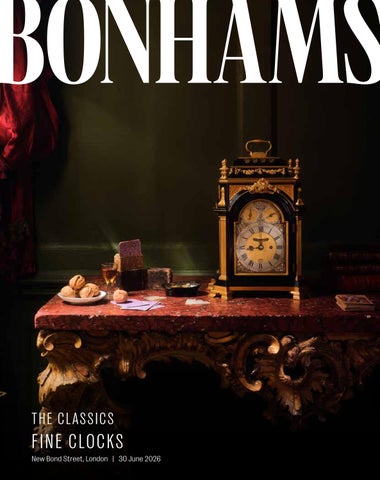
New Bond Street, London | 30 June 2026, at 2pm
Bonhams
101 New Bond Street
London W1S 1SR bonhams.com
SALE NUMBER
31962
Lots 1 - 168
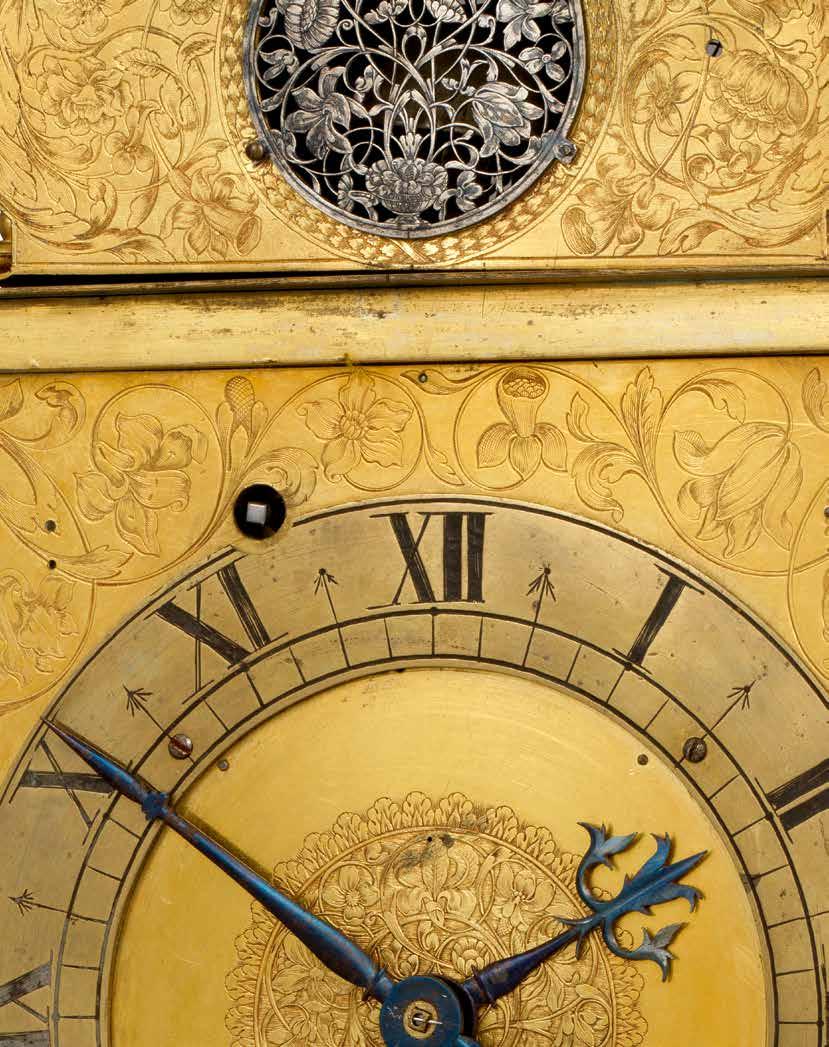
Front Cover: Lot 79
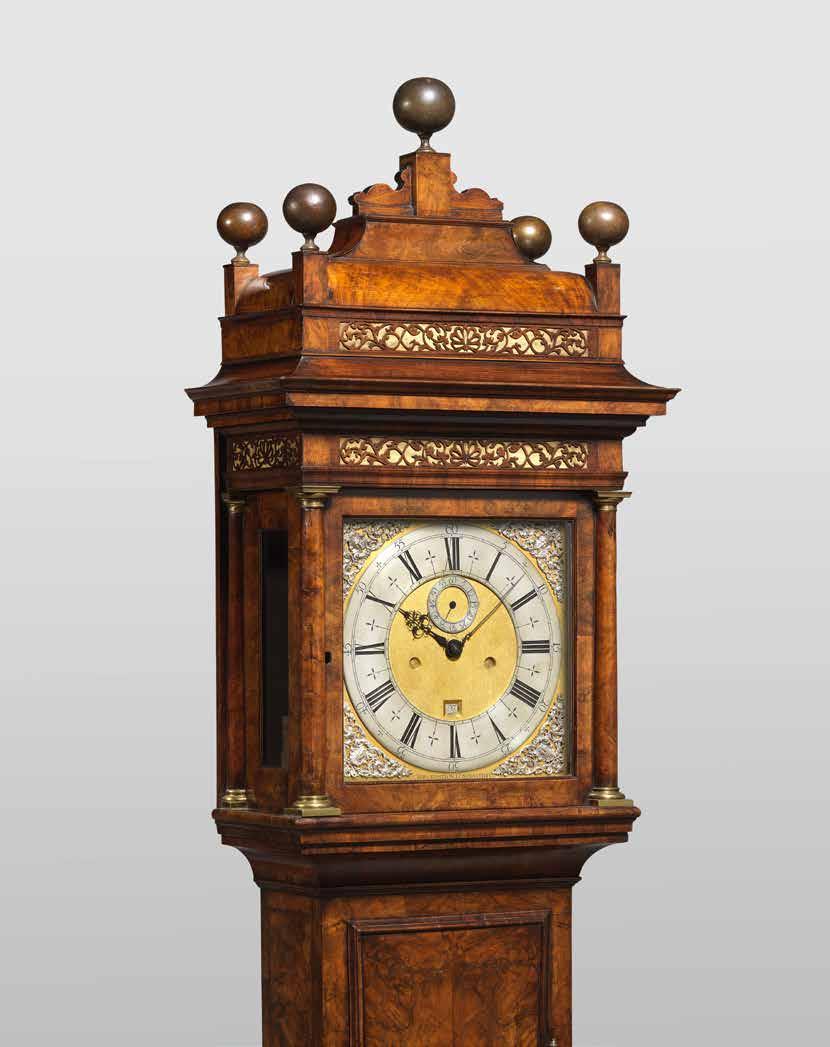
Back Cover: Lot 68
Saturday 27 June, 12pm - 5pm
Sunday 28 June, 12pm - 5pm
Monday 29 June, 9am - 5pm
Tuesday 30 June, 9am - 12pm

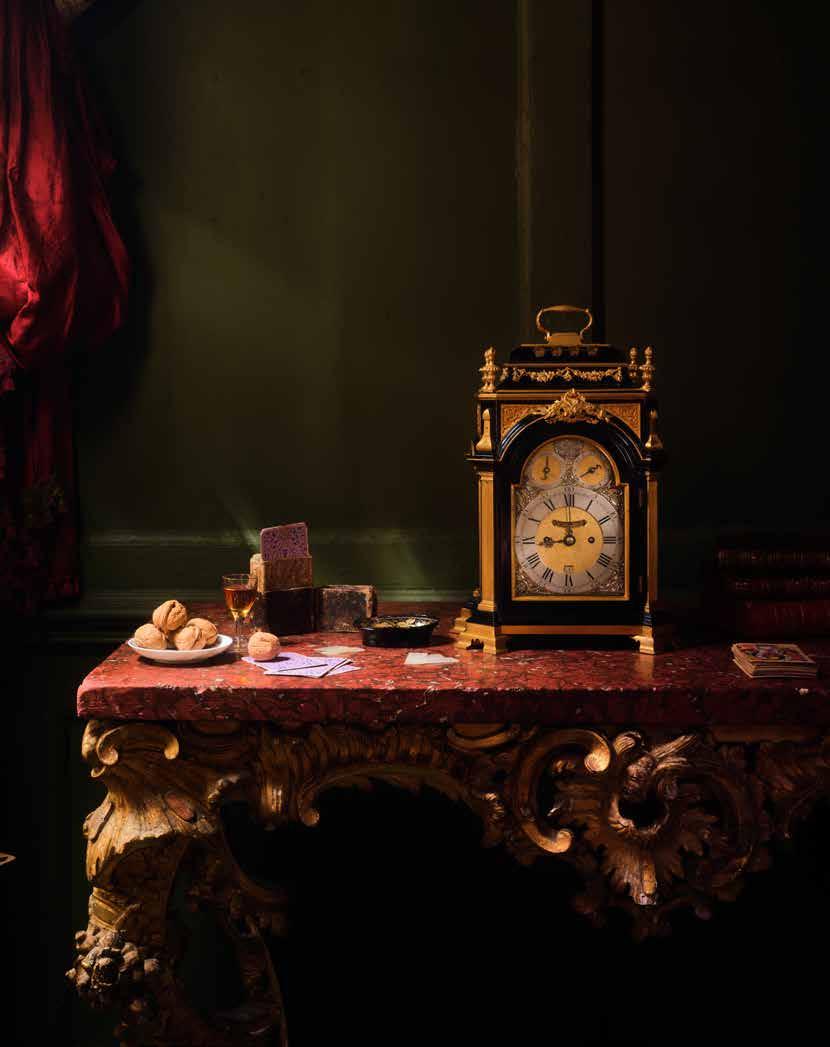
This season, we are delighted to partner with Dennis Severs’ House, one of London’s most evocative historic houses. Built in 1724 and transformed by Dennis Severs in the early 1980s into an immersive time capsule of 18th and 19thcentury Spitalfields life, the house offers a uniquely atmospheric journey into the lives of its fictional historical inhabitants. Through this partnership, we celebrate craftsmanship, history and a shared commitment to preserving the legacy and wonder of architectural and cultural heritage.
James Stratton M.R.I.C.S +44 (0) 20 7468 8364 james.stratton@bonhams.com
Lewis Walduck M.B.H.I. +44 (0) 20 7468 8281 lewis.walduck@bonhams.com
Administrator Vanessa Howson +44 (0) 20 7468 8204 vanessa.howson@bonhams.com
Consultant Andrew King
PHOTOGRAPHERS
David Green Nicola Onions
Bid online/APP New to Bonhams? To be able to place bids, you must have an active bonhams account.
Bid online/VIA OUR APP Register to bid online by visiting www.bonhams.com/31962
Bid through the app. Download now for android and iOS. You will be required to provide a valid credit card in your name which must be verified before you are able to place bids. If you are placing bids on behalf of a company, please ensure you indicate this when registering. We reserve the right to request further information from you (including your government issued ID) where you are the successful bidder, in particular in relation to any lot where the purchase price is over £5000. Please note all successful corporate bidders will be required to provide additional information.
For all other enquiries, contact our Client Services department on: +44 (0) 207 447 7447 or bids@bonhams.com
Please see back of catalogue for important notice to bidders
To submit a claim for refund of VAT, HMRC require lots to be exported from the UK within strict deadlines. For lots on which Import VAT has been charged (marked in the catalogue with a * or Ω) lots must be exported within 30 days of Bonhams’ receipt of payment and within 3 months of the sale date. For all other lots export must take place within 3 months of the sale date.
Please note that from 19 January 2022, items containing ivory cannot be imported into the EU. The import of ivory into the USA is already prohibited.

BIDS
+44 (0) 20 7447 7447
To bid via the internet please visit www.bonhams.com
PAYMENTS
Buyers
+44 (0) 20 7447 7447
Sellers
Payment of sale proceeds
+44 (0) 20 7447 7447
VALUATIONS, TAXATION & HERITAGE
+44 (0) 20 7468 8340 valuations@bonhams.com
SHIPPING
For information and estimates on domestic and international shipping as well as export licenses please contact The Packengers Ltd on +44 (0)203 154 4363 hellolondon@thepackengers.com
BUYERS COLLECTION & STORAGE AFTER SALE LOTS MARKED TP
All sold lots marked TP will be removed to the Packengers, Unit 9, Abbey Mead Industrial Park, Brooker Road, Waltham Abbey, EN9 1HU on Friday 3 July 2026 and will be available for collection from 12pm Monday 6 July 2026 and then every working day between 9.30am and 4pm by appointment only.
A booking email or phone call is required in advance to ensure lots are ready at time of collection. Photographic ID will be required at time of collection. If a third party is collecting for you written authorisation is required in advance from you and photographic ID of the third party is requested at the time of collection.
To arrange a collection time please send a booking email to londonstorage@thepackengers. com or call +44 (0) 2031544360.
All other sold lots will remain in the Collections room at Bonhams New Bond Street free of charge until Tuesday 14 June 2026. Lots not collected by this time will be returned to the department, Storage charges may apply.
AND HANDLING CHARGES ON SOLD LOTS RETURNED TO THE PACKENGERS
Storage
Storage will be free of charge from & including the sale end date, charges will apply from 9.30am Monday 13 July 2026.
Storage Charges
Pictures, and Small Objects <150cm:
£2.80 + VAT per day
This summer, we invite you to discover our Classics auctions in our New Bond Street and Knightsbridge salerooms — an exceptional celebration of Old Master Paintings, Antiquities, Ceramics, Fine Clocks and Silver, Furniture, Sculpture and Works of Art. From rare treasures to timeless masterpieces, each sale offers a journey through centuries of craftsmanship, beauty, and collecting.
FINE GLASS AND BRITISH CERAMICS
Knightsbridge, London | 24 June - 25 June
500 YEARS OF EUROPEAN CERAMICS
New Bond Street, London | 30 June
FINE CLOCKS
New Bond Street, London | 30 June
OLD MASTER PAINTINGS
New Bond Street, London | 1 July
Furniture, and Large Items >150cm:
£5.25 + VAT per day
Handling Charges
Inbound Handling Fees:
£17.25 + VAT <150cm
£34.60 + VAT >150cm
Outbound Handling Fees:
£59.25 + VAT <150cm £118.50 + VAT >150cm
Payment
All charges due to the Packengers must be paid by the time of collection from their warehouse.
Payment in Advance (Telephone to ascertain amount due) by: credit or debit card
Payment at time of collection by credit or debit card
VAT
The following symbols are used to denote that VAT is due on the hammer price and buyer’s premium.
† VAT 20% on hammer price and buyer’s premium
* VAT on imported items at a preferential rate of 5% on hammer price and the prevailing rate on buyer’s premium
A LIFE IN CERAMICS: THE PETER AND MARY WHITE COLLECTION
New Bond Street, London | 1 July
ANTIQUITIES
New Bond Street, London | 2 July
FINE DECORATIVE ARTS
New Bond Street, London | 2 July
Y These lots are subject to CITES regulations, please read the information in the back of the catalogue.
POST BREXIT NOTICE FOR EU BUYERS SHIPPING PURCHASED LOTS OUTSIDE THE UK
Please note that as of 1 January 2021 for Margin Scheme and Imported Lots VAT on the Buyer’s Premium will be refunded by Bonhams on valid proof of export of your Lot from the UK within 90 days of full payment of your invoice.
What else has changed since 1 January 2021 for EU Buyers? If you buy a Lot in this sale and intend to ship the Lot outside the UK, you will need to pay local Import Tax when you bring your Lot into the country of destination.
What do the Star ( * ) and Omega ( Ω ) symbols mean ? If you buy in this sale you will pay import VAT of 5% ( * symbol) or 20% ( Ω symbol) on the Hammer Price. As of 1 January 2021, for EU buyers shipping purchased Lots outside the UK, this tax will be refunded by Bonhams on valid proof of export of your Lot from the UK within 30 days of full payment of your invoice.
FINE BOOKS AND MANUSCRIPTS
Online, Knightsbridge, London | 22 June - 1 July
THE CLASSICS ONLINE: ANTIQUITIES AND CLOCKS
Online, New Bond Street, London | 22 June - 7 July
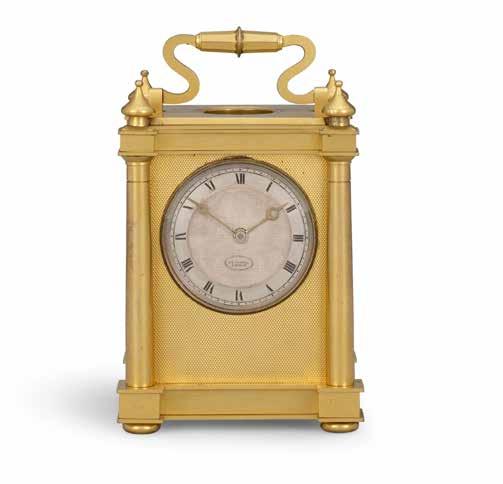
Thomas Frederick Cooper, London No. 2471
The serpentine shaped carrying handle over a circular bevelled glass observation window, the bevelled top set with four turned minaret style finials over Doric three quarter columns, terminating in block feet and a ribbed base, with glazed sides and a solid rear door with sprung catch. The 2.25 inch silvered Roman dial with dotted minute ring framing the polished chapter ring and gilt Breguet style hands reading against the finely engine turned centre signed in an oval name cartouche T. F. Cooper, London . The movement with a finely shaped, fully jewelled, platform with engraved balance cock, diamond endstone with cut and compensated bimetallic balance to an underslung lever escapement, the plates united by four pillars secured to the back plate by finely blued steel screws and powered by a fine chain fusee with maintaining power, the spring barrel set in a shaped plate secured to the backplate by three blued steel screws. Boldly signed T. F. Cooper, 6 Calthorpe Street, Gray’s Inn Road, London, No. 2471 . Ticking. 15cms (6ins) high.
£800 - 1,200
€930 - 1,400
US$1,100 - 1,600 FOR FUTHER INFORMATION, PLEASE SEE APPENDIX
2
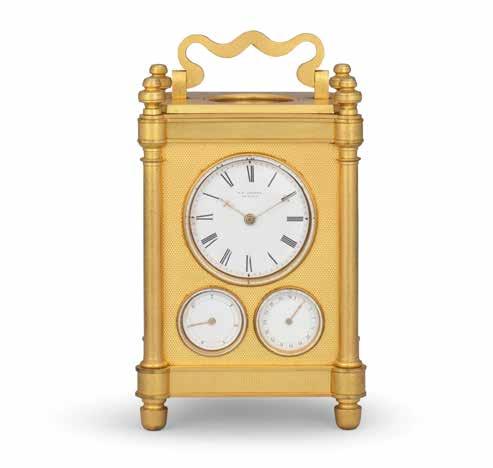
Thomas Frederick Cooper, London No. 2472
The serpentine shaped carrying handle over a circular bevelled glass observation window on a bevelled top framed by four turned finials on three-quarter turned columns, terminating in a ribbed base and turned feet, plain side panels and solid rear door with sprung door catch. The 2 inch white enamel Roman dial with gilt fleur-de-lys hands signed T. F. Cooper, London , with twin subsidiary dials below; the left for day of the week and the right for date. The movement with a finely shaped, fully jewelled platform with engraved balance cock, diamond endstone with cut and compensated balance to an underslung lever escapement, the plates united by four pillars secured to the back plate by finely blued steel screws and powered by a fine chain fusee with maintaining power, the spring barrel set in a shaped plate secured to the backplate by three blued steel screws. Boldly signed T. F. Cooper, 6 Calthorpe Street, Gray’s Inn Road, London, No. 2472 . Ticking. 15cms (6ins) high.
£800 - 1,200
€930 - 1,400
US$1,100 - 1,600
FOR FUTHER INFORMATION, PLEASE SEE APPENDIX
3
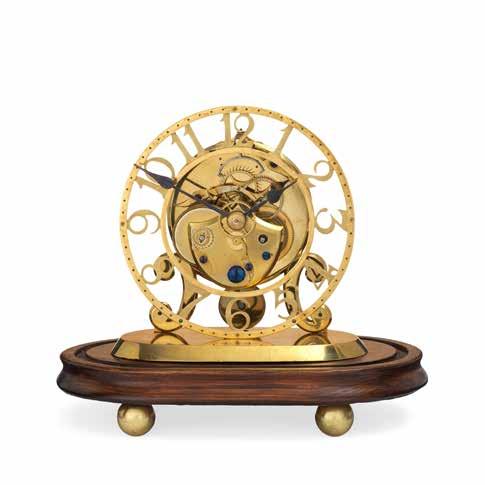
A GOOD AND RARE MID 19TH CENTURY SKELETON CLOCK TIMEPIECE WITH SKELETONISED DIAL, UNDER A GLASS DOME
John Pace, Bury St Edmunds
The skeletonised gilt chapter ring with outer dot minute markers enclosing the pierced Arabic numerals (the 4-8 numerals ‘tumbling’ over to be read upright), the time shown via blued steel spade hands on a signed faceted base mounted on a mahogany oval plinth on ball feet. The gut (now wire) fusee movement with circular backplate set on a pair of C-scroll supports, the frontplate shield-shaped and with canted edge, with half deadbeat escapement, signed to the base John Pace, Bury , currently ticking. 22cms (9ins) high.
£1,500 - 2,500
€1,700 - 2,900
US$2,000 - 3,400
4
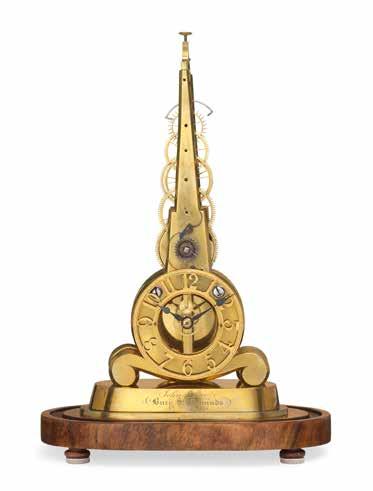
A GOOD AND RARE MID 19TH CENTURY NUMBERED SKELETON CLOCK TIMEPIECE WITH DEADBEAT ESCAPEMENT AND TWO-WEEK DURATION
John Pace, Bury St Edmunds, number 245
The frame consisting or a pair of tapered plates with bevelled edge, united by a pair of pillars to the base and a hipped bracket at the top supporting the pendulum rise-and-fall fine screw regulation, on an angled brass base fully signed and numbered in copperplate script across the front edge. The 3.5 inch skeletonised Arabic chapter ring set within a dotted-minute border, and with blued steel hands. The movement with a going barrel of two week duration, high count pinions and very delicate wheels of five and six crossings, with deadbeat escapement to a polished steel pendulum rod with halberd-shaped cast brass bob, a sub-plate set to the rear of the frame carrying a four wheel train to drive the hands, the whole frame raised on a walnut base and protected by a glass dome. Ticking. 38cms (15ins) high.
£3,000 - 5,000
€3,500 - 5,800
US$4,000 - 6,700
Provenance:
Purchased in these rooms, Fine Clocks, 29th June 2017, lot 30.
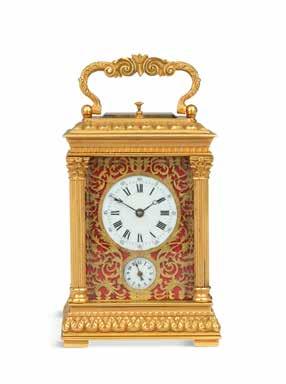
GILT BRASS PETITE SONNERIE MINIATURE CARRIAGE CLOCK
The fancy case with cast handle over a glazed inspection panel in a foliate cast frame, the ripple moulded cornice set on Corinthian style columns to a matching foliate-cast base on block feet. The 1.5 inch white enamel Roman and Arabic dial with Breguet moon hands set over an alarm-setting dial within an elaborately pierced foliate scroll mask backed in red silk, the side panels similarly inlaid, with a glazed rear door. The highly polished movement with jewelled lever platform escapement with compensated bimetallic balance, striking the quarters and hours on a pair of blued steel gongs. Furthermore with the rare facility to repeat the time to the nearest minute on depression of a button to the top. Ticking and repeating. 14cms (5.5ins) high.
£1,000 - 2,000
€1,200 - 2,300
US$1,400 - 2,700
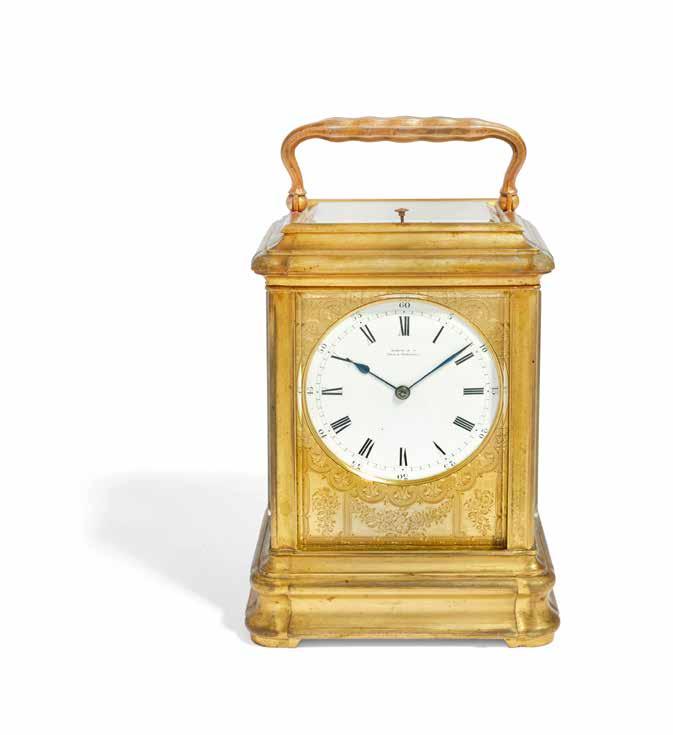
A FINE AND RARE LATE 19TH CENTURY FRENCH GIANT REPEATING CARRIAGE CLOCK WITH ORIGINAL PRESENTATION BOX AND NUMBERED KEY
Martin & Co Paris & Cheltenham, the movement by Drocourt, no. 9217. The gorge case of generous proportions with typical rippled handle over a large bevelled glass inspection panel, to moulded uprights and a tall moulded base. The 3.5-inch circular white enamel Roman and Arabic dial with minute track, blued steel hands and retailers signature set within an engraved gilt brass mask of formal foliate ornament. The substantial brass movement with a large silvered platform, compensated bimetallic balance, and English-style lever escapement, repeating and striking on a blued steel gong. Sold with the original numbered presentation box, embossed to the lid “The Revd.T. P. Little from the parishioners of Oxenhall and Panntley as a mark of their great affection and esteem, August 1883” , together with the original numbered key. 25cms (10ins) high. (2)
£1,500 - 2,000
€1,700 - 2,300
US$2,000 - 2,700
FOR FUTHER INFORMATION, PLEASE SEE APPENDIX
7 * A GOOD MID 19TH CENTURY FRENCH BRASS ONE-PIECE CARRIAGE
CLOCK WITH CHAFF CUTTER ESCAPEMENT
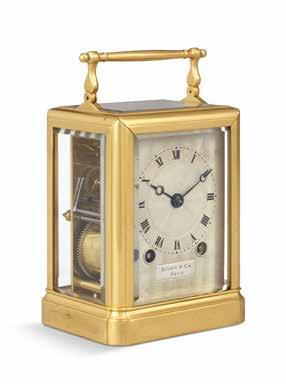
Silvani Et Cie Paris
The turned handle over a large bevelled glass observation window, with similar glazing to the rear and sides, the front with upward sliding door, raised on a moulded base. The 2.5 inch silvered dial with black Roman numerals and blued steel hands reading against a radiating engine turned centre and framed by a pattern of flowing waves, the polished signature cartouche (re)signed Silvani et Cie, Paris . The twin train movement with gold monometallic balance and chaffcutter escapement, striking on a polished bell mounted on the signed back plate. Currently ticking and striking. 15cms (6ins) high.
£1,000 - 1,500
€1,200 - 1,700
US$1,400 - 2,000
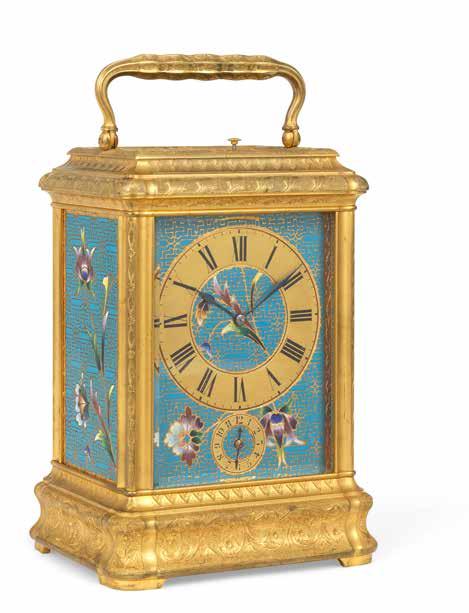
8 * A VERY FINE LATE 19TH CENTURY FRENCH CLOISONNE ENAMELDECORATED GORGE-CASED GIANT CARRIAGE CLOCK
Breguet, Paris, No.5125. Originally sold 7th July 1893 for the sum of 800 Francs. The impressive case engraved all over with foliate scrollwork, repeating
geometric borders, foliage and flowers and other patterns on both burnished and matt grounds, surmounted by an engraved rippled carrying handle and an oval bevelled glass observation window, with repeat button, the sides of cloisonné enamel panels in rich turquoise tones depicting budding flowers in many colours, the rear door glazed, all on a moulded base with fine engraving. The 3.75 inch dial with large gilt Roman chapter ring and matching cloisonné enamel centre and mask, with Arabic alarm setting dial below, and blued steel hands. The substantial movement with large silvered lever platform escapement, wound from the rear and powered by a pair of going barrels, striking the hours and half hours on a blued steel gong mounted to the back plate together with alarm work mounted to the upper left corner of the movement, signed Breguet , and numbered 5125 . Currently ticking and striking. 25cms (10ins) high.
£12,000 - 18,000
€14,000 - 21,000
US$16,000 - 24,000
Originally sold on 7th July 1893 for the sum of 800 Francs. Subsequently sold Christies Amsterdam 27th September 2001 $8019, thereafter Christies London 5th July 2002 $27,963.
8
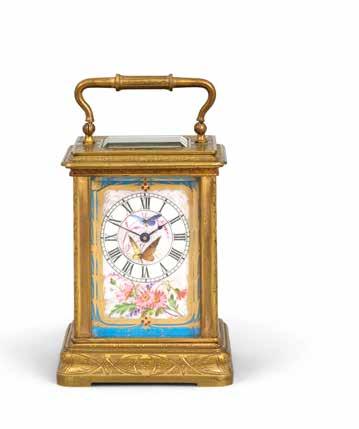
9 A SMALL LATE 19TH CENTURY FRENCH PORCELAIN PANELLED
ENGRAVED BRASS CARRIAGE CLOCK
The movement stamped F.G. Brevete, SGDG within an oval trademark The carrying handle with unusual cast centre section, over a glazed observation window framed by geometric engraving, the moulded cornice over four panels depicting butterflies and bugs within fancy gilt and jewelled borders on a turquoise ground, on an engraved moulded base. The 1.5 inch dial with black Roman numerals within a minute band on a pink ground decorated with multicoloured butterflies and flowers within a fancy gilt and jewelled border. The single train movement with silvered cylinder escapement. 11cms (4.5ins) high.
£600 - 800
€700 - 930
US$810 - 1,100
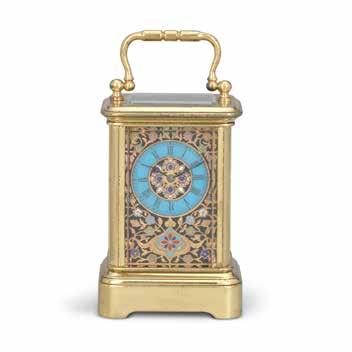
10 A LATE 19TH CENTURY FRENCH MINIATURE CHAMPLEVE ENAMEL AND BRASS CARRIAGE CLOCK TIMEPIECE
Numbered 409
The three-piece carrying handle over a rectangular bevelled glass observation window to a moulded cornice, the sides with multi-coloured enamel decorated panels of geometric patterns, (the rear door glazed), terminating in a moulded base. The 1.25 inch dial with turquoise Roman chapter ring with painted steel hands framed by florid enamel decoration depicting flowers and scrolls. The single train movement with going barrel, numbered 409 to the back plate, fitted with a silvered English-style lever platform escapement, currently ticking. 9cms (3.75ins) high.
£600 - 800
€700 - 930
US$810 - 1,100
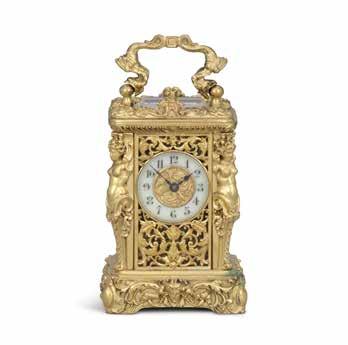
A LATE 19TH CENTURY FRENCH BRASS MINIATURE CARYATID CARRIAGE CLOCK TIMEPIECE IN ORIGINAL NUMBERED BOX
Leroy Fils, 13–15 Palais Royal, Paris, Movement number 13684, case number 321.
The case surmounted by an elaborate handle over a rectangular window framed by a cast ‘grotesque’ heads and foliate scrolls, the uprights of standing female figures interspersed with floral-decorated panels in relief, on a matching base of masks and scrolls in the Renaissance style, signed to the underside Le Roy & Fils, 13–15 Palais Royal, Paris . The cream enamel Arabic chapter ring with blued steel hands with further gilt decoration to the centre. The timepiece movement with silvered plates numbered 13684, with a going barrel and lever platform escapement with cut and compensated bimetallic balance. Currently ticking, sold together with the original velvet-lined box numbered to the underside. 8cms (3.5ins) high. (2)
£800 - 1,200
€930 - 1,400
US$1,100 - 1,600
The above lot was sold in these rooms in 2016.
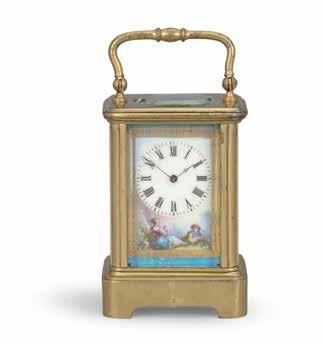
A LATE 19TH CENTURY FRENCH MINIATURE PORCELAIN PANELLED CARRIAGE CLOCK TIMEPIECE
Numbered 345
Surmounted by a brass carrying handle over an oval bevelled glass observation window and a moulded cornice, all four sides inset with turquoise blue porcelain panels depicting period ladies in multi-coloured dresses in a naturalistic setting within gilt borders, on a moulded base. The 1.25-inch Roman dial with fine blued steel hands over a scene depicting a young couple within a glade. The timepiece movement with a single going barrel, numbered 345 to the backplate, fitted with a silvered cylinder platform escapement, currently ticking. 9cms (3.75ins) high.
£600 - 800
€700 - 930
US$810 - 1,100
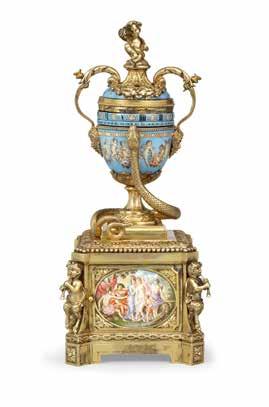
Jakob Wasserberger, Vienna
The case surmounted by a cast cherub above a pair of flowing laurel wreaths with handles to each side, the enamel urn marked with the months of the year over a running frieze of playful cherubs with fruit and harvest, set on a square plinth base decorated to the sides with figures of trumpeting cherubs and four oval enamel plaques painted with different classical scenes. The front door opening to reveal a pair of drawers for the winding key. The two moving annular chapter rings set to the upper part of the urn, the hour with Roman numerals, the minutes with Arabic numerals, the time read by a long serpent wrapping around the body and pointing to the time with it’s tongue. The pocket watch type movement with cylinder escapement. 20cms (8ins) high.
£3,500 - 5,000
€4,100 - 5,800
US$4,700 - 6,700 FOR FUTHER INFORMATION, PLEASE SEE
14
15
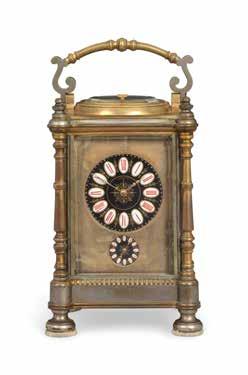
The two-colour case with curved carry handle over a circular inspection panel and moulded cornice supported on four turned columns. The 2.75 inch black enamel dial with red Roman numerals set on white enamel cartouches, overlaid with gilt highlights, over a matching alarm-setting dial, both in a plain mask. The grande sonnerie, twin train movement with a Swiss lever platform escapement striking the hours and quarters on a pair of blued steel gongs mounted to the backplate. Currently ticking, but not striking or repeating, sold together with a leather travel case and winding key. 20cms (8ins) high. (2)
£800 - 1,200
€930 - 1,400
US$1,100 - 1,600
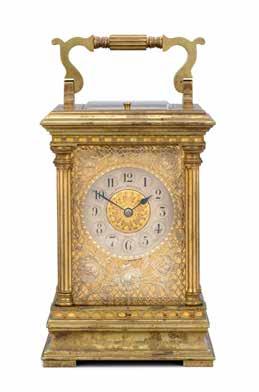
Retailed by Joseph Penlington. Supplied by Maurice and Co.
The case surmounted by a ribbed brass handle over a rectangular bevelled glass observation window, repeat button and deeply moulded cornice with dentil moulding supported by four Doric columns framed by pierced gilt panels of flowers against a fine lattice ground, on a moulded plinth and block feet. The 3 inch Arabic dial with silvered chapter ring within a matching pierced mask, signed below 12 for the retailer Joseph Penlington, Paris, with blued steel hands. The two train movement with silvered lever platform escapement striking the hours and half hours on a blued steel gong mounted to the backplate signed EM & Co, Paris and numbered number 2043 currently not ticking but striking. 21cms (8ins) high.
£600 - 800
€700 - 930
US$810 - 1,100
Joseph Penlington was active in Liverpool from the mid 19th century, known for his chronometers and as a retailer.
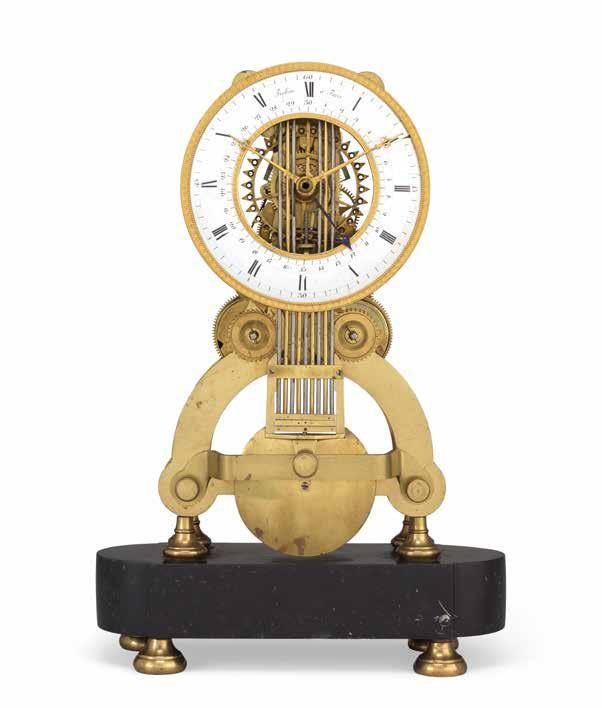
Robin, a Paris
The inverted Y-shaped frame of heavy brass, united by four turned pillars on a shaped black marble base and turned feet. The 5.75 inch enamel chapter ring with outer minute track with Arabic quarters, Roman hours and inner concentric date, signed around XII Robin a Paris , with matching gilt hands for the time and blued steel for the date, (the centre seconds hand now lacking) the open centre revealing the fancy date wheel, the pinwheel escapement mounted to the rear and driven by a heavy gridiron pendulum suspended from the front, with fine-screw beat adjustment.
The strike is on a bell via a countwheel, both of which are mounted on the rear of the plate. With detachable U-shaped brass bracket to secure the pendulum in transit (which can be secured to the rear of the frame when not in use) 38cms (15ins) high
£4,000 - 6,000
€4,600 - 7,000
US$5,400 - 8,100
A similar table regulator with visible pendulum by Ferdinand Berthoud of circa 1790 is illustrated in Heuer & Morice, European Pendulum Clocks, Schiffer, 1988 Fig. 124.
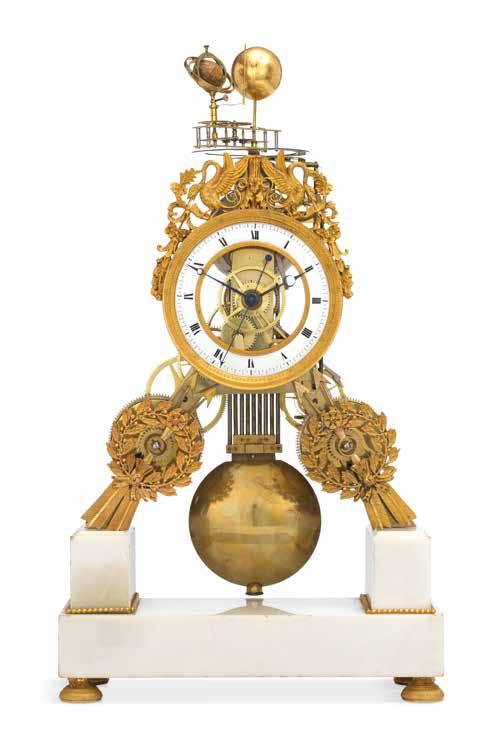
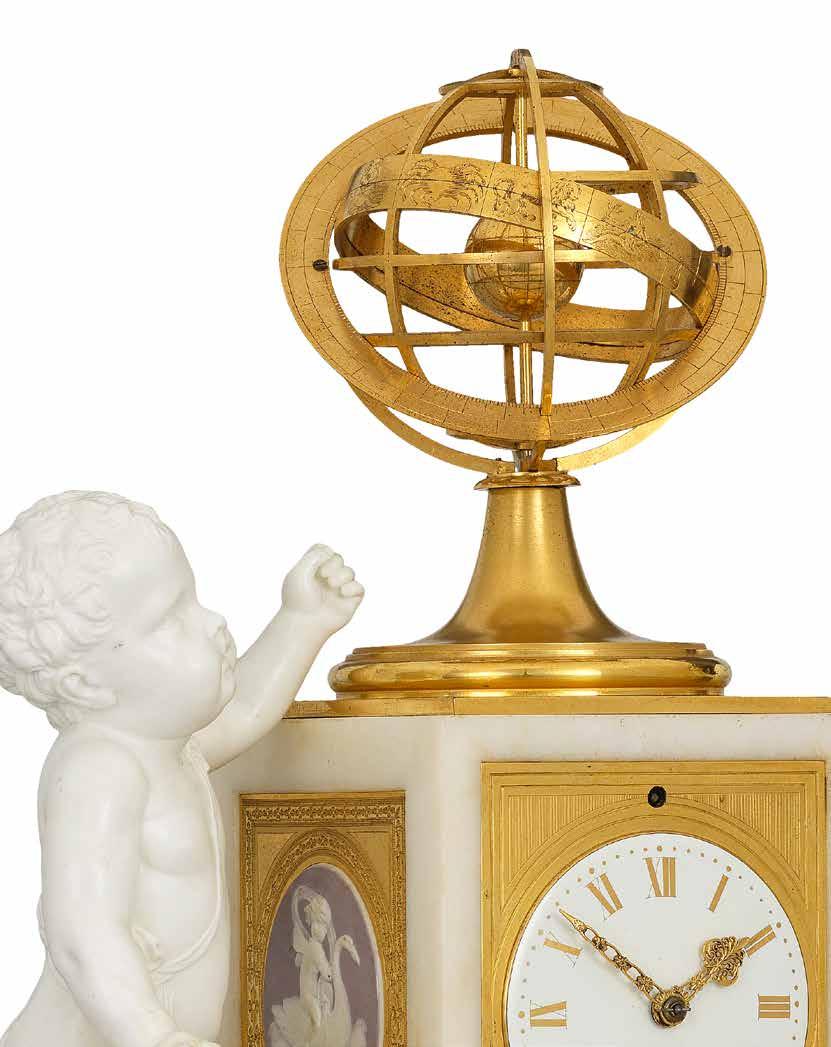
CLOCK WITH GRIDIRON PENDULUM, CENTRE SECONDS AND SIGNED INVERTED Y-SHAPED FRAME, SURMOUNTED BY AN ORRERY Mugnier, Paris
The inverted Y-shaped frame signed to the rear Mugnier, a Paris applied with cast mounts of swans, flowers and laurel wreaths (the latter framing the winding squares), on a pair of pedestals to a rectangular plinth on turned feet, all surmounted by an intricately made orrery depicting a gilt brass sun, turned, revolving moon and earth (with printed and coloured scales) above an engraved silvered brass scale giving cardinal points, date and Zodiac information. The 4-inch white enamel chapter ring with outer band divided into half-minute intervals, and Roman hours, framed
by a pair of cast ormolu bezels, with good blued steel Breguet style hands and counterbalanced seconds hand. The twin spring barrel movement with delicate wheelwork, highly polished pinions and fine pinwheel escapement to a heavy nine-rod gridiron pendulum mounted on a knifeedge at the apex of the frame. The strike train with outside countwheel, striking the hours and half-hours on a vertical bell between the plates. The orrery train powered direct from the strike train via a vertical drive rod connected to the countwheel. Ticking and striking. 46cms (18ins) high.
£8,000 - 12,000
€9,300 - 14,000
US$11,000 - 16,000
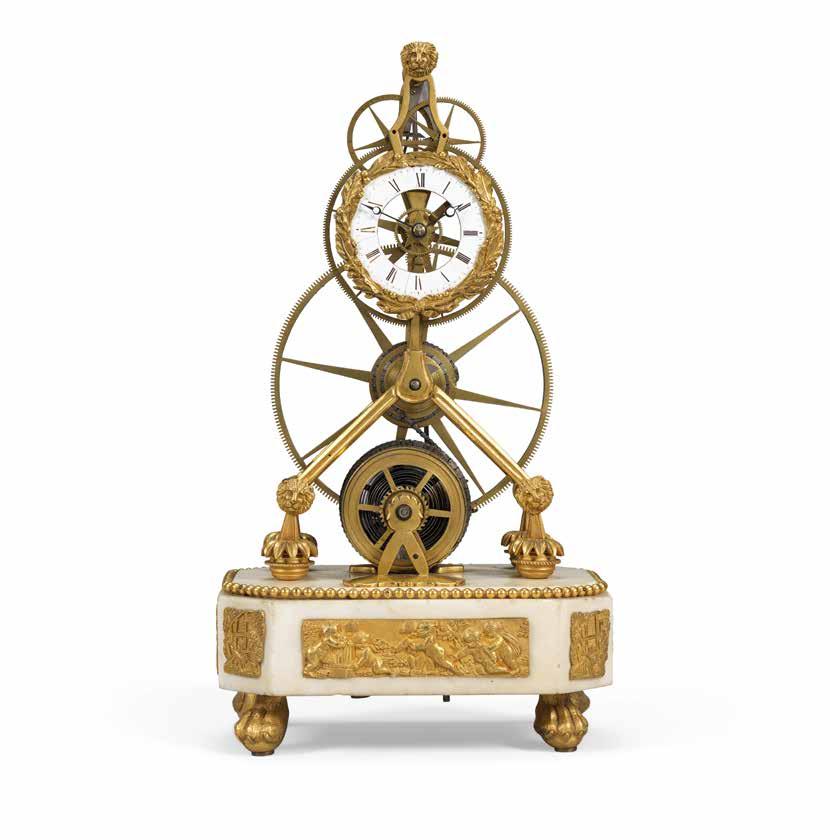
A GOOD AND RARE EARLY 19TH CENTURY FRENCH ORMOLU AND MARBLE ‘GREATWHEEL’ SKELETON CLOCK TIMEPIECE WITH PIN WHEEL ESCAPEMENT AND FUSEE MOVEMENT
The inverted ‘Y’ shaped frame with burnished and matt decoration, the three front angles applied with lions mask mounts, on leaf-cast supports to a white marble base with beaded border and ormolu mounts, all supported on ball-and-claw feet. The 2.75inch enamel Roman dial with outer minutes and open Breguet style moon hands to the open centre revealing the star-shaped centre wheel. Chain fusee movement with 5.75 inch diameter great wheel of eight tapering crossings, the further
wheels of five- and six-crossings, terminating in a delicate pin-wheel escapement, over a large spring barrel with skeletonised caps front and back, set between the lower supports. Now mounted on a mahogany base and sitting under a panelled glass case (old damage to the rear panel). Sold together with a winding key, ticking. 35cms (13.75ins) high.
£2,000 - 3,000
€2,300 - 3,500
US$2,700 - 4,000
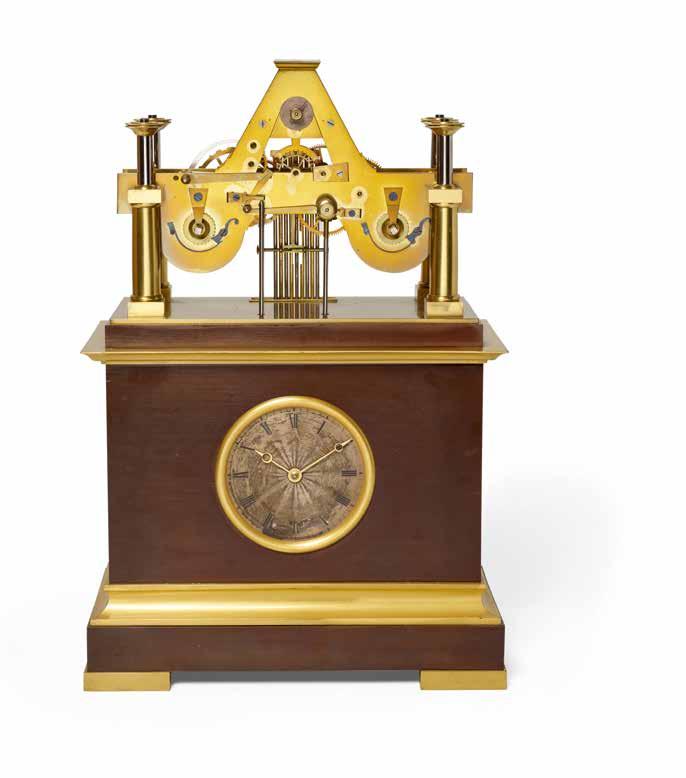
FINE AND RARE MID 19TH CENTURY FRENCH GILT AND PATINATED BRONZE HORIZONTAL FRAME STRIKING SKELETON CLOCK
Charles Oudin, Elève de Breguet
The case surmounted by the thick skeletonised shaped plates united by a pair of very heavy pillars on four mirror-polished steel and lacqueredbrass columns to a stepped plinth, all set on a two-colour low rectangular base, on a bespoke velvet-covered stepped plinth raised on ball feet.
The 3.75 inch silvered Roman dial with outer minute band framing the elegant numerals and wavy engine turned centre, signed CHles OUDIN, Eleve de Breguet, with gilt Breguet style hands and plain bezel. The twin spring barrel movement wound from the front, with blued steel clicks and hand-setting knob, high count pinions and delicately finished wheelwork to a jewelled Brocot style deadbeat escapement (with a rise-and-fall regulation dial set in the apex of the A frame), driving a nine-rod brass and
steel gridiron pendulum mounted at the rear with brass lenticular bob and fine adjustment; two vertical steel arms are mounted at the front and (via a countwheel mounted to the rear) activate the strike of the hammer on the bell mounted behind the dial in the plinth below, and - via a bevel gearing system - driving the hands around the dial.
The clock 44cms (17.5 ins) high. Total height, including the stand 50cms (19.5ins) high.
44cms (17.25ins) high
£1,500 - 2,500
€1,700 - 2,900
US$2,000 - 3,400
FOR FUTHER INFORMATION, PLEASE SEE APPENDIX
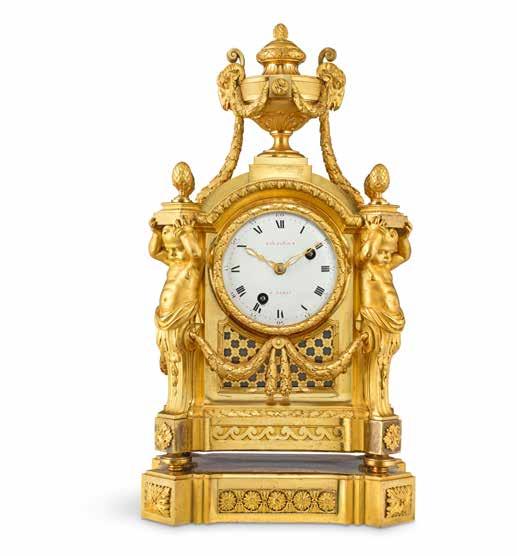
The movement and dial signed Jean Martin, A Paris. The case stamped St Germain
The matt and burnished gilt bronze case surmounted by a cast urn with ram’s head mounts and draped laurel wreaths, over an arched top and pinecone finials on concave pedestals supported by four finely cast putto, the sides with pierced sunflower frets, the front with a tied laurel wreath protecting a lattice-framed observation window. All raised on a shaped base with burnished Vitruvian scroll fret and applied floral bosses. Stamped ST. GERMAIN above the solid rear door. The 4.5 inch white enamel dial framed by a bold laurel wreath bezel with black enamel Arabic five-minute makers framing the minute track with gilt highlights and Roman hour numerals, signed to the centre Martin, A Paris with engraved pierced gilt hands and offset winding squares. The movement with circular plates with flattened lower edge and repeat signature to the backplate, with external star count wheel (the hours individually numbered), the backcock converted from silk suspension to a Brocot style, (now lacking its pendulum), striking the hours on a bell mounted to the backplate. 53cms (21ins) high.
£5,000 - 7,000
€5,800 - 8,100
US$6,700 - 9,400
Literature:
J.-B. Augarde, “Jean-Joseph de St Germain, bronzier (1719-1791)”, in L’estampille l’objet d’art, December 1996, n°308, p. 73
Provenance:
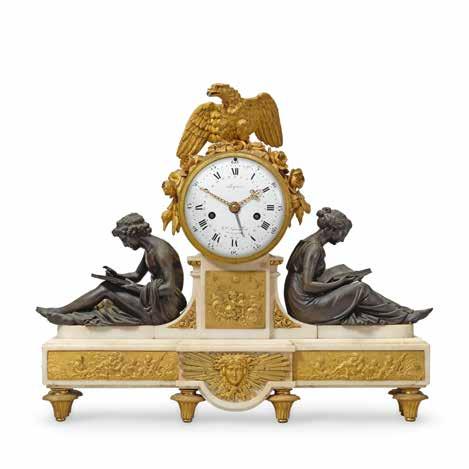
The case sumounted by a seated eagle over floral decoration, the sides with patterned bronze figures reading books with a central ormolu panel depicting seated cherubs above a sunburst panel with further panels to the sides, set on a white marble base and resting on six finely cast ormolu feet. The 5.5 inch white enamel dial with black Roman numerals and Arabic five minute markers with red calendar numerals and blued steel calendar hand, signed beneath with finely finished pierced gilt hands. The two train movement signed on the back plate by the maker, striking the hours and half hours on a polished bell mounted behind, currently ticking and striking. 55cms (22ins) high.
£2,000 - 3,000
€2,300 - 3,500
US$2,700 - 4,000
Perhaps Monsieur de Billy’s collection sale, 15-19th of November 1784 sale, n°189; Perhaps Monsieur Morel’s collection sale, 3rd of May, 1786
22
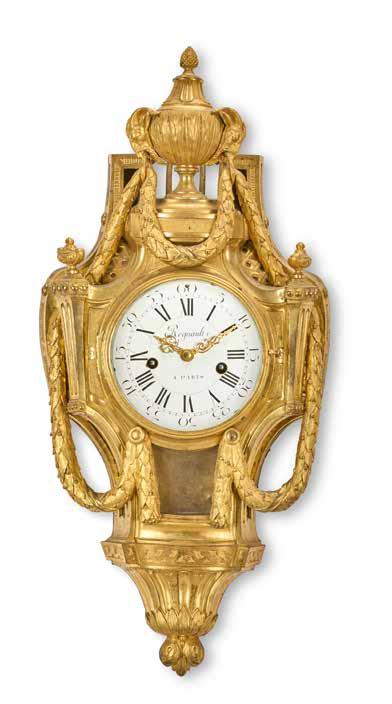
A GOOD LATE 18TH CENTURY LOUIS XVI GILT-BRONZE STRIKING CARTEL CLOCK
Regnault, Paris
The case surmounted by an urn finial above laurel swags and a glazed pendulum window. The 6.5 inch white enamel dial with Roman and Arabic numerals, signed Regnault A Paris , with gilt hands. The movement with silk suspension and verge escapement, with numbered outside countwheel, striking the hours on a bell, the backplate signed Regnault A Paris 71cms (27.5ins) high.
£3,000 - 5,000
€3,500 - 5,800
US$4,000 - 6,700
FOR FUTHER INFORMATION, PLEASE SEE APPENDIX
23
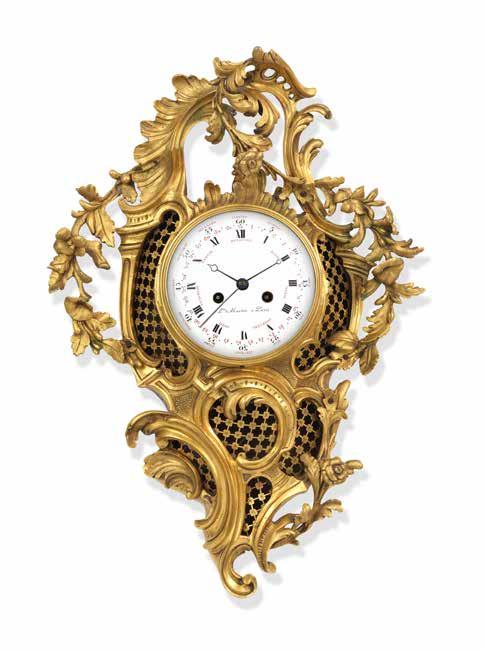
A LATE 18TH CENTURY ORMOLU CARTEL CLOCK WITH UNUSUAL SKELETONISED MOVEMENT
Ant. Martine, Paris
The case decorated in Rococo flowing forms and flowers with pierced and engraved sound frets to the sides and base. The 7 inch white enamel dial with calendar signed Martin, Paris with blued steel hands. The unusual movement with pin pallet escapement striking the hours and quarters on a pair of bells mounted behind via an external star count wheel, with skeletonised plates powered by a pair of going barrels, currently ticking and striking. 66cms (26ins) high.
£1,000 - 1,500
€1,200 - 1,700
US$1,400 - 2,000
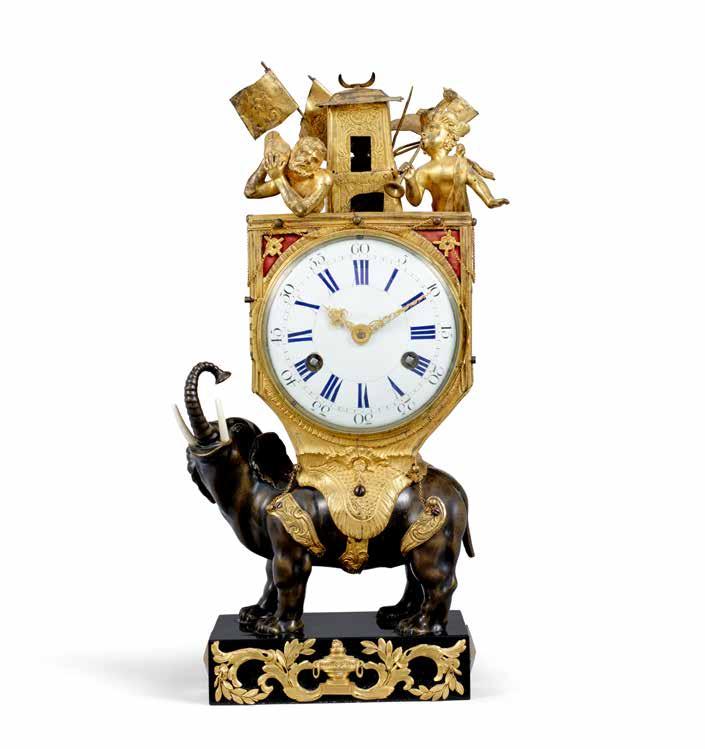
Bailly Laine à Paris
The majestic beast carrying a truncated castle housing a coloured terracotta figure of the Rajah, flanked by two figures at war, the left a gentleman throwing a large boulder, all surrounded by flying flags. The main body of the case with chainwork decoration and pierced sound frets backed in old red silk, supported by a finely cast patinated bronze elephant with ivory tusks and applied ormolu harnesses, now standing on a later wooden base with further ormolu mounts. The 5.5-inch white enamel dial with blue Roman numerals and black Arabic five-minute markers, with finely pierced and gilt brass hands. The large twin-train movement finely engraved on the back plate Bailly Laine à Paris in flowing script, striking the hours and half hours on a polished steel bell mounted to the back plate via a numbered count wheel, with silk suspension pendulum, currently ticking and striking.
£8,000 - 12,000
€9,300 - 14,000
US$11,000 - 16,000
Provenance: From a noble French family.
This clock is illustrated in Old Clocks and Watches and Their Makers by F.J. Britten (1932), page 31. At the time the photograph was taken, the clock sat on an ormolu base, but this has since been replaced.
Another clock signed Bailly L’aine, Paris with a remarkably similar case featuring three figures in the tower was sold as part of the P C Spaans Collection of Important Clocks, 19th December 2007, Christies, Amsterdam, lot 472 for 38,400 euros.
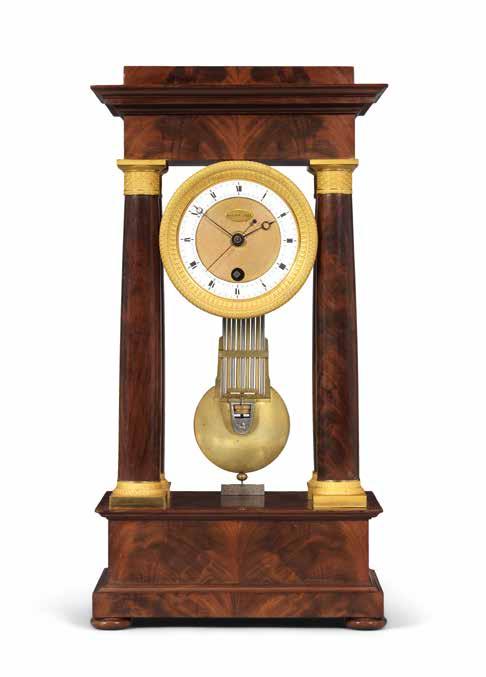
25 A GOOD EARLY 19TH CENTURY FRENCH MAHOGANY TABLE REGULATOR WITH PIN WHEEL ESCAPEMENT AND HEAVY GRIDIRON PENDULUM
Houdin Pere
The architectural case with flat top over a large moulded cornice, the case and movement supported by four Doric columns with finely gilt and chased capitals, terminating in a moulded block base and standing on four shallow bun feet. The 5 inch white enamel dial with black Roman numerals with engine turned centre signed Houdin Père with blued steel hands and centre seconds, framed by an elaborately cast bezel. The single train movement powered by a large going barrel with circular plates supported by four turned pillars, with finely finished pin pallet escapement and knife edge gridiron pendulum, currently ticking. 58cms (23ins) high.
£800 - 1,200
€930 - 1,400
US$1,100 - 1,600
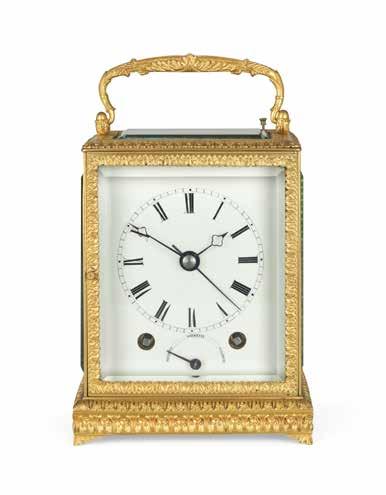
26 * A LARGE AND IMPRESSIVE MID-19TH CENTURY FRENCH/SWISS BRASS GRANDE SONNERIE STRIKING CARRIAGE CLOCK WITH ALARM
The platform stamped Fumey
The cast gilt brass case with foliate handle over a large bevelled glass inspection panel, the frame of the case cast with a running pattern of stylised leaves on a fancy base and foliate feet, all four sides glazed with heavy bevelled panels. The 4.25 inch rectangular white enamel Roman dial with minute track and trefoil hands for the time and a finely tapering hand for the alarm setting, over a subsidiary selection arc offering Silence/Sonnerie or Quarters . The movement wound on opening the front door, with cylinder platform escapement with monometallic balance to delicate wheelwork, the polished steel strike work and bells mounted on the backplate and accessible through the rear door. Ticking, the strike train in need of attention, the alarm fully functioning and wound via a cord emanating from the rear corner of the top. 23cms (9ins) high.
£2,000 - 4,000
€2,300 - 4,600
US$2,700 - 5,400
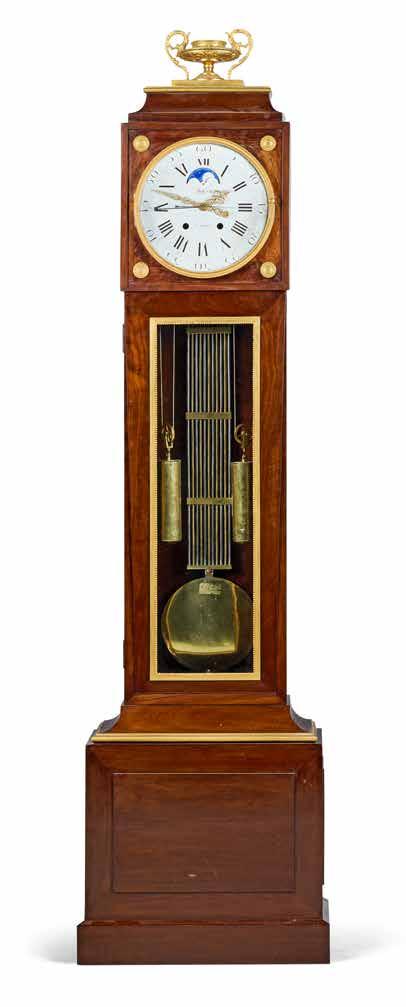
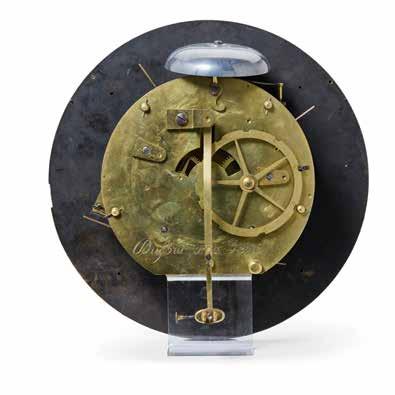
27 * W TP
A GOOD LATE 18TH CENTURY FRENCH MAHOGANY CASED MONTHGOING LONGCASE REGULATOR WITH GRIDIRON PENDULUM AND SIGNED MOVEMENT
Dufour a Laferte
The case surmounted by a gilt brass urn over a moulded top, the front with four gilt mounts to each spandrel to a long trunk door with glazed front and gilt brass surround, terminating in a moulded base and further raised on a large plinth. The 12 inch white enamel dial with black Roman numerals and Arabic five minute markers with red calendar ring and moon phase beneath 12 o’clock, signed in the centre Dufour a Laferte with centre seconds and pierced gilt brass hands. The movement with five pinned pillars with half deadbeat escapement with large cut-out to the back plate for the pallets with long gridiron pendulum, striking the hours on a polished bell mounted above via an external numbered count wheel, the back plate engraved with the maker’s signature, currently ticking and striking. 2.18m (7.16ft) high.
£3,000 - 5,000
€3,500 - 5,800
US$4,000 - 6,700
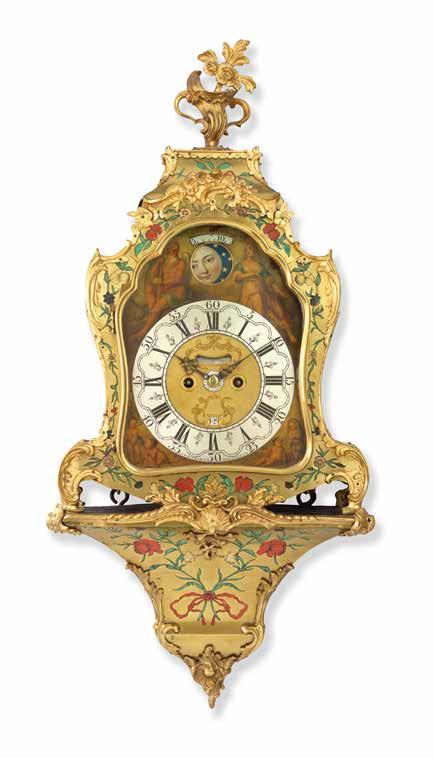
28 * Y
A MID-18TH CENTURY DUTCH BRASS AND HORN INLAID BRACKET CLOCK WITH MOONPHASE. Gerrit Knip, Amsterdam
The case sumounted by a gilt brass urn shaped finial over a decorated top and case with brass and tortoiseshell inlay and rich floral mounts, the sides with glazed observation windows, terminating in a Rococo base and sitting on four decorated feet and resting on a matching wall bracket. The unusual decorated dial with 8 inch silvered brass chapter ring with arcaded minute divisions with unusual half hour markers, black Roman numerals and Arabic five minute markers, the matted centre with mock pendulum aperture, Arabic alarm disc and decorated calendar aperture signed at the 6 o’clock position Gerret Knip, Amsterdam , framed by painted scenes depicting the four seasons to the lower corners and Chronos to the top with central moon phase, with blued steel hands. The double gut fusee movement with verge escapement striking the hours and half hours on a pair of polished bells mounted above with alarm train to the left hand side, the plain back plate with signature to the lower edge, currently ticking, striking and alarm functioning. 60cms (24ins) high.
£2,500 - 3,500
€2,900 - 4,100
US$3,400 - 4,700
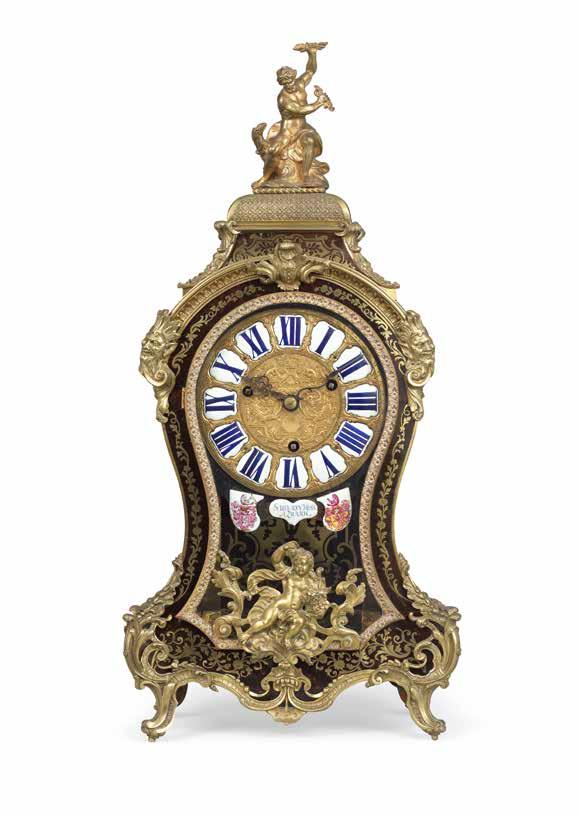
Solomon Hess Zurich
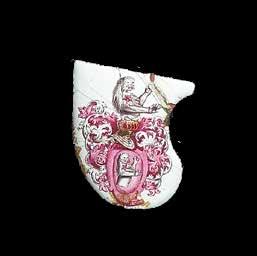
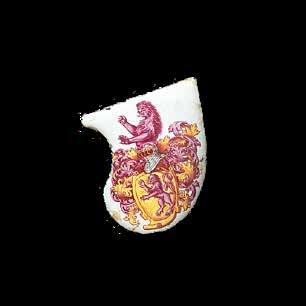
The waisted case surmounted by a removable caddy top set with the cast brass figure of Zeus throwing thunderbolts, accompanied by an eagle over panels of cut brass inlay and mounted to the upper corners with crowned Satyr masks and scrolls to the lower part, the shaped glazed door centred by a frolicking cherub, the sides with glazed observation windows. The 8 inch gilt brass dial with engraved minutes around the outer edge, 1-60, framing the twelve individually enamelled blue Roman numeral cartouches, the centre with cast decoration depicting squirrels and fantastic beasts within scrolls on a matted ground, to finely finished blued steel hands. Below the dial are mounted three enamel plaques, the signature to the centre signed Solomon Hess, A Zurich , flanked by a pair
of coats of arms, likely denoting a marriage, on enamelled copper panels. The three train movement united by four pinned baluster pillars, with verge escapement to a silk-suspended pendulum held between cycloidal cheeks, striking the hours on a large bell and chiming the quarters on two stacked bells set within the caddy above. Capable of striking and chiming, but minor repair needed to the crutch in order for it to tick.
76cms (30ins) high.
£4,000 - 6,000
€4,600 - 7,000
US$5,400 - 8,100
Solomon Hess was the town clockmaker for Zurich in the middle of the 18th century.
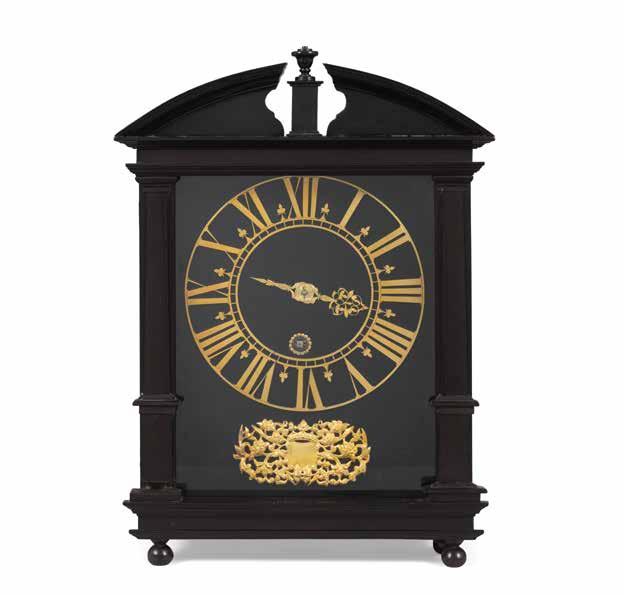
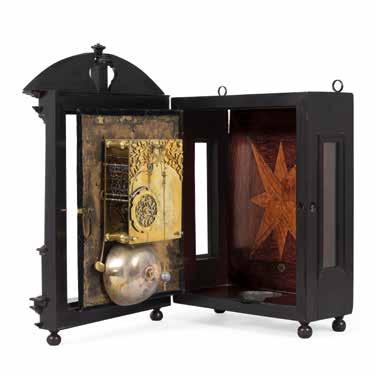
30 * A FINE AND RARE LATE 17TH CENTURY EBONY ‘HAAGSE’ CLOCK
Christian Reynaert, Leyden
The architectural case with arched entablature centred by a turned urn on a pedestal, over a moulded cornice raised on tapering pilasters, all raised on turned ball feet, and set to the top with a pair of iron suspension hooks for wall mounting. The 8 inch rectangular velvetcovered dial with gilt brass skeletonised Roman chapter ring, with inner quarter-hour track and decorated winding square, with finely pierced and engraved counter-poised hand. Signed on a repousse brass hinged plaque Christiaen Reijnaert In Leyden . The dial plate hinged and opening to reveal the single barrel movement with tandem winding driving a verge escapement with silk supsension between cycloidal cheeks, the light brass rod terminating in a spherical lead bob. The strike dictated by a finely pierced, engraved and numbered countwheel mounted on the backplate, the accompanying steelwork turned and fettled, striking on a bell set vertically below. On opening the case, the rear ‘show wood’ parquetry stellar inlay is revealed, together with the circular aperture in the base to allow the sound of the bell to travel.
Ticking and striking, sold together with an associated door/winding key 39cms (15.5ins) high.
£5,000 - 8,000
€5,800 - 9,300
US$6,700 - 11,000
Literature:
This clock is illustrated and described over two pages in Dr. R . Plomb: Spring Driven Dutch Pendulum Clocks, 1657-170, Schiedam 1979, pp198-199.
QUARTER REPEATING TABLE TIMEPIECE OF SMALL SIZE
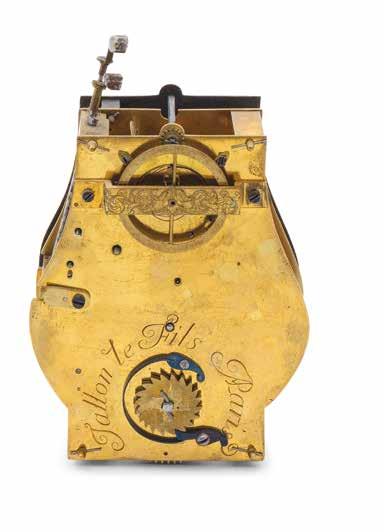
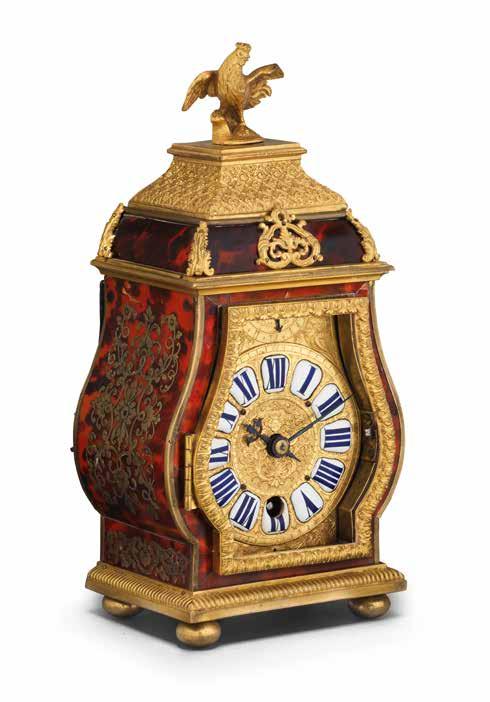
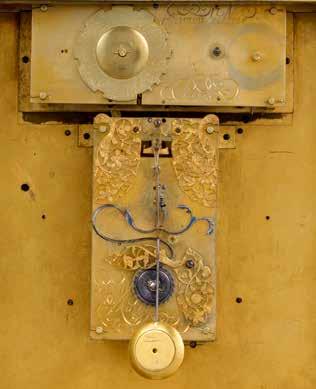
Tallon Le Fills A Paris
The bombe case surmounted by a cast gilt bronze cockerel over a decorated ormolu bell top, on a moulded tortoiseshell base with gilt mounts to each corner and a central applied mount, the front door cast with decorative work and the sides with engraved boulle panels, the moulded base with knurled decoration raised on four bun feet. The 4-inch dial with enamel blue Roman numerals on shaped white enamel cartouches, framed by a minute band and Arabic five-minute markers, the centre with cast decoration of an urn among floral motifs, the dial plate engraved with further foliate patterns and a regulation dial to the top, signed Tallon Le Fils A Paris , with blued steel hands. The movement with shaped plates following the outline of the case, united by four square
pillars, with verge balance wheel escapement and an engraved balance bridge mounted to the backplate, signed below and fitted with open click and ratchet work. The quarter repeating mechanism repeating on a pair of bells mounted above. Ticking and repeating. Sold together with a winding key. 28cms (11ins) high.
£2,000 - 3,000
€2,300 - 3,500
US$2,700 - 4,000
The Talon family were established in Paris in the later years of the 17th century. Louis Tallon, the earliest recorded member of the family worked from 1696 in the Rue Coquillere. After he took his son, Louis, into the family firm, their clocks were signed ‘Tallon le fils’ until later in the 18th century.
32 *
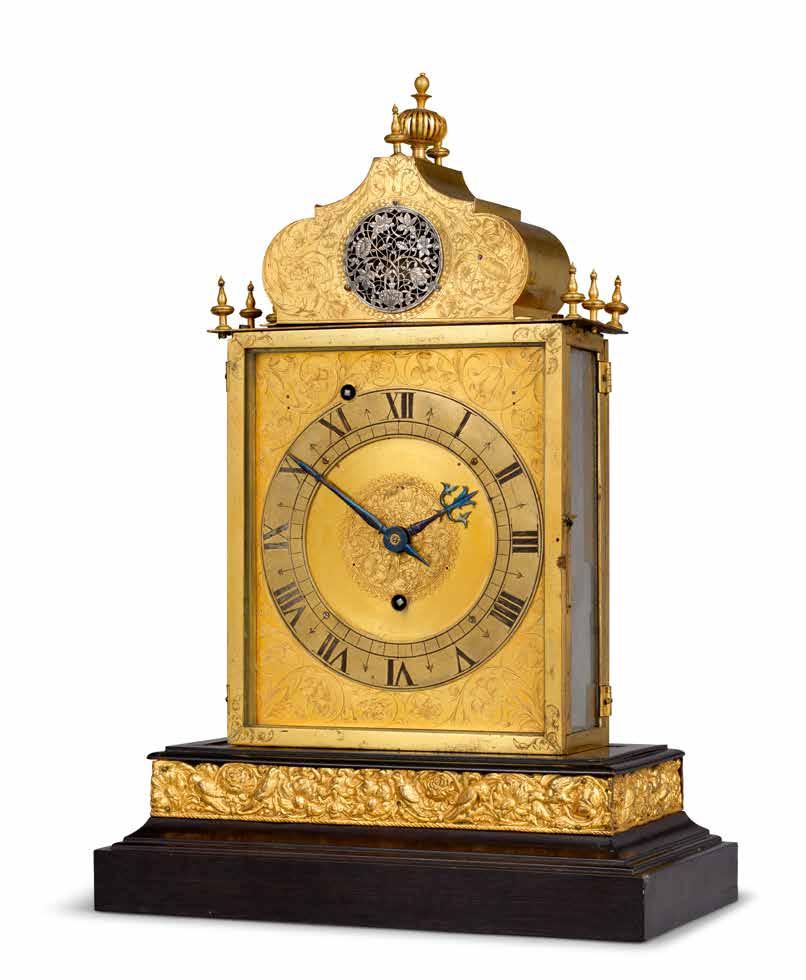
AN IMPORTANT AND RARE FRENCH GILT BRASS EARLY PENDULUM STRIKING CLOCK, CIRCA 1655–1658
Simon Le Noir, Paris surmounted by a shaped cupola engraved to the front and rear with interlaced foliage and flowers, both sides inset with a silver boss of delicately pierced flowerheads, tendrils and leaves issuing from an urn (the rear boss features a wicker basket of fruit), over glazed sides held in gilt and frames with external hinges and engraved foliage to the corners, on a stepped ebony veneered base inset with a cast running mount of birds and flowers. The engraved gilt brass dial measuring 19cms x 16cms (7.5ins x 6.25ins) and set with a Roman chapter ring with inner quarter hour track framed by delicate floral scrolls above and below, a similarly engraved centre sits within a plain band and blued steel hour and minute hands. The going train is wound through the centre, the strike train is wound above XI. The movement consists of two separate units. The going train has upright rectangular plates united by distinctive square-section pillars, the spring barrel driving a four-wheel train terminating in a verge escapement with silk suspended pendulum. The backplate with highly decorated pierced brass and fettled steel set-up on the ratchet, along with two further pierced panels above the signature Simon Le Noir AParis The strike train mounted horizontally above the going movement, with identical pillars, but pierced and engraved spring barrel and solid outside countwheel acting on the bell above, with repeat signature Simon Le Noir, AParis 43cms (17ins) high.
£5,000 - 8,000
€5,800 - 9,300
US$6,700 - 11,000
Simon Le Noir occupies a highly intriguing and increasingly important position in the early history of the pendulum clock. Recent scholarship led by Augustin Gomand has re-examined this very clock within the wider context of mid-17th century scientific experimentation surrounding
Galileo’s pendulum theories, the early Dutch pendulum clocks of Christiaan Huygens and Salomon Coster, and the broader European network of scholars connected to the court of John Casimir Vasa. In 2025, the present Lot became the focus of the Simon Le Noir Project , an extensive interdisciplinary study combining archival research, horological analysis, metallurgy, tomography, and conservation science. The research identified a number of highly unusual stylistic and technical features linking Le Noir’s work more closely to late Renaissance clockmaking traditions than to the later French pendules religieuses derived from Dutch models after 1658. Among these characteristics are richly engraved gilt-brass ornamentation, primitive pillar forms, watchderived train architecture, independent striking arrangements, and short pendulum construction features suggesting an experimental transitional phase in the development of pendulum-regulated domestic clocks.
Particularly compelling is the survival of an early historical account written circa 1720 by the Parisian horological historian Claude Labey (“Raillard”), who recorded that Simon Le Noir had applied the pendulum to clocks in Paris following communications concerning Galileo’s work transmitted through scientific circles associated with the Polish court. While the central role of Huygens in the practical invention and dissemination of the pendulum clock remains undisputed, modern research increasingly supports the view that several experimental workshops across Europe (including those associated with the Fromanteel family in England and Le Noir in Paris) may have participated in parallel early investigations into pendulum timekeeping during the late 1650s.
As such, the present clock is now regarded not merely as an exceptionally rare early French pendulum clock, but as a potentially important documentary object from the formative experimental period of scientific horology in Europe.
Provenance:
The present clock can be securely traced to the celebrated collection of Jean-Léonce Leroux (1811–1895), one of the foremost 19th century French collectors of Renaissance horology. Leroux, a chevalier de la Légion d’honneur and official within the French Ministry of the Navy, assembled an important collection of clocks, watches, enamels, sculpture, paintings, and works of art.
The clock appeared in the posthumous sale of the Leroux Collection conducted at the Hôtel Drouot, Paris, in 1896, where it was catalogued as lot 583 and described as:
“A rectangular gilded copper clock with an oriental-style dome, featuring on the front and back a silver disc pierced and engraved in the style of Gilles Legaré. This clock is unique in having two separate movements, one for the hours and the other for the striking mechanism... Both movements bear the inscription: Simon Le Noir, à Paris. Beginning of the reign of Louis XIV.”
Archival examination of the auctioneer Paul Chevallier’s annotated sale records further revealed the purchaser to have been a certain “M. Bacot,” although his precise identity remains unknown.
The clock had also been exhibited earlier in the landmark 1880 exhibition of the Union Centrale des Beaux-Arts appliqués à l’Industrie in Paris, where the Leroux collection formed an important display devoted to Renaissance horology. The present lot was mistakenly catalogued under the name “Étienne Lenoir,” almost certainly due to confusion with another clock in the Leroux collection, but the description clearly corresponds to the present lot.
Bonhams is grateful to Augustin Gomand for his time a help in researching this lot.
33 *
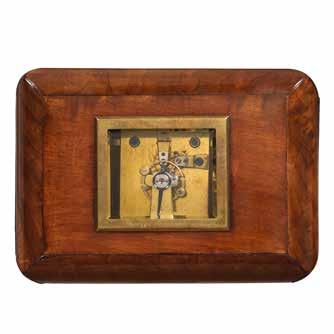
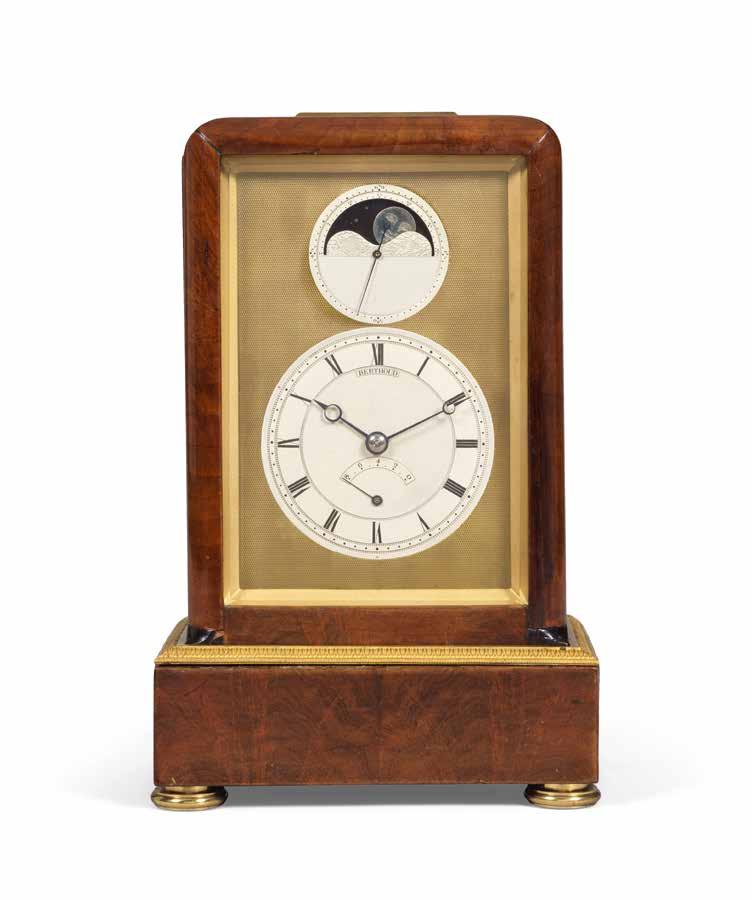
A VERY FINE THIRD QUARTER OF THE 19TH CENTURY FRENCH ORMOLU-MOUNTED MAHOGANY TABLE REGULATOR WITH CHRONOMETER ESCAPEMENT, REMONTOIR AND MOONPHASE DIAL
Berthoud, Paris
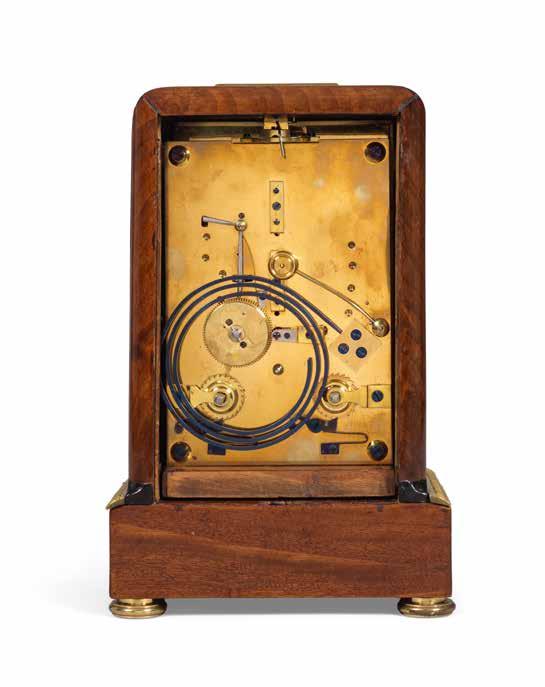
The rectangular case with moulded corners and surmounted by a brass-framed bevelled glass inspection panel revealing the chronometer platform below, the sides of polished mahogany terminating in a lotus-leaf cast ormolu frame, the plinth base on brass button feet. The 4 inch rectangular dial set to the top with a subsidiary rolling moonphase with engraved stars and moon against a blued background, the outer arc marked 1-29.5 to give the age of the moon, further set to the centre with a counterbalanced blued steel seconds hand reading against the outer scale 0-60, the larger time dial below with dotted minute band framing the elegant Roman hours and engine turned centre with a power reserve arc at VI, with blued steel Breguet style hands, all enclosed by a fine latticeeffect engine turned mask and angled sight ring. The twin spring barrel movement striking the halfhours and hours on a rectangular-section blued steel gong, the going train re-winding a subsidiary remontoir geared directly onto the jewelled centre wheel and terminating in a platform with flat blued steel hairspring to a cut and compensated chronometer style bimetallic balance and jewelled pivoted detent escapement. Ticking and striking.
27cms (11ins) high.
£8,000 - 12,000
€9,300 - 14,000
US$11,000 - 16,000
William Congreve, London.
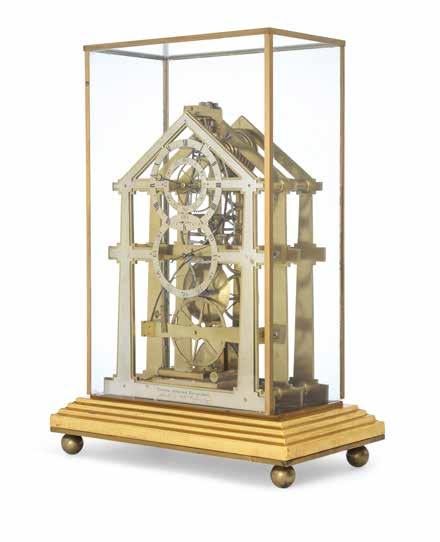
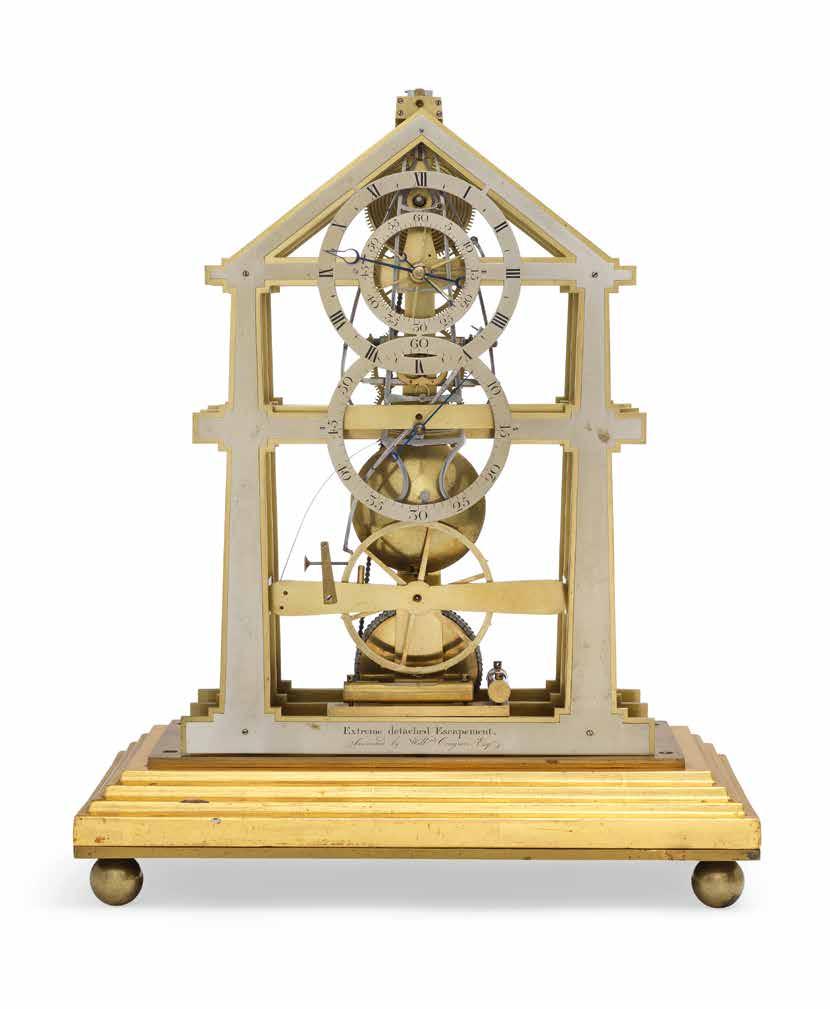
The frame comprised of three substantial openwork rafters, each with a triangular pediment and central bar united by eight tapering knopped pillars, screwed onto a heavy brass baseplate secured to a stepped and moulded gilt wood base on brass ball feet, with a later bespoke five-panel glass shade for protection. The foremost frame applied with a silvered plate that carries the three interlocking subsidiary dials for hours, minutes and seconds, each with a finely finished blued steel hand and signed along the lower edge Extreme detached Escapement, Invented by Willm. Congreve Esq below the pair of brass-framed spirit levels. The eight day movement with a distinctive conical fusee cut with deep grooves to accept the substantial chain which runs approximately 10 inches down to the large spring barrel below, the inverted train with six wheels of six delicate crossings, triple-screwed collets and high count pinions. The knife-edge steel pendulum frame formed as an open tear drop with adjustable central brass bar for beat adjustment over a lenticular brass-faced bob with rating nut, a subsidiary frame carries the gathering pallet and impulse rack, the seconds hand set directly on the 60-tooth ‘scape wheel and with pin to release the minutes below every 60 seconds and thereby impulse the pendulum. 51cms (16.5ins) high.
£20,000 - 30,000
€23,000 - 35,000
US$27,000 - 40,000
Provenance:
A distinguished UK private collection. Purchased Sotheby’s New Bond Street, 15th December 1994, lot 302, featured on the catalogue front cover.
This important clock with extreme detached escapement is one of perhaps half a dozen extant in the world today:
The British Royal Collection includes two currently enjoyed at Buckingham Palace, but originally commissioned by the Prince of Wales (later King George IV) for Carlton House. One is weight driven in a floor standing case, the other is a spring driven table example similar to the current lot but with the addition of a striking train and subsequently wider frame. Both of these are signed for Congreve as the inventor and Joseph Moxon as the maker. While the current lot does not feature Moxon’s signature, it is quite possible that it too was made by him. Unfortunately, both Royal examples have had their original escapements converted to an Earnshaw type escapement.
Two other examples are known in high-quality ormolu cases, the first is illustrated by Cecil Clutton in Antiquarian Horology, June 1958, page 125 in an article comparing the two types of Congreve clock, the rolling ball and the extreme detached escapement. Clutton’s detached example was still owned at the time by the Congreve family. The second of the ormolu-cased clocks was sold at Christie’s on June 12th 1996, lot 272, estimated at £10,000-15,000, it sold for £30,000. The dial was cast as a military trophy bearing the royal arms, signed “William Congreve, London, invenimus et patenti,” with the date 14th September 1808.
The final known two known examples include the current lot, and the example from The Time Museum, sold Sotheby’s 19th June 2002, lot 193, Time Museum Inventory No.1144, and later sold Christies December 2006, lot 65.
William Congreve (1772 - 1828) was the son of a baronet. Educated at Cambridge, he applied his innovative brain not only to horology, but also to the science of rocketry - indeed his invention ‘the Congreve Rocket’ helped shorten battles during the Napoleonic Wars, most noticeably at Leipzig and during the siege of Copenhagen. He took out two patents in 1808, the first for his eponymous Rolling Ball clock, based on the action of a rolling ball on a pivoted and tilting base; over the following 200 years this has inspired countless copies. On 28th August of the same year, he patented the extreme detached escapement. About 2 years later he was made Equerry to the Prince of Wales, and in 1811 was elected a Fellow of the Royal Society. The same year he was made a Lieutenant-Colonel in the Hanoverian artillery. After his father’s death in 1814, he succeeded to the baronetcy as well as the office of Comptroller of the Royal Laboratory.
As Congreve described himself as an “Esquire” on the signature plate of this clock, it is likely that it was made prior to 1814 and his subsequent rise in social rank.
Further reading: For an overview of these clocks and the life and work of Sir William Congreve see:
Roberts, D. (1987) Skeleton Clocks, Britain 1800-1914. Antique Collectors Club. p 79-88.
Jagger, C. (1983) Royal Clocks The British Monarchy and its Timekeepers 1300 – 1900. London p.198-200
Royer-Collard, F.B. (1969) Skeleton Clocks. London: N.A.G. Press Ltd., p136-140.
35
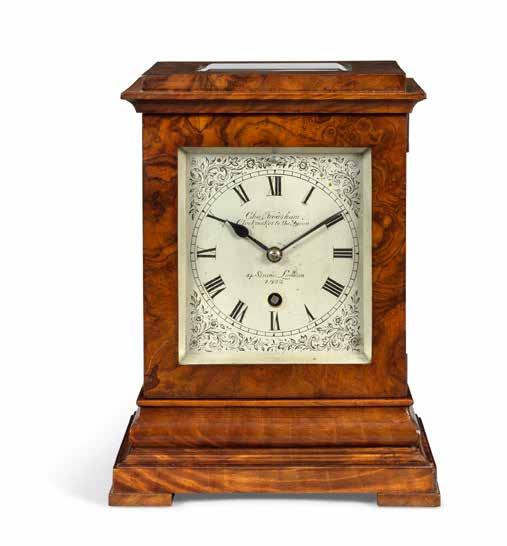
36 A LATE 19TH CENTURY BURR WALNUT VENEERED LIBRARY TIMEPIECE
Charles Frodsham, 84 The Strand, London, No. 1922
The case with flat top with bevelled glass observation window over a moulded top, the sides with further bevelled observation windows, the plain front with moulded base and sitting on four block feet. The 3 inch silvered brass dial with black Roman numerals signed Charles Frodsham, Clockmaker to the Queen, 84 Strand, London number 1922 framed with floral engraving. The single fusee movement with chain fusee and maintaining power with pendulum rise and fall for the anchor escapement, signed on the back plate by the maker, currently ticking. 22cm (9ins) high.
£600 - 900
€700 - 1,000
US$810 - 1,200
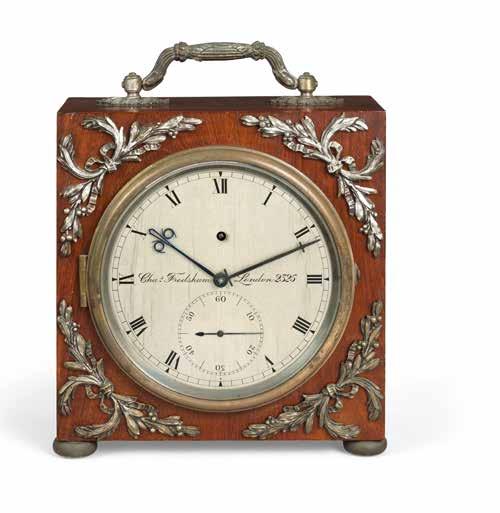
Charles Frodsham, London, number 2325
The square case surmounted by a substantial ribbon-tied reeded foliate handle over plain sides and squat bun feet, the front set with laurel and berry mounts framing the heavy cast bezel. The 6 inch silvered Roman dial with outer minute track enclosing the bold signature Chas. Frodsham, London, 2325 above the subsidiary seconds dial at VI, with blued steel stylised beetle and poker hands. The signed and numbered inverted movement with spring barrel and English lever platform escapement mounted to the underside of the canted square plates. 29cm (11.5in) high.
£2,500 - 3,500
€2,900 - 4,100
US$3,400 - 4,700
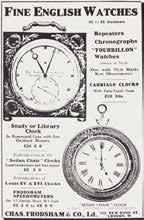
This intriguing model dates to circa 1920 and is one of a very small series produced either side of the First War. Mercer illustrates a 1911 Country Life advertisement in The Frodshams, AHS, 1981 plate 48 which features this and a Sedan Chair clock. It is interesting to note that they were selling their carriage clocks at the time “with deep-toned gong” for £10 and 10 shillings. This model, described as a “Study or Library Clock In Rosewood Case, with fine Oxidised Mounts” was two and a half times as expensive, priced at £26 and 5 shillings.
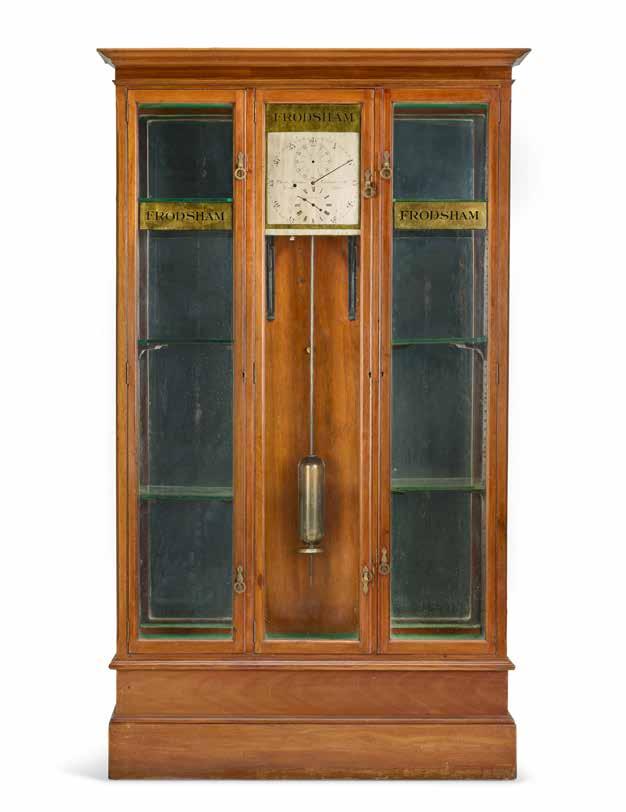
Charles Frodsham, London Clockmaker to the King No 2376
The display cabinet with a moulded top, fitted with two glazed compartments to either side of the central clock section, each with three glass shelves. Beneath the upper shelf, gilt lettering to the glass reading Frodsham . The front fitted with three lockable glazed doors, all terminating in a moulded base and raised on a plinth. The 10 inch silvered regulator dial with Arabic minute divisions and separate hour dial with Roman numerals, with observatory marks to the subsidiary seconds dial,
the seconds hand now missing, signed to the centre Charles Frodsham, London Clockmaker to the King No 2376 . The movement with deadbeat escapement and shaped plates, powered by a single brass-clad weight and zinc pendulum with fine silvered regulation nut, currently ticking and striking. 198cms (78ins) high.
£2,000 - 3,000
€2,400 -3,400
US$2,800 - 4,000
38 *
AN EXCEPTIONAL MID 19TH CENTURY ENGLISH GIANT PATINATED BRASS CARRIAGE CLOCK WITH TWIN POWER RESERVES FOR STRIKE AND GOING TRAINS
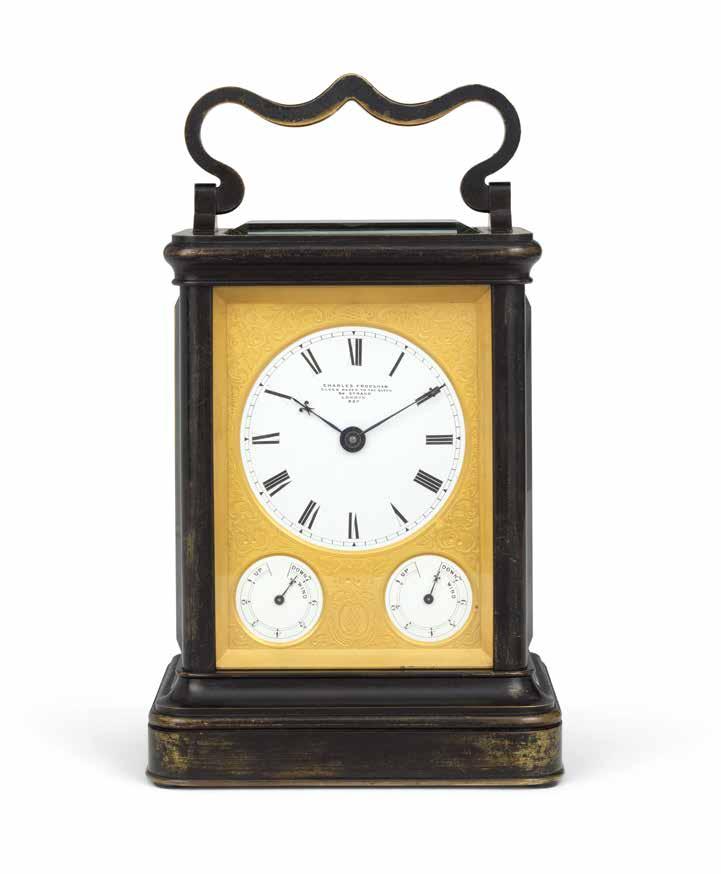
Charles Frodsham, London, No. 990
The serpentine handle set over a large bevelled glass inspection panel framed by the moulded overhanging cornice supported on rounded uprights to a moulded base, the front and sides with matching heavy bevelled glass panels, the rear solid panel with three shuttered squares for hand setting and winding, lifting out if necessary via a sliding catch and pair of pins. The rectangular 3.75inch gilt dial with a fully engraved mask of roses and other flowers and foliage scrolls against a hatched ground to act as a counterfoil to the crisp white enamel dials, the larger time dial with minute band and fine blued steel fleur de lys hands, signed across the centre CHARLES FRODSHAM, CLOCK MAKER TO THE QUEEN, 84 STRAND, LONDON, 990 set above the smaller subsidiary dials for power reserve of both movement trains, marked UP and DOWN over the 1-8 scale, with matching blued steel fleur de lys hands.
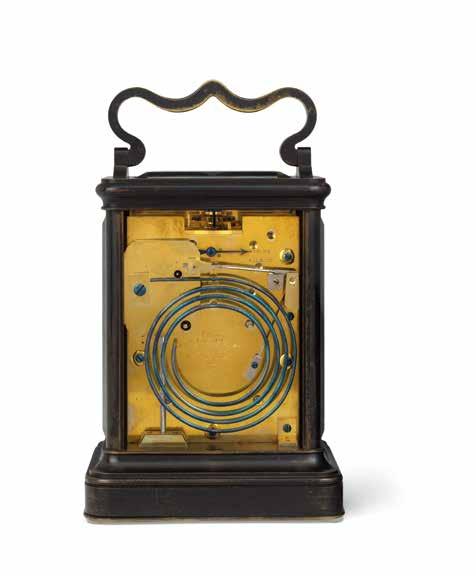
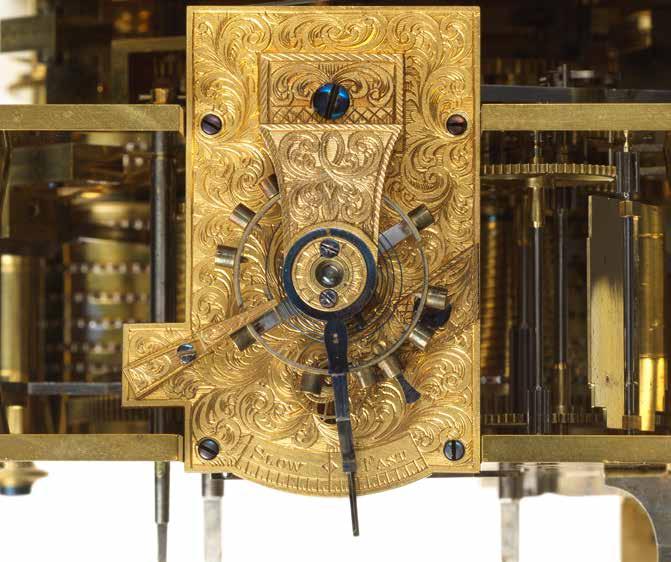
The substantial twin chain fusee movement with heavy plates united by five pillars secured front and back with collets and blued steel screws; the going train with maintaining power, terminating in a large shaped gilt platform fully engraved in the manner of a watch cock with foliate scrolls on a hatched ground, the shaped cock with jewelled endstone to a flat spiral hairspring carrying a cut and compensated bimetallic balance with heavy timing weights to a jewelled English style lever escapement. The strike train striking the half-hours and the full hours on a large circular-section blued steel gong mounted on a raised heavy brass block set into the base, with Strike/Silent selection lever to the backplate. The highly polished backplate signed across the centre Arnold’s, CHARLES FRODSHAM, Clock Maker to the Queen, 84 STRAND, LONDON, 990 . Ticking and striking. 26 (10.25ins) high.
£15,000 - 25,000
€17,000 - 29,000
US$20,000 - 34,000
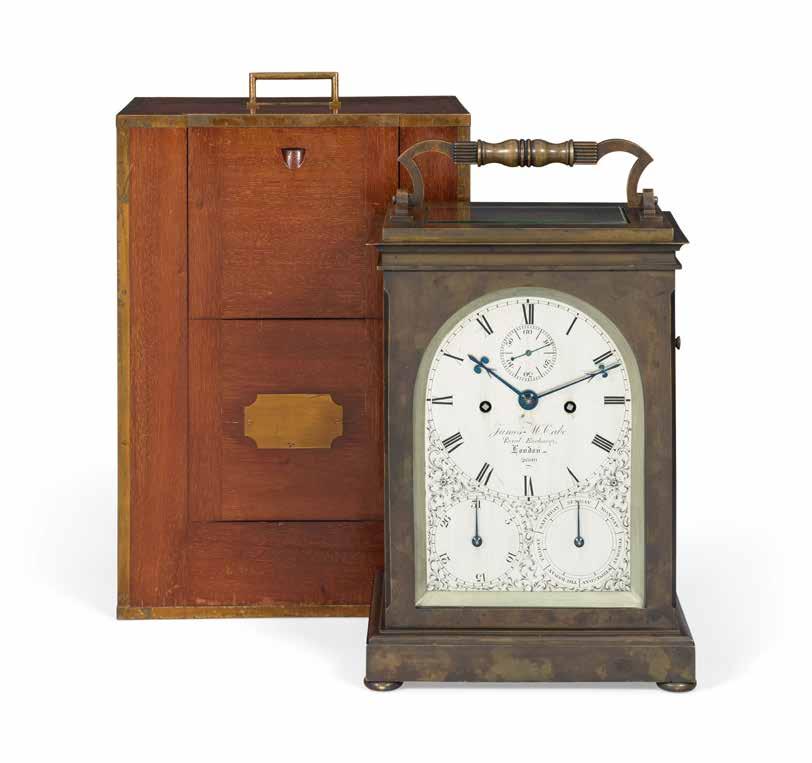
AN EXCEEDINGLY LARGE PATINATED BRASS QUARTER CHIMING CARRIAGE CLOCK WITH CALENDAR DIALS, TOGETHER WITH A WOODEN TRAVEL CASE.
James McCabe, London, No.2609
The case measuring 14.5 inches (37cms) to the top of the turned and ribbed handle set over a large bevelled glass inspection panel framed by a stepped caddy and wide overhanging cornice, the sides set with fish scale side frets to a moulded plinth base on squat bun feet. The 5.5 inch arched silvered Roman dial with minute track and blued steel fleur de lys hands over twin subsidiaries for date (1-31) and day of the week (in English), all within an engraved mask of foliate scrolls and flowerheads framed by an angled sight ring. Signed below the centre James McCabe, Royal Exchange, London, 2609 . The massive twin chain fusee movement with maintaining power and large frosted gilt platform with monometallic balance and underslung lever escapement, the strike train sounding the
hours with two large brass-headed hammers on a pair of stacked bells mounted perpendicular to the backplate (the larger bell 16cms, (6.25ins) in diameter), furthermore repeating the last hour on depression of a button set to the right hand side of the case. Ticking and striking but would benefit from an overhaul. Together with a velvet-lined brass-bound mahogany travel box with campaign style handle to the top, over a front with sliding central section, and opening rear door. 37cms (14.5ins) high.
(McCabe)
£10,000 - 15,000
€12,000 - 17,000
US$13,000 - 20,000
Provenance:
Christies London, 23rd September 2010.
40 *
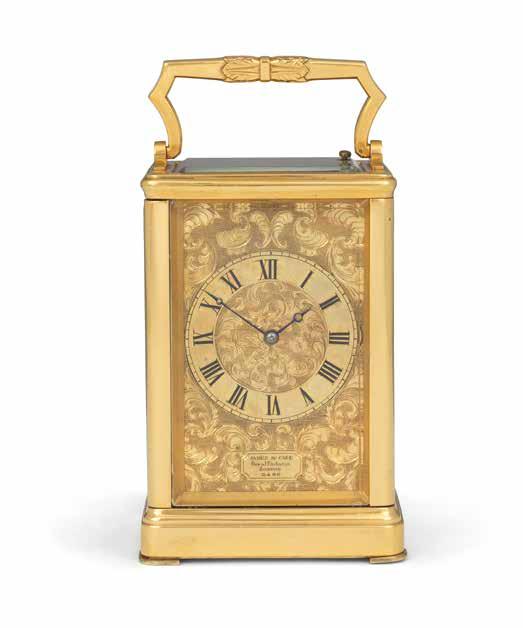
A MID 19TH CENTURY ENGLISH GILT BRASS TWIN FUSEE REPEATING CARRIAGE CLOCK
James McCabe, Royal Exchange, London, No.2486
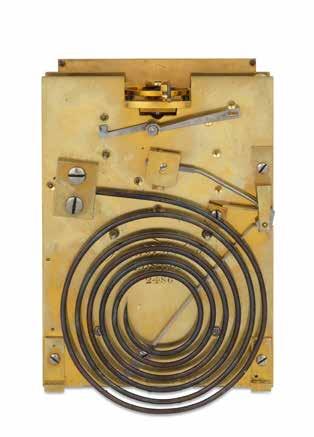
Surmounted by a foliate-tied handle over a large bevelled glass inspection panel with internal repeat button framed by a moulded cornice on curved uprights to a moulded base, with bevelled glazed sides and a solid rear door with shutters to access hand setting and winding, with regulation slot and Strike/Silent lever. The 2.5 inch rectangular dial with Roman chapter ring within a mask of foliage against a hatched ground, with polished signature plaque signed JAMES MCCABE, Royal Exchange, London, 2486 . The twin chain fusee movement with maintaining power to the cruciform-shaped platform carrying the gilt metal monometallic balance and underslung lever escapement, striking on a coiled steel gong. 18.5cms (7.25ins) high.
£4,000 - 6,000
€4,600 - 7,000
US$5,400 - 8,100
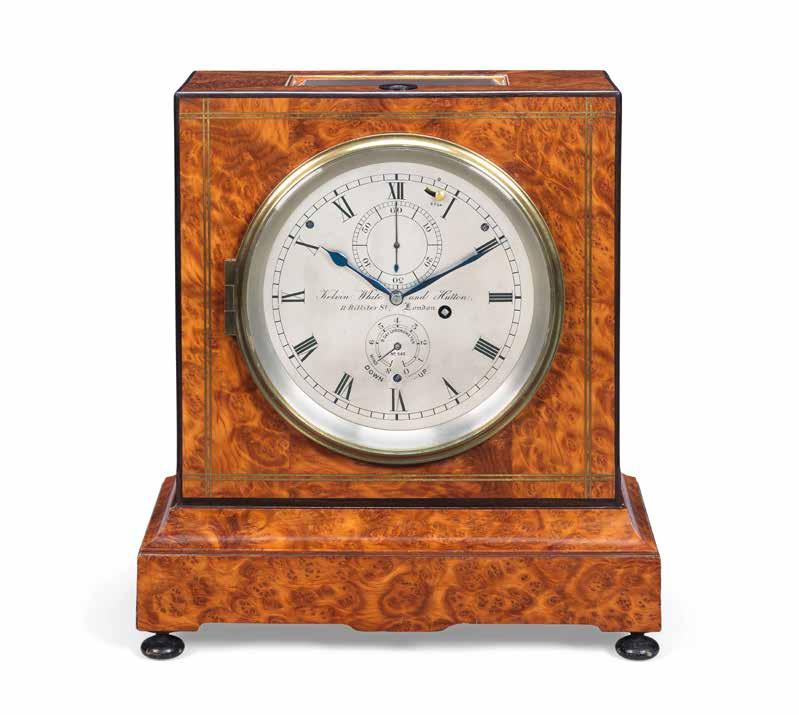
41 A VERY FINE FIRST HALF OF THE 20TH CENTURY EBONY- AND BRASSINLAID BURR AMBOYNA 8 DAY TABLE CHRONOMETER
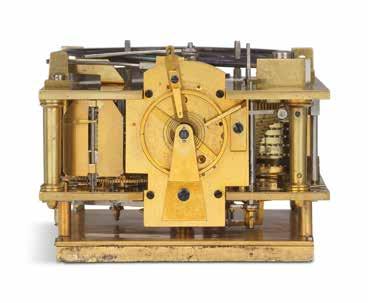
Kevin, White and Hutton, 11 Billiter St, London. No. 545. The flat top case with bevelled glazed observation window and ebonyframed spirit level, the sides with similar glazed panels, the front with double brass stringing framed by an ebony border, over a concave moulded base on adjustable bun feet. The 5.25 inch signed silvered dial with black Roman numerals within a minute track, the centre with Arabic running seconds dial over a power reserve dial marked 0-8, with finely finished blued steel hands with stop lever to the upper right of the dial signed Kevin White and Hutton 11 Billiter St London and numbered 545
The substantial eight day movement with thick plates united by four robust pillars, the single train with maintaining power to the chain fusee, and terminating in a fine spring detent chronometer escapement with helical hairspring and diamond endstone to a heavy cut and compensated bimetallic balance. The plates, platform and baseplate all displaying a machined decorative finish. Ticking and sold with a (later) winding key. 28cms (11ins) high.
£5,000 - 7,000
€5,800 - 8,100
US$6,700 - 9,400
CHRONOMETER
Thomas Mercer, London & St Albans, Maker to The Admiralty
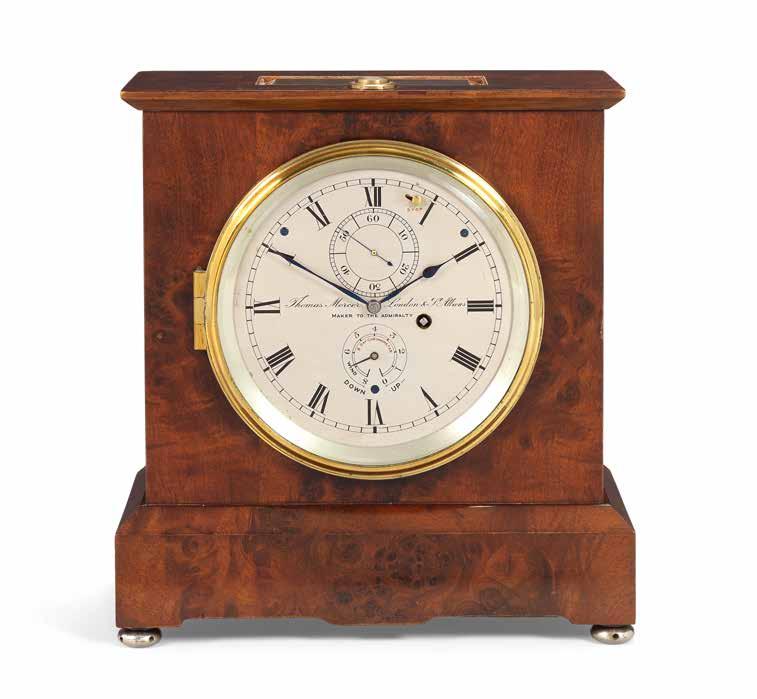
The flat topped case with bevelled glass observation window and raised brass-framed spirit level over a moulded cornice, shaped side inspection panels and a plain front to a moulded base raised on adjustable silvered brass bun feet. The 5.25 inch silvered brass dial with outer minute track framing the black Roman numerals and subsidiary dials for running seconds (with Observatory Marks) and power reserve dial marked 0-8, all with very finely finished blued steel hands with stop lever to the upper right of the dial, signed across the centre in two lines Thomas Mercer, London & St Albans, MAKER TO THE ADMIRALTY
The substantial eight day movement with thick plates united by four
robust pillars, the single train with maintaining power to the chain fusee, and terminating in a fine spring detent chronometer escapement with helical hairspring and diamond endstone to a heavy cut and compensated bimetallic balance. The plates, platform and baseplate all displaying a machined decorative finish. Ticking and and sold with the original winding key. 27cms (11ins) high.
£3,000 - 5,000
€3,500 - 5,800
US$4,000 - 6,700
A similar example, veneered in mahogany rather than walnut, was sold in these rooms, Fine Clocks , 2 December 2025 , lot 60
CHRONOMETER
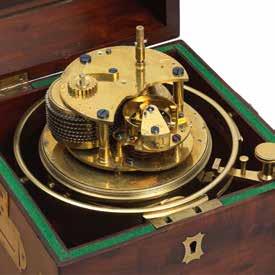
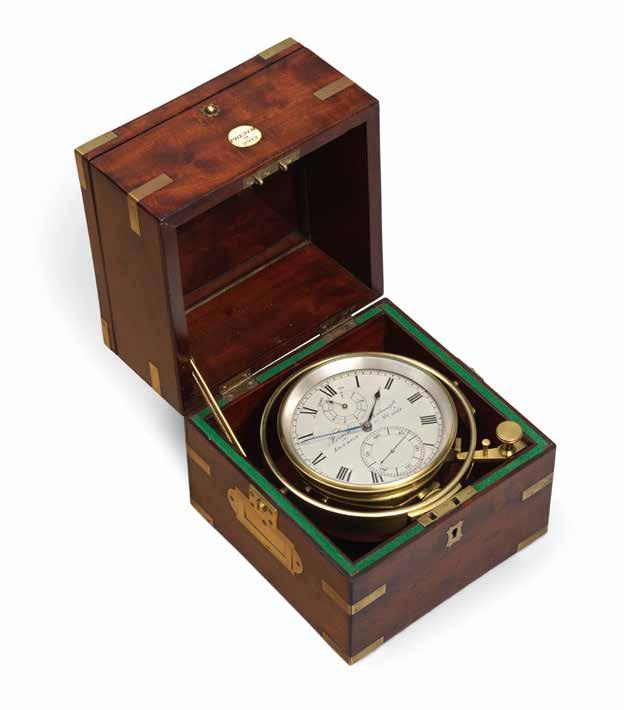
French Royal Exchange, London Number 9912
The three part case with brass corners, nameplate and escutcheon, set with recessed handles to the sides, mounted internally with a brass sliding stay and felt edged lower section. The 4.5 inch silvered Roman dial with minute track enclosing the subsidiary dials for power reserve (marked in days from 0-8), the seconds marked on an intricate track with blued steel hands. The stepped movement with three-quarter plate framing the large chain fusee and maintaining power to a smaller plate with Earnshaw type detent escapement and freesprung blued steel helical spring with diamond endstone. Signed in full French, Royal Exchange, LONDON, No.9912 , wound via an integral key screwed on to the winding arbor and protruding through the rear of the numbered, weighted bowl suspended in gimbals. Ticking. 20cms (8ins) high.
£2,500 - 3,500
€2,900 - 4,100
US$3,400 - 4,700
44
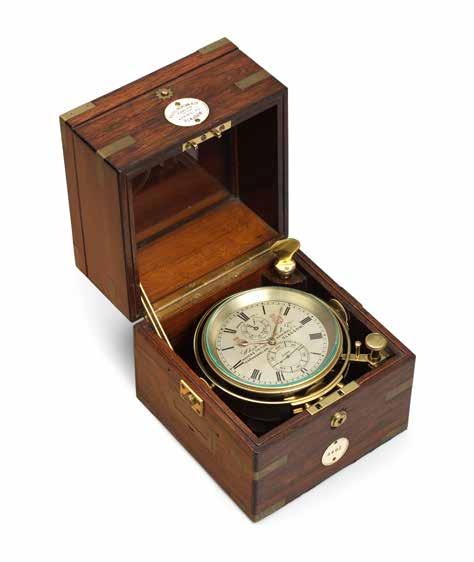
A LATE 19TH CENTURY ROSEWOOD VENEERED TWO DAY MARINE CHRONOMETER
Whyte, Thomson & Co., Makers to the Admiralty, 144 Broomielaw, Glasgow, No. 4492
The three tier brass bound rosewood box with Bramah lock and flush recessed carrying handles, the white disc to the front of the middle section inscribed Whyte, Thomson & Co., Makers to the Admiralty, Glasgow , with a further disc to the lower section inscribed 4492 . The 4 inch silvered dial signed Whyte, Thomson & Co., Makers to the Admiralty, 144 Broomielaw, Glasgow, No. 4492 , with Exhibition “Garter Awards” medallions for 1886 at II and X, Roman hour chapters, gilt hour and minute hands, subsidiary seconds and up-and-down dials with blued steel hands. The movement with Earnshaw escapement, spring detent with jewelled locking pallet, cut bi-metallic balance with circular heat compensation weights and blued steel helical balance spring, contained within a brass bowl and gimbal. Ticking and sold together with a case key and winding key. 19cms (7.5ins) high.
£1,500 - 3,000
€1,700 - 3,500
US$2,000 - 4,000
FOR FUTHER INFORMATION, PLEASE SEE APPENDIX
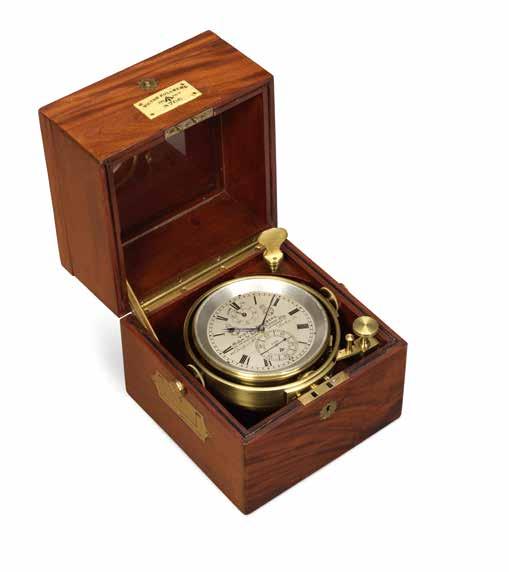
45 A GOOD EARLY 20TH CENTURY MAHOGANY TWO-DAY MARINE CHRONOMETER
Victor Kullberg, 105 Liverpool Rd, London, No.8706
The three-tier mahogany box with recessed side handles, brass escutcheons and an ivorine number plaque, opening to reveal the internal ebonised dust beading and lock stamped O&SL . The 4-inch silvered dial with angled sight ring framing the minute track and Roman numerals, engraved with two medals and the signature VICTOR KULLBERG, Maker to the Admiralty, THE INDIAN & ITALIAN GOVERNMENTS, 105 Liverpool Rd. London, No. 8706 . Subsidiary power reserve dial below XII running to 56 hours in 8-hour increments with instruction to wind at 24, the seconds dial at VI with Observatory marks and further engraved TEN GOLD MEDALS AWARDED.DIPLOMA OF HONOR SOLE & HIGHEST
AWARD VIENNA with engraved Admiralty arrow and fine blued steel hands. Suspended in lockable gimbals, the numbered brass bowl with sprung winding shutter and engraved H.S.^1 to the underside. The full plate spotted movement with four turned pillars secured by blued steel screws, maintaining power with steel click and blued steel spring to the chain fusee, free sprung invar helical hairspring set on a spotted cock with diamond endstone to a ‘late-style’ Kullberg cut and compensated bimetallic balance with circular timing screws, to an Earnshaw spring detent escapement. The pillar plate with repeat Ordnance Arrow. Ticking, together with a numbered safety winding key. 20cms (8ins) high.
£1,200 - 1,800
€1,400 - 2,100
US$1,600 - 2,400
FOR FUTHER INFORMATION, PLEASE SEE APPENDIX
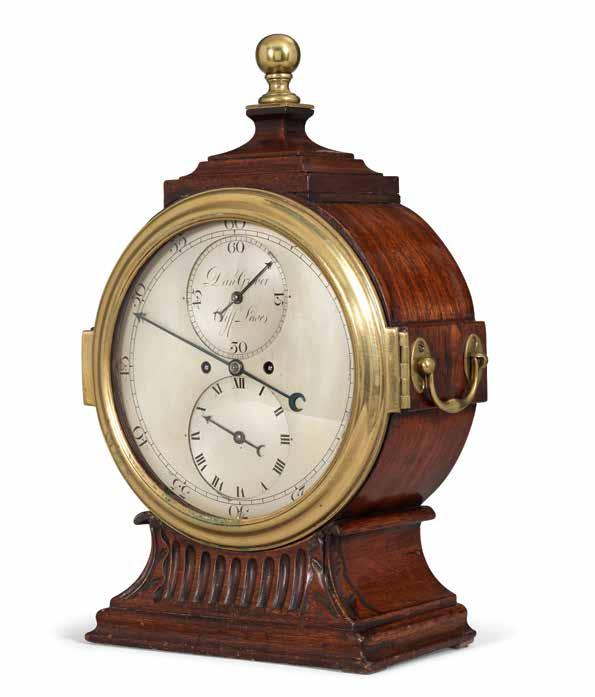
Daniel Grover, Cliff Lewes
The drum shaped case surmounted by a bold brass ball finial and mounted to the sides with substantial carrying handles, the concave base reeded and carved with foliage to the front corners, the 9 inch one-piece silvered dial signed ‘Danl. Grover, Cliff, Lewes’ enclosed by a heavy cast brass locking bezel, with outer minute track framing the recessed subsidiaries for rise and fall regulation (marked in Arabic quarters) and Roman hours, with three matching blued steel hands and ‘dummy’ winding hole to the right hand side, the single chain fusee movement with tall shouldered plates united by
four knopped pillars, with deadbeat escapement to a pendulum with heavy lenticular bob. 46cms (18 inches) high.
£3,000 - 5,000
€3,500 - 5,800
US$4,000 - 6,700
Literature:
This clock is the subject of an extensive article by Brian Loomes in ‘Clocks’ Magazine Spring 2019.
47 W TP
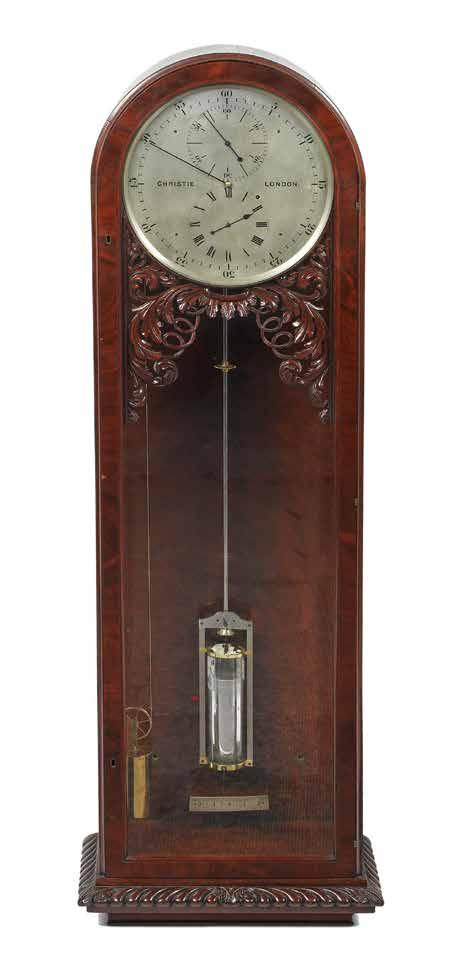
A GOOD MID 19TH CENTURY MAHOGANY WALL MOUNTED EIGHT DAY REGULATOR WITH MERCURY JAR PENDULUM
Christie, London
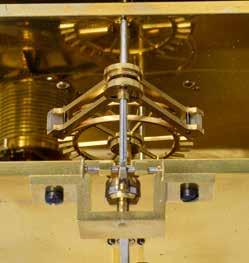
The arch top case with full length glazed door with double locks and inner felt lining to repel dust, terminating in a carved gadrooned base. The 11.5 inch signed silvered dial with blued steel hands and concentric minute band enclosing the subsidiary dials for running seconds (with Observatory marks), and Roman hours, within an angled sight ring, bordered to the lower half by a pierced carved cresting of foliate scroll work. The substantial weight driven movement secured to the seatboard via three heavy brass L-shaped brackets with thick plates united by six tapering ‘cannon barrel’ pillars screwed to the front plate, with maintaining power, high count pinions and wheels of six crossings throughout, the deadbeat escapement with skeletonised pallets holding large facetted jewels, the crutch with fine screw beat adjustment to the steel rod and brass crutch to a mercury jar pendulum suspended from a substantial bracket with adjustable suspension assembly, reading against a silvered beat scale at the base. Ticking.
170cms (67ins) high.
£5,000 - 8,000
€5,800 - 9,300
US$6,700 - 11,000
Provenance:
Sold in these rooms 20th June 2012, lot 136.
William Christie is recorded as working in London from 1825 until 1881.
George Pyke, London
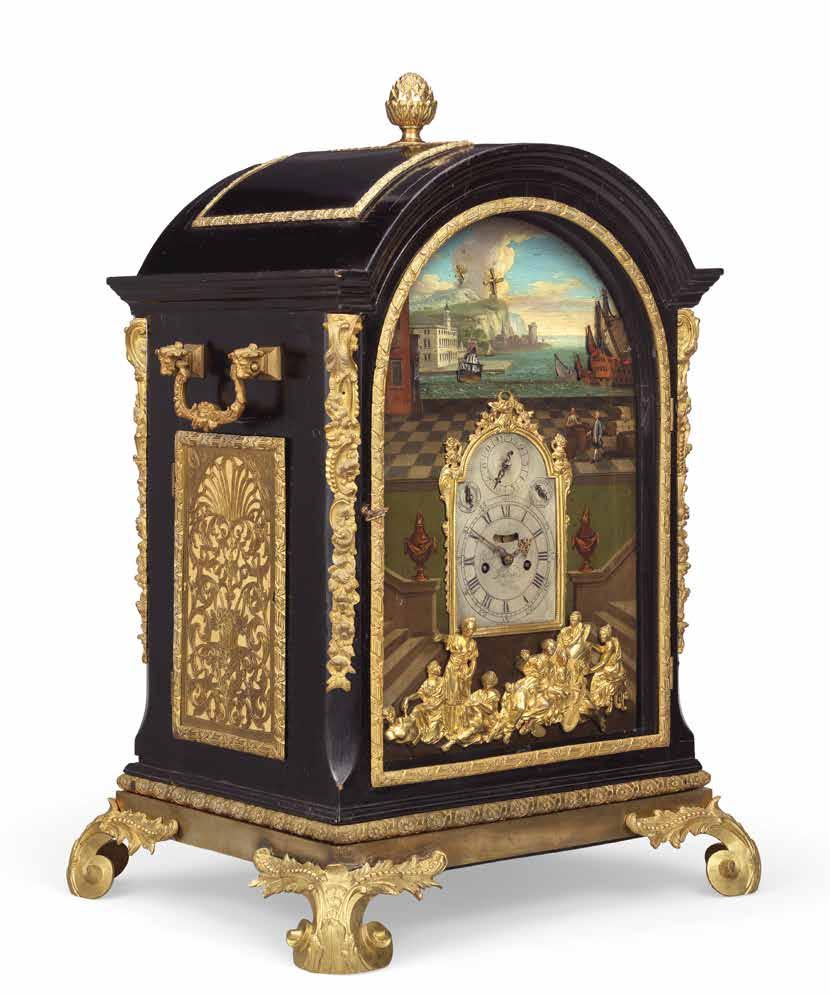
The massive case with substantial pineapple finial and twin brass-bound pads over a pair of heavy cast handles, hinged side doors with cast and pierced brass sound frets to a brass-bound case on elaborate scroll feet, the front angles further set with cast mounts.
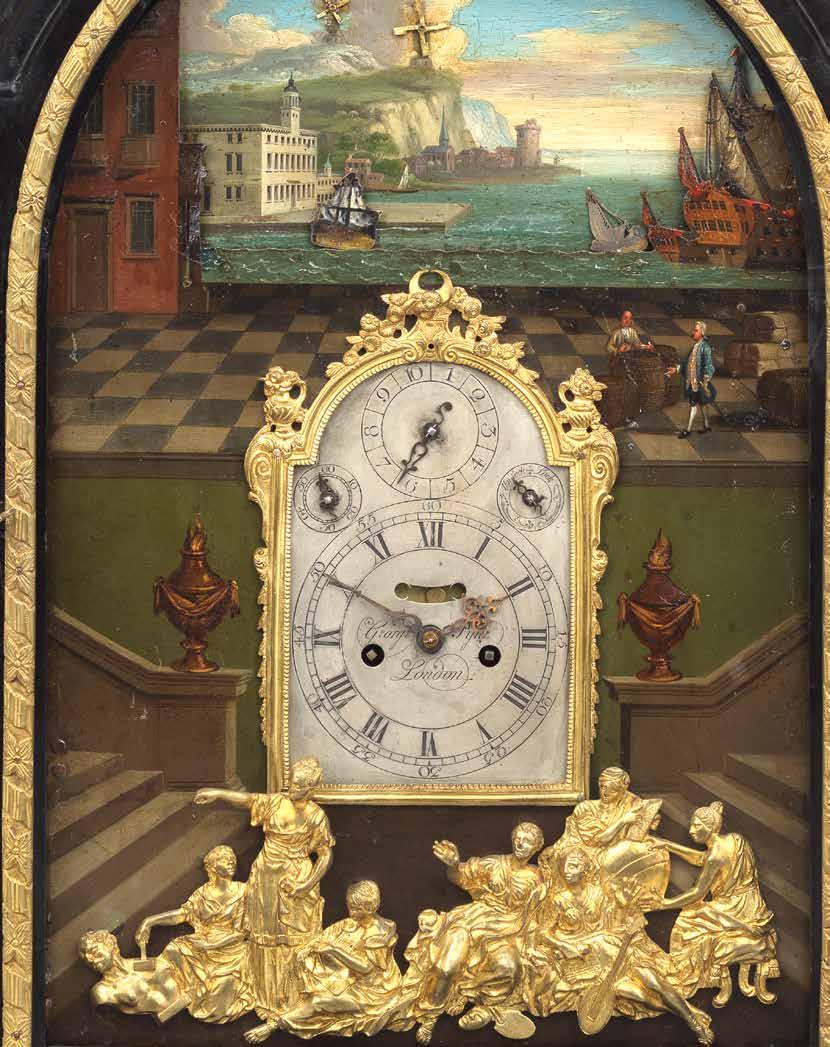
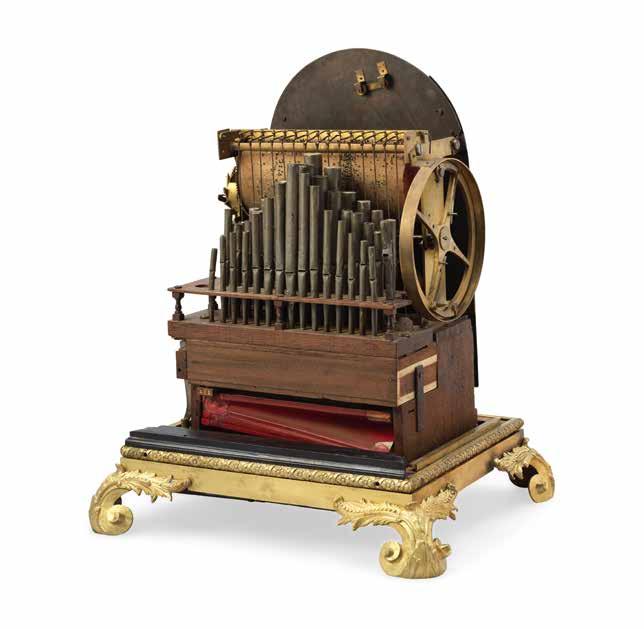
The 4.75 inch signed silvered arched dial with Roman and Arabic chapter ring and mock pendulum aperture set below three subsidiaries, comprising a smaller pair for regulation and to lock/unlock the pendulum, and a third larger one to select one of ten tunes, marked 1-10 , with blued steel hands. Framed by a large (50cms x 33cms/19.5ins x 13ins) arched dial painted on metal, depicting two flights of stairs leading up to an embarkation area with two figures discussing cargo on a tiled floor, in the background a parade of automata ships sail past on choppy waters, against a further scene of a palace and a pair of automata windmills on the cliffs beyond, each with rotating vanes; the front further set with a cast mount depicting the seven liberal arts comprising sculpture, architecture, geometry, music, arithmetic, astronomy, painting. The clock movement wound, locked and regulated from the front, striking the hours on a bell. The musical train powered by a large spring and fusee wound from the side, all the tunes driven from a five inch diameter pinned wooden cylinder activating three divisions of metal pipes to the rear. The barrel carries an applied printed label for xxxx Flight xxxx...Organ Builders, Exeter Change, Strand, Makes and Repairs...Machine Organs....on the most reasonable terms.
£30,000 - 50,000
€35,000 - 58,000
US$40,000 - 67,000
George Pyke was among the most celebrated English makers of musical and automaton clocks in the mid 18th century, eventually holding the Royal appointment of Organ-Builder to His Majesty King George III . The son of the respected clockmaker John Pyke, he was apprenticed through the Worshipful Company of Clockmakers in 1739 and later operated prestigious London workshops in Holborn, St Martin-in-the-Fields, and Vauxhall. Contemporary advertisements described him as “the first Mechanic in that Branch of any in the Kingdom.”
Pyke specialised in monumental organ clocks that combined precision horology, barrel organs, and animated automata within elaborate architectural cases. These highly complex creations employed pinned musical barrels to play multiple tunes often associated with composers such as George Frederic Handel and Joseph Haydn while animated dial scenes depicted moving ships, mills, craftsmen, animals, and mythological figures. Because of their immense cost and complexity, only around a dozen examples are known to survive today, including important examples at Temple Newsam and the Palace Museum, Beijing.
Similar clocks and a very similar movement are illustrated in Haspels The catalogue of the National Museum, Utrecht , p55.
TUNES ON TWELVE BELLS AND TWENTY FOUR HAMMERS
Robert Ramsey, London, the backplate dated 1765
The case surmounted by a single finial over an inverted bell top decorated with gilt brass mounts surrounded by four similar cast urns over a moulded top, the case with gilt mounts to each corner and a pair of carrying handles to each side above pierced wood sound frets backed in red silk all terminating in a moulded base and sitting on brass ogee feet. The 8 inch brass dial with silvered Roman and Arabic chapter ring with a matted dial centre with mock pendulum aperture and calendar with blued steel pierced hands framed by cast brass spandrels with strike/silent subsidiary and six tune indicator, signed in a silvered cartouche framed with foliate engraving Robert Ramsey, London . The triple fusee movement converted to anchor escapement playing six tunes on a large nest of twelve bells and twenty-four hammers above a large pin barrel secured to the back plate, the engraved back plate finely decorated with flowing
scrolls and beasts signed in a central cartouche Robert Ramsey, London and dated 1765, currently ticking and striking. 60cms (24ins) high.
£3,000 - 6,000
€3,500 - 7,000
US$4,000 - 8,100
Robert Ramsey, sometimes recorded as Ramsay, was a London clock and watchmaker active during the mid to late 18th century. He is believed to have gained his Freedom of the Worshipful Company of Clockmakers circa 1753, enabling him to establish his own independent business within the City of London. His career falls within the mature Georgian period, a time when English clockmaking was evolving from the earlier brassdial tradition towards the more refined silvered and painted dial styles associated with later 18th-century taste.
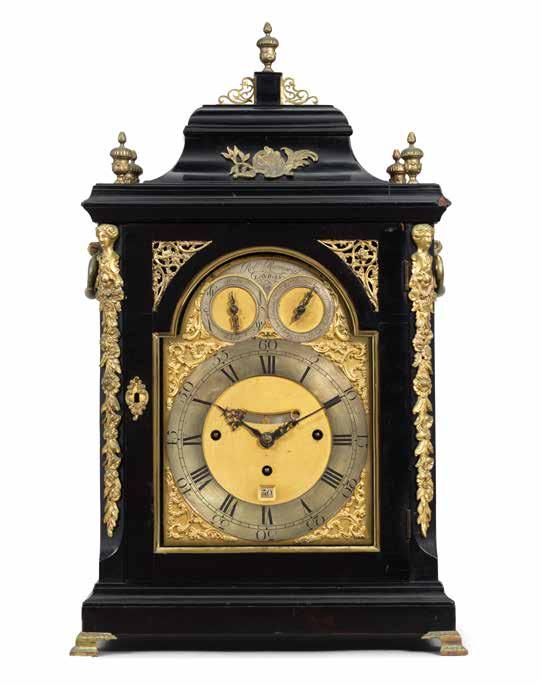
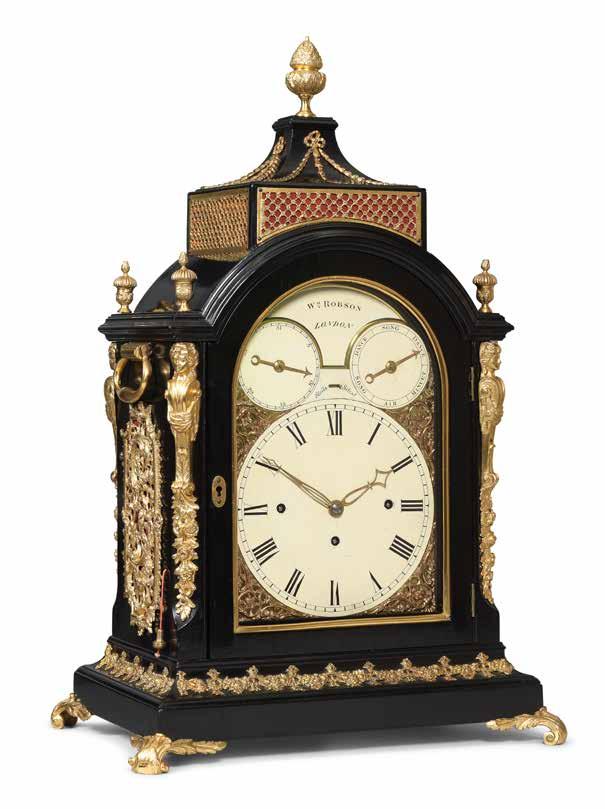
William Robson, London
The case sumounted by a cast brass finial over a pagoda top with silk backed sound frets, the break arch with moulded front, the corners with cast finials, the plain front with brass lock escutcheon to the left hand side flanked by cast female mounts with floral decoration, the sides with carrying handles and elaborately cast sound frets, terminating in a moulded base with further mounts and standing on four cast brass feet. The 8 inch repainted brass dial with black Roman numerals on a white ground with gilt hands framed by cast brass spandrels, with calendar
subsidiary to the upper left and tune selection to the right, signed in a recessed cartouche to the break arch William Robson, London . The triple fusee movement with verge escapement and short bob pendulum, striking the hours on a polished bell and chiming the quarters and playing tunes on a nest of 13 bells and hammers mounted above, the back plate finely engraved with floral decoration, currently ticking and striking. 66cms (26ins) high.
£4,000 - 6,000
€4,600 - 7,000
US$5,400 - 8,100
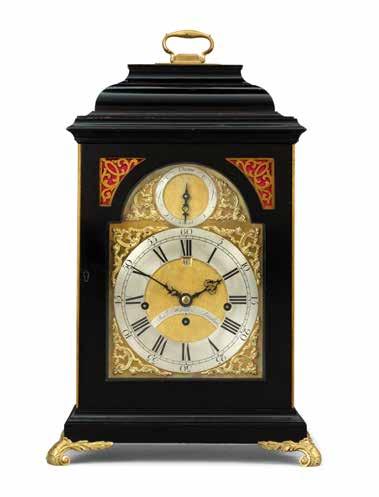
Joseph Harding, London
The case sumounted by a brass carrying handle over an inverted bell top with moulded cornice, the front with later brass sound frets, the sides with later silk backed sound frets, terminating in a moulded base and sitting on four elaborately cast feet. The 8 inch brass dial with silvered Roman and Arabic chapter ring, the matted centre with calendar aperture beneath 12 o’clock signed in a central cartouche Joseph Harding, London , framed by cast brass spandrels with strike/silent subsidiary to the break arch. The triple chain fusee movement with half deadbeat escapement converted from verge, striking the hours on a large polished bell and chiming the quarters on a nest of eight bells and hammers, the back plate engraved with floral swags, currently ticking and chiming.
58cms (23ins) high.
£2,000 - 3,000
€2,300 - 3,500
US$2,700 - 4,000
FOR FUTHER INFORMATION, PLEASE SEE APPENDIX
52
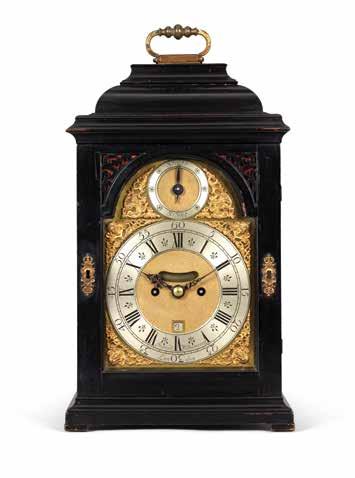
A GOOD SECOND QUARTER OF THE 18TH CENTURY EBONY VENEERED QUARTER REPEATING TABLE CLOCK
Joseph Williamson, London
The inverted caddy top surmounted by a knopped handle over side sound frets to a moulded plinth base on block feet. The 7 inch arched brass dial with mask spandrels framing the Strike/Silent subsidiary and Roman and Arabic chapter ring to a finely matted centre with curved mock pendulum and decorated date apertures, with blued steel hands. The twin gut (now wire) fusee movement with verge escapement and rack striking on a bell, sounding the last hour and the quarters on the pull of a chord, on three bells and hammers. Ticking, striking and with operational repeat, with two case keys and a winding key. 48cms (19ins) high.
£3,000 - 5,000
€3,500 - 5,800
US$4,000 - 6,700
FOR FUTHER INFORMATION, PLEASE SEE APPENDIX 51
53
A LATE 18TH CENTURY GILT METAL MOUNTED EBONISED QUARTER REPEATING TABLE CLOCK WITH ALARM.
Robert Fleetwood, Abchurch Lane, London
The case sumounted by a large cast finial over a bell top with four further finials to each corner over a moulded front, the front with engraved brass sound frets backed in purple silk, the sides with elaborately cast female mounts with floral detailing and pierced engraved silk backed sound frets, terminating in a moulded base and raised on a shaped brass base standing on four brass ogee feet. The 8 inch brass dial with silvered Roman and Arabic chapter ring with finely matted centre signed in a recessed cartouche Robert Fleetwood, Abchurch Lane, London , with small silvered alarm setting dial to the centre and blued steel hands, framed by cast brass spandrels with calendar aperture and strike/silent to the break arch. The large double chain fusee movement with verge escapement and short bob pendulum, striking the hours on a large polished bell and quarter repeating on a nest of three bells and hammers, the back plate finely engraved and signed in a central cartouche, currently ticking and striking. 66cms (26ins) high.
£3,000 - 4,000
€3,500 - 4,600
US$4,000 - 5,400
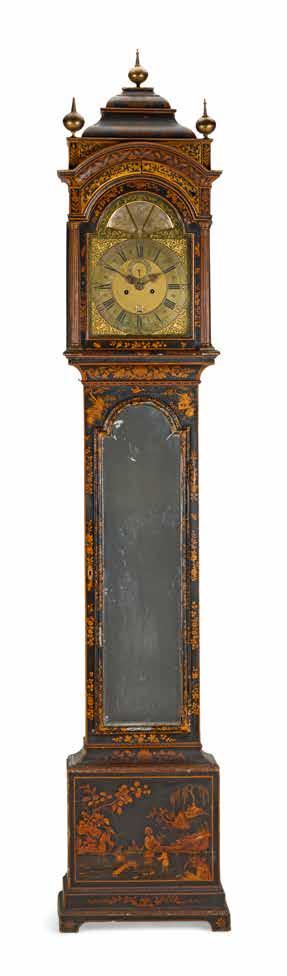
A RARE SECOND QUARTER OF THE 18TH CENTURY CHINOISERIE DECORATED LONGCASE CLOCK WITH MIRROR DOOR PANEL AND DAILY CALENDAR WITH DEITY
Claudius Du Chesne, London
The case decorated allover with gilt sprays of flowers and foliage on a black ground, the original stepped caddy to the hood framed by three brass finials over silk-backed wooden sound frets supported on brass-mounted Doric columns, the trunk with more complex decoration framing the mirrored panel with deep bevelled edge, on a base depicting figures in a landscape. The 12 inch brass dial with three sectors in the arch revealing the day of the week (in French), each with its planetary sign and Diety, over a silvered Roman and Arabic chapter ring, matted centre and subsidiary seconds dial over a chamfered engraved date aperture. The twin train movement with anchor escapement and rack strike sounding the full hour on the hour and a passing strike on the half past. 2.65m (8ft 8ins) nhigh.
£5,000 - 7,000
€5,800 - 8,100
US$6,700 - 9,400
FOR FUTHER INFORMATION, PLEASE SEE APPENDIX
Daniel Quare, London, No.138
The inverted bell top case surmounted by a boldly cast brass handle, over a well moulded cornice, and a pair of tall arched silk-backed sound frets to the sides, the front and rear doors set with upper quadrants backed in green silk, sitting on a moulded base and block feet. The signed and numbered 6.25 inch arched gilt brass dial with three subsidiaries, the largest giving the date, framed by a pair of engraved birds within foliate scrolls, flanked by a rise-and-fall regulation dial to the left marked in fives from 5-40, and a Strike/Silent dial to the right, the foliate and crown-and-sceptre spandrels enclosing the silvered Roman and Arabic chapter ring with lozenge half-quarter marks, and floating fleur de lys half-hour markers, the finely matted centre with deeply chamfered mock pendulum aperture, and burnished signature cartouche 138 Dan Quare, London , a silvered alarm disc to the centre, under pierced blued steel hands. The twin gut fusee movement united by knopped pillars, the verge escapement with sprung suspension to the light lenticular bob pendulum, rack striking the hours on a bell, and repeating the quarters on a smaller bell via the activation cord to the right hand side, the alarm wound via the
cord to the left and sounding via a twin-headed hammer set inside the larger bell.
The backplate with a single line border framing a scene of five birds set within symmetrical foliate scrolls centred by an urn and sun mask, signed and numbered in a wheatear engraved oval plaque 138 Dan: Quare London . Ticking, striking, operational alarm and pull quarter striking. 25.5cm wide x 18.5cm deep x 46cm high, (10in wide x 7in deep x 18in high)
£20,000 - 30,000
€23,000 - 35,000
US$27,000 - 40,000
A handwritten note pasted inside the clock on the seatboard reads; “I inherited this Clock from my mother, who died in 1918. Having it repaired in 1922 an inscription was discovered written in pencil by my father upon the board to which this paper is attached. He died at the age of 67 in 1901. Charles William English, age 60, London, August 1922.”
Provenance:
John Carlton-Smith, Grosvenor House Antiques Fair, June 1996.
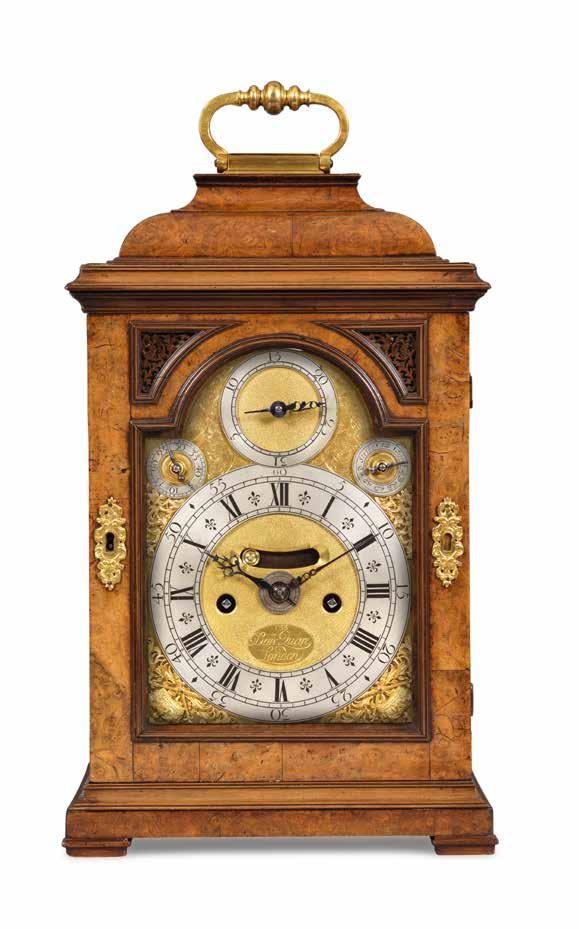
James Snelling, London
The inverted bell top with carrying handle over a heavy brass insert and applied banding, over glazed sides and a moulded base with further brass banding on cast brass pad feet. The 5-inch arched brass dial signed James Snelling, London in a shaped silvered plaque above the date aperture, framed by silvered subsidiary rings for strike/silent and rise-and-fall pendulum regulation, the Roman and Arabic chapter ring with floating lozenge half hour markers, framing the finely matted centre with curved mock pendulum aperture and blued steel hands. The
twin gut fusee movement united by five knopped pillars, with pivoted verge escapement to a pendulum with lenticular bob and rise-and-fall regulation, the striking train with rack striking on a bell, and repeating the quarters on a run of six bells and hammers, the backplate with a single line border framing a symmetrical pattern of foliate scrolls centred by a winged cherub’s head 31cms (12.5ins) high.
£10,000 - 15,000
€12,000 - 17,000
US$13,000 - 20,000
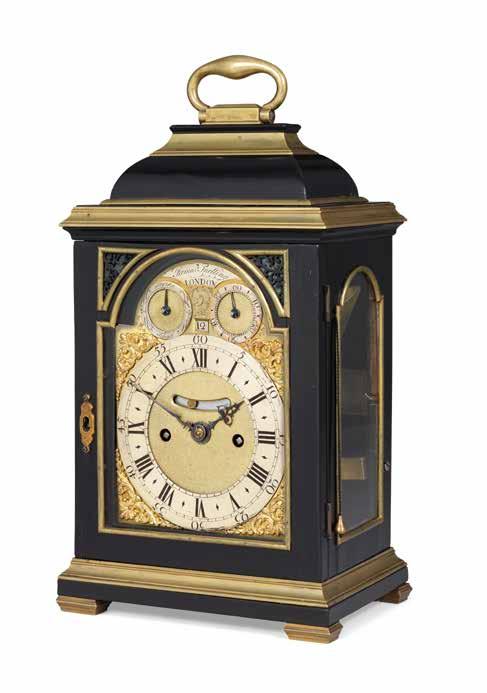
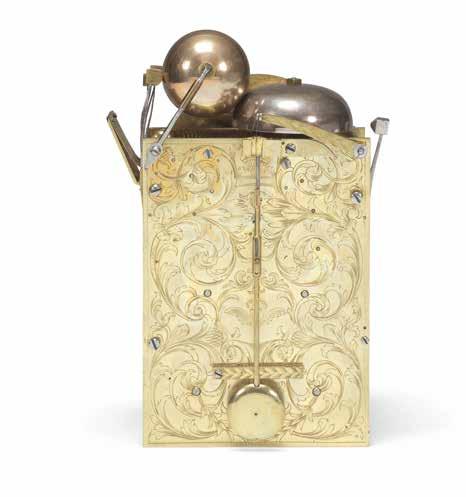
REPEATING TABLE CLOCK TIMEPIECE
Daniel Delander, London
The inverted bell top surmounted by a brass knopped carrying handle over a deeply moulded cornice and circular sound frets and glazed side panels, the front door with matching brass escutcheons and pierced brass silk-backed quadrants, with a glazed rear door, terminating in a moulded base and standing on four block feet. The 6 inch brass dial with silvered Roman and Arabic chapter ring framing the finely matted centre with mock pendulum and calendar apertures, with blued steel hands, signed on a silvered name plaque Delander, London , all framed by cast brass mask spandrels, the break arch with pendulum rise and fall subsidiary dial marked 0-40. The timepiece movement united by five knopped pillars with single gut fusee and pivoted verge escapement held in tear-drop shaped cocks, the pendulum with lenticular bob, quarter
repeating work sounding on three polished bells mounted above, the lacquered back plate unengraved bar a single line border framing the bold signature Delander, London . Ticking and with operational repeat. 44cms (17.5ins) high.
£6,000 - 9,000
€7,000 - 10,000
US$8,100 - 12,000
Provenance:
A distinguished private European collection. Purchased from R.A. Lee (Fine Arts) Ltd., 1988 “A mid 18th century mahgoany table clock with eight day duration movement by Delander, London. Circa 1740/50.”
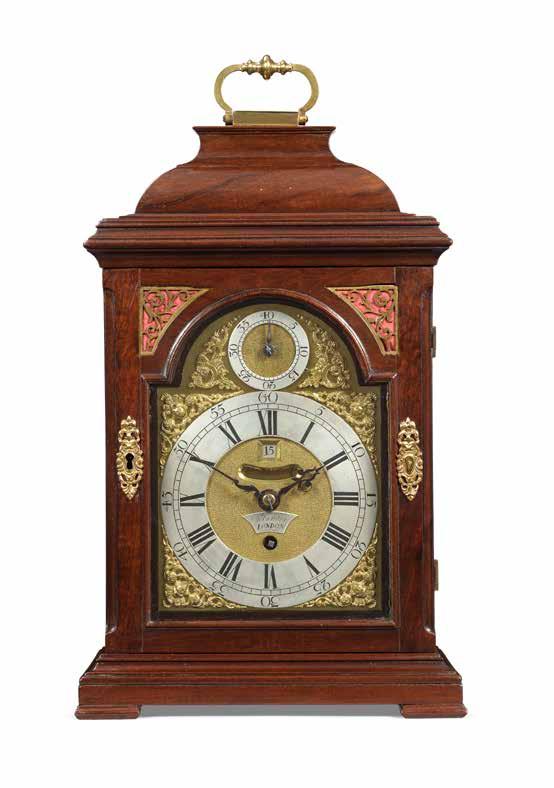
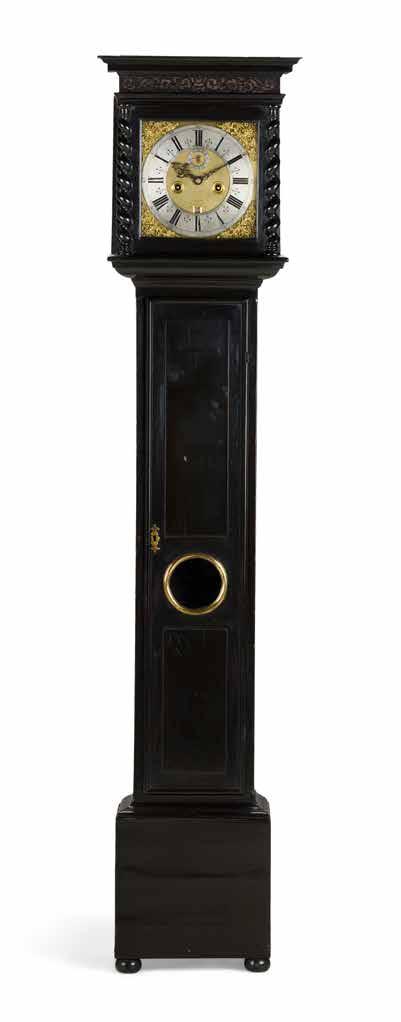
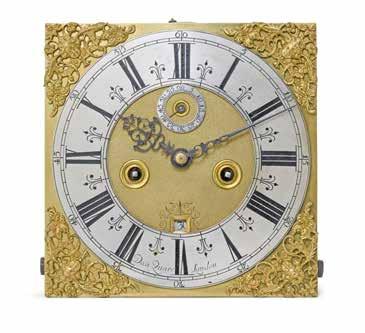
Daniel Quare, London
The case with flat moulded top over a pierced sound fret supported by twisted Doric columns, with glazed observation windows to the sides, the panelled trunk door centred by a brass lenticle and simple lock escutcheon, over a plain base and bun feet. The 10 inch square brass dial with silvered Roman and Arabic chapter ring with unusual fleur-de-lys half hour markers, the matted centre with ringed winding squares, decorated calendar aperture and subsidiary seconds, with finely finished blued steel hands framed by four cast brass cherubs head spandrels, signed at Daniel Quare, London . The two train movement plated movement with anchor escapement and internal count wheel strike, striking the hours on a bell mounted above, united by five pinned pillars. Ticking and striking, sold together with a pendulum, two brass clad weights, a door key and a crank winder. 1.98m (6.5ft) high.
£3,000 - 5,000
€3,500 - 5,800
US$4,000 - 6,700
Daniel Quare (1649–1724) ranks among the greatest English clockmakers of the late 17th and early 18th centuries and was one of the most influential horologists working in London during the reigns of William III, Queen Anne and George I. Born in Somerset and trained within the Quaker community, he was admitted to the Clockmakers’ Company in 1671 and rose to become Master of the Company in 1708. Establishing his business at Exchange Alley in Lombard Street, Quare earned an international reputation for the exceptional quality and technical sophistication of his clocks, watches and scientific instruments.
Quare is particularly celebrated for his mechanical ingenuity and was responsible for numerous horological innovations, most famously the repeating watch mechanism for which he successfully competed against the proposal of the Reverend Edward Barlow before the Privy Council in 1687. He was appointed clockmaker to King William III and later supplied timepieces to Queen Anne and other members of the European aristocracy. Quare also collaborated with leading contemporary makers and scientists, producing complex astronomical, equation and musical clocks of the highest standard.
Surviving clocks signed by Quare are prized for their elegant proportions, refined movements and superb craftsmanship, and today are preserved in major museum collections including the British Museum and the Science Museum, London.
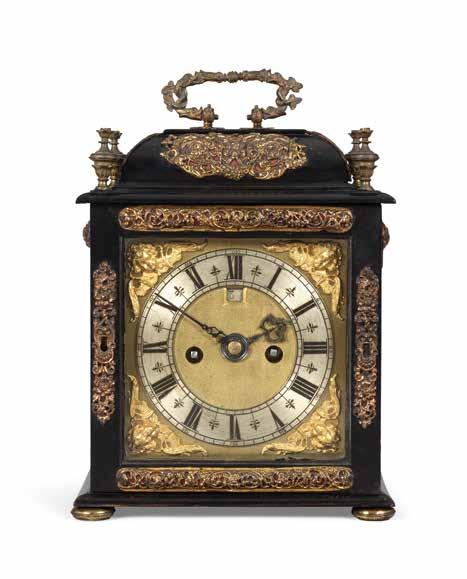
Henry Jones, London
The case surmounted by a brass handle of entwined dolphins on foliate pommels over a caddy top with applied silk-backed repoussé sound frets and four fancy cast brass urn finials, over a simple moulded cornice, the front door with matching repoussé frets and symmetrical lock escutcheons, the sides with further silk-backed frets above glazed windows, sitting on a simple moulded base on four brass bun feet. The 6 inch square dial with silvered Roman and Arabic chapter ring with fancy cruciform half hour markers, the matted centre with chamfered calendar aperture and blued steel hands framed by winged cherubs head spandrels. The movement united by five twin-baluster turned pillars with double gut fusee, now with a 19th century anchor escapement, but retaining the external count wheel to the back plate which strikes on a bell;, the back plate with single line border framing a symmetrical scene of pairs of flowers and foliate scrolls, signed in a central cartouche Henry Jones, in the Temple . Ticking and striking, sold with later winding and case keys. 33cms (13ins) high.
£6,000 - 8,000
€7,000 - 9,300
US$8,100 - 11,000
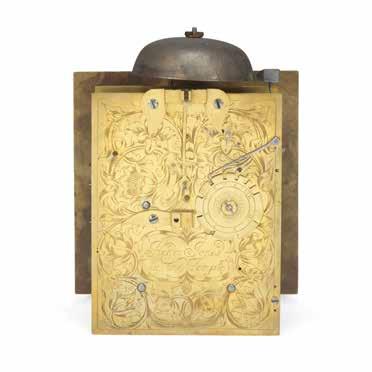
Henry Jones (c.1642–1695) was one of the foremost English clockmakers of the late 17th century and a leading figure of London’s horological Golden Age. Thought to have been the son of William Jones, vicar of Boulder near Southampton, he was apprenticed in 1654 to Benjamin Hill before being transferred to the celebrated royal clockmaker Edward East, under whom he trained during the formative years following the introduction of the pendulum to English clockmaking. He became a Freeman of the Clockmakers’ Company in 1663 and later established his own workshop at Inner Temple Lane, many clocks being signed “Henry Jones in ye Temple”.
Jones rose prominently within the Clockmakers’ Company, serving as Assistant from 1676, Warden between 1687 and 1690, and Master in 1691. His workshop was highly successful, employing numerous apprentices, including his sons William and Henry. Jones produced fine longcase clocks, table clocks, lantern clocks and watches, several of which are now preserved in collections including the British Museum and the Science Museum, London.
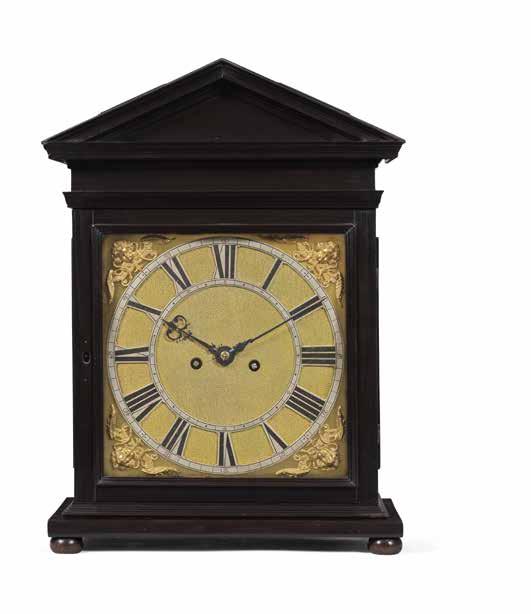
Henry Jones, London
The case surmounted by an architectural portico with moulded detailing over a plain front door with further moulded detailing around the aperture, the sides with glazed observation windows and terminating in a moulded base, the rear with solid door, the whole resting on a turntable base and raised on four turned bun feet, the 9 inch brass dial with silvered skeletonised chapter ring with black Roman numerals and small Arabic five minute markers, the half hours denoted by simple dot markers, the matted centre with later blued steel hands and framed by four finely cast winged cherub head spandrels, the movement with six vase shaped pillars secured by six latches to the backplate with verge escapement and short bob pendulum striking the hours via an external count wheel mounted to the backplate, powered by a pair of gut fusees now with steel lines, the solid clicks mounted to the backplate with finely finished steelwork, signed in a central cartouche Henricus Jones, Londini , currently ticking and striking. 48cms (18.5ins) high.
£8,000 - 12,000
€9,300 - 14,000
US$11,000 - 16,000
Provenance:
Christie’s, London, Fine Clocks and Watches, 21 June 1978, Lot 86.
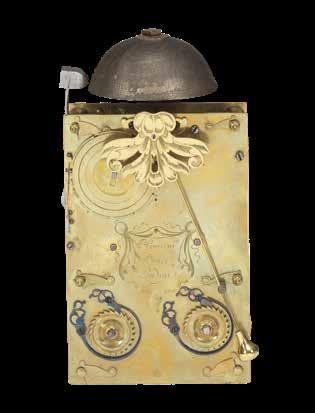
Henry Jones (c.1632–1695) was one of the foremost English clockmakers of the Restoration period and a significant figure in the early development of pendulum horology. Born near Southampton, he travelled to London and was apprenticed in 1654 to Benjamin Hill before being turned over to the royal clockmaker Edward East. This placed him at the centre of English horology during the formative years following the introduction of the pendulum clock. He gained his Freedom of the Clockmakers’ Company in July 1663 and rose through the ranks to become Master of the Company in 1691.
Following the Great Fire of London, Jones established his workshop at Inner Temple Lane, where he produced clocks and watches of exceptional quality. Favoured by the court of King Charles II, he supplied important royal commissions, one reportedly costing the remarkable sum of £150. His work survives today in major institutional collections including the Science Museum, London.
Jones is particularly admired for his architectural ebony longcase clocks and elegant spring table clocks, many displaying refined movements. Surviving examples are signed in several forms including Henry Jones in the Temple, Henry Jones Londini, and Henrikus Jones London, and are regarded as among the finest products of late 17th-century English horology.
61 *
Provenance:
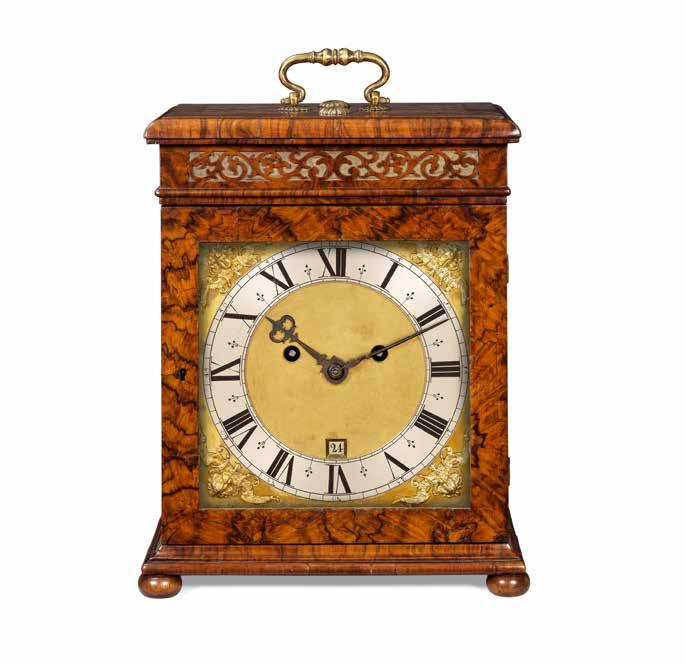
Henry Jones, London
The case surmounted by a lacquered brass double-baluster handle set in ring terminals with gadrooned collets, similar collets set to the front and rear to protect the book-matched veneered panel framed by a feather banded border to a plain moulded cornice over a silk-backed sound fret to all four sides, long glazed side panels on a moulded base and bun feet. The 9 inch square gilt brass dial with narrow silvered chapter ring; the minute track with Arabic five-minute numerals enclosing the Roman hours with fleur-de-lys half hour markers emanating from an inner quarter hour track, around a finely matted centre with chamfered date aperture and blued steel hands, framed by four gilt brass winged cherub spandrels signed Henry Jones in the Temple along the lower edge, secured to the movement via four latched dial feet . The twin gut fusee movement united by six latched, ringed and knopped pillars, knife edge verge escapement and short bob pendulum, striking the hours via an external count wheel engraved with a Tudor rose and Arabic hours, currently ticking and striking. 45cms (18ins) high.
£30,000 - 50,000
€35,000 - 58,000
US$40,000 - 67,000
A distinguished private European collection.
Purchased from R.A.Lee (Fine Arts) Ltd., February 1983. Lee notes “This clock is probably the earliest of a series of seven examples contained in a flat topped walnut case. The high positioning of the winding holes in the dial points to an early date, circa 1672-73. The frontplate has an engraved capital J followed by the number 3. This may be a sequence number?
The casemaker working under instructions from Henry Jones used very highly figured walnut veneers for this case and his usual lifting handle with gadrooned stops as in four other examples.”
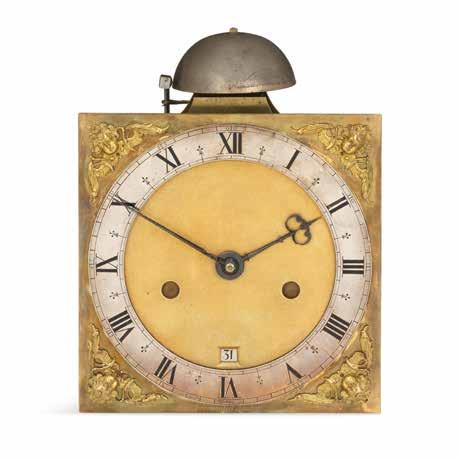
62 * W TP
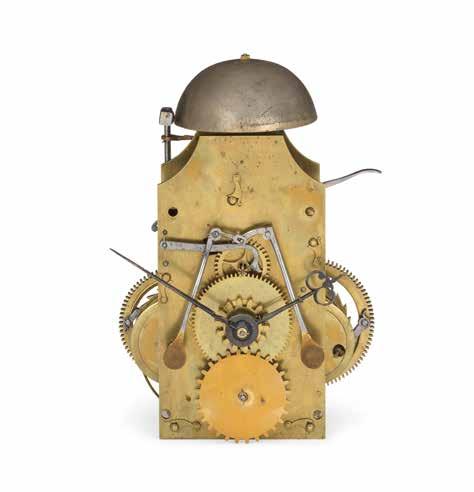
A VERY RARE EARLY PENDULUM LONGCASE CLOCK MOVEMENT AND DIAL IN A CUSTOM MADE EBONY VENEERED ARCHITECTURAL CASE
Ahasuerus Fromanteel, London, circa 1665 and later
The custom-made 20th century case veneered allover in ebony on an oak carcass and faithfully based on the 17th century originals, the lift-up hood with typical triangular pediment with fine mouldings, rain lip and centred by a Fromanteel-style brass mount, over a cornice raised on threequarter Corinthian columns with gilt brass capitals and bases, the sides with large glazed observation windows, the 41 inch long trunk door with three applied panels within a moulded surround, with brass escutcheon, the trunk with moulded base over a similarly panelled front panel, the sides with recessed panels within matching moulded borders, on a plain apron.
The 8.5 inch square gilt brass dial with winged cherub’s head spandrels framing the solid silver Roman and Arabic chapter ring with narrow minute band, wax filled numerals and fleur-de-lys half hour markers emanating from the quarter track, the finely matted centre with crisply chamfered date aperture above VI and signed directly beneath A Fromanteel, Londini. , with blued steel hands.
The two train movement with typical tall, shouldered ‘Fromanteel’ shaped plates; the going train with bolt-and-shutter maintaining power to a knife-edge verge escapement and short bob pendulum; the strike train with small outside countwheel acting on a horizontal bell and hammer, the latter set on a tall steel post held within within a fancy brass bracket mounted on the backplate. Ticking and striking.
£25,000 - 35,000
€29,000 - 41,000
US$34,000 - 47,000
Provenance:
A distinguished private European collection.
Purchased from R.A. Lee (Fine Arts) Ltd, February 1983. Lee mentions in a letter to the family:
“This movement is one of the few examples retaining its original verge, so many having been converted to anchor at a later date. The vertical striking hammer arbor is a feature seldom seen in movements other than those made by Fromanteel: this being fixed to the backplate denotes a date later than those fitted to the frontplate. The incurved upper corners to the latched plates is another Fromanteel feature copied by a few but disappearing before 1675....Fromanteel’s dials are regarded as of good proportions and in this example, one of the rarer features is the silver chapter ring.” and later:
“The other Fromanteel movements which are unaltered from verge escapements are as follows:
1. The movement in its original case at the Science Museum, Oxford.
2. The movement in its original case in a Private collection in Wiltshire.
3. The movement in a genuine but ‘married’ case in the Time Museum, Rockford, Illinois, USA. “
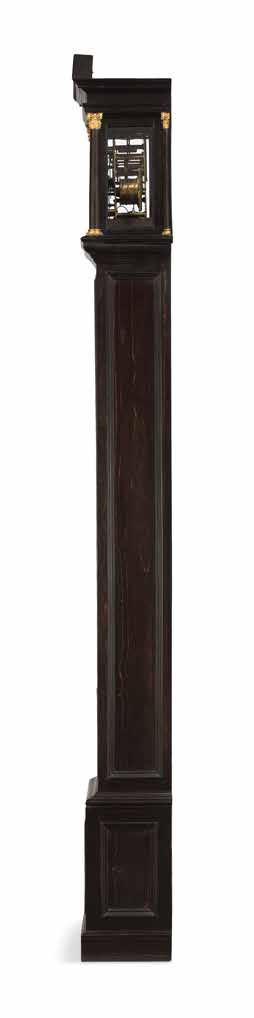
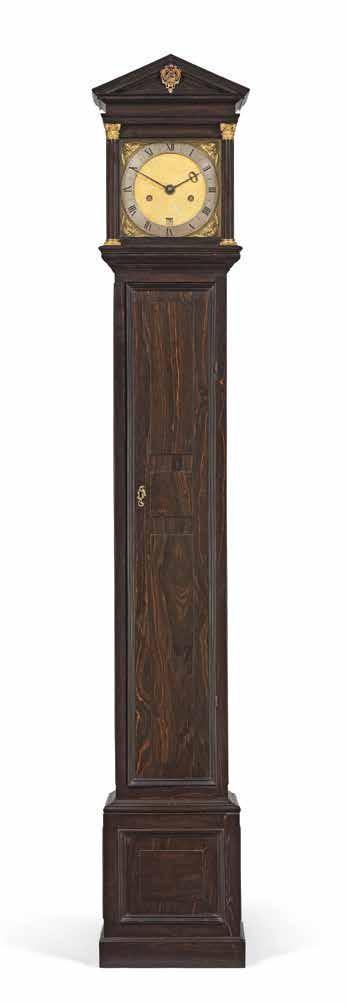
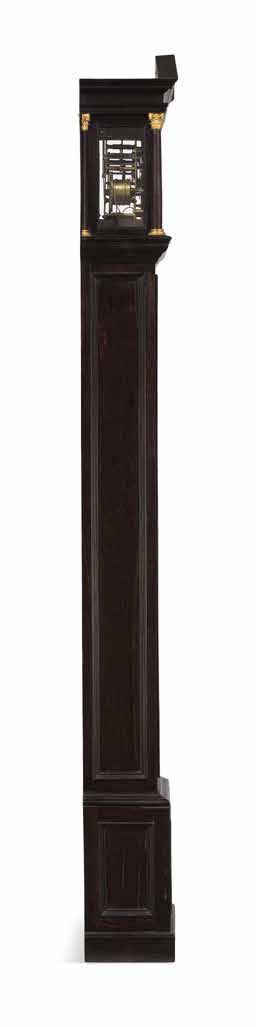
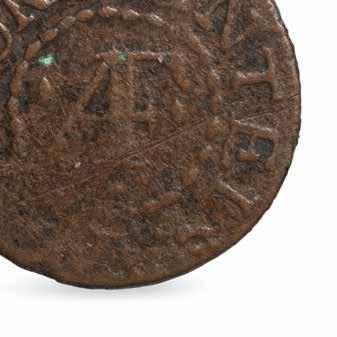
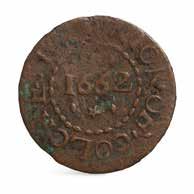
63
A RARE AND INTERESTING MID 17TH CENTURY TRADING TOKEN WITH FROMANTEEL CONNECTION
A Formantel, Colchester, (sic) dated 1662
The front centred with the initials AF framed by block capitals “FORMANTEL” (sic), the obverse inscribed “IVNIOR OF COLCHESTER 1662”
£500 - 700
€580 - 810
US$680 - 950
This small copper trade token offers a rare and fascinating glimpse into 17th-century England. During the Commonwealth and early Restoration periods there was a severe shortage of low-denomination copper coinage issued by the Crown, leading many merchants, tradesmen, and local officials to produce their own privately issued tokens for everyday commerce. While it is well documented that Joseph Knibb issued a trading token during the 1660s, no such piece had previously been firmly associated with the celebrated Fromanteel family of clockmakers, making the present token an especially important and intriguing discovery.
The connection between the Fromanteel family and Colchester stretches back into the 16th century, and is deeply rooted in the history of Flemish Protestant migration to England. In 1588 branches of the family fled religious persecution in the Low Countries and settled in Colchester amongst the thriving Dutch and Flemish refugee community that helped establish the town’s famous “Dutch Quarter.” Through trade and craftsmanship, the family became firmly integrated into local commercial life.
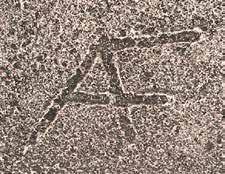
A signed bell by the maker. Sold in these rooms 15/12/2009. Lot 103
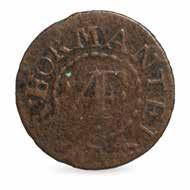
A further important connection came during the Great Plague of 1665, when Ahasuerus Fromanteel fled London with surviving members of his family after the epidemic claimed his wife, youngest son, and several workshop employees. The family sought refuge in Colchester with wealthy merchant relatives, including the token issuer Andrew “Formanteel” (Fromanteel). When plague later spread to Colchester itself, the family fled again, this time to Norwich, before eventually returning to London in 1666.
The long-standing presence of the Fromanteels in Essex also helped foster the development of regional horology, with Colchester emerging as an important provincial clockmaking centre by the early 18th century. As such, the present token represents a remarkable and previously unrecorded association with one of the most celebrated dynasties in English clockmaking history, providing a tangible survival connected to the wider Fromanteel family and the formative years of English horology.
A comparable example is in the permanent collection of the Fitzwilliam Museum Cambridge, Accession number CM.QC.1724_R.
It is interesting to note that the bell used in the silver-mounted architectural longcase clock sold in these rooms on 15th December 2009, lot 103, displays a similar joined AF monogram to the interior.
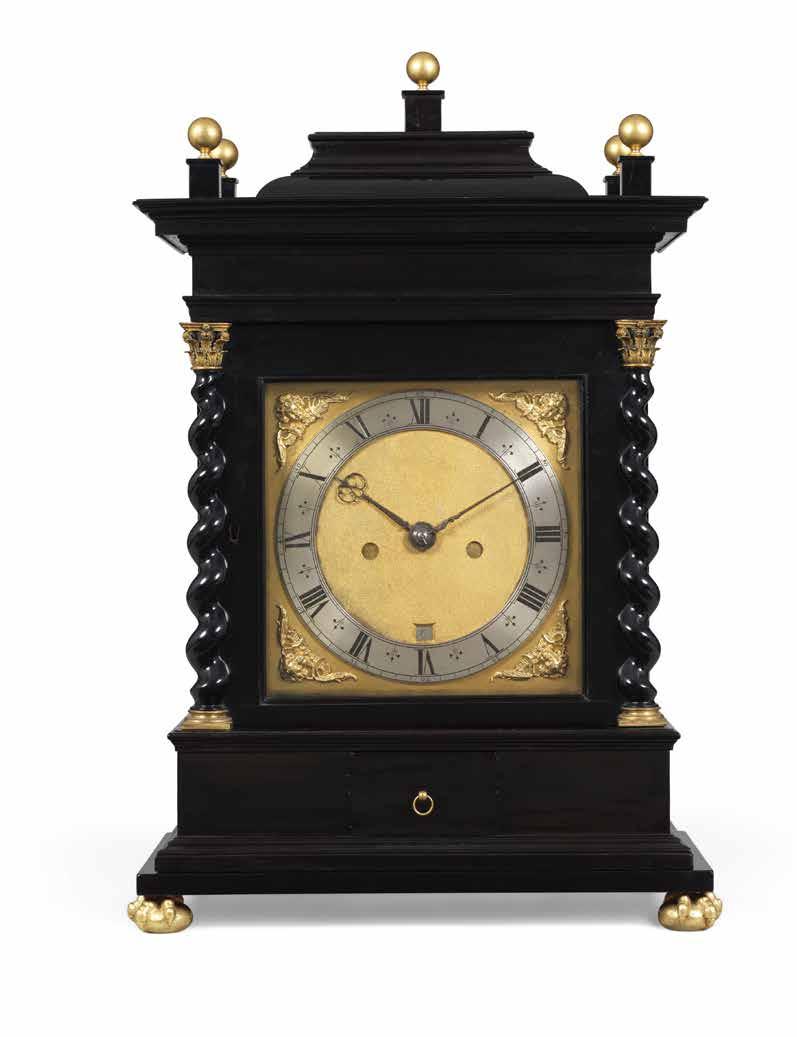
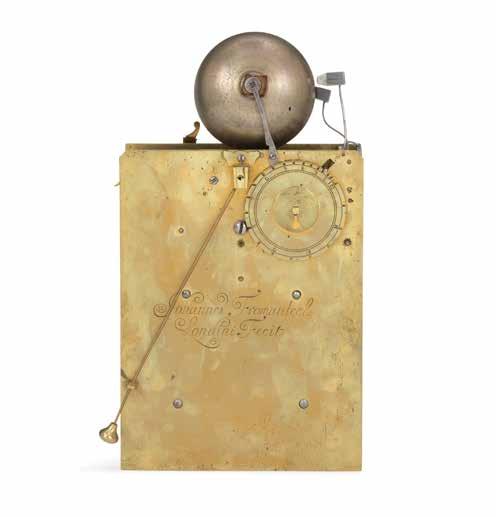
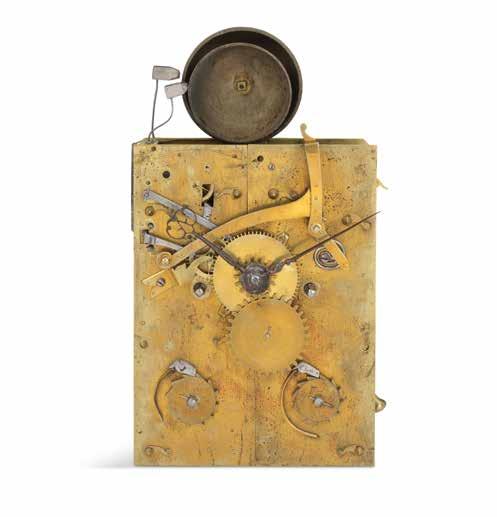
A FINE AND RARE 17TH CENTURY DUTCH-STRIKING EBONY TURNTABLE CLOCK
Johannes Fromanteel, Londini Fecit
The case: The shallow inverted bell caddy with five gilt brass ball finials, each mounted on an ebony plinth, over the moulded entablature, raised on Solomonic columns (three quarter columns to the front and quarter columns to the rear) bordering the glazed door and side panels, each capped with a finely modelled gilt brass composite capital cast with rosettes and volutes over acanthus leaves, mounted on gilt brass bases, raised on the deep plinth base containing a small oak lined key drawer, above the later turntable base with gilt ball and claw feet.
The dial: The nine inch gilt brass dial with winged cherub spandrels (numbered with one to three pips, reciprocated on the dial), bordering the silvered Roman and Arabic chapter ring with fleur-de-lis half hour markers, outer minute track numbered for every fifth minute and inner quarter hour track, the finely matted centre with a calendar aperture above VI and blued steel hands, the winding squares recessed for the shutters, the mask cut for the maintaining power lever.
The movement: The signed twin train fusee movement with a large, numbered outside countwheel calibrated for Dutch striking, indicating the hour and half hour alternately on two bells, the bolt and shutter maintaining power operated by a lever mounted through the mask, the sprung bolt applying power directly to the second wheel, the large
rectangular backplate with canted shoulders, secured to the split frontplate by eight latched knopped and finned pillars, the otherwise unadorned backplate signed in copperplate script ‘Johannes Fromanteel, Londini Fecit’, the movement secured to the case by two brass latches that engage the bottom edge of the backplate, 63.5cm (251n) high
£40,000 - 60,000
€46,000 - 70,000
US$54,000 - 81,000
Provenance:
A distinguished private European collection.
The clock was purchased by the vendor in 1979 from Ronald A Lee (Fine Arts) Ltd. Lee’s notes relate that the clock was discovered “in Spain amongst a collection of mixed examples which were scattered around a hotel in San Sebastian belonging to an elderly lady who ran the hotel which was very Edwardian in character and is now demolished.” In addition he notes “Evidence of certain minor repairs to the movement lead one to believe that it had been in Spain for a very long time.” Another letter regarding the clock notes “There is one hole in the front plate which has not been filled as one may find in time what it was meant to be for. I think a wise precaution as we do not know everything about these early clocks yet and if it is filled in, trace of it may be forgotten or lost.”
Literature:
This clock is illustrated and discussed in detail in Dawson, Drover and Parkes, ‘Early English Clocks’ pages 113-115 and 177. It is suggested that the clock was made after Ahasuerus, his father, left London in 1667. Lee adds in his letter to the vendor that this is one of the earliest clocks signed by John.
The signature is compared to that found on a table clock by Samuel Knibb on page 112, noting the use of a similar flourish used on the ‘J’ of John and the ‘S’ of Samuel, suggests that it may well have been the hand of the same engraver.
The design of the case is a transitional point between the architectural table clocks of the 1660’s and the inverted bell top case that developed later in the 17th century. Similar examples are an olivewood veneered turntable clock by Tompion (Dawson, Drover and Parkes, page 162), a silver mounted ebony turntable clock by Joseph Knibb (page 179) and another by Thomas Harris (pages 182-183), all of which date to the 1670’s.
It retains some earlier features such as the use of split frontplates, latched pillars, the sparing use of gilding beneath the chapter ring and spandrels, vertically mounted bells, unadorned backplate and brass retaining clasps securing the movement to the case, while more modern features are seen in the use of a larger countwheel and the introduction of a glazed backdoor.
The clock perhaps unsurprisingly shares a number of features with those produced by his father Ahasuerus. The numbered spandrels are fitted with steady pins, marked on the dial and the spandrels marked with pips from 1 to 3 (one left blank), also the back of the dial shares similar fittings for the shutters.
The column capitals and bases are almost certainly from the same foundry and compare well with both the Cupid and Chronos Fromanteels. The Cupid Fromanteel also had evidence of the use of latches securing the backplate to the case.
John Fromanteel was apprenticed to his father Ahasuerus in 1652, he was probably then transferred to Thomas Loomes, being made free in 1663. During his apprenticeship John spent time in the Netherlands under the tutelage of Salomon Coster, at the time of Coster’s collaboration with Christian Huygens. This makes John a pivotal figure in the development of horology. It was during this period that the first pendulum clocks were produced by Coster from Huygens designs (patented in 1657). John Fromanteel took the design back with him to England, where his father quickly adopted the new technology, publishing his famous Mercurius Politicus advert of 1658; ‘There is lately a way found out for making Clocks that go exact and keep equaller time than any now made without this regulator (examined aud [sic] proved before his Highness the Lord Protector, by such Doctors whose knowledge and learning is without exception)....’
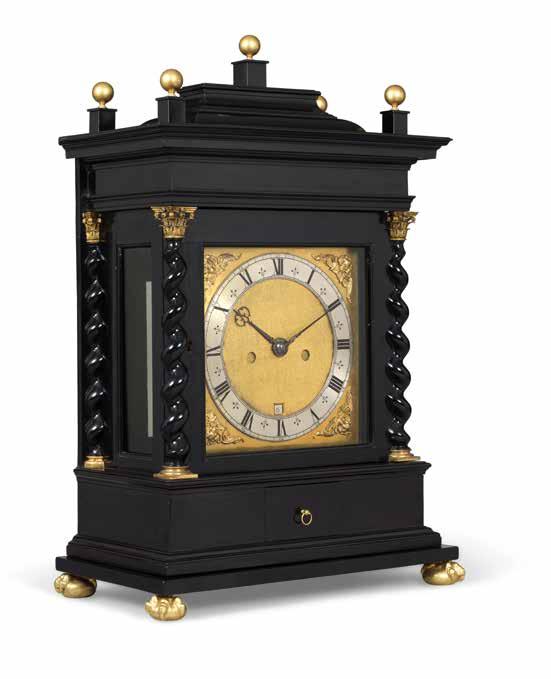
Samuel Aldworth, London
The case surmounted by a brass carrying handle over a caddy top and moulded cornice, the front with (later) cast sound fret and Knibb style lock escutcheons, the sides and back with glazed observation windows, set on a moulded base on block feet. The 7 inch brass dial with silvered Roman and Arabic chapter ring, lozenge half-quarter marks, fleur-de-lys half hour markers signed around VI Aldworth, London , the matted centre with mock pendulum and calendar aperture with a single ringed winding square with blued steel hands framed by cast cherub head spandrels. The single fusee movement united by five robust knopped pillars with verge
escapement and short bob pendulum. On activation of the repeat cord, the clock will sound the hour on a large bell and the number of quarters on a graduated nest of four bells and hammers. The backplate with single line border and a symmetrical engraved pattern of foliate scrolls. Ticking and repeating. Together with a door key and a 17th century-style ‘Knibb’ winding key with pierced foliate handle. 40cm (14ins) high.
£5,000 - 7,000
€5,800 - 8,100
US$6,700 - 9,400
FOR FUTHER INFORMATION, PLEASE SEE APPENDIX
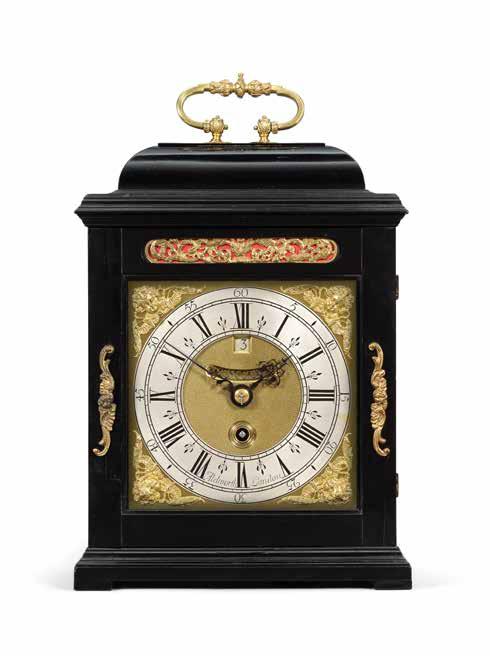
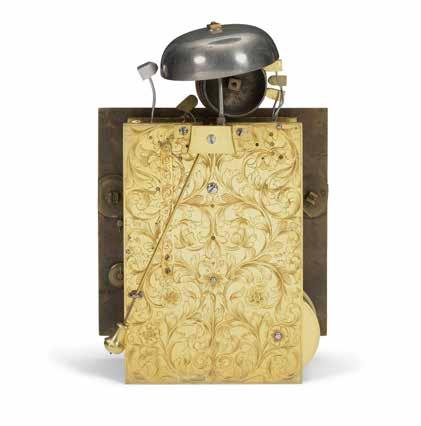
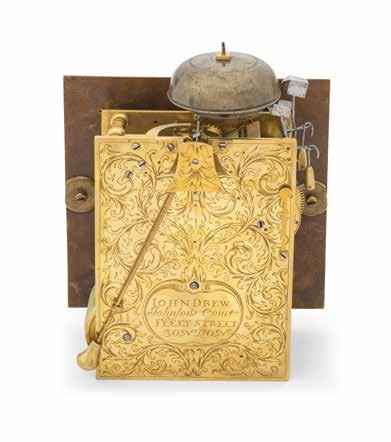
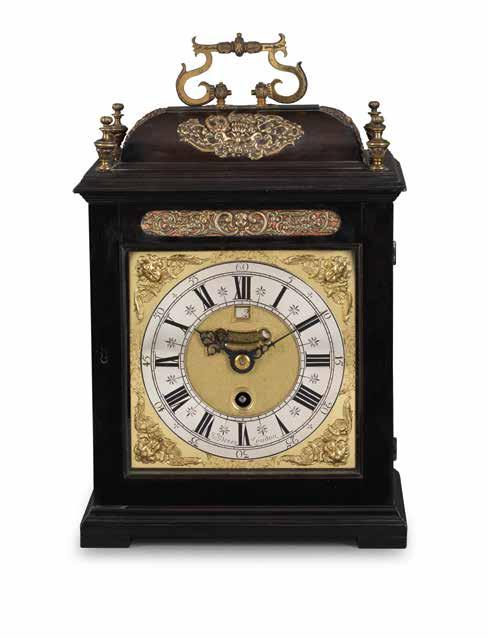
66
A LATE 17TH CENTURY REPOUSSE-BRASS MOUNTED EBONY TABLE TIMEPIECE WITH PULL QUARTER REPEAT
John Drew, Johnsons Court Fleet Street, London
The caddy top surmounted by a foliate-tied S-scroll handle over three applied repousse mounts and four turned finials, the front door further applied with repoussé sound fret, the sides glazed and the whole on a moulded base and block feet. The 6.75 inch square brass dial with winged cherubs head spandrels interspersed with foliate engraving, the silvered Roman and Arabic chapter ring with fancy cruciform half-hour markers enclosing a matted centre with mock pendulum aperture, ringed winding square and date aperture, the lower edge signed between VII and V.
The movement with six vase-shaped turned pillars, re-converted verge escapement and single gut fusee, the reinstated pull quarter repeat
work sounding on two bells, the finely engraved backplate decorated with foliate scrolls and signed within a stylised cartouche John Drew Johnsons Court Fleet Street London . Ticking and repeating. Sold together with a pierced brass ‘Knibb-style’ key, one repousse-, and two cast- door mounts.
40cms high with handle (16 ins) 36cms without (14.5ins).
£3,000 - 5,000
€3,500 - 5,800
US$4,000 - 6,700
FOR FUTHER INFORMATION, PLEASE SEE APPENDIX
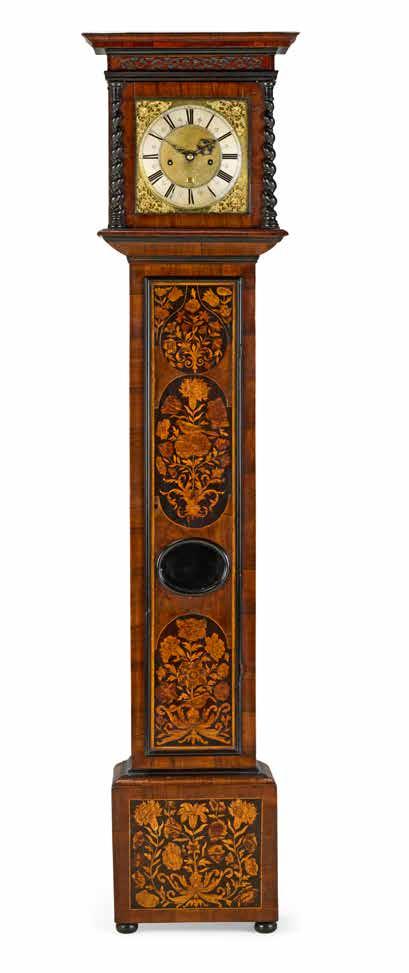
Samuel Aldworth, Oxford
The case with flat top over a pierced sound fret backed in old silk, supported by four ebonised Doric spirally twisted columns, with glazed observation windows to the sides, the convex throat moulding above a long trunk door with marquetry panels depicting flowers and birds within foliate scrolls, centred by an oval lenticle revealing the pendulum, on a matching base and bun feet. The 10 inch square brass dial with silvered Roman and Arabic chapter ring, the finely matted centre with small ringed winding squares, ringed centre and decorated calendar aperture with (later) blued steel hands, framed by cast cherubs head spandrels within floral engraved decoration and signed beneath Samuel Aldworth, Oxford . The movement united by five robust pinned knopped pillars, replaced anchor escapement, striking the hours on a bell mounted above via an internal count wheel. Ticking and striking, together with a pendulum, pair of brass-clad weights, door key and a later crank winding key. 2m (6.58) High.
£3,000 - 5,000
€3,500 - 5,800
US$4,000 - 6,700
Samuel Aldworth, originally from Childrey, Buckinghamshire, travelled to Oxford in 1673 to enter the service of John Knibb, becoming one of Knibb’s most distinguished apprentices. Following the completion of his apprenticeship in 1680, Aldworth remained with Knibb as an assistant until 1689, when he was admitted a Freeman of the City of Oxford and established his own business there.
In 1697 he became a Brother of the Clockmakers’ Company in London and moved to premises in The Strand, notably the same year that Joseph Knibb is thought to have left London. In 1703 Aldworth married Elizabeth Knibb, believed to have been a daughter of John Knibb, further strengthening the close association between the two horological families. Around 1720 he returned to Childrey, where he is believed to have died shortly afterwards, circa 1725.
"THIS CLOCK IS THE EARLIEST RECORDED WALNUT TABLE CLOCK BY JOSEPH KNIBB, LONDON, AND IS PROBABLY THE EARLIEST WALNUT TABLE CLOCK BY ANY ENGLISH MAKER.”
- RONALD A. LEE, 8TH MAY 1984
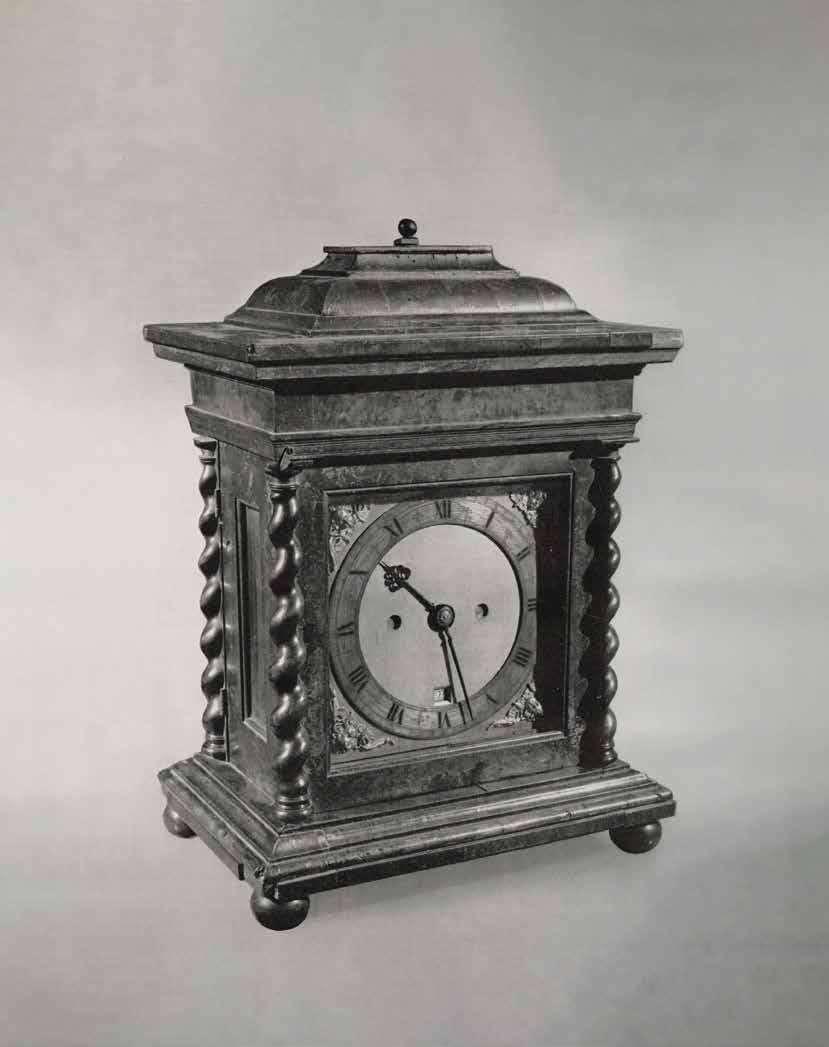
Lot 68, as illustrated in The Knibb Family Clockmakers, published in 1964, prior to its restoration.
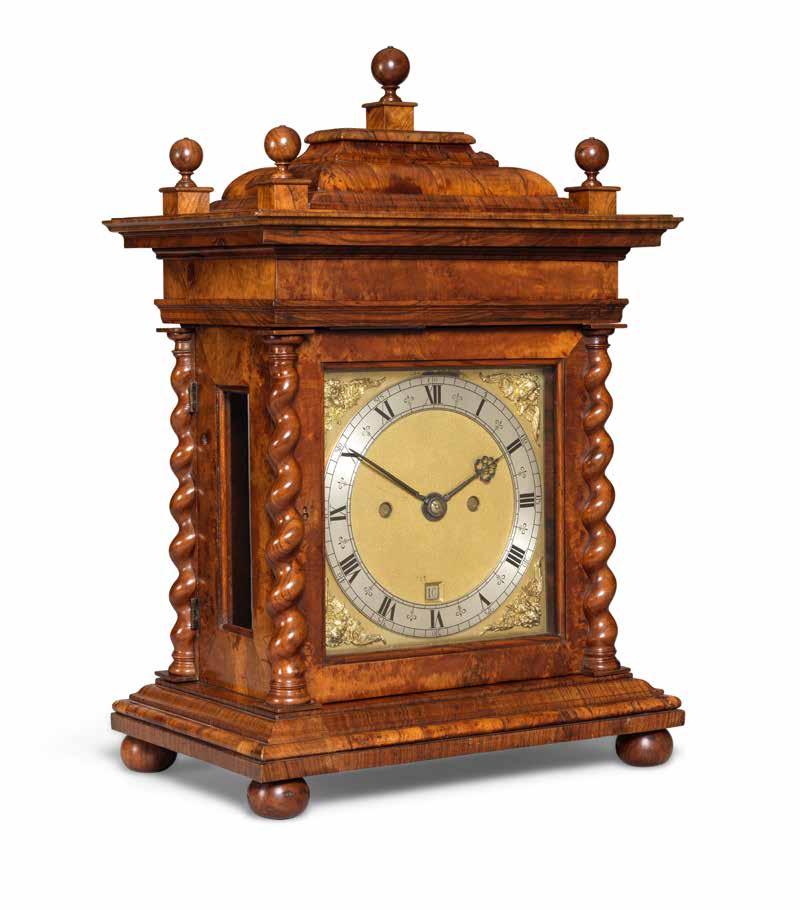
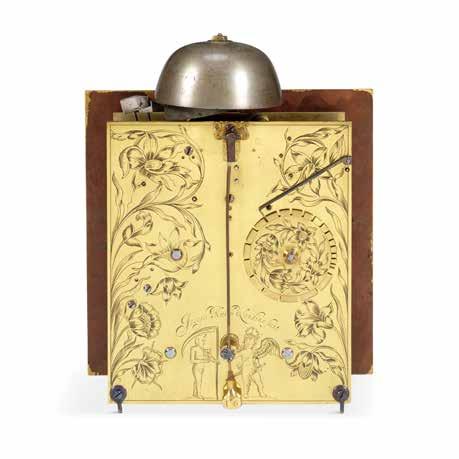
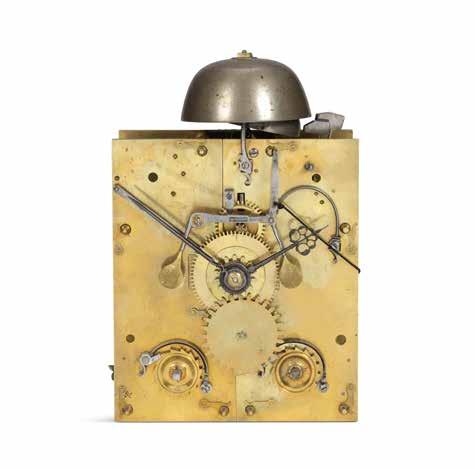
Joseph Knibb, London
The restored case with shallow caddy top surmounted by a turned ball finial and concave moulding, framed by four matching finials to an overhanging cornice with architectural drip rail and intricate mouldings set on four twisted three-quarter columns with carved Doric capitals and bases, the sides and rear with glazed observation windows, all supported by a substantial moulded base on four turned bun feet.
The brass dial measuring 8 1/4inches x 8 1/8inches with a narrow silvered chapter ring, the minute band with Arabic five-minutes marked within the band, Roman hours with fleur-de-lys half hour markers emanating from the inner quarter hour track, the finely matted centre with matted winding shutters and deep chamfered date aperture and finely finished “Oxford type” blued steel hands, all framed by single screwed winged cherubs head spandrels. Secured to the movement front plate via four latched dial feet
The fine Phase I twin gut fusee movement with large plates united by ten knopped and latched pillars, the front plate split in two to allow for easier access of the separate going and striking trains; the former with verge escapement to a short pendulum with engraved hexagonal rating nut; the latter striking the hours twice each hour (once on the full hour, another on the half-hour, in the so called Dutch manner) on a pair of bells and hammers via an external count wheel engraved with tulip and floral decoration. The back plate finely engraved with tulips and sprigs of foliage, signed in a curving arc Joseph Knibb, Londini fecit above the figures of Father Time and Cupid. Currently ticking and striking. 57cms (22.5 inches) high.
£30,000 - 50,000
€35,000 - 58,000
US$40,000 - 67,000
Provenance:
A distinguished private European collection.
Purchased from R.A. Lee (Fine Arts) Ltd., 1984. The invoice, dated May 8th states:
“A Charles II period English table clock in walnut case with twist pillars, a caddy shaped top with ball and urn finials.
The eight-day duration movement striking the hours on a large bell and the half hours on a smaller bell: the movement is fitted with bolt and shutter maintaining power and the backplate is finely engraved with figures and flowers. Circa 1672-3.
This clock is the earliest recorded walnut table clock by Joseph Knibb, London and is probably the earliest walnut table clock by any English maker.”
This clock was fully restored by Ronnie Lee prior to its sale in 1984. However, it had been published at least twice in earlier states of preservation. One can assume that Lee had known of the clocks whereabouts for some 20+ years as he illustrated it in his 1964 masterwork ‘The Knibb Family Clockmakers’ as plate 190 with the caption “The earliest recorded walnut table clock by Joseph Knibb, London. Bolt and shutter maintaining power. Circa 1672-3.” In this image, the case appears dry with several surface scratches and minor veneer losses. A simple catch is screwed to the upper left corner to close the front door. The chapter ring had lost much of it’s silvering and a section of mask is missing.
The clock next appears in print in 1982, in Dawson, Drover and Parkes, Early English Clocks, pp. 186–187 and 309. By this stage, the missing veneer pieces have been replaced, the door catch has been removed, the dial has been restored and the mask repaired.
By the time it was sold to the European collector, Lee had carried out further restoration including re-polishing the case and fitting five ball finials on pedestals.
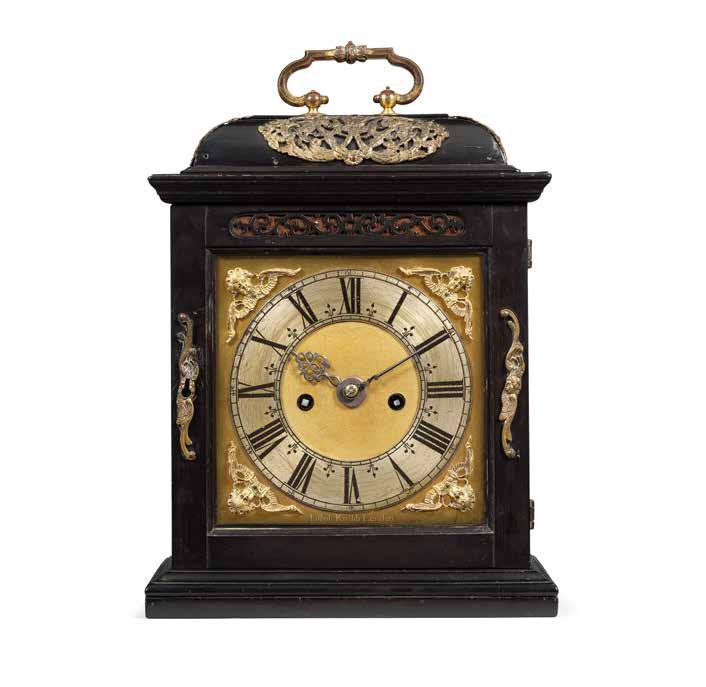
Joseph Knibb, London
The case surmounted by a gilt brass tied-bud carrying handle raised on pommels over a caddy top with cast floral mounts to the front and repoussé mounts to the sides, on a flat-topped cornice, with long glazed side apertures, the front door with typical Knibb escutcheons and pierced wooden sound fret, all resting on a moulded base. The 6.5 inch square brass dial with latched dial feet, and silvered Roman and Arabic chapter ring with outer minute band, and fleur-de-lys half hour markers emanating from the quarter track, the finely matted centre with (later) blued steel hands framed by four cast brass cherub spandrels signed along the lower edge Joseph Knibb, London . The movement with five vase shaped turned and latched pillars, the strike train now missing and the going train with replacement wheels, with verge escapement and short bob pendulum, the finely engraved back plate depicting symmetrical pairs of leaves and flowers within a single line border, signed in a shallow arc Joseph Knibb, Londini Fecit . Ticking, sold together with a door key and later winding key of the correct size. 35cm (14ins) high.
£15,000 - 25,000
€17,000 - 29,000
US$20,000 - 34,000
The above lot is a characteristic Phase III table clock by Joseph Knibb (1640–1711), one of the greatest English clockmakers of the 17th century golden age of horology. Knibb’s table clocks are generally divided into three recognised case types or “phases”, with the present example displaying all the defining features of the mature Phase III design: a flat moulded base, shallow caddy top, finely cast cherub-head escutcheons to the front door, and mouldings of exceptional quality and refinement.
Whilst the case survives in notably fine and unrestored condition, the movement has not fared as well. Only the original plates remain from the movement as made, the strike train now entirely absent and the current going train of later construction. Nevertheless, the surviving elements clearly demonstrate the quality of Knibb’s workmanship, including the distinctive vase-shaped latched pillars and the beautifully engraved backplate, signed in the characteristic arched manner “Joseph Knibb Londini Fecit”.
Despite its losses, the present clock remains an evocative survival by one of the most important makers of the so called “Golden age”, and offering an intriguing opportunity for further study or restoration.
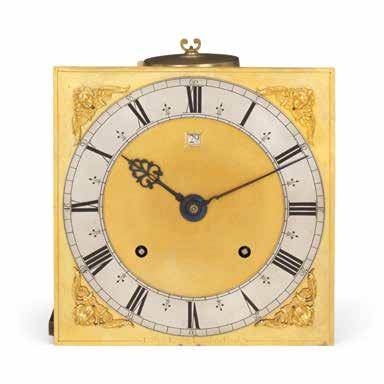
Joseph Knibb, London
The rising hood with flat top over a moulded cornice and pierced silkbacked sound fret of archetypal Knibb design, raised on twisted Doric three-quarter columns to the front and matching quarter-columns to the rear, the sides with tall observation windows to a convex throat moulding, the 42 inch long trunk door with D-moulded surround and well figured veneered panels with typical Knibb style lock escutcheon and large brassframed glazed oval lenticle, set on a moulded base and plinth on four turned bun feet. The 10 inch brass dial with silvered Roman and Arabic chapter ring with fleur-de-lys half hour markers, the finely matted centre with date aperture beneath XII, framed by cast brass winged cherubs head spandrels and signed below VI Joseph Knibb, Londini Fecit , with finely finished blued steel hands. Secured to the movement frontplate via four latched dial feet. The weight driven movement steel locating pins set on small blocks glued to the seatboard, with tall thin plates united by five latched and knopped pillars, the 30-day going train with delicate wheelwork terminating in an anchor escapement accessed via a shaped aperture to the back plate, the pendulum suspended from a butterfly suspension set-up, the strike train sounding on a (replaced) straight-sided bell secured with butterfly nut and governed by an external count wheel of small diameter. Currently ticking and striking, sold with a pair of brass weights and a Knibb style pendulum with butterfly nut. 1.95m (6.65ft) high.
£30,000 - 50,000
€35,000 - 58,000
US$40,000 - 67,000
Provenance:
A distinguished private European Collection.
Purchased from R. A. Lee (Fine Arts) Ltd, 1981. The vendors family paperwork includes a page taken from an auction catalogue featuring this clock as ‘lot 140, tantalisingly the auction house, sale name or sale date is not given. It is likely that Lee vetted and bid on the clock on behalf of the owners, later carrying out any servicing/restoration.
In his 1964 masterwork, The Knibb Family Clockmakers , Lee suggests that there are approximately 10 known longcase clocks with Cariniana wood carcasses, all dating from the 1676-1682 period. One theory is that the wood was used as ballast on Naval ships returning from the West Indies.
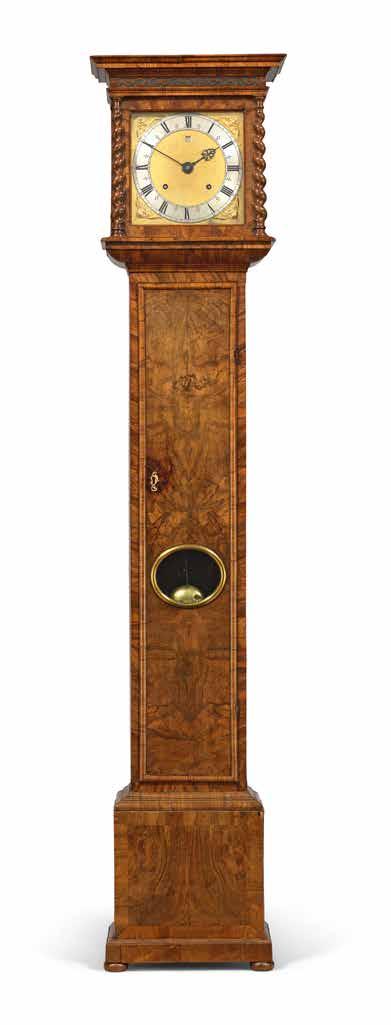
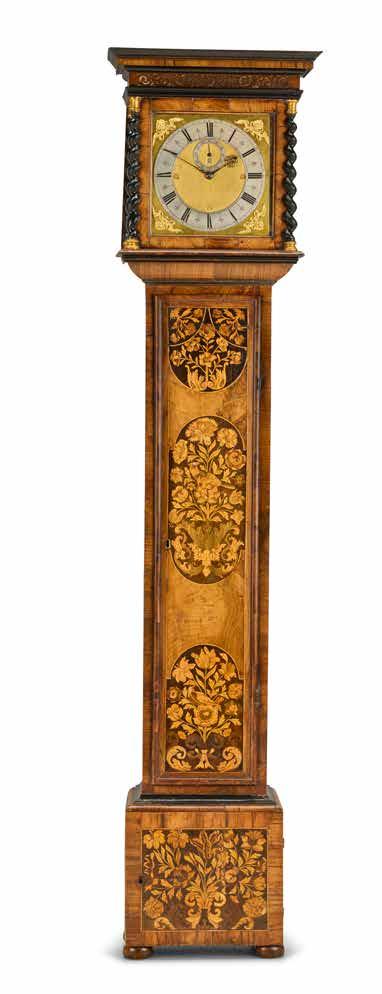
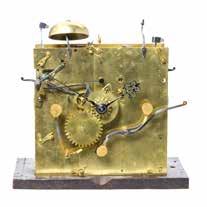
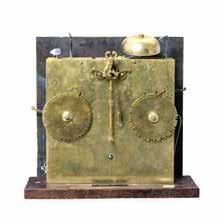
Thomas Herbert, London
The case with ebonised twisted columns to the formerly rising hood, later pierced walnut sound fret and convex throat moulding above the rectangular trunk door inlaid with bird and floral marquetry within D ended panels and ebonised mouldings, the rebuilt plinth with hinged door inlaid with floral marquetry within walnut crossbanding. The 10 inch square dial signed Thomas Herbert, Londini to the silvered Roman and Arabic chapter ring, matted centre with silvered subsidiary seconds enclosing the calendar aperture, with pierced blued steel hands. The three train movement with latched dial feet and eight ringed pillars, the split front plate carrying the quarter train to the left and the going and strike trains centrally and to the right, the going train with anchor escapement and long steel rod pendulum suspended from a flat steel spring in the manner of Joseph Knibb with butterfly regulation nuts above the suspension block and brass faced bob, with bolt and shutter maintaining power. The quarter train with count wheel mounted to the back plate striking the first, second and third quarters on a now missing small bell and additionally striking the hours on each quarter via pump action work on the later large hour bell mounted above the right hand train. 1.94m (6ft 4½i) high.
£10,000 - 15,000
€12,000 - 17,000
US$13,000 - 20,000
Literature: Peter Heuer & Klaus Maurice, Europäische Pendeluhren, Callwey, 1988, page 194, figures 382–384.
Provenance: Sold at Christie’s, London, 11 July 2003, lot 72, £65,725.
Notes: Thomas Herbert was made a Brother of the Clockmakers’ Company in November 1676, although he was probably already free of another Company. By 1680 he is described as the King’s Clockmaker, and by 1683 as the Queen’s Clockmaker. He is recorded in the trade until 1698.
Longcase clocks with 1¼-second pendulums are exceptionally rare and represent an important experimental phase in the early development of pendulum timekeeping. The earliest pendulum longcase clocks employed short pendulums with verge escapements, as the wide arc required by the verge made longer pendulums impractical within the confines of a narrow trunk. Following the invention of the anchor escapement circa 1669–1670, makers began experimenting with longer pendulums in pursuit of improved accuracy. The slower beat and reduced arc of the 1¼ second pendulum offered superior timekeeping, although the increased lateral motion could cause instability in the case and occasionally interrupt the movement. The present clock is particularly remarkable in combining this rare long pendulum with a grande sonnerie movement and a month-duration going train, an extremely unusual and ambitious configuration for the period. The marquetry case has undergone restoration over its lifetime; the original seatboard has been replaced to accommodate the substantial weight of the movement and three driving weights, while the plinth has been rebuilt. The original plinth door, however, appears to survive with its marquetry intact, and the shadow marks of the original hinges since replaced remain clearly visible.
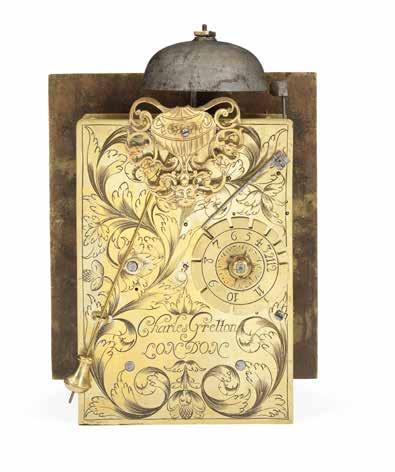
Charles Gretton, London
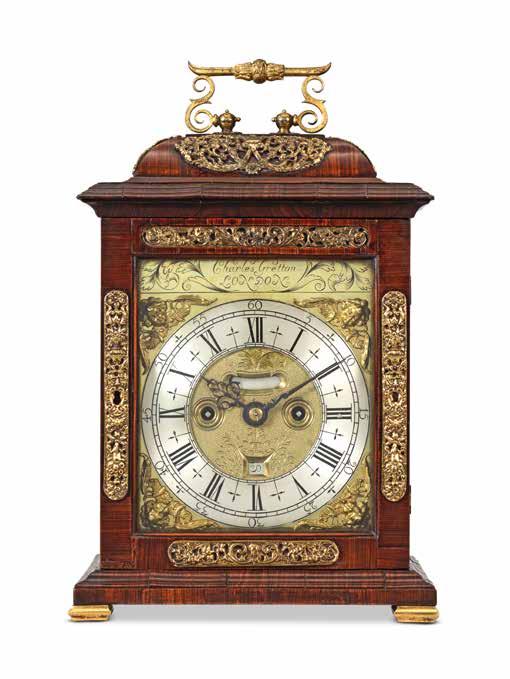
A closely related example is illustrated in Richard Barder, The Georgian Bracket Clock 1714–1830, Antique Collectors’ Club, 1993, p. 25, pl. I/4.
The case with foliate-tied S-form handle on a cushion-moulded top with applied brass mounts, the sides with foliate cast brass repoussé sound frets and small D-ended wooden frets and similar repoussé frets to the front door, the moulded base on later brass block feet. The 6.75 inch brass rectangular dial signed Charles Gretton, LONDON within foliate engraving over the silvered Roman and Arabic chapter ring with cruciform half hour and half- quarter markers and blued steel hands to the matted centre with decorated mock pendulum and date apertures, all framed by winged cherubs head spandrels. The movement with five knopped pillars and twin gut fusees, rebuilt knife edge verge escapement, striking the hours on a bell via a numbered outside countwheel, the backplate boldly engraved with a main foliate scroll issuing leaves and buds, signed Charles Gretton, LONDON. Currently ticking and striking, and sold together with two case keys. 40cms (16ins) high.
£10,000 - 15,000
€12,000 - 17,000
US$13,000 - 20,000
Charles Gretton (circa 1649–1733) was apprenticed in June 1662 to Humfrey Downing and freed in June 1672. He established himself at the sign of the Ship in Fleet Street and by 1685 was recorded as working opposite Serjeants’ Inn Gate. Gretton rose within the Clockmakers’ Company, serving as Assistant from 1689, Warden in 1697 and Master in 1700. He is recorded as attending the Company until 1720 and is believed to have remained active until about 1733.
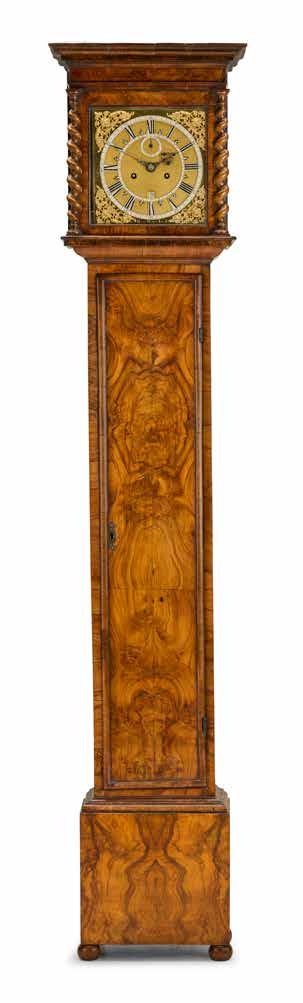
Henry Harpur, London
The case with overhanging moulded cornice over a plain frieze supported by Doric twisted columns, the sides with glazed observation windows to a convex throat moulding, the long trunk door with panels of book-matched veneers framed by a D moulded edge, on a moulded section and matching base on bun feet. The 10 inch square brass dial with skeletonised silvered Roman and Arabic chapter ring with fleur-de-lys half hour markers, the matted centre with date aperture and subsidiary seconds, all framed by cast brass cherubs head spandrels, signed below VI Henry Harpur, London . The two train movement with anchor escapement and long pendulum, striking the hours via an external countwheel on a large bell mounted above, united by five pinned and knopped pillars. Ticking and striking, sold with a pendulum and pair of brass clad weights. 2.03m (6.6ft) high.
£7,000 - 10,000
€8,100 - 12,000
US$9,400 - 13,000
Henry Harpur, sometimes recorded as Henry Harper, was an important London clock and watchmaker active during the golden age of English horology. He entered apprenticeship in the Clockmakers’ Company in 1657 and gained his Freedom in 1664. Records of the Company show that he was at one stage summoned regarding the manufacture of watch chains considered below the required standard of fineness, illustrating the strict regulation of the trade during the period. He died in 1708 at St Mary’s, Islington.
Harpur is best remembered for his sophisticated early watches and fine longcase clocks. His surviving work includes rare pre-balance spring pocket watches of considerable complexity, incorporating astronomical and calendar indications, together with finely made eight-day longcase clocks housed in richly decorated William and Mary walnut and marquetry cases. Examples of his work are preserved in major institutional collections including the British Museum.
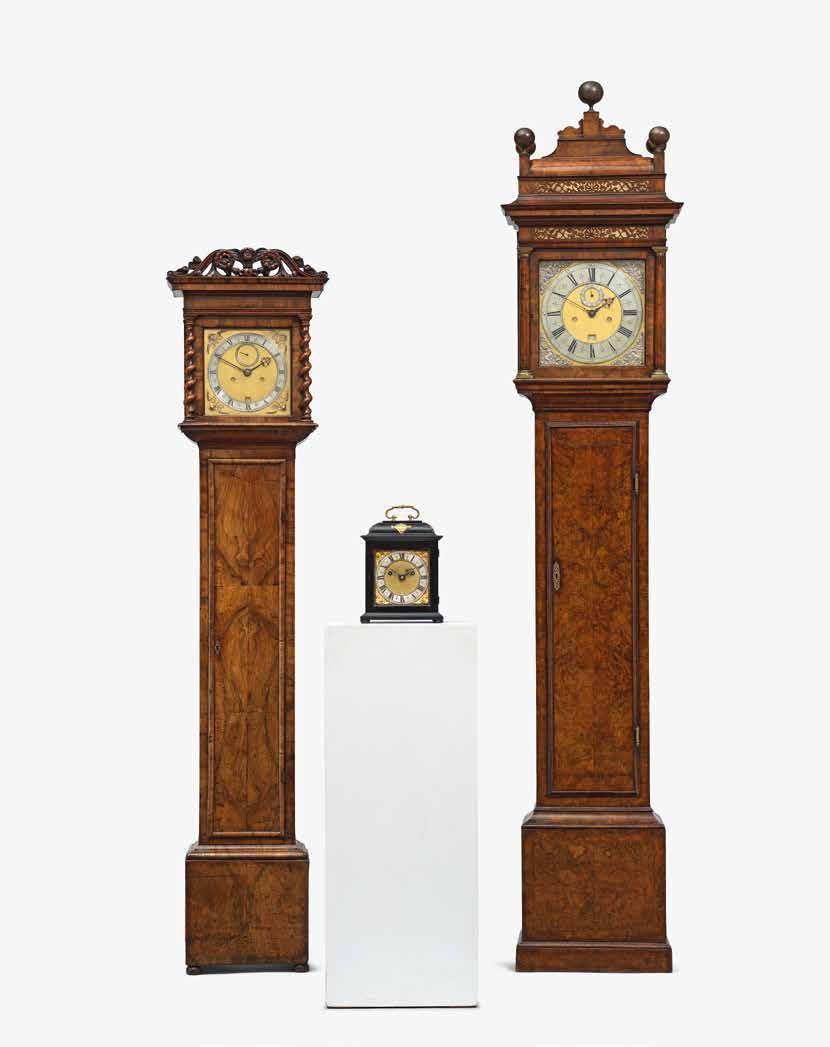
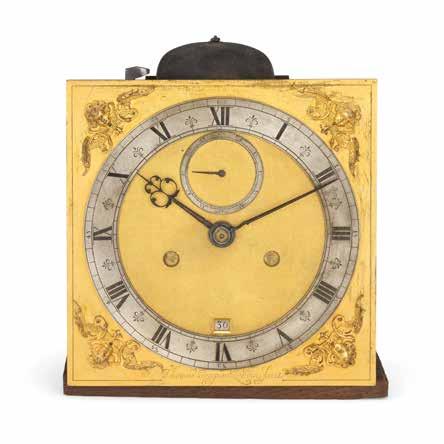
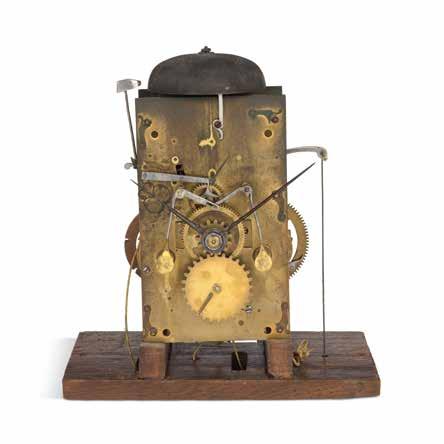
Thomas Tompion, London, pre-numbered, circa 1680
The case surmounted by a carved cresting to a flat-fronted overhanging cornice raised on three-quarter twisted Doric columns to the front angles and matching quarter-columns to the rear supported by a convex throat moulding to a 42 inch long trunk door with six panels of book-matched figured walnut veneer within a D-moulded edge, the figured plinth base below a cavetto/ovolo moulding and raised on bun feet.
The ten inch square gilt brass dial with single line border enclosing the cherub’s head spandrels and signed along the lower edge in a flowing script Thomas Tompion, Londini fecit , the narrow silvered Roman and Arabic chapter ring with minute band and fancy fleur de lys half hour markers, the very finely matted centre with large narrow silvered Arabic seconds ring and chamfered date aperture, with blued steel hands. Secured to the movement by four latched dial feet.
The eight-day, weight-driven movement set on a pair of oak blocks in the early manner, with tall rectangular plates united by six knopped and ringed latched pillars, with reversed trains; the strike train on the left with inside countwheel and vertical steel hammer to the shallow bell above, the going on the right hand side with bolt and shutter maintaining power, four wheel train terminating in an anchor escapement (the backplate with commensurate cut-out), long steel crutch to a pendulum terminating in a brass-faced bob with butterfly regulation nut. Ticking and striking, sold with the pendulum and a pair of brass clad weights. 204cms (6ft 8ins) high.
£70,000 - 100,000
€81,000 - 120,000
US$94,000 - 130,000
Provenance:
Christie’s, London, 8 July, 1971, The Property of a Gentleman; lot 10, 8,000 Guineas;
Christie’s, London, 5 July, 2002, The Property of a Gentleman; lot 92, £122,000; The Richard Thompson Collection.
Literature:
Evans, Carter & Wright, Thomas Tompion 300 Years, 2013, p. 450-451.
Comparative literature:
A clock with an almost identical dial is illustrated in R. W. Symonds, Thomas Tompion: His Life and Work, page 34, figure 11, and page 76, figure 50.
The back cock of this clock is particularly well finished - it is of substantial construction and exhibits finely chamfered edges. Filled holes indicate that it is a very old replacement and it has been suggested that this upgrade was carried out either by Tompion himself, or George Graham - it certainly bears their hallmarks and has been in position for many years.
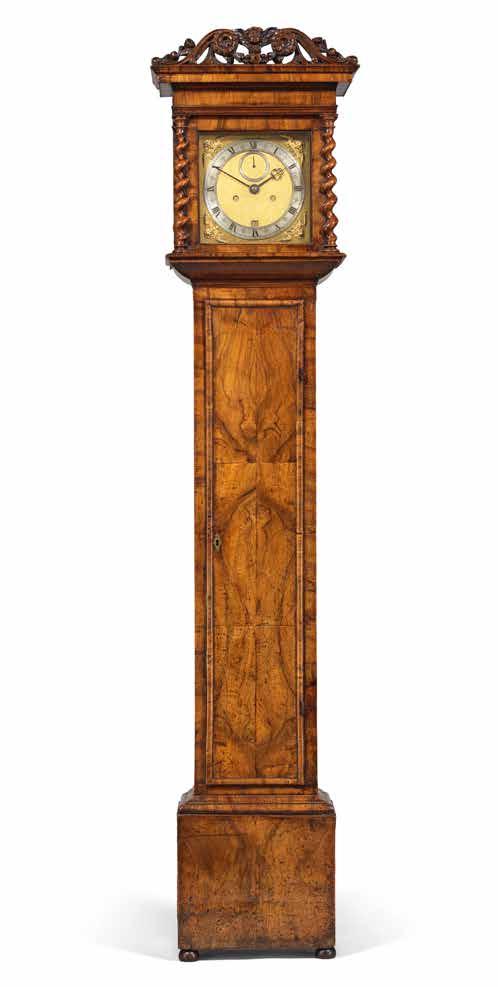
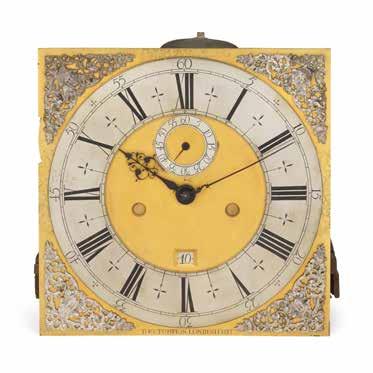
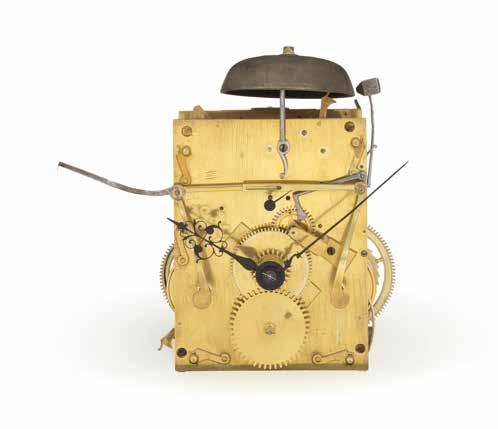
Thomas Tompion, London, No. 385
The case surmounted by a large lacquered brass ball finial raised on a pedestal framed by shaped side pieces over a concave moulding above the main four-sided convex caddy framed by four proportionally smaller matching finials on pedestals, the lower section set with a silk backed sound fret to the front, all set on an impressive overhanging stepped cornice and with matching sound frets to three sides, raised on brassmounted Doric three-quarter and quarter-columns, with long glazed panels to the sides. The trunk with 42 inch long door veneered in six panels of book-matched burr veneers, all framed by an intricate moulded edge, with brass escutcheon, the sides similarly inlaid with burr panels within feather banded borders, the base with lively veneers within cross banding, all raised on a plinth base, further supplied with ebonised moulded block feet (chisel-marked R and L ).
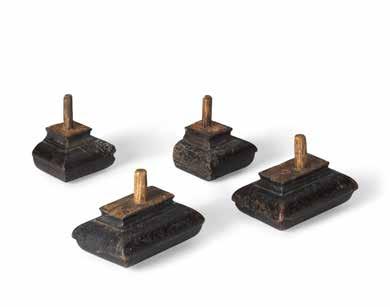
The 12 inch square gilt brass dial engraved by ‘graver 195 and framed by silvered double-screwed Indian mask spandrels separated by foliate engraving and signed along the lower edge THO: TOMPION LONDINI FECIT , the silvered Roman and Arabic chapter ring with cross half-quarter marks outside of the minute ring, and with meeting arrow-head half-hour markers emanating from the inner quarter hour track, framing a finely matted centre with large subsidiary seconds dial, and deeply chamfered date aperture with pin-hole adjustment, with fine blued steel hands. Secured to the frontplate with four latched dial feet.
The weight driven movement with substantial plates united by six heavy knopped and latched pillars, with reversed trains and bolt-andshutter maintaining power; the going side with anchor escapement (with commensurate cut out in the backplate) to a long steel crutch and pendulum terminating in a brass-faced bob with engraved rating nut, the strike with large outside countwheel actuating the steel hammer acting on the bell above (the latter secured by a typical facetted brass retaining nut). The lower central edge of the backplate punch numbered 385 . An L-shaped bracket to the upper right hand corner of the backplate locating into the backboard of the case for increased stability. Ticking and striking, sold together with the pendulum and brass-cased weights. 2.52m (8ft 3ins) high. Total height including the block feet 2.56m (8ft 5ins) high.
£150,000 - 250,000
€170,000 - 290,000
US$200,000 - 340,000
Provenance: Anthony Woodburn Fine Antique Clocks, the Masterpiece Fair, London, 2012.
Thomas Tompion, regarded as the father of English clockmaking is one of the most important figures in the history of horology. Clock number 385 was made in 1703, a time when Tompion was producing some of his very best work for European Royal families, such as the magnificent equation of time, year-going longcase clock for the husband of Queen Anne, Prince George of Denmark. This 8 foot 11 inch gilt-metal mounted tour-de-force with it’s distinctive gilt feet, remains in the British Royal family to this day and stands in the late Queen Elizabeth IIs private study in Buckingham Palace. Exceptional spring clocks commissioned around the same time as the current lot, in 1703/1704, include clock number 381, the grandesonnerie ‘Spanish Tompion’ reputedly made for King Philip V of Spain, and clock number 401, the grande-sonnerie ebony table clock purchased by, or gifted to, King Leopold I, Holy Roman Emperor. Clock number 385 was in production at the same time as these magnificent clocks and it is obvious that it was originally intended for a high ranking client. Purchased from Antony Woodburn in 2012, this clock represents one of the finest Tompion longcases to have been offered for sale in recent decades, many will remember it’s exhibition at the vetted Masterpiece Fair in London. Woodburn had purchased it from a collector and he believed that it had changed hands perhaps only three times in the previous three centuries, which would account for the high degree of originality throughout.
The large and heavily cast dial is entirely characteristic of Tompion’s work, featuring the quintessential cruciform half-hour markers associated with his finest productions. The dial corresponds to what the late Jeremy Evans described as a Type 3 dial, used on clocks numbered from 301 onwards, this example being engraved by Engraver ‘195’. While the use of an outside countwheel is rare, it was used in other clocks of the period such as the month-going number 333 illustrated in Evans, Carter & Wright; numbers 291 and 284, and as late as clock number 502, circa 1710. The spandrels are the typical double-screwed Indian mask and scroll pattern associated with Tompion’s workshop, the current set are original and have been silvered at some stage in their life. The case itself is a fine Type 3 example with the additional refinement of a four -sided caddy to the hood, in the same manner as the Mostyn longcase, no. 347, circa 1700. Woodburn suggests that the walnut feet may well have originally been gilded, there is some sense in this as they would then echo and complement the gilt ball finials above.
Gilt highlights to cases were used by Tompion for several of his special commissions, such as the ‘Denmark’ longcase c.1703 mentioned above; the ‘Record’ longcase of c.1700 - it is easy to see the Mostyn year going spring clock made circa 1691 and now on display in The British Museum as the genesis of this design. In a similar vein, is it possible that Tompion was inspired to use simpler gilt block feet on a number of longcases in the manner of those feet he employed on the grande sonnerie turtle shell clocks numbers 436 (c.1706) now in the FitzWilliam Museum, and the ‘Portland’ sold to the Duke of Portland c.1705. If the current feet were indeed gilt the case would be similar to clock number 275, almost certainly sold to King William III for Kensington Palace in 1696, now in Buckingham Palace.
Literature:
Evans, J., Carter, J., Wright, B. (2013) Thomas Tompion 300 Years. Kent: White Horse Press. p605.
Antiquarian Horology, Volume 33, September 2012 advertisement Clocks Magazine, April 1984, front cover and interior article ‘The simple elegance of Thomas Tompion’, an article by Anthony Woodburn in which he states that he purchased this clock from a Dutch family who had owned it for at least three generations.
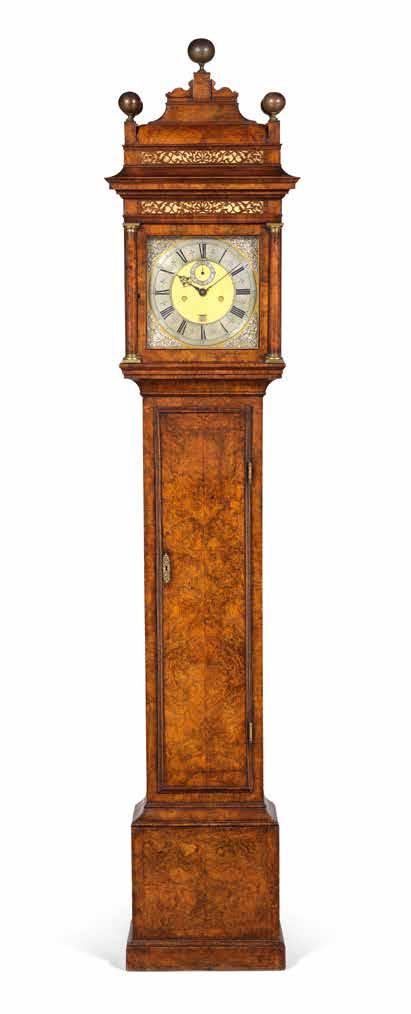
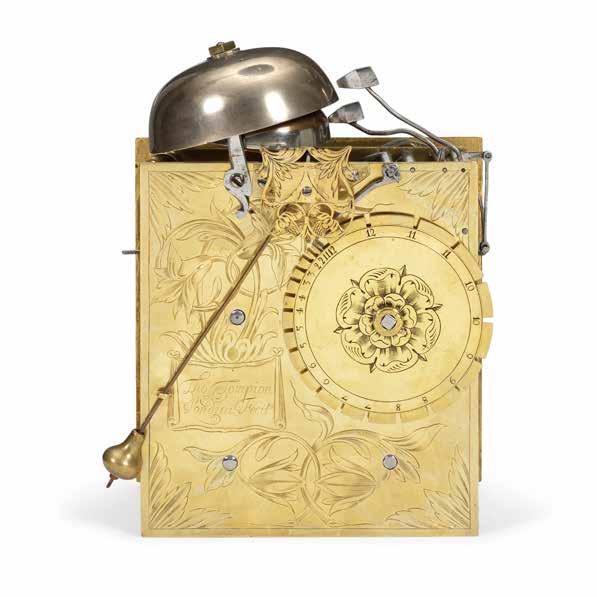
Thomas Tompion, London, pre numbered, circa 1675
The case surmounted by a foliate-tied faceted gilt brass carrying handle set on flowerhead pommels, to a low cushion moulded top with gilt brass mounts to the front and rear and silk backed pierced gilt brass foliate scroll repoussé sound frets to the sides, over long rectangular glazed panels on a moulded base and bun feet. The 6 inch square gilt brass dial with engraved line border framing the winged single-screwed cherub’s head spandrels and engraved silvered Roman chapter ring with Arabic five-minute numerals within the minute band and cruciform half hour markers emanating from the quarter-hour track, the finely matted centre with date aperture at VI with double pinhole adjustment, and blued steel hands. The twin gut fusee movement united by five heavy knopped latched pillars, with knife edge verge escapement, striking in the Dutch manner with the hour struck on the hour and the half-hour on two nested bells and hammers via a double calibrated countwheel mounted
on the backplate engraved with central rosette. The back plate signed Tho Tompion, Londini Fecit in an engraved lambrequin set within pairs of tulips, their stems intertwining, framed by foliate corners. Ticking and striking, sold together with a 17th century style winding key and a case key. 32cms (12.5ins) high.
£80,000 - 120,000
€93,000 - 140,000
US$110,000 - 160,000
Literature:
P.G. Dawson, C.B. Drover & D.W. Parkes, Early English Clocks, Woodbridge, 1982, pp. 303-305, pls. 433-437 and p. 422, pls. 605-606.
Provenance:
Christie’s London, 22 November 1978, lot 156.
Christie’s London, 9 June 2011, lot 241, The Property of a Gentleman.
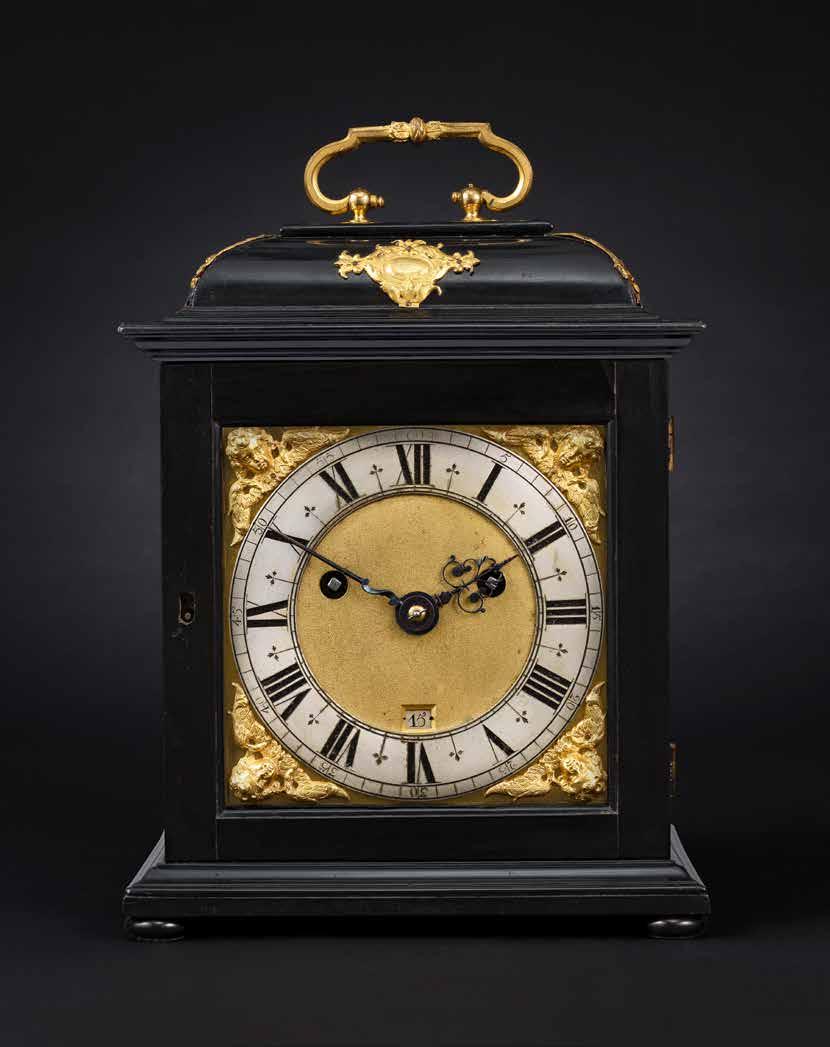
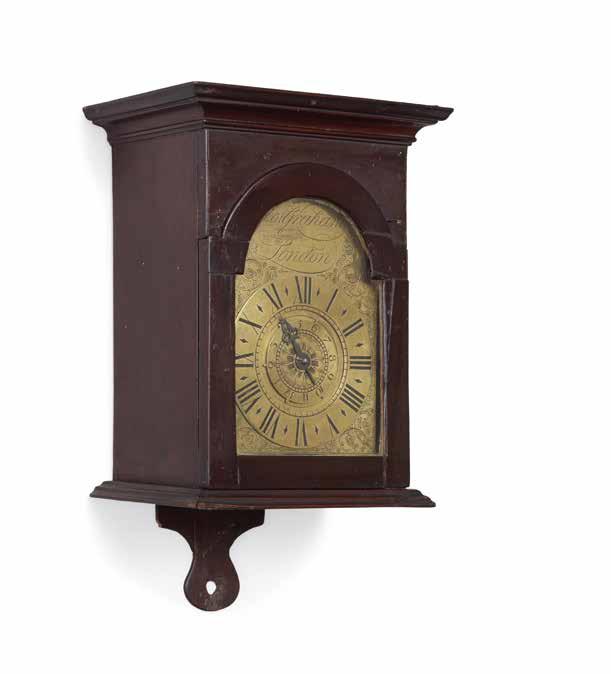
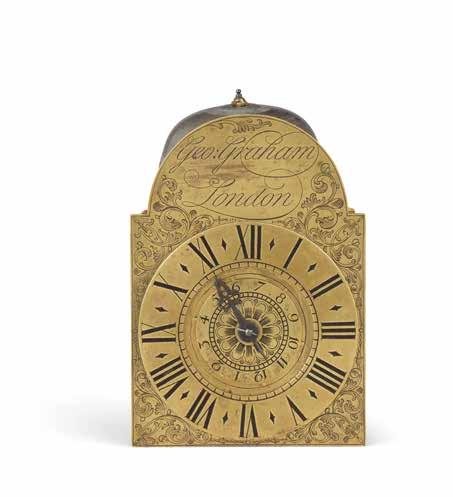
George Graham, London Number 741
The mahogany hood with flat top and moulded cornice over a plain front and sides, terminating in a shaped base, the interior with Iden Collection inventory label numbered 1905 (Graham). The 3.5 inch break arch brass dial with Roman chapter ring with lozenge half hour markers, with Arabic alarm setting dial to the engraved centre and blued steel hand, all framed by engraved floral spandrels and signed George Graham, London . The movement with verge escapement and short bob pendulum with separate alarm work powered by a pair of weights, the back numbered 741 , sold together with a 20th century travel case. The case 24cms (9.5ins) high.
£3,500 - 4,500
€4,100 - 5,200
US$4,700 - 6,100
Literature: Dawson, G.P. (1987) The Iden Clock Collection. Woodbridge: ACC, p186-187 Evans, J. (2006) Thomas Tompion and the Dial and Three Crowns. Kent: White Horse Press, p.85.
The Iden Clock Collection was an important group of 17th- and 18thcentury English clocks assembled by Walter J. Iden (1873–1952), a British engineer who began collecting in the 1930s. By the time of its dispersal in the 1940s, the collection comprised over one hundred fine and rare timepieces, including examples by leading makers such as Thomas Tompion (1639–1713), George Graham (1673–1751), Daniel Quare (1649–1724), and Joseph Knibb (1640–1711). Clocks from the collection are frequently identifiable by their distinctive inventory numbers and remain highly regarded when they appear at auction.
The collection is now best known through the publication Percy G. Dawson, The Iden Clock Collection (1987), which illustrates and catalogues the assembled pieces in detail, preserving an important record of one of the most notable private collections of English horology.

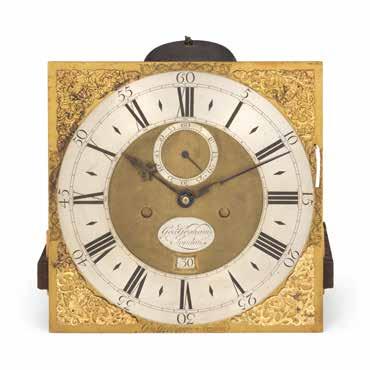
78 * W TP
A GOOD EARLY 18TH CENTURY WALNUT EIGHT-DAY LONGCASE CLOCK
George Graham, London, No.669
The caddy top over a silk-backed pierced sound fret raised on brassmounted Doric three-quarter and quarter columns. The long door with quarter-veneered panels framed by a moulded edge, over a matching base with double apron. The horizontal door sill crisply stamped twice
The 12 inch square brass dial with Indian mask spandrels to each corner, interspersed by three areas of flowing foliate scrolls centred by a flowerhead, the silvered Roman and Arabic dial with outer minute band, inner quarters and floating lozenge half-hour markers, finely matted centre with subsidiary seconds ring, shuttered winding squares, chamfered date aperture with pin-hole adjustment and applied silvered nameplaque. Signed again on the lower edge Geo: Graham, London
The twin train movement with substantial plates united by five heavy knopped and latched pillars; the going train with bolt-and-shutter maintaining power to an anchor escapement with long steel crutch; the strike train with rack striking on a bell via a brass-headed hammer. The backplate crisply numbered 669 on the lower edge. The oak seatboard applied with a printed label Camerer Cuss & Co.... dated SK 3/74 . Ticking and striking, and sold together with a pair of brass clad weights, a trunk door key, a hood door key, and a pendulum. 2.27m (7ft 5ins) high.
£20,000 - 30,000
€23,000 - 35,000
US$27,000 - 40,000
Literature:
Evans, J. (2006) Thomas Tompion and the Dial and Three Crowns. Kent: White Horse Press, p.84.
FOR FUTHER INFORMATION, PLEASE SEE APPENDIX
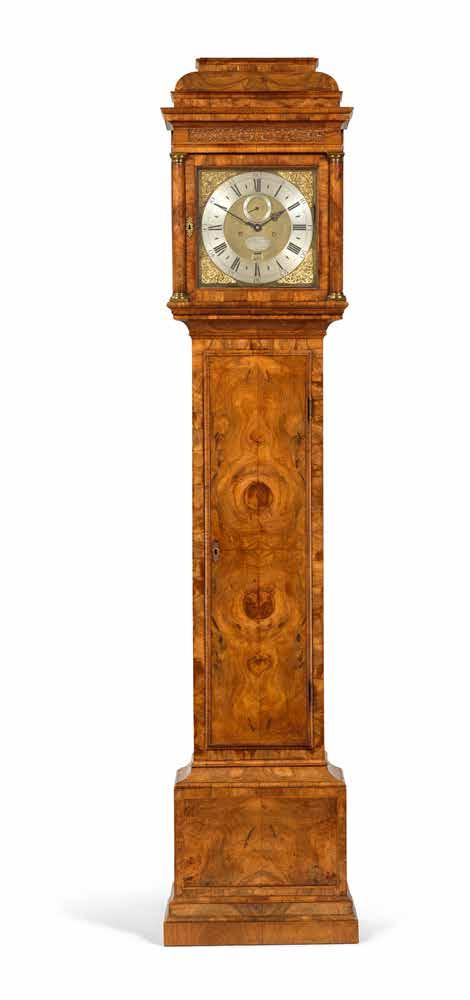
Barkley and Colley, Graham’s Successors, London
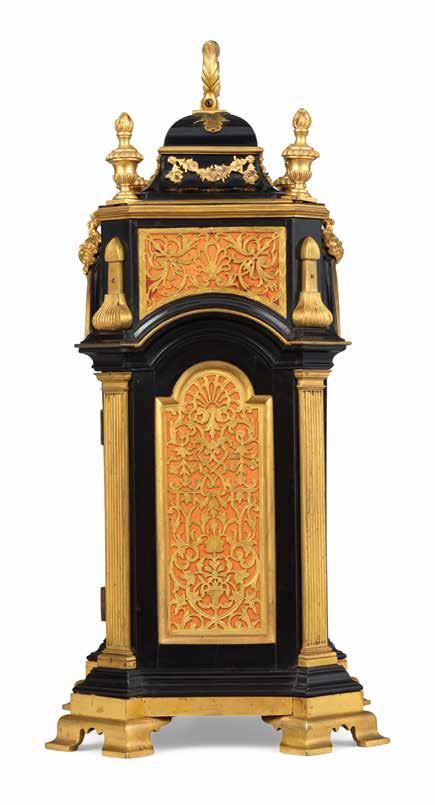
The case surmounted by a carrying handle on a brass-bound bell top applied with engraved ormolu mounts, framed by flambe urn finials to the canted corners, over fine silk-backed pierced and engraved sound frets on a moulded break arch cornice centred by a floral ormolu mount, the long canted angles supported by Doric columns enclosing the matching side sound frets, the glazed rear door revealing the movement within and set on a heavy brass band and double ogee bracket feet.
The silver-mounted 4.75 inch arched brass dial signed on a repousse silver plaque Graham’s Successors, Barkley & Colley, London flanked by a pair of subsidiary dials for Strike/Silent and rise-and-fall-regulation marked in tens 0-60; the silvered Roman and Arabic chapter ring framing the finely matted centre with mock pendulum and date aperture with pin-hole adjustment and finely cut blued steel hands, all framed by delicate silver spandrels.
The finely made twin gut fusee movement with verge escapement and short lenticular bob pendulum, with rack striking for the hours on a polished bell, and pull quarter repeating on two bells with three hammers, the unengraved back plate signed below the pendulum holdfast Graham’s Succs., Barkley & Colley, London . Ticking, striking and repeating. Sold together with a winding key of the correct size. 39cms (15ins) high.
£25,000 - 35,000
€29,000 - 41,000
US$34,000 - 47,000
A letter from Thomas Colley dated 1754 showing his signature. Not included with this lot.
Provenance:
A distinguished European Collection.
Barkley & Colley (fl. 1751–1754) was a short-lived but important London horological partnership formed by Samuel Barkley and Thomas Colley following the death of George Graham (1673–1751). Both men had been closely associated with George Graham, Barkley as his foreman and Colley as a journeyman and were appointed executors of his will. They continued the business from Graham’s premises in Fleet Street, producing clocks of high quality in the established tradition, often signed ‘Graham’s Succs.’.
The partnership was brief, ending with the death of Samuel Barkley in June 1753. Thereafter, Thomas Colley continued independently from 1754, later entering into partnership with John Priest. Clocks bearing the signature of Barkley & Colley are consequently rare and represent a direct continuation of the distinguished Tompion–Graham lineage in mid-18thcentury English horology.
Literature:
A clock in a closely comparable case is illustrated and described as an exceptionally fine brass-mounted ebony example, circa 1755, by John Berry in Richard C. R. Barder, The Georgian Bracket Clock, page 66 This clock also featured in the film British Clocks 1600–1850 (1983), presented by Dan Parkes and produced by James Archibald.
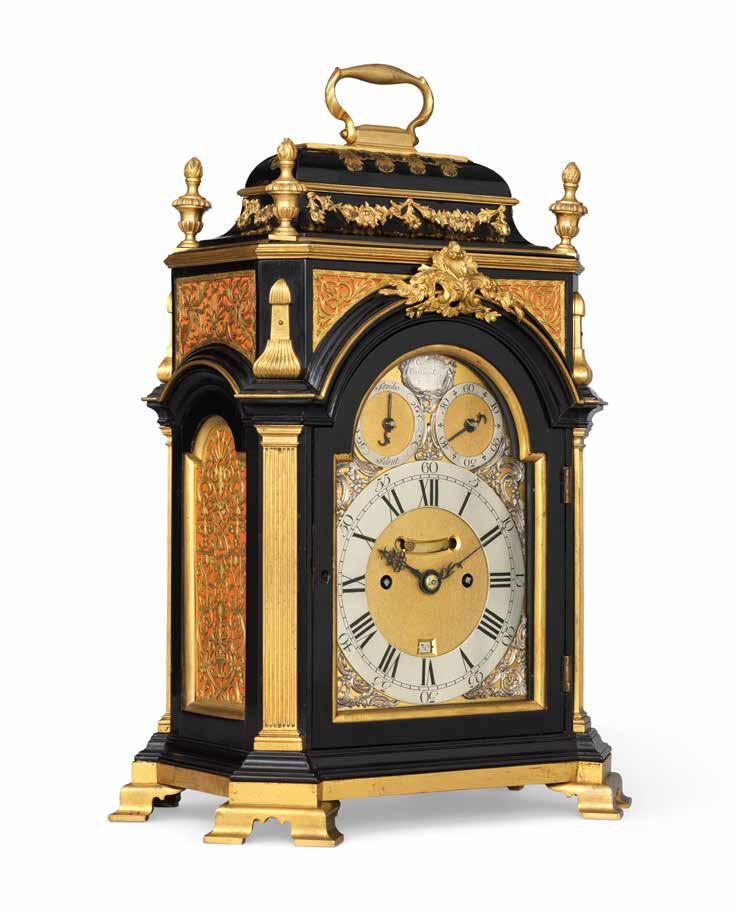
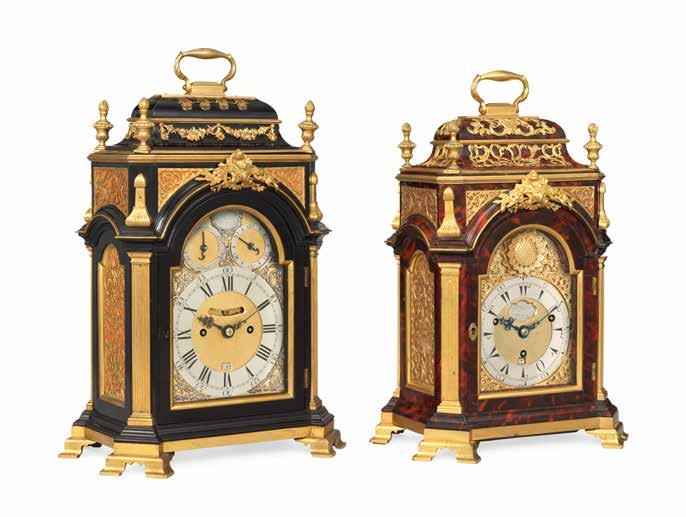
80 Y
AN EXCEPTIONALLY FINE AND RARE MID 18TH CENTURY ENGLISH MUSICAL ORMOLU-MOUNTED TORTOISESHELL TABLE CLOCK OF SMALL SIZE
Markwich Markham, London
The case surmounted by a ribbed handle set on a bell top mounted with ormolu scroll mounts, framed by four flambe urn finials united by applied cast gilt banding, the stepped caddy top with pierced and engraved gilt sound frets to all four sides backed in red silk, each long side panel centred by a basket of flowers with stap- and scroll-work, each canted corner set with a fluted Doric pilaster on double-ogee bracket feet.
The 4.25 inch arched brass dial set with a cast sunflower over the silvered Turkish-market chapter ring enclosing the matted centre with (replacement) recessed signature plaque, with a tune selection lever offering either Ukhac Devir or A Minuet played once every three hours (at 12, 3, 6 and 9), framed by scroll spandrels.
The movement filling the whole of the case interior and only removable through the bottom of the case, with three gut fusees, six knopped pillars and a knife edge verge escapement rack striking the hours on a polished bell and playing either tune on a run of six graduated bells and 12 brassheaded hammers. The backplate with a single line border framing the flowing pattern of engraved foliate scrolls and central signature Markwick Markham, London . Ticking, striking and playing both tunes. Sold together with a later winding key of the correct size and a door key. 36cms (14.25ins) high.
£20,000 - 30,000
€23,000 - 35,000
US$27,000 - 40,000
Literature:
A closely related brass-mounted ebony bracket clock by John Berry, dating to circa 1755, is illustrated and discussed in Richard C. R. Barder, The Georgian Bracket Clock, p. 66. See also A.W.J.G. Ord-Hume, The Musical Clock, Mayfield, 1995, and D. Roberts, Mystery, Novelty and Fantasy Clocks, Atglen, 1999.
A closely related pair of musical tortoiseshell-veneered clocks in comparable cases by Markwick Markham was sold at Christie’s, Important Clocks and Marine Chronometers, 1 July 2008, lot 41, realising £181,250 including premium.
Markwick Markham, trading from “Behind the Royal Exchange, London”, flourished during the mid to late 18th century and became particularly associated with the manufacture of musical and decorative clocks intended for export to the Ottoman Empire, Russia and the wider Near Eastern market. Following the death of James Markwick in 1730, the business was continued by his son-in-law Robert Markham, who worked both independently and in partnership with fellow makers including Henry Borrell and Francis Perigal, producing richly ornamented clocks for distinguished international patrons.
The firm became especially noted for its luxurious tortoiseshell and ormolu-mounted musical clocks, examples of which survive in important public and private collections, including the Seraglio Palace in Istanbul. Comparable clocks are illustrated in the standard works by Barder and Ord-Hume, while related Ottoman-market examples by Markwick Markham and other contemporary London makers have appeared in major international auction sales in recent decades.
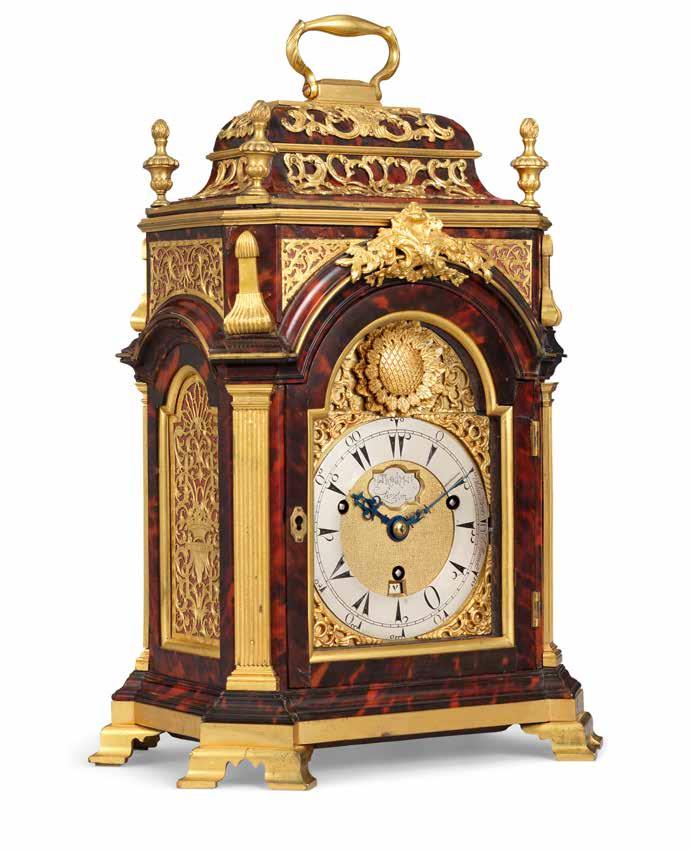
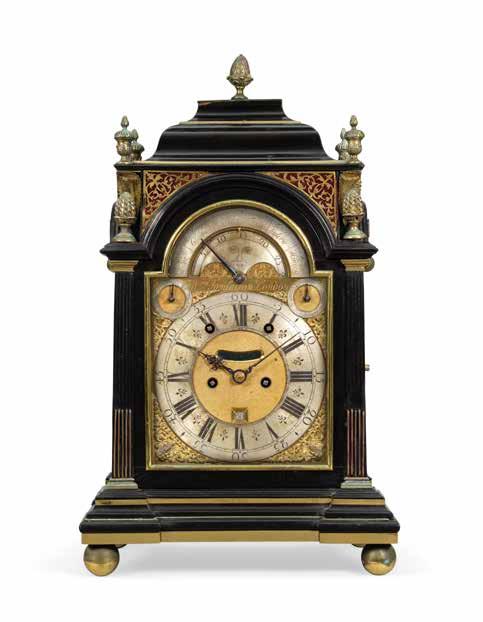
81 *
A FINE AND RARE MID 18TH CENTURY METAL-MOUNTED EBONISED FOUR TRAIN MUSICAL TABLE CLOCK PLAYING SIX TUNES ON EIGHT BELLS AND SIXTEEN HAMMERS. THE CASE POSSIBLY ATTRIBUTABLE TO JOHN HOLL.
William Tomlinson, London
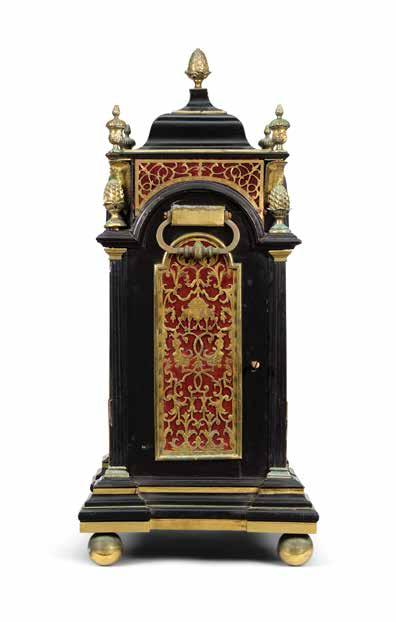
London between twin subsidiaries for Strike/Not Strike and Chime/Not Chime . The silvered Roman and and Arabic dial with half-quarter marks and floating fleur-de-lys half-hour marks, the matted centre with mock pendulum and calendar apertures framed by cast brass spandrels, with blued steel hands.
The brass-banded case surmounted by urn finials over pierced and engraved sound frets framed by four further finials to each corner framed by engraved plaques featuring human face masks, the sides with large pierced and engraved brass sound frets almost identical to those used by Holl, framed in brass and set to each corner with bold stop-fluted Doric pilasters, the front door glazed with brass banding terminating in a large inverted break-front moulded base with further brass banding, raised on four (later) ball feet.
The 7 inch arched brass dial with a silvered arc offering a choice of tunes including Galloping Nagg; the Happy Clown ; Hannover March; Granadeers March; Lilli Culero; and Minuett (sic) framing the rolling moon-phase and Moon’s age dial below, signed across the upper border William Tomlinson,
The four train, quadruple fusee movement with converted anchor escapement set on the backplate, rack striking the hours on a polished bell mounted above, striking the quarters on a nest of eight bells and playing a selection of tunes on a nest of eight bells and sixteen hammers via a pinned barrel, the back plate fully engraved with scrollwork around the central signature cartouche. 54cms (21.5ins) high.
£8,000 - 12,000
€9,300 - 14,000
US$11,000 - 16,000
FOR FUTHER INFORMATION, PLEASE SEE APPENDIX
Claude Duchesne, London
The case with flat cornice and large overhang with brass inlay, the door columns inlaid with tortoiseshell and brass with large glazed observation windows to the sides, the convex throat moulding centred by a heraldic coat of arms with Dutch and Belgian arms beneath a Baron’s coronet, the long trunk door with brass moulded surround and inlaid with intricate brass, tortoiseshell and pewter boulle work with a brass framed glazed lenticle, the sides with conforming boulle decoration of floral motifs, terminating in a moulded base with heavy brass surround on a further boulle decorated plinth and moulded base, the interior of the trunk lined with marbled paper. The 12 inch brass dial with silvered Roman and Arabic chapter ring with fleur-de-lys half hour markers, the centre finely matted with ringed winding squares and large central calendar aperture with subsidiary seconds on a separate silvered Arabic dial with blued steel hands framed by cast brass spandrels, signed in the break arch Claude Du Chesne , Londini with strike/silent aperture. The robust three train movement with five knopped and pinned pillars with anchor escapement, striking the hours on a large bell mounted above and chiming the quarters on a nest of four graduated bells via a pin barrel, the back plate finely engraved and signed Clauduis , sold together with three brass clad weights and pendulum. 2.37m (7.75ft) tall.
£5,000 - 7,000
€5,800 - 8,100
US$6,700 - 9,400
Claude Duchesne (fl. 1690–1730) was a Huguenot clockmaker of French origin working in London, recorded at Dean Street, St Ann’s, Soho. He was a member of the Clockmakers’ Company from 1693 and remained active into the early 18th century. In 1693 he married Elizabeth Bossu at Stepney, reflecting his connections within the Huguenot émigré community. His family continued in the London trades, his son Anthony Duchesne becoming a goldsmith, while his grandson, also Claude Duchesne, followed the horological profession as a clockmaker.
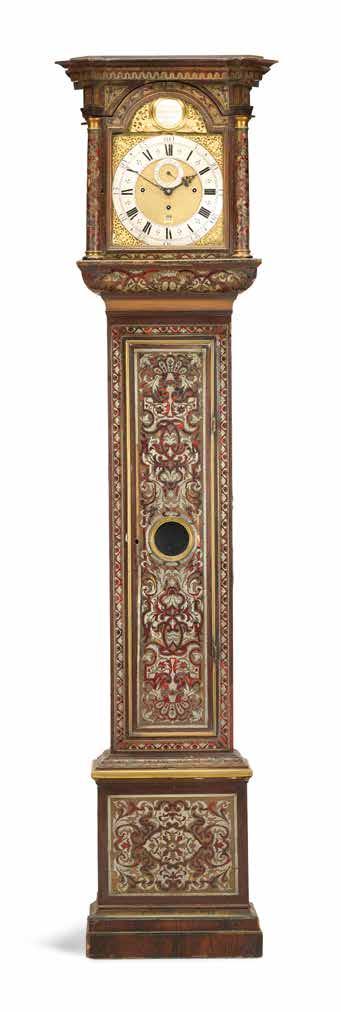
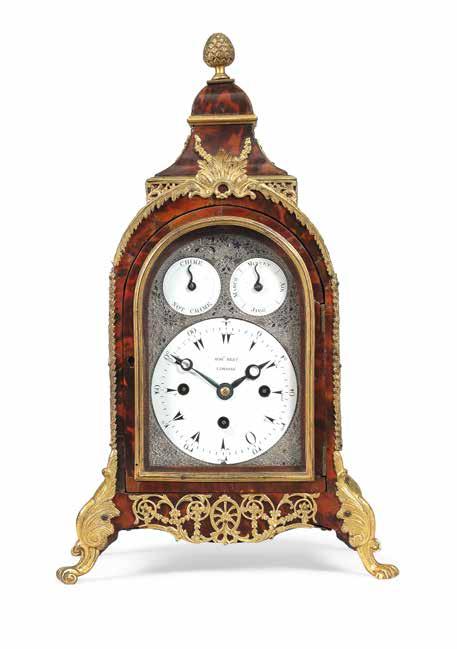
83
A FINE AND SMALL LATE 18TH CENTURY ORMOLU MOUNTED TORTOISESHELL MUSICAL TABLE CLOCK WITH ENAMEL AND SILVER CHAMPLEVE DIAL
Robert Best, London
The case surmounted by an acorn finial over cupola with applied foliate swags and silk-backed sound frets, the sides with arched gilt brass sound frets backed in silk, to a bombe base raised on rare reeded scroll supports, the doors and side panels framed in ormolu borders.
The 4 inch white enamel dial with Turkish numerals signed in the centre
Robert Best, London with blued steel hands and set within an engraved solid silver champleve mask with blue enamel decoration, and further set with twin enamel subsidiaries for Chime/Not Chime and tune selection, offering March - Minuet-Air and a Jigg
The triple gut (now wire) fusee movement with knife-edge verge escapement and short bob pendulum, striking the hours on a vertical bell mounted on the backplate, and playing any of the four tunes on a nest of
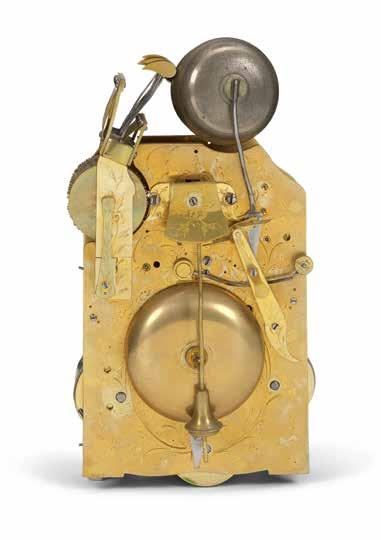
seven bells and 12 hammers, the shouldered back plate finely engraved with a central urn framed by foliate scrolls. Currently ticking and striking. 36cm (14ins) high.
£10,000 - 15,000
€12,000 - 17,000
US$13,000 - 20,000
Robert Best (fl. late 18th–early 19th century) was a London clockmaker working in the St Paul’s area of the city, later recorded at Little Knightrider Street by 1828. He was a member of the Clockmakers’ Company from 1783 until circa 1825–1828. A contemporary of leading horologists such as John Arnold (1736–1799) and Thomas Earnshaw (1749–1829), he is noted for his involvement in developments in precision timekeeping, including giving evidence before the Board of Longitude in relation to the spring detent chronometer. Although a capable and respected maker, he is recorded as having been declared bankrupt in 1796.
The dial signed for Stephen Rimbault, London
The bell top case with brass banding and acorn finials over side handles and shaped brass-bound glazed panels to a brass-bound base on ogee bracket feet. The 7.5 inch circular white enamel Roman and Arabic dial with bold numerals and central signature, framed by spandrels incorporating a basket of flowers and surmounted by a subsidiary dial
for tune selection, with blued steel hands. The triple gut (now wire) fusee movement with knopped pillars and fully engraved backplate striking the hours on a bell and playing the tunes on 14 bells and 22 hammers. Ticking, strike in need of some attention, but playing music every hour on the hour. 59cms (23.25ins) high
£4,000 - 6,000
€4,600 - 7,000
US$5,400 - 8,100
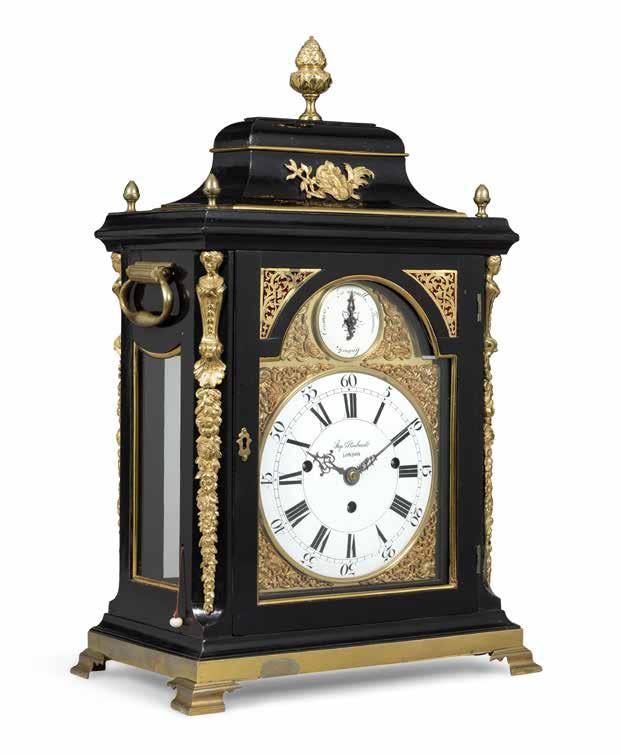
A FINE EARLY 19TH CENTURY ROUGE GRIOTTE MARBLE, ORMOLU AND WEDGWOOD MOUNTED MANTEL CLOCK TIMEPIECE
Benjamin Lewis Vulliamy, London, No 464
The case surmounted by a gilt bronze urn over a rouge griotte marble pedestal case, the front applied with a finely finished gilt brass plaque engraved with palm leaves and centred by a neoclassical cameo-style Wedgwood porcelain plaque of Apollo. The drum-head movement and dial supported on two well-carved marble volute scrolls inlaid with ormolu anthemion mounts. The 3.25 inch white enamel dial with gilt Roman numerals, pierced gilt brass hands, and framed by an ormolu snake or ‘ouroboros’ bezel. The well-made four-pillar movement, numbered, with chain fusee and spring barrel, half-deadbeat escapement, and numbered
pendulum, the backplate signed Vulliamy, London, 464 , protected by a lift-out gilt rear cover with internal feint scratch number 464. Ticking and sold together with a double ended key for winding and regulation. 29cms (11/5ins) high.
£2,000 - 3,000
€2,300 - 3,500
US$2,700 - 4,000
This clock is illustrated in an article by Kelly in The Proceedings of the Wedgwood Society , vol 7 (1968), p. 162 (photo supplied by Blairman). This image shows the current replacement minute hand in situ at that date.
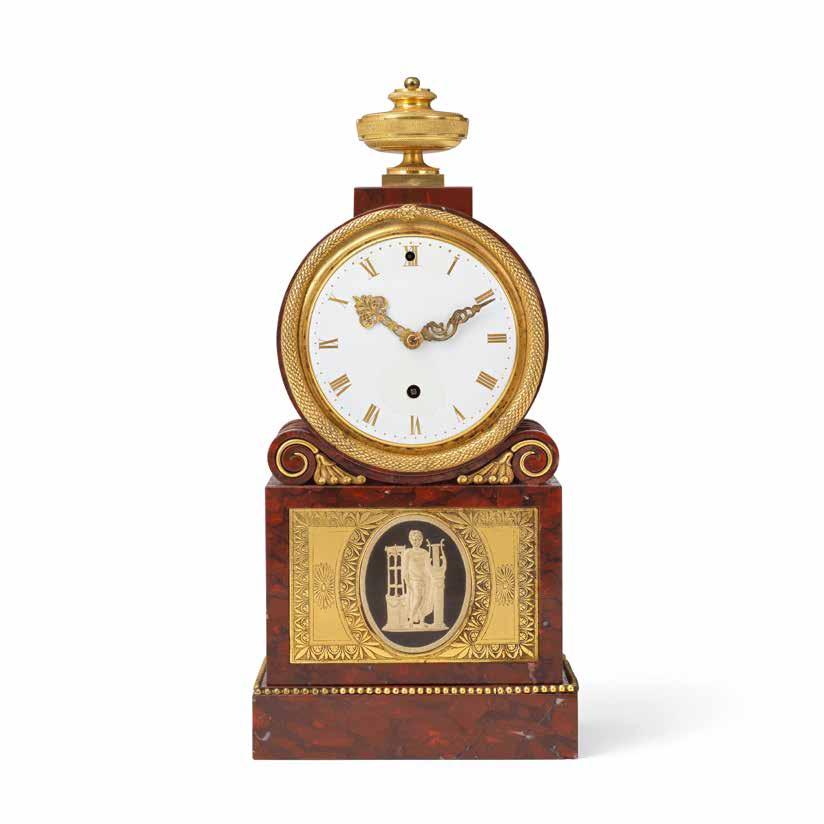
A FINE FIRST QUARTER OF THE 19TH CENTURY, ORMOLU-MOUNTED ROUGE GRIOTTE MARBLE MANTEL CLOCK TIMEPIECE WITH EAGLE SURMOUNT
Vulliamy, London, No.684. Circa 1818
The case surmounted by a crisply cast gilt figure of an eagle with wings held back, leaning forward and gripping the plinth, above a drum case on scroll supports with ormolu inset mounts to a pedestal base. The 3.5 inch gilt dial framed by an ouroboros, the minutes marked by dots with larger markers for the fives, the Roman chapter ring signed between XI and I Vulliamy, London , enclosing a finely engine turned centre with blued steel open heart hands. The single gut fusee circular movement
secured by chamfered brass pinned brackets, signed on the back plate
Vulliamy, London number 684 , with deadbeat escapement and rise and fall regulation to a steel rod pendulum, protected by the numbered lift-off gilt rear cover. Ticking, together with a pendulum and a (later) bespoke numbered double ended winding/regulation key. 30cms (12ins) high.
£3,000 - 5,000
€3,500 - 5,800
US$4,000 - 6,700
FOR FUTHER INFORMATION, PLEASE SEE APPENDIX
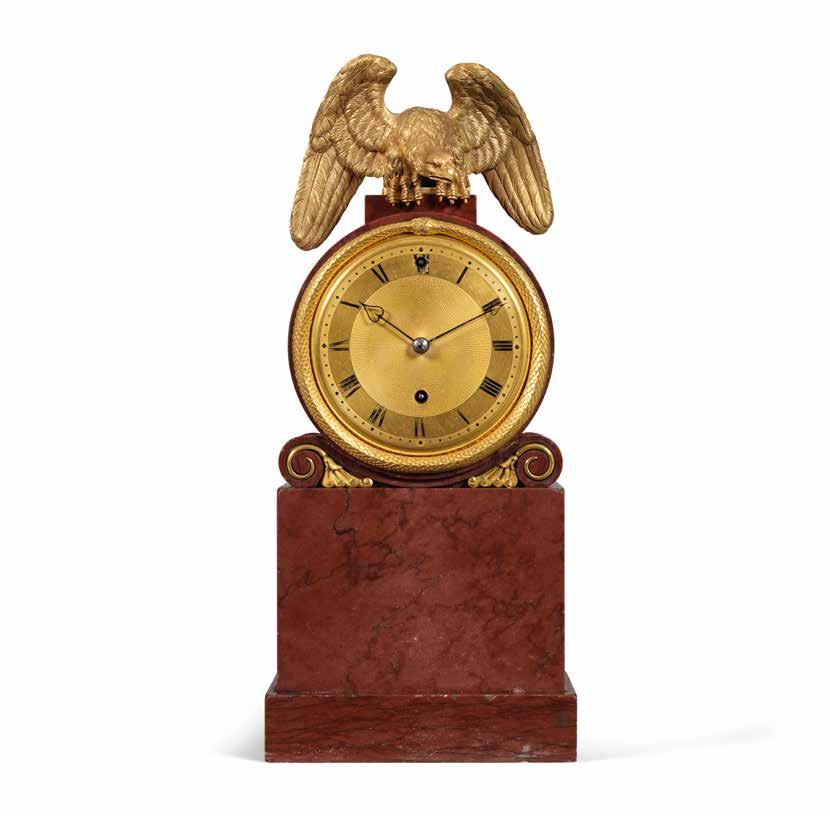
PORCELAIN FIGURAL CLOCK WITH ARMILLARY SPHERE AND TWIN CHERUBS MADE FOR SIR CHARLES KENT IN 1820
Vulliamy, London, No.758
The clock standing on a white marble base with shallow gilt bun feet, flanked by two biscuit porcelain putti and adorned with gilt scientific instruments including an octant, the front with a finely engraved panel depicting drapery and a leather bound book. The rectangular white marble case with engraved and gilt frieze signed Vulliamy, London , the sides with oval Wedgwood panels within gilt frames depicting cherubic scenes, the rear with a gilt door and the top surmounted by a gilt armillary sphere with revolving rings. The 2.75 inch white enamel dial with gilt Roman numerals and finely pierced gilt hands. The single fusee timepiece movement signed and numbered Vulliamy, London number 758 , with six pillars and rise and fall regulation, with subsidiary winding square to the front plate, with steel rod pendulum and heavy brass bob, currently ticking. 33cms (13ins) high.
£18,000 - 25,000
€21,000 - 29,000
US$24,000 - 34,000
The majority of biscuit porcelain clocks were produced by Benjamin Lewis Vulliamy (1780–1854), although by circa 1820 such models were no longer at the height of fashion. The present example is, however, recorded in the Day Book as a special commission for its original owner, Sir Charles Kent, underscoring its bespoke nature.
Benjamin Lewis Vulliamy was the last of the distinguished Vulliamy dynasty, founded by François Justin Vulliamy (d.1797) and continued through Benjamin Vulliamy (1747–1811). Born on 25 January 1780, he was raised at 68 Pall Mall and joined the family business at an early age. He was admitted to the Freedom of the Clockmakers’ Company in December 1809, becoming a Liveryman in January 1810, and in the same year joined the Court, on which he served with distinction, being elected Master on five occasions. Throughout his career he upheld exceptionally high standards of workmanship at a time when such standards were increasingly difficult to maintain.
In contrast to the more decorative emphasis of his father’s production, Benjamin Lewis Vulliamy focused on technical excellence and durability, employing highly skilled specialist craftsmen alongside a core workshop at Pall Mall. Among these were members of the Jump family, who later established their own successful clockmaking enterprise following Vulliamy’s death in 1854.
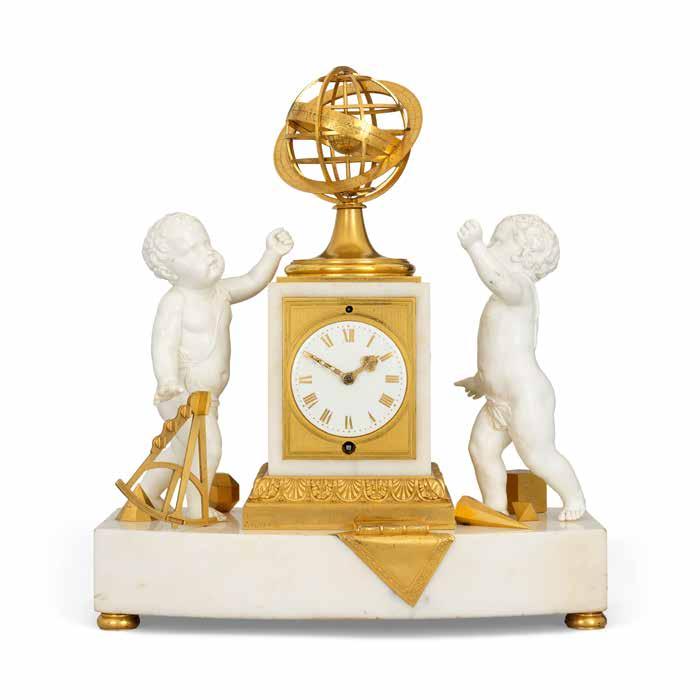
A FINE AND IMPRESSIVE FIRST QUARTER OF THE 19TH CENTURY
ORMOLU MOUNTED ROUGE GRIOTTE MARBLE MANTEL CLOCK
TIMEPIECE WITH ORIGINAL NUMBERED PENDULUM
Vulliamy, London, No.518
Surmounted by a gilt eagle looking to the left with outstretched wings, the shafts of his feathers individually burnished, with boldly cast claws grasping a stylised thunderbolt, set on a plinth over the drum case flanked by a pair of lions, each with finely rendered mane and tail curled around its body, the stepped plinth mounted with a finely cast and burnished foliate scroll frieze centred by acanthus foliage, raised on cast button feet, the side panels with matching acanthus mount. The 3.5 inch gilt dial with engraved dotted minute band framing the matted Roman chapter ring and graduated engine turned centre, with fine blued steel heart-shaped hands enclosed by a snake ‘ouroboros’ bezel. The signed and numbered chain fusee movement with circular plates united by four turned pillars with stepped collets and single collar, the high quality train terminating in a half-deadbeat escapement with rise and fall regulation to the original numbered pendulum, with two-piece cock. Ticking. 30cms (12ins) high.
£18,000 - 25,000
€21,000 - 29,000
US$24,000 - 34,000
Provenance:
Sotheby’s ‘The contents of Stonor Park, Oxfordshire’ 1970, property of Lady Camoys.
The use of a Roman-style thunderbolt sitting below the eagle is very rare in Vulliamy’s ouevre, two others are known to us, number 591 (which incidentally uses the same frieze as the current lot), sold Christies 2.10.1991; and number 598 advertised by Blairman in 2015 and later by Anthony Woodburn in 2018.
The present lions are modelled “from nature” by the sculptor James Smith (1775-1815) and are identical to those used on the preceding clock, number 517, which Vulliamy sold in 1814. For a full analysis of the different lions used on Vulliamy’s clocks, see Smith, Roger, ‘Vulliamy Lions: Their Designers and Modellers, Furniture History Society, Vol. LVI (2020), pp69-82.
We are grateful to Roger Smith for his assistance with this entry.
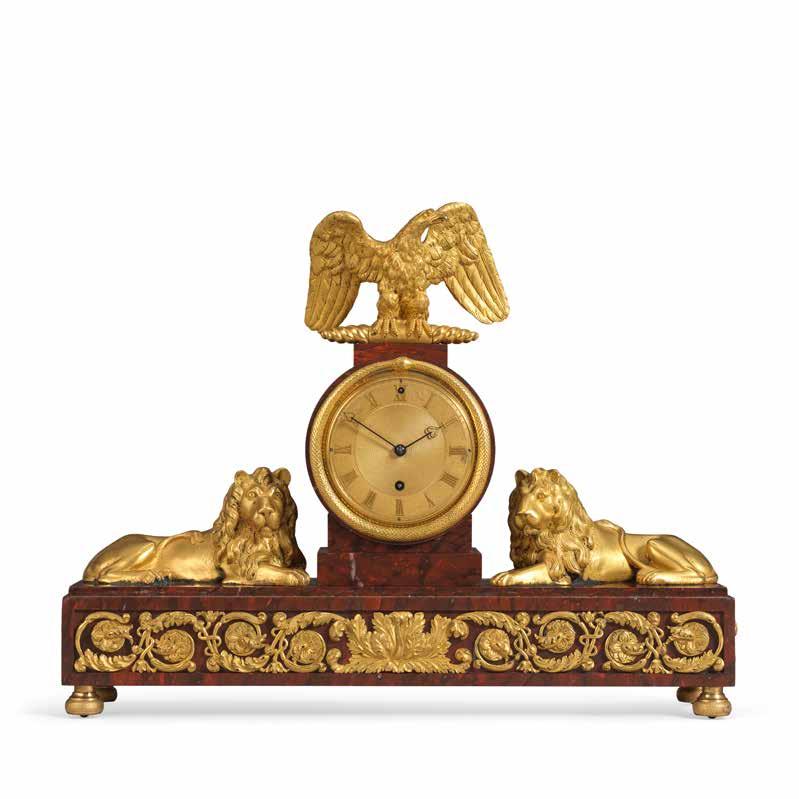
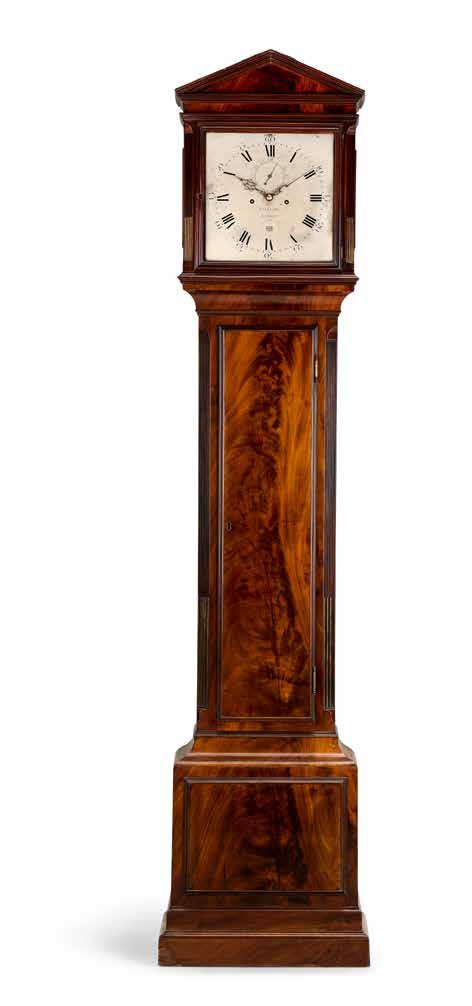
Vulliamy, London, No. 781
The case surmounted by a triangular pediment with fine mouldings over canted reeded corners with inlaid brass flutes, the long trunk door with finely moulded edge framing the flamed veneered front, over a moulded base and double plinth. The 12 inch silvered one piece brass dial signed and numbered for the maker Vulliamy, London, 781 , with Roman numerals to the main chapter ring and outer Arabic minute track, a subsidiary seconds ring below XII and date aperture above VI, with blued steel hands. The fine quality eight day movement with pinned knopped pillars and precision wheelwork, striking the hours on a bell mounted above the movement, with lozenge-section wood rod pendulum and heavy brass bob, powered by two brass cased weights. Ticking and striking. 2.09m (8.8ft) high.
£10,000 - 20,000
€12,000 - 23,000
US$13,000 - 27,000
Benjamin Lewis Vulliamy, born 25 January 1780, was the last in the distinguished line of the Vulliamy clockmaking dynasty. He was admitted Free of the Clockmakers’ Company in December 1809, becoming a Liveryman in January 1810, the same year he entered the Court of the Guild. He subsequently served in every office of the Court and was elected Master on five occasions. Throughout his career he played a significant role in maintaining the reputation of the London clockmaking trade, upholding high standards of workmanship evident in his output. He died in 1854.
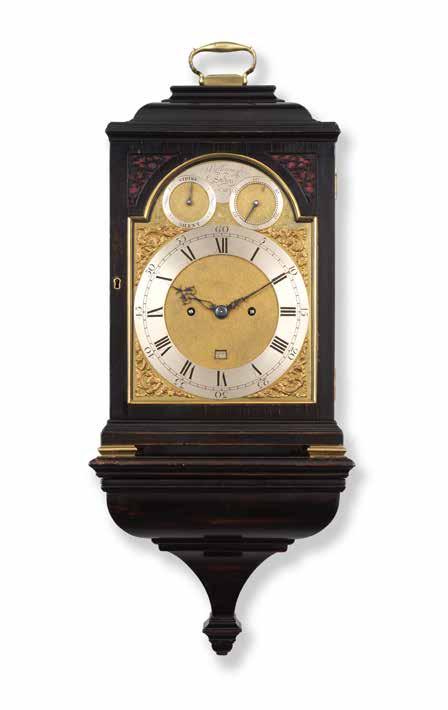
90 A FINE LATE 18TH CENTURY EBONISED BRACKET CLOCK WITH HALF DEADBEAT ESCAPEMENT, SOLD ON 11TH JUNE 1798. TOGETHER WITH A LATER CUSTOM MADE WALL BRACKET
Vulliamy, London, no. 311. The movement supplied by Bullock, the case by Rich. Delivered to Mr Suivers on 11 June 1798.
The case sumounted by a brass carrying handle over a shallow inverted bell top, the front with simple pierced wood sound frets backed in red silk with inlaid brass sight around the front door, the sides with further pierced wooden frets backed in silk and the back with a glazed observation window, terminating in a moulded base and resting on four brass block feet. The 7 inch brass dial with silvered Roman and Arabic chapter ring with finely matted centre, calendar aperture and blued steel hands framed by four cast brass floral spandrels with strike/ silent subsidiary and pendulum rise and fall to the break arch signed in a silvered plaque Vulliamy, London number 311 . The movement powered by a pair of gut fusees to a half deadbeat escapement with pendulum rise and fall indication, with steel rod pendulum terminating in a heavy lenticular bob, the back plate plain bar a central engraved cartouche signed Vulliamy, London, No. 311 , rack strike for the hours on a polished
bell mounted above. Ticking and striking, sold together with a bespoke matching wall bracket, a winding key and a copy of the extract from the Vulliamy workbooks. The clock 41cms (16ins) high. The bracket a further 21cms (8.25ins) high.
£7,000 - 10,000
€8,100 - 12,000
US$9,400 - 13,000
The Vulliamy record books describe this as follows:
311 Spring Clock in a black Case
Bullock the Movt......7’ 7” Rich the Case........2’ 1”
Deld. to Mr Suivers June 11 1798.
A copy of the page accompanies the lot.
92
A RARE EARLY 19TH CENTURY BRASS-MOUNTED, EBONY-INLAID MAHOGANY TABLE CLOCK WITH RUNNING SECONDS, DEADBEAT ESCAPEMENT AND UNUSUAL QUARTER STRIKE SYSTEM
John Bowen, London
The lancet shaped case with brass and ebony inlay stringing to the front over inlaid ebony griffons flanking a lyre, framed by outswept canted front corners set with Egyptian figures, on acorn feet, the sides with lion mask ring handles and blue glass panels. The (replaced) 8 inch brass dial with gilt chapter ring set with applied Roman numerals and with dotted minute track enclosing the silvered centre with applied signature swag John Bowen, London and large recessed subsidiary seconds dial with matted centre. The double chain fusee movement with shaped plates, deadbeat escapement and finely finished pendulum with central regulation nut set in a lozenge, unusually with ting-tang chime for the hours and quarters via a countwheel mounted on the centre, striking the hours and quarters on a pair of polished bells, the backplate with engraved running border. Currently ticking and striking. 53cms (21ins) high.
£1,000 - 2,000
€1,200 - 2,300
US$1,400 - 2,700
91 A GOOD EARLY 19TH CENTURY ORMOLU-MOUNTED MARBLE MANTEL CLOCK TIMEPIECE
F. Baetens 23 Gerrard Street London
The drum case set on an Ionic capital with 3.5 inch white enamel Roman and Arabic dial surmounted by a standing eagle clasping a foliate swag, flanked by a pair of seated ladies, their arms raised in concentration as they read books signed by the maker F. Baetens 23 Gerrard Street London ; set on a white marble plinth with applied Satyrs mask and further ormolu mounts on toupie feet. The single train fusee movement with anchor escapement. Currently ticking. 31cms (12.5ins) high.
£600 - 800
€700 - 930
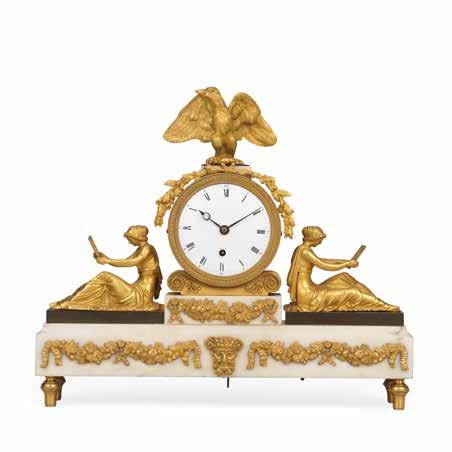
US$810 - 1,100
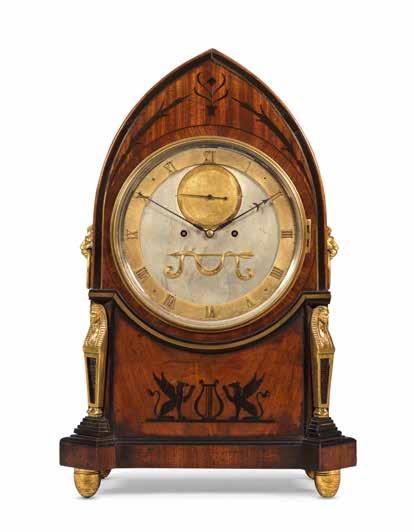
A FINE AND RARE MAHOGANY AND BRASS INLAIDE REGENCY STRIKING TABLE CLOCK WITH SUBSIDIARY SECONDS DIAL
Allport, Birmingham
The case sumounted by a pineapple brass finial over a pagoda top supported on floral swags above an architectural base with finely inlaid brass detailing, the Egyptianesque columns supporting the main case with a bevelled mahogany insert to the centre, terminating in a block base and resting on four brass ball feet. The 6 inch silvered brass dial framed by a decorated brass bezel with black Roman numerals to the silvered dial with blued steel hands and unusual subsidiary seconds dial signed
Allport, Birmingham . The finely made movement shaped to fit the case with an engraved border and signed on the back plate by the maker with a anchor escapement driven by a pair of fusees and striking the hours on a bell mounted to the back plate, currently ticking and striking. 50cms (20ins) high.
£1,500 - 2,500
€1,700 - 2,900
US$2,000 - 3,400
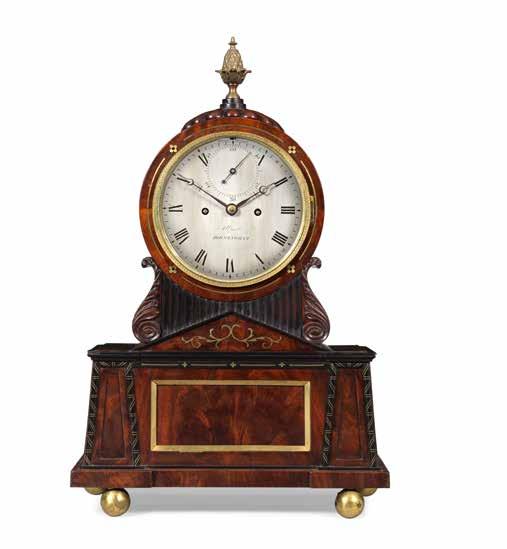
94
A MID 19TH CENTURY BRASS INLAID EBONISED LYRE SHAPED STRIKING
TABLE CLOCK
James McCabe, Royal Exchange, London number 1180
The lyre shaped case sumounted by three cast brass acorn finials over an inlaid brass case with plain sides, terminating in a brass moulded base and sitting on a plinth further raised on carved wooden feet with fine brass detailing centred by floral decoration. The 8 inch white dial with black Roman numerals signed in the centre James McCabe, Royal Exchange, London number 1180 , framed by a pierced and engraved brass fret set before a mirror with a strike/silent subsidiary above. The double fusee movement with anchor escapement striking the hours on a polished bell mounted above, the back plate signed in an engraved cartouche
James McCabe, Royal Exchange, London with further floral detailing to the border. 44cms (17.5ins) high.
£800 - 1,200
€930 - 1,400
US$1,100 - 1,600 95
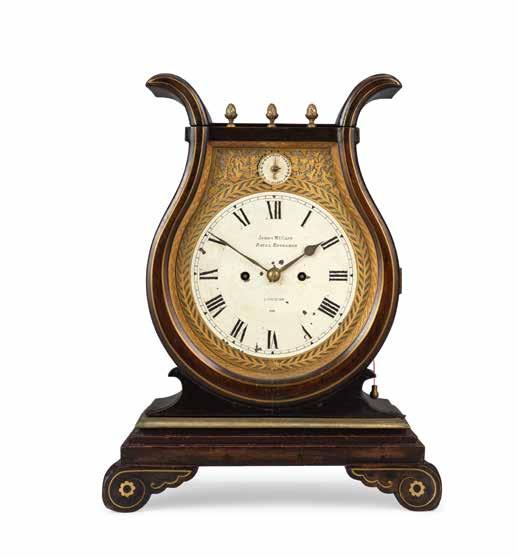
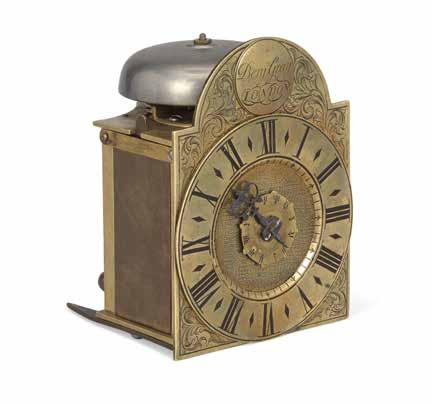
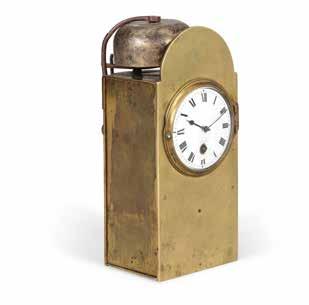
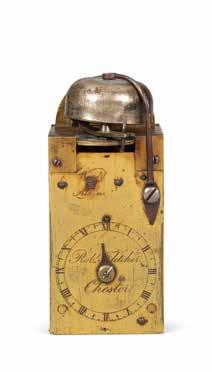
96 *
A GOOD THIRD QUARTER OF THE 18TH CENTURY MINIATURE WALL ALARM TIMEPIECE
Benjamin Gray, London
The 3.5 inch break arch brass dial with Roman chapter ring with lozenge half hour markers and angled inner edge marked for the quarters, the matted centre with Arabic alarm setting dial and blued steel hand, all framed by engraved floral spandrels within a line border, signed on the applied nameplate Benjamin Gray, London . The plated movement with square-section brass pillars and lift-out side doors secured with latches, knife-edge verge escapement and short bob pendulum, with separate alarm work powered by weights and striking on the bell mounted on the top plate with chamfered and tear-drop shaped cocks. Ticking. 12cms (4.5 inches) high.
£2,500 - 3,500
€2,900 - 4,100
US$3,400 - 4,700
Provenance:
A distinguished European collection.
FOR FUTHER INFORMATION, PLEASE SEE APPENDIX
97 AN INTERESTING MINIATURE LATE 18TH/EARLY 19TH CENTURY TRAVELLING ALARM TIMEPIECE
Robert Fletcher, Chester
The lacquered brass case with break arch front and plain sliding panels to the sides, the back with engraved alarm-setting dial with Roman numerals and robust hand, signed in the centre Robert Fletcher, Chester , above a winding square for the alarm work engraved “Wind Alarm”. The 1.5 inch enamel dial with black Roman numerals and blued steel hands set from a central square. The movement revealed by sliding the side plates, with single fusee pocket watch type movement with verge escapement and plain balance cock, the large alarm train wound and set from the rear. Currently ticking. 13cms (5.5ins) high.
£600 - 800
€700 - 930
US$810 - 1,100
FOR FUTHER INFORMATION, PLEASE SEE APPENDIX
98 AN GOOD LATE 18TH CENTURY DIAL CLOCK WITH VERGE ESCAPEMENT
Hedge, Colchester
The case with turned bezel to the front with lock to the left hand side, to a decorated base with door beneath and to the right hand side. The 9 inch brass dial with black wax filled Roman numerals and Arabic five minute markers with blued steel hands signed in the centre Hedge, Colchester. The single fusee movement with frame plates and verge escapement with short bob pendulum, currently ticking. 43cms (17ins) high.
£1,000 - 1,500
€1,200 - 1,700
US$1,400 - 2,000
99
A FINE EARLY 19TH CENTURY BRASS BOUND EBONISED TRAVELLING TABLE CLOCK TIMEPIECE
William Johnson, Strand, London
The case surmounted by a gilt bow handle over a bell top and set upon a moulded break arch case with plain front, the sides with brass banding and inlaid brass stars to each corner, the back with a glazed door, resting on a moulded base and raised on four adjustable lacquered brass feet. The 3 inch silvered brass dial signed in the arch within a quatrefoil border W. Johnson, Strand, London over engraved corner pieces wherein the dial feet screws form the centre of a flowerhead framing the minute track and Roman numerals, blued steel Breguet style hands enclosed by the silvered sight ring. The single fusee movement signed for the maker and with anchor escapement and fine steel rod pendulum. Ticking. 26cm (10.5ins) high.
£4,000 - 6,000
€4,600 - 7,000
US$5,400 - 8,100
The above lot was sold in these rooms Lot 72 Fine Clocks 17 June 2003
William Johnson worked from 50 Strand from 1825 to 1842. These travelling timepieces are amongst his best known work today, produced in series both on his own and with his partner, Grimaldi.
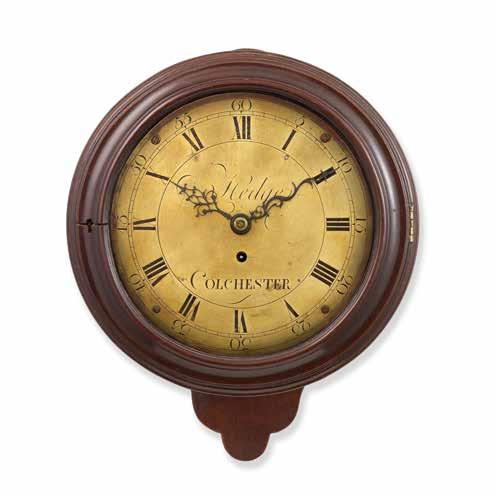
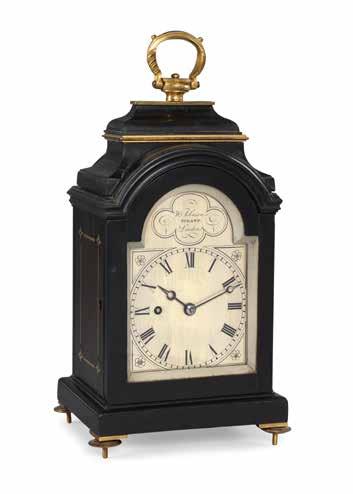
Fabian Robin, Moorfields
The domed caddy with marquetry floral blooms on an ebonised ground over generous architectural cornice, fretwork frieze and visible mask, the sides with rectangular glazed panels and turned half columns set towards the rear edge, the trunk with floral trail decorated convex throat moulding over a 43 inch rectangular door centred with a circular lenticle and with three shaped marquetry panels decorated with bird inhabited floral sprays and scrolling foliage on an ebonised ground within a walnut field, the surround further decorated with delicate Arabesques on a black ground, the sides veneered with twin box-strung panels within crossbanded borders, the base with ogee top moulding and conforming rectangular marquetry panel within an Arabesque border on bun feet. The 12 inch square brass dial with ringed winding squares, foliate border, engraved calendar aperture and subsidiary seconds dial to the matted centre within applied silvered Roman numeral chapter ring with stylised fancy cruciform half hour markers, Arabic five minutes beyond the minute track and signed Fab:n Robin, Moorefields with pierced steel hands and twin cherub and crown cast spandrels to angles. The five pillar outside countwheel bell-striking movement with anchor escapement regulated by seconds pendulum. Sold with a pair of brass clad weights and pendulum. 2.35m (7.7ft) high.
£2,500 - 3,500
€2,900 - 4,100
US$3,400 - 4,700
Fabian Robin, also recorded as Robins or Fabianus Robin, was a London clockmaker active from the late 17th century into the early years of the 18th century, working principally in Moorfields. His career spanned the period from the later Carolean era through the reign of George I, and he became known for producing high-quality domestic clocks of considerable mechanical sophistication.
William Moraley, London
The stepped cornice raised on turned Doric columns to a concave throat and long trunk door with quarter-veneered panels framed by a moulded edge, on a crossbanded base and moulded foot. The 11 inch square brass dial with winged cherubs head spandrels enclosing the silvered Roman and Arabic chapter ring, signed between V and VII, and with fancy meetingarrow-head half-hour markers and lozenge halfquarter markers, matted centre with running seconds and chamfered date aperture. The plates united by five substantial pillars (the centre latched), with anchor escapement and rack striking on a bell. Set on an oak seatboard, and together with two lead weights, a brass faced pendulum, two door keys and a crank winder. Not tested, but will tick and strike. 2.04m (6ft 8ins) high.
£3,000 - 5,000
€3,500 - 5,800
US$4,000 - 6,700
William Moraley Senior (circa 1666–circa 1738) was a London clockmaker closely associated with the workshop of Thomas Tompion (1639–1713). He was first apprenticed on 8 February 1680/1 to Philip Corderoy, before being transferred in 1687 to Tompion, under whom he completed his training. He was made free of the Clockmakers’ Company in December 1688.
Thereafter, he established his own premises in Greyfriars, Newgate, while maintaining professional links with the Tompion workshop, to which he is understood to have supplied finished clocks and watches as an outworker. He was the father of William Moraley Junior (1698–1762), later known for publishing his autobiographical work The Infortunate (1743) The elder Moraley’s own career reflects a direct connection to one of the most important centres of English clockmaking at the close of the 17th century.
102
Christopher Gould, London
The case surmounted by a caddy top with two pedestals to the sides, each supporting a brass ball finial, over a pierced sound fret backed in silk and a moulded top edge over a further pierced fret, also backed in old silk, above the front door flanked by columns to each side, inlaid with marquetry. The sides with additional pierced sound frets, all above a concave throat moulding. The long trunk door richly inlaid with fine marquetry depicting tulips, flowers, still life scenes, beasts, and cherubs, the sides with simple stringing above a moulded plinth, the base panel similarly decorated with fine marquetry, raised on a plinth. The inside of the trunk door retains its original hinges and lock, with evidence of an infilled lenticle and an original printed equation of time table to the rear, inscribed: Printed for Chr Gould Clockmaker at his Shop near North East Corner of the Royal Exchange MDCCI . The 12 inch square brass dial with silvered Roman and Arabic chapter ring intercepted by fleur-de-lys halfhour markers, the finely matted centre with Tudor rose to the centre, subsidiary seconds and a finely decorated calendar aperture, ringed winding squares and blued steel hands, framed by four cherub-head spandrels interspersed with floral engraving between. Signed in elegant script below the chapter ring: Chr Gould Londini Fecit . The movement with substantial plates united by five finely knopped pillars, anchor escapement and striking the hours on a large bell above via an internal count wheel. Sold with a pair of brass clad weights and pendulum with a case key and a crank winding key. 233cms (92ins) high.
£4,000 - 6,000
€4,600 - 7,000
US$5,400 - 8,100
Christopher Gould was made a Free Brother of the Clockmakers’ Company in April 1682 and later appointed Beadle in 1713. Gould’s work is characterised by his high quality and craftsmanship, as attested by the present example. He died in 1718. Clocks by Gould can be found in numerous public collections, including the British Museum.
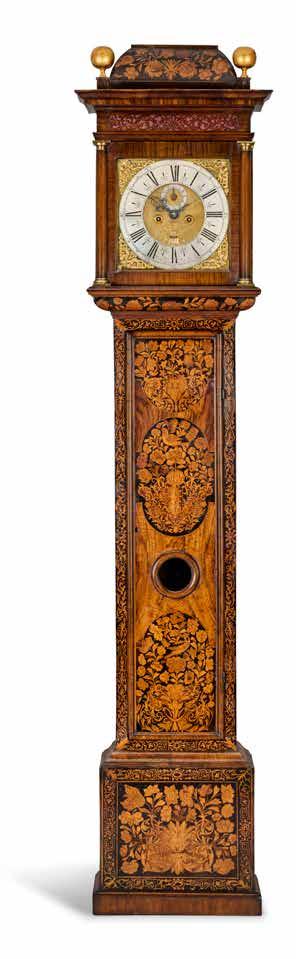
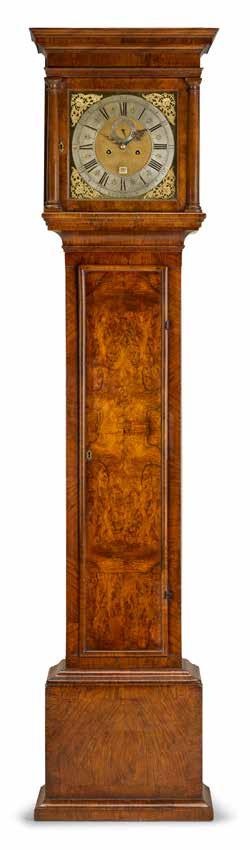
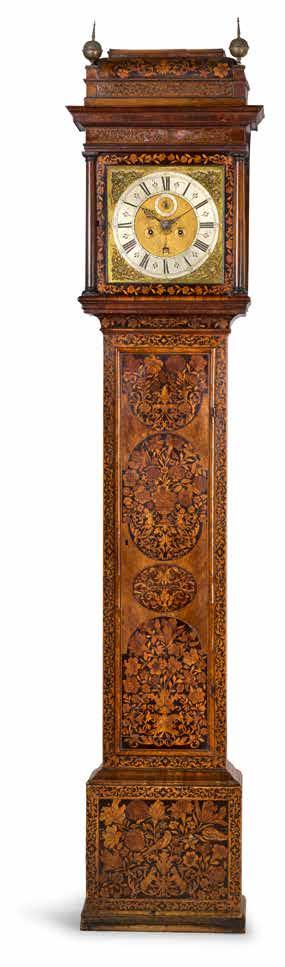
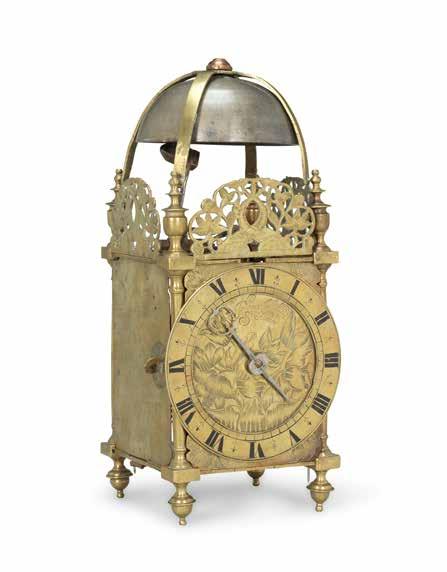
104
A THIRD QUARTER OF THE 17TH CENTURY BRASS LANTERN CLOCK
Nicholas Coxeter, London
The case surmounted by four turned finials supporting the bell and bell stand, secured by a cast urn finial. The front and sides fitted with addorsed dolphin frets, (frets and doors probably later), framed by four tapering Doric columns on ball feet. The 6.25-inch brass dial with Roman chapter ring and fleur-de-lyse half-hour markers, the dial centre finely engraved with tulip and foliate scrollwork emanating from a bud at VI and framing the now missing alarm disc and single steel hands signed Nicholas Coxeter Near Goldsmiths Hall Londini Fecit . The movement formerly with verge and balance wheel escapement, now converted to anchor escapement, with countwheel striking the hours on the bell mounted above. 40cms (16ins) high.
£2,500 - 3,000
€2,900 - 3,500
US$3,400 - 4,000
Nicholas Coxeter (c.1625–1679) was apprenticed to John Pennock via the Clockmakers’ Company, he completed his training in 1646/7. A Captain in Cromwell’s New Model Army during the 1650s, he later established his workshop first in Lothbury, then in Long Lane. Coxeter served three terms as Master of the Clockmakers’ Company, the final in 1677/78. He died in the winter of 1679.
John Halford, St Albans
Surmounted by a strapped bell set between four robust urn-shaped finials cast in one piece with their pedestals, Doric capitals, bases and acorn feet, the top- and bottom- plates each keying into slots cut in to the pedestal bases. Intercepted by pierced frets the front engraved with opposing dolphins amid foliate motifs over the original side doors engraved with flower heads around the turnbuckle handles. (One door further engraved with later repair inscriptions recording John Colins and Thomas Colins, Beckenham, and William — April 22nd 1823 ). The 6 inch brass dial with slender Roman chapter ring, the inner quarter hour track interrupted by double bud half-hour markers, the centre finely engraved with a floral scene and signed to the upper section Johannes Halford, St Albanes , fitted with what appears to be the original steel hand and framed by four engraved spandrels of a stylised tulip. The 30-hour movement, now converted from verge to anchor escapement, with countwheel striking (incomplete) on a large bell mounted above. Currently not ticking or striking. 37cms (14.5 inches) high.
£800 - 1,200
€930 - 1,400
US$1,100 - 1,600
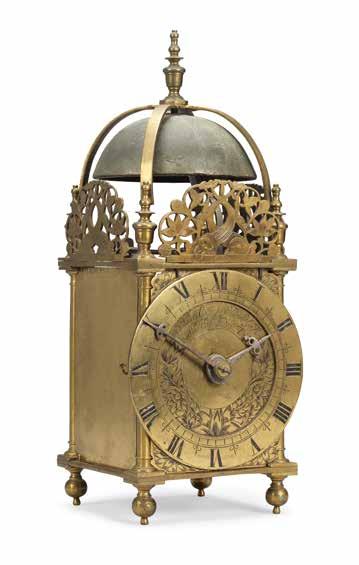
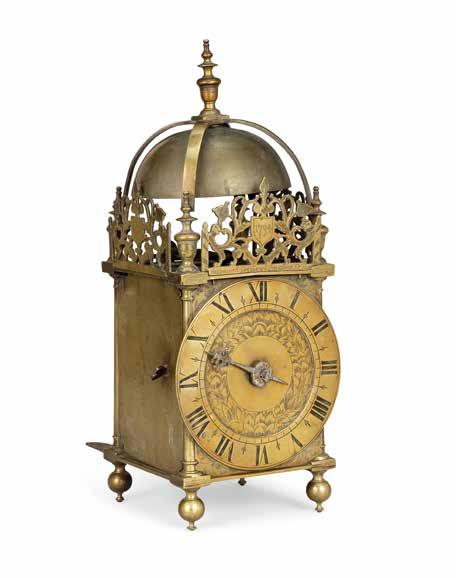
106
A MID 17TH CENTURY BRASS STRIKING LANTERN CLOCK
Surmounted by a (later) turned finial over a bell and bell stand, supported by four turned squat urn-shaped finials intercepted by pierced frets, the front engraved with two dolphins amid tulips and foliate scrolls on a cross-hatched base, with Doric-topped columns and fitted with (replaced) brass side doors, the rear with a later steel backplate. The whole raised on four turned ball feet. The 6.5 inch brass Roman dial with inner quarter hour track interrupted by bud-shaped half-hour markers, the centre engraved with a ring of tulips and floral decoration and retaining a plain central area where an alarm setting disc was formerly fitted. Fitted with a finely shaped steel hand. The 30-hour movement originally with verge and balance wheel, but not converted to long pendulum and anchor escapement, powered by a single weight on rope lines, with countwheel strike on the bell above via a hammer set to the right hand side. Currently ticking and striking. 35cm (14ins) high.
£1,500 - 2,000
€1,700 - 2,300
US$2,000 - 2,700
Jeremiah Gregory, London
The case surmounted by a single finial over a bell and bell stand supported by four further matching finials, the front and sides with pierced frets, the front fret adorned with a central coat of arms and later dated 1734 above the signature Jeremiah Gregory, Londini , the corners supported by simple columns with opening doors to each side, the back with steel back plate (showing evidence of a removed alarm train) with hook and spikes, terminating in four turned ball feet. The 6.25 inch brass dial with Roman chapter ring intercepted by “bud” half hour markers, the spandrels with simple floral engraving and the centre with a ring of tulip engraving, the dial centre plain and formerly with alarm disc now missing with original steel hour hand. The two train 30 hour movement with external count wheel striking the hours on a bell mounted above, the going train converted to anchor escapement from a balance wheel, currently in unrestored condition, sold together with a brass pendulum bob and brass clad weight. 40cms (16ins) high.
£1,500 - 2,000
€1,700 - 2,300
US$2,000 - 2,700
FOR FUTHER INFORMATION, PLEASE SEE APPENDIX
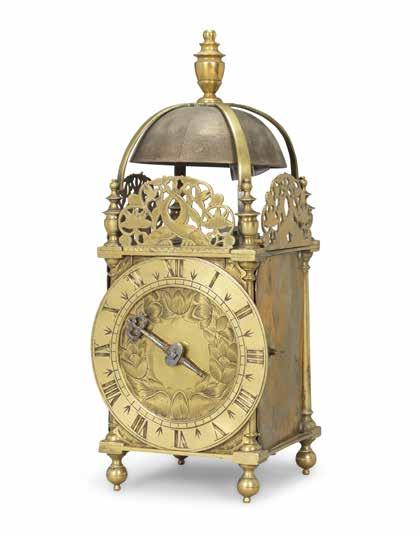
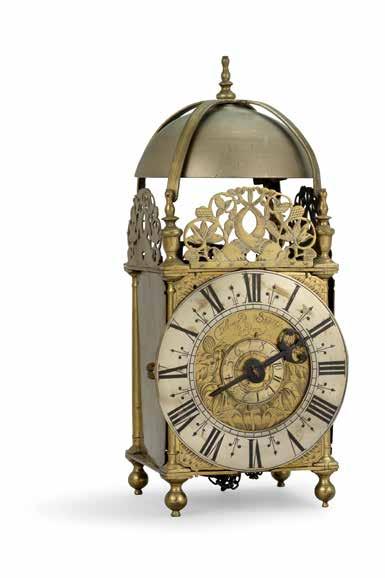
James Badley, Worcester
The case surmounted by a single turned finial over a bell top and bell stand, the front and sides with frets, the front being engraved, the corners supported by simple columns with later doors to the sides, the whole terminating with turned finials. The 7 inch dial with silvered chapter ring with cruciform half hour markers and black Roman numerals, the centre engraved with floral decoration and signed Sam Bradly, Worcester with a blued steel hand. The two train 30 hour weight driven movement with verge escapement and short bob pendulum, striking the hours via an external count wheel, currently ticking and striking. 38cms (15ins) high.
£1,000 - 1,500
€1,200 - 1,700
US$1,400 - 2,000
Edward Stanton, London
The case surmounted by a (later) turned finial over a strapped bell and four finials, the front fret pierced and engraved with entwined dolphins amidst scrolling foliage. The 6.25-inch brass dial with silvered Roman chapter ring with fleur-de-lys half hour markers, the centre with (now redundant) Arabic alarm-setting disc and a Tudor rose, framed by foliate engraving of tulips and budding flowers, and signed to the upper section Edward Stanton, London , with single blued steel hand, all within engraved corner decoration and raised on four turned ball feet. The sides with typical removable doors. The two-train 30-hour movement now converted to anchor escapement, striking the hours on the bell above via countwheel, powered by a single weight and now running on chains. Together with weight and pendulum. 38cms (15ins) high.
£1,500 - 2,500
€1,700 - 2,900
US$2,000 - 3,400
FOR FUTHER INFORMATION, PLEASE SEE APPENDIX
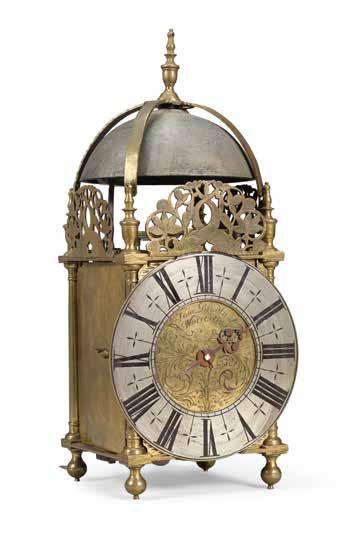
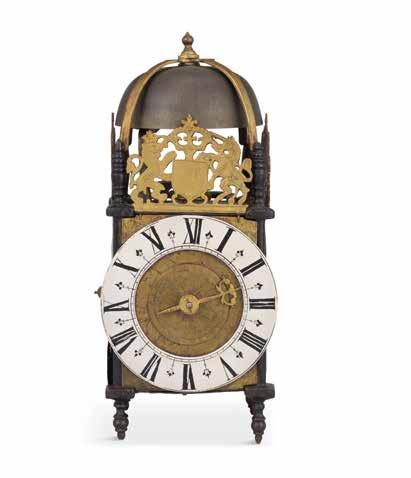
109
A RARE AND INTERESTING 17TH CENTURY IRON AND BRASS WEST COUNTRY LANTERN CLOCK
Anonymous, probably made in Bristol
The tall frame surmounted by a turned finial above the bell in its stand, supported by unusual iron finials, each finial formed in one-piece with its pedestal base, tapering column and shaped foot; the iron top plate mounted with Heraldic style pierced brass frets, one engraved with a lion and unicorn, over the original thin brass side doors with fine ring turned decoration around the handles. The 6 inch brass dial with silvered Roman chapter ring and unusual engraved half hour markers emanating from the inner quarter hour track, the engraved dial centre decorated with floral detail and pierced brass hand, framed by further engraved brass hatched foliate scroll decoration to each corner. The two train movement with verge escapement and short bob pendulum, striking the hours on the bell mounted above via an external count wheel mounted behind the movement. Currently ticking and striking, sold with wall bracket and weight. 35cms (14ins) high.
£2,000 - 3,000
€2,300 - 3,500
US$2,700 - 4,000
FOR FUTHER INFORMATION, PLEASE SEE APPENDIX
Walter Archer, Stow-on-the-Wold
The case with flat top over a convex moulded cornice supported by twisted Doric columns and large pierced sound fret above the dial, the sides with glazed observation windows to a convex throat moulding, the long trunk door with inlaid double line panels centred by a sixpointed star and oval lenticle, set on a panelled base and bun feet. The 10 inch brass dial with silvered Roman and Arabic chapter ring with unusual heart-shaped half hour markers, the matted centre with large ringed winding squares enclosed by a ring of dots, with decorated date aperture and silvered Arabic subsidiary seconds dial, with blued steel hands framed by four cast brass spandrels, signed either side of VI Walter Archer, Stow on ye Wold . The twin train movement with internal count wheel strike and five pinned pillars, striking on a large bell mounted above with anchor escapement and long pendulum, currently ticking and striking, sold with two lead weights and a pendulum. 2.05m (6.75ft) high.
£2,000 - 3,000
€2,300 - 3,500
US$2,700 - 4,000
FOR FUTHER INFORMATION, PLEASE SEE APPENDIX
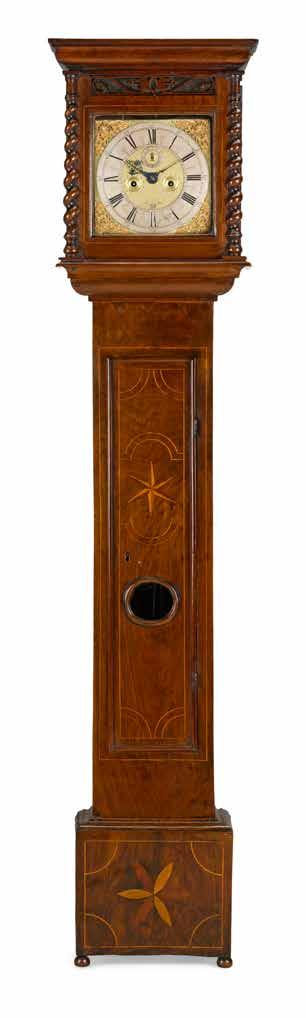
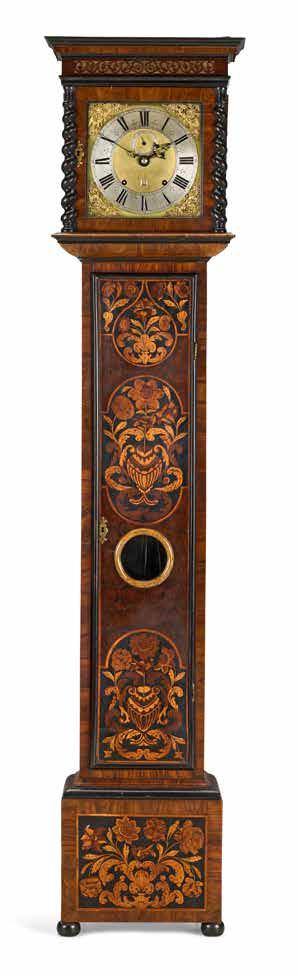
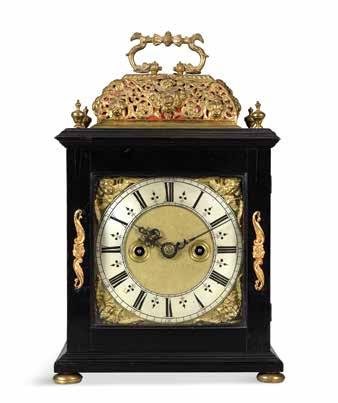
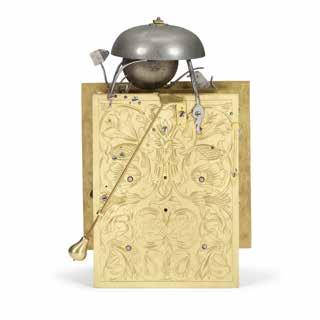
111
A LATE 17TH CENTURY EBONY VENEERED BASKET TOP QUARTER REPEATING TABLE CLOCK
John Wise, London
Surmounted by a brass carrying handle featuring both birds heads and dolphins over a repoussé basket top centred by winged cherubs heads and swags of fruit and flowers, backed in red silk and framed by four urn finials over a moulded cornice, the front door with Knibb-style lock escutcheons, the sides with two pairs of pierced sound frets on red silk, resting on a moulded base and squat bun feet. The 6.5 inch brass dial with silvered Roman and Arabic chapter ring with fleur-de-lys half hour markers framed by four cherub’s head spandrels, the matted centre with ringed winding squares and blued steel hands. The two train movement with verge escapement and finely engraved back plate depicting flowing scrolls and flowers signed in a central cartouche John Wise, London, striking the hours on a bell and repeating the quarters on a nest of two bells (each bell stand with shaped and fettled foot). Ticking and striking, with operational repeat. 38cms (15ins) high.
£5,000 - 8,000
€5,800 - 9,300
US$6,700 - 11,000
FOR FUTHER INFORMATION, PLEASE SEE APPENDIX
112 W TP A LATE 17TH CENTURY WALNUT AND MARQUETRY MONTH-GOING LONG CASE CLOCK WITH 10 INCH DIAL
John Wise, London
The case with flat moulded top over a pierced sound fret backed in old silk, supported by four twisted columns with side observation windows, the trunk door inlaid with floral marquetry panels on an oyster veneered ground, centred by a circular glazed lenticle and rectangular side panels of oyster veneers within boxwood borders, on a matching plinth and bun feet. The 10 inch brass dial with silvered Roman and Arabic chapter ring with fleur-de-lys half hour markers, matted centre with calendar aperture and subsidiary seconds, with blued steel hands framed by four (later) winged cherubs head spandrels, signed beneath VI John Wise, Londini Fecit. The month-duration movement with six latched and knopped pillars, anchor escapement and outside count wheel to the back plate, sounding the hours on a bell mounted above. Ticking and striking, together with a pendulum, and a pair of later brass-clad weights. 2.03m (6.6ft) high.
£7,000 - 10,000
€8,100 - 12,000
US$9,400 - 13,000
Obadiah Gardiner, London
The case surmounted by a brass knopped carrying handle over an inverted bell top with moulded surround, the front door with finely pierced sound frets backed in old silk and framed by moulded borders, the left side with an elaborately decorated escutcheon depicting a green man mask, the sides with glazed observation windows, and the rear with similar escutcheon, raised on a moulded base on block feet. The 6.5-inch brass dial with silvered Roman and Arabic chapter ring and floating lozenge half-hour markers, the matted centre with mock pendulum aperture above an oval silvered nameplate signed Obadiah Gardiner, London, with a decorated calendar aperture and finely blued steel hands, all framed by cast brass spandrels above foliate engraving with pendulum rise-and-fall and strike/silent dials in the break arch. The movement with five knopped pillars, verge escapement, and short bob pendulum regulated by a finely engraved rise-and-fall mechanism, the backplate secured by wheatear engraved brackets and engraved overall with foliate scrolls, budding flowers, and acanthus leaves, the centre depicting a winged cherub above a basket of fruit framed by birds chasing butterflies and signed within a central name cartouche Obadiah Gardiner, London, the lower section depicting an impish head. The upper left with engraved cam and spring for the pull-quarter repeat, repeating on a pair of polished bells mounted above the movement and striking the hours via a rack and snail mechanism on the same bell. Currently ticking, striking, and repeating. 48cms (19ins) high.
£2,000 - 3,000
€2,300 - 3,500
US$2,700 - 4,000 FOR FUTHER INFORMATION,
115
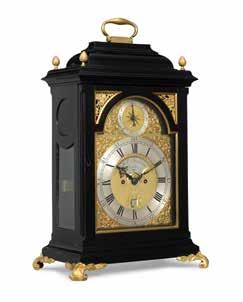
A MID 18TH CENTURY EBONISED QUARTER REPEATING TABLE CLOCK
Markwick, Markham, London
The case surmounted by a knopped brass carrying handle over an inverted bell top with turned finials to each corner over a moulded top, the front with now glazed recesses for sound frets, the sides and back with glazed observation windows, terminating in a moulded base and resting on bun feet. The 7 inch brass dial with silvered Roman and Arabic chapter ring with fleur-de-lys half hour markers, the matted centre with long mock pendulum aperture and calendar aperture, framed by cast brass spandrels with strike/silent subsidiary above 12 o’clock and silvered name cartouche to the break arch signed Markwick Markham, London, with blued steel hands. The double fusee movement now with steel lines and finely turned knopped pillars, striking the hours on a polished bell and quarter repeating on a nest of six bells and hammers, with verge escapement and short bob pendulum, the back plate richly engraved and signed in a central cartouche Markwick Markham, London, currently ticking and striking. 50cms (20ins) high.
£1,200 - 1,800
€1,400 - 2,100
US$1,600 - 2,400
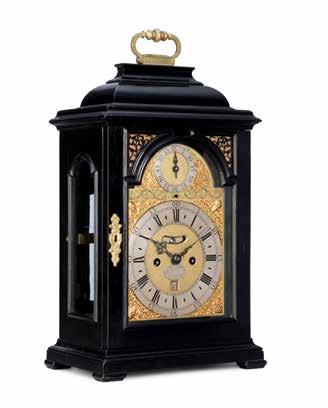
William Frodsham, London
The case sumounted by a brass carrying handle over an inverted bell top framed by four further cast finials over a moulded top, the front with cast sound frets and brass inlay, the sides incorporating two panels, one formerly an observation window, terminating in a moulded base and sitting on four elaborately cast and decorated feet. The 8 inch brass dial with silvered Roman and Arabic chapter ring with a matted centre signed in a silvered cartouche William Frodsham, London with a separate calendar aperture and blued steel hands framed by cast brass spandrels with a strike/silent subsidiary decorated with a shaped star to the break arch. The double fusee movement now with steel lines and verge escapement striking the hours on a polished bell mounted above and quarter repeating on a nest of six polished bells and hammers, the back plate fully engraved, currently ticking and striking. 55cms (22ins) high.
£1,000 - 1,500
€1,200 - 1,700
US$1,400 - 2,000
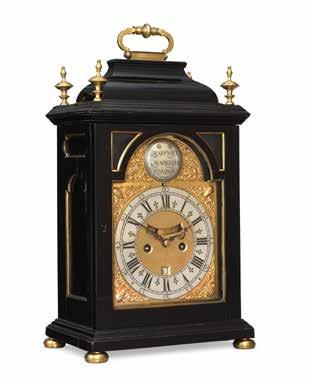
Thomas Bradford, London
The case with low repousse caddy decorated with pairs of fruit and flower swags surmounted by a commensurately large handle with tied bud central knop, with four turned finials over a moulded cornice, long glazed side panels and a moulded base, now together with an additional turntable base. The 10 inch square brass dial with winged cherubs head spandrels framing the silvered Roman and Arabic chapter ring with dotted half-quarter marks within the minute band, and fleur de lys half-hour markers emanating from the quarter track, finely matted centre with date aperture at XII, and blued steel hands, signed between VII and V Tho: Bradford Londini, Fecit . The substantial triple gut fusee movement with split frontplate, secured by ten knopped and latched pillars (one replaced
with a steel post), knife-edge verge escapement, rack strike for the hour sounding on a vertical hammer, and chiming the quarters on a nest of six bells and hammers. The backplate engraved with a symmetrical pattern of flowerheads within foliate scrolls, the barrels with outside steel click springs. Going train gut line broken, hence not currently running, but both hour strike and quarter chime trains working. 52cms (20.5ins) high.
£8,000 - 12,000
€9,300 - 14,000
US$11,000 - 16,000
Provenance:
Derek Roberts Fine Antique Clocks.
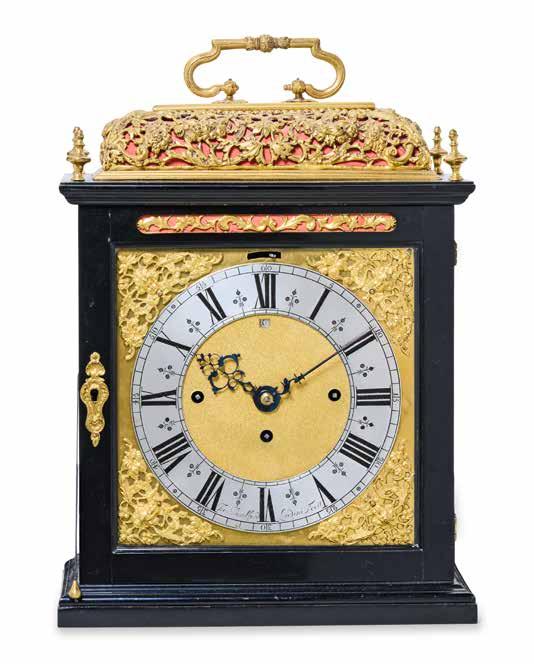
A GOOD LATE 17TH CENTURY EBONISED MUSICAL TABLE CLOCK
PLAYING TWO TUNES ON 25 HAMMERS AND 14 BELLS VIA A TITLED PINNED BARREL
Paul Beauvais, London
The case surmounted by five cast spherical finials around a ‘Huguenot’ style stepped bell top with silk-backed sound fret, the front door with applied cast mounts, the sides with windows and decorated carrying handles, terminating in a moulded base on a further moulded plinth mounted with cast dogs to each side, standing on four cast brass feet.
The impressive 10 inch brass dial with Roman and Arabic chapter ring with lozenge half-quarter marks and cruciform half-hour markers emanating from the quarter track, the matted centre with ringed winding squares, mock pendulum and calendar apertures within a finely engraved wheatear border set with a pair of levers marked Strike/Silent and 1 tune/2 tune , signed at 6 o’clock P. Beauvais, London
The triple chain fusee movement with converted anchor escapement, striking the hours on a bell and playing on a nest of thirteen bells and twenty five hammers, via the brass pinned cylinder engraved with tune titles Folie D’Espagne and strap work and foliage around the signature. Currently ticking, striking and playing. 63cms (25ins) high.
£6,000 - 9,000
€7,000 - 10,000
US$8,100 - 12,000
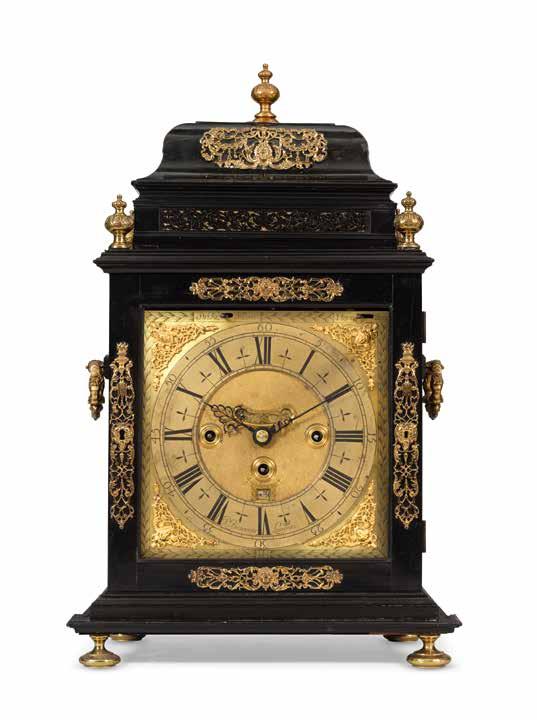
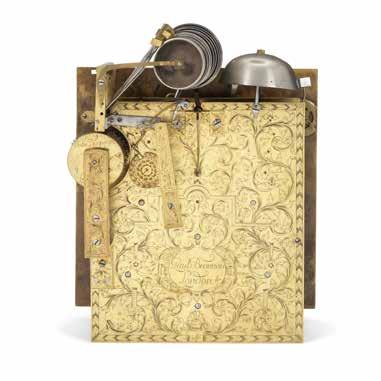
118
A LATE 17TH CENTURY DOUBLE BASKET-TOP QUARTER REPEATING TABLE CLOCK.
Stephen Asselin, London
The case surmounted by an elaborate handle over a double basket top, the upper basket decorated with an ancient warrior framed by cherubs, with ball finials to each corner, the main basket centred by a scene of St George slaying the Dragon guarded by a pair of saluting soldiers, the sides with female busts framed by cherubs all backed in green silk, with pineapple finials to a moulded top, the front with further repoussé decorated sound frets and lock escutcheon decorated with similar motifs of Roman generals and cherubs, the sides with similar repoussé sound frets backed in green silk with architectural centres, terminating in a moulded base and sitting on bun feet. The 8 inch square brass dial with silvered Roman and Arabic chapter ring with cruciform half hour markers and five minute markers within a line border, the matted centre with large mock pendulum aperture engraved backing and a chamfered date aperture, signed around VI Asselin, London, framed by four cast brass cherub head spandrels within a foliate engraved border, with blued steel hands. The twin chain fusee movement with verge escapement and knopped pillars, striking the hours on a bell mounted above and pull quarter repeating on a nest of five bells and hammers, the back plate finely engraved with floral scrolls and swags within a foliate border, centred by a seated eagle, signed in a cartouche Asselin, London. Ticking, striking and repeating. Together with a later winding key 53cms (21ins) high.
£5,000 - 8,000
€5,800 - 9,300
US$6,700 - 11,000
FOR FUTHER INFORMATION, PLEASE SEE APPENDIX
119
Signed, Nathaniel Hodges, London
The tall rectangular case with basket top and four bold finials over rectangular side apertures, on a moulded base, the 7 inch square brass dial with Indian mask spandrels framing the signed silvered Roman and Arabic chapter ring, the matted centre with ringed winding squares and date aperture, the twin gut fusee movement with knife-edge verge escapement and outside countwheel strike on a bell. (The case and chapter ring probably 17th century). 41cms (16ins) high.
£2,500 - 3,500
€2,900 - 4,100
US$3,400 - 4,700
Thomas Lumpkin, London
The caddy top case surmounted by a knopped carrying handle over a moulded cornice and glazed side apertures to a moulded base on small block feet, the front door with repousse brass sound fret centred by a cherub, against a red silk background. The 5.75 inch square brass dial with silvered Roman and Arabic chapter ring with cruciform half hour markers, lozenge half-quarter marks and signed either side of VI Thomas Lumpkin, London , the matted centre with mock pendulum and date apertures, both with fine wheatear engraving to their edges with blued steel hands framed by cast brass cherubs head spandrels. The fusee movement (now on a chain) with five knopped pillars and knife edge verge escapement to a short bob pendulum with pull quarter repeat repeat sounding the hours and quarters on two bells mounted above, the back plate framed by an engraved line border and bold floral scrolls surrounding the signature Thomas Lumpkin, London in a foliate cartouche. Currently ticking and repeating, sold together with a later ebonised bracket. 33cms (13ins) high.
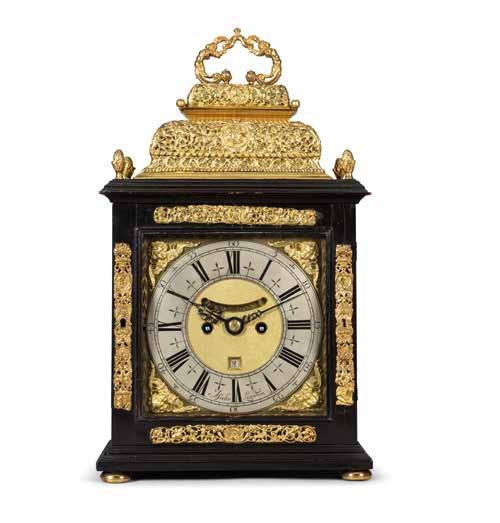
US$4,000 - 6,700
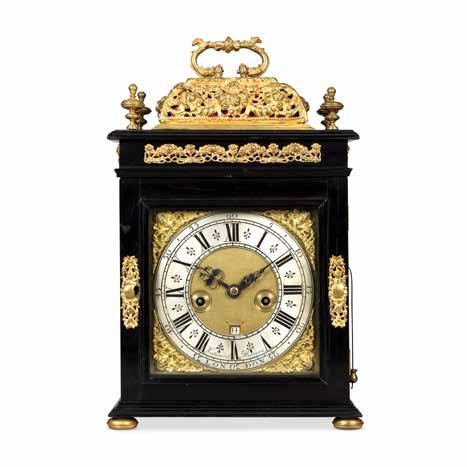
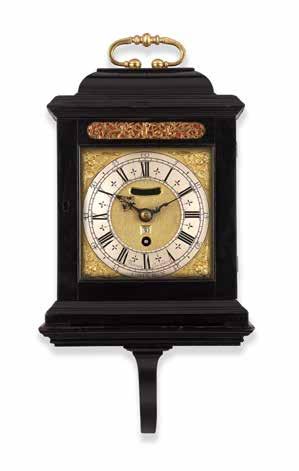
Charles Cabrier, London
The case with flat top over a pierced sound fret supported by four twisted columns with Doric capitals, the front with floral marquetry panels and the sides with glazed observation windows, the convex throat moulding above the long trunk door with three panels of floral marquetry depicting tulips, foliage and a seated bird to the centre above a circular lenticle, the plain sides terminating in a moulded base on further plinth with additional floral marquetry, raised on four turned feet. The 11 inch square dial with silvered Roman and Arabic chapter ring with fancy cruciform half hour markers, the matted centre with elaborately decorated calendar aperture, ringed winding squares and silvered Arabic subsidiary seconds dial with blued steel hands framed by four fancy cherub head spandrels. The two train movement with external count wheel strike, striking the hours on a bell mounted above, united by finely turned knopped pillars, the going train with anchor escapement and long pendulum. Sold together with a pendulum and two brass clad weights. 2m (6.7ft) high.
£4,000 - 6,000
€4,600 - 7,000
US$5,400 - 8,100 FOR FUTHER
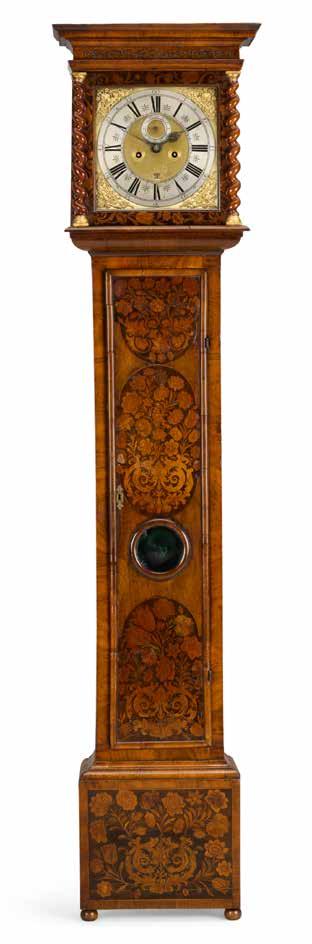
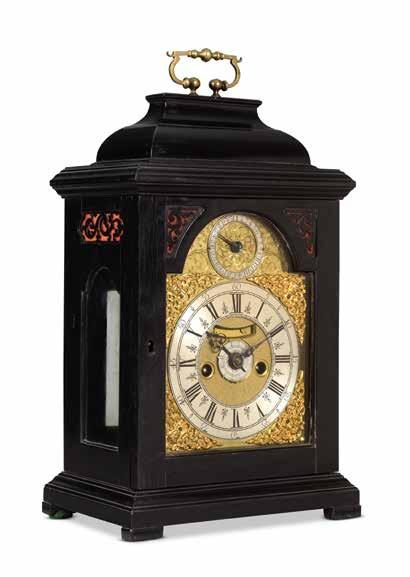
123
AN 18TH CENTURY EBONISED TABLE CLOCK WITH RISE AND FALL REGULATION
Daniel Delander, London
The case sumounted by a decorated brass carrying handle over an inverted bell top with four later finials to each corner over a moulded top with brass banding, the front with cast sound frets and brass lock escutcheon to the left hand side, the sides and back with glazed observation windows, terminating in a moulded base and sitting on brass bun feet. The 7 inch brass dial with silvered chapter ring with black Roman numerals and Arabic five minute markers with lozenge half hour markers, the matted centre with mock pendulum aperture and calendar aperture signed in a finely finished cartouche Dan Delander, London , framed by cast brass spandrels within floral engraved decoration with strike/ silent and pendulum rise and fall to the break arch. The double fusee movement with gut lines striking the hours on a bell mounted above and quarter repeating on a nest of six polished bells and hammers, with verge escapement and short bob pendulum, the back plate finely engraved, currently ticking and striking. 50cms (20ins) high.
£2,000 - 3,000
€2,300 - 3,500
US$2,700 - 4,000
Henry Massy, London
The inverted bell top case surmounted by a delicate knopped brass handle and a moulded cornice, the front door with pierced wood sound frets backed in red silk, the sides with similar frets above break arch glazed observation windows, terminating in a moulded base on four block feet. The 6 inch brass dial with silvered Roman and Arabic chapter ring with lozenge half-quarter marks and fleur-de-lys half hour markers, the matted centre with mock pendulum aperture, ringed winding squares and silvered Arabic alarm setting disc with blued steel hands framed by four cast brass spandrels, further engraved to the arch with a 1-31 calendar within floral engraving. The unusual movement with five knopped pillars, verge escapement with silent pallets to a short bob pendulum powered by a chain fusee, repeating the hours on a single bell and the quarters on a smaller bell, the back plate centred by a large stop-work wheel for the subsidiary alarm train, signed in an arc Henry Massy, London within a wheatear border. Ticking, repeating and with functioning alarm acting on the larger bell and a T-shaped steel hammer. Together with two case keys and a 19th century winding key. 41cm (16ins) high.
£800 - 1,200
€930 - 1,400
US$1,100 - 1,600
Literature:
The above lot was advertised by Ronald A. Lee in Antiquarian Horology, Vol. 1 No.10 , March 1956.
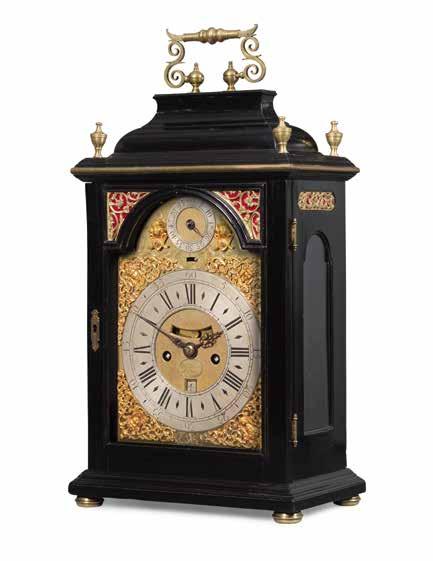
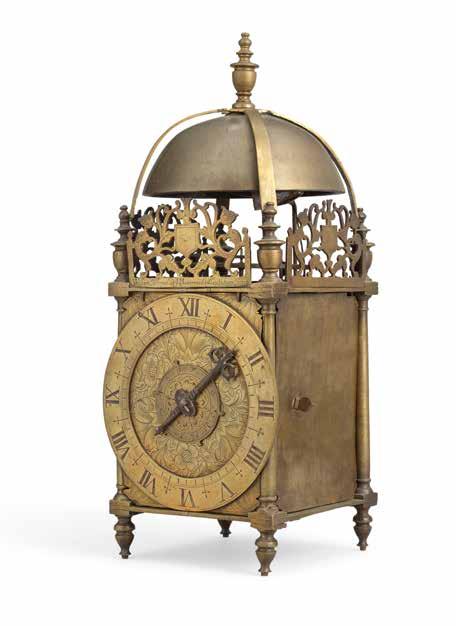
124 *
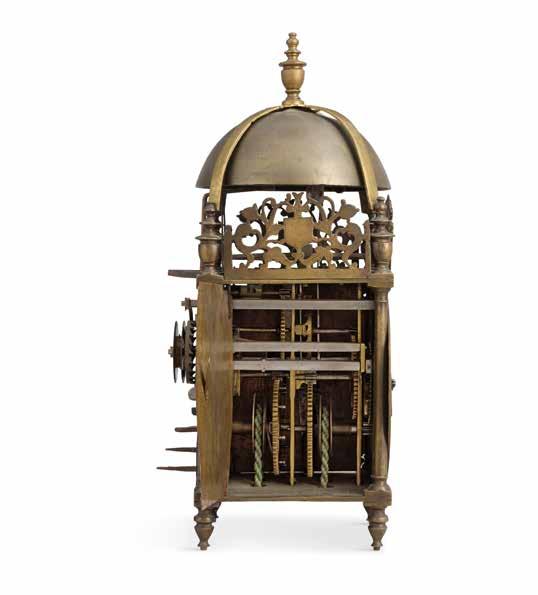
A MID 17TH CENTURY BRASS LANTERN CLOCK WITH BALANCE WHEEL VERGE ESCAPEMENT
William Selwood, London
The case surmounted by a robust turned urn finial over a large heavy bell secured in an X-frame by four matching finials on cast Doric columns to acorn-style feet, the top plate set with three pierced and engraved ‘grotesque’ frets centred by a shield, the front signed along the lower edge William Selwood at ye Maremaid in Louthbury fecit (sic), over four turned columns to each corner with the original brass side doors and an iron backplate, raised on four turned feet. The 7 inch brass dial with Roman chapter ring and cruciform half hour markers emanating from the inner quarter hour track, the centre engraved with a ring of flowers enclosing the Arabic alarm-setting dial with Tudor rose centre and single fettled steel hand, all framed by engraved foliate spandrels. The two train movement with (reinstated) balance wheel and verge escapement, striking the hours on the large bell mounted above via a heavy steel hammer and external count wheel, with alarm train mounted to the steel back plate, currently ticking and striking. 43cms (17ins) high.
£5,000 - 7,000
€5,800 - 8,100
US$6,700 - 9,400
Provenance:
A distinguished private European collection.
Comparative Literatiure:
A similar clock by Selwood - using the same phonetic spelling of Lothbury - was exhibited in the Huygens Legacy exhibition held at Palace Het Loo, Apeldoorn, The Netherlands, 12th September - 28 November 2004. Other examples by this highly regarded maker are illustrated in
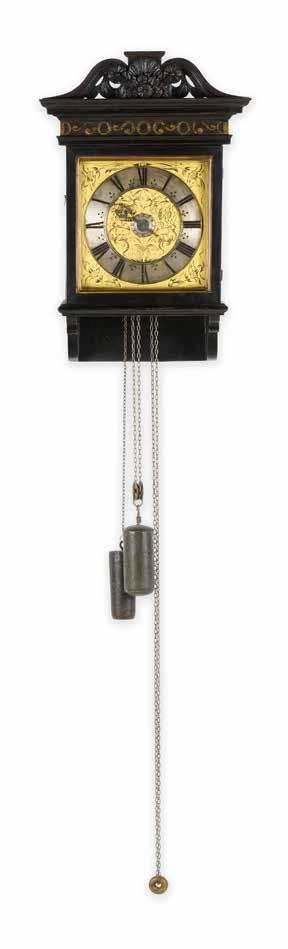
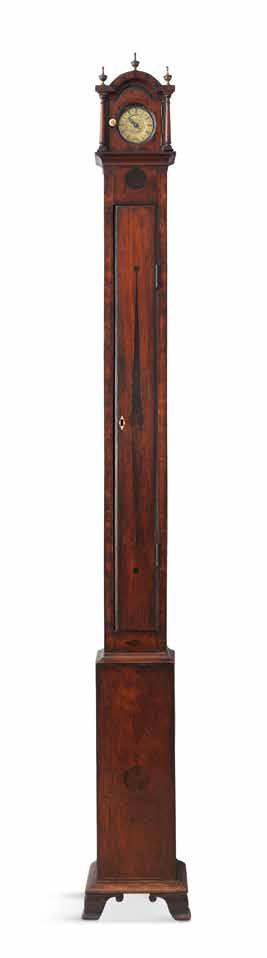
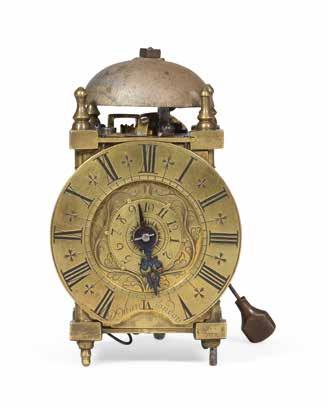
Bearing the signature D Quare, London
The brass posted movement surmounted by a 2 inch bell on a steel post over turned finials and tapering columns to shaped feet. The 2.75 inch Roman chapter ring with arrow-head half hour markers and inner quarter hour track, with unusual curve lower profile around VI, now carrying the signature D Quare, London , with foliate engraved centre and Arabic alarm setting disc with single blued steel hand. The weight driven movement with verge escapement and short bob pendulum, the alarm train set inside the rear panel. Contained within an (early 19th century?) mahogany floorstanding case with geometric ebony inlay, free-standing Doric columns to the hood over a long trunk door and tall plinth base on bracket feet. Ticking. The case 1.69m (5ft 7ins). The clock 11cms (4.25ins) to the top of the bell (Quare)
£800 - 1,200
€930 - 1,400
US$1,100 - 1,600
126 TP
Jonathan Lowndes, London
The later custom-made wooden case with carved cresting to the top over a flat moulded hood with blind-carved frieze with blind giltheightened sound fret in the manner of Joseph Knibb, the sides glazed and terminating in a moulded base with twin brackets. The 10 inch square dial with silvered Roman chapter ring and fleur-de-lys half hour markers emanating from the quarter-track, the dial centre intricately engraved with flowing floral decoration centred by a (areplaced) Arabic alarm setting dial, all framed by engraved tulip corners, signed along the lower edge Jonathan Lowndes, London , with single steel hand. The posted movement with four turned pillars, the going train with crown wheel and verge escapement to a short bob pendulum, striking the hours via a count wheel on a bell mounted above, with alarm work set from the rear, currently ticking and striking. 63cms (25ins) high.
£1,500 - 2,500
€1,700 - 2,900
US$2,000 - 3,400
128
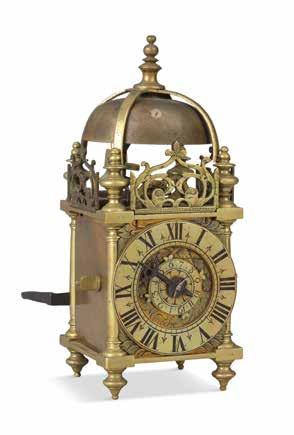
18TH CENTURY FRENCH LANTERN CLOCK WITH ALARM
Michel Guery, Paris
The slender bell strap surmounted and supported by baluster finials between foliate scroll frets, the foremost with a central shield engraved with a lion passant, over the 3.75 inch Roman and Arabic chapter ring with cruciform half hour markers, blued steel hour and minute hands, the dial plate engraved with foliate spandrels and signature below a strapwork panel, centred on the alarm setting disc, the weight driven two train verge movement with silk suspension pendulum, plain hammer stop and spring, the alarm work fitted to the rear frame and iron backplate. 22cm (9 1/2in) high
£1,500 - 2,000
€1,700 - 2,300
US$2,000 - 2,700
Provenance: A distinguished private European collection.
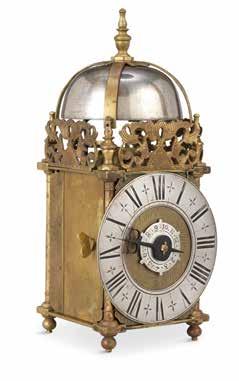
TIMEPIECE
Minoche, Paris,
The case surmounted by a turned finial above the bell and bell stand supported by four further turned finials, each cast in one piece with their bases, tapering columns and to turned feet, intercepted by pierced and engraved frets above side columns with opening side doors, the rear with hook and spike and terminating in four turned feet. The pleasing 3 inch dial with black Roman numerals, half hour markers and engraved centre signed Minoch, Paris , with central Arabic alarm setting dial and blued steel hand. The timepiece alarm movement with verge escapement and short bob pendulum with alarm work mounted behind the movement, currently ticking, with Huygens cheeks to the pendulum suspension. 19cms (7.5ins) high.
£1,500 - 2,500
€1,700 - 2,900
US$2,000 - 3,400
Provenance: A distinguished private European collection.
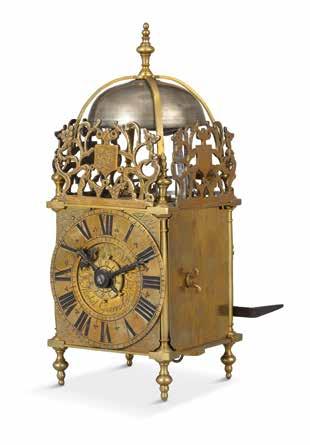
William Webster, Exchange Alley, London
The case surmounted by a turned brass finial above the bell and bell stand with four turned finials to each corner over tapering Doric columns on ball feet, the top plate set with pierced and engraved scroll frets over a pair of side doors and iron backplate. The 4 inch dial with silvered Roman chapter ring and cruciform half hour markers emanating from the inner quarter hour track, signed in the centre William Webster, Exchange Alley, London , with replaced silvered Arabic alarm setting disc and blued steel hand. The timepiece movement with verge escapement and short bob pendulum, the alarm train set to the rear of the movement. Currently converted to run on steel chains, ticking and with functioning alarm, sold together with weights. 22cms (9ins) high.
£800 - 1,200
€930 - 1,400
US$1,100 - 1,600
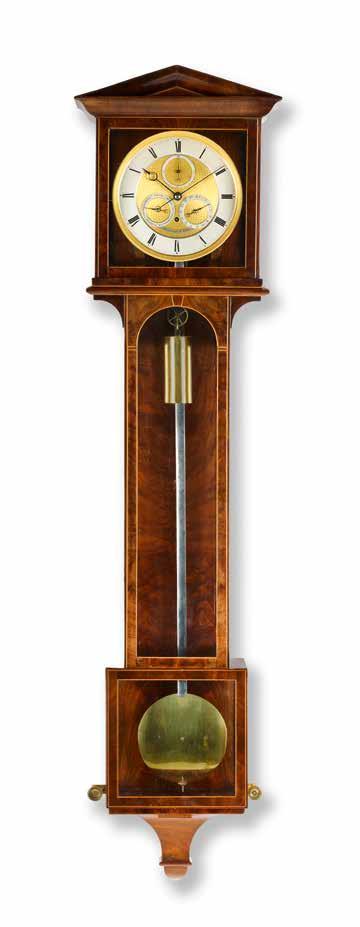
Hitzinger in Wien
The case with ogee moulded elements to the architectural cornice over nine glazed panels framed in boxwood, with a pair of adjustable brass levelling screws to the base. The 5.5 inch brass and silvered dial with Roman chapter ring framing the engine turned centre set with three subsidiaries for running seconds, date, and day (in German), signed on an applied silvered arc HITZINGER IN WIEN , with five blued steel hands (the minute counter-balanced), the weight-driven movement with arched plates, maintaining power to the deadbeat escapement, the pendulum with polished steel rod to a brass lenticular bob. Together with the cylindrical brass weight. Ticking. 1m (3ft 3ins) high.
£7,000 - 10,000
€8,100 - 12,000
US$9,400 - 13,000
131 W TP A GRANDE-SONNERIE STRIKING ARCHITECTURAL EBONY-STRUNG MAHOGANY WALL REGULATOR
Wibral in Wien. The movement also signed, and dated Anno 1812. The triangular pediment over six glazed panels to a concave foot section. The 8.75 inch signed white enamel Roman dial with matching blued steel hands within a cast ormolu bezel. The weight driven movement united by cylindrical pillars and signed along the bottom of the backplate
Wibral in Wien Anno 1812 , with deadbeat escapement and long pendulum suspended from a knife edge mounted on a brass plate secured to the backboard, striking the hours and the quarters on a pair of coiled blued steel gongs. 1.39m (4ft 7ins) high.
£2,000 - 3,000
€2,300 - 3,500
US$2,700 - 4,000
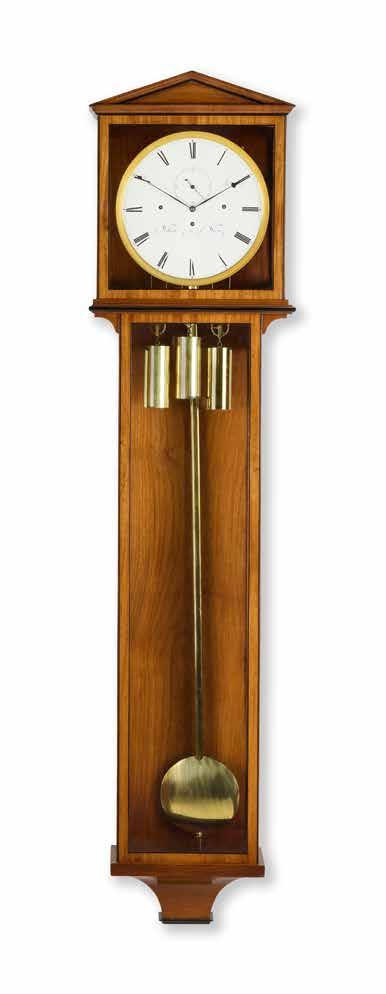
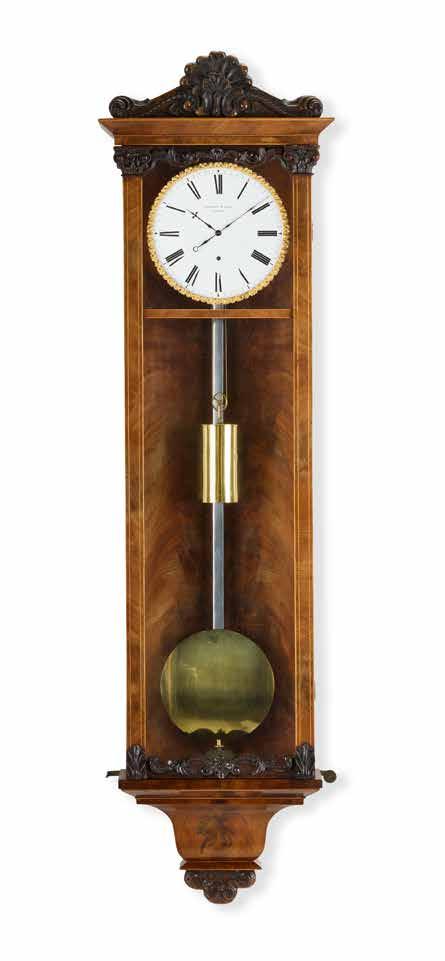
W TP
A BOXWOOD-STRUNG MAHOGANY MONTH GOING VIENNA WALL REGULATOR
Johann Weiss in Wien
The six-light case surmounted by a shell-carved cresting supported on two Ionic-style pilasters with carved capitals and bases, framing further carved detail, the moulded concave base with a matching carved terminal. The 7.5 inch signed enamel dial with scroll-and floral-cast bezel, with blued steel hands (the minute counter-balanced). The weight driven movement with maintaining power to the deadbeat escapement of one month duration, the crutch with fine beat adjustment to the polished steel rod and brass lenticular bob. 127cms (4ft 2ins) high.
£2,000 - 3,000
€2,300 - 3,500
US$2,700 - 4,000
133 W TP
A RARE LATE 20TH CENTURY MAHOGANY AND BOXWOOD STRUNG ‘LANTERNDLUHR’ WALL TIMEPIECE CLOCK OF ONE YEAR DURATION, WITH 6-HOUR FRANKLIN-STYLE
Unsigned
The case with architectural cornice over a glazed front and sides with long trunk door with further glazed observation windows, terminating in a square base with further glazing and concave base. The 8 inch white enamel Roman dial with unusual six hour layout, the subsidiary seconds dial with double tipped hand and counter balanced central hand. The substantial single train year-going movement with maintaining power, large high count wheels and long pendulum powered by a single ovalsection brass weight suspended from the barrel mounted on a bridge on the backplate. Ticking. 145cms (4ft 9ins) high.
£1,000 - 2,000
€1,200 - 2,300
US$1,400 - 2,700
134 W TP
A GOOD MID 19TH CENTURY EBONISED SIX-LIGHT VIENNA REGULATOR WALL CLOCK TIMEPIECE
Johann Rau, in Wien
The architectural case with ripple-moulded edges throughout, ebonised backboard, six thin glass panes and a pair of levelling screws to the base. The signed white enamel Roman dial with minute track and blued steel hands (the minute counter-balanced) within a geometric cast bezel. The weight-driven movement with five-wheel train terminating in a deadbeat escapement, fine screw beat adjustment to the pendulum with polished steel rod and large brass lenticular bob, mounted on a knife-edge secured to the backboard. Together with the brass cylindrical weight, and a brass crank winding key. 94cms (3ft 1ins) high
£800 - 1,200
€930 - 1,400
US$1,100 - 1,600
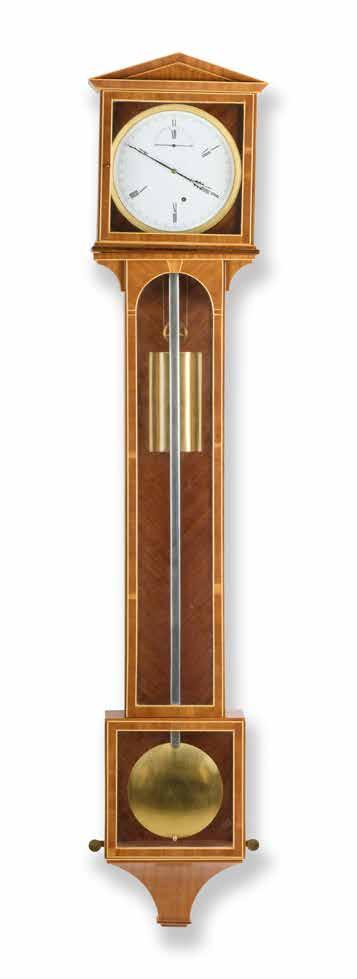
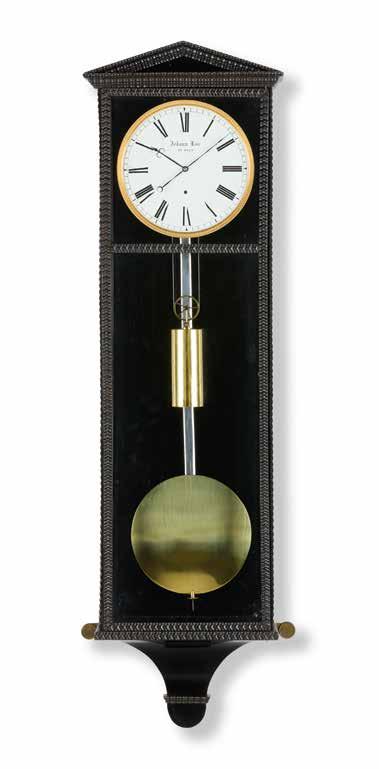
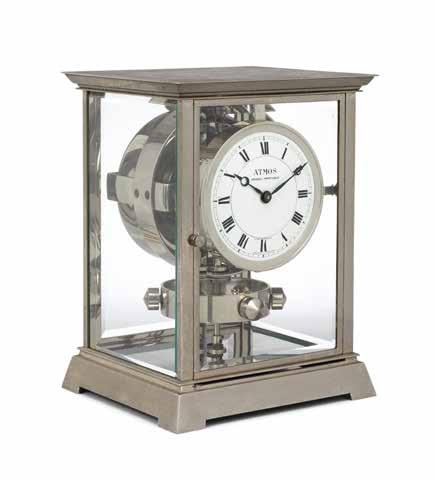
J.L.Reutter,
No.2123
The four glass case with moulded cornice over four bevelled glass panels, raised on a splayed plinth base with integral pendulum lock, the signed 3.5 inch white enamel Roman dial with moon hands, the barometrically wound movement with lever type escapement and torsion pendulum with six large timing screws, the bar stamped 2123 to the reverse. 24cm (9.5in) high.
£2,000 - 3,000
€2,300 - 3,500
US$2,700 - 4,000
136
Jaeger LeCoulture
The signed octagonal onyx base with chromed-brass cover to the painted annular dial under the glass globe with paper world map lit from the centre by a single light bulb, the movement with keyless wind timepiece movement and lever escapement. 30cms (11.5ins) high.
£1,500 - 2,000
€1,700 - 2,300
US$2,000 - 2,700
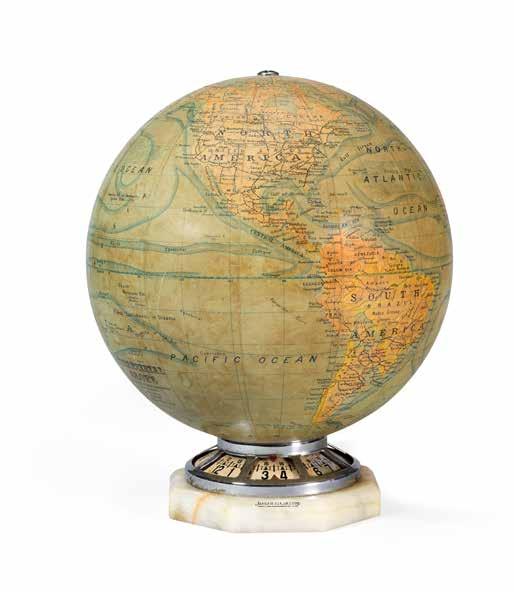
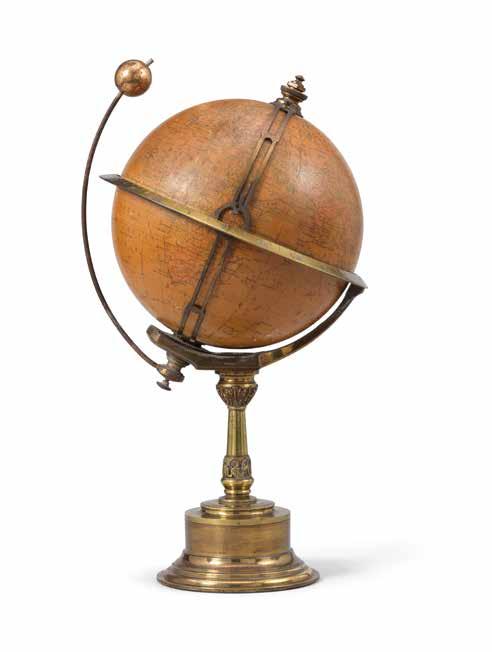
138
A RARE EARLY 20TH CENTURY ELECTRIC SKELETON CLOCK TIMEPIECE WITH REMONTOIR SYSTEM
G. W. Mason, Liverpool
The shaped pierced frame united by turned baluster pillars over three pairs of coils set between two pairs of lacquered brass tapering columns, the centre wheel set in front of a spring remontoir driving the deadbeat escapement and wood-rod pendulum suspended from a block held between a pair of 10.5inch columns mounted at the rear. The silvered skeletonised chapter ring with scalloped outer edge marked for every minute, with blued steel hands, all set on a circular moulded base with applied label for G.W.MASON, MAKER, LIVERPOOL, 1914 , with a battery compartment below (taking two D-cells). Under a glass dome. To the top of the frame 34cms (13.5ins) high.
£1,000 - 1,500
€1,200 - 1,700
US$1,400 - 2,000
Provenance:
Christies, London, 7th December 2010, lot 402.
137
AN INTERESTING EARLY 20TH CENTURY NOVELTY WORLD TIME CLOCK
Smith & Son, ‘The Empire Clock’ Patent No. 19460, numbered to the base 369
The 7.5 inch coloured globe with a centrally mounted horizon ring engraved with twenty-four hour Roman dial divided to the nearest 15 minutes, set on shaped bracket stamped PATENT SGDG and showing the geared wheelwork that drives the globe from the movement below, the bracket also set with a curved arm terminating in an adjustable lacquered brass representation of the sun. The single barrel movement wound from the base and now driven by a replaced lever platform escapement. 41cms (16ins) high
£800 - 1,200
€930 - 1,400
US$1,100 - 1,600
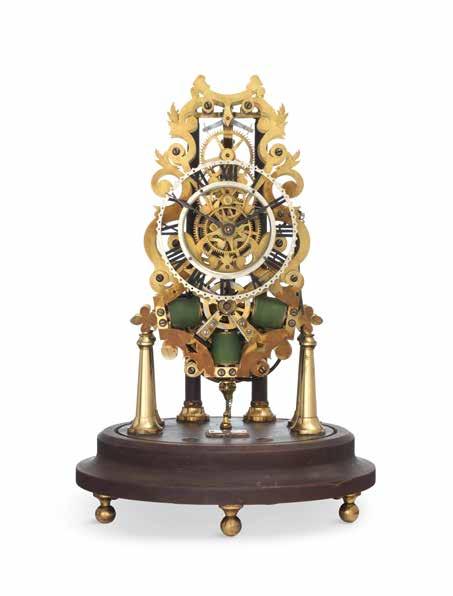
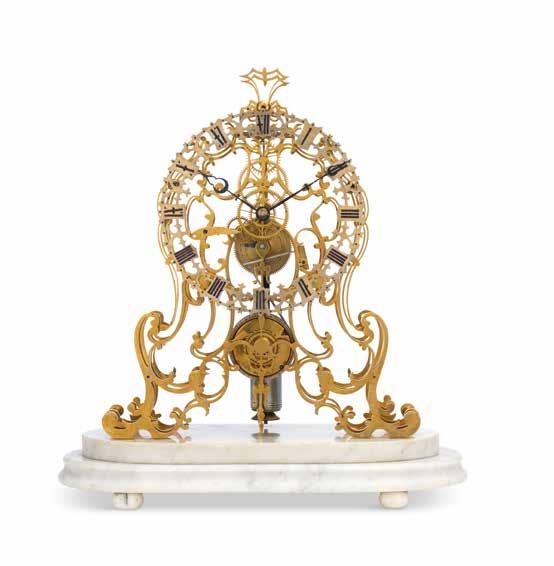
140
A LATE 19TH CENTURY LITCHFIELD CATHEDRAL STRIKING SKELETON CLOCK WITH CENTRE SECONDS AND PLATFORM ESCAPEMENT
Whipp, Rochdale
The clock set on a mahogany veneered wooden base, the 5 inch skeletonised chapter ring with black Roman numerals signed Whipp, Rochdale with blued steel hands and centre seconds. The movement set within an architectural frame surmounted by four spiers with decorative finials, with English lever platform escapement and double chain fusee, striking the hours via a rack on a steel gong mounted in the base, with five spoke wheels, currently ticking and striking, lacking dome. 38cms (15ins) high.
£1,200 - 1,800
€1,400 - 2,100
US$1,600 - 2,400
139
A GOOD SECOND HALF OF THE 19TH CENTURY BRASS TRIPLE-FRAME TIMEPIECE SKELETON CLOCK UNDER A GLASS DOME
Attributable to the Evans workshop.
The three-part frame of open waisted form cast with sinous curves united by seven turned brass pillars. The pierced chapter ring with dotted minutes to the outer edge, each gothic Roman numeral interspersed by a stylised quatrefoil, to unusual open Breguet style hands. The single chain fusee movement with decorative cap to the set up ratchet, deadbeat escapement and wheels of six crossings througout, the wood-rod pendulum with typical cylindrical zinc bob. 43cms (17ins) high.
£800 - 1,200
€930 - 1,400
US$1,100 - 1,600
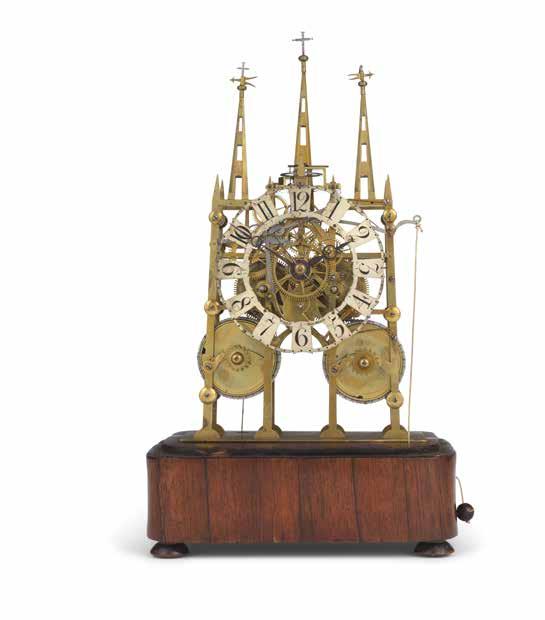
Attributable to the Evans workshop.
The lacquered brass frame based on the original Gothic building, its twin turrets framing the two nests of four graduated bells and hammers, on a cast brass band and velvet-covered and marble base, the thick plates united by six turned pillars (glass dome present but with old damage).
The 8 inch silvered skeletonised chapter ring with shaped outer minute band and Roman numerals set within Gothic-inspired cartouches, to blued steel hands. The triple chain fusee movement with decorative caps
to the set up ratchets and wheels of six crossings throughout; the going train with anchor escapement and ebonised wood rod pendulum with zinc cylindrical bob and fine regulation nut; the strike and chime trains with a pair of polished steel racks and snails on display, striking the hours on a large blued steel coiled gong mounted behind. Ticking and striking. 60cms (24ins) high, without dome.
£8,000 - 12,000
€9,300 - 14,000
US$11,000 - 16,000

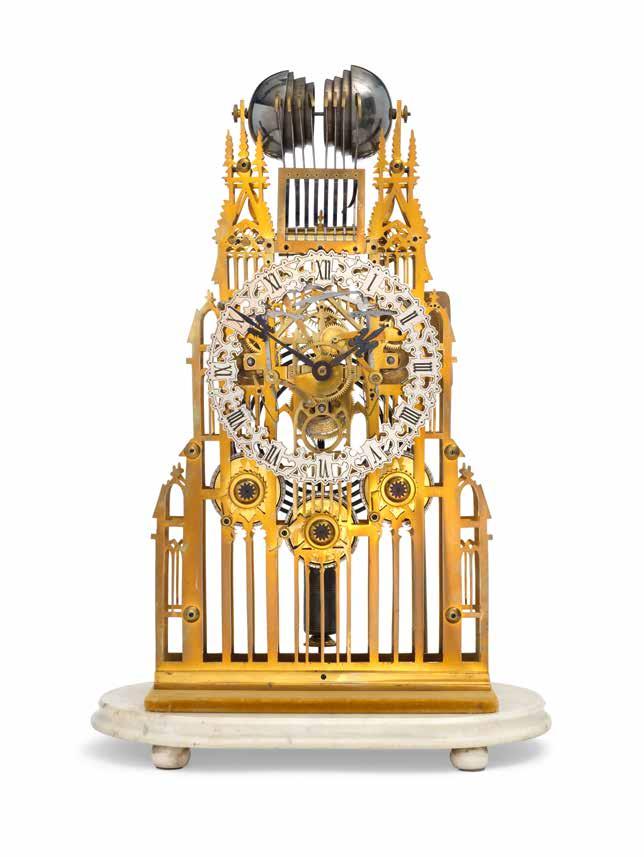
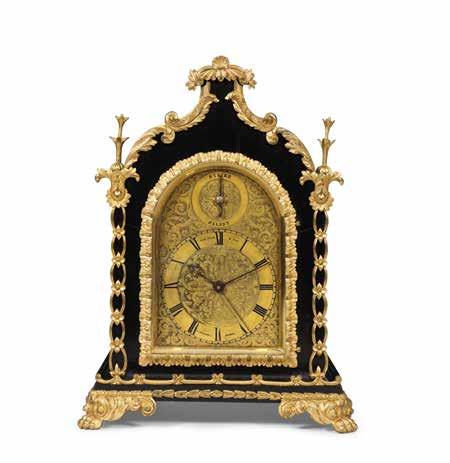
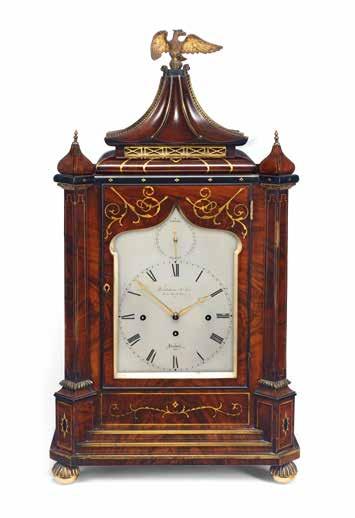
142
John Moore & Sons, Clerkenwell, London, No. 11743. The case repeat numbered on the rear door frame.
The case with shaped pointed arched top and crocket finials over rippled sides, the front applied with ormolu mounts of foliage and linked flowerheads, with harebells to the base and heavy lions paw feet, the sides with substantial glazed panels. The 4.75 inch gilt engraved dial with strike/silent subsidiary over a Roman chapter ring with outer minute band and three blued steel hands, signed John Moore & Sons, Clerkenwell, London, No.1043 within a rich engraved pattern of foliate scrollwork on a hatched ground. The substantial twin chain fusee movement with thick plates united by five tapering pillars, the going train with maintaining power and the original lever platform escapement with heavy monometallic balance mounted vertically on the backplate, the strike train with rack and snail acting on a bell. Signed and numbered on the backplate. Ticking and striking. 36cms (14.5ins) high.
£1,200 - 1,800
€1,400 - 2,100
US$1,600 - 2,400
Frodsham, Gracechurch Street, London
The case crowned by a pagoda top surmounted by a cast brass eagle finial over pierced brass architectural sound frets, the ogee front door with inlaid brass work, flanked by decorative columns and stepped plinth resting on four gadrooned brass bun feet, the 8 inch silvered ogee shaped Roman dial signed Frodsham, Gracechurch St, London with simple strikesilent subsidiary and gilt brass hands.
The triple chain fusee movement united by unusual knopped pillars with anchor escapement, chiming on a nest of eight bells and striking the hours on a pair of bells and hammers together with a winding key and 2 case keys both ticking and chiming.
76cm (29 1/2 in) high
£2,000 - 3,000
€2,300 - 3,500
US$2,700 - 4,000
144
A VERY RARE MID 19TH CENTURY PATENT GILT AND PATINATED BRASS DRUM-CASED NIGHT CLOCK
John Pace, Bury St Edmunds
The drum case with ribbed sides and set on a pair of Ionic volute scrolls on a chamfered plinth with moulded edge on ball feet, the whole surmounted by a turned urn finial. The finial is set on a sliding base which is able to move forward to create an open chimney to release the smoke and heat from the lamp below.
The rear cover signed PATENTED John Pace, Bury St Edmunds with shaped aperture and mounted with an oil reservoir for the internally mounted lamp. The movement with a platform escapement set in the base and wound from the rear which is also set with a fast/slow regulator dial, the hands driven via bevel gearing and vertical motion work to the dial above.
The 3.5 inch dial with cast Arabic numerals on a skeletonised chapter ring set behind two panes of opaque glass with red silk between, with steel spade hands, all framed by a cast lotus-leaf bezel, the interior of the drum section is silvered and set with an angled reflector to increase night time visibility. Currently ticking.
23cms (9ins) high.
£1,000 - 2,000
€1,200 - 2,300
US$1,400 - 2,700
FOR FUTHER INFORMATION, PLEASE SEE APPENDIX
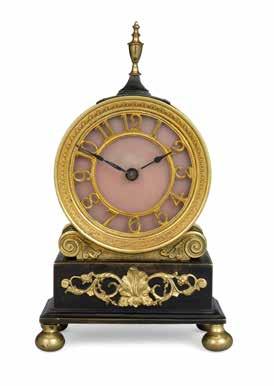
144 Day 144 Night
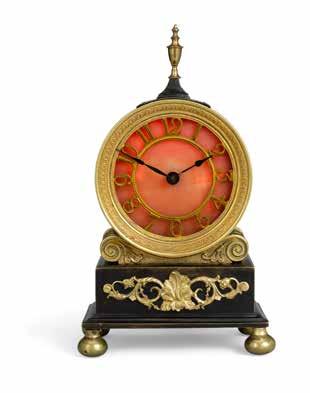
145 W TP
A GOOD FIRST HALF OF THE 19TH CENTURY DOMESTIC STRIKING MAHOGANY REGULATOR, WITH GLAZED FRONT DOOR.
Arnold and Dent, London
The case with sloped top with moulded surround over a textured frieze with fish scale sound frets to the sides backed in red silk, the front with brass inlay to each spandrel over a concave throat moulding, the trunk door with glazed window within a moulded brass surround and double lock with shaped sides, terminating in a block base with simple moulding. The 11 inch silvered brass dial with black Roman numerals and blued steel hands with subsidiary seconds signed in the centre Arnold & Dent, Strand with strike/silent aperture to the upper section. The movement with shaped plates with deadbeat escapement and maintaining power, striking the hours on a bell mounted above via a rack and snail, currently ticking and striking. 1.95m (6.65ft) high.
£4,000 - 6,000
€4,600 - 7,000
US$5,400 - 8,100
Literature:
The above lot is illustrated in Derek Roberts, Precision Clocks, figs. 13-8 A–F.
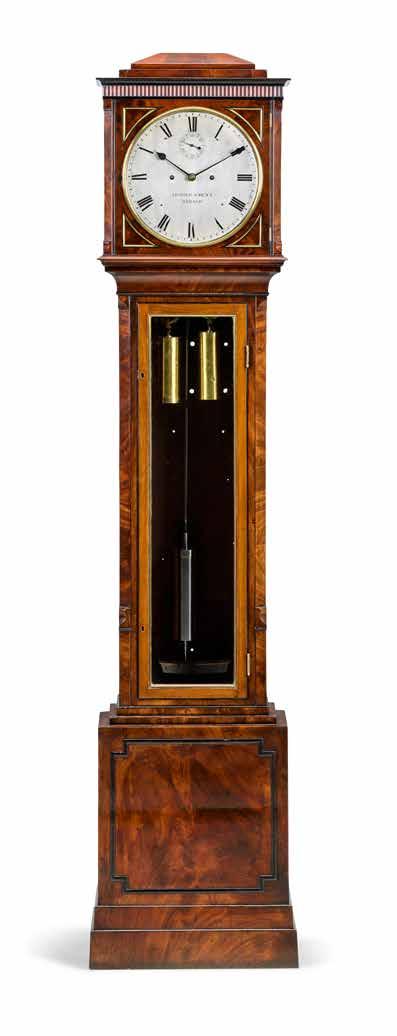
Robert Wood, London
The case sumounted by a turned urn finial over a pagoda top with silk backed sound frets to the break arch with moulded surround, the front with marquetry inlay, the sides with brass fish scale sound frets backed in silk and carrying handles to each side, terminating in a moulded base and resting on four brass ogee feet. The 8 inch painted white dial with black Roman numerals and blued steel hands with concealed strike/ silent above, signed in the centre Robert Wood, London . The large three train triple fusee movement with anchor escapement, striking the hours on a polished bell mounted above and chiming the quarters on a nest of eight graduated bells and hammers, the back plate with simple engraved decoration, currently ticking and striking. 59cms (23.25ins) high.
£2,500 - 4,000
€2,900 - 4,600
US$3,400 - 5,400
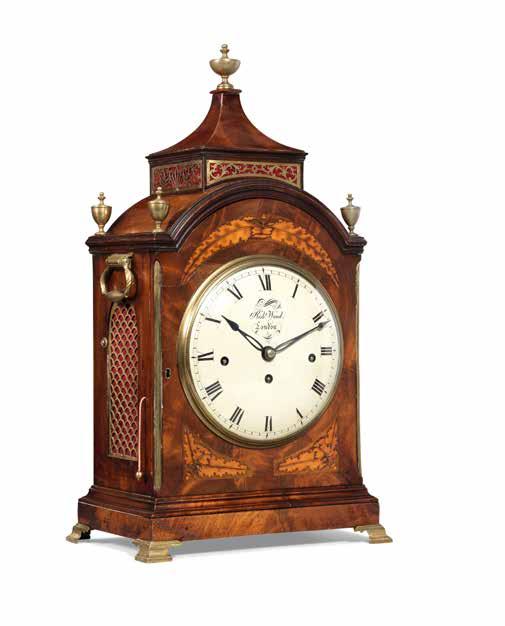
147 * A LATE 18TH CENTURY BRASS-BOUND MAHOGANY TRIPLE PAD TOP QUARTER CHIMING TABLE CLOCK
Metcalfe, Newgate Street, London, Surmounted by a brass handle and three brass-bound pads, to an elaborate moulded arched cornice over fish-scale side frets to a moulded plinth and brass ogee bracket feet.
The later 8 inch silvered brass gothic Roman dial signed in the centre Metcalfe, London , with matching gilt brass hands framed by engraved spandrels and two subsidiary dials above, the left for date and the right for strike/silent . The triple wire fusee movement with knife edge verge escapement, striking the hours on a bell and chiming the quarters on a nest of eight bells and hammers, the backplate with running swag border framing the central signature cartouche signed Metcalfe, Newgate Street, London 48cms (19ins) high.
£3,000 - 5,000
€3,500 - 5,800
US$4,000 - 6,700
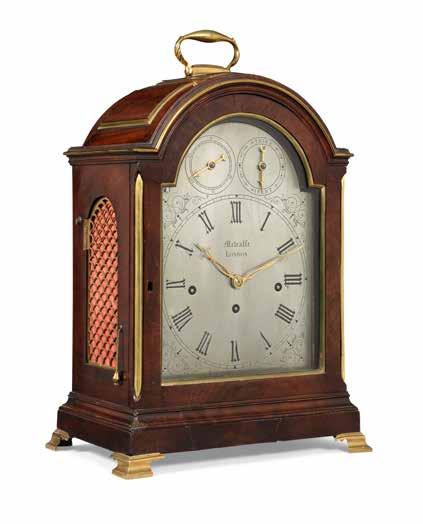
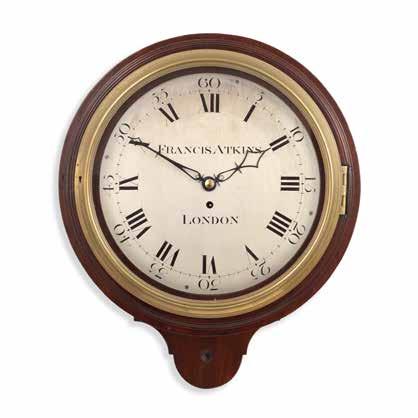
148
A LATE 18TH CENTURY 12” WALL TIMEPIECE CLOCK WITH SIGNED SILVERED DIAL, HEAVY BEZEL AND VERGE ESCAPEMENT
Francis Atkins, London
The case with large turned surround to a shaped and decorated base with doors to the base and right hand side with a cast brass bezel. The 12 inch silvered brass dial with black Roman numerals and Arabic five minute markers with blued steel hands signed in the centre Francis Atkins, London . The single fusee timepiece movement with verge escapement and short bob pendulum, currently ticking. 50cms (20ins) high.
£1,500 - 2,500
€1,700 - 2,900
US$2,000 - 3,400
149
A MID 19TH CENTURY MAHOGANY DROP DIAL CLOCK TIMEPIECE
J Bramble, Oxford Street
The case with long trunk door with well-figured mahogany front and chisel base, the 14 inch painted white dial with black Roman numerals and counterbalanced brass hands signed J Bramble Oxford Street . The single train movement with tapering A-frame plates powered by a single weight with an anchor escapement, currently ticking. 99cms (39ins) high.
£800 - 1,200
€930 - 1,400
US$1,100 - 1,600
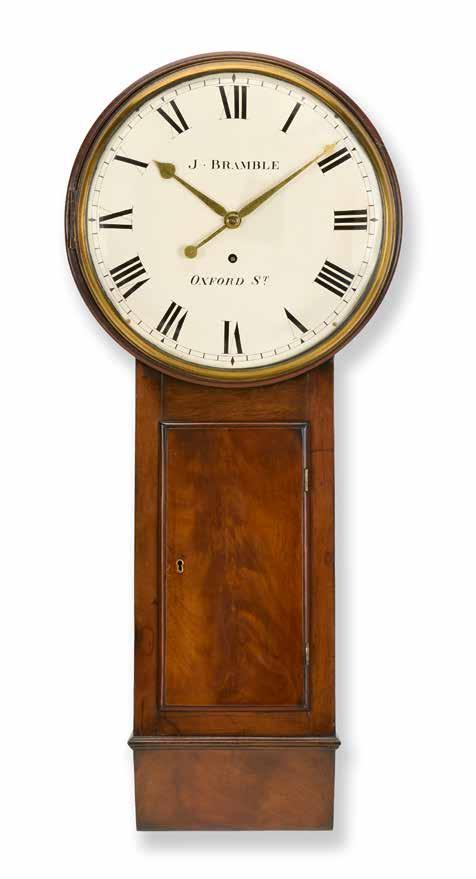
150
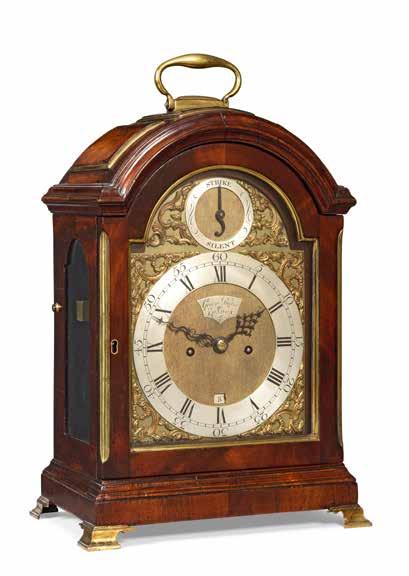
151
Ashwell, London
The arched case surmounted by a small brass carrying handle over a moulded arched cornice, the front set with pierced and engraved sound frets backed in red silk, raised on a shaped base on ogee brass bracket feet. The 3.5 inch white enamel Roman and Arabic dial framed by a well cast brass bezel and with matching blued steel hands, signed across the centre Ashwell, London . The shouldered plates framed by an engraved running border united by five pinned pillars, the chain fusee to an anchor escapement, it’s spring barrel secured by a bridge across the backplate, signed within a central cartouche Ashwell, London , Ticking. 25cms (10ins) high.
£800 - 1,200
€930 - 1,400
US$1,100 - 1,600
George Bates, London
The case sumounted by a brass carrying handle over a three pad top with brass surrounds to a moulded top, the front with brass mounted door and the sides and back with glazed observation windows, terminating in a moulded base and resting on four brass ogee feet. The 7 inch brass dial with silvered Roman and Arabic chapter ring, the matted centre with calendar aperture and central name plaque signed George Bates, London with blued steel hands framed by cast brass spandrels with strike/silent aperture to the break arch. The double fusee movement with shaped plates, the back plate finely engraved with Rococo decoration, with verge escapement and short bob pendulum, striking the hours on a polished bell mounted above, currently ticking and striking. 44cm (18ins) high.
£1,500 - 2,500
€1,700 - 2,900
US$2,000 - 3,400
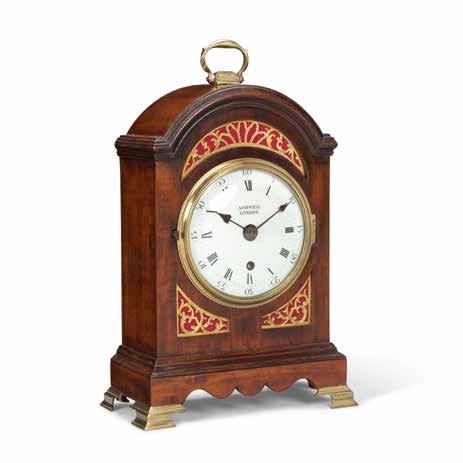
152
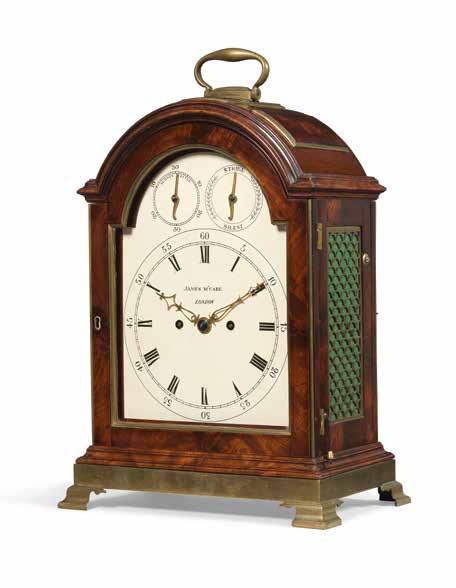
153 *
Eardley Norton, London No.2183
The brass handle over an intricately moulded cornice, side glazed panels, brass-lined front door, and a plinth base on brass ogee feet, the 5.25 inch restored enamel dial signed between the two subsidiaries for alarm-setting and chime/not chime, over the Roman and Arabic numerals and concentric date, with matching brass hands. The twin chain fusee movement with verge escapement and five knopped pillars, playing the tune for 65 seconds on eight bells and 14 hammers at the desired time, the signed and numbered backplate decorated with a basket of fruit amid foliage, the short bob pendulum with kinked rod to accommodate the external, adjustable fly. Ticking and playing. 34cms (13ins) high.
£6,000 - 8,000
€7,000 - 9,300
US$8,100 - 11,000
James McCabe, London
The case sumounted by a brass carrying handle over a three pad top with brass banded sides to a moulded break arch front, the sides with simple brass fish scale sound frets backed in green silk, the front with brass banding to a moulded base with brass plinth and sitting on brass ogee feet. The restored dial with black Roman numerals and Arabic five minute markers signed in the centre James McCabe, London with gilt brass hands, the break arch with twin subsidiaries for pendulum regulation and strike/silent. The double fusee movement with verge escapement with finely finished pendulum rise and fall, striking the hours on a polished bell mounted above, the back plate with simple engraved detailing signed in a central cartouche James McCabe, London and secured with matching engraved brackets, currently ticking and striking. 46cm (19ins) high
£700 - 1,000
€810 - 1,200
US$950 - 1,400
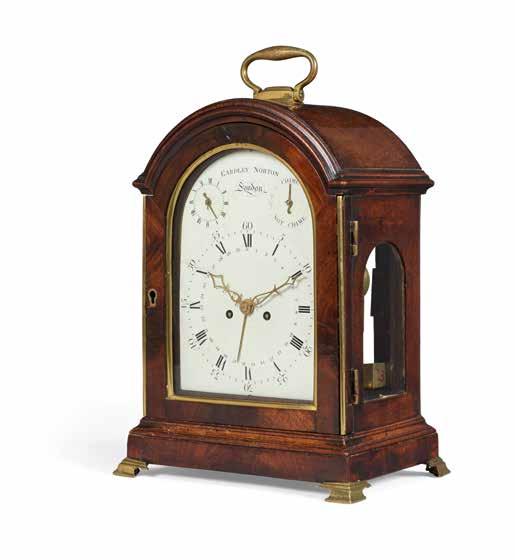
The dial signed for Joseph Knibb, London
The flat topped hood surmounted by a carved cresting and plain frieze supported by four twisted Doric columns, the sides with glazed observation windows over a convex throat moulding, the trunk door with veneered panels framed by a D shaped moulding, on a panelled base and bun feet. The 10 inch square brass dial with silvered Roman and Arabic chapter ring with fleur-de-lys half hour markers, the matted centre with date aperture beneath XII, with finely finished blued steel hands, all framed by four cast brass winged cherubs head spandrels. The robust movement united by five heavy knopped and latched pillars with anchor escapement, the Roman striking movement sounding the hours on a pair of square edged bells via two hammers and custom pin wheel work. Currently ticking and striking, sold with a pair of brass clad weights. 2m (6ft 7ins) high.
£7,000 - 10,000
€8,100 - 12,000
US$9,400 - 13,000
LONGCASE CLOCK
Later signed, Joseph Knibb, London
The case with flat top over a frieze with pierced sound fret supported by four Doric twisted columns, and side windows, over an inlaid throat moulding, the long trunk door framed by a D moulding and inlaid with three panels of bird and floral marquetry on an ebonised ground within ebony and boxwood borders, with brass framed lenticle, on a matching plinth and bun feet. The 10 inch square brass dial with silvered Roman and Arabic chapter ring with fleur-de-lys half hour markers, matted centre with calendar aperture and subsidiary seconds, with finely finished blued steel hands and bolt and shutter maintaining power, framed by cast brass winged cherubs head spandrels, bearing the later signature along the lower edge Joseph Knibb, Londini Fecit . The movement united by six turned knopped and latched pillars, striking the hours on a bell mounted above via an external count wheel, the going train with anchor escapement and “Knibb style” butterfly regulation. Ticking and striking sold together with a pendulum and two brass clad weights. 2.03m (6.6ft) high.
£4,000 - 6,000
€4,600 - 7,000
US$5,400 - 8,100
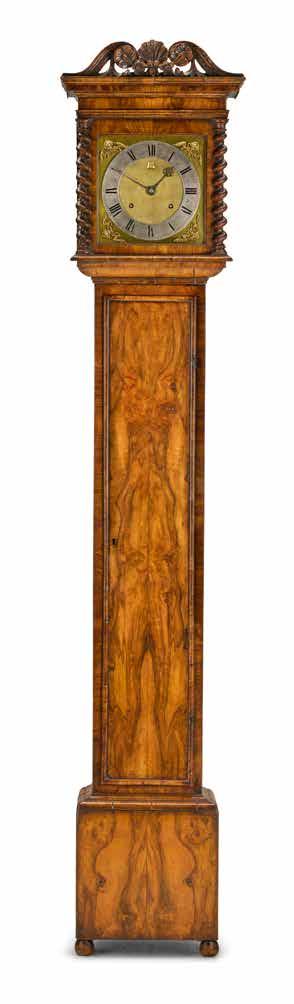
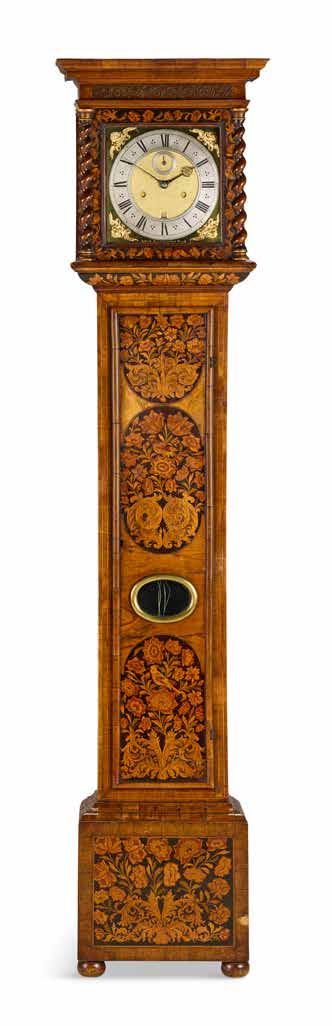
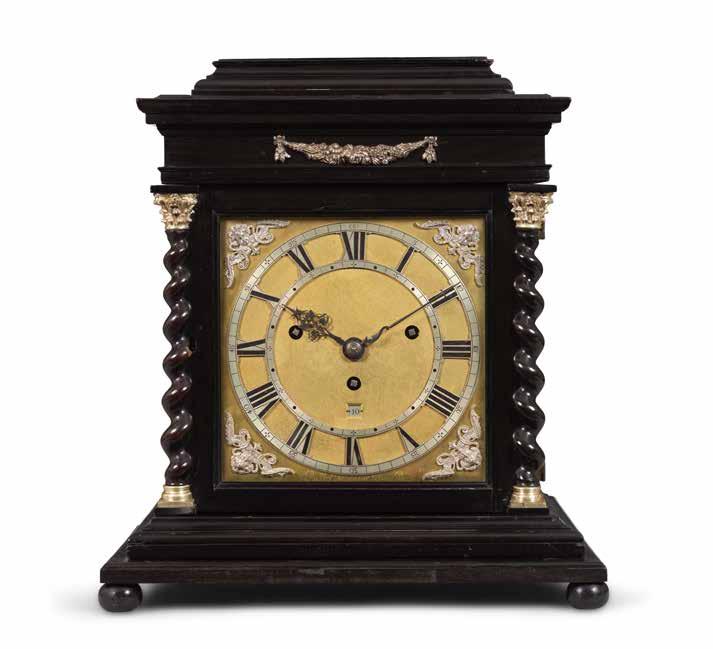
Signed Robert Seignior, London
The architectural case surmounted by a shallow caddy top with hidden compartment for the winding key framed by geometric moulded designs to a moulded top, the front with a cast silver swag of fruit and flowers, the sides supported by twisted Corinthian topped columns with glazed observation windows to each side and terminating in a moulded base raised on a turntable base and sitting on four bun feet. The 9.5 inch square dial with skeletonised silvered chapter ring with black Roman numerals with Arabic five minute markers and circular half hour marks engraved on the hour ring, the matted centre with three winding squares and calendar aperture with pin hole adjustment with blued steel hands framed by four cast silver winged cherub head spandrels signed beneath the VI Robert Seignior, London , the triple gut fusee movement now
with steel lines united by eight knopped and latched pillars with verge escapement, the clock striking the quarters on a nest of four bells and hammers and the hours on a large bell mounted above both via engraved and numbered count wheels mounted to the backplate which carries further engraved decoration with a central Tudor rose and foliate engraving to the corners and sides, the decorated steel work including shaped external solid clicks and springs mounted to the backplate, currently ticking and striking and sold together with one case key. 51cms (20ins) high.
£5,000 - 8,000
€5,800 - 9,300
US$6,700 - 11,000
The above lot is illustrated in Derek Roberts, Collecting Clocks, p. 36.
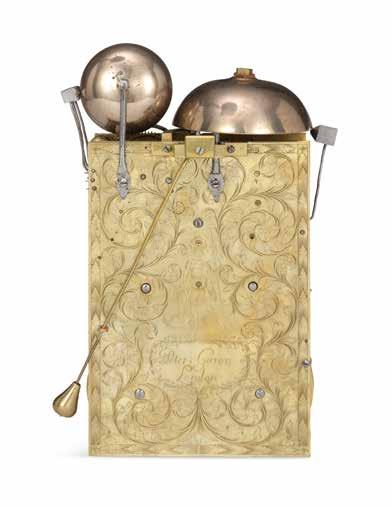
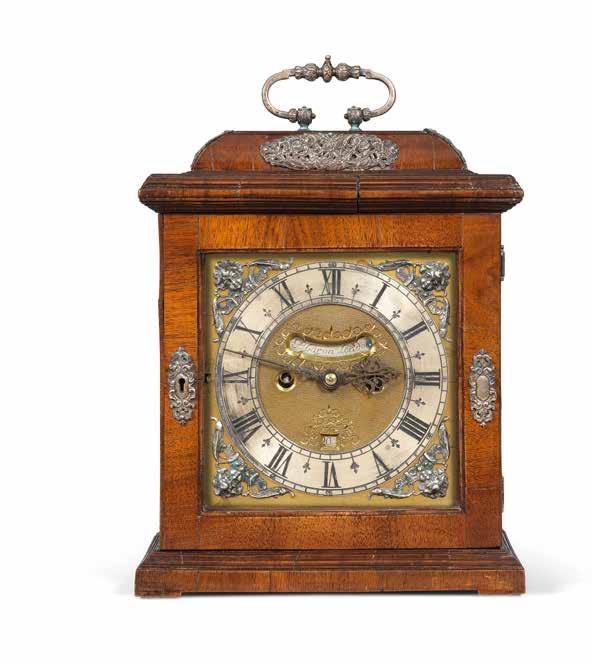
157 *
A LATE 17TH CENTURY AND LATER WALNUT TABLE CLOCK WITH SILVERED MOUNTS
Peter Garon, London
The case surmounted by a silvered tied bud handle above a caddy top with silver mounts to the sides and front, over a moulded top, the front with matching silver escutcheons to the lock and glazed observation windows to the sides and rear, terminating in a moulded base. The 6.5 inch square dial with a (later) solid silver chapter ring with black Roman numerals and Arabic five minute markers with fleur-de-lys half hour markers, the matted centre with signed mock pendulum aperture and calendar aperture framed by later cast silver cherubs head spandrels.
The twin fusee movement united by six knopped pillars, striking the hours on a polished bell mounted above and repeating on a nest of three bells and hammers, with verge escapement and short bob pendulum. The backplate finely engraved with floral decoration centred by a standing Roman soldier above a name cartouche signed Peter Garon, London , currently ticking and striking. 27cms (11ins) high.
£5,000 - 8,000
€5,800 - 9,300
US$6,700 - 11,000
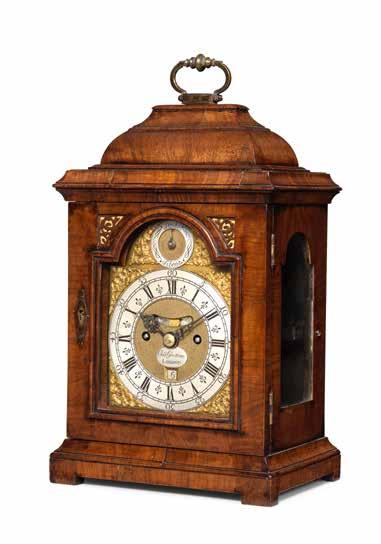
A SMALL WALNUT CASED QUARTER REPEATING TABLE CLOCK
Signed on an applied nameplate Charles Gretton, London. 18th century and later.
The probably 20th century case surmounted by a turned handle on an inverted caddy over long glazed side panels and a moulded base on block feet. The 4.75 inch arched brass dial with Strike/Silent over a Roman and Arabic chapter ring, matted centre with date and mock pendulum apertures, all framed by foliate scroll spandrels, signed on a (later?) silvered cartouche Cha. Gretton, LONDON . The twin gut (now wire) fusee movement with plates measuring just 13.5cms x 11cms (5.25ins x 4.25ins) united by five pillars, the verge escapement with rack strike on a bell and repeating the quarters on a run of six graduated bells and hammers, the backplate engraved with a wheatear border around a series of symmetrical foliate scrolls centred by a basket of fruit and twin eagles heads . Ticking, striking and repeating. Sold together with a door key (that operates both front and back doors) and a later crank winding key. 36cms (14ins) high
£2,000 - 3,000
€2,300 - 3,500
A QUARTER REPEATING BURR WALNUT TABLE CLOCK OF SMALL SIZE
William Webster, London.
The case surmounted by a brass knopped carrying handle above an inverted bell top with moulded surround, the front with pierced sound frets and glazed observation windows to the sides, terminating in a moulded base and standing on four moulded feet. The 4.75 inch brass dial with silvered Roman and Arabic chapter ring with floating lozenge half hour markers, the matted centre with mock pendulum aperture and date aperture, with blued steel hands framed by cast brass spandrels and a silvered subsidiary strike/silent dial, signed William Webster, London . The double gut fusee movement with verge escapement and short bob pendulum, striking the hours on a polished bell mounted above and repeating on a nest of six polished bells and hammers, with finely engraved backplate, currently ticking and striking. 35cms (13.75ins) high.
£8,000 - 12,000
€9,300 - 14,000
US$11,000 - 16,000
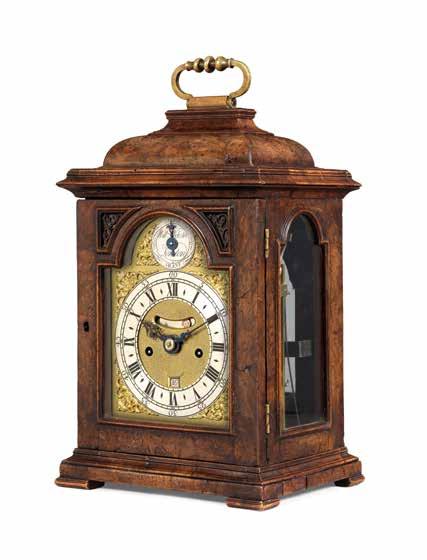
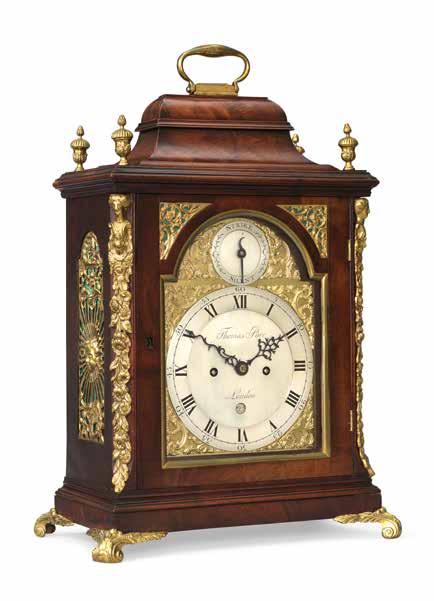
Thomas Pace, London
The brass carrying handle over a bell top with cast urn finials to each corner over a moulded cornice, the front with cast sound fret quadrants backed in green silk, the sides with floral cast mounts including central cherubs heads, raised on a moulded base and four elaborately cast and decorated feet. The 7 inch brass dial with silvered Roman and Arabic chapter ring enclosing the plain centre signed Thomas Pace, London with circular calendar aperture and blued steel hands framed by cast brass spandrels with strike/silent subsidiary to the break arch. The twin fusee movement now with steel lines with verge escapement and short bob pendulum, striking the hours on a polished bell mounted above, the back plate with fine neoclassical engraving with floral detailing and secured in the case with matching engraved brackets, currently ticking and striking. 53cms (21ins) high.
£2,000 - 3,000
€2,300 - 3,500
US$2,700 - 4,000
FOR FUTHER INFORMATION, PLEASE SEE APPENDIX
Edward Foster, London
The bell top surmounted by a handle over glazed side panels and terminating in a moulded base on block feet. The 4 inch silvered arched dial with alarm setting subsidiary set over the Roman and Arabic chapter ring, with blued steel hands. The gut fusee movement with knopped pillars and verge escapement sounding the alarm on a bell and T-shaped hammer. Ticking and with operational alarm. 33cms (13ins) high.
£800 - 1,200
€930 - 1,400
US$1,100 - 1,600 160
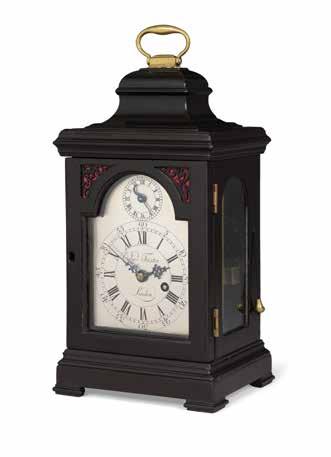
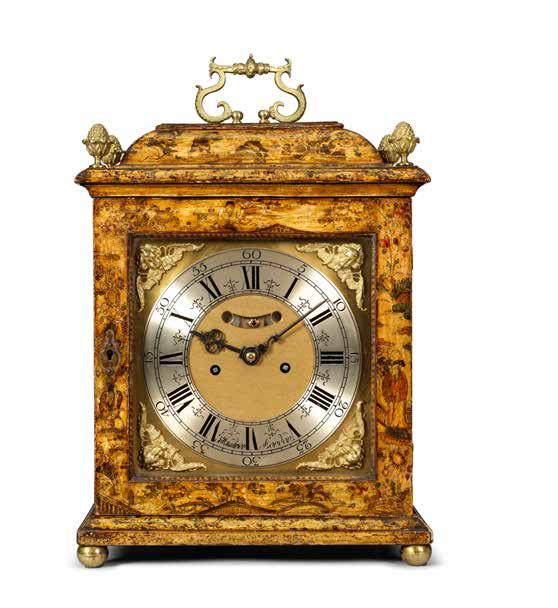
162
A GOOD, DECORATIVE, TABLE CLOCK, THE 17TH CENTURY MOVEMENT NOW WITH LATER DIAL AND RE-DECORATED CASE IN THE CHINOISERIE MANNER ON AN IVORY COLOURED GROUND
Joseph Williamson, London
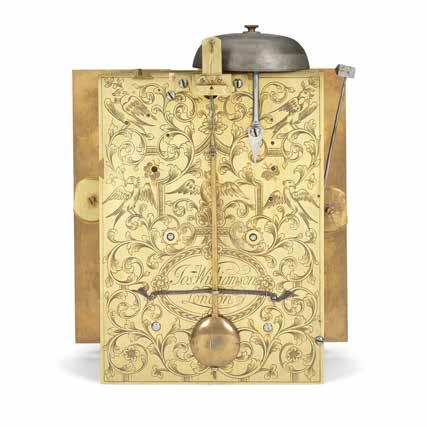
The case surmounted by a double S-tied carrying handle over a shallow caddy top with four pineapple finials to each corner over a moulded-top, the front with a simple brass escutcheon for the lock, the sides with glazed observation windows, terminating in a moulded base and sitting on four brass ball feet, the whole decorated in chinoiserie decoration. The 7.75 inch brass dial with silvered Roman and Arabic chapter ring with unusual half hour markers to a matted centre with mock pendulum aperture and blued steel hands framed by four cast brass cherub head spandrels with a strike/silent dial above 12 o’clock. The fine 17th century movement with five robust knopped pillars with twin fusees now running on steel lines with verge escapement and short bob pendulum with finely finished steel pendulum lock, striking the hours on a bell mounted above, formerly with pull quarter repeat work, the back plate finely engraved with eagles and symmetrical floral patterns, signed in a central cartouche Jos Williamson, London , currently ticking and striking. 41cms (16.5ins) high.
£1,000 - 2,000
€1,200 - 2,300
US$1,400 - 2,700
Joseph Williamson (d.1725) was celebrated for his pioneering work on Equation of Time mechanisms that enabled clocks to display both mean and apparent solar time. Admitted as a Free Brother of the Clockmakers’ Company in 1686, he rose to become Master of the Company in 1724, shortly before his death in June 1725. Working from Clements Lane in the City of London, Williamson produced highly sophisticated clocks and watches for an elite international clientele, including King Philip V of Spain and Charles II, and is known to have collaborated with leading makers such as Daniel Quare. Among his most significant innovations were the development of a kidney-cam pendulum compensation system, which altered the pendulum’s effective length throughout the year to follow solar time, and the early use of differential gearing to combine mean and apparent time displays within a single mechanism. In 1719 he published a notable letter in the Philosophical Transactions of the Royal Society defending his priority in the invention of solar-tracking clocks. Surviving examples of Williamson’s work are exceptionally rare and are preserved in institutions including the British Museum and the Museum of London.
163
A GOOD 20TH CENTURY TURNED WALNUT COPY OF A PORTABLE STICK BAROMETER
Signed ‘Daniel Quare’, and numbered 34
The gilt brass hood section with three finials, the central elongated to accept the glass tube, the two smaller examples operating the recording hands via internal rack and pinion, the glazed silvered dial with 28 to 31 inch silvered scales engraved with seven weather predictions, the throat signed Invented and Made by Danl. Quare, London , over a stop fluted turned trunk to a brass colour and spirally turned lower section. The rectangular base mounted with four hinged cast supports 1.07m (3ft 6ins) high.
£1,500 - 2,500
€1,700 - 2,900
US$2,000 - 3,400
164
A GOOD LATE 20TH CENTURY BURR WALNUT AND BRASS-MOUNTED COPY OF THE HAMPTON COURT BAROMETER BY THOMAS TOMPION
The dial signed ‘Tompion, London’ Faithfully based on the original supplied to Hampton Court Palace; the case surmounted by an orb and brass finial, the main trunk with Doric half-column framed by a pair of ball finials and terminating in a silvered dial with an inverted scale marked from 28 down to 31 inches, signed Tompion, London with recording hands operated via rack and pinion buttons below, flanked by a pair of freestanding Doric columns over a manually adjustable calendar scale for month and date. 1.07m (3ft 6ins) high.
£2,000 - 3,000
€2,300 - 3,500
US$2,700 - 4,000
This barometer is a faithful copy of the one that Thomas Tompion supplied to Hampton Court Palace in the early 18th century. The original is illustrated and discussed in Goodison, English Barometers 1680-1860, Potter 1968, plates 140-142. Sold in these rooms 7th July 2009, lot 3.
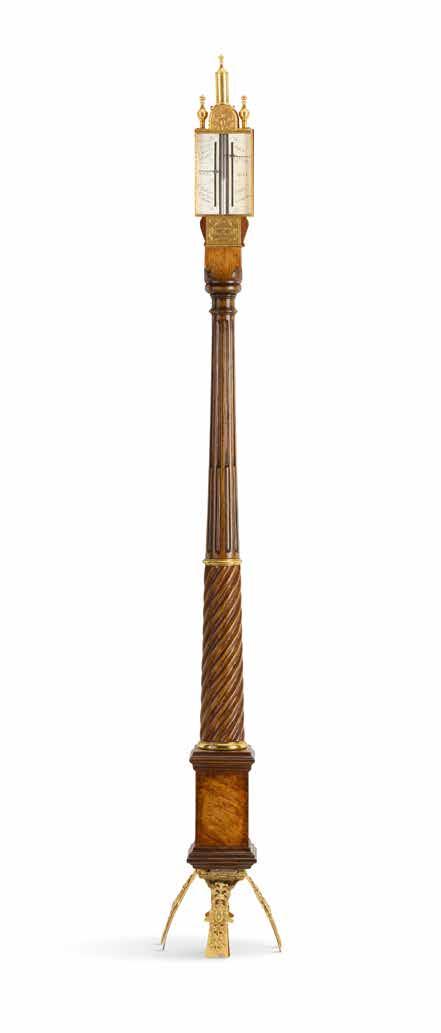
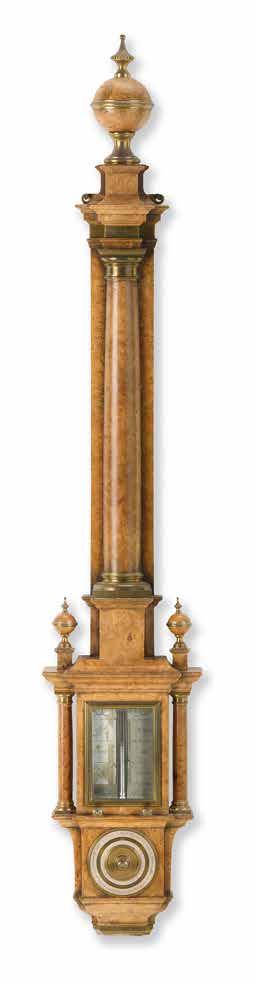
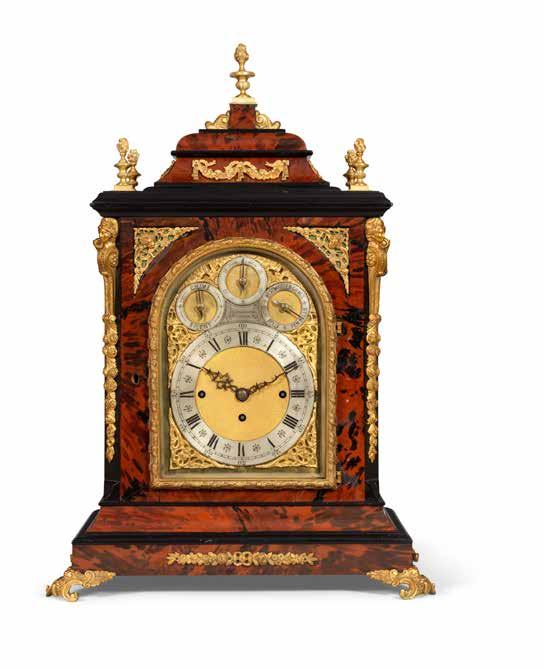
Hall and Co, Manchester
The obelisk shaped case with patterned bronze mounts to the front, with a moulded base and resting on four patinated lion paw feet. The 5 inch dial with decorated brass bezel with painted gilt Roman numerals signed in the centre Hall & Co, Manchester with gilt brass hands. The two train French drum movement striking the hours on a polished bell mounted behind with a Brocot escapement. 45cms (18ins) high.
£700 - 1,000
€810 - 1,200
US$950 - 1,400
J.C. Jennens & Son, London
The case surmounted by a cast brass finial over a bell top with further finials to each corner over a moulded cornice, the front with cast sound frets and female mask mounts to each side with decorated carrying handles, the sides with pierced and cast sound frets backed in green silk, terminating in a moulded base with further applied mounts and standing on four elaborately cast brass feet. The 8 inch brass dial with silvered Roman and Arabic chapter ring with fleur-de-lys half hour markers, the matted centre with blued steel hands framed by cast brass spandrels with strike/chime subsidiary to the left, pendulum regulation to the centre and Westminster or eight bell chime selection above, signed in a cartouche J.C. Jennens & Son, London. The large and robust triple fusee movement with anchor escapement, striking the hours on a large blued steel gong mounted behind and chiming the quarters on a nest of eight bells or alternatively on gongs, currently ticking and striking, sold together with the original tortoiseshell bracket with twin supports and brass mounts. 73cms (29ins) high. Total height with bracket 99cms (3ft 3ins) high.
£3,000 - 5,000
€3,500 - 5,800
US$4,000 - 6,700
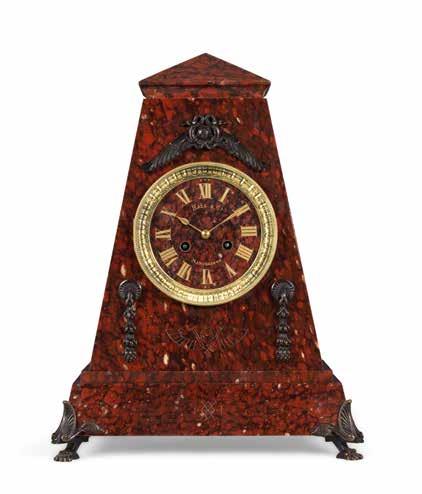
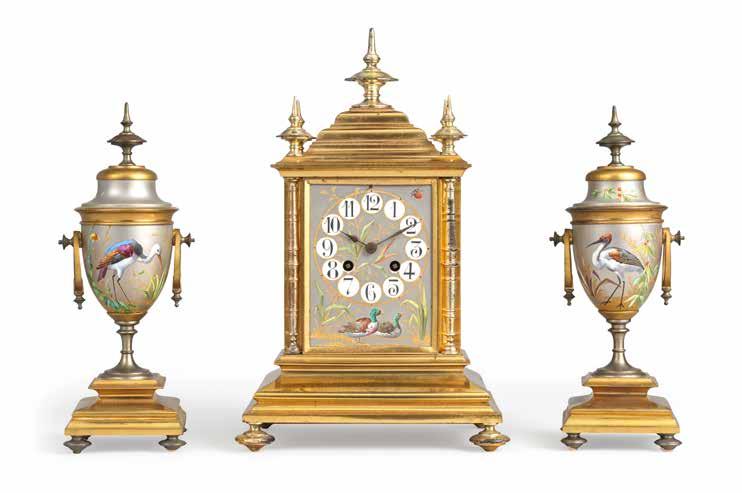
167
AB, No.7085133
The case sumounted by a silvered turned finial over a sloped top surrounded by four further similar turned finials, the corners supported by matching turned columns intercepted by painted scenes of birds to each side, terminating in a large moulded base and sitting on four similar turned feet. The 4 inch porcelain dial with Arabic numerals surrounded by similar painted decoration depicting a pair of sitting ducks and a ladybird to the top right corner with blued steel hands. The twin train French movement striking the hours on a blued steel gong mounted behind, signed on the back plate AB and numbered 7085133, currently ticking and striking, sold together with a matching pair of porcelain urns. 35cm (14ins) high.
£800 - 1,200
€930 - 1,400
US$1,100 - 1,600
168
Imhof, the quartz movement numbered 99400268. The rear signed Opera No 3/5
The upright rectangular case topped with a mother of pearl cap on a nephrite moulding, the fluted sides interrupted via a horizontal ring of mother of pearl terminating in a shaped rectangular nephrite plinth on shaped block feet. The two inch dial set within a large facetted and tapering smoky quartz. The time shown via a pair of diamond-set hands, apparently floating within the stone and reading against 12 diamonds set into the mother of pearl and nephrite chapter ring. The hands set via an integral setting key mounted in the base below, with quartz movement. 17cms (6.75 ins) high.
£7,000 - 10,000
€8,100 - 12,000
US$9,400 - 13,000 167
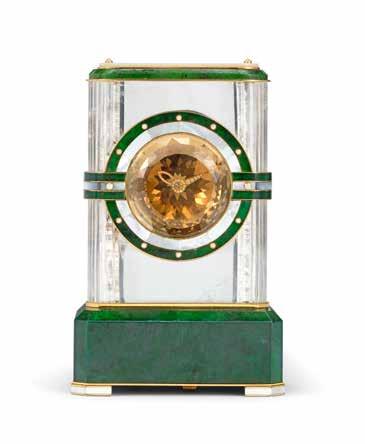
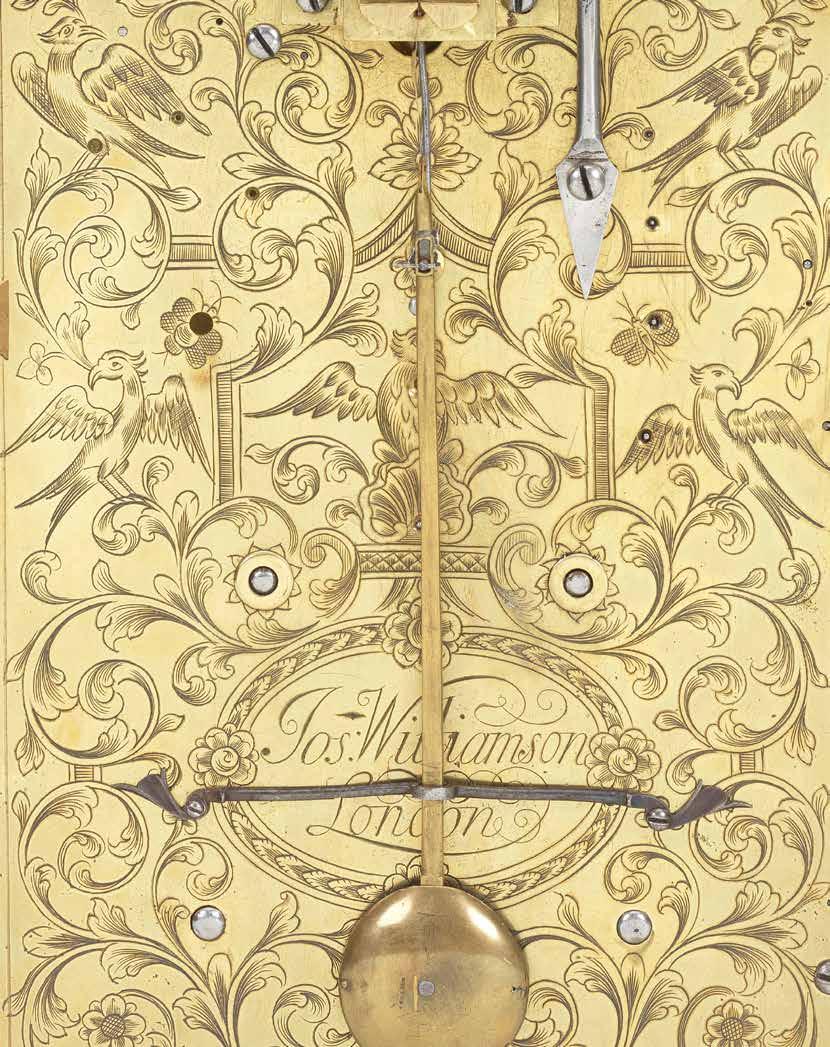
The above lot and Lot 2 are separated by only a single serial number, indicating that the two clocks would almost certainly have been on the workbench at the same time. Together they offer a fascinating insight into the workmanship and production methods of Thomas Frederick Cooper during one of the most important periods of his career.
Thomas Frederick Cooper (1789–1863) was one of the leading English watch and chronometer makers of the Victorian period, renowned for the quality of his portable timepieces and particularly respected in the transatlantic market. Over a career spanning more than forty years he operated from a succession of London addresses, including Wynwatt Street, Northampton Square, President Street, St Luke’s, Duncan Place, City Road, King William Street, and finally 6 Calthorpe Street, Gray’s Inn Road, where the firm advertised itself as “Watch Escapement and Chronometer Makers.”
Cooper specialised in the production and finishing of high-grade watches fitted with lever, duplex, and chronometer escapements, many destined for export to the United States, where his name became synonymous with fine English watchmaking. Such was his reputation that counterfeit watches falsely signed “T. F. Cooper, London” were widely produced, particularly in
The above lot and Lot 1 are separated by only a single serial number, indicating that the two clocks would almost certainly have been on the workbench at the same time. Together they offer a fascinating insight into the workmanship and production methods of Thomas Frederick Cooper during one of the most important periods of his career.
Thomas Frederick Cooper (1789–1863) was one of the leading English watch and chronometer makers of the Victorian period, renowned for the quality of his portable timepieces and particularly respected in the transatlantic market. Over a career spanning more than forty years he operated from a succession of London addresses, including Wynwatt Street, Northampton Square, President Street, St Luke’s, Duncan Place, City Road, King William Street, and finally 6 Calthorpe Street, Gray’s Inn Road, where the firm advertised itself as “Watch Escapement and Chronometer Makers.”
Cooper specialised in the production and finishing of high-grade watches fitted with lever, duplex, and chronometer escapements, many destined for export to the United States, where his name became synonymous with fine English watchmaking. Such was his reputation that counterfeit watches falsely signed “T. F. Cooper, London” were widely produced, particularly in Switzerland, to exploit the prestige associated with his workshop.
The Reverend Thomas Palling Little, perpetual curate of Oxenhall and Pauntley and later vicar of Edge, was active in The Forest of Dean area from the mid to late 19th century.
Jakob Wasserberger was a distinguished Viennese silversmith and maker of luxury objets d’art active during the late 19th century, renowned for richly decorated creations in the Historicist taste. Working at the height of Vienna’s flourishing decorative arts movement, Wasserberger specialised in finely crafted silver-gilt and enamel objects incorporating Renaissance and Baroque revival motifs, often executed with exceptional technical refinement. His workshop is particularly noted for elegant boudoir and desk clocks adorned with hand-painted enamel plaques, scrolling ornament, mythological scenes and sculptural figures such as cherubs or cupids.
A closely similar clock fitted with perpetual calendar is illustrated and discussed in F. B. Royer-Collard, Skeleton Clocks, p. 72. That clock, by Henri Robert (1794-1874), dated 1839 and inscribed for exhibition at the Exposition des Produits de L’Industrie Francaise in 1839 was sold at Skinner 16 July 2011.
Jean-Charles-François, known as Charles Oudin (1768-1840) was one of the most respected associates of the eminent A.-L. Breguet. He is known to have contributed to the design of both watches and clocks for the Breguet firm. In 1801, he established his own firm at the Palais Royal. His clients included the Empress Joséphine and over the years the firm were awarded several prizes at industrial expositions
Regnault was a Parisian horological dynasty founded by Pierre Regnault (c.1700–1776) and continued by his son Pierre-Antoine Regnault (1731–1809) Pierre-Antoine became maître horloger in 1754 and expanded the family workshop, holding a number of prestigious positions within the Paris clockmakers’ guild, including Garde-Visiteur, Syndic and Député. Working from premises on the Rue de la Pelleterie, Rue de la Huchette and later Rue Vieille du Temple, the Regnault workshop became renowned for high-quality precision movements and complex musical clocks, often housed in luxurious cases supplied by leading bronziers and ébénistes such as Jean-Joseph de Saint-Germain, François and Jean Goyer, and Robert and Jean-Baptiste Osmond. Their work is represented today in important collections including Waddesdon Manor.
Provenance:
Christie’s, Clocks & Watches , 15 June 1994, lot 377. At the time of the Christie’s sale, the chronometer was accompanied by notes compiled in 1978 by Cmdr. D. Harries, F.B.H.I., though these are no longer present. The accompanying chronometer box is notably fitted with a Bramah lock, an unusual and desirable feature on marine chronometer cases; by design, the key can only be removed when the lock is secured, necessitating careful custody of the key.
RE LOT 45
Provenance:
From the Collection of the late Eveline Newgas Purchased by the vendor direct from the Ministry of Defence sale of surplus chronometers held on 29th January 1980 at Herstmonceux Castle, East Sussex, lot number 18.
Accompanied by the following documents:
A release note from the Ministry of Defence for the chronometer, dated 29/2/1980
A copy of the Greenwich Ledger page sent to the vendor in June 1980 by Beresford Hutchinson, Assistant Keeper and Curator of Astronomy, Department of Navigation and Astronomy, National Maritime Museum, confirming it’s original purchase by the Admiralty in 1915 and giving details of the vessels on which it served (HMS Jupiter II and HMS Chatham), and the places the chronometer was been serviced including Cape of Good Hope, Hong Kong, Malta and Sheerness during it’s 19 year working life.
A copy of the original Victor Kullberg workshop ledger entry relating to the manufacture and finishing of chronometer No. 8706, headed “Victor Kullberg, 105 Liverpool Rd., London” and dated February 3rd 1915. The detailed manuscript records the original construction, jewelling, engraving, dial work, escapement adjustment, polishing, case finishing, and final regulation of this chronometer, including J Preston £2-6-0 for the movement; W Bench £3-5-0 for engine turning, other craftsmen included Travers, Ottway, Hobbs, Cotton, and Chevalier.
Victor Kullberg (1824–1890), the distinguished Swedish-born chronometer maker established his London business in the mid-19th century, and achieved an international reputation for producing highly accurate marine chronometers supplied to the Admiralty, commercial shipping firms, and scientific expeditions. Chronometers bearing the Kullberg signature are celebrated for their precision workmanship, robust detent escapements, and consistently strong observatory trial results.
RE LOT 51
Joseph Harding was an 18th-century London clockmaker. Records of the Worshipful Company of Clockmakers note his presence in London from around 1718, and he was formally admitted to the Clockmakers’ Company in 1744. He is also recorded in the Middlesex General Orders of the Court as “Joseph Harding Clockmaker,” in relation to a payment of 10 shillings and 6 pence owed to him. Harding worked during the golden age of English horology, when London makers were moving away from late 17th-century square-dial designs toward the more fashionable arched dials and richly figured walnut and mahogany cases that came to define mid-18th century English clockmaking.
Joseph Williamson (d.1725) was celebrated for his pioneering work on Equation of Time mechanisms that enabled clocks to display both mean and apparent solar time. Admitted as a Free Brother of the Clockmakers’ Company in 1686, he rose to become Master of the Company in 1724, shortly before his death in June 1725. Working from Clements Lane in the City of London, Williamson produced highly sophisticated clocks and watches for an elite international clientele, including King Philip V of Spain and Charles II, and is known to have collaborated with leading makers such as Daniel Quare. Among his most significant innovations were the development of a kidney-cam pendulum compensation system, which altered the pendulum’s effective length throughout the year to follow solar time, and the early use of differential gearing to combine mean and apparent time displays within a single mechanism. In 1719 he published a notable letter in the Philosophical Transactions of the Royal Society defending his priority in the invention of solar-tracking clocks. Surviving examples of Williamson’s work are exceptionally rare and are preserved in institutions including the British Museum and the Museum of London.
This clock would appear to have been made for a French-speaking market; each day is marked in French, and interestingly, inside the door is a handwritten script ‘Les Planets’ almost certainly referring to the planetary motifs on the day subsidiary.
Samuel Aldworth was originally from Childrey, Buckinghamshire, and went to Oxford in 1673 as an apprentice to John Knibb, one of the most distinguished clockmakers of the period. After completing his apprenticeship in 1680, he remained with Knibb as an assistant until 1689, when he was made a freeman of the City of Oxford and established his own business there. In 1697 he became a Brother of the London Clockmakers’ Company and moved to premises in The Strand, London. This move coincided with the departure of Joseph Knibb from London in the same year. In 1703 he married Elizabeth Knibb, believed to be the daughter of John Knibb, and the couple continued the business in London before returning to Childrey circa 1720. Samuel Aldworth is thought to have died shortly after c.1725.
John Drew began his horological career in 1676 as an apprentice to the esteemed Joseph Knibb. Over nearly three decades, he trained eight apprentices of his own. In April 1712, Drew assumed the post of Beadle of the Clockmakers’ Company, a role he held until his death the following year, during which time he received modest support from the Company. His successor in that office was Christopher Gould.
The casework associated with Drew is strikingly aligned with that of his master Joseph Knibb. The handle and the upper moulding, known among collectors as ‘Phase IV’, further reinforce this association.
Provenance:
A distinguished private European Collection. Ronald A Lee (Fine Arts) Ltd, June 1981. Christies London, 23rd July 1980, lot 176.
Literature:
Evans, J., Carter, J., Wright, B. (2013) Thomas Tompion 300 Years. Kent: White Horse Press, p610.
George Graham (c.1673–1751) stands among the greatest figures in the history of English horology and scientific instrument making. Born at Kirklinton in Cumberland, he moved to London around 1688 and was apprenticed to Henry Aske before gaining his freedom of the Clockmakers’ Company in 1695. Soon afterwards he entered the service of the celebrated Thomas Tompion, whose niece Elizabeth he married in 1704. Following Tompion’s unsuccessful partnership with Edward Banger, Graham became his trusted successor and formal business partner in 1711, inheriting the renowned Fleet Street workshop upon Tompion’s death in 1713.
Maintaining the exacting standards established by Tompion, Graham developed the workshop into one of the foremost centres of horological excellence in Europe. He served as Master of the Clockmakers’ Company in 1722 and was responsible for several major innovations, including the refinement of the deadbeat escapement, the invention of the mercury compensated pendulum and the cylinder escapement for watches. Alongside his clocks and watches, Graham was an outstanding maker of scientific instruments, producing important astronomical apparatus for figures such as Edmond Halley and James Bradley, and constructing the celebrated planetarium for Charles Boyle, Earl of Orrery.
Graham also played a pivotal role in the early development of the marine timekeeper through his generous support of John Harrison, to whom he advanced a substantial interest-free loan to aid the construction of Harrison’s first sea clock, H1. Upon his death in 1751, Graham was buried beside Thomas Tompion in Westminster Abbey, a distinction reflecting his extraordinary contribution to English science and horology.
A very rare clock by Godfrey Poy with signed brass panels was sold in these rooms on 13th December 2017, lot 103. Comparing the two cases, we are confident in attributing the current case to the same workshop.
John Holl was an immigrant cabinet and clock case maker who lived in the Soho parish of St Anne. His full name was Johan Diederick von Holle, and he appears to have been part of a wider circle of immigrant craftsmen from North Germany and southern Scandinavia working in the furniture and applied arts trades. Although Holl’s Will, proved in 1757, names various close relatives, it does not give their location, apart from an unmarried sister living with him in Soho. [1] However, one of his executors was the wellknown chaser, engraver and metal worker Diederick Nicolaus Anderson (d. 1769), who was probably from Flensburg in Schleswig, which was then part of Denmark but is now in Germany. [2]. Holl’s other executor was a ‘Gunner Mathison’ - perhaps for Gunnar Mathieson in Danish. Interestingly, Godfrie Poy’s daughter married another immigrant German cabinet and clock case maker, Valentine Anscheutz [3]. There is an interesting discussion of German cabinet makers working in 18th century London in Christopher Gilbert and Tessa Murdoch (eds), John Channon and brass-inlaid furniture 1730-1760 (Yale 1993), chapter 4 - “The Continental context: Germany” by Helena Hayward and Sarah Medlam, pp. 24-36.
Notes.
1. The National Archives: PCC Wills, Prob 11/827. Will of Johan Holl, otherwise Johan Diederick Von Holle, proved London 3 January 1757.
2. For Anderson’s work, see Nicholas Goodison, Matthew Boulton: Ormolu (2nd ed. 2002), p. 38 and the references given there.
3. Anscheutz, who was an Elder of the German Lutheran church in the Savoy, married Mary Ann Poy 20 May 1754, at St Martin’s in the Fields, Westminster. He is known to have done work for Gray and Vulliamy in the early 1760s, and for James Cox of Shoe Lane in the 1770s. When he died in 1796, one of his executors was the immigrant Swedish silversmith Andrew Fogelberg.
Benjamin Lewis Vulliamy was the last of a line of exceptional clockmakers in the Vulliamy family, the first of which was François Justin (always known as Justin Vulliamy), followed by his son Benjamin, and followed by his sons Benjamin Lewis and Justin Theodore.
Benjamin Lewis Vulliamy was born on the 25th January 1780, not a lot is known about his childhood except that he spent most of it at 68 Pall Mall. He joined his father in Pall Mall very early in life, certainly when less than 20 years of age. He received the Freedom of the Clockmakers’ Company in December 1809 and became a liveryman in January 1810 at the age of 30 and was admitted to the Court of Guild in the same year. There he served every office in the Court and was five times elected Master. In his years of service he did much to further the good reputation of the clockmakers’ trade and against increasing odds he succeeded in preserving high standards of craftsmanship which can be seen in almost all of the clocks that he produced.
Unlike his father’s main output, which was of ornamental house clocks and furnishing items, Benjamin Lewis tended to concentrate on using the very best of materials and workmanship in order to give long and trouble free life to his clocks.
The workforce that Vulliamy used were in many instances specialist craftsman or out workers. There were however a number of staff permanently employed at 68 Pall Mall. In particular were members of the Jump family who, after Vulliamy’s death in 1854, went on to found their own famous and very successful business.
Benjamin Gray (1676–1764) was a distinguished London clockmaker, renowned for his fine workmanship and for his appointment as Watchmaker-in-Ordinary to King George II in 1742 , succeeding Thomas Cartwright . He established his business in St Martin’s-in-the-Fields before moving to Pall Mall in 1752 , reflecting his elevated status within the trade. He is also credited among the earliest English makers to produce pedometers
In 1743 he entered into partnership with François Justin Vulliamy (d.1797) , a collaboration that laid the foundations for the celebrated Vulliamy dynasty of royal clockmakers. The connection was further strengthened by the marriage of Vulliamy to Mary Gray in 1746 , and clocks from this period are often jointly signed ‘Benj: Gray & Just: Vulliamy’
Robert Fletcher (fl. circa 1784–1820) was a clock and watchmaker working in Chester during the late 18th and early 19th centuries. He is recorded at a number of addresses including Linenhall Street (1782), Foregate Street (1789–1795), and Higher Bridge Street (1792), reflecting an active and established provincial practice.
The business was continued by his son, Robert Fletcher Junior, who obtained his freedom in 1800, ensuring the continuation of the family’s horological tradition into the 19th century.
John Halford is an almost entirely undocumented clockmaker, a circumstance not uncommon among early provincial makers whose lives and work frequently escaped formal record. Many such clocks have long since been lost, making the survival of the present example particularly noteworthy and allowing welcome attention to be drawn to this obscure but intriguing figure. The clock survives in an exceptionally untouched state, a rarity in the 21st century, when early lantern clocks are more often encountered heavily altered or incomplete. Anecdotes of examples emerging from scrapyards during the Second World War underline how precarious their survival could be, yet this clock demonstrates that genuine discoveries are still possible. It retains a high degree of originality, including the original steel hand, iron fittings and much of the wheel train. The movement was converted to a recoil escapement at an early date, possibly even by the original maker. Dating to the mid-17th century, it would originally have been conceived as a pre-pendulum clock. Although little is known of Halford, another clock signed by him is recorded, also pre-pendulum, and notably with the hammer positioned on the same side as on the present example—an unusual arrangement, as hammers were more typically placed opposite to accommodate the swing of the balance.
Jeremiah Gregory (fl. late 17th century), also recorded as Jeremie Gregory, was a London clockmaker and goldsmith, admitted to the Clockmakers’ Company in 1652. Unusually trained originally as a goldsmith, he brought a refined decorative quality to his horological work. He rose to prominence within the Company, serving as Master from 1665–1668 and again in 1676. His work is comparatively rare and of notable quality, with surviving examples held in major collections, including an important ebony-veneered architectural clock surmounted by a figure of Cupid in the Victoria and Albert Museum, and a silver pair-cased alarm watch of circa 1670 in the Science Museum, London. Gregory also trained a number of apprentices, among them John Cotsworth, who gained his freedom in 1669.
Edward Stanton (c.1642 – after 1715) was apprenticed in December 1655, first to Francis Bowen and later to Nathaniel Allen. He gained his Freedom of the Clockmakers’ Company in 1662/63 and soon established his own workshop, where he is recorded as having trained at least fourteen apprentices between 1664 and 1705. Rising steadily through the ranks of the Company, he served as Assistant from 1682, Warden in 1693, and was elected Master in 1697. His name continues to appear in the Court records until 1715, after which no further reference is made.
Literature:
The above lot is illustrated in full in Darken and Hooper, English 30 Hour Clocks: Origin and Development 1600–1800, pp. 36–38.
Provenance:
Sold to the vendor by the collector and restorer John Williams.
RE LOT 109
In Somerset, Devon and Gloucestershire, clocks were often produced by blacksmith-clockmakers and bell-founders who possessed considerable expertise in wrought iron and cast bronze but had limited access to refined sheet brass. As a result, makers developed robust hybrid constructions combining engraved brass dials and frets with heavy iron backplates, frames and finials. By the late 17th century, improvements in regional brass founding, particularly around Bristol and Somerset gradually led provincial makers to adopt the standard all-brass form, making these earlier hybrid iron-framed clocks comparatively rare survivals of an important transitional phase in English horology.
RE LOT
Walter Archer was a noted clockmaker working in Stow-on-theWold, Gloucestershire, active from circa 1695 until his death around 1744/45. Over a career spanning almost fifty years he established a strong reputation for the production of longcase and wall clocks, many fitted with thirty-hour movements. His work typically displays the characteristics of early English provincial horology, often incorporating brass dials with silvered Roman numeral chapter rings and gilt foliate spandrels. Archer is also associated with the production of hook-andspike wall clocks. The family’s clockmaking tradition continued in the later 18th century through other makers including William Archer.
John Wise (1624–1690) was a notable 17th-century English clockmaker, born in Banbury and apprenticed in 1638 to Peter Closon. He is thought to have been related to the distinguished Knibb family of horologists. After completing his training, he worked in Warwick between 1653 and 1668, where he is recorded maintaining church clocks, before returning to London by 1670 to establish a workshop near the Popeshead in Moorfields. He became an important figure within the early Clockmakers’ Company and is known for producing fine lantern, longcase and springdriven clocks. Wise trained several of his sons in the trade, including Peter Wise, who later rose to become Master of the Company in 1725, ensuring the continuation of the family’s horological legacy into the 18th century.
Obadiah Gardiner, often recorded as Gardner, was an important early 18th-century London clockmaker closely associated with the celebrated horological tradition of Thomas Tompion and George Graham. He was the son of Ambrose Gardner, a long-serving assistant in Tompion’s workshop, and was subsequently apprenticed to George Graham, Tompion’s partner and successor. Gardiner completed his apprenticeship and was made free of the Clockmakers’ Company on 29 September 1713, notably the same year as Tompion’s final appearance at the Court of the Company before his death.
In 1720, when Graham moved his business premises across Fleet Street, Gardiner became householder of Tompion’s original workshop at the corner of Water Lane, one of the most historically significant addresses in English horology.
Stephen Asselin (1670–1744) was a Huguenot clockmaker, born in Dieppe, Normandy, and later active in London. He is first recorded in 1701 upon his marriage to Elizabeth Pellier at St Martin Orgar, a church closely associated with the Huguenot community, where the ceremony was conducted by Jacob Asselin, a minister likely related to the family. Asselin was described at this time as a horloger. He is known to have worked in Broad Street, City of London, though notably was not a member of the Clockmakers’ Company. He is believed to have been the brother of Francis Asselin, a clockmaker and engraver admitted to the Company in 1687. Both men were part of the wave of skilled Huguenot craftsmen who settled in London following religious persecution in France, bringing with them expertise rooted in the horological traditions of Dieppe. Asselin remained active into later life; a longcase clock signed by him and dating to circa 1740 demonstrates his continued output into his seventies. By the early 1740s he and his wife were living in Spitalfields, where both received assistance from the French Hospital, a charitable institution for Huguenot refugees. He died in 1744, shortly after receiving support, his advanced age and circumstances noted at the time.
Thomas Lumpkin (d. circa 1719/20) was a London clockmaker active in the late 17th and early 18th centuries, noted for the production of highquality table and longcase clocks. He was a member of the Clockmakers’ Company, where he is recorded as a Master, Citizen and Clockmaker. His death is generally placed around 1719–1720, as evidenced by the transfer of his apprentice, Obadiah Smith, to another master in May 1720, following his presumed death.
Charles Cabrier I was a Huguenot clockmaker active in London from circa 1697–1724, and founder of the celebrated Cabrier dynasty of horologists. Originally from Lyon, he emigrated to England following the Revocation of the Edict of Nantes in 1685, joining the influx of skilled French Protestant craftsmen who greatly influenced the development of English clockmaking. He was admitted to the Clockmakers’ Company by redemption in 1697/98.
Cabrier became renowned for the quality and refinement of his clocks and watches, producing fine longcase clocks of the William and Mary period as well as pocket watches. He founded a distinguished family tradition continued by his son Charles Cabrier II and grandson Charles Cabrier III. Examples of his work survive in important collections including the British Museum and the Science Museum.
This remarkable night clock is an interpretation of the earlier night clocks from the 17th century which use a light source set behind an opaque dial, although most of the earlier ones involved a more complex system whereby the numeral plaques would move in front of the source. The great advantage of this clock is that it uses a traditional dial and pair of hands and thus can be used just as easily in daylight or night-time hours. John Pace of Bury St Edmunds patented this night clock in 1833, he was one of those rare 19th century makers who would push the boundaries of clock design for both dials and cases - one has only to look at lots 3 and 4 in this sale to see how modern looking his work is, over 150 years after they were made.
Thomas Pace was a member of the Pace dynasty of horologists who began working in the second quarter of the 18th century and who continued working for over a century. There are two Thomas Paces recorded; Thomas Pace Snr. (1753-1819) and his son, Thomas Pace Jnr. (1777-1829). Both made bracket clocks, with Pace Snr. also making longcase clocks, while Pace Jnr. also pursued watchmaking and silversmithing in addition to clocks. The Pace family collection of clocks was sold in these rooms 15 July 2020.
Provenance: Evans and Evans
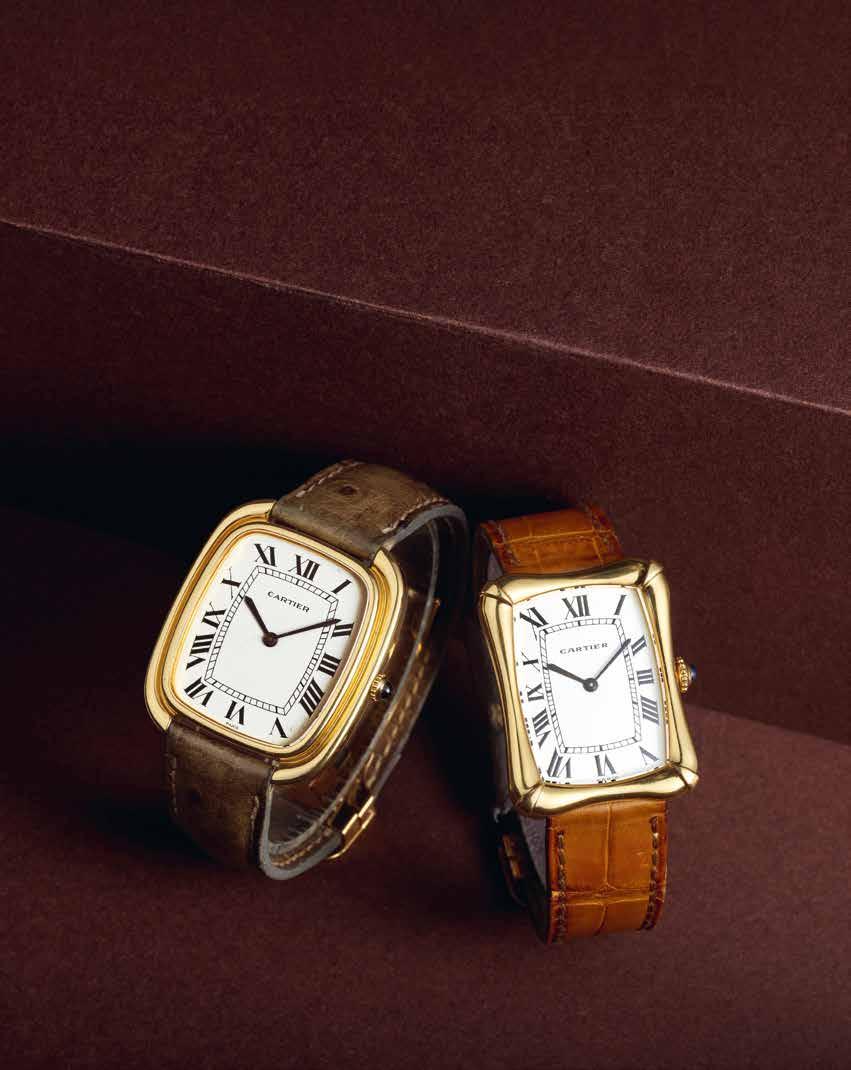
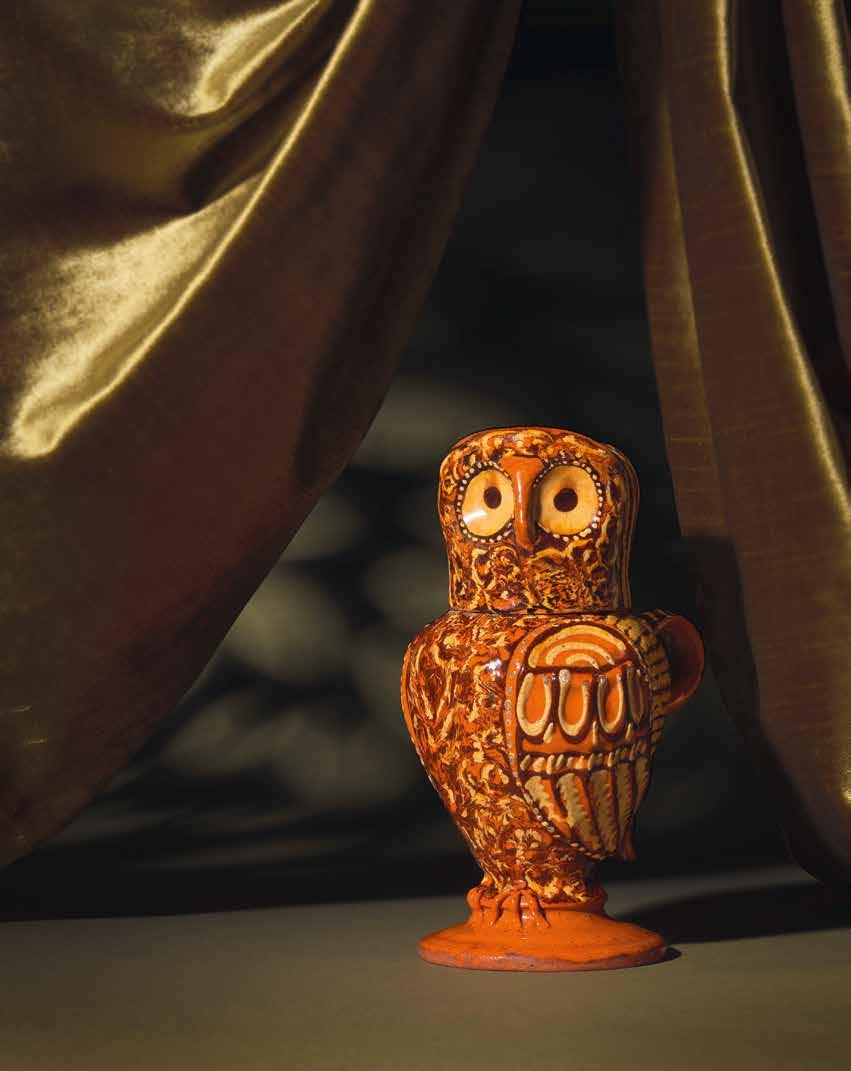
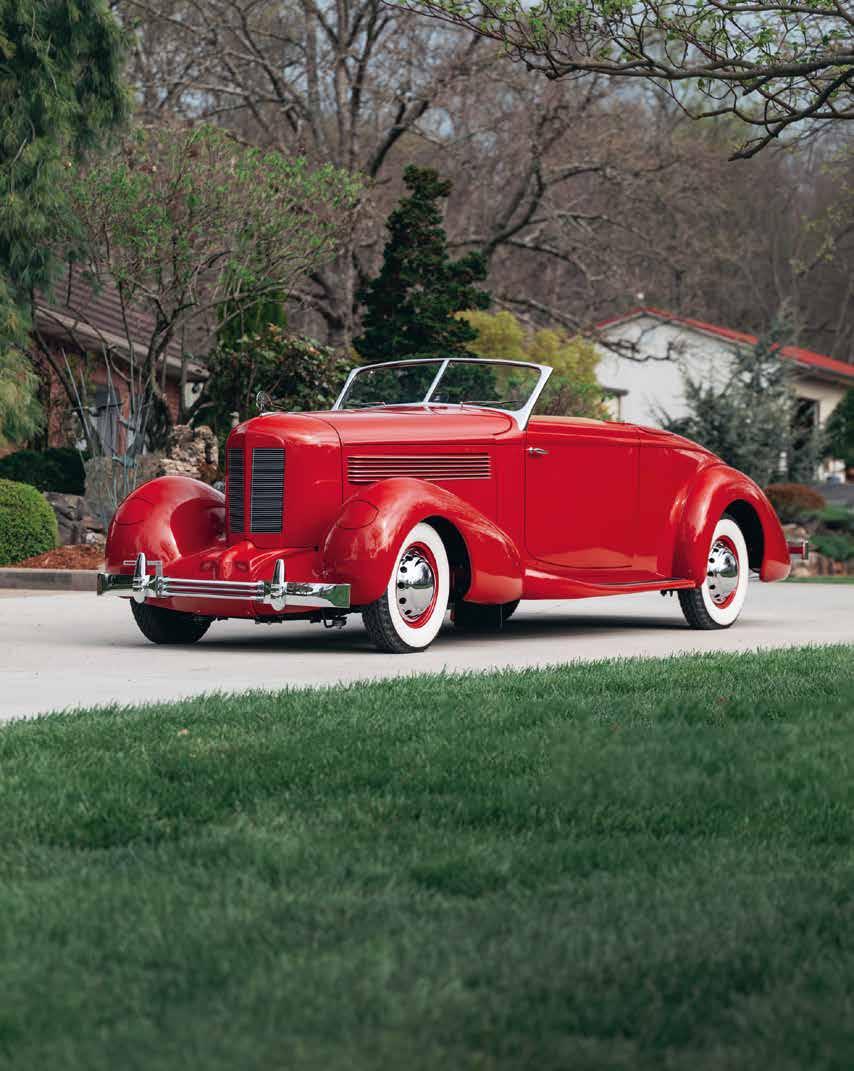
This notice is addressed by Bonhams to any person who may be interested in a Lot, and to all persons participating in the auction process including auction attendees, Bidders and potential Bidders (including any eventual Buyer of the Lot). For ease of reference we refer to such persons as “Bidders” or “you”. Our List of Definitions and Glossary is incorporated into this Notice to Bidders. It is at Appendix 3 at the back of the Catalogue. Where words and phrases are used in this notice which are in the List of Definitions, they are printed in italics. IMPORTANT: Additional information applicable to the Sale may be set out in the Catalogue for the Sale, in an insert in the Catalogue and/or in a notice displayed at the Sale venue and you should read them as well. Announcements affecting the Sale may also be given out orally before and during the Sale without prior written notice. You should be alert to the possibility of changes and ask in advance of bidding if there have been any.
1. OUR ROLE
In its role as Auctioneer of Lots, Bonhams acts solely for and in the interests of the Seller Bonhams’ job is to sell the Lot at the highest price obtainable at the Sale to a Bidder. Bonhams does not act for Buyers or Bidders in this role and does not give advice to Buyers or Bidders. When it or its staff make statements about a Lot or, if Bonhams provides a Condition Report on a Lot it is doing that on behalf of the Seller of the Lot. Bidders and Buyers who are themselves not expert in the Lots are strongly advised to seek and obtain independent advice on the Lots and their value before bidding for them. The Seller has authorised Bonhams to sell the Lot as its agent on its behalf and, save where we expressly make it clear to the contrary, Bonhams acts only as agent for the Seller. Any statement or representation we make in respect of a Lot is made on the Seller’s behalf and, unless Bonhams sells a Lot as principal, not on our behalf and any Contract for Sale is between the Buyer and the Seller and not with us. If Bonhams sells a Lot as principal this will either be stated in the Catalogue or an announcement to that effect will be made by the Auctioneer, or it will be stated in a notice at the Sale or an insert in the Catalogue.
Bonhams does not owe or undertake or agree to any duty or responsibility to you in contract or tort (whether direct, collateral, express, implied or otherwise). If you successfully bid for a Lot and buy it, at that stage Bonhams does enter into an agreement with you as the Buyer. The terms of that contract are set out in our Buyer’s Agreement, which you will find at Appendix 2 at the back of the Catalogue, and this will govern Bonhams’ relationship with the Buyer 2. LOTS
Subject to the Contractual Description printed in bold letters in the Entry about the Lot in the Catalogue (see paragraph 3 below), Lots are sold to the Buyer on an “as is” basis, with all faults and imperfections. Illustrations and photographs contained in the Catalogue (other than photographs forming part of the Contractual Description) or elsewhere of any Lots are for identification purposes only. A photograph or illustration may not reflect an accurate reproduction of the colour(s) or true condition of the Lot Lots are available for inspection prior to the Sale and it is for you to satisfy yourself as to each and every aspect of a Lot, including its authorship, attribution, condition, provenance, history, background, authenticity, style, period, age, suitability, quality, roadworthiness (if relevant), origin, value and estimated selling price (including the Hammer Price). It is your responsibility to examine any Lot in which you are interested. It should be remembered that the actual condition of a Lot may not be as good as that indicated by its outward appearance. In particular, parts may have been replaced or renewed and Lots may not be authentic or of satisfactory quality; the inside of a Lot may not be visible and may not be original or may be damaged, as for example where it is covered by upholstery or material. Given the age of many Lots they may have been damaged and/or repaired and you should not assume that a Lot is in good condition. Electronic or mechanical items or parts are sold for their artistic, historic or cultural interest and may not operate or may not comply with current statutory requirements. You should not assume that electrical items designed to operate on mains electricity will be suitable for connection to the mains electricity supply and you should obtain a report from a qualified electrician on their status before doing so. Such items which are unsuitable for connection are sold as items of interest for display purposes only. If you yourself do not have expertise regarding a Lot, you should consult someone who does to advise you. We can assist in arranging facilities for you to carry out or have carried out more detailed inspections and tests. Please ask our staff for details. Any person who damages a Lot will be held liable for the loss caused.
3. DESCRIPTIONS OF LOTS AND ESTIMATES
Contractual Description of a Lot
The Catalogue contains an Entry about each Lot. Each Lot is sold by its respective Seller to the Buyer of the Lot as corresponding only with that part of the Entry which is printed in bold letters and (except for the colour, which may be inaccurately reproduced) with any photograph of the Lot in the Catalogue. The remainder of the Entry, which is not printed in bold letters, represents Bonhams’ opinion (given on behalf of the Seller) about the Lot only and is not part of the Contractual Description in accordance with which the Lot is sold by the Seller Estimates
In most cases, an Estimate is printed beside the Entry Estimates are only an expression of Bonhams’ opinion made on behalf of the Seller of the range where Bonhams thinks the Hammer Price for the Lot is likely to fall; it is not an Estimate of value. It does not take into account any VAT or Buyer’s Premium payable or any other fees payable by the Buyer, which are detailed in paragraph 7 of the Notice to Bidders, below. Prices depend upon bidding and lots can sell for Hammer Prices below and above the Estimates, so Estimates should not be relied on as an indication of the actual selling price or value of a Lot Estimates are in the currency of the Sale Condition Reports
In respect of most Lots, you may ask Bonhams for a Condition Report on the Lot’s general physical condition. If you do so, this will be provided by Bonhams on behalf of the Seller free of charge. As this is offered additionally and without charge, Bonhams is not entering into a contract with you in respect of the Condition Report and accordingly does not assume responsibility to you in respect of it. The Condition Report represents Bonhams’ reasonable opinion as to the Lot’s general condition in the terms stated in the particular report, and Bonhams does not represent or guarantee that a Condition Report includes all aspects of the internal or external condition of the Lot. Neither does the Seller owe or agree to owe you as a Bidder or Buyer any obligation or duty in respect of this free report about a Lot, which is available for your own inspection or for inspection by an expert instructed by you. The Seller’s responsibility to you
The Seller does not make or agree to make any representation of fact or contractual promise, Guarantee or warranty and undertakes no obligation or duty, whether in contract or in tort (other than to the eventual Buyer as set out above), in respect of the accuracy or completeness of any statement or representation made by him or on his behalf, which is in any way descriptive of any Lot or as to the anticipated or likely selling price of any Lot. Other than as set out above, no statement or representation in any way descriptive of a Lot or any Estimate is incorporated into any Contract for Sale between a Seller and a Buyer Bonhams’ responsibility to you
You have the opportunity of examining the Lot if you want to and the Contract for Sale for a Lot is with the Seller and not with Bonhams; Bonhams acts as the Seller’s agent only (unless Bonhams sells the Lot as principal).
Bonhams undertakes no obligation to you to examine, investigate or carry out any tests, either in sufficient depth or at all, on each Lot to establish the accuracy or otherwise of any Descriptions or opinions given by Bonhams, or by any person on Bonhams’ behalf, whether in the Catalogue or elsewhere.
You should not suppose that such examinations, investigations or tests have occurred.
Bonhams does not make or agree to make any representation of fact, and undertakes no obligation or duty (whether in contract or tort) in respect of the accuracy or completeness of any statement or representation made by Bonhams or on Bonhams’ behalf which is in any way descriptive of any Lot or as to the anticipated or likely selling price of any Lot. No statement or representation by Bonhams or on its behalf in any way descriptive of any Lot or any Estimate is incorporated into our Buyer’s Agreement.
Alterations
Descriptions and Estimates may be amended at Bonhams’ discretion from time to time by notice given orally or in writing before or during a Sale
THE LOT IS AVAILABLE FOR INSPECTION AND YOU MUST FORM YOUR OWN OPINION IN RELATION TO IT. YOU ARE STRONGLY ADVISED TO EXAMINE ANY LOT OR HAVE IT EXAMINED ON YOUR BEHALF BEFORE THE SALE
4. CONDUCT OF THE SALE
Our Sales are public auctions which persons may attend and you should take the opportunity to do so. We reserve the right at our sole discretion to refuse admission to our premises or to any Sale and to remove any person from our premises and Sales, without stating a reason. We have complete discretion as to whether the Sale proceeds, whether any Lot is included in the Sale, the manner in which the Sale is conducted and we may offer Lots for Sale in any order we choose notwithstanding the numbers given to Lots in the Catalogue. You should therefore check the date and starting time of the Sale, whether there have been any withdrawals or late entries. Remember that withdrawals and late entries may affect the time at which a Lot you are interested is put up for Sale. We have complete discretion in which to refuse any bid, to nominate any bidding increment we consider appropriate, to divide any Lot, to combine two or more Lots, to withdraw any Lot from a Sale and, before the Sale has been closed, to put up any Lot for auction again. Auction speeds can exceed 100 Lots to the hour and bidding increments are generally about 10%; however, these do vary from Sale to Sale and from Auctioneer to Auctioneer Please check with the department organising the Sale for advice on this. Where a Reserve has been applied to a Lot, the Auctioneer may, in his absolute discretion, place bids (up to an amount not equalling or exceeding such Reserve) on behalf of the Seller. We are not responsible to you in respect of the presence or absence of any Reserve in respect of any Lot. If there is a Reserve it will be no higher than the lower figure for any Estimate in the Catalogue, assuming that the currency of the Reserve has not fluctuated adversely against the currency of the Estimate. The Buyer will be the Bidder who makes the highest bid acceptable to the Auctioneer for any Lot (subject to any applicable Reserve) to whom the Lot is knocked down by the Auctioneer at the fall of the Auctioneer’s hammer. Any dispute as to the highest acceptable bid will be settled by the Auctioneer in his absolute discretion. All bids tendered will relate to the actual Lot number announced by the Auctioneer. An electronic currency converter may be used at the Sale. This equipment is provided as a general guide as to the equivalent amount in certain currencies of a given bid. We do not accept any responsibility for any errors which may occur in the use of the currency converter. We may use video cameras to record the Sale and may record telephone calls for reasons of security and to assist in solving any disputes which may arise in relation to bids made at the Sale. At some Sales, for example, jewellery Sales, we may use screens on which images of the Lots will be projected. This service is provided to assist viewing at the Sale. The image on the screen should be treated as an indication only of the current Lot. It should be noted that all bids tendered will relate to the actual Lot number announced by the Auctioneer. We do not accept any responsibility for any errors which may occur in the use of the screen.
You must complete and deliver to us one of our Bidding Forms, either our Bidder Registration Form, Absentee Bidding Form or Telephone Bidding Form in order to bid at our Sales
If you are a new client at Bonhams or have not recently updated your registration details with us, you must pre-register to bid at least two working days before the Sale at which you wish to bid. You will be required to provide government-issued proof of identity and residence, and if you are a company, your certificate of incorporation or equivalent documentation with your name and registered address, government issued proof of your current address, documentary proof of your beneficial owners and directors, and proof of authority to transact. We may also request a financial reference and /or deposit from you before allowing you to bid.
We reserve the rights at our discretion to request further information in order to complete our client identification and to decline to register any person as a Bidder, and to decline to accept their bids if they have been so registered. We also reserve the rights to postpone completion of the Sale of any Lot at our discretion while we complete our registration and identification enquiries, and to cancel the Sale of any Lot if you are in breach of your warranties as Buyer, or if we consider that such Sale would be unlawful or otherwise cause liabilities for the Seller or Bonhams or be detrimental to Bonhams’ reputation.
Bidding in person
So long as you have pre-registered to bid or have updated your existing registration recently, you should come to our Bidder registration desk at the Sale venue and fill out a Registration and Bidding Form on (or, if possible, before) the day of the Sale. The bidding number system is sometimes referred to as “paddle bidding”. You will be issued with a large card (a “paddle”) with a printed number on it. This will be attributed to you for the purposes of the Sale. Should you be a successful Bidder you will need to ensure that your number can be clearly seen by the Auctioneer and that it is your number which is identified as the Buyer’s. You should not let anyone else use your paddle as all Lots will be invoiced to the name and address given on your Bidder Registration Form. Once an invoice is issued it will not be changed. If there is any doubt as to the Hammer Price of, or whether you are the successful Bidder of, a particular Lot, you must draw this to the attention of the Auctioneer before the next Lot is offered for Sale At the end of the Sale, or when you have finished bidding please return your paddle to the Bidder registration desk.
Bidding by telephone
If you wish to bid at the Sale by telephone, and have pre-registered to bid or have updated your existing registration details recently, please complete a Registration and Bidding Form, which is available from our offices or in the Catalogue. Please then return it to the office responsible for the Sale at least 24 hours in advance of the Sale. It is your responsibility to check with our Bids Office that your bid has been received. Telephone calls will be recorded. The telephone bidding facility is a discretionary service offered at no additional charge and may not be available in relation to all Lots. We will not be responsible for bidding on your behalf if you are unavailable at the time of the Sale or if the telephone connection is interrupted during bidding. Please contact us for further details.
Bidding by post or fax
Absentee Bidding Forms can be found in the back of this Catalogue and should be completed and sent to the office responsible for the Sale, once you have pre-registered to bid or have updated your existing registration details recently. It is in your interests to return your form as soon as possible, as if two or more Bidders submit identical bids for a Lot, the first bid received takes preference. In any event, all bids should be received at least 24 hours before the start of the Sale Please check your Absentee Bidding Form carefully before returning it to us, fully completed and signed by you. It is your responsibility to check with our Bids Office that your bid has been received. This additional service is complimentary and is confidential. Such bids are made at your own risk and we cannot accept liability for our failure to receive and/or place any such bids. All bids made on your behalf will be made at the lowest level possible subject to Reserves and other bids made for the Lot. Where appropriate your bids will be rounded down to the nearest amount consistent with the Auctioneer’s bidding increments. New Bidders must also provide proof of identity and address when submitting bids. Failure to do this will result in your bid not being placed.
Bidding via the internet
In order to bid online in a Sale, you must be 18 or over and you must register to bid via the Bonhams App or www.bonhams.com. Once you have registered, you should keep your account details strictly confidential and not permit any third party to access your account on your behalf or otherwise. You will be liable for any and all bids made via your account. Please note payment must be made from a bank account in the name of the registered bidder.
Individuals: Enter your full name, email, residential address, date of birth and nationality and provide a valid credit card in your name which will be verified via Stripe before you are able to bid. If your credit card fails verification, you will not be permitted to bid and you should contact Client Services for assistance. We may in addition request a financial reference and/or deposit from you prior to letting you bid. If you are bidding as agent on behalf of another party, you agree: (i) to disclose this fact to Client Services; (ii) to provide such information as we require to enable us to complete our identification and anti-money laundering checks on that third party; and (ii) where your bid is successful, you are jointly and severally liable with that other party for the full amounts owing for the successful bid. Where you are the successful bidder for any lot with a hammer price equal to or in excess of £5,000/$10,000/ HKD50,000/AUS$10,000 depending on the jurisdiction and currency of the Sale, and if you have not provided such documents previously, you will be required to upload or provide to Client Services your Government issued photo ID and (if not on the ID) proof of your
address before the lot can be released to you. We reserve the right to request ID documentation from any bidder or successful buyer regardless of these thresholds and to refuse to release any purchased lot until such documentation is provided.
Companies: You must select the option to set up a business account and then provide your full name, email, residential address, date of birth and the full name of the company. You must provide a credit card for verification either in your name or the name of the company but payment must be made from an account in the company’s name. If your credit card fails verification, you will not be permitted to bid and please contact Client Services for assistance. We may in addition require a bank reference or deposit prior to letting you bid. For all successful bids, we require the company’s Certificate of Incorporation or equivalent documentation confirming the company’s name and registered address, documentary proof of each beneficial owner owning 25% or more of the company, and proof of your authority to transact before the lot can be released to you.
We reserve the right to request any further information from any bidder that we may require in order to carry out any identification, anti-money laundering or anti-terrorism financing checks conducted by us. We may at our discretion postpone or cancel your registration, not permit you to bid and/or postpone or cancel completion of any purchase you may make.
Bidding through an agent
Bids will be treated as placed exclusively by and on behalf of the person named on the Bidding Form unless otherwise agreed by us in writing in advance of the Sale. If you wish to bid on behalf of another person (your principal) you must complete the pre-registration requirements set out above both on your own behalf and with full details of your principal, and we will require written confirmation from the principal confirming your authority to bid.
You are specifically referred to your due diligence requirements concerning your principal and their source of funds, and the warranties you give in the event you are the Buyer, which are contained in paragraph 3 of the Buyer’s Agreement, set out at Appendix 2 at the back of the Catalogue.
Nevertheless, as the Bidding Form explains, any person placing a bid as agent on behalf of another (whether or not he has disclosed that fact) will be jointly and severally liable with the principal to the Seller and to Bonhams under any contract resulting from the acceptance of a bid. Equally, please let us know if you intend to nominate another person to bid on your behalf at the Sale unless this is to be carried out by us pursuant to a Telephone or Absentee Bidding Form that you have completed. If we do not approve the agency arrangements in writing before the Sale, we are entitled to assume that the person bidding at the Sale is bidding on his own behalf. Accordingly, the person bidding at the Sale will be the Buyer and will be liable to pay the Hammer Price and Buyer’s Premium and associated charges. If we approve the identity of your client in advance, we will be in a position to address the invoice to your principal rather than you. We will require proof of the agent’s client’s identity and residence in advance of any bids made by the agent on his behalf. Please refer to our Conditions of Business and contact our Customer Services Department for further details. Bonhams undertakes Customer Due Diligence (CDD) into its Sellers and Buyers as required by the Money Laundering, Terrorist Financing and Transfer of Funds (Information on the Payer) Regulations 2017 (“the Regulations”). Bonhams’ interpretation of the Regulations and Treasury Approved industry Guidance is that CDD under the Regulations is not required by Buyers into Sellers at Bonhams auctions or vice versa
6. CONTRACTS BETWEEN THE BUYER AND SELLER AND THE BUYER AND BONHAMS
On the Lot being knocked down to the Buyer, a Contract for Sale of the Lot will be entered into between the Seller and the Buyer on the terms of the Contract for Sale set out in Appendix 1 at the back of the Catalogue. You will be liable to pay the Purchase Price, which is the Hammer Price plus any applicable VAT. At the same time, a separate contract is also entered into between us as Auctioneers and the Buyer
This is our Buyer’s Agreement, the terms of which are set out in Appendix 2 at the back of the Catalogue. Please read the terms of the Contract for Sale and our Buyer’s Agreement contained in the Catalogue in case you are the successful Bidder including the warranties as to your status and source of funds We may change the terms of either or both of these agreements in advance of their being entered into, by setting out different terms in the Catalogue and/or by placing an insert in the Catalogue and/or by notices at the Sale venue and/or by oral announcements before and during the Sale. It is your responsibility to ensure you are aware of the up to date terms of the Buyer’s Agreement for this Sale
7. BUYER’S PREMIUM AND OTHER CHARGES PAYABLE BY THE BUYER
Under the Buyer’s Agreement, a premium (the Buyer’s Premium) is payable to us by the Buyer in accordance with the terms of the Buyer’s Agreement and at rates set out below, calculated by reference to the Hammer Price and payable in addition to it.
For this Sale the following rates of Buyer’s Premium will be payable by Buyers on each Lot purchased:
28% of the Hammer Price on the first £40,000; plus 27% of the Hammer Price from £40,001 and up to £800,000; plus 21% of the Hammer Price from £800,001 and up to £4,500,000; plus 14.5% of the Hammer Price above £4,500,000
A 3rd party bidding platform fee of 4% of the Hammer Price for Buyers using the following bidding platforms will be added to the invoices of successful Buyers – Invaluable; Live Auctioneers; The Saleroom; Lot-tissimo.
Storage and handling charges may also be payable by the Buyer as detailed on the specific Sale Information page at the front of the catalogue.
The Buyer’s Premium and all other charges payable to us by the Buyer are subject to VAT at the prevailing rate, currently 20%.
VAT may also be payable on the Hammer Price of the Lot, where indicated by a symbol beside the Lot number. See paragraph 8 below for details.
On certain Lots, which will be marked “AR” in the Catalogue and which are sold for a Hammer Price of £1,000 or greater, the Additional Premium will be payable to us by the Buyer to cover our Expenses relating to the payment of royalties under the Artist’s Resale Right Regulations 2006, as amended. The Additional Premium will be a percentage of the amount of the Hammer Price calculated in accordance with the table below, and shall not exceed £12,500.
Note: only one debit or credit card may be used for payment of an account balance. If you have any questions with regards to card payments, please contact our Customer Services Department. We reserve the rights to investigate and identify the source of any funds received by us, to postpone completion of the sale of any Lot at our discretion while we complete our investigations, and to cancel the Sale of any Lot if you are in breach of your warranties as Buyer, if we consider that such Sale would be unlawful or otherwise cause liabilities for the Seller or Bonhams, or would be detrimental to Bonhams’ reputation. 10. COLLECTION AND STORAGE
The Buyer of a Lot will not be allowed to collect it until payment in full and in cleared funds has been made (unless we have made a special arrangement with the Buyer). For collection and removal of purchased Lots, please refer to Sale Information at the front of the Catalogue Our offices are open 9.00am – 5pm Monday to Friday. Details relating to the collection of a Lot, the storage of a Lot and our Storage Contractor after the Sale are set out in the Catalogue 11. SHIPPING
SHIPPING For information and estimates on domestic and international shipping as well as export licenses please contact The Packengers Ltd on +44 (0) 203 154 4360 bonhamslondon@thepackengers.com
12. EXPORT/TRADE RESTRICTIONS
8. VAT
The prevailing rate of VAT at the time of going to press is 20%, but this is subject to government change and the rate payable will be the rate in force on the date of the Sale
The following symbols, shown beside the Lot number, are used to denote that VAT is due on the Hammer Price and Buyer’s Premium:
† VAT at the prevailing rate on Hammer Price and Buyer’s Premium
Ω VAT on imported items at the prevailing rate on Hammer Price and Buyer’s Premium
* VAT on imported items at a preferential rate of 5% on Hammer Price and the prevailing rate on Buyer’s Premium
G Gold bullion exempt from VAT on the Hammer Price and subject to VAT at the prevailing rate on the Buyer’s Premium
• Zero rated for VAT, no VAT will be added to the Hammer Price or the Buyer’s Premium
a Buyers from within the UK: VAT is payable at the prevailing rate on just the Buyer’s Premium (NOT the Hammer Price). Buyers from outside the UK: VAT is payable at the prevailing rate on both Hammer Price and Buyer’s Premium. If a Buyer, having registered under a non-UK address, decides that the item is not to be exported from the UK, then he should advise Bonhams immediately.
In all other instances no VAT will be charged on the Hammer Price, but VAT at the prevailing rate will be added to Buyer’s Premium which will be invoiced on a VAT inclusive basis.
9. PAYMENT
It is of critical importance that you ensure that you have readily available funds to pay the Purchase Price and the Buyer’s Premium (plus VAT and any other charges and Expenses to us)in full before making a bid for the Lot. If you are a successful Bidder, payment will be due to us by 4.30 pm on the second working day after the Sale so that all sums are cleared by the eighth working day after the Sale. Payments made by anyone other than the registered Buyer will not be accepted. Bonhams reserves the right to vary the terms of payment at any time. Bonhams’ preferred payment method is by bank transfer. You may electronically transfer funds to our Account. If you do so, please quote your paddle number and invoice number as the reference. Our Account details are as follows:
Bank: National Westminster Bank Plc
Address: PO Box 4RY
250 Regent Street London W1A 4RY
Account Name: Bonhams 1793 Limited
Account Number: 25563009
Sort Code: 56-00-27
IBAN Number: GB 33 NWBK 560027 25563009
If paying by bank transfer, the amount received after the deduction of any bank fees and/or conversion of the currency of payment to pounds sterling must not be less than the sterling amount payable, as set out on the invoice.
Payment may also be made by one of the following methods:
Debit cards issued in the name of the Buyer (including China Union Pay (CUP) cards and debit cards issued by Visa and MasterCard only). There is no limit on payment value if payment is made in person using Chip & Pin verification.
Payment by telephone may also be accepted up to £5,000, subject to appropriate verification procedures. If the amount payable by you for Lots exceeds that sum, the balance must be paid by other means.
Credit cards issued in the name of the Buyer (including China Union Pay (CUP) cards and credit cards issued by Visa and MasterCard only). There is a £5,000 limit on payment value if payment is made in person using Chip & Pin verification.
It may be advisable to notify your debit or credit card provider of your intended purchase in advance to reduce delays caused by us having to seek authority when you come to pay.
It is your sole responsibility to comply with all export and import regulations relating to your purchases and also to obtain any relevant export and/or import licence(s). Export licences are issued by Arts Council England and application forms can be obtained from its Export Licensing Unit. The detailed provisions of the export licensing arrangements can be found on the ACE website http://www. artscouncil.org.uk/what-we-do/supporting-museums/cultural-property/ export-controls/export-licensing/ or by phoning ACE on +44 (0)20 7973 5188. The need for import licences varies from country to country and you should acquaint yourself with all relevant local requirements and provisions. The refusal of any import or export licence(s) or any delay in obtaining such licence(s) shall not permit the rescission of any Sale nor allow any delay in making full payment for the Lot Generally, please contact our shipping department before the Sale if you require assistance in relation to export regulations.
From 28 June 2025, the import into the EU of non-EU origin property of a certain age (and in some categories above a certain value) into the EU is subject to additional requirements. Under the relevant EU Regulation, it is the Buyer’s sole responsibility to assess whether any Lot meets the criteria for import into the EU. The refusal of any required Importer Licence or Importer Statement, or any delay in obtaining such Licence or Statement shall not give rise to the rescission or cancellation of any Sale, nor allow any delay in making full payment for the Lot.
13. CITES REGULATIONS
Please be aware that all Lots marked with the symbol Y are subject to CITES regulations when exporting these items outside the UK. These regulations may be found at:
https://www.gov.uk/guidance/apply-for-cites-permits-and-certificatesto-trade-endangered-species#how-to-apply or may be requested from: Enquiries: wildlife.licensing@apha.gov.uk
Applications: CITESapplication@apha.gov.uk
Address: UK CITES Management Authority Centre for International Trade Horizon House, Deanery Road, Bristol BS1 5AH
The refusal of any CITES licence or permit and any delay in obtaining such licences or permits shall not give rise to the rescission or cancellation of any Sale, nor allow any delay in making full payment for the Lot
14. THE SELLERS AND/OR BONHAMS’ LIABILITY
Other than any liability of the Seller to the Buyer of a Lot under the Contract for Sale, neither we nor the Seller are liable (whether in negligence or otherwise) for any error or misdescription or omission in any Description of a Lot or any Estimate in respect of it, whether contained in the Catalogue or otherwise, whether given orally or in writing and whether given before or during the Sale. Neither we nor the Seller will be liable for any loss of Business, profits, revenue or income, or for loss of reputation, or for disruption to Business or wasted time on the part of management or staff, or for indirect losses or consequential damages of any kind, irrespective in any case of the nature, volume or source of the loss or damage alleged to be suffered, and irrespective of whether the said loss or damage is caused by or claimed in respect of any negligence, other tort, breach of contract (if any) or statutory duty, restitutionary claim or otherwise. In any circumstances where we and/or the Seller are liable in relation to any Lot or any Description or Estimate made of any Lot, or the conduct of any Sale in relation to any Lot, whether in damages, for an indemnity or contribution, or for a restitutionary remedy or otherwise, our and/or the Seller’s liability (combined, if both we and the Seller are liable) will be limited to payment of a sum which will not exceed by way of maximum the amount of the Purchase Price of the Lot irrespective in any case of the nature, volume or source of any loss or damage alleged to be suffered or sum claimed as due, and irrespective of whether the liability arises from any negligence, other tort, breach of contract (if any) or statutory duty or otherwise. Nothing set out above will be construed as excluding or restricting (whether directly or indirectly) our liability or excluding or restricting any person’s rights or remedies in respect of (i) fraud, or (ii) death or personal injury caused by our negligence (or by the negligence of any person under our control or for whom we are legally responsible), or (iii) acts or omissions for which we are liable under the Occupiers Liability Act 1957, or (iv) any other liability to the extent the same may not be excluded or restricted as a matter of law or (v) our undertakings under paragraphs 9 (in relation to specialist Stamp or Book Sales only) and 10 of the Buyer’s Agreement. The same applies in respect of the Seller, as if references to us in this paragraph were substituted with references to the Seller
15. BOOKS
As stated above, all Lots are sold on an “as is” basis, subject to all faults, imperfections and errors of Description save as set out below. However, you will be entitled to reject a Book in the circumstances set out in paragraph 11 of the Buyers Agreement. Please note that Lots comprising printed Books, unframed maps and bound manuscripts are not liable to VAT on the Buyer’s Premium.
16. CLOCKS AND WATCHES
All Lots are sold “as is”, and the absence of any reference to the condition of a clock or watch does not imply that the Lot is in good condition and without defects, repairs or restorations. Most clocks and watches have been repaired in the course of their normal lifetime and may now incorporate parts not original to them. Furthermore, Bonhams makes no representation or warranty that any clock or watch is in working order. As clocks and watches often contain fine and complex mechanisms, Bidders should be aware that a general service, change of battery or further repair work, for which the Buyer is solely responsible, may be necessary.
17. FIREARMS – PROOF, CONDITION AND CERTIFICATION
Proof of Firearms
The term “proof exemption” indicates that a firearm has been examined at a Proof House, but not proved, as either (a) it was deemed of interest and not intended for use, or (b) ammunition was not available. In either case, the firearm must be regarded as unsafe to fire unless subsequently proved. Firearms proved for Black Powder should not be used with smokeless ammunition.
The term “Certificate of Unprovability” indicates that a firearm has been examined at a Proof House and is deemed both unsuitable for proof and use. Reproof is required before any such firearm is to be used.
Guns Sold as Parts
Barrels of guns sold as parts will only be made available for sleeving and measurements once rendered unserviceable according to the Gun Barrel Proof Act of 1968 to 1978 and the Rules of Proof.
Condition of Firearms
Comment in this Catalogue is restricted, in general, to exceptional condition and to those defects that might affect the immediate safety of a firearm in normal use. An intending Bidder unable to make technical examinations and assessments is recommended to seek advice from a gunmaker or from a modern firearms specialist. All prospective Bidders are advised to consult the of bore and wall-thickness measurements posted in the saleroom and available from the department. Bidders should note that guns are stripped only where there is a strong indication of a mechanical malfunction. Stripping is not, otherwise, undertaken. Guns intended for use should be stripped and cleaned beforehand. Hammer guns should have their rebound mechanisms checked before use. The safety mechanisms of all guns must be tested before use. All measurements are approximate.
Original Gun Specifications Derived from Gunmakers
The Sporting Gun Department endeavours to confirm a gun’s original specification and date of manufacture with makers who hold their original records.
Licensing Requirements
Firearms Act 1968 as amended
Bonhams is constantly reviewing its procedures and would remind you that, in the case of firearms or shotguns subject to certification, to conform with current legislation, Bonhams is required to see, as appropriate, your original registered firearms dealer’s certificate / shot gun certificate / firearm certificate / museum firearms licence / Section 5 authority or import licence (or details of any exemption from which you may benefit, for instance Crown servant status) for the firearm(s) you have purchased prior to taking full payment of the amount shown on your invoice. Should you not already be in possession of such an authority or exemption, you are required to initially pay a deposit of 95% of the total invoice with the balance of 5% payable on presentation of your valid certificate or licence showing your authority to hold the firearm(s) concerned.
Please be advised that if a successful Bidder is then unable to produce the correct paperwork, the Lot(s) will be reoffered by Bonhams in the next appropriate Sale, on standard terms for Sellers, and you will be responsible for any loss incurred by Bonhams on the original Sale to you.
In the case of RFD certificates and Section 5 authorities, we wish to keep an up-to-date copy on file. Please supply us with a Fax or photocopy. It would be helpful if you could send us an updated copy whenever your certificate or authority is renewed or changed.
Lots marked ‘S1´ and bearing red labels are Section 1 firearms and require a valid British Firearms certificate, RFD Licence or import licence.
Lots marked ‘S2’ and bearing blue labels are Section 2 firearms and require a valid British Shotgun certificate, RFD licence or import licence.
Lots marked ‘S5´ and bearing specially marked red labels are Section 5 prohibited firearms and require a valid Section 5 Authority or import licence.
Lots marked with a ‘S58´ and bearing yellow labels are for obsolete calibres and no licence is required unless ammunition is held. Unmarked Lots require no licence.
Please do not hesitate to contact the Modern Sporting Gun Department should you have any queries.
Taxidermy and Related Items
On behalf of the Seller of these articles, Bonhams undertakes to comply fully with Cites and DEFRA regulations. Buyers are advised to inform themselves of all such regulations and should expect the exportation of items to take some time to arrange.
18. FURNITURE
Upholstered Furniture
Whilst we take every care in cataloguing furniture which has been upholstered we offer no Guarantee as to the originality of the wood covered by fabric or upholstery.
Historically many gemstones have been subjected to a variety of treatments to enhance their appearance. Sapphires and rubies are routinely heat treated to improve their colour and clarity, similarly emeralds are frequently treated with oils or resin for the same purpose. Other treatments such as staining, irradiation or coating may have been used on other gemstones. These treatments may be permanent, whilst others may need special care or re-treatment over the years to retain their appearance. Bidders should be aware that Estimates assume that gemstones may have been subjected to such treatments. A number of laboratories issue certificates that give more detailed Descriptions of gemstones. However there may not be consensus between different laboratories on the degrees, or types of treatment for any particular gemstone. In the event that Bonhams has been given or has obtained certificates for any Lot in the Sale these certificates will be disclosed in the Catalogue Although, as a matter of policy, Bonhams endeavours to provide certificates from recognised laboratories for certain gemstones, it is not feasible to obtain certificates for each Lot In the event that no certificate is published in the Catalogue, Bidders should assume that the gemstones may have been treated. Neither Bonhams nor the Seller accepts any liability for contradictions or differing certificates obtained by Buyers on any Lots subsequent to the Sale
Estimated Weights
If a stone(s) weight appears within the body of the Description in capital letters, the stone(s) has been unmounted and weighed by Bonhams If the weight of the stone(s) is stated to be approximate and does not appear in capital letters, the stone(s) has been assessed by us within its/their settings, and the stated weight is a statement of our opinion only. This information is given as a guide and Bidders should satisfy themselves with regard to this information as to its accuracy.
Signatures
1. A diamond brooch, by Kutchinsky When the maker’s name appears in the title, in Bonhams opinion the piece is by that maker.
2. A diamond brooch, signed Kutchinsky Has a signature that, in Bonhams’ opinion, is authentic but may contain gemstones that are not original, or the piece may have been altered.
3. A diamond brooch, mounted by Kutchinsky Has been created by the jeweller, in Bonhams’ opinion, but using stones or designs supplied by the client.
20. PHOTOGRAPHS
Explanation of Catalogue Terms
• “Bill Brandt”: in our opinion a work by the artist.
• “Attributed to Bill Brandt”: in our opinion probably a work by the artist, but less certainty to authorship is expressed than in the preceding category.
• “Signed and/or titled and/or dated and/or inscribed”: in our opinion the signature and/or title and/or date and/or inscription are in the artist’s hand.
• “Signed and/or titled and/or dated and/or inscribed in another hand”: in our opinion the signature and/or title and/or date and/or inscription have been added by another hand.
• The date given is that of the image (negative). Where no further date is given, this indicates that the photographic print is vintage (the term “vintage” may also be included in the Lot Description). A vintage photograph is one which was made within approximately 5-10 years of the negative. Where a second, later date appears, this refers to the date of printing. Where the exact printing date is not known, but understood to be later, “printed later” will appear in the Lot Description
• Unless otherwise specified, dimensions given are those of the piece of paper on which the image is printed, including any margins. Some photographs may appear in the Catalogue without margins illustrated.
• All photographs are sold unframed unless stated in the Lot Description 21. PICTURES
Explanation of Catalogue Terms
The following terms used in the Catalogue have the following meanings but are subject to the general provisions relating to Descriptions contained in the Contract for Sale:
• “Jacopo Bassano”: in our opinion a work by the artist. When the artist’s forename(s) is not known, a series of asterisks, followed by the surname of the artist, whether preceded by an initial or not, indicates that in our opinion the work is by the artist named;
• “Attributed to Jacopo Bassano”: in our opinion probably a work by the artist but less certainty as to authorship is expressed than in the preceding category;
• “Studio/Workshop of Jacopo Bassano”: in our opinion a work by an unknown hand in a studio of the artist which may or may not have been executed under the artist’s direction;
• “Circle of Jacopo Bassano”: in our opinion a work by a hand closely associated with a named artist but not necessarily his pupil;
• “Follower of Jacopo Bassano”: in our opinion a work by a painter working in the artist’s style, contemporary or nearly contemporary, but not necessarily his pupil;
• “Manner of Jacopo Bassano”: in our opinion a work in the style of the artist and of a later date;
• “After Jacopo Bassano”: in our opinion, a copy of a known work of the artist;
• “Signed and/or dated and/or inscribed”: in our opinion the signature and/or date and/or inscription are from the hand of the artist;
• “Bears a signature and/or date and/or inscription”: in our opinion the signature and/or date and/or inscription have been added by another hand.
Damage
For your guidance, in our Catalogues we attempt to detail, as far as practicable, all significant defects, cracks and restoration. Such practicable Descriptions of damage cannot be definitive, and in providing Condition Reports, we cannot Guarantee that there are no other defects present which have not been mentioned. Bidders should satisfy themselves by inspection, as to the condition of each Lot
Please see the Contract for Sale printed in this Catalogue. Because of the difficulty in determining whether an item of glass has been repolished, in our Catalogues reference is only made to visible chips and cracks. No mention is made of repolishing, severe or otherwise.
23.
The Veteran Car Club of Great Britain
Dating Plates and Certificates
When mention is made of a Veteran Car Club Dating Plate or Dating Certificate in this Catalogue, it should be borne in mind that the Veteran Car Club of Great Britain using the services of Veteran Car Company Ltd, does from time to time, review cars already dated and, in some instances, where fresh evidence becomes available, the review can result in an alteration of date. Whilst the Club and Veteran Car Company Ltd make every effort to ensure accuracy, the date shown on the Dating Plate or Dating Certificate cannot be guaranteed as correct and intending purchasers should make their own enquiries as to the date of the car.
24. WINE
Lots which are lying under Bond and those liable to VAT may not be available for immediate collection.
Examining the wines
It is occasionally possible to provide a pre-Sale tasting for larger parcels (as defined below). This is generally limited to more recent and everyday drinking wines. Please contact the department for details. It is not our policy to inspect every unopened case. In the case of wines older than 20 years the boxes will usually have been opened and levels and appearance noted in the Catalogue where necessary. You should make proper allowance for variations in ullage levels and conditions of corks, capsules and labels.
Corks and Ullages
Ullage refers to the space between the base of the cork and the wine. Ullage levels for Bordeaux shaped bottles are only normally noted when below the neck and for Burgundy, Alsace, German and Cognac shaped bottles when greater than 4 centimetres (cm). Acceptable ullage levels increase with age; generally acceptable levels are as follows:
Under 15 years old – into neck or less than 4cm 15 to 30 years old – top shoulder (ts) or up to 5cm
Over 30 years old – high shoulder (hs) or up to 6cm
It should be noted that ullages may change between publication of the Catalogue and the Sale and that corks may fail as a result of transporting the wine. We will only accept responsibility for Descriptions of condition at the time of publication of the Catalogue and cannot accept responsibility for any loss resulting from failure of corks either before or after this point.
Options to buy parcels
A parcel is a number of Lots of identical size of the same wine, bottle size and Description. The Buyer of any of these Lots has the option to accept some or all of the remaining Lots in the parcel at the same price, although such options will be at the Auctioneer’s sole discretion. Absentee Bidders are, therefore, advised to bid on the first Lot in a parcel.
Wines in Bond
Wines lying in Bond are marked Δ. All Lots sold under Bond, and which the Buyer wishes to remain under Bond, will be invoiced without VAT or Duty on the Hammer Price. If the Buyer wishes to take the Lot as Duty paid, UK Excise Duty and VAT will be added to the Hammer Price on the invoice.
Buyers must notify Bonhams at the time of the sale whether they wish to take their wines under Bond or Duty paid. If a Lot is taken under Bond, the Buyer will be responsible for all VAT, Duty, clearance and other charges that may be payable thereon.
Buyers outside the UK must be aware that any forwarding agent appointed to export their purchases must have a movement certificate for Lots to be released under Bond.
Bottling Details and Case Terms
The following terms used in the Catalogue have the following meanings:
CB – Château bottled
DB – Domaine bottled
EstB – Estate bottled
BB – Bordeaux bottled
BE – Belgian bottled
FB – French bottled
GB – German bottled
OB – Oporto bottled
UK – United Kingdom bottled
owc – original wooden case
iwc – individual wooden case
oc – original carton
SYMBOLS
THE FOLLOWING SYMBOLS ARE USED TO DENOTE
Y This lot contains one or more regulated plant or animal species and is subject to CITES regulations. It is the buyer’s responsibility to investigate such regulations and to obtain any necessary import or export certificates. A buyer’s inability to obtain such certificates cannot justify a delay in payment or cancellation of a sale.
TP Objects displayed with a TP will be located at the Cadogan Tate warehouse and will only be available for collection from this location.
W Objects displayed with a w will be located in the Bonhams Warehouse and will only be available for collection from this location.
Δ Wines lying in Bond.
AR An Additional Premium will be payable to us by the Buyer to cover our Expenses relating to payment of royalties under the Artist’s Resale Right Regulations 2006, as amended. See clause 7 for details.
○ The Seller has been guaranteed a minimum price for the Lot, either by Bonhams or a third party. This may take the form of an irrevocable bid by a third party, who may make a financial gain on a successful Sale or a financial loss if unsuccessful.
▲ Bonhams owns the Lot either wholly or partially or may otherwise have an economic interest.
Ф This lot contains elephant ivory and is therefore subject to both CITES regulations and the UK Ivory Act 2018. It has been registered or has an exemption certificate allowing it to be offered for sale and sold under the provisions of the Ivory Act 2018. Property containing African elephant ivory cannot be imported to the USA. The EU and the UK have in place wide-ranging restrictions on dealing with property containing elephant ivory, including restrictions on import and/or export. It is a buyer’s responsibility to obtain any export or import licences, certifications and any other required documentation, where applicable. Bonhams is not able to assist buyers with the shipment of any lots containing elephant ivory into the US, the UK or the EU. A buyer’s inability to export or import these lots cannot justify a delay in payment or cancellation of a sale.
•, †, *, G, Ω, a see clause 8, VAT, for details.
DATA PROTECTION – USE OF YOUR INFORMATION
Where we obtain any personal information about you, we shall only use it in accordance with the terms of our Privacy Policy (subject to any additional specific consent(s) you may have given at the time your information was disclosed). A copy of our Privacy Policy can be found on our Website www.bonhams.com or requested by post from Customer Services Department, 101 New Bond Street, London, W1S 1SR or by email from info@bonhams.com
APPENDIX 1
IMPORTANT: These terms may be changed in advance of the Sale of the Lot to you, by the setting out of different terms in the Catalogue for the Sale and/or by placing an insert in the Catalogue and/or by notices at the Sale venue and/or on Bonhams’ website, and/or by oral announcements before and during the Sale at the Sale venue. You should be alert to this possibility of changes and ask in advance of bidding if there have been any.
Under this contract the Seller’s liability in respect of the quality of the Lot, it’s fitness for any purpose and its conformity with any Description is limited. You are strongly advised to examine the Lot for yourself and/or obtain an independent examination of it before you buy it.
1 THE CONTRACT
1.1 These terms and the relevant terms for Bidders and Buyers in the Notice to Bidders govern the Contract for Sale of the Lot by the Seller to the Buyer
1.2 The Definitions and Glossary contained in Appendix 3 in the Catalogue are incorporated into this Contract for Sale and a separate copy can also be provided by Bonhams on request. Where words and phrases are used which are in the List of Definitions, they are printed in italics.
1.3 The Seller sells the Lot as the principal to the Contract for Sale such contract being made between the Seller and you through Bonhams which acts in the sole capacity as the Seller’s agent and not as an additional principal. However, if the Catalogue states that Bonhams sells the Lot as principal, or such a statement is made by an announcement by the Auctioneer, or by a notice at the Sale, or an insert in the Catalogue, then Bonhams is the Seller for the purposes of this agreement.
1.4 The contract is made on the fall of the Auctioneer’s hammer in respect of the Lot when it is knocked down to you.
2 SELLER’S WARRANTIES AND UNDERTAKINGS
2.1 The Seller undertakes to you that:
2.1.1 the Seller is the owner of the Lot or is duly authorised to sell the Lot by the owner;
2.1.2 save as disclosed in the Entry for the Lot in the Catalogue, the Seller sells the Lot with full title guarantee or, where the Seller is an executor, trustee, liquidator, receiver or administrator, with whatever right, title or interest he may have in the Lot;
2.1.3 except where the Sale is by an executor, trustee, liquidator, receiver or administrator the Seller is both legally entitled to sell the Lot, and legally capable of conferring on you quiet possession of the Lot and that the Sale conforms in every respect with the terms implied by the Sale of Goods Act 1979, Sections 12(1) and 12(2) (see the Definitions and Glossary);
2.1.4 the Seller has complied with all requirements, legal or otherwise, relating to any export or import of the Lot, and all duties and taxes in respect of the export or import of the Lot have (unless stated to the contrary in the Catalogue or announced by the Auctioneer) been paid and, so far as the Seller is aware, all third parties have complied with such requirements in the past;
2.1.5 items consigned for sale by the Seller are not connected with or derived from any criminal activity, including without limitation tax evasion, money laundering, terrorist financing or breach of any applicable international trade sanctions;
2.1.6 subject to any alterations expressly identified as such made by announcement or notice at the Sale venue or by the Notice to Bidders or by an insert in the Catalogue or on the Bonhams website, the Lot corresponds with the Contractual Description of the Lot, being that part of the Entry about the Lot in the Catalogue which is in bold letters and (except for colour) with any photograph of the Lot in the Catalogue.
3 DESCRIPTIONS OF THE LOT
3.1 Paragraph 2.1.5 sets out what is the Contractual Description of the Lot. In particular, the Lot is not sold as corresponding with any part of the Entry in the Catalogue which is not printed in bold letters, the remainder of which Entry merely sets out (on the Seller’s behalf) Bonhams’ opinion about the Lot and which is not part of the Contractual Description upon which the Lot is sold. Any statement or representation other than that part of the Entry referred to in paragraph 2.1.5 (together with any express alteration to it as referred to in paragraph 2.1.5), including any Description or Estimate, whether made orally or in writing, including in the Catalogue or on Bonhams’ Website, or by conduct, or otherwise, and whether by or on behalf of the Seller or Bonhams and whether made prior to or during the Sale, is not part of the Contractual Description upon which the Lot is sold.
3.2 Except as provided in paragraph 2.1.5, the Seller does not make or give and does not agree to make or give any contractual promise, undertaking, obligation, guarantee, warranty, or representation of fact, or undertake any duty of care, in relation to any Description of the Lot or any Estimate in relation to it, nor of the accuracy or completeness of any Description or Estimate which may have been Bonhams. No such Description or Estimate is incorporated into this Contract for Sale
4 FITNESS FOR PURPOSE AND SATISFACTORY QUALITY
4.1 The Seller does not make and does not agree to make any contractual promise, undertaking, obligation, guarantee, warranty, or representation of fact in relation to the satisfactory quality of the Lot or its fitness for any purpose.
4.2 The Seller will not be liable for any breach of any undertaking, whether implied by the Sale of Goods Act 1979 or otherwise, as to the satisfactory quality of the Lot or its fitness for any purpose.
5 RISK, PROPERTY AND TITLE
5.1 Risk in the Lot passes to you after 7 days from the day upon which it is knocked down to you on the fall of the Auctioneer’s hammer in respect of the Lot, or upon collection of the Lot if earlier. The Seller will not be responsible thereafter for the Lot prior to you collecting it from Bonhams or the Storage Contractor, with whom you have separate contract(s) as Buyer You will indemnify the Seller and keep the Seller fully indemnified from and against all claims, proceedings, costs, expenses and losses arising in respect of any injury, loss and damage caused to the Lot beyond 7 days from the day of the fall of the Auctioneer’s hammer until you obtain full title to it.
5.2 Title to the Lot remains in and is retained by the Seller until: (i) the Purchase Price and all other sums payable by you to Bonhams in relation to the Lot have been paid in full to and received in cleared funds by Bonhams, and (ii) Bonhams has completed its investigations pursuant to clause 3.11 of the Buyer’s Agreement with Bonhams set out in Appendix 2 in the catalogue.
6 PAYMENT
6.1 Your obligation to pay the Purchase Price arises when the Lot is knocked down to you on the fall of the Auctioneer’s hammer in respect of the Lot
6.2 Time will be of the essence in relation to payment of the Purchase Price and all other sums payable by you to Bonhams Unless agreed in writing with you by Bonhams on the Seller’s behalf (in which case you must comply with the terms of that agreement), all such sums must be paid to Bonhams by you in the currency in which the Sale was conducted by not later than 4.30pm on the second working day following the Sale and you must ensure that the funds are cleared by the seventh working day after the Sale. Payment must be made to Bonhams by one of the methods stated in the Notice to Bidders unless otherwise agreed with you in writing by Bonhams. If you do not pay in full any sums due in accordance with this paragraph, the Seller will have the rights set out in paragraph 8 below.
7 COLLECTION OF THE LOT
7.1 Unless otherwise agreed in writing with you by Bonhams the Lot will be released to you or to your order only when: (i) Bonhams has received cleared funds to the amount of the full Purchase Price and all other sums owed by you to the Seller and to Bonhams and (ii) Bonhams has completed its investigations pursuant to clause 3.11 of the Buyer’s Agreement with Bonhams set out in Appendix 2 in the catalogue.
7.2 The Seller is entitled to withhold possession from you of any other Lot he has sold to you at the same or at any other Sale and whether currently in Bonhams’ possession or not, until payment in full and in cleared funds of the Purchase Price and all other sums due to the Seller and/or Bonhams in respect of the Lot
7.3 You should note that Bonhams has reserved the right not to release the Lot to you until its investigations under paragraph 3.11 of the Buyers’ Agreement set out in Appendix 2 have been completed to Bonhams’ satisfaction.
7.4 You will collect and remove the Lot at your own expense from Bonhams’ custody and/ or control or from the Storage Contractor’s custody in accordance with Bonhams’ instructions or requirements.
7.5 You will be wholly responsible for packing, handling and transport of the Lot on collection and for complying with all import or export regulations in connection with the Lot
7.6 You will be wholly responsible for any removal, storage or other charges or expenses incurred by the Seller if you do not remove
the Lot in accordance with this paragraph 7 and will indemnify the Seller against all charges, costs, including any legal costs and fees, expenses and losses suffered by the Seller by reason of your failure to remove the Lot including any charges due under any Storage Contract. All such sums due to the Seller will be payable on demand.
8 FAILURE TO PAY FOR THE LOT
8.1 If the Purchase Price for a Lot is not paid to Bonhams in full in accordance with the Contract for Sale, the Seller will be entitled, with the prior written agreement of Bonhams but without further notice to you, to exercise one or more of the following rights (whether through Bonhams or otherwise):
8.1.1 to terminate immediately the Contract for Sale of the Lot for your breach of contract;
8.1.2 to resell the Lot by auction, private treaty or any other means on giving seven days’ written notice to you of the intention to resell;
8.1.3 to retain possession of the Lot;
8.1.4 to remove and store the Lot at your expense;
8.1.5 to take legal proceedings against you for any sum due under the Contract for Sale and/or damages for breach of contract;
8.1.6 to be paid interest on any monies due (after as well as before judgement or order) at the annual rate of 5% per annum above the base rate of National Westminster Bank Plc from time to time to be calculated on a daily basis from the date upon which such monies become payable until the date of actual payment;
8.1.7 to repossess the Lot (or any part thereof) which has not become your property, and for this purpose (unless the Buyer buys the Lot as a Consumer from the Seller selling in the course of a Business) you hereby grant an irrevocable licence to the Seller by himself and to his servants or agents to enter upon all or any of your premises (with or without vehicles) during normal Business hours to take possession of the Lot or part thereof;
8.1.8 to retain possession of any other property sold to you by the Seller at the Sale or any other auction or by private treaty until all sums due under the Contract for Sale shall have been paid in full in cleared funds;
8.1.9 to retain possession of, and on three months’ written notice to sell, Without Reserve, any of your other property in the possession of the Seller and/or of Bonhams (as bailee for the Seller) for any purpose (including, without limitation, other goods sold to you) and to apply any monies due to you as a result of such Sale in satisfaction or part satisfaction of any amounts owed to the Seller or to Bonhams; and
8.1.10 so long as such goods remain in the possession of the Seller or Bonhams as its bailee, to rescind the contract for the Sale of any other goods sold to you by the Seller at the Sale or at any other auction or by private treaty and apply any monies received from you in respect of such goods in part or full satisfaction of any amounts owed to the Seller or to Bonhams by you.
8.2 You agree to indemnify the Seller against all legal and other costs of enforcement, all losses and other expenses and costs (including any monies payable to Bonhams in order to obtain the release of the Lot) incurred by the Seller (whether or not court proceedings will have been issued) as a result of Bonhams taking steps under this paragraph 8 on a full indemnity basis together with interest thereon (after as well as before judgement or order) at the rate specified in paragraph 8.1.6 from the date upon which the Seller becomes liable to pay the same until payment by you.
8.3 On any resale of the Lot under paragraph 8.1.2, the Seller will account to you in respect of any balance remaining from any monies received by him or on his behalf in respect of the Lot after the payment of all sums due to the Seller and to Bonhams, within 28 days of receipt of such monies by him or on his behalf.
9 THE SELLER’S LIABILITY
9.1 The Seller will not be liable for any injury, loss or damage caused by the Lot after the fall of the Auctioneer’s hammer in respect of the Lot
9.2 Subject to paragraph 9.3 below, except for breach of the express undertaking provided in paragraph 2.1.5, the Seller will not be liable for any breach of any term that the Lot will correspond with any Description applied to it by or on behalf of the Seller, whether implied by the Sale of Goods Act 1979 or otherwise.
9.3 Unless the Seller sells the Lot in the course of a Business and the Buyer buys it as a Consumer
9.3.1 the Seller will not be liable (whether in negligence, other tort, breach of contract or statutory duty or in restitution or under the Misrepresentation Act 1967, or in any other way) for any lack of conformity with, or inaccuracy, error, misdescription or omission in any Description of the Lot or any Entry or Estimate in relation to the Lot made by or on behalf of the Seller (whether made in writing, including in the Catalogue, or on the Website, or orally, or by conduct or otherwise) and whether made before or after this agreement or prior to or during the Sale;
9.3.2 the Seller will not be liable for any loss of Business, Business profits or revenue or income or for loss of reputation or for disruption to Business or wasted time on the part of the Buyer or of the Buyer’s management or staff or, for any indirect losses or consequential damages of any kind, irrespective in any case of the nature, volume or source of the loss or damage alleged to be suffered, and irrespective of whether the said loss or damage is caused by or claimed in respect of any negligence, other tort, breach of contract, statutory duty, restitutionary claim or otherwise;
9.3.3 in any circumstances where the Seller is liable to you in respect of the Lot, or any act, omission, statement, or representation in respect of it, or this agreement or its performance, and whether in damages, for an indemnity or contribution or for a restitutionary remedy or in any way whatsoever, the Seller’s liability will be limited to payment of a sum which will not exceed by way of maximum the amount of the Purchase Price of the Lot irrespective in any case of the nature, volume or source
of any loss or damage alleged to be suffered or sum claimed as due, and irrespective of whether the liability arises from any negligence, other tort, breach of contract, statutory duty, bailee’s duty, restitutionary claim or otherwise.
9.4 Nothing set out in paragraphs 9.1 to 9.3 above will be construed as excluding or restricting (whether directly or indirectly) any person’s liability or excluding or restricting any person’s rights or remedies in respect of (i) fraud, or (ii) death or personal injury caused by the Seller’s negligence (or any person under the Seller’s control or for whom the Seller is legally responsible), or (iii) acts or omissions for which the Seller is liable under the Occupiers Liability Act 1957, or (iv) any other liability to the extent the same may not be excluded or restricted as a matter of law.
10 MISCELLANEOUS
10.1 You may not assign either the benefit or burden of the Contract for Sale.
10.2 The Seller’s failure or delay in enforcing or exercising any power or right under the Contract for Sale will not operate or be deemed to operate as a waiver of his rights under it except to the extent of any express waiver given to you in writing. Any such waiver will not affect the Seller’s ability subsequently to enforce any right arising under the Contract for Sale
10.3 If either party to the Contract for Sale is prevented from performing that party’s respective obligations under the Contract for Sale by circumstances beyond its reasonable control or if performance of its obligations would by reason of such circumstances give rise to a significantly increased financial cost to it, that party will not, for so long as such circumstances prevail, be required to perform such obligations. This paragraph does not apply to the obligations imposed on you by paragraph 6.
10.4 Any notice or other communication to be given under the Contract for Sale must be in writing and may be delivered by hand or sent by first class post or air mail or fax transmission, if to the Seller, addressed c/o Bonhams at its address or fax number in the Catalogue (marked for the attention of the Company Secretary), and if to you to the address or fax number of the Buyer given in the Bidding Form (unless notice of any change of address is given in writing). It is the responsibility of the sender of the notice or communication to ensure that it is received in a legible form within any applicable time period.
10.5 If any term or any part of any term of the Contract for Sale is held to be unenforceable or invalid, such unenforceability or invalidity will not affect the enforceability and validity of the remaining terms or the remainder of the relevant term.
10.6 References in the Contract for Sale to Bonhams will, where appropriate, include reference to Bonhams’ officers, employees and agents and to any subsidiary of Bonhams Holdings Limited and to its officers, employees and agents.
10.7 The headings used in the Contract for Sale are for convenience only and will not affect its interpretation.
10.8 In the Contract for Sale “including” means “including, without limitation”.
10.9 References to the singular will include reference to the plural (and vice versa) and reference to any one gender will include reference to the other genders.
10.10 Reference to a numbered paragraph is to a paragraph of the Contract for Sale
10.11 Save as expressly provided in paragraph 10.12 nothing in the Contract for Sale confers (or purports to confer) on any person who is not a party to the Contract for Sale any benefit conferred by, or the right to enforce any term of, the Contract for Sale 10.12 Where the Contract for Sale confers an immunity from, and/or an exclusion or restriction of, the responsibility and/or liability of the Seller, it will also operate in favour and for the benefit of Bonhams, Bonhams’ holding company and the subsidiaries of such holding company and the successors and assigns of Bonhams and of such companies and of any officer, employee and agent of Bonhams and such companies, each of whom will be entitled to rely on the relevant immunity and/or exclusion and/or restriction within and for the purposes of Contracts (Rights of Third Parties) Act 1999, which enables the benefit of a contract to be extended to a person who is not a party to the contract, and generally at law.
11 GOVERNING LAW
All transactions to which the Contract for Sale applies and all connected matters will be governed by and construed in accordance with the laws of that part of the United Kingdom where the Sale takes place and the Seller and you each submit to the exclusive jurisdiction of the courts of that part of the United Kingdom, save that the Seller may bring proceedings against you in any other court of competent jurisdiction to the extent permitted by the laws of the relevant jurisdiction. Bonhams has a complaints procedure in place.
APPENDIX 2
BUYER’S AGREEMENT WITH BONHAMS
IMPORTANT: These terms may be changed in advance of the Sale of the Lot to you, by the setting out of different terms in the Catalogue for the Sale and/or by placing an insert in the Catalogue and/or by notices at the Sale venue and/or by oral announcements before and during the Sale at the Sale venue. You should be alert to this possibility of changes and ask in advance of bidding if there have been any.
1 THE CONTRACT
1.1 These terms govern the contract between Bonhams personally and the Buyer, being the person to whom a Lot has been knocked down by the Auctioneer
1.2 The Definitions and Glossary contained in Appendix 3 to the
Catalogue for the Sale are incorporated into this agreement and a separate copy can also be provided by us on request. Where words and phrases which are defined in the List of Definitions are used in this agreement, they are printed in italics. Reference is made in this agreement to information printed in the Notice to Bidders, printed in the Catalogue for the Sale, and where such information is referred to it is incorporated into this agreement.
1.3 Except as specified in paragraph 4 of the Notice to Bidders the Contract for Sale of the Lot between you and the Seller is made on the fall of the Auctioneer’s hammer in respect of the Lot when it is knocked down to you. At that moment a separate contract is also made between you and Bonhams on the terms in this Buyer’s Agreement
1.4 We act as agents for the Seller and are not answerable or personally responsible to you for any breach of contract or other default by the Seller, unless Bonhams sells the Lot as principal.
1.5 Our personal obligations to you are governed by this agreement and we agree, subject to the terms below, to the following obligations:
1.5.1 we will, until the date and time specified in the Notice to Bidders or otherwise notified to you, store the Lot in accordance with paragraph 5;
1.5.2 subject to any power of the Seller or us to refuse to release the Lot to you, we will release the Lot to you in accordance with paragraph 4 once you have paid to us, in cleared funds, everything due to us and the Seller and following completion of our enquiries pursuant to paragraph 3.11;
1.5.3 we will provide guarantees in the terms set out in paragraphs 9 and 10.
1.6 We do not make or give and do not agree to make or give any contractual promise, undertaking, obligation, Guarantee, warranty, representation of fact in relation to any Description of the Lot or any Estimate in relation to it, nor of the accuracy or completeness of any Description or Estimate which may have been made by us or on our behalf or by or on behalf of the Seller (whether made orally or in writing, including in the Catalogue or on Bonhams’ Website, or by conduct, or otherwise), and whether made before or after this agreement or prior to or during the Sale. No such Description or Estimate is incorporated into this agreement between you and us. Any such Description or Estimate, if made by us or on our behalf, was (unless Bonhams itself sells the Lot as principal) made as agent on behalf of the Seller
2 PERFORMANCE OF THE CONTRACT FOR SALE
You undertake to us personally that you will observe and comply with all your obligations and undertakings to the Seller under the Contract for Sale in respect of the Lot
3 PAYMENT AND BUYER WARRANTIES
3.1 Unless agreed in writing between you and us or as otherwise set out in the Notice to Bidders, you must pay to us by not later than 4.30pm on the second working day following the Sale:
3.1.1 the Purchase Price for the Lot;
3.1.2 a Buyer’s Premium in accordance with the rates set out in the Notice to Bidders on each lot, and
3.1.3 if the Lot is marked [AR], an Additional Premium which is calculated and payable in accordance with the Notice to Bidders together with VAT on that sum if applicable so that all sums due to us are cleared funds by the seventh working day after the Sale
3.2 You must also pay us on demand any Expenses payable pursuant to this agreement.
3.3 All payments to us must be made in the currency in which the Sale was conducted, using, unless otherwise agreed by us in writing, one of the methods of payment set out in the Notice to Bidders. Our invoices will only be addressed to the registered Bidder unless the Bidder is acting as an agent for a named principal and we have approved that arrangement, in which case we will address the invoice to the principal.
3.4 Unless otherwise stated in this agreement all sums payable to us will be subject to VAT at the appropriate rate and VAT will be payable by you on all such sums.
3.5 We may deduct and retain for our own benefit from the monies paid by you to us the Buyer’s Premium, the Commission payable by the Seller in respect of the Lot, any Expenses and VAT and any interest earned and/or incurred until payment to the Seller
3.6 Time will be of the essence in relation to any payment payable to us. If you do not pay the Purchase Price, or any other sum due to us in accordance with this paragraph 3, we will have the rights set out in paragraph 7 below.
3.7 Where a number of Lots have been knocked down to you, any monies we receive from you will be applied firstly pro-rata to pay the Purchase Price of each Lot and secondly pro-rata to pay all amounts due to Bonhams
3.8 You warrant that neither you nor - if you are a company, your directors, officers or your owner or their directors or shareholders - are an individual or an entity that is, or is owned or controlled by individuals or entities that are:
3.8.1 the subject of any sanctions administered or enforced by the U.S. Department of the Treasury’s Office of Foreign Assets Control, the U.S. Departure of State, the United Nations Security Council, the European Union, His Majesty’s Treasury, or other relevant sanctions authority (“Sanctions” and a “Sanctioned Party”); or
3.8.2 located, organised or resident in a country or territory that is, or whose government is, the subject of Sanctions, including without limitation, Iran, North Korea, Sudan, Russia, and Syria); and further
3.8.3 that the property you purchase will not be transferred to or used in a country in contravention of any Sanctions administered or
enforced by the U.S, the United Nations Security Council, the European Union or His Majesty’s Treasury or any other relevant Sanctions authority.
3.9 You warrant that the funds being used for your purchase have no link with criminal activity including without limitation money laundering, tax evasion or terrorist financing, and that you not under investigation for neither have been charged nor convicted in connection with any criminal activity.
3.10 Where you are acting as agent for another party (“your Principal”), you undertake and warrant that:
3.10.1 you have conducted suitable customer due diligence into your Principal under applicable Sanctions and Anti-Money Laundering laws and regulations;
3.10.2 your Principal is not a Sanctioned Party and not owned, partially owned or controlled by a Sanctioned Party, and you have no reason to suspect that your Principal has been charged or convicted with, money laundering, terrorism or other crimes;
3.10.3 funds used for your or your Principal’s purchase are not connected with or derived from any criminal activity, including without limitation tax evasion, money laundering or terrorist financing;
3.10.4 items purchased by you and your Principal through Bonhams are not being transferred to or used in a country in contravention of any Sanctions administered or enforced by the U.S, the United Nations Security Council, the European Union or His Majesty’s Treasury or any other relevant Sanctions authority, or purchased or to be used in any way connected with or to facilitate breaches of applicable Tax, Anti-Money Laundering or Anti-Terrorism laws and regulations; and
3.10.5 that you consent to Bonhams relying upon your customer due diligence, undertaking to retain records of your due diligence for at least 5 years and to make such due diligence records available for inspection by an independent auditor in the event we request you to do so.
3.11 We reserve the rights to make enquiries about any person transacting with us and to identify the source of any funds received from you. In the event we have not completed our investigations in respect of anti-terrorism financing, anti-money laundering or other financial and identity checks concerning either you or the Seller, to our satisfaction at our discretion, we shall be entitled to retain Lots and/or proceeds of Sale, postpone or cancel any sale and to take any other actions required or permitted under applicable law, without liability to you.
4 COLLECTION OF THE LOT
4.1 Subject to any power of the Seller or us to refuse to release the Lot to you, once you have paid to us, in cleared funds, everything due to the Seller and to us, and once we have completed our investigations under paragraph 3.11, we will release the Lot to you or as you may direct us in writing. The Lot will only be released on production of a buyer collection document, obtained from our cashier’s office.
4.2 You must collect and remove the Lot at your own expense by the date and time specified in the Notice to Bidders, or if no date is specified, by 4.30pm on the seventh day after the Sale
4.3 For the period referred to in paragraph 4.2, the Lot can be collected from the address referred to in the Notice to Bidders for collection on the days and times specified in the Notice to Bidders. Thereafter, the Lot may be removed elsewhere for storage and you must enquire from us as to when and where you can collect it, although this information will usually be set out in the Notice to Bidders
4.4 If you have not collected the Lot by the date specified in the Notice to Bidders, you authorise us, acting in this instance as your agent and on your behalf, to enter into a contract (the “Storage Contract”) with the Storage Contractor for the storage of the Lot on the then current standard terms and conditions agreed between Bonhams and the Storage Contractor (copies of which are available on request). If the Lot is stored at our premises storage fees at our current daily rates (currently a minimum of £3 plus VAT per Lot per day) will be payable from the expiry of the period referred to in paragraph 4.2. These storage fees form part of our Expenses
4.5 Until you have paid the Purchase Price and any Expenses in full the Lot will either be held by us as agent on behalf of the Seller or held by the Storage Contractor as agent on behalf of the Seller and ourselves on the terms contained in the Storage Contract
4.6 You undertake to comply with the terms of any Storage Contract and in particular to pay the charges (and all costs of moving the Lot into storage) due under any Storage Contract You acknowledge and agree that you will not be able to collect the Lot from the Storage Contractor’s premises until you have paid the Purchase Price, any Expenses and all charges due under the Storage Contract
4.7 You will be wholly responsible for packing, handling and transport of the Lot on collection and for complying with all import or export regulations in connection with the Lot
4.8 You will be wholly responsible for any removal, storage, or other charges for any Lot not removed in accordance with paragraph 4.2, payable at our current rates, and any Expenses we incur (including any charges due under the Storage Contract), all of which must be paid by you on demand and in any event before any collection of the Lot by you or on your behalf.
5 STORING THE LOT
We agree to store the Lot until the earlier of your removal of the Lot or until the time and date set out in the Notice to Bidders, on the Sale Information Page or at the back of the catalogue (or if no date is specified, by 4.30pm on the seventh day after the Sale) and, subject to paragraphs 3, 6 and 10, to be responsible as bailee to you for damage to or the loss or destruction of the Lot (notwithstanding that it is not your property before payment
of the Purchase Price). If you do not collect the Lot before the time and date set out in the Notice to Bidders (or if no date is specified, by 4.30pm on the seventh day after the Sale) we may remove the Lot to another location, the details of which will usually be set out in the relevant section of the Catalogue. If you have not paid for the Lot in accordance with paragraph 3, and the Lot is moved to any third party’s premises, the Lot will be held by such third party strictly to Bonhams’ order and we will retain our lien over the Lot until we have been paid in full in accordance with paragraph 3.
6 RESPONSIBILITY FOR THE LOT
6.1 Title (ownership) in the Lot passes to you (i) on payment of the Purchase Price to us in full in cleared funds and (ii) when investigations have been completed to our satisfaction under paragraph 3.11.
6.2 Please note however, that under the Contract for Sale, the risk in the Lot passes to you after 7 days from the day upon which it is knocked down to you or upon collection of the Lot if earlier, and you are advised to obtain insurance in respect of the Lot as soon as possible after the Sale.
7 FAILURE TO PAY OR TO REMOVE THE LOT AND PART PAYMENTS
7.1 If all sums payable to us are not so paid in full at the time they are due and/or the Lot is not removed in accordance with this agreement, we will (without further notice to you unless otherwise provided below), be entitled to exercise one or more of the following rights (without prejudice to any rights we may exercise on behalf of the Seller):
7.1.1 to terminate this agreement immediately for your breach of contract;
7.1.2 to retain possession of the Lot;
7.1.3 to remove, and/or store the Lot at your expense;
7.1.4 to take legal proceedings against you for payment of any sums payable to us by you (including the Purchase Price) and/or damages for breach of contract;
7.1.5 to be paid interest on any monies due to us (after as well as before judgement or order) at the annual rate of 5% per annum above the base lending rate of National Westminster Bank Plc from time to time to be calculated on a daily basis from the date upon which such monies become payable until the date of actual payment;
7.1.6 to repossess the Lot (or any part thereof) which has not become your property, and for this purpose (unless you buy the Lot as a Consumer) you hereby grant an irrevocable licence to us, by ourselves, our servants or agents, to enter upon all or any of your premises (with or without vehicles) during normal business hours to take possession of any Lot or part thereof;
7.1.7 to sell the Lot Without Reserve by auction, private treaty or any other means on giving you three months’ written notice of our intention to do so;
7.1.8 to retain possession of any of your other property in our possession for any purpose (including, without limitation, other goods sold to you or with us for Sale) until all sums due to us have been paid in full;
7.1.9 to apply any monies received from you for any purpose whether at the time of your default or at any time thereafter in payment or part payment of any sums due to us by you under this agreement;
7.1.10 on three months’ written notice to sell, Without Reserve, any of your other property in our possession or under our control for any purpose (including other goods sold to you or with us for Sale) and to apply any monies due to you as a result of such Sale in payment or part payment of any amounts owed to us;
7.1.11 refuse to allow you to register for a future Sale or to reject a bid from you at any future Sale or to require you to pay a deposit before any bid is accepted by us at any future Sale in which case we will be entitled to apply such deposit in payment or part payment, as the case may be, of the Purchase Price of any Lot of which you are the Buyer
7.1.12 having made reasonable efforts to inform you, to release your name and address to the Seller, so they might take appropriate steps to recover the amounts due and legal costs associated with such steps.
7.2 You agree to indemnify us against all legal and other costs, all losses and all other Expenses (whether or not court proceedings will have been issued) incurred by us as a result of our taking steps under this paragraph 7 on a full indemnity basis together with interest thereon (after as well as before judgement or order) at the rate specified in paragraph 7.1.5 from the date upon which we become liable to pay the same until payment by you.
7.3 If you pay us only part of the sums due to us such payment shall be applied firstly to the Purchase Price of the Lot (or where you have purchased more than one Lot pro-rata towards the Purchase Price of each Lot) and secondly to the Buyer’s Premium (or where you have purchased more than one Lot pro-rata to the Buyer’s Premium on each Lot) and thirdly to any other sums due to us.
7.4 We will account to you in respect of any balance we hold remaining from any monies received by us in respect of any Sale of the Lot under our rights under this paragraph 7 after the payment of all sums due to us and/or the Seller within 28 days of receipt by us of all such sums paid to us.
8 CLAIMS BY OTHER PERSONS IN RESPECT OF THE LOT
8.1 Whenever it becomes apparent to us that the Lot is the subject of a claim by someone other than you and other than the Seller (or that such a claim can reasonably be expected to be made), we may, at our absolute discretion, deal with the Lot in any manner which appears to us to recognise the legitimate interests of ourselves and the other parties involved and lawfully to protect our position and our legitimate interests. Without
prejudice to the generality of the discretion and by way of example, we may:
8.1.1 retain the Lot to investigate any question raised or reasonably expected by us to be raised in relation to the Lot; and/or
8.1.2 deliver the Lot to a person other than you; and/or
8.1.3 commence interpleader proceedings or seek any other order of any court, mediator, arbitrator or government body; and/or
8.1.4 require an indemnity and/or security from you in return for pursuing a course of action agreed to by you.
8.2 The discretion referred to in paragraph 8.1:
8.2.1 may be exercised at any time during which we have actual or constructive possession of the Lot, or at any time after such possession, where the cessation of such possession has occurred by reason of any decision, order or ruling of any court, mediator, arbitrator or government body; and
8.2.2 will not be exercised unless we believe that there exists a serious prospect of a good arguable case in favour of the claim.
9 FORGERIES
9.1 We undertake a personal responsibility for any Forgery in accordance with the terms of this paragraph 9.
9.2 Paragraph 9 applies only if:
9.2.1 your name appears as the named person to whom the original invoice was made out by us in respect of the Lot and that invoice has been paid; and
9.2.2 you notify us in writing as soon as reasonably practicable after you have become aware that the Lot is or may be a Forgery, and in any event within one year after the Sale, that the Lot is a Forgery; and
9.2.3 within one month after such notification has been given, you return the Lot to us in the same condition as it was at the time of the Sale, accompanied by written evidence that the Lot is a Forgery and details of the Sale and Lot number sufficient to identify the Lot
9.3 Paragraph 9 will not apply in respect of a Forgery if:
9.3.1 the Entry in relation to the Lot contained in the Catalogue reflected the then accepted general opinion of scholars and experts or fairly indicated that there was a conflict of such opinion or reflected the then current opinion of an expert acknowledged to be a leading expert in the relevant field; or
9.3.2 it can be established that the Lot is a Forgery only by means of a process not generally accepted for use until after the date on which the Catalogue was published or by means of a process which it was unreasonable in all the circumstances for us to have employed.
9.4 You authorise us to carry out such processes and tests on the Lot as we in our absolute discretion consider necessary to satisfy ourselves that the Lot is or is not a Forgery
9.5 If we are satisfied that a Lot is a Forgery we will (as principal) purchase the Lot from you and you will transfer the title to the Lot in question to us, with full title guarantee, free from any liens, charges, encumbrances and adverse claims, in accordance with the provisions of Sections 12(1) and 12(2) of the Sale of Goods Act 1979 and we will pay to you an amount equal to the sum of the Purchase Price, Buyer’s Premium, VAT and Expenses paid by you in respect of the Lot
9.6 The benefit of paragraph 9 is personal to, and incapable of assignment by, you.
9.7 If you sell or otherwise dispose of your interest in the Lot, all rights and benefits under this paragraph 9 will cease.
9.8 Paragraph 9 does not apply to a Lot made up of or including a Chinese painting or Chinese paintings, a motor vehicle or motor vehicles, a Stamp or Stamps or a Book or Books.
10 OUR LIABILITY
10.1 We will not be liable whether in negligence, other tort, breach of contract or statutory duty or in restitution or under the Misrepresentation Act 1967 or in any other way for lack of conformity with or any inaccuracy, error, misdescription or omission in any Description of the Lot or any Entry or Estimate in respect of it, made by us or on our behalf or by or on behalf of the Seller (whether made in writing, including in the Catalogue, or on the Bonhams’ Website, or orally, or by conduct or otherwise) and whether made before or after this agreement or prior to or during the Sale
10.2 Our duty to you while the Lot is at your risk and/or your property and in our custody and/or control is to exercise reasonable care in relation to it, but we will not be responsible for damage to the Lot or to other persons or things caused by:
10.2.1 handling the Lot if it was affected at the time of Sale to you by woodworm and any damage is caused as a result of it being affected by woodworm; or
10.2.2 changes in atmospheric pressure; nor will we be liable for:
10.2.3 damage to tension stringed musical instruments; or
10.2.4 damage to gilded picture frames, plaster picture frames or picture frame glass; and if the Lot is or becomes dangerous, we may dispose of it without notice to you in advance in any manner we think fit and we will be under no liability to you for doing so.
10.3.1 We will not be liable to you for any loss of Business, Business profits, revenue or income or for loss of Business reputation or for disruption to Business or wasted time on the part of the Buyer’s management or staff or, if you are buying the Lot in the course of a Business, for any indirect losses or consequential damages of any kind, irrespective in any case of the nature, volume or source of the loss or damage alleged to be suffered, and irrespective of whether the said loss or damage is caused by or claimed in respect of any negligence, other tort, breach of contract, statutory duty, bailee’s duty, a restitutionary claim or otherwise.
10.3.2 Unless you buy the Lot as a Consumer, in any circumstances where we are liable to you in respect of a Lot, or any act,
omission, statement, representation in respect of it, or this agreement or its performance, and whether in damages, for an indemnity or contribution or for a restitutionary remedy or in any way whatsoever, our liability will be limited to payment of a sum which will not exceed by way of maximum the amount of the Purchase Price of the Lot plus Buyer’s Premium (less any sum you may be entitled to recover from the Seller) irrespective in any case of the nature, volume or source of any loss or damage alleged to be suffered or sum claimed as due, and irrespective of whether the liability arises from negligence, other tort, breach of contract, statutory duty, bailee’s duty, a restitutionary claim or otherwise.
You may wish to protect yourself against loss by obtaining insurance.
10.4 Nothing set out above will be construed as excluding or restricting (whether directly or indirectly) any person’s liability or excluding or restricting any person’s rights or remedies in respect of (i) fraud, or (ii) death or personal injury caused by our negligence (or any person under our control or for whom we are legally responsible), or (iii) acts or omissions for which we are liable under the Occupiers Liability Act 1957, or (iv) any other liability to the extent the same may not be excluded or restricted as a matter of law, or (v) under our undertaking in paragraph 9 of these conditions.
11
Where the Lot is made up wholly of a Book or Books and any Book does not contain text or illustrations (in either case referred to as a “non-conforming Lot”), we undertake a personal responsibility for such a non-conforming Lot in accordance with the terms of this paragraph, if: the original invoice was made out by us to you in respect of the Lot and that invoice has been paid; and you notify us in writing as soon as reasonably practicable after you have become aware that the Lot is or may be a nonconforming Lot, and in any event within 20 days after the Sale (or such longer period as we may agree in writing) that the Lot is a non-conforming Lot; and within 20 days of the date of the relevant Sale (or such longer period as we may agree in writing) you return the Lot to us in the same condition as it was at the time of the Sale, accompanied by written evidence that the Lot is a non-conforming Lot and details of the Sale and Lot number sufficient to identify the Lot.but not if: the Entry in the Catalogue in respect of the Lot indicates that the rights given by this paragraph do not apply to it; or the Entry in the Catalogue in respect of the Lot reflected the then accepted general opinion of scholars and experts or fairly indicated that there was a conflict of such opinion; or it can be established that the Lot is a non-conforming Lot only by means of a process not generally accepted for use until after the date on which the Catalogue was published or by means of a process which it was unreasonable in all the circumstances for us to have employed; or the Lot comprises atlases, maps, autographs, manuscripts, extra illustrated books, music or periodical publications; or the Lot was listed in the Catalogue under “collections” or “collections and various” or the Lot was stated in the Catalogue to comprise or contain a collection, issue or Books which are undescribed or the missing text or illustrations are referred to or the relevant parts of the Book contain blanks, half titles or advertisements.
If we are reasonably satisfied that a Lot is a non- conforming Lot, we will (as principal) purchase the Lot from you and you will transfer the title to the Lot in question to us, with full title guarantee, free from any liens, charges, encumbrances and adverse claims and we will pay to you an amount equal to the sum of the Purchase Price and Buyer’s Premium paid by you in respect of the Lot
The benefit of paragraph 10 is personal to, and incapable of assignment by, you and if you sell or otherwise dispose of your interest in the Lot, all rights and benefits under this paragraph will cease.
12.1 You may not assign either the benefit or burden of this agreement.
12.2 Our failure or delay in enforcing or exercising any power or right under this agreement will not operate or be deemed to operate as a waiver of our rights under it except to the extent of any express waiver given to you in writing. Any such waiver will not affect our ability subsequently to enforce any right arising under this agreement.
12.3 If either party to this agreement is prevented from performing that party’s respective obligations under this agreement by circumstances beyond its reasonable control (including without limitation governmental intervention, industrial action, insurrection, warfare (declared or undeclared), terrorism, power failure, epidemic or natural disaster) or if performance of its obligations would by reason of such circumstances give rise to a significantly increased financial cost to it, that party will not, for so long as such circumstances prevail, be required to perform such obligations. This paragraph does not apply to the obligations imposed on you by paragraph 3.
12.4 Any notice or other communication to be given under this agreement must be in writing and may be delivered by hand or sent by first class post or air mail or fax transmission (if to Bonhams marked for the attention of the Company Secretary), to the address or fax number of the relevant party given in the Contract Form (unless notice of any change of address is given in writing). It is the responsibility of the sender of the notice or communication to ensure that it is received in a legible form within any applicable time period.
12.5 If any term or any part of any term of this agreement is held to be unenforceable or invalid, such unenforceability or invalidity
will not affect the enforceability and validity of the remaining terms or the remainder of the relevant term.
12.6 References in this agreement to Bonhams will, where appropriate, include reference to Bonhams’ officers, employees and agents.
12.7 The headings used in this agreement are for convenience only and will not affect its interpretation.
12.8 In this agreement “including” means “including, without limitation”.
12.9 References to the singular will include reference to the plural (and vice versa) and reference to any one gender will include reference to the other genders.
12.10 Reference to a numbered paragraph is to a paragraph of this agreement.
12.11 Save as expressly provided in paragraph 12.12 nothing in this agreement confers (or purports to confer) on any person who is not a party to this agreement any benefit conferred by, or the right to enforce any term of, this agreement.
12.12 Where this agreement confers an immunity from, and/or an exclusion or restriction of, the responsibility and/or liability of Bonhams, it will also operate in favour and for the benefit of Bonhams’ holding company and the subsidiaries of such holding company and the successors and assigns of Bonhams and of such companies and of any officer, employee and agent of Bonhams and such companies, each of whom will be entitled to rely on the relevant immunity and/or exclusion and/ or restriction within and for the purposes of Contracts (Rights of Third Parties) Act 1999, which enables the benefit of a contract to be extended to a person who is not a party to the contract, and generally at law.
13 GOVERNING LAW
All transactions to which this agreement applies and all connected matters will be governed by and construed in accordance with the laws of that part of the United Kingdom where the Sale takes (or is to take) place and we and you each submit to the exclusive jurisdiction of the courts of that part of the United Kingdom, save that we may bring proceedings against you in any other court of competent jurisdiction to the extent permitted by the laws of the relevant jurisdiction. Bonhams has a complaints procedure in place.
DATA PROTECTION – USE OF YOUR INFORMATION
Where we obtain any personal information about you, we shall only use it in accordance with the terms of our Privacy Policy (subject to any additional specific consent(s) you may have given at the time your information was disclosed). A copy of our Privacy Policy can be found on our Website www.bonhams.com or requested by post from Customer Services Department, 101 New Bond Street, London W1S 1SR, United Kingdom or by email from info@bonhams.com.
APPENDIX 3
DEFINITIONS AND GLOSSARY
Where these Definitions and Glossary are incorporated, the following words and phrases used have (unless the context otherwise requires) the meanings given to them below. The Glossary is to assist you to understand words and phrases which have a specific legal meaning with which you may not be familiar.
LIST OF DEFINITIONS
“Account” the bank account of Bonhams into which all sums received in respect of the Purchase Price of any Lot will be paid.
“Additional Premium” a premium, calculated in accordance with the Notice to Bidders, to cover Bonhams’ Expenses relating to the payment of royalties under the Artist’s Resale Right Regulations 2006, as amended, which is payable by the Buyer to Bonhams on any Lot marked [AR] which sells for a Hammer Price which together with the Buyer’s Premium (but excluding any VAT) equals or exceeds 1000 pounds.
“Auctioneer” the representative of Bonhams conducting the Sale
“Bidder” Any person considering, attempting or making a Bid, including those who have completed a Bidding Form
“Bidding Form” our Bidding Registration Form, our Absentee Bidding Form or our Telephone Bidding Form.
“Bonhams” Bonhams 1793 Limited or its successors or assigns. Bonhams is also referred to in the Buyer’s Agreement, the Conditions of Business and the Notice to Bidders by the words “we”, “us” and “our”.
“Book” a printed Book offered for Sale at a specialist Book Sale
“Business” includes any trade, Business and profession.
“Buyer” the person to whom a Lot is knocked down by the Auctioneer. The Buyer is also referred to in the Contract for Sale and the Buyer’s Agreement by the words “you” and “your”.
“Buyer’s Agreement” the contract entered into by Bonhams with the Buyer (see Appendix 2 in the Catalogue).
“Buyer’s Premium” the sum calculated on the Hammer Price at the rates stated in the Notice to Bidders
“Catalogue” the Catalogue relating to the relevant Sale, including any representation of the Catalogue published on our Website
“Commission” the Commission payable by the Seller to Bonhams calculated at the rates stated in the Contract Form
“Condition Report” a report on the physical condition of a Lot provided to a Bidder or potential Bidder by Bonhams on behalf of the Seller
“Conditions of Sale” the Notice to Bidders, Contract for Sale, Buyer’s Agreement and Definitions and Glossary.
“Consignment Fee” a fee payable to Bonhams by the Seller calculated at rates set out in the Conditions of Business.
“Consumer” a natural person who is acting for the relevant purpose outside his trade, Business or profession.
“Contract Form” the Contract Form, or vehicle Entry form, as applicable, signed by or on behalf of the Seller listing the Lots to be offered for Sale by Bonhams
“Contract for Sale” the Sale contract entered into by the Seller with the Buyer (see Appendix 1 in the Catalogue).
“Contractual Description” the only Description of the Lot (being that part of the Entry about the Lot in the Catalogue which is in bold letters, any photograph (except for the colour) and the contents of any Condition Report) to which the Seller undertakes in the Contract of Sale the Lot corresponds.
“Description” any statement or representation in any way descriptive of the Lot, including any statement or representation relating to its authorship, attribution, condition, provenance, authenticity, style, period, age, suitability, quality, origin, value, estimated selling price (including the Hammer Price).
“Entry” a written statement in the Catalogue identifying the Lot and its Lot number which may contain a Description and illustration(s) relating to the Lot
“Estimate” a statement of our opinion of the range within which the hammer is likely to fall.
“Expenses” charges and Expenses paid or payable by Bonhams in respect of the Lot including legal Expenses, banking charges and Expenses incurred as a result of an electronic transfer of money, charges and Expenses for loss and damage cover, insurance, Catalogue and other reproductions and illustrations, any customs duties, advertising, packing or shipping costs, reproductions rights’ fees, taxes, levies, costs of testing, searches or enquiries, preparation of the Lot for Sale, storage charges, removal charges, removal charges or costs of collection from the Seller as the Seller’s agents or from a defaulting Buyer, plus VAT if applicable.
“Forgery” an imitation intended by the maker or any other person to deceive as to authorship, attribution, origin, authenticity, style, date, age, period, provenance, culture, source or composition, which at the date of the Sale had a value materially less than it would have had if the Lot had not been such an imitation, and which is not stated to be such an imitation in any description of the Lot. A Lot will not be a Forgery by reason of any damage to, and/or restoration and/ or modification work (including repainting or over painting) having been carried out on the Lot, where that damage, restoration or modification work (as the case may be) does not substantially affect the identity of the Lot as one conforming to the Description of the Lot.
“Guarantee” the obligation undertaken personally by Bonhams to the Buyer in respect of any Forgery and, in the case of specialist Stamp Sales and/or specialist Book Sales, a Lot made up of a Stamp or Stamps or a Book or Books as set out in the Buyer’s Agreement.
“Hammer Price” the price in the currency in which the Sale is conducted at which a Lot is knocked down by the Auctioneer.
“Loss and Damage Warranty” means the warranty described in paragraph 8.2 of the Conditions of Business.
“Loss and Damage Warranty Fee” means the fee described in paragraph 8.2.3 of the Conditions of Business.
“Lot” any item consigned to Bonhams with a view to its Sale at auction or by private treaty (and reference to any Lot will include, unless the context otherwise requires, reference to individual items comprised in a group of two or more items offered for Sale as one Lot).
“Motoring Catalogue Fee” a fee payable by the Seller to Bonhams in consideration of the additional work undertaken by Bonhams in respect of the cataloguing of motor vehicles and in respect of the promotion of Sales of motor vehicles.
“New Bond Street” means Bonhams’ saleroom at 101 New Bond Street, London W1S 1SR.
“Notional Charges” the amount of Commission and VAT which would have been payable if the Lot had been sold at the Notional Price “Notional Fee” the sum on which the Consignment Fee payable to Bonhams by the Seller is based and which is calculated according to the formula set out in the Conditions of Business.
“Notional Price” the latest in time of the average of the high and low Estimates given by us to you or stated in the Catalogue or, if no such Estimates have been given or stated, the Reserve applicable to the Lot “Notice to Bidders” the notice printed at the back or front of our Catalogues
“Purchase Price” the aggregate of the Hammer Price and VAT on the Hammer Price (where applicable), the Buyer’s Premium and VAT on the Buyer’s Premium and any Expenses.
“Reserve” the minimum price at which a Lot may be sold (whether at auction or by private treaty).
“Sale” the auction Sale at which a Lot is to be offered for Sale by Bonhams.
“Sale Proceeds” the net amount due to the Seller from the Sale of a Lot, being the Hammer Price less the Commission, any VAT chargeable thereon, Expenses and any other amount due to us in whatever capacity and howsoever arising.
“Seller” the person who offers the Lot for Sale named on the Contract Form. Where the person so named identifies on the form another person as acting as his agent, or where the person named on the Contract Form acts as an agent for a principal (whether such agency is disclosed to Bonhams or not), “Seller” includes both the agent and the principal who shall be jointly and severally liable as such. The Seller is also referred to in the Conditions of Business by the words “you” and “your”.
“Specialist Examination” a visual examination of a Lot by a specialist on the Lot
“Stamp” means a postage Stamp offered for Sale at a Specialist Stamp Sale
“Standard Examination” a visual examination of a Lot by a nonspecialist member of Bonhams’ staff.
“Storage Contract” means the contract described in paragraph 8.3.3 of the Conditions of Business or paragraph 4.4 of the Buyer’s Agreement (as appropriate).
“Storage Contractor” means the company identified as such in the Catalogue.
“Terrorism” means any act or threatened act of terrorism, whether any person is acting alone or on behalf of or in connection with any organisation(s) and/or government(s), committed for political, religious or ideological or similar purposes including, but not limited to, the intention to influence any government and/or put the public or any section of the public into fear.
“VAT” value added tax at the prevailing rate at the date of the Sale in the United Kingdom.
“Website” Bonhams Website at www.bonhams.com
“Withdrawal Notice” the Seller’s written notice to Bonhams revoking Bonhams’ instructions to sell a Lot
“Without Reserve” where there is no minimum price at which a Lot may be sold (whether at auction or by private treaty).
The following expressions have specific legal meanings with which you may not be familiar. The following glossary is intended to give you an understanding of those expressions but is not intended to limit their legal meanings:
“artist’s resale right”: the right of the creator of a work of art to receive a payment on Sales of that work subsequent to the original Sale of that work by the creator of it as set out in the Artist’s Resale Right Regulations 2006, as amended.
“bailee”: a person to whom goods are entrusted.
“indemnity”: an obligation to put the person who has the benefit of the indemnity in the same position in which he would have been, had the circumstances giving rise to the indemnity not arisen and the expression “indemnify” is construed accordingly.
“interpleader proceedings”: proceedings in the Courts to determine ownership or rights over a Lot
“knocked down”: when a Lot is sold to a Bidder, indicated by the fall of the hammer at the Sale.
“lien”: a right for the person who has possession of the Lot to retain possession of it.
“risk”: the possibility that a Lot may be lost, damaged, destroyed, stolen, or deteriorate in condition or value.
“title”: the legal and equitable right to the ownership of a Lot
“tort”: a legal wrong done to someone to whom the wrong doer has a duty of care.
“warranty”: a legal assurance or promise, upon which the person to whom the warranty was given has the right to rely.
SALE
The following is an extract from the Sale of Goods Act 1979:
“Section 12 Implied terms about title, etc
(1) In a contract of sale, other than one to which subsection (3) below applies, there is an implied term on the part of the seller that in the case of a sale he has a right to sell the goods, and in the case of an agreement to sell he will have such a right at the time when the property is to pass.
(2) In a contract of sale, other than one to which subsection (3) below applies, there is also an implied term that-
(a) the goods are free, and will remain free until the time when the property is to pass, from any charge or encumbrance not disclosed or known to the buyer before the contract is made, and
(b) the buyer will enjoy quiet possession of the goods except in so far as it may be disturbed by the owner or other person entitled to the benefit of any charge or encumbrance so disclosed or known.
(3) This subsection applies to a contract of sale in the case of which there appears from the contract or is to be inferred from its circumstances an intention that the seller should transfer only such title as he or a third person may have.
(4) In a contract to which subsection (3) above applies there is an implied term that all charges or encumbrances known to the seller and not known to the buyer have been disclosed to the buyer before the contract is made.
(5) In a contract to which subsection (3) above applies there is also an implied term that none of the following will disturb the buyer’s quiet possession of the goods, namely:
(a) the seller;
(b) in a case where the parties to the contract intend that the seller should transfer only such title as a third person may have, that person;
(c) anyone claiming through or under the seller or that third person otherwise than under a charge or encumbrance disclosed or known to the buyer before the contract is made.
(5A) As regards England and Wales and Northern Ireland, the term implied by subsection (1) above is a condition and the terms implied by subsections (2), (4) and (5) above are warranties.”
(Attendee / Absentee / Telephone Bidding)
Please circle your bidding method above.
The Sale, including all bidding and buying, is governed by Bonhams’ Conditions of Sale. You should read the Conditions and any Sales Information prior to bidding and ensure you understand the charges payable on any purchase you make. The Conditions also set out certain undertakings by bidders and buyers and limits Bonhams’ liability to you. Please note an invoice for a purchased lot will be made out in the name as shown on this form and payment will only be accepted from an account in that name (or the name of the company if the bid is on behalf of that company).
Data protection
Where we obtain any personal information about you when you register or bid with us, we shall only use it in accordance with the terms of our Privacy Policy. A copy of our Privacy Policy can be found on our website (www.bonhams.com) or requested by post from Customer Services Department, 101 New Bond Street, London W1S 1SR United Kingdom or by e-mail from info@bonhams.com.
We may from time to time provide you with information about goods and services that we believe may interest you, based on your previous interactions with us. You can opt out of receiving these communications at any time. If you do not want to receive such communications, please tick this box
At least 24 hours prior to the Sale, you must provide government issued photo ID, e.g., a passport or driving licence and - if not included on the ID document - proof of address, e.g., a current utility bill, or bank/credit card statement. Corporate clients must also provide their company registration documents, documentary proof of beneficial owners owning 25% or more of the company and confirmation of the named individual’s authority to act. Failure to provide these documents may result in your bids not being processed. Clients who are not able to provide documents prior to Sale may opt to bid online using our credit card verification option. Please note we reserve the right to request a bank reference or deposit.
If successful
I will collect the purchases myself
Please arrange shippers to contact me with a quote and I agree that you may pass them my contact details.
Bidder/Agent’s (please delete one)
Paddle number (for office use only)
Fine Clocks
31962
30 June 2026
New Bond Street, London
If you are not attending the sale in person, please provide details of the Lots on which you wish to bid at least 24 hours prior to the sale. Bids will be rounded down to the nearest increment. Please refer to the Notice to Bidders in the catalogue for further information relating to Bonhams executing telephone, online or absentee bids on your behalf. Bonhams will endeavour to execute these bids on your behalf but will not be liable for any errors or failing to execute bids.
General Bid Increments:
£10 - 200 by 10s
£200 - 500 by 20 / 50 / 80s
£500 - 1,000 by 50s
£1,000 - 2,000 by 100s
£2,000 - 5,000 by 200 / 500 / 800s
£5,000 - 10,000 by 500s
£10,000 - 20,000 by 1,000s
£20,000 - 50,000 by 2,000 / 5,000 / 8,000s
£50,000 - 100,000 by 5,000s
£100,000 - 200,000 by 10,000s above £200,000 at the auctioneer’s discretion
The auctioneer has discretion to split any bid at any time.
Company name (if applicable)
Company Registration number (if applicable)
Post / Zip code
Telephone (mobile)
Telephone (landline)
E-mail (in capitals)
Please answer all questions below
1. ID supplied: Government issued ID and (if the ID does not confirm your address) current utility bill/ bank statement. If a company, please provide the Certificate of Incorporation, your ID (as above) (plus, if not a director, a letter authorising you to act), and documentary evidence of the company’s beneficial owners
2. Are you representing the Bidder? If yes, please complete question 3.
3. Bidder's name, address and contact details (phone and email):
Bidder’s ID: Government issued ID and (if the ID does not confirm their address) current utility bill/bank statement
Are you acting in a business capacity? Yes No
If registered for VAT in the EU please enter your registration here:
Please note that all telephone calls may be recorded.
Bonhams 1793 Limited. Montpelier Street, London SW7 1HH. Incorporated in England. Company Number 4326560.
Date: