Art
New York | April 23, 2026
Art
New York | April 23, 2026
New York | Thursday April 23, 2026 at 2pm EDT
111 West 57th St. New York, NY 10019 bonhams.com
31842
Lots 1 - 94
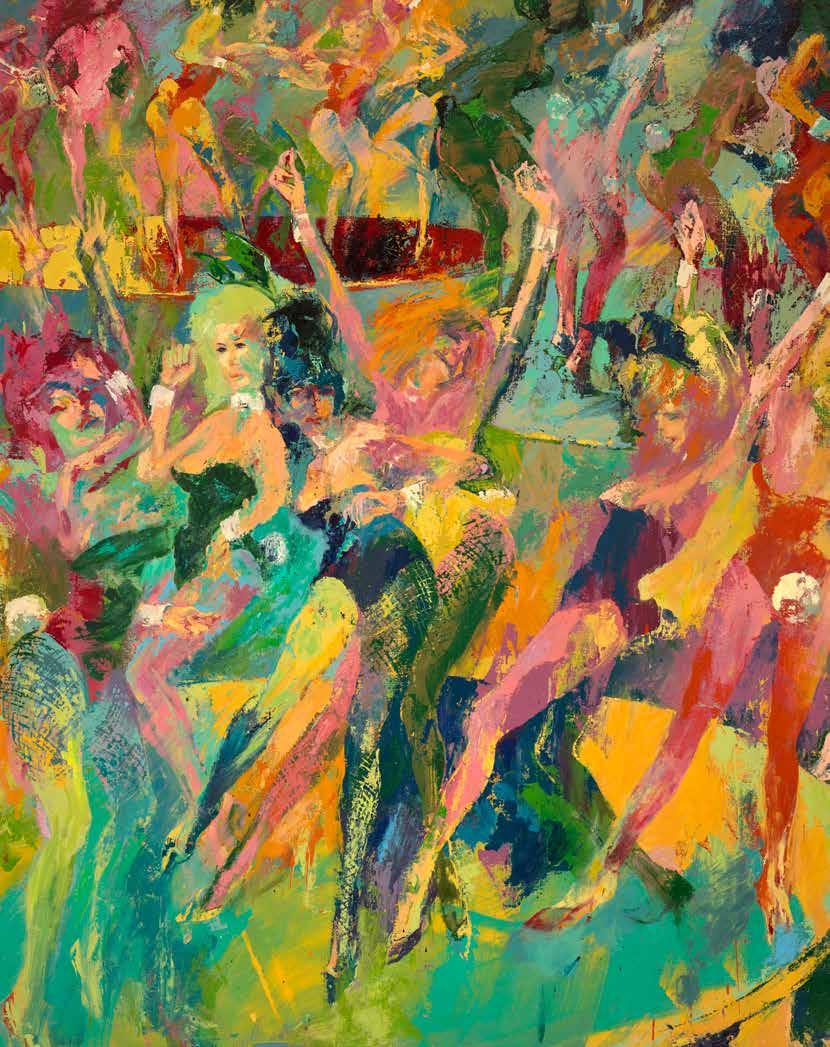
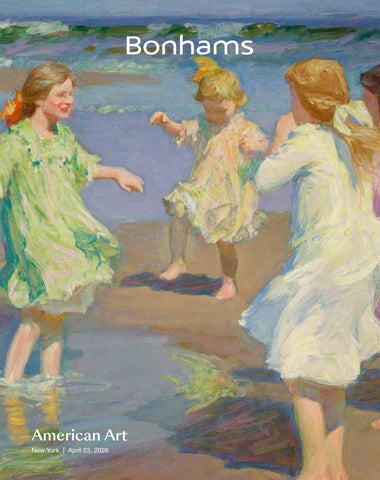
Front Cover: Lot 9
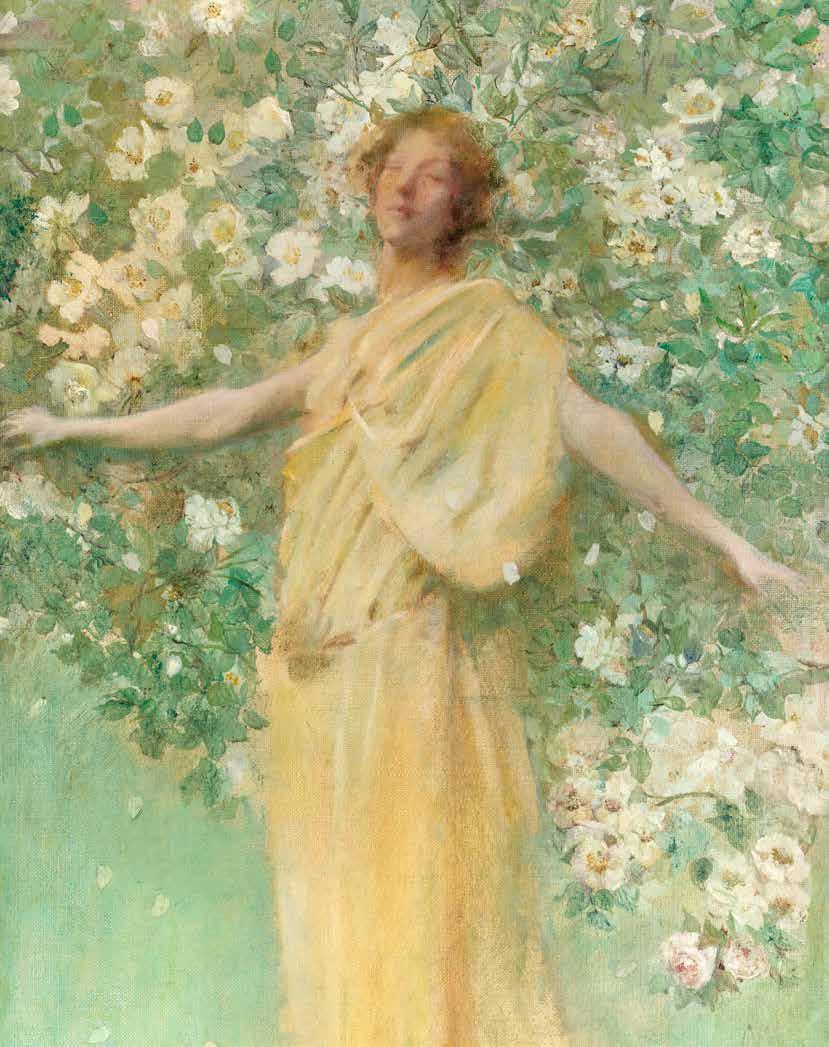
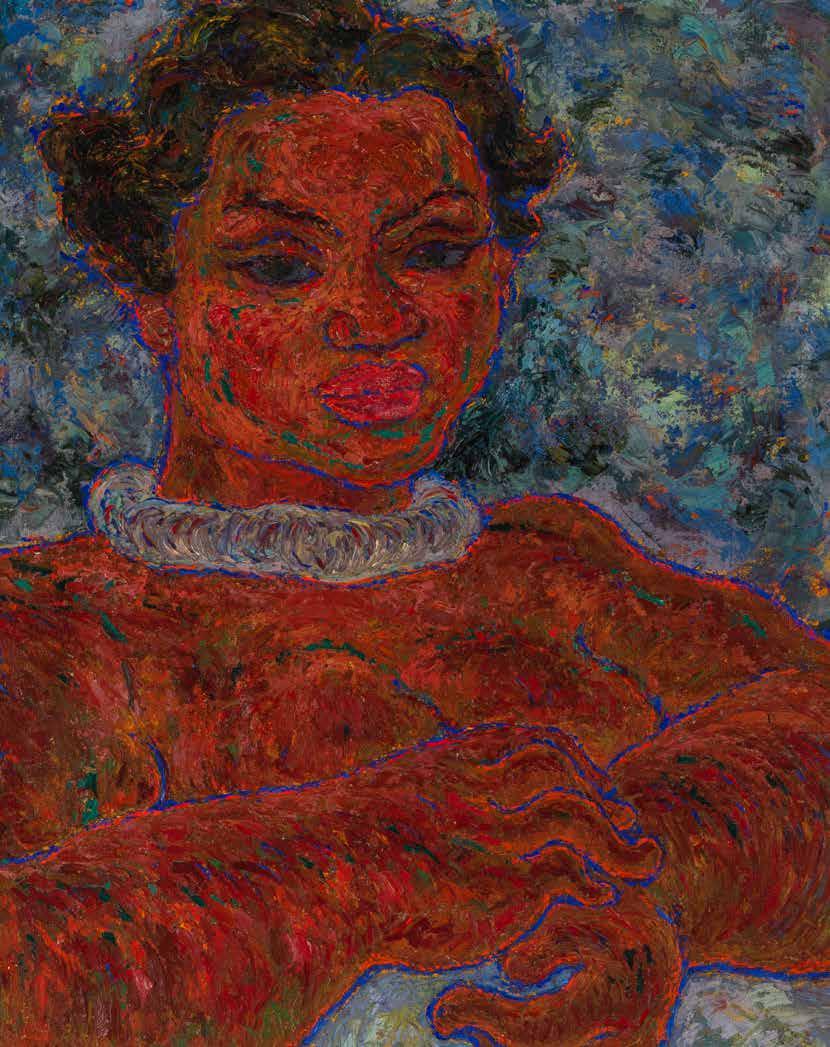
Inside Front Cover: Lot 29
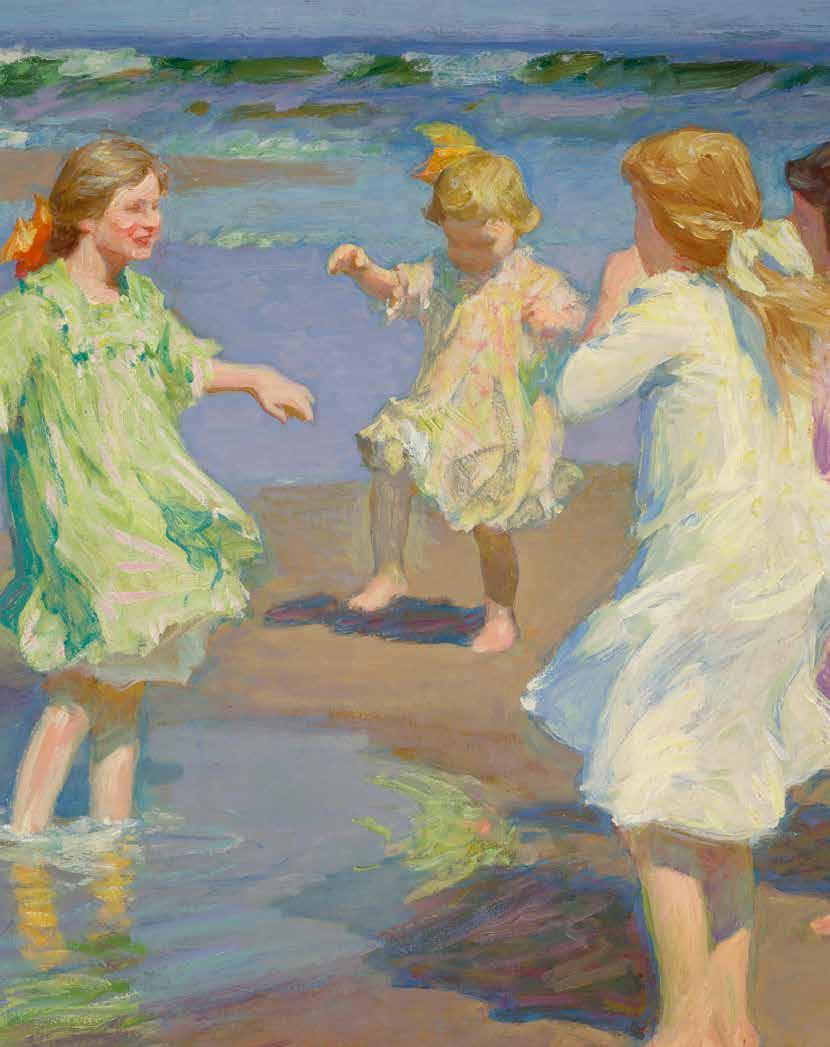
Page 2-3: Lot 56
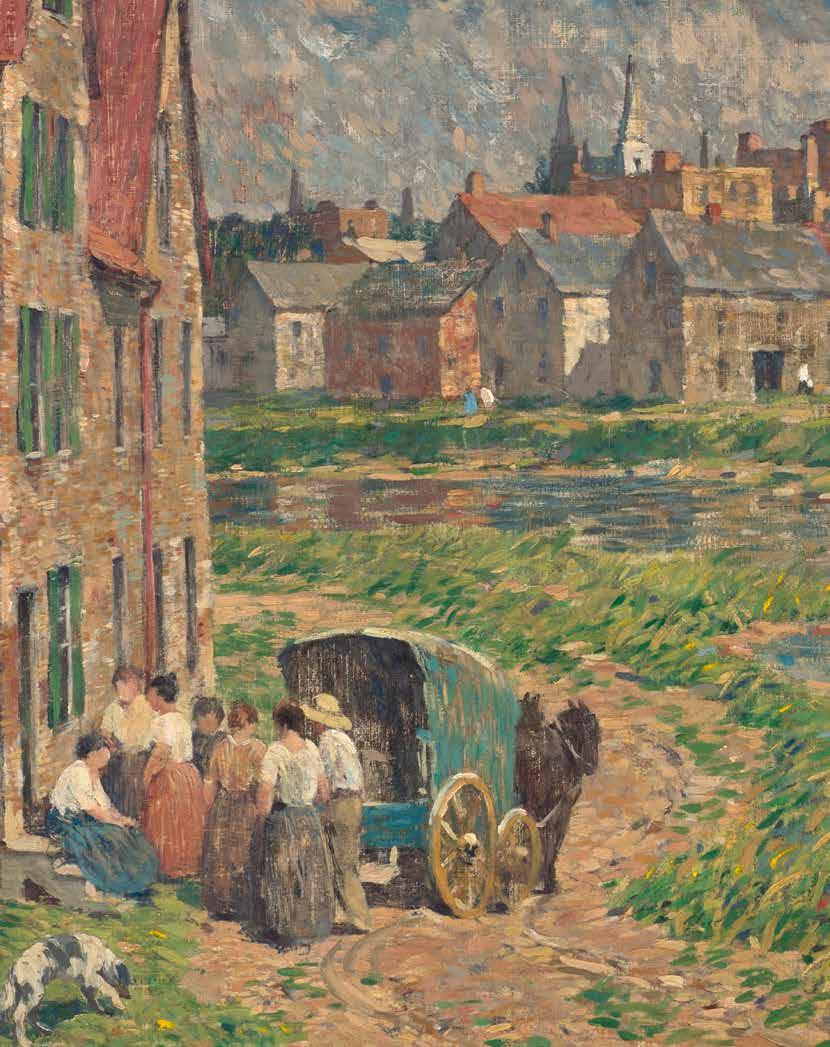
Page 4: Lot 8
© Brown & Bigelow, Inc., Eagan Minnesota Page 6: Lot 71
Inside Rear Cover: Lot 80
Rear Cover: Lot 26 (detail)
PREVIEW
Saturday, April 18, 10am-5pm Sunday, April 19, 12pm-5pm Monday, April 20, 10am-5pm Tuesday, April 21, 10am-5pm Wednesday, April 22, 10am-5pm
A Life in Scholarship: Property from the Collection of Dr. Barbara J. Novak: Lots 48-53
Eclectic Wonders: Property from the Collection of Timothy Egert: Lots 68, 91
Property Sold to Benefit American Public Television: Lots 82-85
Property from the Collection of Cynthia S. Monaco: Lot 70
Property from the Collection of Dean Pitchford: Lot 56
Property from the Collection of Joanne and Howard Hamamoto: Lot 72
Property from the Collection of Rhoda and Dr. Marvin Kantor: Lots 9-17
Property from The Collection of Valerie and Robert Mallett: Lot 77
Property from the Collection of William Yukon Chang, New York: Lot 74
Bonhams © 2026 Bonhams & Butterfields Auctioneers Corp. All rights reserved.
Aaron Anderson Specialist, Head of Sale +1 (917) 206 1616 aaron.anderson@bonhams.com
Mary Manfredi Associate Specialist +1 (917) 206 1653 mary.manfredi@bonhams.com
Bid online/APP
Register to bid online by visiting www.bonhams.com/31842

Bid through the app. Download now for android and iOS
Alternatively, contact our Client Services department at: bids.us@bonhams.com +1 (212) 644 9001
Verification of a valid credit card in your name may be required before you are able to place bids. If you will bid on behalf of a company, you must disclose this at the time of bidder registration. Successful bidders may be required to provide personal, or, if applicable, entity KYC documentation (including government issued ID and other information we may reasonably require). For telephone or absentee bids a completed Bidder Registration Form must be submitted in advance of the sale. The Bidder Registration Form can be found at the back of every catalogue and on our website at www.bonhams.com and should be returned by email to Client Services at bids.us@bonhams.com 24 hours ahead of the start of the sale.
For eligible lots, we endeavor to extended a shipping quote to buyers within 5 business days of the sale. Lots marked “W” are oversized and may be subject to off-site post-sale storage and shipping; please refer to the Oversized Lot information section in the Buyer’s Guide. You may collect or ship your purchases after your payment in full has been received. If you are sending a third party to collect, we will require your advance, written authorization to release the property to your nominee. To schedule a collection, contact our Client Services department at invoices.us@bonhams.com. Pre-allocated 30-minute slots are available Monday through Friday between 9:00am and 4:30pm.
Please note that starting on June 28, 2025, the import into the European Union of certain property of non-EU origin may be subject to additional import requirements. If you are an EU buyer of such items, please ensure you are fully informed of the applicable EU regulatory requirements regarding import prior to bidding.
Aaron Anderson Specialist, Head of Sale American Art
Mary Manfredi Associate Specialist American Art


Robin Starr
Senior Vice President General Manager
Jelena James
Senior Specialist, Head of Sale
American & European Works of Art
Claire Dettelbach Cataloguer
American & European Works of Art



Kathy Wong
Senior Director, Fine Arts Specialist, American Art
Megan Gallagher
Associate Specialist American Art
Aaron Bastian Senior Director Fine Arts



PROPERTY FROM A PRIVATE COLLECTOR
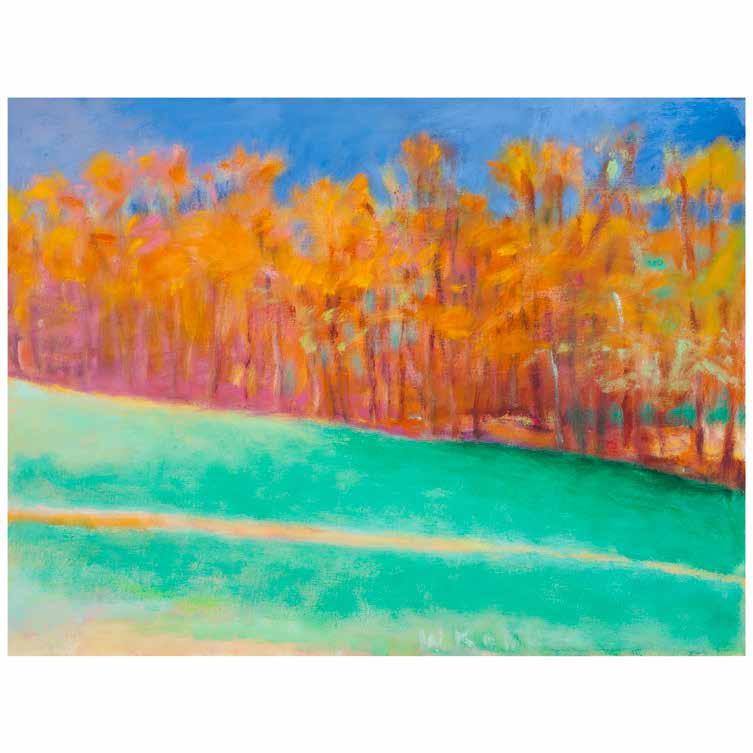
1 WOLF KAHN (1927-2020)
Fall Splendor
signed ‘W Kahn’ (lower center) and inscribed with artist’s inventory number ‘#141-1995’ and inscribed with title (on the stretcher) and inscribed with artist’s inventory number again (on the reverse) oil on canvas
18 x 24 in. (45.7 x 61 cm.)
Painted in 1995.
$30,000 - 50,000
Provenance
Thomas Segal Gallery, Boston.
Acquired by the present owner from the above, circa 1995-2005.
This work will be included in the Wolf Kahn Foundation’s Catalogue Raisonné Project of the artist’s work and is accompanied by a letter of acceptance issued by the Wolf Kahn Foundation.
PROPERTY FROM A PRIVATE COLLECTION, DENVER, COLORADO
2
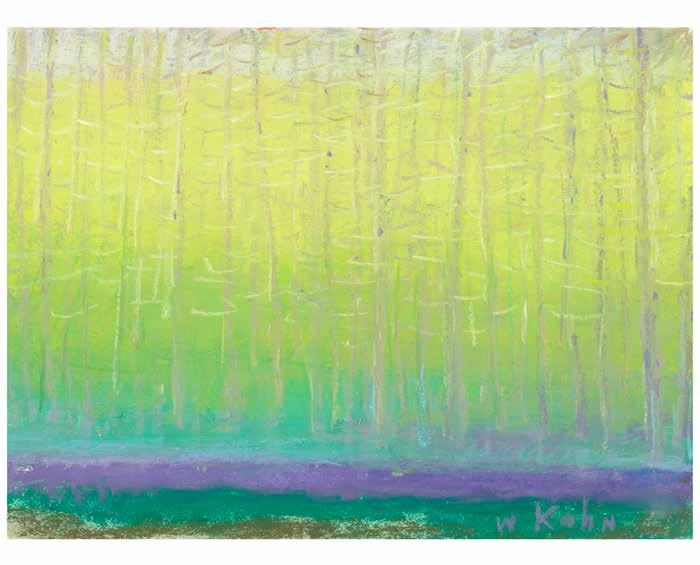
WOLF KAHN (1927-2020)
Conifers Rising
signed ‘W Kahn’ (lower right) and inscribed with artist’s inventory number ‘2891,’ inscribed with title and dated ‘1994’ (on the artist’s label affixed to the backing board) pastel on paper
9 x 12 in. (22.9 x 30.5 cm.) Executed in 1994.
$4,000 - 6,000
Provenance
Gerald Peters Gallery, Santa Fe, New Mexico. Ann Templeton (1936-2011), Pearland, Texas, (probably) acquired from the above.
Robert Rohm (1948-2024), Texas, by descent from the above. By descent to the present owner from the above, daughter of the above, 2024.
This work will be included in the Wolf Kahn Foundation’s Catalogue Raisonné Project of the artist’s work and is accompanied by a letter of acceptance issued by the Wolf Kahn Foundation.
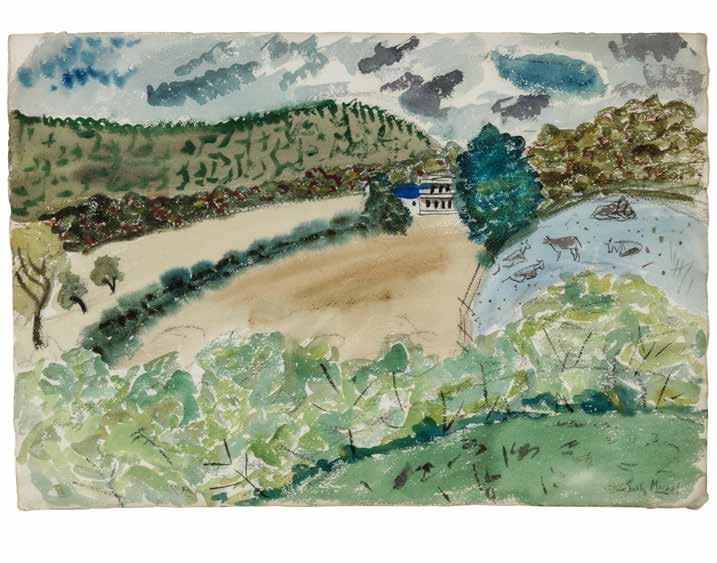
Country Hills
signed ‘Sally Michel’ (lower right) and inscribed with title, dated ‘1939’ and signed again (on the verso) watercolor and graphite on paper 15 1/4 x 22 1/4 in. (38.7 x 56.5 cm.)
Executed in 1939.
$8,000 - 12,000
Provenance
Private collection. Acquired by the present owner from the above, circa 2014.
PROPERTY FROM A PRIVATE FLORIDA COLLECTION
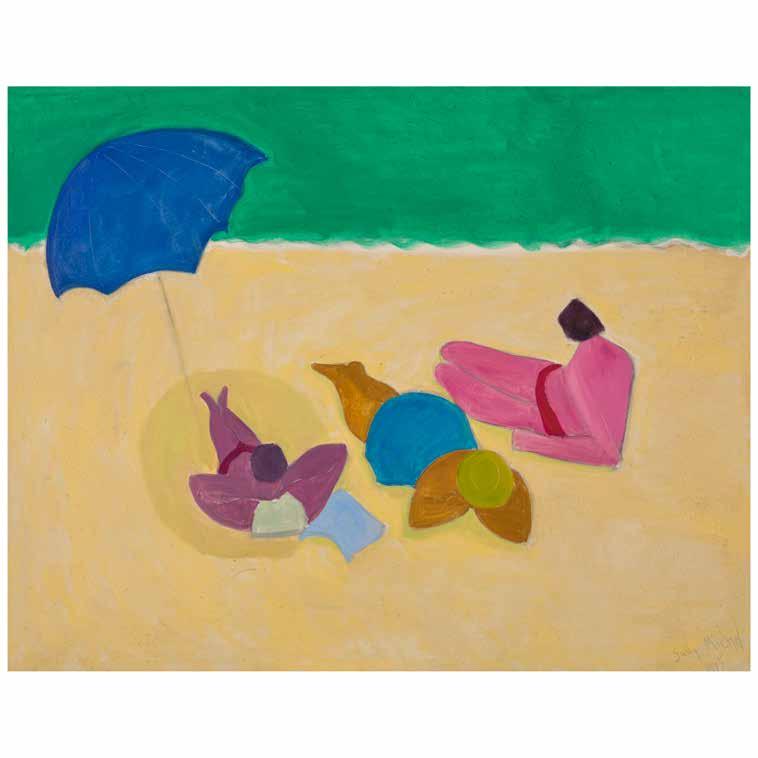
4 SALLY MICHEL AVERY (1902-2003)
Loungers by the Sea signed and dated ‘Sally Michel / 1975’ (lower right) and inscribed with title and signed and dated again (on the reverse) oil on canvas
40 x 50 in. (101.6 x 127 cm.)
Painted in 1975.
$30,000 - 50,000
Provenance
Private collection, Dade City, Florida, acquired circa 1975-79.
Private collection, Ridge Manor, Florida, daughter of the above, by descent from the above. Acquired by the present owner from the above.
PROPERTY
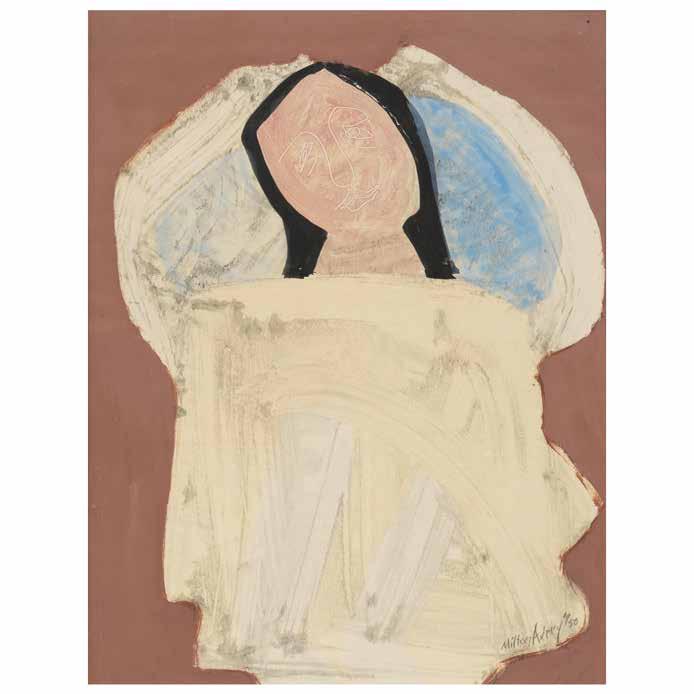
5 MILTON AVERY (1885-1965)
White Angel signed and dated ‘Milton Avery 1950’ (lower right) monotype and gouache on paper 22 x 17 in. (55.9 x 43.2 cm.) Executed in 1950.
$15,000 - 25,000
Provenance
Sale, Auction Gallery of the Palm Beaches, West Palm Beach, February 4, 2023, lot 98. Acquired by the present owner at the above sale.
This lot is accompanied by a letter from The Milton and Sally Avery Arts Foundation, New York.
PROPERTY FROM A NEW YORK PRIVATE COLLECTION
6
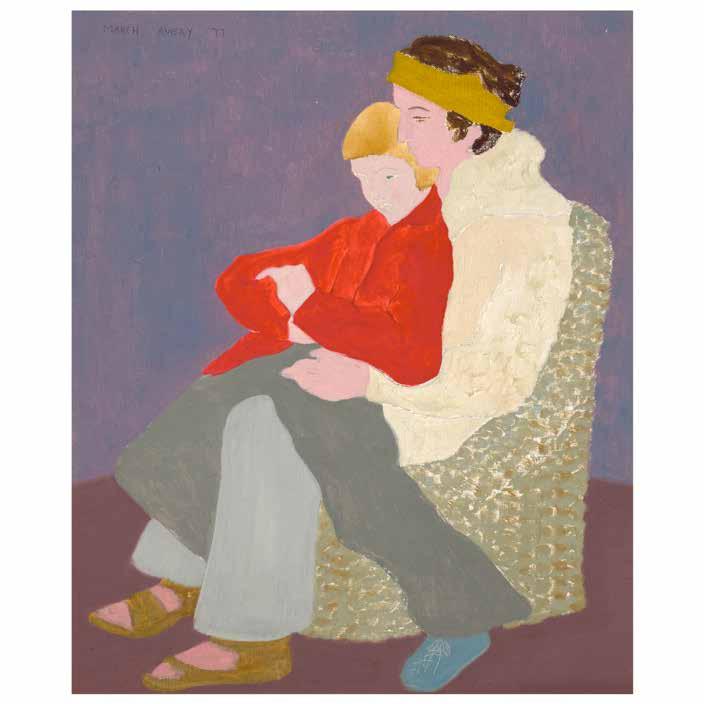
MARCH AVERY (BORN 1932)
Sally and Sean signed and dated ‘MARCH AVERY ‘77’ (upper left) and inscribed with title and signed and dated again (on the reverse) oil on canvasboard
24 x 19 7/8 in. (61 x 50.5 cm.) Painted in 1977.
$15,000 - 25,000
Private collection, New York, acquired from the artist. By descent to the present owner from the above, daughter of the above, 2006.
7
ANDREW WYETH (1917-2009)
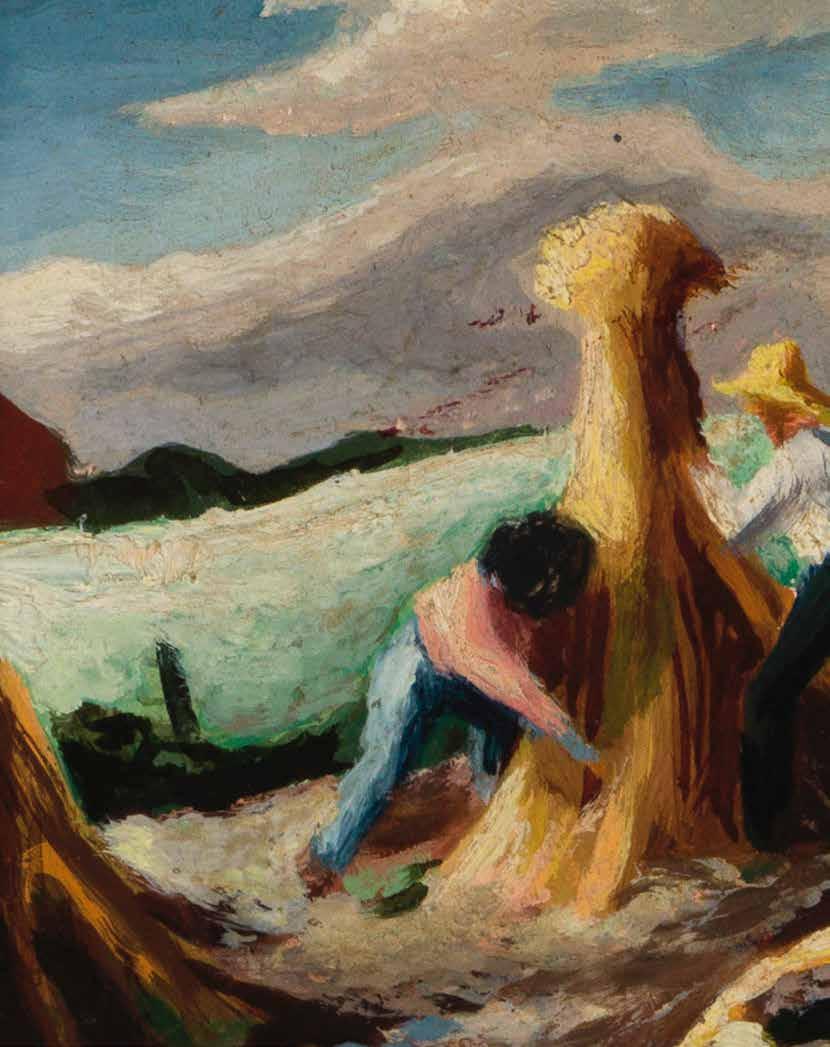
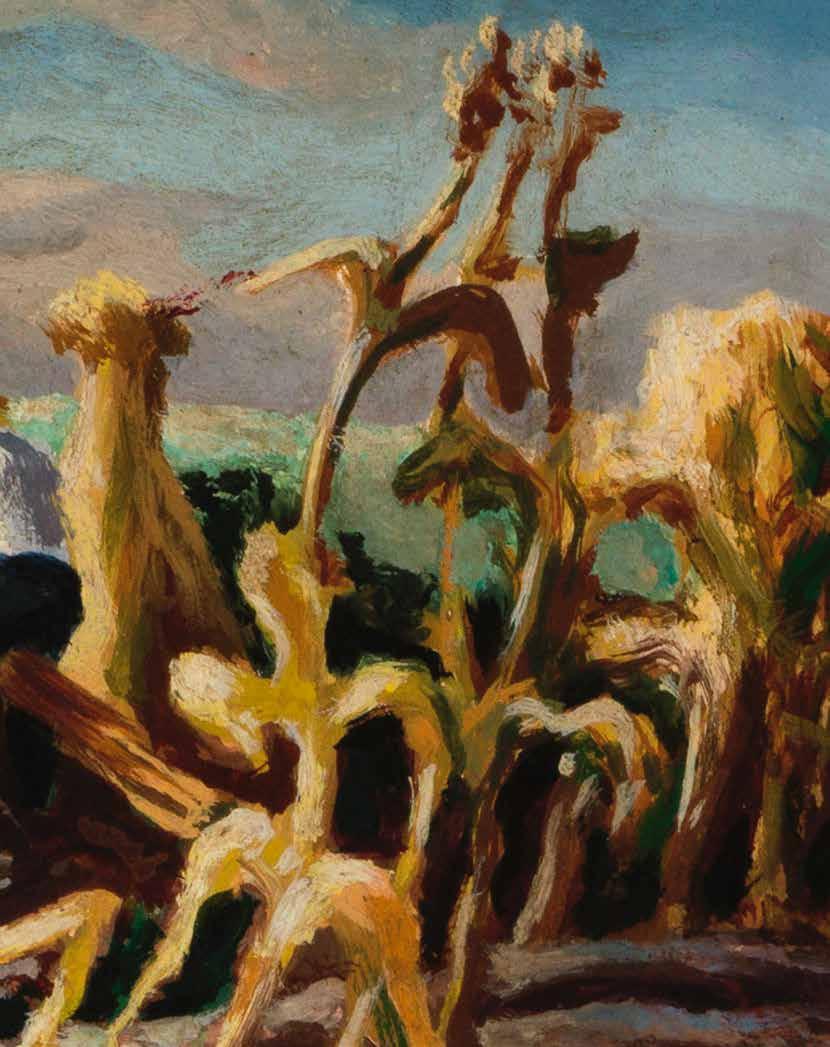
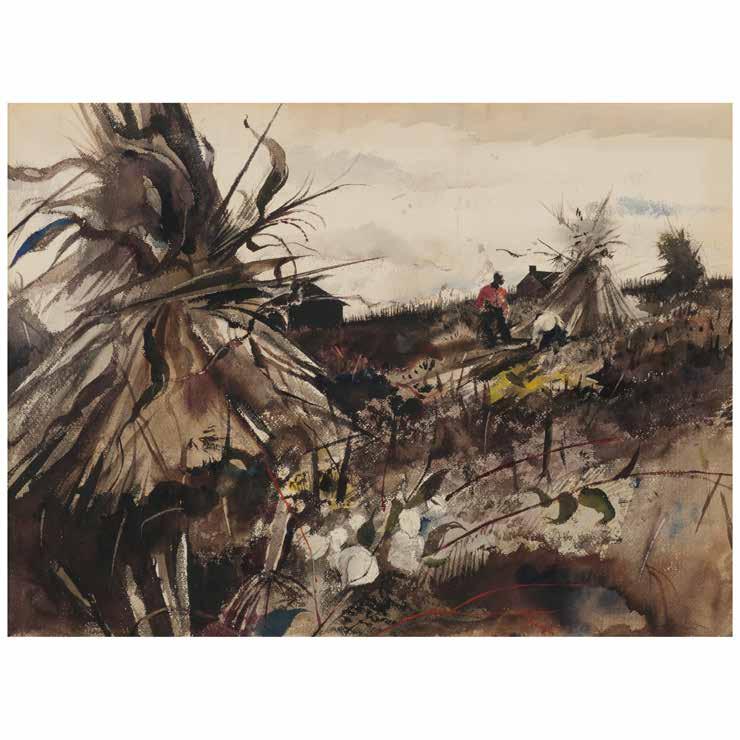
The Corn Huskers signed ‘Andrew Wyeth’ (lower right) watercolor and graphite on paper 21 1/2 x 29 5/8 in. (54.6 x 75.3 cm.) Executed in 1944.
$70,000 - 100,000
Provenance
[With] Macbeth Galleries, New York. Frederic Hicks, East Norwalk, Connecticut, 1945.
Sale, Parke-Bernet Galleries, New York, May 13, 1966, lot 110, sold by the above. William U. Weiss, Memphis, Tennessee, acquired at the above sale.
Sale, Coeur d’Alene Art Auction, July 23, 2011, lot 115, sold by the above. Acquired by the present owner at the above sale.
Exhibited
Janesville, Wisconsin, May 22-July 24, 1944.
New York, National Academy of Design, 78th Annual Exhibition of the American Water Color Society, January 19-February 7, 1945.
New York, The Lotos Club, 1966.
New York, Hammer Galleries, The Wyeths: N.C. Wyeth, Andrew Wyeth, James Wyeth, September 18-October 14, 1995.
Literature
“Picture of the Month,” Lotos Leaf, February 1966. Arts Magazine, May 1966, vol. 40, no. 7, p. 8, illustrated. Art News, May 1966, vol. 65, no. 3, p. 8, illustrated.
The Andrew & Betsy Wyeth Study Center of the Brandywine Museum of Art confirms that this object is recorded in Betsy James Wyeth’s files.
The present work depicts a cornfield with the John Andress house and barn in the distance. The figure in the cornfield has been identified as Adam Johnson.
PROPERTY FROM A PROMINENT PRIVATE COLLECTION
8
NORMAN ROCKWELL (1894-1978)
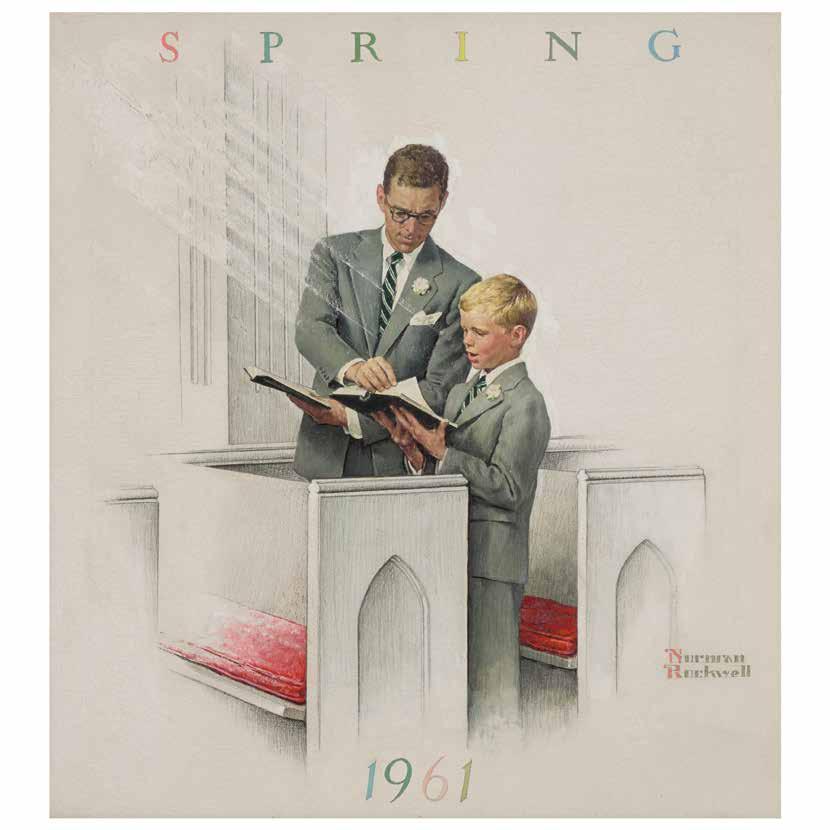
Father and Boy: Church signed ‘Norman /Rockwell’ (lower right) oil on canvas
19 x 18 in. (48.3 x 45.7 cm.)
Painted in 1961.
$100,000 - 150,000
Provenance
Private collection.
Private collection.
American Illustrators Gallery, New York. (as SPRING- FATHER AND SON IN CHURCH)
Private collection, New York, acquired from the above.
Acquired by the present owner from the above, October 26, 2015.
Exhibited Newport, Rhode Island, National Museum of American Illustration, Norman Rockwell’s America, May 27, 2011-January 30, 2012, pp. 166-67, illustrated. (as FATHER AND BOY-IN CHURCH)
Literature
G. Mendoza, Norman Rockwell’s Four Seasons, New York, 1982, n.p., illustrated. L.N. Moffatt, Norman Rockwell: A Definitive Catalogue, vol. I, Stockbridge, Massachusetts, 1986, pp. 330-31, no. A165, illustrated.
The present lot appears in the Norman Rockwell Online Catalogue Raisonné, the Definitive Catalogue of the artist’s work originally compiled by Laurie Norton Moffatt, Norman Rockwell Museum, Director/CEO, as no. A165.
“See! The winter is past; the rains are over and gone. Flowers appear on the earth; the season of singing has come…”
Song of Solomon 2:11–12
Norman Rockwell didn’t just illustrate calendars, he sought to capture and define American culture. His genius lay in transforming everyday moments into vivid, compelling stories on a page. By the end of World War II, his illustrations had made him a household name, celebrated as America’s most beloved visual storyteller. From the playful antics of children to the quiet dignity of ordinary life, his narrative, and often humorous, images regularly appeared on the covers of major publications, most famously The Saturday Evening Post . Although his first cover appeared in 1916, it was his wartime works, particularly the Four Freedoms series, that cemented his fame. Rockwell’s mastery of narrative detail and character would continue to captivate audiences in the postwar era, most notably through his beloved Brown & Bigelow calendar series, which brought his vision of American life into millions of homes.
In the postwar boom, Americans couldn’t get enough of Rockwell’s illustrations, which captured the heart of modern American life while reflecting the era’s patriotic sentiments and family values. From 1948 to 1964, he was commissioned to create Brown & Bigelow’s iconic Four Seasons calendar series, eventually appearing in over 50 million households. Brown & Bigelow, a major force in the calendar industry, played a pivotal role in mass-producing Rockwell’s art, bringing his work into everyday American homes and democratizing fine art in the process. “The series treats NR’s [Norman Rockwell’s] traditional subjects in a lighthearted, episodic manner. Each quarterly scene depicts a favorite or typical seasonal activity. The calendar series was NR’s own creation, and not—as he comments in an interview in The American Weekly of 30 August 1954—’based on somebody else’s high-pressured nudging.’ The young and old were his preferred models, as they remained strictly themselves, neither group wanting to ‘pretty up’” (L.N. Moffatt, Norman Rockwell: A Definitive Catalogue , vol. I, Stockbridge, Massachusetts, 1986, p. 301). In the 1961 Four Seasons series, which includes the present work Father and Boy: Church , viewers are treated to a tender glimpse into fatherhood.
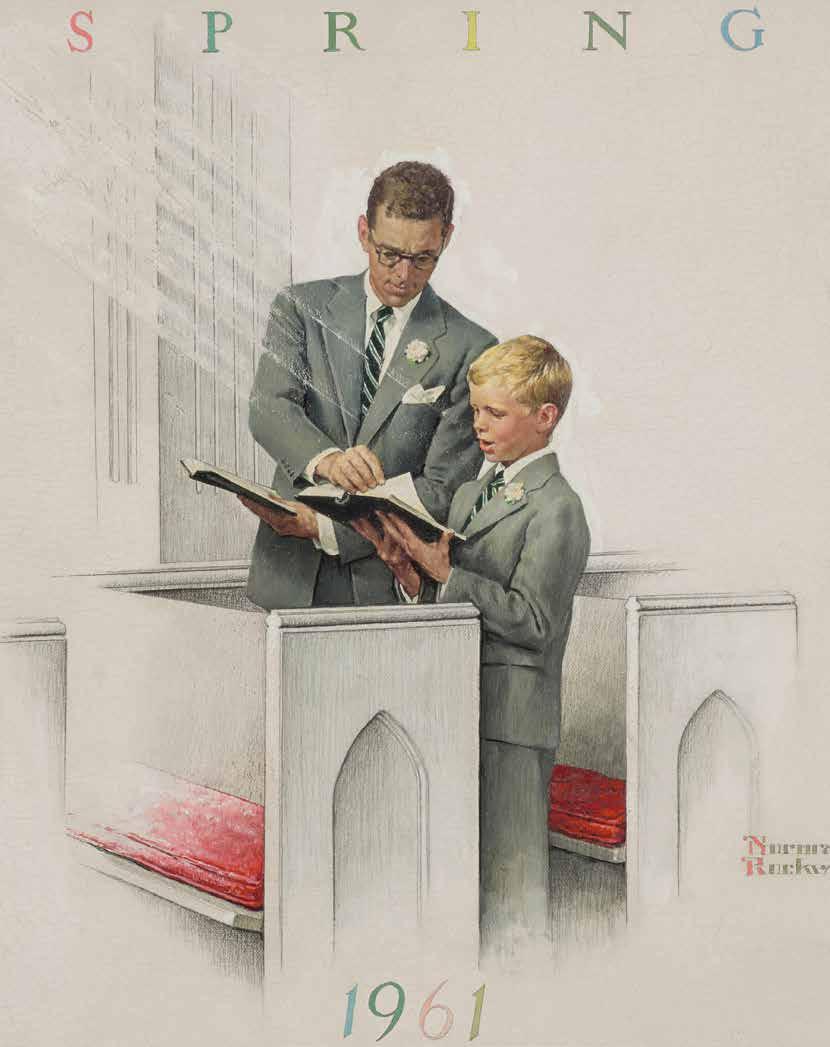
Father and Boy: Church depicts a father and son, dressed in matching Sunday suits, standing together in a church pew. The intimate scene could be witnessed at any service: a father gently helping his son flip through the hymnal. Their coordinated outfits, from striped ties to grey suits and boutonnières, underscore the care and pride woven into this quiet, everyday moment and ultimately speaks to the tender bond shared between a father and son. This work, and others in the series, offer glimpses into family traditions. Other highlights from 1961 include Father and Boy: Skiing (Private collection), Father and Boy: Hunting , and Father and Boy: Fishing (Private collection). In all these works, a common didactic sentiment is present of a father instructing his young son through matters of faith, sport, and leisure. All are tied to the seasons in which these respective recreations occur such as the leaves falling in the autumn composition.
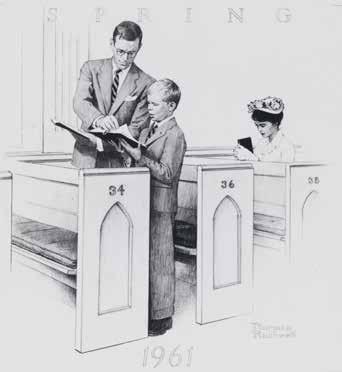
A drawing exists of Father and Boy: Church in which Rockwell initially incorporated more details into the scene. He added a third row of pews, with numbers, where the viewer can clearly see a female figure, kneeling in prayer in the back. She’s locked in a moment of quiet pause; her eyes closed in reflection. While she’s separated from two figures in the immediate foreground, she ultimately distracts from the father and son duo and was omitted from the present work to further solidify the emphasis of the painting.
In this way, Norman Rockwell’s illustrations transcend mere nostalgia; they offer a powerful, enduring portrait of fatherhood, family, and tradition in mid-20th-century America. Through scenes like Father and Boy: Church, he invites us to see ordinary moments as vessels of connection and affection. As these images continue to resonate across generations, they remind us that, like a father’s guiding hand, Rockwell’s art remains a steady beacon of our shared humanity.
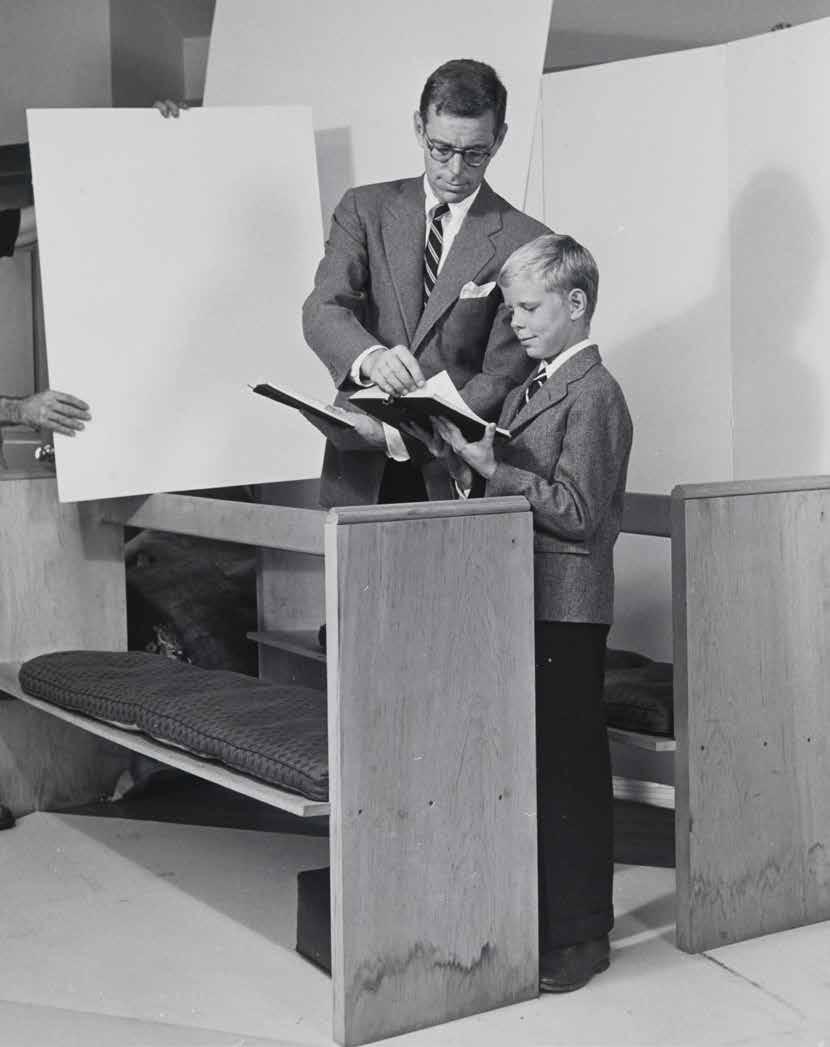
Bill Scovill (1914-1997), Reference Photograph of Initial Sketch for Father and Boy: Church, 1961.Illustration for Brown and Bigelow Four Seasons CalendarSpring. Silver gelatin print, Norman Rockwell Art Collection Trust, Studio Collection, ST.1976.20032.28.19. Courtesy of the Norman Rockwell Museum.

(Lots 9-17)
Bonhams is honored to present the collection of Rhoda and Dr. Marvin Kantor across our American Art and California & Western Art auctions this season. Their collection represents American Impressionist and Modern artists, with a particular concentration in California art. While the works in their collection date mostly to the Modern period, they reflect broad stylistic influences ranging from the Dutch Golden Age to Contemporary Realism. While diverse in genre, their collection coalesces around themes of the theatricality of everyday life (Edward Henry Potthast, Children at Play, Brighton Beach and Franz Arthur Bischoff, Picking Poppies, Pasadena), absorption (Mabel Alvarez, Italian Girl and Edwin Roscoe Schrader, The Window Seat), and capturing light (Abel Warshawsky, Port de Pêche). Their collection was built with joy, discovery and partnership over seventy years of marriage, with nods to their heritage.
Rhoda’s passion for art came naturally. Born Rhoda Helene Kahn (19322022) in Philadelphia, she was part of a distinctly creative family. Her paternal uncle was the celebrated architect Louis I. Kahn. Her father, Oscar, was a talented writer and sketch artist, her brother Alan a concertlevel pianist, and her maternal uncle, Bernard Greenberg, a violinist in the Philadelphia orchestra. Rhoda herself could draw almost anything.
Her passion might have been genetic, but it blossomed during her marriage. After moving to California in childhood, she met Marvin, the love of her life, at eighteen. From their first Los Angeles basement apartment to the elegant property that housed the works in this collection, it was Rhoda’s aesthetic, her discerning eye for beauty, that gave life to their surroundings.
Rhoda was a beauty herself, inside and out. She loved her children and grandchildren deeply. She was a devoted friend and cared for the disadvantaged, as was evident in her decades-long volunteer work at the Braille Institute.
Marvin provided the resources for the collection, but it was Rhoda who taught him to love art. And love it he did, for years carrying in his wallet this bittersweet quote by John Updike: “Art is a touch of transcendence into the vanishing quotidian.”
Born in Brooklyn, Marvin Herbert Kantor (1927-2025) grew up in the ethnically diverse neighborhood of Boyle Heights. His father, Sam, moved the family to Los Angeles in 1933, opening a shoe store on what was then Brooklyn Avenue. His mother, Henrietta, was a homemaker. His beloved older sister, Julia, was a wife, mother, and unsung talented poet.
Marvin graduated from Roosevelt High School and, following a short stint in the Navy at the end of World War II, attended UCLA on the GI Bill. He chose to study medicine on a whim; it just sounded right, and the world was better for it. A born caregiver, Marvin treated patients as a radiation oncologist for forty years at several L.A. hospitals and later in private practice in Whittier.
In 1950, he married Rhoda Kahn, to whom he remained wedded, and in love, for more than seventy years. Together Marvin and Rhoda traveled, entertained friends and collected art, right through their 80s. Though strolling through galleries was their greatest pleasure, they stayed fit by jumping rope. They had two children together, Ona and Steven, whom they adored, supported, and indulged when necessary. They held hands until Rhoda’s death in 2022.
Marvin was brilliant, loving, and adventurous; a troublemaker with a trademark smirk when the occasion called. He was a voracious reader but couldn’t tell a screwdriver from a butter knife. He cared deeply and generously for his friends. He lived for his family.
PROPERTY FROM THE COLLECTION OF RHODA AND DR. MARVIN KANTOR
9
EDWARD HENRY POTTHAST (1857-1927)
Children at Play, Brighton Beach signed ‘E. Potthast’ (lower right) oil on canvas
24 1/8 x 30 1/4 in. (61.3 x 76.8 cm.)
$150,000 - 250,000
Provenance
Sale, Chicago Art Galleries, Inc., Evanston, Illinois, November 13-15, 1977. (Probably) Petersen Galleries, Beverly Hills. Acquired by the present owners by 1979.
Exhibited
San Jose, California, San Jose Museum of Art, The United States and the Impressionist Era, November 17, 1979-January 9, 1980, n.p., illustrated on the front cover. (as Beach Scene)
Literature
“AUCTION,” Chicago Tribune, November 6, 1977, yr. 131, no. 310, sec. 2, p. 11, illustrated. (as Children at Play-Brighton Beach)
“AUCTION,” Chicago Tribune, November 7, 1977, yr. 131, no. 311, sec. 4, p. 16, illustrated. (as Children at Play-Brighton Beach)
“AUCTION,” Chicago Tribune, November 10, 1977, yr. 131, no. 314, sec. 1, p. 21, illustrated. (as Children at Play-Brighton Beach)
C. Shere, “The United States and the Impressionist Era,” Oakland Tribune, Oakland, California, December 30, 1979, p. G-13, illustrated. (as Beach Scene)
P.J. Pierce, Edward Henry Potthast: More Than One Man, Hingham, Massachusetts, 2006, p. xvii, no. 20, illustrated. (as Girls at the Beach)
“The ocean is after all of vast importance and utility in our social life, as well as a regulator of our physical being. It cools the air in summer; it warms it in winter; it proves a blessing to those in our great eastern cities, to whom it is the only refuge from the tenement.”
- J. Howe Adams, “Bathing at the American Sea-Shore Resorts,” The Cosmopolitan, July 1895, vol. XIX, no. 3, p. 328.
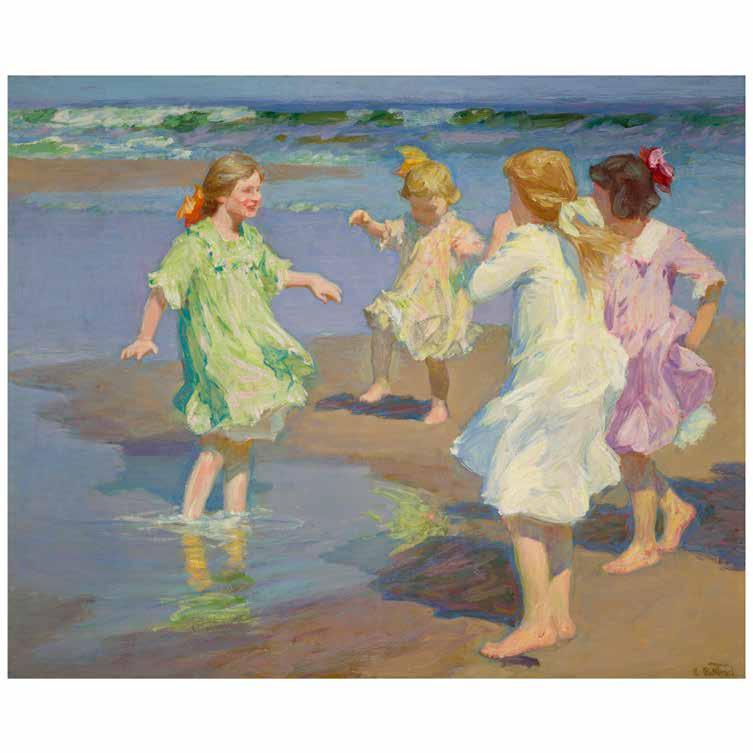
Edward Henry Potthast’s Children at Play, Brighton Beach exemplifies both Potthast’s command of the Impressionist idiom and his sustained engagement with scenes of modern leisure. Across his numerous depictions of sunlit shores animated by sparkling surf, colorful umbrellas, balloons, and figures in wide-brimmed hats, Potthast demonstrated remarkable inventiveness within a seemingly narrow subject. The beaches he favored were typically located along the northeastern coastline, within reach of his studio in New York City. Although he began painting American seaside subjects around the turn of the twentieth century, it was not until approximately 1914—by which point he had already established a successful career—that the beach became fully recognized as his primary thematic focus.
Born in Cincinnati in 1857, Potthast was the son of German immigrants who had arrived in the United States amid the broader European migration to the country during the nineteenth century. His artistic training began in 1869 at the age of twelve at the McMicken School of Design in Cincinnati before going on to complete his studies in Europe, attending the Royal Academy in Munich and later working in Antwerp and Paris during the 1880s. These formative years exposed Potthast to both academic traditions and the emerging currents of European Impressionism, but it was arguably his trip in 1889 to the artist’s colony of Grèz-sur-Loing, France, that made the most influential impact on his development as an artist. Dr. William Gerdts noted that, “When in Grèz, Potthast ‘fell under the influence of [Robert] Vonnoh and [Roderick] O’Connor [sic] and became a convert to the new school of Impressionism.’
The results of Potthast’s conversion to the new aesthetic were immediate, and were seen in the work Potthast brought back with him to his native town. He continued to paint with the bravura brushwork and colorism of Impressionism after he moved to New York in 1896, and it continued when he began to specialize in scenes of children and other bathers at Brooklyn beaches...which theme became his specialty after 1910.” (W. Gerdts, Lasting Impressions: American Painters in France 1865-1915, exhibition catalogue, Evanston, Illinois, 1992, p. 67)
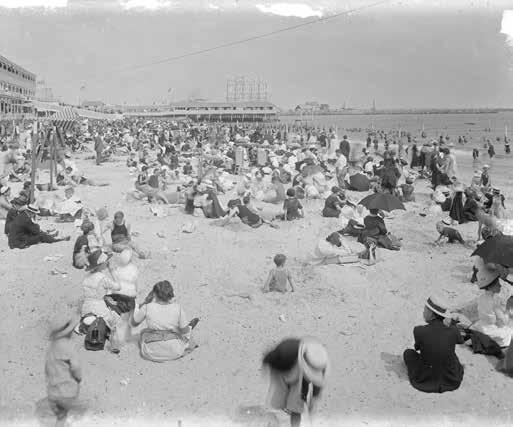
Potthast’s choice of subject was distinctly modern. His attraction to seaside leisure emerged only decades after the rapid development of American coastal resorts and recreational clubs. The Industrial Revolution reshaped the United States in the nineteenth century, transforming it from a predominantly agrarian society into an urban-industrial nation. Waves of immigrants, including Potthast’s own family, arrived from Europe seeking economic opportunity and stability. By the late nineteenth century, labor reforms and the growing influence of unions had shortened the workday for many Americans, while increasing public awareness of the unhealthy conditions associated with urban and factory life sparked a desire to retreat to greener outdoor spaces. These social transformations contributed to the rise of public parks, athletic culture, and a broader desire for restorative environments beyond the city. Entrepreneurs responded by expanding tourism infrastructure, and improvements in rail transportation made coastal destinations increasingly accessible. Consequently, urban populations flocked to the beach during the summer months to escape heat, pollution, and congestion. (J. Aronson, Eternal Summer: The Art of Edward Henry Potthast, exhibition catalogue, Cincinnati, Ohio, 2013, pp. 48-49)
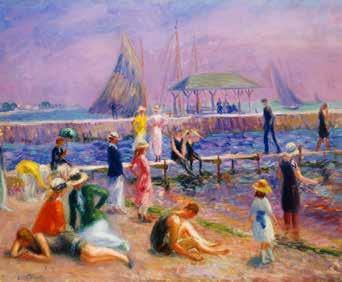
As the beach emerged as a significant social space, it likewise became an important artistic motif. The growth of seaside resorts in the late nineteenth century coincided with the rise of Impressionism in America, a movement that frequently celebrated contemporary leisure and bourgeois experiences. By the early twentieth century, Impressionism had become a dominant style among American painters, drawing attention to coastal environments and scenes of recreation. Potthast’s engagement with the beach paralleled that of contemporaries such as William Merritt Chase (1849-1916), Maurice Prendergast (1858-1924), and William Glackens (1870-1938), whose seaside scenes briefly rivaled Potthast’s. Like Potthast, each of these artists were drawn to the beach as a setting where light, color, and the rhythms of modern leisure could be rendered with painterly spontaneity. Glackens notably was an astute observer of people as they went about their daily lives, as seen in such works as Town Pier-Blue Point, Long Island (Private collection), however, he would recede from the realism that associated him with the Ashcan group of artists to pursue the greater pictorial values of Impressionism. (J. Aronson, Eternal Summer: The Art of Edward Henry Potthast , p. 51)
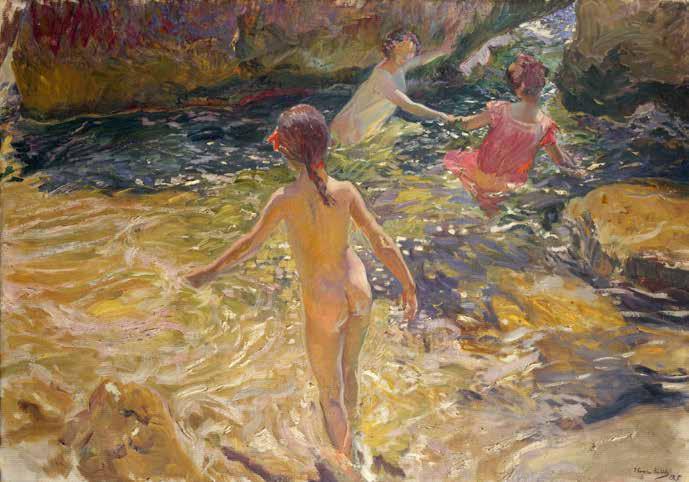
Among the most significant influences on American beach imagery in the early twentieth century was the work of Spanish painter Joaquín Sorolla y Bastida (1863-1923). The landmark 1909 exhibition of Sorolla’s work at the Hispanic Society of America introduced American audiences to his large canvases capturing children playing along radiant shorelines, moving through brilliant reflections of water and sand. Sorolla’s luminous canvases were celebrated for their vibrant color, fluid brushwork, and dynamic compositions that offered compelling models for representing beach life. (J. Aronson, Eternal Summer: The Art of Edward Henry Potthast , p. 50) In viewing such works as Sea Idyll (1908, Hispanic Society of America, New York) and The Bath, Jávea (1905, The Metropolitan Museum of Art, New York), Potthast likely recognized in Sorolla’s work new formal possibilities for treating light, atmosphere, and the human figure in coastal settings.
While Potthast’s style remained distinctly his own, the parallels between his mature beach scenes and Sorolla’s work are notable. Both artists emphasized the sensory experience of the seaside
through energetic brushwork and a palette dominated by brilliant whites, blues, and sun-warmed tones. Sorolla’s compositions often foregrounded children playing in shallow water, their forms animated by sunlight and motion. Potthast likewise populated his canvases with youthful figures engaged in carefree activity along the shoreline. Yet Potthast tended to adopt a more intimate scale and a slightly denser arrangement of figures, reflecting the crowded public beaches of New York rather than the expansive Mediterranean shores that inspired Sorolla.
Beginning around 1910, Potthast himself became a frequent visitor to the beaches surrounding New York City. He regularly traveled to locations such as Rockaway Beach and Far Rockaway on Long Island, as well as easily accessible Brooklyn destinations including Brighton Beach, Manhattan Beach, and Coney Island. These excursions provided the observational foundation for his increasingly confident treatment of coastal subjects. Rather than producing topographically precise records, however, Potthast distilled these experiences into generalized impressions of seaside activity, emphasizing atmosphere and visual rhythm over geographic specificity.
In Children at Play, Brighton Beach , Potthast foregrounds the sensorial effects of light and color rather than specific topographical detail. Potthast generally avoided distinctive architectural markers— boardwalks, bathhouses, or resort hotels—that would anchor the scene to a precise location. Instead, the emphasis rests on the interplay between environment and figure. Children playing and dressed in brightly colored attire populate a shimmering shoreline, their casual gestures suggesting immediacy rather than staged arrangement. Potthast’s chromatic orchestration is central to the painting’s effect: the warm greens, pinks, reds, yellows, and whites of the figures’ garments contrast with the cooler blues, teals, and grays of water and sky, creating a harmonious yet vibrant equilibrium. Spatial depth is achieved through the rolling waves that recede toward the horizon, enhancing the sense of atmosphere and scale. In its synthesis of modern subject matter and painterly sophistication, Children at Play, Brighton Beach stands among Potthast’s most accomplished contributions to American Impressionism.
FROM
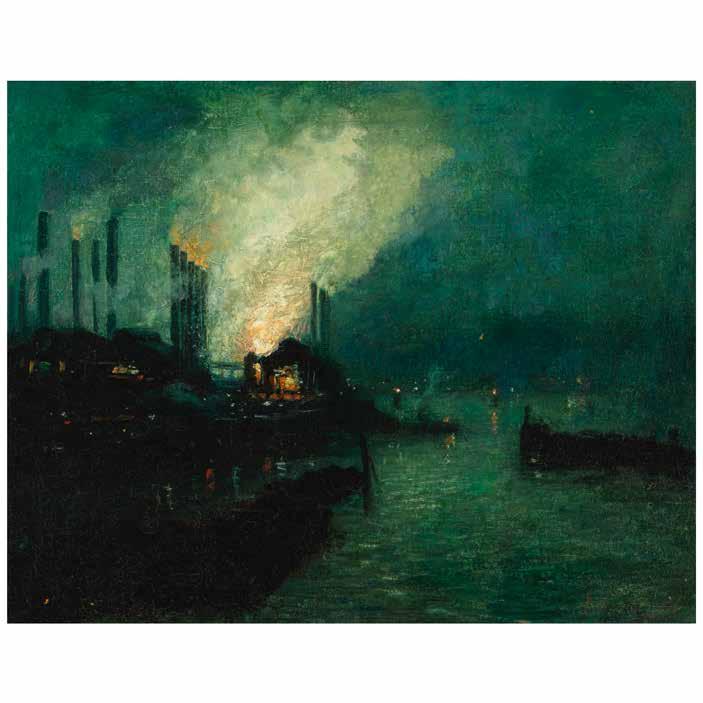
10 AARON HENRY GORSON (1872-1933)
Pittsburgh Steel Mills at Night signed and dated indistinctly (lower right) oil on canvas
22 3/8 x 28 3/8 in. (56.8 x 72.1 cm.)
$15,000 - 25,000
Provenance
Acquired by the present owners by circa 1980s.
PROPERTY FROM THE COLLECTION OF RHODA AND DR. MARVIN KANTOR
11
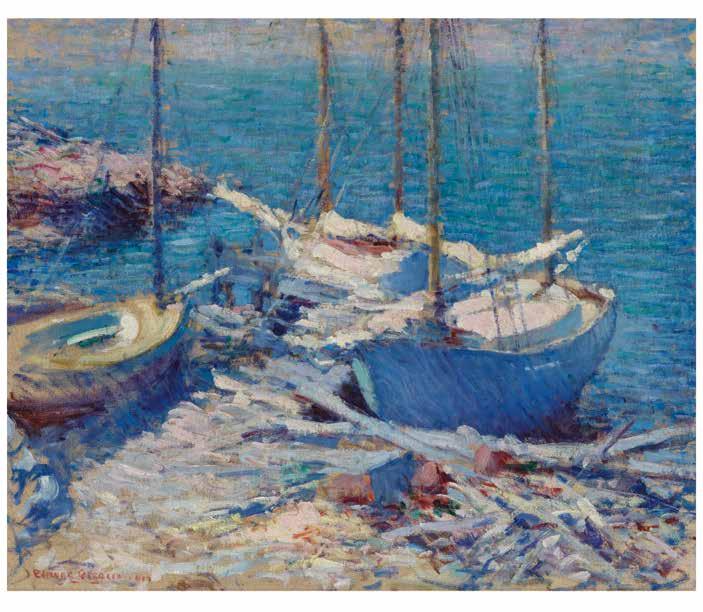
EDMUND WILLIAM GREACEN (1877-1949) Fishing Boats
signed and dated ‘Edmund Greacen 1913’ (lower left) oil on canvas
20 x 24 1/8 in. (50.8 x 61.3 cm.)
Painted in 1913.
$10,000 - 15,000
Provenance
Worstman Rowe Galleries, San Francisco, by 1973. Acquired by the present owners from the above.
PROPERTY FROM THE COLLECTION OF RHODA AND DR. MARVIN KANTOR
12
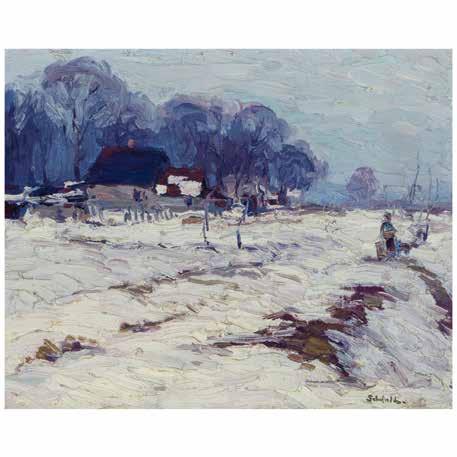
WALTER ELMER SCHOFIELD (1867-1944)
Snow Scene signed ‘Schofield.’ (lower right) and signed again and inscribed with title (on the reverse) oil on board 8 x 10 in. (20.3 x 25.4 cm.)
$4,000 - 6,000
Provenance
Acquired by the present owners by 1979.
Exhibited
(probably) San Jose, California, San Jose Museum of Art, The United States and the Impressionist Era, November 13, 1979-January 9, 1980. (as Untitled)
PROPERTY FROM THE COLLECTION OF RHODA AND DR. MARVIN KANTOR
13
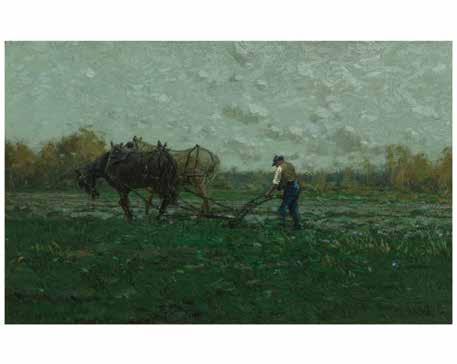
JULIAN ALDEN WEIR (1852-1919)
The Plowman signed ‘J. Alden Weir’ (lower right) oil on canvas 14 1/8 x 22 1/4 in. (35.9 x 56.5 cm.)
$3,000 - 5,000
Provenance
Acquired by the present owners by 1979.
Exhibited
(probably) San Jose, California, San Jose Museum of Art, The United States and the Impressionist Era, November 17, 1979-January 9, 1980. (as Untitled)
Literature (probably) “J. Alden Weir, Eminent U.S. Painter, Dead, Head of National Academy Ill of Heart Disease for Year; Funeral at Church of Ascension Wednesday. Art Covered Wide Range. Portraits, Still Life and Landscapes Hang in Many of the Leading Galleries,” New York Tribune, December 9, 1919, vol. LXXIX, no. 26,686, p. 10.
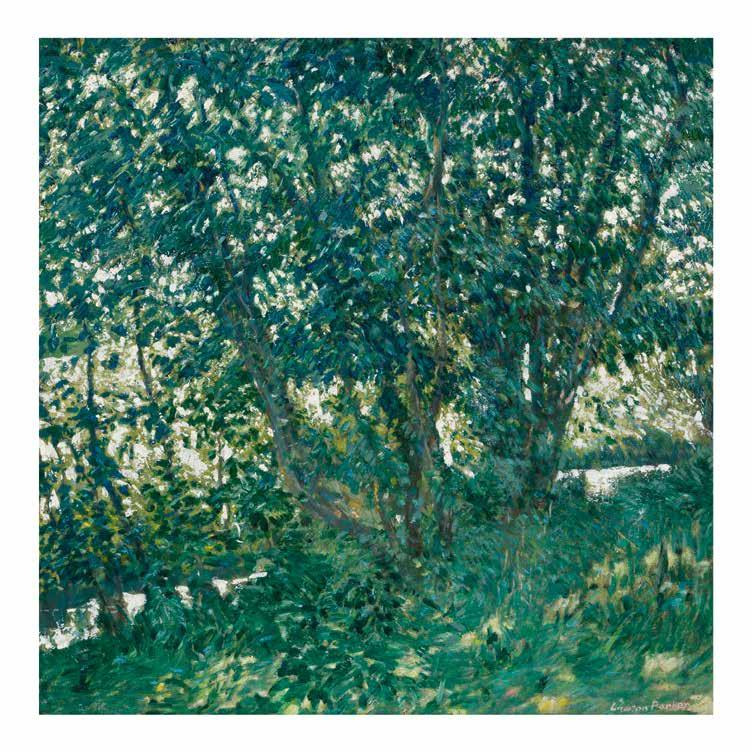
14
LAWTON SILAS PARKER (1868-1954)
Summer Solitude signed ‘Lawton Parker.’ (lower right) oil on board
24 x 24 in. (61 x 61 cm.)
$7,000 - 10,000
Provenance
Goldfield Galleries, Los Angeles. Acquired by the present owner (probably) from the above.
PROPERTY FROM THE COLLECTION OF RHODA AND DR. MARVIN KANTOR
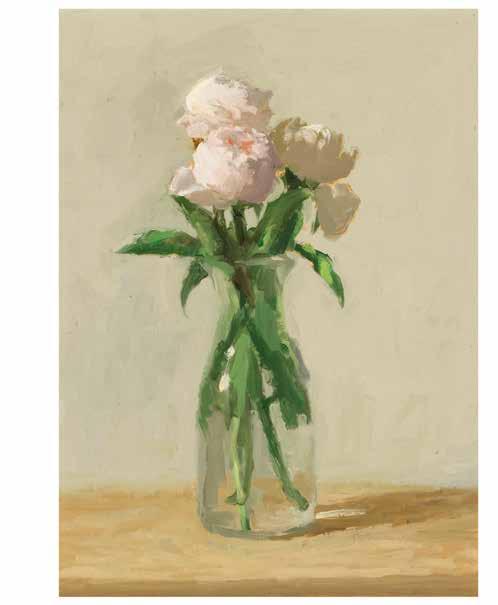
15
ROBERT KULICKE (1924-2007)
Peonies in Glass Vase
signed and dated ‘Kulicke 78’ (lower center) oil on board
16 1/4 x 12 in. (41.3 x 30.5 cm.)
Painted in 1978.
$4,000 - 6,000
Provenance
Davis & Long Company, New York, by 1978. Acquired by the present owners (probably) from the above.
Exhibited
New York, Davis & Long Company, 1978.
PROPERTY FROM THE COLLECTION OF RHODA AND DR. MARVIN KANTOR
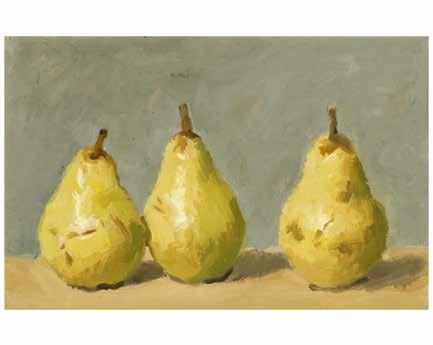
16
ROBERT KULICKE (1924-2007)
Three Pears on Gray Background oil on board
7 x 10 3/4 in. (17.8 x 27.3 cm.)
$3,000 - 5,000
Provenance
Davis & Long Company, New York, by 1978. Acquired by the present owners (probably) from the above.
Exhibited
New York, Davis & Long Company, 1978.
PROPERTY FROM THE COLLECTION OF
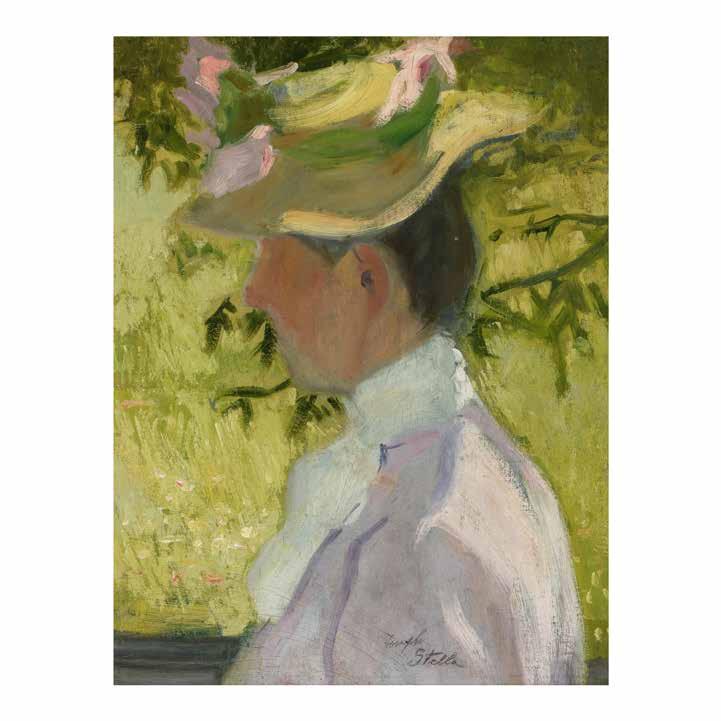
17
JOSEPH STELLA (1877-1946)
The Spring Bonnet signed ‘Joseph / Stella’ (lower center) oil on canvas
18 x 14 in. (45.7 x 35.6 cm.) Painted in 1898.
$3,000 - 5,000
Provenance
Robert Schoelkopf, New York, (probably) by 1963. Maxwell Galleries, San Francisco. Acquired by the present owners (probably) from the above, by 1979.
Exhibited (probably) New York, Robert Schoelkopf Gallery, Joseph Stella, October 29-November 16, 1963, n.p., no. 1. (as Woman in a Hat) San Jose, California, San Jose Museum of Art, The United States and the Impressionist Era, November 17, 1979-January 9, 1980, n.p., illustrated.
PROPERTY FROM A PRIVATE NEW JERSEY COLLECTION
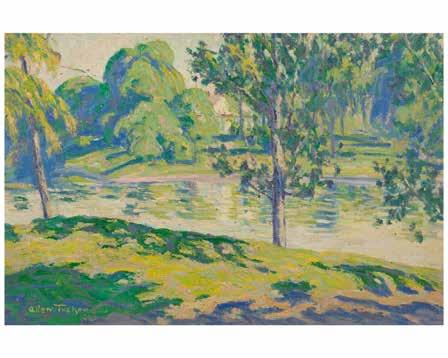
18
ALLEN TUCKER (1866-1939)
The Creek signed and dated ‘Allen Tucker / 1920’ (lower left) and inscribed with title twice and signed again (on the stretcher) oil on canvas
20 x 30 in. (50.8 x 76.2 cm.)
Painted in 1920.
$7,000 - 10,000
Provenance
[With] Milch Galleries, New York. By descent within the family of the present owner.
PROPERTY FROM A PRIVATE NEW JERSEY COLLECTION
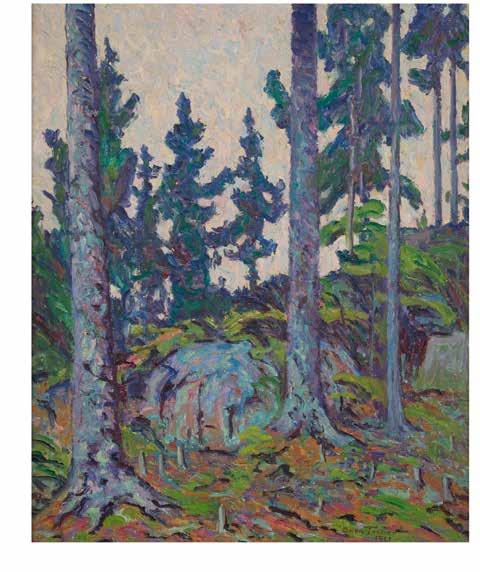
19
ALLEN TUCKER (1866-1939)
Firs signed and dated ‘Allen Tucker / 1921’ (lower right) and signed again and inscribed with title (on the stretcher) oil on canvas
30 x 25 in. (76.2 x 63.5 cm.)
Painted in 1921.
$6,000 - 8,000
Provenance By descent within the family of the present owner.
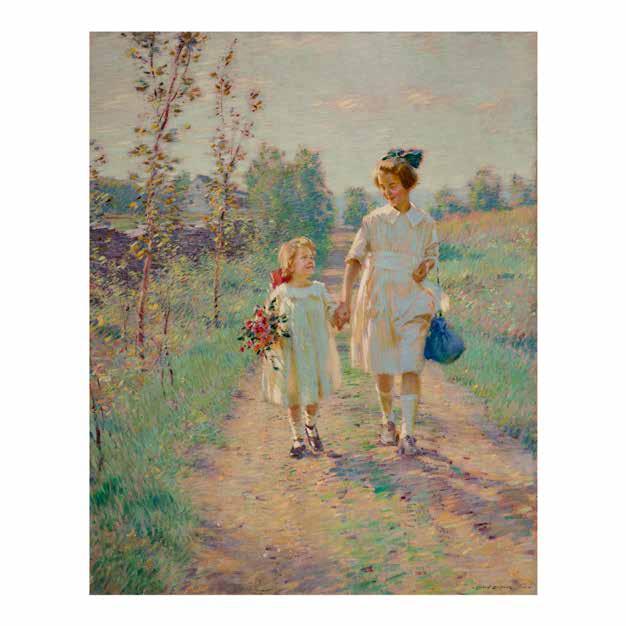
20
EDWARD DUFNER (1872-1957)
Grandma’s Birthday
signed ‘Edward Dufner. N.A.’ (lower right) and inscribed ‘©’ (lower right) and inscribed with title, signed again and inscribed ‘THIS PAINTING SHOULD NEVER / BE VARNISHED E.D.’ (on the backing) oil on canvas
50 1/2 x 40 in. (128.3 x 101.6 cm.)
$15,000 - 25,000
Provenance
Cincinnati Art Galleries, LLC, Cincinnati, Ohio, 1989. Acquired by the present owner from the above, 1990.
Exhibited
New York, National Academy of Design, 97th Annual Exhibition, March 25-April 23, 1922, p. 15, no. 144.
New Jersey, Trenton Fair Grounds, April 1923. Pittsburgh, Carnegie Institute, Twenty-Second Annual International Exhibition of Paintings, April 26-June 17, 1923. Memphis, Tennessee, Brooks Memorial Art Gallery, 1929.
Literature
“Famous Artists Coming Here Thursday for Private View of Paintings at the Fair Grounds,” Trenton Evening Times, New Jersey, September 18, 1923, vol. XLII, no. 221, p. 3.
B.M. Becker, “At the Brooks Memorial Art Gallery,” The Commercial Appeal, Memphis, April 14, 1929, vol. CXVII, no. 104, sec. II, p. 8. Gallery Selections, Cincinnati, 1989, n.p., no. 42, illustrated, P.H. Falk, A.A. Bien, eds., The Annual Exhibition Record of the National Academy of Design: 1901-1950, Madison, Connecticut, 1990, p. 179, no. 144.
P.H. Falk, ed., Record of the Carnegie Institute’s International Exhibitions: 1896-1996, Madison, Connecticut, 1998, p. 100.
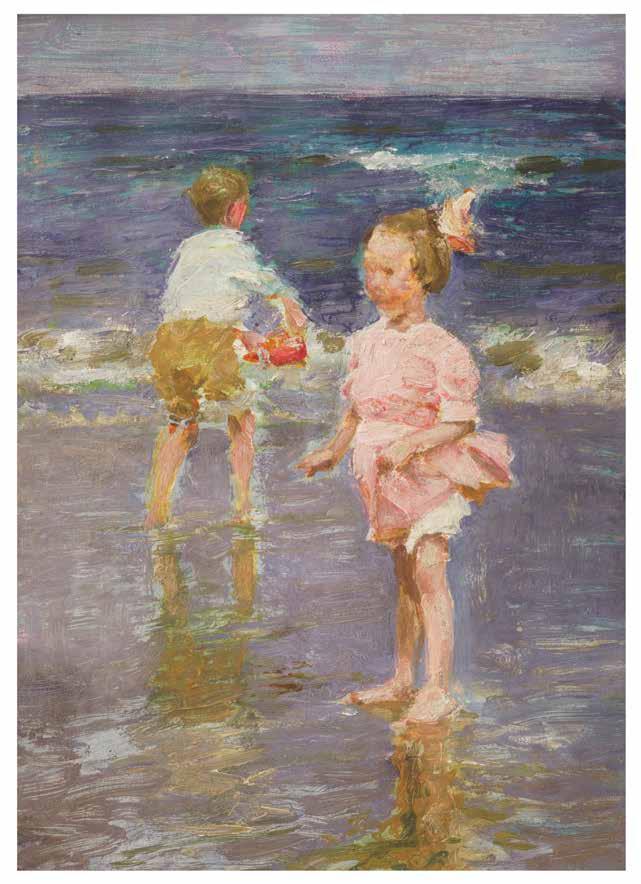
21
EDWARD HENRY POTTHAST (1857-1927)
At Low Tide oil on panel 16 x 12 in. (40 x 30.5 cm.)
$40,000 - 60,000
Provenance
Meredith Long & Company, Houston. Private collection, Texas, acquired from the above, circa 1965-75. By descent to the present owner from the above, daughter of the above, 1991.
Exhibited New York, Salmagundi Club, Annual Oil Exhibition, n.d.
In At Low Tide, Potthast captures the fleeting joys of childhood against a shimmering expanse of shoreline, using a luminous, broken brushstroke that reflects his deep engagement with American Impressionism. The composition centers on two children at the water’s edge—one turned toward the rolling surf, the other momentarily paused—creating a subtle contrast between movement and stillness. Potthast’s palette of iridescent blues, violets, and warm flesh tones dissolves form into light, allowing reflections in the wet sand to echo and soften the figures, while the sea itself becomes a rhythmic field of color rather than a fixed horizon. The painting conveys not just a scene, but an atmosphere—sunlit, breezy, and ephemeral—imbued with a sense of innocence and leisure that defines Potthast’s celebrated beach scenes.
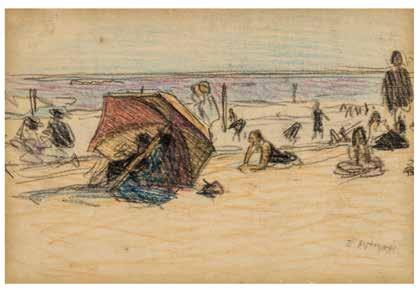
PROPERTY FROM A PRIVATE COLLECTION, FERNANDINA BEACH, FLORIDA 22
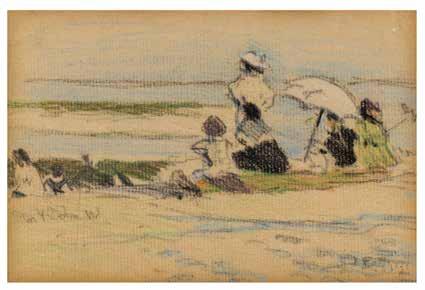
EDWARD HENRY POTTHAST (1857-1927)
Beach Scenes with Red and White Umbrellas: A Pair of Works signed ‘E Potthast’ (lower right), each colored pencil on paper, each
4 7/8 x 7 1/8 in. (12.4 x 18.1 cm.); 4 3/4 x 7 in. (12.1 x 17.8 cm.)
$4,000 - 6,000
Provenance
Joseph C. Haefelin, Pekin, Illinois. Hirschl & Adler Galleries, Inc., New York, acquired from the above, 1968.
Meredith Long & Company, Houston, acquired from the above, 1970. (as Beach Scene, each)
Private collection, Texas, acquired from the above, circa 1970-75. By descent to the present owner from the above, daughter of the above, 1991.
23
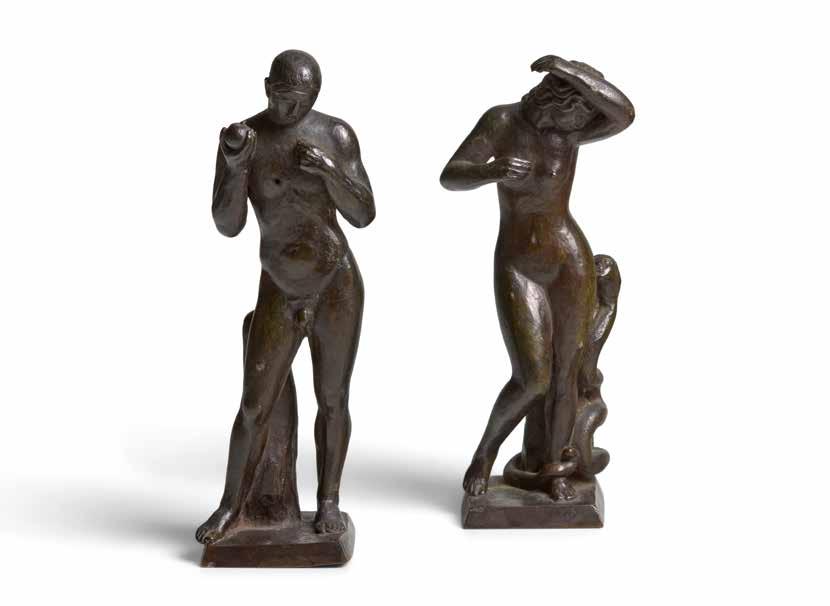
Adam and Eve (Studies)
inscribed with foundry mark ‘R.B.W.’ (along the base), each bronze with brown patina, each 7 1/2 in. (19.1 cm.) high; 7 1/8 in. (18.1 cm.) high Modeled in 1922.
$10,000 - 15,000
Provenance
Private collection, Cooperstown, New York, (possibly) acquired from the artist.
Private collection, Cooperstown, New York, by descent from the above.
Estate of above.
Sale, Carlsen Gallery, Inc., Freehold, New York, December 7, 2025, lot 74.
Acquired by the present owner at the above sale.
Literature
E. Murtha, Paul Manship, New York, 1957, p. 162, cat. nos. 151, 152, pl. 28, other examples illustrated Minnesota Museum of Art, Paul Manship: Changing Taste in America, exhibition catalogue, St. Paul, Minnesota, 1985, pp. 38-39, 41, other versions illustrated.
J. Manship, Paul Manship, New York, 1989, pp. 112-13, 215, other versions illustrated.
Another example of this pair cast and inscribed with the Roman Bronze Works foundry mark, ‘R.B.W.’ can be found in the collection of the Smithsonian Museum of American Art, Washington, D.C. (nos. 1966.47.10 and 1966.47.9).
PROPERTY SOLD TO BENEFIT PRIVATE FAMILY FOUNDATIONS
24
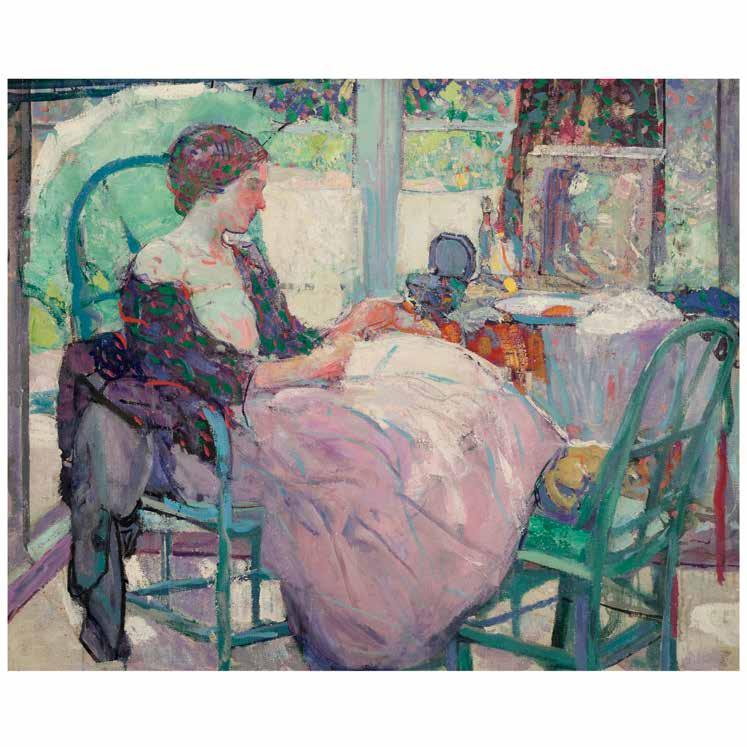
RICHARD EDWARD MILLER (1875-1943)
The Jewel Box oil on canvas
32 1/8 x 39 3/8 in. (81.6 x 100 cm.)
Painted circa 1912-13.
$40,000 - 60,000
Provenance
Sale, Bayeux Auction House, Normandy, France, July 14, 1991, lot 46. (as La Boîte à Bijoux) Private collection, acquired at the above sale.
Sale, Sotheby’s, New York, September 14, 1995, lot 141, sold by the above.
Acquired by the late owner at the above sale.
This lot is accompanied by a letter dated March 6, 2026, from Marie Louise Kane, scholar on the work of Richard Edward Miller and author of the monograph, A Bright Oasis: The Paintings of Richard E. Miller We wish to thank Marie Louise Kane for providing the following essay.
This painting, along with eleven others by Miller, was auctioned at the Bayeux Auction House, Normandy, France, on July 14, 1991. It is reproduced in color in the catalogue of the sale as La Boîte à Bijoux, no. 46. It seems very likely that the canvas (along with others in this sale) was painted in St. Jean-du-Doigt, Brittany, during the summer circa 1912-13. Both summers were cool with limited sunshine in Brittany, and the summer of 1912 was exceptionally wet. This weather no doubt accounts for the cool tonality of The Jewel Box. In June, 1912 Miller came to St.-Jean-du-Doigt, where he had an old house remodeled. He had left Giverny after the summer of 1911 and expected to settle near the sea in this region of northwestern France for the next 3-4 years. In fact, he spent the summers of 1912-13, and possibly part of the 1914 summer here, but with the outbreak of World War I, Miller and his family left France, returning to the United States by December of that year, thus ending a 15-year French residency.
A decoratively dressed young woman seated at her dressing table, surrounded by colorfully painted furniture and a view of a garden behind her, are hallmarks of many of Miller’s Giverny and St.-Jean-du-Doigt paintings. Other props familiar from Miller’s work of the period are the eight-sided, open jewelry box, floral-framed, rectangular mirror, and, most notably, the model’s full, gauzy white skirt (see Sunlight, circa 1913, Art Institute of Chicago), one of the artist’s most recognizable props. The Jewel Box appears to be a more complex and finished version of a small painted study titled Young Lady Sewing (15 x 18 inches, unsigned, Sotheby’s NY, March 15, 2000, Lot 124), from a private St.-Jean-duDoigt collection. Unlike Miller’s Paris Salon paintings (such as Sunlight), which combine two styles-realism with the tightly painted material reality
of flesh, fabrics and furniture, and a post-impressionist manner with very loosely painted, highly textured areas-The Jewel Box confines itself to one style, in which exuberant brushwork, playful color concoctions (note the model’s hair), and a dry, scumbled surface texture, prevail.
With The Jewel Box Miller’s brush is particularly loose and energetic. Pigment is streaked and daubed across the canvas. Shapes and colors jostle each other in the formation of a compact composition, lending visual liveliness to an otherwise quiet, intimate scene. This is Miller quick and confident, allowing himself more artistic license–suggestiveness vs. exactitude-than is typically found in his Salon works. Such freely brushed paintings are sprinkled throughout Miller’s French era. They vary in size, often small, and might be labelled étude (study) or esquisse (sketch). They reveal Miller’s attention, if not complete adherence, to some modern tendencies, such as those pioneered by the Nabis painter Edouard Vuillard (1868-1940) whose decorative, richly colored and textured intimist canvases Miller had opportunities to be familiar with. He also, like Vuillard, sometimes painted with distemper, necessitating quick work.
By 1913 Miller was an established name in French, American and international art circles. Four of his paintings were in French museums. He had been made a Chevalier of the Legion of Honor (1908), garnered many exhibition awards, served on important art juries, and was wellreviewed in art journals. He was sought after as a teacher by many younger American artists. (In fact his younger sister Viola was among a few who came to paint with him in Brittany in 1912.) American museums as well as private collectors came calling.
25
BESSIE POTTER VONNOH (1872-1955)
Maidenhood (or Cinderella)
inscribed, numbered and dated ‘Bessie Potter Vonnoh’ / ‘no. I 1906.’ (on the base) and inscribed with foundry mark ‘ROMAN BRONZE WORKS, N.Y.’ (along the base) bronze with brown patina 10 in. (25.4 cm.) high Modeled and cast in 1906.
$12,000 - 18,000
Provenance
Private collection, Massachusetts.
Sale, Tremont Auctions, Sudbury, Massachusetts, October 26, 2025, lot 453.
Acquired by the present owner at the above sale.
Exhibited
New York, Hirschl & Adler Galleries, Inc., Primary Models: American Plasters, 1880-1945, New York, March 3-April 14, 1990, p. 34, no. 24, illustrated, plaster model exhibited. (as Cinderella)
Literature
Mrs Bessie Potter Vonnoh, Ledgers (1902-1919) of the foundry’s early years, The Roman Bronze Works Archive, Amon Carter Museum of American Art, Fort Worth, February 24, 1906. (as Beatrix Lady with Slipper #1) Society of American Artists, Catalogue of the Society of American Artists Twenty-Eighth Annual Exhibition, exhibition catalogue, New York, 1906, p. 35, no. 116, possibly the plaster model or another example listed. (as Beatrice)
“Some Sculpture by Mrs. Vonnoh,” The International Studio, New York, August 1909, vol. XXXVIII, no. 150, n.p., another example illustrated. (as Cinderella)
Paintings by Robert Vonnoh, Sculpture by Bessie Potter Vonnoh, exhibition catalogue, Pittsburgh, 1914, n.p., no. 88, another example illustrated. (as Maidenhood)
An Exhibition of Paintings and Sculpture by Robert Vonnoh and Bessie Potter Vonnoh and of Paintings by Ernest Lawson and W. Murray Smith of London, England, exhibition catalogue, New York, 1916, n.p., no. 65, another example illustrated. (as Cinderella)
The Bulletin of the Brooklyn Institute of Arts and Sciences, New York, April 23, 1921, vol. XXV, no. 15, p. 205, another example illustrated. (as Cinderella)
J. Conner, J. Rosenkranz, Rediscoveries in American Sculpture: Studio Works 1893-1939, Austin, 1989, pp. 164, 168, 207, another example listed. (as Cinderella)
C.S. Rubinstein, American Women Sculptors: A History of Women Working in Three Dimensions, Boston, 1990, p. 113, another example listed. (as Cinderella)
J. Aronson, Bessie Potter Vonnoh: Sculptor of Women, Cincinnati, 2008, pp. 132-35, 285-86, pl. 16, another example illustrated.
Another example of Maidenhood (or Cinderella) can be found in the collection of the National Gallery of Art, Washington, D.C. (accession no. 2015.19.3738).
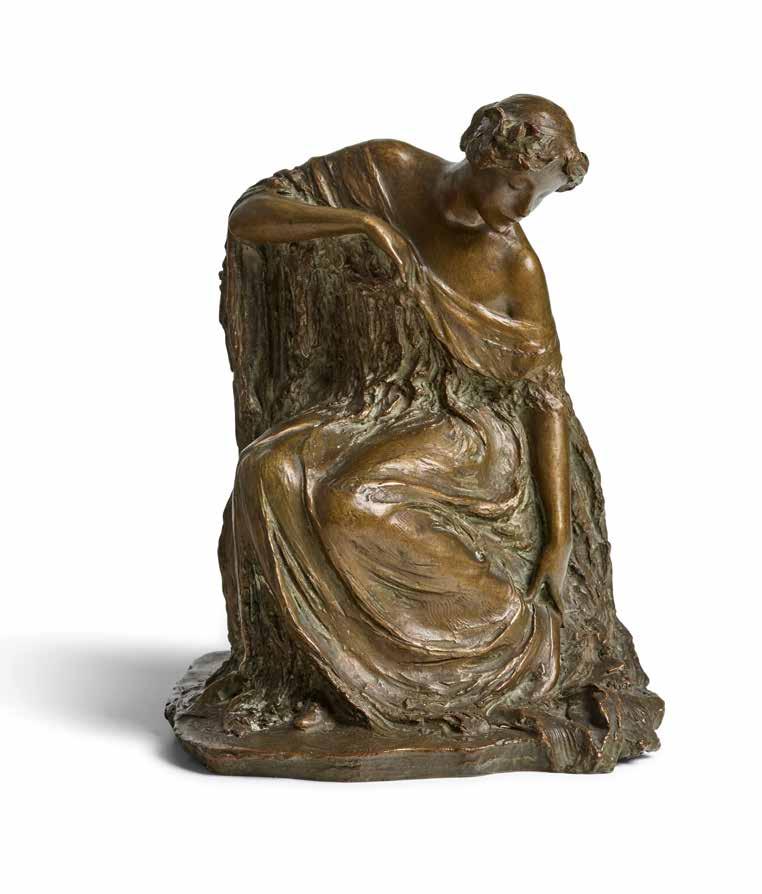
Bessie Potter Vonnoh's Maidenhood (or Cinderella) is one of the most sophisticated works in the artist's oeuvre and exemplifies her perceptive abilities as a modeler. In the present work depicting a seated woman reaching downward to touch her foot, Vonnoh constructed remarkably complex relationships between composition, texture, and pattern while crafting a dynamic narrative that suggests interior space and atmosphere in a new way. Unlike her earlier works where her technique often appears informal to achieve an emphasis on the fundamental desires and emotions that typically characterizes her subjects, Maidenhood (or Cinderella) relies heavily on its controlled handling and its complexities in design to present a refined, intimate depiction of a woman in a moment of quiet, unguarded grace.
By the first decade of the twentieth century, Vonnoh emerged as a singular voice in American sculpture—one attuned to the psychological interiority of her subjects. Maidenhood (or Cinderella) was first exhibited at the 1906 annual exhibition of the Society of American Artists under the title Beatrice and entered the Roman Bronze Works ledgers that same February as Beatrix Lady with Slipper. This initial title carried with it a rich literary tone, possibly an allusion to Beatrice Portinari (12651290) who was immortalized by Dante as the supreme embodiment of feminine beauty and spiritual grace—an association wholly consonant with the idealized refinement of Vonnoh's female figures. It has also been proposed that the name is in reference to Vonnoh's close friend, Beatrice Pope Hoffman (1885–1957), wife of the painter Harry Leslie Hoffman (1871-1964), who was among Vonnoh's most intimate companions and a craftsperson of considerable accomplishment in her own right. (J. Aronson, Bessie Potter Vonnoh: Sculptor of Women, Cincinnati, 2008, p. 134)
By 1910, the sculpture shed its literary identity and was circulating under the title Cinderella, appearing as such in no fewer than six exhibitions before the middle of 1914. Under this guise, the narrative depicted in the present work could be understood as the climactic moment in which the beautiful but lowly maid proves her identity by fitting the slipper returned by the Prince she had met at the ball—yet the connection to the fairy tale was almost certainly fortuitous rather than inadvertent. (J. Aronson, Bessie Potter Vonnoh: Sculptor of Women, p. 134) The figure's dress, though generously draped, bears none of the ragged poverty of Cinderella's condition and the pose is governed by aesthetic rather than narrative logic. Vonnoh herself evidently grew uneasy with the specificity of the Cinderella title. In preparation for a 1914 exhibition, she crossed it out from the checklist and substituted Maidenhood, a title of deliberate openness that dissolves anecdote into archetype.
As Maidenhood, the work offers a timeless meaning and more clearly reveals her affinities for Classicism. Assessed through this lens, Vonnoh likely sought inspiration from the celebrated ancient relief of Victory Adjusting Her Sandal (ca. 410 BC, Acropolis Museum, Athens) from the Temple of Athena Nike on the Athenian Acropolis—one of antiquity's most admired explorations of the draped female form in arrested, intimate movement. Like Victory, Vonnoh's figure is defined by the lyrical fall of drapery, that envelops her lower body in cascading, near-abstract folds, while the torsion of the figure leaves the neck and shoulders beautifully bared. Seated upon a low "Thebes" stool—a studio prop that recurs in several of Vonnoh's compositions—the woman reaches downward with her right hand while her left gently clasps the fabric to preserve her modesty, creating a self-contained world of poise and sensuous restraint. (J. Aronson, Bessie Potter Vonnoh: Sculptor of Women, p. 135) More than any other work in Vonnoh's body of work, Maidenhood (or Cinderella) aligns with the sinuous formal vocabulary of Art Nouveau, and yet its handling of the human figure remains grounded in the classical tradition, making it at once a product of its moment and a work of timeless sculptural authority.
PROPERTY FROM A PROMINENT SONOMA VALLEY COLLECTION
26 W
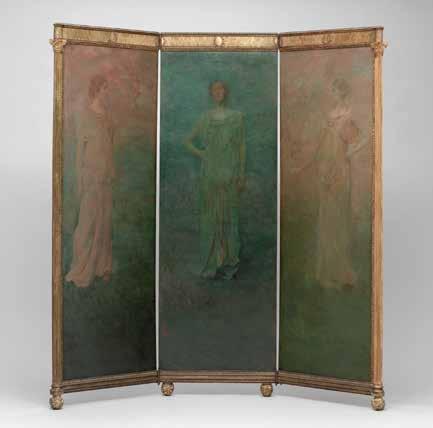
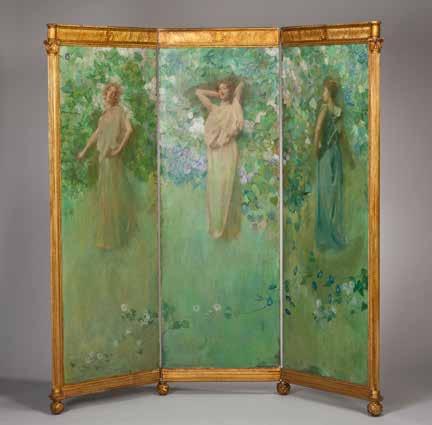
THOMAS WILMER DEWING (1851-1938)
Figures with Blossoms signed ‘TW DEWING’ (each lower left) oil on canvas laid down on panel, each 64 3/4 x 23 3/4 in. (169.6 x 60.3 cm.), each panel Painted in 1900.
$300,000 - 500,000
Provenance
Frank J. Hecker (1846-1927), Detroit, acquired from the artist, 1900. Grace (née Hecker) Beaham (1879-1958), Kansas City, Missouri, daughter of the above, by descent from the above, 1928.
Gordon Beaham II (1906-1986), Kansas City, Missouri, son of the above, by descent from the above, 1958. Private collection, Kansas City, Missouri, circa 1976. By descent to the present owner from the above.
Literature
“CLF to John Gellatly,” Letterpress Books of Charles Lang Freer, November 7, 1900, vol. 7, pp. 7-8.
“Pictures and Objects,” Frank J. Hecker Inventory, undated, Smithsonian Archives of American Art. “Distribution at 5510 Woodward Ave.,” May 1923, Hecker Family Archives. Bulletin of the Detroit Institute of Arts, Spring 1981, vol. 59, no. 1, pp. 8, 14. (as Cherry Blossoms)
J.W. Adams, Decorative Folding Screens: 400 Years in the Western World, New York, 1982, p. 127. (as Cherry Blossoms)
M.K. Komanecky, V.F. Butera, The Folding Image: Screens by Western Artists of the Nineteenth and Twentieth Centuries, exhibition catalogue, Washington, D.C., 1984, p. 159. (as Cherry Blossoms) “Famous Artists Painted Screens,” The Latrobe Bulletin, Latrobe, Pennsylvania, May, 16, 1984, vol. LXXXIII, no. 126, p. 22. (as Cherry Blossoms)
“’The Folding Image’: National Gallery exhibits screenmakers’ art,” The News & Daily Advance, Lynchburg, Virginia, June 17, 1984, vol. 6, no. 48, p. B-8. (as Cherry Blossoms)
E.M. Meyers, “Youthful scholars transform screens into works of art,” The Herald, Dubois County, Indiana, July 20, 1984, p. 33. (as Cherry Blossoms)
K. Pyne, Immanence, Transcendence, and Impressionism in Late Nineteenth-Century American Painting, 1988, p. 325.
D. Strazdes, American Paintings and Sculpture to 1945 in the Carnegie Museum of Art, New York, 1992, pp. 164-66. (as Cherry Blossoms)
S. Hobbs, The Art of Thomas Wilmer Dewing: Beauty Recognized, Washington, D.C., 1996, pp. 28, 141.
S. Paul, “Trail of Lost Art Leads to KC,” Kansas City Star, June 10, 2001, pp. 1, 14.
S. Hobbs, Thomas Wilmer Dewing: Beauty into Art, A Catalogue Raisonné, New Haven, Connecticut, 2018, vol. I, pp. 46, 252, 267, 298-302, vol. II, p. 1048, no. 129.
The frame for the screens is an original frame designed by Stanford White, consisting of two fluted columns with Corinthian capitals.
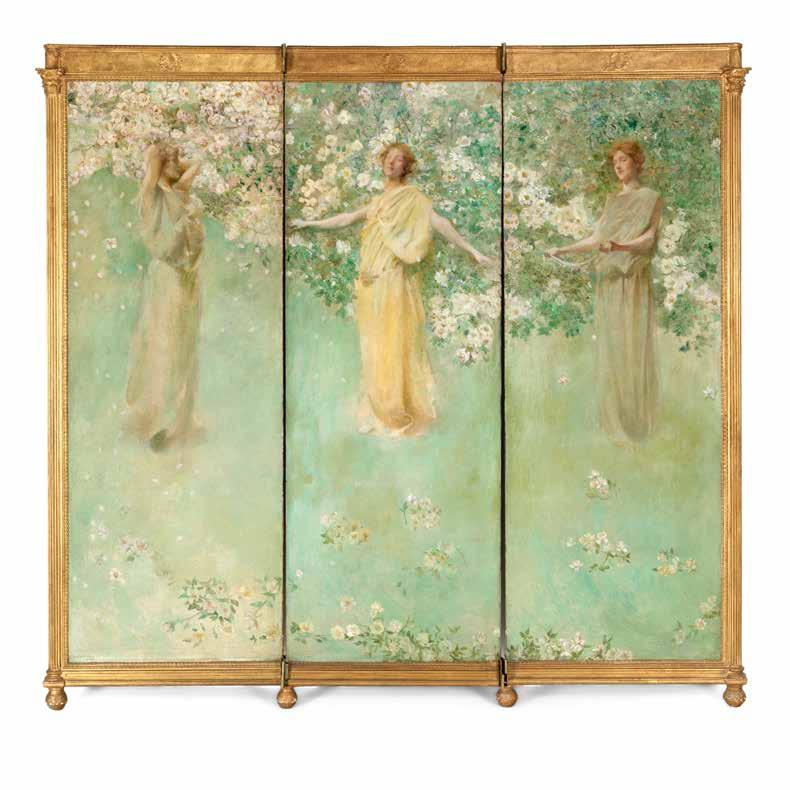
Thomas Wilmer Dewing’s multi-panel painted screen, Figures with Blossoms, completed in 1900 is a tour de force within the artist’s oeuvre and, with its superb treatment of color and gentle, diffuse light, represents one of his most ambitious contributions to Tonalist painting. A master draftsman and exquisite colorist, Dewing is celebrated as a principal figure of the Tonalism movement in America at the turn of the twentieth century—a movement that embraced the American Aesthetic movement’s ethos that privileged mood, harmony, and the poetic suggestiveness of form over visual narrative. Commanding the multi-panel screen format, Figures with Blossoms stands among Dewing’s finest mature works and demonstrates his belief that the purpose of the artist is to “see beautifully.” (as quoted in S.A. Hobbs, The Art of Thomas Wilmer Dewing: Beauty Reconfigured, exhibition catalogue, New York, 1996, p. 1)
Born in Boston in 1851 to Paul Dewing (1805–1863) and Sophronia Durant Dewing (1811–1899), Thomas Wilmer Dewing received his initial artistic training as a lithographer’s apprentice under master lithographer Dominique Fabronius. This apprenticeship sharpened both his eye and hand before he undertook formal study at the Lowell Institute. Dewing became known for his meticulously executed black-and-white chalk portraits, attracting the attention of his first known patrons, Peter Gansevoort (1789-1876) and Susan Lansing Gansevoort (1843-1874). With the funds earned from completing their portraits during a productive sojourn to their Albany residence between 1875 and 1876, Dewing traveled to Paris, where he enrolled at the newly founded Académie Julian—becoming one of the first Americans later to achieve a notable artistic reputation to do so. There, he studied under Gustave Clarence Rodolphe Boulanger (1824–1888) and Jules Joseph Lefebvre (1836–1911), masters of academic painting and specialists in the anatomical rendering of the female figure. In their ateliers, Dewing acquired the careful delineation of volumetric form and meticulous evocation of texture that would remain hallmarks of his mature work.

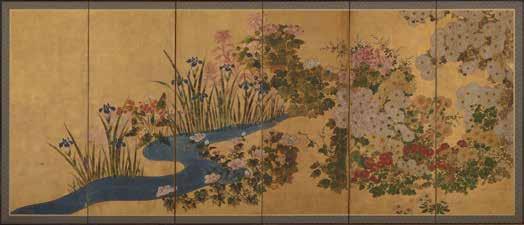
Japan, Edo period (1615-1868), Flowers and a Brook. Folding screen, color and gold paper, each panel, 69 1/4 x 60 1/4, Smithsonian National Museum of Asian Art, Freer Gallery of Art Collection, F1897.27—28.
Returning to America in the fall of 1877, Dewing eventually settled in New York City in mid-October 1880 and married the accomplished painter, Maria Richards Oakey (1845-1927) the following year. Her refined eye and circle of aesthetic acquaintances proved enormously consequential to Dewing’s artistic development. Through Maria, he joined the coterie surrounding writer and editor Richard Watson Gilder (1844-1909) and his wife Helena de Kay Gilder (1846-1916), staunch champions of the American Aesthetic movement. He subsequently attracted the patronage of two discerning collectors: Charles Lang Freer (1854–1919), the Detroit railroad-car manufacturer, and John Gellatly (1853–1931), the insurance magnate. Both assembled significant holdings of Dewing’s work and their connoisseurship ensured him an audience sympathetic to his aesthetic ambitions.
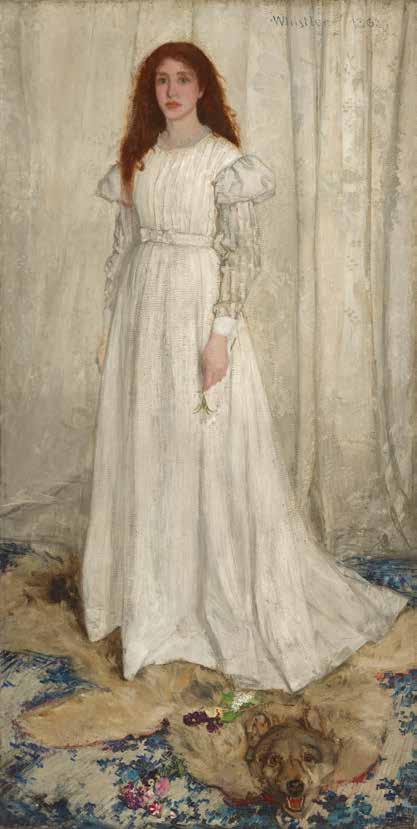
Dewing’s mature style emerged from a convergence of sources: the tonal restraint and simplified pictorial design of James Abbott McNeill Whistler (1834–1903); the compositional clarity of Northern Renaissance painting, particularly the work of Jan Vermeer (1632–1675); the classicizing figure arrangements of the British Aesthetic painters Albert Joseph Moore (1841–1893) and Lawrence Alma-Tadema (1836–1912); and, importantly, the influence of Japanese art, especially woodblock printing and screen painting traditions. From Whistler in particular, Dewing learned to elevate color, tone, and surface harmony above narrative content—a lesson he first absorbed from Whistler when Symphony in White No. 1: The White Girl (1861–63, National Gallery of Art, London) was exhibited in New York in 1881. From Japanese sources, he adapted shallow, frieze-like spatial arrangements and an emphasis on decorative patterning. As a result, Dewing’s figures appear less as individualized portraits and more as timeless presences suspended within dreamlike compositions.
Within this context, Dewing’s rare and highly evocative screen paintings assume particular importance. While abroad with his family, he encountered the European craze for multi-panel folding screens. In November 1894, Dewing accompanied Freer to Whistler’s Paris studio, where he saw Blue and Silver: Screen with Old Battersea Bridge (1871-72, The Hunterian, University of Glasgow, Scotland)—a work that inspired Dewing to produce his own variation of the painted screen. A year later, Freer imported a dozen Japanese screens, such as Flowers and a Brook (Edo period, Freer Gallery of Art, Smithsonian National Museum of Asian Art, Washington, D.C.), further encouraging Dewing’s exploration of the format. Aside from Whistler and Albert Pinkham Ryder (1847–1917), few American artists had worked in this medium, yet Dewing embraced it fully, becoming one of its most prolific practitioners. (S. Hobbs, Thomas Wilmer Dewing: Beauty into Art, A Catalogue Raisonné, New Haven, 2018, p. 280)
In 1900, Dewing painted a pair of three-panel screens in the European tradition for Freer’s neighbor and business partner, Frank J. Hecker (1846–1927): Morning Glories (Carnegie Museum of Art, Pittsburgh) and the present work, Figures with Blossoms. He had previously completed a pair of three-panel screens for Hecker in 1898 titled Classical Figures (Detroit Institute of Arts; Heckscher Museum of Art, Huntington, New York). Concerned that these earlier works were too dark for the Hecker mansion, Dewing produced a second pair featuring more luminous compositions of classically draped figures set among morning glories and flowering branches.
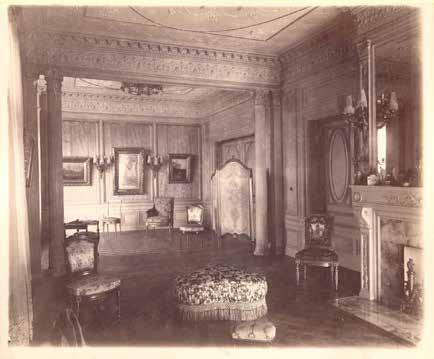
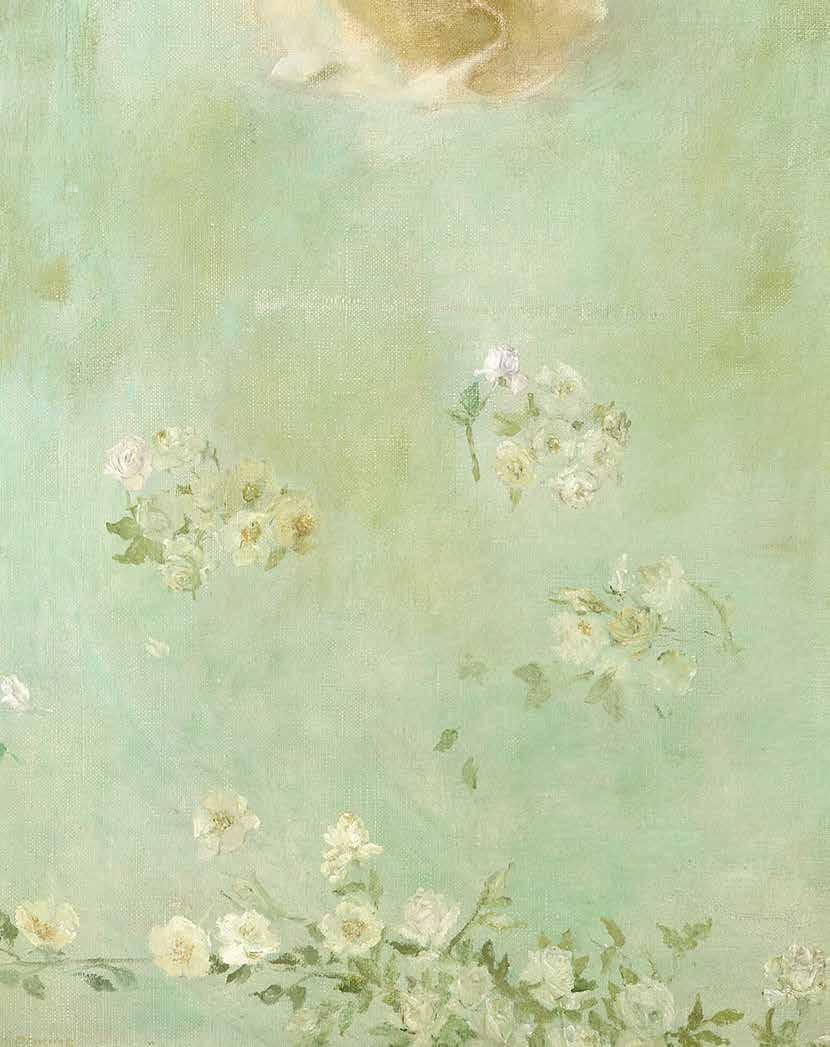
Comprising three vertical panels, each housed within a gilded frame designed by Stanford White (1853-1906), Figures with Blossoms depicts three elongated, classically dressed female figures enveloped in a soft haze of blossoming foliage, likely inspired by the lush greenery and woodland sounds of Cornish, New Hampshire where he spent summers with his family and friends. The composition is unified by a luminous, green-toned ground that dissolves conventional perspective, creating a shallow atmospheric field in which figures and floral motifs intertwine. For his figures, Dewing occasionally used models dressed in classical Greek costume, however, he may have also sought inspiration from Greek Tanagra figures from the fourth and third centuries B.C., which Freer and Hecker both acquired in the early 1890s with Dewing’s assistance. (S. Hobbs, Thomas Wilmer Dewing: Beauty into Art, A Catalogue Raisonné, p. 280)
A formal analysis of the central panel reveals Dewing’s consummate control of line and tone. The central figure, clad in a diaphanous, golden drapery, extends her arms outward in a gesture that is at once expansive and restrained. Her elongated proportions and gently inclined head evoke a sense of introspective reverie, while the soft modulation of light across her form creates a subtle interplay between corporeality and dissolution. The surrounding blossoms— rendered with delicate, almost pointillist touches—function not merely as decorative embellishments but as integral components of the compositional rhythm, echoing the figure’s gesture and distributing visual weight across the panel.
The flanking figures, by contrast, introduce variations on the central motif. On the left, the figure appears partially obscured, her form dissolving into the ambient field, suggesting ephemerality and transition. On the right, a more contained posture, with hands gathered before the body, conveys a quieter introspection. Together, the three figures establish a lyrical progression across the screen, akin to a visual triptych, yet without narrative resolution. This lateral sequencing encourages the viewer to read the work as a continuum of states— perhaps seasonal, emotional, or symbolic— rather than discrete episodes.
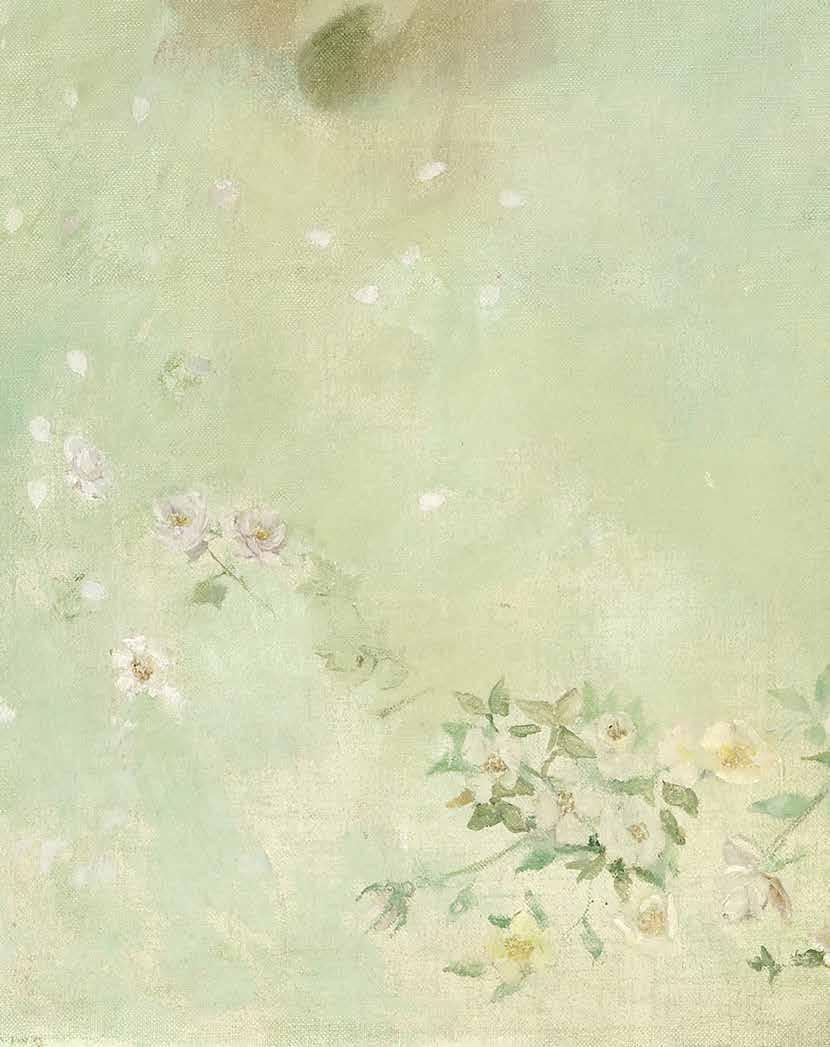
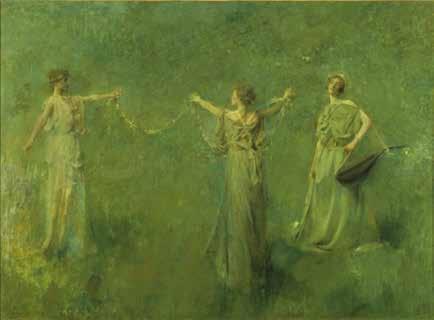
Chromatically, Figures with Blossoms exemplifies Dewing’s mastery of Tonalism. The restrained palette—dominated by soft greens, creams, and muted golds—creates a harmonious unity that is both soothing and subtly radiant. Painted on canvas, rather than directly on panel, Dewing achieves a soft and diffused effect reminiscent of the execution found in his pastels. Dewing worked out his color and technique for both Figures with Blossoms and Morning Glories in The Garland (1899, Private collection) painted the year prior, employing the same models with the central figures displaying nearly identical yet inverted poses (S. Hobbs, Thomas Wilmer Dewing: Beauty into Art, A Catalogue Raisonné, p. 292) The absence of strong contrasts or sharply defined contours enhances the work’s dreamlike quality, while the repeated motif of white blossoms and leaves stemming from spreading vines adopted from Freer’s Japanese screens introduces moments of visual punctuation. These blossoms, floating and scattered across the panels, further destabilize spatial coherence, reinforcing the sense of an immersive, enveloping environment rather than a fixed pictorial space.
Figures with Blossoms encapsulates Dewing’s artistic vision at its most refined: an art of suggestion, atmosphere, and quiet elegance. By adapting the screen format, he transcended the conventional boundaries of easel painting, creating an object that is simultaneously pictorial and architectural, intimate and expansive. In doing so, Dewing not only aligned himself with international aesthetic currents but also contributed to a uniquely American interpretation of decorative modernity. Figures with Blossoms stands today as a testament to Dewing’s ability to transform the simple motif of the female figure into a vehicle for profound aesthetic experience—an achievement that continues to resonate within both art-historical scholarship and the marketplace.
27
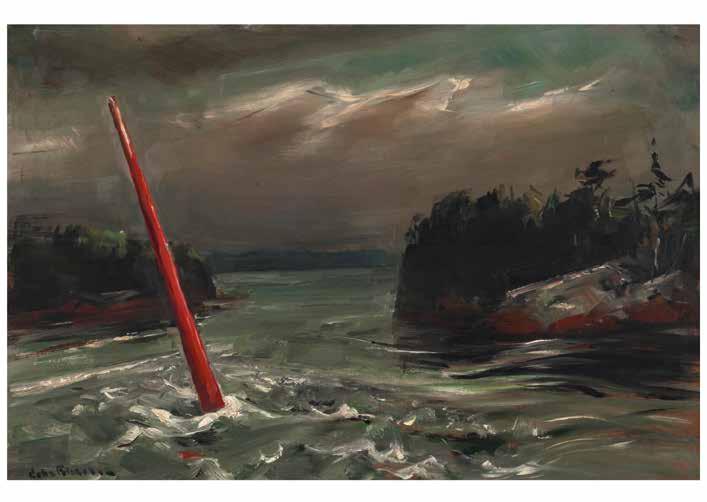
JOHN FULTON FOLINSBEE (1892-1972)
Untitled (Gray Inlet with Red Spar) signed ‘John Folinsbee’ (lower left) oil on Masonite
16 x 23 7/8 in. (40.6 x 60.6 cm.)
$6,000 - 8,000
Provenance
Private collection, New York, by 1970.
Gift to the present owner from the above, son of the above, 2000.
We wish to thank the Folinsbee Art Trust for their assistance in the cataloguing of this lot. This work is included in the John Folinsbee catalogue raisonné under no. JFF.1749, which can be accessed online at www.johnfolinsbee.org.
PROPERTY FROM A PRIVATE COLLECTION, KINGSTON, WASHINGTON
28
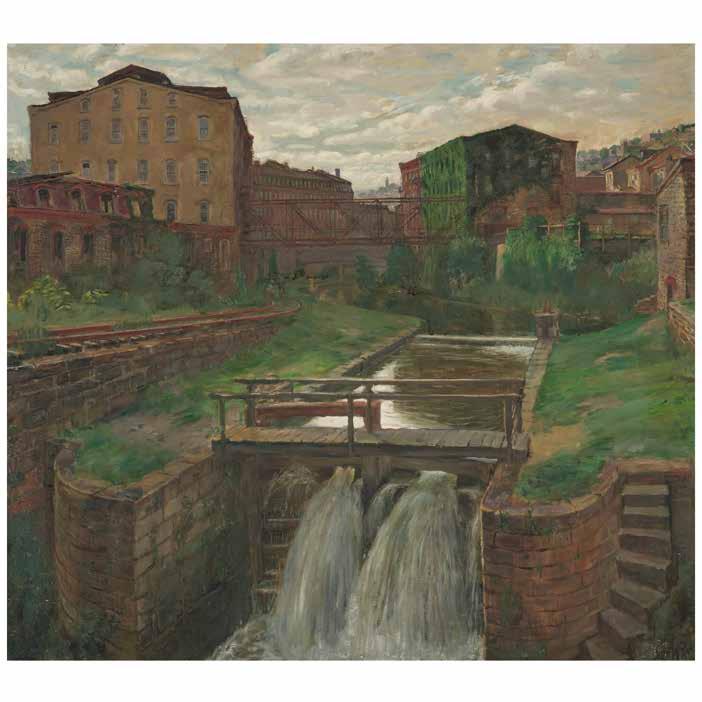
FRANCIS SPEIGHT (1896-1989)
Venice Island: Old Mills and Lock signed ‘Speight’ (lower right) oil on canvas
36 x 40 in. (91.4 x 101.6 cm.) Painted circa 1951.
$15,000 - 25,000
Provenance
Robert Sturgis Ingersoll, Sr. (1891-1973), Philadelphia, acquired from the artist, 1956.
Private collection, by descent within the family of the above, 2025. Sale, Crawford Family Auctions LLC, Tumwater, Washington, October 12, 2025, lot 212, sold by the above. Acquired by the present owner at the above sale.
Exhibited
Philadelphia, Pennsylvania Academy of the Fine Arts, One Hundred and Fifty-First Annual Exhibition of Painting and Sculpture, January 22-February 26, 1956, no. 236.
Literature
P.H. Falk, A.A. Bien, eds., The Annual Exhibition Record of the Pennsylvania Academy of the Fine Arts: Volume III, 1914-1968, Madison, Connecticut, 1989, p. 437, no. 236.
29
ROBERT SPENCER (1879-1931)
A River Town
signed ‘Robert Spencer.’ (lower left) and inscribed with title and signed again (on the stretcher) oil on canvas
30 x 36 in. (76.2 x 91.4 cm.)
Painted circa 1920.
$150,000 - 250,000
Provenance
Spanierman Gallery, New York, by 1988. (as New Hope, Pennsylvania)
Private collection, Palo Alto, California, acquired from the above, December 2, 1988. By descent to the present owners from the above, 2025.
Exhibited
New York, National Academy of Design, Winter Exhibition, November 18-December 18, 1921, p. 16, no. 243.
New York, Milch Galleries, April 1923.
Buffalo, New York, The Buffalo Fine Arts Academy, Albright Art Gallery, Eighteenth Annual Exhibition of Selected Paintings and Small Bronzes by American Artists, April 20-June 30, 1924, pp. 21, 80, 110, no. 213, illustrated.
Illinois, Decatur Art Institute, New Years Open House, January 1926.
Philadelphia, League Island Park, Fine Arts Building, Paintings, Sculpture, and Prints in the Department of Fine Arts: Sesqui-Centennial International Exposition, June 1-December 1, 1926, p. 66, no. 187, illustrated. Omaha, Nebraska, Joslyn Memorial, 1939.
Literature
“A Fine ‘American Show’,” The Art News, New York, vol. XXI, no. 29, p. 2.
“Annual Show of American Art at Albright,” Buffalo Evening News, New York, April 19, 1924, vol. LXXXVIII, no. 8, p. 8.
The Buffalo Fine Arts Academy, Academy Notes, Buffalo, New York, January-June 1924, vol. XIX, no. 1, pp. 54, 88, illustrated.
“New Years Open House at Art Institute: Art Class Receives from 4 to 6, and Exhibit from Carson Pirie Scott Galleries Go on View,” Decatur Herald, Illinois, January 1, 1926, p. 3.
M.C. Pollard, “Spencer’s ‘River Town’ at Memorial,” Sunday World-Herald, Omaha, Nebraska, January 22, 1939, yr. 54, no. 17, sec. C, p. 8-C.
P.H. Falk, A.A. Bien, eds., The Annual Exhibition Record of the National Academy of Design: 1901-1950, Madison, Connecticut, 1990, p. 486, no. 243.
B.H. Peterson, The Cities, the Towns, the Crowds: The Paintings of Robert Spencer, Doylestown, Pennsylvania, 2004, p. 158.
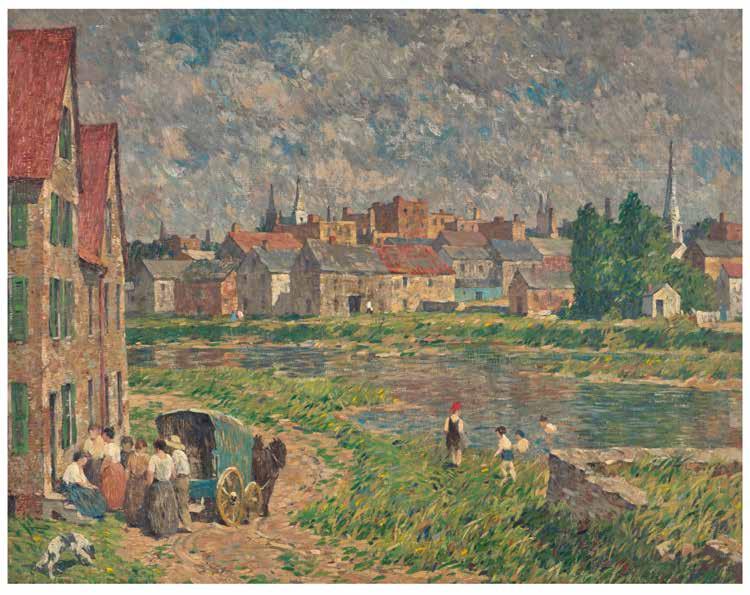
A pioneering member of the Pennsylvania Impressionist movement centered in Bucks County, Robert Spencer occupies a notable position within early twentieth-century American art. Spencer’s work diverges from the purely landscape-oriented aesthetic favored by many of his contemporaries toward a personal visual language that merged Impressionist handling of light and color with a deep interest in the lived environments of workingclass communities. His paintings frequently depict modest river towns, canals, mills, and tenements along the Delaware River, transforming ordinary settings into compositions of remarkable vitality and poetic resonance. Today Spencer is regarded as one of the most compelling interpreters of small-town American life during the Progressive Era.
Born in Harvard, Nebraska, in 1879, Spencer initially intended to pursue a career in medicine before turning decisively toward art at the close of the nineteenth century. He enrolled at the National Academy of Design in New York in 1899 and later studied with leading figures of the American art world, including William Merritt Chase (1849-1916) and Robert Henri (1865-1929). Though it is not certain when or for how long Spencer studied under Henri, his work and the work of the group of artists he led known as The Eight or the Ashcan had a profound influence on Spencer’s artistic development and he absorbed their unsentimental yet loving approach to realism. (B.H. Peterson, The Cities, the Towns, the Crowds: The Paintings of Robert Spencer , Doylestown, Pennsylvania, 2004, p. 23) Spencer’s artistic training provided him with a strong foundation in figure painting and composition while encouraging an engagement with modern urban subject matter—people and buildings—that remained central to his mature work.
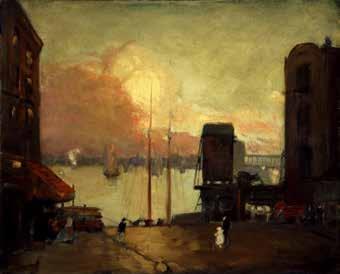
In 1906 Spencer relocated to New Hope, Pennsylvania, where he became associated with the colony of painters that would later be known as the New Hope School of Pennsylvania Impressionism. Artists such as Daniel Garber (1880-1958), with whom Spencer studied privately under, Edward Willis Redfield (1869-1965), and William Langson Lathrop (1859-1938) were drawn to the area for its picturesque landscapes and atmospheric river views. Spencer absorbed Garber’s refined sense of light color, and compositional structure. However, while Garber’s views of New Hope emphasize serene, idealized landscapes, Spencer distinguished himself by focusing less on untouched nature and more on the everyday life of the towns of Bucks County—their factories, bridges, workers, and riverbanks. As Spencer famously remarked, “a landscape without a building or a figure is a very lonely picture,” a statement that reveals the centrality of human presence in his artistic vision. (B.H. Peterson, The Cities, the Towns, the Crowds: The Paintings of Robert Spencer , p. 21)
Throughout the 1910s and 1920s, Spencer enjoyed increased recognition within American art circles. He won awards at both the Art Club of Philadelphia and the National Academy of Design in 1913 and one of his seminal paintings, Repairing the Bridge (1913) was purchased by the Metropolitan Museum of Art the following year. (B.H. Peterson, The Cities, the Towns, the Crowds: The Paintings of Robert Spencer , p. 4) Critics admired Spencer’s ability to transform humble architectural environments into vibrant painterly arrangements, combining strong compositional structure with a lively, broken brushstroke characteristic of Impressionism. At the same time, his work maintained a realism that emphasized the rhythms of daily life within the industrializing American landscape.
Within Spencer’s oeuvre , depictions of the riverside towns that populate the Delaware River represent some of his most evocative achievements. The region provided an inexhaustible source of imagery: narrow streets, clustered stone houses, church spires, canal boats, and grassy riverbanks populated by townspeople engaged in routine activities. These compositions frequently juxtapose built and natural environments, using water as both a compositional anchor and a reflective surface that unifies the scene. Spencer’s abbreviated brushwork and carefully balanced palette allowed him to capture fleeting effects of light while preserving the solidity of architecture and figures.
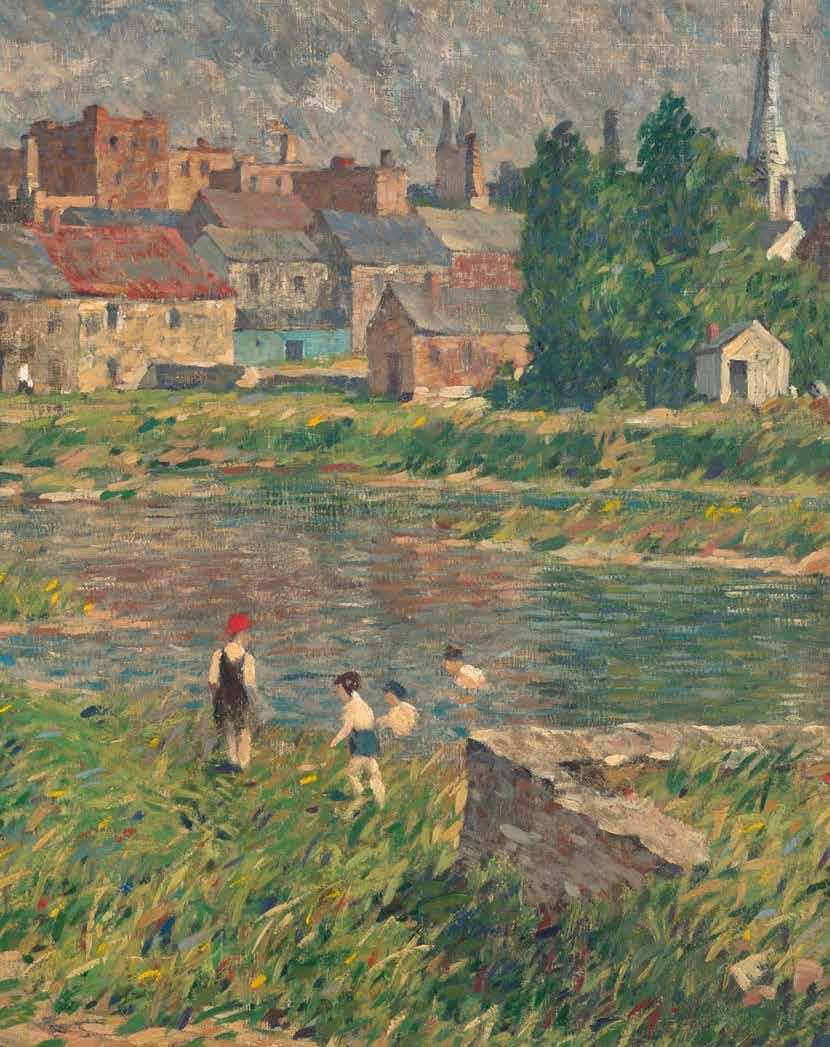
Painted around 1920, A River Town represents a mature expression of Spencer’s approach to the subject. The composition unfolds in a wide panoramic format, with the viewer positioned along the grassy bank of a quiet river. In the foreground a cluster of figures gathers beside a modest brick building and a covered wagon, while others occupy the river’s edge or wade into the water. Beyond the river stretches a dense arrangement of stone houses, barns, and industrial buildings punctuated by slender church steeples that rise against a textured sky. This layering of foreground, middle ground, and distant skyline creates a sense of spatial depth while maintaining the flattened pictorial rhythm characteristic of Spencer’s design.
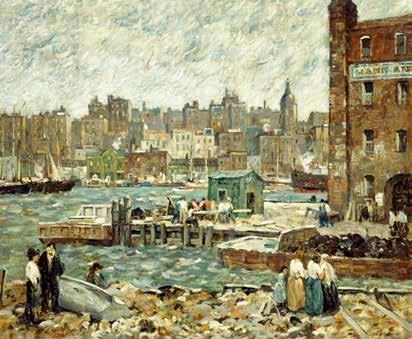
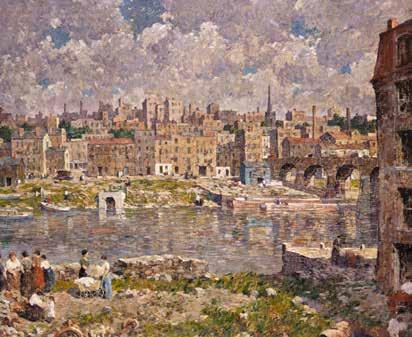
The compositional structure of the present work reveals Spencer’s sensitivity to compositional balance. The vertical mass of the building at left anchors the scene, directing the viewer’s eye toward the riverbank and across the water to the clustered architecture beyond. Spencer organizes the composition through horizontal bands—grass, river, town, and sky—while the scattered figures introduce movement and narrative interest. The town itself appears slightly elevated in the distance, its warm ochres and brick reds contrasting with the cooler greens and blues of the foreground vegetation and water. While Spencer would notably repeat the compositional structure employed in the present work for his views of New York’s East River and Harlem River, such as in The Other Shore (1923, Smithsonian American Art Museum, Washington, D.C.) and Weather (1925, New Hope Museum of Art, Pennsylvania), the emotional tone of his riverside views of New Hope and other towns along the Delaware River would be unparalleled.
Equally compelling in the present work is Spencer’s paint handling. His brushwork is lively yet controlled, composed of small, broken strokes that animate the surface of the canvas. The sky, built from dense dabs of blue, gray, and cream, creates an atmospheric canopy over the town, suggesting shifting weather and diffused light. In the foreground grasses, flecks of yellow and green evoke the shimmering movement of summer vegetation. Reflections ripple across the river in horizontal strokes that echo the town’s architecture, subtly unifying land and water. Through this painterly technique Spencer captures both the immediacy of the moment and the enduring presence of the community.
A River Town encapsulates the qualities that distinguish Spencer within the broader narrative of American Impressionism. While his contemporaries often celebrated untouched rural scenery of Bucks County, Spencer turned his attention to the humanized landscape— places where industry, architecture, and daily life intersected along the Delaware River. In doing so, Spencer elevated ordinary towns into subjects of poetic contemplation, revealing a deeply American expression grounded in everyday experience. A River Town is a remarkably eloquent testament to Spencer’s ability to transform modest environments of small-town America into richly orchestrated compositions of light, color, and social life.
PROPERTY FROM A PRIVATE COLLECTION
30
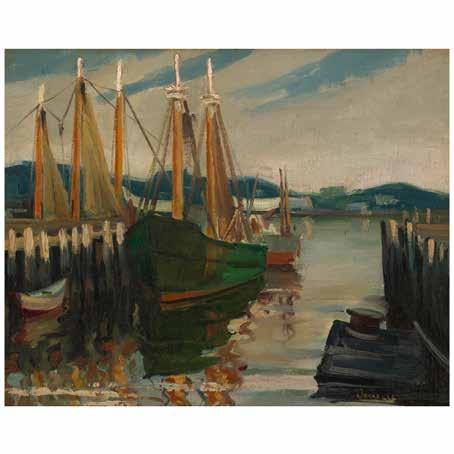
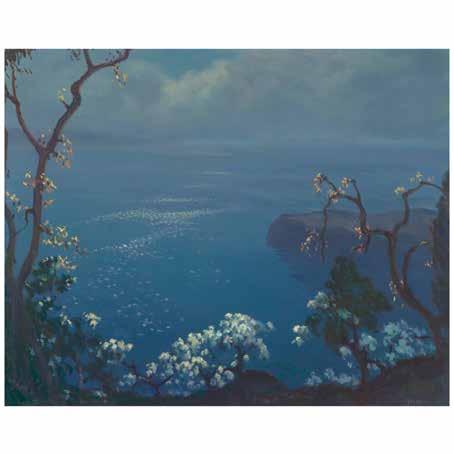
JONAS LIE (1880-1940)
Ships in the Cove signed ‘Jonas Lie’ (lower right) oil on canvas laid down on Masonite 16 x 20 in. (40.6 x 50.8 cm.)
$8,000 - 12,000
Provenance
The Marbella Gallery, Inc., New York. Acquired by the present owner from the above, October 26, 1989.
PROPERTY FROM A PRIVATE COLLECTION, NORTHERN CALIFORNIA
31
FRANK MONTAGUE MOORE (1877-1967)
Dogwood on Hudson signed ‘FM Moore’ (lower right) and inscribed with title and signed again (on the reverse) oil on Masonite
29 1/4 x 36 in. (74.3 x 91.4 cm.)
$3,000 - 5,000
Provenance
Carmel Art Association, Carmel, California. (as Dogwood on the Hudson).
Acquired by the present owner from the above.
Exhibited (possibly) Philadelphia, Pennsylvania Academy of the Fine Arts, 1922, p. 25, no. 83. (as Dogwood on the Hudson).
Literature (possibly) P.H. Falk, A.A. Bien, eds., The Annual Exhibition Record of the Pennsylvania Academy of the Fine Arts: Volume III, 19141968, Madison, Connecticut, 1989, p. 333, no. 83. (as Dogwood on the Hudson).
32
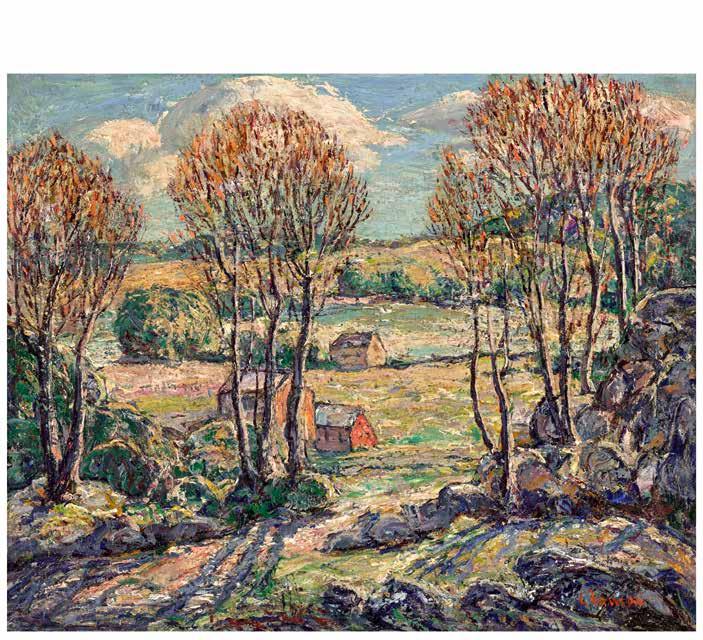
ERNEST LAWSON (1873-1939)
Landscape with Red Barn signed ‘E. LAWSON’ (lower right) oil on canvas
18 1/8 x 22 1/8 in. (46 x 56.2 cm.)
$20,000 - 30,000
Provenance
Private collection, New York. Estate of the above.
Sale, Clarke Auction Gallery, Larchmont, New York, October 8, 2017, lot 40, sold by the above.
Acquired by the present owner at the above sale.
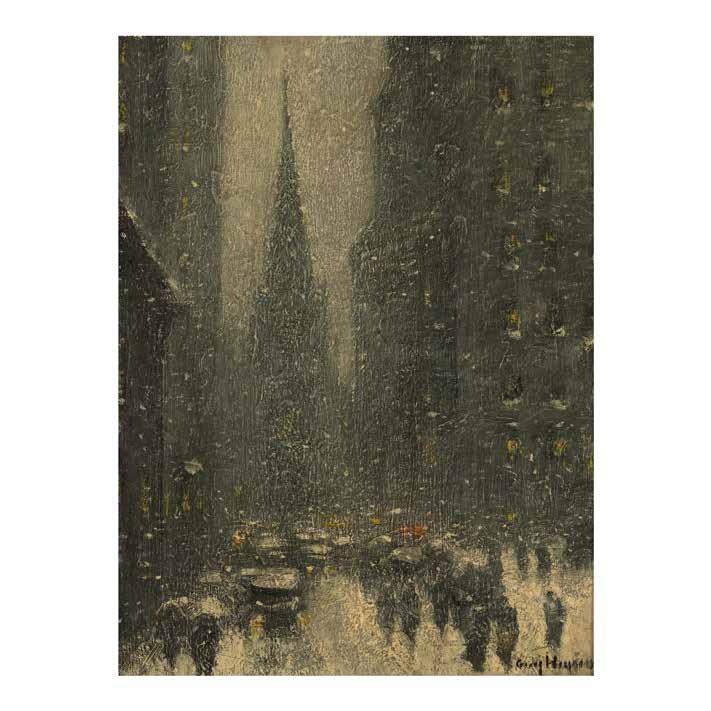
GUY CARLETON WIGGINS (1883-1962)
Old Trinity, New York Winter signed ‘Guy Wiggins’ (lower right) and inscribed with title, signed again and dated ‘1930’ (on the reverse) oil on canvas
16 x 12 in. (40.6 x 30.5 cm.)
Painted in 1930.
$30,000 - 50,000
Meredith Long & Company, Houston. Private collection, Texas. Sale, Freeman’s, Philadelphia, December 4, 2011, lot 98, sold by the above.
Acquired by the present owner at the above sale.
A copy of the letter of authenticity issued by Guy Arthur Wiggins (1920-2020), the son of the artist, dated November 29, 2011, accompanies this lot.
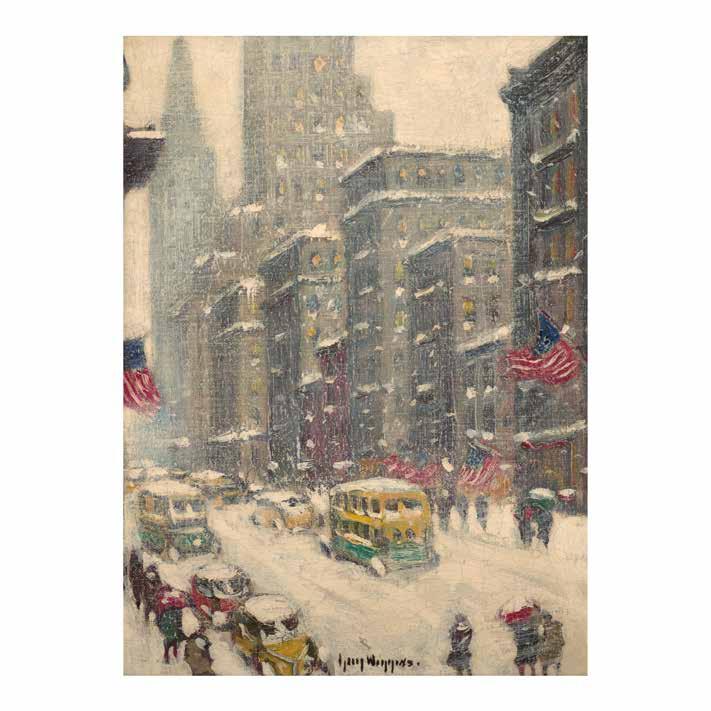
GUY CARLETON WIGGINS (1883-1962)
5th Ave, Midtown, Winter
signed ‘Guy Wiggins.’ (lower center) and inscribed with title and signed again (on the reverse) oil on canvasboard
12 x 9 in. (30.5 x 22.9 cm.)
Painted circa 1940s.
$20,000 - 30,000
[With] Hammer Galleries, New York. Private collection, New York. Private collection, Minnesota, by descent from the above. David Findlay Jr., Inc., New York. (as Fifth Avenue Midtown, Winter) Acquired by the present owner from the above, November 11, 2008.
This lot is accompanied by a letter of authentication from Noel Wiggins. We would like to thank Noel Wiggins for his kind assistance in cataloguing this lot.
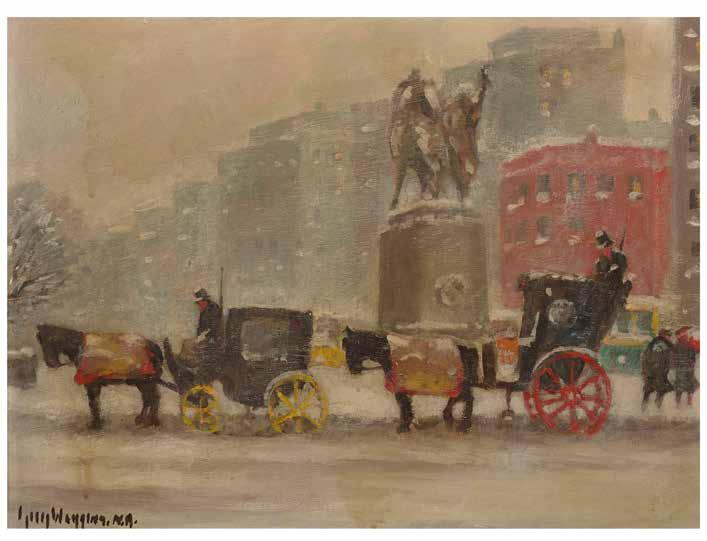
35
(1883-1962)
An Old Fashion Winter, New York signed ‘Guy Wiggins, N.A.’ (lower left) and inscribed with title, signed again and dated ‘1959’ (on the reverse) oil on canvasboard
Private collection, New York. Acquired by the present owner from the above, 2024.
This lot is accompanied by a letter of authentication from Noel Wiggins. We would like to thank Noel Wiggins for his kind assistance in cataloguing this lot. 35
11 7/8 x 15 7/8 in. (30.2 x 40.3 cm.) Painted in 1959.
$6,000 - 8,000
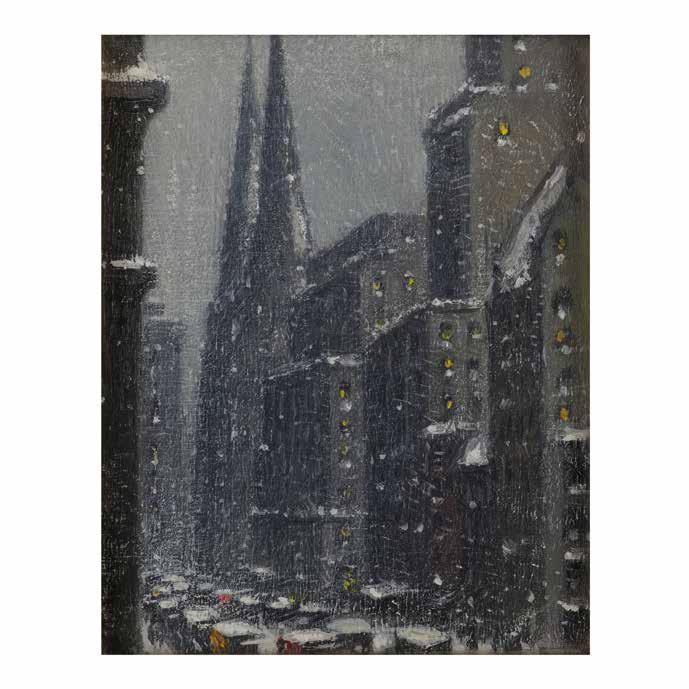
PROPERTY FROM A PRIVATE COLLECTION, TENNESSEE
36 GUY CARLETON WIGGINS (1883-1962) Fifth Ave.
inscribed with title and signed ‘Guy Wiggins’ (on the reverse) oil on canvasboard
10 x 8 in. (25.4 x 20.3 cm.)
$10,000 - 15,000
By descent within the family of the present owner.
Exhibited New York, Salmagundi Club, Thumb Box Exhibition, n.d.
This lot is accompanied by a letter of authentication from Noel Wiggins. We would like to thank Noel Wiggins for his kind assistance in cataloguing this lot.
37
ROBERT HENRI (1865-1929)
Manus
signed ‘Robert Henri’ (lower right) and signed again and inscribed and dated ‘IRELAND 1913’ and inscribed with title (on the reverse) oil on canvas
24 1/4 x 20 1/8 in. (61.6 x 51.1 cm.)
Painted in 1913.
$50,000 - 70,000
Provenance
St. Mark’s, New York, 1914.
Folsom Galleries, New York, 1914. Gage, Cleveland, Ohio, February 1915. Young Gallery, Chicago, February 1916. Macbeth Gallery, New York, 1916. Young Gallery, Chicago, 1919.
Paul Schulze, Esq., Chicago, acquired from the above, April 14, 1919.
Sally Turner Gallery, Phoenix, by 1973.
Dr. William de Hayden, Paris, Texas, acquired from the above, December 1, 1973. Pamplin Collection, by 2025.
Acquired by the present owner from the above, September 2025.
Exhibited
Minnesota, Minneapolis Society of Fine Arts, Loan Exhibition of Modern Art, February 14-March 1, 1914, n.p., no. 10.
Art Institute of Chicago, Exhibition of Paintings from the Collection of Paul Schulze, July 18-October 11, 1929, and elsewhere.
Literature
“At the Modern Art Exhibition,” The Minneapolis Journal, February 15, 1914, p. 6, illustrated.
“Exhibit of Modern Art Opens at Library Today: Represents Best Work of Well Known Artists of This Country and Europe,” The Minneapolis Sunday Tribune, February 15, 1914, vol. XLVII, no. 57, p. 9.
“Loan Collection of Modern Art Proves Excellent Show: Is the Best Collection Seen Here This Winter,” The Minneapolis Sunday Tribune, February 22, 1914, vol. XLVII, no. 64, p. 13.
W. Yarrow, L. Bouche, eds., Robert Henri: His Life and Works with Forty Reproductions, New York, 1921, pp. 9, 102-103, illustrated.
“Current Opinion,” V. 71, December 1921, p. 794.
N. Pousette-Dart, Distinguished American Artists: Robert Henri, New York, 1922, n.p., illustrated. C. Lee, Contemporary American Portrait Painters: Illustrating and Describing the Work of Fifty Living Painters, New York, 1929, p. 34.
We are grateful to Valerie Ann Leeds, PhD, for her assistance in researching this lot.
The summer of 1913 marked a pivotal moment in the career of Robert Henri. His first visit to Ireland sparked a surge of creativity and introduced new directions in his artistic practice. There, he encountered a wealth of unfamiliar subjects and potential sitters, particularly among the local population, whom he would immortalize in his celebrated portraits. Henri was especially drawn to children, as seen in the present work, and would go on to paint hundreds of them during his stays in 1913, and later in 1924 and 1928. As noted by art historian William Inness Homer, these subjects “usually range from ten to sixteen years of age, a period of precious innocence and naiveté that Henri glorified as an antidote to the evils of over sophistication that stifled man when he reached adulthood” (W. I. Homer Robert Henri and His Circle, New York, 1969, p. 249).
Manus reflects the stylistic hallmarks of Henri’s portraiture during this period of artistic exploration. The sitter’s expressive gaze draws the viewer in, while simultaneously revealing Henri’s conception of the subject as an artistic device meant to actively engage the observer, “establishing the subject as a living, communicating being” (W. I. Homer Robert Henri and His Circle, New York, 1969, p. 252). Perched upright, Manus embodies the curiosity and innocence displayed by his fellow sitters from this chapter in Henri’s career.
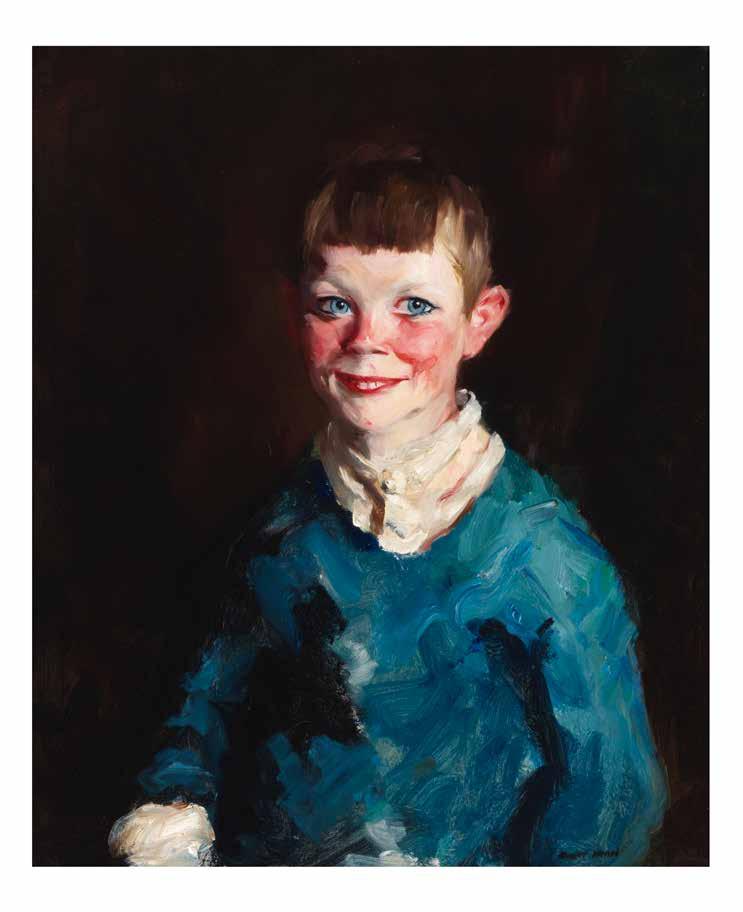
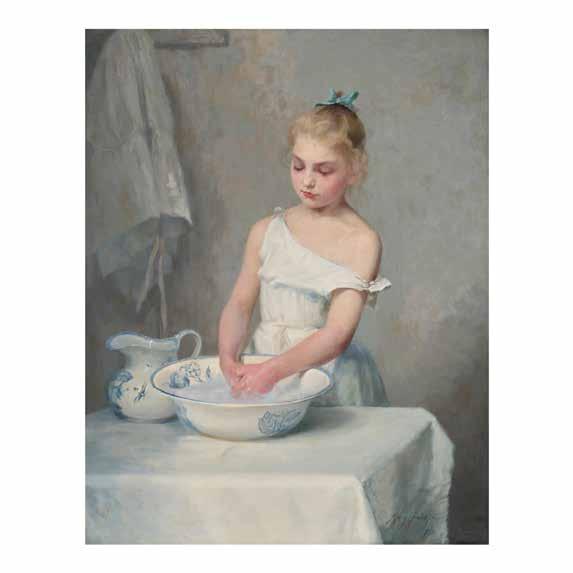
PROPERTY FROM A PRIVATE COLLECTOR, NEW YORK
38
MARY JETT FRANKLIN (1842-1928)
La Toilette
signed and inscribed ‘Mary Franklin - / Paris’ (lower right) oil on canvas
39 1/2 x 31 in. (100.3 x 78.7 cm.)
Painted circa 1895.
$3,000 - 5,000
Provenance
Sale, Case Auctions, Knoxville, Tennessee, January 25-26, 2025, lot 169.
Acquired by the present owner at the above sale.
Exhibited
Paris, Société Nationale Des Beaux-Arts, Exposition de 1896, April 1896, pp. XV, p. 67, no. 536, illustrated.
Art Institute of Chicago, Ninth Annual Exhibition of Oil Paintings and Sculpture by American Artists, October 20-December 6, 1896, p. 24, no. 133.
Philadelphia, Pennsylvania Academy of the Fine Arts, Sixty-Sixth Annual Exhibition, December 21, 1896-February 22, 1897, p. 18, no. 100. (possibly) Paris, American Woman’s Art Association, December 12-24, 1897.
Literature
“Fine American Exhibit, Many Contributions from the United States at the Champ de Mars Salon. These Pictures will Greatly Surpass the Display of Last Year, Which Was Notable. Descriptions of the More Important Canvases-Most of the Pictures Already Hung-Among the Studies.,” Evening World Herald, Omaha, Nebraska, April 20, 1896, p. 1.
“Clever with the Brush. Some New England Artists Whose Paintings will be Seen in the Champ de Mars Salon in Paris.,” The Boston Globe, April 20, 1896, vol. XLIX, no. 111, p. 6.
“Champs de Mars Salon. The Great Exhibition Will Open on Next Thursday. The Exhibits by American Artists Will Far Surpass in Merit These of Last Year-Most of the Pictures Already Hung-Description of Notable Works,” The Sun, New York, April 20, 1896, vol. LXIII, no. 233, p. 3.
“The French Salon. Americans Well Represented-Some of the Pictures.,” The Hartford Daily Courant, Connecticut, April 20, 1896, vol. LX, no. 94, p. 10.
“The Paris Salon. Champ de Mars Exhibition to Open April 23. Many Notable Pictures. American Artists Are More Than Usually Well Represented-Brief Descriptions of Some of the Principal Contributions.,” The Buffalo Courier, New York, vol. LX, no. 111, April 20, 1896, p. 2.
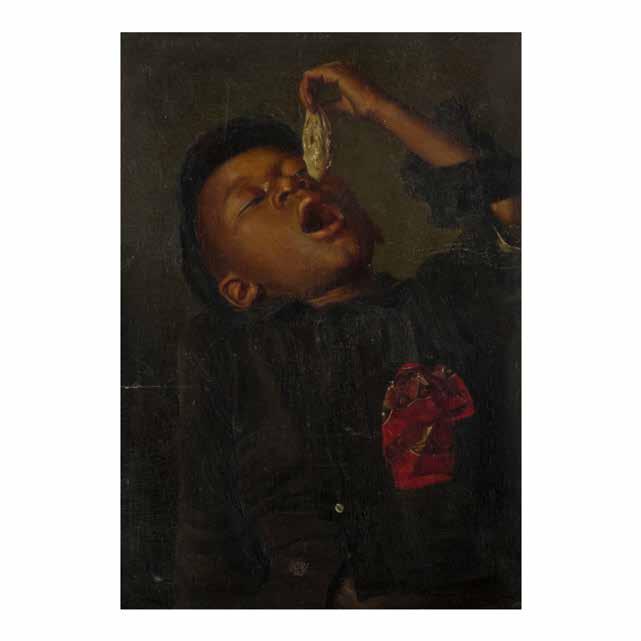
(Lot 38 continued)
“The Parisian Art Event Opening of the Champs de Mars Salons. The Most Notable Exhibits-Many Works by American Artists-Our Display to Surpass Last Year’s. Descriptions of Some of the Best CanvasesKate A. Carl, John W. Alexander, E. Irving Course, &c.,” The Scranton Republican, Pennsylvania, April 20, 1896, p. 1.
“Art Notes,” The Sunday Inter Ocean, Chicago, September 6, 1896, vol. XXV, no. 166, p. 2.
C. Yeldham, Women Artists in Nineteenth-Century France and England Their Art Education, Exhibition Opportunities and Membership of Exhibiting Societies and Academies, with an Assessment of the Subject Matter of Their Work and Summary Biographies, vol. 2, United States of America, 1984, p. 286.
P.H. Falk, A.A. Bien, eds., The Annual Exhibition Record of the Pennsylvania Academy of the Fine Arts: Volume II, 1876-1913, Madison, Connecticut, 1989, p. 202, no. 100.
P.H. Falk, A.A. Bien, eds., The Annual Exhibition Record of the Art Institute of Chicago: 1888-1950, Madison, Connecticut, 1990, p. 335, no. 133. 39
39
ELBRIDGE AYER BURBANK (1858-1949)
Boy Eating Oyster signed ‘E. A. BURBANK’ (upper left) oil on panel 8 x 6 in. (20.3 x 15.2 cm.)
$8,000 - 12,000
Provenance
Private collection, Chicago. Private collection, Ahwatukee, Arizona, acquired from the above. Estate of the above.
Acquired by the present owner from the above, 2024.
PROPERTY FROM A PRIVATE COLLECTION, NEW YORK CITY
40 FRANCIS AUGUSTUS SILVA (1835-1886)
Hudson River at Kingston Point signed and dated partially indistinctly ‘F.A. SILVA 78’ (lower right) oil on canvas 14 1/8 x 24 1/8 in. (35.9 x 61.3 cm.)
Painted in 1878.
$60,000 - 80,000
Provenance
Sale, Christie’s, New York, March 12, 1992, lot 17. Acquired by the present owner at the above sale.
Exhibited
New York, Berry-Hill Galleries, Inc., Francis A. Silva: In His Own Light, April 24-June 28, 2002, pp. 108, 142, pl. 42, illustrated.
Francis Augustus Silva remains one of the most revered American landscape painters associated with the second generation of the Hudson River School. Born in New York City in 1835, Silva began his career as a sign-painter’s apprentice after several occupations and by the late 1860s, turned to a career as an artist. His first paintings were exhibited in 1868 at the National Academy of Design where his interest in marine subjects was revealed. Despite his unconventional training, Silva developed a highly refined approach to landscape painting and quickly became celebrated for his coastal and riverine views, often depicting tranquil waters, dramatic skies, and distant mountains rendered with careful attention to atmospheric effects. Silva’s oeuvre belongs to the later work of the Hudson River School, when artists increasingly sought to emphasize subtle tonal harmonies and intimate observations of nature rather than producing monumental depictions of the wilderness favored by earlier proponents of the Hudson River School, such as Thomas Cole (1801-1848) and Frederic Edwin Church (1826-1900).
Focusing on quiet stretches of water and expansive skies, Silva employed a compositional restraint and delicate light effects that lend a contemplative mood to his landscapes. He was particularly adept at rendering reflections and subtle gradations of color across bodies of water, becoming central stylistic techniques celebrated in his mature work. In contrast to the dramatic panoramas that characterized the works of the first generation of Hudson River School artists, Silva frequently adopted lower vantage points and horizontal compositions that emphasize the calm surface of rivers and bays. His works often include small vessels, docks, or distant shorelines that situate human narrative within the broader natural environment. Through these elements, Silva conveyed a sense of harmony between nature and the presence of human commerce and travel along America’s splendid waterways.
Hudson River at Kingston Point exemplifies these qualities while also demonstrating Silva’s interest in dramatic atmospheric effects. The composition of the present work presents a broad view of the Hudson River near Kingston Point, with a steep bluff rising along the left side of the composition and a wide expanse of the Hudson River occupying the foreground. A dock and small sailboats appear near the shoreline, while a steam vessel travels across the river toward the right side of the scene. Above the water, towering storm clouds dominate the sky, pierced by flashes of lightning and illuminated by breaks of warm light filtering through the atmosphere. The contrast between the luminous sky and the darkening storm front creates a dramatic interplay of light and shadow that heightens the painting’s emotional intensity.
The present work also reflects broader themes associated with the Hudson River School during the late nineteenth century. The juxtaposition of the natural landscape elements with modern vessels— particularly the steam-powered boat—suggests the coexistence of nature and technological progress along the Hudson River, an important commercial artery of the era. At the same time, Silva’s careful rendering of reflections and atmospheric light reinforces the contemplative tone characteristic of his work. Rather than presenting the landscape as untamed wilderness, Hudson River at Kingston Point depicts a lived-in environment shaped by both natural forces and human presence. In this way, Hudson River at Kingston Point embodies the second generation of the Hudson River School’s evolving vision of the American landscape as one that balances the romantic atmosphere of nature with subtle acknowledgments of the rapid onset of industrial and commercial growth in America.
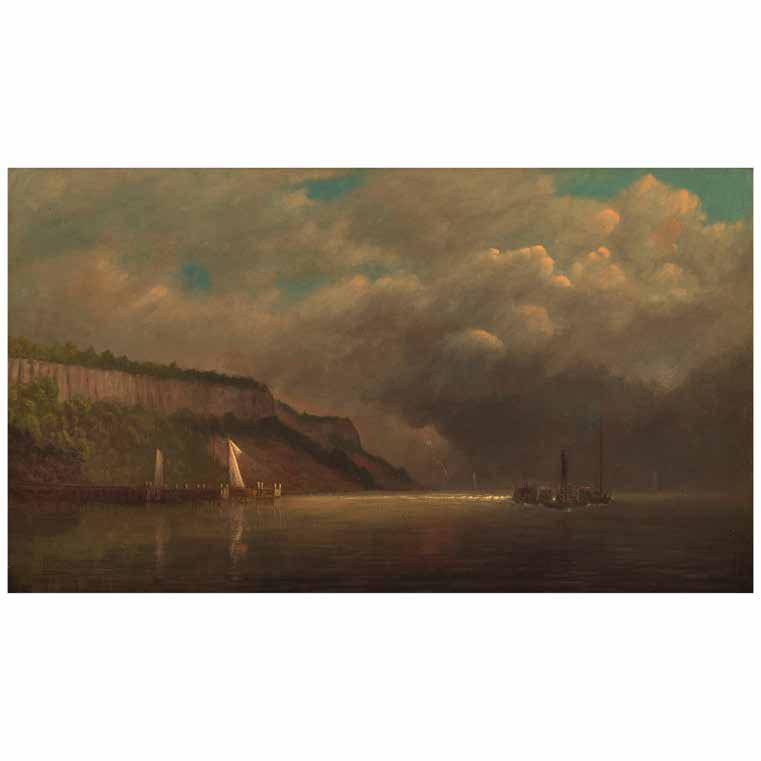
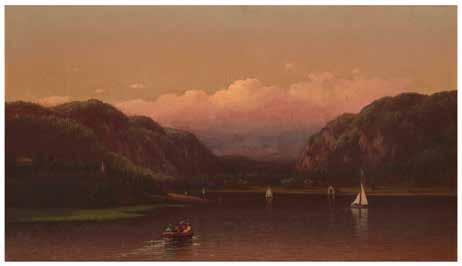
PROPERTY FROM A PRIVATE COLLECTION, LAKE WORTH, FLORIDA
41
ALBERT BIERSTADT (1830-1902)
View along the Hudson River signed with conjoined initials ‘ABierstadt’ (lower left) oil on paper laid down on canvas
13 1/8 x 19 1/8 in. (33.3 x 48.6 cm.)
$15,000 - 25,000
Provenance
Sale, Sotheby Parke Bernet, Inc., New York, October 17, 1980, lot 128. Maxwell Galleries, Ltd., San Francisco. (as A View of the Hudson River)
Acquired by the present owner from the above, April 21, 1981.
We would like to thank Melissa Webster Speidel, President of the Bierstadt Foundation and Director of the Albert Bierstadt catalogue raisonné project, for her assistance in the cataloguing of this lot. This work is included in the database being compiled for her forthcoming catalogue raisonné of the artist’s work.
PROPERTY FROM A PRIVATE COLLECTION, NEW YORK CITY
42
LEMUEL MAYNARD WILES (1826-1905)
Highlands on the Hudson - View Near West Point N.Y. signed and dated ‘L.M. WILES. / 1872.’ (lower right) and inscribed with title, signed again, inscribed ‘N.Y.’ and dated again (on the reverse) oil on canvas
14 x 24 1/8 in. (35.6 x 61.3 cm.)
Painted in 1872.
$10,000 - 15,000
Provenance
Sale, Christie’s, New York, September 23, 1992, lot 57. (as Highlands on the Hudson - View Near West Point)
Sale, Sotheby’s, New York, September 24, 1998, lot 39. (as On the Hudson Near West Point)
Acquired by the present owner at the above sale.
Literature
G.K. Fleming, Lemuel Maynard Wiles: A Record of His Works 18641904, New York, 2009, p. 57, no. 12. (as Highlands of the Hudson)
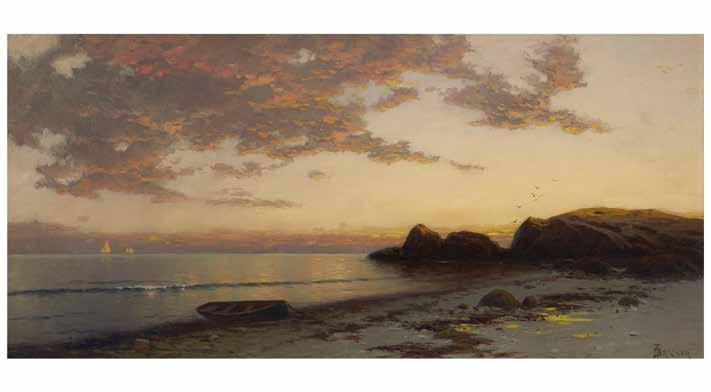
43
ALFRED THOMPSON BRICHER (1837-1908)
Sundown, Sakonnet
signed with conjoined initials ‘ATBricher’ (lower right) oil on canvas
15 1/4 x 32 in. (38.7 x 81.3 cm.)
$30,000 - 50,000
Provenance
Kenneth Lux Gallery, New York. (as Luminous Painting of The Coast of Maine)
Private collection, Midwest, by circa 1970.
Sale, Sotheby’s, New York, September 21, 1994, lot 27. Acquired by the present owner at the above sale.
Alfred Thompson Bricher’s Sundown, Sakonnet beautifully demonstrates his mature abilities as a luminist painter and exhibits among them his mastered techniques for depicting light and atmosphere. Influenced by the placid realism of Fitz Henry Lane (1804-1865) and John Frederick Kensett (1816-1872) alongside other artists of the second generation of the Hudson River School, Bricher developed a style distinguished by smooth surfaces, delicate tonal gradations, and an emphasis on the calm qualities of atmosphere. In Sundown, Sakonnet, Bricher presents a contemplative view of the Rhode Island shoreline at dusk, orchestrating a subtle interplay between land, sea, and sky. The composition is defined by its low horizon and expansive firmament, within which the waning light of day is delicately diffused across a veil of atmosphere, dissolving form into tone. Through this nuanced treatment, Bricher not only demonstrates his technical virtuosity but also engages with broader Luminist concerns—namely, the evocation of tranquility, the suspension of time, and the poetic resonance of the American coastal landscape.
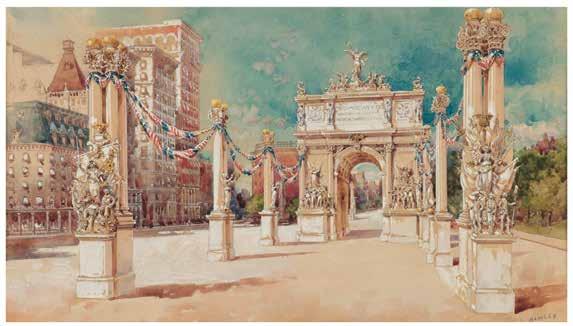
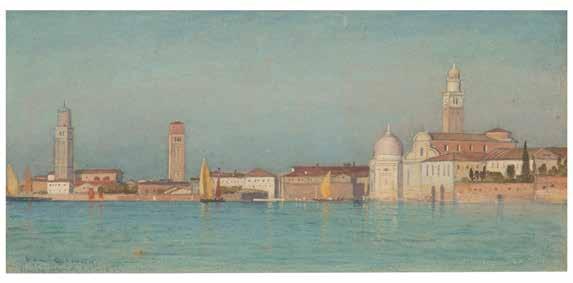
PROPERTY FROM A PRIVATE COLLECTOR,
44
HUGHSON HAWLEY (1850-1936)
Dewey Arch, Madison Square, New York
signed ‘HAWLEY’ (lower right)
watercolor and graphite on paper laid down on board
9 1/4 x 16 1/4 in. (23.5 x 41.3 cm.)
Executed in 1899.
$3,000 - 5,000
Provenance
Estate of Miriam L. Finkel, Philadelphia. Schwarz Gallery, Philadelphia. Acquired by the present owner from the above.
PROPERTY FROM A PRIVATE COLLECTOR,
SAMUEL COLMAN (1832-1920)
Murano Viewed from Venetian Lagoon
signed, inscribed and dated ‘Samuel Colman / Venice April 24th 1874’ (lower left)
watercolor and gouache on paper 6 x 12 1/4 in. (15.2 x 31.1 cm.)
Executed in 1874.
$2,000 - 3,000
Provenance
Jill Newhouse, New York. Acquired by the present owner from the above.
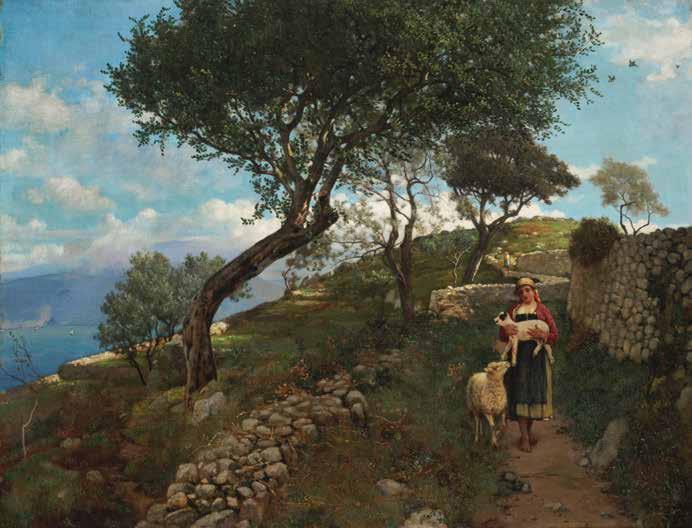
46
CHARLES CARYL COLEMAN (1840-1928)
Shepherdess
signed with monogrammed initials, inscribed and dated ‘CCC / Capri / 1888’ (lower left)
oil on canvas
23 3/4 x 30 7/8 in. (60.3 x 78.4 cm.)
Painted in 1888.
$8,000 - 12,000
Provenance
Thomson Galleries, Detroit.
Alexander Gallery, New York. (as Capri)
Acquired by the present owner from the above, June 2023.
This work will be included in Dr. Adrienne Baxter Bell’s A Conversation of Cultures: Charles Caryl Coleman and American Expatriate Artists in Gilded Age Italy, which contains the first catalogue of the artist’s work.
PROPERTY FROM A PRIVATE NEW YORK ESTATE
47
JOHN STOBART (1929-2023)
New York: The Foot of South Street in 1876 dated ‘© 1968’ (lower left within the composition) and signed ‘· Stobart ·’ (lower right) oil on canvas
26 1/8 x 36 1/8 in. (66.4 x 91.8 cm.)
Painted in 1968.
$50,000 - 70,000
Provenance
(probably) Thomas J. Watson, Jr. (1914-1993), Greenwich, Connecticut.
By descent to the late owner within the family of the above.
Literature
D. Allgeyer, The Tip of The Island: The Saga of Lower Manhattan, Conway, Arizona, 1994, p. 165.
Please note that this lot is sold unframed and is currently presented in a frame loaned by Julius Lowy Frame and Restoring Company. The successful buyer of this lot will have the opportunity to purchase this frame after the auction. For more information, please contact a member of the department.
John Stobart occupies a distinctive position in late twentiethand early twenty-first-century maritime art for his meticulously researched depictions of historic harbor scenes. Born in Leicester, England, in 1929, Stobart demonstrated an early aptitude for drawing and enrolled at the Derby School of Art in 1946 before continuing his studies at the Royal Academy Schools in London. His exposure to major maritime ports during his youth—particularly Liverpool—sparked a lifelong fascination with ships and seafaring commerce. After emigrating to Canada in 1957, Stobart began producing paintings of ships for shipping companies along the St. Lawrence River. This was a practical endeavor that honed both his technical skill and his deep knowledge of maritime vessels. In 1965, Stobart visited New York and was offered an exhibition of his work at the revered Kennedy Galleries. This exhibition at Kennedy Galleries was considered a turning point in his artistic career and encouraged him to shift his focus on historically reconstructed scenes of American ports during the golden age of sail.
Henceforward, Stobart devoted much of his career to visualizing the bustling port cities of nineteenth-century America. His works are distinguished by a synthesis of historical scholarship and painterly atmosphere, often conducting extensive research into ship construction, harbor architecture, and period documentation before beginning a composition. It was this dedication to historical authenticity that allowed him to recreate with the utmost accuracy harbor environments that had largely vanished due to industrial modernization and urban redevelopment. Stobart’s paintings ultimately functioned not only as romantic depictions of sailing, but also as visual reconstructions of maritime history, capturing the dynamic economic and cultural networks that defined American seaports during the golden age of sail.
This approach is particularly evident in Stobart’s painting New York: The Foot of South Street in 1876, which masterfully reconstructs a lively scene along the East River waterfront during a period when the South Street district served as one of the busiest commercial shipping centers in America. In the nineteenth century, the East River functioned as a critical artery of maritime commerce, filled with schooners, ferries, tugs, and large ocean-going traders navigating the strong currents of New York’s harbor. In the present work, Stobart depicts several tall-masted vessels moored at the fingerlike docks while horse-drawn wagons, market stalls, and dockside laborers animate the foreground. These compositional elements convey the intensity of everyday commercial activity along South Street, where goods, passengers, and maritime supplies circulated through a dense network of wharves and warehouses.
New York: The Foot of South Street in 1876 demonstrates Stobart’s ability to construct complex spatial depth and atmospheric effects within his compositions. The diagonally thrust bowsprits of the ships guide the viewer’s eye into the harbor, while the vertical masts form a forest of lines that structure the skyline and reinforce the dominance of maritime infrastructure within the urban environment. The barrels, wagons, and market stalls that populate the foreground establish a narrative of trade and everyday labor, grounding the scene in the human activity that sustained the port’s economic vitality. At the same time, Stobart’s luminous treatment of light and sky softens the otherwise crowded composition, creating a romanticized yet convincing vision of the nineteenth-century waterfront. Through this careful balance of historical detail and painterly atmosphere, New York: The Foot of South Street in 1876 is an accomplished example of Stobart’s broader artistic mission to reconstruct and preserve the visual memory of historic maritime cities that had largely disappeared from the modern urban landscape.
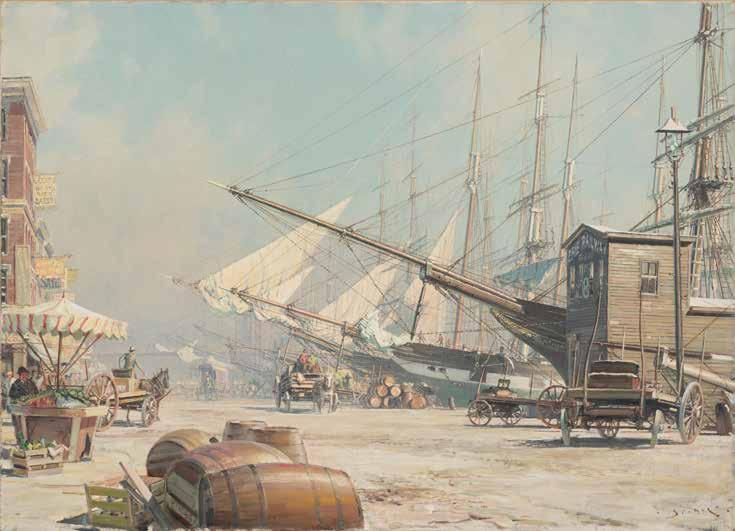
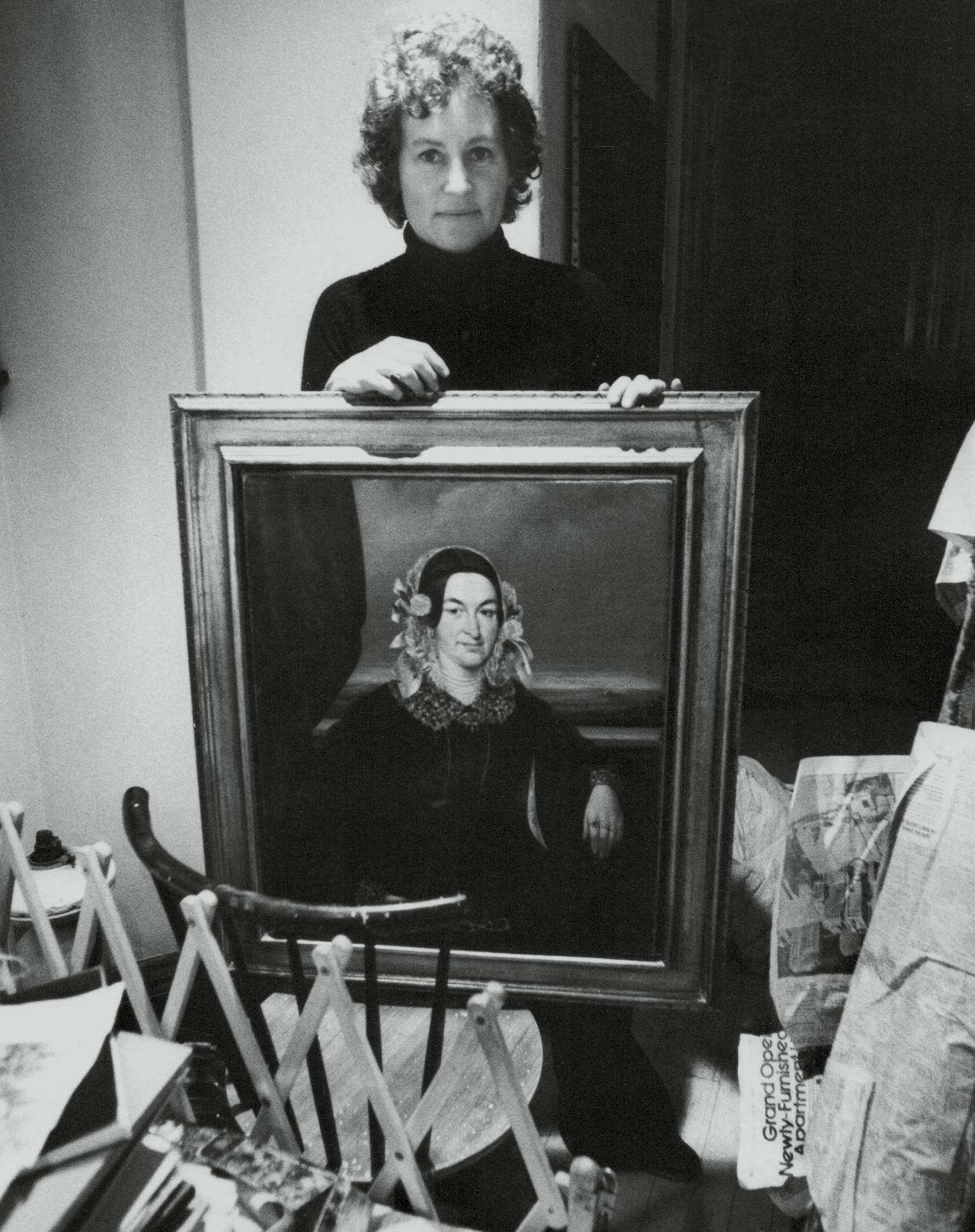
(Lots 48-58)
Bonhams is pleased to offer a selection of works from the collection of the esteemed Dr. Barbara J. Novak. A pioneering American art historian, Dr. Novak’s scholarship has fundamentally reshaped the study of nineteenth-century American art. Over the course of her long academic career, she became one of the most influential voices in defining American art as a distinct field of study, elevating artists who had previously received limited critical attention.
Born in New York City and raised in Far Rockaway, Queens, Dr. Novak showed an early interest in art, studying drawing as a child and later taking classes at institutions such as the Art Students League. She attended Barnard College, graduating in 1950, and went on to complete her doctorate at Columbia University. A Fulbright year in Europe deepened her engagement with landscape painting and helped shape the intellectual foundations of her later work.
Dr. Novak is best known for her landmark book American Painting of the Nineteenth Century: Realism, Idealism, and the American Experience published in 1969, which argued that American art of this period was profoundly shaped by spiritual, philosophical, and transcendental ideas. Rather than treating painting as a purely stylistic progression, she connected it to literature, religion, and intellectual history, particularly the currents of Transcendentalism. Her later book, Nature and Culture: American Landscape and Painting, 1825–1875 published in 1980, further developed these themes and was a finalist for the National Book Award, cementing her reputation as a central architect of modern American art history.
Much of Dr. Novak’s scholarship focused on the symbolic and metaphysical dimensions of landscape painting and artists associated with the Hudson River School. She reframed their work as intellectually ambitious explorations of nature, nationhood, and the sublime, challenging earlier dismissals of American art as derivative of European traditions. Her interdisciplinary method—bridging art history with American studies and intellectual history—reshaped museum narratives and university curricula, influencing generations of scholars.
In her personal life, Dr. Novak married Irish-born artist and critic Brian O’Doherty (1928-2022) in 1960. Their marriage was both a personal and intellectual partnership, embedded in the vibrant New York art world of the 1960s and beyond. They maintained close friendships with artists and composers, such as Edward Hopper (1882-1967) and Josephine Hopper (1883-1968), Mark Rothko (1903-1970), Lee Krasner (19081984), Morton Feldman (1926-1987), and Sol LeWitt (1928-2007); traveled widely; and sustained an active engagement with contemporary art and criticism. They also spent time at their famed painted vacation home, Casa Dipinta “O’Doherty” in Todi, Italy. Novak often reflected on her experiences as a woman in a male-dominated academic field, recalling early challenges but also emphasizing the encouragement she received from family and mentors.
Dr. Novak taught at Barnard College and Columbia University for four decades, eventually serving as the Helen Goodhart Altschul Professor of Art History before retiring in 1998. A dedicated mentor as well as a formidable scholar, she helped secure broader institutional recognition for American art within academia and museums. Today she is widely regarded not only as a leading historian of American painting but also as a formative influence on how the nation’s artistic and cultural identity is understood.
IN
FROM
48
A Glimpse of Hudson, NY signed and dated partially indistinctly ‘Gifford 185-’ (lower right) and bears estate stamp (on the reverse)
oil on paper laid down on canvas 7 5/8 x 9 5/8 in. (19.4 x 24.5 cm.)
Painted circa 1852.
$30,000 - 50,000
Provenance
Sale, Thomas E. Kirby, Auctioneers, Gifford Estate Sale, 1881.
A letter from the recognized expert on the artist, Dr. Ila Weiss, accompanies this lot. We wish to thank her for her kind assistance in cataloguing this lot.
Painted in the early 1850s, at the outset of Sanford Robinson Gifford’s career within the Hudson River School, A Glimpse of Hudson, NY reflects the artist’s close study of nature and his practice of sketching directly from the landscape of the Hudson River Valley. Fresh greens, enlivened with touches of yellow over cooler undertones, animate the meadow, while darker tones illustrate the wooded foreground. A fisherman, barely discernible at the edge of the clearing, recalls a motif found in several of Gifford’s earliest compositions, underscoring his engagement with scenes of rural life. In the far distance, faint smokestacks rise above the town—likely a reference to Hudson, New York, alluding to the artist’s early and enduring interest in aerial perspective.
The composition is anchored by a dense cluster of woods at left, their dark mass reflected in a gently coursing stream that curves through the center of the scene. A clearing with scattered tree stumps opens onto a grassy meadow, leading the eye toward a distant town set against the rise of Mount Merino. Overhead, an overcast sky, articulated through soft, cream-toned bands, diffuses the light and unifies the composition in a restrained, contemplative harmony. Subtle gradations of scale and tone create a measured sense of recession, guiding the viewer from the shadowed foreground into the luminous distance. At once topographically grounded and quietly evocative, the painting offers a characteristic early expression of Gifford’s poetic approach to landscape.
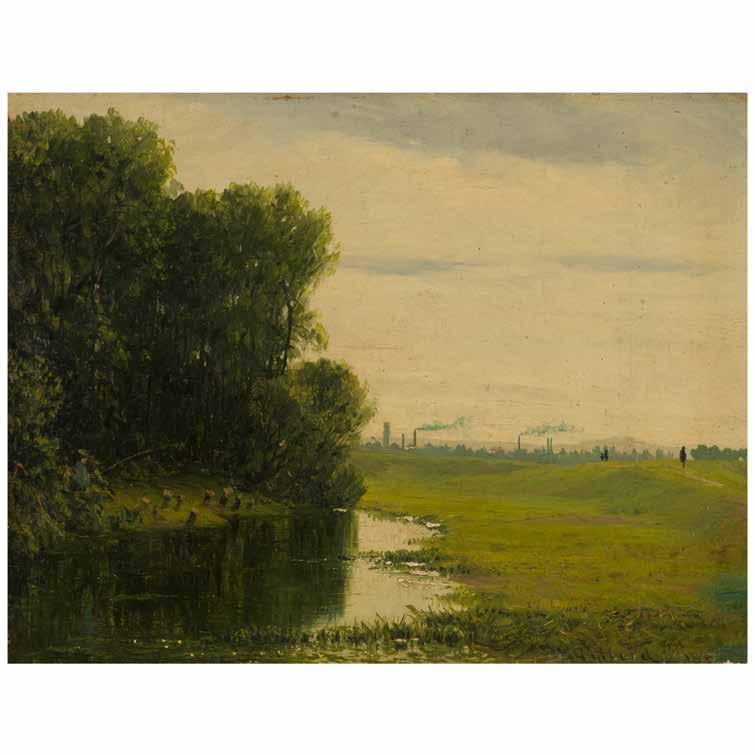
49
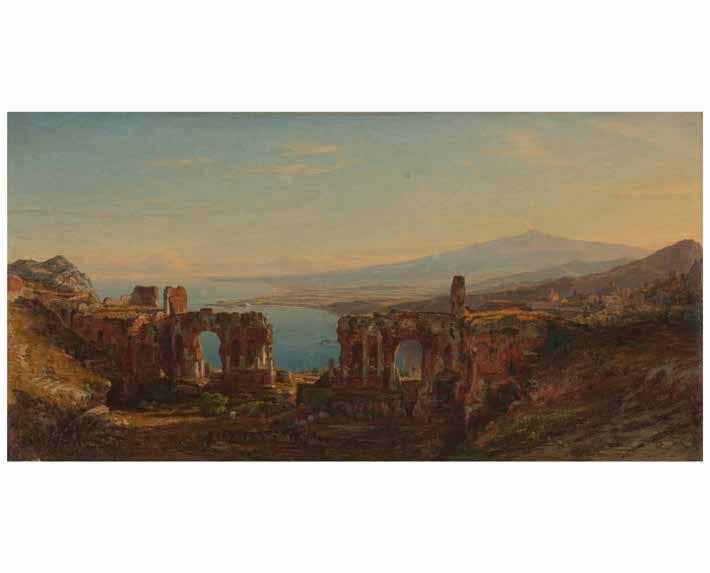
A LIFE IN SCHOLARSHIP: PROPERTY FROM THE COLLECTION
49 THOMAS H. HOTCHKISS (1834-1869)
The Theatre at Taormina signed with initials and dated ‘T.H.H. / 1868’ (lower right) oil on canvas
16 1/8 x 32 in. (41 x 81.3 cm.) Painted in 1868.
$7,000 - 10,000
Provenance
Martin Brimmer (1829-1896), Boston, by 1887. Acquired by the present owner by 1980.
Exhibited Boston, Museum of Fine Arts, April-May 1887.
Literature
Trustees of the Museum of Fine Arts, Twelfth Annual Report, for the Year Ending Dec. 31, 1887, Boston, 1888, p. 29.
B. Novak, Nature and Culture: American Landscape and Painting, 1825-1875, New York, 1980, pp. 215, 311, 318, no. 108, illustrated. (as Theatre at Taormina)
B. Novak, Dreams and Shadows: Thomas H. Hotchkiss in Nineteenth Century Italy, exhibition catalogue, New York, 1993, pp. 7, 104, 132, no. 80, illustrated. (as Theatre at Taormina)
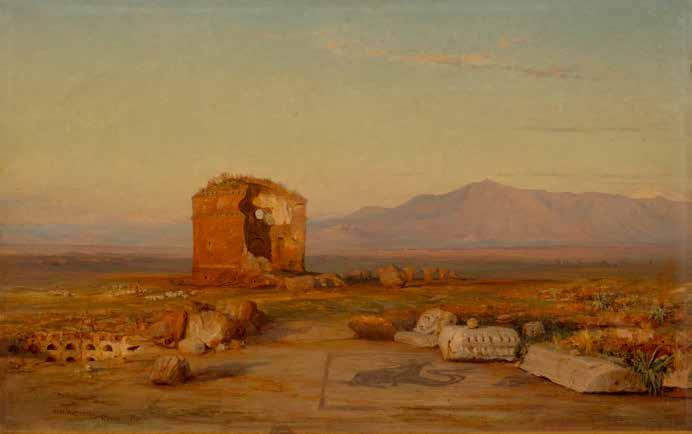
50
A LIFE IN SCHOLARSHIP: PROPERTY FROM THE COLLECTION OF DR.
BARBARA J. NOVAK
50 THOMAS H. HOTCHKISS (1834-1869)
Torre di Schiavi
signed, inscribed and dated partially indistinctly ‘T.H. Hotchkiss / · Rome 1864’ (lower left) oil on canvas
17 1/8 x 27 1/4 in. (43.5 x 69.2 cm.)
Painted in 1864.
$6,000 - 8,000
Provenance
Florence Lewison Gallery, New York, 1964. Acquired by the present owner from the above, by 1968.
Exhibited
New York, Kennedy Galleries, Inc., Exhibition of Paintings by Brooklyn Art Association Artists, November 4-14, 1970, no. 42. (as Torre degli Schiavi (sketch))
Lawrence, Kansas, University of Kansas Museum of Art, The Arcadian Landscape: Nineteenth-Century American Painters in Italy, November 4-December 3, 1972, n.p., no. 23, illustrated.
Literature
B. Novak O’Doherty, “The American 19th Century, Part 1: New Found Land,” Art News, New York, September 1968, v. 67, no. 5, p. 31, illustrated.
B. Novak, American Painting of the Nineteenth Century, 1969, pp. 75, 341, no. 3-10, illustrated.
B. Novak, Dreams and Shadows: Thomas H. Hotchkiss in Nineteenth Century Italy, exhibition catalogue, New York, 1993, pp. 11, 86, 132, no. 79, illustrated.
Please note that this lot is sold unframed and is currently presented in a frame loaned by Julius Lowy Frame and Restoring Company. The successful buyer of this lot will have the opportunity to purchase this frame after the auction. For more information, please contact a member of the department.
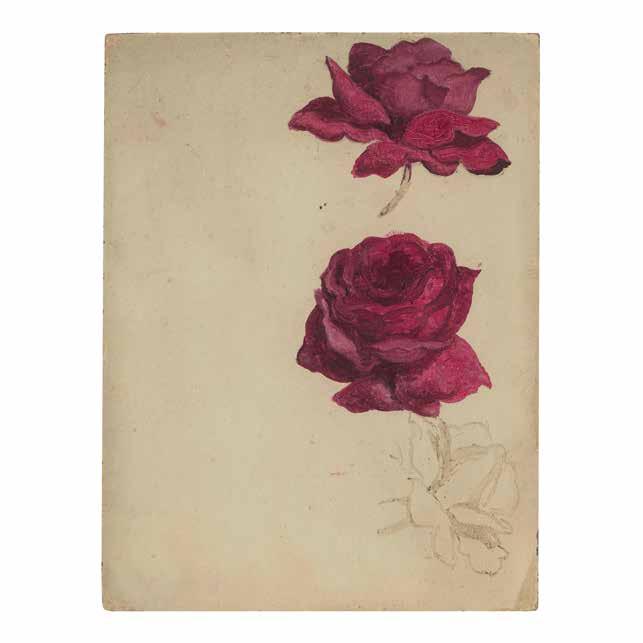
A LIFE IN SCHOLARSHIP: PROPERTY FROM THE COLLECTION OF DR. BARBARA J. NOVAK
51
MARTIN JOHNSON HEADE (1819-1904)
Two Roses oil on board
9 3/8 x 7 1/8 in. (23.8 x 18.1 cm.)
Painted circa 1865-75.
$15,000 - 25,000
Provenance
Wilma Davis, St. Augustine, Florida. Private collection, St. Augustine, Florida. Eaton Fine Art, Inc., West Palm Beach, Florida. (as Study of Two Red Roses)
Acquired by the present owner from the above.
Exhibited
West Palm Beach, Florida, Eaton Fine Art, Inc., Martin Johnson Heade, A Survey: 1840-1900, December 20, 1996-February 22, 1997, pp. 52-54, illustrated. (as Study of Two Red Roses)
Literature
T.E. Stebbins, Jr., The Life and Work of Martin Johnson Heade: A Critical Analysis and Catalogue Raisonné, New Haven, Connecticut, 2000, pp. 298, 389, no. 389, illustrated.
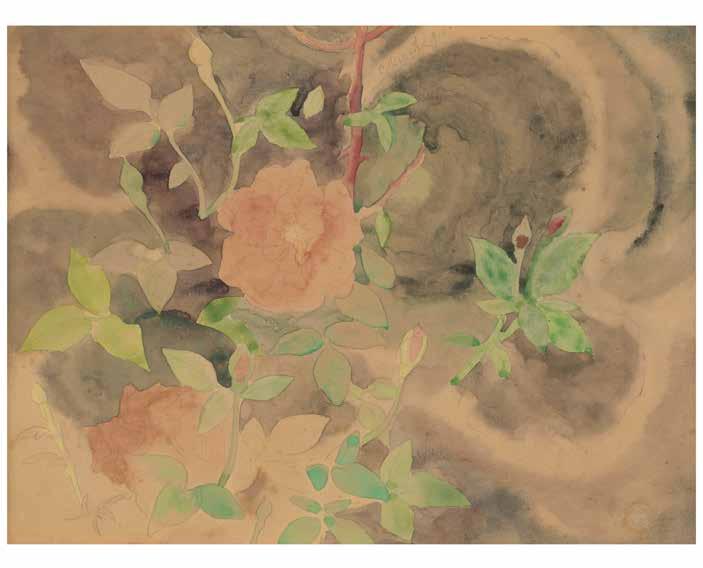
A LIFE IN SCHOLARSHIP: PROPERTY FROM THE COLLECTION OF DR.
52
CHARLES HENRY DEMUTH (1883-1935)
Climbing Rose signed and dated ‘C Demuth - 1914 -’ (upper center) watercolor and graphite on paper 8 x 10 5/8 in. (20.3 x 27 cm.)
Executed in 1914.
$15,000 - 25,000
Provenance
Alfred Stieglitz (1864-1946), New York.
Mrs. A. Stewart Walker, Southampton, New York, acquired from the above. M. Knoedler & Co., New York, consigned from the above, March 14, 1961.
Mrs. Edward Patterson, acquired from the above, June 1, 1961.
Sale, Sotheby Parke Bernet, Inc., New York, December 4, 1980, lot 116. Acquired by the present owner at the above sale.
Literature
E. Farnham, Charles Demuth: His Life, Psychology and Works, Ph.D. dissertation, Ohio State University, Columbus, Ohio, 1959, vol. 2, p. 443, no. 82.
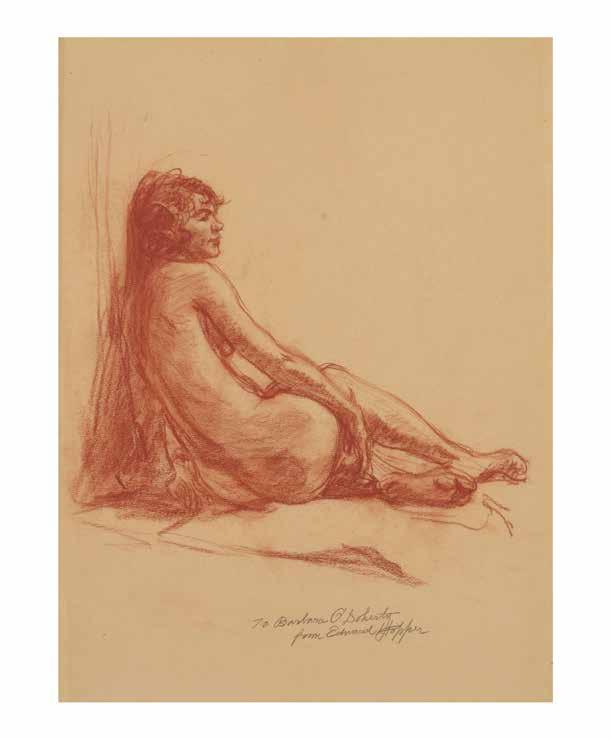
A LIFE IN SCHOLARSHIP: PROPERTY FROM THE COLLECTION OF DR.
53
EDWARD HOPPER (1882-1967)
Nude
Provenance
Gift to the present owner from the artist, circa 1950s. 53
inscribed and signed ‘To Barbara O’Doherty / from Edward Hopper’ sepia chalk and graphite on paper 17 7/8 x 12 in. (45.4 x 30.5 cm.)
$12,000 - 18,000
PROPERTY FROM THE COLLECTION OF A NEW YORK LADY
54
CHARLES HENRY DEMUTH (1883-1935)
Landscape
signed ‘C. Demuth’ (lower left) watercolor on paper
9 7/8 x 13 7/8 in. (25.1 x 35.2 cm.)
Executed circa 1912-15.
$10,000 - 15,000
Provenance
ACA Galleries, New York. Rose Fried Gallery, New York.
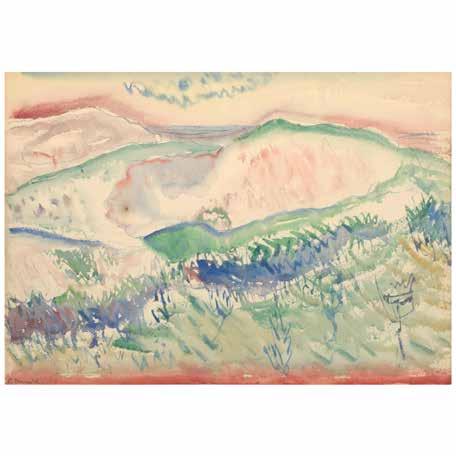
PROPERTY FROM THE COLLECTION OF A NEW YORK LADY
55
REGINALD MARSH (1898-1954)
Danger
signed and dated ‘Reginald Marsh / 1950’ (lower right) ink and ink wash on paper 22 x 30 1/4 in. (55.9 x 76.8 cm.)
Executed in 1950.
$8,000 - 12,000
Provenance
Estate of the artist. Senator William Burnett Benton (1900-1973), New York.
American Masters Gallery, Los Angeles. Harry Spiro, New York. Frank K. M. Rehn Galleries, New York, by 1973.
Acquired by the present owner from the above, November 29, 1973.
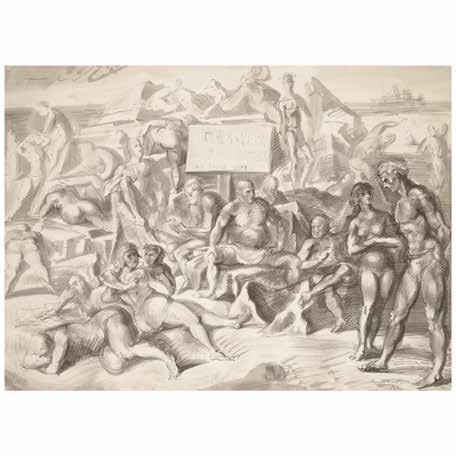
56 THOMAS HART BENTON (1889-1975)
Shocking Corn signed ‘Benton’ (lower left) and inscribed ‘Autumn’ (on the reverse) oil on board
5 1/8 x 6 in. (13 x 15.2 cm.)
Painted circa 1945.
$80,000 - 120,000
Provenance
Kim C. Anderson & Co., Minneapolis, Minnesota, by 1992. (as Autumn-Stacking Corn) Acquired by the present owner from the above, August 27, 1992.
This work will be included in the forthcoming catalogue raisonné being prepared by the Thomas Hart Benton Catalogue Raisonné Foundation. Committee Members: Dr. Henry Adams, Jessie Benton, Anthony Benton Gude, Andrew Thompson and Michael Owen.
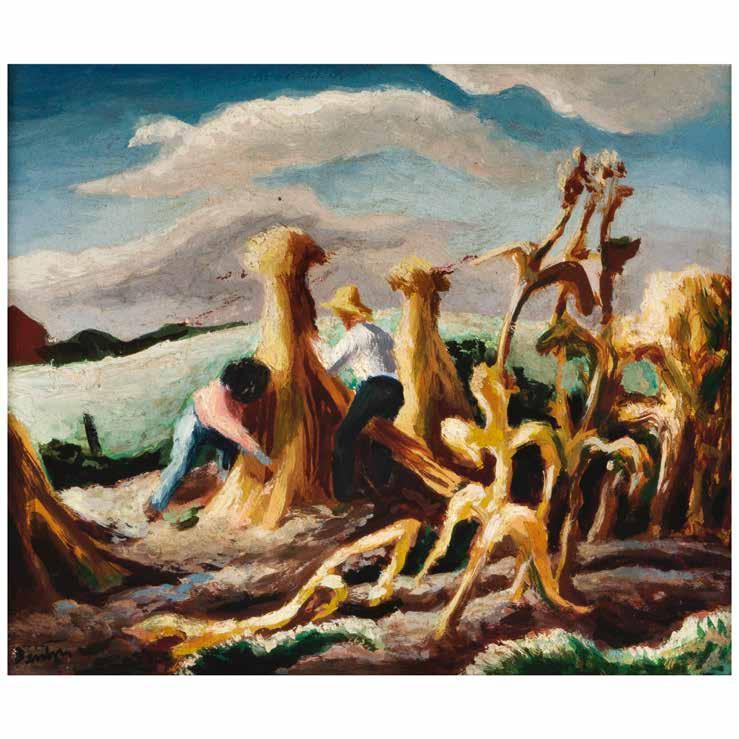
Thomas Hart Benton’s unparalleled depictions of rural life in mid-twentiethcentury America made him one of the most influential figures in American art and a principal champion of American Regionalism—a movement that dominated American art during the 1930s and early 1940s. Emerging during the interwar decades, Regionalism was an artistic response to a nation seeking ways to articulate a distinct visual identity that drew inspiration from rural life, agriculture, and the American landscape. Through his paintings and monumental mural commissions, Benton developed a highly recognizable style distinguished by artistic techniques that employ muscular figuration, undulating forms, and complex narrative compositions. Shocking Corn painted around 1945 as a study for the finished work completed in 1945 by the same title (Minnesota Museum of American Art, St. Paul) is a significant example in Benton’s oeuvre that beautifully captures the energy and character of the everyday American experience and celebrates both the dignity of labor and vitality of regional culture.
Born in Neosho, Missouri in 1889 to a politically prominent family, Benton was the son of Maecenas Eason Benton (1848-1924), a member of the U.S. House of Representatives from Missouri’s 15th district from 1897 to 1905, and Elizabeth (née Wise) Benton (1866-1952). Although Benton faced family pressure to pursue a career in public service, he instead turned to artistic training thanks to his mother’s support. Benton began his studies at The School of the Art Institute of Chicago in 1907 before continuing his education in Paris at the Académie Julian in 1909. During his years in Europe he encountered modernist movements, such as Cubism, but already began to reject abstraction in favor of a more representational visual language that could communicate more directly with a broader American audience. This marked the beginning of Benton’s lifelong commitment to a narrative realism rooted in the observation of American life and eventual declaration as an enemy of modernism.
By the 1920s, Benton traveled widely through the Midwest and the rural South, filling his sketchbooks with studies of farmers, laborers, and the landscapes in which they worked. These direct observations informed the development of his mature artistic style and subject matter. By the early 1930s, Benton had emerged as a leading member of the Regionalist movement in America alongside fellow artists Grant Wood (1891-1942) and John Steuart Curry (18971946). Although the three artists shared an interest in rural subject matter, Benton’s approach was distinguished by the dynamism of his compositions. His figures twist and bend in rhythmic motions, while the surrounding landscape often mirrors these curving forms to create an integrated visual structure that conveys both movement and narrative continuity.
Benton achieved national prominence with a series of ambitious mural commissions in the early 1930s, most notably the cycle America Today (1930–31, Metropolitan Museum of Art, New York), originally installed at the New School for Social Research, a center of progressive thought and education in Greenwich Village, New York. The murals presented a sweeping panorama of modern American society, juxtaposing scenes of agriculture, heavy industry, urban entertainment, and transportation. Through these monumental works, Benton sought to create a comprehensive visual narrative of the nation, one that reflected the diversity and dynamism of American life during the early twentieth century. The success of these projects established him as one of the country’s most visible and influential Regionalist artists in America and helped define his aesthetic ambitions. (E. Braun, T. Branchick, Thomas Hart Benton: The America Today Murals , exhibition catalogue, Williamstown, Massachusetts, pp. 11-29.)
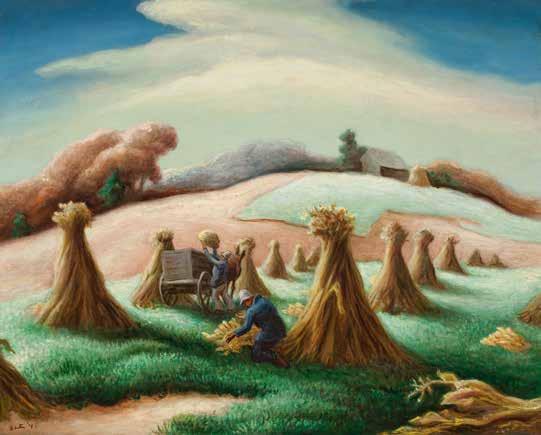

Grant Wood (1891-1942), January, 1940-41, oil on Masonite panel, 18 x 23 11/16 in., J.H. Wade Fund 2002.2. © Figge Art Museum, successors to the Estate of Nan Wood Graham/Licensed by VAGA, New York, NY © 2026 Figge Art Museum, successors to the Estate of Nan Wood Graham / Artists Rights Society (ARS), NY
By the late 1930s, Benton returned to the Midwest to accept a position at the Kansas City Art Institute, where he continued to refine his artistic vision. During the 1940s, Benton shifted his focus to themes of agriculture, reflecting both his personal attachment to rural America and the broader cultural significance of farming in wartime America. The agricultural workforce in America was widely celebrated during World War II for sustaining domestic food production while much of the nation’s labor force served overseas. Benton’s paintings from this period thus function not only as depictions of rural life but also as visual affirmations of the resilience and productivity of American agriculture.
Shocking Corn belongs to Benton’s mature body of work and represents one of his most compelling interpretations of agricultural labor. In the present work, Benton depicts two farmers bundling or shocking harvested corn stalks into upright cone-shaped structures or shocks—a practice used to dry or cure corn in the field prior to storage. Corn shocking would become a subject that Benton revisited repeatedly throughout the 1940s, notably in Corn and Winter Wheat (1945, Worcester Art Museum, Massachusetts). The theme also appears in the work of Benton’s fellow Regionalists, including John Steuart Curry and Grant Wood, as seen in Curry’s Wisconsin Farm Scene (1941, Chazen Museum of Art, Madison, Wisconsin) and Wood’s January (1940–41, Cleveland Museum of Art, Ohio). In the prominently depicted shocks of corn that structure these compositions, Benton, Curry, and Wood evoke traditional agricultural practices of the American Midwest—methods that, by the mid-twentieth century, were increasingly rendered obsolete by the rise of mechanized farming.
Formally, Shocking Corn demonstrates Benton’s sophisticated orchestration of movement and spatial structure. The composition is constructed through a series of strong diagonal movements that sweep across the picture plane, guiding the eye through the activity of the field. The figures, positioned at varying depths within the landscape, form a rhythmic sequence of bending and twisting bodies that echo the vertical stacks of corn and the rolling contours of the surrounding hills. The exaggerated musculature and dramatic torsion of the figures emphasize the physical exertion of agricultural work, while their interlocking poses create a sense of collective rhythm. The corn shocks themselves become structural elements within the composition, punctuating the landscape with repeating vertical forms that stabilize the otherwise fluid movement of the figures. Benton’s palette—dominated by warm earth tones and golden hues—evokes the late-summer or early-autumn harvest season, reinforcing the cyclical nature of agricultural life and the culmination of months of labor. Through these formal devices, Benton transforms a mundane rural task into one of vital importance.
Within the broader context of Benton’s oeuvre, Shocking Corn can be understood as a mature statement of his Regionalist ideals. The painting synthesizes the stylistic characteristics that defined his work— dynamic figuration, rhythmic composition, and a deep engagement with the American landscape—while also reflecting the cultural concerns of its historical moment. Completed at the close of World War II, the work implicitly acknowledges the central role of agricultural labor in sustaining a nation during a period of global conflict. At the same time, it reaffirms Benton’s enduring conviction that the essence of American identity could be found in the landscapes and working communities of the nation’s rural heartland.
PROPERTY FROM A PRIVATE NEW YORK COLLECTOR
57 THOMAS HART BENTON (1889-1975)
Still Life (Still Life with Wildflowers and Summer Squash) signed ‘Benton’ (lower left) and signed again (lower right) and signed again (on the reverse) oil on tin
11 1/2 x 14 in. (29.2 x 35.6 cm.)
Painted circa 1948.
$30,000 - 50,000
Provenance
AAA Sneller /Alexander Antique Restoration, Mamaroneck, New York. Acquired by the present owner from the above, circa 1990s.
This work will be included in the forthcoming catalogue raisonné being prepared by the Thomas Hart Benton Catalogue Raisonné Foundation. Committee Members: Dr. Henry Adams, Jessie Benton, Anthony Benton Gude, Andrew Thompson and Michael Owen.
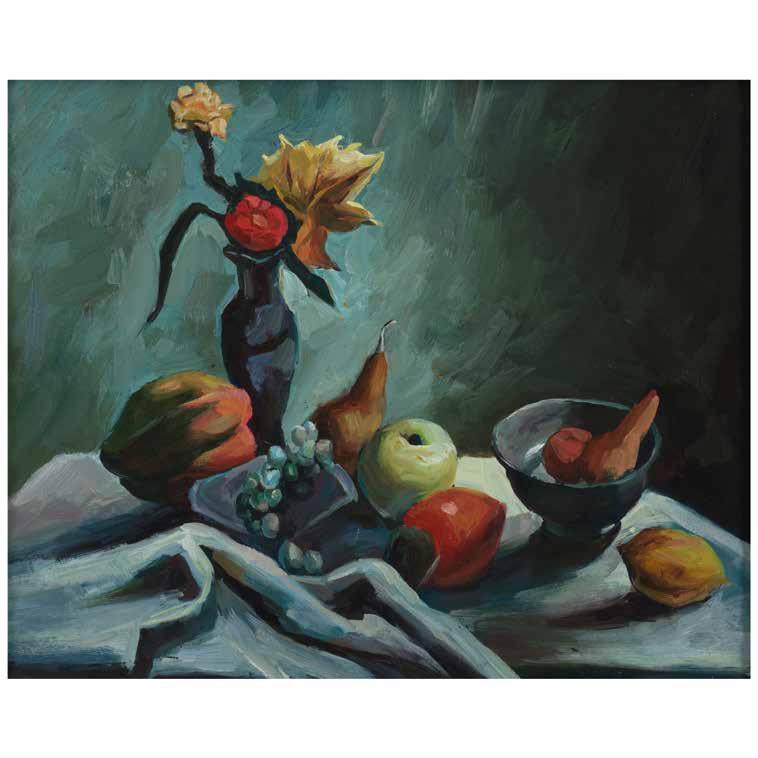
58
HENRIETTE WYETH (1907-1997)
Mary Peck
signed and dated ‘Henriette Wyeth / 1929’ (lower left) and inscribed with title (on the reverse) oil on canvas
38 1/8 x 42 1/4 in. (96.8 x 107.3 cm.)
Painted in 1929.
$30,000 - 50,000
Provenance
Mary Peck (1914-1965), Los Angeles, the sitter.
Henry Allen Reese, Jr. (1914-1987), Los Angeles, husband of the above, by descent from the above, 1965.
Michael Arthur Reese (1942-1991), son of the above, by descent from the above, 1987.
Bianca Victoria Reese (1945-2025), Palm Springs, California, wife of the above, by descent from the above, 1991.
Estate of the above, June 2025.
Acquired by the present owner from the above, 2025.
Eldest daughter of famed illustrator N.C. Wyeth (1882-1945) and member of the renowned Wyeth artistic dynasty, Henriette Wyeth developed a distinctive voice within early twentieth-century American painting, marked by a refined sensitivity to color, form, and psychological presence. Trained within a family steeped in artistic rigor—under the guidance of her father—she nevertheless departed from the narrative bravura of illustration to pursue a quieter, more introspective mode of painting. Wyeth’s work often bridges elements of Realism with lyrical, almost dreamlike modernism, emphasizing mood over strict representation. By the late 1920s, she began to establish herself as a formidable portraitist, capable of infusing her sitters with both immediacy and a subtle, contemplative distance.
Painted in 1929, Wyeth’s portrait of Mary Peck exemplifies this mature sensibility. The composition is fused with a delicate interplay of cool blues, greens, and soft pastels, creating an atmospheric harmony that envelops the sitter. Mary Peck is rendered with a poised stillness, her gaze turned slightly away, suggesting introspection rather than direct engagement with the viewer. The surrounding floral elements are not merely decorative but function as extensions of her inner world, echoing the tonal palette and contributing to the painting’s unified, almost musical structure. In this work, Wyeth demonstrates her ability to balance formal elegance with emotional subtlety, positioning the portrait as both a likeness and a meditation on presence, femininity, and quiet psychological depth.
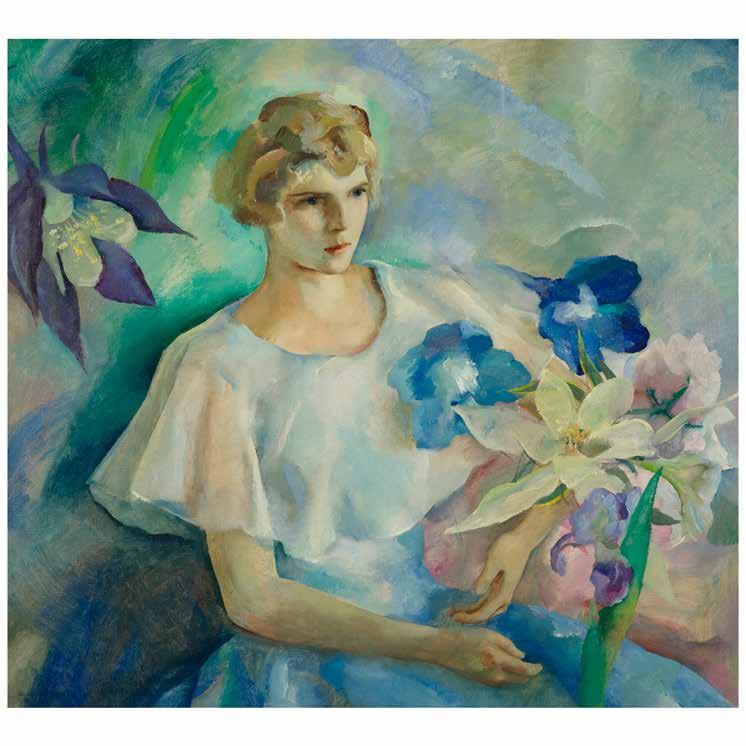
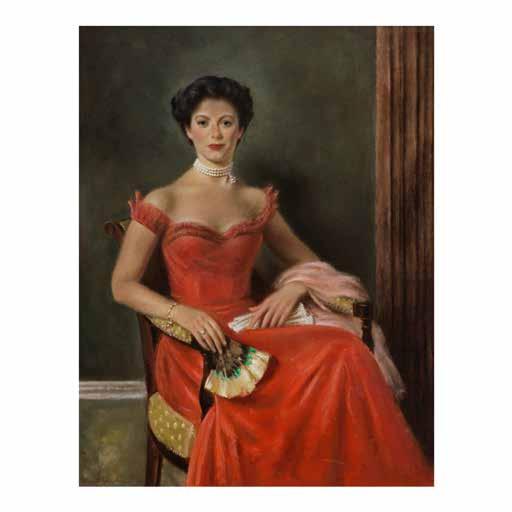
59
Miss Gloria Stroock
signed ‘Eugene Speicher’ (lower right) and inscribed with title and signed again (on the artist’s label affixed to the reverse of the frame) oil on canvas
46 x 36 in. (116.8 x 91.4 cm.)
Painted circa 1951.
$3,000 - 5,000
Provenance
Estate of the artist.
American Academy of Arts and Letters, New York, bequest from the above, circa 1962.
Gloria Jane Stroock (1924-2024), Tucson, Arizona, acquired from the above, March 22, 1984.
By descent to the present owner from the above, son of the above, 2024.
Literature
G. Stroock-Stern, Cast of Characters: A Memoir, Connecticut, 2018, pp. 110-121, illustrated.
M. Barnes, “Gloria Stroock, ‘McMillan & Wife’ and ‘Fun With Dick and Jane’ Actress, Dies at 99,” The Hollywood Reporter, Los Angeles, May 14, 2024.
M. Licht, “Gloria Stroock Dead at 99: Hollywood Actress Starred Alongside Rock Hudson and was on Broadway,” National World, London, May 15, 2024.
The present work is accompanied by a copy of Cast of Characters: A Memoir by Gloria Stroock.
The present portrait by Eugene Edward Speicher depicts American actress Gloria Jane Stroock (1924-2024), remembered for her television roles as Cornelia Otis Skinner in The Girls and Maggie in McMillan & Wife, as well as for her numerous stage roles. Speicher wrote Stroock a letter in December 1945 after seeing her in Kiss and Tell and other stage productions, asking if she would be willing to pose for a portrait to be used as a sample of his work for Portraits Incorporated. Stroock was initially unmoved to reply to his request but was eventually persuaded to sit for him by renowned director and producer, George Abbott (1887-1995) who happened to sit next to Speicher one day at lunch at the Dutch Treat Club in New York and spoke to him about his desire to paint Stroock.
After Abbott’s successful interference, Speicher went on to paint Stroock’s likeness first in 1946 and again around 1951, resulting in the present portrait. Stroock recalled, “He wanted to do another portrait, the same size as the one before, also for Portraits Incorporated. I was happy at the thought of spending time with these gentle people and immediately said yes. For this portrait I wore my red taffeta evening gown, also with a tight bodice, and a three-strand pearl choker. I held his wife’s [Elsie’s] fan with my right hand and short white gloves with my left. He draped a pale pink shawl over my left arm and the chair, which was upholstered in a soft yellow damask.” (as quoted in G. Stroock-Stern, Cast of Characters: A Memoir, Connecticut, 2018, p. 111.) The resulting portrait is nobly conceived, exhibiting Speicher’s mastery of composition and his distinctive color palette that together form a definitive aesthetic repose. Stroock was eventually able to acquire the present portrait from the American Academy of Arts and Letters in New York in 1984, while the first portrait Speicher painted of her in 1946 hung for many years in the Surrey Hotel in the collection of the Denihan family.
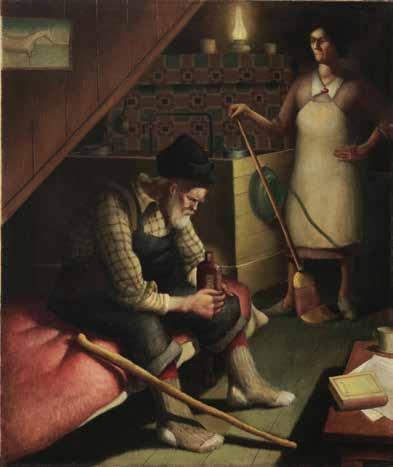
PROPERTY FROM A PRIVATE COLLECTION, BRUNSWICK, MAINE
60 PAUL SAMPLE (1896-1974)
Whiskey for Old Jim’s Cold signed ‘PAUL SAMPLE’ (lower right) and inscribed with title and signed again (on a section of the original stretcher adhered to the replacement stretchers) oil on canvas
30 x 25 1/8 in. (76.2 x 63.8 cm.)
Painted in 1937.
$6,000 - 8,000
Provenance
Ferargil Galleries, New York, 1937. (as Old Jim) Kennedy Galleries, Inc., New York. (as Old Jim) Sale, New York, Sotheby’s Park-Bernet, March 19-20, 1969, lot 195. (as Whiskey for Jim’s Cold) Private collection, Pennsylvania. Acquired by the present owner from the above, 2024.
Exhibited
Providence, Rhode Island School of Design, 1937-38.
New York, National Academy of Design, Special Exhibition, May 8-July 25, 1939, no. 68. (as Whiskey for Jim’s Cold) Norman, Oklahoma, Fred Jones Junior Museum, The University of Oklahoma, 1944. (as Old Jim)
Colorado Springs Fine Arts Center, 5th Annual Exhibition, 1940. (as Whiskey for Jim’s Cold) Manchester, New Hampshire, The Currier Gallery of Art, Paul Sample, Retrospective Exhibition, July 15-September 15, 1948, no. 28. (as Whiskey for Jim’s Cold)
Literature
Year Book, Rhode Island School of Design, 1938, p. 58.
A. Frankenstein, “Paul Sample,” Magazine of Art, Washington, D.C., July 1938, vol. 31, no. 7, p. 390, illustrated. (as Whiskey for Jim’s Cold)
H. Salpeter, “Paul Sample likes painting the cold New England winter, perhaps because the frost stings his senses into sharper awareness,” Esquire, New York, 1942, vol. 17. (as Whiskey for Jim’s Cold)
The Oklahoma Daily, Norman, Oklahoma, November 14, 1944, no. 49, p. 7. (as Old Jim)
P.F. Glick, R.L. McGrath, Paul Sample: Painter of the American Scene, exhibition catalogue, Hanover, New Hampshire, 1988, p. 25. (as Whiskey for Jim’s Cold)
61
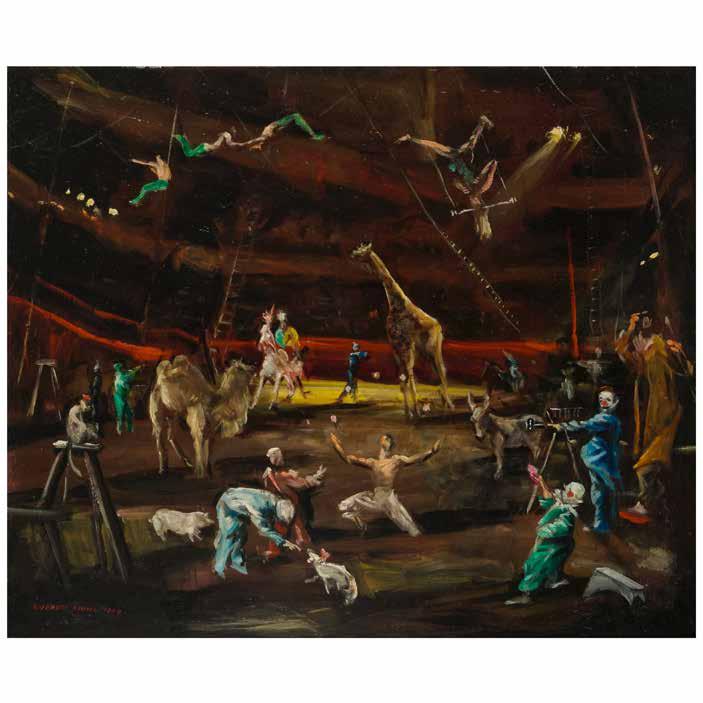
PROPERTY FROM A PRIVATE COLLECTION, PALM DESERT, CALIFORNIA
61 EVERETT SHINN (1876-1953) Circus signed and dated ‘EVERETT SHINN 1949’ (lower left) oil on Masonite
20 x 24 in. (50.8 x 61 cm.) Painted in 1949.
$20,000 - 30,000
Provenance
Chauncey Marvin Holt (1921-1997), La Mesa, California. Karyn Harcourt, daughter of the above, by descent from the above. Acquired by the present owner from the above.
PROPERTY FROM A PRIVATE COLLECTION, MALIBU, CALIFORNIA
62
JACK LEVINE (1915-2010)
The Sob signed ‘J. Levine’ (lower left) oil on canvas
20 1/8 x 24 1/4 in. (51.1 x 61.6 cm.)
Painted in 1952.
$3,000 - 5,000
Provenance
Mr. and Mrs. Stanley Marcus, Dallas. D.C. Moore Gallery, New York. Acquired by the present owner from the above.
Exhibited
New York, The American Federation of Arts, Retrospective Exhibition, September 5-November 5, 1960. Mexico, D.F., Instituto Nacional de Bellas Artes, n.d.
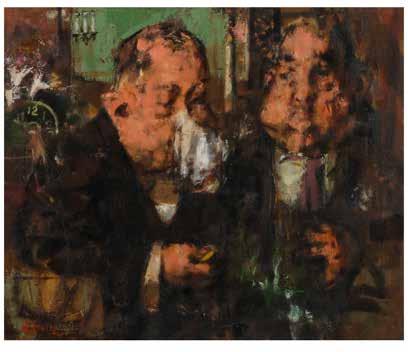
PROPERTY FROM A PRIVATE COLLECTION, CONNECTICUT
63
RALSTON CRAWFORD (1906-1978)
Tugboat estate stamped and numbered ‘32.21’ (on the stretcher) oil on canvas
16 3/8 x 20 3/8 in. (41.6 x 51.8 cm.)
Painted in 1932.
$15,000 - 25,000
Provenance
Estate of the artist.
Hirschl & Adler Galleries Inc., New York, acquired from the above, 1991. Acquired by the present owner from the above, 2023.
Exhibited
(possibly) New York, Boyer Galleries, Ralston Crawford Paintings, February 23-March 11, 1939, n.p., no. 4.
Cincinnati, The Contemporary Arts Center, Ralston Crawford, 1971, p. 36. New York, Hirschl & Adler Galleries Inc., Ralston Crawford and the Sea, March 9-April 20, 1991, pp. 17, 67, 79, no. 3, illustrated.
Literature
R.B. Freeman, Ralston Crawford, Tuscaloosa, Alabama, 1953, p. 44, no. 32.21.
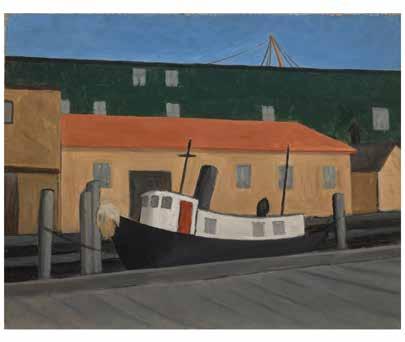
64
ALFRED HENRY MAURER (1868-1932)
Still Life
signed ‘A. H. Maurer’ (upper left) oil on gessoed board
21 3/4 x 18 in. (55.2 x 45.7 cm.)
Painted circa 1928.
$40,000 - 60,000
Provenance
Hudson D. Walker, New York.
Joshua Binion Cahn (1915-1995) and Peggy (née Masback) Cahn (1922-2007), New York, acquired from the above, circa 1940.
Museum of Fine Arts, Boston, bequest from the above, 1972.
Sale, Christie’s, New York, September 27, 2004, lot 166, sold by the above for the benefit of the acquisition funds.
Acquired by the present owner at the above sale.
Literature
C. Troyen, C.E. Moore, P.K. Diamond, T.E. Stebbins, Jr., American Paintings in the Museum of Fine Arts, Boston: An Illustrated Summary Catalogue, Boston, 1997, pp. 192, 337, 341, 358, acc. no. 1972.978, illustrated.
Alfred Henry Maurer occupies a critical position within the trajectory of early American modernism, and his still life paintings from the late 1920s represent some of the most conceptually rigorous and formally resolved works within his oeuvre. Painted circa 1928, the present still life exemplifies Maurer’s mature synthesis of European avant-garde influences, particularly those of Fauvism and Cubism, which he absorbed during his formative years in Paris. In the present work, Maurer abandons naturalistic representation in favor of a highly structured composition, in which interlocking planes and angular forms organize the pictorial space with a deliberate sense of tension and balance.
The composition centers on a grouping of commonplace objects—a chalice, cup, and a piece of fruit— rendered with emphatic contouring and set against a fractured, prismatic background. Maurer’s use of heightened, non-naturalistic color and his suppression of traditional depth flatten the spatial field, directing attention instead to the rhythmic interplay of form and surface. The gessoed board enhances the textural vitality of the paint, allowing passages of abrasion and exposed ground to contribute to the work’s dynamic surface. In this way, the present work transforms a conventional still life arrangement into a sophisticated exercise in formal abstraction, underscoring Maurer’s role as a vital conduit for the transatlantic exchange of modernist ideas into early twentieth-century American art.
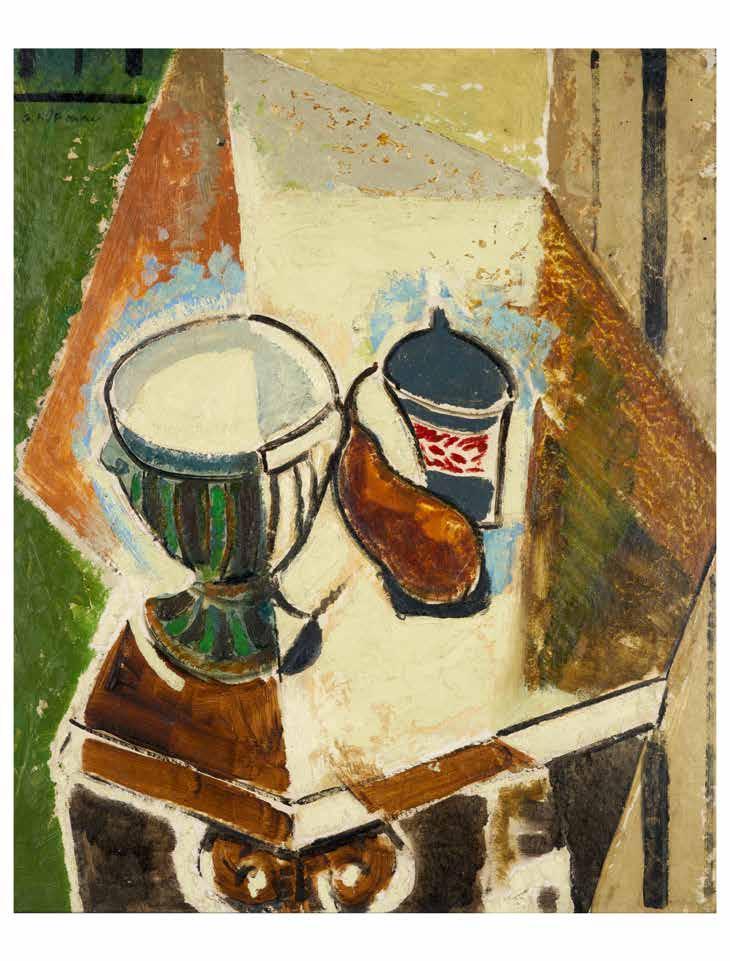
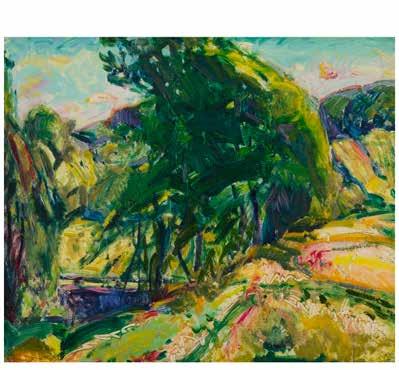
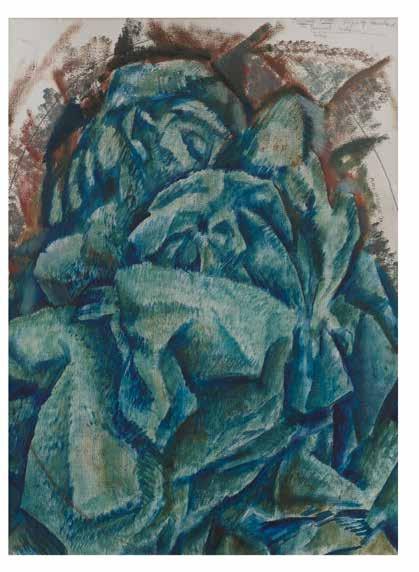
PROPERTY FROM A PRIVATE COLLECTOR, NEW YORK
65
ALFRED HENRY MAURER (1868-1932)
Landscape oil on gessoed board
18 x 21 3/4 in. (45.7 x 55.2 cm.)
Painted circa 1923.
$8,000 - 12,000
Provenance
E. Weyhe, Inc., New York, by 1932. Hollis Taggart Galleries, New York. (as Landscape (with Green Tree))
Private collection.
Private collection, by descent from above. Hollis Taggart Galleries, New York. Acquired by the present owner from the above.
Exhibited
Flint, Michigan, Flint Institute of Arts, The Art of Collecting, November 25, 2011-January 8, 2012.
New York, Questroyal Fine Art, LLC, The American Masters, October 13-December 30, 2022.
PROPERTY FROM THE COLLECTION OF A NEW YORK LADY
66
MAX WEBER (1881-1961)
Blue Crystal Figure Study
signed and dated ‘Max Weber ‘11’ (center right) oil on canvas
16 1/4 x 12 1/4 in. (41.3 x 31.1 cm.)
Painted in 1911.
$7,000 - 10,000
Provenance
Weyhe Gallery, New York, by 1956. Nardin Gallery, New York.
Exhibited
New York, The Jewish Museum, An Exhibition of Oil and Tempera Paintings, Gouaches, Pastels, Woodcuts, Lithographs and Drawings by Max Weber Celebrating the Artist’s 75th Birthday, March-May, 1956, p. 17, no. 4. (probably) New York, Weyhe Gallery, Max Weber: Woodcuts and Related Paintings, November 26-December 22, 1956, n.p., no. 3. (as Blue Crystal Figure)

PROPERTY FROM A PRIVATE COLLECTION, NEW YORK
67
GEORGE COPELAND AULT (1891-1948)
Flight into Egypt signed and dated ‘G. C. Ault 47’ (lower left) and signed again and inscribed with title (on an artist’s label preserved on the stretcher) oil on canvas
24 1/8 x 20 in. (61.3 x 50.8 cm.)
Painted in 1947.
$20,000 - 30,000
Provenance
Mr. and Mrs. I. David Orr, New York. By descent to the present owner within the family of the above.
Exhibited New York, Milch Galleries, George Ault: Memorial Exhibition, January 30-February 18, 1950, n.p., no. 19.
There is a study for this work located at the Nelson Atkins Museum of Art (2012.29.10).
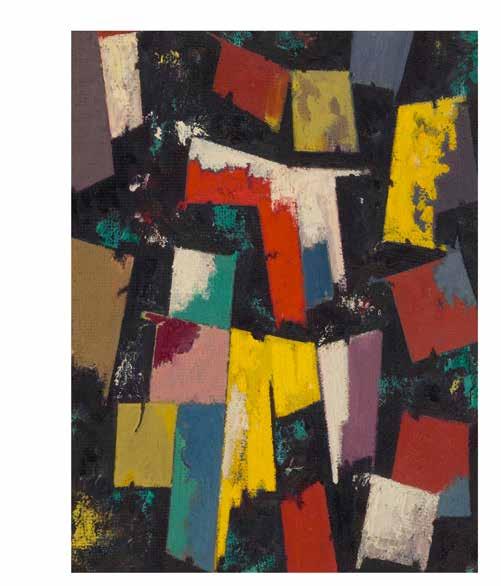
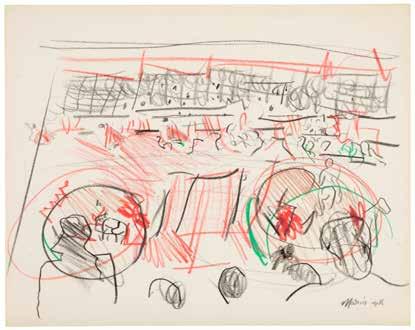
ECLECTIC WONDERS: PROPERTY FROM THE COLLECTION OF TIMOTHY EGERT
68
CHARLES GREEN SHAW (1892-1974)
Heroes and Views
signed ‘Charles Shaw’ (on the reverse) oil on Masonite 11 1/4 x 8 1/4 in. (28.6 x 21 cm.)
Painted in 1956.
$3,000 - 5,000
Provenance
Passedoit Gallery, New York.
69
JOHN MARIN (1870-1953)
The Circus I signed and dated ‘Marin 48’ (lower right) crayon on paper 10 x 12 1/2 in. (25.4 x 31.8 cm.)
Executed in 1948.
$3,000 - 5,000
Provenance
Edith Gregor Halpert (1900-1970), New York. The Downtown Gallery, New York, by 1962. (as The Circus #1)
Exhibited
The Dallas Museum for Contemporary Art, Arts of the Circus, October 9-November 11, 1962.
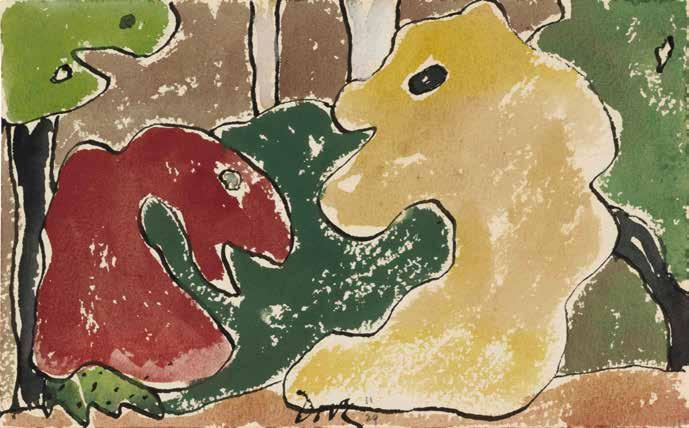
70
PROPERTY FROM THE COLLECTION OF CYNTHIA S. MONACO
70
ARTHUR DOVE (1880-1946)
Centerport Series #10 signed ‘Dove’ (lower center) watercolor, ink wash and ink on paper
5 1/2 x 8 7/8 in. (14 x 22.5 cm.) Executed in 1940.
$15,000 - 25,000
Provenance
The Downtown Gallery, New York. Dr. Leopold S. Tuchman, Beverly Hills, by 1974. By descent to the late owner from the above.
Exhibited
San Francisco Museum of Art, Arthur Dove, November 20, 1974-January 5, 1975, and elsewhere.
PROPERTY FROM AN IMPORTANT PRIVATE CALIFORNIA COLLECTION
71
MADGE TENNENT (1889-1972)
Rose Kokua (Portrait of Young Hawaiian) signed, dated, inscribed and titled ‘...by Madge Tennent Honolulu 1939’ and ‘Val & Jeanne Tennent’ (on the reverse) oil on canvas affixed to board 30 x 24 in. (76.2 x 61 cm.) Painted in 1939.
$100,000 - 150,000
Provenance
Valentine (Val) Leslie and Jeanne Marie Tennent, Koloa, Hawaii, by descent from the artist. By descent to the present owner from the above, July 1984.
“I have built my Hawaiian figures in art, in the manner of building a cathedral; cathedrals are built slowly, and the people who build them seldom experience the joy of seeing their life work completed, but are sustained only by the instinctive faith that their work is important and beautiful.”
- Madge Tennent (A. Tennent, The Art and Writing of Madge Tennent, Honolulu, 1976, p. 129).
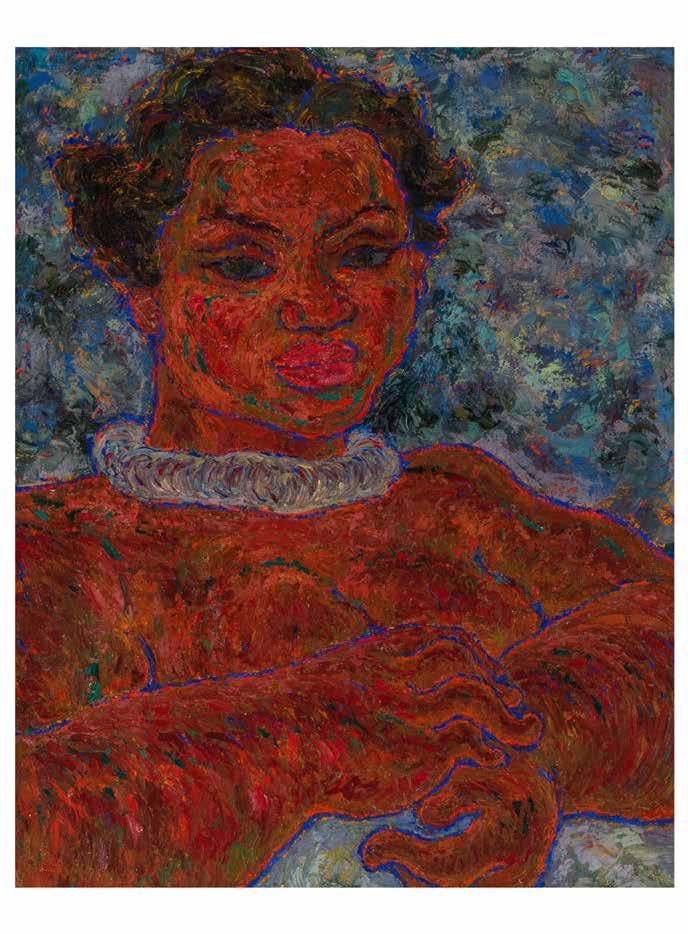
For Madge Tennent, Hawaiʻi was the apotheosis of Polynesian culture, and Kānaka ‘Ōiwi wāhine (Native Hawaiian women) were an enduring source of inspiration for over four decades. Tennent’s form of art-based ethnography, despite reflecting some nostalgia and romanticism of her time, contributed to greater visibility for Hawaiian culture among non-Natives at home and abroad. Tennent played a critical role in the development of Hawaiian Modernism not only by bridging cultures but embedding and supporting local contemporary artists of her day, such as Hon-Chew Hee and John Chin Young.
Born Madeline Grace Cook, Madge Tennent was an art prodigy, nurtured by her creative, unconventional and peripatetic family. She was born in south London but raised in Cape Town, South Africa from the age of five. Outside of ‘brief stints in a girls’ boarding school in England and in a French convent school, most of Madge’s education was the result of her parents’ informal efforts to educate their daughters at home’ (L. Menton, “Madge Tennent: Artist of Hawaii,” Woman’s Art Journal, New Brunswick, New Jersey, Spring-Summer 1981, v. 2, no. 1, p. 30).
Tennent showed an innate ability for drawing from a young age. At the age of twelve, she attended the Cape Town School of Art where she broadened her practice; and at the age of thirteen, she attended the Academie Julian in Paris to study under the leading French academic painter, William-Adolphe Bouguereau.
Her Paris years were formative—she honed her skills ‘drawing and painting eight to ten hours a day, six days a week’ and studied canonical works by at the Louvre and Musée du Luxembourg on Sundays (Ibid).
At the age of sixteen, Tennent’s family moved back to South Africa and she became director of the Johannesburg School of Art and a headmistress for several girls schools in South Africa. Tennent worked as an arts educator for nearly a decade before founding her own art school in Cape Town at the age of twenty-four.
Tennent’s marriage in 1915 to Hugh Cowper Tennent, a Lieutenant in the New Zealand Expeditionary Force, meant following a life of deployment which included the South Pacific. The Tennents were stationed in New Zealand in 1915 where their first son was born, and British Samoa between 1917 and 1923 where her second son was born. During these transformative years as a mother, wife and woman artist, Madge Tennent was first exposed to indigenous Māori and Samoan culture.
Tennent drew Samoan portraits in charcoal daily, exalting, “The Samoans have, in my opinion, the most stately walk of all Polynesians that even the Greeks could not have bettered, nor could the Greeks have had any more perfectly proportioned figures in their women. To meet Samoans, moving in their stately way down a hibiscus fringed street is like meeting a gallery of golden Greek statues and seeing not one Venus of Milo, but a hundred.” (Ibid, pp. 31, 34) The Tennents were intending to return to England from British Samoa in 1923 when a layover in Honolulu changed the course of Madge Tennent’s career.
The Tennents were persuaded to remain on Oʻahu by the artist, writer, scout, and steamship company heir, James Austin “Kimo” Wilder (1868-1934); his wife Sarah, and the poet and illustrator Don Blanding (1894-1977). Honolulu was rapidly changing in the 1920s, fueled by the growth of tourism to and between the Islands, and the rise of local art establishments such as the Honolulu Academy of Arts in 1924, and The Honolulu Printmakers in 1928. Against this backdrop, Tennent saw an opportunity to center native Hawaiians as subjects and represent them uniquely within a larger art historical context. She also found the freedom to exalt women artists in a largely male-dominated field. In 1929, Tennent and six other women artists (which included Juliette May Fraser, Gene Lynch, and Juanita Vitousek) founded The Seven, one of the earliest associations of women artists in the United States.
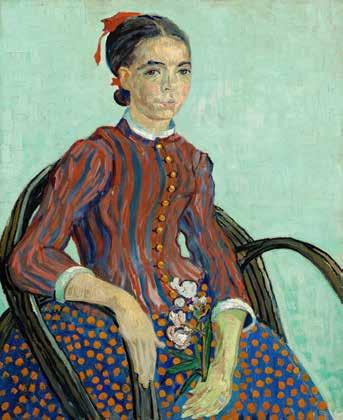
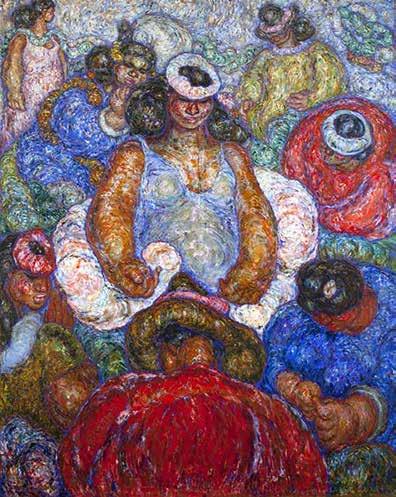
By the mid-1930s, Tennent had developed her signature style, which drew inspiration from Hawaiʻi’s vibrant colors, indigenous forms, and European Post-Impressionist techniques, particularly in the application of complimentary colors and directional impasto. While charcoal drawing remained foundational for her oil paintings, she used color to define form. Her work from this time onward exemplified the Impressionist ideals expressed by Camille Pissarro in 1896: ‘Look for the kind of nature that suits your temperament. The motif should be observed more for shape and color than for drawing...Precise drawing is dry and hampers the impression of the whole, it destroys all sensations...Do not define too closely the outlines of things; it is the brush stroke of the right value and color which should produce the drawing...Paint the essential character of things, try to convey it by any means whatsoever, without bothering about technique...The eye should not be fixed on one point, but should take in everything, while observing the reflections which the colors produce on their surroundings...Paint generously and unhesitatingly, for it is best not to lose the first impression. Don’t be timid in front of nature: one must be bold, at the risk of being deceived and making mistakes...’ (J. Rewald, The History of Impressionism, Boston, New York Graphic Society, 1973, p. 457-58).
Rose Kokua (Portrait of a Young Hawaiian) reflects the nature that suited Tennent’s temperament—abundance, grace, and vibrant energy. The sitter not only fills most of the pictorial space, but her elbows exceed it, refusing to be boxed in by the artist or viewer. In this way, it challenges
the European half-length portrait convention of depicting a sitter fully contained. Her pose with arms folded is self-possessed, accentuating the fullness of her flesh. Abundance is also conveyed materially through Tennent’s generous application of paint to the figure. Her corporeality is both present and absent in the picture plane, revealed and suggested, embodied and obscured, all at once. Grace is conveyed through fluid movement, rendered through curvilinear forms and whirling impasto as shown in her arms, lei, and hair. Vibrancy is conveyed primarily through the pairing of high-keyed complimentary colors—a practice that Vincent Van Gogh used to great effect. In Rose Kokua, juxtapositions of redgreen and blue-orange daubs of color impart an electric quality to the figure, dazzling and activating the viewer’s eye.
Created in the same decade as her monumental magnum opus painting, Lei Queen Fantasia, the present work is a prime example of Tennent’s signature Impressionistic style and palette from her most ambitious period. By the mid-1950s, health constraints limited her ability to paint at a monumental scale, and her later work—mostly on paper—reflects a return to draftsmanship. Her oil paintings are rare on the market, as she painted mostly for exhibitions and on commission. The majority of her work remains in the Tennent Art Foundation which has been entrusted to the Hawai’i Preparatory Academy in perpetuity. Other institutional collections include the Honolulu Museum of Art; the Hawai’I State Foundation on Culture and the Arts, Art in Public Places Collection; and the Victoria and Albert Museum.
72
TADASHI SATO (1923-2005)
Untitled (Submerged Rocks)
signed and dated ‘Tadashi Sato ‘78’ (lower right) oil on canvas 36 x 48 in. (91.4 x 121.9 cm.)
Painted in 1978.
$60,000 - 80,000
Provenance
Private collection, Honolulu, Oʻahu. By descent to the present owners from the above.
Tadashi Sato was born in rural East Maui from humble beginnings. His parents were pineapple farm and service workers who became general store owners once they moved west to Lahaina. Despite showing artistic promise from a young age, he did not pursue artmaking until he became an adult. The burden of filial piety fell hardest on him as the oldest of six children, and after high school, he worked at a pineapple cannery to help his family make ends meet.
In 1941, the Japanese bombing of Pearl Harbor brought upheaval to Honolulu and Sato’s life. Living under Martial Law and the specter of Executive Order 9066, Sato proved his allegiance to the U.S. by serving in the military during WWII. He was a member of the decorated 442nd Regimental Combat Team, a segregated nisei (second generation Japanese American) unit of approximately 18,000 men where a twothirds majority was from Hawaiʻi and the rest was from the mainland. (C. Gentry, “Going For Broke: The 442nd Regimental Combat Team,” The National WWII Museum, accessed March 29, 2026). As Sato was fluent in written and spoken Japanese, he was spared from direct combat and assisted with intelligence and communication efforts.
After three years of service abroad, Sato returned to Hawaiʻi at the end of the war with a new outlook and new opportunities. In 1946, on a GI Bill, Sato attended a newly-formed art school affiliated with the Honolulu Academy of Arts (J. Jensen, Tadashi Sato: A Retrospective, exhibition catalogue, Honolulu, 2002, pp. 11, 79).
Sato flourished at the Honolulu School of Art, gaining not only technical skills but a cosmopolitan understanding of the art world. An opportunity to work with the visiting Precisionist painter Ralston Crawford in the summer of 1947 led to a scholarship at the Brooklyn Museum Art School which brought him to New York. Perhaps most importantly, it was at the Honolulu school where he met classmate Isami Doi, who was two decades older and already a professional artist. Doi helped Sato envision a life as an artist and continued to be a lifelong mentor and friend.
The 1950s were formative years for Sato where he traveled between New York, Hawaiʻi and Japan. Amidst the swell of Abstract Expressionism in New York City, Sato made several key patron and gallery connections that launched his fine art career. Sato was among a cohort of Japanese Hawaiian artists that landed in New York City, including Satoru Abe, Bumpei Akaji, Bob Ochikubo, Keichi Kimura, Robert Kobayashi, and Ralph Iwamoto. They immersed themselves in the New York art world and brought institutional practices home with them. Sato is best known today as a founding member of the Metcalf Château—named after their pop-up exhibition in Honolulu in 1954— who developed a singular visual language that assimilated Abstract Expressionism with his lived experience of Hawaiʻi.
Sato returned to Lahaina in 1960, where he settled permanently. His body of work after returning to Maui expresses the forms and phenomena of the natural world around him. They are site-inspired but not site-specific. They gravitate toward ‘the forces of earth and air, fire and water’ revealing ‘both the artist’s clear attention to the subtle nuances of the environment and his capacity to extract and make visible its purest patterns and rhythms.’ (Ibid, p. 14).
Sato developed a series of mature works exploring coastlines, beaches, lava fields, ocean fauna, and skyscapes. The present work relates to a theme of submerged rocks with rolling surf, which he revisited throughout the 1960s and 1970s. It resonates compositionally with Night Surf #1 , 1965 (Ian McLean Cooke Trust) in its tripartite division of space, reflecting rocks, surf and sky. In both works, Sato activates his landscapes through his signature gestural cross-hatching technique. In the present work, Sato’s surf vibrates and emits kinetic energy at the edges where it transforms into vapor. It contrasts Night Surf #1 , however, in its lighting effects, mood, and palette. Sato’s use of red gives his landscape a vital life force, evoking glowing lava and a fiery sunset on a day with heavy particulate matter. Here, Sato captures a specific, fleeting atmospheric condition, which creates a feeling of the sublime. His entire composition is light-filled which amplifies the perception of distortions underwater in the foreground. Untitled (Submerged Rocks) is a vibrant example of one of Sato’s most enduring visual motifs that explores phenomenology head on.
The present work is the premier lot from the Collection of Joanne and Howard Hamamoto of Honolulu. The Hamamotos assembled a collection as a natural extension of mālama ‘ohana , expressing their care and support for artists of their community. Like Sato, Howard Hamamoto was a kamaʻāina and nisei born of modest means who transcended his circumstances through enterprise and determination. A lifelong resident of Honolulu, he graduated from McKinley High School (1949) and the University of Hawaiʻi at Mānoa (1953). He served his country as a 1st Lieutenant in the U.S. Air Force, and following a tour of duty, he embarked on a career in banking and commercial real estate investment that sustained him for nearly seven decades. He met his wife, Joanne Russell, while both employed at the Bank of Hawaiʻi in the mid1950s, and they married in 1959. Joanne later supported the Punahou School, managing their summer school office for over two decades. The Hamamotos lived a life of public service, supporting non-profits with a focus on Asia-Pacific relations such as The EastWest Center Foundation, Japan-America Society of Hawaii, and the Crown Prince Akihito Scholarship Foundation; and charities such as Goodwill Industries of Hawaiʻi and Aloha United Way.
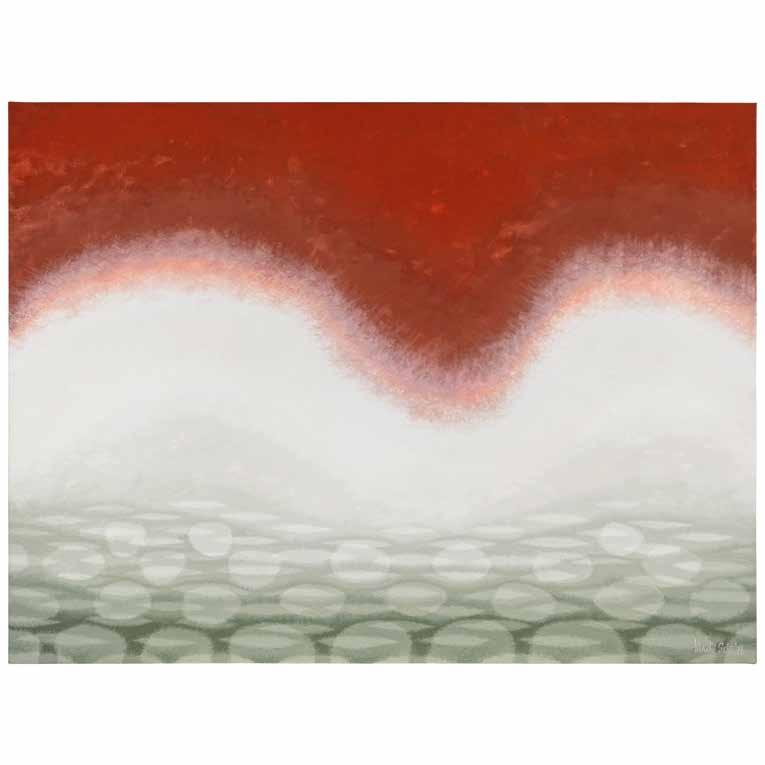
73
RALPH IWAMOTO (1927-2013)
Knight signed ‘Iwamoto’ (lower right) oil on canvas
36 x 24 in. (91.4 x 61 cm.)
Painted circa 1949-51.
$4,000 - 6,000
Provenance
Gift to the late owner from the artist, circa 1949-51.
Ralph Shigeto Iwamoto was a nisei born and raised in Honolulu. He was a student at McKinley High School when the bombing of Pearl Harbor occurred. Like many young Japanese-Hawaiian men of his generation, he proved his loyalty to America by serving in the U.S. military. He was a member of the U.S. Army in the 441st Counter Intelligence Corps Detachment where he was stationed in Allied Occupied Japan. He also attended the Military Intelligence Service Language School (MISLS) at Fort Snelling in St. Paul, Minnesota from 19451946, where he trained in Japanese translation and code breaking (Japanese American Military Experience Database, Discover Nikkei, March 31, 2026, (https://discovernikkei.org/en/resources/military/16161/).
After the war, enabled by a GI Bill, Iwamoto pursued fine art training at the Art Students League in New York City in the late 1940s and early 1950s. Like his contemporary Tadashi Sato, Iwamoto worked in a service job at the Museum of Modern Art which gave him the opportunity to see a multitude of Modernist approaches besides the Abstract Expressionism that dominated the New York art scene earlier in the decade. Here, he was exposed to Cubist and Surrealist artists such as Pablo Picasso, Wifredo Lam, and Rufino Tamayo—all of whom influenced his early work. In the late 1950s, his practice developed toward Minimalism and he became friends with adherents such as Sol LeWitt and Dan Flavin.
Iwamoto’s oeuvre spanned abstract representation to non-objective art over the course of his life in New York City. The present work dates to his earliest years in New York City, possibly while a student at the Art Students League. While painted mostly in a Cubist style, it foreshadows the Surrealist approach he would develop in the mid- to late-1950s, particularly in the treatment of the high sun which is also represented as an eye. Thus, Knight can be appreciated as a bookend for a retrospective understanding of Iwamoto’s practice. He became friends at this time with the influential Chinese-Hawaiian newspaper publisher in New York City, William Yukon Chang, who he remained close to for decades.
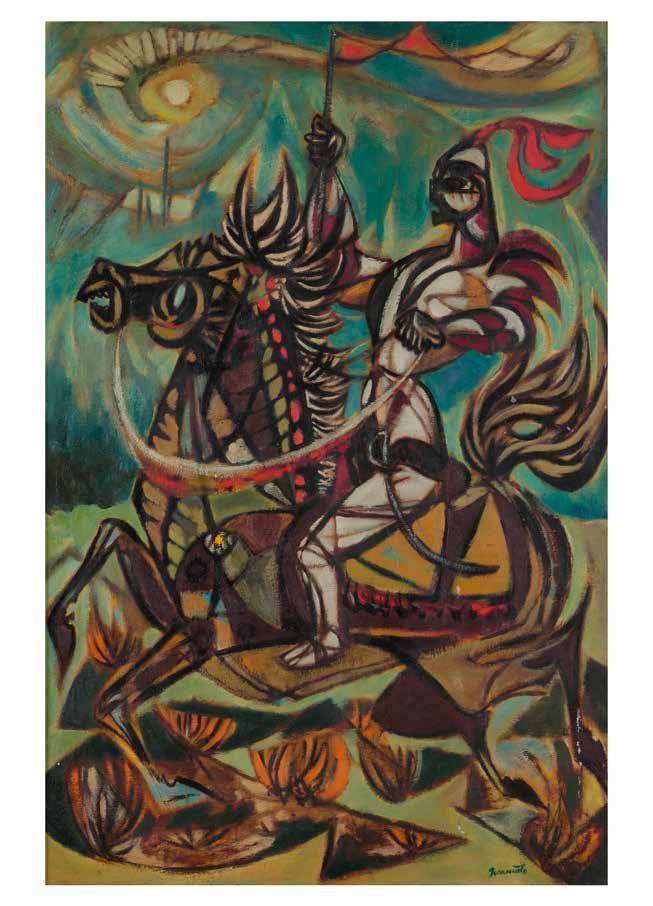
74
TADASHI SATO (1923-2005)
Untitled (Sea Form)
signed and dated ‘Tadashi Sato ‘69’ (lower right) oil on canvas
34 x 48 in. (86.4 x 121.9 cm.)
Painted in 1969.
$60,000 - 80,000
Provenance
Acquired by the present owner from the artist, by 1973.
Tadashi Sato had an illustrious artistic career that spanned over five decades. Of all the motifs that he explored in his work, sea forms were his most unique and wildly imaginative. As an avid fisherman, Sato was intimately familiar with ocean fauna. As an artist, however, Sato sought to defamiliarize their form in order to restore our sense of wonder and awe and see their otherworldliness. Sato described his paintings as ‘non-objective, bordering on abstraction. Ideas come from everywhere. My memories and life experience. Many come from Maui—its mountains, ocean, colors—but I make them mine.’ (J. Clarke and D. Dods, ed. Artists/Hawaii, Honolulu, University of Hawaiʻi Press, 1996, p. 81)
At first glance, his sea forms bear a strong likeness to sea creatures we know—sea urchins, jellyfish, conch, coral, sea sponge, sea anemone, and sand turtles, among others. Upon closer inspection, however, Sato exaggerates the shapes of his creatures, depicting them in high-contrast colors and patterns which give them an intense vitality. In the present work, Sato applied his signature cross-hatching technique to the outermost limits of his jellyfish-like sea form, working wet-on-wet, which creates the effect of radiating light. Sato’s use of a high-keyed orange-red against a monochromatic palette draws the viewer in and evokes the red-hot glow of a volcanic caldera.
Sato revisited sea forms motifs from the 1950s to early 2000s. While he was far removed from the age and rhetoric of the Transcendental Painting Group, his sea form works appear to share an aim which was ‘to carry painting beyond the appearance of the physical world, through new concepts of space, color, light and design upon planes that are termed idealistic and spiritual.’ (Transcendental Painting Group (N.M.). Transcendental Painting Group statement of purpose, 1938?. Agnes Pelton papers, 1885-1989. Archives of American Art, Smithsonian Institution). The present work is a captivating example of his biomorphic sea forms that comprise his most original works. They are a departure from the phenomenology of Sato’s air- and landscapes toward a Platonic realm of pure forms.
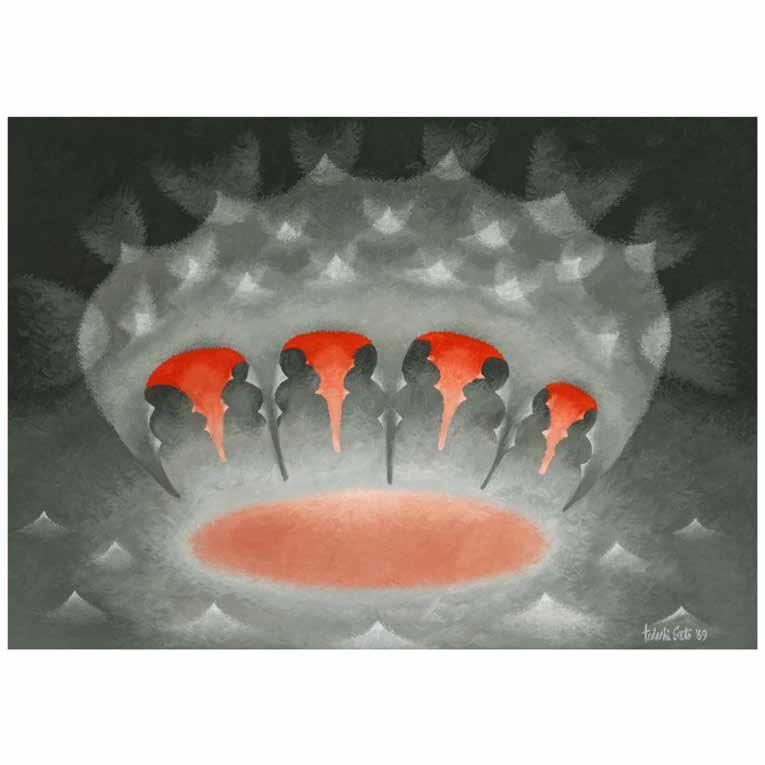
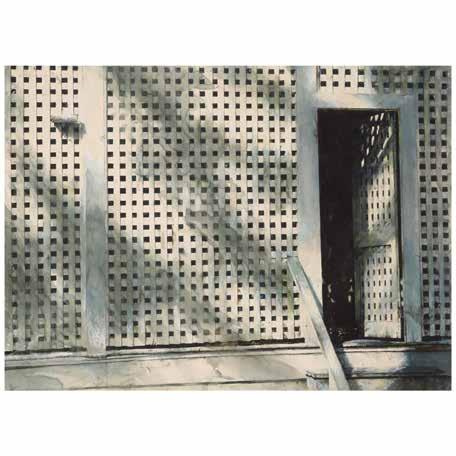
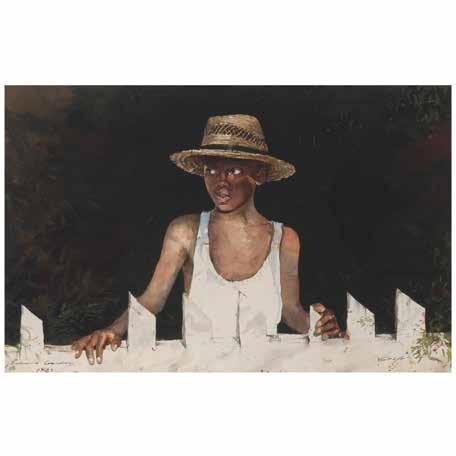
PROPERTY FROM A PRIVATE COLLECTION, LONDON
75
STEPHEN SCOTT YOUNG (BORN 1957)
Lattice Work
signed, inscribed and dated ‘SS Young © 1985’ (upper left) and inscribed with title, dated again, signed again, inscribed ‘St. Augustine, Florida’ and annotated extensively (on the reverse)
watercolor and gouache on paper laid down on board
21 1/4 x 29 in. (54 x 73.7 cm.)
Executed in 1985.
$10,000 - 15,000
Provenance
John Downs, Lake Park, Florida, acquired from the artist, June 21, 1987.
Sale, Barridoff Auctions, South Portland, Maine, August 3, 2007, lot 183. (as Slatt House in St. Augustine)
Acquired by the present owner at the above sale.
PROPERTY FROM A PRIVATE COLLECTION, LONDON
76
STEPHEN SCOTT YOUNG (BORN 1957)
Study for Tenth Son
signed partially indistinctly (lower right) and inscribed and dated ‘Bahamas Garden / 1999’ (lower left)
watercolor and graphite on paper
14 1/8 x 22 7/8 in. (35.9 x 55.1 cm.)
Executed in 1999.
$7,000 - 10,000
Provenance
Surovek Gallery, Palm Beach, Florida. Acquired by the present owner from the above.
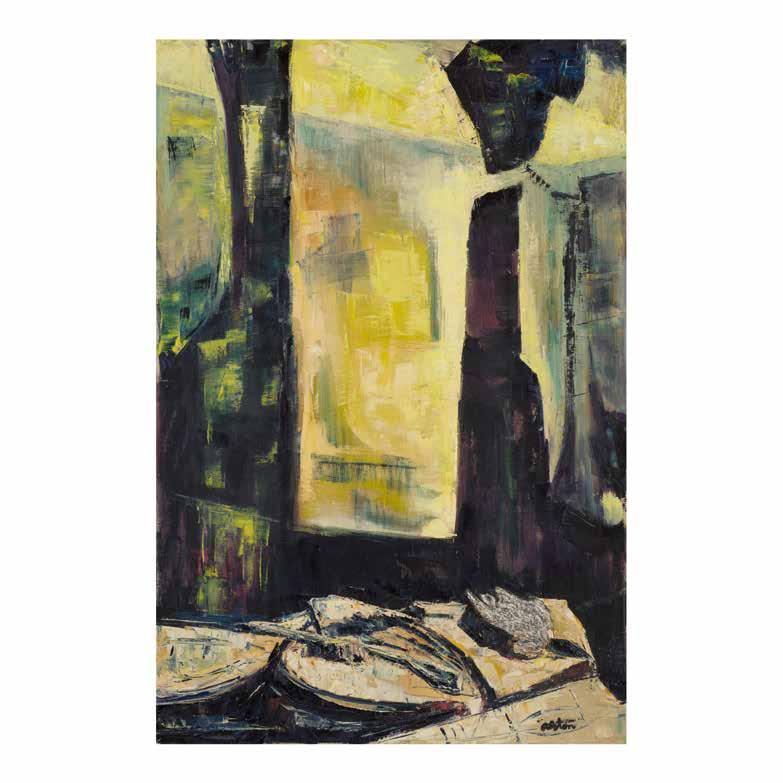
PROPERTY FROM THE COLLECTION OF VALERIE AND ROBERT MALLETT
77 CHARLES HENRY ALSTON (1907-1977)
A Place in the Sun signed ‘Alston’ (lower right) oil on canvas
36 x 24 in. (91.4 x 61 cm.) Painted circa 1953.
$30,000 - 50,000
Provenance
Sale, Treadway Toomey Galleries, Chicago, December 6, 2014, lot 620.
Acquired by the present owner at the above sale.
78
RICHMOND
Black Majesty inscribed and numbered ‘BARTHÉ 3/6’ (on the base) bronze with brown patina 24 in. high, on a 1 1/4 in. (3.2 cm.) high marble base
Modeled in 1969.
$50,000 - 70,000
Provenance
Private collection, France.
Acquired by the present owner from the above.
Literature
M.R. Vendryes, Barthé: A Life in Sculpture, Canada, 2008, pp. 176-78, fig. 5.29, another example illustrated.
P.C. Black, American Masters of the Mississippi Gulf Coast: George Ohr, Dusti Bongé, Walter Anderson, Richmond Barthé, exhibition catalogue, Jackson, Mississippi, 2009, p. 83, another example listed.
Richmond Barthé was one of the most celebrated sculptors of the Harlem Renaissance, revered for his mastered abilities as a modeler of the human form in bronze. Born in Bay St. Louis, Mississippi, Barthé initially studied painting at the School of the Art Institute of Chicago before discovering his extraordinary gift for sculpture. Barthé developed a style that combined techniques rooted in classical sculptural traditions with a deep interest in capturing the psychological depth and sensuous naturalism of his subjects—qualities that set him apart from many of his contemporaries. Through his work, Barthé was committed to representing the dignity and beauty of Black subjects at a time when such portrayals were rare in fine art.
Black Majesty, modeled in 1969, stands as a powerful testament to Barthé’s lifelong mission to celebrate Black identity with grace and grandeur. The sculpture depicts a striding female figure draped in a flowing garment and crowned with a tall, regal headdress, her posture radiating quiet authority and self-possession. The arrangement of the female figure’s posture is reminiscent of his Blackberry Woman modeled by 1930, a time when Barthé was discovering his newfound talent with clay which depicts a young woman striding forward with a basket under one arm and another on top of her head. The rich warm patina of the bronze enhances the sculptural warmth and luminosity Barthé was famous for coaxing from the medium. The work’s title is itself a declaration—an assertion of nobility and pride during a period of significant civil rights struggle in America. Mounted on a marble base, the piece exemplifies Barthé’s seamless synthesis of classical sculptural tradition with a distinctly African and African American aesthetic sensibility, securing its place as one of the defining works of his mature career.
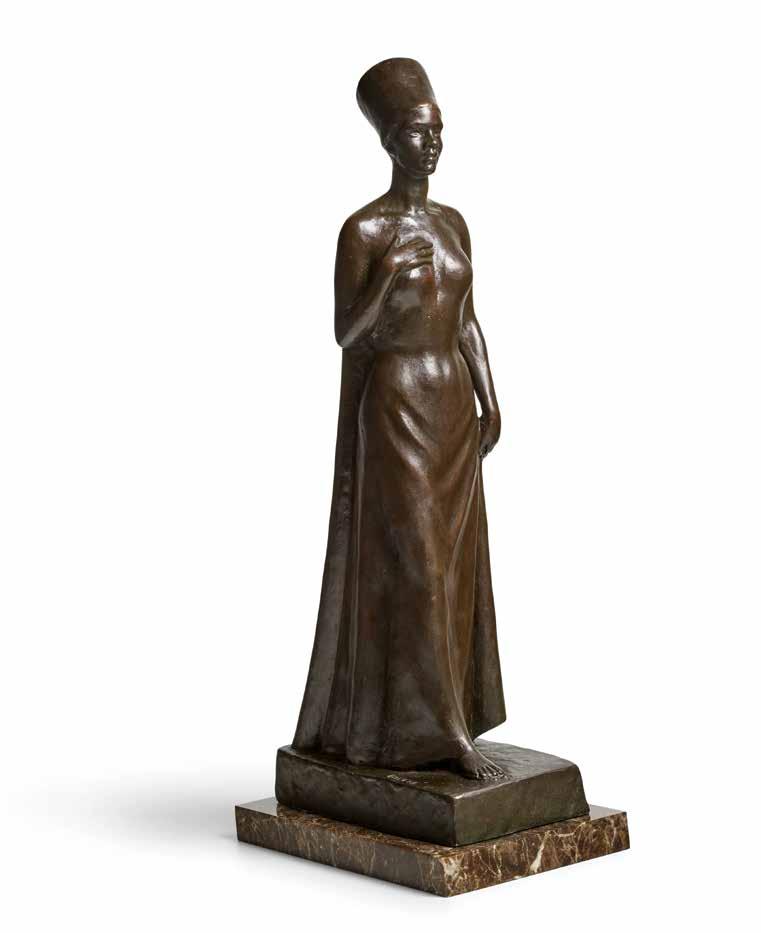
FROM A PRIVATE SOUTHERN CALIFORNIA COLLECTION
79
ELIZABETH CATLETT (1915-2012)
Pensive inscribed ‘EC’ (on the edge) bronze with dark brown patina 16 5/8 in. (42.2 cm.) high, on a 1 in. (2.5 cm.) high marble base Modeled in 1946.
$40,000 - 60,000
Provenance
Gene Vass (1922-1996) and Joan Isabel (née Kaplan) Vass (1925-2011), New York. Private collection, Santa Monica, California, by descent from the above, 2011. Acquired by the present owner from the above.
Literature
S. Lewis, The Art of Elizabeth Catlett, Claremont, California, 1984, pp. 172, 188-89, another example illustrated.
Hidden Heritage: Afro-American Art, 1800-1950, exhibition catalogue, Bellevue, Washington, 1985, p. 85, fig. 56, another example illustrated.
“Roots: a Source of Inspiration,” Sculpture Review, New York, 1998, vol. 37, no.1, p. 27, another example illustrated.
Elizabeth Catlett Sculpture: A Fifty-Year Retrospective, exhibition catalogue, Purchase, New York, 1998, pp. 16, 43, another example illustrated.
A.D. Barnwell, T.H. Benjamin, K.P. Buick, W.O. Evans, A.M. Mooney, The Walter O. Evans Collection of African American Art, Seattle, Washington, 1999, pp. 17, 20, 88, 150, pl. 20, another example illustrated. M. A. Herzog, Elizabeth Catlett: An American Artist in Mexico, Seattle, Washington, 2000, pp. ix, 69, pl. 1, another example illustrated.
S. Lewis, African American Art and Artists, Los Angeles, 2003, pp. 135-36, another example illustrated. “Samuela Lewis: More Than 60 Years of Collecting,” The International Review of African American Art, Hampton, Virginia, 2006, vol. 21, no. 1, p. 11, another example illustrated.
Elizabeth Catlett: A Black Revolutionary Artist and All That it Implies, exhibition catalogue, Washington, D.C., 2024, p. 60, another example illustrated.
Over the course of a career spanning more than seven decades, Elizabeth Catlett distinguished herself as both a master printmaker and a sculptor of exceptional sensitivity. Across these media, Catlett consistently returned to the representation of the Black female figure, treating the subject with dignity and emotional depth. Lowery Stokes Sims wrote of Catlett’s depiction of women, “Catlett’s commitment to the female form has been commented on many times. Invariably it is a celebration of people of the peasant and working class. Her women are characterized by sturdy, voluptuous physiques that invite comparisons with the wellknown female presences that predominate the oeuvre of the Mexican sculpture Francisco Zuñiga...In Catlett’s oeuvre, the female form is never gratuitously eroticized, but rather analyzed and defined for its manifestation of fecundity and strength.” (June Kelly Gallery, Elizabeth Catlett: Sculpture, exhibition catalogue, New York, 1993, p. 5)
Modeled in 1946, Pensive exemplifies these qualities. As described by the scholar Melanie Anne Herzog, the sculpture portrays “a working woman with muscular arms crossed at the base of the torso and simplified facial features that convey careworn sorrow.” (M.A. Herzog, Elizabeth Catlett: An American Artist in Mexico, Seattle, 2000, p. 69) Catlett imbues the subject with a quiet dignity and an unmistakable sense of resolve. The woman’s posture—self-contained and contemplative—suggests both the burdens of labor and an inner resilience that endures despite hardship. The present work was once in the collection of Gene Vass (19221996), a noted Abstract Expressionist painter and sculptor and Joan Vass (1925-2011), a celebrated knitwear designer and the founder of the company bearing her name.
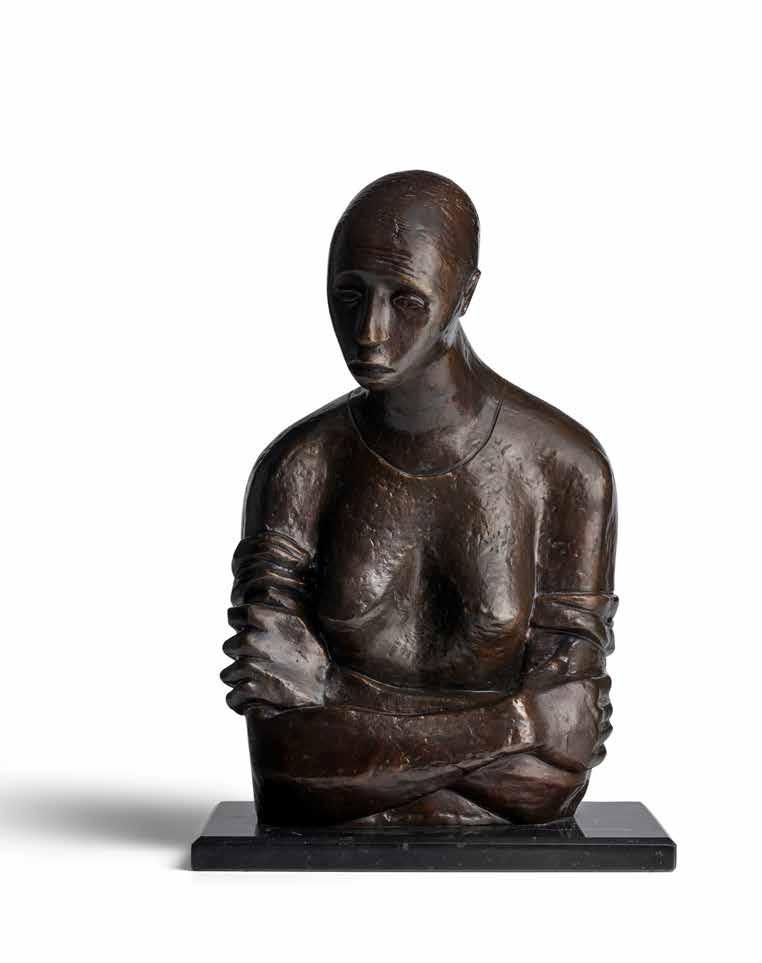
80 W
LEROY NEIMAN (1921-2012)
Bunny Discotheque signed ‘LeRoy Neiman’ (lower right) acrylic on canvas 72 x 72 in. (182.9 x 189.9 cm.)
Painted in 1963.
$100,000 - 150,000
Provenance
The Playboy Collection. Private collection, Australia.
Sale, Sotheby’s, New York, October 3, 2013, lot 166. Franklin Bowles Galleries, New York, 2014. Sale, Gaston & Sheehan Auctioneers, Pflugerville, Texas, October 2, 2025, lot 700.
Acquired by the present owner at the above sale.
Exhibited
New York, Franklin Bowles Galleries, LeRoy Neiman 2014, 2014, pp. 70-71, 141, illustrated.
Literature
L. Neiman, Art & Lifestyle, New York, 1974, pp. 190, 285, illustrated. (as Disco Bunnies)
In the 1950s, LeRoy Neiman found himself immersed in the creative energy of Chicago’s marketing and publishing world, whose figures included both his future wife, Janet ( née Byrne) Neiman (19242025), and the young publisher, Hugh Hefner (1926-2017). At the time, Neiman was producing fashion illustrations for the department store Carson Pirie Scott when Hefner recruited him to contribute artwork to his newly launched magazine, Playboy . The sensational publication would soon reshape mainstream culture, presenting a mix of journalism, fiction, and visual content alongside its nowfamous pictorial spreads. Neiman’s relationship with the magazine would endure for more than five decades. Initially illustrating stories for its monthly issues, he later authored and illustrated the magazine’s recurring feature “Man at His Leisure,” eventually becoming widely recognized as Playboy’s artist-in-residence.
Among Neiman’s most recognizable contributions to the magazine was the creation of Femlin, a mischievous cartoon figure who appeared in the magazine’s “Party Jokes” pages beginning in the mid-1950s. Although Neiman did not design the iconic Playboy Bunny logo, which was created by the magazine’s art director Art Paul (1925-2018), he frequently depicted the Bunny figure and the atmosphere of the Playboy Clubs in his illustrations and paintings. Introduced as the emblem of the Playboy brand and later embodied by the hostesses of the Playboy Clubs, the Bunny combined elements of glamour and theatrical sophistication. The costume’s distinctive rabbit ears paired with formal accessories, bow tie, collar, and cuffs, created a playful juxtaposition of elegance and spectacle that quickly became synonymous with the aspirational lifestyle Hefner promoted.
Neiman’s energetic painterly style proved particularly suited to capturing the vibrancy of this world. Known for his vivid palette and expressive brushwork, the artist translated the movement and excitement of nightlife, entertainment, and leisure culture into dynamic compositions. His depictions of Bunnies and club interiors evoke the animated social atmosphere of the Playboy Clubs, where fashion, performance, and sociability converged. As Neiman himself reflected, “The idea of Playboy was always more than a magazine anyway. It was a mindset, spun out through the clubs, Bunnies, patrons...” (L. Neiman, All Told: My Art and Life Among Athletes, Playboys, Bunnies, and Provocations, Connecticut, 2012, p. 104.) Through his imagery, Neiman helped visualize this broader cultural identity that came to be a trademark of the brand.
The present work reflects this moment when Neiman’s artistic sensibility intersected with Playboy’s emerging visual mythology. By depicting the Bunny motif, Neiman captured one of the most recognizable symbols of mid-century American leisure culture while translating it into the language of expressive painting. Works of this kind occupy a distinctive place within Neiman’s oeuvre, bridging his career as a commercial illustrator and his practice as an independent painter. As such, they offer a vivid glimpse into how the artist transformed the vitality and spectacle of the Playboy world into images that remain instantly recognizable today.
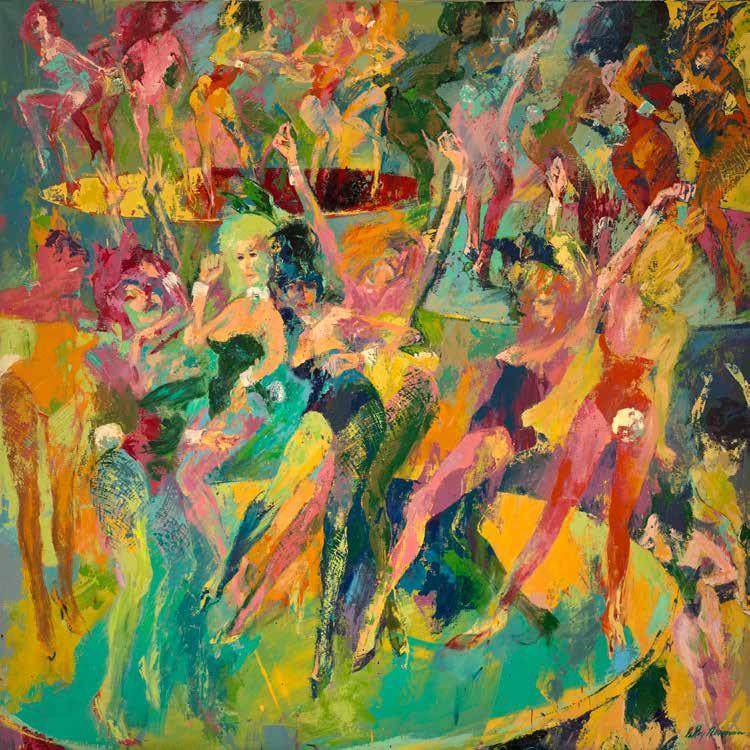
81 W LEROY NEIMAN (1921-2012)
Roulette
signed and dated ‘LeRoy Neiman ‘66’ (lower right) acrylic on Masonite 48 1/4 x 72 1/4 in. (122.6 x 183.5 cm.)
Painted in 1966.
$70,000 - 100,000
Provenance
London Playboy Casino.
Timothy Yarger Fine Art, Beverly Hills, California, by 2000. Acquired by the present owner from the above, 2000.
Painted in 1966 at the height of his long association with Playboy, LeRoy Neiman’s Roulette captures the glamour of mid-century casino culture through his signature, high-key palette and energetic brushwork. Immersed in the world of international leisure and nightlife, Neiman translated firsthand observation into a dynamic composition that evokes both the spectacle and sensuality of the gaming table.
The present work hung in the London Playboy Casino which was open from 1965-1981. It depicts Hugh Hefner (1926-2017) in the blue blazer at right. This monumental work prominently displays Neiman’s artistic prowess engaging a subject to which he would return throughout his oeuvre
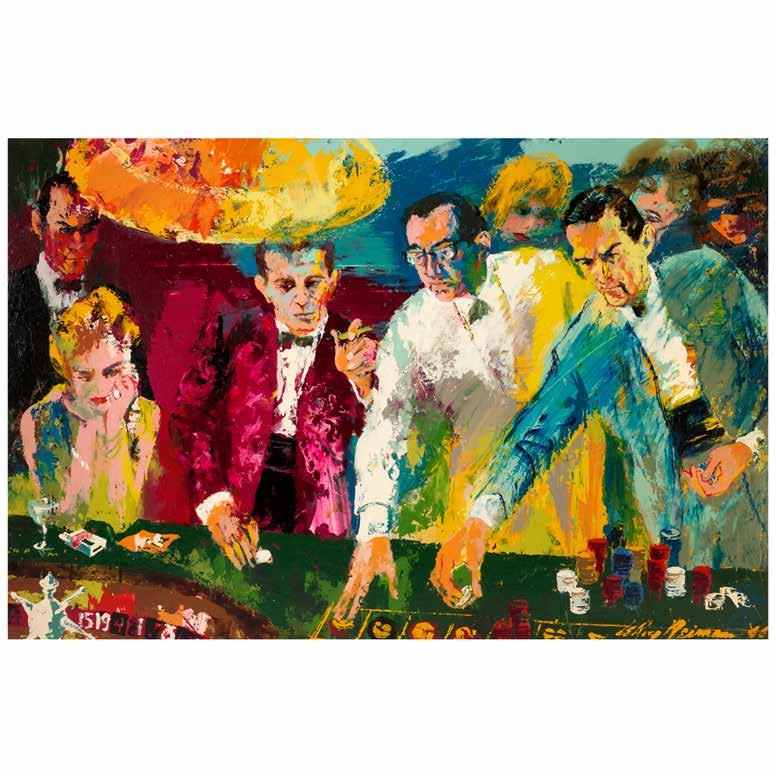

(Lots 82-85)
Bonhams is pleased to offer a selection of paintings by the celebrated American painter, art instructor, and television personality, Bob Ross (1942-1995) to benefit American Public Television. Ross, who is remembered best for his public television series, The Joy of Painting, was born in Daytona Beach, Florida, and raised in Orlando. Ross eventually left school in the ninth grade and later chose to enlist in the United States Air Force. During his twenty years of service—much of it spent in Alaska—he began painting in his spare time, inspired by the dramatic landscapes surrounding him. It was there that he developed the swift, efficient technique that would later define his career.
After leaving the Air Force, Ross studied under German painter Bill Alexander (1915-1997) and adapted and refined the wet-on-wet oil painting method. Ross learned to complete an entire landscape in under thirty minutes—an ideal format for television. In 1983, he launched The Joy of Painting, a halfhour instructional program that ran for eleven years and produced over 400 episodes. With his gentle demeanor, reassuring tone, and signature permed hair, Ross encouraged viewers to embrace creativity without fear, often reminding them that there were “no mistakes, just happy accidents.”
His television shows continue today on public television, uninterrupted since that very first episode, and are also seen on just about every streaming channel imaginable.
Ross’s painting style centered on tranquil natural scenes—snow-capped mountains, reflective lakes, rustic cabins, and softly glowing skies— rendered in rich oils with palette knife and brush. While critics sometimes dismissed his work as formulaic, his broader impact lay in democratizing art. He made painting accessible to millions, offering an approachable alternative to the exclusivity often associated with the fine art world. Through instructional books, art supplies, and certified teacher programs, he built a business enterprise that extended well beyond the television studio.
Since his death in 1995 from lymphoma, Ross’s popularity has only grown. A new generation has discovered his work through streaming platforms and social media, transforming him into a beloved internet-era figure. Today, his image and philosophy have been revisited, and Bob Ross remains synonymous with creativity, calm, and the simple joy of putting brush to canvas.

BOB ROSS (1942-1995) Autumn Images signed ‘ROSS’ (lower left) and inscribed ‘#2201 TV 16 OCT 90’ (on the stretcher)
Bob Ross Wet-on-Wet Technique® on canvas 24 x 18 in. (61 x 45.7 cm.) Painted in 1990.
$40,000 - 60,000
The proceeds from the sale of this lot will benefit American Public Television.
Bob Ross completed the present work live on air in 1990, on episode 1 of his 22nd The Joy of Painting television series. It took Bob about 3-4 days to film an entire series, after which time the paintings were returned to Bob Ross Company. This unique landscape, which Ross described in the episode as a “nice little painting,” has remained in secure storage since it was painted on TV in 1990.
The full episode can be found at: https://www.youtube.com

BOB ROSS (1942-1995)
Purple Mountain Range signed ‘ROSS’ (lower left) and inscribed ‘2610 Book’ (on the turnover edges)
Bob Ross Wet-on-Wet Technique® on canvas 18 x 24 in. (45.7 x 61 cm.) Painted in 1993.
$35,000 - 55,000
The proceeds from the sale of this lot will benefit American Public Television.
Bob Ross completed the present work for Volume 26 of his Joy of Painting instructional book. Purple Mountain Range was created as project number 10 out of 13 in the volume. Once the printer returned the painting to Bob Ross Company, it was placed in secure storage, where it has remained since.
Bob took particular pride in the paintings that would be printed in his books; he knew that people would be studying the pages for years to come and would therefore spend as many as 3-5 hours on each “book” work. For each picture, Bob included lists of materials and thoughtful, accessible step-by-step instructions to allow his readers to follow along.
Joy of Painting Volume 26 can be found here: https://www.bobross. com/joy-of-painting-book-series-26/
A Certificate of Authenticity from Bob Ross Inc. accompanies this lot.

BOB ROSS (1942-1995) Mountain Seclusion signed ‘ROSS’ (lower left) and inscribed ‘1803 Book’ (on the turnover edges)
Bob Ross Wet-on-Wet Technique® on canvas 18 x 24 in. (45.7 x 61 cm.) Painted in 1990.
$30,000 - 50,000
The proceeds from the sale of this lot will benefit American Public Television.
Bob Ross completed this work for Volume 18 of his Joy of Painting instructional book. Mountain Seclusion was project number 3 out of 13 in the volume. After the painting was completed and the printer returned it to Bob Ross Company, it was placed in secure storage, where it has remained ever since.
Bob took particular pride in the paintings that would be printed in his books; he knew that people would be studying the pages for years to come and would therefore spend as many as 3-5 hours on each “book” work. For each picture, Bob included lists of materials and thoughtful, accessible step-by-step instructions to allow his readers to follow along.
Joy of Painting Volume 18 can be found here: https://www.bobross. com/joy-of-painting-book-series-18/
A Certificate of Authenticity from Bob Ross Inc. accompanies this lot.

BOB ROSS (1942-1995)
River’s Peace
signed ‘ROSS’ (lower left) and inscribed ‘2306 Book’ (on the turnover edges)
Bob Ross Wet-on-Wet Technique® on canvas 18 x 24 in. (45.7 x 61 cm.) Painted in 1991.
$25,000 - 45,000
The proceeds from the sale of this lot will benefit American Public Television.
Bob Ross completed the present work for Volume 23 of his Joy of Painting instructional book. River’s Peace was created as project number 6 out of 13 in the volume. Once the printer returned the painting to Bob Ross Company, it was placed in secure storage, where it has remained since.
Bob took particular pride in the paintings that would be printed in his books; he knew that people would be studying the pages for years to come and would therefore spend as many as 3-5 hours on each “book” work. For each picture, Bob included lists of materials and thoughtful, accessible step-by-step instructions to allow his readers to follow along.
Joy of Painting Volume 23 can be found here: https://www.bobross. com/joy-of-painting-book-series-23/
A Certificate of Authenticity from Bob Ross Inc. accompanies this lot.
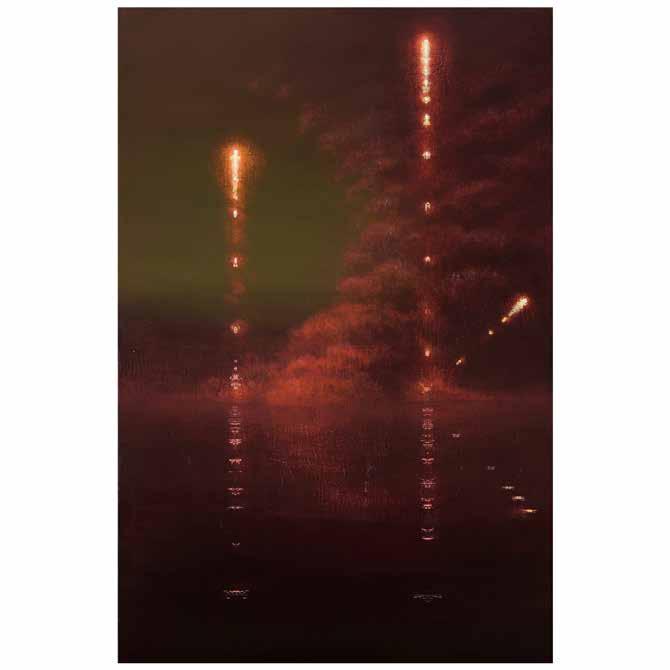
86
STEPHEN HANNOCK (BORN 1951)
Incendiary Nocturne #2 (Mass MoCA No. 220)
signed ‘Stephen Hannock’ and inscribed with title, signed again and dated ‘2014’ (on the reverse)
polished oil on canvas
54 x 36 in. (137.2 x 91.4 cm.)
Painted in 2014.
$10,000 - 15,000
Provenance
Acquired by the present owner from the artist.
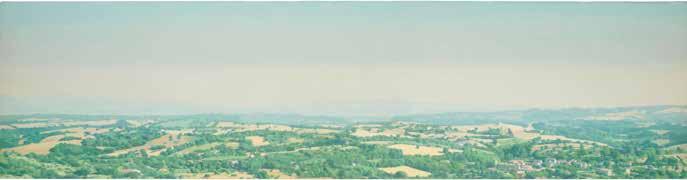
From Soratte
signed and dated ‘Hershberg 2013-2016’ (on the turnover edge) and signed and dated again and inscribed with title (on the reverse) oil on linen
Acquired by the present owner from the artist.
Exhibited
New York, Marlborough Gallery, Israel Hershberg: Paintings, Drawings & Photographs, November 16-December 30, 2016, p. 6, illustrated. 87
25 1/2 x 98 3/4 in. (64.8 x 250.8 cm.)
Painted in 2013-16.
$25,000 - 35,000
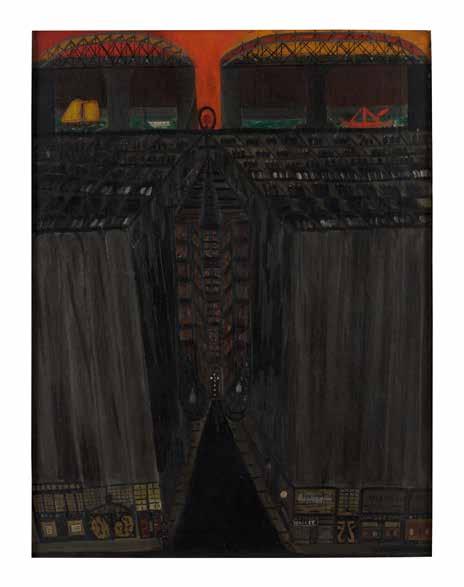
PROPERTY FROM A NEW YORK CITY PRIVATE COLLECTOR
88
RALPH FASANELLA (1914-1997)
Wall Street
signed and dated ‘R. FASANELLA 46’ (lower right) oil on canvas
29 1/4 x 22 in. (74.3 x 55.9 cm.)
Painted in 1946.
$3,000 - 5,000
Provenance
Andrew Edlin Gallery, New York, by 2013. Acquired by the present owner from the above, June 18, 2013.
Exhibited
Ithaca, New York, Herbert F. Johnson Museum of Art, Cornell University, Urban Visions: The Paintings of Ralph Fasanella, September 11-November 10, 1985, n.p., no. 2, and elsewhere. Cooperstown, New York, Fenimore Art Museum, Ralph Fasanella’s America, April 1-December 31, 2001, pp. 49-51, 176, illustrated, and elsewhere.
New York, Andrew Edlin Gallery, Ralph Fasanella: A More Perfect Union, May 11-June 22, 2013, pp. 20-21, illustrated.
Literature
P. Watson, Fasanella’s City, New York, 1973, pp. 40-41, illustrated. C. Moritz, ed., Current Biography Yearbook, New York, 1975, p. 123. S. Rodman, Artists in Tune with Their World: Masters of Popular Art in the Americas and Their Relation to the Folk Tradition, New York, 1982, pp. 95, 222, no. 29, illustrated.
J. Rowe, “Painting Ordinary Lives. Blue-collar Artist Ralph Fasanella Paints a World in Which a Sense of Community Matters,” The Christian Science Monitor, New York, February 15, 1989.
S. Andrews, “Down and Out On $350,000 a Year,” New York Magazine, February 13, 1995, vol. 28, no. 7, p. 70, illustrated.
J. Zandy, Hands: Physical Labor, Class, and Cultural Work, New Jersey and London, 2004, p. 159.
M. Fasanella, “The Utopian Vision of an Immigrant’s Son: the Oil on Canvas Legacy of Ralph Fasanella,” Italian Americana, Illinois, Summer 2010, vol. XXVIII, no. 2, p. 1, illustrated. (as Wallstreet)
R. Smith, “Ralph Fasanella: ‘A More Perfect Union,” The New York Times, June 13, 2013.
For additional information on this lot please refer to the online catalogue.

PROPERTY FROM THE COLLECTION OF A NEW YORK LADY
89
ROBERT REMSEN VICKREY (1926-2011) Madison Ave., Hawk signed ‘Robert Vickrey’ (lower left) tempera on Masonite 20 1/4 x 28 1/8 in. (51.4 x 71.4 cm.)
$7,000 - 10,000
Provenance
ACA Galleries, New York, by 1986. Acquired by the late owner from the above, November 11, 1986. 89
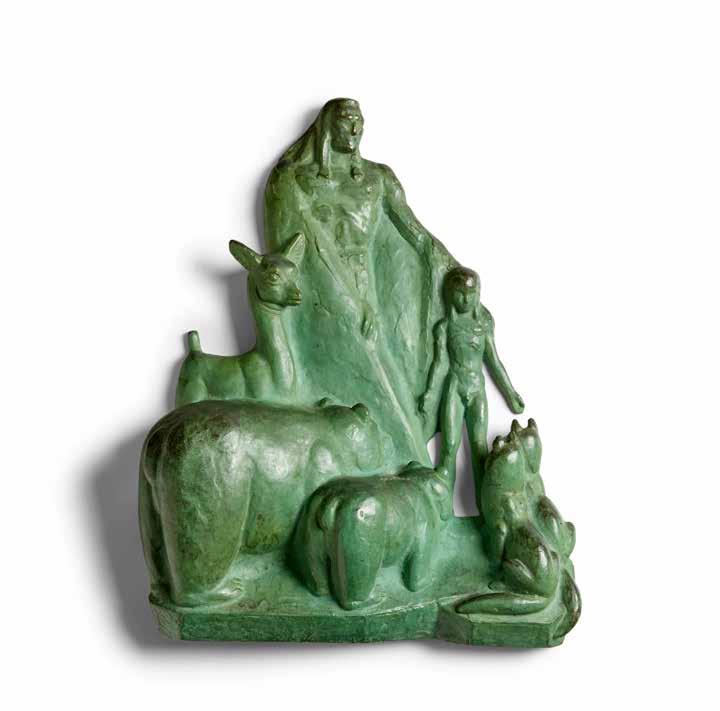
PROPERTY FROM A PRIVATE COLLECTION, FLORIDA
90 MARSHALL FREDERICKS (1908-1998)
Hiawatha bronze with green patina 16 in. (40.6 cm.) high
$8,000 - 12,000
Provenance
Private collection, Pennsylvania. Acquired by the present owner from the above.
Hiawatha was originally designed in 1938. Fredericks later reproduced this image in a largescale limestone sculpture for the Literature, Science and Arts Building at the University of Michigan.
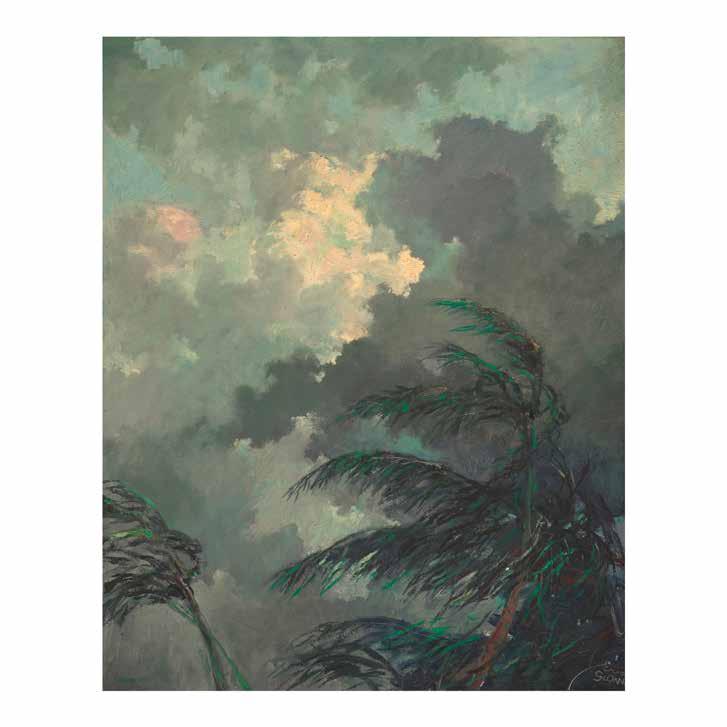
ECLECTIC WONDERS: PROPERTY FROM THE COLLECTION OF TIMOTHY EGERT
91
ERIC SLOANE (1905-1985)
Storm Sky signed ‘Eric / SLOANE’ (lower right) and inscribed with title (lower left) oil on Masonite
30 1/8 x 24 1/8 in. (76.5 x 61.3 cm.)
$4,000 - 6,000
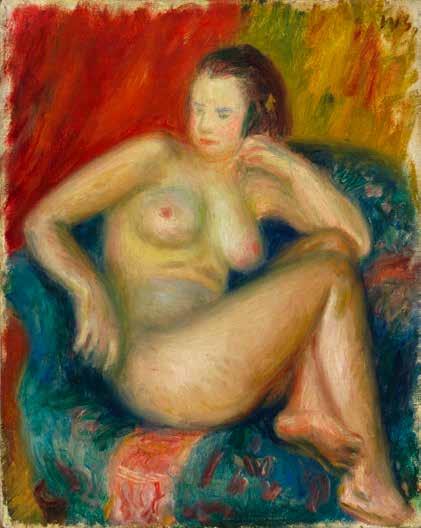
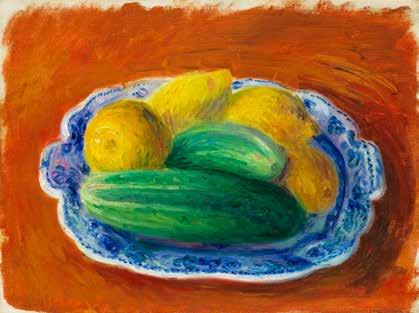
PROPERTY FROM A PRIVATE COLLECTION, NEW YORK
92
WILLIAM JAMES GLACKENS (1870-1938)
Nude in Blue Chair signed with initials ‘WG.’ (upper right) oil on canvas 15 5/8 x 12 1/2 in. (39.7 x 31.8 cm.)
$6,000 - 8,000
Provenance
Estate of the artist.
Kraushaar Galleries, New York.
Mr. and Mrs. I. David Orr, New York, acquired from the above, 1959-60.
By descent to the present owner within the family of the above.
PROPERTY FROM A PRIVATE COLLECTION, NEW YORK
93
WILLIAM JAMES GLACKENS (1870-1938)
Cucumbers and Lemons in Blue Platter inscribed with title and bears artist’s estate stamp (on the reverse) oil on canvas laid down on board 12 x 16 in. (30.5 x 40.6 cm.)
$5,000 - 7,000
Provenance
Estate of the artist. Kraushaar Galleries, New York.
Mr. and Mrs. I. David Orr, New York, acquired from the above, 1959-60.
By descent to the present owner within the family of the above.
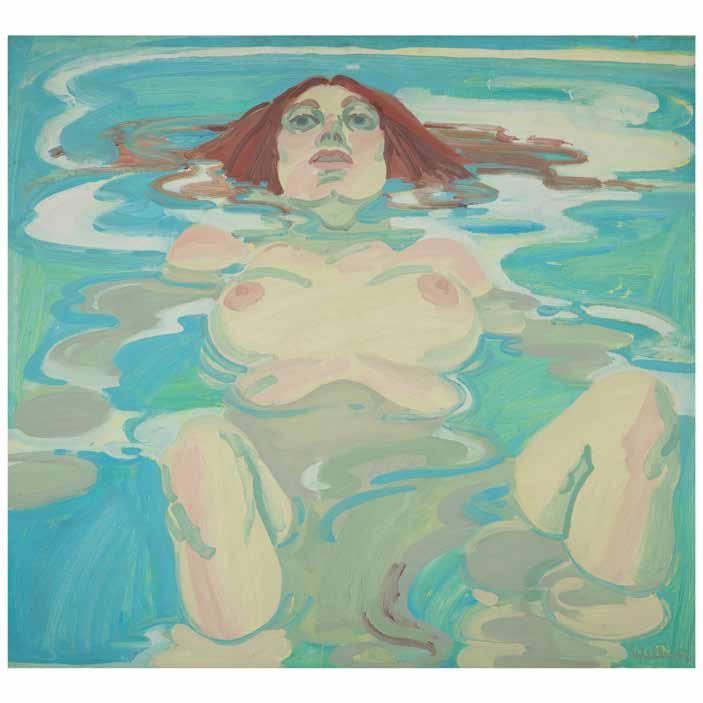
NEIL WELLIVER (1929-2005)
Untitled signed ‘Welliver’ (lower right)
acrylic on canvas
38 x 42 1/8 in. (96.5 x 107 cm.)
$8,000 - 12,000
Provenance
Melton Park Gallery, Oklahoma City, Oklahoma. Sale, Sotheby’s, New York, October 7, 1989, lot 384. Private collection, Montecito, California. Acquired by the present owner from the above.
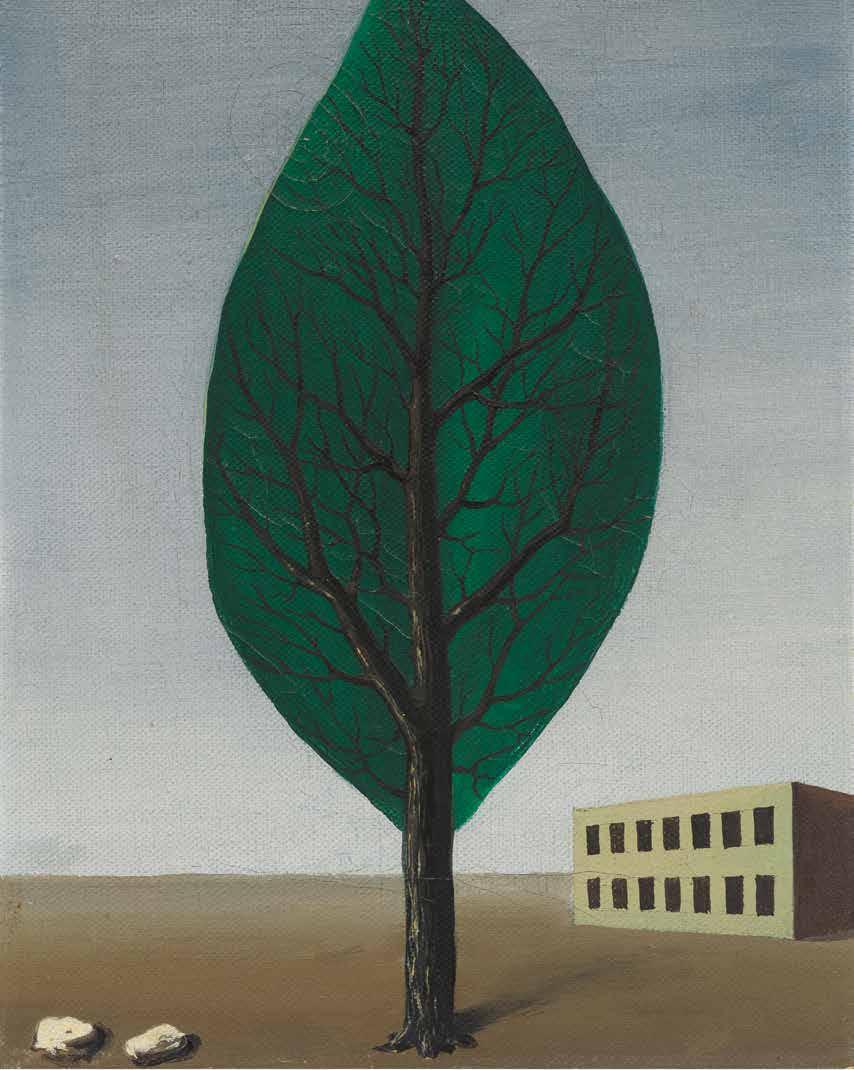
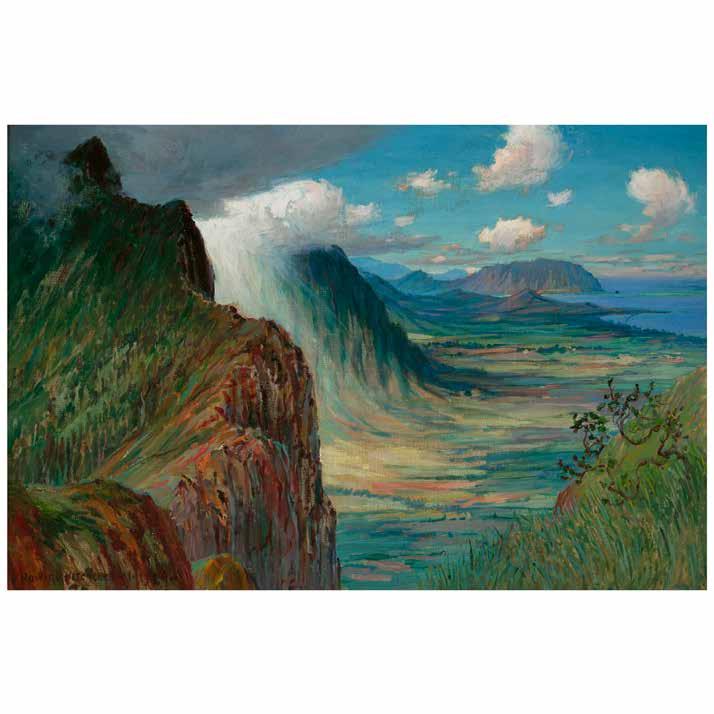
Los Angeles | July 15, 2026








Bohemian National Hall
321 East 73rd Street, New York City


Adelson Galleries
Avery Galleries
D.Wigmore Fine Art
Debra Force Fine Art
Godel & Co., Inc.
Graham Shay 1857
Hawthorne Fine Art
Helicline Fine Art
The Illustrated Gallery
Kiechel Fine Art
Questroyal Fine Art
Red Fox Fine Art
Robert Simon Fine Art
Schwarz Gallery
Somerville Manning Gallery
Thomas Colville Fine Art
Vallarino Fine Art
Weinstein Gallery
Saturday, May 16 at 2:00 pm
The Opalescent Mind:
John La Farge and the Gilded Age
Henry Adams, Ph.D.
Case Western Reserve University
Sunday, May 17 at 2:00 pm
Said in Stone:
Edmonia Lewis's Sculptural Legacy
Jeffrey Richmond-Moll, Ph.D.
The George Putnam Curator of American Art Peabody Essex Museum
Monday, May 18 at 2:00 pm
The Worlds of the Wyeths
William L. Coleman, Ph.D.
Wyeth Foundation Curator and Director,
Andrew & Betsy Wyeth Study Center
Brandywine Museum of Art
Tuesday, May 19 at 2:00 pm
Frederic Church as a Global Artist
Elizabeth Kornhauser, Ph.D.
Curator Emerita,
The Metropolitan Museum of Art
Senior Curator and Chair,
Frederic Church Bicentennial Committee
The Olana Partnership
These Conditions of Sale (as defined below) constitute the entire terms and conditions on which property listed in the catalog shall be offered for sale and sold by Bonhams and the sellers of such property for whom Bonhams acts as agent. By registering to bid and/or by bidding on or buying any property offered in the auction, you agree to be bound by these Conditions of Sale.
As used herein, the term “Conditions of Sale” includes (a) the terms and conditions contained in this document, (b) if online bidding is available for the subject auction, the Conditions of Website use at www. bonhams.com/ WebTerms which terms and conditions are incorporated by reference herein, (c) the Lot Symbols Key, and (d) the additional information contained in the Buyer’s Guide, and any other notices published for this auction, in each case as may be amended prior to or during the auction by saleroom notices published in writing or made by oral announcement. Any post-auction sale of property offered in this auction shall be made subject to these same Conditions of Sale.
The terms “Bonhams,” “we,” “us” and “our” refer to Bonhams & Butterfields Auctioneers Corp., a Delaware corporation. The terms “you” and “your” refer to the auction registrant, bidder or buyer of a lot, as applicable.
On occasion, Bonhams or one of its affiliated companies within the Bonhams Group may have an ownership or equivalent economic interest in an item of property, in whole or in part, which interest will be indicated by the ▲ symbol next to the lot number.
1. As used herein, the term “hammer price” means the price at which a lot is successfully knocked down to the buyer (or, for online-only sales, the price acknowledged by Bonhams’ online bidding system). A PREMIUM, retained by us and payable by the buyer, shall be calculated based on the hammer price and payable in addition to it (the “buyer’s premium”). The following buyer’s premium rates shall apply to each lot:
(a) For all auctions except those listed below in subparagraphs 1.(b)-(d): 28% OF THE FIRST $50,000 OF THE HAMMER PRICE, PLUS 27% OF THE AMOUNT OF THE HAMMER PRICE ABOVE $50,000 UP TO AND INCLUDING $1,000,000, PLUS 21% OF THE AMOUNT OF THE HAMMER PRICE ABOVE $1,000,000 UP TO AND INCLUDING $6,000,000, PLUS 14.5% OF THE AMOUNT OF THE HAMMER PRICE ABOVE $6,000,000.
(b) For Wines and Spirits auctions: a flat 25% OF THE HAMMER PRICE.
(c) For Coins and Banknotes auctions: a flat 20% OF THE HAMMER PRICE.
(d) For Arms and Militaria auctions: a flat 17.5% OF THE HAMMER PRICE.
Additionally, a 3rd-party bidding platform fee (the “3rd-party bidding platform fee”) equal to 4% OF THE HAMMER PRICE shall be payable by buyers whose successful bid is submitted via 3rd-party bidding platforms, including Invaluable, Live Auctioneers, The Saleroom and Lot-tissimo.
The term “purchase price” means the aggregate of (a) the hammer price, (b) the buyer’s premium, (c) any 3rd-party biding platform fee, and (d) unless the buyer is exempt by law from the payment thereof, any state or local sales tax (or compensating use tax) and other applicable taxes or duties. With regard to New York sales tax, please refer to the “SALES AND USE TAX” section of these Conditions of Sale.
2. In order to bid at the sale, prospective bidders must submit to Bonhams a completed bidder registration and any other requested information or references. New bidders and bidders who have not recently updated their registration information must pre-register to bid at least two (2) business days before the sale. Individuals will be required to provide governmentissued proof of identity and proof of address. Entity clients will be required to provide documentation including confirmation of entity registration showing the registered name, confirmation of registered address, documentary proof of officers and beneficial owners, proof of authority to transact on behalf of the entity and government- issued proof of identity for the individual who is transacting on the entity’s behalf.
We may also request a financial reference and/ or deposit from bidders before approving the bidder registration. In the event a deposit is submitted, and you are not the successful bidder, your deposit will be returned to you. If you are the successful bidder, any such deposit will be credited to offset the appropriate portion of the purchase price.
We reserve the right to request further information, including regarding the source of funds, in order to complete bidder identification and registration procedures (including completing any anti-money laundering and/or anti-terrorism financing checks we may require) to our satisfaction. If our bidder identification and registration procedures are not satisfied, we may, in our sole discretion, decline to register any bidder or reject any bid or cancel any sale to such bidder.
Every bidder shall be deemed to act as a principal unless prior to the commencement of the sale there is a written acceptance by Bonhams of a bidder registration form completed and signed by the principal which clearly states that the authorized bidding agent is acting on behalf of the named principal. Absent such written acceptance by Bonhams, any person placing a bid as agent on behalf of another (whether or not such person has disclosed that fact or the identity of the principal) may be jointly and severally liable with the principal under any contract resulting from the acceptance of a bid.
Every bidder shall be responsible for any use of its assigned paddle or bidding account, regardless of the circumstances. For all auctions and sales, should your bid be successful, you irrevocably agree to pay the full purchase price. We are not responsible for any errors that you make or that are made through your bidding account in placing a bid on a lot.
3. You represent and warrant that:
(i) you have provided to us, or will provide upon request, true and correct copies of valid identification and proof of residence and, if applicable, financial and/or corporate documents;
(ii) neither you, your principal (if applicable, and subject to Bonhams’ prior written acceptance pursuant to paragraph 2 above), nor any individual or entity with a beneficial or ownership interest in either the purchased property or in the purchase transaction is on the Specially Designated Nationals List maintained by the Office of Foreign Assets Control of the U.S. Department of the Treasury nor subject to any other sanctions or embargo program or regulation in effect in the United States, European Union, England and Wales, or other applicable jurisdictions (such programs and regulations, collectively, “Sanctions”);
(iii) if you are acting as an agent for a principal, you have conducted appropriate due diligence into such principal, and agree that Bonhams shall be
entitled to rely upon such due diligence, you will retain adequate records evidencing such due diligence for a period of five (5) years following the consummation of the sale, and will make these records available for inspection upon Bonhams’ request;
(iv) neither the purchase transaction (including your bidding activity) nor the purchase funds are connected with nor derive from any criminal activity, and they are not designed to nor have they or shall they, violate the banking, anti-money laundering, or currency transfer laws or other regulations (including without limitation, import-export laws) of any country or jurisdiction, or further any other unlawful purpose, including without limitation collusion, anti-competitive activity, tax evasion or tax fraud; and
(v) property purchased by you or your principal (if applicable) hereunder is not and will not be transferred to or used in a country in contravention of any Sanctions.
You acknowledge and agree that we may rely upon the accuracy and completeness of the foregoing warranties.
4. On the fall of the auctioneer’s hammer (or, for onlineonly sales, on the close of the lot by Bonhams’ online bidding system), the highest bidder accepted for the lot shall have purchased the offered lot in accordance and subject to compliance with all of the conditions set forth herein and (a) assumes full risk and responsibility therefor, (b) if requested will sign a confirmation of purchase, and (c) will pay the purchase price in full or such part as we may require for all lots purchased. No lot may be transferred.
Unless otherwise agreed, payment in good, cleared funds is due and payable within five (5) business days following the auction sale. Whenever the buyer pays only a part of the total purchase price for one or more lots purchased, we may apply such payments or any deposits, in our sole discretion, to the lot or lots we choose. Payment will not be deemed made in full until we have received good, cleared funds for all amounts due. Title in any purchased property will not pass until full and final payment has been received by Bonhams. Accounts must be settled in full before property is released to the buyer. In the event property is released earlier, such release will not affect the passing of title or the buyer’s obligation to timely remit full payment.
We reserve the right to refuse to accept payment from a source other than the registered bidder or buyer of record. Once an invoice is issued, we cannot change the buyer’s name on an invoice.
Payment for purchases must be made in the currency in which the sale is conducted. Bonhams’ preferred payment method is by wire transfer. For final purchases exceeding US $25,000, all payments must be in the form of wire transfer unless other arrangements have been approved in advance. For final purchases below US $25,000, payment may also be made in or by the following methods:
(i) Cash. Please note that the amount of cash that can be accepted from a given buyer is limited to US $5,000 per auction sale (whether by single or multiple related payments). If the amount payable exceeds that sum, the balance must be paid by another method.
(ii) Cashier’s check, money order, or personal check with approved credit drawn on a U.S. bank. A processing fee will be assessed on any returned checks.
(iii) Visa, MasterCard, American Express or Discover debit or credit card issued in the name of the buyer or record. Only one debit or credit card may be
used for payment of an account balance. This method of payment may not be available to first time buyers.
To the fullest extent permitted by applicable law, the buyer grants us a security interest in the property, and we may retain as collateral security for the buyer’s obligations to us, any property and all monies held or received by us for the account of the buyer, in our possession. We also retain all rights of a secured party under the Uniform Commercial Code (which shall mean the New York Uniform Commercial Code, except where the Uniform Commercial Code of another state governs the perfection of a security interest in collateral located in that state), and you agree that we may file financing statements without your signature. If the foregoing conditions or any other applicable conditions herein are not complied with, in addition to all other remedies available to us and the seller by law, we may at our election:
(a) hold the buyer liable for the full purchase price and any late charges, collection costs, attorneys’ fees and costs, expenses and incidental damages incurred by us or the seller arising out of the buyer’s breach;
(b) cancel the sale, retaining as liquidated damages all payments and deposits made by the buyer;
(c) cancel the sale and/or resell the purchased property, at public auction and/or by private sale, and in such event the buyer shall be liable for the payment of all consequential damages, including any deficiencies or monetary losses, and all costs and expenses of such sale or sales, our commissions at our standard rates, all other charges due hereunder, all late charges, collection costs, attorneys’ fees and costs, expenses and incidental damages; and/or
(d) reveal the buyer’s identity and contact details to the seller.
In addition, where two or more amounts are owed in respect of different transactions by the buyer to us, to Bonhams 1793 Limited and/or to any of our other affiliates, subsidiaries or parent companies worldwide within the Bonhams Group, we reserve the right to apply any monies paid in respect of a transaction to discharge any amount owed by the buyer. If all fees, commissions, premiums, hammer prices and other sums due to us from the buyer are not paid promptly as provided in these Conditions of Sale, we reserve the right to impose a finance charge equal to 1.5% per month (or, if lower, the maximum nonusurious rate of interest permitted by applicable law), on all amounts due to us beginning on the 31st day following the sale until payment is received, in addition to other remedies available to us by law.
5. We reserve the right to withdraw any property and to divide and combine lots at any time before such property’s auction. Unless otherwise announced by the auctioneer at the time of sale (or, for online-only sales, explicitly stated in the lot description), all bids are per lot as numbered in the catalog and no lots shall be divided or combined for sale.
6. We reserve the right to reject a bid from any bidder, to split any bidding increment, and to advance the bidding in any manner we, as auctioneer, may decide. In the event of any dispute between bidders, or in the event we, as auctioneer, doubt the validity of any bid, we, as auctioneer, shall have sole and final discretion either to determine the successful bidder, re-open the bidding, or to cancel the sale and re-offer and resell the article in dispute. If any dispute arises after the sale, our sales records shall be conclusive in all respects.
We further reserve the right to cancel the sale of any property if: (i) you are in breach of your representations
and warranties as set forth in paragraph 3 above; (ii) we, in our sole discretion, determine that such transaction might be unlawful or might subject Bonhams or the seller to any liability to any third party; or (iii) there are any other grounds for cancellation under these Conditions of Sale.
7. If we are prevented by fire, theft or any other reason whatsoever from delivering any property to the buyer or a sale otherwise cannot be completed, our liability shall be limited to the sum actually paid therefor by the buyer and shall in no event include any compensatory, incidental or consequential damages.
8. All lots in the catalog are offered subject to a reserve unless otherwise indicated in the catalog. The ¤ symbol next to the lot number denotes no reserve. The reserve is the confidential minimum hammer price at which such lot will be sold and it does not exceed the low estimate value for the lot. If a lot is offered subject to a reserve, we may implement such reserve by bidding on behalf of the seller, whether by opening bidding or continuing bidding in response to other bidders until reaching the reserve. If we have an interest in an offered lot and the proceeds therefrom other than our commissions, we may bid up to the reserve to protect such interest. If any opening or subsequent bid is below the reserve for a lot, the auctioneer (or, for online-only sales, on the close of the lot by Bonhams’ online bidding system), may reject such opening bid and withdraw the item from sale. SELLERS ARE NOT ALLOWED TO BID ON THEIR OWN ITEMS.
9. Other than as provided in the “LIMITED RIGHT OF RESCISSION” section of these Conditions of Sale with respect to identification of authorship, all property is sold “AS IS” and any statements contained in the catalog or in any advertisement, bill of sale, announcement, condition report, invoice or elsewhere as to period, culture, source, origin, media, measurements, size, quality, rarity, provenance, importance, exhibition and literature of historical relevance, merchantability, fitness for a particular purpose, or physical condition ARE QUALIFIED STATEMENTS OF OPINION AND NOT REPRESENTATIONS, WARRANTIES, OR ASSUMPTION OF LIABILITY. Neither Bonhams nor the seller shall be responsible for any error or omission in the catalog description of any property. No employee or agent of Bonhams is authorized to make on our behalf or on that of the seller any representation or warranty, oral or written, with respect to any property.
10. All purchased property shall be removed from the premises at which the sale is conducted by the date(s) and time(s) set forth herein, and, if applicable, as further specified in the “Buyer’s Guide” portion of the catalog. Lots designated with a “W” and associated purchased lots, if not removed promptly following sale, will be transferred to an offsite warehouse at the buyer’s risk and expense, as set forth in more detail in the “Buyer’s Guide.” Purchased property that is permitted to remain onsite at Bonhams’ facility must be removed at the buyer’s expense not later than 5:00 p.m. local time five (5) business days following the date of the sale. If not so removed, a storage fee of US $5.00 per lot per day will be payable to us by the buyer beginning at the close of the 14th day following the sale, and we may thereafter transfer such property to an offsite warehouse at the buyer’s risk and expense.
Accounts must be settled in full before property will be released. Packing and handling of purchased lots are the responsibility of the buyer and at the buyer’s
entire risk, as are the identification, application for, and cost(s) of obtaining any necessary export, import, restricted material (e.g. endangered species) or other permit for such lots.
11. The copyright in the text of the catalog and the photographs, digital images and illustrations of lots in the catalog belong to Bonhams or our licensors. You will not reproduce or permit anyone else to reproduce such text, photographs, digital images or illustrations without our prior written consent. Bonhams and the seller make no representation or warranty as to whether the buyer acquires any copyrights on the purchase of an item of property.
12. Bonhams may, in our discretion, as a courtesy and free of charge, execute bids on your behalf if so instructed by you, provided that neither Bonhams nor our employees or agents will be liable for any error or default (whether human or otherwise) in doing so or for failing to do so. Without limiting the foregoing, Bonhams (including our agents and employees) shall not be responsible for any problem relating to telephone, online, or other bids submitted remotely through any means, including without limitation, any human error, telecommunications or internet fault or failure, or breakdown or problems with any devices or online platforms, including third-party online platforms, regardless of whether such issue arises with our, your, or such third-party’s technology, equipment, or connection.
By participating at auction by telephone or online, bidders expressly consent to the recording of their bidding sessions and related communications with Bonhams and our employees and agents, and acknowledge their acceptance of these Conditions of Sale as well as any additional terms and conditions applicable to any such bidding platform or technology.
13. These Conditions of Sale shall bind the successors and assigns of all bidders and buyers and inure to the benefit of our successors and assigns. No waiver, amendment or modification of the terms hereof (other than posted notices or oral announcements during the sale) shall bind us unless specifically stated in writing and signed by us. No act or omission of Bonhams, its employees or agents, nor any failure thereof to exercise any remedy hereunder, shall operate or be deemed to operate as a waiver of Bonhams’ rights under these Conditions of Sale. If any part of these Conditions of Sale is for any reason invalid or unenforceable, the rest shall remain valid and enforceable.
14. You accept and agree that Bonhams will hold and process your personal information and may share and use it as required by law and as described in, and in line with Bonhams’ Privacy Policy, available online at http://www. bonhams.com/legals/9945/. If you desire access, update, or restriction to the use of your personal information, please email data.protection@bonhams.com.
15. These Conditions of Sale and the buyer’s and our respective rights and obligations hereunder shall be governed by and construed and enforced in accordance with the laws of the State of New York. Any dispute, controversy or claim arising out of or relating to this agreement, or the breach, termination or validity thereof, brought by or against Bonhams (but not including claims brought against the seller by the buyer of lots consigned hereunder) shall be resolved by the procedures set forth in the “MEDIATION AND ARBITRATION PROCEDURES” section of these Conditions of Sale.
a. Bidders and buyers must be at least 21 years of age to participate in the auction and have the legal authority to buy, receive and possess the alcoholic beverage lots offered in the sale. Each winning bidder shall present satisfactory legal documentation that he or she is at least 21 years of age. In the case of a purchaser that is a corporation, partnership or similar entity, the person receiving the purchased lots on its behalf must meet the foregoing requirements.
b. All payments for purchased property must be made directly to Bonhams. Accounts must be settled in full before property will be released. All purchases must be removed from the off-site, third-party storage facility designated in the “COLLECTION OF PURCHASES FROM WINE AND SPIRITS AUCTIONS” section of the Buyer’s Guide, where it is stored in climate-controlled conditions, within 30 days of the auction. Bonhams accepts no responsibility or liability for any damage to property that is not collected more than 14 days after the auction. Any property not so collected will incur storage charges, starting on day 15, at the then applicable rates charged by the third-party facility where sold property is stored for post-sale collection by buyers. Such third-party storage facility may charge, and the buyer agrees to pay, storage fees per lot, on a daily or a monthly basis. If any property has not been collected within 30 days from the date of sale, at the option of Bonhams the property may be transferred to and stored at a bonded warehouse the buyer’s sole risk and expense, and the buyer agrees to pay all transfer and storage expenses associated therewith.
c. Packing and handling of purchased lots are the sole responsibility of the buyer. Buyer will bear the cost and risk of any packing, pick-up, shipping, insurance and any applicable taxes thereon. Bonhams assumes no liability for assisting with any packing, shipping or insurance arrangements. Packing and handling arrangements may be available through the third party storage facility where the property is stored for post-sale collection or through other third party service providers. Buyers must arrange for such services directly with the third party provider independently at the buyer’s sole risk and expense. Bonhams and the sellers will not be liable for any acts or omissions of any packers or carriers, whether or not recommended by us.
d. Bonhams makes no representations as to the legal rights of anyone to ship or import alcoholic beverages into or within any state or jurisdiction. Purchasers are required to comply with their respective states’ or jurisdictions’ regulations regarding the importation, exportation and shipment of alcoholic beverages, and purchasers are solely responsible for the importation, exportation and shipment of alcoholic beverage products purchased. All alcoholic beverage property, however shipped or received, requires the recipient to be in possession of photo identification confirming that he or she is 21 years of age or older. In addition, many jurisdictions prohibit the importation, or limit the quantity, of alcoholic beverages entering such jurisdiction, and some jurisdictions require the purchaser, seller and/or shipper to obtain certain permits or licenses prior thereto. It is the purchaser’s sole responsibility to determine whether any such restrictions, limitations or prohibitions are applicable prior to bidding and to obtain any required permits or licenses, and any delay in obtaining or the denial of any such permit or license shall not serve as
the basis for any cancellation or rescission of any purchase made hereunder or any delay in making full payment for the purchase when due.
e. All Wines and Spirits lots are sold in Massachusetts and title passes to the buyer in Massachusetts. All sales are subject to applicable taxes.
a. Bonhams has utilized adjectival, descriptive grading to describe the conditions of coins and banknotes in the catalog rather than the Sheldon numerical scale. Grading is subjective and open to interpretation. Prospective bidders are encouraged to make their own examination of the numismatic lots offered and not rely on any other party’s opinion as to grade or other attributes, as opinions differ and grading standards change over time.
b. Many of the numismatic lots have been graded by third party grading service(s) including but not limited to PCGS, NGC, and/or ANACS. To the extent Bonhams provides such grading information in the cataloguing of a lot, it does so without any express or implied warranty or guarantee, and such information’s inclusion does not mean that Bonhams or the seller agrees or disagrees with the information that such third party grading service(s) have provided. Bonhams and its sellers shall not be bound by any prior or subsequent opinion or certification (or lack thereof) by any third party grading service, and bidders on numismatic lots hereby acknowledge and agree that any such opinion or certification (or lack thereof) shall not be used as the basis for any attempted rescission of sale. THE BUYER ASSUMES ALL RISKS RELATING TO GRADING, CONDITION, RARITY AND VALUATION OF NUMISMATIC LOTS.
c. Catalog illustrations of numismatic lots may not be to scale or reflect the depicted items’ actual size.
a. Certain classifications of firearms require licensures and/or are subject other regulatory restrictions. Prospective bidders are responsible for checking with their local (e.g. state) regulatory authorities regarding any applicable restrictions and/or license/ permit requirements before bidding. Each lot offered in the sale will be classified as “Antique Pre1899,” “Curio/Relic,” Modern firearm,” or “Modern handgun.” Firearms classified as “Antique Pre-1899” do not require any licensing to purchase and can be released directly to the buyer. Firearms classified as “Modern firearm” or Modern handgun” will only be released to persons possessing a valid Federal Firearms Dealer License. Firearms classified as “Curio/Relic” may be released to persons possessing a valid Federal Firearms Dealer License or persons possessing a valid Federal Firearms Collector of Curios and Relics License. Items that meet the age requirements but have been altered from their original configuration may NOT be delivered on a Federal Firearms Collector of Curios and Relics License. The transfer of certain types of firearms (including without limitation handguns and certain rifles) to residents may be regulated by certain state (including Massachusetts) laws. It is the prospective buyer’s responsibility to determine the legality of possession or ownership of any firearms, including transference of such, in his or her state of residence prior to bidding. Additionally, some states have restrictions
on transfers to persons holding a Federal Firearms Collector of Curios and Relics License. If you determine after purchasing a firearm that it is not transferrable in your state, Bonhams will not cancel the sale and you will be responsible for payment in full
b. Persons holding a valid Federal Firearms Dealer License may take possession of any purchase on the day of the sale upon presenting a signed copy of their Federal Firearms Dealer License provided payment to Bonhams has been made in full. If a person holding a Federal Firearms Dealer License is sending an agent to pick up purchased lot(s), that agent must be a bona fide, paid employee of the company.
c. If you possess a valid Federal Firearms Collector of Curios & Relics License, any purchased lots that qualify as such may be transferred directly to you at time of pickup. You must provide a signed copy of your current Federal Firearms Collector of Curios & Relics License at time of pickup. A Massachusetts resident presenting a Federal Firearms Collector of Curios & Relics at time of pickup must also present a copy of their valid Massachusetts License to Carry, Firearms Identification Card, or Machine Gun License.
d. If you are a Massachusetts resident and are the successful bidder on a firearm classified as “Curio/ Relic,” “Modern firearm,” or “Modern handgun” and do not possess a valid Federal Firearms License, you must arrange for the transfer of the firearm from Bonhams to a dealer in Massachusetts holding a Federal Firearms Dealer License of your choice who will then conduct the necessary background check and document the transfer in accordance with Massachusetts law. Any such fees charged by a dealer are solely the responsibility of the buyer.
e. If you live in a state other than Massachusetts, you must arrange for the shipment of firearms lots classified as “Curio/Relic,” “Modern firearm,” or “Modern handgun” to a dealer in your state holding a Federal Firearms Dealer License who will then transfer the firearm to you. A holder of a valid Federal Firearms Dealer License who lives in another state is permitted to pick up firearms lots designated as “Curio/Relic,” “Modern firearm,” or “Modern handgun.” A holder of a valid Federal Firearms Collector of Curios & Relics License who lives in another state is permitted to pick up firearm lots designated as “Curio/Relic” at Bonhams’ Marlborough office. Some states have restrictions on transfers to Federal Firearms Collector of Curios & Relics license holders. It is the buyer’s responsibility to be familiar with all applicable laws and regulations. To purchase with a Federal Firearms Collector of Curio & Relic License, the firearm must be listed as acceptable on the ATF list for collectors of curios, accessible at: https://www.atf.gov/file/128116/ download and https://www.atf.gov/file/2026/ download. Buyers are responsible for checking all regulatory authorities regarding any applicable restrictions and/or license/permit requirements before shipping any lot.
New York sales tax is charged on the hammer price, buyer’s premium and any other applicable charges on any property collected or delivered in New York State, regardless of the state or country in which the buyer resides or does business. Buyers who make direct arrangements for collection by a shipper who is considered a “private” or “contract” carrier by the New York Department of Taxation and Finance will be charged New York sales tax, regardless of the destination of the
property. Property collected for delivery to a destination outside of New York by a shipper who is considered a “common carrier” by the New York Department of Taxation and Finance (e.g. United States Postal Service, United Parcel Service, and FedEx) is not subject to New York sales tax, but if it is delivered into any state in which Bonhams is registered or otherwise conducts business sufficient to establish a nexus, Bonhams may be required by law to collect and remit the appropriate sales tax in effect in such state. Property collected for delivery outside of the United States by a freightforwarder who is registered with the Transportation Security Administration (“TSA”) is not subject to New York sales tax.
If within one (1) year from the date of sale, the original buyer (a) gives written notice to us alleging that the identification of Authorship (as defined below) of such lot as set forth in the UPPERCASE TYPE heading of the catalog description of such lot (as amended by any saleroom notices or verbal announcements during the sale) is not substantially correct based on a fair reading of the catalog (including the terms of any glossary contained therein), and (b) within ten (10) days after such notice returns the lot to us in the same condition as at the time of sale, and (c) establishes the allegation in the notice to our satisfaction (including by providing one or more written opinions by recognized experts in the field, as we may reasonably require), then the sale of such lot will be rescinded and, unless we have already paid to the seller monies owed him in connection with the sale, the original purchase price will be refunded.
If, prior to receiving such notice from the original buyer alleging such defect, we have paid the seller monies owed him in connection with the sale, we shall pay the original buyer the amount of our commissions, any other sale proceeds to which we are entitled and applicable taxes received from the buyer on the sale and make demand on the seller to pay the balance of the original purchase price to the original buyer. Should the seller fail to pay such amount promptly, we may disclose the identity of the seller and assign to the original buyer our rights against the seller with respect to the lot the sale of which is sought to be rescinded. Upon such disclosure and assignment, any liability of Bonhams as seller’s agent with respect to said lot shall automatically terminate.
The foregoing limited right of rescission is available to the original buyer only and may not be assigned to or relied upon by any subsequent transferee of the property sold. The buyer hereby accepts the benefit of the seller’s warranty of title and other representations and warranties made by the seller for the buyer’s benefit. Nothing in this section shall be construed as an admission by us of any representation of fact, express or implied, obligation or responsibility with respect to any lot. THE BUYER’S SOLE AND EXCLUSIVE REMEDY AGAINST BONHAMS FOR ANY REASON WHATSOEVER IS THE LIMITED RIGHT OF RESCISSION DESCRIBED IN THIS SECTION.
“Authorship” means only the identity of the creator, the period, culture and source or origin of the lot, as the case may be, as set forth in the UPPERCASE TYPE heading of the catalog entry for the lot. The right of rescission does not extend to: (a) works of art executed before 1870 (unless these works are determined to be counterfeits created since 1870), as this is a matter of current scholarly opinion which can change; (b) Chinese, Japanese and Korean paintings and calligraphy (unless, within 21 days of the sale of any such lot, the original buyer gives written notice to Bonhams alleging that the lot is a counterfeit and within ten (10) days after giving
such notice returns the lot to us in the same condition as at the time of sale and demonstrates to our satisfaction that the lot is a counterfeit), as current scholarship in these respective fields does not permit unqualified statements as to Authorship or date of execution; (c) titles, descriptions, or other identification of offered lots, which information normally appears in lower case type below the UPPERCASE TYPE heading identifying the Authorship; (d) Authorship of any lot where it was specifically mentioned that there exists a conflict of specialist or scholarly opinion regarding the Authorship of the lot at the time of sale; (e) Authorship of any lot which as of the date of sale was in accordance with the then generally-accepted opinion of scholars and specialists regarding the same; or (f) the identification of periods or dates of creation in catalog descriptions which may be proven inaccurate by means of scientific processes that are not generally accepted for use until after publication of the catalog in which the property is offered or that were unreasonably expensive or impractical to use at the time of such publication. For purposes of subsections (a) and (b) above, “counterfeit” is defined as a work created with intent to deceive.
EXCEPT AS EXPRESSLY PROVIDED ABOVE, ALL PROPERTY IS SOLD “AS IS.” NEITHER BONHAMS NOR THE SELLER MAKES ANY REPRESENTATION OR WARRANTY, EXPRESS OR IMPLIED, AS TO THE MERCHANTABILITY, FITNESS OR CONDITION OF THE PROPERTY OR AS TO THE CORRECTNESS OF DESCRIPTION, GENUINENESS, ATTRIBUTION, PROVENANCE OR PERIOD OF THE PROPERTY OR AS TO WHETHER THE BUYER ACQUIRES ANY COPYRIGHTS OR OTHER INTELLECTUAL PROPERTY RIGHTS IN LOTS SOLD OR AS TO WHETHER A WORK OF ART IS SUBJECT TO THE ARTIST’S MORAL RIGHTS OR OTHER RESIDUAL RIGHTS OF THE ARTIST. THE BUYER EXPRESSLY ACKNOWLEDGES AND AGREES THAT IN NO EVENT SHALL BONHAMS BE LIABLE FOR ANY DAMAGES INCLUDING, WITHOUT LIMITATION, ANY COMPENSATORY, INCIDENTAL OR CONSEQUENTIAL DAMAGES. IN NO EVENT SHALL THE AGGREGATE LIABILITY OF BONHAMS AND ITS SELLER TO A BUYER EXCEED THE PURCHASE PRICE ACTUALLY PAID FOR A DISPUTED ITEM OF PROPERTY.
(a) Within 30 days of written notice that there is a dispute, the parties or their authorized and empowered representatives shall meet by telephone and/or in person to mediate their differences. If the parties agree, a mutually acceptable mediator shall be selected and the parties will equally share the fees and expenses of mediation. The mediator shall be a retired judge or an attorney familiar with commercial law and trained in or qualified by experience in handling mediations. Any communications made during the mediation process shall not be admissible in any subsequent mediation, arbitration or judicial proceeding. All proceedings and any resolutions thereof shall be confidential, and the terms governing arbitration set forth in paragraph (c) below shall govern.
(b) If mediation does not resolve all disputes between the parties, or in any event no longer than 60 days after receipt of the written notice of dispute referred to above, the parties shall submit the dispute for binding arbitration before a single neutral arbitrator. Such arbitrator shall be a retired judge or an attorney familiar with commercial law and trained in
or qualified by experience in handling arbitrations. Such arbitrator shall make all appropriate disclosures required by law. The arbitrator shall be drawn from a panel of a national or international arbitration service agreed to by the parties, and shall be selected as follows: (i) If the arbitration service has specific rules or procedures, those rules or procedures shall be followed; (ii) If the arbitration service does not have rules or procedures for the selection of an arbitrator, the arbitrator shall be an individual jointly agreed to by the parties. If the parties cannot agree on an arbitration service, the arbitration shall be conducted by Judicial Arbitration and Mediation Services, Inc. (“JAMS”) or another national or international alternative dispute resolution (“ADR”) provider of Bonhams’ choice, and the arbitrator shall be selected in accordance with JAMS’ Streamlined Arbitration Rules and Procedures or the rules of the other ADR provider selected by Bonhams. The arbitrator’s award shall be in writing and shall set forth findings of fact and legal conclusions.
(c) Unless otherwise agreed to by the parties or provided by the published rules of the arbitration service:
(i) The arbitration shall occur within 60 days following the selection of the arbitrator;
(ii) The arbitration shall be conducted in New York, New York; and
(iii) Discovery and the procedure for the arbitration shall be as follows:
A. All arbitration proceedings shall be confidential;
B. The parties shall submit written briefs to the arbitrator no later than 15 days before the arbitration commences;
C. Discovery, if any, shall be limited as follows: (I) Requests for no more than 10 categories of documents, to be provided to the requesting party within 14 days of written request therefor; (II) No more than two (2) depositions per party, provided however, the deposition(s) are to be completed within one (1) day; (III) Compliance with the above shall be enforced by the arbitrator in accordance with New York law;
D. Each party shall have no longer than eight (8) hours to present its position. The entire hearing before the arbitrator shall not take longer than three (3) consecutive days;
E. The award shall be made in writing no more than 30 days following the end of the proceeding. Judgment upon the award rendered by the arbitrator may be entered by any court having jurisdiction thereof.
To the fullest extent permitted by law, and except as required by applicable arbitration rules, each party shall bear its own attorneys’ fees and costs in connection with the proceedings and shall share equally the fees and expenses of the arbitration.
The lot symbols used in the catalog have the following meanings:
¤ No Reserve
Unless indicated by the ¤ symbol next to the lot number (or bearing an explicit statement such as “No Reserve” or “Without Reserve”), which denotes no reserve, all lots in the catalog are subject to a reserve. The reserve is the minimum hammer price that the seller is willing to accept for a lot. This amount is confidential and does not exceed the low estimate value.
▲ Bonhams’ Ownership Interest in Property Offered at Auction
The ▲ symbol indicates that Bonhams or one of its affiliated companies within the Bonhams Group
owns the lot in whole or in part or has an economic interest equivalent to an ownership interest in the lot.
∏ Bidding by Interested Parties
We will mark the lost with the ∏ symbol when a party with a direct or indirect interest in the lot who may have knowledge of the lot’s reserve or other material information may be bidding on the lot. Such interested parties may be beneficiaries of an estate that consigned the lot or a joint owner of a lot. Any interested party who is recognized as the successful bidder on a lot must pay the purchase price in full and is subject to these Conditions of Sale.
○ Guaranteed Property/Third Party Irrevocable Bid
The ○ symbol indicates that the seller of the lot has been guaranteed a minimum price for its property by Bonhams or by a third party, or jointly by Bonhams and a third party (called third party guarantor). Such guaranteed minimum price may apply only to the lot or on an aggregate basis to all or a portion of the seller’s consigned property, which may be offered in one or more auctions. Bonhams and/or any third parties providing a guarantee may benefit financially if the guaranteed property is sold successfully and may incur a financial loss if its sale is not successful. The third party guarantor typically provides an irrevocable written bid on the guaranteed lot prior to the auction at a level that ensures the lot will sell. If there are competing bids at the auction, the third party guarantor may also bid a higher amount than the irrevocable bid submitted. In exchange for sharing or assuming in full this risk, Bonhams may compensate the third party guarantor by paying it a fixed and/or contingent financing fee based on the hammer price achieved. Where the third party guarantor is the successful bidder on the lot, the financing fee for providing the bid may be netted against the full purchase price owing, and in such
Ω
case Bonhams will report the purchase price net of such financing fee. Third party guarantors are required by Bonhams to disclose their financial interest to anyone whom they are advising in connection with the guaranteed lot.
The Ω symbol indicates that the lot is subject to US Customs duty or tariff and/or related import fees payable by the buyer as part of the purchase price. Please refer to the Specialist Department managing the auction for details.
A lot with the Y symbol has been identified at the time of cataloguing as made of or containing certain restricted plant or animal material such as tortoiseshell, coral, whalebone, Brazilian rosewood or certain types of reptilian or other exotic skins, fur or feathers woods that may be subject to import or export restrictions or may otherwise require the granting of one or more export or import licenses or certificates, or that may be subject to similar restrictions regulating intrastate or interstate transport or trade within the United States at the state or federal level, or may be banned from export or import altogether by some countries. Please refer to paragraph 10 in the Conditions of Sale or to the Specialist Department managing the auction for details.
A lot with the ↂ symbol may be pictured or displayed with a component, such as a stand, a watchband, or snuff bottle stopper, that is shown for display purposes only and is not part of the lot being offered for sale. In certain instance, the display-only component may be made of or incorporate restricted materials and may be available for personal pick-up, free of charge (separate from the purchased lot) from the saleroom location where the lot was sold. Please refer to paragraph 10 in the Conditions of Sale or to the Specialist Department managing the auction for details.
Starting on June 28, 2025, the import into the European Union (“EU”) of non-EU origin property of a certain age (and in some categories, property above a certain value) is subject to additional EU regulatory requirements. It is the Buyer’s sole and exclusive responsibility to investigate whether property (including any lot) meets the requisite regulatory criteria for import into the EU and to obtain any relevant import(er) license or statement.
Please note that this process is governed by local authorities and may take time. Regardless of any delay in the obtaining of an import(er) license or statement, or denial thereof, purchased lots shall be paid for in accordance with the Conditions of Sale, and any such delay or denial shall not serve as the basis for cancellation or rescission of any sale. Prospective buyers are advised to obtain information from the relevant regulatory authorities regarding import restrictions, requirements, and costs prior to bidding.
Certain third-party agents may be available to assist the buyer in attempting to obtain the appropriate import(er) license or statement, however, there is no assurance that any necessary licenses or statements can be obtained.
The W symbol indicates that the lot is oversized or otherwise such that it must be collected from our designated warehouse.
Please refer to the Offsite Sold Property Storage section of the Buyer’s Guide for details.
P Premium (“Purple Paddle”) Lot Subject to Restricted Bidding
Lots bearing the “P” symbol will not be available for online bidding, and bidders wishing to register to bid on such lots must do so in advance and may be required to provide a bank letter of reference or other credentials in advance of being permitted to bid on the lot. If you will not be attending the auction in person, contact the Specialist Department managing the auction or Bonhams’ Client Service Office at least one business day in advance of the auction date to arrange a telephone bid or an absentee bid.
Lot symbols appear adjacent to the subject lot number in the catalog and are provided as a convenience to bidders; we do not accept any liability for errors or omissions in marking lots.
26, 80, 81, 87
Whether you are an experienced bidder or an enthusiastic novice, auctions provide a stimulating atmosphere unlike any other. Bonhams previews and sales are free and open to the public. As you will find in these directions, bidding and buying at auction is easy and exciting. Should you have any further questions, please visit our website at www.bonhams.com or contact our Client Services Department at Tel: 1-800-959- 4383 (toll free, within the US) or Tel: 1-908-707-0077 (outside the US).
Catalogs
Before each auction we publish illustrated catalogs. Our catalogs provide descriptions and estimated values for each “lot.” A lot may refer to a single item or to a group of items auctioned together. The catalogs also include the dates and the times for the previews and auctions. We offer our catalogs by subscription or by single copy. For information on subscribing to our catalogs, you may refer to the subscription form in this catalog, call our Client Services Department, or visit our website at www.bonhams.com/us.
Previews
Auction previews are your chance to inspect each lot prior to the auction. We encourage you to look closely and examine each object on which you may want to bid so that you will know as much as possible about it. Except as expressly set forth in the Conditions of Sale, items are sold “as is” and with all faults; illustrations in our catalogs, website and other materials are provided for identification only. At the previews, our staff is always available to answer your questions and guide you through the auction process. Condition reports may be available upon request and are strongly recommended for all intending bidders who cannot view the property in person.
Bonhams’ catalogs include low and high value estimates for each lot, exclusive of the buyer’s premium and tax. The estimates are provided as an approximate guide to current market value based primarily on previous auction results for comparable pieces, and should not be interpreted as a representation or prediction of actual selling prices. They are determined well in advance of a sale and are subject to revision. Please contact us should you have any questions about value estimates
Reserve
Unless indicated by the ¤ symbol next to the lot number, which denotes no reserve, all lots in the catalog are subject to a reserve. The reserve is the minimum auction price that the seller is willing to accept for a lot. This amount is confidential and does not exceed the low estimate value.
On occasion, Bonhams may offer property in which it has an ownership interest in whole or in part or otherwise has an economic interest. Such property, if any, is identified in the catalog with a ▲ symbol next to the lot number(s). Bonhams may also offer property for a seller that has been guaranteed a minimum price for its property by Bonhams or jointly by Bonhams and a third party. Bonhams and any third parties providing a guarantee may benefit financially if the guaranteed property is sold successfully and may incur a financial loss if its sale is not successful. Such property, if any, is identified in the catalog with a ○ symbol next to the lot number(s).
You must be 18 years old or over to bid. At Bonhams, you can bid in many ways: in person, via absentee bid, over the phone, or via Bonhams’ live online bidding facility. Absentee bids can be submitted in person, online, or via email. Irrespective of previous bidding activity a valid Bonhams’ client account is required to participate in bidding activity. You will be required to provide government issued proof of identity, proof of residence, and if you are a company, your certificate of incorporation or equivalent documentation with your name and registered address, proof of your current address, documentary proof of your beneficial owners and directors, and proof of authority to transact. We may also request a financial reference and/or deposit from you
before allowing you to bid. By bidding at auction, whether in person or by agent, by absentee bid, telephone, online or other means, the buyer or bidder agrees to be bound by the Conditions of Sale. Lots are auctioned in consecutive numerical order as they appear in the catalog. Bidding normally begins below the low estimate. The auctioneer will accept bids from interested parties present in the saleroom, from telephone bidders, from online bidders, and from absentee bidders who have left written bids in advance of the sale. The auctioneer (or, for online-only sales, Bonhams’ online bidding system) may also execute bids on behalf of the seller up to the amount of the reserve, but never above it. We assume no responsibility for failure to execute bids for any reason whatsoever.
If you are planning to bid at auction for the first time, you will need to register at the reception desk in order to receive a numbered bid card. To place a bid, hold up your card so that the auctioneer can clearly see it. Decide on the maximum auction price that you wish to pay, exclusive of buyer’s premium and tax, and continue bidding until your bid prevails or you reach your limit. If you are the successful bidder on a lot, the auctioneer will acknowledge your paddle number and bid amount.
As a service to those wishing to place bids, we may at our discretion accept bids without charge in advance of auction online or in writing on bidding forms available from us. “Buy” bids will not be accepted; all bids must state the highest hammer price the bidder is willing to pay. Our auction staff will try to bid just as you would, with the goal of obtaining the item at the lowest hammer price possible. In the event identical bids are submitted, the earliest bid submitted will take precedence. Absentee bids shall be executed in competition with other absentee bids, any applicable reserve, and bids from other auction participants. A friend or agent may place bids on your behalf, provided that we have received your written authorization prior to the sale. Absentee bid forms are available in our catalogs, online at www.bonhams.com/ us, at offsite auction locations and at our Los Angeles, San Francisco and New York galleries.
By Telephone
We can arrange for you to bid by telephone. To arrange for a telephone bid, please contact our Client Services Department a minimum of 24 hours prior to the sale
We offer live online bidding for most auctions and accept absentee bids online for all our auctions. Please visit www. bonhams.com/us for details.
In order to bid online in a sale, you must be 18 years old or over and you must register to bid via MyBonhams.com. Once you have registered, you should keep your account details strictly confidential and not permit any third party to access your account on your behalf or otherwise. You will be liable for any and all bids made via your account. Please note payment must be made from a bank account in the name of the registered bidder.
Online Bidding Registration for Individuals: Enter your full name, email, residential address, date of birth and nationality and provide a valid credit card in your name which will be verified via Stripe before you are able to bid. If your credit card fails verification, you will not be permitted to bid and you should contact the Client Services Department for assistance. We may in addition request a financial reference and/or deposit from you prior to letting you bid. If you are bidding as agent on behalf of another party, you agree: (i) to disclose this fact to the Client Services Department; (ii) to provide such information as we require to enable us to complete bidder identification and registration procedures (including completing any anti-money laundering and/or anti-terrorism financing checks) on that third party; and (iii) that where your bid is successful, you are jointly and severally liable with that other party for the full amounts owing for the successful bid (whether or not you have disclosed that fact or the identity of the principal). Where you
are the successful bidder for any lot with a hammer price equal to or in excess of US $10,000, and if you have not provided such documents previously, you will be required to upload or provide to the Client Services Department your government issued photo ID and (if not on the ID) proof of your address before the purchased lot can be released to you. Notwithstanding the foregoing, we reserve the right to request ID documentation from any bidder or buyer and to refuse to release any purchased lot until such documentation is provided.
Online Bidding Registration for Companies or Other Legal Entities: You must select the option to set up a business account and then provide your full name, email, residential address, date of birth and the full name of the entity. You must provide a credit card for verification either in your name or the name of the entity but payment must be made from an account in the entity’s name. If your credit card fails verification, you will not be permitted to bid and should contact the Client Services Department for assistance. We may, in addition, require a bank reference or deposit prior to letting you bid. For all successful bids, we require the entity’s certificate of formation/incorporation or equivalent documentation confirming the entity’s name and registered address, documentary proof of each beneficial owner owning 25% or more of the entity, and proof of your authority to transact before the lot can be released to you.
We reserve the right to request any further information from any bidder that we may require in order to carry out any identification, anti-money laundering or anti-terrorism financing checks conducted by us. We may at our discretion postpone or cancel your registration, not permit you to bid and/or postpone or cancel completion of any purchase you may make.
For live auctions, Bonhams generally uses the following increment multiples as bidding progresses:
$50-200...................................by $10s
$200-500.................................by $20/50/80s
$500-1,000..............................by $50s
$1,000-2,000...........................by $100s
$2,000-5,000...........................by $200/500/800s
$5,000-10,000….....................by $500s
$10,000-20,000......................by $1,000s
$20,000-50,000......................by $2,000/5,000/8,000s
$50,000-100,000....................by $5,000s
$100,000-200,000..................by $10,000s above $200,000......................at auctioneer’s discretion
For online-only auctions, Bonhams generally uses the following increment multiples as bidding progresses:
$50-200..................................by $10s
$200-500................................by $20/40/60/80s
$500-1,000.............................by $50s
$1,000-2,000..........................by $100s
$2,000-5,000..........................by $200/400/600/800s
$5,000-10,000........................by $500s
$10,000-20,000......................by $1,000s
$20,000-50,000......................by $2,000/4,000/6,000/8,000s
$50,000-100,000....................by $5,000s
$100,000-200,000..................by $10,000s above $200,000......................at auctioneer’s discretion
The auctioneer (or, for online-only sales, Bonhams’ online bidding system) shall have full discretion, as outlined in the Conditions of Sale to split or reject any bid at any time.
Solely for the convenience of bidders, a currency converter may be provided at Bonhams’ auctions. The rates quoted for conversion of other currencies to U.S. Dollars are indications only and should not be relied upon by a bidder, and neither Bonhams nor its agents shall be responsible for any errors or omissions in the operation or accuracy of the currency converter.
A buyer’s premium is added to the winning hammer price of each individual lot purchased, at the rates set forth in the Conditions of Sale. The winning hammer price plus the premium constitute the purchase price for the lot. Applicable sales taxes are computed based on this figure, and the total becomes your final purchase price.
Unless specifically illustrated and noted, fine art frames are not included in the estimate or purchase price. Bonhams accepts no liability for damage or loss to frames during storage or shipment. All sales are final and subject to the Conditions of Sale found in our catalogs, on our website, and available at the reception desk.
Payment may be made to Bonhams by cash, checks drawn on a U.S. bank, money order, wire transfer, or by Visa, MasterCard, American Express or Discover credit or charge card or debit card. All items must be paid for within five (5) business days of the sale. Please note that payment by personal or business check may result in property not being released until purchase funds clear our bank.
Buyers must pay applicable sales tax. Other state or local taxes (or compensation use taxes) may apply. Sales tax will be automatically added to the invoice if Bonhams is required to collect and remit sales tax in the subject jurisdiction based on our local nexus and applicable law, unless a valid resale number has been furnished. If you wish to use your resale license please contact the Client Services Department for our form.
The export of a lot from the United States or import into certain countries may be subject to export or import regulations, licensure and/or other restrictions; in particular, lots containing plant or animal materials such as tortoiseshell, coral, whalebone, Brazilian rosewood or certain types of reptilian or other exotic skins, fur or feathers, irrespective of age or value, may require the granting of one or more export or import licenses or certificates, or may be banned from import altogether by some countries. Moreover, the ability to obtain an export license or certificate does not ensure the ability to obtain an import license or certificate in another country. Lots that contain such regulated species materials may also not be eligible for exportation or for re-importation into the United States. In addition, resales of lots containing certain regulated species materials may be subject to restrictions in some jurisdictions.
Lots noted in the catalog with a “Y” next to the lot number contain one or more such regulated plant or animal materials, however lots containing regulated material may lack the Y notation. It is the buyer’s responsibility to investigate any such restrictions and to obtain any relevant export or import licenses. Please note that this process is governed by local authorities and may take considerable time. Regardless of any delay in the obtaining of an export/import license or certificate or denial thereof, purchased lots shall be
paid for in accordance with the Conditions of Sale, and any such delay or denial shall not serve as the basis for cancellation of any sale. Prospective buyers are advised to obtain information from the relevant regulatory authorities regarding export and import restrictions, requirements, and costs prior to bidding.
Prospective buyers should also check with their local (e.g. state) regulatory authorities regarding any local restrictions and/or permit requirements that may apply with respect to purchases of regulated species materials. Certain third-party agents may be available to assist the buyer in attempting to obtain the appropriate licenses and/or certificates. However, there is no assurance that any necessary licenses or certificates can be obtained. Please contact the relevant Specialist Department for a suggested list of shipping agents prior to placing a bid if you are uncertain as to whether a lot is subject to export/import license or certificate requirements or related restrictions.
Scheduling an appointment and payment in full prior to arrival will facilitate the quick release of your property.
For your convenience, pre-allocated 30-minute collection time slots are available by appointment Monday through Friday between 9am – 4:30pm local time.
If you are sending a third party to collect, please provide details to our Client Services Department prior to your scheduled pickup or we will be unable to release your property.
To schedule collection of purchases:
• For property from NEW YORK Sales and LOS ANGELES auctions: please contact our Client Services Department at Tel: 1-800-959-4383 (toll free, within the US) or Tel: 1-908-707- 0077 (outside the US), or via email at invoices.us@bonhams.com.
• For property form BOSTON Sales and MARLBOROUGH auctions: please use the online scheduler, available at https://skinner. appointlet.com/, or contact our Client Services Department at Tel: 1-508-970-3000 or via email at bids@bonhamsskinner.com.
For an additional fee, Bonhams may provide packing and shipping services for certain items. If you wish to receive a Bonhams’ shipping quote, please indicate this at the time of registration. Carriers are not permitted to deliver to P.O. boxes.
International buyers are responsible for all import/ export customs duties and taxes. An invoice stating the actual purchase price will accompany all international purchases.
Storage charges of US $5 per lot, per day will begin accruing for any lots not collected within 14 calendar days of the auction.
Bonhams reserves the right to remove uncollected sold lots to the warehouse of Door To Door at the buyer’s risk and expense. Handling and storage and Full Value Protection fees will apply, as further set forth in the Offsite Sold Property Storage section (below).
Buyers are to review the Offsite Sold Property Storage section (below) for information regarding lots that will be removed to the offsite warehouse of Door To Door shortly after the sale. These designated lots must be collected by the buyer from Bonhams (at the designated premises where the sale occurred) prior to the day and time designated in the Offsite Sold Property Storage section, or from Door To Door thereafter. If buyers of these designated lots also buy other lots, these lots may also be removed to the warehouse of Door To Door, so all lots remain together and customers can collect or ship from one location. All other items will remain at Bonhams for a period of 14 days, after which time they may be transferred to offsite storage at the buyer’s risk and expense.
All lots marked with a “W” in the catalogue are oversized and subject to additional storage and shipping as set forth below. Lots not so listed will remain at Bonhams; provided, however, THAT IF BUYERS OF W LISTED LOTS ALSO BUY OTHER NON-LISTED ITEMS, THESE OTHER LOTS WILL ALSO BE REMOVED TO THE WAREHOUSE OF DOOR TO DOOR, so that all lots remain together and buyers can collect their entire purchases from one location. For any questions please refer to the Bonhams Client Services Department.
The transfer of lots to the warehouse of Door To Door is at the buyer’s risk and expense. For sold lots removed to Door To Door, there will be transfer and Full Value Protection charges due immediately upon transfer and daily storage charges will begin to accrue five (5) business days after the transfer.
The per-lot charges of Door To Door Services are as follows (plus any applicable sales tax):
FURNITURE/LARGE OBJECTS
Transfer ………...$75
Daily storage …..$10
Full Value Protection (on Hammer + Premium + tax): 0.3%
SMALL OBJECTS
Transfer…..….....$37.50
Daily storage…...$5
Full Value Protection (on Hammer + Premium + tax): 0.3%
Please note, Door To Door does not accept liability for damage or loss due to negligence or otherwise, exceeding the stated value of such goods, or at its option the cost of repairing or replacing the damaged or missing goods.
A. NEW YORK Sales (and New York Online Sales).
Unless you are otherwise notified:
• W lots (and additional purchases) from sales occurring on Tuesdays and Wednesdays will be transferred to offsite storage at Door To Door on the proximate Thursdays . You may collect W lots from Bonhams by 5pm Eastern Time on Wednesdays. Purchases will be available for collection on Fridays of the same week from Door To Door.
• W lots (and additional purchases) from sales occurring on Thursdays, Fridays and Mondays will be transferred to offsite storage at Door To Door on the proximate Tuesdays. You may collect
W lots from Bonhams by 5pm Eastern Time on Mondays. Purchases will be available for collection on Wednesdays from Door To Door.
Collections appointments must be booked 24 hours in advance with Door To Door (subject to full payment of all outstanding amounts due to Bonhams and Door To Door).
Address:
Door To Door Services
50 Tannery Rd. Somerville, NJ 08876
B. LOS ANGELES Sales (and Los Angeles Online Sales)
• You will be notified in advance of the sale of the date and time of the removal of W lots (and additional purchases) to the Door To Door warehouse. Please be advised that removal may occur the day following the day of the sale.
Collections appointments must be booked 24 hours in advance with Door To Door (subject to full payment of all outstanding amounts due to Bonhams and Door To Door).
Address:
Door to Door Services
6280 Peachtree St. Commerce, CA, 90040
For more information regarding storage, shipping, or collection from Door To Door please contact Door To Door directly at auctions@dtdusa.com.
Payments for purchased lots must be made directly to Bonhams. Door To Door will not release property unless the buyer has paid Bonhams in full. All charges for handling and storage due to Door To Door must be paid by the time of collection from their warehouse. Payment may be made by cash, check, or credit card. Please contact Door to Door in advance to ascertain the amount due.
Lots will only be released from the Door To Door warehouse upon production of a “Release Order” obtained from the Cashier’s Office at Bonhams.
The removal/storage and/or shipment by Door To Door of any lots will be subject to their standard Conditions of Business, which can be found at https://www.dtdusa. com/terms-and- conditions and are available upon request from the Bonhams Client Services Department or from Door To Door directly.
All alcoholic beverage property, however collected, shipped or received, requires the recipient to be in possession of photo identification confirming that he or she is at least 21 years of age.
Subject to the terms set forth in this section and in the Conditions of Sale, we will make your purchase(s) available for collection in a manner that is commercially reasonable and facilitates the safe handling of the property. The inherent nature of fine wine and spirits requires that due care be taken in storage and handling. We request your partnership in making sure no harm arises during storage or collection. Bottles that are old
or unusually shaped need to be collected in person. We shall have professional discretion when the circumstance arises.
Full payment must be received and processed by Bonhams following the close of the auction, prior to release of any purchases.
All purchases must be paid for and removed from Gordon’s premises within 30 days of the auction at which they were purchased. Any property not collected within 14 days of the auction in which it was purchased will be subject to storage charges at the then applicable rates charged by Gordan’s starting on day 15 following the auction. The buyer agrees to pay such storage charges which may be calculated and invoiced per lot on a daily or monthly basis. Any applicable payments to Gordon’s or other designated third party shipper must be paid for in full prior to the release of property.
All purchases must be collected from climate-controlled, off-site storage at the location designated below (unless otherwise noticed to you in writing after the auction). Collection is available only by prior appointment at:
Gordon’s Fine Wines Baker’s Best 150 Gould Street Needham, MA 02494
Please schedule your collection with Gordon’s Fine Wines (“Gordon’s”) directly using the automated scheduler (included with your payment confirmation email which you will receive from Bonhams) at least three (3) business days in advance of your desired collection appointment day. For questions please contact wine@ bonhams.com or staff@gordons.com. Contact staff@ gordons.com for additional storage or delivery services.
Full payment of all applicable charges must be received prior to release of any purchases. Purchased property will only be released to those over 21 years of age. Valid government issued proof of age will be required. For any third-party collections (i.e. collection by the buyer’s authorized agent), an Authorized Release Form must be signed by the buyer of record and submitted to Gordon’s prior to collection.
As an ancillary, third-party service, subject to availability, buyers may independently engage Gordon’s directly for the packing and delivery of purchases inside Route 495 for a fee. Deliveries are generally available Monday through Friday during normal business hours. All costs associated with delivery must be paid to Gordon’s directly. Buyers must arrange for such services directly with Gordan’s (or any other the third party service provider of buyer’s choice). Such services shall be independent of Bonhams, and shall be solely at the buyer’s risk and expense. Bonhams will not be liable for any acts or omissions of any packers or carriers, whether or not recommended by us. Such packers or carriers may carry their own insurance and any claim for lost or damaged property should be addressed directly to them. Purchases will only be delivered to, and must be signed for by an individual who is no less than 21 years of age, and presents satisfactory age identification.
Buyers are required to comply with their respective states’ or jurisdictions’ regulations regarding the importation, exportation and shipment of alcoholic beverages. Buyers are solely responsible for the
importation, exportation and shipment of alcoholic beverage products purchased. Many jurisdictions prohibit or limit the importation of alcoholic beverages, and some jurisdictions require the buyer, seller and/ or shipper to obtain certain permits or licenses prior thereto. It is the buyer’s sole responsibility to determine whether any such restrictions, limitations or prohibitions are applicable prior to bidding and to obtain any required permits or licenses.
It is the buyer’s sole responsibility to collect purchased property or to make independent arrangements for collection and delivery service, and to ensure that such service provider is duly licensed or permitted to transport wine and/or spirits, as the case may be, to the relevant destination. Such third party services shall be independent of Bonhams, and shall be solely at the buyer’s risk and expense. Bonhams and the sellers will not be liable for any acts or omissions of any packers or carriers, whether or not recommended by us. Such packers or carriers may carry their own insurance and any claim for lost or damaged property should be addressed directly to them.
(Attendee / Absentee / Online / Telephone Bidding)
Please circle your bidding method above.
Paddle number (for office use only)
General Notice: This sale will be conducted in accordance with Bonhams Conditions of Sale, and your bidding and buying at the sale will be governed by such terms and conditions. Please read the Conditions of Sale in conjunction with the Buyer’s Guide relating to this sale and other published notices and terms relating to bidding. Payment by personal or business check may result in your property not being released until purchase funds clear our bank. Checks must be drawn on a U.S. bank.
Notice to Absentee Bidders: In the table below, please provide details of the lots on which you wish to place bids at least 24 hours prior to the sale. Bids will be rounded down to the nearest increment. Please refer to the Buyer’s Guide in the catalog for further information relating to instructions to Bonhams to execute absentee bids on your behalf. Bonhams will endeavor to execute bids on your behalf but will not be liable for any errors or non-executed bids.
Notice to First Time Bidders: New clients are requested to provide photographic proof of ID - passport, driving license, ID card, together with proof of address - utility bill, bank or credit card statement etc. Corporate clients should also provide a copy of their articles of association / company registration documents, together with a letter authorizing the individual to bid on the company’s behalf. Failure to provide this may result in your bids not being processed. For higher value lots you may also be asked to provide a bankers reference.
Notice to online bidders; If you have forgotten your username and password for www.bonhams.com, please contact Client Services.
If successful I will collect the purchases myself
Please contact me with a shipping quote (if applicable) I will arrange a third party to collect my purchase(s)
Please email the completed Registration Form and requested information to: Bonhams Client Services Department 111 W 57th Street New York, New York 10019 Tel +1 (212) 644 9001 bids.us@bonhams.com
Type of bid
(A-Absentee, T-Telephone)
Lot no.
American Art
31842
General Bid Increments:
$10 - 200 by 10s
$200 - 500 by 20 / 50 / 80s
$500 - 1,000 by 50s
$1,000 - 2,000 by 100s
$2,000 - 5,000 by 200 / 500 / 800s
$5,000 - 10,000 by 500s
April 23, 2026
New York
$10,000 - 20,000 by 1,000s
$20,000 - 50,000 by 2,000 / 5,000 / 8,000s
$50,000 - 100,000 by 5,000s
$100,000 - 200,000 by 10,000s above $200,000 at the auctioneer’s discretion The auctioneer has discretion to split any bid at any time.
Company name (to be invoiced if applicable)
/ Zip code
mobile
Telephone evening
Telephone bidders: indicate primary and secondary contact numbers by writing 1 or 2 next to the telephone number.
E-mail (in capitals)
By providing your email address above, you authorize Bonhams to send you marketing materials and news concerning Bonhams and partner organizations. Bonhams does not sell or trade email addresses.
I am registering to bid as a private client I am registering to bid as a trade client
Resale: please enter your resale license number here
We may contact you for additional information.
Shipping Address (if different than above):
Please note that all telephone calls are recorded.
Brief description (In the event of any discrepancy, lot number and not lot description will govern.) If you are bidding online there is no need to complete this section.
MAX bid in US$ (excluding premium and applicable tax) Emergency bid for telephone bidders only*
You instruct us to execute each absentee bid up to the corresponding bid amount indicated above.
* Emergency Bid: A maximum bid (exclusive of Buyer’s Premium and tax) to be executed by Bonhams only if we are unable to contact you by telephone or should the connection be lost during bidding.
BY SIGNING THIS FORM YOU AGREE THAT YOU HAVE READ AND UNDERSTAND OUR CONDITIONS OF SALE AND SHALL BE LEGALLY BOUND BY THEM, AND YOU AGREE TO PAY THE BUYER’S PREMIUM, ANY APPLICABLE TAXES, AND ANY OTHER CHARGES MENTIONED IN THE BUYER’S GUIDE OR CONDITIONS OF SALE. THIS AFFECTS YOUR LEGAL RIGHTS.
Your signature: Date: