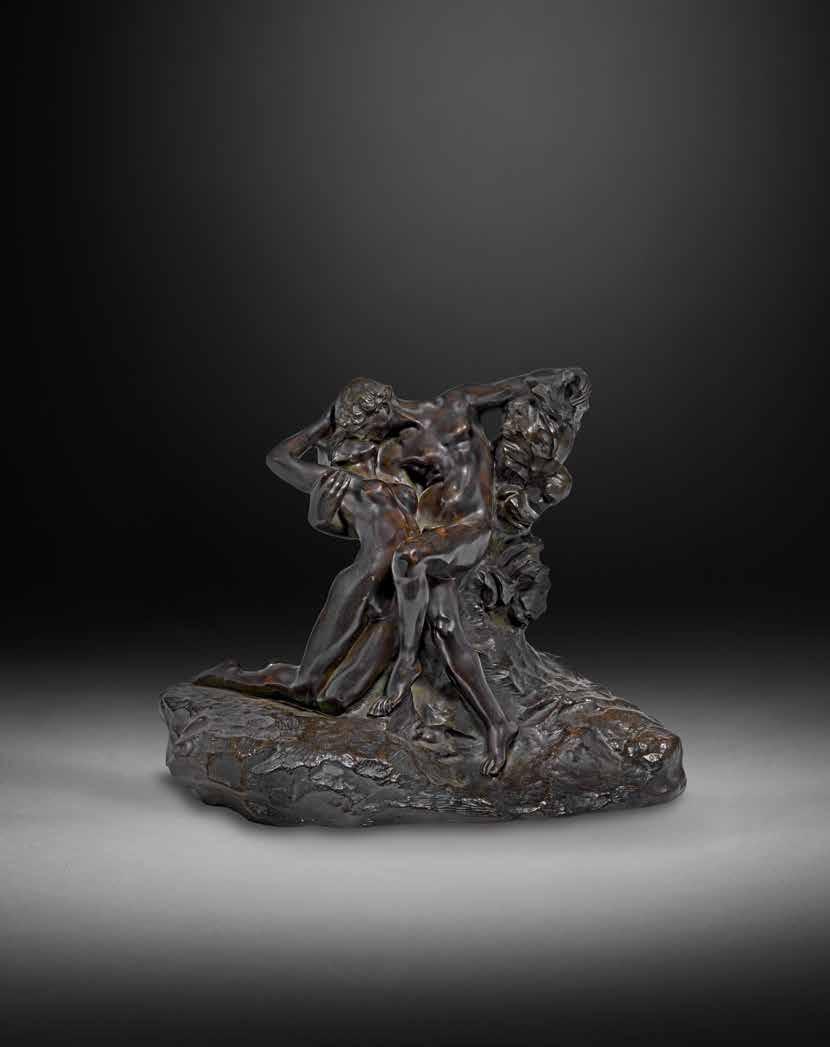


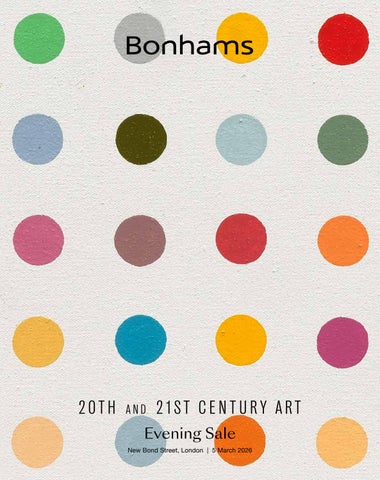
New Bond Street, London I Thursday 5 March 2026 at 4pm BST
BONHAMS
101 New Bond Street London W1S 1SR bonhams.com
SALE NUMBER
32182 Lots 1 - 16
Saturday 28 February, 12pm - 4pm
Sunday 1 March, 12pm - 4pm
Monday 2 March, 9am - 5pm
Tuesday 3 March, 9am - 5pm
Wednesday 4 March, 9am - 5pm
Thursday 5 March, 9am - 2pm
THANKS TO
Flannery Gallagher
David Jones
Simonetta
Francisco Goncalves
Isabel Norsten
Oliver Morris-Jones
ILLUSTRATIONS
Front Cover: Lot 7
Inside Front Cover: Lot 11
Frontispiece: Lot 5
Opposite Page: Lot 8
Inside Back Cover: Lot 14
Back Cover: Lot 6
Impressionist & Modern Art
Ruth Woodbridge
Head of Department
+44 (0) 20 7468 5816 ruth.woodbridge@bonhams.com
Adelaide Dunn
Associate Specialist, Head of Sale
+44 (0) 20 7468 8231 adelaide.dunn@bonhams.com
Rime Sahmaoui
Senior Cataloguer
+44 (0) 20 3988 6392 rime.sahmaoui@bonhams.com
Philippa Iles
Senior Sale Coordinator
+44 (0) 20 7468 8393 philippa.iles@bonhams.com
Hanna Rechnio
Cataloguer
+44 (0) 20 7468 5819 hanna.rechnio@bonhams.com
Post-War & Contemporary Art
Marina Ruiz Colomer
Head of Department, UK & Europe
+44 (0) 20 7468 8239 marina.ruiz-colomer@bonhams.com
Randy Reynolds
Specialist, Head of Sale
+44 (0) 20 7447 7404 randy.reynolds@bonhams.com
Charlotte Redman
Associate Specialist
+44 (0) 20 7468 5842 charlotte.redman@bonhams.com
Lua Castro

Senior Cataloguer
+44 (0) 20 7447 7435 charlotte.redman@bonhams.com
Condition Reports eveningsaleuk@bonhams.com
Bid online/APP New to Bonhams?
To be able to place bids, you must have an active bonhams account.
Bid online/VIA OUR APP Register to bid online by visiting www.bonhams.com/32182
Bid through the app. Download now for android and iOS.
You will be required to provide a valid credit card in your name which must be verified before you are able to place bids. If you are placing bids on behalf of a company, please ensure you indicate this when registering. We reserve the right to request further information from you (including your government issued ID) where you are the successful bidder, in particular in relation to any lot where the purchase price is over £5000. Please note all successful corporate bidders will be required to provide additional information.
Bid by telephone/absentee bid
We require a completed Bidder Registration Form returned by email to bids@bonhams.com The Bidder Registration Form can be found at the back of every catalogue and on our website at www.bonhams.com. If you already have an account with Bonhams, please indicate this on the form.
If you are new to Bonhams, please also send us your government issued ID plus proof of address. Corporate entities must provide a copy of their Certificate of Incorporation, a letter confirming authority to act plus ID of the person acting on behalf of the company, and written confirmation of the company’s UBOs owning 25% or more in that company. Please note we cannot guarantee bids within 24 hours of the sale. Bidding by telephone will only be accepted on a lot with a lower estimate in excess of £1,000.
You can collect a paddle at our Registration Desk by completing our Bidder Registration Form. If you already have an account, please state your client number if known. If new to Bonhams, you will be required to provide your government issued ID and proof of address. Corporate entities will be required to provide the documentation listed above.
For all other enquiries, contact our Client Services department on: +44 (0) 207 447 7447 or bids@bonhams.com
Please see back of catalogue for important notice to bidders
To submit a claim for refund of VAT, HMRC require lots to be exported from the UK within strict deadlines. For lots on which Import VAT has been charged (marked in the catalogue with a * or Ω) lots must be exported within 30 days of Bonhams’ receipt of payment and within 3 months of the sale date. For all other lots export must take place within 3 months of the sale date.
PHYSICAL CONDITION OF LOTS IN THIS AUCTION
PLEASE NOTE THAT THERE IS NO REFERENCE IN THIS CATALOGUE TO THE PHYSICAL CONDITION OF ANY LOT. INTENDING BIDDERS MUST SATISFY THEMSELVES AS TO THE CONDITION OF ANY LOT AS SPECIFIED IN CLAUSE 14 OF THE NOTICE TO BIDDERS CONTAINED AT THE END OF THIS CATALOGUE.
As a courtesy to intending bidders, Bonhams will provide a written Indication of the physical condition of lots in this sale if a request is received up to 24 hours before the auction starts. This written Indication is issued subject to Clause 3 of the Notice to Bidders.
BIDS
+44 (0) 20 7447 7447
To bid via the internet please visit www.bonhams.com
PAYMENTS
Buyers
+44 (0) 20 7447 7447
Sellers
Payment of sale proceeds +44 (0) 20 7447 7447
VALUATIONS, TAXATION & HERITAGE
+44 (0) 20 7468 8340 valuations@bonhams.com
SHIPPING
For all shipping enquiries please contact the Contemporary Art department either by Tel: +44 (0) 20 7468 8393 or by email: philippa.iles@bonhams.com
All sold lots marked TP will be transported to Mtec Fine Art on 10 March 2026. From here the artworks will be available for release from 16 March 2026 and then every working day between 9.30am and 4.30pm by appointment only.
Mtec Fine Art operates daily shuttles to London and can offer shipping quotes for transport services across UK and EU Fine Art Shuttle, also Courier, Airfreight and ocean freight. The team can be reached via estimate@mtecfineart.com.
All other sold lots will remain in the Collections Room at Bonhams New Bond Street free of charge until 5pm 10 April 2026. Lots not collected by this time will be returned to the department, storage charges may apply.
A booking email or phone call is required in advance to ensure lots are ready at time of collection. Lots will be opened for inspection and sign off. Photographic ID will be required at time of collection. If a third party is collecting on your behalf, written authorisation is required in advance from you and photographic ID of the third party is requested at the time of collection.
To arrange a collection time, please send a booking email to bonhams@ mtecfineart.com or telephone call to +44 (0) 1920 461800 to unsure lots are ready at time of collection. Please note the standard leadtime to extract and open for checking is 48hours in advance of collection.
STORAGE AND HANDLING CHARGES ON SOLD LOTS RETURNED TO MTEC FINE ART
Storage
Storage will be free of charge for a period of 30 days from & including the sale date 6 March 2026. Charges will apply from 6 April 2026.
Storage Charges
£4.00 per lot per day (after 6 April)
Handling From £ 55.00
Mtec Fine Art 10 Gentlemens Field Westmill Road Ware, Hertfordshire SG12 0EF
(Please note that charges apply every day including weekend & public holidays)
VAT
The following symbols are used to denote that VAT is due on the hammer price and buyer’s premium.
† VAT 20% on hammer price and buyer’s premium
* VAT on imported items at a preferential rate of 5% on hammer price and the prevailing rate on buyer’s premium
Y These lots are subject to CITES regulations, please read the information in the back of the catalogue.
POST BREXIT NOTICE FOR EU BUYERS SHIPPING PURCHASED LOTS OUTSIDE THE UK
Please note that as of 1 January 2021 for Margin Scheme and Imported Lots VAT on the Buyer’s Premium will be refunded by Bonhams on valid proof of export of your Lot from the UK within 90 days of full payment of your invoice.
What else has changed since 1 January 2021 for EU Buyers?
If you buy a Lot in this sale and intend to ship the Lot outside the UK, you will need to pay local Import Tax when you bring your Lot into the country of destination.
What do the Star (*) and Omega (Ω) symbols mean ? If you buy in this sale you will pay import VAT of 5% (* symbol) or 20% (Ω symbol) on the Hammer Price. As of 1 January 2021, for EU buyers shipping purchased Lots outside the UK, this tax will be refunded by Bonhams on valid proof of export of your Lot from the UK within 30 days of full payment of your invoice.
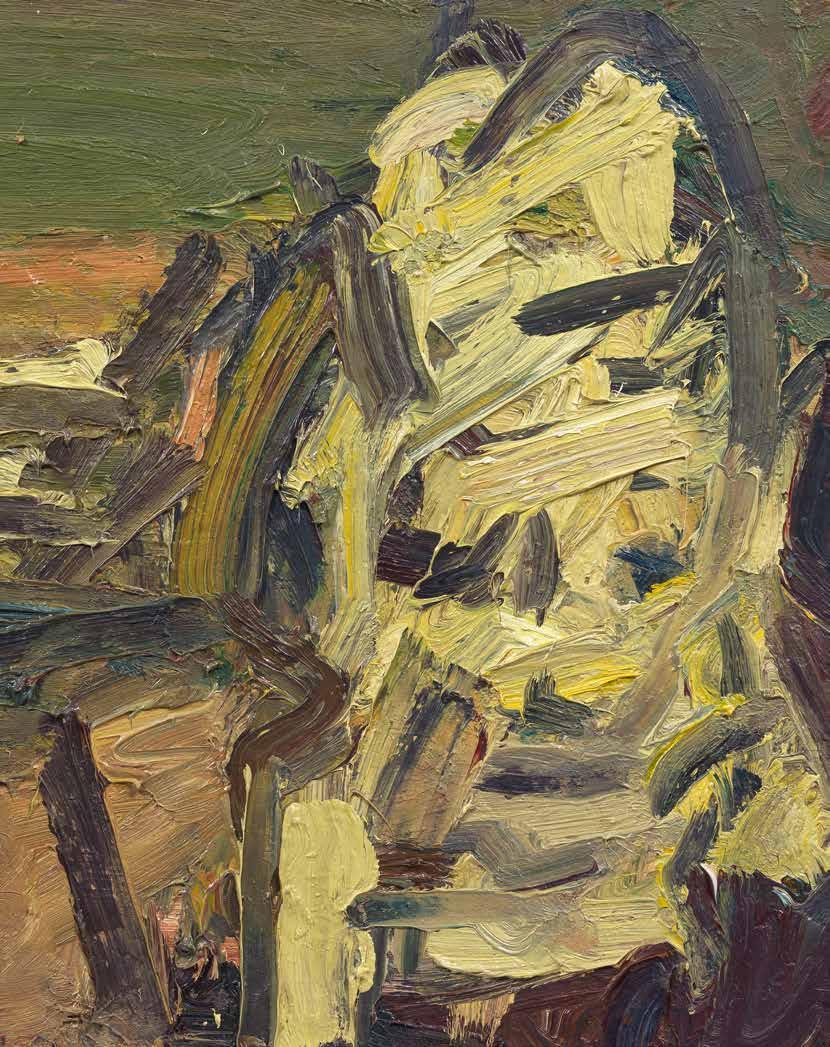
Amassed over decades of careful research, exploration and bold decision making, this prominent collection stands as a poignant meditation on the intersection of memory, fragility, nature, and the human condition. Formed through a deliberate attention to practices historically positioned at the margins of canonical discourse, the collection quietly asserted the value of alternative cultural narratives.
During the past decades, the collection has stood not merely as a private stewardship but as an effort to broaden the historical and cultural frameworks within which artists of the Global South are acknowledged and integrated into art-historical discourse, ultimately asserting the lasting relevance and transformative power of these artistic voices. Today, it stands as a collection that is synonymous with both connoisseurship and quality, embodying an approach to collecting that is at once educated, voracious, and deeply instinctive.
Introducing iconic works by artists such as Jim Hodges, Ana Mendieta, Hiroshi Sugimoto and Félix González-Torres, the works presented encapsulate some of the greatest achievements of 20th and 21st-century art. The collector, a true visionary, carefully curated a selection of works by artists who are now receiving both institutional acclaim and growing market recognition. Notably, this year, the Tate Modern in London will present a major retrospective of Ana Mendieta, showcasing many of her seminal works and underscoring the importance of her output within art history.
Despite the diversity in styles, materials, and methodologies, the selected works coalesce into a unified exploration of impermanence and transience, focusing on the delicate interplay between time, memory, and the fragility of existence. Each artist offers a unique approach to these themes, yet together they illuminate a shared interest in contemplating life’s temporality, whether through the ephemerality of natural materials through a conceptual approach to art-making.
Ana Mendieta’s Untitled perfectly encapsulates the artist’s radical exploration of the body, nature and spirituality. Born in Cuba and displaced at an early age, Mendieta’s art reflects her search for identity and belonging. Her work conveys a spirituality that connects the human self to the Earth, reflecting the transience of memory and, ultimately of the human experience. The present work suggests that much like a leaf’s brief life, we too leave behind traces of our being before returning to the Earth. Latin American heritage and the experience of displacement were central to the artist’s work and throughout her career as a Cuban artist in exile, she engaged with the emotional landscapes of loss and fragmentation, exploring the resilience of identity amid political and personal upheaval. While Mendieta’s works prompt reflection on how cultural origins and memory shape our understanding of life's inherent fragility. Félix GonzálezTorres, in a similarly personal and political manner, also addressed loss,
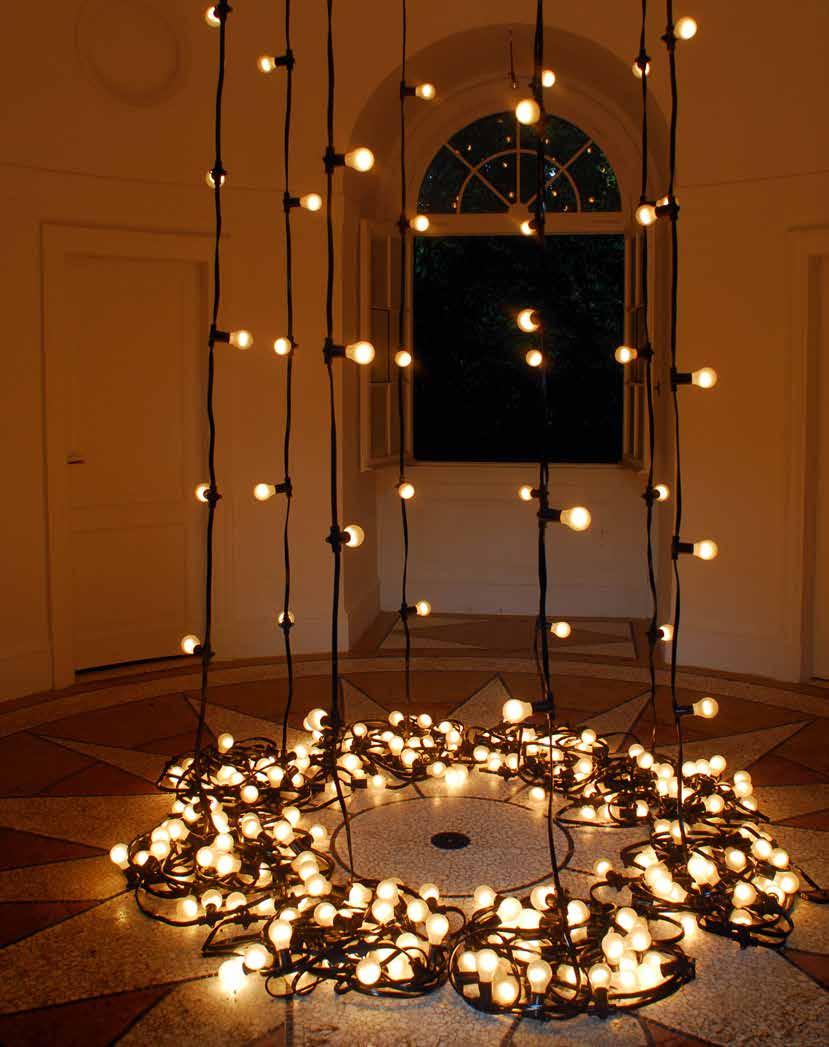
but his focus on the AIDS epidemic adds a layer of urgency and poignancy to his output. His light installations, like quiet flickers suspended in time, evoke both the fleeting nature of existence and the fragility of memory, suggesting that, even in the face of loss, the essence of life continues to flicker. Much like Mendieta’s use of ephemeral materials, Félix GonzálezTorres employed light as a metaphor for the fragility of memory and the human body. His installations gently pulse, suggesting the fleeting nature of all things, while his embossed paper works subtly mark the passage of time. Throughout his tragically short career the artist worked at the intersection of identity, memory, and loss, though his work foregrounds the political dimension of loss as it relates to the AIDS epidemic, imbuing it with both cultural depth and emotional intensity.
In contrast, Jim Hodges offers a more poetic and abstract engagement with fragility. His spider web sculptures draw attention to the intricate beauty that emerges from vulnerability. The ephemeral nature of the web, delicate yet structurally complex, serves as a metaphor for the impermanent connections that define human relationships, suggesting that even the most fragile forms carry deep meaning. Hodges' work, though abstract, invites the viewer to reflect on the human condition, particularly how fleeting yet emotionally charged moments of connection and memory define our lives.
Whereas González-Torres and Hodges engage with the ephemeral through light and materiality, Sugimoto’s Sea photographs convey a sense of timelessness. Mediterranean Sea, Cassis, belongs to a series of seascapes in Cassis in France, that Hiroshi Sugimoto produced in 1989, which offers a striking counterpoint. Here the vast, uninterrupted horizon emphasizes nature’s enduring constancy in stark contrast to the brevity of human life. The stillness and immensity of the ocean, captured with sharp clarity, emphasise the forces of nature that exist beyond human comprehension. Yet, within this stillness, Sugimoto subtly acknowledges the passage of time. Just as the sea’s surface remains constant, it is still shaped by tides, time, and the elemental forces of nature.
The works included in Objects that Matter: Property from an Important Private Collection, invite a space for reflection; one that contemplates the impermanence of existence while celebrating the resilience of human spirit. Through the works of artists such as Mendieta, González-Torres, Hodges, and Sugimoto, the collection explores fleeting yet profound moments of memory and connection, not as fragile points of loss, but as enduring forces that shape our identity. The artists’ diverse approaches converge in a shared meditation on the passage of time, inviting us to engage with life’s transience not as a negation of meaning, but as a catalyst for reflection on what we leave behind. In this carefully curated selection, fragility is not an end, but a poignant reminder of the strength found in what remains, of memory, identity, and the quiet persistence of life itself.
1 *
ANA MENDIETA (1948-1985)
Untitled design on leaf
20 x 13.5cm (7 7/8 x 5 3/8in). Executed in 1982
£35,000 - 45,000
€40,000 - 52,000
US$48,000 - 61,000
Provenance
Galerie Lelong, New York
Acquired from the above by the present owner
Exhibited
Huesca, Centro de Arte y Naturaleza, Fundación Beulas, Territorios que Importan, Género, arte y ecología, 18 October 2018 - 20 January 2019
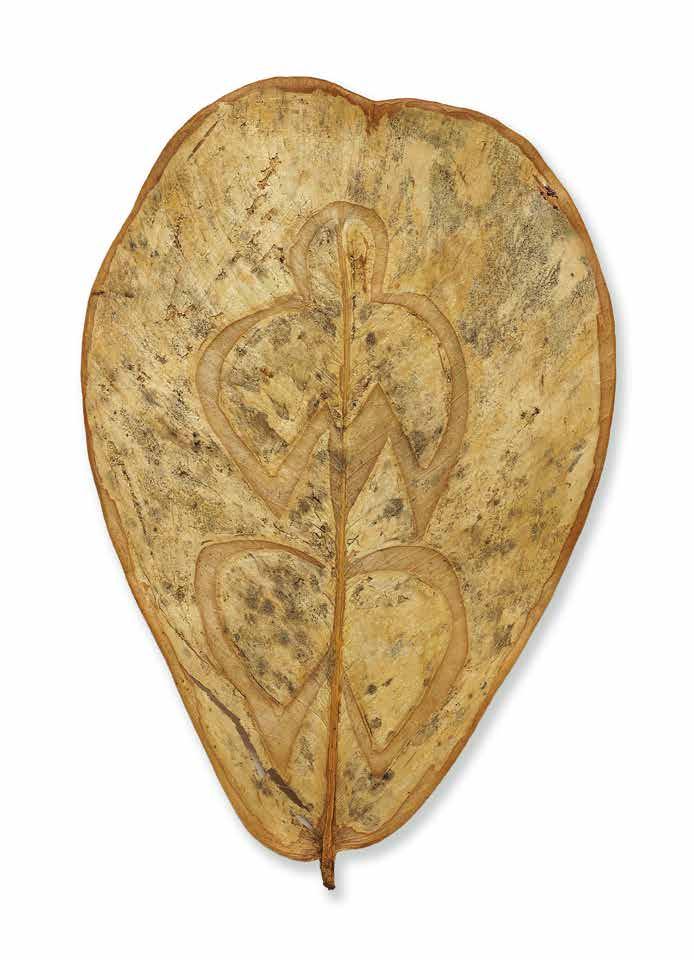
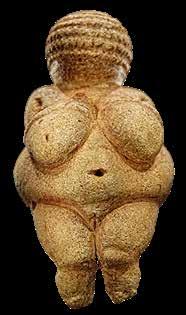
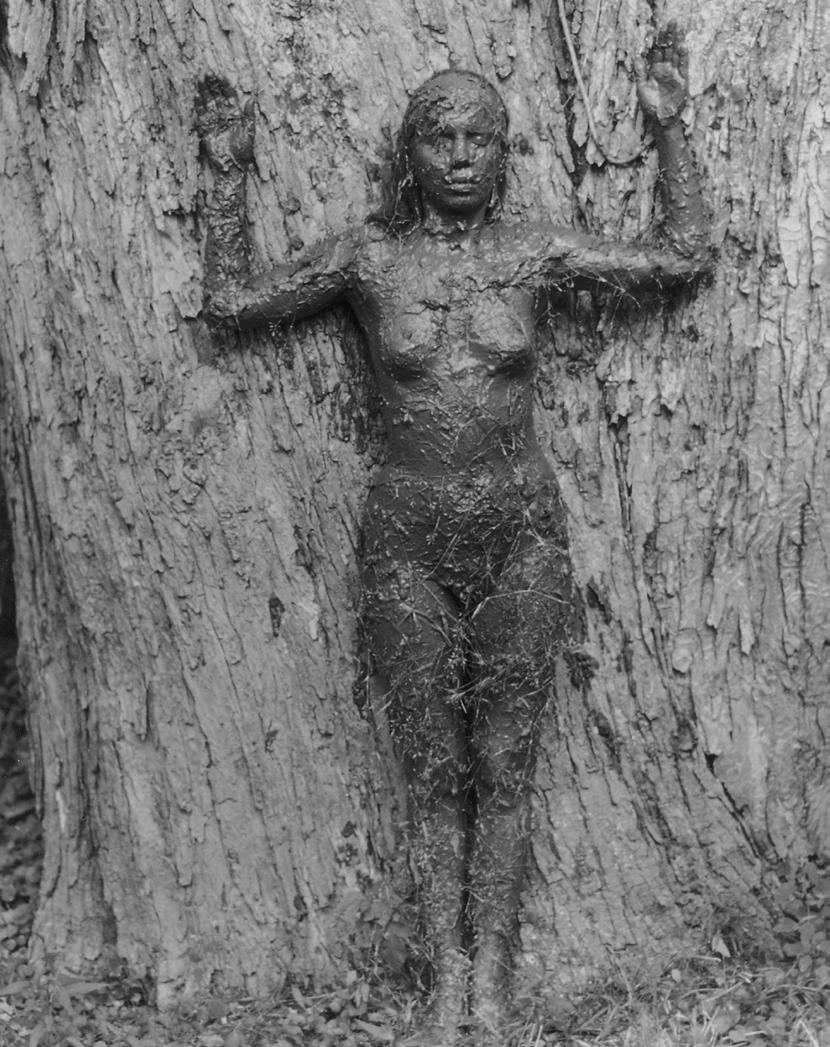
Ana Mendieta's work endures as a quiet yet unyielding force, tracing the profound bond between human beings and the earth. Untitled presents a simple, intimate gesture in the outline of a female figure inscribed on a delicate leaf. Within this modest form lies the complexity of Mendieta's practice - an oeuvre that has moved through many contexts over time: essentialism, feminism, anti-colonial critique, and the continual transgression of artistic boundaries, perfectly exemplifying the artist's lasting relevance and her remarkable ability to speak across generations. The fragility of the leaf in the present work reflects the vulnerability of the female body, yet its preservation and resilience suggest an enduring strength - a quiet assertion of the body's power to persist.
Part of a generation of artists whose practices no longer conformed to the conventions of exhibition-making and collecting, Mendieta's work resists containment in any single category. Instead, it exists somewhere between acts and object. In the present piece, she inscribed upon a green leaf, an element that in its very nature was destined to shift, dry, and decay. Time itself becomes a collaborator, transforming the work as matter changes state. Like her performances, Untitled embodies this delicate tension between permanence and impermanence, capturing both a gesture of presence and its inevitable passage into transformation.
Drawing was an integral part of Mendieta's practice which developed from her years as a student in the Intermedia department at Iowa University. Her sketchbooks from that period are filled with ideas that would later materialise in her earth-body and Silueta works. Throughout her career the artist kept a detailed record of her practice, documenting new, iconic performance pieces and interventions, yet it was only in the early 1980s that drawing emerged as a distinct body of work. Initially, Mendieta experimented with amate, a bark paper made by the Otomí people of Mexico, historically used in ritual contexts since pre-Columbian times. Soon after, she discovered the leaves of the Clusia rosea, also known as the autograph tree, whose thick, leathery surfaces could be inscribed by scratching away the dark outer skin to reveal a lighter layer beneath. Long used by Caribbean schoolchildren for writing and by Spanish colonial soldiers as makeshift playing cards, these leaves carried both everyday and historical resonances.
Onto them, Mendieta etched figures that echoed her contemporaneous 'goddess' sculptures, evoking the imagery of Cuba's Taíno culture. In this act, she turned a material once used by colonisers into a site for the preservation and reanimation of indigenous and ancestral forms. Untitled beautifully exemplifies Mendieta's carefully considered process of memorialisation by recording and preserving her memory through an act that honours her native Cuban culture.
Forging connections with the Earth and the cosmos was central to mendieta's output, a concern that permeated her whole output but which is perhaps most evident in the Silueta Series. In this emblematic body of work the artist placed her body within the landscape, leater also highlighting its absence and the traces she had left within it. Explained by Mendieta herself, "My art is the way I re-establish the bonds that unite me to the universe". Whether inscribed in the earth, or drawn onto it, the body became a conduit for reestablishing ties with the natural world and for articulating a fractured sense of identity. Later in her career, she extended this exploration into freestanding sculptures, in which the personal and performative gave way to archetypal forms, muting ritual presence in favour of lasting, three-dimensional objects. Influenced by artists such as Vito Acconci, Lynda Benglis, Chris Burden, Bruce Nauman, and the Fluxus group, Mendieta continually pushed the boundaries of what art could be. Earth, its elements, and the body itself became at once her medium and her message, expressing the profound, universal bond between humanity and nature, while transcending cultural, social, and historical confines.
Untitled ultimately invites us to inhabit a space where fragility and strength coexist, where the ephemeral becomes eternal through gesture, trace, and transformation. Mendieta's work does not merely represent the body in nature but fuses both into one inseparable force, an elemental language of soil, flame, and flesh. In her leaves and silhouettes, the personal becomes archetypal, the temporary becomes timeless. Even in its small and delicate form, Untitled resonates as a profound meditation on belonging, memory, and the enduring power of the human spirit inscribed upon the earth.
2 *
FERNANDO BOTERO (1932-2023)
Muchacha signed ‘Botero’ (lower right) watercolour on paper
43.5 x 33cm (17 1/8 x 13in). Executed in 1984
£70,000 - 100,000
€80,000 - 110,000
US$95,000 - 140,000
Provenance
Marlborough Fine Art Ltd., Vaduz Private Collection, Geneva (acquired from the above in 1987)
Thence by descent to the present owner
Exhibited
Munich, Kunsthalle der Hypo-Kulturstiftung, Fernando Botero: Bilder, Zeichnungen, Skulpturen, 4 July - 7 September 1986, no. 86 (illustrated n.p.) (and later travelled to Bremen, Kunsthalle Bremen, 11 January - 1 March 1987; Frankfurt, Schirn Kunsthalle Frankfurt, 12 March - 17 May 1987)
Madrid, Centro de Arte Reina Sofía, Fernando Botero: Pinturas, Dibujos, Esculturas, 22 June - 15 August 1987 (illustrated p. 96)
For details of the charges payable in addition to the final Hammer Price of each Lot please refer to paragraphs 7 & 8 of the Notice to Bidders at the back of the catalogue.
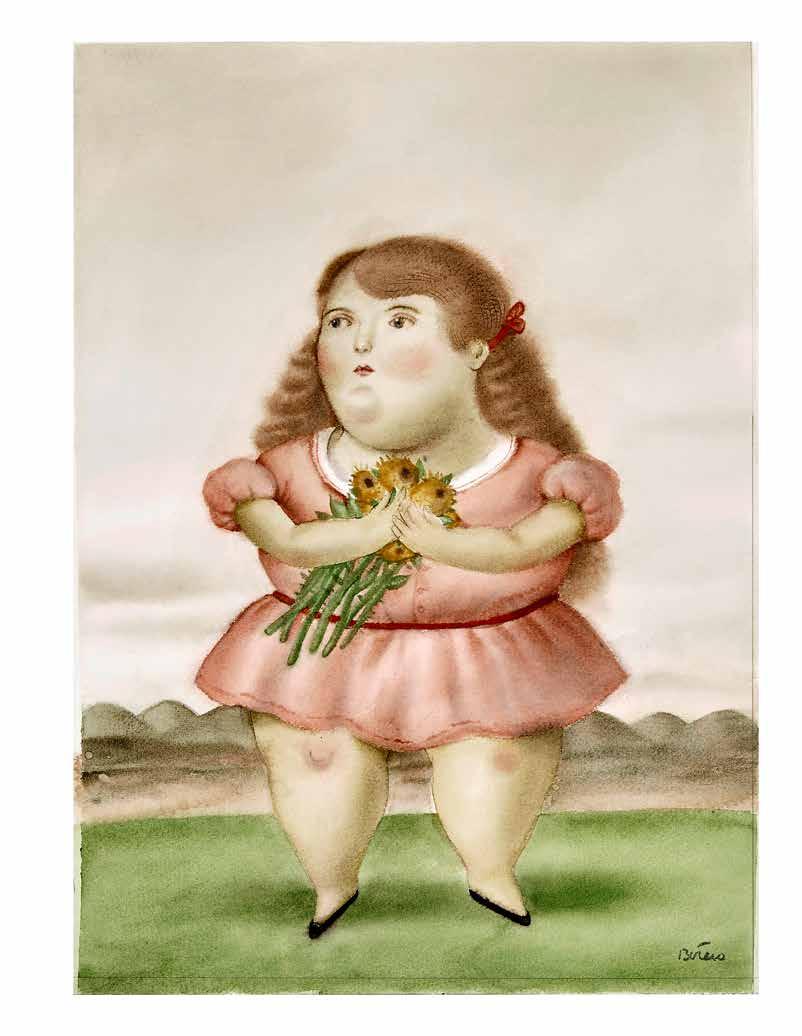
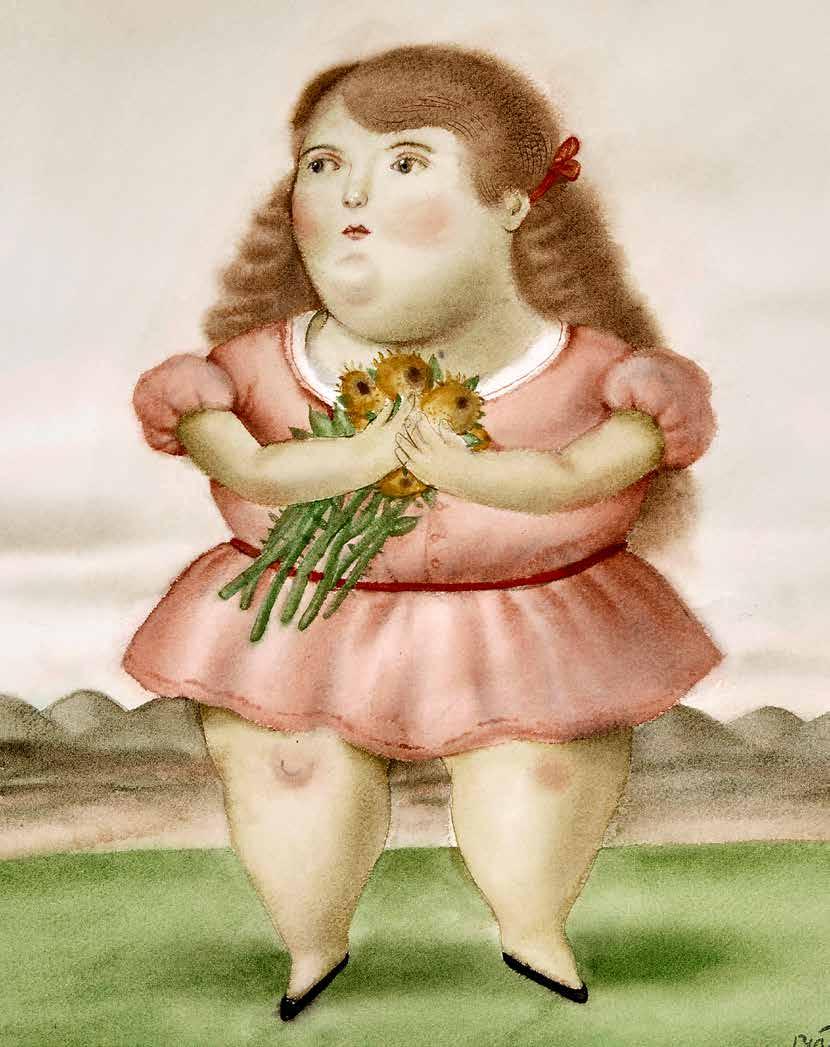
A distilled expression of Fernando Botero’s renowned figurative style, Muchacha from 1984, presents a young girl rendered with sculptural stability and candid existence. Standing frontally against a muted background, her distinct form is presented with gentle curves and compact proportions, giving the figure a sense of undeniable self-determination, despite the work’s modest appearance. Botero deliberately restrains narrative, gesture, and expression, instead giving a self-contained presence to the figure, allowing his signature form and style to stand on its own. Unidealised and uninhibited in her representation, this young girl occupies her frame with unspoken authority, exemplifying Botero’s commitment to form and volume as a force of presence, not drama or performance. Executed at the apex of the ‘Maestro’s’ artistic maturity, Muchacha exemplifies the central role of works on paper in Botero’s practice, where line and proportion articulate volume with a clarity and authority equal to his paintings and sculpture.
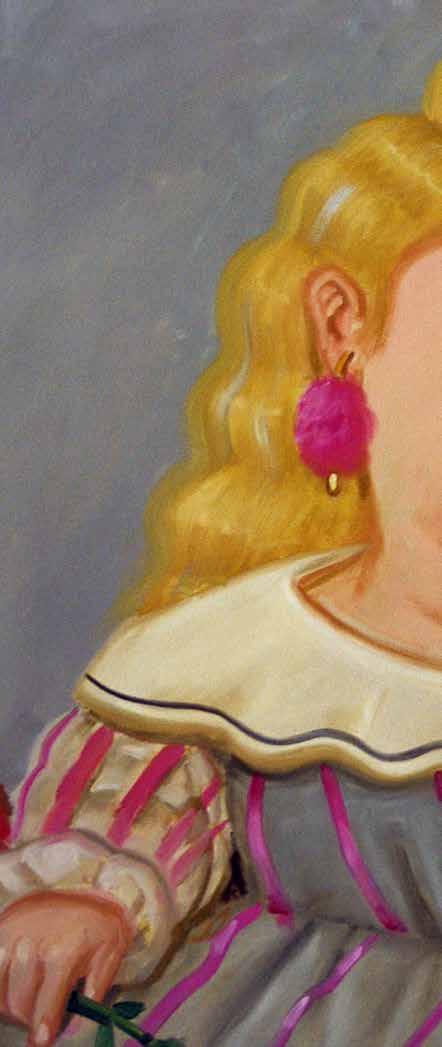
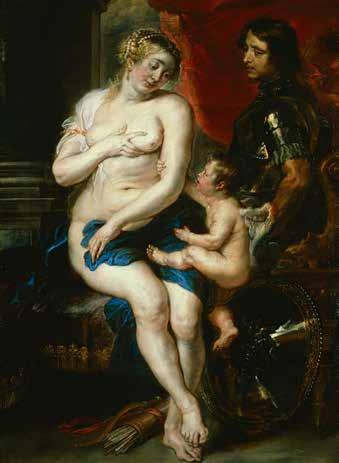
Born in Medellín, in 1932, Botero undertook formative training in Madrid and Florence, where fascination with the works of the Old Masters profoundly shaped his approach to form, subject, and surface. Instead of functioning as a recreation or retelling, Muchacha acts as a synthesis of Botero’s diverse influences. Flawless rosy skin and gently curving volumes take direction from the Renaissance’s relationship to the body, yet Botero also echoes Flemish portraiture in the figure’s frontal stance and emotional reserve. Subverting the western canon further, Muchacha reflects the grounding, compact nature of pre-Colombian figures, rejecting what he described the “anorexic” standards of European art, replacing idealisation with fullness, containment, and solidity.

A recurring theme throughout many of Botero’s works, the female form has always been a pertinent protagonist in his oeuvre. Muchacha’s pink dress, heart shaped hair clip, and bouquet of flowers are all typical symbols of youthful femininity, but her form is diametrically opposed. Even in technique, Botero’s use of buildable watercolour, rather than the strict opacity of oil, introduces a visual lightness that contrasts with the perceived weight and solidity of the form. Luminous skin tones and soft shadows temper mass with delicacy, reinforcing the tension between vulnerability and strength that animates the composition. Botero’s deep examination of the conventions of art history allowed him to masterfully subvert expectations of the traditionally interlinked ideas of bodily form and self-expression. Affirming Botero’s steadfast belief in separating physical embodiment from identity, Muchacha stands strong in her selfexpression despite the artist’s distortion.
Executed in 1984, Muchacha emerged during a period of consolidation in Botero’s artistic career. Moving to Italy with a new bronze-working studio one year earlier, his renewed commitment to sculpture is expertly reflected in the young girl’s, solid, unmoving stance, serving as a translation of physical weight into a two-dimensional landscape. The work was prestigiously exhibited three years later in Madrid’s Reina Sofia Museum in the artist’s solo exhibition: Pinturas. Dibujos. Esculturas. This was Botero’s his first major European retrospective that encompassed bronzes, paintings, and drawings. Presenting Muchacha alongside large portraits and re-interpretations of classical works, the exhibition exemplified the consistency and far-reaching scale of Botero’s iconic visual language, as well as his positioning against broader shifts from the figurative towards the abstract in the 1980s avant-garde. Ultimately, Muchacha demonstrates a succinct articulation of Botero’s matured visual language, where volume, restraint, and subversion converge to display the artist’s artistic mastery and understanding of visual expectation.
4 AR
FRANK AUERBACH (1931-2024)
Head of Catherine Lampert oil on board
51.1 x 68.8cm (20 1/8 x 27 1/8in).
Painted in 1996
£200,000 - 300,000
€230,000 - 340,000
US$270,000 - 410,000
Provenance
Marlborough Fine Art Ltd., London
Acquired from the above by the present owner in 2006
Exhibited
London, Marlborough Fine Art Ltd., Frank Auerbach: Recent Works, January – February 1997, no. 25 (illustrated n.p.)
Literature
William Feaver, Frank Auerbach, New York, 2009, no. 773 (illustrated pp. 170 and 326)
William Feaver, Frank Auerbach, New York, 2022, no. 773 (illustrated pp. 172 and 368)
“My sitters are all people I respect and like. I feel that I’m going further when I paint the same person again. I feel as though there’s no such thing as a definitive encapsulation of a person… And it isn’t a conscious process — I don’t think, ‘I’m going to do this about that person,’ it simply happens.”
- Frank Auerbach
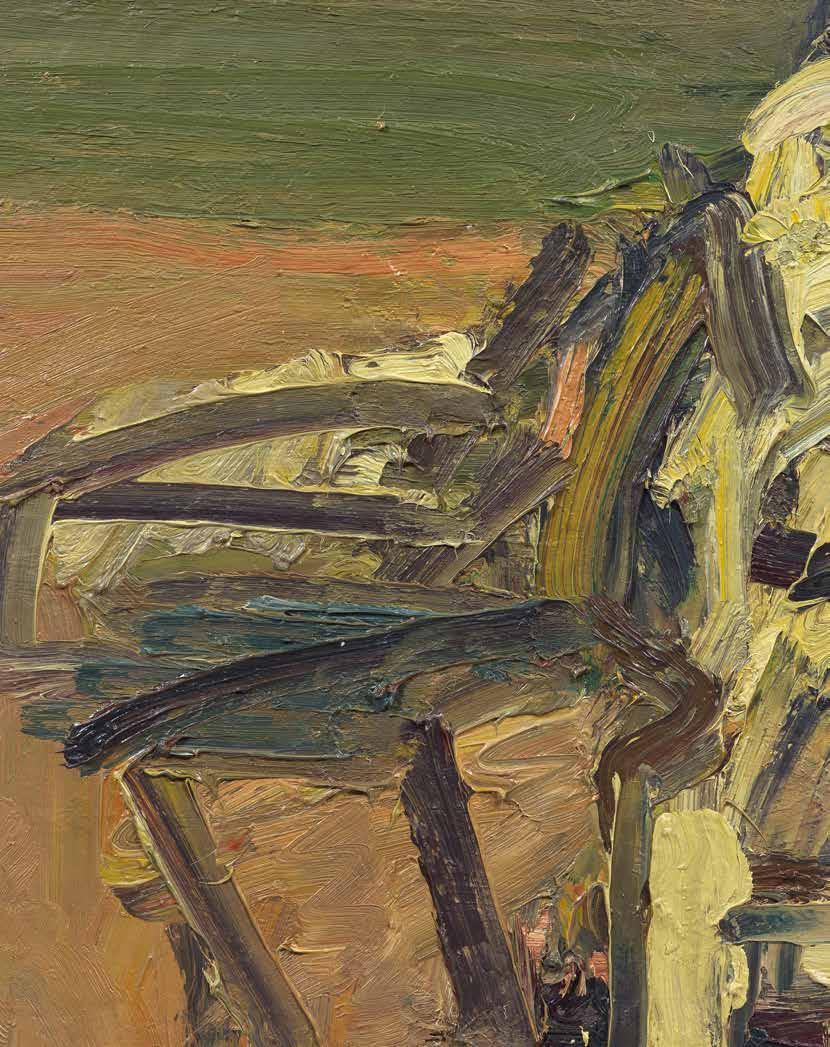
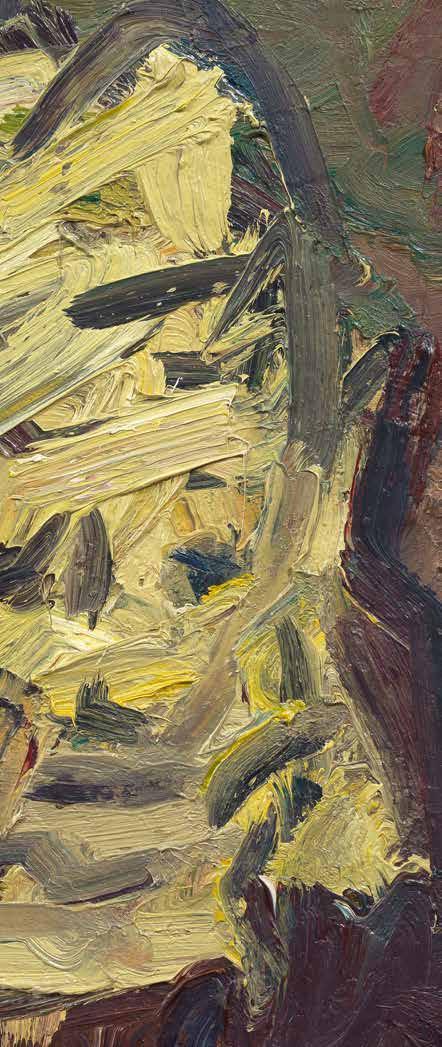
Widely regarded as one of the most significant painters of post-war Britain, throughout his illustrious career Frank Auerbach sustained an uncompromising commitment to the creation of a raw and vital image derived from sustained observation of the seated model. The pursuit of this living presence, at once physical and psychological, remained central to his oeuvre. Renowned for the density and authority of his impasto, which powerfully structured and animated the pictorial surface, Auerbach produced some of the most compelling and materially ambitious portraits of the post-war period. His first solo exhibition was held at London's Beaux Arts Gallery in 1956, and in the decades that followed, his work became among the most widely collected and internationally exhibited of any contemporary British artist. Auerbach's approach to portraiture was shaped by a deep engagement with art history, from Rembrandt and Soutine to Giacometti and de Kooning, which informed both the material density of his surfaces and his existential understanding of the figure.
Painted in 1996, Head of Catherine Lampert belongs to a sustained and intensely focused series of portraits of Catherine Lampert, Auerbach's close friend, biographer, and long-term sitter. The two first met in 1978, when Lampert was organising Auerbach's retrospective at the Hayward Gallery in London and conducted an extensive interview for the accompanying catalogue. Their professional relationship evolved into a profound artistic collaboration: Lampert later became Director of the Whitechapel Gallery in 1988 and curated Auerbach's major retrospective at the Royal Academy in 2001, further shaping the public and critical understanding of his work. Over decades, Lampert sat for Auerbach up to twice weekly, becoming the subject of more than seventy portraits. These works extended and deepened the serial investigations of the human head that had preoccupied the artist since the 1950s, following a lineage of sitters such as Stella West (E.O.W.), Juliet Yardley Mills (J.Y.M.), and his wife, Julia. Through repeated engagement, Auerbach pursued not conventional likeness, but a continually renewed encounter with the physical and psychological reality of the model.

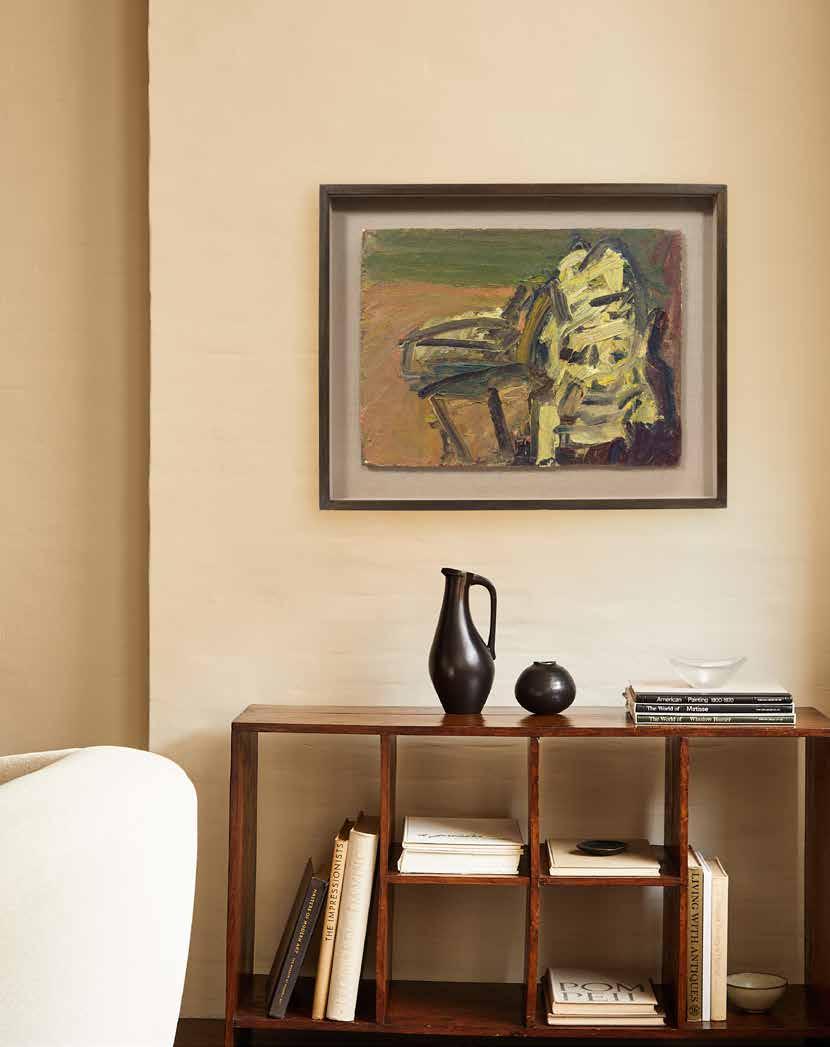
Head of Catherine Lampert demonstrates Auerbach's dialogue with sitter and tradition through a forceful orchestration of paint. The portrait reveals expressive brushwork and dense impasto, in which a vibrant amalgamation of colour and texture lends the surface an almost sculptural authority. Thickly layered pigment accumulates across the canvas, asserting the materiality of paint even as it forms a recognisable likeness. Lampert described the charged atmosphere of the studio: "Auerbach moves noisily around the room, looks at the painting in the mirror, turns the canvas, stands back, and then rushes up, and like darts or writing on the blackboard fairly brutally tries the next throw or cancels the previous one. He is continuously active, drawing in the air, talking to himself, hardly pausing."
(Catherine Lampert, Frank Auerbach Paintings and Drawings 1954–2001, exh. cat. Royal Academy of Arts, London, 2001, p. 62). Her account underscores the physical and psychological intensity of Auerbach's process, an activity defined by constant revision and the gradual accumulation of knowledge about the sitter. Dominating the central right-hand passages of the composition in rich impasto, the thickly layered brushstrokes press forward, rising from areas where the paint has been applied with a faster, higher energy, producing a tension between figure and background that is synonymous with Auerbach's celebrated mark-making. Opulent reds, earthy browns, and vibrant yellows converge in a dense topography of pigment.
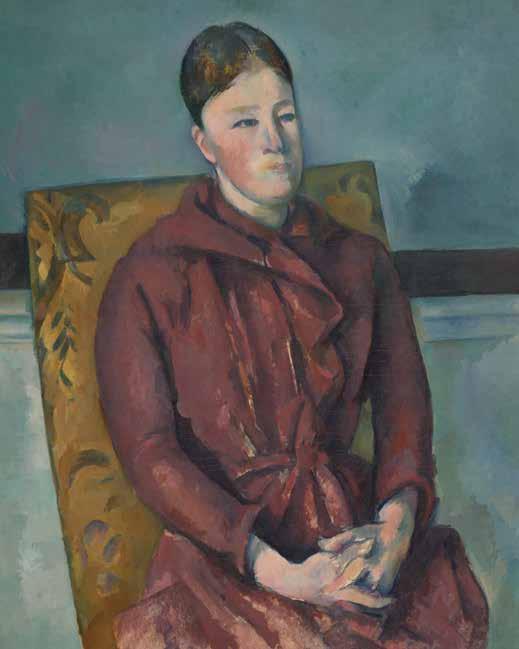
Lampert's head emerges through swirling accumulation of brushstrokes, projecting with almost relief-like force, her facial features articulated through decisive strokes and daubs, each gesture carrying descriptive and expressive weight. Yet despite its material density, the portrait conveys a striking sense of temporal and psychological suspension: "that odd limbo, not an unpleasant state, of drifting from practical self-reminders into daydreams and unquantifiable desires." (Catherine Lampert in William Feaver, Frank Auerbach, New York, 2009, p. 21).
Although fundamentally a figurative painter, the intensity and singularity of Auerbach's technique render his portraits essentially abstract, reflecting
not only the sitter's physical presence but also the artist's emotional and psychological engagement. As Feaver observed, "Auerbach's heads are conceived not as busts or cameos but as presences" (William Feaver, ibid., p. 20), highlighting the existential immediacy of his figures. In Head of Catherine Lampert, his masterful use of colour and decisive painterly gestures conveys a powerful emotional charge, synthesising observation, material density, and psychological depth. Thus, the present work exemplifies Auerbach's inimitable approach to portraiture, in which the act of seeing, the physicality of paint, and the intimacy of human presence converge, producing a work of profound resonance and enduring significance in contemporary British art.
5
HENRI LEBASQUE (1865-1937)
Bord de Marne à Lagny signed ‘H. Lebasque.’ (lower left) oil on canvas
61 x 73.5cm (24 x 28 15/16in).
Painted in Lagny-sur-Marne circa 1903
£50,000 - 70,000
€57,000 - 80,000
US$68,000 - 95,000
The authenticity of this work was confirmed by the late Denise Bazetoux.
Provenance
Private collection, Dordogne; their sale, Martinie Enchères, Brive-la-Gaillarde, 24 November 2018, lot 450. Private collection, London (acquired at the above sale).
“Technique, the study of form, the concern for balance and rhythm obsessed [Lebasque]. Nevertheless, he had kept the divine gift of childhood, marvelling at the vast spectacle of Nature, and he knew that, according to Nietzsche's words, for a poet, ‘to say no to nature is madness.’ He painted as a bird sings, when it sings well – a smooth and expressive drawing, elegance of lines, freshness and haziness, transparency of shadows…”
- Louis Vauxcelles, 1938
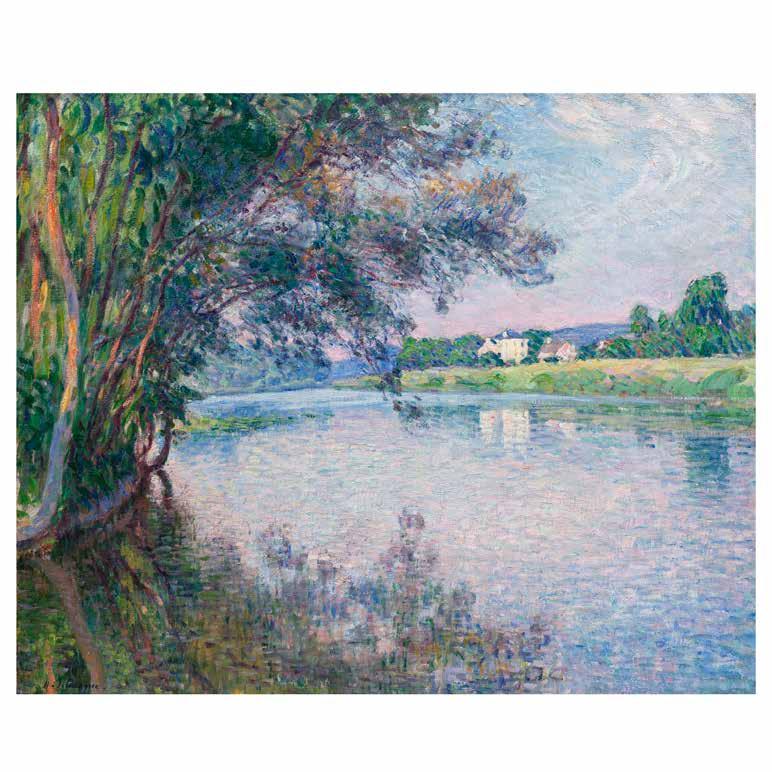
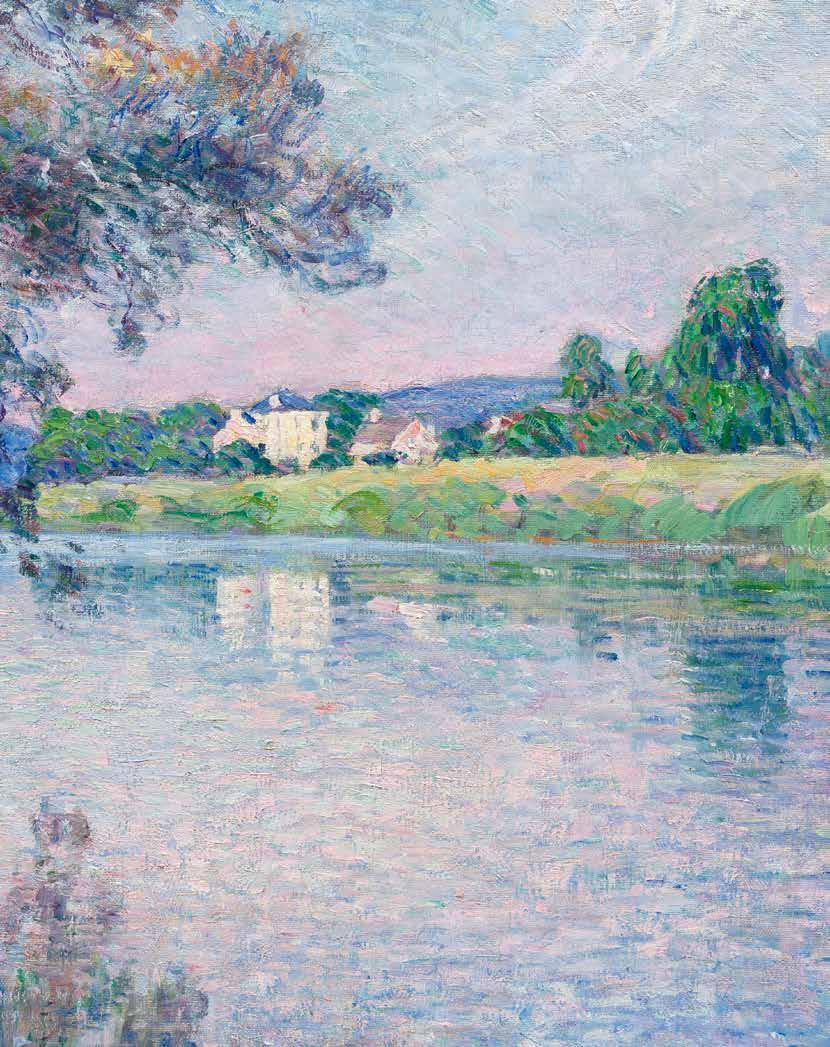
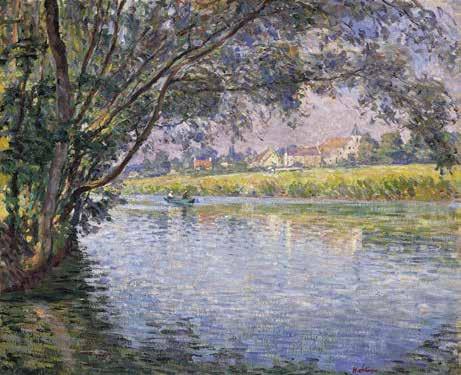
Henri Lebasque’s Bord de Marne à Lagny belongs to one of the most fruitful and lyrical moments of the artist’s career, when Lebasque, newly settled outside Paris for health reasons, immersed himself in the quiet rhythms of life along the banks of the Marne. Executed during his years in Lagny-sur-Marne, this work exemplifies Lebasque’s deeply personal synthesis of Impressionist observation and post-Impressionist colour, resulting in a vision of nature suffused with light, serenity, and immediacy.
The composition unfolds with graceful assurance. On the left, a stand of trees rises from the riverbank, their trunks rendered not in naturalistic browns but in an animated spectrum of golds, ochres, blues and reds. Their branches arc gently over the water, framing the scene while guiding the eye across the shimmering surface of the river toward the distant village beyond. Lebasque’s brushwork is lively and responsive: short, dappled strokes and cross-hatched touches dissolve form into reflection, allowing the water to act as both mirror and atmosphere. Mauves, pinks and soft purples articulate shadow and vibration, a distinctly Impressionist vocabulary used here with remarkable delicacy and control.
The chromatic range is dominated by cool blues and greens, enlivened by flashes of rose and pale gold, particularly along the horizon and within the river’s reflective plane. These pastel-inflected tones, combined with
Lebasque’s use of atmospheric perspective, soften the distant banks and village houses, which are suggested with a few deft strokes. The sky, occupying the upper right quadrant, opens the composition outward: light clouds swirl across a pale expanse tinged with pink, reinforcing the sense of fleeting weather and a specific, transitory moment in time.
This emphasis on light, reflection, and the water’s edge places the painting firmly within the central concerns of Impressionism, yet Lebasque’s temperament distinguishes the work from that of his predecessors. While adapting the lessons of Monet, Renoir and Degas — particularly their plein-air practices and attention to optical sensation — Lebasque avoids bravura effects in favour of intimacy and calm. In this zone of contemplation, the river flows quietly, the village rests in the distance, and human presence is implied rather than asserted, reinforcing the harmony between landscape and lived experience.
The present work relates closely to Two Fishermen in a Boat on the Marne (1903), now in the collection of the Museo Nacional Thyssen-Bornemisza, a composition of similar scale and format painted during the same period. Both works demonstrate Lebasque’s exploration of divisionist brushwork at this moment, a technique he would soon abandon, using finely articulated strokes to achieve extraordinary effects of light, transparency
and reflection. Yet while the Thyssen painting introduces figures and a more enclosed framing, Bord de Marne à Lagny adopts a more expansive viewpoint. Here, the artist steps back, allowing greater prominence to the river’s reflective surface and the open sky, resulting in a composition of heightened luminosity and spatial breadth.
Compared to the Thyssen work, the palette of the present painting is more highly keyed and vibrantly cool, suggesting a different moment of day or season — perhaps early morning or late afternoon in spring or early summer. The foliage appears fuller and more verdant, the blues richer and more varied, ranging from sapphire and turquoise to pale, silvery reflections. The reflection of the trees in the water is rendered with particular care, using tighter, more staccato strokes that lend the surface a crystalline clarity. These subtle distinctions underscore Lebasque’s sensitivity to changing light and atmosphere, as well as his commitment to capturing nature as a living, mutable presence.
Lebasque’s years along the Marne marked a period of consolidation and confidence. Influenced by Pissarro, Luce and Signac — whom he encountered at the Salon des Indépendants in the 1890s — he nonetheless resisted the rigidity of systematic Neo-Impressionism. As Denise Bazetoux observed, Lebasque sought above all to express
his own vision of nature, one rooted in joy, balance, and a deeply felt response to the world around him. His landscapes from this time are imbued with what contemporaries recognised as a rare serenity, reflecting both the harmony of his personal life and his profound engagement with the subtleties of light in the Île-de-France.
Bord de Marne à Lagny stands as a compelling example of this achievement. At once observational and poetic, it captures the spirit of an artist at ease with his medium, translating the fleeting sensations of colour, weather and reflection into a composition of lasting freshness and grace. In this way, the painting encapsulates the quiet modernity of Lebasque’s vision and his distinctive contribution to the evolution of French landscape painting at the turn of the twentieth century.
6
HENRI LE SIDANER (1862-1939)
Les arbres sur la rive, Quimperlé signed ‘Le Sidaner’ (lower right) oil on canvas
65 x 54.2cm (25 9/16 x 21 5/16in). Painted in Versailles in 1931
£150,000 - 200,000
€170,000 - 230,000
US$200,000 - 270,000
Provenance
Galerie J. Allard, Paris (acquired directly from the artist). Anon. sale, Hôtel Drouot, Paris, 6 March 1967, lot 14.
Mr & Mrs James R. Holland Collection, New York (acquired at the above sale); their sale, Peachtree & Bennett, Atlanta, 11 October 2014, lot 16. Private collection, UK (acquired at the above sale).
Exhibited
Brussels, Galerie des Artistes Français, Le Sidaner, October - November 1931, no. 35 (titled ‘Les arbres de la rive’).
Literature
Y. Farinaux-Le Sidaner, Le Sidaner, L’oeuvre peint et gravé, Paris, 1989, no. 704 (illustrated p. 258).
For details of the charges payable in addition to the final Hammer Price of each Lot please refer to paragraphs 7 & 8 of the Notice to Bidders at the back of the catalogue.
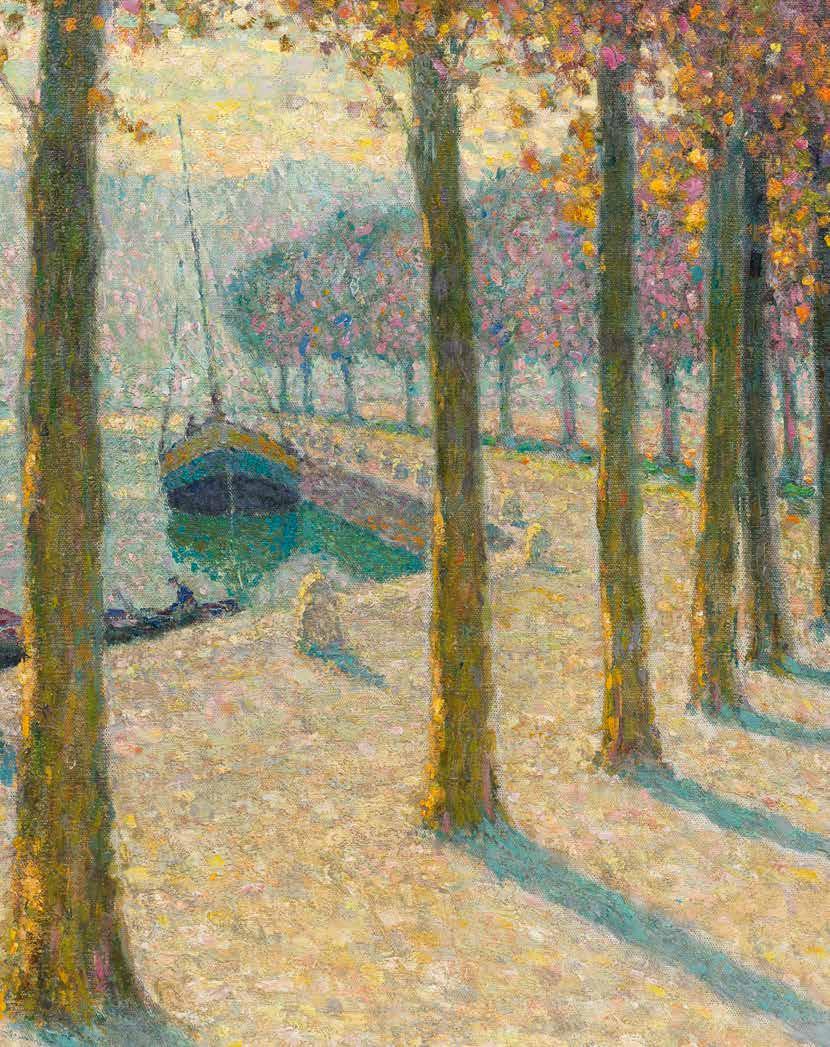
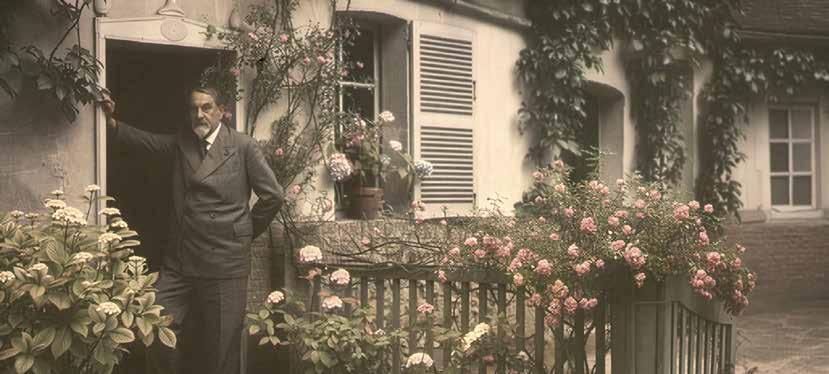
Born on the island of Mauritius, and the son of a long-distance sea captain who disappeared at sea, Henri Le Sidaner grew up in Dunkirk, a northern port city defined by its harbours and tides. Surrounded from an early age by an element that would become a leitmotiv of his artistic practice, water left a lasting imprint on the artist’s memory and imagination. Its never-ending capacity for reflective stillness and mesmerising, perpetually shifting reflections became deeply embedded in the artist’s memory and imagination, and throughout his career Le Sidaner returned persistently to ports, canals and quiet waterways, making them central subjects of his oeuvre. The present work, Les arbres sur la rive, Quimperlé, stands within this lifelong meditation on water and its poetic resonance.
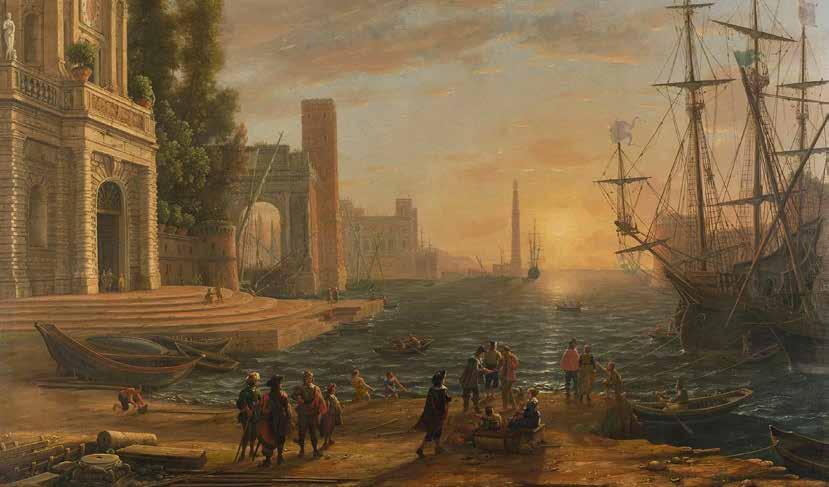
Painted in his Versailles studio in 1931, the composition is inspired by the artist’s memory of Quimperlé, a modest Breton town situated at the confluence of three rivers, which the artist had visited several years earlier. Working from sketches he had made when he was in Quimperlé, Le Sidaner recreated the scene guided by memory and sensation, likely influenced by important port scenes such as Claude Gellée’s
(Le Lorrain) Seaport (1644). With its golden light, classical architecture and tranquil water, Claude’s celebrated painting similarly transforms a natural landscape into a poetic meditation on atmosphere and stillness — anticipating the quiet, contemplative mood that Le Sidaner would later evoke through his more intimate, Symbolist-inflected handling of light and space.
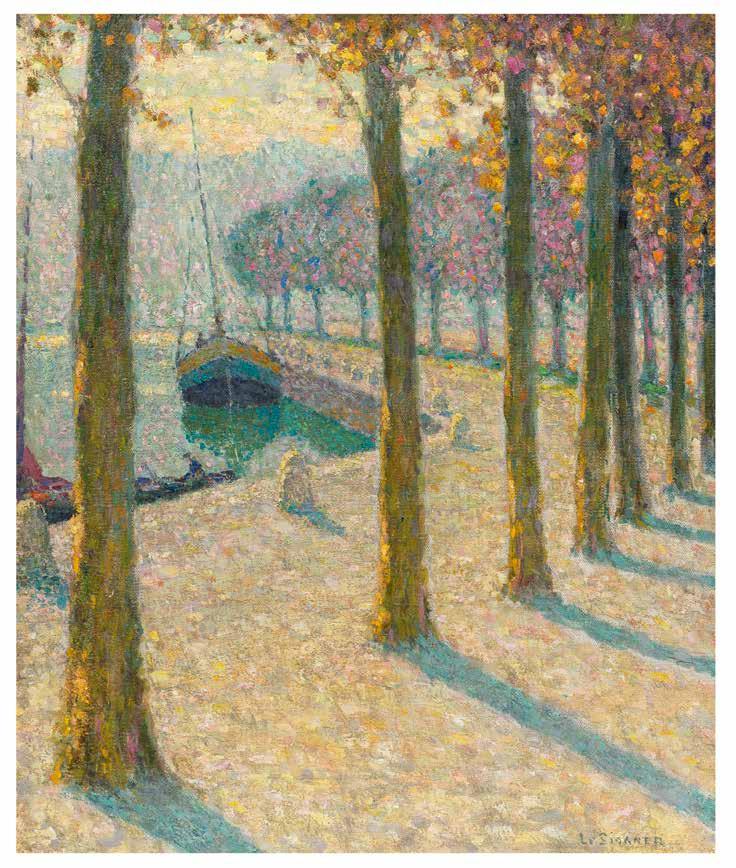
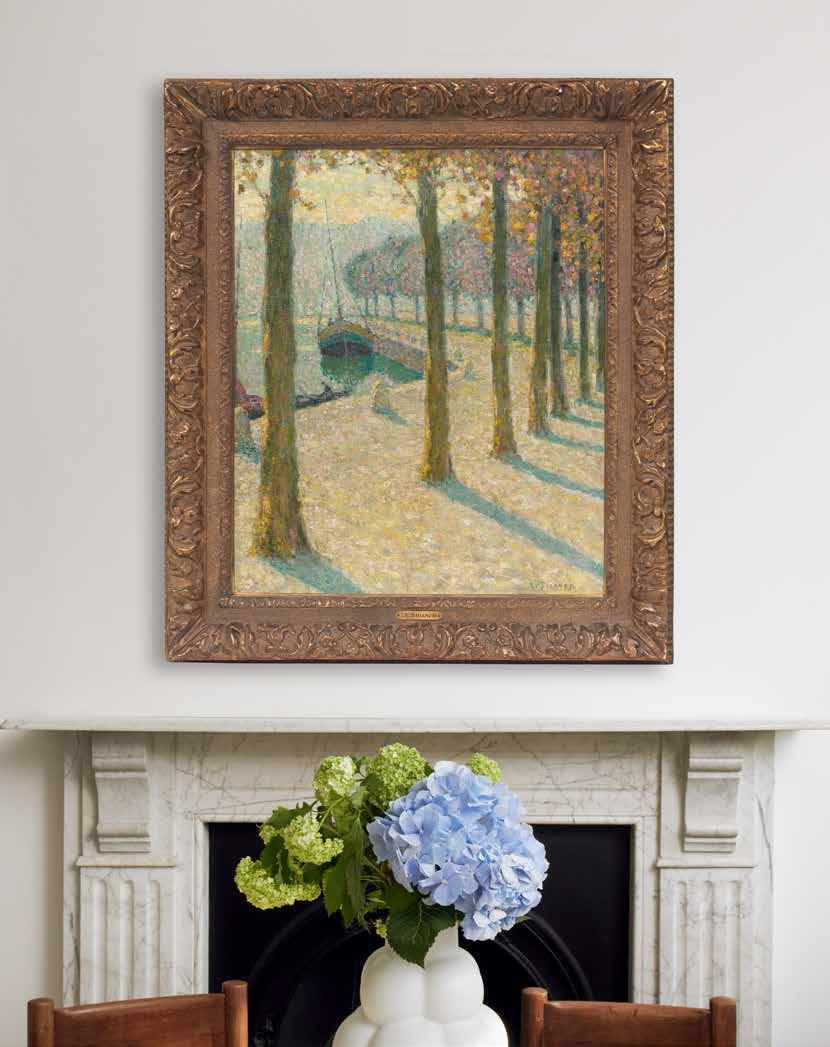
Les arbres sur la rive, Quimperlé is set at the end of a sunny day. A hushed luminosity suffuses the scene, wherein vertical trunks rise like quiet sentinels before a canal. The composition is governed by a rhythmic alternation of upright lines and receding space: the trees, evenly spaced along the riverbank, create a measured cadence whose silence is only disrupted by the gentle diagonals of the boats’ masts, suggesting the soft, hollow echoes of the boats’ hulls as they are lulled by the water.
The long shadows of the trees, rendered with an almost pointillist sensibility, recall Camille Pissarro’s sun-drenched Late Afternoon in Our Meadow (1887), which shares similar tones of muted mauve,
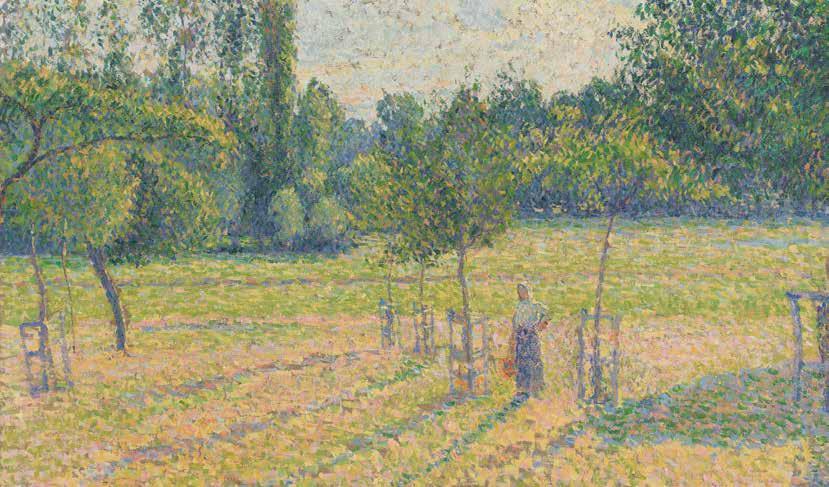
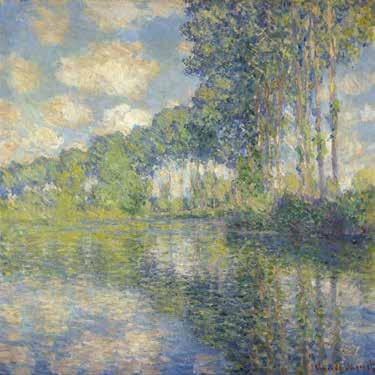
powdery blue and pink, and warm yellow on the ground, with small trees casting longer shadows than their height would suggest. These long silhouettes recall the hands of a sundial and suggest at once the passage of time and its slow, unhurried movement, evoking late sunny afternoons that seem to stretch endlessly beneath a generous, lingering light. The elongated trees and the sinuous line they follow along the riverbank, giving the composition a dynamic perspective that draws the eye inward, also recall Claude Monet’s Poplars (Autumn) (1891), which shares a similar autumnal light.
In Les arbres sur la rive, Quimperlé, different colours dissolve into one another in a tapestry of vibrant brushstrokes. The foliage above shimmers with touches of rose, gold and ochre, suggesting autumnal light filtered through leaves rather than sharp contrasts. The canal itself is rendered in softened reflections, its surface a veil of turquoise and pale jade that echoes the shadows on the ground. Creating a mosaic-like surface, Le Sidaner masterfully illustrates light through chromatic vibrancy, with an ‘extremely varied and subtle [palette] […] [where] the oils bind and melt together in delicate harmonies. […] With
him, contours seem to emerge from the interplay of light, and in this respect, he is similar to Claude Monet’. (J. Baschet in L’Illustration, 1924, quoted in Y. Farinaux-Le Sidaner, Le Sidaner, L'oeuvre peint et gravé, Paris, 1989, p. 37).
Le Sidaner held the Impressionists and Claude Monet in deep admiration, writing that the latter was ‘[working] to conquer a new light every day.’ (H. Le Sidaner, De la lumiere et de la couleur, 1935, quoted in Y. Farinaux-Le Sidaner, op. cit., p. 34). Indeed, for the Impressionists the work was never done, as light constantly changes. One of the most telling examples of this was Claude Monet’s quasi-scientific observation of daylight on the same building at different times of day in his Rouen Cathedral series (1892–1894). Le Sidaner pursued this same obsession, which led some critics to say that ‘in the past, he seemed to proceed as an Impressionist, painting light on surfaces rather than surfaces themselves’ (C. Mauclair, Preface to the catalogue of the Georges Petit exhibition, 1935, quoted in Y. Farinaux-Le Sidaner, op. cit., p. 39). In fact, the light in Les arbres sur la rive, Quimperlé is not so different from that in Monet’s Cathédrale de Rouen, Effet de soleil (Fin de journée) (1892), painted at the end of a sunny day.
In deliberate contrast to the Impressionists, Le Sidaner did not habitually complete his paintings en plein air. Instead, he worked in the studio from sketches made on site and from memory once he had returned home. By distancing himself from direct observation, he freed his compositions from the burden of reality and reshaped the scenes through the filter of memory and sensation. As Camille Mauclair observed, Le Sidaner ‘[retained] the finest principles of the Impressionist masters in order to employ them in the expression of a psychological ideal altogether different from realism’ (C. Mauclair, L’Impressionisme, Son histoire, son esthétique, ses maîtres, Paris, 1904, p. 198). In this way, his painting becomes less an exercise in empirical truth than an act of poetic reconstruction, where memory mediates perception and atmosphere supersedes fact.
In the paintings of Henri Le Sidaner, human figures are rare, and when they do appear, they are more suggested than truly seen. Here, in a quiet and uncommon moment, a fisherman stands at the centre left, tidying his tools aboard his boat at the end of a day’s work. His presence does not dominate the scene; he is barely more than a shadow, almost dissolving into the surrounding light. This absence of clearly defined figures deepens the contemplative mood of the work. The painting feels suspended — poised delicately between reality and reverie — and becomes less a depiction of place than an evocation of atmosphere: a quiet meditation in colour, where light and water captivate the viewer in an instant of reverie. This introspective view, created from memory and old sketches, situates Le Sidaner at a mesmerising intersection between Impressionism and Symbolism.
Indeed, the painting resists narrative closure. No event unfolds, no figure commands interpretation; instead, meaning arises from the subtle orchestration of stillness. Le Sidaner thus moves away from Impressionism and its objectivity towards Symbolism and its emphasis on mood, suggestion, and inner experience rather than clear narrative. This softly lit landscape feels less like a specific location and more like a poetic evocation of solitude and reverie at the end of a quiet afternoon, reminiscent of Debussy’s Prélude à l'Après-midi d'un faune (1892–1894). Both compositions avoid traditional development, dissolve sharp outlines, and create an atmosphere of suspension and introspection in a late sunny afternoon of natural contemplation, thus privileging sensation and the evocative power of suggestion over literal representation.
In the words of Paul Signac, Le Sidaner was ‘a master at creating tender, soft, and silent atmospheres’ (P. Signac quoted in Y. Farinaux-Le Sidaner, op. cit., p. 31). Offering a wonderful sentimental evocation of the landscape, Les arbres sur la rive, Quimperlé stands as a compelling example of Le Sidaner’s elegiac tone, situating the spectator within the scene, as though standing quietly among the trees, absorbed in solitary contemplation for a moment of respite, at a time when much of European art pursued fragmentation, political engagement, or radical formal experimentation.
7 AR
DAMIEN HIRST (B. 1965)
Argininamine
signed ‘Hirst’ (on the reverse) household gloss on canvas
63.5 x 66cm (25 x 26in).
Painted in 1994
£180,000 - 250,000
€210,000 - 290,000
US$240,000 - 340,000
Provenance
Gift from the artist to the present owner
Exhibited
London, Gagosian Gallery, Britannia Street, Damien Hirst: The Complete Spot Paintings 1986-2011, 12 January - 18 February 2012
Literature
Jason Beard & Millicent Wilner (eds.), Damien Hirst: The Complete Spot Paintings 1986-2011, London, 2013 (illustrated p. 84)
For details of the charges payable in addition to the final Hammer Price of each Lot please refer to paragraphs 7 & 8 of the Notice to Bidders at the back of the catalogue.
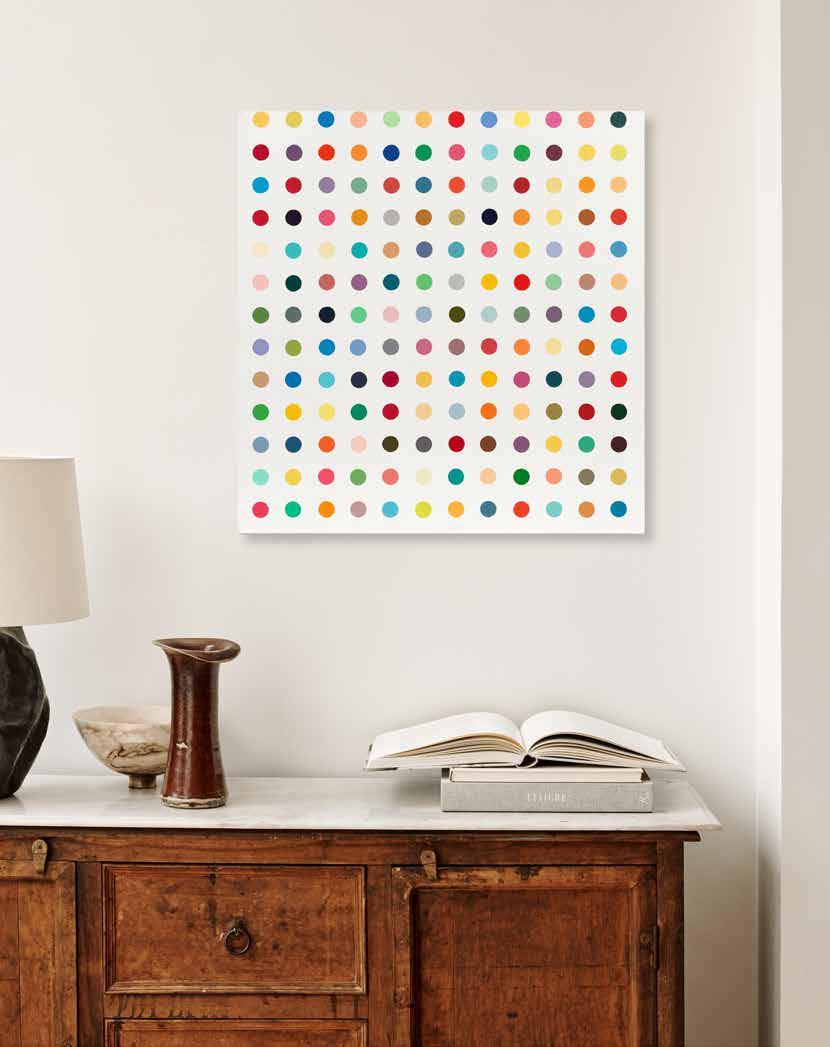
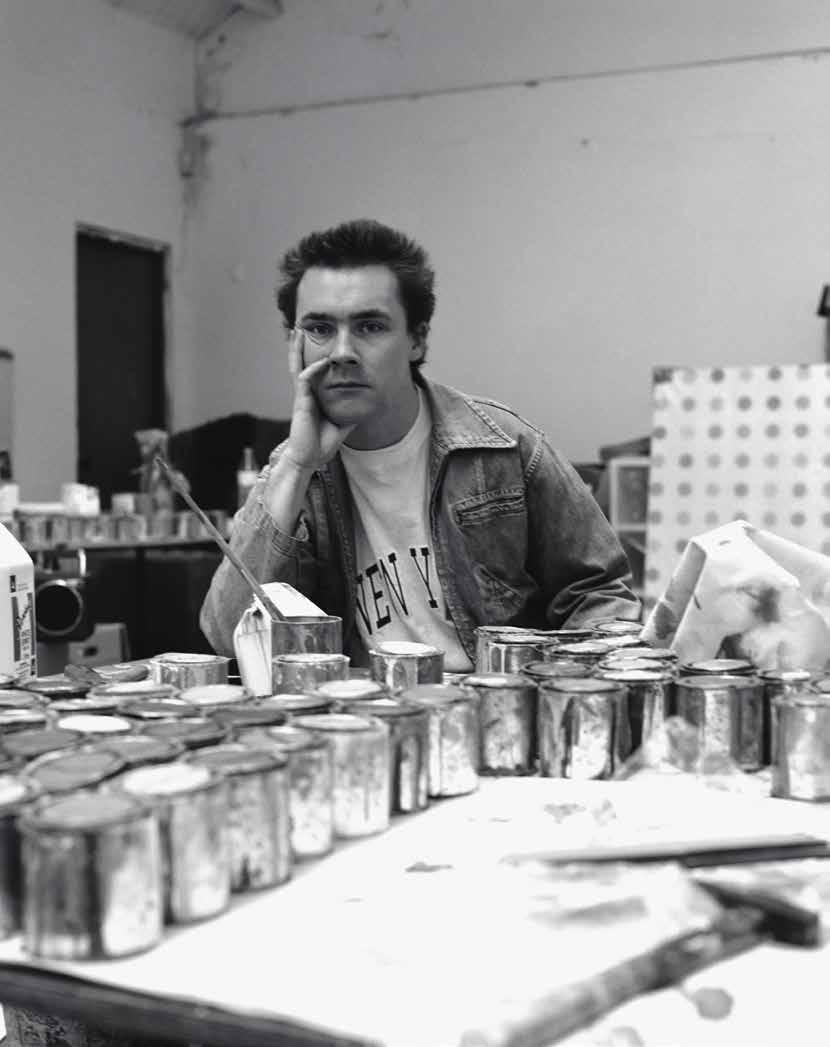

Executed in 1994, Argininamine represents an early iteration of the body of work that propelled Damien Hirst to international prominence and critical distinction. Comprised of one hundred and fifty-six meticulously arranged, uniquely coloured dots set in a precise matrix of twelve rows and thirteen columns, Argininamine stands as an early and important example of Damien Hirst's acclaimed Spot series. Each chromatic sphere, while uniform in scale and spatial placement, is distinguished by its individual hue, creating a composition that is both systematically ordered and visually diverse. Despite the potential for infinite permutations within this framework, the overarching themes of life, death, science and art, and conceptual undercurrents resonate consistently throughout the entire series. With a diversely hued palette and distinct composition, Argininamine demonstrates these core principles with a high degree of formal control and precision.
Emerging as a central figure among the Young British Artists during the late 1980s and 1990s, Hirst and his contemporaries were characterised by an entrepreneurial spirit and an embrace of unconventional, often provocative materials and methods. His first curatorial initiative, Freeze , staged in 1988 while he was still a student at Goldsmiths College of Art, featured two Spot paintings and marked a pivotal moment, catalysing the rise of both Hirst and the YBA collective to immediate recognition within the contemporary art world. Each spot in the series is painstakingly executed by hand using household gloss paint within a rigorously predetermined grid, a practice that interrogates the tension between mechanical precision and the corporeal trace of human intervention.
“I started them as an endless series… a scientific approach to painting in a similar way to the drug companies’ scientific approach to life”
- Damien Hirst
Argininamine is part of the most well-known subseries of the Spot series; the Pharmaceutical paintings. These were initially conceived alongside Hirst's renowned Medicine Cabinets and further the artist's lifelong interest in the conversation between faith, art and science. Hirst sees medicine as a potent belief system, in which society is seduced by drugs and persuaded of their capacity to cure all ailments and sustain life, while rarely interrogating their side effects: "Art is like medicine, it can heal. Yet I've always been amazed at how many people believe in medicine but don't believe in art" (D. Hirst, I want to spend the rest of my life everywhere, with everyone, one to one, always, forever, now, London 2006, p. 246). The artist derived the titles of each Pharmaceutical painting from an alphabetical listing of drug names cited in the Sigma-Aldrich chemical company catalogue that he first encountered in the early 1990s. As such, the Pharmaceutical paintings can be seen as an extension of the medical supplies found in Hirst's Medicine Cabinets with each spot signifying an individual pill.
Through each carefully hand-painted spot, Hirst is able to establish his broader artistic philosophy while creating a distinctive and instantly recognisable visual language. The artist has built upon this discourse over the years, creating a triumphant output of fully unique works that utilise this language. Entirely fresh to the market, Argininamine was included in Gagosian Gallery's ambitious 2012 exhibition series The Complete Spot Paintings 1986–2011, which presented over 300 works from the series across all eleven of the gallery's global locations. Spanning a remarkable range in scale—from minuscule pinhole-sized marks to expansive compositions featuring spots measuring up to 60 inches in diameter—each spot asserts a presence that becomes acutely palpable when viewed in person.
This singular exhibition series highlighted the artist's impressive production and investigation of the spot, which is central to Hirst's aesthetic inquiry exploring the dialectic between seriality and individuality. As he reflects: "I've always liked series. [...] You get some sort of security from the repetition of a series. If you say something twice, it's pretty convincing. It's more convincing than if you say it once. I think it's also the implication of the endlessness, which kind of theoretically helps you avoid death. [...] People are afraid of change, so you create a kind of belief for them through repetition. It's like breathing. So I've always been drawn to series and pairs. A unique thing is quite a frightening object" (The artist in conversation with Hans Ulrich Obrist, In the darkest hour there might be light: Works from Damien Hirst's Murderme Collection, London, Serpentine Gallery/ Other Criteria, 2008).
Unfolding across a radiant chromatic spectrum, Argininamine manifests a structured, contemplative grid that invites reflection on the intricate interrelations among science, religion, art, beauty, life, and death. The seemingly molecular structure of Argininamine suggests a tension between beauty and horror within the sphere of scientific discovery, acknowledging that no matter how deeply we question the mechanics of the world, we remain subject to the unknowable operations of fate. As resonant today as at the time of its creation, this work offers a powerful, lyrical meditation on themes that remain central to the human condition. Through its elegant synthesis of order and emotion, Argininamine epitomises Hirst's enduring engagement with existential inquiry and aesthetic precision.

8 * AR TP
SARAH LUCAS (B. 1962)
Gold Cup Maradona
inscribed with the artist’s signature, number and foundry mark ‘Sarah Lucas 1/3’ bronze
445 x 200 x 340cm (175 1/8 x 78 3/4 x 133 7/8in).
Executed in 2015, this work is number 1 from an edition of 3 plus 1 artist’s proof
£300,000 - 400,000
€340,000 - 460,000
US$410,000 - 540,000
Provenance
Sadie Coles HQ, London
Acquired from the above by the present owner in 2016
Exhibited
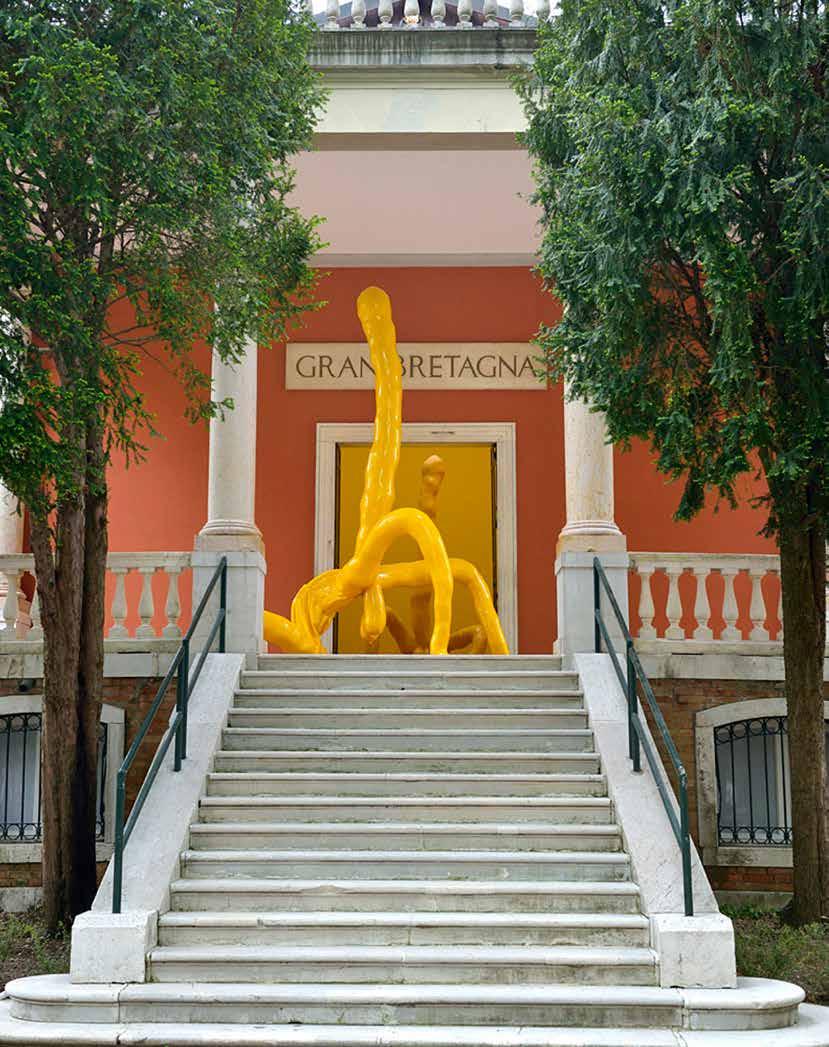
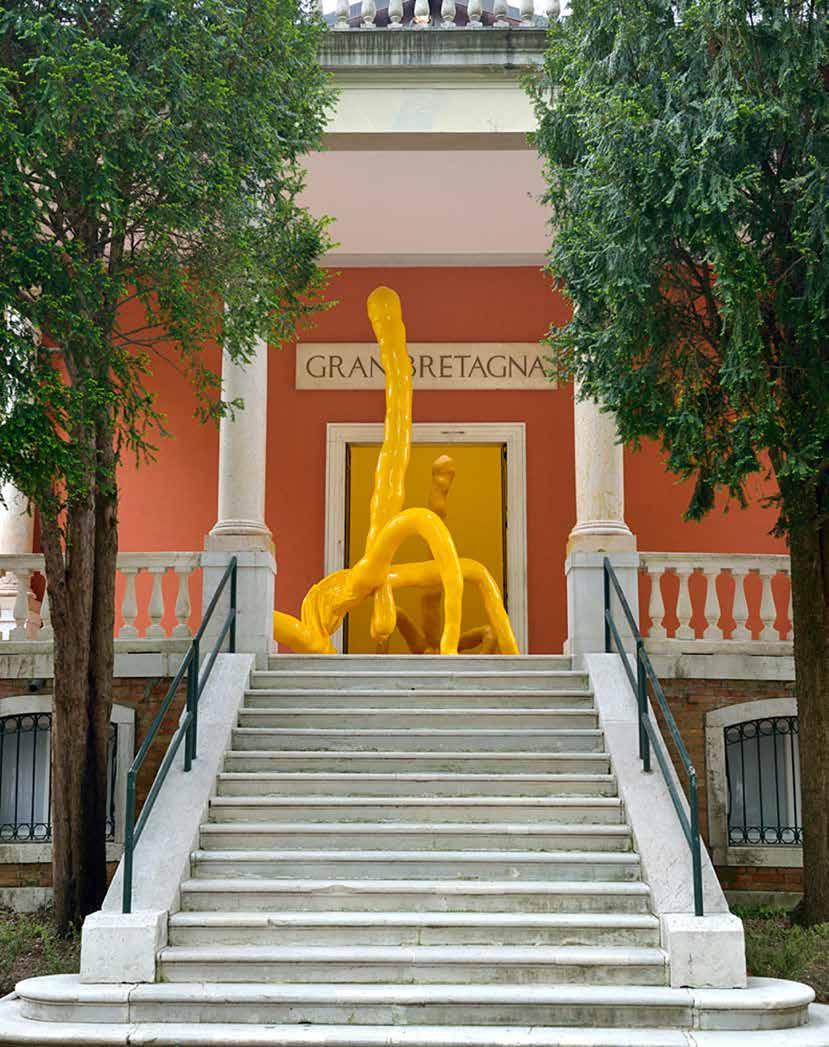
Venice, The British Pavillion, 56th Venice International Art Biennale, I SCREAM DADDIO, 9 May - 22 November 2015 (another from the edition exhibited and illustrated pp. 91, 93, and 94)
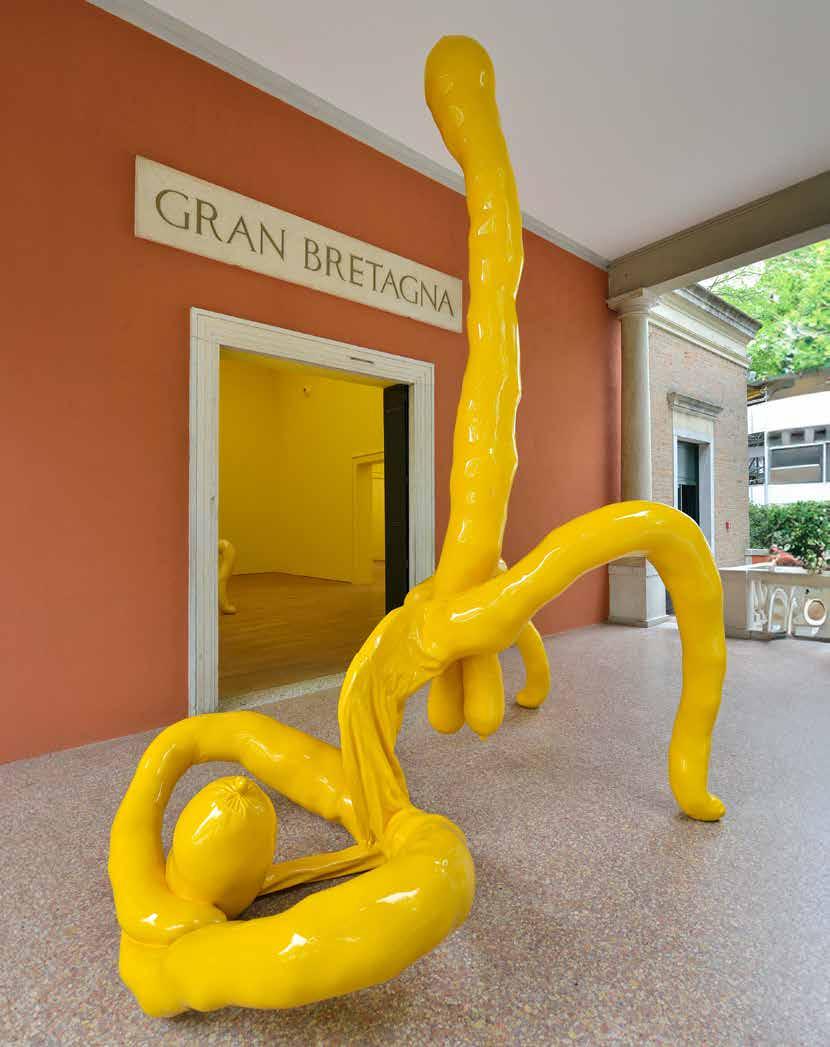
Opposite: Another from the edition exhibited at the 56th Venice International Art Biennale, 2015.
For details of the charges payable in addition to the final Hammer Price of each Lot please refer to paragraphs 7 & 8 of the Notice to Bidders at the back of the catalogue.
“As a young artist I felt that in making art I could be objective… Looking at it all now it seems highly personal and more autobiographical than I thought.”
- Sarah Lucas
Executed in 2015, Sarah Lucas' Gold Cup Maradona is exuberant, monumental and commands attention through its scale, colour, and complex composition. Distinctive within the artist's oeuvre for its imposing size, the present work bears the hallmarks of Lucas' internationally acclaimed work. The result is a striking sculpture that perfectly epitomises the artist's decades-long rebellious yet playful engagement with the art historical tradition of the portrayal of the human form, challenging traditional notions of gender, sexuality and identity. Through its twists and bulges, the present work depicts an anthropomorphic cast whose natural bodily contours mirror and reshape reality. With Gold Cup Maradona , Lucas elevates bravado and bodily excess to an epic status, gleaming with irreverence and audacity.
First presented on the portico of the British Pavilion at the 56th Venice Biennale in 2015, Gold Cup Maradona asserts both physical and conceptual dominance. Originally conceived specifically for this site, the sculpture exemplifies Lucas' long-standing commitment to creating work in direct and thoughtful dialogue with its surroundings. During its Venice presentation, the boldly masculine, fluid contours of Gold Cup Maradona sprawled across the British Pavilion's entrance, dynamically disrupting the restraint of its neoclassical façade while simultaneously enticing viewers into the pavilion by provoking curiosity through its irreverent presence.
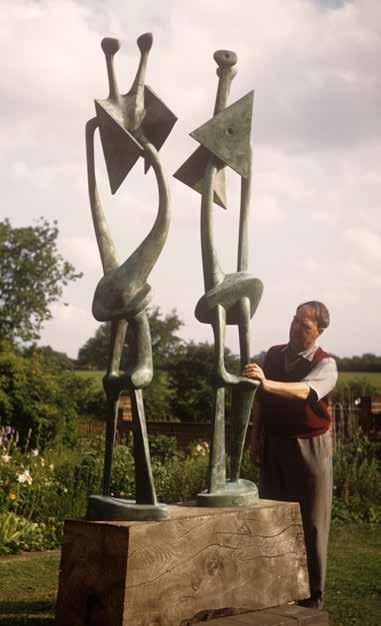
The figure's towering phallus audaciously sliced through the Gran Bretagna sign, yet this irreverent act was accompanied by a thoughtful engagement with art history: the sculpture occupied the same site as Henry Moore's Double Standing Figure in 1948. Here, Lucas established a purposeful challenge between the comical representation of the sexualised male form and Moore's abstract figures, which intended to represent the optimistic and humanist values embodied in modernism.
Notably, at the time of the 56th Venice Biennale, only four women prior to Lucas had been selected to exhibit in the British Pavilion: Barbara Hepworth in 1950, Bridget Riley in 1968, Rachel Whiteread in 1997, and Tracey Emin in 2007. As such, the commanding sculpture that greeted visitors served as a powerful articulation of Lucas' mature confidence in her position as a leading British female artist at the time of the work's creation, a distinction that the artist still carries today.
Lucas is widely associated with sculptural depictions of the female body fashioned from soft fabrics and pliable materials – most notably tights, which openly allude to conventionally feminine objects and rituals. Gold Cup Maradona, by contrast, turns to the male form and to bronze, a resolute and weighty material often coded as robust or even masculine. Yet through this medium Lucas deftly conjures a sense of bodily suppleness, lending the sculpture an inviting tactility and warmth that temper its imposing presence despite the material's inherent hardness. In doing so, the work conveys a delicacy and vulnerability comparable to that found in her fabric-based pieces. This portrayal of the male body, poised between figurative abstraction and sexualised formalisation, carries a palpable vitality and fragility akin to that sensed in the artist's flexible textile sculptures.
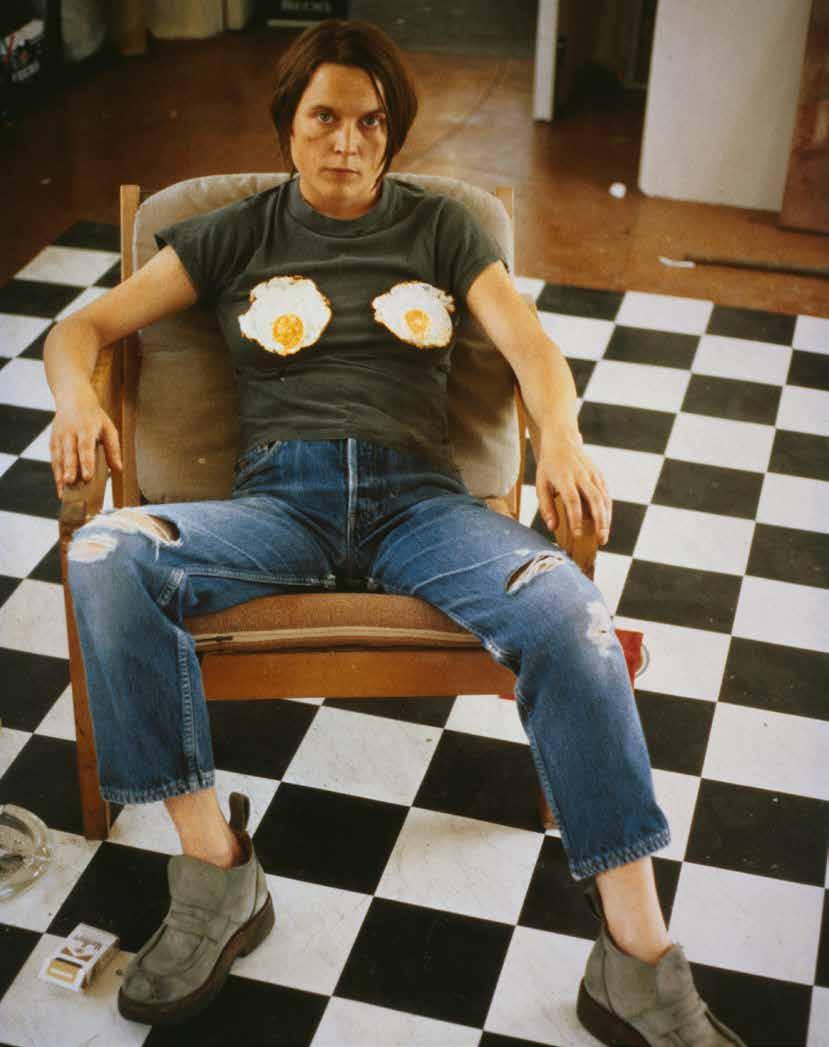
The choice of yellow is reminiscent of Lucas' recurring engagement with eggs, evident throughout her practice, where these function both as humorous references to the female body and as symbols of fertility and reproduction. One of the most recognisable works by the artist is Self Portrait with Fried Eggs, from 1996, where two fried eggs were placed on the artist's breasts as a playful representation of femininity and fertility while defying common representations of women through the male gaze. The incorporation of eggs throughout the artist's practice "put[s] the fate of the egg – typically understood as the female reproductive cell – into the hands of women, perhaps alluding to political debates concerning women's rights over their own bodies" (Margot Norton, Sarah Lucas Au Naturel, New York 2019 p. 99).
As Lucas herself explains, "So why yellow? Is it because I've been wondering, in terms of the two large sculptures, what colour they should be? Or is [it] because I've been wondering how to get eggs into the thing?" (S. Lucas, I SCREAM DADDIO, London, 2015, p. 52). Lucas experimented extensively with different shades of yellow, testing them on various surfaces and observing how they shifted under changing light conditions and at different times of day. Ultimately, the artist chose a colour called Gold Cup, a vivid yellow, for the present work, exhibited on the outside of the pavilion, and Deep Cream, a slightly paler variation, for its sister-piece exhibited inside, with each colour contributing its name to the work's title.
Renowned for her bold, mischievous, and unapologetically provocative approach, Lucas' practice is defined by irreverent humour and the inventive use of visual puns and crude euphemisms. Working across
sculpture, photography, and installation, her work consistently engages the body in its physical, cultural, and psychological dimensions. With both wit and sincerity, Lucas addresses themes of sex, mortality, and British identity, embracing sensationalism as a strategic and critical tool rather than mere shock. Her suggestive forms deftly undermine clichés propagated by popular media, while her sustained interrogation of gender foregrounds the performative nature of femininity and masculinity. Gold Cup Maradona stands as a confident and celebratory culmination of Sarah Lucas' sculptural prowess, uniting humour, provocation, and historical awareness within its fluid, imposing and striking forms. Through its monumental scale, radiant colour, and deliberate engagement with site and gender representations, the present work asserts Lucas' authoritative voice within British and international contemporary art, leaving an enduring and unforgettable impression on both the pavilion and its viewers alike.
Opposite: Another from the edition exhibited at the 56th Venice International Art Biennale, 2015.
9 AR
DAMIEN HIRST (B. 1965)
Beautiful, Dental, Brushing, Full Mouth Rehabilitation, Mullish, Thank You Painting household gloss on canvas Diameter: 121.9cm (48in).
Painted circa 1995
£120,000 - 180,000
€140,000 - 210,000
US$160,000 - 240,000
Provenance
Gift from the artist to the present owner
“Spin art is about accepting whatever happens and being available to it.”
- Damien Hirst
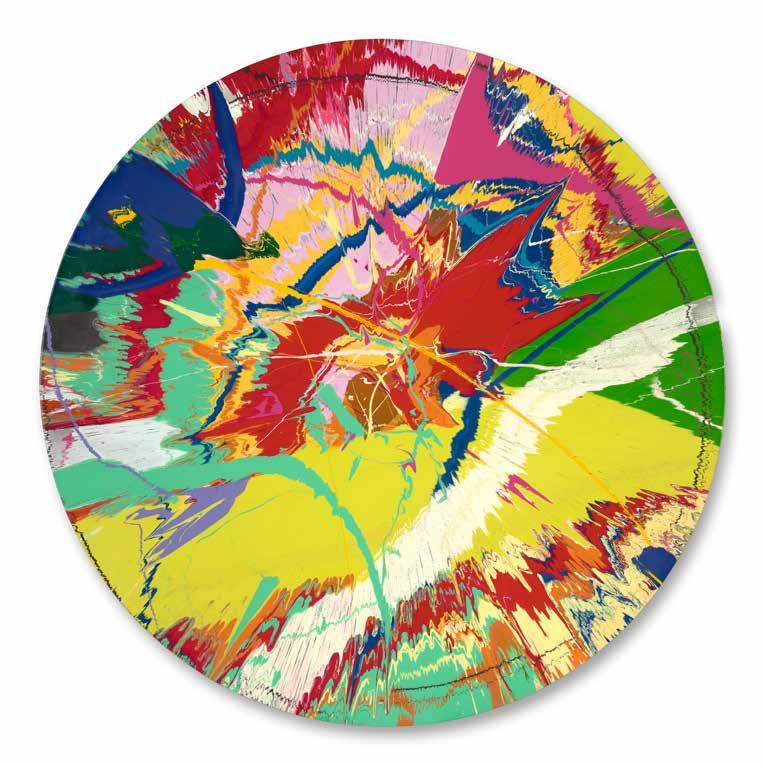
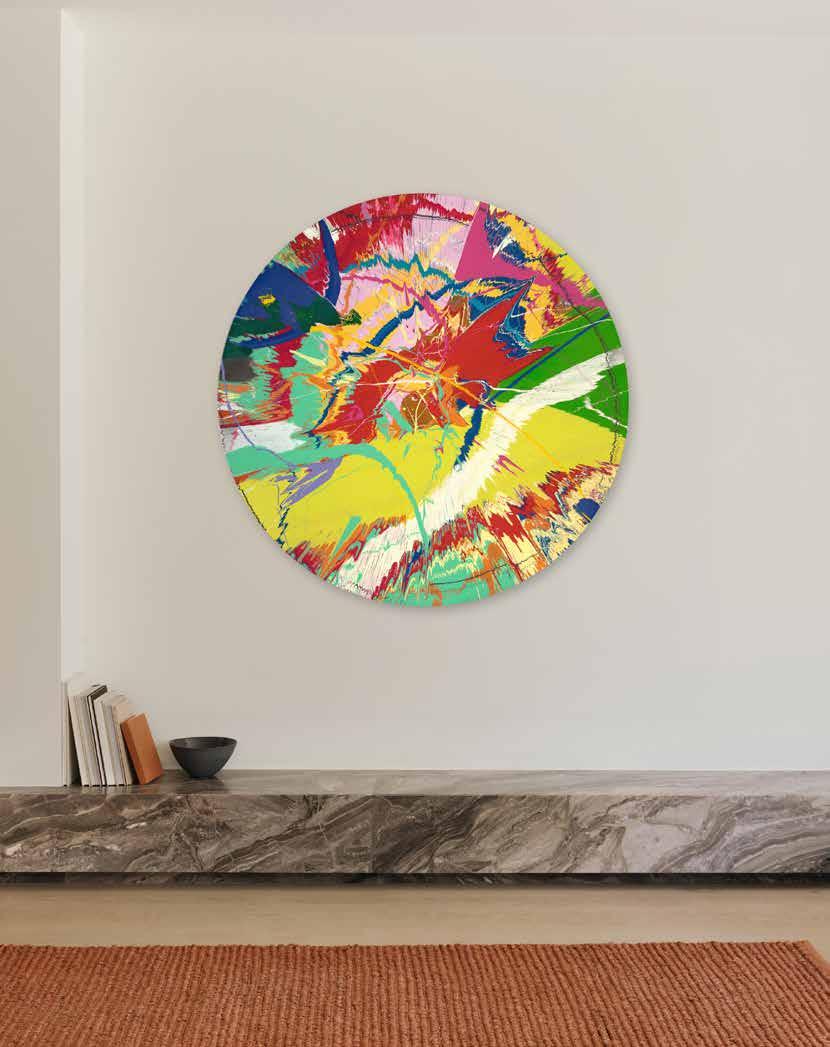
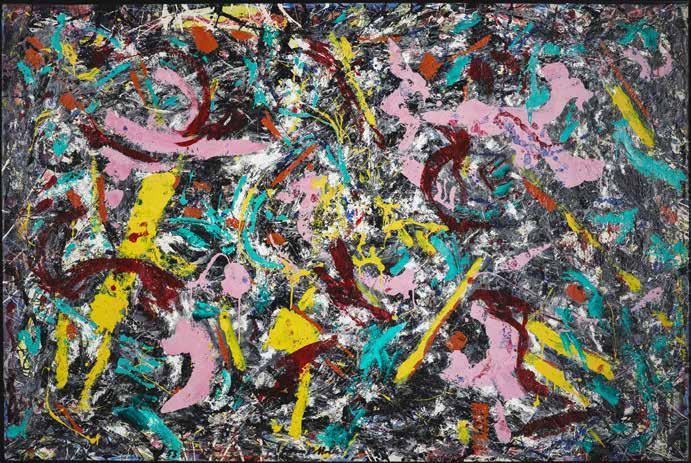
Executed circa 1995, Beautiful, Dental, Brushing, Full Mouth Rehabilitation, Thank You Painting is an early and luminous example of Damien Hirst's iconic series of Spin paintings. Hirst initiated this body of work in 1992, experimenting with the centrifugal force of a rapidly rotating circular canvas onto which he poured vivid streams of household paint. These celebrated Spin paintings captivate through their vibrant kineticism, generated by the spontaneous operations of chance, as the artist's own hand is nearly removed from the final composition. The methodology of the present work recalls Jackson Pollock's revolutionary drip paintings, through which Pollock pioneered a technique of dynamically dripping and pouring skeins of paint onto canvas or paper spread upon the floor beneath him. Similarly animated and bursting with chromatic intensity that seems to extend beyond the canvas's perimeter, Hirst's Spin paintings engage the uncertainty inherent in human experience, emblematic of the artist's enduring pursuit to transcend predetermined limits within his own artistic practice.
Shaped by postmodernism's privileging of chance and the aleatory, Hirst's Spin paintings stand in marked contrast to his methodical Spot series, though both interrogate the notion of an imagined mechanical artist, which is a conceit Hirst has provocatively sustained throughout his diverse oeuvre. Beautiful, Dental, Brushing, Full Mouth Rehabilitation, Thank You Painting unites the automatic with the tactile, creating organic, unique painterly gestures through a regulated process. The tension between automation and chance lies at the heart of Hirst's practice, through which he seeks to unsettle convention and extend the formal and conceptual boundaries of painting, while reaffirming his enduring engagement with mortality, where chance and control remain inextricably entwined.
As with much of Hirst's oeuvre, the apparent simplicity of the spin painting technique is inseparable from his fundamental interrogation of art's function and value. The artist has recounted that the series
was inspired by childhood memories of watching Blue Peter presenter John Noakes demonstrate a variant of the process using a motorised cardboard spinning device. Some time after viewing the broadcast, Hirst attended a school event where he first attempted spin painting himself, recalling a sustained fascination and near-obsessive compulsion to repeat the act again and again. Ironically, Hirst later inaugurated his own spin painting enterprise within a comparable milieu: after producing several early works in his Brixton studio in 1992, he established, the following year, a spin art stall with fellow artist Angus Fairhurst at Joshua Compston's street fair A Fête Worse than Death. For the occasion, the performance artist Leigh Bowery famously transformed Hirst and Fairhurst into clowns, and visitors were invited to produce their own spin paintings, which the artists signed upon completion.
In 1994, whilst living in Berlin, Hirst commissioned the fabrication of his own spin machine, a development that marked the moment at which the series began to take shape. Created circa 1995, the present work encapsulates the euphoric ecstasy of these early investigations. As the Spin paintings became increasingly popular, Hirst never lost his childlike sense of wonder in the process that had inspired him as a young boy. It remained, for him, 'a miracle of technology'; 'I really like making them', he professed. 'And I really like the machine, and I really like the movement. Every time they're finished, I'm desperate to do another one' (D. Hirst, quoted in D. Hirst and G. Burn, On the Way to Work, London 2001, p. 221). Ultimately, these works function as unrestrained affirmations of the power of painting: by removing his own hand directly from the process, Hirst reawakens a primal sense of awe in its unpredictable possibilities.
Hypnotic in composition and resplendent in chromatic brilliance, Beautiful, Dental, Brushing, Full Mouth Rehabilitation, Thank You Painting is an exquisitely executed work that provides a kaleidoscopic and meditative experience for the viewer.
10 *
JIM HODGES (B. 1957)
How Happy We Will Be white brass chains
35 x 41cm (13 3/4 x 16 1/8in). Executed in 1997
£100,000 - 150,000
€110,000 - 170,000
US$140,000 - 200,000
Provenance
CRG Gallery, New York
Acquired from the above by the present owner
“The artwork is an invitation and an opportunity for connection. It was conceived as a meditation and a celebration to honor the spectrum of beauty we share.”
- Jim Hodges
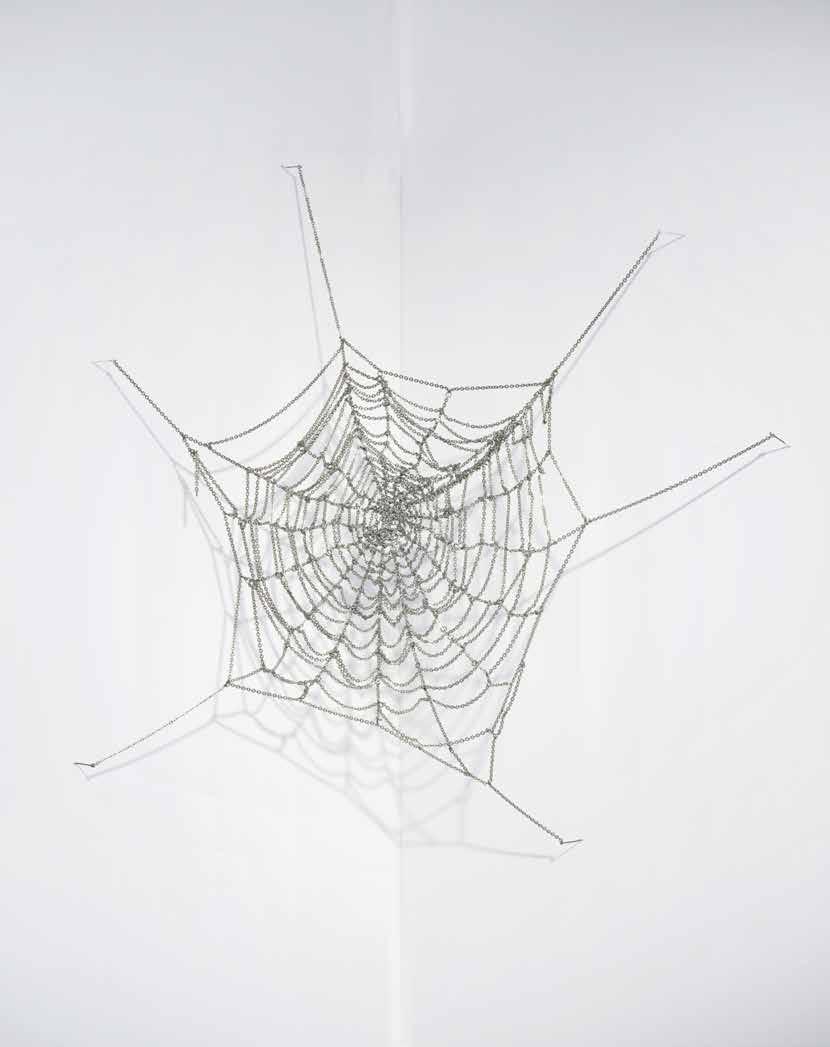
Executed in 1997, How Happy We Will Be is an exemplary work from Jim Hodges’ celebrated series of spider web constructions, a body of visually striking and conceptually rigorous works that have become synonymous with his artistic practice. The present work consists of numerous webs composed of white brass chains, meticulously arranged into a delicate, organic structure reminiscent of natural forms. How Happy We Will Be embodies a compelling duality: it is simultaneously fragile and resilient, ethereal and material, simple and complex. The title itself suggests a sense of hope and longing, an implication that optimism may persist even amid signs of aging and deterioration.
Hodges began his career as a painter but expanded his practice to encompass a broader range of media in the late 1980s. Prior to this shift, he produced a series of drawings of roses using ink on paper napkins. Inspired by this experience, Hodges sought to move beyond the inherently delicate medium of these paper napkins, turning instead to chains as the foundation of his next body of work. In his spider web constructions, the chain is both materially and conceptually strong— durable and enduring in ways paper could not be. For Hodges, these webs represent an extension of his drawing practice, reimagined through a new and invigorated exploration of the line. His practice during this period also began to confront themes tied to the AIDS epidemic, a historical tragedy that profoundly impacted both the artist and his community. Themes of beauty, fragility, and loss, particularly in relation to this context, resonate throughout his oeuvre and are acutely visible in spider web works such as How Happy We Will Be
The spider web itself is laden with symbolic associations: it evokes time, neglect, and nature, but also strength and survival. While the spider constructs its web to ensnare prey, its intricate structure remains ephemeral and easily destroyed. Like his contemporary Felix GonzalezTorres, Hodges employs simple forms and materials to communicate profound and layered ideas with remarkable clarity.
Both artists’ pared-down aesthetic strategies give rise to presentations that are deceptively straightforward yet thematically complex. The transience of life and the simultaneous resilience required for survival are distilled with particular force in How Happy We Will Be
Reflecting on his practice, Hodges has remarked: “I was working with a delicacy of material and thinking very much about time and the impossibility of halting it. For me, that was everywhere I turned. Given the kind of reality that my generation was born into—disease being part of it, and bigotry and homophobia—I think what I got was this incredible challenge of rising to an occasion. I still feel very much in tune with that question: What do we do with this reality?” (Jim Hodges as quoted in Hilarie M. Sheets, “Jim Hodges: Under the Denim Sky,” ArtNews, January 2014, accessed online).
How Happy We Will Be mesmerises its viewers in its shimmering lattice, prompting reflection on love, life, beauty, and temporality. The elaborate yet delicate configuration is spatially commanding and visually arresting, its luminous strands captivating the gaze with a lasting effect. In contrast to the conventional associations of spider webs with fragility, decay, and impermanence, Hodges’ work transforms the motif into one of endurance, permanence, and aesthetic vitality. How Happy We Will Be thus inverts the symbolic qualities of the spider web, asserting itself as strong, lasting, and resonant across time.
Ultimately, the present work stands as a quintessential example of Hodges’ spider web series, for which the artist has achieved international recognition. How Happy We Will Be highlights the beauty within the mundane, while also evoking life’s inherent fragility. His webs emerge from layered memories, transforming everyday objects into vessels of remembrance and the viewer’s own emotions to sustain the works’ enduring resonance.
11 * AR
ALIGHIERO BOETTI (1940-1994)
Mettere i verbi all'infinito
ballpoint pen on paper laid down on canvas, in three parts
Each: 100 x 70cm (39 3/8 x 27 5/8in).
Executed in 1978
£200,000 - 300,000
€230,000 - 340,000
US$270,000 - 410,000
This work is registered in the Archivio Alighiero Boetti, Rome, under the number 571.
Provenance
Galerie Durant-Dessert, Paris Private Collection, France (acquired from the above in 1989)
Anon. sale, Sotheby's, New York, 12 May 2016, lot 139 Acquired from the above by the present owner
Literature
Exh. cat., Alighiero Boetti, Ravenna, 1984, no. 7 (illustrated pp. 44-45)
Bernard Blistène, 'Fontana Burri Manzoni e l'Arte Povera: La Mauvaise Question', in Artstudio, No. 13, Summer 1989 (illustrated p. 27)
Martin De Luca & Massimo Minimmi (eds.), Alighiero e Boetti, Ravenna, 1990, no. 46, p. 55
Mark Kremmer, 'Lightness as a Weapon. On the Work of Alighiero e Boetti', in Archis, No. 2, February 1995 (illustrated p. 71)
Lara Vinca Masini, Arte Contemporanea, La Linea del Modello, Arte Come Progetto del Mondo, Florence, 1996, no. 3136 (illustrated p. 617)
Jean-Christophe Ammann, Alighiero Boetti, Catalogo generale, Tomo secondo, Opere 1972-1979, Milan, 2012, no. 951 (illustrated p. 287)
For details of the charges payable in addition to the final Hammer Price of each Lot please refer to paragraphs 7 & 8 of the Notice to Bidders at the back of the catalogue.
“It’s like looking at a starry sky. Someone who does not know the order of the stars will see only confusion, whereas an astronomer will have a very clear vision of things.”
- Alighiero Boetti
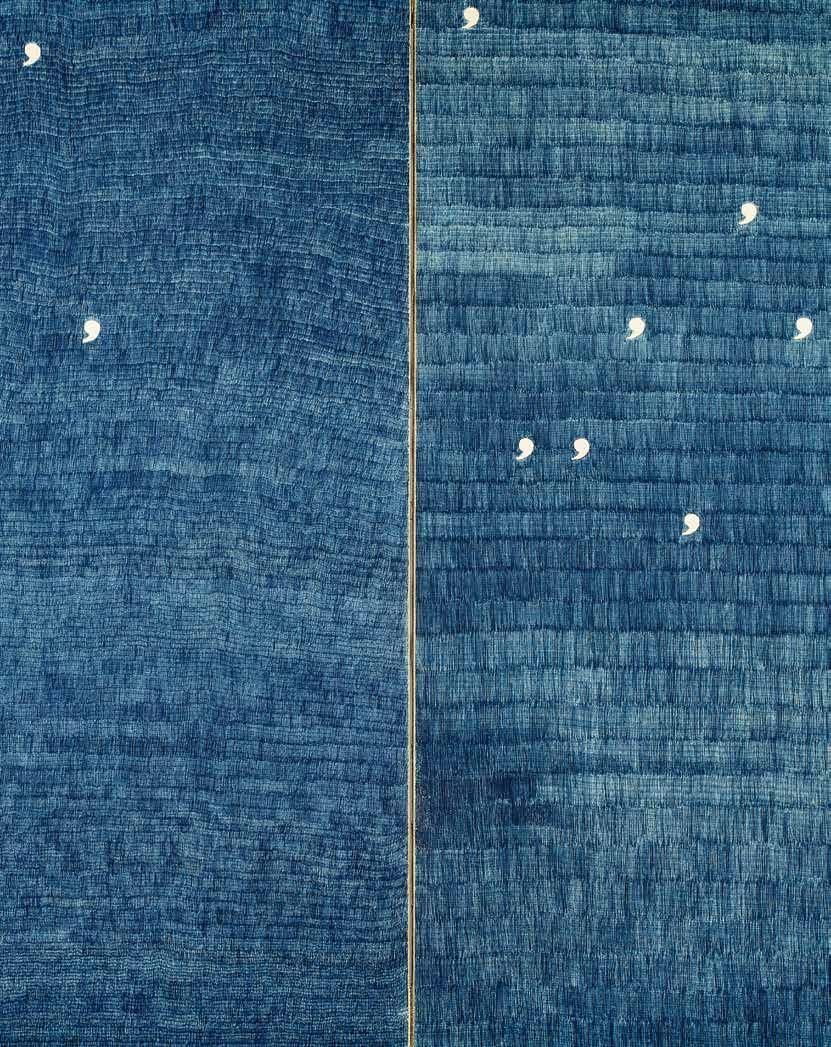
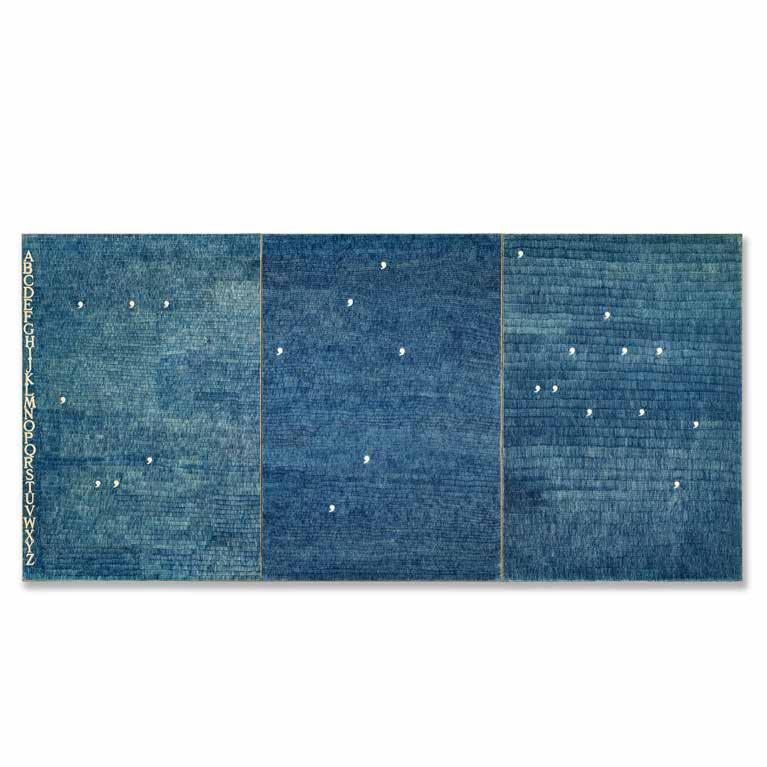
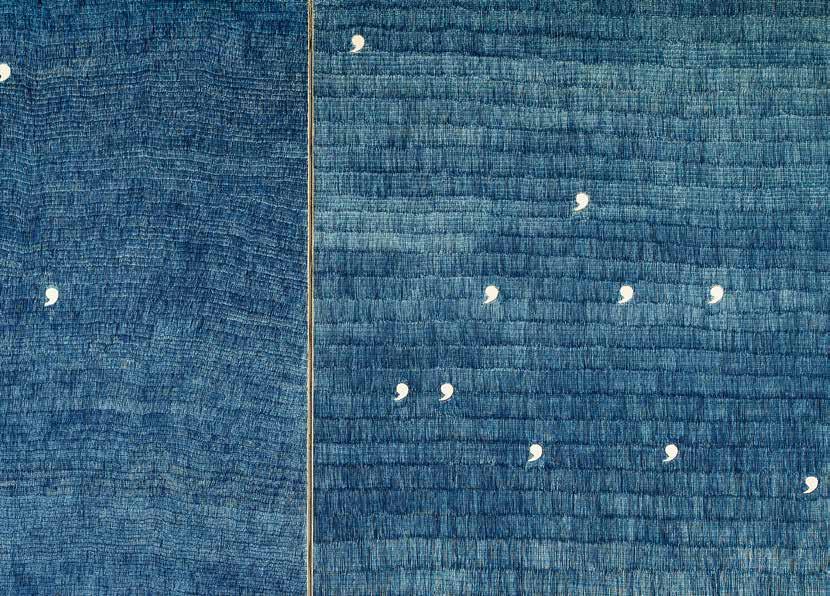
Mettere i verbi all’infinito, from 1978, is a defining work from Alighiero Boetti’s celebrated lavori biro series (or ballpoint drawings), which examine the intersections of linguistic, numerical and visual systems. Initiated in 1972, the series employs the modest medium of the ballpoint pen to generate densely textured fields of colour, composed of accumulative strokes and punctuated by small, luminous white commas. Through this controlled yet open-ended process, Mettere i verbi all’infinito beautifully articulates Boetti’s sustained engagement with structure, language, systematisation and the production of meaning.
Though seemingly dispersed randomly across the page, each comma is meticulously positioned to correspond with a specific letter of the alphabet, identifiable by tracing their sequence against the key along the left-hand side of the composition. As Boetti explained, “A word turns into a sign, into a compilation of commas with a meaning... you must render the comma as something that is not stable” (the artist quoted in Alighiero Boetti: Mettere al mondo il mondo, Frankfurt, 1998, p. 63). Moving from left to right, the viewer gradually deciphers the coded message, which in this instance reveals the title: Mettere i verbi all’infinito. In engaging the viewer in this process of revelation, Boetti constructs a subtle yet playful game that simultaneously deconstructs and celebrates the capacity of letters to convey information, while poetically acknowledging his enduring fascination with language and wordplay.
The work destabilises the perceived authority of the Latin alphabet, exposing it as an artificial system governed by arbitrary rules rather than a fixed conduit of meaning. In doing so, it evokes a sustained tension between control and uncertainty, logic and intuition, as comprehension emerges incrementally through careful attention. This delicate oscillation between order and unpredictability exemplifies one of Boetti’s central preoccupations: ordine e disordine, opposing forces that coexist in a state of continual flux, shaping the conceptual framework of his practice.
Made up of three individual panels, each painstakingly filled with rich, subtly gradated fields of royal blue ink, Mettere i verbi all’infinito presents a shimmering vision of space, the white commas appearing like a mysterious astronomical constellation or a series of falling raindrops against its expanse. While the laborious process demanded a heightened level of attention to ensure the surface was filled as densely as possible, a number of subtle textural shifts can be detected throughout. Each panel is imbued with the distinctive rhythm of its maker, resulting in fluctuating fields of colour that appear to undulate across the composition. These variations depend on numerous factors: from the quality of the pen and the pressure applied, to the speed of each stroke, the temperament of the maker, and even the gradual loss of pigment as the pen began to run out of ink.
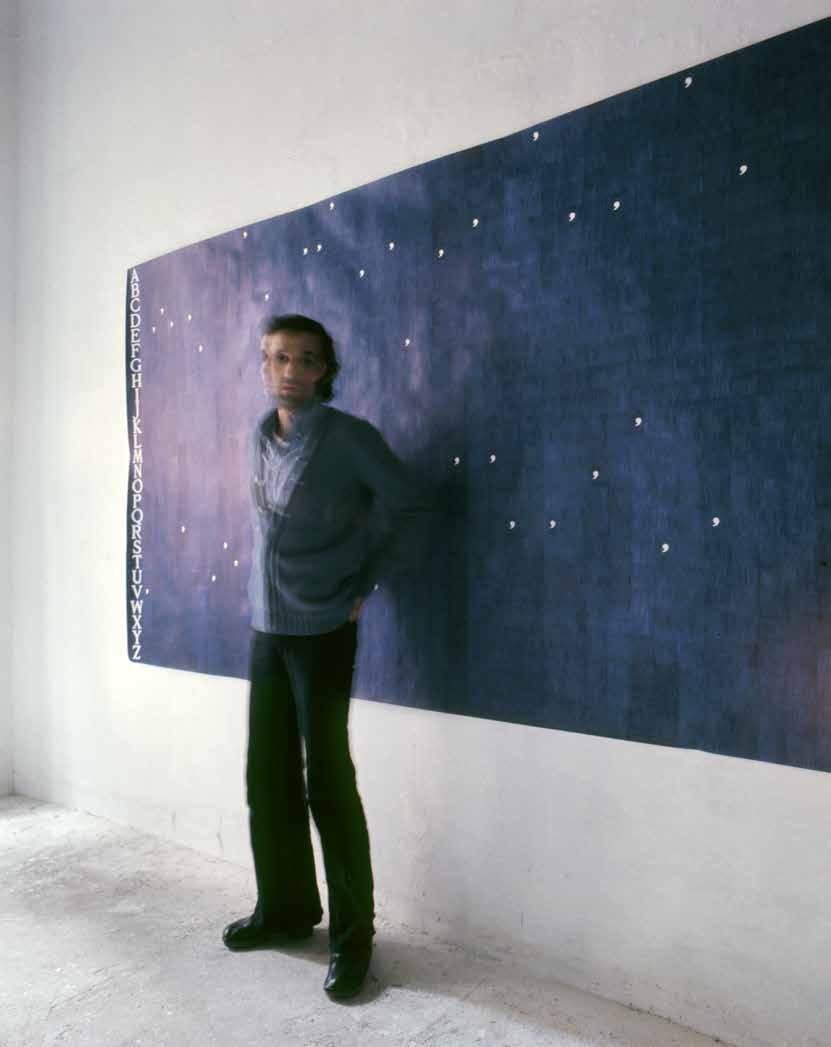

In each of the lavori biro works, Boetti employed a group of collaborators to realise his vision. While the artist developed the concept and defined the basic grid pattern, the execution of the composition was entrusted to others. A similar method was used in the artist’s Arazzi and Mappe series, both of which relied on the technical skills of Afghan embroiderers. By adopting this process, Boetti established a form of relational aesthetics through which he explored the role of the artist as a conceiver rather than the sole creator of a work of art. In the case of the biro drawings, he drew assistants from his local neighbourhood of Trastevere in Rome and requested that each alternating panel be coloured by a member of the opposite sex. Armed with a clearly defined set of rules, his collaborators spent countless hours filling the panels with intricate layers of cross-hatching, a time-intensive process Boetti felt was intrinsic to the nature of the works: “The drawings in Biro are concentrates of time” (the artist quoted ibid, p. 59).
This embrace of systems tempered by chance situates Mettere i verbi all’infinito in dialogue with the conceptual framework of Arte Povera, with which Boetti was closely associated in the late 1960s. Despite its materially modest components, everyday ballpoint pens and the labour of non-professional collaborators, the work extends beyond the movement’s emphasis on physicality and process. Boetti redirects Arte Povera’s anti-hierarchical ethos toward immaterial systems of language, time, and collective authorship.
While resonating with the movement’s resistance to industrialisation, commodification, and rigid formalism; the lavori biro depart from its material focus, privileging conceptual structures and delegated production as instruments for interrogating authorship and meaning. The visible traces of labour, the openness to error, and the gradual accumulation of ink, function not merely as evidence of process, but as markers of a philosophical inquiry that surpasses the movement’s original scope.
Executed in the 1970s, a decade that consolidated Boetti’s conceptual interests, Mettere i verbi all’infinito emerges from a broader exploration of systems as both formal frameworks and metaphors for ordering the world. During this period, Boetti developed parallel bodies of work, most notably the Mappe, which charted geopolitical change, while also formalising his fascination with duality through the adoption of his doubled name, Alighiero e Boetti. Across these projects, he mobilised language, cartography, and delegated labour as interrelated strategies for examining authorship and temporality, holding structure and unpredictability in deliberate tension. In bringing these concerns together, Boetti’s practice reflects an enduring interest in how meaning is shaped through processes that exceed individual intention.
Mettere i verbi all’infinito transforms a deceptively simple system into a work of profound complexity and elegance. It exemplifies Boetti’s capacity to balance conceptual rigor with chance and human variation, producing a composition that is simultaneously intellectually exacting and visually compelling. In its quiet complexity, Mettere i verbi all’infinito stands as a powerful testament to Boetti’s ingenuity.
“I never rejected a ballpoint pen because there is no possibility of making a mistake, there is only one background painting to do, and the more time you take, the more beautiful the work is.”
- Alighiero Boetti

Caixa d’embalar (Packing Box) signed ‘Tàpies’ (on the overturn edge) wood, straw, paper, nails, paint and mixed media assemblage
170.7 x 124.4 x 20cm (67 1/8 x 49 x 7 7/8in).
Executed in 1969
£100,000 - 150,000
€110,000 - 170,000
US$140,000 - 200,000
Provenance
Martha Jackson Gallery, New York Galleria DueCi, Rome
Guillermo Caballero de Luján Collection, Valencia
Acquired from the above by the present owner
Exhibited
Zürich, Galerie Maeght, Tàpies, March - April 1971, no. 2 (illustrated n.p.)
Rome, Galleria Il Collezionista, Antoni Tàpies, Opere 1946-1970, 14 April - 15 May 1971, no. 24 (illustrated p. 59)
Düsseldorf, Galerie Alfred Schmela, Antoni Tàpies, Materialbilder, Gouachen, Zeichnungen und Grafik, 1978 Madrid, Centro de Arte Reina Sofía, Tàpies, Extensiones de la realidad, 7 November - 21 December 1990 (illustrated p. 85)
Barcelona, Fundació Joan Miró, Extensions de la realitat, 28 February - 14 April 1991 (illustrated p. 71)
Barcelona, Fundació Antoni Tàpies, The Fertilizer that Feeds the Soil. Tàpies (1958-1988), 8 October 2022 - 30 April 2023, no. 11
Barcelona, Galeria Mayoral, Tàpies | Miró. We Come From a Silence, 10 October 2023 - 5 January 2024
Literature
Pere Ginferrer, Tàpies i l’esperit català, Barcelona, 1974, (illustrated p. 81 and p. 262)
Roland Penrose, Tàpies, London, 1978, no. 113 (illustrated p. 161)
Victòria Combalia & Concha Lomba, Los Genios de la Pintura Española. Tàpies, Madrid, 1990, Vol. IX, no. 12 (illustrated p. 28 and p. 86)
Anna Agustí, Tàpies, The Complete Works, Volume 3: 1969-1975, Barcelona, 1992, no. 2108 (illustrated p. 103)
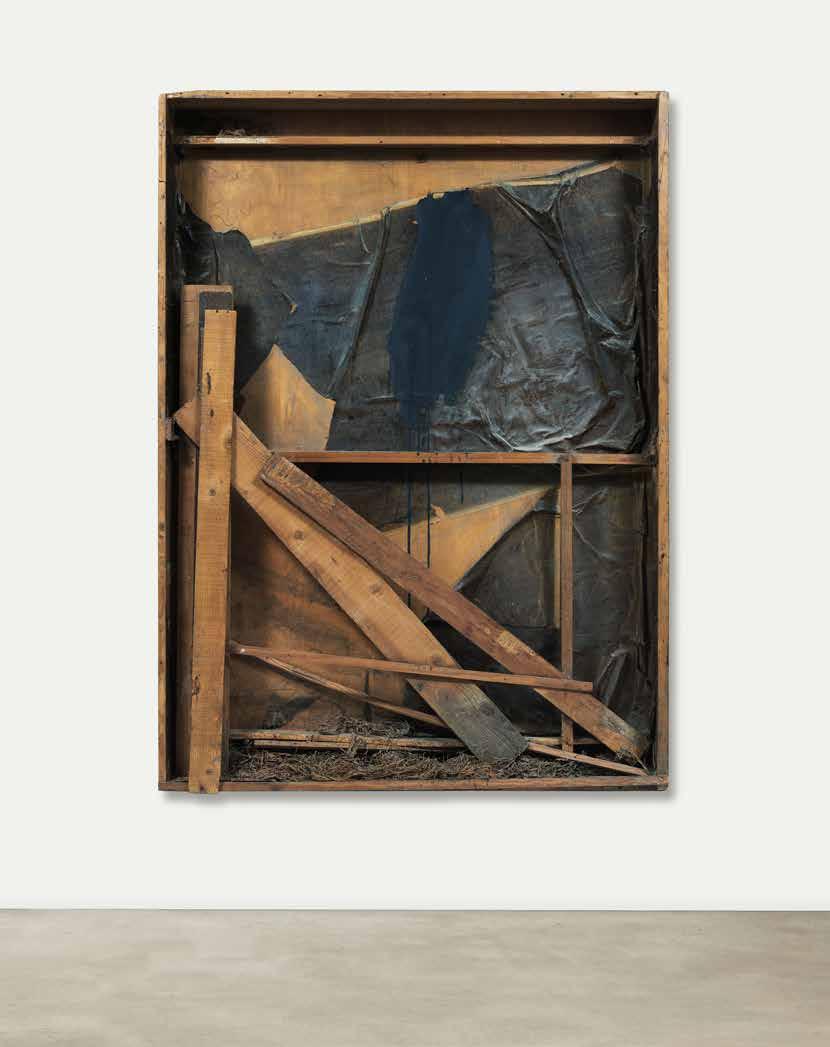
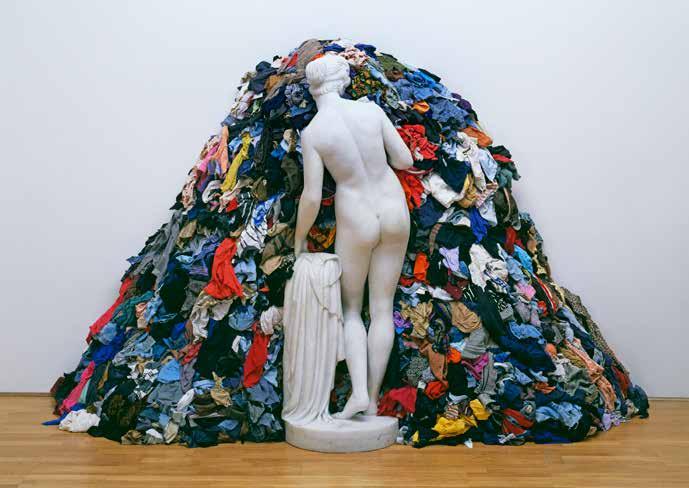
Precarious at first sight yet profoundly sophisticated in conception, Caixa d'embalar is a thought-provoking example of Antoni Tàpies' celebrated "matter paintings," affirming the artist's sustained commitment to the reinvention of painting and its expressive possibilities. Executed in 1969, the work bears the hallmarks of Tàpies' mature practice: densely worked, tactile surfaces constructed from humble, unconventional materials, in which form emerges through processes of accretion, abrasion, and concealment. Suspended between painting and object, Caixa d'embalar unfolds as a charged material terrain, its weathered surface evoking sedimented memory and the passage of time. Here, the ordinary packing case is transformed into a poetic field of enquiry, where matter itself functions as both subject and signifier.
Initially indebted to the imaginative vocabularies of Surrealism, particularly those of Max Ernst, Joan Miró, and Paul Klee, Tàpies soon redirected his practice toward abstraction, first exploring restrained geometrical compositions before arriving at the radically tactile language that would define his mature production. By the early 1950s, and increasingly in the following decade, he aligned himself with the broader currents of Art Informel, forging a distinctly personal mode of "material abstraction" in which substance became both medium and message. In dialogue with contemporaries such as Jean Dubuffet and Alberto Burri, Tàpies rejected illusionistic depth in favour of surfaces activated through physical intervention; built up through sand, marble dust, wood, and discarded matter, then incised, scratched, or scored in gestures that evoke both violence and revelation. This dialectic of addition and subtraction, of concealment and exposure, finds eloquent expression in Caixa d'embalar
Layered sections emerge and recede across the packing case's worn façade, its rough-hewn edges and embedded fragments generating a palpable sense of sedimented time. The surface reads less as a pictorial field than as an archaeological site, bearing traces of process, touch, and human presence. Such material density underscores Tàpies' conviction that texture constituted a "third language," equal in expressive force to colour and form. For the artist, matter was never inert; it functioned as a conduit to metaphysical awareness. As he reflected, his works sought to create "a system that makes it possible to change the spectator's way of looking and to bring him or her closer to a state of contemplation of reality at its deepest level," enabling the perception of hidden depths and "inner illumination" (the artist quoted in: The UNESCO Courier, June 1994, p. 5).
Tàpies' engagement with matter during the 1960s can further be understood within the broader context of contemporary material explorations in Europe and the United States. The emergence of Arte Povera in Italy and the parallel developments of Post-Minimalism and Process Art signalled a decisive shift away from the autonomy of the pristine art object toward practices grounded in contingency, entropy, and the poetics of the everyday. While Tàpies' material investigations predate these movements, they resonate profoundly with their concerns. In post-war Spain, and amid social, political, and cultural upheaval, matter assumed existential significance. As author Youssef Ishaghpour has observed, Tàpies sought to "confront the disillusionment and the absence of meaning in the obtuse force of matter" (Y. Ishaghpour, Antoni Tàpies, Barcelona, 2006, p. 56). Such historical and material conditions are legibly inscribed in Caixa d'embalar, whose worn timber, frayed fibres, and humble fragments evoke a world shaped by scarcity, rupture, and reconstruction, while asserting the resilience embedded within matter itself.
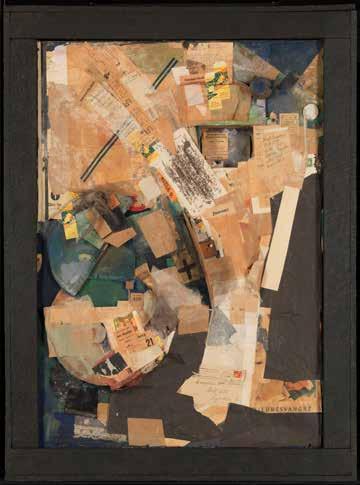
The work's construction is particularly resonant as Tàpies incorporates a recycled packing box together with collaged elements of wood, straw, and paper, preserving the traces of labour and touch that cling to their surfaces. In doing so, he advances a conception of form not as abstract geometry but as lived substance, imbued with the memory of prior existence. These quotidian elements, dislodged from their utilitarian function, acquire symbolic charge and form both the structural and conceptual core of the work, recalling the enigmatic letters and signs of his canvases. By substituting the traditional canvas for a packing box, Tàpies transforms an object of transit and containment into a site of contemplation. Its hollow interior and abraded surfaces resist hierarchical composition, rejecting any singular focal point or fixed declaration of meaning and instead inviting the viewer to reconsider the ontological status of ordinary matter.
This reconfiguration of the box as both structure and symbol also establishes the work's central material tensions. Caixa d'embalar articulates a dialogue between opposites: rigid, sharp-edged fragments of wood are set against soft, fragile straw and paper, which spill, press, and nestle within the crate's interior. The contrast between hardness and delicacy extends the earlier transformation of the packing box, foregrounding the agency of matter and allowing it to assert a palpable vitality. Even the sporadic application of paint, seemingly thrown across the surface, reinforces this dynamic, exemplifying Tàpies' equilibrium between controlled intervention and spontaneous gesture.
In this balance, the fractured material realities of post-war Europe, marked by destruction, scarcity, and reconstruction, find quiet resonance. By permitting the ephemeral and the enduring to coexist within a single, unstable structure, the work becomes a meditation on resilience and impermanence, resisting narrative closure while inviting sustained, contemplative engagement with its surfaces and the histories they embody.
Caixa d'embalar stands as a distilled expression of Tàpies' sustained exploration of matter, spirituality, and the boundaries of painting. By elevating a discarded packing box into a space for aesthetic and metaphysical reflection, he demonstrates painting's capacity to move beyond representation, functioning as an experiential field shaped by perception and tactility. The work's layered construction, the tension between fragility and resilience, and the visible traces of human intervention coalesce into an object that is at once concrete and contemplative, surface and depth intertwined. Here, the ordinary is neither obscured nor idealised, but intensified: matter speaks on its own terms, carrying the weight of history, touch, and time. Within the trajectory of Tàpies' mature practice, the work embodies the principles that mark his most significant contributions, material abstraction as philosophical enquiry, process as revelation, and the transformation of the everyday into the profound. In doing so, Caixa d'embalar emerges not merely as an example of his practice, but as a definitive statement of its enduring resonance in post-war European art.
Reina Mariana smooth crystalline resin
115 x 85 x 62cm (45 1/4 x 33 3/8 x 24 3/8in).
Executed in 2020, this work is number 4 from an edition of 8
£120,000 - 180,000
€140,000 - 210,000
US$160,000 - 240,000
Provenance
Opera Gallery, Monaco
Acquired from the above by the present owner

“The idea for me is to use volumes that are expressive… the fact that the sculpture makes a shadow, it’s part of the image — it’s alive.”
- Manolo Valdés
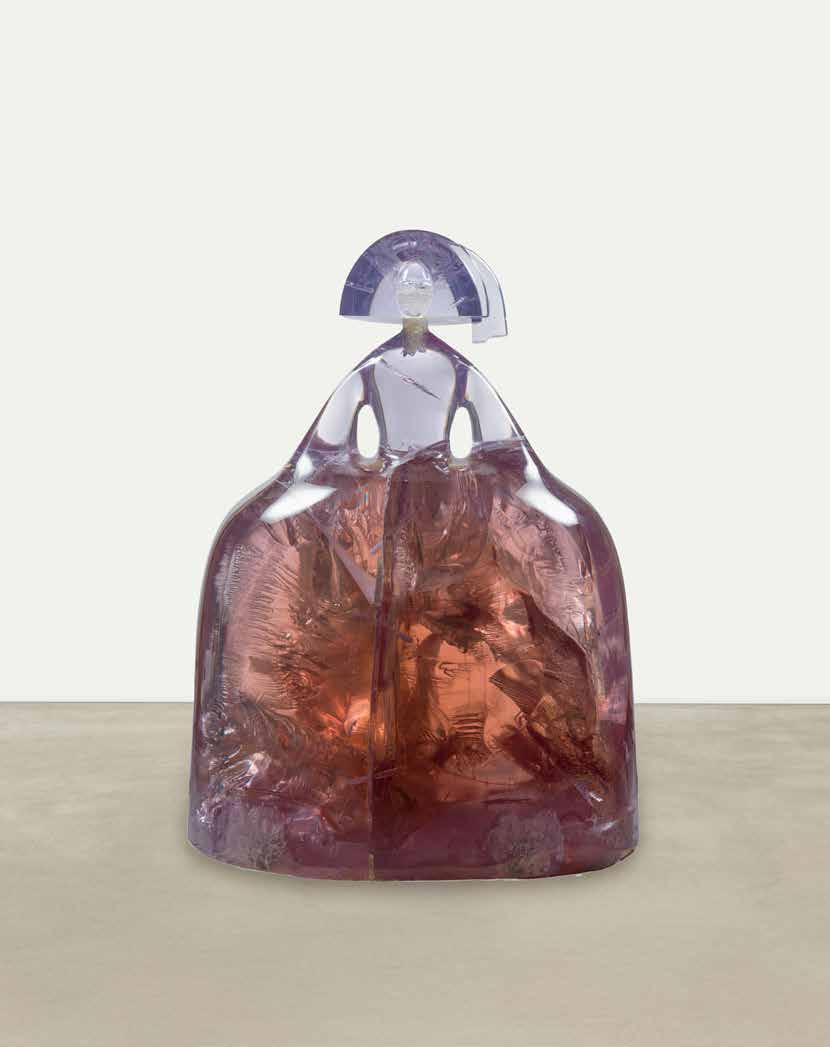
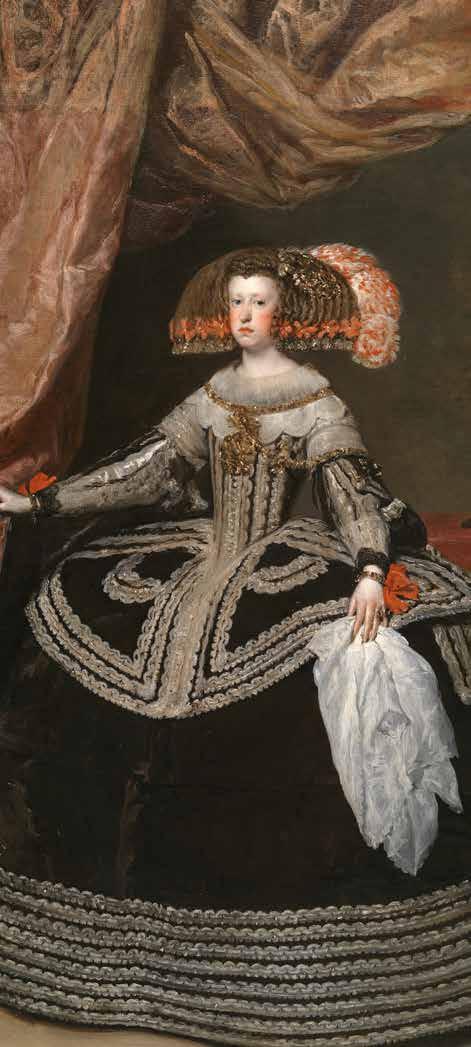
Manolo Valdés occupies a unique position in postwar European art; an archeologist of mythologies who reveals the tension between historical and contemporary spectacle, examining and producing art that engages deeply with the sociocultural potentialities of image-making and iconography. In the present work, Reina Mariana , Valdés' vision crystalises in a reanimated silhouette of the Spanish Golden Age. Lucent and amethystlike, it presents as an object of nature – a piece derived from natural creation and order. Sublimated in this idea is the crux of Valdés' project: to upend the ideologies embedded in images of power.
Emerging during the final decades of the Franco regime in Spain, for Valdés and his artistic comrades art was a vehicle for critique and cultural reclamation. A founding member of the Equipo Crónica in 1965, alongside Rafael Solbes and Juan Antonio Toledo, the group approached art history as an active archive, reconstituting images belonging to the Spanish tradition as a form of Pop art inflected through a politicised lens. "We used 'pop' but questioned it. We took the images (language)

but knew it had to be different from the United States. We felt that American pop lacked the political content [...] We relied heavily on historical painting, which we converted into pop. For us the Museo del Prado represented the utmost expression of popular culture. Its contents became our main source of inspiration" (the artist quoted in: "Artist interview: Manolo Valdés (Equipo Crónica)", Tate, September 2015, Online).
By reworking canonical paintings alongside comic-strip graphics and contemporary political imagery, Equipo Crónica exposed how cultural authority is imposed and disseminated. Their project was neither parody nor homage, but a critical investigation into how images accumulate meaning through repetition and institutional framing. After the dissolution of the collective in 1981 following the death of Solbes, this sustained dialogue with art history has been the driving force of Valdés' own practice, reenvisioning the works of Velázquez, repurposing the tools of Picasso and Matisse, Cubism and the Fauves.
The present work employs Valdés' most prominent leitmotif, taking one of the most recognisable images of Spanish court painting, Velázquez's own 1652–1653 Portrait of Mariana of Austria – in the collection of the Museo del Prado – as it's departure point. The domed features of the subject's extravagant coiffure and architectural dress are inseparable from the work of Valdés. In his
stripping of identity from the original image, Valdés emphasises collective memory over biography; the figure becomes less a historical person than a cultural symbol.
Reina Mariana embodies a worldview that remains in living memory for Spain: history is neither neutral nor passive but is continuously reconstructed; that absolute power corrupts absolutely. The translation of a Baroque royal portrait into a contemporary sculpture demonstrates a fluidity at the heart of image-making. In its immaculate surface Reina Mariana conceals the hand of the artist, reaffirming the mediated perfection of reproduced images but also the natural order implied by autonomous, inhuman objects. Part-sculpture, partmonument, the present work is an elegant window through which the spectator glimpses the essential transparency of images that seek to project power or fortify ideology.
Valdés has long since achieved global stardom and institutional acclaim, his sculptures appearing in public spaces of major cities around the world for decades, most notably representing Spain at the 48th Venice Biennale in 1999, and in 2006 being honored by the Museo Reina Sofía with a comprehensive career survey. There is little doubt in his international standing as an artist who has produced one of the most consistent and compelling bodies of work to emerge from Spain in the latter half of the 20th century.

14 *
AUGUSTE RODIN (1840-1917)
Éternel printemps, second état, 3ème réduction
signed 'Rodin' (on the right of the base), inscribed with the foundry mark 'F. Barbedienne. Fondeur.' (on the left of the base) and engraved with the workshop mark 'TTTT 17' (on the interior) bronze with black-brown patina
39.5 x 50.2cm (15 9/16 x 19 3/4in).
Conceived in 1884 and in this reduced size in 1898, this bronze version cast by the Barbedienne foundry between 1908 and 1912.
£150,000 - 250,000
€170,000 - 290,000
US$200,000 - 340,000
This work will be included in the forthcoming Catalogue Critique de l'Oeuvre Sculpté d'Auguste Rodin, currently being prepared by the Comité Auguste Rodin at Galerie Brame & Lorenceau under the direction of Jérôme Le Blay.
Provenance
Établissements Barbedienne, Paris.
Private collection, US.
Anon. sale, Sotheby Parke-Bernet, Los Angeles, 8 May 1972, lot 49.
Private collection, Los Angeles (acquired at the above sale).
Private collection, US (by descent from the above).
Literature
L. Maillard, Études sur Quelques Artistes Originaux, Auguste Rodin, Statuaire, Paris, 1899, p. 121 (another version illustrated).
G. Grappe, Catalogue du Musée Rodin, Paris, 1927, no. 69 (another cast illustrated p. 42).
G. Grappe, Le Musée Rodin, Paris, 1944, no. 56 (another version illustrated p. 141).
B. Champigneulle, Rodin, New York, 1967, p. 91, nos. 34 & 35 (plaster version illustrated pp. 92 & 93)
J.-F. Chabrun & R. Descharnes, Auguste Rodin, London, 1967, p. 135 (another cast illustrated p. 134).
I. Jianou & C. Goldscheider, Rodin, Paris, 1967, p. 96.
J.L. Tancock, The Sculpture of Auguste Rodin, Philadelphia, 1976, no. 32b (another cast illustrated pp. 243 & 246; plaster version illustrated p. 242; marble version illustrated p. 246).
A.E. Elsen (ed.), Rodin Rediscovered, exh. cat., National Gallery of Art, Washington, 1981 (clay version illustrated p. 68).
D. Finn & M. Busco, Rodin and His Contemporaries, The Iris & B. Gerald Cantor Collection, New York, 1991, p. 227 (another version illustrated).
A.E. Elsen, Rodin's Art, The Rodin Collection of the Iris & B. Gerald Cantor Center for Visual Arts at Stanford University, New York, 2003, no. 148 (another cast illustrated figs. 413 & 414).
A. Le Normand-Romain, The Bronzes of Rodin, Catalogue of Works in the Musée Rodin, Vol. I, Paris, 2007, pp. 335-337 (another cast illustrated p. 334; terracotta version illustrated p. 335; plaster version illustrated p. 336; marble versions illustrated pp. 336 & 337).
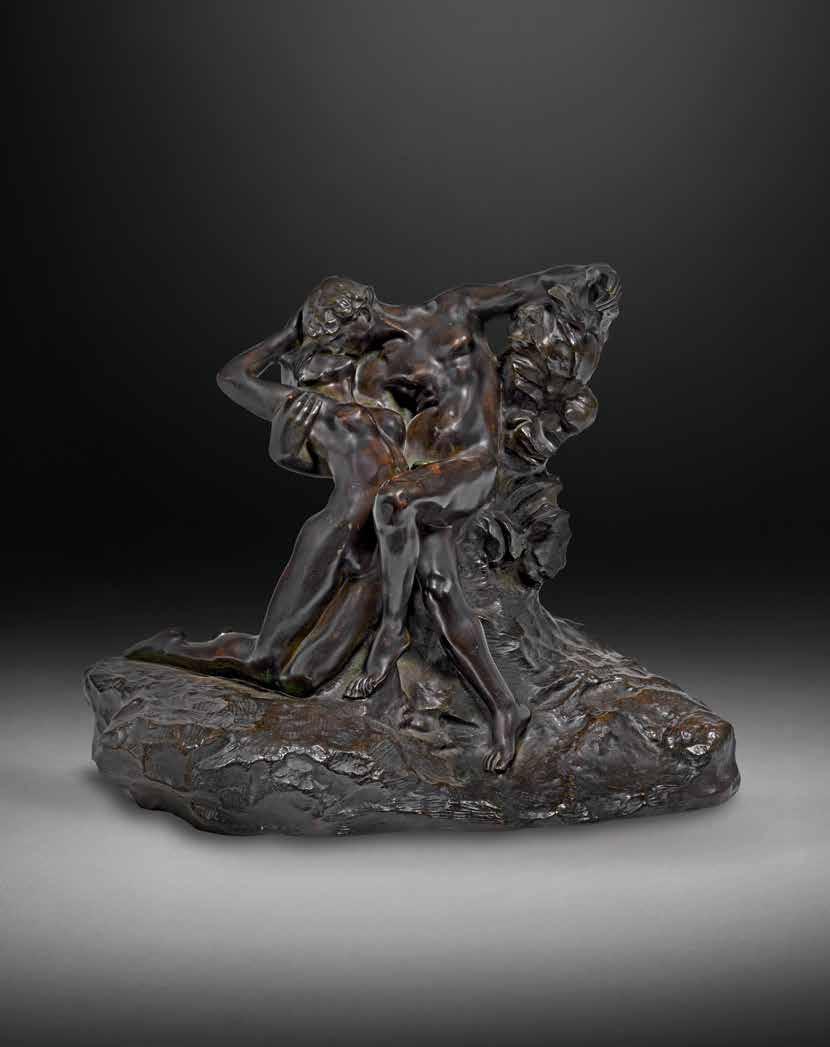
One of Auguste Rodin's most celebrated sculptures and among the greatest commercial successes of his career, Eternal printemps was conceived in 1884 at a moment of profound emotional and artistic intensity. The work emerged during Rodin's passionate relationship with Camille Claudel, who had recently joined his studio as an assistant and whose presence would prove transformative to his art. Originally developed as part of La porte de l'Enfer — the monumental bronze doors inspired by Dante Alighieri's Inferno, commissioned in 1880 — the rapturous embrace of the lovers was ultimately deemed too hopeful in tone for Rodin's vision of damnation and despair. Freed from that context, Eternal printemps evolved into an autonomous celebration of desire, vitality and enduring passion.
The entwined figures evoke the tragic lovers Paolo and Francesca, condemned in Dante's narrative to an eternity of wind-tossed embrace. Yet Rodin transforms literary fate into sculptural exaltation. The female nude, derived from the sensuous Torse d'Adèle — named after Adèle Abruzzesi, one of Rodin's most favoured Italian models — arches upward with luminous abandon, while the male figure responds in a sweeping counter-curve, his body seemingly suspended in air. Their union is both precarious and ecstatic, poised at the threshold between physical gravity and emotional transcendence.
Camille Claudel (1864–1943), The Waltz (Allioli), c. 1900.
Rodin often described his working method as one of perpetual revision, likening sculpture to a language whose grammar and syntax could be endlessly reconfigured. Figures were reused, adapted and recombined in an ongoing search for expressive truth. In Eternal printemps, this process reaches an extraordinary synthesis: concave and convex forms interlock in a tightly coiled rhythm, while the lovers balance upon a rough, insufficient base that heightens the sensation of motion and risk. The male figure's feet barely touch the ground — one hovering in space, the other hanging over the edge — so that the woman's kneeling body becomes his sole anchor.
The emotional charge of the work is inseparable from Rodin's relationship with Claudel. Their affair, which began soon after her arrival in his studio in 1882, marked one of the most fertile periods of mutual influence in modern sculpture. Claudel's own works — most notably Sakuntala (1886) and La Valse (1889) — echo the same entwined dynamism and crossed structural axes that animate Eternal printemps, suggesting a shared sculptural vocabulary developed in near tandem. In a letter written to Claudel in 1886, Rodin spoke of his "furious love" and "violent passion" — words that find palpable form in the sculpture's outstretched arms and charged interdependence.
Rodin later claimed that the idea for Eternal printemps came to him while listening to Ludwig van Beethoven's Symphony No. 2. Reflecting on the music, he remarked on the suffering embedded within its exuberance, and on how this paradox inspired the sculptural vision he would realise. The work was also known under alternative mythological titles — Zéphyr et la Terre and Cupidon et Psyché — a strategy that allowed Rodin to cloak its overt eroticism within the legitimising framework of classical allegory.
The sculpture's early reception cemented its significance. In 1886, Rodin presented a plaster cast of Eternal printemps to Robert Louis Stevenson, in gratitude for a public defence of his work in the London press. The group was exhibited at the Salon of 1897, and its immediate popularity prompted Rodin to authorise multiple versions. A second iteration, featuring an enlarged base and rocky support, became the model for the editions produced by the Barbedienne foundry between 1898 and 1918, following Rodin's exclusive contract with Gustave Leblanc-Barbedienne. These casts, produced in four sizes, ensured the sculpture's widespread dissemination while retaining the expressive daring of the original conception.
At the heart of Eternal printemps lies a rare union of lyricism and tension. The lovers' embrace is not static but charged with anticipation, as though caught in the suspended instant before complete surrender. The gesture of the male figure's raised arm — curved, open, unresolved — infuses the composition with a sense of emotional propulsion that seems to lift the figures beyond the limits of the physical world. As critics have observed, Rodin here gives sculptural form to extreme states of feeling, allowing passion itself to shape space and mass.
Eternal printemps stands as one of Rodin's most enduring images of love: ardent yet fragile, sensual yet monumental. Born from personal passion and refined through relentless formal experimentation, it distils the sculptor's belief that human emotion — when rendered with honesty and intensity — could achieve the timelessness of myth. In this work, a fleeting moment of embrace becomes eternity itself.
15 *
AUGUSTE RODIN (1840-1917)
Masque de l'homme au nez cassé, version dite type I, premier modèle bronze with black-brown patina
32.2 x 19.7cm (12 11/16 x 7 3/4in).
Conceived by 1881, this bronze version probably cast between 1881 and 1883 by Gruet Jeune.
£100,000 - 150,000
€110,000 - 170,000
US$140,000 - 200,000
This work will be included in the forthcoming Catalogue Critique de l'Oeuvre Sculpté d'Auguste Rodin, currently being prepared by the Comité Auguste Rodin at Galerie Brame & Lorenceau under the direction of Jérôme Le Blay.
Provenance
Otto Charles Gutekunst Collection, London (possibly acquired by 1917).
Lina Louise S. Gutekunst (née Obach) Collection, London (by descent from the above in 1947).
The Leicester Galleries, London (acquired from the above).
Harold Kaye Collection, New York (acquired from the above in 1954).
Philip Joseph Collection, Montreal (acquired from the above in February 1963).
Private collection; their sale, Sotheby Parke-Bernet, Los Angeles, 8 May 1972, lot 46.
Private collection, Los Angeles (acquired at the above sale).
Private collection, US (by descent from the above).
Literature
R. Descharnes & J.-F. Chabrun, Auguste Rodin, London, 1967 (another cast illustrated p. 28).
P. Sanders, 'Auguste Rodin', in Wasserman (ed.), Metamorphoses in Nineteenth-Century Sculpture, exh. cat., Fogg Art Museum, Cambridge, 1975, pp. 154-165 (other casts illustrated pp. 154 & 156).
J. L. Tancock, The Sculpture of Auguste Rodin, Philadelphia, 1976, no. 79-2 (another cast illustrated p. 477).
A. le Normand-Romain, The Bronzes of Rodin, Catalogue of Works in the Musée Rodin, Vol. II, Paris, 2007, pp. 413-414 & 417-419 (another cast illustrated p. 417, fig. 4).

“That mask determined all my future work. It is the first good piece of modelling I ever did. From that time I sought to look all around my work, to draw it well in every respect. I have kept that mask before my mind in everything I have done... In fact, I have never succeeded in making a figure as good as ‘The Broken Noseʼ.
- Auguste Rodin
Conceived at the very outset of his career, Masque de l'Homme au nez cassé is widely regarded as Rodin's first true masterpiece and a work against which he measured his sculpture for decades thereafter. As an early experiment, it announces with startling clarity the artistic principles that would define Rodin's revolution of modern sculpture: truth to life, psychological depth, and a fearless rejection of academic idealisation.
The model for the work was an ageing Parisian labourer known as Bibi, whose battered features — most notably his broken nose — bore the visible marks of a life lived hard. Rodin was drawn precisely to this physical history. Yet rather than presenting the sitter as a figure of social realism alone, he deliberately fused contemporary observation with classical allusion. The hair is arranged in a stylised manner, bound with a fillet evocative of ancient Greek portrait busts, subtly aligning this anonymous working man with the lineage of philosophers and sages from antiquity. In this physiognomic frankness — where so-called ugliness becomes a bearer of wisdom — Rodin evokes the tradition of ancient portraits of figures such as Socrates and Roman marble heads, elevating character and experience above ideal beauty. In doing so, he bridged the perceived divide between the modern streets of Paris and the timeless human condition.
This tension lay at the heart of the work's initial rejection. When submitted
to the Salon in 1864, the sculpture was refused, reportedly criticised for its unvarnished realism and fragmentary character. At a moment when French academic sculpture remained wedded to smooth ideal forms, Rodin's insistence on fractured surfaces, asymmetry and expressive modelling proved unsettling — a reaction intensified by contemporary anxieties surrounding Social Realism. The refusal was emblematic of the institutional resistance he would face repeatedly in his early career, and it would be more than a decade before he submitted another sculpture to the Salon, returning in 1875 with a marble version of L'Homme au nez cassé, which was finally accepted.
The fragmentary nature of the mask is itself integral to its power. According to contemporary accounts, the original plaster bust partially collapsed during an exceptionally harsh winter, when Rodin was working in a poorly heated makeshift studio. Rather than discarding the damaged work, he chose to preserve and develop the mask alone. This decision — radical for the 1860s — reveals Rodin's early understanding that a fragment could convey greater intensity than a finished whole. The truncated form concentrates attention on the face, amplifying its psychological immediacy and sculptural force. In this respect, Rodin's approach resonates with his profound admiration for Michelangelo, whose unfinished Slaves, encountered in the Louvre, demonstrated how incompletion could heighten expressive power and emotional truth.
Technically, the work demonstrates Rodin's deep engagement with historical sculptural practices. He revived the ancient method of modelling by profiles, constructing the form through successive viewpoints rather than submitting to a single frontal ideal — a practice so convincingly rediscovered that, in 1878, the sculptor Jules Desbois famously passed the work off as an antique to his fellow students at the École des Beaux-Arts. The surface remains animated and irregular, bearing the imprint of the artist's hand and resisting the polished finish prized by academic convention. Far from diminishing the sitter, this treatment imbues the mask with remarkable dignity and humanity, suggesting an implicit tenderness beneath its rugged exterior. Classical structure is thus infused with a distinctly modern vision of Paris and its eclectic cast of characters, recalling the incisive social observation found in the work of Honoré Daumier.
Rodin himself considered L'Homme au nez cassé a foundational work, cherishing it throughout his life, carefully restoring the damaged model and returning to the subject in multiple variations. Its reputation grew steadily: the sculpture won a gold medal in Nice in 1880, was exhibited at the Grosvenor Gallery in London in 1882 — where it was admired by leading figures including Sir Frederick Leighton, who acquired a cast for himself — and appeared in progressive exhibitions such as the Salon des XX in Brussels in 1887. The work exists in numerous versions, distinguished by subtle variations in format and modelling; however, casts of the type I, premier modèle remain closest to Rodin's original
conception and are especially prized for their immediacy. Closely related examples are held today in major institutional collections, including the Metropolitan Museum of Art, the Ashmolean Museum, and the Harvard Art Museums.
The importance of the present cast is further underscored by its distinguished provenance. The first documented owner was Otto Charles Henry Gutekunst, the influential British art dealer, collector and co-owner of P. & D. Colnaghi & Co., whose collection included significant Old Master and modern works. While the absence of earlier provenance prevents the identification of the sculpture's initial buyer, the present work appears to be identical to the cast made by Gruet Jeune and given by Rodin in 1884 to the artists Jean-Charles Cazin and Marie Cazin.
Masque de l'Homme au nez cassé is widely recognised as a critical turning point in nineteenth-century sculpture. It announces Rodin's break from academic orthodoxy and his emergence as an artist capable of uniting realism, classicism and psychological insight within a single form. More restrained and introspective than the expressive dynamism of later works such as L'Éternel Printemps, the mask nevertheless possesses a quiet radicalism. In its uncompromising humanity, it stands as a powerful assertion of Rodin's belief that modern sculpture must begin not with ideal beauty, but with lived experience.
(1891-1973)
Working Model for Lesson of a Disaster signed and numbered '1/7 J. Lipchitz' and marked with the artist's thumbprint (on the top of the base) and inscribed with the foundry mark 'Modern. Art. FDRY. N.Y' (on the side of the base) bronze with dark brown patina 180.3cm (71in). high
Conceived circa 1961-1970, this bronze version cast by the Modern Art Foundry, New York, in an edition of 7.
£70,000 - 100,000
€80,000 - 110,000
US$95,000 - 140,000
Provenance
The artist’s estate.
Acquired from the above by the present owner.
Exhibited
Moscow, Moscow Museum of Modern Art, Jacques Lipchitz (1891-1973), A Retrospective, 27 November 2018 – 3 March 2019.
Literature
A.G. Wilkinson, Jacques Lipchitz, A Life in Sculpture, exh. cat., Art Gallery of Ontario, Toronto, 1989, no. 112 (another cast illustrated p. 151).
A.G. Wilkinson, The Sculpture of Jacques Lipchitz, A Catalogue Raisonné, Vol. II, The American Years, 1941-1973, New York, 2000, no. 571 (another cast illustrated p. 77).
The artist’s drawn study for his Lesson of a Disaster series, executed on stationery from the Hotel Ambassador, Chicago, 1960.
For details of the charges payable in addition to the final Hammer Price of each Lot please refer to paragraphs 7 & 8 of the Notice to Bidders at the back of the catalogue.
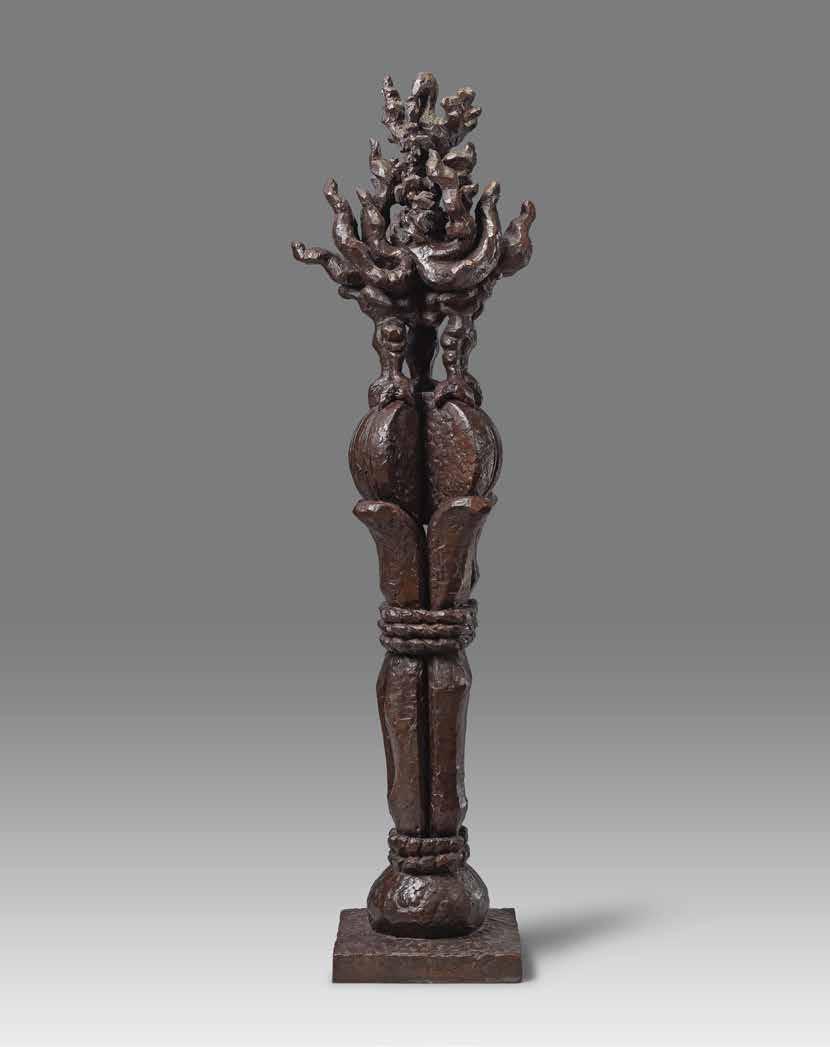
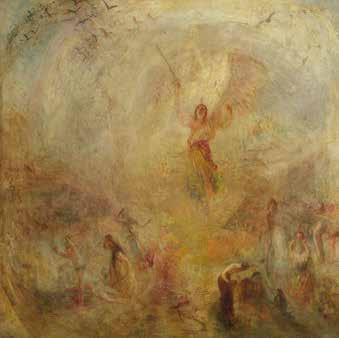
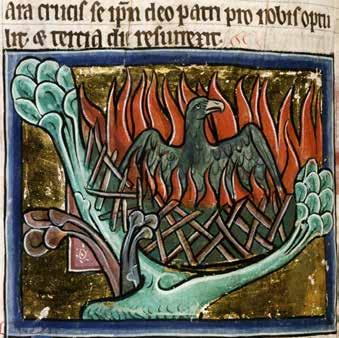
On Saturday, 5 January 1952, fire tore through the studio of Jacques Lipchitz on East 23rd Street in Manhattan. Flames consumed plaster models, preparatory drawings, and works that traced decades of artistic labour, leaving behind a scene of devastation that marked one of the most traumatic moments of the sculptor’s life. Among the losses were works from Lipchitz’s own permanent collection — cherished pieces by Chaïm Soutine, Paul Cézanne, Juan Gris and Pablo Picasso, brought with him to New York from France. Even more devastating was the destruction of nearly ten years of work produced in New York: plaster and compositional models for sculptures already housed in major museum collections, alongside innumerable drawings that mapped the evolution of his ideas. At the age of sixty, Lipchitz found himself forced to begin again.
The fire also claimed one of the most important commissions of his late career: the figure of the Virgin for the Church of Notre-Dame-deToute-Grâce at Assy, known as Notre-Dame de Liesse. Executed in plasticine and representing nearly a year of concentrated work – due to be completed within three months – the sculpture was lost. Friends and critics alike drew parallels between this loss and the Old Testament story of the Burning Bush, a comparison that resonated deeply with Lipchitz himself. Lipchitz’ Virgin, consumed by fire, was imagined as purified rather than annihilated, destined to rise again transformed. The disaster also recalled an earlier trauma from Lipchitz’s life: the burning of his family’s hotel in his hometown of Druskininkai in 1905, an event that had already impressed upon him the fragility of material security.
In the immediate aftermath of the 1952 fire, Lipchitz passed through a period of intense grief. Yet he came to understand the fire as a trial of
faith — an ordeal that, paradoxically, illuminated the future. He resolved to remake the Virgin and his other works with renewed force and beauty, as though they might rise from the flames strengthened rather than diminished. What followed was an extraordinary outpouring of support from the American artistic community and the public at large. The Museum of Modern Art organised aid in the form of a loan, repayable through works of art — the only assistance Lipchitz was willing to accept. Lipchitz’ trusted dealers, including Curt Valentin, waived their usual commissions, while others immediately commissioned new sculptures and portraits. Funds were raised toward the construction of a new studio in Hastings-on-Hudson, where Lipchitz would eventually relocate in 1953. Letters arrived from members of the public enclosing cash, cheques, and messages of goodwill. This experience of profound human kindness deeply ingratiated Lipchitz with the American public and reinforced his determination to continue.
Central to his recovery was John Spring of the Modern Art Foundry on Long Island, who had cast the majority of Lipchitz’s bronzes since his arrival in the United States. The two men shared a close friendship: Lipchitz had helped save Spring from bankruptcy in 1946, and by the early 1950s the foundry had grown into one of the most important in the country. In a gesture of solidarity, Spring gave Lipchitz a room within the foundry and allowed him to use it as a temporary studio. It was here, amid the industrial rhythms of casting and fabrication, that the ideas for Lesson of a Disaster began to take form, born directly from the imagery of the burning Virgin. The experience revealed the buoyancy of Lipchitz’s nature — his capacity to rise above repeated catastrophes and emerge with renewed creative intensity. Far from diminishing his artistic powers, the disaster endowed his work with greater depth, gravity and emotional resonance.
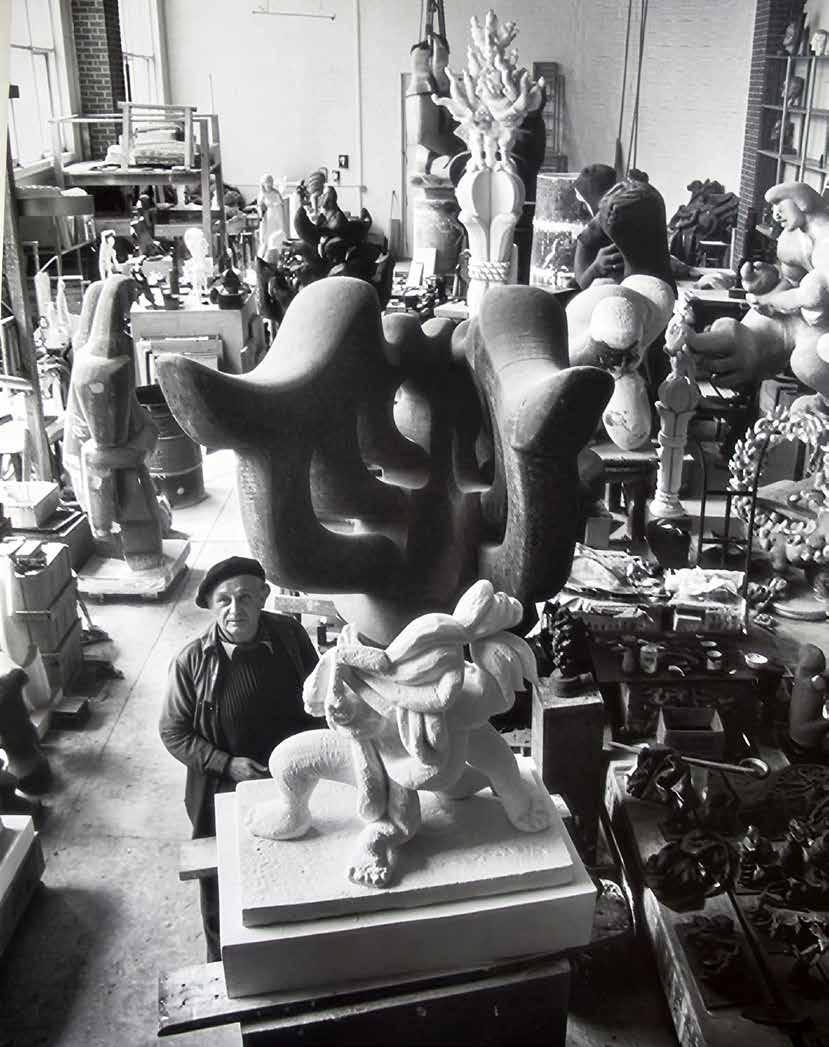
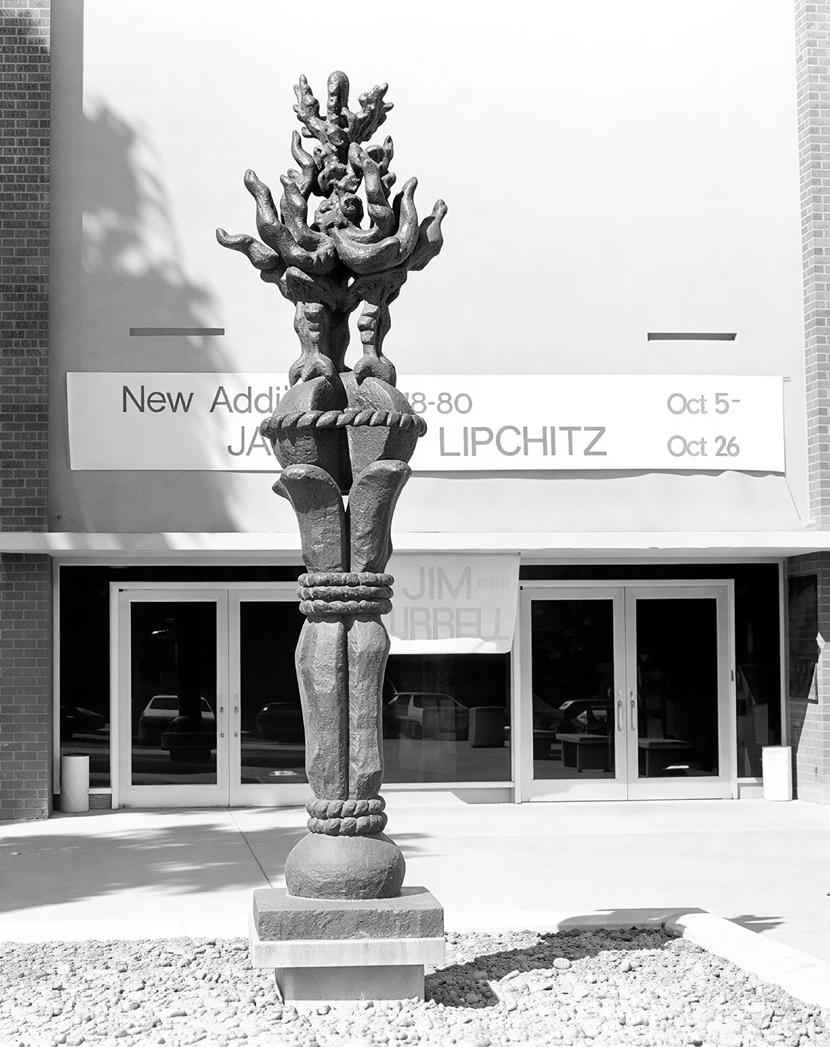
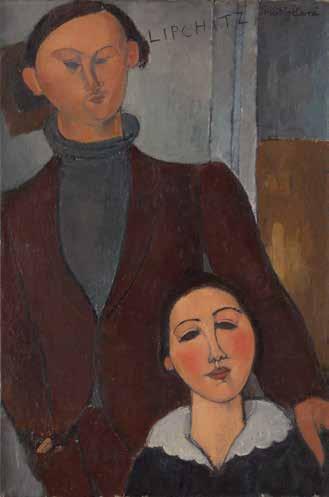
Conceived over the following years and developed throughout the 1960s, the Lesson of a Disaster sculptures stand as Lipchitz’s deeply personal meditation on destruction and renewal. The experience of loss is transformed into a monumental allegory of regeneration. Central to the series is the figure of the phoenix, rising from a chalice-like base engulfed in flames — a symbol at once ancient and autobiographical, embodying endurance through transformation. The present work, a Working Model for Lesson of a Disaster, occupies a crucial position within this sequence, capturing the sculptor’s ideas at a moment of heightened conceptual intensity and formal exploration.
At nearly two metres in height, the sculpture commands space with an imposing verticality. Its structure recalls a medieval reliquary or ritual vessel, its lower form solid and weight-bearing, from which erupt twisting tongues of flame. From this tumult emerges the phoenix, its wings unfurling upward in an emphatic gesture of ascent. Lipchitz arrived at this form through an experimental working method that involved suspending the upper portion of the original plaster with chains — a technique he employed to explore balance, tension and gravity. From this suspended mass, the full shape gradually revealed itself to him as chalice-like in nature.
The work draws upon a constellation of ideas: reflections on the songs and rituals of so-called primitive cultures; meditations on the regulations
and taboos that had shaped the early development of Cubism; and a growing desire to move toward a more lyrical, unified sculptural language. This shift marked a release from what Lipchitz later described as the “dictatorship” of Cubism, allowing symbolic and organic forms to reassert themselves. The phoenix itself represents a synthesis of imagery — integrating the Christian dove, the Virgin as a metaphor for humanity, and a broader constellation of mythic symbols. Lipchitz did not conceive the sculpture as strictly religious, but rather as an interwoven grouping of signs: a pair of lovers embedded within the tongues of flame; the phoenix feeding a nest of small birds; fire transmuted into blossoming flower. At a later stage, he described the structure as resembling a growing plant supported on the legs of an animal — a living organism in the midst of transformation. Throughout, the imagery speaks to hope, continuity and renewal in the aftermath of catastrophe.
The present sculpture thereby offers a particularly revealing insight into Lipchitz’s sculptural thinking. It retains a sense of immediacy that reflects the artist’s intense engagement with process — forms asserted, tested and reworked, symbolism held in a state of charged openness. The scale itself is striking: far from a modest maquette, this is a commanding work that bridges the intimacy of the studio and the ambition of monumental sculpture. It embodies the precise moment at which personal experience is transmuted into a universal statement.

Front Cover
Damien Hirst (B. 1965)
Argininamine, 1994
Artwork: © 2026 Damien Hirst and Science Ltd. All rights reserved, DACS
Lot 1
Ana Mendieta (1948-1985)
Arbol de la Vida (Tree of Life), from the Silueta series, 1976
Photo: © 2025 Christie's Images, London/Scala, Florence
Artwork: © 2026 The Estate of Ana Mendieta Collection, LLC/ Licensed by DACS
Lot 2
Fernando Botero in his studio.
Photo: © Getty Images
Lot 7
Damien Hirst in his studio.
Artwork: © 2026 Damien Hirst and Science Ltd. All rights reserved, DACS
Damien Hirst (B. 1965)
Pretty Vacant, 1989
San Francisco Museum of Modern Art, US.
Artwork: © 2026 Damien Hirst and Science Ltd. All rights reserved, DACS
Lot 8
Sarah Lucas (B. 1962)
Gold Cup Maradona
Photo: Courtesy of Sadie Coles
Sarah Lucas (B. 1962)
Self Portrait with Fried Eggs
Photo: © Tate
Artwork: © Sarah Lucas
Henry Moore (1898-1986)
Venice International Art Biennale, 2052
Artwork: © 2026 The Henry Moore Foundation. All Rights Reserved, DACS / www.henry-moore.org
Lot 9
Jackson Pollock (1912-1956)
Unformed Figure, 1953 Museum Ludwig, Cologne.
Artwork: © 2026 Pollock-Krasner Foundation ARS, NY and DACS, London
Lot 10
Felix Gonzalez-Torres (1957-1996)
Untitled (America), 1994 (Biennale Venezia, 2007)
Photo: © 2026 Paolo Della Corte/Art Resource/Scala, Florence
Lot 11
Alighiero Boetti (1940-1994)
Photo: Antonia Mulas © Antonia Mulas Heirs. All rights reserved.
Artwork: © 2026 DACS
Lot 12
Michelangelo Pistoletto (B. 1933), Venus of the Rags, 1967, 1974 Tate, London.
Back Cover
Pablo Picasso (1881-1973) Trois nus, 1964
Artwork: © 2026 Succession Picasso/DACS, London

New Bond Street, London | 6 March 2026, 1pm GMT
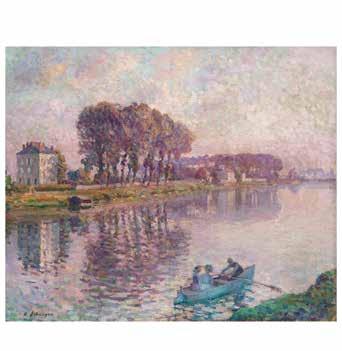
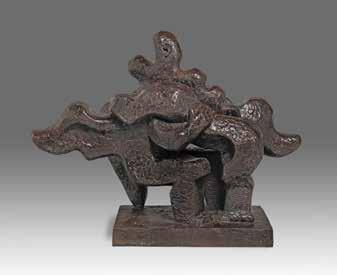
CONTACT
Adelaide Dunn
+44 20 7468 8231
adelaide.dunn@bonhams.com
HENRI LEBASQUE (1865-1937)
La Marne à Pomponne
signed 'H. Lebasque' (lower left) oil on canvas
60 x 72.8cm (23 5/8 x 28 11/16in).
Painted in Pomponne in 1904
£45,000 - 65,000
JACQUES LIPCHITZ (1891-1973)
Jacob and the Angel (Jacob Struggling with the Angel) signed and numbered 'J. Lipchitz 5/7' and marked with the artist's thumbprint (on the top of the base)
bronze with dark brown patina
89.5 x 124.5cm (35 1/4 x 49in).
Conceived in 1932, this bronze version cast in an edition of 7.
£70,000 - 100,000
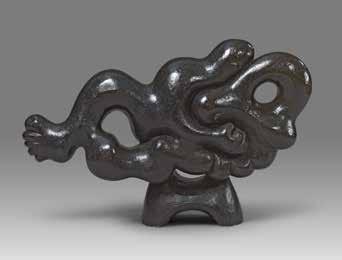
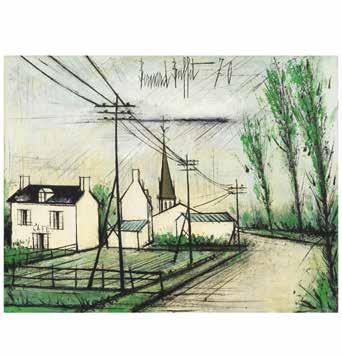
JACQUES LIPCHITZ (1891-1973)
Song of songs
signed and numbered '4/7 J. Lipchitz' and marked with the artist's thumbprint (at the base) bronze with dark brown patina
59.5 x 91.5cm (23 7/16 x 36in).
Conceived in 1945, this bronze version cast in an edition of 7.
£50,000 - 70,000
BERNARD BUFFET (1928-1999)
Café de campagne signed and dated 'Bernard Buffet 70' (upper centre) oil on panel
49.5 x 64.7cm (19 1/2 x 25 1/2in).
Painted in 1970
£40,000 - 60,000
New Bond Street, London | 6 March 2026, 1pm GMT
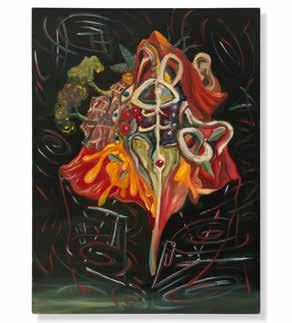
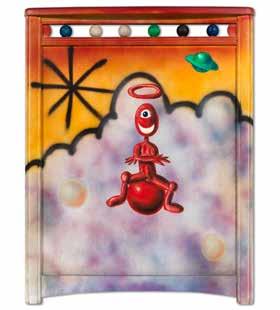
CONTACT
Charlotte Redman
+44 20 7468 5842
charlotte.redman@bonhams.com
GEORGE CONDO (B. 1957)
Untitled
signed and dated 'Condo 83' (lower right) oil on canvas
122.5 x 91.5cm (48 1/4 x 36in).
Painted in 1983
£60,000 - 80,000
KENNY SCHARF (B. 1958)
Boy
signed, titled and dated 'Kenny Scharf Boy 83' (on the reverse) oil and spray paint on found wooden bed frame
104 x 80cm (40 7/8 x 31 1/2in).
Painted in 1983
£35,000 - 55,000
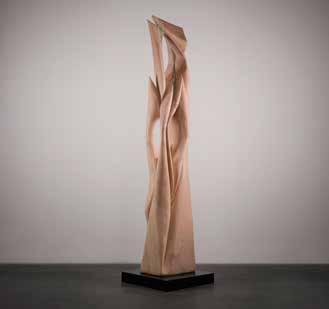
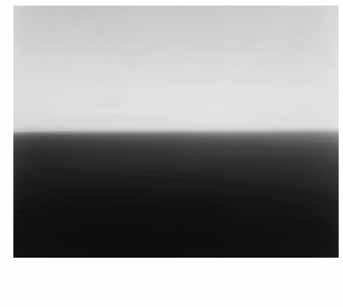
PABLO ATCHUGARRY (B. 1954)
Pareja Estelar
pink Portugal marble on granite base
220 x 39 x 27cm (86 5/8 x 15 3/8 x 10 5/8in).
Executed in 1999
£80,000 - 120,000
HIROSHI SUGIMOTO (B. 1948)
Mediterranean Sea Cassis
signed, titled, dated and numbered 'Mediterranean Sea Cassis 1989 Hiroshi Sugimoto 11/25 321' (lower right); embossed with the title and date 'Mediterranean Sea Cassis 1989' (lower centre) and embossed with the number '11/25 321' (lower right)
gelatin silver print laid down on card
Gelatin silver print size: 48.2 x 60.4cm (19 x 23 3/4in).
Card size: 50.5 x 54.5cm (19 7/8 x 21 3/8in).
Executed in 1989, this work is number 11 from an edition of 25
£20,000 - 30,000
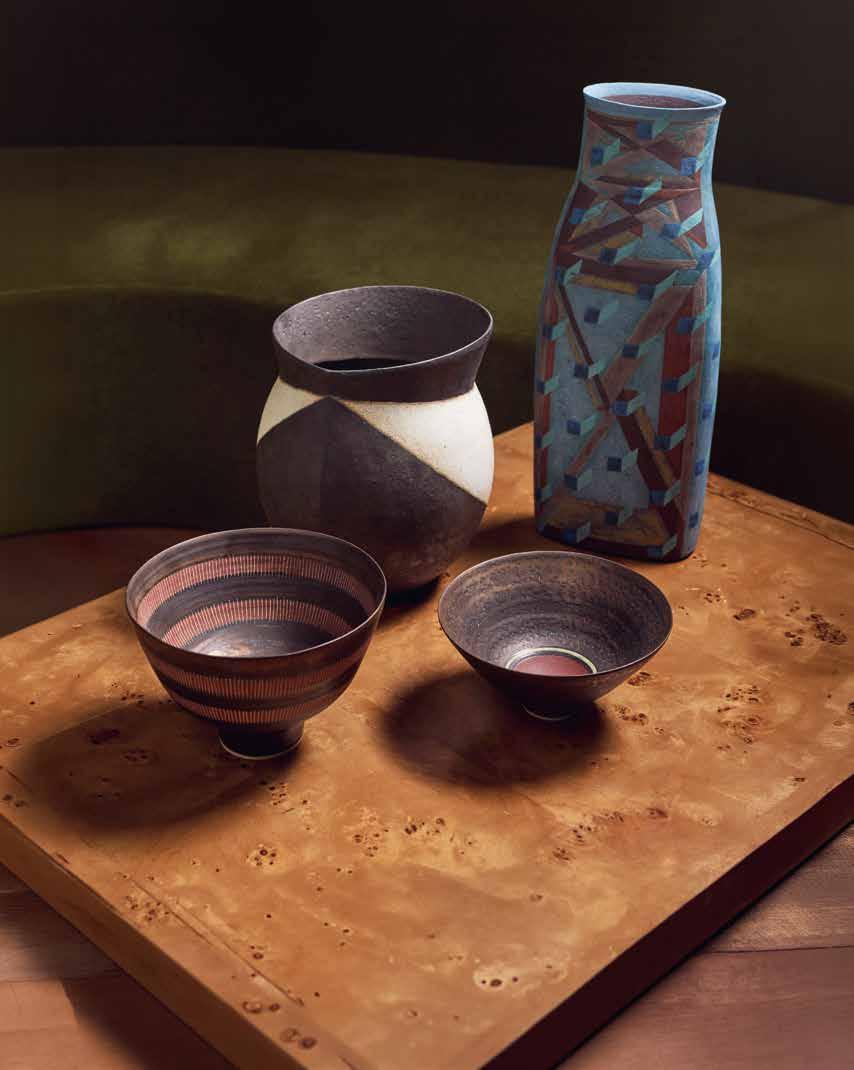
This notice is addressed by Bonhams to any person who may be interested in a Lot, and to all persons participating in the auction process including auction attendees, Bidders and potential Bidders (including any eventual Buyer of the Lot). For ease of reference we refer to such persons as “Bidders” or “you”. Our List of Definitions and Glossary is incorporated into this Notice to Bidders. It is at Appendix 3 at the back of the Catalogue. Where words and phrases are used in this notice which are in the List of Definitions, they are printed in italics. IMPORTANT: Additional information applicable to the Sale may be set out in the Catalogue for the Sale, in an insert in the Catalogue and/or in a notice displayed at the Sale venue and you should read them as well. Announcements affecting the Sale may also be given out orally before and during the Sale without prior written notice. You should be alert to the possibility of changes and ask in advance of bidding if there have been any.
1. OUR ROLE
In its role as Auctioneer of Lots, Bonhams acts solely for and in the interests of the Seller Bonhams’ job is to sell the Lot at the highest price obtainable at the Sale to a Bidder. Bonhams does not act for Buyers or Bidders in this role and does not give advice to Buyers or Bidders. When it or its staff make statements about a Lot or, if Bonhams provides a Condition Report on a Lot it is doing that on behalf of the Seller of the Lot. Bidders and Buyers who are themselves not expert in the Lots are strongly advised to seek and obtain independent advice on the Lots and their value before bidding for them. The Seller has authorised Bonhams to sell the Lot as its agent on its behalf and, save where we expressly make it clear to the contrary, Bonhams acts only as agent for the Seller. Any statement or representation we make in respect of a Lot is made on the Seller’s behalf and, unless Bonhams sells a Lot as principal, not on our behalf and any Contract for Sale is between the Buyer and the Seller and not with us. If Bonhams sells a Lot as principal this will either be stated in the Catalogue or an announcement to that effect will be made by the Auctioneer, or it will be stated in a notice at the Sale or an insert in the Catalogue.
Bonhams does not owe or undertake or agree to any duty or responsibility to you in contract or tort (whether direct, collateral, express, implied or otherwise). If you successfully bid for a Lot and buy it, at that stage Bonhams does enter into an agreement with you as the Buyer. The terms of that contract are set out in our Buyer’s Agreement, which you will find at Appendix 2 at the back of the Catalogue, and this will govern Bonhams’ relationship with the Buyer 2. LOTS
Subject to the Contractual Description printed in bold letters in the Entry about the Lot in the Catalogue (see paragraph 3 below), Lots are sold to the Buyer on an “as is” basis, with all faults and imperfections. Illustrations and photographs contained in the Catalogue (other than photographs forming part of the Contractual Description) or elsewhere of any Lots are for identification purposes only. A photograph or illustration may not reflect an accurate reproduction of the colour(s) or true condition of the Lot Lots are available for inspection prior to the Sale and it is for you to satisfy yourself as to each and every aspect of a Lot, including its authorship, attribution, condition, provenance, history, background, authenticity, style, period, age, suitability, quality, roadworthiness (if relevant), origin, value and estimated selling price (including the Hammer Price). It is your responsibility to examine any Lot in which you are interested. It should be remembered that the actual condition of a Lot may not be as good as that indicated by its outward appearance. In particular, parts may have been replaced or renewed and Lots may not be authentic or of satisfactory quality; the inside of a Lot may not be visible and may not be original or may be damaged, as for example where it is covered by upholstery or material. Given the age of many Lots they may have been damaged and/or repaired and you should not assume that a Lot is in good condition. Electronic or mechanical items or parts are sold for their artistic, historic or cultural interest and may not operate or may not comply with current statutory requirements. You should not assume that electrical items designed to operate on mains electricity will be suitable for connection to the mains electricity supply and you should obtain a report from a qualified electrician on their status before doing so. Such items which are unsuitable for connection are sold as items of interest for display purposes only. If you yourself do not have expertise regarding a Lot, you should consult someone who does to advise you. We can assist in arranging facilities for you to carry out or have carried out more detailed inspections and tests. Please ask our staff for details. Any person who damages a Lot will be held liable for the loss caused.
3. DESCRIPTIONS OF LOTS AND ESTIMATES
Contractual Description of a Lot
The Catalogue contains an Entry about each Lot. Each Lot is sold by its respective Seller to the Buyer of the Lot as corresponding only with that part of the Entry which is printed in bold letters and (except for the colour, which may be inaccurately reproduced) with any photograph of the Lot in the Catalogue. The remainder of the Entry, which is not printed in bold letters, represents Bonhams’ opinion (given on behalf of the Seller) about the Lot only and is not part of the Contractual Description in accordance with which the Lot is sold by the Seller Estimates
In most cases, an Estimate is printed beside the Entry Estimates are only an expression of Bonhams’ opinion made on behalf of the Seller of the range where Bonhams thinks the Hammer Price for the Lot is likely to fall; it is not an Estimate of value. It does not take into account any VAT or Buyer’s Premium payable or any other fees payable by the Buyer, which are detailed in paragraph 7 of the Notice to Bidders, below. Prices depend upon bidding and lots can sell for Hammer Prices below and above the Estimates, so Estimates should not be relied on as an indication of the actual selling price or value of a Lot Estimates are in the currency of the Sale Condition Reports
In respect of most Lots, you may ask Bonhams for a Condition Report on the Lot’s general physical condition. If you do so, this will be provided by Bonhams on behalf of the Seller free of charge. As this is offered additionally and without charge, Bonhams is not entering into a contract with you in respect of the Condition Report and accordingly does not assume responsibility to you in respect of it. The Condition Report represents Bonhams’ reasonable opinion as to the Lot’s general condition in the terms stated in the particular report, and Bonhams does not represent or guarantee that a Condition Report includes all aspects of the internal or external condition of the Lot. Neither does the Seller owe or agree to owe you as a Bidder or Buyer any obligation or duty in respect of this free report about a Lot, which is available for your own inspection or for inspection by an expert instructed by you. The Seller’s responsibility to you
The Seller does not make or agree to make any representation of fact or contractual promise, Guarantee or warranty and undertakes no obligation or duty, whether in contract or in tort (other than to the eventual Buyer as set out above), in respect of the accuracy or completeness of any statement or representation made by him or on his behalf, which is in any way descriptive of any Lot or as to the anticipated or likely selling price of any Lot. Other than as set out above, no statement or representation in any way descriptive of a Lot or any Estimate is incorporated into any Contract for Sale between a Seller and a Buyer Bonhams’ responsibility to you
You have the opportunity of examining the Lot if you want to and the Contract for Sale for a Lot is with the Seller and not with Bonhams; Bonhams acts as the Seller’s agent only (unless Bonhams sells the Lot as principal).
Bonhams undertakes no obligation to you to examine, investigate or carry out any tests, either in sufficient depth or at all, on each Lot to establish the accuracy or otherwise of any Descriptions or opinions given by Bonhams, or by any person on Bonhams’ behalf, whether in the Catalogue or elsewhere.
You should not suppose that such examinations, investigations or tests have occurred.
Bonhams does not make or agree to make any representation of fact, and undertakes no obligation or duty (whether in contract or tort) in respect of the accuracy or completeness of any statement or representation made by Bonhams or on Bonhams’ behalf which is in any way descriptive of any Lot or as to the anticipated or likely selling price of any Lot. No statement or representation by Bonhams or on its behalf in any way descriptive of any Lot or any Estimate is incorporated into our Buyer’s Agreement.
Alterations
Descriptions and Estimates may be amended at Bonhams’ discretion from time to time by notice given orally or in writing before or during a Sale
THE LOT IS AVAILABLE FOR INSPECTION AND YOU MUST FORM YOUR OWN OPINION IN RELATION TO IT. YOU ARE STRONGLY ADVISED TO EXAMINE ANY LOT OR HAVE IT EXAMINED ON YOUR BEHALF BEFORE THE SALE
4. CONDUCT OF THE SALE
Our Sales are public auctions which persons may attend and you should take the opportunity to do so. We reserve the right at our sole discretion to refuse admission to our premises or to any Sale and to remove any person from our premises and Sales, without stating a reason. We have complete discretion as to whether the Sale proceeds, whether any Lot is included in the Sale, the manner in which the Sale is conducted and we may offer Lots for Sale in any order we choose notwithstanding the numbers given to Lots in the Catalogue. You should therefore check the date and starting time of the Sale, whether there have been any withdrawals or late entries. Remember that withdrawals and late entries may affect the time at which a Lot you are interested is put up for Sale. We have complete discretion in which to refuse any bid, to nominate any bidding increment we consider appropriate, to divide any Lot, to combine two or more Lots, to withdraw any Lot from a Sale and, before the Sale has been closed, to put up any Lot for auction again. Auction speeds can exceed 100 Lots to the hour and bidding increments are generally about 10%; however, these do vary from Sale to Sale and from Auctioneer to Auctioneer Please check with the department organising the Sale for advice on this. Where a Reserve has been applied to a Lot, the Auctioneer may, in his absolute discretion, place bids (up to an amount not equalling or exceeding such Reserve) on behalf of the Seller. We are not responsible to you in respect of the presence or absence of any Reserve in respect of any Lot. If there is a Reserve it will be no higher than the lower figure for any Estimate in the Catalogue, assuming that the currency of the Reserve has not fluctuated adversely against the currency of the Estimate. The Buyer will be the Bidder who makes the highest bid acceptable to the Auctioneer for any Lot (subject to any applicable Reserve) to whom the Lot is knocked down by the Auctioneer at the fall of the Auctioneer’s hammer. Any dispute as to the highest acceptable bid will be settled by the Auctioneer in his absolute discretion. All bids tendered will relate to the actual Lot number announced by the Auctioneer. An electronic currency converter may be used at the Sale. This equipment is provided as a general guide as to the equivalent amount in certain currencies of a given bid. We do not accept any responsibility for any errors which may occur in the use of the currency converter. We may use video cameras to record the Sale and may record telephone calls for reasons of security and to assist in solving any disputes which may arise in relation to bids made at the Sale. At some Sales, for example, jewellery Sales, we may use screens on which images of the Lots will be projected. This service is provided to assist viewing at the Sale. The image on the screen should be treated as an indication only of the current Lot. It should be noted that all bids tendered will relate to the actual Lot number announced by the Auctioneer. We do not accept any responsibility for any errors which may occur in the use of the screen.
You must complete and deliver to us one of our Bidding Forms, either our Bidder Registration Form, Absentee Bidding Form or Telephone Bidding Form in order to bid at our Sales
If you are a new client at Bonhams or have not recently updated your registration details with us, you must pre-register to bid at least two working days before the Sale at which you wish to bid. You will be required to provide government-issued proof of identity and residence, and if you are a company, your certificate of incorporation or equivalent documentation with your name and registered address, government issued proof of your current address, documentary proof of your beneficial owners and directors, and proof of authority to transact. We may also request a financial reference and /or deposit from you before allowing you to bid.
We reserve the rights at our discretion to request further information in order to complete our client identification and to decline to register any person as a Bidder, and to decline to accept their bids if they have been so registered. We also reserve the rights to postpone completion of the Sale of any Lot at our discretion while we complete our registration and identification enquiries, and to cancel the Sale of any Lot if you are in breach of your warranties as Buyer, or if we consider that such Sale would be unlawful or otherwise cause liabilities for the Seller or Bonhams or be detrimental to Bonhams’ reputation.
Bidding in person
So long as you have pre-registered to bid or have updated your existing registration recently, you should come to our Bidder registration desk at the Sale venue and fill out a Registration and Bidding Form on (or, if possible, before) the day of the Sale. The bidding number system is sometimes referred to as “paddle bidding”. You will be issued with a large card (a “paddle”) with a printed number on it. This will be attributed to you for the purposes of the Sale. Should you be a successful Bidder you will need to ensure that your number can be clearly seen by the Auctioneer and that it is your number which is identified as the Buyer’s. You should not let anyone else use your paddle as all Lots will be invoiced to the name and address given on your Bidder Registration Form. Once an invoice is issued it will not be changed. If there is any doubt as to the Hammer Price of, or whether you are the successful Bidder of, a particular Lot, you must draw this to the attention of the Auctioneer before the next Lot is offered for Sale At the end of the Sale, or when you have finished bidding please return your paddle to the Bidder registration desk.
Bidding by telephone
If you wish to bid at the Sale by telephone, and have pre-registered to bid or have updated your existing registration details recently, please complete a Registration and Bidding Form, which is available from our offices or in the Catalogue. Please then return it to the office responsible for the Sale at least 24 hours in advance of the Sale. It is your responsibility to check with our Bids Office that your bid has been received. Telephone calls will be recorded. The telephone bidding facility is a discretionary service offered at no additional charge and may not be available in relation to all Lots. We will not be responsible for bidding on your behalf if you are unavailable at the time of the Sale or if the telephone connection is interrupted during bidding. Please contact us for further details.
Bidding by post or fax
Absentee Bidding Forms can be found in the back of this Catalogue and should be completed and sent to the office responsible for the Sale, once you have pre-registered to bid or have updated your existing registration details recently. It is in your interests to return your form as soon as possible, as if two or more Bidders submit identical bids for a Lot, the first bid received takes preference. In any event, all bids should be received at least 24 hours before the start of the Sale Please check your Absentee Bidding Form carefully before returning it to us, fully completed and signed by you. It is your responsibility to check with our Bids Office that your bid has been received. This additional service is complimentary and is confidential. Such bids are made at your own risk and we cannot accept liability for our failure to receive and/or place any such bids. All bids made on your behalf will be made at the lowest level possible subject to Reserves and other bids made for the Lot. Where appropriate your bids will be rounded down to the nearest amount consistent with the Auctioneer’s bidding increments. New Bidders must also provide proof of identity and address when submitting bids. Failure to do this will result in your bid not being placed.
Bidding via the internet
In order to bid online in a Sale, you must be 18 or over and you must register to bid via the Bonhams App or www.bonhams.com. Once you have registered, you should keep your account details strictly confidential and not permit any third party to access your account on your behalf or otherwise. You will be liable for any and all bids made via your account. Please note payment must be made from a bank account in the name of the registered bidder.
Individuals: Enter your full name, email, residential address, date of birth and nationality and provide a valid credit card in your name which will be verified via Stripe before you are able to bid. If your credit card fails verification, you will not be permitted to bid and you should contact Client Services for assistance. We may in addition request a financial reference and/or deposit from you prior to letting you bid. If you are bidding as agent on behalf of another party, you agree: (i) to disclose this fact to Client Services; (ii) to provide such information as we require to enable us to complete our identification and anti-money laundering checks on that third party; and (ii) where your bid is successful, you are jointly and severally liable with that other party for the full amounts owing for the successful bid. Where you are the successful bidder for any lot with a hammer price equal to or in excess of £5,000/$10,000/ HKD50,000/AUS$10,000 depending on the jurisdiction and currency of the Sale, and if you have not provided such documents previously, you will be required to upload or provide to Client Services your Government issued photo ID and (if not on the ID) proof of your
address before the lot can be released to you. We reserve the right to request ID documentation from any bidder or successful buyer regardless of these thresholds and to refuse to release any purchased lot until such documentation is provided.
Companies: You must select the option to set up a business account and then provide your full name, email, residential address, date of birth and the full name of the company. You must provide a credit card for verification either in your name or the name of the company but payment must be made from an account in the company’s name. If your credit card fails verification, you will not be permitted to bid and please contact Client Services for assistance. We may in addition require a bank reference or deposit prior to letting you bid. For all successful bids, we require the company’s Certificate of Incorporation or equivalent documentation confirming the company’s name and registered address, documentary proof of each beneficial owner owning 25% or more of the company, and proof of your authority to transact before the lot can be released to you.
We reserve the right to request any further information from any bidder that we may require in order to carry out any identification, anti-money laundering or anti-terrorism financing checks conducted by us. We may at our discretion postpone or cancel your registration, not permit you to bid and/or postpone or cancel completion of any purchase you may make.
Bidding through an agent
Bids will be treated as placed exclusively by and on behalf of the person named on the Bidding Form unless otherwise agreed by us in writing in advance of the Sale. If you wish to bid on behalf of another person (your principal) you must complete the pre-registration requirements set out above both on your own behalf and with full details of your principal, and we will require written confirmation from the principal confirming your authority to bid.
You are specifically referred to your due diligence requirements concerning your principal and their source of funds, and the warranties you give in the event you are the Buyer, which are contained in paragraph 3 of the Buyer’s Agreement, set out at Appendix 2 at the back of the Catalogue.
Nevertheless, as the Bidding Form explains, any person placing a bid as agent on behalf of another (whether or not he has disclosed that fact) will be jointly and severally liable with the principal to the Seller and to Bonhams under any contract resulting from the acceptance of a bid. Equally, please let us know if you intend to nominate another person to bid on your behalf at the Sale unless this is to be carried out by us pursuant to a Telephone or Absentee Bidding Form that you have completed. If we do not approve the agency arrangements in writing before the Sale, we are entitled to assume that the person bidding at the Sale is bidding on his own behalf. Accordingly, the person bidding at the Sale will be the Buyer and will be liable to pay the Hammer Price and Buyer’s Premium and associated charges. If we approve the identity of your client in advance, we will be in a position to address the invoice to your principal rather than you. We will require proof of the agent’s client’s identity and residence in advance of any bids made by the agent on his behalf. Please refer to our Conditions of Business and contact our Customer Services Department for further details. Bonhams undertakes Customer Due Diligence (CDD) into its Sellers and Buyers as required by the Money Laundering, Terrorist Financing and Transfer of Funds (Information on the Payer) Regulations 2017 (“the Regulations”). Bonhams’ interpretation of the Regulations and Treasury Approved industry Guidance is that CDD under the Regulations is not required by Buyers into Sellers at Bonhams auctions or vice versa
6. CONTRACTS BETWEEN THE BUYER AND SELLER AND THE BUYER AND BONHAMS
On the Lot being knocked down to the Buyer, a Contract for Sale of the Lot will be entered into between the Seller and the Buyer on the terms of the Contract for Sale set out in Appendix 1 at the back of the Catalogue. You will be liable to pay the Purchase Price, which is the Hammer Price plus any applicable VAT. At the same time, a separate contract is also entered into between us as Auctioneers and the Buyer
This is our Buyer’s Agreement, the terms of which are set out in Appendix 2 at the back of the Catalogue. Please read the terms of the Contract for Sale and our Buyer’s Agreement contained in the Catalogue in case you are the successful Bidder including the warranties as to your status and source of funds We may change the terms of either or both of these agreements in advance of their being entered into, by setting out different terms in the Catalogue and/or by placing an insert in the Catalogue and/or by notices at the Sale venue and/or by oral announcements before and during the Sale. It is your responsibility to ensure you are aware of the up to date terms of the Buyer’s Agreement for this Sale
7. BUYER’S PREMIUM AND OTHER CHARGES PAYABLE BY THE BUYER
Under the Buyer’s Agreement, a premium (the Buyer’s Premium) is payable to us by the Buyer in accordance with the terms of the Buyer’s Agreement and at rates set out below, calculated by reference to the Hammer Price and payable in addition to it.
For this Sale the following rates of Buyer’s Premium will be payable by Buyers on each Lot purchased:
28% of the Hammer Price on the first £40,000; plus 27% of the Hammer Price from £40,001 and up to £800,000; plus 21% of the Hammer Price from £800,001 and up to £4,500,000; plus 14.5% of the Hammer Price above £4,500,000
A 3rd party bidding platform fee of 4% of the Hammer Price for Buyers using the following bidding platforms will be added to the invoices of successful Buyers – Invaluable; Live Auctioneers; The Saleroom; Lot-tissimo.
Storage and handling charges may also be payable by the Buyer as detailed on the specific Sale Information page at the front of the catalogue.
The Buyer’s Premium and all other charges payable to us by the Buyer are subject to VAT at the prevailing rate, currently 20%.
VAT may also be payable on the Hammer Price of the Lot, where indicated by a symbol beside the Lot number. See paragraph 8 below for details.
On certain Lots, which will be marked “AR” in the Catalogue and which are sold for a Hammer Price of £1,000 or greater, the Additional Premium will be payable to us by the Buyer to cover our Expenses relating to the payment of royalties under the Artist’s Resale Right Regulations 2006, as amended. The Additional Premium will be a percentage of the amount of the Hammer Price calculated in accordance with the table below, and shall not exceed £12,500.
Note: only one debit or credit card may be used for payment of an account balance. If you have any questions with regards to card payments, please contact our Customer Services Department. We reserve the rights to investigate and identify the source of any funds received by us, to postpone completion of the sale of any Lot at our discretion while we complete our investigations, and to cancel the Sale of any Lot if you are in breach of your warranties as Buyer, if we consider that such Sale would be unlawful or otherwise cause liabilities for the Seller or Bonhams, or would be detrimental to Bonhams’ reputation. 10. COLLECTION AND STORAGE
The Buyer of a Lot will not be allowed to collect it until payment in full and in cleared funds has been made (unless we have made a special arrangement with the Buyer). For collection and removal of purchased Lots, please refer to Sale Information at the front of the Catalogue Our offices are open 9.00am – 5pm Monday to Friday. Details relating to the collection of a Lot, the storage of a Lot and our Storage Contractor after the Sale are set out in the Catalogue 11. SHIPPING
SHIPPING For information and estimates on domestic and international shipping as well as export licenses please contact The Packengers Ltd on +44 (0) 203 154 4360 bonhamslondon@thepackengers.com
12. EXPORT/TRADE RESTRICTIONS
8. VAT
The prevailing rate of VAT at the time of going to press is 20%, but this is subject to government change and the rate payable will be the rate in force on the date of the Sale
The following symbols, shown beside the Lot number, are used to denote that VAT is due on the Hammer Price and Buyer’s Premium:
† VAT at the prevailing rate on Hammer Price and Buyer’s Premium
Ω VAT on imported items at the prevailing rate on Hammer Price and Buyer’s Premium
* VAT on imported items at a preferential rate of 5% on Hammer Price and the prevailing rate on Buyer’s Premium
G Gold bullion exempt from VAT on the Hammer Price and subject to VAT at the prevailing rate on the Buyer’s Premium
• Zero rated for VAT, no VAT will be added to the Hammer Price or the Buyer’s Premium
a Buyers from within the UK: VAT is payable at the prevailing rate on just the Buyer’s Premium (NOT the Hammer Price). Buyers from outside the UK: VAT is payable at the prevailing rate on both Hammer Price and Buyer’s Premium. If a Buyer, having registered under a non-UK address, decides that the item is not to be exported from the UK, then he should advise Bonhams immediately.
In all other instances no VAT will be charged on the Hammer Price, but VAT at the prevailing rate will be added to Buyer’s Premium which will be invoiced on a VAT inclusive basis.
9. PAYMENT
It is of critical importance that you ensure that you have readily available funds to pay the Purchase Price and the Buyer’s Premium (plus VAT and any other charges and Expenses to us)in full before making a bid for the Lot. If you are a successful Bidder, payment will be due to us by 4.30 pm on the second working day after the Sale so that all sums are cleared by the eighth working day after the Sale. Payments made by anyone other than the registered Buyer will not be accepted. Bonhams reserves the right to vary the terms of payment at any time. Bonhams’ preferred payment method is by bank transfer. You may electronically transfer funds to our Account. If you do so, please quote your paddle number and invoice number as the reference. Our Account details are as follows:
Bank: National Westminster Bank Plc
Address: PO Box 4RY
250 Regent Street London W1A 4RY
Account Name: Bonhams 1793 Limited
Account Number: 25563009
Sort Code: 56-00-27
IBAN Number: GB 33 NWBK 560027 25563009
If paying by bank transfer, the amount received after the deduction of any bank fees and/or conversion of the currency of payment to pounds sterling must not be less than the sterling amount payable, as set out on the invoice.
Payment may also be made by one of the following methods:
Debit cards issued in the name of the Buyer (including China Union Pay (CUP) cards and debit cards issued by Visa and MasterCard only). There is no limit on payment value if payment is made in person using Chip & Pin verification.
Payment by telephone may also be accepted up to £5,000, subject to appropriate verification procedures. If the amount payable by you for Lots exceeds that sum, the balance must be paid by other means.
Credit cards issued in the name of the Buyer (including China Union Pay (CUP) cards and credit cards issued by Visa and MasterCard only). There is a £5,000 limit on payment value if payment is made in person using Chip & Pin verification.
It may be advisable to notify your debit or credit card provider of your intended purchase in advance to reduce delays caused by us having to seek authority when you come to pay.
It is your sole responsibility to comply with all export and import regulations relating to your purchases and also to obtain any relevant export and/or import licence(s). Export licences are issued by Arts Council England and application forms can be obtained from its Export Licensing Unit. The detailed provisions of the export licensing arrangements can be found on the ACE website http://www. artscouncil.org.uk/what-we-do/supporting-museums/cultural-property/ export-controls/export-licensing/ or by phoning ACE on +44 (0)20 7973 5188. The need for import licences varies from country to country and you should acquaint yourself with all relevant local requirements and provisions. The refusal of any import or export licence(s) or any delay in obtaining such licence(s) shall not permit the rescission of any Sale nor allow any delay in making full payment for the Lot Generally, please contact our shipping department before the Sale if you require assistance in relation to export regulations.
From 28 June 2025, the import into the EU of non-EU origin property of a certain age (and in some categories above a certain value) into the EU is subject to additional requirements. Under the relevant EU Regulation, it is the Buyer’s sole responsibility to assess whether any Lot meets the criteria for import into the EU. The refusal of any required Importer Licence or Importer Statement, or any delay in obtaining such Licence or Statement shall not give rise to the rescission or cancellation of any Sale, nor allow any delay in making full payment for the Lot.
13. CITES REGULATIONS
Please be aware that all Lots marked with the symbol Y are subject to CITES regulations when exporting these items outside the UK. These regulations may be found at:
https://www.gov.uk/guidance/apply-for-cites-permits-and-certificatesto-trade-endangered-species#how-to-apply or may be requested from: Enquiries: wildlife.licensing@apha.gov.uk
Applications: CITESapplication@apha.gov.uk
Address: UK CITES Management Authority Centre for International Trade Horizon House, Deanery Road, Bristol BS1 5AH
The refusal of any CITES licence or permit and any delay in obtaining such licences or permits shall not give rise to the rescission or cancellation of any Sale, nor allow any delay in making full payment for the Lot
14. THE SELLERS AND/OR BONHAMS’ LIABILITY
Other than any liability of the Seller to the Buyer of a Lot under the Contract for Sale, neither we nor the Seller are liable (whether in negligence or otherwise) for any error or misdescription or omission in any Description of a Lot or any Estimate in respect of it, whether contained in the Catalogue or otherwise, whether given orally or in writing and whether given before or during the Sale. Neither we nor the Seller will be liable for any loss of Business, profits, revenue or income, or for loss of reputation, or for disruption to Business or wasted time on the part of management or staff, or for indirect losses or consequential damages of any kind, irrespective in any case of the nature, volume or source of the loss or damage alleged to be suffered, and irrespective of whether the said loss or damage is caused by or claimed in respect of any negligence, other tort, breach of contract (if any) or statutory duty, restitutionary claim or otherwise. In any circumstances where we and/or the Seller are liable in relation to any Lot or any Description or Estimate made of any Lot, or the conduct of any Sale in relation to any Lot, whether in damages, for an indemnity or contribution, or for a restitutionary remedy or otherwise, our and/or the Seller’s liability (combined, if both we and the Seller are liable) will be limited to payment of a sum which will not exceed by way of maximum the amount of the Purchase Price of the Lot irrespective in any case of the nature, volume or source of any loss or damage alleged to be suffered or sum claimed as due, and irrespective of whether the liability arises from any negligence, other tort, breach of contract (if any) or statutory duty or otherwise. Nothing set out above will be construed as excluding or restricting (whether directly or indirectly) our liability or excluding or restricting any person’s rights or remedies in respect of (i) fraud, or (ii) death or personal injury caused by our negligence (or by the negligence of any person under our control or for whom we are legally responsible), or (iii) acts or omissions for which we are liable under the Occupiers Liability Act 1957, or (iv) any other liability to the extent the same may not be excluded or restricted as a matter of law or (v) our undertakings under paragraphs 9 (in relation to specialist Stamp or Book Sales only) and 10 of the Buyer’s Agreement. The same applies in respect of the Seller, as if references to us in this paragraph were substituted with references to the Seller
15. BOOKS
As stated above, all Lots are sold on an “as is” basis, subject to all faults, imperfections and errors of Description save as set out below. However, you will be entitled to reject a Book in the circumstances set out in paragraph 11 of the Buyers Agreement. Please note that Lots comprising printed Books, unframed maps and bound manuscripts are not liable to VAT on the Buyer’s Premium.
16. CLOCKS AND WATCHES
All Lots are sold “as is”, and the absence of any reference to the condition of a clock or watch does not imply that the Lot is in good condition and without defects, repairs or restorations. Most clocks and watches have been repaired in the course of their normal lifetime and may now incorporate parts not original to them. Furthermore, Bonhams makes no representation or warranty that any clock or watch is in working order. As clocks and watches often contain fine and complex mechanisms, Bidders should be aware that a general service, change of battery or further repair work, for which the Buyer is solely responsible, may be necessary.
17. FIREARMS – PROOF, CONDITION AND CERTIFICATION
Proof of Firearms
The term “proof exemption” indicates that a firearm has been examined at a Proof House, but not proved, as either (a) it was deemed of interest and not intended for use, or (b) ammunition was not available. In either case, the firearm must be regarded as unsafe to fire unless subsequently proved. Firearms proved for Black Powder should not be used with smokeless ammunition.
The term “Certificate of Unprovability” indicates that a firearm has been examined at a Proof House and is deemed both unsuitable for proof and use. Reproof is required before any such firearm is to be used.
Guns Sold as Parts
Barrels of guns sold as parts will only be made available for sleeving and measurements once rendered unserviceable according to the Gun Barrel Proof Act of 1968 to 1978 and the Rules of Proof.
Condition of Firearms
Comment in this Catalogue is restricted, in general, to exceptional condition and to those defects that might affect the immediate safety of a firearm in normal use. An intending Bidder unable to make technical examinations and assessments is recommended to seek advice from a gunmaker or from a modern firearms specialist. All prospective Bidders are advised to consult the of bore and wall-thickness measurements posted in the saleroom and available from the department. Bidders should note that guns are stripped only where there is a strong indication of a mechanical malfunction. Stripping is not, otherwise, undertaken. Guns intended for use should be stripped and cleaned beforehand. Hammer guns should have their rebound mechanisms checked before use. The safety mechanisms of all guns must be tested before use. All measurements are approximate.
Original Gun Specifications Derived from Gunmakers
The Sporting Gun Department endeavours to confirm a gun’s original specification and date of manufacture with makers who hold their original records.
Licensing Requirements
Firearms Act 1968 as amended
Bonhams is constantly reviewing its procedures and would remind you that, in the case of firearms or shotguns subject to certification, to conform with current legislation, Bonhams is required to see, as appropriate, your original registered firearms dealer’s certificate / shot gun certificate / firearm certificate / museum firearms licence / Section 5 authority or import licence (or details of any exemption from which you may benefit, for instance Crown servant status) for the firearm(s) you have purchased prior to taking full payment of the amount shown on your invoice. Should you not already be in possession of such an authority or exemption, you are required to initially pay a deposit of 95% of the total invoice with the balance of 5% payable on presentation of your valid certificate or licence showing your authority to hold the firearm(s) concerned.
Please be advised that if a successful Bidder is then unable to produce the correct paperwork, the Lot(s) will be reoffered by Bonhams in the next appropriate Sale, on standard terms for Sellers, and you will be responsible for any loss incurred by Bonhams on the original Sale to you.
In the case of RFD certificates and Section 5 authorities, we wish to keep an up-to-date copy on file. Please supply us with a Fax or photocopy. It would be helpful if you could send us an updated copy whenever your certificate or authority is renewed or changed.
Lots marked ‘S1´ and bearing red labels are Section 1 firearms and require a valid British Firearms certificate, RFD Licence or import licence.
Lots marked ‘S2’ and bearing blue labels are Section 2 firearms and require a valid British Shotgun certificate, RFD licence or import licence.
Lots marked ‘S5´ and bearing specially marked red labels are Section 5 prohibited firearms and require a valid Section 5 Authority or import licence.
Lots marked with a ‘S58´ and bearing yellow labels are for obsolete calibres and no licence is required unless ammunition is held. Unmarked Lots require no licence.
Please do not hesitate to contact the Modern Sporting Gun Department should you have any queries.
Taxidermy and Related Items
On behalf of the Seller of these articles, Bonhams undertakes to comply fully with Cites and DEFRA regulations. Buyers are advised to inform themselves of all such regulations and should expect the exportation of items to take some time to arrange.
18. FURNITURE
Upholstered Furniture
Whilst we take every care in cataloguing furniture which has been upholstered we offer no Guarantee as to the originality of the wood covered by fabric or upholstery.
Historically many gemstones have been subjected to a variety of treatments to enhance their appearance. Sapphires and rubies are routinely heat treated to improve their colour and clarity, similarly emeralds are frequently treated with oils or resin for the same purpose. Other treatments such as staining, irradiation or coating may have been used on other gemstones. These treatments may be permanent, whilst others may need special care or re-treatment over the years to retain their appearance. Bidders should be aware that Estimates assume that gemstones may have been subjected to such treatments. A number of laboratories issue certificates that give more detailed Descriptions of gemstones. However there may not be consensus between different laboratories on the degrees, or types of treatment for any particular gemstone. In the event that Bonhams has been given or has obtained certificates for any Lot in the Sale these certificates will be disclosed in the Catalogue Although, as a matter of policy, Bonhams endeavours to provide certificates from recognised laboratories for certain gemstones, it is not feasible to obtain certificates for each Lot In the event that no certificate is published in the Catalogue, Bidders should assume that the gemstones may have been treated. Neither Bonhams nor the Seller accepts any liability for contradictions or differing certificates obtained by Buyers on any Lots subsequent to the Sale
Estimated Weights
If a stone(s) weight appears within the body of the Description in capital letters, the stone(s) has been unmounted and weighed by Bonhams If the weight of the stone(s) is stated to be approximate and does not appear in capital letters, the stone(s) has been assessed by us within its/their settings, and the stated weight is a statement of our opinion only. This information is given as a guide and Bidders should satisfy themselves with regard to this information as to its accuracy.
Signatures
1. A diamond brooch, by Kutchinsky When the maker’s name appears in the title, in Bonhams opinion the piece is by that maker.
2. A diamond brooch, signed Kutchinsky Has a signature that, in Bonhams’ opinion, is authentic but may contain gemstones that are not original, or the piece may have been altered.
3. A diamond brooch, mounted by Kutchinsky Has been created by the jeweller, in Bonhams’ opinion, but using stones or designs supplied by the client.
20. PHOTOGRAPHS
Explanation of Catalogue Terms
• “Bill Brandt”: in our opinion a work by the artist.
• “Attributed to Bill Brandt”: in our opinion probably a work by the artist, but less certainty to authorship is expressed than in the preceding category.
• “Signed and/or titled and/or dated and/or inscribed”: in our opinion the signature and/or title and/or date and/or inscription are in the artist’s hand.
• “Signed and/or titled and/or dated and/or inscribed in another hand”: in our opinion the signature and/or title and/or date and/or inscription have been added by another hand.
• The date given is that of the image (negative). Where no further date is given, this indicates that the photographic print is vintage (the term “vintage” may also be included in the Lot Description). A vintage photograph is one which was made within approximately 5-10 years of the negative. Where a second, later date appears, this refers to the date of printing. Where the exact printing date is not known, but understood to be later, “printed later” will appear in the Lot Description
• Unless otherwise specified, dimensions given are those of the piece of paper on which the image is printed, including any margins. Some photographs may appear in the Catalogue without margins illustrated.
• All photographs are sold unframed unless stated in the Lot Description 21. PICTURES
Explanation of Catalogue Terms
The following terms used in the Catalogue have the following meanings but are subject to the general provisions relating to Descriptions contained in the Contract for Sale:
• “Jacopo Bassano”: in our opinion a work by the artist. When the artist’s forename(s) is not known, a series of asterisks, followed by the surname of the artist, whether preceded by an initial or not, indicates that in our opinion the work is by the artist named;
• “Attributed to Jacopo Bassano”: in our opinion probably a work by the artist but less certainty as to authorship is expressed than in the preceding category;
• “Studio/Workshop of Jacopo Bassano”: in our opinion a work by an unknown hand in a studio of the artist which may or may not have been executed under the artist’s direction;
• “Circle of Jacopo Bassano”: in our opinion a work by a hand closely associated with a named artist but not necessarily his pupil;
• “Follower of Jacopo Bassano”: in our opinion a work by a painter working in the artist’s style, contemporary or nearly contemporary, but not necessarily his pupil;
• “Manner of Jacopo Bassano”: in our opinion a work in the style of the artist and of a later date;
• “After Jacopo Bassano”: in our opinion, a copy of a known work of the artist;
• “Signed and/or dated and/or inscribed”: in our opinion the signature and/or date and/or inscription are from the hand of the artist;
• “Bears a signature and/or date and/or inscription”: in our opinion the signature and/or date and/or inscription have been added by another hand.
Damage
For your guidance, in our Catalogues we attempt to detail, as far as practicable, all significant defects, cracks and restoration. Such practicable Descriptions of damage cannot be definitive, and in providing Condition Reports, we cannot Guarantee that there are no other defects present which have not been mentioned. Bidders should satisfy themselves by inspection, as to the condition of each Lot
Please see the Contract for Sale printed in this Catalogue. Because of the difficulty in determining whether an item of glass has been repolished, in our Catalogues reference is only made to visible chips and cracks. No mention is made of repolishing, severe or otherwise.
23.
The Veteran Car Club of Great Britain
Dating Plates and Certificates
When mention is made of a Veteran Car Club Dating Plate or Dating Certificate in this Catalogue, it should be borne in mind that the Veteran Car Club of Great Britain using the services of Veteran Car Company Ltd, does from time to time, review cars already dated and, in some instances, where fresh evidence becomes available, the review can result in an alteration of date. Whilst the Club and Veteran Car Company Ltd make every effort to ensure accuracy, the date shown on the Dating Plate or Dating Certificate cannot be guaranteed as correct and intending purchasers should make their own enquiries as to the date of the car.
24. WINE
Lots which are lying under Bond and those liable to VAT may not be available for immediate collection.
Examining the wines
It is occasionally possible to provide a pre-Sale tasting for larger parcels (as defined below). This is generally limited to more recent and everyday drinking wines. Please contact the department for details. It is not our policy to inspect every unopened case. In the case of wines older than 20 years the boxes will usually have been opened and levels and appearance noted in the Catalogue where necessary. You should make proper allowance for variations in ullage levels and conditions of corks, capsules and labels.
Corks and Ullages
Ullage refers to the space between the base of the cork and the wine. Ullage levels for Bordeaux shaped bottles are only normally noted when below the neck and for Burgundy, Alsace, German and Cognac shaped bottles when greater than 4 centimetres (cm). Acceptable ullage levels increase with age; generally acceptable levels are as follows:
Under 15 years old – into neck or less than 4cm 15 to 30 years old – top shoulder (ts) or up to 5cm
Over 30 years old – high shoulder (hs) or up to 6cm
It should be noted that ullages may change between publication of the Catalogue and the Sale and that corks may fail as a result of transporting the wine. We will only accept responsibility for Descriptions of condition at the time of publication of the Catalogue and cannot accept responsibility for any loss resulting from failure of corks either before or after this point.
Options to buy parcels
A parcel is a number of Lots of identical size of the same wine, bottle size and Description. The Buyer of any of these Lots has the option to accept some or all of the remaining Lots in the parcel at the same price, although such options will be at the Auctioneer’s sole discretion. Absentee Bidders are, therefore, advised to bid on the first Lot in a parcel.
Wines in Bond
Wines lying in Bond are marked Δ. All Lots sold under Bond, and which the Buyer wishes to remain under Bond, will be invoiced without VAT or Duty on the Hammer Price. If the Buyer wishes to take the Lot as Duty paid, UK Excise Duty and VAT will be added to the Hammer Price on the invoice.
Buyers must notify Bonhams at the time of the sale whether they wish to take their wines under Bond or Duty paid. If a Lot is taken under Bond, the Buyer will be responsible for all VAT, Duty, clearance and other charges that may be payable thereon.
Buyers outside the UK must be aware that any forwarding agent appointed to export their purchases must have a movement certificate for Lots to be released under Bond.
Bottling Details and Case Terms
The following terms used in the Catalogue have the following meanings:
CB – Château bottled
DB – Domaine bottled
EstB – Estate bottled
BB – Bordeaux bottled
BE – Belgian bottled
FB – French bottled
GB – German bottled
OB – Oporto bottled
UK – United Kingdom bottled
owc – original wooden case
iwc – individual wooden case
oc – original carton
SYMBOLS
THE FOLLOWING SYMBOLS ARE USED TO DENOTE
Y This lot contains one or more regulated plant or animal species and is subject to CITES regulations. It is the buyer’s responsibility to investigate such regulations and to obtain any necessary import or export certificates. A buyer’s inability to obtain such certificates cannot justify a delay in payment or cancellation of a sale.
TP Objects displayed with a TP will be located at the Cadogan Tate warehouse and will only be available for collection from this location.
W Objects displayed with a w will be located in the Bonhams Warehouse and will only be available for collection from this location.
Δ Wines lying in Bond.
AR An Additional Premium will be payable to us by the Buyer to cover our Expenses relating to payment of royalties under the Artist’s Resale Right Regulations 2006, as amended. See clause 7 for details.
○ The Seller has been guaranteed a minimum price for the Lot, either by Bonhams or a third party. This may take the form of an irrevocable bid by a third party, who may make a financial gain on a successful Sale or a financial loss if unsuccessful.
▲ Bonhams owns the Lot either wholly or partially or may otherwise have an economic interest.
Ф This lot contains elephant ivory and is therefore subject to both CITES regulations and the UK Ivory Act 2018. It has been registered or has an exemption certificate allowing it to be offered for sale and sold under the provisions of the Ivory Act 2018. Property containing African elephant ivory cannot be imported to the USA. The EU and the UK have in place wide-ranging restrictions on dealing with property containing elephant ivory, including restrictions on import and/or export. It is a buyer’s responsibility to obtain any export or import licences, certifications and any other required documentation, where applicable. Bonhams is not able to assist buyers with the shipment of any lots containing elephant ivory into the US, the UK or the EU. A buyer’s inability to export or import these lots cannot justify a delay in payment or cancellation of a sale.
•, †, *, G, Ω, a see clause 8, VAT, for details.
DATA PROTECTION – USE OF YOUR INFORMATION
Where we obtain any personal information about you, we shall only use it in accordance with the terms of our Privacy Policy (subject to any additional specific consent(s) you may have given at the time your information was disclosed). A copy of our Privacy Policy can be found on our Website www.bonhams.com or requested by post from Customer Services Department, 101 New Bond Street, London, W1S 1SR or by email from info@bonhams.com
APPENDIX 1
IMPORTANT: These terms may be changed in advance of the Sale of the Lot to you, by the setting out of different terms in the Catalogue for the Sale and/or by placing an insert in the Catalogue and/or by notices at the Sale venue and/or on Bonhams’ website, and/or by oral announcements before and during the Sale at the Sale venue. You should be alert to this possibility of changes and ask in advance of bidding if there have been any.
Under this contract the Seller’s liability in respect of the quality of the Lot, it’s fitness for any purpose and its conformity with any Description is limited. You are strongly advised to examine the Lot for yourself and/or obtain an independent examination of it before you buy it.
1 THE CONTRACT
1.1 These terms and the relevant terms for Bidders and Buyers in the Notice to Bidders govern the Contract for Sale of the Lot by the Seller to the Buyer
1.2 The Definitions and Glossary contained in Appendix 3 in the Catalogue are incorporated into this Contract for Sale and a separate copy can also be provided by Bonhams on request. Where words and phrases are used which are in the List of Definitions, they are printed in italics.
1.3 The Seller sells the Lot as the principal to the Contract for Sale such contract being made between the Seller and you through Bonhams which acts in the sole capacity as the Seller’s agent and not as an additional principal. However, if the Catalogue states that Bonhams sells the Lot as principal, or such a statement is made by an announcement by the Auctioneer, or by a notice at the Sale, or an insert in the Catalogue, then Bonhams is the Seller for the purposes of this agreement.
1.4 The contract is made on the fall of the Auctioneer’s hammer in respect of the Lot when it is knocked down to you.
2 SELLER’S WARRANTIES AND UNDERTAKINGS
2.1 The Seller undertakes to you that:
2.1.1 the Seller is the owner of the Lot or is duly authorised to sell the Lot by the owner;
2.1.2 save as disclosed in the Entry for the Lot in the Catalogue, the Seller sells the Lot with full title guarantee or, where the Seller is an executor, trustee, liquidator, receiver or administrator, with whatever right, title or interest he may have in the Lot;
2.1.3 except where the Sale is by an executor, trustee, liquidator, receiver or administrator the Seller is both legally entitled to sell the Lot, and legally capable of conferring on you quiet possession of the Lot and that the Sale conforms in every respect with the terms implied by the Sale of Goods Act 1979, Sections 12(1) and 12(2) (see the Definitions and Glossary);
2.1.4 the Seller has complied with all requirements, legal or otherwise, relating to any export or import of the Lot, and all duties and taxes in respect of the export or import of the Lot have (unless stated to the contrary in the Catalogue or announced by the Auctioneer) been paid and, so far as the Seller is aware, all third parties have complied with such requirements in the past;
2.1.5 items consigned for sale by the Seller are not connected with or derived from any criminal activity, including without limitation tax evasion, money laundering, terrorist financing or breach of any applicable international trade sanctions;
2.1.6 subject to any alterations expressly identified as such made by announcement or notice at the Sale venue or by the Notice to Bidders or by an insert in the Catalogue or on the Bonhams website, the Lot corresponds with the Contractual Description of the Lot, being that part of the Entry about the Lot in the Catalogue which is in bold letters and (except for colour) with any photograph of the Lot in the Catalogue.
3 DESCRIPTIONS OF THE LOT
3.1 Paragraph 2.1.5 sets out what is the Contractual Description of the Lot. In particular, the Lot is not sold as corresponding with any part of the Entry in the Catalogue which is not printed in bold letters, the remainder of which Entry merely sets out (on the Seller’s behalf) Bonhams’ opinion about the Lot and which is not part of the Contractual Description upon which the Lot is sold. Any statement or representation other than that part of the Entry referred to in paragraph 2.1.5 (together with any express alteration to it as referred to in paragraph 2.1.5), including any Description or Estimate, whether made orally or in writing, including in the Catalogue or on Bonhams’ Website, or by conduct, or otherwise, and whether by or on behalf of the Seller or Bonhams and whether made prior to or during the Sale, is not part of the Contractual Description upon which the Lot is sold.
3.2 Except as provided in paragraph 2.1.5, the Seller does not make or give and does not agree to make or give any contractual promise, undertaking, obligation, guarantee, warranty, or representation of fact, or undertake any duty of care, in relation to any Description of the Lot or any Estimate in relation to it, nor of the accuracy or completeness of any Description or Estimate which may have been Bonhams. No such Description or Estimate is incorporated into this Contract for Sale
4 FITNESS FOR PURPOSE AND SATISFACTORY QUALITY
4.1 The Seller does not make and does not agree to make any contractual promise, undertaking, obligation, guarantee, warranty, or representation of fact in relation to the satisfactory quality of the Lot or its fitness for any purpose.
4.2 The Seller will not be liable for any breach of any undertaking, whether implied by the Sale of Goods Act 1979 or otherwise, as to the satisfactory quality of the Lot or its fitness for any purpose.
5 RISK, PROPERTY AND TITLE
5.1 Risk in the Lot passes to you after 7 days from the day upon which it is knocked down to you on the fall of the Auctioneer’s hammer in respect of the Lot, or upon collection of the Lot if earlier. The Seller will not be responsible thereafter for the Lot prior to you collecting it from Bonhams or the Storage Contractor, with whom you have separate contract(s) as Buyer You will indemnify the Seller and keep the Seller fully indemnified from and against all claims, proceedings, costs, expenses and losses arising in respect of any injury, loss and damage caused to the Lot beyond 7 days from the day of the fall of the Auctioneer’s hammer until you obtain full title to it.
5.2 Title to the Lot remains in and is retained by the Seller until: (i) the Purchase Price and all other sums payable by you to Bonhams in relation to the Lot have been paid in full to and received in cleared funds by Bonhams, and (ii) Bonhams has completed its investigations pursuant to clause 3.11 of the Buyer’s Agreement with Bonhams set out in Appendix 2 in the catalogue.
6 PAYMENT
6.1 Your obligation to pay the Purchase Price arises when the Lot is knocked down to you on the fall of the Auctioneer’s hammer in respect of the Lot
6.2 Time will be of the essence in relation to payment of the Purchase Price and all other sums payable by you to Bonhams Unless agreed in writing with you by Bonhams on the Seller’s behalf (in which case you must comply with the terms of that agreement), all such sums must be paid to Bonhams by you in the currency in which the Sale was conducted by not later than 4.30pm on the second working day following the Sale and you must ensure that the funds are cleared by the seventh working day after the Sale. Payment must be made to Bonhams by one of the methods stated in the Notice to Bidders unless otherwise agreed with you in writing by Bonhams. If you do not pay in full any sums due in accordance with this paragraph, the Seller will have the rights set out in paragraph 8 below.
7 COLLECTION OF THE LOT
7.1 Unless otherwise agreed in writing with you by Bonhams the Lot will be released to you or to your order only when: (i) Bonhams has received cleared funds to the amount of the full Purchase Price and all other sums owed by you to the Seller and to Bonhams and (ii) Bonhams has completed its investigations pursuant to clause 3.11 of the Buyer’s Agreement with Bonhams set out in Appendix 2 in the catalogue.
7.2 The Seller is entitled to withhold possession from you of any other Lot he has sold to you at the same or at any other Sale and whether currently in Bonhams’ possession or not, until payment in full and in cleared funds of the Purchase Price and all other sums due to the Seller and/or Bonhams in respect of the Lot
7.3 You should note that Bonhams has reserved the right not to release the Lot to you until its investigations under paragraph 3.11 of the Buyers’ Agreement set out in Appendix 2 have been completed to Bonhams’ satisfaction.
7.4 You will collect and remove the Lot at your own expense from Bonhams’ custody and/ or control or from the Storage Contractor’s custody in accordance with Bonhams’ instructions or requirements.
7.5 You will be wholly responsible for packing, handling and transport of the Lot on collection and for complying with all import or export regulations in connection with the Lot
7.6 You will be wholly responsible for any removal, storage or other charges or expenses incurred by the Seller if you do not remove
the Lot in accordance with this paragraph 7 and will indemnify the Seller against all charges, costs, including any legal costs and fees, expenses and losses suffered by the Seller by reason of your failure to remove the Lot including any charges due under any Storage Contract. All such sums due to the Seller will be payable on demand.
8 FAILURE TO PAY FOR THE LOT
8.1 If the Purchase Price for a Lot is not paid to Bonhams in full in accordance with the Contract for Sale, the Seller will be entitled, with the prior written agreement of Bonhams but without further notice to you, to exercise one or more of the following rights (whether through Bonhams or otherwise):
8.1.1 to terminate immediately the Contract for Sale of the Lot for your breach of contract;
8.1.2 to resell the Lot by auction, private treaty or any other means on giving seven days’ written notice to you of the intention to resell;
8.1.3 to retain possession of the Lot;
8.1.4 to remove and store the Lot at your expense;
8.1.5 to take legal proceedings against you for any sum due under the Contract for Sale and/or damages for breach of contract;
8.1.6 to be paid interest on any monies due (after as well as before judgement or order) at the annual rate of 5% per annum above the base rate of National Westminster Bank Plc from time to time to be calculated on a daily basis from the date upon which such monies become payable until the date of actual payment;
8.1.7 to repossess the Lot (or any part thereof) which has not become your property, and for this purpose (unless the Buyer buys the Lot as a Consumer from the Seller selling in the course of a Business) you hereby grant an irrevocable licence to the Seller by himself and to his servants or agents to enter upon all or any of your premises (with or without vehicles) during normal Business hours to take possession of the Lot or part thereof;
8.1.8 to retain possession of any other property sold to you by the Seller at the Sale or any other auction or by private treaty until all sums due under the Contract for Sale shall have been paid in full in cleared funds;
8.1.9 to retain possession of, and on three months’ written notice to sell, Without Reserve, any of your other property in the possession of the Seller and/or of Bonhams (as bailee for the Seller) for any purpose (including, without limitation, other goods sold to you) and to apply any monies due to you as a result of such Sale in satisfaction or part satisfaction of any amounts owed to the Seller or to Bonhams; and
8.1.10 so long as such goods remain in the possession of the Seller or Bonhams as its bailee, to rescind the contract for the Sale of any other goods sold to you by the Seller at the Sale or at any other auction or by private treaty and apply any monies received from you in respect of such goods in part or full satisfaction of any amounts owed to the Seller or to Bonhams by you.
8.2 You agree to indemnify the Seller against all legal and other costs of enforcement, all losses and other expenses and costs (including any monies payable to Bonhams in order to obtain the release of the Lot) incurred by the Seller (whether or not court proceedings will have been issued) as a result of Bonhams taking steps under this paragraph 8 on a full indemnity basis together with interest thereon (after as well as before judgement or order) at the rate specified in paragraph 8.1.6 from the date upon which the Seller becomes liable to pay the same until payment by you.
8.3 On any resale of the Lot under paragraph 8.1.2, the Seller will account to you in respect of any balance remaining from any monies received by him or on his behalf in respect of the Lot after the payment of all sums due to the Seller and to Bonhams, within 28 days of receipt of such monies by him or on his behalf.
9 THE SELLER’S LIABILITY
9.1 The Seller will not be liable for any injury, loss or damage caused by the Lot after the fall of the Auctioneer’s hammer in respect of the Lot
9.2 Subject to paragraph 9.3 below, except for breach of the express undertaking provided in paragraph 2.1.5, the Seller will not be liable for any breach of any term that the Lot will correspond with any Description applied to it by or on behalf of the Seller, whether implied by the Sale of Goods Act 1979 or otherwise.
9.3 Unless the Seller sells the Lot in the course of a Business and the Buyer buys it as a Consumer
9.3.1 the Seller will not be liable (whether in negligence, other tort, breach of contract or statutory duty or in restitution or under the Misrepresentation Act 1967, or in any other way) for any lack of conformity with, or inaccuracy, error, misdescription or omission in any Description of the Lot or any Entry or Estimate in relation to the Lot made by or on behalf of the Seller (whether made in writing, including in the Catalogue, or on the Website, or orally, or by conduct or otherwise) and whether made before or after this agreement or prior to or during the Sale;
9.3.2 the Seller will not be liable for any loss of Business, Business profits or revenue or income or for loss of reputation or for disruption to Business or wasted time on the part of the Buyer or of the Buyer’s management or staff or, for any indirect losses or consequential damages of any kind, irrespective in any case of the nature, volume or source of the loss or damage alleged to be suffered, and irrespective of whether the said loss or damage is caused by or claimed in respect of any negligence, other tort, breach of contract, statutory duty, restitutionary claim or otherwise;
9.3.3 in any circumstances where the Seller is liable to you in respect of the Lot, or any act, omission, statement, or representation in respect of it, or this agreement or its performance, and whether in damages, for an indemnity or contribution or for a restitutionary remedy or in any way whatsoever, the Seller’s liability will be limited to payment of a sum which will not exceed by way of maximum the amount of the Purchase Price of the Lot irrespective in any case of the nature, volume or source
of any loss or damage alleged to be suffered or sum claimed as due, and irrespective of whether the liability arises from any negligence, other tort, breach of contract, statutory duty, bailee’s duty, restitutionary claim or otherwise.
9.4 Nothing set out in paragraphs 9.1 to 9.3 above will be construed as excluding or restricting (whether directly or indirectly) any person’s liability or excluding or restricting any person’s rights or remedies in respect of (i) fraud, or (ii) death or personal injury caused by the Seller’s negligence (or any person under the Seller’s control or for whom the Seller is legally responsible), or (iii) acts or omissions for which the Seller is liable under the Occupiers Liability Act 1957, or (iv) any other liability to the extent the same may not be excluded or restricted as a matter of law.
10 MISCELLANEOUS
10.1 You may not assign either the benefit or burden of the Contract for Sale.
10.2 The Seller’s failure or delay in enforcing or exercising any power or right under the Contract for Sale will not operate or be deemed to operate as a waiver of his rights under it except to the extent of any express waiver given to you in writing. Any such waiver will not affect the Seller’s ability subsequently to enforce any right arising under the Contract for Sale
10.3 If either party to the Contract for Sale is prevented from performing that party’s respective obligations under the Contract for Sale by circumstances beyond its reasonable control or if performance of its obligations would by reason of such circumstances give rise to a significantly increased financial cost to it, that party will not, for so long as such circumstances prevail, be required to perform such obligations. This paragraph does not apply to the obligations imposed on you by paragraph 6.
10.4 Any notice or other communication to be given under the Contract for Sale must be in writing and may be delivered by hand or sent by first class post or air mail or fax transmission, if to the Seller, addressed c/o Bonhams at its address or fax number in the Catalogue (marked for the attention of the Company Secretary), and if to you to the address or fax number of the Buyer given in the Bidding Form (unless notice of any change of address is given in writing). It is the responsibility of the sender of the notice or communication to ensure that it is received in a legible form within any applicable time period.
10.5 If any term or any part of any term of the Contract for Sale is held to be unenforceable or invalid, such unenforceability or invalidity will not affect the enforceability and validity of the remaining terms or the remainder of the relevant term.
10.6 References in the Contract for Sale to Bonhams will, where appropriate, include reference to Bonhams’ officers, employees and agents and to any subsidiary of Bonhams Holdings Limited and to its officers, employees and agents.
10.7 The headings used in the Contract for Sale are for convenience only and will not affect its interpretation.
10.8 In the Contract for Sale “including” means “including, without limitation”.
10.9 References to the singular will include reference to the plural (and vice versa) and reference to any one gender will include reference to the other genders.
10.10 Reference to a numbered paragraph is to a paragraph of the Contract for Sale
10.11 Save as expressly provided in paragraph 10.12 nothing in the Contract for Sale confers (or purports to confer) on any person who is not a party to the Contract for Sale any benefit conferred by, or the right to enforce any term of, the Contract for Sale 10.12 Where the Contract for Sale confers an immunity from, and/or an exclusion or restriction of, the responsibility and/or liability of the Seller, it will also operate in favour and for the benefit of Bonhams, Bonhams’ holding company and the subsidiaries of such holding company and the successors and assigns of Bonhams and of such companies and of any officer, employee and agent of Bonhams and such companies, each of whom will be entitled to rely on the relevant immunity and/or exclusion and/or restriction within and for the purposes of Contracts (Rights of Third Parties) Act 1999, which enables the benefit of a contract to be extended to a person who is not a party to the contract, and generally at law.
11 GOVERNING LAW
All transactions to which the Contract for Sale applies and all connected matters will be governed by and construed in accordance with the laws of that part of the United Kingdom where the Sale takes place and the Seller and you each submit to the exclusive jurisdiction of the courts of that part of the United Kingdom, save that the Seller may bring proceedings against you in any other court of competent jurisdiction to the extent permitted by the laws of the relevant jurisdiction. Bonhams has a complaints procedure in place.
APPENDIX 2
BUYER’S AGREEMENT WITH BONHAMS
IMPORTANT: These terms may be changed in advance of the Sale of the Lot to you, by the setting out of different terms in the Catalogue for the Sale and/or by placing an insert in the Catalogue and/or by notices at the Sale venue and/or by oral announcements before and during the Sale at the Sale venue. You should be alert to this possibility of changes and ask in advance of bidding if there have been any.
1 THE CONTRACT
1.1 These terms govern the contract between Bonhams personally and the Buyer, being the person to whom a Lot has been knocked down by the Auctioneer
1.2 The Definitions and Glossary contained in Appendix 3 to the
Catalogue for the Sale are incorporated into this agreement and a separate copy can also be provided by us on request. Where words and phrases which are defined in the List of Definitions are used in this agreement, they are printed in italics. Reference is made in this agreement to information printed in the Notice to Bidders, printed in the Catalogue for the Sale, and where such information is referred to it is incorporated into this agreement.
1.3 Except as specified in paragraph 4 of the Notice to Bidders the Contract for Sale of the Lot between you and the Seller is made on the fall of the Auctioneer’s hammer in respect of the Lot when it is knocked down to you. At that moment a separate contract is also made between you and Bonhams on the terms in this Buyer’s Agreement
1.4 We act as agents for the Seller and are not answerable or personally responsible to you for any breach of contract or other default by the Seller, unless Bonhams sells the Lot as principal.
1.5 Our personal obligations to you are governed by this agreement and we agree, subject to the terms below, to the following obligations:
1.5.1 we will, until the date and time specified in the Notice to Bidders or otherwise notified to you, store the Lot in accordance with paragraph 5;
1.5.2 subject to any power of the Seller or us to refuse to release the Lot to you, we will release the Lot to you in accordance with paragraph 4 once you have paid to us, in cleared funds, everything due to us and the Seller and following completion of our enquiries pursuant to paragraph 3.11;
1.5.3 we will provide guarantees in the terms set out in paragraphs 9 and 10.
1.6 We do not make or give and do not agree to make or give any contractual promise, undertaking, obligation, Guarantee, warranty, representation of fact in relation to any Description of the Lot or any Estimate in relation to it, nor of the accuracy or completeness of any Description or Estimate which may have been made by us or on our behalf or by or on behalf of the Seller (whether made orally or in writing, including in the Catalogue or on Bonhams’ Website, or by conduct, or otherwise), and whether made before or after this agreement or prior to or during the Sale. No such Description or Estimate is incorporated into this agreement between you and us. Any such Description or Estimate, if made by us or on our behalf, was (unless Bonhams itself sells the Lot as principal) made as agent on behalf of the Seller
2 PERFORMANCE OF THE CONTRACT FOR SALE
You undertake to us personally that you will observe and comply with all your obligations and undertakings to the Seller under the Contract for Sale in respect of the Lot
3 PAYMENT AND BUYER WARRANTIES
3.1 Unless agreed in writing between you and us or as otherwise set out in the Notice to Bidders, you must pay to us by not later than 4.30pm on the second working day following the Sale:
3.1.1 the Purchase Price for the Lot;
3.1.2 a Buyer’s Premium in accordance with the rates set out in the Notice to Bidders on each lot, and
3.1.3 if the Lot is marked [AR], an Additional Premium which is calculated and payable in accordance with the Notice to Bidders together with VAT on that sum if applicable so that all sums due to us are cleared funds by the seventh working day after the Sale
3.2 You must also pay us on demand any Expenses payable pursuant to this agreement.
3.3 All payments to us must be made in the currency in which the Sale was conducted, using, unless otherwise agreed by us in writing, one of the methods of payment set out in the Notice to Bidders. Our invoices will only be addressed to the registered Bidder unless the Bidder is acting as an agent for a named principal and we have approved that arrangement, in which case we will address the invoice to the principal.
3.4 Unless otherwise stated in this agreement all sums payable to us will be subject to VAT at the appropriate rate and VAT will be payable by you on all such sums.
3.5 We may deduct and retain for our own benefit from the monies paid by you to us the Buyer’s Premium, the Commission payable by the Seller in respect of the Lot, any Expenses and VAT and any interest earned and/or incurred until payment to the Seller
3.6 Time will be of the essence in relation to any payment payable to us. If you do not pay the Purchase Price, or any other sum due to us in accordance with this paragraph 3, we will have the rights set out in paragraph 7 below.
3.7 Where a number of Lots have been knocked down to you, any monies we receive from you will be applied firstly pro-rata to pay the Purchase Price of each Lot and secondly pro-rata to pay all amounts due to Bonhams
3.8 You warrant that neither you nor - if you are a company, your directors, officers or your owner or their directors or shareholders - are an individual or an entity that is, or is owned or controlled by individuals or entities that are:
3.8.1 the subject of any sanctions administered or enforced by the U.S. Department of the Treasury’s Office of Foreign Assets Control, the U.S. Departure of State, the United Nations Security Council, the European Union, His Majesty’s Treasury, or other relevant sanctions authority (“Sanctions” and a “Sanctioned Party”); or
3.8.2 located, organised or resident in a country or territory that is, or whose government is, the subject of Sanctions, including without limitation, Iran, North Korea, Sudan, Russia, and Syria); and further
3.8.3 that the property you purchase will not be transferred to or used in a country in contravention of any Sanctions administered or
enforced by the U.S, the United Nations Security Council, the European Union or His Majesty’s Treasury or any other relevant Sanctions authority.
3.9 You warrant that the funds being used for your purchase have no link with criminal activity including without limitation money laundering, tax evasion or terrorist financing, and that you not under investigation for neither have been charged nor convicted in connection with any criminal activity.
3.10 Where you are acting as agent for another party (“your Principal”), you undertake and warrant that:
3.10.1 you have conducted suitable customer due diligence into your Principal under applicable Sanctions and Anti-Money Laundering laws and regulations;
3.10.2 your Principal is not a Sanctioned Party and not owned, partially owned or controlled by a Sanctioned Party, and you have no reason to suspect that your Principal has been charged or convicted with, money laundering, terrorism or other crimes;
3.10.3 funds used for your or your Principal’s purchase are not connected with or derived from any criminal activity, including without limitation tax evasion, money laundering or terrorist financing;
3.10.4 items purchased by you and your Principal through Bonhams are not being transferred to or used in a country in contravention of any Sanctions administered or enforced by the U.S, the United Nations Security Council, the European Union or His Majesty’s Treasury or any other relevant Sanctions authority, or purchased or to be used in any way connected with or to facilitate breaches of applicable Tax, Anti-Money Laundering or Anti-Terrorism laws and regulations; and
3.10.5 that you consent to Bonhams relying upon your customer due diligence, undertaking to retain records of your due diligence for at least 5 years and to make such due diligence records available for inspection by an independent auditor in the event we request you to do so.
3.11 We reserve the rights to make enquiries about any person transacting with us and to identify the source of any funds received from you. In the event we have not completed our investigations in respect of anti-terrorism financing, anti-money laundering or other financial and identity checks concerning either you or the Seller, to our satisfaction at our discretion, we shall be entitled to retain Lots and/or proceeds of Sale, postpone or cancel any sale and to take any other actions required or permitted under applicable law, without liability to you.
4 COLLECTION OF THE LOT
4.1 Subject to any power of the Seller or us to refuse to release the Lot to you, once you have paid to us, in cleared funds, everything due to the Seller and to us, and once we have completed our investigations under paragraph 3.11, we will release the Lot to you or as you may direct us in writing. The Lot will only be released on production of a buyer collection document, obtained from our cashier’s office.
4.2 You must collect and remove the Lot at your own expense by the date and time specified in the Notice to Bidders, or if no date is specified, by 4.30pm on the seventh day after the Sale
4.3 For the period referred to in paragraph 4.2, the Lot can be collected from the address referred to in the Notice to Bidders for collection on the days and times specified in the Notice to Bidders. Thereafter, the Lot may be removed elsewhere for storage and you must enquire from us as to when and where you can collect it, although this information will usually be set out in the Notice to Bidders
4.4 If you have not collected the Lot by the date specified in the Notice to Bidders, you authorise us, acting in this instance as your agent and on your behalf, to enter into a contract (the “Storage Contract”) with the Storage Contractor for the storage of the Lot on the then current standard terms and conditions agreed between Bonhams and the Storage Contractor (copies of which are available on request). If the Lot is stored at our premises storage fees at our current daily rates (currently a minimum of £3 plus VAT per Lot per day) will be payable from the expiry of the period referred to in paragraph 4.2. These storage fees form part of our Expenses
4.5 Until you have paid the Purchase Price and any Expenses in full the Lot will either be held by us as agent on behalf of the Seller or held by the Storage Contractor as agent on behalf of the Seller and ourselves on the terms contained in the Storage Contract
4.6 You undertake to comply with the terms of any Storage Contract and in particular to pay the charges (and all costs of moving the Lot into storage) due under any Storage Contract You acknowledge and agree that you will not be able to collect the Lot from the Storage Contractor’s premises until you have paid the Purchase Price, any Expenses and all charges due under the Storage Contract
4.7 You will be wholly responsible for packing, handling and transport of the Lot on collection and for complying with all import or export regulations in connection with the Lot
4.8 You will be wholly responsible for any removal, storage, or other charges for any Lot not removed in accordance with paragraph 4.2, payable at our current rates, and any Expenses we incur (including any charges due under the Storage Contract), all of which must be paid by you on demand and in any event before any collection of the Lot by you or on your behalf.
5 STORING THE LOT
We agree to store the Lot until the earlier of your removal of the Lot or until the time and date set out in the Notice to Bidders, on the Sale Information Page or at the back of the catalogue (or if no date is specified, by 4.30pm on the seventh day after the Sale) and, subject to paragraphs 3, 6 and 10, to be responsible as bailee to you for damage to or the loss or destruction of the Lot (notwithstanding that it is not your property before payment
of the Purchase Price). If you do not collect the Lot before the time and date set out in the Notice to Bidders (or if no date is specified, by 4.30pm on the seventh day after the Sale) we may remove the Lot to another location, the details of which will usually be set out in the relevant section of the Catalogue. If you have not paid for the Lot in accordance with paragraph 3, and the Lot is moved to any third party’s premises, the Lot will be held by such third party strictly to Bonhams’ order and we will retain our lien over the Lot until we have been paid in full in accordance with paragraph 3.
6 RESPONSIBILITY FOR THE LOT
6.1 Title (ownership) in the Lot passes to you (i) on payment of the Purchase Price to us in full in cleared funds and (ii) when investigations have been completed to our satisfaction under paragraph 3.11.
6.2 Please note however, that under the Contract for Sale, the risk in the Lot passes to you after 7 days from the day upon which it is knocked down to you or upon collection of the Lot if earlier, and you are advised to obtain insurance in respect of the Lot as soon as possible after the Sale.
7 FAILURE TO PAY OR TO REMOVE THE LOT AND PART PAYMENTS
7.1 If all sums payable to us are not so paid in full at the time they are due and/or the Lot is not removed in accordance with this agreement, we will (without further notice to you unless otherwise provided below), be entitled to exercise one or more of the following rights (without prejudice to any rights we may exercise on behalf of the Seller):
7.1.1 to terminate this agreement immediately for your breach of contract;
7.1.2 to retain possession of the Lot;
7.1.3 to remove, and/or store the Lot at your expense;
7.1.4 to take legal proceedings against you for payment of any sums payable to us by you (including the Purchase Price) and/or damages for breach of contract;
7.1.5 to be paid interest on any monies due to us (after as well as before judgement or order) at the annual rate of 5% per annum above the base lending rate of National Westminster Bank Plc from time to time to be calculated on a daily basis from the date upon which such monies become payable until the date of actual payment;
7.1.6 to repossess the Lot (or any part thereof) which has not become your property, and for this purpose (unless you buy the Lot as a Consumer) you hereby grant an irrevocable licence to us, by ourselves, our servants or agents, to enter upon all or any of your premises (with or without vehicles) during normal business hours to take possession of any Lot or part thereof;
7.1.7 to sell the Lot Without Reserve by auction, private treaty or any other means on giving you three months’ written notice of our intention to do so;
7.1.8 to retain possession of any of your other property in our possession for any purpose (including, without limitation, other goods sold to you or with us for Sale) until all sums due to us have been paid in full;
7.1.9 to apply any monies received from you for any purpose whether at the time of your default or at any time thereafter in payment or part payment of any sums due to us by you under this agreement;
7.1.10 on three months’ written notice to sell, Without Reserve, any of your other property in our possession or under our control for any purpose (including other goods sold to you or with us for Sale) and to apply any monies due to you as a result of such Sale in payment or part payment of any amounts owed to us;
7.1.11 refuse to allow you to register for a future Sale or to reject a bid from you at any future Sale or to require you to pay a deposit before any bid is accepted by us at any future Sale in which case we will be entitled to apply such deposit in payment or part payment, as the case may be, of the Purchase Price of any Lot of which you are the Buyer
7.1.12 having made reasonable efforts to inform you, to release your name and address to the Seller, so they might take appropriate steps to recover the amounts due and legal costs associated with such steps.
7.2 You agree to indemnify us against all legal and other costs, all losses and all other Expenses (whether or not court proceedings will have been issued) incurred by us as a result of our taking steps under this paragraph 7 on a full indemnity basis together with interest thereon (after as well as before judgement or order) at the rate specified in paragraph 7.1.5 from the date upon which we become liable to pay the same until payment by you.
7.3 If you pay us only part of the sums due to us such payment shall be applied firstly to the Purchase Price of the Lot (or where you have purchased more than one Lot pro-rata towards the Purchase Price of each Lot) and secondly to the Buyer’s Premium (or where you have purchased more than one Lot pro-rata to the Buyer’s Premium on each Lot) and thirdly to any other sums due to us.
7.4 We will account to you in respect of any balance we hold remaining from any monies received by us in respect of any Sale of the Lot under our rights under this paragraph 7 after the payment of all sums due to us and/or the Seller within 28 days of receipt by us of all such sums paid to us.
8 CLAIMS BY OTHER PERSONS IN RESPECT OF THE LOT
8.1 Whenever it becomes apparent to us that the Lot is the subject of a claim by someone other than you and other than the Seller (or that such a claim can reasonably be expected to be made), we may, at our absolute discretion, deal with the Lot in any manner which appears to us to recognise the legitimate interests of ourselves and the other parties involved and lawfully to protect our position and our legitimate interests. Without
prejudice to the generality of the discretion and by way of example, we may:
8.1.1 retain the Lot to investigate any question raised or reasonably expected by us to be raised in relation to the Lot; and/or
8.1.2 deliver the Lot to a person other than you; and/or
8.1.3 commence interpleader proceedings or seek any other order of any court, mediator, arbitrator or government body; and/or
8.1.4 require an indemnity and/or security from you in return for pursuing a course of action agreed to by you.
8.2 The discretion referred to in paragraph 8.1:
8.2.1 may be exercised at any time during which we have actual or constructive possession of the Lot, or at any time after such possession, where the cessation of such possession has occurred by reason of any decision, order or ruling of any court, mediator, arbitrator or government body; and
8.2.2 will not be exercised unless we believe that there exists a serious prospect of a good arguable case in favour of the claim.
9 FORGERIES
9.1 We undertake a personal responsibility for any Forgery in accordance with the terms of this paragraph 9.
9.2 Paragraph 9 applies only if:
9.2.1 your name appears as the named person to whom the original invoice was made out by us in respect of the Lot and that invoice has been paid; and
9.2.2 you notify us in writing as soon as reasonably practicable after you have become aware that the Lot is or may be a Forgery, and in any event within one year after the Sale, that the Lot is a Forgery; and
9.2.3 within one month after such notification has been given, you return the Lot to us in the same condition as it was at the time of the Sale, accompanied by written evidence that the Lot is a Forgery and details of the Sale and Lot number sufficient to identify the Lot
9.3 Paragraph 9 will not apply in respect of a Forgery if:
9.3.1 the Entry in relation to the Lot contained in the Catalogue reflected the then accepted general opinion of scholars and experts or fairly indicated that there was a conflict of such opinion or reflected the then current opinion of an expert acknowledged to be a leading expert in the relevant field; or
9.3.2 it can be established that the Lot is a Forgery only by means of a process not generally accepted for use until after the date on which the Catalogue was published or by means of a process which it was unreasonable in all the circumstances for us to have employed.
9.4 You authorise us to carry out such processes and tests on the Lot as we in our absolute discretion consider necessary to satisfy ourselves that the Lot is or is not a Forgery
9.5 If we are satisfied that a Lot is a Forgery we will (as principal) purchase the Lot from you and you will transfer the title to the Lot in question to us, with full title guarantee, free from any liens, charges, encumbrances and adverse claims, in accordance with the provisions of Sections 12(1) and 12(2) of the Sale of Goods Act 1979 and we will pay to you an amount equal to the sum of the Purchase Price, Buyer’s Premium, VAT and Expenses paid by you in respect of the Lot
9.6 The benefit of paragraph 9 is personal to, and incapable of assignment by, you.
9.7 If you sell or otherwise dispose of your interest in the Lot, all rights and benefits under this paragraph 9 will cease.
9.8 Paragraph 9 does not apply to a Lot made up of or including a Chinese painting or Chinese paintings, a motor vehicle or motor vehicles, a Stamp or Stamps or a Book or Books.
10 OUR LIABILITY
10.1 We will not be liable whether in negligence, other tort, breach of contract or statutory duty or in restitution or under the Misrepresentation Act 1967 or in any other way for lack of conformity with or any inaccuracy, error, misdescription or omission in any Description of the Lot or any Entry or Estimate in respect of it, made by us or on our behalf or by or on behalf of the Seller (whether made in writing, including in the Catalogue, or on the Bonhams’ Website, or orally, or by conduct or otherwise) and whether made before or after this agreement or prior to or during the Sale
10.2 Our duty to you while the Lot is at your risk and/or your property and in our custody and/or control is to exercise reasonable care in relation to it, but we will not be responsible for damage to the Lot or to other persons or things caused by:
10.2.1 handling the Lot if it was affected at the time of Sale to you by woodworm and any damage is caused as a result of it being affected by woodworm; or
10.2.2 changes in atmospheric pressure; nor will we be liable for:
10.2.3 damage to tension stringed musical instruments; or
10.2.4 damage to gilded picture frames, plaster picture frames or picture frame glass; and if the Lot is or becomes dangerous, we may dispose of it without notice to you in advance in any manner we think fit and we will be under no liability to you for doing so.
10.3.1 We will not be liable to you for any loss of Business, Business profits, revenue or income or for loss of Business reputation or for disruption to Business or wasted time on the part of the Buyer’s management or staff or, if you are buying the Lot in the course of a Business, for any indirect losses or consequential damages of any kind, irrespective in any case of the nature, volume or source of the loss or damage alleged to be suffered, and irrespective of whether the said loss or damage is caused by or claimed in respect of any negligence, other tort, breach of contract, statutory duty, bailee’s duty, a restitutionary claim or otherwise.
10.3.2 Unless you buy the Lot as a Consumer, in any circumstances where we are liable to you in respect of a Lot, or any act,
omission, statement, representation in respect of it, or this agreement or its performance, and whether in damages, for an indemnity or contribution or for a restitutionary remedy or in any way whatsoever, our liability will be limited to payment of a sum which will not exceed by way of maximum the amount of the Purchase Price of the Lot plus Buyer’s Premium (less any sum you may be entitled to recover from the Seller) irrespective in any case of the nature, volume or source of any loss or damage alleged to be suffered or sum claimed as due, and irrespective of whether the liability arises from negligence, other tort, breach of contract, statutory duty, bailee’s duty, a restitutionary claim or otherwise.
You may wish to protect yourself against loss by obtaining insurance.
10.4 Nothing set out above will be construed as excluding or restricting (whether directly or indirectly) any person’s liability or excluding or restricting any person’s rights or remedies in respect of (i) fraud, or (ii) death or personal injury caused by our negligence (or any person under our control or for whom we are legally responsible), or (iii) acts or omissions for which we are liable under the Occupiers Liability Act 1957, or (iv) any other liability to the extent the same may not be excluded or restricted as a matter of law, or (v) under our undertaking in paragraph 9 of these conditions.
11
Where the Lot is made up wholly of a Book or Books and any Book does not contain text or illustrations (in either case referred to as a “non-conforming Lot”), we undertake a personal responsibility for such a non-conforming Lot in accordance with the terms of this paragraph, if: the original invoice was made out by us to you in respect of the Lot and that invoice has been paid; and you notify us in writing as soon as reasonably practicable after you have become aware that the Lot is or may be a nonconforming Lot, and in any event within 20 days after the Sale (or such longer period as we may agree in writing) that the Lot is a non-conforming Lot; and within 20 days of the date of the relevant Sale (or such longer period as we may agree in writing) you return the Lot to us in the same condition as it was at the time of the Sale, accompanied by written evidence that the Lot is a non-conforming Lot and details of the Sale and Lot number sufficient to identify the Lot.but not if: the Entry in the Catalogue in respect of the Lot indicates that the rights given by this paragraph do not apply to it; or the Entry in the Catalogue in respect of the Lot reflected the then accepted general opinion of scholars and experts or fairly indicated that there was a conflict of such opinion; or it can be established that the Lot is a non-conforming Lot only by means of a process not generally accepted for use until after the date on which the Catalogue was published or by means of a process which it was unreasonable in all the circumstances for us to have employed; or the Lot comprises atlases, maps, autographs, manuscripts, extra illustrated books, music or periodical publications; or the Lot was listed in the Catalogue under “collections” or “collections and various” or the Lot was stated in the Catalogue to comprise or contain a collection, issue or Books which are undescribed or the missing text or illustrations are referred to or the relevant parts of the Book contain blanks, half titles or advertisements.
If we are reasonably satisfied that a Lot is a non- conforming Lot, we will (as principal) purchase the Lot from you and you will transfer the title to the Lot in question to us, with full title guarantee, free from any liens, charges, encumbrances and adverse claims and we will pay to you an amount equal to the sum of the Purchase Price and Buyer’s Premium paid by you in respect of the Lot
The benefit of paragraph 10 is personal to, and incapable of assignment by, you and if you sell or otherwise dispose of your interest in the Lot, all rights and benefits under this paragraph will cease.
12.1 You may not assign either the benefit or burden of this agreement.
12.2 Our failure or delay in enforcing or exercising any power or right under this agreement will not operate or be deemed to operate as a waiver of our rights under it except to the extent of any express waiver given to you in writing. Any such waiver will not affect our ability subsequently to enforce any right arising under this agreement.
12.3 If either party to this agreement is prevented from performing that party’s respective obligations under this agreement by circumstances beyond its reasonable control (including without limitation governmental intervention, industrial action, insurrection, warfare (declared or undeclared), terrorism, power failure, epidemic or natural disaster) or if performance of its obligations would by reason of such circumstances give rise to a significantly increased financial cost to it, that party will not, for so long as such circumstances prevail, be required to perform such obligations. This paragraph does not apply to the obligations imposed on you by paragraph 3.
12.4 Any notice or other communication to be given under this agreement must be in writing and may be delivered by hand or sent by first class post or air mail or fax transmission (if to Bonhams marked for the attention of the Company Secretary), to the address or fax number of the relevant party given in the Contract Form (unless notice of any change of address is given in writing). It is the responsibility of the sender of the notice or communication to ensure that it is received in a legible form within any applicable time period.
12.5 If any term or any part of any term of this agreement is held to be unenforceable or invalid, such unenforceability or invalidity
will not affect the enforceability and validity of the remaining terms or the remainder of the relevant term.
12.6 References in this agreement to Bonhams will, where appropriate, include reference to Bonhams’ officers, employees and agents.
12.7 The headings used in this agreement are for convenience only and will not affect its interpretation.
12.8 In this agreement “including” means “including, without limitation”.
12.9 References to the singular will include reference to the plural (and vice versa) and reference to any one gender will include reference to the other genders.
12.10 Reference to a numbered paragraph is to a paragraph of this agreement.
12.11 Save as expressly provided in paragraph 12.12 nothing in this agreement confers (or purports to confer) on any person who is not a party to this agreement any benefit conferred by, or the right to enforce any term of, this agreement.
12.12 Where this agreement confers an immunity from, and/or an exclusion or restriction of, the responsibility and/or liability of Bonhams, it will also operate in favour and for the benefit of Bonhams’ holding company and the subsidiaries of such holding company and the successors and assigns of Bonhams and of such companies and of any officer, employee and agent of Bonhams and such companies, each of whom will be entitled to rely on the relevant immunity and/or exclusion and/ or restriction within and for the purposes of Contracts (Rights of Third Parties) Act 1999, which enables the benefit of a contract to be extended to a person who is not a party to the contract, and generally at law.
13 GOVERNING LAW
All transactions to which this agreement applies and all connected matters will be governed by and construed in accordance with the laws of that part of the United Kingdom where the Sale takes (or is to take) place and we and you each submit to the exclusive jurisdiction of the courts of that part of the United Kingdom, save that we may bring proceedings against you in any other court of competent jurisdiction to the extent permitted by the laws of the relevant jurisdiction. Bonhams has a complaints procedure in place.
DATA PROTECTION – USE OF YOUR INFORMATION
Where we obtain any personal information about you, we shall only use it in accordance with the terms of our Privacy Policy (subject to any additional specific consent(s) you may have given at the time your information was disclosed). A copy of our Privacy Policy can be found on our Website www.bonhams.com or requested by post from Customer Services Department, 101 New Bond Street, London W1S 1SR, United Kingdom or by email from info@bonhams.com.
APPENDIX 3
DEFINITIONS AND GLOSSARY
Where these Definitions and Glossary are incorporated, the following words and phrases used have (unless the context otherwise requires) the meanings given to them below. The Glossary is to assist you to understand words and phrases which have a specific legal meaning with which you may not be familiar.
LIST OF DEFINITIONS
“Account” the bank account of Bonhams into which all sums received in respect of the Purchase Price of any Lot will be paid.
“Additional Premium” a premium, calculated in accordance with the Notice to Bidders, to cover Bonhams’ Expenses relating to the payment of royalties under the Artist’s Resale Right Regulations 2006, as amended, which is payable by the Buyer to Bonhams on any Lot marked [AR] which sells for a Hammer Price which together with the Buyer’s Premium (but excluding any VAT) equals or exceeds 1000 pounds.
“Auctioneer” the representative of Bonhams conducting the Sale
“Bidder” Any person considering, attempting or making a Bid, including those who have completed a Bidding Form
“Bidding Form” our Bidding Registration Form, our Absentee Bidding Form or our Telephone Bidding Form.
“Bonhams” Bonhams 1793 Limited or its successors or assigns. Bonhams is also referred to in the Buyer’s Agreement, the Conditions of Business and the Notice to Bidders by the words “we”, “us” and “our”.
“Book” a printed Book offered for Sale at a specialist Book Sale
“Business” includes any trade, Business and profession.
“Buyer” the person to whom a Lot is knocked down by the Auctioneer. The Buyer is also referred to in the Contract for Sale and the Buyer’s Agreement by the words “you” and “your”.
“Buyer’s Agreement” the contract entered into by Bonhams with the Buyer (see Appendix 2 in the Catalogue).
“Buyer’s Premium” the sum calculated on the Hammer Price at the rates stated in the Notice to Bidders
“Catalogue” the Catalogue relating to the relevant Sale, including any representation of the Catalogue published on our Website
“Commission” the Commission payable by the Seller to Bonhams calculated at the rates stated in the Contract Form
“Condition Report” a report on the physical condition of a Lot provided to a Bidder or potential Bidder by Bonhams on behalf of the Seller
“Conditions of Sale” the Notice to Bidders, Contract for Sale, Buyer’s Agreement and Definitions and Glossary.
“Consignment Fee” a fee payable to Bonhams by the Seller calculated at rates set out in the Conditions of Business.
“Consumer” a natural person who is acting for the relevant purpose outside his trade, Business or profession.
“Contract Form” the Contract Form, or vehicle Entry form, as applicable, signed by or on behalf of the Seller listing the Lots to be offered for Sale by Bonhams
“Contract for Sale” the Sale contract entered into by the Seller with the Buyer (see Appendix 1 in the Catalogue).
“Contractual Description” the only Description of the Lot (being that part of the Entry about the Lot in the Catalogue which is in bold letters, any photograph (except for the colour) and the contents of any Condition Report) to which the Seller undertakes in the Contract of Sale the Lot corresponds.
“Description” any statement or representation in any way descriptive of the Lot, including any statement or representation relating to its authorship, attribution, condition, provenance, authenticity, style, period, age, suitability, quality, origin, value, estimated selling price (including the Hammer Price).
“Entry” a written statement in the Catalogue identifying the Lot and its Lot number which may contain a Description and illustration(s) relating to the Lot
“Estimate” a statement of our opinion of the range within which the hammer is likely to fall.
“Expenses” charges and Expenses paid or payable by Bonhams in respect of the Lot including legal Expenses, banking charges and Expenses incurred as a result of an electronic transfer of money, charges and Expenses for loss and damage cover, insurance, Catalogue and other reproductions and illustrations, any customs duties, advertising, packing or shipping costs, reproductions rights’ fees, taxes, levies, costs of testing, searches or enquiries, preparation of the Lot for Sale, storage charges, removal charges, removal charges or costs of collection from the Seller as the Seller’s agents or from a defaulting Buyer, plus VAT if applicable.
“Forgery” an imitation intended by the maker or any other person to deceive as to authorship, attribution, origin, authenticity, style, date, age, period, provenance, culture, source or composition, which at the date of the Sale had a value materially less than it would have had if the Lot had not been such an imitation, and which is not stated to be such an imitation in any description of the Lot. A Lot will not be a Forgery by reason of any damage to, and/or restoration and/ or modification work (including repainting or over painting) having been carried out on the Lot, where that damage, restoration or modification work (as the case may be) does not substantially affect the identity of the Lot as one conforming to the Description of the Lot.
“Guarantee” the obligation undertaken personally by Bonhams to the Buyer in respect of any Forgery and, in the case of specialist Stamp Sales and/or specialist Book Sales, a Lot made up of a Stamp or Stamps or a Book or Books as set out in the Buyer’s Agreement.
“Hammer Price” the price in the currency in which the Sale is conducted at which a Lot is knocked down by the Auctioneer.
“Loss and Damage Warranty” means the warranty described in paragraph 8.2 of the Conditions of Business.
“Loss and Damage Warranty Fee” means the fee described in paragraph 8.2.3 of the Conditions of Business.
“Lot” any item consigned to Bonhams with a view to its Sale at auction or by private treaty (and reference to any Lot will include, unless the context otherwise requires, reference to individual items comprised in a group of two or more items offered for Sale as one Lot).
“Motoring Catalogue Fee” a fee payable by the Seller to Bonhams in consideration of the additional work undertaken by Bonhams in respect of the cataloguing of motor vehicles and in respect of the promotion of Sales of motor vehicles.
“New Bond Street” means Bonhams’ saleroom at 101 New Bond Street, London W1S 1SR.
“Notional Charges” the amount of Commission and VAT which would have been payable if the Lot had been sold at the Notional Price “Notional Fee” the sum on which the Consignment Fee payable to Bonhams by the Seller is based and which is calculated according to the formula set out in the Conditions of Business.
“Notional Price” the latest in time of the average of the high and low Estimates given by us to you or stated in the Catalogue or, if no such Estimates have been given or stated, the Reserve applicable to the Lot “Notice to Bidders” the notice printed at the back or front of our Catalogues
“Purchase Price” the aggregate of the Hammer Price and VAT on the Hammer Price (where applicable), the Buyer’s Premium and VAT on the Buyer’s Premium and any Expenses.
“Reserve” the minimum price at which a Lot may be sold (whether at auction or by private treaty).
“Sale” the auction Sale at which a Lot is to be offered for Sale by Bonhams.
“Sale Proceeds” the net amount due to the Seller from the Sale of a Lot, being the Hammer Price less the Commission, any VAT chargeable thereon, Expenses and any other amount due to us in whatever capacity and howsoever arising.
“Seller” the person who offers the Lot for Sale named on the Contract Form. Where the person so named identifies on the form another person as acting as his agent, or where the person named on the Contract Form acts as an agent for a principal (whether such agency is disclosed to Bonhams or not), “Seller” includes both the agent and the principal who shall be jointly and severally liable as such. The Seller is also referred to in the Conditions of Business by the words “you” and “your”.
“Specialist Examination” a visual examination of a Lot by a specialist on the Lot
“Stamp” means a postage Stamp offered for Sale at a Specialist Stamp Sale
“Standard Examination” a visual examination of a Lot by a nonspecialist member of Bonhams’ staff.
“Storage Contract” means the contract described in paragraph 8.3.3 of the Conditions of Business or paragraph 4.4 of the Buyer’s Agreement (as appropriate).
“Storage Contractor” means the company identified as such in the Catalogue.
“Terrorism” means any act or threatened act of terrorism, whether any person is acting alone or on behalf of or in connection with any organisation(s) and/or government(s), committed for political, religious or ideological or similar purposes including, but not limited to, the intention to influence any government and/or put the public or any section of the public into fear.
“VAT” value added tax at the prevailing rate at the date of the Sale in the United Kingdom.
“Website” Bonhams Website at www.bonhams.com
“Withdrawal Notice” the Seller’s written notice to Bonhams revoking Bonhams’ instructions to sell a Lot
“Without Reserve” where there is no minimum price at which a Lot may be sold (whether at auction or by private treaty).
The following expressions have specific legal meanings with which you may not be familiar. The following glossary is intended to give you an understanding of those expressions but is not intended to limit their legal meanings:
“artist’s resale right”: the right of the creator of a work of art to receive a payment on Sales of that work subsequent to the original Sale of that work by the creator of it as set out in the Artist’s Resale Right Regulations 2006, as amended.
“bailee”: a person to whom goods are entrusted.
“indemnity”: an obligation to put the person who has the benefit of the indemnity in the same position in which he would have been, had the circumstances giving rise to the indemnity not arisen and the expression “indemnify” is construed accordingly.
“interpleader proceedings”: proceedings in the Courts to determine ownership or rights over a Lot
“knocked down”: when a Lot is sold to a Bidder, indicated by the fall of the hammer at the Sale.
“lien”: a right for the person who has possession of the Lot to retain possession of it.
“risk”: the possibility that a Lot may be lost, damaged, destroyed, stolen, or deteriorate in condition or value.
“title”: the legal and equitable right to the ownership of a Lot
“tort”: a legal wrong done to someone to whom the wrong doer has a duty of care.
“warranty”: a legal assurance or promise, upon which the person to whom the warranty was given has the right to rely.
SALE
The following is an extract from the Sale of Goods Act 1979:
“Section 12 Implied terms about title, etc
(1) In a contract of sale, other than one to which subsection (3) below applies, there is an implied term on the part of the seller that in the case of a sale he has a right to sell the goods, and in the case of an agreement to sell he will have such a right at the time when the property is to pass.
(2) In a contract of sale, other than one to which subsection (3) below applies, there is also an implied term that-
(a) the goods are free, and will remain free until the time when the property is to pass, from any charge or encumbrance not disclosed or known to the buyer before the contract is made, and
(b) the buyer will enjoy quiet possession of the goods except in so far as it may be disturbed by the owner or other person entitled to the benefit of any charge or encumbrance so disclosed or known.
(3) This subsection applies to a contract of sale in the case of which there appears from the contract or is to be inferred from its circumstances an intention that the seller should transfer only such title as he or a third person may have.
(4) In a contract to which subsection (3) above applies there is an implied term that all charges or encumbrances known to the seller and not known to the buyer have been disclosed to the buyer before the contract is made.
(5) In a contract to which subsection (3) above applies there is also an implied term that none of the following will disturb the buyer’s quiet possession of the goods, namely:
(a) the seller;
(b) in a case where the parties to the contract intend that the seller should transfer only such title as a third person may have, that person;
(c) anyone claiming through or under the seller or that third person otherwise than under a charge or encumbrance disclosed or known to the buyer before the contract is made.
(5A) As regards England and Wales and Northern Ireland, the term implied by subsection (1) above is a condition and the terms implied by subsections (2), (4) and (5) above are warranties.”
(Attendee / Absentee / Telephone Bidding)
Please circle your bidding method above.
The Sale, including all bidding and buying, is governed by Bonhams’ Conditions of Sale. You should read the Conditions and any Sales Information prior to bidding and ensure you understand the charges payable on any purchase you make. The Conditions also set out certain undertakings by bidders and buyers and limits Bonhams’ liability to you. Please note an invoice for a purchased lot will be made out in the name as shown on this form and payment will only be accepted from an account in that name (or the name of the company if the bid is on behalf of that company).
Data protection
Where we obtain any personal information about you when you register or bid with us, we shall only use it in accordance with the terms of our Privacy Policy. A copy of our Privacy Policy can be found on our website (www.bonhams.com) or requested by post from Customer Services Department, 101 New Bond Street, London W1S 1SR United Kingdom or by e-mail from info@bonhams.com.
We may from time to time provide you with information about goods and services that we believe may interest you, based on your previous interactions with us. You can opt out of receiving these communications at any time. If you do not want to receive such communications, please tick this box
Notice to Bidders.
At least 24 hours prior to the Sale, you must provide government issued photo ID, e.g., a passport or driving licence and - if not included on the ID document - proof of address, e.g., a current utility bill, or bank/credit card statement. Corporate clients must also provide their company registration documents, documentary proof of beneficial owners owning 25% or more of the company and confirmation of the named individual’s authority to act. Failure to provide these documents may result in your bids not being processed. Clients who are not able to provide documents prior to Sale may opt to bid online using our credit card verification option. Please note we reserve the right to request a bank reference or deposit.
If successful
I will collect the purchases myself
Please arrange shippers to contact me with a quote and I agree that you may pass them my contact details.
Paddle number (for
20th and 21st Century Art Evening Sale
5 March 2026
If you are not attending the sale in person, please provide details of the Lots on which you wish to bid at least 24 hours prior to the sale. Bids will be rounded down to the nearest increment. Please refer to the Notice to Bidders in the catalogue for further information relating to Bonhams executing telephone, online or absentee bids on your behalf. Bonhams will endeavour to execute these bids on your behalf but will not be liable for any errors or failing to execute bids.
General Bid Increments:
£10 - 200 by 10s
£200 - 500 by 20 / 50 / 80s
£500 - 1,000 by 50s
£1,000 - 2,000 by 100s
£2,000 - 5,000 by 200 / 500 / 800s
£5,000 - 10,000 by 500s
£10,000 - 20,000 by 1,000s
£20,000 - 50,000 by 2,000 / 5,000 / 8,000s
£50,000 - 100,000 by 5,000s
£100,000 - 200,000 by 10,000s above £200,000 at the auctioneer’s discretion
The auctioneer has discretion to split any bid at any time.
Company name (if applicable)
Company Registration number (if applicable)
Post / Zip code
Telephone (mobile)
Telephone (landline)
E-mail (in capitals)
Please answer all questions below
1. ID supplied: Government issued ID and (if the ID does not confirm your address) current utility bill/ bank statement. If a company, please provide the Certificate of Incorporation, your ID (as above) (plus, if not a director, a letter authorising you to act), and documentary evidence of the company’s beneficial owners
2. Are you representing the Bidder? If yes, please complete question 3.
3. Bidder's name, address and contact details (phone and email): Bidder’s ID: Government issued ID and (if the ID does not confirm their address) current utility bill/bank statement
Are you acting in a business capacity? Yes No
If registered for VAT in the EU please enter your registration here: /
Please note that all telephone calls may be recorded.
THE APPLICABLE BUYER’S PREMIUM, VAT AND ANY OTHER CHARGES DUE. THIS AFFECTS YOUR LEGAL RIGHTS.
Bidder/Agent’s (please delete one) signature:
Please email or post the completed Auction Registration form and requested information to: Bonhams, Customer Services, 101 New Bond Street, London, W1S 1SR. Tel: +44 (0) 20 7447 7447, bids@bonhams.com Bonhams 1793 Limited. Montpelier Street, London SW7 1HH. Incorporated in England. Company Number 4326560.
Date: