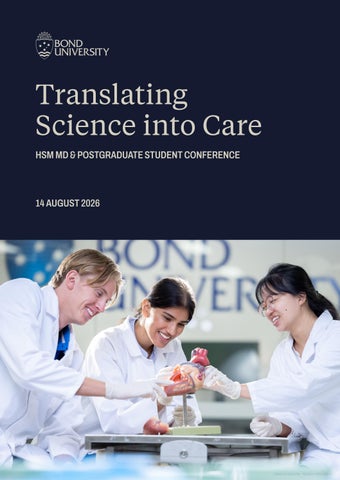
Translating Translating Science into Care Science HSM MD & POSTGRADUATE STUDENT CONFERENCE HSM MD & POSTGRADUATE STUDENT CONFERENCE
14 AUGUST 2026 14 AUGUST 2026
CRICOS 00017B TEQSA PRV12072
Contents Program Schedule.................................................................................................................. 7 Thank you to our MD Project supervisors ................................................................................. 8 Message from the Dean of Medicine................................................................................... 10 Message from the Associate Dean of Research .................................................................. 11 ABSTRACTS ................................................................................................................... 12 STREAM 1: POSTERS ............................................................................................... 12 PO1: What are the barriers and facilitators to culturally safe postnatal care for Muslim women? ........................................................................................................................... 12 PO2: Effectiveness of virtual reality augmented therapies for the management of PTSD in veteran populations .......................................................................................................... 13 PO3: Barriers to the Early Recognition of Sepsis: A Scoping Review .................................... 14 PO4: How effective are current and emerging biomarkers at increasing the early detection of sepsis in hospitalised adult patients? ................................................................................ 15 PO5: Interim Scoping Review of Training and Implementation of Focused Cardiac Ultrasound (FoCUS) in Low-Resource Settings .................................................................................... 16 PO6: Interim Findings from a Scoping Review of Focused Cardiac Ultrasound (FoCUS) Training in Low-Resource Settings ..................................................................................... 17 PO7: Medical Students' Perceptions of Emotional Intelligence and Its Testing in Medical School Admissions — A Preliminary Qualitative Study ....................................................... 18 PO8: Predictors and Challenges of Wellbeing in Medical and Allied Health Students ........... 19 PO9: Cost-benefit analysis of a multidisciplinary rapid response early discharge support team. ............................................................................................................................... 20 P10: Categorisation and prioritisation of end-user feedback in the design process of technologies for neurorehabilitation: A scoping Review. ..................................................... 21 PO11: Incidence and risk factors for delirium in blunt chest trauma.................................... 22 PO12: Vaccine Coercion and Hesitancy: An Ethical Analysis .............................................. 23 PO13: How much decision-making authority should be given to AI in ED triage? .................. 24 PO14: Improving Continuity of Student Support: An Evaluation of Leadership Transitions for Student Wellbeing Officers ............................................................................................... 25 PO15: Narrative Literature Review on Curriculum-Based Strategies Mitigating Psychological Pressures Via an EDES-Informed Evaluation - A Study of the Bond University Year 3 Medical Program ........................................................................................................................... 26 PO16: Transfer Aversion and Fragmented Care in Advanced Bronchiectasis in Remote Western Australia ............................................................................................................. 27 PO17: Learning from a Remote Placement: Managing Pre-existing Type 2 Diabetes in Pregnancy in an Aboriginal Community ............................................................................. 28
1
PO18: Embedding hinengaro: A narrative review of Māori conceptualisations of mental health within health services in Aotearoa New Zealand ................................................................ 29 STREAM 2: HDR......................................................................................................... 30 OP1: Physical and physiological factors underpinning performance progression in highly trained adolescent triathletes ........................................................................................... 30 OP2: Nanopore Sequencing for Aneuploidy Detection in Preimplantation Genetic Testing using Repetitive LINE and Whole Genome Amplification. ................................................... 31 OP3: “I want a human professional opinion, always”: What do Australians think about AI in healthcare data analysis? ................................................................................................. 32 LP2: Analysing the cytotoxic effects of plant-derived compounds and their interactions with docetaxel on prostate cancer cells. ................................................................................... 33 OP4: Identifying molecular mediators of metastasis and cell motility in advanced prostate cancer ............................................................................................................................. 34 LP3: A Preclinical Model of Perimenopause Reveals Early Functional Changes in Bladder Physiology ........................................................................................................................ 35 OP5: Investigating the therapeutic potential of synthesised TA/TMIO hybrids for age-related macular degeneration (AMD)............................................................................................. 36 OP6: The role of neurokinin 3 receptors in micturition in a preclinical model of perimenopause ................................................................................................................ 37 STREAM 3: CAPSTONES - ASIA ............................................................................... 38 PB1: Lessons from India: Social Determinants of Health and Healthcare Delivery in Regional North Gujarat ................................................................................................................... 38 PB2: Taiwan Capstone ...................................................................................................... 39 PB3: The Cost of Access: Comparing Chest Pain Pathways in Urban AHmedabad and Rural Deesa .............................................................................................................................. 40 PB4: Comparative healthcare insights from clinical placements at Pingtung Christian Hospital and Fooyin University Hospital, Taiwan. ............................................................... 41 PB5: Kaohsiung Medical University Chung-Ho Memorial Hospital MD capstone experience 42 PR1: Observational study of surgical anaesthetic services at a secondary healthcare centre in regional North Gujarat over one month. ............................................................................. 43 STREAM 4: PAEDIATRICS......................................................................................... 44 PB6: Predicting ADHD Diagnosis by Age 14 using Early-Life Data: A Machine Learning Analysis of the Millennium Cohort Study ......................................................................................... 44 PB7: Neonatal Resuscitation in the Solomon Islands ......................................................... 45 PB8: Managing Severe Acute Malnutrition in a Resource-Limited Pacific Hospital: A Case from Rural Solomon Islands. ..................................................................................................... 46 PR2: More Than Hyperactivity: A Clinical Audit of Paediatric ADHD and its Common Comorbidities and Treatment Patterns .............................................................................. 47 PR3: Recognising Neonatal Early Onset Sepsis at a Tertiary Hospital in Australia: A Quality Improvement Project ........................................................................................................ 48
2
PR4: Mothers’ experiences of help seeking upon experiencing breastfeeding challenges: A scoping review ................................................................................................................. 49 STREAM 5: GENERAL MEDICINE ............................................................................ 50 PB9: Evaluation of climate impact for common medications prescribed at discharge from a large metropolitan hospital over 8 years ............................................................................ 50 PB10: Galectin-3 as a Diagnostic and Prognostic Biomarker in Heart Failure with Preserved Ejection Fraction Compared to NT-proBNP: A Scoping Review............................................ 51 PR5: Telehealth-Delivered Mindfulness for Chronic Back Pain: A Systematic Review and MetaAnalysis ........................................................................................................................... 52 PR6: Beyond the Simulation: Why the Debrief is Where the Learning Happens .................... 53 PR7: Understanding childhood vaccine hesitancy in Australia: Drivers, Ethics and Implications ..................................................................................................................... 54 PR8: The Impact of Artificial Intelligence on Clinical Competence and Skill Development of Junior Doctors: A Literature Review.................................................................................... 55 PR9: Medical ethics in reproductive health care ................................................................. 56 STREAM 6: OBSTETRICS & GYNAECOLOGY ......................................................... 57 PR10: The relationship between the endometrial microbiome and pregnancy outcomes in assisted reproductive technologies, a systematic review. ................................................... 57 PR11: Cervicovaginal Community State Types and Their Role in STI Susceptibility Among Women of Reproductive Age: A Systematic Review ............................................................ 58 PR12: Factors contributing to diagnostic delay in endometriosis; an umbrella review .......... 59 PR13: Fully Dilated Caesarean Sections at Gold Coast University Hospital in 2024: A Retrospective Audit of Maternal, Neonatal, and Intraoperative Outcomes........................... 60 PR14: SimCerclage: Retrospective Clinical Audit of Cervical Cerclage Procedures at Gold Coast Hospital Health Service .......................................................................................... 61 PR15: A Multidisciplinary approach to Chronic Pelvic Pain and its Impact on Healthcare Burden – A Retrospective Descriptive Service Evaluation ................................................... 62 PR16: TIMING MATTERS: A Retrospective Audit of Amniotomy-First vs Oxytocin-First Protocols for Induction of Labour and Their Impact on Maternal and Neonatal Outcomes .................. 63 PR17: The Effect of Sterile Water Injections for Pain Management in Pregnant Women in Labour: Systematic Review and Meta-Analysis .................................................................. 64 STREAM 7: CAPSTONES AUSTRALIA, SOLOMON ISLANDS & SOUTH AFRICA . 65 PB11: Geography as a Determinant of Health: How Isolation Shapes Health Equity in the Solomon Islands .............................................................................................................. 65 PB12: Resource Limitations and Patient-centred Care: A comparative reflection on public healthcare in Cape Town and the Gold Coast..................................................................... 66 PB13: Timing of First Antenatal Visit and Number of Antenatal Visits and Pregnancy Outcomes at Gizo Hospital, Solomon Islands: A Retrospective Maternity Records Audit ..... 67 PB14: Diabetic Foot Disease: Case-Based Lessons from the Solomon Islands .................... 68 PR18: Barriers to Healthcare Delivery in a Martu Child with Severe Hypothyroidism ............ 69
3
STREAM 8: SURGERY............................................................................................... 70 PB15: Reliability and Quality of YouTube Videos on Robotic Radical Prostatectomy: A DISCERN-Based Analysis ................................................................................................. 70 PR19: Intradiscal Therapies for Discogenic Low Back Pain.................................................. 71 PR20: Diagnostic Features of Discogenic Low Back Pain: A Narrative Review and Suggested Areas for Future Research and Clinical Practice ................................................................. 72 PR21: High Voltage Electrical Injury Requiring Limb Amputation in Rural India .................... 73 PR22: Long Term Follow Up Of Barrett's Oesophagus Following Implementation Of Key Performance Measures for Quality Endoscopy ................................................................... 74 PR23: Developing a protocol for the use of Virtual Reality to support patients during Outpatient Rigid Cystoscopy-Guided Intravesical Botulinum Toxin Injections...................... 75 STREAM 9: NEUROLOGY & MENTAL HEALTH ........................................................ 76 PB16: Mental Health Care in the Solomon Islands: Clinical Observations from the National Psychiatry Unit at Kilu'ufi Hospital, Malaita ........................................................................ 76 PR24: Physical Exercise as Therapy for Post-Traumatic Stress Disorder: A Systematic Review and Meta-Analysis ............................................................................................................ 77 PR25: The impact of acute psychological stress on corticospinal excitability and the cortical silent period during fatiguing muscle contractions ............................................................. 78 PR26: Monoaminergic agents and their effects on voluntary and involuntary motor function after spinal cord injury: a systematic review....................................................................... 79 PR27: Methods of Usability Testing in Neurorehabilitation: A Scoping Review ...................... 80 PR28: Unlocking Compassion: An escape room intervention to reduce mental health stigma among medical students .................................................................................................. 81 STREAM 10: MEDICAL EDUCATION ........................................................................ 82 PB17: Osmosis in Action: Patterns of Engagement at Bond University ................................. 82 PB18: Evaluating the Quality and Reliability of YouTube Videos on Acute Coronary Syndrome Management for Healthcare Professionals ........................................................................ 83 PR29: Cultural Humility, Cultural Safety, and Cultural Competence in Undergraduate Medical Education: A Scoping Review ............................................................................................ 84 PR30: Does Realism in Simulation Matter? ........................................................................ 85 PR31: Physical activity, sedentary behaviour, muscle-strengthening activity and swimming competency among Medicine and Allied Health students: findings from the BOOST-Well survey .............................................................................................................................. 86 PR32: Simulating Success: Lessons From SBE ................................................................... 87 PR33: Simulations: A Crash Course ................................................................................... 88 STREAM 11: EMERGENCY MEDICINE..................................................................... 89 PB19: Suspected Gulliain-Barre Syndrome with Rapid Respiratory Failure in a 12-Year-Old: A Diagnostic and Resuscitation Challenge in Munda, Solomon Islands.................................. 89 PB20: Advanced Life Support in The Solomon Islands ........................................................ 90
4
PR34: Machine Learning Versus Clinical Scoring Tools for Early Sepsis Prediction: A Systematic Review and Meta-Analysis ............................................................................... 91 PR35: Generalisable machine learning approaches to early recognition of sepsis in the hospital: A systematic review ............................................................................................ 92 PR36: Major Haemorrhage Protocols in Queensland: Are We Following the Evidence? ........ 93 PR37: Implementation of a High-Yield Emergency ECG Workshop to Help Increase Confidence and Accuracy Levels in Healthcare Workers: A Prospective Pre-Post Interventional Study ......................................................................................................... 94 PR38: Does acupuncture provide effective pain management in adult patients presenting with renal colic?: A systematic review and meta-analysis. ......................................................... 95 Conference Organising Committee ....................................................................................... 96 Glossary of Presenters ......................................................................................................... 97
5
Acknowledgement of Country In the spirit of reconciliation, Bond University acknowledges the Kombumerri people, the traditional Owners and Custodians of the land on which the University now stands. We pay respect to Elders past, present and emerging.
6
Program Schedule 08:45 – 09:00
Attendees arrive (Basil Sellers Theatre, Building 6)
09:00 – 09:05
Introduction
Dr Paul Dunn, Assistant Professor, Faculty of Health Sciences & Medicine, MD Portfolio Coconvenor, Bond University
09:05 – 09:15
Welcome and Opening Address
Dr Paul Dunn, Assistant Professor, Faculty of Health Sciences & Medicine, MD Portfolio Coconvenor, Bond University
09:15 – 10:00
Keynote Presentation
Associate Professor Arutha Kulasinghe
10:00 – 10:55
Panel Discussion
Chair: Associate Professor Justin Keogh Panel members: Dr Liam O’Callaghan, Associate Professor Mina Bakhit & Professor Julie Redfern
10:55 – 11:00
Overview of Conference Dr Paul Dunn, Assistant Professor, Faculty of Health Sciences & Medicine, MD Portfolio Coconvenor, Bond University
11:00 – 11:30
Morning break
11:30 – 13:00
Concurrent Session 1: Health Building 5 Stream 2
Stream 3
Stream 4
5_3_04
5_3_53
5_3_27
Stream 5
Stream 6
Stream 1: Posters
5_3_40
5_3_35
Basil Sellars Foyer
13:00 – 14:00
Lunch break (Atrium)
14:00 – 15:30
Concurrent Session 2: Health Building 5 Stream 7
Stream 8
Stream 9
5_3_04
5_3_53
5_3_27
Stream 10
Stream 11
5_3_40
5_3_35
15:30 – 15:45
Afternoon break
15:45 – 16:45
Awards Ceremony (Princeton Room, Building 6)
17:30
Close
7
Thank you to our MD Project supervisors We would like to acknowledge and thank all supervisors and Bond University academic staff who voluntarily supervised these projects. Without your support and guidance these projects would not have come to fruition.
Research Projects: • •
• • • • • • • • •
•
• •
•
Professor Peter Jones - A501 - Clinical Audit of the management of ADHD in a private paediatric practice Associate Professor Christian Moro & Associate Professor Allan Stirling - A502 Diagnosis of discogenic low back pain B. Intradiscal therapies for discogenic low back pain Associate Professor Tanisha Jowsy & Associate Professor Richard Matthews A503 - Cultural safety in medicine Dr Steve Abbey - A504 - Audit of obstetric and gynaecologic practices at the Tweed Hospital Associate Professor Rob Orr, Associate Professor Ben Schramm & Associate Professor Elisa Canetti - A505 - Exercise as adjunct therapy in treating PTSD Dr Tony Badrick & Associate Professor Anna Lohning - A506 - Identifying sepsis in the hospital community using "big data" Assistant Professor Paul Dunn & Ms Isabella (Izzy) Davidson - A507 - Fertility and Microbiome (FAM) Health Study Dr Lewis McLean & Dr Lucy Grant - A509 - Scoping review of Point-of-Care ultrasound (POCUS) training in low resource settings Associate Professor Mike Todorovic & Assistant Professor Charlotte Phelps A510 - Quality and content evaluation of Urology education on YouTube Assistant Professor Belinda Craig & Assistant Professor Laura Baxter - A511 Mothers' experiences of help seeking upon experiencing breastfeeding challenges Associate Professor Amy Bannatyne, Associate Professor Cindy Jones and Assistant Professor Jaclyn Szkwara - A514 - Evaluating the feasibility and impact of an escape room style intervention to address MH Assistant Professor Ro Nogueira, Assistant Professor Sule Gunter & Associate Professor Mike Todorovic - A517 - Exploring Osmosis usage and its impact on medical learning Assistant Professor Jacob Thorstenson & Associate Professor Mike Todorovic A518 - Using transcranial magnetic stimulation to study motor pathways in humans Assistant Professor Jaclyn Szkwara, Assistant Professor Ro Nogueira and Assistant Professor Sule Gunter - A520 - Exploring active and sedentary behaviour patterns in medical and allied health students - A521 - Predictors and challenges of wellbeing in medical and allied health students Associate Professor David Waynforth - Predicting ADHD Diagnosis by Age 14 using Early-Life Data: A Machine Learning Analysis of the Millennium Cohort Study
8
• • • • • •
• • • • • •
•
•
Dr Kishanthy Thayalan, Dr Vivian Wong & Associate Professor Christian Moro A526 - Impact of virtual reality immersion headsets in improving patient experience Dr Claudia Wong - A527 - Cost benefit of a multidisciplinary early discharge support team Dr Peter Schmidt - A529 - Assessment of implementation and effectiveness of neonatal early onset sepsis Dr Juliana Oliveira and Dr Angela Model - A532 - Novel interdisciplinary service treating women with endometriosis and chronic pelvic pain Dr Jessica Forbes & Dr Elizabeth Wake - A533 - Composition, quality and delivery of major haemorrhage protocols (MHP) Dr Belinda Lowe - A535 - Delivering safety: intro of a fully dilated caesarean section simulation program - A536 - SimCerciage: intro of a cervical cerciage simulation program Dr Kelly Dungey & Dr Kelly Clanchy - A540 - Co-design and development of a novel neuro training device for inpatient rehab settings Dr Karthi Manugandhi - A542 - High Yield Emergency ECG Dr Sneha John & Dr Reffai Syedmohamed - A544 - Long term follow up of Barrett's dysplasia in a Gold Coast cohort Dr Mike Todorovic - Quality and evaluation of educational material on YouTube Dr Joanna Lane & Dr Elizabeth Wake - A546 - Incidence and risk factors for delirium in blunt chest trauma Associate Professor David Pache, Associate Professor Treasure McGuire, Associate Professor Jane Smith - A553 - Evaluation of climate impact for common medications prescribed at discharge Associate Professor Loai Albarqouni - A554 - Mindfulness for chronic back pain: A systematic review and meta-analysis - A556 - Sterile water injection for renal colic: A systematic review and meta-analysis Associate Professor Loai Albarqouni & Ms Hannah Greenwood - A555 - Non-drug interventions for pain management in labour: A systematic review
Professional Projects: • • •
Dr Nemat Alsaba & Dr Belinda Lowe - Simulation Based Education Associate Professor Richard Matthews – Ethic issues in healthcare Associate Professor Jo Bishop & Assistant Professor Belinda Craig – Every Doctor, Every Setting
Capstone Projects; • • • •
Professor Peter Jones - Solomon Islands & Pilbara & Port Headland Capstone Lead Associate Professor Neelam Maheshwari - India Capstone Lead Associate Professor Cindy Jones – Taiwan Capstone Lead Assistant Professor Tracy Nielson – South Africa Capstone Lead
9
Message from the Dean of Medicine Congratulations on completing your MD Project and presenting your work at the 2026 HSM Medical and Postgraduate Students Research Conference. The breadth and high standard of projects to be presented at this year’s annual conference highlights the strength of collaboration and the importance of medical research to improve the health status and longevity of the population. Your involvement in these projects allowed for diversity in experiences and acquirement of skills that reflects the clinical environment and will support you on your journey as a medical doctor. The health sector continues to face an environment of significant change and disruption, impacted by both global factors and national issues. Some of these are yet to fully play out such as the rise of Artificial Intelligence, and the next few years will require flexibility and adaptability on the part of the medical workforce and healthcare educators. As developing medical researchers, either as clinicians or a focussed career in medical research, formal education is just the start. You need to have effective communication, critical thinking, decision-making and observational skills. These skill sets will enable you to create a competitive edge in the research industry. It takes confidence to get things done – especially the difficult things.
Professor Kirsty Forrest MBChB, BSc Hons, FRCA, MMEd, FAcadMEd, FANZCA Faculty of Health Sciences and Medicine Bond University
10
Message from the Associate Dean of Research The HSM Medical & Postgraduate Students Research Conference is an annual showcase and celebration of student research within the Faculty of Health Sciences and Medicine. The conference enables student researchers at all levels of experience an opportunity to present their research discoveries as well as listen to a range of exciting presentations from their peers. Work presented at the conference includes MD projects, Masters, and PhD studies and other faculty-supervised research activities. To me, this year's research theme – ‘Innovate, Translate, Heal’, focuses on how we should, as individuals and as a part of an evolving society, continue to challenge the status quo to improve outcomes for our planet and all of humankind. Innovation and research translation is a key part of this evolution, and by being inclusive of a wide variety of diverse perspectives in this process, limitless discoveries may emerge that improve our lives and our legacy that we leave our descendants. I therefore hope that this focus of the conference inspires everyone to continue to look for barriers that may be negatively impacting patient and work colleague outcomes and then work collaboratively in an inclusive fashion to develop innovative evidence-based solutions to these issues. The diversity of research topics and designs is a key focus of this conference and congratulations to all of you on the progress you have made, in conjunction with the support provided by your supervisors. I hope you continue to look for innovations that will result in better care for the people that you work with every day, and where possible, add to the evidence base on how these innovations can be best translated into usual care. I wish everyone a great conference experience and thank you for your outstanding contribution to our faculty and university. Assoc/Prof Justin Keogh, PhD, ESSAF, FAAG, FISBS Faculty of Health Sciences and Medicine Bond University
11
ABSTRACTS STREAM 1: POSTERS PO1: What are the barriers and facilitators to culturally safe postnatal care for Muslim women? Badrulhisham, Aishah Maisarah, Ravi, Rachel, Graham, Kirra, Jowsey, Tanisha, & Mathews, Richard Background: The postnatal period is a vulnerable stage of maternity care, yet women from culturally and linguistically diverse backgrounds often encounter barriers to culturally safe healthcare. For Muslim women, cultural and religious beliefs may shape postnatal healthcare experiences and decision-making, highlighting the importance of culturally safe maternity services. Methods: A narrative review was conducted to explore the barriers and facilitators to culturally safe postnatal care for Muslim women. Literature searches were undertaken in PubMed and Embase in September 2025. Studies exploring culturally safe care or the postnatal healthcare experiences of Muslim women were included. Results: Twenty-four studies met the inclusion criteria. Four overarching themes were identified: (1) cultural and religious needs in maternity care, (2) communication and health literacy, (3) respect and discrimination, and (4) psychosocial wellbeing and social support. Key barriers included limited accommodation of modesty and gender preferences, language and cultural barriers, inadequate patient education, stereotyping, discrimination, and social isolation. Facilitators included respectful and culturally responsive care, accommodation of cultural and religious preferences, access to female healthcare providers where preferred, respectful patient–provider relationships, family involvement and community support. Conclusion: Culturally safe postnatal care for Muslim women requires healthcare professionals and maternity services to provide respectful, individualised care that responds to diverse cultural and religious needs. Achieving cultural safety extends beyond individual clinicians to organisational policies, education, and health systems. These findings highlight the need for system-level approaches that promote equitable, culturally safe postnatal care.
12
MD Posters
PO2: Effectiveness of virtual reality augmented therapies for the management of PTSD in veteran populations Petersen, Tomas, Ben Schran, Elisa Canetti & Robin Orr Background: Post traumatic stress disorder (PTSD) is a debilitating condition that disproportionately affects military personnel and veterans compared to the general public. Treatment is complicated by poor adherence, high cost and limited accessibility. This has generated a need to explore novel treatment modalities such as virtual reality (VR). The aims of this systemic review were to identify, critically appraise, and summate the literature around the use and efficacy of VR in the management of PTSD in veteran populations in comparison to existing therapies. Methods: Following the Preferred Reporting Items for Systematic Reviews and Meta-Analyses protocol and registration with the Open Science Framework, a systematic search of five databases (PubMed, Embase, Web of Science, Ovid Medline and CINAHL) was conducted using key search terms. Studies were also identified via independent research and citation reviews. The identified studies were considered against eligibility criteria and critically appraised using the Cochrane Risk of Bias Assessment. Results: From 807 identified records, 13 studies from three countries with a low risk of bias met the eligibility criteria. Included studies compared either VR exposure therapy (VRET) and multimodular motion-assisted memory desensitisation and reconsolidation (3MDR) to a variety of comparators including waitlist, cognitive behaviour therapy (CBT) and exposure therapy. The key findings were that VR psychotherapies were superior to non-intervention. VR psychotherapies appeared comparable to traditional psychotherapies, but results were inconclusive. Conclusion: Whilst the efficacy of VR psychotherapies for PTSD in veterans compared to traditional psychotherapies remains inconclusive, they were superior to non-intervention. VR psychotherapies are a promising therapy to overcome access and cost barriers in veterans.
13
MD Posters
PO3: Barriers to the Early Recognition of Sepsis: A Scoping Review Podder, Orrin, Lohning, Anna & Badrick, Tony Background: Despite advances in sepsis awareness and management, delayed recognition remains a pervasive challenge that contributes to sepsis-associated morbidity and mortality. Given the time-dependent benefits of early sepsis intervention, understanding the factors that delay recognition is essential to inform sepsis care. This review, therefore, aims to synthesise the current evidence on the barriers to early recognition of adult sepsis in hospital settings. Methods: A scoping review was conducted in accordance with the Joanna Briggs Institute (JBI) methodology and reported using the PRISMA-ScR framework. PubMed, Embase, and Cochrane were systematically searched for English-language studies published between January 2021 and February 2026 that investigated barriers to the early recognition of adult sepsis in hospital settings. Results: Twenty-three studies were included, with findings synthesised into four interrelated domains influencing early sepsis recognition: patient-, clinician-, diagnostic-, and system-level barriers. Patient-level barriers were characterised by non-specific and heterogeneous clinical presentations, reduced recognition in high-risk populations, and the evolving trajectory of sepsis. Clinician-level barriers centred on knowledge and competency gaps alongside diagnostic uncertainty. Diagnostic barriers reflected limitations of screening tools, the absence of a consistent gold-standard definition, and delayed or incomplete diagnostic data. System-level barriers encompassed operational inefficiencies, workforce and resource constraints, and recognition and escalation pathway challenges. Conclusion: This review highlights that delayed sepsis recognition is driven by the complex interplay of barriers across multiple domains. Addressing these barriers will require coordinated, multifaceted strategies that strengthen clinician capability, optimise diagnostic processes, and standardise recognition and escalation pathways to facilitate earlier sepsis identification.
14
MD Posters
PO4: How effective are current and emerging biomarkers at increasing the early detection of sepsis in hospitalised adult patients? Wiadrowski, Gisele, Introduction: To determine the diagnostic accuracy of current and emerging biomarkers for the early detection of sepsis in hospitalised adult patients. Method: PubMed was searched for studies published within 10 years with participants ≥18 years old. Studies must have included the diagnostic accuracy of C-Reactive Protein (CRP), Procalcitonin (PCT) and/or Interleukin-6 (IL-6) in their outcome to be selected for the review. Results: Thirty-one studies were included in the review. CRP was found to have a median sensitivity, specificity and AUC of 68.4%, 74.5% and 0.752 respectively. PCT was found to have a median sensitivity, specificity and AUC of 82.0%, 70.0% and 0.86 respectively. IL-6 was found to have a median sensitivity, specificity and AUC of 68.0%, 73.0% and 0.796 respectively. Conclusions: The results of the review indicate that PCT had the highest diagnostic accuracy, while CRP had a moderate diagnostic accuracy and IL-6 has a promising diagnostic potential, but needs further research before clinical application due to the small number of current literature available.
15
MD Posters
PO5: Interim Scoping Review of Training and Implementation of Focused Cardiac Ultrasound (FoCUS) in Low-Resource Settings Daley, Laura, Paniharam, Sathvik, McLean, Lewis, & Sykes, Alice Background: Access to diagnostic imaging remains limited across many low- and middle-income countries (LMICs), where acute and chronic cardiovascular disease burden continues to rise. Focused cardiac ultrasound (FoCUS) is a clinician-performed, point-of-care echocardiographic technique which provides rapid, low-cost, bedside cardiac assessment. While FoCUS training programmes are established in high-income countries, their implementation and thus effectiveness in LMICs remain limited. Methods: This review evaluated literature on FoCUS training and implementation in LMICs, following Joanna Briggs Institute (JBI) guidance, and reported according to the PRISMA-ScR checklist. Databases (PubMed, Embase and Cochrane) search conducted in December 2025 yielded 4,529 studies for screening. Two reviewers screened 3,674 articles at the title/abstract stage, identifying 124 studies for full-text review. Given the ongoing full-text review, an interim analysis was conducted using the RE-AIM framework on three fully appraised articles. Ethics approval was not required. Results: Interim RE-AIM analysis demonstrated that FoCUS reached diverse, underserved populations through successful task-shifting to non-cardiologist doctors, rural nurses and health workers. Participants consistently acquired meaningful-quality images that inform clinical management. Adoption was facilitated by low-cost handheld devices, though implementation barriers included early variability in image quality, time constraints and infrastructure limitations. Conclusion: Preliminary analysis demonstrates that FoCUS is a feasible, effective and scalable strategy for addressing critical diagnostic gaps in low-resource settings. Task-shifting to non-specialist healthcare workers using affordable devices enables clinically meaningful image acquisition and early disease detection. To ensure long-term sustainability and broader implementation, health systems must prioritise ongoing mentorship, structured protocols and robust referral pathways.
16
MD Posters
PO6: Interim Findings from a Scoping Review of Focused Cardiac Ultrasound (FoCUS) Training in Low-Resource Settings Paniharam, Sathvik, McLean, Lewis, & Sykes, Alice. Background: Access to diagnostic imaging remains limited across many low- and middle-income countries (LMICs), where acute and chronic cardiovascular disease burden continues to rise. Focused cardiac ultrasound (FoCUS) is a clinician-performed, point-of-care echocardiographic technique which provides rapid, low-cost, bedside cardiac assessment. While FoCUS training programmes are established in high-income countries, their implementation and thus effectiveness in LMICs remain limited. Methods: This review evaluated literature on FoCUS training and implementation in LMICs, following Joanna Briggs Institute (JBI) guidance, and reported according to the PRISMA-ScR checklist. A search of databases (PubMed, Embase and Cochrane) conducted in December 2025 yielded 4,529 studies for screening. Two reviewers screened 3,674 articles at the title/abstract stage, identifying 124 studies for full-text review. Given the ongoing full-text review, an interim analysis was conducted using the RE-AIM framework on three fully appraised articles. Ethics approval was not required. Results: Interim RE-AIM analysis demonstrated that FoCUS reached diverse, underserved populations through successful task-shifting to non-cardiologist doctors, rural nurses and health workers. Participants consistently acquired images of sufficient quality that informed clinical management. Adoption was facilitated by low-cost handheld devices, though implementation barriers included early variability in image quality, time constraints and infrastructure limitations. Conclusion: Preliminary analysis demonstrates that FoCUS is a feasible, effective and scalable strategy for addressing critical diagnostic gaps in low-resource settings. Task-shifting to non-specialist healthcare workers using affordable devices enables clinically meaningful image acquisition and early disease detection. To ensure long-term sustainability and broader implementation, health systems must prioritise ongoing mentorship, structured protocols and robust referral pathways.
17
MD Posters
PO7: Medical Students' Perceptions of Emotional Intelligence and Its Testing in Medical School Admissions — A Preliminary Qualitative Study Ganeshalingam, Vikram, Jones, Cindy, & Bannatyne, Amy Background: In recent years medical schools are changing how they select students - including more personal characteristics. In 2018, Bond University started a new process as one of the initial Australian institutions to evaluate how applicants manage emotions using the MayerSalovey-Caruso Emotional Intelligence Test (MSCEIT), where subsequent research was conducted the following year in 2019 evaluating perspectives. This study is aimed at exploring medical students' current understanding of Emotional Intelligence (EI), their perceptions of its role in medical school admissions and clinical settings. Methods: In this study researchers used a qualitative method that utilised thematic analysis. To find participants, the team posted announcements on iLearn and recruited four individuals who are medical students at Bond University. Individual interviews followed a semi structured format whereby researchers then transcribed the audio recordings for analysis and two researchers coded the data independently using a codebook. Results: Five preliminary themes were identified: EI as professional ontology; EI as the relational mechanism of clinical care; EI as developmentally contingent; EI as epistemologically resistant to standardisation; and EI testing as necessary but inherently contested. Conclusion: Participants state that EI is a core part of their professional persona and their ability to treat patients successfully, however they express doubt that standardised tools are able to measure those attributes in a genuine way. To address this, they prefer methods that use unique environments and direct observation and evaluation.
18
MD Posters
PO8: Predictors and Challenges of Wellbeing in Medical and Allied Health Students Seeley, John, Szkwara , Jaclyn, Gunter, Sule, Nogueira, Ro , & Rathbone, Evelynne Background: Health professional students may experience psychological distress during the transition to university, yet wellbeing challenges across medical and allied health programs are less well described. Methods: This study used secondary analysis of BOOST-Well survey data from medical and allied health students at Bond University in 2024 and 2025. Outcomes included K10 psychological distress, mean stress score, time-use, financial strain, perceived time pressure, and the impact of wellbeing on work/study. Descriptive statistics summarised student characteristics and wellbeing outcomes. Within-year comparisons between Medicine and Allied Health used independent samples t-tests and chi-square tests where assumptions were met. Correlation analyses explored factors associated with K10 and mean stress scores. Results: The sample included 289 students in 2024 and 248 students in 2025. Allied Health students had significantly higher K10 scores than Medicine students in 2024 and a greater proportion in the high or very high distress categories. These program-level differences were not observed in 2025. Mean stress scores were slightly higher among Allied Health students in both years, but differences were not statistically significant. Across both years, K10 and stress scores were most consistently associated with perceived time pressure, psychological wellbeingrelated impact on work/study, and difficulty managing on available income, rather than weekly study or work hours. Conclusion: Student wellbeing appeared multifactorial and was more closely related to perceived pressure, financial strain, and functional impact than workload volume alone. Support strategies should address broader social, financial, and wellbeing-related needs.
19
MD Posters
PO9: Cost-benefit analysis of a multidisciplinary rapid response early discharge support team. Bains, Gobind, Jones, Mark, Jowsey, Tanisha. Marks, Darryn. McLaren-Kennedy, Annette. Wong, Pan-Kar Claudia & Yang, Aaron Background: This poster reports the findings from a rapid review and the development of a subsequent protocol for undertaking a cost benefits analysis (using retrospective, case-matched cohort data). The context is the Multidisciplinary Avoidance Post-Acute Service (MAPS), delivered by Gold Coast Hospital and Health Service (GCHHS) at the Robina Health Precinct; a service committed to enabling patients earlier discharge from acute wards into community care. In this study, we sought to identify the economic viability of the MAPS service. Methods: I undertook a rapid literature review to examine the existing evidence on multidisciplinary early discharge and transitional care interventions, with a focus on their cost-effectiveness. These findings informed the design of a retrospective, case-matched cohort study comparing patients who received MAPS between 1st November 2023 and 31st May 2025 with a matched non-MAPS comparison group. Our research group established a study protocol. At the time of abstract submission, the cost-benefit analysis was underway. Results: 9 studies were included in the rapid review. The available literature suggests that multidisciplinary transitional care and early discharge services are commonly associated with reduced length of stay, fewer readmissions, and improved patient-centred outcomes. However, the existing economic evidence remains limited and difficult to compare between health services due to high heterogeneity in study design, costing methods, intervention structure, and outcome reporting. Conclusions: The rapid review demonstrated a clear gap in the evidence, particularly in relation to Australian health service models that aim to reduce hospital bed day use through multidisciplinary community-based support. Once completed, this study will provide GCHHS with the first formal economic evaluation of MAPS to help inform future decisions regarding service investment, sustainability, and potential expansion.
20
MD Posters
P10: Categorisation and prioritisation of end-user feedback in the design process of technologies for neurorehabilitation: A scoping Review. Abdi, Zina, Clanchy, Kelly; Carlini, Joan; Dungey, Kelly Objective: This scoping review aimed to evaluate the utilisation of categorisation and prioritisation methods to process user feedback during the design and development of neurorehabilitation technologies. Method: A scoping review was performed following the JBI methodology and was reported using the PRISMA-ScR framework. A systematic search of PubMed, Cochrane Library, Embase, Scopus (advanced search) and CINAHAL (EBSCO) database was conducted. Studies that collected user feedback on technologies and methodologies for categorising and prioritising the feedback were considered for inclusion. The relevant data from the selected studies were extracted and analysed. Results: Of the 3090 studies that resulted from the search, 36 studies met the inclusion criteria. Of these, 67% reported on data categorisation methods, and 19% commented on the prioritisation method. Ultimately, this illustrates a lack of systematic analysis of user feedback to inform the design and development process. Conclusion: Overall, there remains a lack of understanding of the processes governing how user feedback is categorised and prioritised in the design process. Many studies have shown that users’ perspectives are rarely centred in discussions of innovations in neurorehabilitation technology design. Further studies are required to establish a standardised framework and to open report on the processes used to interpret user feedback during design implementation.
21
MD Posters
PO11: Incidence and risk factors for delirium in blunt chest trauma Aggarwal, Kanisha, Background: This prospective observational cohort study investigated the incidence and risk factors of delirium in patients aged 50 years and older admitted with blunt chest trauma to Gold Coast University Hospital, a Level 1 Trauma Centre in Queensland, Australia. Delirium is a serious complication in trauma patients associated with prolonged hospital stay, hospital-acquired complications, and increased morbidity and mortality. It is also an increasingly recognised issue in Australia given the growing ageing population and the considerable financial burden it places on the healthcare system. Despite the considerable burden delirium places on patients and the healthcare system, a significant gap still exists in the Australian literature on delirium following blunt chest trauma. Methods: Adults aged 50 years and older admitted with blunt chest trauma from November 2024 were enrolled with a target sample size of 200 participants. Data collected included patient demographics, injury characteristics, clinical frailty, comorbidity burden, nutritional status, and injury severity. Delirium was screened using the 4AT screening tool, a validated bedside screening tool used across Gold Coast Hospital and Health Services. Restuls: In the interim analysis, the majority of patients were male. Delirium occurred in 15% of patients, consistent with international literature. Patients who developed delirium tended to be older and frailer, with a longer hospital stay and more comorbidities, while the number of rib fractures was similar between both groups. The most common mechanism of injury was a fall from standing height. Conclusion: These findings highlight the importance of routine delirium screening and early identification of at-risk patients in this population.
22
MD Posters
PO12: Vaccine Coercion and Hesitancy: An Ethical Analysis Govender, Uben, Introduction: Vaccination is one of the most effective public health interventions, yet vaccine uptake remains limited across the life course by vaccine hesitancy. In Australia, childhood immunisation coverage remains below the 95% target in some age groups, while adult influenza vaccination coverage also remains suboptimal, including Queensland. Vaccine hesitancy does not simply mean refusal; it may include delaying vaccination, selectively accepting some vaccines, or remaining uncertain despite access to vaccination services. This project examined the ethical evaluation of coercive vaccination policies as both a response to, and a potential driver of, vaccine hesitancy. Methods: A narrative literature review and ethical analysis were undertaken. WHO guidance, Australian immunisation data, and peer-reviewed literature on vaccine hesitancy, mandates, coercion, trust, misinformation, and equity were reviewed and analysed thematically. The analysis focused on autonomy, informed consent, harm prevention, proportionality, least restrictive alternative, justice, and public trust. Results: The literature showed that vaccine hesitancy is multifaceted and context specific, shaped by confidence, complacency, convenience, and broader social and institutional factors. Although coercive policies may increase uptake in high-risk settings, they can also undermine trust, increase perceived pressure, and disproportionately burden disadvantaged groups. The findings also suggest that coercion may worsen hesitancy when it is perceived as excessive, insufficient, or unfair. Conclusion: Coercive vaccination may be ethically justified in limited circumstances, but it should not be the default response to hesitancy. Ethical vaccination policy should prioritise equitable access, clear communication, respectful clinician engagement, and least restrictive measures.
23
MD Posters
PO13: How much decision-making authority should be given to AI in ED triage? Hameed, Muhammad, Background: Emergency department (ED) triage is a fast, critical clinical process that decides how urgently patients are prioritised for assessment and treatment. Artificial intelligence (AI), especially machine learning and natural language processing, has shown increasing potential to help this process by improving early risk detection, consistency, and patient flow. This literature review examined how much decision-making power AI should have in ED triage, focusing on ethical issues like bias, transparency, generalisability, and accountability. Methods: A search was performed using PubMed and EMBASE. Search terms related to artificial intelligence, emergency department, triage, and ethics were combined, resulting in 15 included studies. These included systematic reviews, retrospective modeling studies, realworld implementation studies, and fairness analyses. In the literature examined, AI was mainly assessed for predicting hospital admission, critical illness, ICU needs, and patient outcomes. Results: Overall, machine learning and natural language processing models often outperformed traditional triage methods, especially when structured triage data was combined with free-text notes. However, much of the evidence was retrospective, methodologically diverse, and hampered by inconsistent reporting and inadequate external validation. Conclusion: This review suggests that AI should currently be used in ED triage with limited decisionmaking authority and mainly as a human-supervised decision-support tool. While AI presents clear potential benefits, ongoing concerns about bias, transparency, generalisability, and accountability still outweigh the argument for fully autonomous triage. Future research should focus on prospective multicentre evaluations in real clinical environments, especially in Australian ATS-based emergency departments.
24
MD Posters
PO14: Improving Continuity of Student Support: An Evaluation of Leadership Transitions for Student Wellbeing Officers Howard, Olivia, Bishop, Jo, Craig, Belinda, & Di Dio, Antonio Introduction: Every Doctor, Every Setting (EDES): A National Framework aims to support and strengthen the mental health and wellbeing of medical professionals and students. It promotes the implementation of four key pillars to assist with action change including stigma reduction, promotion of wellbeing services across all stages and areas medical training. This report will primarily focus on Pillar Four: Mental Health Promotion. Aim: To review the current peer-led wellbeing program at Bond University, specifically the leadership transition period and the role of a student wellbeing officer. Target 4.1 “Strategies to improve the health and wellbeing of the medical profession are implemented”, was utilised to guide research and the production of a formal handover document. Methods: A narrative review and scoping survey was conducted with the Queensland medical schools of James Cook University (JCU), Griffith University and the University of Queensland (UQ), to support the evaluation of the wellbeing officer’s role and the importance of peer led wellbeing programs. Furthermore, an interview was conducted with the current Bond CHWB officer to assist in clarifying the role’s expectations as a student leader and to identify the future direction of the wellbeing program. Results/Recommendations: Leadership transitions between wellbeing officers contained varying degrees of information and often left gaps in the requirements of the role. Further the lack of role definition across medical schools highlighted the inconsistency in role expectations. To address these gaps a formal handover document was produced for the Bond wellbeing program, with the aim to improve consistency, support and ensure effective evaluation within each transition period.
25
MD Posters
PO15: Narrative Literature Review on Curriculum-Based Strategies Mitigating Psychological Pressures Via an EDES-Informed Evaluation A Study of the Bond University Year 3 Medical Program Yousef, Rochelle, Bishop, Jo , Craig, Belinda, & Didio, Antonio Introduction: Curriculum is the summation of the planned educational experiences that facilitate students with specific learning objectives. Within these structures, there are periods of heightened psychological risks, particularly in programs that are accelerated such as the Bond Medical Program. The ‘Every Doctor, Every Setting’ (EDES) framework emphasises producing adaptable, safe and sustainable practitioners across all contexts. Primary prevention entails evaluation of curricular design to optimise training and work environments at a university level. Objective: To conduct a literature-based review of curriculum level strategies aimed to mitigate burnout and psychological risk in medical training. This aligns with EDES National Framework’s First pillar to “Improve training and work environments to reduce risk”, specifically Target 1.1 “Review curricula design and assessment processes for doctors and medical students and implement changes to maintain quality while reducing harm to individuals”. Additionally, to evaluate Year 3 timetable reforms at Bond University (2025- 2026) through an EDESinformed lens, with a focus on primary prevention, intra- curricular stressors and sustainable professionalism Methods: A literature review was undertaken on curriculum-based wellbeing interventions, transition to clinical, simulation-based education, peer-assisted learning, and debriefing practices. The 2025 Year 3 timetable was used as a baseline to identify curriculum pressures and compared to the 2026 timetable reforms. Results: The 2026 timetable redesign advances EDES-aligned primary prevention by addressing modifiable curriculum-level stressors identified in the literature and 2025 timetable, including workload predictability, communication burden, hidden curricular pressures and student autonomy. Mediation of educational rigour and clinical exposure were considered whilst also reducing avoidable psychological
26
MD Posters
PO16: Transfer Aversion and Fragmented Care in Advanced Bronchiectasis in Remote Western Australia Cimen, Ela L., & Jones, Peter Introduction: Aboriginal Australians experience a disproportionately high burden of bronchiectasis, with fragmented healthcare contributing to poorer outcomes. In remote Western Australia, repeated inter-hospital transfers may unintentionally reduce patient engagement by separating patients from Country, family and culturally familiar supports. This case study explores how transfer aversion can become a barrier to treatment completion despite appropriate medical management. Methods: A longitudinal case study was undertaken of a 32-year-old Aboriginal woman with severe bronchiectasis managed across Hedland Health Campus, Newman Hospital and the Puntukurnu Aboriginal Medical Service in the Pilbara, Western Australia. Patient interactions, clinical records and observations across multiple healthcare encounters were reviewed to examine factors influencing clinical outcomes. Results: The patient presented with an acute infective bronchiectasis exacerbation complicated by type 1 respiratory failure and was treated appropriately with intravenous piperacillintazobactam. Although discharged with a plan to complete intravenous antibiotics locally, she declined re-presentation for fear of transfer back to the Port Hedland. This resulted in incomplete therapy and subsequent clinical deterioration requiring readmission. The case highlights how fragmented care pathways, anticipated loss of autonomy and transfer-related concerns can undermine otherwise evidence-based management. Conclusion: Transfer aversion represents an important but under-recognised contributor to inequitable health outcomes in remote Australia. Shared decision-making, early involvement of Aboriginal Health Workers, transparent transfer discussions and local treatment pathways may improve treatment completion, strengthen continuity of care and reduce avoidable hospital readmissions.
27
MD Posters
PO17: Learning from a Remote Placement: Managing Pre-existing Type 2 Diabetes in Pregnancy in an Aboriginal Community Millington, Sarah, Introduction/Background Remote clinical placements provide opportunities to understand how social and cultural factors influence patient care. This case study explored the management of a high-risk pregnancy in a young Aboriginal woman with pre-existing type 2 diabetes mellitus (T2DM), with a particular focus on the challenges of providing care in a remote Australian community. Methods A case study was completed during a rural placement in Newman, Western Australia. Clinical notes, pathology, imaging and multidisciplinary management plans were reviewed alongside current Australian guidelines to examine the patient's presentation, management and the factors influencing clinical decision-making. Results A 21-year-old Aboriginal woman presented at approximately 10 weeks' gestation with insulinrequiring T2DM, an HbA1c of 14.6%, diabetic nephropathy and recent exposure to medications contraindicated in pregnancy. Management was complicated by food insecurity, unstable housing, limited health literacy and restricted access to specialist services. Although telehealth support and insulin optimisation were implemented, achieving glycaemic control remained difficult. Throughout the placement, it became clear that continuity of care, involvement of an Aboriginal Health Worker and management plans that reflected the patient's priorities were just as important as medical treatment in supporting engagement. Conclusion This placement demonstrated that managing diabetes in pregnancy in a remote setting involves much more than following clinical guidelines. It reinforced the importance of understanding the patient's social circumstances, working closely with Aboriginal Health Workers and adapting management to the local context. These experiences strengthened my understanding of culturally safe, patient-centred care and will influence my future clinical practice.
28
MD Posters
PO18: Embedding hinengaro: A narrative review of Māori conceptualisations of mental health within health services in Aotearoa New Zealand Ravi, rachel, Jowsey, Tanisha, & Matthews, Richard Background: Within te ao Māori [the Māori worldview], hinengaro [mental and emotional wellbeing] is understood as part of a holistic network of relationships encompassing spiritual, physical, familial, and cultural wellbeing. Unlike dominant Western biomedical models, which often conceptualise mental health as an individual psychological phenomenon, Māori understandings are relational, collective, and grounded in identity, whakapapa [genealogy], and connection to whenua [land]. Although Māori health frameworks have gained increasing recognition within policy and practice, the extent to which these conceptualisations are embedded within contemporary mental health services remains unclear. Methods: A narrative review of literature published between 2000 and 2025 was undertaken to examine how Māori conceptualisations of mental health are represented within mental health services in Aotearoa New Zealand. Literature relating to Māori models of health, kaupapa Māori [Māoricentred philosophy and practice] services, cultural safety, rangatahi [young people] mental health, workforce development, and innovative models of care was synthesised. Results: Māori conceptualisations of wellbeing were increasingly reflected across mental health policy, service design, workforce initiatives, and innovative interventions. Illustrative examples, including Te Whare Tapa Whā, Tiaho Mai, Mahi a Atua, SPARX, and kaupapa Māori services, demonstrate meaningful integration of Māori worldviews into mental health care. However, implementation remains inconsistent, with many mainstream services continuing to operate predominantly within Western biomedical paradigms. Conclusion: Māori conceptualisations of mental health are gaining recognition but remain incompletely embedded across contemporary mental health services. Greater Māori leadership, culturally safe practice, and sustained investment in kaupapa Māori services are essential to advance equitable, culturally responsive mental health care in Aotearoa New Zealand.
29
HDR
STREAM 2: HDR OP1: Physical and physiological factors underpinning performance progression in highly trained adolescent triathletes Scattolini Correa, Glauber, Justin Keogh, Anna Lorimer, Evelyne Rathbone Background: Triathlon training for peak performance is inherently complex due to the interaction of multisport demands. While innovative cross-training approaches are widely adopted by adult elite athletes, their suitability for highly trained, maturing adolescents remains unclear. Youth sport systems therefore face challenges in sustaining participation, as organisational structures often promote adult-like training volumes and expectations of early competitive advantage. This professionalisation frequently overlooks biological limitations, prioritising short-term performance that may contribute to increased injury risk in youth. Methods: This exploratory study aimed to identity performance limits by examining the physical and physiological determinants of cycle-run performance in male (n = 12) and female (n = 4) triathletes (age: 15.3 (1.2) years, VO2max: running 67.5 (7.1) and cycling 64.1 (8.5) mL·kg⁻¹·min⁻¹). Athletes completed neuromuscular assessments and laboratory-based endurance protocols. Results: Anthropometric characteristics, muscle function and aerobic capacity were analysed by sex and performance-level. Cycling performance was strongly associated with body size, fat-free mass, strength, dynamic muscle function (r = 0.66–0.87), and VO2max (r ≥ 0.91). Running performance demonstrated moderate associations with VO2max (r = 0.72–0.75) and weaker relationships with neuromuscular function. Running relationships were attenuated following cycling, suggesting additional ventilatory and fatigue-related contributions. Between-tier comparisons showed moderate-to-large effects favouring higher-performing athletes for VO2 (g = 0.92–1.26), while muscle function differences were small. Conclusion: Findings highlight aerobic capacity as central to performance differentiation. Monitoring of post-cycle running provides insights into sex-specific anaerobic contribution to running performance. Neuromuscular function and experience-related contribution are disciplinespecific and regular assessment alongside somatic growth can inform training strategies.
30
HDR
OP2: Nanopore Sequencing for Aneuploidy Detection in Preimplantation Genetic Testing using Repetitive LINE and Whole Genome Amplification. Oltramare, Vivianne, McDermott, Catherine, & Dunn, Paul Introduction: Chromosomal abnormalities account for 50% of first-trimester pregnancy losses, with the likelihood increasing with advanced maternal age (>35 years). Preimplantation genetic testing (PGT-A) can be used to screen embryos for chromosomal abnormalities prior to implantation to aid in selecting healthy embryos. Current PGT-A methods can take one to three weeks to obtain results; however, newer methods of nanopore sequencing could offer a faster, lower-cost and more accessible option. The aim was to determine the applicability of the MinION sequencer and Flongle flow cell from Oxford Nanopore Technologies (ONT) for PGT-A. Methods: DNA samples were obtained from the Coriell Institute for Medical Research from a normal male (NA12240), normal female (NA12089), monosomy X (NA20027*3) and Trisomy 21 (NA03716*C3). Two DNA amplification methods were compared: the first, targeted PCR amplification of LINE repeat regions, and the second, whole-genome amplification (WGA) using the Repli-G mini-Kit from QAIGEN. Library preparation was carried out using the ONT ligation sequencing kit V14 and Flongle V14 flow cells; sequencing results were analysed with a custom bioinformatic pipeline. Results: Between the two amplification methods, WGA performed the best, and the correct aneuploidies were identified. Whilst both methods obtained sufficient reads for aneuploidy detection between ~9,000 and ~35,000 reads. PCR amplification showed false positive results in chromosomes 19,21, 22 and Y, potentially attributed to the genomic density of the chromosomes or poor mapping. Conclusion: These results show the capability of the MinION and Flongle for aneuploidy detection; further refinement of the bioinformatic pipeline is required to support the use of these methods for PGT-A.
31
HDR
OP3: “I want a human professional opinion, always”: What do Australians think about AI in healthcare data analysis? Hudson, Carly, Goldsworthy, Adrian; Jowsey, Tanisha; Tronstad, Oystein; & Randall, Marcus Background: Artificial intelligence (AI) is increasingly being used in healthcare, yet public acceptability, understanding, and concerns remain incompletely understood. This study explored Australian public attitudes toward the use of AI in healthcare, including perceived benefits, risks, governance expectations, and conditions for acceptable implementation. Methods: A prospective, cross-sectional survey of 3007 Australian adults was conducted in February 2026. Survey items examined self-reported AI knowledge, prior use of AI for health-related questions, comfort with AI across different healthcare applications, concerns about risks and governance, and views on health data use. Qualitative responses gathered from the final freetext question were analysed using Elo and Kyngäs’ approach to inductive content analysis. Results: Forty-seven percent of respondents reported previously asking AI health-related questions, with some reporting that they had followed AI advice or used AI to check information provided by healthcare professionals. Despite this use, respondents expressed substantial concern about AI in healthcare and often reported limited knowledge or uncertainty about whether they had enough information to make informed decisions. Qualitative comments were organised into eight categories: concern, ambivalence, perceived benefits, lack of readiness, need for education, governance issues, rejection of AI, and anticipated harms. Conclusion: Australians are already using AI to guide health-related decisions, but acceptance depends on how AI is implemented. Health systems should prioritise public AI literacy, transparent governance, data protection, patient choice, equity, accountability, and models of AI use that support rather than replace human clinical judgement.
32
HDR
LP2: Analysing the cytotoxic effects of plant-derived compounds and their interactions with docetaxel on prostate cancer cells. Sii, Samuel, Lohning, Anna, & Chess-Williams, Russ. Introduction/Background: Metastatic prostate cancer (mPCa) has a five-year survival rate of 36%. A standard treatment for mPCa is chemotherapy (docetaxel), which is increasingly ineffective due to the rise in treatment resistance. Hence, research is needed to identify novel compounds that can be combined with docetaxel to enhance efficacy. The aim of this study was to evaluate the cytotoxic effects of plant-derived compounds on two mPCa cell lines and analyse their combinations with docetaxel. Methods: The androgen-dependent LNCaP cells and the androgen-independent PC-3 cells were used. Cell viability was determined quantitatively using the resazurin reduction assay, alongside qualitative assessment using brightfield microscope images. Experiments were performed with three/four biological repeats, each in triplicate. Dose-response curves were generated with GraphPad Prism. Combination isobolograms were created with CompuSyn and SiCoDEA. Data was analysed using a one-way ANOVA with either Dunnett’s post-hoc test (dose-response curves) or Tukey’s post-hoc test (combinations). Results: 6-(methylsulfinyl)hexyl isothiocyanate (6-MITC) and 18ß-glycyrrhetinic acid (GA) exerted the greatest cytotoxic activity for both mPCa cell lines, with half-maximal inhibitory concentrations (IC50) of around 20µM and 100µM after 48 hours of incubation, respectively. Combinations of 6-MITC and GA with docetaxel showed a slight synergistic interaction between GA and docetaxel at the highest combinatorial dose, while all other combination doses revealed antagonistic interactions. Conclusion: While 6-MITC and GA were effective anti-cancer agents administered alone, they did not provide clinically meaningful results when combined with docetaxel. Further research should analyse the anti-cancer mechanisms of 6-MITC and its combinations with other standard mPCa treatments, like enzalutamide.
33
HDR
OP4: Identifying molecular mediators of metastasis and cell motility in advanced prostate cancer Turpie, Calum, Dunn, Paul, McDermott, Catherine, & Roehl, Joan. Introduction/Background: Despite improvement to early-stage treatment, prostate cancer remains the fifth leading cause of cancer death amongst males worldwide, with metastasis predominantly driving mortality. While cell motility activation is known as a necessary step for metastasis, the mediating pathways involved in prostate cancer remain under-explored. This project therefore aims to identify and characterise the function of molecules that contribute to prostate cancer motility. Methods: LNCaP, C42B, and PC3 cells were used as models of prostate cancer with increasing metastatic and migratory ability. Initially, the differential gene expression of 84 cell motility genes was measured in LNCaP and PC3 cells using qPCR. Protein expression of the top candidate genes was then validated in both cell lines using immunocytochemistry. Lastly, cell migration and extra-cellular matrix degradation were measured in the presence or absence of various treatments. Results: Seven cell motility genes had significantly decreased expression, and twenty-two had significantly increased expression in more metastatic prostate cancer cells. The top gene candidates identified with relevance to metastasis among these were VIM (Vimentin), CAV1 (Caveolin-1), and MMP14 (Matrix Metalloproteinase 14). Protein expression of these candidates matched the differential gene expression patterns between cell lines. Additionally, cell motility was found to increase progressively from LNCaP, to C42B, to PC3 cells, with treatments decreasing motility in specific cell-lines. Conclusion: This project highlights the functional role of molecular drivers of prostate cancer cell motility and the impact of inhibiting their activity. Further characterisation of these molecules may assist with future therapeutic developments for late-stage prostate cancer.
34
HDR
LP3: A Preclinical Model of Perimenopause Reveals Early Functional Changes in Bladder Physiology Tye, Elouise, McKeon, Aidan. Chess-Williams, Russ. Sellers, Donna. McDermott, Catherine Introduction/Background: Genitourinary symptoms are more prevalent in women post-menopause, however, we hypothesise that these physiological changes begin to emerge during the perimenopausal transition. Therefore, this study aimed to examine the effect of abnormal oestrus cycling in perimenopause on physiological bladder function. Methods: Female C57Bl/6J mice (12-week-old) were randomly allocated to Control or Perimenopause groups (n=8 per group). Mice in the perimenopause group were treated for 10 consecutive days with daily i.p. injections of 4-vinylcyclohexene diepoxide (VCD) (160 mg/kg/day). Agematched control mice received daily vehicle injections. Vaginal cytology was performed to determine oestrus cycle length, and voiding behaviour was assessed. Mice were sacrificed on day 100, whole bladders were removed, catheterised, and intravesical pressure was recorded in response to pharmacological stimulation and following electrical field stimulation (EFS). Data (mean ± SEM) were compared via Student’s t-tests. Results: Vaginal cytology revealed that all animals had normal oestrus cycle length prior to treatment, whilst the perimenopause group exhibited abnormal cycles in the 14 days preceding sacrifice. The contractile response to KCl (60mM) was significantly depressed in the perimenopause group (p<0.01), as was the response to ATP (10mM). Maximal contraction responses to cumulative concentrations of muscarinic receptor agonist carbachol normalised to the KCl response was enhanced (p<0.01). Bladder relaxation in response to β-adrenoceptor agonist isoprenaline was significantly depressed in perimenopause mice, as were nerve-evoked contractile responses to EFS. Conclusion: This study demonstrates that bladder physiology is altered prior to menopause, resulting in distinct functional changes independent of changes in bladder capacity or compliance.
35
HDR
OP5: Investigating the therapeutic potential of synthesised TA/TMIO hybrids for age-related macular degeneration (AMD) Delos Reyes, Neil Josen, Barnett, Nigel, Beaver, Davinia, Dargaville, Tim (QUT), Bottle, Steven (QUT), Soltau, Carl (UQ), & Rayner, Cassie Introducation: Age-related macular degeneration (AMD) is a retinal disease driven by aging, photooxidative stress, and para-inflammation. Dry AMD accounts for ~80% of global cases but has few effective treatments. Inflammatory and oxidative byproduct accumulation marks disease progression. Current TGA-approved dry AMD therapeutics target the complement cascade; however, these agents do not restore vision and may increase the risk of progression to wet AMD, which can lead to blindness. Another approach is glucocorticoid receptor (GR) pathway activation. Triamcinolone acetonide (TA), a GR agonist, is used as the anti-inflammatory component of triple therapy for wet AMD and has been shown to reduce retreatment frequency in patients. Prolonged corticosteroid use, however, is associated with multiple side effects, including oxidative stress induction. Advances in nitroxide chemistry have enabled the conjugation of corticosteroids to superoxide dismutase mimetics, such as nitroxides, potentially combining antioxidant and anti-inflammatory activities within a single hybrid molecule. This study aimed to synthesise novel TA/TMIO hybrids and evaluate their anti-inflammatory potential in retinal cells. Results: The synthesis produced hybrids in good yield. GR binding assays demonstrated that both hybrids retained GR activity, although their IC50 values were higher than TA's. In 661W mouse photoreceptor cells, none of the 2 µM drug treatments affected metabolic capacity. However, only pre-treatment with the biologically cleavable hybrid 1-NR-2 significantly reduced cytokine-induced inflammation, with effects comparable to TA alone. Conclusion: These findings suggest that hybridising TMIO to TA in a cleavable system increases GR IC50 while preserving TA's anti-inflammatory activity, supporting the development of multifunctional therapeutics for dry AMD.
36
HDR
OP6: The role of neurokinin 3 receptors in micturition in a preclinical model of perimenopause McKeon, Aidan, Tye, Elouise, Sellers, Donna; Chess-Williams, Russ; McDermott, Catherine Introduction: Bladder dysfunction is common post-menopause, and early changes may occur in the bladder in perimenopause. Recently a neurokinin 3 (NK3) receptor antagonist was approved for vasomotor symptoms in perimenopause. We aimed to investigate the impact of perimenopause on micturition and the role of NK3 receptors. Methods: Female C57/BL6J mice received 10 daily injections of vehicle or 4-vinylcyclohexene diepoxide (VCD). Oestrous cycle length was measured vaginal cytology. On day 100 cystometry was performed under anaesthesia. Effects of addition of substance P (SP) and senktide (10nmol/L) were also measured. Data (mean ±SEM) were compared via Student’s ttest. Results: Vaginal cytology confirmed perimenopause status. Bladder responses to KCl (60mM) were reduced (P<0.01) in perimenopause mice. Senktide reduced baseline intravesical pressure in both control (P<0.001) and perimenopause (P<0.05) groups by 13% and 24% respectively. Threshold voiding pressure and peak pressure were also reduced by 22.0±5.5% (P<0.05) and 4.2±1.2% (P<0.01) respectively (controls) and by 22.3±6.5% (P<0.05) and 4.1±1.5 (P<0.01) respectively (perimenopause). In terms of non-voiding contractions, senktide reduced the threshold pressure for contractions by 25.6±4.2% (controls, P<0.01) and 26.4±9.3% (perimenopause, P<0.05). Peak pressure for non-voiding contractions was also reduced by senktide (by 24.6±3.7% in controls (P<0.001) and 26.5±5.2% in perimenopause (P<0.01)). The effects of SP were minimal. Conclusion: Perimenopause alters detrusor function despite no overt voiding dysfunction, suggesting compensatory mechanisms are at play. The influence of senktide suggests a role for NK3 receptors in the micturition reflex, which is maintained in perimenopause, suggesting that NK3 receptor antagonists used for vasomotor symptoms may influence bladder control in perimenopause.
37
Capstones - Asia (AM)
STREAM 3: CAPSTONES - ASIA PB1: Lessons from India: Social Determinants of Health and Healthcare Delivery in Regional North Gujarat Gabriel, David, Pathi, Anish, Poon, Evan, & Maheshwari, Neelam Purpose: To examine healthcare delivery in regional North Gujarat, India, and explore how social determinants of health influenced patient outcomes through clinical experiences in Deesa and Bodhgaya. Methods: Clinical observations and reflective analysis were undertaken across three patient care settings during an international medical elective. Cases were examined to identify recurring themes related to healthcare delivery, access to care and clinician practice within resourcelimited environments. Results Three key themes emerged. First, social determinants of health - including limited health literacy, financial hardship, and geographical barriers - significantly delayed access to healthcare. This was illustrated by: -
a seven-year-old boy with beta-thalassaemia major whose transfusion and iron chelation therapy were compromised by travel difficulties and treatment costs a 17-year-old girl with life-threatening microcytic anaemia who had never undergone assessment for primary amenorrhoea or severe growth failure
Second, clinicians demonstrated considerable adaptability by prioritising the most urgent clinical problems despite constraints in time, resources, and continuity of care. Third, the Bodhgaya Eye Camp highlighted the commitment of healthcare teams, delivering accessible cataract surgery and ophthalmic care to underserved communities. Conclusions These experiences demonstrated the substantial influence of social determinants of health on healthcare access and outcomes, while highlighting the adaptability of clinicians working in resource-constrained settings and the value of community-based outreach services. Implications These findings are relevant to rural Australia, where geographical isolation, workforce shortages, and barriers to continuity of care similarly affect health outcomes. Communityfocused models of care and outreach programs to improve health literacy and access may help reduce these health inequities.
38
Capstones - Asia (AM)
PB2: Taiwan Capstone Eom, Angela, Hakim, George, Lam, Sindy, Lu, Vincent, & Jones, Cindy Background The Silent Mentor Program at Tzu Chi University, Hualien, Taiwan, is an innovative medical education initiative that integrates anatomy and procedural skills training with humanistic and reflective learning to foster empathy, professionalism, and patient-centred care. Unlike traditional cadaver-based teaching, whole-body donors are honoured as “Silent Mentors,” allowing medical students to develop an appreciation of the person behind the anatomy while fostering empathy, professionalism, and respect for patient-centred care. This capstone placement provided an immersive learning experience that combined technical skills development with reflection on life, death, and the responsibilities of future physicians. Methods During an immersive five-day program, our group participated in mentor home visits, family interactions, memorial ceremonies, procedural workshops, and guided reflection sessions. Alongside clinical and surgical skills training, we learned about the lives, values, and motivations of our assigned Silent Mentors through meaningful engagement with their families and fellow students. The procedural skills included laparotomy, arthrotomy, central venous catheter insertion, endotracheal intubation, chest tube and pigtail catheter insertion, fasciotomy, and suturing techniques. This integrated approach fostered respect for donors and their families while enriching procedural learning through humanistic engagement. Results The program fostered the development of both technical and non-technical competencies. Training on Silent Mentors enhanced our understanding of anatomy and procedural techniques while providing a realistic, high-fidelity environment for skills practice. Equally significant was the opportunity to reflect on mortality, patient dignity, and the emotional impact of illness and loss on families. Through hearing our mentors’ stories and experiencing the generosity of their final act of donation, we gained a deeper appreciation of empathy, communication, gratitude, professionalism, and family-centred care. Conclusion The Silent Mentor Program demonstrates the value of integrating humanistic education with clinical training. By combining procedural learning with meaningful engagement with donors and their families, the experience supports the development of reflective, compassionate, and patient-centred physicians while providing a model for integrating humanistic values into contemporary medical education.
39
Capstones - Asia (AM)
PB3: The Cost of Access: Comparing Chest Pain Pathways in Urban AHmedabad and Rural Deesa Gahlot, Diya, Jordan, Alexandra, Moloney, Emily, Sidhu, Jasmin, Maheshwari, Neelam & Buch, Keyur Background This project compares two cardiac cases from India to illustrate how social determinants of health influence access to evidence-based care. The first case explores a patient in urban Ahmedabad who received timely diagnosis, advanced investigations and gold-standard management; the second describes a farmer from rural Kotda whose limited health-literacy, financial hardship and limited local resources prevented access to basic diagnostic testing. The comparison highlights how geography, socioeconomic status, and health system factors shape clinical decision-making and outcomes. Methods Two chest pain case reports in contrasting Indian healthcare settings were compared across diagnostic pathways, treatment, health system factors, and social determinants of health. No patient-identifiable data was used. Results Diagnostically, the Ahmedabad patient underwent troponin testing and coronary angiography, followed by total arterial revascularisation, with an excellent prognosis. The Kotda patient could not access troponin testing, with diagnosis based on clinical assessment and serial ECG alone. Management was limited to empirical medical therapy and stabilisation. This dichotomy reflected a subspecialised private tertiary team versus a resource-limited, philanthropically funded NGO hospital in Deesa, further compounded by low health literacy and delayed presentation. Conclusion These cases demonstrate that cardiovascular outcomes are shaped by socioeconomic, geographic, and structural context rather than differences in clinical expertise. Health literacy and delayed symptom recognition were identified as modifiable contributors to poorer rural outcomes. A Gujarati-language pamphlet on cardiovascular risk factors and warning symptoms has been developed to be distributed locally, as a low-cost, practical step toward earlier presentation.
40
Capstones - Asia (AM)
PB4: Comparative healthcare insights from clinical placements at Pingtung Christian Hospital and Fooyin University Hospital, Taiwan. Hsieh, Kei, Willis, Tayla, Purza-Page, Noah, Khan, Sameer, Introduction: Taiwan’s healthcare system is funded through universal National Health Insurance and organised into primary, regional, and tertiary care. Pingtung Christian Hospital and Fooyin University Hospital are regional hospitals providing specialist, emergency, inpatient, surgical, and community/Indigenous outreach services to rural populations in southern Taiwan. Methods/Rationale: A clinical case encountered during our medical placement involved the care of a bed-bound post-stroke patient and provided insight into differences between Taiwanese and Australian healthcare systems. It highlighted the importance of multidisciplinary home-based care, health equity, clinical reasoning in resource-limited settings, and the influence of social determinants of health and health literacy on outcomes. We also explored end-of-life care in rural Taiwan through an elderly woman with advanced heart failure, highlighting a comfortfocused approach that respects individual values, engages families and communities, and acknowledges the cultural factors shaping end-of-life experiences. Results: We will discuss Indigenous Taiwanese health and how healthcare structures shape access, continuity, and the delivery of culturally safe care for Indigenous communities, drawing comparisons with Aboriginal and Torres Strait Islander communities in Australia. We observed that Taiwanese consultations are brief due to high patient demand, access to doctors, and low out-of-pocket costs. Patients value rapid medical access and seek care frequently, contributing to high consultation volumes and requiring clinicians to balance efficiency with patient-centred care. Conclusion: Our time in Taiwan reinforced that effective medical practice in rural settings requires understanding healthcare systems, the social and cultural determinants of health, and adapting care to meet the needs of patients and communities while promoting equitable, culturally responsive and patient-centred healthcare.
41
Capstones - Asia (AM)
PB5: Kaohsiung Medical University Chung-Ho Memorial Hospital MD capstone experience Pitigala, Lewmini, Qu, Nicole, Shah, Ishan, Zheng, Rebecca, Jones, Cindy Background: The MD Capstone placement at Kaohsiung Medical University Chung-Ho Memorial Hospital provided immersive clinical experience across paediatrics, ICU, nephrology and infectious diseases, while offering insights into the comparisons between Australia’s and Taiwan’s healthcare systems through a financial, biological, psychological and cultural lens. Taiwan’s healthcare system, the National Health Insurance (NHI), established in 1985, provides near universal healthcare coverage, timely access to care and low out-of-pocket costs. However, this system faces ongoing pressures from high patient volumes and increasing demands on specialist services due to limited primary care gatekeeping. Methods/Results: Four representative clinical cases illustrate the learning achieved during the placement. An ICU patient who died from metastatic hepatocellular carcinoma and multi-organ failure highlighted the legacy of Taiwan’s hepatitis burden and ethical complexities of family-centred decision-making compared with Australia’s emphasis on patient autonomy. Patient T, a 29year-old male, developed diabetic nephropathy after delayed T2DM treatment. This was complicated by chronic infections, intellectual disability, poor health literacy and poor treatment adherence. A 28-week premature infant developed necrotising enterocolitis after rural transfer, highlighting maternal risk factors for prematurity and Australia’s and Taiwan’s differences in neonatal retrieval pathways. An elderly, Hokkien-speaking male, with advanced chronic kidney disease following the use of nephrotoxic traditional remedies, highlighted the challenges of navigating language barriers and integrating patients’ cultural beliefs with evidence-based Western Medicine. Outcomes: Numerous lessons were gained through the capstone experience. The overarching reflection centred around differences in religion, community values and communication styles between Australia and Taiwan, which strengthened the commitment to delivering culturally respectful healthcare.
42
Capstones - Asia (AM)
PR1: Observational study of surgical anaesthetic services at a secondary healthcare centre in regional North Gujarat over one month. Goonewardena, Senaya, Mittal, Suhani, Maheshwari, Neelam Background: Anaesthetic practices in regional India vary due to a lack of governing guidelines as well as workforce, infrastructure, and resource limitations. Gandhi Lincoln Hospital (GLH) is a 220bed secondary care centre in North Gujarat providing surgical care across multiple specialties, with one full-time equivalent (FTE) on-site anaesthetist. A prospective observational study was conducted over one-month to develop baseline data of anaesthetic practices at GLH. Methods: Surgical patients aged 13 years and above were included. Data on surgery type, anaesthetic details, and peri-operative complications were reported. A 10-point pain scale was used to record patient perioperative pain over a 24-hour period. Data was then analysed using appropriate statistical tests. Results: Over one month, 35 surgical cases were analysed. Of the three types of anaesthesia administered at GLH: Local infiltration (6/35), Regional (23/35) and General anaesthesia (GA) (6/35), regional block was the most used (65.7%). Regional showed lower mean pain scores in the early postoperative period, while GA showed a transient increase one hour postop. However, pain scores across all anaesthetic techniques were similar 24 hours postoperatively. All recorded peri-operative complications were from regional anaesthesia. Conclusion: This short-term prospective observational study showed that adequate and efficient anaesthesia was delivered at GLH. This is reflected by lower pain scores and limited surgical complications. Retaining anaesthetists in regional India remains an ongoing challenge; thus, targeted anaesthetic education to healthcare staff is essential. Ultimately, research with larger sample sizes is required to further evaluate anaesthetic practices in resource-limited healthcare settings.
43
Paediatrics
STREAM 4: PAEDIATRICS PB6: Predicting ADHD Diagnosis by Age 14 using Early-Life Data: A Machine Learning Analysis of the Millennium Cohort Study Harris, Mikaela, Main, Lauren, Quirk, Calvin, Rice, Sophie, & Waynforth, David Introduction: Attention-deficit hyperactivity disorder (ADHD) is a common neurodevelopmental disorder with substantial global variation in prevalence, and early diagnosis is critical to improving academic, social, and psychiatric outcomes. Risk is shaped by genetic, perinatal, and early environmental factors, yet early identification remains difficult. This study aimed to determine whether an ADHD diagnosis by age 14 could be predicted from early-life data using machine learning, and to identify key predictors of ADHD. Methods: Data were obtained from the UK Millennium Cohort Study (n = 11,617). Predictor variables spanning demographic, socioeconomic, developmental, and antenatal factors were drawn from the 9-month sweep, and ADHD diagnosis from the 14-year sweep. Random Forests, KNearest Neighbours, and Neural Networks models were developed to predict children at risk of ADHD; however, due to class imbalance and poor sensitivity, a logistic regression analysis was subsequently used instead. Results: All machine learning models performed poorly, with a sensitivity of 0, despite specificities as high as 97%. The low prevalence of ADHD (1.58%) likely contributed to this poor performance. The logistic regression analysis identified several significant early-life predictors, including male sex, maternal smoking, and delayed developmental milestones, with a sensitivity and specificity of 72.3% and 76.6%, respectively, but a positive predictive value of only 4.72%. Conclusion: Machine learning and logistic regression performance were limited by substantial class imbalance and low ADHD prevalence, reducing generalisability and clinical utility. Future research should directly address class imbalance using statistical programs with resampling capabilities, alongside larger datasets incorporating genetic and neurodevelopmental measures.
44
Paediatrics
PB7: Neonatal Resuscitation in the Solomon Islands Wood, Elijah, Mavi, Dilraaj, Alberti, Luisa, Aratchige, Naveesha, Scott, Lisa Background Respiratory distress syndrome (RDS), caused by surfactant deficiency, is a leading cause of neonatal morbidity and mortality globally. In the Solomon Islands, RDS represents one of the most frequent indications for admission to the special care nursery, highlighting a critical burden of disease in low-resource settings. Case Summary A preterm neonate delivered at 27 weeks gestation was transferred to the NICU at the National Referral Hospital, Honiara, from the birthing suite. The pregnancy was complicated by maternal syphilis and an absence of antenatal care. Formal resuscitation was delayed by 10–20 minutes, leaving the neonate in severe respiratory distress. The neonate was stabilised on a custom bubble CPAP system but rapidly decompensated into cardiac arrest after the circuit was compromised during repositioning for an X-ray. Despite immediate CPR, adrenaline, and emergency intubation, the infant died. Conclusions This case highlights the extreme fragility of preterm neonatal physiology and the severe health inequities driving infant mortality in resource-limited regions such as Solomon Islands. Compounded by inadequate antenatal screening, this outcome highlights that improving neonatal survival requires more than just clinical intervention. Neonatal resuscitation training, early warning scores, and access to reliable respiratory support equipment is essential to improve outcomes for preterm infants in low-resource settings.
45
Paediatrics
PB8: Managing Severe Acute Malnutrition in a Resource-Limited Pacific Hospital: A Case from Rural Solomon Islands. Hande, Nishtha, Nassief, Rebecca, Sullivan, Vanessa, Seedat, Naadirah, Background: Severe acute malnutrition (SAM) remains a leading cause of preventable childhood mortality worldwide. Oedematous malnutrition (kwashiorkor) is associated with significant metabolic derangement and requires cautious nutritional rehabilitation with close clinical monitoring. Delivering evidence-based case remains particularly challenging in remote, resource-limited settings. Case Study: A 16-month-old child presented to a rural hospital in Malaita, Solomon Islands, unconscious and profoundly weak with severe acute malnutrition secondary to prolonged neglect. Her inability to safely tolerate oral intake indicated the placement of a nasogastric tube, through which feeding was commenced with a nutritionally complete therapeutic formula. Over the subsequent days, the child regained consciousness. However, profound weakness, intermittent fever, and anaemia remained concerning for ongoing infection and the systemic effects of severe malnutrition. Although management was guided by WHO recommendations, implementation was significantly constrained by limited resources. The hospital had no access to electrocardiography or serum electrolyte testing to monitor for electrolyte disturbances or refeeding syndrome, and micronutrient supplementation was unavailable. Consequently, treatment relied predominantly on serial clinical assessment and supportive care. At the time of writing, the child remained hospitalised and continued to receive inpatient nutritional rehabilitation. Outcomes: This case highlights the practical challenges of managing severe acute malnutrition in a resource-limited setting. There is an ongoing need for better access to essential diagnostics, therapeutic nutrition, micronutrient supplementation, and strengthened child protection and community nutrition programs to improve outcomes for vulnerable children in remote regions such as Malaita, Solomon Islands.
46
Paediatrics
PR2: More Than Hyperactivity: A Clinical Audit of Paediatric ADHD and its Common Comorbidities and Treatment Patterns Napoli, Grace, Rainbird, Benjamin, & Jones, Peter BACKGROUND: Attention Deficit Hyperactivity Disorder (ADHD) is the most common condition managed in Australian private general paediatric practice.1 The general paediatrician’s role is to provide a holistic management plan accounting for common comorbidities in children with ADHD. This audit provides data about how ADHD is managed by a senior paediatrician. METHODS: A retrospective chart audit of patients seen in a Gold Coast private general paediatric clinic between July 1 - December 31 2024 evaluating the medications prescribed and comorbidities of patients diagnosed with ADHD. RESULTS: 435 consultations, were conducted over 37 days in the six-month period. 83% (366 of 425) of consultations involved ADHD management. Of these, ADHD was the sole diagnosis in 55% of cases with Anxiety present in 30.4% and Autism Spectrum Disorder (ASD) present in 29%. 16% of patients with ADHD presented with ADHD, Anxiety and ASD combined. 327 (89%) of ADHD patients were prescribed medications. Of 660 total prescriptions provided in this audit, 58% were stimulant medications, 10% were non-stimulants, 6% were atypical antipsychotics and 1.6% were CBD oil. Of 390 patients prescribed medication in this practice, 50.5% were treated with 1 medication, 29% with 2 medications and 20.5% with 2+ medications. CONCLUSIONS: The volume of cases managed in this audit suggests that the care of children with ADHD cannot remain solely with paediatricians and child psychiatrists in the future. This study is important to establish which children could be managed solely in general practice vs when specialist review may be required in managing ADHD.
47
Paediatrics
PR3: Recognising Neonatal Early Onset Sepsis at a Tertiary Hospital in Australia: A Quality Improvement Project Lawlor, Jenna, Madsen, Amelie, Schmidt, Peter, & Waynforth, David Background: Neonatal early onset sepsis is an invasive infection with a high morbidity and mortality rate, necessitating accurate and timely diagnosis followed by urgent empiric treatment. Tools facilitating diagnosis include the QNEWT observation pathway and the KPEOS risk calculator. Objectives: This study aimed to determine whether the QNEWT uptake rates had increased at GCUH and examine whether this tool would be effective in recognising EOS alongside a KPEOS calculator. Methods: Two retrospective clinical audits were undertaken at GCUH, a tertiary perinatal hospital in Southeast Queensland. Participants were infants born between March and April 2025. The primary audit was conducted on QNEWT charts to calculate adherence rates. The secondary audit was completed on neonatal charts with positive blood cultures to determine whether the KPEOS calculator would have correctly identified their EOS risk. Results: A total of 180 infants were included in the primary audit cohort. Observation rates were 82% at 15 minutes and 87% at 1 hour, which were considerably higher than previous audits. However, rates decreased at the 3–5-hour mark and for infants requiring blood cultures. The secondary audit included 10 neonates, 3 of whom had GBS or E. Coli and met inclusion criteria. The KPEOS calculator would have correctly identified one of these cases. Conclusion: The uptake of the QNEWT observation pathway at GCUH has considerably improved since 2018. This pathway should continue to be used in combination with a KPEOS calculator and clinical judgement to better recognise and treat neonatal EOS at GCUH.
48
Paediatrics
PR4: Mothers’ experiences of help seeking upon experiencing breastfeeding challenges: A scoping review Frost, Sarah, Woodward, Jasmine, , , Assistant Professors Laura Baxter and Belinda Craig Background: Breastfeeding is globally recommended as the optimal form of infant nutrition, yet rates remain below World Health Organisation targets, with many mothers ceasing early due to inadequate support. Social media and online communities are key sources of parenting advice and health information, particularly when face-to-face support is inaccessible. Despite growing research on online breastfeeding groups, no scoping review has mapped how mothers use these platforms to seek help. This review aims to capture the scope of literature exploring social media as a source of peer-based support and influence in the help-seeking behaviours of breastfeeding mothers. Methods: Following JBI methodology and PRISMA-ScR guidelines, comprehensive searches of PubMed, EMBASE, CINAHL and PsycINFO were conducted. Two independent reviewers screened titles, abstracts, and full texts against inclusion and exclusion criteria. Data were extracted and quality-assessed, followed by descriptive and thematic analysis. Results: Fifteen studies published across five countries between 2016 and 2024 were included, predominantly from the United States (30%). Facebook groups were the most utilised platform across studies (93.3%). Seven themes addressed informational, emotional and community dimensions of online breastfeeding support, emphasising its benefits, risks, and link to professional care. Online groups are seen as accessible, timely and culturally safe complements to formal care, particularly for marginalised groups. Misinformation and judgement were less frequent, with professional moderation increasing trust. Conclusions: Breastfeeding mothers use social media for informational, emotional, and practical support. Findings highlight the importance of integrating online support with traditional care; future longitudinal research should examine causal associations with breastfeeding outcomes across diverse populations.
49
General Medicine
STREAM 5: GENERAL MEDICINE PB9: Evaluation of climate impact for common medications prescribed at discharge from a large metropolitan hospital over 8 years Baselyous, Youanna, Hoang, Timothy, Hwang, Gaaine, , McGuire, Treasure; Pache, David; Schweitzer, Daniel; Smith, Jane Introduction Healthcare contributes substantially to global greenhouse gas emissions, with pharmaceuticals representing a significant component of this burden. However, the environmental impact of discharge prescribing across major therapeutic groups remains poorly characterised in Australian hospital settings. This study evaluated the prescribingrelated carbon burden of common antibiotics, cardiovascular medications, and antidepressants dispensed at hospital discharge over eight years and explored opportunities for environmentally sustainable prescribing. Methods A retrospective observational study analysed routinely collected discharge dispensing data from a large metropolitan Australian hospital between July 2017 and June 2025. Individual medications were assigned a Medication Carbon Footprint (MCF) rating using the YewMaker MCF Formulary and Carbon Burden Scores (CBSs) were calculated by multiplying units dispensed by corresponding MCF ratings. Temporal trend, Pareto, and therapeutic class and theoretical substitution analyses were performed. Results A total of 1,328,086 medication units were analysed, including 881,052 antibiotic, 341,889 cardiovascular, and 105,145 antidepressant units. Across all therapeutic groups, carbon burden was consistently concentrated among a small number of medications. Four antibiotics accounted for 77.7% of the cumulative antibiotic carbon burden, while the ten highestcontributing cardiovascular medications and five highest-contributing antidepressants accounted for over 98% and 75.6% of their respective cumulative carbon burdens. Carbon burden reflected both prescribing volume and medicine-specific carbon intensity. Theoretical substitution modelling identified opportunities for within-class substitution with lower-carbon alternatives across all therapeutic classes. Conclusion Across all therapeutic groups, prescribing-related carbon burden was driven by both prescription volume and medicine-specific carbon intensity. These findings suggest that medicine carbon footprint data may complement existing prescribing frameworks by identifying practical opportunities to reduce the environmental impact of hospital prescribing where clinically appropriate alternatives exist.
50
General Medicine
PB10: Galectin-3 as a Diagnostic and Prognostic Biomarker in Heart Failure with Preserved Ejection Fraction Compared to NT-proBNP: A Scoping Review Gunasekara, Sumuditha, Kanthasamy, Shakthiga, Selvarajan, Akshaya, Yim, Lauren, Gunter, Sule; Nogueira, Ro; Shah, Megha Background: Heart failure with preserved ejection fraction (HFpEF) is a heterogeneous syndrome with few biomarkers that accurately diagnose disease or predict clinical outcomes. Galectin-3, a marker of myocardial fibrosis, may identify diastolic dysfunction, which often precedes the development of overt heart failure. Objective: This scoping review aimed to map the evidence on the diagnostic and prognostic utility of galectin-3 in HFpEF, compared to N-terminal pro-B-type natriuretic peptide (NT-proBNP). Methods: PubMed, Embase and Scopus were searched from inception to November 2025. Eligible studies measured circulating galectin-3, reported NT-proBNP levels and used echocardiography to diagnose or characterise HFpEF. Screening was performed in duplicate. Extracted data were independently cross-checked, and methodological quality was assessed. Results: Fourteen studies were included. Six studies demonstrated that the utility of galectin-3 (AUC 0.71–0.93) was comparable to NT-proBNP (AUC 0.59–0.86), with galectin-3 generally showing higher sensitivity and NT-proBNP higher specificity; combined testing offered minimal incremental value. Higher galectin-3 concentrations were more consistently associated with adverse clinical outcomes, including incident HFpEF, hospitalisation and mortality, although associations often weakened after adjustment for NT-proBNP and clinical covariates. Prognostic associations appeared strongest in patients with type 2 diabetes mellitus, while combined biomarker testing provided limited incremental value. Conclusion: Current evidence does not support galectin-3 as a standalone diagnostic test or as a replacement for NT-proBNP and echocardiography. However, galectin-3 demonstrates more consistent prognostic utility and may provide complementary information regarding myocardial fibrosis and disease severity. Standardised prospective studies with prespecified thresholds and external validation are required before routine clinical use.
51
General Medicine
PR5: Telehealth-Delivered Mindfulness for Chronic Back Pain: A Systematic Review and Meta-Analysis Singh, Shreeya, Sitinamaluwe, Richard, Albarqouni, Loai Introduction/Background: Chronic back pain (CBP) is a leading cause of global disability. Telehealth-delivered mindfulness-based interventions (TDMBIs) are a scalable non-pharmacological treatment option; however, effectiveness remains unclear as no systematic review has investigated their viability. This review aimed to evaluate TDMBI efficacy for adults (≥18 years) with CBP (≥3 months) concerning pain intensity and back-related functional disability. Methods: A systematic review and meta-analysis were conducted following the Cochrane Handbook for Systematic Reviews and PRISMA 2020 guidelines. 4 databases and 2 clinical trial registries were searched from inception to 13 February 2026. Seven RCT’s involving 2,318 participants were included. Meta-analysis subgroup analysed by active comparators involving Cognitive Behavioural Therapy (CBT) and passive comparators (such as usual care and waitlist controls). Results: TDMBIs showed no significant improvement in pain intensity and back-related function. Overall, neither pain intensity (SMD = -0.29, 95% CI [-0.58, 0.01], p = 0.06; I²=83.4%), nor back-related functional disability (SMD = -0.12, 95% CI [-0.39, 0.15], p = 0.37) significantly differed between study arms. This statistically insignificant trend continued for all subgroup analysis as well, except for a statistically significant pain intensity reduction when comparing with passive comparators (SMD =-0.46, 95% CI [-0.87, -0.06], p = 0.02). Heterogeneity was substantial across analyses. No serious treatment-related adverse events were reported. Conclusion: TDMBI may improve pain intensity compared with passive controls but perform equivalently to active structured psychological interventions such as CBT. Further large, methodologically consistent trials are needed to determine the role of TDMBIs as a chronic back pain treatment alternative.
52
General Medicine
PR6: Beyond the Simulation: Why the Debrief is Where the Learning Happens McMahon, Georgia, Lawler, Olivia, Alsaba, Nemat & Lowe, Belinda Background: Simulation-based education is widely used to develop clinical, communication and teamwork skills in a psychologically safe environment. While simulation scenarios provide experiential learning, the debrief is recognised as the primary mechanism through which reflection, knowledge integration and behavioural change occur. This project explored the principles and educational value of effective debriefing in healthcare simulation. Methods: A seven-week Simulation-Based Education rotation at Gold Coast University Hospital involved participation in multidisciplinary and ward simulation sessions, observation of experienced facilitators, simulation design, moulage preparation, facilitation of scenarios and debriefs, and reflective practice. Debriefing techniques were examined using established frameworks, including PEARLS, advocacy-inquiry and Plus–Delta, alongside contemporary simulation literature. Results: Progressive participation demonstrated that structured debriefing promotes psychological safety, learner engagement and critical reflection. Evidence-based debriefing frameworks enabled learners to identify strengths, explore clinical reasoning, recognise performance gaps and develop strategies for future practice. Exposure to translational simulation further highlighted the role of debriefing in identifying latent system issues and supporting improvements in patient safety and team performance. Conclusions: This project demonstrated that the greatest educational value of simulation lies in the debrief rather than the scenario itself. Skilled debriefing transforms experience into meaningful learning by strengthening clinical reasoning, communication and reflective practice. Developing competence in debrief facilitation is therefore an essential capability for clinician educators and contributes to ongoing improvements in healthcare education and patient care.
53
General Medicine
PR7: Understanding childhood vaccine hesitancy in Australia: Drivers, Ethics and Implications Hargraves, Megan, & Matthews, Richard Introduction Childhood vaccination rates in Australia have declined, with vaccination coverage for some vaccine-preventable diseases falling below the herd immunity threshold. This has contributed to a resurgence of vaccine-preventable diseases, posing a significant public health risk. The underlying causes of vaccine hesitancy are complex and multifaceted. This paper explores these factors through a review of the existing literature. Methods An initial review of national and international data sources, including the Australian Institute of Health and Welfare and the World Health Organisation, was undertaken to identify current vaccination trends. This was followed by a literature review of peer-reviewed research from medical databases and relevant bioethical literature. The literature was analysed to identify the key factors influencing childhood vaccine hesitancy in Australia. Results Four key themes emerged from the literature. Trust in healthcare systems, healthcare professionals and scientific evidence was identified as a major determinant of vaccine acceptance. Misinformation, particularly inaccurate and misleading claims regarding vaccine composition, adverse effects and disease severity, was also recognised as a significant driver. Social media enabled the rapid dissemination of accurate and inaccurate information, amplifying unverified opinions. Personal and community beliefs played a substantial role in shaping vaccination attitudes. Increasing individualism, coupled with the clustering of vaccine-hesitant communities, has contributed to pockets of under-vaccinated children where disease transmission has occurred. Conclusion The implications of vaccine hesitancy extend beyond the individual and affect communities, the healthcare system and public expenditure. Understanding these factors is essential to inform future research, policy development and public health interventions aimed at improving childhood vaccination uptake.
54
General Medicine
PR8: The Impact of Artificial Intelligence on Clinical Competence and Skill Development of Junior Doctors: A Literature Review. Oflay, Talia, & Matthews, Richard Introduction: The integration of artificial intelligence (AI) in healthcare presents a competence paradox; while promising enhanced diagnostic accuracy and workflow efficiency, it simultaneously risks the silent erosion of medical competency. This literature review examines how the integration of AI into clinical practice raises significant concerns regarding the development of clinical competence in junior doctors. Through mechanisms of deskilling and inhibited upskilling, AI may diminish opportunities for clinical reasoning, independent decision-making and moral judgement, thereby threatening the professional autonomy upon which safe and ethical medical practice relies on. Methods: A systematic search was conducted across multiple databases utilising a search strategy, and articles were selected based on inclusion and exclusion criteria. Project Outputs: The key themes to emerge included clinician over-dependence on AI, contributing to cognitive offloading, reduced critical thinking, and compromised core clinical competencies such as judgement, procedural skills, and differential diagnostic reasoning. The inhibition of skill acquisition among junior doctors occurred due to fewer opportunities to perform foundational tasks essential for developing skillset, judgement and intuition. Discussion: This review explores several mechanisms through which AI may negatively influence skill development and acquisition. AI may promote cognitive offloading, procedural skill decline, reduced training opportunities, and impaired upskilling. It may diminish moral judgement, compassion, empathy and patient-centred care, potentially undermining clinical competence, professional autonomy and the development of future clinicians. Conclusion: The implementation of AI must be carefully balanced against the need to preserve core clinical competencies, ensuring technological advancement complements rather than compromises the development of future clinicians.
55
General Medicine
PR9: Medical ethics in reproductive health care Farrell, Lisa, & Matthews, Richard Introduction: Access to safe and timely abortion is a fundamental component of reproductive healthcare. In Queensland, the Termination of Pregnancy Act 2018 (Qld) decriminalised abortion and established a legal framework for access, aligning legislation with contemporary clinical and ethical standards. However, emerging evidence suggests that legal reform has not translated into equitable or consistent access in practice. This literature review examines the ethical challenges that persist in accessing abortion care in Queensland, which collectively undermine individual autonomy and equitable access to reproductive healthcare. Methods: A structured narrative review was conducted using electronic databases and grey literature sources. A predefined search strategy guided article identification, with studies selected according to inclusion and exclusion criteria and analysed thematically. Results: Four key themes emerged from the literature: social stigma, geographic inequities, financial barriers, and conscientious objection. Collectively, these findings highlighted a persistent implementation gap between legal reform and practical access to abortion care in Queensland. Conclusion: Although decriminalisation represented an important step towards protecting reproductive rights in Queensland, legislation alone is insufficient to ensure equitable access. Social, structural and institutional barriers continue to shape how, when and if individuals can access abortion care, with disproportionate impacts on vulnerable populations. Addressing these barriers will require coordinated efforts to improve service distribution, reduce financial inequities, strengthen referral pathways and promote non-judgemental, patient-centred care. Ultimately, achieving the intent of legal reform requires reframing abortion as a routine, accessible and visible component of Queensland healthcare.
56
Obstetrics & Gynaecology
STREAM 6: OBSTETRICS & GYNAECOLOGY PR10: The relationship between the endometrial microbiome and pregnancy outcomes in assisted reproductive technologies, a systematic review. Raju, Chanel, Fogarty, Ginger, Davidson, Isabella., & Dunn, Paul. Introduction/ Background: As the use of assisted reproductive technologies within the infertility sphere continues to grow, there is increased attention on modifiable risk factors for adverse reproductive outcomes, including the reproductive microbiome. Whilst the correlation between the vaginal microbiome and adverse reproductive outcomes has been explored, the influence of the endometrial microbiome remains to be seen. Given there is emerging evidence that the endometrial microbiome can influence implantation and pregnancy success, this systematic review aimed to synthesise the data on the endometrial microbiome and the adverse reproductive outcomes of recurrent implantation failure (RIF) and recurrent pregnancy loss (RPL). Methods: A systematic review was conducted following PRISMA guidelines using five databases. Studies focused only on those where the endometrial microbiome was investigated in conjunction with ART, in human populations. Results: From n=21 studies that met the inclusion criteria, there was significant heterogeneity between patient demographics, study design and sample collection which limited the generalisability of the data. Despite this, a trend was demonstrated between a lactobacillus dominated microbiome and favourable reproductive outcomes, while some specific genera were contributing to RIF including Gardnerella and Streptococcus. Conclusion: Overall, this work identified that the endometrial microbiome is a promising biomarker for RIF in predicting ART success and reproductive outcomes. However, current evidence for specific taxa is limited by heterogeneity in study designs and incomplete, often graphical data reporting without formal reporting of statistical significance. More robust research using standardised methodologies and larger sample sizes is required to substantiate specific microbial patterns associated with RIF and RPL, and to support routine microbial testing and antimicrobial intervention in clinical practice.
57
Obstetrics & Gynaecology
PR11: Cervicovaginal Community State Types and Their Role in STI Susceptibility Among Women of Reproductive Age: A Systematic Review Rebibou, Shaina, Davidson, Isabella , & Dunn, Paul Background: The cervicovaginal microbiome is responsible for the maintenance of vaginal function and health, and may influence susceptibility to sexually transmitted infections (STIs). The cervicovaginal microbiome is classified into community state types (CSTs) based on the dominant microbes present. Emerging research has suggested associations between specific CSTs and STI acquisition. This systematic review aims to consolidate existing evidence, highlight patterns, and identify knowledge gaps, ultimately guiding the development of microbiome-informed approaches to STI prevention and risk-management. Methods: A systematic review was conducted in accordance with PRISMA guidelines to identify associations between CSTs and common STIs such as Chlamydia trachomatis (CT), Neisseria gonorrhoea (NG), Trichomonas vaginalis (TV), and Human Papilloma Virus (HPV). Studies were included if they utilised CST classifications and assessed STI outcomes in a population of sexually active females of reproductive age. Data extracted included CST distribution, statistical significance of associations, and methodological characteristics. Results: Twenty-one studies were included. CST IV was consistently associated with STI prevalence. Additionally, CST III demonstrated variable associations with CT and HPV. CSTs I, II, and V were predominantly reported as protective. Statistical significance varied across studies, and adjustments for confounding factors, study design, and methodologies were not consistently described. Conclusion: Overall, CST IV was consistently associated with STI incidence and prevalence. Although associations between CSTs and STI outcomes were commonly reported across the included studies, statistical significance was not consistently observed. Future research should focus on standardising methodological processes, and further investigations into confounding factors such as menstrual cycle phase, ethnicity, and geographical location.
58
Obstetrics & Gynaecology
PR12: Factors contributing to diagnostic delay in endometriosis; an umbrella review Harris, Bella, Watkins, Madeleine, & Dunn, Paul Background: Endometriosis is a chronic inflammatory condition with a global prevalence of 2-10% among the reproductive population, with diagnosis often protracted for many individuals. Understanding the determinants of this delay is essential for designing interventions to minimise it. This umbrella review aimed to synthesise existing systematic reviews on diagnostic delay in endometriosis to understand its magnitude, determinants, and consequences; to appraise the methodological quality of included reviews; and to identify opportunities for intervention. Methods: Four electronic databases (PubMed, Embase, Scopus, and PsycINFO) were searched on March 3rd, 2026, using predefined terms for endometriosis, diagnostic delay, and systematic review. Systematic reviews and meta-analyses examining diagnostic delay, patient-, provider, and system-level determinants, or associated patient outcomes were included; primary studies, narrative reviews, and editorials were excluded. Two reviewers independently extracted data using Covidence and appraised methodological quality using AMSTAR-2 (quantitative) and CASP (qualitative). Results: Primary study overlap was slight (3.6%, corrected cover area method). Five systematic reviews (48 unique primary studies, 1996-2022) were included, with AMSTAR-2 ratings of critically low (n=1), low (n=3), and moderate (n=1). Diagnostic delay ranged from 0.3 to 12 years. Overlapping barriers across all five reviews included symptom normalisation, GP dismissal, and prolonged specialist referral. Pooled standardised mean differences showed large effects for patient-related (1.94, 95% CI 1.62-2.27) and provider-related factors (2.00, 95% CI 1.72-2.28). Discussion/Conclusion: Endometriosis continues to impose a substantial burden on individuals and healthcare systems globally. Clinical and policy priorities include mandatory GP education, streamlined referral pathways, and expanded research in underrepresented populations.
59
Obstetrics & Gynaecology
PR13: Fully Dilated Caesarean Sections at Gold Coast University Hospital in 2024: A Retrospective Audit of Maternal, Neonatal, and Intraoperative Outcomes. Ilic, Lola, Mennillo, Isabella, Dunn, Paul, and Lowe, Belinda Background: Fully dilated caesarean sections (FDCS) are obstetric emergencies associated with increased maternal and neonatal morbidity. Impacted fetal head (IFH), occurring when the fetal head is deeply engaged and cannot be delivered using usual techniques, complicates up to 16% of FDCS and increases operative difficulty. Despite growing international recognition, contemporary Australian data remains limited. This audit evaluated maternal and neonatal outcomes following FDCS at Gold Coast University Hospital (GCUH) to inform the implementation of a simulation-based education program. Methods: A retrospective audit was conducted of all women who underwent FDCS within GCUH between January 1 to December 31, 2024. Patient demographics, primary operator characteristics, disimpaction technique, frequency of IFH, maternal and neonatal morbidity and mortality were analysed. Results: Registrars were the primary operators in 63% (n=57) of cases and consultants in 35% (n=32). The Fetal PillowTM was the most frequently used preventative technique (n=84, 92%). IFH complicated 15 cases (17%). Maternal morbidity included an estimated blood loss >500mL in 41% (n=37) of cases and uterine angle tears in 13% (n=12) of cases. Neonatal outcomes included a NICU admission in 12% (n=11) and head injuries in 5% (n=5) of cases. No maternal or neonatal deaths occurred. Conclusion: Maternal and neonatal morbidity following FDCS at GCUH was low, despite rates of impacted fetal heads comparable to international literature. The frequent use of the Fetal PillowTM highlights opportunities for training in alternative disimpaction techniques. These findings provide a contemporary benchmark for evaluating outcomes, following the implementation of a simulation training program at GCUH.
60
Obstetrics & Gynaecology
PR14: SimCerclage: Retrospective Clinical Audit of Cervical Cerclage Procedures at Gold Coast Hospital Health Service Ruiz-Diaz, Stephanie, Sourry, Jarvis, & Lowe, Belinda Introduction/Background: Cervical cerclage is a complex obstetric procedure with low procedural volumes making surgical competency difficult to achieve. SimCerclage is a simulation-based training program at Gold Coast Hospital Health Service (GCHHS) designed to address this gap in traditional training. This retrospective clinical audit establishes a pre-program implementation baseline to be utilised alongside a 2-year post-implementation audit for future SimCerclage evaluation. Methods: 59 cerclage records at GCHHS from 01/01/21 to 30/06/25 were retrospectively audited. Three procedures were excluded as delivered out of service, leaving 56 for analysis. Key variables included decision-to-procedure interval, cerclage indication, gestational outcomes, operator specialty, and perioperative complications. Data were presented as descriptive statistics. Logistic regression was used to assess operator specialty and postoperative PPROM association. Results: Across 56 procedures, maternal-fetal medicine (MFM) specialists were the predominant primary operator (82.14% of cases) with ultrasound-indicated cerclages as the most prevalent indication (73.21%). Term delivery rate was 44.64%, mean decision-to-procedure interval was 2 days (excl. outliers), and no intraoperative complications were recorded. Postoperative PPROM occurred in 80% of General Obstetrician versus 30.43% of MFM procedures, with MFM associated with 89.1% lower odds of PPROM (OR = 0.109, 95% CI [0.0205, 0.582], p = 0.009). Conclusion: This audit describes the cerclage patient cohort and provides a pre-implementation baseline for SimCerclage evaluation. Notably, MFM specialist predominance highlights limited General O&G/trainee surgical exposure, while specialty disparity in postoperative PPROM rates suggest potentially reduced General O&G proficiency, together substantiating the need for SimCerclage.
61
Obstetrics & Gynaecology
PR15: A Multidisciplinary approach to Chronic Pelvic Pain and its Impact on Healthcare Burden – A Retrospective Descriptive Service Evaluation Hattotuwegama, Sanka, Pham, Jamilla, Oliveira, Juliana S; Model, Angela; Berryman, Jayne; & Ryden, Carmen Background: Endometriosis and persistent pelvic pain are complex, multifactorial conditions with substantial physical, psychological and functional burden, often requiring coordinated interdisciplinary care beyond traditional gynaecological management. The Endometriosis and Pelvic Pain Interdisciplinary Clinical Service (EPPICS) was established at Gold Coast University Hospital in February 2024 as a public interdisciplinary model of care. Aim: To describe EPPICS' implementation during its first two years and characterise patients accessing the service, service activity and healthcare utilisation prior to referral. Methodology: A retrospective descriptive service evaluation used routinely collected clinical data from EPPICS' first two years of operation. Patient characteristics, symptom profiles, service activity and healthcare utilisation were analysed descriptively. Results: In the first two years, 1020 patients were referred to EPPICS, with 840 progressing to an appointment with a clinical nurse consultant. Patients demonstrated complex symptom profiles, with pelvic pain the predominant concern alongside substantial bowel, bladder, musculoskeletal and sexual symptoms. High utilisation of nursing and allied health services reflected the cohort's multidisciplinary needs. Prior to referral, rates of diagnostic imaging, surgery, emergency department presentation and hospital admission for pelvic pain were 80.2%, 42.7%, 29.0% and 16.2% respectively. Conclusion: EPPICS' first two years demonstrate strong demand for this model of care and highlight the complexity of patients with endometriosis and persistent pelvic pain. Though not designed to determine effectiveness, this evaluation provides a foundation for future longitudinal evaluation, service refinement and workforce planning.
62
Obstetrics & Gynaecology
PR16: TIMING MATTERS: A Retrospective Audit of Amniotomy-First vs Oxytocin-First Protocols for Induction of Labour and Their Impact on Maternal and Neonatal Outcomes Akladious, Anna Maria, & Abbey, Steve Background. Guidelines generally support amniotomy (artificial rupture of amniotic sac) before oxytocin when induction of labour is clinically feasible, but oxytocin-first sequencing may be used when immediate amniotomy is potentially unsafe due to the risk of cord prolapse or compound presentation. This audit compared maternal and neonatal outcomes between amniotomy-first and oxytocin-first inductions and examined factors associated with oxytocinfirst use. Methods. This retrospective comparative audit included inductions at Tweed Valley Hospital from 1 January 2020 to 3 October 2025. The final cohort comprised 448 births: 425 amniotomy-first and 23 oxytocin-first. The primary maternal outcome was caesarean section and the primary neonatal outcome was SCN/NICU admission >24 hours. Results. Caesarean section occurred in 46/425 (10.8%) amniotomy-first births and 4/23 (17.4%) oxytocin-first births (OR 1.73, 95% CI 0.41-5.53; p=0.31). SCN/NICU admission >24 hours occurred in 76/424 (17.9%) and 5/23 (21.7%) births, respectively (OR 1.27, 95% CI 0.363.70; p=0.59). No clear differences were observed for postpartum haemorrhage, instrumental vaginal birth, labour duration, or 5-minute Apgar score below 7. Birthweight ≥4000 g was more common in the oxytocin-first group and remained associated after adjustment with oxytocinfirst selection (adjusted OR 5.34, 95% CI 2.12-13.46; p<0.001). Conclusion. Oxytocin-first induction was uncommon and selective, with birthweight ≥4000 g associated with its use. It was not associated with clear adverse maternal or neonatal outcomes, although the small exposed cohort precludes conclusions about equivalence or non-inferiority. These findings support prospective evaluation of oxytocin-first sequencing in selected patients where immediate amniotomy is not feasible or may be less safe.
63
Obstetrics & Gynaecology
PR17: The Effect of Sterile Water Injections for Pain Management in Pregnant Women in Labour: Systematic Review and Meta-Analysis Goswami, Shahi, Yoong, Kate, Albarqouni, Loai, & Hannah Greenwood Background: Sterile water injections (SWIs) are an inexpensive, non-pharmacological intervention for labour-related back pain. Previous systematic reviews have included relatively few trials and have not comprehensively evaluated SWIs across placebo (saline), standard care, pharmacological, and non-pharmacological comparators. This systematic review and metaanalysis aimed to evaluate the efficacy and safety of SWIs for pain management during labour. Methods: Five databases (PubMed, Embase, Cochrane CENTRAL, CINAHL, and PsycINFO) were searched from inception to January 2026. Randomised controlled trials comparing SWIs with saline, standard care, pharmacological interventions, non-pharmacological interventions, or alternative SWI techniques were included. Two reviewers independently screened studies, extracted data, and assessed risk of bias. Random-effects meta-analyses using mean differences (MDs) or standardised mean differences (SMDs) were performed. Pain intensity was the primary outcome; maternal and neonatal outcomes were assessed secondarily. Results: Twenty-six randomised controlled trials involving 4,646 women were included. Compared with saline, SWIs significantly reduced labour pain from 10–90 minutes (10 minutes: MD −2.48, 95% CI −3.29 to −1.67; 90 minutes: MD −1.80, 95% CI −2.87 to −0.73). Compared with standard care and other comparators, SWIs also reduced pain at 10, 30 and 60 minutes (pooled SMDs −1.03 to −0.91), although the 90-minute effect was no longer significant (SMD −0.42, 95% CI −0.87 to 0.03). Maternal satisfaction was higher following SWIs, while epidural use, mode of birth, labour duration, and neonatal outcomes were comparable between groups. Conclusions: SWIs-provide-effective-short-term-analgesia-for-labour-related back pain with a favourable maternal and-neonatal-safety-profile. Despite-no-differences in epidural use or mode of birth, their low cost, ease-of-administration, and-improved-maternal-satisfaction-support-their-useas-a-practical-non-pharmacological-option-for-labour-pain-management.
64
Capstones - Aus/SI/SA
STREAM 7: CAPSTONES AUSTRALIA, SOLOMON ISLANDS & SOUTH AFRICA PB11: Geography as a Determinant of Health: How Isolation Shapes Health Equity in the Solomon Islands Charlie Blond, Celine Farrugia, Megan Luu, Dominique Malisano, Introduction: Despite global advances in medicine, the Solomon Islands, a low-resource Pacific country, still sees high morbidity and mortality from treatable conditions. This is largely attributed to significant challenges in their social determinants of health, specifically geographical isolation. With a population dispersed across multiple provinces, the already under-resourced healthcare system is strained to provide accessible care. Methods: This presentation explores the social determinant of geography and its influence on health outcomes, exemplified by two cases encountered in the Islands. Case 1 revolves around a 31-year-old woman who travelled three-hours by boat to Gizo Hospital for an obstructed labour, requiring emergency caesarean-section. Despite counselling to plan for hospital delivery due to third-trimester malpresentation, geographical and financial barriers delayed her transfer. Case 2 explores a 79-year-old man who journeyed two hours by boat to Helena Goldie Hospital, Munda, after suffering a cerebrovascular accident (CVA). Despite strong clinical suspicion, the process was limited by significant resource scarcity, and diagnostic certainty was difficult to achieve. Results: Delayed care due to geographical isolation negatively impacted both patient’s outcomes. In case one, prolonged obstructed labour resulted in a postpartum haemorrhage and neonatal resuscitation. In case two, the lack of timely treatment resulted in patient death. Evidently, structural factors significantly influence morbidity and mortality, with survival dictated by socioeconomic factors rather than clinical severity alone. Conclusion: By recognising geography as a key determinant of health, medical professionals can better understand the structural barriers that shape their patients’ care and advocate for interventions that improve health equity.
65
Capstones - Aus/SI/SA
PB12: Resource Limitations and Patient-centred Care: A comparative reflection on public healthcare in Cape Town and the Gold Coast Mutisya, Shirleen, Klunyk, Lily, Malhotra, Yuvraj, Mendis, Shamara, Patrick Do (student) Introduction: Healthcare systems differ considerably in their available resources, influencing clinical practice, patient outcomes, and patient-centred care. During a six-week clinical placement at New Somerset Hospital in Cape Town, final-year medical students gained firsthand experience of healthcare delivery within a resource-constrained environment. Objective: To compare experiences of healthcare delivery within public hospitals in Cape Town, South Africa, and the Gold Coast, Australia, with a focus on how resource limitations influence clinical decision-making, patient-centred care, and service delivery across the Orthopaedics, Obstetrics and Gynaecology, and Emergency departments. Comparative Findings: Within the Orthopaedics Department in Cape Town, limited staffing and theatre capacity delayed access to surgical management, resulting in postponed procedures and altered treatment pathways. Observations from the Obstetrics and Gynaecology Department focused on the availability of pain management options during labour, highlighting how resource and staffing constraints influenced available birthing options. Resource limitations in the Emergency Department contributed to prolonged waiting times, even for time-critical presentations, and increased reliance on clinical assessment over diagnostic investigations. These observations were compared with Gold Coast University Hospital, where greater resource availability generally supports patient-centred care, while acknowledging that Australian hospitals continue to face challenges such as increasing demand and workforce pressures. Conclusion: This comparative reflection demonstrates how resource limitations have a profound influence on healthcare delivery and clinical decision-making, while emphasising the resilience and adaptability shown by clinicians working within constrained environments. Analysing these experiences promotes a deeper understanding of global health disparities and reinforces the importance of improving equitable, patient-centre healthcare.
66
Capstones - Aus/SI/SA
PB13: Timing of First Antenatal Visit and Number of Antenatal Visits and Pregnancy Outcomes at Gizo Hospital, Solomon Islands: A Retrospective Maternity Records Audit Ferguson, Kaitlyn, Kennedy, Hannah, Macculloch, Rachel, Liyanage, Shamaya, Background: Timely and consistent antenatal care enables earlier identification and management of potential labour complications. In provincial, low-resource settings such as Gizo Hospital, Solomon Islands, delayed antenatal presentation reduces opportunities for prevention. Although many women first present after the first trimester and inconsistently, this relationship with labour and perinatal outcomes remains unclear. Methods: This study examined whether gestational age at first antenatal visit and number of antenatal visits were associated with labour complications among women delivering at Gizo Hospital. A retrospective audit of Ministry of Health maternity register records was conducted at Gizo Hospital, Solomon Islands. Data from 166 consecutive births between November 2025 and February 2026 were extracted. Exposure variables were gestational age at first antenatal visit and total number of antenatal visits. Maternal risk factors, labour complications, and mode of delivery were recorded. Associations between antenatal care attendance and pregnancy outcomes were assessed using descriptive analysis. Results: Of 166 births, only 11% of women booked antenatal care in the first trimester (median 6 visits), and 73% had at least one recorded complication or risk factor. Among low-risk pregnancies, documented complications rose with later booking (20%, 27%, 29% across first, second and third trimesters) and fell with more visits (38% at 1–3 versus 12% at ≥8). A higher number of antenatal visits was therefore associated with fewer documented complications. The cumulative findings suggest that earlier antenatal booking is associated with fewer documented labour complications among women in this Solomon Islands province. Conclusion: The data reveal a pattern in which early antenatal care, along with a higher number of visits, is associated with a reduced risk of birth-related complications. Despite the high burden of observed complications in this cohort, these results underscore the importance of encouraging earlier antenatal engagement and consistent follow-up visits to improve labour and perinatal outcomes in this resource-limited provincial setting.
67
Capstones - Aus/SI/SA
PB14: Diabetic Foot Disease: Case-Based Lessons from the Solomon Islands Khan, Ezza, Mangoulias, Anthony, Rezvani-Pour, Arman, Sudiana, Demi, Background: The burden of non-communicable diseases, such as Type 2 Diabetes Mellitus (T2DM) is a growing health concern in the Solomon Islands. Complications such as diabetic foot ulceration, infection and charcot neuroarthropathy are progressively overwhelming the provincial-level hospitals that predominantly service the populous. In geographically dispersed island settings, delays in presentation and limited access to preventative care cause minor wounds to advance to limb-threatening disease. Cases: This presentation compares 2 cases of advanced diabetic foot disease, both managed at Gizo Hospital. Case 1 involves a 57-year-old male from Wagina Island, with known diabetes, who developed severe foot infection and ulceration following minor trauma. Despite antibiotic treatment, the infection progressed - requiring above-knee-amputation. Case 2 involves a 37year-old male from Ranongga Island with previously undiagnosed diabetes - presenting with bilateral, painless foot ulcers and charcot neuroarthropathy. Management involved staged debridement and transfer to the National Referral Hospital. Discussion: These cases illustrate structural dissolution across the diabetes care cascade - with limitations in prevention, diagnosis, surveillance, timely wound care, surgical capacity and rehabilitation services. Social and economic factors such as geographic isolation, transportation feasibility, lack of health literacy and workforce constraints also adversely shape clinical outcomes. Conclusion: Improving outcomes for patients with diabetes in the Solomon Islands requires enforcement of apprehensible community-based diabetes education, nurse-led foot screening, increasing the capacity of rural clinics, optimised referral pathways and rehabilitation services. This report also explores the impact of complications of chronic disease, examining its broader social and economic implications.
68
Capstones - Aus/SI/SA
PR18: Barriers to Healthcare Delivery in a Martu Child with Severe Hypothyroidism Plate, Archer, Rastogi, Taje, & Jones, Peter Introduction Newman, a remote mining town in Western Australia’s Pilbara region, is home to many Indigenous language groups, including the Martu People. Historical and ongoing harms, such as child removal from community, have contributed to the distrust and disengagement from Western healthcare services. Additionally, in some cases, care is complicated by overcrowded houses, socioeconomic disadvantage and exposure to substance misuse. In a severe paediatric hypothyroid case, culturally safe engagement and assistance from Aboriginal health workers was essential to deliver much needed basic health care in a community setting. Case presentation A 12-year-old Martu boy from Newman with severe hypothyroidism (TSH 704 mIU/L) presented with profound medication non-adherence, global developmental delay, recurrent petrol sniffing, poor school attendance, and significant social disadvantage. His mother was incarcerated, his father absent, and his uncle was his primary carer. Despite Child Protection involvement, treatment adherence remained poor due to complex psychosocial and environmental barriers. Home visits by the multidisciplinary team delivered Webster-packed medications, food incentives, clothing and head lice treatment to support engagement. Shortly after review, the child was relocated to the remote community of Jigalong because family members feared Child Protection would remove him. This case illustrates how profound social inequity can undermine chronic disease management despite appropriate medical therapy. Conclusion Generational trauma and fear of child removal can make contact with Western healthcare feel threatening, delaying essential treatment and worsening outcomes for Martu children. Aboriginal health workers can bridge the linguistic and cultural divides, build trust, de-escalate conflict, and support culturally safe care that protects children while respecting families and communities
69
Surgery
STREAM 8: SURGERY PB15: Reliability and Quality of YouTube Videos on Robotic Radical Prostatectomy: A DISCERN-Based Analysis Fathi, Yasmin, Nasser, Fergus, Rathore, Kevin, Michael Todorovic, & Charlotte Phelps Background: Patients increasingly use Youtube to obtain information regarding robotic-assisted radical prostatectomy (RARP); however, the quality and reliability of this information remain uncertain. To counter medical misinformation, YouTube introduced the “health shelf ”,videos published by accredited organisations and professionals, although its effectiveness has not been evaluated. Aim: To systematically review and assess the quality and reliability of YouTube videos relating to RARP for patient information using the validated DISCERN instrument and compare educational quality between health shelf and general search videos, and institutional and individual uploaders. Methods: Four Youtube search terms relating to RARP were searched in October 2025 using a signedout incognito browser. Following the screening process, 24 videos were chosen. Video metadata were recorded and educational quality was assessed independently using the 15item DISCERN instrument. Descriptive statistics, parametric and non-parametric statistical tests were performed. Results: The mean DISCERN score was 46.8 +/- 9.0, indicating moderate overall educational quality. Health shelf videos achieved higher mean DISCERN scores than general search videos (47.9 vs 40.3); however, this difference was not statistically significant (Welch’s p= 0.13, MannWhitney p=0.162). Video engagement metrics (views, likes and comments) demonstrated strong correlations with one another but were not associated with DISCERN scores. Conclusion: YouTube provides moderately reliable educational content regarding RARP, although important gaps remain in treatment balance. While health shelf videos demonstrated higher average quality, larger studies are required to determine whether this represents a true advantage. Clinicians should continue directing patients towards evidence-based online resources while
70
Surgery
PR19: Intradiscal Therapies for Discogenic Low Back Pain Chang, Aaron, Moro, Christian & Stirling, Allan Background: The project is a review of the literature involving the various types of intradiscal therapies used to treat discogenic low back pain, with the goal of creating a treatment algorithm. Discogenic low back pain describes pain between the lower edge of the ribs and buttock that consists of interactions between degenerated intervertebral discs and the nervous system. Discogenic low back pain is a major public health issue both globally and in Australia, being the leading cause of disability across all ages and sexes. Management is based off severity, with lower severity pain being managed conservatively whilst higher severity pain is managed with invasive surgical procedures. For moderately severe pain, there are many options without clear indications. These options include intradiscal injections consisting of biologics, pharmacologics, chemical ablatives or augmentative agents or intradiscal annuloplasty with electrothermal or radiofrequency mechanisms. Methods: A search string was created and five databases were searched. 333 studies were included in the review and consisted of randomised controlled trials, cohort studies and case series. Each study was critically appraised with an appropriate risk of bias tool and data was compiled into comparative efficacy tables. Conclusions about each therapy are drawn from their effectiveness when adjusted for age and degree of disc degeneration, as well as any specific variables for the treatment. Conclusion: In the scope of the MD project, only one therapy is presented (mesenchymal stromal cells), however it is explained how the treatment algorithm will be created through repetition of this process for the other therapies. In this case, mesenchymal stromal cells are an effective treatment for the management of discogenic low back pain and have a greater effect in older individuals with less severe disc degeneration, with effect being the greatest over the first 3 months.
71
Surgery
PR20: Diagnostic Features of Discogenic Low Back Pain: A Narrative Review and Suggested Areas for Future Research and Clinical Practice Peters, William, Zotti. Mario, & Stirling, Allan Background: Chronic low back pain is a leading cause of global disability, with discogenic low back pain (DLBP), mechanically stimulated pain arising from the intervertebral disc, representing an important but often under-recognised subtype. DLBP arises from chronic structural and metabolic changes within the intervertebral disc, leading to inflammation, nerve ingrowth, and nociceptive sensitisation. Diagnosis remains difficult due to overlapping symptoms, nonspecific imaging, and the lack of a universally accepted reference standard. Accurate identification is critical for guiding effective management. This review aims to summarise and evaluate current and proposed diagnostic features of DLBP. Methods: A narrative literature review was conducted using PubMed, Scopus, and Web of Science, with supplementary hand searching and citation tracking. Studies evaluating clinical or investigative diagnostic features of discogenic low back pain were included, without restriction on study design. Studies involving neural compression, radiculopathy, or nondiscogenic low back pain were excluded. Evidence was thematically synthesised, with preference given to higher-quality or larger studies where findings overlapped. Results: No clinical features have been consistently validated as predictive of DLBP. Flexion-based postures, movements, and prolonged sitting demonstrate modest diagnostic value, while traditional features such as axial loading or Valsalva manoeuvres lack supporting evidence. Imaging findings, including Modic changes, high-intensity zones, and Pfirrmann grading, show limited specificity. Provocative discography is constrained by invasiveness, complications, and questionable reliability. Emerging metabolic imaging techniques, demonstrate early potential as future reference standards. Evidence of clinical prediction models for DLBP remains limited. Conclusions: DLBP diagnosis remains constrained by non-specific features and imperfect reference standards. Emerging metabolic imaging techniques warrant further validation, alongside development of robust diagnostic models to improve clinical decision making.
72
Surgery
PR21: High Voltage Electrical Injury Requiring Limb Amputation in Rural India Lockie, Sebastian, & Sharma, Deepaank
Background High-voltage electrical injuries (HVEIs) are rare but associated with high morbidity and mortality. Electrical injuries refer to the dysfunction and sometimes death caused by an electrical current passing through body tissues when an individual makes direct contact with an electrical supply. The extent of damage varies depending on voltage and involves the conversion of electrical to thermal energy, often leading to devastating consequences. Case Summary This presentation discusses the case of a 25-year-old male who presented to Gandhi-Lincoln Hospital (GLH) outpatients with a HVEI to the right forearm. It was sustained during farming, accidentally contacting a high-tension line connected to an irrigation system. This patient was ultimately managed with a below elbow amputation and was successfully transitioned into the rehabilitation stage postoperatively. Conclusions Our patient’s presentation to a well-equipped surgical facility was delayed due to financial difficulty, highlighting an inequality in emergency healthcare access to individuals from regional and low socioeconomic backgrounds in India. This case reinforces the need for robust workplace protocolisation and increased safety infrastructure to minimise preventable electrical accidents in this setting. Additionally, it highlights that the prompt, definitive surgical management of HVEIs reduces the risk of acute renal failure, sepsis and long-term morbidity.
73
Surgery
PR22: Long Term Follow Up Of Barrett's Oesophagus Following Implementation Of Key Performance Measures for Quality Endoscopy Tam, Kelly, Gorshechnikova-Illich, Dariya (Dasha), , , Dr Sneha John & Dr Reffai Syed Background: Barrett's oesophagus (BE) is a premalignant condition associated with increased risk of oesophageal adenocarcinoma. Key Performance Measures (KPMs) for BE surveillance endoscopy were introduced at Gold Coast University Hospital (GCUH) in 2019 to improve endoscopic quality and outcomes. Aim: To assess whether KPM implementation improved between 2018 and 2024, whether implementation differed between index and surveillance procedures, and to compare clinical management and survival outcomes before and after implementation. Methods: A retrospective cohort study used de-identified data from BE patients undergoing endoscopy at GCUH. Binomial logistic regression examined factors associated with KPM implementation across 857 procedures, comparing 2018 and 2024. Management outcomes (no follow-up, ongoing surveillance, endoscopic treatment, surgery) and survival (alive/dead) were analysed using Jamovi. Results: Procedures performed in 2024 had 3.55 times higher odds of KPM implementation than in 2018 with surveillance procedures having 41% higher odds of implementation than index procedures. A significant association was observed between year and clinical management. Endoscopic treatment increased from 1.3% in 2018 to 8.7% in 2024. Patients receiving no follow-up endoscopy decreased from 29.7% to 23.1%. Survival improved significantly where patient mortality decreased from 11.6% in 2018 to 1.8% in 2024. No significant association was found between management pathways and patient survival. Conclusion: KPM implementation increased substantially between 2018 and 2024, with improved surveillance uptake, greater use of endoscopic treatment. and improved survival. This further supporting the continued use of quality improvement measures in BE surveillance.
74
Surgery
PR23: Developing a protocol for the use of Virtual Reality to support patients during Outpatient Rigid Cystoscopy-Guided Intravesical Botulinum Toxin Injections Aziz, Christine, Nuha, Raiyana, Moro Christian, Thayalan Krishanthy, Wong Vivien Introduction: Outpatient rigid cystoscopy-guided intravesical Botox injections are a common procedure used to treat a range of bladder conditions and symptoms. Whilst safe and generally welltolerated, the procedure can be associated with discomfort, pain and anxiety. Virtual reality is currently used as a distraction to improve the patient experience; however, it has not been studied in this procedure or population within urogynaecology. In this pilot study, we aim to evaluate the impact of immersive VR distraction technology, SmileyscopeTM, on patient anxiety, pain reduction, and procedural comfort during outpatient rigid cystoscopy-guided intravesical BotoxTM injections, as well as its practicality in clinical practice. Methodology: This study is a prospective, single-centre, non-blinded, randomised controlled pilot and feasibility study. Twenty participants were recruited to the control group and twenty to the intervention group. Patients completed standardised questionnaires before and after the procedure to assess pain, anxiety and overall experience. Heart rate and blood pressure will also be recorded before and after the procedure as objective measures of stress. Furthermore, a focus group discussion was held with clinical staff involved in the study to assess the acceptability and feasibility of implementing virtual reality (VR) in clinical practice. Results: It is expected that this study will provide preliminary evidence on the practicality and benefits of immersive VR in promoting patient-centred care during outpatient intravesical Botox™ injections. Conclusion: The findings obtained will inform future large-scale studies to support the incorporation of VR into outpatient urogynaecology care.
75
Neurology & Mental Health
STREAM 9: NEUROLOGY & MENTAL HEALTH PB16: Mental Health Care in the Solomon Islands: Clinical Observations from the National Psychiatry Unit at Kilu'ufi Hospital, Malaita Agalgaonkar, Prathamesh, Rao, Pranav, Gupta, Rhea, Mayooran, Sanggavi, & Jones, Peter Background: Mental health care in low resource settings is shaped by significant workforce, infrastructure and medication constraints. During our four week clinical placement in Malaita, Solomon Islands, we spent time at Kilu'ufi Hospital, including the National Psychiatry Unit, where we observed the realities of delivering inpatient psychiatric care in a resource limited environment. This presentation shares our observations and reflects on how mental health care in the Solomon Islands compares with contemporary Australian standards of psychiatric practice. Clinical Observations: Our presentation is based on direct observations made during our placement and discussions with local clinicians. Areas of focus included the inpatient environment, management of acute behavioural disturbance, availability of psychotropic medications, and the practical challenges of providing psychiatric care in a low resource setting. We also explored the cultural perceptions of mental illness within the Solomon Islands, where traditional beliefs, stigma and community attitudes continue to influence help seeking behaviours, diagnosis and engagement with mental health services. Key Findings: The unit provides essential psychiatric services despite substantial resource limitations. Observations included the use of a secure enclosure for managing patients experiencing severe behavioural disturbance and reliance on typical antipsychotic medications such as haloperidol because atypical agents, including olanzapine, were not routinely available. These limitations increase the risk of extrapyramidal side effects and restrict therapeutic options. In comparison, Australian psychiatric practice emphasises least restrictive care, trauma informed management, access to a broader range of psychotropic medications, multidisciplinary care, and comprehensive legislative safeguards to support patient rights and recovery. Conclusion: The National Psychiatry Unit in Malaita highlights both the challenges of delivering psychiatric care in a resource constrained setting and the commitment of local healthcare professionals. Comparing this experience with Australian practice demonstrates how resource availability, culture and health system infrastructure influence clinical decision making and reinforces the importance of equitable access to modern medications, appropriate facilities and high quality mental health services worldwide.
76
Neurolology & Mental Health
PR24: Physical Exercise as Therapy for Post-Traumatic Stress Disorder: A Systematic Review and Meta-Analysis Schlimmer, Nicholas, & Orr, Robin Background: Post-traumatic stress disorder (PTSD) is a debilitating psychiatric condition with high prevalence among military personnel, first responders, and healthcare providers. Standard first-line therapies show variable response rates and high attrition. Physical exercise is a promising adjunctive or standalone therapy, but the evidence base has not been comprehensively reviewed. Objectives: To explore the evidence for physical exercise in reducing PTSD symptom severity (selfreported and clinician-scored) in adults with a PTSD diagnosis. Methods: Following PRISMA guidelines, a systematic search of PubMed, EBSCO (SPORTDiscus and CINAHL), and Embase was conducted using dedicated search terms and eligibility criteria. Risk of bias was assessed using the Cochrane Risk of Bias 2 tool. A random-effects metaanalysis was performed with a leave-one-out sensitivity analysis. Results: Fifteen studies met eligibility criteria. Risk of bias was variable with four studies rated high. Exercise was associated with a significant small-to-moderate reduction in PTSD symptom severity (SMD = –0.43 [95% CI: –0.54, –0.20], p < 0.0001; I² = 63%), robust across all leaveone-out scenarios. Subgroup analyses showed non-significant effects on clinician-scored measures (SMD = –0.13, p = 0.19) versus significant effects on self-report scales (SMD = – 0.52, p < 0.001). Excluding specific populations of children and refugees limits the generalisation of the results and inconsistent use of clinician-scored measures introduced variability in the studies. Conclusion: Physical exercise produces a statistically significant reduction in self-reported PTSD symptoms, supporting its use as an adjunctive treatment for PTSD. Future research should clarify optimal exercise frequency, dose, and type using standardised clinician-scored measures alongside self-reported outcomes.
77
Neurology & Mental Health
PR25: The impact of acute psychological stress on corticospinal excitability and the cortical silent period during fatiguing muscle contractions Chapman, Kyle, Hart, Emily, Thorstensen Jacob, & Todorovic Michael Introduction Muscle fatigue influences motor cortical function, as indexed by corticospinal excitability (motor-evoked potential amplitude) and the cortical silent period (CSP), a marker of GABA-B receptor-mediated intracortical inhibition. Acute psychological stress activates the hypothalamic-pituitary axis and releases neurochemicals that modulate these pathways, yet no study has examined stress and fatigue in combination. We examined whether acute stress alters fatigue-related changes in MEP amplitudes and CSP duration. Methods Seven healthy participants completed a control and a stress condition in a within-subjects crossover design, performing five sustained maximum voluntary contractions of the elbow flexors. Stress was induced between contractions by counting backwards in 13s from a fourdigit number for three minutes; the control counted forwards in 1s. Single-pulse transcranial magnetic stimulation was delivered at the start and end of each contraction, with MEP amplitude (% of baseline) and CSP recorded from the biceps brachii via electromyography. Subjective fatigue and stress were rated on 10-point scales. Analyses used two-factor repeated-measures ANOVA and paired-samples t-tests. Results Subjective stress scores were higher in the stress intervention, confirming stress induction (p = 0.002). Between conditions, neither MEP amplitudes nor CSP duration differed significantly. Within the control condition, MEP amplitude increased from start to end (p = 0.002), and CSP lengthened progressively across contractions, both consistent with fatigue. No significant difference was evident under stress within conditions. Conclusion Acute stress appeared to disrupt the fatigue-related trajectory of corticospinal excitability and intracortical inhibition, although the study was underpowered. Objective stress measures and peripheral fatigue controls are needed.
78
Neurology & Mental Health
PR26: Monoaminergic agents and their effects on voluntary and involuntary motor function after spinal cord injury: a systematic review Daly, Lara, Cavallucci, Luca, & Thorstensen, Jacob Introduction: Spinal cord injury (SCI) affects an estimated 14.5 million people worldwide and profoundly impairs quality of life. Disruptions in descending motor pathways give rise to the voluntary and involuntary features of upper motor neuron syndrome, such as impaired locomotion, paralysis, spasticity and hyperreflexia. Descending monoaminergic pathways, key modulators of spinal motor neuron excitability, are among these damaged pathways, however, their receptors remain intact and are upregulated, rendering them pharmacologically targetable. This review aimed to synthesise the evidence on the effects of monoaminergic agents on voluntary and involuntary motor function in SCI, to appraise their therapeutic potential. Methods: This review followed PRISMA 2020 guidelines. Five databases were searched (CINAHL, Cochrane Library, Embase, PubMed and Web of Science) and two independent reviewers screened studies in Covidence. Risk of bias was assessed using Cochrane RoB 2 and ROBINS-I. Due to considerable heterogeneity, a narrative synthesis was conducted. Results: Seven studies (119 participants) evaluating six agents (tizanidine, clonidine, cyproheptadine, zolmitriptan, citalopram and chlorpromazine) met the inclusion criteria. Serotonergic and noradrenergic agents consistently reduced involuntary motor activity, notably reflex activity and spasticity. However, the effects of these agents on voluntary motor function were inconsistent across studies, although noradrenergic agents showed some benefit in higherfunctioning individuals. No studies investigating dopaminergic agents met the criteria. Conclusion: Serotonergic and noradrenergic agents reduce involuntary motor activity in SCI, however, their association with clinically meaningful improvements in voluntary motor function remains uncertain. Larger, methodologically robust studies are needed to confirm and clarify these outcomes.
79
Neurology & Mental Health
PR27: Methods of Usability Testing in Neurorehabilitation: A Scoping Review Joshi, Sehar Rupa, Clanchy, Kelly; Dungey, Kelly; & Norwood, Michael Introduction/Background: Technology-based interventions have been increasingly used in neurorehabilitation in recent years. It is important to assess the usability of these interventions to improve user experience, safety, and patient engagement, thereby maximising positive clinical outcomes. Best practice methods for usability evaluation are essential to support the successful translation of technology from research into clinical practice. The objective of this review was to evaluate usability evaluation methods used to assess technology in neurorehabilitation settings for individuals with neurological disabilities. Methods: A scoping review methodology was used to systematically identify, screen, extract, and map relevant literature. Studies were screened and extracted using Covidence based on inclusion and exclusion criteria, and the data were analysed and synthesised using Microsoft Excel. 130 papers were identified. Results: The results showed that most studies focused on general neurorehabilitation for stroke patients in research settings. While the interventions evaluated in these studies fell into a variety of categories, wearable devices, mobile apps and games appeared frequently across the included literature. Moreover, the majority of these studies employed a mixed-methods approach, combining qualitative and quantitative methods to evaluate usability, most commonly post-intervention. This was most commonly done in the form of questionnaires, the system usability scale (SUS) to be specific, and interviews. Conclusion: This scoping review addressed an important gap by examining how usability testing methods are applied in neurorehabilitation. Future research should conduct usability evaluations across varied contexts, employ data-rich methods, incorporate multidisciplinary stakeholder groups, and assess the acceptability of the methods used.
80
Neurology & Mental Health
PR28: Unlocking Compassion: An escape room intervention to reduce mental health stigma among medical students Gul Zehra, Gallage Chanumi Sirithunga, Jones, Cindy, Bannatyne, Amy, & Szkwara, Jaclyn Background: Medical students experience high rates of psychological distress, yet stigma remains a major barrier to disclosure and help-seeking. Internalised stigma reinforces delayed support, highlighting the need for engaging educational approaches that address these beliefs. Methods: A mixed-methods pre-post pilot study evaluated Unlocking Compassion, a co-designed, narrative-based escape room intervention designed to reduce mental health stigma among medical students. Ten medical students from an Australian university participated in an immersive escape room centred on "Alex", a fictional student experiencing mental health challenges and help-seeking hesitation. Quantitative outcomes were assessed using the Internalised Stigma of Mental Illness Scale (ISMI-9) and the Opening Minds Scale for Health Care Providers (OMS-HC) before and after the intervention. Qualitative data were collected through four open-ended questions and analysed using reflexive thematic analysis. Results: Stigma scores decreased across all measured outcomes. Significant reductions were observed in internalised stigma on the ISMI-9 and the OMS-HC Disclosure/Help-Seeking subscale, while public stigma outcomes improved.. Five interconnected qualitative themes were identified: making stigma visible and challengeable; developing empathic understanding through emotional connection and humanisation; recognising oneself within stigma, including transforming self-stigma into self-compassion; revised expectations of the social world; and from insight to responsibility. Participants also reported high acceptability, with strong agreement that the intervention improved their understanding of stigma and help-seeking. Conclusion: This pilot study suggests that a narrative-based escape room is a feasible, acceptable, and potentially impactful approach to reducing internalised mental health stigma among medical students. Further research with larger samples and longer-term follow-up is warranted.
81
Medical Education
STREAM 10: MEDICAL EDUCATION PB17: Osmosis in Action: Patterns of Engagement at Bond University Huynh, Lina, Gaurav Nair, Danae Mavrakis, Nogueira, Ro, Todorovic, Michael, & Gunter, Sule Introduction/Background Digital learning platforms increasingly supplement medical and health sciences education, but patterns of engagement may vary in accordance with curriculum content and academic demand. This study examined how Bond University health sciences and medical students engaged with Osmosis videos across the 2024 academic year through disciplines and organ systems. Methods A retrospective observational, cross-sectional learning analytics study was conducted using de-identified aggregated Osmosis data from 723 registered students. Monthly video views were analysed descriptively. The 50 most-watched videos were classified by foundational science discipline and organ system, with observed representation compared against expected representation based on the number of available videos in each category. Results Students watched 15,588 videos during 2024. Engagement peaked in April (1,986 views) and March (1,748) and was lowest in January (572) and December (608), suggesting increased use during assessment periods. Embryology had the highest proportion of videos appearing in the Top 50, and in addition to physiology, was over-represented relative to expected counts. Pathology was the most under-represented discipline. Reproductive and breast content was the most over-represented organ-system category, while gastrointestinal content was the most under-represented. Many highly viewed foundational science videos could not be assigned to a single organ system. Conclusion Osmosis appeared to be used selectively as a supplementary resource, particularly for visually complex, sequential and conceptually challenging topics. Therefore, the analysis of the findings in this study can help understand student learning needs and inform curriculum review, although engagement cannot be assumed to indicate improved educational outcomes.
82
Medical Education
PB18: Evaluating the Quality and Reliability of YouTube Videos on Acute Coronary Syndrome Management for Healthcare Professionals Ghatas, Gloria, Lin, Matthew, Murty, Kanishk, Todorovic, Michael Background: YouTube is an integral source of accessible information and is often used by medical students and clinicians as a supplemental resource. The lack of formal peer reviews, concerns are raised regarding the quality and reliability of content pertaining to the management of acute coronary syndrome (ACS). This study aimed to evaluate the educational quality of YouTube videos explaining the immediate management of ACS using the DISCERN tool. Methods: A cross-sectional review of YouTube videos was performed using five predefined search terms relating to ACS management. Following duplicates removal and application of an inclusion and exclusion criteria, 21 videos remained for analysis. Engagement metrics including views, likes, subscribers, comments and duration were documented. The DISCERN tool was used to assess the educational context while descriptive statistics and Spearman’s rank correlation coefficients aided in extrapolating insights between DISCERN scores and engagement metrics. Results: The mean DISCERN score was 48.71, indicating a ‘fair-to-good’ educational quality. Fourteen videos had ‘fair’ quality and seven categorised as ‘good’ quality while none achieved an ‘excellent’ rating. Videos consistently performed well in defining their aims and presenting balanced, relevant information. However, discussion surrounding treatment risks, impacts on quality of life and shared decision making were limited. Conclusion: Educational content from YouTube videos may be moderately reliable for the immediate management of ACS, yet there are deficiencies when explaining patient implications. Engagement metrics cannot be pure indicator of educational quality. Overall, YouTube videos can serve as supplemental sources of information rather than a sole replacement for evidence-based guidelines.
83
Medical Education
PR29: Cultural Humility, Cultural Safety, and Cultural Competence in Undergraduate Medical Education: A Scoping Review Graham, Kirra, Jowsey, Tanisha, Matthews, Richard, Aishah Badrulhisham, Rachel Ravi, Elmarie Stander, Objective/Background: Cultural safety, cultural competency, and cultural humility were introduced into healthcare to foster patient-centred care by helping clinicians to work effectively in cross-cultural situations. These concepts have improved patient adherence, reduced diagnostic delay and strengthened patient report. This scoping review aimed to identify how cultural humility, cultural safety and cultural competence feature in undergraduate medical education and whether there is an established connection between education and implementation into practice as a physician. Methods: We followed the Joanna Briggs Institute and PRISMA guidelines for scoping reviews. We searched PubMed, Embase and CINAHL. Search strings for each database were formulated in conjunction with a university librarian. Studies were uploaded to Covidence, and duplicates removed. Studies were screened by at least two independent screeners. Results: Forty-four studies were included, conveying the experiences of 7241 study participants. Cultural competency was the most reported term, followed by cultural safety and humility. Studies reported that training increased learner knowledge, confidence and self-reflection capabilities. Few studies that reported clinical preparedness (n=1) or the association between education and implementation in practice (n=1). Conclusion: Cultural competency, safety and humility are all important aspect of medical education. These concepts allow students to become more comfortable engaging with populations outside their usual social or cultural experience. However, limited studies exist regarding how cultural competency, safety and humility translates into clinical practice, highlighting the need for further research.
84
Medical Education
PR30: Does Realism in Simulation Matter? Vote, Georgina, Smyth, Annabel, Smith, Jane, & Stokes-Parish, Jessica Background: Simulation-based training is fundamental to teaching intimate examination skills; however, little attention has been paid to whether medical manikins accurately represent the normal diversity of female genital anatomy. This study evaluated the anatomical realism of commercially available urogenital trainers and medical manikins and examined how current simulation models compare with existing evidence on anatomical variation. Methods: A two-phase study was undertaken, comprising a PRISMA-guided literature review and a cross-sectional market audit. Electronic databases were searched for studies evaluating simulation fidelity, anatomical realism, and intimate examination training. An audit tool was developed to assess the anatomical features, diversity, and educational utility of 24 commercially available urogenital trainers and medical manikins from international suppliers. Results: The literature consistently demonstrated that use of simulation improves learner competence and confidence but identified persistent limitations in anatomical realism. The market audit revealed that although most models adequately represented internal pelvic anatomy, external genital realism was poor. Most manikins depicted female genitalia as hairless, symmetrical, and uniformly coloured, with minimal representation of normal anatomical variation, skin tone diversity, asymmetry, or external anatomical landmarks. Current models largely prioritise procedural functionality over anatomical authenticity. Conclusions: Commercially available intimate examination trainers inadequately represent the natural diversity of female genital anatomy, potentially limiting learner preparedness for real patient encounters. These findings highlight the need for evidence-based design standards that integrate anatomical realism, inclusivity, and advances in technologies such as 3D printing, silicone engineering, and hybrid simulation to improve future medical education.
85
Medical Education
PR31: Physical activity, sedentary behaviour, muscle-strengthening activity and swimming competency among Medicine and Allied Health students: findings from the BOOST-Well survey Chowdhury, Rafid, Szkwara, Jaclyn, Nogueira, Ro, Gunter, Sule, & Rathbone, Evelyne Background: University students are exposed to high levels of sedentary behaviour and changing lifestyle behaviours during the transition to university. This study described physical activity, sedentary behaviour, muscle-strengthening activity participation, swimming competency and body mass index among Medicine and Allied Health students participating in the BOnd Online Survey for Student Health and WELL-being Tracking (BOOST-Well) survey. Methods: This descriptive study analysed data collected through the BOOST-Well survey from Medicine and Allied Health students in Wave 1 (2024) and Wave 2 (2025). Demographic characteristics, body mass index, total weekly physical activity, sitting time, musclestrengthening activity and swimming competency were summarised using frequencies, percentages, medians and interquartile ranges. Results: A total of 289 participants were included in Wave 1 and 248 participants were included in Wave 2. Participants generally reported high physical activity, moderate daily sitting time, regular muscle-strengthening activity participation and generally high swimming competency. Allied Health students reported higher physical activity and muscle-strengthening participation than Medicine students, while overall patterns were broadly comparable across survey waves. Conclusion: Medicine and Allied Health students demonstrated generally favourable movement behaviour profiles during the early stages of university training despite moderate sedentary time. Continued monitoring through the BOOST-Well survey may help identify opportunities to promote physical activity, reduce sedentary behaviour and support student wellbeing.
86
Medical Education
PR32: Simulating Success: Lessons From SBE Karim, Aaisha, Woo, Charles, & Alsaba, Nemat Introduction / Purpose: The Simulation-Based Education (SBE) project, completed in pairs of final-year medical students, was undertaken with the purposes of gaining firsthand experience with the delivery of medical education from experts in the field, and expanding on clinical knowledge and communication skills relevant to the context of medical education. The project explored key principles of translational simulations, such as case design, facilitation, and debriefing and examined how these contribute to learners' engagement and achieving learning objectives. Methods: The project was undertaken by attending various simulation education sessions, workshops and meetings held by the Gold Coast Hospital and Health Services (GCHHS) and Bond University Medicine Faculty. Participants gained experience through observation and active participation, and consolidated learning points through daily structured logbook reflections. Roles that participants undertook included preparation of moulage, information technology (IT) operation, creation of medical case vignettes, leading pre-brief and de-briefing sessions and facilitating simulation sessions. Discussion: Partaking in this project highlighted how the scope of SBE in medical education extends beyond teaching of clinical knowledge; additionally promoting effective communication, leadership and teamwork. Translational simulations are implementable in a diverse set of clinical contexts, and allow for the testing of real-world healthcare systems, identification of system-level challenges and inform quality improvement, healthcare policy makers and patient safety initiatives. Conclusion: Overall, this project provided unique insight into the educational and organisational impact of SBE whilst strengthening participants’ understanding of the simulation facilitator’s role. The project reinforced SBE as an essential component of healthcare education, continuous professional development, and safe patient care.
87
Medical Education
PR33: Simulations: A Crash Course Rafla, John, Sharma, Sanskriti, Alsaba, Nemat, Lowe, Belinda Introduction / Purpose: The Simulation-Based Education (SBE) project, completed in pairs of final-year medical students, was undertaken with the purposes of gaining firsthand experience with the delivery of medical education from experts in the field, and expanding on clinical knowledge and communication skills relevant to the context of medical education. The project explored key principles of translational simulations, such as case design, facilitation, and debriefing and examined how these contribute to learners' engagement and achieving learning objectives. Methods: The project was undertaken by attending various simulation education sessions, workshops and meetings held by the Gold Coast Hospital and Health Services (GCHHS) and Bond University Medicine Faculty. Participants gained experience through observation and active participation, and consolidated learning points through daily structured logbook reflections. Roles that participants undertook included preparation of moulage, information technology (IT) operation, creation of medical case vignettes, leading pre-brief and de-briefing sessions and facilitating simulation sessions. Discussion: Partaking in this project highlighted how the scope of SBE in medical education extends beyond teaching of clinical knowledge; additionally promoting effective communication, leadership and teamwork. Translational simulations are implementable in a diverse set of clinical contexts, and allow for the testing of real-world healthcare systems, identification of system-level challenges and inform quality improvement, healthcare policy makers and patient safety initiatives. Conclusion: Overall, this project provided unique insight into the educational and organisational impact of SBE whilst strengthening participants’ understanding of the simulation facilitator’s role. The project reinforced SBE as an essential component of healthcare education, continuous professional development, and safe patient care.
88
Emergency Medicine
STREAM 11: EMERGENCY MEDICINE PB19: Suspected Gulliain-Barre Syndrome with Rapid Respiratory Failure in a 12-Year-Old: A Diagnostic and Resuscitation Challenge in Munda, Solomon Islands Boparai, Ishnoor, Dadlani, Suchita, Das, Aritree, , Harris, Emma, Jones, Peter Sellars, Brett Background: Guillain-Barré Syndrome is an acute immune-mediated polyneuropathy that can rapidly progress into respiratory failure; as such, it requires prompt recognition and supportive management. Within resource limited settings, delays in diagnosis and lack of advanced intensive care facilities contribute to fatal clinical outcomes. Case Presentation An otherwise healthy 14 year old boy presented to Helena Goldie Hospital with a one-week history of progressive ascending weakness and flaccid paralysis. He had recently been treated for malaria and tested positive for syphilis. On examination, he demonstrated profound hypotonia, symmetrically ascending weakness and absent reflexes. His airways were initially maintained; however, after developing progressive respiratory distress, his oxygen saturation declined from 92% to 50% within thirty minutes, progressing to complete respiratory failure, and the patient passed away over the next two hours. Discussion We will present the challenge of diagnostic uncertainty in the setting of acute neurological deterioration and explore how clinical diagnoses are made in Solomon Islands. We will highlight that it can be confronting for students to witness the natural progression of severe illness in a resource limited setting, where the absence of advanced diagnostic tools and escalation of care can result in deaths from conditions that would often be treatable in Australia. Conclusion This case presentation highlights the progressive nature of Guillain-Barré Syndrome to respiratory failure and the associated challenges that resource limited environments face while managing neurological emergencies.
89
Emergency Medicine
PB20: Advanced Life Support in The Solomon Islands Mathews, Diya, Mansour, Kyrillos,& Mankarious, Karin Introduction Advanced life support (ALS) is reserved for patients who require means of resuscitation due to a life-threatening illness, and its guidelines can severely determine mortality. Analysing the differences between ALS protocols in the Solomon Islands and those at Gold Coast University Hospital (GCUH) highlights socioeconomic disparities and resource insufficiency, ultimately influencing patient outcomes. Case summary This case pertains to a 52-year-old male patient who arrived at Helena Goldie Hospital with an infected diabetic ulcer on his right foot, generalised body weakness and associated fever. On general inspection, the patient was delirious, confused and visibly jaundiced. The tissue surrounding his ulcer had turned gangrenous and produced foul-smelling discharge. He was also haemodynamically unstable, with a heart rate of 111bpm, blood pressure of 157/85 mmHg, and a temperature of 38°C. The treating doctor had ordered an X-ray of the foot and pertinent bloodwork; however, these were unavailable because the FBC analyser was out of service. Consequently, the main differentials that were considered were diabetic foot sepsis and hepatic encephalopathy with kernicterus. Unfortunately, while awaiting transfer to Gizo hospital for more specialised treatment, the patient turned unresponsive, prompting ALS enactment. Conclusion The delayed hospital presentation likely stemming from poor health literacy, coupled with the sub-optimal glucose management, all caused deterioration prior to hospital presentation. The efficacy of ALS was limited due to significant resource and workforce constraints compared to tertiary medical centres such as GCUH, with only one doctor on-site alongside the Bond medical students. Despite these challenges and the significant socioeconomic constraints, resuscitative efforts were performed with the available resources.
90
Emergency Medicine
PR34: Machine Learning Versus Clinical Scoring Tools for Early Sepsis Prediction: A Systematic Review and Meta-Analysis Arshad, Hussain, Lohning, Anna & Badrick, Tony Background: Sepsis causes substantial global mortality, and early recognition is critical for timely treatment. Traditional bedside tools, including the Systemic Inflammatory Response Syndrome (SIRS) and quick Sequential Organ Failure Assessment (qSOFA), have limited predictive accuracy. Machine learning (ML) models may improve early detection by integrating multiple clinical variables. This study aimed to quantify the discriminative advantage of ML models over SIRS and qSOFA using within-cohort comparisons. Methods: A systematic review and meta-analysis was conducted using Embase, PubMed, MEDLINE and CENTRAL from database inception to January 2026. Eligible studies of adults reported area under the receiver operating characteristic curve (AUROC) values for an ML model and a clinical score within the same cohort and prediction horizon. Risk of bias was assessed using the PROBAST tool. Random-effects meta-analyses pooled paired mean differences (MDs) in AUROC, stratified by comparator and prediction horizon. Results: Nine retrospective studies comprising 1,140,899 encounters and 54,373 sepsis cases were included. At 1–6 hours before sepsis onset, ML outperformed SIRS (MD 0.166; 95% CI 0.099–0.233) and qSOFA (MD 0.243; 95% CI 0.089–0.397). At sepsis onset, ML also outperformed SIRS (MD 0.203; 95% CI 0.009–0.396) and qSOFA (MD 0.229; 95% CI 0.095– 0.363). Heterogeneity was high to extreme (I²=94.4%–99.7%), and all studies were at high risk of bias. Conclusion: Within the same patient cohorts, ML models demonstrated higher average discrimination than SIRS and qSOFA for early sepsis prediction. However, substantial heterogeneity and high risk of bias limit generalisability. Prospective, externally validated studies assessing calibration, clinical outcomes and real-world implementation are required before widespread clinical adoption.
91
Emergency Medicine
PR35: Generalisable machine learning approaches to early recognition of sepsis in the hospital: A systematic review Soliman, Matthew Introduction: Sepsis is a dysregulated immune response to infection, which can eventually progress to organ dysfunction. Early detection of sepsis (and subsequently reduced time to antibiotics) is key to reducing morbidity and mortality. Established scoring systems, such as the quick Sequential Organ Failure Assessment (qSOFA), have limited value for early diagnosis. Systems designed using machine learning (ML) as a basis for sepsis recognition have been trialled with some success; however, there has not been widespread adoption of these models yet. The generalisability of ML models is an area of study that needs to be explored before ML-based systems can be implemented; thus, this systematic review of studies aims to assess the literature on the validation of ML models for sepsis detection in hospitals. Methods: PubMed, Embase, Cochrane Central Register of Controlled Trials (CENTRAL), and Scopus databases were searched. In total, 15 studies (2016-2026) reporting on the diagnostic performance of ML models were included. Results: Across a variety of hospital settings, most models performed well internally, with AUROCs (Area Under the Receiving Operator Characteristic Curve) typically above 0.85, though performance reliably declined on external validation. Inconsistent reporting and variable prediction horizons made direct comparison difficult, highlighting the need for standardised evaluation frameworks before clinical adoption. Conclusion: While ML demonstrates clear promise for sepsis detection, the findings suggest that no current model is ready for widespread implementation. Future research should prioritise prospective validation across diverse healthcare settings, standardised performance reporting, and direct comparisons between models to establish which approaches are most suitable for real-world deployment.
92
Emergency Medicine
PR36: Major Haemorrhage Protocols in Queensland: Are We Following the Evidence? Sulaiman, Karmen, Nott, Isabella, Wake, Elizabeth. & Brown, Josea. Introduction Major Haemorrhage Protocols (MHPs) guide clinical decision-making during critical bleeding. Wide variations in their content have been identified in Australia despite National Blood Authority (NBA) published evidence-based guidance in 2011 and revised in 2023. It is unclear whether individual hospital and health service MHPs have been updated reflect this update. Aims To determine if public hospitals and health services in Queensland have amended MHPs to reflect the revised 2023 NBA guideline.To review the content of MHPs against the recommended NBA evidence-based guidance. Methods MHPs were accessed from the Queensland Health Intranet and examined in comparison to the revised 2023 NBA evidence-based guidance. Results 47 unique MHPs were obtained from public hospital and health services in Queensland. 77% (n=36/47) of MHPs had been revised since release of the updated NBA guidelines for critical bleeding (2023); n=2 (6%) MHPs were published for the first time after 2023. 78% of the revised MHPs included a VHA arm using either TEG or ROTEM (n=28); 6% (n=2) had renamed the protocol to critical bleeding algorithm. 83% (n=30/36) MHP provided transfusion pack details although this component is not included in the revised guidance. Of these 7 (23%) included a pack zero or ‘stat pack’, all contained a pack 1 (n=30, 100%) and over half included details of ‘pack 2’ or greater. (n=24 (67%) Conclusion: The majority of MHP protocols have updated since the release of the revised NBA evidenceguidance in 2023. Despite this, variations still remain in their content which represents a difference to recommendation.
93
Emergency Medicine
PR37: Implementation of a High-Yield Emergency ECG Workshop to Help Increase Confidence and Accuracy Levels in Healthcare Workers: A Prospective Pre-Post Interventional Study Salih, Isra, Hall, Michael, Bakhit, Mina and Manugandhi, Karthik Background In an emergency department, the ability to accurately and confidently identify high-risk electrocardiograms (ECG) is a valuable skill that improves the patient’s health outcomes. This study evaluated whether a full-day ECG workshop improved healthcare professionals’ accuracy and self-reported confidence. Methods A prospective pre-post interventional study was utilised, where 83 participants were asked to interpret various ECGs before and after an intensive whole-day workshop and to also complete self-perceived confidence questionnaires. All data was analysed using paired ttests, descriptive statistics, Wilcoxon signed-rank test and McNemar’s test. In total, 58 participants were included in the study. Results Results showed a significant increase in confidence levels for atrial flutter (mean 3.21 to 4, p = 0.024) and heart block (mean 2 to 2.92, p = 0.012). In addition, increased accuracy levels were measured for ECGs, including Wellens syndrome (36% to 72%, p = 0.003) and atrial fibrillation (48% to 88%, p = 0.002). Overall, both group 1 (3.0/5 to 3.5/5, p = 0.042) and group 2 (2.94/5 to 3.76/5, p = 0.002) significantly increased in overall mean confidence. However, when measuring accuracy, group 1’s mean accuracy increased (2.85/5 to 2.93/5, p = 0.79) while group 2’s mean accuracy decreased (4.45/5 to 4.35/5, p = 0.660). These changes were not statistically significant. Conclusion The workshop improved overall self-reported ECG confidence, but not overall ECG accuracy. This study showed that high-yield emergency ECG workshops may be useful, though refining these teaching methods and larger sample sizes in future studies is warranted.
94
Emergency Medicine
PR38: Does acupuncture provide effective pain management in adult patients presenting with renal colic?: A systematic review and metaanalysis. Al-Patti, Valantina, Kuo, Jessica, & Albarqouni, Loai Background: Renal colic places a substantial burden on emergency departments and requires urgent pain management. Standard treatments, including non-steroidal anti-inflammatory drugs, antispasmodics, and opioids, may cause adverse effects that have prompted investigation into complementary analgesic therapies. Acupuncture is a promising option for pain relief; however, its effectiveness in renal colic remains unclear. Objective: To evaluate the efficacy of acupuncture-based interventions for pain management in adults with renal colic compared with standard treatments. Methods: Randomised controlled trials (RCTs) comparing acupuncture-based interventions with conventional treatments in adults with renal colic were identified through searches of PubMed, Embase, Cochrane CENTRAL, CINAHL, Web of Science, and China National Knowledge Infrastructure from inception to October 2025. Primary outcomes were reduction in pain intensity at 60 minutes and pain status categories (“mild” or “cured”) at 30 minutes or the latest reported time point. Random-effects meta-analysis was used to estimate pooled effects, and risk of bias was assessed using the Cochrane RoB 2 tool. Results: Ten RCTs involving 873 participants were included, with one study reported narratively. Metaanalysis of six studies (n = 464) found no statistically significant difference between acupuncture and controls for pain intensity reduction (SMD = 0.48, 95% CI −0.22 to 1.19; P = 0.18; I² = 92%). Meta-analysis of three studies (n = 376; four comparisons) also found no significant difference in “mild” or “cured” pain status (RR = 0.94, 95% CI 0.17–5.31; P = 0.94; I² = 82%). Most studies had a high overall risk of bias. Conclusion: Current evidence is insufficient to determine whether acupuncture-based interventions provide effective analgesia for adults with renal colic due to substantial heterogeneity and high risk of bias. Additional subgroup analyses are required to adequately investigate the effect of acupuncture.
95
Conference Organising Committee Dr Paul Dunn MD Portfolio Co-convenor & Conference Chair Prof Justin Keogh, Associate Dean, Research A/Prof Nikki Milne, Assistant Dean, Research Dr Jacob Thorstensen, Assistant Professor, Medical Program A/Prof Tanisha Jowsey, Associate Professor, Medical Program A/Prof Mike Todorovic, Associate Professor, Medical Program Dr Amanda Tauber, Post-Doctoral Research Fellow HDR student representative Madeleen Van Merwe Julia Byrne, Manager Assessment Dena Bird, Assessment Officer Ingrid Arndt, Conference Organiser Peter Marendy, Business Services Officer (Research Support) Patricia Tragear, Curriculum Manager – Medical Program
We also acknowledge volunteer staff and students who greatly assisted in the organisation of this conference. Thank you all.
96
Glossary of Presenters Abdi, Zina, 21
Goonewardena, Senaya, 43
Agalgaonkar, Prathamesh, 76
Gorshechnikova-Illich, Dariya, 74
Aggarwal, Kanisha, 22
Goswami, Shahi, 64
Akladious, Anna Maria, 63
Govender, Uben, 23
Alberti, Luisa, 45
Graham, Kirra, 84
AL-Patti, Valantina, 95
Gunasekara, Sumuditha, 51
Aratchige, Naveesha, 45
Gupta, Rhea, 76
Arshad, Hussain, 91
Hakim , George, 39
Aziz, Christine, 75
Hall, Michael, 94
Badrulhisham, Aishah, 12
Hameed, Muhammad, 24
Bains, Gobind, 20
Hande, Nishtha, 46
Baselyous, Youanna, 50
Hargraves, Megan, 54
Blond, Charlie, 65
Harris, Mikaela, 44
Boparai, Ishnoor, 89
Harris, Bella, 59
Cavallucci, Luca, 79
Hart, Emily, 78
Chang, Aaron, 71
Hattotuwegama, Sanka, 62
Chapman, Kyle, 78
Hoang, Timothy, 50
Chowdhury, Rafid, 86
Howard, Olivia, 25
Cimen, Ela, 27 Correa, Glauber Scattlonin, 30
Hsieh , Kei, 41 Hudson, Carly , 32
Dadlani, Suchita, 89
Huynh, Lina, 82
Daley, Laura, 16
Hwang, Gaaine, 50
Daly, Lara, 79
Ilic, Lola, 60
Das, Aritree, 89 Delos Reyes, Neil Josen , 35
Jordan, Alexandra, 40
Do, Patrick, 66
Kanthasamy, Shakthiga, 51
Eom , Angela, 39
Karim, Aaisha, 87
Farrell, Lisa, 56
Kennedy, Hannah, 67
Farrugia, Celine, 65
Khan, Ezza, 68
Fathi, Yasmin, 70
Khan , Sameer, 41
Fogarty, Ginger, 57
Klunyk, Lily, 66
Frost, Sarah, 49
Kuo, Jessica, 95
Gabriel, David, 38
Lam , Sindy, 39
Gahlot, Diya, 40
Lawler, Olivia, 53
Ganeshalingam, Vikram, 18
Lawlor, Jenna, 48
Ghatas, Gloria, 83
Lin, Matthew, 83
Joshi, Sehar, 80
97
Liyanage, Shamaya, 67
Pham, Jamila, 62
Lockie, Sebastian, 73
Pitigala , Lewmini, 42
Lu , Vincent, 39
Plate, Archer, 69
Luu, Megan, 65
Podder, Orrin, 14
Macculloch, Rachel, 67
Poon, Evan, 38
Madsen, Amelie, 48
Purza-Page , Noah, 41
Main, Lauren, 44
Qu , Nicole, 42
Malhotra, Yuvraj, 66
Quirk, Calvin, 44
Malisano, Dominique, 65
Rafla, John, 88
Mangoulias, Anthony, 68
Rainbird, Benjamin, 47
Mankarious, Karin, 90
Raju, Chanel, 57
Mansour, Kyrillos, 90
Rao, Pranav, 76
Mathews, Diya, 90
Rastogi, Taje, 69
Mavi, Dilraaj, 45
Rathore, Kevin, 70
Mavrakis, Danae, 82
Ravi, Rachel, 29
Mayooran, Sanggavi, 76 McKeon, Aidan, 36
Rebibou, Shaina, 58
McMahon, Georgia, 53
Rice, Sophie, 44
Mendis, Shamara, 66
Ruiz-Diaz, Stephanie, 61
Mennillo, Isabella, 60
Salih, Isra, 94
Millington, Sarah, 28
Schlimmer, Nicholas, 77
Mittal, Suhani, 43
Seedat, Naadirah, 46
Moloney, Emily, 40
Seeley, John, 19
Murty, Kanishk, 83
Selvarajan, Akshaya, 51
Mutisya, Shirleen, 66
Shah , Ishan, 42
Nair, Gaurav, 82
Sharma, Deepaank, 73
Napoli, Grace, 47
Sharma, Sanskriti, 88
Nasser, Fergus, 70 Nassief, Rebecca, 46
Sidhu, Jasmin, 40 Sii, Samuel, 33
Nott, Isabella, 93
Singh, Shreeya, 52
Nuha, Raiyana, 75
Sirithunga, Chanumi (Gallage), 81
Oflay, Talia, 55 Oltramare, Vivianne , 31
Sitinamaluwe, Richard, 52
Paniharam, Sathvik Koundinya, 17
Soliman, Matthew, 92
Pathi, Anish, 38
Sourry (Previously Dover), Jarvis, 61
Peters, William, 72
Sudiana, Demi, 68
Petersen, Tomas, 13
Sulaiman, Karmen, 93
Rezvani-Pour, Arman, 68
Smyth, Annabel, 85
98
Sullivan, Vanessa, 46 Tam, Kelly, 74 Tincknell (now Ferguson), Kaitlyn, 67 Turpie, Calum , 34 Tye, Elouise, 37 Vote, Georgina, 85 Watkins, Madeleine, 59 Wiadrowski, Gisele, 15 Willis , Tayla, 41 Woo, Charles, 87 Wood, Elijah, 45 Woodward, Jasmine, 49 Yim, Lauren, 51 Yoong, Kate, 64 Yousef, Rochelle, 26 Zehra, Gul, 81 Zheng , Rebecca, 42
99