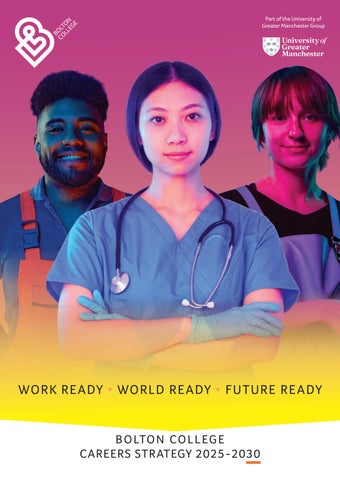
Careers Strategy

Page 1


CONTENTS

Scope and Purpose Page 3

Strategic Vision Page 6

Strategic Approach to Careers Education Page 7

Gatsby Benchmarks: What You Will Find at Bolton College Page 10

Evidence, Data Logging and Gatsby

Audit Framework Page 18

Roles and Responsibilities Page 18

Quality Assurance, Monitoring and Improvement Page 20

Strategic Review and Governance Page 21

1. SCOPE AND PURPOSE

Bolton College is committed to delivering high-quality Careers Education, Information, Advice and Guidance (CEIAG) for all learners and apprentices, enabling them to progress into sustainable education, training and employment. This Careers Strategy applies to:

• All learners aged 16–19.

• Learners aged up to 24 with an Education, Health and Care Plan (EHCP).

• Adult learners and apprentices.

• Applicants accessing careers support through admissions and pre-entry activity

The strategy sets out how Bolton College meets its statutory duties and national expectations for careers guidance and is fully aligned to:

• Department for Education statutory guidance.

• The Gatsby Benchmarks.

• Careers & Enterprise Company (CEC) strategic planning principles.

• Ofsted’s Further Education and Skills Inspection Toolkit (FESIT), with particular reference to inclusion, curriculum teaching and training and participation and development, including learner destinations.

Careers provision at Bolton College is delivered through a whole-college model, bringing together careers professionals, curriculum teams, employer engagement, enrichment and student services.

Pre-entry and Admissions Stage

CEIAG

Bolton College provides careers guidance and information at the admissions stage to ensure prospective learners make informed choices. This includes:

• School liaison and outreach, including assemblies, workshops, apprenticeship information sessions, and events for prospective learners.

• Open evenings, taster sessions, and sampling events to provide insights into courses and career pathways.

• One-to-one conversations at school, in college, or virtually for adult applicants, including guidance for those returning to learning.

• Guidance for applicants who do not meet entry requirements, are unsure of their course choice, or have previously withdrawn.

• Parental and carer involvement in guidance sessions for learners aged 16–18 and those with EHCPs, supporting confident decisionmaking.

• For learners with EHCPs or high needs, our Transition Liaison Officers attend planning meetings with the individual, local authorities and parents/carers whenever Bolton College is being considered as a progression option. This ensures early careers discussions and a smooth transition to college, including supported visits, additional induction, and tailored taster days.

Careers Information Advice and Guidance (CIAG) whilst on programme

Whilst learners and apprentices are on programme, we ensure that statutory Careers Education, Information, Advice and Guidance (CEIAG) requirements are fully met and that the Gatsby Benchmarks, outlined in Section 4, are embedded throughout delivery. This ensures all learners are continually supported to explore, understand and access a wide range of progression options, career opportunities and pathways. Our approach also includes early progression planning each January and the logging of destination data so that every individual is supported effectively with their next steps. Career-focused questions are built into Right Course Reviews, academic reviews and apprenticeship progress reviews to ensure learners and apprentices are consistently making progress towards their career aspirations.

The Bolton College Schools Engagement Team works with local schools to deliver early careers guidance, progression information and awareness of post-16 pathways, supporting young people to make informed choices.

Parental / Carer Involvement

Parents and carers are encouraged to participate in careers guidance and progression planning prior to starting and whilst on programme at the college:

• Attending one-to-one careers guidance appointments for learners aged 16–18 or with EHCPs up to age 25.

• Engaging with workshops and information sessions linked to progression to further education, higher education, apprenticeships, and employment.

• Collaborating with college staff to provide a supportive framework that enables learners to make informed, realistic choices about their future.

2. STRATEGIC VISION

Bolton College’s careers strategy is underpinned by the college’s overarching vision that learners are:

• Work Ready – equipped with the skills, behaviours and experiences employers need.

• World Ready – informed about opportunities, pathways and labour market change.

• Future Ready – confident, adaptable and able to make informed decisions throughout life.

Careers education contributes directly to learners’ personal development, employability, confidence and readiness for next steps, supporting positive behaviour, attendance, aspiration and sustained progression.

CEIAG is a core driver of social mobility, progression and learner success. It supports learners to:

• Understand their options.

• Raise aspirations.

• Overcome barriers.

• Make confident, informed and realistic decisions about their future.

Fiona Fung from Bolton Film Office delivered a sector insight session to Media learners, outlining industry pathways, local production opportunities and the skills required within the screen and creative industries.

3. STRATEGIC APPROACH TO CAREERS EDUCATION

In line with Careers & Enterprise Company guidance, Bolton College adopts a planned, evidence-led and continuously improving approach to careers provision. This strategy is designed to:

• Be stable, visible and embedded across the college.

• Respond to learner need and local labour market priorities.

• Support curriculum alignment with employer demand.

• Strengthen tracking, evidence and accountability in a complex FE environment

We recognise that, unlike schools, Further Education learners often engage with multiple pathways, systems and teams. Our strategic focus is therefore not only on delivery, but on improving how careers activity is:

• Coordinated

• Recorded

• Evaluated

• Used to drive improvement

Impact is measured not only through participation in careers activity, but through learner progression, sustained destinations and the quality of next steps. Destination data is analysed at cohort level, including by age, programme type, SEND status and disadvantage, to identify patterns, strengths and areas for targeted improvement. This ensures careers provision supports positive, realistic and sustained outcomes aligned to individual learner goals and labour market opportunity.

Strategic Priorities 2025–2030

Bolton College recognises that delivering highquality CEIAG in a further education environment is complex, involving multiple learner pathways, systems, teams and transition points. While the college already delivers a broad and inclusive careers programme, this strategy focuses on strengthening consistency, impact and evidence over time.

The following strategic priorities set the direction for careers provision between 2025 and 2030. They are designed to address identified challenges within the FE context and to ensure careers education continues to evolve in response to learner need, labour market change and national expectations.

Strategic Priority 1: Consistency and Equity of Access

To ensure that all learners, regardless of age, programme, pathway or starting point, experience consistent, high-quality careers education, information, advice and guidance throughout their learner journey.

This includes:

• Access to personal guidance at key transition points.

• Parity of experience across full-time learners, apprentices and adult provision.

• Targeted support for learners with EHCPs, SEND, care experience or other barriers.

• Clear, accessible communication of the careers programme and learner entitlement.

Strategic Priority 2: Strengthening Recording, Tracking and Evidence of Impact

To improve how careers activity, personal guidance and employer encounters are recorded, tracked and evaluated across multiple systems, enabling clearer evidence of learner impact and outcomes. This priority focuses on:

• Ensuring consistency in data capture across careers, curriculum and enrichment activity.

• Using Gatsby audits, destination data and learner feedback to identify strengths and continuous improvement.

• Strengthening the use of evidence to inform quality improvement and strategic decisionmaking.

• Supporting team members to understand their role in evidencing careers learning and impact.

Strategic Priority 3: Embedding Careers Deeply Within Curriculum Delivery

To ensure integration of careers education within teaching and learning so that learners clearly understand how their programme links to progression routes, employment opportunities and labour market demand.

This includes:

• Supporting curriculum teams to embed careers learning, employer insight and transferable skills.

• Strengthening collaboration between careers professionals and curriculum staff.

• Empowering learner reflection on careers learning and progression planning.

• Ensuring careers education is meaningful, contextualised and relevant to subject areas.

Strategic Priority 4: Improving Progression Quality and Sustained Destinations

To ensure the quality, suitability and sustainability of learner destinations through earlier intervention, targeted guidance and enhanced destination tracking.

This priority aims to:

• Support learners to make informed, realistic and aspirational choices.

• Reduce mismatched progression and early withdrawal from next steps.

• Use destination analysis to identify trends and inform targeted support.

• Strengthen preparation for progression into higher education, apprenticeships, employment or further training.

Monitoring and Review

Progress against these strategic priorities is reviewed termly and annually through: •

• Termly returns of Compass Evaluation Tool Questionnaire.

• Gatsby Benchmark audits.

• Learner feedback and evaluation.

• Progression and destination data analysis.

• Quality assurance and self-assessment processes.

Findings are used to inform ongoing development of the careers programme and to ensure the strategy remains responsive, deliverable and impactful.

Teegan Moran achieved a Distinction in her Health T Level and has progressed to the University of Salford to study Adult Nursing. Her journey demonstrates high academic achievement alongside clear progression into a professional healthcare pathway.

Osama Omar achieved Triple Distinction* in his Level 3 BTEC Diploma in Computing, the highest possible grade. He has progressed to Manchester Metropolitan University to study Cybersecurity. His achievement reflects successful progression into a specialist higher education pathway aligned to industry demand.

4. GATSBY BENCHMARKS: WHAT YOU WILL FIND AT BOLTON COLLEGE

The Gatsby Benchmarks form the organising framework for CEIAG at Bolton College. Rather than acting as a checklist, they describe what learners, team members and stakeholders can expect to see in practice.

Benchmark 1: A Stable Careers Programme

At Bolton College, learners and apprentices will find a clearly defined and accessible careers programme that is embedded across adult learning and study programmes, and apprenticeships.

The programme:

After completing his Engineering BTEC Level 3 Extended Diploma, Mohammed secured a Level 3 IT Solutions Technician Apprenticeship with Computer Systems in Education (CSE) Ltd. With support from the Employer Engagement Team and Job Shop service, he received targeted interview preparation and employer brokerage, resulting in successful progression into employment.

• Is led by a named Careers Leader.

• Is overseen through a cross-college CEIAG steering group.

• Is reviewed regularly to ensure relevance and impact.

Learner feedback and experience inform the ongoing development of the careers programme. Insight gathered through surveys, focus groups, guidance feedback and destination reviews is used to refine delivery, improve accessibility and ensure the programme remains responsive to learner need.

Evidence and tracking

Careers programme delivery and quality are evidenced through:

Click above to view video

• Published careers strategy and programme.

• Steering group minutes and action plans.

• CIAG meeting logs with individuals

• Team member CPD records

• Termly Gatsby Benchmark audits

Benchmark 2: Learning from Career and Labour Market Information (LMI)

Learners and apprentices are supported to understand how labour market information (LMI) relates to their current studies and future choices.

At Bolton College, learners encounter:

• Local and regional LMI aligned to Bolton and Greater Manchester priorities

• Sector-specific LMI embedded into tutorials, curriculum delivery and guidance

• Employer insight that reflects real labour market demand

LMI is used not just to inform learners, but to shape curriculum-employer alignment and careers planning at a strategic level.

Evidence and tracking

LMI use is evidenced through:

• Strategic business planning activity

• Curriculum and tutorial resources

• Learner activities and reflections

• Employer engagement records

• Careers guidance notes

Benchmark 3: Addressing the Needs of Each Learner

Careers provision at Bolton College is inclusive, personalised and responsive to individual need.

Learners can access:

• One-to-one careers guidance at key transition points.

• Targeted support for learners facing barriers, including SEND, care-experienced and disadvantaged learners.

• Clear referral routes to specialist internal and external services where appropriate.

We recognise that learners’ and apprentices’ careers needs develop over time. Our focus is on building a joined-up approach between careers, curriculum and student support teams to ensure no learner is overlooked. Learner voice is central to this approach, with feedback used to identify barriers, refine support and shape targeted interventions at individual and cohort level.

Evidence

and tracking

Evidence includes:

• Guidance session records

• Intervention and referral logs

• Progression and destination data by cohort

• Termly Gatsby audit identifying gaps in reach or impact

Educational Practitioner Nurses from North Manchester General Hospital delivered a sector insight session to Healthcare learners, sharing professional journeys, frontline experience and progression routes into nursing.

Benchmark 4: Linking Curriculum Learning to Careers

Careers education at Bolton College is embedded within curriculum delivery rather than delivered in isolation.

Learners and apprentices will experience:

• Clear links between their subject, progression routes and employment opportunities

• Employer-informed learning activities and real-world context

• Curriculum teams working with careers’ team members to highlight transferable skills and career pathways

Curriculum teams are supported to develop confidence and consistency in embedding careers into teaching and learning.

Evidence and monitoring

Evidence is drawn from:

• Curriculum plans and schemes of learning/ training plans

• Employer-linked learning activities

• Team member CPD records

• Learner reflections and feedback

Benchmark 5: Encounters with Employers and Employees

Bolton College ensures learners and apprentices have access to meaningful encounters with employers that broaden understanding and raise aspirations.

Learners will find:

• Employer interviews, visits, insights, panels and workshops

• Opportunities to engage with a range of sectors and roles

• Encounters that reflect local labour market needs as well as emerging industries

Employer engagement is coordinated to ensure quality, relevance and equity of access across curriculum areas.

Click above to view video

Evidence and monitoring

Evidence includes:

• Employer engagement records

• Industry insight log

• Attendance and participation data

• Employer and learner feedback

• Mapping of encounters across learner groups

Benchmark 6: Experiences of Workplaces

Learners and apprentices at Bolton College are supported to access high-quality experiences of the workplace that complement their programme of study.

This includes:

• Physical, virtual and project-based work experience.

• Flexible models to support learners with constraints or additional needs.

• Clear preparation and reflection to maximise impact.

Work experience is viewed as a developmental process, not a single event.

Evidence and monitoring

Evidence is maintained through:

• Placement and experience records.

• Learner reflections.

• Employer feedback.

• Completion and quality measures.

Benchmark 7: Encounters with Further and Higher Education

Learners and apprentices receive impartial and comprehensive information about all progression routes.

They will find:

• Information about further education, higher education, apprenticeships, further training and employment.

• Opportunities to engage with other further education providers, universities, training providers and apprenticeship employers.

• Support to understand entry requirements and progression pathways.

Careers guidance supports learners to weigh options and make decisions aligned to their goals and circumstances.

Evidence and monitoring

Evidence includes:

• Event and engagement records.

• Guidance session outcomes.

• Progression data and destinations.

Our Level 3 Year 2 Health and Social Care learners welcomed Lucy Lilley Blackman, Social Worker at Bury Council, who shared valuable insight into the realities of social work. From daily responsibilities to progression routes, the session gave learners a clear understanding of the profession and concluded with a thoughtful Q&A.

Benchmark 8: Personal Guidance

Personal guidance is a core entitlement for learners and apprentices at Bolton College.

Learners and apprentices will find:

• Access to one-to-one careers guidance delivered by appropriately trained staff.

• Guidance that is impartial, confidential and focused on long-term progression.

• Follow-up support to help translate decisions into actions.

We continue to strengthen the consistency, recording and evaluation of guidance to better evidence impact across the learner journey. Learners and apprentices are encouraged to reflect on guidance received and provide feedback, which contributes to service improvement and helps strengthen the consistency and quality of personal guidance across the college.

Ewan progressed from a motor vehicle course to university and is now completing postgraduate study in Motorsport Engineering at the University of Greater Manchester.

With structured support from the Bolton College Careers Team, he developed his personal statement, CV and higher education applications. He now returns to college to advise current learners on progression routes, demonstrating sustained destination success and the long-term impact of effective careers guidance.

Evidence and monitoring

Evidence is captured through:

• Guidance records

• Follow-up actions and outcomes

• Learner satisfaction and confidence measures

Learner Entitlement Statement

All learners and apprentices at Bolton College are entitled to:

• Accurate, impartial careers information and guidance aligned with the Gatsby Benchmarks.

• One-to-one guidance at key transitions (progression to higher education, apprenticeships, employment, or further training).

• Support to develop employability skills, CVs, applications, personal statements, and finance applications.

• Participation in employer encounters, workplace experiences, enrichment activities, and meaningful industry projects.

• Differentiated support for learners with EHCPs, SEND, or other barriers.

• Confidential guidance that is recorded for reflection and future planning.

Policing and Public Serviceslearners attended a criminology taster session at the University of Greater Manchester’s School of Law. The session provided insight into degree-level study and clarified progression routes into higher education and related careers.

5. EVIDENCE, DATA LOGGING AND GATSBY AUDIT FRAMEWORK

Bolton College recognises the challenge of evidencing CEIAG across multiple systems and learner journeys.

To address this, a termly Gatsby Benchmark audit is undertaken by the Careers Team in collaboration with curriculum, enrichment and student services teams.

Evidence is drawn from:

• Navigate (guidance and careers interactions)

• ProMonitor (tutorials, curriculum-linked careers activity, CPD)

• Moodle/VLE (resources, activities, learner reflections)

• Manual tracking tools (events, employer encounters)

• Badge readers (where available) Audit outcomes are:

• RAG-rated against each Gatsby Benchmark

• Used to identify gaps in delivery or evidence

• Reported to the Executive Team, Delivery Team Leaders and Governors

6. ROLES AND RESPONSIBILITIES

Careers education, information, advice and guidance at Bolton College is delivered through a shared, whole-college responsibility model. While leadership and coordination sit within the Careers Team, the quality and impact of CEIAG relies on effective collaboration between leaders and managers, curriculum teams, student services, employer engagement and enrichment. Clear roles, accountability and communication ensure careers provision is consistent, inclusive and aligned with strategic priorities.

Paul Heath from FiveZero delivered a sector insight session to first-year Sports learners, outlining progression opportunities in the United States and pathways within international sport. The session broadened learners’ understanding of global career routes and supported exploration of alternative progression options.

The Governing Board:

• Holds the college to account for the effectiveness and impact of the Careers Strategy.

• Receives assurance on learner progression, destinations and compliance with statutory guidance.

The Executive Team:

• Appoints a named Careers Leader with strategic oversight of CEIAG.

• Ensures sufficient staffing, resources and systems are in place to deliver high-quality careers provision.

• Monitors learner progression and destination outcomes as part of strategic performance review.

The Careers Leader:

• Leads the strategic development, implementation and review of CEIAG.

• Oversees alignment with the Gatsby Benchmarks and statutory guidance.

• Chairs or contributes to cross-college CEIAG governance and quality assurance activity.

• Uses destination data, learner feedback and Gatsby audit findings to drive continuous improvement.

• Ensures publication requirements are met and careers provision is visible, accessible and understood.

In recognition of the scale and complexity of FE careers delivery, the Careers Leader works with leaders and managers to monitor capacity, workload and system effectiveness. Where gaps are identified, mitigating actions are planned through resourcing, staff development, system refinement or revised delivery models.

The Careers Team:

• Delivers impartial, confidential careers education, information, advice and guidance.

• Records and evidences careers activity accurately across agreed systems.

• Works in partnership with curriculum teams to embed and track careers learning.

• Contributes to Gatsby Benchmark audits and quality improvement activity.

• Supports learners at key transition points, including progression and exit.

Staff Qualifications and Professional Development

• Careers Advisors are qualified to Level 6 in Careers Guidance or are actively working towards this qualification.

• Ongoing CPD ensures staff remain up to date with labour market information, statutory guidance, safeguarding and inclusive practice.

Curriculum staff:

• Embed careers learning and employability skills within teaching and learning.

• Make timely referrals to careers support where additional guidance is required.

• Support learners to reflect on careers activity and progression planning.

• Contribute evidence of careers learning through curriculum delivery.

Employer Engagement and Enrichment Teams:

• Broker meaningful employer encounters and workplace experiences.

• Ensure engagement aligns with curriculum, learner need and labour market priorities.

• Provide evidence, feedback and participation data to support careers tracking and evaluation.

Bolton College learners supported the SheInspires Awards as part of their work experience, gaining valuable insight into a high-profile event that celebrates and empowers women across the UK.

7. QUALITY ASSURANCE, MONITORING AND IMPROVEMENT

The quality, consistency and impact of Careers Education, Information, Advice and Guidance (CEIAG) at Bolton College are monitored through an ongoing cycle of evaluation and quality assurance. This ensures that careers provision remains effective, inclusive, and responsive to learner needs, while supporting continuous improvement across the college.

Monitoring and evaluation are undertaken through:

• Termly return of evaluation within the Compass Evaluation Tool

• Termly Gatsby Benchmark audits to assess delivery and evidence against each benchmark

• Destination and progression data to review the quality, suitability, and sustainability of learner outcomes

• Learner and employer feedback to evaluate the relevance and impact of careers provision

• Annual self-assessment and quality improvement planning (QIP) to identify strengths, areas for development, and emerging priorities

• Analysis of sustained destinations and progression quality to inform curriculum planning, targeted interventions, and strategic improvement

Findings from these activities are used to drive improvements in delivery, staff practice, employer engagement, and learner support. They also inform CPD planning, Gatsby audit follow-up, and enhancements to the tracking and recording of CEIAG activity across all pathways.

8. STRATEGIC REVIEW AND GOVERNANCE

This Careers Strategy provides the long-term framework for CEIAG at Bolton College. It is formally reviewed on an annual basis to ensure that it continues to reflect:

• National guidance, including statutory requirements and the Gatsby Benchmarks

• Labour market developments and employer needs

• The college’s strategic vision of learners being Work Ready, World Ready, and Future Ready

• Internal capacity, systems, and operational effectiveness

The review process is led by the Careers Leader in collaboration with the Executive Team and is reported to the Governing Board. Strategic review activities include:

• Ensuring alignment of CEIAG delivery with college priorities and learner needs.

• Assessing the effectiveness of resources, staffing, and systems.

• Incorporating insights from QA monitoring, Gatsby audits, and learner feedback.

• Updating strategic priorities and actions to maintain relevance and impact.

Through this structured governance and review process, the strategy remains live, deliverable, and impactful, providing assurance that all learners continue to receive the guidance and support they require to make informed decisions about their future.

Turn static files into dynamic content formats.

Create a flipbook