ACCC
Issue 1, 2026 Spring
QUARTERLY
President’s Message Fellow members:
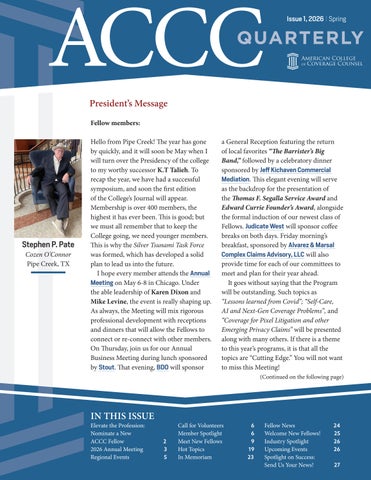
Stephen P. Pate Cozen O'Connor Pipe Creek, TX
Hello from Pipe Creek! The year has gone by quickly, and it will soon be May when I will turn over the Presidency of the college to my worthy successor K.T Talieh. To recap the year, we have had a successful symposium, and soon the first edition of the College’s Journal will appear. Membership is over 400 members, the highest it has ever been. This is good; but we must all remember that to keep the College going, we need younger members. This is why the Silver Tsunami Task Force was formed, which has developed a solid plan to lead us into the future. I hope every member attends the Annual Meeting on May 6-8 in Chicago. Under the able leadership of Karen Dixon and Mike Levine, the event is really shaping up. As always, the Meeting will mix rigorous professional development with receptions and dinners that will allow the Fellows to connect or re-connect with other members. On Thursday, join us for our Annual Business Meeting during lunch sponsored by Stout. That evening, BDO will sponsor
a General Reception featuring the return of local favorites “The Barrister’s Big Band,” followed by a celebratory dinner sponsored by Jeff Kichaven Commercial Mediation. This elegant evening will serve as the backdrop for the presentation of the Thomas F. Segalla Service Award and Edward Currie Founder’s Award, alongside the formal induction of our newest class of Fellows. Judicate West will sponsor coffee breaks on both days. Friday morning’s breakfast, sponsored by Alvarez & Marsal Complex Claims Advisory, LLC will also provide time for each of our committees to meet and plan for their year ahead. It goes without saying that the Program will be outstanding. Such topics as “Lessons learned from Covid”; “Self-Care, AI and Next-Gen Coverage Problems”, and “Coverage for Pixel Litigation and other Emerging Privacy Claims” will be presented along with many others. If there is a theme to this year’s programs, it is that all the topics are “Cutting Edge.” You will not want to miss this Meeting! (Continued on the following page)
IN THIS ISSUE
Elevate the Profession: Nominate a New ACCC Fellow 2026 Annual Meeting Regional Events
2 3 5
Call for Volunteers Member Spotlight Meet New Fellows Hot Topics In Memoriam
6 6 9 19 23
Fellow News Welcome New Fellows! Industry Spotlight Upcoming Events Spotlight on Success: Send Us Your News!
24 25 26 26 27
President’s Message (Continued) (Continued from the following page)
Now for a personal note. It has been the honor of my life to serve as President of this organization. Beyond the
professional development, I have formed many deep friendships with other Fellows. Turning over the gavel to K.T. will not be the end for me. I will continue
to be active for many years to come. Thank you and see you in Chicago. Stephen Pate
Elevate the Profession: Nominate a New ACCC Fellow The prestige of the American College of Coverage Counsel is built entirely upon the caliber of its members. As we grow, we rely on you - our current Fellows - to identify the next generation of leaders in insurance coverage, bad faith, and extracontractual claims law. Do you know a practitioner who belongs among the best in the field? Now is the time to submit your nomination.
Qualifications at a Glance To maintain our high standards, all nominees must meet the following criteria: ` Experience: A minimum of 15 consecutive years in insurance law (May include time served as a judge or clerk). ` Focus: A practice concentrated primarily in insurance coverage or extracontractual claims in the U.S., Canada, or Bermuda. ` Independence: The nominator must be an ACCC Fellow not affiliated with the nominee’s firm.
A Simple, Confidential Process To protect the integrity of the process and the privacy of the candidates, nominations are handled discreetly: 1. E mail: Send the nominee’s name, contact info, and a link to their professional bio to membership@americancollegecoverage.org. 2. V etting: The Membership Committee will conduct a confidential review and contact local references. 3. Invitation: Candidates should not be informed of their nomination; the Committee will extend an official invitation only after the initial vetting is successful. Help us ensure the College remains the premier home for the most distinguished practitioners in our field. Submit your nomination today.
2
Issue 1, 2026
Spring
ACCC QUARTERLY
2026 Annual Meeting By Conference Planning Committee Co-Chairs:
Save the Date – May 6-8, 2026, for the 14th Annual Meeting of the American College of Coverage Counsel Register now for the 14th Annual
Meeting of the American College of Coverage Counsel at the InterContinental Hotel on Chicago’s Magnificent Mile! Brought to you by Planning Committee Co-Chairs, Karen Dixon and Michael Levine. It’s time once again for our Annual Meeting, where Fellows can connect, reconnect and learn from
the field’s preeminent practitioners on spectrum-wide subjects impacting the practice of insurance coverage law. And, by popular demand, we will kick off our Thursday evening festivities with John Vishneski’s The Barristers Big Band, featuring 20 instrumentalists and 5 vocalists!
Karen M. Dixon Skarzynski Marick & Black LLP Chicago, IL
(Continued on the following page)
Michael S. Levine Hunton Andrews Kurth LLP Washington, DC
ACCC QUARTERLY
Spring
Issue 1, 2026
3
What’s more, the Meeting will be punctuated with two days of cutting-edge substantive presentations led by ACCCmember counsel, arbitrators, mediators and professors, to include: ` Lessons Learned from COVID; Lorie Masters and Laura Foggan. ` Extracontractual Exposure Through Unfair Claim Settlements Practices Act: Recent Developments in Rulings, Trends and Strategy; James Bryan, Suzan Charlton, Julia Molander, and Professor Jeffrey Stemple. ` Coverage for Pixel Litigation and Other Emerging Privacy Claims; Darren Teshima, , Adam Fleischer, Jim Ruggeri, and Erika Villanueva. ` The Erosion of the Mediation Privilege; John Bonnie, Neil Posner, and Marialuisa Gallozzi. ` Is Permitted Pollution Really “Pollution”? The Illinois Supreme Court is About to Let Us Know; Brian Bassett, Dena Economou, Angela Elbert, and John Vishneski
` Insurance for Autonomous Vehicles: What Will Drive Those Risks?; John Buchanan, Lara Cassidy, and Professor Mark Geistfeld ` Coverage Issues for TVPRA/ Human Trafficking Claims; James Carter and Nancy Adams ` Self-Care, AI, and Next-Gen Coverage Problems; Mary Borja, Jeff Bowen, Micah Skidmore and Professor Harold Weston ` Navigating the Tripartite Minefield: Tactical and Ethical Issues Posed by the Duties to Defend and Cooperate (Ethics CLE); Beth Bradley, Evan Knott, Emily Garrison, and Jamie Sanders ` Navigating Disclosures and Conflicts in Insurance Arbitrations and Mediations: Ethical and Practical Considerations to Ensure the Neutrality of Your Neutral and Enforceability of Your Award or Settlement; Tyler Gerking, Peter Halprin, Jean Lawler, and Ellen Van Meir
Registered Annual Meeting attendees will obtain approximately 8-10 hrs. of CLE credits, including 2 hrs. of ethics credit (Subject to state accreditors’ receipt and review of program materials). Conference registration is open,
with an April 14, 2026 at 5 pm CT deadline to obtain the InterContinental’s $329/night reduced conference rate (or when
the room block is sold out).
2026 Annual Conference Co-Chairs: Karen Dixon, kdixon@skarzynski.com
Mike Levine, mlevine@HuntonAK.com
2026 Annual Conference Vice Co-Chairs: Christina May Bolin, cmbolin@csattorneys.com
Vince Morgan, vmorgan@winstead.com
Thank you to our conference sponsors for their generous support:
4
Issue 1, 2026
Spring
ACCC QUARTERLY
Regional Events One of the best aspects of the American College of Coverage Counsel is the ability to meet and interact with other Fellows in the College. While these opportunities abound during the College’s signature events such as the Annual Meeting and the Law School Symposium, the College also encourages Fellows to get together outside of these events. This is why the College supports Regional Meet Ups. The idea is to provide an additional opportunity for ACCC Fellows to meet during the year to network, expand potential referral sources, and to keep the College’s creative juices flowing. Fellows from various cities/jurisdictions can volunteer to serve as hosts, and organize a reception at a central location, either in a law firm’s conference room, restaurant or bar. In late 2025 we had several ACCC Regional Meet Ups. Fellows were able to get together in Dallas (hosted by Beth Bradley and Amy Stewart) and Atlanta (hosted by John Bonnie and Tucker Ely). Thank you to the organizers of these events! More Meet Ups are being planned in cities for 2026. If you are interested in hosting an event, please reach out to the Regional Meet Up cochairs, Michael Hamilton (mhamilton@goldbergsegalla.com) and Chris Mosley (cmosley@reedsmith.com).
ACCC Fellows from Georgia gathered on Thursday, November 20 at Pastificio Italian Restaurant in Atlanta. Front row, left to right: Paul Fields, Larry Bracken, Seth Freidman, Caroline Spangenberg, Wayne Taylor, Steve Rapp. Back row, left to right: John Bonnie, Tucker Ely, Mike Johnson, Alycen Moss. Not pictured (but in attendance): Hal Weston.
Fellows in the Dallas/Ft. Worth Region met on December 4, at State & Allen. Pictured left to right are: Beth Bradley, Micah Skidmore, Jody Stasney, Bob Allen, Harrison Yoss, Rick Harmon, Amy Stewart, and David Taubenfeld.
Michael Hamilton
Christopher R. Mosley
Goldberg Segalla Philadelphia, PA
Reed Smith LLP Denver, CO
To assist with invitations, hosts can obtain a list of local Fellows in their area either through ACCC staff (info@americancollegecoverage.org) or the ACCC website Member Directory. The ACCC has also
approved a reimbursement stipend for each Meet Up, to assist in offsetting costs. Chris and Michael look forward to seeing more ACCC networking events throughout the country in 2026!
ACCC QUARTERLY
Spring
Issue 1, 2026
5
Call For Volunteers
Spring Into Action: Elevate Your ACCC Membership! The arrival of spring often signals a time for growth and renewed energy. For the ACCC, that energy is fueled by the collaboration of our Fellows. While our annual meeting provides the spark, it is our committees that keep the fire burning all year long. As we look toward the remainder of 2026, there has never been a more critical time to lend your voice to the conversation. Whether you are a seasoned veteran of the College or a newer Fellow, joining a committee is the most effective way to shape the future of insurance law and build lasting professional bonds.
Find Your Focus Our committees are the “engine room” of the College, producing the scholarship, programming, and dialogues that define our industry. Where does your expertise lie? ` ADR ` Extracontractual and Bad-Faith Claims Litigation ` CGL/Excess Liability Insurance ` First-Party Insurance ` Communications ` Outreach & Regional Meetings ` Cyber, Computer & Emerging Issues ` Pop-Up Dialogues ` D&O Management & Professional Liability ` Professionalism and Ethics Our Committee Co-Chairs are currently seeking enthusiastic volunteers to help plan upcoming initiatives and contribute to our efforts. No matter your schedule, there is a place for your contribution.
Don’t Wait to Make Your Voice Heard The strength of the College is entirely dependent on the engagement of its Fellows. Let this spring be the season you move from the sidelines to the center of the action. Press Here to Volunteer Now!
Questions? If you’re unsure which committee is the right fit for you, reach out to us at info@americancollegecoverage.org. We would be happy to help you find your place within the College.
Member Spotlight By Bob Allen, The Allen Law Group, Dallas, TX Mitchell Dolin grew up in a to Washington, D.C., the city small town in a largely rural President Kennedy described as county in Georgia. He went combining southern efficiency north for college and law school, with northern charm. returned south to clerk for a Fifth Mitchell always knew that he Circuit judge, and then moved was going to be a lawyer. When
6
Issue 1, 2026
Spring
ACCC QUARTERLY
he was growing up, lawyers were less pervasive and provided largely positive role models, whether in real life or as depicted on the screen. Some of the lawyers serving as members or staff on the House
Mitchell F. Dolin Covington & Burling LLP Washington, DC
Judiciary Committee’s Nixon impeachment inquiry made a particular impression on Mitchell as he headed off to college. He appreciated the analytical rigor and advocacy skills required of lawyers and assumed that a career in law would offer a measure of independence and plenty of challenges. After a one-year judicial clerkship, Mitchell re-joined Covington in 1982, having been a summer associate there earlier. 44 years later, he still has the same direct dial phone number and the same measure of professional satisfaction. On his first day of work, Mitchell was assigned to spend half of his time on the California Coordinated Asbestos Insurance Coverage Cases. Because of the expedited pretrial schedule, the litigation presented terrific opportunities for young associates.
Mitchell took and defended a couple of dozen depositions, argued motions before Judge Ira Brown in his massive makeshift courtroom, and eventually worked on his client’s participation in the Wellington Agreement. His experience working with the directors of the entity created by the Wellington Agreement gave Mitchell the opportunity to interact in a non-adversarial setting with insurance industry executives. Claude Glaser, who represented Hartford in that process, was nearing the end of a very long career. One day, Mitchell asked him whether he had ever interacted with Wallace Stevens, the poet who doubled as a Hartford executive. Claude was visibly delighted by the question, understandably once he told Michell that he had inherited Stevens’s old office. Mitchell ended up litigating many cases against Hartford but never lost sight of its history and greatly admired many of its outside lawyers, particularly the late Bill Bowman. Mitchell finds the alwayschanging topics and the emergence of arbitration and mediation as profound changes in his practice over the years. He started litigating large-scale general liability insurance claims, but then saw his docket increasingly include one-off coverage matters like the Exxon Valdez grounding and the World Trade Center terror attacks.
Over the last twenty years, Mitchell’s work has included coverage for: claims against a leading ratings agency arising out of financial crisis; pharmaceutical mass torts subject to Bermuda form policy terms; neurodegenerative injuries alleged to arise from participation in professional sports; multiple antitrust class actions against a leading university; and litigation and other proceedings against consulting, law, and professional services firms under errors-and-omissions insurance policies. The variety of subject matters, clients, and dispute resolution venues has far surpassed what Mitchell expected when he started his practice. Mitchell also thinks that the expansion of mediation and arbitration has been profound. He started working on coverage mediations in the late 1980s, and while he considers himself as a litigator first, he has always been a fan of mediation and of working with mediators that he has known for years as well as mediators who are new to him. Mitchell is also a fan of unmediated negotiations, where lawyers and clients must try to find their way to resolution without the safety net of mediation. As for arbitration, that’s also been a constant throughout much of Michell’s career, but obviously more so over the past 25 years. Mitchell has handled coverage litigation in more than twenty (Continued on the following page)
ACCC QUARTERLY
Spring
Issue 1, 2026
7
Member Spotlight (Continued) states and he has also worked on arbitral proceedings or advised on litigation outside of the United States. He has learned a lot in all those venues, however, he has a particular soft spot for Toledo, Ohio, where for over twenty years, Mitchell handled several coverage cases in state and federal court for Owens Corning, which is headquartered there. The judges of the Lucas
County Court of Common Pleas and the local federal court were excellent, and the size and cohesiveness of the bar made the experience quite rewarding for Mitchell. His memories of Toledo are in no small measure on account of the client, which entrusted him with first-chair responsibilities before and after Mitchell became a partner and for which Mitchell handled
By Bob Allen, The Allen Law Group, Dallas, TX Jodie Spencer, who rejoins the Jodie started her career at a College from a little layoff, grew litigation firm in Toledo, Ohio, up in a small town about an hour Cooper & Walinski, which is where outside of Cleveland. she discovered insurance coverage. Being a lawyer was always It was a great law firm to work at, in the back of her mind. She and she feels extremely fortunate always liked research, writing to have been able to learn from its and analysis and she always knew amazing attorneys who were also she would complete some kind just good people all around. of higher degree after college. It One of Jodi’s biggest and most wasn’t until Jodi completed her memorable cases was for a large first year of graduate school that corporate client enforcing insurance she decided to pull the trigger coverage rights under historical and go to law school. She was in policies for legacy asbestos claims. the school psychology program She was part of a small core and one of the courses was “law team, which was litigating five in education” and she took to it. separate coverage actions in four That is when it became clear to different states at the same time. Jodi what she wanted to do, so It consumed Jodi’s life for many she took the LSAT and switched years and was quite a ride! from grad school to law school. Over her career, Jodi is finding She didn’t know at the time that that it is becoming increasingly she would eventually become an difficult for policyholders – even insurance coverage attorney, but it corporate policyholders - to all worked out as it should. litigate claims due to cost and
8
Issue 1, 2026
Spring
ACCC QUARTERLY
numerous lawsuits, appeals, arbitrations, and mediations and served as special insurance counsel during the company’s successful Chapter 11 reorganization. Outside of his law practice, cycling is one of Mitchell’s passions including everything from riding to talking about riding to watching television coverage of the three Grand Tours each year.
Jodi D. Spencer Calfee, Halter & Griswold LLP Cleveland, OH
delay. In her experience, bad faith allegations used to be a stronger leverage point than they seem to be now. Also, insurance law has developed more clearly on a wide variety of issues, however, not necessarily in the policyholder’s favor. Jodi has been involved in coverage and bad faith litigation
in about a dozen or so different state and federal courts. Texas definitely stands out to her because things are done so much differently there than in the midwest, especially in the state courts.
As a mother of four children, Jodi’s family life keeps her quite occupied outside of the practice of law. When she finds time, Jodi enjoys soaking in as much nature as possible whether its
hiking, going to the beach or discovering a new park. She is also an avid event planner – she takes parties and events to a different level with games, themes and over-the-top décor.
Meet New Fellows By Seth H. Row, Stoel Rives LLP, Portland, OR Pete Dworjanyn is a Senior The developer settled early Counsel with Teague Campbell with a covenant judgment and in Columbia, South Carolina, that kicked off a large litigation representing insurers through stretching over many years. He counseling and litigation. spent four years as an Assistant Although he has spent his whole Solicitor in the 11th Circuit, life in South Carolina, his dad and then into private practice at is Ukrainian and his mom several firms in South Carolina. Australian. As he puts it: “it is an Pete observes that technology interesting story.” Ask him at the has become “an equalizer,” with Annual Meeting! electronic research and drafting After getting a liberal arts muting the advantages of a big firm. degree and law degree at However, technology cannot replace University of South Carolina, he experience and strategic thinking! went on to a state court clerkship Pete reports that having where he learned “many things provided coverage advice in not covered in law school.” His several states in the Southeast, first big insurance case centered South Carolina law is not the around a condo development worst state for insurers, “but it is with an OCIP and a large SIR. not the best, either.”
By Meghan Moore, Flaster Greenberg PC, Boca Raton, FL Michael Guadagno was born in Lured by a scholarship, Michael Tampa, Florida, but grew up in Texas left Texas for the University of after his parents moved there for Missouri, where he planned work. His father developed diagnostic to study engineering. Heavily tests for hospitals, and his mother involved in student government, was a Catholic school religion law was his natural fallback. After teacher. He jokes that he grew up what Michael describes as a “twowith “lots of science and religion.” year slow death” in engineering
Peter Dworjanyn Teague Campbell Columbia, SC
Pete is an avid backpacker! He reports that coming back from a trip with friends he is a happier person with a better appreciation for creature comforts.
studies yearning for human interaction, Michael pivoted. He attended Seattle University School of Law, graduating cum laude in 2003, while collecting his MBA. Michael’s success in mock trial during law school caught the eye (Continued on the following page)
ACCC QUARTERLY
Spring
Issue 1, 2026
9
Meet New Fellows (Continued) of his coaches and landed him a position at the Lee Smart law firm after graduation. Michael’s initiation into the real world of law was fast and furious. He was given his first case to try within 30 days, and the pace didn’t slow down from there. He attended in person hearings almost daily. After a few years, Michael joined Nicoll Black & Feig, where he cut his teeth and learned all things insurance coverage. One of Michael’s more memorable early cases was a product defect case involving M&M’s. Michael was appointed by an insurer to defend Masterfoods against allegations that an M&M’s package contained rocks and caused teeth damage. While Michael wasn’t able to convince the judge to toss the case on summary judgment, he was able to dissuade the claimant from proceeding to trial. Michael transitioned from defending insureds on behalf
of insurers to defending insurers in coverage disputes and bad faith litigation. He loved the transition, and it shows. Michael has successfully represented leading insurance and reinsurance companies in disputes involving a variety of claims and coverages. Michael and his team joined Kennedys in September of 2025. He describes Kennedys as “a nice big coverage focused firm that has a global reach and perspective.” He says the Seattle office is still somewhat new and remarks that: “It feels like we are a small shop with big firm resources.” Michael is licensed to practice law in Alaska, Idaho, Oregon, and Washington state. His advice for attorneys visiting Washington state is simple. “If you are going to practice in Washington state on the carrier side, be warned. If you are on the policyholder side, just show up.”
By Seth H. Row, Stoel Rives LLP, Portland, OR Jon Hardin is a partner at Perkins encouraged to go to law school Coie in its Washington, D.C. by his late grandfather, who was a office. Prior to joining Perkins college professor of State & Local in 2013, he was an associate Government and later a university at Covington & Burling and a president. He graduated from law clerk for the Hon. Bobby E. Vanderbilt Law School in 2008. Shepherd, U.S. Court of Appeals Jon’s first big insurance case was for the Eighth Circuit. He was when he was a junior associate
10
Issue 1, 2026
Spring
ACCC QUARTERLY
Michael A. Guadagno Kennedys Law LLP Seattle, WA
When asked about the most interesting thing he does outside the practice of law, Michael said: “Oh my goodness, how quickly can I bore everyone with that question. I am a father to two teenage daughters. They would say absolutely nothing.” But Michael admits he loves to travel. He and his family have enjoyed traveling throughout Europe, exploring historical sites.
and pursuing a bad faith claim in Missouri state court on behalf of Extended Stay hotels. He notes one fun fact from that case: the first deposition he ever participated in was in that case, and the deponent was former ACCC President Angela Elbert!
Jon has handled coverage disputes in eighteen different states. Of those, North Carolina is near and dear to his heart. He was counsel for the policyholder in the Radiator Specialty case for nearly ten years. The case went through discovery, motion hearings, and trial in the Charlotte area, and then oral arguments in the court of appeals and supreme court in Raleigh. He spent lots of time getting to know the local area
and forming relationships with the client, local counsel, and counsel for the insurers. Jon was born, raised, and went to college in Arkansas and considers Arkadelphia his hometown. Outside of work, Jon has two sons in elementary school, and he loves helping coach their Little League baseball teams. He’s also a music lover and tries to attend as many concerts as he can fit into his schedule.
By Michael L. Young, Reichardt Noce & Young LLC, St. Louis, MO For Joel Isenberg, insurance extensive federal court experience— coverage law was not a straight line— an environment that continues to but it was a natural progression. influence his practice today. “I got a “I’m from Birmingham, lot of experience litigating in federal Alabama and went away to college court. I have an affinity for it because to Tulane in New Orleans and that’s how I grew up learning.” came back here for law school Six years into practice, an and have stayed the whole time.” unexpected opportunity with a A third-generation attorney, Birmingham coverage firm shifted Isenberg’s professional path was his trajectory. “I was very frank shaped early. “Like a lot of people, with them that I had never picked I kind of went into the family up an insurance policy, probably business.” With a dentist father and had not even looked at my own multiple lawyers on his mother’s at that point.” Despite his lack of side, including his mother, he subject-matter experience, the firm made a pragmatic choice: “I didn’t took a chance on him. “They said, want to be a dentist, so I thought, “Look, we like you. We think you ‘This seems like a good path.’” can write. You know how to litigate After graduating from cases. It's just a different subject Cumberland School of Law at matter.” By 2001, he had fully Samford University in 1994, Isenberg transitioned into coverage work—a began his career in labor and field he has practiced ever since. employment litigation, primarily on Today, Isenberg represents the plaintiff side. The work provided insurers across Alabama and
Jonathan G. Hardin Perkins Coie LLP Washington, D.C.
Joel S. Isenberg Porterfield, Harper, Mills, Motlow & Ireland P.A. Birmingham, AL
neighboring states, including Georgia, Tennessee, and Mississippi. While most of his cases remain in Alabama, his multistate licensure reflects the regional nature of coverage practice and the importance of (Continued on the following page)
ACCC QUARTERLY
Spring
Issue 1, 2026
11
Meet New Fellows (Continued) trusted relationships. Over the years, he built and led his own firm for nearly two decades before joining his current firm Porterfield, Harper, Mills, Motlow & Ireland P.A. two years ago. One of his earliest memorable coverage cases set the tone for the complexity of the field. It involved a construction project where a wall collapsed, triggering significant injury claims and layered coverage disputes. “It was a really good introduction to so many things that we see sometimes in isolation, but other times altogether in these liability cases.” The case touched nearly every aspect of third-party liability coverage—multiple carriers, subcontractor tenders, defense and indemnity obligations— an immersive introduction to the interconnected nature of insurance litigation. According to Isenberg, that breadth remains one of coverage law’s defining features. “The issues can be across the board. I'm working on pollution cases now. I'm working on construction cases. I'm working on first-party
property cases. I'm working on death cases. Some are large, some are small, but they run the gamut.” While some view coverage counsel as peripheral to underlying litigation, Isenberg sees it differently. “My experience is other lawyers feel a little bit like we're the man behind the curtain.” In reality, coverage lawyers often shape the trajectory of major disputes—whether facilitating resolution or identifying dispositive policy language that changes the outcome. At its core, coverage practice demands precision. “A piece of advice I would give to new lawyers is to make sure to be incredibly detail oriented.” He underscores how even a single word can determine millions of dollars in exposure. “It can all come down to whether there's an ‘and’ or an ‘or’. All the details matter.” Looking ahead, Isenberg sees technological disruption—not doctrinal change—as one of the most significant challenges facing coverage lawyers. “I think it's AI. I know that's probably what lots of people talk about, but we talk
By Michael L. Young, Reichardt Noce & Young LLC, St. Louis, MO Laura Markovich’s journey to moved quite a bit due to my becoming a leading coverage father’s work. When I was lawyer began far from a single born, we lived in Baton Rouge, hometown. “Growing up, we Louisiana, after which he was
12
Issue 1, 2026
Spring
ACCC QUARTERLY
about it internally at the firm. I know clients are talking about it and they in turn are talking to us about it.” Artificial intelligence presents opportunity, but also risk. He comments that lawyers need to think about “using it in the right way and responsibly, and making sure you're communicating it with clients to make sure that everybody is on the same page with regard to whether to use it at all, how much to use it, and what are the types of things to use it for.” As client guidelines evolve and ethical considerations develop, managing AI thoughtfully will be critical. Outside the office, Isenberg finds balance in the outdoors. “I'm very fortunate for this too, but we have a cabin up on Lookout Mountain which is in northwest Georgia… it's about 30 minutes from Chattanooga, Tennessee.” Time there offers a reset from the demands of legal practice. “We spend so much time at our offices that getting out in nature a little bit helps you to refresh … so that you can look at more and more insurance policies.”
transferred quite a few more times through New Jersey, Virginia and New York. I ultimately went to high school in Fairfield,
Connecticut and following that lived in New York City for about thirty years. Although I’m back in Connecticut now, New York City will always feel like home.” That background of constant change gave Markovich an adaptable, global mindset — one that would serve her well throughout her career. Before law school, Markovich first worked outside the legal field. “In university, I got a business degree with special emphasis on the hospitality industry, with minors in international relations and art history. I started off as a manager in the hotel and restaurant industry, but in the course of doing that found myself drawn to the study of law. I went to law school and quickly fell in love with it,” she says. “A lot of my classmates bemoaned, ‘Why does [law school] have to be three years long?’, while I was disappointed we couldn’t fit more classes in!” After graduating from Brooklyn Law School, Markovich started her legal career in New York. It was at Ohrenstein & Brown where she first found her calling in directors and officers liability coverage. “I had the opportunity to learn from several fantastic litigators there who then introduced me to directors and officers liability,” she says. That experience led to a decade-long tenure at Sedgwick LLP, where she continued to grow her skills
and built a vast professional network. “I was very fortunate to learn from so many talented mentors there.” Today, Markovich is a partner at Skarzynski, Marick & Black LLP and a member of its Executive Committee. “I am privileged to work with a number of dynamic insurers around the globe.” “Approximately 70% to 75% of the cases I handle are venued in the US, while the others are based in Canada, Europe, Israel, Asia and Australia,” she says. Over time, Markovich has seen significant changes in coverage work. “As one example, I’m finding insureds are becoming more knowledgeable about directors and officers liability insurance and how critical it – and the expertise of their insurers – can be for their business,” she says. Years ago, there was some greater skepticism. Now, she sees a shift. “When claims arise, insureds and their insurers are not always aligned on every issue. However, the most successful matters now result from open, constructive and proactive communication between them, and their trusted partners, such as brokers and coverage counsel on both sides. Everyone wins when we find the best resolution of these cases together.” Markovich also recognizes new challenges facing the market. “One is the escalation of defense rates,” she says. “It forces a lot of
Laura K. Markovich Skarzynski Marick & Black LLP. New York, NY
constituencies to make decisions with increasing speed... We often find ourselves in a race to resolve something before the policies are fully eroded, often before defenses can be fully formed.” When asked what advice she’d give to a young lawyer just starting in the field, Markovich offers two points. “Become well versed in the many ways that insurance touches every business, and every community.” she says. “If there’s a particular area of the law that fascinates someone, insurance usually touches it in some vital way.” Her second piece of advice underscores versatility. “I so enjoyed litigating earlier in my career and would not be nearly as good at my job if I hadn’t litigated for as long as I had. However, there are many different hats to (Continued on the following page)
ACCC QUARTERLY
Spring
Issue 1, 2026
13
Meet New Fellows (Continued) wear beyond litigation, and it is essential that everyone finds the best fit for them. There is a role for everyone.”
Outside of her demanding career, Markovich’s greatest joy is rooted in family. “I’m so focused on raising my son,” she says. “He’s
By Meghan Moore, Flaster Greenberg PC, Boca Raton, FL Mina Matin was born in Wales, Mina Matin is as adventurous United Kingdom, where she as she is accomplished. She has fondly remembers growing twice hiked to Everest Base up surrounded by rolling hills Camp, run multiple marathons, blanketed in purple heather. and gone ice climbing in the She was an avid reader from French Alps. Despite her obvious an early age and is the only athleticism, she says “I am not a person I have met who can hiker” and admits to owning an pronounce the longest railway “abundance of cocktail dresses station in Great Britian and high heeled shoes.” LlanfairpwllgwyngyllgogerychwyMina started working on rndrobwllllantysiliogogogo. insurance cases as a barrister Mina’s interest in the law was and has continued to do so inspired by the Rumpole of successfully throughout her the Bailey, a British television career. Her most memorable case series created and written by from early in her career was the the British writer and barrister Sphere Drake Insurance Ltd v. John Mortimer. Impressed by Euro International Underwriting Rumpole’s zealous advocacy and Ltd, an action involving the firm ethics, Mina was naturally operation of a reinsurance drawn to pursue a career in law. market in the 1990s which Mina attended the College traded in losses generated by of London followed by the Inns the US Workers’ Compensation of Court School of Law, where business. The trial involved a she was elected President by detailed examination of whether over one thousand of her peers. the course of conduct between Following law school, she worked certain brokers, agents and as a barrister, dawning wig and insurers and the acceptance of gown while fiercely advocating certain reinsurance programs for her clients. She later became a were dishonest and fraudulent. solicitor of England & Wales and Mina and her colleagues were went to work for Clyde & Co. successful in rescinding over
14
Issue 1, 2026
Spring
ACCC QUARTERLY
so curious about everything and it is such a joy discovering the world together.” She proudly admits, “my greatest honor is being his mother.”
Mina Matin Norton Rose Fulbright New York, NY
112 contracts of reinsurance for breach of fiduciary duty and intent to defraud. Mina joined Norton Rose Fulbright about a decade ago and currently serves as the Co-Head of Insurance Disputes, United States. Known for her expertise in insurance and reinsurance disputes and Bermuda Form arbitrations, Mina represents insurers, reinsurers, and captive insurance companies in litigation and arbitrations in the US, Bermuda, and the UK.
By Seth Lamden, Blank Rome LLP, Chicago, IL Jamison “Jamie” Narbaitz grew law as a new attorney, however, up in a small town in California’s his interest spread to other lines Central Valley called Dos Palos of insurance. He sometimes guest (population ~5,000), which lectures at UC Law SF (formerly literally translates to “Two Sticks.” UC Hastings) and likes to tell the He comes from an agricultural students that the secret no one in background; his grandfather and law school will ever tell them is father ranched sheep and cattle that insurance is by far the sexiest and Jamie worked on his family’s area of law there is – it touches ranch growing up. Compared to on virtually every other area, so building fences during the hot insurance practitioners are spoiled Central Valley summers, law for variety. school was a breeze! Jamie is Jamie started his legal practice very proud of where he comes representing policyholders at from and the hardworking “salt Shernoff Bidart & Darras (now of the earth” people there, Shernoff Bidart & Echeverria) whose collective influence shows in southern California, where in his personality and style of he had summered after his 2L legal practice. year of law school. He had great While attending undergrad at experience working at Shernoff UCLA, Jamie became interested Bidart but began representing in political science and history, insurers when he moved to which nudged him towards a Sedgwick LLP in 2005. career in law. In addition, he One of the first big matters he has an older sister who is a worked on as a coverage attorney “recovering” lawyer (she no longer was a bad faith case involving a practices), who also influenced his house that became infested with decision to become an attorney. mold following a water loss. Jamie became interested in This was in 2001, when the hot insurance law while at Boston new issue in property claims University School of Law after was mold, and before there were joining a legal journal called mold sub-limits or exclusions. “The American Journal of Law Feel free to ask Jamie questions and Medicine” and becoming about Stachybotrys chartarum – the editor-in-chief his 3L year. it’s still ingrained in his memory Through that experience, he was 25 years later! exposed to healthcare law and Today, Lloyd’s of London developed a healthy interest (both Syndicates are a significant puns intended) with managed part of his clientele. For over care issues. As he began practicing a decade, he represented the
Jamison R Narbaitz Atheria Law San Francisco, CA
London Market insuring a major international art auction house in connection with professional services claims. He considers these claims to be by far the most interesting claims he ever worked on – involving counterfeit works, Russian oligarchs, fraudulent European art dealers, and even a long-lost but re-discovered DaVinci painting! He has litigated in about a dozen different states provided coverage advice and claim monitoring for claims all over the world. Jamie has seen a lot of changes in the practice of law over his career, with the biggest being the use of technology to supplement the practice of law – first with the advent of document review software and eDiscovery and now with the rise of AI including in legal research and writing, which (Continued on the following page)
ACCC QUARTERLY
Spring
Issue 1, 2026
15
Meet New Fellows (Continued) has created a new wave of ethical issues for attorneys. Jamie dedicates most of his spare time to his three kids – boys ages 12 and 9 and a daughter age 6 – and all their various weekend
16
activities (sports, birthday parties, etc.). He also plays guitar and bass, although with three young kids taking up his free time, he currently considers himself more of a “guitar collector” than a
“guitar player.” He is also fiercely proud of his Basque heritage and is on the board of directors (and recent past president) of the non-profit San Francisco Basque Cultural Center.
By Seth H. Row, Stoel Rives LLP, Portland, OR Jeffrey (“Jeff ”) Schulman is a but he also knew that it was his partner in the New York City best chance to be in court and try office of Blank Rome. He moved cases quickly. Jeff tried his first to Blank Rome in 2024, after a jury case to verdict about one year long career at Pasich LLP, where after he was admitted to practice. he was Managing Partner. Prior to He then pivoted to insurance the Pasich firm, Jeff was a partner recovery. He didn’t know what it with Dickstein Shapiro. meant to be an insurance lawyer, Jeff was born in New York City but his firm promised he could and grew up right outside the city. keep trying cases – so he did! Jeff earned his B.A. from New York About four years out of law University. Although he claims school, Jeff tried a coverage case not to be able to sing or dance, he to a jury. It was a small, first-party “always envisioned a courtroom property claim for a small business. as the stage on which” he would The amount at issue was small but be comfortable performing – so the fact that it was his first jury it was onward to law school at trial of a coverage case made it very Brooklyn Law School. significant for Jeff – and significant Jeff ’s first job out of law school because he tried it with Jared Zola, was for a well-known plaintiff ’s who is still a colleague and close personal injury firm. He knew friend all these years later. Since that he didn’t want to practice then, Jeff has handled cases in personal injury law long term – more than twelve states.
Outside of his legal practice, Jeff is a dad to twin boys who just turned 17, so his time outside of work is spent with them (as much as they are willing to spend it with him). He reports that for him and his boys “anything outdoors and moving is great!”
By Michael L. Young, Reichardt Noce & Young LLC, St. Louis, MO When Jonathan Schwartz native imagined a future in enrolled at George Washington diplomacy. But one revealing University to study international discovery early on changed politics and history, the Chicago that path: “I learned something
very important about myself my first year of college,” he laughs. “I’m really bad at languages.”
Issue 1, 2026
Spring
ACCC QUARTERLY
Jeffrey L. Schulman Blank Rome LLP New York, NY
Instead, Schwartz found his calling much closer to home - in the law. After graduating from GWU, he returned to Illinois to attend the University of Illinois College of Law, where he discovered not only a professional direction but lifelong friendships. “It was a wonderful contrast,” he recalls. Going “from an urban school in D.C.” - being “in the proverbial room where it happens” - to “the cornfields” of Champaign-Urbana was an amazing experience. Now two decades after celebrating his law school graduation, Schwartz leads a distinguished career in insurance coverage law, based in Chicago. Initially drawn to intellectual property law, Schwartz spent time as a summer associate at IP boutiques in Chicago and took courses in the subject. Yet, he admits, “It didn’t really speak to me.” That realization led him almost unintentionally - into the world of insurance coverage. His first law firm, Cray, Huber, Horstman, Heil & Van Ausdal, offered him the chance to assist with appeals while also taking on some coverage work. “By that point in my career, I said, ‘If you’ll pay me, I’ll do just about anything,’” he jokes. But what began as a few assignments soon revealed itself as a passion: “I started doing coverage work, and I really loved it. And the rest, really, is history.”
Part of that history traces back to family. Schwartz’s aunt, Esther Schwartz, served as a role model and trailblazer in the field - a name partner in her own firm at a time when few women held that distinction. She’s “the person … I’ve modeled my career after the most,” Schwartz says. “I saw all the nights and weekends she put in as a coverage lawyer. I said to myself growing up … that’s the last thing in the world I wanted to do.” But eventually, coverage became “the driving force of [his] practice, and [he] … really never looked back.” Two decades into practice, Schwartz has seen the world of insurance coverage evolve dramatically. Early in his career, most of his work was centered in Illinois, but that soon expanded across the country. “I’ve handled matters in 35 to 38 jurisdictions,” he estimates. He’s found that mastering the law and custom of new states and systems keeps the work fresh: “Insurance law is the law of 50+ states after all.” Asked what’s changed most in the field, Schwartz points to the increasing scale and complexity of claims. “Eight- and nine-figure verdicts and settlements have become more commonplace,” he notes. Lawyers and their clients now deal with “increasingly complex, intellectually challenging matters.” But he also acknowledges a looming question for the next
Jonathan Schwartz Freeman Mathis & Gary, LLP Chicago, IL generation of lawyers: artificial intelligence. “I don’t know yet what the role of AI [will be] in our practice” or “what it is going to displace,” he says. “It’s not that I’m intimidated by it, it’s just an unanswered question.” Mentorship plays a key role in Schwartz’s philosophy. When advising younger lawyers who want to enter coverage work, he urges self-awareness. It is “important to be introspective and to know … what is it about insurance coverage that interests you,” he says. For him, the attraction lies in the puzzle-like nature of legal problem-solving. “I like to strategize. I like to issuespot. I like to … figure out how the puzzle pieces fit together.” He also encourages new lawyers to be open to variety. Coverage law can take you anywhere - from a $25,000 auto claim to a $200 (Continued on the following page)
ACCC QUARTERLY
Spring
Issue 1, 2026
17
Meet New Fellows (Continued) million bodily injury settlement, he says. “It’s all interesting to me.” And, despite a demanding schedule, Schwartz finds balance in family life - often leading to the baseball diamond. In addition to leading and speaking for various professional
organizations, he spends weekends coaching his son’s baseball teams. “I’m always the assistant coach because my practice … is so demanding,” “but when I'm on the diamond … I'm completely invested and all-in.”
By Seth Lamden, Blank Rome LLP, Chicago, IL Rick Vazquez grew up in the became an insurance attorney as Bronx until age 15, when he a fifth-year associate when one of moved to Salt Lake City. He Snow Christensen’s insurance law stayed in Salt Lake City through specialists retired, with no one high school and went to the to take over his book of business. University of Utah for his Rick had never planned on undergraduate degree. After becoming a coverage lawyer nor college, he moved back to New studied insurance in law school, York and received his law degree but with the help of mentors both from NYU School of Law. within the firm, locally, and in Like many Fellows, Rick other jurisdictions in which he became a lawyer at the (very has worked, he came to specialize strong) urging of his parents, who in insurance law. dissuaded him from pursuing a Rick’s first big coverage case career as a sportswriter. While involved a bad faith claim living in Salt Lake City, he covered brought by a concrete contractor the Utah Jazz and University involving a sewer backup and of Utah sports for the school flooding of several retail stores newspaper and a local Salt Lake along a single street in the Salt City daily newspaper. He’s very Lake City business district. glad he took his parents’ advice! This claim involved extremely Rick has practiced with the contentious litigation and same firm, Snow Christensen puzzling pre-trial rulings from & Martineau (later acquired by the judge. On the eve of jury Spencer Fane LLP in March of selection, however, the case 2024), since graduating from law ended anticlimactically when the school in 2001, where he also was plaintiff settled for an amount a first-year summer associate. He that Rick’s client had offered a
18
Issue 1, 2026
Spring
ACCC QUARTERLY
His enthusiasm extends well beyond the legal world. Whether he’s helping his children with violin practice (“I played … for 18 years growing up”) or waving runners home at third base, Schwartz brings the same energy and focus that define his professional life.
Richard (Rick) A. Vazquez Spencer Fane Snow Christensen & Martineau Salt Lake City, UT
year prior. Since then, Rick has handled coverage and bad faith cases in Utah, Idaho, Wyoming, Colorado, South Dakota, Nebraska, and Georgia. One of Rick’s most rewarding cases came when he was approached by a federal court judge in Utah to represent one of the judge’s career clerks when an insurer denied the clerk’s accidental death and
dismemberment claim when her husband unexpectedly passed away on a work trip. Rick ended up getting an above-policy limits settlement for his client very early on in the case, with the clerk and judge being extremely grateful. Rick also once represented an insurer against Forbes Magazine’s “Most Vexatious Pro Se Litigant in America” in three states at
once. That representation resulted in some frustrating, but semihilarious, stories and a Tenth Circuit opinion. Rick has seen many changes in the law over the course of his career, with one of the biggest being increased specialization among attorneys. This has resulted in him often litigating coverage matters in Utah and in
other jurisdictions against the same attorneys and firms. In his spare time, Rick’s interests include stand-up comedy, movies, concerts, podcasts, politics, spending time with his now-adult kids when they’re in town from out of state, and lots of sports: his teams are University of Utah, Mets, Knicks, N.Y. Rangers, and N.Y Giants.
Hot Topics
Silica, Silica Everywhere. So, Let’s All Deny Coverage Ernest Martin, Brittany Parks, Andrew Van Osselaer, and Claire Nelson Haynes and Boone, LLP Submitted to the American College of Coverage Counsel
Introduction Silica is nearly ubiquitous, including in the natural environment. It is the principal component of sand; it is the largest constituent substance in glass; it is a standard ingredient in concrete; and it is a core ingredient in many ceramic coatings—just to name a few examples. In addition to being ubiquitous, silica, and in particular silica dust, is also understood to pose a respiratory hazard. This has given rise to bodily injury and property damage claims that center on harm and risks to the lungs from silica’s inhalation. These claims have been particularly pronounced in fields where exposure to silica dust is common, like industries involving stonecutting and sandblasting. The insurance industry’s response to this influx of respiratory injury claims was the development and deployment of the silica exclusion. Like the asbestos exclusion, the silica exclusion was drafted broadly to avoid some of the interpretive disputes that characterized the pollution exclusion. But despite being broader in some regards, the silica exclusion, like the asbestos exclusion,
Ernest Martin, Jr. Haynes and Boone, LLP Dallas, TX
was always intended to address respiratory risk.1 Recently, however, certain insurers have sought to capitalize on silica’s near universal presence to deny coverage for claims in no way involving respiratory risk, based on silica’s mere existence as an alleged cause of loss. Their (Continued on the following page)
ACCC QUARTERLY
Spring
Issue 1, 2026
19
Hot Topics (Continued) focus: lawsuits alleging cracking in concrete caused by a chemical reaction involving the concrete’s constituent silica. As an initial matter, it is conspicuous that these insurers have waited two decades since the silica exclusion’s development to debut their novel interpretation, only doing so now when it appears no other
argument would suffice to stem the tide of liability for a rash of structural defect claims. That conspicuousness aside, this novel argument is fundamentally contrary to the understood purpose of the silica exclusion.2 In fact, as courts have noted, such an expansive read of the silica exclusion is at odds with the very purpose of general
liability coverage given silica’s ever-presence. Explained below, if this novel argument succeeds, the short-term gain these insurers hope to achieve will pale in comparison to the effect of eroding the predictability of and confidence in the bargain central to nearly all commercial insurance programs. Read the full article here.
S ee, e.g., Jeff Slivka, Silica—The Next Environmental Issue, IRMI, www.irmi.com/articles/expert-commentary/silica-the-nextenvironmental-issue (explaining the silica exclusion was created to eliminate coverage for individuals’ harmful exposure to silica). 2 See, e.g., id.; see also Donald S. Malecki, The Age of Exclusions, ROUGH NOTES, https://roughnotes.com/rnmagazine/2004/december04/12p94.htm (explaining that the exclusion was intended to address the surge in silica exposure claims arising from certain industries). 1
Lessons from Olde Tymes: By John C, Bonnie, Weinberg Wheeler Hudgins Gunn & Dial, Atlanta, GA For the ACCC Professionalism and Ethics Committee
The Curious Case of Using Acid to Alter a Title Insurance Policy and the Audacious Efforts of the Offending Attorney to Avoid Discipline for His Conduct Drama and intrigue in cases of lawyer professional misconduct are not a purely modern occurrence, as revealed by the facts in Stockwell’s Case, 7 Pa. D. 311 (Pa.C.C.1898). There, a Pennsylvania lawyer by the name of Adelbert E. Stockwell made an application to be absolved of a debt under Pennsylvania’s insolvent debtors law (a precursor to modern bankruptcy proceedings). While on the stand for that purpose, he answered questions posed by counsel for one or more creditors “tending to show that his indebtedness was fraudulently incurred.” Specifically, Stockwell openly stated that While acting as counsel for the Supreme Trustees of the Order of Tonti [a fraternal benefit society], he had borrowed from the Trustees . . . the sum of $3000, to be secured by a first mortgage of [certain]
20
Issue 1, 2026
Spring
ACCC QUARTERLY
John Bonnie Professionalism & Ethics Committee
premises . . . and that, by the use of acids, he personally erased from the title insurance policy, issued by the Equitable Trust Company to said trustees, a mortgage of $2500 placed thereon by said company, whereby it was falsely made to appear by said policy that the mortgage to said trustees was a first encumbrance upon said premises, when, in point of fact, it was a second encumbrance, and in that form delivered said policy to his client.
prosecution such that the criminal statute of limitations “bars that mode of procedure.” Id. The court cogently concluded as a result that Stockwell “has . . . deprived himself of the tribunal of his choice.” Id. In this respect, the court noted that Pennsylvania Supreme Court precedent allowed disbarment of an attorney for committing an indictable offense even while the indictment remained pending, and then rhetorically asked: “[W]hy any trial when the culprit confesses his offence?” Id.
Id. at 311. This unsettling if not unexpected testimony caused the court to immediately issue a rule to show cause why Mr. Stockwell should not be stricken from the roll of attorneys of the court and disbarred, to which he responded 1) that the charge against him was “not sufficiently specific as to time and circumstances”; 2) that as a criminal matter, he was entitled to a trial by jury; 3) that the five year statute of limitations for the forgery had lapsed; 4) that the court was prohibited from using testimony in the insolvency proceeding against him in a disciplinary matter; and 5) contrary to the charge (and his prior testimony), he was not acting as counsel for the Supreme Trustees of the Order of Tonti when he forged the document, contending that the transaction had nothing to do with an attorney-client relationship. The court handily rejected each of these contentions.
The court just as easily found immaterial Stockwell’s third argument - the acknowledged lapse of the five year statute of limitations for forgery: “While that lapse of time may prevent [Stockwell’s] criminal prosecution, it is difficult to see how it makes him fit to be a member of an honorable profession.” Id. at 312. The court went on to cite Pennsylvania Supreme Court authority establishing the power of the court “to admit an attorney at its bar a person possessing the requisite qualifications, and to remove him therefrom when found unworthy . . . “ Id. According to the court, by previously admitting Stockwell to the bar of the court he had been presented as worthy of the public’s confidence, and it was therefore the duty of the court to withdraw that endorsement based upon his later actions.
As to the first assertion, the court noted that the “rule [to show cause] was founded entirely on what [Stockwell] himself had said. When, where and how he committed the forgery, he had confessed . . . “Id., and in dispensing with the argument, characterized it as “grotesque”. Id. Addressing Stockwell’s second assertion - that he was entitled to a trial by jury given the criminal nature of the charge - the court noted that criminal proceedings “would be highly desirable”, but then observed that Stockwell had evaded criminal
As for Stockwell’s fourth contention - that his compelled answers in the insolvency proceeding could not be used in the disbarment proceeding - the court noted that the statute Stockwell relied upon was applicable to any other “suit or prosecution”, and concluded simply that “[t]his is neither; clearly it is not a suit, nor is it a prosecution.” Id. The court extensively dissected Stockwell’s final contention: that he was not acting as counsel for the Order of Tonti when he delivered the title insurance policy, because it acknowledged that his previous admission in the insolvency proceeding had not (Continued on the following page)
ACCC QUARTERLY
Spring
Issue 1, 2026
21
Hot Topics (Continued) been sworn to. After the court obtained statements from independent witnesses about the nature of Stockwell’s role in the transaction, Stockwell was called to the stand to testify further. In doing so, he asserted that it was actually his wife who paid for the title policy, and that he was acting as attorney for her, rather than the Order of Toti. Stockwell went on to admit, however, that his wife’s alleged payment for the title policy was made to Stockwell; that he conducted the title searches and ordered the policy; and that if he was not the lawyer for the Order of Tonti, the organization was legally unrepresented in the transaction. The court concluded: These statements being voluntarily made, . . . are certainly not liable to the objection made to his former testimony, and clearly indicate that he was acting in his professional character throughout the whole transaction. The question is not whether he acted for the Council of Tonti, but whether he acted dishonorably in his office of attorney, representing whom he may. Id. at 313. In this respect, the court noted that the altered policy was “a very skilled forgery” and that the writing showing that the property was subject to a first mortgage of $2,500 “was erased by acids so completely that not a trace of it appears, and nothing is to be observed but a discoloration of the paper from the acids used. Even this is not easily discernable.” Id. The court also noted as material that Stockwell paid interest on the mortgage up to the point the statute of limitations for criminal prosecution passed, after which “he has not paid a penny.” Id. Finally, the court was unimpressed by the assertion of Stockwell’s counsel in the disbarment proceeding to the effect that he sought “credit and commendation for his client’s candor in not having ever denied [the truth of the charge]”
22
Issue 1, 2026
Spring
ACCC QUARTERLY
Id.: Being satisfied from the evidence before us that in this whole matter [Stockwell] was acting as an officer of this court in his official capacity, we make the rule absolute, and strike from our roll the name of one who has disgraced himself and brought reproach upon the honorable profession of which he was a member. Id. Perhaps unsurprisingly, it wasn’t acceptable even 125 years ago for a lawyer to fraudulently alter the text of a document by dissolving it with acid and then contend that he was immune from discipline because wasn’t engaged in services for a putative client but was actually acting as the attorney for his wife. Even allowing for the truth of this highly inconsistent statement, the list of ethical offenses reflected in Stockwell’s actions is very long by modern standards. They include violations of Rule 3.3(a)(1)(knowing false statement of fact or law to a tribunal; failing to correct a false statement of material fact or law previously made to the tribunal); Rule 8.1(a)(knowing false statement of material fact in connection with a disciplinary matter); Rule 8.4(b) (commission of a criminal act that reflects adversely on the lawyer’s honesty, trustworthiness or fitness as a lawyer); and Rule 8.4(c)(engaging in conduct prejudicial to the administration of justice). While the court found at best that Stockwell was representing his wife (and therefore was engaged in the practice of law) when the conduct for which he was charged occurred, under the Model Rules, any illegal conduct reflecting adversely on the practice of law subjects a lawyer to discipline, irrespective of the whether he or she was at the time engaged in professional services for a client. Rule 8.4, Comment [2].
In Memoriam
Joseph P. Monteleone (1951–2026) ACCC mourns the loss of our esteemed Fellow and colleague, Joseph P. Monteleone, who passed away on January 27, 2026, at the age of 74. Joe was a titan of the insurance law community, a devoted mentor, and a cherished friend to many within the College.
A Distinguished Career With a career spanning over 40 years, Joe was widely recognized as a “legend” in the professional liability and D&O insurance space. After earning his J.D. from New York Law School, he built a multifaceted career that bridged the gap between the insurance industry and private practice. He served as a claims professional and executive for several major companies - most notably during his influential tenure at Reliance National before becoming a partner at prominent law firms. In 2023, Joe transitioned to the next chapter of his career, establishing Catamount Services. There, he continued to serve the legal community as a highly sought-after mediator, arbitrator, and expert witness.
A Prolific Contributor Joe’s commitment to the legal profession was matched only
by his generosity in sharing his knowledge. He was a prolific writer, authoring or co-authoring five books and countless articles that helped shape the understanding of corporate governance and D&O liability. A frequent speaker across the United States, Europe, and Asia, Joe played a pivotal role in educating an entire generation of insurance professionals. Within the ACCC, Joe was more than just a member; he was a catalyst for growth and excellence, known for recruiting new talent into the College and fostering a spirit of collaboration. As a Co-Chair, Joe was a tremendous contributor to the now thriving ACCC D&O, Management and Professional Liability Committee.
Beyond the Law To those who knew him personally, Joe was defined by his “strong but gentle” nature. He was a man of quiet wisdom, intuitive kindness, and a brilliant legal mind. Outside of the courtroom and the boardroom, Joe was an avid fisherman, a dedicated reader, and a talented cook who approached the culinary arts with the same precision
he applied to a complex coverage opinion. Above all, he was a devoted family man who took immense pride in his 51-year marriage to his wife, Geraldine, and his role as a father and grandfather.
A Lasting Legacy Joe Monteleone left an indelible mark on the American College of Coverage Counsel and the broader legal industry. His legacy lives on through his writings, the professionals he mentored, and the high standard of integrity he set for all of us. The College extends its deepest condolences to the Monteleone family. He will be profoundly missed. Requiescat in pace, Joe.
ACCC QUARTERLY
Spring
Issue 1, 2026
23
Fellow News
Rina Carmel Named to Southern California Super Lawyers Lists Rina Carmel of Anderson, McPharlin & Conners LLP in Los Angeles, CA, was recently selected to the Top 50: 2026 Women Southern California Super Lawyers, and named to the 2026 Southern California Super Lawyers list.
Angela Elbert Named to the 2026 Top 50 Women Illinois Super Lawyers list In January, NGE announced eleven of their attorneys had been selected to the 2026 Illinois Super Lawyers list. Among this year’s honorees, ACCC Immediate Past President, Angela R. Elbert was also named to the 2026 Top 50: Women Illinois Super Lawyers list, a distinction reserved for the most highly rated women attorneys in Illinois.
Jeffrey J. Vita Featured in ABA TIPS The Brief
“Understanding Business Risk Exclusions: ‘That Particular Part’ Does Not Mean the Entire Construction Project” Jeffrey J. Vita of Saxe Doernberger & Vita, P.C. was featured in the American Bar Association’s The Brief for an article he wrote entitled “Understanding Business Risk Exclusions: ‘That Particular Part’ Does Not Mean the Entire Construction Project.” The article examines how courts interpret the “that particular part” language in CGL business risk exclusions and the practical implications for contractors pursuing coverage for property damage to the project. Read the article here.
24
Issue 1, 2026
Spring
ACCC QUARTERLY
Jean M. Lawler Honored with FDCC Lifetime Achievement Award At the Federation of Defense & Corporate Counsel (FDCC) Annual Meeting held in February, Jean Lawler was presented with their Lifetime Achievement Award. Far from being a mere ceremonial gesture, this honor recognizes Jean’s profound, decades-long commitment to the bar, the public interest, and the fair administration of justice. Jean’s impact on the legal community is expansive, highlighted by her influential tenure as a Past President of the FDCC. Beyond her leadership roles, she continues to dedicate
her time to impactful initiatives such as the Will Work For Food Project, demonstrating a career-long devotion to both professional excellence and social responsibility. The award ceremony was made even more poignant by the presence of Jean’s family. Her husband, Tim, and their children—who traveled from across the country—were in attendance to witness this milestone, proving that while professional accolades are significant, they are sweetest when shared with loved ones.
Jean M. Lawler Lawler ADR Services, LLC El Segundo, CA
Congratulations to Jean on this well-deserved recognition of her stellar career and ongoing contributions to the legal profession.
Welcome New Fellows! Christopher Avery, Martin, Disiere, Jefferson, and Wisdom, Houston, TX
Bradley Nash, Hoguet Newman Regal & Kenney, LLP, New York, NY
Stephen Clancy, Robinson & Cole LLP., Hartford, CT
Paul C. Noel, Honigman LLP, Chicago, IL
Jamie Cooper, Martin, Disiere, Jefferson, and Wisdom, San Antonio, TX Melissa M. D’Alelio, Robins Kaplan LLP, Boston, MA Jonathan Hardin, Perkins Coie LLP, Washington, D.C. Joel Isenberg, Porterfield, Harper, Mills, Motlow & Ireland P.A., Birmingham, AL Mina Matin, Norton Rose Fulbright, New York, NY
Jennifer Noya, Modrall Sperling Roehl Harris & Sisk P.A., Albuquerque, NM Matthew Paradowski, Tollefson Bradley Mitchell & Melendi, LLP, Dallas, TX Edmund Saffery, Goodsill, Honolulu, HI Jeffrey Schulman, Blank Rome LLP, New York, NY Jonathan Schwartz, Freeman Mathis & Gary, LLP, Chicago, IL George L. Stewart, Reed Smith, Pittsburg, PA Christopher Thompson, Jackson Walker LLP, Dallas, TX
ACCC QUARTERLY
Spring
Issue 1, 2026
25
Industry Spotlight
ACCC Launches a New Job Board
We are thrilled to announce that the American College of Coverage Counsel has officially launched its brand-new Job Board! Whether you are looking to grow your firm with top-tier talent or seeking your next career milestone, our platform is designed exclusively for the Insurance Coverage Law community.
Why Use the ACCC Job Board? We’ve built this tool to be streamlined and efficient, ensuring you spend less time navigating software and more time connecting with professionals. ` Targeted Reach: Get your openings in front of highly qualified candidates, from seasoned practitioners to ambitious law students. ` Speed & Ease: Post jobs or upload law student resumes in under five minutes. ` Mobile-Friendly: Manage your listings or browse opportunities on the go, from any device. ` Cost-Effective: Postings are 100% free for ACCC Fellows and Law School students.
Ready to Get Started? For Employers: Stop sifting through generic resumes. Find your next great hire by posting your internship or career opportunities where the experts look. For Candidates: Your next chapter starts here. Browse current openings specifically curated for the insurance coverage sector. Visit the ACCC Job Board Now
Questions or need assistance? Our team is here to help. Reach out to us at info@americancollegecoverage.org
for support with your posting.
Upcoming Events ACCC 2026 Annual Meeting Thursday, May 6 - Friday, May 8, 2026 • Chicago, IL The InterContinental Chicago
Save the Date! ACCC 2026 Insurance Law Symposium Friday, November 6, 2026 Georgia State University, Buckhead Center Atlanta, GA
For details about these and other upcoming ACCC events, please visit www.americancollegecoverage.org.
26
Issue 1, 2026
Spring
ACCC QUARTERLY
SPOTLIGHT ON SUCCESS:
Let the College Celebrate Your Milestones!
As the landscape of insurance law continues to evolve this spring, our Fellows remain at the forefront—setting precedents, earning accolades, and leading the industry. At the American College of Coverage Counsel, we believe your individual victories strengthen the collective reputation of the College. We want to ensure your professional milestones receive the recognition they deserve. Whether it’s a landmark courtroom win or a career-defining honor, your success is news worth sharing. We are looking for your noteworthy updates, including: ` Awards and Honors you’ve received. ` Significant case wins or professional victories. ` Firm changes or major career transitions. ` Publications or Quotations - if you’ve been published in an article or quoted in the media, please send it our way!
Don’t Keep Your Success a Secret Sharing your news isn’t just about self-promotion; it’s about keeping our community informed and inspired. By highlighting your work, we showcase the caliber of expertise that defines an ACCC Fellow. Ready to share? Send your news items, links, or press releases to us at info@americancollegecoverage.org. We look forward to spotlighting your contributions to the field and celebrating your continued success throughout 2026!
ACCC QUARTERLY
Spring
Issue 1, 2026
27