ACCC
Issue 2, 2026 Summer
QUARTERLY
President’s Message Fellow members:
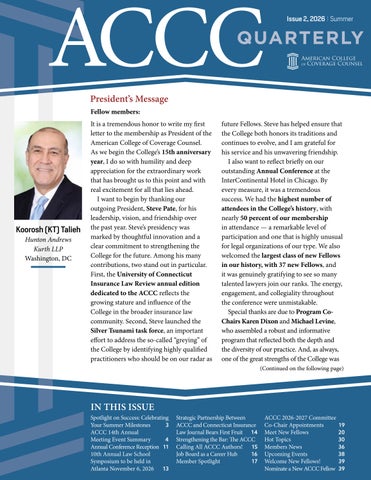
Koorosh (KT) Talieh Hunton Andrews Kurth LLP Washington, DC
It is a tremendous honor to write my first letter to the membership as President of the American College of Coverage Counsel. As we begin the College’s 15th anniversary year, I do so with humility and deep appreciation for the extraordinary work that has brought us to this point and with real excitement for all that lies ahead. I want to begin by thanking our outgoing President, Steve Pate, for his leadership, vision, and friendship over the past year. Steve’s presidency was marked by thoughtful innovation and a clear commitment to strengthening the College for the future. Among his many contributions, two stand out in particular. First, the University of Connecticut Insurance Law Review annual edition dedicated to the ACCC reflects the growing stature and influence of the College in the broader insurance law community. Second, Steve launched the Silver Tsunami task force, an important effort to address the so-called “greying” of the College by identifying highly qualified practitioners who should be on our radar as
future Fellows. Steve has helped ensure that the College both honors its traditions and continues to evolve, and I am grateful for his service and his unwavering friendship. I also want to reflect briefly on our outstanding Annual Conference at the InterContinental Hotel in Chicago. By every measure, it was a tremendous success. We had the highest number of attendees in the College’s history, with nearly 50 percent of our membership in attendance — a remarkable level of participation and one that is highly unusual for legal organizations of our type. We also welcomed the largest class of new Fellows in our history, with 37 new Fellows, and it was genuinely gratifying to see so many talented lawyers join our ranks. The energy, engagement, and collegiality throughout the conference were unmistakable. Special thanks are due to Program CoChairs Karen Dixon and Michael Levine, who assembled a robust and informative program that reflected both the depth and the diversity of our practice. And, as always, one of the great strengths of the College was (Continued on the following page)
IN THIS ISSUE Spotlight on Success: Celebrating Your Summer Milestones 3 ACCC 14th Annual 4 Meeting Event Summary Annual Conference Reception 11 10th Annual Law School Symposium to be held in Atlanta November 6, 2026 13
Strategic Partnership Between ACCC and Connecticut Insurance Law Journal Bears First Fruit 14 Strengthening the Bar: The ACCC Calling All ACCC Authors! 15 Job Board as a Career Hub 16 Member Spotlight 17
ACCC 2026-2027 Committee Co-Chair Appointments 19 Meet New Fellows 20 Hot Topics 30 Members News 36 Upcoming Events 38 Welcome New Fellows! 39 Nominate a New ACCC Fellow 39
President’s Message (Continued) (Continued from the following page)
on full display: the opportunity to connect and reconnect with friends and colleagues from both sides of the “v.” That spirit of collegiality, professionalism, mutual respect, and shared commitment to the development of insurance law remains one of the defining characteristics of the ACCC. As we look ahead to this anniversary year, I want to share a few of the initiatives and priorities that will help shape the year to come. One exciting area of focus is our outreach to the College’s Honorary Fellows. As I briefly mentioned at the business luncheon, the College is fortunate to have a distinguished group of insurance law professors among our Honorary Fellows, all of whom are doing important work and research on cuttingedge insurance and extracontractual issues. Over the past several months, we conducted a number of brainstorming sessions with several of these professors to explore how the College can support their efforts and, in turn, how our membership can benefit from their scholarship and insights. As a result of those discussions, the Board has agreed to provide a yearly research grant of $20,000 to support the research and publication of the resulting scholarly paper by one of our Honorary Fellows. An open
2
Issue 2, 2026
Summer
invitation for requests for proposals is currently being finetuned and will be disseminated in the near term. Our goal is to have the selected paper published and presented to our membership either at the Annual Conference or at that year’s Law Symposium. We also intend, of course, to publish the paper in the UConn Law Review annual edition dedicated to the College. This is an exciting opportunity to strengthen the connection between the College and the world of academics while delivering meaningful value to our members. Another important event on the horizon is the 2026 Insurance Law Symposium, which will be held at Georgia State University in Atlanta, Georgia on Friday, November 6, 2026. I want to extend special thanks to our Honorary Fellow, Professor Harold (“Hal”) Weston, who was instrumental in securing Georgia State as this year’s host. We are also fortunate to have John Bonnie and Larry Bracken serving as this year’s Co-Chairs. John and Larry are developing a wide-ranging program designed to give law students a broader understanding of coverage practice and the many career paths available in our field. I encourage all of you to be on the lookout for their request for proposals and to consider presenting at or attending this year’s law symposium.
ACCC QUARTERLY
I also want to briefly highlight the already launched ACCC Job Board, which went live on March 5, 2026. The Job Board has already generated overwhelming support among our Honorary Fellows, particularly law professors who see it as a valuable resource for students and emerging practitioners interested in insurance coverage. To help expand awareness and usage, I have asked Tyler Gerking and Alex Potente to lead a task force focused on increasing engagement with the Job Board. We recognize that not every firm recruits in this manner, but for those that do, we greatly appreciate your support in using the College’s platform. This initiative can become an important tool for connecting talented lawyers with meaningful opportunities in our field. We also will continue the important work begun under Steve’s leadership through the Silver Tsunami task force. As many of you know, this ad hoc committee was created to address the demographic challenges facing the College by identifying younger coverage lawyers who may not yet satisfy the 15 year/70 percent requirement for admission, but who are clearly on the path toward Fellowship. The purpose is to ensure that, when the time comes, the Membership Committee already has these rising practitioners on its radar. We have decided to continue this important work, and I have
asked Gaby Reicheimer and James Carter, two of our newer Fellows, to lead the task force. Their perspective and energy will be invaluable as we continue cultivating the next generation of ACCC Fellows. Finally, we are renewing our efforts to increase the College’s visibility and value as a resource to major insurance publications, including outlets such as Business Insurance and Law360, when they are looking for insight and commentary on insurance law issues. We have already begun outreach to some of these
publications and are making a concerted effort to ensure that the ACCC remains top of mind when editors and reporters seek informed perspectives on insurance coverage and extracontractual law. This is an important part of enhancing the College’s profile and reinforcing the depth of expertise that exists within our membership. As we celebrate the College’s first 15 years, we should also look ahead with confidence and ambition. The ACCC has become an extraordinary organization
because of the commitment, talent, scholarship, and collegiality of its members. I welcome your thoughts and ideas for how we can continue to build on that foundation. I encourage each of you to stay engaged, get involved, and help us make the next 15 years — and beyond — as successful, productive, engaging, and fun as the first 15. With appreciation, Koorosh Talieh President American College of Coverage Counsel
Spotlight on Success: Celebrating Your Summer Milestones As the insurance law landscape heats up this summer, our Fellows continue to lead the way—shaping industry standards, securing pivotal victories, and earning well-deserved accolades. At the ACCC, we know your individual achievements are the foundation of the College’s collective excellence. We want to ensure your professional milestones are celebrated across our community. Whether you’ve closed a major case before the summer break or received a prestigious mid-year honor, your success is a story worth telling. We are seeking your noteworthy updates, including: ` Awards and Honors: ` Significant Victories: ` Career Transitions: ` Thought Leadership: Recent recognition Landmark case Firm changes, Recent publications, or industry wins or successful promotions, or new media quotes, or accolades. settlements. leadership roles. speaking engagements. Share Your News, Inspire Your Peers Sharing your updates does more than just highlight your personal brand; it keeps our membership connected and reinforces the elite caliber of expertise that defines an ACCC Fellow. Ready to be featured? Please send your news items, links, or press releases to info@americancollegecoverage.org. We look forward to spotlighting your contributions and celebrating your continued success throughout the second half of 2026!
ACCC QUARTERLY
Summer
Issue 2, 2026
3
ACCC 14th Annual Meeting Event Summary By Conference Planning Committee Co-Chairs
Over 220 Fellows and supporting sponsors – our largest attendance ever – attended our 14th Annual Meeting at the InterContinental Chicago in May. In addition to the excellent programs referenced below, we welcomed 37 new Fellows into the College, now totaling 470 Fellows. During our Thursday night reception, we were regaled by the Barrister’s Big Band of musician-lawyers for a second year in a row. The conference planning committee was led by co-chairs Karen Dixon, Skarzynski Marick & Black LLP, and Mike Levine, Hunton Andrews Kurth, and co-vice chairs, Christina May Bolin, Christian Small, and Vince Morgan, Winstead PC. The committee began planning this event last summer, striving to present diverse, relevant, and timely programming. The conference was kicked off with comments from Steven Pate, Cozen O’Connor, ACCC President. The conference included a dinner where our new Fellows and award recipients were recognized. The Thomas F. Segalla Service Award was
4
Issue 2, 2026
Summer
bestowed upon Tracy Saxe, Saxe Doernberger & Vita, PC, and Debra Varner, Varner & Van Volkenburg, PLLC, recognizing their dedication and service to the College, in which each has demonstrated creativity, visibility, and persistence. The Edward Currie Founder’s Award, for a senior lawyer representing the highest level of accomplishment, competence, professionalism, and ethics in the practice of insurance law and/or insurance litigation, and who has inspired others to do likewise, was awarded to Mike Aylward, past ACCC President and College Officer. Our Conference Committee, along with members of the Communications Committee, have summarized the panel discussions from the conference. Conference attendees can view the papers and presentations behind the members-only login area of the ACCC website. Still want more content? Mark your calendar to join us for our 15th Annual Conference, May 6-8, 2027. We will be returning to the InterContinental Chicago.
ACCC QUARTERLY
Karen M. Dixon Skarzynski Marick & Black LLP Chicago, IL
Michael S. Levine Hunton Andrews Kurth LLP Washington, DC
Award recipients
Thomas F. Segalla Service Award Tracy Saxe, Saxe Doernberger & Vita, PC, Trumbull, CT with Stephen Pate, Cozen O’Connor, Pipe Creek, TX
Thomas F. Segalla Service Award Debra Varner, Varner & Van Volkenburg, PLLC, Clarksburg, WV
Edward Currie Founder’s Award Mike Aylward, Morrison Mahoney LLP (Ret.), Newton Centre, MA With Ned Currie, Currie Johnson & Myers, P.A. (Ret.), Madison, MS
CLE Session Summaries
Coverage Issues for TVPRA/Human Trafficking Claims Summarized by Bob Allen, The Allen Law Group, Dallas, TX In this presentation, Nancy Adams (Mintz Levin), Jim Carter (Blank Rome) and Greg Gotwald (Plews Shadley Racher & Braun) discussed the gnarly coverage issues involved in human trafficking claims. Similar to other heinous and sordid situations, insurance coverage for human trafficking claims may afford the only avenue for victim financial recovery. The panel discussed the developments leading to the Trafficking Victims Protection Reauthorization
Act (“TVPRA”), which includes a civil remedy component that drives the coverage issues. The panel then went through various coverage issues including lack of an occurrence, expected or intended injury exclusion and exclusions specifically drafted for motels known to be involved TVPRA claims. The presentation served as a reminder that there are claims involving seriously injured people that may or may not be covered by insurance.
Navigating the Tripartite Minefield: Tactical and Ethical Issues Summarized by Bob Allen, The Allen Law Group, Dallas, TX This topic was analyzed by Evan Knott, Emily Garrison, Jamie Sanders, and Beth Bradley. The panel analyzed both recurring and unique situations to illustrate some of the difficult
situations that arise in connection with the Tripartite Relationship. Applying the various jurisdiction’s rules on the Tripartite Relationship, (Continued on the following page)
ACCC QUARTERLY
Summer
Issue 2, 2026
5
CLE Session Summaries (continued) the panel highlighted the different approaches different jurisdictions take when analyzing the Tripartite Relationship. The panel’s discussion
of ethical issues served as a reminder of the seriousness of proper handling of these very sensitive situations.
Lessons Learned from COVID Summarized by Mary Craig Calkins, Blank Rome LLP, Los Angeles, CA Just when you thought it was safe to go back in the water… Our annual meeting kicked off with this rousing session discussing how the insurance issues addressed in the context of the COVID pandemic will continue to affect all of us: Policyholders and Insurers, courts and different jurisdictions, claims, decisions, and appeals. This dynamic panel, comprised of Laura Foggan of Lavin Rindner Duffield LLC, Lorelie Masters of Hunton Andrews Kurth LLP, and Elizabeth Hanke of Alvarez & Marsal Disputes and Investigations, identified the coverage issues that will continue to raise their [ugly] heads based on the decisions (or lack thereof) in 3,000 COVID Litigation matters that swept the nation a mere five years ago. The panel discussed how those rulings will affect our practices despite having most matters resolved on a Motion to Dismiss. They identified key issues including governmental actions and governmental orders, the eviction moratoria, limits
on gatherings, masks and vaccine mandates and facilities. The panel also discussed developments affecting issues relating to direct physical loss and virus exclusions, event cancellations, communicable disease coverage, property damage requirements, and the application of many of these issues issued in fast-paced litigation and appeals. Finally, the panel raised the question of how some of these issue will live on, including what constitutes direct physical loss, whether experts will always be required to prove physical alterations to property, potential computer applications involving loss of services and whether being offline constitutes direct physical loss or property damage, potential application to construction defect cases, the application of COVID rulings in products liability, mass tort and traditional environmental cases, and even the procedural lessons learned via our new familiarity with MDL filings, consolidation of cases, and potential arbitration and bankruptcy proceedings.
Is Permitted Pollution Really “Pollution”? The Illinois Supreme Court is About to Let Us Know. Summarized by Mary Craig Calkins, Blank Rome LLP, Los Angeles, CA This panel, led by Brian Basset of Traub Lieberman Straus & Schrewsberry LLP, Dena Economou of Weber Gallagher Simpson Stapleton
6
Issue 2, 2026
Summer
ACCC QUARTERLY
Fires & Newby LLC, Angela Elbert of Neal Gerber & Eisenberg LLP, and John Vishneski of Reed Smith, LLP, posed the lingering question: How can
it be Pollution if it is a permitted substance? The panel (or at least some of them) strongly suggested that an emission does not become pollution until it is a restricted substance, and that there can be reliance on the notion that if an insured has been granted a permit in connection with a substance, it is “not pollution.” The panel then discussed the holding in Griffith Foods International Inc. v. National Union Fire Insurance Co. of Pittsburgh, PA, where the Supreme Court of Illinois held that a permit or regulation authorizing emissions had no relevance to the determination of whether a pollution exclusion in a standard-form CGL policy would bar coverage. It also addressed the
public policy issues, including guidelines issued by the Environmental Protection Act, and noted that we are not limited these days to traditional environmental pollutants when addressing these coverage issues. The lively discussion— reminiscent of disputes from previous decades— included whether fugitive emissions escaping from a location and harming nearby residents could change that determination, whether a declaratory relief action might be necessary to avoid coverage, whether the very existence of a permit requirement bolstered the notion that a substance was, in fact, a pollution, and whether insurers had the duty to defend in the interim.
Navigating Disclosures and Conflicts in Insurance Arbitrations and Mediations: Ethical and Practical Considerations to Ensure the Neutrality of Your Neutral and Enforceability of Your Award or Settlement Summarized by Mary Craig Calkins, Blank Rome LLP, Los Angeles, CA We all know that Arbitrations and Mediations are critical to our practices, and issues regarding the neutrality of mediators and arbitrators are becoming even more important. No one wants an arbitration award or settlement to be attacked. In our very last session of a wonderful Annual Meeting capping off a great year (with Steve Pate at the helm, who passed the baton to incoming President KT Talieh), this experienced panel led by Peter Halprin of Haynes Boone, Ellen Van Meir of Nicolaides Fink Thorpe Michaelides Sullivan, LLP and Tyler Gerking of Farella Braun + Martel LLP talked about current issues regarding disclosures and the protections that need to be in place to avoid impartiality or the
appearance of bias. In an era of repeat appointments, there is always a concern relating to protecting your record and the guardrails or protections that need to be considered. The panel also warned about issues that can arise if a neutral is disqualified, and how a case can be disrupted before, after, and even during a proceeding. The panel also recognized and thanked mediator Jean Lawler, Lawler ADR Services, LLC who was under the weather and sent her regrets but contributed to the written presentation and was referenced throughout. Great way to end a terrific gathering of the best coverage counsel in the U.S., Canada, and Bermuda! (Continued on the following page)
ACCC QUARTERLY
Summer
Issue 2, 2026
7
CLE Session Summaries (continued)
Insurance for Autonomous Vehicles: What Will Drive Those Risks? Summarized by Seth Row, Stoel Rives LLP, Portland, OR What might the future hold for autonomous vehicles and will it reshape commercial and personal-lines auto insurance? Those were the questions addressed by the panel of John Buchanan, Covington & Burling LLP, Lara Cassidy, Hunton Andrews Kurth LLP, and Professor Leo Martinez, University of California College of Law San Francisco. (Panel member Professor Mark Geistfeld was unable to attend). The panel explored the wide variety of autonomous vehicles now in use or under development, from the ubiquitous Waymo self-driving taxis to fleets of delivery trucks to robo-mowers to campus shuttles, and the
legal scrapes that AVs have already engendered. Litigation over AVs has ranged from bodily injury claims against manufacturers to securities claims. Drawing on Professor Geistfeld’s article A Roadmap for Autonomous Vehicles: State Tort Liability, Automobile Insurance, and Federal Safety Regulation (in the materials) the panel explored what existing insurance might apply (“silent cyber” redux?), and what kinds of insurance might be required in the future for manufacturers and service providers - and whether owners of AVs would need to buy insurance if they have little control over the safety of the vehicles.
The Erosion of the Mediation Privilege Summarized by Seth Row, Stoel Rives LLP, Portland, OR This panel, consisting of John Bonnie, Weinberg Wheeler Hudgins Gunn & Dial, Marialuisa Gallozzi, Covington & Burling, LLP, and Neil Posner, Much Shelist P.C., began with the history of the so-called “mediation privilege,” and brought us along on the (bumpy) journey to where we are today, with a varied patchwork of protections that differ substantially from state to state. Key points included: court observations on the public policy basis for keeping mediation communications confidential; the important distinction between discoverability of mediation communications and admissibility of mediation communications (with some states only barring admission - and not barring discoverability);
8
Issue 2, 2026
Summer
ACCC QUARTERLY
the limited utility of Federal Rule of Evidence 408 in protecting mediation communications; and the role of Federal Rule of Evidence 501 in developing federal common law on mediation privilege. The panel also explored the Uniform Mediation Act, which has only been adopted by fourteen states. Yet in total 49 states have adopted some form of protection for mediation communications - meaning that choice of law questions will always be critical. The panel concluded by observing that although the mediation privilege is not eroding, it is a complex area in which much can turn on choice of law, choice of venue, and the particular facts of the communication in question.
Extracontractual Exposure Through Unfair Claims Settlement Practices Acts: Recurring Issues, Recent Rulings, Trends, and Strategies Summarized by Seth Row, Stoel Rives LLP, Portland, OR In this presentation, James W. Bryan, Maynard Nexsen PC, Suzan F. Charlton, Covington & Burling LLP, Julia Molander, JAMolander Consulting, and Jeffrey W. Stempel, UNLV, discussed the historical evolution of the Unfair Claims Settlement Practices Act beginning with precursors to the initial proposal from the NAIC, to its widespread adoption, with significant variations, by the states. The panel discussed in detail one particular difference - whether there is a private right of action, under state law. The answer can be found sometimes in the state-adopted version of the statute, and sometimes in the case law. (The written materials on this subject are very detailed and should be a resource for any practitioner who
finds themselves in a new jurisdiction.) The panel then went through the various elements of a claim including how to prove (or disprove): a “general business practice;” “misrepresentation” of the facts or the policy; failure to adopt reasonable practices; failure to “effectuate” a settlement when liability has become “clear;” or refusal to pay a claim without investigation. The concept of ‘reasonableness’ was a common theme. The panel concluded with a spirited discussion of whether hiring an expert on claims handling practices is necessary, and what qualifications are key; the panel’s consensus seemed to be that although policyholders might not need an expert, the insurer side will inevitably want one.
Coverage for Pixel Litigation and Other Emerging Privacy Claims Summarized by Seth D. Lamden, Blank Rome, Chicago, IL If you’ve ever searched for New York hotels and then seen Broadway ads follow you across every device you own, you’ve met a pixel — a snippet of code embedded in websites that tracks what you do online and reports it back to third parties. In this presentation, Darren Teshima, Covington & Burling LLP, Erica Villanueva, Farella Braun + Martel LLP, and Jim Ruggeri, Ruggeri Parks Weinberg, LLP, explained how the plaintiffs’ bar has turned this ubiquitous marketing technology into massive class-action and mass-arbitration exposure by repurposing legacy wiretapping statutes, the Video Privacy Protection Act, and similar laws never written with pixels in mind. Turning to coverage, the panelists analyzed how cyber/E&O policies may respond through broad privacy coverage
definitions incorporating “Wrongful Collection,” while cautioning that cyber/E&O forms are far from standardized, with some insurers now adding wrongful collection exclusions or limiting privacy coverage to regulatory enforcement actions. The panel discussed how even without an express privacy coverage grant, other insuring agreements, such as those covering media liability, have been held to cover pixel claims. On the CGL side, the panelists examined Coverage B’s “publication” requirement, noting case law construing the term broadly to include even one-to-one data transmissions, while flagging the ISO statutory-violations exclusion as a potentially dispositive barrier for claims grounded (Continued on the following page)
ACCC QUARTERLY
Summer
Issue 2, 2026
9
CLE Session Summaries (continued) in statutory theories. Looking ahead, the panel identified AI-driven privacy claims — including suits alleging that generative AI tools secretly tracked
users’ private communications and that AI-enabled wearable devices recorded users in their homes — as the next wave of coverage fights.
Self-Care, AI, and Next-Gen Coverage Problems Summarized by Seth D. Lamden, Blank Rome, Chicago, IL Your doctor probably uses AI in your care already — and if the algorithm gets it wrong, the insurance coverage questions are, as the panel put it in their paper, “a metastatic tangle.” Mary Borja, Wiley Rein LLP, Jeff Bowen, Lindemann Miller Bowen LLC, Micah Skidmore, Haynes and Boone, LLP, and Professor Harold Weston, Georgia State University, traced the expanding liability vectors from traditional physician-centric malpractice through AI-assisted diagnosis and robotic surgery to the Wild West of unregulated consumer wellness apps. The panel highlighted the emerging tension between “negligent reliance” on AI (adopting its recommendation without verification) and “negligent non-use” (ignoring proven AI tools as they become the standard of care), discussing litigation involving AI-driven health insurance benefit denials, robotic surgery injuries, and secret AI recording of patient-clinician conversations. For
coverage, the panelists worked through CGL issues, including whether AI-related harms constitute an “occurrence,” whether psychological injuries from health apps qualify as “bodily injury,” and how Coverage B’s “publication” requirement applies to apps that monetize user data. The panel also discussed the “product versus service” question for E&O coverage, exploring how courts struggle with that classification when a health app delivers something between a consumer product and a professional service. The panel concluded that significant gaps remain: cyber policies typically do not respond absent a data breach, CGL intentionalact exclusions may bar claims involving deliberate data sharing, and professional liability policies may not cover entities without traditional professional licensing, all of which leaves policyholders and insurers navigating uncharted territory as the technology races ahead of the policy language.
Thank you to our conference sponsors for their generous support:
10
Issue 2, 2026
Summer
ACCC QUARTERLY
Annual Conference Reception
(Continued on the following page)
ACCC QUARTERLY
Summer
Issue 2, 2026
11
12
2026 Annual Conference Co-Chairs:
2026 Annual Conference Vice Co-Chairs:
Karen Dixon, kdixon@skarzynski.com Mike Levine, mlevine@HuntonAK.com
Christina May Bolin, cmbolin@csattorneys.com Vince Morgan, vmorgan@winstead.com
Issue 2, 2026
Summer
ACCC QUARTERLY
10th Annual Law School Symposium to be held in Atlanta November 6, 2026 Georgia State University in Atlanta, Georgia will be the site of the ACCC’s 10th Annual Law School Symposium, which will offer panel presentations on a slate of cutting-edge insurance topics and highlight emerging insurance industry challenges and trends. Mark your calendars now and plan on joining us for the Symposium. To advance the goal of legal professional outreach and education, the Symposium will include presentations on a broad range of third and first-party insurance topics of combined interest to law students and seasoned insurance coverage professionals. The day-long series of panel discussions will include the perspectives of policyholder and insurer-side counsel, as well as industry, academic and judicial representatives. We are (nearly) guaranteeing moderate and enjoyable Fall weather for an event that will unfold over a tight two block radius in Atlanta’s vibrant Buckhead neighborhood. The Symposium will be held at Georgia State University (GSU)’s impressive
Terry Executive Education Center overlooking the Atlanta skyline. A group hotel block has been arranged at the Hilton Garden Inn, which is just a few steps away from the GSU Buckhead campus. For anyone arriving early on Thursday, November 5, please join us at 7:00 p.m. for a preSymposium dinner at South City Kitchen. In addition to offering your fill of delicious Southern cuisine, the restaurant is also just a few steps from the hotel. For those with later flights out of Atlanta on Friday, at the conclusion of the Symposium on Friday afternoon we will return to South City Kitchen for a cocktail reception. Be on the lookout via email for Symposium registration details, hotel booking, and Thursday night dinner reservations. The hotel and GSU facility are just .2 miles (an easy fourminute walk) from the Buckhead Station of Atlanta’s rapid rail system, MARTA, which also has a stop inside HartsfieldJackson International Airport.
2026 Insurance Law Symposium Co-Chairs:
John Bonnie Weinberg Wheeler Atlanta, GA
Larry Bracken Hunton Atlanta, GA
The Airport and the Buckhead Station are accessible on the train’s Red Line without any transfer required, and the total trip time is just 30 minutes. (Continued on the following page)
ACCC QUARTERLY
Summer
Issue 2, 2026
13
The ACCC acknowledges the grateful support of Honorary ACCC Fellow Hal Weston, a clinical associate professor and WSIS Distinguished Chair in Risk Management and Insurance at Georgia State
University in the planning and arrangements for the Symposium. The meeting is co-chaired by John Bonnie of Weinberg Wheeler and Larry Bracken of Hunton. Please reach out
to them at symposium@ americancollegecoverage.org with
any questions, and we look forward to welcoming you in Atlanta this November for what promises to be an enlightening and enjoyable series of events.
Strategic Partnership Between ACCC and Connecticut Insurance Law Journal Bears First Fruit By Michael Aylward, Morrison Mahoney LLP (Ret), Newton Centre, MA and Douglas Skelley, Shidlofsky Law Firm PLLC, Austin, TX The first fruits of a strategic partnership between our College and the most prestigious academic insurance law journal in the United States are now on view on the ACCC website and will shortly be mailed to thousands of insurance practitioners and scholars around the country who subscribe to the Connecticut Insurance Law Journal (CILJ). In 2025, ACCC President Stephen Pate entered discussions with the University of Connecticut Law School centering on a possible joint venture that would enhance the academic content of the Law School’s flagship CILJ publication, while providing greater exposure and prestige to ACCC Fellows by introducing their scholarship to a broader audience. The outcome of these discussions was an agreement that was signed
14
Issue 2, 2026
Summer
last Fall wherein the ACCC committed to identifying five or six articles by ACCC Fellows that met the CILJ’s rigorous academic standards. Those articles would then be edited and refined by the CILJ’s student law editors working in partnership with ACCC Fellow Editors Michael Aylward and Douglas Skelley and ultimately included in a special issue of the CILJ. Over the next few months, Aylward and Skelley reviewed recent articles that had been prepared in conjunction with our 2025 Annual Meeting and the 2025 Hartford Insurance Symposium and selected five for inclusion in a special issue of the CILJ to be published in the Spring of 2026. Aylward and Skelley worked with the ACCC authors to refine these articles and promote consistency in
ACCC QUARTERLY
Michael Aylward Morrison Mahoney LLP (Ret) Newton Centre, MA
Douglas Skelley Shidlofsky Law Firm PLLC Austin, TX
their formatting. The articles were then turned over to CILJ student editors for cite checking and final refinements. As noted above, those final articles are now available on the ACCC website (Member login required) and will soon be in the hands of CILJ’s subscribers. The CILJ is the premier academic journal in the United
States that is devoted solely to insurance law. It is entirely fitting, therefore, that its pages now include insightful and probing articles by ACCC Fellows, the very lawyers who are litigating these issues and framing the insurance and bad faith law. It is our hope that this strategic partnership will be a lasting one and will help to raise the profile of our Fellows
and the prestige of the American College of Coverage Counsel. Work on the 2027 Spring ACCC/ CILJ journal issue will begin this summer. ACCC Fellows who have authored independent scholarship of national interest are encouraged to contact ACCC staff and our Fellow Editors Michael Aylward and Douglas Skelley at symposium@ americancollegecoverage.org.
Insurance Law Journal
Calling All ACCC Authors! Last year, the American College of Coverage Counsel and Connecticut Insurance Law Journal (CILJ) entered a strategic partnership designed to provide greater visibility for ACCC member scholarship and greater depth to the content of the CILJ’s publications. The Connecticut Insurance Law Journal is the world’s only academic law review dedicated exclusively to the publication of original research on insurance law. Since its founding in 1994, the Journal has succeeded in attracting articles that are theoretically sophisticated and of practical importance. Since 2008, the Washington and Lee University’s survey of law journals ranked the Connecticut Insurance Law Journal as its top-rated periodical for insurance law.
In January 2026, the CILJ published the inaugural issue of the Journal of the American College of Coverage Counsel, which was comprised entirely of scholarly articles authored by ACCC Fellows. Access to the Journal is available to our members on the ACCC website under “Publications.” The ACCC is now looking for 6-8 more articles for consideration
for publication in our January 2027 issue. Each article should be between 3,000 and 15,000 words in length. The articles should be of original content but may be based upon material that has previously been used for ACCC symposia if it can be reworked to meet an appropriate scholarly standard. All submissions will be reviewed and edited by ACCC Fellows Michael Aylward and Doug Skelley.
If you have material that you would like to submit for inclusion in this special issue, please submit it to journal@americancollegecoverage.org no later than October 1, 2026. Similarly, if you have questions concerning this initiative, please contact the editors, or ACCC President KT Talieh.
ACCC QUARTERLY
Summer
Issue 2, 2026
15
Strengthening the Bar: The ACCC Job Board as a Career Hub ACCC remains at the forefront of the insurance law community, not only through its scholarship and advocacy but also by fostering professional growth within the bar. Central to this mission is the ACCC Job Board, a specialized digital marketplace designed to connect the industry’s most talented practitioners with the firms and organizations that need them most. Whether you are a seasoned Fellow looking to expand your team, an attorney seeking a new challenge, or a law student looking to break into the industry, the ACCC Job Board offers a streamlined, targeted experience that general career sites cannot match.
For Job Seekers: Specialized Opportunities The ACCC Job Board is more than just a list of openings; it is a gateway to high-caliber positions across the U.S., Canada, and Bermuda. By focusing exclusively on insurance coverage and bad-faith litigation, the board eliminates the noise of broader legal job sites. ` Tailored Search: Filter opportunities by location, practice focus, and seniority to find roles that match your specific expertise. ` Resume Visibility: Candidates can upload their resumes to a secure database, allowing
16
Issue 2, 2026
Summer
premier employers to find them directly. ` Customized Alerts: Sign up for automated notifications to be alerted the moment a position matching your criteria is posted.
For Students and Interns: Launching a Career The future of the insurance bar depends on early mentorship and practical experience. The ACCC Job Board serves as a vital bridge for the next generation of legal talent by highlighting specialized internships and clerkships. ` Entry-Point Access: Students can find summer associate positions and internships at boutique coverage firms, national practices, and in-house legal departments. ` Building a Specialty: These roles allow students to immerse themselves in policy analysis and litigation strategy, providing a significant competitive advantage for future associate positions. ` Networking with Purpose: By utilizing the ACCC platform, interns connect with a network of Fellows who represent the highest standards of the profession.
For Employers: Accessing and Cultivating Talent Hiring for insurance coverage roles requires candidates with
ACCC QUARTERLY
a deep understanding of policy language. The ACCC Job Board provides direct access to a highly vetted, focused audience. ` Targeted Reach: Your job posts are seen by the most prominent members of the insurance law bar, including ACCC Fellows and emerging leaders. ` Building a Pipeline: We encourage member firms to post internship opportunities to attract students who have already demonstrated an interest in the complexities of insurance law. ` Ease of Management: The platform offers intuitive tools to manage applications and track candidate interest seamlessly. As the field of insurance law continues to evolve - addressing everything from emerging cyber risks to complex climate litigation - having a dedicated space for professional recruitment is more important than ever. The ACCC Job Board ensures that the creative, ethical, and efficient adjudication of insurance disputes continues with the best talent the industry has to offer. Visit the ACCC Job Board Today: To browse current openings, post a position, or list an internship, visit coverage.memberclicks.net/ accc-job-board.
Member Spotlight: Meet the New ACCC President By Bob Allen, The Allen Group, Dallas, TX
ACCC entered its 15th year in Chicago this May, and ushered in its newest President, Koorosh “KT” Talieh of Hunton Andrews Kurth LLP. In anticipation of this newsletter, Bob Allen met with the College’s newest President, and talked about his background, practice, what led him to insurance coverage law, and his plans for the ACCC 2026-2027 year. Q: Hi KT, as the 13th President of the American College of Coverage Counsel, tell us what led you to become a lawyer? The law was part of my family’s daily conversation. My father was a judge, and I was fascinated hearing his stories about courtroom battles, colorful personalities, and the impact the law could have on people’s lives. All of that said, my own path to becoming a lawyer was far from linear. I graduated from a liberal arts college in Massachusetts with no job, no graduate school plans, and only a vague ambition to move to Washington, D.C. and save the world. When a job on the Hill didn’t materialize, I took a job as a legal assistant at a large D.C. law firm. That detour turned out to be one of the better decisions of my life. The lawyers I worked with encouraged me to think seriously about law school, and before long I realized
the law was not just the family business — it might actually be my calling. Q: How did you get into policyholder-side insurance coverage work, who are your mentors and what was your first job as a lawyer? I got into coverage work almost by accident, which is probably true for most of us. One of the lawyers from that same D.C. firm who had encouraged me to go to law school hired me right out of school to work on a major long-tail coverage case for a pharmaceutical company. It was a great opportunity for a young lawyer as I was thrown into the proverbial deep end of the pool right away. I was able to work on that case from its early stages through resolution in an adversarial proceeding, which helped me gain a ton of handson substantive and procedural experience very quickly.
Koorosh Talieh Hunton Andrews Kurth LLP Washington, D.C.
That experience ultimately led me to Anderson Kill in the early 1990s, where I had the privilege of working with and learning from Lorie Masters, the College’s second president, on another significant long-tail coverage matter in Wilmington, Delaware. David Baldwin — the College’s first Fellow from Delaware — served as co-counsel on that case and together we all spent an entire hot summer in Wilmington, Delaware on that case. Those early years really were the heydays of policyholder coverage practice. Very few (Continued on the following page)
ACCC QUARTERLY
Summer
Issue 2, 2026
17
firms focused exclusively on policyholder-side work, and those of us on the policyholder side genuinely felt we were blazing the trail for coverage law and the lawyers who would follow. Looking back now, it is remarkable to see how much the practice has grown nationwide, particularly when you consider the depth of talent and the number of outstanding coverage lawyers who are Fellows in the College.
humility is always just one double fault away. Travel is also a major part of our life. My wife works in the airline industry, which has given us the opportunity to explore much of the world together with our girls -- from the Far East and Australia to Africa and Europe. I find travel both energizing and grounding. It has a way of broadening perspective, reminding you how large and interconnected the world really is while also
Insurance coverage cases are often won or lost in the details — a single word or comma in a policy provision, a carefully framed argument, or a factual nuance that may have been overlooked. There is no substitute for mastering the record, understanding the policy language inside and out, and being more prepared than the lawyer on the other side of the table. Q: Outside of your busy practice at Hunton Andrews Kurth, what do you enjoy outside of work? I spend much of my “spare” time trying to stay one step ahead of Father Time through regular exercise, with a recent emphasis on weight training and a bit of tennis. Tennis is a competitive outlet and a reminder that
18
Issue 2, 2026
Summer
making you appreciate coming home. And whatever spare time remains is often spent attempting to explain the concept of a “living wage” to my college-age daughters — a conversation that invariably ends up in spirited debate, occasional eye rolls, and a reminder that advocacy skills are apparently hereditary.
ACCC QUARTERLY
Q: What advice would you give to younger lawyers entering insurance coverage law? My advice to younger lawyers entering the coverage space is that the fundamentals still matter — attention to detail, preparation, hard work, and confidence in your abilities. Insurance coverage cases are often won or lost in the details — a single word or comma in a policy provision, a carefully framed argument, or a factual nuance that may have been overlooked. There is no substitute for mastering the record, understanding the policy language inside and out, and being more prepared than the lawyer on the other side of the table. It is also important to remember that insurance coverage practice sits at the intersection of business, litigation strategy, and problem solving. Clients are often dealing with high-stakes disputes that affect the future of their companies, and they need lawyers who can provide sound legal advice and judgment but also be problem solvers. There is no question that the work can be demanding, the cases can last for years, and the learning curve can be steep. But for lawyers who are intellectually curious and willing to put in the work, it remains one of the most fascinating and rewarding areas of the law. And if there is one lesson that has held true throughout my career, it is this: prepare, prepare, prepare.
Announcing the ACCC 2026-2027 Committee Co-Chair Appointments ACCC is proud to announce its leadership appointments for the 2026-2027 term. Our committees serve as the engine of the College, driving the high-level discourse, educational programming, and specialized insights that define our organization. Please join us in welcoming our new and returning Co-Chairs as they step into these vital roles to guide the College through the coming year:
ADR Committee
Extracontractual and Bad-Faith Claims Litigation Committee
` William Bulfer – Teague Campbell Dennis & Gorham, LLP ` John Mumford – Hancock, Daniel & Johnson, P.C.
` Mark Boyle – Boyle, Leonard & Anderson, P.A. ` Clay Crawford – Lathrop GPM
2027 Annual Conference Committee
First-Party Insurance Committee
` Christina May Bolin – Christian & Small LLP ` Vince Morgan – Winstead PC
` Christina May Bolin – Christian & Small LLP ` Micah Skidmore – Haynes and Boone, LLP
Vice Chairs: ` Stephen Melendi – Tollefson Bradley Mitchell & Melendi, LLP ` Helen Michael – Blank Rome
Insurance Law Symposium Committee ` John Bonnie – Weinberg Wheeler Hudgins Gunn & Dial ` Lawrence Bracken – Hunton Andrews Kurth LLP
CGL/Excess Liability Insurance Committee
Membership Committee
` Gretchen Hoff Varner – Covington & Burling LLP ` John Harding – Lewis Brisbois Bisgaard & Smith LLP
` Christine Haskett – Covington & Burling LLP ` Laura Hanson – Meagher & Geer, P.L.L.P.
Communications Committee
Outreach & Regional Meetings Committee
` Bob Allen – The Allen Law Group ` Debra Varner – Varner & Van Volkenburg, PLLC
` Mike Hamilton – Goldberg Segalla ` Chris Mosley – Sherman & Howard L.L.C.
Cyber, Artificial Intelligence & Emerging Issues Committee
Pop-Up Dialogues Committee
` Mary Borja – Wiley Rein LLP ` John Buchanan – Covington & Burling LLP
D&O, Management & Professional Liability Committee ` Jeff Bowen – Lindemann Miller Bowen LLC ` Emily Garrison – Honigman LLP
` Matthew Pierce – Gordon Tilden Thomas & Cordell ` Alex Potente – Clyde & Co.
Professionalism and Ethics Committee ` Neil Posner – Much Shelist, P.C. ` Harrison Yoss – Freeman Mathis & Gary, LLP (Continued on the following page)
ACCC QUARTERLY
Summer
Issue 2, 2026
19
The ACCC remains committed to its mission of advancing the creative, ethical, and efficient adjudication of insurance coverage and extracontractual disputes. The expertise represented in this list of chairs is a testament to the depth of talent within our Fellows. “Our committee chairs are the backbone of the College’s initiatives,” says KT Talieh, ACCC President. “We look forward to the innovative programming and scholarly contributions this group will produce over the next year.”
interested in joining a committee or learning more about their current projects, please visit our
Committee Chairs Page and reach
out to the chairs directly via their listed ACCC email aliases.
ACCC Communications Committee Co-Chairs at Churchill Downs in Louisville, KY.
Get Involved Committees are the best way to network with fellow experts and contribute to the evolution of insurance law. If you are
Bob Allen, The Allen Law Group, Dallas, TX Debra Varner, Varner & Van Volkenburg, PLLC, Clarksburg, WV
Meet New Fellows By Michael Young, Reichardt Noce & Young LLC, Saint Louis, MO For Christopher (Chris) H. Avery, the path to insurance coverage law began long before law school. “Just one of those things from childhood,” he said. “I love to read, I love history, and my parents said I could argue with a tree, so it became a just natural career path.” Avery’s upbringing took him across the country before he eventually settled in what he calls his “adopted hometown” of Greenville, South Carolina.
20
Issue 2, 2026
Summer
Born in Amarillo, Texas, he later moved to California’s San Joaquin Valley and then to South Carolina during high school. Despite those moves, Texas remained central to his professional identity. He attended Texas A&M University as an undergraduate, where he was part of the Corps of Cadets, before earning his law degree from South Texas College of Law. Unlike many attorneys, Avery did not come from a family of lawyers.
ACCC QUARTERLY
Christopher H. Avery Martin, Disiere, Jefferson, and Wisdom Houston, TX
Meet New Fellows (Continued) “No, no. First one to go past college,” he joked during the interview. But timing and opportunity quickly pushed him into the deep end of insurance litigation. “I had the good luck and bad luck to graduate in 2009,” Avery explained. The legal market was still reeling from the financial crisis, but Hurricane Ike had created enormous demand for property litigation attorneys. Through a professional connection, he joined Martin, Disiere, Jefferson & Wisdom and began handling firstparty property claims almost immediately. “Before the ink was dry on my license, I was handling property damage files with Chris Martin.” That experience shaped the trajectory of his career. Today, Avery estimates his practice is “probably 60% property just being based in Texas, 30% coverage, which is more nationwide,” with the remaining portion consisting of the unpredictable and often complex matters that arise from working alongside longtime mentor Chris Martin. His early years practicing after Hurricane Ike provided unusually intensive litigation experience for a young lawyer. “At one point our office had 500 active trial settings,” he recalled. “So before I turned a year on my
license, I was handling mediations by myself, handling hearings, climbing on roofs.” The pace and volume created what Avery described as a “baptism by fire.” That environment accelerated his development as both a litigator and coverage lawyer. “By my third year, I had tried one jury case and been a part of about 10 other trial teams.” For Avery, those years reinforced a lesson he now passes on to younger attorneys entering the field: coverage practice requires patience and deep technical knowledge. “Be prepared to be a nerd,” he said when asked what advice he gives new lawyers interested in insurance coverage. “It takes time.” Unlike many practice areas, coverage work demands mastery of not only policy interpretation but also underlying litigation. “You’ve got to understand how the underlying litigation works so that you can apply the coverage right.” Avery believes one of the biggest changes in the profession has been the shrinking number of attorneys who focus on insurance coverage. “Brain drain,” he called it. “I feel like when we started, there was a bunch of people that did this and I feel like as time has gone on, it’s become a narrower field.” He attributes that trend to multiple factors, including changes in law school priorities, perceptions surrounding
insurance defense work, and broader economic opportunities. At the same time, Avery sees technology rapidly transforming the profession. “Implementation of AI. That’s absolutely common,” he said when discussing the biggest challenges facing coverage lawyers over the next decade. Yet he believes the more pressing challenge may be helping judges navigate increasingly sophisticated insurance law doctrines. “Insurance coverage is really such a particular niche, and there’s such a deep level of law. Finding judges that are willing to spend the time to dig deeply into it is a concern.” For Avery, effective advocacy often comes down to communication. He encourages younger lawyers to simplify complex legal concepts whenever possible. “What I tell my associates is to speak muggle like I’m Harry Potter, speak plain talk.” His test for clarity is practical and direct: “If you’re at your kid’s soccer match, you’ve got to be able to explain it to all of the parents. If you can’t do that, I don’t know that you’re doing a good job of persuasion.” Outside the office, Avery channels his lifelong love of history into research and public speaking. A self-described “massive history nerd,” he was invited to speak at the San Felipe (Continued on the following page)
ACCC QUARTERLY
Summer
Issue 2, 2026
21
Meet New Fellows (Continued) de Austin State Historic Site on women’s property rights in early Texas. The presentation traced legal concepts from Spain through
the Republic of Texas and into modern Houston development. For Avery, the connection between history and law is natural.
Both require attention to detail, context, and storytelling—skills that continue to define his approach to coverage practice today.
By Seth H. Row, Stoel Rives LLP, Portland, OR Jamie Cooper is a partner with Martin, Disiere, Jefferson & Wisdom LLP in San Antonio, Texas, representing insurers. She has been with the Martin, Disiere firm cumulatively for over seventeen years, in two stints, having spent a period in the middle – 2017 – 2020 – as Executive Director at USAA. Jamie is from Humble, Texas. Where is Humble? “If you’ve ever flown into Houston’s Bush Airport, you’ve probably flown right over my childhood home on approach.” She had a “very rural upbringing, even for Texas. My family had a place on the river near Spring, and we spent every summer there. No air conditioning, an outdoor toilet, and days spent swimming, fishing, and running wild in the San Jacinto River bottom.” She has some of the best “fun facts” about growing up that this reporter has ever heard (even for Texas!): “We had a pet turkey and a pet bass. The turkey followed us around and protected us from snakes. The bass would come up in the lake and let us catch and weigh him.” Jamie came to the law through
22
Issue 2, 2026
Summer
a “process of elimination.” She explored a number of paths early on – medicine, lab science, pharmaceutical sales, policy work, academia – and learned pretty quickly that those were not a fit. “What I eventually realized is that I enjoy solving problems, thinking strategically, and working with people. The law was the first place where all of that came together in a way that felt right.” Jamie’s orientation toward law became clear when she was in Washington, D.C., as an intern for the House Agriculture Committee through Texas A&M’s Congressional Internship Program. “Watching the lawyers there work—especially our chief of staff, Vernie Hubert—was the moment it clicked for me. He also taught me the ‘never let them see you coming’ approach.” Jamie clerked for the First Court of Appeals in Houston. She describes it as “an incredible experience” which gave her an inside view of how courts evaluate cases and make decisions. Her clerkship ended up having a personal connection —her judge
ACCC QUARTERLY
Jamie Cooper Martin, Disiere, Jefferson, and Wisdom San Antonio, TX
later presided over her wedding! Jamie’s “outside of office” time is centered around her family. Her oldest kid is a corps member with Teach for America in Boston. Cameron, her middle kid, plays collegiate softball at UT Arlington and her youngest will be a senior in high school this fall. Jamie’s family are longtime season ticket holders for the National Finals Rodeo and attend as often as they can. Her husband competed in rodeo and now works as a horseshoer. Jamie also enjoys creative writing - it “lets me think creatively in a different way than my day-to-day
practice” She reports having drafted a novel, currently at 130,000 words! She needs to cut roughly 40,000 words out of it to reach a realistic length. Apparently a 130,000 word novel from Jamie would not be a surprise to Fellows who have seen her coverage opinions. Jamie’s first big case was a 2007 arson and extra-contractual case that she tried with David Disiere. Her client obtained a full defense verdict with a jury finding of
fraud/misrepresentation. Another notable case was Downhole Navigator v. Nautilus Insurance Company, which came after she had just made partner and was handling the case on her own. The issue was whether an insurer had to reimburse an insured for independent counsel after a reservation of rights. The district court granted summary judgment for her client, and the Fifth Circuit affirmed in 2012. “What felt like a small case at the time
ended up contributing to the law on independent counsel in Texas.” Jamie has handled claims all over the country, and while in-house even got to work on international claims, which she reports “present an entirely different set of challenges.” Jamie reflects that through it all, “one constant is the people. Across jurisdictions, coverage lawyers tend to share a common interest in the nuance of the work, which creates a level of professionalism and camaraderie.”
By Seth D. Lamden, Blank Rome, LLP, Chicago, IL Melissa D’Alelio grew up in Stoneham, Massachusetts, which is located about ten miles north of Boston. As the oldest of five, the daughter of an Italian immigrant, and the granddaughter of a construction labor organizer, debating and advocacy were a big part of her upbringing. Melissa was the first in her family to go to college, let alone law school. She found her way to the law after September 11th, drawn to a career that combined what she’d always loved — teaching, counseling, advocacy, and debate — into something purposeful. She chose Northeastern University School of Law for its practical bent, which included four internships before graduation. She clerked for a federal magistrate judge, worked for the Massachusetts Teachers Association, and spent time at two law firms. One of those
firms, Robinson & Cole in Boston, became her first home as a lawyer. And then came the happy accident. As a first-year litigation associate, Melissa’s office happened to sit between two insurance practitioners, one on the coverage side, one on defense. Proximity bred opportunity. She was the closest newbie, so she got their overflow work. Within five years, she’d found her specialty. “I had no idea what insurance law was,” she says now. She figured it out. One of her first major coverage cases at Robins Kaplan involved a Superfund site in New Jersey, lost policies from the 1960s and ‘70s, and proceedings before a special master. The case lasted through her engagement, her wedding, and the birth of her first son — a timeline familiar to anyone who has litigated environmental coverage.
Melissa M. D’Alelio Robins Kaplan LLP. Boston, Massachusetts
Over the years, Melissa has handled matters nationally across state and federal courts, including Washington, California, Texas, New York, New Hampshire, Rhode Island, Connecticut, Maine, New Jersey, Florida, North Carolina, Alabama, and more. She recalls with particular fondness a tough first-party coverage litigation in Rhode Island where building code issues carried the day, (Continued on the following page)
ACCC QUARTERLY
Summer
Issue 2, 2026
23
Meet New Fellows (Continued) and the Superstorm Sandy and Katrina cases that followed. Asked about the biggest change she’s seen over her career, Melissa points to the growing focus on risk management, business cost, and
efficiency — including how AI can be harnessed in coverage litigation. When she’s not practicing, Melissa is home in Melrose, Massachusetts, where she and her husband restored an old
Victorian and filled it with three kids (now eleven, nine, and seven) and a sassy bulldog. They travel together, read, garden, cook, try new restaurants, and play basketball or soccer at the park.
By Meghan Moore, Flaster Greenberg PC, Boca Raton, FL Jennifer (“Jen”) O. Farina was born in Buffalo, New York, but jokes that she “is from a little bit all over.” She was on the move with family from the age of two and grew up in a variety of states including New York, Massachusetts, Oklahoma, and Minnesota. In hindsight she is grateful for the experience and exposure to different cultures, but she is also glad that she and her husband have been able to offer their son and daughter more continuity. Jen and her family reside in Maplewood, New Jersey. Jen enjoyed reading and writing from an early age, which inspired her to take pre-law courses at Boston College, where she made the decision to pursue a career in law despite never having set foot in a law firm. During law school at New York University, Jen accepted a position as a summer associate at Covington. Covington hired her full time after graduation. While there, she was introduced to coverage cases, which she thoroughly enjoyed. She also excelled and proved to have
24
Issue 2, 2026
Summer
an instinct for coverage law. Jen spent a dozen years at Covington before joining her current firm, McCarter & English. One of Jen’s first big coverage cases involved coverage for legacy asbestos exposures. She represented Exxon Mobil against its insurers and was on the team that convinced them to resolve the case before dispositive motions were decided. She is now Deputy Practice Group leader of McCarter & English’s Insurance Recovery, Litigation & Counseling practice group, where she has helped numerous clients maximize their insurance coverage under a variety of insurance policies, including general liability, property, fidelity, and directors and officers. More recently, she has developed a niche practice handling bankruptcy related insurance work. Jen has handled cases in California, Delaware, Texas, New Jersey, and New York, among other jurisdictions. When asked whether any of them stand out for one reason or another, she joked
ACCC QUARTERLY
Jennifer O. Farina McCarter & English, LLP Newark, NJ
that her first cases in New Jersey were an “incredible breath of fresh air” after spending so much time in New York courts, noting that she favors New Jersey’s “codified evidence rules” and “procedural clarity” over New York’s unwritten, common law-oriented approach. When Jen isn’t practicing law or raising teenagers, she is playing tennis. She rediscovered the sport during Covid and has enjoyed pushing herself to improve. Given her drive and determination, she will doubtless be as much a force to reckon with on the court as she is in the courtroom.
By Seth H. Row, Stoel Rives LLP, Portland, OR Brad Nash is a partner with Hoguet Newman Regal & Kenney, LLP in New York, representing policyholders in complex insurance recovery matters. He was born and raised in Roslyn, New York, on the North Shore of Long Island. He enjoys insurance coverage because it requires both deep factual analysis and strategic problem solving. After law school, Brad clerked for Judge David G. Trager of the United States District Court for the Eastern District of New York. He describes the experience as formative, particularly for the insight it gave him into how judges approach difficult cases. The most enduring lesson, he says, was the importance of mastering the facts. While law school teaches doctrine, trial courts often resolve hard cases based overwhelmingly on the factual record—a principle that has stayed with him throughout his career. Outside the practice of law, Brad is an amateur genealogist.
He loves it for the same reasons he loves coverage: both require curiosity and persistence, the desire to dig into records, reconstruct narratives, and make sense of complicated histories. Like many insurance coverage lawyers, Brad did not set out intending to build a career in this field. After several years practicing general commercial litigation, he worked on a hard-fought dispute between a high-end Park Avenue co-op and a tenant-shareholder. Asked to review the client’s insurance policy, he succeeded in persuading the insurer to fund a settlement. That early success became a turning point, and over time he developed what is now a sophisticated insurance recovery practice. When asked about the biggest change he has seen in coverage litigation, Brad returns to the lesson he learned in his clerkship: facts matter. In his view, one of the central challenges of coverage practice is applying contested
Bradley Nash Hoguet Newman Regal & Kenney New York, NY
policy language to an effectively limitless range of real-world circumstances that no drafter could fully anticipate. Because many policies are built from standardized forms rather than language tailored to a particular insured or business, the lawyer’s task is to interpret and apply those provisions in a way that fits the facts and, for policyholder counsel, secures coverage. For Brad, that combination of textual analysis and factual precision is what continues to make the practice both demanding and rewarding.
By Bob Allen, The Allen Group, Dallas, TX Jennifer A. Noya was born in California, however, her family moved to New Mexico and she grew up there. Initially, her interests were in business, but her father, a lawyer, encouraged her to go to law school as it would provide
a good background for the business world. At that time, she did not really know whether she would actually practice law or use the degree in another field. After spending a summer at her current firm, Modrall Sperling, she learned that she enjoyed law
work and she has been at Modrall Sperling ever since. On her first day at Modrall Sperling, Jennifer was assigned to defending an insurer in a class action challenging stacking of uninsured motorist coverage (Continued on the following page)
ACCC QUARTERLY
Summer
Issue 2, 2026
25
Meet New Fellows (Continued) under personal auto policies. Now, thirty years later she is still litigating UM stacking issues. While there have been several New Mexico decisions over the years regarding the issue, the rules have also frequently changed. The biggest change that Jennifer has seen over her career with respect to coverage litigation is that when she started in 1994, coverage litigation rarely had bad faith and statutory claims tied to it. Now, even when we initiate claims for declaratory relief on behalf of carriers, the answer frequently asserts extracontractual counterclaims.
While Jennifer practices primarily in New Mexico state and federal courts, as well as the Tenth Circuit Court of Appeals., she has also handled Texas and Colorado coverage disputes in those state courts. Jennifer notes that New Mexico state courts are not known for predictability and are well known for large verdicts. Outside of the practice of law, Jennifer has been a white-water rafter for several years. She enjoys foreign travel and recently survived base jumping in Oludeniz, Turkey. As far as safer and day to day hobbies, Jennifer is trying to learn
Jennifer A. Noya Modrall Sperling Roehl Harris & Sisk P.A. Albuquerque, NM
to play the violin and she is a terrible golfer as well (Editor’s note: she is in good company at the College in that regard).
By Meghan Moore, Flaster Greenberg PC, Boca Raton, FL Matt Paradowski joins the College from Dallas, Texas, where he represents insurance companies alongside a few other ACCC fellows from Tollefson Bradley Mitchell & Melendi, LLP. A resident of Texas since he was six months old, Matt grew up in San Antonio. From there, he moved to San Angelo, Texas, where he played college football for two years, concluded that was a “fruitless pursuit” and transferred to Texas State University. Matt planned to coach college football, but during his senior year a professor encouraged him to take the LSAT. The next week he did so, proving
26
Issue 2, 2026
Summer
he could score better off the field. Matt graduated summa cum laude and enrolled in law school at Southern Methodist University. After graduating, Matt spent a year and a half dabbling in general commercial litigation before he began cutting his teeth on coverage work. One of Matt’s most memorable coverage cases involved the question of whether processed boneless chicken has bones. It does, and Matt was tasked with analyzing whether there was coverage for an insured who had represented otherwise. Matt handles complex coverage matters and defends carriers from lawsuits alleging extra-
ACCC QUARTERLY
Matthew Paradowski Tollefson Bradley Mitchell & Melendi, LLP Dallas, TX
contractual liability. Lately, he has been handling a lot of construction defect coverage and
cases involving the Oilfield AntiIndemnity Act. When Matt is not practicing law, he is throwing a frisbee to
his talented cattle dog, Marvin, playing folk guitar with family, or watching sports. While he admits that he is “a reluctant Cowboys
fan,” he says “he wouldn’t dream of changing to the Mavericks.” He is a San Antonio Spurs fan through and through.
By Meghan Moore, Flaster Greenberg PC, Boca Raton, FL Noel C. Paul was born and raised in Wilmette, Illinois, a suburb north of Chicago. He went to the University of Virginia for college and emerged as a journalist. Noel’s first job was working as an intern on The NewsHour with Jim Lehrer, where he jokes that he “got Diet Cokes for Kofi Annan [former United Nations SecretaryGeneral] and Sandy Berger, the National Security Advisor at the time,” and “took calls on the news desk,” including one from Warren Beatty. But he also produced copy for news, which served as a springboard for his next position in print journalism. Noel spent the next four years writing for The Christian Science Monitor before becoming a freelance journalist. After six years in journalism, Noel grew “tired of writing about other people doing things and wanted to be more of a protagonist in things.” A career in law seemed like the right choice. It was. After graduating from Loyola University Chicago School of Law, Noel joined Reed Smith, where he used his skill of prose to write his clients’ winning stories. As an insurance recovery attorney,
he also gained a reputation for being one of the Best Lawyers in America in Insurance Law. Last year, Noel joined Honigman as one of six insurance recovery policyholder attorneys, allowing him to play a bigger role and leverage his experience more effectively. The firm, with close to 400 attorneys, offers big firm resources with a small firm feel of collegiality and entrepreneurism. One of Noel’s first memorable insurance cases involved the failure of aquarium glass at one of the largest privately owned aquariums in the country. Noel was tasked with evaluating coverage for exotic tropical fish and coral, something that required him to delve into the biology of coral and coverage interpretation issues relating to the plain meaning of the term “animals” under an exclusion in the policy. The biggest changes Noel has seen during his career with respect to coverage relate to “different risk transfer strategies like big retentions and captive insurance fronting coverage.” “We are seeing the impact of so many parties trying to shift
Noel C. Paul Honigman LLP Chicago, IL
risk, with additional insured coverage and indemnity issues so prevalent.” When asked about the most interesting thing he does outside the practice of law, Noel revealed that he is starting to learn ventriloquism. He said he “will not perform with my dummy at the ACCC meeting,” since he is still very much a beginner. When Noel isn’t practicing law or ventriloquism, he spends time with his wife and with his daughter, shown in this photo with Noel. (Continued on the following page)
ACCC QUARTERLY
Summer
Issue 2, 2026
27
Meet New Fellows (Continued) By Michael Young, Reichardt Noce & Young LLC, Saint Louis, MO For George L. Stewart, the practice of law was both a family tradition and an intellectual fit. “My paternal grandfather was a lawyer here in Pittsburgh and was eventually appointed to the federal bench, seated in the Western District of Pennsylvania, by President Harry Truman,” Stewart explained. “My father was a lawyer in Pittsburgh, as was his brother.” Viewing organic chemistry as an insurmountable obstacle to medical school, coupled with a lack of interest in business school, Stewart ultimately decided “to follow in the footsteps.” That decision led him to a career spanning nearly four decades at Reed Smith LLP, where he has practiced continuously since joining the firm as an associate after graduating from Penn State Dickinson Law. Before law school, Stewart attended Vanderbilt University, but Pittsburgh remained home throughout his career. “Other than having gone away to college and law school, I’ve lived here my entire life.” Stewart described Reed Smith as the premier firm in the Pittsburgh legal market when he was entering practice. “That was the prize firm that I wanted to be part of,” he said.
28
Issue 2, 2026
Summer
The work exceeded expectations. “I’ve had the great privilege of working with some phenomenal lawyers and on interesting and big matters that pose lots of fascinating issues.” His introduction to insurance coverage work came almost immediately after joining the firm. One of his earliest assignments involved a petition for writ of certiorari to the Supreme Court of the United States concerning lost insurance policies. “I didn’t know a thing about insurance before I started working on that petition,” Stewart admitted. Yet the challenge of reconstructing the existence and terms of policies no longer physically available intrigued him. “How do you cobble together enough evidence to prove the existence of terms of a policy that you don’t have?” That early exposure led to increasingly significant work involving asbestos-related coverage litigation. Stewart became deeply involved in representation of policyholders, such as Pittsburgh Corning, and eventually worked on the landmark Pennsylvania Supreme Court “triple trigger” litigation involving J.H. France. Although still a junior associate at the time, he recalls drafting significant portions of the briefs
ACCC QUARTERLY
George L. Stewart Reed Smith Pittsburgh, PA
filed in the case. “By that time, I was completely hooked.” The constantly changing nature of risk is one of the reasons Stewart has remained engaged “To me, what’s fascinating about this practice… has been the evolution of risk,” he explained. “Ten years ago, you and I didn’t know what cyber coverage was.” Today, cyber claims are a common part of his practice, reflecting how rapidly insurance products and disputes evolve alongside emerging technologies and commercial exposures. “The nature of those risks just seems to be evolving exponentially.” Looking forward, Stewart believes one of the greatest challenges facing coverage lawyers will be balancing technological advancement with meaningful attorney development. Like many
senior practitioners, he sees tremendous potential in artificial intelligence but also significant concerns. “I do worry about the training that younger lawyers otherwise would have gotten but for AI,” he said. “There is something to be said for doing deposition summaries and preparing deposition outlines and things like that.” For Stewart, those foundational tasks are not merely administrative—they are essential to developing analytical judgment. “I’m concerned about how AI is going to encroach upon the training and development of younger attorneys.” He also predicts broader economic impacts across the legal industry as efficiency pressures re-shape staffing models and billing structures. Ultimately, Stewart believes that these new realities will impact the manner in which law students are educated. “Law schools are going to have to
further develop curricula that emphasize ‘practice-ready’ graduates, meaning graduates who can hit the ground running in terms of the day-to-day practice of law,” Stewart believes. Despite those concerns, Stewart remains enthusiastic about the practice itself and actively mentors younger attorneys entering the field. At Reed Smith, he helps teach an internal “Insurance 101” course for junior lawyers that introduces core concepts across multiple lines of coverage and insurance markets. Stewart also believes coverage litigation offers advantages that younger lawyers may not immediately appreciate. Unlike sprawling commercial disputes that can last nearly a decade, coverage cases often move more efficiently toward resolution. “In my experience, coverage cases tend to resolve at an earlier stage in the litigation life-cycle,” he said. “You’re typically not involved in multi-year litigations that move at an imperceptibly slow pace.” The
quicker pace of coverage litigation keeps the work intellectually fresh while exposing attorneys to constantly changing factual and legal issues. Outside the office, Stewart channels his energy into endurance cycling and charitable fundraising. Last year, he completed a 170-mile ride over three days benefiting what is now known as Blood Cancer United. The effort raised approximately $137,000. “I think I proved myself a better fundraiser than a cyclist,” he quips. After decades of handling significant coverage disputes throughout the country, Stewart’s enthusiasm for the profession remains evident. Whether discussing asbestos litigation, aviation insurance, cyber risks, or mentoring younger lawyers, he continues to view insurance law as a uniquely dynamic and intellectually rewarding practice area—one that evolves as quickly as the risks do themselves.
By Seth D. Lamden, Blank Rome, LLP, Chicago, IL Chris Thompson has lived in enough places to accumulate a lifetime of sports heartbreak. Born in Texas, raised in New Hampshire, and back in Texas for high school, college, and law school, he has suffered through the Curse of the Bambino as a Red Sox fan (now mercifully lifted several times over) and
currently endures what he calls the “Curse of the Jerry” as a Cowboys fan. He’s still waiting on that first championship since moving to Dallas in 1997. Twenty-eight years later, he calls himself a Dallasite — even if October still makes him nervous. Chris was certain he was headed to business school until
his senior year of college, when his uncle — the only other lawyer in the family — suggested he take a constitutional law course. A great professor made the material challenging and intellectually alive. Suddenly there were two paths. But Chris wasn’t in a rush. He decided to (Continued on the following page)
ACCC QUARTERLY
Summer
Issue 2, 2026
29
Meet New Fellows (Continued) spend time in the workforce first, and his first real job as a claims adjuster handling homeowner’s and auto claims turned out to be the deciding factor. Evaluating coverage, investigating losses, negotiating with claimants and attorneys on the other side of the phone: it was complex, engaging work that pointed him squarely toward law school. After law school, Chris started at Jackson Walker in 1997. He’s been there ever since. “I can’t imagine working anywhere else,” he says. His background in claims gave him a head start. He already understood insurance policies and the business of insurance, which helped him communicate with clients and take on coverage matters early. The more he handled, the more he wanted to handle — more coverage lines, more complex legal issues, more chances to be the person colleagues (and, of course, friends and family) called with insurance questions. Twenty-eight years in, he still relishes it. One of the first coverage cases Chris handled on his own involved dueling “other insurance” provisions between two auto insurers. The plaintiff argued prorata contribution; Chris argued his client’s policy was excess. The
30
Issue 2, 2026
Summer
lawyers agreed to submit their contract-interpretation arguments to the court early before any discovery, and after multiple rounds of briefing on crossmotions for summary judgment, the court agreed with Chris’s position, effectively terminating the action. That early experience with efficient, focused resolution has stayed with him. Asked about the biggest change he’s seen in coverage litigation over his career, Chris points to an increased level of collegiality and pragmatism among practitioners. He sees more lawyers agreeing to defer unnecessary discovery and submit coverage-interpretation questions to the court for early rulings. “This allows us to get quicker and more efficient answers for our clients,” he says. “And for those cases where that’s not possible, we can devote more time and energy to those matters.” His most rewarding work? Helping non-profits, individuals, and small companies navigate difficult claims and securing coverage, whether first-party benefits or defense of third-party claims. A close second is appellate work. His team recently obtained a Ninth Circuit opinion affirming summary judgment for an
ACCC QUARTERLY
Christopher A. Thompson Jackson Walker LLP Dallas, Texas
insurance client in a matter where the insured sought additional “overhead and profit” payments on behalf of herself and a putative class of policyholders. Chris has handled coverage or policy-interpretation matters in federal or state courts across at least eight states. His bad faith work has been concentrated in Texas and New Mexico where, he notes, “the business has been plentiful.” Now empty-nesters, Chris and his wife spend their time travelling, deepening their knowledge of wine, and reconnecting with friends. Chris also plays in a beer-league hockey league and is working to resuscitate his tennis and golf games after years of neglect.
Hot Topics
The Misuse and Misunderstanding of Generative Artificial Intelligence in Litigation By Dan D. Kohane1, Hurwitz Fine, Buffalo, NY With Michael J. Williams2 Hurwitz Fine, Buffalo, NY The use of artificial intelligence must be accompanied by the application of actual intelligence in its execution.3 Generative artificial intelligence (“AI”) is the latest innovative weapon in a litigator’s arsenal to zealously and efficiently represent their clients. While useful as a research and drafting aid when properly used, overreliance on this developing technology becomes a double-edged sword to the neglectful practitioner. Electronically fabricated or deceptive case citations, quotations or facts, commonly referred to as “hallucinations”, present an ongoing danger to our courts and the efficient administration of justice. Courts have responded by emphasizing that attorneys—not their computers—retain nondelegable and longstanding duties of reasonable inquiry as to all data presented and for candor to the tribunal should error occur. This article examines the growing problem, how a select subset of courts applies these obligations to the emerging generative AI technology and why ignorance of the hallucination danger is no defense.
Prevalence and Pitfalls of Generative AI Models A 2024 LexisNexis survey reported that while 80% of responding Fortune 1000 executives expect that generative AI will reduce their billing from outside counsel, 78% of legal executives identified hallucinations as a significant obstacle to AI adoption. The concern is justified: a 2025 article in the Journal of Empirical Legal Studies found that LexisNexis’ Lexis+ AI was the highest performing system while accurately answering only 65% of the researchers’ queries. Westlaw’s AI-Assisted Research reportedly boasted only a 42% accuracy rate and hallucinated at twice the rate of the other systems tested. No executive should wager on betthe-corporation litigation against those odds. Hallucinations occur in many unexpected forms. While completely manufactured case citations or quotations are the most frequently reported, they also manifest as false
Dan D. Kohane Hurwitz Fine Buffalo, NY
factual data on which analysis relies, applying out of context data inappropriately, illogical conclusions based on otherwise factual data, or responses accurate to the user’s prompts which are distorted or unresponsive to the user’s intent. All of these result from generative AI’s imperfect deep-learning models, which are algorithms that imperfectly mimic human learning and decision-making. Those algorithms became more active with development of Large Language Models which gather tremendous amounts of data—from the internet complete with its misinformation and biases—to predict the next element in a sequence to generate content. Stated differently, the model guesses at what the next (Continued on the following page)
ACCC QUARTERLY
Summer
Issue 2, 2026
31
Hot Topics (Continued) appropriate word should be when generating a response with no ability to ascertain the truth or falsity of the prediction. This process is entirely invisible to the user-attorney, and any predicative misstep can generate facially plausible but completely erroneous results. Industry-standard providers such as LexisNexis and Westlaw engage in constant development to improve performance. Recently, Retrieval-Augmented Generation—effectively limiting the universe of data applied to generate contextually appropriate and more accurate responses— have been boasted to reduce hallucinations. However, even these more sophisticated models cannot ascertain whether a source states a definitive rule of law or one hotly contested, particularly where courts themselves disagree as to the correct answer and the model applies only a miniscule subsection of the available data. The model simply lacks an attorney’s specialized background knowledge in the subject matter and ability to synthesize relevant data within the context of fact patterns, rules of law, and resulting legal holdings across a myriad of jurisdictions and over time. The fact that our legal search engines present their generative AI responses as if they
32
Issue 2, 2026
Summer
were as reliable as reported case law is a trap for the unwary or inexperienced practitioner.
A Singular Case Study Both attorneys and generative AI models are imperfect. Many briefs contain scrivener’s errors misreporting a case name or citation, omitting a critical word or misplacing a quotation mark. In a recent Southern District of New York case, Jiminez-Fogarty v. Fogarty, 1:24-cv-08705 (April 29, 2026), the court generously distinguished such errors by excluding instances of erroneous volume and page citations, completely incorrect case names, and even references addressing the general issue but presented in a “completely mischaracterized” or “grossly misleading” manner. The court detailed the egregious errors it permitted, then itemized seven “completely made up” citations, and detailed its own efforts attempting to identify any basis whatsoever for the offending attorney’s references. Rather than proceeding on its own findings, the court ordered the offending attorney an opportunity to show cause why they should not be sanctioned under Fed. R. Civ. P. 16(f), 28 U.S.C. § 1927, or the Court’s inherent power, including requesting “a complete
ACCC QUARTERLY
and detailed description of the process of the drafting of the two memoranda of law” and “a detailed and complete description of the role of any individual or computer system that was involved in the drafting process.” While the offending attorney had clearly violated their duty of reasonable inquiry as to the arguments presented, they chose to additionally fail in their duty of candor before the court by responding to the itemized hallucinations with “[c]ase number exists; incorrect case name” or similar responses, despite these being untrue. Opposing counsel then moved the court for Fed. R. Civ. P. 11 sanctions including attorneys’ fees and costs. The court then filed a second order to show cause and again received a completely inadequate response. The Southern District lamented that while “most attorneys” candidly explain their error including admitting their reliance on AI platforms, the offending attorney offered “only airy generalities and conclusory statements” while failing to answer the most basic question: “what was the source of the fabricated citations?” The court also found the offending attorney’s assurance of manually checking each citation to be “obviously false” because that
surely would have revealed the eleven errors to which counsel themselves admitted. The offending attorney also blamed their errors on using “established legal research platforms,” to which the court accurately responded that the proposition was “utterly devoid of evidence.” While the court offered no evidence supporting its own reliance on the databases used to check the offending attorney’s work, the reliability of official reporters remains the time-tested backbone of legal practice. LexisNexis and Westlaw generative AI platforms may produce hallucinated results as discussed above, but every court and practitioner relies on their industry-leading and accurate reporting of actual case law. Having given the offending attorney a generous reading of their brief, and two opportunities to explain their errors, the court held Rule 11 sanctions appropriate for failing to conduct a reasonable inquiry of their own case citations, their bad faith unresponsiveness to the court and because the same attorney continued to file documents featuring hallucinated cases including before the sanctioning court. Ultimately, the court ordered a $2,500 fine and notice to the client to all other courts in which the offending attorney was appearing that included a copy of the Southern
District’s twenty-page opinion detailing their misconduct.
Hallucinated Case Citations Constitute Recklessness and Not Honest Error While Jiminez-Fogarty is among the latest examples of hallucinatory error by counsel, litigators must recognize that the epidemic is no longer limited to mostly unpublished trial court opinions of which few would know other than the parties to the litigation. Appellate courts have also written on sanctions issued by lower courts, or for misconduct by hallucination on the appeals themselves. Every practitioner is accordingly on notice not just from articles in periodicals such as this one, but from the courts with authority to affirm sanctions levied against them or their clients. Court systems and bar associations have also proactively taken steps to remind their practitioners of their duties. New York provides one of the most recent examples with 22 NYCRR §§ 161.1 to 161.4 (effective June 1, 2026). The Unified Court System undertook an extensive review of generative AI use in legal briefing, accepted public comments, and promulgated rules for those litigating on the electronic frontier. These can be boiled down to three policy decisions: (1) the use of AI in papers submitted
to the court “should not be prohibited”, (2) attorneys “should not be required” to disclose to the court if they used AI tools, and (3) individual judges may exercise their discretion to implement a rule requiring attorneys using AI to “carefully review the paper and independently ensure” it contains no factual or legal hallucinations. However, existing rules of professional responsibility already require attorneys to conduct a reasonable inquiry as to all data presented to the court—regardless of the tools they employ to draft their briefing—resulting in these rules covering little new ground. Turning to the federal appellate courts finds a similar approach. The Second Circuit Court of Appeals has held that the Federal Rule of Civil Procedure Rule11 “reasonable inquiry” standard requires “that attorneys read, and thereby confirm the existence and validity of, the legal authorities on which they rely,” as there is “no other way to ensure that the arguments made based on those authorities are ‘warranted by existing law,’ . . . or otherwise ‘legally tenable.’” Park v. Kim, 91 F.4th 610, 614-615 (2nd Cir. 2024) (quoting Cooter & Gell v. Hartmarx Corp., 496 U.S. 384, 393 (1990)). When an attorney relies on fabricated authority, they necessarily reveal that they “made no inquiry, much less the (Continued on the following page)
ACCC QUARTERLY
Summer
Issue 2, 2026
33
Hot Topics (Continued) reasonable inquiry required by Rule 11.” Park, 91 F.4th at 615; see also Ioio v. City of New York, 2026 U.S. App. LEXIS 7593, *7 n. 7 (2nd Cir. Mar. 16, 2026). In other words, standards set decades ago govern new technologies such as generative AI. The same standard applies for briefing presented to the federal Courts of Appeals themselves. In Fletcher v. Experian Info. Sols., Inc., 168 F.4th 231 (5th Cir. 2026), the court applied Fed. R. App. P. 38—Rule 11’s appellate equivalent—with an analysis that began by documenting hallucinogenic proliferation. The Fletcher court referenced a database assembled by a lawyer and data scientist who tracked 239 cases of hallucinations by attorneys in the United States by the date the opinion was drafted. Id. at 234. Only four months later, at the time of this article’s submission for publication, that list stands at 372. For those litigating against pro se parties, an additional 602 instances are presently identified. As the Fifth Circuit stated: “It is a problem that is getting worse— not better.” Fletcher, 168 F.4th at 234-235; see also Ford v. Bank of N.Y. Mellon, 2025 U.S. App. LEXIS 7985, *2 n. 1 (5th Cir. Apr. 4, 2026).
34
Issue 2, 2026
Summer
Fletcher’s appellate reply brief itself presented “16 instances of fabricated quotations and 5 additional serious misrepresentations of law or fact.” The offending attorney responded to the order asserting that they “relied on publicly available versions of the cases, which [they] believed were accurate.” The Fifth Circuit then researched for itself the alleged sources (Google Scholar, CourtListener, Justia, and FindLaw) and found that none of them included the hallucinated quotations. The offending attorney’s other two reported sources, Casetext and vLex, were both generative AI products. Counsel further compounded their error by failing to candidly admit their misapplication of generative AI in their briefing. The court ultimately cautioned practitioners that admitting error would have likely limited sanctions, while misleading, evading and violating duties as an officer of the court resulted in a personal $2,500 sanction. Relying on Fletcher, Park and other opinions, the Fourth Circuit has directly expressed the sentiment all practitioners should respect: sanctionable misconduct “applies to submitting a brief with nonexistent cases no matter how it is done, whether through generative AI or not.” In re Nwaubani, 2026
ACCC QUARTERLY
U.S. App. LEXIS 7501 (4th Cir. Mar. 11, 2026). The Sixth Circuit agrees, holding that “[a]ttorneys have an ethical obligation to verify the citations and propositions they submit to courts; that obligation reflects duties of competence and candor that apply no matter the tools attorneys use.” United States v. Farris, 2026 U.S. App. LEXIS 9704 (6th Cir. Apr. 3, 2026). Notably in Farris, the offending attorney was not monetarily sanctioned after promptly admitting their erroneous reliance on unverified generative AI provided by nonattorney staff, reminding all practitioners that candor counts. The Sixth Circuit also provides a cautionary tale to offending attorneys who fail both their duties of reasonable inquiry and candor. In Whiting v. City of Athens, 2026 U.S. App. LEXIS 7479 (6th Cir. Mar. 13, 2026), the court reviewed briefing containing two dozen cases that “did not exist, did not include the quoted language [counsel] claimed they did, or did not discuss or support the proposition for which” they were cited. Invited to explain their errors, the offending attorneys instead argued that the order to show cause was void, motivated by harassment towards them and reflected illegal ex parte communications with the court. The court rejected these
arguments along with counsel’s position that revealing “how the briefs were cite-checked” violates the work-product and attorneyclient-privilege doctrines. Under both Rule 38 and the court’s inherent authority, the Sixth Circuit found the two unrepentant offending attorneys had abused the adversary system by relying on “fake opinions,” sanctioned them $15,000 each, required them to pay their opponent’s attorneys fees and double their costs, while also referring them for disciplinary proceedings. The Tenth Circuit has recently joined the federal appellate courts delving into generative AI hallucinations. In Picon-Diaz v. Bondi, 2026 U.S. App. LEXIS 4417 (10th Cir. Feb. 13, 2026), the court identified offending counsel as relying “multiple times throughout his brief on what clearly appears to be a case fabricated by the use of a generative artificial intelligence tool.” Rather than sanction the error, the court instead chose to warn counsel “and all attorneys practicing before this court” of their responsibility to present only “real cases that contain quotations attributed to them
and arguably stand for the propositions for which they are cited.” Id. at *14; see also Dodds v. Bridges, 2026 U.S. App. LEXIS 4159 (10th Cir. Feb. 11, 2026) (generalized warning to pro se litigants and counsel alike). Contemporaneously, in Amarsingh v. Frontier Airlines, Inc., 2026 U.S. App. LEXIS 3928 (10th Cir. Feb. 9, 2026), the Tenth Circuit fined offending counsel $1,000 for presenting hallucinated cases and quotations while blaming “an embedded algorithm” in ChatGPT and admitting they failed to verify the data. The court declined the relief requested by offending counsel’s opponent: dismissal of the appeal. Though finding counsel’s conduct “reckless” for failing to confirm their citations and quotations, the court was persuaded by remorse, somewhat qualified candor and the perceived “novelty at the time of the infraction (January 24, 2025) of the use of AI by lawyers.” Id. at *19. Considering that Park was decided on January 30, 2024, and relies on an even earlier opinion addressing the issue, offending counsel in Amarsingh may be among the last permitted a “novelty” exception to longstanding rules of reasonable
inquiry merely because the error results from AI hallucinations.
Conclusion Clients, carriers, and law firms rightfully expect counsel to use the most efficient tools available to deliver high-quality, cost-effective services, including innovations such as generative AI. But the attorney using the tool remains responsible for the result. As one court has aptly put it, “the use of artificial intelligence must be accompanied by the application of actual intelligence in its execution.” Mid Cent. Operating Eng’rs Health & Welfare Fund v. Hoosiervac LLC, No. 2:24-CV-326, 2025 U.S. Dist. LEXIS 31073, 2025 WL 574234, at *4 (S.D. Ind. Feb. 21, 2025), report and recommendation adopted as modified, 2025 U.S. Dist. LEXIS 100748, 2025 WL 1511211 (S.D. Ind. May 28, 2025). Attorneys must always conduct their reasonable inquiry into the facts and law presented to all courts before which they appear. In the event of error, they must protect their client by candidly responding to a court’s inquiry. No attorney should ever cost a client their legal rights for something as elementary as failing to verify their case citations.
1 Dan D. Kohane is a Senior Member at Hurwitz Fine P.C. where he chairs the firm’s Insurance Coverage and Extracontractual Liability teams. He has served, for almost four decades, as Adjunct Professor of Insurance Law at the University at Buffalo School of Law. He was one of the original Founding Fellows of the American College of Coverage Counsel 2 Michael J. Williams is a Member at Hurwitz Fine P.C. where he leads the firms Child Victims Act & Sexual Misconduct Coverage and Defense teams, as well as its Indian Law & Policy Team. He is an active litigator, focusing his practice on general liability including products liability, prescription medications and medical device claims. 3 Willis v. U.S. Bank N.A., 783 F. Supp. 3d 959 (USDC, ND Texas 2025)
ACCC QUARTERLY
Summer
Issue 2, 2026
35
Member News
Spotlight on Excellent Results – Rina Carmel Rina recently obtained a significant victory for an insurance client when a bankruptcy court granted a motion for summary judgment during an interpleader adversary proceeding. The court ruled that the insurer had interpleaded more than the remaining amount of covered repairs following a wildfire, the insurer did not act in bad faith, and no one else had claim to the policy proceeds.
Rina Carmel Anderson McPharlin & Conners, LLP Los Angeles, CA
The American Crisis in Civility Professional Parables: Pathways Illuminated By The Better Angels of Our Nature
By Edward J. Currie Esq and H. Mills Gallivan Esq, with stories/parables from ACCC Fellows: John Bonnie, Lorie Masters, Dianne Polscer, Tom Segalla, Rich Traub, and John Trimble (deceased). There is a growing crisis of civility in America – especially within the legal profession – where common courtesy, professionalism, and respect have sharply declined despite being mandated by attorney oaths. Drawing on nearly a century of combined litigation experience, editors Ned Currie and Mills Gallivan seek to benefit and promote the FDCC Foundation’s Barb Currie
36
Issue 2, 2026
Summer
Diversity Scholarship and the National Foundation for Judicial Excellence, both of which have long championed civility, professionalism, and judicial excellence. Concerned by the cultural shift toward incivility, they created this book as a collection of real-life parables from respected lawyers and judges. They offer powerful models for young attorneys and a reminder that civility strengthens
ACCC QUARTERLY
Edward J. Currie, Jr. Currie Johnson & Myers, P.A. (Ret) Madison, MS
both advocacy and the justice system. The book shares the editors’ purpose and gratitude for contributors and sponsors. They hope readers will “pay it forward” by promoting civility throughout the legal community and beyond.
Saxe Doernberger & Vita, P.C. Celebrates 30 Years and Announces Key Leadership Transition Saxe Doernberger & Vita, P.C. (SDV)
proudly marked a significant milestone this year: the celebration of its 30th anniversary. Since its founding in 1996 by three attorneys in a small New Haven office, SDV has remained steadfast in its mission of representing policyholders in insurance coverage matters. Today, that focused vision has transformed SDV into a nationally recognized boutique firm. With 50 attorneys serving clients across the United States, the firm continues to expand its reach, recently announcing the opening of its newest office in Massachusetts. In tandem with its anniversary, SDV entered a new chapter of leadership designed to balance continuity with future innovation: Tracy Alan Saxe will continue in his long-standing role as Chair, providing the steady leadership that has guided the firm since its inception. Greg Podolak has been promoted to Vice-Chair. Greg’s journey is a “full-circle” success story; having started as a Summer Associate in the Connecticut office, he eventually launched the firm’s Southeast office in Naples, Florida, in 2016.
Tracy Alan Saxe
Gregory D. Podolak
Saxe Doernberger & Vita, P.C. Trumbull, CT
Saxe Doernberger & Vita, P.C. Naples, FL
“Reaching SDV’s 30th anniversary is a meaningful milestone and a point of pride for all of us,” said Tracy Saxe. “This achievement reflects the trust of our clients and the commitment of our attorneys and staff, past and present, who have built this firm.”
SDV’s commitment to excellence has earned consistent accolades from industry leaders, including Chambers USA and Best Lawyers. Beyond its domestic growth, the firm has strengthened its international presence through a robust collaboration with UK-based Fenchurch Law.
ACCC QUARTERLY
Summer
Issue 2, 2026
37
Member News (Continued)
Leading Lawyers Recognize Browning and Newa Among Plunkett Cooney Attorneys in Michigan By Charles W. Browning and Kenneth C. Newa, Plunkett Cooney, P.C., Bloomfield Hills, MI Online legal industry platform, Leading Lawyers recently named multiple attorneys to its 2026 list of top Michigan attorneys. In compiling its list, the publisher uses attorney recommendations of peers they would recommend to others if they could not handle a matter in their own jurisdiction. Inclusion on the list cannot be purchased, and attorneys cannot self-nominate. Leading Lawyers is a division of Law Bulletin Media, a diversified information company serving Chicago legal and business communities since 1854.
Charles W. Browning
Kenneth C. Newa
Plunkett Cooney, P.C. Bloomfield Hills, MI
Plunkett Cooney, P.C. Bloomfield Hills, MI
Read the full press release here.
Upcoming Events ACCC Pop-Up Dialogue The Texas Supreme Court Draws the Line on Appraisal Thursday, June 18, 2026 3:00 PM - 4:00 PM EDT
ACCC Pop-Up Dialogue Transitioning to the Next Generation: Business and Practice Succession Planning of an Insurance Coverage Practice Tuesday, July 21, 2026 4:00 PM - 5:00 PM EDT
ACCC 2026 Insurance Law Symposium Friday, November 6, 2026 Georgia State University J. Mack Robinson College of Business Buckhead Center Campus Atlanta, GA
For details about these and other upcoming ACCC events, please visit www.americancollegecoverage.org.
38
Issue 2, 2026
Summer
ACCC QUARTERLY
Welcome New Fellows! Jennifer Kalvestran, Anderson, McPharlin & Conners LLP, Los Angeles, CA
James A. Kitces, Robins Kaplan LLP, Boston, MA
James Maloney, Baker Sterchi Cowden & Rice LLC, Kansas City, MO
Elevate the Profession: Nominate a New ACCC Fellow The prestige of the American College of Coverage Counsel is built entirely upon the caliber of its members. As we grow, we rely on you - our current Fellows - to identify the next generation of leaders in insurance coverage, bad faith, and extracontractual claims law. Do you know a practitioner who belongs among the best in the field? Now is the time to submit your nomination.
Qualifications at a Glance To maintain our high standards, all nominees must meet the following criteria: ` Experience: A minimum ` Focus: A practice ` Independence: The of 15 consecutive years in concentrated primarily nominator must be an ACCC insurance law (May include in insurance coverage or Fellow not affiliated with the time served as a judge extracontractual claims in the nominee’s firm. ` or clerk). U.S., Canada, or Bermuda.
A Simple, Confidential Process To protect the integrity of the process and the privacy of the candidates, nominations are handled discreetly: 1. Email: Send the nominee’s name, contact info, and a link to their professional bio to membership@americancollegecoverage.org. 2. Vetting: The Membership Committee will conduct a confidential review and contact local references. 3. Invitation: Candidates should not be informed of their nomination; the Committee will extend an official invitation only after the initial vetting is successful. Help us ensure the College remains the premier home for the most distinguished practitioners in our field. Submit your nomination today.
ACCC QUARTERLY
Summer
Issue 2, 2026
39