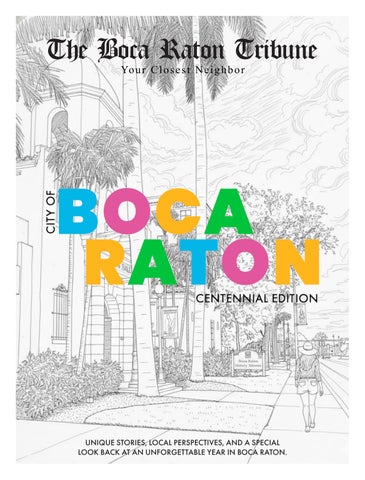
UNIQUE STORIES, LOCAL PERSPECTIVES, AND A SPECIAL LOOK BACK AT AN UNFORGETTABLE YEAR IN BOCA RATON.


Design Team
Senior
![]()
UNIQUE STORIES, LOCAL PERSPECTIVES, AND A SPECIAL LOOK BACK AT AN UNFORGETTABLE YEAR IN BOCA RATON.


Design Team
Senior
Marketing Team
Ana Borges
Alex Penã
Marichi Aria
Tony Venezia
Claudia Catherine
News Room
C. Ron Allen
Dini Heizer
Doug Logan Isabel Rizzi
Kartik Krishnaiyer
Kenny Spahn
Michael Demyan
Synesio Lyra
Thomas J. Madden
Toni King
Toni Marshall
Photographers
Andre Freitas
Gabriela Barbieri
Rosa Cavalcanti
Mail Subscription subscription@bocaratontribune.com
Advertising Information sales@bocaratontribune.com
Mailing Address
P.O. Box 970593
Boca Raton, FL 33497
General Information
Phone: 561-536-5443
Email: frontdesk@bocaratontribune.com


STATEPOINT MEDIA
THEME: BODY LANGUAGE
ACROSS
1. Hot Springs and such 5. ____ Bell and ____ Barker
8. Wharton degree, acr. 11. Artist’s inspiration 12. *Move head to show attention
13. Angry growl
15. Shamu, e.g. 16. Diva’s number 17. Put on fancy dress (2 words)
18. *Making facial expression showing pain 20. Mine passage 21. Single-handedly 22. Assistance 23. Made according to specifications 26. Economizes 30. Biochemistry acr.
31. Aerie baby
34. Genesis skipper
35. Leaves out
37. *Some look up and to the right when telling one
38. Watcher
39. “The Forsyte ____” by John Galsworthy
40. Forty winks
42. Fraternity letter T
43. *Said “easy peasy” with fingers
45. Like a weight lifter, usually
47. Weasel-related onomatopoeia
48. Undo laces
50. Helicopter sound
52. *Showing low self-esteem or boredom
56. 100 centimes
57. Purl partner
58. From square one
59. Frustration, in a comic book
60. “At ____, soldier!”
61. Don’t go 62. Dashboard acr.
“Give thanks to the Lord, for He is good; His love endures forever.” Psalm 107:1

63. Like Willie Winkie
64. Frustrated driver’s recourse
DOWN
1. Urban haze
2. Make like a cat
3. Ascus, pl.
4. Same as sea moss (2 words)
5. Rice wine
6. Dress with a flare
7. Rudolph, when older
8. Famous Christmas guests
9. Like some champagnes
10. High mountain
12. Toyota truck model
13. Part of flight
14. *Showing agreement
19. Healing plants
22. Be in a cast
23. *Show anger with arms
24. Unnerve
25. Eurasian antelope
26. “____ but not heard”
27. Much, in Italy
28. Song of praise
29. *”I don’t know” move
32. *One’s smiling because one’s ____
33. Intoxicated
36. *Showing impatience with fingers
38. Like retina and brain connecting nerve
40. Large edible mushroom
41. Keen
44. Nice place for a rocking chair
46. Reuse ideas
48. Forearm bones
49. Hustle and bustle sound
50. Sandwich alternative
51. Stay out of its way!
52. Place at angle
53. Gung-ho about something
54. Close by 55. Gwyneth, for short
56. Opposite of #54 Down


By Caris Weinberg
Throughout 2025, the city of Boca Raton has celebrated its centennial, calling it “100 Years Bold.” In 1925, not only was Boca Raton incorporated as a municipality, but some of its most defining landmarks emerged at the same time. While this includes establishments such as The Boca Raton and the Addison—both celebrating their 100th anniversaries—many may not know that Boca Raton’s first church also began that year.
One hundred years ago, the First United Methodist Church started as a small Christian worship group meeting in a building originally used as a schoolhouse west of the Florida East Coast Railway tracks, near what is now South Dixie Highway/U.S. 1. These meetings were interdenominational, alternating between Methodist and Baptist pastors.
In the summer of 1925, the worship group decided to form an organized church under the leadership of the Rev. W.C. Fountain of Delray Methodist Church. A permanent structure was built that same year on Royal Palm Road with funds raised by the community. Services remained multi-denominational until 1930.
As Boca Raton grew throughout the 1930s, the congregation then known as the Boca Raton Community Church became increasingly structured. The formal transition into Methodism occurred in 1944, when the church property was deeded to the trustees of the First Methodist Church of Boca Raton.
In 1948, the Women’s Society of Christian Service organized, and the church became part of newly formed Methodist districts as Methodism expanded across Florida. After World War II, the church entered a period


of growth. Membership doubled from about 50 people to around 100 by 1951.
By the mid-1950s, the congregation had outgrown its Royal Palm Road building. In 1957, the church purchased its current property at 625 NE Mizner Blvd. Construction soon began on new facilities, including a sanctuary and a classroom wing. The sanctuary was completed in 1965 with about 650 seats and remains the oldest building on campus today. These developments marked the shift toward the modern campus recognizable in present-day.
Enhancements continued in 1966, when the patio north of the sanctuary was roofed and named “Noah’s Mother Ark.” The Methodist Early Childhood Education (MECE) preschool program began in 1973, leading to the construction of an education building in 1977 that later became central to the church’s children’s ministries. Renovations in

1978 and 1979 included reversing the sanctuary to face the parking lot, enlarging the kitchen, adding a choir room and office complex, and expanding parking. From 1965 through 1980, the church grew alongside Boca Raton’s own postwar development. This period saw expanding ministries—especially in music, children’s programs and adult fellowship—laying the groundwork for the transformational 1980s under Pastor Tillman Wise, who became known as the “most outstanding member” of the Florida Conference.
By the church’s 60th anniversary in 1985, membership had reached about 1,150. During this time, the church approached its highest historical membership levels, offering counseling services, a thriving preschool with multi-faith participation, and involvement in scouting. In the late 1980s and early 1990s, sanctuary expan -

sions continued along with the addition of new classrooms and outreach space. Throughout the 1990s, 2000s and 2010s, the church offered multiple services, thriving choirs, mission initiatives and educational programs. Ongoing efforts—including the MECE preschool, community outreach, music ministries and partnerships—continued as leaders worked to remain relevant amid changing demographics.
The 2020s began under the leadership of Senior Pastor Craig Nelson. During this decade, the church expanded its work addressing homelessness, mental health and immigration. Partnerships included PEACE/DART, Boca Helping Hands and a Saturday houseless outreach program. Worship also evolved, with the sanctuary used for classical and sacred music, while the gym hosted contemporary services and outreach events.
As it marks its 100th year, First United Methodist Church says it plans to strengthen community partnerships and expand ministries for children, youth and marginalized residents. Nelson says the church will also continue refining a mix of contemporary and traditional worship styles as it works to serve a diverse, multigenerational congregation.
On Sunday, Nov. 16, the First United Methodist Church celebrated its 100th anniversary in Boca Raton. City Council member Andy Thomson presented a city proclamation to honor the milestone. The celebration included a centennial service in the newly renovated sanctuary, a guest sermon from Bishop Tom Berlin and recognition of past ministers and leaders. A historical video presentation highlighted past pastors and earlier eras of the church.


Founded January 15, 2010 DOUGLAS HEIZER, Publisher

By: Douglas Heizer THOUGHTS
We are reaching the end of the centennial celebrations of the City of Boca Raton. At the same time, we are also closing another meaningful chapter: 16 years of your community newspaper — your local Boca Raton newspaper.
Year 17 is approaching.
Year 101 for the city is also just ahead.
We chose to wait until the end of the year to produce a truly special and historical edition about Boca Raton and everything that marked its centennial. We did not do this earlier because so much was happening — countless events, celebrations, and stories being told all at once. And we are different. We always have been.
Throughout the year, we covered the centennial events, official ceremonies, and moments that helped shape this historic milestone. But we wanted to do something more. We wanted to create an edition meant to be kept, revisited in the future, and shared with pride.
The stories in this edition will also live on our website, in a special category called Centennial — a historical archive created to preserve the city’s memory. There, readers will discover curiosities such as the origin of the name Boca Raton, revisit important chapters of our past, and learn how major companies arrived here and helped shape who we are today. The

arrival of IBM, for example, may have been the city’s first major boom. Or maybe not. History is also about asking those questions.
This is a special edition.
An edition to keep.
I already know exactly what I will do with mine: I will frame it and place it in my office. And more than that, I will collect the autographs of every current member of the Boca Raton City Council on my copy. It will not sit in a drawer. It will hang on the wall — a visible, signed record of a moment worth remembering.
And as if that were not enough, the second page of the newspaper features the result of the largest sporting event in our city, the Boca Raton Bowl.
This year, the “Bush’s Boca Raton Bowl of Beans.”
And it is impossible not to mention the cover. What a beautiful cover. An outstanding job by our design team. Honestly, it deserves to be a poster.
We are ready for a new year and for a new century of Boca Raton, continuing to tell the city’s stories day by day — with closeness, responsibility, and deep respect for local history.
I would also like to wish all of our readers a Merry Christmas. May the joy of the birth of Jesus Christ, our Savior, be renewed not only during the New Year celebrations, but throughout all of 2026.
We will speak again soon.

By: Douglas G Logan SOLVITUR AMBULANDO
The opening (and closing) song from ‘Gigi’, a 1958 film, strikes terror in the heart of parents, and grandparents, of little girls. Some naïfs may see Maurice Chevalier’s warble as benign; the savvy see it for what it is. An anthem for perversion, pedophilia and child abuse.
This is the heart of the Epstein case. A case with, now, over 1,200 victims, many younger than the legal age of consent. 1,200. More than an Army Battalion. Recruitment, entrapment, fondling, erotic massages, threats of physical harm, sex in all forms, pornography, humiliation. By pigs, who were powerful, wealthy, privileged, entitled and engaging in immoral criminal behavior. No way to soft-ball this.
That’s why this has become such a cause célèbre. To Red and Blue; Republicans and Democrats; men and women. The revulsion is not going to die, regardless of the ham-handed machinations of Pam Bondi and Todd Blanche. No amount of redaction ink is going to assuage the public’s demand for full disclosure. The DOJ’s last minute attempt to obfuscate the truth, late on the Friday night before Christmas, is not going to work. Trump’s attempt to make this “Jeffrey/Bill” instead of “Jeffrey/Donald” has no legs. They are stupid to delay this. It only conjures increased complicity in the eyes of the electorate.
The worst public statement of the
Wishing Our Community a
Thank you for suppor ting local journalism and being par t of our stor y Here’s to a healthy, informed, and connected year ahead

week came from Susie Wiles, Trump’s Chief of Staff, in her interview with Vanity Fair. She explained it by reducing this vile behavior by a pair of predators to the actions of “a couple of playboys”. Oh, yeah, that makes it OK. Ya think? I cannot think of a more enabling statement. By a woman, and one who has lived through the agony caused by the years of brutal alcohol dependency by her father, Pat Summerall, the NFL player and broadcaster.
Porfirio Rubirosa never entrapped young girls on a private island. Errol Flynn never had a procurement system. Even Ali Khan had boundaries. No, Susie, that dog won’t hunt. Your boss is a pig; Epstein was a pig; Clinton is a pig. And, so are all the other powerful, detumescent, rich, old guys whose identity you are working so hard to hide.
I thought, at one time, DOJ would do a pro-forma document dump, there would be a couple of uncomfortable news cycles, and the “beast” would be fed. With all this politically stupid foot-dragging, I am now certain this story now has a life of its own. It may last forever.
The dismay over this sordid affair is ubiquitous because of the universal revulsion of child abuse. Almost everyone has a sister, or a daughter, or a granddaughter, or a niece, or a neighbor that they worry about. And, they tremble when they hear Chevalier sing.


By Rick Warren FAITH
“We know that our old sinful selves were crucified with Christ so that sin might lose its power in our lives. We are no longer slaves to sin. For when we died with Christ we were set free from the power of sin.”
God gives incredible freedoms to everyone who puts their trust in him. We already looked at the first two: a clear conscience and personal access to God. The third freedom is the power to do what is right.
Most people think freedom means no rules, no limits, and no regulations—but that’s a very limited view of freedom. Instead, freedom is the power God graciously gives you to say “yes” to the things that are good for you and “no” to the things that are harmful.
If you don’t have the power to say “no,” there’s a word for that: addiction. And with it comes obsessions and compulsions in your life. The Bible teaches, “For you are a slave to whatever controls you” (2 Peter 2:19 NLT).
I once read a story about a brother and sister who were encouraged by their parents to “find your bliss.” Their home had no boundaries, and they were allowed to experiment with sex and drugs. By the time they were in their mid-20s, their lives were out of control.
The brother soon realized, “My freedom was no freedom at all. On the outside, I appeared to be enjoying life. But inside I was enslaved to my own fears, insecurities, and compulsions. I needed someone to free me from myself.”
That’s exactly what we all need: someone to free us from ourselves.
Have you ever thought, “Why do I fly off the handle at people I love the most?” or “Why am I anxious and fearful all the time?” and “How do I stop?”
These are things you may have tried to change about yourself but didn’t have the power to change. That kind of power comes only from God.
Paul voiced this tension in Romans 7:24-25: “Oh, what a miserable person I am! Who will free me from this life that is dominated by sin and death? Thank God! The answer is in Jesus Christ our Lord” (NLT).
Why is Jesus Christ the answer? Jesus promised, “If the Son sets you free, you will be free indeed” (John 8:36 NIV).
Freedom is not simply having no limits. Radical freedom is the freedom to say “yes” to the things that improve your health, increase your happiness, and fill your life with significance. Radical freedom is the power to do what is right.
Talk It Over
Think about 2 Peter 2:19: “For you are a slave to whatever controls you” (NLT). Why do you think God hates sin so much?
Describe a time you tried to change a behavior on your own power. How did it work out?
What would you say to someone who believes that following Christ is all about being controlled?

By Robert J. Tamasy
This week marks the annual celebration we call Christmas, observed in many parts of the world. For many people, it is about the arrival of Santa Claus, known in other nations by names like Pere Noel, Sinterklaas, St. Nicholas, Der Weihnachtsmann, Father Christmas, Noel Baba, Babbo Natale, and Kris Kringle. Traditions and depictions of the famous Christmas person vary markedly.
In the business world, Christmas often means the last, most important step in trying to achieve a profitable calendar year. ‘The Christmas season’ often involves lavish gift giving, festive parties and events, and other endof-year activities. All of these can lead to greatly increased revenues that will please any company’s finance department.
Of course, the origin of the festive event had nothing to do with a man wearing a red suit, a white beard, big smile, and a hearty “Ho, ho, ho!” as he is depicted in the United States. Or holiday sales promotions. It originated in the Middle East, in what one Christmas carol called, “O Little Town of Bethlehem,” which is located less than seven miles (about 10 kilometers) from Jerusalem. The word “Christmas” refers to Jesus Christ, who was born there more than 2,000 years ago.
The first two chapters of both the gospels of Matthew and Luke in the Bible’s New Testament give us accounts of the birth of Jesus Christ, the promised Messiah. They tell us a young woman named Mary was visited by an angel who declared, “Mary, you have found favor with God. You will be with child and give birth to a son, and you are to give Him the name Jesus. He will be great and will be called the Son of the Most High. The Lord God will give Him the throne of his [ancestral] father David, and He will reign over the house of Jacob forever; His kingdom will never end” (Luke 1:30-33).

In the second chapter, we learn that Mary and her betrothed husband, Joseph, journeyed from their town of Nazareth to Bethlehem in accordance with a census decree by the Roman emperor Caesar Augustus. Jesus being born in Bethlehem fulfilled an Old Testament prophecy: “But you, Beth-
lehem Ephrathah, though you are small among the clans of Judah, out of you will come for Me one who will be ruler over Israel, whose origins are from of old, from ancient times” (Micah 5:2).
The most compelling description of Jesus Christ, however, is found in the gospel of John: “In the beginning was the Word, and the Word was with God, and the Word was God. He was with God in the beginning…. The Word became flesh and made His dwelling among us…” (John 1:1-2,14). What this means would be unbelievable – if it were not true.
God took on human flesh as Jesus, living on earth for 33 years, teaching and preaching, setting an example of how to live, being crucified as the atoning sacrifice for the sins of humankind, and being resurrected from the dead, achieving once and for all victory over death and assuring that everyone who trusts in Him will have eternal life.
As the Scriptures declare, “And this is the testimony: God has given us eternal life, and this life is in His Son. He who has the Son has life; he who does not have the Son of God does not have life. I write these things to you who believe in the name of the Son of God so that you may know that you have eternal life” (1 John 5:11-13). To summarize in a few words, if it were not for Jesus’ birth, His life, death, and resurrection, there would be no reason for Christmas. But they did occur – so we can sing, “Hallelujah”!
© 2025. Robert J. Tamasy has written Marketplace Ambassadors: CBMC’s Continuing Legacy of Evangelism and Discipleship; Business at Its Best: Timeless Wisdom from Proverbs for Today’s Workplace; Pursuing Life With a Shepherd’s Heart, coauthored with Ken Johnson; and The Heart of Mentoring, coauthored with David A. Stoddard. Bob’s biweekly blog is: www. bobtamasy.blogspot.com.
Reflection/Discussion Questions
Describe what Christmas means for you. What impact – if any – does it have on the productivity and profitability of your company or organization? Explain your answer.
Scan the QR Code to read the full article.

By Stacy Carchman

Did you know how Boca Raton got its name and why is it always mispronounced? The Historical Society of Boca Raton has the answer.
“The meaning of the name Boca Raton has always aroused curiosity. Many people wrongly assume the name is simply Rat’s Mouth. The Spanish word boca, or mouth, often describes an inlet, while Raton means literally, mouse. The term Boca de Ratones or Boca Ratones, was a navigational term referring to a rocky
or jagged inlet, but the original location of Boca de Ratones was Biscayne Bay near present day Miami Beach, according to eighteenth century maps. By the beginning of the nineteenth century, the term was mistakenly applied to the current Lake Boca Raton, whose inlet was closed throughout most of the eighteenth and nineteenth centuries. The “s” and later the “e” were dropped from this title by the 1920s, yet the correct pronunciation remains Rah-tone.”
So next time someone asks you where you are from you will know how to pronounce it!
Did you know?? Boca Raton is also one of the highest Jewish population percentages in the United States, It has an estimated 70.8% of its 100,000 residents identifying as Jewish in 2023,
Did you know? Boca Raton is the home of the first personalized computer and was the site of the Army Air Corps’ only wartime radar training school during World War II. The city has a significant population of Holocaust survivors, ranks second only to New York City, and features a unique costume museum with over 1.2 mil -
lion pieces. Historically, Boca Raton was also the location of defunct amusement parks, Africa U.S.A., with its roaming peacocks, and Ancient America, which was built around a Native American burial mound.
Here are some little-known facts about
Boca Raton: a city known for its luxury and unique history:
• Birthplace of the IBM PC: The first IBM Personal Computer was developed in Boca Raton in 1981. The office and conference table where the famous deal with Microsoft for the MS-DOS operating system was signed are reportedly still at the former complex, now known as the Boca Raton Innovation Campus (BRiC).
• No Billboards: The city has strict development codes that prohibit large billboards and advertisements, contributing to a cleaner, greener aesthetic along major roads.
• Amusement Park Remnants: Boca Raton was once home to two amusement parks, Africa U.S.A. and Ancient America. Africa U.S.A. was a safari park with no fences between visitors and the animals. Today, the Camino Gardens neighborhood sits
on the former site, and a 30-foot waterfall and red wooden bridge from the park can still be seen at its entrance.
• Highest Point is a Guard Shack: The highest natural point in all of Boca Raton is only 24 feet above sea level, located at a guard shack in Camino Gardens.
• “A City Within a Park”: Boca Raton manages 49 parks and has earned the nickname “A City Within a Park”.
• Home to a Costume Museum: The Wick Theatre houses a costume museum featuring more than 1.2 million pieces of theatre wardrobe, including outfits worn by stars like Angela Lansbury and Richard Burton, valued at an estimated $21 million.
• Unique Building Codes: All doors on public buildings in Boca Raton are required to open outward.
• High Water Table: Like other South Florida cities, Boca Raton has a high-water table, which prevents the construction of basements.
• Notable Residents: The city has been home to many notable individuals over the years, including singer Ariana Grande, actor Adam Sandler, and tennis star Chris Evert

By Kartik Krishnaiyer

The sprawling, modern campus of Florida Atlantic University (FAU) sandwiched between Spanish River Boulevard and Glades Road is today a beacon of higher education, but its foundation rests on a storied past: the former I just downloaded one I’ll send it to you Boca Raton Army Air Field. The decision to transform this abandoned military installation into a revolutionary state university is a tale of post-war necessity, local vision, and political tenacity.
From Radar Secrets to Academic Dreams
The story begins in 1942, when the U.S. Army Air Corps seized vast tracts of land, displacing Japanese-American farmers of the Yamato Colony, to construct a top-secret facility. This was the Boca Raton Army Air Field, the sole radar training school for the Air Corps during World War II. It was a pivotal site where the classified art of radar operation was mastered, directly contributing to the Allied victory. At its height, the base housed thousands of airmen, using runways that crisscrossed the land now occupied by campus parking lots and academic buildings.
However, after the war ended, the radar school was relocated, and by the late 1940s, the expansive base—which once held 800 buildings—lay largely abandoned, battered by hurricanes, and overgrown with weeds.
The 1950s brought a new challenge to Florida: the burgeoning Baby Boomer generation was reaching college age, and the state’s existing universities could not handle the demand. In 1955, the Florida Legislature authorized the creation of a fifth state university to serve the rapidly growing southeast region. Thanks to the legislative influence of the University of Miami, the public school would not be in Dade County. So incredibly, given the fact that a quarter of the population of the state at the time lived in Dade County, the first public university in the state south of Tampa would NOT be in Miami.
The Visionary: Tom Fleming
While community leaders across Broward and Palm Beach counties jockeyed for the honor of hosting the new university, it was Boca Raton banker and civic leader Thomas F. Fleming, Jr. who championed the cause for the former airfield site. Fleming was a true visionary who saw opportunity in the thousands of acres
of federally owned, vacant land.
Fleming launched an enthusiastic campaign with the rallying cry, “Boca U. in ’62!” He successfully argued to the state’s Board of Control that the massive, centrally located military site was the perfect, ready-made location for an institution of scale. The selection of the Boca Raton site was officially approved in 1957.
The path was not easy. The community was required to raise start-up funds to demonstrate commitment, leading Fleming to organize the Endowment Corporation, which successfully raised $300,000—far surpassing the mandated $100,000 goal. After complex negotiations in Washington to lift land-use restrictions, the federal government eventually designated 1,000 acres of the former airbase for the university, with an additional 200 acres reserved for the adjacent Boca Raton Municipal Airport.
In 1961, the state legislature formally authorized the establishment of Florida Atlantic University.For those confused the University of South Florida designation was already taken by the new state university in Tampa which was designated in 1956 and opened in 1960 somewhat in tandem with the development of FAU.
The Grand Opening: A Presidential Dedication
Construction swiftly followed, and the opening was originally slated for September 1964. However, the debut was slightly delayed by the passing of Hurricane Cleo whose eye moved directly over the area.
Finally, on September 14, 1964, Florida Atlantic University officially opened its doors to an initial class of 867 students. In a groundbreaking move, FAU was the first university in the nation to initially offer only upper-division and graduate-level courses, designed to complement the state’s burgeoning community college system.
The significance of this new institution was underscored by its dedication ceremony. On October 25, 1964, the 36th President of the United States, Lyndon Baines Johnson, traveled to Boca Raton to personally dedicate the university. President Johnson, an education advocate, called for “a new revolution in education” and celebrated FAU as a pioneer of innovative learning. Both President Johnson and Governor Farris Bryant received the university’s first honorary doctorates, while Tom Fleming received the Distinguished Service Award for his tireless efforts.
From a secret wartime airfield to a major center of learning, FAU’s history stands as a powerful testament to Boca Raton’s ability to evolve and embrace the future. To this day, the four original “T-Buildings” (temporary military structures) remain on campus, a permanent, humble reminder of the university’s military genesis and its remarkable journey to academia
By Kartik Krishnaiyer

When we think of Prohibition, we often picture Chicago alleyways or New York speakeasies. But in the 1920s, the real frontline of the “noble experiment” was the humid, mangrove-lined coast of South Florida. When researching for a contribution to a book written by another author on prohibition in Florida, I found Boca Raton’s early history, like that of much of southern Florida was tied up in the bootlegging era and prohibition.
Boca Raton, which was known as Boca Ratone for a time in the mid 1920’s was then a tiny, burgeoning resort town, sat at the perfect intersection of high-society thirst and lawless geography. While Addison Mizner was busy building his “dream city” of pink stucco palaces, a shadow economy was thriving in the dark waters of the Intracoastal.
The Geography of Smuggling - The Inlet
Boca Raton was a bootlegger’s paradise for one simple reason: The Inlet.
In the 1920s, the Boca Raton Inlet was not the dredged, navigable channel it is today. It was a shifting, treacherous cut that only locals knew how to navigate safely. This made it a nightmare for the Coast Guard and a haven for the “rum runners” making the quick sprint from the Bahamas.
The scheme was simple: Large mother ships would anchor three miles offshore (the international water line, known as “Rum Row”), loaded with cases of Scotch, gin, and rum from Nassau or Bimini. Under the cover of darkness, small, fast skiffs—often powered by souped-up aircraft engines—would ferry the cargo through the Boca inlet and into the labyrinth of the Intracoastal Waterway.
The “Surveyor” Signal
One of the most famous local anecdotes involves J.M. “Jake” Boyd, a Palm Beach County county engineer. In 1926, Boyd’s crew was working on the beach in Boca Raton, using surveyor’s transits (telescopes on tripods) to map out future roads.
Unbeknownst to them, local bootleggers used a similar system to signal their boats. A lookout on the dunes
would use a telescope or light to signal “all clear” to the waiting skiffs. When the bootleggers saw Boyd’s surveyor crew, they mistook them for their own lookouts and gunned their engines for the shore.
Realizing their mistake only after beaching the boat in broad daylight in front of a road crew, the smugglers panicked, abandoned their vessel, and fled into the scrub. Boyd and his crew were left with a boatload of high-quality liquor. As the story goes, the county workers “confiscated” the evidence, and very little of it ever made it to the police station.
The Al Capone Connection No South Florida Prohibition tale is complete without Al Capone. While “Scarface” famously owned a mansion on Palm Island in Miami, his footprint extended north to Boca.
Local legend has long swirled around Deerfield Island Park (formerly known as Capone Island), a triangular wedge of land in the Intracoastal just south of the Boca Raton border. It is widely believed that Capone—or his associates—purchased the island to use as a secluded transfer point. Its location, isolated by water but close to the railroad tracks and the Dixie Highway, made it an ideal logistics hub for moving illicit cargo north toward Chicago.
High Society at The Cloister While the gangsters worked the waterways, the consumers were busy partying at the Cloister Inn (now The Boca Raton).
Opened in 1926, Mizner’s hotel was the playground of the ultra-wealthy. During Prohibition, money bought immunity. The hotel was often described as a “private” fiefdom where federal agents rarely dared to tread.
When the Florida land boom bust and Mizner went bankrupt, utility tycoon Clarence Geist bought the property. Geist famously ran the club with an iron fist and a strict “no publicity” policy. This secrecy ensured that the captains of industry, politicians, and celebrities vacationing in Boca could enjoy their “tea”—served in tea cups, but definitely 80-proof—without fear of a raid.
The End of an Era
The party ended—or rather, went legit—in 1933 with the repeal of the 18th Amendment. The fast boats that once ran rum through the Boca Inlet were repurposed for sport fishing, and the hidden basements and secret doors of the era became quaint architectural curiosities.
Today, if you sit at the Boca Inlet and watch the boats pass, you are looking at the same water that once served as the I-95 of the alcohol trade, carrying the “Devil’s rum” to a thirsty nation.
By Caris Weinberg

Between the late 1960s and the mid1990s, a massive, distinctive complex of concrete and glass in Boca Raton served as the unlikely global epicenter of the technological revolution. This was the home of IBM, and it was here, far from the corporate pressures of Big Blue’s New York headquarters, that a small, renegade team invented the machine that would define the modern era: the Personal Computer (PC).
Growing up in South Florida, IBM’s Boca Raton campus was a symbol of pride- everyone in the region knew somebody who worked at IBM. My father personally knew Don Estridge, the father of the PC well and we mourned when Estridge died in the crash of Delta Flight 191 on a flight from Fort Lauderdale to Dallas. Broward County School Board
Member Kathleen C. Wright, the first black School Board member from that county also famously died in that tragic crash.
IBM’s Brutalist Birthplace: A 1960s Vision
IBM first established operations in Boca Raton in 1967. The campus itself, now known as the Boca Raton Innovation Campus (BRiC), was a landmark in architecture. It was designed by the renowned Brutalist architect Marcel Breuer, whose use of monolithic, pre-cast concrete structures created a space that was both isolated and expansive, perfectly suited for top-secret research.
The facility quickly grew to cover millions of square feet and, at its peak in the early 1980s, employed over 10,000 people. This influx of high-tech talent transformed Boca Raton from a sleepy resort town into the bustling center of what was soon dubbed “Silicon Beach,” fundamentally altering the local economy and demographics.
Project Acorn: The Race to develop the PC
By 1980, IBM faced a challenge from smaller, nimbler competitors like Apple and Commodore. To catch up, the company sanctioned an unprecedented move: a small, autonomous team, led by visionary manager Don Estridge, was sequestered in Boca Raton with a single mission: devel-
op a personal computer in record time. Estridge as noted above was someone my family knew - and was a source of pride for us as he was a Jacksonville native and a University of Florida graduate. He represented the best of Florida.
IBM called the PC development “Project Chess,” with the prototype code-named “Acorn.”
The team defied IBM’s rigid, slow-moving corporate culture by making three critical decisions that accelerated the project but fundamentally changed the industry:
1. Off-the-Shelf Parts: Instead of designing every component, they used commercially available parts.
2. Open Architecture: They published the PC’s technical specifications, inviting third-party developers to create software and accessories.
3. Microsoft Partnership: They licensed the operating system, MSDOS, from a small company called Microsoft, led by Bill Gates.
On August 12, 1981, the IBM PC 5150 was released. It was an instant, roaring success. The IBM brand legitimized personal computing, shifting it from a hobbyist niche into a business necessity. In 1983, Time Magazine recognized its revolutionary impact by naming the PC the “Machine of the Year,” the first time the award was given to an object instead of a person.
Ctrl-Alt-Del and the First Smartphone
The Boca campus continued to be a powerhouse of invention long after the PC launch. Among the critical innovations developed by the site’s engineers were:
● Ctrl-Alt-Delete: The now-famous key combination, initially created by engineer Dr. Dave Bradley as a quick reboot shortcut for developers, became the most recognizable computer command in the world.
● The Simon Personal Communicator: Conceived and developed at the Boca lab, this device, unveiled in 1992, is widely regarded as the world’s first smartphone.
But by the early 1990’s IBM was scaling down Boca Raton. My family knew friends who were either laid off or relocated to North Carolina (this move began in 1987 as IBM stopped manufacturing in Boca Raton but continued product development here until 1995 or so) or New York. IBM’s Boca campus was shut down for good in 1996.
While the open architecture strategy fueled the PC revolution, it also led to the rise of “IBM-compatible” clone makers, which eventually chipped away at IBM’s market dominance. Manufacturing was moved out in 1987, and IBM officially sold the entire campus in 1996, marking the end of the “Big Blue” era in South Florida.
The Fuller Center, a South Florida nonprofit dedicated to under-resourced families for over half a century, achieved a significant organizational milestone on December 7 with its first major fundraising celebration on the island of Palm Beach. The event, titled “A Perfect Palm Beach Holiday,” was hosted at the historic Colony Hotel and succeeded in introducing the organization’s educational mission to a fresh audience of local families. Surpassing its initial financial and outreach goals, the gala effectively blended traditional holiday wonder with the sophisticated philanthropic spirit of the Palm Beach community.
A Fusion of Tradition and Philanthropy
Building on the success of earlier initiatives, such as the October Palm Beach Shopping Block Party, the holiday event transformed the venue into an immersive experience reminiscent of a “Toyland” mixed with a magical chocolate factory. Guests participated in a variety of interactive stations, ranging from bouquet and wreath making to LEGO building and a Dolce & Gabbana trunk show. A central highlight of

the afternoon was a toy auction featuring high-demand gifts, which directly benefited the organization’s programs for children and families.
The afternoon also served as the culmination of the “Champion for a Child” chocolate bar campaign. In a moment that resonated with the event’s focus on youth empowerment, Selah McClure, an 11-year-old Palm Beach resident, was awarded a $500 prize live on stage after discovering a winning gold ticket earlier in the season.
Expanding the Safety Net for South
The Fuller Center’s expansion onto the island represents a strategic effort to bolster programs that serve more than 1,100 children and 700 families annually across Palm Beach and Broward Counties. The organization’s portfolio includes specialized infant care, private elementary education, teen leadership development, and family empowerment services. Beyond education, the Center remains a critical provider of nutritional support, delivering over 430,000 meals and snacks each year across three dis-
tinct campuses.
“Hosting our first major event on Palm Beach Island—and seeing such an overwhelming response—was incredible and demonstrates the compassion and generosity of our community,” said Eric Roby, CEO of the Fuller Center. Mr. Roby noted that the proceeds would directly strengthen the nonprofit’s ability to provide high-quality, affordable childcare options for families traveling from more than 40 zip codes to utilize the Center’s award-winning programs.
Looking Toward a New Era of Community Support
The success of “A Perfect Palm Beach Holiday” signals a burgeoning relationship between the 55-year-old institution and the island’s donor base. By effectively showcasing its multi-generational impact to a new demographic, the Fuller Center is positioned to expand its foundational support for “hard-working, under-resourced families” throughout the region. As the organization moves into the next calendar year, officials expect the momentum from this gala to provide a sustainable platform for its innovative education and teen leadership initiatives.
Healthcare isn’t the same as one ages. Seniors have different health needs, so it makes sense to choose primary care centered on seniors. Here are some things to consider:
1. Care access. Does the doctor offer same-day appointments? If there is a concern after hours, is the care team available 24/7 over the phone?
2. More one-on-one time with the doctor. It’s important for a doctor to really get to know their patient. That takes time— time for patients to ask questions and the time for the doctor to answer them thoroughly.
3. Senior-focused. Make sure the doctor and care team see just seniors. They’ll have more up-todate information on what it takes for seniors to feel their best.
4. Proactive approach to care. The doctor should see patients routinely to monitor their health and detect and treat any issue early.
5. Dedicated care team. Ideally, a patient's care
Brought to you by

team should include a board-certified doctor, a behavioral health specialist, a care coach and, in some cases, a clinical pharmacist. They should work together, so they see a broader view of their patient’s physical, mental and social wellbeing.
AD6. Accepts Medicare Have the provider confirm if they accept Medicare plans. If someone has paid into Medicare their entire working life, they should reap the benefits of lowcost healthcare coverage and not pay more than they need to.
When it comes to aging well, it’s important to choose primary care that centers on seniors’ needs. This, along with a proactive approach to healthcare, helps patients thrive and continue enjoying the things they love.
This is the first time I’ve had a doctor who really listens to me
George | Actual patient
At Conviva Senior Primary CareTM, you can count on our senior-focused primary care team to take a proactive approach to help keep you at your healthiest.
Senior-focused primary care
Same-day appointments for current patients
50% more one-on-one time with your doctor* 24/7 phone access to the care team

Accepting new patients
* Comparison based on a study published by the Oxford Academic in June 2023 stating that the average primary care exam was approximately 21 minutes. Times vary based on services performed.
Conviva does not discriminate on the basis of race, color, national origin, ancestry, sex, sexual orientation, gender, gender identity, disability, age or religion in their programs and activities, including in admission or access to, or treatment or employment in, their programs and activities. Visit MyConvivaPalmBeach.com 561-933-7961
By Kartik Krishnaiyer
As Boca Raton celebrates its centennial year, it does so alongside the Boca Raton Fire Rescue, an organization that has grown with the city since its earliest days.
The Boca Raton Fire Rescue began as an idea with Ordinance No. 72 in 1925. Soon after, a compensation system was established in which the Fire Chief would earn $150 per year, and fi refi ghter pay was based on the number of fi res responded to and drills attended. For one fi re, a fi refi ghter earned $4, and $2 was earned for each training drill.
The fi rst fi refi ghters were volunteers and included Guy J. Bender, M. W. Stokes, John LaMont, Harry Purdom, Stroud Eldredge, Kline Platt, J. K. McClintock, E. M. Thomason, S. Jerkins, O. Arnold, and O. Ozier.
In 1926, the City of Boca Raton purchased its fi rst fi re engine, known as “Old Betsy.” Old Betsy was a 1925 American LaFrance Type 75 Triple Combination fi re engine. It cost roughly $12,000, with funding that included $1,000 paid by check and $11,500 in notes payable over three years at 6% interest. Weekly inspections of Old Betsy were performed by its driver, who was paid $5 per month in addition to rates for drills and fi res. Old Betsy was

housed in the south bay of the former City Hall, a building shared by the Boca Raton Fire Rescue and the Police Services Department.
Notably, Old Betsy responded to the Great Miami Hurricane, assisting with fl ood emergencies, and served as the city’s only fi re engine for approximately 20 years. From 1928 through the 1960s, Old Betsy functioned as Boca Raton’s fi rst and only fi refi ghting apparatus, providing fi rst or second responses to all fi res. On October 16, 1967, Old Betsy completed its last major fi re response at a San Remo Condominium Villa Verona roof fi re. The engine offi cially retired in 1968 after 40 years of service in Boca Raton. During the 1990s, Old Betsy was restored to near factory condition,


competing in antique fi re engine competitions and earning “Best of Show” and “Best Restored” awards. On November 1, 2001, Old Betsy was listed in the National Register of Historic Places and is now housed at Boca Raton Fire Station 3.
The Boca Raton Fire Rescue was formally established on August 13, 1928. The Fire Chief was appointed by the Town Commission, and the formalized department consisted of up to 12 volunteer fi refi ghters. This establishment required monthly drills and granted the Fire Chief authority over departmental operations. The initial annual budget for the Fire Rescue was set at $700.
Boca Raton’s historic Town Hall,
which housed both the Police Services Department and the Boca Raton Fire Rescue, later became the Schmidt Boca Raton History Museum, preserving important civic and departmental history. Regarding information on Boca Fire history, retired Fire Chief Thomas R. Wood (who served from 1974 to 2021) contributed lectures and historical insight into the department’s legacy. Boca Raton Fire Rescue ceased operations out of this building around 1964, transitioning to stand-alone fi re stations.
The fi rst of these stand-alone locations opened in 1964 as a modern station near Glades Road and North Federal Highway, serving as the main fi re station in Boca Raton. In the present day, Boca Raton has eight Boca Fire Rescue stations. As Boca Raton’s population grew and continues to grow, the demand for additional personnel and strategically located stations to better serve residents has also increased. Boca Raton Fire Rescue stations are positioned throughout all sections of the city. The modern state of Boca Raton Fire Rescue and the number of its stations refl ect the city’s growth and the expansion of its community public services alongside it.


By Stacy Carchman

Boca Raton celebrated its Centennial Year with many celebrations throughout the year. It can all be found on Boca100.com where the events are listed.
2025 has been a non-stop year of fun events, community connections and ways to celebrate the centennial. There was a hallmark Centennial Celebration Weekend in May and a whole host of activities in the city.
On January 25, there was a Boca Street Fest in Mizner Park. This inaugural event featured live entertainment, a community marketplace with live vendors, a lively beer garden and other surprises that showcased the best of Boca Raton.
On May 24-25, the Centennial Celebration weekend kicked off with a concert in Mizner Park with Weezer & Fountains of Wayne that was sold out
on May 24.
On May 25, there was a Drone Show at the Boca Raton Innovation Campus at 5000 T-Rex Avenue in Boca Raton.
All these events honored the City’s 100-year history. As the birthplace of the IBM personal computer, this setting for the drone show reflected the City’s transformation from a small resort town to a hub of invention and progress.
On October 25, there was a Centennial Celebration Concert-Through the Decades in Mizner Park and November 8, a Poetry in Pajamas event was hosted.
On December 3, a Holiday Street Parade took place and ended the signature events for the centennial year.
It has been a centennial year jam packed with fun activities and celebration all in honor of Boca’s 100th birthday!


As the City of Boca Raton celebrates 100 years of incorporating its municipality, it is befitting to take a walk through the historical context of neighborhoods the city has built itself around for the past century. The origins of neighborhoods in Boca Raton predate its 1925 official municipal incorporation, as the first neighborhood, Pearl City, was established in 1915.
In the early 1900s, Boca Raton attracted Black migrants for its economic opportunities in truck farming and sharecropping. Its comparatively better wages than other Southern communities provided a chance for homeownership, and often, Black migrants had family and community connections in the area. Pearl City is roughly three blocks and still stands south of present-day Glades Boulevard, between Dixie Highway and Federal Highway. The neighborhood’s name is believed to be inspired by the Hawaiian Pearl pineapple because its location was formerly the site of a pineapple packing shed. It was Boca Raton’s first Black neighborhood, developed as Black migrants, both Bahamians (“Nassaus”) and African Americans from the American South, moved to the city.
Pearl City was built for functionality and intentionally set aside, allowing Black farm workers to live closer to Boca Raton farms rather than walking from Deerfield. It eventually became a community centered on its institutions, two of which—Macedonia A.M.E. Church and Ebenezer Baptist Church—still remain today. Daily life for the next two decades included truck farming and sharecropping, with children often working on farms and sometimes missing school. Social life involved picnics, baseball, fish fries, jukebox gatherings, and church-centered events. Inequality forced children into segregated high schools in Delray, and younger children attended Roadman Elementary in Pearl City. During the time of segregation, the neighborhood had limited medical access. Residents of Pearl City had become reliant on midwives, home remedies, and distant hospitals. Post-segregation, the community remained close-knit.
From the Spanish River project in the 1980s, more insight was gained on the community. It was With the Spanish River project came documented oral histories of longtime Pearl City residents, who shared stories of early farm labor,
By Caris Weinberg
migration, church traditions, segregation, and Boca’s Army Base era. In the 1990s, developments started to rise east of Pearl City, including Mizner Park, surrounding the neighborhood with new commercial expansion. Soon, it would be the downtown we know today. This growth continued through the 2000s, 2010s, and 2020s, with some original structures replaced or repaired in and outside Pearl City. Many original Pearl City structures remain, including its two churches, symbolizing resilience and the community Boca Raton built itself around. In 2023, Pearl City was added to the National Register of Historic Places for its cultural significance.
Outside of the pre-existing Pearl City neighborhood, developments of Boca Raton were ramping up. In the 1920s, leading up to and following Boca Raton’s 1925 incorporation, excitement ran high among investors and developers. Led by Addison Mizner, developers promoted luxury villas, hotels, and golf courses to Northern investors. While
Mizner-approved project and later used as a polo field. It was planned adjacent to Villa Raton—a town, not a subdivision—also inspired by Mizner’s style and was redeveloped after the 1926 hurricane. Unfortunately, several projects, like Boca Raton Park, never progressed beyond the planning stage or were left unfinished, including Croissantania, Boca Centrale, Buena Vista, Boca Vista, Del Raton Park, and Villa Raton (which was destroyed and replatted after the hurricane). All of these appear in the preserved plans for 1920s developments in Boca Raton. Some failed for specific reasons, such as the 1926 hurricane in the cases of Boca Raton Park and Villa Raton, while others simply fell through. In some instances, like Boca Centrale, the reasons for their abandonment remain a mystery. If any of these plans had materialized further, Boca Raton might be different from the city we know today.
Among the successful developments was Por La Mar, platted in April

few projects were actually designed by Mizner, others competed by imitating his Mediterranean Revival resort-style designs—an aesthetic that would come to define Boca Raton’s civic identity. This period was marked by a flood of advertisements aimed at attracting investors, some of which were misleading.
Developments by Mizner and his competitors were supported by the Florida East Coast Railroad, which helped Boca Raton gain a reputation as a carefully planned community. However, the land boom collapsed after the F.E.C. embargoed building supplies in late 1925, and the Great Miami Hurricane of 1926 devastated projects, causing bankruptcies and halting construction. Despite these setbacks, Mizner’s vision left a lasting impact on Boca Raton’s architecture and identity, laying the foundation for the city’s later growth.
Of the 1920s development projects, Boca Raton Park was a failed project falsely promoting itself as one of Mizner’s. It was to be located at the northwest corner of Military Trail and Glades Road and was promoted as a
was Old Floresta, located north of Palmetto Park Road between Paloma and Cardinal Avenues and intended to house MDC executives. The original plan called for 200 cottages in a village style, but only 29 were built by a New York firm before it ran out of money, reverting the land to its original owners. Notable residents of Mizner’s first neighborhood included Mizner’s brother, Henry Mizner, and author Theodore Platt. Hermann von Holst, another resident of Old Floresta, later remapped the streets, oversaw development, and ensured lush landscaping using plants from David Fairchild of Fairchild Tropical Gardens. He also incorporated Miznerstyle features, including rough-finished stucco walls, wrought-iron balconies, barrel tile roofs made by Mizner Industries, and varied rooflines. Interiors in Old Floresta homes were simple, with smaller homes having dining alcoves instead of formal dining rooms. Old Floresta was formally recognized as a historic district in 1990 by the City of Boca Raton.
Spanish Village, like Old Floresta, was successful and is a surviving neighborhood that exists in modern-day Boca Raton. It is another project in Mizner’s portfolio. Mizner originally included plans for 100 Mediterranean Revival cottages during the 1920s land boom, something that can be seen in preserved Mizner Development Corporation drawings. Of the 100 planned, 22 cottages were built north of modern-day City Hall. The neighborhood of Spanish Village followed planned designs similar to Old Floresta in architectural style, but with smaller cottages built. Today, fewer of the original Spanish Village homes remain in comparison to the number of original Old Floresta cottages.
1925, about a week before Mizner announced his Boca Raton resort project, making it one of the city’s first neighborhoods aside from Pearl City. Por La Mar was designed as a residential waterfront community that still stands east of the Intracoastal and south of Palmetto Park Road. Advertisements likely depicted a beach lifestyle, as Por La Mar means “by the sea.” Boca Raton Heights was platted in 1925, located west of the F.E.C. Railroad and south of Palmetto Park Road. It sought to invoke Mizner’s style to attract residents, though he was not directly involved, and still stands today.
As 1925 marked the official start of the Mizner Era, it was when the Mizner Development Corporation officially arrived and planned key Mizner-designed neighborhoods, including Old Floresta, Boca Raton Park, Spanish Village, and Villa Raton. These neighborhoods were designed in the Mediterranean Revival style with Spanish-inspired villas and amenities such as golf, hotels, and parks, reflecting Mizner’s goal to brand Boca Raton architecturally.
Mizner’s first official subdivision
Looking back at Boca Raton’s history over the past century, Mizner’s timeless style remains evident in historic neighborhoods and is favored by both visitors and residents alike. Of the original 1920s-era platted neighborhoods, Old Floresta, Spanish Village, and Boca Raton Heights have endured, along with Pearl City, the city’s first neighborhood established in 1915. Although these areas have been updated and modernized in various ways over the decades, they remain resilient and continue to symbolize Boca Raton and its origins as a envisioned resort city.
This article draws on research from the Boca Raton Historical Society. For anyone curious about the city’s rich past—whether you’re a visitor, a newcomer, or a longtime resident—the Historical Society offers extensive archives and resources to explore. The Boca Raton Historical Society, together with The Schmidt Boca Raton History Museum, can be your guide through the city’s story, conveniently located in Historic Town Hall, easily recognized by its iconic gold dome in the heart of Boca Raton.
By Kartik Krishnaiyer

The sprawling, modern campus of Florida Atlantic University (FAU) sandwiched between Spanish River Boulevard and Glades Road is today a beacon of higher education, but its foundation rests on a storied past: the former I just downloaded one I’ll send it to you Boca Raton Army Air Field. The decision to transform this abandoned military installation into a revolutionary state university is a tale of post-war necessity, local vision, and political tenacity.
From Radar Secrets to Academic Dreams
The story begins in 1942, when the U.S. Army Air Corps seized vast tracts of land, displacing Japanese-American farmers of the Yamato Colony, to construct a top-secret facility. This was the Boca Raton Army Air Field, the sole radar training school for the Air Corps during World War II. It was a pivotal site where the classified art of radar operation was mastered, directly contributing to the Allied victory. At its height, the base housed thousands of airmen, using runways that crisscrossed the land now occupied by campus parking lots and academic buildings.
However, after the war ended, the radar school was relocated, and by the late 1940s, the expansive base—which once held 800 buildings—lay largely abandoned, battered by hurricanes, and overgrown with weeds.
The 1950s brought a new challenge to Florida: the burgeoning Baby Boomer generation was reaching college age, and the state’s existing universities could not handle the demand. In 1955, the Florida Legislature authorized the creation of a fifth state university to serve the rapidly growing southeast region. Thanks to the legislative influence of the University of Miami, the public school would not be in Dade County. So incredibly, given the fact that a quarter of the population of the state at the time lived in Dade County, the first public university in the state south of Tampa would NOT be in Miami.
The Visionary: Tom Fleming
While community leaders across Broward and Palm Beach counties jockeyed for the honor of hosting the new university, it was Boca Raton banker and civic leader Thomas F. Fleming, Jr. who championed the cause for the former airfield site. Fleming was a true visionary who saw opportunity in the thousands of acres
of federally owned, vacant land.
Fleming launched an enthusiastic campaign with the rallying cry, “Boca U. in ’62!” He successfully argued to the state’s Board of Control that the massive, centrally located military site was the perfect, ready-made location for an institution of scale. The selection of the Boca Raton site was officially approved in 1957.
The path was not easy. The community was required to raise start-up funds to demonstrate commitment, leading Fleming to organize the Endowment Corporation, which successfully raised $300,000—far surpassing the mandated $100,000 goal. After complex negotiations in Washington to lift land-use restrictions, the federal government eventually designated 1,000 acres of the former airbase for the university, with an additional 200 acres reserved for the adjacent Boca Raton Municipal Airport.
In 1961, the state legislature formally authorized the establishment of Florida Atlantic University.For those confused the University of South Florida designation was already taken by the new state university in Tampa which was designated in 1956 and opened in 1960 somewhat in tandem with the development of FAU.
The Grand Opening: A Presidential Dedication
Construction swiftly followed, and the opening was originally slated for September 1964. However, the debut was slightly delayed by the passing of Hurricane Cleo whose eye moved directly over the area.
Finally, on September 14, 1964, Florida Atlantic University officially opened its doors to an initial class of 867 students. In a groundbreaking move, FAU was the first university in the nation to initially offer only upper-division and graduate-level courses, designed to complement the state’s burgeoning community college system.
The significance of this new institution was underscored by its dedication ceremony. On October 25, 1964, the 36th President of the United States, Lyndon Baines Johnson, traveled to Boca Raton to personally dedicate the university. President Johnson, an education advocate, called for “a new revolution in education” and celebrated FAU as a pioneer of innovative learning. Both President Johnson and Governor Farris Bryant received the university’s first honorary doctorates, while Tom Fleming received the Distinguished Service Award for his tireless efforts.
From a secret wartime airfield to a major center of learning, FAU’s history stands as a powerful testament to Boca Raton’s ability to evolve and embrace the future. To this day, the four original “T-Buildings” (temporary military structures) remain on campus, a permanent, humble reminder of the university’s military genesis and its remarkable journey to academia


With the City of Boca Raton celebrating its centennial, many institutions, organizations, businesses, and buildings that came up the same year celebrate 100 years too. In 2025, the City of Boca Raton Police Services Department celebrated 100 years of operations as well.
Their century of service was celebrated with the launching of several initiatives, a Boca Raton Police Services Department Family Reunion, centennial badges for officers and a challenge coin, and a vehicle nodding to the department’s history, composed of photos from their past.
A 100-year banner was also created to mark the milestone. On September 23, 2025, when the Boca Raton Police Services Department celebrated, Mayor Scott Singer proclaimed the day Boca Raton Police Services Day. The event acknowledged the growth from the beginning of the Boca Raton Police Services Department with Chief Charles Raulerson to what today’s force is like, with new technology and dedication to community safety.
It all started when the city council approved the hiring of the first officer, Charles Raulerson, marking the start of organized law enforcement in the newly incorporated city of Boca Raton. A hundred years ago, Officer Raulerson was paid $175 a month to police the town as the Town Marshal. The way he found out if there was a problem was by the red light that was mounted on the dome of City Hall, alerting him when there was an issue.
In September of 1925, the town council enacted an ordinance to create a law enforcement body that originally started with the appointment of Raulerson as town marshal.
In 1926, a year later, the department grew to five employees with a
By Caris Weinberg
budget of approximately $1,600.00.
The officers served and protected the City of Boca Raton with the minimal resources available, including two Henderson motorcycles, one Ford tour car, five revolvers, and three pairs of handcuffs.
The Boca Raton Police Services Department shared space with the fire department in the first municipal
Boca Raton’s Police services department would begin growing alongside the city, which transformed from a small farming community in the 1920s into a bustling modern city.
After World War II, a significant period of growth occurred when the former Army Air Field land was transferred to the city and state, attracting new businesses and leading to a pop -

building, the Boca Raton Town Hall, which opened in 1927. As it was also the building serving the Fire Department, the Town Hall housed the town’s first fire engine, “Old Betsy.”
The building now, formerly Town Hall, the Police Services Department, and the fire department, is home to the Boca Raton Historical Society & Museum.

ulation boom in the 1950s and 1960s.
As the department grew from a small force with a minimal budget serving a developing town into a growing major agency, it was in need of a new headquarters by the year 1987. This prompted ongoing discussions for even larger facilities to serve the expanding city. A new police station was built in 1987 and is the modern
police station that is in use today.
The Boca Raton Police Services Department has a long history of being forward-thinking and committed to continuous advancement, which has helped the department stay ahead of emerging challenges and provide the highest level of service to the community.
Over the 100 years of its incorporation, the Boca Raton Police Services Department has made significant advancements across all aspects of its operations, including modernizing equipment and technology, enhancing communication tools, expanding and training staff, investing in education, and upgrading facilities when needed to support specialized divisions and state-of-the-art operations.
Today, 100 years later, the Boca Raton Police Services Department has a force of over 300 men and women, including both law enforcement and civilian employees, dedicated to community safety. The Boca Raton Police Services Department’s history reflects Boca Raton’s transformation from a small agricultural area into a major city, with its policing needs growing alongside population and development, shifting from simple marshal duties to handling complex modern crime.
The Boca Raton Police Services Department plans a future in which it will continue to improve and adapt to the evolving needs of the community while maintaining high standards of professionalism, safety, and public trust.
“We look to the future with a commitment to innovation, professionalism, and community connection,” Boca Raton Police Services Department public information officer Jessica Desir said.


If the 1920s were Boca Raton’s era of grandiose dreams and founding, the 1950s were its era of reality.
While the rest of America was buying hula hoops and watching I Love Lucy, Boca Raton was undergoing a transformation that was less about flamboyant architecture and more about defining a new soul. In the 1950s, Boca wasn’t yet the bustling metropolis of corporate headquarters and traffic but it wasn’t the small town of Mizner’s dreams anymore; it was a fiercely exclusive town with local attractions that was wrestling with how to grow up without losing its charm. Some things never change, perhaps!
The Post-War Pivot: From Radar to Resorts
The decade began in the shadow of World War II. During the war, the town had been dominated by the Boca Raton Army Air Field (BRAAF), a massive ra-
By Kartik Krishnaiyer
dar training facility that brought thousands of troops to the tiny hamlet.
By the 1950s, the military had packed up, leaving behind a massive airfield and a population that had tasted Florida sunshine and wanted more. The closure of the base in 1947 left a void, but it also left infrastructure. The town suddenly had a ready-made airport (now Boca Raton Airport) and acres of land primed for development.
The Schine Era at the Club
The heartbeat of the town remained the Boca Raton Club (formerly Mizner’s Cloister Inn). In 1944, hotel magnate J. Myer Schine purchased the property, and by the 1950s, he had ushered in a new era of glamour.
Under Schine, the Club wasn’t just a hotel; it was the social center of the universe for the town’s elite. The 1950s saw the Club transition from a seasonal winter retreat to a more robust operation. It was the era of “Cabana Culture”—martinis by the pool, high-stakes bridge games, and winter balls attended by northern industrialists escaping the snow.
The “Boca Raton Hotel and Club” (as it was rebranded) effectively was the local economy. If you didn’t work there, you likely worked for someone who did.
The “Millionaire’s Mile” and the fight for the Beach
The 1950s marked the moment Boca
Raton realized its greatest asset was rapidly disappearing: the oceanfront.
Historically, the beach had been wild and inaccessible. But in the ‘50s, developers began eyeing the dunes. This decade saw the initial carving out of what would become the “Golden Mile” along A1A. However, unlike Miami or Fort Lauderdale, Boca Raton’s leadership—and its wealthy residents—made a crucial, defining choice: Density Control.
While other cities allowed wall-towall skyscrapers particularly on the waterfront, Boca began to cultivate its reputation for restriction. The town council, driven by the desire to maintain a “village” feel, resisted the neon signs and commercial boardwalks springing up to the south. They wanted quiet luxury, not spring break chaos. This model was replicated by Coral Springs which was founded in the early 1960’s.
The Africa U.S.A. Phenomenon
Strangely enough, the biggest tourist attraction in 1950s Boca Raton wasn’t a beach or a hotel—it was a cage-less zoo. Growing up in South Florida, I heard stories about this attraction and a place called “Storyland” in Pompano Beach. Both appealed to locals and tourists alike before Interstate 95 was built.
Opened in 1953 by John Pederson on 300 acres (near where the Camino Gardens neighborhood sits today), Africa

U.S.A. was a revolutionary concept. It was an “open” safari park where tourists rode a “Jeep train” through herds of roaming zebras, ostriches, and gazelles.
For a decade, it was Florida’s premier attraction, arguably more famous than the beaches. It put Boca on the map for middle-class families driving down U.S. 1, proving the town could be more than just a playground for the rich. (The park eventually closed in 1961 due to a red velvet disease outbreak among the animals and rising land values).
The Birth of the “City”
The 1950s ended with a pivotal shift. In 1956, the Arvida Corporation was formed by Arthur Vining Davis. Arvida bought the Boca Raton Hotel and Club and tens of thousands of acres of land.
This marked the end of the “small town” era. Arvida brought corporate planning, master-planned communities (like Royal Palm Yacht & Country Club, established in 1959), and the capital to turn Mizner’s old sketches into a modern city.
The 1950s were the bridge—the sweet spot between the mosquito-filled pioneer days and the IBM-fueled boom of the 1960s. It was the last decade where everyone in Boca Raton likely knew everyone else’s name. Eventually Arvida would be the primary driver in the development of Boca West, which is of course not within the city limits of Boca Raton.


By Marci Shatzman

Boca Bowl chairman Anthony Barbar said it best at the trophy presentation to Louisville University’s Cardinals in a 27-to-22 win against Toledo’s third try for a victory at Bush’s Boca Raton Bowl of Beans.
Even knowing their football team couldn’t overcome a five-point lead with minutes to go, Toledo University’s Rockets never gave up. “We persevered” is how a player described the game’s final moments Tuesday after a 2 p.m. kickoff. Predictions were for a close game, and fans on both sides of the stadium cheered three last-minute touchdowns.
Then this 12th annual ESPN Events’ college football matchup was over, and the action quickly moved to centerfield. Presenting the Howard Schnellenberger trophy in her late husband’s name was Beverlee Schnel-
lenberger, joined by Barbar, Boca Raton Mayor Scott Singer and Brooke Greene, executive vice president and CFO of this year’s title sponsor. Bush’s will donate $300,000 to local causes, she announced. Then ESPN conducted an interview with Jeff Brohm, the winning coach.
This game is always held in Florida Atlantic University’s Flagler Credit Union stadium on the field named for coach Schnellenberger. His likeness stands over the entrance. Small world. Turns out two years after leading Miami to a 1983 championship, Schellenberger guided the Cardinals’ football program for 10 seasons from 1985 to ‘94. “His 1990 unit was one of the most successful in school history.”
Toledo defeated Temple University and Liberty University in two previous Boca Bowls.


Donate Your Car to Veterans Today! Help and Support our Veterans. Fast - FREE pick up. 100% tax deductible. Call 800-245-0398
TOP DOLLAR PAID for old vintage guitars! Gibson, Fender, Martin, Grecsch, Rickenbacker, Epiphone, Etc. 1930’s to 1980’s. Call 866-433-8277
Reach millions of homes nationwide with one easy, affordable buy in the ADS Network! For more information www.communitypublishers.com/category/all-products
Peace of mind & early detectionNow more than ever, it’s important to get screened for Stroke & Cardiovascular Disease risk. Life Line
Screening is simple & painless. 833970-4172
We buy houses for cash as is! No repairs or fuss. Any condition. Easy 3-step process: Call, get cash offer, get paid. Get your fair cash offer today. Liz Buys Houses: 844-877-5833
Portable oxygen concentrator may be covered by Medicare! Reclaim independence & mobility w/the compact design & long-lasting battery. Inogen One free info kit! 877305-1535
Consumer Cellular - same reliable, nationwide coverage as large carriers. No long-term contract or hidden fees, free activation. All plans unlimited talk & text starting at just $20/mo. 877-751-0866
Become a published author. We want to read your book! Dorrance Publishing trusted since 1920. Consultation, production, promotion & distribution. Free author`s guide 877-729-4998 or dor-ranceinfo. com/ads
No more cleaning gutters. Guaranteed! LeafFilter backed by no-clog guarantee & lifetime war-ranty. Call 1-833-610-1936 to schedule FREE inspection/estimate. Get 15% off your entire or-der. Military & Seniors get additional 10% off. Limited time. Restrictions apply, see rep for de-tails. Replace your roof w/the best looking & longest lasting material steel from Erie Metal Roofs! 3 styles/ multiple colors available. Guaranteed to last a lifetime! Limited time offer up to 50% off install + additional 10% off install military, health & 1st responders. 833-3701234
Inflation at 40-year highs. Interest rates are up. Credit cards, medical bills, car loans. Have $10k+ in debt? Call National Debt Relief to
find out how to pay off your debt for much less than you owe! Free quote: 844-955-4930
Don’t let the stairs limit your mobility! Discover the solution for anyone who struggles on the stairs, concerned about a fall or wants to regain access to their entire home. AmeriGlide 833399-3595
Home break-ins take less than 60 seconds. Don’t wait! Protect your family, home, assets now for as little as 70¢/day! 833-890-1262
Jacuzzi Bath Remodel can install a new, custom bath or shower in as little as 1-day. Limited time, waving all installation costs! Additional terms apply. Subject to change & vary by dealer. Ends 12/28/25. 844-501-3208
Pest control: Protect your home from pests safely. Roaches, Bed Bugs, Rodent, Termite, Spiders & more. Locally owned & affordable. For service or inspection today! 833-860-0657 Have zip code ready!
MobileHelp America’s premier mobile medical alert system. Home or away. For safety & peace of mind. No long term contracts, free brochure! 888-489-3936
Aging roof? New homeowner?
Storm damage? You need a local expert provider that proudly stands behind their work. Fast, free estimate. Financing available. 833-640-4753 Have zip code ready when calling!
Water damage cleanup & restoration: A small amount of water can lead to major damage in your home. Our trusted professionals do repairs to protect your family & home value! 833-887-0117. Have zip code ready!
Professional lawn service: Fertilization, weed control, seeding, aeration & mosquito control. Free quote. Ask about first application special! 833-860-0811
DIRECTV Stream - Carries the most local MLB games! Choice
Pkg $89.99/mo for 12 mos Stream on 20 devic-es. HBO Max included for 3 mos w/Choice Package or higher. No contract or hid-den fees! Restrictions apply. IVS 866-859-0405
Dental insurance from Physicians Mutual Insurance Company. 400+ procedures. Real dental in-surance - not a discount plan. Free info kit! 855-526-1060 www. dental50plus.com/ads #6258

NOTICE IS HEREBY GIVEN that the undersigned desiring to engage in business under the fictitious name of CASINI FIRENZE located at 224A Worth Avenue, Palm Beach FL 33480, intends to register the said name with the Division of Corporations of The Florida Department of State, Tallahassee, Florida. Dated at Boca Raton, Florida, December 25, 2025. Owner JTCPB LLC
VP, Light Industrial, Real Estate finance –Support asset mgmt. team in regular oversight of industrial portfolio. Reqs: Master’s in Real Estate, Finance & Investment, or rel., or foreign equiv., plus 2 yrs. exp. in job offered, or as a Sr. Assoc., Asset Mgmt., Asset Mgmt. Analyst, or rel. Exp./skills/ability must include 2 yrs. of real estate asset mgmt; ability to create & manipulate complex files, analyses, & reports in Excel; high proficiency in Excel, Argus, Word, & PowerPoint; strong qualitative & quantitative skills. Job/ interview site: Boca Raton, FL. Salary: $110K - $190K/yr. Work Auth. req’d if hired. Send resume to: Kayne Anderson Capital Advisors, (hrcommunications@kaynecapital.com). Principals only.
NOTICE IS HEREBY GIVEN that the undersigned desiring to engage in business under the fictitious name of KBL Associates located at 5786 St Annes Way, Boca Raton, FL 33496, intends to register the said name with the Division of Corporations of The Florida Department of State, Tallahassee, Florida. Dated at Boca Raton, Florida, December 25, 2025. Owner KBL Project Resources, LLC


