C E L E B R A T I N G 30 Y E A R S O F E D U C A T I N G T H E P R I V A T E C L U B I N D U S T R Y ISSUE 327
|
VOLUME XXX SEPTEMBER/OCTOBER
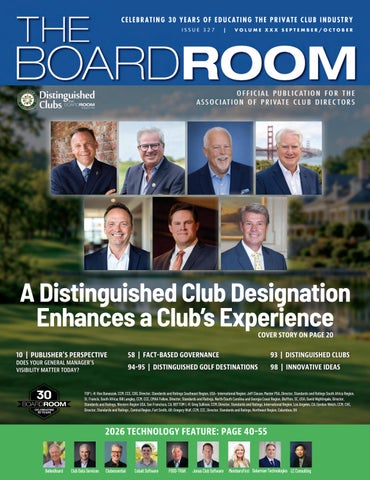
A Distinguished Club Designation Enhances a Club’s Experience COVER STORY ON PAGE 20
10 | PUBLISHER’S PERSPECTIVE DOES YOUR GENERAL MANAGER’S VISIBILITY MATTER TODAY?
58 | FACT-BASED GOVERNANCE
93 | DISTINGUISHED CLUBS
94-95 | DISTINGUISHED GOLF DESTINATIONS
98 | INNOVATIVE IDEAS
TOP L-R: Ron Banaszak, CCM, CCE, COO, Director, Standards and Ratings Southeast Region, USA– International Region; Jeff Clause, Master PGA, Director, Standards and Ratings South Africa Region, St. Francis, South Africa; Bill Langley, CCM, CCE, CMAA Fellow, Director, Standards and Ratings, North/South Carolina and Georgia Coast Region, Bluffton, SC, USA; David Nightingale, Director, Standards and Ratings, Western Region USA, San Francisco, CA; BOTTOM L-R: Greg Sullivan, CCM, Director, Standards and Ratings, International Region, Los Angeles, CA; Gordon Welch, CCM, CHE, Director, Standards and Ratings , Central Region, Fort Smith, AR; Gregory Wolf, CCM, CCE, Director, Standards and Ratings, Northeast Region, Columbus, OH
2026 TECHNOLOGY FEATURE: PAGE 40-55
BellesBoard
Club Data Services
Clubessential
Cobalt Software
FOOD-TRAK
Jonas Club Software
MembersFirst Delarman Technologies LC Consulting
Executive Search and Consulting
Serving the private club and boutique resort industries.
Consulting
Governance Strategic Planning Surveys and focus groups Executive Compensation Operational Reviews Club Assessment and Acquisition Management Advisory Services Performance Management
Executive Search Club Management Financial Management Golf Operations Food and Beverage Agronomy Athletics Resort Management Membership
2,200+ PROJECTS OVER 26 YEARS
Dan Denehy President
NOW OFFERING
Employee Housing Workforce housing. Solved.
Workforce Stability Infrastructure • No Assessments • No Capital Outlay • No Balance Sheet Impact • Professionally Managed • Affordable • Fuel Internship Programs
800+
PRIVATE CLUBS INCLUDING MEMBER-OWNED, SINGLE-OWNER AND PRIVATE EQUITY
denehyctp.com
The value of peripheral vision.
Scan now for more information!
CONNECTICUT | JACKSON HOLE | ARIZONA | CALIFORNIA | OHIO
203 319 8228
We specialize in teeing you up for success.
With over 40 years of experience guiding some of golf’s most iconic courses like Walt Disney World Golf, resorts like PGA WEST, and clubs like The Nelson Golf & Sports Club, Century Golf Partners understands what it takes to help yours truly thrive. Whether navigating major transitions, rethinking member experiences, or optimizing everyday operations, our creative approach helps clubs find the best path forward, no matter how complex the challenge. See what’s possible with us as your partners at CenturyGolf.com/partner
The trusted partners for your club’s future
EDITOR’S NOTE
What Technology Gives Us TECHNOLOGY HAS COME A LONG WAY IN THE 30 YEARS BOARDROOM HAS BEEN PUBLISHING.
Here’s a little-known fact: For two years in the early 2000s, I lived in Thailand with my young children while continuing to work. My parents were there too, including my dad, Dave White, now BoardRoom’s editor emeritus, and my mom, Gail. I suppose you could call me one of the original digital nomads, although it certainly didn’t feel very “digital” at the time. To make it possible, we had satellite internet installed specifically for us at the guest house where we were living. It was remarkable technology for the time. I could work from halfway around the world, send files back and forth and stay connected to an office thousands of miles away. But there were limits. The printer’s proofs still had to be sent to me by overnight FedEx. And these weren’t PDFs arriving neatly in my inbox. They came in a custom cardboard package about three feet by two feet. After a few issues, the FedEx delivery driver knew exactly who I was, arriving on his motorbike with this enormous package, weaving around roosters in the road with a temple rising in the background, all to deliver printer’s proofs to the woman working from a guest house in Chiang Mai. When John Fornaro would call, I’d sometimes joke and answer the phone, “BoardRoom magazine, Southeast Asia division.” There were plenty of long-term travelers in Asia back then. Most were teaching ESL, studying abroad or spending time on retreats. But working remotely from the other side of the world was still unusual, and internet cafés were the hot ticket, opening up a whole new world to people like me. Looking back, the technology seems almost quaint. But it gave me something extraordinary: the opportunity to live on the other side of the world with my parents and my children while they were little. I could continue doing the work I loved while giving all of us an experience we would remember for the rest of our lives.
are problem solvers, helping clubs identify challenges, anticipate what is coming next and find solutions that make operations more efficient without losing the high-touch experience that defines this industry. Technology should never replace the human side of the club business. It should support it. The smartest technology gives club professionals better information, stronger systems and more time to focus on what they do best: leading teams, serving members and creating the experiences people remember. Sometimes that also means knowing what you don’t need to master yourself and leaving it to the experts who do. BR
That may be what I appreciate most about technology when it works well. It should not consume more of our lives. It should give some of our lives back to us. In the club industry, technology now touches nearly every part of the operation. Data and analytics inform decisions. Cybersecurity protects members, employees and the club itself. Mobile apps, online reservations and member communications shape the experience. Point-of-sale systems, accounting platforms and operational software keep everything moving behind the scenes. And all of it’s changing quickly. That’s why the right technology partners matter. The vendors serving the private club industry are not simply selling software, systems or platforms. At their best, they
4
BOARDROOM | SEPTEMBER / OCTOBER 2026
Heather Arias de Cordoba Editor | heather@boardroommag.com
Co-Founder/CEO
John G. Fornaro
Publisher/CEO
President
John G. Fornaro
Keith Jarrett
Editor/Co-Publisher
COO Distinguished Clubs and Distinguished Golf Destinations
Heather Arias de Cordoba
Editor Emeritus
People Focused, Quality Driven
Ron Banaszak, CCM, CCE
Dave White
Chief Analyst
Copy Editor
Frank Gore
Chryssoula Filippakopoulos
Chief Technology Officer
Innovative Ideas Editor
Jeff Briggs
Kaden Arias
President, DGD
APCD Executive Director
Paul Levy
Bill Thomas
CEO, DGD
Editorial & Marketing Director
Thomas Fitzgerald
Business Development
Christine Fitzgerald
Dee Kaplan
Director, DGD
Joshua Nuzzi
Director, DGD
Operations Director/Subscriptions
Gordon Welch, CCM, CHE
Krystal Seidel & Ronni Dana
Executive Director
Marketing Coordinator
Bill Thomas
Kaiya Brielle
Director of Support
Digital Content Coordinator Julia Williams
www.BoardRoomMagazine.com www.apcd.com (949) 376-8889
Joshua Nuzzi
www.DistinguishedClubs.com www.DistinguishedGolfDestinations.com
Featured Columnists Heather Arias de Cordoba Ray Cronin Henry DeLozier John G. Fornaro
Bonnie J. Knutson Nancy M. Levenburg Sam Lindsley Robyn Nordin Stowell
Gregg Patterson Mitchell L. Stump
Lynne LaFond DeLuca Leon Denton Dave Doherty Ed Doyle Chryssoula Filippakopoulos Matt Guzik Wes Hagen Phil Harvey Jr. Tyler Hathaway Jeremy Hoch Monte Koch Dick Kopplin Karima Lanfranco Michael Leemhuis Paul K. Levy Mitch Little
David Mackesey Safa Movassaghi Tom Neill Tara Osborne Whitney Reid Pennell Pamela Radcliff Michelle A. Riklan Corey Saban Robert A. Sereci Toni Shibayama Brad D. Steele Scott Strong Kelsey Underwood Gordon Welch Dave White
The most trusted name in executive search and consulting!
Contributing Writers David Andow Kaden Arias Lawrence J. “Skip” Avery Ronald Banaszak Bruce Barilla Allison “Alli” Bell, Ph.D. Victoria Burns Kris Butterfield Cance Kevin Carroll Roger Chao Lingxiang Cheng, PhD Jarrett Chirico Natalie Choi Frank Cordeiro John Corley Colin Cowie
Scan for a full directory of services.
Strategic Partners and Allied Associations
ARIZONA | COLORADO | FLORIDA | GEORGIA | KANSAS MICHIGAN | NEBRASKA | NEW JERSEY | NEW YORK NORTH CAROLINA | OHIO | TEXAS | WASHINGTON D.C. AUSTRALIA | CANADA | NEW ZEALAND | UNITED KINGDOM
BoardRoom magazine is published by APCD Inc., 1100 S. Coast Hwy. #311 Laguna Beach, California 92651 The BoardRoom magazine (USPS 022516, ISSN 15537684) is a bi-monthly trade publication. Issue 327 Periodical postage paid at Laguna Beach, Calif. and additional mailing offices. POSTMASTER: Send address changes to BoardRoom magazine, P.O. Box 9455, Laguna Beach, Calif. 92652. Reach The BoardRoom magazine at (949) 376-8889 ext. 1 or accounting: krystal@boardroommag.com editorial: johnf@apcd.com or heather@boardroommag.com or visit the website at www.BoardRoomMagazine.com.
WWW.KKANDW.COM WWW.KKANDW.COM/INTERNATIONAL WWW.CLUBLEADERSHIPALLIANCE.COM
833-KKW-HIRE
CONTENTS | SEPTEMBER / OCTOBER 2026
PUBLISHER’S PERSPECTIVE
GLOBAL PERSPECTIVES
BY JOHN G. FORNARO
BY HENRY DELOZIER
BY NANCY M. LEVENBURG
10
12
14
DOES YOUR GM’S VISIBILITY MATTER TODAY? Today’s general manager must balance visibility with an increasingly complex leadership role. When does presence build trust, and when does leadership need to happen behind the scenes? The strongest GMs understand that visibility is less about being seen and more about being present with purpose.
LEGAL COMMITTEE
16
BY ROBYN NORDIN STOWELL & MITCHELL L. STUMP
TAX-EXEMPT STATUS: QUALIFICATIONS AND REQUIREMENTS - PART I Tax-exempt status offers private clubs important advantages, but it also carries significant operational restrictions. From member control and nonmember revenue to recordkeeping and permitted activities, club leaders need to understand the requirements before a compliance issue puts that status at risk.
PLIGHTS AND INSIGHTS
BUILDING YOUR CLUB’S BRAND
PARKING LOT BLUES
Every private club has a brand, whether leadership manages it intentionally or not. Strong clubs understand what they stand for, differentiate themselves in meaningful ways and create an experience that resonates with current and future members. Is your club delivering on the promise its brand makes?
The member experience begins before anyone reaches the clubhouse. Parking affects convenience, safety, accessibility and first impressions. Take a fresh look at your club’s parking policies and design: Are they putting members and guests first or creating frustration before the experience even begins?
BOARDROOM BASICS
FACT-BASED GOVERNANCE
BY SAM LINDSLEY
BY RAY CRONIN
18
58
INNOVATIONS CONTINUING TO SHAPE PRIVATE CLUBS IN 2026
WHAT THE NUMBERS SAY ABOUT CLUB GOVERNANCE
Technology, AI, events, social media, food and beverage and marketing continue to reshape private clubs. The challenge is knowing which trends deserve attention while preserving the personal connection members value most. Which innovations should your club be prioritizing now?
Strong governance requires more than opinions and tradition. Financial data, capital funding and net worth over time can reveal whether a club is truly positioned for long-term success. Do your board’s assumptions about dues, expenses and financial health align with what the numbers actually show?
HOSPITALITY MINDSET
MEMBERSHIP MUSINGS
TRIBAL MAGIC
BY WHITNEY REID PENNELL
BY BONNIE J. KNUTSON
BY GREGG PATTERSON
86
102
70 BEYOND MAINTENANCE: WHY FACILITIES ARE A STRATEGIC ADVANTAGE Facilities influence employee efficiency, service consistency, member satisfaction and financial performance. Poorly designed spaces and aging equipment create friction throughout the operation. Are your club’s facilities helping employees deliver the experience you promise or forcing them to work around unnecessary obstacles?
BORROWING IS BRILLIANT Some of the best ideas for private clubs may come from outside the industry. Luxury retail, hospitality, entertainment and marketing offer valuable lessons in personalization, storytelling, culture and connection. Where could your club borrow its next great idea?
GOT RELATIONSHIPS? THEY MATTER FOR LONG STAYERS Why do some club professionals remain energized and committed for decades? Staying power is often rooted in strong relationships with employees, members, club culture and the broader industry. What connections are you intentionally building that make your club, and your career, worth staying for?
FEATURES
ALLIANCE INSIGHTS ACCP . . . . . . . . . . . . . . . . . . . . . . . . . . . . . . . . . . . . . . . . . . . . . 26
GOVERNANCE 101 . . . . . . . . . . . . . . . . . 36
Hidden Cost of Delaying Change By Roger Chao
Where Members Gather: Designing Intentional Outdoor Club Experiences By Lynne LaFond DeLuca
INDUSTRY INSIDER . . . . . . . . . . . . . . . . 56
HFTP . . . . . . . . . . . . . . . . . . . . . . . . . . . . . . . . . . . . . . . . . . . . . . 38 Raising the Bar: How Clubs Develop a Head of Finance Worth Trusting By Michelle A. Riklan
Club Recruiter By Natalie Choi
CMAA . . . . . . . . . . . . . . . . . . . . . . . . . . . . . . . . . . . . . . . . . . . . . 60
ON THE FRONTLINES . . . . . . . . . . . . . . . 62
Technology as a Leadership Responsibility By Leon Denton
The Communication Trap: Why Saying Less Often Says More By Robert A. Sereci
GCSAA . . . . . . . . . . . . . . . . . . . . . . . . . . . . . . . . . . . . . . . . . . . . 66 Working for You: National Golf Day and the Industry Advocacy Coalitions By Kelsey Underwood
ON THE FRONTLINES . . . . . . . . . . . . . . . 63
The General Manager as Chief Culture Officer By Tyler Hathaway
APCD . . . . . . . . . . . . . . . . . . . . . . . . . . . . . . . . . . . . . . . . . . . . . 74
DISTINGUISHED EXPERIENCES . . . . . . . 71
DIRECTORS’ CLUB OF AMERICA . . . . . . . . . . . . . . . . . . . . . . . . . . 76
Top Private Club Presidents of the Year By Chryssoula Filippakopoulos
High Tech, Higher Touch By Colin Cowie
The Leader Is the Brand By Jarrett Chirico
PGA . . . . . . . . . . . . . . . . . . . . . . . . . . . . . . . . . . . . . . . . . . . . . . 80
CULTURE PLAYBOOK . . . . . . . . . . . . . . . 72
Technology Changes Fast. Culture Determines Whether It Sticks. By Karima Lanfranco
Change Starts Here: The ‘MAD Manager’ Mindset By Monte Koch
APCD . . . . . . . . . . . . . . . . . . . . . . . . . . . . . . . . . . . . . . . . . . . . 104 Governance Without Interference By Gordon Welch
THE FACTS OF WINE . . . . . . . . . . . . . . . . 82
Beyond the Wine Dinner By Wes Hagen INDUSTRY LEGISLATION . . . . . . . . . . . . 90
Cleaning Up Your Club’s Bylaws By Brad D. Steele DISTINGUISHED CLUBS . . . . . . . . . . . . . 93
West Bay Club By Ronald Banaszak DISTINGUISHED GOLF DESTINATIONS . . . . . . . . . . . . . . . . . 94-95
The Grand Resort Sonnenalp Club By Ronald Banaszak THE REFLECTIVE GM . . . . . . . . . . . . . . . 96
The Leap That Lasted 12 1/2 Years By Matt Guzik INNOVATIVE IDEAS . . . . . . . . . . . . . . . . 98
COMMITTEES EXECUTIVE COMMITTEE . . . . . . . . . . . . 28
CULTURE COMMITTEE . . . . . . . . . . . . . . 73
COMMUNICATION COMMITTEE . . . . . . 92
Navigating Strategic Planning By Allison “Alli” Bell, Ph.D.
Culture First, Talent Follows By Tara Osborne
EXECUTIVE COMMITTEE . . . . . . . . . . . . 30
MEMBERSHIP COMMITTEE . . . . . . . . . . 78
It’s Not a Matter of If. It’s a Matter of When. By Corey Saban
Who Sets and Leads Strategy? By Frank Cordeiro and David Mackesey
Membership Cap Does Not Tell You By Kris Butterfield Cance GOLF COMMITTEE . . . . . . . . . . . . . . . . . 81
EXECUTIVE COMMITTEE . . . . . . . . . . . . 32
Beyond the Experience - Part II By Kevin Carroll and Michael Leemhuis EXECUTIVE COMMITTEE . . . . . . . . . . . . 34
What Makes a Member Stay? By Lawrence J. “Skip” Avery
By Kaden Arias
GREEN COMMITTEE . . . . . . . . . . . . . . . . . . . . . . . . 64
EXCELLENCE IN CLUB GOVERNANCE . . . 100-101
Customized Aerification/Displacement By Dave Doherty
Three Things Club Boards Overlook Tactical or Strategic? By Henry DeLozier THIS MUCH I KNOW FOR SURE . . . . . . 118
My 10 Norms and Expectations By Dick Kopplin
INSURANCE COMMITTEE . . . . . . . . . . . . 68
Autonomous Mowers By Phil Harvey Jr. INSURANCE COMMITTEE . . . . . . . . . . . . 69
Protecting Your Club By Toni Shibayama
Balancing Technology for Convenience By Paul K. Levy F&B COMMITTEE . . . . . . . . . . . . . . . . . . 83
F&B and House Committee Alignment By Ed Doyle
COVER STORY . . . . . . . . . . . 20
By Dave White, editor emeritus
HR COMMITTEE . . . . . . . . . . . . . . . . . . . 84
Change Catches You by Surprise By Pamela Radcliff HOUSE COMMITTEE . . . . . . . . . . . . . . . . 85
Sometimes Saying “Sorry” Isn’t Enough By Bruce Barilla HISTORIC COMMITTEE . . . . . . . . . . . . . . 91
How a Club’s History Guides Change By Tom Neill
TECHNOLOGY FEATURE BELLESBOARD . . . . . . . . . . . . . . . . . 40-41 CLUB DATA SERVICES . . . . . . . . . . . 42-43 CLUBESSENTIAL . . . . . . . . . . . . . . . . 44-45 COBALT SOFTWARE . . . . . . . . . . . . . 46-47 FOOD-TRAK . . . . . . . . . . . . . . . . . . . 48-49 JONAS CLUB SOFTWARE . . . . . . . . . 50-51 MEMBERSFIRST . . . . . . . . . . . . . . . . 52-53 DELARMAN TECHNOLOGIES . . . . . . . . . 54 LC CONSULTING . . . . . . . . . . . . . . . . . . . 55
JOHN G. FORNARO
PUBLISHER’S PERSPECTIVE
John G. Fornaro is the publisher/CEO of BoardRoom, co-founder/CEO of Distinguished Clubs and Distinguished Golf Destinations, CEO of APCD and president of BoardRoom Institute. He can be reached at (949) 376-8889 or via email: johnf@apcd.com.
Does Your GM’s Visibility Matter Today? General managers are often seen as the visible face of private clubs—the conductors who bring everything together and the stewards of the club’s culture and strategy. How visible should a general manager be at a private club today—and where, when, and why? What role does visibility play in a manager’s connection with club members? Private club managers can often feel they need to be present to stay connected and engaged, whether at late dinner parties, holiday celebrations, or summer golf tournaments. “There is no question that visibility matters for a general manager. It matters to members, and it matters just as much to employees,” said Joe Krenn, CEO/GM of Farmington Country Club in Charlottesville, VA. “But I think we sometimes define visibility too simply. As the GM role has become more complex, the traditional expectation of visibility hasn’t changed nearly as much. Today’s GM has responsibilities involving governance, strategy, finances, capital planning, employee culture, member relations and countless other areas. We simply cannot be everywhere, nor should we be. To me, visibility isn’t about making sure people see the GM. It is about being present with purpose,” he added. “Members want to know their trusted leader has a pulse on what is happening at their club. Employees want to know you understand their work and will be there to support them when it matters. Sometimes the most important reason to show up isn’t that members expect to see you, but because your team has worked incredibly hard and your presence tells them you see and appreciate their efforts.” Ray Cronin believes that “the best general managers understand when, how frequent (likely some influence from the culture of the club), and when to be visible.” As the founder of Club Benchmarking, an industry leader in data-driven products and services for private clubs, Cronin brings valuable insight to the field. “It seems to me, across the industry, the ‘need’ to be visible is lessening. If clubs are making investments worth tens of millions, the members understand that focusing on being on time and on budget trumps standing in the grill room on Friday night. It is slow as can be, but I do believe half of the industry is evolving in member view of management and roles and responsibilities,” he added. “After more than 35 years in the private club industry, I believe strongly that a general manager should be visible. Members should know their GM, feel comfortable approach10
BOARDROOM | SEPTEMBER / OCTOBER 2026
ing them and know that the person entrusted with leading their club understands the member experience firsthand,” explained Karen Harmon, GM/COO of Sarasota Yacht Club, Sarasota, FL. “I make it a priority to walk the club, visit dining areas, attend events, and spend time talking with members and employees while simply observing. You learn things by being present that will never appear on a financial statement, survey or dashboard. A member’s expression, the energy in a dining room or a conversation with an employee can tell you a great deal. “But visibility should never be confused with being available every minute of every day, or with effective leadership itself. Today’s GM is leading an increasingly complex organization. Behind the scenes, we are developing budgets and long-range capital plans, overseeing construction projects, managing risk, recruiting and developing employees, addressing regulatory and legal matters, listening to and evaluating member feedback, planning strategically and preparing our clubs for challenges that members may never know existed,” she said. “From our perspective, high-functioning clubs don’t put as much emphasis on visibility as they once did. That said, clubs still want to see their GM. It’s consistently one of the top five things boards mention, especially when replacing a highly visible manager,” said Tom Wallace of the industry search and consulting firm, Kopplin Kuebler & Wallace. “We’ve always said clubs want someone who can run the business. The GM/COO doesn’t need to be in the dining room handing out menus, but they do need to be self-aware enough to know when to be visible. Managing by walking around is still critical for both members and the team. “Visibility is important, but it should be intentional rather than simply being present for the sake of being seen. A successful GM or COO needs to be self-aware enough to understand where members and staff expect to connect with their leader and then make a point of being present at those key connection points. “That might mean welcoming members in the dining room before dinner or being visible around the first tee on a Saturday morning. Still, it also means making time to walk the property regularly and engaging with both members and employees throughout the day,” Wallace said. “At the same time, members need to recognize that effective leadership today cannot be measured solely by how much time a GM spends in public view. See Publisher’s Perspective | 114
In everything we do
Style and Functionality Blended with Comfort and Durability • Designs that Enhance Your Brand with Unparalleled Service & Expertise • Quality Products Ready to Ship with Competitive Pricing • In-house Embroidery with Fast Turn Around EXCELLENCE in ACHIEVEMENT AWARD WINNER FOURTEEN YEARS RUNNING
2012 - 2 0 25 BoardRoom Magazine
Contact us today! Let’s start the conversation.
(707) 746-7011 SALES@HIGHENDUNIFORMS.COM HIGHENDUNIFORMS.COM
HENRY DELOZIER
GLOBAL PERSPECTIVES
Henry DeLozier is a partner at GGA Partners. He can be reached via email: henry.delozier@ggapartners.com
Building Your Club’s Brand Quickly now, what is the most recognized brand among private clubs? Most club leaders will argue, “We are a private club … not a brand. We aren’t selling anything!” But wait. … Al and Laura Reis, the father-daughter team that authored “The 22 Immutable Laws of Branding,” describe a brand as “a small piece of real estate that one owns in the mind of the customer.” Private clubs, which rely on the promises of exclusivity and superior services and experiences, are brands unto themselves when managed properly. Brand authority is the truth about your brand. Is your club what it claims to be? Does it deliver on its brand promise? Is it worth something special? And the answer to the opening question is Augusta National Golf Club and the Masters Tournament. No club is more thorough or more thoughtful. “The 22 Immutable Laws of Branding” says, “The power in a brand name lies in its ability to positively influence purchasing behavior. In an increasingly cluttered information society, a powerful brand image can act as a guidepost for the consumer in making a purchase decision.” Here are a handful of steps that you can take to fortify your brand and its authority in your market. 1. Define your club’s brand. Does your brand represent and create market differentiation? Or is your club another private club that is the same as its many competitors? Your brand should describe your club’s core values. What values does your club stand for? Concepts that resonate in today’s private club market include family-friendly, diverse, earth-first, safe haven, fun and full of friends. 2. Let others speak for you. Provide “tools” that your members and their friends can use to brag about your club. Digital brochures they can send to acquaintances, photos they can post on social media, and third-party endorsements—such as awards and recognitions that highlight your club’s strengths—are opportunities for you. To seize this opportunity, prepare the tools before you need them. Keep a photo library, invite members to share their own photos and stories, and develop and sustain ongoing communications (not advertising) with your community. Examples of private club outreach into communities are energetic and engaging junior programs for sports, social and
12
BOARDROOM | SEPTEMBER / OCTOBER 2026
cultural learning activities, and environmental programs for Boy and Girl Scouts—private clubs are laboratories for earning merit badges in conservationism, commerce, cooking, lifesaving and citizenship. 3. Use sophisticated design to show that your club is innovative. Update your club’s website if it is outdated. It is your virtual front door. Curate stories and images that show your club’s people and lifestyle. Change impacts the people of your club. It influences their anxieties, expectations and needs concerning the club. Your club’s brand represents both stability and quality in their minds … or not. 4. Create an aspirational club. Make your club one everyone wishes to join. To accomplish this objective, execute a SOAR analysis—strengths, opportunities, aspirations and results. Be deliberate in establishing what the club wants to do, be and promise. Demonstrate how your club is leaning forward and creating a world people want in their futures. Answer the question, “What will the next generation of members want at our club?” Your club is either leaning forward or backward. 5. Differentiate. Differentiate. Differentiate. See that your club stands out from the pack in favorable ways. Align your intentions with what members and prospects want and with your club’s values. Peter Drucker, the unparalleled management thinker, taught, “Because the purpose of business is to create a customer, the business enterprise has two—and only two—basic functions: marketing and innovation. Marketing and innovation produce results; all the rest are costs. Marketing is the distinguishing, unique function of the business.” Wellness programs, special dining experiences and robust non-golf activities that build on lifelong learning, travel and an experience economy are points of differentiation that resonate today. Now, mindful club leadership is intentional with the club’s brand and how the brand is actual in members’ lives. Brand your club to sustain its values and reach its future goals. BR
NANCY M. LEVENBURG
PLIGHTS AND INSIGHTS
Nancy Levenburg, Ph.D., is Professor Emerita in Management from the Seidman College of Business at Grand Valley State University in Grand Rapids, Michigan. She has published hundreds of articles in business and professional journals, and has assisted over 200 organizations with strategic planning, marketing strategy, and improving operations. She is the President of Edgewater Consulting, a member of Spring Lake Country Club in Spring Lake, and the recipient of the BoardRoom 2024 David White Editorial Award. For more information, contact her at: levenbun@gvsu.edu or (616) 821-5678.
Parking Lot Blues “Life is a journey, but don’t worry, you’ll find a parking spot at the end.” this is where the new sunroom is being built. – Isaac Asimov However, the parking spaces with signs that say “Library Staff Only” remain unchanged; library “They paved paradise and put up a parking lot.” staff have the same number of spaces and lo– Joni Mitchell cation (right next to the building) as before the project began. We all know what many people consider to be the “best” parking spots. Needless to say, I ran into a real dilemma the They’re the ones closest to the front entrance of the grocery store, other day when I went to the library to return a Home Depot, Walmart or the shopping mall, or the country club. And if book, which would normally have taken a total of the white backup lights of a vehicle parked in a choice spot illuminate to about 10 seconds. I circled the parking lot three signal the car has gone into reverse and the spot is about to be vacated, times with nary an empty spot nor even a vehicle drivers hover nearby, often turning on their blinkers to alert others that with backup lights on. they’ve claimed the spot. JEWELRY STORE PARKING In fact, if another driver should be so audacious as to encroach upon I have nothing against librarians. In fact, I althat claimed spot, the offender might be greeted with profane language ways encouraged my students to make friends and the one-finger salute. That’s one example of bad parking etiquette. with the business school’s reference librarian. But there are others: people who park their vehicles crookedly, occupy But do they really need to have prime parking multiple spaces or block pedestrian walkways. spaces reserved for their exclusive use when An estimated 20 percent of vehicle accidents occur in parking lots they are presumably going to be working for a where aggravations and potential hazards abound. Why? Poor lighting can jeopardize public safety and provide cover for theft, vandalism and shift of at least a couple of hours? I recalled the many times I pitched in on the other crime. Potholes and cracks in asphalt can cause trips and falls sales floor of a jewelry store in a regional mall. that result in physical injuries, as do environmental hazards like rain, We (employees) always parked in a remote area snow and ice. (farther away from the mall entrance) so that All this means that careful attention should be paid to the parking lot, mall shoppers could have the “prime” spots. including its design (rectangular layout versus angled maximizes the use If we were going to be working for four hours of space), the number and width of parking spots, traffic flow, pedestrian (or more, especially during the holiday season), safety, drainage and ADA compliance. Aesthetics, too, because your we did not need fast and easy access to our cars. parking lot may be the first impression guests and visitors have of your In fact, the same thing happens at my local Walprivate club or golf resort. greens. Employees park in spots farthest from LIBRARY PARKING LOT the store entrance—not the “best” ones right So, my local library is in the midst of a building reconstruction project next to the entrance. to add a sunroom. (Why it needs a sunroom, I don’t know.) Its estimated So, bringing this full circle to private clubs and completion date is six months from now. golf resorts, what’s your parking situation like? Contractors’ trucks and trailers occupy several parking spaces where Do employees forego parking in the “best” spots library patrons used to park, reducing the spaces they can access by to give preference to members and guests? Or, about half. Consequently, if the lot is full—which it often is—prospective like the librarians, do they have the best spots readers in search of new books are forced to park either on the street or reserved for themselves? B R in a nearby church’s parking lot—if it’s not a Sunday. The library’s drive-thru window for returning books is also closed, or rather, is enclosed with fencing to make it inaccessible. Presumably,
14
BOARDROOM | SEPTEMBER / OCTOBER 2026
FIRST STEP FOR ANY IMPROVEMENT PROGRAM S T R A T E G I C
F A C I L I T Y
Master Planning OUR CRITICAL 8-STEP PROCESS HELPS ENSURE CLUB FACILITY SUCCESS!
Call the Club Facility E X P E RT S !
SCHEDULE YOUR COMPLIMENTARY ‘FIRST IMPRESSIONS’ VISIT! " The McMahon Team is Always at Your Service "
McMahon offers our complimentary visit and First Impressions report by a McMahon planner to understand your club's needs and to recommend future improvements. Contact us about our award-winning club services at 314-744-5040, info@mcmahongroup.com or visit McMahonGroup.com for more detailed information.
43 YEARS
IN B USINESS
2000
$4+
SERVED
RAISED
OVER
CLUBS
BILLION
CONCLUDING MASTER PLANNING STEP: DEVELOPING & APPROVING FUNDING!
McMahon Group has developed a capital funding expertise for clubs to use in sizing major capital projects. Based on our 40 years of experience with thousands of club projects costing over $4 Billion, we know how to develop club facility master plans’ and how to fund them. We know how to develop funding plans that members will approve if presented properly, call us to help you develop a funding program for your next master plan project! T H E
S O U R C E
F O R
P R I V A T E
C L U B
F A C I L I T Y
E X C E L L E N CE™
ROBYN STOWELL
MITCHELL STUMP
LEGAL COMMITTEE
Tax-Exempt Status: Qualifications and Requirements - Part I This is a two-part article addressing 501(c)(7) tax-exempt status. Part 1 discusses the benefits and restrictions of tax-exempt status. Part 2 discusses how a club that is not tax-exempt can convert to tax-exempt status, and vice versa, including the requirements and benefit calculations. Generally, a newly formed corporation may apply for tax-exempt status during the first seven years of its existence without possible tax ramifications. An existing club applies for tax-exempt status, and the IRS approves it. It is a separate issue from whether the club is a for-profit or nonprofit corporation for state purposes. TAX-EXEMPT STATUS IS AVAILABLE TO PRIVATE MEMBER-OWNED CLUBS Federal laws, IRS regulations and interpretations, and court rulings give guidance on the qualities a club should have to be eligible for tax-exempt status. Some of these criteria have been articulated as follows: • Member ownership, meaning members would share in the proceeds on dissolution, but members do not share in the club’s net earnings. Members generally pay a joining fee, dues and/or assessments. • Member-controlled, meaning members hold meetings, have a voice in selecting new members, have voting rights and control the club’s operations (through electing the board). • Selective membership, meaning membership is not open to the general public, and there is a robust membership selection process. A club should not have the following qualities to be eligible for tax-exempt status: • Not under the control of a single member, meaning it is not available to the club while the club is under developer control, and no membership classes allow just one member to have all control • Not a homeowners/property owners association, which has roles such as owning and maintaining residential streets, administering and enforcing deed covenants, and preserving the architecture and appearance of the housing development • Not providing the following services, which have been held inconsistent with 501(c)(7) tax-exempt status: fire, police protection and trash collection. A Tax-Exempt Club Has Several Significant Limitations on Its Operations: Individuals versus Corporations: Only individuals are contemplated to be members of the club. Corporations can be 16
BOARDROOM | SEPTEMBER / OCTOBER 2026
members but are deemed nonmembers (the general public), and their gross receipts are recorded as nonmember revenue. Recordkeeping: Clubs must maintain records (Rev. Rul. 71-17 “Parties of more than 8” forms) to identify member versus nonmember gross receipts. Nonmember gross receipts should not exceed 15 percent of the total gross receipts. Nonmember gross receipts plus investment income should not exceed 35 percent of the total gross receipts. Gross Receipts Defined: Gross receipts include charges, admission fees, membership fees, dues, assessments, investment income (such as dividends, rents and similar receipts) and normal recurring gains on investments. Initiation fees and capital contributions are excluded from gross receipts. TAX-EXEMPT CLUBS ARE LIMITED AS TO “NONTRADITIONAL” ACTIVITIES “Nontraditional activities” at a tax-exempt club should be very limited (there is not a 5 percent rule) or, as the rules state, “de minimis.” Transactions with members and nonmembers that might fall in the nontraditional category include food sales to go to be consumed off club premises, such as Thanksgiving turkeys or turkey dinners, Christmas hams, pizza, baked goods sold to go (such as a cake to be consumed off club property) and cases of wine sold to go. Other nontraditional activities could include catering parties at members’ homes, providing parking for use while going to work (not coming to visit the club, such as all-day parking at a city club). LEGAL PRIVATE STATUS IN YOUR STATE Do not confuse tax-exempt requirements with private club requirements. For tax purposes, a club may be “open to the public” or “not purely private” because of nonmember weddings or Monday outings. That may be a tax issue (i.e., exceeding nonmember revenue). It can also impact the club’s ability to be selective in its membership decisions and to be exempt from some other laws. So, the decision of whether to be tax-exempt turns on the extent to which the club can benefit from the five times in its life that there could be a significant tax liability and whether the club can operate within the restrictions listed. BR Robyn Nordin Stowell is a partner at Spencer Fane LLP. Robyn may be reached at (602) 333-5467 or at rstowell@spencerfane. com. Mitchell L. Stump is the author of the Club Tax Book and may be reached at (561) 776-0452 or mitch@clubtax.com. This article is for informational purposes and is not legal or tax advice.
Award Winning Clubhouse Master Planning “creating your club’s road map to best in class facilities”
“We engaged C2 Limited Design to develop Baltimore Country Club’s master plan. Their first iteration was well designed, thoughtful and took to heart the needs we shared with them, particularly with our challenge of being a two campus facility. From their first presentation, to nearing completion, it is apparent C2’s strengths lie in their ability to listen and understand their clients.” M. Kent Johnson, CCM General Manager/COO Baltimore Country Club Kansas City Country Club
Award Winning Clubhouse Design & Furniture “transformative change to your member experience & operations” To say we were pleased with C2’s design, process, involvement, and “hand-holding” might be the understatement of the year. They were amazing every step of the way. I cannot speak highly enough about working with C2. Craig, Christina, and the team were a treat to work with and they exceeded our loftiest expectations. I know I am not the only one at Westchester who is taking a good look around the club to see what other spaces can be vastly improved by C2’s incredible designs.” Mark J. McCooey Chairman, WCC House Committee Westchster Country Club Kansas City Country Club
Boardroom Excellence in Achievement “award winners of 21 awards for 13 consecutive years!”
Master Planning The Briar Club Clubhouse Historical Interior Renovation Oak Hill Country Club
(203) 259-2555
w w w. c 2 l i m i t ed . c om
SAM LINDSLEY
BOARDROOM BASICS AND BEYOND
Sam Lindsley is a search & consulting executive with Kopplin Kuebler & Wallace. He can be reached at (833) KKW-HIRE, ext. 712 or via email: sam@kkandw.com
Innovations Continuing to Shape Private Clubs in 2026 In my years working with private clubs across the country, first in F&B operations and now supporting clubs through executive search and consulting at KK&W, I’ve seen firsthand how rapidly the industry is evolving. With younger demographics joining and operational complexities rising, private clubs that thoughtfully integrate technology tools and approaches are the ones building lasting member loyalty and financial strength. Here’s my perspective on the key trends in technology, events, social media, F&B and marketing that club leaders should prioritize this year. Technology is a part of the daily operating playbook for private clubs. Most clubs use data to anticipate staffing needs, manage inventory, understand member habits, and improve reservations and service through mobile platforms. When used thoughtfully, these tools can help leaders make better decisions faster, whether that means preparing for a busy dining night, managing tee time demand or recognizing member preferences without losing the personal service that members expect. Regarding AI, I’m having déjà vu all over again. During the pandemic, the landscape of our understanding kept changing rapidly. I have an eerily similar feeling these days about our understanding and use of AI and how it is impacting our professional (and personal) lives in real time. Our understanding of AI technology opens up similarly to how a map opens up as you run forward in a video game. That is why privacy and proprietary content protection should be paramount in your approach. The key is balance: Technology should enhance, not replace, the personal touch that defines great clubs. Boards and general managers/COOs who invest with clear governance around data and ethics will be best positioned for the future. Events have moved beyond standard programming to become powerful drivers of engagement. Multigenerational and wellness-focused gatherings are particularly strong, aligning with members’ desires for meaningful connection. Smaller group, intimate formats like seasonal tasting menus in limited settings create the kind of shared moments that turn members into advocates. From my F&B background, I advise clubs to lean into local supplier partnerships and story-driven events. Personalization based on real member data makes the difference between good attendance and unforgettable nights that reinforce why members belong. 18
BOARDROOM | SEPTEMBER / OCTOBER 2026
For out-of-the-box, fun and interactive ideas, check out Ben Lorenzen at www.benlorenzen.com. Lorenzen is the creative director and chief memory officer at Champions Run in Omaha, NE. Social media platforms are vital for recruitment and community-building, but they must reflect a club’s exclusive character. Successful clubs share genuine glimpses of member milestones, vibrant dining scenes and behind-the-scenes energy while protecting privacy through policies like no-phone zones in key areas. Instagram and targeted private groups work especially well. The “privacy paradox” is real: The most sought-after clubs maintain discretion yet generate buzz through strategic, high-quality content. Focus on value-first posting and member spotlights to build authentic connections without compromising the member experience. We all know that food and beverage remains one of the most important definers of member satisfaction. Traditional items like hot dogs, while still loved, have ceded ground to premium, chef-driven offerings: fresh handhelds, seasonal local ingredients, healthy grab-and-go options, and creative low- and no-alcohol beverages. Outdoor dining expansions and mobile service are delivering strong returns. Clubs that treat F&B as a true hospitality program (emphasizing service culture, staff training and functional wellness options) see higher satisfaction and covers. It’s about delivering indulgence that also aligns with how members want to live and feel today. Effective marketing today highlights lifestyle, community and personalized value. With waitlists common at many clubs, the focus should be on clear storytelling around wellness amenities, flexible programming and the sense of belonging that sets private clubs apart. Data-driven targeting helps reach younger professionals and multigenerational families who prioritize experiences. In my work with clubs, I emphasize authenticity and integration: Every touchpoint, from digital presence to on-site experiences, should reinforce why membership matters. Clubs that do this well turn prospects into engaged members who stay for decades. Private clubs remain resilient because they answer a deep human need for connection and excellence. By embracing these trends with intention, leveraging technology and data while preserving warmth, service and tradition, clubs will continue to thrive. B R
COVER STORY | BY DAVE WHITE, EDITOR EMERITUS
A Distinguished Club Designation Enhances a Club’s Experience “I’ve learned that people will forget what you said, people will forget what you did, but people will never forget how you made them feel.” —Maya Angelou “When asked what I do for a living, I simply say, ‘We are Distinguished. We are the Michelin Guide for the private-club and golf destination industry.’”
“Our mission is to verify the Member Experience,” Fornaro explained. “Through our merit-based evaluation, we spotlight outstanding clubs that have earned this distinguished designation.”
Ron Banaszak passionately supports BoardRoom’s Distinguished Clubs and Distinguished Golf Destinations. As the chief operating officer, he thoughtfully evaluates and guides clubs around the globe, helping them enhance governance, leadership, operations, strategic planning and the overall member experience.
“Being a Distinguished Club not only brings accolades but also elevates a club’s standing through reputable third-party relationships,” said Fornaro.
“It’s a simple, yet profound, way of describing what we do: we are the leading authority with the only merit-based designation a private club or golf destination can earn,” he said. Distinguished Clubs was co-founded 16 years ago by Chief Executive Officer John Fornaro and President Keith Jarrett as an adjunct to BoardRoom magazine. “Our designation is based on transparent, verifiable criteria, informed by member feedback and evaluated by tenured former private club GMs and COOs. “We believe the best clubs in the world should be evaluated on the quality of the member experience. The only meaningful way to assess a property is to experience it firsthand,” Banaszak said. In the exclusive world of private clubs, where prestige is not only earned but cultivated through experience and dedication, Distinguished Clubs designation is the ultimate symbol of excellence. Recognizing clubs that set new standards in Member Experience, this designation is more than an accolade—it’s a validation of a club’s unwavering commitment to service, facilities, and amenities. Fornaro, who is also publisher of BoardRoom magazine, the number one publication in the private club industry, emphasized the significance of this achievement. 20
BOARDROOM | SEPTEMBER / OCTOBER 2026
“Distinguished Clubs shines a public light on your club’s achievements. You join a worldwide community that has earned this prestigious designation.” In practice, this means that nominated clubs must meet the program’s standards as confirmed through independent site visits and an evaluation process conducted by Distinguished Clubs’ tenured Directors of Standards and Ratings. These assessors bring distinguished experiences, institutional knowledge of the process, and the prestige and honor of earning a Distinguished Clubs designation in the private club industry. Distinguished Clubs must meet specific criteria for each category. Each category is also limited to a certain number of clubs worldwide. Distinguished Clubs with EXCEPTIONAL Status: Will not exceed four percent of clubs globally. These clubs meet our baseline Distinguished Criteria by providing exceptional service, facilities, and amenities and consistently achieve strong Member Experience Index™ metrics, thereby setting a high standard. Distinguished Clubs with ELITE status: Will not exceed three percent of clubs globally. These clubs exceed our Distinguished Criteria by delivering the highest standards of service, facilities, and amenities. They are
among the most highly regarded private clubs, with membership fees and dues that reflect their standing. These clubs consistently achieve outstanding Member Experience Index™ metrics. Distinguished Clubs with ICONIC status: Will not exceed one percent of clubs globally The most prestigious clubs, often over 75 years old and invitationonly, have hosted national or international championship sporting or political events and are widely regarded as among the world’s most prestigious private clubs. These clubs consistently achieve extraordinary Member Experience Index™ scores. “Distinguished Clubs site visits have a tremendously positive impact on Distinguished Clubs leadership teams, and the value of the directors conducting the assessments gives us a strong, silent comparison to other private clubs,” expressed Fornaro. “Our team visits each property, meets with the management team and, in many cases, the president or owner, and conducts a comprehensive facility tour. Just as importantly, we gather formal member feedback through ClubIQ™, our proprietary membershippolling software, along with informal conversations with members and employees, to understand the club’s culture and level of member experience,” Banaszak said. “It is impossible to accurately evaluate a property using online forms, applications, photographs, or marketing materials. One must visit the club to understand what truly makes it special. “While evaluation is the primary purpose of the site visits, they also offer opportunities for meaningful idea sharing, professional dialogue, and team morale building. Our goal is not simply to assess clubs but also to recognize excellence and contribute to the continued advancement of the private-club industry,” said Banaszak. “Each year, a small number of properties move down a designation level or lose their designation entirely. This is essential to maintaining the program’s integrity and credibility. “But perhaps more important is how rarely clubs ever receive an invitation to begin the process,” Banaszak added. “A club must first be nominated by the current general manager or COO of a Distinguished property. Of those nominated, nearly onethird do not meet our initial criteria for prestige and reputation. “After a nomination, we contact personnel at other clubs and industry leaders in the area to assess the property’s reputation. This additional due diligence helps ensure that when a club earns its Distinguished designation, its reputation and performance justify its inclusion on our official listing of the finest clubs in the world,” Banaszak continued. “This is what makes Distinguished the Hallmark of Excellence. It is not a pay-to-play model, a licensing agreement, or a popularity contest (where managers beg for votes on social media). For a designation to have meaning, it must be earned—and its standards must remain rigorous, transparent, and consistently applied. “This is the standard the private-club industry deserves!”
Ron Banaszak, CCM, CCE Chief Operating Officer Director, Standards and Ratings Southeast Region, USA—International Region Ronald Banaszak is a recognized authority in the private club industry. He has more than 30 years of leadership experience across premier country, golf, dining, and yacht clubs. As Chief Operating Officer of Distinguished Clubs and Distinguished Golf Destinations, Ron assesses and advises clubs worldwide on sound governance, strong leadership, excellent operations, thoughtful strategic planning, and outstanding member experiences. Here are comments from the various directors of standards and ratings about the Distinguished Clubs they have evaluated.
Gregory Wolf, CCM, CCE Director, Standards and Ratings Northeast Region Columbus, OH Gregory P. Wolf retired after an impressive 32 years in club management in Columbus, Ohio. After 15 years as a high school mathematics teacher and coach at private schools, Greg’s career took him to three distinctly different clubs in the Columbus area. He spent more than five years at Muirfield Village Golf Club and seven years at Wedgewood Golf & Country Club. His career culminated with a 20-year tenure at the historic Scioto Country Club, a Distinguished Club with ICONIC status, a 1,100-member family club with a proud golf tradition and history among the best in the country. Greg and his wife, Kay, have two married children and two grandchildren. What separates a truly distinguished club from a club that offers impressive amenities and facilities? Truly great clubs foster a warm and inviting club culture and a member experience that transcends facilities. The best clubs make the most of the talents of their membership and staff. While visiting the numerous clubs for Distinguished Clubs, I am most surprised by the wonderful diversity of the club types, how they operate and what each club feels is important to its membership. Some of the clubs visited have outstanding histories, such as The Buffalo Club, ICONIC status, where Teddy Roosevelt and his cabinet first met following the assassination of President William McKinley, or the Union League Club in Philadelphia, ICONIC status, which has an incredible history tied to Abraham Lincoln during the Civil War. But what truly makes these clubs special isn’t just the facilities. What matters most is member engagement—the warm, engaging experience members enjoy every time they visit their club. That’s the most important. Many clubs show their priorities the moment you walk through the door, highlighting what’s important.
➤ SEPTEMBER / OCTOBER 2026 | BOARDROOM
21
Whether you’re strolling past a charming display of pastries and vibrant flowers, admiring historic photos, or noticing cricket bats hanging on the wall, you’ll get a wonderful sense of what that club is all about, almost like the walls are sharing the values and passions of its members. Some of these clubs boast incredible facilities where staff can relax, enjoy a tasty lunch or dinner, and take a peaceful break from the hustle and bustle. Taking care of the staff so they can provide better service for the membership is a top priority. Distinguished Clubs celebrates the clubs and the teams that go above and beyond in delivering outstanding service. This is measured by our ClubIQ® data and by real visits and interactions with the staff, club leadership and member leaders. Many of the top clubs know they have a great club, are proud of their achievements and recognize their success. But an independent validation using quantifiable metrics supports the club’s leadership, including the GM/COO and their department heads, who take ownership and responsibility of their areas. This information not only supports the board’s decision-making while guiding the club’s future direction, but also fosters a foundation of trust and strong relationships between the staff and the membership.
Gordon Welch, CCM, CHE Director, Standards and Ratings Central Region, Fort Smith, AR Gordon Welch is a passionate and dedicated professional in the world of private golf clubs. He currently serves as a Director of Standards & Ratings for Distinguished Golf Destinations and Distinguished Clubs. Additionally, he is the chief operating officer of the Association of Private Club Directors and BoardRoom Institute. Starting his private club career at just 26 as a general manager, Gordon has spent 25 years leading some of our nation’s most prestigious clubs. He also spent eight years as the senior vice president responsible for professional development and certification at the Club Managers Association of America (CMAA), where he oversaw the Club Management Institute (CMI). Gordon has co-authored numerous books and publications, demonstrating his commitment to education and growth in the industry. He was also instrumental in managing certification programs and has served as a board and committee member of The Club Foundation, CMAA’s charitable organization. He was elected to the CMAA National Board in 1996. Outside of his professional achievements, Gordon loves to travel, write and enjoy a round of golf during his leisure time. What program, practice or idea has stood out as an impressive example of elevating the member experience? What made it successful? It’s difficult to choose one. But I’ve seen many GREAT parties—such as Medinah Country Club, which celebrated its 100-year anniversary with a million-dollar party! What stands out about all these clubs is their programming. They generate so much great programming, giving members opportunities to be truly involved in their club. That is the best practice I see and an approach I admire.
All of my Distinguished Clubs share a common trait—the GM/COO and board leadership work as hard for the staff as they do for the members. You can see it in their actions and feel it. It is one of the first things that leaves a warm impression on me. The site visit gives the leadership team a great boost of enthusiasm and a readiness to demonstrate why they are a Distinguished Club. At Indian Hills Country Club, EXCEPTIONAL status, in Kansas City, for example, the GM has a staff meeting room that’s very functional and features caricatures of the leadership team drawn on the wall. They are funny and freeing, reminding everyone that while they are leaders, they are also human. They are all in it together. They work as one and are there to help and to serve. Their shared experience is to create a better experience every day. Ultimately, it’s all about the people.
Greg Sullivan, CCM Director, Standards and Ratings International Region Los Angeles, CA Greg Sullivan has more than 35 years of executive leadership experience at premier golf and country clubs. As general manager of Rolling Hills Country Club in Rolling Hills Estates, CA, a Distinguished Club with ELITE status, for more than three decades, he successfully led a $70 million redevelopment. What program, practice, or idea has stood out as an impressive example of enhancing the member experience? The Distinguished Clubs site visit process delivers meaningful value as the club’s leadership teams consistently report taking a sharper, more deliberate and thoughtful look at their facilities and service standards. Clubs see the visit as a catalyst for examining the finer details members notice, such as uniforms, overall cleanliness (especially in the kitchens), lighting, golf cart condition, carpet stains, cobwebs, and other elements that might be overlooked in normal daily operations. They go the extra mile to address details in advance. The process therefore validates strong existing practices already in place, prompts fresh attention to detail. This helps leaders identify opportunities to raise daily standards. What do you look and listen for during a site visit that may not be immediately visible in a club’s facilities, and what does it reveal about the club’s culture, service standards and operational consistency? The distinguishing markers appear in everyday interactions: how staff members greet, smile, assist, and respond; whether they engage proactively or wait to be approached; whether they thoughtfully anticipate needs and whether they demonstrate confidence, knowledge of the club, and show genuine care. Employees describe a family-like culture among colleagues, supportive leadership that recognizes effort and welcomes ideas, opportunities for growth and development, respectful treatment of staff by members, and an organization that prioritizes training, recognition, and staff well-being all while maintaining a high level of operational excellence.
➤
22
BOARDROOM | SEPTEMBER / OCTOBER 2026
Responses that highlight commute convenience, compensation, the building’s beauty, or time off signal a different environment, one in which the club may appear impressive yet falls short of true distinction. These patterns are rarely isolated; they recur across multiple team members and clearly distinguish clubs that are simply amazing facilities from those that are genuinely distinguished places to work and belong.
David Nightingale Director, Standards and Ratings Western Region USA San Francisco, CA David Nightingale is one lucky guy who has been in the private club world since 1989. He started at the Olympic Club, a Distinguished Club with ICONIC status, in San Francisco as the director of food and beverage. He also served as the general manager of several Distinguished private clubs, including Sharon Heights Golf & Country Club, ELITE status, The St. Francis Yacht Club, ICONIC status, and The Peninsula Golf & Country Club, ELITE status. What program, practice, or idea has stood out as an impressive example of enhancing the member experience? Forest Highlands in Flagstaff, Arizona, has reimagined its Friday Family Night by expanding services to three exciting zones. The first is the Clubhouse Dining Room, primarily for adults; the second is the Dining Room Patio for families; and the third is the fun-filled driving range off the patio, which hosts curated games and events for children and grandchildren. Each Friday features a unique theme and menu. Members love the concept because it gives their children and grandchildren a place to play and make new friends in a supervised setting while they relax and enjoy a great dinner. How does the site visit benefit a club’s leadership team? The highlight of the site visits for me is always the opportunity to spend one-on-one time with the managers. They care about the trends and insights I observe during my visits to other clubs. A perfect example is our discussions about future capital renovations or new amenities, which we believe will increase member usage and enhance their member experience. Having the budget to fund the vision is key, and the best clubs have budgets with appropriate dues, capital dues and initiation fees that enable the management team to deliver a high-quality member experience. That means the best management teams set policies and goals, along with a realistic budget, to ensure the club delivers an outstanding membership experience every day. The key is hiring and retaining the very best general manager, who, in turn, assembles a team that works well across all the club’s departments. The most successful clubs foster collaboration rather than micromanaging every detail. The best management teams take ownership and responsibility. They are also highly engaged with both their members and the staff to create a warm and welcoming environment. 24
BOARDROOM | SEPTEMBER / OCTOBER 2026
Jeff Clause, Master PGA Director, Standards and Ratings South Africa Region St. Francis, South Africa Jeff Clause is a seasoned golf industry leader with more than 30 years of experience in South Africa, holding PGA Class A Professional (USA) and Master Professional (PGA of South Africa) credentials. Known for combining operational excellence with world-class guest experiences, he has served in key roles including CEO and director of golf at St Francis Links, ELITE status, and founding director of golf at Fancourt—host of the 2003 Presidents Cup. Jeff has served on the PGA of South Africa Board, hosted major tournaments including the SA PGA Championship five times, and contributed extensively to golf estate governance and community initiatives. He and his wife Liezl, also a long-time golf industry professional, are based in St Francis Bay.
Bill Langley, CCM, CCE, CMAA Fellow Director, Standards and Ratings North/South Carolina and Georgia Coast Region Bluffton, SC, USA Bill Langley is a nationally recognized leader in private club and community management, bringing over four decades of experience to premier residential and recreational environments. His career spans more than $500 million in capital investments across clubs and communities across the southern United States. Most recently as COO and general manager of The Club at Quail Ridge, Bill led a $70 million transformation covering a new clubhouse, racquet and wellness facilities, redesigned championship golf courses, and governance oversight for nearly 1,000 residences. Previous highlights include vice president of clubs at The Woodlands in Texas, original managing director of the Five-Star, Five-Diamond Lodge at Sea Island Golf Club, and COO of the awardwinning Colleton River Club near Hilton Head. A CMAA Fellow, Bill has served on the National CMAA Board, four state boards, and over 20 national committees, while actively mentoring the next generation of industry leaders. He and his wife Susan are based in Bluffton, SC.
LYNNE LAFOND DELUCA Lynne LaFond DeLuca is executive director of ACCP and a private club industry consultant. She received BoardRoom’s Gary Player Educator of the Year Award in 2016 and 2019 and the John Fornaro Impact Award in 2024. She can be reached at Lynne@TheACCP.com or by visiting www.TheACCP.com.
Where Members Gather: The Art of Designing Intentional Outdoor Club Experiences At many private clubs, the most coveted seat in the house is no longer indoors. Outdoor dining terraces, event lawns, poolside lounges and open-air pavilions have evolved from “overflow space” into the heartbeat of the member experience. Today’s members are craving connection, flexibility and environments that feel both elevated and effortless. The clubs responding most successfully are not simply adding patio furniture and string lights—they are intentionally designing outdoor spaces and experiences around how members actually want to live. The most effective outdoor spaces begin with a lifestyle-first mindset. Members are seeking experiences that mirror the best aspects of boutique resorts, luxury hospitality and curated social living. They want spaces that transition seamlessly from morning coffee meetings to family brunches, sunset cocktails, wellness programming and sophisticated evening events. A thoughtfully designed outdoor environment allows clubs to serve multiple generations and multiple moods throughout the day. Designing these spaces requires clubs to think beyond aesthetics alone. Comfort is strategy. Shade structures, layered lighting, flexible seating, integrated sound systems, fire and water features and climate considerations shape how long members stay and how often they return. Spaces that feel adaptable naturally create more usage and more revenue opportunities. Equally important is designing for flow. The most successful outdoor venues create intuitive movement between dining, socializing and entertainment. Members should feel invited to linger. A cocktail lounge that subtly transitions into communal dining or a lawn that transforms from a family movie night into an elegant wedding venue gives the space longevity and relevance. Flexibility has become one of the most valuable design features a club can offer. But the physical environment is only half of the equation. The event design in these outdoor spaces ultimately creates emotional connections and memorable member experiences. Clubs are moving away from one-size-fits-all programming and toward highly intentional events that reflect member preferences, regional culture and evolving social trends. An outdoor space should never feel static. It should feel alive with possibility. 26
BOARDROOM | SEPTEMBER / OCTOBER 2026
Today’s members are drawn to immersive experiences that feel personal, relaxed and shareable. A wine dinner under olive trees feels different than the same dinner inside a ballroom. A barefoot beach-inspired concert on the lawn creates a different energy than traditional banquet seating. The environment itself becomes part of the storytelling. Successful clubs are also embracing layered sensory design within outdoor events. Lighting, music, scent, décor, culinary presentation and even pacing influence how members emotionally experience an event. Outdoor settings provide opportunities to lean into natural beauty while creating experiences that feel organic rather than overly produced. This is especially important as clubs continue to compete not only with neighboring clubs but also with luxury hotels, restaurants and destination experiences. Members are increasingly comparing their club experiences to the broader hospitality world. They expect originality, personalization and environments that feel thoughtfully curated. The most forward-thinking clubs are responding by designing events around how members want to gather now. Smaller social clusters, lounge-style seating, interactive culinary moments, wellness-focused programming and multigenerational experiences are becoming more desirable than rigid formal events. Outdoor spaces naturally support these evolving preferences because they encourage comfort, spontaneity and social interaction. There is also a deeper emotional value to outdoor experiences. In an increasingly digital and fast-paced world, members are craving spaces that help them slow down and reconnect with family, friends and community. A well-designed outdoor environment creates a sense of escape without requiring travel. It becomes a sanctuary within the club itself. Ultimately, intentional outdoor design is not just about creating beautiful spaces. It is about creating belonging. When clubs thoughtfully align space design with event design and member lifestyle preferences, outdoor venues become far more than amenities. They become the backdrop for celebrations, traditions, relationships and memories. And in today’s club industry, that emotional connection may be the most valuable design element of all. B R
www.larsonnichols.com
larsonnichols.com
ALLISON BELL
EXECUTIVE COMMITTEE
Allison “Alli” Bell, Ph.D., is a senior planning consultant with Strategic Club Solutions, bringing experience in strategic planning, governance, research, evaluation and facilitation. She also serves as commodore of the San Diego Yacht Club and vice commodore of the Transpacific Yacht Club. In 2025, Bell became the first woman skipper to win the Transpacific Yacht Race. For more information please visit: www.strategicclubsolutions.com
Navigating Strategic Planning in Private Clubs: Lessons from the Ocean By any account, the last year has been momentous in my personal life. I was the first female skipper to win the Transpacific Yacht Race (Transpac) from Los Angeles, CA, to Honolulu, HI. Often, I’m asked about how my approach to the race, specifically in terms of leadership and planning, led to my team’s success. After several presentations on the topic and hours of reflection, I have clarified my philosophy into five central tenets: vision, authenticity, receptivity, perseverance and community. Conveniently, each of these also contributes to my success and enjoyment in private club leadership (as the commodore of the San Diego Yacht Club) and strategic planning (as part of the team at Strategic Club Solutions). VISION “If you don’t know where you’re going, you’ll end up someplace else.” - Yogi Berra It was always my dream to skipper my own boat in Transpac. I knew what kind of boat I wanted, how I wanted it to look and the kind of experience I wanted to have. I made plans and worked hard to prepare for the race. Leading up to the race, every decision I made was with my vision in mind. Club leadership and planning are no different. As commodore, I think about what I want the club to be, how I want the members to feel. As a strategic planner, I think about how I want the process to go and what I want the end product to look like. AUTHENTICITY “Be who you are and say what you feel, because those who mind don’t matter and those who matter don’t mind.” - Dr. Seuss Authenticity is about being genuine and having the confidence in yourself to keep moving forward. As a female in a male-dominated sport, I had to believe in myself and shut out the naysayers, even after we finished the race. Fortunately, authenticity now comes easily to me, but I wasn’t always comfortable being unapologetically me. The benefits both personally and professionally of building my 28
BOARDROOM | SEPTEMBER / OCTOBER 2026
confidence, vulnerability and genuineness have been immeasurable. I can build rapport and trust easily, both of which are essential in private club leadership and planning. RECEPTIVITY I used to advise saying yes to every opportunity. I no longer give that advice. Instead, I say be receptive to the opportunities your way and be prepared to take them. In ocean racing, this meant pushing myself outside my comfort zone to gain experience and properly preparing the boat so that during the race we could take advantage of weather that propelled us ahead. Being open and receptive to new ideas is essential in dealing with membership and leadership at private clubs. This is true both as the commodore and as a consultant. PERSEVERANCE “If you’re going through hell, keep going.” - Winston Churchill I was never the kid who won a lot of races. I was never the adult who won a lot of races, for that matter. But I kept at it. I was true to my vision and myself. I just kept going. During the race, there were some boring moments, some scary moments and a lot of tiring moments, but we kept going. In the grand scheme of things, it’s hard to say that private clubs endure a lot of adversity, but we do have challenges. Whether I’m commodore-ing or consulting, I think it’s important not only to persevere, but to encourage others to do the same. We all end up in a better place. COMMUNITY “No man is an island.” - John Donne This is the most important tenet of all, and central to my life. It wasn’t me who won the race; it was the team. That includes people on the boat as well as the hundreds who supported us. My advice? Listen to the advice and take what suits the situation, ask for and accept help, build bridges and relationships, and remember that it’s about the people at the end of the day. B R
FRENCHMAN’S CREEK BEACH & COUNTRY CLUB PALM BEACH GARDENS, FL
A ClubWorks Partner North Palm Beach 561.626.9704 | www.peacockandlewis.com | Naples 239.631.2332
FRANK CORDEIRO
DAVID MACKESEY
EXECUTIVE COMMITTEE
Who Sets and Leads Strategy? Success in any organization requires a thoughtful and compelling strategy. If you agree that strategy is inextricably linked to organizational success, who within the organization should be trusted to set and lead strategy? Is it the GM/COO? The board? The board president? This question, like most important governance questions, involves layers of complexity and nuance. The answer will vary based on organizational culture, the talent pool and the goals of the business. This article explores this very complex and important question and is designed to help clarify what will work best for your organization. Even the most thoughtful strategy will fall short if it is not communicated effectively. For an organizational strategy to succeed, it must be clearly understood, consistently reinforced, and embraced across all stakeholders. The strategy leader must possess exceptional communication skills, broad organizational credibility and the ability to influence diverse audiences. Ideally, this person interacts with stakeholders regularly, enabling frequent and meaningful engagement.
course and not meander. Who in your club most closely mirrors the characteristics and qualities of a founder? A common pitfall observed in both corporate America and clubs across the country is falling prey to the loudest voice in the room. Organizations can allow the most influential and relentless voice to drive decision-making and strategy. Organizations that let personal power or intimidation prevail over knowledge, logic and expertise often struggle. This approach leads to disruption and failure as sound strategy is suppressed and goes unheard. Organizations that lack a formal process and governance system are the most susceptible to this shortcoming. Ultimately, allowing personal agendas and bias to influence strategy causes good ideas to be ignored or overlooked. When personal preference prevails, strategy meanders and organizations fail. Is the best idea driving your strategy, or is it the loudest voice in the boardroom in any given year? The goal with any important decision is for the best idea to win. This requires getting the right people in the room. In clubs, the GM/COO is best positioned and most qualified to lead and
Board terms are commonly three years, and the president’s term is often one or two years. With most clubs, the board approves the club’s strategic direction and oversees its progress, while management leads the planning process and implementation. With that in mind, is the president or board truly well positioned to determine and lead strategy? Effective strategy communicators have a deep understanding of the organization, its objectives and its operating environment. The message must come from a source that is trusted, respected and viewed as credible. As you consider your own club, ask yourself: Who in your club is best positioned to meet these criteria and fulfill this important role? The person setting and leading strategy must have “skin in the game.” Nobody has more to protect or lose than company owners/founders. They are motivated to protect their personal or family wealth. They care deeply about their legacy and are less likely to take risks that potentially put their business and family legacy at risk. They likely know the business better than anyone, have the most institutional knowledge and are most likely to stay on 30
BOARDROOM | SEPTEMBER / OCTOBER 2026
frame the discussion. If your GM/COO is not qualified to lead the process, you have the wrong person in the role. The board’s role is vital. Board members play a critical role by informing the discussion with their insight and foresight and, ultimately, by codifying and supporting the strategy. Management should include industry data and member feedback in the framing of the discussion. A formal strategic planning process is the most efficient way to ensure quality data is considered. Member surveys, focus groups, financial modeling, branding and industry benchmarks are commonly found in a proper strategic plan. This analysis is necessary for a thoughtful strategy. Experienced and qualified GMs/COOs should be integrally involved in setting and leading strategy. They have the broadSee Executive Committee Cordeiro | 112
“I have to say that in my 25 years of senior leadership in various businesses, your process was among the best I’ve seen run by an executive search firm in terms of its consistency, objectivity and thoroughness. We as a board all felt well informed every step of the way and appreciated the tight and thoughtful process that ensured we got to really know the candidates beyond just their resumes. It is now obvious to us why KK&W is considered the gold standard for senior executive search in the club industry!“ Scott Troeller, President Old Palm Golf Club, Palm Beach Gardens, FL
RICHARD KOPPLIN
KURT KUEBLER
THOMAS WALLACE
BRAD BAECHT
JODIE CUNNINGHAM
CHRIS DECHILLO
J. G. TED GILLARY
MICHAEL HERD
PAUL LEVY
SAM LINDSLEY
BEN LORENZEN
LAWRENCE MCFADDEN
EMILY MCCARVILL
MARCIE MILLS
TIM NELSON
MICHELLE RIKLAN
LEN SIMARD
MICHAEL SMITH
ARMEN SUNY
KEVIN VITALE
ANNETTE WHITTLEY
KKANDW.COM | KKANDW.COM/INTERNATIONAL
| CLUBLEADERSHIPALLIANCE.COM
ARIZONA | COLORADO | FLORIDA | GEORGIA | KANSAS | MICHIGAN | NEBRASKA | NEW JERSEY | NEW YORK NORTH CAROLINA | OHIO | TEXAS | WASHINGTON D.C. | AUSTRALIA | CANADA | NEW ZEALAND | UNITED KINGDOM
EXECUTIVE SEARCH FIRM OF THE YEAR 19TH YEAR IN A ROW
SCAN TO BROWSE OUR ACTIVE CAREER OPPORTUNITIES Specializing in GM/COO, CEO, AGM, Clubhouse Manager, Food & Beverage, Financial, Golf, Culinary, Agronomy, Racquets, HOA Manager, Human Resources, Fitness & Wellness, Membership/Marketing, Activities Director/Director of Recreation Searches.
KEVIN CARROLL
MICHAEL LEEMHUIS
EXECUTIVE COMMITTEE
Beyond the Experience: Aligning Strategy, Structure and Financial Models in Private Clubs – Part II If the member experience feels seamless, it’s easy to assume it happens naturally. A great round, a well-timed drink or an event that flows effortlessly from start to finish can feel intuitive, even simple. But behind that experience is something far more deliberate. Because what members feel on the surface is often the result of decisions made well before they arrive. In Part 1, we explored how the integration of golf and food and beverage defines the modern club experience. But that level of integration doesn’t happen by chance. It is built through structure, strategy and, perhaps most importantly, through alignment. And that alignment often begins with a question that many clubs still struggle to answer clearly: How should these departments be measured? In some clubs, golf is expected to perform as a business. In others, it’s treated as a core amenity. The same is true for food and beverage. Sometimes one is subsidized, sometimes both are, and sometimes expectations shift depending on the season or leadership perspective. No single model works for every club. But over time, it becomes clear that financial philosophy shapes behavior. When departments are evaluated independently, they tend to operate independently. Decisions are made within silos, priorities compete and collaboration becomes something that requires effort rather than something that happens naturally. But when financial expectations are aligned with the broader goal of delivering a cohesive member experience, something shifts. The focus moves from individual performance to collective impact. And that shift opens the door to a different kind of thinking. Branding, for example, is often viewed through an external lens—how the club presents itself to prospective members or the broader market. But within the club, branding is something much more tangible. It’s how a day unfolds. It’s how an event feels. It’s the consistency between what happens on the course and what happens in the clubhouse. When golf and food and beverage share a sense of identity, the experience becomes more cohesive. Events feel intentional. Programming feels connected. And members begin to associate those moments with the club itself, not just the individual departments behind them.
32
BOARDROOM | SEPTEMBER / OCTOBER 2026
Of course, even the best intentions can be undermined by structure. The way teams are organized—who reports to whom, how responsibilities are defined, where decisions are made—affects how collaboration happens. In some environments, teams are encouraged to work together. In others, they simply work alongside one another, crossing paths only when necessary. Over time, those differences become embedded in the culture. And then there is governance—the layer that often operates quietly but carries significant influence. Boards and committees help shape priorities, allocate resources and define what success looks like. In doing so, they either reinforce a unified approach or unintentionally create friction between departments. When governance aligns with management, and there is a shared understanding of the experience the club is trying to deliver, decisions tend to support collaboration. When that alignment is missing, even well-intentioned efforts can feel disjointed. None of this is visible to the members. And that’s the point. From their perspective, the club is one experience. There are no departments, no reporting lines, no budget discussions—only moments that either feel connected or don’t. The clubs that consistently deliver exceptional experiences understand this. They recognize that what happens behind the scenes matters just as much as what happens in front of members. They build alignment intentionally through financial models, branding, structure and leadership. And while the result may feel effortless, it is anything but accidental. Because in the end, the difference between a good experience and a great one isn’t just how it’s delivered. It’s how it’s built. B R Kevin Carroll, CCM, CCE, CMAA Fellow, is director of club consulting at Peacock + Lewis, a ClubWorks company. He can be reached via email: kcarroll@peacockandlewis.com Michael Leemhuis, M.A.Ed., CCM, CCE, Master PGA, CMAA Fellow, is chairman of ClubWorks, where he helps private clubs strengthen governance, leadership and long-term strategy. He can be reached via email: mleemhuis@clubworks.com
SKIP AVERY
EXECUTIVE COMMITTEE
Lawrence J. “Skip” Avery, CCM, CCE, CMAA Fellow, is director of club development at Stone Group Architects. He can be reached at (608) 335-0342 or SkipA@stonegrouparch.com
What Makes a Member Stay? ‘Belonging Is the Sticky Piece’ Oct. 8, 2008, was a beautiful fall afternoon, the kind of day you’d call a Chamber of Commerce day. I was general manager at Nakoma Golf Club in Madison, WI, 14 years into my time there. It was Ladies’ Bridge Day. As the group wrapped up, one of our members, 96-year-old Mrs. Nedrebo, needed a ride home. She lived off the 10th hole. Normally, a staff member would run her back. That Wednesday, I’d had a tough day, and I decided to take her myself. I didn’t just drive her home. I put her in a cart and took her around the golf course, somewhere she hadn’t been in over 20 years. Mrs. Nedrebo had been a member for over 60 years. We passed members out playing that afternoon, past presidents, people who’d known her for decades. Every one of them lit up seeing her out there. For a few minutes, she wasn’t a name on a membership roster. She was seen. She was remembered. She mattered to the people around her.
Two days later, I got a call from her daughter. That ride had become one of her last great memories before she passed. I’ve carried that afternoon with me for almost 20 years now. It taught me something no P&L or member survey ever could: People may join a club for the amenities, but they stay for the sense of belonging. That’s the piece I keep coming back to after 40 years in this industry. Belonging is the sticky piece. It’s what makes members stay. Not the reciprocal privileges. Not the new fitness wing. Not even the golf course. Those get people in the door, but belonging is what keeps them from leaving. And in a society where fewer and fewer 34
BOARDROOM | SEPTEMBER / OCTOBER 2026
institutions still deliver that feeling, clubs are sitting on something rarer and more valuable than they may realize. BELONGING IN SHORT SUPPLY People are more connected to their phones and further from each other than at almost any point in memory. Civic groups, churches, unions, neighborhood associations—institutions that deliver belonging across generations—have thinned out. What’s left are fewer and fewer physical places where someone can show up regularly, be known by name and sit across the table from people 20 or 40 years apart in age. A well-led club is one of the last of those places. That’s not a small thing, and it’s not something a website or a wellness program can manufacture. It has to be built deliberately by leadership, and it’s built through empathy and vulnerability, not through amenities. It looks like a golf cart ride that didn’t have to happen, taken by someone who decided it mattered more than the rest of the day’s to-do list. EMPATHY Empathy is the discipline of genuinely understanding another person’s experience before deciding how to respond. It is not agreement, and it is not softness. A leader can understand why a younger member bristles at a decades-old dress code and still enforce it. A leader can understand why a longtime member is unsettled by change and still move the club forward. Empathy doesn’t make the decision. It changes how the decision, and the person delivering it, lands with the people on the other side of it. That landing is what belonging actually depends on. A member who feels understood, even in disagreement, stays engaged. A member who feels managed, processed or unheard quietly checks out long before they cancel their membership. And sometimes, as with Mrs. Nedrebo, it isn’t disagreement at all; it’s simply someone taking an extra few minutes to notice a person who might otherwise have gone unnoticed that day. VULNERABILITY Empathy asks a leader to understand someone else. Vulnerability asks for something harder: It asks a leader to admit See Executive Committee Avery | 112
TPC Monterey at Pasadera | Designed by Jack Nicklaus | Monterey, California
Our investor group of local residents and club members lovingly cared for this Nicklaus gem, but then ran into disagreements and capital calls. We knew we needed an upscale, private club hospitality firm that invested for the long-term. We’ve found that partner - Concert Golf Partners is a breath of fresh air! - CHRIS LAVER TPC MONTEREY AT PASADERA MANAGING MEMBER (Formerly The Club at Pasadera)
Many esteemed clubs, such as TPC Monterey at Pasadera choose to partner with Concert Golf Partners as the best approach to preserve and enhance their clubs.
Discover More Visit ConcertGolfPartners.com
ROGER CHAO
GOVERNANCE 101
Roger Chao, BA (Hons), BEc, Grad Dip Bus, MBA, FGIA, FAICD, is an experienced CEO, chair, non-executive director and board consultant. He can be reached via email: roger@phronimon.com.au
The Hidden Cost of Delaying Change I’ve witnessed enough board meetings as a governance advisor to realize that a booking system can look like it’s functioning on the surface, with staff spending hours fixing errors in the background. While a familiar spreadsheet generates the monthly report (and only one employee knows the formula) for the board, staff often complain about the same cumbersome method. A competent manager smooths the issue before it hits the board. Membership data that could be useful to the club is stuck within systems that do not talk to each other. There is no crisis; therefore, the decision is delayed until the next budget cycle. That delay represents change debt. The first problem represents the principal. Extra staff hours, inconsistent services, lack of information and increasing vulnerability due to the loss of a key employee represent interest. Although the liability seldom shows up on a club’s accounts, the club keeps paying for it. Because good people cover the expense associated with carrying this debt for years, private clubs can accumulate it. Until a workaround fails and the club must replace it in haste during a crisis, their efforts cover this up and maintain the outward-facing image of a quality member experience. A board cannot manage a liability that it does not see. Private clubs ought to maintain a change-debt ledger adjacent to their risk register and capital plan. Management should document systems that require repeated workarounds, service issues that continually recur, missing skills and the decisions being rolled from year to year. Each ledger entry should reflect current costs. Both staff time and member frustration matter; poor information and cyber exposure can increase the future cost of fixing the issue. Management should estimate what an additional year of delay would add to the total bill. This turns what was previously a hypothetical conversation about modernizing into a financial conversation about money and service. Directors can determine which debts the club can afford to carry and which balances have become unaffordable. Artificial intelligence can help in those instances where staff spend time on repetitive administrative tasks or struggle to find scattered information. Artificial intelligence can, however, create a new liability just as easily if it is implemented without the club doing its due diligence or addressing the underlying issues. 36
BOARDROOM | SEPTEMBER / OCTOBER 2026
If a club purchases an artificial intelligence tool without defining data standards or a specific use case, it is borrowing again before it fully understands its present liabilities. Although the technology may appear to be brand new, the club has placed it atop a flawed process and failed to resolve the old problems. Member trust forms a significant portion of a private club’s value. Changing debt jeopardizes that asset, because members suffer the consequences before they ever appear on a board paper. Members recognize when reservations disappear, responses are delayed, bills include errors or staff provide varying answers. Even though staff may recognize what seem to be minor process faults inside the club, members perceive these things as significantly impacting their member experience or customer journey. A repayment plan should begin with the service promise. Automation suits routine transactions where speed matters. Personal judgment belongs in conversations involving complaints, membership decisions, financial hardship or private family matters. The board and general manager need to agree on that boundary before software settings establish it by default. Staff also carry interest on the debt. They reconcile bad data and apologize for failures, while keeping obsolete processes alive and training newcomers to use them. Their experience should shape the redesign because they know where the cost sits. Boards often accept that a project is completed after the system is implemented. This provides little insight regarding whether the debt has been reduced. Management should informally report whether manual corrections and mistake rates have declined, whether members are receiving quicker service as the club relies less on one or two employees. In addition, boards should be able to see which deferred decisions remain outstanding and how their costs have increased since the last meeting. Ask management to identify the club’s greatest item of change debt and calculate the interest the club incurred on this debt over the last 12 months at your next meeting. Settle on your first repayment and schedule it for your next board meeting. Delays only seem cheap until someone submits an invoice. B R
Entrada at Snow Canyon Country Club St. George, Utah
DISCOVER
T R O O N PR I V É
Y O U R C L U B . Y O U R C U LT U R E . O U R R E S O U R C E S .
Every private club has its own unique identity and we want to help your club maintain yours. Of course, that requires a different approach than the status quo of self-management, which is why Troon Privé® continues to grow. As Troon’s dedicated private club division, we are a proven professional services organization that provides best-in-class systems, processes and resources to the private clubs we serve. Visit TheTroonApproach.com to learn more about who we are and why our clients partner with us.
Champion Hills Hendersonville, North Carolina
The Clubs at St. James Southport, North Carolina
Bay Creek Cape Charles, Virginia
private clubs of distinction West Bay Club Estero, Florida
MICHELLE A. RIKLAN Michelle A. Riklan, ACRW, CPRW, CEIC, CJSS, is a Certified DiSC Trainer, Career Strategist, Consulting and Search Executive with Kopplin Kuebler & Wallace, and regular content contributor for HFTP Clubs-Online. She can be reached via email: Michelle@kkandw.com
Raising the Bar: How Clubs Develop a Head of Finance Worth Trusting Executive presence is one of the top qualities boards say they want in a finance leader. Here is how to cultivate it, recognize it and hold the standard that produces it. Ask boards what they look for in a head of finance, and one answer rises above the technical qualifications almost every time: executive presence. It is a top quality that separates a competent accountant from a trusted strategic partner, and it is the one boards most often struggle to define, let alone develop. Part of the difficulty is that executive presence has long been miscast as something reserved for the polished, charismatic generalist who commands a room. For a club finance leader, the reality is broader and far more tangible. It shows up in the work they put in front of leadership, in every financial report and board presentation they deliver. SET THE EXPECTATION THAT HOW MATTERS AS MUCH AS WHAT Consider the difference between two board presentations. In the first, the fonts shift three times, the color scheme fights itself, and the data takes real effort to follow. In the second, a clean, cohesive set of financials makes complex information easy to absorb. The gap between them is not merely cosmetic. It signals professionalism, care and command of the material. Every report and financial package a finance leader delivers either reinforces or erodes their credibility, and consistency is the through line: fonts, color, formatting and structure that hold steady across documents; internal reports that mirror external ones; and financials that follow the same framework every month. When a board makes it clear that it values this discipline, it gives the head of finance a concrete target to hit and a reason to treat presentation as part of the job rather than an afterthought. HOLD THE AUDIT STANDARD WITHOUT COMPROMISE Polish means nothing without substance, and substance begins with the audit. Well-run boards hold their finance leaders to a clear, well-understood standard, and they do not soften it. What leadership should expect every year without exception: a clean, unqualified audit opinion; no adjusting entries to the general ledger from external auditors; internal financials that align precisely with external audit results; zero management letter comments—the findings that flag weaknesses in internal controls or accounting practices; and strong internal controls over financial statement preparation. A head of finance who consistently delivers clean audits with no adjusting entries and no management letter com38
BOARDROOM | SEPTEMBER / OCTOBER 2026
ments has demonstrated mastery. That track record earns a seat at the leadership table. A board’s role is to keep the standard non-negotiable and to recognize the leader who meets it year after year. The questions a board should expect its finance leader to be asking year-round are simple to pose and revealing to answer: Are our internal controls documented and functioning? Are our reporting processes GAAP-compliant from start to finish? Do our internal presentations reflect the same standards as our external audits? EXPECT FLUENCY WITH THE TOOLS OF THE TRADE A modern finance leader should be using the tools that raise the quality of their work, and artificial intelligence now sits squarely among them. The question is no longer whether AI belongs in the finance function. The question a board should be comfortable asking is whether its finance leader is using it well. Before a board or finance committee presentation, a capable head of finance can run the materials through an AI tool and ask: Is the key message clear? Is the data presented logically? Are there inconsistencies in the numbers or terminology? Would a board member find anything confusing? Does the formatting hold up throughout? Used this way, AI becomes an objective second set of eyes. A board that expects this kind of rigor and a finance leader who embraces it as a professional tool rather than a shortcut together produce board-ready materials that reflect real expertise and care. THE BOARD’S RETURN ON A HIGHER BAR Boards, finance committees and general managers are raising expectations for every member of the leadership team, and the head of finance is no exception. Technical accuracy is the floor. Executive presence, demonstrated through professional communication, clean audits and presentations that are both visually compelling and GAAP-compliant, is a key element that elevates the role into a trusted strategic partnership. The quality of a finance leader’s work is within that leader’s control, and the standard they rise to is often the one their board and head of club make clear it expects. Set the bar with intention and recognize the leader who clears it. The club gains something more valuable than clean financials. It gains a finance executive the board can genuinely trust. BR
Thank You! For Elevating the Member Experience, Together Our vendor partners are more than sponsors, they are trusted problem solvers delivering smart, practical solutions that help clubs operate more effectively, innovate with confidence and lead with clarity. Distinguished Clubs proudly thanks the partners below who help elevate the member experience every day.
Distinguished Clubs is the only merit-based designation program that recognizes private clubs and their management for the outstanding delivery of an extraordinary Member Experience. www.distinguishedclubs.com. For more information contact Ron Banaszak, ron@boardroommag.com
Why It’s Trending:
The Move to Board & Committee Governance Portals in Private Clubs Private clubs have always been about tradition - but governance is no place for outdated tools. Corporate America made the switch to board portals years ago, and private clubs are quickly following. The reason is clear: Volunteer leaders expect modern tools. And if your club is still emailing PDFs, printing packets, and managing governance from personal inboxes, the question becomes: Is your club keeping up? Your club already uses technology to streamline operations and elevate member experiences. Your leaders use digital platforms every day in their businesses and personal lives. So, when they step into governance roles, they expect the same seamless experience - secure, mobile, and always available. A board and committee portal like BellesBoard for Clubs signals something important: You value their time, their expertise, and their contribution. ➢ ➢ ➢
No more patchwork of emails. No more lost attachments. No more last-minute confusion.
Just clarity, structure, and efficiency. The Key Benefits Mobile Access Anytime, Anywhere Review agendas, documents, and communications from any device. Members 40
modernizing their governance - and reaping the benefits: Less administrative burden ➢ Stronger engagement from leaders ➢ Higher standards of professionalism and confidentiality ➢ Better alignment between Board and GM The clubs moving now are setting the standard. The ones waiting are beginning to feel the gap. ➢
collaborate before meetings leading to sharper discussions and more decisive votes.
With properly organized materials, boards stay aligned with their true purpose:
Better Engagement Through Better Preparation One-third of volunteer leaders admit they don’t read materials until the meeting begins. BellesBoard changes that. Read receipts and participation tracking encourage preparation without chasing anyone down.
Governance, oversight, and strategic direction - not micromanagement.
Security That Protects Your Club’s Reputation Personal email? Risky. Paper? Even riskier. A secure, cloud-based portal keeps sensitive information confidential and compliant dramatically reducing the risk of leaks or misuse.
Governance Education Included Built-in resources give new and returning board members instant access to best practices - helping your club lead with confidence and consistency. Custom Modules Built for Private Clubs This isn’t a repurposed corporate tool.
➢ Your board members will appreciate it ➢ Your future leaders expect it. ➢ Your club’s reputation depends on it.
BellesBoard for Clubs recognizes the unique ecosystem of private clubs, including:
BellesBoard for Clubs because effective governance shouldn’t be a struggle.
Major Time Savings for Administrators
➢
New Member Admission workflows
Upload once - everyone sees it instantly.
➢
Nominating Committee management
Change a document - no reprints required.
➢
Risk & Safety oversight
➢
Fully vetted governance pathways
Schedule, share, notify, track - right from the portal.
Now is the time to modernize your club’s governance.
For many clubs, the time saved covers the system cost.
These aren’t generic add-ons - they’re tools designed for how clubs actually operate.
Anthony Giaccone
Keeps Boards Focused on Strategy, Not Operations
The Transition Is Underway Across the country, clubs are
AGiaccone@BellesBoard.com
BOARDROOM | SEPTEMBER / OCTOBER 2026
Director of Nat’l Sales M: 631.428.1874 (EST)
Finally, a Board Management Platform Built for Private Clubs A Smarter Way To Manage Your Board And Streamline Governance! Today’s private clubs must operate with professionalism and continuity to deliver exceptional member experiences. BellesBoard helps GMs and board leaders save time, reduce risk, and preserve institutional knowledge by centralizing governance documents, performance metrics, and candidate data in one secure platform. Identify qualified individuals, track experience, align nominees to committees, and ensure seamless transitions - so your leadership stays strong today, and prepared for tomorrow.
A Glimpse Into How Club Leaders Are Benefiting From BellesBoard “Bellesboard transformed how we communicate with our Board and committees - eliminating paper, large emails, and attachments while making information easy to access. Governance is now far more efficient.”
“We highly recommend them to any other private club that is looking to improve board governance and engagement.”
Chad Schultenover CCM, CCE General Manager Meridian Hills Country Club
Marvin Jones General Manager San Antonio Country Club
Join these clubs simplifying their board management with BellesBoard
Mission Hills
Algonquin GC
Le Cumbre
Save time, reduce risk, and strengthen leadership. Scan the QR code to schedule a personalized free demo
Addison Reserve
The Country Club Brookline
Winged Foot
Anthony Giaccone Director of National Accounts AGiaccone@BellesBoard.com 631.428.1874 (EST) BellesBoardforClubs.com
TECHNOLOGY / CLUB DATA SERVICES
JEREMY HOCH Jeremy Hoch is a founding partner at Club Data Services. He can be reached at (786) 449-6079 or jeremy@clubdataservices.com
Got Data? Many consider “Got Milk?” to be one of the most memorable advertising campaigns of all time. It took something everyone was familiar with and reminded us why it mattered. Maybe private clubs should be asking themselves a similar question: Got Data? The answer is almost certainly YES. Most clubs greatly underestimate the amount of useful data they already have. It is often trapped inside accounting, membership, point of sale, payroll, tee time, and other software systems. The problem isn’t collecting more data. The problem is getting to what you already have and putting it to work. In many clubs, important information is spread across different systems, spreadsheets, and departments. Getting a complete answer to a relatively simple question can involve several people and take days. For many clubs, having that information at hand is a big change. We have all sat in meetings where someone remembers something differently, has a different version of the numbers, or promises to look into it and get back to you. When everyone has the same numbers in front of them, those conversations change pretty quickly. Patrick (PJ) Ferrari, assistant general manager of Hillwood Country Club in Nashville, Tennessee, sees another benefit. “I can now monitor financials, operations, and labor in real time without relying on other departments to gather and share the information. Having data this quickly allows us to make mid-month corrections as things change.” That last point is especially important. Finding out what went wrong after the month has closed may explain the past, but it doesn’t give you much opportunity to change the outcome. Catch a problem on the 15th, and there is still time to address it. How many times has someone at your club said, “I wish I had known that sooner”?
“I knew our team was collecting valuable data every day, but I struggled to access it in a way that was timely, meaningful, and actionable. With Club Data Services, I receive a customized GM dashboard in my inbox every morning, automatically pulling information from multiple systems and presenting it in the exact format I need to make informed decisions. In addition, I have access to a variety of realtime Power BI dashboards throughout the day, providing deeper insights into club operations and helping support our decision-making process at every level.” Mark Bado, GM/COO of Mizner Country Club, a BoardRoom Distinguished Club with ELITE status in Delray Beach, Florida.
42
BOARDROOM | SEPTEMBER / OCTOBER 2026
And it isn’t just about getting the information sooner. It is also about being able to get to it when and where you need it. Alex Bearden, general manager of Pine Canyon in Flagstaff, Arizona, describes the value this way: “Club Data Services knows our business well enough to understand what I need to see, sometimes before I even ask for it. I have the information at my fingertips, so I can spend my time managing the club instead of searching for answers.” Neal Vohr, general manager of the University Club of Boston, describes Club Data Services as an extension of his leadership team. “I no longer feel like I am burdening my accounting and membership teams to cobble together yet another spreadsheet. I bring my iPad to board meetings, beam it to the TV, and feel prepared to answer whatever questions come up.” Think about how information moves through your club today. When a manager needs an answer, can they get it right away, or do they have to wait for someone else to pull a report? Do department heads know how they are performing soon enough to make a change? And when a board member asks a question, do you have the information you need? If not, your club probably has plenty of data. It just isn’t working hard enough for you. Which brings us to another famous milk slogan that may deserve an update: Data: It Does a Club Good. So grab a glass of milk, or whatever your beverage of choice may be, and take another look at the information already sitting inside your club’s software systems. You may be surprised by how much you already have. BR
Weather Membership
Over 30 Integrations +
All your Data
Labor
in One Place
Labor
Financials & Budgets
Point of Sale
Member Surveys Financials & Budgets
Tee T e
clubdataservices.com in o@clubdataservices.com |
Reservations
TECHNOLOGY / CLUBESSENTIAL
SCOTT STRONG Scott Strong is president of Clubessential An Xplor Golf & Club Company.
Where Should AI Earn Its Place at Your Club? AI is already finding its way into private club operations. For club leaders, however, the question isn’t how much AI to use. It’s where AI can create meaningful value without losing the judgment, relationships, and personal service that define the private club experience. For club leaders, that means looking beyond the technology itself. Where could AI help your team get to answers faster? Where could it give staff time back? And where should experience and judgment remain part of the decision? Those questions matter as AI use grows. New research from Xplor Golf & Club, which includes Clubessential, found that 90 percent of respondents are already using some form of AI, with more than 85 percent using it weekly or daily. Those findings are explored in From AI Curiosity to Critical Advantage, a new Xplor Golf & Club industry guide. For private club leaders, the research points to an important question: not whether AI belongs in club operations, but where it can create meaningful value without compromising the personal service, judgment and trust that define the club experience. START WITH THE INFORMATION YOU ALREADY HAVE Your club already has valuable information across membership, dining, events, billing, communications and reservations. The challenge is turning it into something your team can use. More than half of golf and club professionals surveyed said reporting and analytics could create the most value from AI over the next 12 months. That points to an early opportunity: use AI to better understand the information you already have before asking it to take on more responsibility. For a club leader, that could mean getting key information without waiting for several reports. A membership team could spot changes in activity sooner. F&B leaders could spend less time gathering information and more time acting on it. AI does not need to make the decision to be useful. Its first value may be helping club leaders get from information to insight faster, so teams can make better-informed decisions. GIVE STAFF MORE TIME FOR MEMBERS Private clubs run on relationships. The people who know your members are a big part of what makes the experience personal. But those same people also spend time searching through systems, compiling information, rewriting routine communications and preparing reports. The opportunity is to spend less staff time on routine work and more on the areas where their experience matters most: connecting with members and building the relationships that make the club experience extraordinary. AI can support the work behind the scenes while staff stay focused on the decisions and interactions that shape the member experience. KEEP PEOPLE INVOLVED Not every task should be handed over to AI. Research in the guide shows that club leaders favor a measured approach. For areas such as scheduling, communications, reporting and marketing 44
BOARDROOM | SEPTEMBER / OCTOBER 2026
content, many prefer AI to work with approval rather than completely on its own. For higher-impact decisions, people still have an important role to play. The goal should not be removing people from the process simply because technology makes it possible. Let AI support the work while your team brings the experience and judgment. As trust grows, AI can take on more responsibility where it makes sense.
BUILD THE FOUNDATION FIRST Before adding more AI tools, club leaders should look at the foundation already supporting their operation. If membership, dining, reservations, billing and other club information live across disconnected systems, adding AI could create another layer of complexity instead of reducing it. Connected, reliable information creates a stronger foundation for getting useful answers and ultimately putting AI to work. Trust is part of that foundation as well. Clubs manage highly personal member, financial, and operational information. Privacy, security, and appropriate governance should therefore be part of the AI conversation from the beginning, not considerations added later. Becoming AI-ready doesn’t mean changing everything at once. It means understanding what you already have, identifying where AI could solve a real problem and building from there. From AI Curiosity to Critical Advantage explores these considerations in greater detail and includes a two-minute AI Readiness Assessment for club leaders interested in evaluating their current foundation. The future of the private club isn’t less human because of AI. Done well, AI could give club teams more time and better information to focus on the very things that make the club experience human. B R
AI Is Already Changing Club Operations. Where Does It Belong? See where AI could create real value for your club while keeping people at the heart of the member experience.
Get To Insights Faster
AI is moving quickly into private clubs. But using more AI isn’t the goal. Using it in the
Turn club data into answers your team can use.
right places is. Your club already has valuable information across membership, dining, events, billing, communications, and reservations.
Spot Changes Sooner
See shifts in member activity before they’re easy to miss.
Clubessential’s new industry guide, From AI Curiosity to Critical Advantage, explores how AI could help your team use that information, where experience and judgment still matter, and how to build the
Give Staff Time Back
Spend less time searching, compiling, and repeating routine work.
right foundation for AI. Keep People Involved
DOWNLOAD THE GUIDE
Let your team lead when decisions need experience and judgment.
Check your AI Readiness
Take the 2-minute assessment to see where your club stands.
TECHNOLOGY / COBALT SOFTWARE
MITCH LITTLE Mitch Little is vice president of product at Cobalt Software, bringing more than a decade of experience in hospitality and club operations to the development of technology solutions for the private club industry. Learn more at mycobaltsoftware.com.
Why Software Architecture Matters More Than Features As private clubs modernize their operations, technology plays an increasingly central role in the member experience and day-to-day administration. Accounting, membership, dining, golf, amenities, events and communications serve different functions, but are increasingly expected to work together seamlessly. When evaluating technology, clubs naturally focus on features, user experience and implementation. Those matter, but one factor may matter more for long-term value: the underlying architecture of the software itself. Architecture determines how a system is built, how easily it can evolve and how well it can support the complexity of a modern club. It may not be visible during a demonstration, but its impact becomes apparent over time. HOW CLUB SOFTWARE EVOLVED Many systems used across the club industry were developed during an earlier era of enterprise software, installed on servers at each organization. Computing resources were limited, internet connectivity was less reliable and applications were commonly built to support individual departments. A club might have separate systems for accounting, membership, food and beverage, golf and events. Over time, vendors expanded their offerings by acquiring, connecting or adding modules to existing products, creating broader functionality but often leaving multiple applications working behind the scenes rather than one comprehensive solution. Today, many of these systems are accessible through a browser or hosted in the cloud, but that changes where software runs, not how it was architected. WHY “ONE DATABASE” ISN’T THE FULL PICTURE For years, clubs have asked technology vendors a familiar question: “Is it one database?” Historically, it was important, since older systems often stored information across multiple databases and required data transfers between departments, and consolidating that information helped reduce reconciliation challenges. But one database doesn’t necessarily mean one platform. Multiple applications can share a database while still operating independently, storing information in the same place while relying on different application logic, codebases, and release cycles. Today, clubs should go further and ask: • Do departments operate within the same application environment? • Do all customers run the same version of the software? • Are improvements delivered continuously or through scheduled upgrades? • Is the platform built on one codebase or several applications connected together? 46
BOARDROOM | SEPTEMBER / OCTOBER 2026
Those answers reveal more than what a platform can do today; they show how quickly and effectively it can evolve tomorrow. ARCHITECTURE AND THE PACE OF INNOVATION Modern cloud infrastructure and web development have enabled a fundamentally different approach: rather than building separate departmental applications and connecting them later, a platform can be architected from the start on a single codebase, with every module operating inside one application environment. This becomes particularly important when software changes. Traditional systems often operate on version cycles requiring periodic upgrades, and when multiple applications or codebases are involved, vendors must account for dependencies between components and different versions in use, a complexity that carries a real cost: engineering resources spent maintaining older versions are resources not spent on innovation. With a single codebase solution, an improvement can be developed once and deployed across the platform, so clubs operate on the same version with enhancements delivered continuously rather than accumulated into major upgrade cycles. That doesn’t mean every club operates identically. Features and workflows can be configured on or off at the club level, so two properties can run very differently day to day while operating on a single codebase and pace of improvement. That version divide shows up most clearly in support. On a platform not architected as a single codebase, clients end up on different versions with their own customizations, and support staff must account for each client’s specific setup before they can even begin troubleshooting. When every client runs the same product, regardless of configuration, support already knows what they’re working with and can reach resolution much faster. LOOKING AHEAD Club technology decisions are long-term investments. The platform selected today must support changing member expectations, new operational models, the rapid rise of AI and technologies that have yet to emerge. Features matter, and clubs should evaluate whether a system supports current requirements. But a feature list is a snapshot in time, and the architecture underneath it determines how naturally those features work together, how efficiently the platform can change, and how quickly innovation reaches the club. The best technology decision may not be the platform with the most boxes checked today. It may be the one architected to keep checking new ones tomorrow. B R
POWERING YOUR ENTIRE CLUB
ONE SYSTEM. EVERY DEPARTMENT. All-in-one club management software. From accounting to the member app, and every interaction in between. One Version Cobalt's single codebase means every club is always on the latest version. No upgrades to plan for.
Cloud-Hosted Access your entire club's operations from anywhere, always up to date.
AI-Enabled Smart automation, built into the system.
Club-Industry Support U.S.-based support from people who understand how clubs operate firsthand.
TECHNOLOGY / FOOD-TRAK
DAVID ANDOW David Andow is president of System Concepts, Inc. (SCI), a Scottsdale, Arizona-based food and beverage procurement and inventory management consulting firm and developer of the FOOD-TRAK System, widely used in club operations across the country. He can be reached at (800) 737-3554 or via email: DavidA@foodtrak.com.
From Debating the Numbers to Effective Food and Beverage Cost Control How accurate data collection and database maintenance changed decision-making at a private country club At one private country club, food and beverage represents nearly 30 percent of total club revenue. At that scale, decisions cannot rest on numbers that require explanation, reconciliation, or defense. THE REAL ISSUE BEHIND THE REPORTS When the club’s chief financial officer examined its food and beverage reporting, he recognized that better reporting alone would not solve the problem. Reports are only as dependable as the underlying information. Manual counts, inconsistent item descriptions, outdated pricing, duplicate records, and fragmented spreadsheets weaken confidence. That lack of confidence carries a hidden cost. Managers spend time tracing discrepancies, searching for invoices, comparing conflicting figures, and debating whether an apparent variance is operational or a data problem. Finance committee discussions become exercises in verification instead of opportunities to understand what happened, why it happened, and what should happen next. ACCURACY BEGINS BEFORE THE REPORT The club’s experience reinforces a principle: useful analysis begins with disciplined data collection. Technology can accelerate a sound process, but cannot compensate for inconsistent procedures or a poorly maintained database. Items and units need clear definitions, inventory counts must be accurate, purchasing information must remain current, and employees must be motivated to collect accurate data. SCI’s onboarding team identified the data and documents needed, worked with club staff to fill the gaps, and built the club’s initial FOOD-TRAK database. Since then, SCI’s F&B cost-control specialists have remained an ongoing partner, solving problems, refining process flows, and providing suggestions for improving accuracy as needs evolved. That partnership reflects SCI’s specialization. For more than four decades, SCI has focused on enterprise F&B cost control. Its leadership team brings more than 100 years of combined experience to team building, employee transition and motivation, accurate data collection, process flows, reporting, and the action planning and decisions that follow. Software does not control costs, people do. Staff acceptance was strengthened by mobile tools that made inventory counts and other data collection faster, more accurate, 48
BOARDROOM | SEPTEMBER / OCTOBER 2026
and less stressful. Attention to adoption helped the changes take hold and created a foundation for further improvements. ACCURACY ACROSS THE OPERATION Accurate inventory counts are only one input to reliable reporting. Purchasing, transfer, and recipe information must also be accurate. Procurement disciplines such as bid comparisons, purchase orders, and invoice reconciliation help control costs while improving the information available to management. Automated vendor integrations bring current purchasing and pricing information into the FOOD-TRAK system, reducing manual entry and aligning the database with invoices. When the culinary team completes a physical inventory, management receives a valuation based on current operating conditions rather than months-old costs. Database maintenance is equally important. Obsolete items, duplicate descriptions, vague units, and outdated vendor information erode accuracy. Review and cleanup preserve information quality and prevent the system from becoming harder to use over time. FROM VERIFICATION TO ACTION The most important result is a different management conversation. Drawing on numerous reports addressing different aspects of the operation, the CFO and finance committee can focus on where costs moved, why they moved, and what response is appropriate. They are managing the business rather than debating the credibility of the numbers. For clubs seeking stronger food and beverage control, the lesson is: begin with the integrity of the data. Build a cost-control team, establish consistent collection practices, maintain a clean and current database, and use technology that supports those disciplines. When leadership can trust the information, reports stop being the end of the process. They become the starting point for better decisions. If your team spends more time validating numbers than acting on them, SCI can provide ongoing expertise to strengthen data collection, process flows, and database maintenance. FOOD-TRAK then converts accurate operating data into reports your team can use with confidence. B R
FOOD & BEVERAGE MANAGEMENT SOFTWARE 2006 - 2025
Inventory | Procurement | Recipe Costing | Waste Management | Consulting
HAPPY STAFF - HAPPY LIFE! a No more paper forms! Scanners provide accurate and instant results and your staff will love using them.
a Accurate data collection = accurate reports = better decisions a Our club consulting and implementation team is focused on long-term client success.
a Onboarding focuses on staff confidence and acceptance—happy teams collect better data, and better data drives better decisions.
Using decades of experience to help clubs analyze reports and make informed decisions.
Contact our club account managers to get started! 800.553.2438
WWW.FOODTRAK.COM
TECHNOLOGY / JONAS CLUB SOFTWARE
JOHN CORLEY John Corley is president of the Club Division at Jonas Software, a leading provider of enterprise management solutions for the private club industry. For more information, please visit www.jonasclub.com.
Building the Future on Proven Foundations For three decades, Jonas Club Software has been the foundation that private clubs trust. We’ve earned our reputation as the reliable choice—the platform that simply works. In our industry, handling sensitive financial and member data, reliability isn’t just preferred— it’s necessary. But reliability was never our end goal. It was our starting point. THE EVOLUTION APPROACH How do you deliver both cutting-edge innovation and operational reliability? The same way successful clubs evolve: by building the future on top of strong foundations. Great clubs don’t start over when they modernize. They enhance what makes them special while evolving to meet new member expectations. That’s exactly our approach with technology - the evolution advantage. We treat clubs like our members, listening to their needs to honor what works while embracing what’s possible. Behind this approach is our team - the largest club technology organization in our industry - backed by the highest R&D investments, stable ownership, and the most capable North American-based support team. This scale enables long-term innovation while maintaining the deep, personal relationships that define great partnerships. PILLARS OF TECHNOLOGY MODERNIZATION Over the past two years, we’ve focused our modernization efforts on areas that matter most to club operations. With much of this innovation already in the hands of club operators, the best is yet to come. 1. Hospitality Grade Member Experiences We’ve continued to enhance the digital member experiences in our newest generation of ClubHouse Online and MembersFirst platforms. Gorgeous websites paired with modern, fully customizable apps—all deeply integrated with intuitive booking flows that create consistency across every club activity. Experiences that rival the best in hospitality with functionality that can only exist when delivered as part of a single unified product experience. 2. Powerful Staff Experiences We’re making major investments in tools that drive staff productivity. This year’s rebuilt web-based tee sheet is the start of an all-new activity management suite. The first versions of UX upgrades across all core platforms represent a broader transformation toward more intuitive operations. I’m particularly excited about flexible reporting capabilities—now in beta at select clubs—that enable AI insights to help managers make data-driven decisions and identify trends previously hidden in spreadsheets. Throughout 2026, clubs will see modernized F&B operations with unified reservations, table management, events, and more intuitive POS functionality. 50
BOARDROOM | SEPTEMBER / OCTOBER 2026
3. Fully Integrated Payments Jonas Club Payments quietly launched this year as our fully integrated payment processing platform. One setup, one reconciliation, complete visibility across every online and in-person payment channel. This addresses the complexities of external payment services while improving financial oversight and driving efficiency. CLOUD TECHNOLOGY FOUNDATIONS All of this is underpinned by a modern cloud foundation, enabling hundreds of clubs to smoothly transition from on-prem servers through our investments in security infrastructure and platform architecture. No forced migrations. No painful disruptions. Just the evolution advantage that respects operational realities while unlocking all the cloud benefits when and if you are ready. PARTNERSHIP THAT DELIVERS RESULTS Technology improvements only matter if they solve real problems. That’s why in 2025 we reaffirmed our commitment to Strategic Account Reviews with thousands of clubs annually. Not to sell, but to understand how we can help you run a better club and drive up member satisfaction. When clubs face complex challenges, they need partners who understand both innovation and institutional support. This partnership extends across our complete solution portfolio through dedicated teams committed to helping clubs like yours thrive. WHY THIS MATTERS NOW The private club industry faces increasing complexity: rising member expectations, persistent staffing challenges, and mounting operational pressures. Success belongs to clubs that can adapt and innovate, while preserving the traditions and service standards that make them special. We have always believed clubs shouldn’t choose between reliability and innovation – you need both. Our commitment is to help clubs realize their unique vision while honoring their originality and traditions; evolving on top of what works, rather than disruption. That’s the evolution advantage we’re building with our club partners. It’s what becomes possible when deep club expertise meets modern innovation, and when technology truly serves the club experience. This is our “Software for Life” philosophy. Thank you for your continued trust in Jonas Club Software. We’re committed to being the organization that clubs don’t just rely on today, but enthusiastically choose for tomorrow. B R
Ask. Arrive. Enter. AI Concierge + Frictionless Access A conversational concierge grounded in your club’s approved content. Biometric login, digital member card, and phone-as-key entry, all from one premium mobile app.
ClubHouse Online™ Premium Mobile App
Instant answers from approved club content
Biometric login digital member card
Phone-as-key access for gates, lockers, and amenities
See it in action
1-888-789-9073 | sales@jonasclub.com
TECHNOLOGY / MEMBERSFIRST
VICTORIA BURNS Victoria Burns, corporate marketing manager at MembersFirst, has experience working at four private clubs prior to her 10-year tenure. With her blend of technical expertise and deep understanding of club culture and member expectations, she’s a trusted leader in guiding clubs through their web and app tech needs. Connect on LinkedIn: linkedin.com/in/victoriaburns1.
Seeing Your Digital Front Door with Fresh Eyes SEASONAL TRANSITIONS ARE THE PERFECT TIME TO REIMAGINE YOUR WEBSITE, ENSURING IT MIRRORS THE IN-PERSON EXPERIENCE MEMBERS AND PROSPECTS EXPECT. Your club’s website is your digital front door—the first impression for prospects, the daily touchpoint for members and a reflection of your culture. Externally, it communicates pride in your history, the elevated experience of belonging and the value prospective members anticipate. For clubs with waitlists, it validates their choice. For guests, it sets expectations before they arrive. Internally, the website drives engagement after login. Members register for events, reserve tee times, and stay connected to news and communications. In many ways, it is the digital counterpart to your clubhouse—polished, welcoming and consistent with the service members’ experience on property. Just as you would not welcome guests into a clubhouse with faded paint or poor signage, your digital entryway must be thoughtfully maintained and ready to adapt as expectations evolve. Seasonal shifts—whether entering peak season or closing out a busy stretch—are the perfect time to review your site with fresh eyes. Your website should feel like walking into your clubhouse, familiar, polished, and unmistakably yours. A LIVING APPROACH TO YOUR WEBSITE Websites often become so familiar that blind spots creep in. Stepping back to view your site as a visitor can reveal issues like outdated photography, buried membership information, or confusing navigation. Even small adjustments like updated images, refined layouts, or simplified menus can transform the digital experience. Equally important is ensuring that the online experience mirrors what members and guests expect in person. A warm, welcoming clubhouse should be matched by a site that is intuitive and engaging. Ask yourself: Does the tone of your content feel authentic? Can members book tee times or pay bills without frustration? Is your branding consistent across digital, print, and signage? Alignment builds trust and reinforces the value of membership. Finally, remember that your website is not a one-time project but a living asset. Scheduling seasonal or annual reviews ensures the site evolves with your club. Update photos, calendars, and content regularly. If your site hasn’t changed in years or members struggle to find information, it may be time to redesign.
52
BOARDROOM | SEPTEMBER / OCTOBER 2026
THINK BEYOND THE WEBSITE The website becomes even more powerful when paired with your mobile app. At MembersFirst, website content can be assigned directly to the app, ensuring updates flow seamlessly across platforms. This ease of management saves staff time while creating a consistent experience for members wherever they connect. A unified digital approach is more than convenience. It is strategy. When your website and app work in tandem, supported by integrations with back-office systems, you strengthen engagement, streamline operations, and position your club for long-term success. YOUR NEXT SEASON ONLINE For 25 years, MembersFirst has partnered with private clubs to design and maintain websites that reflect each club’s unique culture while delivering an unmatched online member and prospect experience. For the past decade as part of the Jonas family, we have deepened integrations with back-office solutions, collaborated with industry-leading teams, and invested in innovations that keep clubs ahead of shifting expectations. As Ryan Maione, our president, often notes, our work reflects appreciation for the clubs who trust us and excitement for the innovations that strengthen connections between the website, mobile app, and Jonas back-office tools. The next time you walk through your clubhouse doors, imagine that same moment happening online. Is the welcome just as warm? Is the journey just as intuitive? Does your digital front door reflect the pride you have in your community, your members, and your history? Your website is not just a reflection of your club. It is an active participant in your members’ journey. Investing the time to refresh, align, and integrate it with the rest of your technology is one of the most strategic moves you can make before the next busy season arrives. Season after season, we work with clubs who want their digital front door as ready as their golf course or dining room. When the online experience is as polished as the in-person experience, it becomes a place members are proud to visit every day. BR
DEMAND MORE OF YOUR WEBSITE
ADDISON RESERVE COUNTRY CLUB
THE COUNTRY CLUB
THE CLUB AT OLDE CYPRESS
DELRAY BEACH, FL
BROOKLINE, MA
NAPLES, FL
BARTON HILLS COUNTRY CLUB
COLONIAL COUNTRY CLUB
CANOE BROOK COUNTRY CLUB
ANN ARBOR, MI
FORT WORTH, TX
SUMMIT, NJ
TECHNOLOGY / DELARMAN
SAFA MOVASSAGHI Safa Movassaghi is president of Delarman Technologies, a California-based full-service technology partner specializing in managed IT, cybersecurity and technology solutions for golf clubs and the hospitality industry. He can be reached at (949) 877-1899 or www.delarman.com
Is Your Club’s Technology Helping the Member Experience or Holding It Back? Technology now touches nearly every part of the private club experience. Members expect reliable Wi-Fi, seamless reservations and ordering, secure transactions and digital tools that simply work. Employees depend on interconnected systems to serve those members. The problem is that many clubs are managing an increasingly complex technology environment without the depth of an enterprise IT department. That creates more than inconvenience. An unreliable network can disrupt operations. Outdated systems can create cybersecurity vulnerabilities. Disconnected technology can frustrate employees and members alike. And when leadership is constantly reacting to technology problems, there is little time to think strategically about what technology could be doing for the club. That is the problem Delarman Technologies is designed to solve. Led by founder and CEO Safa Movassaghi and vice president Arman Movassaghi, Delarman serves as both an outsourced IT department and strategic technology partner, bringing more than 25 years of experience working with golf, country and yacht clubs.
54
BOARDROOM | SEPTEMBER / OCTOBER 2026
The company manages the infrastructure clubs rely on every day, including networks, cybersecurity, cloud environments, Microsoft 365, devices, backup and disaster recovery and compliance. Delarman also helps clubs strengthen the member-facing side of technology through dependable Wi-Fi, mobile applications, online ordering, event technology and other connected experiences. The difference is a proactive approach. Rather than waiting for something to break, Delarman monitors systems, identifies vulnerabilities and helps club leaders plan for what comes next, including the thoughtful integration of artificial intelligence and automation. For club leaders, the question is no longer whether technology belongs in the member experience. It already does. The more important question is whether someone is making sure all of it works together, securely. That makes cybersecurity part of the same conversation. Testing can uncover vulnerabilities before they become costly disruptions. When was the last time your club’s cybersecurity was tested? For Delarman, that is the job. “We never power down.” BR
LINGXIANG CHENG
TECHNOLOGY / LC CONSULTING
Lingxiang Cheng, PhD, is owner and CEO of LC Consulting Group and creator of ClubPulse, a platform designed to help private clubs turn their data into actionable insights to improve operations, financial performance and member experience. He can be reached at (484) 868-4315 or lingxiang@lcconsulting.us
From Disconnected Data to Confident Decisions Private clubs generate an enormous amount of operational data. Membership, finance, food and beverage, golf, payroll, reservations and point-of-sale systems all contain valuable information. The problem is that these systems rarely communicate with one another. Club leaders often spend hours combining spreadsheets, reconciling reports and searching for explanations. By the time the information reaches the board or management team, it may already be outdated. LC Consulting Group created ClubPulse to solve this problem. For more than 10 years, ClubPulse has helped private clubs bring information from their core systems into one centralized analytics platform. ClubPulse integrates with leading club management, payroll, reservation and operational systems, including Jonas, Northstar and Clubessential. Instead of reviewing disconnected reports, managers can monitor financial performance, membership trends, labor costs, food and beverage activity, golf utilization and other key indicators through a unified set of dashboards. Automated reporting and
ClubPulse
TM
alerts deliver timely information to the people who need it, helping clubs identify unusual results before they become larger problems. Now ClubPulse AI takes this approach one step further. Club leaders can ask questions about their data in plain language and receive answers based on the club’s governed information. ClubPulse AI can also scan results across multiple departments, highlight meaningful changes and help management investigate the factors behind those changes. The goal is not to replace the judgment of experienced club professionals. It is to give them faster access to accurate information so they can focus on decisions rather than data preparation. For boards, this means clearer reporting and better visibility into the club’s performance. For general managers and department leaders, it means less time assembling reports and more time improving operations and the member experience. Every club has data. The real opportunity is turning that data into answers, insights and action. B R
LC Consulting Group
AI-POWERED CLUB DATA. INSIGHTS. DECISIONS.
ALL YOUR CLUB DATA. INTEGRATED. AçALYæå äT TéROUóé INTERA TI E DA ARD .
FIND ANSWERS IN YOUR DATA WITH AI . MAKE CONFIDENT DECISIONS.
T RU ST ED BY LEAD ING CLUB S
ClubPulse AI
Why did labor cost increase last monthz
Financial Where are we over budget? What changed since last ionth? Which areas drive the variance?
Lrbfod ftndie ovrtvnd7.4%,dnoievedbydhiahvodfevotivdied F&Bdrendrnnitferad fevoravd fod vvevendvevents INSIG£TS Overtie hours increasee during weekend eventse Adjust schedules and cross-train to reduce overtie reliancee
Dining Which outlets drove growth? How are covers trending? Which ienu iteis underperfori?
Golf Why are rounds down? Which tee ties are underused? How is revenue trending?
Membership Why did retenton decline? Which ieibers are disengaging? What segients are growing?
Payroll What caused overtie? Which teais exceeded plan? Where can schedules iiprove?
Operaitons Where are costs rising? What needs attenton now? Which areas are iissing targets?
YOUR CLUB CAN PERFORM BETTER. LET US SHOW YOU HOW. Schedule a personalized demonstration lcconsulting.us 484-868-4315
S
SEPTEMBER / OCTOBER 2026 | BOARDROOM
55
NATALIE CHOI
INDUSTRY INSIDER
Natalie is the founder of Club Recruiter, a centralized recruitment platform dedicated to the private club industry. A Vanderbilt University graduate, she previously led a recruiting team at GLG, connecting organizations with specialized expertise worldwide. Drawing on her recruiting experience and lifelong association with the club industry, she founded Club Recruiter to better connect club employers, recruiters and applicants. For more information, visit clubrecruiter.com, call (469) 373-2532 or email natalie@clubrecruiter.com
Your Job Post is Not Your Pitch: Five Strategies Top Clubs Use to Hire Winning Candidates Here’s the truth that boards and general managers still don’t want to hear: every open role at a private club is competing with every open role everywhere else and not just roles at other clubs. Most of the candidates I work with have spent their careers in hospitality at clubs, hotels, and restaurants. They aren’t stumbling in from unrelated fields, which is exactly why the sales job still matters. Someone weighing a private club role against a hotel or restaurant group is comparing your opening to every other option, not just the other clubs. If your posting and process don’t make the case for why this move beats the alternative, someone else’s will. Here’s what the clubs who fill roles fast–and fill them well–do differently. 1. Stop requiring club experience for roles that don’t need it. Candidates who have worked in food and beverage, membership, HR, or as a controller bring skills that transfer from hotels, restaurants, and private business far more than the industry likes to admit. Clubs willing to interview someone with strong skills but zero club background, then teach them the role, are pulling from a deeper candidate pool than everyone else and often find a great fit who outperforms candidates with a more robust resume. 2. Move like the job is actually open. A search committee that needs three weeks to schedule a second interview isn’t being thorough; it’s being slow. Candidates from hotels and restaurant groups are used to faster processes. A month of silence between interviews doesn’t read as “careful,” it reads as “not that serious.” 3. Sell the life, not the list. A posting that reads like a checklist of certifications and years of experience tells a candidate nothing about what a Tuesday looks like: who they’d work with, what the membership is like, or whether there’s room to grow into bigger responsibilities in three years. Clubs that win talent write postings the way they’d describe the job to a friend, not the way they’d write a compliance document. Autonomy, mentorship, and a real path upward are worth more to most candidates than a slightly bigger number, but only if the club says so out loud. 4. Let the candidate meet real people. A panel interview in a boardroom doesn’t give candidates a real sense of the working environment. Instead, take them on a walk of the grounds, introduce them to the person who held the job before, or take them to lunch in the staff dining room. Candidates remember whether they were shown the place or just told about it. 5. Put pay and benefits on the table early. Staying vague is a sure way to lose top candidates. Be up front about housing stipends, family memberships, health coverage, and retirement matches. Candidates are typically comparing more than one offer at a time, and the club that stays vague until the final round tends to lose to the club that was specific from the first conversation. 56
BOARDROOM | SEPTEMBER / OCTOBER 2026
None of this requires a bigger budget, but it requires treating the hiring process like a twoway pitch instead of a screening process, whether clubs are comfortable with that or not. Club Recruiter supports candidate searches across the entire club industry, rather than just one lane. A board shouldn’t need three different channels to fill three different jobs. Whether you’re looking for general managers, superintendents, F&B, or membership associates, we help all types of clubs—from golf to yacht to tennis to ski—connect with real candidates. At Club Recruiter, we keep it personal because we’d rather show candidates the industry than describe it to them. If your board is staring down an open GM search, a chef who just gave notice, or an irrigation technician role you can’t seem to fill, post it at jobs.clubrecruiter.com or reach out directly to natalie@clubrecruiter.com. We’d love to help you find the right person. B R
RAY CRONIN
FACT-BASED GOVERNANCE
Ray Cronin is founder of Club Benchmarking, which he co-founded in 2009 to bring fact-based decision-making to private club leadership. Since then, the company has become a leading source of financial, operational and compensation data for the industry. Cronin has advised more than 500 clubs and is a nationally recognized educator whose work is featured in CMAA’s BMI curriculum. Before entering the club industry, he spent nearly 30 years leading high-technology companies. He was named BoardRoom’s Gary Player Educator of the Year in 2018, and Lifetime Achievement in 2025. Cronin holds an MBA from Harvard Business School.
What the Numbers Say About Club Governance Welcome to the inaugural Fact-Based Governance. Because that phrase will recur, let’s establish the acronym now: FBG. BoardRoom is the world’s leading publication for educating volunteer leaders in private clubs. This column adds a distinct perspective to the insights already published in its pages. It is not an opinion column. For readers who remember “Dragnet” and Joe Friday, the objective is simple: “Just the facts.” Ask anyone in the member-owned private club industry to identify its fundamental challenge and the answer will be governance—more precisely, opinion-based governance. The familiar euphemism is, “Don’t let the facts get in the way of a good story.” Too often, opinions such as “F&B shouldn’t lose money” or “our expenses and dues are too high” define the story. The data tells a different one. F&B is the amenity most strongly associated with overall member satisfaction, and private clubs operate a loss-leader business model: They provide subsidized services and amenities—most notably F&B—in exchange for dues and initiation fees. The higher the dues and initiation fees, the healthier the club. We cannot address every dimension in one column, but we will examine each in those ahead.
The purpose of Fact-Based Governance is to present evidence that improves governance and, in turn, clubs’ financial health and member satisfaction. The facts are available. They require objective, open-minded volunteer leaders willing to embrace fact-based insight ahead of opinion. In 2015, after research into club financial outcomes beginning in 2006 and encompassing thousands of clubs worldwide, Club Benchmarking identified what I believe is the industry’s most consequential key performance indicator: net worth over time, or NWOT. Every club should monitor it, understand it and improve it. For objective, open-minded and team-oriented volunteer leaders—the qualities of the best leaders—a grounded understanding of NWOT is eye-opening and game-changing. Future columns will explore the principles rooted in NWOT. For now, this summary offers a preview and, I hope, a reason to return to FactBased Governance: • Clubs compete on the member experience they deliver, not on the price they charge. • Clubs are high-fixed-cost, capital-intensive businesses. • A foundational financial practice is separation of the operating and capital ledgers. • The operating ledger funds delivery of the member experience; it does not drive the club’s long-term financial outcome. • Over time, the capital ledger drives a club’s finances. It determines whether the club can sustain, renew and improve the physical assets on which the member experience depends. Net worth, book value, stockholders’ or members’ equity, unrestricted net assets, etc. • Effective volunteer leadership practices are synonymous terms that reflect the book value of a club as a going concern (market strategic governance: It looks to the future, value is not pertinent, except as collateral for debt, as a going concern). recognizes the need for continuous evoluAs the chart shows, nearly 50 percent of clubs have a lower net worth, in real dollars, tion of the member experience and entrusts at the end of 2025 than in 2006. Ultimately, NWOT measures the adequacy of capital day-to-day operations to professional staff. income. Ineffective leadership defaults to operational Club Benchmarking’s research indicates that, to meet both obligatory and aspirational governance—micromanaging staff while concapital needs, a club should grow net worth at a CAGR of 5 percent or more. As shown centrating on keeping dues and expenses low. in the chart, 65 percent of clubs come up short. That results from a broad misunderstanding of the financial and business model concepts presented above.
See Fact-Based Governance | 113 58
BOARDROOM | SEPTEMBER / OCTOBER 2026
Bonnie Briar CC Larchmont, NY
Vibrant Spaces for Recreation & Community
Follow @chambers1899
CONTACT US TODAY! Visit our website or call 410.727.4535 Let our team transform your unique needs into opportunities for an elevated club ambiance and enhanced member experience.
PLANNING / ARCHITECTURE / INTERIOR DESIGN / PROCUREMENT / MEMBER SURVEYS / FINANCIAL MODELING
Delivering Success Through Experience, Integrity and Results
EXPERIENCE THE GSI DIFFERENCE Our placement process is clear, communicative and customized — every time. We do more than fill a position; we utilize our proven process to deliver solutions that align with your club’s culture, needs and goals. Our search process is built on decades of firsthand experience, specialized knowledge and a commitment to understanding what makes your organization exceptional.
“
Our GSI consultants took the time to understand our club’s culture, our team and the type of leader we were looking for, not just the qualifications on paper. Their communication, guidance and network of exceptional candidates made the process efficient and enjoyable.
“
Justin Wright, CCM General Manager & Chief Operating Officer Eau Gallie Yacht Club
Learn more about the process and the GSI difference
SEPTEMBER / OCTOBER 2026 | BOARDROOM
59
LEON DENTON Leon Denton, Founder and CEO of Dappo Technologies, authored Chapter 12: The Digital Evolution of Private Club Technology. This article is excerpted from the dynamic fourth edition of Contemporary Club Management, the definitive, comprehensive textbook on private club operations, covering leadership, food and beverage, golf operations, and finance, published by the Club Management Association of America in 2026. Learn more about the resource and explore the online textbook features at https://www.cmaa.org/learn/textbook.
Technology as a Leadership Responsibility Tradition, relationships and a commitment to experience have always defined private clubs. Long before mobile applications, cloud platforms, cybersecurity frameworks or artificial intelligence, clubs were places where people gathered not simply for recreation, but for connection, trust, familiarity and belonging. That foundational purpose has not changed. What has changed is the environment in which clubs now operate. Technology is no longer a peripheral utility quietly supporting operations in the background. It has become woven into nearly every aspect of the modern club experience. It influences how members communicate, how reservations are processed, how financial transactions occur, how facilities are secured, how events are delivered, how data is protected and how leadership makes decisions. Infrastructure, cybersecurity, compliance, automation, audiovisual systems, analytics and artificial intelligence are no longer isolated technical considerations. Together, they form the operational architecture of the future-ready club. Fragmented systems create inefficiency. Fragmented governance creates operational inconsistency. Fragmented infrastructure and cybersecurity create exposure. Fragmented leadership creates confusion. The strongest clubs therefore pursue integration—not simply technologically, but operationally and culturally. They align infrastructure with strategy. They align cybersecurity with governance. They align compliance with accountability. They align automation with hospitality. Most importantly, they ensure every technology decision supports the club’s mission, strengthens its culture and advances its long-term strategic vision. As technology has expanded throughout the club environment, so has exposure to legal, financial, reputational, operational and cybersecurity risk. Compliance today is an operational discipline. It is governance maturity. And increasingly, it reflects institutional trust. Private clubs occupy a uniquely sensitive position because they maintain environments built upon discretion, confidentiality, reputation and member confidence. Members entrust clubs not only with financial information, but often with family details, behavioral preferences, communication history, travel patterns, event participation, and personal relationships cultivated over many years. Protecting that information and operating responsibly around it has become one of the defining leadership responsibilities of the modern club. 60
BOARDROOM | SEPTEMBER / OCTOBER 2026
Few technological developments have generated as much excitement—and as much confusion—as artificial intelligence. In private clubs, the discussion is rarely abstract. It shows up in staffing forecasts, member communications, cybersecurity alerts, and even the way facilities are maintained. For some club leaders, AI represents a path to operational excellence: better decision-making, improved efficiency, stronger personalization and a more responsive member experience. For others, it raises legitimate concerns such as the loss of human touch, increased cybersecurity exposure, privacy risks and the fear that hospitality could become overly mechanized. Both perspectives are understandable. Used with clear intent, AI becomes a powerful operational tool. Without purpose, governance or cultural alignment, it can distract teams, introduce new risks, and dilute the member experience. The conversation is especially nuanced in private clubs because clubs are not simply service providers; they are relationship-driven institutions built on personalization, discretion, familiarity and culture. Any technology introduced into this environment must support hospitality rather than compete with it. The strongest clubs recognize that technology is not an end in itself. New platforms, mobile applications, AI tools and automation create value when they support the club’s culture and enhance hospitality rather than replace it. Members rarely notice technology when it is working well—and that is the point. The best technology quietly removes friction, improves consistency, strengthens security and allows staff to focus on the human interactions that define exceptional service. Ultimately, the future-ready club is not the one with the most sophisticated technology. It is the one that governs technology thoughtfully, aligns it with its mission and ensures every investment reinforces the values that have always distinguished private clubs. Technology should never define what a club becomes. The club’s culture, values and long-term vision should determine how the club implements technology. When that alignment exists, technology becomes more than an operational tool—it becomes an enabler of stronger governance, better decision-making and a more resilient institution. BR
ARCHITECTURE | MASTER PLANNING | INTERIOR DESIGN Specializing in Private Clubs 44 North Main Street : South Norwalk, Connecticut : 203 354 5210 : rm-arch.com
SEPTEMBER / OCTOBER 2026 | BOARDROOM
61
ROBERT A. SERECI
ON THE FRONTLINES
Robert A. Sereci, CCM, ECM, is chief executive office at Colleton River Club in Bluffton, SC
The Communication Trap: Why Saying Less Often Says More The flashing lights have barely disappeared before the emails begin. “What happened?” “Why has the club not said anything?” “Everyone is talking about it.” Every club executive has lived through this moment. An ambulance leaves the property, a vehicle accident blocks a roadway or law enforcement responds to an incident. Within minutes, members begin searching for answers. Some believe the club has an obligation to communicate immediately, while others argue that these situations are private and should never become the subject of a community-wide email. Neither position is unreasonable. In fact, both are rooted in legitimate expectations. The challenge for management is recognizing that responding to an incident is rarely a question of whether to communicate. It is a question of understanding what responsibility the club actually has. Private clubs occupy a space unlike almost any other organization. We are not municipalities responsible for informing the public about everything that occurs within our borders, nor are we simply businesses serving anonymous customers. We manage communities where members are simultaneously owners, neighbors, friends and stakeholders. Those overlapping relationships create expectations that do not exist almost anywhere else. When something happens inside the gates, many members naturally assume the club should acknowledge it. The mere presence of the gate changes perception. It creates the feeling that everything within the community somehow belongs to the community. I have always questioned that assumption. Imagine a serious automobile accident on a public road in your hometown. No one expects the mayor to distribute an email explaining what happened, identifying those involved, or reassuring residents that emergency personnel have responded. Likewise, if someone experiences a medical emergency at a neighborhood restaurant, we do not expect the restaurant owner to notify every customer who dined there that evening. We instinctively understand those events belong to the individuals involved. Yet when remarkably similar situations happen at a private club, many believe management is obligated to become the 62
BOARDROOM | SEPTEMBER / OCTOBER 2026
narrator. Somewhere between the front gate and the clubhouse, our expectations change. The problem is that visibility and responsibility are often confused. Just because hundreds of members witnessed flashing lights, emergency vehicles or a temporary road closure does not automatically obligate the club to explain what occurred. Visibility simply means people observed something. Responsibility asks a very different question. Does the incident affect the broader membership in a way that requires action, awareness or a behavior change? Those are two different standards, yet they are frequently treated as though they are the same. Private clubs have traditionally been built on an unwritten understanding of discretion. Long before neighborhood social media pages and text message chains existed, members accepted that living in a close community meant occasionally witnessing difficult moments without expecting them to become community announcements. Discretion has never meant secrecy. Rather, it reflects sound judgment. It recognizes that people deserve privacy during some of the most difficult moments of their lives, and that management’s role is to protect both the individual and the community. Unfortunately, the speed at which information now travels has made that judgment increasingly difficult. By the time management becomes aware of an incident, multiple versions of the story may already be circulating. The temptation is to respond quickly before rumors take hold. That instinct is understandable, but it often creates more problems than it solves. Early reports are frequently incomplete, witnesses may disagree about what they observed and facts continue to evolve for hours or even days. A communication intended to calm the community can easily become tomorrow’s correction. The opposite approach carries its own risks. Complete silence often creates a vacuum, and human nature rarely tolerates a vacuum for long. Members begin filling the gaps themselves, piecing together fragments of conversations, assumptions and speculation until those fragments become accepted as fact. Before long, management finds itself responding to a narrative it never intended to create. See Frontlines - Sereci | 105
TYLER HATHAWAY Tyler Hathaway, CRME, is club general manager at Balboa Bay Club in Newport Beach, CA. He can be reached at (949) 630-4375 or via email: thathaway@balboabayclub.com .
ON THE FRONTLINES
The General Manager as Chief Culture Officer Why the Most Important Responsibility in Club Leadership Isn’t Managing Operations—It’s Cultivating the Club Ecosystem When people ask what a general manager’s primary responsibility is, the answers are usually predictable. We oversee operations, manage budgets, support the board, maintain facilities and ensure our members receive exceptional service. Those responsibilities certainly define the position, but through my experience, I’ve come to believe they result from something more fundamental. The general manager’s most important responsibility is to shape the club culture. In my previous BoardRoom article, I wrote about empowering leaders and creating a shared strategic vision centered on being obsessed with the member experience. Strategy gives an organization direction, but direction alone is never enough. A strategic vision becomes reality when a culture that allows people to thrive supports it. Vision tells people where they are going, but culture determines whether they get there. For that reason, I believe general managers should view themselves not only as leaders of club operations, but also as chief culture officers. The word culture is often misunderstood. Many people think of it as morale, employee engagement, or simply “the way we do things around here.” I see it differently. Culture is the invisible force that shapes thousands of decisions throughout the day. It influences how leaders solve problems, how employees care for members, how departments collaborate and, ultimately, how members feel every time they walk through the front door. The way general managers interact with their employees each day becomes the foundation upon which the club’s culture is built. One of my guiding leadership philosophies, which I learned from my dad, is that I will only be successful if the leaders around me are successful. That mindset fundamentally changes the general manager’s role. Rather than believing I need to have every answer, I see my responsibility as creating an environment where great leaders can do their best work. Private clubs are among the most diverse organizations in hospitality, requiring expertise across a wide range of disciplines. My goal has never been to become the expert in each one. Instead, I strive to understand enough about every
department to appreciate its challenges, remove unnecessary obstacles and support the people who truly are the experts. It begins with a genuine curiosity to learn from every employee on the team. Curiosity demonstrates respect for their knowledge and expertise. When employees feel understood, they begin to feel trusted. Trust builds confidence, and confidence naturally leads to ownership. But perhaps the greatest opportunity general managers have to influence culture is recognizing that their club’s culture extends well beyond its employees. We also have the opportunity, and responsibility, to shape the culture of the entire club community. Every club has a personality. It reveals itself in conversations over dinner, the way members welcome someone attending their first event, how respectfully employees are treated during a busy Friday night and whether members genuinely feel invested in the club’s success beyond their monthly statement. Those behaviors are not accidental. They are cultivated over time, and our leadership influences them every day. They create the club ecosystem: a community where the club, its employees and its members continually strengthen one another. The club invests in its people by developing leaders, providing resources and creating an environment where employees can build meaningful careers. Employees return that investment by creating memorable experiences, taking ownership of their responsibilities and bringing the club’s vision to life through every interaction. Members, in turn, invest back into the club. Not simply through dues or participation, but through the respect they show employees, the relationships they build with fellow members and the pride they take in preserving the culture that makes their club special. Employees who feel valued naturally provide more thoughtful hospitality. Members who consistently experience authentic hospitality become more engaged with the club and more appreciative of the people serving them. That appreciation reinforces employee pride, creating an environment where See Frontlines - Hathaway | 105 SEPTEMBER / OCTOBER 2026 | BOARDROOM
63
DAVE DOHERTY
GREEN COMMITTEE
Dave Doherty is CEO and founder of the International Sports Turf Research Center, Inc. (ISTRC) and holds three patents for testing sand- and soil-based greens. He can be reached at (913) 706-6635, daveistrc@hotmail.com, or www.davedohertyistrc.com.
Creating Customized Aerification/ Displacement Programs The single most important item on our “must have” list to create a customized displacement program for our individual greens is knowledge. Before we can start talking about what size tines to use and what the spacing should be between each tine center and how deep we should go when we do our aerifying, we have to find out what we have in our greens mix below our putting surface. Once we know what we have, we can talk intelligently about what we need to accomplish with our aerification program and start two- and three-way conversations between the appropriate parties regarding what program would work best for our course. With this knowledge, we can base our aerification program on science, not on subjective guessing. The companies that supply us with aerification equipment have done a wonderful job of providing the tools we need to implement a customized aerification program for our greens, tees and fairways. A few short years ago, we were stuck with the standard spacing of 1/4-inch tines on 1.24-inch centers, 1/2-inch tines on 2.5-inch centers, and 1-inch tines on 5-inch spacing. Each of these standard spacing units provided us with a displacement of 3.14 percent. If we needed to displace 20 percent in a year, we would need to aerify six times. Even then, we would not reach our goal of 20 percent, and we would all be fired when our golfers learned we planned on ruining their course six times each year. See the three-column chart below.
64
BOARDROOM | SEPTEMBER / OCTOBER 2026
Over the last few years, equipment manufacturers have stepped up and met our needs. It is almost impossible to find a new piece of equipment without variable spacing. Our options for achieving our displacement goals with minimal disruption to our golfers are almost limitless. What would have taken six aerifications a few short years ago can now be accomplished with two aerifications, and the healing time for our holes can be cut in half. The chart on the opposite page, which evolved from the first three-column chart, is a good start for putting together a solid agronomic program regarding organic displacement, relieving compaction and controlling thatch. (More on compaction and thatch in later articles.) With the options available to us today regarding tine sizes, spacing and depth, we can do what needs to be done to our greens from an agronomic standpoint and still make the course playable for our golfers with minimal disruption. Once we know what is in our greens from a physical properties standpoint, we can customize a program to fit our needs based on knowledge we derive from science—no more subjective guessing. For example, let’s say that we can aerify twice a year and that
we have too much organic matter in our greens. Let’s set a goal of 25 percent organic displacement. By looking at the five-column chart above, we can explore our options. Aerifying our greens with 1/2inch tines on 1.25-inch centers would displace 25.04 percent with two aerifications a year. This is very tight spacing. If our greens have a shallow root system, they might not be able to take such tight spacing, so we need to look at other alternatives. Using 1/2-inch tines on 1.5inch centers, we would achieve 8.73 percent displacement each aerification. This would amount to 17.46 percent displacement with two aerifications during the year. Add two non-disruptive aerifications of 1/4-inch hollows
on 1.25-inch centers and we have displaced another 6.28 percent. We now have a total displacement of 23.74 percent. Pretty close to our goal of 25 percent. BR
SEPTEMBER / OCTOBER 2026 | BOARDROOM
65
Working for You: National Golf Day and the Industry Advocacy Coalitions GCSAA’s Advocacy Efforts Make a Positive Impact on the Industry BY KELSEY UNDERWOOD
Each year, GCSAA joins the American Golf Industry Coalition for the National Golf Day event in Washington, DC, to speak on key issues affecting the golf course management industry, advocate for the game and highlight the important work GCSAA members do. This collaboration enables golf industry representatives to advocate for issues vital to business growth and job creation. The annual event helps business leaders gain access to and build relationships with key decision-makers and administration officials. More than 300 golf industry advocates attended the 18th annual National Golf Day, held May 4-6. Jordan Diede, a six-year GCSAA member and assistant golf course superintendent for the City of Fort Collins, CO, attended for the first time this year as part of GCSAA’s EXCEL Leadership Program. The program is presented in partnership with Nufarm. “The overall tone of my time in Washington, DC, felt incredibly unifying,” Diede said. “Golf industry professionals from across the country, representing diverse backgrounds and facilities, came together to advocate for issues that impact all of us. It reinforced that what we do as golf course professionals matters and that we have a responsibility to speak up in support of our industry when the opportunity arises.” On Lobby Day, held on May 6, National Golf Day participants focused on modernizing the tax code in the PAR Act, passage of the PHIT Act, H-2B visa program improvements and a new request for funding for the National Agriculture Statistics Survey at more than 250 meetings with the offices of lawmakers from 40 states. For the National Golf Day Community Service Project, NDG attendees lent a hand at a local golf course and the National Mall. The National Mall service project included painting the names of the 56 signers of the Declaration of Independence on the Signers’ Memorial.
66
BOARDROOM | SEPTEMBER / OCTOBER 2026
At Old Soldiers’ Home Golf Course, a 9-hole golf course and driving range at the Armed Forces Retirement Home, 50 NGD attendees helped Milton Stark, the 84-year-old course manager, with eight projects. The projects involved everything from dead tree removal to mowing. This collaborative effort with the veterans, who help Stark with course management, made a big difference to residents and those who use the golf course. In addition to supporting National Golf Day, GCSAA is a member of 12 coalitions that align with the association’s priority issues. By joining forces with coalitions/associations such as the H-2B Workforce Coalition, the Waters Advocacy Coalition, the National Alliance for Accessible Golf and the National Turfgrass Federation, GCSAA has successfully amplified the voice of the golf course management industry and advocated on its behalf. The association has also dedicated advocacy efforts to the National Alliance for Accessible Golf to advance accessibility standards for golf facilities, and it has helped distribute more than $1 million in grants to help expand access to golf for people with disabilities. These are just a few examples of GCSAA’s advocacy coalition involvement and successes. They demonstrate the association’s commitment to its mission of serving its members, advancing their profession and improving communities through the enjoyment, growth and vitality of the game of golf. B R
TENNIS & PICKLEBALL
SPORT BUILDERS
CONSTRUCTION, FENCING, LIGHTING
fast-dry.com 800-432-2994
TENNIS & PICKLEBALL
COURT SUPPLIES
SHOP ONLINE OR GIVE US A CALL!
10S.COM
800 247 3907
SEPTEMBER / OCTOBER 2026 | BOARDROOM
67
PHIL HARVEY JR.
INSURANCE COMMITTEE
Phil Harvey Jr. is executive vice president for Venture Programs’ PREFERRED CLUB Insurance Program (www.preferredclub.com). He can be reached at pharveyjr@ventureprograms.com.
Autonomous Mowers Are Changing Club Operations. Is Risk Management Keeping Up? Autonomous mowers can help golf and country clubs address labor shortages, rising operating costs and demanding maintenance standards. But the technology also changes a club’s risk profile. The insurance conversation should begin before the equipment arrives, not after it is purchased. The more important question is whether the club’s property, fire protection, loss control and insurance program have kept pace with the change in operations. That is particularly important when autonomous equipment relies on lithium-ion batteries and will be stored and charged inside a club facility. A NEW TECHNOLOGY, A FAMILIAR RISK Many clubs already have experience with lithium-ion battery-powered golf carts and other electric equipment. Lithium iron phosphate batteries are generally considered a more stable lithium-ion chemistry. They can still experience thermal runaway under certain conditions, including overheating, overcharging, physical damage or electrical failure. When that occurs, significant heat can be generated and flammable or toxic gases can be released. In a storage environment, the concern is not limited to the individual piece of equipment. Multiple units, surrounding materials and the building itself can become part of the exposure. Clubs should evaluate new equipment as part of the entire operation, not as an isolated purchase. LOOK BEYOND THE EQUIPMENT The most important loss control questions may have little to do with how the mower operates on the course. Where will it be stored? Where will it be charged? Is the electrical infrastructure appropriate? Is the space adequately ventilated and temperature controlled? How will damaged equipment be identified and isolated? These questions become important because many club maintenance facilities were designed and built around the equipment and operations that existed. Introducing multiple high-value battery-powered machines can materially change that exposure. This is where thoughtful risk management can make a difference. A club should understand the implications of the investment before committing the equipment to a facility. 68
BOARDROOM | SEPTEMBER / OCTOBER 2026
DO NOT ASSUME EXISTING FIRE PROTECTION IS ENOUGH One common assumption is that an existing sprinkler system will automatically address a new fire exposure, but that may not be the case. Sprinkler systems are designed for specific hazards, so changing what is stored or charged inside a building can change the hazard and may require a different level of protection. Sprinklers remain an important first line of defense for lithium-ion battery exposures because water provides a cooling effect that can help control heat and limit fire propagation. But the appropriate level of protection depends on the battery technology, quantity of equipment, storage configuration, building construction and overall value at risk. The answer is not necessarily a new sprinkler system. The answer is to evaluate the existing protection against the current exposure. DETECTION AND TECHNOLOGY CAN WORK TOGETHER Monitored heat, infrared and off-gas detection systems may provide earlier warning of a developing battery event. Where supported by the equipment, connecting the alarm system to the battery management or charging system may provide another safeguard by stopping charging when an alarm condition occurs. No single solution exists for every club. The strongest approach involves appropriate fire protection, detection, charging controls, operating procedures and emergency response working together. INSURANCE SHOULD FOLLOW THE OPERATION A club’s insurance program should reflect how the club operates today, not the way it operated when the policy was originally designed. When autonomous equipment is added, clubs should review equipment values, property coverage, equipment scheduling, deductibles, applicable coverage limitations and business interruption exposure. They should also consider the potential impact if a charging or storage facility is damaged and course maintenance operations are interrupted. The objective is not simply to insure a new piece of equipment. It is to understand how the new technology changes the See Insurance | 113
TONI SHIBAYAMA Toni Shibayama, Chief Risk Officer at S&K Financial and Insurance Services, can be reached at (213) 627-5304 ext. 7 or via email: Toni@sk-insurance.com
INSURANCE COMMITTEE
Protecting Your Club and the People Who Lead It Private clubs today operate in an environment that is more complex, more transparent and undeniably more litigious than ever before. Board members and executives are expected to oversee multimillion-dollar assets, manage large workforces, navigate members’ expectations and make decisions that carry longterm financial and reputational consequences. And they need to do it in an extremely litigious world. Yet despite this reality, many clubs remain underprotected from this legal exposure. These risks are happening inside private clubs right now. Consider the 2024 lawsuit involving Oak Hill Country Club in upstate New York. After questioning financial allocations— including the club’s holiday employee bonus fund—and clashing with management, board member Eugene Baldino was removed by an 8–7 vote. Baldino and five other board members sued the club and several executives. Although the case was ultimately dismissed, Oak Hill still spent more than $1 million in legal fees, and the club’s reputation endured months of public scrutiny and internal division. This case illustrates a truth every club leader must acknowledge: Even when a club wins in court, it can still lose financially, reputationally and operationally. The question for boards and executives becomes clear: How do you protect your club and the people who lead it from becoming the next cautionary tale? Two forms of protection have become essential in today’s private club environment: employment practices liability insurance and directors and officers liability insurance. Together, they form the backbone of modern governance protection. Employment practices liability insurance protects the club from employment-related allegations, including: • Wrongful termination • Failure to hire or promote • Negligent evaluation • Wrongful discipline • Emotional distress • Harassment or discrimination • Mismanagement of benefit plans • Third-party claims involving members, guests or vendors. In private clubs—where employees interact closely with members in fast-paced, high-touch environments—misunderstandings can escalate quickly. EPLI ensures the club has the legal and financial support to navigate these disputes without crippling operations or draining reserves.
Directors and officers liability insurance protects board members and executives from allegations tied to governance decisions, including: • Mismanagement of club finances • Breach of fiduciary duty • Conflicts of interest • Improper board actions or votes • Member lawsuits against leadership • Claims arising from disciplinary decisions or policy changes. Board members today face heightened expectations for transparency, accountability and financial stewardship. D&O coverage ensures that leaders are protected when decisions— no matter how well-intentioned—are challenged. There’s no denying that private clubs operate in a uniquely sensitive environment due to high member interaction, complex governance structures and large seasonal or part-time workforces. They must also contend with significant capital projects, strong personalities and passionate stakeholders, all of which increase expectations for disclosure and fairness. According to national data, the average US business faces a 10.5 percent chance of experiencing an employment-related claim. In member-facing industries, the risk is even higher. And defense costs alone can exceed six figures—even when the club is fully vindicated. The cost of EPLI and D&O coverage varies based on club size, number of employees, claims history, turnover, governance structure and state legal environment. But compared to the financial and reputational damage of a lawsuit, these policies are among the most cost-effective risk management tools available. Forward-thinking boards understand that insurance is not merely a financial product—it is a governance strategy. No board member or executive wants to imagine being sued by a member, an employee or a fellow director. But the reality is that these lawsuits are increasing, and clubs are not immune. As one industry expert noted, “Unprotected organizations can face devastating financial repercussions. What is particularly troubling is that many organizations don’t recognize the need for EPLI and D&O until they are already facing a claim.” The strongest clubs are those that protect their leaders before a crisis occurs. Protecting your club means protecting the people who lead it. EPLI and D&O are not optional. They are essential governance tools that safeguard your club’s mission, reputation and financial stability. In today’s environment, they are leadership armor. B R SEPTEMBER / OCTOBER 2026 | BOARDROOM
69
WHITNEY REID PENNELL
THE HOSPITALITY MINDSET
Whitney Reid Pennell, president and founder of RCS Hospitality Group, is a celebrated thought leader, club influencer, consultant, management educator, and speaker. RCS specializes in strategic planning, operations consulting and management, executive recruitment and training programs. RCS has been recognized 18 times with BoardRoom magazine’s Excellence in Achievement Awards, including Staff Training Company 9 times. RCS offers innovative solutions through RCSUniversity.com, a culture lab for employees and managers, and in-person training programs for staff and managers.For more information, call (623) 322-0773 or visit RCS at www.consultingRCS.com.
Beyond Maintenance: Why Facilities Are a Strategic Advantage When club leaders discuss facilities, the conversation often focuses on buildings, equipment, maintenance schedules and capital projects. Those are important considerations, but they overlook a larger truth: Facilities either create friction or remove it. Members experience one club. They do not separate facilities, service, leadership, operations and amenities into individual categories. Every interaction, environment and detail they encounter throughout their visit influences the quality of that experience. The same is true for employees. Every day, team members navigate hundreds of tasks that contribute to the member experience. Bartenders prepare beverages, servers deliver meals, golf operations teams stage carts, prepare practice facilities, welcome golfers and manage retail experiences. Golf maintenance professionals care for the course and grounds. Housekeepers maintain the club’s cleanliness and appearance. Fitness and recreation staff support member wellness and engagement. Behind every one of these responsibilities is a facility, workspace, piece of equipment or operating system that either helps employees succeed or creates obstacles they must overcome. A well-designed facility helps employees succeed. A poorly designed facility makes their jobs harder. Consider a few common examples of operational friction: • A bartender who cannot keep pace with member demand because glassware and liquor storage are inadequate, requiring repeated trips away from the service area • A server searching for supplies because storage areas are not designed to support the volume of service • A golf operations team working around an undersized cart facility during a busy tournament morning • A maintenance department relying on aging equipment that reduces productivity and increases downtime • A culinary team adapting to equipment failures or inadequate refrigeration during peak service periods. These challenges may not be visible to members. Yet the outcome is felt in the experience they receive. Members experience slower service, inconsistent execution, diminished engagement, and environments that no longer reflect the club’s standards.
Employees experience something else: frustration. When team members spend more time overcoming obstacles than serving members, friction begins to erode engagement, morale and retention. Small frustrations become daily frustrations. Workarounds become routine. Standards erode. Eventually, the culture feels reactive rather than engaged. The result is often a cycle that extends far beyond facilities: Operational Friction > Employee Frustration > Increased Turnover > Service Inconsistency > Lower Member Satisfaction > Reduced Usage > Greater Difficulty Recruiting Top Talent > Weakened Competitive Position Many clubs attempt to solve these challenges through training, coaching, communication and accountability. Some try to solve them through leadership changes. Those efforts are important. However, even the strongest leadership team cannot consistently deliver exceptional results when employees lack the tools, equipment, workspaces and infrastructure needed to perform at their best. FACILITIES ARE NOT SEPARATE FROM SERVICE. THEY HELP MAKE SERVICE POSSIBLE. The strongest clubs view facilities and critical equipment as operational assets that support efficiency, employee engagement and member satisfaction. Reliable equipment reduces downtime. Well-designed workspaces improve execution. Attractive, well-maintained amenities reinforce the club’s brand and encourage greater member usage. When facilities support operations, a different cycle emerges: Well-Maintained Facilities > Efficient Operations > Engaged Employees > Consistent Service Delivery > Higher Member Satisfaction > Increased Usage > Stronger Retention > Improved Financial Performance THIS IS WHERE FACILITIES BECOME A COMPETITIVE ADVANTAGE. Higher member satisfaction strengthens retention and the dues line. A strong reputation attracts both members and talent. Improved financial performance creates opportunities for continued investment, allowing clubs to fulfill their brand promise better and remain competitive in their market. As boards and leadership teams evaluate future investments, two questions should guide the discussion: See Hospitality Mindset | 113
70
BOARDROOM | SEPTEMBER / OCTOBER 2026
COLIN COWIE Colin Cowie is Chairman & CEO for Colin Cowie Lifestyle and Chief Experiential Officer for Thrive Hospitality. Author of 11 books, contributor to the Today Show, and BoardRoom Gary Player Educator of the Year 2025, Cowie continually sets the standard for luxury experiences worldwide. He can be reached at distinguished@colincowie.com
DISTINGUISHED EXPERIENCES
High Tech, Higher Touch Protecting the Member Experience in the Age of AI We are in the business of how we make people feel. In the private club world, everything we do must ultimately return to the guest and member experience. The welcome. The recognition. The thoughtful detail. The ability to anticipate what someone needs, sometimes before they have expressed it themselves. There is no artificial intelligence that can replace the intuition, empathy, energy and human connection required to deliver that experience. But that does not mean we should fear AI or resist its place in our businesses. Quite the opposite. If we do not embrace technology to become more efficient, agile and responsive, we will be left behind. AI is not here to replace hospitality. It is here to assist us, strengthen our capabilities and help us operate at our very best. Consider what becomes possible if AI-driven efficiencies give a leader or employee 10 hours back each week. That is 10 more hours to spend on the floor, coaching a team, listening to members, studying the details, solving problems and creating meaningful experiences. The true value of technology is not simply the work it can accomplish for us. It is the time it can return to us and how intentionally we use it. At its best, technology should operate quietly behind the scenes, removing friction and giving employees more knowledge, confidence and capacity to care for members. It should never become a barrier between the employee and the person standing in front of them. The goal is not to choose between high tech and high touch but to create the right blend of both. In The Gold Standard, we often distinguish between the hardware and the software of an experience. The hardware includes the physical club, its amenities, operating systems, databases, reservation platforms and technology. The software is the human element: presence, anticipation, timing, tone, energy, empathy, discretion and emotional intelligence. Members may be impressed by the hardware, but they remember how the software made them feel. A member profile might tell an employee which wine someone prefers, where they like to sit or when they typically arrive. That information becomes meaningful only when someone applies it with care. Technology can provide the detail, but hospitality determines the delivery. Imagine a member arriving at the club after a difficult day. The system recognizes the reservation, recalls the preferred
table and alerts the team to a dietary preference. That is high tech. The host notices the member’s energy, adjusts the pace of the greeting, avoids unnecessary questions and guides them to their table with warmth and discretion. That is high touch. Together, they create an experience that feels effortless. AI can also help clubs improve their internal operating systems. It can organize member feedback, identify recurring service concerns, generate educational resources and support more consistent communication across departments. Used responsibly, it can help connect the many touchpoints that form the member journey. AI can also serve as a creative assistant, helping clubs craft invitations and announcements, explore logo concepts and express their brand with greater consistency. It can accelerate the creative process, but the taste, judgment and final point of view must still belong to the club. A preference shared with the golf pro may be relevant in the dining room. A special occasion mentioned during a reservation may help the events team create a thoughtful surprise. A service concern recognized in one department may allow another department to restore confidence before the member ever needs to repeat the story. This is where technology supports what we call invisible preparation. The member does not need to see everything happening behind the scenes. They simply experience a club that appears to know them, understand them and care about what matters to them. That promise comes with responsibility. There is a meaningful difference between recognition and intrusion. Clubs must handle member information with discretion, protect privacy and train employees to understand when and how to use personal details. Personalization should feel thoughtful, never performative or unsettling. Technology also cannot replace situational intelligence. An algorithm may recognize a pattern, but it cannot fully interpret the emotional context of a moment. It cannot feel the energy in a room, recognize when a member wants conversation or instinctively understand when the most gracious response is to step back. See Distinguished Experience | 113 SEPTEMBER / OCTOBER 2026 | BOARDROOM
71
KARIMA LANFRANCO
CULTURE PLAYBOOK
Karima Lanfranco, Ph.D. is director of people and culture at Boca West Country Club in Boca Raton, FL, where she oversees talent strategy, leadership development and organizational culture initiatives. She can be reached at (561) 765-5381 or via email: klanfranco@bocawestcc.org.
Technology Changes Fast Technology continues to change nearly every part of the club experience. From reservations and member communications to scheduling, data and artificial intelligence, leaders are constantly evaluating tools that promise to help us work faster, communicate better and make more informed decisions. But I have learned that introducing technology is rarely just a technology project. It is actually a people project. A new platform may work exactly as designed, but that does not mean employees will immediately understand it, trust it or feel confident using it. The success of any new tool depends on whether people can see how it supports their work and improves the experience they create for members. That is why technology adoption is as much about culture as it is about operations. At Boca West Country Club, we try to look beyond what the technology can do. We ask, “How will this affect our employees? How will it support the member experience? What will people need from us to feel prepared?” When employees feel that change is being done to them, resistance is understandable. When they feel informed, included and supported, change becomes easier to navigate. COMMUNICATE THE WHAT, HOW AND WHY Our learning and development manager, Gabriel Felix, champions a simple communication, training and education approach: What. How. Why. The what explains the change. What is happening? What is being introduced? What will be different? The how explains the practical impact. How will this affect an employee’s daily work? How will the process operate? How will employees be trained and supported? The why connects the change to purpose. Why are we doing this? Why does it matter to the team, the member experience or the organization? Leaders often communicate the what but move too quickly past the how and why. Employees may know that a new system is coming without understanding what it means for them or why their participation matters. LISTEN TO THE PEOPLE CLOSEST TO THE WORK The employees using a system every day often notice things leaders may not see. Before introducing a new tool, ask frontline employees, supervisors and department leaders what slows them down, where communication breaks down and what support would make the transition easier. People are more likely to support a change when they believe their experience and perspective were considered. TRAIN FOR CONFIDENCE, NOT COMPLETION Technology training often focuses on functionality: where to click, what to enter and how to complete a task. That informa72
BOARDROOM | SEPTEMBER / OCTOBER 2026
tion is necessary, but it is not enough. Employees also need time to practice, ask questions and make mistakes without feeling judged. Some people will adapt quickly. Others may need more repetition or individual support. Anyone who has ever been muted in Teams, double-booked in Outlook or asked to sign into Office again knows that adoption requires lots of patience. The goal should not be to prove that training took place. The goal should be to ensure employees feel capable of using the tool when operations become busy and the pressure returns. Identifying early adopters can also help. Peer support often feels more accessible and reinforces learning after formal training ends. PROTECT THE HUMAN EXPERIENCE In the club industry, technology should strengthen hospitality, not replace it. AI can help organize information, improve forecasting and support communication. Digital tools can create convenience, consistency and speed. But members will still remember how they were welcomed, how thoughtfully a concern was handled and whether an employee made them feel known. That should remain our measure. Does the technology create more time for meaningful interaction? Does it help employees respond more effectively? Does it make service feel more personal? The best technology removes friction so employees can focus more fully on people. CULTURE IS THE ADOPTION STRATEGY Leading through technological change requires more than a project plan and a launch date. It requires communication, patience, empathy and visible leadership. At Boca West, our PROMISE values help guide that work. Ownership means taking responsibility for learning and implementation. Mindfulness means considering how change may affect employees differently. Innovation encourages us to explore better ways of working. Empathy reminds us that people adapt at different speeds. Technology will continue to change. The human need for clarity, support and connection will not. When club leaders invest in both the tool and the people expected to use it, change feels less like disruption and more like progress with purpose. BR Editor’s Note: This story is part of a year-long Culture Playbook series featured in both BoardRoom magazine and BoardRoom Briefs (QR Codes below). Through the lens of everyday practices, leadership habits and values in action, the series offers practical, transferable insights for private clubs looking to strengthen employee experience and reinforce what makes their culture feel like home.
December
February
March
April
May
June
July
August
September
TARA OSBORNE
CULTURE COMMITTEE
Tara Osborne is a principal with GSI Executive Search and a seasoned private club professional with more than 18 years of industry experience. She can be reached at (512) 965-5643 or via email: tara@gsiexecutivesearch.com. Visit gsiexecutivesearch.com for more information.
Culture First, Talent Follows Over the past few years, one of the most common conversations I have with club leaders is about people. Finding great talent has become more challenging, and keeping strong team members engaged in the long term requires more intention than ever before. While compensation, benefits and beautiful facilities certainly matter, what truly sets successful clubs apart today is culture. Clubs that consistently attract high performers do not rely on chance. They create environments where professionals feel respected, supported and excited about the work they do each day. From my perspective as a recruiter, culture is often the deciding factor. Great candidates want more than a paycheck. They want strong leadership, opportunities to grow and a workplace where they feel valued. Clubs that understand this are consistently better positioned to attract and retain top talent. Based on my experience working alongside club boards, general managers and leadership teams across the country, several consistent themes define clubs with strong, magnetic cultures.
RECOGNITION THAT FEELS GENUINE AND CONSISTENT The pace of club operations can be intense, especially during peak seasons. It can be easy to overlook the importance of recognition while managing daily service demands. Yet simple, consistent appreciation often makes the biggest difference in how employees feel about their workplace. Acknowledging exceptional service moments and publicly thanking team members for their contributions builds pride and connection. People are more likely to stay in environments where their efforts are noticed and valued.
LEADERSHIP THAT IS PRESENT AND PEOPLE-FOCUSED Culture always starts at the top. The tone set by the general manager, department heads and even volunteer leaders shapes how teams communicate, collaborate and solve problems. The clubs that stand out most are those where leaders are approachable and genuinely invested in their teams. When employees feel heard and understand the reasoning behind decisions, trust begins to build. That trust creates confidence in the organization’s direction and encourages individuals to take ownership in their roles.
A SHARED SENSE OF PURPOSE The most engaging club cultures help employees feel connected to something meaningful. Whether it is honoring the club’s traditions, contributing to exciting capital improvements or striving to deliver exceptional hospitality, a shared vision brings teams together. When leaders communicate where the club is headed and celebrate progress along the way, employees are more likely to feel proud of their role in that journey.
CLEAR PATHWAYS FOR GROWTH AND DEVELOPMENT Hospitality professionals are driven by opportunity. Many of the strongest candidates I work with are looking for environments where they can keep learning, expand their skills and grow into future leadership roles. Clubs that invest in professional development send a powerful message about their long-term vision. This includes: • Mentorship programs • Support for industry education • Cross-training between departments • Intentional succession planning. When team members can see a future at the club, retention improves naturally.
OPERATIONAL STRUCTURE THAT SUPPORTS SUSTAINABILITY Another major factor influencing retention is burnout. Many clubs are taking a closer look at staffing models, scheduling practices and leadership expectations to create healthier work environments. Building depth within management teams, setting realistic service standards and encouraging leaders to take time to recharge can strengthen both performance and morale. Sustainable operations lead to a more consistent member experience and a more stable team.
FINAL THOUGHTS In today’s competitive talent market, clubs can no longer rely solely on reputation, history or facilities to attract great people. The clubs that consistently win the talent game are the ones that intentionally invest in their culture. Strong cultures are built through consistent leadership, thoughtful communication, professional development and a genuine commitment to people. When clubs put culture first, talent follows—and more importantly, talent stays. As recruiters, we can help clubs identify and attract exceptional talent. No organization can retain every employee forever, but the most successful clubs consistently create environments that encourage great people to stay, grow and contribute at a high level. Those clubs understand that culture is not a one-time initiative. It is a daily commitment that influences every part of the employee experience. BR SEPTEMBER / OCTOBER 2026 | BOARDROOM
73
BOARDROOM MAGAZINE’S
Top Private Club Presidents of the Year By Chryssoula Filippakopoulos BoardRoom magazine, now in its 18th year of honoring outstanding club leadership, is proud to recognize 34 board presidents as the 2025 Top Private Club Presidents of the Year. These leaders, volunteers who devote countless hours to the success of their clubs, embody the principles of collaborative governance, partnership and purpose-driven decision-making. Private club board presidents play an essential role in the professional operations of their clubs. They work closely with their boards and general managers, striving for well-informed decisions rooted in fact rather than emotion. Their leadership strengthens communication, alignment, and accountability across the boardroom, management team and membership—ensuring each club moves forward with clarity and shared purpose. BoardRoom’s selection of 32 outstanding private club presidents for 2025—along with the naming of two Distinguished Club Presidents, Jeanine Banks of Boca West Country Club and Jay McDermott of Desert Highlands Association—reflects our commitment to recognizing leaders who understand their responsibilities, uphold accountability and guide their boards with discipline, transparency and respect for macromanagement. These presidents don’t just serve; they elevate. “This kind of recognition for volunteers who give so much to their club has been long overdue,” shared BoardRoom publisher John
Fornaro. “Since the first awards were presented 18 years ago, we’ve seen steady growth in nominations from general managers and industry professionals.” These presidents understand the power of partnership, between board and management, between leadership and membership, between tradition and innovation. They practice what they preach, demonstrating the leadership required to uphold best practices and deliver an extraordinary and consistent member experience. A successful board is never the product of systems alone. It depends on commitment, competence, diversity of perspectives, collective decision-making, openness, transparency, effective communication, fiscal responsibility and a clear mission and vision—ideally reinforced by a strategic plan. The strongest presidents draw on institutional memory, steward their club’s resources responsibly and equip new board members and future presidents with the knowledge they need to serve effectively. We extend our gratitude to Kopplin Kuebler & Wallace for their continued insights and support of this recognition program. As the firm so aptly put it, “A great club president leads with vision, integrity and courage—leaving the club stronger, better and more enduring than they found it.” The 2025 honorees reflect exactly that. Their leadership is not only respected, it is felt, seen and lived across their clubs every day.
JESSE GREEN, PRESIDENT | TOKYO AMERICAN CLUB | TOKYO, JAPAN
JESSE GREEN PRESIDENT
DUSTIN MCAVOY GM/COO
As the representative governor from 2021 to 2025, Jesse Green helped steer Tokyo American Club through the challenges it faced since the COVID-19 pandemic with a strong vision and purpose, turning uncertainty into opportunity. “Jesse served with remarkable passion and integrity,” said Dustin McAvoy, general manager and chief operating officer at Tokyo American Club, a BoardRoom Distinguished Club with ICONIC status. “Having grown up as a member of the club, worked at the pool and served on committees and the board, he led from a deeply informed place,” McAvoy explained about Green, a club member since childhood. 74
BOARDROOM | SEPTEMBER / OCTOBER 2026
“Those varied perspectives gave him an intimate understanding of our membership. Every opinion and vision he offered was grounded in genuine care for the club and its people.” Green’s sterling leadership, love of the club, and ability to bring staff and members together helped Tokyo American Club expand its offerings, be flexible, and increase member satisfaction to record highs. For example, when Green became representative governor, many members expressed dissatisfaction with the similarities among the dishes offered at the club’s restaurants. Green responded by leading efforts to introduce distinct menus and concepts at each restaurant and to instill sustainable kitchen practices. The club’s 2025 member survey results showed that members approved of the changes. Green also spearheaded the club’s efforts to improve the integration of its recreational offerings and to strengthen and restructure governance. At Tokyo American Club, the board sets policy and strategy and takes responsibility for fiduciary oversight. The general manager handles day-to-day operations. Under Green’s leadership, the board formed a long-range planning committee that worked with consultants to conduct member and staff surveys, focus groups and data analysis. The long-range strategic plan will be completed this year. Green, who was born in Hong Kong to American parents and raised in Tokyo, is head of solutions for business in Japan for the real estate company Jones Lang LaSalle. After completing high school in the United States, Green studied pre-med at the University of Pittsburgh and worked as an EMT and firefighter before earning his Bachelor of Arts degree in communication and media studies at Bethany College. He returned to Japan in 2002, working in public relations. He also holds a Master of Science in management from the University of Illinois Urbana-Champaign. BR
DOUGLAS STEWART, PRESIDENT | HILLCREST COUNTRY CLUB | INDIANAPOLIS, IN
DOUGLAS STEWART PRESIDENT
STEPHEN CASEY GM/COO
For Stephen Casey, Douglas Stewart is the kind of leader you hope to serve with once in your life. Stewart’s steadiness, compassion and deep commitment to the people who make Hillcrest Country Club special are qualities that Casey, the club’s general manager and chief operating officer, admires in his president. “To me, he is the heartbeat of our governance structure,” Casey said. “He carries every decision with care and grace, and his dedication brings comfort, inspiration and a shared sense of hope for our future.”
Among his accomplishments in guiding Hillcrest Country Club, Stewart led the board through a thoughtful, months-long effort to resolve the longstanding “Diddel’s Dilemma.” With Stewart at the helm, the club found the balance between honoring Hillcrest’s heritage and meeting the needs of a modern, growing membership. His steady leadership got the board behind a renovation plan that respects Hillcrest’s past and prepares the club for the future. Stewart actively engaged board members and key historical voices every step of the way. “We honor history by planning boldly for tomorrow,” noted Stewart, who is committed to Hillcrest’s future. Under the shared leadership of Stewart and Casey, the member experience has improved through clearer communication, more consistent service and upgraded spaces that better support how members use the club today. Strong board alignment has allowed the club to move projects forward efficiently, creating a more welcoming, reliable and enjoyable club for everyone. Hillcrest’s governance model is built on trust. The board sets policy and strategic direction, and the general manager leads operations without micromanagement. With Stewart’s guidance, the club strengthened this clarity and advanced key elements of its emerging strategic plan. Stewart kept the board aligned, focused and futureoriented throughout the process. Stewart is a PGA life member and has been part of the Hillcrest Country Club community for nearly 10 years. He is a respected business leader who brings integrity, vision and calm judgment to his role as president. B R
SCOTT TESSER, PRESIDENT | MONTAMMY GOLF CLUB | ALPINE, NJ
SCOTT TESSER PRESIDENT
GREG DEVINO GM/COO
A sharp, charismatic and passionate leader who puts the team and membership at the center of every decision. That is how Greg Devino, general manager and chief operating officer at Montammy Golf Club, a BoardRoom Distinguished Club with EXCEPTIONAL status, describes Scott Tesser, the club’s long-standing president. “He is a visionary, forward-thinking professional who brings energy and purpose to the organization,
consistently elevating standards and treating the club with the pride and care he would his own home,” Devino noted about a man whose longtime leadership has strengthened the club’s success. During his multiyear presidency, Tesser has displayed the aforementioned attributes while developing a long-term master plan for Montammy Golf Club, leading a 50,000-square-foot renovation, establishing governance documents, implementing the GM/COO model, and onboarding a seasoned leadership team. The renovation project included a new sports bar, an upgraded main bar, and a rooftop terrace overlooking the course. The club added distinctive outdoor dining spaces and upgraded kitchen facilities to accommodate à la carte service and events. It partnered with Rees Jones to rebuild the 18-hole course. Under Tesser’s leadership, the club has seen increased member demand. Feedback sessions and surveys confirm a strong member experience. The club’s multigenerational members now stay on an average of 15 years, and the club has been recognized for excellence in programming and food and beverage. At Montammy Golf Club, the board, guided by the club’s governance framework, focuses on strategic planning. The leadership team is accountable for daily operations. Tesser recommended the GM/COO model to the board after he benchmarked highperforming clubs, and he was instrumental in its adoption. Away from the club, Tesser is CEO and co-owner of Precision Textiles. He brings nearly 40 years of industry experience and has led major innovation across key markets. Tesser was raised in his family’s textile business and began working at Tesser Textiles after graduating from Syracuse University. B R
Private Club Presidents of the Year Major Sponsors
SEPTEMBER / OCTOBER 2026 | BOARDROOM
75
JARRETT CHIRICO Jarrett Chirico, DCA, is director of racquets at North Hills Club, a BoardRoom Distinguished Club with ELITE status in Raleigh, NC, president of The Directors Club and BoardRoom’s Dave White Editorial Award Recipient for 2025. He can be reached via email: jarrettchirico@gmail.com
The Leader Is the Brand Clubs are investing millions in buildings: new clubhouses, fitness centers, championship-caliber courts, resort-style pools, restaurants and amenities designed to create unforgettable member experiences. And they should. But every club should ask an uncomfortable question: Who is responsible for bringing that investment to life? A $10 million renovation does not create a great club. A beautiful clubhouse does not create loyalty. A new court does not create culture. A spectacular facility does not create an experience. People do. And at the center of those people is the leader. For too long, clubs have viewed directors and general managers through an operational lens. Can they manage a budget, hire staff, solve problems and keep members happy? Those things matter, but they are only the beginning. THE BEST DIRECTORS AND GENERAL MANAGERS ARE NOT SIMPLY CLUB LEADERS. THEY ARE THE CLUB’S BRAND. When a club hires the best, something bigger happens than filling a position. The decision promises members an elevated experience, employees someone worth following and the board a return on its investment in people. When a club hires a name-brand leader, it is not only hiring someone who can do the job. It is hiring someone who can make the club matter. The leader’s reputation opens doors. Relationships bring opportunities. Credibility attracts talent. A respected voice creates attention, and high standards build culture. That brand becomes an extension of the club’s identity. When a club becomes known for truly exceptional leadership, people talk about it differently. Industry professionals, search firms and potential employees pay attention. Vendors want to work with the club, media outlets want to tell its story and members become proud to belong. Suddenly, the club is competing on a global stage. Recognition and awards are byproducts of building a community people want to join. The best leaders do not just attract members’ attention. They attract talent. Great professionals want to work for great professionals. They want to learn from accomplished people, be challenged by high standards and know their résumé will mean something. They want someone to recognize their potential, develop it and help them become more. Every aspiring leader is asking: How can this make my life better? When a club has a leader with a powerful personal brand, employees feel that gravity. They want to join the team, stay, 76
BOARDROOM | SEPTEMBER / OCTOBER 2026
grow and become part of something bigger. That creates a remarkable cycle. Great leaders attract great people. Great people create great experiences. Great experiences create happy members. Happy members create loyalty. Loyalty strengthens the club, and a stronger club attracts even better people. That is the return on investing in leadership. It is not simply revenue, retention or awards. It is momentum, one of the most valuable assets a club can possess. A club can spend $20 million on a facility and still struggle to create an extraordinary experience if the people leading it are ordinary. Members do not experience a blueprint. They experience people. Members do not remember a building’s square footage. They remember how they were treated, whether someone knew their name, whether their children felt welcome and how a professional made them feel. They remember a smile, a feeling, a moment. Facilities create the stage. Leaders create the experience. That is why clubs must rethink how they value directors and general managers. The question cannot simply be “What will this person cost us?” The real question is “What can this person make us worth?” What happens to membership when a club becomes more desirable? What happens to revenue when programming improves? What happens to member pride when the club becomes known as one of the best? Most importantly, what happens when young professionals can say, “I learned from the best”? That is the power of a personal brand. Great leaders do not keep their brands separate from the club. They transfer them. They use their credibility to elevate the organization, their relationships to create opportunities, their influence to attract talent and their standards to build culture. Eventually, the leader’s name and the club’s reputation become intertwined. That is not ego. That is leadership. The greatest leaders understand success is not about making their names bigger. It is about making everyone around them better. When that happens, the club, its members, its employees, the board and the next generation win. As clubs continue investing millions in facilities, perhaps the greatest investment is not the next building, amenity or renovation. Maybe it is the person standing in the middle of it all. B R
SUBSCRIBE TODAY!
BoardRoommagazine.com is the industry’s most trusted digital platform for boards, executives and leadership teams. Access exclusive content, including Innovative Ideas, a Jobs Board and more than 10 years of searchable digital archives, all available with one login per club. Strengthen governance, shape healthy club culture, elevate the member experience, and stay informed with timely insight, trends, ideas, and practical tools designed for today’s private club leaders. LEADERSHIP LENS A podcast hosted by BoardRoom editor Heather Arias de Cordoba, featuring candid conversations with respected industry leaders on purpose, perspective, leadership and the defining moments that shape lasting impact. BROUGHT TO YOU BY
BOARDROOM CLUB TALK A practical podcast hosted by Ricky L. Potts Jr., assistant GM at The Springs in Rancho Mirage, CA, exploring governance, operations, day-to-day challenges and real-world solutions for private clubs. BROUGHT TO YOU BY
KRIS BUTTERFIELD CANCE
MEMBERSHIP COMMITTEE
Kris Butterfield Cance is the director of membership and communications at La Cumbre Country Club in Santa Barbara, CA. She can be reached at (805) 563-1622 or via email: kris@lacumbrecc.org
What Your Membership Cap Does Not Tell You For decades, we hoped for lower attrition, stronger demand and a healthy waiting list. Then the membership boom arrived. Applications increased and resignations slowed. Many clubs reached the limits established by their boards or governing documents. Now it is time to examine what remains. A membership cap tells a club how many memberships it can accommodate, but it does not explain when, where or how those members use the club. And that distinction matters, especially when it involves a waitlist. A recent industry publication reported that 70 percent of prospects do not intend to join a club with a waiting period of 12 months or longer. About half say they will pursue another club or experience rather than remain on the waiting list. Let’s consider that. In other words, the only people who like wait lists are those not on them. We know that a waiting list can protect the member experience and preserve exclusivity. However, it is not automatic proof that a club’s membership strategy is working. Demand a club cannot serve may eventually be served by a competitor.
78
BOARDROOM | SEPTEMBER / OCTOBER 2026
The question is no longer simply “are we at capacity?” Better questions include: • Which facilities are at capacity? • On which days and at what times does pressure occur? • Which membership categories create the greatest demand? • Where does the club still have unused capacity? • How will age and lifecycle patterns affect future resignations and use? START WITH THE MEMBERSHIP YOU HAVE Begin by examining your club’s age demographic. Group your members and their spouses into ranges that are meaningful for your club. Then compare those groups with participation, spending, reservations, golf rounds, dining activity, program registration and facility use. In the accompanying example, the largest group is ages 50-59, representing 525 members and spouses, or about 30 percent of the population measured.
Members and spouses in their 40s and 60s are nearly equal, with 362 people ages 40-49 and 368 ages 60-69. Those 49 and younger also represent about 30 percent of the population. This group may have the longest potential membership tenure and may require different onboarding, family programming, communication and social integration. The numbers do not provide all the answers. They help us ask better questions: • Does the 50-59 group use the club more frequently because of changing family responsibilities or greater schedule flexibility? • Are younger families concentrated around junior programs, early dinners and weekends? • Are older members reducing golf participation or shifting toward dining, fitness, table games or social events? • Without adding a new member, what would the club look like in 10 years? • What age group by member category has the highest club spend? Do we know what they’re buying? • Who is attending signature events, by age and membership type? We might have genuine constraints and unused capacity at the same time, but analyzing age demographics helps us understand why we have an oversubscribed golf course on Saturday morning but available tee times later in the day. Dining may be full on Friday evening but quiet on Tuesday. The pool may be crowded for a few summer hours while remaining underused the rest of the week. This analysis may confirm that the current cap is appropriate. It may also show that capacity can be managed through scheduling, programming, category design or access privileges. If your six tennis courts are booked for matches with 12 members, add an hour of LiveBall to give 30 members their tennis “fix.” A long waiting list can create a sense of security, but it can also become stale. Candidates relocate, family circumstances change and prospects join competing clubs. Others lose interest when communication is limited or admission timing is unclear. The goal is not to admit members faster than the club can serve them. It is to determine whether the waiting list reflects durable demand or historical interest. A membership cap should be part of a broader strategy, not treated as a permanent answer. Study the demographic. Measure actual use. Evaluate the waiting list. Forecast resignations and category movement. Speak with employees who manage reservations, programs and daily member interactions. The data may tell you to hold the line. It may tell you to adjust categories, privileges or programming. It may even show that the club can responsibly welcome more members. The objective is not simply to maintain a waiting list. It is to protect the member experience, maintain a healthy membership and ensure the club remains relevant for the next generation. BR SEPTEMBER / OCTOBER 2026 | BOARDROOM
79
MONTE KOCH Monte Koch, PGA, is a PGA Career Services Consultant serving the Pacific Northwest PGA section. He can be reached at (206) 335-5260 or mkoch@pgahq.com
Change Starts Here: The ‘MAD Manager’ Mindset For some, golf season is in mid-swing. For others in southern climates, it is around the corner. For all of us, change is coming. What changes? Who can say? But it is coming for our service teams, brands, cultures and effectiveness. I’m reminded of a key insight from Marcus Buckingham that is relevant to leaders and managers across golf and hospitality. At first glance, “leadership” and “management” may seem interchangeable, but they’re not. Leadership is about influence and behavior; management is a role or title. You can manage without leading or lead without a title. It’s a common but important mix-up to clarify, especially for those at clubs or in governance steering teams through change. Let’s treat “leader” and “manager” as job titles and focus on the impact a manager can make. Buckingham says it best: “Highly successful teams and less successful teams in the same companies … When push came to shove and you really looked at what was the difference, it was the manager, it was the manager, manager, manager … If you work for a really great boss inside a bad company, you have a really great work environment. If you work for a bad boss inside a great company, you have a bad work environment … It’s the manager that makes all the difference.” So, where does this leave those of us in club operations, hospitality and agronomy: PGA professionals, club managers and superintendents? Your title matters less than what you do daily with your team. Leading through change is most effective locally through what I call the “MAD manager,” a make-a-difference manager who creates a great work environment regardless of broader circumstances. HALLMARKS OF A MAD MANAGER IN GOLF HOSPITALITY 1. Culture of Recognition Great managers learn what motivates individuals and give genuine, personalized recognition. Some prefer public praise; others appreciate a private “thank you.” Use a rotating “team player” award that highlights teamwork, positivity and above-and-beyond contributions. Record team shout-outs for employees to keep. Make sure someone records what is said because the person recognized won’t remember everything. Recognition delivered well keeps morale high and sets standards. 2. Open Communication and Feedback Hold weekly one-on-ones for employees, not the manager. “Cart ride” check-ins and genuine feedback loops create safety and trust. An anonymous suggestion box, digital or physical, can encourage candor. Appropriate transparency keeps people connected to the bigger picture and builds buy-in during change. 80
BOARDROOM | SEPTEMBER / OCTOBER 2026
3. Team-Centric Culture Bring your team together beyond daily work. Organize inclusive events, including golf outings, volunteer projects or quarterly cookouts. Build a committee to plan and lead, rotating responsibilities to avoid cliques. A mentorship program gives experienced employees a way to lead others, accelerating growth and connection. 4. Empowerment and Autonomy Delegation is more than assigning tasks. It is entrusting team members with real responsibility and room to innovate within clear parameters. Empower your team to make guest-centric decisions. Test your delegation: Did you give your team members the training, resources and clarity they need? Did you define their “box of outcomes” and commit to staying out of their box? 5. Well-Being and Work-Life Balance Respect time off, track your team’s workloads and support flexible scheduling. There are no medals for burnout, only diminished performance. Lead by example by guarding your own work-life balance. Members are paying for employees who serve with something in the tank, not fumes. 6. Training and Development Upskill and cross-train employees. Invite external experts for fresh perspectives. Offer shadowing opportunities at nearby clubs and do the same for employees from partner clubs. Map career pathways so every team member sees a future in your organization. 7. Set Clear Expectations and Lead by Example Continually reinforce your standards for professionalism and service. Consistency, not perfection, makes a club or facility remarkable to members and guests. Be a visible, hands-on presence, rolling up your sleeves when needed. 8. Positive Guest and Team Member Experiences Train employees to create “wow” moments for guests and recognize those moments in each other. Meet with your team to define, develop and deliver the member experience as a journey for everyone. Foster empathy and celebrate individual and group milestones. As leaders, whether titled or not, our daily influence shapes teams and guest experiences. As a MAD manager, you have the power to lead through change, building a culture of excellence and engagement that multiplies beyond your reach. This drives results at clubs, regardless of the letters behind our names (PGA, CMAA or GCSAA), one team at a time. BR
PAUL K. LEVY Paul K. Levy, PGA, 40th president and honorary president of the PGA of America, is a PGA Hall of Fame inductee and 2018 BoardRoom Award of Dedication recipient. A search executive with Kopplin Kuebler & Wallace, he brings decades of leadership as a golf professional, general manager and CEO.
GOLF COMMITTEE
Balancing Technology for Convenience: Does It Replace Hospitality? Country clubs and golf facilities have always sold more than access. At their best, they sell an experience built around relationships, recognition, anticipation and personal service. Members expect to be known, welcomed and cared for. Mobile apps, QR codes, automated reservations, digital ordering, artificial intelligence, texting and self-service platforms are becoming standard tools throughout the club industry. There’s no doubt technology can make club life easier, but the challenge today is not whether clubs should embrace it. They should. The real question is where convenience begins to replace hospitality. A member who once had to call the golf shop can now open an app and reserve a tee time in seconds. It gives the member control and frees the golf professional from spending hours managing routine reservations. A knowledgeable staff member might remember that a member prefers an early Saturday tee time, know which guests are visiting or suggest a better option based on course conditions. Technology should enable clubs to provide better service, not replace service. It is not the problem. The problem occurs when the club eliminates the human interaction and assumes the app is the experience. The same principle applies to dining, spa services and much more. QR codes and digital ordering can be extremely convenient, particularly for casual food service around a pool, halfway house or outdoor patio. Yet if every interaction becomes a QR code, a member may begin to wonder what distinguishes a country club from any other self-service establishment. Hospitality is often in the moments technology cannot easily replicate. It’s the server remembering a member’s favorite drink or the employee who notices that someone has been waiting and steps in before being asked. These seemingly small interactions create a sense of belonging. AI can help clubs analyze member preferences, predict demand, improve scheduling, personalize communications and answer routine questions. Used properly, it can actually make hospitality more personal. But AI becomes problematic when it is used primarily to remove people from the experience. A chatbot that answers a basic question at midnight can be helpful. Members should not have to navigate layers of automation to reach a person when they have a problem, special request or simply want to speak with someone. A quick text confirming a reservation or alerting golfers that frost has delayed play is convenient and appropriate.
Texting can also create a stronger relationship when used thoughtfully. A golf professional might text a member about an opening in a tournament or congratulate them on a recent accomplishment. The danger comes when mass automated texts replace meaningful communication. A message that feels personal because it contains a member’s first name is not necessarily personal. Members can quickly recognize the difference between genuine attention and automated engagement. The best clubs will think about technology in terms of enablement rather than elimination. Every technological solution should answer a simple question: Does this make it easier for our employees to deliver exceptional service, or does it simply allow us to provide less service? In many situations, members want self-service. Nobody necessarily needs to speak with an employee to reserve a tennis court at 6 a.m. or check whether a tee time is available next Tuesday. But convenience should create opportunities for hospitality rather than eliminate them. Imagine a club where members can make reservations through an app but still receive a warm greeting when they arrive—a club where technology provides employees with information that helps them recognize members and anticipate their needs. That is technology working in the service of hospitality. The strongest country clubs will not necessarily be the ones with the most technology. They will be the ones that understand where technology belongs—and where it does not. Members join clubs because they want experiences that feel personal. They want relationships, community, recognition and a sense that they matter. Technology can make those things easier to deliver, but it cannot create them by itself. The line between convenience and hospitality is crossed when the member begins to feel that the club is asking them to serve themselves because the club does not want to serve them. The goal should never be to eliminate human interaction. It should be to eliminate unnecessary friction so that employees have more time for the interactions that matter. Ultimately, the future of country clubs is not technology versus hospitality. It is technology for hospitality. The winning clubs will use apps, AI, QR codes, texting, automation and self-service not to hide the people behind the experience, but to give them more time and better information to do what great hospitality has always required: know the member, anticipate the need and make the experience feel personal. BR SEPTEMBER / OCTOBER 2026 | BOARDROOM
81
WES HAGEN
THE FACTS OF WINE
Wes Hagen is brand ambassador and educator for Native9 Wine and an international wine and hospitality consultant. He can be reached at (805) 4502324 or via email: weswines@gmail.com | native9.com
Beyond the Wine Dinner: Six Unforgettable Wine Experiences for Club Members “Don’t just pour great wine. Give your members a story they’ll want to tell.” THE PROBLEM WITH THE TRADITIONAL WINE DINNER Wine dinners can easily become predictable: reception, four courses, four wines, winemaker speaks, dessert, check. Members are looking for experiences, not simply another meal. The opportunity for F&B directors: use wine as the centerpiece of an interactive member experience. The goal isn’t necessarily more expensive wine—it is more memorable engagement. SIX EVENTS TO CONSIDER TO KEEP YOUR WINE AND FOOD PROGRAM MEMORABLE Turn Members Into Winemakers “The Great Club Blend Challenge” • Provide members with 3–4 wines representing different varieties. • Teams taste, discuss and create their own blend. • Give them bottles, labels and perhaps a simple blending worksheet. • Finish with a blind judging competition. • Why it works: Highly interactive, educational and naturally competitive. • Revenue opportunity: Premium ticket price and bottle sales. Take Members Around the World “Passport to Wine” • Choose one region—Bordeaux, Tuscany, Napa, Rioja, Champagne, etc. • Transform different areas of the club into different wine destinations. • Match wines with regional food, music, décor and storytelling. • Members receive a “passport” and move through stations. • Why it works: It creates an immersive event without requiring a formal seated dinner. Make Wine a Competition “The Ultimate Blind Tasting Challenge” • Teams compete to identify grape varieties, regions, vintages or price categories. • Include a few surprises: inexpensive wines outperforming expensive wines. • Offer prizes: dinner, golf privileges, wine or club experiences. 82
BOARDROOM | SEPTEMBER / OCTOBER 2026
•
Why it works: Competition removes the intimidation factor and gets members talking. Pair Wine with Unexpected Food “Wine Meets the Unexpected” • Forget steak and cabernet. • Try champagne with fried chicken, sauvignon blanc with tacos, pinot noir with pizza, riesling with Chinese, or sherry with barbecue. • Let members vote for the winning pairing. • Why it works: It is approachable, social-media-friendly, and gives the culinary team creative freedom. Bring the Vineyard to the Club “An Evening with the Winemaker” • Go beyond a winemaker simply pouring wine and giving a speech. Choose winemakers with excellent presentation skills and energy. • Include barrel samples, vineyard stories, vintage comparisons (old wines). • Let members ask questions and taste wines they normally couldn’t access. • Why it works: Exclusivity creates perceived value. Make the Bottle Personal “Members’ Wine Stories” • Invite members to bring a meaningful bottle and tell its story. This can be done at each table, and then each table can vote for the best story to share with the room. • If members bring 3-4 bottles of each wine, participants can taste the wines at the end of the conversation. • The bottle might commemorate a wedding, a trip, a friendship or a special achievement. • The club provides the food and setting. Family-style appetizers are delivered to tables. • Why it works: Wine becomes a vehicle for member-to-member connection, not just consumption. THE BIG DIFFERENCE IN A DYNAMIC CLUB WINE PROGRAM The most successful wine event isn’t necessarily the one featuring the rarest or most expensive bottles. It is the event members talk about the next morning. Encourage F&B directors to ask: What will our members actually do, discover, compete in or remember? A great wine event can simultaneously drive F&B revenue, member engagement, education, retention and club culture. B R
ED DOYLE
F&B COMMITTEE
Ed Doyle is President of RealFood Hospitality, Strategy & Design – a Troon company. RFHSD creates industry-leading experiences for the modern hospitality world. He can be reached via email: eddoyle@rfhsd.com
Break Bread: A Guide to F&B and House Committee Alignment Everyone is a “scratch eater,” especially house committee members. Assuming good intentions (which is always preferred), club members sign up to serve on a committee because they are passionate about the group’s purview. A more likely scenario? Members volunteer their time for a house committee seat because they believe club dining needs fixing. This is how the scratch eater moniker came to be. Everyone eats and eats well, so naturally, everyone feels qualified to run a professional kitchen and dining room. It’s an easy trap. Then, the operator-committee relationship feels adversarial from the outset, and all too often, club management, chefs and hospitality professionals end up playing defense. But here’s the thing: A good offense wins matches. We’ve established that generally no one is joining the house committee because they think everything is hunky-dory in the grille room. What we haven’t established is why. Research from various industry sources, including Club Benchmarking, McMahon Group and Troon, shows that the food and beverage experience is highly influential in overall member satisfaction within a private club. House committee members are justified, then; they have a reason behind their sneak-attack kitchen inspections and AI-powered memos about F&B’s shortcomings. We can’t blame them, but we can start to work ahead of them. Playing offense doesn’t mean fighting back. It means replacing oneway mandates with true two-way communication. Industry research also corroborates that F&B is the most criticized department in private clubs. For clubhouse managers, chefs, and food and beverage directors, the challenge is to take a different, proactive approach. A few key strategies have proven successful in creating a culture of mutual respect, communication and F&B excellence when it comes to aligning the F&B team with the house committee: Lean in and embrace each other’s expertise. F&B leaders, take the time to listen to committee members to understand what they’re looking for and what they are trying to accomplish. They regularly consume the club experience and have powerful and plentiful insights. Committee members, running a professional kitchen and dining room is no small feat; hear out your F&B leaders. Lean in instead of against and join the same effort.
Be open and vulnerable. Separate the mechanics of what we as chefs and hospitality professionals do from the passion of why we do it. Be OK with someone saying, “I don’t like this dish.” Not every dish is for every customer. Allow feedback to help move the satisfaction needle. Now make a delicious soup with all the ingredients. With an open mind, take the plate full of information—feedback, budget goals, labor market, food trends and more—and carefully export the priorities into a plan. Relentlessly communicate progress. Treat F&B like a scientific experiment: identify the friction, set clear objectives with measurable outcomes, put the plan into action, assess progress, refine and adjust. Building a new menu? Share the data behind the planned menu and the process the team employed to put it together. Then share the progress, both good and bad, building a foundation that yields objective decision-making and more trust. Board alignment is crucial. Ask, “Where does the club want to go and how does F&B help it get there?” F&B executes a strategy that ultimately supports the club’s overarching strategy. When the house committee aligns with the board, everyone knows where the club wants to go and is participating in that singular effort. Leave operations to F&B. The house committee is responsible for aspirational thinking, strategic planning and policy decision-making; day-to-day operational decision-making belongs to the F&B team. The house committee should set fences and filters for the F&B team to operate within. The ultimate task is to bridge the club’s strategic plan, the desires of membership and the F&B team’s efforts to build a thriving dining amenity. Break bread. Food is a language both F&B and house committee members speak. The common ground is that both parties are key stakeholders in the same, shared club. Share a meal and dig into this. With a shift in dynamics, the house committee can quickly move from a committee of critics to a group of collaborators. B R
SEPTEMBER / OCTOBER 2026 | BOARDROOM
83
PAMELA RADCLIFF
HR COMMITTEE
Pamela Radcliff, SHRM-SCP, CCM, CAM, is the director of human resources at Hideaway Beach Club on Marco Island, FL, and can be reached via email: pradcliff@hideawaybeachclub.org
When Change Catches You by Surprise We spend a lot of time in club leadership talking about change. We build strategic plans. We communicate rollouts. We prepare our teams for new technology, new expectations and new ways of doing business. But what happens when change doesn’t give you time to prepare? Recently, our club experienced the kind of change no leader puts on a strategic plan. We lost our executive chef, Tim Smith. There was no transition plan. No six-month runway. No opportunity to carefully communicate what was coming next. One day, we were running the operation we knew. The next day, we were figuring out how to move forward without someone who had been an important part of our team. And that’s when I was reminded of something about leadership that is easy to forget: Change isn’t always something you manage. Sometimes, change happens to you … and your team is watching to see what you do next. The team rallied. People stepped up. Leaders adapted. Responsibilities shifted. Problems that would normally take days to work through had to be solved in hours. Everyone had to be willing to do things differently. Our members were also part of that experience. They had questions. They had their own emotions and expectations. They shared their generosity. And through it all, one leadership responsibility became more important than anything else: communication. Not perfect communication. Real communication. People don’t expect leaders to have every answer. What they do expect is to know what is happening, what you know, what you don’t know and what happens next. Silence creates its own story. When leaders don’t communicate, people fill in the blanks. That’s true when a chef passes away. It’s true when a general manager leaves. It’s true when a major technology system fails. It’s true when AI changes a process someone has performed the same way for 20 years. The leadership requirement is the same. Talk to your people, especially when you don’t have all the answers. I think club leaders sometimes underestimate how much stability they can create simply by being present and communicating consistently. Your team doesn’t need you to say, “Everything is going to be fine.” Sometimes the more credible message is: “This is where we are. This is what we know. This is what we’re working on. And we’ll keep you informed as we figure out the rest.” 84
BOARDROOM | SEPTEMBER / OCTOBER 2026
That kind of communication builds trust because it is honest. And here’s the challenging part: Change exposes leadership. When everything is running smoothly, anyone can look like a good leader. Unexpected change has a way of revealing capability that may have been sitting quietly beneath the surface. Someone takes ownership of something they have never owned before. Someone solves a problem without being asked. Someone supports a colleague who is struggling. Someone says, “I’ve got this.” Those moments matter. As club leaders, we should be creating organizations where people are capable of saying “I’ve got this” before the crisis arrives; not just because something went wrong, but because we have consistently given people responsibility, confidence and permission to lead. That is especially important as our industry navigates the changes coming at us. Technology is changing how we work. AI is changing how we think about productivity and service. Member expectations continue to evolve. The definition of the workplace itself is changing. We can, and should, prepare for those changes. But we also need to prepare our organizations for the changes we cannot predict. That means building resilient teams. It means developing leaders at every level. It means creating a culture where information moves quickly and honestly. It means having difficult conversations before they become crises. And it means understanding that communication isn’t a leadership task we pull out when something goes wrong. Communication allows an organization to survive when something does go wrong. Tim’s passing reminded me that we don’t always get to choose when change arrives. But we do get to choose how we lead through it. Change will continue to catch us by surprise. The question isn’t whether we’re prepared for every possible change. We never will be. The question is whether we’ve built teams and cultures strong enough to respond when the unexpected happens. That’s the real test of leadership. B R
BRUCE BARILLA
HOUSE COMMITTEE
Bruce Barilla has consulted at over 60 clubs. As a courtesy, he provides many complimentary teaching tools for a better locker room at: www.lrcgolf.com
Sometimes Saying ‘Sorry’ Isn’t Enough: Compensation Is Appropriate at Times The idea for this article came from my recent stay at a major name-brand hotel chain in Pigeon Forge, TN. It was nice to have a remodeled room with a king bed and separate shower, but I was missing a couch and desk lamp. However, the main reason for my disappointment was the stains on the bathroom floor by the commode. I took a wet washcloth to clean the floor, and the stains disappeared. In reality, I paid for a dirty bathroom floor with missing furniture in the room. I was not going to mention it to the front desk, but it was not right not to say anything. THE NEXT STEP Rather than discuss the matter in person with the friendly staff, I replied to a text message from the agent who welcomed me to the hotel. I received a heartfelt apology, with the promise that the hotel would do all it could to ensure that this did not happen again. It sounded nice, but I still paid for a dirty bathroom floor with missing furniture in the room.
I gained a lot of respect for this hotel brand, and it was worth it to keep trying. The manager was professional, trusting and sincere. I decided to keep the hotel’s credit card. BEWARE OF CONSTANT COMPLAINERS I did not realize some people try to get free perks by being dishonest with made-up complaints. It is easy for a hotel to keep a record of such supposed incidents on the guest profile page. Golf and country clubs can do the same, although staff will learn fast what members do. If it becomes a continual habit by the same person, the membership committee chairperson should be informed and advise the staff. APPLICATION TO GOLF AND COUNTRY CLUBS Assuming the disappointment is honest and fair, I believe that saying “sorry” is not always enough and that compensation is appropriate at times, too. Members do not pay for excuses. A promise to make sure the disappointment does not happen again
I did not realize some people try to get free perks by being dishonest with made-up complaints. It is easy for a hotel to keep a record of such supposed incidents on the guest profile page. Golf and country clubs can do the same, although staff will learn fast what members do. If it becomes a continual habit by the same person, the membership committee chairperson should be informed and advise the staff. I did not think the agent’s reply was enough. I told the agent I had luxury hotel customer service experience at The Greenbrier and asked if the hotel would be willing to add comp hotel points to my account. I thought 3,000 to 5,000 points would be fair. I did not hear back from the agent. I later felt the apology text was more marketing than caring. NOT WILLING TO GIVE UP TRYING I called the customer service center associated with the hotel’s credit card, explained my disappointment and mentioned that I was hoping for a fair solution. I was transferred to a manager and was surprised and quite satisfied that he quickly made a right out of a wrong and deposited more hotel points to my account than I had hoped for, even after I said I would be satisfied with a few less.
is not, in my opinion and experience, enough to rectify each situation. Whatever the solution, the goodwill created and repeat purchases by the member should outweigh the cost to the club. TYPES OF COMPENSATION Depending on the area of the club involved, the department manager can adjust an event bill, provide complimentary desserts after dinner, offer half price on the next meal, or even give a free guest greens fee to make things right. Employees need the authority to do the same without always having to contact a manager first. One time when I was a bartender, a member did not care for the drink I served him. I told him I was sorry, made him another one and said, “No charge.” Members deserve their money’s worth. Compensation has a better overall effect than an apology only. B R SEPTEMBER / OCTOBER 2026 | BOARDROOM
85
BONNIE J. KNUTSON
MEMBERSHIP MUSINGS
Bonnie J. Knutson, PhD, is a people watcher. A professor in The School of Hospitality Business, Broad College of Business, Michigan State University, Dr. Knutson is a member of the Country Club of Lansing and the Michigan Athletic Club. She can be reached via email: drbonnie@msu.edu
Borrowing Is Brilliant It was a cloudy gray morning. The clouds hung low over the golf course, and the air felt heavy. The club’s manager, whom I will call Dana, stood at the tall windows of Lakeshore Country Club and watched a member get out of his car, walk along the sidewalk, come up the stairs and through the front doors. The member paused, scanned the lobby and offered a polite half-smile to no one in particular before heading toward the locker room. Dana knew that look. It wasn’t an unhappy look. It wasn’t a look of frustration. It was a look that is far more dangerous for a private club. It was a look psychologists call emotional neutrality. Basically, emotional neutrality is a facial expression and demeanor that displays no strong positive or negative emotion. The expression is viewed as “the universal baseline for facial expressions. It is a state of cognitive balance and calm, not to be confused with being cold or unfeeling. Instead, it represents intentional emotional management, allowing individuals to assess situations based on facts rather than … (their emotion, their heart, or as my dad always said, their gut).” Members rarely leave the club because of a bad meal, a slow check-in at the pool, or even an error in a monthly invoice. They leave when the club stops feeling like it is “my club” and becomes “the club.” When the spark fades. When the experience becomes predictable. And lately, Dana had been sensing that shift. Lakeshore is a beautiful club—historic, respected, financially stable—but something in the atmosphere felt stale and muted. The amenities were fine. The service was fine. The food was fine. The golf course was fine. The programs were fine. The events were fine, too. Everything was fine. And “fine,” she knew, was the enemy of loyalty. She needed inspiration. Something bold. Something fresh. Something that would remind members why they fell in love with the club in the first place. That inspiration arrived unexpectedly at a hospitality conference in Chicago. The keynote speaker, a hotel executive from a luxury brand, said something that lodged itself in Dana’s mind like a pebble in a shoe: “We don’t compete with other hotels. We compete with every experience our guests have anywhere.” Dana scribbled the line in her notebook and circled it three times. If hotels were competing with the world, then private clubs were too. And that meant the solutions she needed might not come from the club industry at all. They might come from retail, tech, entertainment, wellness—industries that had mastered the art of loyalty, personalization and emo86
BOARDROOM | SEPTEMBER / OCTOBER 2026
tional connection. So she flew home with a mission: borrow brilliance from the best, no matter the industry or business. Insight No. 1: Making Members Feel Known. Her first insight came from luxury retail. Stores like Nordstrom and Tiffany had built empires on the simple idea that customers should feel recognized, not just greeted—known. So Dana began with something small. She asked the dining team to track member preferences—not in a creepy way, but in a “we remember you” way. Favorite tables. Favorite wines. Dietary quirks. The little things that make people feel seen. Two weeks later, Mrs. Smith, a longtime member, walked into the dining room. Before she could speak, the host smiled and said, “Your usual window table is ready, and chef saved a slice of the lemon tart you love.” Mrs. Smith beamed. “You remembered.” Word spread. Members started lingering longer. Staff began swapping stories about the details they’d learned. The club felt warmer, more human. It was a small shift, but it changed everything. Insight No. 2: The Club as a Lifestyle, not a Location. The next idea came from the world of luxury hotels and branded residences. These places didn’t just offer amenities—they offered ecosystems. Workspaces. Wellness lounges. Social hubs. Places where people could live entire slices of their lives. Dana remembered that Lakeshore had a large card room that hadn’t seen a full table in years. So she transformed it into a coworking lounge with high-speed internet, soft lighting, soundproof booths, quiet meeting corners, and a coffee bar that rivaled anything downtown. Within a month, young professionals were showing up with laptops. Members who rarely visited during the week suddenly had a reason to stop by for lunch, get in a quick workout or stay for happy hour. The club wasn’t just a destination anymore. It was becoming part of their daily rhythm. Insight No. 3: The Culture Question. The biggest shift came from an unexpected place: a brand strategy workshop she attended on a whim. The facilitator said something that hit her harder than she expected: “Amenities can be copied. Culture cannot.” It suddenly dawned on Dana that Lakeshore had spent years polishing its facilities but had never clearly articulated its culture. What did the club stand for? What kind of community was it trying to build? So she gathered her leadership team and asked a simple question: “What do we want members to feel when they walk through the door?”
She also gathered groups of members and asked them the same question. The answers were revealing not only for what they were, but that both groups gave similar answers: Warmth. Belonging. Ease. Connection. So Dana and her staff redesigned members’ experiences around those emotions. Instead of handing newcomers a packet and a tour, they paired each one with a “culture ambassador”—a member who shared similar interests. They created a 30-day welcome journey filled with curated introductions, personal invitations and small moments of delight. Retention among first-year members soared. More importantly, the overall club “vibe” increased; the club felt alive again. Insight No. 4: The Power of Story. Dana’s next breakthrough came from the world of entertainment and social media. Brands like Peloton and Airbnb didn’t just sell products—they sold stories. Real people. Real moments. Real emotion. So Dana hired a part-time storyteller—a young photographer who had a knack for capturing candid moments. They launched a “Faces of Lakeshore” series featuring members, staff and behind-the-scenes glimpses of club life. One photo showed the grounds crew preparing the course at sunrise. Another captured a sous chef teaching a member’s child how to flip a pancake. Another featured a couple who had met at the club 30 years earlier. Members shared the posts. Prospective members commented. The club’s personality—its warmth, its humor, its humanity—became visible and attractive in a way it had never been before. Insight No. 5: A New Way to Welcome the Future. Dana’s final insight came from modern marketing. These businesses
didn’t wait for customers to wander in; they guided them through a thoughtful, structured journey. So Dana redesigned the membership pipeline. Prospects received a beautifully designed digital guide. After a tour, they got a personalized video from Dana. A week later, a handwritten note arrived from a member ambassador inviting them to join the member ambassador for a round of golf, a game of pickleball or a workout class. The invitation wasn’t “salesy.” It was intentional. It was personal. It was warm. And it worked. Decision times shortened. Conversion rates climbed. Prospects felt cared for before they even joined. And current members felt valued and important. By the end of the year, Lakeshore Country Club felt different. It remembered who it was not because of a renovation or a new amenity, service or program, but because of something deeper: a renewed sense of connection. Members lingered longer on the patio. Staff greeted people by name. Stories filled the hallways. It felt like a community. Lakeshore Country Club felt less like “the club” and more like “my club.” The spark was back. All it took was the courage to borrow brilliance from the world beyond the club gates. One afternoon, Dana stood again at the tall windows and watched a member walk through the doors. This time, he smiled—wide, genuine—and waved to the receptionist, who greeted him like an old friend. So if you are looking for new insights to guard against your members falling into the emotional neutrality trap, borrow brilliance from the best, no matter the industry or business. Your bottom line will thank you. B R
BETTER TRAINING. REAL RESULTS. Private clubs know training matters, and great member experiences start with well-prepared teams. JDS Consulting helps private clubs build talent development programs that strengthen onboarding, leadership and performance, all aligned with your club’s goals and measured against real results. Whether you are starting from scratch or improving what you already have. We meet you where you are. Unlock Your Club’s Performance Scan, call or email to book your free intro consult. 562.257.3983 | info@jdsconsulting.co SEPTEMBER / OCTOBER 2026 | BOARDROOM
87
OFFICIAL LIST
Below is the current list of Distinguished Golf Destinations as determined by a thorough vetting and awarding process conducted by BoardRoom magazine’s Distinguished Golf Destinations team We verify Golf Experience ™ of industry specialists.
Resort
anager
ounder
The Grand GolfWaldorf Club Astoria Orlando
ICONIC
The Grand Bandon Dunes Golf ResortGolf Club
ELITE
San Diego, California Orlando, Florida ELITE ELITE Ian Leggatt, Director of Golf Ryan Fitzgerald, General Manager
ICONIC
Big Cedar LodgeHammock Beach Resort
ELITE
Palm Coast, FloridaGrand Haven, ELITE Michigan Brad Hauer, General Manager Doug Bell, General Manager
Bandon, Oregon San Diego, California ICONIC Jeff Simonds, General ManagerDirector of Golf Ian Leggatt, Ridgedale, MissouriPalm Coast, Florida ICONIC Johnny Morris, Owner/Founder Brad Hauer, General Manager
each
Harbor Shores The Breakers Palm Beach
esort
Heritage Kiawah Island Golf ResortGolf & Wellness Resort
ports Club
Shores The Nelson GolfHoiana & Sports ClubGolf Club
ICONIC resident
olina ICONIC anager
ICONIC Manager
Palm Beach, Florida Benton Harbor, Michigan ICONIC ELITE Tricia Taylor, President, President Joshua Doxtator, General Manager Kiawah Island, South BelCarolina Ombre Territory, ICONIC ELITE William Lacey, General RyanManager Dodds, Head of Golf Management & Projects Irving, Texas Quang Nam, ICONIC ELITE Auggie Barrios, General Manager Wee Peng Siong, CCM, General Manager
Hammock BeachAmerican Resort Dunes Golf Club
EXCEPTIONAL
Harbor Shores Arroyo Golf Club
Paradise Island, Aventura, Florida ICONIC ELITE Robbie Leming, PGA, Manager RajCMAA, Mohan,General Managing Director
d Resort
Kiva Dunes The Omni Homestead Resort
b
ICONIC
Club at Kukui`ula Pelican Hill GolfThe Club
ICONIC
Pinehurst
ICONIC Manager
a ager
anager
Hot Springs, Virginia Gulf Shores, Alabama ICONIC ELITE Mark Spadoni, General MarkManager Stillings, General Manager Newport Coast, California Koloa, Hawaii ICONIC ELITE Kevin Kelly, GeneralBrian Manager Hallberg, General Manager
Omni Barton Creek
Pinehurst, North Carolina Austin, Texas ICONIC ELITE Ben Bridgers, General Manager Daniel Budzius, PGA, General Manager
acht Club
National Regatta Bay GolfPGA & Yacht ClubResort
am
Royal Golf dar EsPreserve Salam Sporting Club & Residences
ICONIC olf Professional
ICONIC Manager
ICONIC Executive Officer
Destin, Florida Palm Beach Gardens, ICONICFlorida ELITE Chris Stone, PGA, Head Golf Professional Patrick O'Malley, General Manager Rabat, Richmond, Rhode Island ICONIC ELITE Hicham Berdai, General Manager CCM, CCEAAS, General Manager Phil Santomaro,
Spring City Golf & Lake Resort Sea Island Resort
Sea Island, GeorgiaYunnan, PR, ICONIC ELITE Scott Steilen, CEO, Mervin Chief Executive OfficerVice President Ho, Executive
tain Club
St. FrancisClub Links Spanish Peaks Mountain
ort
Club at Starr Pass Whistling StraitsThe Resort
ICONIC Manager ICONIC Manager
anager
ELITE
ELITE P, Golf Ops & Resort Sales
nager
ELITE
ountain
ELITE eral Manager
Big Sky, Montana Eastern Cape, ICONIC ELITE John Johnstone, General Manager Jeff Clause, MPGA, Chief Executive Officer Sheboygan, Wisconsin Tucson, Arizona ICONIC ELITE Michael O'Reilly, General Manager David Loomis, General Manager
Streamsong Black Desert Resort
Ivins, Utah Bowling Green, Florida ELITE ELITE Colby Cowan, General Manager Miles Blundell, General Manager
Boyne Golf
Tazegzout Golf
Harbor Springs, Michigan Taghazout Bay,ELITE Rabat-Sale-Kenitra ELITE Bernie Friedrich, PGA, SVP, Golf Ops & Resort Sales
Turning Stone French Lick Resort
French Lick, Indiana Verona, New York ELITE ELITE Chuck Franz, General Manager Jerry Marrello, SVP Hospitality
Vattanac Golf Resort Golf Club at Dove Mountain
Marana, Arizona Phnom Penh, ELITE ELITE Matt Nuechterlein,Chris General Manager DeSilva, General Manager
American Dunes Golf Club
Grand Haven, Michigan Doug Bell, General Manager
EXCEPTIONAL
Arroyo Golf Club
Benton Harbor, Michigan Las Vegas, Nevada ELITE EXCEPTIONAL Joshua Doxtator, General Manager Regional General Manager Thom Blinkinsop,
Las Vegas, Nevada EXCEPTIONAL Thom Blinkinsop, Regional General Manager
Anguilla Heritage Golf &Aurora Wellness ResortResort & Golf Club
Aurora Anguilla Resort & Golf Club
Bel Ombre Territory, British West Indies, British West Indies, ELITE EXCEPTIONAL EXCEPTIONAL Ryan Dodds, Head Scott of Golf Management & Projects DeLong, PGA, General Manager of Golf Operations Scott DeLong, PGA, General Manager of Golf Operations
BellaClub Collina Hoiana Shores Golf
Quang Nam, Montverde, Florida ELITE EXCEPTIONAL Wee Peng Siong, CCM, StacyGeneral Sewell, Manager General Manager
BirckTurnberry Boilermaker Marriott MiamiParadise Turnberry Resort & Spa JW Marriott Miami Resort & Spa rse, Atlantis Paradise Island Ocean Club GolfJWCourse, Atlantis Island
ICONIC AA, General Manager
Waldorf Astoria Orlando
Orlando, Florida ELITE Ryan Fitzgerald, General Manager
Aventura, Florida West Lafayette, Indiana ELITE EXCEPTIONAL Raj Mohan, Managing AndyDirector Elliott, General Manager
Kiva Dunes
Camelback Golf Club
Gulf Shores, Alabama Scottsdale, Arizona ELITE EXCEPTIONAL Mark Stillings, General Manager Oliver Riding, General Manager
Carter Plantation The Club at Kukui`ula
Koloa, Hawaii Springfield, Louisiana ELITE EXCEPTIONAL Brian Hallberg, General Manager General Manager Alex Boudreaux,
Classic Club Omni Barton Creek
Austin, Texas Palm Desert, California ELITE EXCEPTIONAL Daniel Budzius, PGA, General Manager Greg Rubino, PGA, CMAA, General Manager
Desert Willow Golf Resort PGA National Resort
Palm Beach Gardens, Florida Palm Desert, California ELITE EXCEPTIONAL Patrick O'Malley, General Manager Derek White, PGA, CMAA, General Manager
Devils Golf at Wintergreen Resort Preserve Sporting ClubKnob & Residences
Richmond, Rhode Island Wintergreen, Virginia ELITE EXCEPTIONAL Phil Santomaro, CCM, General Manager ZachCCEAAS, Marlowe, General Manager
Dunes Golf & Beach Club Spring City GolfThe & Lake Resort
Bella Collina
Montverde, Florida EXCEPTIONAL Stacy Sewell, General Manager
Birck Boilermaker
West Lafayette, Indiana EXCEPTIONAL Andy Elliott, General Manager
Camelback Golf Club
Scottsdale, Arizona EXCEPTIONAL Oliver Riding, General Manager
Carter Plantation
Springfield, Louisiana EXCEPTIONAL Alex Boudreaux, General Manager
Classic Club
Palm Desert, California EXCEPTIONAL Greg Rubino, PGA, CMAA, General Manager
Desert Willow Golf Resort
Palm Desert, California EXCEPTIONAL Derek White, PGA, CMAA, General Manager
Devils Knob Golf at Wintergreen Resort
Wintergreen, Virginia EXCEPTIONAL Zach Marlowe, General Manager
The Dunes Golf & Beach Club
Yunnan, PR, Myrtle Beach,ELITE South Carolina EXCEPTIONAL Mervin Ho, Executive Vice PresidentGeneral Manager Brian Miklaszels,
Myrtle Beach, South Carolina EXCEPTIONAL Brian Miklaszels, General Manager
St. Francis LinksFairfield Glade Community Club
Fairfield Glade Community Club
Eastern Cape, Fairfield Glade,ELITE Tennessee Fairfield Glade, Tennessee EXCEPTIONAL EXCEPTIONAL Jeff Clause, MPGA,William Chief Executive Officer Ward, MS, CCM, CAM, General Manager / COO William Ward, MS, CCM, CAM, General Manager / COO
The Club at StarrFisher Pass Island Club
Tucson, Arizona Fisher Island, Florida ELITE EXCEPTIONAL David Loomis, General Manager Sasha Gjorsovski, Chief Executive Officer
Streamsong Gamble Sands Resort
Bowling Green, Florida Brewster, Washington ELITE EXCEPTIONAL Miles Blundell, General BlakeManager Froling, PGA, General Manager
Tazegzout GolfGarland Lodge & Golf Resort
Fisher Island Club
Fisher Island, Florida EXCEPTIONAL Sasha Gjorsovski, Chief Executive Officer
Gamble Sands Resort
Brewster, Washington EXCEPTIONAL Blake Froling, PGA, General Manager
Garland Lodge & Golf Resort
Taghazout Bay, Rabat-Sale-Kenitra Lewiston, Michigan ELITE EXCEPTIONAL David Sanderson, General Manager
Lewiston, Michigan EXCEPTIONAL David Sanderson, General Manager
Turning Stone Golf Les Dunes
Adadir, Rabat-Sale-Kenitra
Verona, New York Adadir, Rabat-Sale-Kenitra ELITE Jerry Marrello, SVP Hospitality
The Grand Resort Vattanac Golf Resort
EXCEPTIONAL
Phnom Penh, Warren, Ohio ELITE EXCEPTIONAL Chris DeSilva, General KelliManager Denman, General Manager
Golf Les Dunes
The Grand Resort
EXCEPTIONAL
Warren, Ohio EXCEPTIONAL Kelli Denman, General Manager
Grand Traverse Resort & Spa
Acme, Michigan EXCEPTIONAL Tim Norman, General Manager
Grandover
Greensboro, North Carolina EXCEPTIONAL Kelly Harrill, General Manager
Great River Golf Club
Milford, Connecticut EXCEPTIONAL Jason Loomis, PGA, Executive Director
Half Moon Bay Golf Links
Half Moon Bay, California EXCEPTIONAL Kevin Buckles, General Manager
Indian Wells Golf Resort
Indian Wells, California Robin Graf, General Manager
EXCEPTIONAL
Innisbrook, A Salamander Resort
Palm Harbor, Florida EXCEPTIONAL J Michael Williams, Managing Director
Lake of Isles Golf Club and Resort
North Stonington, Connecticut EXCEPTIONAL Ben Mackey, General Manager
Lansdowne Resort
Leesburg, Virginia EXCEPTIONAL Jake Hatch, Director of Sales & Marketing
Metamora Fields Golf Club
Metamora, Illinois EXCEPTIONAL Kevin Brinkman, General Manager
Mission Resort + Club
Howey In The Hills, Florida EXCEPTIONAL Cindy Staley, General Manager
Monarch Beach
Dana Point, California EXCEPTIONAL Eric Lohman, PGA, General Manager
Grand TraverseOlde ResortScotland & Spa Links
Acme, Michigan Bridgewater, Massachusetts EXCEPTIONAL EXCEPTIONAL Tim Norman, General Manager Chris Anthony, General Manager / Director of Golf
Grandover
Omni PGA Frisco Resort
Greensboro, NorthFrisco, Carolina Texas EXCEPTIONAL EXCEPTIONAL Kelly Harrill, General JeffManager Smith, Vice President & Managing Director
Great River GolfOued ClubFes Golf
Milford, Connecticut Fes, Rabat-Sale-Kenitra EXCEPTIONAL Jason Loomis, PGA, Executive Director
Half Moon Bay, California Port Saint Lucie, Florida EXCEPTIONAL EXCEPTIONAL Kevin Buckles, General Manager Jeremy Wiernasz, General Manager
Port Saint Lucie, Florida Jasper, IndianaEXCEPTIONAL EXCEPTIONAL Jeremy Wiernasz, General Manager Chris Tretter, General Manager
Indian Wells Golf Ponte Resort Vedra Inn & Club
Ponte Vedra InnThe & Club Links at Terranea Resort
Half Moon Bay PGA Golf Golf LinksClub
Innisbrook, A Salamander Princeville Resort Makai Golf Club
Palm Harbor, Florida Princeville, Hawaii EXCEPTIONAL EXCEPTIONAL J Michael Williams,Michael Managing Director Neider, PGA, General Manager
Lake of Isles GolfTheClub Quail andGolf Resort Club
North Stonington, Carmel, Connecticut California EXCEPTIONAL EXCEPTIONAL Ben Mackey, General Manager James Overbaugh, Managing Director
Lansdowne Resort Rancho Bernardo Inn
Leesburg, Virginia San Diego, California EXCEPTIONAL EXCEPTIONAL Jake Hatch, Director of Sales & Marketing Jamie Lemon, General Manager
Metamora FieldsRedGolf Rock Club Country Club
Metamora, Illinois Las Vegas, Nevada EXCEPTIONAL EXCEPTIONAL Kevin Brinkman, General Manager Regional General Manager Thom Blinkinsop,
North Palm Beach Country Club
El Jadida, Rabat-Sale-Kenitra Buckeye, Arizona EXCEPTIONAL EXCEPTIONAL Troy Thivierge, General Manager
Mossy Oak GolfSeaview Club Golf Resort Nemacolin
Sequoyah National Golf Club
Farmington, Pennsylvania Whittier, NorthEXCEPTIONAL Carolina EXCEPTIONAL Kory Young, President Brad Adams, PGA, General Manager
North Palm Beach Seven Country Canyons ClubGolf Club
The Ocean Course Hokuala
The Ocean Course Siena Hokuala Golf Club
Old Waverly Golf Silverado Club Resort
West Point, Mississippi Napa, California EXCEPTIONAL Engin Tuntcay, General Manager Jay Rocha, General Manager
EXCEPTIONAL
Three status levels of excellence...
TM
Will not exceed 4% of golf destinations globally.
EXCEPTIONAL
EXCEPTIONAL
Lihue, Hawaii Lihue, Hawaii Las Vegas, Nevada EXCEPTIONAL EXCEPTIONAL EXCEPTIONAL Thomas Freestone, PGA, Director of Golf Operations Thomas Freestone,Thom PGA, Blinkinsop, Director of Regional Golf Operations General Manager
EXCEPTIONAL
Red Rock Country Turtleback Club Mountain Golf and Resort
Las Vegas, Nevada Elephant Butte, New Mexico EXCEPTIONAL Thom Blinkinsop, Regional General Manager JC Wright, General Manager
Monarch BeachRoyal Golf El Jadida
Dana Point, California El Jadida, Rabat-Sale-Kenitra EXCEPTIONAL Eric Lohman, PGA, General Manager
North Palm Beach,Sedona, Florida Arizona EXCEPTIONAL EXCEPTIONAL Beth Davis, CCM, General Manager Cheryl Shipe, COO, Chief Operating Officer
Old Waverly Golf Club
Rancho Bernardo Troon Inn North Golf Club
San Diego, California Scottsdale, Arizona EXCEPTIONAL EXCEPTIONAL Jamie Lemon, General BrianManager Thorne, General Manager
Fes, Rabat-Sale-Kenitra Tucson, Arizona EXCEPTIONAL EXCEPTIONAL Jeremy Duda, General Manager
North Palm Beach, Florida EXCEPTIONAL Beth Davis, CCM, General Manager
West Point, Mississippi EXCEPTIONAL Engin Tuntcay, General Manager
The Quail Golf Club Treetops Resort
Carmel, California Gaylord, Michigan EXCEPTIONAL EXCEPTIONAL James Overbaugh,Barry Managing Director Owens, General Manager
EXCEPTIONAL
West Point, Mississippi Galloway, NewEXCEPTIONAL Jersey EXCEPTIONAL Engin Tuntcay, General ManagerGeneral Manager Rob Morgan,
EXCEPTIONAL
Princeville Makai TheGolf Quarry ClubGolf Course
Princeville, Hawaii San Antonio, Texas EXCEPTIONAL EXCEPTIONAL Michael Neider, PGA, General Manager Dustin Burell, PGA, General Manager
Mission Resort Royal + ClubGolf de Fes
Howey In The Hills,Fes, Florida Rabat-Sale-Kenitra EXCEPTIONAL Cindy Staley, General Manager
West Point, Mississippi EXCEPTIONAL Engin Tuntcay, General Manager
Nemacolin
PGA Golf Club Sultan's Run
Indian Wells, California Ponte Vedra Beach, Florida Ponte Vedra Beach,Rancho FloridaPalos Verdes, California EXCEPTIONAL EXCEPTIONAL EXCEPTIONAL EXCEPTIONAL Robin Graf, GeneralMichael Manager Gordon, Vice President & General Manager Michael Gordon, Vice President & General Manager Marc Marini, PGA, Director of Golf Operations
Monticello, New York Shelton, Washington EXCEPTIONAL EXCEPTIONAL Tom Green, Director of Golf Tyler Brown, PGA, Head Golf Professional
Farmington, Pennsylvania Kory Young, President
Oued Fes Golf Stoney Creek Golf at Wintergreen Resort
Fes, Rabat-Sale-Kenitra Wintergreen, Virginia EXCEPTIONAL EXCEPTIONAL Zach Marlowe, General Manager
EXCEPTIONAL
Mossy Oak Golf Club
Omni PGA FriscoSonnenalp Resort Golf Club
Frisco, Texas Edwards, Colorado EXCEPTIONAL EXCEPTIONAL Jeff Smith, Vice President & Managing Director Paul Lovelace, General Manager
EXCEPTIONAL
Monster Golf Club at Resorts World CatskillsMonster Golf Club Salish at Resorts Cliffs Golf World ClubCatskills
Monticello, New York Tom Green, Director of Golf
Olde Scotland Links SilverRock Resort
Bridgewater, Massachusetts La Quinta, California EXCEPTIONAL EXCEPTIONAL Chris Anthony, General Director of Golf RandyManager Duncan,/PGA, General Manager / DOG
Royal Golf de Fes Ventana Canyon Club & Lodge Royal Golf El Jadida Verrado Golf Club
Salish Cliffs GolfWarren Club Golf Course at Notre Dame
Shelton, Washington Notre Dame, Indiana EXCEPTIONAL EXCEPTIONAL Tyler Brown, PGA, Kyle HeadDemeter, Golf Professional Head Golf Professional
Seaview Golf Resort Westin Kierland Golf Club
Galloway, New Jersey Scottsdale, Arizona EXCEPTIONAL EXCEPTIONAL Rob Morgan, General Manager Nancy Dickens, CGCS, Director of Golf Operations
Sequoyah National Whiteface Golf Club Club & Resort
Whittier, North Carolina Lake Placid, New York EXCEPTIONAL EXCEPTIONAL Brad Adams, PGA, Tracey GeneralBrooks, Manager Chief Executive Officer
Seven Canyons The GolfWoodlands Club Club
Sedona, Arizona Farmington, Pennsylvania EXCEPTIONAL EXCEPTIONAL Cheryl Shipe, COO,Chris ChiefAnderson, OperatingDirector Officer of Golf Operations
Siena Golf ClubWoodloch Springs
Las Vegas, Nevada Hawley, Pennsylvania EXCEPTIONAL EXCEPTIONAL Thom Blinkinsop, Regional Manager MatthewGeneral Kiesendahl, Director of Operations
Silverado ResortWorld Golf Village
Napa, California St Augustine, Florida EXCEPTIONAL EXCEPTIONAL Jay Rocha, GeneralLon Manager Grundy, General Manager
Yocha Dehe Golf Club
Brooks, California EXCEPTIONAL William Foust, PGA, Director of Golf & Hospitality
TM
ELITE
Will not exceed 3% of golf destinations globally.
TM
ICONIC
Will not exceed 1% of golf destinations globally.
Net Promoter, Net Promoter System, Net Promoter Score, NPS, and the NPS-related emoticons are registered trademarks of Bain & Company, Inc., Fred Reichheld and Satmetrix Systems, Inc. Member Experience Index and MEI are active trademarks of Distinguished Clubs and refer to the propriectary metric derived only by ClubIQ®, the first and only Member Experience Polling System designed specifically for use by private clubs.
SilverRock
La Quinta, Ca Randy Dunca
Sonnenalp
Edwards, Co Paul Lovelac
Stoney Cre
Wintergreen Zach Marlow
Sultan's Ru
Jasper, Indian Chris Tretter,
The Links a
Rancho Palo Marc Marini
The Quarr
San Antonio, Dustin Burel
Treetops R
Gaylord, Mic Barry Owens
Troon Nor
Scottsdale, A Brian Thorne
Turtleback
Elephant But JC Wright, Ge
Ventana C
Tucson, Arizo Jeremy Duda
Verrado G
Buckeye, Ari Troy Thivierg
Warren Go
Notre Dame, Kyle Demete
Westin Kie
Scottsdale, A Nancy Dicken
Whiteface
Lake Placid, N Tracey Brook
The Wood
Farmington, Chris Anders
Woodloch
Hawley, Penn Matthew Kie
World Gol
St Augustine Lon Grundy,
Yocha Deh
Brooks, Calif William Fous
BRAD D. STEELE
Brad D. Steele, J.D., started Private Club Consultants to provide in-depth legal and operational answers for America’s top private clubs. For more information about PCC, email Brad at steele@privateclubconsultants.net, call/text him at (703) 395-5463 or connect with him at www.linkedin.com/in/BradSteelePCC.
INDUSTRY LEGISLATION
Cleaning Up Your Club’s Bylaws For most club leaders, reviewing club bylaws is like having a root canal without novocaine. As such, it is understandable that most don’t want to think about their club’s bylaws. Regrettably, basic problems associated with older bylaws need to be addressed to ensure they don’t become bigger problems down the road. So, what areas should club leaders look to clean up? First, your club’s bylaws must conform with the articles of incorporation. Traditionally, state laws require only a few things to be a part of the articles of incorporation. Unfortunately, that usually includes establishing the number of board members. Over time, clubs likely will alter this number without reviewing their articles of incorporation. If those numbers don’t match, the club can face a slew of potential legal issues. Second, your club’s bylaws should specifically define who is a “member.” In most clubs, everyone thinks they are a member. Legally speaking, that is not always the case. If the club defines an individual as a member and offers spousal privileges, then the spouse is not a member. If the spouse is not a member, then the death, divorce, resignation or expulsion of that member affects the spouse. This issue arises with other benefits, too, such as serving on the board. With a clear definition, clubs can avoid legal issues from those spouses. Third, your club’s bylaws must establish a clear disciplinary process. Members charged with violating club rules must follow a straightforward process. The bylaws should enumerate the process. In addition, the process must be “fair and reasonable,” meaning holding a hearing where everyone can explain their side of the story. Though the board’s result is usually clear, the process will help protect the club when the punishment comes down. Most importantly, many states require a specific process to meet that fair and reasonable standard. So, create a disciplinary process that complies with your state’s laws, ensure it is fair and reasonable, and follow it for every member who has transgressed. Fourth, your club’s bylaws should establish terms and term limits for board members and officers. Today, board members are not tasked with running the club’s day-to-day operations—nor should they be. As such, 90
BOARDROOM | SEPTEMBER / OCTOBER 2026
ensuring that fresh eyes are on the board is an important part of club growth. Therefore, a three-year term and a two-term limit are recommended for board members. This enables board members to serve for six years, which provides more than enough time to help the club succeed. Officers should serve for one year and have a two-term limit per position. This permits a board member to serve as secretary, vice president and then president during the final four years of his board tenure (assuming reelection after the first board term). A common concern with these terms and term limits is that a president who starts a project might not see it through. The better way to look at it is that the entire board, not one officer, has this responsibility. This is not to diminish the work of that individual board member or officer, but rather to better ensure the board grows as the club does. Fifth, your club’s membership classifications should not cover every possible member desire. A private club is tailored to those who want a beautifully appointed clubhouse with unparalleled amenities. In short, they want the Ritz. At the Ritz, you can’t ask for a room without paying for the pool. This should be the same for a club. Indeed, most club bylaws should only offer four (maybe five) membership classifications: full, junior, sports and social (and maybe senior). That means if a member only wants to use the pool and fitness center, the member will still have to pay for a sports membership, even though it includes other benefits. Hopefully, a prospective member will understand the operational and financial benefits of running the club this way and accept it, just as they accept it at the Ritz. There is no doubt that reviewing club bylaws is a thankless job. However, good governance requires reviewing and amending older bylaws to conform with today’s best practices. Though the concerns listed above aren’t exhaustive, these should be the first areas reviewed. Doing so will help position the board and its club for long-term success. BR
TOM NEILL Tom Neill is president of Private Club Historical. His company creates strategic historical plans, discovers club history, and designs historical exhibits, displays, books and historical videos. He may be reached at (949) 497-6543 or via email tom@privateclubhistorical.com | www.clubhistorical.com
HISTORICAL COMMITTEE
How a Club’s History Guides Change How Technology and Thoughtful Leadership Can Turn Heritage into a Lasting Strategic Asset In more than 30 years working in marketing, branding and visual storytelling, including over a decade focused on private clubs, I have come to appreciate a simple truth: A club’s greatest point of distinction is rarely something it needs to create. It is already there—in the vision of its founders, its architecture and course design, its traditions, defining moments and generations of relationships. As clubs renovate, adopt new technologies and respond to changing member expectations, the temptation can be to search for a new identity. A more meaningful starting point is to uncover and understand the identity the club already owns. History does not hold a club back. It gives leaders the context to move forward with purpose.
resource. Digitization protects vulnerable materials, improves access and helps clubs uncover connections across decades of records. Yet technology alone cannot determine what a story means to a club. It cannot fully explain why a person, tradition or moment mattered, nor can it judge whether a source is accurate, a story is sensitive or the language reflects the club’s character. Technology works best when it supports thoughtful stewardship. Human BRING HISTORY INTO THE CONVERSATION EARLY judgment remains essential for research, verification, context, privacy and Too often, history is considered after a major meaning. Before migrating a collection to a new platform, clubs should esdecision has been made. By then, renovation plans tablish clear standards for ownership, access and fact-checking, ensuring may be complete, original features removed or the that greater speed and accessibility never come at the expense of trust. people who could identify important photographs are no longer available. TURN HERITAGE INTO A LIVING MEMBER EXPERIENCE Bringing history into the beginning of any period A club’s history deserves to live beyond storage and the next anniverof change helps protect what matters. Before rensary. For marketing and membership leaders, it offers a continuing source ovating, document significant spaces, architectural of original, credible content. One well-researched story can become a details and displays. Before restoring a course, clubhouse exhibit, newsletter feature, video, social post, onboarding mogather plans, aerial photographs and corresponment or member event. dence that reveal the architect’s intent. Before longThe goal is not nostalgia. It is connection. New members gain a deeper time members or employees step away, record the sense of belonging; longtime members see that the institution they helped knowledge and stories that may exist nowhere else. shape is understood and valued. Unlike manufactured messaging, these This does not mean preserving everything. Clubs stories belong to one club alone. Competitors can’t copy them. are living institutions, not museums. The question Leading through change requires more than explaining what will be difis whether a place, object or tradition helps explain ferent. Members also need to understand what will endure. When leaders who the club is and whether losing it would erase connect new investments to the club’s defining values and stories, change part of the club’s institutional memory. feels less like a departure and more like the next chapter. A club’s future legacy is being created now. By investing in its history— TECHNOLOGY EXPANDS WHAT IS POSSIBLE preserving it responsibly, using technology thoughtfully and sharing it Technology can transform photographs, archicreatively—a club does not simply honor where it has been. It sets the tectural plans, newsletters, films and oral histocourse for what it will become. B R ries into an organized, searchable institutional SEPTEMBER / OCTOBER 2026 | BOARDROOM
91
COREY SABAN
COMMUNICATIONS COMMITTEE
Corey Saban is an EMMY-nominated, AP award-winning journalist and speaker who has interviewed global leaders, covered landmark events and helped clients craft powerful stories that boost engagement and revenue. He is an expert in crisis communication. For more information please visit www.csmediaworks.com.
It’s Not a Matter of If. It’s a Matter of When. I was talking with a respected general manager recently about the increasingly unusual situations clubs are facing— from member disputes and employee misconduct to cyberattacks, social media crises and unexpected emergencies. He paused and said something that has stayed with me: “It’s not a matter of if a club will face a crisis—it’s a matter of when.” I couldn’t agree more. For the past seven years, I’ve worked with boards, general managers and leadership teams across the country on crisis management, media relations and reputation protection. During those conversations, one reality has become increasingly clear: while clubs invest significant time planning capital projects, strategic initiatives and financial sustainability, many have never developed a comprehensive plan to protect their most valuable asset—their reputation. Too often, crisis planning becomes reactive. A difficult incident occurs, leadership gathers in a conference room, phones begin ringing, rumors spread online and everyone starts asking the same questions: Who’s in charge? What do we tell members? Who speaks to the media? Should we post something on social media? By the time those answers are determined, valuable time has already been lost. The strongest organizations don’t wait for a crisis to determine who speaks, what happens next or how members will be informed. They prepare before emotions are high and information is incomplete. A crisis management handbook is more than an emergency manual. It is a leadership playbook that establishes roles, communication protocols, decision 92
BOARDROOM | SEPTEMBER / OCTOBER 2026
trees, media guidance, member messaging and operational checklists before they’re needed. It also aligns the board, management team, legal counsel, security and outside partners. When everyone understands their role before an incident occurs, decisions become faster, communications become clearer and confidence replaces uncertainty. Today’s crises also move at unprecedented speed. A member can post a video before emergency responders arrive. An employee can share inaccurate information with hundreds of people in minutes. Reporters no longer wait for the evening news cycle—they begin calling almost immediately. In many cases, your reputation is being shaped long before you release your first official statement. That’s why preparation extends beyond emergency response. It includes training spokespersons, establishing internal notification procedures, developing holding statements, identifying decision-makers, monitoring social media and conducting tabletop exercises so leaders can practice responding before the stakes are real. Boards invest millions protecting club facilities, golf courses, amenities and financial reserves. Protecting the club’s reputation deserves the same level of planning. Reputation is built over decades, but it can be damaged in a single afternoon if leadership is unprepared. The question for every board is not whether a crisis will occur. The question is whether your club will respond with confusion or with confidence. Preparation doesn’t eliminate crises. It gives leaders the clarity, coordination and credibility to navigate a crisis while protecting the club’s people, preserving member trust and strengthening the reputation that generations have worked so hard to build. B R
RONALD BANASZAK Ronald Banaszak, CCM, CCE, is COO of BoardRoom’s Distinguished Clubs. He can be contacted at (415) 420-5183 or via email: ron@boardroommag.com.
West Bay Club: The Privilege and Promise of Ownership Every private club has amenities. The exceptional ones have something far more difficult to create: a culture that inspires members to invest not only in the club they enjoy today, but in the club they want future generations to inherit. That culture is what defines West Bay Club, a BoardRoom Distinguished Club with ELITE status. Located along Florida’s Gulf Coast, West Bay is one of Southwest Florida’s premier private club communities. Members enjoy a championship Pete and P.B. Dye-designed golf course, widely regarded as one of the region’s most distinctive and naturally beautiful layouts, along with a private beach club, direct Gulf access for boaters, exceptional dining at all five branded dining outlets, wellness amenities and an active social lifestyle. Yet ask members what distinguishes West Bay, and the answer has little to do with facilities. It comes down to ownership. West Bay is both a member-owned club and part of a member-owned community. In today’s private club landscape, that combination is increasingly rare. It creates a mindset built on stewardship, engagement and long-term vision. Members are not simply customers enjoying amenities. They are stakeholders in the future of the club and community they call home. That distinction brings both opportunity and responsibility. A membership deeply invested in the future of its club expects thoughtful leadership, open communication, financial stewardship and a clear vision. At West Bay, those expectations are embraced and are important criteria for earning and maintaining their Distinguished Clubs designation. Members want confidence that decisions are made thoughtfully and resources are invested wisely, with the club’s long-term interests remaining the guiding priority. Open communication and meaningful engagement have helped foster a culture of trust that continues to strengthen the community. Members place their confidence in leadership when they experience the results firsthand. Whether through enhanced amenities, elevated service, new opportunities for connection or investments that strengthen the community’s future, West Bay has continued to evolve while remaining true to its values. “One of the things I appreciate most about West Bay is that members never settle for simply maintaining what we have,” observed Ken Kouril, the club’s chief operating officer. “There’s a shared desire to continually elevate the experience while preserving the character and sense of community that make this club so distinctive.” The Island at West Bay is perhaps the most visible expression of that philosophy. As the final residential development within the community, it reflects a commitment to preserving West Bay’s prestige while thoughtfully investing in its next chapter.
That commitment extends beyond capital projects. Through initiatives such as its employee council and employee scholarship programs, West Bay invests in the people who bring its culture to life every day, encouraging professional growth and reinforcing a level of hospitality that feels personal and genuine. The same spirit was evident following Hurricane Melissa in 2025. The Category 5 storm, the strongest ever recorded to make landfall in Jamaica, caused widespread devastation across the island. In the aftermath, West Bay members quickly mobilized to support team members whose families had been affected, providing meaningful assistance to employees facing significant hardship. More important than the financial support itself was what the response revealed about the community—a culture of stewardship that extends beyond ownership and amenities to the people who make West Bay what it is. At first glance, a residential tower, employee development programs and member-supported relief efforts may appear unrelated. In reality, they are connected by a common belief: that great clubs are never finished. At West Bay, success is measured not only by amenities, but by the strength of the community and the quality of the member experience. Ask members what they value most about West Bay, and many offer the same answer: the people and the culture of community. The club provides the foundation, but the membership provides the momentum. Their engagement and pride have created something increasingly rare in today’s private club landscape: a community that honors its traditions while continually striving to become better. That spirit of stewardship continues to shape West Bay Club and will guide its future for generations to come. B R SEPTEMBER / OCTOBER 2026 | BOARDROOM
93
The Grand Resort: Where Great Golf Starts with Great Leadership At The Grand Resort in Ohio, championship golf is only part of the product. The real differentiator is a leadership culture built around service, people and continuous improvement. A great golf course can attract a golfer. A great experience will bring that golfer back. But creating a destination that consistently delivers both requires something more difficult to build: a strong culture. That may be the most compelling story at The Grand Resort, a BoardRoom Distinguished Golf Destination with EXCEPTIONAL status. The property is one of the Midwest’s premier golf destinations, combining championship golf with luxury accommodations, dining, wellness, recreation, entertainment and personalized service. Its relationship with Avalon Golf & Country Club gives guests and members access to multiple championship courses and the resort’s amenities. This creates an experience that extends well beyond the 18th green. Guests can spend the morning on the course, visit the spa or Roman bath, dine at Gatsby’s and finish the day without leaving the property. Amenities alone do not explain the resort’s appeal. Ask what guests remember most, and the answer is often service. The Grand Resort regularly hears that guests feel genuinely cared for from the moment they arrive. One guest described the staff as making them “feel like family,” while another said every detail exceeded expectations. Those comments reflect its leadership philosophy: Luxury is not simply what a guest sees; it is how a guest feels. The resort’s management approach is deliberately visible, collaborative and guest-focused. Leadership and departmental meetings, pre-shift “huddles” and operational walk-throughs keep the guest experience in the daily conversation. Employees are also encouraged to share ideas because those interacting with guests often see opportunities first. That is an important lesson for club leaders. The best service standards cannot be written into a manual. They have to be modeled, reinforced and embraced throughout an organization. Ownership supports that approach by investing in the property, encouraging innovation and empowering leadership to make thoughtful, long-term decisions. That alignment allows management to focus on continuous improvement instead of the next operational challenge. The resort has faced staffing pressures confronting much of hospitality. Its response has been to look beyond filling vacancies. Leadership has invested in training, culture enhancements, employee development and empowerment. The objective is not simply to have enough people on the schedule, but to create an environment in which talented people want to perform. That begins with hiring for attitude and hospitality. Technical skills can be taught; genuine kindness, work ethic and a desire to serve are harder to manufacture. Retention then becomes an ongoing commitment through strong onboarding, communication, recognition, professional development and opportunities to grow. Employees also receive resort and dining discounts, golf privileges, appreciation events and recognition programs. 94
BOARDROOM | SEPTEMBER / OCTOBER 2026
The leadership philosophy is rooted in experience. Kelli Denman built a career across golf operations, events, membership, concierge services, dining and resort management before assuming the role of general manager in 2016. That breadth reinforced a fundamental understanding: Every department contributes to the guest journey, and every employee can influence it. Ultimately, The Grand Resort’s strongest asset may not be its championship golf, luxurious amenities or impressive facilities. It is the culture connecting all three. Leadership recognizes that awards are earned by employees delivering outstanding hospitality every day. Just as important, success is measured by guests who return and employees who grow, assume new responsibilities and build careers within the organization. For hospitality leaders, that is the larger takeaway. Great golf may open the door, but great leadership, engaged employees and genuine hospitality keep guests coming back. “It is an incredible honor and a reflection of the dedication shown by every member of our team,” Denman said about The Grand Resort being named a BoardRoom Distinguished Golf Destination with EXCEPTIONAL status. “The recognition validates our commitment to excellence while motivating us to continue raising the bar. We are proud of what we have accomplished, but we also understand that maintaining this distinction requires us to keep listening, improving and finding new ways to serve our guests and members.” BR
RONALD BANASZAK Ronald Banaszak, CCM, CCE, is president of BoardRoom’s Distinguished Golf Destinations. He can be contacted at (415) 420-5183 or via email: ron@boardroommag.com.
The Sonnenalp Standard At Sonnenalp Club, a BoardRoom Distinguished Golf Destination with EXCEPTIONAL status, mountain golf provides the setting. Consistency, culture and team alignment make it worthwhile. Colorado has no shortage of spectacular golf. What distinguishes Sonnenalp Club in the Vail Valley is the discipline with which it delivers the experience. This is mountain golf at a high level: a Jay Morrish-designed course, outstanding conditioning, thoughtful service and elevated hospitality without formality or pretension. For club leaders, the compelling story is what happens behind the experience. Sonnenalp has built its reputation around a simple principle: Consistency is the product of culture.
A COURSE DESIGNED FOR THE MOUNTAIN, NOT AGAINST IT The Sonnenalp course opened in 1980 on 160 acres and reflects Morrish’s philosophy: work with the land rather than impose upon it. The routing incorporates water, elevation and natural landscaping without allowing any element to dominate. The course changes as the round progresses. The front nine introduces the landscape; the back nine reveals dramatic elevation changes and expansive valley views. Strong players find strategic challenges, while others enjoy an approachable, rewarding course known for consistent conditioning and playability. Consistency is more than an agronomic achievement. It is a golfer-experience strategy. Golfers may forgive an imperfect day, but rarely unpredictability. At Sonnenalp, the expectation is that the course will be “dialed.” CULTURE IS AN OPERATING SYSTEM Seasonal staffing challenges mountain markets. Sonnenalp responds by focusing less on short-term solutions and more on the employee experience. The club hires for attitude and awareness. Technical skills can be taught; how people carry themselves and treat others cannot. The emphasis is on clarity, communication, recognition and support. The management philosophy is direct, consistent and team-focused. Expectations are clear, leadership communication is frequent and opportunities to improve the member and guest experience are discussed continuously. Sonnenalp reinforces that environment through team engagement, recognition, access to amenities and an emphasis on balance. The goal is not to fill positions. It is to create a workplace where good employees want to remain. They produce institutional knowledge, stronger member relationships and more consistent service. SMALL IMPROVEMENTS COMPOUNDED Sonnenalp concentrates on incremental improvement, not dramatic change. That means refining service, adjusting menus, improving the golf experience and addressing operational details as they arise. For general managers and department heads, the lesson is important. In a mature club, transformational ideas are relatively rare. Continuous execution is not. The club’s leadership believes most problems stem from a lack of clarity rather than a lack of effort. That philosophy extends to the relationship
between management and ownership. Clear expectations, direct communication and long-term alignment allow the team to focus on execution instead of recalibrating direction.
THE EXPERIENCE BEYOND THE COURSE Sonnenalp Club is part of a hospitality ecosystem anchored by Sonnenalp Hotel. Golf, dining, wellness and the Vail Valley experience connect, allowing members and guests to move between activities without friction. The patio becomes a transition point where competition gives way to conversation, and the pace slows. It illustrates a principle: Great operators understand not only what golfers do, but how they want to feel. The club’s member-guest tournament embodies the same thinking: competitive golf during the day, social interaction at night and an experience executed well enough that members plan for it year after year. THE LESSON FOR CLUB LEADERS Sonnenalp’s greatest accomplishment is alignment. The agronomy team, hospitality team and leadership understand the standards. Employees understand their role in delivering them. When those pieces align, exceptional service depends less on individual heroics and more on the strength of the system. Build the culture first. Clarify the standard. Communicate relentlessly. Improve continuously. Then give your people the tools and trust to deliver the experience. B R Golf Pros and Directors of Golf. Scan the QR code to see Sonnenalp Club exclusive offer featured in BoardRoom’s Distinguished Golf Destinations Guidebook.
MATT GUZIK
THE REFLECTIVE GM
Matt Guzik, CCM, CCE, CMAA Fellow, is a veteran private club executive with more than 35 years of leadership experience. Most recently, he served as general manager of Tara Iti Golf Club in New Zealand, where he was part of the opening team in 2013 and helped shape the club’s culture and operations. Guzik has returned to Montana, where he is beginning his next chapter with a new private club project to be announced soon.
The Leap That Lasted 12 1/2 Years In 2013, Linda and I said goodbye to 15 years at the Stock Farm Club and Trapper Creek Job Corps in Hamilton, MT, to friends and family, and got on a plane for New Zealand. I’d acquired a three-year work visa to open a new club in Te Arai—a proper adventure, a chance to build something new. We had no way of knowing that this “adventure” would turn into 12 1/2 years, a career-defining role, a second home on the other side of the world, and new family and friends in a magical community.
THE DECISION The opportunity was to help open Tara Iti Golf Club, a project on a remote stretch of New Zealand coastline with the ambition of becoming one of the great golf clubs in the world. On paper, it looked like a dream job. In practice, it meant walking away from a career I understood, a country I knew and a support system Linda and I had spent years building. That’s what made it hard. Taking a leadership role at an established club means stepping into a culture, systems and expectations that already exist. Helping create all of that 9,000 miles from home from nothing is another thing entirely. We talked about it for months. In the end, what tipped it was the pull of the opportunity itself—the chance to shape something extraordinary from the ground up, with people who shared our sense of ambition and care. We decided we’d rather regret trying than regret not trying. INHERITING VERSUS CREATING There’s a difference between stepping into an established culture and building one from scratch. When you inherit a culture, your job is largely to protect what works and adjust at the margins. When you’re on an opening team, there’s no culture yet to protect—only the founder’s vision, a blank canvas and daily decisions that either honour that vision or drift from it. 96
BOARDROOM | SEPTEMBER / OCTOBER 2026
Every hire, every policy, every interaction with a member, guest or employee in those early years was a brick in the foundation. Get enough of those bricks right, consistently, and you end up with a culture. Get careless, even briefly, and you end up rebuilding. I felt that responsibility every day, especially early on, knowing that whatever we did in year one and two would still be shaping the club a decade later. FROM VISION TO LIVED CULTURE Ric and Suzanne Kayne, Tara Iti’s owners, had a clear vision from day one, but a founder’s vision only becomes real culture when the people on the ground live it consistently. One of the more unusual influences on Tara Iti’s culture has nothing to do with golf. Early on, I kept coming back to an idea that Ric and I discussed: “Some of the most exceptional hospitality in the world happens not in five-star hotels, private clubs, but on superyachts, where a small crew delivers flawless, personalised service to a handful of guests, day after day, creating lifelong memories.” I knew nothing about superyachts, so I did what any good leader does when an opportunity outstrips their own expertise: I found people who knew what I didn’t. I hired superyacht veterans as part of the opening team: Cedar Watt, chief stew, interiors and guest relations; Ben Mills, head chef; Bevan Pulham, clubhouse maintenance; Wendy East, dining room manager; and Maristela Johanson, housekeeping. Paul Reid, our Kiwi, as director of golf, and CJ Kreuscher, our golf course superintendent, rounded out the rest of the opening team. What we borrowed wasn’t the glamour; it was the discipline underneath it. Here is a concise summary of guest service best practices from the super yacht industry that can be applied to private clubs:
• • • • • • • •
Communicate proactively about guest needs and preferences to ensure seamless service Make strong first and last impressions by warmly welcoming and farewelling guests, never rushing them Use intuition to anticipate guest needs and provide personalized attention Foster teamwork where everyone helps out, regardless of rank Focus on creating memorable experiences and pay attention to every detail Build genuine relationships with guests through enthusiasm and passion for service Always stay busy and attentive, ensuring the environment is perfect and guests feel cared for Demonstrate dedication by working hard and prioritizing guest satisfaction above all else.
None of it was really about yachts. It was about borrowing hardwon discipline from an industry that had already solved a problem we were trying to solve and having the humility to admit our own expertise didn’t have to be homegrown. WHEN TEMPORARY BECAME PERMANENT I couldn’t point to a single day when three to five years quietly became 12 1/2. It happened the way most meaningful commitments do—gradually, through a hundred small yeses and another project worth finishing, another team member worth investing in, another milestone worth being present for. Somewhere in there, Tara Iti stopped being a job and became part of who Linda and I were. Our team, our members, Ric and Suzanne, and the wider community gave us far more reason to stay than any three-year plan ever gave us reason to leave. GRATITUDE It has been the honour of my career to serve as general manager of Tara Iti Golf Club for 12 1/2 years. Reflecting on this chapter, I am overwhelmed with gratitude. What I was given was far more than a job—it was an invitation to help build something extraordinary from the ground up. Opening Tara Iti, shaping its culture and assembling a team whose character matched the world-class land and course has been the professional privilege of my lifetime. To Ric and Suzanne, thank you for believing in me and trusting me with your vision. To our team, you were always my greatest source of pride. And to our members, your passion for this place inspired me every day. New Zealand has given us far more than we could have anticipated: friendships, culture, breathtaking beauty and, most of all, the warmth of the people we’ve been lucky enough to call colleagues and friends. It will stay with us for the rest of our lives. THE LESSON If there’s one thing I’d want another leader to take from this chapter, it’s this: We rarely know, when we say yes, how consequential an opportunity will turn out to be. Leadership in
unfamiliar territory doesn’t begin with a plan for every contingency. It can’t, because you don’t yet know enough to make one. It begins with enough courage to step into the unknown and enough humility to let the experience change you along the way. Linda and I are back in Montana, building a home in Hamilton and settling into a landscape and community we’ve missed. There’s a particular joy in rekindling old friendships, in picking up conversations that never really ended, just paused. We’re looking forward to being closer to family, especially to more time with our grandkids, watching them grow in a way distance never quite allowed. This new chapter won’t mean the end of adventure. We’re looking forward to travelling, to seeing more of the world with the same curiosity that first sent us overseas in 2013, just with Montana as home base. Tara Iti will always hold an extraordinary place in our hearts, and we’ll watch its continued success with enormous pride. But the biggest gift of those 12 1/2 years wasn’t the club we helped build, but who we became in building it. BR SEPTEMBER / OCTOBER 2026 | BOARDROOM
97
KADEN ARIAS
INNOVATIVE IDEAS
Kaden Arias is the Innovative Ideas editor. He can be reached at kadenboardroomideas@gmail.com
BRINGING REAL-WORLD SOLUTIONS TO YOUR CLUB
Each issue, we highlight eight Innovative Ideas showcasing smart, practical ways clubs are strengthening culture, building connection and creating memorable experiences for members and staff. In this issue, the featured stories explore hands-on community service, creative sports programming, thoughtful club restoration, immersive events, family traditions and meaningful employee recognition. Scan the QR codes to read the full stories on BoardRoommagazine.com.
JONATHAN CLUB TURNS GIVING INTO HANDS-ON SERVICE
GLOW-IN-THE-DARK PICKLEBALL ENERGIZES MEMBER ENGAGEMENT
ST. DAVIDS GOLF CLUB TURNS CHALLENGES INTO OPPORTUNITY
Jonathan Club paired a $25,000 donation with hands-on service, bringing members, staff and families together to assemble 900 care kits supporting West Coast Care’s mission.
Hollywood Golf Club transformed its courts with lighting, music, food and playful extras, turning pickleball into a social experience that strengthened connection and member participation.
St. Davids Golf Club turned significant challenges into a comprehensive restoration, using thoughtful planning and reinvestment to strengthen the club’s future and overall member experience.
JEWEL OF THE JUNGLE REIMAGINES THE SEASON OPENER
JONATHAN CLUB SCORES BIG WITH WORLD CUP PROGRAMMING
CORNING COUNTRY CLUB BUILDS COMMUNITY THROUGH HALLOWEEN TRADITION
Broken Sound Club transformed familiar spaces into Jewel of the Jungle, an immersive season-opening experience blending entertainment, dining and storytelling to re-engage members across generations.
Jonathan Club embraced World Cup excitement with interactive soccer, themed menus, branded scarves and a bracket competition, turning spectators into participants and building clubwide energy.
Corning Country Club expanded its Halloween Carnival into an immersive family tradition, combining staff creativity, interactive activities and shared ownership to strengthen community and belonging.
From hands-on community service and club restoration to creative sports programming, immersive events, family traditions and employee recognition, innovative ideas are strengthening the member experience.
98
THE SANCTUARY BUILDS COMMUNITY THROUGH COURT SPORTS
HUNTERS RUN MAKES EMPLOYEE RECOGNITION PART OF THE CULTURE
The Sanctuary Golf Club created an inclusive courts culture across tennis, pickleball and bocce, using personal outreach and social programming to build friendships and participation.
Hunters Run’s OGO program makes employee recognition continuous, using peer nominations, shout-outs, thank-you notes and formal awards to reinforce culture, pride and consistently exceptional performance.
BOARDROOM | SEPTEMBER / OCTOBER 2026
Innovative ideas help clubs build connection, spark engagement and stand apart. To submit your Innovative Idea for consideration in BoardRoom magazine, send your idea to kadenboardroomideas@gmail.com.
INNOVATIVE IDEAS sponsored by
Subscribe to BOARDROOM BRIEFS Today! Unlock Weekly Insights: Governance, Member Experience & Retention at Top Clubs & Resorts
BoardRoom Briefs is sponsored by
Congratulations MOVERS & SHAKERS BOARDROOM magazine is promoting advancement in the club industry via its Movers and Shakers section on the website. This section pays tribute to new placements and advancement for club executives and staff. In addition to announcements on social media and on the website, these posts are shared through bi-weekly and monthly emails. Movers & Shakers is sponsored by
Scan here to view or submit a placement. SEPTEMBER / OCTOBER 2026 | BOARDROOM
99
EXCELLENCE IN CLUB GOVERNANCE
Three Things Club Boards Overlook Governing a private club requires tremendous perspective and resilience. With so many different viewpoints, suggestions and critical comments, many club leaders lose focus on what is essential to keeping their club on track. Try as they may, most boards and board members overlook three essential duties: 1. Trusted and transparent governance 2. Sustainable fiscal discipline 3. Respectable leadership practices. TRUSTED AND TRANSPARENT GOVERNANCE Building and earning trust comes down to telling people what you will do and doing what you said you will do. Boards seeking higher marks for trust and trustworthiness need the following points of focus: 1. Communicate Well. Establish a reliable communications plan and execute it faithfully, timely and truthfully. Distinguish board communications from announcements of activities, menus and special events. Make board communications easy to spot and understand. 2. Be an Accessible Listener. Most board members become worn down and worn out by the steady stream of criticism and distrust they face. Establish accessibility boundaries so you can listen to fellow members’ viewpoints. Beg to be excused when fellow members approach you outside of your boundaries: • Note that you are at the club to enjoy friends and family • Note that you are at the club for a particular reason and be faithful to that reason • Suggest days and times when you are available for a thoughtful conversation. 3. Exercise Empathetic Patience. Many clubs are regenerating in real time. Some of the most tenured members are simply aging out of the club. Or some see dues increasing and cannot keep up financially. Some have lost friends and feel alone. Try to understand the individual’s circumstances and separate yourself from your desire to “fix everything.” Listen. Nod. Promise to share others’ viewpoints with fellow board members. And do so.
100
BOARDROOM | SEPTEMBER / OCTOBER 2026
4. Do What You Said You Would Do. Be impeccable with your word. Promise only what you can deliver. SUSTAINABLE FISCAL DISCIPLINE Affordability is on many members’ minds. They see dues increasing and new members joining with an apparent disregard for costs. Inflation. War. These are unsettling times. One of the most frequently mentioned concerns voiced in member focus groups is members’ desire—and expectation—that their board will exercise fiscal discipline. Granted, to some members “fiscal discipline” means “don’t spend any money.” However, members want to see that their leaders are not spending recklessly or needlessly. Knowing what the board considers to be necessary spending is everyone’s duty. Board members must consistently address and emphasize their spending priorities and practices. More importantly, members want to see their boards use financial acumen tied to practices such as a sources and uses of funds analysis—rather than apparently reckless spending—or adhere to established best practices for organizational management. RESPECTABLE LEADERSHIP PRACTICES The most difficult duty is also the simplest. Be the leader you would trust and respect. Honor the post you have assumed by being discreet with confidential information, governing responsibly and communicating truthfully and regularly. Trust must be earned. It is not given freely. BR
HENRY DELOZIER Henry DeLozier is a partner at GGA Partners. He can be reached via email: henry.delozier@ggapartners.com
Tactical or Strategic? Is your club’s board of directors tactical or strategic? Does the board seek to supervise the management staff? Or does your board focus on leadership priorities? Strategic boards focus on the four cornerstones of sound governance: strategy, finance, governance and leadership. Strategic boards deal with “big picture” matters that create economic sustainability for clubs. A checklist of strategic boards’ priorities and points of focus appears below. This checklist encourages board members to consider their effectiveness thoughtfully and identify opportunities for improving their performance as trusted leaders within their clubs. GOVERNANCE • The board and each member have committed to governing well. • The club follows and adheres to the principles and standards of best practice shown within “Private Club Governance: A Handbook of Principles and Best Practices.” • The club’s nomination process is respected and trusted by most members. • Club committees have clearly stated charters that describe what each committee is to do and not to do. FINANCE • The board maintains strict fiscal discipline, relying on the long-term sources and uses of funds analysis to plan capital spending. • Financial budgets are implemented timely, as required by the club’s bylaws. • Adequate funding for the club’s financial needs is arranged and confirmed well before it is needed. • The club’s capital needs are drawn from multiple sources, including debt (both commercial and private), capital calls on members (assessments), capital dues on members and planned giving programs.
STRATEGY • The club has and uses a current strategic plan developed by strategic planning experts. • Strategy and strategic review are a part of each board agenda. • The club’s strategic plan is updated every three to five years without fail. • The board reviews the club’s strategic goals and objectives annually. • Each new board member receives detailed board orientation before taking a seat at the board table. • The board maintains a board performance scorecard it reports annually to members. LEADERSHIP • Individual board members maintain the confidentiality of the boardroom and do not “leak” board deliberations to fellow members. • All board members honor the premise that the board speaks with one voice and in writing. • The board addresses matters of member discipline swiftly, fairly and firmly. • Board communications are timely, relevant and trusted. Tactical boards tend to focus on day-to-day matters that arise and, in many cases, on managing their clubs. Tactical boards are sometimes described as “micromanagers” who become bogged down in small details. Members of tactical boards often become fatigued by the seemingly endless “problems” that arise. So ask yourself: Is our board tactical or strategic? BR
SEPTEMBER / OCTOBER 2026 | BOARDROOM
101
GREGG PATTERSON
TRIBAL MAGIC
Gregg Patterson is founder and president of Tribal Magic. He can be reached via email: GJPAir@aol.com
Got Relationships? They Matter for Long Stayers Some GMs stay in clubdom for decades and remain buzzed about the business until they’re old and geeky, happy with their lifetime commitment to clubdom. Let’s call them long stayers. Some of these long stayers stay put, wedded to one club, committed and loyal, buzzed until they retire, unwaveringly positive, energized and energizing, fulfilled, stimulated and happy for decades. Let’s call these long stayers the fortunate few. Managers who see and talk to these long stayers, who witness their enthusiasm, their energy and their “always-up” personalities, often wonder how they sustain their enthusiasm and positivity when they deal with crazy boards, unhappy bridge players, screaming kids, 90-hour weeks and career uncertainty. More often than not, when long stayers are asked “why” they love their club and clubdom, they’ll say, quickly and without thinking, it’s the relationships. They wax poetic about the bond they’ve forged with the members, the staff, the club operation, the community they’re in, the club professionals they know and the CMAA they experience. They explain that long staying is about connecting and deepening those relationships over time so emotional bonds— the love—can be forged. Relationships need to be identified, and tactics need to be found. Patience is required because relationships take time. Ponder these thoughts. … PREPARING TO BUILD Those who build strong, long-lasting relationships know that they need to prepare. Become Interesting. People want to connect with interesting people. Read, travel, talk, write. Be Curious. Relationships are built on “knowing.” The more you know about staff, members, your club’s operation, its history and the club business, the more you’ll like where you are, who you’re with and what you’re doing. Knowing is easy. Be curious about everyone and everything, ask questions and follow up with more questions. Become Knowing. Know lots about the club, the people and clubdom. Be primed to provide insight and answers.
102
BOARDROOM | SEPTEMBER / OCTOBER 2026
Have Enthusiasm. People like people who have the buzz for where they’re at, what they’re doing and who they’re with. Show it. Do the Reach. People want you to reach out and connect with them. Don’t wait. Identify “reach locations” and “reach opportunities” and make the reach happen. Develop Engagement Tactics. Master “the good conversation.” Become research-oriented. Find opportunities to connect. Write lots of notes and send lots of photographs—with captions. Dress right and act right. Create a Relationship Bank. Fill your computerized “idea bank” with your “relationships” of people, places and ideas. Read, talk, look, ponder and then write those things down. Share your insights with others. And be thankful for the relationships you have. LONG-STAYER RELATIONSHIPS When managers think about relationships and “why stay,” people come to mind. Excellent and absolutely job one. But other relationships are equally important if you want to develop big love and long stay for the club and the clubdom. The following are the foundational long-stayer relationships needed to stay enthused about the club you’re at and the business you’re in. Team Relationship. Managers stay where they have a deepened relationship with the employee team. Hire people you like, who like hospitality and clubdom, who like you. Then meet with them lots—on the floor, in their workspace, during daily upbriefs and debriefs, in weekly supervisor meetings, during monthly all-staff meetings. Member Relationships. Managers stay where they know and like the members. They walk and talk lots, orient “newbies,” engage with member “affinity groups,” participate enthusiastically on committees, acknowledge and celebrate a member’s “memorable moments.” Club Culture Relationships. Managers stay where they “dig” the culture. The club’s why is consistent with their own. They become the club’s institutional memory, are the club historian, know where everything came from, why it was chosen, when it arrived and how it’s used; tweak and tune the governance so that committees advise, boards set policy and
the GM administers, identifies and “cultivates” the next generation of board and committee members. Geographic Relationship. Those who like the physical and political geography of where they’re at—who have created a relationship with the geography—tend to stay. They like the weather, the landscape, the urban experience and the political geography. Community Relationship. Managers stay where they’re deeply connected to the surrounding community. They set aside time to connect. Maybe they coach Little League baseball, sit on the PTA, fundraise for the hospital, volunteer at the library, teach at the local junior college, join the Rotary Club. Club Manager Relationships. Managers stay “in the biz” because they have an extensive network of managers who are enthused about and deeply connected with clubdom. They connect regularly with their GM network, become mentors and mentees, and attend LAN meetings, BMI programs and World Conference. While attending and participating, they talk to attendees, take names and emails and—to really and deeply connect—participate in biking Chautauquas and walking ChauWALKquas. Clubdom Relationship. Managers stay in clubdom when they have a deepened relationship with the industry. They get certified, watch webinars, listen to podcasts, read club publications, attend World Conference, volunteer for committees, visit other clubs.
The Relationship with Friends and Loved Ones. Managers stay at a club and in the club business when they have strong relationships with friends and loved ones who believe in the club they’re at and the business they’re in. They talk lots, ponder deeply and engage often with their “circle of affirmation.” The Relationship with Themselves. Managers who have a relationship with themselves know their “life why,” acknowledge their needs, wants and expectations and live a life that allows time for their satisfaction. They know and live their why; they calendar outside-the-club time for the things they enjoy, for their family and friends. They set aside time to ponder, reflect, recharge and recover. RELATIONSHIPS MATTER Big love for club, clubdom and life is built on a foundation of relationships. Connections generate emotions, and emotions become the glue that keeps GMs at a club and in clubdom for decades. Identify the relationships you need to create “long stay” and “big happy.” Create a list of tactics you’ll use to make those relationships happen. Make relationship building a priority. Stay in the biz. Stay at your club. And enjoy the journey. B R
SEPTEMBER / OCTOBER 2026 | BOARDROOM
103
GORDON WELCH Gordon Welch, president of the Association of Private Club Directors, has over 20 years’ private club experience and 12 years as an association executive and registered lobbyist. For more information or orientation, reach him at gordon@boardroominstitute.com or (918) 914-9050.
Governance Without Interference A private club cannot achieve its highest form of hospitality when governance and operations are confused. A club may have excellent facilities, loyal members, capable staff, sound finances and meaningful traditions, yet still struggle if the board does not understand its proper role. When governance drifts into management, decisions slow, authority becomes unclear, employees receive mixed signals, committees overreach and the general manager is weakened. The club may function, but it will not flourish. Governance without interference is the disciplined practice of board leadership that protects mission, strategy, financial stewardship, policy and executive accountability while respecting professional management’s authority to lead daily operations. Governance is not absence. It is not passivity, rubber-stamping or avoiding difficult questions. But governance is not daily management either. It is not directing employees, rewriting menus, personally handling member complaints or using committee influence to override department heads. A great board governs the institution. It does not operate it. This distinction is cultural as much as administrative. When governance and management are aligned, the club feels stable. Leadership has authority. Employees understand direction. Members know where to go. Standards are protected. Strategy is clear. Trust grows. Governance and management are different forms of stewardship. Governance asks: Who are we? Where are we going? What must be protected? Management asks: How do we execute? How do we staff, train, serve, maintain, solve and lead? In a well-governed club, the general manager or chief operating officer is the operational authority. This does not make the general manager untouchable or remove accountability. It means daily operations must flow through a professional executive leader with the authority to lead staff, manage departments, implement standards and execute the board’s approved direction. A general manager cannot be held responsible for outcomes while being denied the authority to lead. If board members, committee chairs or influential members directly instruct department heads, reverse management decisions or create separate operational agendas, the chain of command weakens. Employees become unsure whom to follow. Managers become cautious. The general manager loses credibility. The club becomes political. Committees are valuable when properly structured. They provide member insight, historical memory and support for strategic priorities. But committees become dangerous when they forget they are advisory, not operational. A food and bev104
BOARDROOM | SEPTEMBER / OCTOBER 2026
erage committee may advise on dining direction, but it should not manage the chef. A golf committee may discuss experience priorities, but it should not direct golf staff. Private club governance is uniquely vulnerable to personal preference because board and committee members are also members. Naturally, they have opinions. Some may be informed and useful. But personal preference must never be mistaken for institutional strategy. Every board member should ask: Am I speaking as a governor of the institution or as an individual member? Am I relying on data or hallway conversation? Am I strengthening management or undermining it? Member complaints also require discipline. Complaints matter and should be heard carefully, but they must move through proper channels. A wise board member listens respectfully and directs the concern to the general manager or approved management process. A dangerous board member begins managing the complaint personally, promising solutions or pressuring department heads without context. A board governs patterns. Management resolves incidents. The best boards do not interfere less because they care less. They interfere less because they know how to ask better questions. Instead of asking, “Why was my table not ready?” they ask, “What trends are we seeing in dining satisfaction?” Small questions pull the board into operations. Large questions lift the board into stewardship. Trust is essential, but trust does not mean lack of oversight. The mature principle is trust and verify. Trust allows the general manager to lead without constant interference. Verification gives the board meaningful reporting, financial review, member feedback, performance evaluation and strategic accountability. Trust without verification becomes abdication. Verification without trust becomes interference. Board unity matters as well. Healthy boards debate vigorously in private, but once decisions are made, they speak with one voice in public. Board members should not leave the boardroom and undermine decisions among members, employees or committees. Their words carry institutional weight. Ultimately, governance is hospitality at a distance. A well-governed club creates the stability that allows hospitality to flourish. It protects the general manager’s authority, provides resources, supports standards, preserves financial health, plans for the future and prevents politics from overtaking service. A private club is too important to be governed casually. It holds members’ trust, employee livelihoods, financial responsibility, history, tradition and future promise. To govern well is to protect the house. To interfere is to confuse it. The finest boards understand the difference. B R
ARCHITECTURE +PLANNING
from Frontlines - Sereci | 62
Neither extreme represents good leadership. The question should never be whether members are talking. They always will. Conversations over dinner, on the golf course and around the fitness center are part of the fabric of every private club. Leadership begins by asking a different question altogether. Does this incident create a shared risk, disrupt club operations or create a condition that members need to understand to safely and effectively navigate the community? If the answer is yes, communication serves a purpose. If the event is isolated to the individuals involved, even if it was highly visible, restraint is often the more responsible course of action. That distinction is subtle, but it changes everything. It shifts the club from reacting to curiosity toward responding to legitimate operational needs. It also provides management with something far more valuable than a script. It provides a philosophy. Culture is shaped as much by what we choose not to do as by what we do. Every communication sends two messages. The first is contained in the words themselves. The second tells members what kind of organization we are. A club that comments on every personal incident slowly becomes a broadcaster of private lives. A club that exercises thoughtful restraint reinforces something far more valuable: trust. In an era where information moves faster than judgment, perhaps the most important communication skill a club leader can develop is knowing when not to communicate. Because sometimes saying less says more. B R from Frontlines - Hathaway | 63
people want to stay, grow and continue investing in the club’s success. Our goal should be to move beyond transactional relationships, then beyond relational relationships, and ultimately toward symbiotic relationships. In a truly healthy club culture, everyone benefits from the collective relationship. And because they benefit, everyone becomes more willing to invest back into it. Employees become more engaged because they feel appreciated. Members become stronger ambassadors because they feel connected. The club becomes stronger because both groups are actively contributing to something larger than themselves. That is the true power of culture. It is not created through mission statements or employee handbooks. It is created one conversation, one interaction and one decision at a time. As general managers, we influence those moments through our visibility, our communication and the example we set every day. We do it by being present, listening before directing, mentoring future leaders and consistently reinforcing the behaviors we want our organization to embrace. Culture is not built from behind a desk. It is built in dining rooms, on golf courses, in locker rooms, in the kitchen, at the front desk and through countless conversations with employees and members. Long after capital projects are completed and strategic plans are implemented, the culture we create will continue to shape how people feel about our clubs. That is why I believe the general manager’s most important responsibility is not simply leading operations. It is cultivating the club ecosystem as an environment where leaders flourish, employees feel valued, members feel connected, and all three continually strengthen one another. B R
SEPTEMBER / OCTOBER 2026 | BOARDROOM
105
OFFICIAL LIST
The list below is comprised of only those private clubs that have officially earned the prestigious Distinguished Clubs Designation as determined by a thorough vetting process conducted by BoardRoom magazine’s Distinguished Clubs team of industry specialists.
Three status levels of excellence...
Only 1% of clubs qualify globally.
Only 3% of clubs qualify globally.
Only 4% of clubs qualify globally.
Distinguished Clubs with ICONIC status are 75 years or older, having hosted major events, and widely considered a prestigious club. It exceeds MEI metrics and meets Elite criteria.
Distinguished Clubs with ELITE status exceed our Distinguished Club Criteria. Constantly achieves outstanding MEI metrics.
Distinguished Clubs with EXCEPTIONAL status meet our baseline Distinguished Criteria; achieve strong MEI metrics.
™
™
™
For more information on designation methodology, please visit: DistinguishedClubs.com
Net Promoter, Net Promoter System, Net Promoter Score, NPS, and the NPS-related emoticons are registered trademarks of Bain & Company, Inc., Fred Reichheld and Satmetrix Systems, Inc. Member Experience Index and MEI are active trademarks of Distinguished Clubs and refer to the propriectary metric derived only by ClubIQ®, the first and only Member Experience Polling System designed specifically for use by private clubs.
Golf Clubs
Hollywood Golf Club
EXCEPTIONAL Deal, New Jersey Salil S. Bokil, CCM, General Manager
Southern Hills Country Club
ICONIC Tulsa, Oklahoma Kimberly Clark Warren, CCE, General Manager
The Club at Nine Bridges
Augusta National Golf Club
Manor Golf & Country Club
Cypress Point Club
Montammy Golf Club
Arizona Country Club
Haesley Nine Bridges Golf Club
Point Grey Golf & Country Club
Bald Head Island Club
Pine Valley Golf Club
The Quarry at La Quinta
Bay Harbor Yacht Club
San Francisco Golf Club
The Quarry Golf Club
Belle Meade Country Club
Royal Ottawa Golf Club
Bent Tree Country Club
Bay Colony Golf Club
Sanctuary Golf Club
Birnam Wood
Canterbury Golf Club
Sonoma Golf Club
ICONIC Augusta, Georgia Kevin Bozada, CCM, Senior Director of Club / Hospitality ICONIC Pebble Beach, California Alan Morrison, Clubhouse Manager
Gyeonggi-do, Korea Albert Kim, Director of Marketing
ICONIC
ICONIC Pine Valley, New Jersey Charles Raudenbush, PGA, GM & Director of Golf ICONIC San Francisco, California Kevin Wentworth, General Manager
Shinnecock Hills Golf Club
Southampton, New York Nicholas Conlin, General Manager
ICONIC
ELITE Naples, Florida Michael Bradfield, General Manager/COO ELITE Cleveland, Ohio Michael Lukegord, General Manager
Capilano Golf & Country Club
West Vancouver, BC Michelle Mousseau, GM/COO
EXCEPTIONAL
EXCEPTIONAL Alpine, New Jersey Gregory Devino, General Manager/COO EXCEPTIONAL Vancouver, BC Sheryle Rowland, General Manager EXCEPTIONAL La Quinta, California Daniel Budzius, General Manager / COO EXCEPTIONAL Naples, Florida Markus Rentzing, CCM, General Manager EXCEPTIONAL Gatineau, QC Gregory Richardson, CCM, CCE, General Manager / COO EXCEPTIONAL Sanibel, Florida Jeff Brown, CCM, General Manager
Sonoma, California Brian Simpson, General Manager
EXCEPTIONAL
ELITE
Eagle Oaks Golf & Country Club
Farmingdale, New Jersey Nado Giordano, General Manager
Milton, Georgia Tony Harber, General Manager
ELITE
Country Clubs
Seogwipo-si, Korea Albert Kim, Director of Marketing
ICONIC
ELITE Phoenix, Arizona Doc Belitz, General Manager / COO
South Port, North Carolina David Sawyer, CEO
ELITE
ELITE Bay Harbor, Michigan Michael K. Stacks, ECM, General Manager / COO ELITE Nashville, Tennessee Brett Ninness, CCM, CCE, General Manager ELITE Dallas, Texas Kurt Greve, General Manager / COO ELITE Santa Barbara, California Jordan Sweeney, CCM, CSW, General Manager / COO
Carmel Country Club
ELITE Charlotte, North Carolina Nicole Guy, CCM, General Manager / COO
Carolina Country Club Raleigh, North Carolina
ELITE
Century Country Club
ELITE
Purchase, New York John Tieng, General Manager
Fox Chapel Golf Club
ELITE
Cherokee Town & Country Club
Colorado Golf Club
Glen Oaks Club
ELITE
Cherry Hills Country Club
Denver Country Club
Jupiter Hills Club
ELITE
Colonial Country Club
Des Moines Golf and Country Club
Loxahatchee Club
ELITE
Farmington Country Club
Desert Mountain Club
Meadow Club
ELITE
Hong Kong Golf Club
Country Club of Detroit
Miromar Lakes Golf Club
The Los Angeles Country Club
Dong Zhuang Beach GC
Old Marsh Golf Club
Medinah Country Club
Edgewood Country Club
Quail West Golf & Country Club
Monterey Peninsula Country Club
Exmoor Country Club
Shady Canyon Golf Club
Oakmont Country Club
Fiddler's Elbow
Stone Eagle Golf Club
Olympic Club
Forsyth Country Club
Upper Montclair Country Club
Philadelphia Cricket Club
Foshan Golf Club
Banyan Golf Club
Pinehurst
Pinehurst, North Carolina Ben Bridgers, General Manager
ICONIC
Fresh Meadow
Brookside Golf & Country Club
River Club
Sandton, Gauteng, Andy Bean, General Manager
ICONIC
Gibson Island Club
Farms Golf Club
Riviera Country Club
Greensboro Country Club
Forest Highlands Golf Club
Scioto Country Club
Greenwich Country Club
Hacienda Golf Club
Sleepy Hollow Country Club
Pittsburgh, Pennsylvania Brian Higgins, General Manager Old Westbury, New York John Crean, GM/COO Tequesta, Florida Atilla Kardas, General Manager Jupiter, Florida Dan Myers, General Manager Fairfax, California Greg Brown, General Manager
ELITE Miromar Lakes, Florida Ken McMaster, PGA, General Manager / DOG ELITE Palm Beach Gardens, Florida Michael Menery, General Manager ELITE Naples, Florida Alexis Chaffee, Chief Operating Officer ELITE Irvine, California Marty Hoeffken, CCM, PGA, General Manager / COO ELITE Palm Desert, California Rob Blackburn, PGA, General Manager / DOG ELITE Clifton, New Jersey Charlie Dimpfl, CCM, General Manager / COO
W. Palm Beach, Florida Courtney Bibby, General Manager
EXCEPTIONAL
Columbus, Ohio Max Reed, CCM, General Manager
EXCEPTIONAL
EXCEPTIONAL Rancho Santa Fe, California Scott Heyn , PGA, General Manager / COO EXCEPTIONAL Flagstaff, Arizona Douglas Sutter, General Manager / COO EXCEPTIONAL La Habra Heights, California Wade Berzas, General Manager / COO
ICONIC Atlanta, Georgia Michael Wheeler, MCM, CCE, General Manager / COO ICONIC Cherry Hills Village, Colorado Emily Capone, Director of Operations ICONIC Fort Worth, Texas frank cordeiro, General Manager / COO ICONIC Charlottesville, Virginia Joseph Krenn, CCM, CCE, General Manager / CEO ICONIC Sheung Shui, New Territories,, Daniel O'Neill, PGA, General Manager ICONIC Los Angeles, California Michael Beam, General Manager / COO ICONIC Medinah, Illinois Dave Schneider, PGA, CCM, General Manager / COO
Pebble Beach, California JJ West, CCM, General Manager
ICONIC
ICONIC Oakmont, Pennsylvania Robert Davis, General Manager / COO ICONIC San Francisco, California Tim Muessle, CCM, CCE, General Manager / COO ICONIC Philadelphia, Pennsylvania Linda Cozzi, CCM, General Manager / CFO
ICONIC Pacific Palisades, California Jim Richerson, PGA, General Manager ICONIC Columbus, Ohio Joe Furko, General Manager / COO
Scarborough, New York Paul Brock, General Manager
ICONIC
ELITE Parker, Colorado John Easterbrook, PGA, General Manager / COO ELITE Denver, Colorado Patrice L. Piralla, CCM, General Manager
ELITE West Des Moines, Iowa Matt Ruehling, CCM, PGA, General Manager / COO ELITE Scottsdale, Arizona Damon J. DiOrio, CCM, CCE, Chief Executive Officer
Grosse Pointe Farms, Michigan Craig Cutler, General Manager
ELITE
ELITE Shanghai, John Zhao, PhD, CCM, General Manager ELITE River Vale, New Jersey Daniel Somogyi, Managing Partner, General Manager ELITE Highland Park, Illinois Eric Hogan, CCM, General Manager / COO
Bedminster Township, New Jersey ELITE Thomas E. Hurley, General Manager / COO ELITE vWinston-salem, North Carolina Doug Shifflett, CCM, CCE, General Manager / COO ELITE Foshan, Guangdong, Guangdong Linda Liao, CCM, Executive General Manager ELITE Lake Success, New York Edward Leonard, CMC, General Manager / COO ELITE Gibson Island, Maryland John Berish, CCM, Island General Manager ELITE Greensboro, North Carolina Friedrich Eder, CCM, CCE, General Manager / COO ELITE Greenwich, Connecticut Keith Armstrong, CEC, General Manager / COO
Hammock Dunes Club Palm Coast, Florida Christina Toups
ELITE
Houston Country Club Houston Country Club
Northwood Club
Northwood Club
Big Easy Ranch
Houston Oaks
Houston Oaks
Oaks Club
Oaks Club
Birmingham CountryBirmingham Club Country Club
Ibis
Ibis
Big Easy Ranch
ELITE EXCEPTIONAL ELITEDallas, Texas ELITEColumbus, Texas Columbus, Texas Houston, Texas Dallas, TexasELITE Houston, Texas Ricky Lyons, General Manager John/ Northcutt, Assistant John General Manager Ricky Lyons, General Manager Janine Budzius, CCM, CCE,Janine General Manager / COO Northcutt, Assistant General Manager Budzius, CCM, CCE, General Manager COO
EXCEPTIONAL
ELITE ELITE EXCEPTIONAL ELITEOsprey, Florida ELITEBirmingham, Michigan Birmingham, EXCEPTIONAL Michigan Hockley, Texas Osprey, Florida Hockley, Texas Timothy J Gardella, CCM, Timothy General Manager Manager J Gardella,/ COO CCM, General Manager / COO Skip Wagner, Interim General Holly Farrell,/ COO CCM, General Manager / COO Skip Manager Wagner, Interim General Manager Holly Farrell, CCM, General ELITE Florida West Palm Beach, Florida West Palm Beach,
Blackhawk Country Club Blackhawk Country Club Oklahoma City Golf &Oklahoma Country Club City Golf & Country Club
EXCEPTIONAL ELITEDanville, California EXCEPTIONAL Danville, California Pickering, Chief Operating Officer Chief Operating Officer Oliver Boudin, CCM, CCE, Oliver Chief Operating Officer Will Pickering, Boudin, CCM, CCE, Chief Operating Will Officer
ELITE ELITENichols Hills, Oklahoma Nichols Hills, Oklahoma
Indian Creek CountryIndian Club Creek Country Club
Old Oaks Country Club Old Oaks Country Club
Ironwood Country Club Ironwood Country Club
Orchard Lake CountryOrchard Club Lake Country Club
ELITEYork ELITEPurchase, New York Indian Creek Village, Florida Purchase, New Indian CreekELITE Village, Florida Clarece Depkin, CMP, General Manager Iwona Sterk, General Manager Clarece Depkin, CMP, General Manager Iwona Sterk, General Manager
Bonita National
ELITEBonita Springs, Florida
Bonita National
EXCEPTIONAL EXCEPTIONAL Bonita Springs, Florida Simon Coulls, LCAM, CMAA, CFBE, General Manager Simon Coulls, LCAM, CMAA, CFBE, General Manager
The Country Club at Castle Pines Club at Castle Pines The Country
ELITE ELITEOrchard Lake, Michigan Orchard Lake, ELITECastle Rock, Colorado Castle Rock,EXCEPTIONAL Colorado Palm Desert, California Palm Desert,ELITE Michigan California Perry Kenney, General Manager Peter R. Swick, CCM, General Manager Perry Kenney, General Manager Joshua Tanner, CCM, CCE,Joshua GeneralTanner, Manager / CEO Peter R. Swick,/ COO CCM, General Manager / COO CCM, CCE, General Manager / CEO
Isleworth Golf & Country Club Golf & Country Club Orinda Country ClubOrinda Country Club Isleworth
The Club at Castlewood The Club at Castlewood
ELITE ELITEPleasanton, California Pleasanton,EXCEPTIONAL California Orinda, California John Vest, PGA, General Manager Brian Thomas, RSPA, PTR,Brian CCM,Thomas, General Manager John Vest, PGA, General Manager RSPA, PTR, CCM, General Manager
ELITE Windermere, Florida Windermere, Florida Cary Massey, General Manager Cary Massey, General Manager
ELITEOrinda, California
Jupiter Island Club Jupiter Island Club
ELITE Hobe Sound, Florida Hobe Sound, Florida Michael Feil, General Manager Michael Feil, General Manager
ELITEPalo Alto, California
Kenwood Country Club Kenwood Country Club
ELITE Cincinnati, Ohio Cincinnati, Ohio Dan Plunkett, General Manager Dan Plunkett, General Manager
ELITEParkland, Florida
EXCEPTIONAL
EXCEPTIONAL
Club Golf & Country Club Chartwell Palo Alto Hills Golf &Palo Country Alto Club Hills Golf & Country ClubChartwell Golf & Country
ELITE EXCEPTIONAL ELITESeverna Park, Maryland Severna Park, EXCEPTIONAL Maryland Palo Alto, California Richard Marr, CCM, General Manager David Conforti, CCM, PGA,David General Manager / COO Richard Marr,/ COO CCM, General Manager / COO Conforti, CCM, PGA, General Manager / COO
Parkland Golf & Country Club Golf & Country Club Parkland
Coldstream Country Coldstream Club Country Club
ELITE EXCEPTIONAL ELITECincinnati, Ohio EXCEPTIONAL Cincinnati, Ohio Parkland, Florida Shawn Costello, CCM, General Manager Tom Tripoli, General Manager COO General Manager / COO Shawn Costello,/ COO CCM, General Manager / COO Tom /Tripoli,
La Quinta Country Club La Quinta Country Club
The Peninsula Golf &The Country Club Golf & Country ClubColonial Country ClubColonial Country Club Peninsula
Lakes Country Club Lakes Country Club
Plainfield Country Club Plainfield Country Club
The Colony Golf & Country Club Golf & Country Club The Colony
Lakeside Country Club Lakeside Country Club
Porto Vita Villa Grande ClubVita Villa Grande Club Porto
Columbine Country Club Columbine Country Club
Lakewood Country Club Lakewood Country Club
Columbus Country Club River Bend Golf & Country Club Golf & Country Club Columbus Country Club River Bend
Lambton Golf & CC Lambton Golf & CC
Rochester
Rochester
Corral de Tierra Country Club Corral de Tierra Country Club
Las Campanas
Rolling Hills CountryRolling Club Hills Country Club
Crane Creek CountryCrane Club Creek Country Club
Lords Valley CountryLords Club Valley Country Club
Serrano Country ClubSerrano Country Club
Del Rio Country ClubDel Rio Country Club
Marin Country Club Marin Country Club
Shadow Wood
Escondido Golf & LakeEscondido Club Golf & Lake Club
Maroon Creek Club Maroon Creek Club
Fairfax Sharon Heights Golf Sharon and Country ClubGolf and Country Club Heights
ELITE EXCEPTIONAL ELITESan Mateo, California ELITEFt. Myers, Florida EXCEPTIONAL Ft. Myers, Florida La Quinta, California San Mateo, ELITE California La Quinta, California RobGeneral Podley, Manager CCM, CCE, CAM, General Manager Chris Gilley, PGA, GeneralChris Manager / COO MichaelManager Hartigan, CCM, General ManagerRob Podley, CCM, CCE, CAM, Gilley, PGA, General Manager / COOMichael Hartigan, CCM, General EXCEPTIONAL ELITEEdison, New Jersey ELITEBonita Springs, Florida Bonita Springs, Florida Palm Desert, California Palm Desert,ELITE Edison, NewELITE Jersey California Alvarez, General Manager Director of Culinary Chris Alvarez, General Manager Ron Phipps, CCAM, PCAM,Ron LSM, GM / CCAM, COO PCAM, LSM, GM / COOStephen Hurd, General Manager Stephen/ Hurd, General Manager / DirectorChris of Culinary Phipps,
EXCEPTIONAL
ELITE ELITE EXCEPTIONAL ELITEAventura, Florida ELITELittleton, Colorado EXCEPTIONAL Littleton, Colorado Houston, Texas Aventura, Florida Houston, Texas Jason Murphy, / COO General Manager / COO General Manager COO General Manager Jason Murphy, Casey Newman, General Manager / COO General Manager / COO Bruno Macazaga, CCM, CAM, Bruno Macazaga, CCM,/ CAM, / COO General Manager Casey Newman, ELITE EXCEPTIONAL ELITEGreat Falls, Virginia ELITEColumbus, Ohio Columbus, Ohio Rockville, Maryland Great Falls, ELITE Virginia Rockville, Maryland Manager Pat Gibbons, General Manager Andrea Morrow, Interim General Mackay,/ COO CCM, General Manager / COOPat Gibbons, General Manager Andrea Manager Morrow, Interim General ManagerLee Mackay, CCM, GeneralLee
EXCEPTIONAL
ELITE ELITEYork EXCEPTIONAL ELITERochester, New York ELITESalinas, California EXCEPTIONAL Salinas, California Toronto, Ontario Rochester, New Toronto, Ontario Scott Ferreira, PGA, General Manager / COO Tyler Pickens, CCM, General Manager Scott Ferreira, PGA, General Manager / COO David Main, General Manager COO General Manager / COO Tyler Pickens,/ COO CCM, General Manager / COO David/ Main,
Las Campanas
ELITE ELITERolling Hills Estates, California ELITEBoise, Idaho EXCEPTIONAL Boise, IdahoEXCEPTIONAL Santa Fe, New Mexico Santa Fe, New Rolling HillsELITE Estates, California Mexico General Manager / CEO Manager / COO General Manager / COO Arthur Barajas, CCM, CCE,Arthur Barajas, CCM, CCE, General Manager / CEO Barry Bevers, CCM, CCE, General Manager Sheffield, Barry Bevers, CCM, CCE, General ManagerWayne Sheffield, General Wayne ELITE ELITECalifornia EXCEPTIONAL ELITEEl Dorado Hills, California El Dorado Hills, ELITEModesto, California EXCEPTIONAL Modesto, California Hawley, Pennsylvania Hawley, Pennsylvania GeneralReno Manager / COO / COO General Manager / COO Duncan Reno , CCM, CCE, Duncan , CCM, CCE, General Manager / COO Ryan Janesko, General Manager / COO General Manager / COO Josh Rumsey, General Manager Josh Rumsey, Ryan Janesko,
Shadow Wood
ELITE ELITE EXCEPTIONAL ELITEEstero, Florida ELITEHorseshoe Bay, Texas Horseshoe Bay, Texas Novato, California Estero, Florida Novato, California / COO General Manager / COO Dan DuBreuil, General Manager Dan DuBreuil, General Manager Greg French, Interim General Brian Bartolec, GregManager French, Interim General Manager Brian Bartolec, General Manager
EXCEPTIONAL
Fairfax
ELITE EXCEPTIONAL ELITEMenlo Park, California ELITEFairfax, Virginia EXCEPTIONAL Fairfax, Virginia Aspen, Colorado Menlo Park,ELITE California Aspen, Colorado Todd Van Meer, PGA, General Aaron Grant, CCM, General Manager ToddManager Van Meer, PGA, General Manager David Chadbourne, General Manager Aaron Grant,/ COO CCM, General Manager / COO David Chadbourne, General Manager
Mayfield Sand RidgeMayfield Club Sand Ridge Club ELITE South Euclid, Ohio South Euclid, Ohio Dan DeCrow, General Manager Dan DeCrow, General Manager
Meridian Hills Country Club Hills Country Club Meridian
Stanwich Club
Stanwich Club
Falls Club of the PalmFalls Beaches Club of the Palm Beaches
ELITELake Forth, Florida EXCEPTIONAL Lake Forth, EXCEPTIONAL Florida COO General Manager / COO Guy D'Ambrosio, General Guy Manager / COO General Manager / COO Daniel Sayed, General Manager Daniel /Sayed, D'Ambrosio,
ELITEGreenwich, Connecticut Greenwich, ELITE Connecticut
Troon Country Club Troon Country Club
Flint Hills National GC Flint Hills National GC
Trump National GolfTrump Club National Golf Club
The Gallery Golf ClubThe Gallery Golf Club
Glenmoor Country Club Glenmoor Country Club
ELITE ELITE EXCEPTIONAL ELITEScottsdale, Arizona ELITEAndover, Kansas EXCEPTIONAL Andover, Kansas Indianapolis, Indiana Scottsdale, Arizona Indianapolis, Indiana Manager Garrett/Wallace, Manager Rittmueller, General Manager Chad Schultenover, CCM, Chad CCE, General Manager / COO Garrett Wallace, PGA, General Manager Mike Rittmueller, GeneralMike Schultenover, CCM, CCE, General Manager COO PGA, General
Midland Country ClubMidland Country Club
ELITE Midland, Michigan Midland, Michigan Todd Beals, General Manager Todd Beals, General Manager
ELITE EXCEPTIONAL ELITEMarana, Arizona EXCEPTIONAL Marana, Arizona Potomac Falls, Virginia Paul 'Gus' Gustafson, General Trent Kathmann, General Trent Manager Paul Manager 'Gus' Gustafson, General Manager Kathmann, General Manager
ELITEPotomac Falls, Virginia
Minnehaha
Minnehaha
Waialae Country ClubWaialae Country Club
Mirabel Club
Mirabel Club
Alpine Country Club Alpine Country Club
ELITE Dakota ELITE ELITEHonolulu, Hawaii ELITECherry Hills Village, Colorado Cherry HillsEXCEPTIONAL Village, Colorado Sioux Falls, South Dakota Sioux Falls, South Honolulu, Hawaii Ryan Norris, General Manager Russ Onizuka , CCM, PGA,Russ General Manager / COO Ryan Norris, General Manager Bret R. Coad, CCM, CCE, Chief Officer Onizuka , CCM, PGA, General Manager / COO Bret Operating R. Coad, CCM, CCE, Chief Operating Officer ELITE EXCEPTIONAL ELITEDemarest, New Jersey Scottsdale, Arizona Demarest, New Jersey Scottsdale, Arizona Jim Napolitano, General Manager / COO General Manager / COO Andreas Plaitis, General Manager Andreas Plaitis, General Manager Jim Napolitano,
EXCEPTIONAL
Gulf Harbour Yacht &Gulf Country ClubYacht & Country Club Harbour
Fort Myers, Florida EXCEPTIONAL
Fort Myers,EXCEPTIONAL Florida Lonnie E, General Manager Lonnie E, General Manager
EXCEPTIONAL
Montclair Golf Club Montclair Golf Club
Atlantic Beach Country Club Beach Country Club Atlantic
Harbour Ridge YachtHarbour and Country RidgeClub Yacht and Country Club
Mountain Lake
Bald Peak Colony Club Bald Peak Colony Club
Hyde Park Golf & Country Hyde Club Park Golf & Country Club
Myers Park Country Club Myers Park Country Club
The Club at BarefootThe Beach Club at Barefoot Beach
Indian Hills Country Club Indian Hills Country Club
Newport Beach Country Club Beach Country Club Newport
Barton Hills Country Barton Club Hills Country Club
Ivanhoe Club
ELITE Palm City, Florida ELITEJacksonville, Florida EXCEPTIONAL West Orange, New Jersey West Orange, Jacksonville,EXCEPTIONAL Florida New Jersey Levent Officer Yurdatap, CCM Michael Chase, CCM, CCE,Michael ECM, Chief Operating Officer Joel Inman, General Manager / COO General Manager / COO Chase, CCM, CCE, ECM, Chief Operating Joel Inman,
Mountain Lake
EXCEPTIONAL Palm City, Florida Levent Yurdatap, CCM
EXCEPTIONAL
EXCEPTIONAL Cincinnati, Ohio EXCEPTIONAL ELITEMoultonborough, New Hampshire Cincinnati, Ohio EXCEPTIONAL Lake Wales, Florida Moultonborough, New Hampshire EXCEPTIONAL Lake Wales,ELITE Florida Nicholas Smithson, General Manager Manager Nicholas Smithson, General Manager Eric J. Von Hofen, GeneralEric Manager COO General Manager / COOChristopher Wyles, CCM, General Christopher Wyles, CCM, General Manager J. Von /Hofen, ELITE Carolina EXCEPTIONAL Mission Hills, Kansas EXCEPTIONAL ELITEBarefoot Beach, Florida Barefoot Beach, EXCEPTIONAL Mission Hills, Kansas EXCEPTIONAL Charlotte, North Carolina Charlotte, North Florida Robert Tibbetts, CCM, General Manager Eduard Manager Robert Tibbetts, CCM, General Manager Meridith Picarelli-Khattar,Meridith General Manager / COO General Manager Suarasan, General Manager Picarelli-Khattar, / COOSuarasan, GeneralEduard
Ivanhoe Club
ELITE California EXCEPTIONAL Ivanhoe, Illinois EXCEPTIONAL ELITEAnn Arbor, Michigan EXCEPTIONAL Ivanhoe, Illinois EXCEPTIONAL Newport Beach, CaliforniaNewport Beach, Ann Arbor, Michigan Michael Krabbe, General Michael ManagerKrabbe, / COO General Manager / COO MarkManager R. Klinger, PGA, General / COO Robin Shelton, MBA, CCM,Robin CCE, Shelton, PGA, General MarkManager R. Klinger, PGA, General Manager / COO MBA,Manager CCM, CCE, PGA, General
Berkshire The Country Club of North Carolina The Country Club of North Carolina
Berkshire
Jonathan's Landing Golf Club Landing Golf Club Jonathan's
ELITE Carolina EXCEPTIONAL Jupiter, Florida EXCEPTIONAL ELITEReading, Pennsylvania Reading, Pennsylvania EXCEPTIONAL Jupiter, Florida EXCEPTIONAL Pinehurst, North Carolina Pinehurst, North Joe DiPasquantonio, General COO General Manager / COO Joe Manager DiPasquantonio, General Manager Jim Sutton, CCM, CCE, General Manager / COO Jamie/ Hoch, Jim Sutton, CCM, CCE, General Manager /Jamie COO Hoch, General Manager
Key Biscayne Yacht Club Key Biscayne Yacht Club
Entrada at Snow Silver Creek Country ClubCanyon Country Cl Silver Creek Valley Country Club Valley Country Club Entrada at Snow Canyon
La Paloma Country Club La Paloma Country Club
Southern Southern Trace Country Club Trace Country Club
St. George, ELITE Utah San Jose, California EXCEPTIONAL Key Biscayne, Florida EXCEPTIONAL St. George, Utah EXCEPTIONAL EXCEPTIONAL San Jose, California Key Biscayne, Florida Jim Cleary, General Manager Charles/Lewis, Charles Lewis, General Manager COO General Manager / COO Jim Cleary, General Manager Thomas Kassner, General Thomas ManagerKassner, General Manager
ELITE
Ford Field & River Club Ford Field & River Club
Georgia Shreveport,EXCEPTIONAL Louisiana EXCEPTIONAL Tucson, Arizona ELITE Richmond Hill, Georgia Richmond Hill, EXCEPTIONAL EXCEPTIONAL Shreveport, Louisiana ELITE Tucson, Arizona Ted Coleman, Robbie Kearney, PGA, General Manager Ted Coleman, Interim General Manager Interim / AGM General Manager / AG Robbie Kearney, PGA, General Manager William Mattrey, General William ManagerMattrey, General Manager
Country Club SouthShore Country SouthShore Club
LedgeRock Golf ClubLedgeRock Golf Club
EXCEPTIONAL Mohnton, Pennsylvania Mohnton, Pennsylvania Tyler C. Henry, Club Manager Tyler C. Henry, Club Manager
EXCEPTIONAL Henderson, Nevada
Lehigh Country ClubLehigh Country Club
EXCEPTIONAL Allentown, Pennsylvania Allentown, Pennsylvania
EXCEPTIONAL EXCEPTIONAL Pittsburgh, Pennsylvania Pittsburgh, Pennsylvania
Henderson,EXCEPTIONAL Nevada Jason Brickles, General Manager Jason Brickles, General Manager
Frenchman's Creek Frenchman's Creek Beach & Country ClubBeach & Countr
Palm BeachELITE Gardens, Florida Palm Beach Gardens, Florida EXCEPTIONAL
ELITE
Frenchman's ReserveFrenchman's Reserve
ELITE
Rob Oosterhuis CCM,CCE,PGA, CCM, CCE, PGA, GM, COO CCM, CCE, PG Rob Oosterhuis CCM,CCE,PGA,
St. Clair Country ClubSt. Clair Country Club
Palm BeachELITE Gardens, Florida Palm Beach Gardens, Florida EXCEPTIONAL Richard LaRocca, CCM, CCE, General Manager Richard LaRocca, CCM, CCE, General Manager / COO Gwen/ COO Gordon Gwen Gordon
Grey Oaks Country Club Toronto Cricket Skating & CurlingGrey ClubOaks Country Club Toronto Cricket Skating & Curling Club
Little Rock Country Club Little Rock Country Club
Naples, Florida Toronto, Ontario Little Rock, Arkansas EXCEPTIONAL EXCEPTIONAL ELITE Naples, Florida EXCEPTIONAL EXCEPTIONAL Toronto, Ontario ELITE Little Rock, Arkansas Mike Ridout, MBA, General Manager/COODonald Emery, CCM, CCE,Donald Hardin, CCM, General Manager Mike Ridout, MBA, General Manager/COO Wes Hardin, CCM, GeneralWes Manager GeneralEmery, Manager CCM, CCE, General Manager
Country Club Manchester CountryManchester Club Montecito Club
Landings Club
Landings Club
ELITE
Loblolly
Loblolly
ELITE
TraverseClub City Golf & Country ClubLost Tree Club Traverse City Golf & Country
Lost Tree Club
ELITE
Windstar on Naples Bay Windstar on Naples Bay
Mediterra
Mediterra
Mirasol
Mirasol
EXCEPTIONAL Duluth, Georgia
TPC Sugarloaf
TPC Sugarloaf
TPC Potomac
TPC Potomac
Duluth, Georgia EXCEPTIONAL Larry Antinozzi, General Manager Larry Antinozzi, General Manager
Hampshire EXCEPTIONAL Bedford, New Hampshire Bedford, New Bill Thibeault, General Manager Bill Thibeault, General Manager
Montecito Club
Savannah, Georgia ELITE Steven Freund, Executive Steven DirectorFreund, Executive Director
Savannah, Georgia EXCEPTIONAL
Hobe Sound, Florida Potomac, Maryland EXCEPTIONAL ELITE Hobe Sound, Florida EXCEPTIONAL Ned/ Graff, General Golf Reilly , General Manager Ned Graff, General Manager Director of GolfManager / Director of Mike Mike Reilly , General Manager
California EXCEPTIONAL Santa Barbara, California Santa Barbara, Mike Orosco, General Manager Mike Orosco, General Manager
EXCEPTIONAL Potomac, Maryland
Moraga Country ClubMoraga Country Club
Beach, Florida Michigan Moraga, California EXCEPTIONAL EXCEPTIONAL North Palm Beach, FloridaNorth Palm ELITE EXCEPTIONAL Traverse City, Michigan Traverse City, EXCEPTIONAL Moraga, California GUARINO, CCM, CCE, General Manager Eric Jacobsen, General Manager Eric Jacobsen, General Manager / COO General Manager / COO GUY GUARINO, CCM, CCE,GUY Richard Bayliss, General Manager Richard Bayliss, General Manager
Naperville Country Club Naperville Country Club
Naples, Florida Naples, Florida EXCEPTIONAL ELITE Naples, Florida EXCEPTIONAL ELITE Christine Pooler, General Christine Manager /Pooler, COO General Manager / COOCarmen Mauceri, GeneralCarmen Manager / COO General Manager / COO Mauceri,
Naperville, Illinois EXCEPTIONAL Naperville, Illinois Brad McMillan , General Manager Brad McMillan , General Manager
EXCEPTIONAL Naples, Florida
Woodstock Club
Nashawtuc Country Club Nashawtuc Country Club
Woodstock Club
Navesink Country Club Navesink Country Club
Country Club Yellowstone CountryYellowstone Club
Palm BeachELITE Gardens, Florida Indianapolis, Indiana EXCEPTIONAL EXCEPTIONAL Palm Beach Gardens, Florida EXCEPTIONAL Indianapolis, Indiana EXCEPTIONAL ELITE Concord, Massachusetts Concord, Massachusetts Barrett Miller, CCM, General Manager ChrisManager Carpenter, PGA, General Manager / COO Barrett Miller, CCM, General Manager Chris Carpenter, PGA, General / COO Matt Lambert, CCM, CAM,Matt ECM,Lambert, GeneralCCM, Manager CAM, ECM, General M
Mizner Country ClubMizner Country Club
Delray Beach, Florida Billings, Montana Red Bank, New Jersey EXCEPTIONAL EXCEPTIONAL ELITE Delray Beach, Florida EXCEPTIONAL Billings, Montana EXCEPTIONAL ELITE Red Bank, New Jersey Dylan Petrick, Jeffrey C. Mellott, CCM, CCE, General Manager Dylan Petrick, General Manager / COO General Manager / COO Mark Bado, MCM, CCE, General Jeffrey C. Mellott, CCM, CCE, General Manager Manager / COO Mark Bado, MCM, CCE, General Manager /
NCR Country Club NCR Country Club Kettering, Ohio
Kettering, Ohio EXCEPTIONAL
Nevillewood
Nevillewood
Old Palm Golf Club Old Palm Golf Club
EXCEPTIONAL
Residential Country Clubs
New Jersey EXCEPTIONAL South Orange, New JerseySouth Orange, Stefanie Peters, General Manager Stefanie Peters, General Manager
Ozaukee Country Club Ozaukee Country Club
ELITE
Orchid, Florida ELITE Orchid, Florida Rob Tench, General Manager Rob Tench, General Manager
ELITE
Island Golf & Beach Club Orchid Island Golf & Orchid Beach Club
Pennsylvania EXCEPTIONAL EXCEPTIONAL Nevillewood, PennsylvaniaNevillewood, Carl Gurtner, CCM, General Manager Carl Gurtner, CCM, General Manager
Orange Lawn Tennis Orange Club Lawn Tennis Club
Palm BeachELITE Gardens, Florida Palm Beach Gardens, Florida Paul Mroz, CCM, CEO Paul Mroz, CCM, CEO
Paradise Addison Club Valley Country Club Addison Reserve Country ClubReserve Country Club Paradise Valley Country
Delray Beach, Florida ELITE ELITEArizona ELITEParadise Valley, Arizona Paradise Valley, ELITE Michael McCarthy, General Manager Michael McCarthy, General Manager Ryan Cozzetto, CCM, General RyanManager Cozzetto, CCM, General Manager
EXCEPTIONAL Delray Beach, Florida
Admirals Cove
Polo Club of Boca Raton Polo Club of Boca Raton
Admirals Cove
Boca Raton,ELITE Florida Jupiter, Florida Mequon, Wisconsin EXCEPTIONAL ELITE EXCEPTIONAL Jupiter, Florida ELITEBoca Raton, Florida ELITE Mequon, Wisconsin Brett Morris, CMAA /Fellow, / COO William Norem, General Manager COO General Manager Liliana Hang, General Manager COO General Manager / COO William Norem, General Manager / COO General Manager / COO Brett Morris, CMAA Fellow, Liliana/ Hang,
Phoenix Country ClubPhoenix Country Club
Phoenix, Arizona EXCEPTIONAL Phoenix, Arizona Max Rascon, General Manager Max Rascon, General Manager
Preserve Sporting Club & Residence Preserve Sporting Club & Residences
Audubon Country Club Audubon Country Club
Naples, Florida ELITE ELITE Island ELITERichmond, Rhode Island Richmond, Rhode ELITE Michael Rodriguez , General Manager Phil Santomaro, CCM, CCEAAS, Michael Rodriguez , General Manager General Manager Phil Santomaro, CCM, CCEAAS, General Man
Naples, Florida EXCEPTIONAL
Quail Ridge Country Quail Club Ridge Country Club
BallenIsles Country Club Plantation Plantation at Ponte Vedra Beachat Ponte Vedra Beach BallenIsles Country Club
Palm BeachELITE Gardens, Florida Ponte VedraEXCEPTIONAL Beach, Florida ELITEFlorida Palm Beach Gardens, Florida EXCEPTIONAL ELITEBoynton Beach, Florida Boynton Beach, ELITE Ponte Vedra Beach, Florida Ryan/Walls, Mark Gallaudet, COO General Manager / COO Robert Ames, CCM, PGA, General Manager / COO Mark Gallaudet, General Manager / COO General Manager / COO Ryan Walls, General Manager Robert Ames, CCM, PGA, General Manager
Belfair
Quail Creek CountryQuail Club Creek Country Club Naples, Florida EXCEPTIONAL Naples, Florida Chris Evans, General Manager Chris Evans, General Manager
ELITECarolina Bluffton, South Carolina Bluffton, South EXCEPTIONAL
QuailClub Valley Golf & River Club Quail Valley Golf & River Vero Beach,EXCEPTIONAL Florida Vero Beach, Florida kevin given, General Manager kevin given, General Manager
ELITECarolina Bluffton, South Carolina Bluffton, South EXCEPTIONAL
Quarry Beach Club Quarry Beach Club
Belfair
Berkeley Hall Club Berkeley Hall Club
Mike /Blazer, Mike Blazer, General Manager COO General Manager / COO
Boca West Country Club Boca West Country Club
Spring Island
Spring Island
Okatie, South Carolina ELITE ELITE Kevin Rhatigan, General Manager / COO General Manager / COO Kevin Rhatigan,
ELITEOkatie, South Carolina
Joe Langford, Joe Langford, General Manager / COO General Manager / COO
Andrews Country Club St. Andrews CountrySt. Club
Boca Raton,ELITE Florida ELITE Marius Ilie, CCM, GeneralMarius Manager Ilie, CCM, General Manager
ELITEBoca Raton, Florida
West Bay Club
West Bay Club
Estero, Florida Boca Raton,ELITE Florida Naples, Florida EXCEPTIONAL ELITE Boca Raton, Florida EXCEPTIONAL ELITEEstero, Florida Naples, Florida ELITE Matthew Linderman, President / General Ken Manager ScottGeneral Garvin, Manager CCM, CCE, CAM, General Manager Matthew Linderman, President / General Manager Kouril, General Manager COO General Manager / COO Scott Garvin, CCM, CCE, CAM, Ken/Kouril,
The River Club
The River Club
Suwanee, Georgia EXCEPTIONAL Suwanee, Georgia Andy Deyo, General Manager Andy Deyo, General Manager
Bonita Bay Club
Bonita Bay Club
Woodfield Boca RatonWoodfield Boca Raton
ELITE
ELITE
Boca Raton,ELITE Florida Bonita Springs, ELITEFlorida ELITEBoca Raton, Florida Fung, CCM, CCE, General Manager / COO Frederick Fung, CCM, CCE,Frederick General Manager / COO Eben Molloy, General Manager Eben Molloy, General Manager
Bonita Springs, Florida EXCEPTIONAL
River Crest Country Club River Crest Country Club
Bridgewater Club Bridgewater Club
Wycliffe Wycliffe Golf & Country Club Golf & Country Club
Round Hill Country Club Round Hill Country Club
Broken Sound Club Broken Sound Club
Country Club Wyndemere CountryWyndemere Club
Wellington,ELITE Florida Carmel, Indiana Fort Worth,EXCEPTIONAL Texas ELITE Carmel, Indiana EXCEPTIONAL ELITEWellington, Florida Fort Worth, Texas Gardner,/ COO CCM, General Manager / COO Jessica Anderson, Assistant General Manager Michael D. Gardner, CCM,Michael GeneralD. Manager Robert Martin, General Manager Jessica Anderson, Assistant General Manager Robert Martin, General Manager
Naples, Florida Boca Raton,ELITE Florida Alamo, California EXCEPTIONAL ELITE Boca Raton, Florida EXCEPTIONAL ELITENaples, Florida Alamo, California ELITE Ken Kosak, CAM, PGA, General Manager Traci Irons Izzo, General Manager CCM, General Manager COO CAM, PGA, General Ken/ Kosak, Manager / COO Milward Bell-Bhatti, CCM,Milward General Bell-Bhatti, Manager / COO Traci Irons Izzo, General Manager / COO
Royal Palm Royal Palm Yacht & Country ClubYacht & Country Club Carlton Woods Boca Raton, Florida
Boca Raton,EXCEPTIONAL Florida
Carlton Woods
The Woodlands, ELITE Texas Steve Salzman, General Manager Steve Salzman, General Manager
The Woodlands, Texas EXCEPTIONAL
Colleton River Club Colleton River Club
Sawgrass Country Club Sawgrass Country Club
Ponte VedraEXCEPTIONAL Beach, Florida Ponte Vedra Beach, Florida Stefan Brunt, General Manager Stefan Brunt, General Manager
ELITECarolina Bluffton, South Carolina Bluffton, South EXCEPTIONAL
Sea Pines Country Club Sea Pines Country Club
HeadEXCEPTIONAL Island, South Carolina Hilton Head Island, South Hilton Carolina Chris Signore, General Manager Chris Signore, General Manager
Delray Beach, Florida EXCEPTIONAL
Shoals Club
Shoals Club
Aberdeen Aberdeen Golf & Country Club Golf & Country Club
Boynton Beach, Florida EXCEPTIONAL EXCEP Jeffrey S. Riegler, General Jeffrey Manager / COO General Manager / COO S. Riegler,
ELITEBoynton Beach, Florida
Anthem Anthem Golf & Country Club Golf & Country Club
Anthem, Arizona EXCEPTIONAL Robert Sereci, CCM, CCE, General Manager / COOBecton, General Manager Robert Sereci, CCM, CCE, General Manager / COO Monty Monty Becton, General Manager ELITEAnthem, Arizona
Delaire Country ClubDelaire Country Club
Bear's Paw Country Club Bear's Paw Country Club
Desert Highlands Association Desert Highlands Association
The Clubs at St. JamesThe Clubs at St. James
EXCEP
Naples, Florida Delray Beach, Florida ELITE EXCEPTIONAL ELITENaples, Florida EXCEP Robin Manager Blankhorst, CCE, General Manager /Sean COORedding, General Manager Robin Blankhorst, CCE, General / COO / COO General Manager / COO Sean Redding,
Carolina Scottsdale, Arizona Bald Head Island, North Carolina EXCEPTIONAL ELITE EXCEPTIONAL Scottsdale, Arizona EXCEPTIONAL Bald Head Island, North Carolina ELITESouthport, North CarolinaSouthport, North EXCEP Desi/ Speh, Brian Mullins, CCM, CCE, General ManagerDesi Speh, General Manager COO General Manager / COO Kent Silhanek, CCM, General Brian Mullins, CCM, CCE, General Manager KentManager Silhanek, CCM, General Manager
Collier's Reserve Country Club
Naples, Florida Sean Hynes, General Manager
EXCEPTIONAL
The Club at the Dunes
EXCEPTIONAL Naples, Florida Michael Broughton, Club General Manager
Fiddler's Creek
Jonathan Club
EXCEPTIONAL Winter Park, Florida Ian Munroe, CCM, General Manager / COO
Toronto, ON Brad Pinnell, General Manager
Milwaukee, Wisconsin Omar Naimi, General Manager
National Club
ICONIC
ICONIC New York, New York Roger Simon, General Manager / COO
EXCEPTIONAL Chapel Hill, North Carolina Jeff Earley, General Manager / COO
ICONIC Vancouver, BC Peter Jackman, General Manager / CEO
Governors Club
Grand Harbor Golf Beach Club
EXCEPTIONAL Vero Beach, Florida Michael Gibson, CCM, General Manager
Hampton Hall Club
EXCEPTIONAL Bluffton, South Carolina Eric Bischofberger, General Manager / COO
Hideaway Beach Club
EXCEPTIONAL Marco Island, Florida Eamon Murphy, CCM, CAM, General Manager / COO
Long Cove Club
Hilton Head Island, South Carolina EXCEPTIONAL Mario Campuzano, CCM, General Manager / COO
Naples Lakes Country Club
EXCEPTIONAL Naples, Florida Joe Basso, MCM CCE CAM CSW CFSM, GM, COO
Palmira Golf Club
Bonita Springs, Florida Ron Parris, CEO
EXCEPTIONAL
Peninsula Golf & Country Club
Wisconsin Club
Terminal City Club
Tokyo American Club
Yacht & Beach Clubs Bel-Air Bay Club
ICONIC Tokyo, Tokyo Prefecture Dustin McAvoy, General Manager / COO
ICONIC Pacific Palisades, California Barrett Eiselman, CCM, General Manager / COO
Chicago, Illinois Mark Tunney, General Manager
Grosse Pointe Shores, Michigan Aaron Wagner, General Manager
Union League Club of Chicago
ICONIC
Union League of Philadelphia
Grosse Pointe Yacht Club
ICONIC
Royal Hong Kong Yacht Club
ICONIC Philadelphia, Pennsylvania Jeffrey P. McFadden, CCM, CEE, Chief Executive Officer
ICONIC Kellett Island, Jeff Merrin, MBA, General Manager / COO
ICONIC New York, New York James Reisig, CCM, CCE, General Manager
Annapolis, Maryland Brian Asch, General Manager
ELITE San Antonio, Texas Richard Bundick, General Manager
ELITE Corona del Mar, California Russell Miller, MBA, CCM, General Manager
Palm Beach, Florida Robert Morris, General Manager
ELITE Naples, Florida Hallie Girardeau, SHRM-SCP, General Manager
University Club Argyle
The Beach Club
ELITE
Calgary Petroleum Club
Annapolis Yacht Club
ELITE
Balboa Yacht Club
Naples Yacht Club Port Royal Club
ELITE Calgary, Alberta Toni-Marie Ion-Brown, CCM, General Manager
ELITE Naples, Florida Augusto Francisco, General Manager
ELITE Dallas, Texas Christina Gusella, General Manager
ELITE Palm Beach, Florida Ryan Barry, General Manager / COO
ELITE Fort Worth, Texas Walter P. Littlejohn, General Manager
ELITE Sarasota, Florida Karen Harmon, General Manager / COO
ELITE London, Ontario Geoff Curphey, CCM, General Manager
ELITE Bratenahl, Ohio Shawn Tatarowicz, CSW, General Manager
ELITE Raleigh, North Carolina John Wilkening, CCM,CCE, General Manager / COO
EXCEPTIONAL Fort Lauderdale, Florida Rhett J. Robicheaux, CCM, General Manager
EXCEPTIONAL
ELITE New York, New York Kevin O'Brien, CCM, General Manager
Santa Barbara, California Nash Tennant, General Manager
EXCEPTIONAL Naples, Florida Sebastian Ruggieri, Assistant General Manager
ELITE Cleveland, Ohio Preston Smith, Chief Executive Officer
EXCEPTIONAL Tiburon, California Bruce Pruitt, CCM, CCE, MCM, General Manager
ELITE Washington, District of Columbia Vijayakumar Raj, CCM, General Manager
EXCEPTIONAL Ena Lake, AB Stephen Petasky, General Manager
ELITE Wilkes-Barre, Pennsylvania Matthew Riviello, General Manager
Port Washington, New York Cathy Caamano, General Manager
ELITE New York, New York Daniel Perez, General Manager / COO
EXCEPTIONAL Vero Beach, Florida Craig Lopes, CCM, General Manager
Baltimore, Maryland Nicholas Steege, General Manager
EXCEPTIONAL
West Palm Beach, Florida Harris Levitt, General Manager
Palm Beach Yacht Club
EXCEPTIONAL
EXCEPTIONAL Columbus, Ohio Sarah Favara, CCM, General Manager
Vancouver, British Columbia Claire Wright, General Manager
Royal Vancouver Yacht Club
EXCEPTIONAL
Costa Mesa, California Tim Vels, General Manager
EXCEPTIONAL Savannah, Georgia Michael Ryan, General Manager / COO
Millsboro, Delaware Neil Maurer, General Manager
EXCEPTIONAL
Pine Canyon
EXCEPTIONAL Flagstaff, Arizona Alex Bearden, CCM, General Manager
Piper's Landing Yacht & Country Club
EXCEPTIONAL Palm City, Florida Rick Falero, General Manager / COO
Quechee Club
EXCEPTIONAL Hartford, Vermont Brian P. Kelley, CCM, PGA, General Manager / COO
Seabrook Island
EXCEPTIONAL Seabrook Island, South Carolina Brendan Clark, General Manager / COO
Talking Rock
Prescott, Arizona Rob Spence, General Manager
TPC Treviso Bay
Wilderness Country Club
EXCEPTIONAL Naples, Florida Alan Raulerson, CCM, CCE, General Manager / COO
City & Athletic Clubs
American Club of Hong Kong The Army and Navy Club
ICONIC Washington, District of Columbia Sarah Ford, CCM, CHAE, General Manager / COO
Buffalo Club
Buffalo, New York Kevin Pinkert, GM/CFO
Dallas Petroleum Club Fort Worth Club London Club
North Hills Club Penn Club
Union Club of Cleveland
University Club of Washington DC Westmoreland Club
Yale Club of New York City
ICONIC Hong Kong, David Loan, CCM, General Manager
ICONIC
Cosmos Club
The Center Club INC
Athletic Club of Columbus Park Club
EXCEPTIONAL
Santa Ana Country Club CR
Sailfish Club of Florida Sarasota Yacht Club Shoreby
Cat Cay Yacht Club
Coral Casino Beach and Cabana Club
EXCEPTIONAL
Corinthian Yacht Club Ena Lake Lodge
Manhassett Bay Yacht Club
EXCEPTIONAL
Moorings Yacht & Country Club
Savannah Yacht Club Tampa Yacht Club
ICONIC Washington, District of Columbia Mitchell S. Platt, MCM, CCE, General Manager
EXCEPTIONAL San Jose, CR Esteban Oreamuno, General Manager
EXCEPTIONAL Tampa, Florida Andreas Anagnostopoulos, Director of Club Operations
ICONIC Detroit, Michigan Charles Johnson, MBA, CCM, CCE, EM, CEO
EXCEPTIONAL Tiburon, California Lukasz Monka, CCM,CAM, General Manager / COO
Newport Beach, California Karen So, General Manager
Detroit Athletic Club
Tiburon Peninsula
thehouse Newport Beach
For more information on designation methodology, 110
EXCEPTIONAL
New York Athletic Club
EXCEPTIONAL
Naples, Florida Matt McKinney, General Manager
Winter Park Racquet Club
ICONIC Los Angeles, California Matthew J. Allnatt, General Manager
BOARDROOM | SEPTEMBER / OCTOBER 2026
EXCEPTIONAL
Does it make a difference when a club earns Distinguished Club status? Of course, it does! Both general managers and department heads of clubs who have earned Distinguished Club status are widely recognized by Kopplin Kuebler & Wallace and boards as leaders at providing a great Member Experience. It makes you a very strong candidate for leading clubs searching for top club management.
Executive Search Firm Leaders for the Private Club Industry Kopplin Kuebler & Wallace Partners pictured L-R: Dick Kopplin, Tom Wallace & Kurt Kuebler
Distinguished Clubs is the only merit-based designation program that recognizes private clubs and their management for the outstanding delivery of an extraordinary Member Experience. www.distinguishedclubs.com. For more information contact Ron Banaszak, ron@boardroommag.com
from Executive Committee Cordeiro | 30
est reach, industry expertise, access to trends and data, and a direct connection to the employees who implement the strategy every day. Beware of following past practice or blindly following the one-size-fits-all guidance we read about in industry publications and in academia: “The board sets strategy, and management executes the strategy.” Past practice is not best practice, and blindly following past practice stifles creativity and rarely leads to effective strategy. Tenure and continuity are also important considerations when deciding who will set and lead strategy in your organization. By definition, strategy is long-term and requires the leader to remain with the organization until the strategy is completed. A leader with less than five years of tenure is rarely the answer. from Executive Committee Avery | 34
what they don’t yet understand about their own club. A GM in his 50s may genuinely not know why a new member in her late 20s communicates the way she does. A board built almost entirely of one generation may not have the first idea what would make membership meaningful to the next one. Those customs formed decades ago, however well-intentioned, may now be quietly telling some members and staff they don’t quite belong. Admitting that out loud is uncomfortable, especially for leaders used to having the answers. But it’s also the only thing that actually creates belonging for people who don’t look, sound or think like the room has traditionally looked, sounded or thought. A leader who says “I don’t fully understand this, help me” gives everyone else in the club permission to be honest, too, and honesty is the raw material belonging is built from. WHAT IT LOOKS LIKE IN PRACTICE For volunteer leadership, this means a nominating committee that actively asks whether the board reflects the membership it serves. It means listening to sessions that look for the generations and cultural perspectives that don’t normally speak up, instead of only hearing from whoever’s already in the room. For professional staff, it means training that goes beyond service standards into genuine cultural and generational fluency—understanding that hospitality can mean warm formality to one member and easy familiarity to another, and that neither is wrong. It means a GM who’s as comfortable asking a 20-something server what would make her want to build a career at the club as he is asking a 50-year-old member what keeps him coming back. And sometimes it simply means noticing who’s been quiet lately and finding 20 minutes to take them for a ride around the course. 112
BOARDROOM | SEPTEMBER / OCTOBER 2026
Board terms are commonly three years, and the president’s term is often one or two years. With most clubs, the board approves the club’s strategic direction and oversees its progress, while management leads the planning process and implementation. With that in mind, is the president or board truly well positioned to determine and lead strategy? Who sets and leads strategy at your club? Put this on the agenda for your next board meeting and shine a spotlight on it. You may be surprised by how many varied opinions surface. While there is no one right answer, focusing on this will, at least, help your board understand itself better. It may even help lead you from opinion-based governance to merit-based leadership. B R Frank Cordeiro, Chief Operating Officer, Colonial Country Club, Fort Worth, TX. David Mackesey, Diablo Country Club President, 20132015, Club Historian and Retired President, The Wine Group, Inc.
None of this requires lowering standards. It requires holding them while genuinely working to understand the range of people those standards now serve. Get that sequence right: understanding first; decisions second; and belonging follows, along with every other measure of a great member and staff experience. Get it backward, and even the best-designed program or the most expensive renovation will miss more people than it reaches. THE BOTTOM LINE It’s tempting to treat belonging as the intangible thing sitting off to the side of the real numbers: dues, capital reserves, occupancy. It isn’t off to the side. It shows up on the balance sheet as membership counts, retention, revenue and every dollar the club takes in. The mistake is thinking of it as one line item among many. It’s the reason there are any line items at all. A club exists because there are members, and there are members because somewhere along the way, they decided this was where they belonged. Boards that treat belonging as a soft afterthought are, without realizing it, treating their own membership numbers as an afterthought, too. Clubs that build belonging deliberately end up far ahead of clubs that assume it happens on its own, not because belonging is a nice extra, but because it’s the thing everything else on the financials depends on. The clubs that matter most a decade from now won’t be the ones with the newest clubhouse. They’ll be the ones where a member of any age, any background, any number of years on the roster, can walk in and feel like they belong. Leadership, professional and volunteer alike, made that feeling a decision, not an accident. I still think about that ride with Mrs. Nedrebo. I hope every club leader gets a moment like it, and I hope more of them decide to take it. B R
from Fact-Based Governance | 58
• Every member-owned club contains an inherent conflict of interest: Through the board, as owners, the members set the cost of belonging. Industry data from 2,000 clubs presented in the accompanying chart, amassed by Club Benchmarking, shows that 65 percent of clubs set the total cost of belonging, including capital funding, below the level required for long-term financial health.
In future issues, this column will present the facts supporting each mission-critical concept above. Every reader should know, as a reference, the compounded annual growth rate, or CAGR, of their club’s net worth since 2006. If you don’t, contact Club Benchmarking. We will produce your net worth and balance sheet benchmark report for free. See you in the next issue as we begin the journey toward fact-based governance. B R
from Insurance Committee | 68
from Distinguished Experiences | 71
club’s overall exposure and make sure the insurance program is designed accordingly.
AI can help write a service standard. It cannot live that standard. That responsibility still belongs to people. It belongs to the employee who looks up from the screen, makes eye contact, listens consciously and chooses the response that is right for that individual. It belongs to the manager who remains present on the floor, coaches in the moment and reinforces that service is not simply a task to complete. It is an emotional transfer. As clubs consider new technology, leaders should evaluate it through the lens of the member experience. Does it remove friction? Does it give employees more time to engage with members? Does it improve recognition and continuity? Does it strengthen internal communication? Most importantly, does it help the club make members feel more known, valued and cared for? If the answer is yes, technology is serving hospitality. If the answer is no, efficiency may have been gained at the expense of connection. The club with the most technology will not define the future of private club hospitality. The future will belong to the club that uses technology with the greatest intention. High tech can provide the information. High touch gives it meaning. When the two work together, technology becomes more than an operating tool. It becomes an invisible partner in creating thoughtful, personal and emotionally intelligent experiences that members never forget. Because in the end, it is not only about what we do. It is about how we make people feel. B R
A MORE STRATEGIC APPROACH TO INNOVATION Autonomous mowers may offer significant benefits to golf and country clubs, helping address labor challenges, improve consistency and allow maintenance teams to use their time more efficiently. But with innovation should come an equally thoughtful approach to managing risk. Before purchasing autonomous equipment, clubs should involve their insurance agent or broker early to review the new exposure, discuss appropriate loss control measures and confirm that the insurance program reflects how the equipment will be used, stored and charged. The goal is not to slow innovation, but to ensure the club is prepared to adopt it safely and responsibly. B R from Hospitality Mindset | 70
1. Does this investment support the club’s strategic vision and brand promise? 2. Will it help employees deliver that promise with less friction? The most successful projects accomplish both. Facilities may be physical assets, but their impact is deeply human. They shape how employees work, how members feel and, ultimately, how successfully the club delivers on its promise every day. B R
KE CAMPS The Country Club Summer Camp
KE Camps is the leading summer camp company in the industry with over 16 years of experience across 40+ states and 20,000+ campers each year! Let’s Discuss Summer 2027! Reach out now and lock in preferred pricing for next season. Mark Keane, mark@kecamps.com, 877-671-2267 ext. 410
“I adore what KE Camps does for Country Clubs! The KE System is well organized and extremely professional. This is always a huge help each year and assist me with ensuring our youngest campers have the best summer.” - Country Club of Columbus, GA
SEPTEMBER / OCTOBER 2026 | BOARDROOM
113
from Publisher’s Perspective | 10
“There must also be time behind the scenes to think strategically and run the business. Visibility with the management team is equally important, because department heads need to know their GM is engaged, accessible and part of the team. Ultimately, the goal is to find the right balance of visibility, accessibility and strategic leadership for that particular club and its culture,” he added. “Visibility is a leadership imperative. For a club’s COO/GM, visibility is about more than simply being present; it means being accessible, engaged and intentional about building relationships. As stewards of the club’s vision, mission and purpose, senior leaders have a responsibility to build meaningful relationships with the people they lead and serve. These relationships are among the most powerful tools available to help align stakeholders, build trust and create the support needed to move the organization forward,” said Frank Cordeiro, chief operating officer and general manager of Colonial Country Club in Fort Worth, Texas. “Meaningful relationships are built one person at a time, and there is no substitute for face-to-face interaction and conversation. Visibility is about more than merely standing at the podium during a major holiday event or shaking hands at a member gathering. Those moments have value, but leadership visibility must go deeper. The objective is not simply to be seen; it’s to know others and be known,” Cordeiro explained. “I want to know our members and help them to know me, not simply as the person managing the club, but as a leader guided by values, a sense of purpose and a clear vision for the organization. I want them to know my values, my purpose, and the vision for the club. I want to earn their trust and have a connection that goes beyond pleasantries and small talk. That takes time, care and genuine interest. “It can be challenging to set priorities while leading a large, complex organization, but taking the time to do so pays off when difficult decisions arise and we need everyone to align and move forward together.” “At Colonial Country Club, with over 1,200 families, it’s not possible to connect personally with every member or to expect a meaningful connection with each one. What is possible, however, is to engage every circle of influence within the club. Committees, task forces, capital projects, strategic initiatives and club events provide natural opportunities to work alongside members and employees. These are more than vehicles for getting work done; they are opportunities to build relationships, establish credibility and develop mutual respect,” Cordeiro added. “Walking around the club and chatting with members is also the fun part of the job for most of us. It is why many of us got into hospitality. But when I walk around the club, I’m doing more than simply making a lap so people see me. I am trying to read the club. What is the energy like? How are members and employees interacting? What feels right and what could 114
BOARDROOM | SEPTEMBER / OCTOBER 2026
be even better? Who is ‘owning’ each area, and are our leaders engaged and taking responsibility for the experience? “Visibility works both ways. Members and employees can see the GM, but just as importantly, the GM can see, hear and feel the organization. Today’s GM is also responsible for ensuring the rest of the executive team is visible. If members believe the GM is the only person who can address an issue, we may have helped create that expectation ourselves. Members should know and have confidence in the other executive leaders. I am always available to meet with a member, but a strong club should not require every road to lead to the GM’s office,” Krenn stated. “In fact, if a club only feels well led when the GM is physically present, I’d question whether we have actually built a well-led organization. Our responsibility is to develop strong leaders, give them direction and counsel, and then allow them to lead.” But another question arises: Do boards and members recognize and appreciate the work general managers do? “Some of the best work a GM does is work members never see. In fact, when a club operates exceptionally well, much of that work should be invisible. Members should simply experience a club that feels welcoming, effortless and special. That is one of the great paradoxes of our profession,” said Harmon. “Members naturally evaluate what they can see. They see the dining room, an event, the condition of the facilities and perhaps the GM greeting members on a Friday evening. They don’t necessarily see the hundreds of decisions, conversations and hours of preparation that made those experiences possible. “Do boards fully appreciate those intangibles?” Harmon queried. “The strongest boards do. They understand that their GM isn’t simply managing today’s operation. We are constantly thinking about tomorrow: What will our members expect five years from now? Where should we invest? What risks are emerging? Who are our future leaders? How do we preserve the traditions that make a club special while continuing to evolve? The relationship between the board and GM is therefore incredibly important. The board should establish the vision, policy and strategic direction and then empower the GM and professional management team to determine how best to execute it. That clarity creates accountability and, just as importantly, trust,” she injected. “Boards often have a better understanding of the scope and complexity of the GM’s role than the membership at large, but even boards can benefit from greater education about what the position truly entails,” said the KK&W principals Tom Wallace, Kurt Kuebler and Dick Kopplin. “Operating a private club at a high level involves an enormous amount of work and influence that isn’t always visible to members, and it can be difficult for a GM to explain that without sounding as though they are either bragging or
complaining. Strong member and board orientations can help establish a clearer understanding of who is responsible for what and how the club operates. “Clubs can also do a better job of sharing meaningful measures of success, such as employee retention and satisfaction rate, professional certifications, awards and other recognition earned by the club and/or team. Those accomplishments are often a direct reflection of the culture and leadership established by the GM. Ultimately, the GM has significant ownership of the employee culture while also helping the board shape and steward the member culture,” they added. “The board has an important responsibility to articulate the GM’s duties, responsibilities and goals clearly, and that understanding should begin with the new-member experience. Members should know the respective roles of the board, GM, department heads and committees so they understand who is responsible for decisions and operations. Without that clarity, expectations can become blurred. “There is also a significant difference between managing the immediate needs of the club and having the time and perspective to think strategically about its future. GMs are sometimes told they need to ‘think bigger’, but that becomes difficult when they are consumed by the day-to-day demands of running a complex organization. The more clearly roles and responsibilities are communicated, the more members can appreciate both the operational demands placed on the GM and the strategic leadership the position requires,” the KK&W principals emphasized. “The relationship with the board is another important part of this conversation,” Krenn intoned. “I believe there is a significant difference between a GM who works with a board and one who works for a board. The board has ultimate governance responsibility, but the healthiest clubs recognize the GM as a professional partner and trusted advisor. “When board members seek the GM’s guidance, value professional judgment and allow the staff to manage the operation, it creates an entirely different environment for the organization. “There is accountability on the GM side of that relationship as well,” he added. “We cannot expect a board to understand the distinction between governance and operations if we haven’t helped educate them, and we cannot ask for professional trust without being accountable for results. GMs can unintentionally give away some of their own effectiveness when they don’t own the results or take responsibility for educating their board members about their respective roles.
➤
from Publisher’s Perspective | 115
“I want a new board member to understand that they are a steward of the club for a particular period. Some of the hardest and most important decisions they make may not produce results until long after their term has ended. Once someone gets ‘behind the curtain’, the sheer number of moving parts in a private club can also be overwhelming. That is why the partnership between the board and professional staff is so important.” But do boards and members fully appreciate everything a GM does? “Probably not, but I don’t think they should have to,” Krenn added. “Much of our best work happens behind the scenes. Issues get resolved, employees are coached, difficult conversations take place and decisions are made that most members will never know about. “A GM also has to allow team members to manage their areas with guidance and counsel without needing to make every decision or receive credit for every outcome. For me, appreciation isn’t really about recognition. The greater sign of appreciation is trust,” he stressed. “There is powerful value in solving problems together. When you solve problems collaboratively and work closely to advance the club, you naturally get to know one another and understand one another better. Over time, familiarity becomes trust, and trust creates the foundation for alignment,” said Colonial’s Cordeiro. “The pace and scale of transformation we embarked on at Colonial five years ago would not have been possible had I not invested in building quality relationships early. Our members supported large capital projects and major governance changes—including reducing the board of governors from 15 to nine members and replacing a contested election with a merit-based nomination process, and capital dues were approved for the first time in the club’s history. “Decisions of this magnitude require more than a well-developed business case. They require confidence in the people presenting it. Members do not support transformational change simply because they have seen the GM around the club. They support it because they know the leader, understand the leader’s values and intentions, and trust the leader to act in the club’s best interests. “The real power of visibility is that it creates the relationships that make leadership possible,” Cordeiro explained. The Kopplin Kuebler & Wallace group sees ongoing board education as one of the greatest opportunities for clubs. “A GM is not simply running one business; they are effectively overseeing multiple businesses under one roof: a club, restaurant, fitness center, golf or pro shop operation and numerous other services, all while trying to maintain one cohesive culture. “Regular board meetings can provide an opportunity for the GM and key department heads to highlight the month’s activ116
BOARDROOM | SEPTEMBER / OCTOBER 2026
ities, share relevant benchmarking data and give directors a better understanding of the scope of work taking place. “That education should extend beyond club operations to industry trends, emerging best practices and participation in appropriate industry conferences and educational programs. Boards also need to recognize that it can be difficult for a GM to maintain a big-picture perspective while immersed in the daily demands of leading a complex club. GMs need protected time away from the club to step back, recharge, stay inspired and think strategically about the organization’s future,” they encouraged. “One of the greatest frustrations for club leaders is having to repeatedly re-educate boards and committees as leadership changes from year to year. A new president, new committee chair or new group of directors often means that a GM must revisit issues, explain processes and provide context that may have already been covered numerous times. “Over time, that repetition can become discouraging, particularly when the GM is also juggling the club’s day-to-day complexities. “Members also become more engaged in the club’s operations once they serve on a committee or board and suddenly gain a greater understanding of how decisions are made and what goes on behind the scenes. This can sometimes leave GMs feeling as though they are starting the education process all over again. Building a stronger culture of institutional knowledge, orientation and ongoing board education can help reduce that burden and give the GM more time to lead rather than repeatedly explaining,” they added. “I believe every board should understand that the GM role cannot be measured solely by what happens during board meetings or what is visible on the club floor,” GM Harmon said. “A significant part of our responsibility is anticipating what hasn’t happened yet, identifying potential risks, developing people, protecting the club financially, thinking several years ahead. And at times, making difficult decisions before an issue ever reaches the membership. “Boards should also understand the importance of letting professional management manage. The most productive board-GM relationships are built on clearly defined roles, candid communication, mutual respect and trust. A board should absolutely hold its GM accountable for results, but accountability and operational involvement are two very different things. When those roles are clear, the GM can lead effectively, and the board can focus its energy on governance, strategy and the long-term future of the club,” Harmon added. “For me, what can be frustrating isn’t a lack of appreciation, but sometimes a lack of understanding of the breadth of the role. My pet peeve isn’t criticism—criticism comes with leadership. It’s when a GM’s effectiveness is measured by whether someone happened to see me or didn’t see me on a particular day.”
If the GM isn’t in the dining room really get a better feel for the membership’s culture, it helps to spend time among tonight, perhaps she is preparing for them now and then, observing and listening. And as you pay attention to them, tomorrow’s board meeting, reviewing a they’ll notice you, too. multimillion-dollar capital project, workUnfortunately, many club members and even some boards of directors aren’t ing through a personnel issue, meeting fully clear about the GM/COO/CEO’s role, what they do every day or their responwith an architect or attorney, analyzing sibilities. This can happen when neither the board members nor the general manfinancial results or developing the next ager have clearly articulated roles. Clarifying these roles can help club members generation of leaders. And sometimes feel more confident and secure in their leadership structure. the opposite is true. The GM needs to The board is responsible for setting clear policies and guidelines and helping enleave the office, put down the spreadsure the club operates within them. sheet and walk into the dining room. The The general manager, chief operating officer, or chief executive officer (name it as art is knowing when each is required,” appropriate) is the top executive responsible for overseeing the club’s operations, Harmon added. setting its strategic direction and managing of departments, to keep everyone “For club leaders, visibility is ultimately aligned with the club’s goals. not about presence; it is about connecSetting and clearly communicating a strategy, establishing sound processes, and tion. And connection is not built solely in choosing and mentoring key people will create the conditions everyone needs to a boardroom or from a podium. It is built make good decisions. through countless individual interactions As well, the general manager is often involved in intangible activities that benefit that, over time, create trust, credibility the club but go unnoticed or unappreciated by members or boards. and alignment. When the time comes As the club’s leader, the GM sets the tone and helps shape the organization’s to lead through change, make a difficult culture and values, ensuring they’re maintained and protected. They also lead by decision or pursue an ambitious vision, example, showing employees how to behave, contributing to a positive workplace. those relationships become the leadership However, I also believe the GM must be visible and engaged. A general manager capital that makes it possible. The most can easily lose their credibility…their relevancy, if they’re missing in action or uneffective club leaders do not simply lead convincing when they are visible. the organization; they know the people At least, that’s the way I see it. B R who make up the organization, and they John G. Fornaro, publisher have taken the time to earn their trust,” Cordeiro emphasized. “A great GM shouldn’t need to be the star of the club. Our responsibility is to set direction, develop people, serve as a trusted advisor and be a steward of the club during our time there. Being visible absolutely matters, but it works both ways. Members and employees need to see and know their GM, but the GM also needs to see, hear and feel the club. The real skill is knowing where your presence matters, when it matters and, occasionally, when the best thing you can do is allow someone else to lead,” added Farmington Country Club’s GM Krenn. “Ultimately, I don’t believe a great general manager needs to be everywhere. A great GM needs to be present where it matters, accessible when it matters and leading all the time. Our job isn’t to make sure members see everything we do. Our job is to make sure they feel and experiChange waits for no one. Don’t sit back. Work with future-focused ence the results!” Harmon concluded. private club advisors who embrace technology-driven strategies,
Followers come in second.
PUBLISHER’S FINAL THOUGHTS Visibility matters, and so does understanding what members are doing. To
so you can take charge of change. rsmus.com/privateclubtrends Visit rsmus.com/aboutus for more information regarding RSM US LLP and RSM International.
SEPTEMBER / OCTOBER 2026 | BOARDROOM
117
DICK KOPPLIN
THIS MUCH I KNOW FOR SURE
Richard (Dick) M. Kopplin, CMAA Fellow, is a partner with Kopplin Kuebler & Wallace, a private club industry executive search and consulting firm. You can reach Dick via email: dickopplin@aol.com
My 10 Norms and Expectations After working in the private club business for over 54 years, I decided it was time to edit some of the material in my overflowing office files. As I began discarding the piles of paperwork, I came across one sheet of paper that I decided to keep in my “best practices file.” The page was titled “Norms and Expectations for Department Head Meeting.” It was a brief outline I had prepared for my first department manager meeting at a club that had engaged me as the new general manager a month earlier. I believe it sent our employees the right message about how I intended to lead the club. In the 10 years I served the club, we never deviated from those norms and expectations. I am convinced they were an important foundation to our success. Many general managers have similar documents, but I would like to share mine in the hopes that someone may see value in this exercise. 1. I will always tell you the truth, and I will expect the same from you. 2. I will always be on time for any meeting or appointment I have with you, a member, a guest or a vendor and expect the same from you. 3. I will never consume any alcohol on club premises, and I expect the same from you. Alcohol or drug use on club property will result in immediate termination. 4. I will return all phone calls within 24 hours and would expect the same from you. 5. I will wear my name tag every day when I am in the club, and I will expect the same from you. 6. I will address every member as Mr., Mrs. or Ms., and I will expect the same from you. I will not socialize or play golf with members and respect the fact that I have a “name tag” and not a “bag tag.” 7. I will treat every employee with respect, and I will always address a work-related issue in private and never in public. I will never embarrass you in front of your fellow employees, club members or guests, and I will expect the same behavior from you.
8.
I will have an “open door” policy and will make every effort to communicate openly and frequently with all employees. 9. I will respect your expertise and will provide you with every resource I can so that you can perform your job, and I will not “micromanage” you. I will, however, give you feedback as I believe appropriate. 10. I enjoy working at the club and will have fun every day because I realize how fortunate we are to be in the “recreation business.” As I reflected on this document, which I wrote over 40 years ago as a young general manager, I pondered whether I would change, delete or add anything to my norms and expectations. I don’t think so. I am sure if I gave the exercise additional serious thought, I might tweak a sentence or two, but I don’t think I would change anything of substance. Perhaps the reason I would engage the same type of document, if I were managing a club today, is that if I have had any success in managing private clubs, I truly believe that little piece of paper was a major factor. I thought it was appropriate to share this document with my club president and board members. Many of them said they appreciated having a leader at the club who was providing standards for the employee team. The level of trust I enjoyed with employees and board members resulted from this type of communication. This much I know for sure. B R
PRODUCTS & SERVICES
Club Master Planning, Design, & Furniture Creating your club’s road map to best-in-class facilities while ensuring transformative change to the overall member experience and clubhouse operations.
The Future of Club Data is Here With Advanced Real-Time Reporting Club Data Services is revolutionizing how private club leaders use data to increase revenue, cut expenses, and make strategic decisions around sales, marketing, and member experience. I love it! I use it for every board meeting— covers, demographics of the club, yearover-year comparisons...it’s really been great. “We’re spending far less time compiling spreadsheets... we all use it every day and we’re all ready enjoying it.” Neal Vohr, General Manager The University Club of Boston
Presentation is Everything.
Shaping the Modern Club
A crisp uniform speaks volumes about your organization. From elegant – to timeless classic – to crafted excellence, we blend style with functionality, providing uniforms that feel natural and intentional to your club’s aesthetic. If Quality, Presentation, and Customer Centric Service are important to you, we’ve got you covered!
Marsh & Associates, Inc. is a global leader in architecture, interior design, and clubhouse master planning for private clubs and resorts. Founded in 1996, the firm blends award-winning design, sustainability, and personalized service to create functional environments that elevate the member experience.
Future-Focused Sustainability
Why Branding Matters
Leading the future of private club design.
Chambers is an award-winning firm boasting over 75 years of experience in the private club industry.
Club Design Studio is a creative agency for clubs specializing in day-to-day creative support, covering everything from graphic design, email marketing, and social media. “I just wanted to tell you that I finished a new member orientation, and she mentioned that she ‘absolutely loves our branding.’” She went further to say that she interviewed all the clubs in the area and said that their materials were all flat and looked like they had not been updated in years. “So, a HUGE thank you for always making our materials look so great.” Meghan Katch Director of Membership & Member Services
THE GOOD KIND OF SHADE THE INDUSTRY’S ONLY CENTER POLE AND FRAME MADE OF 100% FIBERGLASS, ALSO AVAILABLE WITH AN ALUMINUM POLE. LIGHTER AND MORE DURABLE THAN THE COMPETITION. NO ROTTING, WARPING, BENDING, RUSTING, BONDING OR FLAKING. PERFECT AROUND BOTH SALT WATER AND CHLORINE POOLS.
CONTACT STEVE BERLIN (954) 614-1505 | STEVE@XHIBTZ.COM | WWW.XHIBTZ.COM
Where fragrance meets function to create lasting impressions and unforgettable spaces.
C R E AT I V E + S T R AT E G I C
INTERIOR DESIGN
Steve Berlin
FULL RANGE OF PRODUCTS TO SATISFY ALL YOUR NEEDS 239.596.8551 | wegmandesigngroup.com
EAGLE CREEK GOLF CLUB
2012 - 2025 2022 recipient of the Jay DiPietro Vendor of the Year Award 2025 Lifetime Achievement
OUTSIDE DINING & PATIO FURNITURE UMBRELLAS | CUSTOM OUTDOOR FURNITURE CUSHIONS | POOL FURNITURE
(954) 614-1505 | STEVE@XHIBTZ.COM | WWW.XHIBTZ.COM
BOARDROOM MAGAZINE ADVERTISING INDEX 10-S Tennis Supply . . . . . . . . . . . . . . . . . . . . . . . . . . . . . . . . . . . . . . . . . . . . . . . . . . . . . . . . . . . . . 67 Addison Law . . . . . . . . . . . . . . . . . . . . . . . . . . . . . . . . . . . . . . . . . . . . . . . . . . . . . . . . . . . . . . . . . . . 8 Ambassador Uniform . . . . . . . . . . . . . . . . . . . . . . . . . . . . . . . . . . . . . . . . . . . . . . . . . . . . . . . . . . . 6 BellesBoard . . . . . . . . . . . . . . . . . . . . . . . . . . . . . . . . . . . . . . . . . . . . . . . . . . . . . . . . . . . . . . . . 40-41 BoardRoom Briefs . . . . . . . . . . . . . . . . . . . . . . . . . . . . . . . . . . . . . . . . . . . . . . . . . . . . . . . . . . . . . 99 BoardRoom Distinguished Clubs . . . . . . . . . . . . . . . . . . . . . . . . . . . . . . . . . . . . . . . . . . 39, 106-111 BoardRoom Distinguished Golf Destinations . . . . . . . . . . . . . . . . . . . . . . . . . . . . . . . . . . . 88-89 BoardRoom Movers and Shakers . . . . . . . . . . . . . . . . . . . . . . . . . . . . . . . . . . . . . . . . . . . . . . . . 99 BoardRoom Subscriptions . . . . . . . . . . . . . . . . . . . . . . . . . . . . . . . . . . . . . . . . . . . . . . . . . . . . . . 77 C2 Limited Design Associates . . . . . . . . . . . . . . . . . . . . . . . . . . . . . . . . . . . . . . . . . . . . . . . . . . . . 17 Castor Design Associates . . . . . . . . . . . . . . . . . . . . . . . . . . . . . . . . . . . . . . . . . . . . . . . . . . . . . . . 19 CDA Design . . . . . . . . . . . . . . . . . . . . . . . . . . . . . . . . . . . . . . . . . . . . . . . . . . . . . . . . . . . . . . . . . . . 65 Century Golf Partners . . . . . . . . . . . . . . . . . . . . . . . . . . . . . . . . . . . . . . . . . . . . . . . . . . . . . . . . . . . 3 Chambers . . . . . . . . . . . . . . . . . . . . . . . . . . . . . . . . . . . . . . . . . . . . . . . . . . . . . . . . . . . . . . . . . . . . 59 Club Data Services . . . . . . . . . . . . . . . . . . . . . . . . . . . . . . . . . . . . . . . . . . . . . . . . . . . . . . . . . . 42-43 Club Design Studio . . . . . . . . . . . . . . . . . . . . . . . . . . . . . . . . . . . . . . . . . . . . . . . . . . . . . . . . . . . . . 79 ClubIQ . . . . . . . . . . . . . . . . . . . . . . . . . . . . . . . . . . . . . . . . . . . . . . . . . . . . . . . . . . . . . . . . . . . . . . . 103 Club Recruiter . . . . . . . . . . . . . . . . . . . . . . . . . . . . . . . . . . . . . . . . . . . . . . . . . . . . . . . . . . . . . . 56-57 Clubessential . . . . . . . . . . . . . . . . . . . . . . . . . . . . . . . . . . . . . . . . . . . . . . . . . . . . . . . . . . . . . . . 44-45 Cobalt Software . . . . . . . . . . . . . . . . . . . . . . . . . . . . . . . . . . . . . . . . . . . . . . . . . . . . . . . . . . . . 46-47 Concert Golf Partners . . . . . . . . . . . . . . . . . . . . . . . . . . . . . . . . . . . . . . . . . . . . . . . . . . . . . . . . . . 35 Delarman Technologies . . . . . . . . . . . . . . . . . . . . . . . . . . . . . . . . . . . . . . . . . . . . . . . . . . . . . . . . 54 DENEHY Club Thinking Partners . . . . . . . . . . . . . . . . . . . . . . . . . . . . . . . . . . . . . . . . . . . . . . . . . . 2 Fast-Dry Courts . . . . . . . . . . . . . . . . . . . . . . . . . . . . . . . . . . . . . . . . . . . . . . . . . . . . . . . . . . . . . . . 67
FOOD-TRAK . . . . . . . . . . . . . . . . . . . . . . . . . . . . . . . . . . . . . . . . . . . . . . . . . . . . . . . . . . . . . . . . 48-49 GCSAA . . . . . . . . . . . . . . . . . . . . . . . . . . . . . . . . . . . . . . . . . . . . . . . . . . . . . . . . . . . . . . . . . . . . . . . 123 GSI Executive Search . . . . . . . . . . . . . . . . . . . . . . . . . . . . . . . . . . . . . . . . . . . . . . . . . . . . . . . . . . . 59 High End Uniforms . . . . . . . . . . . . . . . . . . . . . . . . . . . . . . . . . . . . . . . . . . . . . . . . . . . . . . . . . . . . . . 11 Hint Harris Interiors . . . . . . . . . . . . . . . . . . . . . . . . . . . . . . . . . . . . . . . . . . . . . . . . . . . . . . . . . . . . 25 JDS Consulting . . . . . . . . . . . . . . . . . . . . . . . . . . . . . . . . . . . . . . . . . . . . . . . . . . . . . . . . . . . . . . . . 87 Jonas Club Software . . . . . . . . . . . . . . . . . . . . . . . . . . . . . . . . . . . . . . . . . . . . . . . . . . . . . . . . 50-51 KE Camps . . . . . . . . . . . . . . . . . . . . . . . . . . . . . . . . . . . . . . . . . . . . . . . . . . . . . . . . . . . . . . . . . . . . . 113 Kopplin Kuebler & Wallace . . . . . . . . . . . . . . . . . . . . . . . . . . . . . . . . . . . . . . . . . . . . . . . 5, 31 & 115 Kuo Diedrich Chi . . . . . . . . . . . . . . . . . . . . . . . . . . . . . . . . . . . . . . . . . . . . . . . . . . . . . . . . . . . . . . 105 Larson Nichols . . . . . . . . . . . . . . . . . . . . . . . . . . . . . . . . . . . . . . . . . . . . . . . . . . . . . . . . . . . . . . . . 27 LC Consulting Group . . . . . . . . . . . . . . . . . . . . . . . . . . . . . . . . . . . . . . . . . . . . . . . . . . . . . . . . . . . 55 Marsh & Associates (MAI) . . . . . . . . . . . . . . . . . . . . . . . . . . . . . . . . . . . . . . . . . . . . . . . . . . . . . . . 13 McMahon Group . . . . . . . . . . . . . . . . . . . . . . . . . . . . . . . . . . . . . . . . . . . . . . . . . . . . . . . . . . . . . . 15 MembersFirst . . . . . . . . . . . . . . . . . . . . . . . . . . . . . . . . . . . . . . . . . . . . . . . . . . . . . . . . . . . . . . 52-53 Peacock + Lewis . . . . . . . . . . . . . . . . . . . . . . . . . . . . . . . . . . . . . . . . . . . . . . . . . . . . . . . . . . . . . . . 29 PGA of America . . . . . . . . . . . . . . . . . . . . . . . . . . . . . . . . . . . . . . . . . . . . . . . . . . . . . . . . . . . . . . . . 33 Proform . . . . . . . . . . . . . . . . . . . . . . . . . . . . . . . . . . . . . . . . . . . . . . . . . . . . . . . . . . . . . . . . . . . . . . 67 RCS Hospitality Group . . . . . . . . . . . . . . . . . . . . . . . . . . . . . . . . . . . . . . . . . . . . . . . . . . . . . . . . . . 61 Rogers McCagg Architects . . . . . . . . . . . . . . . . . . . . . . . . . . . . . . . . . . . . . . . . . . . . . . . . . . . . . . 61 RSM US LLP . . . . . . . . . . . . . . . . . . . . . . . . . . . . . . . . . . . . . . . . . . . . . . . . . . . . . . . . . . . . . . . . . . . 117 Strategic Club Solutions . . . . . . . . . . . . . . . . . . . . . . . . . . . . . . . . . . . . . . . . . . . . . . . . . . . . . . . 124 The Verdin Company . . . . . . . . . . . . . . . . . . . . . . . . . . . . . . . . . . . . . . . . . . . . . . . . . . . . . . . . . . . 23 Troon Privé . . . . . . . . . . . . . . . . . . . . . . . . . . . . . . . . . . . . . . . . . . . . . . . . . . . . . . . . . . . . . . . . . . . 37
CLUBS MENTIONED Avalon Golf & Country Club. . . . . . . . . . . . . . . . . . . . . . . . . 94 Balboa Bay Club. . . . . . . . . . . . . . . . . . . . . . . . . . . . . . . . . . . 63 Boca West Country Club. . . . . . . . . . . . . . . . . . . . . . . . . 72, 74 Broken Sound Club. . . . . . . . . . . . . . . . . . . . . . . . . . . . . . . . 98 Colonial Country Club. . . . . . . . . . . . . . . . . . . 30, 112, 114-117 Colleton River Club . . . . . . . . . . . . . . . . . . . . . . . . . . . . . 24, 62 Corning Country Club . . . . . . . . . . . . . . . . . . . . . . . . . . . . . 98 Country Club of Lansing. . . . . . . . . . . . . . . . . . . . . . . . . . . 86 Desert Highlands Association . . . . . . . . . . . . . . . . . . . . . . . 74 Diablo Country Club . . . . . . . . . . . . . . . . . . . . . . . . . . . 30, 112 Fancourt. . . . . . . . . . . . . . . . . . . . . . . . . . . . . . . . . . . . . . . . . . 24 Farmington Country Club. . . . . . . . . . . . . . . . . . . . . . . . 10, 117 Forest Highlands . . . . . . . . . . . . . . . . . . . . . . . . . . . . . . . . . . 24 Hideaway Beach Club. . . . . . . . . . . . . . . . . . . . . . . . . . . . . . 84 Hillcrest Country Club. . . . . . . . . . . . . . . . . . . . . . . . . . . . . . 75 Hillwood Country Club. . . . . . . . . . . . . . . . . . . . . . . . . . . . . 42 Hollywood Golf Club. . . . . . . . . . . . . . . . . . . . . . . . . . . . . . 98 Hunters Run . . . . . . . . . . . . . . . . . . . . . . . . . . . . . . . . . . . . . 98 Indian Hills Country Club . . . . . . . . . . . . . . . . . . . . . . . . . . . 22 Jonathan Club. . . . . . . . . . . . . . . . . . . . . . . . . . . . . . . . . . . . 98
La Cumbre Country Club. . . . . . . . . . . . . . . . . . . . . . . . . . . . 78 Lakeshore Country Club. . . . . . . . . . . . . . . . . . . . . . . . . 86-87 Medinah Country Club . . . . . . . . . . . . . . . . . . . . . . . . . . . . . 22 Michigan Athletic Club . . . . . . . . . . . . . . . . . . . . . . . . . . . . 86 Mizner Country Club. . . . . . . . . . . . . . . . . . . . . . . . . . . . . . . 42 Montammy Golf Club. . . . . . . . . . . . . . . . . . . . . . . . . . . . . . 75 Muirfield Village Golf Club. . . . . . . . . . . . . . . . . . . . . . . . . . 21 Nakoma Golf Club. . . . . . . . . . . . . . . . . . . . . . . . . . . . . . . . . 34 North Hills Club . . . . . . . . . . . . . . . . . . . . . . . . . . . . . . . . . . . 76 Oak Hill Country Club . . . . . . . . . . . . . . . . . . . . . . . . . . . . . . 69 Old Soldiers’ Home Golf Course. . . . . . . . . . . . . . . . . . . . . . 66 Olympic Club. . . . . . . . . . . . . . . . . . . . . . . . . . . . . . . . . . . . . . 24 Pine Canyon . . . . . . . . . . . . . . . . . . . . . . . . . . . . . . . . . . . . . . 42 Rolling Hills Country Club. . . . . . . . . . . . . . . . . . . . . . . . . . . 22 San Diego Yacht Club. . . . . . . . . . . . . . . . . . . . . . . . . . . . . . . 28 Sarasota Yacht Club. . . . . . . . . . . . . . . . . . . . . . . . . . . . . . . . 10 Scioto Country Club. . . . . . . . . . . . . . . . . . . . . . . . . . . . . . . . 21 Sea Island Golf Club. . . . . . . . . . . . . . . . . . . . . . . . . . . . . . . . 24 Sharon Heights Golf & Country Club . . . . . . . . . . . . . . . . . 24 Sonnenalp Club. . . . . . . . . . . . . . . . . . . . . . . . . . . . . . . . . . . . 95
Spring Lake Country Club. . . . . . . . . . . . . . . . . . . . . . . . . . . 14 St. Davids Golf Club. . . . . . . . . . . . . . . . . . . . . . . . . . . . . . . 98 St. Francis Yacht Club. . . . . . . . . . . . . . . . . . . . . . . . . . . . . . 24 St Francis Links. . . . . . . . . . . . . . . . . . . . . . . . . . . . . . . . . . . . 24 Stock Farm Club. . . . . . . . . . . . . . . . . . . . . . . . . . . . . . . . . . . 96 Tara Iti Golf Club. . . . . . . . . . . . . . . . . . . . . . . . . . . . . . . 96-97 The Buffalo Club. . . . . . . . . . . . . . . . . . . . . . . . . . . . . . . . . . . 21 The Club at Quail Ridge. . . . . . . . . . . . . . . . . . . . . . . . . . . . . 24 The Grand Resort. . . . . . . . . . . . . . . . . . . . . . . . . . . . . . . . . . 94 The Peninsula Golf & Country Club. . . . . . . . . . . . . . . . . . . 24 The Sanctuary Golf Club. . . . . . . . . . . . . . . . . . . . . . . . . . . 98 The Woodlands. . . . . . . . . . . . . . . . . . . . . . . . . . . . . . . . . . . . 24 Tokyo American Club. . . . . . . . . . . . . . . . . . . . . . . . . . . . . . . 74 Transpacific Yacht Club. . . . . . . . . . . . . . . . . . . . . . . . . . . . . 28 Union League Club of Philadelphia. . . . . . . . . . . . . . . . . . . 21 University Club of Boston . . . . . . . . . . . . . . . . . . . . . . . . . . 42 West Bay Club. . . . . . . . . . . . . . . . . . . . . . . . . . . . . . . . . . . . . 93 Wedgewood Golf & Country Club. . . . . . . . . . . . . . . . . . . . 21
PEOPLE MENTIONED Mark Bado, GM/COO, Mizner Country Club Eugene Baldino, board member, Oak Hill Country Club Jeanine Banks, president, Boca West Country Club Alex Bearden, general manager, Pine Canyon Allison “Alli” Bell, commodore, San Diego Yacht Club; vice commodore, Transpacific Yacht Club Kris Butterfield Cance, director of membership and communications, La Cumbre Country Club Stephen Casey, GM/COO, Hillcrest Country Club Jarrett Chirico, director of racquets, North Hills Club Jeff Clause, former executive, Fancourt; St Francis Links; director, standards and rating BoardRoom Distinguished Clubs Frank Cordeiro, GM/COO, Colonial Country Club Kelli Denman, general manager, The Grand Resort Greg Devino, GM/COO, Montammy Golf Club Jordan Diede, assistant golf course superintendent, City of Fort Collins Wendy East, opening team, Tara Iti Golf Club Patrick (PJ) Ferrari, assistant general manager, Hillwood Country Club Jesse Green, president / representative governor, Tokyo American Club Matt Guzik, former GM Tara Iti Golf Club Karen Harmon, GM/COO, Sarasota Yacht Club Tyler Hathaway, GM, Balboa Bay Club Maristela Johanson, opening team, Tara Iti Golf Club Ric Kayne, owner / founder, Tara Iti Golf Club Suzanne Kayne, owner / founder, Tara Iti Golf Club Bonnie J. Knutson, member, Country Club of Lansing; Michigan Athletic Club Ken Kouril, COO, West Bay Club
122
BOARDROOM | SEPTEMBER / OCTOBER 2026
CJ Kreuscher, golf course superintendent, Tara Iti Golf Club Joe Krenn, CEO/GM, Farmington Country Club Bill Langley, former executive, Colleton River Club; Sea Island Golf Club; The Club at Quail Ridge; The Woodlands Karima Lanfranco, director of people and culture, Boca West Country Club David Mackesey, former president / historian, Diablo Country Club Dustin McAvoy, GM/COO, Tokyo American Club Jay McDermott, president, Desert Highlands Association Ben Mills, opening team, Tara Iti Golf Club David Nightingale, former executive, Olympic Club; Sharon Heights Golf & Country Club; St. Francis Yacht Club; The Peninsula Golf & Country Club Bevan Pulham, opening team, Tara Iti Golf Club Pamela Radcliff, director of human resources, Hideaway Beach Club Paul Reid, director of golf, Tara Iti Golf Club Robert A. Sereci, CEO, Colleton River Club Milton Stark, course manager, Old Soldiers’ Home Golf Course Douglas Stewart, president, Hillcrest Country Club Greg Sullivan, former general manager, Rolling Hills Country Club Scott Tesser, president, Montammy Golf Club Neal Vohr, GM University Club of Boston Cedar Watt, opening team, Tara Iti Golf Club Gregory P. Wolf, former club executive, Muirfield Village Golf Club; Scioto Country Club; Wedgewood Golf & Country Club
JOIN US IN NOLA NEW ORLEANS I JANUARY 18-21, 2027 GCSAACONFERENCE.COM
THE EXPERTISE CLUBS & COMMUNITIES TRUST
88%
of our clients hire us a second time. More than 81% engage us a third time, and 71% return four or more times.
SEARCH · TRAINING · BRANDING PLANNING · COMMUNICATIONS
StrategicClubSolutions.com 262.661.2582