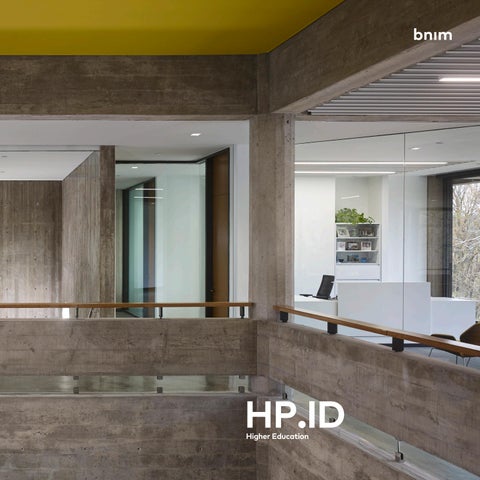
HP.ID
Human Purposed Integrated Design
Our approach to meeting design challenges is a resolute commitment to Human Purposed Integrated Design, or HP.ID
HP - Human Purposed is a deep commitment to humanity as the origin of inspiration, innovation, and prosperity.
ID - Integrated Design is the delivery of insights enabled by clear communication among a diverse team of active collaborators with refined expertise.
We have created a practice that improves the lives of each individual we serve. In doing so, each organization, campus, and city we serve is better positioned to achieve its goals and aspirations.
At BNIM, we refer to our design process as Human Purposed Integrated Design (HP.id). Through this process, we can create solutions that advance human and organizational potential and building performance through design. This means helping students, faculty, staff, researchers, and investigators achieve more while working in environments that are better for them, more responsible to natural systems, and less expensive to own and operate.
Results matter. We have learned that human beings are healthier and perform better when connected with nature and vibrant ecosystems. Often this means generous daylight and views to the outdoors as well as other biophilic strategies that nurture each individual. Research performed by the University of Michigan shows that students in urban settings who have access to nature are more successful in their studies and other pursuits. In our own post occupancy reviews, we have seen a reduction in absenteeism, decreased instances of comfort complaints, and increases in productivity when these strategies are employed.
Our HP.ID process is collaborative and iterative. This allows us to learn from each other and from past experiences. We have learned that achieving results for occupants requires challenging conventions and traditional practices of program, design, and construction. We have learned that by crafting better envelopes, harvesting daylighting more effectively, accurately understanding electrical loads, and being smarter about ventilation we are able to allocate the budget to make buildings that are better connected to their environs and less dependent upon mechanical and electrical systems. In doing so, we have learned that we can shift dollars from things that use energy to things that save energy, while creating more comfortable and productive results.
The most important step in our HP.ID process is the first step. We initiate each project utilizing our client’s mission and work alongside our client team to create solutions that achieve their goals for increased performance without additional expense. Each project in the following pages is unique because each of our clients is unique. Each necessitated a slightly different process and achieved different outcomes, just as our next project will also be unique. One consistent notion threads our work together, however – a Human Purposed Integrated Design process that helps our clients achieve measurable results in their mission and facilities.
Since 1970, BNIM has designed millions of square feet of innovative spaces for public entities, including school districts, higher education institutions, and civic and federal agencies. In the past three decades, BNIM has emerged as a national expert in the design of technologically sophisticated applied learning environments that accommodate the needs of nextgeneration students and faculty.
To date, the firm has executed —
46 campuses in the U.S.
108 higher education projects on including Princeton, Washington University, UC Berkeley, UCLA, UC CalPoly, Georgia Tech, Metropolitan Community College - Omaha, Johnson County Community College, Palomar Community College District, and Tarrant County Community College District. A select few projects are featured on the following pages.

AIB COLLEGE OF BUSINESS
Campus Master Plan
CALIFORNIA STATE UNIVERSITY, LONG BEACH
Child Development Center
Presidents Suite
The Pointe Renovation
CALIFORNIA POLYTECHNIC STATE UNIVERSITY, SAN LUIS OBISPO
Kennedy Library Renovation Programming + Feasibility Study
CALIFORNIA STATE UNIVERSITY, SAN MARCOS
Academic Building Feasibility Study
CAMBRIAN COLLEGE
Cambrian College Energy Center of Excellence
CHATHAM UNIVERSITY
Eden Hall Campus Master Plan
DRAKE UNIVERSITY
Meredith Hall Feasibility Study
Harkin Institute
GEORGIA INSTITUTE OF TECHNOLOGY
Price Gilbert Library and Crosland Tower Renewal
GRINNELL COLLEGE
Nollen House Renovation + Addition
Academic Center Renovation
1127 Park Street Renovation + Addition Study
Grinnell House Renovation + Addition Study
Preschool Psychology Lab Facility Study
IOWA STATE UNIVERSITY
Gerdin Business Building Expansion
Troxel Hall Auditorium
Pearson Hall Classroom Improvements
JOHNSON COUNTY COMMUNITY COLLEGE
Career and Technical Education Building
Fine Arts + Design Studios
KANSAS CITY ART INSTITUTE
Campus Master Plan + Plan Verification
Campus Coffee House
ARTSpace (adaptive reuse)
Jannes Library + Learning Center
New Academic Building Feasibility Study
KANSAS STATE UNIVERSITY
Justin Hall Renovation + Addition Study
Seaton Hall Renovation + Expansion (with Ennead)
FASTER Feasibility Study + Programming
McCain Auditorium Study + Concept Design
LITTLE BIG HORN COLLEGE
Health + Wellness Center
METROPOLITAN COMMUNITY COLLEGE
Center for Advanced and Emerging Technology
MIDDLEBURY COLLEGE
Middlebury College Bicentennial Hall
MIRACOSTA COMMUNITY COLLEGE DISTRICT
Master Services Agreement
MISSOURI STATE UNIVERSITY
Walnut Street Housing
(with Hanbury Evans Wright Vlattas)
Exterior Renovation of Blair-Shannon House
Exterior Renovation of Freudenberger House
Exterior Renovation of Hammons House
Exterior Renovation of Hutchens House Kentwood Hall Study
Exterior Renovation of Garst Dining Center
Exterior Renovation of Looney Hall (West Plains Campus)
Exterior Renovation of Jordan Valley Innovation Center
Ozarks Education Center, Bull Shoals Field Station
MONTANA STATE UNIVERSITY
Montana State University EPICenter + NIST Report
Gaines Hall Renovation
OBERLIN COLLEGE
Green Arts District Master Plan
Master Plan Programming + Planning
PALOMAR COMMUNITY COLLEGE
Maintenance and Operations Facility
PRINCETON UNIVERSITY
Lewis Center for the Arts (with Steven Holl Architects)
RESEARCH COLLEGE OF NURSING
Classroom Renovations
ROCKHURST UNIVERSITY
Campus Master Plan
Parking Structure
RICE UNIVERSITY
Anderson Hall Improvements
SOUTH DAKOTA STATE UNIVERSITY
Visual Arts Building (with Koch Hazard Architects)
TARRANT COUNTY COLLEGE DISTRICT
Center of Excellence for Energy Technology
THE UNIVERSITY OF BRITISH COLUMBIA
C.K. Choi Institute of Asian Research (Sustainable Design Consultant)
UNIVERSITY OF CALIFORNIA - BERKELEY
Moffitt Library Renovation
UNIVERSITY OF CALIFORNIA - LOS ANGELES
Medical Education Building + Biomedical Library (with Lake | Flato Architects)
Engineering VI Phase I (WIN-GEM) (with MRY)
Engineering VI Phase II (with MRY)
UNIVERSITY OF CHICAGO
Stevanovich Institute on the Formation of Knowledge (with UrbanWorks Architecture)
UNIVERSITY OF GEORGIA
Odum School of Ecology
UNIVERSITY OF HOUSTON
Campus Expansion Site Study
Michael J. Cemo Hall
UNIVERSITY OF IOWA
Visual Arts Building (with Steven Holl Architects)
Newton Road and Melrose Avenue Parking Facilities Architectural Enhancements
Stanley Museum of Art
Psychological + Brain Sciences Center
Stuit Hall Renovation
Art Building West Flood Recovery
Art Building Flood Replacement Project (with Steven Holl Architects)
Seamans Center for the Engineering Arts + Sciences
University of Iowa Informatics Initiative (UI3
College of Nursing Building
UNIVERSITY OF KANSAS
Marvin Hall Addition + Renovation Study
School of Engineering M2SEC Research Building NIST Grant
UNIVERSITY OF KANSAS MEDICAL CENTER
Parking Garage #5
UNIVERSITY OF MISSOURI
Christopher S. Bond Life Sciences Center
Virginia Avenue Parking Garage
Maryland Avenue Parking Design-Build Guidelines
Reynolds Alumni Center
Journalism School Renovations
Parking Garage No. 7
Patient-Centered Care Learning Center
School of Music Building
UNIVERSITY OF MISSOURI - KANSAS CITY
The Henry W. Bloch Executive Hall for Entrepreneurship + Innovation
Cherry Street Parking Garage
Hospital Hill Parking Garage
Hospital Hill Health Sciences Education + Research
Glenn Korff
School of Music


Washington University East End Transformation and Garage

MSU Blunt Hall Addition and Renovation page 48
Western Institute of Nanoelectronics Green Engineering and Metrology

Stanley Museum of Art


Seaton Hall Renovation and Addition
O’Brien HallCollege of Business Administration Psychological and Brain Sciences Building

University College Building


Princeton Lewis University
Visual

University of Iowa College of Nursing Building Modifications


Palomar Community College District Maintenance and Operations Complex
Princeton University Arts Center


Patient-Centered Care Learning Center

Fayez S. Sarofim Research Building
University of Iowa Arts Building


Seamans Center for the Engineering Arts and Sciences South Annex Addition

Price GilbertCrosland Tower Library Renewal

School of Nursing and Student Community Center

Glenn Korff School of Music Building
A next-generation creative center for music and dance excellence that serves as a space for cross-disciplinary collaboration and artistic expression on UNL campus

The new Glenn Korff School of Music will be a premiere creative center for music and dance excellence, redefining what it means to be a collaborative, inclusive, and healthy environment for performing arts education. Set on a prominent corner on the University of Nebraska-Lincoln (UNL) campus, the 103,000-sf facility acts as a welcoming threshold to its urban campus. The building’s diagrammatically “F”-shaped form maintains key pedestrian circulation links while expanding the existing Arts Quad.
Emphasizing sustainable design strategies, most importantly human health and wellness, the School of Music’s complex program is organized around multipurpose lightwells that provide daylight. views, and orientation. These vertical elements encourage cohesion by linking diverse spaces, creating study zones, and enriching public spaces through intentional sound bleed.
The project supports the School of Music’s program through acoustically isolated rehearsal and practice rooms, a cutting-edge recording studio, music library, faculty studios, student lounges, and space for a future café. The facility’s iconic 190-seat performance hall will be a creative tool for expanding interdisciplinary and multimedia performances by leveraging physical and electronic adjustable acoustics and state-of-theart performance technology. Creating meaningful connections with the surrounding city, campus, and students’ experiences, the Glenn Korff School of Music embodies and leverages creativity in action.
Location: Lincoln, Nebraska Size: 101,000 SF

IMPACT + INNOVATION
To meet the needs of today’s performing arts education, flexibility and adaptability are an important tool for student creativity. In the Glenn Korff School of Music, the Performance Hall demonstrates this flexibility by merging a traditional Recital Hall with a Sonic Playground (space for sound experimentation). The Performance Hall features physical and electronic acoustics, retractable seating, adjustable curtains, suspended theatre rigging system with acoustic reflectors that can be reconfigured based upon the use type, and a moveable acoustic shell with integrated LED screens that can be pulled out or put away.
Technologically, the space is set up for immersive audio and video and supports the future use of ambisonics, which creates a sphere of spatialized sound. The lower portion of the room is lined with a wood screen to create an intimate environment for recitals. The screen is acoustically transparent but can be projected on for immersive video which creates opportunities for collaboration with emerging media, theatre, and dance.


Human health and wellness is prioritized in the design and was important to the School of Music’s users when envisioning their future building during programming phase of the project. The project is organized to allow views and daylight throughout the building. The design team benchmarked peer institutions and found that only about 20% of practice rooms have access to natural daylight. BNIM flipped this notion on its head with 80% of practice rooms having access to daylight within the Glenn Korff School of Music. 88% of regularly occupied spaces in the building have access to quality views, which provide a connection to nature and support creativity.
To support decarbonization, the project’s goal is to reduce the amount of embodied carbon. Early in the design process, the design team worked with the contractor and local ready-mix supplier to integrate high cement replacement into our mix design. Other strategies included rammed aggregate geo-piers, right sizing the program, and re-using part of the existing music building. Together these strategies reduce the embodied carbon by 57%, which exceeds the current 2030 Challenge. The project is also PV-ready offering a prominent location for the university to display their commitment to decarbonization.
PROCESS
BNIM’s integrated design team, in collaboration with Sinclair Hille Architects, worked closely with the School of Music and its stakeholders to create a facility that will be a campus destination for high-quality arts education, scholarship, creativity, and performance. The technical requirements for music schools are complex, and our team addressed considerations including sound isolation, acoustic quality and safety, appropriate room volume, instrument accessibility, and HVAC systems tailored for sound attenuation and instrument preservation through humidity control.
Achieving superior acoustics was paramount despite the challenge posed by the School of Music’s proximity to a busy on-ramp. The design addressed this by locating sound sensitive spaces such as the Recording Suite and the Performance Hall away from the highway and locating Instrumental Rehearsal and Percussion Rehearsal spaces closest to the highway. Additionally, acoustic considerations are addressed with precast facades and a low-carbon concrete structure, leveraging high mass for sound isolation while enhancing energy efficiency. Key areas feature triple-glazed windows for superior acoustic and thermal performance.
Superior acoustics also require room acoustics in the form of fixed absorption, fixed diffusion, variable absorption, angled walls, overhead reflectors, angled glass, floor finishes and sufficient room volume. Working collaboratively with the acoustic engineer, the design team went through an iterative process to integrate the room acoustics into the architecture of the space to create a cohesive environment for creativity.


East Campus Framework and Master Plan
WASHINGTON UNIVERSITY AT ST. LOUIS, MISSOURI

Washington University in St. Louis (WUSTL) has undertaken a major endeavor to transform the East Campus area to accommodate future growth and create a new gateway to the surrounding city. The projects have been divided into three phases, each building upon the foundation laid by the previous phase.
In Phase 1, BNIM partnered with Sasaki and Andropgon on the East Campus Framework Plan. The team developed the fundamental strategies of open space concepts and program, identified pedestrian pathways and connections, and established pedagogical and sustainability goals for buildings and landscape, among other strategies. The campus contains significant opportunities for this development but was somewhat restricted by St. Louis County’s mandate to provide a specific amount of parking. To create a vibrant campus with thriving landscape and responsible development that respected the prestigious campus history, the plan explores creating a new underground parking structure. This would allow for future growth and meet WUSTL’s programmatic needs.
During the second phase, BNIM collaborated with Michael Vergason on the master plan, which delved deeper into the framework, identifying specific strategies and potential projects. BNIM and Michael Vergason worked together to refine building placement and scale of five new structures — which are currently underway — plus the addition to the Kemper Museum, including the parking structure.
In the third and final phase, six projects and landscape work are currently being executed. BNIM’s primary role in this phase is to serve as architect of the new underground parking structure, along with KieranTimberlake. In addition, BNIM participates on the advisory committee with Moore Ruble Yudell, KieranTimberlake, and Michael Vergason.


Following the East Campus Framework Plan (with Sasaki and Andropogon) and the East Campus Master Plan (with Michael Vergason), BNIM continued its collaborative relationship at Washington University in St. Louis, this time with KieranTimberlake on a new underground parking garage.
The new garage is the connective tissue for all of the buildings on campus. It also plays a prominent role in the visitor experience. The overall goal of removing cars from the landscape and creating comfort, safety, and beauty for pedestrians was paired with the goal of creating a welcoming presence for visitors to the campus when entering campus through the new parking facility. As such, it has been carefully crafted to uphold WUSTL’s prestigious reputation, designed with the intention of making visitors and other users feel welcome and comfortable when coming to campus.
Knowing that the need for parking will eventually decrease over time, the team designed the garage to be transformed into academic or other campus space in the future. The design incorporates higher floor-to-floor dimensions, heavier floor loads for anticipated occupancies, accommodation for connections to daylight and landscape above, and other strategies that will enhance the transformation of parking space into people spaces.


East Campus Garage
Stanley Museum of Art
UNIVERSITY OF IOWA


The University of Iowa Stanley Museum of Art project is a new cultural arts destination that restores an art museum presence to the campus community after 14 years, following historic flooding in 2008. The new home for the Museum reunites the University with its extensive and world-renowned collection of African Art, 20th Century Art, and works such as Jackson Pollock’s Mural. Art galleries, outdoor terraces, a sculpture courtyard, and a greeting and gathering entry lobby create a vibrant and supportive museum experience while spaces including a visual classroom and visible storage area support the Museum’s teaching and research objectives. Welcoming gallery spaces are designed with flexibility for the collection, traveling exhibitions, and curation and teaching curriculum. An inviting entry plaza and transparent, daylight-filled art lounge lobby, adjacent to Gibson Square Park, serve as an inviting front door for the facility and provide space for performances, student gathering, classes, and artist talks, allowing artistic expression to extend from within the walls of the museum to become a central component of the campus experience.
Location: Iowa City, Iowa
Size: 63,000 SF
Completion: 2022


IMPACT + INNOVATION
The Stanley Museum of Art is immersed in campus activity at the University of Iowa. Dynamic and kinetic dark, warm brick exterior recalls timeless academic and cultural brick masonry buildings. Through an alternating composition of brick texture and brick finish, the façade is transformed by the daily and seasonal changes in sunlight, creating oscillating levels of reflection and shadow. A glass façade on the main floor brings the outside in, establishing transparency and connectivity to the surrounding campus. The Museum is designed as a rectilinear solid interrupted by interconnected voids, creating a form that provides a protective and respectful home for the display and conservation of the collections while still inviting daylight through the building’s three floors, creating an intuitive pathway for visitor experience.


PROCESS
After significant flooding breached the 500-year flood level of the Iowa River in 2008, including the original 1968 university art museum located across the river, it was determined that mitigating the original museum from future flooding was not financially feasible and a new facility should be constructed. The design team collaborated with the Stanley Museum of Art and the University of Iowa to understand goals and vision for this new museum presence. It was important that the new Stanley Museum of Art create a welcoming home for its extensive collection on campus while also embracing the multi-faceted role of the Museum in benefitting the community through arts education, becoming a space for public forum and a catalyst for creativity. The design team also addressed the concerns of future flooding at the new site, elevating the first level of the new Museum and all building systems above grade and the 500-year flood level. The building is designed to maintain its temperature and humidity band necessary for the conservation environment for a minimum of 72 hours in a flooding event.

O’Brien Hall College of Business Administration
The new home for business and innovation leadership on Marquette campus connects students, faculty, and industry leaders to the Milwaukee region and beyond

The O’Brien Hall College of Business is a transformational new facility for business education and innovation on this higher education campus. Situated at a highly visible and frequently travelled site on campus, the building was envisioned as an engaging and welcoming convening space for students, faculty, and visitors that would establish an important campus corridor between the university and the local community beyond.
The carefully crafted interior environment creates integrated spaces that emphasize transparency, clarity, connectivity, and student focused experiences. Multiple iterations of glazing system and daylight analysis studies formed an approach to understand the impact of quality daylighting. As a result, every regularly occupiable space in the building has access to visually comfortable quality daylight and views, particularly in the central atrium which serves as the heart of the facility and center for student activity. The project’s massing and organizational approach intentionally places student-focused, social spaces along the daylit central atrium with instructional and faculty spaces. Large, glazed windows introduce generous daylight and views throughout the social and learning spaces to create an interior environment that feels welcoming and well-connected to its surrounding context, improving overall user experience, wellness, and wayfinding.
Location: Milwaukee, Wisconsin
Size: 105,000 SF
Completion: 2023


“Since good business - business with purpose - isn’t done in a silo, O’Brien Hall emphasizes innovative, collaborative spaces where our students are immersed in experiential learning and creative solutions every day.”
TIM HANLEY acting Keyes Dean of Business Administration
IMPACT + INNOVATION
As the nature of Business is continually evolving, so must academic curriculums and the spaces that support students and faculty. It was important that the design of the College of Business be nimble and responsive to meet the current and future needs of the college. The design team approached this project with the intent that it would be equipped for changing programmatic requirements and future generations of students for years to come. As a result, the design is both “purpose-built,” responding to clear strategic vision for this facility, while simultaneously employing strategies for a “long-life, loose-fit.” Spaces are designed with flexibility in mind to adapt and respond to multi-functional needs for academic or professional development. As a project completed during the onset of the pandemic, classroom spaces are specifically designed to be to accommodate all modes of learning, from in-person to hybrid to virtual learning.


PROCESS
Early architectural design studies for the College of Business were informed by adjacent campus and neighborhood buildings, streetscapes, and existing urban design patterns to determine the right scale, massing, materials, colors, and textures to enhance design integration.


“O’Brien Hall will serve as a convening space and a major catalyst to grow the pipeline of future Catholic, Jesuit-educated business leaders for years to come.”
MICHAEL
R. LOVELL Marquette President
AWARDS
2025 AIA Kansas City
Citation – Architecture
2024 AIA Central States
Honor Award – Design Excellence
2024 Wisconsin Masonry Alliance
Excellence in Masonry – Best of Show & Excellence in Clay Masonry
2024 City of Milwaukee
7th Annual Mayor’s Design Awards – Urbanism Redefined
2023 AIA Wisconsin Honor Award – Design Excellence
2023 AIA Kansas Honor Award Excellence in Architecture
2023 Milwaukee Business Journal Real Estate Awards Best New Development
2023 The Daily Reporter Top Projects of 2022


Blunt Hall College of Natural and Applied Sciences
A transformational addition and renovation project unites multiple disciplines within one cohesive facility to support learning, collaboration, and research.

MSU Roy Blunt Hall houses the College of Natural and Applied Sciences Program (CNAS) and serves as a hub for the College. The addition and renovation will bring together the three primary departments of Biology, Chemistry and Biochemistry, and Geography, Geology & Planning (GGP), while improving flexibility and usability of spaces within Roy Blunt Hall. The addition and renovation are envisioned to include state-ofthe-art, flexible teaching and research laboratories for each of the three departments. Roy Blunt Hall will serve as a welcoming place for current and prospective students while showcasing the research and programs within. Human-purposed design strategies will include increased access to natural light, connections to nature, outside views, and more comfortable, usable spaces.
Location: Springfield, MO
Size: 239,714 SF
IMPACT + INNOVATION
The journey of Roy Blunt Hall on MSU campus bookends the history of BNIM and holds a special significance for our team with one of the building’s original designers being Tom Nelson, a founding principal of our firm. Tom contributed to the design of the original building in 1971 while with Kivett & Myers. Five decades later, BNIM is collaborating with MSU on the renovation and addition that will lead Roy Blunt Hall into its next era of learning, teaching, and research. BNIM is working closely with MSU to reinterpret the architectural cues of the existing building in a contemporary way. With intentionality and respect for its legacy and surrounding context, the MSU Roy Blunt Hall addition and renovation will reflect the notable features that make the building a unique part of MSU campus architecture while also addressing modern needs of the CNAS programs to strengthen Roy Blunt Hall’s presence on campus. Building on the 2020 CNAS Master Plan conducted by MSU as well as the goals and needs identified by CNAS stakeholder groups, the design for Temple Hall was informed and inspired by three primary themes: Enable Research, Increase Visibility for Science, and Provide for the Future of CNAS and Temple Hall.


PROCESS
The needs, goals, and feedback from the CNAS and University community was integral in shaping the future vision for Roy Blunt Hall. BNIM’s design team worked attentively with a core team of MSU representatives including MSU’s Dean, university architect, project manager, facilities staff, and department heads from the CNAS program. As equally essential to the design process were the perspectives and voices of the students, faculty, and researchers as part of the CNAS community who will engage with Roy Blunt Hall each day to fundamentally determine the framework of the design.
BNIM held an open house for students and faculty; met with MSU’s advisory groups focused on sustainability, equity, and ADA guidelines; and held in-depth discussions with researchers and our team’s laboratory consultant to understand specific research and laboratory requirements in order to guide design development. Part of BNIM’s engagement process involves the use of collaborative, online whiteboards, such as Miro and Mural, to have real-time discussion, conduct workshopping, and trial ideas with clients and collaborators.
Western Institute of Nanoelectronics Green Engineering and Metrology
UNIVERSITY OF CALIFORNIA, LOS ANGELES
LOS ANGELES, CALIFORNIA


The development of the Western Institute of Nanoelectronics (WIN) and Green Engineering and Metrology (GEM) building (Phase I) on the UCLA campus represents the highest of aspirations for the research community in supporting the advancement of clean and green technologies. The building houses three primary driving Centers of Excellence in the field of nano-systems and clean technology.
The WIN-GEM facility provides space for faculty and their industrial collaborators to perform research and development in energy harvesting, storage, conservation and management. As such the facility is thoughtfully designed for collaborative, multidisciplinary research, and the building itself is thought of as an expression and armature of that research.
With Moore Ruble Yudell
61,625 SF Completion in 2014 LEED Gold certified

SUSTAINABLE
/ NOTABLE FEATURES
• 61,625 SF facility
• Active chilled beams in dry labs
• Natural ventilation in post doc office suites – mixed-mode VAV
• Demand ventilation in wet labs to reduce air change rates
• Exhaust stream monitoring to reduce fan power
• Fume hood sash management by reduced height to reduce air changes
• Dry lab return air used as supply air in wet research support space alcoves
• Grey water system - reclaims waste RO process water for toilet flushing
• Façade shading element for solar heat gain control


Seaton Hall and Seaton Court Renovation and Expansion
KANSAS STATE UNIVERSITY, MANHATTAN, KANSAS
40% WATER USE REDUCTION AND 50% POTABLE WATER REDUCTION

Over the last decade, the College of Architecture, Planning, and Design (APDesign) at Kansas State University has risen in stature and recognition among the nation’s design programs. Today, the program’s home in the historic Seaton Hall complex no longer supports the college’s current and future needs. Each semester, APDesign students, faculty, and visitors together explore the potential of design to impact human experience, health, and happiness – the new and renovated facility is born of these same pedagogical objectives.
The new addition stitches together the two renovated historic buildings of Seaton East (1908) and Mechanics Hall (1874), and is punctuated by “The Jewel,” a transparent, three-story social container and entry courtyard that assumes the new face of APDesign. Located in the heart of the campus network, the facility is a hub of interdisciplinary interaction, engaging KSU in a unified expression of innovation, excellence, and sustainability.
191,247 SF
Completed in Fall 2017 LEED Gold Targeted
With Ennead Architects and Confluence

35% ENERGY SAVINGS FROM BASELINE


Psychological and Brain Sciences Building
UNIVERSITY OF IOWA
IOWA CITY, IOWA


The Psychological and Brain Sciences Building establishes an important gateway to the University of Iowa campus. Providing numerous administrative functions, active learning classrooms, research laboratories, faculty offices, and collaboration and commons spaces, the Psychological and Brain Sciences building is frequented by students, faculty, and researchers. The building serves a unique purpose as both a teaching and research facility, involving the general public and visitors of all ages to the University of Iowa campus. As an anchor of the campus and connection to the neighboring downtown central business area, it was important to provide a welcoming environment for all who interact with the facility on a daily basis.
The Psychological and Brain Sciences Building establishes a renewed presence on the University of Iowa campus while maintaining the design context of the site through reflection of and connection to the adjacent Spence Labs. The existing facilities did not support the needs of the Psychological and Brains Sciences department, lacking a sense of campus connection and the Human Purposed Integrated Design qualities that are necessary to the practice of Psychology. The introduction of views of the outdoors and generous natural daylight open the building in a transformative way, creating a sense of connection among the different functional spaces of the building and better supporting occupant health, comfort, and well-being.
62,000 SF
Completed in 2020


The building is efficiently designed to perform at LEED Silver and uses low VOC materials and recycled content. For the unique sun shading façade of the building, the team explored various terracotta baguette options to analyze the amount of solar radiation reduced on the glass pane during the summer months.
This data was balanced with the amount of view angle out of the building’s windows between the baguettes to optimize performance and reduce glare and heat gain while still allowing views to the exterior.


The facility is attentive to both the programmatic needs of the Psychological and Brain Sciences department and the campus community at-large, serving as a multi-disciplinary resource for students and faculty from across campus. As a functioning research facility, a series of research rooms are equipped with specialized light and acoustic controls to aid in experiments.
The goal was to create a lab module that could be modified to accommodate the different research pursuits of the Psychological and Brain Sciences department. General purpose classrooms, student learning commons, and collaboration areas are also included to support the academic needs of students and faculty from various disciplines and colleges.

As a place of connectivity for students across campus and the surrounding community, it was important to the University of Iowa to create a welcoming, comfortable facility that would accommodate all building users through inclusive design. The BNIM team worked with the University of Iowa and an accessibility consultant to implement design strategies informed by ADA guidelines. In working with the University of Iowa, the BNIM design team also had the opportunity to learn from student groups about specific needs and considerations to help improve the facility’s accessibility and sense of comfort. Focusing on inclusive, human-purposed design, spaces are designed to enhance mobility and accommodate larger wheelchairs, provide easier access to bathroom facilities on each floor, and create clear wayfinding upon entry into the facility.


College of Nursing Building Modifications
UNIVERSITY OF IOWA IOWA CITY, IOWA


The University of Iowa Nursing building was built in 1971. A brutalist concrete midcentury modern structure, it houses programming for the College of Nursing, including regular on-campus curriculum as well as continuing education. Sited on the West campus and positioned high on a limestone bluff 40 feet above road level, the glass façade around the perimeter of the first level of the threestory building provides unprecedented views east across the Iowa River towards downtown Iowa City and the historical state capitol.
While the original structure made a powerful architectural statement, over time, the spaces inside became inefficient programmatically for the College’s needs. A loop corridor on the perimeter of the interior left classroom, lab, and office spaces relegated to the building core, windowless and with little to no access to natural daylight. For the renovation, the design teams focus was on students and the University community. The space was designed to be inviting to new nursing students and visitors from across campus, support active learning and modern health science pedagogical objectives, and encourage interaction and collaboration among budding nursing professionals.
A systematic approach to the reorganization of spaces was based on the building’s original five-foot module. Giving light back to the occupants and the spaces most used became the primary objective. The perimeter circulation became student commons areas, and rearranging walls with floor to ceiling glass partitions for lab and classroom spaces allow for natural daylight to penetrate nearly all occupiable spaces. Programming for the new space includes an entry lobby, offices, the dean’s suite, general assignment classrooms, student commons, a diversity resource center, a student success center, and administration spaces. Eight of nine classrooms include AV systems to support an active learning format, including remote student integration.
By maximizing the buildings potential and focusing on a long life, loose fit approach to a flexible and forward-looking learning environment, the College of Nursing renovation offers the University a highly efficient space centered on human health and productivity.
85,000 SF Completion 2019


Lewis Center for the Arts
PRINCETON UNIVERSITY, PRINCETON, NEY JERSEY

Princeton University’s Lewis Center for the Arts is an academic program comprised of Writing, Dance, Theater, Visual Arts, and the Princeton Atelier, a program that brings together artists from different disciplines to collaborate for one dedicated semester. The new Lewis Center for the Arts facility is a physical representation of these creative forces, dedicated to the belief that the arts lift the human spirit.
The 139,000 square foot complex consists of three contemporary buildings designed around a courtyard. The buildings will share a common reception area and will house several public spaces, including an art gallery, a black box theater, a dance studio and a music rehearsal room. The complex will also house faculty and administrative offices and a box office.
With Steven Holl Architects
139,000 SF Completion 2017

The project has an energy goal of utilizing 50 percent less energy than required by current energy codes. Princeton’s policy is not to pursue LEED, but to go beyond LEED and focus on maximum carbon reduction throughout the design, construction and operation of the facility. To achieve this goal integrated sustainable features are being considered, including geothermal heating and cooling, green roofs, improved exterior envelope performance, displacement ventilation system; mixed mode ventilation system; radiant heating and cooling, and passive design strategies of building orientation, shading, natural light, natural ventilation and thermal mass. In furthering environmental stewardship goals, sustainable material selection and construction management practices also will be key components of the building project.


AWARDS
2017 Best Building - Mid Atlantic
Architect’s Newspaper
2018 Project Of The Year Award
Professional Engineers Society Of Mercer County
2018 New Good Neighbor Award
New Jersey Business & Industry Association
2018 Best Regional Project, Culture / Worship Category
Engineering News Record
“BNlM’s leadership has been critical to the success of this project. We have been greatly impressed by the depth of their staff at all levels, whether related to design or technology, building codes, sustainability, envelope detailing, waterproofing or specifications. Their goal has been to make the finished product the best it can be, consistent with our budget. BNIM is a valued team member, willing to listen closely, to offer their professional advice, to be patient, and to lead.”
JANE CURRY, AIA, LEED AP
Sr. Project Manager, Princeton University Office of Design and Construction

Visual Arts Building
UNIVERSITY OF IOWA, IOWA CITY, IOWA

In 2008, the original University of Iowa School of Art and Art History building experienced significant flood damage. The 1930s Art Building was no longer a viable venue for arts education. The new University of Iowa Visual Arts Building provides studio space for ceramics, sculpture, metals, photography, printmaking, 3D design, intermedia, animation, and graphic design, as well as graduate student studios, faculty and staff studios and offices, and gallery space.
with Steven Holl Architects
126,000 SF Completion in 2016 LEED Gold Registered

Sculptural open stairs are shaped to encourage meeting, interaction and discussion. Some stairs stop at generous landings with tables and chairs, others open onto lounge spaces with built-in seating.

ENERGY 30% REDUCTION FROM ASHRAE
STEVEN HOLL ARCHITECTS

AWARDS
2017 AIANY Design Award Honor Award, Architecture
2016 Interior Design Best of Year Award, Education
2016 Architects Newspaper Building of the Year, Midwest
2017 Chicago Athenaeum American Architecture Prize
2017 The Weidt Group, Commercial New Construction Excellence In Energy Efficient Design
2017 Metal Construction Association Chairman’s Award For Overall Excellence
2017 SARA NY, Design Awards Design Award Of Excellence
2017 ENR, Midwest Regional Best Higher Education/Research Project
2017 Metal Construction News MCN Building And Roofing Awards, New Metal Walls
2016 Interior Design Best Of The Year Award Winner - Education
2016 Architect’s Newspaper Building Of The Year Award, Midwest


Maintenance and Operations Complex
PALOMAR COMMUNITY COLLEGE DISTRICT
SAN MARCOS, CALIFORNIA

ENERGY 105% DESIGNED TO PRODUCE MORE ENERGY THAN IT CONSUMES

The Palomar College Operations and Maintenance Complex will serve buildings and grounds at Palomar College and other satellite campuses. It will house the district’s facilities personnel for buildings, grounds, and maintenance as well as providing conference space, staff offices, and shop spaces. The project consists of a large shop building and small office building that are linked through a series of outdoor paths and spaces on an irregularly shaped site. While campus operations facilities are often relegated to secondary locations, the project is located on what was an existing surface lot at a highly visible campus gateway. The design team has used site topography and the strategic placement of the building to screen vehicular uses and to create a series of memorable indoor and outdoor spaces that are visible from pedestrian and vehicular entries to the campus. The team worked with Palomar staff to map the many vehicular and maintenance circulation patterns in order to optimize the performance of the facility while reducing the overall vehicular footprint.
28,000 SF Completion in 2018 Designed to achieve Net Zero


2/3rds OF THE BUILDING THAT FUNCTIONS AS A WORKSHOP AREA, HAS NO MECHANICAL SYSTEM
Sustainable Strategies and Features
• 100% Daylight for all Office Spaces
• 100% Natural Ventilation for all Shop and Offices
• Primarily Native Californian Landscape
• 86% Cooling Load Reduction
• 29% Heating Load Reduction
• 105% Renewable Energy Provided by Solar Panel Array
• 20.95 Current Designed EUI
• 67% Passive Ventilation (Shops and Storage) v. 33% Active Ventilation (Offices)
• 50/50 Balanced Site - Hardscape/Softscape
MAINTENANCE BAR

1 Overhead sectional doors with operable louvres - Precooled
2 Solartube and ceiling fans
3 Operable window
4 Aluminum thermal chimney
5 Operable window - Precooled
6 Aluminum roof monitor
7 Photovoltaic system
8 Dual harvesting sunshade system
9 Bioretention basin

80% STRATEGIES RESULT IN REDUCTION OF MECHANICAL SYSTEMS UP TO 80% OF THE TIME


Patient-Centered Care Learning Center

The University of Missouri School of Medicine (SOM) was tasked with expanding its enrollment in response to a call from the Association of American Medical Colleges (AAMC) for all medical schools to increase enrollment by 30%. The SOM has partnered with CoxHealth and Mercy health systems out of Springfield, MO to create a clinical campus in Columbia, which will help meet a critical need for more physicians. This public-private partnership will bring transformational change by ultimately providing more than 300 additional physicians for the state, adding more than $390 million annually to Missouri’s economy and creating 3,500 new jobs.
BNIM’s team designed an alternative that called for new construction on top of the existing MSA, and also a smallfootprint addition to the MSA’s immediate west side, which will significantly enhance the primary entrance to the SOM and create a street-side entrance for all of MU Health Sciences. This solution maximized the SOM’s budget and resulted in a more effective, high-performing design.
The SOM’s focus on patient-based care defined the ultimate design, which includes improved daylight quality, access to views of campus, more generous amenities for students, and an enhanced focus on providing a facility that promotes collaboration among students, faculty, and staff. By improving its technology, increasing lab sizes and providing additional space for first- and second-year medical students, the new SOM will become a recruiting tool.
98,888 SF Completion in 2017

EUI = 51.3 (INCLUDING SITE)
50.6% REDUCTION BASED ON CBECS NATIONAL BASELINE


SUSTAINABLE STRATEGIES
• Fixed horizontal and vertical louvers on the building’s exterior reduce solar heat gain and glare.
• Designed glazing percentages based on combination of solar orientation and optimizing views.
• Reduced ventilation rate of anatomy lab when unoccupied


38.1%
SAVING COMPARED TO BASELINE

Seamans Center for the Engineering Arts and SciencesSouth Annex Addition
UNIVERSITY OF IOWA, IOWA CITY

BNIM is currently completing construction documents for the South Annex Addition to the Seamans Center for the Engineering Arts and Sciences. The goals for this project include creating a series of spaces that not only provide for functional use, but to help build a larger community within the entire engineering facility and foster innovation teaching, learning, and discovery.
The project includes new formal and informal research spaces, varied sizes of active learning classrooms, student development and tutoring spaces, and the creation of a new common lobby centered around a technology-rich student project design studio that brings the entire engineering community together. Renovation work in the existing building includes creating an Engineering Learning Commons adjacent to the engineering library space. The Commons will include flexible study and presentation spaces for faculty and students use.
65,739 SF Est. Completion in 2017


SUSTAINABLE / NOTABLE FEATURES
• 68,094 SF facility
• Building will serve as a living laboratory that creates an attitude of discovery and innovation.
• The majority of the building is elevated above the grade plane to increase open space on the urban site and to create covered bicycle parking.
• The elevation also allows air and light to create a more habitable urban environment on a congested campus site.
• Above and beyond approach to universal design includes a digital kiosk with assistive learning technology and a comprehensive wayfinding strategy.
• The site / building design offers 24/7 accessible access up and down a steeply sloped site, which was previously a significant barrier in a heavily utilized pedestrian path.
• Prior to the project, stormwater would run-off down a steep slope to the storm sewer and near by river. The site now incorporates biocells to slow, cool, and clean storm water.
• Native landscaping and ground covers also create a more sustainable site condition.
• There is enough detention to reduce the postdeveloped 100-year storm to be less than half of the pre-developed rate. ENERGY

20%
PROJECTED COST SAVINGS COMPARED TO BASELINE


Price Gilbert - Crosland Tower Library Renewal
GEORGIA INSTITUTE OF TECHNOLOGY ATLANTA, GEORGIA

The adaptive reuse of Price Gilbert Memorial Library and Crosland Tower at Georgia Institute of Technology will transform the two campus buildings into the Research Library of the 21st Century. The project is a critical initiative of the university’s strategic plan and vision for transforming the campus into a knowledge-based community. The transformation is founded on changes in the way that students and faculty currently use the library, as well as future trends in library utilization on peer campuses across the country. Georgia Tech conceived of a place where knowledge is not simply stored, but generated.
230,000 SF Est. Completion in 2018 (Phase 1) LEED Gold targeted

Original Building
ENERGY USE

19.9 btu/sf/person AFTER RENEWAL 96.8 CURRENT


Fayez S. Sarofim Research Building
THE UNIVERSITY OF TEXAS
HEALTH SCIENCE CENTER AT HOUSTON
HOUSTON, TEXAS


The Fayez S. Sarofim Research Building, home of the Brown Foundation Institute of Molecular Medicine, is a comprehensive research facility on a tight urban site within the Texas Medical Center campus. This facility is designated to support research collaboration in the area of molecular medicine, particularly in genetics and proteomics and bioinformatics. The Sarofim Research Building houses dry and wet laboratories, offices, conferencing areas, a 200-seat assembly facility, and appropriate support spaces. The design creates a dynamic, interactive environment conducive to research and learning on multiple levels. From the relationship with the outdoors, to the architecture of the building, to the interior spaces, the approach considers form and function holistically, promoting the productivity and well-being of users.
229,250 SF Completion in 2005


The building incorporates sustainable design strategies at many scales. Building orientation allows optimum penetration and control of natural light in relationship to the differing programmatic elements of flexible laboratory space, support laboratories, office and common areas. The separation of office and lab elements enabled the environmental control system to capture and reuse energy that would normally have been wasted. The reinforced concrete column and slab structure employs high fly ash concrete thus reducing the upstream environmental impact of the building. The building also has a specialized facade design that responds to the Houston climate.


School of Nursing and Student Community Center

The University of Texas Health Science Center in Houston is one of Houston’s premier teaching institutions for health-related professions. As such, it recognized its responsibility to take the lead in the creation of an environment that speaks to living health-centered lives. This facility was designed with a focus on creating a benchmark for pedagogy. Goals of increased air quality, increased natural daylighting, reduction of polluting emissions and run-off, and increased user satisfaction and productivity were achieved using the LEED rating system as a platform. The building includes approximately 20,000 square feet of state-of-the-art classrooms, a 200-seat auditorium, cafe and dining room, bookstore, student lounge, student government offices, research laboratory and faculty offices.
The School of Nursing utilized a holistic design approach that unites façade design, building systems, resource conservation and materials reclamation in creation of a high-performing, integrated educational and academic workplace facility. The strategies have a quantifiable return on investment: the annual purchased utilities cost for the School of Nursing is approximately 60% less than comparable buildings on the campus. In addition, rainwater storage tanks capture approximately 826,140 gallons of rainwater or “grey” water (non-potable water) per year fulfilling the estimated 42,000 gallons needed each month for toilet flushing and irrigation.
With Lake|Flato
195,000 SF Completion in 2005
LEED Gold certified

Because of the limits of the available site, the building is oriented with its long axis in a north-south direction. A breezeway connection—a two story open air space carved from the lower levels of the building—runs east to west allowing the entrance and the main public spaces to be oriented toward Fay Park. Each façade of the building was designed with unique fenestration and sun screening strategies, all of which were computer modeled by BNIM to maximize building performance.


UTILITIES
60% COST SAVINGS FOR PURCHASED UTILITIES

SELECT AWARDS
2006 TOP TEN GREEN PROJECTS AWARD
AIA Committee on the Environment (COTE)
2006 HONOR AWARD
Texas Society of Architects
2006 REGION IV ENERGY PROJECT OF THE YEAR
Association of Energy Engineers (AEE)
2005 HONOR AWARD, ARCHITECTURE
AIA Houston
2005 HONOR AWARD, SUSTAINABLE ARCHITECTURE
AIA Houston
2005 AWARD FOR INNOVATIVE SCHOOLS, RECOGNIZED VALUE AWARD
DesignShare International
2004 HONOR AWARD
AIA San Antonio
2004 HONOR AWARD, EXCELLENCE IN ARCHITECTURE
AIA Kansas City
2004 HONOR AWARD
AIA Kansas
2004 HONOR AWARD, EXCELLENCE IN SUSTAINABLE DESIGN
AIA COTE Kansas City
2004 MERIT AWARD
AIA Central States Region
BNIM is an innovative leader in designing high performance environments. BNIM’s instrumental development of the USGBC, LEED, and the Living Building concept, combined with projects, methods, and research, shaped the direction of the sustainable movement. Through this involvement, the firm has redefined design excellence to elevate human experience together with aesthetics and building performance. In practice, this multifaceted approach to design excellence has yielded national acclaim, including the AIA National Architecture Firm Award, and consistent design recognition nationally and internationally. BNIM is Building Positive, a notion that describes how our practice leverages its collective capacity for design thinking to solve issues at every scale in a way that is focused on building the positive attributes of community and the built environment. Through an integrated process of collaborative discovery, BNIM creates transformative, living designs that lead to vital and healthy organizations and communities.


Our primary offices and job locations operate as "One BNIM." This strong support system provides focused, personal service centered in each office as well as firm-wide resources, including talent and technology, which are shared through a mesh of interaction.
With the full capacity of our multiple offices and a studio structure to ensure everyone has a voice, we are a united in our drive for design excellence.
• We seek a better way.
• We are committed to long term thinking and measurable improvement as a way of life.
• We seek to increase the vitality of people, planet and prosperity equally.
• We are passionate about generous design, it inspires people and changes the world.
• We insist on being excellent – in execution, performance and results.
• We care about what our buildings do and how they positively impact lives.
• We operate with a spirit of authenticity and servant leadership.
• We embrace diversity in our culture – in perspective, voice and skills.
• We promote integrated thinking and a collaborative dialogue of discovery.
• We embrace the challenge of innovation and the advantage of replication.
ONE BNIM

Additional Projects
THE PRACTICE OF BNIM
CONTENTS
SCIENCE AND ENGINEERING
Engineering VI University of California Los Angeles, California
University of Iowa Informatics Initiative (UI3)
Iowa City, Iowa
Ozark Education Center - Bull Shoals Field Station
Missouri State University Springfield, Missouri
School of Medicine Renovation
University of Missouri - Kansas City
Kansas City, Missouri
Therkildsen Industrial Engineering Building
Iowa State University Ames, Iowa
Human-Centered Computational Building
California-based University
Medical Education and Biomedical Library Study
University of California
Los Angeles, California
Christopher S. Bond Life Sciences Center
University of Missouri Columbia, Missouri
Iowa Advanced Technology Laboratory
Renovation and Addition
University of Iowa
Iowa City Iowa
ARTS
Sinquefield Music Center University of Missouri Columbia, Missouri
McCain Auditorium Lobby Addition and Renovation
Kansas State University Manhattan, Kansas
BUSINESS SCHOOLS
Bloch Executive Hall University of Missouri - Kansas City Kansas City, Missouri
Ivy College of Business Gerdin Building Expansion
Iowa State University Ames, Iowa
LIBRARIES
Robert E. Kennedy Library Programming and Feasibility Study
California Polytechnic Institute St. Louis Obispo, California
Moffitt Library Rennovation
University of California Berkeley, California
Science and Engineering
THE PRACTICE OF BNIM

Engineering VI
Highest of aspirations for the research community in supporting clean and green technologies.

BNIM worked with the University of California, Los Angeles, to design a new facility for the Henry Samueli School of Engineering and Applied Science. The development of the Engineering VI building (Phase I) on the UCLA campus houses three primary driving Centers of Excellence in the field of nanosystems and clean technology and provides laboratories for new program initiatives in engineering instruction, and research. The total engineering complex is comprised of flexible wet and dry research laboratories; faculty, graduate and post-doc offices; conference spaces; supporting interaction space within various configurations; and a conference center that includes flexible meeting rooms and a 250-seat multi-functional auditorium. The facility is designed to foster collaboration inside and out by including meaningful outdoor courtyard spaces which provide a diversity of collaboration and gathering spaces. The design was a collaboration between BNIM as Co-Design Architect and Moore Ruble Yudell, which served as Architect of Record / Co-Design Architect.
Location: Los Angeles, California
Size: 61,000 SF
Completion: 2015
With Moore Ruble Yudell

SUSTAINABLE / NOTABLE FEATURES
• 61,625 SF facility
• Active chilled beams in dry labs
• Natural ventilation in post doc office suites – mixed-mode VAV
• Demand ventilation in wet labs to reduce air change rates
• Exhaust stream monitoring to reduce fan power
• Fume hood sash management by reduced height to reduce air changes
• Dry lab return air used as supply air in wet research support space alcoves
• Grey water system - reclaims waste RO process water for toilet flushing
• Façade shading element for solar heat gain control


IMPACT + INNOVATION
Engineering VI represents the highest of aspirations for the research community in supporting the advancement of clean and green technologies. The facility provides space for faculty and their industrial collaborators to perform research and development in energy harvesting, storage, conservation, and management. Engineering VI hosts over 30 researchers from Berkeley, Stanford, and UCLA to collaborate in research and
development important to humanity and our economy. As such, the facility was thoughtfully designed for collaborative, multidisciplinary research, and the building itself is thought of as an expression and armature of that research. The building’s design, including very generous operable bay windows, aim to demystify science and create greater awareness of the role engineering plays in bettering lives and the economy.


University of Iowa Informatics Initiative (UI 3)
A technology-rich space designed for interdisciplinary collaboration

The University of Iowa Informatics Initiative (UI3) space incorporated various types of environments on the fifth floor of the College of Public Health Building to foster collaboration between researchers, graduate students, and staff from various disciplines across campus. To help form and define the vision for this collaborative environment, BNIM facilitated a series of meetings between the UI3 core team and multidisciplinary committee members, cluster faculty, and graduate students. The project is rich in innovative collaborative technologies, and significant collaboration occurred between the design team, users, and UI Information Technology Services. The latest technologies were incorporated into the design of this space, including wall monitors, writable wall surfaces, and digital touch walls. Mobile storage carts allowed a user to store materials within the space and take their work to any type of collaborative or private area based on their needs for the day. The space was also designed to be intentionally flexible, with operable walls in the collaboration and service rooms to allow for larger interactions.
Location: Iowa City, Iowa Size: 11,913 SF Completion: 2016
IMPACT + INNOVATION
Due to the diverse disciplines and backgrounds represented in the Informatics Initiative, the team realized the importance of integrating them with a single, unifying element. The design team chose inspirations that were based on genetics – a human data element and common thread that binds all of these disciplines together. Visual connections through and across the entire space inspire curiosity and promote engagement. The Informatics space brought together these individuals, who share a common pursuit, creating opportunities that lead to academic collaborations and innovations. The overarching organizational elements are bent linear ribbons, inspired by the graphic linearity of human genome mapping and the ribbon-like structure of DNA. Each bent ribbon captures a collaborative space. A central core of collaboration rooms spans east-west in the space, with a bent wood ribbon weaving them together. Bent white ribbons capture informal work and gathering spaces, serving as social collaboration zones. Focused work areas are located at the perimeter, providing acoustically protected space that also has a view to the outdoors and common areas, so users are comfortable and connected to the adjacent activity without interruption.


PROCESS
The design process for the Informatics Initiative project required an understanding of the spectrum of spaces necessary to support various fields of study within one dynamic facility. In this space, the UI3 brought together brain scientists, engineers, nursing faculty, arts faculty, and more, to study big data and produce collaborative research proposals. During the programming process, the team determined that people — and the connections between them — were the most important element that a space can offer. The design was shaped by organizing a spectrum of spaces that support various modes
of work to optimize interactions, interweave relationships, and promote visual connections while respecting appropriate levels of privacy. The building provides large flexible classrooms with integrated technology, private meeting and study rooms, common areas that created opportunities for researchers to interact in a casual environment. Supporting the many ways in which students assemble and learn from each other, this renovation within the College of Public Health Building helped foster collaborations, scholarship, and training.


AWARDS
IIDA Mid-America Design Awards
Gold Award, Higher Education, Research 2017
“Working with BNIM was great. They were very collaborative and worked with us to help us better define our needs and vision, and then they came up with a wonderful design. We wanted to create a space that would help us bring the Informatics community together — from all corners of the University, from art to medicine — to foster collaborations, scholarship, and training.”
GREGORY CARMICHAEL Director
University of Iowa Informatics Initiative

Ozark Education Center - Bull Shoals Field Station
An education center immersed in the landscape of the Ozark Mountains promotes ecology research through a unique experiential lens.

The Missouri State University Ozarks Education Center addresses the increasing demand for educational opportunities within the College of Natural and Applied Sciences and provides a new location for education and research by MSU faculty and students, visiting university and school groups, and nature-focused organizations. The MSU Ozarks Education Center allows students to expand and have a more diverse study of the southern Missouri natural environment and enables the College to grow in the future. The community facility, at 4,310 sf, provides one central location to accommodate larger groups of students and visitors with sleeping and bathing quarters, a dining center, residential kitchen, classroom space, and room for programs. Small and large groups of up to 60 people can be accommodated in the community space housed in the main building. Individual cabins and sleeping quarters in the main building can accommodate 19 overnight guests at a time. Cabins are located down in the topography to immerse the guests in the surrounding environment and to provide a full sensory experience.
Missouri State University
Location: Cedarcreek, MO Size: 239,714 SF


IMPACT + INNOVATION
A new field station for MSU Natural and Applied Sciences Department had been a vision for many years. Immersed in the unique landscape of the Ozark Mountains, the MSU Ozarks Education Center is designed to serve as a gateway for learning and observation of the surrounding state conservation areas and ecological resources through a unique experiential lens. At the heart of the facility, the design team implemented the “dogtrot” vernacular typology. Large barn doors frame views from the east and west and a roof oculus emphasizes connection to sky and earth, serving as a threshold for visitors to begin exploration of the greater 1,200-acre site. The space is shaded and cooled passively through the design’s geometry which increases wind speeds, inherent in the dogtrot approach. The west elevation of the facility takes advantage of the change in grade of the site and elevates the visitor into the landscape with a long continuous deck that is cantilevered into the tree canopy. The large commons room provides ample space for small yearly conventions to occur as well as space to host MSU’s student programs for high school juniors and seniors during a week-long program emphasizing leadership, service, and biological education. The impact of these ecological programs has inspired past students to pursue careers in ecological conservation. The MSU Ozarks Education Center aims to help foster a stewardship and community capacity among visitors to pursue research, to celebrate, and to maintain the unique Ozarks landscape and the region’s natural resources.


PROCESS
The building is designed with a light touch both physically and sustainably on the natural environment, considering sustainable strategies in the areas of site, building, systems, and materials. The project’s massing was also sited to minimize excavation and overall site disturbance, ultimately reducing project costs. The design team carefully considered programming to ensure the correct amount of space was allotted for the program’s needs without oversizing the project. The education center is designed to be an affordable building with materials intended to weather over time. The project’s existing site began as a burnt down house and a field of waste. This previous destruction ultimately led to success in the project’s restoration capabilities. For example, the building was designed in position to save the trees in the project area where possible and utilized the trees that necessitated removal as car stops in the parking area. The design team and College of Natural and Applied Sciences also worked together to plant new trees to fill out the site to return it closer to its natural state. The remaining site was seeded with native grasses and shrubs. In addition, roof water runoff was directly channeled to bioswales with rip rap and native rain garden plantings which helps discourage water runoff and preserve the quality of the lake ecosystem located a few acres from the site. Native plantings were incorporated to help filter water through building deep root systems. Through these strategies, the design provided increased opportunity for the natural environment to create healthy ecosystems than there was prior to the project. As time goes on, MSU students will continue to add to the plantings, create attractions for local species, and harvest rainwater to irrigate when needed.

AWARDS
2022 Chicago Anthenaeum: Museum of Architecture and Design and European Centre for Architecture Art Green Good Design Award
2021 Chicago Anthenaeum: Museum of Architecture and Design and European Centre for Architecture The American Architecture Award
2020 AIA Springfield Honor Award, Excellence in Design
2020 AIA Kansas Honor Award, Excellence in Design
2020 AIA Central State Merit Award, Excellence in Design


School of Medicine Renovation

After completing programming and conceptual design services for the UMKC Hospital Hill Campus Health Sciences Education and Research Buildings, BNIM began a multi-phased renovation project on the 254,000 square foot School of Medicine building, scheduled to take place over the next several years. The first phase was comprised of approximately 11,000 square feet on the first and third floors. The primary program areas for the renovation were a Computer Test Lab and a prototypical design for a Docent Unit.
The Docent Unit design was developed as part of an overall planning study in creating 32 Docent Units on the third and fourth floors. This renovation provides four of those Docent Units, with the additional Units being constructed through future phases of renovation.
University of Missouri - Kansas City
Location: Kansas City, MO
Size: 11,000 SF


Therkildsen Industrial Engineering Building
A new ISU engineering facility enables innovative teaching, impactful research, and opportunities for collaboration to support the Department of Industrial and Manufacturing Systems Engineering

The design of Therkildsen Industrial Engineering Building has been carefully and thoughtfully organized to foster community among industrial engineering scholars. This design creates a unique identity for the Department of Industrial and Manufacturing Systems Engineering, elevating and enhancing the student, faculty, and visitor experience with a collaborative, light-filled, and engaging spirit. The design expands the ability to effectively provide innovative teaching, impactful research, and community engagement through the following design goals:
– Provide a dynamic system of spaces that integrates teaching, learning, and research in an innovative academic facility
– Create an inviting and inclusive environment that encourages collaboration among students, faculty, staff, and industry partners while enhancing the sense of community for IMSE
– Create a facility for IMSE and the College of Engineering that fosters current program needs yet is adaptable, flexible, and resilient to evolve as the challenges of industry partners, curriculum, pedagogies, and research advances.
Location: Ames, Iowa
Certification: LEED Gold V4


IMPACT + INNOVATION
Spaces include advanced manufacturing lab and related shop facilities, flexible labs for collaboration with industry; immersive lab incorporating digital technologies, operational research labs, and human factors research labs. Teaching spaces include active learning classrooms, computer labs, and learning community collaborative settings. Administrative space is provided for departmental, faculty, and student services. The entire facility incorporates a spectrum of social and collaborative spaces to provide a sense of community throughout the building.


Human-Centered Computational Building
A place of sanctuary and connection within a rapidly expanding contextual environment

BNIM was selected to participate in a design charrette and conceptual design study for a California-based higher education institution’s Department of Computer Science. BNIM presented three design concepts that aimed to embody the University’s vision for a new Computational Building. The design sets high-performance goals on the path to net zero carbon, energy, and water use while emphasizing human-centered design in health and wellness, research and pedagogy, operational resilience and reliability, and equity. For three concepts — Central Heart, Outside In, and Inside Out — BNIM presented a series of design solutions that emphasize human experience through authentic placemaking, flexible organization, courtyard activation, connection to nature, paradigmatic and responsive buildings, humanpurposed spaces, collaboration, living lab and pedagogy, and research. The ‘Central Heart’ concept featured collaboration spaces which formed the interface between offices along the south façade and research spaces to the north, concentrating building movement and supporting a central heart of activity. The ‘Outside In’ concept included research spaces which opened up onto an exterior deck, bringing the outside in and allowing activity from the research spaces to activate the community. The ‘Inside Out’ concept featured all primary circulation with collaborative spaces pulled to the exterior.
Size: 108,339 SF

Collaboration spaces form the interface between offices along the south façade and research spaces to the north, concentrating building movement and supporting a central heart of activity.

2. Outside In
Research spaces open up onto an exterior deck, bringing the outside in. Activity spills out from the research spaces to these collaborative areas which activates the street edge.

3. Inside Out
All primary circulation with specific collaborative spaces are pulled to the exterior, turning inside out. This reduces indoor conditioned space, decreasing energy consumption and future operational costs.

1. Central Heart
Medical Education and Biomedical Library Study
THE UNIVERSITY OF CALIFORNIA, LOS ANGELES
LOS ANGELES, CA


BNIM led a comprehensive design team to develop a new building for the David Geffen School of Medicine at UCLA, which will establish a new gateway for the Health Sciences campus, create a front door for the School of Medicine (SOM), and integrate the new building with existing facilities to provide greater campus connectivity and new outdoor spaces. The team developed a Design Brief that includes a space program for the School of Medicine and Library functions, a master plan for the Health Sciences campus precinct, and a conceptual design for a new building in conjunction with the repurposing of an adjacent, existing structure for the Biomedical Library, which will serve the entire campus.
The space program for the new SOM facility includes classrooms and seminar rooms, multi-purpose teaching laboratory space, study and amenity space for students, administrative offices and related building support space.
The plan creates new outdoor spaces to promote campus community and interprofessional activities, including a future Tiverton Health Sciences Commons, planned as a largely pedestrian outdoor space adjacent to the Botanic Garden, which will connect the front doors of the Schools of Medicine, Dentistry, Public Health and Nursing. The new commons relates directly to the newly renovated Court of Sciences due north in the heart of the main campus. The master plan includes a second new outdoor, public space north of the new building and east of the new library
157,223 SF
Completion in 2011

Christopher S. Bond Life Sciences Center
A facility illustrating the principles that life sciences embody: research, teaching and education

The Life Sciences Center at the University of Missouri unites faculty and students from several schools and programs into one, collaboratively focused research center. The Colleges of Agriculture, Food and Natural Resources, Arts and Sciences, Veterinary Medicine, Human and Environmental Sciences Engineering, and the School of Medicine engage in joint research into genomic and biomolecular structures. State-ofthe-art laboratories, shared meeting areas and public spaces provide unsurpassed opportunities for interdisciplinary biomedical science and agricultural biotechnology research. With the idea that a healthy building illustrates the principles that life sciences embody, research, teaching and education converge in naturally daylit laboratory spaces, generous meeting areas, and informal teaming areas located off of the primary circulation spaces. The atrium, which centralizes faculty and research offices, a café and one of the reading rooms, encourages interaction. The project was completed in collaboration with coproject designer, Anshen + Allen.
Size: 239,714 GSF
Completion: 2004
Location: Columbia, MO

“The Center is kind of a catalyst that brings people together doing such different things.”
MANNIE LISCUM
BIOLOGICAL SCIENCES PROFESSOR AND ASSOCIATE DEAN OF GRADUATE STUDIES


IMPACT + INNOVATION
The building’s architecture is designed to symbolize the forward-thinking, leadingedge science taking place within, while respecting the university’s established legacy. The building helps welcome existing faculty and new recruits, is host to national meetings, and experiences consistent use from students, faculty, and visitors in atrium, café, and informal meeting spaces. With approximately 3% of faculty at MU, the Life Sciences Center generates approximately 10% of competitively funded research expenditures at MU. In 2020, Life Sciences Center investigators submitted 19 proposals totaling $9M for COVID-19 related research. The project was bid more than one million dollars below final estimates, allowing for the construction of several alternates.


“Most researchers would argue that, when it comes to science, collaboration is central to success. Just over a decade ago an MU experiment in brick and mortar set out to prove it. Today the Bond Life Sciences Center has largely confirmed its planners’ vision, demonstrating to scientists and scholars here at MU and around the world that, if knowledge is power, then shared knowledge is power2.
“This place is intended to be a coordinated organism, not a hotel for good scientists,” said Jack Schultz, director of the Bond LSC since 2007. “It’s been a fascinating but slow process to see investigators gain from working with others outside of their field who overlap in an aspect of their research.”
Both the National Academy of Sciences and National Institutes of Health (NIH) agree this sort of convergent science, cutting across disciplines, is the future. The former highlighted the Bond LSC in a 2014 report as among those programs that excel in being exceptionally “nimble in their focus” of steering faculty toward interdisciplinary convergence and novel research approaches.” Excerpt from Discovery - Bond Lifescience Center Annual Report 2014


"The Building has been set up with lots of what we call ‘collision zones.’ In Chemistry, when things collide you get a reaction. When two people can interact in a hall or corner and discuss an idea, that's when you get new ideas and new things happening. Students see how this happens and they grow and thrive under this."
DR. G. MICHAEL CHIPPENDALE
PH.D. PROFESSOR EMERITUS


AWARDS
2005 Honor Award, Excellence in Architecture
AIA Kansas
2005 Merit Award
AIA Mid-Missouri
The MU Bond Lifesciences Building has since 2016 received federal competitive grants totalling -
FY18
FY19
FY20
$13.3 M
$16.8 M
$15.2 M
Overall, with approximately 3% of faculty at MU, the LSC generates approximately 10% of competitively funded research expenditures at MU.


Advanced Technology Laboratories
The IATL Renovation and Addition creates a new identity and convening home for the Department of Computer Sciences on the University of Iowa campus, fostering student engagement, multi-disciplinary collaboration, and innovation and flexibility for the future.

Formerly, the University of Iowa’s Computer Science Department was dispersed across several buildings on campus. The IATL Renovation and Addition will create a new identity and unified home for the Department through the renovation of two floors of the existing west wing along with a new addition, which was originally planned by Frank Gehry but never completed with the exception of a structural foundation system. This existing structural foundation is intended to be utilized for the footprint of the new addition in support of a holistic low-carbon approach.
Student collaboration spaces along with connected meeting and support spaces will serve as the heart of the new home for computer science with a goal to encourage interaction, access to people and resources, and foster engagement in computing and algorithmic thinking, creating environments where students and faculty want to be. A mix of flexible teaching and research labs support the multidisciplinary work within the department and their ability to adapt to evolving technology, practices, and research needs.
Location: Iowa City, Iowa


THE PRACTICE OF BNIM

Sinquefield Music Center
UNIVERSITY OF MISSOURI - COLUMBIA COLUMBIA, MISSOURI

The Jeanne and Rex Sinquefield Music Center unites the School of Music within one welcoming, state-ofthe-art facility that renews the program’s culture and identity on the University of Missouri - Columbia campus. Students previously attended classes in a series of acoustically inadequate buildings scattered across campus and needed a facility that would better support and strengthen their premier collegiate music program. The new facility enhances opportunities for engagement, program growth, and student connection as part of a dynamic cultural corridor located on the northern edge of campus.
Immersed in the activity of the University community within downtown Columbia, the facility engages with students and the community through two large entry plazas that dual as external performance venues and impromptu classrooms. Windows along the ground level of the building also provide a glimpse into the percussion practice rooms. This design allows the building itself to become an instrument and music to extend into the community.
Completed in 2020
The project is being designed to achieve LEED certification.


SCHOOL OF MUSIC SITE
JESSE HALL


BUILDING CONTEXT
The Jeanne and Rex Sinquefield Music Center represents the first phase of a larger building master plan envisioned for the site. The Sinquefield Music Center is designed to respond to its surrounding urban and campus contexts. Located at the corner of Hitt Street and University Avenue, the building sits at the frequently traveled northern edge of the campus, providing a unique and valuable opportunity to spur the development of this cultural corridor, connecting the University of Missouri with downtown Columbia. Utilizing campus infrastructure, the new facility promotes density and walkability, as staples of sustainable design. Additionally, the design team worked with consultant team members and the University to provide sustainable resources, materials, and products.
is building positive
BUILDING CONCEPT AND PROGRAM
The design is shaped by the primary goal of enhancing the human experience, both by providing acoustically advanced facilities that increase functionality and by creating inspiring, comfortable spaces which promote creativity and well-being. The new facility enables students to learn, practice, and perform in a strong acoustical atmosphere that supports the composition, instrumental, vocal, and editing and recording curricula.
The building’s program is laid out in a simple, yet incredibly thoughtful way to provide cost-effective solutions for acoustically isolated spaces. Resembling a series of ‘boxes’ slightly pulled apart, the design focuses on establishing distance between practice and performance spaces and situating the most acoustically sensitive spaces on the ground floor of the building to reduce the carrying of sound and vibrations to other areas. These effective strategies allowed the design to provide acoustic isolation without the need for additional extensive acoustical systems.


PROGRAM SPACE TYPES
∙ Rehearsal / Performance
∙ Classrooms
∙ Collaboration Space
∙ Faculty Studios
∙ Administrative Offices
∙ Support Space
∙ Building Services
Often, music schools have a series of practice rooms and rehearsal spaces that cater to a single individual or small groups of people and, as a result, can cause facilities to turn inward, lacking access to natural daylight and views that are essential for health and wellness. To address this issue, the design team situated the building’s corridors, which serve as connective ancillary spaces, to include large windows to provide a sense of relief and a connection back to nature while orienting users throughout the building with a series of daylight vistas.


Instrumental Rehearsal Room
The practice and performance spaces of the Jeanne and Rex Sinquefield Music Center share a beautiful atmosphere with wood paneling and an abundance of daylight. Practice spaces allow for flexibility to adapt to emerging trends and different musical compositions and provide innovative acoustically isolated areas for all rehearsals, recordings, and performances.
The facility’s large instrumental rehearsal room and traditional choral rehearsal room are elegant performance spaces that are ‘tunable’ to different types of music being performed. They provide a substantial volume for acoustics and are outfitted with the ability to record and stream performances to physical or virtual live audiences. To create ‘tunable’ rooms, the design team worked with the project’s acoustician on a series of operable acoustic drapes that can be deployed or retracted depending on preferences of the musicians. This cost-effective strategy provided acoustically advanced spaces while also allowing the School of Music the greatest amount of flexibility to accommodate program needs as curriculum continues to evolve in the future.

Traditional Performance Space
Design for future flexibility is further demonstrated in the traditional performance rehearsal space which not only utilizes the retractable draperies to either enliven or deaden the room based on the performance, but also includes a floor plan designed such that the room can be morphed for a series of different purposes. The flat floor in the space was enlarged from a typical choral rehearsal room to allow the space to be flipped and risers to be utilized for patrons to view opera rehearsal or other individual or group performances. The custom woodworking on the room’s the south wall also includes concealed white boards to be utilized in a classroom format when not occupied by performances. Operable wood walls fold out to create a band shell-like form that meets directional requirements for performances of various scales to audiences.


“... This music center belongs to all of us, and I’m excited to imagine the kinds of new communityuniversity collaborations that will arise because of this beautiful facility. As the chancellor has already said, music brings people together. This music center brings us together, people from across campus, throughout Columbia and Missouri, and well beyond.”
PAT OKKER , DEAN, ARTS & SCIENCE UNIVERSITY OF MISSOURI-COLUMBIA
JEANNE AND REX SINQUEFIELD MUSIC CENTER GRAND OPENING


McCain Auditorium Renovation

The design approach of the Kansas State University McCain Auditorium Lobby Addition and Renovation is focused on celebrating the performing arts by activating the surrounding campus precinct and creating potential for new and exciting experiences and activities by re-establishing McCain as a vital physical and cultural campus destination. The design solution aims to pay homage to the simplistic, formal geometry of the McCain Auditorium structure and responds to the existing, strong vertical and horizontal elements that currently help to define not only the building but the adjacent campus fabric, such as buildings, pedestrian and vehicular circulation, hardscape, and greenspace.
With the goal of increased use and viability of the venue, the reimagined facility includes a new extension to the west of the existing auditorium space to serve as a welcoming and celebratory gathering space that also provides visual connections to the adjacent quad and the new exterior courtyard to the west. The lobby space is also home to a repurposed and modernized ticketing/concierge space and includes new spaces for event concessions and merchandise sales. An additional multipurpose room space, elevated above the new lobby and clad in limestone, is held away from the box of the existing auditorium to allow light into the lobby and to emphasize the existing auditorium form. This design study focused on improving the community outreach experience by adding a more intimate multi-purpose room and performance space as well as lobby improvements to the existing 1,800-seat auditorium – an opaque limestone box that houses the current lobby and auditorium.
Location: Manhattan, Kansas


Business Schools
THE PRACTICE OF BNIM

Bloch Executive Hall
An innovative, interdisciplinary business school hub encouraging innovation, entrepreneurship, and design thinking

BNIM worked in collaboration with Moore Ruble Yudell and the University of Missouri-Kansas City (UMKC) to design a new building for Henry W. Bloch School of Management. The design of the 68,000+ square foot Henry W. Bloch Executive Hall for Entrepreneurship and Innovation is intentionally simple and elegant. The building provides new spaces to meet the demands of an increased student population, address the specialized needs of entrepreneurial education programs, and serve the growing executive education programs and need for teaching spaces for undergraduate and graduate programs of the Bloch School. Bloch Executive Hall also serves as a social hub for students on campus, providing flexible new spaces for increased student collaboration and engagement. The facility includes a 200-seat auditorium, multiple flexible and active learning classrooms, seminar rooms, a finance lab, and faculty offices. The upper three floors are connected by an open, light-filled lobby that includes an amphitheater which serves as an important student gathering area.
Location: Kansas City, Missouri
Size: 68,000 SF
Completion: 2013


IMPACT + INNOVATION
The design team gave much thought and consideration to the vision for this new building. The Bloch School has embraced active learning styles of teaching, group teaching methods, and design-based thinking and learning. In addition, the building is designed to house a design-led innovation laboratory, space for prototyping entrepreneurial concepts, and incubator space for creating new companies. In the spirit of Henry Bloch and entrepreneurialism, the new building was designed as a fresh, progressive and a step into the future. The state-of-the-art building provided an innovative model for business schools across the country and globally to support the future of entrepreneurship education. Bloch Hall is both a place and a portal. It utilizes space very efficiently to serve the programmatic needs of the school and the connectivity needs of the campus. Curved forms in the heart of the building juxtapose the straight lines of the building’s exterior form. The amphitheater provides a venue for informal student gathering as well as for teaching and major school gatherings. The atrium serves as public passage between the Bloch School and the Student Union and indoor gathering place.


PROCESS
Dr. Teng-Kee Tan, then dean of the Bloch School of Management, expressed an idea in the early stages of design that shaped the team’s process and the final design: The path of innovation is never a straight line. The design process, too, was not a straight line. It was iterative and interactive, involving UMKC, BNIM, MRY, JE Dunn and the larger team of collaborators. The design of the new building itself became an entrepreneurial and innovative exercise, where the collaborative, interdisciplinary teaching and learning taking place within the spaces were a continuum of the design process. It was clearly articulated during the vision process for Bloch Hall that the new building would be a good steward of human health, nature and the economic resources of the university, achieving a balance among these triple-bottom-line considerations. Collaboration, as a key element of the design process, created an open dialogue among all team members that shepherded these and other significant goals through design iterations, rigorous testing and analysis, negotiations and, finally, to successful execution. The Bloch Executive Hall was completed from design through construction on a fast-track schedule within a 24-month period.
Level One connects with Level One of the existing Bloch School and has a west-facing, grade-level entry providing convenient access to the largest parking area of the Bloch School. This floor houses lobby spac, the behavioral research lab and building support spaces for mechanical and other uses.


The main entries are on Level Two, which houses a 200-seat auditorium, three active learning classrooms, a finance lab, small group study rooms and informal student study areas. The spaces are organized along a north-south axial lobby space. At the center of the building is an amphitheater connecting the three main levels of the building with a light-filled, three-story lobby.


The Institute for Entrepreneurship and Innovation is the primary occupant of Level Three. The spaces include the Design-Led Innovation Lab, one 60seat active learning classroom, an 80-seat tiered classroom, small group study rooms and institute offices wrapped around central lobby space.


Level Four will house a second 80-person tiered classroom, the remaining active learning classroom/ boardroom, small group meeting/office rooms for departmental use and the dean’s suite. There is also a roof garden that opens to the central lobby space and serves the entire building for small group study, relaxation and special events.


AWARDS
2015 IIDA Mid America
Mid-America Design Awards - Silver AwardHigher Education
2014 Precast/Prestressed Concrete Institute (PCI) Best Higher Education/University Building
2014 Precast/Prestressed Concrete Institute (PCI) The Harry H Edwards Industry Advancement Award
2014 AIA Kansas City Merit Award, Excellence in Architecture
2014 AIA Kansas Excellence in Architecture Merit Award
2013 Precast/Prestressed Concrete Institute (PCI) Honorable Mention
2013 Design-Build Institute of America (DBIA) Mid-America Regional Award
2013 Concrete Promotional Group (CPG) Excellence in Concrete Award – High Rise
2013 AIA Kansas City Citation Award – Architecture
2013 Southtown Beautification Award

Ivy College of Business Gerdin Building Expansion
A new expansion seamlessly connects with ISU’s existing business school while creating a more inclusive, welcoming, and daylight-filled learning environment.

The new Gerdin Building Expansion at Iowa State University creates a dynamic nexus and intellectual center for the Ivy College of Business. The design expands the College’s ability to foster collaboration and innovation among business scholars through modern teaching methodologies, impactful research, and community engagement. Located within Iowa State’s central campus, the Ivy College of Business had previously started to outgrow its existing space and aimed to create a seamless addition that both respects its original building and allows the College space to grow. The expansion provides multiple settings for student learning including formal, tiered classroom settings; huddle rooms and team rooms for student collaboration; faculty offices; and a suite of behavioral sales labs for the College’s business sales program.
Location: Ames, Iowa Size: 46,080 SF Completion: 2020
IMPACT + INNOVATION
Strategic spatial organization, refined programming, and simplicity in design have resulted in seamless integration of the expansion with the original building, maintaining and upholding a timeless campus aesthetic. The resulting design is focused on creating a building that is comfortable and provides a spectrum of spaces and qualities that promote the creation of community as well as numerous sustainability goals in energy, water, air quality, construction, and waste and recycling. Creative solutions for inclusive design and access have allowed the design of the expansion to manage grade changes on the site to graciously allow access for all. A goal of the University in creating this seamless addition to the Gerdin business building was to maintain the existing facility’s main thoroughfare that provides east entry access from the central campus. The new addition maintained this campus connection, continuing the pathway from campus with a gradually sloping floor. This intuitive accessible design strategy provides students with wide pathways and gracious, hospitable space when entering the College. In addition, to create an integrated accessibility solution for a barrier free entry into classroom spaces, the team designed a sloping main hallway which creates an open, welcoming, public circulation pathway to provide equal access to classrooms for all students.


PROCESS
BNIM and Story Construction formed an integrated design-build team in response to the University’s request for design and cost proposals. The entire design and construction team worked collaboratively to address the unique programmatic needs of the College within the constrained site and to develop dynamic solutions for project challenges. The team implemented a human-purposed design approach and LEAN methodologies, defined by Story Construction as CP2.0 in this successful integrated design process. The resulting design is an addition that is comfortable, promotes accessibility, and provides a spectrum of spaces and qualities that foster community among Ivy College of Business scholars.


THE PRACTICE OF BNIM

Robert E. Kennedy Library Programming and Feasibility Study
A programming and feasibility study focused on envisioning an enhanced 21st century library experience for a campus community

The Robert E. Kennedy Library at California Polytechnic State University (Cal Poly) in San Luis Obispo, originally completed in 1980, is heavily utilized by students, faculty, and the surrounding community. In 2016-217, the library received more than 1.5 million visitors, including researchers from around the world who traveled for its archival collections of manuscripts, rare books, architectural drawings, and photographs.
The five-story, 208,433 GSF Brutalist structure is in need of renovation to repair degrading infrastructure, accommodate current and future technology, increase energy and water conservation, and enhance overall functionality and flexibility for the 21st-century student experience.
Working with brightspot, BNIM is reimagining the library to achieve its 2015–2022 Strategic Plan — as a place where expertise, scholarly content, and technology come together in an experiential learning environment.
Location: San Luis Obispo, California
Size: 208,433 SF
Completion: 2018 (Feasibility Study)
CONTEXT
The design team aims to capitalize on the facility’s existing, intrinsic human-purposed design characteristics, including a central courtyard and views to the surrounding mountains. The project’s temperate, coastal siting also provides opportunities for natural ventilation and daylighting, optimizing passive design strategies to achieve high-performance results and meet Cal Poly’s LEED Gold design standard.


Connection to Nature - The stepped building form pays homage to the neighboring Nine Sisters mountain range.
20,000+ STUDENTS 243
ADDITIONAL CLASSROOM SEATS
1,100
ADDITIONAL CLASSROOM & STUDY SEATS
3,500 TOTAL SEATS
CHALLENGES AND NEEDS
The building was completed in 1980, and since that time, there had been no significant renovations. Instead, there were several interior improvements made over time, but they did not address issues that were beginning to appear as the building aged, including:
Temperature control
The windows are manually operated, but there are no controls and no humidity monitoring. Students were often uncomfortably hot inside the building, even on mild days outside.
Building systems
The elevators were too small and unreliable, and acoustics on the exposed concrete deck were poor. Additionally, there were not enough outlets for students to plug in their laptops and mobile devices.
Inefficient use of space
As the Library moved a portion of its collections to an adjacent campus building, space utilization became a growing problem. There were many empty pockets of shelves, and certain faculty departments had more space than they needed while students were not provided with adequate study space.
Security
Security gates were removed over time and visitor check-in occurs at the existing circulation desk adjacent to the entry.
Sustainability
As an institution, Cal Poly also prioritized sustainable design. All projects must be designed to LEED Gold standards or higher, although they may not seek certification.
Transformational work
work renewal work
work work
required work renewal work
Transformational work


PROCESS
The process began with visioning sessions and identifying metrics for success. The team then moved into the needs assessment and creating the program, while also developing alternative strategies. To determine the vision for the future of Kennedy Library, the team held frequent engagement sessions with students, staff and faculty, including town halls, workshops with staff and stakeholders, and student feedback fairs. In every forum, library patrons have been encouraged to imagine the possibilities for Kennedy Library, from the services it provides to the spaces within the building.


Following these sessions, BNIM and Brightspot developed three design concepts, all of which involve updating the central courtyard, removing the main stairs, and introducing a new set of stairs to the courtyard. This will maximize the amount of usable space for library services. Each concept establishes a strong identity for Kennedy Library and achieves the goals outlined in the 2015-2022 Strategic Plan.


DESIGN RESPONSES
The three distinct design concepts are grounded in several common elements that were derived from the workshops:
Establish connections to nature through increased daylighting, natural ventilation, and clear connections between interior and exterior environments.
Provide students with a diversity of study space options and additional seats and choices to support quiet, focused study periods and collaborative group work.
Identify a staff home base, which is a single, consolidated area where staff can interact and collaborate.
Address thermal comfort to support natural ventilation and integrate additional systems as needed.
Use long life, loose fit principles to incorporate flexible spaces and prolong the useful life of the building.
Increase porosity at the ground level and create a stronger connection to the surrounding campus by including multiple points of entry and locating public programs adjacent to areas of high pedestrian and transit activity.
Promote the Library’s special collections through a global gallery , where they will be celebrated and exhibited throughout the Library.

1 Open courtyard 1 Open courtyard
DESIGN CONCEPT 1
• Updates to the existing open courtyard
• Removes existing main stair and introduces a new main stair at the courtyard
• Place a staff ‘home base’ on levels 3-5
• Include areas on levels 4 and 5 with high density shelving located on level 1 for special collections
• Stack classrooms vertically on levels 2-4
• Non-library partners will be located towards the southeast of the building on levels 2-3, adjacent to classrooms
• Stacks are dispersed with quiet study on levels 2-5 on the north side of the building


Stairs: 3,650 sf
HVAC: 4,000 sf
2 Enclosed atrium + north porch
DESIGN CONCEPT 2
• Updates to the existing open courtyard
• Removes existing main stair and introduces a new main stair at the courtyard
• Place a staff ‘home base’ on levels 2-3
• Include areas on levels 1 and 4 with high density shelving on level 1 for special collections
• Consolidate classrooms on levels 1-2
• Locate non-library partners on level 2, adjacent to the classrooms
• Stacks are distributed on levels 2-5 with books visible to atrium

2 Enclosed atrium + north porch

ATRIUM
Stairs: 3,650 sf
4,000
Courtyard: 3,200 sf
Courtyard Balconies: 4,100 sf
3,650 sf
3 Enclosed atrium + enclosed north porch + level 5 classrooms 18,450 sf
sf
DESIGN CONCEPT 3
• Updates to the existing open courtyard
• Removes existing main stair and introduces a new main stair at the courtyard
• Place a staff ‘home base’ on levels 2-4
• Include areas on levels 1 and 3 with high density shelving on level 1 for special collections
• Consolidate classrooms on level 5
• Non-library partners will be adjacent to classrooms on level 5
• Consolidate stacks on level 3, quiet study on level 4, active study on level 2

3 Enclosed atrium + enclosed north porch + level 5 classrooms

Stairs:
Courtyard:
Courtyard


Moffitt Library
UNIVERSITY
OF CALIFORNIA | BERKELEY, CALIFORNIA

BNIM is working with the University of California, Berkeley to create a project program for the initial phase of a full renovation of the first through third floors of Moffitt Library. UC Berkeley’s 32 constituent and affiliated libraries together make Moffitt the fourth largest university library by number of volumes in the United States — surpassed only by the libraries of Harvard, Yale, and the University of Illinois at Urbana-Champaign. Opened in 1970 as a cutting-edge library for undergraduates, Moffitt Library rejected the neoclassical tradition of most campus buildings. At five-stories and constructed of cast-in-place concrete, Moffitt Library is uniquely situated within memorial glade, partially below grade with building entry points at the third floor. In 1994, Gardner Stacks, a four-story underground addition connecting Moffitt to the historic Doe Library was completed, where more than 2.5 million volumes are stored within four acres of space.
In 2016, the University began re-envisioning Moffitt Library with the renovation of floors 4 and 5, comprising approximately 38,000 SF. This initiated the transformation of the library to interactive and dynamic modes of learning and research. A stated goal of the University is that the renovation of floors 1, 2, and 3, comprising of approximately 100,000 SF, should “both capitalize and improve on the foundations presented by the work on floors 4 and 5 toward the creation of a flexible yet culturally and aesthetically harmonized facility.” Through our current work on major library renovations at both Georgia Tech and Cal Poly San Luis Obispo, we are seeing a reinvention of the library system that focuses on the revitalization of historic structures to reposition libraries as contemporary centers for discovery and innovation.gy come together in an experiential learning environment.