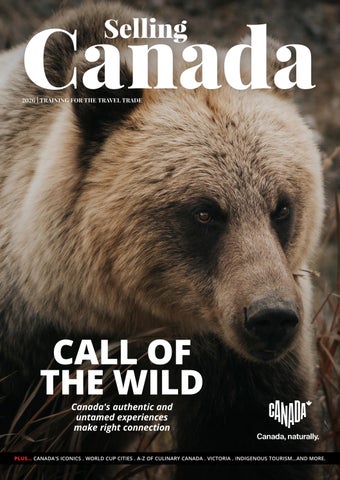
Selling Canada Australia 2026

Page 1


SELLING CANADA 2026

Museums and Galleries

How to Sell: Victoria

Winter in the Rockies

Canada's National Parks

Postcard from Canada

Accessible Travel

Magical Islands

FRONT COVER: @VICTORAERDEN PUBLISHED BY BMI PUBLISHING LTD, 501 THE RESIDENCE, NO.1 ALEXANDRA TERRACE, GUILDFORD, GU1 3DA • T: 020 8649 7233; E: ENQUIRIES@BMIPUBLISHING.CO.UK • W:BMIPUBLISHING. CO.UK • PUBLISHER: SALLY PARKER; EDITORIAL DIRECTOR: STEVE HARTRIDGE; DESIGNERS: CAITLAN FRANCIS & COLETTE DENHAM; PRODUCTION MANAGER: CLARE HUNTER; MANAGING DIRECTOR: MATT BONNER; CEO: MARTIN STEADY • WHILST EVERY EFFORT IS MADE TO ENSURE ACCURACY, BMI PUBLISHING CANNOT BE HELD RESPONSIBLE FOR ANY ERRORS OR OMISSIONS. 2026.

Canada ready to have a ball in 2026

I AM delighted to introduce this issue of Selling Canada, which includes features on wildlife, this summer’s World Cup, culinary and Indigenous experiences and much more.

It was great to catch up with some of you at the events we participated in last year. We were at the Entire Travel Group’s Roadshow in February, the Virtuoso event in Melbourne in September and staged our own Focus Canada events in Sydney.

I experienced some great trips to Canada last year. These included the Helloworld OMC conference in Vancouver and RVC in Winnipeg in the spring, which is a great time to visit both: it was warming up nicely and not too crowded.

Then it was off to Ontario in October for our Strategic Advisory Group from Australia, to meet with our partners in Ontario as well as experience what the province has on offer in the fall.

We started in Toronto, then headed to Niagara Falls, where we planted some trees for a Niagara Parks regeneration programme, and also spent time at Elmhirst Resort and in Ottawa, which was beautiful draped in its fall foliage.

Our webinars are back in 2026 – see our library at canadaspecialists.com – as is our More To Explore eDM programme.

DC update

Canada’s natural approach highlights the authentic

DESTINATION Canada’s latest brand refresh, Canada, naturally. has been engaging UK audiences since it went live in late summer 2025.

Designed to influence summer and autumn 2026 bookings and aimed at what Destination Canada has identified as ‘Refined Globetrotters’ and ‘Outdoor Explorers’, Canada, naturally. is a cornerstone initiative of its 2030 strategy which aims to generate $160 billion in annual tourism revenue by 2030.

The brand, which features across online video, social, publisher, and out-of-home placements, showcases those

aspects that make Canada truly unique and is grounded in the insight that more travellers are now seeking authenticity in a world increasingly filled with artificial experiences.

The Canada, naturally. creatives feature the stunning beauty of Canada’s everyday landscapes and the genuine warmth of its people through observational snapshots of everyday Canadian moments – from roadside fill-ups in the Rockies to backyard BBQs featuring the northern lights.

They highlight that in Canada what is viewed as ordinary by locals is rarely anything less than extraordinary for visitors.

Help desk

KEY CONTACTS: Nathan McLoughlin Mobile: 0407897814

EMAIL: nathan@jkingassociates.com

TRAINING: canadaspecialist.com. au; keepexploring.com.au

Secure an eTA for Canada clients –and allow times

AGENTS are reminded that all Australian visitors to Canada who arrive by air must be in possession of an Electronic Travel Authority (eTA) which should be obtained before the purchase of air tickets.

An eTa costs C$7 and applicants should allow at least three days for it to be approved.

An eTA is valid for five years, or until the passport expires, and allows multi-entry.

Travellers can only apply for one person at a time.

For example, a family of three must complete and submit the form three times.

Any website charging more than C$7 is not an official government site. Apply online at Canada.ca/

Numbers game

AUSTRALIA will be one of the fastest growing markets for Canada this year, according to Destination Canada’s Market Highlights Report. With numbers yet to be finalised, overnight visits from Australia in 2025 were expected to reach 124% of 2019 levels, with spending 101% of 2019 levels (around $1.3 billion).

Over a barrel

* OVERSIZED floating wine barrels offer one-ofa-kind accommodation in Murray Harbour, Prince Edward Island.

Set on docks in the marina, the Nellie’s Landing ‘Merlot’ wine barrels have a door and two windows at the front, a large window overlooking the water and air-conditioning.

It’s a short walk to a nearby bathhouse with individual toilets, sinks, and showers. Dockside, there’s an oyster bar that serves up lobster rolls and cocktails. Rates start at CAD$225 a night. nellieslanding.com

Lake Louise wellness

FAIRMONT Chateau Lake

Louise’s new indoor-outdoor lakeshore thermal wellness destination is described as a “contemporary interpretation of a traditional bathhouse” .

BASIN Glacial Waters, the first facility of its kind within the protected alpine area of Banff National Park, takes inspiration

from the natural springs, thermal waters and wellness practices of Nordic sauna.

Facilities include Finnish and Bio saunas, an Aufguss sauna, steam rooms, a hot stone massage room, temperature pools and a Hammam for a fullbody exfoliation. fairmont.com

Air North seasonal to Yellowknife

AIR North will resume its seasonal service between Vancouver and Yellowknife on November 24, 2025.

The route will operate twice weekly through March 27, 2026.

Fares start from C$139 one way, including meals, checked and carry-on baggage and Air North’s signature warm chocolate chip cookie.

49% owned by the Vuntut Gwitchin First Nation, Air North operates a fleet of Boeing 737-800, 737-500, 737-400 and ATR 42 turboprops. It flies to destinations across the Yukon and to the Northwest Territories, British Columbia, Alberta, and seasonally to Ontario. flyairnorth.com flyairnorth.com

New in Vancouver

* A NEW 30-storey dualbranded Marriott hotel is under construction in Vancouver. Slated to open in summer 2028, it will feature Moxy Hotels and Element by Westin, with 390 guest rooms and a sky lobby lounge. marriott.com

Saskatoon refresh

* DELTA Hotels

Bessborough in Saskatoon is undergoing a complete renovation and will emerge as part of Marriott’s Autograph Collection brand. All 225 guest rooms and dining options will be refreshed. marriott.com

Niagara takes flight

VISITORS to Niagara Falls

can now experience the destination from an entirely new perspective. Located inside Niagara Parks’ flagship site, Table Rock Centre, at the brink of the Horseshoe Falls, Niagara Takes Flight is an immersive, sensory-rich attraction that uses

drone technology and a huge 180-degree domed screen to take passengers on a simulated “journey” that celebrates Niagara’s geography, history and people. The ride features sensory effects like wind, mist and even smells. niagaraparks.com

Yukon hotel brings guests in from cold

WHITEHORSE has a striking new hotel after the opening of Hyatt Place Whitehorse, the brand’s first property in Canada’s North and only the second purposebuilt hotel to open in Whitehorse in more than 50 years.

Located in the heart of downtown, and minutes from Erik Nielsen Whitehorse International Airport, the hotel puts guests within steps of Main Street’s cafés and shops, the Yukon River waterfront and landmarks such as the MacBride Museum of Yukon History.

The 115-room hotel, which has views of the mountains, was developed by majority First Nations-owned Northern Vision Development Partnership. hyattplace.com

Arctic Games a Northern celebration

THE Arctic Winter Games 2026, a multisport and cultural event, will take place in Whitehorse, Yukon, from March 8-15, 2026.

The tournament will see athletes from across the circumpolar north – Northwest Territories, Yukon, Nunavut, Alaska, Greenland, Northern Quebec (Nunavik), Northern Alberta, and the Sami people from Norway, Sweden, and Finland – compete in 20 different sports, including ‘traditional games’.

Held every two years, the event features Inuit favourites like one-foot high kick and knuckle hop, and Dene games that include finger Pull (a test of strength), hand games (a guessing and deceiving game involving sticks), and Snow Snake (a throwing competition), along with the more familiar hockey, skating and curling.

Many of the featured sports are culturally significant, reflecting and honing the skills necessary for survival in the Arctic region. awg2026.org

Sofitel adds French luxury in Montrèal

SOFITEL’S flagship Canadian property has completed a multiphase refurbishment, spanning across its rooms and suites, dining and event spaces.

Marc Pichot, General Manager of the 256-room Sofitel Montreal Golden Mile, said: “We’re thrilled to welcome guests into a fully redefined Sofitel experience that embodies the vibrancy of Montréal and the soul of French art de vivre.

“The hotel’s revitalistion reflects a French home: intimate expressive and artfully curated.”

The hotel is located on Sherbrooke Street, in the heart of Montréal, near boutiques, restaurants and attractions like Mount Royal and the Montréal Museum of Fine Arts. sofitel.accor.com

Prince Edward Island Awaits

From breathtaking coastal landscapes to world‑class culinary experiences, PEI is the ideal destination for outdoor adventurers and food lovers alike. Explore scenic shoreline paths, head out kayaking or enjoy other ocean adventures, then indulge in fresh seafood, wander through charming coastal towns and experience the warm hospitality that makes our Island unforgettable.

top 10 CLASSICS

Canada has a stellar line-up-up of star attractions that should be on every visitor’s ‘hit list’, says Lauren Jarvis

NIAGARA FALLS, ONTARIO

Water has been tumbling over the Niagara Escarpment for more than 12,000 years, but today visitors have so much more to see and do than just the roaring cataract. Experiences include the new Niagara Takes Flight, an immersive flying theatre journey along the Niagara River corridor, and the allnew nighttime experience at the falls’ power station that gives a different perspective of Niagara’s cathedral of power. You can also ride 3,500 feet across the Niagara Gorge and witness the vibrant swirls from the Niagara Whirlpool on the Whirlpool Aero Car.

ROCKY MOUNTAINEER, BRITISH COLUMBIA AND ALBERTA

Rocky Mountaineer has been journeying through Western Canada and the Canadian Rockies for 35 years. Summer 2026 will see the luxury train company bringing a new journey on board, Passage to the Peaks, which for a limited time will connect

the Rocky Mountain towns of Jasper and Banff with an overnight stay in Kamloops. Highlights include Yellowhead Pass and the Spiral Tunnels of Kicking Horse Pass. rockymountaineer.com

OLD QUÉBEC, QUÉBEC CITY, QUÉBEC

Founded in the 17th century, Québec City was the first permanent French settlement in North America. The Historic District of Old Québec was designated a UNESCO World Heritage Site in 1985, but this colonial neighbourhood isn’t frozen in time. Heritage buildings, ramparts and fortifications are under ongoing restoration, while celebrations to mark 40 years of the UNESCO listing are in full swing. quebec-cite.com

THE BAY OF FUNDY, NEW BRUNSWICK AND NOVA SCOTIA

Located on Indigenous Mi’gmaq territory, between Nova Scotia and New Brunswick, the Bay of Fundy holds the Guinness World

Record for the world’s greatest recorded tidal range at 47 feet, six inches. More than 100 billion tons of water fills and drains the funnel-shaped bay twice daily, exposing inter-tidal zones bursting with life. The surrounding Acadian forests offer hiking and biking trails, while Saint John is the place to watch the unusual Reversing Falls Rapids. fundytourism.com

BEAR WATCHING, MANITOBA AND BRITISH COLUMBIA

Known for their walking safaris which offer up-close encounters with the polar bears of northern Manitoba, Churchill Wild is now offering expert-led photography tours to capture the region’s wild wolves. Meanwhile in British Columbia, the legacy of Gary Zorn is being kept alive by his wife Peggy after the legendary “Bear Whisperer” passed away in 2022. The Northern Lights Lodge has reopened and hosts guests on a threenight Eco Tours Bear Whisperer experience,

tracking grizzly and black bears in the Cariboo Mountains. ecotours-bc.com

BANFF NATIONAL PARK, ALBERTA

Banff is a designated UNESCO World Heritage Site in the Canadian Rockies, with breathtaking alpine views, wildflower meadows and a gondola ride drawing visitors to the park in summer, while some of the best snow on earth welcomes skiers at world-class resorts in winter. But travelling in the shoulder seasons of spring (April to June) and autumn (September to November) offers the chance to experience the park’s natural splendour without the crowds. banffnationalpark.com

CN TOWER, TORONTO, ONTARIO

Soaring 1,815 feet above the city, the tower became the world’s tallest freestanding structure when it opened in 1976, Marking its 50th anniversary in 2026, the CN Tower is a must-do in Toronto, but not all will be brave enough to take on the dizzying

challenge of the EdgeWalk: the world’s highest full-circle, hands-free (but harnessed) “walk” around the five-feet-wide ledge encircling the top of the tower’s main pod. cntower.ca/brave-the-edgewalk

AURORA BOREALIS, YUKON

The sky’s natural light show illuminates Canada’s northern realms each winter when the Aurora Borealis, or northern lights, paints ribbons across the night skies. The best time to see them in Yukon is from mid-August to mid-April, with the optimal viewing hours being between 22.00-03.00. This Yukon magic is expected to be at its peak during the Solar Cycle 25 activity in 2026. northernlightsyukon.com

PEGGY’S COVE, NOVA SCOTIA,

There are few images more iconic of Canada than that of the white-and-red lighthouse that proudly stands guard over the Atlantic Ocean in this small rural community on the eastern shore of St.

Margarets Bay. There’s plenty to experience in the heart of this active fishing village, from restaurants and local art, while the region is popular for its hiking trails, kayaking adventures, whale watching, birding activities and golf courses. Accommodation includes inns, cottages and bed and breakfasts. peggyscoveregion.com

BISON, WANUSKEWIN HERITAGE PARK, SASKATCHEWAN

A true icon of North America, millions of bison once thundered across the plains, but by the late 1800s they had been almost hunted to extinction by European settlers. In 2019, Parks Canada partnered with Wanuskewin Heritage Park on a mission to reintroduce the bison to their prairie home and restore the park’s native grasslands. Here, visitors can learn about Indigenous people’s cultural relationship with the land and watch the bison roaming free again. wanuskewin.com •

Canada, naturally.

“TRAVELLERS ARE LOOKING FOR GENUINE AND AUTHENTIC EXPERIENCES”

How long in the making was your current campaign Canada,naturally which highlights authentic connections and experiences?

We weren’t starting from scratch with this. We launched our “Canada Mark” in 2019 with the tagline For Glowing Hearts, which had a heart-shaped logo that is rooted in Canada’s red and white colours.

From the start, our brand strategy has been to create an emotional connection with potential visitors by highlighting the transformative and heartfelt experiences that Canada offers, moving beyond traditional advertising to focus on authentic connections and values. We did a lot of foundation work to come up with a brand that would resonate across all of our key markets

Explain the push factors that underpin it Canada, naturally. focuses on the genuine, everyday things that make Canada special, such as its open spaces, wilderness and welcoming residents.

Travellers today are looking for real and nonmanufactured experiences that immerse them in the lives of people doing ordinary things.

In Canada jaw-dropping views are not staged or temporary, they are just out there all the time and have been for over 10,000 years.

Explain how Canada,naturally. targets what you call “highly engaged” tourists

Through analytics and other research we have been looking closely at “travel behaviours”. For example, would they (visitors) be open to coming to Canada in the fall and winter? Are they getting out into more remote or rural communities, as well as visiting the cities? And do they have travel values that are matched by their experiences (in Canada)? That is, do they like the fact that their travel dollars are staying in a community and helping that community achieve its objectives for sharing culture and achieving economic growth?

One of your key challenges is to see a greater spread of visitors across all four seasons – is your proactive marketing of autumn and winter producing results?

We’ve tried to identify the markets, such as Australia, that have the most opportunity for off-season travel and we are starting to see positive signs.

The other side of the coin is destination and product development. More Canadian resorts are no longer building just a ski hill or a golf course but are constructing in a way that prioritises all four seasons. That’s not how Whistler started, for example, which was just an out-and-out ski hill.

We’ve also got an initiative running with Parks Canada. Obviously, if the parks stay closed for too many months this limits (visitor) opportunities, so we’re working with them to give them the confidence to stay open for longer. We’re using our data to show them there is demand at times outside of summer.

What are some of your own favourite moments of your travels in Canada?

When I am asked this I often respond by saying how much I enjoyed the Calgary Stampede, but my fondest memories are of people offering to help me out in various locations, which is not unusual in Canada.

One night in Newfoundland I was out walking and stopped when I heard live music...and was invited into a kitchen party. This kind of thing really does happen a lot and always makes me proud to be Canadian. •

Savour Calgary

A FOOD-LOVER’S GUIDE

Calgary, Alberta, is a food-lover’s paradise, showcasing everything from curated culinary tours to farmers’ markets and craft breweries

Awardwinning restaurants and chefs

Calgary’s dining scene is led by nationally and internationally recognised chefs who showcase bold creativity and local ingredients. From fine dining to innovative casual concepts, the city’s award-winning restaurants reflect a diverse culinary identity rooted in Alberta’s premium beef, fresh produce and global influences.

Breweries and distilleries

Calgary is home to a thriving craft beverage scene, with over 40 breweries and distilleries producing small-batch beers, spirits, and innovative flavours. From lively taprooms to cozy tasting rooms, visitors can meet local makers, sample award-winning creations, and experience the city’s entrepreneurial spirit while exploring the diversity of Calgary’s craft beverage culture.

Alberta Food Tours

Alberta Food Tours’ Iconic Eats of Calgary Tour offers a curated and guided journey through the city’s vibrant food scene. Guests of the tour will sample local specialties, meet talented chefs and makers, and explore unique neighbourhoods. By the tour’s end, participants will gain a true taste of Calgary’s culture, history and dedication to fresh, locally-sourced cuisine.

Farmers’ markets

Calgary’s farmers’ markets are lively hubs featuring fresh, locally grown produce; artisanal foods and handmade goods. Open yearround, they connect visitors with Alberta farmers and producers. The Calgary Farmers’ Market West offers travellers heading to the Rocky Mountains a chance to assemble a picnic basket full of locally-sourced delights.

Food Bike Tours

Food Bike Tours combines Calgary’s extensive cyclingfriendly pathway system with numerous delicious culinary stops along the way. This fun, active experience allows visitors to explore the different neighbourhoods, enjoy local eats, and learn about the city’s food culture, all while taking in scenic views and Calgary’s renowned outdoor lifestyle.

Signature foods

Alberta’s signature foods celebrate the province’s rich culinary heritage. Ingredients like beef, saskatoon berries and honey showcase local bounty and can be savoured at Calgary’s restaurants. These flavours tell the story of Alberta’s farms and producers, letting visitors experience the province’s culinary identity through fresh, locallyinspired dishes in the heart of the city.

The coast

WITH THE MOST

To experience some of the best that Canada has to offer, pack your bags and head to its closest coast, says Peter Ellegard

Eastern Canada serves up a sensory feast, from lip-smacking seafood to captivating culture to centuries of maritime heritage to stunning scenery.

Five of the region’s six provinces border the Atlantic, encompassing more than 26,000 miles of coastline in total.

Quèbec

Québec by the Sea, as the province’s maritime coast is sometimes called, takes in the areas lapped by the Gulf of St. Lawrence and is Atlantic Canada with a certain je ne sais quoi.

Explore the Gaspe Peninsula’s dramatic coast, quaint fishing villages, brooding mountains and sandy beaches on the 575-mile Gaspesie Tour loop, one of Canada’s most iconic road trips.

Boat trips head out to Perce Rock, a huge natural arch, and Bonaventure Island, North America’s largest migratory bird refuge that is home to a northern gannet colony.

Nova Scotia

Halifax is Nova Scotia’s heartbeat, an urban hub with big city vibes yet a friendly, smalltown feel. Take in festivals, enjoy its vibrant restaurant and nightlife scene and catch the noon-day gun firing at the star-shaped Halifax Citadel fortress.

Tuck into fresh lobster 10 months of the year in coastal communities, take Canada’s most popular selfie at Peggy’s Cove lighthouse, visit the historic waterfront of Lunenberg, a UNESCO World Heritage Site, and linger along Cape Breton Island’s beautiful Cabot Trail.

New Brunswick

Walk on the ocean floor below the towering Hopewell Rocks in the Bay of Fundy, which has the highest tides in the world, or kayak around them when the tide is high.

Go whale watching in the bay on a motorboat or tall ship to spot some of the dozen species found there along with seals and bald eagles.

Take a hike on trails including the 40-mile Fundy Footpath, seeing wildlife such as moose, bears and deer. Stroll through the capital

Prince Edward Island

Get out and about to discover tiny PEI. See the island end to end biking or hiking the 168-mile Confederation Trail. Help oyster or lobster fishermen haul in their catches, followed by tasting the shellfish. Or play golf on some of its 28 facilities, paddle in a kayak or canoe and ride a horse on deserted beaches or through woods. Immerse yourself in an Anne of Green Gables experience where the children’s classic was set or visit one of its 61 lighthouses.

Newfoundland & Labrador

The largest Atlantic province is divided between mainland Labrador and the island of Newfoundland. Watch giant, 10,000-year-old icebergs as they drift along the coasts through ‘Iceberg Alley’ in spring and summer, also a good time to spot migrating humpback whales. Hike or take a boat trip to see the marshlands, boreal forest, soaring mountains and deep fjords of Gros Morne National Park. And don’t miss the recreated Viking village at L’Anse aux Meadows where Norse settlers lived 1,000 years ago. •

Fredericton or chill out in historic seaside resort St. Andrews by the Sea.
PERCE ROCK, QUÉBEC
BAY OF FUNDY, NEW BRUNSWICK

WESTERN LUXURY

Siwash Lake Wilderness Resort and Ranch in B.C. appeals to those seeking experience-led luxury rooted in conservation, says Allyson Rogers, Owner and GM Manager

Tell us about Siwash

We are a remote, family-run wilderness ranch. Surrounded by forests and lakes, we offer guests the chance to experience a truly wild environment while enjoying a high level of comfort and thoughtful, personalised service. Guests come here to slow down, spend time outdoors and reconnect with nature through horses –which roam freely on the property – wildlife and wide-open landscapes. It is immersive, personal and deeply restorative.

Do guests need riding experience?

No. While many guests are experienced riders, others have never been on a horse before. Our focus is on connection rather than performance, and we take time to

match each guest with a horse that suits their comfort level and energy.

Beyond riding, what other activities are on offer at Siwash Lake?

Wildlife encounters are a natural part of life at Siwash Lake. Guests may see moose, deer, bears, river otters and birds of prey.

How do you balance luxury hospitality with adventure?

Guests enjoy beautifully designed accommodation, great food and attentive service, while still feeling fully immersed in the wilderness. Comfort enhances the experience without overshadowing the authenticity of the landscape.

How do you embrace Sustainability and regeneration principles?

Sustainability here is rooted in long-term stewardship. After a wildfire in 2017, we saw how the land can regenerate when given time and care. Guests can experience this recovery through guided walks that explore fire ecology and biodiversity. siwashlake.com •

*Terms and conditions apply.

Top experiences IN NUNAVUT

From festivals celebrating the rich Inuit culture to hiking the frozen tundras, Nunavut presents a land of wonder

INDIGENOUS CULTURE: Nunavut is home to various arts festivals showcasing local artists and celebrating traditional practices. Toonik Tyme and Alianait are some of the most popular festivals, hosted in the capital of Nunavut, Iqaluit. Toonik Tyme is hosted annually every April. The eventl typically consists of traditional Inuit games, throat singing, drum dancing, a community feast and an evening of music and dancing at Toonik Lake. Alianait occurs in the summer, usually in late June. This festival is a prominent stage for Inuit artists and brings in world-class musicians, acrobats, dancers, storytellers, actors, filmmakers and visual artists from around the world. alianait.ca

GO FOR A SPIN ON A SNOWMOBILE: One of Nunavummiut’s preferred methods of transportation, the snowmobile, is a staple of Arctic living. Feel the cool Arctic breeze as

you cruise along the tundra, following the migratory paths of caribou and arctic foxes. Glide over hills, peaks, and frozen lakes as you take in the land around you. Get the True North experience with full day trips or join shorter local tours. Jump and ride to your heart’s desire. inukpakoutfitting.ca

TRY YOUR HAND AT FISHING: Fishing is one of the most popular leisure activities in Canada’s North. Deeply rooted in tradition, the act of fishing is heavily embedded in Inuit culture. The summer months offer a familiar fishing season for enthusiasts, while the winter months provide a unique ice fishing experience. Regardless of your preference, Nunavut is home to many species of fish including Arctic char, lake trout, northern pike, and Arctic grayling. Many tour operators offer fishing packages, with skilled guides ready to help you reel in your next big catch. arcticbayadventures.com

TAKE A HUNTING TRIP: Hunting is an integral part of Inuit culture. Caribou, muskox, seal, walrus, and even polar bear have been hunted for years in order to provide survival gear and nourishment, which are essential for enduring the harsh cold. For hunting enthusiasts, many skilled outfitters across Nunavut’s communities offer exciting packages. You can hunt both small or big game with expert guides walking you through the process to help bring your hunting trips to the next level. arcticwildernessoutfitter.ca

RIDE THE TIDES IN A KAYAK OR CANOE: Paddle through the Hudson’s Bay, Labrador Sea or Arctic Ocean. Nunavut’s unique geographic location sees it surrounded by bodies of water, making it the perfect destination for those looking to canoe or kayak. And for a greater challenge, the spring runoff allows for whitewater kayaking. Nunavut’s rapids, such as the Sylvia

Grinnell River located in Iqaluit and the Soper Heritage River in Kimmirut, provide thrilling opportunities. Plan your own adventure through the rocky shorelines and majestic fjords. nukpakoutfitting.ca

LET THE NORTHERN LIGHTS DAZZLE

YOU: Experience the greatest lightshow that nature has to offer, right here in the beautiful territory of Nunavut. November through to March offers excellent opportunities for viewing the Northern Lights. See the stunning landscapes of Iqaluit, through local outfitter-led tours that include a hands-on photography workshop, ensuring you capture how the Spirit of the Arctic lights up the sky! arctickingdom.com

EXPERIENCE THE THRILL OF DOG

SLEDDING: Dog sledding e is one of the earliest, most iconic forms of Arctic travel in Nunavut. Dog sledding involves not only dogs, but also a traditional sled known as a ‘qamutiik’. A ‘musher’ acts as a driver, giving

the talented team of dogs commands as they travel across the land. Join one of the various dog sledding tours, allowing you to ride as a passenger while taking in the breathtaking tundra landscape. koolrunnings.ca

WONDER AT THE BEAUTY OF NATURE AND WILDLIFE: Nunavut is home to an incredible array of wildlife. Polar bears, caribou, arctic foxes and wolves, narwhals, belugas, seals and many species of birds call the Arctic kingdom home. While some of these animals can be spotted year-round, the best opportunity to view these stunning species comes in late April to early June. The area where the landfast ice meets open water, known as the ‘Floe Edge’, is a hotspot for marine animals, birds and mammals. Outfitters offer guided trips, boat tours and cruises allowing visitors to witness these beautiful creatures. arctickingdom.com

SKI IN PARADISE: In a territory known for its snow and highlands,

Nunavut is a skiers paradise. Cross country ski across Baffin Island, or traverse the hills in northern Pangnirtung. It’s the perfect combination of stunning views coupled with a great workout! Tour operators offer a plethora of ski-focused trips at various skill levels. Find your favourite itinerary, load up your gear, and prepare for a once in a lifetime adventure.

blackfeather.com

HIKE THE SNOWSCAPES: The vast Arctic tundra, deep fjords, and extensive coastline of Nunavut make for unparalleled hiking experiences. Enjoy an informative trek out on the land in Nunavut’s capital, or take it to the extreme and walk alongside towering mountains like Mount Thor in Auyuittuq National Park. Tour operators offer a variety of packages to accommodate your desired route for an unforgettable adventure.

blackfeather.com •

Ready for the ball

WORLD CUP CITIES

Toronto and Vancouver will both stage FIFA World Cup 26 matces and fans travelling for the football will find plenty to enjoy in those cities and beyond, says Stuart Forster

Canada is one of three host countries for the FIFA World Cup 26, which will run between June 12 and July 19, with Toronto staging six matches and Vancouver seven.

In Toronto these include the Canada national team’s first-ever World Cup finals game on home soil and one Round of 32 fixture.

Meanwhile, Vancouver’s fixtures include one game in Round of 32 and one in Round of 16.

Canada’s venues

The 45,736 capacity Toronto Stadium – more commonly known as BMO Field, where Toronto FC play their Major League Soccer (MLS) home games – is located in Exhibition Place, by the shoreline of Lake Ontario, just west of downtown. The stadium is easily reached from the downtown area and handily placed next to Billy Bishop Toronto City Airport, where Air Canada and Porter Airlines operate flights to destinations across Canada.

Two of Canada’s matches (against Qatar and Switzerland) will feature among the five group games at Vancouver’s 54,00- capacity BC Place, a downtown stadium with a retractable roof.

BC Place is in the Yaletown neighbourhood, near Stadium-Chinatown station, which means fans can travel on Vancouver’s SkyTrain metro, with its links to the international airport.

The city’s Pacific Central Station is just one stop from the stadium on the Expo Line.

Host city highlights

Fans will have time to combine the football action with some city sightseeing and tours.

Toronto’s Islands are stunning on summer days and sightseeing cruises offer views of a skyline dominated by the CN Tower. The tower’s EdgeWalk provides adrenalin thrills for visitors with a head and stomach for heights.

Family-friendly highlights include Ripley’s Aquarium of Canada, the Toronto Railway Museum and Royal Ontario Museum, whose collection ranges from art to natural history. The historic Distillery District, with its

cobblestones, eateries and brew pubs will be a popular option on match days.

Vancouver’s Gastown, Granville Island and Kitsilano will also be thronged with visitors, while a seawall popular among runners and cyclists (and with unbeatable skyline views) is on offer in Stanley Park, whose Brockton Point is the province’s most-visited tourist attraction thanks to First Nations art and totem poles.

Other popular attractions include Capilano Suspension Bridge, VanDusen Botanical Garden and nearby Grouse Mountain.

Beyond the hosts

Canada’s often relatively traffic-free roads and reliable transport network make staying outside of the host cities a viable and more affordable option. The pretty town of Niagara-on-the-Lake is just two hours from Toronto and 30 minutes from Niagara Falls. The town places visitors in the heart of the country’s biggest winemaking region while the Shaw Theatre Festival will offer drama away from the football action.

Just over an hour out from Toronto, Hamilton will appeal to military aviation enthusiasts who

will pencil in a visit to the Canadian Warplane Heritage Museum. The colourful Devil’s Punchbowl is one of more than 100 waterfalls in and around Hamilton. Many, including those in the Dundas Valley Conservation Area, are accessible via hiking trails.

Gravenhurst, two-and-a-half-hours’ drive from Toronto, is nicknamed ‘the Gateway to Muskoka’, a region of lakes and forests where Canada’s great outdoors is at its prettiest.

Similarly, three hours east of Toronto, Kingston’s attractions include its historic penitentiary and Fort Henry.

At the mouth of the Great Cataraqui River, Kingston is on the Rideau Canal and boat journeys along it, or into the Thousand Islands region, will prove a popular option between World Cup matches.

On the west coast, additional accommodation is available in Burnaby, North Vancouver, Richmond and across Metro Vancouver, all areas easily connected to downtown and BC Place Stadium via Skytrain and bus services.

Further afield, ferries and seaplanes will provide good regional connections, with

seaplanes linking Vancouver with destinations on Vancouver Island in less than an hour.

The town of Ucluelet provides access to the Pacific Rim National Park Reserve and hiking on the rugged Wild Pacific Trail, while grizzly bear and whale-watching tours are offered from Campbell River. Wildlife viewing is also an option from Tofino, whose rainforest boardwalks, indigenous experiences and worldclass surfing are other major draw cards.

The new elevated walkway along Squamish Canyon, a 1.5-hour drive from Vancouver along the scenic Sea-to-Sky Highway, is a way to experience the Howe Sound Biosphere’s coastal rainforest, Mamquam Falls’ prodigious power and the Squamish Nation’s culture.

Abbotsford, another of the many possible bases or day-trip options around Vancouver, is an 80-minute drive from the city and buses operate along the route. Staying there opens up opportunities to explore the Fraser Valley and the mineral-rich waters of Harrison Hot Springs. Whatever happens on the pitch, football fans can be winners by experiencing the FIFA World Cup 26 in Canada. •

NIAGARA-ON-THE-LAKE
MAMQUAM FALLS

TOP OF THE swaps

North America is packed with quintessential experiences. Here’s where to find 20 of the most sought after in Canada, says Lauren Jarvis

THE YUKON RIVER

IF YOU LOVE A PACIFIC COAST CITY BREAK... swap Seattle for Vancouver. Looking for a place with a mild climate that is surrounded by mountains and the ocean, with easy access to the Great Outdoors and the chance to go whale watching from the city? Seattle offers these but Vancouver, where Orcas and humpback whales pass through from May to October, ticks all the same boxes. Seattle is known as the birthplace of the American coffee scene, while Vancouver’s coffee culture is also strong, driven by its multicultural population.

IF YOU LOVE ROAD TRIPS... swap Route 66 for the TransCanada Highway. Marking its centenary in 2026, America’s Mother Road is going to be a hectic highway so consider Canada’s longest national road, the provincial highway system that travels through all 10 of the country’s provinces, extending east-west from Victoria, B.C. to St. John’s, Newfoundland. Car ferries link both Newfoundland and Vancouver Island to the mainland.

IF YOU LOVE COWBOY CULTURE... swap Texas for Alberta. Home to the world-famous Calgary Stampede, Alberta’s cowboy culture was born from its 19thcentury cattle-ranching roots. Visitors with a hankering for the Old West can saddle up for ranch stays, a strong country music scene and horse riding along The Cowboy Trail in the foothills of the Rocky mountains.

IF YOU LOVE FARM TO TABLE DINING... swap Portland for Montréal. The Oregon city is known for prioritising locally sourced ingredients, organically grown produce and sustainable, ethical dining – as is Montréal, which is now something of a Mecca for foodies committed to eating responsibly. From the urban farms and “buvettes” (neighbourhood cafés) of Montréal, you’ll find regional seasonal cuisine that (literally) won’t cost the earth.

IF YOU LOVE BEARS AND WOLVES... swap Alaska for the Yukon. The breathtaking wilderness of the Yukon is more than a match for Alaska’s national parks. Tour operators in Whitehorse offer

a range of eco-friendly excursions to watch grizzly and black bears, as well as wolves and lynx. Paddle the mighty Yukon River and you’ll likely see eagles, ospreys and beavers along its banks.

IF YOU LOVE JAZZ AND BLUES... swap New Orleans for Montréal. The jazz and blues scene is thriving in the bars and music venues of Montréal, where you’ll find cool and casual speakeasies showcasing rising stars and world-class auditoriums hosting international big-name acts. Montréal has a rich Jazz heritage: its most famous “son” of the genre is the legendary Oscar Peterson, with a downtown plaza dedicated to him.

IF YOU LOVE AUTUMN COLOURS... swap New England for Québec. Québec is a great choice to experience the dazzling colours of a North American fall without the crowds. Popular areas to view the foliage include national parks like MontTremblant and cities such as Montréal and

Québec City, which have numerous urban parks and nearby scenic spots.

IF YOU LOVE THEATRE BREAKS... swap New York for Toronto. “Off Broadway” has a whole new meaning for those wanting a North American theatre break. Toronto has both grand theatres, where visitors can catch major touring shows, and intimate venues for independent plays. The city’s Theatre District is a major hub, with venues such as the Princess of Wales and Royal Alexandra Theatre.

IF YOU LOVE INDIGENOUS EXPERIENCES...swap New Mexico for Ontario. Southwest USA is home to numerous federally recognised pueblos, nations and tribes that welcome visitors, but Indigenous culture in Ontario is equally diverse, with distinct languages and distinct artistic traditions (primarily Algonquian and Iroquoian). For example, Manitoulin Island is home to several First Nations communities which host tours, pow wows and festivals throughout the year.

IF YOU LOVE CITY MARKETS... swap Philadelphia’s Reading Street Terminal for Vancouver’s Granville Island Public Market. Philadelphia’s famous indoor market provides fresh produce and lunchtime snacks to locals and visitors alike – and Granville Island, with its 50 unique vendors, does the same but from a more aesthetically pleasing location that boasts waterfront and coastal views.

IF YOU LOVE A BALL GAME... swap the New York Yankees for the Toronto Blue Jays. Every trip to North America should include a baseball match

ALBERTA’S COWBOY CULTURE
MONTRÉAL
© GOUVQC
JEAN-FRANÇOIS
HAMELIN
FESTIVAL INTERNATIONAL DE JAZZ DE MONTRÉAL

and in Canada the team to watch is the Toronto Blue Jays, who reached the sport’s World Series in October 2025. See them play at the Rogers Centre.

IF YOU LOVE THE GREAT LAKES... swap Lake Michigan for Lake Superior. The world’s largest freshwater lake, Superior stretches across the USA and Canada and offers exciting outdoor adventures along its Canadian shores. Stargaze in Lake Superior Provincial Park, hike the Casque Isle Trail or camp at Sleeping Giant Provincial Park, amidst some of the most incredible landscapes in North America.

IF YOU LOVE WHALE WATCHING... swap New England for Atlantic Canada. Ishmael, the lead character in Moby Dick, joined the whaling ship Pequod in Nantucket, Massachusetts, but the nutrient-rich coastal waters around Canada’s maritime provinces also yield opportunities to get out on the water to observe the giant leviathans. The Bay of Fundy is another prime whale-watching spot, due to its high tides that churn up plankton and krill.

IF YOU LOVE CREOLE CULTURE... swap Southern Louisiana for New Brunswick. The Canadian Maritimes were home to one of the first European colonies in North America, French settlers or “Acadians” who arrived in the 17th and 18th centuries. With their own history, culture and dialect, the Acadians of New Brunswick speak “Chiac” or “Brayon”. Visitors can celebrate all things Arcadian at the annual Festival Acadien in Caraquet, New Brunswick, in August.

IF YOU LOVE GIANT ICONS... swap the Grand Canyon for the Rocky Mountains. The grandeur of

America’s Grand Canyon is rivalled by the soaring snow-capped peaks of Canada’s Rocky Mountains, a monumental chain that runs for around 1,000 miles southeastward from the northern tip of B.C. Explore on foot or by bike in summer, and strap on skis or snowshoes in winter.

IF YOU LOVE DREAMY BEACHES... swap Alabama for Prince Edward Island. Think the pristine white-sand beaches of the Gulf Shores can’t be beaten? Then visit Prince Edward Island’s central and north shores. Cavendish Beach is a popular long stretch of white-gold sand within PEI National Park, known for its connection to L.M. Montgomery’s Anne of Green Gables.

IF YOU LOVE LGBTQ+ NEIGHBOURHOODS... swap San Francisco for Vancouver. “San Fran” may have a long history of LGBTQ+ influence and activism but Vancouver’s Davie Village is home to gay-friendly bars, clubs, restaurants and shops. In the city’s West End, south-west of the downtown core, it’s an area of pink bus stops, rainbow banners, gay businesses, gay-friendly events and over 30 Travel Alternatives Group (TAG) hotels. Each August, the city hosts one of Canada’s best Prides.

IF YOU LOVE HIGHLAND GAMES... swap North Carolina for Nova Scotia. Pipes, kilts and Celtic songs come out in force at Grandfather Mountain, which hosts one of North America’s largest Highland Games, but when Scottish settlers began arriving in Atlantic Canada in the 18th century they bought with them a similar set of traditions. Today, the annual Antigonish

Festival has become a highlight of Nova Scotia’s events calendar. The weekend gathering includes ceilidhs, a kilted golf tournament and games from the Highlands such as the caber toss and tug of war.

IF YOU LOVE WINE COUNTRY... swap Napa, California, for the Okanagan valley, B.C. California’s Napa Valley has done a grand job of marketing itself as America’s King of the Vines but there’s no better way to while away a sunny afternoon than in a stylish vineyard in the beautiful Okanagan Valley, home to more than 200 wineries, cellar-door tastings and a farm-to-table culinary scene.

IF YOU LOVE SCENIC DRIVES... swap the California coast for Cape Breton Island. Rivalling the twisting coastal views of the Pacific Coast Highway, the Cabot Trail is a 185-mile scenic highway which offers a scenic way to explore Nova Scotia’s famous island. From the rugged northern shore to Cape Breton Highlands National Park and the Gulf of St. Lawrence, the trail offers breathtaking views at every turn.

CAPTION
A PRISTINE BEACHES ON PRINCE EDWARD ISLAND
VINEYARD IN OKANAGAN VALLEY
SCENIC DRIVE, CAPE BRETON ISLAND

ONTARIO

Whether your clients crave cosmopolitan cities and culture or pristine nature and outdoor adventure, Ontario offers unforgettable experiences that are easy to sell

Why sell it

Ontario is home to a diverse array of headline attractions, from Niagara Falls to multicultural Toronto and its laidback capital, Ottawa. Nature is on your doorstep, even in the cities. For total solitude, visit untouched landscapes such as Algonquin Provincial Park, home to forests, lakes and wildlife.

Ontario’s name derives from the Iroquois word for ‘beautiful water’, and with over 250,000 glistening lakes to visit – including the Great Lakes bordering the U.S. – you’re never far from water here.

For a truly authentic, relaxing experience, escape to a lakeside resort or lodge. There are many distinctive options in the Muskoka Region, Ontario’s Highlands and the 1,000 Islands, an archipelago of 1,860+ isles dotted along the St Lawrence River.

Who to sell to

Ontario has a broad appeal thanks to its mix of culturally rich cities, creative culinary experiences and abundance of nature. Toronto visitors can sample an eclectic dining scene, excellent museums and memorable nightlife, or spend time in nature on the pedestrian-only Toronto Islands. Meanwhile, Ottawa will charm those looking for a friendly, green and walkable city. The historic Rideau Canal, a UNESCO World Heritage Site, runs through the heart of the city and can be explored by boat, kayak, on foot or by bike. Seven of Canada’s

nine national museums are in Ottawa, covering everything from Canadian history to aviation.

For art lovers, Ontario’s galleries champion both Canadian and Indigenous artists, with standouts including Toronto’s Art Gallery of Ontario and the McMichael Canadian Art Collection in Vaughan.

When to sell

While every season in Ontario has its charm, autumn is a magical time, when the weather is cooler and the crowds are fewer than in summer but the days are still long and warm. Autumn colours are a major draw across the province, with Algonquin

Provincial Park’s stunning sugar and red maple forests best enjoyed between late September and into October.

There’s also a range of special experiences to enjoy in autumn, such as the Cranberry Plunge at Muskoka Lakes Farm and Winery.

For foodies, harvest season is the perfect time to visit the many wineries and farmers’ markets selling local, seasonal produce.

How to sell

Ontario is perfect for fly-drives, allowing visitors to explore Toronto, Niagara and Ottawa at their own pace, discovering nature and hidden gems along the way.

For families and groups of friends, suggest unwinding and reconnecting in nature at a lakeside cottage or resort – a treasured tradition for Ontario residents.

Let clients know that Niagara is so much more than just a day trip. As well as experiencing the might of Niagara Falls from the water, zipline or by helicopter, there’s also the new immersive virtual Niagara Takes Flight experience, taking clients over the falls, with mist, wind and scent effects.

The Niagara Peninsula is also the largest, most concentrated wine-making region in Canada, with over 100 wineries clustered within easy reach of Niagara Falls.

UNWIND AT A LAKESIDE RESORT
NIAGARA FALLS IS A MUST-VISIT ATTRACTION NIAGARA

Access

ALL AREAS

From St. John’s on the east coast to Vancouver on the west coast, Canada’s attractive gateway cities offer up a plethora of reasons to satisfy an extended stay

TORONTO

Why go: Arguably the world’s most multicultural city, with over half of its residents born outside Canada, Toronto has more than a dozen ethnic neighbourhoods. These include Kensington Market and West Queen West for its artsy, trendy vibes. The city is also known for its green spaces like Toronto Islands Park, that can be reached via a quick ferry ride from downtown. It has car-free paths, beaches and skyline views. Getting downtown: Get to the city from Pearson Airport by train on the UP Express service ($12.35), by bus ($3.35) or by taxi (around $62).

Trending: The CN Tower celebrates its 50th anniversary in 2026. The tallest building in the Western Hemisphere is a third of a mile tall from its base to the top of the antenna. Don’t miss: Explore Chinatown and other neighbourhoods. Enjoy a culture trip at the Royal Ontario Museum and live music in the Distillery Historic District. Also experience tastes from over 250 nationalities, from Michelin-starred dining to street food at St. Lawrence Market.

VANCOUVER

VANCOUVER

Why go: Vancouver is Canada’s most scenic and eye-catching city, a mix of green spaces and shimmering glass and where the Pacific Ocean meets the Coast Mountains. It mixes a blend of urban comforts, beaches and nearby pristine nature with activities like hiking, cycling and skiing.

Getting downtown: Take the Canada Line Skytrain for the 25-minute journey from Vancouver Airport to downtown or a taxi, which costs $55-$65 depending on traffic.

Trending: Grouse Mountain welcomed two major new attractions in summer 2025: the North Shore’s only chairlift-accessed Mountain Bike Park and a gravity-defying Mountain Coaster.

Don’t miss: Among its top attractions are Stanley Park, where Vancouver Aquarium is located, funky Granville Island and the Museum of Anthropology. Popular spots just outside the city are Capilano Suspension Bridge Park, while the busy four-season destination Whistler is two hours away via the Sea to Sky Highway.

MONTRÉAL

Why go: Its appeal is the blend of European charm and North American modernity, and a history seen in Old Montréal’s architecture and cobblestone streets.

Getting downtown: The 747-bus service ($11.25) takes passengers from the airport to downtown 24/7 in around half an hour. After its completion in 2027, the city’s new REM will link downtown and the airport in just 20 minutes. Taxis (a fixed fare of $35) and ridesharing services are other options.

Trending: For thrill seekers, Montréal Bungee in the Old Port is the highest urban bungee jump in North America, with nighttime jumps new for 2026.

Don’t miss: While in Québec’s largest city, visit Old Montréal and try poutine at Montréal Poutine, located in an old building with stone walls. Then head to Gothic Revival Notre-Dame Cathedral, which offers a 25-minute immersive multimedia experience. Climb up to Mont-Royal Park and explore neighbourhoods such as Le Plateau and the Old Port.

CALGARY

Why go: Outdoor adventures, Western Heritage, a vibrant arts scene, top cuisine and an Olympic Games legacy make for a unique mix. The city is also a gateway to the Rocky Mountains.

Getting downtown: Express buses ($10.75) and taxis ($40-$65), take around 20 minutes from the airport to downtown

Trending: Its Western heritage, which is shown off each July at the 10-day Calgary Stampede (July 3-12, 2026) featuring the world’s largest outdoor rodeo, has earned the city the soubriquet “Cowtown”, although oil laid the foundations for the city’s growth. Don’t miss: Experience its past in the openair living history museum Heritage Park, head to the top of the Calgary Tower with 360-degree views of the city and the Rocky Mountains, whizz down a zipline from the ski jump tower at Calgary Olympic Park and visit Banff National Park, a 90 minutedrive away.

OTTAWA

Why go: Canada’s capital is the country’s cultural, historical, and political heart, with a host of national museums and galleries. Getting downtown: Ride the O-Train ($4) from the airport to the city or take a bus ($4) or taxi (around $40).

Trending: The Canadian Tulip Festival takes place in May, while the Red Hot & Blue rockabilly weekend (July 31–Aug 2, 2026) hits the right notes in the ByWard Market, one of Canada’s oldest and largest public markets.

In September, Ottawa will host the wheelchair Basketball World Championships, featuring 28 nations. Through venue upgrades, Ottawa 2026 will establish new accessibility standards and position the city as a premier inclusive sporting destination. Don’t miss: Parliament Hill’s architecture, the Rideau Canal and world-class museums are top draws, while seasonal events also include Winterlude, with ice sculptures and skating on the canal,.

HALIFAX

Why go: Visit for its historic charm, maritime vibe and scenic coastal views. Key attractions include the waterfront boardwalk, historic sites, top seafood and outdoor activities like whale watching and visiting picturesque fishing villages. A popular trip out of the city is to Canada’s most photographed lighthouse at Peggy’s Cove.

Getting Downtown: Get to the city centre from the airport by express bus ($4.75), shuttles ($4.50) and taxis (around $65).

Trending: The Halifax Busker Festival returns to the Halifax Waterfront from July 29-August 3, 2026, showcasing talent from buskers around the world.

Don’t miss: Explore the hilltop Halifax Citadel then stroll the city’s Waterfront Boardwalk, from Pier 21 at the Halifax Seaport to Casino Nova Scotia. Stop to visit the Canadian Museum of Immigration and the Maritime Museum of the Atlantic.

ST. JOHN’S

Why go: With a quaint charm, North America’s oldest city boasts a distinct cultural heritage with strong Irish and British influences. The city features narrow, winding streets that were originally laid out for horse and carriage, lined with colorful “Jellybean Row” houses.

Getting Downtown: Take the Metrobus ($2.50), taxis ($25-$35) or ride-sharing services to get to the city from the airport

Trending: 2026 sees the 25th anniversary

of 9/11. Make the three-hour drive from St. John’s to Gander next summer (June 4-13) to see the show performed in the very town that stars in the uplifting musical.

Don’t miss: Explore the colourful homes in The Battery neighbourhood before hiking up Signal Hill for scenic views and to learn of the conflicts waged here during the Seven Years’ War (1756 to 1763), when British and French troops vied for control of the continent. Also see its Railway Coastal Museum. •

CALGARY
HALIFAX
ST. JOHN’S

A-Z OF CULINARY Canada

With its oceans and rivers, rich agricultural sector, Indigenous and multiethnic influences, Canada is a four-season playground for chefs and gastronomes alike. Aman Dosanj takes us on a culinary tour

A is for Atlantic Canada Seafood

Nova Scotian lobster rolls are a must recommendation for clients heading to New Brunswick, Nova Scotia, Newfoundland and Labrador and Prince Edward Island (PEI). The popular lunchtime staple showcases tender Atlantic lobster meat, which is often dressed with creamy mayo and perhaps chives, dill, garlic and zest of lemon and served on a toasted bun. Other high-quality, sustainable seafood readily available in the region includes, scallops, snow crab, Atlantic cod, Atlantic halibut, mussels and shrimp.

B is for Butter Tarts

This quintessential Canadian treat dates back to the early 1900s and has inspired self-guided tours and annual festivals, like Ontario’s Butter Tart Festival (June 13, 2026) in Midland, Ontario. Bà Nôi micro-bakery in Toronto has arguably the tastiest old-school butter tarts around. The flaky caramelized crust encases a gooey, shimmery, not-toosweet filling, while a gentle pinch of sea salt on top lifts each bite.

B is also for Beaver Tails. This all-weather treat consists of whole-wheat dough stretched into an oblong shape (hence the name), then deep-fried and tossed in cinnamon sugar or icing sugar for purists. Since debuting in Ottawa in 1978, Beaver

Trails Pastry has spawned more than 140 locations worldwide.

C is for Craft Beer and Cider

Over the past decade, the Canadian craft beer industry has exploded, growing from 564 breweries in 2015 to over 1,200 today.

In British Columbia alone, the Ale Trail features around 220 local breweries across 22 routes, but several other provinces have also set up guided walking tours, self-guided itineraries, downloadable trail maps and interactive apps to help visitors plan the perfect “beercation.”

Cidermakers are blending local and foraged fruits, funky homegrown botanicals and natural fermentations for a unique taste of place. Chain Yard in Halifax, Nova Scotia, sources its apples from orchards in the Annapolis Valley.

D is for Cultural Diversity

Poutine, maple syrup and ketchup-flavoured crisps are only the beginning.

Canada is a mosaic; a patchwork of food traditions and distinct identities united by the common ingredients that the country’s varied, sometimes extreme, landscapes offer. Toronto, the fourth-largest city in North America, is home to more than 230 nationalities with over 140 languages spoken

– and that’s reflected in its ever-evolving foodways. Throughout the country, secondand third-generation chefs are reimagining their heritage cuisines and flavours with local ingredients in bold new and creative ways.

E is for Edible Adventures

Wild food experts offer interactive foraging walks, workshops and field camps to discover the plant-based wonders that can be found at our feet. After a stroll along a riverbank or trek in the boreal forest, you’ll be able to stock your home pantry with wild edibles like shaggy mane mushrooms, Labrador tea and nodding onion. Options to suggest to clients include From the Wild tours, which are hosted by the James Beard Award-

A FLIGHT OF CRAFT BEERS
ATLANTIC COAST SEAFOOD WITH A VIEW
WILD MUSHROOMS
A LOBSTER PARTY IN PRINCE EDWARD ISLAND

nominated filmmaker Kevin Kossowan in Alberta, and Food Culture Placed workshops, organised by Lori McCarthy, a cultural ambassador for Newfoundland.

F is for Farmers’ Markets

Canada is home to shape-shifting soils and diverse microclimates. It enjoys four distinct seasons and with such an emphasis on eating seasonally and locally, it’s easy to find produce-packed markets featuring a wide range of products such as fresh produce, jams, pickles, vinegars and oils, cheeses and hot sauces. Standouts include the Founders’ Food Hall in Charlottetown (PEI), Jean-Talon Market in Montréal, Penticton Farmers’ Market in B.C. and Fredericton Boyce Farmers’ Market on the St. John River in New

Brunswick. Farmers’ markets are good for picking up road trip snacks, or gifts such as maple syrup or mustards at prices more affordable than at the main airports.

G is for Grapes

Canada experiences summer temperatures in the Okanagan Valley, B.C., hot enough to ripen Cabernet Sauvignon yet also has cold enough weather in the winter to produce world-class icewine in Ontario.

The country has long been known for its icewine production – a popular choice of gift to take home – and varietals like Pinot Noir, Chardonnay and Riesling. But from British Columbia to Nova Scotia, wineries are making a mark globally with their stellar bubbly: of the 600-plus cool-climate wineries

dotted across the country, about 200 now produce sparkling wine.

H is for Natural Honey

Wendell Estate in Roblin, Manitoba, is the gold standard for beekeeping. The result? A striking white, raw, naturally soft-set honey with floral aromas, a buttery texture and a slightly tart flavour profile, which makes for a unique souvenir. For a more immersive experience, head to Miels d’Anicet, located 275 km north of Montréal in the HautesLaurentides region. You can tour the dreamy 1,200-hive apiary, watch the bees in action and sample products in the boutique.

I is for Indigenous Cuisine

Experiences and food tours that celebrate and preserve Indigenous culture and wisdom are available across the country.

Whether you grab a pint at Inuk-owned Red Tape Brewery in Toronto, feast on modern Indigenous cuisine led by Scott Jonathan Isheroff (a Mushkego chef from Attawapiskat First Nation) at Bernadette’s in Edmonton or go for a tasting at Nk’Mip Winery in Osoyoos, B.C., every act of support is a step toward meaningful reconciliation.

Indigenous chefs whip up delicious meals based on traditional recipes or fusion delights like stinging nettle gnocchi, boar bacon or bison cheeseburgers.

SAINT-VIATEUR BAGEL, MONTRÉAL
ICE WINE MAKES A GOOD GIFT
JEAN TALON MARKET, MONTRÉAL
YUKON POTATOES

J is for Jerky

For centuries, Métis, Inuit, and other First Nations communities have transformed key staples such as wild salmon and bison into jerky to address food security challenges and preserve their cultural heritage.

Wanuskewin Heritage Park in Saskatoon is a natural sanctuary where the land echoes with the stories of its First Peoples that date back more than 6,000 years.

One Arrow First Nation crafted a tasty BBQ or Teriyaki Bison Jerky made with local Saskatchewan bison. In B.C., Authentic Indigenous Seafood offers a variety of naturally cured products, including Candied Wild Pink Salmon. Jerky options are high in protein, making them excellent snacks for camping, hiking and other backcountry activities – and make good homecoming gifts.

K is for Kozlik’s Mustard

Kozlik’s has been a beloved pantry staple since 1948. The family-owned Toronto brand’s handmade products – including a zippy classic Dijon, a spicy honey mustard and the whole-seed Triple Crunch, featuring Canadian whisky and Ontario honey – start with top-quality mustard seeds grown in their own backyard. Head to their stall in St. Lawrence Market in Toronto, where you can taste as many varietals as your palette can take before making your selection.

L is for Legendary Bagels

Montréal takes its bagels seriously – and for good reason. The city’s most famous, rivalrous bakeries are St-Viateur and Fairmount, with both within walking distance of each another. Every chewy ring of dough has been handmade, dipped in honeysweetened water and then wood-fired until golden. That means they’re sweeter, smaller and crispier than their New York

counterparts, and they also have a larger hole. The Montréal bagel – which is available from the city’s airport – is more than a breakfast staple; each mouthful is steeped in the history and immigration of the city’s Jewish communities, originally from Poland and other Eastern European countries.

M is for Maple Syrup

It takes about 40 litres of sap to produce approximately one litre of maple syrup – and Canada produces roughly 78% of the world’s 100% pure maple syrup, with Québec alone responsible for around 92% of the country’s total production.

A typical “Sugar Season” roughly runs from late February until the end of April.

Wabanaki Maple is a female- and Indigenous-led business in New Brunswick that makes its barrel-aged maple syrups using generations-old techniques passed down by the Wabanaki Confederacy (Wolastoqiyik, Mi’kmaq, Penobscot, Abenaki and Passamaquoddy Peoples). Wabanaki Maple is available at stockists across Canada.

“Cidermakers are blending local and foraged fruits, funky homegrown botanicals and natural fermentations for unique tastes of place”

N is for Nanaimo Bars

The city of Nanaimo on Vancouver Island, B.C., may have a tiny population but it is big on name recognition. And that is all down to the iconic triple-layered treat, which consists of a thick graham cracker, cocoa and coconut base, creamy custard layer, and a rich chocolate ganache topper. They are sold everywhere from British Columbia Ferries to coffee stands. Vancouver’s Northern Bars – a premium version – has bite-sized squares sold in giftable boxes, available at their store at Granville Island Public Market.

No room in your suitcase? You can pick up a box post-Security at Vancouver, Calgary, Toronto Pearson or Billy Bishop Airport.

TORONTO HAS A DIVERSE RESTAUARANT SCENE

O is for Ocean Wise

Canada’s pristine waters stretch from coast to coast to coast, making it easy to find 100% traceable seafood at local fishmongers and restaurants.

The country borders three oceans – the Atlantic, Pacific and Arctic – and even the sea salt varies. West Coast finishing salts tend to be milder and more delicate; the crystals in Bonavista, hand-harvested by Newfoundland Salt Company, have a crisp, clean, and briny profile. Don’t miss out on Atlantic lobster, Quahog clams, B.C. spot prawns, wild Chinook salmon, oysters and halibut, and more. For fishinados, the PEI International Shellfish Festival has earned a reputation as the biggest kitchen party in Atlantic Canada. Manitoba and The Northwest Territories are both renowned for their fishing lodges.

P is for Pop-Up Dinners

Explore diverse regional African flavours in Toronto at Rachel Adjei’s The Abibiman Project; dine on top of a frozen river in Winnipeg with RAW:almond; immerse yourself in soul-enriching storytelling at the Han Wi Moon Dinners at Wanuskewin Heritage Park in Saskatoon; or feast to the backdrop of the Bay of Fundy’s tides via Dining on the Ocean Floor in Nova Scotia. P is also for is Poutine, the French-Canadian

classic of golden fries loaded with savoury gravy and cheese curds. Each February, La Poutine Week is a national celebration of the dish, while Le Grand Poutinefest in Montréal in the summer features several weeks of poutine, family activities, booths and outdoor concerts.

Q is for Quebec Excellence

It’s no secret that the residents of Québec love to eat well – and in style. Year after year, small-scale artisanal cheese-makers here rack up accolades for their cheeses,

which rank among the best in the world. Fromagerie La Station, Fromagerie Oka and Fromagerie le Mouton Blanc are three to keep an eye out for. Québec is also the newest addition to the Michelin guide in Canada. Eight terroir-driven establishments, including Montréal’s Soninabayon (a 14-seat micro restaurant), has received one star while Tanière³ in Québec City earned two.

R is for Rye Bread

Canadians enjoy rye bread, especially Winnipeg-style rye and other varieties like Canadian rye. It is considered a beloved staple in many households and is popular for sandwiches, toast, and more.

Winnipeg’s rye bread, in particular, has a national reputation for its unique quality. Based in Winnipeg, City Bakery has been producing rye bread since 1948 and now ships to other provinces like BC, Alberta, and Saskatchewan. Dimpflmeier Bakery, a German-Canadian company in Toronto, is a large producer of rye bread and other baked goods that can be found throughout Canada.

PREPARING SHELLFISH IN PEI
FISHING LODGE IN MANITOBA
“Canada produces roughly 78% of the world’s 100% pure maple syrup, with 92% of that total coming out of Québec”

S is Sugar Shacks

Visiting a sugar shack is an iconic experience. The Sucrerie de la Montagne in Québec, designated an official “Site du Patrimoine Québécois” (Québec Heritage site), is open year-round and offers tours, tastings and lunch accompanied by live music.

Each course on the menu features maple, whether it’s a hearty bowl of yellow pea soup flavoured with maple-glazed ham hock or maple-syrup covered tourtière (Québec’s famous meat pie).

A highlight of a sugar shack visit is maple taffy, where boiled maple syrup is poured into fresh snow and rolled into a lollipop.

T is for Thanksgiving.

Canada’s Thanksgiving day, a national holiday, falls on the second Monday of October and is all about celebrating the autumn harvest and offering thanks for the food it provides before winter sets in.

A “traditional” meal consists of roasted

turkey, yams or mashed potatoes, veggies, cranberry sauce, gravy and, of course, pumpkin pie. Several Canadian hotels, particularly those within the Fairmont Hotels & Resorts chain and Canadian Rocky Mountain Resorts, are known for their elaborate Thanksgiving spreads.

U is for Ukrainian Dumplings

This comforting Western Canadian treat, which is more commonly known as pierogis, is often filled with mashed potatoes and cheese, pan-fried or boiled, then served with sour cream and bacon. There are also sweet options, including versions filled with tart Saskatoon berries. Canada has the second-largest Ukrainian diaspora and top restaurants and delis are found across the country – such as Kozak Ukrainian Restaurant in Vancouver, Borscht Kitchen in Toronto,

Perogie Lili in Montréal and Ukrainian Fine Foods in Calgary.

Drive two hours northeast of Edmonton to the tiny Alberta town of Glendon and you will find a giant 27-foot statue of a pierogi, complete with a fork. Built in 1993 it honours Eastern European immigrants and the cultural importance of the pierogi.

V is for Vegetarians and Vegans

Canada is an excellent choice for vegetarians and vegans, particularly in the larger cities where plant-based dining options, festivals, and grocery store selections are abundant and a still-growing trend.

According to a study by Western Grocer, a Canadian trade magazine, Victoria, B.C., With an average of 17.85 vegan-friendly restaurants per 10,000 people, ranks as the “most plant-based city in Canada”.

Michelin Guide recommended vegetarian restaurants include The Acorn – try the tasting menu – and Bonjour Vietnam Bistro, both in Vancouver, and Gia, a popular Italian eatery in Toronto.

Even large chains like Boston Pizza and Earl’s Kitchen + Bar now provide plant-based sections on their menus

W is for Whisky

Government regulations stipulate that Canadian whisky (yep, no “e”) must be

DAVID HORNER
KOZLIK’S MUSTARD
PIEROGIS
SUCRERIE DE LA MONTAGNE, QUÉBEC

produced from cereal grains in Canada, using a process of continuous distillation.

The rules state that Canadian whisky must be aged in small wood for at least three years. Canadian whiskies may be lightbodied in style, but they are shining bright on the international stage. For example, Okanagan Spirits, a family-run distillery in Vernon, B.C., swept the whisky categories at the 2025 World Spirits Awards in Germany.

X is for X-trodinary Xmas

There’s nothing more festive than strolling through a snow-dusted collection of street stalls all decked out with twinkly lights and filled with unique artisanal gifts and goods. Soak up a dollop of festive cheer at magical

markets and enchanting experiences, from the Banff Christmas Market in the Canadian Rockies to the Toronto Christmas Market in the city’s Distillery District.

Others offering a traditional Xmas vibe include the Vancouver Christmas Market, located along the waterfront, and the Québec City German Christmas Market, with its splash of Old-World charm.

With roasting chestnuts, grilled Bratwurst, carolers and a steaming cup of mulled wine in hand, you could be forgiven for thinking you were in Frankfurt of Cologne.

Y is for Yukon Produce

Specialist food in the Yukon includes a host of dishes and ingredients that make use

“Visit a farmers’ market to purchase Canadian takehome gifts such as jams, pickles, chutneys, vinegars, oils and more”

of local ingredients like wild game (such as moose and caribou, which is often found in stews or grilled), salmon, berries, and foraged plants, often prepared using traditional methods such as smoking or grilling.

And yes, Yukon Gold potatoes – Yukon Gold was the first Canadian-bred potato variety to be promoted and marketed with its name on the pack – make the creamiest mash imaginable. Find them in a variety of dishes, whether shredded, roasted or grilled. Just look out for their signature bright yellow skin

Z is for Zero-Proof Cocktails

This is the age of the health-conscious nondrinker and Canadian restaurants, bars and pubs have pivoted accordingly.

Enjoy drinks such as refreshing alcohol-free wine spritzers, botanical-forward alt-gins and tasty craft beers – and let the pros work their magic at top establishments like Bar Clementine in Edmonton, Simpl Things in Toronto and Nola in Winnipeg.•

CGLENORA DISTILLERY, CAPE BRETON ISLAND, NOVA SCOTIA
WILD MOOSE YUKON
A CHRISTMAS MARKET IN QUÉBEC

Super, Natural

BRITISH COLUMBIA

From the sweeping vistas of The Infinite Coast to the rolling plains of the Valleys & Vineyards area, BC should be on every travellers wish list

Destination British Columbia introduces six new destination brands, shaped by key traveller segments, research and input from industry. This collection of globally compelling reasons to visit BC, Canada, will help travellers easily understand what sets BC apart from global competitors. With Super, Natural British Columbia as our parent brand and the new Iconic brands as siblings in this family, we can create greater clarity on why BC belongs on every international traveller’s bucket list!

British Columbia

THE INFINITE COAST

As its name suggests, The Infinite Coast offers up over 25,000km of shoreline with endless natural beauty and cultural attractions along the way

On The Infinite Coast in British Columbia, rugged mountains meet lush coastal rainforests and deserted sandy beaches.

Visitors can explore inlets, fjords, glaciers and islands, go bear watching in the Great Bear Rainforest and discover the numerous rich Indigenous cultures.

Unique

experiences

The Infinite Coast follows British Columbia’s dramatic shoreline along the Pacific Ocean, encompassing Vancouver Island, the Gulf Islands, the Great Bear Rainforest, the North Coast and Sunshine Coast.

Ocean, mountains and rainforest converge to offer visitors endless opportunities to experience moments of rugged beauty. A creative spirit thrives here, shaped by the Indigenous Peoples that call this place home.

First Nations steward the coastline, preserving deep-rooted culture and traditions that are woven into the landscape. Immerse yourself in cultural learning and ecotourism experiences to hear stories of art, creativity, food and sustainability that invite visitors to connect with these places on a deeper level.

At Hazleton’s ‘Ksan Historical Village and Museum, seven longhouses recreate a Gitxsan village that stood on the same riverbank for centuries. Each of the houses, set in a row facing the river, reveals a different aspect of Gitxsan culture, from feast traditions to tales of the distant past.

Explore the area by car on an iconic road trip or travel by ferry, foot, floatplane and boat. From the air visitors can witness breathtaking fjords, islets, glaciers and waterfalls.

By boat you’ll sail past quaint seaside communities, secluded beaches and intriguing islands, home to wildlife and life-affirming outdoor adventures.

In the hospitable town of Tofino on Vancouver Island, surfers gather to catch some of the best waves in the region. Come autumn, go storm watching and see the huge swells and moody

skies put on a wild natural display. Inland, visitors can walk deserted mountain trails that lead to an unmatched wilderness and explore old growth rainforests.

Wildlife encounters

Wildlife is all around you on The Infinite Coast, no more so than in the Great Bear Rainforest. Forming one of the world’s largest intact forests and covering a vast 6.4 million hectares – an area larger than Ireland – visitors shouldn’t miss one of North America’s most untouched wildernesses.

The rainforest is home to grizzly bears, black bears, wolves and the elusive Spirit bear – a rare, white-coated subspecies that’s sacred to the Indigenous Peoples of British Columbia.

Discover the numerous waterways, forests, waterfalls and hot springs that are all managed by local First Nations. Northern BC Jetboat Tours, based out of Terrace, offers charter-based tours of the area where it’s not uncommon to spot bears and whales along the

way. Getting there is all part of the journey.

Lodges like Tweedsmuir Park Lodge in neighbouring Cariboo offer low-impact ways to observe bears from dedicated platforms – best seen in spring.

Head to Campbell River or Port Hardy on the northern tip of Vancouver Island, then cross to the mainland via ferry or floatplane. From there, small-ship cruises and eco lodges offer immersive ways to explore. Look out for sea lions and eagles on a kayaking adventure.

In the bays and inlets, don’t be surprised if you see migratory humpback whales breaching in the bays and orcas swimming in the crystal-clear waters.

Slow burn

In the artsy Southern Gulf Islands, visitors are encouraged to go in search of quiet leisure. Cowichan Bay is the first Cittaslow-designated “slow community” in North America. The charming seaside village is home to foodies, galleries, boating enthusiasts, artisans and a bohemian local community.

Similarly, Chemainus, the Sunshine Coast, Prince Rupert, Terrace and Bella Coola showcase experiences inspired by place. Chemainus, for example is famed for its murals, holds gallery shows and rotating public art displays. While annual events like the Sunshine Coast Art Crawl and Skeena Salmon Arts Festival are lively local events that are worth seeking out.

Whale of a time

Each spring, around 20,000 grey whales migrate along The Infinite Coast

Prince Rupert, Bella Bella, Bella Coola and Vancouver Island offer guided tours that provide a safe way to witness the journey while supporting local marine research and stewardship efforts.

Further north, seek out the remote oceanfront hot springs, accessible only by boat from Bella Coola or Kitimat – a must-do experience. From Campbell River, wildlife tours offer visitors a glimpse of elusive bears and whales in their natural habitat.

Coastal journeys

From Victoria to Prince Rupert, British Columbia’s coastline affords visitors a glimpse of untouched nature and unique landscapes framed by the mighty Pacific Ocean.

Along its craggy coastline you’ll find thriving coastal communities and a vibrant arts scene. Across the area, artists and changemakers take inspiration from the coastal contrasts, crafting stories and experiences that reflect both

ancient traditions and modern transformation.

Take an iconic train ride through spectacular landscapes of canyons and never-ending valleys on the VIA Rail from Prince Rupert along the Skeena River Valley.

And learn more about British Columbia’s Indigenous cultures at stops like Kitselas Canyon, where the Ts’msyen share stories about the river’s role in trade, migration and everyday life. •

Campbell River
Port Hardy
Bella Bella
Bella Coola
Terrace Kitimat
INDIGENOUS

British Columbia

VALLEYS & VINEYARDS

The Valleys & Vineyards area’s abundant sunshine cultivates fertile lands which dazzle with natural beauty, rich culture and exceptional cuisine

In British Columbia’s southern interior, wine country meets wilderness. Glaciercarved lakes shimmer below sunny slopes, while Canada’s only ‘pocket desert’ leads to fertile valleys.

Cross the Coast Mountains eastward from Vancouver and watch the landscape change dramatically. Coastal rainforest falls away; something altogether unexpected emerges.

Here, volcanic soils nurture world-class vineyards; fat grapes ripening in a climate that records over 2,000 hours of annual sunshine.

Here, First Nations stories and knowledge are inseparable from the landscape, from the lifegiving waters to N’ha-a-itk, the legendary spirit of Lake Okanagan.

A date with adventure

Begin in British Columbia’s most celebrated valleys, Okanagan and Similkameen, a glorious contrast of fertile orchards, burnished scrubland and expansive sapphire lakes.

It’s the perfect playground for adventure, from an idle cycle down the scenic Kettle Valley Rail Trail, to paddleboarding the serene lakes of Osoyoos and Okanagan as the sun rises, to exploring the peculiarly alien, yet beautiful, desert landscape of Oliver, the winemaking capital of Canada.

Or hike one of the region’s myriad trails: from gentle lake loops to voyages through alpine forests, valley-view ridges near Knox Mountain.

In early autumn, Hardy Falls in the South Okanagan witnesses the return of spawning kokanee salmon, transforming the valley’s streams into ribbons of brilliant red, a natural spectacle which draws nature lovers and photographers alike.

Feast

on

regional food and drink

Gourmands will find themselves spoiled in Valleys & Vineyards. Over 200 wineries craft award-winning vintages, as the area’s terroir — the alchemical marriage of soil, climate, and topography — lends each wine a distinctive depth. Progressive producers are increasingly

embracing sustainable methods. Beyond wine, the land yields abundant harvests. Orchards sag under the weight of cherries, peaches, apricots, and apples.

Taste the bounty of the land through fruit and nut picking experiences at local orchards, where produce ripens under the sun’s warmth. The region’s thriving honey farms celebrate native pollinators, offering tastings that showcase how bees transform the flora into liquid gold.

An exciting new culinary movement is emerging, too, as innovative chefs merge South Asian flavours with Okanagan tradition to create fusion dishes (turmeric-spiced halibut, tandoori techniques applied to local lamb) that marry heritage with local bounty. Visit Kelowna, designated Canada’s Canada’s first UNESCO Creative City of Gastronomy.

From the warmth of family-run kitchens to fine dining overlooking vineyard rows, the area offers both impeccable produce and cuisine.

A

living legend

But this isn’t merely a destination for wine and cuisine. It’s a place where culture breathes

as vividly as the land itself, thanks to the stewardship of its Indigenous people.

The knowledge of the Syilx Okanagan Nation is vibrant and living. First Nations stories are woven into every element – from N’ha-a-itk, the legendary spirit dwelling in the depths of Lake Okanagan, to the lifegiving waters that sustain communities.

The region honours Indigenous leadership through initiatives such as the Seven Generations Pledge, a promise to care for today with tomorrow in mind.

Connect with cultural experiences led by Syilx guides who share traditional teachings about the land’s gifts, the stories of creation, and the delicate balance that has protected this place for thousands of years.

Visit the Nk’Mip Desert Cultural Centre in Osoyoos, where the pocket desert’s ecosystem is explained through Indigenous eyes, revealing not just what grows here, but why it matters, how it endures, and what it asks of those who walk upon it.

Mountain bike through history

The Kettle Valley Rail Trail is one of Canada’s most rewarding cycling experiences.

Originally built to connect remote mining communities in the early 1900s, this historic railway route now winds through tunnels carved into mountainsides and across wooden bridges suspended high above dramatic gorges.

The crown jewel is the Myra Canyon

section near Kelowna, where cyclists traverse 18 trestle bridges and two tunnels, drinking in panoramic views of Okanagan Lake glistening far below.

Suitable for all levels, the trail transforms with each season.

Embrace wellness

Wellness here isn’t confined to treatment rooms but spills into the landscape itself.

At Sparkling Hill Resort near Vernon, European-inspired rituals harness the shock and restoration of contrast therapy – fire

Seasonal rhythmns

With the shifting seasons, every visit will feel like a new discovery.

Arrive in spring (April–June), and you’ll find orchards erupting in blossom, the valleys awash in pink and white blooms that promise summer’s harvest.

In the summer months (July–August), the region transforms into a sun-soaked paradise of beach days, paddleboarding on crystalline lakes, and long evenings on vineyard patios.

But locals know that autumn (September–October) holds a particular magic: harvest time, when the valleys glow amber, the grapes are crushed and the air carries the sweet perfume of fermenting fruit.

and ice, heat and cold, the body jolted awake, then soothed into surrender.

In Osoyoos, desert spa experiences draw on the pocket desert’s unique energy, blending Indigenous practices with contemporary treatments for a restorative experience. Or try gentle yoga overlooking the vineyards, meditation in wildflower meadows, or therapeutic massage with botanical oils pressed from local plants.

The practitioners here understand that true restoration comes not from escape, but from connection. •

STROLL THE LANDSCAPES
CAPTIVATING VISTAS
DELICIOUS CUISINE

TO ROCKIES From Rainforest

Discover British Columbia’s iconic itineraries which explore dramatic landscapes from Vancouver to the Canadian Rockies

THE SIGNATURE CIRCLE ROUTE

(7-10

Days): Starting in Vancouver, this route takes you from the Pacific Ocean to the Canadian Rockies and back again. It takes in the mountain town of Whistler, jade-hued Lillooet Lake, canyons and rivers. The leg between Kamloops and Valemount promises outdoorsy thrills like trail hiking, water-based activities, mineral springs, lava beds, waterfall-watching and the chance to see bears and kokanee salmon thriving at Blue River in the North Thompson Valley. Then there is Mount Robson, the highest peak in the Canadian Rockies. Finish the trip via Golden and the Hot Springs Circle Route, Kimberley and Cranbrook before following Highway 1 back to Vancouver. Visit in autumn to avoid the crowds.

ALONG THE TRANS-CANADA

HIGHWAY (7-10 Days): Set off from Metro Vancouver via the Trans-Canada Highway 1. Travel east alongside the mighty Fraser River and trade the roads for river adventures such as fishing or white water rafting before arriving in Hope, a canyon

town nestled at the foot of the Cascade Mountains. At Hell’s Gate witness what happens when 750 million litres of water tries to make its way through a 110-foot narrowing. Follow the Trans-Canada Highway through Goldpan Provincial Park, towards Cache Creek, home to gold rush history and on to Kamloops before arriving at Revelstoke THE place for skiers, bikers, boarders and hikers. Finish at Yoho National Park a UNESCO-designated Canadian Rocky Mountain Parks World Heritage Site.

COAST MOUNTAIN CIRCLE ROUTE

(4-6 Days): From Vancouver, head north along the scenic Sea-to-Sky Highway. Stop at the historic Britannia Mine Museum on the way to Squamish. Travel to Whistler and try outdoor adventures such as biking, hiking, bear watching and ride the PEAK 2 PEAK Gondola. Make sure to visit the Squamish Lil’wat Cultural Centre for insight into the Indigenous peoples. Continue driving north of Whistler to pretty Pemberton, then on to Lillooet and Lytton. Stop at Fraser Canyon and Harrison Hot

Springs before finishing back at Vancouver.

ROCKY MOUNTAINEER RAIL TOUR (3 Days): Choose from three rail routes onboard the Rocky Mountaineer, a BC-based luxury train operator. The First Passage to the West from Vancouver to Banff is the most popular route through the Canadian Rockies, famous for uniting Canada’s East and West. The Journey Through The Clouds from Vancouver to Jasper showcases the beauty of the highest peaks in the Canadian Rockies and the remote vistas of Canada’s West, while the Rainforest to Gold Rush route travels from Vancouver ending in Jasper, carving through BC’s coastline, rainforest, Fraser Canyon and the Cariboo gold rush region.

THE COLUMBIA VALLEY (4-6 Days): From Vancouver, travel east on Trans-Canada Highway 1, stopping in the Fraser Valley and Hope. Journey southeast on Crowsnest Highway 3, looking out for grizzly bears and moose in the Cascade Mountains. As you arrive in lakeside Osoyoos, Canada’s semi-arid desert

ecosystem unfolds. Transition east into the Kootenays for hiking and biking. Next, explore the mountain peaks of The Columbia Valley. Head north on Highway 95 to the town of Golden, where mountain culture reigns. Savour a final nature fix in UNESCO Yoho National Park to see before heading back to Vancouver.

LAND OF HIDDEN WATERS

(4-6

Days): From Vancouver head to the fertile farmlands of Pemberton. This area is still an active fishing ground for the St’át’imc Nation, and Xwisten. As you travel along Highway 97 stop in at Chasm Lookout Point, with panoramic views of small lakes and sweeping pasturelands. Highway 24 between Lone Butte and Little Fort is known as “the Land of Hidden Waters” on “the Fishing Highway,” this 97-km stretch across the Thompson River Plateau is dotted with the lakes of Kokanee, Burbot, Rainbow, Brook, and Lake trout. From Little Fort, head north on Highway 5—also known as the scenic Southern Yellowhead Highway. End the journey in Mount Robson by hiking the

renowned Berg Lake Trail. It’s important to note that reservations are required.

VALLEYS & VINEYARDS

(4-6 Days):

Sample fresh seafood scooped from the Pacific Ocean in Vancouver before stopping at the Fraser River near Hope which has one of the world’s largest salmon runs. Follow The Crowsnest Highway 3 to the former mining town of Princeton, beyond which the mountains part to reveal a green floor of farmland: Keremeos in the Similkameen Valley is known as the Fruit Stand Capital of Canada, with bountiful orchards and vineyards. Stop at Okanagan, BC’s grape-growing hub with the town of Oliver named Canada’s Wine Capital.

NORTH TO MOUNT ROBSON (7-10 Days): Start in Vancouver, travelling on the Sea-to-Sky Highway to Whistler. Continue on to Lillooet, a historic community home to the St’át’imc peoples and further to Kamloops, the second-largest city in BC’s Interior, home to some great spots to enjoy a craft beer on a sunny patio. As you leave Kamloops, consider a detour to the all-

season Sun Peaks Resort for lift-accessed mountain biking and alpine hiking in summer, and shredding the country’s second-largest ski area in the winter. Farther north, Clearwater is known as the gateway to Wells Gray Provincial Park, one of BC’s finest. Point your car in the direction of Mount Robson, the tallest peak in the Canadian Rockies, and enjoy a scenic drive.

CROWSNEST HIGHWAY 3 TO THE CANADIAN ROCKIES (7-10 Days): Begin in Vancouver to hike old-growth forests, enjoy a Michelin meal and try your hand at sailing. Head east from Abbotsford to Hope, where the land gradually transforms from citycapes to rolling farmland, the southeast along Crowsnest Highway 3, with stops to pan for gold or sip Chardonnay. Pass through Osoyoos, home to a semi-arid desert, and venture off the highway into some of the small communities of Boundary Country. Traverse the Selkirk and Purcell mountain ranges en route to the Rockies, before reaching your final destination of Fernie.

Canada’s best

MUSEUMS AND GALLERIES

Canada has over 2,300 museums and galleries exhibiting everything from prehistoric dinosaurs to contemporary Canadian art. Don’t miss these...

Royal Ontario Museum, Toronto

Home to 18 million artworks, cultural objects and natural history specimens, the museum features 40 gallery and exhibition spaces. It also hosts workshops, tours, movie nights, talks and scavenger hunts. “Psychedelics” opens in June 2026, promising an immersive exhibition that “explores the importance of altered states of consciousness”. rom.on.ca

Montrèal Museum of Fine Arts

Artworks by Rembrandt, Picasso and Monet sit alongside those from Canadian artists. There’s around 47,000 paintings, multimedia installations, sculpture, prints, drawings, furniture and photographs to browse. The museum also runs batik workshops, sketching classes, film screenings and musical performances. mbam.qc.ca

National Gallery of Canada, Ottawa

At this light-filled landmark site close to the ByWard Market area, visitors can peruse one of the finest collections of Indigenous and Canadian art in the world, as well as artworks from other artistic traditions. One of the gallery’s most beautiful spaces is the Michael and Sonja Koerner Family Atrium, which features a glass-bottomed pool and soaring skylights. gallery.ca

Royal

Tyrrell Museum, Drumheller

The prehistoric past comes to life in Alberta at Canada’s only museum dedicated to the study of ancient life. In addition to seeing one of the world’s largest dinosaur displays, kids will love a sleepover in the shadow of these creatures or enjoy hunting for real dinosaur fossils in the Alberta Badlands. tyrrellmuseum.com

Royal BC Museum, Victoria

One of the oldest continually operating museums in Canada aims to broaden visitors’ understanding of British Columbia through collections, exhibits and talks. Over seven million objects include photographic, audio and video collections. See John Lennon’s Psychedelic Rolls-Royce and learn about the migration journeys that shaped Chinese- Canadian identities. royalbcmuseum.bc.ca

Maritime Museum of the Atlantic, Halifax

Hear the stories, events and people that have shaped Nova Scotia’s rich maritime heritage. Take a seat in a replica Titanic deck chair and visit the permanent exhibition, Ta’n me’j Tel-keknuo’ltiek: How Unique We Still Are, which reflects how Mi’kmaw people remain connected to the lands and waters. maritimemuseum.novascotia.ca

VICTORIA

This treasure trove of natural wonders on Canada’s Vancouver Island is the ideal destination for customers with adventure in their sights, says Lauren Jarvis

and reinforcing its respect for nature.

Why sell it

The capital of British Columbia, Victoria –and the Greater Victoria region – offers an exciting blend of outdoor adventure, history and authentic Indigenous experiences.

Overlooking a scenic harbour and surrounded by forests with the Gulf Islands lying in the Salish Sea offshore, the stunning coastal capital offers a relaxed city break, with easy access to the Great Outdoors and the ocean adventures beyond the city limits.

Located on the ancestral lands of the Lekwungen-speaking people of the Esquimalt Nation and the Songhees Nation, Greater Victoria has achieved Biosphere certification from the Responsible Tourism Institute and encourages visitors to “tread lightly and breathe deep”.

Who to sell to

It’s an ideal choice for those who prefer the road less-travelled as Greater Victoria offers visitors a unique blend of history, culture and lifestyle. It also offers a huge range of experiences for nature lovers.

Known as ‘The Garden City,’ Victoria’s mild climate nurtures lush green spaces – and no more so than the world-renowned 122-yearold Butchart Gardens, where a former quarry was transformed into a breathtaking floral wonderland.”

Add to the mix a range of accommodation – from stylish historic icons like the Fairmont Empress Hotel to boutique resorts like the Oak Bay Beach Hotel – plus a thriving farmto-table dining scene and it’s easy to see why Greater Victoria is fast-becoming a popular choice for affluent travellers and those seeking out soft adventure.

What to sell

History fans will enjoy exploring the Parliament Buildings, while the city’s Chinatown – the second-oldest in North America – highlights its global connections.

The traditions and artistry of the region’s First Nations peoples are deeply woven into Victoria’s identity, too, shaping its culture

Owned by the Songhees Nation, Songhees Tours offers immersive Indigenous-run tours, including the chance to paddle the city’s Inner Harbour in a traditional canoe while learning about First Nations history through stories and songs.

The Malahat SkyWalk yields fantastic views of the island from a 10-storey spiral tower soaring 250 feet above sea level, while the 34-mile Galloping Goose Regional Trail is a repurposed railway line offering excellent e-biking from Victoria’s city streets through farmlands to forests of Douglas firs.

How to sell

Combine a stay in Greater Victoria with a road trip around British Columbia.

After exploring Victoria, head to Tofino on Vancouver Island’s rugged west coast and sign up to a wildlife tour to look for the black bears, grey wolves, otters and whales of the UNESCO-listed Clayoquot Sound Biosphere Reserve.

Then take a 30-minute float-plane flight or a 1.5-hour ferry ride from Victoria to the mainland city of Vancouver, before visiting the world-class wine region of the Okanagan, the alpine ski resort of Whistler and spending time in the province’s wonderfully wild Yoho or Kootenay national parks. • destinationgreatervictoria.com

VICTORIA’S INNER HARBOUR

SOMETHING original

Whether dark skies and northern lights gazing, wildlife viewing, wilderness lodges or art retreats, Indigenous owned and operated experiences are on offer across Canada, says Clare Dodd

Opening the doors, Liz Davidson proudly welcomes us to the sacred heart of the village, a building her father constructed by hand.

“When you enter a big house, you always head to the right,” she says. “I think it stems from the rotation of the earth.”

Dimly lit, dappled light streams from gaps in the roof above a fire pit.

The floor is earth and sand. The air is sweet with the smell of cedar. Two giant ancient trees have been used to create richly carved poles that hold up a sort of stage.

A bank of built-in benches run round every edge of the room and painted masks and blankets sewn with hundreds of buttons hang on the walls. From bears to ravens, there are eyes everywhere.

I’m on the west coast of Canada, and like many other tourists I am hoping to spot bears. And at Knight Inlet Lodge – a floating wilderness lodge located deep in a fjord 150 miles northwest of Vancouver – my days have been centred around them.

Each morning, I get into a small boat and cruise the coastline. It doesn’t take long to spot a female Grizzly and her two cubs.

Many other sightings follow as we bob a suitable distance away, silently watching on, exploring deeper into the inlet on other boats, forest hikes, or viewing platforms.

Community stories

Bought by a partnership of the Da’nada xw A’wa’ettala, Mamalilikulla, Tlowitsis, Wei Wai Kum and Kómoks Nations in 2017, Knight Inlet is fully Indigenous owned. Members of the Da’nada xw A’wa’ettala community share culture with nightly presentations and storytelling, as well as leading tours.

Today, sporadically escorted by orcas, dolphins, rafts of otters, sea lions, and even humpbacks, we’ve sailed to the end of the inlet to the Pacific Ocean.

Clouds drift down the forested hillside like cobwebbed fingers as we dock at Tsatsisnukwomi, a tiny village of just 10 residents and a cluster of houses.

Towering totems, one topped by a mythic thunderbird, stand in the corners of the

windowless big house. Paintings of men and women look out over the ocean.

The atmosphere feels charged with meaning; a vibrant but quiet energy. Here, on the remote coast of British Columbia, this village is practising and passing on a culture that has survived millennia.

Over the next hour Liz runs us through stories from the community and the meaning of dance carved masks.

“We’re very theatrical,” she says.

“At a potlach [a ceremonial feast or assembly] the fire burns for the duration,” Liz explains. “Then, for the first ceremony, you bring in your ancestors. You bring in anybody that has passed. You’ll call them by name, open the front doors and they come in.

“If you show up in a community that’s holding a potlatch, you can walk in. People are never turned away, even if you’re not First Nations...everybody is welcome.”

Original Original benchmark

From northern lights viewing, whale and bear watching, wilderness lodges, medicine walks,

fishing lodges, art retreats and far, far more, the breadth Indigenous owned and operated experiences on offer across the breadth of Canada is large, and getting bigger.

Ongoing work by the Indigenous Tourism Association of Canada (ITAC) to support both emerging and established businesses has seen the creation of the Original Original Accreditation, a benchmark of quality.

To date 262 businesses have been accredited for providing authentic and quality experiences for visitors. It’s a useful resource for agents. And with over 451 applications received, many more will be added in time.

Tour operators report that clients are increasingly looking for connections with the environments in which they are visiting or travelling through. Additionally, a sustainability focus is becoming more important for guests, something which is a key focus of many Indigenous businesses.

Bear viewing lodges such as Spirit Bear Lodge and Klahoose Wilderness Resort (both in B.C.) are two properties with strong connections to indigenous land.

Experiences that stand out are those that blend an Indigenous angle with wildlife encounters, with cultural experiences also popular. For example, Keith Diakiw, from Talking Rock Tours, a 100% Indigenousowned company in Edmonton, Alberta, mixes earth sciences with Indigenous storytelling in a way that’s educational but with a passion that’s infectious.”

For agents, it’s key to know the breadth of experiences on offer, and that you can find them in every province and territory.

Anneka Desrosiers, Co-Director & Tailormade Travel Consultant at UK-based

SPIRIT BEAR LODGE
METIS CROSSING
TRAVEL
ALBERTA

Southern Cross Travel, and an Elite Canada Specialist, says while some clients are keen on Indigenous experiences others don’t consider these unless she highlights examples.

“Interest has increased over the last few years. I think more than ever travellers are looking for an enriched holiday experience when visiting Canada now,” she says.

“My own favourite experience was being taken out on to Shuswap Lake (near Kelowna, B.C.) and having an elder sing and drum to us – it felt so special, so unique.”

Chris Roberts from Travel Counsellors agrees. “More of my clients are asking about immersive experiences.

“On one of my most memorable trips I learnt all about life on the plains and the importance of bison to First Nations people in Saskatchewan,” he recalls. •

Hotels and Accommodation

More than just a boutique hotel, Skwachàys Lodge in Vancouver is also a gallery and residence for Indigenous artists. Enter through the gallery which sells jewellery, paintings, textiles and more. Each hotel room features works from Indigenous artists and the profits enable Indigenous artists, actors and musicians to live and work here.

Opened in 2022 with a 40-room boutique lodge overlooking the North Saskatchewan River, Alberta’s Métis Crossing has since added luxury Sky Watching Domes. Ideal for star-gazing and northern lights viewing, guests can learn how the Métis people used the stars and sky to navigate, and how the sky was used as an essential clock

and calendar for farming and hunting. The site also includes a campground, heritage species wildlife park and the Cultural Gathering Centre.

Located just outside of Québec City, the Wendat Nation (Tourisme Wendake) is home to a hotel, restaurant, and illuminated forest walk. The Hôtel-Musée Premières Nations, which includes the Huron-Wendat Museum and Ekionkiestha longhouse, has new forest inspired rooms.

Nearby, the Onhwa’ Lumina is a 1.2km immersive multimedia forest walk that tells the story of the Wendat nation through light, sound and video projections.

Tours

Sub Arctic Tours is an Inuit-owned company that runs small-group tours and wildlife spotting in the polar bear capital of the world, Churchill, Manitoba. Guests also seek beluga whales, arctic foxes, caribou, seals, arctic hares and snowy owls.

Pêmiska Tourism in Saskatchewan offers ATV rides with a difference: guests ride through the scenic terrain of Beardy’s and Okemasis’ Cree Nation, with guides, stopping at landmarks and historical sites. On the site are winter camping and glamping-style lodges.

Mahikan Trails in Alberta has expanded

its seasonal offerings. Known for its medicine walks in Canmore, Banff or Sundre, where guests learn about the Indigenous use of plants, the company now offers a Warmth of Winter tour, with a two-night cabin stay, snowshoeing and guided walks with traditional cooking experiences and teas from local plants. Its Sense of Snow tour focuses on winter medicine, with boreal forest walks.

Experiences

Aurora Village in Yellowknife, Northwest Territories, says guests who stay for three or four nights have a 98% change of seeing the northern lights. Indigenous-owned Aurora Village keeps you warm in a Teepee until the lights come out, and has heated outdoor seating, guides and a restaurant.

The Nibiischii Corporation has new winter activities. At its cabins at Waconichi Lake in Northern Québec, guests can snowshoe, follow ski trails, stargaze, warmup in the sauna and take part in cultural activities such as moose-hide tanning. Mamattuk opened in 2025 to offer an immersive dining experience that celebrates the land, people and culture of Labrador. Partnering with local artists and craftspeople, the focus is on seasonal and locally-sourced food.

KLAHOOSE WILDERNESS RESORT

YOUR GATEWAY WILD

British Columbia offers some of the world’s most spectacular whale watching. From orcas and humpbacks to dolphins and porpoises, the waters teem with life in every season.

Prince of Whales is more than a whale watching company. It is a gateway to meaningful connection with the ocean, wildlife, and the unmatched beauty that defines British Columbia’s coast. For over three decades, Prince of Whales has been welcoming guests from around the world to experience the Salish Sea and Northern Vancouver Island through immersive, respectful, and unforgettable encounters with marine life.

Whales guaranteed

Operating from Victoria, Vancouver, and Telegraph Cove, Prince of Whales offers a range of experiences aboard purpose-built vessels. Every trip blends awe with wonder, fostering ocean ambassadors long after guests return home.

Heated catamarans departing from Victoria and Vancouver include a free photo package, educational activities for kids, multilingual guides, and complimentary hot drinks. These tours are perfect for families, mature travellers and large groups.

The zodiac tours in Telegraph Cove and Victoria offer an intimate way to experience whales and wildlife on board an open boat. Telegraph Cove tours are offered on zodiacs and cruisers, inviting guests to access pristine ecological reserves like the Broughton Archipelago. All tours are guided by certified naturalists who provide an educational adventure.

Vancouver tours depart from Granville Island multiple times a day, just minutes from the city centre. These tours have been recognised as TripAdvisor’s Best Experience in Canada in both 2024 and 2025.

Every tour is backed by a Whale Sightings Guarantee. If guests do not see whales, they’re offered a complimentary and non-expiry return trip from any departure location. In addition to orcas and humpback whales, guests have the chance to encounter porpoises, sea otters, Pacific white-sided dolphins, gray whales, sea lions and seals. It’s also possible to spot bears, deer, eagles and other wildlife.

Stewardship of the sea

Prince of Whales is driven by stewardship, taking a holistic, long-term approach to conservation, recognising that protecting whales means supporting their ecosystems. This includes donations to British Columbia’s research and conservation organisations, which lead efforts for ecosystem rehabilitation, killer whale research and humpback whale disentanglement. Prince of Whales also supports shoreline cleanups, empowering guests to understand the challenges faced by marine wildlife.

Every journey with Prince of Whales leaves guests inspired, connected, and committed to protecting the ocean. Contact sales@princeofwhales.com

Reasons to explore WINNIPEG

Manitoba’s capital has a host of attractions that add up to an experience-packed city stay, says Steve Hartridge

THE FORKS

This multi-use retail, cultural and historical development – so named because it is located where the Assiniboine River flows into the Red – is a modern-day ‘gathering place’, in keeping with its rich history. It was here that Indigenous peoples traded and where Scottish settlers, railway pioneers and thousands of immigrants arrived in the city. Highlights include an indoor marketplace, with quality gift shops and food outlets. Take a walk back through its green spaces that connect The Forks to the city centre. On the way you will pass the Children’s Museum and Canadian Museum of Human Rights. theforks.com

AGOWIIDIWINAN CENTRE

Located at The Forks, this small centre offers education and a balanced understanding of the various land treaties between the First Nations and the Crown. Exhibits and archival tools plot the history of

First Nations people in Manitoba, their laws and customs. One of its key messages is: “We Are All Treaty People” in the hope it will help Canadians increase their understanding and appreciation of Treaties and their shared responsibilities as “Treaty partners”. indigenoustourismmanitoba.ca

CANADIAN

MUSEUM OF HUMAN RIGHTS

Spread out over eight floors the museum shines a light on the struggle for equality and civil liberties. Take a guided tour – billed as a “Journey from Darkness into Light” – to hear the stories of those who were determined to overcome prejudice and discrimination or attempts to obliterate their cultures, political views or sexual preferences. Winnipeg is an appropriate choice for a museum dedicated to human rights: Manitoba was the first province to pass both an Indigenous Bill of Rights and grant women the vote. humanrights.ca

ASSINIBOINE PARK ZOO

Manitoba is the “home” of polar bear watching in Canada, but you don’t have to fly up to the southern edge of the Arctic to see the beasts as the zoo’s Journey to Churchill exhibit has polar bears, Arctic fox, muskoxen, wolves and other northern species. But it is the rescued bears – orphaned or vulnerable cubs – who are the stars of the show as they swim in huge overhead tanks. assiniboinepark.ca

EXCHANGE DISTRICT

Located downtown are several blocks of characterful turn-of-the 20th century buildings that once formed the commercial heart of the city. Today, these well-preserved heritage buildings are home to some of the city’s coolest art galleries, brew pubs, cafes, restaurants and one-of-a-kind boutique shops that on a Friday or Saturday evening transform this just-off-downtown area. exchangedistrict.org

ROYAL CANADIAN MINT

As a world leader in circulation coin design, the Royal Canadian Mint is always on the money. Established in 1976 as a hightech, high-volume manufacturing facility, every single Canadian coin in circulation is minted here – which adds up to billions each year. Visitors can sign up for an informative guided tour to discover the complexities and wonders of how the coins roll off the press. mint.ca

ROYAL AVIATION MUSEUM OF WESTERN CANADA

Located at Winnipeg’s international airport, this eclectic collection of more than 90 aircraft includes a replica of a Lockheed Model 10 Electra, the aircraft Amelia Earhart was flying in 1937 when she disappeared over the Pacific Ocean while attempting to complete a round-the-world flight, and a Stinson SR-8CM, CF-AZV, which flew supplies to Canada’s remotest outposts. You can also

climb aboard a 1970s Air Canada Vickers

Viscount passenger plane. There’s also an example of an early helicopter prototype, whose creators knew they were onto something but didn’t live long enough to see it, quite literally, get off the ground.

royalaviationmuseum.com

WINNIPEG POLICE MUSEUM

See vehicles, weapons, uniforms, handcuffs, police medals and other crimebusting artefacts, and hear stories about notorious criminals and much more in a facility that charts the history of the city’s police force, which dates to 1874.

The largest item on display is a 1925 REO Police Patrol Wagon, used to convey prisoners. There is also a 1978 Harley Davidson motorcycle, complete with sidecar, a hovercraft briefly used for water rescues, and a display in honour of those who laid down their lives in the line of duty. winnipegpolicemuseum.ca

RIVERFRONT STROLL

Stroll the Westaway River Trail, a six-kilometre path that spans the Red and Assiniboine Rivers that is popular year-round for strolling and cycling. The trail once held the Guinness World Record for the longest naturally frozen skating trail in the world.

On a typical winter’s day, it attracts up to 50,000 skaters and cross-country skiers.

CAPITOL BUILDING

Take a self-guided or group tour of the regal Legislative Building to see sculptures, pink marble floors, a grand stairway and the pure-gold Golden Boy statue. It is a building steeped in mystery, with claims of hidden hieroglyphic inscriptions, numerological codes and Freemasonic symbols in the carvings and statues – which is why the Hermetic Code tour is the most popular way to see the building. In December the Capitol is festooned with Christmas lights. gov.mb.ca •

Rocking

THE WINTER

With its powder-rich ski hills, Christmas markets, street parades and festive events, the Rocky Mountains region offers plenty of cold comforts

Winter is a wonderful and magical time to visit Canada’s Rocky Mountains region. Whether you’re planning to slope off to its ski resorts for downhill thrills and apres-ski fun or simply want to savour snowy days and frosty nights in stunning surroundings, there’s plenty to do in the region’s characterful mountain villages and towns.

Slope style

Lively Banff lies within Banff National Park in Alberta, its three nearby resorts known collectively as SkiBig3. Together, Banff Sunshine, Lake Louise Ski Resort and Mt. Norquay have almost 7,750 acres of skiable terrain, accessible with a single lift ticket The ski season can run November-May.

Mountain town Jasper has Marmot Basin on its doorstep, while the family-friendly Nakiska Ski Area is Calgary’s closest mountain resort.

British Columbia’s resorts include Fernie, Kicking Horse, Revelstoke and Sun Peaks.

Away from the ski hills, other winter activities on offer include snowshoeing, cross-country skiing, ice climbing, cat-skiing, heli-skiing, snowmobiling, tobogganing and snow tubing.

In the market

Christmas markets add festive charm to the Rockies. Banff Christmas Market runs for 13 days over four weekends in November and December at the Banff Heritage Railway Station. It kicks off with Twinkle Night, featuring live music, an outdoor fire lounge and shopping under tens of thousands of Christmas lights. Santa’s House and Workshop is a treat for young ones.

Edmonton Christmas Market in Fort Edmonton Park runs over 12 weekend days, starting in late November.

Also in Edmonton, A Very Indigenous Holiday Market, Alberta’s longest-running all-indigenous market, runs over three days each November at the Alberta Aviation Museum, with stalls and entertainment.

Rockies gateway Calgary weighs in with a Christmas market as part of Once Upon a Christmas, an eight-day event in December at Heritage Park. There are wagon rides, Santa visits and a winter train ride aboard a restored 1951 diesel-electric locomotive, with onboard entertainment and holiday cheer for all ages.

Eventful

The all-action SnowDays Festival (from midJanuary to early February) sees the streets of Banff transformed into a winter wonderland of giant snow sculptures, while spectacular ice sculptures adorn Lake Louise.

Galloping horses pull skiers and snowboarders along Banff Avenue in thrilling skijoring races and stunts, while SnowNights features dining and events after dark. For kids, there’s a dedicated area with activities like ice slides, sledding hills and a Play Zone.

Edmonton’s Silver Skate Festival is a free 10day, family-focused event each February on the banks of the Northern Saskatchewan River that offers skating and snowshoe races, snow and fire sculptures and a heritage village. •

SNOW DAYS IN LAKE LOUISE
CHRISTMAS MARKET IN BANFF
SLEIGH RIDE ON FROZEN LAKE LOUISE

NATURAL PRODUCTS

Agents are being urged to consider the vast range of experiences and overnight options available in Canada’s national parks and heritage places

Parks Canada protects and manages a huge network of cultural and natural heritage places, including 171 national historic sites, 48 national parks, five national marine conservation areas, and one national urban park – 13 of which are UNESCO World Heritage Sites.

Taken together, that’s around 343,377 sq kms of lands in Canada, located in every province and territory and ranging from mountains and plains to boreal forests and tundra to lakes and glaciers, and much more.

Heritage sites include Banff National Park, Canada’s first national park (1885), Fundy National Park in New Brunswick and Signal Hill National Historic Site in St. John’s, Newfoundland and Labrador, which in 2026 will celebrate the 125th anniversary of Canada receiving its first transatlantic signal.

“We are easily Canada’s largest provider of natural and cultural tourism products,” says Guy Thériault, Chief Travel Media Relations, Corporate Communications Directorate at Parks Canada Parks .

Accommodation in the parks are varied and creative: there are traditional rustic cabins, yurts (a round hut with beds, furniture and heating), canvas tipis and oTENTiks, a hybrid cabin-tent. Another option is Ôasis, a teardrop-shaped cabin with a suspended hammock and a bed.

“We have all kinds of incredible and unique places where you can sleep overnight,” enthuses Thériault. “For example, you can stay at the Fortress of Louisbourg National Historic Site in Cape Breton, Nova Scotia, in one of the reconstructed historic buildings.

“Imagine waking up next to the Atlantic and having the entire fortress to yourself until the staff start arriving around 08.00.”

Historic waterways

Parks Canada also administers historic canals and waterways, in Ontario, Québec and Nova Scotia. On the Rideau Canal, a World Heritage Site that is the oldest continually operating canal in North America, you can travel all the way from Ottawa to Kingston with Le Boat, a Parks Canada partner that offers 10% to agents – and no sailing or seamanship skills are required.

In other news for agents, since September 2025 Parks Canada has been offering an Advanced Reservations Service on its website, with on-account payment options available in 2026. Discovery Pass, which provides unlimited access to all Parks Canada sites, can be purchased at net rates, with experiences and on-account payment options available in 2026.

Also returning for 2026 is the Canada Strong Pass, which offers free admission and discounted overnight stays during the periods December 12, 2025 to January 15, 2026, and summer 2026.

The pass also provides free travel for children on VIA Rail, discounts for young adult and free entry for children to participating national museums. parks.canada.ca

LOUISBOURG
SIGNAL HILL NATIONAL HISTORIC SITE

Mountai n highs in JASPER

Alberta’s popular mountain town has the welcome mat out for both visitors and wildlife as, a year on from devastating wildfires, it resumes its role as one of Canada’s most awe-inspiring destinations, says Claire Dodd

It’s 06.00 and I must be mad. Stepping out of my cabin and keeping an eye out for wildlife I set off. No bears. No elk. Good.

Brrrr...it’s September in Jasper, and that means you never really know what weather to expect. The last time I was here was almost exactly two years ago, when snow was falling in thick flurries.

But this time, packing my suitcase full of jumpers was a mistake. It’s been 30⁰C and today it’s just the morning air that’s fresh.

As I make my way to the lake in a bathrobe, the stars – plenty of them – are still out. With a large group of us staying at the Fairmont Jasper Park Lodge, someone had the bright idea of a dawn dip in the property’s glacial lake, and I signed up.

That’s something I’m slightly regretting as an instructor from the hotel teaches us some breathing techniques we’ll need to cope with the cold. I lower myself off the dock and, for 20 seconds or so, it’s not nice. I remember those breathing tips as my water shoes make contact with the pebbles on the bottom of the lake.

But then something curious happens. I get used to it. And a few minutes in, I begin to enjoy it. Bobbing around, watching the sun begin to highlight the individual gullies, grooves and glaciers atop the surrounding

mountains, I decide I love it. And my reward for sticking it out? A few seconds in a lakeside sauna that I’m informed by a staff member was left by the production crew of The Bachelor, which was filmed at Jasper Park Lodge in 2024.

Stepping into the Lodge again is a little déjà vu for me. When I first came to Jasper – over 15 years ago, on my very first trip to Canada – I stayed here.

Seeing stars

Back then, pulling up in its long meandering driveway, passing lakes and woodland, making it to the main lodge with its mix of taxidermy and colossal rock fireplaces, and seeing its log cabins dotted around the lake, I remember thinking ‘Gosh, I’m in DirtyDancing’.

So picturesque is the setting, so ‘classic’ the mountain escape décor, that something about this place did, and still does, feel filmic. At least to me.

Built in 1922, the railway brought

the hotel’s first wave of tourists to this mountain playground in the Canadian Rockies and it’s easy to see why visitors have been coming here ever since.

Is there a prettier spot in the world to tee off from? The golf course at Jasper Park Lodge celebrates a centenary this year. It too hugs the neon blue waters of the lake, and is surrounded by the peaks.

In winter, sport shifts to the slopes. Marmot Basin is just 20 minutes out of town, with over 90 named runs suitable for all skill levels.

Today, people come for the stars too. Nightly, on my way back to the cabin, I start a habit of taking a photo of the sky with the lake and mountains in the foreground, my camera picking out seemingly endless constellations. With minimal light pollution and at over 11,000 km2, Jasper National Park is the second largest dark sky preserve in the world. Each October, Jasper holds a Dark Sky Festival with concerts under the stars, drone light shows and

ROOM WITH A VIEW AT FAIRMONT JASPER PARK LODGE
SPIRIT ISLAND, MALIGNE LAKE

gazing with astronomy experts. Jasper Planetarium – located at Jasper Park Lodge itself – also offers stargazing alongside films of the stars and northern lights. Every now and again, the lights make an appearance for real in these parts.

Some things haven’t changed: this is still a popular stop off for those arriving from VIA Rail’s The Canadian train or the Rocky Mountaineer. Jasper is also a start point and terminus for those driving the legendary Icefield’s Parkway – a 227 km stretch of mountain road that connects the town with Lake Louise.

Some things have changed. Looking out across the lake at the charred tree trunks that stand starkly like spent match sticks, it’s sobering to see how close the hotel was to being lost in the wildfires in July 2024. Walking around the centre of this closeknit community it’s easy at first to feel like things are normal. Jasper is open for business and as a town reliant on tourism, it needs visitors to rebuild.

New growth

the forest floor. Now, green shoots are emerging, and animals are returning. The trees will too in time.

And secondly, with whole swatches of forest gone, the area is transformed.

Walking paths that would have previously afforded views of tree trunks now offer views for miles, to landmarks and geological features previously completely buried in the trees. It’s a revelation.

We make it to the viewpoint, though I’m not ashamed to admit that the last climb was tough. I’m blaming the altitude: Jasper town itself is over 1000m above sea level.

“So picturesque is the setting, so ‘classic’ the mountain escape decor that something back then felt filmic - and it still does today”

The flames largely spared Jasper’s main hub of stores, bars, restaurants, and historic buildings. Yet, turn a corner of main drags such as Connaught Drive or Patricia Street and you see it.

On the southern edge of town, whole streets of homes were destroyed and families displaced. Building work is underway but for those residents, it will take time to recover and rebuild.

Yet across the over 32,000 hectares of affected parkland nature is already repairing. I join Jasper Food Tours and their guide, Nicolas Gosselin, on a Summer Wildfire Peak-Nic Tour, one of a couple of new wildfire tours that have launched since the park reopened.

We take the Old Fort Point Trail, steadily climbing to a lookout over the town. The whole way, we’re walking through blackened stumps, fallen timber made charcoal – a lost forest.

But Nicolas raises several points that put an alternative spin on things. Before the fire, the forest floor was barren. With wildfires – something needed in nature to keep forests healthy – ‘overdue’ for so long, the dense tree canopy was starving

But it’s worth it. The milky blue threads of the Athabasca River fan out like lace across a bed of ground glacial gravel, some illuminated silver in the late afternoon light. Floating gently down the river, inflatable rafts take now-soaked-through passengers back to shore. Though the section of the river that runs through town is calm, there’s plenty of white water nearby. Tours at varying classes of rapids – usually Class II or III –across both the Athabasca and Sunwap-ta rivers feature plenty of splashes, bumps, and waves.

Back at the lodge, I relax in a renovated Bayview Junior Suite, with a lounge area and patio looking out on the lake.

A week after I leave, the hotel closes for a major renovation. Due for completion in Spring 2026, it will see the main lodge updated and transformed – no taxidermy I’m told – some refreshed guest rooms, a renovated pool and a new dining venue. The renderings show a chicer, but still mountain-cosy facility.

To end the trip, it’s time for a do-over. Last time snow hampered my attempt to sail on Maligne Lake, the largest natural lake in the Canadian Rockies, but today, the sun is out.

I’ve been here before, but it’s still a jawon-the-floor moment to turn the corner into the “Hall of the Gods”. The cathedrallike, glacier-capped mountains that provide a backdrop for the sacred, tree clustered spit of land, Spirit Island, command awe.

Fire may have temporarily impacted life here but Jasper’s beauty remains as enticing and timeless as before. •

A MORNING HIKE
CLARE TAKES A BRACING DIP
JASPER PARK LODGE
RAFTING ON THE ATHABASCA RIVER

Top 10 activities IN CHURCHILL

In Churchill every season tells a story, from sleeping on the tundra in winter to spotting polar bears in summer

Winter

NORTHERN LIGHTS WITH NANUK OPERATIONS OR DISCOVER

CHURCHILL: Spend winter nights chasing the Aurora Borealis in true northern style. Cozy up in Nanuk’s aurora yurt, where warmth meets wonder, or join Discover Churchill’s Northern Lights call list to make sure you never miss a midnight sky show if you’re already in town. When the lights begin to dance, it’s pure celestial theatre. The best viewing months are January to March.

NORTHERN LIGHTS DINING AT DAN’S DINER: Dine beneath the stars at Dan’s Diner, a glass restaurant with panoramic windows and skylights set in the heart of the frozen wilderness. Feast on “Tundra fare” such as elk, caribou and Arctic berries, as the aurora ripples across the night sky – proof that Churchill serves its magic with a side of fine dining. The pop-up stays

up from February to March, to coincide with the best Northern Lights viewing months.

Spring

CLOUD WOLVES OF THE KASKA

COAST: This surreal safari offers a rare chance to witness wolves in the wild while contributing to groundbreaking research. Over 10 nights, join National Geographic photographer Jad Davenport to observe these enigmatic predators. March marks the wolves’ breeding season, when courtship unfolds in crystalline winter light and the crisp air carries howls across the silent bay. This is the prime time for unforgettable sightings followed by lively fireside chats. Clients can book onto the safari in March.

BIRDING WITH THE CHURCHILL

NORTHERN STUDIES CENTRE: Each spring, tens of thousands of migratory birds fill Churchill’s skies, making it a paradise for

birders. Spread your wings on this five-day trip and join the experts to explore the diverse habitats, home to more than 175 species. While the elusive Ross’s Gull is the star attraction, you’ll also spot favourites like the Willow Ptarmigan, Arctic Tern, Snowy Owl, Tundra Swan and more.

The experience is available across June.

Summer

SPOT POLAR BEARS IN SUMMER WITH LAZY BEAR

EXPEDITIONS: Think polar bears are just for winter? Think again. On this incredible week-long adventure, which also includes kayaking and spotting beluga wales, you’ll hop aboard the Matonabee and cruise to Fireweed Island, where summer bears bask on the grassy coast. It’s a front-row seat to the gentler side of Churchill’s most famous residents, and no snow is required. Lazy Bear Expeditions runs tours from July to August.

“Spotting polars bears in summer is a front-row seat to the gentler side of Churchill’s most famous residents”

AQUAGLIDING WITH LAZY BEAR

EXPEDITIONS: Dive into one of Churchill’s most unique experiences: AquaGliding. Slip into a wetsuit and lie belly-down on a floating mat, towed gently behind a Zodiac, as belugas swim beneath you – an utterly enchanting sight. This three-hour adventure is like a flying carpet on the water, and designed to be unintrusive to the whales while getting as close as possible. Available June to August.

BELUGA WATCHING WITH SEA

NORTH TOURS: Each summer, more than 6,000 playful beluga whales gather in

the Churchill River estuary, and they’re sure to steal your heart on this unforgettable two-hour tour. Beluga’s are the sirens of the whale world, and you can listen to their lively song through hydrophones as they glide beside your boat or kayak; it’s truly a whale of a time! Sea North Tours can facilitiate from June through August.

Autumn

WALKING WITH POLAR BEARS

DURING AN ARCTIC SAFARI WITH CHURCHILL WILD: Venture into the wild tundra landscapes to walk with polar bears in their natural habitat on an Arctic safari. September’s golden light and migrating wildlife make it one of Churchill’s most breathtaking, soul-stirring experiences. Then decamp to a cozy lodge for a couple of nights followed by a few nights in a tundra camp, sleeping out in nature. Churchill Wild offers the experience in September.

TUNDRA BUGGY TOURS WITH FRONTIERS NORTH ADVENTURES:

Climb aboard an iconic Tundra Buggy with Frontiers North Adventures and roll across the wild where polar bears prowl and Arctic foxes dart in the snow. Choose from family-friendly, photography, or conservation-focused tours. Round out the adventure with dog sledding at Wapusk Adventures – the perfect mix of polar power and puppy love. Drives happen from October to November.

STAY IN A TUNDRA BUGGY

LODGE: Stay where the wild things are. The Tundra Buggy Lodge places you right on the tundra, surrounded by roaming polar bears – who often outnumber people – and glowing Arctic sunsets. Cozy, close and completely unforgettable, it’s like a floating hotel for wildlife lovers. Operated by Frontiers North Adventures, guests can stay between October and November.•

PEDAL TO the metal

The kindness of Canadians helped MS patient Dominic Shadbolt push through physical and mental barriers as he covered 6,000 kilometres on a cross-country bicycle challenge, he tells Steve Hartridge

“Exercise is one of the main things you can do for brain health,” says Dominc Shadbolt, offering context for our chat about the trip of a lifetime he undertook this summer in Canada.

His plan was to cycle 8,000 kilometres from Halifax to Vancouver – in the heat of the summer and without a back-up crew.

That would be demanding enough for anyone, but this was a journey that required reserves of added grit and determination: Dominic, who was born in Vancouver but now lives in the UK, is an MS patient.

“When you have multiple sclerosis it’s like the Sword of Damocles is hanging over you as you never know when you’ll lose the ability to do something,… but I decided long ago that I was not going to go down without fighting,” he says.

Instead Dominic, an honorary university lecturer who is on the board of several medical trials and founder of theMSguide. com, a YouTube support channel for MS sufferers, started planning a challenge that would raise funds for Multiple Sclerosis Brain Health initiatives.

It was a hugely ambitious undertaking –

too ambitious as it turned out, and Dominic didn’t quite make it all away across the country, but more about that later.

“I’ve had MS for 34 years now, and about 20 years ago I chatted with Matt Craner, a neurologist. He said to me, “I think you have done so well with your MS because you have always been so active. That stuck with me, as did a nagging desire to ride across Canada”.

By the spring of 2025 the necessary plans, and sponsorship deals, were in place.

“The sponsors, both Canadians and Brits, were astonishing, We attracted around $40,000 worth of sponsorship – and that was before any fundraising,” says Dominic.

These included Oxford PharmaGenesis, a medical communications company, and Celestra Health, which provides an AIpowered platform to monitor walking quality for patients with neurological conditions.

Durston, makers of high-quality lightweight tents, supplied an X Dome 1+.

His other gear included a carbon fibre ICE Sprint trike – a fast, foldable, recumbent (back-supported) tricycle – mainly he says to “avoid the neck and shoulder issues I get day after day on a conventional bike”.

It was fitted with a front fairing, a curved, shell-like body panel at the front that protects the rider from wind and rain while also improving aerodynamic efficiency.

“My sightseeing was mostly restricted to the passing countryside”

“With the trike, I am seated, albeit in a very cool custom carbon tub of a seat…you have a significantly lower frontal area and, as drag increases at the square of the speed, the lower you are the better,” he says.

Oh, Canada!

The aim was to do 80 kilometres a day and, setting off on May 1, 2025 Dominic enjoyed a police escort out of Halifax.

“There was a guy in the police department whose wife has MS, and he spoke to his inspector… that was the first of many acts of kindness I received in Canada,” he recalls.

Once out of Halifax he cycled to Digby and caught the ferry to Saint John, New Brunswick, before heading up to Rivièredu-Loup, on the south shore of the Saint Lawrence River in the Bas-Saint-Laurent region of Québec.

From there he pedalled through Montréal and across to Ottawa. “I stayed in Ottawa for a bit, says Dominic. “I really tried to rest for a while and be sensible; no one was going to give me a medal for being a hero.

“I cycled across Ontario with a Swiss guy I

met, because we decided it would be better that way. Ontario is a bloody big province and it’s just safer in numbers sometimes, particularly if you have a mechanical issue. But he also provided moral support, which I had underestimated.”

The hardest day of the trip was the 107-kilometre stretch from Terrace Bay to Nippagon in Ontario.

“I have cycled all my life, but nothing compares to the six-kilometre-long hill with a steady 10% grade I took on with my 25-kilogramme load – and I’ve ridden a fixed gear bike up Mont Blanc! I said to myself ‘suck it up, no one’s coming to save you’.”

Relief on one stretch was provided by Via Rail. “There’s a nasty part of Highway 17, which is part of the Trans Canada, right beside Lake Superior. Instead, we went from Sudbury to White River on VIA’s rolling stock, which dates from 1956.

“I would recommend it to readers as it takes in the beauty of the Lake Superior region, from the shores of Lake Ramsay to coniferous forests and the beautiful landscapes of the Canadian Shield.

“It also serves those communities that are not accessible by road. I saw train staff unloading supplies and passengers shoving their canoes on – that was a slice of real Canada, which was great.”

A KINDLY FAMILY HELPED DOMINIC AT A CAMPSITE
ON THE ROAD

Dominic’s trip coincided with bad bush fires in northern Manitoba and Saskatchewan: “There were a couple of times when I was affected by really poor air quality,” he recalls.

But the flatness of the prairies provided some welcome respite. “My God, they were a relief,” he says, “but my sightseeing was mostly restricted to the passing countryside.... I mean, I wasn’t a tourist.”

Canada’s famed wildlife also failed to appear. “I tried to stay off Highway One as much as I could, but even on backroads I didn’t see a single moose, just a few deer,” he says. “I did carry a bear spray and in both New Brunswick and Ontario I saw a black bear at around 200 metres away; but they were not interested in me.”

Three months into his road trip, after 6,000k on the road and 35 kilometres out

“If I had the funds I would live in New Brunswick, Nova Scotia, Québec or BC”

from Banff, Dominic knew it was time to hit the brakes for one last time.

“I have a strong ‘just-crack-on’ attitude but as I started to approach Banff something felt really wrong. In hindsight, I’d been getting warnings for two weeks, before my body and brain said, “I’m not really fond of this... you can try all you like, but we are done,” he says.

Dominic was picked up by an old school friend, which turned out to be his best decision of the trip.

Kindness of Canadians

Tests showed he had rhabdomyolysis, a condition bought on by extreme endurance exercise, which in simple terms means your body starts to eat its own muscles.

“My neurologist, who is also a highaltitude mountaineer, was very insistent and told me, ‘You can’t do anything. You don’t realise what a close call you have had’.

“I had a grotty four weeks where I could barely walk three steps upstairs,” he says.

When I am asked, ‘what are your lasting memories of the trip?’ I always reply ‘the kindness of Canadians’.

“I experienced this on many occasions.

“At the start, I had help from a bike shop in Halifax, which helped me put the trike together. Then there was the time I was trying to pay for my meal but the card machines were broken, so I said, ‘I’ll go get some cash’. But the waitress replied, ‘somebody behind you has already paid’.

“I had the funds, and I thought ‘do I look like that much of a hobo!?’ But seriously, it was a lovely gesture.

“And once, at a campsite, I told my story and got ‘Oh my God, that’s amazing, welcome .…we’re celebrating Canada Day, so join us for some pancakes,’ Interactions like that were just really touching.

“I also learned a lot about Canada on this trip. If I had the funds I would live in New Brunswick or Nova Scotia, or perhaps Québec or British Columbia.”

Reflecting on his Big Trip Dominic has an acute sense of what he did achieve but struggles to shake a nagging feeling that he needs to find a way to complete what he set out to do.

“When I got back, people were patting me on the back, saying ‘well done for making 6,000k’. And yeah, I can accept that I did something bigger than most people, but in my head I’m missing a province! I set myself a target to go from Halifax to Vancouver and I didn’t get there.

“It’s not that I am whipping myself from mortification failure; it’s just that I didn’t complete what I set out to do. So, I am thinking, how can I finish what I started? How am I going to make up the missing miles? British Columbia needs to be covered!

“Maybe I will walk in the province, for about a month or so, on the Trans Canada Trail, which is a series of multi-use trails stretching over 28,000 kilometres from the Atlantic to the Pacific to the Arctic Ocean.

“Now that would be interesting.” •

LAKE SUPERIOR, ONTARIO

Island getaways

ISLE BE BACK

Consider one of Canada’s many islands for an adventurous getaway that showcases wildlife, white-sand beaches, small communities, local artisans, First Nations history and more, says Peter Ellegard

Whether you are looking for jawdropping natural spectacles, memorable wildlife encounters, rich indigenous heritage, quaint fishing villages or simply the opportunity to get away from it all, Canada’s magical islands will leave you longing to return. Here are some of the options...

BAFFIN ISLAND Canada’s largest island is an adventurer’s wonderland, even in winter when you can visit giant icebergs trapped by the frozen sea and see the northern lights from Nunavut’s capital, Iqaluit, and other places.

You haven’t truly experienced Baffin Island until you have tasted local Inuit favourite muktuk – raw, frozen whale blubber.

Regional connections to Iqaluit from Canadian gateways like Ottawa, Montréal and Edmonton are offered by Canadian North.

MANITOULIN ISLAND The world’s largest freshwater island lies in Lake Huron in Ontario and is reached by ferry from Tobermory, on the tip of the Bruce Peninsula, or the Little Current Swing Bridge. Visitors come for its blend of native customs and European history.

Contact Wikwemikiong Tourism for a naturebased First Nations tour (May-November) of cultural experiences, walks and discovering the island’s Anishinaabeg heritage, which includes the Odawa, Ojibwe, and Potawatomi peoples.

THOUSAND ISLANDS Enjoy life in the slow lane in this chain of Ontario islands in the St. Lawrence River, which actually numbers more than 1,800 granite islands.

It is popular for its small communities, castles, lighthouses and getaway places to stay. From spring through fall, scenic narrated boat tours meander through channels, between islands and under bridges, past castles, historic lighthouses and stately mansions.

CAPE BRETON ISLAND Nova Scotia’s eastern region is a scenic delight, taking in picturepostcard fishing villages, cliff-hugging turns, grand coastlines and forested highlands, all viewable along the 185-mile Cabot Trail. Infused with Gaelic and Acadian heritage, the

trail throws up quaint villages, whale watching and historical sites aplenty – including the 18th century Fortress of Louisbourg National Historic Site, a captivating living history museum.

SABLE ISLAND A tiny, remote crescent of sand 180 miles from Halifax, Nova Scotia, it is known as the “Graveyard of the Atlantic” for its many shipwrecks and can only be accessed on day visits. Those who make the trip are rewarded by sightings of some of the resident 550 wild horses, seals galore and huge dunes.

MAGDALEN ISLANDS Twelve islands, reached by a five-hour ferry crossing from Souris, Prince Edward Island, and the Madelinot archipelago, make up this sparsely-populated archipelago in Québec’s Gulf of St. Lawrence. Brightly-coloured houses contrast with the rolling, green hills –popular among hikers – white-sand beaches and red cliffs, which can be viewed close-up by kayak. Islanders are known for being talented chefs, artists and artisans. Many art studios and galleries welcome drop-in visitors.

HAIDA GWAII Formerly the Queen Charlotte Islands, they comprise 450 pristine islands off the northern coast of British Columbia that are rich in wildlife, ancient rainforests and the cultural heritage of the Haida people, who have lived there for thousands of years. Centuries-old totem poles stand in the remains of the Haida Nation village known as SGang Gwaay Llnagaay.•

PETER ELLEGARD
PETER ELLEGARD
MAGDALEN ISLANDS
SABLE ISLAND
BAFFIN ISLAND

Turn static files into dynamic content formats.

Create a flipbook