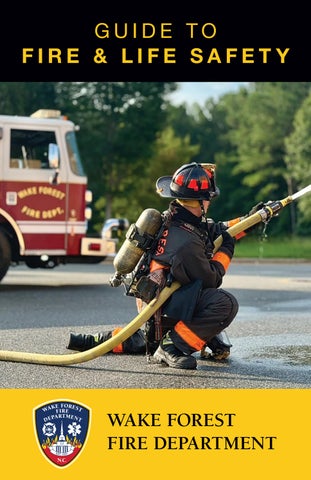
GUIDE TO FIRE & LIFE SAFETY
WAKE FOREST FIRE DEPARTMENT
TA B L E O F C O N T EN T S Important Phone Numbers.......................................................... 2 Apartment Fire Safety Checklist.................................................. 4 Cooking Safety............................................................................. 8 Fire Extinguishers...................................................................... 12 Fire Escape Plan........................................................................ 16 Fire Safety Checklist.................................................................. 20 Smoke Detectors....................................................................... 24 Common Driving Distractions.................................................... 28
PD, Fire, and EMS Numbers f o r WA K E FO R ES T R ES ID E NT S POLICE DEPARTMENT, FIRE, OR EMS EMERGENCIES: 911 WAKE FOREST POLICE DEPARTMENT To request a phone number: 411 To report a power outage: 919.554.6724 To report water/sewer problem after hours: 919.829.1930 For general road conditions during and after a storm: 511 For school and business closings: use area media or visit their websites. Police related emergencies: 919.556.9111 Police non-emergencies: 919.554.6150 WAKE COUNTY SHERIFF DEPARTMENT: 919.856.6911 WAKE FOREST FIRE DEPARTMENT Non-Emergencies: 919.556.1966 For CPR class questions, please contact Anthony Lamberti at 919.569.2254 or alamberti@wakeforestnc.gov For Fire & Life Safety questions, please contact Glenn Ebron at 919.569.2255 or gebron@wakeforestnc.gov WAKE COUNTY EMS: 919.856.6020
2 | Important Phone Numbers
Important Phone Numbers f o r WA K E FO R ES T R ES ID E NT S WAKE ELECTRIC: 919.863.6499 or 1.800.474.6300 7:30 am-5:30 pm Monday-Friday 24-hour Dispatch: 1.800.474.6300 WAKE FOREST POWER: 919.435.9478 DUKE ENERGY: 800.419.6356 ENBRIDGE GAS: 877.776.2427 RALEIGH WATER: 919.996.3245 WAKE FOREST PUBLIC WORKS: 919.435.9570 RALEIGH SOLID WASTE: 919.996.3245 WASTE MANAGEMENT IN WAKE FOREST: 866.849.0076 WAKE FOREST TOWN HALL: 919.435.9400 WAKE FOREST CHAMBER OF COMMERCE: 919.556.1519 SUICIDE AND CRISIS LIFELINE: 988 POISON CONTROL: 800.222.1222 CSX: 877.744.7279 COMMENDATIONS AND COMPLAINTS Police Department On Duty Supervisor: 919.554.6150
Important Phone Numbers | 3
Fire Safety Checklist fo r A PA R T M E N T R ES I D E N T S
Fire Alarm & Evacuation n Familiarize yourself with the sound and
location of fire alarms in your apartment complex.
n If the fire alarm sounds, evacuate the
building immediately and follow the designated escape routes.
n Never ignore or assume a fire alarm is a
false alarm. Treat every alarm as a real emergency.
Smoke Alarms n Ensure that your apartment unit is equipped
with working smoke alarms.
n Test the smoke alarms monthly to ensure
they are functioning properly.
n Change the batteries in your smoke alarms
at least once a year or as recommended by the manufacturer.
4 | Apartment Fire Safety Checklist
Escape Plan n Develop a fire escape plan for your
apartment and share it with everyone in your household.
n Identify primary and secondary escape
routes in case one is blocked by fire or smoke.
n Designate a safe meeting point outside
your building where you can gather after evacuating.
Fire Extinguishers n Check if fire extinguishers are available in
common areas or hallways of your apartment complex.
n Familiarize yourself with the locations of the
nearest fire extinguishers to your apartment.
n If safe to do so, use a fire extinguisher only
on small, manageable fires. If the fire grows, evacuate immediately.
Kitchen Safety n Never leave cooking unattended. Stay in the
kitchen while using the stove or oven.
n Keep flammable items such as towels,
potholders, and paper products away from heat sources.
n In case of a grease fire, cover the pan with a
lid or use a fire extinguisher. Never use water.
Apartment Fire Safety Checklist | 5
Electrical Safety n Regularly inspect electrical cords for fraying
or damage and replace if necessary.
n Avoid overloading electrical outlets and use
surge protectors as needed.
n Report any electrical issues or concerns to
the property management promptly.
Candle Safety n Check if candles are allowed in your
apartment complex. Follow any restrictions or guidelines.
n Never leave burning candles unattended.
Extinguish them before leaving the room or going to bed.
n Keep candles away from flammable
materials and out of the reach of children or pets.
Clear Pathways and Exits n Ensure hallways, stairwells, and common
areas are free of clutter and obstructions.
n Do not block exit doors or emergency exits.
Keep them easily accessible at all times.
n Report any obstructions or hazards in
common areas to the property management.
6 | Apartment Fire Safety Checklist
Reporting Hazards n Immediately report any fire hazards, faulty
smoke alarms, or safety concerns to the property management.
n Encourage your neighbors to follow fire
safety practices and report any hazards they notice as well.
Fire Safety Education n Stay informed about fire safety information
provided by the property management.
n Review fire safety procedures specific to
your apartment complex and familiarize yourself with emergency contact number.
n Participate in fire drills or safety awareness
programs organized by the apartment complex.
Remember, this checklist serves as a general guide for fire safety in apartments. Always follow the specific fire safety guidelines provided by your property management and local authorities. Regularly review and update your fire safety practices ensuring the wellbeing of yourself and your neighbors.
Apartment Fire Safety Checklist | 7
Cooking Safety T I PS & G U I D E LI N ES TO PR E V E N T K ITC H E N FI R ES
Cooking is one of the leading causes of home fires and home fire injuries The kitchen is the leading area where home fires start. Unattended cooking, grease buildup, and improper use of appliances can quickly turn a routine meal preparation into a dangerous fire.
Why Cooking Safety Matters n Cooking caused an average of 158,400
reported home structure fires per year (44 percent of all reported home fires in the US).
n Cooking-related fires resulted in an average
of 470 civilian deaths (18 percent of all home fire deaths) and 4,150 civilian injuries (42 percent of all reported home fire injuries) annually.
n Most home cooking fires occur during the
evening hours between 5 pm and 7 pm when families are preparing dinner.
n Statistics reveal that nearly five million
cooking fires occur annually in the home. Of these fires, grease fires are the most dangerous and are responsible for 1 in every 5 home fire deaths. Learning how to prevent and put out grease fires could save you or a loved one’s life.
8 | Cooking Safety
Preventing Kitchen Fires n Stay Alert: Never leave the stove unattended.
Always stay in the kitchen while cooking, especially when frying, grilling, or broiling food.
n Clear the Area: Keep flammable items such
as towels, potholders, and paper away from the stovetop.
n Maintain Appliances: Regularly clean your
stove, oven, and other kitchen appliances to prevent grease buildup.
n Use a Timer: Set a timer as a reminder to
check on food that’s cooking, especially if simmering, baking, or roasting.
Safe Cooking Practices n Dress Safely: Wear short or close-fitting
sleeves while cooking to avoid catching clothing on fire.
n Use the Right Equipment: Always use the
correct size pot or pan for the burner, and turn pot handles inward to prevent accidents.
n Prevent Grease Fires: Keep a lid nearby to
smother small grease fires. Never use water on a grease fire.
n Microwave Safety: Use only microwave-safe
containers and never heat sealed containers in the microwave, as they can explode.
Cooking Safety | 9
By following safe cooking practices, you can prevent fires and protect your family. Being vigilant in the kitchen reduces the risk of injuries and fatalities, making your home a safer place for everyone.
In Case of a Fire n Stay Calm: If a fire starts, remain calm and
assess the situation.
n For Small Fires: Cover the pan with a lid or
use a fire extinguisher to put out small fires.
n For Larger Fires: Evacuate immediately and
call 911 from outside the home.
n Stop, Drop, and Roll: If your clothing catches
fire, stop immediately, drop to the ground, and roll to extinguish the flames.
Child Safety in the Kitchen n Keep Children Away: Create a “kid-free zone”
of at least three feet around the stove and hot appliances.
n Teach Safety: Educate children about hot
surfaces and the dangers of touching or reaching over the stove.
n Use Back Burners: Whenever possible, use
the back burners and keep handles turned inward.
10 | Cooking Safety
Prevent grease buildup by regularly cleaning your stove, oven, and other kitchen appliances.
Important Fire Safety Resources n Smoke Alarms: Ensure smoke alarms are
installed and working in or near the kitchen area.
n Fire Extinguishers: Keep a fire extinguisher in
the kitchen and know how to use it.
IN CASE OF AN EMERGENCY, CALL 911 For more information on fire safety, contact the Wake Forest Fire Department.
Cooking Safety | 11
Fire Extinguishers K N OW W H E N A N D H OW TO U S E T H E M
When to Use a Fire Extinguisher Before You Begin: n Make sure you are trained and comfortable
using a fire extinguisher.
n Only attempt to extinguish small fires that
are confined to the original source.
When NOT to Use an Extinguisher: n If the fire is spreading quickly.
n If the fire is producing toxic smoke or fumes. n If you are unsure how to use the extinguisher
properly.
Remember: Your safety comes first.
Evacuate immediately if the fire becomes unmanageable.
12 | Fire Extinguishers
How to Use a Fire Extinguisher Remember the P•A•S•S method: PULL • AIM • SQUEEZE • SWEEP
nozzle at base of fire P Pull the safety pin A AIM
the S SQUEEZE handle
nozzle S SWEEP from side to side
Have a clear exit. Always ensure you have a clear exit before using the extinguisher. If the fire cannot be be controlled quickly, evacuate immediately and call 911.
Fire Extinguishers | 13
Understanding Fire Extinguishers T Y PES O F FI R E E X TI N G U I S H E R S A N D H OW T H E Y WO R K
CLASS
MATERIALS
Class A
Ordinary Combustibles
Class B
Flammable Liquids
Class C
Electrical Fires
Class D
Combustible Metals
Class K
Kitchen Fires
SYMBOL
PICTOGRAM
Proper Placement n Keep fire extinguishers in easily accessible
locations like the kitchen, garage, and near exits.
n Ensure that they are not blocked or hidden
by other objects.
14 | Fire Extinguishers
TARGET FIRES
HOW IT WORKS
Everyday materials including: n paper n wood n textiles / cloth
Uses water or foam to cool the fire and reduce the temperature of burning materials like wood, paper, and cloth until the fire is extinguished.
Flammable liquids such as: n gasoline n oil n grease
Discharges foam, CO2, or a dry chemical to smother the fire, cutting off the oxygen supply or breaking the chemical reaction of the fire.
n energized electrical equipment
Uses non-conductive agents like CO2 or dry chemicals to extinguish the fire without the risk of electrical shock.
Combustible metals: n magnesium n titanium n sodium
Utilizes dry powder agents to absorb heat and prevent the chemical reactions necessary for the fire to continue burning.
Cooking fires involving oils and fats, commonly used in commercial kitchens.
Releases a wet chemical agent that cools the flames and creates a barrier between the oxygen and the fuel, preventing the fire from reigniting.
Regular Maintenance n Check the pressure gauge monthly to ensure
the extinguisher is charged.
n Inspect for any visible damage or corrosion. n Replace or service extinguishers as
recommended by the manufacturer.
Fire Extinguishers | 15
Fire Escape Plan B E PR E PA R E D. S TAY S A FE . Practice your plan by pushing the test button on your smoke alarm. Then start your home fire drill.
Tips for a Successful Fire Escape Plan n Practice regularly. n Conduct fire drills twice
a year.
n Test smoke alarms
monthly.
n Include all family
members.
n Involve children in creating and
practicing the plan.
n Ensure elderly or ..
disabled family members have assistance
n Plan for pets and
teach children how to help them.
n Make sure windows
and doors are easy to open.
16 | Fire Escape Plan
Know two ways out of every room. If one exit is blocked, have a second way to escape.
Why It’s Important to Have a Plan n Fires can spread rapidly, leaving just minutes
to escape safely.
n Every second counts. Having a clear, well-
practiced escape plan can save lives.
n By practicing your plan, your family will know
what to do in case of fire and when they hear the smoke alarm.
Sample Fire Escape Plan
Bedroom
Den
Bath Bedroom MEET HERE!
Living Room
Kitchen
CALL 911
Windows Primary Escape Route Secondary Escape Route Smoke Alarms
Fire Escape Plan | 17
Make Your Fire Escape Plan Here
18 | Fire Escape Plan
To make your fire escape plan, start by drawing a map of your home in the space provided. Then: Mark the locations of smoke alarms, windows, and doors.
Identify the primary and secondary escape routes for each room. Choose a safe meeting place outside.
Ensure all family members know the plan and practice it regularly.
Primary Escape Route: The fastest way out of the home.
Secondary Escape Route: An alternative route in case the primary path is blocked. Meeting Place: A safe space outside where everyone will gather.
Call 911: Once safely outside, call for help.
Fire Escape Plan | 19
Home Fire Safety C H EC K LI S T Install smoke detectors. Ensure smoke
detectors are installed on every level of your home, including inside bedrooms and outside sleeping areas.
Check electrical cords. Inspect electrical cords
for damage or fraying and replace any that are worn out. Avoid overloading outlets and use surge protectors as needed.
Keep flammable items away. Store flammable
materials, such as cleaning agents and paint, in a well-ventilated area away from heat sources.
Have a fire escape plan. Create a fire escape
plan with clear exit routes from each room and establish a designated meeting point outside the house.
20 | Home Fire Safety Checklist
Maintain heating equipment. Have your heating
system, including furnaces and chimneys, inspected and serviced annually by a qualified professional.
Use candles safely. Place candles in sturdy
holders on a stable surface away from flammable materials, and never leave them unattended.
Practice safe cooking. Never leave cooking
unattended, and keep flammable items, such as oven mitts and paper towels, away from the stove.
Install fire extinguishers. Place fire
extinguishers in key locations, such as the kitchen and garage, and ensure everyone knows how to use them properly.
Keep matches and lighters out of reach. Store
matches and lighters in a secure location out of the reach of children.
Home Fire Safety Checklist | 21
Test smoke detectors regularly. Test your
smoke detectors monthly and replace them every 5–7 years. Keep them powered with fresh batteries by replacing them twice a year.
Regularly clean dryer vents. Clean lint from
dryer vents regularly to prevent lint buildup which can pose a fire hazard.
Store firewood safely. Keep firewood at least
20 feet away from your home and store it in a covered, well-ventilated area.
22 | Home Fire Safety Checklist
Install carbon monoxide detectors. Install
carbon monoxide detectors near sleeping areas and check them regularly to ensure they are functioning properly.
Stay vigilant. Remain aware of potential fire
hazards in your home and address them promptly to minimize risks.
Remember, fire safety is crucial. Regularly reviewing and implementing these safety measures can help protect your home and loved ones.
Home Fire Safety Checklist | 23
Smoke Detectors PR OT EC T YO U R H O M E & FA M I LY Smoke detectors are vital for early fire detection, providing crucial time for escape in case of a fire. In some cases, smoke detectors can detect the presence of smoke before an open flame is visible. This early detection can prevent small fires from turning into large, dangerous blazes. Smoke detectors not only save lives but also help protect your property. They can minimize the damage caused by a fire by alerting you to it quickly. In many places, including residential buildings, it is a legal requirement to have smoke detectors. Non-compliance can result in fines.
Types of Smoke Detectors Ionization Smoke Detector. faster at detecting fires . Ionization alarms will react
to shower steam, so they shouldn’t be used near bathrooms and kitchens. However, ionization alarms can be used in bedrooms and living rooms.
Photoelectric. better at detecting smoldering fires . Photoelectric smoke detectors should
be used in areas that have steam.
Combination Smoke Detectors. These
detectors which combine both technologies offer the best protection. Combination detectors are known as smoke and (CO) detectors.
24 | Smoke Detectors
Installation & Placement Bedrooms / Hallways. Smoke detectors
should be installed on every level of a home. Place a smoke detector inside each bedroom and just outside in the hallway. This ensures that people are alerted whether they are sleeping or in the hallway. Smoke detectors in a hallway are typical escape routes during a fire, so it is crucial to have smoke detectors installed in your hallway leading to bedrooms.
Height / Spacing. Install smoke detectors
on the ceiling or high on the wall. Wall mounted detectors should be installed no more than 12 inches from the ceiling and away from vents. For large rooms, use multiple detectors.
Kitchen Placement. Install smoke
detectors at least 10 feet away from cooking appliances to avoid false alarms.
Interconnection. For increased safety,
consider interconnected detectors. When one alarm detects smoke, all interconnected detectors sound their alarms. This ensures that everyone in your home is alerted.
Basements. If your home has a basement,
install a smoke detector at the bottom of the basement stairs.
CO Detectors. For added safety, place
carbon monoxide (CO) detectors near sleeping areas and in proximity of potential CO sources, such as gas appliances.
Smoke Detectors | 25
Battery Maintenance It is important to change the batteries in your smoke detectors at least every six months, typically when changing the clocks for daylight savings. note: For more information, including
maintenance guidelines, refer to the instruction manual on the back of your smoke detector.
Testing Smoke Detectors When testing your smoke detectors, remember to listen for the loud alarm sound. The alarm is designed to be attention grabbing and audible from various parts of your home. If you don’t hear a loud, clear alarm sound during the test, it could indicate a problem with the detector, and you should investigate and address the issue immediately. If the detector is battery-powered, replace the battery. If the problem persists, consider replacing the detector itself. Regular monthly testing, along with annual battery replacement and overall maintenance, ensures that your smoke detectors are ready to serve their critical role in protecting your home and loved ones from the dangers of a fire.
26 | Smoke Detectors
Smoke Detectors Lifespan Smoke detectors typically have a limited lifespan, and they are considered expired when they reach the end of their useful service life. Most smoke detectors have a recommended lifespan of about 10 years. This means that after a decade of use, the detector may no longer be reliable in detecting smoke or fires. Manufacturing Date. You can determine the age of a smoke detector by checking the manufacturing date, which is usually printed on the back or inside the detector. If the detector is approaching or has exceeded its 10-year mark, it is time to replace it. Maintenance and Testing. Even with regular testing and maintenance, smoke detectors should still be replaced after 10 years. Testing and maintenance help ensure they are operational, but they cannot address sensor degrading due to age.
Combination Smoke Detectors. If your smoke detector includes a carbon monoxide detector (CO) sensor, the CO sensor typically has a shorter lifespan, often around 5–7 years. Combination smoke detectors should be replaced when they reach this limit.
Safety Tip Create a fire escape plan for your home that includes multiple exit routes for each room. Ensure everyone in the household is familiar with the plan.
Smoke Detectors | 27
Common Driving Distractions R OA D S A FE T Y FO R YO U R S E LF A N D OT H E R S
Visual Distractions Taking Your Eyes Off The Road Looking At A Phone. Changing Music. Looking At Passengers. Watching Something Outside the Vehicle.
Manual Distractions Taking Your Hands Off The Wheel Texting. Eating. Applying Makeup. Reaching for Items.
Cognitive Distractions Taking Your Mind Off Driving Conversations. Stress or Anger. Daydreaming. Social Media Notifications
28 | Common Driving Distractions
Looking at your phone for just 5 seconds while driving at 55 mph is like driving the length of a football field with your eyes closed.
As Communities Grow More Drivers are on the Roads. Traffic Congestion Increases. Commute Times Become Longer. Drivers Become Frustrated and Impatient. Emergency Responders See More Crashes
Every Day.
First Responders Respond to Vehicle
Accidents Daily, Involving: n Rear-end Collisions n Speed-related Crashes
n Distracted Driving Incidents n Teen Driver Accidents n Pedestrian Accidents
Keep in Mind A single distracted moment can change someone’s life forever.
Common Driving Distractions | 29
More Cars + More Distractions + Less Patience = More Crashes Our roads are busier than ever. Stay alert.
Speeding Reduces Reaction Time Vehicle Control Stopping Distance Chances of Survival During a Crash
Slow down. Someone is waiting for you at home.
Aggressive Driving Includes Tailgating Weaving Through Traffic Running Red Lights Road Rage Honking Aggressively Unsafe Lane Changes
Patience behind the wheel saves lives.
30 | Common Driving Distractions
Before Driving Put phones on ‘Do Not Disturb’ Set GPS and music before moving Wear seatbelts Check mirrors and surroundings While Driving:
n Keep both hands on the wheel n Stay focused on traffic n Leave enough following distance n Stay calm in traffic n Leave enough following distance n Stay calm in distance n Watch for pedestrians and cyclists n When upset or distracted n Pull over safely if needed n Avoid emotional driving n Never drive while overly tired
Eyes on the road. Hands off the phone.
Getting somewhere a few minutes faster is never worth risking a life. One distraction can become a lifetime regret.
Common Driving Distractions | 31
WAKE FOREST FIRE DEPARTMENT Main Station 420 Elm Ave. Wake Forest, NC 27587 919-556-1966 wakeforestnc.gov/fire
Saving Lives, Our Prime Goal
@wakeforestfire