
Jesse Littlebird, Meditations on Fire

Page 1


Jesse Littlebird

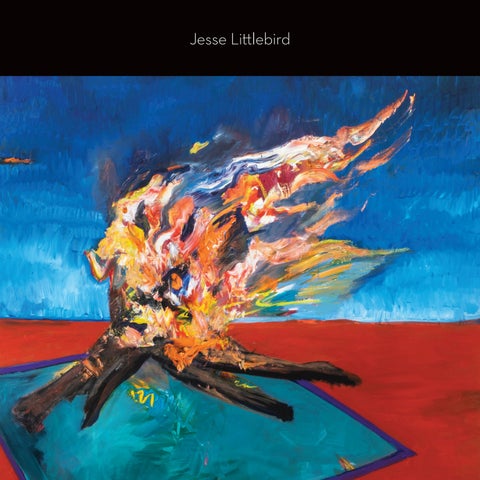
Study of Fire No. 41

(Lodge Fire During Winter) (detail)
Oil on canvas, 60" h x 48" w

JESSE LITTLEBIRD

Meditations on Fire

In a compelling collection of new works, Pueblo artist Jesse Littlebird commands a deepened awareness of his world, expressed in bold subjects and unexpected color. Never far from a heritage that guides him spiritually, his paintings not only depict evocative subject matter, they raise new questions about who or what the subject really is. From portraiture to landscape, this current collection alludes to the endless challenge of telling a personal story on a two-dimensional plane.

Meditations on Fire proves a new maturity has emerged by an artist steeped in tradition with a mission to continue carrying the torch. That torch was lit by his father, the late Larry Littlebird, a pioneering native filmmaker, actor, and artist from Laguna/ Kewa Pueblo who passed away last September. Still healing from the pain of loss, Jesse has worked his way through the grief via memory and connection and a commitment to his craft, each painting a hidden step on the journey.

On the Cover Meditations on Fire No. 11 (Eternal Joy) (detail) Oil on canvas, 60" h x 48" w

Though literal in portrayal, the fire images are highly symbolic, alluding to the role fire plays in Littlebird’s life

Having studied art at the University of New Mexico, Jesse also once explored film, forging an awareness of light, dimensionality and storytelling. Deeply centered in New Mexico, his work relies not only on inspiration from the land, but also from popular culture, graphics, and his own sense of living fully in the present. The enigmatic fire studies or “altars” in his own words, are “a subject as primal as our very beginning. They take me back to my childhood where fire was a part of every ceremony. I grew to be a fire keeper.” These various versions have brought him solace and connection. “I explored this subject,” said Jesse, “until I exhausted it. But it was important for me to do the work. It was a powerful emotional investment.”

Figurative works evoke the subtle influence of Jesse’s father and, admittedly, an iconic forbearer, Fritz Scholder (1937 – 2005), especially in the brilliant palette and use of shadow. But unlike Scholder, Littlebird’s subjects have a grim honesty that almost hurts. The boisterous fusion of deer and bulls is an updated version of one of his father’s own paintings from the sixties; a way of assuring their powerful connection, once deeply felt, now seen.

Finally, eye-popping landscapes richly dotted with local flora, Jesse asks us to behold the New Mexico night sky studded with stars; celestial code-talkers telling an ancient story in pictographic symbols.

Bulls In Movement Under Vermillion Skies Oil on canvas 48" h x 60" w
Three Mule Deer Spirits Homage to Larry Littlebird No.2 Oil on canvas
48" h x 60" w
Calm Embrace, oil on canvas, 60" h x 48" w
Lightning People Dancing In The Valley No. 7, oil and acrylic on canvas, 28" h x 68" w
Meditations on Fire No. 1 (Blue Hour Singing Flame) Oil on canvas, 60" h x 48" w
Mule Deer Spirit No. 3, oil on canvas, 48" h x 36" w
Portrait of Indian Inmate at McNeill Prison Before Haircut 1901 Oil on canvas, 28" h x 22" w

Prologue

The following set of monologues or “Meditations” by the artist are in part an homage to the legacy of inheritance experienced by Jesse Littlebird; in particular, to the gifts left behind by his father, the late Larry Littlebird, a legendary artist, teacher and leader in the Southwestern art world and Native American community.

Each passage deepens the viewer’s insight into this latest collection of works inspired by the idea of fire as spirit and creation. Though literal in portrayal, the fire images are highly symbolic, alluding to the role fire plays in Littlebird’s life; an essential element in ceremony, ritual and life passages. In eloquent and intimate prose, the artist allows us to share childhood memories cherished for a lifetime moments that have shaped his self-expression and unique artistic imagery. Most importantly, this series of mixed media paintings illuminates a responsibility to those who came before generations of Puebloan families who have held on to sacred ways that bind generations together, living keepers of the flame.

this series of mixed media paintings illuminates a responsibility to those who came before

Artist Statement

This series of abstract and representational paintings establishes a visual language rooted in presence and feeling. Meaning is not explained but encountered; held in color, surface, and scale, where sensation clarifies what words cannot.

Meditations on Fire emerges from the convergence of memory, ceremony, and lineage. I grew up in the presence of fire its heat, breath, and quiet instruction absorbed through early morning and evening ceremonies. In many Native traditions, ceremony unfolds in the blue hour, the threshold where night and day meet. In this space, fire becomes more than physical: a witness, a companion, and a keeper of responsibility, holding stories that bind us to land and to one another.

Vine Deloria Jr., in God Is Red, reminds us that spirituality is inseparable from place, rooted in land, lineage, and relationship. These paintings move within that understanding, asking how teachings are carried forward, how those who came before remain present, and how land, sky, and fire continue to shape who we are becoming.

Fire serves as both witness and guide as I move through memory, loss, and grief. My father, Larry Littlebird, was my first spiritual guide and teacher, introducing me to the lodge — both sweat and tipi — and to spaces that function as living vessels of prayer, humility, and transformation. His passing in September 2025 opened a profound space of longing. This series speaks into that space through color, gesture, and ember-like memory. These works are conversations with him, carried in pigment and light.

The paintings are built through a process of return: layering washes, scraping back surfaces, allowing pigments to pool and fracture. Some marks are fast and unrestrained, like sparks rising from a ceremonial fire; others are slow and deliberate, reflecting contemplation and restraint. Meaning accumulates through repetition, patience, and attention.

Red Tail Hawk Homage to Larry Littlebird (detail) Oil on canvas, 48" h x 36" w

Meditations on Fire is both a tribute and a continuation. My practice is rooted in honoring those who came before me, my elders, mentors, and entire creative lineages. My father’s early paintings, including his studies of bulls and deer from the 1960s, remain touchstones. Influenced by modernism yet grounded in ancestral vision, his work continues to echo in my own. My recent reinterpretations of these forms are not homages alone, but extensions of an ongoing dialogue between generations.

Throughout the creation of this series, I remained aware of the joy of painting, an energy my father carried fully. I often recalled his stories from the early days of IAIA, painting freely and without hesitation, reveling in the abundance of making.

In these meditative works, fire continues to shape my creative life though shifting color, unpredictability, and insistence on presence. I invite viewers into the blue hour, into the space where memory glows, ancestors speak, and fire continues to teach, heal, and create.

Meditations on Fire No. 4
(Eastern Flame on Viridian Alter) (detail) Oil on canvas, 60" h x 48" w

Meditations on Fire No. 2 (The Speaking Flame)

Magenta and Indian Red with Blue Flames

Listening to my father speak about painting near the end of his life felt like standing close to a flame that still knew how to speak. In his Alzheimer’s state, so many names and dates slipped away, yet art always remained. When he could still walk, I would bring him to my various studios when it was my time to take care of him. When viewing some of my paintings, he would lean forward, eyes suddenly bright, and talk about an underpainting peeking through the surface, and how it was never a mistake but a whisper from earlier decisions. He loved how layers carried memory, and how a painting could hold time the way land holds story.

He spoke with wonder about mixtures, pigments meeting oil or medium, and turning into something neither had planned. Those moments thrilled him, the accidents that felt discovered rather than made. He told me that if you really looked, there were dozens of small paintings living inside one canvas, each passage its own quiet world. I watched his hands move as if still mixing, still brushing, even when no brush was there.

What moved me most was the way his eyes would light up when he spoke to me about painting, as if recognition lived deeper than language. In those moments, my heartbreak loosened its grip. I felt myself letting go, freeing something I had been holding too tightly. It was during this time that my desire to be a painter was reaffirmed, not through instruction, but through shared seeing. I knew, without question, that he is still behind me, my biggest fan.

Meditations on Fire No. 2 (The Speaking Flame) holds this reflection. A color field of magenta and Indian red, pierced by blue flames that seem to speak across layers. The fire becomes voice, memory, and release. Through it, I found meditation, grief softened into motion, and the certainty that painting is where our conversation continues.

Meditations on Fire No. 2 (The Speaking Flame) (detail) Oil on canvas, 60" h x 48" w

Meditations on Fire No. 3, (Sweat House Rocks Almost Ready)

Purple Field and Blue Sky

I learned the protocols of the sweat lodge from my father, who learned them from Johnny Arlee of the Salish Kootenai. He carried that knowledge carefully, like water that must not spill. Preparation begins long before the heat: fir bows cut with intention, willow bent into ribs, volcanic rock chosen for endurance, firewood gathered and sorted. Nothing is misplaced.

I learned by watching, by carrying water and stacking wood, by keeping quiet in a joyful way. My father would remind me, “This is a place to pray, not to play.”

In winter, the fire sometimes stood in full daylight. Its posture shifted upright, deliberate, and authoritative. Purple came to mind, a color I associate with royalty. Watching the flame loosened thought. Fire spoke without words, and I began learning how to listen.

Meditations on Fire No. 3 (Sweat House Racks Almost Ready), oil on canvas, 60" h x 48" w
Meditations on Fire No. 7 (How to Build and Start a Fire), oil on canvas, 60" h x 48" w

Meditations on Fire No. 7, (How to Build and Start a Fire)

Color Field of Blue and Ochre

My father had this parable about “the one match”. In the lodge, after a story about “man’s inventiveness” as he would put it, my dad would give the firekeeper a single “strike anywhere” match. He then instructed him to light the fire. Now if you were paying attention during the story you would have observed the firekeeper building the fire with certainty and order. Various sizes of wood, kindling, and one, maybe two types of pitch or “firestarter” as my dad called it. It is the firekeeper’s duty to have gathered and prepared all of this before the people arrive. The fire had been built with order and intention. In our lodge it was dry aspen or cottonwood sorted by size. Kindling laid to breathe. One or two kinds of pitch, never more. This was the firekeeper’s responsibility.

Near the end of the story, the match was struck. Most of the time, the flame began quietly, almost unsure, then slowly found itself. A low hum, a small crackle. Sometimes it caught quickly, if the pitch and kindling were dry. Sometimes it failed, and then another lesson appeared, softened with laughter. After we had a good flame going, my father sent everyone out onto the land. Alone. Each person was asked to gather small sticks for kindling. When we all returned, we shared with the council what we had learned during our time away from each other.

I assisted him through this many times. I came to understand that Pueblo teaching moves slowly. It relies less on explanation and more on being shown, again and again, how something is done properly. Small adjustments come only after long practice. I think this is where tradition and progress meet in a significant way and it is this that moves culture forward. Not as opposition, but as continuity. Past, present, and future held in balance. It is through the acknowledgment of the past, present and future and through teachings of protocols and traditions that is the opportunity for communal living in a harmonious way. It is with this metaphor of the single match that I learned this.

Meditations on Fire No. 9, (Vienna Sausage Memory)

Vermillion Red Sky and Prussian Blue Grass

This painting unfolds as a broad color field: a vermillion sky pressing down with warmth, anchored by cool Prussian blue grass. The flame is simple, suggested rather than described, leaning east with the wind. The land responds as if alive.

The memory returns me to a day trip with my family, when my father made a small fire and roasted Vienna sausages, recalling his youth near Paguate and his grandparents’ sheep camp. The painting honors a way of living where simplicity is not lack, but abundance.

Meditations on Fire No. 9 (Vienna Sausage Memory), oil on canvas, 60" h x 48" w
The Council No. 2 (Golden Hour), oil on canvas, 24" h x 36" w
Study of Fire No. 44, oil on canvas, 40" h x 30" w

on

Meditations
Fire No. 10 (The Gift of Loving), oil on canvas, 60" h x 48" w
Meditations on Fire No. 5 (Northern Picnic Flame During Summer) (detail) Oil on canvas, 60" h x 48" w

Turn static files into dynamic content formats.
Create a flipbook