SANTA BARBARA


2026/27
Q&A, plus recipes

TAKE A HIKE!
The best trails around Santa Barbara
A FLY SOLUTION TO INVASIVE CAPE IVY
GOOD ECO-NEWS
Santa Barbara’s environmental wins of 2025
DO MARINE PROTECTED AREAS WORK?
THE GUERILLA GARDENERS OF OXNARD

Annual Fundraiser Live music, food trucks, drinks, and nonprofit partners Silent & live auctions, food, drinks, & Environmental Hero Awards
Summer Happy Hours
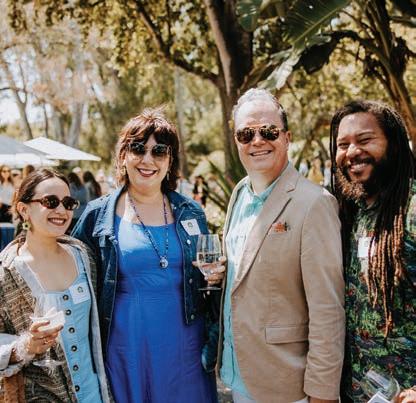
The Environmental Defense Center is the only public interest environmental nonprofit law firm between Los Angeles and San Francisco. For almost 50 years, EDC has represented more than 140 community groups, providing them with free and low-cost legal services.
The organization is leading the fight against expanded oil drilling in the Santa Barbara Channel and has helped preserve over 100,000 acres of open space, won protections for endangered species including California sea otters, steelhead, and great whales, and protected our communities’ clean air and water from industrial polluters.

Read stories from this magazine and more at 2026/27
BROUGHT TO YOU BY
Publisher Brandi Rivera
Editor in Chief Marianne Partridge
Senior Editor Tyler Hayden
News Reporter Ella Heydenfeldt
Advertising Director Sarah Sinclair
Digital Marketing Specialist Graham Brown
Advertising Account Executives
Suzanne Cloutier, Bryce Eller, Ariana Hugo, Scott Maio, and Tonea Songer
Associate Production Manager Bianca Castro
Graphic Designer Leah Brewer
Web Content Manager Don Brubaker
Social Media Manager Maya Johnson
Marketing & Events Manager Richelle Boyd
Operations Administrator Erin Lynch
Distribution Greg Hall
For a full Santa Barbara Independent list, visit independent.com/about-us
For advertising, email advertising@independent.com
For story ideas, email tips@independent.com
The Santa Barbara Independent is the leading source for news, arts & entertainment, and lifestyle coverage in the greater Santa Barbara area. We print more than 25,000 copies of the paper every Thursday and also publish daily online for more than 300,000 monthly readers at Independent.com.
Follow us on Instagram, Facebook, and TikTok: @sbindependent
“Look again at that dot. That’s here. That’s home. On it everyone you love .” –Carl Sagan
Founder and Publisher Victoria Riskin
CEO Raymond Pearce
Publications Director Jamie Kageleiry
Head of Audience Kirsten Carroll
CFO David Smith
Editor Robin Jones
Associate Editor Emily Cain
Creative Director Tara Kenny
Art Director Whitney Multari
Digital Team Grace Hughes, Alison Mead
Ad Production Gabby Gobaton
Contributors: Randi Baird, Pascale Beale, Leslie Garrett, Hilary Dole Klein, Ethan Maday, Lily Olsen
Santa Barbara Green Guide is printed on recycled material, using soy-based ink, in the U.S.

Sign up for the Santa Barbara Bluedot Living newsletter (along with any of our others — the BuyBetter Marketplace, our national Weekly newsletter, and Daily Dot newsletter): bit.ly/SB-Newsletters
Find Bluedot Living online at bluedotliving.com and on Instagram, Threads, Facebook, and YouTube @bluedotliving
Once again, we’re delighted to bring you the Santa Barbara Green Guide, published by the Santa Barbara Independent and Bluedot Living. This is our third edition, arriving just in time for Earth Day, and we’re proud to present it together.
We probably say too often that Santa Barbara is the birthplace of Earth Day, but it is, after all, our history and deserves remembering. The environmental spirit that grew from the events in 1970 still shapes this community. When Vicki recently came through town with a group of folks on a Bluedot Living Travel excursion, everyone loved learning about Santa Barbara’s history and meeting people dedicated to conservation during stops to visit Marianne at her husband’s family ranch and to take in Lotusland, Sedgwick Reserve, and the new Chumash Museum.
In these pages you’ll find a variety of stories, including profiles of farmers, abalone growers, and people tackling invasive plants that impact fragile ecosystems, as well as recipes like Vicki’s Andalusian gazpacho.
Speaking of invasives, the “invasive” federal government has falsely asserted the right to restart oil drilling off the California coast we’ve spent decades protecting. It’s been quite a year of hubris from Washington, and the Indy and Bluedot Living have worked together to tell the story. What gives us optimism is the pushback from Santa Barbara citizens, scientists from UC Santa Barbara, advocacy groups, and legal teams — lots of great people who continue to fight against the oil behemoth to protect our coastline.
We hope these pages leave you
Let's talk!
Please email sbeditor@bluedotliving.com
informed, inspired, and grateful for the many people in Santa Barbara working to protect our community.


Victoria Riskin President and Founder Bluedot Living
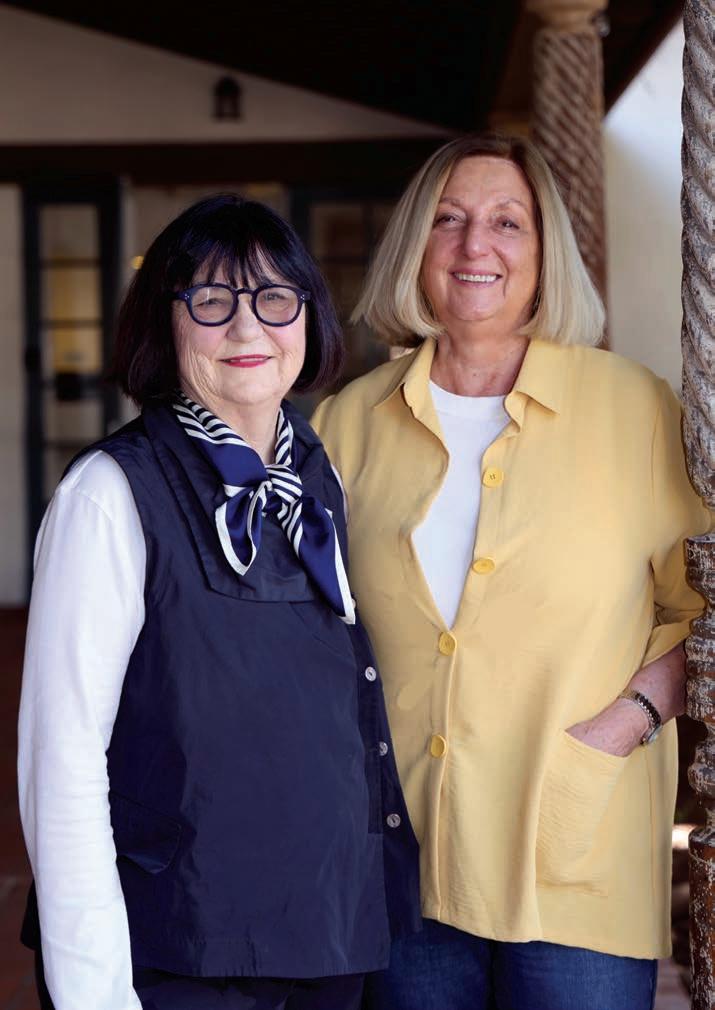
P.S. This photograph was taken at the Independent’s new offices at 223 E. De La Guerra St., where Marianne and Vicki are doing their best to hold up the building.
Marianne Partridge Editor in Chief and Co-Founder Santa Barbara Independent

By Ella Heydenfeldt
Students who skipped class to make a point. Volunteers who picked up trash instead of stepping over it. Scientists who tracked fish with photos and butterflies with backpacks. Policymakers who represented their constituents, making policy by the people, for the people, to protect the planet.
N one of it solved everything. But together, it is progress. In a year when it often felt like the world was stuck — or sliding backward — here are some meaningful environmental leaps Santa Barbara made.
ANIMAL SHELTER ASSIST ANCE PROGRAM
Got community cats? Help them by:
• Scheduling a free spay/neuter
• Making them a warm/dry place to sleep
• Giving them food and water
• Calling ASAP Cats with questions




In 2026, the Mickey Flacks Journalism Fund will support the in-depth coverage of the regional housing crisis by Christina McDermott and the ongoing reporting of the oil industry.
To make a contribution visit sbcan.org/journalism_fund


The Voices of the Young — and the Old
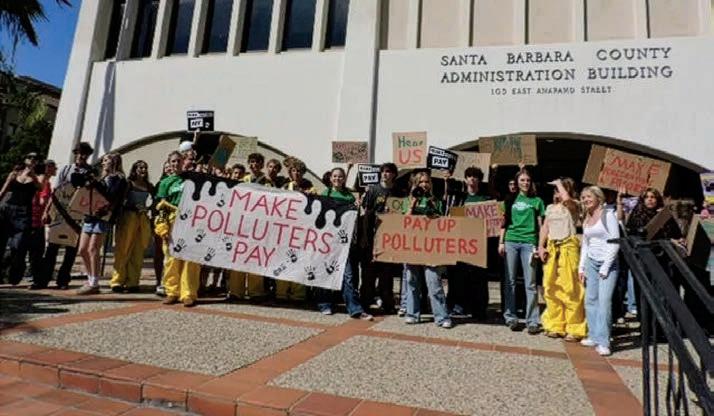
In October, Santa Barbara High School students walked out of class and down Anapamu Street, joining dozens of schools statewide in support of the Polluters Pay Climate Superfund Act, legislation still winding its way through the Senate.
According to bill sponsors, fossil fuel operations generated more than one billion tons of greenhouse gas emissions in California between 1990 and 2024. The proposal would calculate climate damages through 2045 and assess fees accordingly. If nothing else, the walkout made one thing clear: The next generation is ready to jump into the fight for environmental accountability.
Adults, meanwhile, made their own noise. Filling the County Administration Building later that same month, they spoke emotionally and urgently about Santa Barbara County banning new onshore oil drilling and starting the process of phasing out existing operations.
After hours of testimony, supervisors voted 3-2 to begin the phase-out process. The decision did not end Santa Barbara’s oil legacy, but it marked a turning point in a county whose relationship with petroleum dates back nearly 150 years.
Our Hands Dirty
Santa Barbara has never been particularly squeamish about getting its hands dirty — whether that means trash, tar, or, apparently, used sports equipment.

The Bluedot Living Collection — your destination for planet-friendly products
Bluedot Living wants to make it easier for our readers to buy better. From home essentials to clean beauty, wardrobe staples to low-waste swaps, every item has been carefully chosen to help you live more sustainably.


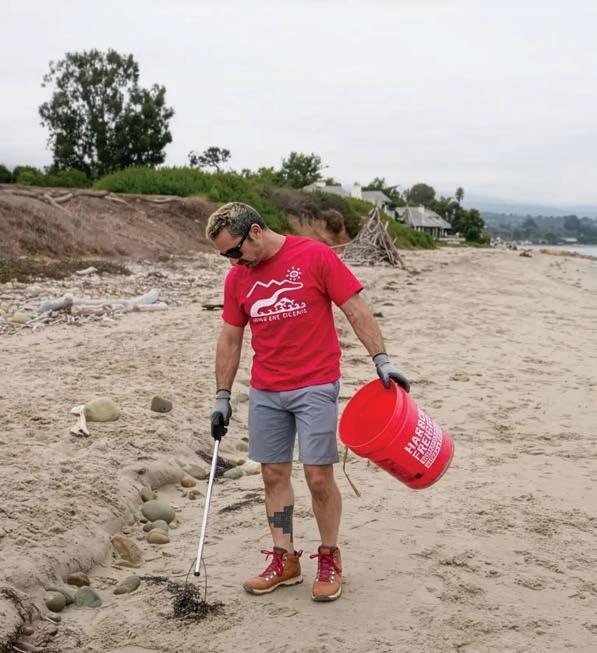
In August, mysterious tar balls began washing up on Hammonds and Leadbetter beaches. Their origin remains unclear; however, the response was crystal. Volunteers, nonprofits, and local agencies mobilized quickly, scraping hundreds of pounds of sticky black goo off the sand before it could spread further.
In September, instead of tar, it was trash. During Coastal Cleanup Day, more than 1,000 volunteers fanned out across beaches, creeks, and parks, hauling away over 3,600 pounds of debris in a single morning. Along with the expected cigarette butts and plastic fragments came the unexpected: a curling iron, hundreds of golf balls, a pink stiletto heel, and a rattlesnake hiding under a trash pile.
The cleanup dovetailed with a broader push to choke off waste at the source. In December, Santa Barbara’s Ordinance Committee advanced proposals to ban several single-use plastics, including small water bottles, Mylar balloons, plastic confetti, and other party favors that tend to end their lives in gutters, storm drains, and pelican stomachs.
Elsewhere, sustainability got a little more … “Oprah,” as Santa Barbara Independent reporter Callie Fausey put it.
At the county level, a Green Appliance Giveaway that launched in July distributed plug-in electric appliances — induction cooktops, electric kettles, air conditioners, and smart plugs — to eligible residents.
At UC Santa Barbara, students tackled a less recognized waste stream: sports equipment. A student-led initiative installed the campus’s first sports-gear recycling bin, capturing swim goggles, caps, fins, and tennis balls — items that typically fall through the cracks of standard recycling systems.
Two by two — give or take — certain threatened species are beginning to come back, aided by the same species (humans) that decimated them in the first place.
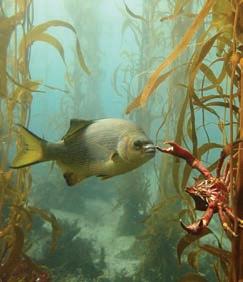
Marine scientists confirmed that populations of endangered giant sea bass, a.k.a. “the kings of the kelp forest,” are inching upward in Southern California waters. Using
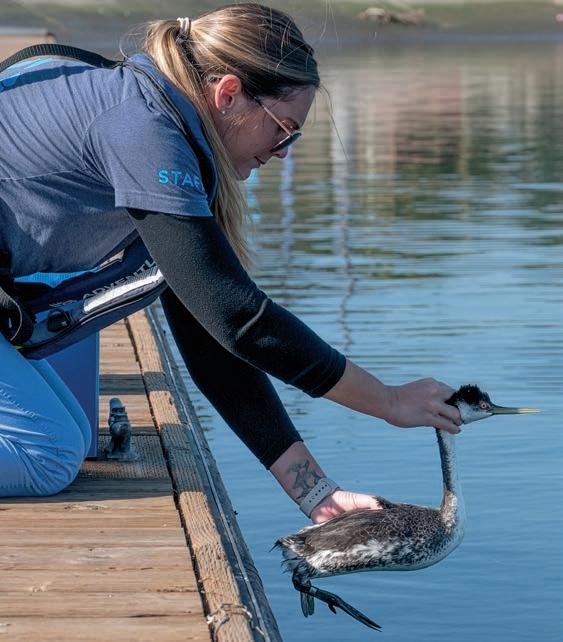
grebe is released back into the wild.



photos submitted by divers, researchers identified more than 1,200 adult fish between 2015 and 2022, suggesting that marine protected areas are beginning to pay dividends for a species nearly eradicated by overfishing. (Read more about marine protected areas on pages 26-27.)
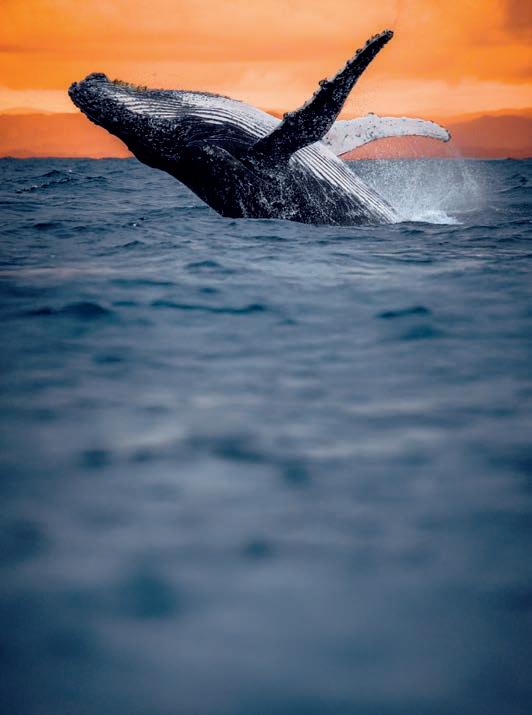
Whales got a boost, too. A decade–old program aimed at reducing deadly ship strikes in the Santa Barbara Channel expanded statewide after Governor Gavin Newsom signed Assembly Bill 14. The Protecting Blue Whales and Blue Skies initiative incentivizes shipping companies to slow down, reducing underwater noise, greenhouse gas emissions, and the likelihood of fatal collisions.
Later in the fall, a one-square-mile oil slick off the Central Coast left more than 120 seabirds — mostly western grebes — coated in crude. Many didn’t survive. Those that could be rehabilitated were released back into the wild in December.
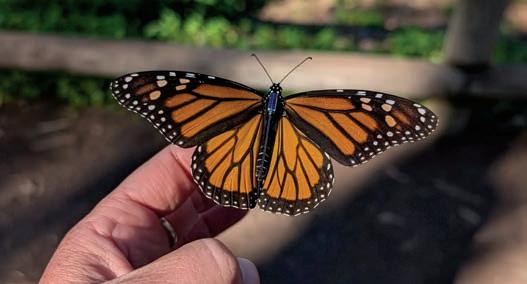
On land, scientists at Ellwood Mesa fitted monarch butterflies with tiny solar-powered radio tags. With these “backpacks” weighing as much as a few grains of rice, researchers can for the first time track individual insects across long distances, which will shed light on migration patterns that have long eluded study.
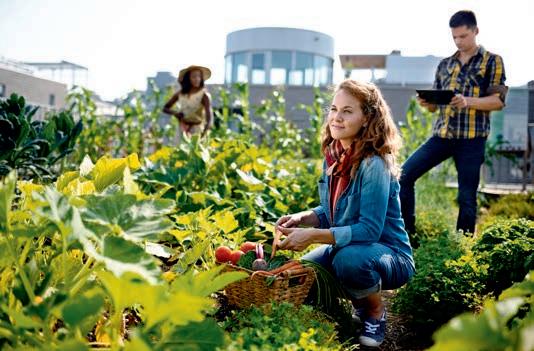


Santa Barbara festivals and venues have found creative solutions to the environmental challenges posed by big events.
By Ella Heydenfeldt
Events attract hordes of people. What comes with people? Trash.
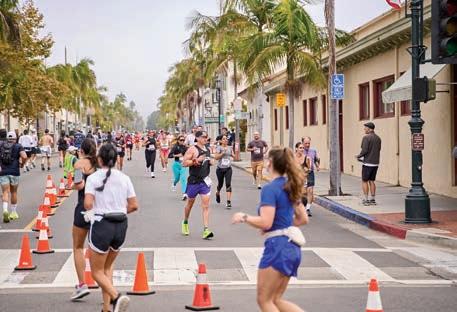
Events also have to provide people with food, water, and bathrooms, which require electricity and light. Large events — festivals, concerts, even half marathons — can be the bane of an environmentalist’s existence.
Or they can serve as an opportunity. An opportunity to rethink single-use plastics, or how thousands of people get to one place at the same time. To sort trash so what can be recycled makes it to a recycling center. To use solar panels instead of diesel generators.
Over the past year, several of Santa Barbara’s largest venues and events have been building systems to reduce their footprint, acknowledging that if you’re going to host the masses, you might as well do it responsibly.
In the words of Eric Shiflett, the Santa
Barbara Bowl’s programs director, “We feel like we should be stewards of that land and have no impact on the community that we serve in a negative way.”
The Santa Barbara Bowl
“Our impetus for trying to be one of the greatest venues in the world is just the fact that we’ve been entrusted by Santa Barbara County,” Shiflett says. The stewardship he speaks about shows up most visibly at the bar.
“No cup served at the Santa Barbara Bowl is in a single-use cup, aside from some coffee,” Shiflett says. Every drink is poured into a reusable cup, called an r.cup, that gets tossed in a designated bin, washed, and cycled back into use. “We have a harvest rate close to 96% year over year,” he says, meaning 96% of cups successfully go through the process to reenter the system. Every r.cup can be used up to 200 times before being retired.
Aside from r.cups, the Bowl sells souvenir pint glasses and offers those who use them $2 off refills for the life of the cup.
The Bowl also focuses on trash — anything that ends up in the garbage on concert nights is sorted, leading to a nearly 75% diversion rate from the landfill — and transportation. The Bowl’s free bike valet, run by Move Santa Barbara, logged record participation in 2025. Anyone who rides their bike to the venue gets complimentary bike parking and security at the closest possible location to the entrance and exit of the Bowl.
Then there’s energy. The Santa Barbara Bowl has more than 200 solar panels that help power its shows. Split between ground-mounted arrays and rooftop systems, the panels create energy equal to — or, fingers crossed, more than — what the Bowl uses during its colorfully lit shows.
“Last year, we offset 100% of the
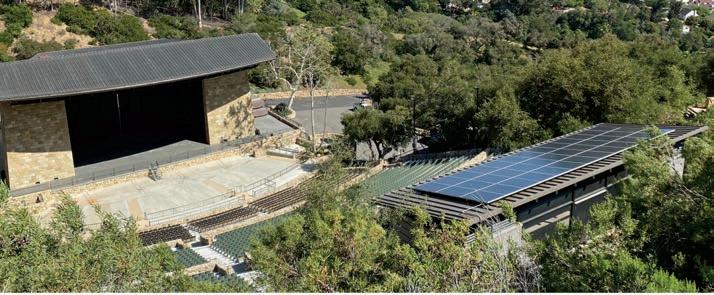
energy we used throughout the year,” Shiflett says. “We planned it so that we have a net-zero energy use each year.”
If concerts are complex, festivals are chaos. Logan Goldberg, an event and production manager who works on Earth Day Festival, Summer Solstice, and Fields of Funk, knows this well. Hosting tens of thousands of people at once leaves little room for environmental idealism without the infrastructure to make it a reality.
“Five years ago, when we were
hosting 20,000, 30,000, 40,000 people at an event, there weren’t a lot of options,” Goldberg says.
Now, there are more and more to be able to green-ify events at scale. For Earth Day and other major festivals, Goldberg has begun supplementing diesel generators with solar-powered alternatives. “It’s not fully there yet in terms of being able to power everything,” he says, “but we’re implementing that transition.”
Like the Bowl, many festivals have shifted to reusable cups. Instead of buying tens of thousands of disposable plastic cups for beer gardens and water

stations, events use a reusable cup service that supplies, collects, sanitizes, and redistributes cups between events.
“I’m no longer having to buy $10,000, $20,000, $30,000 worth of plastic cups,” Goldberg says.
Food vendors are pushed toward compostable containers and local sourcing, particularly at Earth Day. Behind the scenes, water conservation efforts extend down to the grass beneath festival tents.
By saturating irrigation weeks in advance and cutting water use closer to event dates, Goldberg says, large venues can save “hundreds of thousands of gallons.” More than that, it actually helps the grass withstand a crowd of people standing on top of it.
At the Samala Showroom inside Chumash Casino Resort, sustainability is measured in pounds.
“In 2025, we managed 2.6 million pounds of material through the


property and successfully recycled more than 91% of it,” says Mark Funkhouser, executive director of facilities for Chumash Enterprises.
The resort operates under a TRUE Zero Waste program, meaning waste is separated at the source rather than being sorted later. According to Funkhouser, “Zero Waste means recycling over 90% of the materials that come into the casino without incineration.”
That includes some unexpected items. Inside the showroom, lightly used trash bags from bingo operations are recycled through a Santa Maria–based partner and converted into post-consumer resin pellets.
“Since 2014, this strategy has allowed us to reduce the incoming waste stream by approximately 1 million pounds per year,” Funkhouser says.
Santa Barbara Half Marathon Running events leave thousands of literal footprints — as well as an environmental one. There are those goodie bags after the race, the medals,
and, of course, the water stations.
“It’s always a work in progress, and we’re never doing enough,” says David Monico, event director for the Santa Barbara Half Marathon.
One major change came in participant shirts. “Most race shirts are polyester blends,” Monico says. “Not recyclable.”
Last year, the event switched to 100% cotton shirts — more expensive, but less environmentally problematic.
“You multiply that by 7,500 shirts, and all of a sudden, you’re not making any money,” he says.
But such a large volume of shirts — or even medals — has an effect. The finisher medals are now made from recycled metals, further folding the post-race “goodies” into a cyclical process.
Water — specifically its container — proved to be a hurdle. Pre-pandemic partnerships helped the race offset the cost of using aluminum bottles instead of plastic. When those partnerships dried up, sticking with aluminum bottles, rather than switching back to plastic, added
LEARN MORE
(805) 739−9102 sbcasa.org BE A POWERFUL VOICE IN A
The mission of CASA of Santa Barbara County is to assure a safe, permanent, nurturing home for all abused and/or neglected children by providing a highly trained volunteer to advocate for them in the court system.
Through a dedicated team of volunteer guardians, CASA stands beside young people every step of the way, helping them find safety, stability, and hope.
thousands of dollars to the budget. But the half-marathon stuck with its commitment. “We made the decision that we’re not turning back,” Monico says.
Beyond using aluminum bottles, the race provides “big water monsters” — large blue multigallon containers where runners can refill their bottles. As for the thousands of small cups of water handed out throughout the race, those are compostable, which Monico says is one of the “best developments that have occurred” when it comes to sustainability.

BY VICTORIA RISKIN
For years, solar energy was framed as a feel-good choice: cleaner power, lower bills, a way to reduce your carbon footprint. In places like Santa Barbara, that framing is no longer enough. Today, solar paired with battery storage isn’t just about sustainability. It’s about resilience.

This reality is what drives Brighten Solar and its co-founder, Marine Schumann.
She has worked with homeowners to navigate California’s evolving energy landscape and is blunt about the reality: The electric grid is aging, overstressed, and increasingly unreliable, and it is not keeping pace with climate change or electrification.
“We’re at the very end of the electric infrastructure here,” Schumann explains. “Santa Barbara already experiences 53% more outages than the state average. And that was before extreme weather became routine.”
Wildfires, winter storms, and prolonged heat waves now arrive regularly, stressing a grid that wasn’t designed for today’s demand. At the same time, California is pushing rapid electrification of homes and transportation, adding further strain. Rates continue to rise, and
both planned and unplanned outages have become a fact of daily life.
“The real question isn’t if you’ll lose power,” Schumann says. “It’s when, and for how long.”
For homeowners, the consequences are personal: spoiled food, medical equipment without power, heating or cooling shutting down overnight. These aren’t abstract risks anymore — they’re lived experiences.
“If the grid goes down and you don’t have a battery, your solar system shuts off,” she explains. “That’s a safety requirement.”
Battery storage changes everything. A properly designed solar-plus-storage system allows a home to disconnect from the grid during an outage and operate independently, drawing from stored energy at night and solar production during the day.
“At Brighten, we design systems with a reserve,” Schumann says. “When the sun comes up, the system recharges itself. Your appliances, your battery, and your generation work together as a closed loop.”
Systems can be phased in — starting with solar, adding storage, and adapting as needs change. What Schumann hears most often from customers is relief. New financing opportunities offset the loss of federal rebates.
“People tell us it feels good to do something,” she says. “So much feels out of our control right now. Energy doesn’t have to be one of them.”
Energy resilience, she believes, is becoming as fundamental as insurance or emergency preparedness. It’s not about fear — it’s about foresight.
“We can’t wait for the grid to fix itself, but we can take responsibility for our own homes. And when people do, they feel prepared — and empowered.”
– MARINE SCHUMANN, Co-founder of Brighten Solar
In this model, solar plays a new role. It’s no longer just about offsetting a utility bill. It’s what keeps the battery charged when the grid can’t deliver power at all.
“If resilience is the goal,” Schumann says, “solar and storage have to work hand in hand.”

“We can’t wait for the grid to fix itself,” Schumann says. “But we can take responsibility for our own homes. And when people do, they feel prepared — and empowered.”
In an era defined by uncertainty, that may be the most reliable power of all.
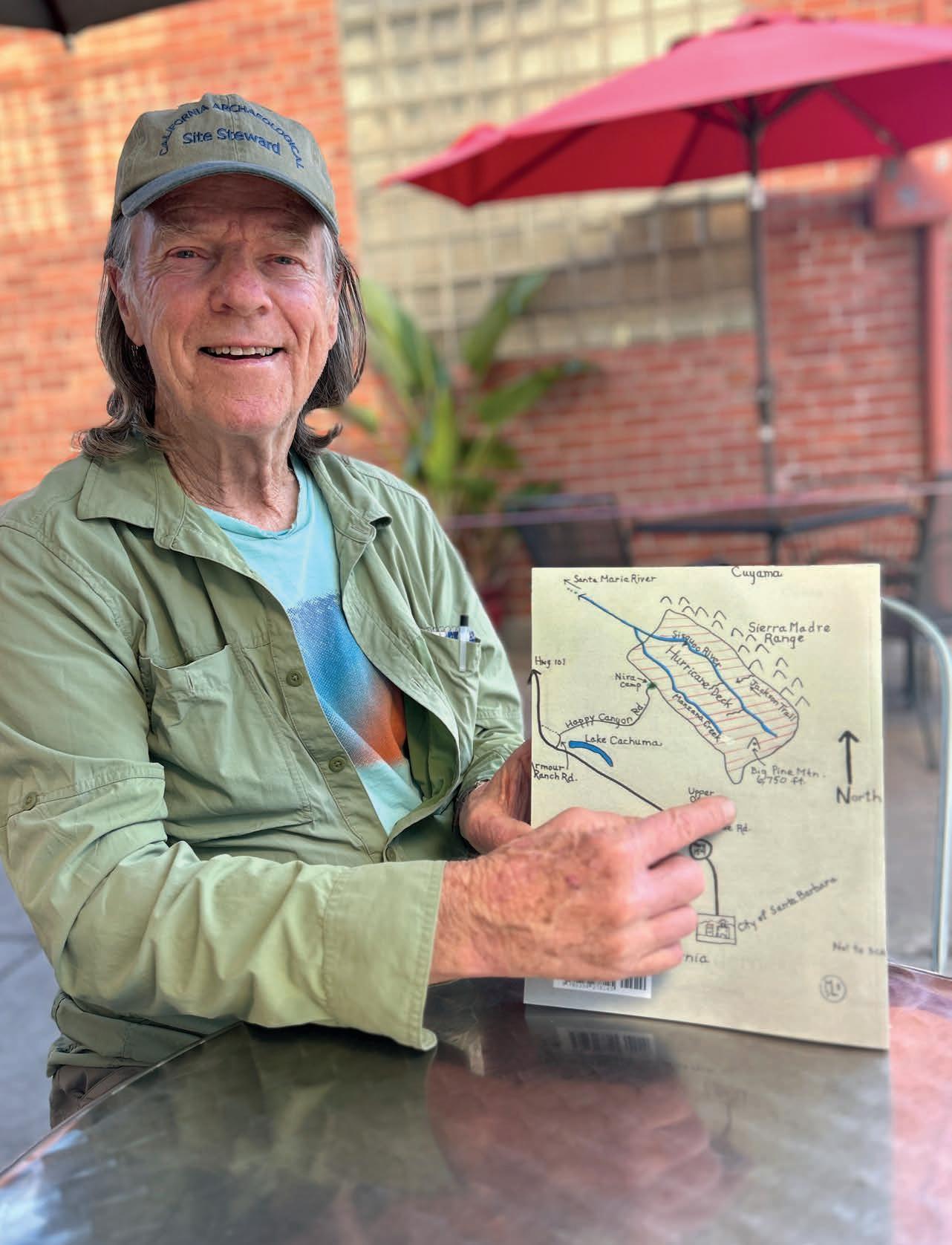
When most people look at Santa Barbara, they see art galleries, Spanish-style architecture, sandy beaches, and glittering ocean waves. But Dan McCaslin, a 78-year-old Santa Barbara local, looks north to the mountains.
Dan, a retired teacher, is a local wilderness guide, author, and outdoors writer for the local news site Noozhawk. Here are his favorite hikes in the Santa Barbara area.
To Tunnel Connector: 1.6 miles one way, 949-ft. elevation gain
To Gibraltar Road: 2.2 miles one way, 1,590-ft. elevation gain
Roadside parking on Las Conas Road
Rattlesnake Canyon Trail is one of the most popular hikes in Santa Barbara. It can get crowded, especially on weekends. It’s easy to see why. The trail snakes along the canyon next to a gentle creek, which sometimes houses California newts and toads, then slowly drops to the first water crossing. When the path starts to rise again, it reaches a second creek crossing, a great place for a cold-water plunge. The final, steeper stretch before Gibraltar Road can get slippery.
The trail hosts some unusual foliage, including sage, ceanothus, and poison oak. Oak trees protect hikers from the hot sun, and wide footpaths make it one of the nicest family trails in Santa Barbara.
6.6 miles round-trip, 1,461-ft. elevation gain
Parking at Cater Water Treatment Plant on San Roque Road
Jesusita Trail is a lesser-known but stunning trail. From the parking area at San Roque Road near the Cater Water Treatment Plant, the hike descends to a creekbed. It steepens after that before hitting the final exposed mile leading up to Inspiration Point. There are a few eroded sections along the creek that require extra caution.
The trail, Dan says, is “the back door hike to get to Inspiration Point,” a local favorite viewpoint from which, on a clear day, you can see all the way to Santa Cruz Island.
Around 2 miles round-trip
Parking on Cliff Drive, Calle Andalucia, Calle Montilla, and Jerry Harwin Parkway
Elings Park is located in Santa Barbara’s West Mesa neighborhood and has two public access points, on Calle Andalucia and Calle Montilla. The park has “very much of a community kind of feel,” Dan says.
The upper area of the park is perfect for an afternoon stroll. Dirt trails overlooking the Pacific crisscross the grassy area. Hikers can watch paragliders sailing peacefully in the ocean breeze as

they practice takeoff and landing.
Elings Park is also home to the area’s most popular downhill mountain biking trail, with flowing trails that riders of all ages enjoy. Hikers should avoid the steeper downhill trails and the bikers riding down them whenever possible, and instead enjoy the trails — and the views — from the top.
No. 4: East Camino Cielo to Forbush Flat Campground (Hard)
Day 1: 1.6 miles one way, 1,000-ft. elevation loss
Day 2: 1.6 miles one way, 1,000-ft. elevation gain
Although Dan enjoys training on frontcountry trails, his true love is the backcountry. One of his favorite backcountry expeditions starts with the Forbush Flat trail. A small pullout on Camino Cielo leads to a marked trail that drops 1,000 feet in about a mile, ending in the Forbush Flat Campground. Backpackers can then choose to camp or continue exploring the network of trails. Non-backpackers and frontcountry explorers can take the oceanside Cold Springs Trail.
“It’s the side that doesn’t get as much sun,” Dan explains, “so back there is a whole kind of vegetation that you don’t see on the front side of our mountains, like madrone trees,” a distinctive native variety with smooth, reddish bark.
Dan says it’s also a great group trip. “I took my son there when he was 3. You feel like you’re way far away, and you’re actually not. As the crow flies, you’re 4 to 5 miles away from downtown Montecito.”



14 miles round-trip
Day 1: 1,600-ft. elevation gain
Day 2: 500-ft. elevation gain
Parking at the end of Happy Canyon Road
Though he enjoys the local trails, Dan loves to see the stars, and his all-time favorite trailhead, Nira Campground, 45 miles from Santa Barbara, offers some of the best stargazing in the region. From the campground, hikers can easily access the Manzana Creek trail network, which snakes through the San Rafael Wilderness and offers more than 40 miles of wild unmarked trails.
One overnight out-and-back trail runs from Nira Campground to Manzana Narrows along Manzana Creek, which flows along a shallow riverbed. Sacred Chumash sites and artwork are scattered throughout the greater Los Padres National Forest, and centuries-old oak trees cast shade and beauty along the trail.
The campground has an outhouse, fire ring, picnic bench, and creekfront tent spots, and, Dan says, is a magical place to stay.
All trail elevation and mileage statistics are taken from the Strava (strava.com) map. Always check trail information and weather before hiking, as well as road conditions, on the U.S. Forest Service website (fs.usda.gov/r05/lospadres) .
We source from Central Coast farms with produce harvested just days before it reaches your table. Taste the difference!

The first time I tasted a tomato, I was a toddler transitioning from puréed food to solids. I was sitting in my highchair when a bright red slice appeared on my plate. The moment I bit in I felt utter delight: a sweet sparkly aliveness.
Over the years that delight has faded to frequent disappointment. Tomatoes served at restaurants are often dull or mealy, slices that promise flavor but rarely deliver.
One night at one of my favorite Italian restaurants in Montecito, Pane e Vino, I stopped to say hello to the owner, Pietro Bernardi, on my way out. He introduced me to the man he was talking to.
“This is Chris Cadwell of Tutti Frutti Farms,” he said, “who grows the best tomatoes ever!” That kind of praise piqued my interest.
So I reached out to Chris to learn more about the story behind the “bestever” tomatoes. He told me about his deep roots in Carpinteria and Santa Barbara County and his love of place and land. Also — I have now tried his tomatoes and, well, they are amazing.
Victoria Riskin: How did you get into farming, growing vegetables and tomatoes?
Chris Cadwell: I started out in Carpinteria where we lived on my grandfather’s farm, and he raised avocados and lemons. He had a garden with exotic fruit trees, macadamia nuts, and cherimoyas. We had fresh corn, tomatoes, and artichokes. I think that influenced me as a young lad, having all that wonderful food around. Later, in high school, I started my own garden. I always loved farming. The flavors were so different from [those in] store-bought food. It makes a huge difference growing your own food. And I did it organically, even though we didn’t have the word organic yet.
By Victoria Riskin
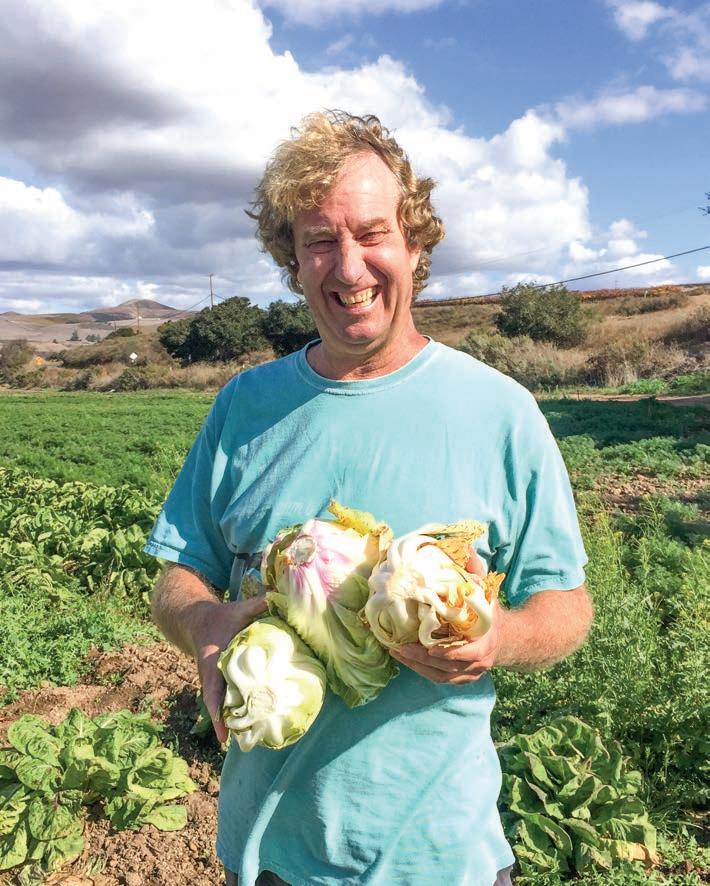
Chris Cadwell, the owner of Tutti Frutti Farms in the Santa Rita Hills, has been growing vegetables organically since he was in high school. Now, his heirloom tomatoes are stars at farmers markets and in restaurant kitchens around Santa Barbara.

Tutti Frutti farms grows more than 12 types of tomatoes, including cherry tomatoes, Romas, and several heirloom varieties.
VR: What did growing organically mean then? Of course, now you’re doing it professionally.
CC: Basically, you’re just not allowed to use any chemicals or artificial fertilizers, which is a great thing and totally doable.
VR: And your grandfather knew that or did he use chemicals?
CC: He sprayed a lot with heavy chemicals. He died young. He sprayed everything!
VR: That’s what folks did back then. So why did you instinctively not do that?
CC: It was the ’60s, and there were backto-the-land movements. So right off the bat I was anti-chemical, and I didn’t find it difficult at all.
VR: And after high school?
CC: I moved up to Big Sur, and I ended up growing vegetables on one acre, all organically. I gave everything to the neighbors and traded with different stores and restaurants. I also fished for a living. I’d get all these fish scraps and bury them in the soil to make compost. The vegetables were just fantastic.
VR: How did you know to use those fish scraps?
CC: I studied a little anthropology and learned how the Indians used fish scraps and the shells. We got fantastic results. The fishing was very good there. I had a little tin boat. I launched out of one spot named Big Creek, which is south of Esalen. It’s the only calm spot you could launch a boat from on the whole coast there. And I kept my boat there because my friend managed the ranch. I had an ideal situation. He raised llamas, and the
llamas would poop in one pile, so they made great compost full of worms. We’d gather that up, too, and mix all these blends together and had unbelievable results.
VR: How long did you stay there?
CC: I lived there for five years and then moved back to Santa Barbara. I was doing construction and realized that wasn’t really my favorite thing. I leased some land and grew garlic. I braided it, added flowers to them. I took them to Italian restaurants and stores and then the farmers market. I was so successful with the garlic that I decided, well, I’m going to start growing some other things, and I really got hooked.
I got six acres in Carpinteria, grew vegetables, and distributed them to the restaurants in Santa Barbara — maybe 50 restaurants. Then I acquired 100 acres in Lompoc in 1991 because there’s so much more water there. I decided that was what I was going to do for a living, and we moved up to Lompoc. The farm is right on the river. It’s a little colder, windier, but great for tomatoes — not too hot, not too foggy — so it’s about growing the tomatoes slowly like a Pinot Noir grape. You want it to hang on the vine, otherwise they just grow so fast, they don’t have as much flavor.
VR: Are the farmers markets the biggest place that you sell?
CC: I am in several supermarkets, too. But the farmers market is a big part of our life. My family enjoys selling there more than anything else. It’s a social activity, and we end up growing a lot of special things that people really want to eat, like different kinds of melons and carrots and parsnips.
VR: How many varieties of tomatoes do you grow?
CC: Well, there’s probably 12 to 14 types. That’s including different Romas, cherries, there’s Early Girls, and of course,
all the heirlooms: the Cherokee, the Chocolate Stripe, Marble Stripe, Copia and Beefsteaks, Ponderosa, Brandywine. And there’s a Green Cherokee, which is very good, too, except it doesn’t sell very well because it’s green. People think it’s not ripe, but it’s got a wonderful flavor.
VR: We’ll have to bring back that movie Fried Green Tomatoes! Any favorite varieties?
CC: I’d say the Cherokee Purple and the Chocolate Striped tomatoes are very good. Brandywine is wonderful. Striped German is a nice fruity one. It’s almost like a real tropical fruit. Some are sweeter than others, and some have more acid. Some are tangier. We gather a lot of that seed ourselves to keep those varieties going and try and adapt them to our area.
VR: There are so many wonderful restaurants in Santa Barbara. Do the chefs spend time thinking about those different varieties and flavors?
CC: Yes, they do, they really do. They’ll ask for one variety, or they’ll do like a rainbow mix. Typically people will do fresh basil, olive oil, buffalo mozzarella, and the heirloom tomato rainbow. That’s a fantastic thing because you have all the flavors.
VR: My friend mixes heirlooms with ripe juicy peaches.
CC: And I still love them with fish, so I’ll catch a lot of the local rockfish and fillet them, layer them with tomatoes and basil, garlic, and olive oil, and bake them.
VR: Do you know about Andalusian gazpacho?
CC: I don’t!
VR: I’ll make some with your tomatoes and give it to you.
Learn more at tuttifrutti.com.
“I always loved farming. The flavors were so different from the store-bought food. It makes a huge difference growing your own food. And I did it organically, even though we didn't have the word organic yet.”
– Chris Cadwell, Tutti Frutti Farms


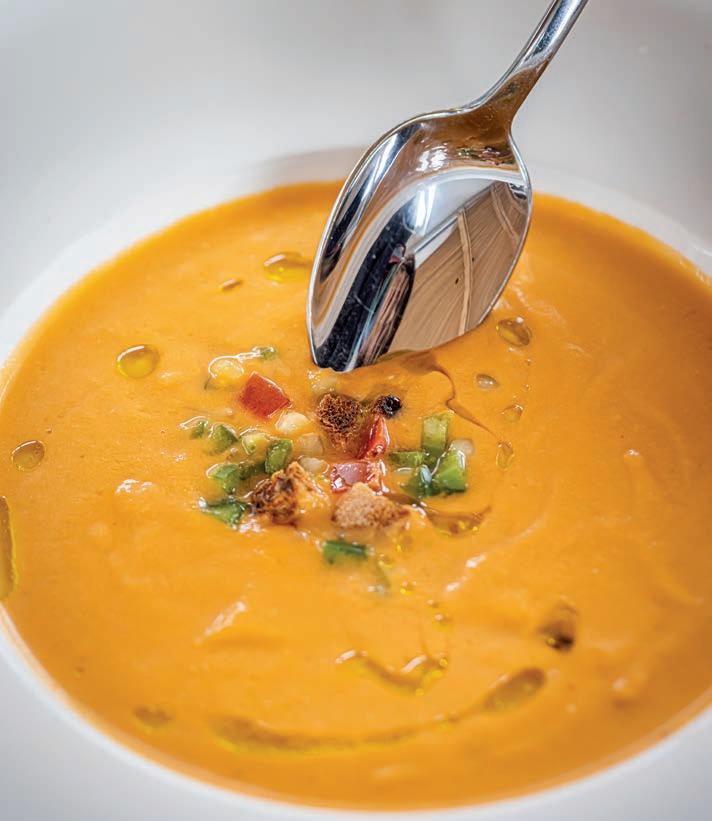
I first tasted Andalusian gazpacho in Seville, Spain, one afternoon when the warm air slowed us down while we were sightseeing and we snuck into a little restaurant. Gazpacho Andaluz was featured on the menu — as it is everywhere in Seville — puréed to silky perfection, always served ice-cold, refreshing, the tomato flavor forward with a subtle, heavenly garlicky sharpness.
I found the gentleman who owned the restaurant, complimented him on his soup, far better than most, I told him. I asked him for his recipe, and how he achieved the soup's silkiness. He took me to the small kitchen and showed me his Thermomix, a handsome kitchen appliance. Though it’s not necessary to make this soup — any good blender will do — that machine is now a star in my kitchen.
The recipe for the soup is simple and calls for just a handful of ingredients. It’s a delicious, inexpensive starter for summer gatherings, and guests are always impressed.
Texture, From Rustic to Silky: For an ultra-smooth texture, blend longer than you think. A high-powered blender works beautifully, and for a classic finish, many cooks pass the soup through a sieve to achieve that velvety texture. It’s worth the effort.
Chill and Rest: Gazpacho improves with time — overnight is ideal. Serve cold, but not icy, so the flavors stay alive.
Recipe by Victoria Riskin
Photo by Randi Baird
Serves 6
2 lbs very ripe organic tomatoes, roughly chopped
1 medium organic green bell pepper, seeded and chopped
1 organic cucumber, peeled and chopped
1/2 medium yellow onion, peeled and chopped
1 large garlic clove, peeled
2 Tbsps white wine vinegar, to taste
Fine sea salt, to taste
4–6 Tbsps olive oil
Cold filtered water, as needed
1. Put all the ingredients but the oil into the blender or food processor: tomatoes, bell pepper, cucumber, onion, garlic, vinegar, and salt. Blend until completely smooth.
2. With the motor running, slowly drizzle in the olive oil to emulsify.
3. Adjust consistency with cold water — gazpacho should be pourable, not thick. I add 8 cubes of ice because my blender has strong blades.
4. Chill for at least 2 hours, preferably longer.
5. Taste again before serving and adjust salt or vinegar if needed.
6. Serve very cold, with a final drizzle of olive oil.
To Serve: In southern Spain, gazpacho is often sipped from a glass, but it’s equally lovely in a bowl. Offer garnishes on the side, like finely diced cucumber, green bell pepper, homemade croutons, and extra-virgin olive oil.
A Model of Earth-Friendly Cooking: No cooking means no energy use. Gazpacho is ideal for overripe or imperfect produce, entirely plant-based, and low-carbon when ingredients are local.
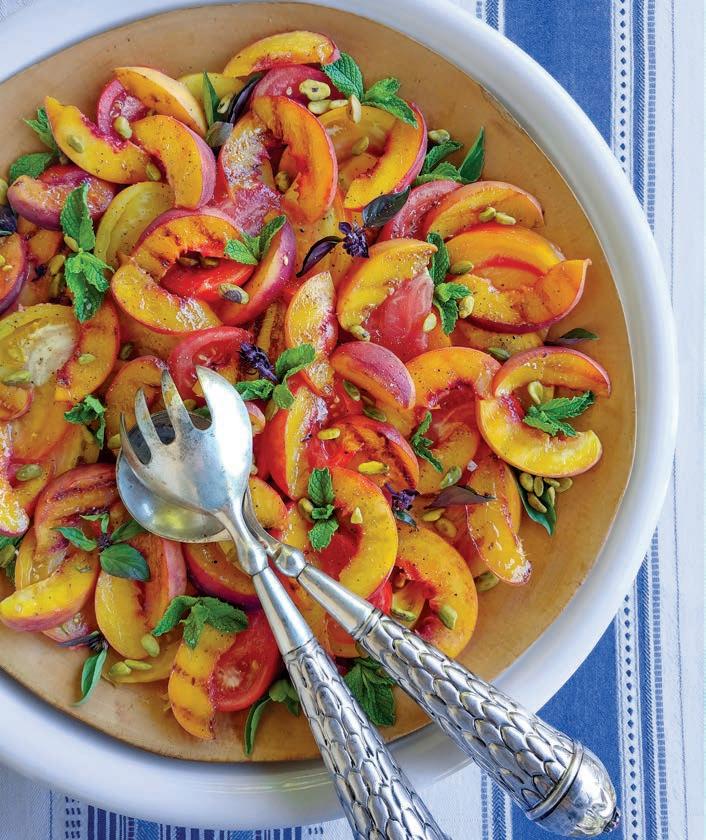
Santa Barbara–based culinary designer and teacher Pascale Beale learned the art of cooking at the knee of her French grandmother, and today she brings home her passion for food through her delicious writing. She creates recipes that are simple, yet utterly surprising, with combinations that leave guests delighted. Here she combines tomatoes and peaches, inspired by her sensory reflections of Venice.
Recipe and photo by Pascale Beale
It was during a conversation with a friend of mine about the pleasures of Venice, getting lost along the lesser known canals, finding minute squares with jewel box chapels, the pastel shades of the palazzo, the local food, and of course, peach Bellini — that the idea for this vinaigrette popped into my head. It helped that this conversation took place in the middle of my local farmers market, and that we had just tasted a sublime peach. I bought some, of course, and later that night, grilled a few peaches for a salad I was making. The grilling intensified the flavors of the peaches, caramelizing the juices a little as they cooked, and paired beautifully with the acidity in the tomatoes. I had put one peach aside to make a puree for the vinaigrette and was delighted with the result. We toasted Giuseppe Cipriani that evening, in honor of his frothy cocktail, and for inspiring what has become one of my new favorite summer salads. Serves 8
The vinaigrette
1/4 cup olive oil
Juice and zest of 1 lemon
1 ripe peach
1 Tbsp Champagne vinegar
Pinch of coarse salt
10 grinds black pepper
The salad
2 lbs large heirloom tomatoes, approximately the same size as the peaches, halved and cut into wedges
4–6 large peaches, halved, pitted, and cut into wedges
2 Tbsps basil olive oil
Sea salt
Black pepper
1/2 cup packed mint leaves
1/4 cup Thai basil leaves
1 Tbsp pistachios
1. Place all the vinaigrette ingredients in a blender or food processor, and pulse until you have a smooth, homogenous vinaigrette. Keep refrigerated until ready to use.
2. Place the tomatoes into a large salad bowl or a large shallow platter.
3. Heat a griddle pan over a medium-hot flame on the stove.
4. Place the peaches into a medium-sized bowl. Pour the basil olive oil over the slices. Toss gently so that the peaches are coated. Sprinkle a little salt and pepper over the peaches. Place the peaches on the griddle and cook for 90 seconds. Carefully turn the peaches over and cook for 60 seconds on the other side. The peaches should have char marks on them.
5. Carefully remove the peaches from the griddle and add them to the tomatoes. Scatter the mint, basil leaves, and pistachios over the fruit.
6. Drizzle the peach Bellini vinaigrette over the salad, toss carefully so as not to break the fruit, and serve immediately.

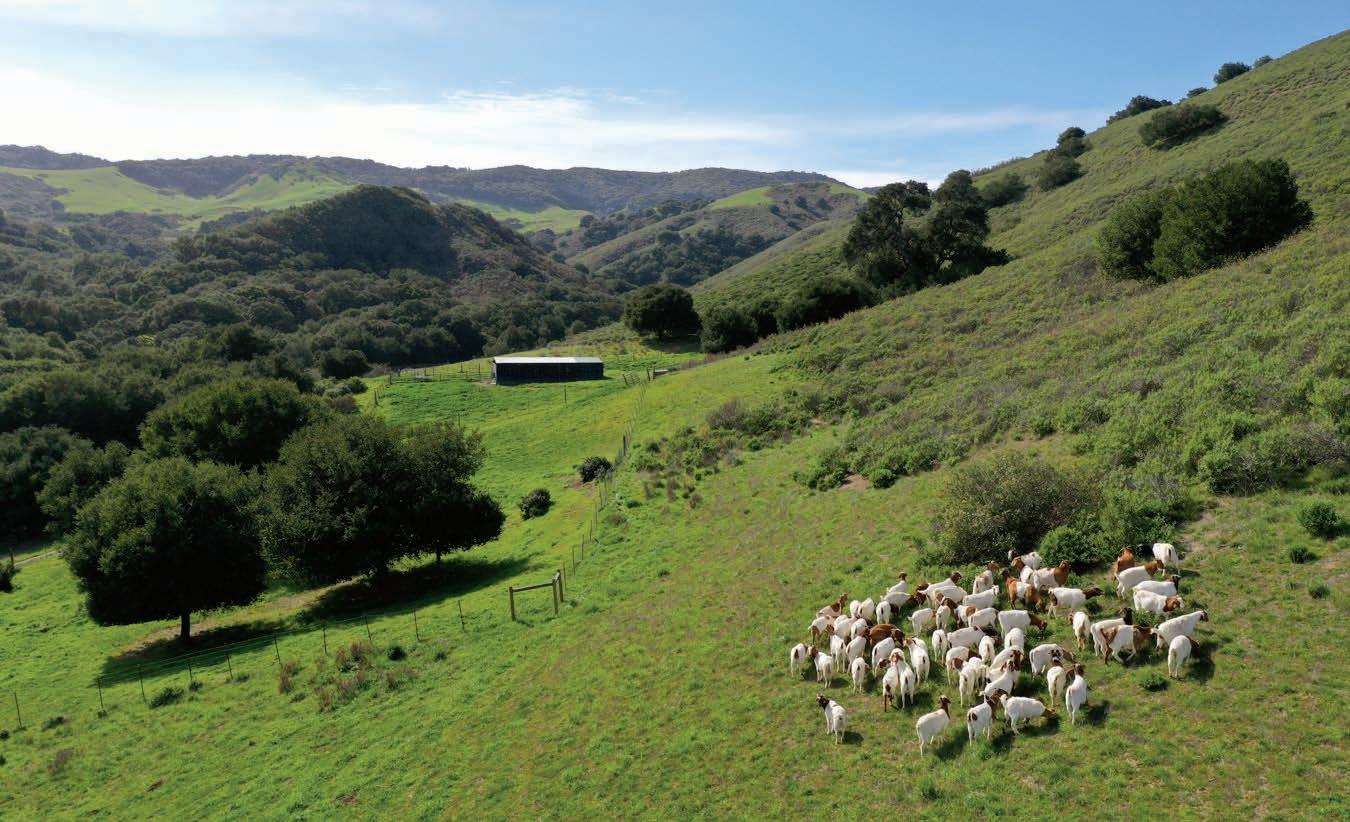
A regenerative farm at Jalama Canyon Ranch seeks to capture the spirit of Santa Barbara’s landscape by striking harmony between the new and the old.
By Lily Olsen
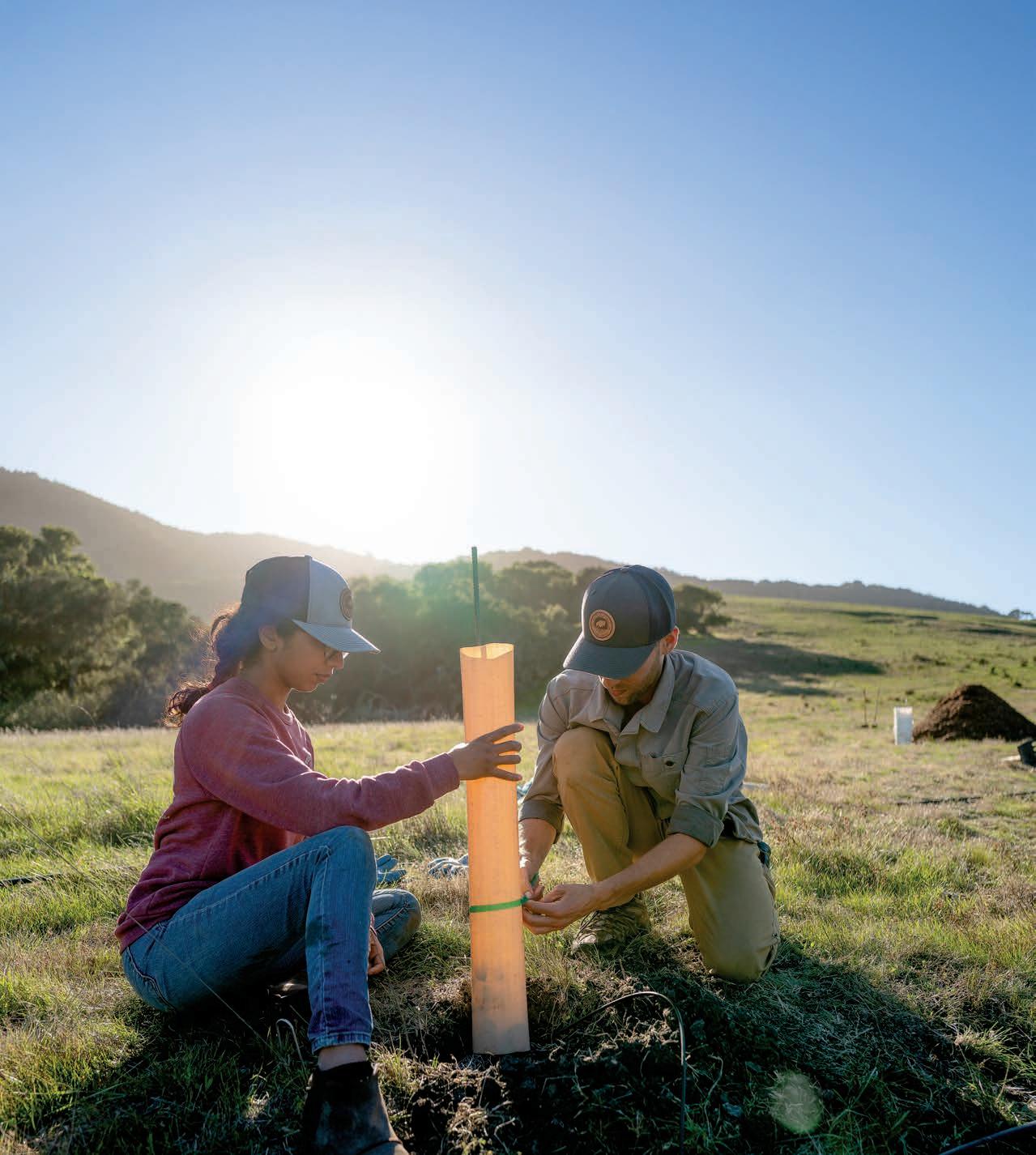
Workers re-vegetate stream banks and flood plains at Jalama Canyon Ranch, improving water filtration and reducing erosion.
Santa Barbara is known for its sprawling ranches and vineyards. But the agricultural practices that have pervaded the region since Spanish colonization are in many ways incompatible with the health of the landscape’s natural ecosystems.
For Jesse Smith, director of land stewardship at the White Buffalo Land Trust (whitebuffalolandtrust.org), a local conservation group, this is personal. Jesse was born and raised in Santa Barbara and is intent on harnessing the untapped potential of the county’s agriculture.
“I’d love to sit back when I’m old and see Santa Barbara on a global stage as one of the most unique food and agricultural expressions,” he says.
With his group, Jesse is trying to make these changes at the 1,000-acre Jalama Canyon Ranch, with the hope that the work can be a model for agriculture locally and beyond.
Jalama Canyon Ranch sits on the western edge of the Santa Ynez watershed and borders the Jack and Laura Dangermond Preserve. The landscape displays the ecological diversity that’s typical of Mediterranean climates: grassland Savanna, oak woodland, riparian corridors, coastal sage scrub, and managed agroforestry such as orchards and vineyards.
White Buffalo Land Trust purchased Jalama Canyon Ranch in 2021 in a combined effort with other groups, including the Land Trust for Santa Barbara County, and is in charge of operations on the ranch. Since the purchase, the conservation group has been using regenerative agriculture, an approach that takes into account the holistic wellbeing of the ecosystem, to restore the ranch.
Jesse handles decision-making and oversees projects at the ranch, which involves everything from processing paperwork to building fences. In the process of restoring the land, Jesse has advocated for a nuanced approach. “I think it’s important to see degradation and wildlife risk within a larger context of our country and our region,” he says.
The ranching and livestock practices Spanish settlers brought to the land, for instance, led to a couple hundred years of ecological degradation — but applying regenerative agriculture doesn’t mean doing away with all of the agricultural practices they put in place.
“We’re not going to get rid of all the non-native European grasses throughout this landscape or have a full shift away from cattle ranching and have people all of a sudden ranching native Tule elk,” Jesse says.
One way White Buffalo Land Trust is attempting to strike this balance at Jalama Canyon is through its cattle practices.
Modern cattle ranching in the U.S. involves keeping cattle on the property year-round. In Santa Barbara, these practices have wreaked havoc on native perennial grasses, which require a
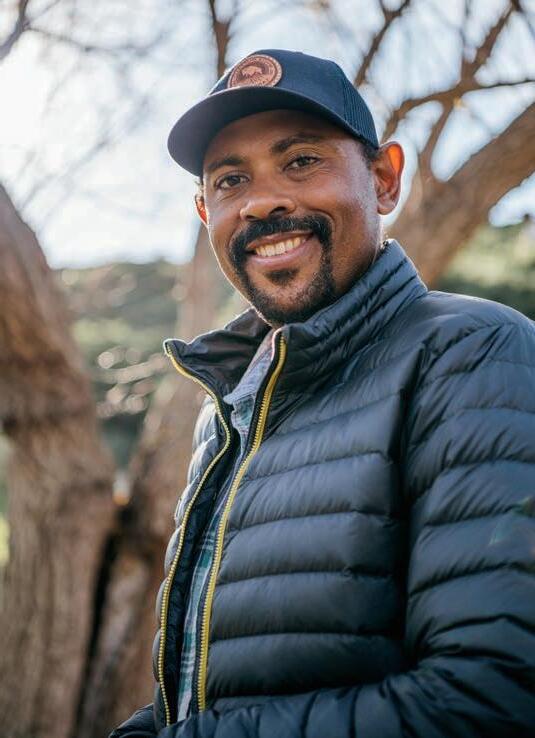
“I’d love to sit back when I’m old and see Santa Barbara on a global stage as one of the most unique food and agricultural expressions.”
– Jesse Smith, White Buffalo Land Trust
summer dry season to recover. With year-round grazing, these grasses don’t get that recovery time.
White Buffalo Land Trust still ranches cattle at Jalama Canyon. But in order to ensure that cattle ranching can exist in harmony with the natural ecosystem, it has created a migratory pattern for its herds that mimics that of native ungulates. Large livestock remain on the property only during growing season; once they reach market weight, they’re sent to a grass-fed beef market in Northern California.
This allows the native perennial grasses to have the recovery period they need. “I was just at one of our restoration sites, and
it was amazing to see these grasses that are starting to come back,” Jesse says.
Jalama Canyon Ranch is also a site of extensive research. The White Buffalo Land Trust calls it a “living laboratory.”
These studies are already yielding informative results. Caltech conducted research on methane-sequestering bacteria called methanotrophs at the ranch. The study sought to discover where the bacteria lives — in rangelands, grasslands, riparian corridors, vineyards, oaks, or sage brush. Results indicated that coastal sage scrub has a large concentration of methanotrophs and thus a relatively high methane-sequestration rate.
“This shows the value of those specific ecological sites that sometimes get burned down by ranchers who think that sage scrub is terrible because it’s not good forage for cattle,” Jesse says.
Another aspect of the ranch’s mission is inviting the public to experience it — everyone from students to elected officials. Jesse talks about the simple power of flipping over a cow pie in front
of a group of policymakers, showing them the dung beetles that are there transferring carbon and organic matter into the soil.
White Buffalo’s practice of rotating pastures is what protects the existence of dung beetles, which are essential to the health of the ecosystem. When cattle don’t stay in any one pasture for too long, they’re less likely to get parasites, which means ranchers don’t have to use dewormers, which would trickle down their digestive system and kill the dung beetles.
In addition, White Buffalo Land Trust is launching business ventures from its vineyards, orchards, fields, and herds with the aim of increasing demand for regenerativesourced products. These products include Sandhi Wine and the brand Figure Ate, which sells persimmon vinegar and grass-fed-beef biltong sourced from the ranch. (Shop at bit.ly/wblt-shop-regenerative.)
The project at Jalama Canyon Ranch is just getting started, but Jesse is hopeful that it will change Santa Barbara agriculture for the better.
“The fact that everyone we’ve talked to about this work finds something to resonate with, even if they’re coming from a place of skepticism, gives me hope,” Jesse says.
“The fact that everyone we’ve talked to about this work finds something to resonate with, even if they’re coming from a place of skepticism, gives me hope.” – Jesse Smith, White Buffalo Land Trust

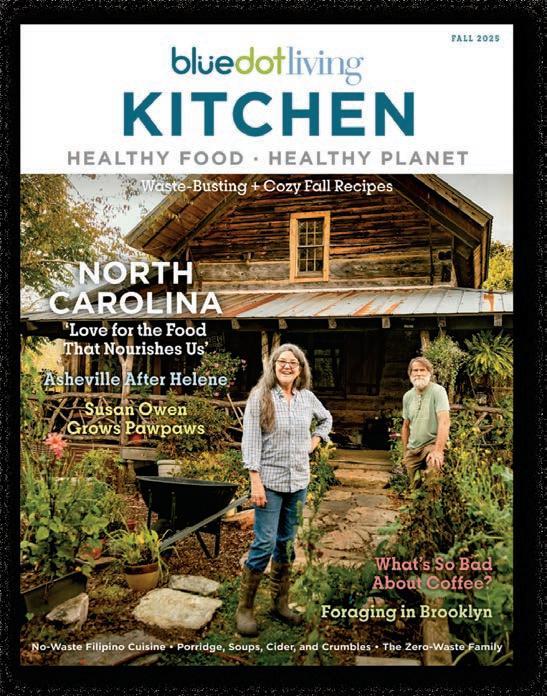
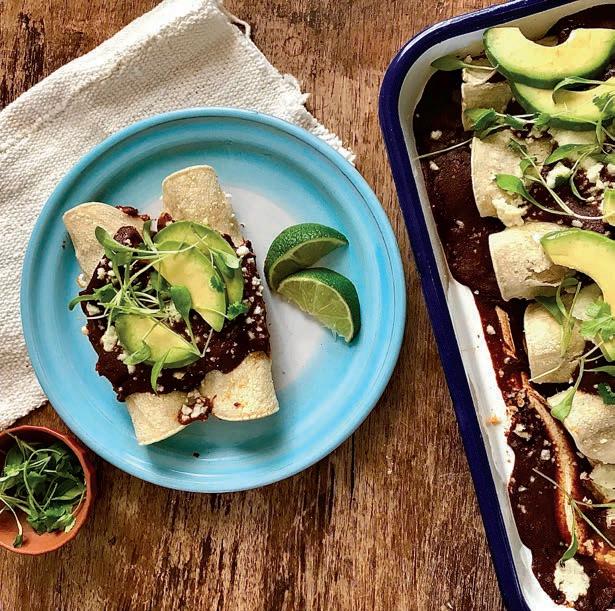
You’ll find simple, planet-friendly recipes, inspiring stories, and smart tips to reduce food waste and shop sustainably. With our digital magazine, you’ll get:


An interactive experience on any device with one-click access (no login!)
Links to ingredients and green products to make shopping easier


Enhanced audio feature to listen to articles and step-by-step instructions
A bonus 32-page Recipe Collection plus access to previous issues!

The Marine Protected Area around the Santa Barbara Channel Islands was part of a study showing that MPAs are largely free of industrial fishing.
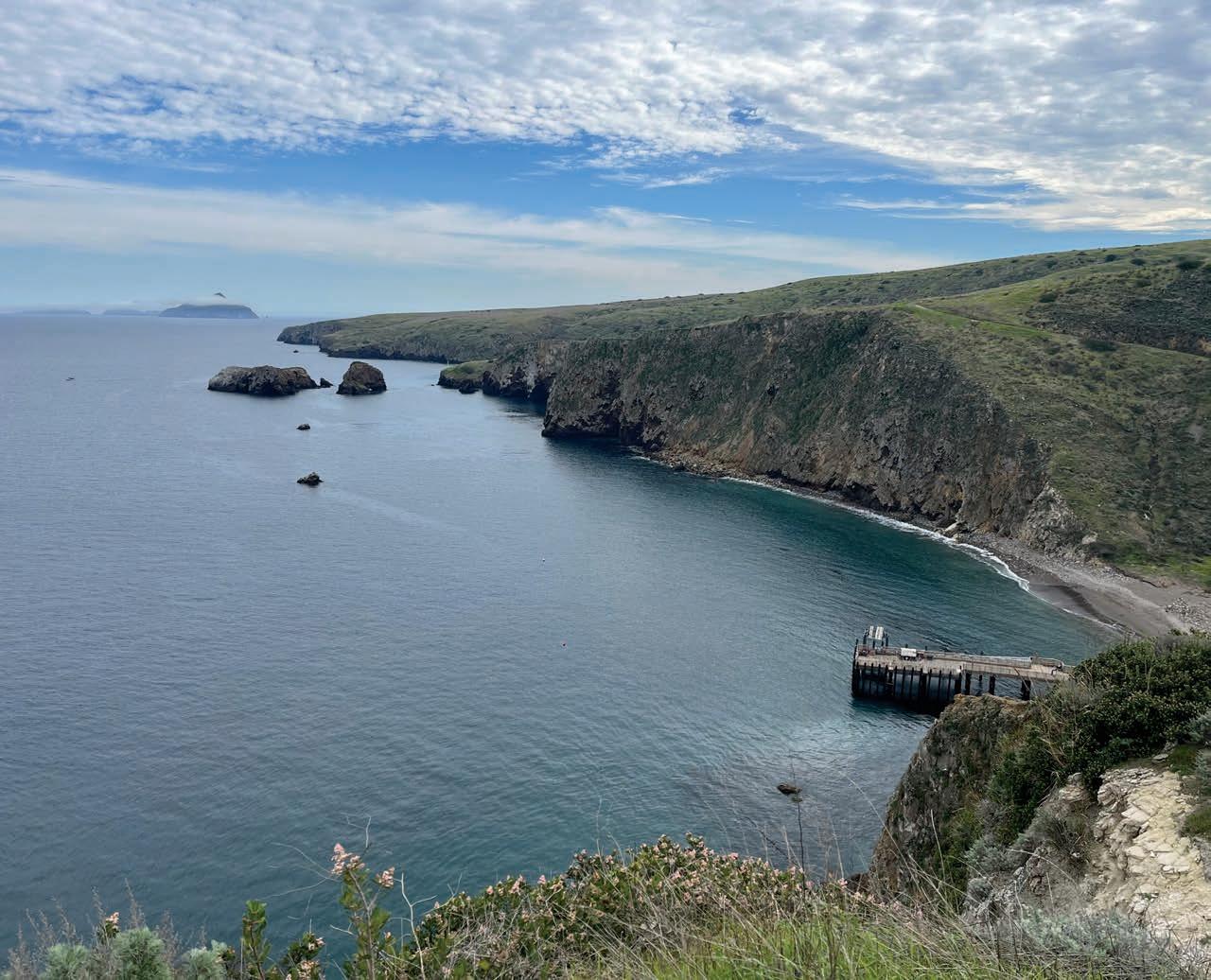
A recent study shows that many marine protected areas where industrial fishing is banned, including one around the Santa Barbara Channel Islands, are largely free of boat activity.
By Tyler Hayden Photos by Jim Miller
An international study using satellite imagery and artificial intelligence revealed that many of the world’s marine protected areas, otherwise known as MPAs, are largely free of industrial fishing, upending a frequent argument among critics that these exclusion zones are merely political and performative and have little benefit.
“There’s a commonly held assumption that MPAs are just ‘paper parks,’” says
Gavin McDonald, a senior project scientist at UC Santa Barbara. “However, we’ve found that for fully and highly protected MPAs, this is not the case.”
Among the hundreds of MPAs McDonald and his team studied were those around the Santa Barbara Channel Islands, as well as Australia’s Great Barrier Reef and Hawai‘i’s Papahānaumokuākea Marine National Monument. Together, they represent
around 2.1% of the planet’s oceans.
The peer-reviewed study, published this summer in the journal Science, analyzed boat activity across 1,380 MPAs that ban industrial fishing. The results were striking. Nearly 79% of the MPAs studied showed no fishing activity whatsoever. Among the remaining sites, 82% averaged less than 24 hours of activity per year.
“Honestly, I was pretty surprised,”
“There’s a commonly held assumption that MPAs are just ‘paper parks’. However, we’ve found that for fully and highly protected MPAs, this is not the case.” – Gavin McDonald, senior project scientist at UC Santa Barbara
McDonald said of the positive numbers. “Looking at that many MPAs, I assumed a good chunk would be illegally fished. So this is really encouraging.”
Illegal fishing is notoriously difficult to monitor, particularly in remote waters where enforcement resources are limited. Many industrial vessels broadcast their location using the Automatic Identification System (AIS), a GPS-based safety signal. But AIS can be disabled, manipulated, or absent altogether — creating so-called “dark vessels.”
To find these shadowy boats, the study’s researchers paired five billion AIS positions collected between 2017 and 2021 with satellite images that were created by sending radar pulses to the ocean surface and measuring the reflected signals. By combining these two datasets, which had never been done before, researchers were able to accurately pinpoint the location of vessels, regardless of cloud cover or time of day.
“No single dataset can solve the challenge of monitoring fishing activity at sea,” says Juan Mayorga, a scientist with National Geographic Pristine Seas and a co-author of the study. “Each has its blind spots. But when we combine them, their power emerges.”
Properly monitored MPAs produce spillover benefits outside their borders, as the increased biodiversity helps fish populations grow. A 2024 study showed higher catch rates of 12% to 18% in these areas. In other words, McDonald says, “The fishing industry benefits from following the rules.”
Satellite-based monitoring can also help countries predict where illegal
fishing is most likely to occur, allowing them to deploy patrols more efficiently and reduce enforcement costs, a critical advantage for smaller nations.
There were a small number of exceptions to the otherwise glowing numbers. Some well-known reserves, including the Chagos Marine Reserve and the South Sandwich Islands, showed higher levels of fishing activity, highlighting the ongoing need for targeted enforcement, even in places with strong legal protections.
McDonald hopes the findings
will inform future marine policy as governments work toward the Global Biodiversity Framework’s “30 by 30” target, which aims to protect 30% of the world’s oceans by 2030. He also wants to refine their two-system detection method.
“As amazing as the two data sources are, we’re still missing small boats — those under 15 meters — and ones made of wood or fiberglass,” McDonald says. “But there are new satellite sources coming online soon.”
Meanwhile, McDonald and his team are coming up with more ways to use space-based data and AI to tackle other environmental problems. They’re working with Global Fishing Watch to measure greenhouse gas emissions from marine vessels, potentially offering a real-time picture of emissions at sea for the very first time.
As Mayorga says, “The ocean is now no longer too big to watch.”
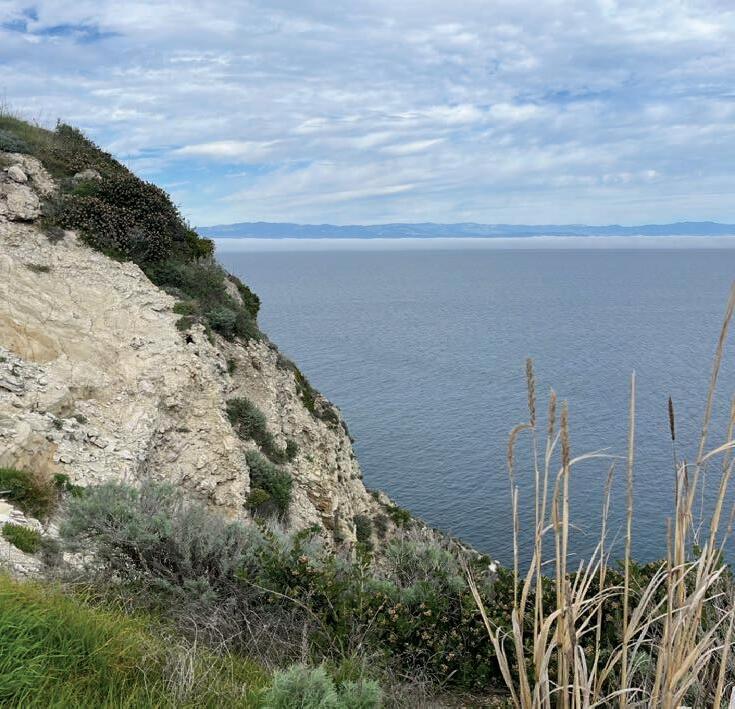
“Honestly, I was pretty surprised. Looking at that many MPAs, I assumed a good chunk would be illegally fished. So this is really encouraging.”
– Gavin McDonald
At the Cultured Abalone Farm, an ocean delicacy is helping to restore ecosystems.
Story by Hilary Dole Klein
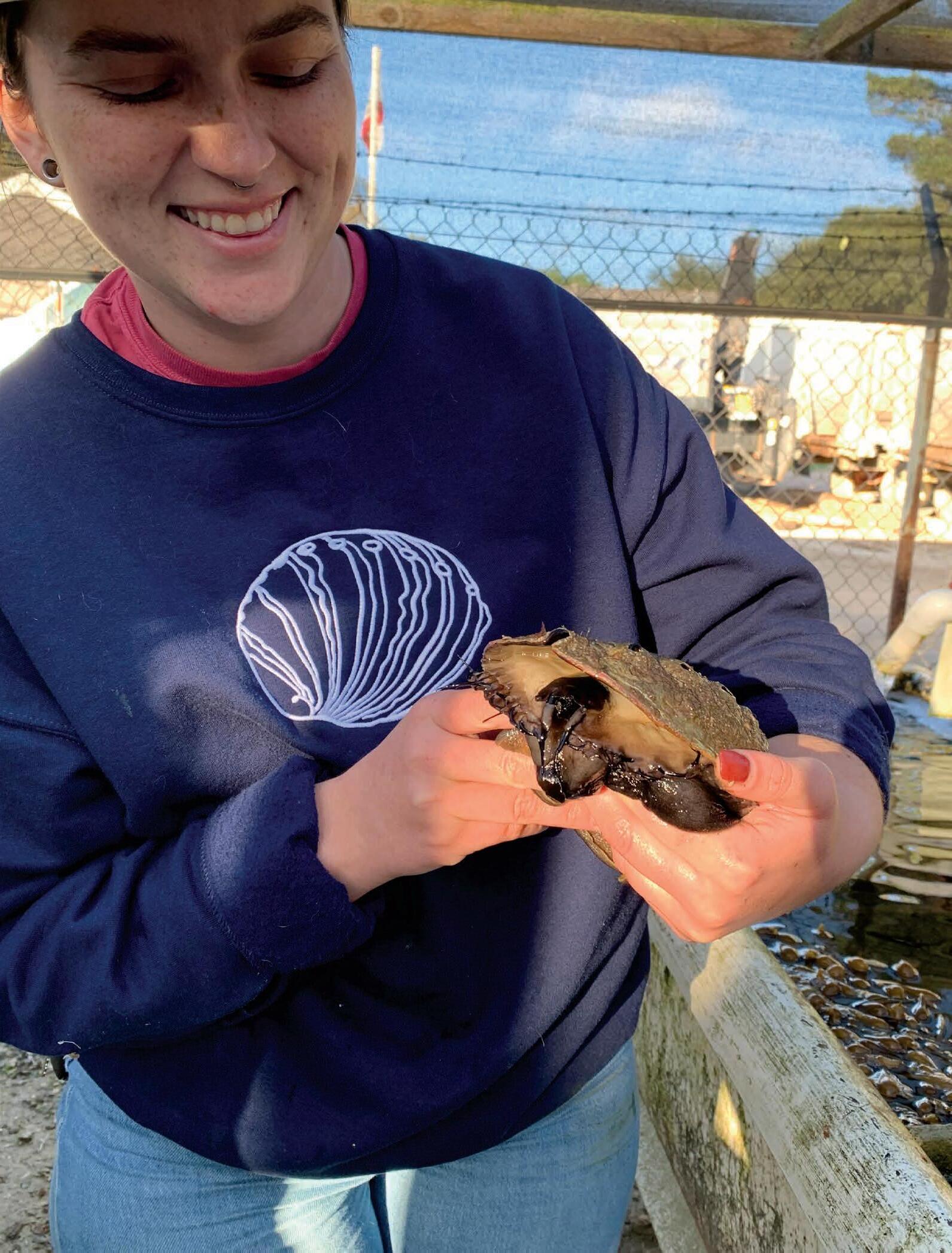
Atour of the Cultured Abalone Farm has to be one of the great, little-known outdoor adventures in Santa Barbara County. At Rancho Dos Pueblos, north of Goleta, you can spend a few hours at this gorgeous spot on the Gaviota Coast, learning about the iconic shellfish. It’s a fascinating glimpse into the miracle of nature.
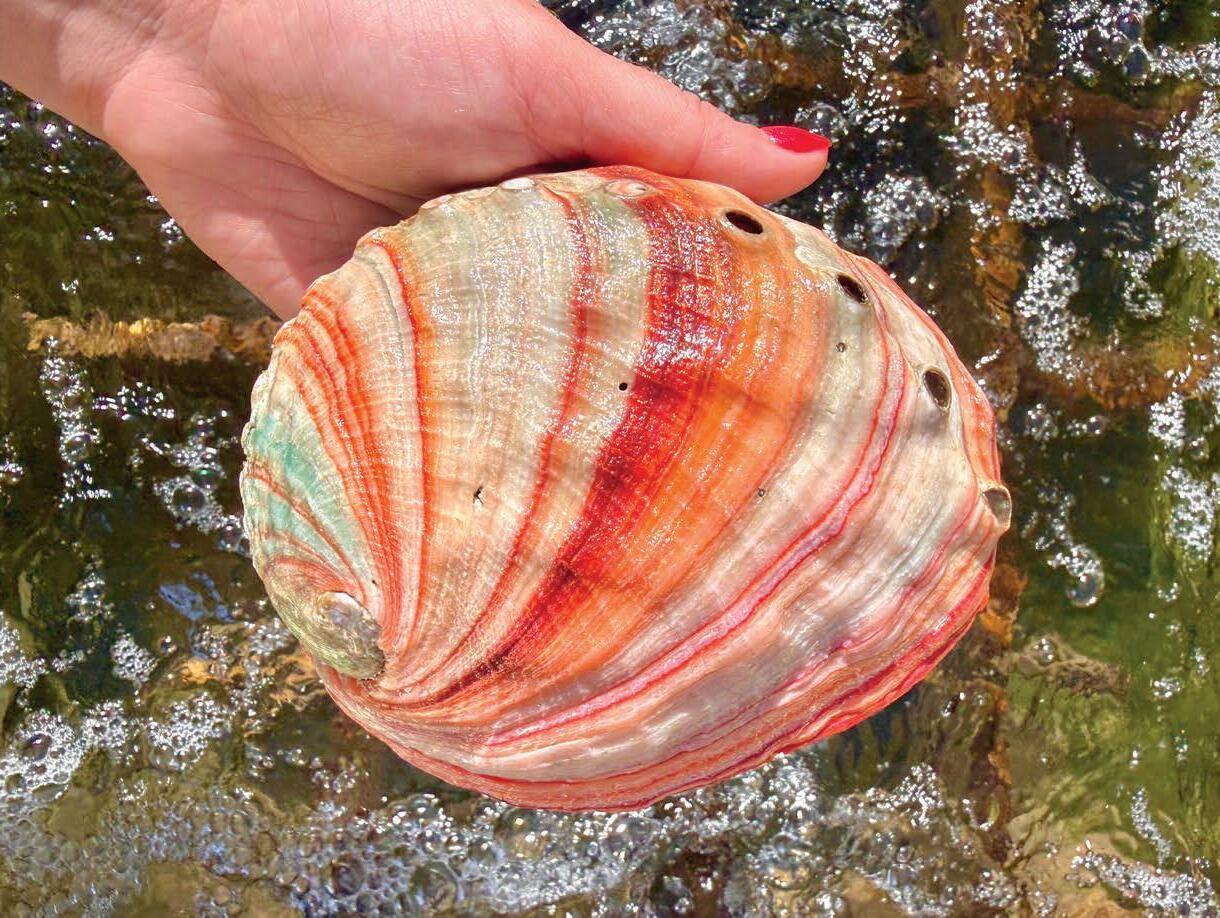
Abalone are marine gastropods, or sea snails. They hide their beautiful motherof-pearl under ear-shaped shells that can grow to be as strong as concrete. For more than 10,000 years, their plenitude fed Indigenous communities along the western coast of the Americas, providing an excellent source of protein. Their multi-colored, pearlescent shells were crafted into decorations, jewelry, and tools and used in ceremonies, burials, and trade.
In Southern California in the 1960s, abalone were so common, you could buy an abalone burger for a dollar at beach burger shacks. On Hollister Ranch, where my family lived during those years, my uncle organized the occasional abalone expedition along its miles of empty beaches. On a rocky point at low tide, he deftly popped abalone off the rocks. Back at the house, we kids were corralled into pounding the tough muscle into the delicacy for which a restaurant like Lucky’s Steakhouse in Montecito now charges $115.
In the heyday of the commercial abalone industry in the 1950s and ’60s, abalone fishers were harvesting 2,000 tons (four million pounds!) a year of red, white, and black abalone — three of the seven
species found in this part of the world. In a regrettably familiar story, as harvests increased, abalone dwindled. At the same time, warming waters and disease killed off the sunflower sea star, the biggest predator of sea urchin, who were then left to reproduce unchecked, decimating the kelp forests that abalone rely on for food.
Commercial fishing was stopped in 1997 — almost too late — and recreational free diving for abalone has been banned until 2036, although poaching is still a big problem.
“In my lifetime, commercial abalone harvesting has never been legal,” says Andie Van Horn, farm-to-table manager at the Cultured Abalone Farm. She is giving me a tour of the operation, explaining that the only way to procure fresh abalone today is through aquaculture. The farm is one of only two that raise abalone in California. The other is the Monterey Abalone Company, where the abalone are raised in crates under a pier.
At the farm, I discovered how a million abalone are spawned in hatcheries and grown with careful husbandry in hundreds of tanks, something that would have been unimaginable to my teenage self walking on the beach, looking for perfect tiny abalone shells.
Van Horn, who studied marine biology at UC Santa Barbara, is an informative, articulate guide. Her job draws on her scientific background and involves a lot of hands-on work.
“Every day, 230 million gallons of unfiltered ocean water are pumped in from intake pipes 40 feet deep in the ocean,” says Van Horn, who takes pride in the farm’s sustainable practices. “The growing environment in the tanks replicates the abalone’s intertidal native habitat.” Every week, 10 to 16 tons of freshly harvested giant kelp are brought in to feed them.
“To trim the kelp, we have our kelp cutter boat,” Van Horn says. “It trims about the top 6 feet — like mowing a lawn — so it doesn’t damage the forest.” Ogo and dulse seaweeds are also grown
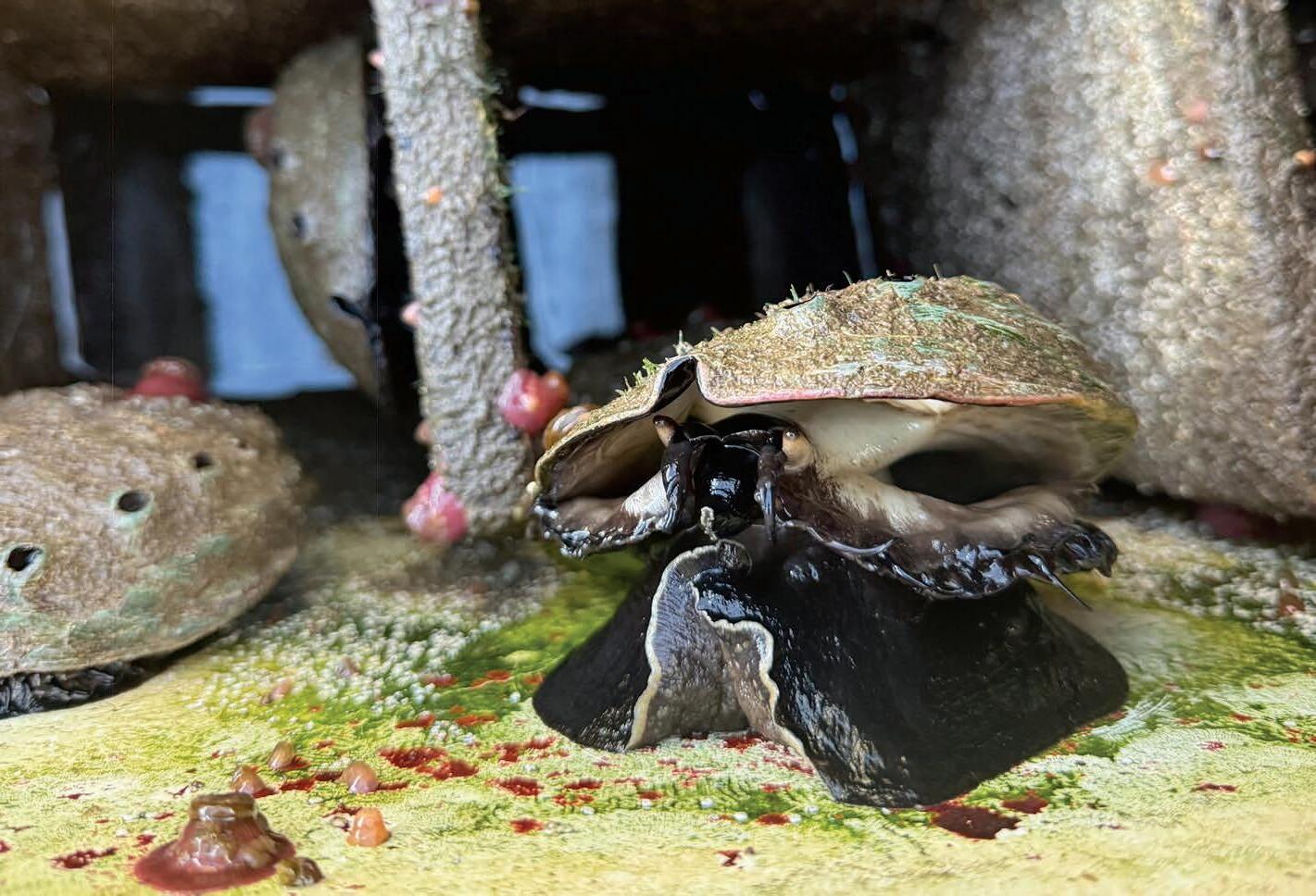
onsite for feed and to sell.
The farm ships abalone throughout the United States, Canada, and the Pacific Rim, along with selling them at its shop. “It has become more of a delicacy than a common meal item,” Van Horn says. “The standard size we sell is about a quarter of a pound, and it takes three to four years of constant hand feeding, weighing, and sorting, as they are moved through the tanks, to get to that size.”
For me, the big story is how conservation and regeneration are just as important to this operation as growing a prized shellfish. The most recent owners of Rancho Dos Pueblos, where the farm is located, created the Dos Pueblos Institute, which works “to connect people to the land in a hands-on, experiential fashion via a variety of programs, including outdoor education, public access, experimental regenerative agriculture, and restoration programs and scientific and educational partnerships.”
The Cultured Abalone Farm, which was founded in 1989, fits all these criteria. One example is their cultivation of purple sea urchins. With the decline of their traditional predators — otters and sunflower sea stars — sea urchins
are decimating the giant kelp along the Santa Barbara coast. Divers from the farm bring the spiky invertebrates from the ocean in a semi-starvation, dormant state to the farm’s tanks. After feeding on seaweed for 10 weeks, they are ready for market.
The farm also contributes to the restoration of red and white abalone by helping to return them to the ocean. The practice benefits both abalone populations and their habitat: Known as “architects of the kelp forest,” abalone increase biodiversity. Among other endeavors, the farm is partnering with the Bay Foundation on a four-year project to outplant 40,000 red abalone at Refugio in response to the 2015 oil spill.
White abalone are considered reproductively extinct; it is thought that they can no longer reproduce in the wild. But they can and do at the farm, which sends hatchlings to other programs researching how to outplant them successfully.
At the Cultured Abalone Farm, science and hard work are contributing to bringing these species back from probable extinction. Go for the adventure, and stay for a lesson in human ingenuity, sustainability, and hope.
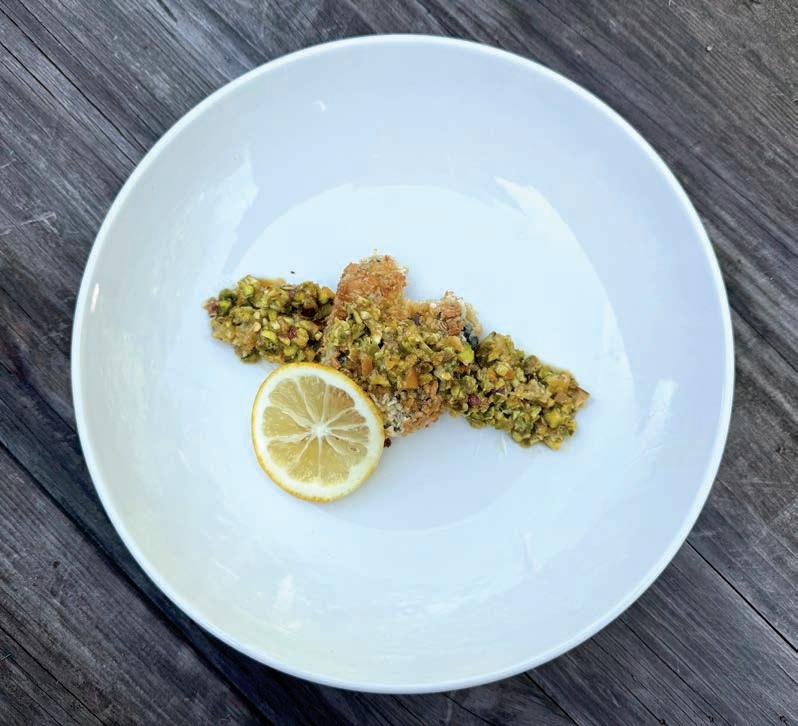

1. Chop the preserved lemon very finely, almost into a paste, being careful to remove the seeds.
2. Zest the lemon and juice half of the lemon. Set aside.
3. On the stove top, toast the pistachios until fragrant and before they turn brown, about 2 to 3 minutes. Let cool before chopping.
4. Add the chopped preserved lemon, lemon zest, lemon juice, and garlic to the chopped, cooled pistachios. Mix in the olive oil. Add salt and pepper to taste. You may not need salt as the preserved lemon is very salty.
5. Using a small paring knife or a spoon, shuck the abalone from their shells: Starting at the top of the abalone, where the holes begin, run your knife or spoon under the membrane connecting the meat
to the shell. Work your way around the shell until the membrane is completely removed from the shell. With some force, pop the meat from its attachment point in the middle of the shell. Remove the guts and head from the meat and discard.
6. Place the abalone between two sheets of parchment paper, ensuring the parchment is folded and tucked along the edges, enclosing the abalone on all sides.
7. Using a meat tenderizer or rolling pin, lightly pound the abalone to tenderize, being careful not to split the meat. Pound until the abalone is about 1/4-inch thick. Repeat with each abalone, using new parchment paper each time.
8. In a heavy-bottomed pan such as cast-iron, add the oil to coat the bottom of the pan. Heat on medium-high until the oil is shimmering and starting to smoke.
Recipes and photos courtesy of Cultured Abalone Farm
Serves 2 as a main protein or up to 6 as an appetizer
The gremolata
1/2 preserved lemon
1 whole lemon
1 cup raw pistachios
1 garlic clove, grated finely, until it forms a paste
1/4 cup olive oil
Salt and pepper to taste
The abalone
6 standard size abalone (about 1/4 lb each)
Avocado oil, or another high-smoke-point oil
2 large eggs
1 cup flour
1 cup panko
Sea salt
9. While waiting for the oil to come to temperature, lightly beat the eggs in a shallow bowl. Place the flour and panko in separate shallow dishes and season each with salt. Dredge each abalone steak in flour, then eggs, then panko, ensuring each steak is coated completely.
10. Cook the breaded abalone for 40 seconds on each side in the smoking hot pan until golden brown. Be sure not to crowd the pan; cook the abalone in batches if necessary. Place on a paper towel or wire rack to drain any excess oil. Season with salt immediately.
11. Top the hot abalone with the preserved lemon gremolata to your taste, and enjoy!
NOTES Can’t find preserved lemon? You can substitute two whole lemons. Just be sure to cut the whole lemon really finely after zesting and juicing, and remove the seeds.
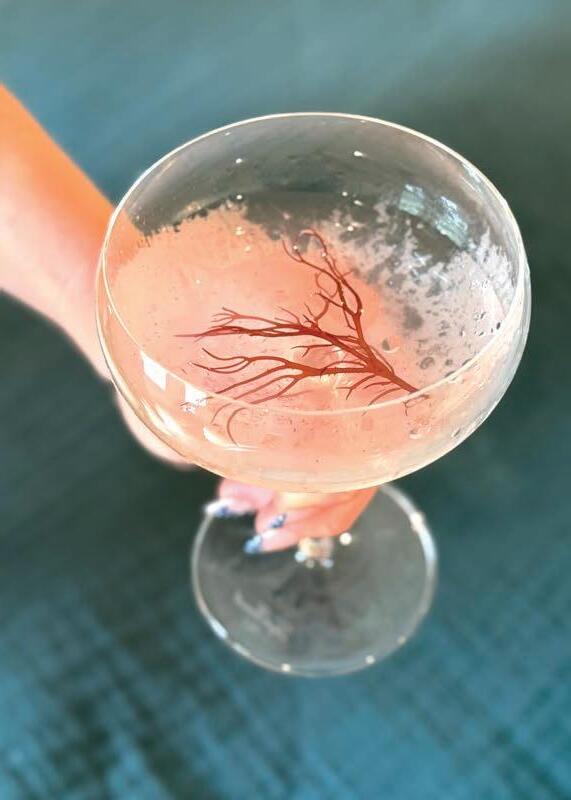
Serves 1
INGREDIENTS
1 handful ogo seaweed
2.5 oz gin or vodka
0.5 oz dry vermouth
Ice
1 sprig ogo, for garnish
INSTRUCTIONS
1. Place your martini glass in the freezer.
2. Place the handful of ogo in the bottom of a cocktail shaker, and add the ice to the top.
3. Add the gin or vodka and the vermouth.
4. Shake vigorously.
5. Pour the drink though a strainer into your chilled martini glass, and top with an artful sprig of ogo. Enjoy!
NOTES If you don’t like vermouth, you can substitute an equal amount of gin or vodka.
You can grow abalone with materials from any hardware store: plastic buckets, PVC pipes, bathroom tiles, and shade cloth. The challenge is getting access to fresh recirculating sea water.
Fossils show that abalone lived along the Pacific Coast 70 million years ago. Pockets of them survived the Ice Age to evolve into more than 50 species worldwide.
Red abalone is named for the red band around the edge of its shell, while white abalone gets its name from the color of its meat tissue.
Abalone have primitive eyes that can detect light. They use chemical sensors on their ruffled black epipodial fringe to detect nearby seaweed.
Marine gastropod mollusks like abalone graze seaweed by slowly scraping away at it using their radula, an organ that resembles a tongue with teeth.
Pearls found in abalone are rare and highly prized. Known for their intense colors and iridescence, they come in irregular, non-spherical shapes that resemble a shark’s tooth or a horn.
Before free diving for abalone was outlawed in California in 2018, the sport attracted passionate, obsessive practitioners, as well as unfortunate amateurs. Cold water, unpredictable swells, and tangles of kelp make abalone diving more fatal than skydiving.
Cape Ivy, an invasive vine, spreads quickly and smothers native species. Eradicating it is costly and difficult — but UC Santa Barbara researchers may have come up with an inexpensive fix.
By Tyler Hayden
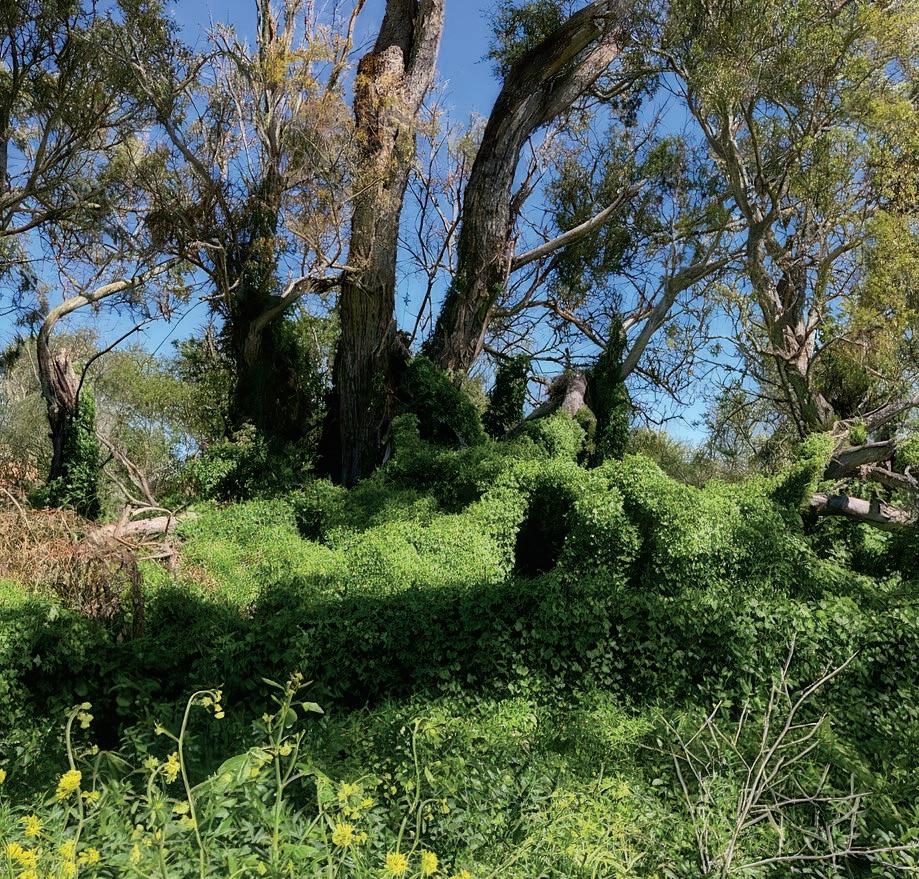
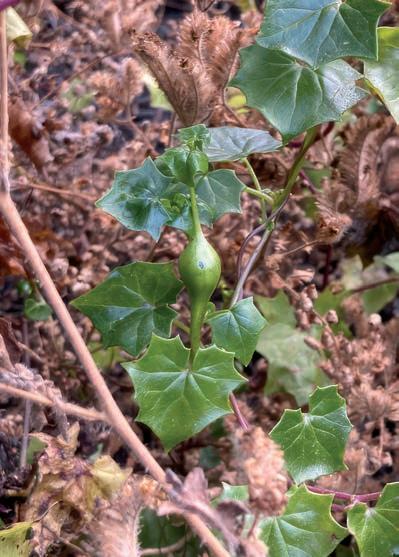
Cape Ivy is a perennial vine with petite yellow flowers that was introduced to California in the late 19th century as an ornamental houseplant. But it wasn’t long before the South Africa native escaped its pots and took root in the wild, spreading across West Coast landscapes in thick mats of vegetation that smother native plants and throw entire ecosystems out of whack.
Today, Cape Ivy — nicknamed “Kudzu of the West” after its equally destructive cousin in the eastern U.S. — occupies more than 500,000 acres of California. With a shallow root system, it’s fond of shady riparian corridors but can also survive on sunny hillsides, where it laps up morning fog. It grows so fast — up to a quarter-mile a year — and with so much mass that it’s been known to topple fences and telephone poles and block train tracks. In the summer it goes dormant, dries up, and creates fire hazards.
Given the scale of the problem, controlling Cape Ivy with bulldozers or chemicals would be a massive undertaking, not to mention prohibitively expensive. Golden Gate Park in San Francisco, for example, recently spent three years and $600,000 trying to map and eradicate its infestation, with mixed results. But what if an insect from the same region of South Africa could help curtail this ecological threat?
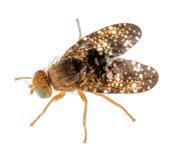
Since 2016, after a decade of intensive research by the U.S. Department of Agriculture, scientists have been releasing thousands of tiny Cape Ivy flies across 22 coastal California sites as a form of “biological control.” Adult females lay eggs within new growth tips of the vine, and as
quartermile a year.
larvae develop, their feeding stimulates the plant to form galls — hollow, spherical swellings around the feeding site. These galls, while not immediately lethal, disrupt shoot development and significantly slow the ivy’s growth and ability to spread.
Ten years into the project, the army
Once the fly colonies are established, no more human intervention is needed. “We could all lose interest and funding and the flies will still be there doing their thing.”
of introduced flies is making a real impact, said Madeline A. Holroyd, a grad student researcher with UC Santa Barbara’s RIVRLab (rivrlab.org). Holroyd recently presented findings from an ongoing survey to the USDA, where she and her team documented the concentration and pattern of galls at release sites. “The numbers are looking really promising,” she says. Among the most successful locations thus far are Santa Barbara’s Atascadero Creek and Toro Canyon Park, where more than 100 galls were counted, some 3.5 miles from where the flies were released. Further north in Big Sur, “a site has actually shown strong reduction in [Cape Ivy] from biocontrol and likely some recovery of the native coastal sage scrub habitat that was being smothered before,” says Tom Dudley, director of the
RIVRLab. Other promising locations include Garrapata State Park in Carmel and Glen Deven Ranch in Monterey.
Over the years, scientists have refined their release methods. Early efforts used cages containing equal numbers of male and female flies placed at release sites. More recent techniques involve planting greenhouse-reared Cape Ivy plants already laden with galls into the field. In her presentation to the USDA, Holroyd noted that sites with connected riparian corridors may facilitate higher dispersal rates and should therefore be prioritized for future releases.
By its nature, biocontrol is a slow, steady process, Holroyd explained. Results don’t appear overnight. “It’s a tricky thing,” she says. “People like to see results, and they like to see them fast.” That can frustrate impatient land managers,
but Holroyd stressed a main upside of the strategy: Once the fly colonies are established, no more human intervention is needed. “We could all lose interest and funding and the flies will still be there doing their thing,” she says.
Holroyd is also investigating how insects might be used to slow the spread of tamarisk and yellow star thistle, two more invasive weeds wreaking havoc on native California habitat. In lab tests, a type of weevil has proven its mettle, but they’re especially difficult to rear, Holroyd says. “But that’s an interesting part of it, too,” she says. “The learning process.”
Holroyd is currently in talks with a conservation group in Ventura County that is concerned about Cape Ivy climbing trees and disturbing monarch butterfly colonies there. It could be a perfect opportunity for another release. Holroyd likes the idea of one insect helping another.
And while the monarchs are renowned for their flashy orange and black, the flies have their own charm too. “Under a microscope, their wings look like stained glass,” she says. “They’re really quite beautiful.”
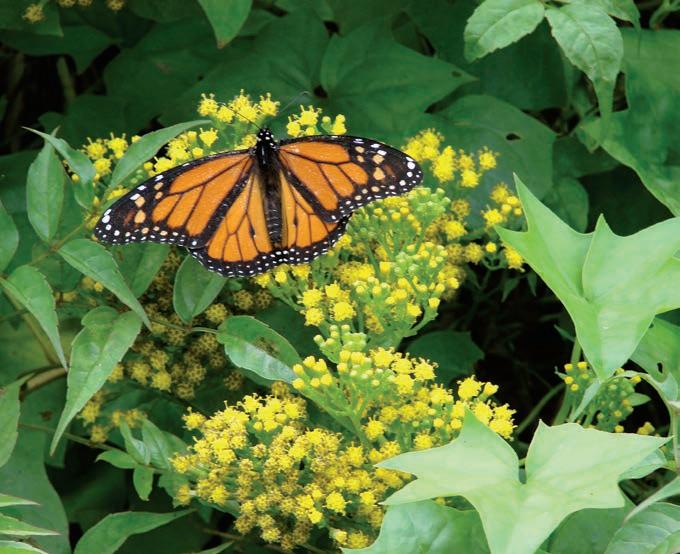
Cape Ivy in bloom.
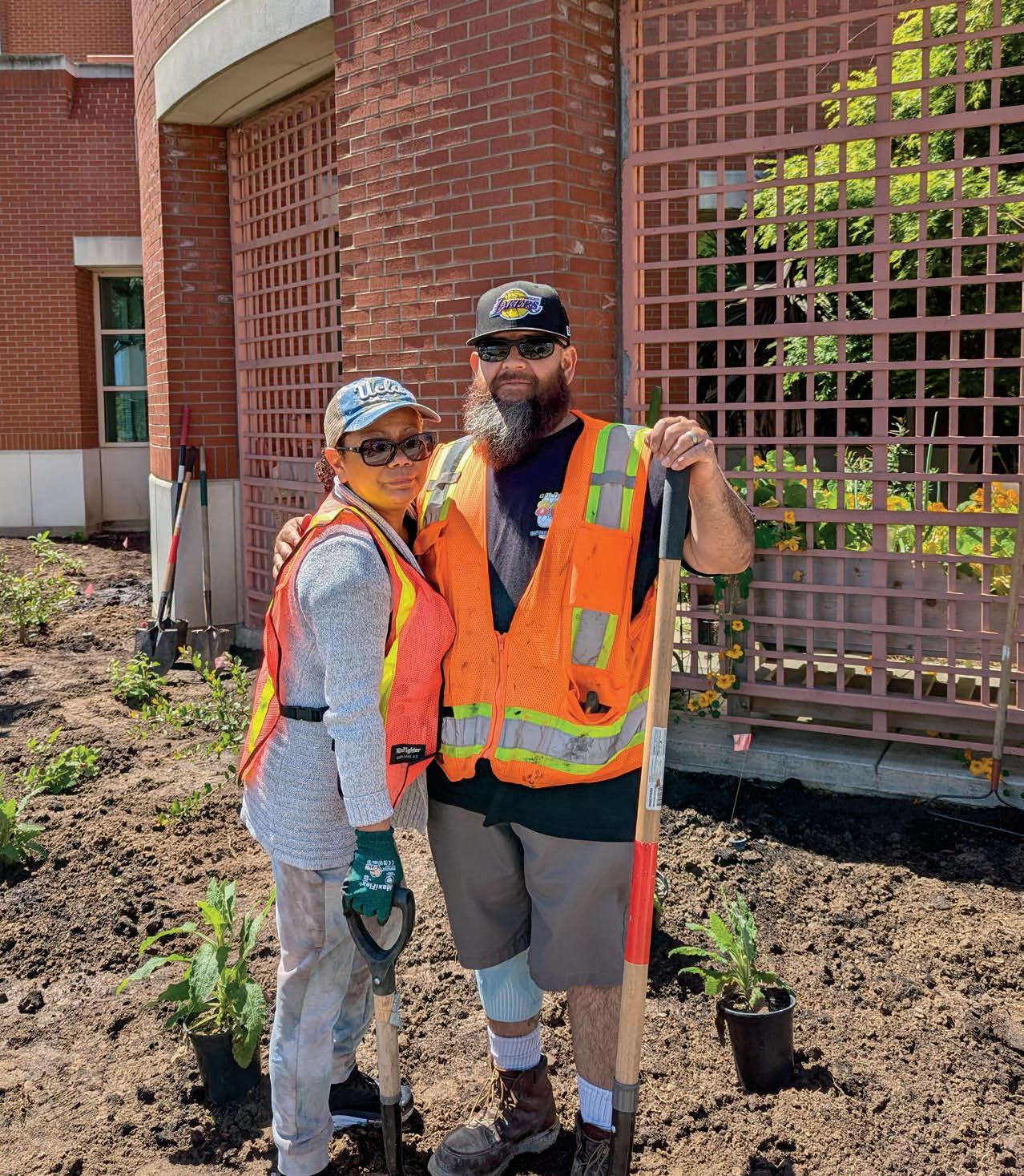
A brother-and-sister-duo is leading a movement to plant native gardens and habitats in Oxnard — and they aren’t asking for permission.
By Emily Cain Photos by Diego Magaña
Take a drive down the Santa Barbara coast, and before you make it to Los Angeles, you’ll hit Oxnard, a concrete coastal city right in the middle. If Santa Barbara is “L.A. without the traffic,” then Oxnard is Santa Barbara without the resources. But what it lacks in funding, it has always made up for in people power.
Diego and Miranda Magaña, siblings and co-founders of the nonprofit MiniNature Reserve (mininature.org), have lived in Oxnard their entire lives. Growing up in a town whose history is steeped in activism, yet is often reduced to what Miranda calls “the dumping grounds for a lot of larger cities,” has taught the siblings to not sit idly by.
In 1903, Mexican and Japanese laborers working on sugar beet fields in Oxnard unionized to form the Japanese Mexican Labor Association — the first major farmworkers union to unite members of different races — and held a 48-day strike against unfair wages and exploitative contracts. Years later, during the ’60s and ’70s, Dolores Huerta worked with the Community Service Organization, a Latino civil rights group, to organize movements to help farmworkers unionize throughout Ventura County, including in Oxnard. In 2025, a housing project in Oxnard for farmworkers and veterans was established, honoring her activism with the name Dolores Huerta Gardens.
Today, the people of Oxnard have come together to take action for their community once again. A group of guerilla gardeners working with the siblings’ nonprofit is quietly planting patches of food, medicine, and native habitat in neglected pockets around Ventura County.
When Miranda looks back on her childhood, she doesn’t see power plants, abandoned lots, and paved roads. She remembers walks to the park, getting down in the grass and plants, and collecting ladybugs in a water bottle to bring back to her grandmother’s garden.
“Plants don’t need permission to grow and flourish. This is where they belong, and they were here before us.”
– Miranda Magaña, co-founder of MiniNature Reserve
“Somehow I ended up with a fascination with nature. Because if you look in Oxnard, there’s not a whole lot,” she says. “You have to look in the small, little places.”
As the saying goes, you can’t miss what you’ve never had. Those moments of getting down in the grass and searching for bits of nature among the concrete were enough. That is, until Diego took a trip to the Grand Canyon.
As he stood there, taking in the natural beauty and grandeur of the canyon, he was moved to tears. “To this day, it’s the only national park that’s made me cry,” he says. On the way back to Oxnard, he realized what was lacking in his own home. “When you drive back, you start to notice all the forest and the deserts turn into farms and then gradually into concrete and asphalt,” he says. “I started grieving the loss of nature.”
He shared his feelings with Miranda. Surely, they thought, Oxnard was once just as beautiful as those deserts and forests. “The answer to bringing that beauty back was native plants,” Diego says.
They started propagating native plants in their backyard, some with medicinal and food value. Once they were ready to be planted, they called on their community via social media.
“We didn’t ask anyone. We didn’t ask the city,” Diego says. “Eight people showed up on the first day.”
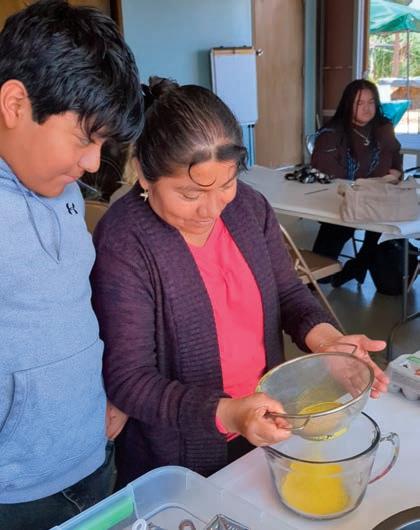
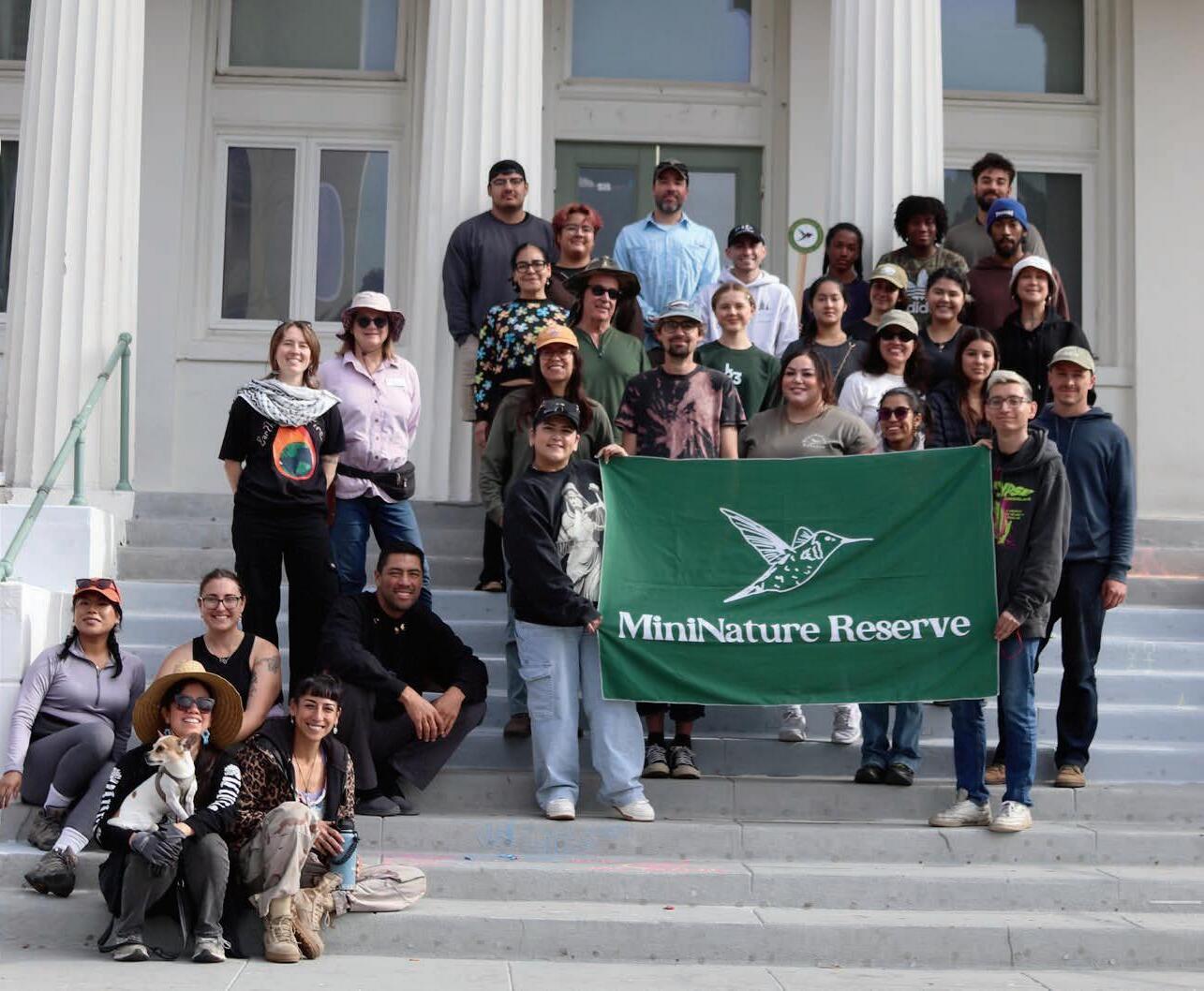
Volunteers are coming to Diego and Miranda with their own guerilla gardening projects. “We’re giving them everything they need and they go out and they do it,” Diego says. “Now, the city can’t even keep up.”
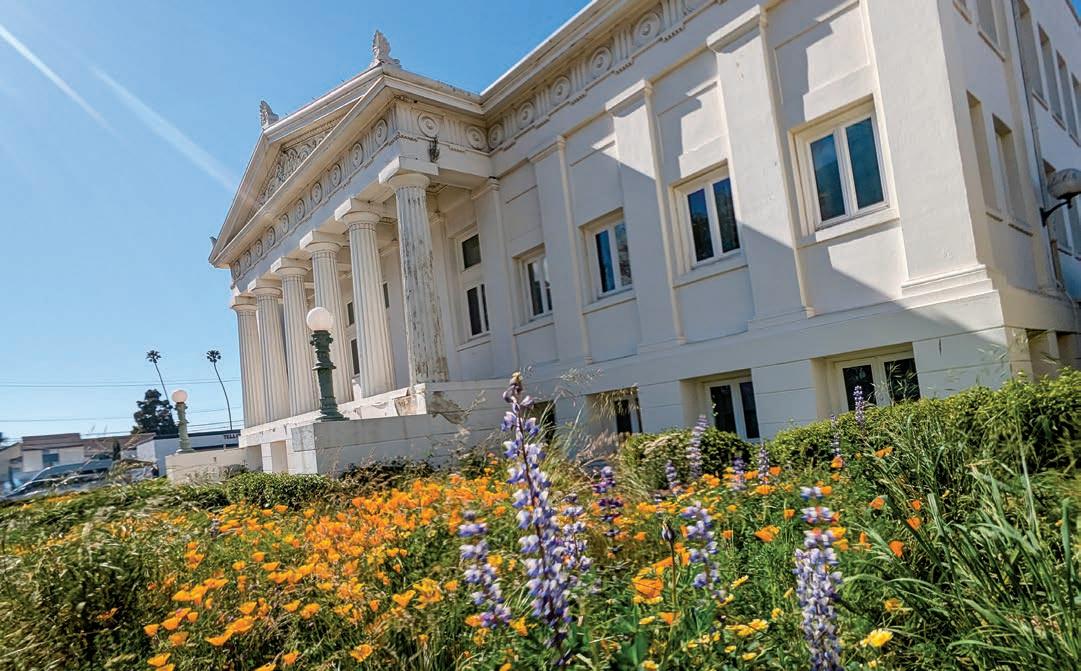
Since that first event in 2020, MiniNature Reserve has put more than 3,500 native plants in the ground with the help of more than 1,500 volunteers. Today, the nonprofit has 21 gardens maintained by the people.
But it hasn’t come without its challenges. “Unfortunately, we sometimes get gardens ripped out that were planted by the community,” Miranda says.
The city designs landscaping to take as little effort as possible by the maintenance team, who follow a “mow, blow, and go” system, Diego says. “When you add something that needs more care, then the maintenance crew gets scared.”
Sometimes the installations are destroyed by unknowing landlords who might mistake native sprouts for weeds, but the usual suspect is the city, who has mowed down, ripped up, and poured concrete over some of the gardens, citing the plants as tripping hazards in one case.
“It’s a little bit of a complicated relationship. Right now, there’s a lot of people in the city who claim to support us, but they told us they want to have an agreement in place,” Diego says. “But they have stalled, and it’s going to be almost a year since they banned us from doing anything in the gardens.”
Despite the disheartening reaction from the city, the Magañas and their volunteers refuse to back down. They are set on correcting the imbalance between those in power, the people, and the plants.
“I absolutely think that we don’t need permission to plant,” Miranda says. “Plants don’t need permission to grow and flourish. This is where they belong, and they were here before us.”
Now, MiniNature Reserve is working to mobilize their volunteers. They offer a training program and invite volunteers to their plant nurseries to empower and educate their neighbors on how to design, install, and maintain mini native habitats and gardens.
“With just poppy seeds, you can paint the whole town orange.”
– Diego Magaña
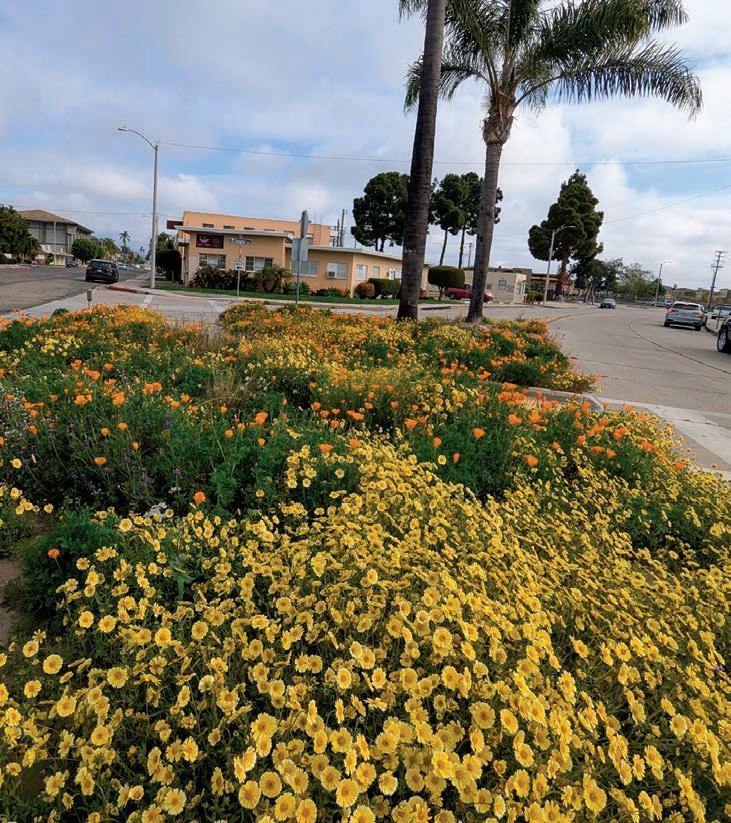
With that education, volunteers are coming to Diego and Miranda with their own guerilla gardening projects. “We’re giving them everything they need and they go out and they do it,” Diego says. “Now, the city can’t even keep up.”
The nonprofit also works closely with local Indigenous communities to host Indigenous knowledge classes. These workshops teach the community how to use plants harvested from MiniNature’s gardens and nurseries for food, medicine, and cultural practices.
“We are at this place where we’re realizing that we have a lot of volunteers, and in a numbers game, we beat them,” Diego says of the government officials in opposition. “They don’t run the city. They serve us.”
• Fill an empty seasoning shaker with a mix of native wildflower seeds and sprinkle seeds around your city.
• Create your own seed bombs using recycled paper, compost, or clay and plant them in empty patches. Learn how at bit.ly/diy-seed-balls.
• Sign up to volunteer at mininature.org/sign-up or donate at mininature.org/donate.
















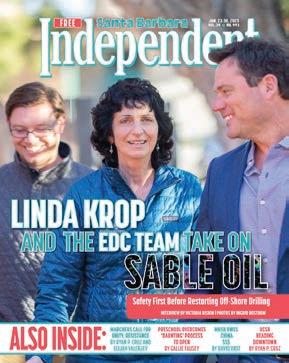
To: Bluedot Living
From: Get Oil Out!
Subject: Stopping Sable
On January 28, 1969, a disaster of unbelievable proportions struck Santa Barbara. Union Oil’s Platform A, six miles from shore and in 188 feet of water, suffered a “blow out” in the Santa Barbara Channel. In less than 24 hours, 75 square miles of ocean were covered in oil, and 210,000 gallons continued spilling each day for more than a week, resulting in the worst man-made environmental disaster in U.S. history at the time.
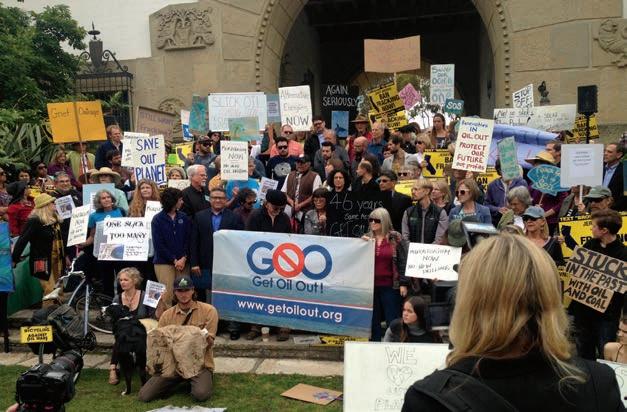
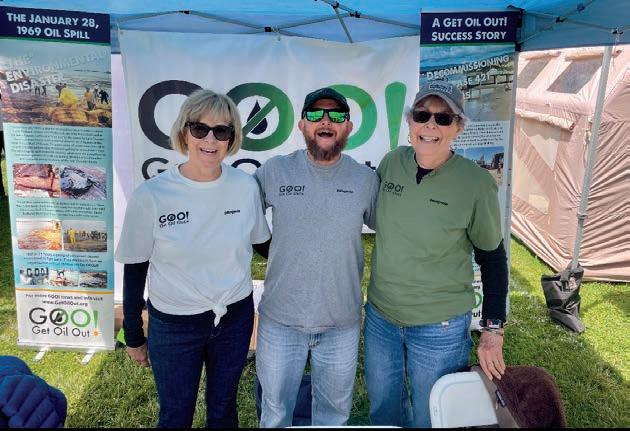
Within 24 hours, a group of concerned citizens assembled to fight back. They formed an organization called Get Oil Out! (GOO!). Since 1969, GOO! has been fighting proposals for oil and gas development, from leasing to production.
In what became known as the Refugio Oil spill, more than 450,000 gallons of crude oil gushed into the Santa Barbara Channel in May of 2015, spreading at least 150 miles to the south and damaging 1,500 acres of shoreline habitat and 2,200 acres of subtidal habitat. Sable Oil proposes to use the same badly corroded oil pipeline that burst in 2015 to resume oil production from three platforms on the western Gaviota Coast. GOO! is convinced that this pipeline, which now lacks adequate protection from erosion, will spill again if returned to service. If it does, Sable will have little financial resources
TAKE ACTION AGAINST SABLE
Make your voice heard by writing to public agencies and elected officials, including the California Coastal and State Lands Commissions, State Parks Department, State Fire Marshal, your county supervisor, state assemblymember, state senators, and the governor. Let them know this proposal is too risky for our coast. You can also take steps in your own life to reduce dependence on fossil fuels: Use public transportation, ride a bike, or install solar panels if you’re able. Collectively, small actions make a difference!
with which to respond to a significant oil spill like the one in 2015. GOO! is working with multiple environmental groups to stop this risky proposal in its tracks.

JOIN GET OIL OUT!
Our strength is in our numbers, so join us! Chat with us on Saturday, April 25, from 11 a.m. to 5 p.m. at the Santa Barbara Earth Day Festival at Alameda Park. Donate at getoilout.org and sign up to receive our quarterly newsletters. We’ll keep you informed about the latest updates on Sable and other oil development proposals, as well as upcoming events.
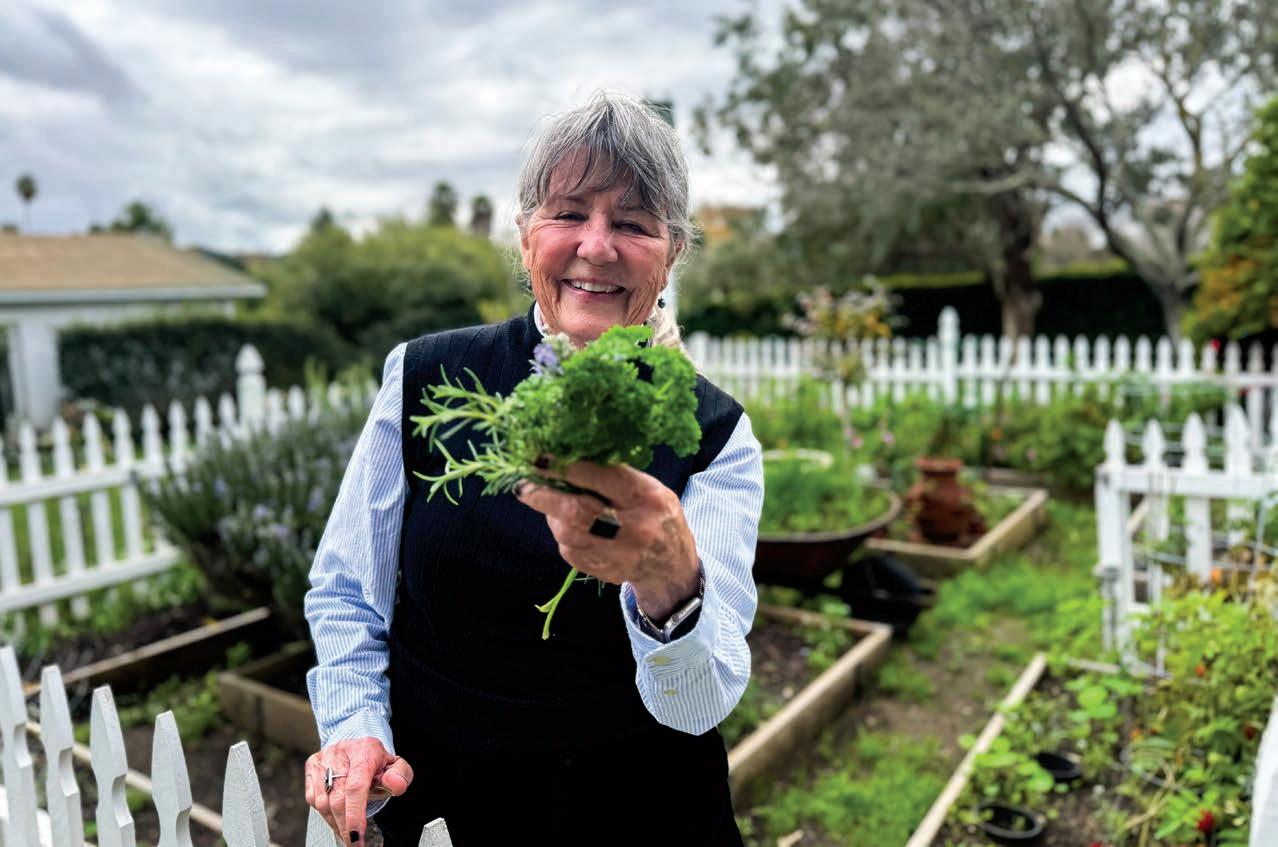
Best-selling author Susan Branch built the garden of her dreams in her backyard, complete with tomato plants, roses, manicured pathways, birdbaths, and milkweed for the monarchs.
Story and photos by Ethan Maday
Susan Branch and I sat down in her kitchen, counters and windowsills displaying ceramic baubles and appliances older than I am. The smell of tea wafted through the air, and beams of sunlight peeked through the windows, illuminating her overflowing studio desk stacked high with journals and watercolors.
In this home about an hour up the coast from Santa Barbara, the best-selling author and self-taught artist handwrote and illustrated her Heart of the Home series (susanbranch.com). Many of her books share recipes, depict travels, and present diagrams of her garden.
Susan’s love for gardens started on a garden-to-garden trip through England. “We fell in love with it … and we came out to California and laid the foundation for an English garden. And over the years, it grew.”
I was about to discover just how much it had grown. Around the side of her quaint cottage, we stepped from her dirt driveway into the meticulously planned and maintained plot that was clearly another canvas for Susan.
“I thought gardening was petunias, carrots, and tomatoes,” she cheerfully explained. “But there’s just much, much more to it. It’s an art all by itself.”
“I thought gardening was petunias, carrots, and tomatoes. But there’s just much, much more to it.” – Susan Branch
We walked on grass pathways threaded through hedgelined corridors, every corner a new patch of beauty. Water splashed and bubbled in granite bird baths, and the scent of roses hung in the air. Susan pointed out the milkweed plants, rest stops for the seasonal monarch butterflies on their journey south. Simon, a friendly, handsome cat, proudly pranced through the flowers.
In Susan’s “kitchen garden,” plump, ruby-red tomatoes hung heavy on their vines, while rosemary bushes sweetened the air. Flower buds grew on nasturtium vines, preparing to
reveal their brilliant red and orange petals. Nearby, abundant green onions sprouted.
“Everything that you want in your salad is the first thing I would plant in spring,” she said. “So I would plant lettuce, tomatoes, herbs, and definitely nasturtiums.”
Every day, Susan and her husband, Joe, stroll through the garden and on the outskirts of their property. They walk along the creek, through the long grasses, and listen to water running and birds singing their good-morning song. Susan finds meaning in the small moments: a hummingbird at the birdfeeder, dewdrops in a spider web, the sharp aroma of ceanothus, the California lilac.
After our garden stroll, we sat down again. Between sips of afternoon tea, Susan explained why she put so much time and effort into her garden.
“It’s just a joy surrounding yourself [with beauty] and growing things,” she said. “It’s paradise out here. I wake up happy every day.”
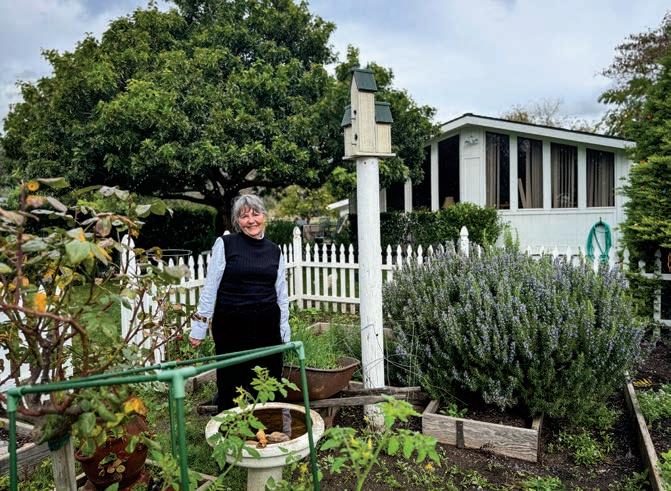
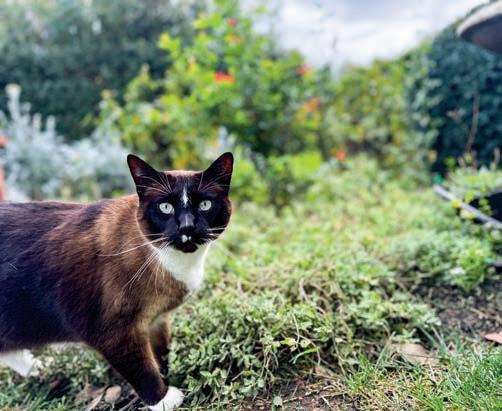
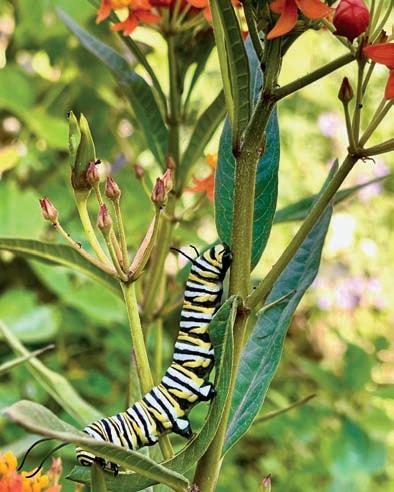
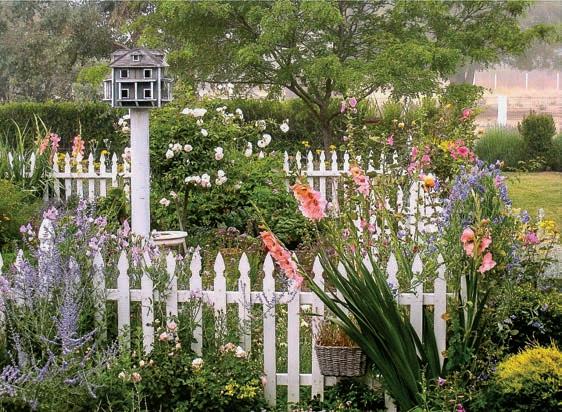
This handbook lists services, stores, and advice that will come in handy all year long.
ADVOCACY: Contact elected officials and comment at public meetings. Get up-to-date contact information for officials, as well as calendars and agendas for public meetings, at countyofsb.org or your city’s website or city hall.
This nonprofit with more than 50 years of leadership on the Central Coast is working to reverse the climate crisis. This is a go-to hub for whatever you want to know about environmental policies, issues, programs, and more. cecsb.org
ELECTRIFY YOUR LIFE: This CEC program gives guidance on tax credits and incentives for energyefficient upgrades and electric vehicle and e-bike purchases. Free to residents of Santa Barbara, San Luis Obispo, and Ventura counties. Resources are available in English and Spanish. Fill out an interest form at cecsb.org/electrify-your-life.
LAWN REBATE: Apply in advance through the City of Santa Barbara to get paid to remove your lawn. santabarbaraca.gov/lawnrebate
LIBRARY OF THINGS: The Santa Barbara Public Library offers an assortment of objects that you can borrow and then return. Want to try a new instrument? Go on a fishing trip? Bring binoculars on a hike? Borrow items and avoid buying things you may not use again. 40 E. Anapamu St., Santa Barbara, library.santabarbaraca.gov/books-more/library-things
LOS PADRES FORESTWATCH: Since 2004, this advocacy group has worked to protect and restore the forests, chaparral, grasslands, rivers, wildlife, and wilderness along California’s Central Coast. They monitor forest conditions, conduct conservation projects, review and comment on projects proposed by public land management agencies, and educate the public through plant walks, hikes, birding excursions, and more. forestwatch.org
SANTA BARBARA BOTANIC GARDEN: For 100 years, this 78-acre garden has been dedicated to conserving and displaying California’s native plants. Visitors can walk more than 5 miles of trails and experience everything from a redwood forest to desert landscape. Guided nature walks provide opportunities to learn more about the state’s natural habitat, and hands-on classes offer tips on establishing your own native garden. sbbotanicgarden.org
SANTA BARBARA MUSEUM OF NATURAL HISTORY: Founded in 1916, this museum includes exhibits on local mammals and marine life, minerals, and Chumash plants, as well as rotating exhibits on other aspects of the natural world. Visitors can marvel at the museum’s blue whale skeleton, one of just five complete such specimens in the world, and gaze at the cosmos through telescopes in the Palmer Observatory. sbnature.org
SUSTAINABILITY AND RESILIENCE DEPARTMENT:
The City of Santa Barbara is spearheading a range of sustainability initiatives, from promoting alternative transportation to investing in clean energy to implementing climate adaptation solutions. Find comprehensive information on projects and resources for taking action, sign up for news about programs and events, explore volunteer opportunities, and keep up to date on the latest waste services online. sustainability.santabarbaraca.gov
EYE OF THE DAY GARDEN DESIGN CENTER: Peruse a wide variety of garden decor that can be customized. By appointment only. 273 Bell St., Los Alamos; and 321 N. Aviador St., Camarillo; eyeofthedaygdc.com
GET HOOKED: This subscription offers delivery or pickup of local seafood that you can customize based on your taste and schedule. gethookedseafood.com
LA SUMIDA: This nursery and gift shop specializes in organic gardening. 165 S. Patterson Ave., Santa Barbara, lasumida.com
MATTRESS MIKE: This local shop features ecofriendly mattresses. 3845 State St., Santa Barbara, mattressmikesb.com
MISSION REFILL: Buy less-wasteful products like bamboo straws and reusable paper towels, or choose from a selection of over 40 refillable products. 5733 Calle Real, Goleta, missionrefill.com
NATURAL HAVEN: Learn how to reduce toxins in your home with a customized consultation. naturalhavensb.com
SUNKISSED PANTRY: Find home essentials for everything from kitchen to beauty to pet products without single-use plastic packaging. 19 E. Canon Perdido St., Santa Barbara, sunkissedpantry.com
ANTIQUE ALLEY, antiques, 706 State St., Santa Barbara, antiquealleysb.com
BLUE DOOR, antiques, 4 E. Yanonali St., Santa Barbara, thebluedoorsb.com
CROSSROADS TRADING, thrift, 1025 State St., Santa Barbara, crossroadstrading.com
LOVEWORN, vintage, 11 Anacapa St., Santa Barbara, shoploveworn.com
MOVING MISS DAISY’S CONSIGNMENT & AUCTION HOUSE, consignment, 3845 State St., Santa Barbara, consignmentsbymmd.com
UNITY SHOPPE, thrift, 1209 State St., Santa Barbara, unityshoppe.org
SOLAR COMPANIES
BRIGHTEN SOLAR CO., brightensolarco.com
MAC’S SOLAR, macsolar.com
SUNRISE 805, sunrise805.com
SANTA BARBARA COUNTY ASSOCIATION OF GOVERNMENTS (SBCAG) TRANSPORTATION
PROGRAMS: Find alternatives to driving alone, from electric buses to carpools, vanpools, and e-bike lending programs, and use the SmartRide app for trip planning. sbcag.org/projects/traveler-services
MOVE SANTA BARBARA COUNTY: This group advocates for equitable countywide infrastructure for walking, cycling, and public transit and empowers and educates residents to choose active and sustainable forms of transportation. movesbcounty.org
BCYCLE: Use this app-enabled e-bike share service. santabarbara.bcycle.com
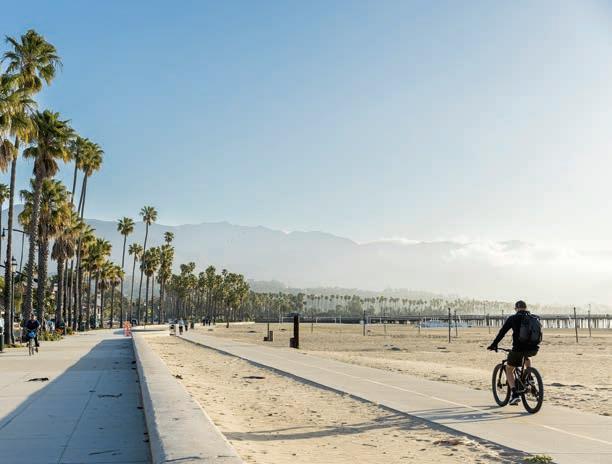
BIKE SHOPS
BICI CENTRO COMMUNITY BIKE SHOPS, 434 Olive St., Santa Barbara; 310 E. Oak St., Santa Maria; Santa Barbara City College, 721 Cliff Dr., Santa Barbara; movesbcounty.org/community-bike-shops-bici-centro
BOOM BOOM BIKE ROOM, 1924 De La Vina St., Santa Barbara, boomboombikeroom.com
FASTRACK BICYCLES, 118 W. Canon Perdido St., Santa Barbara, fastrackbicycles.com
HAZARD’S CYCLESPORT, 110 Anacapa St., Santa Barbara, incycle.com/pages/retailer/hazards-cyclesport
ISLA VISTA BICYCLE BOUTIQUE, 880 Embarcadero del Mar, Isla Vista, islavistabicycles.com
OPEN AIR BICYCLES, 135 E. Carrillo St., Santa Barbara, openairbicycles.com
VELO PRO CYCLERY, 15 Hitchcock Way, Santa Barbara; 5887 Hollister Ave., Goleta; velopro.com
ADVOCACY
CITIZENS PLANNING ASSOCIATION:
This organization advocates for sustainable urban design and land use, as well as natural resource protection. As a volunteer, you can write letters to government officials, assist with clerical work, or be a Watchdog Leader of a project. citizensplanning.org
ENVIRONMENTAL DEFENSE CENTER:
This group takes legal action to protect the local environment. You can volunteer at the organization’s events and help with a range of administrative work. environmentaldefensecenter.org
GET OIL OUT!:
This public-interest group works to protect the Santa Barbara Channel and coastline from the environmental harms caused by oil drilling. Volunteers help with advocacy efforts and community events. getoilout.org
BEACH CLEANUPS
HEAL THE OCEAN: If you want to host a beach cleanup, you can find resources here to help make it a success. healtheocean.org




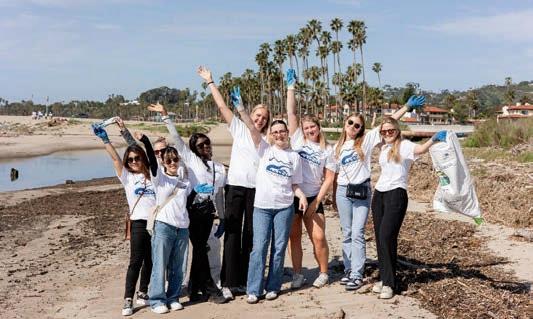
SANTA BARBARA CHANNELKEEPER:
This nonprofit hosts at least four major cleanups each year. sbck.org
CHANNEL ISLANDS RESTORATION: Collect native seeds, help remove invasive species, and maybe even be a sheep docent at the Channel Islands. cirweb.org
LAND TRUST FOR SANTA BARBARA COUNTY:
Participate in habitat restoration and trail maintenance at Arroyo Hondo Preserve and the Jack and Laura Dangermond Preserve. sblandtrust.org

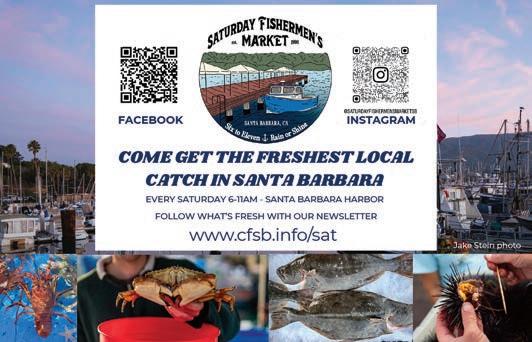
SANTA BARBARA COUNTY TRAILS COUNCIL:
Join the trail maintenance team or serve on an advisory committee for this organization, which advocates for trail access and improvements so nature lovers can enjoy the outdoors. sbtrails.org
YOUR CHILDREN’S TREES: This student-run nonprofit aims to restore local ecosystems by planting trees. Sign up for one of the many tree-planting events online. yourchildrenstreesatucsb.org
WILDLIFE
OJAI RAPTOR CENTER: This wildlife rehabilitation center offers volunteer opportunities to partake in animal care, wildlife transportation, educational programs, data entry, and much more. ojairaptorcenter.org
SANTA BARBARA AUDUBON SOCIETY:
Volunteer at the Eyes in the Sky program to participate in educational initiatives and care for birds. santabarbaraaudubon.org
SANTA BARBARA WILDLIFE CARE CENTER:
Volunteers can help feed, clean, and care for rescued animals; rescue and transport wildlife to the center; answer calls to the center’s helpline; and help out with facilities, gardening, and administrative tasks. sbwcn.org
FOODBANK OF SANTA BARBARA COUNTY: Bring food in good condition. foodbanksbc.org
OTHER ORGANIZATIONS: Check out opportunities to help others and avoid food waste by donating food and scraps. lessismore.org
Donate or find secondhand items and supplies for artsand-crafts projects at Art From Scrap. 302 E. Cota St., Santa Barbara, exploreecology.org/art-from-scrap
Contents of blue bins are consolidated at various facilities, where they are sorted by material and processed for reuse. Among the items that can go in the blue bins are paper, glass, metal, #1 and #2 plastic bottles that once held liquid, and rigid #5 plastic containers that are gallon-sized or larger. Make sure everything is clean, dry, and not in a bag. To learn more about what can and cannot be recycled where you live, go to the county’s Less Is More website. lessismore.org

Put tape on the ends and place them in a sealed plastic bag on top of — not inside — your blue bin or in the orange buckets at apartment buildings. (This service is available for MarBorg customers and does not apply to the cities of Carpinteria, Lompoc, or Santa Maria.) Batteries are also accepted at local hazardous waste facilities throughout the county.
ELECTRONICS: Find a location near you at lessismore.org/electronics.
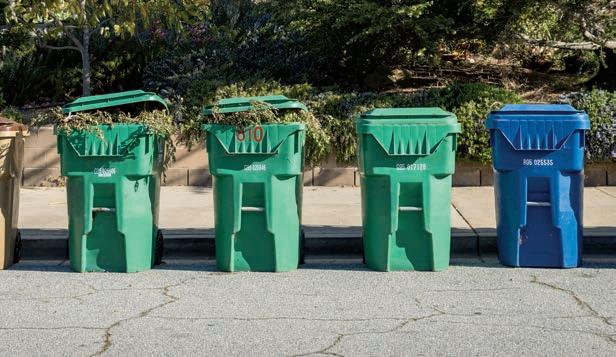
LIGHTS: Fluorescent bulbs and LEDs should be taken to your local hazardous waste facility. String and solar lights should be taken to your local electronic waste collection location. Incandescent light bulbs can be placed in the trash bin.
CARDBOARD PIZZA BOXES: Residents of the South Coast, Santa Ynez Valley, and Cuyama Valley can put these in the trash. They will be sorted out into compost at the ReSource Center. Residents of the Santa Maria and Lompoc valleys should place these in their green bins. Carpinteria residents should bag their pizza boxes along with food waste.
PLASTIC BAGS: To keep film plastics like shopping bags, bread bags, and Ziploc bags (just remove the zipper part) out of the trash, drop them off at Ablitt’s Fine Cleaners and Tailors (14 W. Gutierrez St., Santa Barbara, ablitts.com) during one of their recycling events.
STYROFOAM: Bring to MarBorg in Goleta (20 David Love Place) or Santa Barbara (132 Nopalitos Way).
Yard waste, such as grass clippings, small branches, leaves, and plants, go in the green bin in all of Santa Barbara County. Residents of the Lompoc and Santa


Maria valleys may mix food scraps with yard waste (it’s composted and used in local agriculture), while residents of Santa Ynez Valley and the South Coast should put food scraps in the trash. Carpinteria residents may also put food scraps in the green bin, but they must be placed in plastic or paper bags first.
Mulch from green bin contents is available for free at South Coast Recycling and Transfer Station (4430 Calle Real, Santa Barbara) and Santa Ynez Valley Recycling and Transfer Station (4004 Foxen Canyon Road, Los Olivos).
Did you know? The Santa Barbara Zoo accepts certain plant clippings. sbzoo.org
Residents of Santa Ynez Valley and the South Coast should put all food waste in the trash bins. The waste from the trash bins is then machine-sorted and put into an anaerobic digester at the ReSource Center. This generates methane, which is turned into renewable electricity at a power plant, and the compost is then sold for use by homes, farms, and businesses. This is a great service for those who do not have a yard where they can make their own compost.
Composting your organic waste has multiple benefits, not least of which are the nutrient-rich compost you’ll have for your garden and a lower trash services bill. Keep in mind that the following organic materials shouldn’t go in your home compost bin: dairy products, pet waste, produce treated with pesticides, oils and fats, and meat.
BIN? Get a discounted Earth Machine composting bin at one of these locations:
• South Coast Recycling and Transfer Station (4430 Calle Real, Santa Barbara)
• Santa Ynez Valley Recycling and Transfer Station (4004 Foxen Canyon Road, Los Olivos)
• North County Public Works Building (620 W. Foster Road, Orcutt)
Less Is More offers free workshops. lessismore.org

To: Bluedot Living
From: Channel Islands Restoration
Subject: Safeguarding Rare and Endangered Plants and Animals
Channel Islands Restoration is a nonprofit dedicated to protecting and restoring the unique ecosystems of the California Channel Islands and the adjacent mainland. Our mission is simple yet vital: to safeguard rare and endangered plants and animals by restoring the habitats they depend on for survival. Volunteers are at the heart of our efforts.
We host around six to eight events every month in spectacular natural settings, from the rugged beauty of the Channel Islands, local preserves, and land trusts to the Santa Clara River watersheds and the pristine rivers of the Los Padres Forest.
By removing invasive species and planting thousands of native plants in these spaces and helping to monitor the progress of long-term restoration projects, like our Elings Park Transformation Project in collaboration with Santa Barbara Botanic Garden, our volunteers make a tangible difference.
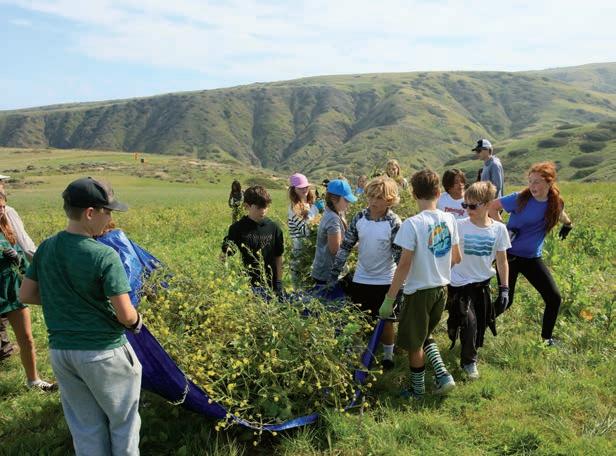
Thanks to their support, and the support of our partners, we’ve been able to expand our efforts to a 21,000-squarefoot native plant nursery in Goleta. During our nursery days, volunteers help us clear out weeds and make way for native seedlings that will eventually be planted across our restoration sites.
Channel Islands Restoration is more than an organization — it’s a movement to preserve the natural heritage of California’s Central Coast. Join us in this mission. Together, we can ensure that these unique habitats thrive for generations to come. Learn more and sign up for volunteer opportunities at CIRWEB.org.
Volunteers of all ages clear weeds and plant native seedlings at Channel Islands National Park.